Interdisciplinary Computing In Java Programming 1st Edition Sunchong Wang Auth
Interdisciplinary Computing In Java Programming 1st Edition Sunchong Wang Auth
Interdisciplinary Computing In Java Programming 1st Edition Sunchong Wang Auth
Interdisciplinary Computing In Java Programming 1st Edition Sunchong Wang Auth
Interdisciplinary Computing In Java Programming 1st Edition Sunchong Wang Auth
1.
Interdisciplinary Computing InJava Programming
1st Edition Sunchong Wang Auth download
https://ebookbell.com/product/interdisciplinary-computing-in-
java-programming-1st-edition-sunchong-wang-auth-4200180
Explore and download more ebooks at ebookbell.com
2.
Here are somerecommended products that we believe you will be
interested in. You can click the link to download.
Soft Computing In Interdisciplinary Sciences 1st Ed 2022 S Chakraverty
https://ebookbell.com/product/soft-computing-in-interdisciplinary-
sciences-1st-ed-2022-s-chakraverty-44939266
Ubiquitous Computing In The Workplace What Ethical Issues An
Interdisciplinary Perspective 1st Edition Katharina Kinderkurlanda
https://ebookbell.com/product/ubiquitous-computing-in-the-workplace-
what-ethical-issues-an-interdisciplinary-perspective-1st-edition-
katharina-kinderkurlanda-4973668
Balancing The Common Core Curriculum In Middle School Education
Composing Archimedes Lever The Equation And The Sentence As An
Interdisciplinary Unity 1st Edition James H Bunn Auth
https://ebookbell.com/product/balancing-the-common-core-curriculum-in-
middle-school-education-composing-archimedes-lever-the-equation-and-
the-sentence-as-an-interdisciplinary-unity-1st-edition-james-h-bunn-
auth-5838812
Technology For Facilitating Humanity And Combating Social Deviations
Interdisciplinary Perspectives 1st Edition Miguel Vargas Martin
https://ebookbell.com/product/technology-for-facilitating-humanity-
and-combating-social-deviations-interdisciplinary-perspectives-1st-
edition-miguel-vargas-martin-1884006
3.
Interdisciplinary Applications OfShameviolence Theory Breaking The
Cycle Roman Gerodimos
https://ebookbell.com/product/interdisciplinary-applications-of-
shameviolence-theory-breaking-the-cycle-roman-gerodimos-45056688
Interdisciplinary Research On Climate And Energy Decision Making 30
Years Of Research On Global Change M Granger Morgan
https://ebookbell.com/product/interdisciplinary-research-on-climate-
and-energy-decision-making-30-years-of-research-on-global-change-m-
granger-morgan-46489974
Interdisciplinary And Transdisciplinary Failures 1st Edition Dena Fam
https://ebookbell.com/product/interdisciplinary-and-transdisciplinary-
failures-1st-edition-dena-fam-48239786
Interdisciplinary Value Theory Steffen Steinert
https://ebookbell.com/product/interdisciplinary-value-theory-steffen-
steinert-48513658
Interdisciplinary Statistics In Mexico Ame Virtual Meeting September
1011 2020 And 34 Fne Acatln Mexico September 2224 2021 Isadora
Antonianovillalobos
https://ebookbell.com/product/interdisciplinary-statistics-in-mexico-
ame-virtual-meeting-september-1011-2020-and-34-fne-acatln-mexico-
september-2224-2021-isadora-antonianovillalobos-48704746
Library of CongressCataloging-in-Publication
INTERDISCIPLINARY COMPUTING IN lAVA PROGRAMMING
by Sun-Chong Wang
ISBN 978-1-4613-5046-0 ISBN 978-1-4615-0377-4 (eBook)
DOI 10.1007/978-1-4615-0377-4
Copyright <D 2003 by Springer Science+Business Media New York
Originally published by Kluwer Academic Publishers in 2003
Softcover reprint ofthe hardcover 1st edition 2003
AII rights reserved. No part of this publication may be reproduced, stored in a retrieval
system or transmitted in any form or by any means, electronic, mechanical, photo-copying,
microfilming, recording, or otherwise, without the prior written permission of the
publisher, with the exception of any material supplied specifically for the purpose of being
entered and executed on a computer system, for exclusive use by the purchaser of the
work.
Printed on acid-free paper.
9.
Contents
Preface Xl
Part IJava Language
1. JAVA BASICS 3
1.1 Object Oriented Programming 3
1.2 An Object Example 4
1.3 Primitive Data Types 8
1.4 Class Constructor 9
1.5 Methods of a Class 9
1.6 Exceptions 10
1.7 Inheritance 10
1.8 Usage ofthe Matrix Class 11
1.9 Running the Program 13
1.10 Summary 14
1.11 References and Further Reading 15
2. GRAPHICAL AND INTERACTIVE JAVA 17
2.1 Windowed Programming 17
2.2 Example of a Window Object 18
2.3 Frame 23
2.4 Panel 23
2.5 Menu 24
2.6 Interactions 24
2.7 File Input/Output 24
10.
VI INTERDISCIPLINARY COMPUTING
2.8StreamTokenizer
2.9 Graphics
2.10 Printing
2.11 Summary
2.12 References and Further Reading
3. HIGH PERFORMANCE COMPUTING
3.1 Parallel Computing
3.2 Java Threads
3.3 An Example of Parallel Computing
3.4 Distributed Computing
3.5 Remote Method Invocation
3.6 An RMI Client
3.7 The Remote Interface
3.8 Serialization
3.9 A Reflective RMI Server
3.10 Reflection
3.11 Build and Run the Server
3.12 Build and Run the Client
3.13 Summary
3.14 Appendix
3.15 References and Further Reading
Part II Computing
4. SIMULATED ANNEALING
4.1 Introduction
4.2 Metropolis Algorithm
4.3 Ising Model
4.4 Cooling Schedule
4.5 3-Dimensional Plot and Animation
4.6 An Annealing Example
4.7 Minimization of Functions of Continuous Variables
4.8 Summary
4.9 References and Further Reading
26
27
36
37
37
39
39
40
41
41
41
42
44
48
48
51
51
53
54
55
55
59
59
60
61
62
62
63
77
78
79
11.
Contents VB
5. ARTIFICIALNEURAL NETWORK 81
5.1 Introduction 81
5.2 Structural vs. Temporal Pattern Recognition 84
5.3 Recurrent Neural Network 84
5.4 Steps in Designing a Forecasting Neural Network 86
5.5 How Many Hidden NeuronslLayers ? 87
5.6 Error Function 87
5.7 Kohonen Self-Organizing Map 88
5.8 Unsupervised Learning 89
5.9 A Clustering Example 90
5.10 Summary 99
5.11 References and Further Reading 100
6. GENETIC ALGORITHM 101
6.1 Evolution 101
6.2 Crossover 102
6.3 Mutation 103
6.4 Selection 104
6.5 Traveling Salesman Problem 105
6.6 Genetic Programming 113
6.7 Prospects 114
6.8 Summary 115
6.9 References and Further Reading 115
7. MONTE CARLO SIMULATION 117
7.1 Random Number Generators 117
7.2 Inverse Transform Method 118
7.3 Acceptance-Rejection (Von Neumann) Method 119
7.4 Error Estimation 120
7.5 Multivariate Distribution with a Specified Correlation Matrix 121
7.6 Stochastic-Volatility Jump-Diffusion Process 122
7.7 A Cash Flow Example 123
7.8 Variance Reduction Techniques 130
7.9 Summary 130
7.10 References and Further Reading 131
12.
Vlll INTERDISCIPLINARY COMPUTING
8.MOLECULAR DYNAMICS
8.1 Computer Experiment
8.2 Statistical Mechanics
8.3 Ergodicity
9.
8.4 Lennard-Jones Potential
8.S Velocity Verlet Algorithm
8.6 Correcting for Finite Size and Finite Time
8.7 An Evaporation Example
8.8 Summary
8.9 References and Further Reading
CELLULAR AUTOMATA
9.1 Complexity
9.2 Self-Organized Criticality
9.3 Simulation by Cellular Automata
9.4 Lattice Gas Automata
9.S A Hydrodynamic Example
9.6 Summary
9.7 References and Further Reading
10.3 Options in Finance 171
10.4 A Path Integral Approach to Option Pricing 171
1O.S Importance Sampling (Metropolis-Hastings algorithm) 172
10.6 Implementation 174
10.7 Summary 179
10.8 References and Further Reading 180
11. DATA FITTING 181
11.1 Chi-Square 181
11.2 Marquardt Recipe 182
11.3 Uncertainties in the Best-Fit Parameters 183
11.4 Arbitrary Distributions by Monte Carlo 183
ll.S A Surface Fit Example 187
13.
Contents ix
11.6 Summary193
11.7 References and Further Reading 194
12. BAYESIAN ANALYSIS 195
12.1 Bayes Theorem 195
12.2 Principle of Maximum Entropy 196
12.3 Likelihood Function 197
12.4 Image/Spectrum Restoration 198
12.5 An Iterative Procedure 201
12.6 A Pixon Example 202
12.7 Summary 209
12.8 References and Further Reading 210
13. GRAPHICAL MODEL 211
13.1 Directed Graphs 211
13.2 Bayesian Information Criterion 212
13.3 Kalman Filter 214
13.4 A Progressive Procedure 215
13.5 Kalman Smoother 217
13.6 Initialization of the Filter 218
13.7 Helix Tracking 218
13.8 Buffered VO 221
13.9 The Kalman Code 226
13.lOH Infinity Filter 235
13.11Properties of H Infinity Filters 236
13.12Summary 237
13.13References and Further Reading 238
14. JNI TECHNOLOGY 241
14.1 Java Native Interface 241
14.2 JNI HOW-TO 242
14.3 Call Fortran Programs from C 242
14.4 A JNI Example 244
14.5 Summary 251
14.6 References and Further Reading 251
Appendices 253
Preface
This book isintended for personnel in quantitative research. Prerequisite
is elementary calculus. Knowledge of probability and statistics is helpful but
not mandatory. We introduce language and computing in separate parts of the
book. Java is selected as the programming language because, among others,
it is easy to learn. A computing methodology is elaborated in each chapter in
part II. Each chapter contains a worked out example in Java.
In part I, the 1st chapter introduces Java elements, especially the concept of
'object'. We write a matrix object as an example. Chapter 2 is about graphics in
Java and lays the foundation of the plotting and user-interaction programs for
the rest of the book. Chapter 3 illustrates parallel and distributed computing in
Java. We set up a client-server system as an example of distributed computing.
Chapters in part II are basically independent. Simulated annealing and ge-
netic algorithm are usually applied in optimization problems. We find the
ground state energy of a physical system as an example for simulated anneal-
ing. Traveling salesman problem is solved using genetic algorithm. Artificial
neural network is used in AI and control. We apply neural network to perform
clustering as the example. Monte Carlo method, molecular dynamics, and cel-
lular automata are seen in simulation in different fields. We simulate stock
prices using Monte Carlo and particle motions using molecular dynamics and
cellular automata. Feynman's path integral is an alternative evaluation method
in physics and chemistry. We price financial derivatives by path integral as an
illustration. Chi-square fitting is indispensable in data analysis. We present a
two dimensional surface fitting in the chapter example. Bayesian technique is
gaining momentum as computing power advances. We deconvoluted a blurred
image by Bayesian method. Graphical models are applied to decision making.
We track particle trajectories in space using Kalman filter as a graphical model
example. JNI technology allows Java programmers to call methods written in
other languages. We demonstrate the way to call Fortran library routines from
16.
XlI INTERDISCIPLINARY COMPUTING
Java.In the appendix, we show how to transform standalone Java applications
into applets to realize web computing.
Source codes for an application in each chapter are typically organized in
the following way: a class, holding a main method, sets up a frame, a pair of
classes that are responsible for observing and drawing changes in data, a class
creating a dialog box for user input and program output, and finally an 'engine'
class that performs computing of the methodology of the chapter. In Chapter
4 (and appendix), we show all the source codes for the application. Starting
from Chapter 5, we then show only the engine class to save space. A reader
can easily create an application that have the plot and dialog box as shown in
each chapter by simply revising the complete sources of Chapter 4.
I am indebted to Drs. Nathan Rodning of University of Alberta, Chary Ran-
gacharyulu of University of Saskatchewan, Mamoru Fujiwara of Osaka Uni-
versity, Henry Tsz-king Wong of Academia Sinica, George Seidel of Brown
University, Noel Coron of University of Paris XI, and Hinko Henry Stroke of
New York University for enlightening discussions. I thank Susan Lagerstrom-
Fife and Sharon Palleschi of Kluwer Academic Publishers for editorial assis-
tance. This book is dedicated to Helen Weiwen Wang and my parents.
SUN-CHONG WANG
4 INTERDISCIPLINARY COMPUTING
data,variables, and methods (subroutines) are separated. In object oriented
languages, such as Java, relevant variables and methods are bundled into an ob-
ject. An object, considered as a self-contained module, can be repeatedly used
(and therefore tested). Re-usability of consistent objects greatly shortens the
time for software design and development. Although programs in conventional
languages like C and Fortran 90 can be dressed with a flavor of object-oriented
paradigm, the syntax of Java makes transformation of the concept into coding
straightforward. Other important features of Java, such as graphics, interactiv-
ity, parallel and distributed computing, are topics of following chapters.
1.2 An Object Example
Listing 1.1 shows the content of the file Matrix. java.
Java is case sensitive. Statements can start from any row or column in the
program file. A statement terminates with a semicolon ;. A paired curly braces
{ and} bound the body of a collection of statements.
Comments in Java reside between 1* and *1. A short comment often comes
after the double slash II.
In Listing 1.1, the keyword public class defines the class Matrix, which
should also be the name of the file. public here means this Matrix class
is callable by all other classes. The statement import java .lang . *; in the
beginning indicates this file needs support from objects in the standard Java li-
brary package named java .lang. Those standard Java packages are installed
when the Java Development Kit is installed in your system. We will need to
import many other useful standard Java libraries as we proceed in later chap-
ters.
1* Sun-Chong Wang
TRIUMF
4004 Wesbrook Mall
Vancouver, V6T 2A3
Canada
e-mail: wangsc@triumf.ca
Matrix.java performs matrix algebra including
inversi.on *1
import java.lang.*;
public class Matrix {
double[][] M; II array to store the matrix elements
double det; II determinant
public Matrix(int row, int col) {
M = new double [row] [col];
det = 0.0;
} II end of constructor
public double [] [] plus (double [] [] N) {
I I M[] [] of this object + input N[] []
if ((M.length == N.length) && (M[O] . length == N[O] .length)) {
double[] [] tmp = new double[M.length] [M[O].length];
for (int i=O; i<M.length; i++) {
20.
Java Basics
}
}
for (intj=O; j<M[O] . length; j++) {
tmp [i] [j] = M[i] [j] + N[i] [j] ;
}
return tmp;
} else {
}
System.out.println("Error in matrix addition");
return null;
public double [] [] minus (double [] [] N) {
II M[] [] of this object - input N[] []
}
if ((M.length == N.length) && (M[O] . length == N[O].length)) {
double[][] tmp = new double [M. length] [M[O].length];
for (int i=O; i<M.length; i++) {
}
for (int j=O; j<M[O] . length; j++) {
tmp [i] [j] = M[i] [j] - N[i] [j] ;
}
return tmp;
} else {
}
System.out.println("Error in matrix subtraction");
return null;
public double [] [] times (double [] [] N) {
II M[] [] of this object x input N[] []
if (M[O] . length == N.length) {
}
double[][] tmp = new double[M.length] [N[O].length] ;
for (int i=O; i<M.length; i++) {
}
for (int j=O; j<N[O] .length; j++) {
tmp[i] [j] = 0.0;
}
for (int k=O; k<M[O] . length; k++) {
tmp[i] [j] += M[i] [k] * N[k] [j];
}
return tmp;
} else {
}
System.out.println("Error in matrix multiplication");
return null;
public doubler] [] transpose() {
I I transpose M
[] []
}
doubler] [] tmp = new double[M[O].length] [M.length];
for (int i=O; i<M[O].length; i++) {
for (int j=O; j<M.length; j++) {
tmp [i] [j] = M[j] [i] ;
}
}
return tmp;
public doubler] [] ret_inv() throws MyMatrixExceptions {
II returns the inverse of M[] []
doubler] [] save = new double [M. length] [M[O] .length];
double [] [] tmp;
for (int i=O; i<M.length; i++)
for (int j=O; j<M[O].length; j++)
5
21.
6
}
save [i] U]
inverse0 ;
tmp = M;
M = save;
return tmp;
INTERDISCIPLINARY COMPUTING
M[i]Cj];
public void inverse() throws MyMatrixExceptions {
II inplace matrix inversion with full pivoting
II also calculates the determinant
int i, j, k;
int iext=O, jext=O, itemp, jtemp;
int nmax = M.length;
int[] ir = new int[nmax];
int[] ic = new int[nmax];
double aext, atemp, de;
de=1.0;
for (j=O;j<nmax;j++) {
ic [j] = j;
ir [j] = j;
}
for (k=O;k<nmax;k++) {
aext=O.O;
for (i=k;i<nmax;i++)
for (j=k;j<nmax;j++)
if (aext<Math.abs(M[i] [j]» {
iext=i·
jext=j;
aext=Math.abs(M[i] [j]);
}
if (aext<=O.O)
throw new MyMatrixExceptions("Error in matrix inversion 1");
if (k!=iext) {
}
de = -de·
for (j=O;j<nmax;j++) {
atemp=M[k] [j];
M
[k] [j] =M [iext] [j] ;
M[iext] [j]=atemp;
}
itemp=ic[k] ;
ic [k] =ic [iext] ;
ic[iext]=itemp;
if (k!=jext) {
de = -de·
for (i=O;i<nmax;i++) {
atemp=M [i] [k] ;
}
M
[i] [k] =M [i] [j ext] ;
M
[i] [j ext] =atemp;
}
itemp=ir[k];
ir [k] =ir [j ext] ;
ir[jext]=itemp;
aext=M [k] [k] ;
de*=aext;
M[k] [k] =1. 0;
for (j=O;j<nmax;j++) M[k] [j]/=aext;
for (i=O;i<nmax;i++)
if (k!=i) {
aext=M [i] [k] ;
if (aext!=O.O) {
MCi] [k]=O.O;
for (j=O;j<nmax;j++) M[i] [j]-=aext*M[k] [j];
22.
Java Basics
}
}
int
for
}
}
idim/~ ~!~~l;
(k=O;k<idim;k++){
int kk=k+l;
if (k! =ic[k]) {
}
for (i=kk;i<nmax;i++) if (k==ic[i]) break;
if (i == nmax) throw new
MyMatrixExceptions("Error in matrix inversion 2");
for (j=O;j<nmax;j++) {
atemp=M[j] [k];
M
[j] [k] =M [j] [i] ;
M[j] [i] =atemp;
}
itemp=ic[i];
ic [i] =ic [k] ;
ic[k]=itemp;
if (k! =ir [k]) {
}
for (j=kk;j<nmax;j++) if (k==ir[j]) break;
if (j == nmax) throw new
MyMatrixExceptions("Error in matrix inversion 3");
for (i=O;i<nmax;i++) {
atemp=M [k] [i] ;
M[k] [i] =M [j] [i] ;
M
[j] [i] =atemp;
}
itemp=ir[j] ;
ir[j]=ir[k] ;
ir[k]=itemp;
} II k loop
det=de;
public double[] [] rotation(int k, double angle) {
II rotate an angle along k axis
int i,j;
}
if (k<3) {
i = (k+l)%3;
j = (k+2)%3;
double[] [] tmp = new double [3] [3];
for (int row=O; row<3; row++) {
for (int col=O; col<3; col++) {
if (row != col) {
tmp[row] [col] 0.0;
} else {
}
}
}
tmp[i] [i]
tmp [j] [j]
tmp[i] [j]
tmp [j] [i]
tmp[row][col] = 1.0;
= Math.cos(angle);
= Math.cos(angle);
= Math.sin(angle);
-tmp [i] [j] ;
return tmp;
} else {
}
System.out.println("Error in rotational matrix");
return null;
} II end of class Matrix
7
23.
8 INTERDISCIPLINARY COMPUTING
Listing1.1 Matrix.java
1.3 Primitive Data Types
Table 1.1. Primitive data types in Java. Their size/format, minimum, and maximum val-
ues accessible via Type.MIN_VALUE and Type.MALVALUE, where Type can be Byte, Short,
Integer, Long, Float, or Double.
primitive type size MIN_VALUE MALVALUE
byte 8-bit -128 127
short 16-bit -32768 32767
int 32-bit -2147483648 2147483647
long 64-bit -9223372036854775808 9223372036854775807
float 32-bit IEEE 754 1.4E-45 3.4028235E38
double 64-bit IEEE 754 4.9E-324 1. 7976931348623157E308
char 16-bit Unicode
boolean true or false
Within the Matrix class, first of all, a 2-dimensional double array is de-
clared. Primitive data types in Java include boolean, char, byte, short,
int, long, float, and double. Their representations and ranges are shown
in Table 1.1. To create an instance of integer mylnt, the following statement
is used,
int mylnt;
An array, unlike primitive data types, assumes the status of a class. The state-
ment in Matrix. java,
double [] [] M;
therefore declares that Mis a class of a 2-dimensional array whose elements are
of type double. Before Mcan be deployed, it has to be instantiated; namely,
enough memory space has to be allocated to store the content of the array. This
act of instantiation is accomplished by the statement with the keyword new like
this,
M = new double [3] [3];
where an instance of a 3 by 3 double array is created. Variables defined in this
field of a class are accessible by all the methods defined in the class. A method
in fact implements the way the state (variables) of the object is changed upon
requests by foreign objects.
24.
Java Basics 9
1.4Class Constructor
In the spirit of array creation by calling new double [3] [3] , we have to
write a constructor for the class Matrix. The constructor, bearing the same
name as the class name, is usually the first method of the class, as in the Matrix
example of Listing 1.1. In this simple example, two integers, row and col in
the argument list of the constructor method, are passed and used to specify the
dimensional lengths of the array. To create an instance of the class Matrix in
other files, a new command is issued after Matrix declaration:
Matrix A, B;
A new Matrix(4,4);
B = new Matrix(3,4);
The variable array M's in Aand Bcan then be accessed via,2
A.M[O] [1]
B. M[2] [3]
2.0;
-4.0;
and so on. Note array indexes start from 0 in Java as in C/C++.
We have so far done nothing more than creating arrays. The responsibili-
ties of an object and thus how it interacts with other objects are defined in its
methods.
1.5 Methods of a Class
Following the constructor method in the class Matrix is implemented the
method plus (). The declaration of the method,
public double[] [] plus(double[] [] N)
says that this method is public, thereby can be called by any other objects.
double [] [] after the public keyword depicts that this method returns a 2-
dimensional array when called. The double [] [] N inside the parentheses
indicates that this method accepts a 2-dimensional array as input. It is to be
noted that, in Java, arguments of primitive types are passed by value and that
arguments of types other than primitive are passed by reference (pointer or
memory address). That is, any arguments created by the new keyword are
passed by reference.
Inside the body of the method, delimited by curly braces { and }, is im-
plemented how the input 2-dimensional array N is added to the 2-dimensional
array, M, of the current matrix object:
tmPij = Mij +Nij
2Note that, to preserve encapsulation of data in an object, an object-oriented purist may prefer methods
like A. setValueAt (0,1,2.0) and B. setValueAt (2.3. -4.0) to alter variables of the objects. Method-
callings, however, take a longer time than statements. In some cases, we simply optimize speed at the cost
of object encapsulation.
25.
10 INTERDISCIPLINARY COMPUTING
Therange of i and j is between 0 and M.length-1 inclusive. M. length
returns the length of the first dimension of the array. Likewise, the length of
the second dimension of the array is kept in the constant M[0] . length.
int i, j, and double [] [] tmp defined in this method are temporarily cre-
ated by the compiler for the interim task within the block of this method. They
will be (hopefully) garbage collected by the compiler when they are no longer
in use (such as after the method is exited).
It is perhaps most convenient for many programmers that the looping and
logical syntax of Java look much similar to those of C and C++. Java also
adopts some of the shorthands of C. For example, the statement value++; di-
rects the program to deliver the value of value and then to increment value
by 1. ++value; increments value by 1 before delivering the value of value.
value /= 10; is a shortcut to value = value/10;. In fact, most numerical
routines in C and C++ can be ported to Java without much change. In addition,
Java relieves C/C++ programmers from array memory allocation and deallo-
cation chores. The array length attribute in Java also facilitates array bound
checks.
Subsequent methods minus (), times (), transpose () in the class Matrix
are no more particular than plus (). We will demonstrate their usage later in
the chapter. We mention briefly here that System. out. println (" string") ;
writes string to the standard output of the computer, usually the monitor
screen of the computer. More I/O utilities in Java will be introduced in the
next chapter.
1.6 Exceptions
The inverse () method takes no input parameters. It inverts the 2 dimen-
sional array variable Mof the Matrix object. The algorithm used to invert
the matrix is the familiar Gauss-Jordan elimination (with full pivoting) method
found in most texts on numerical computation.
We now encounter in this method a handy utility ofJava called exceptions. It
may happen that some matrices cannot be inverted. For example, the set of lin-
ear equations corresponding to the matrix equation does not have a solution. In
this case, the inverse () method will fail and it is desirable that the failure be
handled gracefully without aborting program execution. To accomplish this,
the method indicates that it throws MyMatrixExceptions, which is a class
inheriting Java's class Throwable. Inheritance is another feature of object ori-
ented Java and will be addressed in the next section. Examining the algorithm,
we observe that unsuccessful inversions occur when for example numbers are
divided by zero. Instances of the class MyMatrixExceptions are created and
thrown in these occasions. The exceptions are then caught in the try-catch
block in the object that calls the inverse () method. Examples of the try catch
block will be seen shortly in the following section.
The difference between methods reLint () and inverse () is in their re-
turn types.
1.7 Inheritance
A look at Listing 1.2 shows how easily MyMatrixExceptions inherits
Java's Throwable class by simply extends Throwable. Again, the first
method, bearing the same name as the class (MyMatrixExceptions), is the
constructor of the class. It accepts a single String object as the input pa-
26.
Java Basics 11
rameter.Here super means the parent of MyMatrixExceptions which is
Throwable.
1* Sun-Chong Wang
TRIUMF
4004 Wesbrook Mall
Vancouver, V6T 2A3
Canada
e-mail: wangsc@triumf.ca
MyMatrixExceptions.java reports failure to
the calling object *1
class MyMatrixExceptions extends Throwable {
public MyMatrixExceptions(String s) {
super(s);
} II end of constructor
} II end of class
Listing 1.2 MyMatrixExceptions.java
1.8 Usage of the Matrix Class
The remaining method rotation () in Matrix. java performs coordinate
system transformations along axes. It will not be used until we rotate a 3-
dimensional geometrical object in Chapter 4.
File MatrixDemo. java in Listing 1.3 demonstrates how Matrix objects
are used. Since MatrixDemo is itself a class, an instance of it has to be created
before the variables and methods contained in it can be maneuvered. Instanti-
ation of MatrixDemo is done in the main 0 method.
public static void main(String args[J)
static here means there can only be one such method in possibly many in-
stances of MatrixDemo. This makes sense since one entry point to the ap-
plication is necessary and sufficient. void indicates that the method returns
nothing. args [J is a String array storing command line arguments similar
to that in C.
1* Sun-Chong Wang
TRIUMF
4004 Wesbrook Mall
Vancouver, V6T 2A3
Canada
e-mail: wangsc@triumf.ca
MatrixDemo.java demonstrates use of the Matrix class *1
import java.lang.*;
class MatrixDemo {
final int Size = 3;
Matrix A = new Matrix(Size,Size);
Matrix B = new Matrix(Size,Size);
Matrix C = new Matrix(Size,Size);
Matrix D = new Matrix(Size,Size);
Matrix E = new Matrix(Size,Size);
public static void main(String args[J) {
MatrixDemo demo = new MatrixDemo();
27.
12
System.out.println("A = II);
demo.printMatrix(demo.A);
System.out.println(IIB= II);
demo.printMatrix(demo.B);
demo.C.M = demo.A.transpose();
INTERDISCIPLINARY COMPUTING
System. out. println ("transpose of A ") ;
demo.printMatrix(demo.C);
demo.C.M = demo.A.plus(demo.B.M);
System.out.println(IIA + B = II);
demo.printMatrix(demo.C);
demo.C.M = demo.B.minus(demo.A.M);
System.out.println("B - A = II);
demo.printMatrix(demo.C);
try {
demo.C.M = demo.A.ret_inv();
System.out.println("inverse of A = II);
demo.printMatrix(demo.C);
} catch (MyMatrixExceptions mme) {
System.out.println(mme.getMessage());
}
demo.D.M = demo.A.times(demo.C.M);
System.out.println(IIA x A_inverse II);
demo.printMatrix(demo.D);
try {
demo.E.M =
demo.B.minus(demo.A.times(demo.C.plus(demo.A.ret_inv())));
System.out.println(IIB - (A x (A_inverse + A_inverse)) = II);
demo.printMatrix(demo.E);
} catch (MyMatrixExceptions mme) {
System.out.println(mme.getMessage());
}
} II end of main
public MatrixDemo () {
A. M
[OJ [OJ 1.; A.M[OJ [1] 2. ; A.M[OJ [2J
A.M[lJ [OJ 2.; A. M
[1] [1J 3. ; A. M
[lJ [2J
A.M[2J [OJ -1. ;A.M[2J [1] 1.; A. M
[2J [2J
B. M
[OJ [OJ 1.; B.M[OJ [1] O. ; B.M[OJ [2J
B.M[1] [OJ 0.; B.M[1] [1] 1.; B.M[lJ [2J
B.M[2J [OJ 0.; B.M[2J [1] O. ; B. M[2J [2J
II class constructor
}
public void printMatrix(Matrix C) {
}
for (int i=O; i<Size; i++) {
}
for (int j=O; j<Size; j++)
System.out.print(C.M[iJ [jJ+" II);
System.out.println("");
System.out.println('II') ;
} II end of class MatrixDemo
Listing 1.3 MatrixDemo.java
5.
8.
2.
O.
O.
1.
28.
Java Basics 13
Inthe variable field of the class, five Matrix variables A, B, C, D, E are
declared and instantiated to be 3 by 3 in single statements. The keyword final
in,
final int Size = 3;
modifies the property of the int so that Size is now a constant integer with a
fixed value of 3.
The main 0 method is followed by the class constructor, MatrixDemo 0,
which implicitly calls the default (parent) constructor. Note that every class in
Java has its immediate superclass. At the top of the class hierarchy is a class
called Object. The constructor superO is the constructor of the ancestral
class.
Next in the class constructor, values of the array elements are assigned. All
the MatrixDemo methods are called within the main 0 after an instance of
MatrixDemo is realized,
MatrixDemo demo = new MatrixDemo();
Recall that the keyword new calls the constructor of the class. Matrix objects
A, B, C, D, and E are now made to interact by performing subtraction, addition,
multiplication between them and transpose and inversion on itself. The results
are printed out on the screen by the method printMatrix 0 of demo, for
example,
demo.printMatrix(demo.C);
Note that variables and methods of an object are referenced via the. oper-
ator, as in the above example. The try-catch block encompassing the ma-
trix inversion method is also noted. This block is mandatory since the method
inverse 0 indicates that it may throw exceptions when occasions arise. Com-
pilation will fail if the try-catch block is missing. When an exception does
happen, it's caught by catch and the warning message can be printed out.
Namely, remedial procedures are taken in the catch and execution proceeds
to the next statement without crashing program running.
1.9 Running the Program
In the present working directory we now have three files: Matrix. java,
MatrixDemo. j ava, and MyMatrixExceptions . java. Before compiling, we
set up the environment under the system prompt $ by,
$export JAVAJHOME=/home/wangsc/JAVA/jdkl.2.2
$export PATH=$JAVAJHOME/bin:$PATH
$export CLASSPATH=.
The reader should replace the above Java home directory with the directory
containing the Java tools in her system. Setting-up of the environment is done
29.
14 INTERDISCIPLINARY COMPUTING
onlyonce (per login). We can then compile the sources by the Java compiler,
javac,
$javac MatrixDemo.java
We observe that three (bytecode) class files have been created by the compiler.
We now launch the application by the Java interpreter (or launcher), java,
$java MatrixDemo
We immediately get the following output on screen,
A =
1.0 2.0 5.0
2.0 3.0 8.0
-1.0 1.0 2.0
B =
1.0 0.0 0.0
0.0 1.0 0.0
0.0 0.0 1.0
transpose of A =
1.0 2.0 -1.0
2.0 3.0 1.0
5.0 8.0 2.0
A + B =
2.0 2.0 5.0
2.0 4.0 8.0
-1.0 1.0 3.0
B - A =
0.0 -2.0 -5.0
-2.0 -2.0 -8.0
1.0 -1.0 -1.0
inverse of A =
1.9999999999999996 -0.9999999999999999 -0.9999999999999999
11.999999999999998 -7.0 -1.9999999999999998
-4.999999999999999 3.0000000000000004 0.9999999999999999
A x A_inverse =
leO 1.7763568394002505E-15 0.0
0.0 1.0000000000000036 0.0
0.0 8.881784197001252E-16 0.9999999999999999
B - (A x (A_inverse + A_inverse)) =
-1.0 -3.552713678800501E-15 0.0
0.0 -1.000000000000007 0.0
0.0 -1.7763568394002505E-15 -0.9999999999999998
The matrix class of this chapter exemplifies creation and use of objects in
Java. In part II, we will meet occasions where we need this matrix class. Java
also provides a mathematics class, java .lang .Math, that performs square
root, calculates sines, cosines, and so on. Visit Sun Microsystems' website for
online documentations of all the classes in a Java distribution: java. sun. com.
1.10 Summary
As software becomes more complicated, expenses on the maintenance sky-
rocket. Besides the urgency to develop intelligent and autonomic software that
30.
Java Basics 15
MatrixDemo.java- - - Matrix.java- - - MyMatrixExceptions.java
Figure 1.1. Source programs in the matrix object demonstration
can maintain and heal itself and each other, a cross-platform programming lan-
guage is an advantage. Java was introduced with such an idea of 'write once,
run everywhere'.
We introduced the concept of object oriented programming. A class is a
blueprint that specifies the functionality. Once a blueprint is laid out, instances
of the class can be incarnated via the new statement, which in fact calls the
constructor method of the class.
An int (long) and float (double) in Java are represented by 4 (8)
bytes. Arrays in Java are objects and their instantiation and initialization are
by the new statements. Information on the array length is retrievable with the
array name.
All objects in Java, including the ones the programmer writes, are sub-
classes. The inheritance property makes it easy for a programmer to use classes
written by others. For example, one may find the class Matrix in this chapter
useful but wants to add to it her own methods. She can then simply extends
Matrix and work on her supplements.
1.11 References and Further Reading
M. Smith, "Java: an Object-Oriented Language", McGraw-Hill International
(UK) Limited, London (1999)
G. Cornell and C.S. Horstmann, "Core Java", Prentice Hall, NJ (1996)
C. Laffra, "Advanced Java", Prentice Hall, NJ (1997)
D. Flanagan, "Java in a Nutshell: A Desktop Quick Reference", third ed.
O'Reilly & Associates (1999)
18 INTERDISCIPLINARY COMPUTING
MyWimlowOemo
FileForftat View
1 .0
0.9
0 .8
0.7
~
.11
0 .6
.11
;:
,
0.4
0 .3
0.2
0 .1
/
0 .0
I i
? ./
In
/
~
p-.""
/ ~.,
I !
I !
q; :'
.100 mV (den.e stack)
i II J..~' I
0 350 rnV <3 - n'lOd u l@ )
.500 mV (3- rnod ule )
1100 1150 1200 1250 1300 1350 1400 1450 1500 1550
mx
I
pl.n.. H .V . (Volts )
--------~-----------------------~
Figure 2.1. The window object
2.2 Example of a Window Object
The code of the window class of Figure 2.1 is shown in Listing 2.1. We
need window utilities from Java, therefore classes in the package java. awt
are being imported.
/* Sun-Chong Wang
TRIUMF
4004 Wesbrook Mall
Vancouver, V6T 2A3
Canada
e-mail: wangsc@triumf.ca
MyWindow.java demonstrates Java window programming */
import java.~wt.*;
import ~ava.lo.*;
import Java.lang.*;
import java.awt.ev~nt.*;
import ~ava.awt.prlnt.*;
import Java.awt.print.PrinterJob;
import Java.text.DecimaIFormat;
33.
Graphical and InteractiveJava 19
~ 1:WS,,('ih! !!.
~t--* ,J_ ....
~~
Figure 2.2. Items on the File pull-down
menu
Figure 2.3. Items on the View pull-down
menu
public class MyWindow extends Frame
implements ActionListener, Printable {
Plotter plotting;
int nColns, nLines, xlndex, nSkips;
doubler] [] Table;
boolean beforePlot = true;
public static void main(String args[]) {
MyWindow demo = new MyWindow();
demo. show 0 ;
} II end of main
public MyWindow() {
super();
setTitle("MyWindowDemo");
nCoIns 5;
xlndex = 1;
nSkips = 4;
II default input file format, no. of columns
II x column
II no. of lines to skip
Font font = new Font("Dialog", Font.BOLD, 13);
setFont(font);
plotting = new Plotter(this); II 'this' is MyWindow
II enables quitting the application by clicking the
II x button on the upper right corner of the window
addWindowListener(new WindowAdapter() {
public void windowClosing(WindowEvent e)
{System.exit(O);} });
addMenus 0 ;
Panel mypanel = new Panel();
mypanel.setLayout(new BorderLayout(»;
mypanel.add(plotting, BorderLayout.CENTER);
add (mypanel) ;
packO;
34.
20 INTERDISCIPLINARY COMPUTING
setSize(newDimension(500,500));
} II end of constructor
private void addMenus() {
MenuBar mymenubar = new MenuBar(); II list menus
Menu myfile = new Menu("File");
myfile.add("Open"); II items on this menu
myfile.add("Save");
myfile.addSeparator();
myfile.add("Quit");
Menu format = new Menu("Format");
format.add("Import");
Menu operate = new Menu("View");
operate.add("Plot") ;
operate.add("Print");
myfile.addActionListener(this);
format.addActionListener(this);
operate.addActionListener(this);
mymenubar.add(myfile);
mymenubar.add(format);
mymenubar.add(operate);
setMenuBar(mymenubar);
} II end of addMenus
II action handler
public void actionPerformed(ActionEvent e) {
String action_is = e.getActionCommand();
II action when a particular item is selected
if (action_is.equals("Quit")) {
System.exit(O);
} else if (action_is.equals("Open")) {
FileDialog opendlg = new FileDialog(this,
"Open File",FileDialog.LOAD);
opendlg. show () ;
String infile = opendlg.getDirectory() + opendlg.getFile();
if (opendlg.getFile() != null) {
Message readingBox = new Message(this,"MyWindow",
"Reading file ... ");
}
readingBox.show();
loadData(infile);
readingBox.dispose();
} else if (action_is.equals("Import")) {
FDialog formatdlg = new FDialog(this,"Format Dialog");
formatdlg.show();
} else if (action_is.equals("Save")) {
FileDialog savedlg new FileDialog(this,
"Save File As ... ",FileDialog.SAVE);
savedlg. show () ;
String outfile = savedlg.getDirectory()+savedlg.getFile();
Message savingBox = new Message(this,"MyWindow",
savingBox.show();
writeData(outfile);
savingBox.dispose();
"Saving file ... ");
} else if (action_is.equals("Plot")) {
assignArrays () ;
35.
Graphical and InteractiveJava
Message plottingBox
plottingBox.show();
beforePlot = false;
new Message(this,
IMyWindowl,"Plotting file ... ");
plotting.repaint(); II invokes paint()
plottingBox.dispose();
} else if (action_is.equals(IPrint")) {
}
PrinterJob printJob = PrinterJob.getPrinterJob();
PageFormat pf = new PageFormat();
pf.setOrientation(pf.PORTRAIT);
printJob.setPrintable(this,pf);
if (printJob.printDialog()) {
}
try {
printJob.print();
} catch (Exception ex) {
ex.printStackTrace();
}
} II end of actionPorformed
public int print(Graphics g, PageFormat pf, int pi) {
II this method is required by the interface Printable
}
if (pi >= 1) return Printable.NO_SUCH_PAGE;
Graphics2D g2 = (Graphics2D) g;
g2.translate(pf.getlmageableX(), pf.getlmageableY());
plotting.paint(g2);
return Prlntable.PAGE_EXISTS;
public void assignArrays() {
int j = 0;
}
plotting.x = Table[xlndex-1];
plotting.y = new double [nColns-l] [];
for (int i=O; i<nColns; i++) {
}
if (i != (xlndex-1)) {
plotting.y[j] = Table[i];
j += 1;
}
public void loadData(String infile) {
int itmp;
String stmp;
nLines = 0;
try {
II file input, infile is from the dialog box
FilelnputStream fis = new FilelnputStream(infile);
InputStreamReader br = new InputStreamReader(fis);
LineNumberReader re = new LineNumberReader(br);
itmp = -1;
while (itmp != nLines) {
itmp = nLines;
stmp = re.readLine();
nLines = re.getLineNumber();
} II get the number of lines in the input file
fis.closeO;
} catch (IOException e) {
System. out. println ("IOExcpetion: "+e. getMessage 0) ;
21
36.
22 INTERDISCIPLINARY COMPUTING
}
Table= new double [nColns] [nLines-nSkips];
try {
FileInputStream fis
InputStreamReader br
BufferedReader re
StreamTokenizer sto
new FileInputStream(infile);
new InputStreamReader(fis);
new BufferedReader(br);
new StreamTokenizer(re);
II skip the first nSkips lines
for (int i=O; i<nSkips; i++) stmp = re.readLine();
for (int i=O; i«nLines-nSkips); i++) {
}
for (int j=O; j<nColns; j++) {
Table[j][i] = readNumber(sto);
}
fis . close 0 ;
} catch (FileNotFoundException fnfe) {
System.out.println(fnfe.getMessage());
} catch (IOException e) {
System. out .println("IOExcpetion: "+e .getMessage 0 ) ;
}
} II end of readFile
II read numbers in plain or scientific notation
public double readNumber(StreamTokenizer sto) throws IOException {
double output;
Integer integer;
sto .nextToken 0 ;
output = sto.nval;
sto .nextToken 0 ;
if (sto.ttype == StreamTokenizer.TT_WORD) {
if (sto.sval.length() > 1 &&
sto.sval.substring(O,l).equalsIgnoreCase("E")) {
integer = new Integer(sto.sval.substring(2));
if (sto. sval. substring(1 ,2) .equals("-")) {
output 1= Math.pow(10.0, integer.doubleValue());
} else {
output *= Math.pow(10.0, integer.doubleValue());
}
} else if (sto.sval.length() == 1 &&
sto.sval.substring(O,l) .equalsIgnoreCase("E")) {
sto.nextToken(); II get the + sign
sto.nextToken(); II get the exponent
output *= Math.pow(10.0, sto.nval);
} else System.out.println("Error in the number format");
} else
sto. pushBack 0 ;
return output;
} II end of readNumber
public void writeData(String outfile) {
try {
II file output, outfile is
FileOutputStream ostream =
PrintWriter pw
from the dialog box
new FileOutputStream(outfile);
new PrintWriter(ostream);
II set the decimal format of the numerals
DecimalFormat dfl new DecimalFormat("OOOO");
DecimalFormat df2 = new DecimalFormat("O.OOOO");
37.
Graphical and InteractiveJava
}
String fm = II ";
for (int i=O; i<Table[O] . length; i++) {
}
for (int k=O; k<Table.length; k++) {
}
if (k == 0) fm = dfl.format(Table[k] [i]);
else fm = df2.format(Table[k] [i]);
pw.print(fm+" II);
pw.println(" ");
pw.flushO;
ostream. close 0 ;
} catch (IOException ee) {
System. out. println ("IOException "+ee. getMessage 0) ;
}
} II end of MyWindow class
Listing 2.1 MyWindow.java
2.3 Frame
23
This MyWindow class inherits, i.e. extends, the class java.awt.Frame.
Here we have ignored java. awt since the import statement above told the
compiler where to search for Frame. ActionListener is a category of classes
called interface. In contrast to other object oriented programming languages
like C++, multiple inheritance (inheritance from multiple parents) is not al-
lowed in Java. One way to work around is via implements'ing interfaces. We
therefore come up with the class declaration like this,
public class MyWindow extends Frame implements ActionListener {
We will encounter instances of interface in more detail in the next chapter.
It suffices to say here that an interface is an abstract object where methods
are only declared but not implemented. By implements'ing an interface, the
programmer is obliged to provide her implementations of the methods.
Next in MyWindow comes the main () method, where an object of the class
MyWindow is instantiated.
In the constructor of MyWindow, a font object is declared and instantiated.
The method setFont (font) is not seen among the methods written below in
MyWindow, indicating that it is a method of Frame, which MyWindow inherits.
Through inheritance, we are exploiting Java utilities!
Next, more objects which are declared in the variable field are instantiated
here in the constructor. this refers to self, i.e., MyWindow.
pack () is a method of Frame. setSize (new Dimension(500,500) ) de-
fines the dimension of MyWindow in pixels.
addMyMenu () is one of the methods of this class, and is the subject of Sec-
tion 2.5.
2.4 Panel
A Panel class provides space for any window component, including other
panels. Here a panel object is declared and instantiated: Panel mypanel =new
38.
24 INTERDISCIPLINARY COMPUTING
Panel() ;. This panel object then invokes its setLayout () method to request
an instance ofBorderLayout to be the layout manager: mypanel. setLayout
(new BorderLayout 0) ;. This layout manager, managing the space which is
to be used by the plotting object, is then added to this panel: mypanel. add
(plotting, BorderLayout. CENTER) ;. Finally this panel is added to the
MyWindow object by add(mypanel) ;.
2.5 Menu
We might prefer separate menus for very different cuisines. We therefore in
the method addMyMenu () first create an instance of MenuBar to hold subse-
quent submenus.
The file menu is then created: Menu file =new Menu(IFile");. An
entree in this menu is added: file. add ( II Open") . In this case, three entrees
are available. This file menu is then added to the menubar. Other menus are
populated in the same fashion. In the end of the method, the menubar is added
to MyWindow by setMenuBar (menubar). So far, when a menu is clicked by
a customer, entrees are displayed. We then need a waiter to assist in receiv-
ing, placing, and delivering the order. The responsibilities of the waiter are
prescribed by the interface ActionListener and implemented in the method
public void actionPerformed(ActionEvent e).
2.6 Interactions
An instance of ActionEvent e is passed as the argument for the method.
Invoking the method getActionCommandO of e returns a String object
holding the menu item clicked by the user. This item is to be identified in
the if else if else block within which an appropriate action is performed in
response to user selection.
We remind that these responding actions are included in the menus by the
menu's addActionListener 0 method as in the statement myfile. addActi
onListener (this). Again, this refers to MyWindow, which is capable of
reacting because it implements ActionListener. Programmer's implemen-
tation of the method actionPerformedO in class MyWindow is mandatory
since MyWindow implements the ActionListener interface.
2.7 File Input/Output
We now turn to one of the main subjects of any language, namely, input and
output. Traditionally, we would issue a command from a UNIX or DOS shell
like this,
$go.exe my_input.dat my_output.dat
where go. exe is the executable which reads data from file my_input. dat
and, after processing, writes the output to file my_output. dat. This can be
accomplished in Java via the args [] array to mainO: args [0] holds the
string "my_input. dat" and args [1] limy_output. dat".
However we may opt for taking advantage of Java's graphical user interface
(GUI) by instantiating an instance of FileDialog,
39.
Graphical and InteractiveJava
-4 MyWirulowDemo
- Oflelll'il x
En~th o~~d!!~~
I f/hoM/wanesclBOOKIJClCH2ti
Filter
![".1-1
Files
nyMindoll.Java
Plotter.clan
Plotter. java
fdialoe.ps
idialoa.ps
iiDUliWiM
out.ps
output.dat
pdla!olf.p$
Enter rlie n_:
Iinput.datI
I OK I Update I c"nce1 1
Figure 2.4. The file dialog
FileDialog opendlg = new FileDialog(this,"Open File", FileDialog.LOAD);
25
A dialog is shown upon user request, which is identified and acted upon in
method actionPerformedO,
opendlg.show();
A screen shot of the dialog box is displayed in Figure 2.4. Object opendlg's
methods are then deployed to locate the file of user's choice where the mouse
is released,
String infile = opendlg.getDirectory() + opendlg.getFile();
Before importing the data, we may want to specify the format ofthe data file.
Listing 2.2 shows the raw data for the curves in Figure 2.1. In this example,
three pieces of information can be supplied to the program: the total number
of columns in the file, the column for the x coordinate data, and the number
of lines to skip in the beginning of the input file. They are represented by the
three integers nColns, xlndex, and nSkips in MyWindow. The interaction
40.
26 INTERDISCIPLINARY COMPUTING
•of header lines to ignore: I ~
Total. of colutms: rl~
---
Colunn Ih is K coordinates
~~___J _E~~~J
Figure 2.5. Dialog box for the user to update the input file format
medium between the user and the program is the dialog box in Figure 2.5. The
class (FDialog. java in the appendix) also implements an ActionListener
interface to read in user's input.
c
c these header lines are for comments
c data follow
1.10E+3 0.00879531
1.20E+3 0.0304673
1.25E+3 0.0863443
1.30E+3 0.251472
1.35E+3 0.643502
1.40E+3 0.934565
1.45E+3 0.995856
1.50E+3 0.999473
1.55E+3 0.999735
0.00237217
0.0168901
0.0337259
0.106202
0.306731
0.713828
0.962992
0.997534
0.999733
0.000756203
0.0119284
0.02265734
0.05121746
0.163953
0.497001
0.881213
0.990032
0.998151
0.0
0.051
0.11
0.278
0.611
0.938
0.985
0.987
0.991
Listing 2.2 Raw data in the input file for the curves in Figure 2.1
2.8 StreamTokenizer
To read numbers (or characters) from the input file, we introduce the ver-
satile class StrearnTokenizer, which appears in our method loadDataO in
MyWindow. java. A try-catch block is needed because the constructors and
some methods of the first three classes in loadDataO throw various excep-
tions.
First of all, the input file is wrapped into FileInputStrearn which creates
a stream for reading data from a file,
FileInputStrearn fis = new FileInputStrearn(infile);
fis is then wrapped into an instance of the class InputStrearnReader which
reads bytes and translates them into characters according to platform (or user)
specified encodings,
InputStrearnReader br = new InputStrearnReader(fis);
41.
Graphical and InteractiveJava 27
The character-input stream is next buffered for efficient reading,
BufferedReader re = new BufferedReader(br);
Finally, re is taken by the StreamTokenizer class and is parsed into tokens
which are read once at a time,
StreamTokenizer sto = new StreamTokenizer(re);
The first while block determines the total number oflines in the opened file.
Arrays of appropriate size are then instantiated to store the data. The file is then
closed by FileInputStream's method close (). Objects InputStreamRead
er, BufferedReader, and StreamTokenizer which are created within the
try-catch block expire after execution leaves the block and will be garbage
collected when the system is free to do so.
The next while block opens again the file and the method readNumber ()
is now repeated nLines - nSkips times to fill the arrays in the for loop. The
method makes use ofmethods ofthe class StreamTokenizer. readNumberO
is able to read real numbers and numbers in scientific notation like 6.626E-34
and 1.37elO. The former is Planck's constant in J . s and the latter the age of
the universe in years.
1100 0.0088 0.0024 0.0008 0.0000
1200 0.0305 0.0169 0.0119 0.0510
1250 0.0863 0.0337 0.0227 0.1100
1300 0.2515 0.1062 0.0512 0.2780
1350 0.6435 0.3067 0.1640 0.6110
1400 0.9346 0.7138 0.4970 0.9380
1450 0.9959 0.9630 0.8812 0.9850
1500 0.9995 0.9975 0.9900 0.9870
1550 0.9997 0.9997 0.9982 0.9910
Listing 2.3 Content of the saved file.
Most often, after data processing, we want to save the manipulated data.
The file name for the output file can be entered by the user and then captured
by the program in the way input files are opened for reading. The dialog box
for this purpose is invoked by selecting the Import item in the Format menu
and is shown in Figure 2.6. Here we demonstrate by writing the raw data of
Listing 2.2 to an output file with the decimal format defined in the method
writeDataO. Listing 2.3 shows the content of the output file. They are seen
to be the same as the raw data of Listing 2.2 except the numeral format.
During reading, saving and even drawing data, it is helpful to show a small
message box on the screen, informing the user that work is in progress. In-
stances of such a class Message are created before and closed after the task
The type of the task being performed is specified as a string argument to the
constructor ofthe class as shown in the example in Figure 2.7. The source code
for this message class is listed in the appendix.
2.9 Graphics
We have so far annotated the class MyWindow, which sets up an interactive
window environment for the class Plotter, whose job is to plot the input data.
42.
28 INTERDISCIPLINARY COMPUTING
MylVimlowDemo
1.0
o.g
0.8
0 .4
0 .3
0 .2
0 .1
0 .0
..............
En~e.!:..!~~or
-lolder_~an
..;:
flhO"e/WeneScl~k/JC/CH2}.
,.'
j
I
Filter
fi...·]..;:
Folders
F - '
I
I
I
i
Files j
rFDialOV'ChS;--~ I
'FDialol.J;lva "
' "essaue.class
"..&Sale. java I
"yNind~$1.class !
I~E~;~~~::S IJ
l
Plotter.java f.
_---'--'-_i'T'IOc't "'@)
Im o d ule )
l ~ J _~~~J ~~~lJ ~~--~
H OO JJSO -===~=======
=t:=!J 1500 1550
o X
pia n e H .V . ( Vo lt$)
------------------------------~.~
Figure 2.6, The dialog box for writing to files
Listing 2.4 shows the code of the plotting class. It is seen that it is subclassed
from class Canvas, which is in tum a subclass of the class Component. The
Component class, inheriting java . lang . Dbj ect which is the root of all Java
classes, is the abstract superclass of many window classes. The class Canvas
represents a blank rectangle on which graphics can be drawn and user input
events are listened to. Unlike its parent Component, which is abstract, the
class Canvas requires that its method paint (graphics g) be overridden by
the programmer for customized graphics on the canvas. We now focus on the
the method paint ().
/* Sun-Chong Wang
TRIUMF
4004 Wesbrook Mall
Vancouver, V6T 2A3
Canada
e-mail: wangsc@triumf.ca
Plotter.java connects data points with color lines */
import java.lang.*;
import ~ava.awt.*;
import Java.awt.event.*;
import java.awt.geom.*;
import ~ava.awt.font.*;
import Java.text.DecimaIFormat;
43.
Graphical and InteractiveJava
MyWindowDemD ·Y X
Figure 2.7. The message box showing that reading is underway
import java.util.*;
class Plotter extends Canvas {
MyWindow parent;
double xmin,xmax,ymin,ymax;
double topborder,sideborder;
static int bottom,right;
int rectWidth = 6, rectHeight 6;
double x[];
double y [] [] ;
final static int maxCharHeight = 20;
final static int minFontSize = 8;
public Plotter(MyWindow parent) {
super();
thls.parent = parent;
}
public void paint(Graphics g) {
final Color bg = Color.white;
final Color fg = Color. black;
final Color red = Color.red;
final Color white = Color.white;
29
44.
30 INTERDISCIPLINARY COMPUTING
finalBasicStroke stroke = new BasicStroke(1.0f);
final BasicStroke wideStroke = new BasicStroke(8.0f);
final float dashl[] = {10.0f};
final BasicStroke dashedl = new BasicStroke(1.0f,
BasicStroke.CAP_BUTT,BasicStroke.JOIN_MITER,10.0f,
dashl, O. Of) ;
final float dash2[] = {2.0f};
final BasicStroke dashed2 = new BasicStroke(1.0f,
BasicStroke.CAP_BUTT,BasicStroke.JOIN_MITER,10.0f,
dash2, O.Of);
FontMetrics fontMetrics;
Graphics2D g2 = (Graphics2D) g;
g2. setRenderingHint (RenderingHints.KEY_ANTIALIASING,
RenderingHints.VALUE_ANTIALIAS_ON);
Dimension d getSize();
fontMetrics pickFont(g2, "WELCOME", d.width);
int rectWidth = 6, rectHeight = 6;
int j,xO,yO,xl,yl;
II this handles resizing of the window
if ((d. width != right) I I (d.height !=
bottom = d.heiglit;
bottom» {
}
right = d.widtli;
SetScreenSize(right,bottom);
if (parent.beforePlot == false) {
setBackground(Color.white);
SetPlottingLimits();
SetBorderSize(0.15,0.15);
fontMetrics = pickFont(g2, "Vth 200 mV", (d.width/6»;
II now draw the axes
DrawXAxis(g2);
DrawYAxis(g2);
putAxisTitles(g2,stroke,d,"efficiency",20,
"plane H.V. (Volts)",-50);
drawPieces(g2,x,y[0],stroke,stroke,Color.green,1);
drawPieces(g2,x,y[1],stroke,dashedl,Color.red,2);
drawPieces(g2,x,y[2] ,stroke,dashed2,Color.black,3);
drawPieces(g2,x,y[3],stroke,stroke,Color.blue,4);
putCaption(g2,"100 mV
putCaption(g2,"200 mV
putCaption(g2,"350 mV
putCaption(g2,"500 mV
(dense stack)",1400.,0.2,
Color.blue,4);
(3-module) " ,1400. ,0.15,
Color.green,l);
(3-module)",1400.,0.10,Color.red,2);
(3-module) ",1400. ,0.05,
Color.black,3);
} else g2.drawString("WELCOME", d.width/2, d.height/2);
} II end of re-display method
private void putCaption(Graphics2D g2, String text, double x,
double y, Color color, int symbol) {
int iO, jO;
g2.setPaint(color);
iO GetXCoordinate(x);
jO = GetYCoordinate(y);
45.
Graphical and InteractiveJava
}
iO -= rectWidth/2;
jO -= rectHeight/2;
switch (symbol) {
case 1: g2.draw(new
break;
case 2: g2.draw(new
break;
case 3: g2.fill(new
break;
case 4: g2.fill(new
default:
Rectangle2D.Double(iO-10, jO-5,
rectWidth, rectHeight»;
Ellipse2D.Double(iO-10, jO-5,
rectWidth, rectHeight»;
Rectangle2D.Double(iO-10, jO-5,
rectWidth, rectHeight»;
Ellipse2D.Double(iO-10, jO-5,
rectWidth, rectHeight»;
} II end of switch
g2.drawString(text, iO, jO);
private void putAxisTitles(Graphics2D g2, BasicStroke stroke,
Dimension d, String xTitle, int yoffset,
String yTitle, int xoffset) {
}
g2.setPaint(Color.black);
g2.setStroke(stroke);
g2.rotate(Math.toRadians(-90»;
g2.translate(-d.width/2,d.height/20);
g2.drawString(xTitle,yoffset,0);
g2.translate(d.width/2,-d.height/20);
g2.rotate(Math.toRadians(90»;
g2.drawString(yTitle,d.width/2 + xoffset,d.height*29/30);
private void drawPieces(Graphics2D g2, double[] x, double[] y,
BasicStroke stroKe, BasicStroke dashed,
Color color, int symbol) {
int iO, jO;
g2.setStroke(stroke);
GeneralPath brokenLine = new GeneralPath(
GeneralPath.WIND_EVEN_ODD,y.length);
brokenLine.moveTo(GetXCoordinate(x[O]), GetYCoordinate(y[O]»;
if (y.length > 0) {
g2.setPaint(color);
for(int j~O;j<y.length;j++) {
iO = GetXCoordinate(x[j]);
jO = GetYCoordinate(y[j]);
if (j != 0) brokenLine.lineTo(iO, jO);
iO -= rectWidth/2;
jO -= rectHeight/2;
switch (symbol) {
case 1: g2.draw(new Rectangle2D.Double(iO, jO,
break;
case 2: g2.draw(new
break;
case 3: g2.fill(new
break;
case 4: g2. fill (new
default:
} II end of switch
rectWidth, rectHeight»;
Ellipse2D.Double(iO, jO,
rectWidth, rectHeight»;
Rectangle2D.Double(iO, jO,
rectWidth, rectHeight»;
Ellipse2D.Double(iO, jO,
rectWidth, rectHeight»;
31
46.
32
}
}
}
g2.setStroke(dashed);
g2.draw(brokenLine);
INTERDISCIPLINARY COMPUTING
II FontMetricsclass encapsulates information on
II rendering a particular font on a particular screen
FontMetrics pickFont(Graphics2D g2, String longString, int xSpace) {
boolean fontFits = false;
}
public
}
Font font = g2.getFont();
FontMetrics fontMetrics = g2.getFontMetrics();
int size = font.getSize();
String name = font.getName();
int style = font.getStyle();
while (!fontFits) {
}
if ((fontMetrics.getHeight() <= maxCharHeight)
&& (fontMetrics.stringWidth(longString) <= xSpace)) {
fontFits = true;
} else {
}
if (size <= minFontSize) {
fontFits = true;
} else {
}
g2.setFont(font = new Font(name,style,--size));
fontMetrics = g2.getFontMetrics();
return fontMetrics;
void DrawXAxis(Graphics2D g2) {
int xO,x1,yofaxis,yoftick,yText;
double xTicklnterval,dValue;
int tshift=11; II number position
xO = (int) (sideborder*right);
x1 = (int) ((1.0-sideborder)*right);
offset
if (ymin < 0) yofaxis = (int) ((1.0-topborder)*bottom +
(1.0-(2*topborder))*bottom*ymin/(ymax-ymin));
else yofaxis = (int) (0. O-topborder) *bottom) ;
g2.draw(new Line2D.Double(xO, yofaxis, x1, yofaxis));
xTicklnterval = FindTicks(xmin,xmax);
yoftick = yofaxis + (int) (topborder*bottom/10);
yText = yofaxis + (int) (topborder*bottom/3);
dValue = xmin;
while (dValue <= xmax) {
}
xO = (int) (right*((1-2.*sideborder)*
(dValue-xmin)/(xmax - xmin))+right*sideborder);
g2.draw(new Line2D.Double(xO, yofaxis, xO, yoftick));
String fs = "0";
DecimalFormat df = new DecimalFormat(fs);
String sz = df.format(dValue);
g2.drawString(sz, xO-tshift, yText);
aValue+= xTicklnterval;
public void DrawYAxis(Graphics2D g2) {
int yO,y1,xofyaxis,xoftick,xText;
double yTicklnterval,dValue;
yTicklnterval = FindTicks(ymin,ymax);
yO = (int) (topborder*bottom);
47.
Graphical and InteractiveJava
yl = (int) (C1-topborder) *bottom) ;
if (xmin < 0) xofyaxis = (int)((1.0-2*sideborder)*
right*(-xmin/(xmax-xmin»+sideborder*right);
else xofyaxis = (int) (sideborder*right);
g2.draw(new Line2D.Double(xofyaxis, yO, xofyaxis, yl»;
II xText = (int) ((double) xofyaxis-(sideborder*right/4»;
}
xText = 5·
xoftick ='xofyaxis-(int) (sideborder*right/l0);
dValue = ymin;
while (dValue<= ymax) {
}
yO = (int) ((1-topborder)*bottom-(1.0-2*topborder)*
bottom*(dValue-ymin)/(ymax-ymin»;
g2.draw(new Line2D.Double(xofyaxis, yO, xoftick, yO»;
String fs = "0.0";
DecimalFormat df = new DecimalFormat(fs);
String sz = df.format(dValue);
g2.drawString(sz,xText+30,yO+3);
aValue+= yTicklnterval;
public int GetYCoordinate(double dValue) {
}
int y = (int) ((1-topborder)*bottom-(1.0-2*topborder)*
bottom*(dValue-ymin)/(ymax-ymin»;
return y;
public int GetXCoordinate(double dValue) {
}
int x = (int) (right*((1-2.*sideborder)*(dValue-xmin)1
(xmax - xmin»+right*sideborder);
return x;
public void SetScreenSize(int x, int y) {
right = x;
bottom = y;
}
public void SetPlottingLimits() {
}
if (parent.beforePlot == false) {
}
if (x.length > 0 && yeO] .length > 0) {
if ((GetXMin 0 == GetXMax 0 ) I I
(GetYMin() == GetYMax(»)
else {
}
}
xmin GetXMin();
xmax GetXMax();
ymin GetYMin();
ymax GetYMax();
public void SetBorderSize(double fraction_of_x,
double fraction_of_y) {
}
if ((fraction_oLx <= 0) II (fraction_oLy <= 0»
else {
}
topborder = fraction_of_y;
sideborder = fraction_of_x;
private double FindTicks(double AxisMin, double AxisMax) {
33
48.
34
double fSpan =0;
double multiplier = 1;
double span,flnitiaISpan;
long ISpan,quot,rem;
span = AxisMax - AxisMin;
boolean b;
if (AxisMax <= AxisMin)
INTERDISCIPLINARY COMPUTING
System.out.println(IIError in axis data range");
flnitialSpan = span;
if (flnitialSpan < 10.0) {
while (span < 10) {
multiplier *= 10;
span *= 10;
}
} else {
while (span > 1. Oe9) {
multiplier 1= 10;
span 1= 10;
}
}
ISpan (long) span;
b = false·
for (int i=10· i>=2· i--) {
quot = ISpanli; ,
}
rem = ISpan - quot*i;
if (rem == 0) {
}
fSpan = (double) quot;
fSpan = fSpan/multiplier;
b = true;
if (b == true) break;
II if all else fails
if (b == false)
fSpan = (span/(2*multiplier)); II two intervals by default
return fSpan;
} II FindTicks method
public double GetXMinO {
double dmin = x[O];
}
for (int i=l; i<x.length; i++) if (x[i] < dmin) dmin xCi];
xmin = dmin;
return xmin;
public double GetYMin() {
double dmin = y[O][O];
}
for (int j=O; j<y.length; j++) {
for (int i=O; i<y[j] . length; i++)
if (y[j] [i] < dmin) dmin = y[j] [i];
}
ymin dmin;
return ymin;
public double GetXMax() {
double dmax = x[O];
}
for (int i=l; i<x.length; i++) if (x[i] > dmax) dmax xCi];
xmax = dmax;
return xmax;
public double GetYMax() {
double dmax = yeO] [0];
for (int j=O; j<y.length; j++) {
49.
Graphical and InteractiveJava
}
}
Print ·0 X
'rl"t:
Copies: W-
Pdlll to:
v Prinhr f1
"" fU. fooIIo-u"'
..-p-s..--.....;...,--~---..
...,I
th,,,,,,,, 1'~9'1 ·rl.n.. : II
J>riJ,1 C.."""nd GpHoroJ'; f-I
I-----:--,--
'rint J c..~ul I
--~--~----------~~~
Figure 2.8. The printing dialog
for (int i=O; i<y[j].length; i++)
if (y[j] [i] > dmax) dmax = y[j] [i];
ymax = dmax;
return ymax;
} II end of Plotter class
Listing 2.4 Plotter.java
35
First of all, color aliases are assigned to the variables ofthe java. awt .Colo
r class, which is already imported. black, blue, cyan, darkGray, gray,
green, lightGray, magenta, orange, pink, red, white, and yellow Me
defined in the variable field of Color. Other colors can also be created by the
programmer. One such example is in the chapter of artificial neural network
in part 2 of the book. The modifier final here means that those instances are
made constant. BasicStroke defines how lines are drawn, i.e., solid, dotted,
or dashed lines.
Functionality of the class Graphics2D is very rich in its own right. It is
the fundamental class that renders 2-dimensional shapes, text, and images. It
performs coordinate transformation and manages color, fonts, and text layout.
It draws or fills circles, ovals, rectangles, polygons. Its sophistication is to
fulfill demands of computer graphics and animation, which are topics of a
whole book. We in this section grab what we need from Graphics2D to realize
the screen shot that we saw in Figure 2.1. When tailoring for her drawing
needs, the reader can leave most of the code intact except changing the axis
captions, texts, and so forth.
Graphics is cast into Graphics2D,
Graphics2D g2 = (Graphics2D) g;
50.
36
1.0
0.9
O.B
>- 0.7
u
<:
.,
·u 0.6
:E
.,
0.4
0.3
0.2
0.1
0.0
INTERDISCIPLINARYCOMPUTING
...
/ ~,..
/ /
I /
'/> .I
I .I
I ./
I /
It
I ./
I !
1/
..
/ ./ . 100 mV (dense stack)
/ ~. ,) m /' rn (HI P
cf ../ 0350 mV (3-module)
/ ....... .500 mV (3-module)
....'"'"'i:-:"········
llOO 1150 1200 1250 1300 1350 1400 1450 1500 1550
plane H.V. (Volts)
Figure 2.9. The graphics of the postscript output
Method DrawXAxis 0 draws horizontal and vertical axis, and particularly the
ticks on the axes. Bounds of the axis are calculated by methods getXMin () ,
getXMax 0 , getYMin 0, and getYMax 0 .
Data points read in MyWindow are first stored in instances of GeneralPath.
A symbol (rectangle, or circle) is drawn on every point and then a line is
drawn, connecting the data points. The line attribute (solid, dotted, ...) is
set by Graphics2D's setStroke 0 method. Note that data are converted
to pixel coordinates whose origin is at the top-left comer of the screen by
methods GetXCoordinate 0 and GetYCoordinate O. Texts are drawn by
Graphics2D's drawStringO method at coordinates in the coordinate sys-
tem of the data. Finally the method pickFont 0 picks the font of the right
size such that the string "Vth =200 mV" fits in the given restricted space.
When the user chooses the Plot item inside the View menu, the paint 0
method is called and drawing is engaged.
2.10 Printing
Recall that the class MyWindow implements the Printable interface in
addition to ActionListener. We are therefore obliged to implement the
51.
Graphical and InteractiveJava 37
print 0 method to render graphics to a printer. In short, when the Print
option (Figure 2.3) is selected in the pull-down menu, a print dialog box of
Figure 2.8 appears. Users ofthe application can choose to print out, to a printer
or to a file (in postscript format), the graphics content in the canvas painted by
Plotter's paint 0 method. An example of the postscript output is shown in
Figure 2.9.
2.11 Summary
1-.MYWindow.java--
1
FDialog.java Message.java Plotter.java
Figure 2.10. Source programs of the windowing/plotting/printing application
FDialog. java and Message. java are enclosed in the appendix.
Extensive graphics classes are provided in Java. The programmer's numer-
ical objects can therefore couple with the graphics objects in a straightforward
fashion, which manifests itself in various animation examples in later chapters
of the book.
A pop-up dialog box serves as a convenient intermediary for user interaction
with the application. Unlike parameter inputs from command-line arguments
in traditional programs, users of Java applications can, through dialog boxes,
choose data files or change parameter values relevant to the computational task.
We will encounter more examples of parameter/outcome input/output through
dialog boxes in the book.
Once an application implements the Printable interface, rendering can be
on a printer or to the screen.
Interactivity of Java greatly enhances functionality of the language. To-
gether with its portability, Java programming language shortens the time for
collaborative software development and design.
2.12 References and Further Reading
K. Walrath and M. Campione, "The JFC Swing Tutorial: A Guide to Construct-
ing GUIs (The Java(TM) Series)", Addison-Wesley Publishing Co. (1999)
D.M. Geary and A.L. McClellan, "Graphic Java", Prentice Hall, Englewood
Cliffs, NJ (1997)
J. Knudsen, "Java 2D Graphics", 1st ed. O'Reilly & Associates, Inc. (1999)
40 INTERDISCIPLINARY COMPUTING
thenature of the task and on the hardware architecture of the mUlti-processor
system.
If, for example, data are shared among the processors, deliberate synchro-
nization of the computing processes between data updates has to be devised.
The issue of synchronization for jobs of a subtle nature like this is to be re-
minded of. Otherwise, the program ends up computing what is not meant to do
because of corrupted data. We will see examples of synchronization in Chapter
l3.
If the scattered computers are inter-connected via slow links, communica-
tions overhead counterplays gains in parallelization. The slower the link or the
more frequent for the task to exchange data among computers, the severer is
the penalty.
Bearing in mind the precautions, we show straightforward implementation
of parallelism in Java, via the Thread class.
3.2 Java Threads
A thread is a separate executing process in a program. We have experienced,
without notice, threads in Java's windowed programming in the previous chap-
ter. Threading is in fact indispensable to interactivity in windowed program-
ming. Consider the case where a lengthy job is running while the user clicks
on a button on the menu of the window. Without threads, the application would
not respond to the click until the lengthy job is finished. A window object is
therefore a thread.
In a single CPU system, a thread is run by the CPU at one instance of time.
It's suspended when, at the next instance oftime, the CPU switches its attention
to another thread. The switching over is usually so swift that the user does
not notice the pause in the execution of individual threads. Examples are the
playing of video/audio files while writing emails. In addition, consider that
an application is faced with a slow process which can be due to hardware,
such as reading from a slow device (tape) or network connection. It is then
desirable for the application to spawn a separate thread for this slow process.
The application can then impart time to other processes while waiting for the
slow reading to finish its course. Chapter 13 shows one example of the so-
called buffered I/O. Threading is thus handy for multi-process and/or multi-
user applications. There, however, exist no gains in computation in such single
CPU systems.
Once a class extends the Thread class (or implements the Runnable
interface, a method called run () has to be provided. The method run () of the
class then runs as a thread.
Dual-CPU PC's and quad-CPU servers are getting popularity due to their
little extra cost. When they are administered by appropriate operating systems,
54.
High Performance Computing41
such as GNU Linux, threads are dispatched to individual CPU's. It is this type
of multi-processor systems that are gaining an edge with parallelization.
3.3 An Example of Parallel Computing
Consider the example of matrix multiplication,
Lij = L MikNkj .
k
(3.1)
Let's assume that i runs from 1 to 4 while j, k can presumably be very large.
We further assume that there is a quad-processor system at our command. To
speed up the process, we can split the multiplication of Eq. (3.1) into four
pieces (threads) with processor one working on L 1j in thread one and processor
two on L2j in thread two, and so on. At the end of a thread, an array of size
defined by the range of j is returned to the main program. We have to wait to
make sure all the other threads are finished. The four returned arrays are then
grouped into the matrix L before the program execution leaves the statement of
Eq. (3.1). The benefit of the parallel computing in this example is appreciable
when the size of the two multiplying matrices is large. We will see a real,
similar implementation of parallel computation in Chapters 11 and 12.
3.4 Distributed Computing
Unlike parallel computing where divided jobs are loaded to multiple and
usually identical processors to attain a speed-up in job execution, distributed
computing usually relegates divided jobs to an echelon of disparate computers.
Consider, for example, machine S has a very fast CPU while machine C is
equipped with proprietary hardware (video card and monitor) for accelerated
image processing and display. It is then advantageous to combine the merit of
each, creating an improved system.
We describe how to achieve the goal with Java. The system architecture
assumed is shown in Figure 3.1. The connection between the two machines
is via the Internet (TCP/IP protocol). To set up such a distributed computing
environment, the programmer is required to have a regular account on each
machine; she does not have to be a superuser (system administrator) of either
system.
3.5 Remote Method Invocation
Java provides an application package that enables a method to be run on a
remote machine. The package is called Remote Method Invocation, or RMI
for short. We envisage a scenario that a user sits in front of machine C, which
hosts many of the user's utilities. In the application, however, a lengthy numer-
ical calculation has to be undertaken before the result is further processed on
Parbury.
I’ve been workingvery hard, you know, lately. I feel I want a
change.
Mrs. Parbury.
[Tearfully.] It doesn’t occur to you that I might want a change.
Parbury.
Well, have one, dear. Aunt Martha would be delighted to have
you at Oaklands.
Mrs. Parbury.
I don’t want to go to Aunt Martha. How would you like to go to
Aunt Martha?
Parbury.
[Suppressing a groan.] What is it you do want?
Mrs. Parbury.
[Quickly.] You! I want to be with you! It’s very simple—it’s not
asking very much. If you don’t like my being with you, why did you
marry me?
[Taking out her handkerchief.
Parbury.
Now, dear, please don’t cry! [Aside.] If she does, I’m done for!
[Aloud.] It’s only common sense that you can’t go knocking about
with a couple of men in a tub of a boat.
Mrs. Parbury.
Of course I quite know now that you don’t love me.
[Bursts into tears. Sits on sofa.
57.
Parbury.
[With real irritation.]Oh, damn it! [Goes up, but turns quickly
and comes down to her.] ’Pon my soul, you make me almost hate
——
Mrs. Parbury.
Of course you hate me. Your old friend has done that for me. You
are breaking my heart!
Parbury.
[Who has recovered control of his temper and resumed his
natural bantering tone.] Not at all, dear. [Sits at his desk and affects
to be busy.] I was only going to say that I hated—now, what the
deuce was it I hated?—oh, I know—to see a woman cry. I do think a
woman is wise who does her crying in private, and yet—I wonder—
they know best—millions to one they know best. I must write
something about it.
Mrs. Parbury.
[Rises, goes to top of table, R. She is wiping her eyes, her back
to him.] Of course, you’re going all the same?
Parbury.
[Affecting great pre-occupation.] Going? Going where?
Mrs. Parbury.
With Mr. Gunning.
[Pause. She continues to cry gently.
Parbury.
Gunning—Gunning!—who’s Gunning? Oh—George—yachting, you
mean! Not I! I’m staying here.
Mrs. Parbury.
[Comes towards him gladly, her arms extended.] Clement!
58.
Parbury.
Eh? Oh, forgiveme for a few minutes.
[Writes.
Mrs. Parbury.
[Reproachfully.] I was only going to kiss you.
Parbury.
[Writing.] All right, dear—presently—presently, there’s a dear girl!
[Mrs. Parbury has a slow silent exit, looking back at him.] [He doesn’t
look up, but goes on writing. When the door closes, he puts down
his pen.] Oh, the tyranny of it! The tyranny of it!
[Slow Curtain.
END OF ACT I.
59.
ACT II
Scene.—The sameas Act I. Evening after dinner the same day. The
room is lighted with lamps, but as it is a still warm evening, the
curtains are not drawn over the glass door which leads into the
garden and is open.
[Enter Evans, L. He places cigars and cigarettes on
occasional table, and lights a small spirit cigar-lamp.
[Exit.] Voices of ladies and a ripple of laughter heard
from the drawing-room, and for a moment the sound
made by fingers running lightly and irresponsibly over
the keys of the piano. Enter Colonel Armitage, followed
by Gunning and Parbury. Armitage goes to mantelpiece.
Gunning selects the easiest chair in the room. Parbury
goes to occasional table. Armitage is a well-preserved
man of sixty-five, very carefully dressed—something of
an elderly dandy.
Parbury.
Cigarette or cigar, George?
Gunning.
Thanks, I have a cigarette.
[Takes one from his case and lights it.
Parbury.
Colonel?
60.
Colonel.
Thank you, I’lltake a cigar. I think, however, I’ll—er—smoke it in
the garden. Mabel’s limited appreciation of tobacco——
Parbury.
Oh, Mabel won’t mind—she’s quite educated.
Colonel.
Not beyond the cigarette, I fancy.
[He strolls to the glass door, lights his cigar, and
steps out. For a few moments he is still seen,
then he wanders away.
Gunning.
Nice old chap, your father-in-law.
Parbury.
Isn’t he? I’m quite fond of him. [Pause. They smoke in silence,
Parbury standing at mantelpiece.] What are you thinking of?
Gunning.
I’m not thinking. I’m digesting. I had an excellent dinner.
Enter Evans with coffee, &c. Gunning takes coffee.
Evans.
Cognac, sir, or green chartreuse?
Gunning.
Cognac. [He takes glass.] Thank you.
Parbury.
Colonel, here’s your coffee.
61.
Colonel.
[Outside.] I’ll haveit out here, if I may.
[Parbury takes his coffee and liqueur.
Parbury.
Serve Colonel Armitage’s coffee in the garden.
Evans.
Yes, sir.
[Exit Evans, L.
Gunning.
I’ve wired for the champagne.
Parbury.
[Uneasily.] Oh, yes!
[Slight pause.
Gunning.
I notice the glass keeps up well.
Parbury.
Really? Good!
[Slight pause.
Gunning.
Yes, we ought to have capital weather.
Parbury.
Capital! [He is very embarrassed.] If it doesn’t rain it’ll be pretty
—er—fine.
[Drinks. Puts his cup on mantelpiece.
62.
Gunning.
[Favours him witha slow stare.] What’s the matter, old man?
Parbury.
Nothing in the world. Why?
Gunning.
Oh, it doesn’t matter. But I think the change will do you good.
[Slight pause.] By the way, would to-morrow afternoon suit you for a
start?
Parbury.
[Standing with his back to the fireplace, looking up at the
ceiling.] I’m not going, old man.
Gunning.
[Indifferently.] Oh!
Re-enter Evans, R., from garden, and exit L. Silence till he has
gone.
Parbury.
Well, you don’t seem surprised.
Gunning.
[Effecting a yawn.] I never permit myself to be surprised.
Parbury.
Or disappointed.
Gunning.
Oh yes, I own I’m disappointed. I looked for a good time for a
few days. You were the only one of the old lot available, and you
were the best of them. I can’t bear the new lot. They wear strange
colours, drop their “g’s,” and get on one’s nerves.
63.
Parbury.
I’m really sorry,George.
Gunning.
Don’t bother. One simply goes alone. [Discreetly.] The calls of
business are often irresistible.
Parbury.
Don’t rot. You know what the situation is.
Gunning.
Mine is one of those poor intelligences that never know without
information.
Parbury.
I’ll supply it.
[Sits on arm of chair, R.C.
Gunning.
Don’t, if it matters.
Parbury.
I will, though it does matter. [Grimly.] My wife wept.
Gunning.
Unanswerable argument.
Parbury.
Quite. George, what the devil is a man to do?
Gunning.
I knew a man who once interfered between a husband and wife
who were disagreeing. The husband and wife each got a black eye.
The man got two.
64.
Parbury.
You might atleast talk.
Gunning.
Oh, certainly.
Parbury.
You know the situation.
Gunning.
Well, if one dare say so, I fancy you are suffering from the
tyranny of a fascinating egoism.
Parbury.
I’m suffering from the tyranny of tears.
Gunning.
What I can’t understand is how a man of your strong nature
arrived where you are.
Parbury.
I’ll make an effort to tell you. To begin with, I suppose I’m fairly
good-natured.
Gunning.
Oh yes!
Parbury.
Or say, if you like, of indolent habit, which after all often passes
for the same thing. Then of course I was in love—I am still. One
drifted. It’s so easy to give way in little things—really not unpleasant
when you’re in love. And then there’s one’s work, which fills the
mind and makes the little things appear smaller than they are. I say
one drifted.
65.
Gunning.
Sometimes, if Iknow you, you rebelled. What then?
Parbury.
[Promptly.] Tears! And over such absurdly paltry things! Oh, the
farcical tragedy of it all! I wished to go shooting for a few days.
Tears! I fancied dining and spending the evening with an old chum.
Tears! I would go on a walking tour for a week. Tears! Some one
would ask me for three days’ hunting. Tears! Tears, you understand,
always on hand. Tears—tears—tears ad—— [Pulling himself up.] No.
Gunning.
[Quietly.] No—not ad nauseam.
Parbury.
No, that would be too low a thing to say.
[Goes up R.C. Takes stopper out of the decanter.
Gunning.
Do you know, Clement, I really like you tremendously.
Parbury.
Thanks, old man. Have some more brandy?
Gunning.
No thanks. [Pause.] Don’t stop. I’m interested.
Parbury.
That’s all. I drifted, almost unconsciously, right up to to-day, for
all the world like the man in the moral story-book one read as a child
on Sundays, who drifted in his boat on the Erie River towards
Niagara. To-night I’m conscious—I’m awake—I can feel the water
gliding along the boat’s keel. I can see Niagara. I don’t like it. What
the devil’s one to do?
66.
Gunning.
Get out andwalk.
[Pause. They smoke.
Parbury.
Of course, I shall change it all. I must, but it will be beastly work.
Gunning.
Beastly. When do you begin?
Parbury.
When occasion serves. I can’t go back over this yachting
business. I’ve said I’m not going.
Gunning.
Quite right.
[Slight pause.
Parbury.
Oh, if the exigeant women only knew—if they only knew!
Enter Colonel Armitage, R.
Talking of brandies, this is Hennessy ’63. Have some, Colonel?
Colonel.
Perhaps half a glass.
[Takes brandy and sits.
Enter Mrs. Parbury, L., from drawing-room.
Mrs. Parbury.
Miss Woodward and I are boring each other. Shall we come to
you, or will you come to us? [Gunning and Armitage rise.] There, the
question’s answered.
67.
[Sits on sofa,L.
Enter Miss Woodward, L. She goes to the desk.
Gunning.
[To Mrs. Parbury.] You were playing the piano just now?
Mrs. Parbury.
Yes, but I play wretchedly nowadays. I gave up practising when
we married.
Gunning.
One should never give up an accomplishment.
Colonel.
You used to play charmingly, Mabel.
Mrs. Parbury.
You thought so, dear, and that was enough for me. [She rises
and crosses to C.] Why don’t we sit in the garden? It’s a perfect
night. [Colonel strolls off to garden.] [Mrs. Parbury goes to Parbury,
who is standing by fireplace, and takes his arm. In a low voice.] Are
you still angry?
Parbury.
[As they go out to the garden.] I angry with you! Nonsense. [He
pats her hand.] Poor little woman! Poor little woman!
[Exit Mr. and Mrs. Parbury.
Gunning.
[Crossing to R.C. top of the table.] Are you not coming, Miss
Woodward?
Miss Woodward.
No, thank you. I have some work to do.
68.
Gunning.
But you seemto me to be always working.
Miss Woodward.
I needn’t, you know. I do it because I like it.
Gunning.
What are you doing now?
Miss Woodward.
Correcting proof sheets of a new novel. It will save Mr. Parbury
the trouble of doing it to-morrow.
Gunning.
I wanted you to talk to me.
Miss Woodward.
What about?
Gunning.
Yourself.
Miss Woodward.
I’m not interesting.
Gunning.
On the contrary.
Miss Woodward.
What do you wish to know?
Gunning.
All about you. May I?
69.
Miss Woodward.
Will yougo away and leave me to work if I tell you?
Gunning.
Yes.
[Comes down by chair R.C.
Miss Woodward.
[Putting down her pen, and resting her cheek on her hand.] I’m
the thirteenth daughter of a parson. Why my parents had thirteen
daughters, I don’t know; but I suppose it was because they are very
poor. We were all given the names of flowers—Rose, Lily, Tulip,
Mignonette—I can’t remember them all—but Hyacinth fell to my lot.
Why we were called after flowers, I don’t know; but I suppose it was
because we are none of us the least like flowers. My eldest sister
married my father’s curate. I don’t know why, but I suppose it was
because she came first and is the plainest in the family.
Gunning.
[Laughing.] Yes, well?
Miss Woodward.
[Speaking in an even, emotionless way.] Two other of my sisters
run a Kindergarten, and one other is a governess. Personally I would
rather be a domestic servant. The others remain at home, help in
the house, and await husbands. I fear they will wait in vain, because
there are so many women in our part of the country and so few
men. For my part I seized an early opportunity of learning shorthand
and typewriting—and—well, here I am. Now you know the story of
my life.
[She returns to her work.
Gunning.
I’m afraid it was deuced impertinent of me to ask.
70.
Miss Woodward.
Not atall—only eminently man-like.
[Pause. She works, he smokes.
Gunning.
And so you have found your happiness.
Miss Woodward.
Oh no. I’ve only just started to look for it.
Gunning.
Oh ho! Ambitious!
Miss Woodward.
Very. Have you ever been poor?
Gunning.
Yes, at one time—had to pawn things.
Miss Woodward.
I mean being one of fifteen in family—large inferior joints to last
for days—hot, cold, hashed, minced, shepherd’s pie—[Gunning
shudders at this]—too much potatoes—too much boiled rice—too
much bread and dripping—too much weak tea—too much polishing
up of things not worth polishing up—too much darning on too little
material—and for ever giving thanks out of all proportion to the
benefits received. I wish some one would write the history of a hat
or a frock—I mean a hat or a frock that has marched steadily and
sullenly under various guises through an entire family such as ours,
from the mother down to the youngest girl. What might be written
of the thoughts that had been thought under such a hat, or of the
hearts that had felt under such a frock!
Gunning.
Why don’t you write the story?
71.
Miss Woodward.
Perhaps someday I shall try. [Returns to her work.] In the
meantime you ought to go. You promised, you know. You have
nothing more to learn. I don’t think in all my life I’ve talked so much
about myself as I have to you, a stranger.
[She keeps her eyes on her work.
Gunning.
You have been engagingly frank. I do hope I shall have another
opportunity——
Miss Woodward.
Not at all likely, Mr. Gunning. [Pause.] Goodnight. [Still without
looking up.]
[Gunning looks at her, goes up to the window,
turns, looks at her again.
Gunning.
[At window.] Good-night, Miss Woodward.
[Exit to garden, R.
[Miss Woodward goes on with her work for a few
moments, then drops her face on her hand in
her favourite attitude.
Miss Woodward.
[Soliloquising.] Rather than go back, I—well, I know I’d rather
die. [She looks over the pages for a moment or two, then yawns
slightly; she gathers her pages together and places a paperweight
over them.] That will have to do. [She rises, looks off R.] There was
actually a man ready to take a sort of languid interest in me. Quite a
new experience. [She takes up Parbury’s photograph and speaks to
it.] You don’t take an interest in me of any kind, do you? [To the
72.
photograph.] You neverwill, and I don’t think I want you to. But I
do want to stay near you, because you are so strong—
Enter Mrs. Parbury from garden carrying the Colonel’s coffee
cup and saucer.
—and so weak, and so kind, and so foolish.
[Mrs. Parbury has come down and is watching her
unobserved. Miss Woodward slowly raises the
photograph to her lips. The cup and saucer
drop from Mrs. Parbury’s hand to the floor and
are broken. Miss Woodward, much startled,
slowly turns towards Mrs. Parbury, and their
eyes meet. There is a pause. Suddenly, with a
quick movement, Mrs. Parbury snatches the
photograph from Miss Woodward.
Mrs. Parbury.
How dare you! How dare you! [Long pause. She is almost
breathless. Then she partly regains self-control.] What train do you
intend taking?
Miss Woodward.
[R.C.] I don’t understand you.
Mrs. Parbury.
I mean for your home, of course.
Miss Woodward.
[Moves as if she had received a blow, and clasps her hands
together.] I am not going home.
Mrs. Parbury.
Oh, indeed you are. You don’t suppose you can stay here, do
you?
73.
Miss Woodward.
Why shouldn’tI?
Mrs. Parbury.
How dare you ask that when I have just caught you in the act of
kissing my husband’s photograph?
Miss Woodward.
That was in a moment of abstraction. I wasn’t even thinking of
Mr. Parbury.
Mrs. Parbury.
Oh! And you are the daughter of a clergyman! [She goes up and
fetches the A.B.C. from bookcase, and offers it to Miss Woodward.]
Here is the A.B.C.
Miss Woodward.
[Turning away.] I have no use for it just now, thank you.
Mrs. Parbury.
Then I’ll look you out an early morning train myself. [Sits L.] Let
me see—[turning over leaves]—Carfields, Worcestershire, isn’t it?
Here it is. 7.20. I suppose that’s too early. 9.35; that will do. Please
understand you are to take the 9.35 from Paddington in the
morning.
Miss Woodward.
[Firmly.] I shall do nothing of the kind.
Mrs. Parbury.
[Ignoring the remark.] In the meanwhile there is no necessity
that my husband should know the reason of your going. You can
make some excuse. I wouldn’t have him know for worlds.
74.
Miss Woodward.
Of coursehe shall never know from me—but I want you to quite
understand, Mrs. Parbury, that I am not going to Carfields to-
morrow. Rather than go home under the circumstances I would
starve in the gutter.
Mrs. Parbury.
Well, you must find a lodging till you get other employment. You
will have a month’s salary, of course. Anyway, I’m determined you
leave this house in the morning.
[Goes up C. Puts A.B.C. on chair up L.C.
Miss Woodward.
Is there any real occasion for my leaving?
Mrs. Parbury.
Haven’t you sufficient delicacy of feeling left to teach you that?
Miss Woodward.
[Warmly.] I don’t think I need lessons of delicacy of feeling from
you. [Slight pause.] I’m sorry I said that, and it means a great deal
for me to say I’m sorry. I’m sorry too about the photograph. I think
it all might be forgotten.
Mrs. Parbury.
Forgotten!
Miss Woodward.
After all, I’m only a girl; and I’ve worked very hard for Mr.
Parbury. I think you might be more lenient.
Mrs. Parbury.
[At fireplace.] I’m very sorry for you, Miss Woodward; but I owe
a duty to myself and to my husband. You must go in the morning.
75.
[She moves toreturn to garden.
Miss Woodward.
[Crosses to L.C.] Mrs. Parbury!
Mrs. Parbury.
Well?
Miss Woodward.
I suppose I ought to be a lady and go, because you, the mistress
of the house, wish me to. But I don’t feel a bit like a lady just now. I
only feel like a poor girl whose chances in life are being ruined for a
very small and innocent folly.
Mrs. Parbury.
Well, what does all this mean?
Miss Woodward.
[Fiercely.] It means that I am in Mr. Parbury’s employment, not
yours, and that I will take my dismissal from him only.
Mrs. Parbury.
Oh, I can promise you that. [She calls into the garden.] Clement!
[Exit Mrs. Parbury to garden, R.
[Miss Woodward throws a hard look after her.
Then her eyes fall on the broken cup and
saucer. She stoops, collects the fragments, and
puts them in waste-paper basket. Then she
goes to desk, sits and works on proof sheets as
before.
Enter Mr. and Mrs. Parbury, R.
76.
Parbury.
Working again, MissWoodward! Really, you are indefatigable!
Miss Woodward.
I’m only correcting these proof sheets.
Mrs. Parbury.
No doubt Miss Woodward wishes to finish the work to-night, as
she is leaving to-morrow.
Parbury.
Leaving to-morrow?
Miss Woodward.
I think Mrs. Parbury is mistaken.
Parbury.
[To Mrs. Parbury.] What do you mean, dear?
Mrs. Parbury.
I wish her to go.
Parbury.
Why?
Mrs. Parbury.
I can’t tell you. It is not a thing you would understand. It is
simply impossible for her to remain. In her heart she knows I am
right.
[Slight pause. Parbury goes to Miss Woodward.
Parbury.
Are you satisfied here?
77.
Miss Woodward.
Perfectly.
Parbury.
You haveno wish to go away?
Miss Woodward.
Not while you wish me to remain.
Parbury.
Do you know why my wife wishes you to go?
Miss Woodward.
Yes.
Parbury.
Will you kindly tell me?
Miss Woodward.
I’m sorry I can’t. I’ve promised. But—[with a look at Mrs. Parbury]
—I don’t think that Mrs. Parbury’s reasons are adequate.
[Pause. Parbury is thoughtful.
Parbury.
[To Mrs. Parbury.] Have you anything more to say?
Mrs. Parbury.
I have only to repeat that it is quite impossible for Miss
Woodward to stay.
Parbury.
Well, I have made up my mind that there is something very
foolish under all this, and I shall not allow it to deprive me of Miss
Woodward’s services. [Mrs. Parbury looks surprised.] I don’t mind
saying in her presence that she is invaluable to me. I should never
78.
be able toreplace her. [Sense of relief on Miss Woodward’s part.]
Now, come. [Looking from one to the other.] What is it? A tiff—a
stupid misunderstanding? Oh, you women, why will you fuss about
little things? Make it up, do. Think of “The Roll of Ages.” Shake
hands, cry, embrace, kiss, or whatever your pet method may be.
Weep if you like, though personally I’d rather you didn’t. Anyway, as
far as I am concerned, the incident is closed.
[He turns to go.
Mrs. Parbury.
[Doggedly.] Miss Woodward leaves this house in the morning.
Parbury.
[Looks at his wife for a moment, then turns to Miss Woodward.]
Miss Woodward, would you be so very kind——
[He opens the door for her with great courtesy.
Miss Woodward bows, and exits L. He comes to
C.
Mrs. Parbury.
[Turning to him with assumed brightness.] Now, darling, it will be
different. Of course, I couldn’t say much before her. You were quite
right to be nice and courteous to her now she is going.
Parbury.
But I assure you she is not.
[They are C. Mrs. Parbury takes his arm
caressingly.
Mrs. Parbury.
But she is—believe me, she is. Of course, we don’t want to be
hard on her, and she shall have a month’s salary and a strong
recommendation.
79.
Parbury.
[Disengaging his arm.]My dear Mabel, I absolutely refuse to act
in the dark. I hate mysteries. If you care to tell me what all this
bother is about, I’ll judge for myself what’s the right thing to do.
[Sits on sofa.
Mrs. Parbury.
I can’t—it’s impossible. There are some things that men can’t be
trusted to know about. You must leave this matter to me.
[Sits next him.
Parbury.
That I quite decline to do.
[She again takes his arm and talks rapidly,
gradually rather hysterically, towards the end
appearing about to cry.
Mrs. Parbury.
Darling, do listen. You don’t understand. You have never been
like this with me before. I’m sure I’m not asking very much. You can
easily get another secretary. Another time you shall have a man one,
as you originally wanted to. You were right, dear—you often are.
[Parbury rises; crosses to R. Mrs. Parbury follows him.] Darling, do be
reasonable. I’ve been a good wife to you, haven’t I? I’ve always
respected your wishes, and not bothered you more than I could
help. This is only a little thing, and you must let me have my own
way. You must trust me absolutely, dear. You know anything I would
do would only be for your good, for you know that I love you. [She
takes out her handkerchief.] I adore you, darling. You must give way
—you must—you must!
Parbury.
[Stepping back from her.] If you cry I shall leave the room.
80.
[Sits R. Beginsto write.
Mrs. Parbury.
[With her back to the audience, in a low voice.] I wasn’t going to
cry.
Parbury.
I’m glad to hear it.
[Mrs. Parbury puts her handkerchief away and
turns.
Mrs. Parbury.
I had no intention of crying, dear. [Parbury still writes. Pause. She
comes to desk.] Shall I write out an advertisement for you, dear?
Parbury.
What for?
Mrs. Parbury.
For a new secretary—a man.
Parbury.
No. My mind’s made up. I shall not change my secretary.
Mrs. Parbury.
Clement!
Parbury.
[Rises and goes to her.] Listen, my dear Mabel. Perhaps I’m a
good deal to blame for the pain you are going to suffer now, and I’m
very sorry for you; in many ways you are the best little woman in
the world. I’ve been weak and yielding, and I’ve gradually allowed
you to acquire a great deal more power than you know how to use
wisely.
81.
Welcome to ourwebsite – the perfect destination for book lovers and
knowledge seekers. We believe that every book holds a new world,
offering opportunities for learning, discovery, and personal growth.
That’s why we are dedicated to bringing you a diverse collection of
books, ranging from classic literature and specialized publications to
self-development guides and children's books.
More than just a book-buying platform, we strive to be a bridge
connecting you with timeless cultural and intellectual values. With an
elegant, user-friendly interface and a smart search system, you can
quickly find the books that best suit your interests. Additionally,
our special promotions and home delivery services help you save time
and fully enjoy the joy of reading.
Join us on a journey of knowledge exploration, passion nurturing, and
personal growth every day!
ebookbell.com




![4 INTERDISCIPLINARY COMPUTING
data, variables, and methods (subroutines) are separated. In object oriented
languages, such as Java, relevant variables and methods are bundled into an ob-
ject. An object, considered as a self-contained module, can be repeatedly used
(and therefore tested). Re-usability of consistent objects greatly shortens the
time for software design and development. Although programs in conventional
languages like C and Fortran 90 can be dressed with a flavor of object-oriented
paradigm, the syntax of Java makes transformation of the concept into coding
straightforward. Other important features of Java, such as graphics, interactiv-
ity, parallel and distributed computing, are topics of following chapters.
1.2 An Object Example
Listing 1.1 shows the content of the file Matrix. java.
Java is case sensitive. Statements can start from any row or column in the
program file. A statement terminates with a semicolon ;. A paired curly braces
{ and} bound the body of a collection of statements.
Comments in Java reside between 1* and *1. A short comment often comes
after the double slash II.
In Listing 1.1, the keyword public class defines the class Matrix, which
should also be the name of the file. public here means this Matrix class
is callable by all other classes. The statement import java .lang . *; in the
beginning indicates this file needs support from objects in the standard Java li-
brary package named java .lang. Those standard Java packages are installed
when the Java Development Kit is installed in your system. We will need to
import many other useful standard Java libraries as we proceed in later chap-
ters.
1* Sun-Chong Wang
TRIUMF
4004 Wesbrook Mall
Vancouver, V6T 2A3
Canada
e-mail: wangsc@triumf.ca
Matrix.java performs matrix algebra including
inversi.on *1
import java.lang.*;
public class Matrix {
double[][] M; II array to store the matrix elements
double det; II determinant
public Matrix(int row, int col) {
M = new double [row] [col];
det = 0.0;
} II end of constructor
public double [] [] plus (double [] [] N) {
I I M[] [] of this object + input N[] []
if ((M.length == N.length) && (M[O] . length == N[O] .length)) {
double[] [] tmp = new double[M.length] [M[O].length];
for (int i=O; i<M.length; i++) {](https://image.slidesharecdn.com/2100090-250514040017-75aded39/85/Interdisciplinary-Computing-In-Java-Programming-1st-Edition-Sunchong-Wang-Auth-19-320.jpg)
![Java Basics
}
}
for (int j=O; j<M[O] . length; j++) {
tmp [i] [j] = M[i] [j] + N[i] [j] ;
}
return tmp;
} else {
}
System.out.println("Error in matrix addition");
return null;
public double [] [] minus (double [] [] N) {
II M[] [] of this object - input N[] []
}
if ((M.length == N.length) && (M[O] . length == N[O].length)) {
double[][] tmp = new double [M. length] [M[O].length];
for (int i=O; i<M.length; i++) {
}
for (int j=O; j<M[O] . length; j++) {
tmp [i] [j] = M[i] [j] - N[i] [j] ;
}
return tmp;
} else {
}
System.out.println("Error in matrix subtraction");
return null;
public double [] [] times (double [] [] N) {
II M[] [] of this object x input N[] []
if (M[O] . length == N.length) {
}
double[][] tmp = new double[M.length] [N[O].length] ;
for (int i=O; i<M.length; i++) {
}
for (int j=O; j<N[O] .length; j++) {
tmp[i] [j] = 0.0;
}
for (int k=O; k<M[O] . length; k++) {
tmp[i] [j] += M[i] [k] * N[k] [j];
}
return tmp;
} else {
}
System.out.println("Error in matrix multiplication");
return null;
public doubler] [] transpose() {
I I transpose M
[] []
}
doubler] [] tmp = new double[M[O].length] [M.length];
for (int i=O; i<M[O].length; i++) {
for (int j=O; j<M.length; j++) {
tmp [i] [j] = M[j] [i] ;
}
}
return tmp;
public doubler] [] ret_inv() throws MyMatrixExceptions {
II returns the inverse of M[] []
doubler] [] save = new double [M. length] [M[O] .length];
double [] [] tmp;
for (int i=O; i<M.length; i++)
for (int j=O; j<M[O].length; j++)
5](https://image.slidesharecdn.com/2100090-250514040017-75aded39/85/Interdisciplinary-Computing-In-Java-Programming-1st-Edition-Sunchong-Wang-Auth-20-320.jpg)
![6
}
save [i] U]
inverse 0 ;
tmp = M;
M = save;
return tmp;
INTERDISCIPLINARY COMPUTING
M[i]Cj];
public void inverse() throws MyMatrixExceptions {
II inplace matrix inversion with full pivoting
II also calculates the determinant
int i, j, k;
int iext=O, jext=O, itemp, jtemp;
int nmax = M.length;
int[] ir = new int[nmax];
int[] ic = new int[nmax];
double aext, atemp, de;
de=1.0;
for (j=O;j<nmax;j++) {
ic [j] = j;
ir [j] = j;
}
for (k=O;k<nmax;k++) {
aext=O.O;
for (i=k;i<nmax;i++)
for (j=k;j<nmax;j++)
if (aext<Math.abs(M[i] [j]» {
iext=i·
jext=j;
aext=Math.abs(M[i] [j]);
}
if (aext<=O.O)
throw new MyMatrixExceptions("Error in matrix inversion 1");
if (k!=iext) {
}
de = -de·
for (j=O;j<nmax;j++) {
atemp=M[k] [j];
M
[k] [j] =M [iext] [j] ;
M[iext] [j]=atemp;
}
itemp=ic[k] ;
ic [k] =ic [iext] ;
ic[iext]=itemp;
if (k!=jext) {
de = -de·
for (i=O;i<nmax;i++) {
atemp=M [i] [k] ;
}
M
[i] [k] =M [i] [j ext] ;
M
[i] [j ext] =atemp;
}
itemp=ir[k];
ir [k] =ir [j ext] ;
ir[jext]=itemp;
aext=M [k] [k] ;
de*=aext;
M[k] [k] =1. 0;
for (j=O;j<nmax;j++) M[k] [j]/=aext;
for (i=O;i<nmax;i++)
if (k!=i) {
aext=M [i] [k] ;
if (aext!=O.O) {
MCi] [k]=O.O;
for (j=O;j<nmax;j++) M[i] [j]-=aext*M[k] [j];](https://image.slidesharecdn.com/2100090-250514040017-75aded39/85/Interdisciplinary-Computing-In-Java-Programming-1st-Edition-Sunchong-Wang-Auth-21-320.jpg)
![Java Basics
}
}
int
for
}
}
idim/~ ~!~~l;
(k=O;k<idim;k++) {
int kk=k+l;
if (k! =ic[k]) {
}
for (i=kk;i<nmax;i++) if (k==ic[i]) break;
if (i == nmax) throw new
MyMatrixExceptions("Error in matrix inversion 2");
for (j=O;j<nmax;j++) {
atemp=M[j] [k];
M
[j] [k] =M [j] [i] ;
M[j] [i] =atemp;
}
itemp=ic[i];
ic [i] =ic [k] ;
ic[k]=itemp;
if (k! =ir [k]) {
}
for (j=kk;j<nmax;j++) if (k==ir[j]) break;
if (j == nmax) throw new
MyMatrixExceptions("Error in matrix inversion 3");
for (i=O;i<nmax;i++) {
atemp=M [k] [i] ;
M[k] [i] =M [j] [i] ;
M
[j] [i] =atemp;
}
itemp=ir[j] ;
ir[j]=ir[k] ;
ir[k]=itemp;
} II k loop
det=de;
public double[] [] rotation(int k, double angle) {
II rotate an angle along k axis
int i,j;
}
if (k<3) {
i = (k+l)%3;
j = (k+2)%3;
double[] [] tmp = new double [3] [3];
for (int row=O; row<3; row++) {
for (int col=O; col<3; col++) {
if (row != col) {
tmp[row] [col] 0.0;
} else {
}
}
}
tmp[i] [i]
tmp [j] [j]
tmp[i] [j]
tmp [j] [i]
tmp[row][col] = 1.0;
= Math.cos(angle);
= Math.cos(angle);
= Math.sin(angle);
-tmp [i] [j] ;
return tmp;
} else {
}
System.out.println("Error in rotational matrix");
return null;
} II end of class Matrix
7](https://image.slidesharecdn.com/2100090-250514040017-75aded39/85/Interdisciplinary-Computing-In-Java-Programming-1st-Edition-Sunchong-Wang-Auth-22-320.jpg)
![8 INTERDISCIPLINARY COMPUTING
Listing 1.1 Matrix.java
1.3 Primitive Data Types
Table 1.1. Primitive data types in Java. Their size/format, minimum, and maximum val-
ues accessible via Type.MIN_VALUE and Type.MALVALUE, where Type can be Byte, Short,
Integer, Long, Float, or Double.
primitive type size MIN_VALUE MALVALUE
byte 8-bit -128 127
short 16-bit -32768 32767
int 32-bit -2147483648 2147483647
long 64-bit -9223372036854775808 9223372036854775807
float 32-bit IEEE 754 1.4E-45 3.4028235E38
double 64-bit IEEE 754 4.9E-324 1. 7976931348623157E308
char 16-bit Unicode
boolean true or false
Within the Matrix class, first of all, a 2-dimensional double array is de-
clared. Primitive data types in Java include boolean, char, byte, short,
int, long, float, and double. Their representations and ranges are shown
in Table 1.1. To create an instance of integer mylnt, the following statement
is used,
int mylnt;
An array, unlike primitive data types, assumes the status of a class. The state-
ment in Matrix. java,
double [] [] M;
therefore declares that Mis a class of a 2-dimensional array whose elements are
of type double. Before Mcan be deployed, it has to be instantiated; namely,
enough memory space has to be allocated to store the content of the array. This
act of instantiation is accomplished by the statement with the keyword new like
this,
M = new double [3] [3];
where an instance of a 3 by 3 double array is created. Variables defined in this
field of a class are accessible by all the methods defined in the class. A method
in fact implements the way the state (variables) of the object is changed upon
requests by foreign objects.](https://image.slidesharecdn.com/2100090-250514040017-75aded39/85/Interdisciplinary-Computing-In-Java-Programming-1st-Edition-Sunchong-Wang-Auth-23-320.jpg)
![Java Basics 9
1.4 Class Constructor
In the spirit of array creation by calling new double [3] [3] , we have to
write a constructor for the class Matrix. The constructor, bearing the same
name as the class name, is usually the first method of the class, as in the Matrix
example of Listing 1.1. In this simple example, two integers, row and col in
the argument list of the constructor method, are passed and used to specify the
dimensional lengths of the array. To create an instance of the class Matrix in
other files, a new command is issued after Matrix declaration:
Matrix A, B;
A new Matrix(4,4);
B = new Matrix(3,4);
The variable array M's in Aand Bcan then be accessed via,2
A.M[O] [1]
B. M[2] [3]
2.0;
-4.0;
and so on. Note array indexes start from 0 in Java as in C/C++.
We have so far done nothing more than creating arrays. The responsibili-
ties of an object and thus how it interacts with other objects are defined in its
methods.
1.5 Methods of a Class
Following the constructor method in the class Matrix is implemented the
method plus (). The declaration of the method,
public double[] [] plus(double[] [] N)
says that this method is public, thereby can be called by any other objects.
double [] [] after the public keyword depicts that this method returns a 2-
dimensional array when called. The double [] [] N inside the parentheses
indicates that this method accepts a 2-dimensional array as input. It is to be
noted that, in Java, arguments of primitive types are passed by value and that
arguments of types other than primitive are passed by reference (pointer or
memory address). That is, any arguments created by the new keyword are
passed by reference.
Inside the body of the method, delimited by curly braces { and }, is im-
plemented how the input 2-dimensional array N is added to the 2-dimensional
array, M, of the current matrix object:
tmPij = Mij +Nij
2Note that, to preserve encapsulation of data in an object, an object-oriented purist may prefer methods
like A. setValueAt (0,1,2.0) and B. setValueAt (2.3. -4.0) to alter variables of the objects. Method-
callings, however, take a longer time than statements. In some cases, we simply optimize speed at the cost
of object encapsulation.](https://image.slidesharecdn.com/2100090-250514040017-75aded39/85/Interdisciplinary-Computing-In-Java-Programming-1st-Edition-Sunchong-Wang-Auth-24-320.jpg)
![10 INTERDISCIPLINARY COMPUTING
The range of i and j is between 0 and M.length-1 inclusive. M. length
returns the length of the first dimension of the array. Likewise, the length of
the second dimension of the array is kept in the constant M[0] . length.
int i, j, and double [] [] tmp defined in this method are temporarily cre-
ated by the compiler for the interim task within the block of this method. They
will be (hopefully) garbage collected by the compiler when they are no longer
in use (such as after the method is exited).
It is perhaps most convenient for many programmers that the looping and
logical syntax of Java look much similar to those of C and C++. Java also
adopts some of the shorthands of C. For example, the statement value++; di-
rects the program to deliver the value of value and then to increment value
by 1. ++value; increments value by 1 before delivering the value of value.
value /= 10; is a shortcut to value = value/10;. In fact, most numerical
routines in C and C++ can be ported to Java without much change. In addition,
Java relieves C/C++ programmers from array memory allocation and deallo-
cation chores. The array length attribute in Java also facilitates array bound
checks.
Subsequent methods minus (), times (), transpose () in the class Matrix
are no more particular than plus (). We will demonstrate their usage later in
the chapter. We mention briefly here that System. out. println (" string") ;
writes string to the standard output of the computer, usually the monitor
screen of the computer. More I/O utilities in Java will be introduced in the
next chapter.
1.6 Exceptions
The inverse () method takes no input parameters. It inverts the 2 dimen-
sional array variable Mof the Matrix object. The algorithm used to invert
the matrix is the familiar Gauss-Jordan elimination (with full pivoting) method
found in most texts on numerical computation.
We now encounter in this method a handy utility ofJava called exceptions. It
may happen that some matrices cannot be inverted. For example, the set of lin-
ear equations corresponding to the matrix equation does not have a solution. In
this case, the inverse () method will fail and it is desirable that the failure be
handled gracefully without aborting program execution. To accomplish this,
the method indicates that it throws MyMatrixExceptions, which is a class
inheriting Java's class Throwable. Inheritance is another feature of object ori-
ented Java and will be addressed in the next section. Examining the algorithm,
we observe that unsuccessful inversions occur when for example numbers are
divided by zero. Instances of the class MyMatrixExceptions are created and
thrown in these occasions. The exceptions are then caught in the try-catch
block in the object that calls the inverse () method. Examples of the try catch
block will be seen shortly in the following section.
The difference between methods reLint () and inverse () is in their re-
turn types.
1.7 Inheritance
A look at Listing 1.2 shows how easily MyMatrixExceptions inherits
Java's Throwable class by simply extends Throwable. Again, the first
method, bearing the same name as the class (MyMatrixExceptions), is the
constructor of the class. It accepts a single String object as the input pa-](https://image.slidesharecdn.com/2100090-250514040017-75aded39/85/Interdisciplinary-Computing-In-Java-Programming-1st-Edition-Sunchong-Wang-Auth-25-320.jpg)
![12
System.out.println("A = II);
demo.printMatrix(demo.A);
System.out.println(IIB = II);
demo.printMatrix(demo.B);
demo.C.M = demo.A.transpose();
INTERDISCIPLINARY COMPUTING
System. out. println ("transpose of A ") ;
demo.printMatrix(demo.C);
demo.C.M = demo.A.plus(demo.B.M);
System.out.println(IIA + B = II);
demo.printMatrix(demo.C);
demo.C.M = demo.B.minus(demo.A.M);
System.out.println("B - A = II);
demo.printMatrix(demo.C);
try {
demo.C.M = demo.A.ret_inv();
System.out.println("inverse of A = II);
demo.printMatrix(demo.C);
} catch (MyMatrixExceptions mme) {
System.out.println(mme.getMessage());
}
demo.D.M = demo.A.times(demo.C.M);
System.out.println(IIA x A_inverse II);
demo.printMatrix(demo.D);
try {
demo.E.M =
demo.B.minus(demo.A.times(demo.C.plus(demo.A.ret_inv())));
System.out.println(IIB - (A x (A_inverse + A_inverse)) = II);
demo.printMatrix(demo.E);
} catch (MyMatrixExceptions mme) {
System.out.println(mme.getMessage());
}
} II end of main
public MatrixDemo () {
A. M
[OJ [OJ 1.; A.M[OJ [1] 2. ; A.M[OJ [2J
A.M[lJ [OJ 2.; A. M
[1] [1J 3. ; A. M
[lJ [2J
A.M[2J [OJ -1. ;A.M[2J [1] 1.; A. M
[2J [2J
B. M
[OJ [OJ 1.; B.M[OJ [1] O. ; B.M[OJ [2J
B.M[1] [OJ 0.; B.M[1] [1] 1.; B.M[lJ [2J
B.M[2J [OJ 0.; B.M[2J [1] O. ; B. M[2J [2J
II class constructor
}
public void printMatrix(Matrix C) {
}
for (int i=O; i<Size; i++) {
}
for (int j=O; j<Size; j++)
System.out.print(C.M[iJ [jJ+" II);
System.out.println("");
System.out.println('II') ;
} II end of class MatrixDemo
Listing 1.3 MatrixDemo.java
5.
8.
2.
O.
O.
1.](https://image.slidesharecdn.com/2100090-250514040017-75aded39/85/Interdisciplinary-Computing-In-Java-Programming-1st-Edition-Sunchong-Wang-Auth-27-320.jpg)
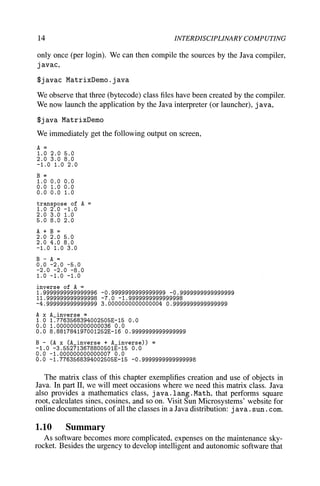
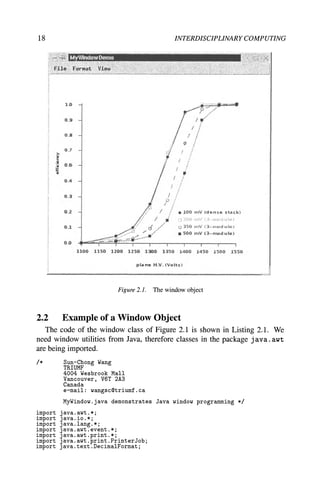
![Graphical and Interactive Java 19
~ 1:WS,,('ih! !!.
~t--* ,J_ ....
~~
Figure 2.2. Items on the File pull-down
menu
Figure 2.3. Items on the View pull-down
menu
public class MyWindow extends Frame
implements ActionListener, Printable {
Plotter plotting;
int nColns, nLines, xlndex, nSkips;
doubler] [] Table;
boolean beforePlot = true;
public static void main(String args[]) {
MyWindow demo = new MyWindow();
demo. show 0 ;
} II end of main
public MyWindow() {
super();
setTitle("MyWindowDemo");
nCoIns 5;
xlndex = 1;
nSkips = 4;
II default input file format, no. of columns
II x column
II no. of lines to skip
Font font = new Font("Dialog", Font.BOLD, 13);
setFont(font);
plotting = new Plotter(this); II 'this' is MyWindow
II enables quitting the application by clicking the
II x button on the upper right corner of the window
addWindowListener(new WindowAdapter() {
public void windowClosing(WindowEvent e)
{System.exit(O);} });
addMenus 0 ;
Panel mypanel = new Panel();
mypanel.setLayout(new BorderLayout(»;
mypanel.add(plotting, BorderLayout.CENTER);
add (mypanel) ;
packO;](https://image.slidesharecdn.com/2100090-250514040017-75aded39/85/Interdisciplinary-Computing-In-Java-Programming-1st-Edition-Sunchong-Wang-Auth-33-320.jpg)
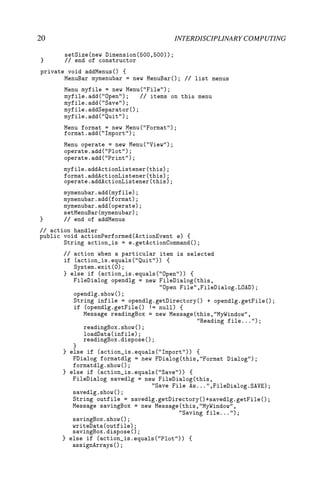
![Graphical and Interactive Java
Message plottingBox
plottingBox.show();
beforePlot = false;
new Message(this,
IMyWindowl,"Plotting file ... ");
plotting.repaint(); II invokes paint()
plottingBox.dispose();
} else if (action_is.equals(IPrint")) {
}
PrinterJob printJob = PrinterJob.getPrinterJob();
PageFormat pf = new PageFormat();
pf.setOrientation(pf.PORTRAIT);
printJob.setPrintable(this,pf);
if (printJob.printDialog()) {
}
try {
printJob.print();
} catch (Exception ex) {
ex.printStackTrace();
}
} II end of actionPorformed
public int print(Graphics g, PageFormat pf, int pi) {
II this method is required by the interface Printable
}
if (pi >= 1) return Printable.NO_SUCH_PAGE;
Graphics2D g2 = (Graphics2D) g;
g2.translate(pf.getlmageableX(), pf.getlmageableY());
plotting.paint(g2);
return Prlntable.PAGE_EXISTS;
public void assignArrays() {
int j = 0;
}
plotting.x = Table[xlndex-1];
plotting.y = new double [nColns-l] [];
for (int i=O; i<nColns; i++) {
}
if (i != (xlndex-1)) {
plotting.y[j] = Table[i];
j += 1;
}
public void loadData(String infile) {
int itmp;
String stmp;
nLines = 0;
try {
II file input, infile is from the dialog box
FilelnputStream fis = new FilelnputStream(infile);
InputStreamReader br = new InputStreamReader(fis);
LineNumberReader re = new LineNumberReader(br);
itmp = -1;
while (itmp != nLines) {
itmp = nLines;
stmp = re.readLine();
nLines = re.getLineNumber();
} II get the number of lines in the input file
fis.closeO;
} catch (IOException e) {
System. out. println ("IOExcpetion: "+e. getMessage 0) ;
21](https://image.slidesharecdn.com/2100090-250514040017-75aded39/85/Interdisciplinary-Computing-In-Java-Programming-1st-Edition-Sunchong-Wang-Auth-35-320.jpg)
![22 INTERDISCIPLINARY COMPUTING
}
Table = new double [nColns] [nLines-nSkips];
try {
FileInputStream fis
InputStreamReader br
BufferedReader re
StreamTokenizer sto
new FileInputStream(infile);
new InputStreamReader(fis);
new BufferedReader(br);
new StreamTokenizer(re);
II skip the first nSkips lines
for (int i=O; i<nSkips; i++) stmp = re.readLine();
for (int i=O; i«nLines-nSkips); i++) {
}
for (int j=O; j<nColns; j++) {
Table[j][i] = readNumber(sto);
}
fis . close 0 ;
} catch (FileNotFoundException fnfe) {
System.out.println(fnfe.getMessage());
} catch (IOException e) {
System. out .println("IOExcpetion: "+e .getMessage 0 ) ;
}
} II end of readFile
II read numbers in plain or scientific notation
public double readNumber(StreamTokenizer sto) throws IOException {
double output;
Integer integer;
sto .nextToken 0 ;
output = sto.nval;
sto .nextToken 0 ;
if (sto.ttype == StreamTokenizer.TT_WORD) {
if (sto.sval.length() > 1 &&
sto.sval.substring(O,l).equalsIgnoreCase("E")) {
integer = new Integer(sto.sval.substring(2));
if (sto. sval. substring(1 ,2) .equals("-")) {
output 1= Math.pow(10.0, integer.doubleValue());
} else {
output *= Math.pow(10.0, integer.doubleValue());
}
} else if (sto.sval.length() == 1 &&
sto.sval.substring(O,l) .equalsIgnoreCase("E")) {
sto.nextToken(); II get the + sign
sto.nextToken(); II get the exponent
output *= Math.pow(10.0, sto.nval);
} else System.out.println("Error in the number format");
} else
sto. pushBack 0 ;
return output;
} II end of readNumber
public void writeData(String outfile) {
try {
II file output, outfile is
FileOutputStream ostream =
PrintWriter pw
from the dialog box
new FileOutputStream(outfile);
new PrintWriter(ostream);
II set the decimal format of the numerals
DecimalFormat dfl new DecimalFormat("OOOO");
DecimalFormat df2 = new DecimalFormat("O.OOOO");](https://image.slidesharecdn.com/2100090-250514040017-75aded39/85/Interdisciplinary-Computing-In-Java-Programming-1st-Edition-Sunchong-Wang-Auth-36-320.jpg)
![Graphical and Interactive Java
}
String fm = II ";
for (int i=O; i<Table[O] . length; i++) {
}
for (int k=O; k<Table.length; k++) {
}
if (k == 0) fm = dfl.format(Table[k] [i]);
else fm = df2.format(Table[k] [i]);
pw.print(fm+" II);
pw.println(" ");
pw.flushO;
ostream. close 0 ;
} catch (IOException ee) {
System. out. println ("IOException "+ee. getMessage 0) ;
}
} II end of MyWindow class
Listing 2.1 MyWindow.java
2.3 Frame
23
This MyWindow class inherits, i.e. extends, the class java.awt.Frame.
Here we have ignored java. awt since the import statement above told the
compiler where to search for Frame. ActionListener is a category of classes
called interface. In contrast to other object oriented programming languages
like C++, multiple inheritance (inheritance from multiple parents) is not al-
lowed in Java. One way to work around is via implements'ing interfaces. We
therefore come up with the class declaration like this,
public class MyWindow extends Frame implements ActionListener {
We will encounter instances of interface in more detail in the next chapter.
It suffices to say here that an interface is an abstract object where methods
are only declared but not implemented. By implements'ing an interface, the
programmer is obliged to provide her implementations of the methods.
Next in MyWindow comes the main () method, where an object of the class
MyWindow is instantiated.
In the constructor of MyWindow, a font object is declared and instantiated.
The method setFont (font) is not seen among the methods written below in
MyWindow, indicating that it is a method of Frame, which MyWindow inherits.
Through inheritance, we are exploiting Java utilities!
Next, more objects which are declared in the variable field are instantiated
here in the constructor. this refers to self, i.e., MyWindow.
pack () is a method of Frame. setSize (new Dimension(500,500) ) de-
fines the dimension of MyWindow in pixels.
addMyMenu () is one of the methods of this class, and is the subject of Sec-
tion 2.5.
2.4 Panel
A Panel class provides space for any window component, including other
panels. Here a panel object is declared and instantiated: Panel mypanel =new](https://image.slidesharecdn.com/2100090-250514040017-75aded39/85/Interdisciplinary-Computing-In-Java-Programming-1st-Edition-Sunchong-Wang-Auth-37-320.jpg)
![24 INTERDISCIPLINARY COMPUTING
Panel () ;. This panel object then invokes its setLayout () method to request
an instance ofBorderLayout to be the layout manager: mypanel. setLayout
(new BorderLayout 0) ;. This layout manager, managing the space which is
to be used by the plotting object, is then added to this panel: mypanel. add
(plotting, BorderLayout. CENTER) ;. Finally this panel is added to the
MyWindow object by add(mypanel) ;.
2.5 Menu
We might prefer separate menus for very different cuisines. We therefore in
the method addMyMenu () first create an instance of MenuBar to hold subse-
quent submenus.
The file menu is then created: Menu file =new Menu(IFile");. An
entree in this menu is added: file. add ( II Open") . In this case, three entrees
are available. This file menu is then added to the menubar. Other menus are
populated in the same fashion. In the end of the method, the menubar is added
to MyWindow by setMenuBar (menubar). So far, when a menu is clicked by
a customer, entrees are displayed. We then need a waiter to assist in receiv-
ing, placing, and delivering the order. The responsibilities of the waiter are
prescribed by the interface ActionListener and implemented in the method
public void actionPerformed(ActionEvent e).
2.6 Interactions
An instance of ActionEvent e is passed as the argument for the method.
Invoking the method getActionCommandO of e returns a String object
holding the menu item clicked by the user. This item is to be identified in
the if else if else block within which an appropriate action is performed in
response to user selection.
We remind that these responding actions are included in the menus by the
menu's addActionListener 0 method as in the statement myfile. addActi
onListener (this). Again, this refers to MyWindow, which is capable of
reacting because it implements ActionListener. Programmer's implemen-
tation of the method actionPerformedO in class MyWindow is mandatory
since MyWindow implements the ActionListener interface.
2.7 File Input/Output
We now turn to one of the main subjects of any language, namely, input and
output. Traditionally, we would issue a command from a UNIX or DOS shell
like this,
$go.exe my_input.dat my_output.dat
where go. exe is the executable which reads data from file my_input. dat
and, after processing, writes the output to file my_output. dat. This can be
accomplished in Java via the args [] array to mainO: args [0] holds the
string "my_input. dat" and args [1] limy_output. dat".
However we may opt for taking advantage of Java's graphical user interface
(GUI) by instantiating an instance of FileDialog,](https://image.slidesharecdn.com/2100090-250514040017-75aded39/85/Interdisciplinary-Computing-In-Java-Programming-1st-Edition-Sunchong-Wang-Auth-38-320.jpg)
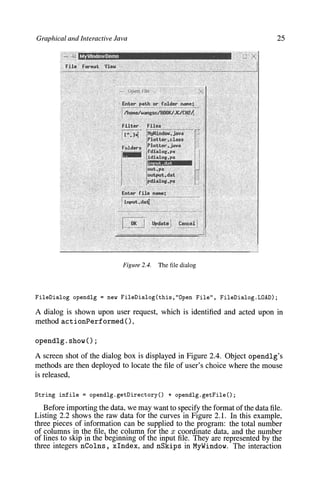
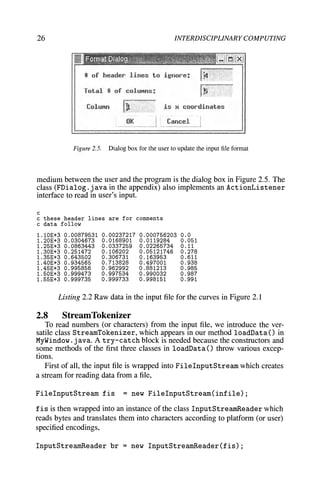
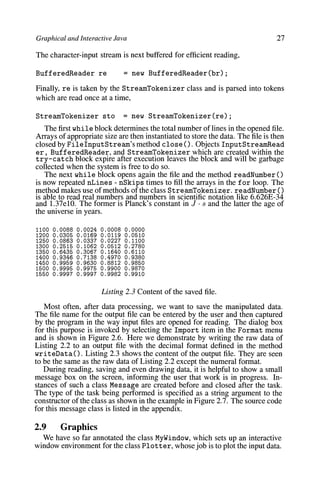
![28 INTERDISCIPLINARY COMPUTING
MylVimlowDemo
1.0
o.g
0 .8
0 .4
0 .3
0 .2
0 .1
0 .0
..............
En~e.!:..!~~or
-lolder_~an
..;:
flhO"e/WeneScl~k/JC/CH2}.
,.'
j
I
Filter
fi...·]..;:
Folders
F - '
I
I
I
i
Files j
rFDialOV'ChS;--~ I
'FDialol.J;lva "
' "essaue.class
"..&Sale. java I
"yNind~$1.class !
I~E~;~~~::S IJ
l
Plotter.java f.
_---'--'-_i'T'IOc't "'@)
Im o d ule )
l ~ J _~~~J ~~~lJ ~~--~
H OO JJSO -===~=======
=t:=!J 1500 1550
o X
pia n e H .V . ( Vo lt$)
------------------------------~.~
Figure 2.6, The dialog box for writing to files
Listing 2.4 shows the code of the plotting class. It is seen that it is subclassed
from class Canvas, which is in tum a subclass of the class Component. The
Component class, inheriting java . lang . Dbj ect which is the root of all Java
classes, is the abstract superclass of many window classes. The class Canvas
represents a blank rectangle on which graphics can be drawn and user input
events are listened to. Unlike its parent Component, which is abstract, the
class Canvas requires that its method paint (graphics g) be overridden by
the programmer for customized graphics on the canvas. We now focus on the
the method paint ().
/* Sun-Chong Wang
TRIUMF
4004 Wesbrook Mall
Vancouver, V6T 2A3
Canada
e-mail: wangsc@triumf.ca
Plotter.java connects data points with color lines */
import java.lang.*;
import ~ava.awt.*;
import Java.awt.event.*;
import java.awt.geom.*;
import ~ava.awt.font.*;
import Java.text.DecimaIFormat;](https://image.slidesharecdn.com/2100090-250514040017-75aded39/85/Interdisciplinary-Computing-In-Java-Programming-1st-Edition-Sunchong-Wang-Auth-42-320.jpg)
![Graphical and Interactive Java
MyWindowDemD ·Y X
Figure 2.7. The message box showing that reading is underway
import java.util.*;
class Plotter extends Canvas {
MyWindow parent;
double xmin,xmax,ymin,ymax;
double topborder,sideborder;
static int bottom,right;
int rectWidth = 6, rectHeight 6;
double x[];
double y [] [] ;
final static int maxCharHeight = 20;
final static int minFontSize = 8;
public Plotter(MyWindow parent) {
super();
thls.parent = parent;
}
public void paint(Graphics g) {
final Color bg = Color.white;
final Color fg = Color. black;
final Color red = Color.red;
final Color white = Color.white;
29](https://image.slidesharecdn.com/2100090-250514040017-75aded39/85/Interdisciplinary-Computing-In-Java-Programming-1st-Edition-Sunchong-Wang-Auth-43-320.jpg)
![30 INTERDISCIPLINARY COMPUTING
final BasicStroke stroke = new BasicStroke(1.0f);
final BasicStroke wideStroke = new BasicStroke(8.0f);
final float dashl[] = {10.0f};
final BasicStroke dashedl = new BasicStroke(1.0f,
BasicStroke.CAP_BUTT,BasicStroke.JOIN_MITER,10.0f,
dashl, O. Of) ;
final float dash2[] = {2.0f};
final BasicStroke dashed2 = new BasicStroke(1.0f,
BasicStroke.CAP_BUTT,BasicStroke.JOIN_MITER,10.0f,
dash2, O.Of);
FontMetrics fontMetrics;
Graphics2D g2 = (Graphics2D) g;
g2. setRenderingHint (RenderingHints.KEY_ANTIALIASING,
RenderingHints.VALUE_ANTIALIAS_ON);
Dimension d getSize();
fontMetrics pickFont(g2, "WELCOME", d.width);
int rectWidth = 6, rectHeight = 6;
int j,xO,yO,xl,yl;
II this handles resizing of the window
if ((d. width != right) I I (d.height !=
bottom = d.heiglit;
bottom» {
}
right = d.widtli;
SetScreenSize(right,bottom);
if (parent.beforePlot == false) {
setBackground(Color.white);
SetPlottingLimits();
SetBorderSize(0.15,0.15);
fontMetrics = pickFont(g2, "Vth 200 mV", (d.width/6»;
II now draw the axes
DrawXAxis(g2);
DrawYAxis(g2);
putAxisTitles(g2,stroke,d,"efficiency",20,
"plane H.V. (Volts)",-50);
drawPieces(g2,x,y[0],stroke,stroke,Color.green,1);
drawPieces(g2,x,y[1],stroke,dashedl,Color.red,2);
drawPieces(g2,x,y[2] ,stroke,dashed2,Color.black,3);
drawPieces(g2,x,y[3],stroke,stroke,Color.blue,4);
putCaption(g2,"100 mV
putCaption(g2,"200 mV
putCaption(g2,"350 mV
putCaption(g2,"500 mV
(dense stack)",1400.,0.2,
Color.blue,4);
(3-module) " ,1400. ,0.15,
Color.green,l);
(3-module)",1400.,0.10,Color.red,2);
(3-module) ",1400. ,0.05,
Color.black,3);
} else g2.drawString("WELCOME", d.width/2, d.height/2);
} II end of re-display method
private void putCaption(Graphics2D g2, String text, double x,
double y, Color color, int symbol) {
int iO, jO;
g2.setPaint(color);
iO GetXCoordinate(x);
jO = GetYCoordinate(y);](https://image.slidesharecdn.com/2100090-250514040017-75aded39/85/Interdisciplinary-Computing-In-Java-Programming-1st-Edition-Sunchong-Wang-Auth-44-320.jpg)
![Graphical and Interactive Java
}
iO -= rectWidth/2;
jO -= rectHeight/2;
switch (symbol) {
case 1: g2.draw(new
break;
case 2: g2.draw(new
break;
case 3: g2.fill(new
break;
case 4: g2.fill(new
default:
Rectangle2D.Double(iO-10, jO-5,
rectWidth, rectHeight»;
Ellipse2D.Double(iO-10, jO-5,
rectWidth, rectHeight»;
Rectangle2D.Double(iO-10, jO-5,
rectWidth, rectHeight»;
Ellipse2D.Double(iO-10, jO-5,
rectWidth, rectHeight»;
} II end of switch
g2.drawString(text, iO, jO);
private void putAxisTitles(Graphics2D g2, BasicStroke stroke,
Dimension d, String xTitle, int yoffset,
String yTitle, int xoffset) {
}
g2.setPaint(Color.black);
g2.setStroke(stroke);
g2.rotate(Math.toRadians(-90»;
g2.translate(-d.width/2,d.height/20);
g2.drawString(xTitle,yoffset,0);
g2.translate(d.width/2,-d.height/20);
g2.rotate(Math.toRadians(90»;
g2.drawString(yTitle,d.width/2 + xoffset,d.height*29/30);
private void drawPieces(Graphics2D g2, double[] x, double[] y,
BasicStroke stroKe, BasicStroke dashed,
Color color, int symbol) {
int iO, jO;
g2.setStroke(stroke);
GeneralPath brokenLine = new GeneralPath(
GeneralPath.WIND_EVEN_ODD,y.length);
brokenLine.moveTo(GetXCoordinate(x[O]), GetYCoordinate(y[O]»;
if (y.length > 0) {
g2.setPaint(color);
for(int j~O;j<y.length;j++) {
iO = GetXCoordinate(x[j]);
jO = GetYCoordinate(y[j]);
if (j != 0) brokenLine.lineTo(iO, jO);
iO -= rectWidth/2;
jO -= rectHeight/2;
switch (symbol) {
case 1: g2.draw(new Rectangle2D.Double(iO, jO,
break;
case 2: g2.draw(new
break;
case 3: g2.fill(new
break;
case 4: g2. fill (new
default:
} II end of switch
rectWidth, rectHeight»;
Ellipse2D.Double(iO, jO,
rectWidth, rectHeight»;
Rectangle2D.Double(iO, jO,
rectWidth, rectHeight»;
Ellipse2D.Double(iO, jO,
rectWidth, rectHeight»;
31](https://image.slidesharecdn.com/2100090-250514040017-75aded39/85/Interdisciplinary-Computing-In-Java-Programming-1st-Edition-Sunchong-Wang-Auth-45-320.jpg)
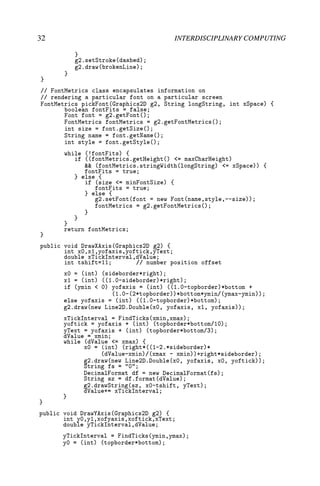
![Graphical and Interactive Java
yl = (int) (C1-topborder) *bottom) ;
if (xmin < 0) xofyaxis = (int)((1.0-2*sideborder)*
right*(-xmin/(xmax-xmin»+sideborder*right);
else xofyaxis = (int) (sideborder*right);
g2.draw(new Line2D.Double(xofyaxis, yO, xofyaxis, yl»;
II xText = (int) ((double) xofyaxis-(sideborder*right/4»;
}
xText = 5·
xoftick ='xofyaxis-(int) (sideborder*right/l0);
dValue = ymin;
while (dValue<= ymax) {
}
yO = (int) ((1-topborder)*bottom-(1.0-2*topborder)*
bottom*(dValue-ymin)/(ymax-ymin»;
g2.draw(new Line2D.Double(xofyaxis, yO, xoftick, yO»;
String fs = "0.0";
DecimalFormat df = new DecimalFormat(fs);
String sz = df.format(dValue);
g2.drawString(sz,xText+30,yO+3);
aValue+= yTicklnterval;
public int GetYCoordinate(double dValue) {
}
int y = (int) ((1-topborder)*bottom-(1.0-2*topborder)*
bottom*(dValue-ymin)/(ymax-ymin»;
return y;
public int GetXCoordinate(double dValue) {
}
int x = (int) (right*((1-2.*sideborder)*(dValue-xmin)1
(xmax - xmin»+right*sideborder);
return x;
public void SetScreenSize(int x, int y) {
right = x;
bottom = y;
}
public void SetPlottingLimits() {
}
if (parent.beforePlot == false) {
}
if (x.length > 0 && yeO] .length > 0) {
if ((GetXMin 0 == GetXMax 0 ) I I
(GetYMin() == GetYMax(»)
else {
}
}
xmin GetXMin();
xmax GetXMax();
ymin GetYMin();
ymax GetYMax();
public void SetBorderSize(double fraction_of_x,
double fraction_of_y) {
}
if ((fraction_oLx <= 0) II (fraction_oLy <= 0»
else {
}
topborder = fraction_of_y;
sideborder = fraction_of_x;
private double FindTicks(double AxisMin, double AxisMax) {
33](https://image.slidesharecdn.com/2100090-250514040017-75aded39/85/Interdisciplinary-Computing-In-Java-Programming-1st-Edition-Sunchong-Wang-Auth-47-320.jpg)
![34
double fSpan = 0;
double multiplier = 1;
double span,flnitiaISpan;
long ISpan,quot,rem;
span = AxisMax - AxisMin;
boolean b;
if (AxisMax <= AxisMin)
INTERDISCIPLINARY COMPUTING
System.out.println(IIError in axis data range");
flnitialSpan = span;
if (flnitialSpan < 10.0) {
while (span < 10) {
multiplier *= 10;
span *= 10;
}
} else {
while (span > 1. Oe9) {
multiplier 1= 10;
span 1= 10;
}
}
ISpan (long) span;
b = false·
for (int i=10· i>=2· i--) {
quot = ISpanli; ,
}
rem = ISpan - quot*i;
if (rem == 0) {
}
fSpan = (double) quot;
fSpan = fSpan/multiplier;
b = true;
if (b == true) break;
II if all else fails
if (b == false)
fSpan = (span/(2*multiplier)); II two intervals by default
return fSpan;
} II FindTicks method
public double GetXMinO {
double dmin = x[O];
}
for (int i=l; i<x.length; i++) if (x[i] < dmin) dmin xCi];
xmin = dmin;
return xmin;
public double GetYMin() {
double dmin = y[O][O];
}
for (int j=O; j<y.length; j++) {
for (int i=O; i<y[j] . length; i++)
if (y[j] [i] < dmin) dmin = y[j] [i];
}
ymin dmin;
return ymin;
public double GetXMax() {
double dmax = x[O];
}
for (int i=l; i<x.length; i++) if (x[i] > dmax) dmax xCi];
xmax = dmax;
return xmax;
public double GetYMax() {
double dmax = yeO] [0];
for (int j=O; j<y.length; j++) {](https://image.slidesharecdn.com/2100090-250514040017-75aded39/85/Interdisciplinary-Computing-In-Java-Programming-1st-Edition-Sunchong-Wang-Auth-48-320.jpg)
![Graphical and Interactive Java
}
}
Print ·0 X
'rl"t:
Copies: W-
Pdlll to:
v Prinhr f1
"" fU. fooIIo-u"'
..-p-s..--.....;...,--~---..
...,I
th,,,,,,,, 1'~9'1 ·rl.n.. : II
J>riJ,1 C.."""nd GpHoroJ'; f-I
I-----:--,--
'rint J c..~ul I
--~--~----------~~~
Figure 2.8. The printing dialog
for (int i=O; i<y[j].length; i++)
if (y[j] [i] > dmax) dmax = y[j] [i];
ymax = dmax;
return ymax;
} II end of Plotter class
Listing 2.4 Plotter.java
35
First of all, color aliases are assigned to the variables ofthe java. awt .Colo
r class, which is already imported. black, blue, cyan, darkGray, gray,
green, lightGray, magenta, orange, pink, red, white, and yellow Me
defined in the variable field of Color. Other colors can also be created by the
programmer. One such example is in the chapter of artificial neural network
in part 2 of the book. The modifier final here means that those instances are
made constant. BasicStroke defines how lines are drawn, i.e., solid, dotted,
or dashed lines.
Functionality of the class Graphics2D is very rich in its own right. It is
the fundamental class that renders 2-dimensional shapes, text, and images. It
performs coordinate transformation and manages color, fonts, and text layout.
It draws or fills circles, ovals, rectangles, polygons. Its sophistication is to
fulfill demands of computer graphics and animation, which are topics of a
whole book. We in this section grab what we need from Graphics2D to realize
the screen shot that we saw in Figure 2.1. When tailoring for her drawing
needs, the reader can leave most of the code intact except changing the axis
captions, texts, and so forth.
Graphics is cast into Graphics2D,
Graphics2D g2 = (Graphics2D) g;](https://image.slidesharecdn.com/2100090-250514040017-75aded39/85/Interdisciplinary-Computing-In-Java-Programming-1st-Edition-Sunchong-Wang-Auth-49-320.jpg)
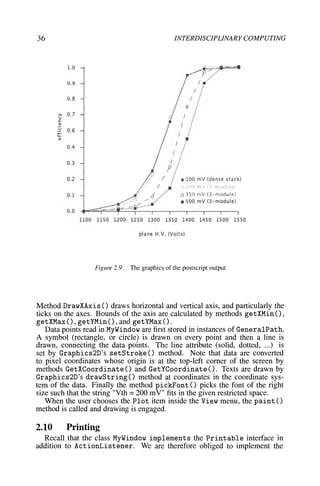
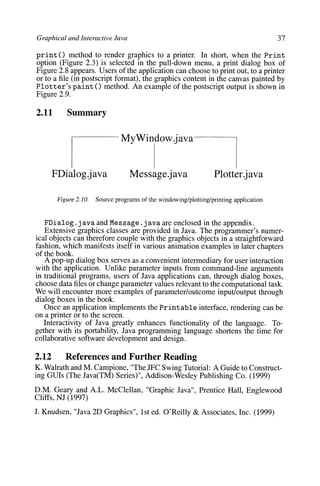
![Chapter 3
HIGH PERFORMANCE COMPUTING
Since the advent of the first digital computer decades ago, prices of comput-
ers have dropped significantly, making personal computers affordable. Mean-
while, the performances [in terms of the memory size and speed of the central
processing unit (CPU)] double every 18 to 24 months (the so-called Moore's
law). Computers are usually connected to one another to form a web of com-
puters called Internet. A conceivable avenue of achieving high-performance
computing is to coordinate together the vast number of otherwise idle comput-
ers on the network to tackle single tough tasks of computation. This is the very
idea behind grid computing where both data and computing power are shared
and accessible to a user. We will demonstrate an implementation of the so-
called distributed computing to boost the performance in this chapter. Before
this, let's introduce the other high performance computing via parallelism in
Java.l
3.1 Parallel Computing
There arise cases where a task can be divided into independent pieces. If
each piece is taken care of by an individual CPU and the mUltiple CPU's are
run concurrently in the system, then ideally we expect a time saving by a factor
of the total number of CPU's in the system. The actual saving depends on
1Language design features such as Java's checks of array indexes and references to objects for
out-of-bound and null-pointer exceptions at runtime make Java a secure and reliable programming plat-
form. They however have detrimental effects on technical computing. The arrays of arrays structure for
multidimensional arrays in Java further hurts its numerical performance. As compiler optimization tech-
nologies advance, Java code can achieve 50% to 90% performance of highly optimized Fortran.
Since the book focuses on numerical computation, we play down handy applications of Java's container
classes such as java. util. Vector. When collection classes are nevertheless used, we point out that the
overhead due to extravagant object creation and type casting should be avoided.
S.-C. Wang, Interdisciplinary Computing in Java Programming
© Kluwer Academic Publishers 2003](https://image.slidesharecdn.com/2100090-250514040017-75aded39/85/Interdisciplinary-Computing-In-Java-Programming-1st-Edition-Sunchong-Wang-Auth-52-320.jpg)
![Parbury.
I’ve been working very hard, you know, lately. I feel I want a
change.
Mrs. Parbury.
[Tearfully.] It doesn’t occur to you that I might want a change.
Parbury.
Well, have one, dear. Aunt Martha would be delighted to have
you at Oaklands.
Mrs. Parbury.
I don’t want to go to Aunt Martha. How would you like to go to
Aunt Martha?
Parbury.
[Suppressing a groan.] What is it you do want?
Mrs. Parbury.
[Quickly.] You! I want to be with you! It’s very simple—it’s not
asking very much. If you don’t like my being with you, why did you
marry me?
[Taking out her handkerchief.
Parbury.
Now, dear, please don’t cry! [Aside.] If she does, I’m done for!
[Aloud.] It’s only common sense that you can’t go knocking about
with a couple of men in a tub of a boat.
Mrs. Parbury.
Of course I quite know now that you don’t love me.
[Bursts into tears. Sits on sofa.](https://image.slidesharecdn.com/2100090-250514040017-75aded39/85/Interdisciplinary-Computing-In-Java-Programming-1st-Edition-Sunchong-Wang-Auth-56-320.jpg)
![Parbury.
[With real irritation.] Oh, damn it! [Goes up, but turns quickly
and comes down to her.] ’Pon my soul, you make me almost hate
——
Mrs. Parbury.
Of course you hate me. Your old friend has done that for me. You
are breaking my heart!
Parbury.
[Who has recovered control of his temper and resumed his
natural bantering tone.] Not at all, dear. [Sits at his desk and affects
to be busy.] I was only going to say that I hated—now, what the
deuce was it I hated?—oh, I know—to see a woman cry. I do think a
woman is wise who does her crying in private, and yet—I wonder—
they know best—millions to one they know best. I must write
something about it.
Mrs. Parbury.
[Rises, goes to top of table, R. She is wiping her eyes, her back
to him.] Of course, you’re going all the same?
Parbury.
[Affecting great pre-occupation.] Going? Going where?
Mrs. Parbury.
With Mr. Gunning.
[Pause. She continues to cry gently.
Parbury.
Gunning—Gunning!—who’s Gunning? Oh—George—yachting, you
mean! Not I! I’m staying here.
Mrs. Parbury.
[Comes towards him gladly, her arms extended.] Clement!](https://image.slidesharecdn.com/2100090-250514040017-75aded39/85/Interdisciplinary-Computing-In-Java-Programming-1st-Edition-Sunchong-Wang-Auth-57-320.jpg)
![Parbury.
Eh? Oh, forgive me for a few minutes.
[Writes.
Mrs. Parbury.
[Reproachfully.] I was only going to kiss you.
Parbury.
[Writing.] All right, dear—presently—presently, there’s a dear girl!
[Mrs. Parbury has a slow silent exit, looking back at him.] [He doesn’t
look up, but goes on writing. When the door closes, he puts down
his pen.] Oh, the tyranny of it! The tyranny of it!
[Slow Curtain.
END OF ACT I.](https://image.slidesharecdn.com/2100090-250514040017-75aded39/85/Interdisciplinary-Computing-In-Java-Programming-1st-Edition-Sunchong-Wang-Auth-58-320.jpg)
![ACT II
Scene.—The same as Act I. Evening after dinner the same day. The
room is lighted with lamps, but as it is a still warm evening, the
curtains are not drawn over the glass door which leads into the
garden and is open.
[Enter Evans, L. He places cigars and cigarettes on
occasional table, and lights a small spirit cigar-lamp.
[Exit.] Voices of ladies and a ripple of laughter heard
from the drawing-room, and for a moment the sound
made by fingers running lightly and irresponsibly over
the keys of the piano. Enter Colonel Armitage, followed
by Gunning and Parbury. Armitage goes to mantelpiece.
Gunning selects the easiest chair in the room. Parbury
goes to occasional table. Armitage is a well-preserved
man of sixty-five, very carefully dressed—something of
an elderly dandy.
Parbury.
Cigarette or cigar, George?
Gunning.
Thanks, I have a cigarette.
[Takes one from his case and lights it.
Parbury.
Colonel?](https://image.slidesharecdn.com/2100090-250514040017-75aded39/85/Interdisciplinary-Computing-In-Java-Programming-1st-Edition-Sunchong-Wang-Auth-59-320.jpg)
![Colonel.
Thank you, I’ll take a cigar. I think, however, I’ll—er—smoke it in
the garden. Mabel’s limited appreciation of tobacco——
Parbury.
Oh, Mabel won’t mind—she’s quite educated.
Colonel.
Not beyond the cigarette, I fancy.
[He strolls to the glass door, lights his cigar, and
steps out. For a few moments he is still seen,
then he wanders away.
Gunning.
Nice old chap, your father-in-law.
Parbury.
Isn’t he? I’m quite fond of him. [Pause. They smoke in silence,
Parbury standing at mantelpiece.] What are you thinking of?
Gunning.
I’m not thinking. I’m digesting. I had an excellent dinner.
Enter Evans with coffee, &c. Gunning takes coffee.
Evans.
Cognac, sir, or green chartreuse?
Gunning.
Cognac. [He takes glass.] Thank you.
Parbury.
Colonel, here’s your coffee.](https://image.slidesharecdn.com/2100090-250514040017-75aded39/85/Interdisciplinary-Computing-In-Java-Programming-1st-Edition-Sunchong-Wang-Auth-60-320.jpg)
![Colonel.
[Outside.] I’ll have it out here, if I may.
[Parbury takes his coffee and liqueur.
Parbury.
Serve Colonel Armitage’s coffee in the garden.
Evans.
Yes, sir.
[Exit Evans, L.
Gunning.
I’ve wired for the champagne.
Parbury.
[Uneasily.] Oh, yes!
[Slight pause.
Gunning.
I notice the glass keeps up well.
Parbury.
Really? Good!
[Slight pause.
Gunning.
Yes, we ought to have capital weather.
Parbury.
Capital! [He is very embarrassed.] If it doesn’t rain it’ll be pretty
—er—fine.
[Drinks. Puts his cup on mantelpiece.](https://image.slidesharecdn.com/2100090-250514040017-75aded39/85/Interdisciplinary-Computing-In-Java-Programming-1st-Edition-Sunchong-Wang-Auth-61-320.jpg)
![Gunning.
[Favours him with a slow stare.] What’s the matter, old man?
Parbury.
Nothing in the world. Why?
Gunning.
Oh, it doesn’t matter. But I think the change will do you good.
[Slight pause.] By the way, would to-morrow afternoon suit you for a
start?
Parbury.
[Standing with his back to the fireplace, looking up at the
ceiling.] I’m not going, old man.
Gunning.
[Indifferently.] Oh!
Re-enter Evans, R., from garden, and exit L. Silence till he has
gone.
Parbury.
Well, you don’t seem surprised.
Gunning.
[Effecting a yawn.] I never permit myself to be surprised.
Parbury.
Or disappointed.
Gunning.
Oh yes, I own I’m disappointed. I looked for a good time for a
few days. You were the only one of the old lot available, and you
were the best of them. I can’t bear the new lot. They wear strange
colours, drop their “g’s,” and get on one’s nerves.](https://image.slidesharecdn.com/2100090-250514040017-75aded39/85/Interdisciplinary-Computing-In-Java-Programming-1st-Edition-Sunchong-Wang-Auth-62-320.jpg)
![Parbury.
I’m really sorry, George.
Gunning.
Don’t bother. One simply goes alone. [Discreetly.] The calls of
business are often irresistible.
Parbury.
Don’t rot. You know what the situation is.
Gunning.
Mine is one of those poor intelligences that never know without
information.
Parbury.
I’ll supply it.
[Sits on arm of chair, R.C.
Gunning.
Don’t, if it matters.
Parbury.
I will, though it does matter. [Grimly.] My wife wept.
Gunning.
Unanswerable argument.
Parbury.
Quite. George, what the devil is a man to do?
Gunning.
I knew a man who once interfered between a husband and wife
who were disagreeing. The husband and wife each got a black eye.
The man got two.](https://image.slidesharecdn.com/2100090-250514040017-75aded39/85/Interdisciplinary-Computing-In-Java-Programming-1st-Edition-Sunchong-Wang-Auth-63-320.jpg)
![Gunning.
Sometimes, if I know you, you rebelled. What then?
Parbury.
[Promptly.] Tears! And over such absurdly paltry things! Oh, the
farcical tragedy of it all! I wished to go shooting for a few days.
Tears! I fancied dining and spending the evening with an old chum.
Tears! I would go on a walking tour for a week. Tears! Some one
would ask me for three days’ hunting. Tears! Tears, you understand,
always on hand. Tears—tears—tears ad—— [Pulling himself up.] No.
Gunning.
[Quietly.] No—not ad nauseam.
Parbury.
No, that would be too low a thing to say.
[Goes up R.C. Takes stopper out of the decanter.
Gunning.
Do you know, Clement, I really like you tremendously.
Parbury.
Thanks, old man. Have some more brandy?
Gunning.
No thanks. [Pause.] Don’t stop. I’m interested.
Parbury.
That’s all. I drifted, almost unconsciously, right up to to-day, for
all the world like the man in the moral story-book one read as a child
on Sundays, who drifted in his boat on the Erie River towards
Niagara. To-night I’m conscious—I’m awake—I can feel the water
gliding along the boat’s keel. I can see Niagara. I don’t like it. What
the devil’s one to do?](https://image.slidesharecdn.com/2100090-250514040017-75aded39/85/Interdisciplinary-Computing-In-Java-Programming-1st-Edition-Sunchong-Wang-Auth-65-320.jpg)
![Gunning.
Get out and walk.
[Pause. They smoke.
Parbury.
Of course, I shall change it all. I must, but it will be beastly work.
Gunning.
Beastly. When do you begin?
Parbury.
When occasion serves. I can’t go back over this yachting
business. I’ve said I’m not going.
Gunning.
Quite right.
[Slight pause.
Parbury.
Oh, if the exigeant women only knew—if they only knew!
Enter Colonel Armitage, R.
Talking of brandies, this is Hennessy ’63. Have some, Colonel?
Colonel.
Perhaps half a glass.
[Takes brandy and sits.
Enter Mrs. Parbury, L., from drawing-room.
Mrs. Parbury.
Miss Woodward and I are boring each other. Shall we come to
you, or will you come to us? [Gunning and Armitage rise.] There, the
question’s answered.](https://image.slidesharecdn.com/2100090-250514040017-75aded39/85/Interdisciplinary-Computing-In-Java-Programming-1st-Edition-Sunchong-Wang-Auth-66-320.jpg)
![[Sits on sofa, L.
Enter Miss Woodward, L. She goes to the desk.
Gunning.
[To Mrs. Parbury.] You were playing the piano just now?
Mrs. Parbury.
Yes, but I play wretchedly nowadays. I gave up practising when
we married.
Gunning.
One should never give up an accomplishment.
Colonel.
You used to play charmingly, Mabel.
Mrs. Parbury.
You thought so, dear, and that was enough for me. [She rises
and crosses to C.] Why don’t we sit in the garden? It’s a perfect
night. [Colonel strolls off to garden.] [Mrs. Parbury goes to Parbury,
who is standing by fireplace, and takes his arm. In a low voice.] Are
you still angry?
Parbury.
[As they go out to the garden.] I angry with you! Nonsense. [He
pats her hand.] Poor little woman! Poor little woman!
[Exit Mr. and Mrs. Parbury.
Gunning.
[Crossing to R.C. top of the table.] Are you not coming, Miss
Woodward?
Miss Woodward.
No, thank you. I have some work to do.](https://image.slidesharecdn.com/2100090-250514040017-75aded39/85/Interdisciplinary-Computing-In-Java-Programming-1st-Edition-Sunchong-Wang-Auth-67-320.jpg)
![Miss Woodward.
Will you go away and leave me to work if I tell you?
Gunning.
Yes.
[Comes down by chair R.C.
Miss Woodward.
[Putting down her pen, and resting her cheek on her hand.] I’m
the thirteenth daughter of a parson. Why my parents had thirteen
daughters, I don’t know; but I suppose it was because they are very
poor. We were all given the names of flowers—Rose, Lily, Tulip,
Mignonette—I can’t remember them all—but Hyacinth fell to my lot.
Why we were called after flowers, I don’t know; but I suppose it was
because we are none of us the least like flowers. My eldest sister
married my father’s curate. I don’t know why, but I suppose it was
because she came first and is the plainest in the family.
Gunning.
[Laughing.] Yes, well?
Miss Woodward.
[Speaking in an even, emotionless way.] Two other of my sisters
run a Kindergarten, and one other is a governess. Personally I would
rather be a domestic servant. The others remain at home, help in
the house, and await husbands. I fear they will wait in vain, because
there are so many women in our part of the country and so few
men. For my part I seized an early opportunity of learning shorthand
and typewriting—and—well, here I am. Now you know the story of
my life.
[She returns to her work.
Gunning.
I’m afraid it was deuced impertinent of me to ask.](https://image.slidesharecdn.com/2100090-250514040017-75aded39/85/Interdisciplinary-Computing-In-Java-Programming-1st-Edition-Sunchong-Wang-Auth-69-320.jpg)
![Miss Woodward.
Not at all—only eminently man-like.
[Pause. She works, he smokes.
Gunning.
And so you have found your happiness.
Miss Woodward.
Oh no. I’ve only just started to look for it.
Gunning.
Oh ho! Ambitious!
Miss Woodward.
Very. Have you ever been poor?
Gunning.
Yes, at one time—had to pawn things.
Miss Woodward.
I mean being one of fifteen in family—large inferior joints to last
for days—hot, cold, hashed, minced, shepherd’s pie—[Gunning
shudders at this]—too much potatoes—too much boiled rice—too
much bread and dripping—too much weak tea—too much polishing
up of things not worth polishing up—too much darning on too little
material—and for ever giving thanks out of all proportion to the
benefits received. I wish some one would write the history of a hat
or a frock—I mean a hat or a frock that has marched steadily and
sullenly under various guises through an entire family such as ours,
from the mother down to the youngest girl. What might be written
of the thoughts that had been thought under such a hat, or of the
hearts that had felt under such a frock!
Gunning.
Why don’t you write the story?](https://image.slidesharecdn.com/2100090-250514040017-75aded39/85/Interdisciplinary-Computing-In-Java-Programming-1st-Edition-Sunchong-Wang-Auth-70-320.jpg)
![Miss Woodward.
Perhaps some day I shall try. [Returns to her work.] In the
meantime you ought to go. You promised, you know. You have
nothing more to learn. I don’t think in all my life I’ve talked so much
about myself as I have to you, a stranger.
[She keeps her eyes on her work.
Gunning.
You have been engagingly frank. I do hope I shall have another
opportunity——
Miss Woodward.
Not at all likely, Mr. Gunning. [Pause.] Goodnight. [Still without
looking up.]
[Gunning looks at her, goes up to the window,
turns, looks at her again.
Gunning.
[At window.] Good-night, Miss Woodward.
[Exit to garden, R.
[Miss Woodward goes on with her work for a few
moments, then drops her face on her hand in
her favourite attitude.
Miss Woodward.
[Soliloquising.] Rather than go back, I—well, I know I’d rather
die. [She looks over the pages for a moment or two, then yawns
slightly; she gathers her pages together and places a paperweight
over them.] That will have to do. [She rises, looks off R.] There was
actually a man ready to take a sort of languid interest in me. Quite a
new experience. [She takes up Parbury’s photograph and speaks to
it.] You don’t take an interest in me of any kind, do you? [To the](https://image.slidesharecdn.com/2100090-250514040017-75aded39/85/Interdisciplinary-Computing-In-Java-Programming-1st-Edition-Sunchong-Wang-Auth-71-320.jpg)
![photograph.] You never will, and I don’t think I want you to. But I
do want to stay near you, because you are so strong—
Enter Mrs. Parbury from garden carrying the Colonel’s coffee
cup and saucer.
—and so weak, and so kind, and so foolish.
[Mrs. Parbury has come down and is watching her
unobserved. Miss Woodward slowly raises the
photograph to her lips. The cup and saucer
drop from Mrs. Parbury’s hand to the floor and
are broken. Miss Woodward, much startled,
slowly turns towards Mrs. Parbury, and their
eyes meet. There is a pause. Suddenly, with a
quick movement, Mrs. Parbury snatches the
photograph from Miss Woodward.
Mrs. Parbury.
How dare you! How dare you! [Long pause. She is almost
breathless. Then she partly regains self-control.] What train do you
intend taking?
Miss Woodward.
[R.C.] I don’t understand you.
Mrs. Parbury.
I mean for your home, of course.
Miss Woodward.
[Moves as if she had received a blow, and clasps her hands
together.] I am not going home.
Mrs. Parbury.
Oh, indeed you are. You don’t suppose you can stay here, do
you?](https://image.slidesharecdn.com/2100090-250514040017-75aded39/85/Interdisciplinary-Computing-In-Java-Programming-1st-Edition-Sunchong-Wang-Auth-72-320.jpg)
![Miss Woodward.
Why shouldn’t I?
Mrs. Parbury.
How dare you ask that when I have just caught you in the act of
kissing my husband’s photograph?
Miss Woodward.
That was in a moment of abstraction. I wasn’t even thinking of
Mr. Parbury.
Mrs. Parbury.
Oh! And you are the daughter of a clergyman! [She goes up and
fetches the A.B.C. from bookcase, and offers it to Miss Woodward.]
Here is the A.B.C.
Miss Woodward.
[Turning away.] I have no use for it just now, thank you.
Mrs. Parbury.
Then I’ll look you out an early morning train myself. [Sits L.] Let
me see—[turning over leaves]—Carfields, Worcestershire, isn’t it?
Here it is. 7.20. I suppose that’s too early. 9.35; that will do. Please
understand you are to take the 9.35 from Paddington in the
morning.
Miss Woodward.
[Firmly.] I shall do nothing of the kind.
Mrs. Parbury.
[Ignoring the remark.] In the meanwhile there is no necessity
that my husband should know the reason of your going. You can
make some excuse. I wouldn’t have him know for worlds.](https://image.slidesharecdn.com/2100090-250514040017-75aded39/85/Interdisciplinary-Computing-In-Java-Programming-1st-Edition-Sunchong-Wang-Auth-73-320.jpg)
![Miss Woodward.
Of course he shall never know from me—but I want you to quite
understand, Mrs. Parbury, that I am not going to Carfields to-
morrow. Rather than go home under the circumstances I would
starve in the gutter.
Mrs. Parbury.
Well, you must find a lodging till you get other employment. You
will have a month’s salary, of course. Anyway, I’m determined you
leave this house in the morning.
[Goes up C. Puts A.B.C. on chair up L.C.
Miss Woodward.
Is there any real occasion for my leaving?
Mrs. Parbury.
Haven’t you sufficient delicacy of feeling left to teach you that?
Miss Woodward.
[Warmly.] I don’t think I need lessons of delicacy of feeling from
you. [Slight pause.] I’m sorry I said that, and it means a great deal
for me to say I’m sorry. I’m sorry too about the photograph. I think
it all might be forgotten.
Mrs. Parbury.
Forgotten!
Miss Woodward.
After all, I’m only a girl; and I’ve worked very hard for Mr.
Parbury. I think you might be more lenient.
Mrs. Parbury.
[At fireplace.] I’m very sorry for you, Miss Woodward; but I owe
a duty to myself and to my husband. You must go in the morning.](https://image.slidesharecdn.com/2100090-250514040017-75aded39/85/Interdisciplinary-Computing-In-Java-Programming-1st-Edition-Sunchong-Wang-Auth-74-320.jpg)
![[She moves to return to garden.
Miss Woodward.
[Crosses to L.C.] Mrs. Parbury!
Mrs. Parbury.
Well?
Miss Woodward.
I suppose I ought to be a lady and go, because you, the mistress
of the house, wish me to. But I don’t feel a bit like a lady just now. I
only feel like a poor girl whose chances in life are being ruined for a
very small and innocent folly.
Mrs. Parbury.
Well, what does all this mean?
Miss Woodward.
[Fiercely.] It means that I am in Mr. Parbury’s employment, not
yours, and that I will take my dismissal from him only.
Mrs. Parbury.
Oh, I can promise you that. [She calls into the garden.] Clement!
[Exit Mrs. Parbury to garden, R.
[Miss Woodward throws a hard look after her.
Then her eyes fall on the broken cup and
saucer. She stoops, collects the fragments, and
puts them in waste-paper basket. Then she
goes to desk, sits and works on proof sheets as
before.
Enter Mr. and Mrs. Parbury, R.](https://image.slidesharecdn.com/2100090-250514040017-75aded39/85/Interdisciplinary-Computing-In-Java-Programming-1st-Edition-Sunchong-Wang-Auth-75-320.jpg)
![Parbury.
Working again, Miss Woodward! Really, you are indefatigable!
Miss Woodward.
I’m only correcting these proof sheets.
Mrs. Parbury.
No doubt Miss Woodward wishes to finish the work to-night, as
she is leaving to-morrow.
Parbury.
Leaving to-morrow?
Miss Woodward.
I think Mrs. Parbury is mistaken.
Parbury.
[To Mrs. Parbury.] What do you mean, dear?
Mrs. Parbury.
I wish her to go.
Parbury.
Why?
Mrs. Parbury.
I can’t tell you. It is not a thing you would understand. It is
simply impossible for her to remain. In her heart she knows I am
right.
[Slight pause. Parbury goes to Miss Woodward.
Parbury.
Are you satisfied here?](https://image.slidesharecdn.com/2100090-250514040017-75aded39/85/Interdisciplinary-Computing-In-Java-Programming-1st-Edition-Sunchong-Wang-Auth-76-320.jpg)
![Miss Woodward.
Perfectly.
Parbury.
You have no wish to go away?
Miss Woodward.
Not while you wish me to remain.
Parbury.
Do you know why my wife wishes you to go?
Miss Woodward.
Yes.
Parbury.
Will you kindly tell me?
Miss Woodward.
I’m sorry I can’t. I’ve promised. But—[with a look at Mrs. Parbury]
—I don’t think that Mrs. Parbury’s reasons are adequate.
[Pause. Parbury is thoughtful.
Parbury.
[To Mrs. Parbury.] Have you anything more to say?
Mrs. Parbury.
I have only to repeat that it is quite impossible for Miss
Woodward to stay.
Parbury.
Well, I have made up my mind that there is something very
foolish under all this, and I shall not allow it to deprive me of Miss
Woodward’s services. [Mrs. Parbury looks surprised.] I don’t mind
saying in her presence that she is invaluable to me. I should never](https://image.slidesharecdn.com/2100090-250514040017-75aded39/85/Interdisciplinary-Computing-In-Java-Programming-1st-Edition-Sunchong-Wang-Auth-77-320.jpg)
![be able to replace her. [Sense of relief on Miss Woodward’s part.]
Now, come. [Looking from one to the other.] What is it? A tiff—a
stupid misunderstanding? Oh, you women, why will you fuss about
little things? Make it up, do. Think of “The Roll of Ages.” Shake
hands, cry, embrace, kiss, or whatever your pet method may be.
Weep if you like, though personally I’d rather you didn’t. Anyway, as
far as I am concerned, the incident is closed.
[He turns to go.
Mrs. Parbury.
[Doggedly.] Miss Woodward leaves this house in the morning.
Parbury.
[Looks at his wife for a moment, then turns to Miss Woodward.]
Miss Woodward, would you be so very kind——
[He opens the door for her with great courtesy.
Miss Woodward bows, and exits L. He comes to
C.
Mrs. Parbury.
[Turning to him with assumed brightness.] Now, darling, it will be
different. Of course, I couldn’t say much before her. You were quite
right to be nice and courteous to her now she is going.
Parbury.
But I assure you she is not.
[They are C. Mrs. Parbury takes his arm
caressingly.
Mrs. Parbury.
But she is—believe me, she is. Of course, we don’t want to be
hard on her, and she shall have a month’s salary and a strong
recommendation.](https://image.slidesharecdn.com/2100090-250514040017-75aded39/85/Interdisciplinary-Computing-In-Java-Programming-1st-Edition-Sunchong-Wang-Auth-78-320.jpg)
![Parbury.
[Disengaging his arm.] My dear Mabel, I absolutely refuse to act
in the dark. I hate mysteries. If you care to tell me what all this
bother is about, I’ll judge for myself what’s the right thing to do.
[Sits on sofa.
Mrs. Parbury.
I can’t—it’s impossible. There are some things that men can’t be
trusted to know about. You must leave this matter to me.
[Sits next him.
Parbury.
That I quite decline to do.
[She again takes his arm and talks rapidly,
gradually rather hysterically, towards the end
appearing about to cry.
Mrs. Parbury.
Darling, do listen. You don’t understand. You have never been
like this with me before. I’m sure I’m not asking very much. You can
easily get another secretary. Another time you shall have a man one,
as you originally wanted to. You were right, dear—you often are.
[Parbury rises; crosses to R. Mrs. Parbury follows him.] Darling, do be
reasonable. I’ve been a good wife to you, haven’t I? I’ve always
respected your wishes, and not bothered you more than I could
help. This is only a little thing, and you must let me have my own
way. You must trust me absolutely, dear. You know anything I would
do would only be for your good, for you know that I love you. [She
takes out her handkerchief.] I adore you, darling. You must give way
—you must—you must!
Parbury.
[Stepping back from her.] If you cry I shall leave the room.](https://image.slidesharecdn.com/2100090-250514040017-75aded39/85/Interdisciplinary-Computing-In-Java-Programming-1st-Edition-Sunchong-Wang-Auth-79-320.jpg)
![[Sits R. Begins to write.
Mrs. Parbury.
[With her back to the audience, in a low voice.] I wasn’t going to
cry.
Parbury.
I’m glad to hear it.
[Mrs. Parbury puts her handkerchief away and
turns.
Mrs. Parbury.
I had no intention of crying, dear. [Parbury still writes. Pause. She
comes to desk.] Shall I write out an advertisement for you, dear?
Parbury.
What for?
Mrs. Parbury.
For a new secretary—a man.
Parbury.
No. My mind’s made up. I shall not change my secretary.
Mrs. Parbury.
Clement!
Parbury.
[Rises and goes to her.] Listen, my dear Mabel. Perhaps I’m a
good deal to blame for the pain you are going to suffer now, and I’m
very sorry for you; in many ways you are the best little woman in
the world. I’ve been weak and yielding, and I’ve gradually allowed
you to acquire a great deal more power than you know how to use
wisely.](https://image.slidesharecdn.com/2100090-250514040017-75aded39/85/Interdisciplinary-Computing-In-Java-Programming-1st-Edition-Sunchong-Wang-Auth-80-320.jpg)