Intercultural Communication
Rita Cooper and Shelby L. Cearley
Assoc. of Metroplex Int’l Educators, 9 July 2007
Introduction
 Today’s Presenters
 Rita Cooper, University of North Texas
 Shelby L. Cearley, Texas Tech University
 Overview of Presentation
What Is Culture?
 Culture is the values, behaviors,
practices, assumptions we've learned
from our membership in groups that
share them.
 It is taught, learned and shared.
 Intercultural interaction occurs when
people from different cultures interact
with each other to the extent that both
are expected to make accommodations
to build relationships.
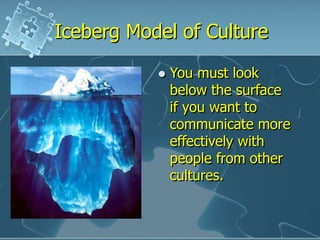
Iceberg Model of Culture
 When we interact with someone from
another culture, we only hear their
words and see their behavior.
 It’s like seeing the tip of an iceberg; so
much more is below the surface.
 Someone’s cultural values and attitudes
affect what s/he says and does.
Iceberg Model of Culture
 You must look
below the surface
if you want to
communicate more
effectively with
people from other
cultures.
Eye Contact
 US-Americans depend
on direct eye contact.
 Why???
• It is perceived as active listening,
sincerity, and honesty.
Rude Behavior
 Without a connection, they may feel
"out of contact" with the other person.
Uncomfortable and Aggressive
• In some Arab and South Asian cultures,
the gaze may seem too direct.
• US-Americans see
a prolonged stare
as a sign of aggression.
Personal Space . . .
 We are all territorial.
 Group norms exist for
all cultures.
 We acquire our
“specific” space in
early childhood.
Get Info Before Going Abroad!
 In the Middle
East, standing
less than 1 foot
next to someone
is acceptable.
 In Europe & North
America, 2.5 – 3
feet is acceptable.
 In Asia, 4 – 5 feet
is acceptable due
to bowing.
Intercultural Exchanges
on Campus
 There’s more than just International
Education Week!
 Become more visible on campus as an
organization
 Make international events more visible on
campus
 Make international students more visible
on campus
Become More Visible on Campus
 Create an identifier (not a name tag)
 Attend campus events
 Join staff organizations
 Invite people to visit your office and
vice-versa
Become More Visible on Campus
 Have an int’l office representative on
standing committees
 Incorporate int’l events and campus
events calendars
 Have an int’l office representative at
campus events
Make Int’l Events More Visible
 Create intercultural training for
increased access to campus
 Have regular events co-sponsored by
int’l and departmental offices
 Give upcoming event flyers to related
classes, academic units, and
administrative departments
Make Int’l Events More Visible
 Create advertising and display in
popular areas
 Cultivate academic contacts with those
faculty with int’l/cross-cultural interests
 Create mailing list of those who
attended previous events
Make Int’l Students Visible
 Take group of int’l students to campus-
sponsored events
 Showcase an int’l group/organization each
month
 Create monthly newsletter of int’l students
 Make int’l student groups part of your
recruiting efforts
 Use int’l student groups to advertise events
Want More Info?
 Please visit our website at
http://www.angelfire.com/empire/sdeb
ate/intercultural.html.
 This PowerPoint presentation
 Links to information about intercultural
communication/competence
 Our email addresses
 Thank you for your attendance!

intercultural-communication.ppt

  • 1.
    Intercultural Communication Rita Cooperand Shelby L. Cearley Assoc. of Metroplex Int’l Educators, 9 July 2007
  • 2.
    Introduction  Today’s Presenters Rita Cooper, University of North Texas  Shelby L. Cearley, Texas Tech University  Overview of Presentation
  • 3.
    What Is Culture? Culture is the values, behaviors, practices, assumptions we've learned from our membership in groups that share them.  It is taught, learned and shared.  Intercultural interaction occurs when people from different cultures interact with each other to the extent that both are expected to make accommodations to build relationships.
  • 4.
    Iceberg Model ofCulture  When we interact with someone from another culture, we only hear their words and see their behavior.  It’s like seeing the tip of an iceberg; so much more is below the surface.  Someone’s cultural values and attitudes affect what s/he says and does.
  • 5.
    Iceberg Model ofCulture  You must look below the surface if you want to communicate more effectively with people from other cultures.
  • 6.
    Eye Contact  US-Americansdepend on direct eye contact.  Why??? • It is perceived as active listening, sincerity, and honesty.
  • 7.
    Rude Behavior  Withouta connection, they may feel "out of contact" with the other person.
  • 8.
    Uncomfortable and Aggressive •In some Arab and South Asian cultures, the gaze may seem too direct. • US-Americans see a prolonged stare as a sign of aggression.
  • 9.
    Personal Space .. .  We are all territorial.  Group norms exist for all cultures.  We acquire our “specific” space in early childhood.
  • 10.
    Get Info BeforeGoing Abroad!  In the Middle East, standing less than 1 foot next to someone is acceptable.  In Europe & North America, 2.5 – 3 feet is acceptable.  In Asia, 4 – 5 feet is acceptable due to bowing.
  • 11.
    Intercultural Exchanges on Campus There’s more than just International Education Week!  Become more visible on campus as an organization  Make international events more visible on campus  Make international students more visible on campus
  • 12.
    Become More Visibleon Campus  Create an identifier (not a name tag)  Attend campus events  Join staff organizations  Invite people to visit your office and vice-versa
  • 13.
    Become More Visibleon Campus  Have an int’l office representative on standing committees  Incorporate int’l events and campus events calendars  Have an int’l office representative at campus events
  • 14.
    Make Int’l EventsMore Visible  Create intercultural training for increased access to campus  Have regular events co-sponsored by int’l and departmental offices  Give upcoming event flyers to related classes, academic units, and administrative departments
  • 15.
    Make Int’l EventsMore Visible  Create advertising and display in popular areas  Cultivate academic contacts with those faculty with int’l/cross-cultural interests  Create mailing list of those who attended previous events
  • 16.
    Make Int’l StudentsVisible  Take group of int’l students to campus- sponsored events  Showcase an int’l group/organization each month  Create monthly newsletter of int’l students  Make int’l student groups part of your recruiting efforts  Use int’l student groups to advertise events
  • 17.
    Want More Info? Please visit our website at http://www.angelfire.com/empire/sdeb ate/intercultural.html.  This PowerPoint presentation  Links to information about intercultural communication/competence  Our email addresses  Thank you for your attendance!