Systems
Integration
Standards
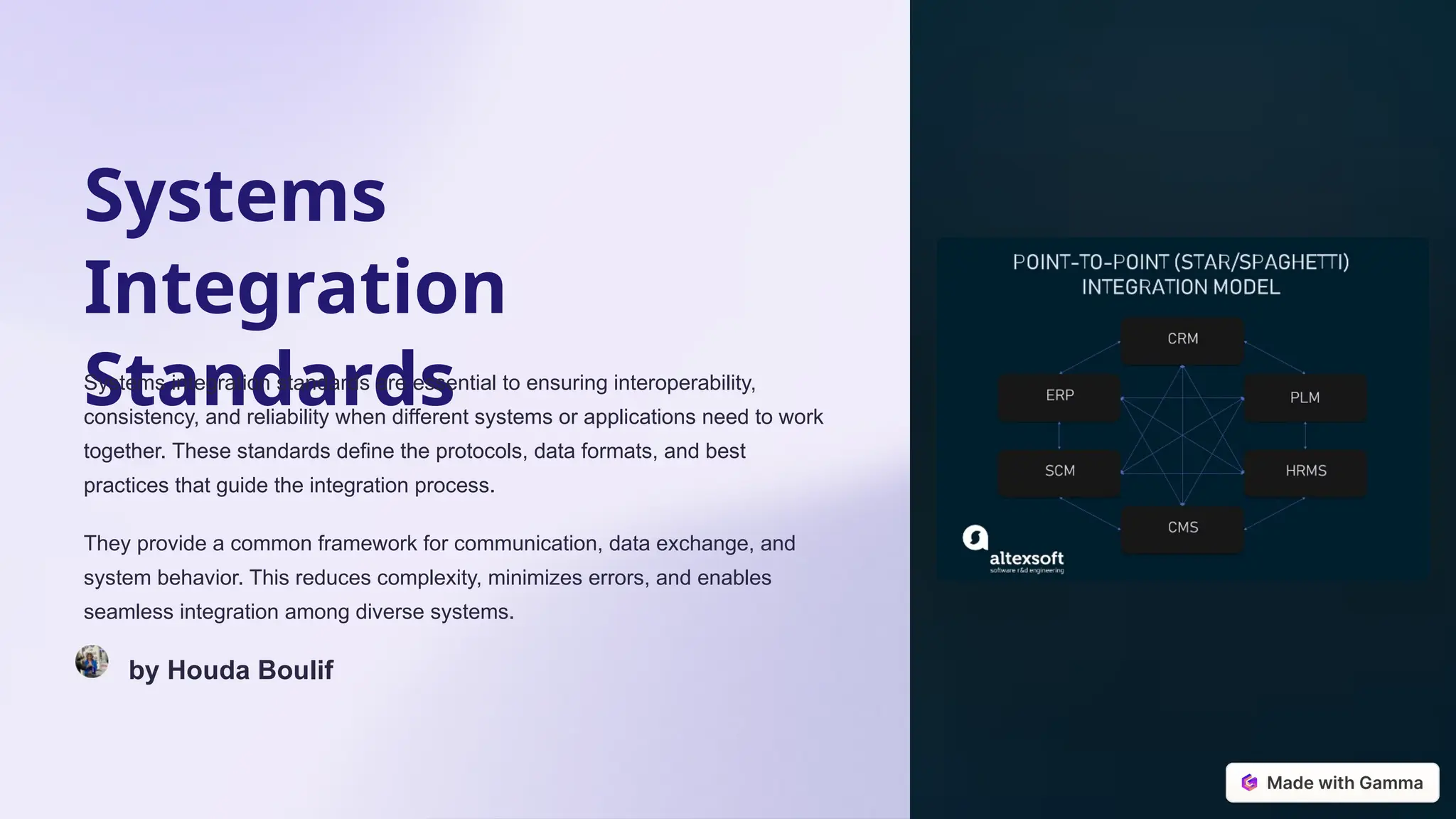
Systems integration standards are essential to ensuring interoperability,
consistency, and reliability when different systems or applications need to work
together. These standards define the protocols, data formats, and best
practices that guide the integration process.
They provide a common framework for communication, data exchange, and
system behavior. This reduces complexity, minimizes errors, and enables
seamless integration among diverse systems.
by Houda Boulif
Communication Protocols
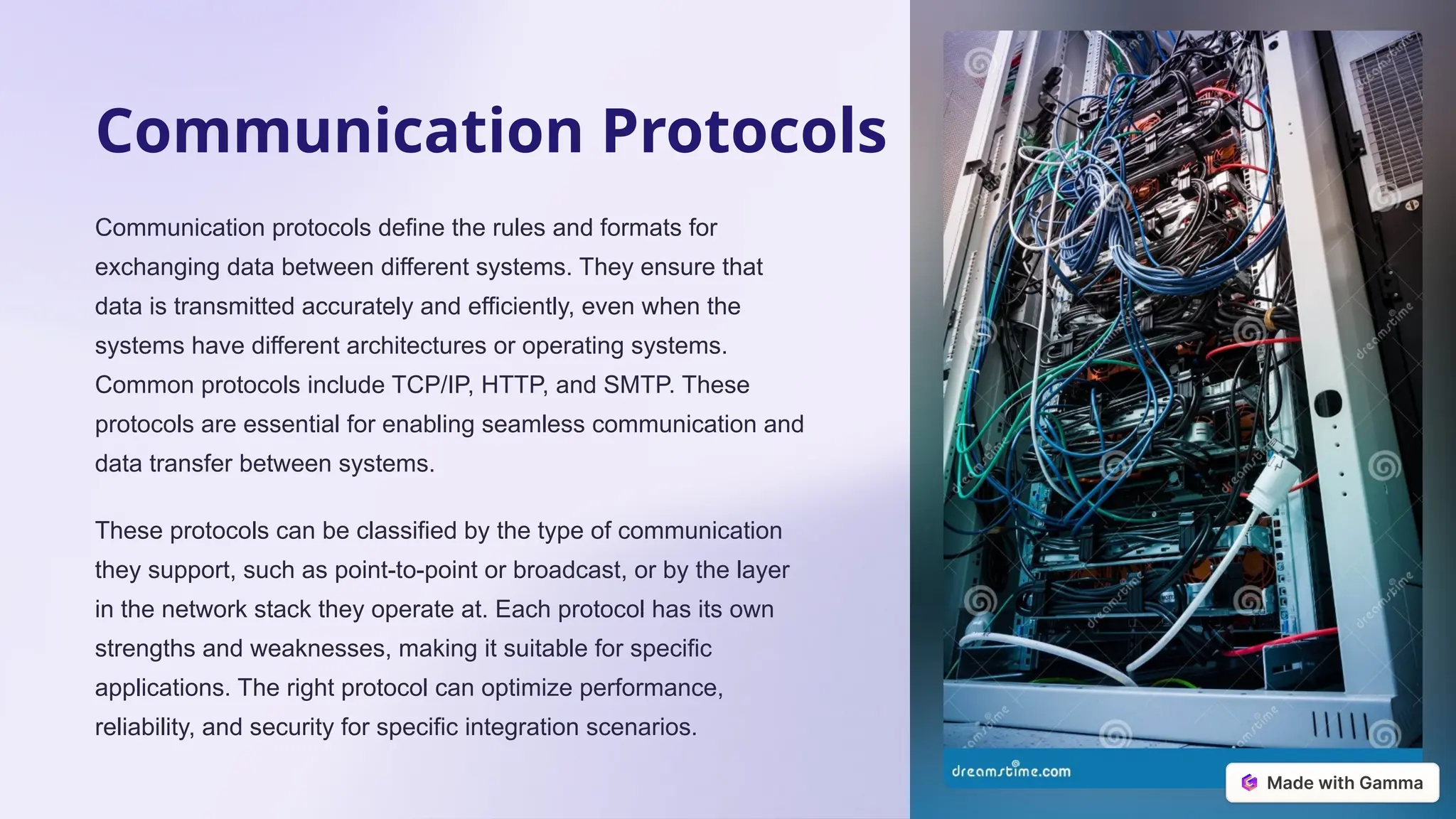
Communication protocols define the rules and formats for
exchanging data between different systems. They ensure that
data is transmitted accurately and efficiently, even when the
systems have different architectures or operating systems.
Common protocols include TCP/IP, HTTP, and SMTP. These
protocols are essential for enabling seamless communication and
data transfer between systems.
These protocols can be classified by the type of communication
they support, such as point-to-point or broadcast, or by the layer
in the network stack they operate at. Each protocol has its own
strengths and weaknesses, making it suitable for specific
applications. The right protocol can optimize performance,
reliability, and security for specific integration scenarios.
Data Exchange Formats
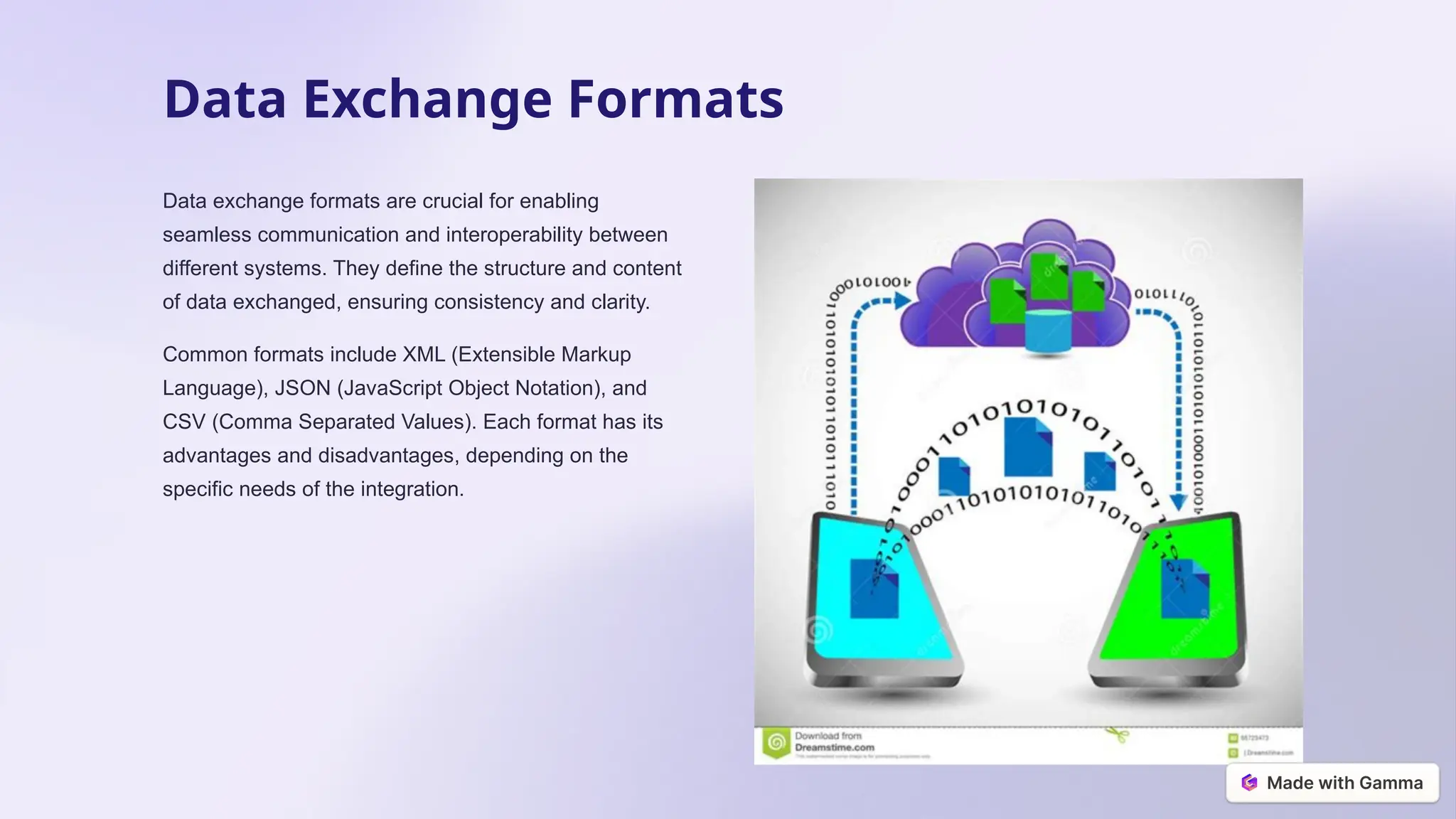
Data exchange formats are crucial for enabling
seamless communication and interoperability between
different systems. They define the structure and content
of data exchanged, ensuring consistency and clarity.
Common formats include XML (Extensible Markup
Language), JSON (JavaScript Object Notation), and
CSV (Comma Separated Values). Each format has its
advantages and disadvantages, depending on the
specific needs of the integration.
4. APIs and Web Services
REST (Representational
State Transfer)
RESTful APIs are designed to be
scalable and interoperable,
adhering to standard HTTP
methods for accessing and
manipulating data. REST
emphasizes simplicity and ease of
use, leveraging familiar web
technologies for communication. By
following REST principles,
developers can create APIs that
are accessible to a wide range of
clients and applications.
SOAP (Simple Object
Access Protocol)
SOAP is a protocol for exchanging
structured information in web
services, based on XML for data
representation. It provides a robust
and extensible framework for
communication, supporting a wide
range of data types and complex
business transactions. While SOAP
offers a more complex approach
compared to REST, its features
make it suitable for scenarios
requiring high reliability and
security.
GraphQL
GraphQL is an open-source query
language that empowers clients to
request only the data they need
from APIs. It provides a more
efficient approach compared to
REST, minimizing unnecessary
data transfer and enhancing
performance. GraphQL offers a
flexible and powerful way to query
and manipulate data, allowing
developers to build efficient and
responsive applications.
Middleware Standards
JMS
Java Message Service (JMS) is a standard for
asynchronous messaging. This messaging is between
two or more clients in a distributed application. JMS
allows for reliable communication between various
applications, even when they are running on different
platforms.
ESB
An Enterprise Service Bus (ESB) is an architectural
pattern. This pattern facilitates communication between
applications and services. ESBs act as a central point
for integrating systems, enabling data transformation
and routing of messages.
Security Standards
OAuth 2.0
OAuth 2.0 is a widely adopted open standard for secure delegation of
access to user information. It allows websites and applications to request
limited access to a user’s information without requiring them to share their
passwords. This approach enhances security by minimizing the risk of
sensitive data exposure.
SSL/TLS
SSL (Secure Sockets Layer) and its successor, TLS (Transport Layer
Security), are cryptographic protocols essential for providing secure
communication over computer networks. They encrypt data exchanged
between a web server and a web browser, ensuring confidentiality and
integrity of information transmitted during online interactions.
Integration Challenges
1 1. Compatibility Issues
Integrating different systems can be challenging
due to variations in data formats, communication
protocols, and software versions. It can require
significant effort to ensure compatibility and
prevent data loss or errors.
2 2. Data Synchronization
Maintaining data consistency across integrated
systems is crucial. Real-time updates, transaction
management, and data validation are essential to
avoid data discrepancies and ensure accurate
information flow.
3 3. Security Concerns
Data security is paramount in integration projects.
Access controls, encryption, and authentication
measures are necessary to protect sensitive
information from unauthorized access,
modification, or disclosure.
4 4. Vendor Support and Maintenance
Vendor support for integrated systems is essential
for ongoing maintenance, upgrades, and
troubleshooting. Reliable vendor support ensures
the stability and functionality of the integrated
environment over time.
Overview of OPC UA
Interoperability Standard
OPC UA stands for Open Platform Communications Unified Architecture. It's a standard that promotes
interoperability among various systems. Devices, machines, and software applications can communicate
with each other seamlessly, regardless of their manufacturer or operating system. This allows for the
creation of more robust and efficient automation systems.
Industry-Wide Adoption
OPC UA has gained widespread adoption across many industries, including manufacturing, energy, and
transportation. Its wide usage has led to the development of a rich ecosystem of tools and resources. This
includes software libraries, development frameworks, and certified products, making it easier for
developers and integrators to work with OPC UA.
Data-Centric Approach
OPC UA is designed to be a data-centric standard. It focuses on the secure and reliable exchange of data
between different systems. This allows for the development of applications that can access and analyze
real-time data from various sources, enabling better decision-making and process optimization.
Key Features of OPC UA
Platform
Independence
OPC UA is designed to
operate on a wide range
of platforms, including
Windows, Linux, and
embedded systems. This
platform independence
enables seamless
integration across
different operating
systems and hardware
architectures, allowing for
greater flexibility and
scalability in industrial
automation systems.
Interoperability
OPC UA fosters
interoperability by
defining a common
communication language
for devices and systems
from different vendors.
This allows for the
exchange of data
between heterogeneous
systems, eliminating the
need for proprietary
communication protocols
and simplifying system
integration.
Scalability
OPC UA is designed to
handle large-scale
industrial systems with a
high volume of data. It
employs efficient data
exchange mechanisms
and robust security
features to ensure
reliable and secure
communication in
complex environments.
Security
OPC UA incorporates a
comprehensive security
framework to protect
sensitive industrial data
from unauthorized access
and manipulation. It
leverages industry-
standard cryptographic
algorithms and
authentication
mechanisms to ensure
data integrity and
confidentiality, enhancing
the overall security of
industrial systems.
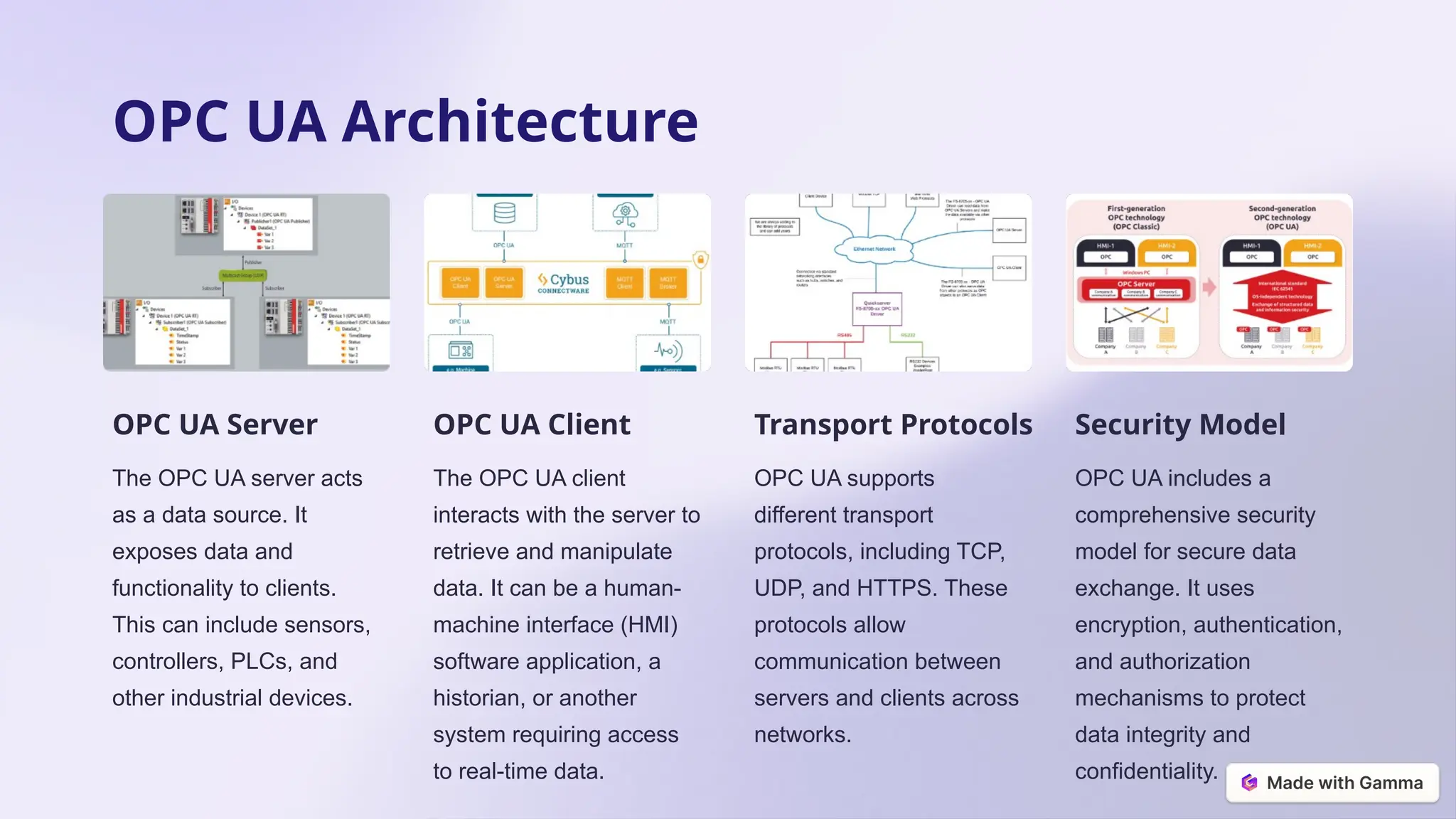
OPC UA Architecture
OPC UA Server
The OPC UA server acts
as a data source. It
exposes data and
functionality to clients.
This can include sensors,
controllers, PLCs, and
other industrial devices.
OPC UA Client
The OPC UA client
interacts with the server to
retrieve and manipulate
data. It can be a human-
machine interface (HMI)
software application, a
historian, or another
system requiring access
to real-time data.
Transport Protocols
OPC UA supports
different transport
protocols, including TCP,
UDP, and HTTPS. These
protocols allow
communication between
servers and clients across
networks.
Security Model
OPC UA includes a
comprehensive security
model for secure data
exchange. It uses
encryption, authentication,
and authorization
mechanisms to protect
data integrity and
confidentiality.

integration standards requirements for systems

  • 1.
    Systems Integration Standards Systems integration standardsare essential to ensuring interoperability, consistency, and reliability when different systems or applications need to work together. These standards define the protocols, data formats, and best practices that guide the integration process. They provide a common framework for communication, data exchange, and system behavior. This reduces complexity, minimizes errors, and enables seamless integration among diverse systems. by Houda Boulif
  • 2.
    Communication Protocols Communication protocolsdefine the rules and formats for exchanging data between different systems. They ensure that data is transmitted accurately and efficiently, even when the systems have different architectures or operating systems. Common protocols include TCP/IP, HTTP, and SMTP. These protocols are essential for enabling seamless communication and data transfer between systems. These protocols can be classified by the type of communication they support, such as point-to-point or broadcast, or by the layer in the network stack they operate at. Each protocol has its own strengths and weaknesses, making it suitable for specific applications. The right protocol can optimize performance, reliability, and security for specific integration scenarios.
  • 3.
    Data Exchange Formats Dataexchange formats are crucial for enabling seamless communication and interoperability between different systems. They define the structure and content of data exchanged, ensuring consistency and clarity. Common formats include XML (Extensible Markup Language), JSON (JavaScript Object Notation), and CSV (Comma Separated Values). Each format has its advantages and disadvantages, depending on the specific needs of the integration.
  • 4.
    4. APIs andWeb Services REST (Representational State Transfer) RESTful APIs are designed to be scalable and interoperable, adhering to standard HTTP methods for accessing and manipulating data. REST emphasizes simplicity and ease of use, leveraging familiar web technologies for communication. By following REST principles, developers can create APIs that are accessible to a wide range of clients and applications. SOAP (Simple Object Access Protocol) SOAP is a protocol for exchanging structured information in web services, based on XML for data representation. It provides a robust and extensible framework for communication, supporting a wide range of data types and complex business transactions. While SOAP offers a more complex approach compared to REST, its features make it suitable for scenarios requiring high reliability and security. GraphQL GraphQL is an open-source query language that empowers clients to request only the data they need from APIs. It provides a more efficient approach compared to REST, minimizing unnecessary data transfer and enhancing performance. GraphQL offers a flexible and powerful way to query and manipulate data, allowing developers to build efficient and responsive applications.
  • 5.
    Middleware Standards JMS Java MessageService (JMS) is a standard for asynchronous messaging. This messaging is between two or more clients in a distributed application. JMS allows for reliable communication between various applications, even when they are running on different platforms. ESB An Enterprise Service Bus (ESB) is an architectural pattern. This pattern facilitates communication between applications and services. ESBs act as a central point for integrating systems, enabling data transformation and routing of messages.
  • 6.
    Security Standards OAuth 2.0 OAuth2.0 is a widely adopted open standard for secure delegation of access to user information. It allows websites and applications to request limited access to a user’s information without requiring them to share their passwords. This approach enhances security by minimizing the risk of sensitive data exposure. SSL/TLS SSL (Secure Sockets Layer) and its successor, TLS (Transport Layer Security), are cryptographic protocols essential for providing secure communication over computer networks. They encrypt data exchanged between a web server and a web browser, ensuring confidentiality and integrity of information transmitted during online interactions.
  • 7.
    Integration Challenges 1 1.Compatibility Issues Integrating different systems can be challenging due to variations in data formats, communication protocols, and software versions. It can require significant effort to ensure compatibility and prevent data loss or errors. 2 2. Data Synchronization Maintaining data consistency across integrated systems is crucial. Real-time updates, transaction management, and data validation are essential to avoid data discrepancies and ensure accurate information flow. 3 3. Security Concerns Data security is paramount in integration projects. Access controls, encryption, and authentication measures are necessary to protect sensitive information from unauthorized access, modification, or disclosure. 4 4. Vendor Support and Maintenance Vendor support for integrated systems is essential for ongoing maintenance, upgrades, and troubleshooting. Reliable vendor support ensures the stability and functionality of the integrated environment over time.
  • 8.
    Overview of OPCUA Interoperability Standard OPC UA stands for Open Platform Communications Unified Architecture. It's a standard that promotes interoperability among various systems. Devices, machines, and software applications can communicate with each other seamlessly, regardless of their manufacturer or operating system. This allows for the creation of more robust and efficient automation systems. Industry-Wide Adoption OPC UA has gained widespread adoption across many industries, including manufacturing, energy, and transportation. Its wide usage has led to the development of a rich ecosystem of tools and resources. This includes software libraries, development frameworks, and certified products, making it easier for developers and integrators to work with OPC UA. Data-Centric Approach OPC UA is designed to be a data-centric standard. It focuses on the secure and reliable exchange of data between different systems. This allows for the development of applications that can access and analyze real-time data from various sources, enabling better decision-making and process optimization.
  • 9.
    Key Features ofOPC UA Platform Independence OPC UA is designed to operate on a wide range of platforms, including Windows, Linux, and embedded systems. This platform independence enables seamless integration across different operating systems and hardware architectures, allowing for greater flexibility and scalability in industrial automation systems. Interoperability OPC UA fosters interoperability by defining a common communication language for devices and systems from different vendors. This allows for the exchange of data between heterogeneous systems, eliminating the need for proprietary communication protocols and simplifying system integration. Scalability OPC UA is designed to handle large-scale industrial systems with a high volume of data. It employs efficient data exchange mechanisms and robust security features to ensure reliable and secure communication in complex environments. Security OPC UA incorporates a comprehensive security framework to protect sensitive industrial data from unauthorized access and manipulation. It leverages industry- standard cryptographic algorithms and authentication mechanisms to ensure data integrity and confidentiality, enhancing the overall security of industrial systems.
  • 10.
    OPC UA Architecture OPCUA Server The OPC UA server acts as a data source. It exposes data and functionality to clients. This can include sensors, controllers, PLCs, and other industrial devices. OPC UA Client The OPC UA client interacts with the server to retrieve and manipulate data. It can be a human- machine interface (HMI) software application, a historian, or another system requiring access to real-time data. Transport Protocols OPC UA supports different transport protocols, including TCP, UDP, and HTTPS. These protocols allow communication between servers and clients across networks. Security Model OPC UA includes a comprehensive security model for secure data exchange. It uses encryption, authentication, and authorization mechanisms to protect data integrity and confidentiality.