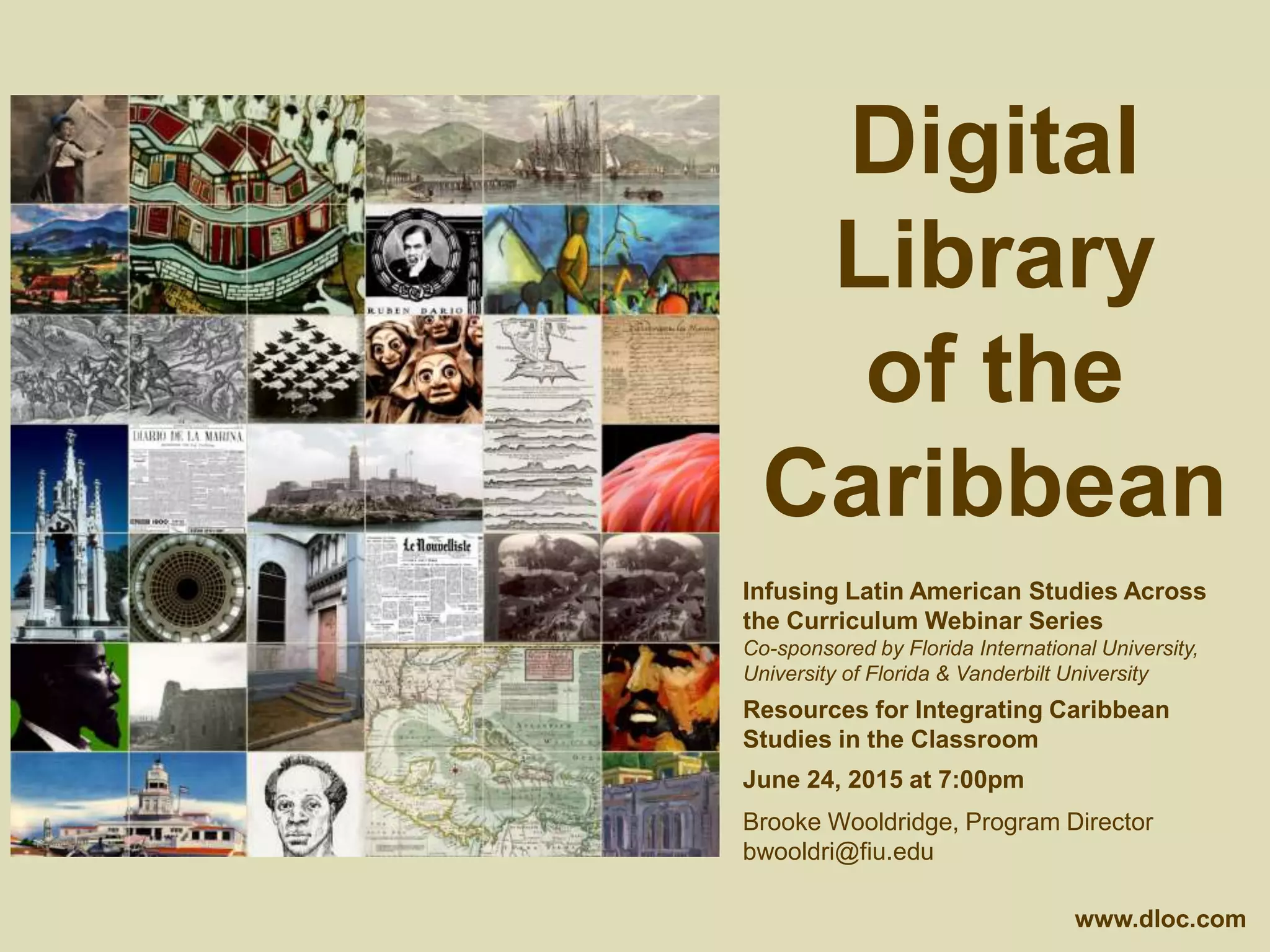
Digital
Library
of the
Caribbean
Infusing Latin American Studies Across
the Curriculum Webinar Series
Co-sponsored by Florida International University,
University of Florida & Vanderbilt University
Resources for Integrating Caribbean
Studies in the Classroom
June 24, 2015 at 7:00pm
Brooke Wooldridge, Program Director
bwooldri@fiu.edu
www.dloc.com
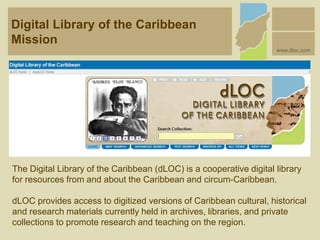
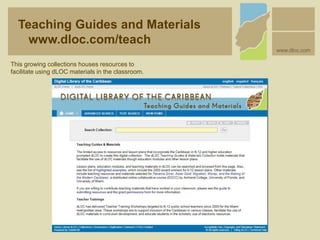
The Digital Library of the Caribbean (dLOC) is a cooperative digital library
for resources from and about the Caribbean and circum-Caribbean.
dLOC provides access to digitized versions of Caribbean cultural, historical
and research materials currently held in archives, libraries, and private
collections to promote research and teaching on the region.
Digital Library of the Caribbean
Mission
www.dloc.com
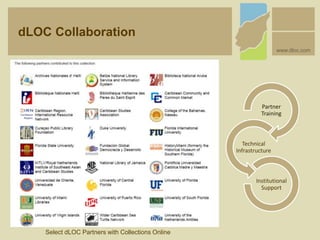
Select dLOC Partners with Collections Online
Partner
Training
Technical
Infrastructure
Institutional
Support
dLOC Collaboration
www.dloc.com
U.S. Occupation of Haiti: 1915-1934
- Using dLOC to Teach
www.dloc.com
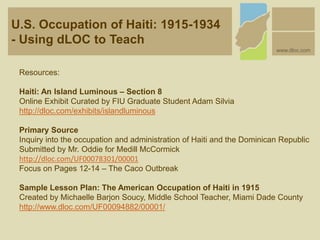
Resources:
Haiti: An Island Luminous – Section 8
Online Exhibit Curated by FIU Graduate Student Adam Silvia
http://dloc.com/exhibits/islandluminous
Primary Source
Inquiry into the occupation and administration of Haiti and the Dominican Republic
Submitted by Mr. Oddie for Medill McCormick
http://dloc.com/UF00078301/00001
Focus on Pages 12-14 – The Caco Outbreak
Sample Lesson Plan: The American Occupation of Haiti in 1915
Created by Michaelle Barjon Soucy, Middle School Teacher, Miami Dade County
http://www.dloc.com/UF00094882/00001/
U.S. Occupation of Haiti: 1915-1934
- Using dLOC to Teach
www.dloc.com
U.S. Occupation of Haiti: 1915-1934
- Using dLOC to Teach
www.dloc.com
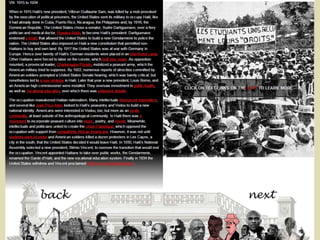
As opposition mounted, a provincial leader, Charlemagne
Péralte, mobilized a peasant army, which the American
military tried to suppress.
Excerpt from “Peralte and the Cacos”
Yveline Alexis, PhD, Oberlin College
• At first, Péralte utilized tactful and non-aggressive means
to oppose the occupation
• After serving time in prison on charges drawn up by the
United States Marines, Péralte [escaped]
• Under Péralte’s leadership, the cacos increased attacks
in and around the capital city.
• And on 3 October 1919, US Marines killed Péralte and
many other cacos displaying his body to discourage
other opposition.
• Péralte and his struggles are still remembered to this day
U.S. Occupation of Haiti: 1915-1934
- Using dLOC to Teach
www.dloc.com
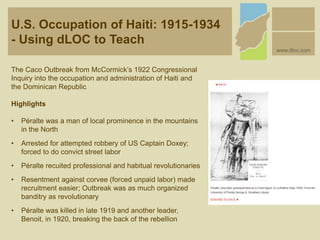
The Caco Outbreak from McCormick’s 1922 Congressional
Inquiry into the occupation and administration of Haiti and
the Dominican Republic
Highlights
• Péralte was a man of local prominence in the mountains
in the North
• Arrested for attempted robbery of US Captain Doxey;
forced to do convict street labor
• Péralte recuited professional and habitual revolutionaries
• Resentment against corvee (forced unpaid labor) made
recruitment easier; Outbreak was as much organized
banditry as revolutionary
• Péralte was killed in late 1919 and another leader,
Benoit, in 1920, breaking the back of the rebellion
U.S. Occupation of Haiti: 1915-1934
- Using dLOC to Teach
www.dloc.com
Teaching Activities
Adapted from Soucy Lesson Plan (2009)
Key Point for Classroom Lesson
• Quick overview of Haitian History
• Activate prior knowledge about occupations (maybe Iraq)
• Read about Haiti from 1915-1934
• Analyze the Congressional Report and the essay on
Charlemagne Peralte
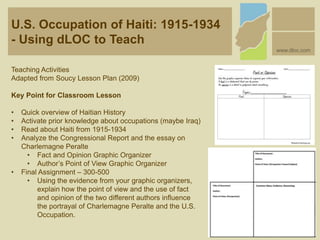
• Fact and Opinion Graphic Organizer
• Author’s Point of View Graphic Organizer
• Final Assignment – 300-500
• Using the evidence from your graphic organizers,
explain how the point of view and the use of fact
and opinion of the two different authors influence
the portrayal of Charlemagne Peralte and the U.S.
Occupation.
Title: Trinidad Guardian
Date: 1917-1931 online
Contributor: University of Florida
Title: Haiti En Marche
Date: 1999-2011 online
Contributor: Publisher
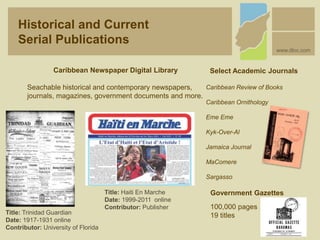
Caribbean Newspaper Digital Library
Seachable historical and contemporary newspapers,
journals, magazines, government documents and more.
Select Academic Journals
Caribbean Review of Books
Caribbean Ornithology
Eme Eme
Kyk-Over-Al
Jamaica Journal
MaComere
Sargasso
Government Gazettes
100,000 pages
19 titles
Historical and Current
Serial Publications
www.dloc.com
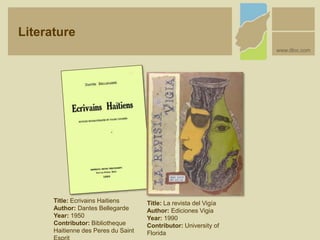
Title: Ecrivains Haitiens
Author: Dantes Bellegarde
Year: 1950
Contributor: Bibliotheque
Haitienne des Peres du Saint
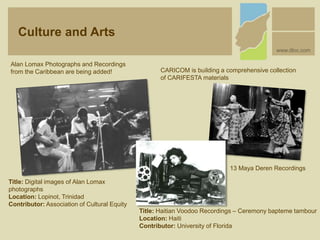
Title: La revista del Vigía
Author: Ediciones Vigia
Year: 1990
Contributor: University of
Florida
Literature
www.dloc.com
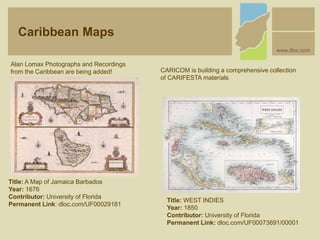
Title: Digital images of Alan Lomax
photographs
Location: Lopinot, Trinidad
Contributor: Association of Cultural Equity
Alan Lomax Photographs and Recordings
from the Caribbean are being added! CARICOM is building a comprehensive collection
of CARIFESTA materials
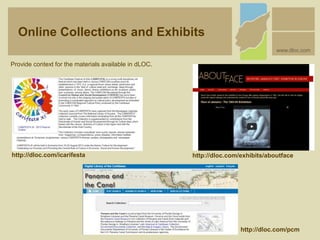
Title: Haitian Voodoo Recordings – Ceremony bapteme tambour
Location: Haiti
Contributor: University of Florida
13 Maya Deren Recordings
Culture and Arts
www.dloc.com
Title: A Map of Jamaica Barbados
Year: 1676
Contributor: University of Florida
Permanent Link: dloc.com/UF00029181
Alan Lomax Photographs and Recordings
from the Caribbean are being added! CARICOM is building a comprehensive collection
of CARIFESTA materials
Title: WEST INDIES
Year: 1850
Contributor: University of Florida
Permanent Link: dloc.com/UF00073691/00001
Caribbean Maps
www.dloc.com
http://dloc.com/icarifesta
Provide context for the materials available in dLOC.
http://dloc.com/exhibits/aboutface
Online Collections and Exhibits
www.dloc.com
http://dloc.com/pcm
This growing collections houses resources to
facilitate using dLOC materials in the classroom.
Teaching Guides and Materials
www.dloc.com/teach
www.dloc.com
This growing collections houses resources to
facilitate using dLOC materials in the classroom.
Teaching Guides and Materials
www.dloc.com/teach
www.dloc.com
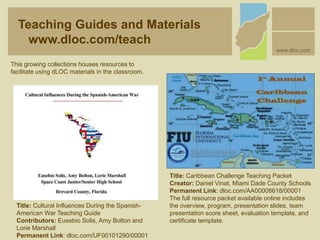
Title: Cultural Influences During the Spanish-
American War Teaching Guide
Contributors: Eusebio Solis, Amy Bolton and
Lorie Marshall
Permanent Link: dloc.com/UF00101290/00001
Title: Caribbean Challenge Teaching Packet
Creator: Daniel Vinat, Miami Dade County Schools
Permanent Link: dloc.com/AA00008618/00001
The full resource packet available online includes
the overview, program, presentation slides, team
presentation score sheet, evaluation template, and
certificate template.
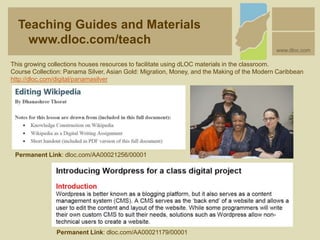
This growing collections houses resources to facilitate using dLOC materials in the classroom.
Course Collection: Panama Silver, Asian Gold: Migration, Money, and the Making of the Modern Caribbean
http://dloc.com/digital/panamasilver
Teaching Guides and Materials
www.dloc.com/teach
www.dloc.com
Permanent Link: dloc.com/AA00021256/00001
Permanent Link: dloc.com/AA00021179/00001

Integrating caribbeanstudies 2015

  • 1.
    Digital Library of the Caribbean Infusing LatinAmerican Studies Across the Curriculum Webinar Series Co-sponsored by Florida International University, University of Florida & Vanderbilt University Resources for Integrating Caribbean Studies in the Classroom June 24, 2015 at 7:00pm Brooke Wooldridge, Program Director bwooldri@fiu.edu www.dloc.com
  • 2.
    The Digital Libraryof the Caribbean (dLOC) is a cooperative digital library for resources from and about the Caribbean and circum-Caribbean. dLOC provides access to digitized versions of Caribbean cultural, historical and research materials currently held in archives, libraries, and private collections to promote research and teaching on the region. Digital Library of the Caribbean Mission www.dloc.com
  • 3.
    Select dLOC Partnerswith Collections Online Partner Training Technical Infrastructure Institutional Support dLOC Collaboration www.dloc.com
  • 4.
    U.S. Occupation ofHaiti: 1915-1934 - Using dLOC to Teach www.dloc.com Resources: Haiti: An Island Luminous – Section 8 Online Exhibit Curated by FIU Graduate Student Adam Silvia http://dloc.com/exhibits/islandluminous Primary Source Inquiry into the occupation and administration of Haiti and the Dominican Republic Submitted by Mr. Oddie for Medill McCormick http://dloc.com/UF00078301/00001 Focus on Pages 12-14 – The Caco Outbreak Sample Lesson Plan: The American Occupation of Haiti in 1915 Created by Michaelle Barjon Soucy, Middle School Teacher, Miami Dade County http://www.dloc.com/UF00094882/00001/
  • 5.
    U.S. Occupation ofHaiti: 1915-1934 - Using dLOC to Teach www.dloc.com
  • 6.
    U.S. Occupation ofHaiti: 1915-1934 - Using dLOC to Teach www.dloc.com As opposition mounted, a provincial leader, Charlemagne Péralte, mobilized a peasant army, which the American military tried to suppress. Excerpt from “Peralte and the Cacos” Yveline Alexis, PhD, Oberlin College • At first, Péralte utilized tactful and non-aggressive means to oppose the occupation • After serving time in prison on charges drawn up by the United States Marines, Péralte [escaped] • Under Péralte’s leadership, the cacos increased attacks in and around the capital city. • And on 3 October 1919, US Marines killed Péralte and many other cacos displaying his body to discourage other opposition. • Péralte and his struggles are still remembered to this day
  • 7.
    U.S. Occupation ofHaiti: 1915-1934 - Using dLOC to Teach www.dloc.com The Caco Outbreak from McCormick’s 1922 Congressional Inquiry into the occupation and administration of Haiti and the Dominican Republic Highlights • Péralte was a man of local prominence in the mountains in the North • Arrested for attempted robbery of US Captain Doxey; forced to do convict street labor • Péralte recuited professional and habitual revolutionaries • Resentment against corvee (forced unpaid labor) made recruitment easier; Outbreak was as much organized banditry as revolutionary • Péralte was killed in late 1919 and another leader, Benoit, in 1920, breaking the back of the rebellion
  • 8.
    U.S. Occupation ofHaiti: 1915-1934 - Using dLOC to Teach www.dloc.com Teaching Activities Adapted from Soucy Lesson Plan (2009) Key Point for Classroom Lesson • Quick overview of Haitian History • Activate prior knowledge about occupations (maybe Iraq) • Read about Haiti from 1915-1934 • Analyze the Congressional Report and the essay on Charlemagne Peralte • Fact and Opinion Graphic Organizer • Author’s Point of View Graphic Organizer • Final Assignment – 300-500 • Using the evidence from your graphic organizers, explain how the point of view and the use of fact and opinion of the two different authors influence the portrayal of Charlemagne Peralte and the U.S. Occupation.
  • 9.
    Title: Trinidad Guardian Date:1917-1931 online Contributor: University of Florida Title: Haiti En Marche Date: 1999-2011 online Contributor: Publisher Caribbean Newspaper Digital Library Seachable historical and contemporary newspapers, journals, magazines, government documents and more. Select Academic Journals Caribbean Review of Books Caribbean Ornithology Eme Eme Kyk-Over-Al Jamaica Journal MaComere Sargasso Government Gazettes 100,000 pages 19 titles Historical and Current Serial Publications www.dloc.com
  • 10.
    Title: Ecrivains Haitiens Author:Dantes Bellegarde Year: 1950 Contributor: Bibliotheque Haitienne des Peres du Saint Title: La revista del Vigía Author: Ediciones Vigia Year: 1990 Contributor: University of Florida Literature www.dloc.com
  • 11.
    Title: Digital imagesof Alan Lomax photographs Location: Lopinot, Trinidad Contributor: Association of Cultural Equity Alan Lomax Photographs and Recordings from the Caribbean are being added! CARICOM is building a comprehensive collection of CARIFESTA materials Title: Haitian Voodoo Recordings – Ceremony bapteme tambour Location: Haiti Contributor: University of Florida 13 Maya Deren Recordings Culture and Arts www.dloc.com
  • 12.
    Title: A Mapof Jamaica Barbados Year: 1676 Contributor: University of Florida Permanent Link: dloc.com/UF00029181 Alan Lomax Photographs and Recordings from the Caribbean are being added! CARICOM is building a comprehensive collection of CARIFESTA materials Title: WEST INDIES Year: 1850 Contributor: University of Florida Permanent Link: dloc.com/UF00073691/00001 Caribbean Maps www.dloc.com
  • 13.
    http://dloc.com/icarifesta Provide context forthe materials available in dLOC. http://dloc.com/exhibits/aboutface Online Collections and Exhibits www.dloc.com http://dloc.com/pcm
  • 14.
    This growing collectionshouses resources to facilitate using dLOC materials in the classroom. Teaching Guides and Materials www.dloc.com/teach www.dloc.com
  • 15.
    This growing collectionshouses resources to facilitate using dLOC materials in the classroom. Teaching Guides and Materials www.dloc.com/teach www.dloc.com Title: Cultural Influences During the Spanish- American War Teaching Guide Contributors: Eusebio Solis, Amy Bolton and Lorie Marshall Permanent Link: dloc.com/UF00101290/00001 Title: Caribbean Challenge Teaching Packet Creator: Daniel Vinat, Miami Dade County Schools Permanent Link: dloc.com/AA00008618/00001 The full resource packet available online includes the overview, program, presentation slides, team presentation score sheet, evaluation template, and certificate template.
  • 16.
    This growing collectionshouses resources to facilitate using dLOC materials in the classroom. Course Collection: Panama Silver, Asian Gold: Migration, Money, and the Making of the Modern Caribbean http://dloc.com/digital/panamasilver Teaching Guides and Materials www.dloc.com/teach www.dloc.com Permanent Link: dloc.com/AA00021256/00001 Permanent Link: dloc.com/AA00021179/00001

Editor's Notes

  • #2 Good evening everyone. First, I would like to thank Title VI and the university sponsors for creating this Webinar Series. I’d also like to thank Mary Risner for her leadership and vision in the creation of the series. Finally, I’d like to thank you very much for joining this online event tonight. My name is Brooke Wooldridge and I’m the Program Director for the Digital Library of the Caribbean. Tonight, I’d like to take a few minutes to share with you some resources and possibilities for incorporating Caribbean Studies into your Classroom. First, I’ll explain a little about the Digital Library of the Caribbean or dLOC as I will usually call it. Second, I’ll take you through a sample exercise on the U.S. Occupation of Haiti. And, finally, I’ll walk you through some of the types of materials and collections available in dLOC. This freely accessible resource has hundreds of thousands of pages of Caribbean content and one of our main goals is to facilitate use of that content in the classroom. So, thank you for your attention and I look forward to your questions after the presentation.
  • #3 The Digital Library of the Caribbean began in 2006 with funding from the US Department of Education, several universities in Florida and the Virgin Islands and 5 Caribbean institutions. dLOC is a cooperative digital library for resources from and about the Caribbean. Currently, we provide access to 2.3 million pages of content which have been viewed over 60 million times. The content is digitized by libraries, archives, museums and others and then provided online in a common web space to facilitate research and teaching on the region.
  • #4  These are just a few of the partner institutions contributing to dLOC. Now I’d like to take you from the general to the specific and show you how these resources could be used in the classroom to teach about the US Occupation of Haiti.
  • #5  For this exercise, I will highlight three items in dLOC. Section 8 of an online exhibit titled Haiti: An Island Luminous which focuses on the period of the US Occupation of Haiti. A selection from a Congressional Report on Haiti and the Dominican Republic from 1922. A Sample Lesson Plan on the American Occupation of Haiti in 1915 created by Michaelle Soucy for the dLOC Lesson Plan Competition in 2009.
  • #6  This is Section 8 of Haiti: An Island Luminous. This exhibit covers 500 years of Haitian History. This is the “learn” section of the exhibit. The images in the timeline allow you to jump from one time period to another starting in pre-Columbian times and ending in the present day. For this activity, we will be in the section highlighted in pink which covers the years 1915-1934. For those of you that may not be familiar with the history, I’ll read the narrative that describes this period. For your reference, each of the red links opens a new window on the right with more information and links to resources available in dLOC. When in 1915 Haiti’s new president, Vilbrun Guillaume Sam, was killed by a mob provoked by the execution of political prisoners, the United States sent its military to occupy Haiti, like it had already done in Cuba, Puerto Rico, Nicaragua, the Philippines and, by 1916, the Dominican Republic. The United States chose a senator, Sudre Dartiguenave, over a fiery politician and medical doctor, Rosalvo Bobo, to become Haiti’s president. Dartiguenave endorsed a treaty that allowed the United States to build a new Gendarmerie to police the nation. The United States also imposed on Haiti a new constitution that permitted non-Haitians to buy and own land. By 1917 the United States was at war with Germany in Europe. Hence over twenty of Haiti’s German residents were placed in an internment camp. Other Haitians were forced to labor on the corvée, which built new roads. As opposition mounted, a provincial leader, Charlemagne Péralte, mobilized a peasant army, which the American military tried to suppress. By 1922, numerous reports of atrocities committed by American soldiers prompted a United States Senate hearing, which was barely critical, but nonetheless led to a new strategy in Haiti. Later that year a new president, Louis Borno, and an American high commissioner were installed. They oversaw investment in public health, as well as vocational education, over which there was extensive debate. The occupation reawakened Haitian nationalism. Many intellectuals denounced imperialism, and several like Jean Price-Mars looked to Haiti’s peasantry and Vodou to build a new national identity. Americans were interested in Vodou, too, but more as an exotic commodity, at least outside of the anthropological community. In Haiti there was a movement to incorporate peasant culture into music, poetry, and novels. Meanwhile, intellectuals and politicians united to create the Union Patriotique, which opposed the occupation with support from sympathetic African Americans. However, it was not untilstudents went on strike and American soldiers killed a dozen protesters in Les Cayes, a city in the south, that the United States decided it would leave Haiti. In 1930, Haiti’s National Assembly selected a new president, Sténio Vincent, to oversee the transition that would end the occupation. Vincent appointed Haitians to take over public works, the Gendarmerie, renamed the Garde d’Haïti, and the new vocational education system. Finally in 1934 the United States withdrew and Vincent proclaimed Haiti’s second independence.
  • #7  I hope you found that narrative informative. I encourage you to explore the exhibit after today’s webinar. Now, I’d like to dig deeper into one of the red links. About halfway through the first paragraph, it reads: As opposition mounted, a provincial leader, Charlemagne Péralte, mobilized a peasant army, which the American military tried to suppress.  If you click on the link, you’ll see a short essay prepared by Professor Yveline Alexis. In her essay she presents a short biography of Peralte. Some of the highlights are included in this slide.
  • #8  In contrast, the 1922 Congressional Inquiry presents a very different picture. The main idea behind this assignment is for the students to learn about the US Occupation of Haiti in 1915 and to analyze it from the perspective of the US Government and the Haitians opposing the occupation.
  • #9  Adapted from Soucy’s Lesson Plan on The American Occupation of Haiti in 1915, here are the Key Points for a possible lesson. First, the instructor will provide a quick overview of Haitian History. Students can read a selection of the summary narratives from the Haiti: An Island Luminous Exhibit or just the section for 1915-1934. The instructor would discuss other US Occupations to link to prior learning. After reading both pieces on Peralte, the students would use Fact and Opinion and Author’s Point of View Graphic Organizers to analyze the works. As a final assignment, the students would use the evidence from their graphic organizers to explain how the point of view and the use of fact and opinion of the two different authors influence the portrayal of Charlemagne Peralte and the U.S. Occupation overall. I hope you found this very concrete example of how to use content in dLOC helpful.
  • #10 Now, I’d like to give you a few examples of the type of content available in dLOC. We have historical and contemporary newspapers, journals, magazines, government documents and more. These resources are extremely useful in a variety of subjects, but do require a little bit of time to sift through. Many of them have full text search functions, but be careful if the images come from scans of microfilm because the digital versions will often have light or dark spots that can make them hard to read.
  • #11 dLOC has historical literature in English, French and Spanish.
  • #12 Photographs, records, newspaper clippings, books and ephemeral materials related to culture and the arts.
  • #13 Hundreds of historical Caribbean Maps and a great map lesson plan. And many other items. I encourage you to just explore the materials via the search function on the home page or to browse through the partner collections or thematic collections.
  • #14 You can find a listing of the thematic collections from the link in the top header. I’ve already spoken at length about the Haiti An Island Luminous Collection. On this slide, I highlight a collection about the Caribbean Cultural Festival, CARIFESTA, the Panama and the Canal Exhibit and the Jamaican Art Exhibit About Face. These exhibits and the others in dLOC provide easy access and context for select materials in dLOC.
  • #15 This collection – www.dloc.com/teach – provides one place to find lesson plans and other teaching resources for materials in dLOC. Also, if you create a lesson that you would like to share with others, please contact dloc@fiu.edu or use the contact us link at the bottom of the page.
  • #16 These are two of the items on the teaching collection. The first is on the Cultural Influences during the Spanish American War and the second is an all day event created by Daniel Vinat where students research a topic using materials in dLOC and present their findings to the group. In this case, we had multiple schools compete at FIU for prizes.
  • #17 Finally, I want to share the link for a collection of resources created for the course Panama Silver, Asian Gold: Migration, Money, and the Making of the Modern Caribbean. The collection has materials specific to this course and samples and instructions that can be applied to a variety of topics. These two, created by University of Florida Graduate Student Dhanashree Thorat, provide instructions on how to edit Wikipedia or use Wordpress in the classroom. This presentation has been a quick tour through some of the resources available in the Digital Library of the Caribbean. I hope it has sparked some new ideas for incorporating Caribbean Studies into your Classroom. All the resources in dLOC are freely available for educational use. Please explore the resource online at www.dloc.com and contact me or anyone on the dLOC team if you have any questions or would like to contribute resources or lesson plans to the collection. Thank you very much.