CAMMS Whitepaper


CREATING A CULTURE OF ENTERPRISE RISK-MANAGEMENT
                       AWARENESS AND OWNERSHIP


www.cammsgroup.com
CAMMS Whitepaper


                     In many organisations, risk management functions very much as a ‘siloed’ process,
                     without an holistic, enterprise outlook of managing risks across operational areas. In
                     doing so, different definitions of ‘risk’ can be applied, information can be recorded
                     inconsistently and duplication in implementing mitigating risk treatment plans can
                     occur.

                     The definition of risk, as defined in the International Risk Management Standard ISO
                     31000, is the “effect of uncertainty on objectives”. Specific definitions of risk may vary
                     but there are three characteristics common to all definitions; The potential for loss must
                     exist; there must be uncertainty and; a decision is required.

                     Risk management is a systematic approach for minimising exposure to potential losses
                     and provides a disciplined environment for continuously assessing what could go wrong
                     and determining which of these risks need to be addressed.


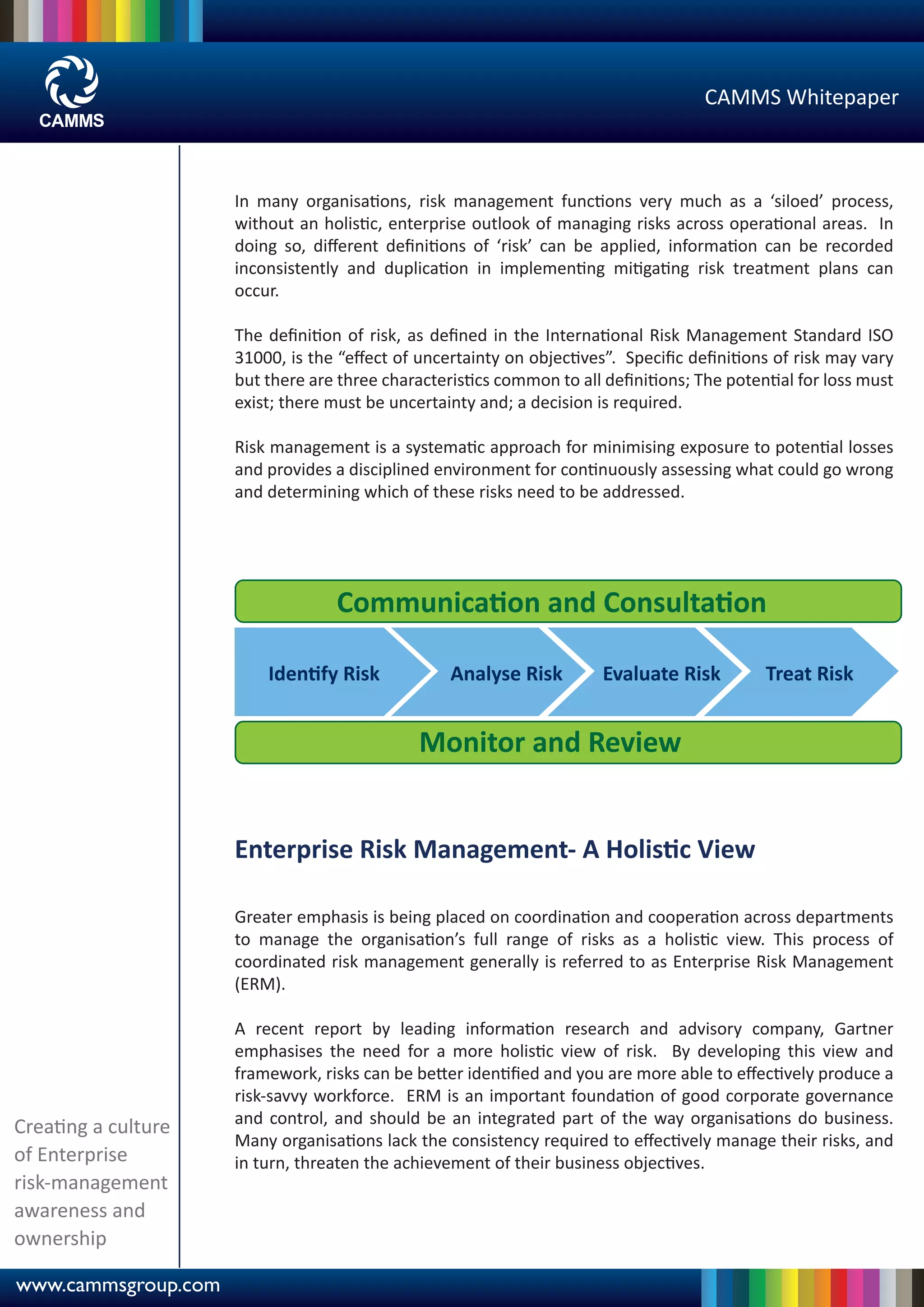
                                  Communication and Consultation

                         Identify Risk            Analyse Risk        Evaluate Risk         Treat Risk


                                             Monitor and Review


                     Enterprise Risk Management- A Holistic View

                     Greater emphasis is being placed on coordination and cooperation across departments
                     to manage the organisation’s full range of risks as a holistic view. This process of
                     coordinated risk management generally is referred to as Enterprise Risk Management
                     (ERM).

                     A recent report by leading information research and advisory company, Gartner
                     emphasises the need for a more holistic view of risk. By developing this view and
                     framework, risks can be better identified and you are more able to effectively produce a
                     risk-savvy workforce. ERM is an important foundation of good corporate governance
                     and control, and should be an integrated part of the way organisations do business.
Creating a culture
                     Many organisations lack the consistency required to effectively manage their risks, and
of Enterprise        in turn, threaten the achievement of their business objectives.
risk-management
awareness and
ownership

www.cammsgroup.com
CAMMS Whitepaper


                     Integrated Risk Management
                     There is a growing need for organisations to link their risks across their business and
                     adopt a more comprehensive framework. Paul Proctor, Vice President at Gartner
                     believes “Risk managers should develop a clear, enterprise-specific risk hierarchy to
                     facilitate appropriate decisions about risk controls, processes and tools.”

                     CAMMS Integrated Risk Manager solution provides a robust yet flexible approach to
                     identifying, profiling and assessing risks at all levels and enables organisations to:


                         • Ensure that risks are identified, profiled, assessed, monitored and reviewed
                           consistently across the organisation
                         • View the impact of risk treatment initiatives to ensure adequate controls and
                           solutions are being put in place to mitigate risks to a suitable level
                         • Integrate risk management with organisational planning and performance
                           measurement frameworks and other key business processes
                         • Ensure compliance with relevant standards and legislative requirements with the
                           flexibility to respond to changing legislative and environmental circumstances
                         • Enable high level analysis and graphing of the organisation’s risk profile
                         • Promote informed decision making from timely reports


                     CASE STUDY - Rural City of Murray Bridge - Australia
                     The Rural City of Murray Bridge, with a current workforce of over 150 staff, is the fastest
                     growing regional, non-coastal local government area in South Australia.

                     The Council implemented CAMMS Integrated Risk Management software to develop a
                     risk management framework, streamline risk identification and management, and
                     provide an overall risk profile and reporting system for the organisation.

                     They identified the need to build a risk management framework in order to :

                        • Strengthen management decision making and prioritisation of certain tasks in
                          response to risk assessments
                        • Develop risk policies and procedures that can be adopted by all departments
                        • Improve risk responses


Creating a culture   In 2011 the Local Government Association of SA (LGSA) awarded Council with the Local
of Enterprise        Government Association Mutual Liability Scheme Risk Management Award for their best
                     practice approach to public and organisational risks.
risk-management
awareness and
ownership

www.cammsgroup.com
CAMMS Whitepaper


                     They were commended by the LGSA for identifying business processes requiring greater
                     risk management, and responding with improved electronic recording of issues,
                     improved training and education and a revised risk management framework.


                     Conclusion
                     A solitary approach to risk results in limited transparency across processes which affects
                     an organisation’s ability to analysis risk exposure levels The ability to capture risk data
                     centrally and share this across the organisation is pivotal to managing and appropriately
                     dealing with risk.

                     Stop accepting disjointed risk management and start reaping the benefits of CAMMS
                     Integrated Risk Management.


Creating a culture
of Enterprise
risk-management
awareness and
ownership

www.cammsgroup.com
Organise a demonstration and see the difference first hand by contacting:

AUSTRALIA/NEW ZEALAND           NORTH AMERICA                     SRI LANKA                 UNITED KINGDOM
T: +61 (0)8 8212 5188           T: +1 416 322 2925                T: +94 (0)115 443 443     T: +44 (0)1273 666 360
F: +61 (0)8 8212 5288           F: +1 416 322 2932                F: +94 (0)112 470 374     F: +44 (0)1273 666 361
E: sales@cammsgroup.com         E: sales@cammsgroup.com           E: sales@cammsgroup.com   E: sales@cammsgroup.com


       AUSTRALIA | NEW ZEALAND | NORTH AMERICA | SRI LANKA | UNITED KINGDOM

Integrated Risk Management Whitepaper - CAMMS

  • 1.
    CAMMS Whitepaper CREATING ACULTURE OF ENTERPRISE RISK-MANAGEMENT AWARENESS AND OWNERSHIP www.cammsgroup.com
  • 2.
    CAMMS Whitepaper In many organisations, risk management functions very much as a ‘siloed’ process, without an holistic, enterprise outlook of managing risks across operational areas. In doing so, different definitions of ‘risk’ can be applied, information can be recorded inconsistently and duplication in implementing mitigating risk treatment plans can occur. The definition of risk, as defined in the International Risk Management Standard ISO 31000, is the “effect of uncertainty on objectives”. Specific definitions of risk may vary but there are three characteristics common to all definitions; The potential for loss must exist; there must be uncertainty and; a decision is required. Risk management is a systematic approach for minimising exposure to potential losses and provides a disciplined environment for continuously assessing what could go wrong and determining which of these risks need to be addressed. Communication and Consultation Identify Risk Analyse Risk Evaluate Risk Treat Risk Monitor and Review Enterprise Risk Management- A Holistic View Greater emphasis is being placed on coordination and cooperation across departments to manage the organisation’s full range of risks as a holistic view. This process of coordinated risk management generally is referred to as Enterprise Risk Management (ERM). A recent report by leading information research and advisory company, Gartner emphasises the need for a more holistic view of risk. By developing this view and framework, risks can be better identified and you are more able to effectively produce a risk-savvy workforce. ERM is an important foundation of good corporate governance and control, and should be an integrated part of the way organisations do business. Creating a culture Many organisations lack the consistency required to effectively manage their risks, and of Enterprise in turn, threaten the achievement of their business objectives. risk-management awareness and ownership www.cammsgroup.com
  • 3.
    CAMMS Whitepaper Integrated Risk Management There is a growing need for organisations to link their risks across their business and adopt a more comprehensive framework. Paul Proctor, Vice President at Gartner believes “Risk managers should develop a clear, enterprise-specific risk hierarchy to facilitate appropriate decisions about risk controls, processes and tools.” CAMMS Integrated Risk Manager solution provides a robust yet flexible approach to identifying, profiling and assessing risks at all levels and enables organisations to: • Ensure that risks are identified, profiled, assessed, monitored and reviewed consistently across the organisation • View the impact of risk treatment initiatives to ensure adequate controls and solutions are being put in place to mitigate risks to a suitable level • Integrate risk management with organisational planning and performance measurement frameworks and other key business processes • Ensure compliance with relevant standards and legislative requirements with the flexibility to respond to changing legislative and environmental circumstances • Enable high level analysis and graphing of the organisation’s risk profile • Promote informed decision making from timely reports CASE STUDY - Rural City of Murray Bridge - Australia The Rural City of Murray Bridge, with a current workforce of over 150 staff, is the fastest growing regional, non-coastal local government area in South Australia. The Council implemented CAMMS Integrated Risk Management software to develop a risk management framework, streamline risk identification and management, and provide an overall risk profile and reporting system for the organisation. They identified the need to build a risk management framework in order to : • Strengthen management decision making and prioritisation of certain tasks in response to risk assessments • Develop risk policies and procedures that can be adopted by all departments • Improve risk responses Creating a culture In 2011 the Local Government Association of SA (LGSA) awarded Council with the Local of Enterprise Government Association Mutual Liability Scheme Risk Management Award for their best practice approach to public and organisational risks. risk-management awareness and ownership www.cammsgroup.com
  • 4.
    CAMMS Whitepaper They were commended by the LGSA for identifying business processes requiring greater risk management, and responding with improved electronic recording of issues, improved training and education and a revised risk management framework. Conclusion A solitary approach to risk results in limited transparency across processes which affects an organisation’s ability to analysis risk exposure levels The ability to capture risk data centrally and share this across the organisation is pivotal to managing and appropriately dealing with risk. Stop accepting disjointed risk management and start reaping the benefits of CAMMS Integrated Risk Management. Creating a culture of Enterprise risk-management awareness and ownership www.cammsgroup.com
  • 5.
    Organise a demonstrationand see the difference first hand by contacting: AUSTRALIA/NEW ZEALAND NORTH AMERICA SRI LANKA UNITED KINGDOM T: +61 (0)8 8212 5188 T: +1 416 322 2925 T: +94 (0)115 443 443 T: +44 (0)1273 666 360 F: +61 (0)8 8212 5288 F: +1 416 322 2932 F: +94 (0)112 470 374 F: +44 (0)1273 666 361 E: sales@cammsgroup.com E: sales@cammsgroup.com E: sales@cammsgroup.com E: sales@cammsgroup.com AUSTRALIA | NEW ZEALAND | NORTH AMERICA | SRI LANKA | UNITED KINGDOM