Definition
• PEST -Any organism that cause significant and economic damage to crops, stored
produced and animals”.
• Pests include insects, nematodes, mites, snails, slugs, etc. and vertebrates like rats,
birds, etc.
• Dis-ease: Any malfunctioning of host cells and tissues from continuous irritation
by a pathogenic agent or environmental factor and lead to development of
symptoms (Agrios 1997).
3.
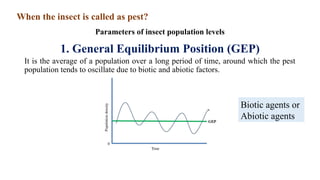
1. General EquilibriumPosition (GEP)
It is the average of a population over a long period of time, around which the pest
population tends to oscillate due to biotic and abiotic factors.
When the insect is called as pest?
Biotic agents or
Abiotic agents
Parameters of insect population levels
4.
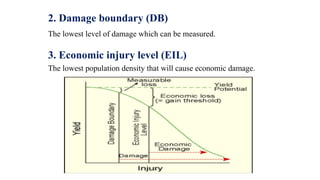
2. Damage boundary(DB)
The lowest level of damage which can be measured.
3. Economic injury level (EIL)
The lowest population density that will cause economic damage.
5.
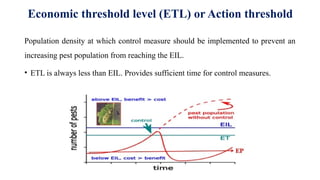
Economic threshold level(ETL) or Action threshold
Population density at which control measure should be implemented to prevent an
increasing pest population from reaching the EIL.
• ETL is always less than EIL. Provides sufficient time for control measures.
6.
Insect pests areclassified as follows based on season and
locality
a. Regular pests: Occur most frequently (regularly) in a crop and have close
association with that particular crop. Eg: Chilli Thrips (Scirtothrips dorsalis),
brinjal shoot and fruit borer (Leucinodes orbonalis) Rice stem borer.
b. Occasional pests: Here a close association with a particular crop is absent and
they occur infrequently. Eg: Rice case worm (Nymphula depuctalis) castor slug
caterpillar (Parasa lepida) , mango stem borer (Batocera rufamaculata)
c. Seasonal pests: Occur mostly during a particular part of the year, and usually
the incidence is governed by climatic conditions. Eg: Red hairy caterpillar on
groundnut-June - July, Rice grasshoppers –June-July
d. Persistent pests: Occur on a crop almost throughout the year. Eg. Thrips on
chillies.
e. Sporadic pests: Pests, which occur in a few isolated localities Eg. Rice ear
head bug.
7.
a. Epidemic pests:Sudden outbreak of a pest in a severe form in a region at a
particular time Eg: Rice hispa, Dicladispa armigera, rice leaf roller,
Cnaphalocrocis medinalis
b. Endemic pests: Pests, which occur regularly and confined to a particular area
of locality. Eg. Rice Gall midge in Madurai district and rice stem borer cauvery
delta.
Insect's pests are also classified as follows based on intensity of infestations
8.
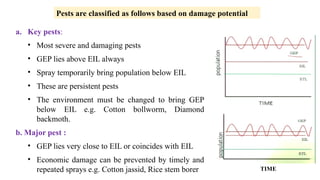
a. Key pests:
•Most severe and damaging pests
• GEP lies above EIL always
• Spray temporarily bring population below EIL
• These are persistent pests
• The environment must be changed to bring GEP
below EIL e.g. Cotton bollworm, Diamond
backmoth.
b. Major pest :
• GEP lies very close to EIL or coincides with EIL
• Economic damage can be prevented by timely and
repeated sprays e.g. Cotton jassid, Rice stem borer
Pests are classified as follows based on damage potential
TIME
9.
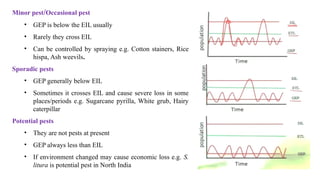
Minor pest/Occasional pest
•GEP is below the EIL usually
• Rarely they cross EIL
• Can be controlled by spraying e.g. Cotton stainers, Rice
hispa, Ash weevils.
Sporadic pests
• GEP generally below EIL
• Sometimes it crosses EIL and cause severe loss in some
places/periods e.g. Sugarcane pyrilla, White grub, Hairy
caterpillar
Potential pests
• They are not pests at present
• GEP always less than EIL
• If environment changed may cause economic loss e.g. S.
litura is potential pest in North India
10.
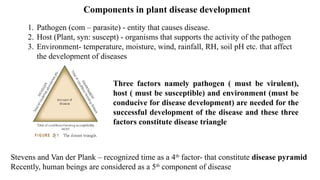
Components in plantdisease development
1. Pathogen (com – parasite) - entity that causes disease.
2. Host (Plant, syn: suscept) - organisms that supports the activity of the pathogen
3. Environment- temperature, moisture, wind, rainfall, RH, soil pH etc. that affect
the development of diseases
Stevens and Van der Plank – recognized time as a 4th
factor- that constitute disease pyramid
Recently, human beings are considered as a 5th
component of disease
Three factors namely pathogen ( must be virulent),
host ( must be susceptible) and environment (must be
conducive for disease development) are needed for the
successful development of the disease and these three
factors constitute disease triangle
11.
Classification of plantdiseases
(based on occurrence and geographic distribution)
1. Endemic disease ("endemic" means "prevalent in, and confined to, a particular
country or district“)
The disease is constantly present in a moderate to severe from and is confined to a
particular country or district.
E.g. Club root disease of cabbage is endemic in the Nilgiris district.
Potato wart disease- Synchytrium endobioticum in Darjeeling
12.
2. Epidemic orEpiphytotic disease
• Sudden outbreak of a disease over a widespread area in a devastatingly severe
form causing extensive losses or complete destruction.
• E.g. Late blight of potato- Phytophthora infestans, wheat stem rust, sugarcane red
rot
There are two types
1. Rapid epiphytotic- caused by non-systemic pathogen with high birth rate, several
generations and with short incubation and sporulation period
2. Slow epiphytotic-caused by systemic pathogen having low birth rate and
multiply slowly due to lengthy sporulation and incubation time.
13.
3. Sporadic diseaseoccurs at very irregular intervals and locations over limited
areas or locations
E.g. Udubatta disease in rice.
4. Pandemic disease When the disease occur all over the world and result in mass
mortality. E.g wheat stem rust
14.
Classification of plantdiseases
(based on type of infection)
1. Localized diseases- limited to definite area/ part of a plant e.g Leaf spots
2. Systemic disease- pathogen spreads from the point of infection to entire plant
body. E.g smult, downy mildew, viral diseases
Classification of plant diseases
(based on spread and perpetuation)
1. Air-borne disease - carried over and spread by air- Tikka leaf spot- Mycosphaerella
arachidis
2. Seed-borne disease- by seed- Loose smut of wheat- Ustilago nuda tritici
3. Soil –borne disease- by soil-root rot of pulses- Macrophomina phaseolina
4. Vector borne disease- rice tungro virus- by insects green leaf hopper
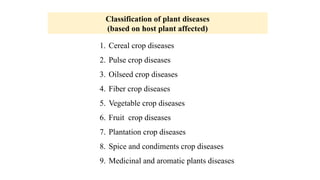
15.
Classification of plantdiseases
(based on host plant affected)
1. Cereal crop diseases
2. Pulse crop diseases
3. Oilseed crop diseases
4. Fiber crop diseases
5. Vegetable crop diseases
6. Fruit crop diseases
7. Plantation crop diseases
8. Spice and condiments crop diseases
9. Medicinal and aromatic plants diseases
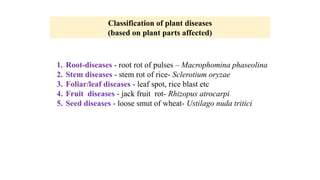
16.
Classification of plantdiseases
(based on plant parts affected)
1. Root-diseases - root rot of pulses – Macrophomina phaseolina
2. Stem diseases - stem rot of rice- Sclerotium oryzae
3. Foliar/leaf diseases - leaf spot, rice blast etc
4. Fruit diseases - jack fruit rot- Rhizopus atrocarpi
5. Seed diseases - loose smut of wheat- Ustilago nuda tritici
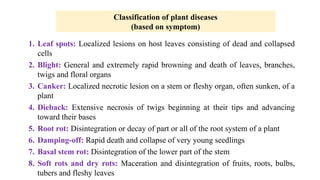
17.
1. Leaf spots:Localized lesions on host leaves consisting of dead and collapsed
cells
2. Blight: General and extremely rapid browning and death of leaves, branches,
twigs and floral organs
3. Canker: Localized necrotic lesion on a stem or fleshy organ, often sunken, of a
plant
4. Dieback: Extensive necrosis of twigs beginning at their tips and advancing
toward their bases
5. Root rot: Disintegration or decay of part or all of the root system of a plant
6. Damping-off: Rapid death and collapse of very young seedlings
7. Basal stem rot: Disintegration of the lower part of the stem
8. Soft rots and dry rots: Maceration and disintegration of fruits, roots, bulbs,
tubers and fleshy leaves
Classification of plant diseases
(based on symptom)
18.
9. Anthracnose: Necroticand sunken ulcer-like lesion on the stem, leaf, fruit, or
flower of the host plant caused mainly by a certain group of fungi
10. Scab: Localized lesions on host fruit, leaves, tubers, etc., usually slightly raised
or sunken and cracked, giving a scabby appearance
11. Decline: Progressive loss of vigor; plants growing poorly; leaves small, brittle,
yellowish, or red; some defoliation and dieback present
12. Wilt: Generalized loss of turgidity and drooping of leaves or shoots
13. Rust: Many small pustules on leaves or stems, usually of a rusty color
14. Smut: Seed or a gall filled with the mycelium or black spores of the smut fungi
15. Mildew: Areas on leaves, stems, blossoms, and fruits, covered with whitish
mycelium and the fructifications of the fungus
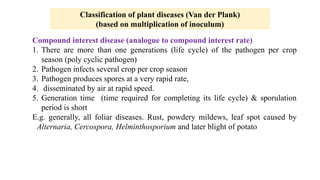
19.
Classification of plantdiseases (Van der Plank)
(based on multiplication of inoculum)
Compound interest disease (analogue to compound interest rate)
1. There are more than one generations (life cycle) of the pathogen per crop
season (poly cyclic pathogen)
2. Pathogen infects several crop per crop season
3. Pathogen produces spores at a very rapid rate,
4. disseminated by air at rapid speed.
5. Generation time (time required for completing its life cycle) & sporulation
period is short
E.g. generally, all foliar diseases. Rust, powdery mildews, leaf spot caused by
Alternaria, Cercospora, Helminthosporium and later blight of potato
20.
Simple interest disease(analogue to simple interest rate)
1. There is only one generation of the pathogen per crop season (monocyclic
pathogen)
2. pathogen infects one crop per crop season
3. Pathogen produces spores a very slow rate
4. Disseminated by soil/seed
5. Generation time and sporulation period is long
E. g. wilt diseases caused by fungal pathogens such as Fusarium and Verticillium and
bacterial pathogens Ralstonia ; Root rot diseases caused by Rhizoctonia; Smut
diseases typically loose smut of wheat.






![Polymer [ बहुलक ] Chemistry Notes PDF - Irfanullah Mehar - JJ Sir Chemistry.pdf](https://cdn.slidesharecdn.com/ss_thumbnails/polymerchemistrynotespdf-irfanullahmehar-jjsirchemistry-260210172118-3f9b37f7-thumbnail.jpg?width=640&height=640&fit=bounds)


