The embedded control software for a personal insulin
pump
1
Case study: Insulin pump overview
Medical systems
 More and more medical instruments now include embedded
control software.
 These software systems are often critical systems as a
patient’s life (or at least their health) may depend on the
correct and timely functioning of these systems
 The systems themselves are often relatively small and are
therefore understandable unlike, for example, industrial
control systems
2
Case study: Insulin pump overview
Diabetes
 People with diabetes cannot make their own insulin, a
hormone that is normally secreted by the pancreas. Insulin is
essential to metabolise sugar and hence generate energy
 Currently most diabetics inject insulin 2 or more times per day,
with the dose injected based on readings of their blood sugar
level
 However, this results in artificial blood sugar fluctuations as it
does not reflect the on-demand insulin production of the
pancreas
3
Case study: Insulin pump overview
A personal insulin pump
 A personal insulin pump is an external device that mimics the
function of the pancreas
 It uses an embedded sensor to measure the blood sugar level
at periodic intervals and then injects insulin to maintain the
blood sugar at a ‘normal’ level.
 I will draw on this example at various points in the course to
illustrate aspects of critical systems engineering
4
Case study: Insulin pump overview
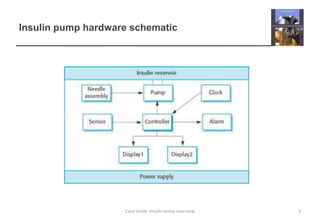
Insulin pump hardware schematic
5
Case study: Insulin pump overview
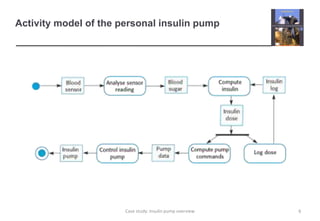
Activity model of the personal insulin pump
6
Case study: Insulin pump overview
Concept of operation
 Using readings from an embedded sensor, the system
automatically measures the level of glucose in the sufferer’s
body
 Consecutive readings are compared and, if they indicate that
the level of glucose is rising (see next slide) then insulin is
injected to counteract this rise
 The ideal situation is a consistent level of sugar that is within
some ‘safe’ band
7
Case study: Insulin pump overview
Sugar levels
 Unsafe
 A very low level of sugar (arbitrarily, we will call this 3 units) is
dangerous and can result in hypoglaecemia which can result in a
diabetic coma and ultimately death.
 Safe
 Between 3 units and about 7 units, the levels of sugar are ‘safe’ and
are comparable to those in people without diabetes. This is the ideal
band.
 Undesirable
 Above 7 units of insulin is undesirable but high levels are not
dangerous in the short-term. Continuous high-levels however can
result in long-term side-effects.
8
Case study: Insulin pump overview
Insulin injection
 The decision when to apply insulin does NOT depend on the
absolute level of glucose that is measured in the sufferer’s
blood.
 The reason for this is that insulin does not act instantaneously
and the change in sugar level does not simply depend on a
single injection but also on previous injections.
 A more complex decision based on previous levels and rate of
change of sugar level is used.
9
Case study: Insulin pump overview
Injection scenarios
 Level of sugar is in the unsafe band
 Do not inject insulin;
 Initiate warning for the sufferer.
 Level of sugar is falling
 Do not inject insulin if in safe band. Inject insulin if rate of change of level is
decreasing.
 Level of sugar is stable
 Do not inject insulin if level is in the safe band;
 Inject insulin if level is in the undesirable band to bring down glucose level;
 Amount injected should be proportionate to the degree of undesirability ie
inject more if level is 20 rather than 10.
10
Case study: Insulin pump overview
Injection scenarios
 Level of sugar is increasing
 Reading in unsafe band
• No injection.
 Reading in safe band
• Inject only if the rate of increase is constant or increasing. If constant,
inject standard amount; if increasing, compute amount based on increase.
 Reading in unsafe band
• Inject constant amount if rate of increase is constant or decreasing.
• Inject computed amount if rate of increase is increasing.
11
Case study: Insulin pump overview
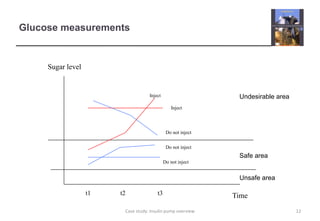
Glucose measurements
Time
Sugar level
Unsafe area
Safe area
Undesirable area
t1 t2 t3
Inject
Inject
Do not inject
Do not inject
Do not inject
12
Case study: Insulin pump overview
System specification
 Functional specification
 How to carry out the computation to determine if insulin should be
administered
 Dependability specification
 Requirements to ensure safe operation of the pump
13
Case study: Insulin pump overview
Functional requirements
 If the reading is below the safe minimum, no insulin shall be
delivered.
 If the reading is within the safe zone, then insulin is only delivered if
the level of sugar is rising and the rate of increase of sugar level is
increasing.
 If the reading is above the recommended level, insulin is delivered
unless the level of blood sugar is falling and the rate of decrease of
the blood sugar level is increasing.
14
Case study: Insulin pump overview
Formal specification
 Because of the complexity of the functional specification,
there is considerable scope for misinterpretation
 This system is an example where formal specification can be
used to define the insulin to be delivered in each case
15
Case study: Insulin pump overview
Dependability specification
 Availability
 The pump should have a high level of availability but the nature of
diabetes is such that continuous availability is unnecessary
 Reliability
 Intermittent demands for service are made on the system
 Safety
 The key safety requirements are that the operation of the system
should never result in a very low level of blood sugar. A fail-safe
position is for no insulin to be delivered
 Security
 Not really applicable in this case
16
Case study: Insulin pump overview
System availability
 In specifying the availability, issues that must be considered
are:
 The machine does not have to be continuously available as failure to
deliver insulin on a single occasion (say) is not a problem
 However, no insulin delivery over a few hours would have an effect on
the patient’s health
 The machine software can be reset by switching it on and off hence
recovery from software errors is possible without compromising the
usefulness of the system
 Hardware failures can only be repaired by return to the manufacturer.
This means, in practice, a loss of availability of at least 3 days
17
Case study: Insulin pump overview
Availability
 A general specification of availability suggests that the
machine should not have to be returned to the manufacturer
more than once every year years (this repair time dominates
everything else) so
 System availability = 727/730 *100 = 0.99
 It is much harder to specify the software availability as the
demands are intermittent. In this case, you would subsume
availability under reliability
18
Case study: Insulin pump overview
Reliability metric
 Demands on the system are intermittent (several times per
hour) and the system must be able to respond to these
demands
 In this case, the most appropriate metric is therefore
Probability of Failure on Demand
 Other metrics
 Short transactions so MTTF not appropriate
 Insufficient number of demands for ROCOF to be appropriate
19
Case study: Insulin pump overview
System failures
 Transient failures
 can be repaired by user actions such as resetting or recalibrating the
machine. For these types of failure, a relatively low value of POFOD
(say 0.002) may be acceptable. This means that one failure may occur
in every 500 demands made on the machine. This is approximately
once every 3.5 days.
 Permanent failures
 require the machine to be repaired by the manufacturer. The
probability of this type of failure should be much lower. Roughly once a
year is the minimum figure so POFOD should be no more than
0.00002.
20
Case study: Insulin pump overview
System hazard analysis
 Physical hazards
 Hazards that result from some physical failure of the system
 Electrical hazards
 Hazards that result from some electrical failure of the system
 Biological hazards
 Hazards that result from some system failure that interferes with
biological processes
21
Case study: Insulin pump overview
Insulin system hazards
 insulin overdose or underdose (biological)
 power failure (electrical)
 machine interferes electrically with other medical equipment
such as a heart pacemaker (electrical)
 parts of machine break off in patient’s body(physical)
 infection caused by introduction of machine (biol.)
 allergic reaction to the materials or insulin used in the
machine (biol).
22
Case study: Insulin pump overview
Risk analysis example
23
Case study: Insulin pump overview
Software-related hazards
 Only insulin overdose and insulin underdose are software
related hazards
 The other hazards are related to the hardware and physical
design of the machine
 Insulin underdose and insulin overdose can be the result of
errors made by the software in computing the dose required
24
Case study: Insulin pump overview
Software problems
 Arithmetic error
 Some arithmetic computation causes a representation failure (overflow
or underflow)
 Specification may state that arithmetic error must be detected and an
exception handler included for each arithmetic error. The action to be
taken for these errors should be defined
 Algorithmic error
 Difficult to detect anomalous situation
 May use ‘realism’ checks on the computed dose of insulin
25
Case study: Insulin pump overview
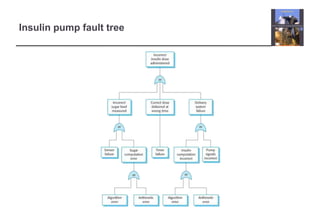
Insulin pump fault tree
General dependability requirements
 SR1: The system shall not deliver a single dose of insulin that is
greater than a specified maximum dose for a system user.
 SR2: The system shall not deliver a daily cumulative dose of insulin
that is greater than a specified maximum for a system user.
 SR3: The system shall include a hardware diagnostic facility that
should be executed at least 4 times per hour.
 SR4: The system shall include an exception handler for all of the
exceptions that are identified in Table 3.
 SR5: The audible alarm shall be sounded when any hardware
anomaly is discovered and a diagnostic message as defined in
Table 4 should be displayed.
27
Case study: Insulin pump overview
Safety proofs
 Safety proofs are intended to show that the system cannot
reach in unsafe state
 Weaker than correctness proofs which must show that the
system code conforms to its specification
 Generally based on proof by contradiction
 Assume that an unsafe state can be reached
 Show that this is contradicted by the program code
28
Case study: Insulin pump overview
Insulin delivery system
 Safe state is a shutdown state where no insulin is delivered
 If hazard arises,shutting down the system will prevent an accident
 Software may be included to detect and prevent hazards such
as power failure
 Consider only hazards arising from software failure
 Arithmetic error The insulin dose is computed incorrectly because of
some failure of the computer arithmetic
 Algorithmic error The dose computation algorithm is incorrect
29
Case study: Insulin pump overview
 Use language exception handling mechanisms to trap errors
as they arise
 Use explicit error checks for all errors which are identified
 Avoid error-prone arithmetic operations (multiply and divide).
Replace with add and subtract
 Never use floating-point numbers
 Shut down system if exception detected (safe state)
Arithmetic errors
30
Case study: Insulin pump overview
 Harder to detect than arithmetic errors. System should always
err on the side of safety
 Use reasonableness checks for the dose delivered based on
previous dose and rate of dose change
 Set maximum delivery level in any specified time period
 If computed dose is very high, medical intervention may be
necessary anyway because the patient may be ill
Algorithmic errors
31
Case study: Insulin pump overview
Insulin delivery code
32
Case study: Insulin pump overview
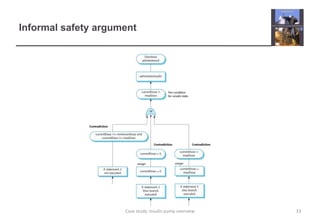
Informal safety argument
33
Case study: Insulin pump overview
System testing
 System testing of the software has to rely on simulators for
the sensor and the insulin delivery components.
 Test for normal operation using an operational profile. Can be
constructed using data gathered from existing diabetics
 Testing has to include situations where rate of change of
glucose is very fast and very slow
 Test for exceptions using the simulator
34
Case study: Insulin pump overview
Safety assertions
 Predicates included in the program indicating conditions
which should hold at that point.
 May be based on pre-computed limits e.g. number of insulin
pump increments in maximum dose.
 Used in formal program inspections or may be pre-processed
into safety checks that are executed when the system is in
operation.
35
Case study: Insulin pump overview
Safety assertions
36
Case study: Insulin pump overview

insulinpumpoverview-141212105807-conversion-gate01 (2).pdf

  • 1.
    The embedded controlsoftware for a personal insulin pump 1 Case study: Insulin pump overview
  • 2.
    Medical systems  Moreand more medical instruments now include embedded control software.  These software systems are often critical systems as a patient’s life (or at least their health) may depend on the correct and timely functioning of these systems  The systems themselves are often relatively small and are therefore understandable unlike, for example, industrial control systems 2 Case study: Insulin pump overview
  • 3.
    Diabetes  People withdiabetes cannot make their own insulin, a hormone that is normally secreted by the pancreas. Insulin is essential to metabolise sugar and hence generate energy  Currently most diabetics inject insulin 2 or more times per day, with the dose injected based on readings of their blood sugar level  However, this results in artificial blood sugar fluctuations as it does not reflect the on-demand insulin production of the pancreas 3 Case study: Insulin pump overview
  • 4.
    A personal insulinpump  A personal insulin pump is an external device that mimics the function of the pancreas  It uses an embedded sensor to measure the blood sugar level at periodic intervals and then injects insulin to maintain the blood sugar at a ‘normal’ level.  I will draw on this example at various points in the course to illustrate aspects of critical systems engineering 4 Case study: Insulin pump overview
  • 5.
    Insulin pump hardwareschematic 5 Case study: Insulin pump overview
  • 6.
    Activity model ofthe personal insulin pump 6 Case study: Insulin pump overview
  • 7.
    Concept of operation Using readings from an embedded sensor, the system automatically measures the level of glucose in the sufferer’s body  Consecutive readings are compared and, if they indicate that the level of glucose is rising (see next slide) then insulin is injected to counteract this rise  The ideal situation is a consistent level of sugar that is within some ‘safe’ band 7 Case study: Insulin pump overview
  • 8.
    Sugar levels  Unsafe A very low level of sugar (arbitrarily, we will call this 3 units) is dangerous and can result in hypoglaecemia which can result in a diabetic coma and ultimately death.  Safe  Between 3 units and about 7 units, the levels of sugar are ‘safe’ and are comparable to those in people without diabetes. This is the ideal band.  Undesirable  Above 7 units of insulin is undesirable but high levels are not dangerous in the short-term. Continuous high-levels however can result in long-term side-effects. 8 Case study: Insulin pump overview
  • 9.
    Insulin injection  Thedecision when to apply insulin does NOT depend on the absolute level of glucose that is measured in the sufferer’s blood.  The reason for this is that insulin does not act instantaneously and the change in sugar level does not simply depend on a single injection but also on previous injections.  A more complex decision based on previous levels and rate of change of sugar level is used. 9 Case study: Insulin pump overview
  • 10.
    Injection scenarios  Levelof sugar is in the unsafe band  Do not inject insulin;  Initiate warning for the sufferer.  Level of sugar is falling  Do not inject insulin if in safe band. Inject insulin if rate of change of level is decreasing.  Level of sugar is stable  Do not inject insulin if level is in the safe band;  Inject insulin if level is in the undesirable band to bring down glucose level;  Amount injected should be proportionate to the degree of undesirability ie inject more if level is 20 rather than 10. 10 Case study: Insulin pump overview
  • 11.
    Injection scenarios  Levelof sugar is increasing  Reading in unsafe band • No injection.  Reading in safe band • Inject only if the rate of increase is constant or increasing. If constant, inject standard amount; if increasing, compute amount based on increase.  Reading in unsafe band • Inject constant amount if rate of increase is constant or decreasing. • Inject computed amount if rate of increase is increasing. 11 Case study: Insulin pump overview
  • 12.
    Glucose measurements Time Sugar level Unsafearea Safe area Undesirable area t1 t2 t3 Inject Inject Do not inject Do not inject Do not inject 12 Case study: Insulin pump overview
  • 13.
    System specification  Functionalspecification  How to carry out the computation to determine if insulin should be administered  Dependability specification  Requirements to ensure safe operation of the pump 13 Case study: Insulin pump overview
  • 14.
    Functional requirements  Ifthe reading is below the safe minimum, no insulin shall be delivered.  If the reading is within the safe zone, then insulin is only delivered if the level of sugar is rising and the rate of increase of sugar level is increasing.  If the reading is above the recommended level, insulin is delivered unless the level of blood sugar is falling and the rate of decrease of the blood sugar level is increasing. 14 Case study: Insulin pump overview
  • 15.
    Formal specification  Becauseof the complexity of the functional specification, there is considerable scope for misinterpretation  This system is an example where formal specification can be used to define the insulin to be delivered in each case 15 Case study: Insulin pump overview
  • 16.
    Dependability specification  Availability The pump should have a high level of availability but the nature of diabetes is such that continuous availability is unnecessary  Reliability  Intermittent demands for service are made on the system  Safety  The key safety requirements are that the operation of the system should never result in a very low level of blood sugar. A fail-safe position is for no insulin to be delivered  Security  Not really applicable in this case 16 Case study: Insulin pump overview
  • 17.
    System availability  Inspecifying the availability, issues that must be considered are:  The machine does not have to be continuously available as failure to deliver insulin on a single occasion (say) is not a problem  However, no insulin delivery over a few hours would have an effect on the patient’s health  The machine software can be reset by switching it on and off hence recovery from software errors is possible without compromising the usefulness of the system  Hardware failures can only be repaired by return to the manufacturer. This means, in practice, a loss of availability of at least 3 days 17 Case study: Insulin pump overview
  • 18.
    Availability  A generalspecification of availability suggests that the machine should not have to be returned to the manufacturer more than once every year years (this repair time dominates everything else) so  System availability = 727/730 *100 = 0.99  It is much harder to specify the software availability as the demands are intermittent. In this case, you would subsume availability under reliability 18 Case study: Insulin pump overview
  • 19.
    Reliability metric  Demandson the system are intermittent (several times per hour) and the system must be able to respond to these demands  In this case, the most appropriate metric is therefore Probability of Failure on Demand  Other metrics  Short transactions so MTTF not appropriate  Insufficient number of demands for ROCOF to be appropriate 19 Case study: Insulin pump overview
  • 20.
    System failures  Transientfailures  can be repaired by user actions such as resetting or recalibrating the machine. For these types of failure, a relatively low value of POFOD (say 0.002) may be acceptable. This means that one failure may occur in every 500 demands made on the machine. This is approximately once every 3.5 days.  Permanent failures  require the machine to be repaired by the manufacturer. The probability of this type of failure should be much lower. Roughly once a year is the minimum figure so POFOD should be no more than 0.00002. 20 Case study: Insulin pump overview
  • 21.
    System hazard analysis Physical hazards  Hazards that result from some physical failure of the system  Electrical hazards  Hazards that result from some electrical failure of the system  Biological hazards  Hazards that result from some system failure that interferes with biological processes 21 Case study: Insulin pump overview
  • 22.
    Insulin system hazards insulin overdose or underdose (biological)  power failure (electrical)  machine interferes electrically with other medical equipment such as a heart pacemaker (electrical)  parts of machine break off in patient’s body(physical)  infection caused by introduction of machine (biol.)  allergic reaction to the materials or insulin used in the machine (biol). 22 Case study: Insulin pump overview
  • 23.
    Risk analysis example 23 Casestudy: Insulin pump overview
  • 24.
    Software-related hazards  Onlyinsulin overdose and insulin underdose are software related hazards  The other hazards are related to the hardware and physical design of the machine  Insulin underdose and insulin overdose can be the result of errors made by the software in computing the dose required 24 Case study: Insulin pump overview
  • 25.
    Software problems  Arithmeticerror  Some arithmetic computation causes a representation failure (overflow or underflow)  Specification may state that arithmetic error must be detected and an exception handler included for each arithmetic error. The action to be taken for these errors should be defined  Algorithmic error  Difficult to detect anomalous situation  May use ‘realism’ checks on the computed dose of insulin 25 Case study: Insulin pump overview
  • 26.
  • 27.
    General dependability requirements SR1: The system shall not deliver a single dose of insulin that is greater than a specified maximum dose for a system user.  SR2: The system shall not deliver a daily cumulative dose of insulin that is greater than a specified maximum for a system user.  SR3: The system shall include a hardware diagnostic facility that should be executed at least 4 times per hour.  SR4: The system shall include an exception handler for all of the exceptions that are identified in Table 3.  SR5: The audible alarm shall be sounded when any hardware anomaly is discovered and a diagnostic message as defined in Table 4 should be displayed. 27 Case study: Insulin pump overview
  • 28.
    Safety proofs  Safetyproofs are intended to show that the system cannot reach in unsafe state  Weaker than correctness proofs which must show that the system code conforms to its specification  Generally based on proof by contradiction  Assume that an unsafe state can be reached  Show that this is contradicted by the program code 28 Case study: Insulin pump overview
  • 29.
    Insulin delivery system Safe state is a shutdown state where no insulin is delivered  If hazard arises,shutting down the system will prevent an accident  Software may be included to detect and prevent hazards such as power failure  Consider only hazards arising from software failure  Arithmetic error The insulin dose is computed incorrectly because of some failure of the computer arithmetic  Algorithmic error The dose computation algorithm is incorrect 29 Case study: Insulin pump overview
  • 30.
     Use languageexception handling mechanisms to trap errors as they arise  Use explicit error checks for all errors which are identified  Avoid error-prone arithmetic operations (multiply and divide). Replace with add and subtract  Never use floating-point numbers  Shut down system if exception detected (safe state) Arithmetic errors 30 Case study: Insulin pump overview
  • 31.
     Harder todetect than arithmetic errors. System should always err on the side of safety  Use reasonableness checks for the dose delivered based on previous dose and rate of dose change  Set maximum delivery level in any specified time period  If computed dose is very high, medical intervention may be necessary anyway because the patient may be ill Algorithmic errors 31 Case study: Insulin pump overview
  • 32.
    Insulin delivery code 32 Casestudy: Insulin pump overview
  • 33.
    Informal safety argument 33 Casestudy: Insulin pump overview
  • 34.
    System testing  Systemtesting of the software has to rely on simulators for the sensor and the insulin delivery components.  Test for normal operation using an operational profile. Can be constructed using data gathered from existing diabetics  Testing has to include situations where rate of change of glucose is very fast and very slow  Test for exceptions using the simulator 34 Case study: Insulin pump overview
  • 35.
    Safety assertions  Predicatesincluded in the program indicating conditions which should hold at that point.  May be based on pre-computed limits e.g. number of insulin pump increments in maximum dose.  Used in formal program inspections or may be pre-processed into safety checks that are executed when the system is in operation. 35 Case study: Insulin pump overview
  • 36.
    Safety assertions 36 Case study:Insulin pump overview