Inside NumPy: preparing for the next decade
Ralf Gommers, Sebastian Berg, Matti Picus,

Tyler Reddy, Stéfan van der Walt, Charles Harris
A very brief history of NumPy
2005: NumPy created
2006: NumPy 1.0
…….: 1-2 releases every year, gradual progress
2015: governance and NumFOCUS relationship formalized
2018: first-ever paid developers hired
The Sloan & Moore grants to BIDS for NumPy
• Two grants for in total $1.3M, Apr 2018 — Oct 2020
• Current co-PIs: Stéfan van der Walt and Fernando Perez
• Social aims: Improve community engagement

Grow core team, Diversify contributors
• Technical aims: More flexible & sustainable code,
Frequent & consistent releases, Improve data type
system, New array protocol
An organizational view of the project
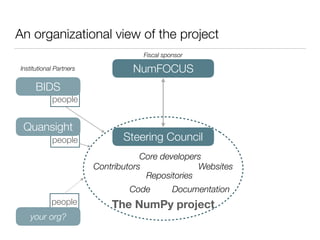
Steering Council
The NumPy project
Contributors
Core developers
Repositories
Websites
Code Documentation
NumFOCUS

Fiscal sponsor
people
BIDS

people
Quansight

people
your org?

Institutional Partners
Key questions we’ll try to answer in this talk
• Has grant funding over the last year invigorated the
NumPy project?
• How healthy/sustainable is NumPy today?
• What does NumPy need in order to thrive?
• What’s our vision for NumPy, and what is our plan to
achieve that vision?
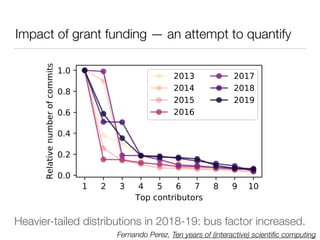
Impact of grant funding — an attempt to quantify
Heavier-tailed distributions in 2018-19: bus factor increased.
Fernando Perez, Ten years of (interactive) scientific computing
Impact of grant funding — an attempt to quantify
Heavier-tailed distributions in 2018-19: bus factor increased.
Fernando Perez, Ten years of (interactive) scientific computing
Impact of grant funding — an attempt to quantify
Volunteer contributions relatively stable; total activity up.
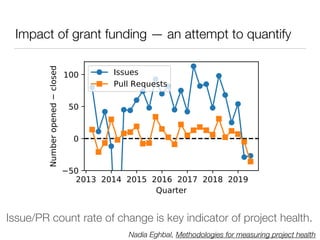
Impact of grant funding — an attempt to quantify
Issue/PR count rate of change is key indicator of project health.
Nadia Eghbal, Methodologies for measuring project health
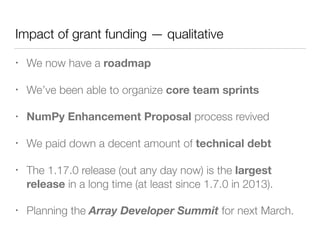
Impact of grant funding — qualitative
• We now have a roadmap
• We’ve been able to organize core team sprints
• NumPy Enhancement Proposal process revived
• We paid down a decent amount of technical debt
• The 1.17.0 release (out any day now) is the largest
release in a long time (at least since 1.7.0 in 2013).
• Planning the Array Developer Summit for next March.
Has grant funding over the last year invigorated
the NumPy project?
Yes, we think so.
Faster progress and more hands for
maintenance also makes it more fun.
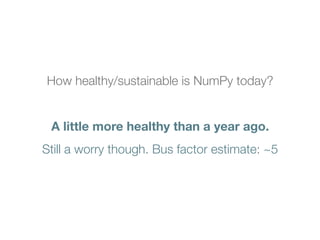
How healthy/sustainable is NumPy today?
A little more healthy than a year ago.
Still a worry though. Bus factor estimate: ~5
Hiring
So who did we hire?
Two full-time engineers, ongoing (till Oct 2020 at least):
• Mar 2018 — : Matti Picus (PyPy maintainer)
• Jun 2018 — Jun 2019: Tyler Reddy (SciPy maintainer)
• May 2019 — : Sebastian Berg (NumPy Steering Council member)
Additionally:
• Supporting Kriti Singh through Outreachy (docs work)
• Planning for a few more short-term contractors (code & docs)
Funding
Funding — what to pay for?
• Pay for things that are important and otherwise won't get
done.
• Think broadly. There's more to a project than code!
• Balance maintenance & innovation: keep people
motivated!
• Plan for sustainability. Don't start depending on funding
unless you’re fairly certain it’s stable.
• Make the life of volunteer maintainers easier, not harder!
Funding — who to pay?
• All else being equal, give preference to existing
maintainers.
• Pay attention to communication and self-management
skills, in addition to technical skills and motivation.
• Consider this an opportunity to make your project more
diverse.
Challenges
Sustainability — maintainer bandwidth
Of the 11 Steering Council members:
• 3 are very active (Chuck, Eric, Stephan)
• 3 are paid to work on NumPy

(Sebastian full-time,

Stéfan & Ralf a small part of their time (~1 day/wk))
• 5 are in low-activity mode (infrequent emails/commits)
This is still a major challenge! NumPy depends both on a
handful of people, and probably on continued funding.
The project beyond code
It’s still hard getting work done on:
• High-level documentation
• Website
• Community building
• Governance and project management
• Long-term planning (both technical and organizational)
Improving NumPy’s culture
• We still struggle with a lack of diversity: all maintainers are
white and male.
• Our GitHub and mailing list culture is occasionally not as
friendly and welcoming as we’d all like it to be.
Vision
Scope & Vision
The key thing NumPy offers is:
an array object (N-dimensional, in-memory, on CPUs)
and array computing APIs
NumPy lives at the heart of the numerical Python
ecosystem. We want to:
evolve while remaining a stable base,
address bottlenecks that limit how the

ecosystem can grow,
and grow and diversify our team and community.
What does NumPy need in order to thrive?
• Sustained funding at a higher level than today.

Our estimate: 10 full-time people
• More bandwidth from key people for long-term planning,
managing the project
• Attracting people in roles that primarily focus on activities
other than coding
Parts of a plan to get there
• In the next year, work with tech writers and web
developers to start building a docs/web team.

Efforts already ongoing.
• Build a diverse and robust funding quilt:

Express our needs as a community (not just NumPy),

and ask funders and major users for contributions:

Recently started (e.g. pitched to NASA), want to make this much more
concrete at SciPy’19.

Inside NumPy: preparing for the next decade

  • 1.
    Inside NumPy: preparingfor the next decade Ralf Gommers, Sebastian Berg, Matti Picus,
 Tyler Reddy, Stéfan van der Walt, Charles Harris
  • 2.
    A very briefhistory of NumPy 2005: NumPy created 2006: NumPy 1.0 …….: 1-2 releases every year, gradual progress 2015: governance and NumFOCUS relationship formalized 2018: first-ever paid developers hired
  • 3.
    The Sloan &Moore grants to BIDS for NumPy • Two grants for in total $1.3M, Apr 2018 — Oct 2020 • Current co-PIs: Stéfan van der Walt and Fernando Perez • Social aims: Improve community engagement
 Grow core team, Diversify contributors • Technical aims: More flexible & sustainable code, Frequent & consistent releases, Improve data type system, New array protocol
  • 4.
    An organizational viewof the project Steering Council The NumPy project Contributors Core developers Repositories Websites Code Documentation NumFOCUS
 Fiscal sponsor people BIDS
 people Quansight
 people your org?
 Institutional Partners
  • 5.
    Key questions we’lltry to answer in this talk • Has grant funding over the last year invigorated the NumPy project? • How healthy/sustainable is NumPy today? • What does NumPy need in order to thrive? • What’s our vision for NumPy, and what is our plan to achieve that vision?
  • 6.
    Impact of grantfunding — an attempt to quantify Heavier-tailed distributions in 2018-19: bus factor increased. Fernando Perez, Ten years of (interactive) scientific computing
  • 7.
    Impact of grantfunding — an attempt to quantify Heavier-tailed distributions in 2018-19: bus factor increased. Fernando Perez, Ten years of (interactive) scientific computing
  • 8.
    Impact of grantfunding — an attempt to quantify Volunteer contributions relatively stable; total activity up.
  • 9.
    Impact of grantfunding — an attempt to quantify Issue/PR count rate of change is key indicator of project health. Nadia Eghbal, Methodologies for measuring project health
  • 10.
    Impact of grantfunding — qualitative • We now have a roadmap • We’ve been able to organize core team sprints • NumPy Enhancement Proposal process revived • We paid down a decent amount of technical debt • The 1.17.0 release (out any day now) is the largest release in a long time (at least since 1.7.0 in 2013). • Planning the Array Developer Summit for next March.
  • 11.
    Has grant fundingover the last year invigorated the NumPy project? Yes, we think so. Faster progress and more hands for maintenance also makes it more fun.
  • 12.
    How healthy/sustainable isNumPy today? A little more healthy than a year ago. Still a worry though. Bus factor estimate: ~5
  • 13.
  • 14.
    So who didwe hire? Two full-time engineers, ongoing (till Oct 2020 at least): • Mar 2018 — : Matti Picus (PyPy maintainer) • Jun 2018 — Jun 2019: Tyler Reddy (SciPy maintainer) • May 2019 — : Sebastian Berg (NumPy Steering Council member) Additionally: • Supporting Kriti Singh through Outreachy (docs work) • Planning for a few more short-term contractors (code & docs)
  • 15.
  • 16.
    Funding — whatto pay for? • Pay for things that are important and otherwise won't get done. • Think broadly. There's more to a project than code! • Balance maintenance & innovation: keep people motivated! • Plan for sustainability. Don't start depending on funding unless you’re fairly certain it’s stable. • Make the life of volunteer maintainers easier, not harder!
  • 17.
    Funding — whoto pay? • All else being equal, give preference to existing maintainers. • Pay attention to communication and self-management skills, in addition to technical skills and motivation. • Consider this an opportunity to make your project more diverse.
  • 18.
  • 19.
    Sustainability — maintainerbandwidth Of the 11 Steering Council members: • 3 are very active (Chuck, Eric, Stephan) • 3 are paid to work on NumPy
 (Sebastian full-time,
 Stéfan & Ralf a small part of their time (~1 day/wk)) • 5 are in low-activity mode (infrequent emails/commits) This is still a major challenge! NumPy depends both on a handful of people, and probably on continued funding.
  • 20.
    The project beyondcode It’s still hard getting work done on: • High-level documentation • Website • Community building • Governance and project management • Long-term planning (both technical and organizational)
  • 21.
    Improving NumPy’s culture •We still struggle with a lack of diversity: all maintainers are white and male. • Our GitHub and mailing list culture is occasionally not as friendly and welcoming as we’d all like it to be.
  • 22.
  • 23.
    Scope & Vision Thekey thing NumPy offers is: an array object (N-dimensional, in-memory, on CPUs) and array computing APIs NumPy lives at the heart of the numerical Python ecosystem. We want to: evolve while remaining a stable base, address bottlenecks that limit how the
 ecosystem can grow, and grow and diversify our team and community.
  • 24.
    What does NumPyneed in order to thrive? • Sustained funding at a higher level than today.
 Our estimate: 10 full-time people • More bandwidth from key people for long-term planning, managing the project • Attracting people in roles that primarily focus on activities other than coding
  • 25.
    Parts of aplan to get there • In the next year, work with tech writers and web developers to start building a docs/web team.
 Efforts already ongoing. • Build a diverse and robust funding quilt:
 Express our needs as a community (not just NumPy),
 and ask funders and major users for contributions:
 Recently started (e.g. pitched to NASA), want to make this much more concrete at SciPy’19.