Inside Automotive Testing Labs, Ensuring Safety and Performance
Behind every reliable vehicle on the road today lies thousands of hours of meticulous testing
and validation. Automotive testing laboratories serve as the critical proving grounds where
vehicles and components are pushed to their limits—ensuring safety, performance, and
durability before they ever reach consumers. These sophisticated facilities combine cutting-
edge technology with specialized expertise to simulate years of real-world usage in compressed
timeframes, identifying potential issues long before they could affect drivers.
The Essential Role of Automotive Testing Facilities
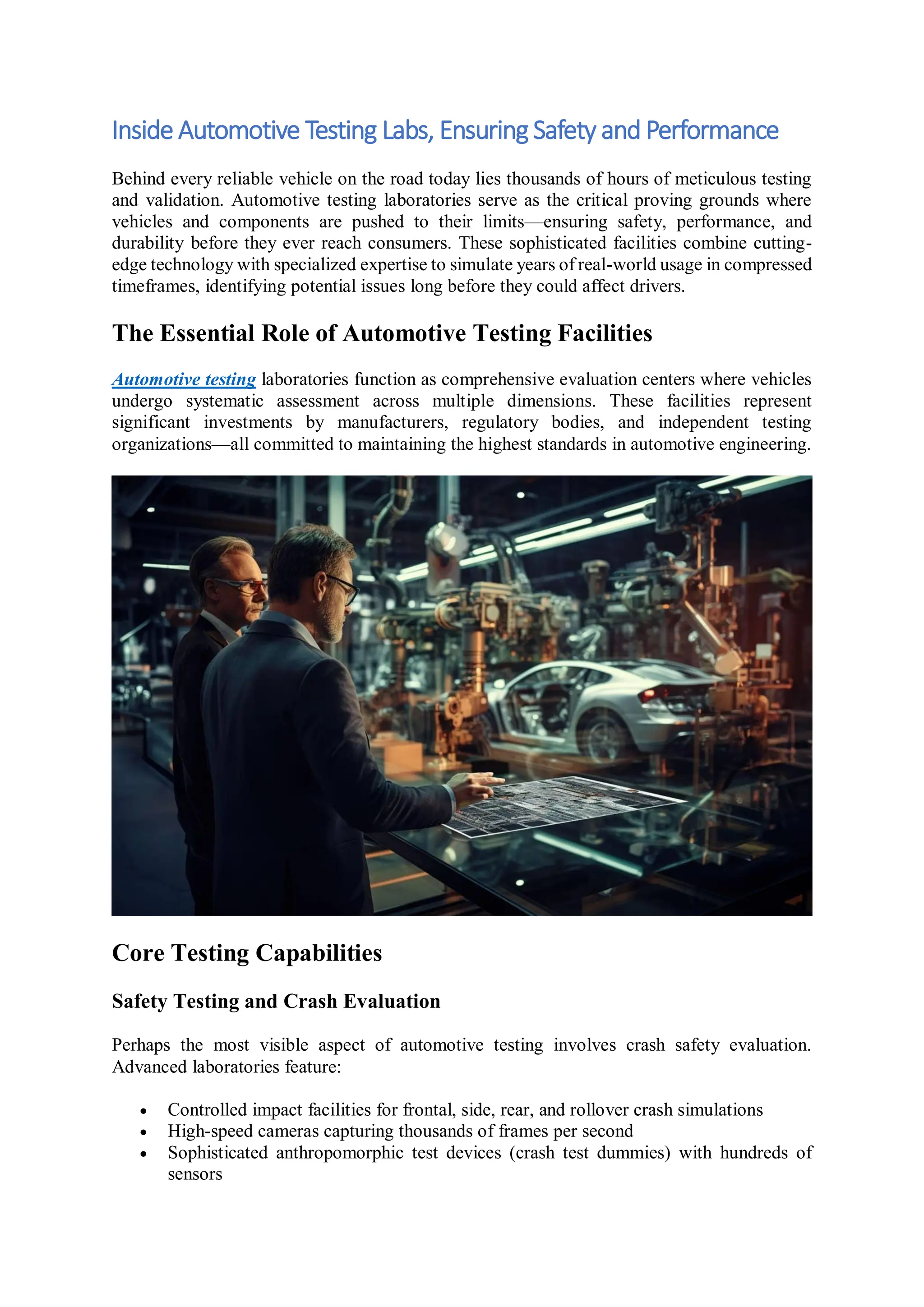
Automotive testing laboratories function as comprehensive evaluation centers where vehicles
undergo systematic assessment across multiple dimensions. These facilities represent
significant investments by manufacturers, regulatory bodies, and independent testing
organizations—all committed to maintaining the highest standards in automotive engineering.
Core Testing Capabilities
Safety Testing and Crash Evaluation
Perhaps the most visible aspect of automotive testing involves crash safety evaluation.
Advanced laboratories feature:
 Controlled impact facilities for frontal, side, rear, and rollover crash simulations
 High-speed cameras capturing thousands of frames per second
 Sophisticated anthropomorphic test devices (crash test dummies) with hundreds of
sensors
 Deformation analysis systems measuring structural integrity
Emissions and Environmental Testing
With increasing global focus on environmental impact, emissions testing has become more
rigorous than ever:
 Sophisticated dynamometer facilities simulating various driving conditions
 Real Driving Emissions (RDE) testing on actual roads
 Environmental chambers recreating extreme temperatures and altitudes
 Particulate matter and chemical composition analysis
Durability and Reliability Testing
Ensuring vehicles withstand years of operation requires accelerated wear testing:
 Road simulators replicating pothole impacts, rough terrain, and various road surfaces
 Automated driving robots maintaining precise test parameters
 Corrosion chambers exposing vehicles to salt spray and humidity extremes
 Component-specific endurance testing (door slams, seat movements, control inputs)
Performance Validation
Beyond safety and reliability, performance characteristics receive equally thorough evaluation:
 Aerodynamic assessment in wind tunnels
 Handling dynamics on specialized test tracks
 Acceleration, braking, and steering response measurement
 NVH (Noise, Vibration, Harshness) analysis in anechoic chambers
Specialized Testing Facilities
Climatic Wind Tunnels
These massive facilities recreate extreme weather conditions while allowing vehicle operation:
 Temperature ranges from -40°F to 140°F (-40°C to 60°C)
 Solar radiation simulation
 Wind speeds exceeding 150 mph (240 km/h)
 Humidity control from desert dryness to tropical moisture
EMC (Electromagnetic Compatibility) Labs
As vehicles incorporate more electronics, EMC testing has grown increasingly important:
 Measuring electromagnetic emissions from vehicle systems
 Testing immunity to external electromagnetic interference
 Validating wireless communication system performance
 Ensuring critical safety systems function despite electromagnetic challenges
ADAS and Autonomous Driving Test Centers
The newest generation of testing facilities focuses on advanced driver assistance systems:
 Simulated urban environments with moving obstacles
 Vehicle-to-vehicle and vehicle-to-infrastructure communication testing
 Sensor performance evaluation in various weather conditions
 Edge-case scenario replication for validation of safety algorithms
Conclusion
Automotive testing laboratory represent the unsung heroes of vehicle development—facilities
where engineering theories meet real-world conditions in the pursuit of safer, more reliable
transportation. As vehicles become increasingly complex—integrating advanced electronics,
alternative powertrains, and autonomous capabilities—these testing facilities continue
evolving to ensure every vehicle on the road meets the highest standards of quality and safety.

Inside Automotive Testing Labs, Ensuring Safety and Performance.pdf

  • 1.
    Inside Automotive TestingLabs, Ensuring Safety and Performance Behind every reliable vehicle on the road today lies thousands of hours of meticulous testing and validation. Automotive testing laboratories serve as the critical proving grounds where vehicles and components are pushed to their limits—ensuring safety, performance, and durability before they ever reach consumers. These sophisticated facilities combine cutting- edge technology with specialized expertise to simulate years of real-world usage in compressed timeframes, identifying potential issues long before they could affect drivers. The Essential Role of Automotive Testing Facilities Automotive testing laboratories function as comprehensive evaluation centers where vehicles undergo systematic assessment across multiple dimensions. These facilities represent significant investments by manufacturers, regulatory bodies, and independent testing organizations—all committed to maintaining the highest standards in automotive engineering. Core Testing Capabilities Safety Testing and Crash Evaluation Perhaps the most visible aspect of automotive testing involves crash safety evaluation. Advanced laboratories feature:  Controlled impact facilities for frontal, side, rear, and rollover crash simulations  High-speed cameras capturing thousands of frames per second  Sophisticated anthropomorphic test devices (crash test dummies) with hundreds of sensors
  • 2.
     Deformation analysissystems measuring structural integrity Emissions and Environmental Testing With increasing global focus on environmental impact, emissions testing has become more rigorous than ever:  Sophisticated dynamometer facilities simulating various driving conditions  Real Driving Emissions (RDE) testing on actual roads  Environmental chambers recreating extreme temperatures and altitudes  Particulate matter and chemical composition analysis Durability and Reliability Testing Ensuring vehicles withstand years of operation requires accelerated wear testing:  Road simulators replicating pothole impacts, rough terrain, and various road surfaces  Automated driving robots maintaining precise test parameters  Corrosion chambers exposing vehicles to salt spray and humidity extremes  Component-specific endurance testing (door slams, seat movements, control inputs) Performance Validation Beyond safety and reliability, performance characteristics receive equally thorough evaluation:  Aerodynamic assessment in wind tunnels  Handling dynamics on specialized test tracks  Acceleration, braking, and steering response measurement  NVH (Noise, Vibration, Harshness) analysis in anechoic chambers Specialized Testing Facilities Climatic Wind Tunnels These massive facilities recreate extreme weather conditions while allowing vehicle operation:  Temperature ranges from -40°F to 140°F (-40°C to 60°C)  Solar radiation simulation  Wind speeds exceeding 150 mph (240 km/h)  Humidity control from desert dryness to tropical moisture EMC (Electromagnetic Compatibility) Labs As vehicles incorporate more electronics, EMC testing has grown increasingly important:  Measuring electromagnetic emissions from vehicle systems  Testing immunity to external electromagnetic interference  Validating wireless communication system performance  Ensuring critical safety systems function despite electromagnetic challenges
  • 3.
    ADAS and AutonomousDriving Test Centers The newest generation of testing facilities focuses on advanced driver assistance systems:  Simulated urban environments with moving obstacles  Vehicle-to-vehicle and vehicle-to-infrastructure communication testing  Sensor performance evaluation in various weather conditions  Edge-case scenario replication for validation of safety algorithms Conclusion Automotive testing laboratory represent the unsung heroes of vehicle development—facilities where engineering theories meet real-world conditions in the pursuit of safer, more reliable transportation. As vehicles become increasingly complex—integrating advanced electronics, alternative powertrains, and autonomous capabilities—these testing facilities continue evolving to ensure every vehicle on the road meets the highest standards of quality and safety.