The Evolution of Innovation Ecosystems
  and How to Manage Within Them?
                   
              Innovation Forum Norway,
                    12 April 2011


                         Presentation by

           Jørn Bang Andersen
         Nordic Innovation Centre
    j.andersen@nordicinnovation.org / www.nordicinnovation.org
                   www.jornbangandersen.com
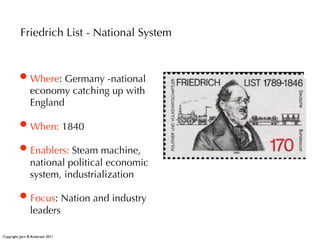
Friedrich List - National System


         • Where: Germany -national
                 economy catching up with
                 England

         • When: 1840
         • Enablers: Steam machine,
                 national political economic
                 system, industrialization

         • Focus: Nation and industry
                 leaders

Copyright: Jørn B. Andersen 2011
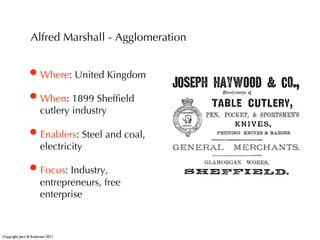
Alfred Marshall - Agglomeration


                • Where: United Kingdom
                • When: 1899 Sheffield
                       cutlery industry

                • Enablers: Steel and coal,
                       electricity

                • Focus: Industry,
                       entrepreneurs, free
                       enterprise


Copyright: Jørn B. Andersen 2011
Erik Dahmén - Development Blocks


        • Where: Sweden
        • When: 1950
        • Enablers: Entrepreneurs,
                capital, creative destruction

        • Focus: Study of Swedish
                industry transformation
                1919-1939.


Copyright: Jørn B. Andersen 2011
François Perroux - Growth Poles


              • Where: France
              • When: France 1950s
                      and 1960, 1970s

              • Enablers: Domination,
                      asymmetry, location,
                      globalization

              • Focus: Global value
                      chains, North-South


Copyright: Jørn B. Andersen 2011
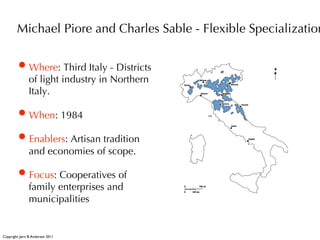
Michael Piore and Charles Sable - Flexible Specialization


         • Where: Third Italy - Districts
                of light industry in Northern
                Italy.

         • When: 1984
         • Enablers: Artisan tradition
                and economies of scope.

         • Focus: Cooperatives of
                family enterprises and
                municipalities


Copyright: Jørn B. Andersen 2011
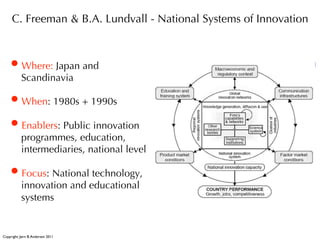
C. Freeman & B.A. Lundvall - National Systems of Innovation


    • Where: Japan and
           Scandinavia

    • When: 1980s + 1990s
    • Enablers: Public innovation
           programmes, education,
           intermediaries, national level

    • Focus: National technology,
           innovation and educational
           systems


Copyright: Jørn B. Andersen 2011
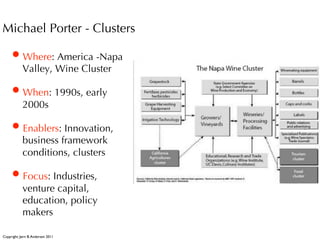
Michael Porter - Clusters

     • Where: America -Napa
            Valley, Wine Cluster

     • When: 1990s, early
            2000s

     • Enablers: Innovation,
            business framework
            conditions, clusters

     • Focus: Industries,
            venture capital,
            education, policy
            makers

Copyright: Jørn B. Andersen 2011
Innovation Ecosystems Network

               • Where: US - Stanford +
                      China, Finland, Japan

               • When: 2010
               • Enablers: Formation of
                      alliances

               • Focus: Co-creation,
                      investment capital,
                      network centric views


Copyright: Jørn B. Andersen 2011
              http://www.innovation-ecosystems.org/
Community ecosystems

  • Where: Silicon Valley,
         Bangalore,Google, Apple, Tata,
         Huawei, Facebook

  • When: 2000s, present day and
         beyond 2011

  • Enablers: Internet, global
         hotspots, globalization

  • Focus: Entrepreneurs, global
         company value chains,
         business model innovation,
         service integration
Copyright: Jørn B. Andersen 2011
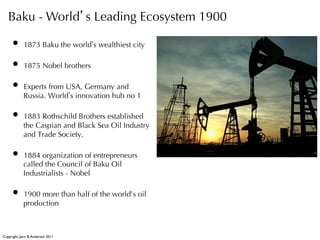
Baku - World s Leading Ecosystem 1900

     •  1873 Baku the world s wealthiest city
     •  1875 Nobel brothers
     •  Experts from USA, Germany and
             Russia. World s innovation hub no 1

     •  1883 Rothschild Brothers established
             the Caspian and Black Sea Oil Industry
             and Trade Society.

     •  1884 organization of entrepreneurs
             called the Council of Baku Oil
             Industrialists - Nobel

     •  1900 more than half of the world’s oil
             production


Copyright: Jørn B. Andersen 2011
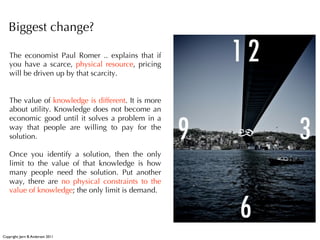
Biggest change?

    The economist Paul Romer .. explains that if
    you have a scarce, physical resource, pricing
    will be driven up by that scarcity.


    The value of knowledge is different. It is more
    about utility. Knowledge does not become an
    economic good until it solves a problem in a
    way that people are willing to pay for the
    solution.

    Once you identify a solution, then the only
    limit to the value of that knowledge is how
    many people need the solution. Put another
    way, there are no physical constraints to the
    value of knowledge; the only limit is demand.


Copyright: Jørn B. Andersen 2011
How to Manage Within Innovation
          Ecosystems in 2011?


Copyright: Jørn B. Andersen 2011
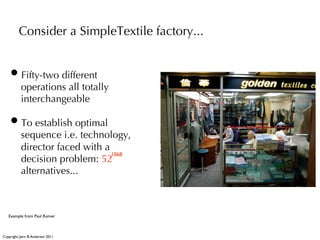
Consider a SimpleTextile factory...


    • Fifty-two different
           operations all totally
           interchangeable

    • To establish optimal
           sequence i.e. technology,
           director faced with a
                                 1068
           decision problem: 52
           alternatives...


   Example from Paul Romer


Copyright: Jørn B. Andersen 2011
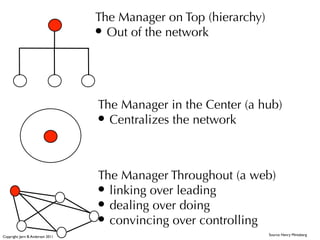
The Manager on Top (hierarchy)
                                    •  Out of the network


                                    The Manager in the Center (a hub)
                                    •  Centralizes the network


                                    The Manager Throughout (a web)
                                    •  linking over leading
                                    •  dealing over doing
                                    •  convincing over controlling
                                                                     Source: Henry Mintzberg
Copyright: Jørn B. Andersen 2011
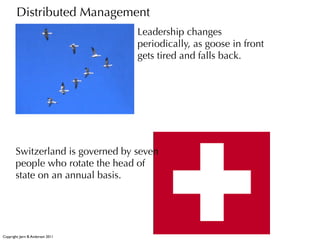
Distributed Management
                                    Leadership changes
                                    periodically, as goose in front
                                    gets tired and falls back.


        Switzerland is governed by seven
        people who rotate the head of
        state on an annual basis.


Copyright: Jørn B. Andersen 2011
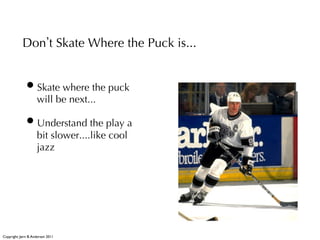
Don t Skate Where the Puck is...


              • Skate where the puck
                     will be next...

              • Understand the play a
                     bit slower....like cool
                     jazz


Copyright: Jørn B. Andersen 2011
• From Friedrich List to Steve Jobs - it has always
                                      been a question of connecting the dots and
                                      organize work in a better and smarter way.

                                    • Possibilities do not add up. They multiply.
                                    • The biggest obstacle today lies within how we
                                      think organization and manage work.
Copyright: Jørn B. Andersen 2011
Main Points


Not New
# Innovation ecosystems
# Entrepreneurs
# Technology platforms, tools
# Organizational configurations


New
# Knowledge primary factor of production
# ICT melts manufacturing and services
# Demands change

Copyright: Jørn B. Andersen 2011
Thank you for listening

Innovation Ecosystems' Evolution - How to Manage Within Them? - Jorn Bang Andersen

  • 1.
    The Evolution ofInnovation Ecosystems and How to Manage Within Them? Innovation Forum Norway, 12 April 2011 Presentation by Jørn Bang Andersen Nordic Innovation Centre j.andersen@nordicinnovation.org / www.nordicinnovation.org www.jornbangandersen.com
  • 2.
    Friedrich List -National System • Where: Germany -national economy catching up with England • When: 1840 • Enablers: Steam machine, national political economic system, industrialization • Focus: Nation and industry leaders Copyright: Jørn B. Andersen 2011
  • 3.
    Alfred Marshall -Agglomeration • Where: United Kingdom • When: 1899 Sheffield cutlery industry • Enablers: Steel and coal, electricity • Focus: Industry, entrepreneurs, free enterprise Copyright: Jørn B. Andersen 2011
  • 4.
    Erik Dahmén -Development Blocks • Where: Sweden • When: 1950 • Enablers: Entrepreneurs, capital, creative destruction • Focus: Study of Swedish industry transformation 1919-1939. Copyright: Jørn B. Andersen 2011
  • 5.
    François Perroux -Growth Poles • Where: France • When: France 1950s and 1960, 1970s • Enablers: Domination, asymmetry, location, globalization • Focus: Global value chains, North-South Copyright: Jørn B. Andersen 2011
  • 6.
    Michael Piore andCharles Sable - Flexible Specialization • Where: Third Italy - Districts of light industry in Northern Italy. • When: 1984 • Enablers: Artisan tradition and economies of scope. • Focus: Cooperatives of family enterprises and municipalities Copyright: Jørn B. Andersen 2011
  • 7.
    C. Freeman &B.A. Lundvall - National Systems of Innovation • Where: Japan and Scandinavia • When: 1980s + 1990s • Enablers: Public innovation programmes, education, intermediaries, national level • Focus: National technology, innovation and educational systems Copyright: Jørn B. Andersen 2011
  • 8.
    Michael Porter -Clusters • Where: America -Napa Valley, Wine Cluster • When: 1990s, early 2000s • Enablers: Innovation, business framework conditions, clusters • Focus: Industries, venture capital, education, policy makers Copyright: Jørn B. Andersen 2011
  • 9.
    Innovation Ecosystems Network • Where: US - Stanford + China, Finland, Japan • When: 2010 • Enablers: Formation of alliances • Focus: Co-creation, investment capital, network centric views Copyright: Jørn B. Andersen 2011 http://www.innovation-ecosystems.org/
  • 10.
    Community ecosystems • Where: Silicon Valley, Bangalore,Google, Apple, Tata, Huawei, Facebook • When: 2000s, present day and beyond 2011 • Enablers: Internet, global hotspots, globalization • Focus: Entrepreneurs, global company value chains, business model innovation, service integration Copyright: Jørn B. Andersen 2011
  • 11.
    Baku - Worlds Leading Ecosystem 1900 •  1873 Baku the world s wealthiest city •  1875 Nobel brothers •  Experts from USA, Germany and Russia. World s innovation hub no 1 •  1883 Rothschild Brothers established the Caspian and Black Sea Oil Industry and Trade Society. •  1884 organization of entrepreneurs called the Council of Baku Oil Industrialists - Nobel •  1900 more than half of the world’s oil production Copyright: Jørn B. Andersen 2011
  • 12.
    Biggest change? The economist Paul Romer .. explains that if you have a scarce, physical resource, pricing will be driven up by that scarcity. The value of knowledge is different. It is more about utility. Knowledge does not become an economic good until it solves a problem in a way that people are willing to pay for the solution. Once you identify a solution, then the only limit to the value of that knowledge is how many people need the solution. Put another way, there are no physical constraints to the value of knowledge; the only limit is demand. Copyright: Jørn B. Andersen 2011
  • 13.
    How to ManageWithin Innovation Ecosystems in 2011? Copyright: Jørn B. Andersen 2011
  • 14.
    Consider a SimpleTextilefactory... • Fifty-two different operations all totally interchangeable • To establish optimal sequence i.e. technology, director faced with a 1068 decision problem: 52 alternatives... Example from Paul Romer Copyright: Jørn B. Andersen 2011
  • 15.
    The Manager onTop (hierarchy) •  Out of the network The Manager in the Center (a hub) •  Centralizes the network The Manager Throughout (a web) •  linking over leading •  dealing over doing •  convincing over controlling Source: Henry Mintzberg Copyright: Jørn B. Andersen 2011
  • 16.
    Distributed Management Leadership changes periodically, as goose in front gets tired and falls back. Switzerland is governed by seven people who rotate the head of state on an annual basis. Copyright: Jørn B. Andersen 2011
  • 17.
    Don t SkateWhere the Puck is... • Skate where the puck will be next... • Understand the play a bit slower....like cool jazz Copyright: Jørn B. Andersen 2011
  • 18.
    • From Friedrich Listto Steve Jobs - it has always been a question of connecting the dots and organize work in a better and smarter way. • Possibilities do not add up. They multiply. • The biggest obstacle today lies within how we think organization and manage work. Copyright: Jørn B. Andersen 2011
  • 19.
    Main Points Not New #Innovation ecosystems # Entrepreneurs # Technology platforms, tools # Organizational configurations New # Knowledge primary factor of production # ICT melts manufacturing and services # Demands change Copyright: Jørn B. Andersen 2011
  • 20.
    Thank you forlistening