WRITING
Thursday 21st May, 2020
Jaytab Episode
Writing: Information text
◦Learning objective:
◦To write an information text
◦Success criteria:
◦I can define an information text
◦I can identify the features of an information text.
◦I can write an information text.
Starter
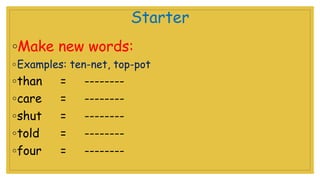
◦Make new words:
◦Examples: ten-net, top-pot
◦than = --------
◦care = --------
◦shut = --------
◦told = --------
◦four = --------
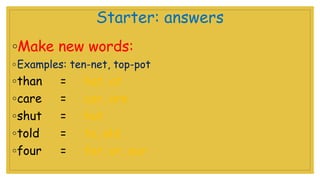
Starter: answers
◦Make new words:
◦Examples: ten-net, top-pot
◦than = hat, at
◦care = car, are
◦shut = hut
◦told = to, old
◦four = for, or, our
What is an information?
◦An information is facts provided or
learned about something or someone.
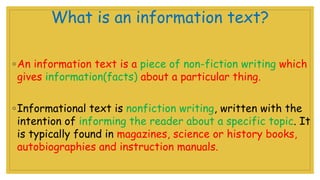
What is an information text?
◦An information text is a piece of non-fiction
writing which gives information(facts) about a
particular thing.
What is an information text?
◦An information text is a piece of non-fiction writing which
gives information(facts) about a particular thing.
◦Informational text is nonfiction writing, written with the
intention of informing the reader about a specific topic. It
is typically found in magazines, science or history books,
autobiographies and instruction manuals.
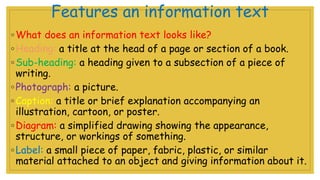
Features an information text
◦What does an information text looks like?
◦Heading: a title at the head of a page or section of a book.
◦Sub-heading: a heading given to a subsection of a piece of
writing.
◦Photograph: a picture.
◦Caption: a title or brief explanation accompanying an
illustration, cartoon, or poster.
◦Diagram: a simplified drawing showing the appearance,
structure, or workings of something.
◦Label: a small piece of paper, fabric, plastic, or similar
material attached to an object and giving information about it.
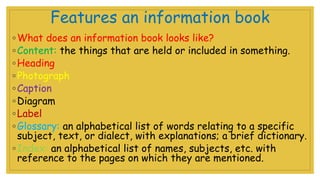
Features an information book
◦What does an information book looks like?
◦Content: the things that are held or included in something.
◦Heading
◦Photograph
◦Caption
◦Diagram
◦Label
◦Glossary: an alphabetical list of words relating to a specific
subject, text, or dialect, with explanations; a brief dictionary.
◦Index: an alphabetical list of names, subjects, etc. with
reference to the pages on which they are mentioned.
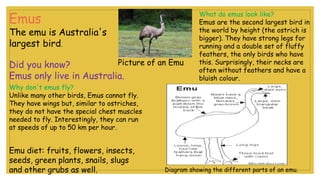
Emus
The emu is Australia's
largest bird.
What do emus look like?
Emus are the second largest bird in
the world by height (the ostrich is
bigger). They have strong legs for
running and a double set of fluffy
feathers, the only birds who have
this. Surprisingly, their necks are
often without feathers and have a
bluish colour.
Did you know?
Emus only live in Australia.
Why don't emus fly?
Unlike many other birds, Emus cannot fly.
They have wings but, similar to ostriches,
they do not have the special chest muscles
needed to fly. Interestingly, they can run
at speeds of up to 50 km per hour.
Diagram showing the different parts of an emu.
Emu diet: fruits, flowers, insects,
seeds, green plants, snails, slugs
and other grubs as well.
Picture of an Emu
Class activity
◦Annotate the features on an information text on slide 10.

Information text

  • 1.
    WRITING Thursday 21st May,2020 Jaytab Episode
  • 2.
    Writing: Information text ◦Learningobjective: ◦To write an information text ◦Success criteria: ◦I can define an information text ◦I can identify the features of an information text. ◦I can write an information text.
  • 3.
    Starter ◦Make new words: ◦Examples:ten-net, top-pot ◦than = -------- ◦care = -------- ◦shut = -------- ◦told = -------- ◦four = --------
  • 4.
    Starter: answers ◦Make newwords: ◦Examples: ten-net, top-pot ◦than = hat, at ◦care = car, are ◦shut = hut ◦told = to, old ◦four = for, or, our
  • 5.
    What is aninformation? ◦An information is facts provided or learned about something or someone.
  • 6.
    What is aninformation text? ◦An information text is a piece of non-fiction writing which gives information(facts) about a particular thing.
  • 7.
    What is aninformation text? ◦An information text is a piece of non-fiction writing which gives information(facts) about a particular thing. ◦Informational text is nonfiction writing, written with the intention of informing the reader about a specific topic. It is typically found in magazines, science or history books, autobiographies and instruction manuals.
  • 8.
    Features an informationtext ◦What does an information text looks like? ◦Heading: a title at the head of a page or section of a book. ◦Sub-heading: a heading given to a subsection of a piece of writing. ◦Photograph: a picture. ◦Caption: a title or brief explanation accompanying an illustration, cartoon, or poster. ◦Diagram: a simplified drawing showing the appearance, structure, or workings of something. ◦Label: a small piece of paper, fabric, plastic, or similar material attached to an object and giving information about it.
  • 9.
    Features an informationbook ◦What does an information book looks like? ◦Content: the things that are held or included in something. ◦Heading ◦Photograph ◦Caption ◦Diagram ◦Label ◦Glossary: an alphabetical list of words relating to a specific subject, text, or dialect, with explanations; a brief dictionary. ◦Index: an alphabetical list of names, subjects, etc. with reference to the pages on which they are mentioned.
  • 10.
    Emus The emu isAustralia's largest bird. What do emus look like? Emus are the second largest bird in the world by height (the ostrich is bigger). They have strong legs for running and a double set of fluffy feathers, the only birds who have this. Surprisingly, their necks are often without feathers and have a bluish colour. Did you know? Emus only live in Australia. Why don't emus fly? Unlike many other birds, Emus cannot fly. They have wings but, similar to ostriches, they do not have the special chest muscles needed to fly. Interestingly, they can run at speeds of up to 50 km per hour. Diagram showing the different parts of an emu. Emu diet: fruits, flowers, insects, seeds, green plants, snails, slugs and other grubs as well. Picture of an Emu
  • 11.
    Class activity ◦Annotate thefeatures on an information text on slide 10.