H.O.: 53/5, Basement, Old Rajender Nagar Market, Delhi-60.
B.O.:105-106, Top Floor, Mukherjee Tower, Mukherjee Nagar, Delhi-9
Forum of India’s Best Trainers for General Studies
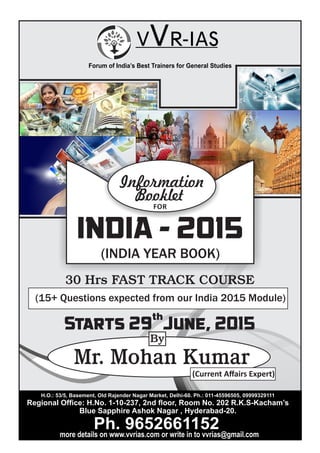
(INDIA YEAR BOOK)
INDIA - 2015
30 Hrs FAST TRACK COURSE
(15+ Questions expected from our India 2015 Module)
th
Starts 29 June, 2015
Mr. Mohan Kumar
(Current Affairs Expert)
9999329111, 011-45596505
Information
Booklet
FOR
By
for more details log on to www.vvrias.com or write in to vvrias@gmail.com
Ph. 9652661152
H.O.: 53/5, Basement, Old Rajender Nagar Market, Delhi-60. Ph.: 011-45596505, 09999329111
Regional Office: H.No. 1-10-237, 2nd floor, Room No. 202 R.K.S-Kacham’s
Blue Sapphire Ashok Nagar , Hyderabad-20.
DearAspirants,
India 2015 (India Year Book) is the most relevant source of the Government Information and
it's Programmes and Schemes. In the past, we have observed it's continuously growing
importance for Civil Services Preliminary and Main Examinations. It's importance can be
seen with the depth and width of information it contains with almost all information of India
kept in a single all-in-one book. Consistently 13 to 20 questions (out of 100) are directly
asked in Preliminary examination and if one studies the India Year Book with proper and in-
depth analysis with keeping India Year Book in centre, then We can say, these question
numbers may reach up to 25 to 35. Previous year(2014 PT), directly 14 questions have been
asked from India Year Book(IYB). The respective question numbers in GS 2014 and Page
numbers in IYB have been provided in the last of this booklet for the confidence of the
students.
Apart from all these importance and unavoidable substances of IYB, One issue has been here
with IYB. It is quite bulky and it consumes a lot of time to cover all chapters of IYB. We will
suggest mechanism, How we will simplify this issue in the next paragraph. But let us discuss
firstWhy IndiaYear Book is unavoidable?
As per trend of preparation for Civil Services PT, Serious aspirants were not ignoring IYB till
2010 but after introduction of CSAT since 2011, many students have been simply ignoring
IYB as CSAT was the dominantly deciding factor of success in PT examination. However the
trend has been changed again. Now, General Studies is the only deciding factor in PT and the
Gap areas (Non Conventional Part apart from basic concept of Geography, Polity, History,
Economy and Science and Technology) must be focused. We firmly believe that generally
students put their all efforts and time in Conventional subjects and in the last, they lack in
the Gap Areas like India Year Book, Current Affairs, Economic Survey, Art & Culture,
Environment and Bio-diversity etc. As per the new trends and the time since IFoS has been
combined with UPSC PT, around 50% questions are directly asked from the above mentioned
Gap Areas. Here, VVR has developed the capacity in Gap Areas with rigorous research work
and continuous teaching methodology through round the year class room programmes
which is going to be boon for PT 2015 Examination. We are sure that India Year Book is going
to be proved the boon for civil services aspirants in a very specific way.
Yes, India Year Book is Bulky but our teaching methodology will simplify it and your journey
through this 30 hours class room programme would be quite comfortable, interesting and
result oriented. Our Expert has designed the course in a very systematic, lucid and
apprehending manner by first dividing the chapters among different disciplines. We go in our
class on the basis of discipline like first all chapters of Geography and Biodiversity would be
covered, then IR and Defense and then next discipline. Summary notes have been prepared
in such a way that many un-important details of IYB have been curtailed to reduce your
burden. Things are discussed in class in such a way that you remember much items inside
the class only. And so, This 30 hours of IYB module will proceed in burden free and highly
productive environment to ensure your better understanding and higher success in PT 2015
Examination.
All the best with IndiaYear Book Reading...
Thanks & Regards!
Importanceof IndiaYearBookinCivilServicesExaminationImportanceof IndiaYearBookinCivilServicesExamination
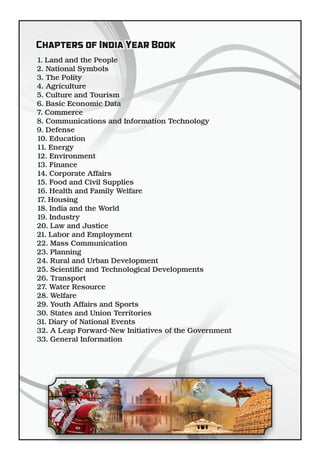
1. Land and the People
2. National Symbols
3. The Polity
4. Agriculture
5. Culture and Tourism
6. Basic Economic Data
7. Commerce
8. Communications and Information Technology
9. Defense
10. Education
11. Energy
12. Environment
13. Finance
14. Corporate Affairs
15. Food and Civil Supplies
16. Health and Family Welfare
17. Housing
18. India and the World
19. Industry
20. Law and Justice
21. Labor and Employment
22. Mass Communication
23. Planning
24. Rural and Urban Development
25. Scienti c and Technological Developments
26. Transport
27. Water Resource
28. Welfare
29. Youth Affairs and Sports
30. States and Union Territories
31. Diary of National Events
32. A Leap Forward-New Initiatives of the Government
33. General Information
Chapters of India Year BookChapters of India Year Book
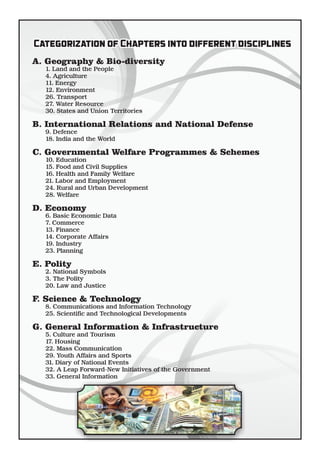
Categorization of Chapters into different disciplinesCategorization of Chapters into different disciplines
A. Geography & Bio-diversity
1. Land and the People
4. Agriculture
11. Energy
12. Environment
26. Transport
27. Water Resource
30. States and Union Territories
B. International Relations and National Defense
9. Defence
18. India and the World
C. Governmental Welfare Programmes & Schemes
10. Education
15. Food and Civil Supplies
16. Health and Family Welfare
21. Labor and Employment
24. Rural and Urban Development
28. Welfare
D. Economy
6. Basic Economic Data
7. Commerce
13. Finance
14. Corporate Affairs
19. Industry
23. Planning
E. Polity
2. National Symbols
3. The Polity
20. Law and Justice
F. Science & Technology
8. Communications and Information Technology
25. Scienti c and Technological Developments
G. General Information & Infrastructure
5. Culture and Tourism
17. Housing
22. Mass Communication
29. Youth Affairs and Sports
31. Diary of National Events
32. A Leap Forward-New Initiatives of the Government
33. General Information
Course HighlightsCourse Highlights
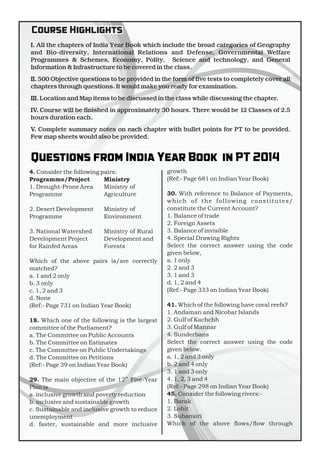
Questions from India Year Book in PT 2014Questions from India Year Book in PT 2014
I. All the chapters of India Year Book which include the broad categories of Geography
and Bio-diversity, International Relations and Defense, Governmental Welfare
Programmes & Schemes, Economy, Polity, Science and technology, and General
Information & Infrastructure to be covered in the class.
II. 500 Objective questions to be provided in the form of ve tests to completely cover all
chapters through questions. It would make you ready for examination.
III. Location and Map items to be discussed in the class while discussing the chapter.
IV. Course will be nished in approximately 30 hours. There would be 12 Classes of 2.5
hours duration each.
V. Complete summary notes on each chapter with bullet points for PT to be provided.
Few map sheets would also be provided.
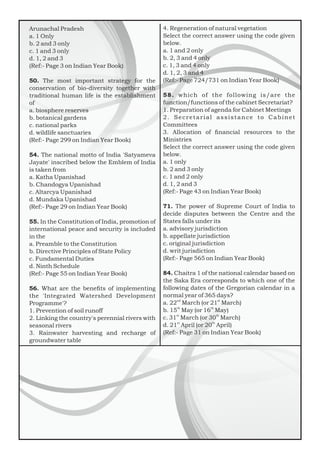
4. Consider the following pairs:
Programme/Project
1. Drought-Prone Area
Programme
2. Desert Development
Programme
3. National Watershed
Development Project
for Rainfed Areas
Which of the above pairs is/are correctly
matched?
a. 1 and 2 only
b. 3 only
c. 1, 2 and 3
d. None
(Ref:- Page 731 on Indian Year Book)
18. Which one of the following is the largest
committee of the Parliament?
a. The Committee on Public Accounts
b. The Committee on Estimates
c. The Committee on Public Undertakings
d. The Committee on Petitions
(Ref:- Page 39 on Indian Year Book)
th
29. The main objective of the 12 Five-Year
Plan is
a. inclusive growth and poverty reduction
b. inclusive and sustainable growth
c. Sustainable and inclusive growth to reduce
unemployment
d. faster, sustainable and more inclusive
growth
(Ref:- Page 681 on Indian Year Book)
30. With reference to Balance of Payments,
which of the following constitutes/
constitute the Current Account?
1. Balance of trade
2. Foreign Assets
3. Balance of invisible
4. Special Drawing Rights
Select the correct answer using the code
given below,
a. 1 only
2. 2 and 3
3. 1 and 3
d. 1, 2 and 4
(Ref:- Page 333 on Indian Year Book)
41. Which of the following have coral reefs?
1. Andaman and Nicobar Islands
2. Gulf of Kachchh
3. Gulf of Mannar
4. Sunderbans
Select the correct answer using the code
given below.
a. 1, 2 and 3 only
b. 2 and 4 only
3. 1 and 3 only
4. 1, 2, 3 and 4
(Ref:- Page 298 on Indian Year Book)
45. Consider the following rivers:-
1. Barak
2. Lohit
3. Subansiri
Which of the above ows/ow through
Ministry
Ministry of
Agriculture
Ministry of
Environment
Ministry of Rural
Development and
Forests
Arunachal Pradesh
a. 1 Only
b. 2 and 3 only
c. 1 and 3 only
d. 1, 2 and 3
(Ref:- Page 3 on Indian Year Book)
50. The most important strategy for the
conservation of bio-diversity together with
traditional human life is the establishment
of
a. biosphere reserves
b. botanical gardens
c. national parks
d. wildlife sanctuaries
(Ref:- Page 299 on Indian Year Book)
54. The national motto of India 'Satyameva
Jayate' inscribed below the Emblem of India
is taken from
a. Katha Upanishad
b. Chandogya Upanishad
c. Altarcya Upanishad
d. Mundaka Upanishad
(Ref:- Page 29 on Indian Year Book)
55. In the Constitution of India, promotion of
international peace and security is included
in the
a. Preamble to the Constitution
b. Directive Principles of State Policy
c. Fundamental Duties
d. Ninth Schedule
(Ref:- Page 55 on Indian Year Book)
56. What are the benefits of implementing
the 'Integrated Watershed Development
Programme'?
1. Prevention of soil runoff
2. Linking the country's perennial rivers with
seasonal rivers
3. Rainwater harvesting and recharge of
groundwater table
4. Regeneration of natural vegetation
Select the correct answer using the code given
below.
a. 1 and 2 only
b. 2, 3 and 4 only
c. 1, 3 and 4 only
d. 1, 2, 3 and 4
(Ref:- Page 724/731 on Indian Year Book)
58. which of the following is/are the
function/functions of the cabinet Secretariat?
1. Preparation of agenda for Cabinet Meetings
2. Secretarial assistance to Cabinet
Committees
3. Allocation of financial resources to the
Ministries
Select the correct answer using the code given
below.
a. 1 only
b. 2 and 3 only
c. 1 and 2 only
d. 1, 2 and 3
(Ref:- Page 43 on Indian Year Book)
71. The power of Supreme Court of India to
decide disputes between the Centre and the
States falls under its
a. advisory jurisdiction
b. appellate jurisdiction
c. original jurisdiction
d. writ jurisdiction
(Ref:- Page 565 on Indian Year Book)
84. Chaitra 1 of the national calendar based on
the Saka Era corresponds to which one of the
following dates of the Gregorian calendar in a
normal year of 365 days?
nd st
a. 22 March (or 21 March)
th th
b. 15 May (or 16 May)
st th
c. 31 March (or 30 March)
st th
d. 21 April (or 20 April)
(Ref:- Page 31 on Indian Year Book)
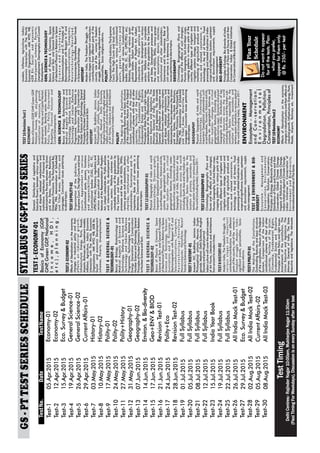
TEST1-ECONOMY-01
BasicsofEconomy(GDP,
GNP,GreenGDP,National
Income,HDI,
etc),planning,
ENVIRONMENT
Ecosystem–Management
andCon-servation,
Environmental
Degradation,Pollution,
Conservation,Principlesof
SYLLABUSOFGS-PTTESTSERIES
IFoS Results
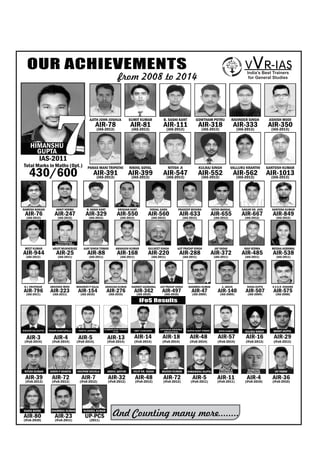
from 2008 to 2014
AJITH JOHN JOSHUA
AIR-78
SUMIT KUMAR
AIR-81
B. SASHI KANT
AIR-111
GOWTHAM POTRU
AIR-318
RAVINDER SINGH
AIR-333
ASHISH MODI
AIR-350
PARAS MANI TRIPATHI
AIR-391
NIKHIL GOYAL
AIR-399
NITISH .K
AIR-547
KULRAJ SINGH
AIR-552
VALLURU KRANTHI
AIR-562
SANTOSH KUMAR
AIR-1013
(IAS-2013) (IAS-2013) (IAS-2013) (IAS-2013) (IAS-2013) (IAS-2013)
(IAS-2013) (IAS-2013) (IAS-2013) (IAS-2013) (IAS-2013) (IAS-2013)430/600
Total Marks in Maths (Opt.)
RAMESH RANJAN
AIR-76
(IAS-2012)
ANKIT VERMA
AIR-247
(IAS-2012)
B. SASHI KANT
AIR-329
(IAS-2012)
KRISHAN KANT
AIR-550
(IAS-2012)
VISHAL GARG
AIR-560
(IAS-2012)
PRADEEP MISHRA
AIR-633
(IAS-2012)
KETAN BANSAL
AIR-655
(IAS-2012)
SANJAY KR. JAIN
AIR-667
(IAS-2012)
SANTOSH KUMAR
AIR-849
(IAS-2012)
MEET KUMAR
AIR-944
(IAS-2012)
ARIJIT MUKHERJEE
AIR-25
(IAS-2011)
AJAY SINGH TOMAR
AIR-88
(IAS-2011)
AWAKASH KUMAR
AIR-168
(IAS-2011)
GULNEET SINGH
AIR-220
(IAS-2011)
AJIT PRATAP SINGH
AIR-288
(IAS-2011)
JAY YADAV
AIR-372
(IAS-2011)
RAVI VERMA
AIR-485
(IAS-2011)
MEGHA AGRAWAL
AIR-538
(IAS-2011)
AWAKASH KUMAR
AIR-276
(IAS-2010)
NAVNEET AGGRAWAL
AIR-362
(IAS-2010)
AJIT PRATAP SINGH
AIR-497
(IAS-2010)
SHAMBHU KUMAR
AIR-47
(IAS-2009)
A. ARJUN
AIR-140
(IAS-2009)
NISHA GUPTA
AIR-507
(IAS-2009)
K.V.S.R. KISHORE
AIR-575
(IAS-2008)
Consolidated
Reserve List-2011
OUR ACHIEVEMENTS
IAS-2011
HIMANSHU
GUPTA77
India’s Best Trainers
for General Studies

Information brochure india year-book

  • 1.
    H.O.: 53/5, Basement,Old Rajender Nagar Market, Delhi-60. B.O.:105-106, Top Floor, Mukherjee Tower, Mukherjee Nagar, Delhi-9 Forum of India’s Best Trainers for General Studies (INDIA YEAR BOOK) INDIA - 2015 30 Hrs FAST TRACK COURSE (15+ Questions expected from our India 2015 Module) th Starts 29 June, 2015 Mr. Mohan Kumar (Current Affairs Expert) 9999329111, 011-45596505 Information Booklet FOR By for more details log on to www.vvrias.com or write in to vvrias@gmail.com Ph. 9652661152 H.O.: 53/5, Basement, Old Rajender Nagar Market, Delhi-60. Ph.: 011-45596505, 09999329111 Regional Office: H.No. 1-10-237, 2nd floor, Room No. 202 R.K.S-Kacham’s Blue Sapphire Ashok Nagar , Hyderabad-20.
  • 2.
    DearAspirants, India 2015 (IndiaYear Book) is the most relevant source of the Government Information and it's Programmes and Schemes. In the past, we have observed it's continuously growing importance for Civil Services Preliminary and Main Examinations. It's importance can be seen with the depth and width of information it contains with almost all information of India kept in a single all-in-one book. Consistently 13 to 20 questions (out of 100) are directly asked in Preliminary examination and if one studies the India Year Book with proper and in- depth analysis with keeping India Year Book in centre, then We can say, these question numbers may reach up to 25 to 35. Previous year(2014 PT), directly 14 questions have been asked from India Year Book(IYB). The respective question numbers in GS 2014 and Page numbers in IYB have been provided in the last of this booklet for the confidence of the students. Apart from all these importance and unavoidable substances of IYB, One issue has been here with IYB. It is quite bulky and it consumes a lot of time to cover all chapters of IYB. We will suggest mechanism, How we will simplify this issue in the next paragraph. But let us discuss firstWhy IndiaYear Book is unavoidable? As per trend of preparation for Civil Services PT, Serious aspirants were not ignoring IYB till 2010 but after introduction of CSAT since 2011, many students have been simply ignoring IYB as CSAT was the dominantly deciding factor of success in PT examination. However the trend has been changed again. Now, General Studies is the only deciding factor in PT and the Gap areas (Non Conventional Part apart from basic concept of Geography, Polity, History, Economy and Science and Technology) must be focused. We firmly believe that generally students put their all efforts and time in Conventional subjects and in the last, they lack in the Gap Areas like India Year Book, Current Affairs, Economic Survey, Art & Culture, Environment and Bio-diversity etc. As per the new trends and the time since IFoS has been combined with UPSC PT, around 50% questions are directly asked from the above mentioned Gap Areas. Here, VVR has developed the capacity in Gap Areas with rigorous research work and continuous teaching methodology through round the year class room programmes which is going to be boon for PT 2015 Examination. We are sure that India Year Book is going to be proved the boon for civil services aspirants in a very specific way. Yes, India Year Book is Bulky but our teaching methodology will simplify it and your journey through this 30 hours class room programme would be quite comfortable, interesting and result oriented. Our Expert has designed the course in a very systematic, lucid and apprehending manner by first dividing the chapters among different disciplines. We go in our class on the basis of discipline like first all chapters of Geography and Biodiversity would be covered, then IR and Defense and then next discipline. Summary notes have been prepared in such a way that many un-important details of IYB have been curtailed to reduce your burden. Things are discussed in class in such a way that you remember much items inside the class only. And so, This 30 hours of IYB module will proceed in burden free and highly productive environment to ensure your better understanding and higher success in PT 2015 Examination. All the best with IndiaYear Book Reading... Thanks & Regards! Importanceof IndiaYearBookinCivilServicesExaminationImportanceof IndiaYearBookinCivilServicesExamination
  • 3.
    1. Land andthe People 2. National Symbols 3. The Polity 4. Agriculture 5. Culture and Tourism 6. Basic Economic Data 7. Commerce 8. Communications and Information Technology 9. Defense 10. Education 11. Energy 12. Environment 13. Finance 14. Corporate Affairs 15. Food and Civil Supplies 16. Health and Family Welfare 17. Housing 18. India and the World 19. Industry 20. Law and Justice 21. Labor and Employment 22. Mass Communication 23. Planning 24. Rural and Urban Development 25. Scienti c and Technological Developments 26. Transport 27. Water Resource 28. Welfare 29. Youth Affairs and Sports 30. States and Union Territories 31. Diary of National Events 32. A Leap Forward-New Initiatives of the Government 33. General Information Chapters of India Year BookChapters of India Year Book
  • 4.
    Categorization of Chaptersinto different disciplinesCategorization of Chapters into different disciplines A. Geography & Bio-diversity 1. Land and the People 4. Agriculture 11. Energy 12. Environment 26. Transport 27. Water Resource 30. States and Union Territories B. International Relations and National Defense 9. Defence 18. India and the World C. Governmental Welfare Programmes & Schemes 10. Education 15. Food and Civil Supplies 16. Health and Family Welfare 21. Labor and Employment 24. Rural and Urban Development 28. Welfare D. Economy 6. Basic Economic Data 7. Commerce 13. Finance 14. Corporate Affairs 19. Industry 23. Planning E. Polity 2. National Symbols 3. The Polity 20. Law and Justice F. Science & Technology 8. Communications and Information Technology 25. Scienti c and Technological Developments G. General Information & Infrastructure 5. Culture and Tourism 17. Housing 22. Mass Communication 29. Youth Affairs and Sports 31. Diary of National Events 32. A Leap Forward-New Initiatives of the Government 33. General Information
  • 5.
    Course HighlightsCourse Highlights Questionsfrom India Year Book in PT 2014Questions from India Year Book in PT 2014 I. All the chapters of India Year Book which include the broad categories of Geography and Bio-diversity, International Relations and Defense, Governmental Welfare Programmes & Schemes, Economy, Polity, Science and technology, and General Information & Infrastructure to be covered in the class. II. 500 Objective questions to be provided in the form of ve tests to completely cover all chapters through questions. It would make you ready for examination. III. Location and Map items to be discussed in the class while discussing the chapter. IV. Course will be nished in approximately 30 hours. There would be 12 Classes of 2.5 hours duration each. V. Complete summary notes on each chapter with bullet points for PT to be provided. Few map sheets would also be provided. 4. Consider the following pairs: Programme/Project 1. Drought-Prone Area Programme 2. Desert Development Programme 3. National Watershed Development Project for Rainfed Areas Which of the above pairs is/are correctly matched? a. 1 and 2 only b. 3 only c. 1, 2 and 3 d. None (Ref:- Page 731 on Indian Year Book) 18. Which one of the following is the largest committee of the Parliament? a. The Committee on Public Accounts b. The Committee on Estimates c. The Committee on Public Undertakings d. The Committee on Petitions (Ref:- Page 39 on Indian Year Book) th 29. The main objective of the 12 Five-Year Plan is a. inclusive growth and poverty reduction b. inclusive and sustainable growth c. Sustainable and inclusive growth to reduce unemployment d. faster, sustainable and more inclusive growth (Ref:- Page 681 on Indian Year Book) 30. With reference to Balance of Payments, which of the following constitutes/ constitute the Current Account? 1. Balance of trade 2. Foreign Assets 3. Balance of invisible 4. Special Drawing Rights Select the correct answer using the code given below, a. 1 only 2. 2 and 3 3. 1 and 3 d. 1, 2 and 4 (Ref:- Page 333 on Indian Year Book) 41. Which of the following have coral reefs? 1. Andaman and Nicobar Islands 2. Gulf of Kachchh 3. Gulf of Mannar 4. Sunderbans Select the correct answer using the code given below. a. 1, 2 and 3 only b. 2 and 4 only 3. 1 and 3 only 4. 1, 2, 3 and 4 (Ref:- Page 298 on Indian Year Book) 45. Consider the following rivers:- 1. Barak 2. Lohit 3. Subansiri Which of the above ows/ow through Ministry Ministry of Agriculture Ministry of Environment Ministry of Rural Development and Forests
  • 6.
    Arunachal Pradesh a. 1Only b. 2 and 3 only c. 1 and 3 only d. 1, 2 and 3 (Ref:- Page 3 on Indian Year Book) 50. The most important strategy for the conservation of bio-diversity together with traditional human life is the establishment of a. biosphere reserves b. botanical gardens c. national parks d. wildlife sanctuaries (Ref:- Page 299 on Indian Year Book) 54. The national motto of India 'Satyameva Jayate' inscribed below the Emblem of India is taken from a. Katha Upanishad b. Chandogya Upanishad c. Altarcya Upanishad d. Mundaka Upanishad (Ref:- Page 29 on Indian Year Book) 55. In the Constitution of India, promotion of international peace and security is included in the a. Preamble to the Constitution b. Directive Principles of State Policy c. Fundamental Duties d. Ninth Schedule (Ref:- Page 55 on Indian Year Book) 56. What are the benefits of implementing the 'Integrated Watershed Development Programme'? 1. Prevention of soil runoff 2. Linking the country's perennial rivers with seasonal rivers 3. Rainwater harvesting and recharge of groundwater table 4. Regeneration of natural vegetation Select the correct answer using the code given below. a. 1 and 2 only b. 2, 3 and 4 only c. 1, 3 and 4 only d. 1, 2, 3 and 4 (Ref:- Page 724/731 on Indian Year Book) 58. which of the following is/are the function/functions of the cabinet Secretariat? 1. Preparation of agenda for Cabinet Meetings 2. Secretarial assistance to Cabinet Committees 3. Allocation of financial resources to the Ministries Select the correct answer using the code given below. a. 1 only b. 2 and 3 only c. 1 and 2 only d. 1, 2 and 3 (Ref:- Page 43 on Indian Year Book) 71. The power of Supreme Court of India to decide disputes between the Centre and the States falls under its a. advisory jurisdiction b. appellate jurisdiction c. original jurisdiction d. writ jurisdiction (Ref:- Page 565 on Indian Year Book) 84. Chaitra 1 of the national calendar based on the Saka Era corresponds to which one of the following dates of the Gregorian calendar in a normal year of 365 days? nd st a. 22 March (or 21 March) th th b. 15 May (or 16 May) st th c. 31 March (or 30 March) st th d. 21 April (or 20 April) (Ref:- Page 31 on Indian Year Book)
  • 7.
  • 8.
    IFoS Results from 2008to 2014 AJITH JOHN JOSHUA AIR-78 SUMIT KUMAR AIR-81 B. SASHI KANT AIR-111 GOWTHAM POTRU AIR-318 RAVINDER SINGH AIR-333 ASHISH MODI AIR-350 PARAS MANI TRIPATHI AIR-391 NIKHIL GOYAL AIR-399 NITISH .K AIR-547 KULRAJ SINGH AIR-552 VALLURU KRANTHI AIR-562 SANTOSH KUMAR AIR-1013 (IAS-2013) (IAS-2013) (IAS-2013) (IAS-2013) (IAS-2013) (IAS-2013) (IAS-2013) (IAS-2013) (IAS-2013) (IAS-2013) (IAS-2013) (IAS-2013)430/600 Total Marks in Maths (Opt.) RAMESH RANJAN AIR-76 (IAS-2012) ANKIT VERMA AIR-247 (IAS-2012) B. SASHI KANT AIR-329 (IAS-2012) KRISHAN KANT AIR-550 (IAS-2012) VISHAL GARG AIR-560 (IAS-2012) PRADEEP MISHRA AIR-633 (IAS-2012) KETAN BANSAL AIR-655 (IAS-2012) SANJAY KR. JAIN AIR-667 (IAS-2012) SANTOSH KUMAR AIR-849 (IAS-2012) MEET KUMAR AIR-944 (IAS-2012) ARIJIT MUKHERJEE AIR-25 (IAS-2011) AJAY SINGH TOMAR AIR-88 (IAS-2011) AWAKASH KUMAR AIR-168 (IAS-2011) GULNEET SINGH AIR-220 (IAS-2011) AJIT PRATAP SINGH AIR-288 (IAS-2011) JAY YADAV AIR-372 (IAS-2011) RAVI VERMA AIR-485 (IAS-2011) MEGHA AGRAWAL AIR-538 (IAS-2011) AWAKASH KUMAR AIR-276 (IAS-2010) NAVNEET AGGRAWAL AIR-362 (IAS-2010) AJIT PRATAP SINGH AIR-497 (IAS-2010) SHAMBHU KUMAR AIR-47 (IAS-2009) A. ARJUN AIR-140 (IAS-2009) NISHA GUPTA AIR-507 (IAS-2009) K.V.S.R. KISHORE AIR-575 (IAS-2008) Consolidated Reserve List-2011 OUR ACHIEVEMENTS IAS-2011 HIMANSHU GUPTA77 India’s Best Trainers for General Studies