CHILDHOOD ASTHMA
Asthma Definition
❑ It is defined by the history of respiratory symptoms
such as wheeze, shortness of breath, chest tightness
and cough that vary over time and in intensity,
together with variable expiratory airflow limitation.
❑ Asthma is a heterogeneous disease, usually
characterized by chronic airway inflammation.
Asthma Definition
❑ Asthma is characterized by reversible airflow limitation,
an oversensitive cough reflex and mucus
hypersecretion.
❑ It may have no inflammatory component or there may
be different patterns of inflammation, as there may be
contributions from bacterial and viral infections that
vary over time.
CHALLENGE TO DIAGNOSE
■ Classical features like wheezing and dyspnea
are seen only in 30%.
■ Wheeze - All asthmatic children do not
wheeze; all that wheezes is not asthma
■ Asthma being characteristically episodic,
there may be no signs at the time of
evaluation
■ Cough – Recurrent / Persistent cough
(often misdiagnosed)
WHEN TO SUSPECT
1.Frequent episodes of wheezing-> once a month
2. Activity induced cough or wheeze
3. Cough particularly in night during periods
without viral infection.
4. Absence of seasonal variation in wheeze
5. Symptoms that persists after the age 3
Consider asthma if any the following signs or
symptoms are present:
6 .Symptoms occur or worsen in the presence of:
• Aeroallergens
• Exercise
• Pollens
• Respiratory infections (viral)
• Strong emotional stress
• Tobacco smoke
WHEN TO SUSPECT
Consider asthma if any the following signs or
symptoms are present:
■ 7 . Childs cold repeatedly “goes to the chest”
or takes more than 10 days to clear up.
■ 8. Symptoms improve when asthma
medications are given
WHEN TO SUSPECT
Consider asthma if any the following signs or
symptoms are present:
WHEN TO SUSPECT
■ Recurrent cough?
■ Recurrent wheeze?
■ Recurrent breathlessness?
■ Exercise induced cough/wheeze?
■ Nocturnal cough?
■ Tightness of chest?
If these symptoms of airway obstruction are
recurrent then it is asthma.
WHAT TO LOOK FOR
■ Asthma is a dynamic condition
■ The examination may be essentially
normal when in remission
■ Generalized wheeze /prolonged
expiration /Chest hyperinflation-
symptomatic
■ Evidences of skin/nasal atopy
How To Confirm
❑ No gold standard test to diagnose.
❑ Diagnosis is essentially clinical.
❑ Other causes of recurrent cough should be ruled out.
The role of lung function in
asthma
❑ Diagnosis
▪ Demonstrate variable expiratory airflow limitation
▪ Reconsider diagnosis if symptoms and lung function are
discordant
■ Frequent symptoms but normal FEV1: cardiac disease; lack of
fitness?
■ Few symptoms but low FEV1: poor perception; restriction of
lifestyle?
❑ Risk assessment
▪ Low FEV1 is an independent predictor of exacerbation risk.
GINA 2014
The role of lung function in
asthma
❑ Monitoring progress
▪ Measure lung function at diagnosis, 3-6 months after starting
treatment (to identify personal best), and then periodically.
▪ Consider long-term PEF monitoring for patients with severe
asthma or impaired perception of airflow limitation.

❑ Adjusting treatment?
▪ Utility of lung function for adjusting treatment is limited by
between-visit variability of FEV1 (15% year-to-year).
GINA 2014
Diagnosis of asthma
❑ The diagnosis of asthma should be based on:
▪ A history of characteristic symptom patterns
▪ Evidence of variable airflow limitation, from bronchodilator
reversibility testing or other tests
❑ Document evidence for the diagnosis in the patient’s
notes, preferably before starting controller treatment
▪ It is often more difficult to confirm the diagnosis after treatment
has been started.
GINA 2014
RULE OUT MIMICS
■ Younger age- Congenital anomalies, GERD, WARI
■ Cardiovascular causes L-R shunts
■ Foreign body aspiration
■ CF, PCD , Immunodeficiency
■ Tuberculosis/Bronchiectasis
Comorbidities of asthma
❑ It is important to assess for the comorbidities as if underdiagnosed
or undertreated, comorbid conditions can influence quality of life
and asthma control.
❑ Rhinitis
❑ Rhinosinusitis
❑ Nasal polyposis
❑ Obesity
❑ Obstructive sleep apnea
❑ Gastro-esophageal reflux disease
❑ Psychological stress, anxiety symptoms, depression
❑ Dysfunctional breathing
❑ Exercise induced laryngeal obstruction
GINA 2014, Box 1-1 © Global Initiative for Asthma
NEW!
Summary so far…..
> 3 episodes of airflow obstruction are present
■ Airway obstruction is reversible
■ Alternative diagnoses are excluded
■ Co morbid conditions are identified
Diagnosis of Asthma is mainly clinical
HOW TO TREAT
• Patient education
• Pharmacotherapy
• Long term management
• Trigger avoidance
• Treatment of acute attack
• Home management plan
• Follow up
HOW TO TREAT
Parental and patient counseling (Education)
1.Conveying the diagnosis
2.Disease pathogenesis and natural course
3.Treatment and out come
4.Inhalation devices –use, myths
5.Home monitoring
6.Home treatment plan
HOW TO TREAT
■ Pharmacotherapy
-Relievers- b-agonists (oral/inhaled),
Anticholinergics,
systemic steroids
-Preventers-
-Inhalers- LABA/Steroids/chromone
-oral -LTRAS
-theophylline
-steroids
ICS
■ Anti inflammatory effect evident in 2-3 weeks
■ Local side effects can be minimized by
spacers/gargling
■ Systemic side effects negligible
■ Most children are controlled with medium
doses.
■ In prolonged high doses-monitor growth and
eyes
LABA
■ Not used as relievers
■ Never use alone
■ Used with ICS for synergistic effects/steroid
steroid sparing effects
■ Useful in nocturnal/Exercise induced
symptoms
■ Used only in children >4years
■ Salmeterol / Formoterol-not much to choose
Leukotrine antagonists
■ Weak anti inflammatory effect
■ Add on in moderate to severe asthma
■ Mono therapy may be considered in mild
asthma but certainly inferior to ICS
■ Exercise induced asthma
■ Montelukast > 6 months
Theophylline
■ Anti inflammatory/immuno modulator effect
■ Used as preventer only (sustained release
formulations as ad on to ICS), no role of syrup
formulations
■ Exception-Acute severe asthma
■ Caution- side effects / drug interactions
Long term oral steroids
■ Use limited to severe persistent asthma
■ Minimal possible doses
■ Alternate morning doses preferred
■ Prednisolone – best option
■ Monitor side effects-bone density, eyes, skin,
immuno suppression, HPA axis
Inhalation treatment is not only the most
natural, effective, fast and safe way to
treat Asthma…
It is the only way to treat it.
What is the need for
inhalation treatment?
PRINCIPLES OF INHALATION
THERAPY
• Targeted delivery of
medication to the
airway tract
• Rapid onset of action
• Smaller doses
• Less systemic and GI
adverse effects
• Relatively comfortable
Barriers to inhalation therapy
■ Fear about steroids
■ Do not like public labeling as asthmatic
■ Fear of addiction
■ Feel pumps reserved for serious or severe
attacks or will fail to act
■ Misconception that costly
■ Prefer oral medications
■ Physicians lack of knowledge and time
WHEN GIVEN BY INHALED ROUTE
HOW MUCH DRUG GOES IN TO LUNGS
Inhalation device delivery
MDI with spacer 10-15 %
MDI alone 5-10 %
DPI 5-10 %
Nebuliser 1-5%
When using MDI spacer is a must
■ Eliminates need for hand-breath co
ordination
■ Improve drug delivery
■ Reduce local side effects of ICS
■ Dilute the taste of inhaled sprays
■ Eliminates cold freon effect
Spacers in Childhood Asthma
■ Spacers in acute wheezing < 2 yrs.
■ Spacers in acute asthma management.
■ Spacers in daily asthma management.
A Spacer is the only practical “total
asthma care” device.
HOW TO INITIATE INHALED
THERAPY
1. Explain advantage of inhaled therapy
2. Dispel myths and fears
3. Select the appropriate device
4. Demonstrate how to use the selected device
1. Asthma control - two domains
▪ Assess symptom control over the last 4 weeks
▪ Assess risk factors for poor outcomes, including low lung
function
2. Treatment issues
▪ Check inhaler technique and adherence
▪ Ask about side-effects
▪ Does the patient have a written asthma action plan?
▪ What are the patient’s attitudes and goals for their asthma?
3. Comorbidities
▪ Think of rhinosinusitis, GERD, obesity, obstructive sleep
apnea, depression, anxiety
▪ These may contribute to symptoms and poor quality of life
Assessment of asthma
GINA 2014, Box 2-1
© Global Initiative for Asthma
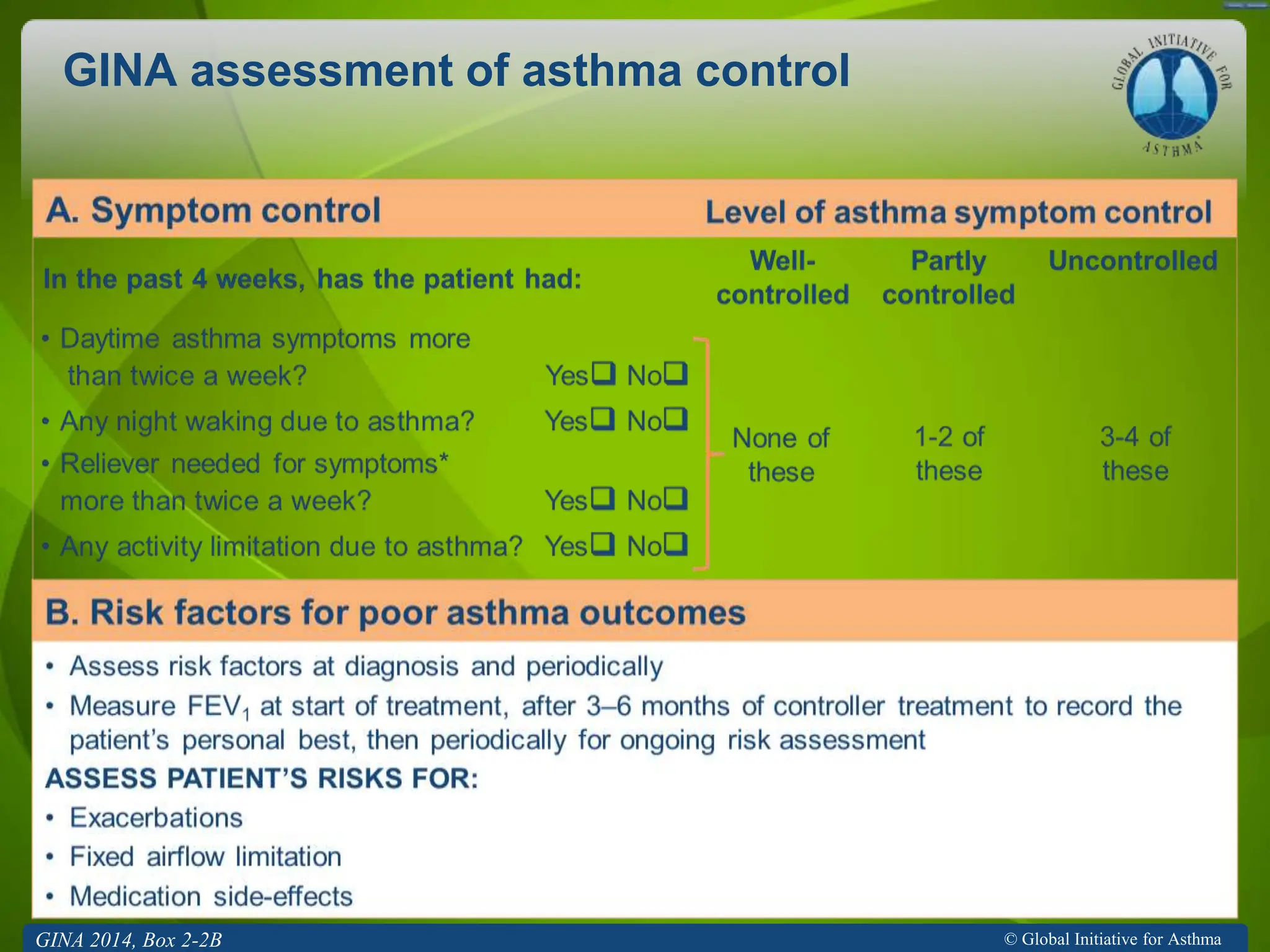
GINA assessment of asthma control
GINA 2014, Box 2-2B
© Global Initiative for Asthma
Assessment of risk factors for poor asthma
outcomes
Risk factors for exacerbations include:
• Ever intubated for asthma
• Uncontrolled asthma symptoms
• Having ≥1 exacerbation in last 12 months
• Low FEV1 (measure lung function at start of treatment, at 3-6 months
to assess personal best, and periodically thereafter)
• Incorrect inhaler technique and/or poor adherence
• Smoking
• Obesity, pregnancy, blood eosinophilia
GINA 2014, Box 2-2B
Risk factors for exacerbations include:
• Ever intubated for asthma
• Uncontrolled asthma symptoms
• Having ≥1 exacerbation in last 12 months
• Low FEV1 (measure lung function at start of treatment, at 3-6 months
to assess personal best, and periodically thereafter)
• Incorrect inhaler technique and/or poor adherence
• Smoking
• Obesity, pregnancy, blood eosinophilia
Risk factors for fixed airflow limitation include:
• No ICS treatment, smoking, occupational exposure, mucus
hypersecretion, blood eosinophilia
Risk factors for exacerbations include:
• Ever intubated for asthma
• Uncontrolled asthma symptoms
• Having ≥1 exacerbation in last 12 months
• Low FEV1 (measure lung function at start of treatment, at 3-6 months
to assess personal best, and periodically thereafter)
• Incorrect inhaler technique and/or poor adherence
• Smoking
• Obesity, pregnancy, blood eosinophilia
Risk factors for fixed airflow limitation include:
• No ICS treatment, smoking, occupational exposure, mucus
hypersecretion, blood eosinophilia
Risk factors for medication side-effects include:
• Frequent oral steroids, high dose/potent ICS, P450 inhibitors
■ How?
▪ Asthma severity is assessed retrospectively from the level of
treatment required to control symptoms and exacerbations
■ When?
▪ Assess asthma severity after patient has been on controller
treatment for several months
▪ Severity is not static – it may change over months or years,
or as different treatments become available
■ Categories of asthma severity
▪ Mild asthma: well-controlled with Steps 1 or 2 (as-needed
SABA or low dose ICS)
▪ Moderate asthma: well-controlled with Step 3 (low-dose
ICS/LABA)
▪ Severe asthma: requires Step 4/5 (moderate or high dose
ICS/LABA ± add-on), or remains uncontrolled despite this
treatment
Assessing asthma severity
GINA 2014
Initial controller therapy in
treatment naive
Symptom un(control) First Choice Other options
Infrequent Symptoms (not
uncontrolled or partly
controlled and with no risk
factors)
No controller medication
Asthma symptoms (even if
infrequent) with any risk
factors for exacerbations,
Asthma symptoms more than
twice a month
Waking due to asthma more
than once a month
Low dose ICS LRTA
Troublesome symptoms on
most days
waking more than once a
week or more
Low dose ICS+ LABA(>12
yrs)
Medium dose ICS (6-11Yrs)
Low/medium dose ICS
+LRTA/SR Theophylline
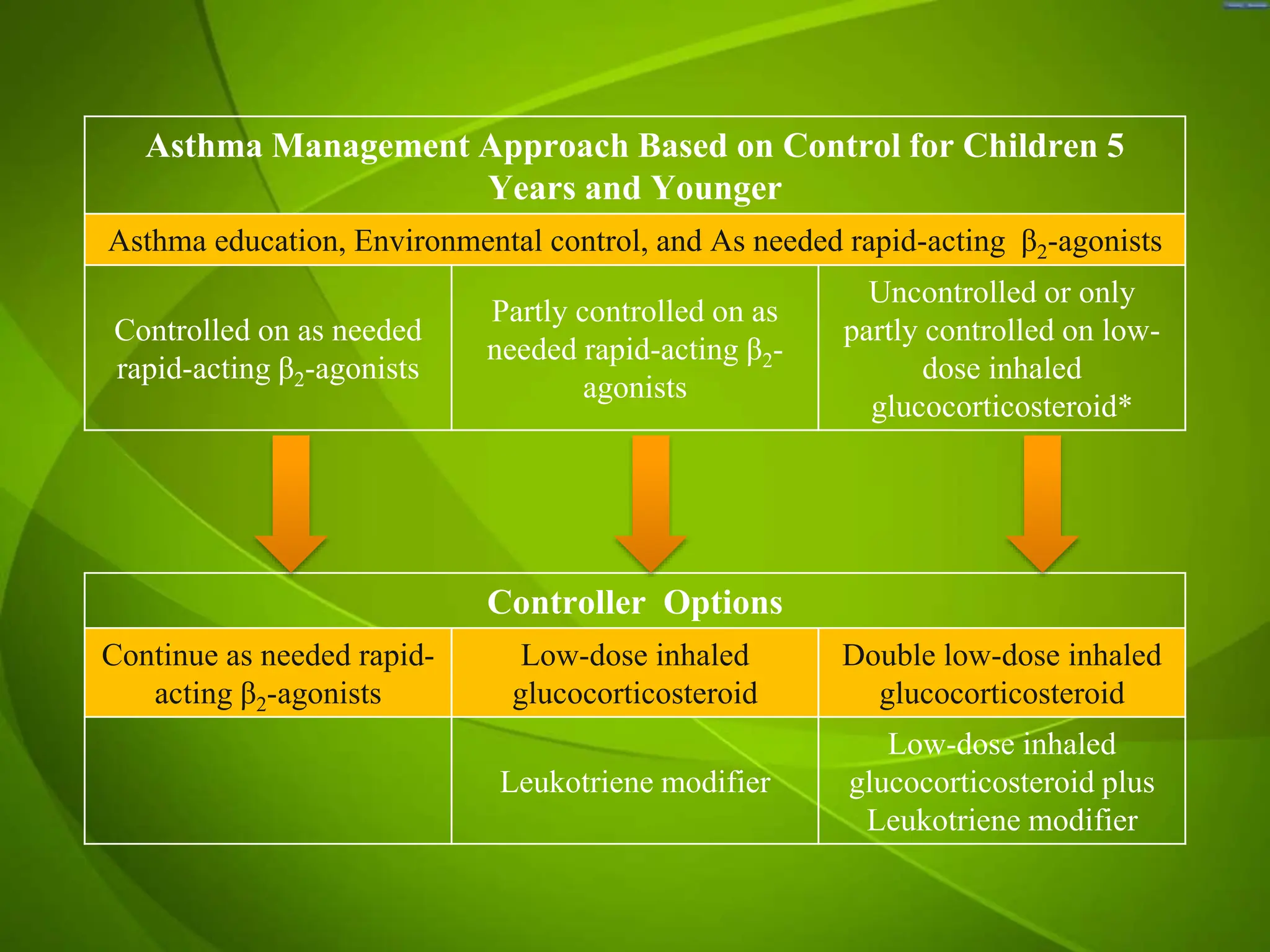
Asthma Management Approach Based on Control for Children 5
Years and Younger
Asthma education, Environmental control, and As needed rapid-acting β2-agonists
Controlled on as needed
rapid-acting β2-agonists
Partly controlled on as
needed rapid-acting β2-
agonists
Uncontrolled or only
partly controlled on low-
dose inhaled
glucocorticosteroid*
Controller Options
Continue as needed rapid-
acting β2-agonists
Low-dose inhaled
glucocorticosteroid
Double low-dose inhaled
glucocorticosteroid
Leukotriene modifier
Low-dose inhaled
glucocorticosteroid plus
Leukotriene modifier
Step Care Approach
Control inflammation & symptoms fast with higher
dose ICS
Step down ICS dose 25 – 50% every 3 –6 mo
Maintain at lowest possible dose
OD Flu / Bud enough in stable patients
Can discontinue if stable for 6 – 12 mo
STEPING DOWN TREATMENT
■ Step down the treatment after good control for
3 months i.e no symptoms/occasional use of
SABA
■ Follow the principle last in - first out
■ Reduce the dose of ICS by 25% every 3 month
■ Step down to the regimen suitable for the
lower grade of severity.
STOPING TREATMENT
■ Good control continues on low dose ICS for 3
months.
■ Stop preventer regimen-remission
■ Trigger avoidance continues
■ Explain home management plan- for acute
episodes.
■ Follow up every 2-3 monthly for 1-2 years
■ Counsel regarding future recurrences
NATURAL HISTORY
■ Re emphasize that drugs control but do
not cure
■ As asthma in children often remits hence
control can be considered as good as
cure.
■ Identify those at risk for persistence
NATURAL HISTORY
■ 2 out of 3 children with asthma out grow their
symptoms.
■ Risk factors for persistence in adulthood are:
1.Female
2.Eczema
3.Severe disease
4.Onset after the age of 3 years
5.Parental h/o atopy/asthma
Thank You

Information about CHILDHOOD ASTHMA E-CLASS.pptx

  • 1.
  • 2.
    Asthma Definition ❑ Itis defined by the history of respiratory symptoms such as wheeze, shortness of breath, chest tightness and cough that vary over time and in intensity, together with variable expiratory airflow limitation. ❑ Asthma is a heterogeneous disease, usually characterized by chronic airway inflammation.
  • 3.
    Asthma Definition ❑ Asthmais characterized by reversible airflow limitation, an oversensitive cough reflex and mucus hypersecretion. ❑ It may have no inflammatory component or there may be different patterns of inflammation, as there may be contributions from bacterial and viral infections that vary over time.
  • 4.
    CHALLENGE TO DIAGNOSE ■Classical features like wheezing and dyspnea are seen only in 30%. ■ Wheeze - All asthmatic children do not wheeze; all that wheezes is not asthma ■ Asthma being characteristically episodic, there may be no signs at the time of evaluation ■ Cough – Recurrent / Persistent cough (often misdiagnosed)
  • 5.
    WHEN TO SUSPECT 1.Frequentepisodes of wheezing-> once a month 2. Activity induced cough or wheeze 3. Cough particularly in night during periods without viral infection. 4. Absence of seasonal variation in wheeze 5. Symptoms that persists after the age 3 Consider asthma if any the following signs or symptoms are present:
  • 6.
    6 .Symptoms occuror worsen in the presence of: • Aeroallergens • Exercise • Pollens • Respiratory infections (viral) • Strong emotional stress • Tobacco smoke WHEN TO SUSPECT Consider asthma if any the following signs or symptoms are present:
  • 7.
    ■ 7 .Childs cold repeatedly “goes to the chest” or takes more than 10 days to clear up. ■ 8. Symptoms improve when asthma medications are given WHEN TO SUSPECT Consider asthma if any the following signs or symptoms are present:
  • 8.
    WHEN TO SUSPECT ■Recurrent cough? ■ Recurrent wheeze? ■ Recurrent breathlessness? ■ Exercise induced cough/wheeze? ■ Nocturnal cough? ■ Tightness of chest? If these symptoms of airway obstruction are recurrent then it is asthma.
  • 9.
    WHAT TO LOOKFOR ■ Asthma is a dynamic condition ■ The examination may be essentially normal when in remission ■ Generalized wheeze /prolonged expiration /Chest hyperinflation- symptomatic ■ Evidences of skin/nasal atopy
  • 10.
    How To Confirm ❑No gold standard test to diagnose. ❑ Diagnosis is essentially clinical. ❑ Other causes of recurrent cough should be ruled out.
  • 11.
    The role oflung function in asthma ❑ Diagnosis ▪ Demonstrate variable expiratory airflow limitation ▪ Reconsider diagnosis if symptoms and lung function are discordant ■ Frequent symptoms but normal FEV1: cardiac disease; lack of fitness? ■ Few symptoms but low FEV1: poor perception; restriction of lifestyle? ❑ Risk assessment ▪ Low FEV1 is an independent predictor of exacerbation risk. GINA 2014
  • 12.
    The role oflung function in asthma ❑ Monitoring progress ▪ Measure lung function at diagnosis, 3-6 months after starting treatment (to identify personal best), and then periodically. ▪ Consider long-term PEF monitoring for patients with severe asthma or impaired perception of airflow limitation. ❑ Adjusting treatment? ▪ Utility of lung function for adjusting treatment is limited by between-visit variability of FEV1 (15% year-to-year). GINA 2014
  • 13.
    Diagnosis of asthma ❑The diagnosis of asthma should be based on: ▪ A history of characteristic symptom patterns ▪ Evidence of variable airflow limitation, from bronchodilator reversibility testing or other tests ❑ Document evidence for the diagnosis in the patient’s notes, preferably before starting controller treatment ▪ It is often more difficult to confirm the diagnosis after treatment has been started. GINA 2014
  • 14.
    RULE OUT MIMICS ■Younger age- Congenital anomalies, GERD, WARI ■ Cardiovascular causes L-R shunts ■ Foreign body aspiration ■ CF, PCD , Immunodeficiency ■ Tuberculosis/Bronchiectasis
  • 15.
    Comorbidities of asthma ❑It is important to assess for the comorbidities as if underdiagnosed or undertreated, comorbid conditions can influence quality of life and asthma control. ❑ Rhinitis ❑ Rhinosinusitis ❑ Nasal polyposis ❑ Obesity ❑ Obstructive sleep apnea ❑ Gastro-esophageal reflux disease ❑ Psychological stress, anxiety symptoms, depression ❑ Dysfunctional breathing ❑ Exercise induced laryngeal obstruction
  • 16.
    GINA 2014, Box1-1 © Global Initiative for Asthma NEW!
  • 17.
    Summary so far….. >3 episodes of airflow obstruction are present ■ Airway obstruction is reversible ■ Alternative diagnoses are excluded ■ Co morbid conditions are identified Diagnosis of Asthma is mainly clinical
  • 18.
    HOW TO TREAT •Patient education • Pharmacotherapy • Long term management • Trigger avoidance • Treatment of acute attack • Home management plan • Follow up
  • 19.
    HOW TO TREAT Parentaland patient counseling (Education) 1.Conveying the diagnosis 2.Disease pathogenesis and natural course 3.Treatment and out come 4.Inhalation devices –use, myths 5.Home monitoring 6.Home treatment plan
  • 20.
    HOW TO TREAT ■Pharmacotherapy -Relievers- b-agonists (oral/inhaled), Anticholinergics, systemic steroids -Preventers- -Inhalers- LABA/Steroids/chromone -oral -LTRAS -theophylline -steroids
  • 21.
    ICS ■ Anti inflammatoryeffect evident in 2-3 weeks ■ Local side effects can be minimized by spacers/gargling ■ Systemic side effects negligible ■ Most children are controlled with medium doses. ■ In prolonged high doses-monitor growth and eyes
  • 22.
    LABA ■ Not usedas relievers ■ Never use alone ■ Used with ICS for synergistic effects/steroid steroid sparing effects ■ Useful in nocturnal/Exercise induced symptoms ■ Used only in children >4years ■ Salmeterol / Formoterol-not much to choose
  • 23.
    Leukotrine antagonists ■ Weakanti inflammatory effect ■ Add on in moderate to severe asthma ■ Mono therapy may be considered in mild asthma but certainly inferior to ICS ■ Exercise induced asthma ■ Montelukast > 6 months
  • 24.
    Theophylline ■ Anti inflammatory/immunomodulator effect ■ Used as preventer only (sustained release formulations as ad on to ICS), no role of syrup formulations ■ Exception-Acute severe asthma ■ Caution- side effects / drug interactions
  • 25.
    Long term oralsteroids ■ Use limited to severe persistent asthma ■ Minimal possible doses ■ Alternate morning doses preferred ■ Prednisolone – best option ■ Monitor side effects-bone density, eyes, skin, immuno suppression, HPA axis
  • 26.
    Inhalation treatment isnot only the most natural, effective, fast and safe way to treat Asthma… It is the only way to treat it. What is the need for inhalation treatment?
  • 27.
    PRINCIPLES OF INHALATION THERAPY •Targeted delivery of medication to the airway tract • Rapid onset of action • Smaller doses • Less systemic and GI adverse effects • Relatively comfortable
  • 28.
    Barriers to inhalationtherapy ■ Fear about steroids ■ Do not like public labeling as asthmatic ■ Fear of addiction ■ Feel pumps reserved for serious or severe attacks or will fail to act ■ Misconception that costly ■ Prefer oral medications ■ Physicians lack of knowledge and time
  • 29.
    WHEN GIVEN BYINHALED ROUTE HOW MUCH DRUG GOES IN TO LUNGS Inhalation device delivery MDI with spacer 10-15 % MDI alone 5-10 % DPI 5-10 % Nebuliser 1-5%
  • 30.
    When using MDIspacer is a must ■ Eliminates need for hand-breath co ordination ■ Improve drug delivery ■ Reduce local side effects of ICS ■ Dilute the taste of inhaled sprays ■ Eliminates cold freon effect
  • 31.
    Spacers in ChildhoodAsthma ■ Spacers in acute wheezing < 2 yrs. ■ Spacers in acute asthma management. ■ Spacers in daily asthma management. A Spacer is the only practical “total asthma care” device.
  • 32.
    HOW TO INITIATEINHALED THERAPY 1. Explain advantage of inhaled therapy 2. Dispel myths and fears 3. Select the appropriate device 4. Demonstrate how to use the selected device
  • 33.
    1. Asthma control- two domains ▪ Assess symptom control over the last 4 weeks ▪ Assess risk factors for poor outcomes, including low lung function 2. Treatment issues ▪ Check inhaler technique and adherence ▪ Ask about side-effects ▪ Does the patient have a written asthma action plan? ▪ What are the patient’s attitudes and goals for their asthma? 3. Comorbidities ▪ Think of rhinosinusitis, GERD, obesity, obstructive sleep apnea, depression, anxiety ▪ These may contribute to symptoms and poor quality of life Assessment of asthma GINA 2014, Box 2-1
  • 34.
    © Global Initiativefor Asthma GINA assessment of asthma control GINA 2014, Box 2-2B
  • 35.
    © Global Initiativefor Asthma Assessment of risk factors for poor asthma outcomes Risk factors for exacerbations include: • Ever intubated for asthma • Uncontrolled asthma symptoms • Having ≥1 exacerbation in last 12 months • Low FEV1 (measure lung function at start of treatment, at 3-6 months to assess personal best, and periodically thereafter) • Incorrect inhaler technique and/or poor adherence • Smoking • Obesity, pregnancy, blood eosinophilia GINA 2014, Box 2-2B Risk factors for exacerbations include: • Ever intubated for asthma • Uncontrolled asthma symptoms • Having ≥1 exacerbation in last 12 months • Low FEV1 (measure lung function at start of treatment, at 3-6 months to assess personal best, and periodically thereafter) • Incorrect inhaler technique and/or poor adherence • Smoking • Obesity, pregnancy, blood eosinophilia Risk factors for fixed airflow limitation include: • No ICS treatment, smoking, occupational exposure, mucus hypersecretion, blood eosinophilia Risk factors for exacerbations include: • Ever intubated for asthma • Uncontrolled asthma symptoms • Having ≥1 exacerbation in last 12 months • Low FEV1 (measure lung function at start of treatment, at 3-6 months to assess personal best, and periodically thereafter) • Incorrect inhaler technique and/or poor adherence • Smoking • Obesity, pregnancy, blood eosinophilia Risk factors for fixed airflow limitation include: • No ICS treatment, smoking, occupational exposure, mucus hypersecretion, blood eosinophilia Risk factors for medication side-effects include: • Frequent oral steroids, high dose/potent ICS, P450 inhibitors
  • 36.
    ■ How? ▪ Asthmaseverity is assessed retrospectively from the level of treatment required to control symptoms and exacerbations ■ When? ▪ Assess asthma severity after patient has been on controller treatment for several months ▪ Severity is not static – it may change over months or years, or as different treatments become available ■ Categories of asthma severity ▪ Mild asthma: well-controlled with Steps 1 or 2 (as-needed SABA or low dose ICS) ▪ Moderate asthma: well-controlled with Step 3 (low-dose ICS/LABA) ▪ Severe asthma: requires Step 4/5 (moderate or high dose ICS/LABA ± add-on), or remains uncontrolled despite this treatment Assessing asthma severity GINA 2014
  • 37.
    Initial controller therapyin treatment naive Symptom un(control) First Choice Other options Infrequent Symptoms (not uncontrolled or partly controlled and with no risk factors) No controller medication Asthma symptoms (even if infrequent) with any risk factors for exacerbations, Asthma symptoms more than twice a month Waking due to asthma more than once a month Low dose ICS LRTA Troublesome symptoms on most days waking more than once a week or more Low dose ICS+ LABA(>12 yrs) Medium dose ICS (6-11Yrs) Low/medium dose ICS +LRTA/SR Theophylline
  • 38.
    Asthma Management ApproachBased on Control for Children 5 Years and Younger Asthma education, Environmental control, and As needed rapid-acting β2-agonists Controlled on as needed rapid-acting β2-agonists Partly controlled on as needed rapid-acting β2- agonists Uncontrolled or only partly controlled on low- dose inhaled glucocorticosteroid* Controller Options Continue as needed rapid- acting β2-agonists Low-dose inhaled glucocorticosteroid Double low-dose inhaled glucocorticosteroid Leukotriene modifier Low-dose inhaled glucocorticosteroid plus Leukotriene modifier
  • 40.
    Step Care Approach Controlinflammation & symptoms fast with higher dose ICS Step down ICS dose 25 – 50% every 3 –6 mo Maintain at lowest possible dose OD Flu / Bud enough in stable patients Can discontinue if stable for 6 – 12 mo
  • 41.
    STEPING DOWN TREATMENT ■Step down the treatment after good control for 3 months i.e no symptoms/occasional use of SABA ■ Follow the principle last in - first out ■ Reduce the dose of ICS by 25% every 3 month ■ Step down to the regimen suitable for the lower grade of severity.
  • 42.
    STOPING TREATMENT ■ Goodcontrol continues on low dose ICS for 3 months. ■ Stop preventer regimen-remission ■ Trigger avoidance continues ■ Explain home management plan- for acute episodes. ■ Follow up every 2-3 monthly for 1-2 years ■ Counsel regarding future recurrences
  • 43.
    NATURAL HISTORY ■ Reemphasize that drugs control but do not cure ■ As asthma in children often remits hence control can be considered as good as cure. ■ Identify those at risk for persistence
  • 44.
    NATURAL HISTORY ■ 2out of 3 children with asthma out grow their symptoms. ■ Risk factors for persistence in adulthood are: 1.Female 2.Eczema 3.Severe disease 4.Onset after the age of 3 years 5.Parental h/o atopy/asthma
  • 45.