Informal decision-making
is *considered harmful!
* https://en.wikipedia.org/wiki/Considered_harmful
by Hamid Davoodi
Imagine a very likely scenario
● Moved to a new team in your current company
● Working on a new project in the same team
● You are asked to cover someone for a while
● Work with some other team to fix an issue
● Moving to a new company
● Went to coma and woke up 6 month later
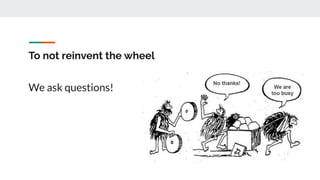
To not reinvent the wheel
We ask questions!
You’d have many questions!
● Why gRPC over web?
● Why NodeJS over Java?
● Why Scala over Java?
● Why DC over Cloud?
● Why Cloud over DC?
● Why NoSQL over ACID?
● Why RabbitMQ and not Kafka?
● Why a new API?
● Why CDN over API?
● Why RMQ has only one instance?
● Why this particular database?
● Why PostgreSQL over Redis?
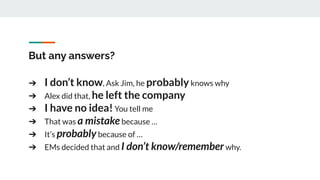
But any answers?
➔ I don’t know, Ask Jim, he probablyknows why
➔ Alex did that, he left the company
➔ I have no idea!You tell me
➔ That was a mistakebecause …
➔ It’s probablybecause of …
➔ EMs decided that and I don’t know/rememberwhy.
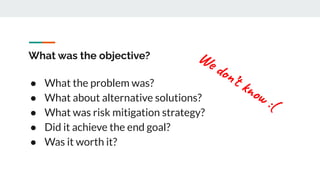
What was the objective?
● What the problem was?
● What about alternative solutions?
● What was risk mitigation strategy?
● Did it achieve the end goal?
● Was it worth it?
We don’t know :(
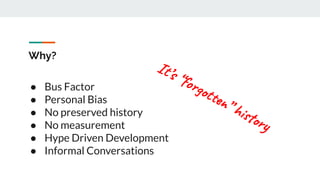
Why?
● Bus Factor
● Personal Bias
● No preserved history
● No measurement
● Hype Driven Development
● Informal Conversations
It’s “forgotten” history
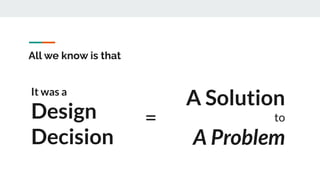
All we know is that
A Solution
to
A Problem
It was a
Design
Decision
=
What’s to blame?!
Informal Decision-Making
aka
Tribal Knowledge
Tribal Knowledge
Or informal knowledge refers to the unwritten, unspoken, and often
implicit understanding, skills, and practices that exist within a group or
organization.
https://en.wikipedia.org/wiki/Tribal_knowledge
https://devblogs.microsoft.com/premier-developer/tribal-knowledge-the-anti-devops-culture/
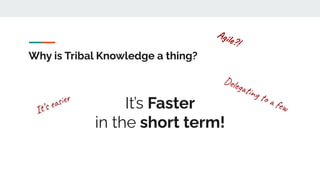
Why is Tribal Knowledge a thing?
It’s Faster
in the short term!
Delegating to a few
It’s easier
Agile?!
Why is Tribal Knowledge a thing?
It’s faster in the short term!
However, It leads to longer-term issues in
code quality,
team alignment,
and system maintainability.
Tribal Knowledge’s risks:
● Lack of transparency:
Decisions may be made without all stakeholders being aware or having input.
● Inconsistency:
Without a formal process, similar issues might be handled differently each time.
● Limited perspective:
Quick, informal decisions often don't benefit from diverse viewpoints or expertise.
● Poor documentation:
The reasoning behind decisions may not be recorded, leading to confusion later.
● Miscommunication:
Important details or considerations can be easily overlooked or misunderstood.
Tribal Knowledge’s risks:
● Difficulty in scaling:
As teams grow, informal processes become less effective and more prone to errors.
● Reduced accountability:
It's harder to track who made what decision and why.
● Increased technical debt:
Hasty, undocumented decisions can lead to suboptimal solutions that cause problems later.
● Missed opportunities for improvement:
Without a formal review process, chances to refine ideas are often lost.
● Risk of bias:
Informal processes may favor the loudest voices or highest-ranking team members, rather
than the best ideas.
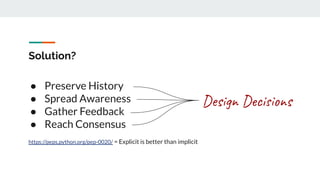
Solution?
● Preserve History
● Spread Awareness
● Gather Feedback
● Reach Consensus
https://peps.python.org/pep-0020/ = Explicit is better than implicit
Design Decisions
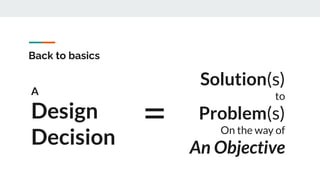
Back to basics
Solution(s)
to
Problem(s)
On the way of
An Objective
A
Design
Decision
=
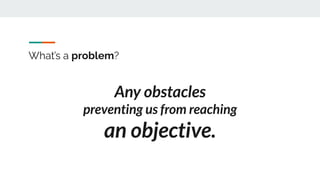
What’s a problem?
Any obstacles
preventing us from reaching
an objective.
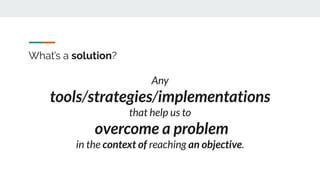
What’s a solution?
Any
tools/strategies/implementations
that help us to
overcome a problem
in the context of reaching an objective.
What’s an objective?
A specific and
measurable goal
to achievewithin a defined
timeframe.
Let’s propose
a document structure for
Design Decisions.
To document a Design Decision:
● Context:
Define what’s the current state and
the objective to reach
To document a Design Decision:
● Problems:
Find all obstacles on our way to
reach the objective
To document a Design Decision:
● Solution proposal:
The least riskiest solution for the
most obstacles
To document a Design Decision:
● Alternatives:
List all the other feasible solutions
To document a Design Decision:
● Risks and mitigations:
List mitigations on risks of the
chosen solution(s)
To document a Design Decision:
● Cost factors:
Define Timeline, Estimations,
Budget
To document a Design Decision:
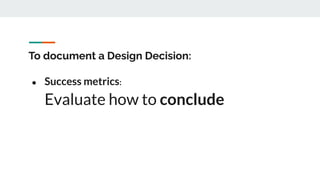
● Success metrics:
Evaluate how to conclude
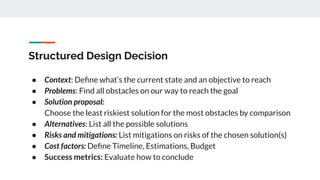
Structured Design Decision
● Context: Define what’s the current state and an objective to reach
● Problems: Find all obstacles on our way to reach the goal
● Solution proposal:
Choose the least riskiest solution for the most obstacles by comparison
● Alternatives: List all the possible solutions
● Risks and mitigations: List mitigations on risks of the chosen solution(s)
● Cost factors: Define Timeline, Estimations, Budget
● Success metrics: Evaluate how to conclude
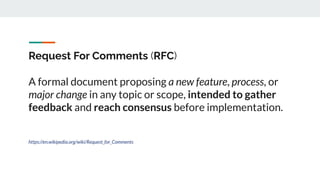
Request For Comments (RFC)
A formal document proposing a new feature, process, or
major change in any topic or scope, intended to gather
feedback and reach consensus before implementation.
https://en.wikipedia.org/wiki/Request_for_Comments
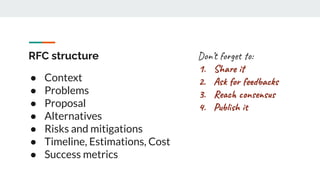
RFC structure
● Context
● Problems
● Proposal
● Alternatives
● Risks and mitigations
● Timeline, Estimations, Cost
● Success metrics
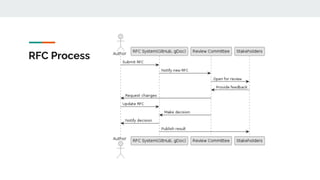
Don’t forget to:
1. Share it
2. Ask for feedbacks
3. Reach consensus
4. Publish it
RFC Process
An interesting tool for RFCs:
Architectural Design Records
adr.github.io
Another process!? You anti-agile monster!
Let’s go through agile principles:
● Individuals and interactions OVER processes and tools
● Working software OVER comprehensive documentation
● Customer collaboration OVER contract negotiation
● Responding to change OVER following a plan
Isn’t this against Agile?! Nope.
RFCs can align with agile principles by:
● Promoting transparency and collaboration
● Encouraging early feedback on significant changes
● Providing a mechanism for continuous improvement
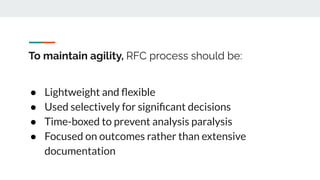
To maintain agility, RFC process should be:
● Lightweight and flexible
● Used selectively for significant decisions
● Time-boxed to prevent analysis paralysis
● Focused on outcomes rather than extensive
documentation
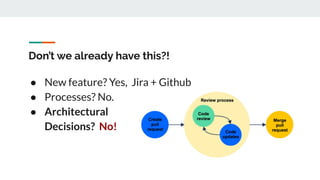
Don’t we already have this?!
● New feature? Yes, Jira + Github
● Processes? No.
● Architectural
Decisions? No!
Why RFCs?
● Clarifies what the objective, explicitly, is
● Refine what the problems are
● Test and confirm your idea
● Eradicates jumping to conclusions
● No Tribal Knowledge
● Easier to ask for a change
● Synchronization with other teams
Right?!
RFC > Meeting
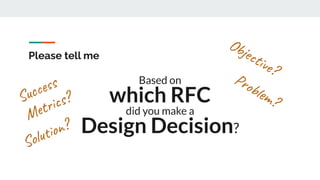
Please tell me
Based on
which RFC
did you make a
Design Decision?
Objective?
Problem?
Success
Metrics?
Solution?
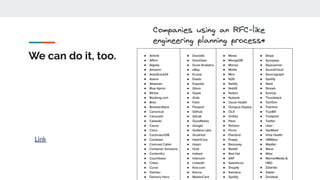
We can do it, too.
Link
Thanks
Questions?
References
https://blog.pragmaticengineer.com/scaling-engineering-teams-via-writing-things-down-rfcs/
https://www.industrialempathy.com/posts/design-docs-at-google/
https://blog.pragmaticengineer.com/rfcs-and-design-docs/
What do YOU think?
Now what?

Informal decision-making considered harmful

  • 1.
    Informal decision-making is *consideredharmful! * https://en.wikipedia.org/wiki/Considered_harmful by Hamid Davoodi
  • 2.
    Imagine a verylikely scenario ● Moved to a new team in your current company ● Working on a new project in the same team ● You are asked to cover someone for a while ● Work with some other team to fix an issue ● Moving to a new company ● Went to coma and woke up 6 month later
  • 3.
    To not reinventthe wheel We ask questions!
  • 4.
    You’d have manyquestions! ● Why gRPC over web? ● Why NodeJS over Java? ● Why Scala over Java? ● Why DC over Cloud? ● Why Cloud over DC? ● Why NoSQL over ACID? ● Why RabbitMQ and not Kafka? ● Why a new API? ● Why CDN over API? ● Why RMQ has only one instance? ● Why this particular database? ● Why PostgreSQL over Redis?
  • 5.
    But any answers? ➔I don’t know, Ask Jim, he probablyknows why ➔ Alex did that, he left the company ➔ I have no idea!You tell me ➔ That was a mistakebecause … ➔ It’s probablybecause of … ➔ EMs decided that and I don’t know/rememberwhy.
  • 6.
    What was theobjective? ● What the problem was? ● What about alternative solutions? ● What was risk mitigation strategy? ● Did it achieve the end goal? ● Was it worth it? We don’t know :(
  • 7.
    Why? ● Bus Factor ●Personal Bias ● No preserved history ● No measurement ● Hype Driven Development ● Informal Conversations It’s “forgotten” history
  • 8.
    All we knowis that A Solution to A Problem It was a Design Decision =
  • 9.
    What’s to blame?! InformalDecision-Making aka Tribal Knowledge
  • 10.
    Tribal Knowledge Or informalknowledge refers to the unwritten, unspoken, and often implicit understanding, skills, and practices that exist within a group or organization. https://en.wikipedia.org/wiki/Tribal_knowledge https://devblogs.microsoft.com/premier-developer/tribal-knowledge-the-anti-devops-culture/
  • 11.
    Why is TribalKnowledge a thing? It’s Faster in the short term! Delegating to a few It’s easier Agile?!
  • 12.
    Why is TribalKnowledge a thing? It’s faster in the short term! However, It leads to longer-term issues in code quality, team alignment, and system maintainability.
  • 13.
    Tribal Knowledge’s risks: ●Lack of transparency: Decisions may be made without all stakeholders being aware or having input. ● Inconsistency: Without a formal process, similar issues might be handled differently each time. ● Limited perspective: Quick, informal decisions often don't benefit from diverse viewpoints or expertise. ● Poor documentation: The reasoning behind decisions may not be recorded, leading to confusion later. ● Miscommunication: Important details or considerations can be easily overlooked or misunderstood.
  • 14.
    Tribal Knowledge’s risks: ●Difficulty in scaling: As teams grow, informal processes become less effective and more prone to errors. ● Reduced accountability: It's harder to track who made what decision and why. ● Increased technical debt: Hasty, undocumented decisions can lead to suboptimal solutions that cause problems later. ● Missed opportunities for improvement: Without a formal review process, chances to refine ideas are often lost. ● Risk of bias: Informal processes may favor the loudest voices or highest-ranking team members, rather than the best ideas.
  • 15.
    Solution? ● Preserve History ●Spread Awareness ● Gather Feedback ● Reach Consensus https://peps.python.org/pep-0020/ = Explicit is better than implicit Design Decisions
  • 16.
    Back to basics Solution(s) to Problem(s) Onthe way of An Objective A Design Decision =
  • 17.
    What’s a problem? Anyobstacles preventing us from reaching an objective.
  • 18.
    What’s a solution? Any tools/strategies/implementations thathelp us to overcome a problem in the context of reaching an objective.
  • 19.
    What’s an objective? Aspecific and measurable goal to achievewithin a defined timeframe.
  • 20.
    Let’s propose a documentstructure for Design Decisions.
  • 21.
    To document aDesign Decision: ● Context: Define what’s the current state and the objective to reach
  • 22.
    To document aDesign Decision: ● Problems: Find all obstacles on our way to reach the objective
  • 23.
    To document aDesign Decision: ● Solution proposal: The least riskiest solution for the most obstacles
  • 24.
    To document aDesign Decision: ● Alternatives: List all the other feasible solutions
  • 25.
    To document aDesign Decision: ● Risks and mitigations: List mitigations on risks of the chosen solution(s)
  • 26.
    To document aDesign Decision: ● Cost factors: Define Timeline, Estimations, Budget
  • 27.
    To document aDesign Decision: ● Success metrics: Evaluate how to conclude
  • 28.
    Structured Design Decision ●Context: Define what’s the current state and an objective to reach ● Problems: Find all obstacles on our way to reach the goal ● Solution proposal: Choose the least riskiest solution for the most obstacles by comparison ● Alternatives: List all the possible solutions ● Risks and mitigations: List mitigations on risks of the chosen solution(s) ● Cost factors: Define Timeline, Estimations, Budget ● Success metrics: Evaluate how to conclude
  • 29.
    Request For Comments(RFC) A formal document proposing a new feature, process, or major change in any topic or scope, intended to gather feedback and reach consensus before implementation. https://en.wikipedia.org/wiki/Request_for_Comments
  • 30.
    RFC structure ● Context ●Problems ● Proposal ● Alternatives ● Risks and mitigations ● Timeline, Estimations, Cost ● Success metrics Don’t forget to: 1. Share it 2. Ask for feedbacks 3. Reach consensus 4. Publish it
  • 31.
  • 32.
    An interesting toolfor RFCs: Architectural Design Records adr.github.io
  • 33.
    Another process!? Youanti-agile monster! Let’s go through agile principles: ● Individuals and interactions OVER processes and tools ● Working software OVER comprehensive documentation ● Customer collaboration OVER contract negotiation ● Responding to change OVER following a plan
  • 34.
    Isn’t this againstAgile?! Nope. RFCs can align with agile principles by: ● Promoting transparency and collaboration ● Encouraging early feedback on significant changes ● Providing a mechanism for continuous improvement
  • 35.
    To maintain agility,RFC process should be: ● Lightweight and flexible ● Used selectively for significant decisions ● Time-boxed to prevent analysis paralysis ● Focused on outcomes rather than extensive documentation
  • 36.
    Don’t we alreadyhave this?! ● New feature? Yes, Jira + Github ● Processes? No. ● Architectural Decisions? No!
  • 37.
    Why RFCs? ● Clarifieswhat the objective, explicitly, is ● Refine what the problems are ● Test and confirm your idea ● Eradicates jumping to conclusions ● No Tribal Knowledge ● Easier to ask for a change ● Synchronization with other teams
  • 38.
  • 39.
    Please tell me Basedon which RFC did you make a Design Decision? Objective? Problem? Success Metrics? Solution?
  • 40.
    We can doit, too. Link
  • 41.
  • 42.
    What do YOUthink? Now what?