ISP-friendly Peer-assisted On-demand Streaming of Long
Duration Content in BBC iPlayer
Dmytro Karamshuk1, Nishanth Sastry1, Jigna Chandaria2, Andy Secker2
1King's College London, 2BBC R&D
CD-GAIN: EPSRC project in collaboration with BBC R&D, http://bit.ly/cd-gain
This talk is about BBC iPlayer
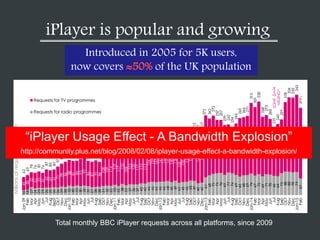
iPlayer is popular and growing
Total monthly BBC iPlayer requests across all platforms, since 2009
Introduced in 2005 for 5K users,
now covers 50% of the UK population
“iPlayer Usage Effect - A Bandwidth Explosion”
http://community.plus.net/blog/2008/02/08/iplayer-usage-effect-a-bandwidth-explosion/
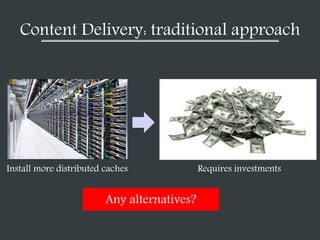
Content Delivery: traditional approach
Install more distributed caches Requires investments
Any alternatives?
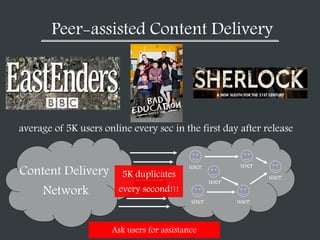
Peer-assisted Content Delivery
Content Delivery
Network
user
user user
user
user
user
average of 5K users online every sec in the first day after release
5K duplicates
every second!!!
Ask users for assistance
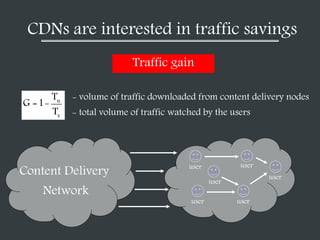
CDNs are interested in traffic savings
Content Delivery
Network
user
user user
user
user
user
Traffic gain
- volume of traffic downloaded from content delivery nodes
- total volume of traffic watched by the userss
u
T
T
-1=G
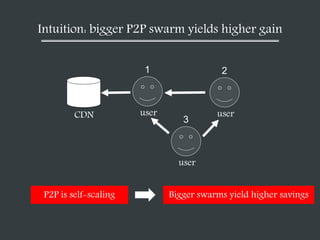
Intuition: bigger P2P swarm yields higher gain
CDN user
1
user
2
user
3
P2P is self-scaling Bigger swarms yield higher savings
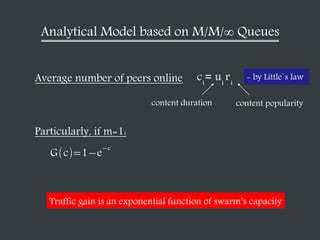
Analytical Model based on M/M/ Queues
ci
= ui
riAverage number of peers online
How much we can offload to peers
Traffic gain is an exponential function of swarm’s capacity
content popularitycontent duration
G c 1 e
c
- by Little`s law
How peer-assistance works in real life
… there is a number of obstacle factors they do not address
Huang, Cheng et al. [NOSSDAV’2008] Zhao, Mingchen, et al. [IMC’2013]
Balachandran et al. [IMC’2013]
Obstacle N1: ISP Friendliness
Content Delivery
Network
P2P increases egress traffic, impacting bandwidth
cost for ISPs, Karagiannis et al. [USENIX’2005]
Traffic savings drop from 87% to 13% if swarms are
localized within ISP and city, Balachandran et al.
[IMC’2013]
Obstacle N1: ISP Friendliness
Content Delivery
Network
ISP1
ISP2
P2P increase egress traffic, impacting bandwidth cost
for ISPs, Karagiannis et al. [USENIX’2005]
Traffic savings drop to 13% if swarms are localized
within ISP and city, Balachandran et al. [IMC’2013]
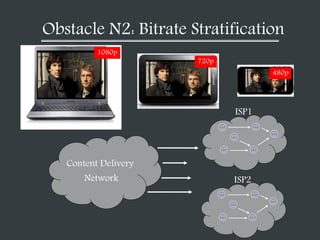
Obstacle N2: Bitrate Stratification
Content Delivery
Network
ISP1
ISP2
1080p
720p
480p
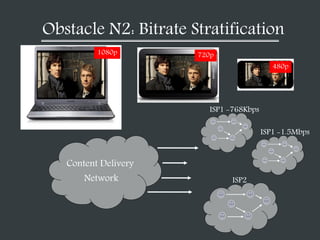
Obstacle N2: Bitrate Stratification
Content Delivery
Network ISP2
ISP1 -768Kbps
ISP1 -1.5Mbps
1080p 720p
480p
Obstacle N3: Partial Participation
Content Delivery
Network ISP2
ISP1 -768Kbps
ISP1 -1.5Mbps
Obstacle factors decrease size of swarms
Only 31% signed up for sharing in
Akamai NetSession
Zhao, Mingchen, et al. [IMC’2013]
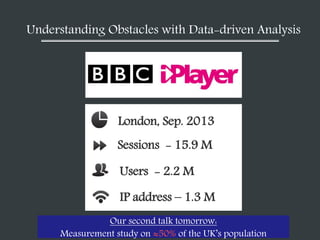
Users - 2.2 M
IP address – 1.3 M
Sessions - 15.9 M
London, Sep. 2013
Understanding Obstacles with Data-driven Analysis
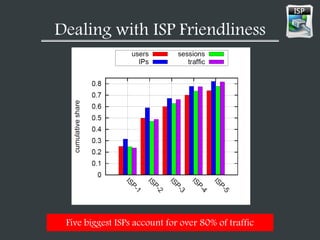
Dealing with ISP Friendliness
Five biggest ISPs account for over 80% of traffic
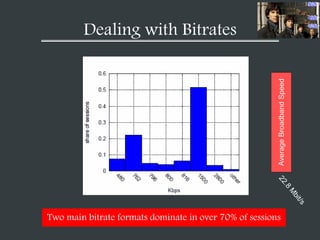
Two main bitrate formats dominate in over 70% of sessions
1080p
720p
480p
Dealing with Bitrates
AverageBroadbandSpeed
Results of the Simulations
1080p
720p
480p
G c 1 e
c
An episode of Bad Education series, 100K views
Results of the Simulations
potential traffic gains for popular content are high despite obstacles
G c 1 e
c
An episode of Bad Education series, 100K views
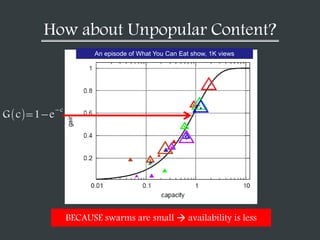
How about Unpopular Content?
BECAUSE swarms are small  availability is less
An episode of What You Can Eat show, 1K views
G c 1 e
c
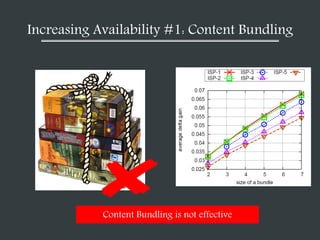
Increasing Availability #1: Content Bundling
Content Bundling is not effective
Increasing Availability #2: Client Caching
Simple caching can boost savings by 23%
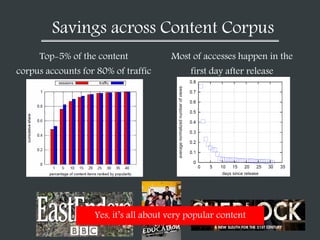
Savings across Content Corpus
Top-5% of the content
corpus accounts for 80% of traffic
Most of accesses happen in the
first day after release
Yes, it’s all about very popular content
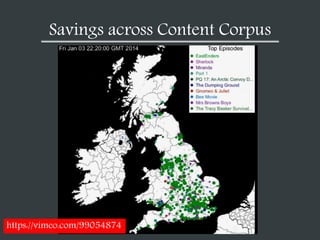
Savings across Content Corpus
https://vimeo.com/99054874
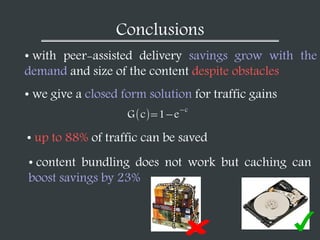
Conclusions
• with peer-assisted delivery savings grow with the
demand and size of the content despite obstacles
• we give a closed form solution for traffic gains
• up to 88% of traffic can be saved
• content bundling does not work but caching can
boost savings by 23%
G c 1 e
c
Dmytro Karamshuk
King's College London
follow me on Twitter: @karamshuk
Come to our second talk tomorrow:
Room: Ballroom C
Time: 4/29/2015 8:30 — 4/29/2015 10:00
Geography Devices PricingOperators
Measurement study on 50% of the UK’s population

ISP-friendly Peer-assisted On-demand Streaming of Long Duration Content in BBC iPlayer

  • 1.
    ISP-friendly Peer-assisted On-demandStreaming of Long Duration Content in BBC iPlayer Dmytro Karamshuk1, Nishanth Sastry1, Jigna Chandaria2, Andy Secker2 1King's College London, 2BBC R&D CD-GAIN: EPSRC project in collaboration with BBC R&D, http://bit.ly/cd-gain
  • 2.
    This talk isabout BBC iPlayer
  • 3.
    iPlayer is popularand growing Total monthly BBC iPlayer requests across all platforms, since 2009 Introduced in 2005 for 5K users, now covers 50% of the UK population “iPlayer Usage Effect - A Bandwidth Explosion” http://community.plus.net/blog/2008/02/08/iplayer-usage-effect-a-bandwidth-explosion/
  • 4.
    Content Delivery: traditionalapproach Install more distributed caches Requires investments Any alternatives?
  • 5.
    Peer-assisted Content Delivery ContentDelivery Network user user user user user user average of 5K users online every sec in the first day after release 5K duplicates every second!!! Ask users for assistance
  • 6.
    CDNs are interestedin traffic savings Content Delivery Network user user user user user user Traffic gain - volume of traffic downloaded from content delivery nodes - total volume of traffic watched by the userss u T T -1=G
  • 7.
    Intuition: bigger P2Pswarm yields higher gain CDN user 1 user 2 user 3 P2P is self-scaling Bigger swarms yield higher savings
  • 8.
    Analytical Model basedon M/M/ Queues ci = ui riAverage number of peers online How much we can offload to peers Traffic gain is an exponential function of swarm’s capacity content popularitycontent duration G c 1 e c - by Little`s law
  • 9.
    How peer-assistance worksin real life … there is a number of obstacle factors they do not address Huang, Cheng et al. [NOSSDAV’2008] Zhao, Mingchen, et al. [IMC’2013] Balachandran et al. [IMC’2013]
  • 10.
    Obstacle N1: ISPFriendliness Content Delivery Network P2P increases egress traffic, impacting bandwidth cost for ISPs, Karagiannis et al. [USENIX’2005] Traffic savings drop from 87% to 13% if swarms are localized within ISP and city, Balachandran et al. [IMC’2013]
  • 11.
    Obstacle N1: ISPFriendliness Content Delivery Network ISP1 ISP2 P2P increase egress traffic, impacting bandwidth cost for ISPs, Karagiannis et al. [USENIX’2005] Traffic savings drop to 13% if swarms are localized within ISP and city, Balachandran et al. [IMC’2013]
  • 12.
    Obstacle N2: BitrateStratification Content Delivery Network ISP1 ISP2 1080p 720p 480p
  • 13.
    Obstacle N2: BitrateStratification Content Delivery Network ISP2 ISP1 -768Kbps ISP1 -1.5Mbps 1080p 720p 480p
  • 14.
    Obstacle N3: PartialParticipation Content Delivery Network ISP2 ISP1 -768Kbps ISP1 -1.5Mbps Obstacle factors decrease size of swarms Only 31% signed up for sharing in Akamai NetSession Zhao, Mingchen, et al. [IMC’2013]
  • 15.
    Users - 2.2M IP address – 1.3 M Sessions - 15.9 M London, Sep. 2013 Understanding Obstacles with Data-driven Analysis
  • 16.
    Dealing with ISPFriendliness Five biggest ISPs account for over 80% of traffic
  • 17.
    Two main bitrateformats dominate in over 70% of sessions 1080p 720p 480p Dealing with Bitrates AverageBroadbandSpeed
  • 18.
    Results of theSimulations 1080p 720p 480p G c 1 e c An episode of Bad Education series, 100K views
  • 19.
    Results of theSimulations potential traffic gains for popular content are high despite obstacles G c 1 e c An episode of Bad Education series, 100K views
  • 20.
    How about UnpopularContent? BECAUSE swarms are small  availability is less An episode of What You Can Eat show, 1K views G c 1 e c
  • 21.
    Increasing Availability #1:Content Bundling Content Bundling is not effective
  • 22.
    Increasing Availability #2:Client Caching Simple caching can boost savings by 23%
  • 23.
    Savings across ContentCorpus Top-5% of the content corpus accounts for 80% of traffic Most of accesses happen in the first day after release Yes, it’s all about very popular content
  • 24.
    Savings across ContentCorpus https://vimeo.com/99054874
  • 25.
    Conclusions • with peer-assisteddelivery savings grow with the demand and size of the content despite obstacles • we give a closed form solution for traffic gains • up to 88% of traffic can be saved • content bundling does not work but caching can boost savings by 23% G c 1 e c
  • 26.
    Dmytro Karamshuk King's CollegeLondon follow me on Twitter: @karamshuk Come to our second talk tomorrow: Room: Ballroom C Time: 4/29/2015 8:30 — 4/29/2015 10:00 Geography Devices PricingOperators Measurement study on 50% of the UK’s population