Infix to Prefix Conversion
 Represented to : Sudhir Pandey Sir
 Presented By : Prashant Yadav
 Reg no: 22105117040
 Branch: Computer science & Engineering
What is Infix Notation?
An expression is written in a conventional or
typical manner in an infix notation. The
operators are placed between the operands in
this notation. A+B, A*B, and A/B, is an
example of infix notation.
What is Prefix Notation?
A prefix notation does not require knowledge
about precedence or associativity, whereas an
infix notation requires information about
precedence and associativity. Polish notation is
another name for it. An operator comes before
the operands in prefix notation. The following is
the prefix notation's syntax:
Converting Infix Expression to Prefix
Expression
We can use the stack data structure for an
Infix to prefix conversion. Here's the
concept:
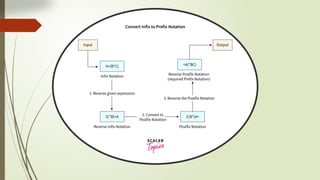
• First, flip the infix expression. Keep in mind
that when reversed, each "(" will become
a ")" and each ")" a "(".
• The second step is to "nearly" postfix the
reversed infix expression.
•Instead of performing the pop operation to
remove operators with greater than or equal
precedence during the conversion to postfix
expression, we will only remove the operators
from the stack that have a higher precedence in
this case.
•Reverse the postfix expression in step three.
•Infix expressions are converted to postfix forms
using the stack.
Priority/Precedence of Arithmetic Operators: -
Highest Precedence ( ) , ^.
Mid Precedence → * , /.
Lowest Precedence → + , -.
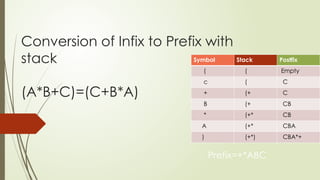
Conversion of Infix to Prefix with
stack
(A*B+C)=(C+B*A)
Prefix=+*ABC
Symbol Stack Postfix
( ( Empty
c ( C
+ (+ C
B (+ CB
* (+* CB
A (+* CBA
) (+*) CBA*+
Infix to Prefix Conversion/....................................................................pptx

Infix to Prefix Conversion/....................................................................pptx

  • 1.
    Infix to PrefixConversion  Represented to : Sudhir Pandey Sir  Presented By : Prashant Yadav  Reg no: 22105117040  Branch: Computer science & Engineering
  • 2.
    What is InfixNotation? An expression is written in a conventional or typical manner in an infix notation. The operators are placed between the operands in this notation. A+B, A*B, and A/B, is an example of infix notation.
  • 3.
    What is PrefixNotation? A prefix notation does not require knowledge about precedence or associativity, whereas an infix notation requires information about precedence and associativity. Polish notation is another name for it. An operator comes before the operands in prefix notation. The following is the prefix notation's syntax:
  • 4.
    Converting Infix Expressionto Prefix Expression We can use the stack data structure for an Infix to prefix conversion. Here's the concept: • First, flip the infix expression. Keep in mind that when reversed, each "(" will become a ")" and each ")" a "(". • The second step is to "nearly" postfix the reversed infix expression.
  • 5.
    •Instead of performingthe pop operation to remove operators with greater than or equal precedence during the conversion to postfix expression, we will only remove the operators from the stack that have a higher precedence in this case. •Reverse the postfix expression in step three. •Infix expressions are converted to postfix forms using the stack.
  • 7.
    Priority/Precedence of ArithmeticOperators: - Highest Precedence ( ) , ^. Mid Precedence → * , /. Lowest Precedence → + , -.
  • 8.
    Conversion of Infixto Prefix with stack (A*B+C)=(C+B*A) Prefix=+*ABC Symbol Stack Postfix ( ( Empty c ( C + (+ C B (+ CB * (+* CB A (+* CBA ) (+*) CBA*+