WELCOME
INFECTION
PREVENTION CONTROL
PRESENTED BY
SUGUNA
NURSING SUPERINTENDENT
TEAM
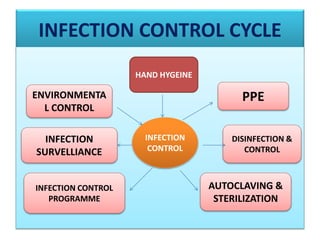
INFECTION CONTROL CYCLE
INFECTION
CONTROL
HAND HYGEINE
PPE
DISINFECTION &
CONTROL
AUTOCLAVING &
STERILIZATION
INFECTION CONTROL
PROGRAMME
INFECTION
SURVELLIANCE
ENVIRONMENTA
L CONTROL
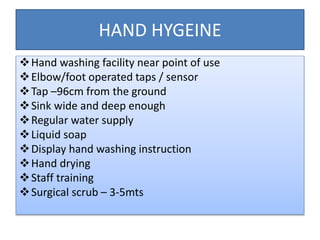
HAND HYGEINE
Hand washing facility near point of use
Elbow/foot operated taps / sensor
Tap –96cm from the ground
Sink wide and deep enough
Regular water supply
Liquid soap
Display hand washing instruction
Hand drying
Staff training
Surgical scrub – 3-5mts
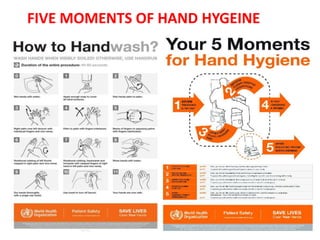
FIVE MOMENTS OF HAND HYGEINE
PPE
Availability
Adequete quantity
Disposable kit for hiv patients
No reuse of disposable items
Correct method of
wearing and removing
DECONTAMINATION AND CLEANING
• Procedure surfaces –1% sodium hypochlorite
Solution after every procedure.
• Instruments –in 0.5% sodium hypochlorite
solution for 10 mts
• Soiled linen – soaking in 0.5% sodium
hypochlorite solution for 30 mts.
• Detergent wash
• drying
DECONTAMINATION AND CLEANING
• How to make disinfectant
• Supervision
• Gluteraldehide –date of preparation and due
date of change of solution.
• Contact time required for chemical
sterilization
AUTOCLAVING AND STERILIZATION
CSSD :
Facility lay out ensures separation of
routes for clean and dirty items.
Demarcated separate area for receiving
dirty items ,processing
AUTOCLAVING AND STERILIZATION
CSSD :
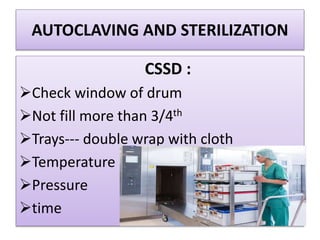
Check window of drum
Not fill more than 3/4th
Trays--- double wrap with cloth
Temperature
Pressure
time
AUTOCLAVING AND STERILIZATION
CSSD :
• Sterile pack is marked with
• Date and time of sterilization
• Contents
• Expiry date and time
• Name and signature of technitian.
STORAGE OF STERILE ITEMS
• Sterile packs are kept in clean,dust free ,
moist free environment
• Separate place for clean and sterile items
• Dedicated trolly for its transportation
VALIDATION OF STERILIZATION
• Mechanical indicator –time, temperature and
pressure
• Chemical indicators – internal & external
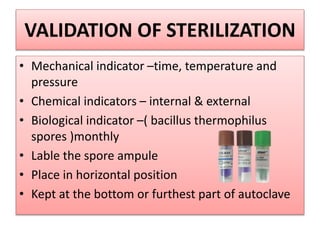
• Biological indicator –( bacillus thermophilus
spores )monthly
• Lable the spore ampule
• Place in horizontal position
• Kept at the bottom or furthest part of autoclave
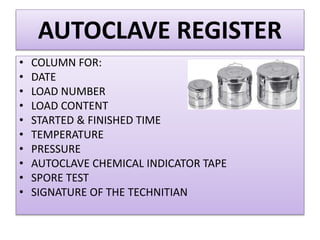
AUTOCLAVE REGISTER
• COLUMN FOR:
• DATE
• LOAD NUMBER
• LOAD CONTENT
• STARTED & FINISHED TIME
• TEMPERATURE
• PRESSURE
• AUTOCLAVE CHEMICAL INDICATOR TAPE
• SPORE TEST
• SIGNATURE OF THE TECHNITIAN
ANTIBIOTIC POLICY
• Facility has defied and established antibiotic
policy
• Doctors must be aware of it
• Antibiotics precribed as per the policy
HEALTH CARE ASSOCIATED INFECTION
HAI
SSI
1-72 HOURS AFTER
ADMISSION
3 DAYS AFTER
DISCHARGE
DATE OF SURGERY 30 DAYS
DATE OF SURGERY ONE YEAR
HAI SURVEILLANCE
• Microbiological surveillance
• Measurement of SSI Rates
• Measurement of device related infection rates
• Measurement of blood related and respiratory
infections
• Analysis and correcive action on survillance
findings.
MICROBIOLOGICAL SURVILLINCE
AIR SAMPLING:
 Once in a week for OT with HEPA FILTERS
 Once in a month for OT Without ventillation system and LR
 Obtain the required number of culture media plate from the
microbiology lab ( room temperature)
 Sampling– immediately after opening in the morning.
AIR SAMPLING
• LABEL—OT /LR no,,sample site etc before takingit
into the OT/LR
• Change in to protective dress
• Enter the OT/LR with media
• Ventilation system /AC should be turned on and
allowed to run for at least 10mts
• Follow asceptic technique
• Expose one plate on the OT Table for 40mts
• After 40mts plate should be closed ,sealed and
sent to lab.
MICROBIOLOGICAL SURVEILLANCE
SURFACE SAMPLING
 In the morning before any cleaning is done
 Swabs and media should be at room temperature
when the sample is taken
 Label– OT/LR no., sample site
 Change in to protective dress
 Enter the OT /LR with swab and media
 Ventilation system /AC should be kept off.
SWAB
• OT/DELIVERY TABLE
• OT LIGHT
• STERILE INSTRUMENTS TROLLY/ DELIVERY SET
• MEDICATION PREPARATION SURFACE OF
ANAESTHESIA MECHEINE
• FLOOR – ADJACEMENT TO OT/DELIVERY TABLE
• NEW BORN WARMER
• ANY ONE WALL AT WAIST TO SHOULDER HEIGHT
UNACCEPTABLE RESULTS
• Postpone elective cases
• Do not use OT/LR until the problem is resolved
• Repeat cleaning ,disinfection and swab ,
procedure should be supervised
• All procedures in the duration between sampling
and reporting of unacceptable swab result
,should be identified and followed up for for the
surgical site infection
• Investigation for the causes of unacceptable
results
SSI RATE
NUMBER OF SSI X 100
-------------------------------------------
NO OF SURGERIES PERFORMED IN SAME PERIOD
CAUTI RATE
NUMBER OF CAUTI X 100
__________________________
NO OF CATHETER DAYS
DEVICE RELATED
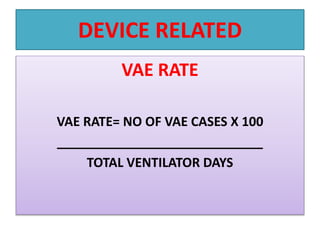
VAE RATE
VAE RATE= NO OF VAE CASES X 100
_____________________________
TOTAL VENTILATOR DAYS
CORRECTIVE ACTION
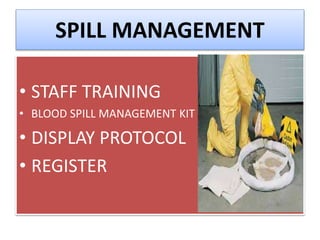
SPILL MANAGEMENT
• STAFF TRAINING
• BLOOD SPILL MANAGEMENT KIT
• DISPLAY PROTOCOL
• REGISTER
SPILL MANAGEMENT
• PPE
• 1% HYPOCHLORITE SOLUTION
• TISSUE PAPER / TOWEL / NEWS PAPER
• WIPER
• DUST BIN
• YELLOW BIO HAZARD BAG
BLOOD SPILL MANAGEMENT
• SPILL ALERT
• SPILL MANAGEMENT KIT
• WEAR PPE
• SPREAD TISSUE PAPER ABOUT THE SPILL
• POUR 1 % HYPOCHLORITE SOLUTION ( 10% FOR LARGE SPILLS)
• WAIT FOR 15-20 MTS
• WIPE UP THE SPILLAGE
• NORMAL CLEANING WITH SODIUM HYPOCHLORITE
• REMOVE PPE AND DISPOSE PROPERLY
• WASH HANDS
• KEEP REGISTER
BLOOD SPILL MANAGEMENT
REGISTER SAMPLE
DATE &
TIME
AREA OF
INCIDENT
( LOCATION )
TYPE OF
SPILL (
SMALL/
LARGE
ACTION
TAKEN
MANAGED
BY ( NAME
OF HOUSE
KEEPING
STAFF )
EXPOSURE
TO STAFF
( IF ANY )
SIGNATUR
E
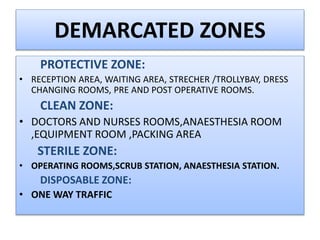
DEMARCATED ZONES
PROTECTIVE ZONE:
• RECEPTION AREA, WAITING AREA, STRECHER /TROLLYBAY, DRESS
CHANGING ROOMS, PRE AND POST OPERATIVE ROOMS.
CLEAN ZONE:
• DOCTORS AND NURSES ROOMS,ANAESTHESIA ROOM
,EQUIPMENT ROOM ,PACKING AREA
STERILE ZONE:
• OPERATING ROOMS,SCRUB STATION, ANAESTHESIA STATION.
DISPOSABLE ZONE:
• ONE WAY TRAFFIC
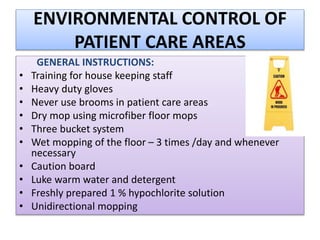
ENVIRONMENTAL CONTROL OF
PATIENT CARE AREAS
GENERAL INSTRUCTIONS:
• Training for house keeping staff
• Heavy duty gloves
• Never use brooms in patient care areas
• Dry mop using microfiber floor mops
• Three bucket system
• Wet mopping of the floor – 3 times /day and whenever
necessary
• Caution board
• Luke warm water and detergent
• Freshly prepared 1 % hypochlorite solution
• Unidirectional mopping
ENVIRONMENTAL CONTROL OF
PATIENT CARE AREAS
GENERAL INSTRUCTIONS:
• Disinfection of mops
• Cleaning of bucket
• Cleaning and disinfection of surfaces
• Hand washing
• Check list
• Supervision and corrective action
• Housekeeping register
ENVIRONMENTAL CONTROL OF
PATIENT CARE AREAS
 FUMIGATION
 NO FORMALIN USE
 WITH PRODUCTS CONTAINING HYDROGEN
PEROXIDE AND SIVER COMPOUND
 Entry to the sterile zone only after hand wash
,change of cloths and appropriate PPE
 External footwear restricted
 Positive pressure in OT
 20- 25 Air exchanges per hour
BIO MEDICAL WASTE MANAGEMENT
( RULES )
• Committee ( atleast six monthly)
• Copy of bio medical waste management rules
• Colour codes ,foot operated , covered bins
and bags
• Non chlorinated , barcoded plastic bags
• Development of website and uploading of
annual reports.
BIO MEDICAL WASTE MANAGEMENT
( RULES )
• Display of work instruction
• Bins should be covered
• Bins should not be filled more than 2/3 of its
capacity
• PPE
• Collection at specified time
• Transport in closed containers in dedicated
trolly.
BIO MEDICAL WASTE MANAGEMENT
( RULES )
• Dedicated storage facility with biohazard
emblem
• Away from patient care areas
• Secured against pilfirage and reach of animals
with lock and key
• Disposal within 48 hours
• Hand washing facility
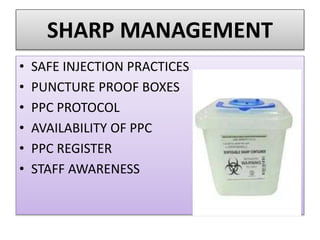
SHARP MANAGEMENT
• SAFE INJECTION PRACTICES
• PUNCTURE PROOF BOXES
• PPC PROTOCOL
• AVAILABILITY OF PPC
• PPC REGISTER
• STAFF AWARENESS
INFECTION CONTROL PPT.pptx

INFECTION CONTROL PPT.pptx

  • 1.
  • 2.
  • 3.
  • 4.
    INFECTION CONTROL CYCLE INFECTION CONTROL HANDHYGEINE PPE DISINFECTION & CONTROL AUTOCLAVING & STERILIZATION INFECTION CONTROL PROGRAMME INFECTION SURVELLIANCE ENVIRONMENTA L CONTROL
  • 5.
    HAND HYGEINE Hand washingfacility near point of use Elbow/foot operated taps / sensor Tap –96cm from the ground Sink wide and deep enough Regular water supply Liquid soap Display hand washing instruction Hand drying Staff training Surgical scrub – 3-5mts
  • 6.
    FIVE MOMENTS OFHAND HYGEINE
  • 7.
    PPE Availability Adequete quantity Disposable kitfor hiv patients No reuse of disposable items Correct method of wearing and removing
  • 8.
    DECONTAMINATION AND CLEANING •Procedure surfaces –1% sodium hypochlorite Solution after every procedure. • Instruments –in 0.5% sodium hypochlorite solution for 10 mts • Soiled linen – soaking in 0.5% sodium hypochlorite solution for 30 mts. • Detergent wash • drying
  • 9.
    DECONTAMINATION AND CLEANING •How to make disinfectant • Supervision • Gluteraldehide –date of preparation and due date of change of solution. • Contact time required for chemical sterilization
  • 10.
    AUTOCLAVING AND STERILIZATION CSSD: Facility lay out ensures separation of routes for clean and dirty items. Demarcated separate area for receiving dirty items ,processing
  • 11.
    AUTOCLAVING AND STERILIZATION CSSD: Check window of drum Not fill more than 3/4th Trays--- double wrap with cloth Temperature Pressure time
  • 12.
    AUTOCLAVING AND STERILIZATION CSSD: • Sterile pack is marked with • Date and time of sterilization • Contents • Expiry date and time • Name and signature of technitian.
  • 13.
    STORAGE OF STERILEITEMS • Sterile packs are kept in clean,dust free , moist free environment • Separate place for clean and sterile items • Dedicated trolly for its transportation
  • 14.
    VALIDATION OF STERILIZATION •Mechanical indicator –time, temperature and pressure • Chemical indicators – internal & external • Biological indicator –( bacillus thermophilus spores )monthly • Lable the spore ampule • Place in horizontal position • Kept at the bottom or furthest part of autoclave
  • 15.
    AUTOCLAVE REGISTER • COLUMNFOR: • DATE • LOAD NUMBER • LOAD CONTENT • STARTED & FINISHED TIME • TEMPERATURE • PRESSURE • AUTOCLAVE CHEMICAL INDICATOR TAPE • SPORE TEST • SIGNATURE OF THE TECHNITIAN
  • 16.
    ANTIBIOTIC POLICY • Facilityhas defied and established antibiotic policy • Doctors must be aware of it • Antibiotics precribed as per the policy
  • 17.
    HEALTH CARE ASSOCIATEDINFECTION HAI SSI 1-72 HOURS AFTER ADMISSION 3 DAYS AFTER DISCHARGE DATE OF SURGERY 30 DAYS DATE OF SURGERY ONE YEAR
  • 18.
    HAI SURVEILLANCE • Microbiologicalsurveillance • Measurement of SSI Rates • Measurement of device related infection rates • Measurement of blood related and respiratory infections • Analysis and correcive action on survillance findings.
  • 19.
    MICROBIOLOGICAL SURVILLINCE AIR SAMPLING: Once in a week for OT with HEPA FILTERS  Once in a month for OT Without ventillation system and LR  Obtain the required number of culture media plate from the microbiology lab ( room temperature)  Sampling– immediately after opening in the morning.
  • 20.
    AIR SAMPLING • LABEL—OT/LR no,,sample site etc before takingit into the OT/LR • Change in to protective dress • Enter the OT/LR with media • Ventilation system /AC should be turned on and allowed to run for at least 10mts • Follow asceptic technique • Expose one plate on the OT Table for 40mts • After 40mts plate should be closed ,sealed and sent to lab.
  • 21.
    MICROBIOLOGICAL SURVEILLANCE SURFACE SAMPLING In the morning before any cleaning is done  Swabs and media should be at room temperature when the sample is taken  Label– OT/LR no., sample site  Change in to protective dress  Enter the OT /LR with swab and media  Ventilation system /AC should be kept off.
  • 22.
    SWAB • OT/DELIVERY TABLE •OT LIGHT • STERILE INSTRUMENTS TROLLY/ DELIVERY SET • MEDICATION PREPARATION SURFACE OF ANAESTHESIA MECHEINE • FLOOR – ADJACEMENT TO OT/DELIVERY TABLE • NEW BORN WARMER • ANY ONE WALL AT WAIST TO SHOULDER HEIGHT
  • 23.
    UNACCEPTABLE RESULTS • Postponeelective cases • Do not use OT/LR until the problem is resolved • Repeat cleaning ,disinfection and swab , procedure should be supervised • All procedures in the duration between sampling and reporting of unacceptable swab result ,should be identified and followed up for for the surgical site infection • Investigation for the causes of unacceptable results
  • 24.
    SSI RATE NUMBER OFSSI X 100 ------------------------------------------- NO OF SURGERIES PERFORMED IN SAME PERIOD
  • 25.
    CAUTI RATE NUMBER OFCAUTI X 100 __________________________ NO OF CATHETER DAYS
  • 26.
    DEVICE RELATED VAE RATE VAERATE= NO OF VAE CASES X 100 _____________________________ TOTAL VENTILATOR DAYS
  • 27.
  • 28.
    SPILL MANAGEMENT • STAFFTRAINING • BLOOD SPILL MANAGEMENT KIT • DISPLAY PROTOCOL • REGISTER
  • 29.
    SPILL MANAGEMENT • PPE •1% HYPOCHLORITE SOLUTION • TISSUE PAPER / TOWEL / NEWS PAPER • WIPER • DUST BIN • YELLOW BIO HAZARD BAG
  • 30.
    BLOOD SPILL MANAGEMENT •SPILL ALERT • SPILL MANAGEMENT KIT • WEAR PPE • SPREAD TISSUE PAPER ABOUT THE SPILL • POUR 1 % HYPOCHLORITE SOLUTION ( 10% FOR LARGE SPILLS) • WAIT FOR 15-20 MTS • WIPE UP THE SPILLAGE • NORMAL CLEANING WITH SODIUM HYPOCHLORITE • REMOVE PPE AND DISPOSE PROPERLY • WASH HANDS • KEEP REGISTER
  • 31.
    BLOOD SPILL MANAGEMENT REGISTERSAMPLE DATE & TIME AREA OF INCIDENT ( LOCATION ) TYPE OF SPILL ( SMALL/ LARGE ACTION TAKEN MANAGED BY ( NAME OF HOUSE KEEPING STAFF ) EXPOSURE TO STAFF ( IF ANY ) SIGNATUR E
  • 32.
    DEMARCATED ZONES PROTECTIVE ZONE: •RECEPTION AREA, WAITING AREA, STRECHER /TROLLYBAY, DRESS CHANGING ROOMS, PRE AND POST OPERATIVE ROOMS. CLEAN ZONE: • DOCTORS AND NURSES ROOMS,ANAESTHESIA ROOM ,EQUIPMENT ROOM ,PACKING AREA STERILE ZONE: • OPERATING ROOMS,SCRUB STATION, ANAESTHESIA STATION. DISPOSABLE ZONE: • ONE WAY TRAFFIC
  • 33.
    ENVIRONMENTAL CONTROL OF PATIENTCARE AREAS GENERAL INSTRUCTIONS: • Training for house keeping staff • Heavy duty gloves • Never use brooms in patient care areas • Dry mop using microfiber floor mops • Three bucket system • Wet mopping of the floor – 3 times /day and whenever necessary • Caution board • Luke warm water and detergent • Freshly prepared 1 % hypochlorite solution • Unidirectional mopping
  • 34.
    ENVIRONMENTAL CONTROL OF PATIENTCARE AREAS GENERAL INSTRUCTIONS: • Disinfection of mops • Cleaning of bucket • Cleaning and disinfection of surfaces • Hand washing • Check list • Supervision and corrective action • Housekeeping register
  • 35.
    ENVIRONMENTAL CONTROL OF PATIENTCARE AREAS  FUMIGATION  NO FORMALIN USE  WITH PRODUCTS CONTAINING HYDROGEN PEROXIDE AND SIVER COMPOUND  Entry to the sterile zone only after hand wash ,change of cloths and appropriate PPE  External footwear restricted  Positive pressure in OT  20- 25 Air exchanges per hour
  • 36.
    BIO MEDICAL WASTEMANAGEMENT ( RULES ) • Committee ( atleast six monthly) • Copy of bio medical waste management rules • Colour codes ,foot operated , covered bins and bags • Non chlorinated , barcoded plastic bags • Development of website and uploading of annual reports.
  • 38.
    BIO MEDICAL WASTEMANAGEMENT ( RULES ) • Display of work instruction • Bins should be covered • Bins should not be filled more than 2/3 of its capacity • PPE • Collection at specified time • Transport in closed containers in dedicated trolly.
  • 39.
    BIO MEDICAL WASTEMANAGEMENT ( RULES ) • Dedicated storage facility with biohazard emblem • Away from patient care areas • Secured against pilfirage and reach of animals with lock and key • Disposal within 48 hours • Hand washing facility
  • 40.
    SHARP MANAGEMENT • SAFEINJECTION PRACTICES • PUNCTURE PROOF BOXES • PPC PROTOCOL • AVAILABILITY OF PPC • PPC REGISTER • STAFF AWARENESS