CCEWOOL® ceramic fiber explanation
Industry News
Alumina silicate refractory fibers’
issues easily occurred in kilns for brick
tile
www.ceceramicfiber.com
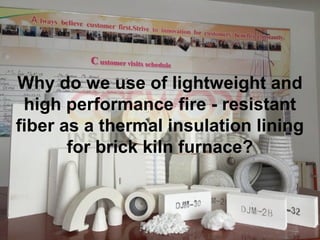
Why do we use of lightweight and
high performance fire - resistant
fiber as a thermal insulation lining
for brick kiln furnace?
• Can reduce 40%
of fuel consumption
and shorten 35% of
firing period, which
could increase firing
efficiency of brick
and tile products
effectively.
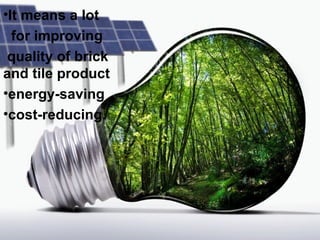
•It means a lot
for improving
quality of brick
and tile product
•energy-saving
•cost-reducing.
Do you know
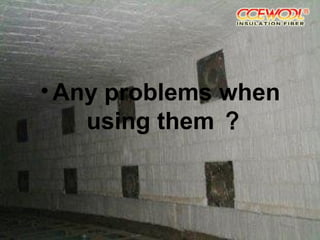
•Any problems when
using them ?
• In recent years, The fibrous structure at
the top of the wicket of annular kiln and
kiln, tunnel kiln, kiln top is widely used in
all sorts of furnace type.
• But it is found that refractory fiber in use
after a period of time is possible to occur
pulverization, contraction and oxidation,
fibers fall off, and Installation does not
reach the designated position, etc.
The first problem
• High temperature makes alumina
silicate refractory fibers pulverized.
• Analyzed from the thermodynamics, due to that any material has
characteristics of making its surface be the lowest, so under the
condition of certain thermodynamics, the total surface area of
refractory fiber tends to be minimum.
• Tiny grain or particle will gradually condense into big grain or
particle, and the unit cell grows as the temperature increases to lead
to deterioration in their resistance to thermal shock resistance.
• Due to the refractory fiber's long-term work under high temperature,
refractory fiber's fine crystal will bear high temperature for a long
time, it will accordingly grow up gradually. Fiber surface is becoming
rough, and crack appeared.
• When the crystal grew up to the fiber diameter, the fiber strength will
drop to limitation that cannot work under internal pressure, thus to
make the fiber breakage pulverization, which is the main reason of
refractory fiber's broken.
The second problem
• Alkali, sulfur and other harmful gases
cause erosion of aluminum silicate
refractory fibers and oxidation
shrinkage.
• Air component of brick firing furnace is quite complex, including both the fuel
vapor harmful gases produced by combustion and water evaporation
produced by body, as well as alkali metal ions existing in the raw materials.
Since refractory fiber has a very large surface area, when the water vapor
presents in the air, refractory fibers will absorb a lot of moisture.
• At the same time, the carbon dioxide and silicon dioxide in furnace medium
can dissolve in water, forming weak acid. Weak acid and alkali ion fiber can
take replacement reaction, thereby undermining the fiber structure, and it
will lead to the fibers’ erosion and deterioration in long-term use.
• Alkali metal ions and aluminum silicate refractory fibers can react and result
in feldspar, destroying the fiber’s network structure. Under reducing
atmosphere, fiber crystallization will accelerate, reducing the fiber’s life.
• These harmful gases and substances will react with refractory fiber,
corroding refractory fiber, destructing of its original structure, which caused
refractory fiber’s pulverization, shrinkage and breakage. It is also one of the
important reasons accounting for the usage life of furnace.
The third problem
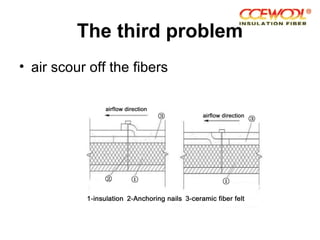
• air scour off the fibers
• In the long-term effects of high temperature, the grains of
ceramic fibers in brick firing kiln grow brittle, so the
tensile strength decreases dramatically. After chalking
fiber at high speed airflow erosion, powder particles are
constantly blew, flowing along with the media.
• As the fibers are constantly being washed off, kiln wall's
thickness decreases, so the insulation effect
deteriorates, kiln lining heat increased, which make the
heat consumption increases, thus greatly affecting the
thermal efficiency of brick kilns.
• This situation not only pollute the environment, but also
reduce the brick kiln's life.
The fourth problem
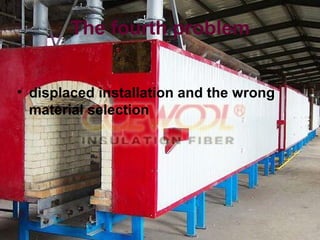
• displaced installation and the wrong
material selection
• At present, alumina silicate refractory fibers used
in the brick kiln, is usually divided into ordinary
type, standard, high-purity type, and high-
alumina type.
• CCEWOOL® ceramic fiber also launched a
high-zirconium-type. Selection of refractory fiber
should according to characteristics of local raw
materials. When alkali and sulfur content are
high in raw materials, the furnace should use
composition fire-resistant fiber.
• On the refractory fiber installation, a lot of fire-resistant fiber
manufacturers generally used the anchor hook to secure ceramic
fiber modules.
• As we all know, such fixed pattern did not completely secure the
block, and the refractory fiber module completely rely on their
expansion after releasing package. If not completely anchor
position, will inevitably lead to mutual swim between the module and
secure the module completely, it will lead to move between blocks,
with the high-temperature contraction of the gap between the
modules will eventually make anchor oxidation and the module's off,
causing serious damage to the furnace.
• Some furnace company in order to reduce the cost of construction
of the furnace, they even don't lay steel panel on steel structure.
The Alumina silicate refractory fibers loses steel panel's care, the
consequences can be imagined.
www.ceceramicfiber.com
A
TOP
CERAMIC
FIBER
EXPORT
BRAND
FROM
CHINA
Industry News---CCEWOOL® ceramic fiber explanation

Industry News---CCEWOOL® ceramic fiber explanation

  • 1.
    CCEWOOL® ceramic fiberexplanation Industry News Alumina silicate refractory fibers’ issues easily occurred in kilns for brick tile www.ceceramicfiber.com
  • 2.
    Why do weuse of lightweight and high performance fire - resistant fiber as a thermal insulation lining for brick kiln furnace?
  • 3.
    • Can reduce40% of fuel consumption and shorten 35% of firing period, which could increase firing efficiency of brick and tile products effectively.
  • 4.
    •It means alot for improving quality of brick and tile product •energy-saving •cost-reducing.
  • 5.
  • 6.
  • 7.
    • In recentyears, The fibrous structure at the top of the wicket of annular kiln and kiln, tunnel kiln, kiln top is widely used in all sorts of furnace type. • But it is found that refractory fiber in use after a period of time is possible to occur pulverization, contraction and oxidation, fibers fall off, and Installation does not reach the designated position, etc.
  • 8.
    The first problem •High temperature makes alumina silicate refractory fibers pulverized.
  • 9.
    • Analyzed fromthe thermodynamics, due to that any material has characteristics of making its surface be the lowest, so under the condition of certain thermodynamics, the total surface area of refractory fiber tends to be minimum. • Tiny grain or particle will gradually condense into big grain or particle, and the unit cell grows as the temperature increases to lead to deterioration in their resistance to thermal shock resistance. • Due to the refractory fiber's long-term work under high temperature, refractory fiber's fine crystal will bear high temperature for a long time, it will accordingly grow up gradually. Fiber surface is becoming rough, and crack appeared. • When the crystal grew up to the fiber diameter, the fiber strength will drop to limitation that cannot work under internal pressure, thus to make the fiber breakage pulverization, which is the main reason of refractory fiber's broken.
  • 10.
    The second problem •Alkali, sulfur and other harmful gases cause erosion of aluminum silicate refractory fibers and oxidation shrinkage.
  • 11.
    • Air componentof brick firing furnace is quite complex, including both the fuel vapor harmful gases produced by combustion and water evaporation produced by body, as well as alkali metal ions existing in the raw materials. Since refractory fiber has a very large surface area, when the water vapor presents in the air, refractory fibers will absorb a lot of moisture. • At the same time, the carbon dioxide and silicon dioxide in furnace medium can dissolve in water, forming weak acid. Weak acid and alkali ion fiber can take replacement reaction, thereby undermining the fiber structure, and it will lead to the fibers’ erosion and deterioration in long-term use. • Alkali metal ions and aluminum silicate refractory fibers can react and result in feldspar, destroying the fiber’s network structure. Under reducing atmosphere, fiber crystallization will accelerate, reducing the fiber’s life. • These harmful gases and substances will react with refractory fiber, corroding refractory fiber, destructing of its original structure, which caused refractory fiber’s pulverization, shrinkage and breakage. It is also one of the important reasons accounting for the usage life of furnace.
  • 12.
    The third problem •air scour off the fibers
  • 13.
    • In thelong-term effects of high temperature, the grains of ceramic fibers in brick firing kiln grow brittle, so the tensile strength decreases dramatically. After chalking fiber at high speed airflow erosion, powder particles are constantly blew, flowing along with the media. • As the fibers are constantly being washed off, kiln wall's thickness decreases, so the insulation effect deteriorates, kiln lining heat increased, which make the heat consumption increases, thus greatly affecting the thermal efficiency of brick kilns. • This situation not only pollute the environment, but also reduce the brick kiln's life.
  • 14.
    The fourth problem •displaced installation and the wrong material selection
  • 15.
    • At present,alumina silicate refractory fibers used in the brick kiln, is usually divided into ordinary type, standard, high-purity type, and high- alumina type. • CCEWOOL® ceramic fiber also launched a high-zirconium-type. Selection of refractory fiber should according to characteristics of local raw materials. When alkali and sulfur content are high in raw materials, the furnace should use composition fire-resistant fiber.
  • 16.
    • On therefractory fiber installation, a lot of fire-resistant fiber manufacturers generally used the anchor hook to secure ceramic fiber modules. • As we all know, such fixed pattern did not completely secure the block, and the refractory fiber module completely rely on their expansion after releasing package. If not completely anchor position, will inevitably lead to mutual swim between the module and secure the module completely, it will lead to move between blocks, with the high-temperature contraction of the gap between the modules will eventually make anchor oxidation and the module's off, causing serious damage to the furnace. • Some furnace company in order to reduce the cost of construction of the furnace, they even don't lay steel panel on steel structure. The Alumina silicate refractory fibers loses steel panel's care, the consequences can be imagined.
  • 17.