Key concepts ofIndustry 4.0
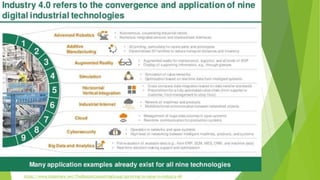
Industry 4.0 is the paradigm of connecting different kinds of physical devices
enriched with embedded electronics to a network or internet, so they
interact, man to machine of machine to machine, facilitating IT-enabled mass
customization in manufacturing.
Transformation of manufacturing processes with the help of IoT platforms into
cyber-physical systems that are increasingly adaptable, digitalised,
interconnected and demand-driven, process to allow for customized,
personalized and high-quality products.
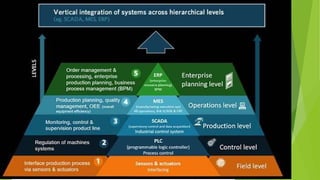
For Industry 4.0 production, it is essential to implement both the horizontal
and vertical integration of the value network and the production inside the
factory.
Adolph, Lars, et al., 2016
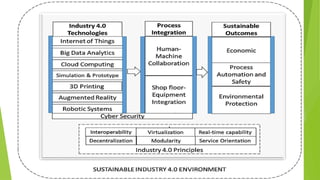
Interoperability
Interoperability: theability of CPS, humans and Smart Factories to connect
and communicate with each other via the Internet of Things and the Internet
of Services
Connection of CPS, people and manufacturing systems
Collaboration
IT and OT convergence
IoT and People
Standards, protocols and connected data
9.
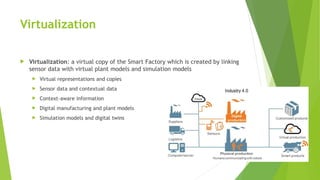
Virtualization
Virtualization: avirtual copy of the Smart Factory which is created by linking
sensor data with virtual plant models and simulation models
Virtual representations and copies
Sensor data and contextual data
Context-aware information
Digital manufacturing and plant models
Simulation models and digital twins
10.
Decentralization
Decentralization: theability of CPS within Smart Factories to make decisions
on their own
Autonomous and semi-autonomous decisions
Intelligence towards the edge
The cyber-physical system as a decision maker
Human/machine element in planning and deciding
Ubiquitous decentralization from manufacturing to warehousing and logistics
11.
Real-Time Capability
Real-TimeCapability: the capability to collect and analyze data and provide
the insights immediately
Real-time data for real-time economy
Immediate collection and analysis to obtain desired insights
Fast data for flexibility
Focus on decisions
Preventive/predictive maintenance
12.
Service Orientation
ServiceOrientation: offering of services (of CPS, humans and Smart
Factories) via the Internet of Services
Cyber-physical systems supporting people
As-a-service-economy
Personalization and value-added with focus on customer
Internet of services
New service models
13.
Modularity
Modularity: flexibleadaptation of Smart Factories for changing requirements
of individual modules
Replacement or expansion of individual models as response to changing needs
Customer-centricity
Flexibility and agility
Planning for the unpredictable
Dynamic environment: capabilities for swift changes
14.
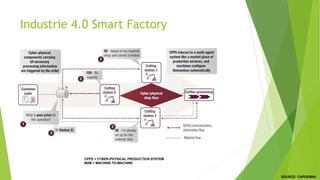
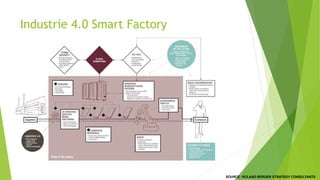
Industrie 4.0 SmartFactory
SOURCE: CAPGEMINI
CPPS = CYBER-PHYSICAL PRODUCTION SYSTEM
M2M = MACHINE-TO-MACHINE
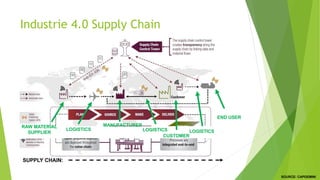
Industrie 4.0 SupplyChain
SOURCE: CAPGEMINI
RAW MATERIAL
SUPPLIER
LOGISTICS
MANUFACTURER
LOGISTICS
CUSTOMER
END USER
LOGISTICS
SUPPLY CHAIN:
18.
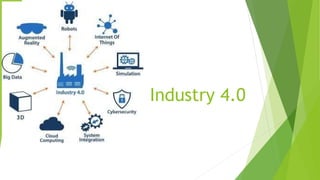
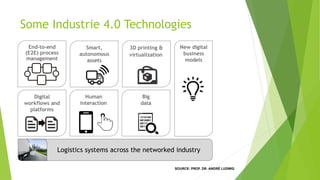
Some Industrie 4.0Technologies
Digital
workflows and
platforms
End-to-end
(E2E) process
management
Smart,
autonomous
assets
Human
interaction
Logistics systems across the networked industry
Big
data
3D printing &
virtualization
New digital
business
models
SOURCE: PROF. DR. ANDRÉ LUDWIG
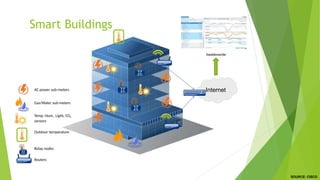
Smart Buildings
Internet
AC powersub-meters
Gas/Water sub-meters
Temp, Hum., Light, CO2
sensors
Outdoor temperature
Relay nodes
Routers
Dashboards
SOURCE: CISCO