DESMA 9: Art, Science and Technology “ Imagination is more important than knowledge. For knowledge is limited to all we now know and understand, while imagination embraces the entire world, and all there ever will be to know and understand.”  Einstein Industrialization, Robotics, Kinetic / robotic art
TODAY 10/15/07: Quick Review of last week’s topics Industrialization / ford / taylorism Communication revolution: movable type Mechanical Philosophy / dualism Robotics / Cybernetics / Computing Kinetic Art Contemporary art using robotics
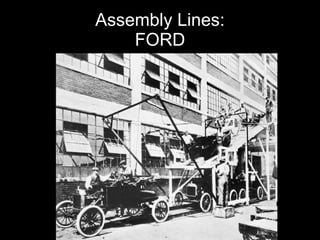
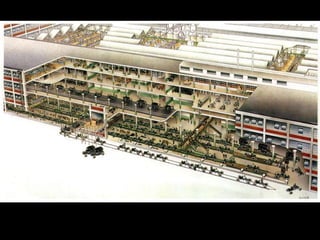
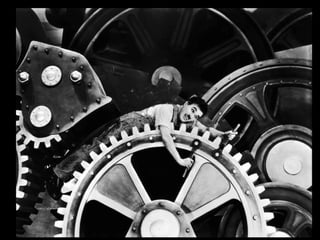
Assembly Lines: FORD
 
 
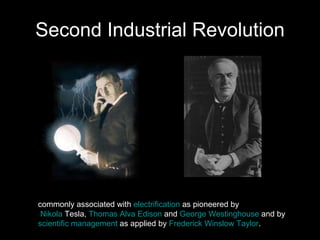
Second Industrial Revolution commonly associated with  electrification  as pioneered by Nikola  Tesla ,  Thomas Alva Edison  and  George Westinghouse  and by  scientific management  as applied by  Frederick Winslow Taylor .
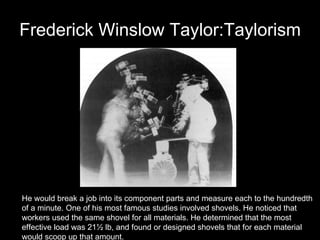
Frederick Winslow Taylor:Taylorism He would break a job into its component parts and measure each to the hundredth  of a minute. One of his most famous studies involved shovels. He noticed that  workers used the same shovel for all materials. He determined that the most  effective load was 21½ lb, and found or designed shovels that for each material  would scoop up that amount.
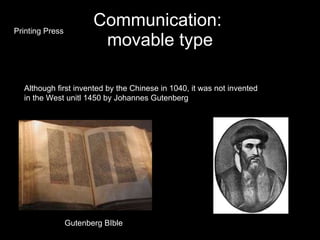
Communication:  movable type Printing Press Although first invented by the Chinese in 1040, it was not invented  in the West unitl 1450 by Johannes Gutenberg Gutenberg BIble
Although Gutenberg was financially unsuccessful in his lifetime, the printing technologies spread quickly, and news and books began to travel  across Europe much faster than before. It fed the growing Renaissance,  and since it greatly facilitated scientific publishing, it was a major catalyst  for the later scientific revolution.
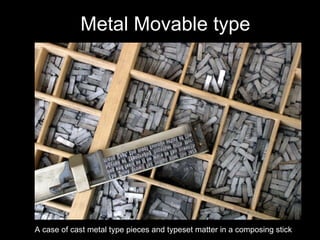
Metal Movable type A case of cast metal type pieces and typeset matter in a composing stick
 
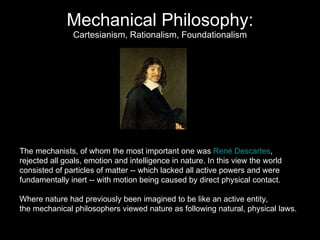
Mechanical Philosophy: Cartesianism, Rationalism, Foundationalism The mechanists, of whom the most important one was  René Descartes , rejected all goals, emotion and intelligence in nature. In this view the world  consisted of particles of matter -- which lacked all active powers and were  fundamentally inert -- with motion being caused by direct physical contact.  Where nature had previously been imagined to be like an active entity,  the mechanical philosophers viewed nature as following natural, physical laws.
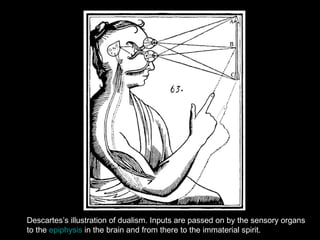
Descartes’s illustration of dualism. Inputs are passed on by the sensory organs  to the  epiphysis  in the brain and from there to the immaterial spirit.
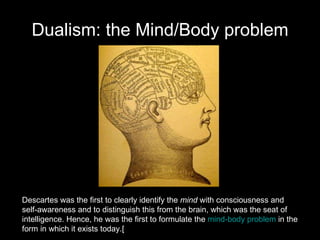
Dualism: the Mind/Body problem Descartes was the first to clearly identify the  mind  with consciousness and  self-awareness and to distinguish this from the brain, which was the seat of  intelligence. Hence, he was the first to formulate the  mind-body problem  in the  form in which it exists today.[
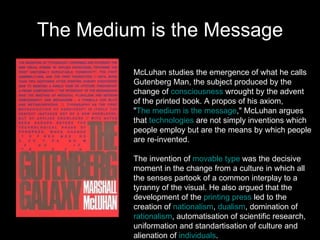
The Medium is the Message McLuhan studies the emergence of what he calls  Gutenberg Man, the subject produced by the  change of  consciousness  wrought by the advent  of the printed book. A propos of his axiom,  " The medium is the message ," McLuhan argues  that  technologies  are not simply inventions which  people employ but are the means by which people  are re-invented.  The invention of  movable type  was the decisive  moment in the change from a culture in which all  the senses partook of a common interplay to a  tyranny of the visual. He also argued that the  development of the  printing press  led to the  creation of  nationalism ,  dualism , domination of  rationalism , automatisation of scientific research,  uniformation and standartisation of culture and  alienation of  individuals .
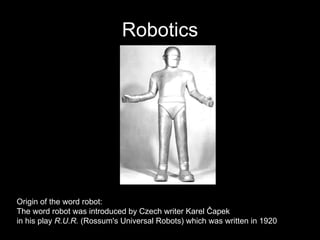
Robotics Origin of the word robot: The word robot was introduced by Czech writer Karel Čapek in his play  R.U.R.  (Rossum's Universal Robots) which was written in 1920
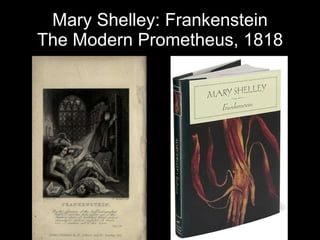
Mary Shelley: Frankenstein The Modern Prometheus, 1818
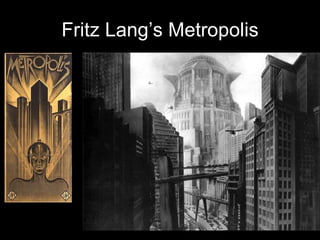
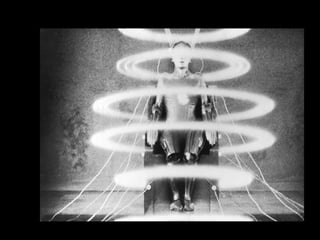
Fritz Lang’s Metropolis
 
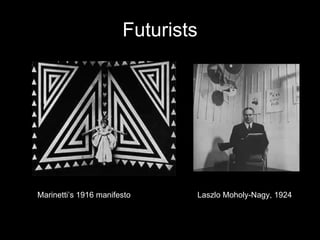
Futurists Marinetti’s 1916 manifesto Laszlo Moholy-Nagy, 1924
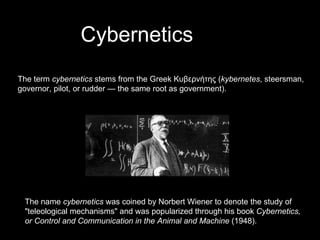
Cybernetics The name  cybernetics  was coined by Norbert Wiener to denote the study of  "teleological mechanisms" and was popularized through his book  Cybernetics,  or Control and Communication in the Animal and Machine  (1948).  The term  cybernetics  stems from the Greek Κυβερνήτης ( kybernetes , steersman,  governor, pilot, or rudder — the same root as government).
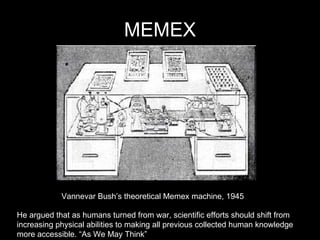
MEMEX Vannevar Bush’s theoretical Memex machine, 1945 He argued that as humans turned from war, scientific efforts should shift from  increasing physical abilities to making all previous collected human knowledge  more accessible. “As We May Think”
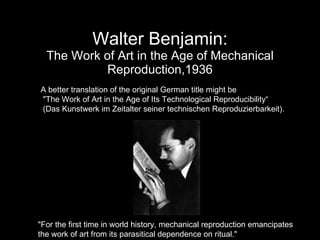
Walter Benjamin: The Work of Art in the Age of Mechanical Reproduction,1936 A better translation of the original German title might be "The Work of Art in the Age of Its Technological Reproducibility“ (Das Kunstwerk im Zeitalter seiner technischen Reproduzierbarkeit).  "For the first time in world history, mechanical reproduction emancipates  the work of art from its parasitical dependence on ritual."
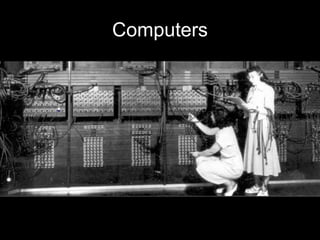
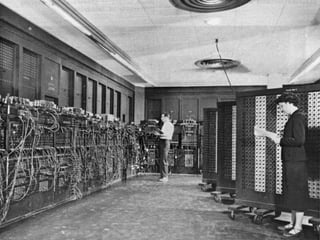
Computers
 
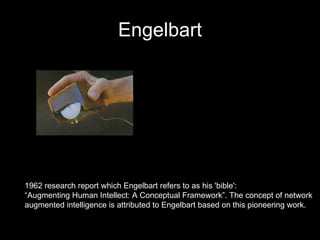
Engelbart 1962 research report which Engelbart refers to as his 'bible':  “ Augmenting Human Intellect: A Conceptual Framework”. The concept of network  augmented intelligence is attributed to Engelbart based on this pioneering work.
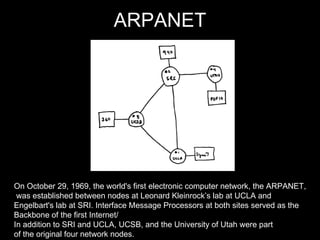
ARPANET On October 29, 1969, the world's first electronic computer network, the ARPANET, was established between nodes at Leonard Kleinrock’s lab at UCLA and  Engelbart's lab at SRI. Interface Message Processors at both sites served as the  Backbone of the first Internet/ In addition to SRI and UCLA, UCSB, and the University of Utah were part  of the original four network nodes.
E.A.T:  experiments in art & technology 1966 Engineer Billy Kluver and artist Robert Rauschenberg "Rauschenberg decided to form Experiments in Art and Technology as a service organization  for artists, engineers and scientists."
Frank Malina: astrophysicist and kinetic artist founds  Leonardo journal, 1968 In his work as a scientist and engineer, Malina had access to an abundance of  scholarly periodicals that enabled peers in any given field to stay abreast of each  other's work and to monitor important news developments. There was no equivalent  publication for artists, so he decided to start one. The concept was simple--- a publication by serious artists with subject integrity secured by the same kind of  peer review of articles that is common in scientific journals. Malina felt that the  demystification of modern art could, in part, be accomplished by the free exchange  of information regarding artistic disciplines.
Kinetic Art Kinetic art was first recorded by the sculptors Naum Gabo and Antoine Pevsner in their Realist Manifesto issued as part of a manifesto of constructivism in 1920  in Moscow. "Bicycle Wheel," of 1913, by Marcel Duchamp, is said to be the first  kinetic sculpture The Manifesto focused largely on divorcing art from such conventions as use of lines, color, volume, and mass. They also believed art should accompany man  through all parts of his life: "at the workbench, at the office, at work, at rest, and  at leisure; work days and holidays, at home and on the road, so that the flame  of life does not go out in man."  David  Bermant  foundation collection
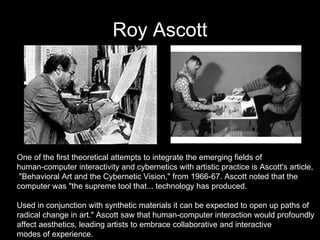
Roy Ascott One of the first theoretical attempts to integrate the emerging fields of  human-computer interactivity and cybernetics with artistic practice is Ascott's article, "Behavioral Art and the Cybernetic Vision," from 1966-67. Ascott noted that the  computer was "the supreme tool that... technology has produced.  Used in conjunction with synthetic materials it can be expected to open up paths of  radical change in art." Ascott saw that human-computer interaction would profoundly  affect aesthetics, leading artists to embrace collaborative and interactive  modes of experience.
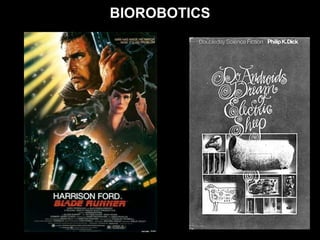
BIOROBOTICS
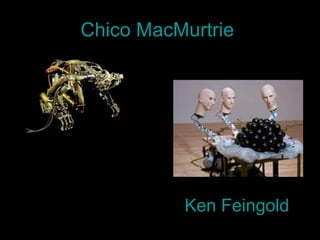
Chico  MacMurtrie   Ken Feingold
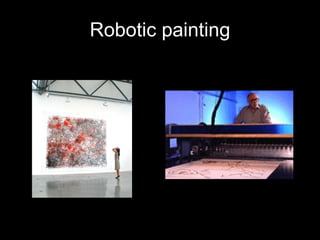
Robotic painting
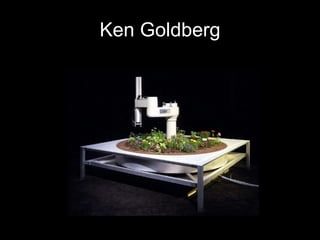
Ken Goldberg
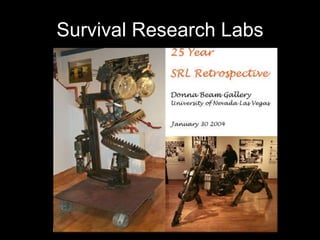
Survival Research Labs
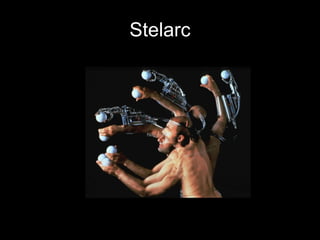
Stelarc


Industrialization robotics

  • 1.
    DESMA 9: Art,Science and Technology “ Imagination is more important than knowledge. For knowledge is limited to all we now know and understand, while imagination embraces the entire world, and all there ever will be to know and understand.” Einstein Industrialization, Robotics, Kinetic / robotic art
  • 2.
    TODAY 10/15/07: QuickReview of last week’s topics Industrialization / ford / taylorism Communication revolution: movable type Mechanical Philosophy / dualism Robotics / Cybernetics / Computing Kinetic Art Contemporary art using robotics
  • 3.
  • 4.
  • 5.
  • 6.
    Second Industrial Revolutioncommonly associated with electrification as pioneered by Nikola Tesla , Thomas Alva Edison and George Westinghouse and by scientific management as applied by Frederick Winslow Taylor .
  • 7.
    Frederick Winslow Taylor:TaylorismHe would break a job into its component parts and measure each to the hundredth of a minute. One of his most famous studies involved shovels. He noticed that workers used the same shovel for all materials. He determined that the most effective load was 21½ lb, and found or designed shovels that for each material would scoop up that amount.
  • 8.
    Communication: movabletype Printing Press Although first invented by the Chinese in 1040, it was not invented in the West unitl 1450 by Johannes Gutenberg Gutenberg BIble
  • 9.
    Although Gutenberg wasfinancially unsuccessful in his lifetime, the printing technologies spread quickly, and news and books began to travel across Europe much faster than before. It fed the growing Renaissance, and since it greatly facilitated scientific publishing, it was a major catalyst for the later scientific revolution.
  • 10.
    Metal Movable typeA case of cast metal type pieces and typeset matter in a composing stick
  • 11.
  • 12.
    Mechanical Philosophy: Cartesianism,Rationalism, Foundationalism The mechanists, of whom the most important one was René Descartes , rejected all goals, emotion and intelligence in nature. In this view the world consisted of particles of matter -- which lacked all active powers and were fundamentally inert -- with motion being caused by direct physical contact. Where nature had previously been imagined to be like an active entity, the mechanical philosophers viewed nature as following natural, physical laws.
  • 13.
    Descartes’s illustration ofdualism. Inputs are passed on by the sensory organs to the epiphysis in the brain and from there to the immaterial spirit.
  • 14.
    Dualism: the Mind/Bodyproblem Descartes was the first to clearly identify the mind with consciousness and self-awareness and to distinguish this from the brain, which was the seat of intelligence. Hence, he was the first to formulate the mind-body problem in the form in which it exists today.[
  • 15.
    The Medium isthe Message McLuhan studies the emergence of what he calls Gutenberg Man, the subject produced by the change of consciousness wrought by the advent of the printed book. A propos of his axiom, " The medium is the message ," McLuhan argues that technologies are not simply inventions which people employ but are the means by which people are re-invented. The invention of movable type was the decisive moment in the change from a culture in which all the senses partook of a common interplay to a tyranny of the visual. He also argued that the development of the printing press led to the creation of nationalism , dualism , domination of rationalism , automatisation of scientific research, uniformation and standartisation of culture and alienation of individuals .
  • 16.
    Robotics Origin ofthe word robot: The word robot was introduced by Czech writer Karel Čapek in his play R.U.R. (Rossum's Universal Robots) which was written in 1920
  • 17.
    Mary Shelley: FrankensteinThe Modern Prometheus, 1818
  • 18.
  • 19.
  • 20.
    Futurists Marinetti’s 1916manifesto Laszlo Moholy-Nagy, 1924
  • 21.
    Cybernetics The name cybernetics was coined by Norbert Wiener to denote the study of "teleological mechanisms" and was popularized through his book Cybernetics, or Control and Communication in the Animal and Machine (1948). The term cybernetics stems from the Greek Κυβερνήτης ( kybernetes , steersman, governor, pilot, or rudder — the same root as government).
  • 22.
    MEMEX Vannevar Bush’stheoretical Memex machine, 1945 He argued that as humans turned from war, scientific efforts should shift from increasing physical abilities to making all previous collected human knowledge more accessible. “As We May Think”
  • 23.
    Walter Benjamin: TheWork of Art in the Age of Mechanical Reproduction,1936 A better translation of the original German title might be "The Work of Art in the Age of Its Technological Reproducibility“ (Das Kunstwerk im Zeitalter seiner technischen Reproduzierbarkeit). "For the first time in world history, mechanical reproduction emancipates the work of art from its parasitical dependence on ritual."
  • 24.
  • 25.
  • 26.
    Engelbart 1962 researchreport which Engelbart refers to as his 'bible': “ Augmenting Human Intellect: A Conceptual Framework”. The concept of network augmented intelligence is attributed to Engelbart based on this pioneering work.
  • 27.
    ARPANET On October29, 1969, the world's first electronic computer network, the ARPANET, was established between nodes at Leonard Kleinrock’s lab at UCLA and Engelbart's lab at SRI. Interface Message Processors at both sites served as the Backbone of the first Internet/ In addition to SRI and UCLA, UCSB, and the University of Utah were part of the original four network nodes.
  • 28.
    E.A.T: experimentsin art & technology 1966 Engineer Billy Kluver and artist Robert Rauschenberg "Rauschenberg decided to form Experiments in Art and Technology as a service organization for artists, engineers and scientists."
  • 29.
    Frank Malina: astrophysicistand kinetic artist founds Leonardo journal, 1968 In his work as a scientist and engineer, Malina had access to an abundance of scholarly periodicals that enabled peers in any given field to stay abreast of each other's work and to monitor important news developments. There was no equivalent publication for artists, so he decided to start one. The concept was simple--- a publication by serious artists with subject integrity secured by the same kind of peer review of articles that is common in scientific journals. Malina felt that the demystification of modern art could, in part, be accomplished by the free exchange of information regarding artistic disciplines.
  • 30.
    Kinetic Art Kineticart was first recorded by the sculptors Naum Gabo and Antoine Pevsner in their Realist Manifesto issued as part of a manifesto of constructivism in 1920 in Moscow. "Bicycle Wheel," of 1913, by Marcel Duchamp, is said to be the first kinetic sculpture The Manifesto focused largely on divorcing art from such conventions as use of lines, color, volume, and mass. They also believed art should accompany man through all parts of his life: "at the workbench, at the office, at work, at rest, and at leisure; work days and holidays, at home and on the road, so that the flame of life does not go out in man." David Bermant foundation collection
  • 31.
    Roy Ascott Oneof the first theoretical attempts to integrate the emerging fields of human-computer interactivity and cybernetics with artistic practice is Ascott's article, "Behavioral Art and the Cybernetic Vision," from 1966-67. Ascott noted that the computer was "the supreme tool that... technology has produced. Used in conjunction with synthetic materials it can be expected to open up paths of radical change in art." Ascott saw that human-computer interaction would profoundly affect aesthetics, leading artists to embrace collaborative and interactive modes of experience.
  • 32.
  • 33.
    Chico MacMurtrie Ken Feingold
  • 34.
  • 35.
  • 36.
  • 37.
  • 38.
  • 39.