Industrial Psychology
(BAS-12/ BHM-05)
Unit 1 Lecture 2
Introduction to Industrial Psychology
WHAT IS PSYCHOLOGY?
• “The scientific study of mind and behavior.”
• Psychology is a varied field. Psychologists conduct basic and applied
research, serve as consultants to communities and organizations,
diagnose and treat people, and teach future psychologists and those
who will pursue other disciplines. They test intelligence and
personality.
• Many psychologists work as health care providers. They assess
behavioral and mental function and well-being. Other psychologists
study how human beings relate to each other and to machines, and
work to improve these relationships.
WHAT IS PSYCHOLOGY?
• The application of psychological research can decrease
the economic burden of disease on government and
society as people learn how to make choices that
improve their health and well-being.
• The strides made in educational assessments are
helping students with learning disabilities. Psychological
science helps educators understand how children think,
process and remember — helping to design effective
teaching methods.
WHAT IS PSYCHOLOGY?
• In many countries, Psychological science contributes to
justice by helping the courts understand the minds of
criminals, evidence and the limits of certain types of
evidence or testimony.
• The science of psychology is pervasive. Psychologists
work in some of the most prominent companies and
organizations. From Google, Boeing and NASA to the
health care organizations and research groups to Disney
and NASCAR — psychologists are there, playing
important roles.
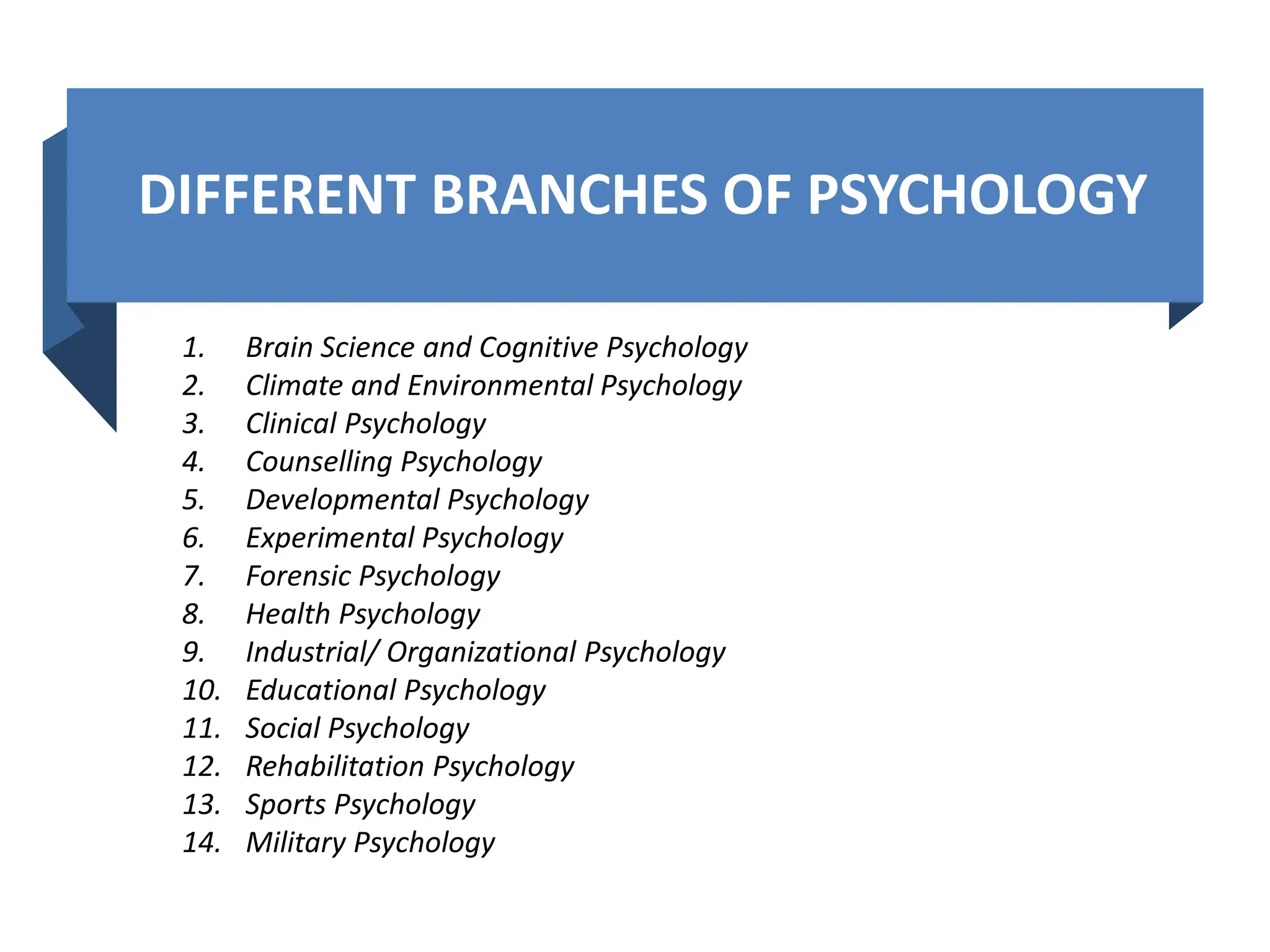
DIFFERENT BRANCHES OF PSYCHOLOGY
1. Brain Science and Cognitive Psychology
2. Climate and Environmental Psychology
3. Clinical Psychology
4. Counselling Psychology
5. Developmental Psychology
6. Experimental Psychology
7. Forensic Psychology
8. Health Psychology
9. Industrial/ Organizational Psychology
10. Educational Psychology
11. Social Psychology
12. Rehabilitation Psychology
13. Sports Psychology
14. Military Psychology
INDUSTRIAL PSYCHOLOGY:
WHAT IT IS?
• Just imagine a situation where all
employees in an organization love their
jobs so much that they couldn’t wait to
get to work.
• Now imagine another scenario where
all employees were so well suited and
trained that their performances were
outstanding.
• Do you think it is possible?? Yes???
No???
INDUSTRIAL PSYCHOLOGY:
WHAT IT IS?
• Unfortunately: -
1. not every employee will enjoy his or
her job, and;
2. not every employee will do well on a
job.
• In this introductory course, you will
learn how industrial psychologists
contribute towards the goal of a
happy and productive workforce.
INDUSTRIAL PSYCHOLOGY:
PURPOSE
“To enhance the dignity
and performance of
human beings, and the
organizations they work
in, by advancing the
science and knowledge of
human behavior.”
INDUSTRIAL PSYCHOLOGY:
DEFINITION
“Industrial psychology is
a branch of psychology
that applies the principles
of psychology to the
workplace.”
INDUSTRIAL PSYCHOLOGY:
DEFINITION
Industrial psychology is, therefore,
simply the application or extension of
psychological facts and principles to
the problems/ challenges/ issues
concerning human beings operating in
business and industry.
INDUSTRIAL PSYCHOLOGY:
DEFINITION
• How principles of psychology are used at
workplace??
1. principles of learning are used to develop
training programs and incentive plans;
2. principles of social psychology are used to
form work groups and understand employee
conflict;
3. principles of motivation and emotion are used
to motivate and satisfy employees; and
4. knowledge about intelligence and personality
is used in recruitment and selection of
employees.
ThE PRESENTATION IS BASED ON
FOLLOWING SOURCES
• Aamodt, M. G. (2007). Industrial/ Organizational
Psychology: An Applied Approach. Pacific Grove, CA:
Wadsworth / Thomson.
• Deshpandey, A. (2010). Industrial Psychology. New
Delhi: Sun India Publications.
• Bisen, V., & Priya (2010). Industrial Psychology. New
Delhi: New Age International Publishers.
• https://www.apa.org/about

Industrial Psychology. Unit 1 (2).pptx

  • 1.
    Industrial Psychology (BAS-12/ BHM-05) Unit1 Lecture 2 Introduction to Industrial Psychology
  • 2.
    WHAT IS PSYCHOLOGY? •“The scientific study of mind and behavior.” • Psychology is a varied field. Psychologists conduct basic and applied research, serve as consultants to communities and organizations, diagnose and treat people, and teach future psychologists and those who will pursue other disciplines. They test intelligence and personality. • Many psychologists work as health care providers. They assess behavioral and mental function and well-being. Other psychologists study how human beings relate to each other and to machines, and work to improve these relationships.
  • 3.
    WHAT IS PSYCHOLOGY? •The application of psychological research can decrease the economic burden of disease on government and society as people learn how to make choices that improve their health and well-being. • The strides made in educational assessments are helping students with learning disabilities. Psychological science helps educators understand how children think, process and remember — helping to design effective teaching methods.
  • 4.
    WHAT IS PSYCHOLOGY? •In many countries, Psychological science contributes to justice by helping the courts understand the minds of criminals, evidence and the limits of certain types of evidence or testimony. • The science of psychology is pervasive. Psychologists work in some of the most prominent companies and organizations. From Google, Boeing and NASA to the health care organizations and research groups to Disney and NASCAR — psychologists are there, playing important roles.
  • 5.
    DIFFERENT BRANCHES OFPSYCHOLOGY 1. Brain Science and Cognitive Psychology 2. Climate and Environmental Psychology 3. Clinical Psychology 4. Counselling Psychology 5. Developmental Psychology 6. Experimental Psychology 7. Forensic Psychology 8. Health Psychology 9. Industrial/ Organizational Psychology 10. Educational Psychology 11. Social Psychology 12. Rehabilitation Psychology 13. Sports Psychology 14. Military Psychology
  • 6.
    INDUSTRIAL PSYCHOLOGY: WHAT ITIS? • Just imagine a situation where all employees in an organization love their jobs so much that they couldn’t wait to get to work. • Now imagine another scenario where all employees were so well suited and trained that their performances were outstanding. • Do you think it is possible?? Yes??? No???
  • 7.
    INDUSTRIAL PSYCHOLOGY: WHAT ITIS? • Unfortunately: - 1. not every employee will enjoy his or her job, and; 2. not every employee will do well on a job. • In this introductory course, you will learn how industrial psychologists contribute towards the goal of a happy and productive workforce.
  • 8.
    INDUSTRIAL PSYCHOLOGY: PURPOSE “To enhancethe dignity and performance of human beings, and the organizations they work in, by advancing the science and knowledge of human behavior.”
  • 9.
    INDUSTRIAL PSYCHOLOGY: DEFINITION “Industrial psychologyis a branch of psychology that applies the principles of psychology to the workplace.”
  • 10.
    INDUSTRIAL PSYCHOLOGY: DEFINITION Industrial psychologyis, therefore, simply the application or extension of psychological facts and principles to the problems/ challenges/ issues concerning human beings operating in business and industry.
  • 11.
    INDUSTRIAL PSYCHOLOGY: DEFINITION • Howprinciples of psychology are used at workplace?? 1. principles of learning are used to develop training programs and incentive plans; 2. principles of social psychology are used to form work groups and understand employee conflict; 3. principles of motivation and emotion are used to motivate and satisfy employees; and 4. knowledge about intelligence and personality is used in recruitment and selection of employees.
  • 12.
    ThE PRESENTATION ISBASED ON FOLLOWING SOURCES • Aamodt, M. G. (2007). Industrial/ Organizational Psychology: An Applied Approach. Pacific Grove, CA: Wadsworth / Thomson. • Deshpandey, A. (2010). Industrial Psychology. New Delhi: Sun India Publications. • Bisen, V., & Priya (2010). Industrial Psychology. New Delhi: New Age International Publishers. • https://www.apa.org/about