


@aopres fb.me/aopres
Financial Technology
What is it and why does it matter for you and me?
Art of Presentation
What is fintech?
Disrupting the traditional financial system
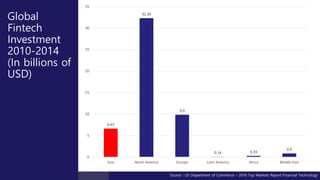
Global
Fintech
Investment
2010-2014
(In billions of
USD)
6.67
32.36
9.9
0.14 0.33
0.9
0
5
10
15
20
25
30
35
Asia North America Europe Latin America Africa Middle East
Source : US Department of Commerce โ€“ 2016 Top Markets Report Financial Technology
6.67
32.36
9.9
0.14 0.33
0.9
0
5
10
15
20
25
30
35
Asia North America Europe Latin America Africa Middle East
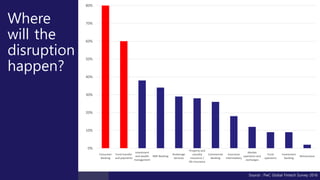
Where
will the
disruption
happen?
0%
10%
20%
30%
40%
50%
60%
70%
80%
Consumer
Banking
Fund transfer
and payments
Investment
and wealth
management
SME Banking
Brokerage
Services
Property and
casualty
insurance /
life insurance
Commercial
Banking
Insurance
intermediary
Market
operators and
exchanges
Fund
operators
Investment
banking
Reinsurance
Column1 80% 60% 38% 34% 29% 28.00% 26% 18% 12% 9% 9% 2%
Source : PwC Global Fintech Survey 2016
0%
10%
20%
30%
40%
50%
60%
70%
80%
Consumer
Banking
Fund transfer
and payments
Investment
and wealth
management
SME Banking
Brokerage
Services
Property and
casualty
insurance /
life insurance
Commercial
Banking
Insurance
intermediary
Market
operators and
exchanges
Fund
operators
Investment
banking
Reinsurance
Column1 80% 60% 38% 34% 29% 28.00% 26% 18% 12% 9% 9% 2%
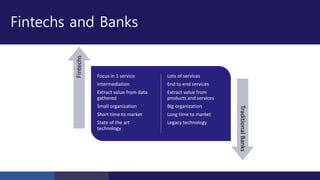
Fintechs and Banks
Focus in 1 service
Intermediation
Extract value from data
gathered
Small organization
Short time to market
State of the art
technology
Lots of services
End to end services
Extract value from
products and services
Big organization
Long time to market
Legacy technology
Fintechs
TraditionalBanks
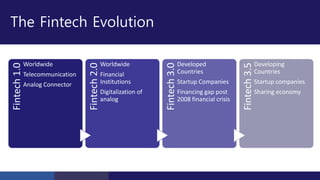
The Fintech EvolutionFintech1.0
Worldwide
Telecommunication
Analog Connector
Fintech2.0
Worldwide
Financial
Institutions
Digitalization of
analog
Fintech3.0
Developed
Countries
Startup Companies
Financing gap post
2008 financial crisis
Fintech3.5
Developing
Countries
Startup companies
Sharing economy
Why does it matter to
Indonesia?
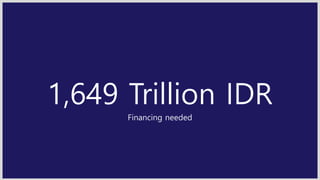
1,649 Trillion IDR
Financing needed
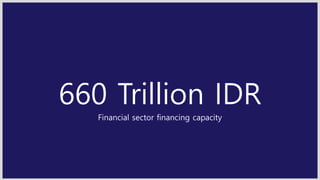
660 Trillion IDR
Financial sector financing capacity
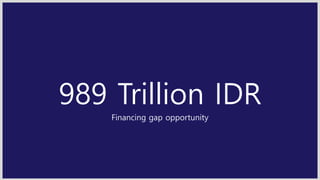
989 Trillion IDR
Financing gap opportunity
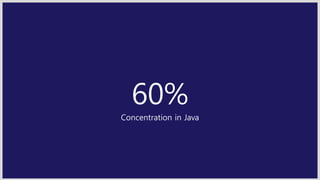
60%
Concentration in Java
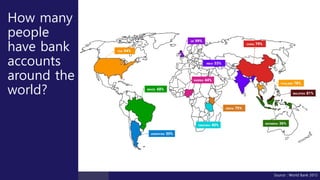
How many
people
have bank
accounts
around the
world?
Source : World Bank 2015
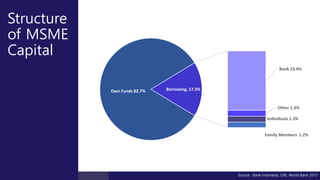
Structure
of MSME
Capital
Own Funds 82.7%
Bank 13.4%
Other 1.3%
Individuals 1.3%
Family Members 1.2%
Borrowing, 17.3%
Source : Bank Indonesia, OJK, World Bank 2015
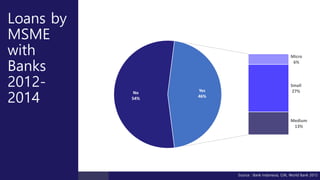
Loans by
MSME
with
Banks
2012-
2014
No
54%
Micro
6%
Small
27%
Medium
13%
Yes
46%
Source : Bank Indonesia, OJK, World Bank 2015
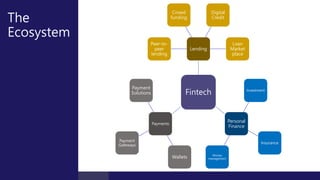
The
Ecosystem
Fintech
Lending
Peer-to-
peer
lending
Crowd
funding
Digital
Credit
Loan
Market
place
Personal
Finance
Investment
Insurance
Money
management
Payments
Wallets
Payment
Gateways
Payment
Solutions
Letโ€™s take a look...
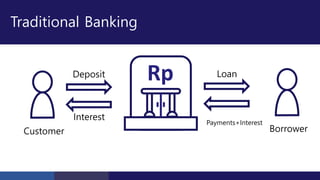
Traditional Banking
2
Rp
Customer
Deposit
Interest
Loan
Payments+Interest
Borrower
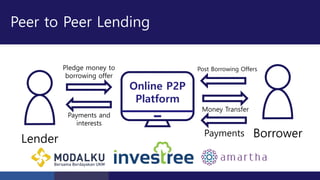
Peer to Peer Lending
Lender Borrower
Pledge money to
borrowing offer
Payments and
interests
Online P2P
Platform
Post Borrowing Offers
Money Transfer
Payments
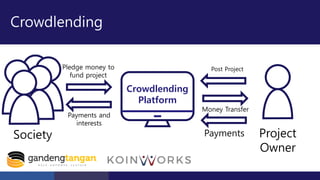
Crowdlending
Project
Owner
Pledge money to
fund project
Payments and
interests
Crowdlending
Platform
Post Project
Money Transfer
PaymentsSociety
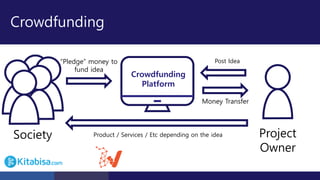
Crowdfunding
Society Project
Owner
โ€œPledgeโ€ money to
fund idea
Product / Services / Etc depending on the idea
Crowdfunding
Platform
Post Idea
Money Transfer
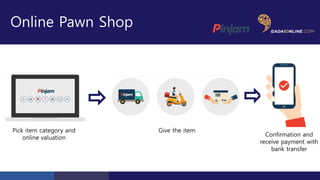
Online Pawn Shop
Pick item category and
online valuation
Give the item
Confirmation and
receive payment with
bank transfer
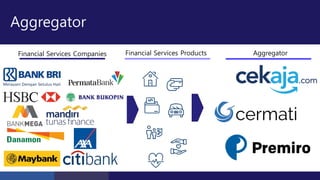
Aggregator
Financial Services Companies Financial Services Products Aggregator
"Uber, the worldโ€™s largest taxi company,
owns no vehicles. Facebook, the worldโ€™s
most popular media owner, creates no
content. Alibaba, the most valuable
retailer, has no inventory. Airbnb, the
worldโ€™s largest accommodation provider,
owns no real estate. Something interesting
is happening.โ€œ
Tom Goodwin
Disruption is the new norm
Break the tradition
THANK YOU

Indonesia Fintech Overview 2016

Editor's Notes

  • #3ย Fintech has many opportunities in supporting the Rp 1.649 triliun needed financing in Indonesia. The current financing ability from the financial sector is Rp 660 triliun, hence there is a Rp 989 trillion financing gap.
  • #5ย Banks extract over $1 trillion in revenues a year from over $400 trillion of annual payments, according to the Boston Consulting Group. As consumers in both rich and poor countries increasingly pay with credit cards or online and on their mobile phones, that figure could reach over $2 trillion by 2023. Banks currently dominate this ecosystem,which includes technology providers and payments networksโ€”mainly Visa and MasterCard. FinTech newcomers, however, are increasing the size of the overall payments sector and may be cutting into bank margins. The next payment frontier is online payments, particularly mobile, as payment systems that are easy to install on a website and help boost the conversion rate from browser to buyer are attractive company investments. The payments ecosystems will evolve largely according to local circumstances. Every country has its own payments system based on traditions and consumer preferences. Figure 6 shows that regulators can and do upend entire payments systems. USG regulators are planning to speed up bank payments, after putting pressure on the banks to reduce their credit and debit card fees. Figure 6 above shows the status of payment infrastructure modernization. Four of the five countries discussed in this report have recently modernized their payment system. The other case study country, Australia, is in the build phase
  • #6ย http://trade.gov/topmarkets/pdf/Financial_Technology_Executive_Summary.pdf
  • #10ย Fintech has many opportunities in supporting the Rp 1.649 triliun needed financing in Indonesia. The current financing ability from the financial sector is Rp 660 triliun, hence there is a Rp 989 trillion financing gap.
  • #11ย Fintech has many opportunities in supporting the Rp 1.649 triliun needed financing in Indonesia. The current financing ability from the financial sector is Rp 660 triliun, hence there is a Rp 989 trillion financing gap.
  • #20ย The first company to offer peer-to-peer loans in the world was Zopa. Since its founding in February 2005, it has issued over ยฃ1.5 billion in loans.[6] In 2010 Funding Circle became the first significant peer-to-business lender launching in August 2010 and offering small businesses loans from investors via the platform.[7] Funding Circle has lent over ยฃ1.3 billion as of March 2016.[8][9] Both Zopa and Funding Circle are members of the Peer 2 Peer Finance Association (P2PFA).[10] SOcietyOne โ€“ Australia Peer2peer finance association โ€“ UK Lending Club - US
  • #21ย The first company to offer peer-to-peer loans in the world was Zopa. Since its founding in February 2005, it has issued over ยฃ1.5 billion in loans.[6] In 2010 Funding Circle became the first significant peer-to-business lender launching in August 2010 and offering small businesses loans from investors via the platform.[7] Funding Circle has lent over ยฃ1.3 billion as of March 2016.[8][9] Both Zopa and Funding Circle are members of the Peer 2 Peer Finance Association (P2PFA).[10] SOcietyOne โ€“ Australia Peer2peer finance association โ€“ UK Lending Club - US
  • #22ย The first company to offer peer-to-peer loans in the world was Zopa. Since its founding in February 2005, it has issued over ยฃ1.5 billion in loans.[6] In 2010 Funding Circle became the first significant peer-to-business lender launching in August 2010 and offering small businesses loans from investors via the platform.[7] Funding Circle has lent over ยฃ1.3 billion as of March 2016.[8][9] Both Zopa and Funding Circle are members of the Peer 2 Peer Finance Association (P2PFA).[10] SOcietyOne โ€“ Australia Peer2peer finance association โ€“ UK Lending Club - US
  • #23ย The first company to offer peer-to-peer loans in the world was Zopa. Since its founding in February 2005, it has issued over ยฃ1.5 billion in loans.[6] In 2010 Funding Circle became the first significant peer-to-business lender launching in August 2010 and offering small businesses loans from investors via the platform.[7] Funding Circle has lent over ยฃ1.3 billion as of March 2016.[8][9] Both Zopa and Funding Circle are members of the Peer 2 Peer Finance Association (P2PFA).[10] SOcietyOne โ€“ Australia Peer2peer finance association โ€“ UK Lending Club - US
  • #25ย The first company to offer peer-to-peer loans in the world was Zopa. Since its founding in February 2005, it has issued over ยฃ1.5 billion in loans.[6] In 2010 Funding Circle became the first significant peer-to-business lender launching in August 2010 and offering small businesses loans from investors via the platform.[7] Funding Circle has lent over ยฃ1.3 billion as of March 2016.[8][9] Both Zopa and Funding Circle are members of the Peer 2 Peer Finance Association (P2PFA).[10] SOcietyOne โ€“ Australia Peer2peer finance association โ€“ UK Lending Club - US