INDICATIONS FOR THROMBOLYSIS
• Acute myocardial infarction [AMI]
• Deep vein thrombosis [DVT]
• Pulmonary embolism [PE]
• Acute ischemic stroke [AIS]
• Acute peripheral arterial occlusion
• Occlusion of indwelling catheters
• Intracardiac thrombus formation
• Severe frostbite
INDICATIONS FOR PTCA
• Chronic stable angina :
The main aim of treatment is to improve symptoms to reduce mortality:
- In asymptomatic or mildly symptomatic patients,revascularization can be
deferred if procedural risks/bleeding risks are high.PCI is warranted only
if symptoms worsen or there is evidence of severe ischemia on non
invasive testing in spite of optimal medical therapy.
- Moderate to severely symptomatic patients should
undergo ischemia-guided revascularization.
- Less severe multi-vessel disease with or without
diabetes have equal outcomes with PCI and CABG.
• Absolute contractions
• Any previous intracranial hemorrhage
• Known structural cerebral vascular lesion (AV malformations)
• Known malignant intra cranial neoplasm(primary or metastatic)
• Ischemic stroke within 3 months except acute ischemic stroke within
4.5 hrs
• Suspected aortic dissection
• Active bleeding or bleeding diathesis
• Significant closed head or facial trauma within 3 months.
• Intra cranial or intra spinal surgery within 2 months
• Severe uncontrolled hypertension (unresponsive to emergency
therapy)
• For streptokinase, previous treatment within previous 6 months.
• RELATIVE CONTRAINDICATIONS
• History of chronic, severe, poorly controlled hypertension.
• Significant hypertension at initial evaluation (SP> 180mmhg or
DBP>110mmhg)
• History of previous ischemic stroke > 3 months.
• Dementia
• Known intracranial pathology not covered in absolute contra indications
• Traumatic or prolonged cardio pulmonary resuscitation.
• Major surgery (< 3 weeks
• Recent within (2-4 weeks) internal bleeding
• Non compressive vascular punctures
• Pregnancy
• Active peptic ulcer
• Oral anti coagulant therapy
ACUTE CORONARY SYNDROMES:
- PCI is superior to optimal medical management due to high risk of mortality. PCI
is preferred over CABG surgery except in case of severe multi-vessel
disease or anatomical factors which are
not amenable to successful treatment.
• „elevation myocardial infarction (STEMI):
• —— Primary PCI (Primary angioplasty in Myocardial
• Infarction—PAMI) is a preferred strategy (direct
• intervention without thrombolysis).
• —— In the pharmaco-invasive approach, patients are
• thrombolyzed followed by PCI within 2–24 hours
• after thrombolysis.
• —— In case of failed thrombolytic therapy (patients in
• whom there is ongoing angina 90 minutes after
• fibrinolysis and/or ECG persistently shows ST
• elevation), Rescue PCI should be performed.
• STEMI DIAGNOSIS < 10 mins
• Once stemi is diagnosed,
• If estimated time taken to reach PCI capable centre and undergo PCI
is less than 120 mins, refer the patient
• With an intend to get PCI with wire crossing within 90 mins.
• Grace period of 30mins to arrange and transport.
• If the distance to PCI capable centre is far and it takes more than 120
mins ,
• Immediately thrombolyse the patient within 10 mins, with preferably
bolus lytics like, Tenecteplase or alteplase
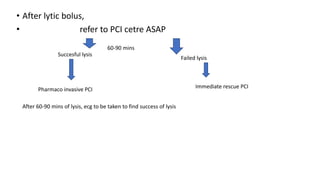
• After lytic bolus,
• refer to PCI cetre ASAP
60-90 mins
Succesful lysis
Failed lysis
Pharmaco invasive PCI Immediate rescue PCI
After 60-90 mins of lysis, ecg to be taken to find success of lysis
INDICATIONS FOR PTCA.pptx

INDICATIONS FOR PTCA.pptx

  • 1.
    INDICATIONS FOR THROMBOLYSIS •Acute myocardial infarction [AMI] • Deep vein thrombosis [DVT] • Pulmonary embolism [PE] • Acute ischemic stroke [AIS] • Acute peripheral arterial occlusion • Occlusion of indwelling catheters • Intracardiac thrombus formation • Severe frostbite
  • 2.
    INDICATIONS FOR PTCA •Chronic stable angina : The main aim of treatment is to improve symptoms to reduce mortality: - In asymptomatic or mildly symptomatic patients,revascularization can be deferred if procedural risks/bleeding risks are high.PCI is warranted only if symptoms worsen or there is evidence of severe ischemia on non invasive testing in spite of optimal medical therapy. - Moderate to severely symptomatic patients should undergo ischemia-guided revascularization. - Less severe multi-vessel disease with or without diabetes have equal outcomes with PCI and CABG.
  • 3.
    • Absolute contractions •Any previous intracranial hemorrhage • Known structural cerebral vascular lesion (AV malformations) • Known malignant intra cranial neoplasm(primary or metastatic) • Ischemic stroke within 3 months except acute ischemic stroke within 4.5 hrs • Suspected aortic dissection • Active bleeding or bleeding diathesis • Significant closed head or facial trauma within 3 months. • Intra cranial or intra spinal surgery within 2 months • Severe uncontrolled hypertension (unresponsive to emergency therapy) • For streptokinase, previous treatment within previous 6 months.
  • 4.
    • RELATIVE CONTRAINDICATIONS •History of chronic, severe, poorly controlled hypertension. • Significant hypertension at initial evaluation (SP> 180mmhg or DBP>110mmhg) • History of previous ischemic stroke > 3 months. • Dementia • Known intracranial pathology not covered in absolute contra indications • Traumatic or prolonged cardio pulmonary resuscitation. • Major surgery (< 3 weeks • Recent within (2-4 weeks) internal bleeding • Non compressive vascular punctures • Pregnancy • Active peptic ulcer • Oral anti coagulant therapy
  • 5.
    ACUTE CORONARY SYNDROMES: -PCI is superior to optimal medical management due to high risk of mortality. PCI is preferred over CABG surgery except in case of severe multi-vessel disease or anatomical factors which are not amenable to successful treatment. • „elevation myocardial infarction (STEMI): • —— Primary PCI (Primary angioplasty in Myocardial • Infarction—PAMI) is a preferred strategy (direct • intervention without thrombolysis). • —— In the pharmaco-invasive approach, patients are • thrombolyzed followed by PCI within 2–24 hours • after thrombolysis. • —— In case of failed thrombolytic therapy (patients in • whom there is ongoing angina 90 minutes after • fibrinolysis and/or ECG persistently shows ST • elevation), Rescue PCI should be performed.
  • 6.
    • STEMI DIAGNOSIS< 10 mins • Once stemi is diagnosed, • If estimated time taken to reach PCI capable centre and undergo PCI is less than 120 mins, refer the patient • With an intend to get PCI with wire crossing within 90 mins. • Grace period of 30mins to arrange and transport. • If the distance to PCI capable centre is far and it takes more than 120 mins , • Immediately thrombolyse the patient within 10 mins, with preferably bolus lytics like, Tenecteplase or alteplase
  • 7.
    • After lyticbolus, • refer to PCI cetre ASAP 60-90 mins Succesful lysis Failed lysis Pharmaco invasive PCI Immediate rescue PCI After 60-90 mins of lysis, ecg to be taken to find success of lysis