INDIA-U.S.A.
RELATIONS
Change,
Continuity and
Transformation
Edited by D Dhanuraj
INDIA-U.S.A.
RELATIONS
Change,
Continuity and
Transformation
Edited by D Dhanuraj
India-US Relations: Change, Continuity & Transformation
Edited by D Dhanuraj
ISBN 978-81-955180-8-1 (eBook)
ISBN 978-81-955180-7-4 (Print)
First published in 2023
Copyright © Centre for Public Policy Research, 2023
Published by the Centre for Public Policy Research (CPPR)
Elamkulam, Kochi, Kerala - 682020, India (www.cppr.in)
Copy-edited by Swapna Jambhekar
Design and Typeset by Nerd Labs
All rights reserved. No part of this publication may be
reproduced, stored in a retrieval system, or transmitted in any
form or by any means (electronic, mechanical, photocopying,
recording or otherwise), without the prior written permission of
the publisher.
The views expressed in the book are the individual opinion(s)
of the author(s), who take individual and joint responsibility
for its content. The book does not reflect the official views of
the Centre for Public Policy Research, or of any government
department, institution or agency. The publishers do not accept
any responsibility for the same in any manner whatsoever.
Contents
Abbreviations
Contributors
Foreword
Introduction
Chapter 1 India U.S.A. Relations: Change,
Continuity, and Transformation - The
U.S.A and India in Indo-Pacific
Vice Admiral M P Muralidharan (Retd.)
04
i
v
vi
01
20
32
42
54
U.S.A. and India in the Indo-Pacific
Dr. Uma Purushothaman
Chapter 2
The U.S.A. and India: Building Synergies
in Global Platforms
Dr. Harinder Sekhon
Chapter 3
Indo-United States Climate Diplomacy
and Clean Energy Cooperation:
Opportunities and Challenges
Dr. Dhanasree Jayaram and
Aishwarya R. J
Chapter 4
Changing Currents in India-U.S.A.
Relations By Michael Kugelman
Prepared by Sharon Susan Koshy
Chapter 5
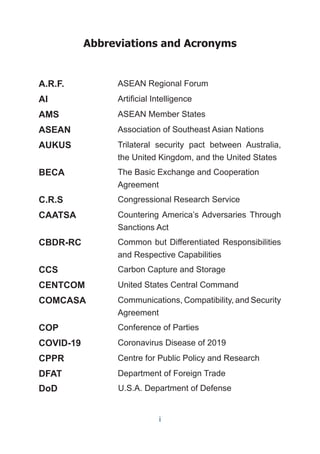
Abbreviations and Acronyms
A.R.F. ASEAN Regional Forum
AI Artificial Intelligence
AMS ASEAN Member States
ASEAN Association of Southeast Asian Nations
AUKUS Trilateral security pact between Australia,
the United Kingdom, and the United States
BECA The Basic Exchange and Cooperation
Agreement
C.R.S Congressional Research Service
CAATSA Countering America’s Adversaries Through
Sanctions Act
CBDR-RC Common but Differentiated Responsibilities
and Respective Capabilities
CCS Carbon Capture and Storage
CENTCOM United States Central Command
COMCASA Communications, Compatibility, and Security
Agreement
COP Conference of Parties
COVID-19 Coronavirus Disease of 2019
CPPR Centre for Public Policy and Research
DFAT Department of Foreign Trade
DoD U.S.A. Department of Defense
i
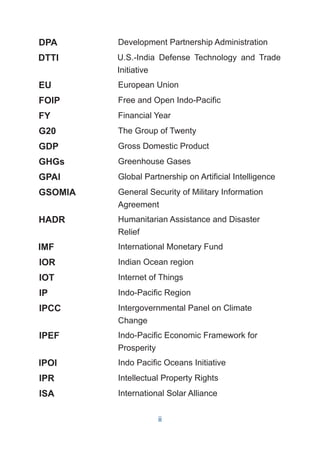
DTTI U.S.-India Defense Technology and Trade
Initiative
DPA Development Partnership Administration
EU European Union
FOIP Free and Open Indo-Pacific
FY Financial Year
G20 The Group of Twenty
GDP Gross Domestic Product
GHGs Greenhouse Gases
General Security of Military Information
Agreement
GSOMIA
Global Partnership on Artificial Intelligence
GPAI
Humanitarian Assistance and Disaster
Relief
HADR
International Monetary Fund
IMF
Indian Ocean region
IOR
Internet of Things
IOT
Indo-Pacific Region
IP
Intergovernmental Panel on Climate
Change
IPCC
Indo-Pacific Economic Framework for
Prosperity
IPEF
Indo Pacific Oceans Initiative
IPOI
Intellectual Property Rights
IPR
International Solar Alliance
ISA
ii
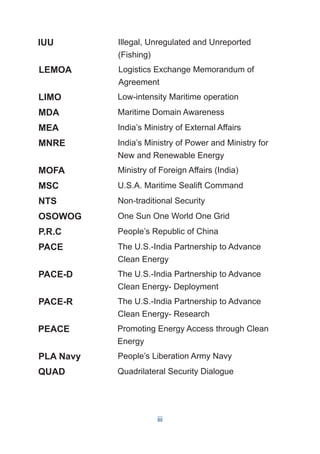
LIMO Low-intensity Maritime operation
MDA Maritime Domain Awareness
MEA India’s Ministry of External Affairs
MNRE India’s Ministry of Power and Ministry for
New and Renewable Energy
MOFA Ministry of Foreign Affairs (India)
MSC U.S.A. Maritime Sealift Command
NTS Non-traditional Security
OSOWOG One Sun One World One Grid
P.R.C People’s Republic of China
PACE The U.S.-India Partnership to Advance
Clean Energy
PACE-D The U.S.-India Partnership to Advance
Clean Energy- Deployment
PACE-R The U.S.-India Partnership to Advance
Clean Energy- Research
PEACE Promoting Energy Access through Clean
Energy
PLA Navy People’s Liberation Army Navy
QUAD Quadrilateral Security Dialogue
Logistics Exchange Memorandum of
Agreement
LEMOA
Illegal, Unregulated and Unreported
(Fishing)
IUU
iii
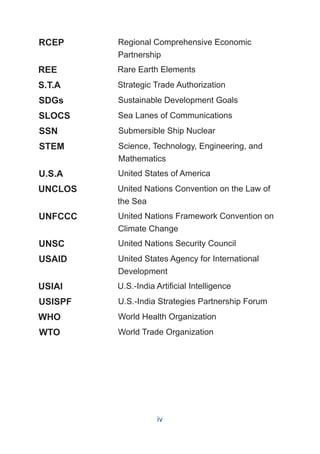
RCEP Regional Comprehensive Economic
Partnership
REE Rare Earth Elements
SDGs Sustainable Development Goals
SLOCS Sea Lanes of Communications
SSN Submersible Ship Nuclear
STEM Science, Technology, Engineering, and
Mathematics
U.S.A United States of America
UNCLOS United Nations Convention on the Law of
the Sea
UNFCCC United Nations Framework Convention on
Climate Change
UNSC United Nations Security Council
USAID United States Agency for International
Development
USIAI U.S.-India Artificial Intelligence
USISPF U.S.-India Strategies Partnership Forum
World Health Organization
WHO
World Trade Organization
WTO
S.T.A Strategic Trade Authorization
iv
Contributors
Vice Admiral M. P. Muralidharan AVSM & BAR, NM (Retd.),
Former Director General, Coast Guard and Hon. Distinguished
Fellow, CPPR, India
Dr. Uma Purushothaman, Assistant Professor, Central University
of Kerala, India
Dr. Harinder Sekhon, Former Consultant at the Vivekananda
International Foundation, India
Dr. Dhanasree Jayaram, Alexander von Humboldt Foundation
- International Climate Protection Fellow, Freie Universität and
Centre Marc Bloch, Germany; Assistant Professor, Manipal
Academy of Higher Education, India
Ms. Aishwarya R. J., Postgraduate Student, Department of
Geopolitics and International Relations, Manipal Academy of
Higher Education, India
Mr. Michael Kugelman, Senior Associate for South and
Southeast Asia at the Woodrow Wilson Center, USA
Ms. Sharon Susan Koshy, Research Associate, Centre for Public
Policy Research, India
v
Foreword
As natural and evolved partners celebrating 75 years of diplomatic
relations, both the United States and India share a commitment
to democracy, pluralism, a multifaceted bilateral agenda and
a growing convergence of strategic interests. Both countries
continue to promote a resilient, rules-based international order
that safeguards sovereignty and territorial integrity, upholds
democratic values, and promotes peace and prosperity for all.
Both countries are committed to establishing a free and open Indo-
Pacific where all nations’ sovereignty and territorial integrity are
honored and countries are not subjected to any kind of military and
economic coercion by any powers. Both India and the U.S.A. are
striving to promote regional stability and prosperity, an inclusive
regional architecture, the rule of law, freedom of navigation, and
peaceful resolution of disputes, while maintaining ASEAN and
Indo-Pacific centrality. The partnership in the Quad to deliver
peace and prosperity in the region in pursuance of a free, open,
and inclusive Indo-Pacific is proof of the commitment of India and
the U.S.A. to shared values in the region.
The U.S.A.’s continued support for India’s permanent membership
in a reformed United Nations Security Council and for India’s entry
into the Nuclear Suppliers’ Group speaks volumes about how the
U.S.A. looks at India as a major player at an international level.
The U.S.A.-India Statement of Guiding Principles on Triangular
Cooperation for Global Development (June 2016) to address
vi
global development challenges, especially in Asia and Africa, is
another area where America and India will lead the way for a better
future based on shared values. The U.S. Agency for International
Development (USAID) and India’s Development Partnership
Administration (DPA) have decided to expand triangular
development activity with low or middle-income countries in Asia
and Africa.
The enhancement of trade and economic ties between the United
States and India has resulted in shared prosperity for both nations,
with bilateral trade exceeding $113 billion in goods in 2021.
In combating the challenges of climate change, both countries
are working together on the exchange of best practices and the
development of technology transfer to enable the affordable
deployment of clean and emerging energy technologies, including
the commercialization and scaling up of battery storage, offshore
wind, green hydrogen, and rooftop solar technology in India.
The recent 2+2 dialogue between the two countries mentions the
relationship as a global strategic partnership. The Basic Exchange
and Cooperation Agreement is a very important step in the bilateral
relationship. The dialogue also reiterated the Combined Maritime
Exercise. The significance lies in the deepening of the relationship
between the defense forces of India and the U.S.A., as well as
the necessity for joint development of various platforms to achieve
shared objectives. The readout of the 2+2 dialogue states that both
countries commit to jointly fighting the conflict from sea to space.
vii
It is in this context that the international conference on ‘Indo-U.S.
Relations: Change, Continuity and Transformation’ was held in
collaboration with the U.S. Consulate General in Chennai to pave
the way for strengthening Indo-U.S. relations in times when the
world is facing new threats and distrust. This opens up new vistas
of cooperation and partnership between the largest and biggest
democracies in the world. The sessions highlighted synergies in
Indo-U.S. relations on global platforms, convergences of interests
in climate change and energy, trade and economic cooperation,
and cooperation in the Indo-Pacific in emerging technologies,
maritime security, and maritime trade. The enlightening sessions
brought out 5 research articles compiled into this compendium.
I am thankful for the support we received from the U.S. Consulate to
organize the conference. The papers in this compendium discuss
the scope of the Indo-U.S. relationship and its divergences and
synergies. I am grateful to the scholars for sharing their insights
and experiences on the themes. I am positive that the scholarly
papers in this edited volume will add value to the conversations
and deliberations on Indo-U.S. relations.
D. Dhanuraj PhD
Chairman
Centre for Public Policy Research
February 2023
viii
Introduction
The Indo-U.S. relationship has been a turbulent one due to the
vagaries of the Cold War, followed by a unipolar world order. Now,
with an emergent multipolar world order, India offers the U.S.A. a
valuable opportunity as a pivot to Asia and the much-contested
Indo-Pacific overtures. As we approach the one-year anniversary
of the Russian invasion of Ukraine, there are conversations about
what the emerging world power dynamics will look like. Although
there are many speculations, there is no consensus. However, one
pertinent agreement is with regard to the rising influence of China
in the region and shifting power dynamics in world geopolitics.
India features as a prominent element in America’s rebalancing
strategy and framework. Perhaps, the single most important
testament to this is the rechristening of Asia Pacific as Indo-Pacific,
bringing into light the strategic importance of the Indian Ocean
in America’s approach to the region. This newfound collaborative
approach has spilled over into strategic and defense partnerships,
among many other areas of enduring cooperation.
In this context, a two-day conference was held in Kochi on April
19-20, 2022, with a view to advancing the conversations in Indo-
US foreign policy cooperation. This is a publication of five research
articles from the conference proceedings in five chapters.
Vice Admiral M. P. Muralidharan AVSM & BAR, NM (Retd.),
analyzes the scope of the defense partnership between India and
the U.S.A. in the Indo-Pacific. The chapter discusses synergies in
1
the Indo-Pacific Strategy Report, security interests and challenges
for India and the U.S.A. vis-à-vis China in the Indo-Pacific, as well
as the differences in the countries’ outlook.
The second chapter by Dr. Uma Purushothaman looks into the
larger scope of cooperation between India and the U.S.A. in
the Indo-Pacific region. The chapter discusses goals to counter
emerging technologies, the relevance of QUAD and other security
alliances, challenges in the region, and possibilities for future
engagement in terms of joint military exercises in countering
emerging threats.
Dr. Harinder Sekhon writes about the areas of convergence that
India and the U.S.A. can capitalize on global platforms. The article
discusses the possible roadmap for both countries to nourish their
bilateral and plurilateral cooperation for shared interests.
The fourth chapter by Dr. Dhanasree Jayaram and Aishwarya R. J.
discussesclimatediplomacyandcleanenergycooperationbetween
India and the U.S.A. The authors critically explore variousclimate
diplomacy initiatives and comment on the challenges in realizing
the full potential and vigor of these programs between the two
countries.
The fifth article by Sharon Susan Koshy is based on an interview
with Mr. Michael Kugelman about the changing dynamics of
Indo-U.S. relations. He postulates how Indo-U.S. relations are
on a resilient trajectory that will play an important role in shaping
geopolitics, especially in the Indo-Pacific region.
2
The chapters discuss common interests and areas of difference in
India-U.S.A. relations that are expected to influence policy-making.
Many of these are under active consideration by policymakers
and are high on the agenda of experts who delve deep into these
issues and academics who study and teach.
I thank the U.S. State Department, the Government of the United
States, and the Centre for Public Policy and Research (CPPR)
for facilitating this conference. It is also our sincere hope that this
publication will stimulate policy formulation to strengthen synergies
in the India-U.S.A. partnership.
Sharon Susan Koshy
Associate - Research
Centre for Public Policy Research
3
INDIA-U.S.A. RELATIONS:
CHANGE, CONTINUITY, AND
TRANSFORMATION- THE
U.S.A. AND INDIA IN INDO-
PACIFIC
Vice Admiral M. P. Muralidharan, AVSM & BAR,
NM (Retd.)
The 21st century is often considered the ‘century of the seas.’
Admiral A T Mahan, the American Naval thinker and historian of
the 19th century, had prophetically said, “Whoever controls the
Indian Ocean controls Asia. This ocean is the key to the seven
seas. In the 21st century, the world’s destiny will be decided
on its waters”. However, towards the end of the 20th century, it
became apparent that the Indian Ocean could not be looked at in
isolation or as a lake. The emergence of a multipolar world at the
end of the Cold War and the expanding globalization of trade and
commerce coupled with the growth of Asian economies, which in
turn called for their energy and mineral resources from the Arabian
Gulf and Africa, and the transportation of finished products from
these nations to other parts of Asia, Africa, and Europe, resulted
in increased shipping between both oceans. Thus, in the early
part of this century, strategists conceived of the concept of Asia
– Pacific as a region, and the term Indo-Pacific emerged, linking
both oceans into one strategic area. Some analysts also opine
Chapter 1
4
that the increasing dominance, including the flexing of its military
capabilities by resurgent China and its ‘‘String of Pearls’’ strategy,
raised alarms not only among the littorals but also among all the
nations that have economic and security interests in the area.
Therefore, the Indo–Pacific is considered one geo-economic and
security zone.
Prime Minister Shinzo Abe of Japan spoke of the ‘Confluence of
the Two Seas’ in his address to the Indian Parliament in August
2007. The concept possibly got its first official recognition when
Australia brought out a Defense White Paper in 2013 indicating
the Indo-Pacific as a new theater. Two years later, in December
2015, India and Japan issued a joint statement after a bilateral
meeting between their Prime Ministers. Vision 2025 indicates a
resolve to transform the India-Japan Special Strategic and Global
Partnership to work together for peace and prosperity in the Indo-
Pacific region and the world. The U.S.A., indicating the Indo-Pacific
as the new theater in its national security strategy, renamed the
U.S.A. Pacific Command as the Indo-Pacific Command in 2018. In
2019, ASEAN and France brought out documents indicating their
visions for the Indo-Pacific.
Looking back on history, India, with its strategic location in the
Indian Ocean, was a flourishing economic and cultural center from
the dawn of civilization. So, the area of the Indo-Pacific was not
unknown to India, as it had extensive trade, cultural and religious
links in the area. The influence of Indian culture is evident in
Cambodia, Vietnam, Thailand, and Indonesia as well as through
Buddhist links in Japan. Just as India announced its Look East
India USA relations: Change, Continuity and Transformation
5
policy in the last decade of the 20th century to enhance linkages
in the area, the concept of the Indo-Pacific too gained momentum.
India’s location at the base of continental Asia, on top of the Indian
Ocean, close to the choke points of the ocean, gives it a vantage
position in relation to the entire area from the African coast and
West Asia to South East Asia and beyond into the Pacific Ocean. It
gives India an added stake in the security and stability of waters in
the Indo-Pacific region, more so as it is located close to the largest
source of oil and natural gas in the world, i.e., the Gulf Nations
and Central Asia. For India, it means a strategic stretch from the
Eastern coast of Africa to that of the Americas, which includes
the South China Sea. Even merely looking East from the Indian
subcontinent through the Malacca Straits, it is a region covering
ASEAN, China, Taiwan, Korea, Japan, and Eastern stretches of
Russia, a central significant arena of economic and geo-strategic
significance.
Indo-Pacific is a multi-cultural and multipolar region, accounting
for nearly 60% of the world’s GDP and 65 percent of its population.
It is also a significant repository of marine resources, both living
and nonliving. Maritime trade and commerce transiting through the
region, including energy flows, are equally significant and account
for close to 60 percent of global maritime trade (To and Tuan,
n.d.). In the case of India, the bulk of her trade is through the sea.
It amounts to 90 percent of trade by volume and 70 percent by
value, amounting to close to U.S.$750 billion, of which 55 percent
of trade worth over U.S.$5 trillion passes through the South China
Sea, with its share with ASEAN nations alone being over 11.5
percent of total world trade (UNCTAD, 2023).
India USA relations: Change, Continuity and Transformation
6
Prime Minister Narendra Modi amplified the Indian outlook
towards the Indo-Pacific at the Shangri La Dialogue in June 2018,
when he said, “Oceans had an important place in Indian thinking
since pre-Vedic times. ………The Indian Ocean has shaped much
of India’s history. It now holds the key to our future. ……. It is
also the lifeline of global commerce”. He went on to say that “The
Indo-Pacific is a natural region. It is also home to a vast array of
global opportunities and challenges”. It is increasingly convincing
with each passing day that the destinies of those of us who live in
the region are linked. We should all have equal access as a right
under international law to the use of common spaces on sea and
in the air that would require freedom of navigation, unimpeded
commerce, and peaceful settlement of disputes in accordance
with international law. When we all agree to live by that code, our
sea lanes will be pathways to prosperity and corridors of peace.
We will also be able to be united to prevent maritime crimes,
preserve marine ecology, protect against disasters, and prosper
from the Blue Economy. India’s engagement in the Indo-Pacific
region – from the shores of Africa to those of the Americas - will
be inclusive. Both countries are aiming to support an international
order that is democratic and based on rules, ensuring all nations
can prosper as equal and sovereign entities.
As far as the U.S.A. is concerned, the opening message from the
Secretary of Defense in the Indo-Pacific Strategy Report brought
out by the Department of Defense in June 2019 makes it clear
that the Indo-Pacific is a priority theater. It further states, “The
United States is a Pacific nation; we are linked to our Indo-Pacific
neighbors through unbreakable bonds of shared history, culture,
India USA relations: Change, Continuity and Transformation
7
commerce, and values. We have an enduring commitment to
uphold a free and open Indo-Pacific in which all nations, large and
small, are secure in their sovereignty and able to pursue economic
growth consistent with accepted international rules, norms, and
principles of fair competition”.
The report further states that, in keeping with the U.S. National
Security and Defense Strategies, the Indo-Pacific is critical for
America’s continued stability, security, and prosperity. It also
amplifies that the challenges faced in the Indo-Pacific extend
beyond what any single country can address alone and seeks to
cooperate with like-minded allies and partners to address common
challenges. A significant reason for this partnership is the very
nature of the maritime domain, as the threats emerging and, more
so, the unconventional ones, do not recognize political boundaries.
There is an apparent limit to what an individual state can do to
counter the multiple challenges. While conventional threats are
conflicts between nations, non-conventional maritime security
challenges, which are also called LIMO or low-intensity maritime
operations, include maritime terrorism, drugs and arms trafficking,
piracy, human trafficking, smuggling, and Illegal, Unregulated and
Unreported or IUU fishing, and other threats to the economy and
environment.
Thereportenvisagesstructuresthatallowmilitariestoworktogether
– leveraging complementary forces, regional relationships, and
information capabilities to deter challenges and, if necessary,
fight and win together. The report also indicates the Indo-U.S.A.
relationship as one of a broad-based strategic partnership,
India USA relations: Change, Continuity and Transformation
8
underpinned by shared interests, democratic values, and strong
people-to-people ties. It further states that the partnership has
strengthened significantly during the past two decades, based on
the convergence of strategic interests. This deepening relationship
should continue to be used to build new partnerships within and
beyond the Indo-Pacific. The designation of India in June 2016,
as a Major Defense Partner, and the establishment of the U.S.A.-
India 2+2 Ministerial Dialogue in September 2018 are significant
steps in this regard to promote shared principles of a free and
open Indo-Pacific.
At this juncture, let me add that there are differing perceptions of
the span of the Indo-Pacific Region. While India looks at it as ‘from
the shores of Africa to those of the Americas’, the U.S.A. views it
as the ‘stretch of the globe from the west coast of America to the
western shores of India. However, both India and the U.S.A. share
a common vision of an open, rules-based Indo-Pacific where all
nations thrive as equals. A vision similar to the one expressed by
PM Modi was expressed by President Joe Biden at the QUAD
leaders’ summit in September 2021, when he said that “The future
of each of our nations—and indeed the world—depends on a free
and open Indo Pacific enduring and flourishing in the decades
ahead”.
Needless to say, as shared interests and security cooperation
have expanded between India and the U.S.A., several initiatives
have been taken to strengthen interoperability and establish a
strong foundation for defense trade, technology sharing, industrial
collaboration, and broader cooperation on defense innovation.
India USA relations: Change, Continuity and Transformation
9
The signing of the Communications, Compatibility and Security
Agreement in 2018 represents a significant development in
military-to-military relationships, facilitating greater interoperability
and real-time secure information-sharing. DoD and the Indian
Ministry of Defense are increasing the scope, complexity, and
frequency of military exercises. Apart from maritime security,
enhancing Maritime Domain Awareness, Humanitarian Assistance
and Disaster Relief and other transnational issues mentioned
earlier are all areas of cooperation.
While examining the various facets of the Indo-Pacific and the
security angle, one aspect that emerges is the rise of China and
its assertive political and military behavior in the Western Pacific
and expansion into the Indian Ocean Region (IOR). China has
vast economic interests in the Indian Ocean region (IOR), and the
PLA Navy has been making regular forays into the IOR for over
two decades now. China has also been actively engaging India’s
neighbors by developing their maritime and military infrastructure
and extending economic assistance. The so-called string of pearls
strategy of bases and diplomatic ties from Africa to the Middle
East and South Asia is all part of her strategy to establish China
as a power in the IOR or a potent threat in the years ahead. In the
Pacific, China’s territorial claims in the seas close to its shores (or
Near Seas), more specifically the East and South China Seas,
where she claims historical ownership over nearly the entire
region, are a concern. Over the years, China has mastered the
art of ‘salami slicing’ or gradually bringing about small changes
or making incremental gains, each of which by itself may not
raise any alarms but taken as a whole can bring about significant
India USA relations: Change, Continuity and Transformation
10
strategic changes in the long run. In the maritime arena, this is
being used to enhance her claims over island territories in the
seas around her.
In the East China Sea, the dispute over the Senkaku islands is well
known. Reasons are apparent: the East China Sea is estimated to
be the repository of over 100 billion barrels of crude oil and seven
trillion cubic feet of natural gas, apart from fisheries resources (US
Energy Information Administration, 2014). Strategically, China
is also hoping that control over the islands will enable it to gain
uncontrolled access to the Pacific between the main Japanese
island chain and Taiwan. Its claims in the South China Sea, which
date back to the founding of the People’s Republic of China, cover
nearly two million square kilometers of the entire sea and feature
the Paracel Islands, Scarborough Reef, and Spratly Islands. Once
again, the area is appreciated as a repository of natural gas and
petroleum reserves in addition to rich fishing resources. Rival
claims over these islands have been made by Vietnam, Taiwan,
Philippines, Malaysia and Brunei. Over a period of time, China
has tried to expand its claims over the South China Sea (nine-
dash line) by reclaiming land physically to increase the size of
islands or creating new islands altogether by filling existing reefs.
Incidentally, China’s sweeping claims of sovereignty over the
South China Sea were rejected by an Arbitration Tribunal under
UNCLOS in 2016. Still, China considers that UNCLOS does not
apply as these territorial disputes are to be settled bilaterally. So,
a potent threat exists in the South China Sea.
India USA relations: Change, Continuity and Transformation
11
The Indo-Pacific Strategy Report of the U.S.A. discussed earlier
brings out a similar view, “the People’s Republic of China, under
the leadership of the Chinese Communist Party, seeks to reorder
the region to its advantage by leveraging military modernization,
influence operations, and predatory economics to coerce other
nations”. The U.S. DoD clearly will not accept policies or actions
that threaten or undermine the rules-based international order
– an order that benefits all nations. Secretary Austin highlighted
this aspect in the press conference post the recent 2+2 dialogue,
when he pointed out the challenge of China seeking to refashion
the region and the international system more broadly in ways that
serve its authoritarian interests.
QUAD or the Quadrilateral Security Dialogue, is a grouping of
four democratic nations with considerable maritime interests,
which, in addition to the U.S.A. and India, also includes Japan and
Australia. Geographically, the four of them are virtually in the four
corners of the Indo-Pacific. Following the Tsunami of 2004, the
group combined to provide HADR. In 2007, the group met again
unofficially on the sidelines of an ARF (ASEAN Regional Forum)
meeting based on an initiative put forward by then-Japanese
PM Shinzo Abe and aimed at developing a free and open Indo-
Pacific region; some saw it as a coalition against China. While
such an inference was denied by the countries involved, it made
little headway for a variety of reasons. It was revived in 2017,
coined as Quad 2.0, to develop the collective vision of a free, open
and inclusive Indo-Pacific, in other words, to ensure the critical
Sea Lanes of Communications (SLOCS) in the area are free of
any influence. The focus has been on connectivity, sustainable
India USA relations: Change, Continuity and Transformation
12
development, counter-terrorism and maritime security to promote
peace, stability and prosperity in an increasingly interconnected
Indo-Pacific region. China has been raising concerns that QUAD
is conceived against it.
Even though it commenced well before the idea of the QUAD, the
Malabar series of Naval exercises has been linked to the concept
of the QUAD. Originally started in 1992 as bilateral exercises
between India and the U.S.A., Japan and later Australia joined
(with Singapore also being part of the exercise in 2007). China
has consistently raised concerns about the Quad nations jointly
exercising, which resulted in the conduct of Malabar with just two
or three members. While Australia was not part of the exercises
for a while, Japan has been regular since 2015. The 25th edition of
the exercise was conducted in two Phases in August (Philippines
Sea) and October (Bay of Bengal) 2021, with all four nations
participating. Considering the economic and military capabilities
of the QUAD Nations, a joint major maritime exercise such as
Malabar has the potential to send a deterrent message to any
power seeking to subvert the development of the Indo-Pacific into
a free and open area in keeping with international norms.
In keeping with India’s vision of working together with other nations
in the maritime arena, as enunciated by PM Modi at the Shangri
La Dialogue, India proposed at the East Asia Summit in Bangkok
on November 4, 2019, an Indo-Pacific Oceans Initiative (IPOI)
to manage, conserve, sustain, and secure the maritime domain.
Essentially, IPOI seeks to create partnerships with like-minded
countries across the expanse from the Eastern shores of Africa
India USA relations: Change, Continuity and Transformation
13
to the Western Pacific Ocean to ensure security and stability in
the maritime domain through a non-treaty-based, cooperative
and collaborative approach. IPOI covers a broad spectrum of
significant issues through its seven pillars of Maritime Security,
Maritime Ecology, Maritime Resources, Capacity Building and
Resource Sharing, Disaster Risk Reduction and Management,
Science, Technology and Academic Cooperation, and Trade
Connectivity and Maritime Transport.
Given the common vision of India and the U.S.A. of a free and
open Indo-Pacific, the IPOI covers a wide range of areas for
cooperation. The Indo-Pacific strategy of the U.S.A., brought out in
February 2022, talks of continuing to “build a strategic partnership
in which the United States and India work together and through
regional groupings to promote stability in South Asia; collaborate
in new domains, such as health, space, and cyberspace; deepen
our economic and technological cooperation; and contribute to a
free and open Indo-Pacific. … We will strengthen the QUAD as
a premier regional grouping and ensure it delivers on issues that
matter to the Indo-Pacific”. The report recognizes India as a like-
minded partner and leader in South Asia and the Indian Ocean,
active in and connected to Southeast Asia, a driving force of the
QUAD and other regional fora, and an engine for regional growth
and development.
The report envisages that QUAD can lead in health security, critical
and emerging technologies, driving supply-chain cooperation,
joint technology deployments, and advancing common technology
principles. Further, it says, “QUAD will also build a green shipping
India USA relations: Change, Continuity and Transformation
14
network and coordinate the sharing of satellite data to improve
maritime domain awareness and climate responses. Its members
will cooperate in providing high-standard infrastructure in South
and Southeast Asia and the Pacific Islands and will work to
improve their cyber capacity. The QUAD Fellowship will formally
launch in 2022, recruiting its first class of 100 students from all
four countries to pursue graduate degrees in STEM fields in the
United States beginning in 2023. The QUAD will continue to meet
regularly at the leader and ministerial levels”. So, QUAD has the
potential to uplift the entire maritime sector in the region.
The Fourth Annual U.S.–India 2+2 Ministerial Dialogues held in
Washington a few days ago (12 April 2022) further reaffirmed a
shared commitment between the nations on many issues and
the growing convergence of strategic interests. Both seek to
continue to promote a resilient, rules-based international order
that safeguards sovereignty and territorial integrity, upholds
democratic values, and promotes peace and prosperity for all.
The importance of the U.S.-India Comprehensive Global Strategic
Partnership to international peace and security was highlighted.
As far as the Indo-Pacific is concerned, the Ministers reaffirmed
their commitment to a free and open Indo-Pacific in which the
sovereignty and territorial integrity of all states are respected and
countries are free from military, economic, and political coercion.
They further reaffirmed their dedication to promoting regional
stability and prosperity with an inclusive regional architecture,
abiding by the rule of law, the freedom of navigation and overflight,
peaceful resolution of disputes, and ASEAN centrality. They also
reiterated the importance of adherence to international law to
India USA relations: Change, Continuity and Transformation
15
meet challenges to the rules-based order, including in the South
China Sea.
The Ministerial dialogue also discussed the need to empower
the QUAD as a force for global good in the Indo-Pacific region.
It looked forward to discussions in the QUAD Working Groups on
infrastructure, space, cyber security, and critical and emerging
technologies for delivering practical and tangible benefits to the
region. The need for building an advanced and comprehensive
defense partnership in which the U.S. and Indian militaries
coordinate closely across all domains and in evolving new defense
domains, including space, artificial intelligence (AI), and cyber, was
discussed. Technological advances should be made to enhance
the capabilities of sensors and systems in the maritime arena.
Acknowledging that Navies have been a driving force in advancing
the United States and India’s shared interests in the Indian Ocean
Region and the broader Indo-Pacific, the Ministers discussed
opportunities to advance and deepen maritime cooperation,
including underwater domain awareness. The Basic Exchange
and Cooperation Agreement (BECA) to support the exchange
of geospatial information can enhance domain awareness. The
emerging opportunities for cooperation were identified as regular
bilateral logistics operations such as replenishments at sea, air-to-
air and ground-refueling and increasing such cooperation through
the Logistics Exchange Memorandum of Agreement (LEMOA).
Both sides reaffirmed the importance of regular bilateral and
multilateral exercises, increasing the scope and complexity of these
exercises, deepening cooperation between the Special Forces
India USA relations: Change, Continuity and Transformation
16
of both countries, and using the Indian shipyards for the repair
and maintenance of ships of the U.S. Maritime Sealift Command
(MSC). Support for India as a defense industry leader in the Indo-
Pacific and a net provider of security in the region was announced.
Observing that China is seeking to refashion the region and the
international system in ways that serve her interests, the need to
identify new opportunities to extend the operational reach and for
closer coordination between both nations across the expanse of
the Indo-Pacific was highlighted.
Several initiatives are on the anvil to enhance Indo-US cooperation
in the Indo-Pacific. The maritime forces of not only India and the
U.S.A. but other littoral nations too, be they the Navy or Coast
Guard, can enhance cooperation between nations in several
ways. Port visits by ships at regular intervals, exercises between
maritime forces, assistance for Search and Rescue, HADR post
major calamities, operational interaction and staff talks, training and
high-level visits, and strategic interactions can all help to increase
cooperation in the Asia Pacific. India and the U.S.A. should take
the lead in encouraging and coordinating such activities. Among
these, institutionalized regular exercises between maritime forces
of nations across various corners of the Indo-Pacific, coordinated
patrols along maritime boundaries, and anti-piracy operations
can all build cooperation and interoperability that are essential to
tackling any crisis situation, as no single nation can tackle major
situations alone. Enhancing Maritime Domain Awareness (MDA),
including in Underwater Domain across the Indo-Pacific region,
should be another focus area for closer Indo-U.S.A. cooperation, as
that would provide timely inputs on the developing situation across
India USA relations: Change, Continuity and Transformation
17
the oceans to initiate actions as necessary, be it for HADR or to
thwart developing security threats. The Information Fusion Center
set up at Gurugram in 2018 was a significant step in collaborating
with countries in the region and multinational agencies to enhance
maritime awareness and share information. The Center currently
has linkages with 21 partner countries (five of which have liaison
officers based at the Center) and 22 multinational agencies
worldwide to enhance the surveillance of maritime spaces and sea
lanes of communication across the Indo-Pacific.
Let me sum up by saying that the concept of the Indo-Pacific is
becoming more relevant with each passing day. The shared view
of the U.S.A. and India of the Indo-Pacific as an area of peace,
security, stability and prosperity and for nations to work together
for global good is gaining support despite the efforts of China to
underplay the concept. Apart from the QUAD nations, ASEAN
and even nations of the European Union have started showing
interest in the concept. The areas of cooperation identified by
India and the U.S.A., many of which overlap the pillars proposed
in IPOI, need to be progressed. Quad could take the lead. Regular
and institutionalized interaction between maritime forces of the
littorals through bilateral and multilateral exercises, seminars,
and dialogues would bring more interoperability and closer
understanding, which is essential in tackling maritime threats and
challenges.
References
ToAnhTuan, “Maritime Security in the Indo-Pacific: Mixed Opportunities and Challenges
from Connectivity Strategies”, in Responding to the Geopolitics of Connectivity, Konrad-
Adenauer-Stiftung, 125-138.
India USA relations: Change, Continuity and Transformation
18
UNCTAD, UNCTAD’s Review of Maritime Transport 2022: Facts and Figures on Asia
and the Pacific, (UNCTAD, Geneva, Switzerland, 29 November 2022).
US Energy Information Administration, East China Sea, US Energy Information
Administration, 17 September 2014
India USA relations: Change, Continuity and Transformation
19
In this article, I try to answer four questions posed to the panelists
at the CPPR-US Consulate conference on the Indo-Pacific.
Following are the four key questions that were discussed at the
session:
i. The mutual goals set by India and the U.S.A. to effectively
manage the development of emerging technologies.
ii. The role of the QUAD and other security alliances in enhancing
India-U.S.A. defense ties.
iii. The role of joint military exercises in countering emerging
threats in the maritime domain of the Indo-Pacific.
iv. The scope of developments in Science and Technology opens
vistas of transformation for bilateral relationships in maritime
security and trade.
To answer the first question, it is important to have some context
here about the state of bilateral defense cooperation. In a fact
sheet released in 2021, the U.S. State Department said the
defense cooperation between the U.S.A. and India was reaching
new heights, including through information sharing, liaison
officers, increasingly complex exercises like the Malabar exercise,
U.S.A AND INDIA IN THE
INDO-PACIFIC
Dr. Uma Purushothaman
Chapter 2
20
and defense enabling agreements such as the Communications,
Compatibility, and Security Agreement (COMCASA).1
As of 2020,
the United States has authorized over U.S.$20 billion in defense
sales to India, according to the State Department. Through the
U.S.-India Defense Technology and Trade Initiative (DTTI), the
two countries today work together on co-production. This kind
of cooperation seemed impossible in the 2000s. There were
many insurmountable challenges to closer defense cooperation,
including a trust deficit on both sides, a lack of interoperability, and
disagreements over the foundational agreements. However, since
the 2000s, the two countries have finalized the last two of four
foundational enabling agreements—i.e., the COMCASA and the
Basic Exchange and CooperationAgreement (BECA)—to allow for
the sharing of high-end capabilities, equipment, and intelligence.
The defense trade has increased by leaps and bounds. In June
2016, the U.S.A. designated India a “Major Defense Partner,”
elevating India’s status to Tier I of the Strategic Trade Authorization
(S.T.A.) license exception in 2018, enabling advanced technology
cooperation between the two countries to levels similar to the
U.S.A.’s key strategic partners and allies. Today, defense trade
has crossed U.S.$21 billion, including the cutting-edge P-8I anti-
submarine warfare aircraft and the MH-60R naval helicopter. India
and the U.S.A. have been engaged through several dialogues, like
the 2+2. Indo-U.S. defense relationship has reached new heights,
with both countries now exploring opportunities for joint defense
production, for instance, the agreement for developing an air-
1
State Department, U.S. Security Cooperation With India Fact Sheet, 20 January 2021,
https://www.state.gov/u-s-security-cooperation-with-india/
India USA relations: Change, Continuity and Transformation
21
launched uncrewed aerial vehicle under the joint working group
on air systems as part of the framework on DTTI. There has been
expansive intelligence sharing as well. New Delhi benefited from
U.S. intelligence, mainly satellite pictures, during the skirmishes
with China in the last couple of years.
So, the next natural frontier in India-U.S.A. defense cooperation
would be cooperating on countering emerging technologies.
Emerging technologies like Artificial Intelligence, the Internet of
Things,3DPrinting,Robotics,autonomoussystems,Cyberwarfare,
Big Data, etc. all have security dimensions. This is where the next
round of competition among the major powers will be. The major
powers are competing to develop and deploy these technologies
to shape the economic and military balance to their advantage.
History has shown us that technologically superior countries,
particularly in the military realm, have an edge over others. The
history of colonization itself bears witness to this. The U.S.A. has
used its technological superiority to underwrite its dominance in
global politics and strengthen its national security, and it continues
to do so. However, the 2022 Congressional Research Service
report points out that the Chinese and Russians are making “steady
progress” in developing advanced military technologies (Saley,
2022). Integration and deployment of these technologies into the
military by different countries would have significant implications
for the future of international security and order. Both the U.S.
and India do not want Chinese hegemony. China has developed
various types of air, land, sea, and undersea autonomous military
vehicles and is actively pursuing swarm technologies that could
overwhelm adversary missile defense interceptors. Moreover,
USA and India in the Indo-Pacific
22
it is developing a suite of AI tools for cyber operations (Mallick,
2022). This is one area where the U.S. and India can collaborate
either bilaterally or through partnerships like the QUAD. Efforts are
already underway for this.
At the first-ever in-person Leaders’ Summit of the QUAD in
September 2021, the leaders launched a statement of principles
on technology along with new efforts that will advance critical and
emerging technologies shaped by our shared democratic values
and respect for universal human rights. This is being discussed at
the bilateral level as well. In the Interim National Security Strategic
Guidance in March 2021, President Biden expressed his desire to
develop strong partnerships with key allies like India in critical and
emerging technologies. In 2020, India’s Ministry of External Affairs
(MEA) announced the establishment of the New, Emerging, and
Strategic Technologies (NEST) Division to engage in technology
diplomacy and deal with foreign policy and international legal
aspects of critical and emerging technologies. In March 2021,
India and the U.S.A. launched the U.S.-India Artificial Intelligence
Initiative (USIAI) to scale up science and technology cooperation
and joined the Global Partnership on Artificial Intelligence (GPAI)
in June 2020 as founding members.
One more option for cooperation in this realm would be to have a
trilateralarrangementwithIsraelondevelopingaswellascountering
emerging technologies, as both the U.S.A. and Israel are top
suppliers of military equipment to India. There is unprecedented
trust between the U.S.A. and Israel. India could provide its
engineers and research prowess. India is already emerging as a
India USA relations: Change, Continuity and Transformation
23
powerhouse for new technologies, and U.S. tech companies like
Google, Amazon, and Microsoft have already made significant
investments in India. The U.S.A. and Israel are already leaders in
military technology and have the financial wherewithal. As Samir
Patil suggests in a paper, this kind of trilateral collaboration would
bring together the three innovation hubs of Silicon Valley, Tel Aviv,
and Bengaluru to capitalize on their respective strengths and
declare national technology priorities. (Patil, 2021)
The second question was about the role of the QUAD and other
security alliances in enhancing India-U.S.A. defense ties. Before
addressing this question, it is important to mention the challenges
faced by India regarding the Indo-Pacific. The most critical
challenge is the lack of definitional clarity or consensus about what
is meant by Indo-Pacific. It is variously defined by different players
globally. Prime Minister Modi, in his speech at the Shangri La
Dialogue, described it as stretching “from the shores of Africa to
that of the Americas.” It is clear from this definition that New Delhi
sees the Indo-Pacific as a theater that encompasses East Asia
as well as the Middle East. The waters towards its West or the
Western Indian Ocean, are of equal importance to it, as India gets
around 70 percent of its oil and gas supplies from the Middle East
and has over seven million strong Indian diasporas in the region.
China is almost as dependent on the Middle East for its energy
supplies and has strong economic relations with these countries.
This explains the Indian Navy’s Maritime Security Strategy
document’s focus on the Western Indian Ocean. For the U.S.A.,
however, the Western Indian Ocean does not seem to be essential
USA and India in the Indo-Pacific
24
to its conception of the Indo-Pacific. Despite statements, the Middle
East still does not come under the purview of the U.S. conception
of the Indo-Pacific but is considered under U.S. CENTCOM
(Central Command). This could be a problem because the Middle
East is where India and the U.S.A. have had the most differences,
whether it is the U.S.A.’s action in Libya and Syria or its continuing
attacks on Iran, a country that is crucial for India. If the U.S.
decides to withdraw from the rest of the world, India naturally
worries about how much of the burden it will have to shoulder,
given how unpredictable times are. It is uncertain if the U.S.A. has
the will, resources, or strength to prop up an India-centric security
framework in the region. There has to be a definitional agreement
on what the Indo-Pacific is, though a lack of agreement should not
be an obstacle to enhancing defense ties.
The second challenge is that Tokyo, New Delhi, Washington and
Canberra do not seem to have similar levels of strategic awareness
and military capabilities in the Indian Ocean. They should
develop practical strategic cooperation by promoting cooperation,
coordinating, and jointly adopting policies and strategies.
The third challenge is related to China. Most of India’s close
partners in its Indo-Pacific strategy, be it members of the QUAD,
the Indian Ocean Region nations, or ASEAN, have more robust
economic ties with China than with India. This could be a problem,
particularly if China decides to play hardball. The example of how
the QUAD frittered out in 2008 after Australia under Kevin Rudd
left it to cater to Chinese sensitivities must not be forgotten. So,
there is a possibility of cooperation in the Indo-Pacific being held
India USA relations: Change, Continuity and Transformation
25
hostage to domestic politics in these countries and to China’s
concerns.
The fourth challenge is India’s own capability. It is uncertain how
much India will be able to invest in developing its naval power and
in its partner countries, given the economic situation in India, where
there are so many competing pressures on the budget. It cannot
be stated with certainty if the U.S.A. will go back to isolationism or
whether Japan and Australia will be interested in investing military
and economic power to support India.
The fifth challenge is to convince partners in the Indo-Pacific
region that India is sufficiently invested in the region and is there
for the long haul. This has become difficult with India not signing
the Regional Comprehensive Economic Partnership. It would be
interesting to see if this will affect the way the region views India’s
credibility and whether it will damage the Indian economy in the
long run, as it could make India uncompetitive and close it out
of the Asian market. An economically weak India will not be of
interest or use to any of its partners.
Finally, overemphasizing the Indo-Pacific runs the risk of
antagonizing China since it sees the Indo-Pacific essentially as a
strategy to contain it. While the U.S.A. and Australia are physically
distant from China, India, Japan, and their other partners, who
are geographically close to China, need to be more nuanced
in their pronouncements about the Indo-Pacific. While it is true
that modern technology has made distance a non-factor in war,
geography still matters, particularly since India shares a long
USA and India in the Indo-Pacific
26
border with China. The U.S.A. needs to understand this dilemma
that New Delhi faces.
An essential part of the engagement in the Indo-Pacific has
been the QUAD, comprising the U.S.A., India, Australia, and
Japan. One of the primary aims of the QUAD is to work together
for a free, open, prosperous, and inclusive Indo-Pacific region.
However, it is perceived as a concert of democracies working
together to manage China’s rise. The problem with the QUAD is
that despite the decidedly intense nature of the engagement and
several meetings, there still seems to be a lack of trust among the
members. For instance, the sudden announcement of the AUKUS
(Australia, U.K., and U.S.) alliance certainly begs the question
of the need for such an alliance when the QUAD is already in
place. AUKUS makes Australia the second nation, after the U.K.,
with which the U.S.A. has ever shared its nuclear submarine
technology. What is it that AUKUS has that the QUAD does not
have? Perhaps the answer is simple: the QUAD has India, which is
not a treaty ally of the U.S.A., while all members of the AUKUS are
treaty allies, making for easier and faster policymaking. However,
is there a preference for an Anglo-Saxon alliance here? Or does
the U.S.A. not trust India or even the French enough? In India,
there is also concern that AUKUS would lead to the crowding of
nuclear attack submarines (SSNs/ submersible ship nuclear) in
the Eastern Indian Ocean, eroding India’s regional pre-eminence.
(Singh,2021). The author agrees that the U.S. has good reasons
not to trust India implicitly. The Russian invasion of Ukraine and
India’s subsequent response to it have made it clear that India will
not act like an ally of the U.S.A. and follow its lead with docility. As
India USA relations: Change, Continuity and Transformation
27
far as India is concerned, there are two views on how the Ukraine
crisis could affect the U.S.’s role in the Indo-Pacific. One is that
the U.S. will be distracted by the security situation in Europe and
focus on the Indo-Pacific. It certainly has the liberty to do that,
as it is not geographically in the Indo-Pacific. The other view is
that with countries like Germany now planning to remilitarize
and increase their defense spending, it would free the U.S.A. to
give due attention to the Indo-Pacific. At this point, any of these
scenarios are plausible. So, let’s see where we are a couple of
years from now.
One of the primary reasons for the QUAD not receiving much
acceptance outside of its membership is that it does not provide
any economic leadership or alternative to China. However, this
may change as at the QUAD Summit in 2022 in Japan, the
members agreed to create an Indo-Pacific Economic Framework
for Prosperity (IPEF), comprising 12 countries that account for 40
percent of global GDP. The economic framework broadly rests
on four pillars: trade, supply chain resilience, clean energy and
decarbonization, taxes, and anti-corruption measures. Prime
Minister Modi described the grouping as born from a collective
desire to make the Indo-Pacific region an engine of global
economic growth, calling for common and creative solutions to
tackle economic challenges in the region. (Ghosh,2022). So, the
answer to the question of whether the QUAD can play a role in
enhancing defense cooperation is that it can build and enhance
interoperability. However, first, we need to overcome the lack of
trust among the members and perhaps get the Southeast Asian
countries to accept and welcome the QUAD.
USA and India in the Indo-Pacific
28
The third question was about the role of joint military exercises
in countering emerging threats in the maritime domain of the
Indo-Pacific. Increased military exercises between India and the
United States—such as Tiger Triumph, the first bilateral tri-service
amphibious military exercise between the two nations—have
greatly enhanced interoperability and camaraderie, particularly
after the signing of the foundational agreements. India engages
in more military exercises with the United States than any other
country. The exponentially growing U.S.- India bilateral and
multilateral maritime exercises will be vital to stability and security
in the region’s sea lanes. So, joint military exercises certainly play
a significant role in countering the emerging threats in the maritime
domain of the Indo-Pacific.
The fourth question was about whether developments in Science
and Technology can open vistas of transformation for bilateral
relationships in maritime security and trade. The maritime industry
is vulnerable to crimes like piracy, armed robbery against ships, and
terrorism. Ship Security Alert Systems, Automatic Radar Plotting
Aid and Automatic Identification Systems are proven technologies
that have enhanced maritime security. As science and technology
develop further, maritime security will improve.
It is clear that the Indo-Pacific will remain at the center of global
geopolitics for some time to come. The region is likely to witness
much turmoil. Therefore, it is imperative that like-minded countries
and countries that can change things on the ground, like India and
the U.S.A., come together for the greater common good of the
regionandensurethatthereisnoeconomicandpoliticaldominance
India USA relations: Change, Continuity and Transformation
29
by any one country. The enhanced understanding between New
Delhi and Washington across the political, economic, and defense
spheres would provide a good foundation for future cooperation in
the region.
References
Saley, M Kelley, CRS Report, Emerging Military Technologies: Background and Issues
for Congress, April 6, 2022, https://sgp.fas.org/crs/natsec/R46458.pdf, p.1
Major General PK Mallick, VSM (Retd), “China’s Developing Cyber Warfare
Capabilities”, Centre for Land Warfare Studies, Issue Brief No 323, January 2022.
Samir Patil, Inserting India into U.S.-Israel Defence Technology Cooperation,16 April
2021,https://www.gatewayhouse.in/inserting-india-into-us-israel-defence-technology-
cooperation/
Abhiijit Singh, India is not a bystander in the AUKUS saga, 25 September 2021, https://
www.orfonline.org/research/india-is-not-a-bystander-in-the-aukus-saga/
Saptaparno Ghosh, What is the Indo-Pacific Economic Framework for Prosperity?, 28
May 2022, https://www.thehindu.com/news/international/explained-what-is-the-indo-
pacific-economic-framework-for-prosperity/article65460071.ece
USA and India in the Indo-Pacific
30
THE U.S.A. AND INDIA:
BUILDING SYNERGIES ON
GLOBAL PLATFORMS
Harinder Sekhon
The Early Years
Indo-U.S. relations have witnessed a qualitative change since
the end of the Cold War, especially after 9/11, wherein a reaitic
appraisal of India’s strategic potential has led to a severe re-
evaluation in the United States of its relationship with India. For
India also, the end of the Cold War and the disappearance of
the Soviet Union from the global strategic framework created the
necessity to engage with the West, specifically the U.S.A., more
effectively. In the early years of this bonhomie, a number of bilateral
agreements were signed between India and the United States.
Of these, the Indo-U.S. Defense Framework Agreement of June
28, 2005, the India-U.S.A. The Joint Statement of July 18, 2005,
and the Science and Technology Cooperation Agreement signed
on October 17, 2005, are significant. These represent a new
set of landmarks and recognition by the United States of India’s
impending rise as a global player. An assessment of its position,
security, and other interests in a rapidly changing Asia and a
growing realization of India’s strategic and economic potential are
among the factors that have contributed to a reassessment among
Chapter 3
32
American policymakers and their declared intention of assisting
India’s rise as a significant world power.
Simultaneously, additional factors like India’s economic
liberalization and the gradual opening up of the Indian market
after 1991 allowed better and more significant interaction between
the Indian and American business communities. India’s growing
economy, the concurrent growth of its military and technical
capabilities, and the emergence of an increasingly vocal Indian
diaspora in the U.S.A. had an enduring positive impact on Indo-U.S.
relations. The Indian diaspora, a highly educated and prosperous
community of techno-savvy entrepreneurs and professionals, has
played a critical role in bringing the two countries closer together.
The U.S.A. has come to view India as a key regional power and
an emerging global player. More recently, as a rising China has
acquired a higher international profile, the U.S.A. has shown
recognition of the Indian democracy’s importance as a factor
in the emerging Asian balance of power. A mutual desire to
strengthen bilateral relations is reinforced by factors such as
shared democratic values. Globalization has also played a role,
and the requirements of global strategic policy have helped focus
the attention of U.S. policymakers on India. Ambassador Frank G
Wisner, speaking at the United Services Institution, New Delhi, on
November 10, 1994, stated:
No single country can bear the burden of bringing
stability to this dangerous and confusing world - not
the US or anyone else. We need strong partners.
With India, we share a commitment to global peace.
India USA relations: Change, Continuity and Transformation
33
After 9/11, President Bush highlighted strategic ties with India. In
his 2002 State of the Union Address, the President stated that the
U.S. was working with India in ways that we had never before, to
achieve peace and prosperity. Bilateral relations moved on to a
higher plane, with increasing cooperation in a number of areas,
including intelligence, law enforcement, defense cooperation,
contacts and joint exercises between the armed forces of the two
countries, energy security, economic cooperation and significantly,
civil nuclear and space cooperation, as well as scientific and
medical research.
9/11 was, undoubtedly, a defining moment for the U.S.A., and its
reverberations are being felt even today. America’s vital, enduring,
and growing interest in Asia transformed relations between
the U.S.A. and India from two estranged democracies into two
engaged nations. A guiding document in the transformation of the
U.S.–India relationship is the National Security Strategy of the
United States of America, released by the U.S. Government in
September 2002, which staked out the path for future cooperation:
In order to achieve the goals, our security strategy
must draw upon more than traditional military
preparedness and the alliance architecture of the
Cold War. We must support global political stability,
advance democracy and promote economic growth.2
“The United States has undertaken a transformation
in its bilateral relationship with India based on a
conviction that U.S.A. interests require a strong
relationship with India. We are the two largest
India USA building synergies in Global platforms
34
The importance of both countries to each other, and more especially
as partners for peace and stability in Asia and the Indo-Pacific,
safeguarding the global commons through deepening cooperation
on counter-terrorism, radicalism and cyber security, is not lost on
either. In more recent years, this has been amply reflected in the
U.S.-India Joint Strategic Vision for Asia-Pacific and the Indian
Ocean Regions. Besides this, cooperation on bilateral issues like
defense, trade and commerce has continued to make remarkable
progress.
Recent Interdependence
The COVID-19 pandemic and the war in Ukraine have emerged as
serious threats to the U.S.-led international order with the potential
to challenge the global hegemony that it established at the end
of World War II. The U.S.A., which emerged as the undisputed
leader at the end of the Cold War in the 1990s, is locked in a
long-term strategic competition with China for dominance of the
U.S.-established international order, which in turn helped China
integrate. American global leadership, which came with added
responsibilities and high economic costs due to involvement in
democracies, committed to political freedom
protected by representative government. India is
moving toward greater economic freedom as well.
We have a common interest in the free flow of
commerce, including through the vital sea lanes of the
Indian Ocean. Finally, we share an interest in fighting
terrorism and in creating a strategically stable Asia.”
India USA relations: Change, Continuity and Transformation
35
international crises, has caused unease among about 30 to 40
percent of the American population, who question the rationale
behind involvement in futile overseas wars with no resultant
benefits. These wars have dragged on virtually since 9/11 with no
end in sight, and this has become more visible since the global
financial crisis of 2008. These Americans also question the forces
of globalization unleashed by the U.S., which have benefited many
countries that today challenge it.
Ironically, given all its desire to cut back on international
engagements and become more domestically focused, the U.S.A.
was hit the hardest by COVID-19 and needs its friends and allies
to overcome the challenges of the pandemic. While the U.S.A. is
bouncing back from the present challenge, it still has a long and
arduous path to recovery. The challenge for the United States is
to bring manufacturing back to America to rebuild the economy,
create jobs, and rebuild its alliances with Europe and Asia. The
Indo-Pacific focus has emerged as an essential calculus as both
Russia and China pose challenges in the region.
The post-Covid world has seen the acceleration of specific trends
– intensification of the Sino-U.S. rivalry, a shift away from hyper-
globalization, a move towards protectionism, the inability of
international multilateral groups to function appropriately due to
tensions between the United States and China (we have already
witnessed the lackluster WHO that has been hampered by U.S.-
China tensions), and countries making a shift away from the China
supply chain. The world is also less collaborative, with greater
strategic rivalry between the United States and China and a
India USA building synergies in Global platforms
36
recognition that over-dependence on China is a sign of weakness
on the part of the United States. All this is further compounded by
Russian aggression and the war in Ukraine.
Options for India
COVID-19 has been a challenge for India’s economic growth,
and we must prepare for a lengthy recovery period. The declining
rupee and our dependence on international trade for critical
imports, including China, are hurdles. India, in fact, faces a more
formidable challenge than the United States, Europe and Japan
because it shares a border, and has territorial disputes with
China. India is relatively more vulnerable to Chinese pressure and
thus has to deal with China pragmatically. Recently, China has
assertively engaged with India and has been insensitive towards
some of India’s core issues. This is where the United States and
the West become important in India’s foreign policy calculus.
Any weakening and limiting of China’s influence is in India’s
vital interest. How can India achieve this? Between outright
confrontation and timidity, India has a lot of space to act. India now
sheds its diffidence and acts with confidence. In recent months,
India’s discourse on the Indo-Pacific has become sharper. While
initially India was trying to accommodate Chinese concerns about
the Indo-Pacific, it has now delinked its Indo-Pacific policy from
bilateral relations with China (just as China does with Pakistan
in its relations with India). India has taken definite steps towards
strengthening the QUAD in a toned-down manner (unlike Australia
and the United States) and raised its concerns about China’s
aggressiveness in international forums.
India USA relations: Change, Continuity and Transformation
37
The real challenge, however, is to rebuild the economy and seize
opportunities. In the aftermath of the crisis, American, European
and Japanese capital will look to invest in other nations, and
India should work towards attracting this capital. This will require
serious policy changes on India’s part. While the United States is
a difficult trade partner for India under current circumstances, it is
best suited to help India realize its long-term interests.
Economic Impact
There had been an immense negative impact from the pandemic,
both in terms of lives lost and economic disruption as millions
across the world were under mobility restrictions. Following the
pandemic, there were historic drops in the GDPs of all major
economies. The United States GDP fell by 8.9 percent in the
second quarter of 2020 (The White House 2022).
Similarly, other major economies in the G20, uch as France,
Germany, the UK, Italy, Japan, and South Korea, took a massive
hit. Large multinational companies witnessed trouble, especially
those operating in the worst-hit aviation, tourism, and hospitality
sectors amidst global travel restrictions. Aerospace manufacturer
Airbus, for instance, lost more than a third of its business. At the
same time, British Airways laid off more than twelve thousand
employees to cut costs and deal with the business losses due
to the COVID-19 pandemic. As countries worldwide now look
towards mitigating the impact of the pandemic and restarting and
reviving their economies, India needs to navigate this complex
global scenario with multiple policy approaches. Almost half of
India USA building synergies in Global platforms
38
India’s U.S.$2.7 trillion economy is rooted in external sources, with
the U.S.A. being its largest export market. In the short run, India’s
growth was seriously impacted by the pandemic outbreak, with
its GDP projections falling to 1.9% in FY20, which translated to
significant losses in livelihood, income and revenue, significantly
reducing the government’s fiscal space to revive the economy. In
the post-Covid period, India’s GDP in 2022-2023 was estimated at
7.2 percent.
India, therefore, needs to leverage the post-Covid opportunity to
position itself as an attractive alternative destination for foreign
capital. Competing with other emerging markets like Vietnam
requires India to move beyond the mere projection of its large
domestic market and undertake substantial domestic policy
reforms. While India’s ease of doing business ranking has jumped
from 142nd in 2014 to 63rd in 2019 as per the World Bank’s ranking
of 2020, significant concerns remain with regard to regulatory
hurdles and infrastructure provisions. Experts also recommend
reworking the incentive structure to attract FDI, along with
bringing in extensive trade policy support to provide guarantees to
investors and facilitate a cluster-based ecosystem for integrating
into global value chains. Additionally, experts suggest rethinking
and expediting long-pending trade negotiations with the European
Union and ASEAN countries.
Additionally, on the defense manufacturing front, India needs to
provide specific industry incentives to encourage the participation
of domestic producers in critical defense-based global value
chains.
India USA relations: Change, Continuity and Transformation
39
In the long run, however, India needs to use the disruption caused
by the pandemic as an opportunity to bring about a paradigm
shift in its economic thinking. Domestic reform should be oriented
towards self-reliance and building a sustainable growth model. In
the post-COVID world, the focus of India’s external engagement
also needs to be on harnessing its strengths and charting out
an effective solution to emerging non-traditional security (NTS)
threats.
Critical sectors such as healthcare infrastructure and the bio-
pharma industry should form the priority areas for action in a post
pandemic world, and India and the U.S.A. can collaboratively play
a greater role in the global platforms in this regard. The pandemic
has brought to light the vulnerabilities of our domestic healthcare
sector. There is an urgent need for medical and para-medical
staff to cater to the vast population. Manufacturing essential
medical devices and equipment needs a boost to meet the huge
domestic demand. India boasts of a competitive pharmaceutical
manufacturing industry. The industry needs to be incentivized
for further research and development activities, and India-U.S.A.
collaboration can be optimized for this benefit.
The pandemic also presents an opportunity to build a resilient
economy with solid defense and social sector capabilities.
Commercializing indigenous technologies to build large-scale
manufacturing capabilities in aerospace and defense technology
should form an essential policy objective for the government.
Self-reliance would not only help in safeguarding India’s strategic
interests and reducing dependence on China but also present an
India USA building synergies in Global platforms
40
opportunity for India to leverage its enormous population and bring
millions of informal laborers into the mainstream to be a part of
the Indian growth story. It would be imperative for the Government
and industry to collaborate on up-skilling the Indian workforce.
Strengthening India’s global engagement would entail reviving
global south-south cooperation over NTS threats like pandemics,
climate change and disaster relief. India has already been leading
several multilateral initiatives, like the International Solar Alliance,
and this would further its neighborhood strengths. India needs to
strengthen its economic and trade linkages in the neighborhoods,
both to soften the negative impact of the pandemic on global trade
and to counter Chinese influence in the region. The United States
and Europe are important facilitators in achieving this ambitious
goal.
References
U.S.A. White House, “The U.S. Economy and the Global Pandemic” 2021.https://www.
whitehouse.gov/wp-content/uploads/2022/04/Chapter-3-new.pdf
India USA relations: Change, Continuity and Transformation
41
INDO-UNITED STATES
CLIMATE DIPLOMACY
AND CLEAN ENERGY
COOPERATION:
OPPORTUNITIES AND
CHALLENGES
Dr. Dhanasree Jayaram and
Aishwarya R. J.
BackgroundtoIndia-U.S.A.ClimateDiplomacy
Climate diplomacy is a multifaceted approach used by state and
non-state actors to tackle one of humankind’s most significant
challenges – climate change. Countries, including India and
the U.S.A., have been attempting to solve the evolving climate
crisis through bilateral, plurilateral, and multilateral engagements.
However, the climate change negotiations under the aegis of
the United Nations Framework Convention on Climate Change
(UNFCCC) have been fraught with political and economic fault
lines, especially the questions of who is responsible for the crisis
and who should pay for the solutions. India and the United States
have been on opposite sides of the debate. While India, being a
developing country and having contributed very little to historical
emissions, has been consistently demanding more action from
Chapter 4
42
the industrialized world (in terms of emissions reduction as well
as financial and technological transfer), the U.S.A, being an
industrialized country (and a superpower) and having a ‘historical
responsibility’, has been a laggard when it comes to international
climate action (Maizland, 2021). India, along with other developing
countries, has been stressing the principle of Common but
Differentiated Responsibilities and Respective Capabilities
(CBDR-RC) to ensure equitable access to global carbon space
and climate justice (Maguire, 2013).
The U.S.A. did not ratify the Kyoto Protocol, and during Donald
Trump’s presidency, it pulled out of the 2015 Paris Agreement.
On the other hand, India adopted voluntary targets at the 2009
Copenhagen Summit and has since been gradually boosting its
commitments, particularly in renewable energy development and
deployment. However, with India emerging as the world’s third-
largest emitter of greenhouse gasses (GHGs), the U.S.A. has also
been pressuring India to commit more than the latter’s current
targets. Despite these differences, both these countries have
made significant strides in climate cooperation through diplomatic
efforts to advance clean energy cooperation
Furthermore, with a renewed emphasis on climate policy under
President Joe Biden in the U.S.A. and the return of the U.S.A. to
the Paris Agreement, the opportunities for cooperation between
India and the US grow manifold. This article examines the state of
Indo-U.S. Climate diplomacy in light of recent developments, such
as the 2021 Glasgow Climate Conference, bilateral agreements
signed between India and the U.S.A. over the past decade (with a
India USA relations: Change, Continuity and Transformation
43
focus on clean energy), as well as the implications of the changing
geopolitical dynamics in the Indo-Pacific region for Indo-U.S.
climate and clean energy cooperation.
Evolution and Dimensions of Indo-U.S.
Climate Diplomacy
The drivers of Indo-U.S. climate diplomacy in a changing
geopolitical and geo-economic scenario are influenced not only
by the historical politics of climate change but also by increasing
recognition of common vulnerabilities, convergence and
harmonization of interests in climate change cooperation, and the
vision for a common future in the Indo-Pacific. The 2021 IPCC
assessment report categorically identifies the various risks posed
by climate change to countries such as India and the U.S.A. As
these vulnerabilities multiply, both face several risks related to the
resilience of populations, physical infrastructure, socio-economic
structures, and other related issues. Risks such as water stress,
extreme weather events, sea-level rise, and forest fires, among
others, are common in both countries (IPCC, 2021). Under the
Biden administration, especially with the appointment of John Kerry
as the U.S.A. Special Presidential Envoy for Climate Change, the
issue has become an integral part of the U.S.A.’s bilateral and
multilateral diplomacy. The U.S.A. sees India as a major partner
in climate action (White House. 2022). The U.S.A. has pledged to
achieve the net-zero target by 2050, while India has committed
to achieving the same by 2070. Renewable energy cooperation,
in particular, has taken center stage when it comes to Indo-U.S.
climate diplomacy.
India US Climate Diplomacy & Clean Energy transformation
44
India-U.S.A. climate cooperation has made significant strides.
The U.S.-India Partnership to Advance Clean Energy (PACE),
launched in 2009, aims to advance inclusive carbon growth by
aiding R&D in clean energy technologies. PACE has since been
strengthened (except during the Trump Presidency). For example,
the efforts of Prime Minister Narendra Modi and President Barack
Obama led to the establishment of several initiatives such as
Research (PACE-R), Deployment (PACE-D), and Off-Grid Energy
Access (PEACE), of which the PACE-D included a five-year US$
20 million technical assistance led by the U.S. Department of
State and US Agency for International Development (USAID), to
be implemented in cooperation with the Government of India’s
Ministry of Power and Ministry for New and Renewable Energy
(MNRE) (PACE. 2016). Through PACE, India could raise its
climate ambition and achieve clean energy goals. (US Department
of Energy. 2022).
Under the U.S.-India Climate and Clean Energy Agenda 2030
launched by PM Modi and President Biden in April 2022 to meet
Paris goals (especially clean energy), India and the U.S.A. have
agreed to launch a high-level bilateral partnership on climate
action. According to the targets announced at the 2021 Glasgow
Summit, the U.S.A. has set an economy-wide target of reducing
its net GHG emissions by 50-52 percent below the levels of
2005 by the year 2030, and India aims to install 450 GW of
renewable energy by the same year. This is expected to facilitate
the ‘Strategic Clean Energy Partnership’ and the ‘Climate Action
and Finance Mobilization Dialogue,’ which will be built upon
the existing processes (MEA. 2021). It is expected to promote
India USA relations: Change, Continuity and Transformation
45
financing, mobilization, and deployment of clean technologies,
even while taking into consideration the national circumstances
(embedded in the Paris Agreement to ensure differentiation
between industrialized and industrializing countries), inclusivity in
terms of socio-economic resilience, and sustainable development
that advances both protection of the environment and economic
development and well-being.
One of the potential areas of cooperation that both India and the
U.S.A. are seriously considering is ‘hydrogen fuel’ (from both
renewable and fossil fuel sources). With the mandate to introduce
and develop technologies and business models to promote a
hydrogen economy, the U.S.-India hydrogen task force was
launched on June 17, 2021, as a “high-level bilateral collaboration
between the U.S. Department of Energy and India’s Ministry of
New and Renewable Energy in coordination with the U.S.-India
Strategies Partnership Forum (USISPF).” (USISPF. 2021). It
acts as a platform for leaders to pool ideas to achieve affordable
hydrogen-based fuel solutions, thus strengthening energy security
and resilience by shifting to zero-carbon sources. This task force
is also expected to provide recommendations for policies and
regulations, conceptualize pilot projects, and develop them for
deployment and adoption on a larger scale.
Other initiatives include the U.S.-India Sub-nation E-Mobility
Collaboration and the U.S.-India State and Urban Initiative. Forty-
five states in the U.S.A. and the District of Columbia, as well as
14 Indian states and two Union Territories, are involved in charting
a vision for transition to electric mobility. This demands extensive
India US Climate Diplomacy & Clean Energy transformation
46
exchange and building synergies between stakeholders such
as “auto and electronics manufacturers, transportation service
companies, utilities, real estate and urban development agencies,
research institutions, and lawmakers’’. (Singh,2019). The U.S.-
India State and Urban Initiative aims to expand U.S.-India energy
cooperation through increased and strengthened engagement with
India’s most powerful states. It also aims to foster direct and closer
sustainable relationships between sub-national governments, civil
society organizations, and private actors in both countries (Singh,
2019). Under this initiative, private technological leaders in the
U.S. could assist Indian states in building modern, reliable, and
cleaner energy infrastructures.
The discourse of Indo-U.S. climate diplomacy is also increasingly
influenced by the evolving geopolitical construct of the ‘Indo-
Pacific’ and the competing geopolitical narratives in the region.
The growing U.S.-China trade and technological conflict and the
introduction of several Indo-Pacific strategies have significant
implications for climate action (notably the energy transition) in
the region. For instance, under the aegis of the QUAD, India and
the U.S.A. have begun to focus on low-carbon transition in energy-
intensive sectors, climate adaptation, green hydrogen, and climate
services. At the 2022 meeting of the foreign ministers of these
countries, an Indo-Pacific Clean Energy Supply Chain Forum was
also announced – “to establish responsible and resilient clean-
energy supply chains”2
in the region. China’s monopoly on Rare
2
MOFA. 2022. “Joint Statement of the Foreign Ministers of Australia, India and Japan
and the Secretary of State of the United States.” Ministry of Foreign Affairs of Japan.
Accessed June 10, 2022. https://www.mofa.go.jp/files/100301156.pdf
India USA relations: Change, Continuity and Transformation
47
Earth Elements (REE), critical for energy transitions, is pushing
countries like India and the U.S.A. to think of ways to reduce
dependence on China (Chang, 2022). At the same time, the U.S.A.
and China signed a joint declaration for enhancing climate action
over the next decade through cooperation in the development of
regulatory frameworks and technologies, including carbon capture
and storage (CCS), as well as expanding the use of renewable
energy (US Department of State. 2021). Indo-U.S. climate
cooperation is further strengthened by the participation of the
U.S.A. in intergovernmental initiatives such as the International
Solar Alliance or ISA (launched by India and France in 2015) and
the One Sun One World One Grid or OSOWOG (launched by
India and the UK in 2021) (PIB, 2021).
Challenges in In U.S. Climate Diplomacy
Despite growing convergence and cooperation, both countries
face several challenges in expanding their climate cooperation.
Besides the fact that both countries continue to be fossil-
fuel intensive economies, there are internal challenges to the
accelerated energy transition, whether it is recurring episodes
of energy crisis (at times fueled by external factors too, such as
the Russia-Ukraine crisis), continued coal production (to meet
burgeoningenergyrequirements),theinfluenceoffossilfuellobbies
(particularly in the U.S.A.), or political incoherence (such as anti-
climate movements in the U.S.A.). While the U.S.A. has been slow
at pushing its climate agenda at the domestic and international
levels, India has just begun its journey of ‘just transition’ to avoid
transition risks, such as the loss of livelihoods, economic decline,
India US Climate Diplomacy & Clean Energy transformation
48
and deterioration of social and societal well-being (Sharma, 2022).
More importantly, any changes in the political dispensation in the
U.S.A. tilted towards an anti-climate action agenda could have
wide-ranging repercussions on U.S.A. climate policy, as seen
during the Trump Presidency. This could not only hurt the U.S.A.’s
credibility on the global stage but also damage existing climate
partnerships with countries such as India. Hence, policy continuity
in the U.S.A. is crucial.
India and the U.S.A. have been engaged in World Trade
Organization (WTO) disputes over solar panels more than once.
One of them involved a certain dispute regarding India introducing
policies to push Indian solar energy producers to use domestically
manufactured solar cells and offering subsidies for using domestic
equipment instead of imports, which the U.S.A. called “forced
localization”. In another case, India countered the U.S.A. for the
latter’sprotectionistpoliciesaboutDomesticContentRequirements
– implemented by eight states to safeguard their solar industries
(Gladwin, 2017). These differences over trade regulations and
Intellectual Property Rights (IPR) complicate Indo-U.S.A. climate
diplomacy. However, they have, in a way, also reinforced the need
to consider ‘national circumstances’. However, this challenge
will likely persist in the future, given the innovation gap between
India and the U.S.A. In terms of technological innovation in clean
energy and several other technologies, the U.S.A. is way ahead
of India. Hence, finding the right balance between both parties
and co-developing technologies (and not just technology transfer
that could create dependency) are critical to long-term climate
cooperation.
India USA relations: Change, Continuity and Transformation
49
China’s dominance in the REE sector is well-known. According
to the U.S. Geological Survey report, China accounted for nearly
80 percent of rare earth imports in 2019 (Gambogi, 2019). The
COVID-19 pandemic may have dampened China’s monopoly to
an extent, but countries such as India and the US have to find
alternative means of acquiring REE and diversifying mineral
value chains and supply chains for a smoother energy transition,
especially considering China’s past behavior of banning REE
exports to Japan over the conflict in the East China Sea (Mary,
2021).
In addition, the U.S.A. has the responsibility of living up to its
promises of providing climate finance contributions as one of the
developed countries (US$100 billion a year to poor nations by
developed countries) and filling the trust deficit built over the past
two decades. Many new financial channels have been opened
by the U.S.A. to India (also involving private actors), but Indian
requirements are massive. The climate finance and investment
gap needs to be filled for accelerated and effective climate
action. Very importantly, with the focus on COVID-19 recovery,
the festering Ukraine-Russia crisis, the worsening food crisis, and
various other challenges, all countries face a herculean task of
climate diplomacy. From a multilateral perspective, countries such
as the U.S.A. and India should work together to push the climate
agenda in a positive direction at the 27th Conference of Parties
(COP) in Egypt in 2022 and not let the geopolitical turmoil wear
away the constructive steps taken so far in achieving the Paris
Goals.
India US Climate Diplomacy & Clean Energy transformation
50
References
Chang, Felix K. 2022. “China’s Rare Earth Metals Consolidation and Market Power.”
Foreign Policy Research Institute. 2 March. Accessed June 6, 2022. https://www.fpri.org/
article/2022/03/chinas-rare-earth-metals-consolidation-and-market-power/.
Gambogi, Joseph. 2019. Rare Earths. Mineral Commodity Summaries, Reston: U.S.
Geological Survey.
Gladwin, Isaac, and Trisha Menon. 2017. “When Good Intentions are Not Enough:
Revisiting the US-India Solar Panels WTO Dispute.” OIDA International Journal of
Sustainable Development 10 (2): 37-44. doi:https://ssrn.com/abstract=2971690.
Hui, Mary. 2021. “Japan’s global rare earths quest holds lessons for the US and Europe.”
Quartz. 28 December. Accessed June 11, 2022. https://qz.com/1998773/japans-rare-
earths-strategy-has-lessons-for-us-europe/
IPCC. 2021. Climate Change 2021: The Physical Science Basis. Contribution of Working
Group I to the Sixth Assessment Report of the Intergovernmental Panel on Climate
Change. Accessed June 10, 2022. https://www.ipcc.ch/report/ar6/wg1/.
Maguire, Rowena. 2013. “The Role of Common but Differentiated Responsibility in the
2020 Climate Regime: Evolving a New Understanding of Differential Commitments.”
Carbon and Climate Law Review 7 (4): 260-269. doi:https://doi.org/10.21552/
CCLR/2013/4/269.
Maizland, Lindsay. 2021. “Global Climate Agreements: Successes and Failures.”
Council on Foreign Relations. November 17. Accessed June 10, 2022. https://www.cfr.
org/backgrounder/paris-global-climate-change-agreements.
MEA. 2021. “India-US Joint Statement on Launching the “India-US Climate and
Clean Energy Agenda 2030 Partnership”.” Ministry of External Affairs: Media
Center. April 22. Accessed June 8, 2022. https://www.mea.gov.in/bilateral-documents.
India USA relations: Change, Continuity and Transformation
51
htm?dtl%2F33821%2FIndiaUS_Joint_Statement_on_Launching_the_IndiaUS_
Climate_and_Clean_Energy_Agenda_2030_Partnership.
PACE. 2016. “Partnership to Advance Clean Energy.” USAID. March 16. Accessed June
08, 2022. https://www.usaid.gov/sites/default/files/documents/1861/PACE-D-Brochure-
Feb-2016-1.pdf.
Press Information Bureau. 2021. “The United States of America becomes the 101st
member country of the International Solar Alliance.” Ministry of Environment, Forest
and Climate Change. November 10. Accessed June 11, 2022. https://pib.gov.in/
PressReleasePage.aspx?PRID=1770688.
Sharma, Neha, Ajay Mathur, Srestha Banerjee, and Mike Ward. 2022. “Just Transitions:
India’s Path Forward.” Center for Strategic and International Studies. Accessed June 10,
2022. https://www.csis.org/podcasts/energy-360%C2%B0/just-transitions-indias-path-
forward-0.
Singh, Kartikeya, Lisa Hyland, Afeena Ashfaque, and Stephen Naimoli. 2019. “U.S.-
India State and Urban Initiative.” Centre for Strategic and International Studies.
Accessed June 06, 2022.
Singh, Kartikeya. 2019. “Driving Change: U.S.-India Subnational E-Mobility
Collaboration.” Centre for Strategic and International Studies. May. Accessed June 8,
2022.
US Department of Energy. 2022. U.S.-India Energy Cooperation. Accessed June 8, 2022.
https://www.energy.gov/ia/initiatives/us-india-energy-cooperation.
US Department of State. 2021. U.S-China Joint Glasgow Declaration on Enhancing
Climate Action in the 2020s. November 10. Accessed June 8, 2022. https://www.state.
gov/u-s-china-joint-glasgow-declaration-on-enhancing-climate-action-in-the-2020s/.
USISPF. 2021. “US-India Hydrogen Task Force.” US-India Strategic Partnership Forum.
Accessed June 8, 2022. https://usispf.org/us-india-hydrogen-task-force/.
India US Climate Diplomacy & Clean Energy transformation
52
White House. 2022. Readout of President Biden’s Meeting with Prime Minister Modi of
India. May 24. Accessed June 10, 2022
India USA relations: Change, Continuity and Transformation
53
CHANGING CURRENTS IN
INDIA-U.S.A. RELATIONS BY
MICHAEL KUGELMAN
Prepared by Sharon Susan Koshy based
on an interview with Michael Kugelman
The relationship between India and the U.S.A. has experienced
exponential growth, and the trend is likely to continue in the coming
decades. Moreover, if you look at the broader Indo-Pacific story,
there is strong multi-partisan support in Washington that India is
a crucial strategic bet for the U.S.A. and that it has the capacity,
theoretically, to work with the United States to counter China’s
rise in the broader Indo Pacific. Indeed, the U.S.A. and India have
disagreed to an extent on how exactly India could play that role. In
the long term, with America’s Indo-Pacific policy, which is meant
to counter China, the trend lines are favorable for robust U.S.-
India relations.
The recent 2 + 2 dialogue between the U.S.A. and India is a
testament towards strengthening the relationship between the two
countries.Although the dialogue took place at the height of scrutiny
regarding the Ukraine-Russia crisis and obvious reservations in
the West regarding India’s stance, the statements referred only
to humanitarian concerns, and there is an overarching trend of
emphasizing convergences rather than divergences in interests.
Chapter 5
54
Regarding India’s position on the Ukraine invasion, three things
need to be considered: It is an egregious aggression; the U.S.-
India relationship has never been stronger, which also increases
the gravity of expectations that the U.S.A. side has on India; and
lastly, the very fabric of our like-mindedness comes from the fact
that both countries are democracies, and democracies, unlike
autocratic regimes, stand for peace. The U.S. government and
like-minded countries from the West have pitched the idea of a
stronger stand on Russia as rooted in global democracies working
together. This is also pertinent to the U.S.-India relationship and
the QUAD. There is an increasing understanding in Washington
that India will not change its position regardless of its reservations
on the issue. Washington could try pitching to Indian interlocutors
that Russia is not a viable security partner for India in the future.
For instance, Washington is under the impression that reliance on
Russia for arms imports is not sustainable for India, nor can India
rely on Russia for support in case of border skirmishes with China
(Gokhale, 2023).
The currents of time could also present India with an opportunity to
be a mediator in the Ukraine-Russia conflict. India has a special
relationship with both, giving New Delhi an edge over others who
project themselves as mediators like France or Turkey. If India were
to try to project itself as a mediator, it could help preempt some
potential tensions with the U.S.A. and other Western countries
emerging from India’s position on Russia. However, there are
debates as to how realistic that would be. Hence, the U.S.A. must
ultimately play a more significant role in the mediation process.
India USA relations: Change, Continuity and Transformation
55
Nevertheless, the U.S.–India relationship and bilateral
engagements are moving at an accelerated pace. The regularity
of ministerial meetings, and designating India to be a Major
Defense Partner (hitherto applied to only those countries the
U.S.A. has foundational defense agreements with) in recent years
has brought the two democracies closer. The 2+2 discussions
included a broad range of traditional and non-traditional security
issues as well as clean energy, technology, and cyber security.
Such multifaceted, broad-based and consistent cooperation
creates a level of insulation that allows it to withstand inevitable
potential shocks.
In the energy sector, India has become one of the top destinations
for U.S.A. oil exports. Even though there have been energy deals
in the past, fighting climate change is a big agenda item for the
Biden Administration. Recent energy-related talks have shifted to
prioritizing clean energy cooperation with significant numbers of
investments in solar power and other clean energy areas in India.
Indeed, the U.S.A. continues to not necessarily agree with the
position India has taken in some of the climate change negotiations
over the years. However, there’s a perception in Washington that
India’s broader position in global climate change negotiations is
more in line with that of the United States, which bodes well for
broader cooperation around climate change mitigation.
The U.S.A. also distinguishes India’s dependence on Russia for
arms vis-a-vis oil. The understanding in Washington is that India’s
energy dependence forms only a small portion of its total energy
imports. Given that the lion’s share of India’s energy is sourced
Changing currents in India-USA
56
from the Middle East and now increasingly from the U.S.A., the
increase in imports from Russia in the current circumstances was a
matter of economic prudence. However, U.S.A. concerns hamper
the import of arms. Even though U.S. arms exports to India have
increased in recent years, jumping to 11%, India’s dependence on
Russia for arms is still significantly high, although it dropped from
64% to 45% during 2013-2017 and 2018-2022.
Another concern for Washington is the human rights issue in
India, which has in recent years come to be highlighted in the
State Department’s Human Rights Report. Since the time of the
Trump Administration, there have been concerns raised over
India’s decision to abrogate Article 370 in August 2019. The Biden
administration has focused on human rights and democracy
promotion as a big part of its foreign policy. At the same time,
it understands the strategic importance of this relationship.
Therefore, such concerns and comments are reserved for private
discussions rather than public articulation. The two partners have
built sufficient goodwill over the years and share a strategic outlook;
hence, the divergent views must be treated as a challenge, not a
threat that could undermine the relationship.
India USA relations: Change, Continuity and Transformation
57
Centre for Public Policy Research
First Floor, Mandoli House, New Link Road (Opp. Metro Pillar 821)
Elamkulam, Kochi - 682020. Kerala. India
cppr@cppr.in
About the Publisher
Centre for Public Policy Research
Centre for Public Policy Research (CPPR) is an independent, not-
for-profit public policy think tank dedicated to in-depth research and
scientific analysis with the objective of delivering actionable ideas
that could transform society. Based out of Kochi, in the Indian
state of Kerala, our engagement in public policy that began in
2004 has initiated open dialogue, policy changes, and institutional
transformation in the areas of Urban Reforms, Development
Studies, Economy, Ease of Doing Business, Governance & Law,
and International Relations & Foreign Policy.
Over the years, CPPR has worked with different Ministries
and Departments of the Government of India, Different State
Governments in India, City Corporations, Universities, Academia,
and Civil Society Organisations on various projects and themes.
We have also worked with Embassies and High Commissions
of different nations in India, international foundations, and multi-
lateral organisations. Please find more details about the people,
work, and impact of CPPR at www.cppr.in.

India-U.S.A. Relations: Change, Continuity and Transformation

  • 1.
  • 3.
  • 4.
    India-US Relations: Change,Continuity & Transformation Edited by D Dhanuraj ISBN 978-81-955180-8-1 (eBook) ISBN 978-81-955180-7-4 (Print) First published in 2023 Copyright © Centre for Public Policy Research, 2023 Published by the Centre for Public Policy Research (CPPR) Elamkulam, Kochi, Kerala - 682020, India (www.cppr.in) Copy-edited by Swapna Jambhekar Design and Typeset by Nerd Labs All rights reserved. No part of this publication may be reproduced, stored in a retrieval system, or transmitted in any form or by any means (electronic, mechanical, photocopying, recording or otherwise), without the prior written permission of the publisher. The views expressed in the book are the individual opinion(s) of the author(s), who take individual and joint responsibility for its content. The book does not reflect the official views of the Centre for Public Policy Research, or of any government department, institution or agency. The publishers do not accept any responsibility for the same in any manner whatsoever.
  • 5.
    Contents Abbreviations Contributors Foreword Introduction Chapter 1 IndiaU.S.A. Relations: Change, Continuity, and Transformation - The U.S.A and India in Indo-Pacific Vice Admiral M P Muralidharan (Retd.) 04 i v vi 01 20 32 42 54 U.S.A. and India in the Indo-Pacific Dr. Uma Purushothaman Chapter 2 The U.S.A. and India: Building Synergies in Global Platforms Dr. Harinder Sekhon Chapter 3 Indo-United States Climate Diplomacy and Clean Energy Cooperation: Opportunities and Challenges Dr. Dhanasree Jayaram and Aishwarya R. J Chapter 4 Changing Currents in India-U.S.A. Relations By Michael Kugelman Prepared by Sharon Susan Koshy Chapter 5
  • 6.
    Abbreviations and Acronyms A.R.F.ASEAN Regional Forum AI Artificial Intelligence AMS ASEAN Member States ASEAN Association of Southeast Asian Nations AUKUS Trilateral security pact between Australia, the United Kingdom, and the United States BECA The Basic Exchange and Cooperation Agreement C.R.S Congressional Research Service CAATSA Countering America’s Adversaries Through Sanctions Act CBDR-RC Common but Differentiated Responsibilities and Respective Capabilities CCS Carbon Capture and Storage CENTCOM United States Central Command COMCASA Communications, Compatibility, and Security Agreement COP Conference of Parties COVID-19 Coronavirus Disease of 2019 CPPR Centre for Public Policy and Research DFAT Department of Foreign Trade DoD U.S.A. Department of Defense i
  • 7.
    DTTI U.S.-India DefenseTechnology and Trade Initiative DPA Development Partnership Administration EU European Union FOIP Free and Open Indo-Pacific FY Financial Year G20 The Group of Twenty GDP Gross Domestic Product GHGs Greenhouse Gases General Security of Military Information Agreement GSOMIA Global Partnership on Artificial Intelligence GPAI Humanitarian Assistance and Disaster Relief HADR International Monetary Fund IMF Indian Ocean region IOR Internet of Things IOT Indo-Pacific Region IP Intergovernmental Panel on Climate Change IPCC Indo-Pacific Economic Framework for Prosperity IPEF Indo Pacific Oceans Initiative IPOI Intellectual Property Rights IPR International Solar Alliance ISA ii
  • 8.
    LIMO Low-intensity Maritimeoperation MDA Maritime Domain Awareness MEA India’s Ministry of External Affairs MNRE India’s Ministry of Power and Ministry for New and Renewable Energy MOFA Ministry of Foreign Affairs (India) MSC U.S.A. Maritime Sealift Command NTS Non-traditional Security OSOWOG One Sun One World One Grid P.R.C People’s Republic of China PACE The U.S.-India Partnership to Advance Clean Energy PACE-D The U.S.-India Partnership to Advance Clean Energy- Deployment PACE-R The U.S.-India Partnership to Advance Clean Energy- Research PEACE Promoting Energy Access through Clean Energy PLA Navy People’s Liberation Army Navy QUAD Quadrilateral Security Dialogue Logistics Exchange Memorandum of Agreement LEMOA Illegal, Unregulated and Unreported (Fishing) IUU iii
  • 9.
    RCEP Regional ComprehensiveEconomic Partnership REE Rare Earth Elements SDGs Sustainable Development Goals SLOCS Sea Lanes of Communications SSN Submersible Ship Nuclear STEM Science, Technology, Engineering, and Mathematics U.S.A United States of America UNCLOS United Nations Convention on the Law of the Sea UNFCCC United Nations Framework Convention on Climate Change UNSC United Nations Security Council USAID United States Agency for International Development USIAI U.S.-India Artificial Intelligence USISPF U.S.-India Strategies Partnership Forum World Health Organization WHO World Trade Organization WTO S.T.A Strategic Trade Authorization iv
  • 10.
    Contributors Vice Admiral M.P. Muralidharan AVSM & BAR, NM (Retd.), Former Director General, Coast Guard and Hon. Distinguished Fellow, CPPR, India Dr. Uma Purushothaman, Assistant Professor, Central University of Kerala, India Dr. Harinder Sekhon, Former Consultant at the Vivekananda International Foundation, India Dr. Dhanasree Jayaram, Alexander von Humboldt Foundation - International Climate Protection Fellow, Freie Universität and Centre Marc Bloch, Germany; Assistant Professor, Manipal Academy of Higher Education, India Ms. Aishwarya R. J., Postgraduate Student, Department of Geopolitics and International Relations, Manipal Academy of Higher Education, India Mr. Michael Kugelman, Senior Associate for South and Southeast Asia at the Woodrow Wilson Center, USA Ms. Sharon Susan Koshy, Research Associate, Centre for Public Policy Research, India v
  • 11.
    Foreword As natural andevolved partners celebrating 75 years of diplomatic relations, both the United States and India share a commitment to democracy, pluralism, a multifaceted bilateral agenda and a growing convergence of strategic interests. Both countries continue to promote a resilient, rules-based international order that safeguards sovereignty and territorial integrity, upholds democratic values, and promotes peace and prosperity for all. Both countries are committed to establishing a free and open Indo- Pacific where all nations’ sovereignty and territorial integrity are honored and countries are not subjected to any kind of military and economic coercion by any powers. Both India and the U.S.A. are striving to promote regional stability and prosperity, an inclusive regional architecture, the rule of law, freedom of navigation, and peaceful resolution of disputes, while maintaining ASEAN and Indo-Pacific centrality. The partnership in the Quad to deliver peace and prosperity in the region in pursuance of a free, open, and inclusive Indo-Pacific is proof of the commitment of India and the U.S.A. to shared values in the region. The U.S.A.’s continued support for India’s permanent membership in a reformed United Nations Security Council and for India’s entry into the Nuclear Suppliers’ Group speaks volumes about how the U.S.A. looks at India as a major player at an international level. The U.S.A.-India Statement of Guiding Principles on Triangular Cooperation for Global Development (June 2016) to address vi
  • 12.
    global development challenges,especially in Asia and Africa, is another area where America and India will lead the way for a better future based on shared values. The U.S. Agency for International Development (USAID) and India’s Development Partnership Administration (DPA) have decided to expand triangular development activity with low or middle-income countries in Asia and Africa. The enhancement of trade and economic ties between the United States and India has resulted in shared prosperity for both nations, with bilateral trade exceeding $113 billion in goods in 2021. In combating the challenges of climate change, both countries are working together on the exchange of best practices and the development of technology transfer to enable the affordable deployment of clean and emerging energy technologies, including the commercialization and scaling up of battery storage, offshore wind, green hydrogen, and rooftop solar technology in India. The recent 2+2 dialogue between the two countries mentions the relationship as a global strategic partnership. The Basic Exchange and Cooperation Agreement is a very important step in the bilateral relationship. The dialogue also reiterated the Combined Maritime Exercise. The significance lies in the deepening of the relationship between the defense forces of India and the U.S.A., as well as the necessity for joint development of various platforms to achieve shared objectives. The readout of the 2+2 dialogue states that both countries commit to jointly fighting the conflict from sea to space. vii
  • 13.
    It is inthis context that the international conference on ‘Indo-U.S. Relations: Change, Continuity and Transformation’ was held in collaboration with the U.S. Consulate General in Chennai to pave the way for strengthening Indo-U.S. relations in times when the world is facing new threats and distrust. This opens up new vistas of cooperation and partnership between the largest and biggest democracies in the world. The sessions highlighted synergies in Indo-U.S. relations on global platforms, convergences of interests in climate change and energy, trade and economic cooperation, and cooperation in the Indo-Pacific in emerging technologies, maritime security, and maritime trade. The enlightening sessions brought out 5 research articles compiled into this compendium. I am thankful for the support we received from the U.S. Consulate to organize the conference. The papers in this compendium discuss the scope of the Indo-U.S. relationship and its divergences and synergies. I am grateful to the scholars for sharing their insights and experiences on the themes. I am positive that the scholarly papers in this edited volume will add value to the conversations and deliberations on Indo-U.S. relations. D. Dhanuraj PhD Chairman Centre for Public Policy Research February 2023 viii
  • 14.
    Introduction The Indo-U.S. relationshiphas been a turbulent one due to the vagaries of the Cold War, followed by a unipolar world order. Now, with an emergent multipolar world order, India offers the U.S.A. a valuable opportunity as a pivot to Asia and the much-contested Indo-Pacific overtures. As we approach the one-year anniversary of the Russian invasion of Ukraine, there are conversations about what the emerging world power dynamics will look like. Although there are many speculations, there is no consensus. However, one pertinent agreement is with regard to the rising influence of China in the region and shifting power dynamics in world geopolitics. India features as a prominent element in America’s rebalancing strategy and framework. Perhaps, the single most important testament to this is the rechristening of Asia Pacific as Indo-Pacific, bringing into light the strategic importance of the Indian Ocean in America’s approach to the region. This newfound collaborative approach has spilled over into strategic and defense partnerships, among many other areas of enduring cooperation. In this context, a two-day conference was held in Kochi on April 19-20, 2022, with a view to advancing the conversations in Indo- US foreign policy cooperation. This is a publication of five research articles from the conference proceedings in five chapters. Vice Admiral M. P. Muralidharan AVSM & BAR, NM (Retd.), analyzes the scope of the defense partnership between India and the U.S.A. in the Indo-Pacific. The chapter discusses synergies in 1
  • 15.
    the Indo-Pacific StrategyReport, security interests and challenges for India and the U.S.A. vis-à-vis China in the Indo-Pacific, as well as the differences in the countries’ outlook. The second chapter by Dr. Uma Purushothaman looks into the larger scope of cooperation between India and the U.S.A. in the Indo-Pacific region. The chapter discusses goals to counter emerging technologies, the relevance of QUAD and other security alliances, challenges in the region, and possibilities for future engagement in terms of joint military exercises in countering emerging threats. Dr. Harinder Sekhon writes about the areas of convergence that India and the U.S.A. can capitalize on global platforms. The article discusses the possible roadmap for both countries to nourish their bilateral and plurilateral cooperation for shared interests. The fourth chapter by Dr. Dhanasree Jayaram and Aishwarya R. J. discussesclimatediplomacyandcleanenergycooperationbetween India and the U.S.A. The authors critically explore variousclimate diplomacy initiatives and comment on the challenges in realizing the full potential and vigor of these programs between the two countries. The fifth article by Sharon Susan Koshy is based on an interview with Mr. Michael Kugelman about the changing dynamics of Indo-U.S. relations. He postulates how Indo-U.S. relations are on a resilient trajectory that will play an important role in shaping geopolitics, especially in the Indo-Pacific region. 2
  • 16.
    The chapters discusscommon interests and areas of difference in India-U.S.A. relations that are expected to influence policy-making. Many of these are under active consideration by policymakers and are high on the agenda of experts who delve deep into these issues and academics who study and teach. I thank the U.S. State Department, the Government of the United States, and the Centre for Public Policy and Research (CPPR) for facilitating this conference. It is also our sincere hope that this publication will stimulate policy formulation to strengthen synergies in the India-U.S.A. partnership. Sharon Susan Koshy Associate - Research Centre for Public Policy Research 3
  • 17.
    INDIA-U.S.A. RELATIONS: CHANGE, CONTINUITY,AND TRANSFORMATION- THE U.S.A. AND INDIA IN INDO- PACIFIC Vice Admiral M. P. Muralidharan, AVSM & BAR, NM (Retd.) The 21st century is often considered the ‘century of the seas.’ Admiral A T Mahan, the American Naval thinker and historian of the 19th century, had prophetically said, “Whoever controls the Indian Ocean controls Asia. This ocean is the key to the seven seas. In the 21st century, the world’s destiny will be decided on its waters”. However, towards the end of the 20th century, it became apparent that the Indian Ocean could not be looked at in isolation or as a lake. The emergence of a multipolar world at the end of the Cold War and the expanding globalization of trade and commerce coupled with the growth of Asian economies, which in turn called for their energy and mineral resources from the Arabian Gulf and Africa, and the transportation of finished products from these nations to other parts of Asia, Africa, and Europe, resulted in increased shipping between both oceans. Thus, in the early part of this century, strategists conceived of the concept of Asia – Pacific as a region, and the term Indo-Pacific emerged, linking both oceans into one strategic area. Some analysts also opine Chapter 1 4
  • 18.
    that the increasingdominance, including the flexing of its military capabilities by resurgent China and its ‘‘String of Pearls’’ strategy, raised alarms not only among the littorals but also among all the nations that have economic and security interests in the area. Therefore, the Indo–Pacific is considered one geo-economic and security zone. Prime Minister Shinzo Abe of Japan spoke of the ‘Confluence of the Two Seas’ in his address to the Indian Parliament in August 2007. The concept possibly got its first official recognition when Australia brought out a Defense White Paper in 2013 indicating the Indo-Pacific as a new theater. Two years later, in December 2015, India and Japan issued a joint statement after a bilateral meeting between their Prime Ministers. Vision 2025 indicates a resolve to transform the India-Japan Special Strategic and Global Partnership to work together for peace and prosperity in the Indo- Pacific region and the world. The U.S.A., indicating the Indo-Pacific as the new theater in its national security strategy, renamed the U.S.A. Pacific Command as the Indo-Pacific Command in 2018. In 2019, ASEAN and France brought out documents indicating their visions for the Indo-Pacific. Looking back on history, India, with its strategic location in the Indian Ocean, was a flourishing economic and cultural center from the dawn of civilization. So, the area of the Indo-Pacific was not unknown to India, as it had extensive trade, cultural and religious links in the area. The influence of Indian culture is evident in Cambodia, Vietnam, Thailand, and Indonesia as well as through Buddhist links in Japan. Just as India announced its Look East India USA relations: Change, Continuity and Transformation 5
  • 19.
    policy in thelast decade of the 20th century to enhance linkages in the area, the concept of the Indo-Pacific too gained momentum. India’s location at the base of continental Asia, on top of the Indian Ocean, close to the choke points of the ocean, gives it a vantage position in relation to the entire area from the African coast and West Asia to South East Asia and beyond into the Pacific Ocean. It gives India an added stake in the security and stability of waters in the Indo-Pacific region, more so as it is located close to the largest source of oil and natural gas in the world, i.e., the Gulf Nations and Central Asia. For India, it means a strategic stretch from the Eastern coast of Africa to that of the Americas, which includes the South China Sea. Even merely looking East from the Indian subcontinent through the Malacca Straits, it is a region covering ASEAN, China, Taiwan, Korea, Japan, and Eastern stretches of Russia, a central significant arena of economic and geo-strategic significance. Indo-Pacific is a multi-cultural and multipolar region, accounting for nearly 60% of the world’s GDP and 65 percent of its population. It is also a significant repository of marine resources, both living and nonliving. Maritime trade and commerce transiting through the region, including energy flows, are equally significant and account for close to 60 percent of global maritime trade (To and Tuan, n.d.). In the case of India, the bulk of her trade is through the sea. It amounts to 90 percent of trade by volume and 70 percent by value, amounting to close to U.S.$750 billion, of which 55 percent of trade worth over U.S.$5 trillion passes through the South China Sea, with its share with ASEAN nations alone being over 11.5 percent of total world trade (UNCTAD, 2023). India USA relations: Change, Continuity and Transformation 6
  • 20.
    Prime Minister NarendraModi amplified the Indian outlook towards the Indo-Pacific at the Shangri La Dialogue in June 2018, when he said, “Oceans had an important place in Indian thinking since pre-Vedic times. ………The Indian Ocean has shaped much of India’s history. It now holds the key to our future. ……. It is also the lifeline of global commerce”. He went on to say that “The Indo-Pacific is a natural region. It is also home to a vast array of global opportunities and challenges”. It is increasingly convincing with each passing day that the destinies of those of us who live in the region are linked. We should all have equal access as a right under international law to the use of common spaces on sea and in the air that would require freedom of navigation, unimpeded commerce, and peaceful settlement of disputes in accordance with international law. When we all agree to live by that code, our sea lanes will be pathways to prosperity and corridors of peace. We will also be able to be united to prevent maritime crimes, preserve marine ecology, protect against disasters, and prosper from the Blue Economy. India’s engagement in the Indo-Pacific region – from the shores of Africa to those of the Americas - will be inclusive. Both countries are aiming to support an international order that is democratic and based on rules, ensuring all nations can prosper as equal and sovereign entities. As far as the U.S.A. is concerned, the opening message from the Secretary of Defense in the Indo-Pacific Strategy Report brought out by the Department of Defense in June 2019 makes it clear that the Indo-Pacific is a priority theater. It further states, “The United States is a Pacific nation; we are linked to our Indo-Pacific neighbors through unbreakable bonds of shared history, culture, India USA relations: Change, Continuity and Transformation 7
  • 21.
    commerce, and values.We have an enduring commitment to uphold a free and open Indo-Pacific in which all nations, large and small, are secure in their sovereignty and able to pursue economic growth consistent with accepted international rules, norms, and principles of fair competition”. The report further states that, in keeping with the U.S. National Security and Defense Strategies, the Indo-Pacific is critical for America’s continued stability, security, and prosperity. It also amplifies that the challenges faced in the Indo-Pacific extend beyond what any single country can address alone and seeks to cooperate with like-minded allies and partners to address common challenges. A significant reason for this partnership is the very nature of the maritime domain, as the threats emerging and, more so, the unconventional ones, do not recognize political boundaries. There is an apparent limit to what an individual state can do to counter the multiple challenges. While conventional threats are conflicts between nations, non-conventional maritime security challenges, which are also called LIMO or low-intensity maritime operations, include maritime terrorism, drugs and arms trafficking, piracy, human trafficking, smuggling, and Illegal, Unregulated and Unreported or IUU fishing, and other threats to the economy and environment. Thereportenvisagesstructuresthatallowmilitariestoworktogether – leveraging complementary forces, regional relationships, and information capabilities to deter challenges and, if necessary, fight and win together. The report also indicates the Indo-U.S.A. relationship as one of a broad-based strategic partnership, India USA relations: Change, Continuity and Transformation 8
  • 22.
    underpinned by sharedinterests, democratic values, and strong people-to-people ties. It further states that the partnership has strengthened significantly during the past two decades, based on the convergence of strategic interests. This deepening relationship should continue to be used to build new partnerships within and beyond the Indo-Pacific. The designation of India in June 2016, as a Major Defense Partner, and the establishment of the U.S.A.- India 2+2 Ministerial Dialogue in September 2018 are significant steps in this regard to promote shared principles of a free and open Indo-Pacific. At this juncture, let me add that there are differing perceptions of the span of the Indo-Pacific Region. While India looks at it as ‘from the shores of Africa to those of the Americas’, the U.S.A. views it as the ‘stretch of the globe from the west coast of America to the western shores of India. However, both India and the U.S.A. share a common vision of an open, rules-based Indo-Pacific where all nations thrive as equals. A vision similar to the one expressed by PM Modi was expressed by President Joe Biden at the QUAD leaders’ summit in September 2021, when he said that “The future of each of our nations—and indeed the world—depends on a free and open Indo Pacific enduring and flourishing in the decades ahead”. Needless to say, as shared interests and security cooperation have expanded between India and the U.S.A., several initiatives have been taken to strengthen interoperability and establish a strong foundation for defense trade, technology sharing, industrial collaboration, and broader cooperation on defense innovation. India USA relations: Change, Continuity and Transformation 9
  • 23.
    The signing ofthe Communications, Compatibility and Security Agreement in 2018 represents a significant development in military-to-military relationships, facilitating greater interoperability and real-time secure information-sharing. DoD and the Indian Ministry of Defense are increasing the scope, complexity, and frequency of military exercises. Apart from maritime security, enhancing Maritime Domain Awareness, Humanitarian Assistance and Disaster Relief and other transnational issues mentioned earlier are all areas of cooperation. While examining the various facets of the Indo-Pacific and the security angle, one aspect that emerges is the rise of China and its assertive political and military behavior in the Western Pacific and expansion into the Indian Ocean Region (IOR). China has vast economic interests in the Indian Ocean region (IOR), and the PLA Navy has been making regular forays into the IOR for over two decades now. China has also been actively engaging India’s neighbors by developing their maritime and military infrastructure and extending economic assistance. The so-called string of pearls strategy of bases and diplomatic ties from Africa to the Middle East and South Asia is all part of her strategy to establish China as a power in the IOR or a potent threat in the years ahead. In the Pacific, China’s territorial claims in the seas close to its shores (or Near Seas), more specifically the East and South China Seas, where she claims historical ownership over nearly the entire region, are a concern. Over the years, China has mastered the art of ‘salami slicing’ or gradually bringing about small changes or making incremental gains, each of which by itself may not raise any alarms but taken as a whole can bring about significant India USA relations: Change, Continuity and Transformation 10
  • 24.
    strategic changes inthe long run. In the maritime arena, this is being used to enhance her claims over island territories in the seas around her. In the East China Sea, the dispute over the Senkaku islands is well known. Reasons are apparent: the East China Sea is estimated to be the repository of over 100 billion barrels of crude oil and seven trillion cubic feet of natural gas, apart from fisheries resources (US Energy Information Administration, 2014). Strategically, China is also hoping that control over the islands will enable it to gain uncontrolled access to the Pacific between the main Japanese island chain and Taiwan. Its claims in the South China Sea, which date back to the founding of the People’s Republic of China, cover nearly two million square kilometers of the entire sea and feature the Paracel Islands, Scarborough Reef, and Spratly Islands. Once again, the area is appreciated as a repository of natural gas and petroleum reserves in addition to rich fishing resources. Rival claims over these islands have been made by Vietnam, Taiwan, Philippines, Malaysia and Brunei. Over a period of time, China has tried to expand its claims over the South China Sea (nine- dash line) by reclaiming land physically to increase the size of islands or creating new islands altogether by filling existing reefs. Incidentally, China’s sweeping claims of sovereignty over the South China Sea were rejected by an Arbitration Tribunal under UNCLOS in 2016. Still, China considers that UNCLOS does not apply as these territorial disputes are to be settled bilaterally. So, a potent threat exists in the South China Sea. India USA relations: Change, Continuity and Transformation 11
  • 25.
    The Indo-Pacific StrategyReport of the U.S.A. discussed earlier brings out a similar view, “the People’s Republic of China, under the leadership of the Chinese Communist Party, seeks to reorder the region to its advantage by leveraging military modernization, influence operations, and predatory economics to coerce other nations”. The U.S. DoD clearly will not accept policies or actions that threaten or undermine the rules-based international order – an order that benefits all nations. Secretary Austin highlighted this aspect in the press conference post the recent 2+2 dialogue, when he pointed out the challenge of China seeking to refashion the region and the international system more broadly in ways that serve its authoritarian interests. QUAD or the Quadrilateral Security Dialogue, is a grouping of four democratic nations with considerable maritime interests, which, in addition to the U.S.A. and India, also includes Japan and Australia. Geographically, the four of them are virtually in the four corners of the Indo-Pacific. Following the Tsunami of 2004, the group combined to provide HADR. In 2007, the group met again unofficially on the sidelines of an ARF (ASEAN Regional Forum) meeting based on an initiative put forward by then-Japanese PM Shinzo Abe and aimed at developing a free and open Indo- Pacific region; some saw it as a coalition against China. While such an inference was denied by the countries involved, it made little headway for a variety of reasons. It was revived in 2017, coined as Quad 2.0, to develop the collective vision of a free, open and inclusive Indo-Pacific, in other words, to ensure the critical Sea Lanes of Communications (SLOCS) in the area are free of any influence. The focus has been on connectivity, sustainable India USA relations: Change, Continuity and Transformation 12
  • 26.
    development, counter-terrorism andmaritime security to promote peace, stability and prosperity in an increasingly interconnected Indo-Pacific region. China has been raising concerns that QUAD is conceived against it. Even though it commenced well before the idea of the QUAD, the Malabar series of Naval exercises has been linked to the concept of the QUAD. Originally started in 1992 as bilateral exercises between India and the U.S.A., Japan and later Australia joined (with Singapore also being part of the exercise in 2007). China has consistently raised concerns about the Quad nations jointly exercising, which resulted in the conduct of Malabar with just two or three members. While Australia was not part of the exercises for a while, Japan has been regular since 2015. The 25th edition of the exercise was conducted in two Phases in August (Philippines Sea) and October (Bay of Bengal) 2021, with all four nations participating. Considering the economic and military capabilities of the QUAD Nations, a joint major maritime exercise such as Malabar has the potential to send a deterrent message to any power seeking to subvert the development of the Indo-Pacific into a free and open area in keeping with international norms. In keeping with India’s vision of working together with other nations in the maritime arena, as enunciated by PM Modi at the Shangri La Dialogue, India proposed at the East Asia Summit in Bangkok on November 4, 2019, an Indo-Pacific Oceans Initiative (IPOI) to manage, conserve, sustain, and secure the maritime domain. Essentially, IPOI seeks to create partnerships with like-minded countries across the expanse from the Eastern shores of Africa India USA relations: Change, Continuity and Transformation 13
  • 27.
    to the WesternPacific Ocean to ensure security and stability in the maritime domain through a non-treaty-based, cooperative and collaborative approach. IPOI covers a broad spectrum of significant issues through its seven pillars of Maritime Security, Maritime Ecology, Maritime Resources, Capacity Building and Resource Sharing, Disaster Risk Reduction and Management, Science, Technology and Academic Cooperation, and Trade Connectivity and Maritime Transport. Given the common vision of India and the U.S.A. of a free and open Indo-Pacific, the IPOI covers a wide range of areas for cooperation. The Indo-Pacific strategy of the U.S.A., brought out in February 2022, talks of continuing to “build a strategic partnership in which the United States and India work together and through regional groupings to promote stability in South Asia; collaborate in new domains, such as health, space, and cyberspace; deepen our economic and technological cooperation; and contribute to a free and open Indo-Pacific. … We will strengthen the QUAD as a premier regional grouping and ensure it delivers on issues that matter to the Indo-Pacific”. The report recognizes India as a like- minded partner and leader in South Asia and the Indian Ocean, active in and connected to Southeast Asia, a driving force of the QUAD and other regional fora, and an engine for regional growth and development. The report envisages that QUAD can lead in health security, critical and emerging technologies, driving supply-chain cooperation, joint technology deployments, and advancing common technology principles. Further, it says, “QUAD will also build a green shipping India USA relations: Change, Continuity and Transformation 14
  • 28.
    network and coordinatethe sharing of satellite data to improve maritime domain awareness and climate responses. Its members will cooperate in providing high-standard infrastructure in South and Southeast Asia and the Pacific Islands and will work to improve their cyber capacity. The QUAD Fellowship will formally launch in 2022, recruiting its first class of 100 students from all four countries to pursue graduate degrees in STEM fields in the United States beginning in 2023. The QUAD will continue to meet regularly at the leader and ministerial levels”. So, QUAD has the potential to uplift the entire maritime sector in the region. The Fourth Annual U.S.–India 2+2 Ministerial Dialogues held in Washington a few days ago (12 April 2022) further reaffirmed a shared commitment between the nations on many issues and the growing convergence of strategic interests. Both seek to continue to promote a resilient, rules-based international order that safeguards sovereignty and territorial integrity, upholds democratic values, and promotes peace and prosperity for all. The importance of the U.S.-India Comprehensive Global Strategic Partnership to international peace and security was highlighted. As far as the Indo-Pacific is concerned, the Ministers reaffirmed their commitment to a free and open Indo-Pacific in which the sovereignty and territorial integrity of all states are respected and countries are free from military, economic, and political coercion. They further reaffirmed their dedication to promoting regional stability and prosperity with an inclusive regional architecture, abiding by the rule of law, the freedom of navigation and overflight, peaceful resolution of disputes, and ASEAN centrality. They also reiterated the importance of adherence to international law to India USA relations: Change, Continuity and Transformation 15
  • 29.
    meet challenges tothe rules-based order, including in the South China Sea. The Ministerial dialogue also discussed the need to empower the QUAD as a force for global good in the Indo-Pacific region. It looked forward to discussions in the QUAD Working Groups on infrastructure, space, cyber security, and critical and emerging technologies for delivering practical and tangible benefits to the region. The need for building an advanced and comprehensive defense partnership in which the U.S. and Indian militaries coordinate closely across all domains and in evolving new defense domains, including space, artificial intelligence (AI), and cyber, was discussed. Technological advances should be made to enhance the capabilities of sensors and systems in the maritime arena. Acknowledging that Navies have been a driving force in advancing the United States and India’s shared interests in the Indian Ocean Region and the broader Indo-Pacific, the Ministers discussed opportunities to advance and deepen maritime cooperation, including underwater domain awareness. The Basic Exchange and Cooperation Agreement (BECA) to support the exchange of geospatial information can enhance domain awareness. The emerging opportunities for cooperation were identified as regular bilateral logistics operations such as replenishments at sea, air-to- air and ground-refueling and increasing such cooperation through the Logistics Exchange Memorandum of Agreement (LEMOA). Both sides reaffirmed the importance of regular bilateral and multilateral exercises, increasing the scope and complexity of these exercises, deepening cooperation between the Special Forces India USA relations: Change, Continuity and Transformation 16
  • 30.
    of both countries,and using the Indian shipyards for the repair and maintenance of ships of the U.S. Maritime Sealift Command (MSC). Support for India as a defense industry leader in the Indo- Pacific and a net provider of security in the region was announced. Observing that China is seeking to refashion the region and the international system in ways that serve her interests, the need to identify new opportunities to extend the operational reach and for closer coordination between both nations across the expanse of the Indo-Pacific was highlighted. Several initiatives are on the anvil to enhance Indo-US cooperation in the Indo-Pacific. The maritime forces of not only India and the U.S.A. but other littoral nations too, be they the Navy or Coast Guard, can enhance cooperation between nations in several ways. Port visits by ships at regular intervals, exercises between maritime forces, assistance for Search and Rescue, HADR post major calamities, operational interaction and staff talks, training and high-level visits, and strategic interactions can all help to increase cooperation in the Asia Pacific. India and the U.S.A. should take the lead in encouraging and coordinating such activities. Among these, institutionalized regular exercises between maritime forces of nations across various corners of the Indo-Pacific, coordinated patrols along maritime boundaries, and anti-piracy operations can all build cooperation and interoperability that are essential to tackling any crisis situation, as no single nation can tackle major situations alone. Enhancing Maritime Domain Awareness (MDA), including in Underwater Domain across the Indo-Pacific region, should be another focus area for closer Indo-U.S.A. cooperation, as that would provide timely inputs on the developing situation across India USA relations: Change, Continuity and Transformation 17
  • 31.
    the oceans toinitiate actions as necessary, be it for HADR or to thwart developing security threats. The Information Fusion Center set up at Gurugram in 2018 was a significant step in collaborating with countries in the region and multinational agencies to enhance maritime awareness and share information. The Center currently has linkages with 21 partner countries (five of which have liaison officers based at the Center) and 22 multinational agencies worldwide to enhance the surveillance of maritime spaces and sea lanes of communication across the Indo-Pacific. Let me sum up by saying that the concept of the Indo-Pacific is becoming more relevant with each passing day. The shared view of the U.S.A. and India of the Indo-Pacific as an area of peace, security, stability and prosperity and for nations to work together for global good is gaining support despite the efforts of China to underplay the concept. Apart from the QUAD nations, ASEAN and even nations of the European Union have started showing interest in the concept. The areas of cooperation identified by India and the U.S.A., many of which overlap the pillars proposed in IPOI, need to be progressed. Quad could take the lead. Regular and institutionalized interaction between maritime forces of the littorals through bilateral and multilateral exercises, seminars, and dialogues would bring more interoperability and closer understanding, which is essential in tackling maritime threats and challenges. References ToAnhTuan, “Maritime Security in the Indo-Pacific: Mixed Opportunities and Challenges from Connectivity Strategies”, in Responding to the Geopolitics of Connectivity, Konrad- Adenauer-Stiftung, 125-138. India USA relations: Change, Continuity and Transformation 18
  • 32.
    UNCTAD, UNCTAD’s Reviewof Maritime Transport 2022: Facts and Figures on Asia and the Pacific, (UNCTAD, Geneva, Switzerland, 29 November 2022). US Energy Information Administration, East China Sea, US Energy Information Administration, 17 September 2014 India USA relations: Change, Continuity and Transformation 19
  • 33.
    In this article,I try to answer four questions posed to the panelists at the CPPR-US Consulate conference on the Indo-Pacific. Following are the four key questions that were discussed at the session: i. The mutual goals set by India and the U.S.A. to effectively manage the development of emerging technologies. ii. The role of the QUAD and other security alliances in enhancing India-U.S.A. defense ties. iii. The role of joint military exercises in countering emerging threats in the maritime domain of the Indo-Pacific. iv. The scope of developments in Science and Technology opens vistas of transformation for bilateral relationships in maritime security and trade. To answer the first question, it is important to have some context here about the state of bilateral defense cooperation. In a fact sheet released in 2021, the U.S. State Department said the defense cooperation between the U.S.A. and India was reaching new heights, including through information sharing, liaison officers, increasingly complex exercises like the Malabar exercise, U.S.A AND INDIA IN THE INDO-PACIFIC Dr. Uma Purushothaman Chapter 2 20
  • 34.
    and defense enablingagreements such as the Communications, Compatibility, and Security Agreement (COMCASA).1 As of 2020, the United States has authorized over U.S.$20 billion in defense sales to India, according to the State Department. Through the U.S.-India Defense Technology and Trade Initiative (DTTI), the two countries today work together on co-production. This kind of cooperation seemed impossible in the 2000s. There were many insurmountable challenges to closer defense cooperation, including a trust deficit on both sides, a lack of interoperability, and disagreements over the foundational agreements. However, since the 2000s, the two countries have finalized the last two of four foundational enabling agreements—i.e., the COMCASA and the Basic Exchange and CooperationAgreement (BECA)—to allow for the sharing of high-end capabilities, equipment, and intelligence. The defense trade has increased by leaps and bounds. In June 2016, the U.S.A. designated India a “Major Defense Partner,” elevating India’s status to Tier I of the Strategic Trade Authorization (S.T.A.) license exception in 2018, enabling advanced technology cooperation between the two countries to levels similar to the U.S.A.’s key strategic partners and allies. Today, defense trade has crossed U.S.$21 billion, including the cutting-edge P-8I anti- submarine warfare aircraft and the MH-60R naval helicopter. India and the U.S.A. have been engaged through several dialogues, like the 2+2. Indo-U.S. defense relationship has reached new heights, with both countries now exploring opportunities for joint defense production, for instance, the agreement for developing an air- 1 State Department, U.S. Security Cooperation With India Fact Sheet, 20 January 2021, https://www.state.gov/u-s-security-cooperation-with-india/ India USA relations: Change, Continuity and Transformation 21
  • 35.
    launched uncrewed aerialvehicle under the joint working group on air systems as part of the framework on DTTI. There has been expansive intelligence sharing as well. New Delhi benefited from U.S. intelligence, mainly satellite pictures, during the skirmishes with China in the last couple of years. So, the next natural frontier in India-U.S.A. defense cooperation would be cooperating on countering emerging technologies. Emerging technologies like Artificial Intelligence, the Internet of Things,3DPrinting,Robotics,autonomoussystems,Cyberwarfare, Big Data, etc. all have security dimensions. This is where the next round of competition among the major powers will be. The major powers are competing to develop and deploy these technologies to shape the economic and military balance to their advantage. History has shown us that technologically superior countries, particularly in the military realm, have an edge over others. The history of colonization itself bears witness to this. The U.S.A. has used its technological superiority to underwrite its dominance in global politics and strengthen its national security, and it continues to do so. However, the 2022 Congressional Research Service report points out that the Chinese and Russians are making “steady progress” in developing advanced military technologies (Saley, 2022). Integration and deployment of these technologies into the military by different countries would have significant implications for the future of international security and order. Both the U.S. and India do not want Chinese hegemony. China has developed various types of air, land, sea, and undersea autonomous military vehicles and is actively pursuing swarm technologies that could overwhelm adversary missile defense interceptors. Moreover, USA and India in the Indo-Pacific 22
  • 36.
    it is developinga suite of AI tools for cyber operations (Mallick, 2022). This is one area where the U.S. and India can collaborate either bilaterally or through partnerships like the QUAD. Efforts are already underway for this. At the first-ever in-person Leaders’ Summit of the QUAD in September 2021, the leaders launched a statement of principles on technology along with new efforts that will advance critical and emerging technologies shaped by our shared democratic values and respect for universal human rights. This is being discussed at the bilateral level as well. In the Interim National Security Strategic Guidance in March 2021, President Biden expressed his desire to develop strong partnerships with key allies like India in critical and emerging technologies. In 2020, India’s Ministry of External Affairs (MEA) announced the establishment of the New, Emerging, and Strategic Technologies (NEST) Division to engage in technology diplomacy and deal with foreign policy and international legal aspects of critical and emerging technologies. In March 2021, India and the U.S.A. launched the U.S.-India Artificial Intelligence Initiative (USIAI) to scale up science and technology cooperation and joined the Global Partnership on Artificial Intelligence (GPAI) in June 2020 as founding members. One more option for cooperation in this realm would be to have a trilateralarrangementwithIsraelondevelopingaswellascountering emerging technologies, as both the U.S.A. and Israel are top suppliers of military equipment to India. There is unprecedented trust between the U.S.A. and Israel. India could provide its engineers and research prowess. India is already emerging as a India USA relations: Change, Continuity and Transformation 23
  • 37.
    powerhouse for newtechnologies, and U.S. tech companies like Google, Amazon, and Microsoft have already made significant investments in India. The U.S.A. and Israel are already leaders in military technology and have the financial wherewithal. As Samir Patil suggests in a paper, this kind of trilateral collaboration would bring together the three innovation hubs of Silicon Valley, Tel Aviv, and Bengaluru to capitalize on their respective strengths and declare national technology priorities. (Patil, 2021) The second question was about the role of the QUAD and other security alliances in enhancing India-U.S.A. defense ties. Before addressing this question, it is important to mention the challenges faced by India regarding the Indo-Pacific. The most critical challenge is the lack of definitional clarity or consensus about what is meant by Indo-Pacific. It is variously defined by different players globally. Prime Minister Modi, in his speech at the Shangri La Dialogue, described it as stretching “from the shores of Africa to that of the Americas.” It is clear from this definition that New Delhi sees the Indo-Pacific as a theater that encompasses East Asia as well as the Middle East. The waters towards its West or the Western Indian Ocean, are of equal importance to it, as India gets around 70 percent of its oil and gas supplies from the Middle East and has over seven million strong Indian diasporas in the region. China is almost as dependent on the Middle East for its energy supplies and has strong economic relations with these countries. This explains the Indian Navy’s Maritime Security Strategy document’s focus on the Western Indian Ocean. For the U.S.A., however, the Western Indian Ocean does not seem to be essential USA and India in the Indo-Pacific 24
  • 38.
    to its conceptionof the Indo-Pacific. Despite statements, the Middle East still does not come under the purview of the U.S. conception of the Indo-Pacific but is considered under U.S. CENTCOM (Central Command). This could be a problem because the Middle East is where India and the U.S.A. have had the most differences, whether it is the U.S.A.’s action in Libya and Syria or its continuing attacks on Iran, a country that is crucial for India. If the U.S. decides to withdraw from the rest of the world, India naturally worries about how much of the burden it will have to shoulder, given how unpredictable times are. It is uncertain if the U.S.A. has the will, resources, or strength to prop up an India-centric security framework in the region. There has to be a definitional agreement on what the Indo-Pacific is, though a lack of agreement should not be an obstacle to enhancing defense ties. The second challenge is that Tokyo, New Delhi, Washington and Canberra do not seem to have similar levels of strategic awareness and military capabilities in the Indian Ocean. They should develop practical strategic cooperation by promoting cooperation, coordinating, and jointly adopting policies and strategies. The third challenge is related to China. Most of India’s close partners in its Indo-Pacific strategy, be it members of the QUAD, the Indian Ocean Region nations, or ASEAN, have more robust economic ties with China than with India. This could be a problem, particularly if China decides to play hardball. The example of how the QUAD frittered out in 2008 after Australia under Kevin Rudd left it to cater to Chinese sensitivities must not be forgotten. So, there is a possibility of cooperation in the Indo-Pacific being held India USA relations: Change, Continuity and Transformation 25
  • 39.
    hostage to domesticpolitics in these countries and to China’s concerns. The fourth challenge is India’s own capability. It is uncertain how much India will be able to invest in developing its naval power and in its partner countries, given the economic situation in India, where there are so many competing pressures on the budget. It cannot be stated with certainty if the U.S.A. will go back to isolationism or whether Japan and Australia will be interested in investing military and economic power to support India. The fifth challenge is to convince partners in the Indo-Pacific region that India is sufficiently invested in the region and is there for the long haul. This has become difficult with India not signing the Regional Comprehensive Economic Partnership. It would be interesting to see if this will affect the way the region views India’s credibility and whether it will damage the Indian economy in the long run, as it could make India uncompetitive and close it out of the Asian market. An economically weak India will not be of interest or use to any of its partners. Finally, overemphasizing the Indo-Pacific runs the risk of antagonizing China since it sees the Indo-Pacific essentially as a strategy to contain it. While the U.S.A. and Australia are physically distant from China, India, Japan, and their other partners, who are geographically close to China, need to be more nuanced in their pronouncements about the Indo-Pacific. While it is true that modern technology has made distance a non-factor in war, geography still matters, particularly since India shares a long USA and India in the Indo-Pacific 26
  • 40.
    border with China.The U.S.A. needs to understand this dilemma that New Delhi faces. An essential part of the engagement in the Indo-Pacific has been the QUAD, comprising the U.S.A., India, Australia, and Japan. One of the primary aims of the QUAD is to work together for a free, open, prosperous, and inclusive Indo-Pacific region. However, it is perceived as a concert of democracies working together to manage China’s rise. The problem with the QUAD is that despite the decidedly intense nature of the engagement and several meetings, there still seems to be a lack of trust among the members. For instance, the sudden announcement of the AUKUS (Australia, U.K., and U.S.) alliance certainly begs the question of the need for such an alliance when the QUAD is already in place. AUKUS makes Australia the second nation, after the U.K., with which the U.S.A. has ever shared its nuclear submarine technology. What is it that AUKUS has that the QUAD does not have? Perhaps the answer is simple: the QUAD has India, which is not a treaty ally of the U.S.A., while all members of the AUKUS are treaty allies, making for easier and faster policymaking. However, is there a preference for an Anglo-Saxon alliance here? Or does the U.S.A. not trust India or even the French enough? In India, there is also concern that AUKUS would lead to the crowding of nuclear attack submarines (SSNs/ submersible ship nuclear) in the Eastern Indian Ocean, eroding India’s regional pre-eminence. (Singh,2021). The author agrees that the U.S. has good reasons not to trust India implicitly. The Russian invasion of Ukraine and India’s subsequent response to it have made it clear that India will not act like an ally of the U.S.A. and follow its lead with docility. As India USA relations: Change, Continuity and Transformation 27
  • 41.
    far as Indiais concerned, there are two views on how the Ukraine crisis could affect the U.S.’s role in the Indo-Pacific. One is that the U.S. will be distracted by the security situation in Europe and focus on the Indo-Pacific. It certainly has the liberty to do that, as it is not geographically in the Indo-Pacific. The other view is that with countries like Germany now planning to remilitarize and increase their defense spending, it would free the U.S.A. to give due attention to the Indo-Pacific. At this point, any of these scenarios are plausible. So, let’s see where we are a couple of years from now. One of the primary reasons for the QUAD not receiving much acceptance outside of its membership is that it does not provide any economic leadership or alternative to China. However, this may change as at the QUAD Summit in 2022 in Japan, the members agreed to create an Indo-Pacific Economic Framework for Prosperity (IPEF), comprising 12 countries that account for 40 percent of global GDP. The economic framework broadly rests on four pillars: trade, supply chain resilience, clean energy and decarbonization, taxes, and anti-corruption measures. Prime Minister Modi described the grouping as born from a collective desire to make the Indo-Pacific region an engine of global economic growth, calling for common and creative solutions to tackle economic challenges in the region. (Ghosh,2022). So, the answer to the question of whether the QUAD can play a role in enhancing defense cooperation is that it can build and enhance interoperability. However, first, we need to overcome the lack of trust among the members and perhaps get the Southeast Asian countries to accept and welcome the QUAD. USA and India in the Indo-Pacific 28
  • 42.
    The third questionwas about the role of joint military exercises in countering emerging threats in the maritime domain of the Indo-Pacific. Increased military exercises between India and the United States—such as Tiger Triumph, the first bilateral tri-service amphibious military exercise between the two nations—have greatly enhanced interoperability and camaraderie, particularly after the signing of the foundational agreements. India engages in more military exercises with the United States than any other country. The exponentially growing U.S.- India bilateral and multilateral maritime exercises will be vital to stability and security in the region’s sea lanes. So, joint military exercises certainly play a significant role in countering the emerging threats in the maritime domain of the Indo-Pacific. The fourth question was about whether developments in Science and Technology can open vistas of transformation for bilateral relationships in maritime security and trade. The maritime industry is vulnerable to crimes like piracy, armed robbery against ships, and terrorism. Ship Security Alert Systems, Automatic Radar Plotting Aid and Automatic Identification Systems are proven technologies that have enhanced maritime security. As science and technology develop further, maritime security will improve. It is clear that the Indo-Pacific will remain at the center of global geopolitics for some time to come. The region is likely to witness much turmoil. Therefore, it is imperative that like-minded countries and countries that can change things on the ground, like India and the U.S.A., come together for the greater common good of the regionandensurethatthereisnoeconomicandpoliticaldominance India USA relations: Change, Continuity and Transformation 29
  • 43.
    by any onecountry. The enhanced understanding between New Delhi and Washington across the political, economic, and defense spheres would provide a good foundation for future cooperation in the region. References Saley, M Kelley, CRS Report, Emerging Military Technologies: Background and Issues for Congress, April 6, 2022, https://sgp.fas.org/crs/natsec/R46458.pdf, p.1 Major General PK Mallick, VSM (Retd), “China’s Developing Cyber Warfare Capabilities”, Centre for Land Warfare Studies, Issue Brief No 323, January 2022. Samir Patil, Inserting India into U.S.-Israel Defence Technology Cooperation,16 April 2021,https://www.gatewayhouse.in/inserting-india-into-us-israel-defence-technology- cooperation/ Abhiijit Singh, India is not a bystander in the AUKUS saga, 25 September 2021, https:// www.orfonline.org/research/india-is-not-a-bystander-in-the-aukus-saga/ Saptaparno Ghosh, What is the Indo-Pacific Economic Framework for Prosperity?, 28 May 2022, https://www.thehindu.com/news/international/explained-what-is-the-indo- pacific-economic-framework-for-prosperity/article65460071.ece USA and India in the Indo-Pacific 30
  • 45.
    THE U.S.A. ANDINDIA: BUILDING SYNERGIES ON GLOBAL PLATFORMS Harinder Sekhon The Early Years Indo-U.S. relations have witnessed a qualitative change since the end of the Cold War, especially after 9/11, wherein a reaitic appraisal of India’s strategic potential has led to a severe re- evaluation in the United States of its relationship with India. For India also, the end of the Cold War and the disappearance of the Soviet Union from the global strategic framework created the necessity to engage with the West, specifically the U.S.A., more effectively. In the early years of this bonhomie, a number of bilateral agreements were signed between India and the United States. Of these, the Indo-U.S. Defense Framework Agreement of June 28, 2005, the India-U.S.A. The Joint Statement of July 18, 2005, and the Science and Technology Cooperation Agreement signed on October 17, 2005, are significant. These represent a new set of landmarks and recognition by the United States of India’s impending rise as a global player. An assessment of its position, security, and other interests in a rapidly changing Asia and a growing realization of India’s strategic and economic potential are among the factors that have contributed to a reassessment among Chapter 3 32
  • 46.
    American policymakers andtheir declared intention of assisting India’s rise as a significant world power. Simultaneously, additional factors like India’s economic liberalization and the gradual opening up of the Indian market after 1991 allowed better and more significant interaction between the Indian and American business communities. India’s growing economy, the concurrent growth of its military and technical capabilities, and the emergence of an increasingly vocal Indian diaspora in the U.S.A. had an enduring positive impact on Indo-U.S. relations. The Indian diaspora, a highly educated and prosperous community of techno-savvy entrepreneurs and professionals, has played a critical role in bringing the two countries closer together. The U.S.A. has come to view India as a key regional power and an emerging global player. More recently, as a rising China has acquired a higher international profile, the U.S.A. has shown recognition of the Indian democracy’s importance as a factor in the emerging Asian balance of power. A mutual desire to strengthen bilateral relations is reinforced by factors such as shared democratic values. Globalization has also played a role, and the requirements of global strategic policy have helped focus the attention of U.S. policymakers on India. Ambassador Frank G Wisner, speaking at the United Services Institution, New Delhi, on November 10, 1994, stated: No single country can bear the burden of bringing stability to this dangerous and confusing world - not the US or anyone else. We need strong partners. With India, we share a commitment to global peace. India USA relations: Change, Continuity and Transformation 33
  • 47.
    After 9/11, PresidentBush highlighted strategic ties with India. In his 2002 State of the Union Address, the President stated that the U.S. was working with India in ways that we had never before, to achieve peace and prosperity. Bilateral relations moved on to a higher plane, with increasing cooperation in a number of areas, including intelligence, law enforcement, defense cooperation, contacts and joint exercises between the armed forces of the two countries, energy security, economic cooperation and significantly, civil nuclear and space cooperation, as well as scientific and medical research. 9/11 was, undoubtedly, a defining moment for the U.S.A., and its reverberations are being felt even today. America’s vital, enduring, and growing interest in Asia transformed relations between the U.S.A. and India from two estranged democracies into two engaged nations. A guiding document in the transformation of the U.S.–India relationship is the National Security Strategy of the United States of America, released by the U.S. Government in September 2002, which staked out the path for future cooperation: In order to achieve the goals, our security strategy must draw upon more than traditional military preparedness and the alliance architecture of the Cold War. We must support global political stability, advance democracy and promote economic growth.2 “The United States has undertaken a transformation in its bilateral relationship with India based on a conviction that U.S.A. interests require a strong relationship with India. We are the two largest India USA building synergies in Global platforms 34
  • 48.
    The importance ofboth countries to each other, and more especially as partners for peace and stability in Asia and the Indo-Pacific, safeguarding the global commons through deepening cooperation on counter-terrorism, radicalism and cyber security, is not lost on either. In more recent years, this has been amply reflected in the U.S.-India Joint Strategic Vision for Asia-Pacific and the Indian Ocean Regions. Besides this, cooperation on bilateral issues like defense, trade and commerce has continued to make remarkable progress. Recent Interdependence The COVID-19 pandemic and the war in Ukraine have emerged as serious threats to the U.S.-led international order with the potential to challenge the global hegemony that it established at the end of World War II. The U.S.A., which emerged as the undisputed leader at the end of the Cold War in the 1990s, is locked in a long-term strategic competition with China for dominance of the U.S.-established international order, which in turn helped China integrate. American global leadership, which came with added responsibilities and high economic costs due to involvement in democracies, committed to political freedom protected by representative government. India is moving toward greater economic freedom as well. We have a common interest in the free flow of commerce, including through the vital sea lanes of the Indian Ocean. Finally, we share an interest in fighting terrorism and in creating a strategically stable Asia.” India USA relations: Change, Continuity and Transformation 35
  • 49.
    international crises, hascaused unease among about 30 to 40 percent of the American population, who question the rationale behind involvement in futile overseas wars with no resultant benefits. These wars have dragged on virtually since 9/11 with no end in sight, and this has become more visible since the global financial crisis of 2008. These Americans also question the forces of globalization unleashed by the U.S., which have benefited many countries that today challenge it. Ironically, given all its desire to cut back on international engagements and become more domestically focused, the U.S.A. was hit the hardest by COVID-19 and needs its friends and allies to overcome the challenges of the pandemic. While the U.S.A. is bouncing back from the present challenge, it still has a long and arduous path to recovery. The challenge for the United States is to bring manufacturing back to America to rebuild the economy, create jobs, and rebuild its alliances with Europe and Asia. The Indo-Pacific focus has emerged as an essential calculus as both Russia and China pose challenges in the region. The post-Covid world has seen the acceleration of specific trends – intensification of the Sino-U.S. rivalry, a shift away from hyper- globalization, a move towards protectionism, the inability of international multilateral groups to function appropriately due to tensions between the United States and China (we have already witnessed the lackluster WHO that has been hampered by U.S.- China tensions), and countries making a shift away from the China supply chain. The world is also less collaborative, with greater strategic rivalry between the United States and China and a India USA building synergies in Global platforms 36
  • 50.
    recognition that over-dependenceon China is a sign of weakness on the part of the United States. All this is further compounded by Russian aggression and the war in Ukraine. Options for India COVID-19 has been a challenge for India’s economic growth, and we must prepare for a lengthy recovery period. The declining rupee and our dependence on international trade for critical imports, including China, are hurdles. India, in fact, faces a more formidable challenge than the United States, Europe and Japan because it shares a border, and has territorial disputes with China. India is relatively more vulnerable to Chinese pressure and thus has to deal with China pragmatically. Recently, China has assertively engaged with India and has been insensitive towards some of India’s core issues. This is where the United States and the West become important in India’s foreign policy calculus. Any weakening and limiting of China’s influence is in India’s vital interest. How can India achieve this? Between outright confrontation and timidity, India has a lot of space to act. India now sheds its diffidence and acts with confidence. In recent months, India’s discourse on the Indo-Pacific has become sharper. While initially India was trying to accommodate Chinese concerns about the Indo-Pacific, it has now delinked its Indo-Pacific policy from bilateral relations with China (just as China does with Pakistan in its relations with India). India has taken definite steps towards strengthening the QUAD in a toned-down manner (unlike Australia and the United States) and raised its concerns about China’s aggressiveness in international forums. India USA relations: Change, Continuity and Transformation 37
  • 51.
    The real challenge,however, is to rebuild the economy and seize opportunities. In the aftermath of the crisis, American, European and Japanese capital will look to invest in other nations, and India should work towards attracting this capital. This will require serious policy changes on India’s part. While the United States is a difficult trade partner for India under current circumstances, it is best suited to help India realize its long-term interests. Economic Impact There had been an immense negative impact from the pandemic, both in terms of lives lost and economic disruption as millions across the world were under mobility restrictions. Following the pandemic, there were historic drops in the GDPs of all major economies. The United States GDP fell by 8.9 percent in the second quarter of 2020 (The White House 2022). Similarly, other major economies in the G20, uch as France, Germany, the UK, Italy, Japan, and South Korea, took a massive hit. Large multinational companies witnessed trouble, especially those operating in the worst-hit aviation, tourism, and hospitality sectors amidst global travel restrictions. Aerospace manufacturer Airbus, for instance, lost more than a third of its business. At the same time, British Airways laid off more than twelve thousand employees to cut costs and deal with the business losses due to the COVID-19 pandemic. As countries worldwide now look towards mitigating the impact of the pandemic and restarting and reviving their economies, India needs to navigate this complex global scenario with multiple policy approaches. Almost half of India USA building synergies in Global platforms 38
  • 52.
    India’s U.S.$2.7 trillioneconomy is rooted in external sources, with the U.S.A. being its largest export market. In the short run, India’s growth was seriously impacted by the pandemic outbreak, with its GDP projections falling to 1.9% in FY20, which translated to significant losses in livelihood, income and revenue, significantly reducing the government’s fiscal space to revive the economy. In the post-Covid period, India’s GDP in 2022-2023 was estimated at 7.2 percent. India, therefore, needs to leverage the post-Covid opportunity to position itself as an attractive alternative destination for foreign capital. Competing with other emerging markets like Vietnam requires India to move beyond the mere projection of its large domestic market and undertake substantial domestic policy reforms. While India’s ease of doing business ranking has jumped from 142nd in 2014 to 63rd in 2019 as per the World Bank’s ranking of 2020, significant concerns remain with regard to regulatory hurdles and infrastructure provisions. Experts also recommend reworking the incentive structure to attract FDI, along with bringing in extensive trade policy support to provide guarantees to investors and facilitate a cluster-based ecosystem for integrating into global value chains. Additionally, experts suggest rethinking and expediting long-pending trade negotiations with the European Union and ASEAN countries. Additionally, on the defense manufacturing front, India needs to provide specific industry incentives to encourage the participation of domestic producers in critical defense-based global value chains. India USA relations: Change, Continuity and Transformation 39
  • 53.
    In the longrun, however, India needs to use the disruption caused by the pandemic as an opportunity to bring about a paradigm shift in its economic thinking. Domestic reform should be oriented towards self-reliance and building a sustainable growth model. In the post-COVID world, the focus of India’s external engagement also needs to be on harnessing its strengths and charting out an effective solution to emerging non-traditional security (NTS) threats. Critical sectors such as healthcare infrastructure and the bio- pharma industry should form the priority areas for action in a post pandemic world, and India and the U.S.A. can collaboratively play a greater role in the global platforms in this regard. The pandemic has brought to light the vulnerabilities of our domestic healthcare sector. There is an urgent need for medical and para-medical staff to cater to the vast population. Manufacturing essential medical devices and equipment needs a boost to meet the huge domestic demand. India boasts of a competitive pharmaceutical manufacturing industry. The industry needs to be incentivized for further research and development activities, and India-U.S.A. collaboration can be optimized for this benefit. The pandemic also presents an opportunity to build a resilient economy with solid defense and social sector capabilities. Commercializing indigenous technologies to build large-scale manufacturing capabilities in aerospace and defense technology should form an essential policy objective for the government. Self-reliance would not only help in safeguarding India’s strategic interests and reducing dependence on China but also present an India USA building synergies in Global platforms 40
  • 54.
    opportunity for Indiato leverage its enormous population and bring millions of informal laborers into the mainstream to be a part of the Indian growth story. It would be imperative for the Government and industry to collaborate on up-skilling the Indian workforce. Strengthening India’s global engagement would entail reviving global south-south cooperation over NTS threats like pandemics, climate change and disaster relief. India has already been leading several multilateral initiatives, like the International Solar Alliance, and this would further its neighborhood strengths. India needs to strengthen its economic and trade linkages in the neighborhoods, both to soften the negative impact of the pandemic on global trade and to counter Chinese influence in the region. The United States and Europe are important facilitators in achieving this ambitious goal. References U.S.A. White House, “The U.S. Economy and the Global Pandemic” 2021.https://www. whitehouse.gov/wp-content/uploads/2022/04/Chapter-3-new.pdf India USA relations: Change, Continuity and Transformation 41
  • 55.
    INDO-UNITED STATES CLIMATE DIPLOMACY ANDCLEAN ENERGY COOPERATION: OPPORTUNITIES AND CHALLENGES Dr. Dhanasree Jayaram and Aishwarya R. J. BackgroundtoIndia-U.S.A.ClimateDiplomacy Climate diplomacy is a multifaceted approach used by state and non-state actors to tackle one of humankind’s most significant challenges – climate change. Countries, including India and the U.S.A., have been attempting to solve the evolving climate crisis through bilateral, plurilateral, and multilateral engagements. However, the climate change negotiations under the aegis of the United Nations Framework Convention on Climate Change (UNFCCC) have been fraught with political and economic fault lines, especially the questions of who is responsible for the crisis and who should pay for the solutions. India and the United States have been on opposite sides of the debate. While India, being a developing country and having contributed very little to historical emissions, has been consistently demanding more action from Chapter 4 42
  • 56.
    the industrialized world(in terms of emissions reduction as well as financial and technological transfer), the U.S.A, being an industrialized country (and a superpower) and having a ‘historical responsibility’, has been a laggard when it comes to international climate action (Maizland, 2021). India, along with other developing countries, has been stressing the principle of Common but Differentiated Responsibilities and Respective Capabilities (CBDR-RC) to ensure equitable access to global carbon space and climate justice (Maguire, 2013). The U.S.A. did not ratify the Kyoto Protocol, and during Donald Trump’s presidency, it pulled out of the 2015 Paris Agreement. On the other hand, India adopted voluntary targets at the 2009 Copenhagen Summit and has since been gradually boosting its commitments, particularly in renewable energy development and deployment. However, with India emerging as the world’s third- largest emitter of greenhouse gasses (GHGs), the U.S.A. has also been pressuring India to commit more than the latter’s current targets. Despite these differences, both these countries have made significant strides in climate cooperation through diplomatic efforts to advance clean energy cooperation Furthermore, with a renewed emphasis on climate policy under President Joe Biden in the U.S.A. and the return of the U.S.A. to the Paris Agreement, the opportunities for cooperation between India and the US grow manifold. This article examines the state of Indo-U.S. Climate diplomacy in light of recent developments, such as the 2021 Glasgow Climate Conference, bilateral agreements signed between India and the U.S.A. over the past decade (with a India USA relations: Change, Continuity and Transformation 43
  • 57.
    focus on cleanenergy), as well as the implications of the changing geopolitical dynamics in the Indo-Pacific region for Indo-U.S. climate and clean energy cooperation. Evolution and Dimensions of Indo-U.S. Climate Diplomacy The drivers of Indo-U.S. climate diplomacy in a changing geopolitical and geo-economic scenario are influenced not only by the historical politics of climate change but also by increasing recognition of common vulnerabilities, convergence and harmonization of interests in climate change cooperation, and the vision for a common future in the Indo-Pacific. The 2021 IPCC assessment report categorically identifies the various risks posed by climate change to countries such as India and the U.S.A. As these vulnerabilities multiply, both face several risks related to the resilience of populations, physical infrastructure, socio-economic structures, and other related issues. Risks such as water stress, extreme weather events, sea-level rise, and forest fires, among others, are common in both countries (IPCC, 2021). Under the Biden administration, especially with the appointment of John Kerry as the U.S.A. Special Presidential Envoy for Climate Change, the issue has become an integral part of the U.S.A.’s bilateral and multilateral diplomacy. The U.S.A. sees India as a major partner in climate action (White House. 2022). The U.S.A. has pledged to achieve the net-zero target by 2050, while India has committed to achieving the same by 2070. Renewable energy cooperation, in particular, has taken center stage when it comes to Indo-U.S. climate diplomacy. India US Climate Diplomacy & Clean Energy transformation 44
  • 58.
    India-U.S.A. climate cooperationhas made significant strides. The U.S.-India Partnership to Advance Clean Energy (PACE), launched in 2009, aims to advance inclusive carbon growth by aiding R&D in clean energy technologies. PACE has since been strengthened (except during the Trump Presidency). For example, the efforts of Prime Minister Narendra Modi and President Barack Obama led to the establishment of several initiatives such as Research (PACE-R), Deployment (PACE-D), and Off-Grid Energy Access (PEACE), of which the PACE-D included a five-year US$ 20 million technical assistance led by the U.S. Department of State and US Agency for International Development (USAID), to be implemented in cooperation with the Government of India’s Ministry of Power and Ministry for New and Renewable Energy (MNRE) (PACE. 2016). Through PACE, India could raise its climate ambition and achieve clean energy goals. (US Department of Energy. 2022). Under the U.S.-India Climate and Clean Energy Agenda 2030 launched by PM Modi and President Biden in April 2022 to meet Paris goals (especially clean energy), India and the U.S.A. have agreed to launch a high-level bilateral partnership on climate action. According to the targets announced at the 2021 Glasgow Summit, the U.S.A. has set an economy-wide target of reducing its net GHG emissions by 50-52 percent below the levels of 2005 by the year 2030, and India aims to install 450 GW of renewable energy by the same year. This is expected to facilitate the ‘Strategic Clean Energy Partnership’ and the ‘Climate Action and Finance Mobilization Dialogue,’ which will be built upon the existing processes (MEA. 2021). It is expected to promote India USA relations: Change, Continuity and Transformation 45
  • 59.
    financing, mobilization, anddeployment of clean technologies, even while taking into consideration the national circumstances (embedded in the Paris Agreement to ensure differentiation between industrialized and industrializing countries), inclusivity in terms of socio-economic resilience, and sustainable development that advances both protection of the environment and economic development and well-being. One of the potential areas of cooperation that both India and the U.S.A. are seriously considering is ‘hydrogen fuel’ (from both renewable and fossil fuel sources). With the mandate to introduce and develop technologies and business models to promote a hydrogen economy, the U.S.-India hydrogen task force was launched on June 17, 2021, as a “high-level bilateral collaboration between the U.S. Department of Energy and India’s Ministry of New and Renewable Energy in coordination with the U.S.-India Strategies Partnership Forum (USISPF).” (USISPF. 2021). It acts as a platform for leaders to pool ideas to achieve affordable hydrogen-based fuel solutions, thus strengthening energy security and resilience by shifting to zero-carbon sources. This task force is also expected to provide recommendations for policies and regulations, conceptualize pilot projects, and develop them for deployment and adoption on a larger scale. Other initiatives include the U.S.-India Sub-nation E-Mobility Collaboration and the U.S.-India State and Urban Initiative. Forty- five states in the U.S.A. and the District of Columbia, as well as 14 Indian states and two Union Territories, are involved in charting a vision for transition to electric mobility. This demands extensive India US Climate Diplomacy & Clean Energy transformation 46
  • 60.
    exchange and buildingsynergies between stakeholders such as “auto and electronics manufacturers, transportation service companies, utilities, real estate and urban development agencies, research institutions, and lawmakers’’. (Singh,2019). The U.S.- India State and Urban Initiative aims to expand U.S.-India energy cooperation through increased and strengthened engagement with India’s most powerful states. It also aims to foster direct and closer sustainable relationships between sub-national governments, civil society organizations, and private actors in both countries (Singh, 2019). Under this initiative, private technological leaders in the U.S. could assist Indian states in building modern, reliable, and cleaner energy infrastructures. The discourse of Indo-U.S. climate diplomacy is also increasingly influenced by the evolving geopolitical construct of the ‘Indo- Pacific’ and the competing geopolitical narratives in the region. The growing U.S.-China trade and technological conflict and the introduction of several Indo-Pacific strategies have significant implications for climate action (notably the energy transition) in the region. For instance, under the aegis of the QUAD, India and the U.S.A. have begun to focus on low-carbon transition in energy- intensive sectors, climate adaptation, green hydrogen, and climate services. At the 2022 meeting of the foreign ministers of these countries, an Indo-Pacific Clean Energy Supply Chain Forum was also announced – “to establish responsible and resilient clean- energy supply chains”2 in the region. China’s monopoly on Rare 2 MOFA. 2022. “Joint Statement of the Foreign Ministers of Australia, India and Japan and the Secretary of State of the United States.” Ministry of Foreign Affairs of Japan. Accessed June 10, 2022. https://www.mofa.go.jp/files/100301156.pdf India USA relations: Change, Continuity and Transformation 47
  • 61.
    Earth Elements (REE),critical for energy transitions, is pushing countries like India and the U.S.A. to think of ways to reduce dependence on China (Chang, 2022). At the same time, the U.S.A. and China signed a joint declaration for enhancing climate action over the next decade through cooperation in the development of regulatory frameworks and technologies, including carbon capture and storage (CCS), as well as expanding the use of renewable energy (US Department of State. 2021). Indo-U.S. climate cooperation is further strengthened by the participation of the U.S.A. in intergovernmental initiatives such as the International Solar Alliance or ISA (launched by India and France in 2015) and the One Sun One World One Grid or OSOWOG (launched by India and the UK in 2021) (PIB, 2021). Challenges in In U.S. Climate Diplomacy Despite growing convergence and cooperation, both countries face several challenges in expanding their climate cooperation. Besides the fact that both countries continue to be fossil- fuel intensive economies, there are internal challenges to the accelerated energy transition, whether it is recurring episodes of energy crisis (at times fueled by external factors too, such as the Russia-Ukraine crisis), continued coal production (to meet burgeoningenergyrequirements),theinfluenceoffossilfuellobbies (particularly in the U.S.A.), or political incoherence (such as anti- climate movements in the U.S.A.). While the U.S.A. has been slow at pushing its climate agenda at the domestic and international levels, India has just begun its journey of ‘just transition’ to avoid transition risks, such as the loss of livelihoods, economic decline, India US Climate Diplomacy & Clean Energy transformation 48
  • 62.
    and deterioration ofsocial and societal well-being (Sharma, 2022). More importantly, any changes in the political dispensation in the U.S.A. tilted towards an anti-climate action agenda could have wide-ranging repercussions on U.S.A. climate policy, as seen during the Trump Presidency. This could not only hurt the U.S.A.’s credibility on the global stage but also damage existing climate partnerships with countries such as India. Hence, policy continuity in the U.S.A. is crucial. India and the U.S.A. have been engaged in World Trade Organization (WTO) disputes over solar panels more than once. One of them involved a certain dispute regarding India introducing policies to push Indian solar energy producers to use domestically manufactured solar cells and offering subsidies for using domestic equipment instead of imports, which the U.S.A. called “forced localization”. In another case, India countered the U.S.A. for the latter’sprotectionistpoliciesaboutDomesticContentRequirements – implemented by eight states to safeguard their solar industries (Gladwin, 2017). These differences over trade regulations and Intellectual Property Rights (IPR) complicate Indo-U.S.A. climate diplomacy. However, they have, in a way, also reinforced the need to consider ‘national circumstances’. However, this challenge will likely persist in the future, given the innovation gap between India and the U.S.A. In terms of technological innovation in clean energy and several other technologies, the U.S.A. is way ahead of India. Hence, finding the right balance between both parties and co-developing technologies (and not just technology transfer that could create dependency) are critical to long-term climate cooperation. India USA relations: Change, Continuity and Transformation 49
  • 63.
    China’s dominance inthe REE sector is well-known. According to the U.S. Geological Survey report, China accounted for nearly 80 percent of rare earth imports in 2019 (Gambogi, 2019). The COVID-19 pandemic may have dampened China’s monopoly to an extent, but countries such as India and the US have to find alternative means of acquiring REE and diversifying mineral value chains and supply chains for a smoother energy transition, especially considering China’s past behavior of banning REE exports to Japan over the conflict in the East China Sea (Mary, 2021). In addition, the U.S.A. has the responsibility of living up to its promises of providing climate finance contributions as one of the developed countries (US$100 billion a year to poor nations by developed countries) and filling the trust deficit built over the past two decades. Many new financial channels have been opened by the U.S.A. to India (also involving private actors), but Indian requirements are massive. The climate finance and investment gap needs to be filled for accelerated and effective climate action. Very importantly, with the focus on COVID-19 recovery, the festering Ukraine-Russia crisis, the worsening food crisis, and various other challenges, all countries face a herculean task of climate diplomacy. From a multilateral perspective, countries such as the U.S.A. and India should work together to push the climate agenda in a positive direction at the 27th Conference of Parties (COP) in Egypt in 2022 and not let the geopolitical turmoil wear away the constructive steps taken so far in achieving the Paris Goals. India US Climate Diplomacy & Clean Energy transformation 50
  • 64.
    References Chang, Felix K.2022. “China’s Rare Earth Metals Consolidation and Market Power.” Foreign Policy Research Institute. 2 March. Accessed June 6, 2022. https://www.fpri.org/ article/2022/03/chinas-rare-earth-metals-consolidation-and-market-power/. Gambogi, Joseph. 2019. Rare Earths. Mineral Commodity Summaries, Reston: U.S. Geological Survey. Gladwin, Isaac, and Trisha Menon. 2017. “When Good Intentions are Not Enough: Revisiting the US-India Solar Panels WTO Dispute.” OIDA International Journal of Sustainable Development 10 (2): 37-44. doi:https://ssrn.com/abstract=2971690. Hui, Mary. 2021. “Japan’s global rare earths quest holds lessons for the US and Europe.” Quartz. 28 December. Accessed June 11, 2022. https://qz.com/1998773/japans-rare- earths-strategy-has-lessons-for-us-europe/ IPCC. 2021. Climate Change 2021: The Physical Science Basis. Contribution of Working Group I to the Sixth Assessment Report of the Intergovernmental Panel on Climate Change. Accessed June 10, 2022. https://www.ipcc.ch/report/ar6/wg1/. Maguire, Rowena. 2013. “The Role of Common but Differentiated Responsibility in the 2020 Climate Regime: Evolving a New Understanding of Differential Commitments.” Carbon and Climate Law Review 7 (4): 260-269. doi:https://doi.org/10.21552/ CCLR/2013/4/269. Maizland, Lindsay. 2021. “Global Climate Agreements: Successes and Failures.” Council on Foreign Relations. November 17. Accessed June 10, 2022. https://www.cfr. org/backgrounder/paris-global-climate-change-agreements. MEA. 2021. “India-US Joint Statement on Launching the “India-US Climate and Clean Energy Agenda 2030 Partnership”.” Ministry of External Affairs: Media Center. April 22. Accessed June 8, 2022. https://www.mea.gov.in/bilateral-documents. India USA relations: Change, Continuity and Transformation 51
  • 65.
    htm?dtl%2F33821%2FIndiaUS_Joint_Statement_on_Launching_the_IndiaUS_ Climate_and_Clean_Energy_Agenda_2030_Partnership. PACE. 2016. “Partnershipto Advance Clean Energy.” USAID. March 16. Accessed June 08, 2022. https://www.usaid.gov/sites/default/files/documents/1861/PACE-D-Brochure- Feb-2016-1.pdf. Press Information Bureau. 2021. “The United States of America becomes the 101st member country of the International Solar Alliance.” Ministry of Environment, Forest and Climate Change. November 10. Accessed June 11, 2022. https://pib.gov.in/ PressReleasePage.aspx?PRID=1770688. Sharma, Neha, Ajay Mathur, Srestha Banerjee, and Mike Ward. 2022. “Just Transitions: India’s Path Forward.” Center for Strategic and International Studies. Accessed June 10, 2022. https://www.csis.org/podcasts/energy-360%C2%B0/just-transitions-indias-path- forward-0. Singh, Kartikeya, Lisa Hyland, Afeena Ashfaque, and Stephen Naimoli. 2019. “U.S.- India State and Urban Initiative.” Centre for Strategic and International Studies. Accessed June 06, 2022. Singh, Kartikeya. 2019. “Driving Change: U.S.-India Subnational E-Mobility Collaboration.” Centre for Strategic and International Studies. May. Accessed June 8, 2022. US Department of Energy. 2022. U.S.-India Energy Cooperation. Accessed June 8, 2022. https://www.energy.gov/ia/initiatives/us-india-energy-cooperation. US Department of State. 2021. U.S-China Joint Glasgow Declaration on Enhancing Climate Action in the 2020s. November 10. Accessed June 8, 2022. https://www.state. gov/u-s-china-joint-glasgow-declaration-on-enhancing-climate-action-in-the-2020s/. USISPF. 2021. “US-India Hydrogen Task Force.” US-India Strategic Partnership Forum. Accessed June 8, 2022. https://usispf.org/us-india-hydrogen-task-force/. India US Climate Diplomacy & Clean Energy transformation 52
  • 66.
    White House. 2022.Readout of President Biden’s Meeting with Prime Minister Modi of India. May 24. Accessed June 10, 2022 India USA relations: Change, Continuity and Transformation 53
  • 67.
    CHANGING CURRENTS IN INDIA-U.S.A.RELATIONS BY MICHAEL KUGELMAN Prepared by Sharon Susan Koshy based on an interview with Michael Kugelman The relationship between India and the U.S.A. has experienced exponential growth, and the trend is likely to continue in the coming decades. Moreover, if you look at the broader Indo-Pacific story, there is strong multi-partisan support in Washington that India is a crucial strategic bet for the U.S.A. and that it has the capacity, theoretically, to work with the United States to counter China’s rise in the broader Indo Pacific. Indeed, the U.S.A. and India have disagreed to an extent on how exactly India could play that role. In the long term, with America’s Indo-Pacific policy, which is meant to counter China, the trend lines are favorable for robust U.S.- India relations. The recent 2 + 2 dialogue between the U.S.A. and India is a testament towards strengthening the relationship between the two countries.Although the dialogue took place at the height of scrutiny regarding the Ukraine-Russia crisis and obvious reservations in the West regarding India’s stance, the statements referred only to humanitarian concerns, and there is an overarching trend of emphasizing convergences rather than divergences in interests. Chapter 5 54
  • 68.
    Regarding India’s positionon the Ukraine invasion, three things need to be considered: It is an egregious aggression; the U.S.- India relationship has never been stronger, which also increases the gravity of expectations that the U.S.A. side has on India; and lastly, the very fabric of our like-mindedness comes from the fact that both countries are democracies, and democracies, unlike autocratic regimes, stand for peace. The U.S. government and like-minded countries from the West have pitched the idea of a stronger stand on Russia as rooted in global democracies working together. This is also pertinent to the U.S.-India relationship and the QUAD. There is an increasing understanding in Washington that India will not change its position regardless of its reservations on the issue. Washington could try pitching to Indian interlocutors that Russia is not a viable security partner for India in the future. For instance, Washington is under the impression that reliance on Russia for arms imports is not sustainable for India, nor can India rely on Russia for support in case of border skirmishes with China (Gokhale, 2023). The currents of time could also present India with an opportunity to be a mediator in the Ukraine-Russia conflict. India has a special relationship with both, giving New Delhi an edge over others who project themselves as mediators like France or Turkey. If India were to try to project itself as a mediator, it could help preempt some potential tensions with the U.S.A. and other Western countries emerging from India’s position on Russia. However, there are debates as to how realistic that would be. Hence, the U.S.A. must ultimately play a more significant role in the mediation process. India USA relations: Change, Continuity and Transformation 55
  • 69.
    Nevertheless, the U.S.–Indiarelationship and bilateral engagements are moving at an accelerated pace. The regularity of ministerial meetings, and designating India to be a Major Defense Partner (hitherto applied to only those countries the U.S.A. has foundational defense agreements with) in recent years has brought the two democracies closer. The 2+2 discussions included a broad range of traditional and non-traditional security issues as well as clean energy, technology, and cyber security. Such multifaceted, broad-based and consistent cooperation creates a level of insulation that allows it to withstand inevitable potential shocks. In the energy sector, India has become one of the top destinations for U.S.A. oil exports. Even though there have been energy deals in the past, fighting climate change is a big agenda item for the Biden Administration. Recent energy-related talks have shifted to prioritizing clean energy cooperation with significant numbers of investments in solar power and other clean energy areas in India. Indeed, the U.S.A. continues to not necessarily agree with the position India has taken in some of the climate change negotiations over the years. However, there’s a perception in Washington that India’s broader position in global climate change negotiations is more in line with that of the United States, which bodes well for broader cooperation around climate change mitigation. The U.S.A. also distinguishes India’s dependence on Russia for arms vis-a-vis oil. The understanding in Washington is that India’s energy dependence forms only a small portion of its total energy imports. Given that the lion’s share of India’s energy is sourced Changing currents in India-USA 56
  • 70.
    from the MiddleEast and now increasingly from the U.S.A., the increase in imports from Russia in the current circumstances was a matter of economic prudence. However, U.S.A. concerns hamper the import of arms. Even though U.S. arms exports to India have increased in recent years, jumping to 11%, India’s dependence on Russia for arms is still significantly high, although it dropped from 64% to 45% during 2013-2017 and 2018-2022. Another concern for Washington is the human rights issue in India, which has in recent years come to be highlighted in the State Department’s Human Rights Report. Since the time of the Trump Administration, there have been concerns raised over India’s decision to abrogate Article 370 in August 2019. The Biden administration has focused on human rights and democracy promotion as a big part of its foreign policy. At the same time, it understands the strategic importance of this relationship. Therefore, such concerns and comments are reserved for private discussions rather than public articulation. The two partners have built sufficient goodwill over the years and share a strategic outlook; hence, the divergent views must be treated as a challenge, not a threat that could undermine the relationship. India USA relations: Change, Continuity and Transformation 57
  • 72.
    Centre for PublicPolicy Research First Floor, Mandoli House, New Link Road (Opp. Metro Pillar 821) Elamkulam, Kochi - 682020. Kerala. India cppr@cppr.in About the Publisher Centre for Public Policy Research Centre for Public Policy Research (CPPR) is an independent, not- for-profit public policy think tank dedicated to in-depth research and scientific analysis with the objective of delivering actionable ideas that could transform society. Based out of Kochi, in the Indian state of Kerala, our engagement in public policy that began in 2004 has initiated open dialogue, policy changes, and institutional transformation in the areas of Urban Reforms, Development Studies, Economy, Ease of Doing Business, Governance & Law, and International Relations & Foreign Policy. Over the years, CPPR has worked with different Ministries and Departments of the Government of India, Different State Governments in India, City Corporations, Universities, Academia, and Civil Society Organisations on various projects and themes. We have also worked with Embassies and High Commissions of different nations in India, international foundations, and multi- lateral organisations. Please find more details about the people, work, and impact of CPPR at www.cppr.in.