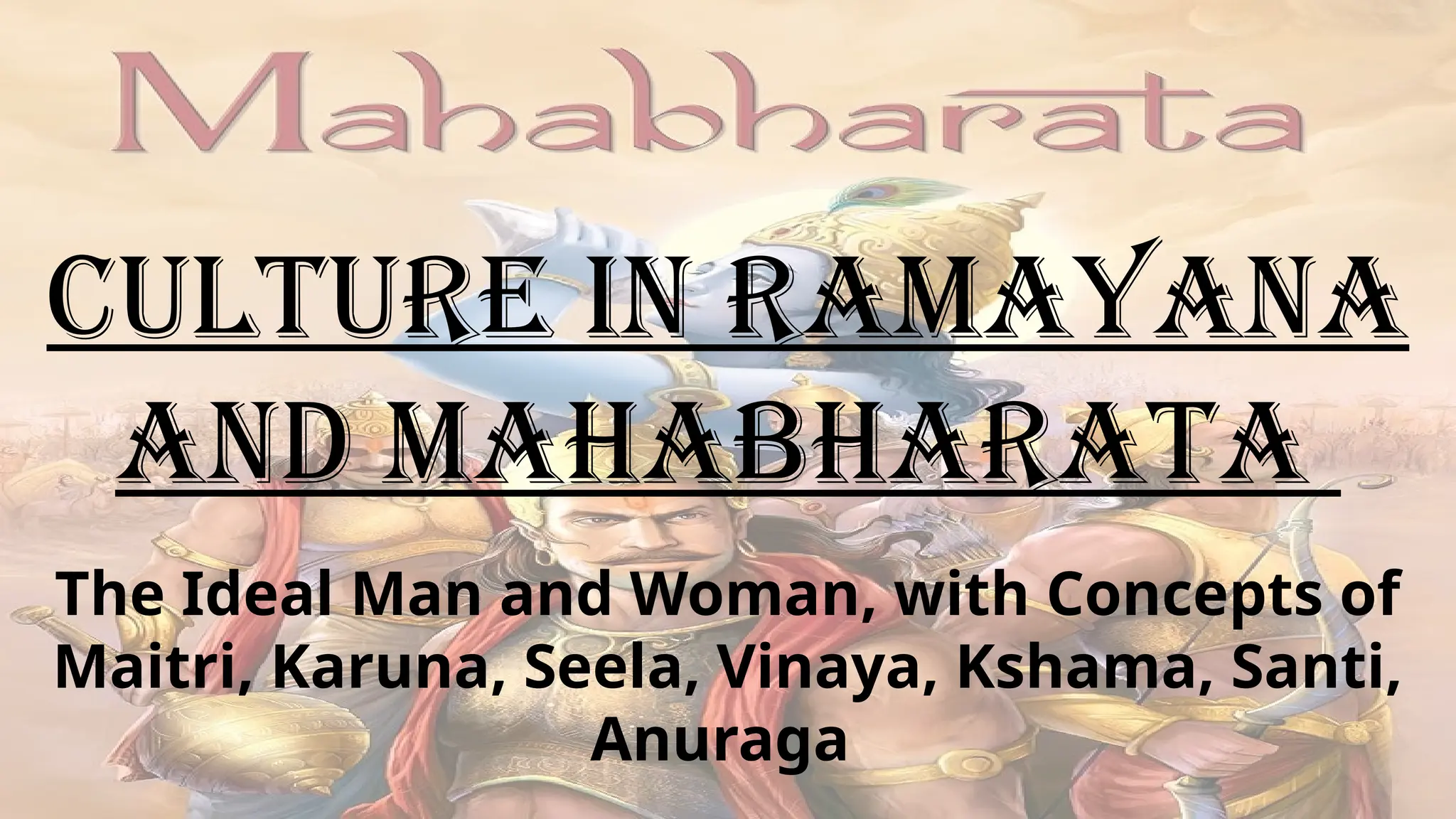
Culture in Ramayana
and Mahabharata
The Ideal Man and Woman, with Concepts of
Maitri, Karuna, Seela, Vinaya, Kshama, Santi,
Anuraga
INTRODUCTION
• The Mahabharata is one of the two major Sanskrit epics of ancient
India, the other being the Ramayana. Composed by the sage Vyasa, it’s
one of the longest epic poems in the world, with over 100,000 verses.
This grand narrative weaves together a complex tapestry of stories,
philosophy, mythology, and history.
• The Mahabharata centers on a power struggle between two sets of
cousins: the Pandavas and the Kauravas. Both groups are part of the
Kuru dynasty, but they have competing claims to the throne of
Hastinapura. The conflict leads to the great war of Kurukshetra, which
is the climax of the epic and a symbolic struggle between righteousness
(dharma) and moral corruption (adharma).
.
The Ramayana is not only a story of heroism but also explores themes of
duty, honour, devotion, and the triumph of good over evil. Its teachings
on dharma (righteousness) and moral conduct have had a profound
influence on Hindu culture and have inspired countless adaptations and
performances across Asia, making it one of the most enduring stories in
world literature.
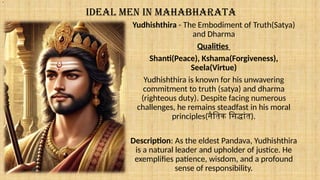
IDEAL MEN IN MAHABHARATA
Yudhishthira - The Embodiment of Truth(Satya)
and Dharma
Qualities
Shanti(Peace), Kshama(Forgiveness),
Seela(Virtue)
Yudhishthira is known for his unwavering
commitment to truth (satya) and dharma
(righteous duty). Despite facing numerous
challenges, he remains steadfast in his moral
principles(नैतिक सिद्धांत).
Description: As the eldest Pandava, Yudhishthira
is a natural leader and upholder of justice. He
exemplifies patience, wisdom, and a profound
sense of responsibility.
.
IDEAL MEN IN MAHABHARATA
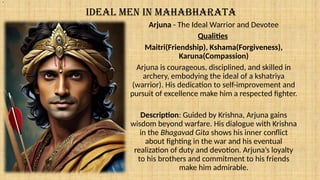
Arjuna - The Ideal Warrior and Devotee
Qualities
Maitri(Friendship), Kshama(Forgiveness),
Karuna(Compassion)
Arjuna is courageous, disciplined, and skilled in
archery, embodying the ideal of a kshatriya
(warrior). His dedication to self-improvement and
pursuit of excellence make him a respected fighter.
Description: Guided by Krishna, Arjuna gains
wisdom beyond warfare. His dialogue with Krishna
in the Bhagavad Gita shows his inner conflict
about fighting in the war and his eventual
realization of duty and devotion. Arjuna’s loyalty
to his brothers and commitment to his friends
make him admirable.
.
IDEAL MEN IN MAHABHARATA
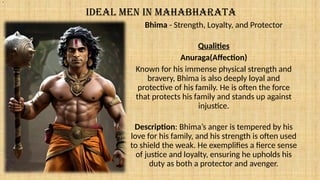
Bhima - Strength, Loyalty, and Protector
Qualities
Anuraga(Affection)
Known for his immense physical strength and
bravery, Bhima is also deeply loyal and
protective of his family. He is often the force
that protects his family and stands up against
injustice.
Description: Bhima’s anger is tempered by his
love for his family, and his strength is often used
to shield the weak. He exemplifies a fierce sense
of justice and loyalty, ensuring he upholds his
duty as both a protector and avenger.
.
IDEAL MEN IN MAHABHARATA
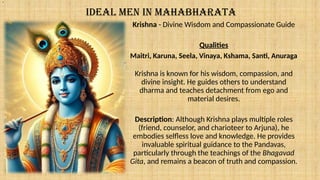
Krishna - Divine Wisdom and Compassionate Guide
Qualities
Maitri, Karuna, Seela, Vinaya, Kshama, Santi, Anuraga
Krishna is known for his wisdom, compassion, and
divine insight. He guides others to understand
dharma and teaches detachment from ego and
material desires.
Description: Although Krishna plays multiple roles
(friend, counselor, and charioteer to Arjuna), he
embodies selfless love and knowledge. He provides
invaluable spiritual guidance to the Pandavas,
particularly through the teachings of the Bhagavad
Gita, and remains a beacon of truth and compassion.
.
IDEAL MEN IN MAHABHARATA
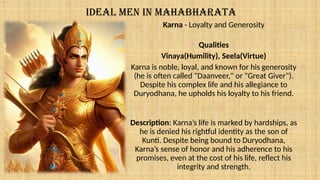
Karna - Loyalty and Generosity
Qualities
Vinaya(Humility), Seela(Virtue)
Karna is noble, loyal, and known for his generosity
(he is often called "Daanveer," or "Great Giver").
Despite his complex life and his allegiance to
Duryodhana, he upholds his loyalty to his friend.
Description: Karna’s life is marked by hardships, as
he is denied his rightful identity as the son of
Kunti. Despite being bound to Duryodhana,
Karna’s sense of honor and his adherence to his
promises, even at the cost of his life, reflect his
integrity and strength.
.
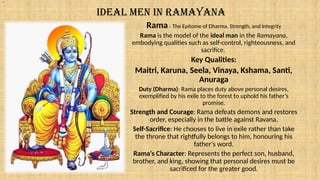
IDEAL MEN IN RAMAYANA
Rama– The Epitome of Dharma, Strength, and Integrity
Rama is the model of the ideal man in the Ramayana,
embodying qualities such as self-control, righteousness, and
sacrifice.
Key Qualities:
Maitri, Karuna, Seela, Vinaya, Kshama, Santi,
Anuraga
Duty (Dharma): Rama places duty above personal desires,
exemplified by his exile to the forest to uphold his father’s
promise.
Strength and Courage: Rama defeats demons and restores
order, especially in the battle against Ravana.
Self-Sacrifice: He chooses to live in exile rather than take
the throne that rightfully belongs to him, honouring his
father's word.
Rama's Character: Represents the perfect son, husband,
brother, and king, showing that personal desires must be
sacrificed for the greater good.
.
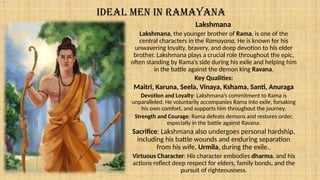
IDEAL MEN IN RAMAYANA
Lakshmana
Lakshmana, the younger brother of Rama, is one of the
central characters in the Ramayana. He is known for his
unwavering loyalty, bravery, and deep devotion to his elder
brother. Lakshmana plays a crucial role throughout the epic,
often standing by Rama’s side during his exile and helping him
in the battle against the demon king Ravana.
Key Qualities:
Maitri, Karuna, Seela, Vinaya, Kshama, Santi, Anuraga
Devotion and Loyalty: Lakshmana’s commitment to Rama is
unparalleled. He voluntarily accompanies Rama into exile, forsaking
his own comfort, and supports him throughout the journey.
Strength and Courage: Rama defeats demons and restores order,
especially in the battle against Ravana.
Sacrifice: Lakshmana also undergoes personal hardship,
including his battle wounds and enduring separation
from his wife, Urmila, during the exile..
Virtuous Character: His character embodies dharma, and his
actions reflect deep respect for elders, family bonds, and the
pursuit of righteousness.
.
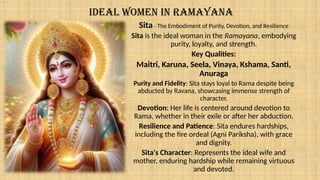
IDEAL WOMEN IN RAMAYANA
Sita– The Embodiment of Purity, Devotion, and Resilience
Sita is the ideal woman in the Ramayana, embodying
purity, loyalty, and strength.
Key Qualities:
Maitri, Karuna, Seela, Vinaya, Kshama, Santi,
Anuraga
Purity and Fidelity: Sita stays loyal to Rama despite being
abducted by Ravana, showcasing immense strength of
character.
Devotion: Her life is centered around devotion to
Rama, whether in their exile or after her abduction.
Resilience and Patience: Sita endures hardships,
including the fire ordeal (Agni Pariksha), with grace
and dignity.
Sita's Character: Represents the ideal wife and
mother, enduring hardship while remaining virtuous
and devoted.
.
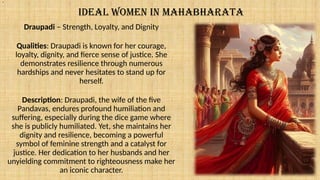
IDEAL WOMEN IN MAHABHARATA
Draupadi – Strength, Loyalty, and Dignity
Qualities: Draupadi is known for her courage,
loyalty, dignity, and fierce sense of justice. She
demonstrates resilience through numerous
hardships and never hesitates to stand up for
herself.
Description: Draupadi, the wife of the five
Pandavas, endures profound humiliation and
suffering, especially during the dice game where
she is publicly humiliated. Yet, she maintains her
dignity and resilience, becoming a powerful
symbol of feminine strength and a catalyst for
justice. Her dedication to her husbands and her
unyielding commitment to righteousness make her
an iconic character.
.
IDEAL WOMEN IN MAHABHARATA
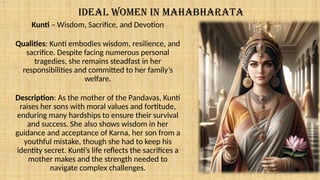
Kunti – Wisdom, Sacrifice, and Devotion
Qualities: Kunti embodies wisdom, resilience, and
sacrifice. Despite facing numerous personal
tragedies, she remains steadfast in her
responsibilities and committed to her family’s
welfare.
Description: As the mother of the Pandavas, Kunti
raises her sons with moral values and fortitude,
enduring many hardships to ensure their survival
and success. She also shows wisdom in her
guidance and acceptance of Karna, her son from a
youthful mistake, though she had to keep his
identity secret. Kunti’s life reflects the sacrifices a
mother makes and the strength needed to
navigate complex challenges.
.
CONCLUSION
• In the Mahabharata, ideals of the "ideal man" and "ideal woman" are
portrayed through characters who embody virtues like Maitri
(friendship), Karuna (compassion), Seela (character), Vinaya
(humility), Kshama (forgiveness), Santi (peace), and Anuraga
(affection). Through figures like Yudhishthira, Draupadi, and Bhishma,
the epic illustrates that living by these virtues requires complex
choices and sacrifices, especially in times of conflict.
• The Mahabharata teaches that true heroism is found not in
perfection but in striving to uphold virtues and fulfill one’s duties
(dharma) even amid challenges. It emphasizes that an ideal life
balances personal desires with ethical responsibilities, contributing to
a just and harmonious society.
.
The Ramayana embodies the core cultural values of ancient
India, such as dharma (righteousness), devotion, sacrifice, and
honour. It highlights the importance of virtues like friendship,
compassion, humility, forgiveness, and peace. Through the lives
of Rama and Sita, the epic teaches how one should live a
righteous life, uphold moral duties, and maintain harmonious
relationships. The Ramayana reflects the cultural ideals of
family loyalty, selflessness, and ethical conduct, offering
timeless lessons that continue to inspire individuals to live with
integrity and compassion in society.
Major TAKEAWAYS
• Dharma (Duty): Upholding righteousness, even in the face of
adversity.
• Consequences of Greed and Lust: The destructive power of
unchecked desire.
• Value of Friendship and Loyalty: The enduring power of true bonds.
• Power of Knowledge and Wisdom: Seeking guidance and pursuing
knowledge.
• Inevitability of Change: Embracing impermanence and adapting to
circumstances.
• Significance of Forgiveness: Letting go of resentment and choosing
peace
.
बहुत बहुत धन्यवाद

Indian value society systems SVNIT .pptx

  • 1.
    Culture in Ramayana andMahabharata The Ideal Man and Woman, with Concepts of Maitri, Karuna, Seela, Vinaya, Kshama, Santi, Anuraga
  • 2.
    INTRODUCTION • The Mahabharatais one of the two major Sanskrit epics of ancient India, the other being the Ramayana. Composed by the sage Vyasa, it’s one of the longest epic poems in the world, with over 100,000 verses. This grand narrative weaves together a complex tapestry of stories, philosophy, mythology, and history. • The Mahabharata centers on a power struggle between two sets of cousins: the Pandavas and the Kauravas. Both groups are part of the Kuru dynasty, but they have competing claims to the throne of Hastinapura. The conflict leads to the great war of Kurukshetra, which is the climax of the epic and a symbolic struggle between righteousness (dharma) and moral corruption (adharma). .
  • 3.
    The Ramayana isnot only a story of heroism but also explores themes of duty, honour, devotion, and the triumph of good over evil. Its teachings on dharma (righteousness) and moral conduct have had a profound influence on Hindu culture and have inspired countless adaptations and performances across Asia, making it one of the most enduring stories in world literature.
  • 4.
    IDEAL MEN INMAHABHARATA Yudhishthira - The Embodiment of Truth(Satya) and Dharma Qualities Shanti(Peace), Kshama(Forgiveness), Seela(Virtue) Yudhishthira is known for his unwavering commitment to truth (satya) and dharma (righteous duty). Despite facing numerous challenges, he remains steadfast in his moral principles(नैतिक सिद्धांत). Description: As the eldest Pandava, Yudhishthira is a natural leader and upholder of justice. He exemplifies patience, wisdom, and a profound sense of responsibility. .
  • 5.
    IDEAL MEN INMAHABHARATA Arjuna - The Ideal Warrior and Devotee Qualities Maitri(Friendship), Kshama(Forgiveness), Karuna(Compassion) Arjuna is courageous, disciplined, and skilled in archery, embodying the ideal of a kshatriya (warrior). His dedication to self-improvement and pursuit of excellence make him a respected fighter. Description: Guided by Krishna, Arjuna gains wisdom beyond warfare. His dialogue with Krishna in the Bhagavad Gita shows his inner conflict about fighting in the war and his eventual realization of duty and devotion. Arjuna’s loyalty to his brothers and commitment to his friends make him admirable. .
  • 6.
    IDEAL MEN INMAHABHARATA Bhima - Strength, Loyalty, and Protector Qualities Anuraga(Affection) Known for his immense physical strength and bravery, Bhima is also deeply loyal and protective of his family. He is often the force that protects his family and stands up against injustice. Description: Bhima’s anger is tempered by his love for his family, and his strength is often used to shield the weak. He exemplifies a fierce sense of justice and loyalty, ensuring he upholds his duty as both a protector and avenger. .
  • 7.
    IDEAL MEN INMAHABHARATA Krishna - Divine Wisdom and Compassionate Guide Qualities Maitri, Karuna, Seela, Vinaya, Kshama, Santi, Anuraga Krishna is known for his wisdom, compassion, and divine insight. He guides others to understand dharma and teaches detachment from ego and material desires. Description: Although Krishna plays multiple roles (friend, counselor, and charioteer to Arjuna), he embodies selfless love and knowledge. He provides invaluable spiritual guidance to the Pandavas, particularly through the teachings of the Bhagavad Gita, and remains a beacon of truth and compassion. .
  • 8.
    IDEAL MEN INMAHABHARATA Karna - Loyalty and Generosity Qualities Vinaya(Humility), Seela(Virtue) Karna is noble, loyal, and known for his generosity (he is often called "Daanveer," or "Great Giver"). Despite his complex life and his allegiance to Duryodhana, he upholds his loyalty to his friend. Description: Karna’s life is marked by hardships, as he is denied his rightful identity as the son of Kunti. Despite being bound to Duryodhana, Karna’s sense of honor and his adherence to his promises, even at the cost of his life, reflect his integrity and strength. .
  • 9.
    IDEAL MEN INRAMAYANA Rama– The Epitome of Dharma, Strength, and Integrity Rama is the model of the ideal man in the Ramayana, embodying qualities such as self-control, righteousness, and sacrifice. Key Qualities: Maitri, Karuna, Seela, Vinaya, Kshama, Santi, Anuraga Duty (Dharma): Rama places duty above personal desires, exemplified by his exile to the forest to uphold his father’s promise. Strength and Courage: Rama defeats demons and restores order, especially in the battle against Ravana. Self-Sacrifice: He chooses to live in exile rather than take the throne that rightfully belongs to him, honouring his father's word. Rama's Character: Represents the perfect son, husband, brother, and king, showing that personal desires must be sacrificed for the greater good. .
  • 10.
    IDEAL MEN INRAMAYANA Lakshmana Lakshmana, the younger brother of Rama, is one of the central characters in the Ramayana. He is known for his unwavering loyalty, bravery, and deep devotion to his elder brother. Lakshmana plays a crucial role throughout the epic, often standing by Rama’s side during his exile and helping him in the battle against the demon king Ravana. Key Qualities: Maitri, Karuna, Seela, Vinaya, Kshama, Santi, Anuraga Devotion and Loyalty: Lakshmana’s commitment to Rama is unparalleled. He voluntarily accompanies Rama into exile, forsaking his own comfort, and supports him throughout the journey. Strength and Courage: Rama defeats demons and restores order, especially in the battle against Ravana. Sacrifice: Lakshmana also undergoes personal hardship, including his battle wounds and enduring separation from his wife, Urmila, during the exile.. Virtuous Character: His character embodies dharma, and his actions reflect deep respect for elders, family bonds, and the pursuit of righteousness. .
  • 11.
    IDEAL WOMEN INRAMAYANA Sita– The Embodiment of Purity, Devotion, and Resilience Sita is the ideal woman in the Ramayana, embodying purity, loyalty, and strength. Key Qualities: Maitri, Karuna, Seela, Vinaya, Kshama, Santi, Anuraga Purity and Fidelity: Sita stays loyal to Rama despite being abducted by Ravana, showcasing immense strength of character. Devotion: Her life is centered around devotion to Rama, whether in their exile or after her abduction. Resilience and Patience: Sita endures hardships, including the fire ordeal (Agni Pariksha), with grace and dignity. Sita's Character: Represents the ideal wife and mother, enduring hardship while remaining virtuous and devoted. .
  • 12.
    IDEAL WOMEN INMAHABHARATA Draupadi – Strength, Loyalty, and Dignity Qualities: Draupadi is known for her courage, loyalty, dignity, and fierce sense of justice. She demonstrates resilience through numerous hardships and never hesitates to stand up for herself. Description: Draupadi, the wife of the five Pandavas, endures profound humiliation and suffering, especially during the dice game where she is publicly humiliated. Yet, she maintains her dignity and resilience, becoming a powerful symbol of feminine strength and a catalyst for justice. Her dedication to her husbands and her unyielding commitment to righteousness make her an iconic character. .
  • 13.
    IDEAL WOMEN INMAHABHARATA Kunti – Wisdom, Sacrifice, and Devotion Qualities: Kunti embodies wisdom, resilience, and sacrifice. Despite facing numerous personal tragedies, she remains steadfast in her responsibilities and committed to her family’s welfare. Description: As the mother of the Pandavas, Kunti raises her sons with moral values and fortitude, enduring many hardships to ensure their survival and success. She also shows wisdom in her guidance and acceptance of Karna, her son from a youthful mistake, though she had to keep his identity secret. Kunti’s life reflects the sacrifices a mother makes and the strength needed to navigate complex challenges. .
  • 14.
    CONCLUSION • In theMahabharata, ideals of the "ideal man" and "ideal woman" are portrayed through characters who embody virtues like Maitri (friendship), Karuna (compassion), Seela (character), Vinaya (humility), Kshama (forgiveness), Santi (peace), and Anuraga (affection). Through figures like Yudhishthira, Draupadi, and Bhishma, the epic illustrates that living by these virtues requires complex choices and sacrifices, especially in times of conflict. • The Mahabharata teaches that true heroism is found not in perfection but in striving to uphold virtues and fulfill one’s duties (dharma) even amid challenges. It emphasizes that an ideal life balances personal desires with ethical responsibilities, contributing to a just and harmonious society. .
  • 15.
    The Ramayana embodiesthe core cultural values of ancient India, such as dharma (righteousness), devotion, sacrifice, and honour. It highlights the importance of virtues like friendship, compassion, humility, forgiveness, and peace. Through the lives of Rama and Sita, the epic teaches how one should live a righteous life, uphold moral duties, and maintain harmonious relationships. The Ramayana reflects the cultural ideals of family loyalty, selflessness, and ethical conduct, offering timeless lessons that continue to inspire individuals to live with integrity and compassion in society.
  • 16.
    Major TAKEAWAYS • Dharma(Duty): Upholding righteousness, even in the face of adversity. • Consequences of Greed and Lust: The destructive power of unchecked desire. • Value of Friendship and Loyalty: The enduring power of true bonds. • Power of Knowledge and Wisdom: Seeking guidance and pursuing knowledge. • Inevitability of Change: Embracing impermanence and adapting to circumstances. • Significance of Forgiveness: Letting go of resentment and choosing peace .
  • 17.