Index Blocks Splitting Mechanisms in Oracle Database
1.
Oracle index Splittingmechanisms
What are solutions to handling high concurrent inserts in Oracle?
How does Oracle, internally, manage index block maintenance in this way?
What is best Approach to Overcoming this issue?
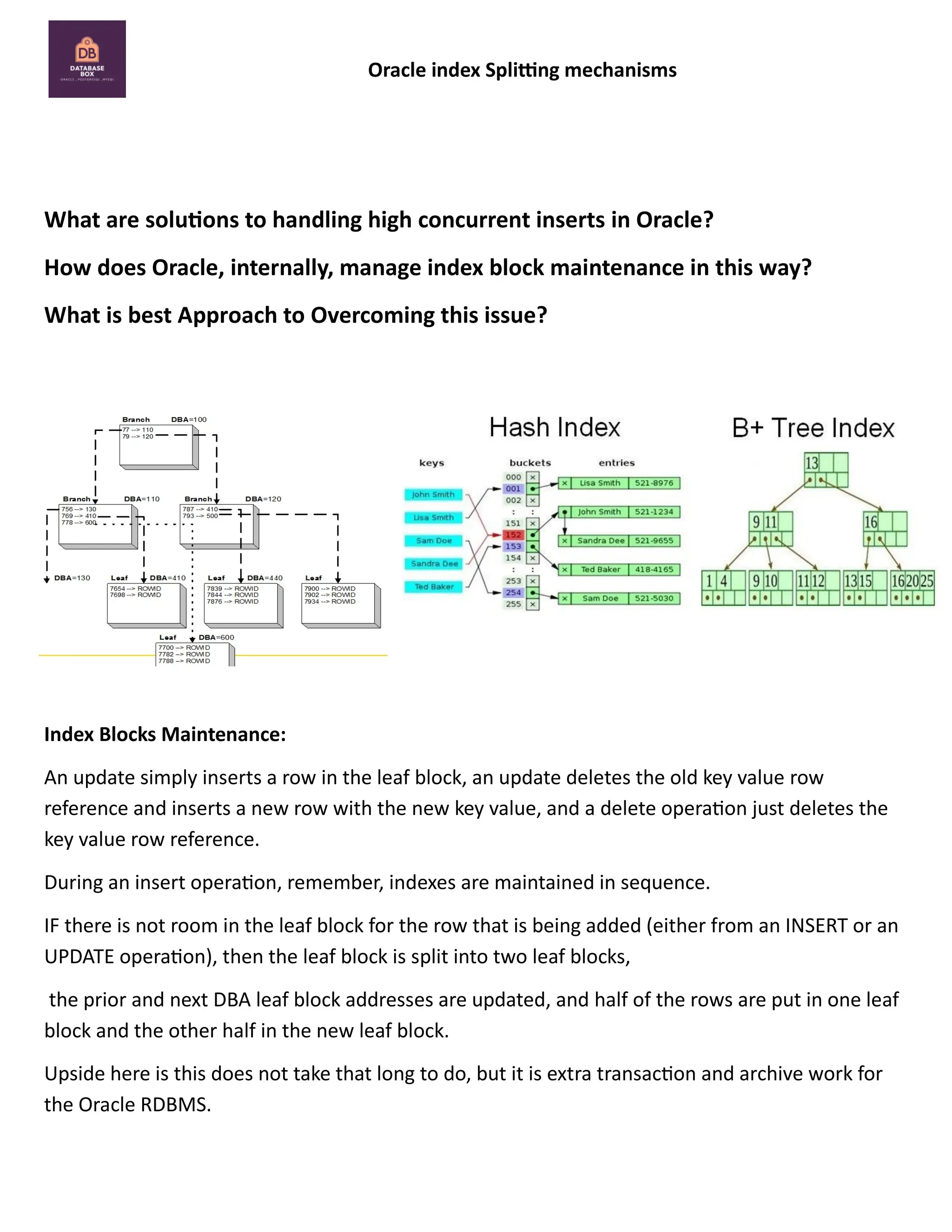
Index Blocks Maintenance:
An update simply inserts a row in the leaf block, an update deletes the old key value row
reference and inserts a new row with the new key value, and a delete operation just deletes the
key value row reference.
During an insert operation, remember, indexes are maintained in sequence.
IF there is not room in the leaf block for the row that is being added (either from an INSERT or an
UPDATE operation), then the leaf block is split into two leaf blocks,
the prior and next DBA leaf block addresses are updated, and half of the rows are put in one leaf
block and the other half in the new leaf block.
Upside here is this does not take that long to do, but it is extra transaction and archive work for
the Oracle RDBMS.
2.
Oracle index Splittingmechanisms
Downside is that these splits are generally not good for performance because it is another
physical I/O process to read both half-empty leaf blocks.
Recommend that the DBA staff reorganize indexes on tables with a lot of DML. This will realign
the index leaf blocks with the assigned PCTFREE.
Rebuilding of Indexes have some consideration and doesn’t need to rebuild all indexes in a same
fashion.
You can visit https://www.linkedin.com/feed/update/urn:li:activity:7254434622145499137 to
get more info about when we have to rebuild indexes in Oracle.
Oracle Index Splitting Mechanism:
What is Index Pre-Splitting in Oracle?
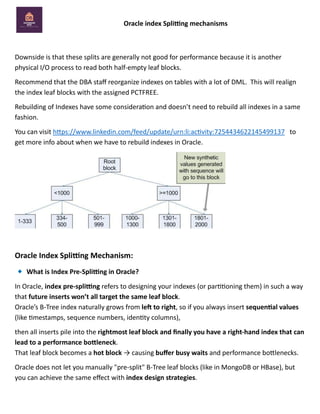
In Oracle, index pre-splitting refers to designing your indexes (or partitioning them) in such a way
that future inserts won’t all target the same leaf block.
Oracle’s B-Tree index naturally grows from left to right, so if you always insert sequential values
(like timestamps, sequence numbers, identity columns),
then all inserts pile into the rightmost leaf block and finally you have a right-hand index that can
lead to a performance bottleneck.
That leaf block becomes a hot block → causing buffer busy waits and performance bottlenecks.
Oracle does not let you manually "pre-split" B-Tree leaf blocks (like in MongoDB or HBase), but
you can achieve the same effect with index design strategies.
3.
Oracle index Splittingmechanisms
Oracle Indexing:
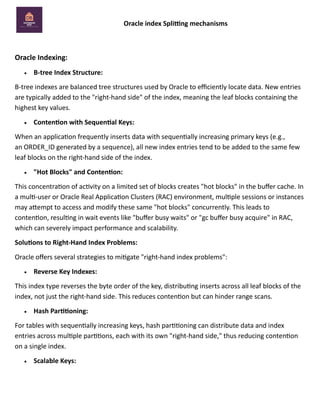
• B-tree Index Structure:
B-tree indexes are balanced tree structures used by Oracle to efficiently locate data. New entries
are typically added to the "right-hand side" of the index, meaning the leaf blocks containing the
highest key values.
• Contention with Sequential Keys:
When an application frequently inserts data with sequentially increasing primary keys (e.g.,
an ORDER_ID generated by a sequence), all new index entries tend to be added to the same few
leaf blocks on the right-hand side of the index.
• "Hot Blocks" and Contention:
This concentration of activity on a limited set of blocks creates "hot blocks" in the buffer cache. In
a multi-user or Oracle Real Application Clusters (RAC) environment, multiple sessions or instances
may attempt to access and modify these same "hot blocks" concurrently. This leads to
contention, resulting in wait events like "buffer busy waits" or "gc buffer busy acquire" in RAC,
which can severely impact performance and scalability.
Solutions to Right-Hand Index Problems:
Oracle offers several strategies to mitigate "right-hand index problems":
• Reverse Key Indexes:
This index type reverses the byte order of the key, distributing inserts across all leaf blocks of the
index, not just the right-hand side. This reduces contention but can hinder range scans.
• Hash Partitioning:
For tables with sequentially increasing keys, hash partitioning can distribute data and index
entries across multiple partitions, each with its own "right-hand side," thus reducing contention
on a single index.
• Scalable Keys:
4.
Oracle index Splittingmechanisms
Designing a primary key that does not strictly increase sequentially (e.g., incorporating a non-
sequential component like an instance ID in RAC) can also help distribute inserts more evenly or
using scalable sequences.
• Index Compression:
While not directly addressing right-hand index issues, index compression can reduce the physical
size of the index, potentially leading to fewer block splits and better buffer cache utilization.
We looking to a solution to minimize contention on high load inserts on a table and we want to
knowing how Oracle handle this issue:
One of solution called Pre-Splitting that handle in the Internal of Oracle:
Pre-Splitting Solutions in Oracle
Here are the practical techniques:
1. Reverse Key Index
o Reverses the bytes of the indexed column.
o Sequential values (1, 2, 3…) become non-sequential keys internally.
o Inserts are spread randomly across many leaf blocks instead of piling up at the right
edge.
Best when: Index is used mostly for equality searches, not range scans.
2. Hash Partitioned Index
o Instead of one big index, Oracle splits the index into multiple partitions based on a
hash of the key.
o Inserts are evenly distributed across partitions (so across many leaf blocks).
o Prevents rightmost hot block contention.
Best when: You want balanced inserts and can afford managing partitions.
5.
Oracle index Splittingmechanisms
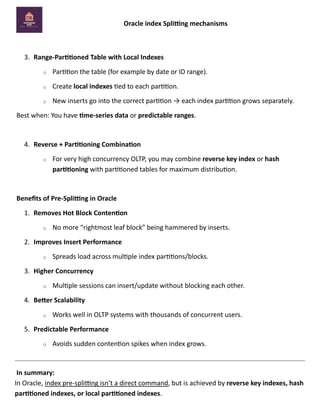
3. Range-Partitioned Table with Local Indexes
o Partition the table (for example by date or ID range).
o Create local indexes tied to each partition.
o New inserts go into the correct partition → each index partition grows separately.
Best when: You have time-series data or predictable ranges.
4. Reverse + Partitioning Combination
o For very high concurrency OLTP, you may combine reverse key index or hash
partitioning with partitioned tables for maximum distribution.
Benefits of Pre-Splitting in Oracle
1. Removes Hot Block Contention
o No more “rightmost leaf block” being hammered by inserts.
2. Improves Insert Performance
o Spreads load across multiple index partitions/blocks.
3. Higher Concurrency
o Multiple sessions can insert/update without blocking each other.
4. Better Scalability
o Works well in OLTP systems with thousands of concurrent users.
5. Predictable Performance
o Avoids sudden contention spikes when index grows.
In summary:
In Oracle, index pre-splitting isn’t a direct command, but is achieved by reverse key indexes, hash
partitioned indexes, or local partitioned indexes.
6.
Oracle index Splittingmechanisms
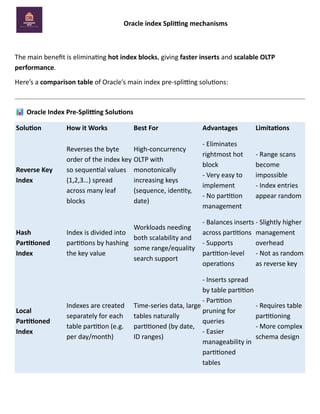
The main benefit is eliminating hot index blocks, giving faster inserts and scalable OLTP
performance.
Here’s a comparison table of Oracle’s main index pre-splitting solutions:
Oracle Index Pre-Splitting Solutions
Solution How it Works Best For Advantages Limitations
Reverse Key
Index
Reverses the byte
order of the index key
so sequential values
(1,2,3…) spread
across many leaf
blocks
High-concurrency
OLTP with
monotonically
increasing keys
(sequence, identity,
date)
- Eliminates
rightmost hot
block
- Very easy to
implement
- No partition
management
- Range scans
become
impossible
- Index entries
appear random
Hash
Partitioned
Index
Index is divided into
partitions by hashing
the key value
Workloads needing
both scalability and
some range/equality
search support
- Balances inserts
across partitions
- Supports
partition-level
operations
- Slightly higher
management
overhead
- Not as random
as reverse key
Local
Partitioned
Index
Indexes are created
separately for each
table partition (e.g.
per day/month)
Time-series data, large
tables naturally
partitioned (by date,
ID ranges)
- Inserts spread
by table partition
- Partition
pruning for
queries
- Easier
manageability in
partitioned
tables
- Requires table
partitioning
- More complex
schema design
7.
Oracle index Splittingmechanisms
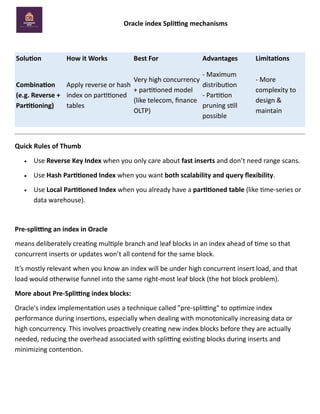
Solution How it Works Best For Advantages Limitations
Combination
(e.g. Reverse +
Partitioning)
Apply reverse or hash
index on partitioned
tables
Very high concurrency
+ partitioned model
(like telecom, finance
OLTP)
- Maximum
distribution
- Partition
pruning still
possible
- More
complexity to
design &
maintain
Quick Rules of Thumb
• Use Reverse Key Index when you only care about fast inserts and don’t need range scans.
• Use Hash Partitioned Index when you want both scalability and query flexibility.
• Use Local Partitioned Index when you already have a partitioned table (like time-series or
data warehouse).
Pre-splitting an index in Oracle
means deliberately creating multiple branch and leaf blocks in an index ahead of time so that
concurrent inserts or updates won’t all contend for the same block.
It’s mostly relevant when you know an index will be under high concurrent insert load, and that
load would otherwise funnel into the same right-most leaf block (the hot block problem).
More about Pre-Splitting index blocks:
Oracle's index implementation uses a technique called "pre-splitting" to optimize index
performance during insertions, especially when dealing with monotonically increasing data or
high concurrency. This involves proactively creating new index blocks before they are actually
needed, reducing the overhead associated with splitting existing blocks during inserts and
minimizing contention.
8.
Oracle index Splittingmechanisms
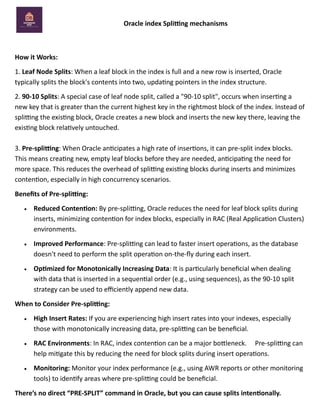
How it Works:
1. Leaf Node Splits: When a leaf block in the index is full and a new row is inserted, Oracle
typically splits the block's contents into two, updating pointers in the index structure.
2. 90-10 Splits: A special case of leaf node split, called a "90-10 split", occurs when inserting a
new key that is greater than the current highest key in the rightmost block of the index. Instead of
splitting the existing block, Oracle creates a new block and inserts the new key there, leaving the
existing block relatively untouched.
3. Pre-splitting: When Oracle anticipates a high rate of insertions, it can pre-split index blocks.
This means creating new, empty leaf blocks before they are needed, anticipating the need for
more space. This reduces the overhead of splitting existing blocks during inserts and minimizes
contention, especially in high concurrency scenarios.
Benefits of Pre-splitting:
• Reduced Contention: By pre-splitting, Oracle reduces the need for leaf block splits during
inserts, minimizing contention for index blocks, especially in RAC (Real Application Clusters)
environments.
• Improved Performance: Pre-splitting can lead to faster insert operations, as the database
doesn't need to perform the split operation on-the-fly during each insert.
• Optimized for Monotonically Increasing Data: It is particularly beneficial when dealing
with data that is inserted in a sequential order (e.g., using sequences), as the 90-10 split
strategy can be used to efficiently append new data.
When to Consider Pre-splitting:
• High Insert Rates: If you are experiencing high insert rates into your indexes, especially
those with monotonically increasing data, pre-splitting can be beneficial.
• RAC Environments: In RAC, index contention can be a major bottleneck. Pre-splitting can
help mitigate this by reducing the need for block splits during insert operations.
• Monitoring: Monitor your index performance (e.g., using AWR reports or other monitoring
tools) to identify areas where pre-splitting could be beneficial.
There’s no direct “PRE-SPLIT” command in Oracle, but you can cause splits intentionally.
9.
Oracle index Splittingmechanisms
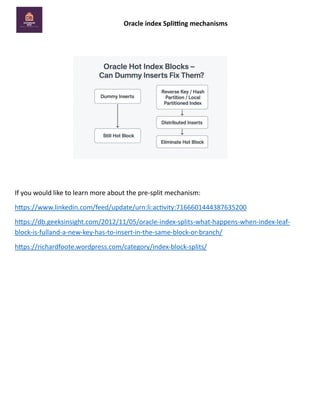
Dummy Inserts as a basic Idea (is not a normal solution)
1. Create the table and index normally.
2. Insert “dummy” rows with key values spaced apart enough to force the index to split into
multiple leaf blocks.
3. Delete the dummy rows — the leaf blocks remain in the index structure.
Example:
-- Create the table
CREATE TABLE orders (
order_id NUMBER PRIMARY KEY,
data VARCHAR2(100)
);
-- Populate to pre-split
BEGIN
FOR i IN 1 .. 100000 LOOP
INSERT INTO orders VALUES (i * 1000, 'dummy');
END LOOP;
COMMIT;
END;
/
-- Delete the dummy data
DELETE FROM orders WHERE data = 'dummy';
COMMIT;
Now the index has many pre-created leaf blocks ready for new inserts.
10.
Oracle index Splittingmechanisms
Recently I tested an old idea: “What if we insert dummy rows into a table, then delete them, to
pre-split index blocks and leave space for future inserts?”
At first glance, this sounds like it might reduce hot block contention in Oracle indexes.
So, I set up the experiment:
Create a table with a sequential primary key.
Run multiple sessions inserting rows → immediately saw buffer busy waits on the index (classic
rightmost leaf block problem).
Insert 500K “dummy” rows, then delete them (leaving free space inside the index).
Start inserting again with new IDs…
Guess what? The hot block issue did not disappear.
Why? Because Oracle’s B-Tree index grows rightward, and sequential inserts always hit the
rightmost leaf block — not the earlier freed ones.
The proof was clear in AWR/ASH:
•buffer busy waits
•enq: TX - index contention
Still present, even after dummy pre-splitting.
The Real Solutions in Oracle
If you want to eliminate hot block contention, you need proper index design:
• Reverse Key Index → spreads Inserts randomly, perfect for equality lookups.
• Hash Partitioned Index → distributes inserts across partitions.
• Local Partitioned Indexes → great for time-series and large partitioned tables.
• Adjust PCTFREE of Index or Table and review AWR report.
11.
Oracle index Splittingmechanisms
If you would like to learn more about the pre-split mechanism:
https://www.linkedin.com/feed/update/urn:li:activity:7166601444387635200
https://db.geeksinsight.com/2012/11/05/oracle-index-splits-what-happens-when-index-leaf-
block-is-fulland-a-new-key-has-to-insert-in-the-same-block-or-branch/
https://richardfoote.wordpress.com/category/index-block-splits/