IMPORTANT JUDGMENTS UNDER SARFAESI ACT, DRBT ACT & IBC
Important Judgments Under SARFAESI ACT,
DRBT ACT & IBC
on the Issue of Priority of Secured
Creditors, Sale of Secured Assets and
Jurisdiction of the Civil Courts
2
O. Konavalov vs. Commander, Coast
Guard Region and others
(2006 (4) SCC 620)
“The lien of a pawnee traceable to
Sections 172, 173 and 176 of the Contract
Act is capable of satisfaction from
property in the hands of the Government
obtained even by lawful seizure”.
Bank of Bihar v. State of Bihar –
[(1972) 3 SCC 196]
“The Pawnee has special property and a lien
which is not of ordinary nature on the goods and
so long as his claim is not satisfied no other
creditor of the pawnor has any right to take away
the goods or its price. After the goods had been
seized by the Government it was bound to pay the
amount due to the plaintiff and the balance could
have been made available to satisfy the claim of
other creditors of the pawnor. But by a mere act
of lawful seizure the Government could not
deprive the plaintiff of the amount which was
secured by the pledge of the goods to it”.
M/s. Builders Supply Corporation
v. The Union of India & Ors. [AIR
1965 SC 1061]
“In making a provision for recovery of
arrears of tax, it cannot be said
that section 46 deals with or provides for
the principal of priority of tax dues at all;
and so, it is impossible to accede to the
argument that section 46 in terms
displaces the application of the said
doctrine in the present proceedings”.
SUPREME COURT JUDGMENTS THAT HAVE HELD THAT CROWN DEBTS
(UNSECURED) HAVE NO PRIORITY OVER THE SECURED DUES OF THE SECURED
CREDITORS/ PAWNEE/ BAILEE
Union of India v. SICOM Ltd.
[(2009) 2 SCC 121]
“A bare perusal of the aforementioned
provision clearly goes to show that the
right to recover must start with the sale of
excisable goods. It is only when the dues
of the Central Excise Department are not
satisfied by sale of such excisable goods,
proceedings may be initiated to recover
the dues as land revenue”.
Rana Girders Ltd. v. Union of India
[(2012) 10 SCC 746]
“Statutory liabilities arising out of the land and
building could be in the form of property tax or other
types of cess relating to property etc. Likewise,
statutory liability arising out of the plant and
machinery could be the sales tax etc. payable on the
said machinery. As far as the dues of the Central
Excise are concerned, they were not related to the
said plant and machinery or the land and building
and thus did not arise out of those properties. Dues
of the Excise Department became payable on the
manufacturing of excisable items by the erstwhile
owner, therefore, these statutory dues are in respect
of those items produced and not the plant and
machinery which was used for the purposes of
manufacture. This fine distinction is not taken note at
all by the High Court”.
Central Bank of India v. Siriguppa
Sugurs & Chemicals Ltd.
[(2007) 8 SCC 353]
“Thus, going by the principles governing
the matter, propounded by this Court
there cannot be any doubt that the rights
of the appellant-bank over the pawned
sugar had precedence over the claims of
the Cane Commissioner and that of the
workmen”.
CONT…..
Krishna Lifestyle Technologies Ltd.
v. Union of India
[ [2008 SCC OnLine Bombay 137]
“From the above discussions, we are of the
opinion that though assets were sold, sale
of assets by itself would not be transfer of
business in whole or in part. There must be
material on record to show that the
business has been transferred to the
Petitioner and consequent thereto the
Petitioner has succeeded in said business.
Respondent Nos. 2 and 3 on the facts of
this case have not proceeded under the
proviso to Section 11 of the Central Excise
Act”.
UTI Bank Ltd. v. Dy. Commissioner
Central Excise [2006 SCC OnLine
Madras 1182 (Full Bench)]
“Since there is no specific provision claiming "first
charge" in the Central Excise Act and the Customs
Act, the claim of the Central Excise Department
cannot have precedence over the claim of secured
creditor, viz., the petitioner Bank”.
Sitani Textiles and Fabrics (Pvt.)
Ltd. v. Assistant Collector of
Customs & Central Excise [1998
SCC Online Andhra Pradesh 416]
“In the present case, the State Financial
Corporations Act, 1951 is special
enactment whereas the Central Excise
and Salt Act is a general enactment.
However, in view of Section 46-B, the
State Financial Corporation Act prevails
over the other enactments”.
CONT…..
The Court examined the
grievance of Rajasthan State
Financial Corporation in the
context of conflict between the
SFC Act and the Companies Act
“After carefully considering a plethora
of previous judgments from this Court
in the case of, it was held that a
financial corporation has the right to
proceed under Section 29 of the SFC
Act against a debtor, if it is a
company, only so long as there is no
order of winding up.
When the debtor is a company in winding up, the provisions of
Sections 529 and 529A of the Companies Act would affect the
rights of financial corporations because of a “pari passu” charge
in favor of the workmen. In respect of such dues of the workmen
the Official Liquidator has to be accepted as their representative”.
Supreme Court- Rajasthan State Financial Corporation V. Official
Liquidator Appeal (civil) 4055 of 1998
Priority of state dues over the
secured creditor
This case followed the judgment of Dena Bank Vs
Bhikhabhai Prabhudas Parekh 25.04.2000
State of M.P. & Anr. v. State Bank of Indore - (2002) 10 SCC 441
Priority of secured creditor
upheld vis-à-vis order of the Cane
Commissioner for workmen dues
A certain quantity of sugar was pledged with the
appellant bank for securing a loan of the first
respondent. The loan however was not repaid. The goods
were forcibly taken possession of at the instance of the
revenue recovery authority from the custody of the
pawnee, the appellant-bank.
The Court held that “In view of the fact that the goods were
validly pawned to the appellant bank, the rights of the appellant-
bank as pawnee cannot be affected by the orders of the Cane
Commissioner or the demands made by him or the demands
made on behalf of the workmen”.
Central Bank of India v. Siriguppa Sugars & Chemicals Ltd.
[(2007) 8 SCC 353]
Provisions of SARFAESI Act
overrides the provisions of the
Central Sales Tax Act
“Considering the language of Section 35 and the
decided case law, in our opinion it would be of no
effect, as the provisions of SARFAESI Act override the
provisions of the Central Sales Tax Act and as such the
priority given to a secured creditor would override
Crown dues or the State dues”.
Bombay High Court in Krishna Lifestyle Technologies Ltd. v. Union of
India [2008 SCC OnLine Bombay 137]
Whether realization of the duty
under the Central Excise Act will
have priority over the secured debts
in terms of the State Financial
Corporation Act, 1951?
The Court held that generally, the rights of the crown to recover
the debt would prevail over the right of a subject. Crown debt
means the debts due to the State or the king; debts which a
prerogative entitles the Crown to claim priority for before all
other creditors. [See Advanced Law Lexicon by P. Ramanatha
Aiyear (3rd Edn.) p. 1147]. Such creditors, however, must be held
to mean unsecured creditors.
Principle of Crown debt as such pertains to the common law
principle. A common law which is a law within the meaning of
Article 13 of the Constitution is saved in terms of Article 372
thereof. Those principles of common law, thus, which were
existing at the time of coming into force of the Constitution of
India, are saved by reason of the aforementioned provision. A
debt which is secured or which (by reason of the provisions of a
statute) becomes the first charge over the property (with regards
to to the plain meaning of Article 372 of the Constitution of India)
must be held to prevail over the Crown debt which is an
unsecured one.
Union of India v. SICOM Ltd. [(2009) 2 SCC 121]
Dues payable by an employer
under Section 11 of the Employees
Provident Fund and Miscellaneous
Provisions Act, 1952
This case arose in the context of dues payable by an
employer under Section 11 of the Employees Provident
Fund and Miscellaneous Provisions Act, 1952. The issue
in question was whether in granting priority, such dues
would be subject to Section 529A of the Companies Act.
The answer was in the affirmative, i.e., the Companies
Act would, in this matter hold its field as there is no
situation of conflict.
Employees Provident Fund Commissioner v. Official Liquidator -
(2011) 10 SCC 727
Banks priority upheld over Section
48 of VAT Act
It was held that the first priority over the assets shall be
of the Bank and not of the State Government by virtue of
Section 48 of the VAT Act, 2003.
Bank of Baroda v. State of Gujarat and - Ors MANU/GJ/188512019
Right of a secured creditor over
good on which security interest is
created, would have priority over all
debts and Government dues.
The Court ruled that there was no doubt that the rights of a
secured creditor to realize secured debts by sale of assets over
which security interest is created, would have priority over all
debts and Government dues. This included revenues, taxes,
cesses and rates due to the Central Government, State
Government or Local Authority. This section introduced in the
Central Act is with ''notwithstanding'' clause and has come into
force from 01.09.2016.
The Assistant Commissioner (CT), Anna Salai-III Assessment Circle v. The Indian
Overseas Bank and Ors. MANU/TN/3743/2016
Right of secured creditors to realize
secured dues will have priority over
all other debts and government
dues.
It was ruled that enforcement of Security Interest and Recovery
of Debts and Loans and Miscellaneous Provision (Amendment)
Act, 2016 came into force w.e.f. 01.09.2016. By virtue of the said
amendment, the right of secured creditors to realize secured dues
and debts dues, which are payable to secured creditors by sale of
assets over which security has been created, has priority over all
other debts and government dues including revenue, taxes, cesses
and rates due to Central Government, State Government and
local authorities.
Bank of Baroda v. Commissioner of Sales Tax, Indore and Ors.
MANU/MP/0331/20185
Income-tax dues, being in the nature
of Crown debts, do not take
precedence even over secured
creditors
It was ruled that income-tax dues, being Crown debts, do not
take precedence even over secured creditors, who are private
persons. Given Section 238 of the Insolvency and Bankruptcy
Code, 2016, the Code will override anything inconsistent
contained in any other enactment, including the Income-Tax Act.
Principal Commissioner of Income Tax v. Monnet Ispat & Energy Ltd
(2018) 18 SCC 786.
SEBI VS SARFAESI
NCLT Delhi Principal Bench ruled that the provisions
of Section 11 and 11 B of the SEBI Act read with
Regulation 65 of the SEBI (Collective Investment
Scheme) Regulations, 1999 would be directly in
conflict with Section 238 as well as Sections 14, 15,
17, 18 & 25 of the Insolvency and Bankruptcy Code,
2016.
The only one condition imposed by the Hon’ble Supreme Court
(Monnet Ispat Case) is that the code is to override anything
inconsistent by any other enactment.
Bhanu Ram and Ors. v. HBN Dairies and Allied Ltd.
MANU/ND/7107/2019
The tax dues under the Customs Act and
Central Excise Act, do not have priority of
claim over the dues of a secured creditor.
“The tax dues under the Customs Act and Central Excise Act, do
not have priority of claim over the dues of a secured creditor as
there is no specific provision either in the Central Excise Act or the
Customs Act giving those dues first charge, and that the claims of
the secured creditors will prevail over the claims of the State.
Considering the law declared by the Apex Court in the matter of
priority of state debts as already discussed and the provision of
Section 35 of SARFAESI Act we are in respectful agreement with
the view taken by the Madras High Court”.
Full Bench of the Madras High Court in UTI Bank Ltd. v. Deputy
Commissioner of C. Excise, Chennai-II
Whether in the absence of any
provisions providing for First Charge
in relation to Central Excise dues in
the Central Excise Act, 1944, the
dues of the Excise department
would have priority over the dues of
the Secured Creditors or not?
The Court ruled that the Commissioner of Customs and
Central Excise could not have invoked the powers under
Rule 173Q(2) of the Central Excise Rules, 1944 on
26.03.2007 and 29.03.2007 for confiscation of land,
buildings etc., when on such date, the said Rule 173Q(2)
was not in the Statute books, having been omitted by a
notification dated 12.05.2000.
Second, the dues of the secured creditor, i.e. the Appellant-bank,
will have priority over the dues of the Central Excise Department,
as even after insertion of Section 11E in the Central Excise Act,
1944 (w.e.f. 08.04.2011), the provisions contained in the SARFAESI
Act, 2002 will have an overriding effect on the provisions of the
Central Excise Act of 1944.
Punjab National Bank v. Union of India and Others - 2022 SCC OnLine 227
A secured creditor has the right to enforce its
security interest without the intervention of
the court or tribunal
“The aforesaid view of the Court aligns to the clear intention of
the Parliament expressed in Section 13 of the SARFAESI Act - that
a secured creditor has the right to enforce its security interest
without the intervention of the court or tribunal. In parallel, the
SARFAESI Act ensures that in case of grievance, the borrower,
which in the case of a company under liquidation would mean the
liquidator, will have the right of seeking redressal under Sections
17 and 18 of the SARFAESI Act”.
Pegasus Assets Reconstruction Private Limited v. M/s Haryana Concast Limited
and Anr. (2016) 4 SCC 47
Public money cannot be stalled else
the banking system will collapse
The HC ruled that public money cannot be stalled, else
the banking system would collapse. The said provision
has also been amended under PMLA - where the
attachment of assets can be lifted in the case of a victim
who suffers a loss because of non-returned of debts by
the borrowers.
As per the the definition in Section 2(u) of the PMLA, “proceeds
of crime” () comprises of property which is derived or obtained as
a result of criminal activity. In the present case, both the
properties were purchased by the borrowers and mortgaged with
the bank much prior to the date of alleged offence. This indicated
that no proceeds of crime are involved in the acquiring of the
property and hence the same cannot be attached.
Bank of Baroda v. The Deputy Director- Karnataka High Court PMLA Vs
SARFAESI FPA-PMLA-2115/ MUM/ 2017
On passing of stay orders by the
High Courts. Bank loan does not
become the property of the person
taking the loan, but retains its
character of public money given in a
fiduciary capacity as entrustment by
the public
The Court ruled that it is its solemn duty to apply the
correct law without waiting for an objection to be raised by
a party, especially when the law stands well settled. Any
departure, if permissible, has to be for reasons of the case
falling under a defined exception, duly discussed, after
noticing the relevant law. In financial matters, grant of ex-
parte interim orders can have a deleterious effect and it is
not sufficient to say that the aggrieved party has the
remedy to move for vacating the interim order.
Loans by financial institutions are granted from public money
generated at the tax payers expense. This loan does not become
the property of the person taking the loan, but retains its
character of public money given in a fiduciary capacity as
entrustment by the public. Timely repayment also ensures
liquidity to facilitate other loans. Circulation of money cannot be
permitted to be blocked by frivolous litigation.
Authorized Officer, State Bank of Travancore & Anr. v. Mathew K.C
(2018) 3 SCC 85
Section 26E in the SARFAESI Act and Section
31B in RDDB Act accord ‘priority’ in payment
‘over all other dues’ to a secured creditor
“With regards to the intent of the Parliament while including
Section 26E in the SARFAESI Act and Section 31B in RDDB Act,
both the provisions begin with a non-obstante clause and accord
‘priority’ in payment ‘over all other dues’ to a secured creditor in
enforcement of the security interest over all other debts and all
revenues, taxes, cesses and other rates payable to the central
government or state government or local authorities”.
Jalgaon Janta Sahakari Bank Ltd. & Anr. v. Joint Commissioner- Bombay High
Court -WP (C) 2935 of 2018
PMLA Vs SARFAESI
“If it is shown , by cogent evidence, by the bonafide third party claimant (as aforesaid), staking
interest in an alternative attachable property (or deemed tainted property) claiming that it had
acquired the same at a time anterior to the commission of the proscribed criminal activity, the
property to the extent of such interest of the third party will not be subjected to confiscation so long
as the charge or encumbrance of such third party subsists, the attachment under PMLA being valid or
operative subject to satisfaction of the charge or encumbrance of such third party and restricted to
such part of the value of the property as is in excess of the claim of the said third party.
(xv). If the bonafide third party is a claimant (as aforesaid) and is a "secured creditor", pursuing enforcement of "security
interest" in the property (secured asset) sought to be attached, and if the property is an alternative attachable property
(or deemed tainted property), having acquired such interest from person(s) accused of (or charged with) the offence of
money-laundering (or his abettor), or from any other person through such transaction (or inter-connected transactions)
as involve(s) criminal activity relating to a scheduled offence, then this third party (secured creditor) having initiated
action, in accordance with law for enforcement of such interest prior to the order of attachment under PMLA, the
directions of such attachment under PMLA shall be valid and operative subject to satisfaction of the charge or
encumbrance of such third party and restricted to such part of the value of the property as is in excess of the claim of the
said third party”.
Deputy Director Directorate of Enforcement Delhi v. Axis Bank & Ors- Delhi
High Court - 2019 SCC OnLine Del 7854
SARFAESI VS SEBI Act
The Delhi HC has held that an interpretation of Section 35 and
Section 37 of the SARFAESI Act, 2002 would reveal that the
proceedings under the SARFAESI Act, 2002 are to be treated as a
carve out to, and remain unaffected by, the orders passed under
the SEBI Act, 1992.
ICICI Bank Limited Vs DGM SEBI & Ors.
W.P.(C) 3796/2022- Decided on 21.07.2023
The Judgment has clarified the legal position under section 53 of
the Code by observing that the decision of Rainbow Papers did
not notice the ‘waterfall mechanism’ under Section 53 – the
provision had not been adverted to or extracted in the judgment.
Furthermore, Rainbow Papers (supra) was in the context of a
resolution process and not during liquidation. Section 53, as held
earlier, enacts the waterfall mechanism providing for the
hierarchy or priority of claims of various classes of creditors.
The Apex Court has emphasized that the careful design of Section
53 locates amounts payable to secured creditors and workmen at
the second place, after the costs and expenses of the liquidator
payable during the liquidation proceedings are paid. However, the
dues payable to the government are placed much below those of
secured creditors and even unsecured and operational creditors.
This design was either not brought to the notice of the court in
Rainbow Papers (supra) or was missed altogether. In any event, the
judgment has not taken note of the provisions of the IBC which
treat the dues payable to secured creditors at a higher footing than
dues payable to Central or State Government.
Paschimanchal Vidhut Vtran Nigam Ltd v. Raman Ispat Pvt Ltd Secured - Creditor
Vs Government Dues
The separate and distinct treatment of amounts payable to secured creditor on the one
hand, and dues payable to the government on the other clearly signifies Parliament’s
intention to treat the latter differently - and in the present case, having lower priority. The
Court further clarified that this intention is also evident from a reading of the preamble to
the Act itself.
Key Judgments in the context of
IBC & Its Overriding Effect
26
▪ Innoventive Industries, CIT v. Monnet Ispat & Energy
Ltd.
▪ Duncans Industries Ltd. v. AJ Agrochem
▪ Sundaresh Bhatt, Liquidator of ABG Shipyard v.
Central Board of Indirect Taxes and Customs
▪ Ghanashyam Mishra & Sons (P) Ltd. v. Edelweiss Asset
Reconstruction Co. Ltd.
JUDGMENTS IN RESPECT OF
SECTION 14 OF SARFAESI ACT
27
Do’s and Don’ts for
action under Section 14
of SARFAESI
This was a landmark judgment on a civil suit
filed by a Borrower against a
Bank/Financial Institution in relation to the
proceedings for recovery of debt by a Bank
or Financial Institution under RDB Act 1993,
Transfer of a suit from Civil Court to a Debts
Recovery Tribunal (DRT) and Parallel
Proceedings in DRT and Civil Court.
The Hon’ble Supreme Court upheld the decision of Division Bench of Bombay High Court in which the Bench listed
Do’s and Don’ts for action under Section 14 of SARFAESI. The Hon’ble Supreme Court held that the powers
exercisable by CMM/DM under Section 14 of the SARFAESI Act are a ministerial step and Section 14 does not involve
any adjudicatory process qua points raised by the borrowers against the secured creditor taking possession of the
secured assets. Against this backdrop, once all the requirements under Section 14 of the SARFAESI Act are complied
with/satisfied by the secured creditor, it is the duty cast upon the CMM/DM to assist the secured creditor in
obtaining the possession as well as the documents related to the secured assets even with the help of any officer
subordinate to him and/or with the help of an advocate appointed as Advocate Commissioner.
Balkrishna Rama Tarle Dead thr LRS & Anr
v. Phoenix ARC Pvt. Ltd. & Ors.
At that stage, the CMM/DM is not required to adjudicate the
dispute between the borrower and the secured creditor
and/or between any other third party and the secured
creditor (with respect to the secured assets). The aggrieved
party is to be relegated to raise objections in the proceedings
under Section 17 of the SARFAESI Act, before the Debts
Recovery Tribunal.
Mandatory nature of the modes of
service of sale notice
“A reading of the proviso to Rule 9(1) of the Rules makes it explicit
that the authorised officer must serve, affix and publish the notice
of sale of not less than 15 days to the borrower, for any
subsequent sale. The word 'serve' relates to personal service of
notice, affixture relates to the notice being affixed on the
property and the publication relates to the publication of notice in
the newspaper dailies. The conjunction ‘and’ employed in the
proviso also indicate the mandatory nature of all three methods
of notice. Further, in spite of the amendment to section 13(8) of
the Act, the proviso to Rule 9(1) mandates the three methods of
serve, affix and publish the notice to be carried out, with 15 days
clear notice”.
E.K. Rajan v. The Authorized Officer, Canara Bank
WP(C) No. 27485 of 2021- Kerala High Court
District Magistrate has no
jurisdiction and/or District
Magistrate and/or even the Chief
Metropolitan Magistrate has no
jurisdiction to adjudicate the dispute
between secured creditor and
debtor
“While exercising power under Section 14 of the SARFAESI Act, even the
District Magistrate has no jurisdiction and/or District Magistrate and/or
even the Chief Metropolitan Magistrate has no jurisdiction to adjudicate
the dispute between secured creditor and debtor. Under Section 14 of the
SARFAESI Act, the District Magistrate or the Chief Metropolitan Magistrate
as the case may be, is required to assist the secured creditor in getting the
possession of secured assets. Under Section 14 of the SARFAESI Act, neither
the District Magistrate nor Metropolitan Magistrate would have any
jurisdiction to adjudicate and/or decide the dispute even between the
secured creditor and the debtor.
If any person is aggrieved by the steps under Section 13(4) / order
passed under Section 14, then the aggrieved person has to
approach the Debts Recovery Tribunal by way of appeal /
application under Section 17 of the SARFAESI Act. Therefore, the
order passed by the Naib Tehsildar refusing to take the possession
pursuant to the order passed by the District Magistrate under
Section 14 of the SARFAESI Act was wholly without jurisdiction
and therefore also the same was liable to be set aside”.
Kotak Mahindra Bank Limited v. Girnar Corrugators Pvt. Ltd. &
Ors. 2023 SCC OnLine SC 15
CMM has to pass appropriate
orders for the purpose of taking
possession of the secured asset
within a period of 30 days from the
date of application, and not later
than 60 days
The Court ruled that the Chief Metropolitan Magistrate
or the District Magistrate before whom the applications
under Section 14 are filed - after satisfying the contents
of the affidavit filed by the secured creditors - has to
pass appropriate orders for the purpose of taking
possession of the secured asset within a period of 30
days from the date of application, and not later than 60
days.
Kalupur Commercial Co-operative Bank Ltd v. State of Gujarat
019 SCC Online Guj 1892
Decided on 25.02.2022
“Process under Section 14 of SARFAESI Act is a
ministerial act. It cannot brook delay. Time is of the
essence and this is the spirit of the special enactment”.
NKGSB Cooperative Bank Limited v. Subir Chakravarty & Ors.
(Civil Appeal 12 No. 1637 / 2022)
CMM/DM can appoint an
advocate in exercise of
powers under section 14(1A)
of SARFAESI Act
“It is well established that an advocate is a guardian
of constitutional morality and justice equally with
the Judge. Sub-Section (1A) of Section 14 of the
2002 Act is no impediment for the CMM/DM to
engage services of an advocate (an officer of the
court)- only for taking possession of secured assets
and documents relating thereto and to forward the
same to the secured creditor in furtherance of the
orders passed by the CMM/DM under Section 14(1)
of the 2002 Act in that regard.
If an advocate is appointed as commissioner for
execution of the orders passed by the CMM/DM
under Section 14(10 of the 2002 Act, that
responsibility and duty will be discharged
honestly and in accordance with rule of law. In
our view, in law, an advocate is an officer of the
Court and, thus, subordinate to the CMM/DM”.
NKGSB Cooperative Bank Ltd Vs Subir Chakravarty & Ors
Supreme Court
DM is not required to grant an
opportunity of hearing while
examining an application filed
by the secured creditor under
Section 14 of the Act, 2002
“As far as statutory provisions are concerned, they
clearly do not support the contention of the petitioner
that the District Magistrate should have afforded an
opportunity of hearing especially when neither any
adjudicatory functions are to be performed nor any
right inter-se the parties are to be determined by the
District Magistrate. The only remedy available with the
petitioners is to challenge the action of the bank by
filing of an application before the DRT under section 17
of the Act, 2002”.
M/s. Maa Kalika Bhandar & Ors.
v. The Collector and District Magistrate, Khordha & Ors.-
W.P.(c) No.26500 of 2021-Orissa High Court
It is necessary to read into
Rule 8(8) - that sale by private
treaty can be conducted only
after the sale by inviting
tenders from the public or by
holding public auction fails
“ It is possible that as a result of the amended Rule 8(8), the sale of secured
asset by private treaty can be conducted, even at the first instance, without
making attempts to sell the same by public auction or by inviting public
tender. Thus allowing sale by private treaty without failure of sale by
method of public auction or by inviting public tender will be violative of the
object of the said Act and said Rules of ensuring receipt of maximum
possible price by sale of the secured asset. In that case, the said amended
Rule 8(8) will become unconstitutional as unfettered and arbitrary powers
are conferred on the secured creditor/authorised officer to that extent. Said
amended Rule 8(8) is not per se unconstitutional.
If the said Rule is invoked at the first instance, then in view of absence
of public notice as public participation is denied, the same will amount
to conferring unfettered, arbitrary and excessive powers on the secured
creditor/ authorised officer resulting into destroying the object of the
said Act and said Rules. Thus to save the said amended Rule 8(8) from
unconstitutionality on the ground that unfettered and arbitrary powers
are given to secured creditors/authorised officer it is necessary to read
into said Rule 8(8) that sale by private treaty can be conducted only
after the sale by inviting tenders from the public or by holding public
auction fails”.
Mr. Prateek Pradeep Agarwal v. Union of India- Bombay High Court- WRIT
PETITION (L) NO. 5858 OF 2020
EVICTION OF TENANT FROM THE SECURED ASSETS
36
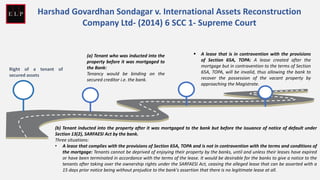
Right of a tenant of
secured assets
(a) Tenant who was inducted into the
property before it was mortgaged to
the Bank:
Tenancy would be binding on the
secured creditor i.e. the bank.
(b) Tenant inducted into the property after it was mortgaged to the bank but before the issuance of notice of default under
Section 13(2), SARFAESI Act by the bank.
Three situations:
• A lease that complies with the provisions of Section 65A, TOPA and is not in contravention with the terms and conditions of
the mortgage: Tenants cannot be deprived of enjoying their property by the banks, until and unless their leases have expired
or have been terminated in accordance with the terms of the lease. It would be desirable for the banks to give a notice to the
tenants after taking over the ownership rights under the SARFAESI Act, ceasing the alleged lease that can be asserted with a
15 days prior notice being without prejudice to the bank's assertion that there is no legitimate lease at all.
Harshad Govardhan Sondagar v. International Assets Reconstruction
Company Ltd- (2014) 6 SCC 1- Supreme Court
▪ A lease that is in contravention with the provisions
of Section 65A, TOPA: A lease created after the
mortgage but in contravention to the terms of Section
65A, TOPA, will be invalid, thus allowing the bank to
recover the possession of the vacant property by
approaching the Magistrate.
▪ A lease that is in contravention to the terms of the
mortgage, forbidding the mortgagor from creating any
leasing of the property: The banks have an option to
directly approach the Magistrate to seek recovery by
evicting the alleged tenants from the property as their
tenancies are also void. The bank need not file a suit
before the Civil court for vacating the tenants.
CONT….
(c) Tenant inducted into the property after the bank has issued a
notice of default and demands payment under Section 13(2),
SARFAESI Act:
SARFAESI Act itself prohibits any creation of encumbrance without
prior consent after a notice has been issued by the bank pursuant to
Section 13(13) of the Act. Thus, even in such situations, banks don't
need to get the tenants evicted by filing a lawsuit in a civil court, nor
can they be compelled to sell the property with such tenants in
possession. The bank can simply get the tenants evicted and recover
the possession of the vacant property by directly approaching the
magistrate.
Once tenancy is created, a
tenant can be evicted only
after following the due process
of law
“As far as granting leasehold rights being created after the
property has been mortgaged to the bank, the consent of
the creditor needs to be taken. We have already taken this
view in the case of Harshad Govardhan Sondagar (supra).
We have not stated anything to the effect that the tenancy
created after mortgaging the property must necessarily be
registered under the provisions of the Registration Act and
the Stamp Act.
It is a settled position of law that once tenancy is created, a tenant
can be evicted only after following the due process of law, as
prescribed under the provisions of the Rent Control Act. A tenant
cannot be arbitrarily evicted by using the provisions of the SARFAESI
Act as that would amount to stultifying the statutory rights of
protection given to the tenant. A non obstante clause (Section 35 of
the SARFAESI Act) cannot be used to bulldoze the statutory rights
vested on the tenants under the Rent Control Act. The expression
‘any other law for the time being in force’ as appearing in Section 35
of the SARFAESI Act cannot mean to extend to each and every law
enacted by the Central and State legislatures. It can only extend to
the laws operating in the same field”.
Vishal N Kalsaria v. Bank of India & Ors. on January 20, 2016
Rent Act would not come to the
aid of a “tenant¬-in-¬sufferance”
vis-à-vis SARFAESI Act due to the
operation of Section 13(2) read
with Section 13(13) of the
SARFAESI Act
Bajarang Shyamsunder Agarwal vs Central Bank Of India
on September 11, 2019 - CA NO. 1371 OF 2019-Supreme Court
(Arising out of SLP (CRL.) NO. 9590/2015)
Even if the tenancy had been claimed to be renewed in terms
of Section 13(13) of the SARFAESI Act, the Borrower would be
required to seek the consent of the secured creditor for
transfer of the Secured Asset by way of sale, lease or
otherwise, after issuance of the notice under Section 13(2) of
the SARFAESI Act and, admittedly, no such consent has been
sought by the Borrower.
The Court held:
“We agree with the principle laid out in Vishal N. Kalsaria Case
(supra) that the tenancy rights under the Rent Act need to be
respected in appropriate cases, however, we believe that the
holding with respect to the restricted application of the non
obstante clause under section 35 of SARFAESI Act, to only apply to
the laws operating in the same field is too narrow and such a
proposition does not follow from the ruling of this Court in
Harshad Govardhan Case (supra). In our view, the objective of
SARFAESI Act, coupled with the T.P. Act and the Rent Act are
required to be reconciled herein in the following manner.
a) If a valid tenancy under law is in existence even prior to the creation of the mortgage, the
tenant’s possession cannot be disturbed by the secured creditor by taking possession of the
property. The lease has to be determined in accordance with Section 111 of the TP Act for
determination of leases. As the existence of a prior existing lease inevitably affects the risk
undertaken by the bank while providing the loan, it is expected of Banks/Creditors to have
conducted a standard due diligence in this regard. Where the bank has proceeded to accept such a
property as mortgage, it will be presumed that it has consented to the risk that comes as a
consequence of the existing tenancy. In such a situation, the rights of a rightful tenant cannot be
compromised under the SARFAESI Act proceedings.
CONT….
b) If a tenancy under law comes into existence after
the creation of a mortgage, but prior to the issuance
of notice under Section 13(2) of the SARFAESI Act, it
has to satisfy the conditions of Section 65¬A of the
T.P. Act.
c) In any case, if any of the tenants claim that he is
entitled to possession of a secured asset for a term of
more than a year, it has to be supported by the
execution of a registered instrument. In the absence of
a registered instrument, if the tenant relies on an
unregistered instrument or an oral agreement
accompanied by delivery of possession, the tenant is
not entitled to possession of the secured asset for more
than the period prescribed under Section 107 of the T.P.
Act.
The operation of the Rent Act cannot be extended to a
“tenant-in-sufferance” vis-à-vis the SARFAESI Act, due to the
operation of Section 13(2) of the SARFAESI Act. A contrary
interpretation would violate the intention of the legislature to
provide for section 13(13), which as a valuable role in making
SARFAESI Act a self-executory instrument of debts recovery.
Moreover, such an interpretation would also violate the mandate
of section 35, SARFAESI Act which is couched in broad terms”.
CONT….
A “tenant-in-sufferance”, is
not entitled to any
protection of the Rent Act
Hemraj Ratnakar Salian Vs HDFC Bank Ltd & Ors. Criminal Appeal
No. (s).843¬844 OF 2021- Supreme Court
“Even according to the appellant, he is a “tenant-in-
sufferance”, therefore, he is not entitled to any
protection of the Rent Act. Secondly, even if the tenancy
has been claimed to be renewed in terms of section
13(13) of the SARFAESI ACT, the Borrower would be
required to seek consent of the secured creditor for
transfer of the secured assets”.
Bank has no right to
withhold the Title Deeds
especially when there is no
relationship as banker and
customer
Mr. Sunil s/o Ratnakar Gutte
v. Union Bank of India -WP No.32 OF 2022
“By invoking the provision of Section 171 of the said Act
respondent Bank has no right to withhold the Title Deeds
especially when there is no relationship between the
petitioner and the respondent as banker and customer. Said
act of the bank is not justifiable. Hence, for the reasons
recorded we have no hesitation to hold that the respondent-
Bank has no right of general lien over the Title Deeds
deposited by the petitioner after the entire loan amount was
fully satisfied by the petitioner”.
SOME RELATED JUDGMENTS IN THE
CONTEXT OF SALE UNDER SARFAESI ACT
45
If aggrieved by any of the
actions of the private
Bank/Bank/ARC, the
borrower has to avail the
remedy under the SARFAESI
Act. No writ petition is
maintainable.
“In view of the statutory remedy available under Section 17 of
the SARFAESI Act, the writ petitions against the notice under
Section 13(4) of the SARFAESI Act was not required to be
entertained by the High Court.
Even otherwise, it is required to be noted that a writ petition
against the private financial institution – ARC – appellant
herein under Article 226 of the Constitution of India against
the proposed action/actions under Section 13(4) of the
SARFAESI Act can be said to be not maintainable.
The ARC as such cannot be said to be performing public
functions which are normally expected to be performed
by the State authorities. During the course of a
commercial transaction and under the contract, the
bank/ARC lent the money to the borrowers herein and
therefore the said activity of the bank/ARC cannot be
said to be as performing a public function which is
normally expected to be performed by the State
authorities”.
Phoenix ARC Pvt. Ltd. v. Vishwa Bharati Vidya Mandir & Ors. -
Supreme Court
It is not mandatory for the
secured creditor to make an
attempt to obtain possession
on his own before
approaching the Magistrate
under section 14.
“No doubt that a secured creditor may initially
resort to the procedure under section 13(4) and
on facing resistance, he may still approach the
Magistrate under section 14. But it is not
mandatory for the secured creditor to make
attempt to obtain possession on his own before
approaching the Magistrate under section 14.
Rule 8 provides for the procedure to be followed by
secured creditor taking possession of the secured asset
without the intervention of Court. Such a process was
unknown prior to the SARFAESI Act. So, specific provision
is made under Rule 8 to ensure transparency in taking
such possession. We do not see any conflict between
different procedures prescribed by law for taking
possession of the secured asset”.
Standard Chartered Bank v. Noble Kumar & Ors. Supreme Court
No obligation on the DM to
put the defaulter borrower
on notice before passing any
order under the section 14 of
the SARFAESI Act
“The nature of powers that are exercised by the District
Magistrate under section 14 of the Act are purely executionary in
nature in taking possession of the secured assets and delivering it
to the secured creditor. At the time of passing order under section
14 of Act, the District Magistrate will have to consider only two
aspects. He must find out whether the secured assets fall within
his territorial jurisdiction and whether notice under section 13(2)
of the Act is given or not.
Section 14 of the SARFAESI Act is an enabling provision which
is non-adjudicatory provision and executory in nature. The
function of the District Magistrate under section 14 of the Act
is non-adjudicatory in nature subject to examination of factual
correctness of the assertions made in the affidavit filed.
No duty is cast upon the District Magistrate to put the
defaulter borrower on notice before passing any order under
the section 14 of the Act.”.
Adams Marketing Pvt. Ltd. & Ors. V. State Bank Of India & Anr. on
January 19, 2022- Calcutta High Court
Requirement of registration
and stamp duty on sale
certificate
M/S ESJAYPEE Impex Pvt. Ltd. v. The AGM and the Authorized Officer Canara
Bank - Petition(s) for Special Leave to Appeal (C) No(s). 24164/2019
“The mandate of law in terms of Section 17(2) (xii) read with
Section 89(4) of the Registration Act, 1908 only required the
authorized officer of the bank under the SARFAESI Act to
hand over the duly validated sale certificate to the auction
purchaser with a copy forwarded to the registering
authorities to be filed in Book I as per Section 89 of the
Registration Act”.
A certificate of sale issued by a
Civil or a Revenue Officer in
evidence of a sale conducted by
way of public auction is not
compulsorily registrable under
Registration Act, 1908
“A certificate of sale issued by a Civil or a Revenue
Officer in evidence of a sale conducted by way of
public auction is not compulsorily registrable and
Section 89(4) imposes an obligation on the
Revenue Officer, who conducts an auction sale to
forward the certificate to the Registering Authority
to enable him to file the same in Book-I
maintained by him.
Under Section 17(2)(xii) would show that a certificate of sale
issued by a Civil or a Revenue Officer in evidence of a sale
conducted by way of public auction is not compulsorily
registrable and Section 89(4) imposes an obligation on the
Revenue Officer, who conducts an auction sale to forward the
certificate to the Registering Authority to enable him to file
the same in Book-I maintained by him.”
L. Sangeetha Vs. The Sub Registrar, Pollachi
W.P. No. 25139 and W.M.P. No. 24090 of 2022 and W.P. No. 25140 of 2022
High Court of Madras
By selling the mortgaged
property/secured property it cannot
be said that the borrower is
discharged from the entire liability
outstanding against him
Bank of Baroda v. M/s Karwa Trading Company & Anr.
“By selling the mortgaged property/secured property it
cannot be said that the borrower is discharged from the
entire liability outstanding against him. The liability of the
borrower with respect to the balance outstanding dues
would still be continued. Unless and until the borrower was
ready to deposit/pay the entire amount payable together
with all costs and expenses with the secured creditor, the
borrower cannot be discharged from the entire liability
outstanding”.
JUDGMENTS ON JURISDICTION
OF CIVIL COURTS
52
Restraint on the exercise of
the power of sale will be
exercised by Courts only under
limited circumstances
“The prohibition Section 34 covers even matters which can be taken
cognizance of by the DRT though no measures in that direction were
taken under sub section (4) of Section 13. However, to a very limited
extent jurisdiction of the civil court can also be invoked, where for
example, the action of the secured creditor is alleged to be
fraudulent or their claim may be so absurd and untenable which may
not require any probe whatsoever or to say precisely to the extent
the scope is permissible to bring an action in the civil court in the
case of English mortgages.
That this restraint on the exercise of the power of sale will be
exercised by Courts only under the limited circumstances.
The secured creditor must bear in mind the say of the borrower
before such a process of recovery is initiated so as to demonstrate
that the reply of the borrower to the notice under Section 13(2) of
the Act has been considered applying mind to it. The reasons,
howsoever brief they may be, for not accepting the objections, if
raised in the reply, must be communicated to the borrower”.
Mardia Chemicals Limited & Ors.
v. Union of India & Ors. (2004) 4 SCC 311
The Supreme Court formulated the principles
applicable to the jurisdiction of the civil court in
relation to industrial disputes.
Premier Automobile Ltd. v. Kamlekar Shantaram (1976) 1 SCC 496
Proceedings under the RDB
Act will not be impeded in any
manner by filing of a separate
suit before the Civil Court
Bank of Rajasthan Ltd. vs Vck Shares And Stock Broking
on November 10, 2022, Supreme Court
“In the absence of any such power existing in the Civil Court,
an independent suit filed by the borrower against the bank
or financial institution cannot be transferred to be tried
along with application under the RDB Act, as it is a matter of
option of the defendant in the claim under the RDB Act.
However, the proceedings under the RDB Act will not be
impeded in any manner by filing of a separate suit before the
Civil Court”.
Ouster of the civil court's
jurisdiction is not to be readily
inferred
Rajasthan SRTC v. Bal Mukund Bairwa
(2009) 4 SCC 299
Ouster of the civil court's jurisdiction is not to be readily
inferred and that if there is a doubt as to whether a civil
court has jurisdiction or not, the court should proceed on
the presumption that it has jurisdiction.
Jurisdiction of the tribunal is confined to
matters which fall within its domain under
the special legislation
Standard Chartered Bank v. Dharminder Bhohi
(2013) 15 SCC 341
The Supreme Court took note of Section 34 of the
SARFAESI Act and concluded that the jurisdiction of
the tribunal is confined to matters which fall
within its domain under the special legislation.
Supreme Court categorically held that the
jurisdictional DRT should be approached in
respect of any grievance against any
measure under Section 13(4) of the
SARFAESI Act.
Jagdish Singh v. Heeralal - (2014) 1 SCC 479
Borrower can maintain a civil suit
despite a remedy being available
to file a counterclaim in an
application filed by the
bank/financial institution before
DRT
In the wake of the clear law laid down in Bank of
Rajasthan Ltd. (supra). The position of law that emerges
today is, the borrower can maintain a civil suit despite a
remedy being available to file a counterclaim in an
application fled by the bank/financial institution before
the designated forum i.e. Debt Recovery Tribunal and
the choice is ultimately of the borrower to approach the
Civil Court, if he deem it to be expedient.
Amongst the Civil Court and the arbitration proceedings,
arbitration being a chosen forum and once it is agreed
between the parties that the dispute amongst them, that
has or which may arise, shall be referred for arbitration,
the Civil Court under Section 8 of the Arbitration and
Conciliation Act, 1996 would not entertain the suit and
will relegate the parties to the process of arbitration
Mantras Green Resources Ltd. & Ors. V. Canara Bank Comm
Arbitration Application (L) No. 12570 OF 2021
Court cannot issue a
mandamus directing the
respondent banks to
restructure
This Court cannot issue a mandamus directing the
respondent banks to restructure the financial
assistance granted by them to the petitioner.
Cases Referred:
▪ Haryana Steel & Alloys Ltd. v. IFCI Ltd. &
Anr.: 137(2007) DLT 554;
▪ Chinar Fabrics and Furnishing Private
Limited and Ors. v. State Bank of India:
W.P.(C) Nos. 18753-57/2005
Amira Pure Foods Pvt Ltd v. Canara Bank & Ors.
WP (C) 8814 & CM No. 33880/2018-Delhi High Court
Commercial court under the
Commercial Courts Act is
prohibited from entertaining a suit
where the jurisdiction is vested
with DRT or DRAT
M/S. Reactive Chemicals v. Indian Overseas Bank on March 10, 2010 - Civil Suit
(Comm. Div) No.639 of 2018 - Madras High Court
On reading Section 34 of the SARFAESI Act and
Section 11 of the Commercial Courts Act conjointly,
the position that emerges is that a commercial
court or commercial division is prohibited from
entertaining a suit or proceeding in respect of
matters which the jurisdictional DRT or DRAT, as
the case may be, is empowered by the SARFAESI
Act to determine.
SOME JUDGEMENTS IN THE CONTEXT OF SICA &
JUDGEMENT PRIOR TO INSERTION OF SECTION 26E
AND 31B IN THE SARFAESI ACT & RDB ACT
62
Central Bank of India v. State of
Kerala (2009) 4 SCC 94
The Court was in complete agreement
with the Division Bench which ruled that
the statutory first charge created in
favour of the State under Section 26B of
the Kerala General Sales Tax Act, 1963
has primacy over the right of the bank to
recover its dues.
Note: This judgement is prior to
amendments in DRBT Act and SARFAESI
Act.
Madras Petrochem Ltd. v. Board for
Industrial & Financial Reconstruction &
Ors. (2016) 4 SCC 1
The Securitization and Reconstruction of Financial
Assets and Enforcement of Security Interest Act,
2002 prevails over the Sick Industrial Companies
(Special Provisions) Act, 1985 to the extent of
inconsistency therewith. Section 15(1) proviso 3
covers all references pending before the BIFR, no
matter whether such reference is at the inquiry
stage, scheme stage, or winding up stage.
KSL & Industries Ltd. v. Arihant
Threads Ltd (2015) 1 SCC 166
The provisions of SICA, in particular
Section 22, shall prevail over the
provision for the recovery of debts in
the RDDB Act.
Judgements in the Context of SICA & Judgement prior to Insertion of Section
26E and 31B in the SARFAESI Act & RDB Act
And, the reason for it is not far to seek. Section 30 of the Industrial
Finance Corporation Act, 1948 confers on the Corporation special
rights to enable it to recover its dues promptly and effectively, and
without the necessity of resorting to long drawn litigation requiring
adjudication by judicial authorities and which may harm the
interest of the Corporation, frustrate its rights, block its funds and
make it difficult for it to freely invest money.
In short, thus. Section 34 of the Recovery of Debts Due to Banks
and Financial Institutions Act, 1993 keeps intact the Industrial
Finance Corporation Act, 1948 and in no way limits, binders or
impairs the play of its provisions. This being the position, the
coming into force of the Recovery of Debts Due to Banks and
Financial Institutions Act, 1993 has no effect on the pendency of
the present proceedings. I hold accordingly.
CONT……
Recovery of Debts Due to Banks
and Financial Institutions Act,
1993 neither limits the scope nor
impairs the utility and force of
the Industrial Finance
Corporation Act, 1948
The term "in addition to", is synonymous with "also", "moreover",
"likewise", or "besides". The term, surely, cannot be construed as
meaning "in lieu of" and is rather diametrically opposed to diminution or
abatement or abridgment. In other words, what the term "in addition
to" signifies is an increase of or accession to, and thus carries out the
idea of protecting the reliefs already available under Section 30 of the
Industrial Finance Corporation Act, 1948. This, it is further fortified by the
words "and not in derogation of, the Industrial Finance Corporation Act,
1948."
(15) As we all know, the word "derogation" relates to the partial
repeal or abolishing of a law, as by a subsequent Act which limit its
scope or impairs its utility and force. In other words when we say "in
derogation of" we mean, more generally, the act of taking away, or
destroying the value or effect of anything, or of limiting its extent,
or of restraining its operation. If that be the meaning and purport of
the word "derogation", when Section 34 uses the words "and not in
derogation of the Industrial Finance Corporation Act, 1948", it is
clearly conveyed that the Recovery of Debts Due to Banks and
Financial Institutions Act, 1993 neither limits the scope nor impairs
the utility and force of the Industrial Finance Corporation Act, 1948.
Industrial Finance Corporation of India v. Allied International Products Ltd. & Ors.
(1997) 2 Comp LJ 195 (Del)
Tier 1 for several
practices in Legal
500
Band 1 Chambers
Global & Chambers
APAC
Ranked amongst the
top 10 law firms in
the country by RSG
Report
Highly Recommended
for
Competition/Antitrust:
GCR100 2023 Edition
Ranked amongst the
top 100 arbitration
firms in the world by
GAR 100 Ranked as Top Tier
Firm – ITR
Ranked as Top Tier
Firm – IFLR 1000
Award Winning
Law Firm - IBLJ
Ranked as
Outstanding Firm of
the Year 2023-
Asialaw Profiles
Ranked as Top Tier
Firm – Benchmark
Litigation APAC
Ranked as Export
Control Firm of the
Year India International
Trade Law Firm of the
Year 2023
AWARDS & RECOGNITIONS
MUMBAI
9th Floor, Mafatlal Centre
Vidhan Bhavan Marg
Nariman Point,
Mumbai 400 021
T: +91 22 6636 7000
GIFT CITY
GIFT CITY Unit No. 605,
Signature, 6th Floor Block 13B,
Zone – I GIFT SEZ,
Gandhinagar 382355
AHMEDABAD
C-507/508, 5th Floor
Titanium Square
SG Highway,
Ahmedabad – 380054
T: +91 79 6605 4480/8
PUNE
202, 2nd Floor, Vascon Eco
Tower, Baner Pashan Road
Pune 411 045
T: +91 20 4912 7400
CONTACT US
DELHI
801 A, 8th Floor, Konnectus
Tower,Bhavbhuti Marg
New Delhi 110 001
T: +91 11 4152 8400
BENGALURU
6th Floor, Rockline Centre
54, Richmond Road
Bengaluru 560 025
T: +91 80 4168 5530/1
CHENNAI
No 18, BBC Homes, Flat-7 Block
A, South Boag Road
Chennai 600 017
T: +91 44 4210 4863
elplaw@elp-in.com
elplaw.in
Economic Laws Practice
(ELP)
67

IMPORTANT JUDGMENTS UNDER SARFAESI ACT, DRBT ACT & IBC.pdf

  • 1.
    IMPORTANT JUDGMENTS UNDERSARFAESI ACT, DRBT ACT & IBC
  • 2.
    Important Judgments UnderSARFAESI ACT, DRBT ACT & IBC on the Issue of Priority of Secured Creditors, Sale of Secured Assets and Jurisdiction of the Civil Courts 2
  • 3.
    O. Konavalov vs.Commander, Coast Guard Region and others (2006 (4) SCC 620) “The lien of a pawnee traceable to Sections 172, 173 and 176 of the Contract Act is capable of satisfaction from property in the hands of the Government obtained even by lawful seizure”. Bank of Bihar v. State of Bihar – [(1972) 3 SCC 196] “The Pawnee has special property and a lien which is not of ordinary nature on the goods and so long as his claim is not satisfied no other creditor of the pawnor has any right to take away the goods or its price. After the goods had been seized by the Government it was bound to pay the amount due to the plaintiff and the balance could have been made available to satisfy the claim of other creditors of the pawnor. But by a mere act of lawful seizure the Government could not deprive the plaintiff of the amount which was secured by the pledge of the goods to it”. M/s. Builders Supply Corporation v. The Union of India & Ors. [AIR 1965 SC 1061] “In making a provision for recovery of arrears of tax, it cannot be said that section 46 deals with or provides for the principal of priority of tax dues at all; and so, it is impossible to accede to the argument that section 46 in terms displaces the application of the said doctrine in the present proceedings”. SUPREME COURT JUDGMENTS THAT HAVE HELD THAT CROWN DEBTS (UNSECURED) HAVE NO PRIORITY OVER THE SECURED DUES OF THE SECURED CREDITORS/ PAWNEE/ BAILEE
  • 4.
    Union of Indiav. SICOM Ltd. [(2009) 2 SCC 121] “A bare perusal of the aforementioned provision clearly goes to show that the right to recover must start with the sale of excisable goods. It is only when the dues of the Central Excise Department are not satisfied by sale of such excisable goods, proceedings may be initiated to recover the dues as land revenue”. Rana Girders Ltd. v. Union of India [(2012) 10 SCC 746] “Statutory liabilities arising out of the land and building could be in the form of property tax or other types of cess relating to property etc. Likewise, statutory liability arising out of the plant and machinery could be the sales tax etc. payable on the said machinery. As far as the dues of the Central Excise are concerned, they were not related to the said plant and machinery or the land and building and thus did not arise out of those properties. Dues of the Excise Department became payable on the manufacturing of excisable items by the erstwhile owner, therefore, these statutory dues are in respect of those items produced and not the plant and machinery which was used for the purposes of manufacture. This fine distinction is not taken note at all by the High Court”. Central Bank of India v. Siriguppa Sugurs & Chemicals Ltd. [(2007) 8 SCC 353] “Thus, going by the principles governing the matter, propounded by this Court there cannot be any doubt that the rights of the appellant-bank over the pawned sugar had precedence over the claims of the Cane Commissioner and that of the workmen”. CONT…..
  • 5.
    Krishna Lifestyle TechnologiesLtd. v. Union of India [ [2008 SCC OnLine Bombay 137] “From the above discussions, we are of the opinion that though assets were sold, sale of assets by itself would not be transfer of business in whole or in part. There must be material on record to show that the business has been transferred to the Petitioner and consequent thereto the Petitioner has succeeded in said business. Respondent Nos. 2 and 3 on the facts of this case have not proceeded under the proviso to Section 11 of the Central Excise Act”. UTI Bank Ltd. v. Dy. Commissioner Central Excise [2006 SCC OnLine Madras 1182 (Full Bench)] “Since there is no specific provision claiming "first charge" in the Central Excise Act and the Customs Act, the claim of the Central Excise Department cannot have precedence over the claim of secured creditor, viz., the petitioner Bank”. Sitani Textiles and Fabrics (Pvt.) Ltd. v. Assistant Collector of Customs & Central Excise [1998 SCC Online Andhra Pradesh 416] “In the present case, the State Financial Corporations Act, 1951 is special enactment whereas the Central Excise and Salt Act is a general enactment. However, in view of Section 46-B, the State Financial Corporation Act prevails over the other enactments”. CONT…..
  • 6.
    The Court examinedthe grievance of Rajasthan State Financial Corporation in the context of conflict between the SFC Act and the Companies Act “After carefully considering a plethora of previous judgments from this Court in the case of, it was held that a financial corporation has the right to proceed under Section 29 of the SFC Act against a debtor, if it is a company, only so long as there is no order of winding up. When the debtor is a company in winding up, the provisions of Sections 529 and 529A of the Companies Act would affect the rights of financial corporations because of a “pari passu” charge in favor of the workmen. In respect of such dues of the workmen the Official Liquidator has to be accepted as their representative”. Supreme Court- Rajasthan State Financial Corporation V. Official Liquidator Appeal (civil) 4055 of 1998
  • 7.
    Priority of statedues over the secured creditor This case followed the judgment of Dena Bank Vs Bhikhabhai Prabhudas Parekh 25.04.2000 State of M.P. & Anr. v. State Bank of Indore - (2002) 10 SCC 441
  • 8.
    Priority of securedcreditor upheld vis-à-vis order of the Cane Commissioner for workmen dues A certain quantity of sugar was pledged with the appellant bank for securing a loan of the first respondent. The loan however was not repaid. The goods were forcibly taken possession of at the instance of the revenue recovery authority from the custody of the pawnee, the appellant-bank. The Court held that “In view of the fact that the goods were validly pawned to the appellant bank, the rights of the appellant- bank as pawnee cannot be affected by the orders of the Cane Commissioner or the demands made by him or the demands made on behalf of the workmen”. Central Bank of India v. Siriguppa Sugars & Chemicals Ltd. [(2007) 8 SCC 353]
  • 9.
    Provisions of SARFAESIAct overrides the provisions of the Central Sales Tax Act “Considering the language of Section 35 and the decided case law, in our opinion it would be of no effect, as the provisions of SARFAESI Act override the provisions of the Central Sales Tax Act and as such the priority given to a secured creditor would override Crown dues or the State dues”. Bombay High Court in Krishna Lifestyle Technologies Ltd. v. Union of India [2008 SCC OnLine Bombay 137]
  • 10.
    Whether realization ofthe duty under the Central Excise Act will have priority over the secured debts in terms of the State Financial Corporation Act, 1951? The Court held that generally, the rights of the crown to recover the debt would prevail over the right of a subject. Crown debt means the debts due to the State or the king; debts which a prerogative entitles the Crown to claim priority for before all other creditors. [See Advanced Law Lexicon by P. Ramanatha Aiyear (3rd Edn.) p. 1147]. Such creditors, however, must be held to mean unsecured creditors. Principle of Crown debt as such pertains to the common law principle. A common law which is a law within the meaning of Article 13 of the Constitution is saved in terms of Article 372 thereof. Those principles of common law, thus, which were existing at the time of coming into force of the Constitution of India, are saved by reason of the aforementioned provision. A debt which is secured or which (by reason of the provisions of a statute) becomes the first charge over the property (with regards to to the plain meaning of Article 372 of the Constitution of India) must be held to prevail over the Crown debt which is an unsecured one. Union of India v. SICOM Ltd. [(2009) 2 SCC 121]
  • 11.
    Dues payable byan employer under Section 11 of the Employees Provident Fund and Miscellaneous Provisions Act, 1952 This case arose in the context of dues payable by an employer under Section 11 of the Employees Provident Fund and Miscellaneous Provisions Act, 1952. The issue in question was whether in granting priority, such dues would be subject to Section 529A of the Companies Act. The answer was in the affirmative, i.e., the Companies Act would, in this matter hold its field as there is no situation of conflict. Employees Provident Fund Commissioner v. Official Liquidator - (2011) 10 SCC 727
  • 12.
    Banks priority upheldover Section 48 of VAT Act It was held that the first priority over the assets shall be of the Bank and not of the State Government by virtue of Section 48 of the VAT Act, 2003. Bank of Baroda v. State of Gujarat and - Ors MANU/GJ/188512019
  • 13.
    Right of asecured creditor over good on which security interest is created, would have priority over all debts and Government dues. The Court ruled that there was no doubt that the rights of a secured creditor to realize secured debts by sale of assets over which security interest is created, would have priority over all debts and Government dues. This included revenues, taxes, cesses and rates due to the Central Government, State Government or Local Authority. This section introduced in the Central Act is with ''notwithstanding'' clause and has come into force from 01.09.2016. The Assistant Commissioner (CT), Anna Salai-III Assessment Circle v. The Indian Overseas Bank and Ors. MANU/TN/3743/2016
  • 14.
    Right of securedcreditors to realize secured dues will have priority over all other debts and government dues. It was ruled that enforcement of Security Interest and Recovery of Debts and Loans and Miscellaneous Provision (Amendment) Act, 2016 came into force w.e.f. 01.09.2016. By virtue of the said amendment, the right of secured creditors to realize secured dues and debts dues, which are payable to secured creditors by sale of assets over which security has been created, has priority over all other debts and government dues including revenue, taxes, cesses and rates due to Central Government, State Government and local authorities. Bank of Baroda v. Commissioner of Sales Tax, Indore and Ors. MANU/MP/0331/20185
  • 15.
    Income-tax dues, beingin the nature of Crown debts, do not take precedence even over secured creditors It was ruled that income-tax dues, being Crown debts, do not take precedence even over secured creditors, who are private persons. Given Section 238 of the Insolvency and Bankruptcy Code, 2016, the Code will override anything inconsistent contained in any other enactment, including the Income-Tax Act. Principal Commissioner of Income Tax v. Monnet Ispat & Energy Ltd (2018) 18 SCC 786.
  • 16.
    SEBI VS SARFAESI NCLTDelhi Principal Bench ruled that the provisions of Section 11 and 11 B of the SEBI Act read with Regulation 65 of the SEBI (Collective Investment Scheme) Regulations, 1999 would be directly in conflict with Section 238 as well as Sections 14, 15, 17, 18 & 25 of the Insolvency and Bankruptcy Code, 2016. The only one condition imposed by the Hon’ble Supreme Court (Monnet Ispat Case) is that the code is to override anything inconsistent by any other enactment. Bhanu Ram and Ors. v. HBN Dairies and Allied Ltd. MANU/ND/7107/2019
  • 17.
    The tax duesunder the Customs Act and Central Excise Act, do not have priority of claim over the dues of a secured creditor. “The tax dues under the Customs Act and Central Excise Act, do not have priority of claim over the dues of a secured creditor as there is no specific provision either in the Central Excise Act or the Customs Act giving those dues first charge, and that the claims of the secured creditors will prevail over the claims of the State. Considering the law declared by the Apex Court in the matter of priority of state debts as already discussed and the provision of Section 35 of SARFAESI Act we are in respectful agreement with the view taken by the Madras High Court”. Full Bench of the Madras High Court in UTI Bank Ltd. v. Deputy Commissioner of C. Excise, Chennai-II
  • 18.
    Whether in theabsence of any provisions providing for First Charge in relation to Central Excise dues in the Central Excise Act, 1944, the dues of the Excise department would have priority over the dues of the Secured Creditors or not? The Court ruled that the Commissioner of Customs and Central Excise could not have invoked the powers under Rule 173Q(2) of the Central Excise Rules, 1944 on 26.03.2007 and 29.03.2007 for confiscation of land, buildings etc., when on such date, the said Rule 173Q(2) was not in the Statute books, having been omitted by a notification dated 12.05.2000. Second, the dues of the secured creditor, i.e. the Appellant-bank, will have priority over the dues of the Central Excise Department, as even after insertion of Section 11E in the Central Excise Act, 1944 (w.e.f. 08.04.2011), the provisions contained in the SARFAESI Act, 2002 will have an overriding effect on the provisions of the Central Excise Act of 1944. Punjab National Bank v. Union of India and Others - 2022 SCC OnLine 227
  • 19.
    A secured creditorhas the right to enforce its security interest without the intervention of the court or tribunal “The aforesaid view of the Court aligns to the clear intention of the Parliament expressed in Section 13 of the SARFAESI Act - that a secured creditor has the right to enforce its security interest without the intervention of the court or tribunal. In parallel, the SARFAESI Act ensures that in case of grievance, the borrower, which in the case of a company under liquidation would mean the liquidator, will have the right of seeking redressal under Sections 17 and 18 of the SARFAESI Act”. Pegasus Assets Reconstruction Private Limited v. M/s Haryana Concast Limited and Anr. (2016) 4 SCC 47
  • 20.
    Public money cannotbe stalled else the banking system will collapse The HC ruled that public money cannot be stalled, else the banking system would collapse. The said provision has also been amended under PMLA - where the attachment of assets can be lifted in the case of a victim who suffers a loss because of non-returned of debts by the borrowers. As per the the definition in Section 2(u) of the PMLA, “proceeds of crime” () comprises of property which is derived or obtained as a result of criminal activity. In the present case, both the properties were purchased by the borrowers and mortgaged with the bank much prior to the date of alleged offence. This indicated that no proceeds of crime are involved in the acquiring of the property and hence the same cannot be attached. Bank of Baroda v. The Deputy Director- Karnataka High Court PMLA Vs SARFAESI FPA-PMLA-2115/ MUM/ 2017
  • 21.
    On passing ofstay orders by the High Courts. Bank loan does not become the property of the person taking the loan, but retains its character of public money given in a fiduciary capacity as entrustment by the public The Court ruled that it is its solemn duty to apply the correct law without waiting for an objection to be raised by a party, especially when the law stands well settled. Any departure, if permissible, has to be for reasons of the case falling under a defined exception, duly discussed, after noticing the relevant law. In financial matters, grant of ex- parte interim orders can have a deleterious effect and it is not sufficient to say that the aggrieved party has the remedy to move for vacating the interim order. Loans by financial institutions are granted from public money generated at the tax payers expense. This loan does not become the property of the person taking the loan, but retains its character of public money given in a fiduciary capacity as entrustment by the public. Timely repayment also ensures liquidity to facilitate other loans. Circulation of money cannot be permitted to be blocked by frivolous litigation. Authorized Officer, State Bank of Travancore & Anr. v. Mathew K.C (2018) 3 SCC 85
  • 22.
    Section 26E inthe SARFAESI Act and Section 31B in RDDB Act accord ‘priority’ in payment ‘over all other dues’ to a secured creditor “With regards to the intent of the Parliament while including Section 26E in the SARFAESI Act and Section 31B in RDDB Act, both the provisions begin with a non-obstante clause and accord ‘priority’ in payment ‘over all other dues’ to a secured creditor in enforcement of the security interest over all other debts and all revenues, taxes, cesses and other rates payable to the central government or state government or local authorities”. Jalgaon Janta Sahakari Bank Ltd. & Anr. v. Joint Commissioner- Bombay High Court -WP (C) 2935 of 2018
  • 23.
    PMLA Vs SARFAESI “Ifit is shown , by cogent evidence, by the bonafide third party claimant (as aforesaid), staking interest in an alternative attachable property (or deemed tainted property) claiming that it had acquired the same at a time anterior to the commission of the proscribed criminal activity, the property to the extent of such interest of the third party will not be subjected to confiscation so long as the charge or encumbrance of such third party subsists, the attachment under PMLA being valid or operative subject to satisfaction of the charge or encumbrance of such third party and restricted to such part of the value of the property as is in excess of the claim of the said third party. (xv). If the bonafide third party is a claimant (as aforesaid) and is a "secured creditor", pursuing enforcement of "security interest" in the property (secured asset) sought to be attached, and if the property is an alternative attachable property (or deemed tainted property), having acquired such interest from person(s) accused of (or charged with) the offence of money-laundering (or his abettor), or from any other person through such transaction (or inter-connected transactions) as involve(s) criminal activity relating to a scheduled offence, then this third party (secured creditor) having initiated action, in accordance with law for enforcement of such interest prior to the order of attachment under PMLA, the directions of such attachment under PMLA shall be valid and operative subject to satisfaction of the charge or encumbrance of such third party and restricted to such part of the value of the property as is in excess of the claim of the said third party”. Deputy Director Directorate of Enforcement Delhi v. Axis Bank & Ors- Delhi High Court - 2019 SCC OnLine Del 7854
  • 24.
    SARFAESI VS SEBIAct The Delhi HC has held that an interpretation of Section 35 and Section 37 of the SARFAESI Act, 2002 would reveal that the proceedings under the SARFAESI Act, 2002 are to be treated as a carve out to, and remain unaffected by, the orders passed under the SEBI Act, 1992. ICICI Bank Limited Vs DGM SEBI & Ors. W.P.(C) 3796/2022- Decided on 21.07.2023
  • 25.
    The Judgment hasclarified the legal position under section 53 of the Code by observing that the decision of Rainbow Papers did not notice the ‘waterfall mechanism’ under Section 53 – the provision had not been adverted to or extracted in the judgment. Furthermore, Rainbow Papers (supra) was in the context of a resolution process and not during liquidation. Section 53, as held earlier, enacts the waterfall mechanism providing for the hierarchy or priority of claims of various classes of creditors. The Apex Court has emphasized that the careful design of Section 53 locates amounts payable to secured creditors and workmen at the second place, after the costs and expenses of the liquidator payable during the liquidation proceedings are paid. However, the dues payable to the government are placed much below those of secured creditors and even unsecured and operational creditors. This design was either not brought to the notice of the court in Rainbow Papers (supra) or was missed altogether. In any event, the judgment has not taken note of the provisions of the IBC which treat the dues payable to secured creditors at a higher footing than dues payable to Central or State Government. Paschimanchal Vidhut Vtran Nigam Ltd v. Raman Ispat Pvt Ltd Secured - Creditor Vs Government Dues The separate and distinct treatment of amounts payable to secured creditor on the one hand, and dues payable to the government on the other clearly signifies Parliament’s intention to treat the latter differently - and in the present case, having lower priority. The Court further clarified that this intention is also evident from a reading of the preamble to the Act itself.
  • 26.
    Key Judgments inthe context of IBC & Its Overriding Effect 26 ▪ Innoventive Industries, CIT v. Monnet Ispat & Energy Ltd. ▪ Duncans Industries Ltd. v. AJ Agrochem ▪ Sundaresh Bhatt, Liquidator of ABG Shipyard v. Central Board of Indirect Taxes and Customs ▪ Ghanashyam Mishra & Sons (P) Ltd. v. Edelweiss Asset Reconstruction Co. Ltd.
  • 27.
    JUDGMENTS IN RESPECTOF SECTION 14 OF SARFAESI ACT 27
  • 28.
    Do’s and Don’tsfor action under Section 14 of SARFAESI This was a landmark judgment on a civil suit filed by a Borrower against a Bank/Financial Institution in relation to the proceedings for recovery of debt by a Bank or Financial Institution under RDB Act 1993, Transfer of a suit from Civil Court to a Debts Recovery Tribunal (DRT) and Parallel Proceedings in DRT and Civil Court. The Hon’ble Supreme Court upheld the decision of Division Bench of Bombay High Court in which the Bench listed Do’s and Don’ts for action under Section 14 of SARFAESI. The Hon’ble Supreme Court held that the powers exercisable by CMM/DM under Section 14 of the SARFAESI Act are a ministerial step and Section 14 does not involve any adjudicatory process qua points raised by the borrowers against the secured creditor taking possession of the secured assets. Against this backdrop, once all the requirements under Section 14 of the SARFAESI Act are complied with/satisfied by the secured creditor, it is the duty cast upon the CMM/DM to assist the secured creditor in obtaining the possession as well as the documents related to the secured assets even with the help of any officer subordinate to him and/or with the help of an advocate appointed as Advocate Commissioner. Balkrishna Rama Tarle Dead thr LRS & Anr v. Phoenix ARC Pvt. Ltd. & Ors. At that stage, the CMM/DM is not required to adjudicate the dispute between the borrower and the secured creditor and/or between any other third party and the secured creditor (with respect to the secured assets). The aggrieved party is to be relegated to raise objections in the proceedings under Section 17 of the SARFAESI Act, before the Debts Recovery Tribunal.
  • 29.
    Mandatory nature ofthe modes of service of sale notice “A reading of the proviso to Rule 9(1) of the Rules makes it explicit that the authorised officer must serve, affix and publish the notice of sale of not less than 15 days to the borrower, for any subsequent sale. The word 'serve' relates to personal service of notice, affixture relates to the notice being affixed on the property and the publication relates to the publication of notice in the newspaper dailies. The conjunction ‘and’ employed in the proviso also indicate the mandatory nature of all three methods of notice. Further, in spite of the amendment to section 13(8) of the Act, the proviso to Rule 9(1) mandates the three methods of serve, affix and publish the notice to be carried out, with 15 days clear notice”. E.K. Rajan v. The Authorized Officer, Canara Bank WP(C) No. 27485 of 2021- Kerala High Court
  • 30.
    District Magistrate hasno jurisdiction and/or District Magistrate and/or even the Chief Metropolitan Magistrate has no jurisdiction to adjudicate the dispute between secured creditor and debtor “While exercising power under Section 14 of the SARFAESI Act, even the District Magistrate has no jurisdiction and/or District Magistrate and/or even the Chief Metropolitan Magistrate has no jurisdiction to adjudicate the dispute between secured creditor and debtor. Under Section 14 of the SARFAESI Act, the District Magistrate or the Chief Metropolitan Magistrate as the case may be, is required to assist the secured creditor in getting the possession of secured assets. Under Section 14 of the SARFAESI Act, neither the District Magistrate nor Metropolitan Magistrate would have any jurisdiction to adjudicate and/or decide the dispute even between the secured creditor and the debtor. If any person is aggrieved by the steps under Section 13(4) / order passed under Section 14, then the aggrieved person has to approach the Debts Recovery Tribunal by way of appeal / application under Section 17 of the SARFAESI Act. Therefore, the order passed by the Naib Tehsildar refusing to take the possession pursuant to the order passed by the District Magistrate under Section 14 of the SARFAESI Act was wholly without jurisdiction and therefore also the same was liable to be set aside”. Kotak Mahindra Bank Limited v. Girnar Corrugators Pvt. Ltd. & Ors. 2023 SCC OnLine SC 15
  • 31.
    CMM has topass appropriate orders for the purpose of taking possession of the secured asset within a period of 30 days from the date of application, and not later than 60 days The Court ruled that the Chief Metropolitan Magistrate or the District Magistrate before whom the applications under Section 14 are filed - after satisfying the contents of the affidavit filed by the secured creditors - has to pass appropriate orders for the purpose of taking possession of the secured asset within a period of 30 days from the date of application, and not later than 60 days. Kalupur Commercial Co-operative Bank Ltd v. State of Gujarat 019 SCC Online Guj 1892
  • 32.
    Decided on 25.02.2022 “Processunder Section 14 of SARFAESI Act is a ministerial act. It cannot brook delay. Time is of the essence and this is the spirit of the special enactment”. NKGSB Cooperative Bank Limited v. Subir Chakravarty & Ors. (Civil Appeal 12 No. 1637 / 2022)
  • 33.
    CMM/DM can appointan advocate in exercise of powers under section 14(1A) of SARFAESI Act “It is well established that an advocate is a guardian of constitutional morality and justice equally with the Judge. Sub-Section (1A) of Section 14 of the 2002 Act is no impediment for the CMM/DM to engage services of an advocate (an officer of the court)- only for taking possession of secured assets and documents relating thereto and to forward the same to the secured creditor in furtherance of the orders passed by the CMM/DM under Section 14(1) of the 2002 Act in that regard. If an advocate is appointed as commissioner for execution of the orders passed by the CMM/DM under Section 14(10 of the 2002 Act, that responsibility and duty will be discharged honestly and in accordance with rule of law. In our view, in law, an advocate is an officer of the Court and, thus, subordinate to the CMM/DM”. NKGSB Cooperative Bank Ltd Vs Subir Chakravarty & Ors Supreme Court
  • 34.
    DM is notrequired to grant an opportunity of hearing while examining an application filed by the secured creditor under Section 14 of the Act, 2002 “As far as statutory provisions are concerned, they clearly do not support the contention of the petitioner that the District Magistrate should have afforded an opportunity of hearing especially when neither any adjudicatory functions are to be performed nor any right inter-se the parties are to be determined by the District Magistrate. The only remedy available with the petitioners is to challenge the action of the bank by filing of an application before the DRT under section 17 of the Act, 2002”. M/s. Maa Kalika Bhandar & Ors. v. The Collector and District Magistrate, Khordha & Ors.- W.P.(c) No.26500 of 2021-Orissa High Court
  • 35.
    It is necessaryto read into Rule 8(8) - that sale by private treaty can be conducted only after the sale by inviting tenders from the public or by holding public auction fails “ It is possible that as a result of the amended Rule 8(8), the sale of secured asset by private treaty can be conducted, even at the first instance, without making attempts to sell the same by public auction or by inviting public tender. Thus allowing sale by private treaty without failure of sale by method of public auction or by inviting public tender will be violative of the object of the said Act and said Rules of ensuring receipt of maximum possible price by sale of the secured asset. In that case, the said amended Rule 8(8) will become unconstitutional as unfettered and arbitrary powers are conferred on the secured creditor/authorised officer to that extent. Said amended Rule 8(8) is not per se unconstitutional. If the said Rule is invoked at the first instance, then in view of absence of public notice as public participation is denied, the same will amount to conferring unfettered, arbitrary and excessive powers on the secured creditor/ authorised officer resulting into destroying the object of the said Act and said Rules. Thus to save the said amended Rule 8(8) from unconstitutionality on the ground that unfettered and arbitrary powers are given to secured creditors/authorised officer it is necessary to read into said Rule 8(8) that sale by private treaty can be conducted only after the sale by inviting tenders from the public or by holding public auction fails”. Mr. Prateek Pradeep Agarwal v. Union of India- Bombay High Court- WRIT PETITION (L) NO. 5858 OF 2020
  • 36.
    EVICTION OF TENANTFROM THE SECURED ASSETS 36
  • 37.
    Right of atenant of secured assets (a) Tenant who was inducted into the property before it was mortgaged to the Bank: Tenancy would be binding on the secured creditor i.e. the bank. (b) Tenant inducted into the property after it was mortgaged to the bank but before the issuance of notice of default under Section 13(2), SARFAESI Act by the bank. Three situations: • A lease that complies with the provisions of Section 65A, TOPA and is not in contravention with the terms and conditions of the mortgage: Tenants cannot be deprived of enjoying their property by the banks, until and unless their leases have expired or have been terminated in accordance with the terms of the lease. It would be desirable for the banks to give a notice to the tenants after taking over the ownership rights under the SARFAESI Act, ceasing the alleged lease that can be asserted with a 15 days prior notice being without prejudice to the bank's assertion that there is no legitimate lease at all. Harshad Govardhan Sondagar v. International Assets Reconstruction Company Ltd- (2014) 6 SCC 1- Supreme Court ▪ A lease that is in contravention with the provisions of Section 65A, TOPA: A lease created after the mortgage but in contravention to the terms of Section 65A, TOPA, will be invalid, thus allowing the bank to recover the possession of the vacant property by approaching the Magistrate.
  • 38.
    ▪ A leasethat is in contravention to the terms of the mortgage, forbidding the mortgagor from creating any leasing of the property: The banks have an option to directly approach the Magistrate to seek recovery by evicting the alleged tenants from the property as their tenancies are also void. The bank need not file a suit before the Civil court for vacating the tenants. CONT…. (c) Tenant inducted into the property after the bank has issued a notice of default and demands payment under Section 13(2), SARFAESI Act: SARFAESI Act itself prohibits any creation of encumbrance without prior consent after a notice has been issued by the bank pursuant to Section 13(13) of the Act. Thus, even in such situations, banks don't need to get the tenants evicted by filing a lawsuit in a civil court, nor can they be compelled to sell the property with such tenants in possession. The bank can simply get the tenants evicted and recover the possession of the vacant property by directly approaching the magistrate.
  • 39.
    Once tenancy iscreated, a tenant can be evicted only after following the due process of law “As far as granting leasehold rights being created after the property has been mortgaged to the bank, the consent of the creditor needs to be taken. We have already taken this view in the case of Harshad Govardhan Sondagar (supra). We have not stated anything to the effect that the tenancy created after mortgaging the property must necessarily be registered under the provisions of the Registration Act and the Stamp Act. It is a settled position of law that once tenancy is created, a tenant can be evicted only after following the due process of law, as prescribed under the provisions of the Rent Control Act. A tenant cannot be arbitrarily evicted by using the provisions of the SARFAESI Act as that would amount to stultifying the statutory rights of protection given to the tenant. A non obstante clause (Section 35 of the SARFAESI Act) cannot be used to bulldoze the statutory rights vested on the tenants under the Rent Control Act. The expression ‘any other law for the time being in force’ as appearing in Section 35 of the SARFAESI Act cannot mean to extend to each and every law enacted by the Central and State legislatures. It can only extend to the laws operating in the same field”. Vishal N Kalsaria v. Bank of India & Ors. on January 20, 2016
  • 40.
    Rent Act wouldnot come to the aid of a “tenant¬-in-¬sufferance” vis-à-vis SARFAESI Act due to the operation of Section 13(2) read with Section 13(13) of the SARFAESI Act Bajarang Shyamsunder Agarwal vs Central Bank Of India on September 11, 2019 - CA NO. 1371 OF 2019-Supreme Court (Arising out of SLP (CRL.) NO. 9590/2015) Even if the tenancy had been claimed to be renewed in terms of Section 13(13) of the SARFAESI Act, the Borrower would be required to seek the consent of the secured creditor for transfer of the Secured Asset by way of sale, lease or otherwise, after issuance of the notice under Section 13(2) of the SARFAESI Act and, admittedly, no such consent has been sought by the Borrower. The Court held: “We agree with the principle laid out in Vishal N. Kalsaria Case (supra) that the tenancy rights under the Rent Act need to be respected in appropriate cases, however, we believe that the holding with respect to the restricted application of the non obstante clause under section 35 of SARFAESI Act, to only apply to the laws operating in the same field is too narrow and such a proposition does not follow from the ruling of this Court in Harshad Govardhan Case (supra). In our view, the objective of SARFAESI Act, coupled with the T.P. Act and the Rent Act are required to be reconciled herein in the following manner.
  • 41.
    a) If avalid tenancy under law is in existence even prior to the creation of the mortgage, the tenant’s possession cannot be disturbed by the secured creditor by taking possession of the property. The lease has to be determined in accordance with Section 111 of the TP Act for determination of leases. As the existence of a prior existing lease inevitably affects the risk undertaken by the bank while providing the loan, it is expected of Banks/Creditors to have conducted a standard due diligence in this regard. Where the bank has proceeded to accept such a property as mortgage, it will be presumed that it has consented to the risk that comes as a consequence of the existing tenancy. In such a situation, the rights of a rightful tenant cannot be compromised under the SARFAESI Act proceedings. CONT…. b) If a tenancy under law comes into existence after the creation of a mortgage, but prior to the issuance of notice under Section 13(2) of the SARFAESI Act, it has to satisfy the conditions of Section 65¬A of the T.P. Act. c) In any case, if any of the tenants claim that he is entitled to possession of a secured asset for a term of more than a year, it has to be supported by the execution of a registered instrument. In the absence of a registered instrument, if the tenant relies on an unregistered instrument or an oral agreement accompanied by delivery of possession, the tenant is not entitled to possession of the secured asset for more than the period prescribed under Section 107 of the T.P. Act.
  • 42.
    The operation ofthe Rent Act cannot be extended to a “tenant-in-sufferance” vis-à-vis the SARFAESI Act, due to the operation of Section 13(2) of the SARFAESI Act. A contrary interpretation would violate the intention of the legislature to provide for section 13(13), which as a valuable role in making SARFAESI Act a self-executory instrument of debts recovery. Moreover, such an interpretation would also violate the mandate of section 35, SARFAESI Act which is couched in broad terms”. CONT….
  • 43.
    A “tenant-in-sufferance”, is notentitled to any protection of the Rent Act Hemraj Ratnakar Salian Vs HDFC Bank Ltd & Ors. Criminal Appeal No. (s).843¬844 OF 2021- Supreme Court “Even according to the appellant, he is a “tenant-in- sufferance”, therefore, he is not entitled to any protection of the Rent Act. Secondly, even if the tenancy has been claimed to be renewed in terms of section 13(13) of the SARFAESI ACT, the Borrower would be required to seek consent of the secured creditor for transfer of the secured assets”.
  • 44.
    Bank has noright to withhold the Title Deeds especially when there is no relationship as banker and customer Mr. Sunil s/o Ratnakar Gutte v. Union Bank of India -WP No.32 OF 2022 “By invoking the provision of Section 171 of the said Act respondent Bank has no right to withhold the Title Deeds especially when there is no relationship between the petitioner and the respondent as banker and customer. Said act of the bank is not justifiable. Hence, for the reasons recorded we have no hesitation to hold that the respondent- Bank has no right of general lien over the Title Deeds deposited by the petitioner after the entire loan amount was fully satisfied by the petitioner”.
  • 45.
    SOME RELATED JUDGMENTSIN THE CONTEXT OF SALE UNDER SARFAESI ACT 45
  • 46.
    If aggrieved byany of the actions of the private Bank/Bank/ARC, the borrower has to avail the remedy under the SARFAESI Act. No writ petition is maintainable. “In view of the statutory remedy available under Section 17 of the SARFAESI Act, the writ petitions against the notice under Section 13(4) of the SARFAESI Act was not required to be entertained by the High Court. Even otherwise, it is required to be noted that a writ petition against the private financial institution – ARC – appellant herein under Article 226 of the Constitution of India against the proposed action/actions under Section 13(4) of the SARFAESI Act can be said to be not maintainable. The ARC as such cannot be said to be performing public functions which are normally expected to be performed by the State authorities. During the course of a commercial transaction and under the contract, the bank/ARC lent the money to the borrowers herein and therefore the said activity of the bank/ARC cannot be said to be as performing a public function which is normally expected to be performed by the State authorities”. Phoenix ARC Pvt. Ltd. v. Vishwa Bharati Vidya Mandir & Ors. - Supreme Court
  • 47.
    It is notmandatory for the secured creditor to make an attempt to obtain possession on his own before approaching the Magistrate under section 14. “No doubt that a secured creditor may initially resort to the procedure under section 13(4) and on facing resistance, he may still approach the Magistrate under section 14. But it is not mandatory for the secured creditor to make attempt to obtain possession on his own before approaching the Magistrate under section 14. Rule 8 provides for the procedure to be followed by secured creditor taking possession of the secured asset without the intervention of Court. Such a process was unknown prior to the SARFAESI Act. So, specific provision is made under Rule 8 to ensure transparency in taking such possession. We do not see any conflict between different procedures prescribed by law for taking possession of the secured asset”. Standard Chartered Bank v. Noble Kumar & Ors. Supreme Court
  • 48.
    No obligation onthe DM to put the defaulter borrower on notice before passing any order under the section 14 of the SARFAESI Act “The nature of powers that are exercised by the District Magistrate under section 14 of the Act are purely executionary in nature in taking possession of the secured assets and delivering it to the secured creditor. At the time of passing order under section 14 of Act, the District Magistrate will have to consider only two aspects. He must find out whether the secured assets fall within his territorial jurisdiction and whether notice under section 13(2) of the Act is given or not. Section 14 of the SARFAESI Act is an enabling provision which is non-adjudicatory provision and executory in nature. The function of the District Magistrate under section 14 of the Act is non-adjudicatory in nature subject to examination of factual correctness of the assertions made in the affidavit filed. No duty is cast upon the District Magistrate to put the defaulter borrower on notice before passing any order under the section 14 of the Act.”. Adams Marketing Pvt. Ltd. & Ors. V. State Bank Of India & Anr. on January 19, 2022- Calcutta High Court
  • 49.
    Requirement of registration andstamp duty on sale certificate M/S ESJAYPEE Impex Pvt. Ltd. v. The AGM and the Authorized Officer Canara Bank - Petition(s) for Special Leave to Appeal (C) No(s). 24164/2019 “The mandate of law in terms of Section 17(2) (xii) read with Section 89(4) of the Registration Act, 1908 only required the authorized officer of the bank under the SARFAESI Act to hand over the duly validated sale certificate to the auction purchaser with a copy forwarded to the registering authorities to be filed in Book I as per Section 89 of the Registration Act”.
  • 50.
    A certificate ofsale issued by a Civil or a Revenue Officer in evidence of a sale conducted by way of public auction is not compulsorily registrable under Registration Act, 1908 “A certificate of sale issued by a Civil or a Revenue Officer in evidence of a sale conducted by way of public auction is not compulsorily registrable and Section 89(4) imposes an obligation on the Revenue Officer, who conducts an auction sale to forward the certificate to the Registering Authority to enable him to file the same in Book-I maintained by him. Under Section 17(2)(xii) would show that a certificate of sale issued by a Civil or a Revenue Officer in evidence of a sale conducted by way of public auction is not compulsorily registrable and Section 89(4) imposes an obligation on the Revenue Officer, who conducts an auction sale to forward the certificate to the Registering Authority to enable him to file the same in Book-I maintained by him.” L. Sangeetha Vs. The Sub Registrar, Pollachi W.P. No. 25139 and W.M.P. No. 24090 of 2022 and W.P. No. 25140 of 2022 High Court of Madras
  • 51.
    By selling themortgaged property/secured property it cannot be said that the borrower is discharged from the entire liability outstanding against him Bank of Baroda v. M/s Karwa Trading Company & Anr. “By selling the mortgaged property/secured property it cannot be said that the borrower is discharged from the entire liability outstanding against him. The liability of the borrower with respect to the balance outstanding dues would still be continued. Unless and until the borrower was ready to deposit/pay the entire amount payable together with all costs and expenses with the secured creditor, the borrower cannot be discharged from the entire liability outstanding”.
  • 52.
  • 53.
    Restraint on theexercise of the power of sale will be exercised by Courts only under limited circumstances “The prohibition Section 34 covers even matters which can be taken cognizance of by the DRT though no measures in that direction were taken under sub section (4) of Section 13. However, to a very limited extent jurisdiction of the civil court can also be invoked, where for example, the action of the secured creditor is alleged to be fraudulent or their claim may be so absurd and untenable which may not require any probe whatsoever or to say precisely to the extent the scope is permissible to bring an action in the civil court in the case of English mortgages. That this restraint on the exercise of the power of sale will be exercised by Courts only under the limited circumstances. The secured creditor must bear in mind the say of the borrower before such a process of recovery is initiated so as to demonstrate that the reply of the borrower to the notice under Section 13(2) of the Act has been considered applying mind to it. The reasons, howsoever brief they may be, for not accepting the objections, if raised in the reply, must be communicated to the borrower”. Mardia Chemicals Limited & Ors. v. Union of India & Ors. (2004) 4 SCC 311
  • 54.
    The Supreme Courtformulated the principles applicable to the jurisdiction of the civil court in relation to industrial disputes. Premier Automobile Ltd. v. Kamlekar Shantaram (1976) 1 SCC 496
  • 55.
    Proceedings under theRDB Act will not be impeded in any manner by filing of a separate suit before the Civil Court Bank of Rajasthan Ltd. vs Vck Shares And Stock Broking on November 10, 2022, Supreme Court “In the absence of any such power existing in the Civil Court, an independent suit filed by the borrower against the bank or financial institution cannot be transferred to be tried along with application under the RDB Act, as it is a matter of option of the defendant in the claim under the RDB Act. However, the proceedings under the RDB Act will not be impeded in any manner by filing of a separate suit before the Civil Court”.
  • 56.
    Ouster of thecivil court's jurisdiction is not to be readily inferred Rajasthan SRTC v. Bal Mukund Bairwa (2009) 4 SCC 299 Ouster of the civil court's jurisdiction is not to be readily inferred and that if there is a doubt as to whether a civil court has jurisdiction or not, the court should proceed on the presumption that it has jurisdiction.
  • 57.
    Jurisdiction of thetribunal is confined to matters which fall within its domain under the special legislation Standard Chartered Bank v. Dharminder Bhohi (2013) 15 SCC 341 The Supreme Court took note of Section 34 of the SARFAESI Act and concluded that the jurisdiction of the tribunal is confined to matters which fall within its domain under the special legislation.
  • 58.
    Supreme Court categoricallyheld that the jurisdictional DRT should be approached in respect of any grievance against any measure under Section 13(4) of the SARFAESI Act. Jagdish Singh v. Heeralal - (2014) 1 SCC 479
  • 59.
    Borrower can maintaina civil suit despite a remedy being available to file a counterclaim in an application filed by the bank/financial institution before DRT In the wake of the clear law laid down in Bank of Rajasthan Ltd. (supra). The position of law that emerges today is, the borrower can maintain a civil suit despite a remedy being available to file a counterclaim in an application fled by the bank/financial institution before the designated forum i.e. Debt Recovery Tribunal and the choice is ultimately of the borrower to approach the Civil Court, if he deem it to be expedient. Amongst the Civil Court and the arbitration proceedings, arbitration being a chosen forum and once it is agreed between the parties that the dispute amongst them, that has or which may arise, shall be referred for arbitration, the Civil Court under Section 8 of the Arbitration and Conciliation Act, 1996 would not entertain the suit and will relegate the parties to the process of arbitration Mantras Green Resources Ltd. & Ors. V. Canara Bank Comm Arbitration Application (L) No. 12570 OF 2021
  • 60.
    Court cannot issuea mandamus directing the respondent banks to restructure This Court cannot issue a mandamus directing the respondent banks to restructure the financial assistance granted by them to the petitioner. Cases Referred: ▪ Haryana Steel & Alloys Ltd. v. IFCI Ltd. & Anr.: 137(2007) DLT 554; ▪ Chinar Fabrics and Furnishing Private Limited and Ors. v. State Bank of India: W.P.(C) Nos. 18753-57/2005 Amira Pure Foods Pvt Ltd v. Canara Bank & Ors. WP (C) 8814 & CM No. 33880/2018-Delhi High Court
  • 61.
    Commercial court underthe Commercial Courts Act is prohibited from entertaining a suit where the jurisdiction is vested with DRT or DRAT M/S. Reactive Chemicals v. Indian Overseas Bank on March 10, 2010 - Civil Suit (Comm. Div) No.639 of 2018 - Madras High Court On reading Section 34 of the SARFAESI Act and Section 11 of the Commercial Courts Act conjointly, the position that emerges is that a commercial court or commercial division is prohibited from entertaining a suit or proceeding in respect of matters which the jurisdictional DRT or DRAT, as the case may be, is empowered by the SARFAESI Act to determine.
  • 62.
    SOME JUDGEMENTS INTHE CONTEXT OF SICA & JUDGEMENT PRIOR TO INSERTION OF SECTION 26E AND 31B IN THE SARFAESI ACT & RDB ACT 62
  • 63.
    Central Bank ofIndia v. State of Kerala (2009) 4 SCC 94 The Court was in complete agreement with the Division Bench which ruled that the statutory first charge created in favour of the State under Section 26B of the Kerala General Sales Tax Act, 1963 has primacy over the right of the bank to recover its dues. Note: This judgement is prior to amendments in DRBT Act and SARFAESI Act. Madras Petrochem Ltd. v. Board for Industrial & Financial Reconstruction & Ors. (2016) 4 SCC 1 The Securitization and Reconstruction of Financial Assets and Enforcement of Security Interest Act, 2002 prevails over the Sick Industrial Companies (Special Provisions) Act, 1985 to the extent of inconsistency therewith. Section 15(1) proviso 3 covers all references pending before the BIFR, no matter whether such reference is at the inquiry stage, scheme stage, or winding up stage. KSL & Industries Ltd. v. Arihant Threads Ltd (2015) 1 SCC 166 The provisions of SICA, in particular Section 22, shall prevail over the provision for the recovery of debts in the RDDB Act. Judgements in the Context of SICA & Judgement prior to Insertion of Section 26E and 31B in the SARFAESI Act & RDB Act
  • 64.
    And, the reasonfor it is not far to seek. Section 30 of the Industrial Finance Corporation Act, 1948 confers on the Corporation special rights to enable it to recover its dues promptly and effectively, and without the necessity of resorting to long drawn litigation requiring adjudication by judicial authorities and which may harm the interest of the Corporation, frustrate its rights, block its funds and make it difficult for it to freely invest money. In short, thus. Section 34 of the Recovery of Debts Due to Banks and Financial Institutions Act, 1993 keeps intact the Industrial Finance Corporation Act, 1948 and in no way limits, binders or impairs the play of its provisions. This being the position, the coming into force of the Recovery of Debts Due to Banks and Financial Institutions Act, 1993 has no effect on the pendency of the present proceedings. I hold accordingly. CONT……
  • 65.
    Recovery of DebtsDue to Banks and Financial Institutions Act, 1993 neither limits the scope nor impairs the utility and force of the Industrial Finance Corporation Act, 1948 The term "in addition to", is synonymous with "also", "moreover", "likewise", or "besides". The term, surely, cannot be construed as meaning "in lieu of" and is rather diametrically opposed to diminution or abatement or abridgment. In other words, what the term "in addition to" signifies is an increase of or accession to, and thus carries out the idea of protecting the reliefs already available under Section 30 of the Industrial Finance Corporation Act, 1948. This, it is further fortified by the words "and not in derogation of, the Industrial Finance Corporation Act, 1948." (15) As we all know, the word "derogation" relates to the partial repeal or abolishing of a law, as by a subsequent Act which limit its scope or impairs its utility and force. In other words when we say "in derogation of" we mean, more generally, the act of taking away, or destroying the value or effect of anything, or of limiting its extent, or of restraining its operation. If that be the meaning and purport of the word "derogation", when Section 34 uses the words "and not in derogation of the Industrial Finance Corporation Act, 1948", it is clearly conveyed that the Recovery of Debts Due to Banks and Financial Institutions Act, 1993 neither limits the scope nor impairs the utility and force of the Industrial Finance Corporation Act, 1948. Industrial Finance Corporation of India v. Allied International Products Ltd. & Ors. (1997) 2 Comp LJ 195 (Del)
  • 66.
    Tier 1 forseveral practices in Legal 500 Band 1 Chambers Global & Chambers APAC Ranked amongst the top 10 law firms in the country by RSG Report Highly Recommended for Competition/Antitrust: GCR100 2023 Edition Ranked amongst the top 100 arbitration firms in the world by GAR 100 Ranked as Top Tier Firm – ITR Ranked as Top Tier Firm – IFLR 1000 Award Winning Law Firm - IBLJ Ranked as Outstanding Firm of the Year 2023- Asialaw Profiles Ranked as Top Tier Firm – Benchmark Litigation APAC Ranked as Export Control Firm of the Year India International Trade Law Firm of the Year 2023 AWARDS & RECOGNITIONS
  • 67.
    MUMBAI 9th Floor, MafatlalCentre Vidhan Bhavan Marg Nariman Point, Mumbai 400 021 T: +91 22 6636 7000 GIFT CITY GIFT CITY Unit No. 605, Signature, 6th Floor Block 13B, Zone – I GIFT SEZ, Gandhinagar 382355 AHMEDABAD C-507/508, 5th Floor Titanium Square SG Highway, Ahmedabad – 380054 T: +91 79 6605 4480/8 PUNE 202, 2nd Floor, Vascon Eco Tower, Baner Pashan Road Pune 411 045 T: +91 20 4912 7400 CONTACT US DELHI 801 A, 8th Floor, Konnectus Tower,Bhavbhuti Marg New Delhi 110 001 T: +91 11 4152 8400 BENGALURU 6th Floor, Rockline Centre 54, Richmond Road Bengaluru 560 025 T: +91 80 4168 5530/1 CHENNAI No 18, BBC Homes, Flat-7 Block A, South Boag Road Chennai 600 017 T: +91 44 4210 4863 elplaw@elp-in.com elplaw.in Economic Laws Practice (ELP) 67