


Implementing an eMentoring program for aged and community care staff in rural and remote Queensland Sarah Stewart 2010 Creative Commons BY http://sarah-stewart.blogspot.com
Acknowledgements  Dept. Health and Aging, Australia who provided project funding  All the people who volunteered to be mentors and mentees Aged Care Queensland Inc project team: Anne Livingstone, Anna Lennon, Tania Whyatt and Robin Apps eMentoring project Reference Committee
What were the issues that needed to be addressed?
Difficult to recruit and retain staff in aged and community care sector in Queensland http://www.flickr.com/photos/34701044@N06/4000009470
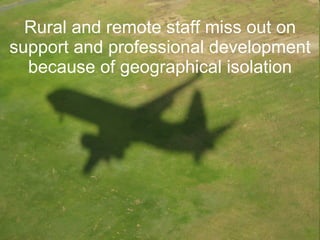
Rural and remote staff miss out on support and professional development because of geographical isolation
Indigenous staff require support and professional development that meets their particular needs
Professional development and support for workers is  vital for provision of high quality care  http://www.flickr.com/photos/23368139@N02/4182053334
critical to the sustainability of aged care industry by attracting and retaining younger people   http://www.flickr.com/photos/41894180985@N01/2478337872
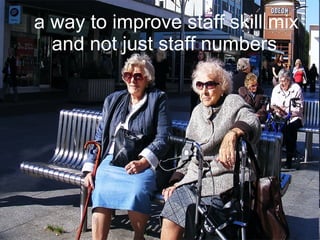
a way to improve staff skill mix and not just staff numbers
eMentoring seen by ACQI to be one way of meeting development needs of workforce
Program development  Jan – May 2009 Development of resources including handbook Advertising & recruiting mentors & mentees Selection and matching mentees with mentors Assessment of computer skills and equipment
 
Development of eMentoring  CD Rom with Creative Commons BY license
Program implementation May - June 2009  Face-to-face mentoring and computer skills workshops Supporting mentors and mentees in making contact, developing learning plans and developing mentoring relationships Helping out with technology issues Evaluation questionnaire
 
Participants EOI Entered Program Mentees 63 23 Mentors 34 20
 
Why people didn’t participate Too busy with audit and accreditation Attitudes of employers/managers  Too busy with other study Unable to attend face-to-face eMentoring workshops  Too busy with mentoring student nurses Time frame was too short or did not suit their needs No financial support for time off work  Lacking computer skills and confidence Concerns about cost to the organization Prefers face-to-face mentoring
 
Why indigenous people didn’t participate Prefer to work in a face-to-face context, to build a rapport and feelings of trust Concerns about eMentoring relationship arising from such factors as gender, culture, position or time Concerns about privacy and confidentiality in small, close-knit communities  Potential fear of ‘failing’ or ‘shame’ by participant  Lack of access to the Internet bandwidth, especially in remote areas eg. Thursday Island Lack of computer skills Variability of literacy skills
 
Barriers to participation once enrolled in program Difficulties with technology eg organisational firewalls Lack of time Program too short Mentor or mentee did not get in touch
 
Successes of the program  Provided support when none was available Increased computer skills and confidence Introduced people to free, cost-cutting communication tools Introduced people to concepts and benefits of online networking
 
eMentoring handbook re-mashed by Terrance DeShaun  for youth eMentoring program in  New Orleans  http://terrancedeshaun.blogspot.com
Recommendations for future programs Longer program – minimum 6 months ‘ Train the trainer’ approach to computer skills Explore benefits/disadvantages of online communities of practice Strategies for embedding technology in the workplace Engage with wider community to share skills and resources
sarahstewart07@gmail.com  http://sarah-stewart.blogspot.com  Twitter: SarahStewart

Implementing An eMentoring Program For Aged And Community Care

  • 1.
    Implementing an eMentoringprogram for aged and community care staff in rural and remote Queensland Sarah Stewart 2010 Creative Commons BY http://sarah-stewart.blogspot.com
  • 2.
    Acknowledgements Dept.Health and Aging, Australia who provided project funding All the people who volunteered to be mentors and mentees Aged Care Queensland Inc project team: Anne Livingstone, Anna Lennon, Tania Whyatt and Robin Apps eMentoring project Reference Committee
  • 3.
    What were theissues that needed to be addressed?
  • 4.
    Difficult to recruitand retain staff in aged and community care sector in Queensland http://www.flickr.com/photos/34701044@N06/4000009470
  • 5.
    Rural and remotestaff miss out on support and professional development because of geographical isolation
  • 6.
    Indigenous staff requiresupport and professional development that meets their particular needs
  • 7.
    Professional development andsupport for workers is vital for provision of high quality care http://www.flickr.com/photos/23368139@N02/4182053334
  • 8.
    critical to thesustainability of aged care industry by attracting and retaining younger people http://www.flickr.com/photos/41894180985@N01/2478337872
  • 9.
    a way toimprove staff skill mix and not just staff numbers
  • 10.
    eMentoring seen byACQI to be one way of meeting development needs of workforce
  • 11.
    Program development Jan – May 2009 Development of resources including handbook Advertising & recruiting mentors & mentees Selection and matching mentees with mentors Assessment of computer skills and equipment
  • 12.
  • 13.
    Development of eMentoring CD Rom with Creative Commons BY license
  • 14.
    Program implementation May- June 2009 Face-to-face mentoring and computer skills workshops Supporting mentors and mentees in making contact, developing learning plans and developing mentoring relationships Helping out with technology issues Evaluation questionnaire
  • 15.
  • 16.
    Participants EOI EnteredProgram Mentees 63 23 Mentors 34 20
  • 17.
  • 18.
    Why people didn’tparticipate Too busy with audit and accreditation Attitudes of employers/managers Too busy with other study Unable to attend face-to-face eMentoring workshops Too busy with mentoring student nurses Time frame was too short or did not suit their needs No financial support for time off work Lacking computer skills and confidence Concerns about cost to the organization Prefers face-to-face mentoring
  • 19.
  • 20.
    Why indigenous peopledidn’t participate Prefer to work in a face-to-face context, to build a rapport and feelings of trust Concerns about eMentoring relationship arising from such factors as gender, culture, position or time Concerns about privacy and confidentiality in small, close-knit communities Potential fear of ‘failing’ or ‘shame’ by participant Lack of access to the Internet bandwidth, especially in remote areas eg. Thursday Island Lack of computer skills Variability of literacy skills
  • 21.
  • 22.
    Barriers to participationonce enrolled in program Difficulties with technology eg organisational firewalls Lack of time Program too short Mentor or mentee did not get in touch
  • 23.
  • 24.
    Successes of theprogram Provided support when none was available Increased computer skills and confidence Introduced people to free, cost-cutting communication tools Introduced people to concepts and benefits of online networking
  • 25.
  • 26.
    eMentoring handbook re-mashedby Terrance DeShaun for youth eMentoring program in New Orleans http://terrancedeshaun.blogspot.com
  • 27.
    Recommendations for futureprograms Longer program – minimum 6 months ‘ Train the trainer’ approach to computer skills Explore benefits/disadvantages of online communities of practice Strategies for embedding technology in the workplace Engage with wider community to share skills and resources
  • 28.

Editor's Notes

  • #5 Not sexy Poorly paid Hard work Lonely Repetitive
  • #6 Cost of PD Unable to get away because of family and work commitment-backfill
  • #7 Claims on their times PD that is not designed for them Inappropriate delivery Inflexible PD Lack of funding