July 2013
Implementing a covered straddle or a covered strangle
In the January 2013 issue of the options newsletter, we saw how implementing a long straddle options
strategy could benefit the holder of the position when there are large fluctuations in the price level of the stock
market or the price of a specific security. On the other hand, the risk of implementing this strategy resides in
the large cost required to simultaneously buy the call options and the put options. Under conditions when the
stock market is relatively stable, investors face the risk of losing the entire options premium paid. In this
edition of the options newsletter, we explore the straddle options strategy, and a variation of it, called the
strangle options strategy, within the context where the investor implements a short position on these
strategies while holding the underlying shares. We will discover how selling both call options and put options
contracts is an attractive strategy in a long term bull market. This strategy allows an investor to take
advantage of the time decay of the options in a stable and rising market environment. Furthermore, the
strategy allows an investor to double his position in the underlying shares during the unavoidable corrections
that will arise from time to time in a bull market.
A covered straddle
In this example, an investor holds 1,000 shares of XYZ stock at a price of $50 per share. The investor is
willing to double his share position on XYZ since he is confident in the long term growth potential of the
company. In the eventuality of an important increase in the share price of XYZ, the investor is willing to sell
the shares and wait for another buying opportunity if it arises. Consequently, the investor implements a
covered straddle options strategy by selling 10 call options contracts expiring in 3 months with a strike price of
$50 (symbol: XYZ3M50C) at a price of $2.40 per share, and by simultaneously selling 10 put options
contracts expiring in 3 months with a strike price of $50 (symbol: XYZ3M50P) at a price of $2.20 per share,
for a total options premium collected of $4,600 (i.e., a total premium of $4.60 per share multiplied by 100
shares per contract multiplied by 10 options contracts).
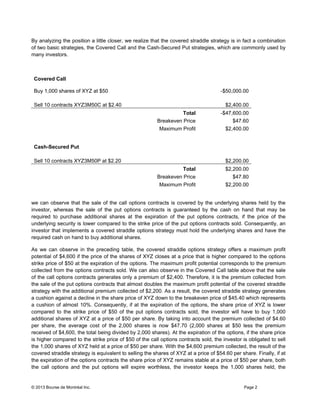
Covered Straddle
Buy 1,000 shares of XYZ at $50 -$50,000.00
Sell 10 contracts XYZ3M50C at $2.40 $2,400.00
Sell 10 contracts XYZ3M50P at $2.20 $2,200.00
Total -$45,400.00
Breakeven Price $45.40
Maximum Profit $4,600.00
© 2013 Bourse de Montréal Inc. Page 1
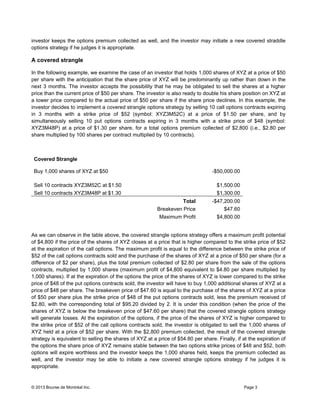
By analyzing the position a little closer, we realize that the covered straddle strategy is in fact a combination
of two basic strategies, the Covered Call and the Cash-Secured Put strategies, which are commonly used by
many investors.
Covered Call
Buy 1,000 shares of XYZ at $50 -$50,000.00
Sell 10 contracts XYZ3M50C at $2.40 $2,400.00
Total -$47,600.00
Breakeven Price $47.60
Maximum Profit $2,400.00
Cash-Secured Put
Sell 10 contracts XYZ3M50P at $2.20 $2,200.00
Total $2,200.00
Breakeven Price $47.80
Maximum Profit $2,200.00
we can observe that the sale of the call options contracts is covered by the underlying shares held by the
investor, whereas the sale of the put options contracts is guaranteed by the cash on hand that may be
required to purchase additional shares at the expiration of the put options contracts, if the price of the
underlying security is lower compared to the strike price of the put options contracts sold. Consequently, an
investor that implements a covered straddle options strategy must hold the underlying shares and have the
required cash on hand to buy additional shares.
As we can observe in the preceding table, the covered straddle options strategy offers a maximum profit
potential of $4,600 if the price of the shares of XYZ closes at a price that is higher compared to the options
strike price of $50 at the expiration of the options. The maximum profit potential corresponds to the premium
collected from the options contracts sold. We can also observe in the Covered Call table above that the sale
of the call options contracts generates only a premium of $2,400. Therefore, it is the premium collected from
the sale of the put options contracts that almost doubles the maximum profit potential of the covered straddle
strategy with the additional premium collected of $2,200. As a result, the covered straddle strategy generates
a cushion against a decline in the share price of XYZ down to the breakeven price of $45.40 which represents
a cushion of almost 10%. Consequently, if at the expiration of the options, the share price of XYZ is lower
compared to the strike price of $50 of the put options contracts sold, the investor will have to buy 1,000
additional shares of XYZ at a price of $50 per share. By taking into account the premium collected of $4.60
per share, the average cost of the 2,000 shares is now $47.70 (2,000 shares at $50 less the premium
received of $4,600, the total being divided by 2,000 shares). At the expiration of the options, if the share price
is higher compared to the strike price of $50 of the call options contracts sold, the investor is obligated to sell
the 1,000 shares of XYZ held at a price of $50 per share. With the $4,600 premium collected, the result of the
covered straddle strategy is equivalent to selling the shares of XYZ at a price of $54.60 per share. Finally, if at
the expiration of the options contracts the share price of XYZ remains stable at a price of $50 per share, both
the call options and the put options will expire worthless, the investor keeps the 1,000 shares held, the
© 2013 Bourse de Montréal Inc. Page 2
investor keeps the options premium collected as well, and the investor may initiate a new covered straddle
options strategy if he judges it is appropriate.
A covered strangle
In the following example, we examine the case of an investor that holds 1,000 shares of XYZ at a price of $50
per share with the anticipation that the share price of XYZ will be predominantly up rather than down in the
next 3 months. The investor accepts the possibility that he may be obligated to sell the shares at a higher
price than the current price of $50 per share. The investor is also ready to double his share position on XYZ at
a lower price compared to the actual price of $50 per share if the share price declines. In this example, the
investor decides to implement a covered strangle options strategy by selling 10 call options contracts expiring
in 3 months with a strike price of $52 (symbol: XYZ3M52C) at a price of $1.50 per share, and by
simultaneously selling 10 put options contracts expiring in 3 months with a strike price of $48 (symbol:
XYZ3M48P) at a price of $1.30 per share, for a total options premium collected of $2,800 (i.e., $2.80 per
share multiplied by 100 shares per contract multiplied by 10 contracts).
Covered Strangle
Buy 1,000 shares of XYZ at $50 -$50,000.00
Sell 10 contracts XYZ3M52C at $1.50 $1,500.00
Sell 10 contracts XYZ3M48P at $1.30 $1,300.00
Total -$47,200.00
Breakeven Price $47.60
Maximum Profit $4,800.00
As we can observe in the table above, the covered strangle options strategy offers a maximum profit potential
of $4,800 if the price of the shares of XYZ closes at a price that is higher compared to the strike price of $52
at the expiration of the call options. The maximum profit is equal to the difference between the strike price of
$52 of the call options contracts sold and the purchase of the shares of XYZ at a price of $50 per share (for a
difference of $2 per share), plus the total premium collected of $2.80 per share from the sale of the options
contracts, multiplied by 1,000 shares (maximum profit of $4,800 equivalent to $4.80 per share multiplied by
1,000 shares). If at the expiration of the options the price of the shares of XYZ is lower compared to the strike
price of $48 of the put options contracts sold, the investor will have to buy 1,000 additional shares of XYZ at a
price of $48 per share. The breakeven price of $47.60 is equal to the purchase of the shares of XYZ at a price
of $50 per share plus the strike price of $48 of the put options contracts sold, less the premium received of
$2.80, with the corresponding total of $95.20 divided by 2. It is under this condition (when the price of the
shares of XYZ is below the breakeven price of $47.60 per share) that the covered strangle options strategy
will generate losses. At the expiration of the options, if the price of the shares of XYZ is higher compared to
the strike price of $52 of the call options contracts sold, the investor is obligated to sell the 1,000 shares of
XYZ held at a price of $52 per share. With the $2,800 premium collected, the result of the covered strangle
strategy is equivalent to selling the shares of XYZ at a price of $54.80 per share. Finally, if at the expiration of
the options the share price of XYZ remains stable between the two options strike prices of $48 and $52, both
options will expire worthless and the investor keeps the 1,000 shares held, keeps the premium collected as
well, and the investor may be able to initiate a new covered strangle options strategy if he judges it is
appropriate.
© 2013 Bourse de Montréal Inc. Page 3
Conclusion
The covered straddle, and the covered strangle, are strategies which, in the context of a bull market, provide
investors the opportunity to take advantage of the time decay of options when the market is relatively stable
and trending higher. Furthermore, the strategies provide an investor the opportunity to buy additional shares
during corrections which are certain to occur in a bull market. An investor willing to sell the shares he holds on
any market advance, will implement a covered straddle, whereas an investor who desires to have more
leeway will rather implement a covered strangle since the strike price of the call options contracts sold is
higher compared to the actual share price. The same is true during corrections since the covered straddle
requires the purchase of additional shares as soon as the price is lower compared to the strike price of the put
options contracts sold. The covered strangle provides more leeway to investors since the strike price of the
put options contracts sold is lower compared to the actual share price. When the share price is stable, the
covered straddle generates a higher maximum profit potential. However, the covered strangle offers the
greater probability of realizing the maximum profit potential. Indeed, at the expiration of the options, in order to
realize the maximum profit with the covered straddle, the share price must be equal to the strike price of both
options, whereas for the covered strangle, the share price must only be in between the strike prices of the two
options. Consequently, investors must consider these two factors prior to implementing either strategy.
© 2013 Bourse de Montréal Inc. Page 4

Implementing a covered straddle or a covered strangle

  • 1.
    July 2013 Implementing acovered straddle or a covered strangle In the January 2013 issue of the options newsletter, we saw how implementing a long straddle options strategy could benefit the holder of the position when there are large fluctuations in the price level of the stock market or the price of a specific security. On the other hand, the risk of implementing this strategy resides in the large cost required to simultaneously buy the call options and the put options. Under conditions when the stock market is relatively stable, investors face the risk of losing the entire options premium paid. In this edition of the options newsletter, we explore the straddle options strategy, and a variation of it, called the strangle options strategy, within the context where the investor implements a short position on these strategies while holding the underlying shares. We will discover how selling both call options and put options contracts is an attractive strategy in a long term bull market. This strategy allows an investor to take advantage of the time decay of the options in a stable and rising market environment. Furthermore, the strategy allows an investor to double his position in the underlying shares during the unavoidable corrections that will arise from time to time in a bull market. A covered straddle In this example, an investor holds 1,000 shares of XYZ stock at a price of $50 per share. The investor is willing to double his share position on XYZ since he is confident in the long term growth potential of the company. In the eventuality of an important increase in the share price of XYZ, the investor is willing to sell the shares and wait for another buying opportunity if it arises. Consequently, the investor implements a covered straddle options strategy by selling 10 call options contracts expiring in 3 months with a strike price of $50 (symbol: XYZ3M50C) at a price of $2.40 per share, and by simultaneously selling 10 put options contracts expiring in 3 months with a strike price of $50 (symbol: XYZ3M50P) at a price of $2.20 per share, for a total options premium collected of $4,600 (i.e., a total premium of $4.60 per share multiplied by 100 shares per contract multiplied by 10 options contracts). Covered Straddle Buy 1,000 shares of XYZ at $50 -$50,000.00 Sell 10 contracts XYZ3M50C at $2.40 $2,400.00 Sell 10 contracts XYZ3M50P at $2.20 $2,200.00 Total -$45,400.00 Breakeven Price $45.40 Maximum Profit $4,600.00 © 2013 Bourse de Montréal Inc. Page 1
  • 2.
    By analyzing theposition a little closer, we realize that the covered straddle strategy is in fact a combination of two basic strategies, the Covered Call and the Cash-Secured Put strategies, which are commonly used by many investors. Covered Call Buy 1,000 shares of XYZ at $50 -$50,000.00 Sell 10 contracts XYZ3M50C at $2.40 $2,400.00 Total -$47,600.00 Breakeven Price $47.60 Maximum Profit $2,400.00 Cash-Secured Put Sell 10 contracts XYZ3M50P at $2.20 $2,200.00 Total $2,200.00 Breakeven Price $47.80 Maximum Profit $2,200.00 we can observe that the sale of the call options contracts is covered by the underlying shares held by the investor, whereas the sale of the put options contracts is guaranteed by the cash on hand that may be required to purchase additional shares at the expiration of the put options contracts, if the price of the underlying security is lower compared to the strike price of the put options contracts sold. Consequently, an investor that implements a covered straddle options strategy must hold the underlying shares and have the required cash on hand to buy additional shares. As we can observe in the preceding table, the covered straddle options strategy offers a maximum profit potential of $4,600 if the price of the shares of XYZ closes at a price that is higher compared to the options strike price of $50 at the expiration of the options. The maximum profit potential corresponds to the premium collected from the options contracts sold. We can also observe in the Covered Call table above that the sale of the call options contracts generates only a premium of $2,400. Therefore, it is the premium collected from the sale of the put options contracts that almost doubles the maximum profit potential of the covered straddle strategy with the additional premium collected of $2,200. As a result, the covered straddle strategy generates a cushion against a decline in the share price of XYZ down to the breakeven price of $45.40 which represents a cushion of almost 10%. Consequently, if at the expiration of the options, the share price of XYZ is lower compared to the strike price of $50 of the put options contracts sold, the investor will have to buy 1,000 additional shares of XYZ at a price of $50 per share. By taking into account the premium collected of $4.60 per share, the average cost of the 2,000 shares is now $47.70 (2,000 shares at $50 less the premium received of $4,600, the total being divided by 2,000 shares). At the expiration of the options, if the share price is higher compared to the strike price of $50 of the call options contracts sold, the investor is obligated to sell the 1,000 shares of XYZ held at a price of $50 per share. With the $4,600 premium collected, the result of the covered straddle strategy is equivalent to selling the shares of XYZ at a price of $54.60 per share. Finally, if at the expiration of the options contracts the share price of XYZ remains stable at a price of $50 per share, both the call options and the put options will expire worthless, the investor keeps the 1,000 shares held, the © 2013 Bourse de Montréal Inc. Page 2
  • 3.
    investor keeps theoptions premium collected as well, and the investor may initiate a new covered straddle options strategy if he judges it is appropriate. A covered strangle In the following example, we examine the case of an investor that holds 1,000 shares of XYZ at a price of $50 per share with the anticipation that the share price of XYZ will be predominantly up rather than down in the next 3 months. The investor accepts the possibility that he may be obligated to sell the shares at a higher price than the current price of $50 per share. The investor is also ready to double his share position on XYZ at a lower price compared to the actual price of $50 per share if the share price declines. In this example, the investor decides to implement a covered strangle options strategy by selling 10 call options contracts expiring in 3 months with a strike price of $52 (symbol: XYZ3M52C) at a price of $1.50 per share, and by simultaneously selling 10 put options contracts expiring in 3 months with a strike price of $48 (symbol: XYZ3M48P) at a price of $1.30 per share, for a total options premium collected of $2,800 (i.e., $2.80 per share multiplied by 100 shares per contract multiplied by 10 contracts). Covered Strangle Buy 1,000 shares of XYZ at $50 -$50,000.00 Sell 10 contracts XYZ3M52C at $1.50 $1,500.00 Sell 10 contracts XYZ3M48P at $1.30 $1,300.00 Total -$47,200.00 Breakeven Price $47.60 Maximum Profit $4,800.00 As we can observe in the table above, the covered strangle options strategy offers a maximum profit potential of $4,800 if the price of the shares of XYZ closes at a price that is higher compared to the strike price of $52 at the expiration of the call options. The maximum profit is equal to the difference between the strike price of $52 of the call options contracts sold and the purchase of the shares of XYZ at a price of $50 per share (for a difference of $2 per share), plus the total premium collected of $2.80 per share from the sale of the options contracts, multiplied by 1,000 shares (maximum profit of $4,800 equivalent to $4.80 per share multiplied by 1,000 shares). If at the expiration of the options the price of the shares of XYZ is lower compared to the strike price of $48 of the put options contracts sold, the investor will have to buy 1,000 additional shares of XYZ at a price of $48 per share. The breakeven price of $47.60 is equal to the purchase of the shares of XYZ at a price of $50 per share plus the strike price of $48 of the put options contracts sold, less the premium received of $2.80, with the corresponding total of $95.20 divided by 2. It is under this condition (when the price of the shares of XYZ is below the breakeven price of $47.60 per share) that the covered strangle options strategy will generate losses. At the expiration of the options, if the price of the shares of XYZ is higher compared to the strike price of $52 of the call options contracts sold, the investor is obligated to sell the 1,000 shares of XYZ held at a price of $52 per share. With the $2,800 premium collected, the result of the covered strangle strategy is equivalent to selling the shares of XYZ at a price of $54.80 per share. Finally, if at the expiration of the options the share price of XYZ remains stable between the two options strike prices of $48 and $52, both options will expire worthless and the investor keeps the 1,000 shares held, keeps the premium collected as well, and the investor may be able to initiate a new covered strangle options strategy if he judges it is appropriate. © 2013 Bourse de Montréal Inc. Page 3
  • 4.
    Conclusion The covered straddle,and the covered strangle, are strategies which, in the context of a bull market, provide investors the opportunity to take advantage of the time decay of options when the market is relatively stable and trending higher. Furthermore, the strategies provide an investor the opportunity to buy additional shares during corrections which are certain to occur in a bull market. An investor willing to sell the shares he holds on any market advance, will implement a covered straddle, whereas an investor who desires to have more leeway will rather implement a covered strangle since the strike price of the call options contracts sold is higher compared to the actual share price. The same is true during corrections since the covered straddle requires the purchase of additional shares as soon as the price is lower compared to the strike price of the put options contracts sold. The covered strangle provides more leeway to investors since the strike price of the put options contracts sold is lower compared to the actual share price. When the share price is stable, the covered straddle generates a higher maximum profit potential. However, the covered strangle offers the greater probability of realizing the maximum profit potential. Indeed, at the expiration of the options, in order to realize the maximum profit with the covered straddle, the share price must be equal to the strike price of both options, whereas for the covered strangle, the share price must only be in between the strike prices of the two options. Consequently, investors must consider these two factors prior to implementing either strategy. © 2013 Bourse de Montréal Inc. Page 4