January 2014 by
Marketing & Training
2
Analysis areas
• Market changes
• Business drivers: sell-in
• Business drivers: sell-out
• Brand to patient
• Pricing
• Patient’s insights
3
Market changes
• Economic pressure due to recession.
• Growing competition (200+ global players, Spain 90+).
• Patient’s capacity / willingness under restraint.
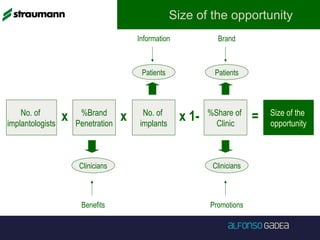
Size of the opportunity
No. of
implantologists
No. of
implants
%Share of
Clinic
Size of the
opportunity
x x 1- =%Brand
Penetration
x
Brand
Patients
Information
Patients
Benefits
Clinicians
Promotions
Clinicians
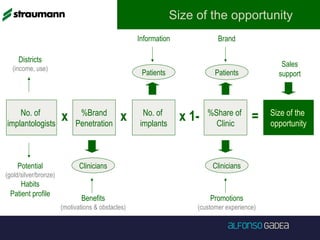
Size of the opportunity
No. of
implantologists
No. of
implants
%Share of
Clinic
Size of the
opportunity
x x 1- =%Brand
Penetration
x
Brand
Patients
Information
Patients
Benefits
(motivations & obstacles)
Clinicians
Promotions
(customer experience)
CliniciansPotential
(gold/silver/bronze)
Habits
Patient profile
Districts
(income, use)
Sales
support
6
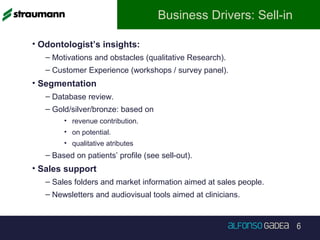
Business Drivers: Sell-in
• Odontologist’s insights:
– Motivations and obstacles (qualitative Research).
– Customer Experience (workshops / survey panel).
• Segmentation
– Database review.
– Gold/silver/bronze: based on
• revenue contribution.
• on potential.
• qualitative atributes
– Based on patients’ profile (see sell-out).
• Sales support
– Sales folders and market information aimed at sales people.
– Newsletters and audiovisual tools aimed at clinicians.
7
Business Drivers: Sell-in
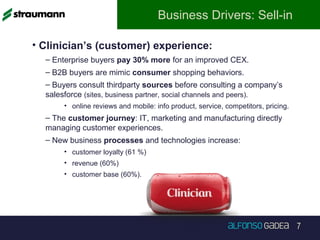
• Clinician’s (customer) experience:
– Enterprise buyers pay 30% more for an improved CEX.
– B2B buyers are mimic consumer shopping behaviors.
– Buyers consult thirdparty sources before consulting a company’s
salesforce (sites, business partner, social channels and peers).
• online reviews and mobile: info product, service, competitors, pricing.
– The customer journey: IT, marketing and manufacturing directly
managing customer experiences.
– New business processes and technologies increase:
• customer loyalty (61 %)
• revenue (60%)
• customer base (60%).
8
Business Drivers: Sell-in
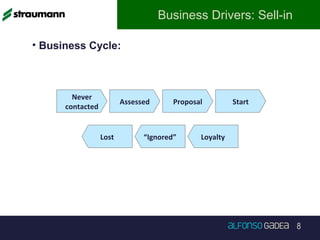
• Business Cycle:
Never
contacted
Assessed Proposal Start
Lost “Ignored” Loyalty
Business Drivers: Sell-in
• How to win a customer (Spanish implantologist):
– New product trial.
– Easy-to-use system.
– Welcome pack promotion.
– Introduction course.
– Current with current brand / service.
– Referred by a lab.
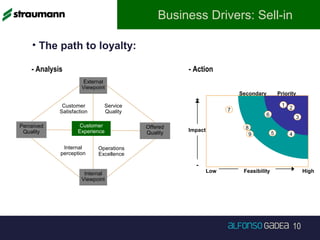
• The path to loyalty:
10
Business Drivers: Sell-in
+
-
Low Feasibility
Impact
Secondary Priority
9
8
1
2
3
45
7
6
High
Customer
Satisfaction
Operations
Excellence
Service
Quality
Internal
perception
Internal
Viewpoint
External
Viewpoint
Perceived
Quality
Offered
Quality
Customer
Experience
- Analysis - Action
Business Drivers: Sell-in
• The path to loyalty (Spanish implantologist):
– “X is for me the best. However their rep don’t take care of me:
• They never ask if I need something.
• I hear about their promotions from other peers, not from them.
• Once I received surgical instruments dirty.
• They didn’t warned me about a modification in the new product.
– Moments of Truth:
• New product.
• Case solution.
• Got a problem (urgent visit).
– Advisory:
• Triple vision: Product + Doctors + Prothesic Labs.
Business Drivers: Sell-in
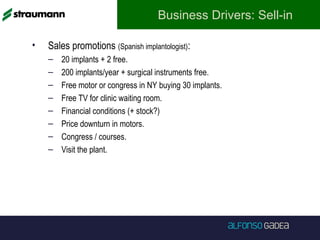
• Sales promotions (Spanish implantologist):
– 20 implants + 2 free.
– 200 implants/year + surgical instruments free.
– Free motor or congress in NY buying 30 implants.
– Free TV for clinic waiting room.
– Financial conditions (+ stock?)
– Price downturn in motors.
– Congress / courses.
– Visit the plant.
13
Business Drivers: Sell-out
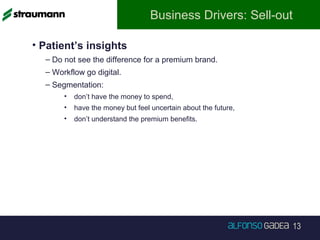
• Patient’s insights
– Do not see the difference for a premium brand.
– Workflow go digital.
– Segmentation:
• don’t have the money to spend,
• have the money but feel uncertain about the future,
• don’t understand the premium benefits.
14
Business Drivers: Sell-out
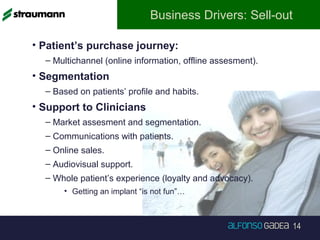
• Patient’s purchase journey:
– Multichannel (online information, offline assesment).
• Segmentation
– Based on patients’ profile and habits.
• Support to Clinicians
– Market assesment and segmentation.
– Communications with patients.
– Online sales.
– Audiovisual support.
– Whole patient’s experience (loyalty and advocacy).
• Getting an implant “is not fun”…
15
Business Drivers: Sell-out
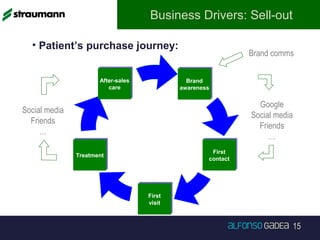
• Patient’s purchase journey:
Brand
awareness
Brand
awareness
First
visit
First
visit
After-sales
care
After-sales
care
TreatmentTreatment
First
contact
First
contact
Google
Social media
Friends
…
Social media
Friends
…
Brand comms
16
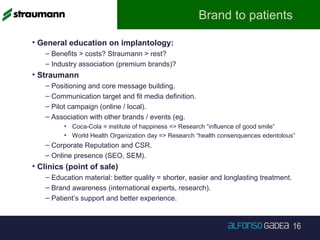
Brand to patients
• General education on implantology:
– Benefits > costs? Straumann > rest?
– Industry association (premium brands)?
• Straumann
– Positioning and core message building.
– Communication target and fit media definition.
– Pilot campaign (online / local).
– Association with other brands / events (eg.
• Coca-Cola = institute of happiness => Research “influence of good smile”
• World Health Organization day => Research “health consenquences edentolous”
– Corporate Reputation and CSR.
– Online presence (SEO, SEM).
• Clinics (point of sale)
– Education material: better quality = shorter, easier and longlasting treatment.
– Brand awareness (international experts, research).
– Patient’s support and better experience.
17
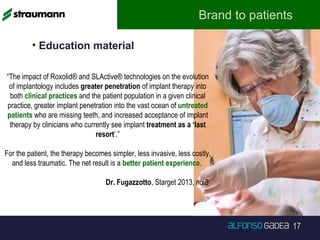
Brand to patients
“The impact of Roxolid® and SLActive® technologies on the evolution
of implantology includes greater penetration of implant therapy into
both clinical practices and the patient population in a given clinical
practice, greater implant penetration into the vast ocean of untreated
patients who are missing teeth, and increased acceptance of implant
therapy by clinicians who currently see implant treatment as a ‘last
resort’.”
For the patient, the therapy becomes simpler, less invasive, less costly,
and less traumatic. The net result is a better patient experience.
Dr. Fugazzotto, Starget 2013, no.3
• Education material
18
Price
• Price decisions in front of recession:
– More than 9 out of 10 companies feel increased pricing pressure.
• Customers demand higher discounts (53%).
• Lower-price competitors / new market entrants (50%).
– The sharp increase in purchasing power of retailers places pressure on
suppliers.
– Internet has increased market transparency, making it easier for shoppers to
compare prices.
– Emerging industrial powers (i.e. China): lower unit labor costs.
• Impact in margin (sales equivalent?).
• Advising the client.
• Multichannel pricing.
19
Price
• What to take in account when making decisions (and what’s usually
considered by executives):
– Variable costs 80%
– Fixed costs 80%
– Competitors’ product prices 70%
– Value attached to the product 60%
– How customers would react to a change in prices 35%
– Willingness of a customer to pay different price levels 20%
• Segmentation:
“pockets” of real variance in demand: customer segments, geographies, product lines,
occasions of use, etc.
• Delivering higher value for the same price:
Can be as costly as cutting prices in the short term, but it preserves pricing integrity for the
long term.
• Multichannel:
– Willingness to pay for a product through offline channels can be 8% to 22%
higher.
– The extent of channel-based price differentiation is highest in the case of
services, which are less vulnerable to cannibalization due to resale.
20
Social Media
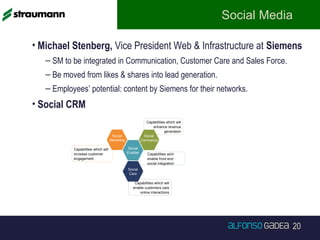
• Michael Stenberg, Vice President Web & Infrastructure at Siemens
– SM to be integrated in Communication, Customer Care and Sales Force.
– Be moved from likes & shares into lead generation.
– Employees’ potential: content by Siemens for their networks.
• Social CRM
Capabilities which will
increase customer
engagement
Capabilities wich
enable front-end
social integration
Capabilities which will
enhance revenue
generation
Capabilities which will
enable customers care
online interactions
Social
Marketing
Social
Enabler
Social
Commerce
Social
Care
21
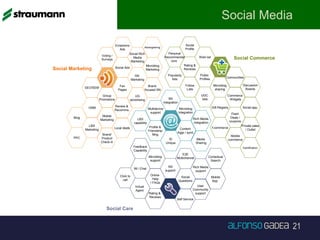
Social Media
Content
Aggr./ synd.
Web
Enabler
Microblog
Integration
SN
Integration
Multidevice
support
ID
Unique
Profile &
Friendship
Mng.
LBS
capability
E2E
Multichannel
SN
support
Microblog
support
IM / Chat
Social
Questions
Feedback
Capability
Rich Media
Integration
Online
Help
/ FAQs
Media
Sharing
Rich Media
support
Contextual
Search
Social Care
Mobile
App.
User
Community
support
Virtual
Agent
Click to
call
Rating &
Reviews
Self Service
Social Marketing
Review &
Recomms.
SN
Marketing
Microblog
Marketing
Brand
focused SN
Group
Promotions
Social Ads
UG
advertising
LBS
Marketing
Fan
Pages
Brand/
Product
Check-in
ORM
Social Rich
Media
Marketing
Email/sms
Ads
Mobile
Marketing
Advergaming
SEO/SEM
PPC
Blog
Local deals
Voting /
Surveys
f-commerce
Commerce
Widgets
Rating &
Reviews
Public
Profiles
Gift Registry
UGC
lists
Follow
Lists
Flash
Deals /
coupons
Popularity
lists
Microblog
sharing
Social Commerce
Communities
Wish list
Personal
Recommendat
ions
Discussion
Boards
Social app.
Private sales
/ Outlet
Mobile
commerce
Social
Profile
Gamification
AlfonsoGadea.es

Implantology go-to-market Straumann

  • 1.
  • 2.
    2 Analysis areas • Marketchanges • Business drivers: sell-in • Business drivers: sell-out • Brand to patient • Pricing • Patient’s insights
  • 3.
    3 Market changes • Economicpressure due to recession. • Growing competition (200+ global players, Spain 90+). • Patient’s capacity / willingness under restraint.
  • 4.
    Size of theopportunity No. of implantologists No. of implants %Share of Clinic Size of the opportunity x x 1- =%Brand Penetration x Brand Patients Information Patients Benefits Clinicians Promotions Clinicians
  • 5.
    Size of theopportunity No. of implantologists No. of implants %Share of Clinic Size of the opportunity x x 1- =%Brand Penetration x Brand Patients Information Patients Benefits (motivations & obstacles) Clinicians Promotions (customer experience) CliniciansPotential (gold/silver/bronze) Habits Patient profile Districts (income, use) Sales support
  • 6.
    6 Business Drivers: Sell-in •Odontologist’s insights: – Motivations and obstacles (qualitative Research). – Customer Experience (workshops / survey panel). • Segmentation – Database review. – Gold/silver/bronze: based on • revenue contribution. • on potential. • qualitative atributes – Based on patients’ profile (see sell-out). • Sales support – Sales folders and market information aimed at sales people. – Newsletters and audiovisual tools aimed at clinicians.
  • 7.
    7 Business Drivers: Sell-in •Clinician’s (customer) experience: – Enterprise buyers pay 30% more for an improved CEX. – B2B buyers are mimic consumer shopping behaviors. – Buyers consult thirdparty sources before consulting a company’s salesforce (sites, business partner, social channels and peers). • online reviews and mobile: info product, service, competitors, pricing. – The customer journey: IT, marketing and manufacturing directly managing customer experiences. – New business processes and technologies increase: • customer loyalty (61 %) • revenue (60%) • customer base (60%).
  • 8.
    8 Business Drivers: Sell-in •Business Cycle: Never contacted Assessed Proposal Start Lost “Ignored” Loyalty
  • 9.
    Business Drivers: Sell-in •How to win a customer (Spanish implantologist): – New product trial. – Easy-to-use system. – Welcome pack promotion. – Introduction course. – Current with current brand / service. – Referred by a lab.
  • 10.
    • The pathto loyalty: 10 Business Drivers: Sell-in + - Low Feasibility Impact Secondary Priority 9 8 1 2 3 45 7 6 High Customer Satisfaction Operations Excellence Service Quality Internal perception Internal Viewpoint External Viewpoint Perceived Quality Offered Quality Customer Experience - Analysis - Action
  • 11.
    Business Drivers: Sell-in •The path to loyalty (Spanish implantologist): – “X is for me the best. However their rep don’t take care of me: • They never ask if I need something. • I hear about their promotions from other peers, not from them. • Once I received surgical instruments dirty. • They didn’t warned me about a modification in the new product. – Moments of Truth: • New product. • Case solution. • Got a problem (urgent visit). – Advisory: • Triple vision: Product + Doctors + Prothesic Labs.
  • 12.
    Business Drivers: Sell-in •Sales promotions (Spanish implantologist): – 20 implants + 2 free. – 200 implants/year + surgical instruments free. – Free motor or congress in NY buying 30 implants. – Free TV for clinic waiting room. – Financial conditions (+ stock?) – Price downturn in motors. – Congress / courses. – Visit the plant.
  • 13.
    13 Business Drivers: Sell-out •Patient’s insights – Do not see the difference for a premium brand. – Workflow go digital. – Segmentation: • don’t have the money to spend, • have the money but feel uncertain about the future, • don’t understand the premium benefits.
  • 14.
    14 Business Drivers: Sell-out •Patient’s purchase journey: – Multichannel (online information, offline assesment). • Segmentation – Based on patients’ profile and habits. • Support to Clinicians – Market assesment and segmentation. – Communications with patients. – Online sales. – Audiovisual support. – Whole patient’s experience (loyalty and advocacy). • Getting an implant “is not fun”…
  • 15.
    15 Business Drivers: Sell-out •Patient’s purchase journey: Brand awareness Brand awareness First visit First visit After-sales care After-sales care TreatmentTreatment First contact First contact Google Social media Friends … Social media Friends … Brand comms
  • 16.
    16 Brand to patients •General education on implantology: – Benefits > costs? Straumann > rest? – Industry association (premium brands)? • Straumann – Positioning and core message building. – Communication target and fit media definition. – Pilot campaign (online / local). – Association with other brands / events (eg. • Coca-Cola = institute of happiness => Research “influence of good smile” • World Health Organization day => Research “health consenquences edentolous” – Corporate Reputation and CSR. – Online presence (SEO, SEM). • Clinics (point of sale) – Education material: better quality = shorter, easier and longlasting treatment. – Brand awareness (international experts, research). – Patient’s support and better experience.
  • 17.
    17 Brand to patients “Theimpact of Roxolid® and SLActive® technologies on the evolution of implantology includes greater penetration of implant therapy into both clinical practices and the patient population in a given clinical practice, greater implant penetration into the vast ocean of untreated patients who are missing teeth, and increased acceptance of implant therapy by clinicians who currently see implant treatment as a ‘last resort’.” For the patient, the therapy becomes simpler, less invasive, less costly, and less traumatic. The net result is a better patient experience. Dr. Fugazzotto, Starget 2013, no.3 • Education material
  • 18.
    18 Price • Price decisionsin front of recession: – More than 9 out of 10 companies feel increased pricing pressure. • Customers demand higher discounts (53%). • Lower-price competitors / new market entrants (50%). – The sharp increase in purchasing power of retailers places pressure on suppliers. – Internet has increased market transparency, making it easier for shoppers to compare prices. – Emerging industrial powers (i.e. China): lower unit labor costs. • Impact in margin (sales equivalent?). • Advising the client. • Multichannel pricing.
  • 19.
    19 Price • What totake in account when making decisions (and what’s usually considered by executives): – Variable costs 80% – Fixed costs 80% – Competitors’ product prices 70% – Value attached to the product 60% – How customers would react to a change in prices 35% – Willingness of a customer to pay different price levels 20% • Segmentation: “pockets” of real variance in demand: customer segments, geographies, product lines, occasions of use, etc. • Delivering higher value for the same price: Can be as costly as cutting prices in the short term, but it preserves pricing integrity for the long term. • Multichannel: – Willingness to pay for a product through offline channels can be 8% to 22% higher. – The extent of channel-based price differentiation is highest in the case of services, which are less vulnerable to cannibalization due to resale.
  • 20.
    20 Social Media • MichaelStenberg, Vice President Web & Infrastructure at Siemens – SM to be integrated in Communication, Customer Care and Sales Force. – Be moved from likes & shares into lead generation. – Employees’ potential: content by Siemens for their networks. • Social CRM Capabilities which will increase customer engagement Capabilities wich enable front-end social integration Capabilities which will enhance revenue generation Capabilities which will enable customers care online interactions Social Marketing Social Enabler Social Commerce Social Care
  • 21.
    21 Social Media Content Aggr./ synd. Web Enabler Microblog Integration SN Integration Multidevice support ID Unique Profile& Friendship Mng. LBS capability E2E Multichannel SN support Microblog support IM / Chat Social Questions Feedback Capability Rich Media Integration Online Help / FAQs Media Sharing Rich Media support Contextual Search Social Care Mobile App. User Community support Virtual Agent Click to call Rating & Reviews Self Service Social Marketing Review & Recomms. SN Marketing Microblog Marketing Brand focused SN Group Promotions Social Ads UG advertising LBS Marketing Fan Pages Brand/ Product Check-in ORM Social Rich Media Marketing Email/sms Ads Mobile Marketing Advergaming SEO/SEM PPC Blog Local deals Voting / Surveys f-commerce Commerce Widgets Rating & Reviews Public Profiles Gift Registry UGC lists Follow Lists Flash Deals / coupons Popularity lists Microblog sharing Social Commerce Communities Wish list Personal Recommendat ions Discussion Boards Social app. Private sales / Outlet Mobile commerce Social Profile Gamification
  • 22.