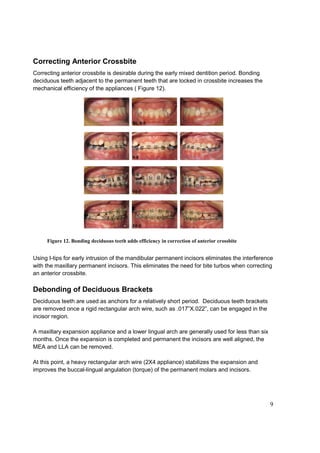
6 The orthodontic patient
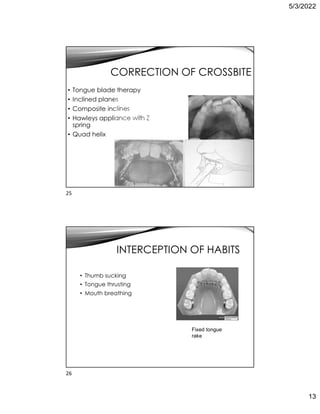
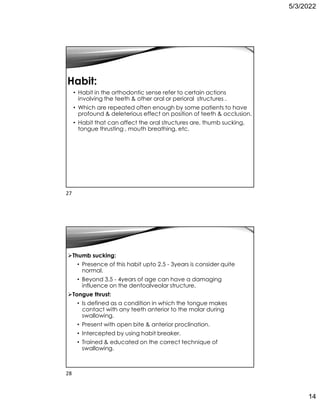
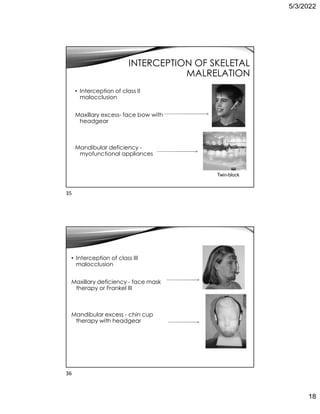
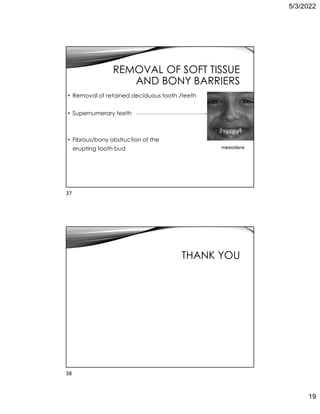
examination and diagnosis
Successful orthodontic treatment begins with the correct diagnosis, which involves patient interview, examination and the collection of appropriate records. At
the end of this process, the orthodontist should have assimilated a comprehensive database for each patient, from which the appropriate treatment plan can be
formulated. Examination and record collection are discussed in this chapter, whilst treatment planning is the subject of Chapter 7.
Patient’s complaint and motivation
The demand for orthodontic treatment is primarily patient-driven and one of the most important components of an examination is the initial interview with the
patient and their parent or guardian. It is important to ascertain what their main concerns are and the expectations of treatment. Over the past two decades

there has been an increasing uptake in orthodontic treatment, with a greater awareness and demand for improved dental and facial aesthetics. Unfortunately
this does not always accompany an appreciation of what orthodontic treatment involves (Tulloch et al, 1984). It can also be the case that the patient has no
particular concerns regarding his/her dentition and it is the parent or dentist who has requested the consultation, which may make the acceptance of orthodontic
treatment more difficult to obtain.
Dental history
Patients being considered for orthodontic treatment should be in good dental health and under the care of a general dental practitioner. It is important that the
orthodontist and dental practitioner have a good working relationship because the orthodontist may often need to work closely with the dentist in a number of
circumstances:
• Achieving a high enough standard of oral hygiene to allow orthodontic treatment;
• Treatment of any dental pathology as orthodontic appliance therapy should not be carried out in the presence of active dental disease;
• Facilitating elective tooth extraction;
• Requesting or coordinating any restorative work that may be required, either prior to or following orthodontic treatment (particularly in cases of hypodontia or
trauma); and
• Assessing the occlusal impact of early tooth loss due to caries or trauma.
The general dental practitioner should be fully aware of the orthodontic treatment goals and good communication between the orthodontist, patient and dentist
is therefore essential.
Medical history
A number of medical conditions may impact upon the provision of orthodontic treatment:
• Heart defects (with risk of endocarditis);
The orthodontic patient: examination and diagnosis
Pocket Dentistry
Fastest Clinical Dentistry Insight Engine
Home Log in Category » About Contact Gold Member Video Terms and Condition
Search...
• Bleeding disorders;
• Childhood malignancies;
• Diabetes;
• Immunosuppression;
• Epilepsy;
• Asthma; and
• Allergies.
Infective endocarditis
Infective endocarditis (IE) is a serious condition characterized by colonization or invasion of the heart valves or mural endocardium by a microbiological agent,
following a transient entry into the bloodstream (bacteraemia). A number of factors can put a patient at high risk of developing an endocarditis:
• Previous IE;
• Acquired valvular heart disease with stenosis or regurgitation;
• Heart valve replacement;
• Structural congenital heart disease, including surgically corrected structural conditions (but excluding isolated atrial-septal defect, fully repaired ventricular-
septal defect and fully repaired patent ductus arteriosus); and
• Hypertrophic cardiomyopathy.
A number of invasive medical procedures have been causally associated with bacteraemia and endocarditis in susceptible patients and these include dental
treatment. The British Society for Antimicrobial Chemotherapy previously recommended the use of antibiotic prophylaxis for any form of dentogingival
manipulation in high-risk patients. These recommendations have now changed in the UK.
The National Institute of Health and Clinical Excellence (NICE) now advise that antibiotics to prevent IE should not be given to adults and children with structural
cardiac defects at risk of IE who are undergoing dental interventional procedures and this includes orthodontic treatment. According to NICE, current evidence
suggests that such antibiotic prophylaxis is not cost effective and may lead to a greater number of deaths through fatal anaphylactic reactions than from not
using preventive antibiotics.
Bleeding disorders
Severe bleeding disorders such as haemophilia A do not contraindicate orthodontic treatment, but factor transfusion will be required to achieve haemostasis if
dental extractions are necessary. Any risks of potential bleeding in the oral cavity during orthodontic treatment can be kept to a minimum by:
• Maintaining a high standard of oral hygiene; and
• Careful checking of appliances at each visit to ensure there are no wires or sharp surfaces traumatizing the soft tissues.
These minor intraoral bleeds are an irritation to most patients, but can be a serious problem in this group. The orthodontist should also be aware of the
increased risk of these patients being carriers for hepatitis or the human immunodeficiency virus (HIV).
Childhood malignancy
The commonest malignancies in childhood are the leukaemias, and amongst these, acute lymphoblastic leukaemia accounts for around 80% of cases. This
condition mostly occurs in early childhood, before orthodontic treatment is routinely carried out. Treatment for a variety of malignancies in children often involves
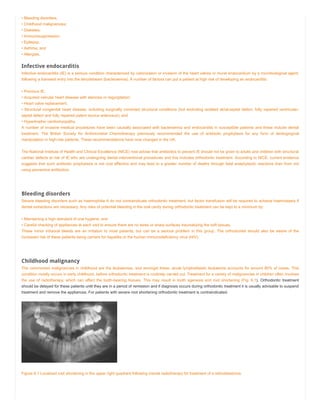
the use of radiotherapy, which can affect the tooth-bearing tissues. This may result in tooth agenesis and root shortening (Fig. 6.1). Orthodontic treatment
should be delayed for these patients until they are in a period of remission and if diagnosis occurs during orthodontic treatment it is usually advisable to suspend
treatment and remove the appliances. For patients with severe root shortening orthodontic treatment is contraindicated.
Figure 6.1 Localized root shortening in the upper right quadrant following cranial radiotherapy for treatment of a retinoblastoma.
Diabetes
Patients with insulin-dependent diabetes are more susceptible to periodontal disease and therefore excellent oral hygiene accompanied by regular periodontal
maintenance is essential during orthodontic treatment.
Immunosuppression
Immunosuppressant drugs such as cyclosporin, which are routinely used in transplant patients to prevent rejection of the donor organ, can cause gingival
hyperplasia, which can be exacerbated by orthodontic appliances. Excellent oral hygiene needs to be maintained during treatment and this can be reinforced
with a chlorhexidine mouthwash. Gingivectomy of hyperplastic tissue may be necessary before or even during treatment.
Epilepsy
Removable orthodontic appliances should be avoided in the poorly controlled epileptic as there is a potential risk to the airway from displacement during
seizures. These patients can also be at risk from gingival hyperplasia due to the use of certain anticonvulsant drugs; therefore a high standard of oral hygiene
must be maintained during treatment.
Asthma
The regular use of steroid-based inhalers can result in oral candida infections on the palate, which can be made worse by the use of palate-covering removable
appliances. Patients with autoimmune and hyper-allergenic conditions can also be more prone to root resorption during orthodontic treatment.
Allergies
A patient may present with a reported history of allergic reaction. Although many materials used in orthodontics are capable of inducing an allergic response,
the most relevant are natural rubber latex and nickel.
Allergy to latex was first recognized in the 1970s and its occurrence has increased in recent years, particularly amongst healthcare workers following the
universal adoption of wearing protective gloves. Latex allergy has been reported in orthodontic practice in relation to gloves and orthodontic elastics. The most
common allergic response is a type IV delayed hypersensitivity reaction triggered by the chemical accelerators used in the manufacture of latex. This causes a
localized contact dermatitis, typically associated with a pruritic eczematous rash. The IgE-mediated type I reaction is less common but has more serious
consequences, including anaphylaxis. Amongst the general public, type I sensitivity has been estimated to occur in around 6% of the population (Ownby et al,
1996). Investigation is via skin prick testing or immunoassay. Patients with a confirmed type I allergy should be treated in a ‘latex-screened’ environment where
potential exposure to any allergens is minimized. Synthetic gloves composed of vinyl or nitrile are available as an alternative to latex gloves, whilst the use of
orthodontic elastomeric auxiliaries containing natural rubber latex should be avoided. Latex-free silicone elastics are available but show greater force decay and
as such, require more frequent replacement.
Orthodontic wires and brackets contain nickel and nickel allergy is thought to be present in approximately 10% of Western populations and more common in
females. It is usually a type IV allergic reaction related to the wearing of jewellery or watches and body piercing. Fortunately, oral reactions are rare, although
prolonged exposure to nickel-containing oral appliances may increase sensitivity to nickel (Bass et al, 1993). Intraoral signs are nonspecific and have been
reported to include erythema, soreness at the side of the tongue and severe gingivitis, despite good oral hygiene. Definitive diagnosis is usually achieved via
patch testing. Stainless steel wires and brackets contain a relatively low proportion of nickel and are considered safe to use in a patient with diagnosed nickel
allergy although titanium or cobalt chromium nickel-free brackets are available. In contrast, nickel titanium archwires have a much higher content, and should be
avoided in these patients.
Extraoral examination
Assessment of the patient should begin with an examination of the facial features because orthodontic treatment can impact on the soft tissues of the face.
Although a number of absolute measurements can be taken, a comprehensive facial assessment involves looking at the balance and harmony between
component parts of the face and noting any areas of disharmony. Extraoral examination should start as the patient enters the room and it is important to look at
the face and soft tissues both passively and in an animated state. Once in the dental chair, the patient should be asked to sit and the face examined from the
front and in profile, in a position of natural head posture (Box 6.1).
Box 6.1 Natural head posture
Natural head posture (NHP) is the position that the patient naturally carries their head and is therefore the most relevant for assessing skeletal relationships and
facial deformity. It is determined physiologically rather than anatomically and varies between individuals; however, it is relatively constant for each individual
(Moorrees & Keane, 1958). As such, NHP should be used whenever possible to assess the orthodontic patient. The patient is asked to sit upright and look
straight ahead to a point at eye level in the middle distance. This can be a point on the wall in front of them, or a mirror so that they look into their own eyes.
Ideally NHP should also be used when taking a lateral skull radiograph, allowing the clinical examination to be related more accurately to the cephalometric
data.
Frontal view
The frontal view of the face should be assessed vertically and transversely, with attention being paid to the presence of any asymmetry. In addition, the
relationship of the lips within the face is examined in detail.
Vertical relationship
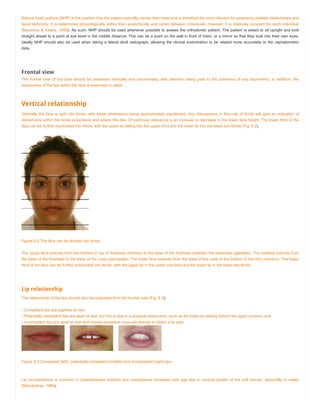
Vertically the face is split into thirds, with these dimensions being approximately equidistant. Any discrepancy in this rule of thirds will give an indication of
disharmony within the facial proportions and where this lies. Of particular relevance is an increase or decrease in the lower face height. The lower third of the
face can be further subdivided into thirds, with the upper lip falling into the upper third and the lower lip into the lower two-thirds (Fig. 6.2).
Figure 6.2 The face can be divided into thirds.
The upper face extends from the hairline or top of forehead (trichion) to the base of the forehead between the eyebrows (glabellar). The midface extends from
the base of the forehead to the base of the nose (subnasale). The lower face extends from the base of the nose to the bottom of the chin (menton). The lower
third of the face can be further subdivided into thirds, with the upper lip in the upper one-third and the lower lip in the lower two-thirds.
Lip relationship
The relationship of the lips should also be evaluated from the frontal view (Fig. 6.3):
• Competent lips are together at rest;
• Potentially competent lips are apart at rest, but this is due to a physical obstruction, such as the lower lip resting behind the upper incisors; and
• Incompetent lips are apart at rest and require excessive muscular activity to obtain a lip seal.
Figure 6.3 Competent (left), potentially competent (middle) and incompetent (right) lips.
Lip incompetence is common in preadolescent children and competence increases with age due to vertical growth of the soft tissues, especially in males
(Mamandras, 1988).
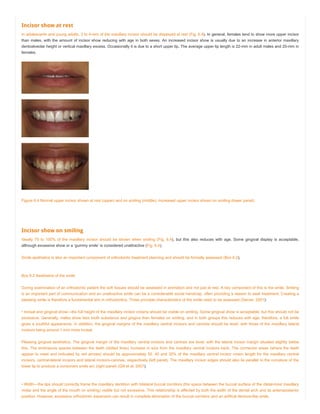
Incisor show at rest
In adolescents and young adults, 3 to 4-mm of the maxillary incisor should be displayed at rest (Fig. 6.4). In general, females tend to show more upper incisor
than males, with the amount of incisor show reducing with age in both sexes. An increased incisor show is usually due to an increase in anterior maxillary
dentoalveolar height or vertical maxillary excess. Occasionally it is due to a short upper lip. The average upper lip length is 22-mm in adult males and 20-mm in
females.
Figure 6.4 Normal upper incisor shown at rest (upper) and on smiling (middle). Increased upper incisor shown on smiling (lower panel).
Incisor show on smiling
Ideally 75 to 100% of the maxillary incisor should be shown when smiling (Fig. 6.4), but this also reduces with age. Some gingival display is acceptable,
although excessive show or a ‘gummy smile’ is considered unattractive (Fig. 6.4).
Smile aesthetics is also an important component of orthodontic treatment planning and should be formally assessed (Box 6.2).
Box 6.2 Aesthetics of the smile
During examination of an orthodontic patient the soft tissues should be assessed in animation and not just at rest. A key component of this is the smile. Smiling
is an important part of communication and an unattractive smile can be a considerable social handicap, often providing a reason to seek treatment. Creating a
pleasing smile is therefore a fundamental aim in orthodontics. Three principle characteristics of the smile need to be assessed (Sarver, 2001):
• Incisal and gingival show—the full height of the maxillary incisor crowns should be visible on smiling. Some gingival show is acceptable, but this should not be
excessive. Generally, males show less tooth substance and gingiva then females on smiling, and in both groups this reduces with age; therefore, a full smile
gives a youthful appearance. In addition, the gingival margins of the maxillary central incisors and canines should be level, with those of the maxillary lateral
incisors being around 1-mm more incisal.
Pleasing gingival aesthetics. The gingival margin of the maxillary central incisors and canines are level, with the lateral incisor margin situated slightly below
this. The embrasure spaces between the teeth (dotted lines) increase in size from the maxillary central incisors back. The connector areas (where the teeth
appear to meet and indicated by red arrows) should be approximately 50, 40 and 30% of the maxillary central incisor crown length for the maxillary central
incisors, central-lateral incisors and lateral incisors-canines, respectively (left panel). The maxillary incisor edges should also lie parallel to the curvature of the
lower lip to produce a consonant smile arc (right panel) (Gill et al, 2007).
• Width—the lips should correctly frame the maxillary dentition with bilateral buccal corridors (the space between the buccal surface of the distal-most maxillary
molar and the angle of the mouth on smiling) visible but not excessive. This relationship is affected by both the width of the dental arch and its anteroposterior
position. However, excessive orthodontic expansion can result in complete elimination of the buccal corridors and an artifical denture-like smile.
• Relationship of the upper incisor edges with the lower lip—the upper incisor edges should be parallel to the curvature of the lower lip on smiling. This is known
as the smile arc. Flattening of the smile arc will result in a less attractive smile, which can also be associated with premature aging.
Transverse relationship and symmetry
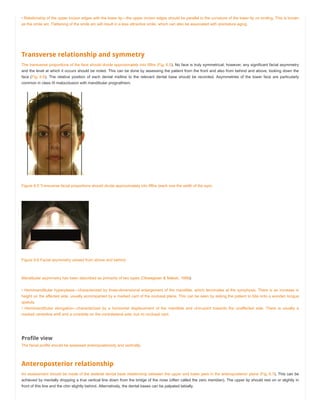
The transverse proportions of the face should divide approximately into fifths (Fig. 6.5). No face is truly symmetrical; however, any significant facial asymmetry
and the level at which it occurs should be noted. This can be done by assessing the patient from the front and also from behind and above, looking down the
face (Fig. 6.6). The relative position of each dental midline to the relevant dental base should be recorded. Asymmetries of the lower face are particularly
common in class III malocclusion with mandibular prognathism.
Figure 6.5 Transverse facial proportions should divide approximately into fifths (each one the width of the eye).
Figure 6.6 Facial asymmetry viewed from above and behind.
Mandibular asymmetry has been described as primarily of two types (Obwegeser & Makek, 1986):
• Hemimandibular hyperplasia—characterized by three-dimensional enlargement of the mandible, which terminates at the symphysis. There is an increase in
height on the affected side, usually accompanied by a marked cant of the occlusal plane. This can be seen by asking the patient to bite onto a wooden tongue
spatula.
• Hemimandibular elongation—characterized by a horizontal displacement of the mandible and chin-point towards the unaffected side. There is usually a
marked centreline shift and a crossbite on the contralateral side, but no occlusal cant.
Profile view
The facial profile should be assessed anteroposteriorly and vertically.
Anteroposterior relationship
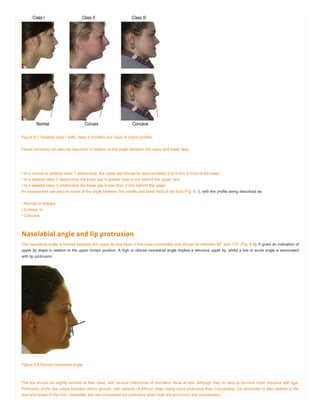
An assessment should be made of the skeletal dental base relationship between the upper and lower jaws in the anteroposterior plane (Fig. 6.7). This can be
achieved by mentally dropping a true vertical line down from the bridge of the nose (often called the zero meridian). The upper lip should rest on or slightly in
front of this line and the chin slightly behind. Alternatively, the dental bases can be palpated labially.
Figure 6.7 Skeletal class I (left), class II (middle) and class III (right) profiles.
Facial convexity can also be described in relation to the angle between the upper and lower face.
• In a normal or skeletal class 1 relationship, the upper jaw should be approximately 2 to 4-mm in front of the lower;
• In a skeletal class 2 relationship the lower jaw is greater than 4-mm behind the upper; and
• In a skeletal class 3 relationship the lower jaw is less than 2-mm behind the upper.
An assessment can also be made of the angle between the middle and lower third of the face (Fig. 6.7), with the profile being described as:
• Normal or straight;
• Convex; or
• Concave.
Nasolabial angle and lip protrusion
The nasolabial angle is formed between the upper lip and base of the nose (columella) and should be between 90° and 110° (Fig. 6.8). It gives an indication of
upper lip drape in relation to the upper incisor position. A high or obtuse nasolabial angle implies a retrusive upper lip, whilst a low or acute angle is associated
with lip protrusion.
Figure 6.8 Normal nasolabial angle.
The lips should be slightly everted at their base, with several millimetres of vermillion show at rest, although they do tend to become more retrusive with age.
Protrusion of the lips varies between ethnic groups, with patients of African origin being more protrusive than Caucasians. Lip protrusion is also relative to the
size and shape of the chin. Generally, lips are considered too protrusive when both are prominent and incompetent.
Vertical relationship
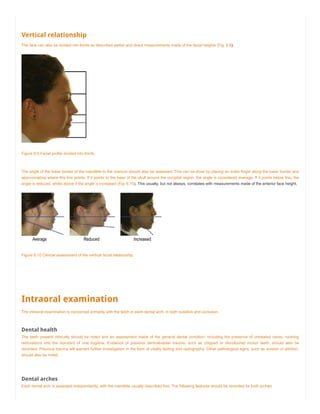
The face can also be divided into thirds as described earlier and direct measurements made of the facial heights (Fig. 6.9).
Figure 6.9 Facial profile divided into thirds.
The angle of the lower border of the mandible to the cranium should also be assessed. This can be done by placing an index finger along the lower border and
approximating where this line points. If it points to the base of the skull around the occipital region, the angle is considered average. If it points below this, the
angle is reduced, whilst above it the angle is increased (Fig. 6.10). This usually, but not always, correlates with measurements made of the anterior face height.
Figure 6.10 Clinical assessment of the vertical facial relationship.
Intraoral examination
The intraoral examination is concerned primarily with the teeth in each dental arch, in both isolation and occlusion.
Dental health
The teeth present clinically should be noted and an assessment made of the general dental condition, including the presence of untreated caries, existing
restorations and the standard of oral hygiene. Evidence of previous dentoalveolar trauma, such as chipped or discoloured incisor teeth, should also be
recorded. Previous trauma will warrant further investigation in the form of vitality testing and radiographs. Other pathological signs, such as erosion or attrition,
should also be noted.
Dental arches
Each dental arch is assessed independently, with the mandible usually described first. The following features should be recorded for both arches:
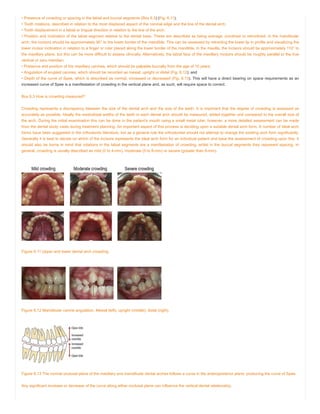
• Presence of crowding or spacing in the labial and buccal segments (Box 6.3) (Fig. 6.11);
• Tooth rotations, described in relation to the most displaced aspect of the coronal edge and the line of the dental arch;
• Tooth displacement in a labial or lingual direction in relation to the line of the arch;
• Position and inclination of the labial segment relative to the dental base. These are described as being average, proclined or retroclined. In the mandibular
arch, the incisors should be approximately 90° to the lower border of the mandible. This can be assessed by retracting the lower lip in profile and visualizing the
lower incisor inclination in relation to a finger or ruler placed along the lower border of the mandible. In the maxilla, the incisors should be approximately 110° to
the maxillary plane, but this can be more difficult to assess clinically. Alternatively, the labial face of the maxillary incisors should be roughly parallel to the true
vertical or zero meridian;
• Presence and position of the maxillary canines, which should be palpable buccally from the age of 10 years;
• Angulation of erupted canines, which should be recorded as mesial, upright or distal (Fig. 6.12); and
• Depth of the curve of Spee, which is described as normal, increased or decreased (Fig. 6.13). This will have a direct bearing on space requirements as an
increased curve of Spee is a manifestation of crowding in the vertical plane and, as such, will require space to correct.
Box 6.3 How is crowding measured?
Crowding represents a discrepancy between the size of the dental arch and the size of the teeth. It is important that the degree of crowding is assessed as
accurately as possible. Ideally the mesiodistal widths of the teeth in each dental arch should be measured, added together and compared to the overall size of
the arch. During the initial examination this can be done in the patient’s mouth using a small metal ruler; however, a more detailed assessment can be made
from the dental study casts during treatment planning. An important aspect of this process is deciding upon a suitable dental arch form. A number of ideal arch
forms have been suggested in the orthodontic literature, but as a general rule the orthodontist should not attempt to change the existing arch form significantly.
Generally it is best to decide on which of the incisors represents the ideal arch form for an individual patient and base the assessment of crowding upon this. It
should also be borne in mind that rotations in the labial segments are a manifestation of crowding, whilst in the buccal segments they represent spacing. In
general, crowding is usually described as mild (0 to 4-mm), moderate (5 to 8-mm) or severe (greater than 9-mm).
Figure 6.11 Upper and lower dental arch crowding.
Figure 6.12 Mandibular canine angulation. Mesial (left); upright (middle); distal (right).
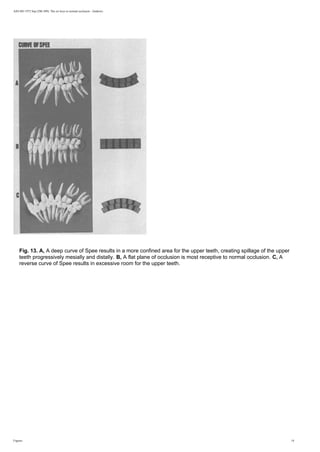
Figure 6.13 The normal occlusal plane of the maxillary and mandibular dental arches follows a curve in the anteroposterior plane, producing the curve of Spee.
Any significant increase or decrease of the curve along either occlusal plane can influence the vertical dental relationship.
Static occlusion
When each dental arch has been assessed the patient is asked to occlude in intercuspal position (ICP) and the static occlusal relationship is recorded.
Incisor relationship
The incisor relationship is described using the British Standards Classification, but also needs to be supplemented with a description of the overjet and overbite.
Overjet
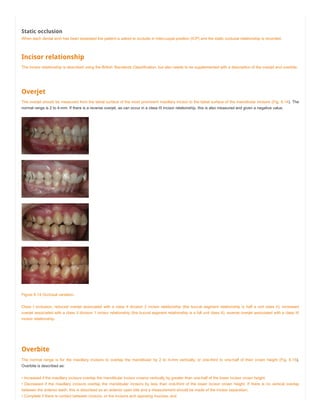
The overjet should be measured from the labial surface of the most prominent maxillary incisor to the labial surface of the mandibular incisors (Fig. 6.14). The
normal range is 2 to 4-mm. If there is a reverse overjet, as can occur in a class III incisor relationship, this is also measured and given a negative value.
Figure 6.14 Occlusal variation.
Class I occlusion; reduced overjet associated with a class II division 2 incisor relationship (the buccal segment relationship is half a unit class II); increased
overjet associated with a class II division 1 incisor relationship (the buccal segment relationship is a full unit class II); reverse overjet associated with a class III
incisor relationship.
Overbite
The normal range is for the maxillary incisors to overlap the mandibular by 2 to 4-mm vertically, or one-third to one-half of their crown height (Fig. 6.15).
Overbite is described as:
• Increased if the maxillary incisors overlap the mandibular incisor crowns vertically by greater than one-half of the lower incisor crown height;
• Decreased if the maxillary incisors overlap the mandibular incisors by less than one-third of the lower incisor crown height. If there is no vertical overlap
between the anterior teeth, this is described as an anterior open bite and a measurement should be made of the incisor separation;
• Complete if there is contact between incisors, or the incisors and opposing mucosa; and
• Incomplete if there is no contact between incisors, or the incisors and opposing mucosa.
Figure 6.15 Variation in overbite.
Normal (upper left), reduced (upper right), increased (lower left) and anterior open bite (lower right).
If the overbite is complete to the gingival tissues, it is described as traumatic if there is evidence of damage. This is most commonly seen on the palatal aspect
of the upper incisors or labial aspect of the lower (Fig. 6.16).
Figure 6.16 Traumatic overbites causing palatal (left panels) and labial (right panels) gingival trauma.
Anterior crossbite
Teeth in anterior crossbite should also be noted along with the presence and size of any displacement of the mandible that may occur when closing in the
retruded contact position (RCP) into the intercuspal position (ICP) (Fig. 6.17). An anterior crossbite with displacement can cause labial gingival recession
associated with the lower incisors in traumatic occlusion, which if present, should be recorded.
Figure 6.17 Anterior crossbite with a forward mandibular displacement on closing, which worsens the class III incisor relationship.
Centrelines
Maxillary and mandibular dental centrelines are assessed in relation to the facial midline and to each other. Displacement of a centreline can be due to:
• Asymmetric dental crowding (Fig. 6.18);
• Buccal crossbite with a mandibular displacement on closing (Fig. 6.19); and
• Skeletal asymmetry of the jaws (Fig. 6.20).
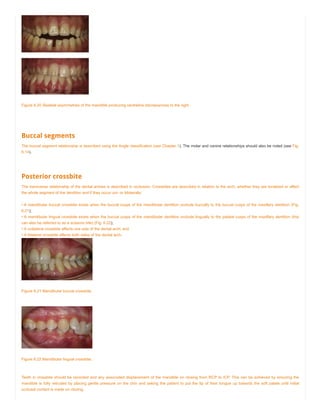
Figure 6.18 Centreline discrepancies due to asymmetric crowding.
Figure 6.19 Lower-centreline displacement to the right, secondary to a mandibular buccal crossbite associated with a mandibular displacement to the right.
Figure 6.20 Skeletal asymmetries of the mandible producing centreline discrepancies to the right.
Buccal segments
The buccal segment relationship is described using the Angle classification (see Chapter 1). The molar and canine relationships should also be noted (see Fig.
6.14).
Posterior crossbite
The transverse relationship of the dental arches is described in occlusion. Crossbites are described in relation to the arch, whether they are localized or affect
the whole segment of the dentition and if they occur uni- or bilaterally:
• A mandibular buccal crossbite exists when the buccal cusps of the mandibular dentition occlude buccally to the buccal cusps of the maxillary dentition (Fig.
6.21);
• A mandibular lingual crossbite exists when the buccal cusps of the mandibular dentition occlude lingually to the palatal cusps of the maxillary dentition (this
can also be referred to as a scissors bite) (Fig. 6.22);
• A unilateral crossbite affects one side of the dental arch; and
• A bilateral crossbite affects both sides of the dental arch.
Figure 6.21 Mandibular buccal crossbite.
Figure 6.22 Mandibular lingual crossbite.
Teeth in crossbite should be recorded and any associated displacement of the mandible on closing from RCP to ICP. This can be achieved by ensuring the
mandible is fully retruded by placing gentle pressure on the chin and asking the patient to put the tip of their tongue up towards the soft palate until initial
occlusal contact is made on closing.
Functional occlusion
Any discrepancy between RCP and ICP should be recorded. The patient should also be asked to slide from ICP to the left and right, and the following should be
detailed for each lateral excursion:
• Canine guidance or group function; and
• Non-working side interferences.
The patient should also be asked to slide the mandible forwards to check for disclusion of the posterior teeth.
Temporomandibular joint
The patient should be questioned about and examined for any signs and symptoms associated with both temporomandibular joints. These include:
• Clicking;
• Crepitus (a grinding noise or sensation within the joint);
• Pain (muscular and neurological); and
• Locking or limited opening.
Although some occlusal traits have a weak correlation with temporomandibular dysfunction, orthodontic treatment should be regarded as being neutral in
relation to this condition. Treating a malocclusion is unlikely to have any long-term effect on symptoms, either positive or negative. However, a baseline record
of temporomandibular joint health should be taken and any signs or symptoms should be recorded. If these represent the main complaint, they should be
investigated further and managed before orthodontic treatment is considered.
Orthodontic records
Clinical orthodontic records are used primarily for diagnosis, monitoring of growth and development, and are a medico-legal requirement. They provide an
accurate representation of the patient prior to orthodontic treatment, demonstrate treatment progress and allow communication between orthodontists, other
healthcare professionals and the patient. Records also play an important role in research and clinical audit. It is essential that accurate clinical records are taken
before commencing orthodontic treatment.
Study models
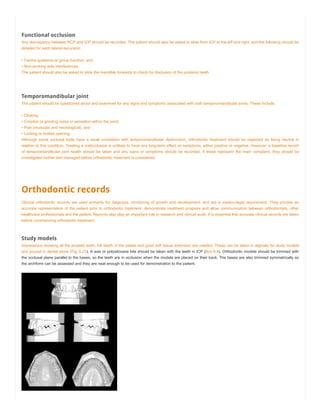
Impressions showing all the erupted teeth, full depth of the palate and good soft tissue extension are needed. These can be taken in alginate for study models
and poured in dental stone (Fig. 6.23). A wax or polysiloxane bite should be taken with the teeth in ICP (Box 6.4). Orthodontic models should be trimmed with
the occlusal plane parallel to the bases, so the teeth are in occlusion when the models are placed on their back. The bases are also trimmed symmetrically so
the archform can be assessed and they are neat enough to be used for demonstration to the patient.
Figure 6.23 Angle trimmed cast stone orthodontic study models.
Box 6.4 Should articulated study models be used for orthodontic diagnosis?
The use of articulated study models has been advocated as a potential aid to orthodontic diagnosis and treatment planning. There is often a discrepancy
between the occlusal relation in RCP and the full or habitual occlusion in ICP. Whilst a small shift is very common and not generally considered to be clinically
important, larger shifts have been considered potentially damaging for both periodontal and temporomandibular joint health, although there is little substantial
evidence for this. Small shifts can only be detected by articulating study models, but if these are unimportant, th/>
Only gold members can continue reading. Log In or Register to continue
You may also need
The orthodontic patient:
treatment planning
Management of the
developing dentition
Orthodontic tooth movement
Adult orthodontics
Posterior crossbite in the
deciduous dentition period, its
relation with sucking habits,
irregular orofacial functions,
and otolaryngological findings
Management of the
permanent dentition
Development of the dentition
Cleft lip and palate, and
syndromes affecting the
craniofacial region
Contemporary fixed
appliances
Contemporary removable
appliances
4: Orthodontic Records and
Case Evaluation
Occlusion and malocclusion
Postnatal growth of the
craniofacial region
Prenatal development of the
craniofacial region
Orthodontic Assessment and
Treatment Planning Strategies
The effect of digital diagnostic
setups on orthodontic
treatment planning
Load more posts
Load more posts
Share this:
Jan 1, 2015 | Posted by mrzezo in Orthodontics | Comments Off
  
WordPress theme by UFO themes
Citrus North
4/23/2022
1
SEMINAR
ON
SPACE MAINTAINER AND REGAINER
DEPARTMENT OF PEDODONTICS
SUBMITTED TO:-
Dr. JASHEENA SINGH
Prof. and H.O.D
Department of pedodontics
GUIDED BY:-
Dr. SUBHASH SINGH SUBMITTED BY:-
(MDS,Sr. Lecturer) ANKUR SAHU
Dr. GARIMA SINGH Final year
(MDS,Sr. Lecturer) Roll no.- 10
Dr. SHIVIKA MEHTA Batch- B
(MDS,Sr. Lecturer)
1
2
4/23/2022
2
CONTENTS
• SPACE MAINTAINER
• INTRODUCTION
• CLASSIFICATION
• FIXED SPACE MAINTAINER
» BAND AND LOOP
» LINGUAL ARCH
» TRANSPALATAL ARCH
» NANCE PALATAL ARCH
» DISTAL SHOE
• REMOVABLE SPACE MAINTAINER
• SPACE REGAINER
• INTRODUCTION
• CLASSIFICATION
• REMOVABLE SPACE REGAINER
• FIXED SPACE REGAINER
3
4
4/23/2022
3
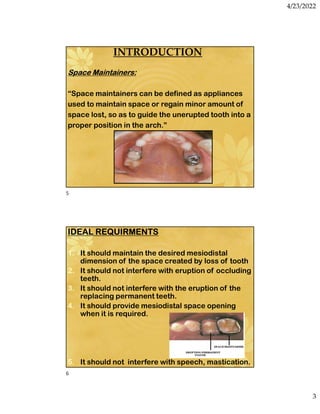
INTRODUCTION
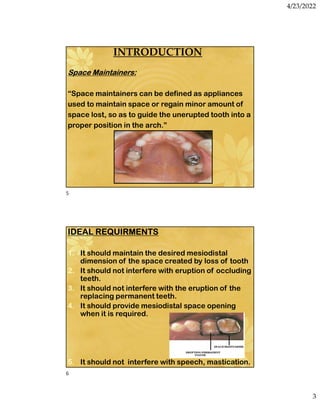
Space Maintainers:
“Space maintainers can be defined as appliances
used to maintain space or regain minor amount of
space lost, so as to guide the unerupted tooth into a
proper position in the arch.”
IDEAL REQUIRMENTS
1. It should maintain the desired mesiodistal
dimension of the space created by loss of tooth
2. It should not interfere with eruption of occluding
teeth.
3. It should not interfere with the eruption of the
replacing permanent teeth.
4. It should provide mesiodistal space opening
when it is required.
5. It should not interfere with speech, mastication.
5
6
4/23/2022
4
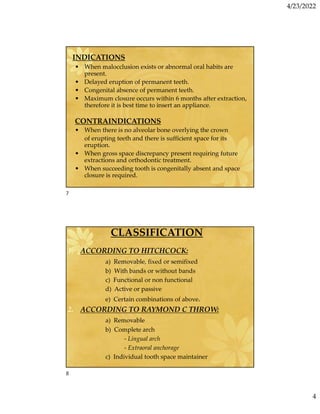
INDICATIONS
• When malocclusion exists or abnormal oral habits are
present.
• Delayed eruption of permanent teeth.
• Congenital absence of permanent teeth.
• Maximum closure occurs within 6 months after extraction,
therefore it is best time to insert an appliance.
CONTRAINDICATIONS
• When there is no alveolar bone overlying the crown
of erupting teeth and there is sufficient space for its
eruption.
• When gross space discrepancy present requiring future
extractions and orthodontic treatment.
• When succeeding tooth is congenitally absent and space
closure is required.
CLASSIFICATION
1. ACCORDING TO HITCHCOCK:
a) Removable, fixed or semifixed
b) With bands or without bands
c) Functional or non functional
d) Active or passive
e) Certain combinations of above.
2. ACCORDING TO RAYMOND C THROW:
a) Removable
b) Complete arch
- Lingual arch
- Extraoral anchorage
c) Individual tooth space maintainer
7
8
4/23/2022
5
3. ACCORDING TO HEINRICHSEN:
a) Fixed space maintainer
Class 1-
Non functional
- Bar type
- Loop type
Functional
-Pontic type
-Lingual arch type
Class 2-
Cantilever type (distal shoe, band and loop)
b) Removable space maintainer
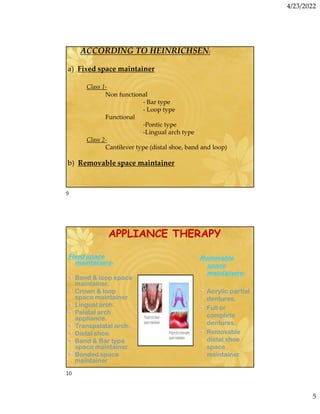
APPLIANCE THERAPY
Fixed space
maintainers-
Band & loop space
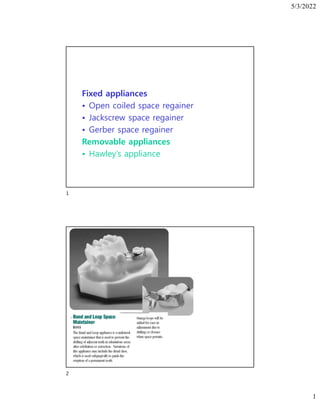
maintainer.
Crown & loop
space maintainer.
Lingual arch.
Palatal arch
appliance.
Transpalatal arch.
Distal shoe.
Band & Bar type
space maintainer.
Bonded space
maintainer
Removable
space
maintainers-
Acrylic partial
dentures.
Full or
complete
dentures.
Removable
distal shoe
space
maintainer.
9
10
4/23/2022
6
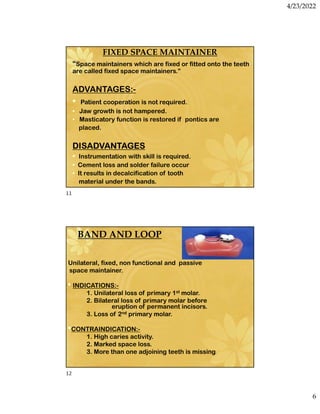
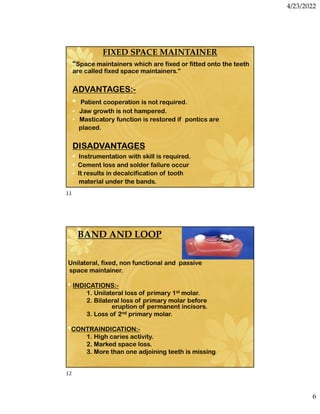
FIXED SPACE MAINTAINER
“Space maintainers which are fixed or fitted onto the teeth
are called fixed space maintainers.”
ADVANTAGES:-
• Patient cooperation is not required.
• Jaw growth is not hampered.
• Masticatory function is restored if pontics are
placed.
DISADVANTAGES
• Instrumentation with skill is required.
• Cement loss and solder failure occur
• It results in decalcification of tooth
material under the bands.
BAND AND LOOP
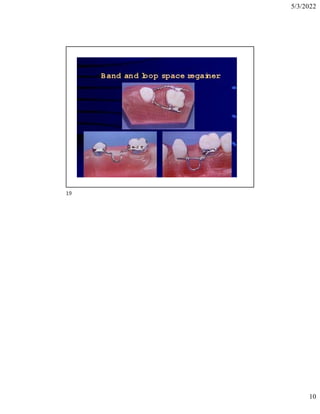
Unilateral, fixed, non functional and passive
space maintainer.
• INDICATIONS:-
1. Unilateral loss of primary 1st molar.
2. Bilateral loss of primary molar before
eruption of permanent incisors.
3. Loss of 2nd primary molar.
•CONTRAINDICATION:-
1. High caries activity.
2. Marked space loss.
3. More than one adjoining teeth is missing.
11
12
4/23/2022
7
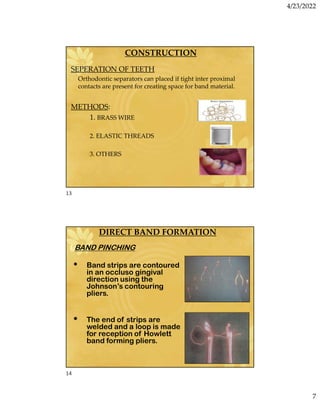
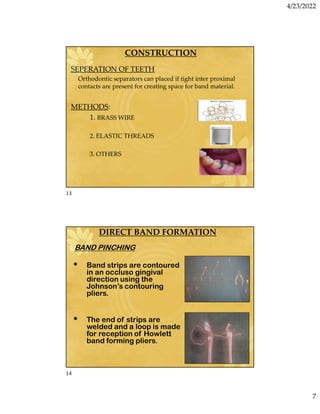
CONSTRUCTION
SEPERATION OF TEETH
Orthodontic separators can placed if tight inter proximal
contacts are present for creating space for band material.
METHODS:
1. BRASS WIRE
2. ELASTIC THREADS
3. OTHERS
DIRECT BAND FORMATION
1.BAND PINCHING
• Band strips are contoured
in an occluso gingival
direction using the
Johnson’s contouring
pliers.
• The end of strips are
welded and a loop is made
for reception of Howlett
band forming pliers.
13
14
4/23/2022
8
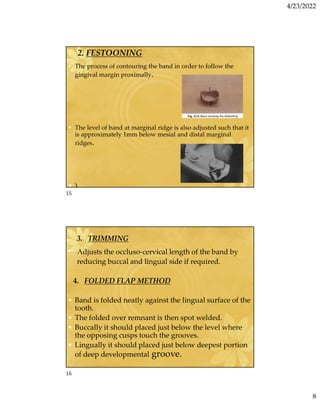
2. FESTOONING
• The process of contouring the band in order to follow the
gingival margin proximally.
• The level of band at marginal ridge is also adjusted such that it
is approximately 1mm below mesial and distal marginal
ridges.
• )
3. TRIMMING
• Adjusts the occluso-cervical length of the band by
reducing buccal and lingual side if required.
4. FOLDED FLAP METHOD
• Band is folded neatly against the lingual surface of the
tooth.
• The folded over remnant is then spot welded.
• Buccally it should placed just below the level where
the opposing cusps touch the grooves.
• Lingually it should placed just below deepest portion
of deep developmental groove.
15
16
4/23/2022
9
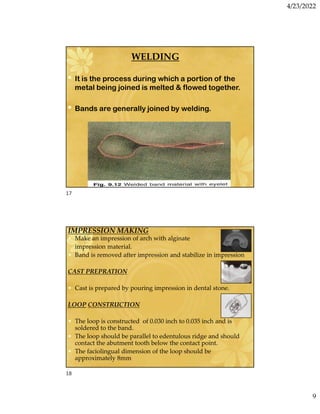
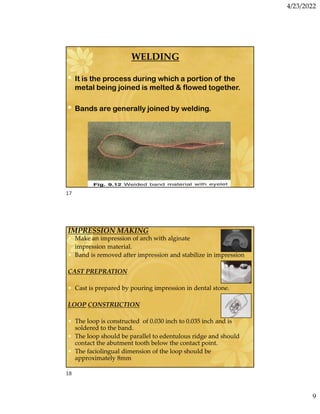
WELDING
• It is the process during which a portion of the
metal being joined is melted & flowed together.
• Bands are generally joined by welding.
IMPRESSION MAKING
• Make an impression of arch with alginate
impression material.
• Band is removed after impression and stabilize in impression
CAST PREPRATION
• Cast is prepared by pouring impression in dental stone.
LOOP CONSTRUCTION
• The loop is constructed of 0.030 inch to 0.035 inch and is
soldered to the band.
• The loop should be parallel to edentulous ridge and should
contact the abutment tooth below the contact point.
• The faciolingual dimension of the loop should be
approximately 8mm
17
18
4/23/2022
10
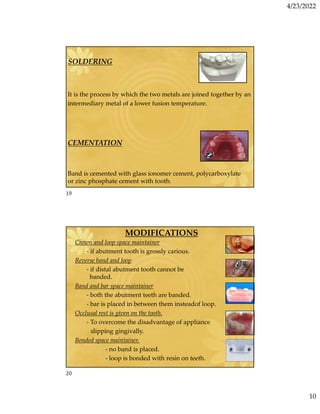
SOLDERING
It is the process by which the two metals are joined together by an
intermediary metal of a lower fusion temperature.
CEMENTATION
Band is cemented with glass ionomer cement, polycarboxylate
or zinc phosphate cement with tooth.
MODIFICATIONS
Crown and loop space maintainer
- if abutment tooth is grossly carious.
Reverse band and loop
- if distal abutment tooth cannot be
banded.
Band and bar space maintainer
- both the abutment teeth are banded.
- bar is placed in between them insteadof loop.
Occlusal rest is given on the tooth.
- To overcome the disadvantage of appliance
slipping gingivally.
Bonded space maintainer.
- no band is placed.
- loop is bonded with resin on teeth.
19
20
4/23/2022
11
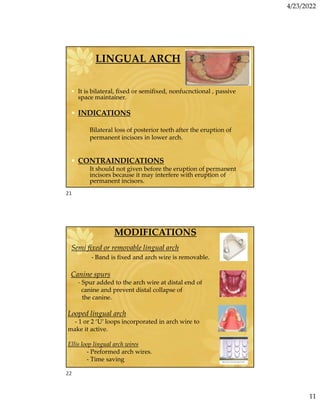
LINGUAL ARCH
• It is bilateral, fixed or semifixed, nonfucnctional , passive
space maintainer.
• INDICATIONS
Bilateral loss of posterior teeth after the eruption of
permanent incisors in lower arch.
• CONTRAINDICATIONS
It should not given before the eruption of permanent
incisors because it may interfere with eruption of
permanent incisors.
MODIFICATIONS
Semi fixed or removable lingual arch
- Band is fixed and arch wire is removable.
Canine spurs
- Spur added to the arch wire at distal end of
canine and prevent distal collapse of
the canine.
Looped lingual arch
- 1 or 2 ‘U’ loops incorporated in arch wire to
make it active.
Ellis loop lingual arch wires
- Preformed arch wires.
- Time saving
21
22
4/23/2022
12
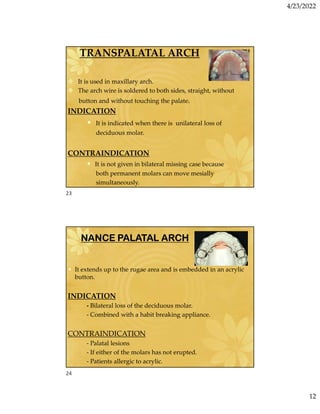
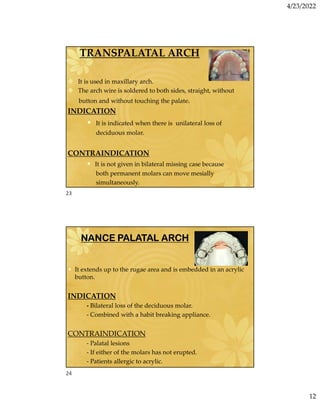
TRANSPALATAL ARCH
 It is used in maxillary arch.
 The arch wire is soldered to both sides, straight, without
button and without touching the palate.
INDICATION
• It is indicated when there is unilateral loss of
deciduous molar.
CONTRAINDICATION
• It is not given in bilateral missing case because
both permanent molars can move mesially
simultaneously.
NANCE PALATAL ARCH
• It extends up to the rugae area and is embedded in an acrylic
button.
INDICATION
- Bilateral loss of the deciduous molar.
- Combined with a habit breaking appliance.
CONTRAINDICATION
- Palatal lesions
- If either of the molars has not erupted.
- Patients allergic to acrylic.
23
24
4/23/2022
13
DISTAL SHOE
(Intralveolar Appliance/Eruption guidance appliance)
• It is unilateral, fixed, non functional and passive
space maintainer.
• It is intra-alveolar appliance, in which portion of the appliance is extending into
alveolus.
• INDICATIONS
- Early loss of second deciduous molar
before the eruption of first permanent molar.
• CONTRAINDICATIONS
- Inadequate abutments due to
multiple loss of teeth.
- poor oral hygiene
- Poor patient cooperation.
- Congenitally missing first molar.
- Medically compromised patient.
Blood dyscrasias
Immunosuppression
Chronic inflammatory
disease
Congenital cardiac
defect
Sub acute bacterial
endocarditis
Rheumatic fever
diabetes
MEDICAL CONDITIONS
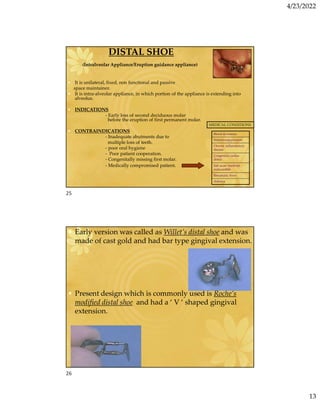
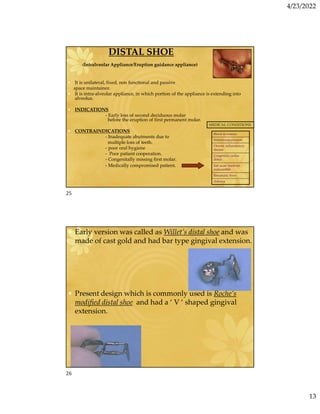
• Early version was called as Willet’s distal shoe and was
made of cast gold and had bar type gingival extension.
• Present design which is commonly used is Roche’s
modified distal shoe and had a ‘ V ‘ shaped gingival
extension.
25
26
4/23/2022
14
REMOVABLE SPACE MAINTAINER
Definition:
They are the space maintainer that can be removed and
reinserted by the patient into the oral cavity.
Types:
It can be functional or non functional.
FUNCTIONAL NON FUNCTIONAL
• INDICATIONS
- Multiple teeth loss is seen.
- Masticatory function is important.
- Premature loss of anterior teeth having effect on speech
and esthetics.
- When space maintainer is required for short period.
• CONTRAINDICATIONS
- Uncooperative patients.
- Epileptic patient.
- Patient allergic to acrylic.
27
28
4/23/2022
15
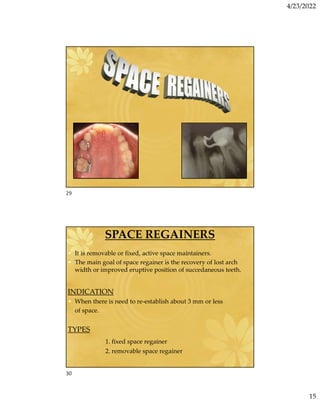
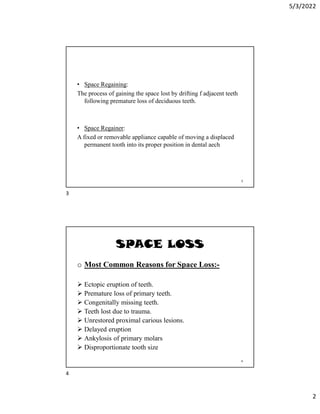
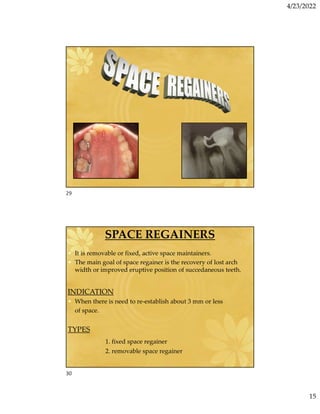
SPACE REGAINERS
• It is removable or fixed, active space maintainers.
• The main goal of space regainer is the recovery of lost arch
width or improved eruptive position of succedaneous teeth.
INDICATION
• When there is need to re-establish about 3 mm or less
of space.
TYPES
1. fixed space regainer
2. removable space regainer
29
30
4/23/2022
16
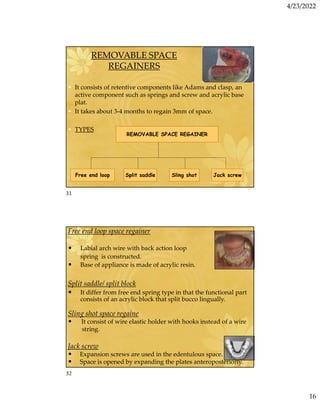
REMOVABLE SPACE
REGAINERS
• It consists of retentive components like Adams and clasp, an
active component such as springs and screw and acrylic base
plat.
• It takes about 3-4 months to regain 3mm of space.
• TYPES
Free end loop Split saddle Sling shot Jack screw
REMOVABLE SPACE REGAINER
Free end loop space regainer
• Labial arch wire with back action loop
spring is constructed.
• Base of appliance is made of acrylic resin.
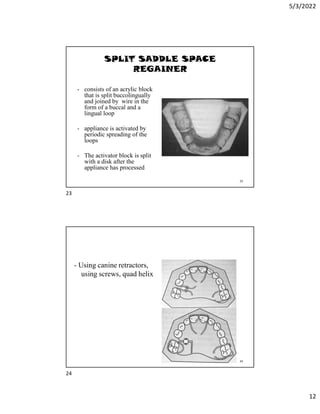
Split saddle/ split block
• It differ from free end spring type in that the functional part
consists of an acrylic block that split bucco lingually.
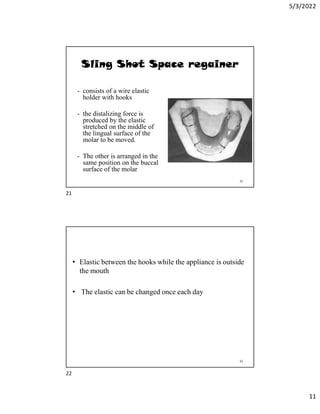
Sling shot space regaine
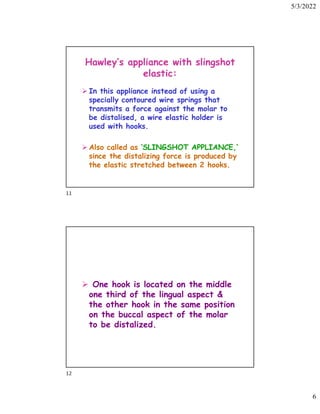
• It consist of wire elastic holder with hooks instead of a wire
string.
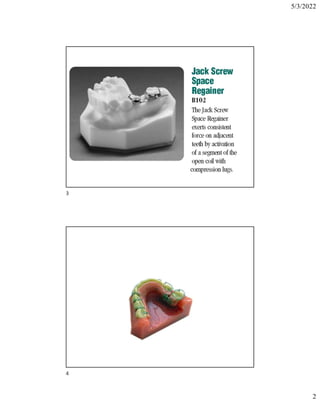
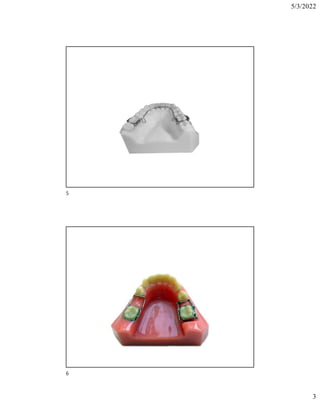
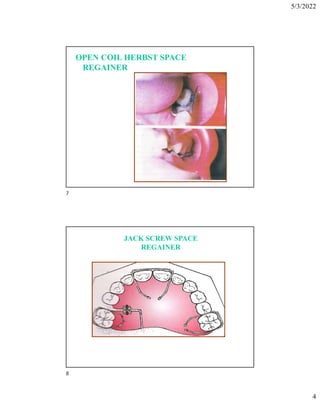
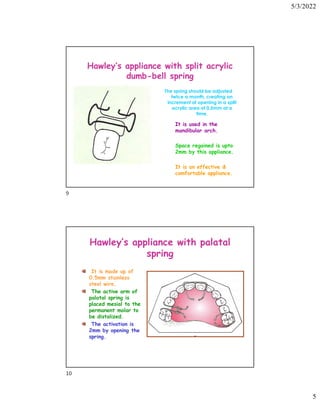
Jack screw
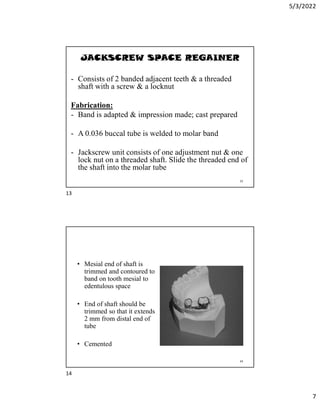
• Expansion screws are used in the edentulous space.
• Space is opened by expanding the plates anteroposteriorly.
31
32
4/23/2022
17
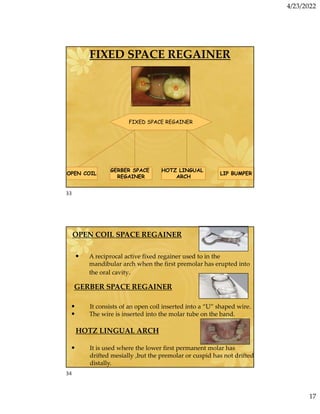
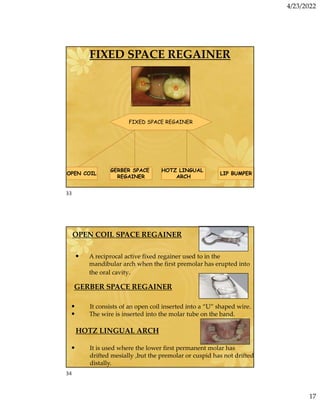
FIXED SPACE REGAINER
HOTZ LINGUAL
ARCH
LIP BUMPER
GERBER SPACE
REGAINER
OPEN COIL
FIXED SPACE REGAINER
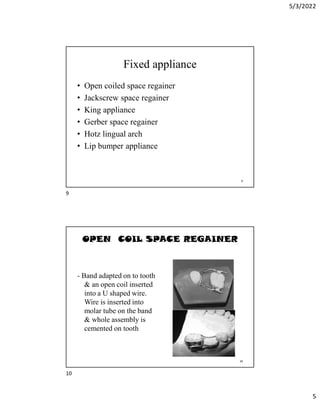
OPEN COIL SPACE REGAINER
• A reciprocal active fixed regainer used to in the
mandibular arch when the first premolar has erupted into
the oral cavity.
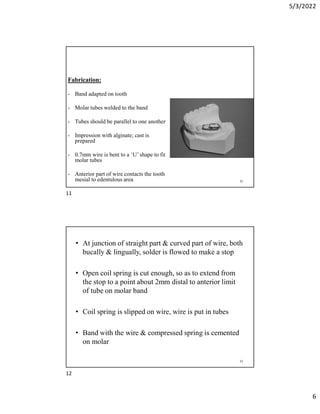
• It consists of an open coil inserted into a “U” shaped wire.
• The wire is inserted into the molar tube on the band.
GERBER SPACE REGAINER
• It is used where the lower first permanent molar has
drifted mesially ,but the premolar or cuspid has not drifted
distally.
HOTZ LINGUAL ARCH
33
34
4/23/2022
18
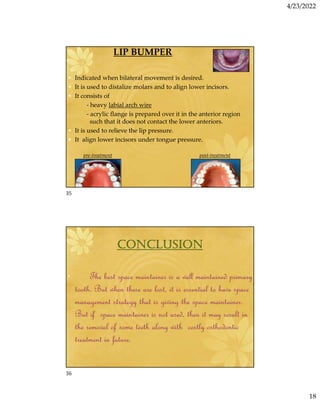
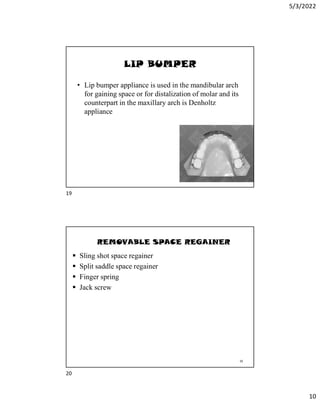
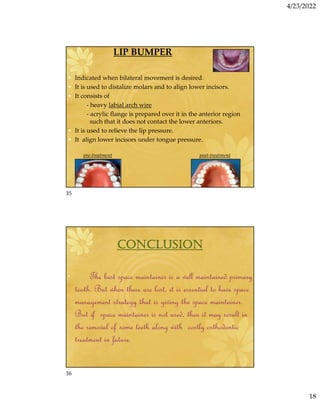
LIP BUMPER
• Indicated when bilateral movement is desired.
• It is used to distalize molars and to align lower incisors.
• It consists of
- heavy labial arch wire
- acrylic flange is prepared over it in the anterior region
such that it does not contact the lower anteriors.
• It is used to relieve the lip pressure.
• It align lower incisors under tongue pressure.
pre-treatment post-treatment
CONCLUSION
• The best space maintainer is a well maintained primary
tooth. But when these are lost, it is essential to have space
management strategy that is giving the space maintainer.
But if space maintainer is not used, then it may result in
the removal of some teeth along with costly orthodontic
treatment in future.
35
36
4/23/2022
19
REFERENCES
1. Dentistry for the child and adolescent ;
McDonaldAveryDean ; 8th
edition
2. Textbook of Pedodontics ; Shobha Tandon; 2nd
edition
3. Pediatric dentistry; Pinkham Casamassimo Fields
McTigue Nowak; 4th
edition
4. Principle and practice of pedodontics; Arathi Rao; 3rd
edition
5. Internet
dentalbooks-drbassam.blogspot.com
depts.washington.edu/peddent/AtlasDemo/space024.html
37
38
7 The orthodontic patient
treatment planning
One of the most difficult, but important aspects of orthodontic management is treatment planning. With the advent of modern fixed appliance systems it is
deceptively easy to straighten teeth. The skill of the orthodontist lies in placing the dentition in the optimal position and achieving the correct aesthetic and
occlusal result for each patient. This process starts with clinical examination, record collection and diagnosis. The next stage is treatment planning, which
should ideally be carried out in a formal manner and away from the patient, using the clinical data and collected records. It is a two-stage process, initially
defining the treatment aims and then deciding how these are to be achieved. In this chapter, treatment aims and the general principles of treatment planning are
discussed. The specifics of treatment for different types of malocclusion are covered in Chapters 10 and 11.
Timing of treatment
Many traits of a malocclusion can manifest in the early mixed dentition and there is often a temptation to begin treatment at this stage. In particular, both ‘arch
development’ (or expansion) to relieve crowding and growth modification to correct a skeletal discrepancy have been proposed by some to benefit from an early
approach.
Advocates of these early treatment strategies suggest that they maximize growth potential, compliance and orthopedic change in the young patient, reduce the
risk of trauma when maxillary incisors are prominent, simplify any further treatment that may be required in the permanent dentition, reduce the need for
extractions and ultimately establish a more stable result. They can also have a psychological benefit, promoting self-esteem by correcting potentially socially
debilitating malocclusions early.
However, there are disadvantages associated with starting treatment too soon. The overall duration will be extended, because almost inevitably a second phase
of treatment will be required in the permanent dentition and this can lead to problems with compliance over the longer term. The original arch form and growth
patterns will tend to reimpose themselves following the first phase of early treatment and a prolonged retention period may be required to maintain any
correction during the transition from mixed to permanent dentition. Finally, there is a growing body of evidence to suggest that the treatment result for growth
modification will be the same whether carried out in the early mixed or permanent dentition, the only difference being the increased duration if started early
(Harrison et al, 2007). In the case of arch development in the early mixed dentition, the long-term results are poor, particularly with regard to the stability of tooth
alignment (Little et al, 1990).
The most appropriate time to start treatment aimed at growth modification is usually the late mixed dentition, essentially just before loss of the second
deciduous molars. This results in the shortest treatment time, whilst still utilizing growth potential and is least demanding upon compliance. The majority of
routine orthodontic treatment with fixed appliances is carried out in the early permanent dentition and this is generally the best time to address problems of
crowding. However, there are exceptions and some malocclusions will benefit from earlier treatment:
• Class III cases associated with maxillary hypoplasia can benefit from interceptive treatment to move the maxilla forward with protraction headgear. This
appears to be more effective if carried out in the early mixed dentition (see Figs 10.45 and 10.46) (Kim et al, 1999).
• Treatment to correct a class II skeletal base relationship is most effective during the adolescent growth spurt. In females, this will generally occur earlier than in
males and is poorly correlated with dental age. Therefore, this type of treatment should often be started earlier in females than males.
• Certain malocclusions, especially an increased overjet, can be a source of teasing and bullying, which can be very distressing. In these circumstances, early
treatment may be indicated.
The orthodontic patient: treatment planning
Pocket Dentistry
Fastest Clinical Dentistry Insight Engine
Home Log in Category » About Contact Gold Member Video Terms and Condition
Search...
• An increased overjet increases the risk of dentoalveolar trauma, especially before the age of ten. Early treatment to reduce the overjet is indicated in those
individuals where little protection is provided by the lips, due to gross lip incompetence and marked maxillary protrusion.
• Early treatment of a posterior crossbite associated with a displacement can prevent perpetuation into the permanent dentition (Harrison & Ashby, 2001). An
anterior crossbite can result in mucogingival problems associated with the lower incisors (see Fig. 10.42). Both these forms of malocclusion are amendable to
simple removable appliance treatment in the early mixed dentition.
Aims of treatment
The principle aims of orthodontic treatment relate to aesthetics and function:
• Positioning the dentition within the skeletal and soft tissue environment for optimal facial and dental aesthetics; and
• Achieving a stable and ideal static, and functional occlusion.
The extent to which these aims need to be considered will vary between patients and depend upon the diagnosis. The treatment required to achieve them may
range from simple occlusal change to complex multidisciplinary intervention.
Facial aims
There is a greater awareness amongst orthodontists of the importance associated with facial and soft tissue aesthetics in treatment planning (Box 7.1).
Obtaining a class I incisor and canine relationship is usually a fundamental aim of treatment, but this must not be achieved at the expense of the soft tissue
profile. Reconciling the facial and occlusal aims of treatment can be difficult and will depend in part on the underlying skeletal relationship:
• In the absence of any significant discrepancy in the skeletal pattern, treatment planning will be concerned primarily with obtaining the correct occlusal
relationship (Fig. 7.1).
• If there is a mild to moderate skeletal discrepancy, appliances aimed at growth modification can be used in an attempt to improve the skeletal relationship.
These appliances tend to rely on good patient compliance combined with favourable facial growth, results can be variable and they are much more effective at
correcting class II discrepancies than class III. Alternatively, orthodontic camouflage may be appropriate, accepting the skeletal pattern and planning the
necessary occlusal changes to correct the malocclusion (Fig. 7.2) (Box 7.2).
• If the skeletal discrepancy is severe and the patient is growing, growth modification should certainly be considered, but success will be less predictable.
However, orthodontic camouflage in these cases can be more problematic, particularly in terms of achieving good facial aesthetics. Surgical repositioning of the
jaws is a definitive method of changing a more severe skeletal pattern, but this is only carried out once facial growth is complete. Attempts have been made to
define the relative limits of orthodontic and surgical tooth movement for the correction of malocclusion, but these can only ever represent a guide (Fig. 7.3).
Box 7.1 Planning treatment around the face
Orthodontic treatment planning should begin with the position of the dentition, particularly the upper incisors, within the face. This represents something of a
shift in emphasis from planning based around the lower incisor position and treating to isolated static occlusal goals.
In the infancy of orthodontics it was assumed that if all the teeth were aligned and the occlusal goals achieved, each individual would have ideal facial
aesthetics. However, it soon become apparent that this was not the case, resulting in extreme protrusion of the dentition in some cases and extensive relapse in
others. With the advent of cephalometric analysis, it was argued that facial growth was genetically determined and that orthodontic treatment could have little
influence on the facial skeleton. Treatment became based around arbitrary hard tissue cephalometric standards, especially in relation to lower incisor position,
even though these bear little relation to the soft tissues and facial profile (Park & Burstone, 1986). Since then, conventional thinking has shifted again, with the
soft tissues defining the limits of orthodontic treatment in each individual (Ackerman & Proffit, 1997). The main reasons for this are a resurgence of interest in
functional appliance therapy, advances in orthognathic surgical techniques, a greater understanding of orthodontic relapse and the acceptance of long-term
retention strategies. There is also an appreciation of how the face ages and therefore how treatment carried out in the teenage years will impact on facial
appearance many years into the future.
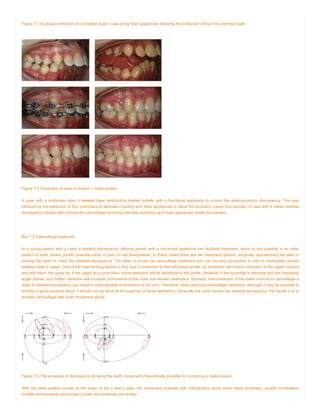
Figure 7.1 Occlusal correction of a crowded class I case using fixed appliances following the extraction of four first premolar teeth.
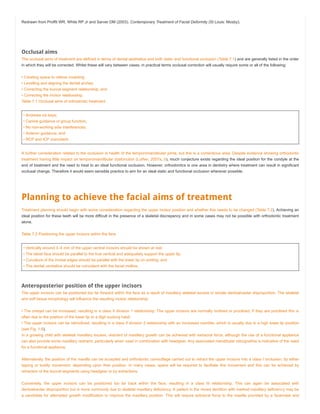
Figure 7.2 Correction of class II division 1 malocclusion.
A case with a moderate class II skeletal base relationship treated initially with a functional appliance to correct the anteroposterior discrepancy. This was
followed by the extraction of four premolars to alleviate crowding and fixed appliances to detail the occlusion (upper four panels). A case with a milder skeletal
discrepancy treated with orthodontic camouflage involving premolar extraction and fixed appliances (lower two panels).
Box 7.2 Camouflage treatment
In a young patient with a class II skeletal discrepancy, utilizing growth with a functional appliance can facilitate treatment, which is not possible in an older
patient or adult, where growth potential either is poor or has disappeared. In these cases there are two treatment options: surgically repositioning the jaws or
moving the teeth to mask the skeletal discrepancy. The latter is known as camouflage treatment and can be very successful in mild to moderately severe
skeletal class II cases. One of the main limiting factors in this type of treatment is the soft tissue profile, as treatment will involve retraction of the upper incisors
and with them, the upper lip. If the upper lip is protrusive, some retraction will be beneficial to the profile. However, if the lip profile is retrusive and the nasolabial
angle obtuse, any further retraction will increase prominence of the nose and worsen aesthetics. Similarly, over-retraction of the lower incisors to camouflage a
class III skeletal discrepancy can result in unacceptable prominence of the chin. Therefore, when planning camouflage treatment, although it may be possible to
achieve a good occlusal result, it should not be done at the expense of facial aesthetics. Generally the more severe the skeletal discrepancy, the harder it is to
achieve camouflage with tooth movement alone.
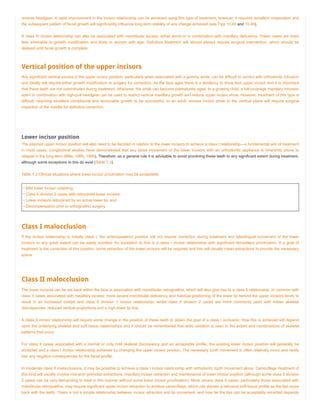
Figure 7.3 The envelope of discrepancy showing the tooth movements theoretically possible for correcting a malocclusion.
With the ideal position shown at the origin of the x and y axes, the movement possible with orthodontics alone (inner black envelope), growth modification
(middle red envelope) and surgery (outer red envelope) are shown.
Redrawn from Proffit WR, White RP Jr and Sarver DM (2003). Contemporary Treatment of Facial Deformity (St Louis: Mosby).
Occlusal aims
The occlusal aims of treatment are defined in terms of dental aesthetics and both static and functional occlusion (Table 7.1) and are generally listed in the order
in which they will be corrected. Whilst these will vary between cases, in practical terms occlusal correction will usually require some or all of the following:
• Creating space to relieve crowding;
• Levelling and aligning the dental arches;
• Correcting the buccal segment relationship; and
• Correcting the incisor relationship.
Table 7.1 Occlusal aims of orthodontic treatment
• Andrews six keys;
• Canine guidance or group function;
• No non-working side interferences;
• Anterior guidance; and
• RCP and ICP coincident.
A further consideration related to the occlusion is health of the temporomandibular joints, but this is a contentious area. Despite evidence showing orthodontic
treatment having little impact on temporomandibular dysfunction (Luther, 2007a, b), much conjecture exists regarding the ideal position for the condyle at the
end of treatment and the need to treat to an ideal functional occlusion. However, orthodontics is one area in dentistry where treatment can result in significant
occlusal change. Therefore it would seem sensible practice to aim for an ideal static and functional occlusion wherever possible.
Planning to achieve the facial aims of treatment
Treatment planning should begin with some consideration regarding the upper incisor position and whether this needs to be changed (Table 7.2). Achieving an
ideal position for these teeth will be more difficult in the presence of a skeletal discrepancy and in some cases may not be possible with orthodontic treatment
alone.
Table 7.2 Positioning the upper incisors within the face
• Vertically around 3–4 mm of the upper central incisors should be shown at rest;
• The labial face should be parallel to the true vertical and adequately support the upper lip;
• Curvature of the incisal edges should be parallel with the lower lip on smiling; and
• The dental centreline should be coincident with the facial midline.
Anteroposterior position of the upper incisors
The upper incisors can be positioned too far forward within the face as a result of maxillary skeletal excess or simple dentoalveolar disproportion. The skeletal
and soft tissue morphology will influence the resulting incisor relationship:
• The overjet can be increased, resulting in a class II division 1 relationship. The upper incisors are normally inclined or proclined. If they are proclined this is
often due to the position of the lower lip or a digit sucking habit.
• The upper incisors can be retroclined, resulting in a class II division 2 relationship with an increased overbite, which is usually due to a high lower lip position
(see Fig. 1.8).
In a growing child with skeletal maxillary excess, restraint of maxillary growth can be achieved with extraoral force, although the use of a functional appliance
can also provide some maxillary restraint, particularly when used in combination with headgear. Any associated mandibular retrognathia is indicative of the need
for a functional appliance.
Alternatively, the position of the maxilla can be accepted and orthodontic camouflage carried out to retract the upper incisors into a class I occlusion, by either
tipping or bodily movement, depending upon their position. In many cases, space will be required to facilitate this movement and this can be achieved by
retraction of the buccal segments using headgear or by extractions.
Conversely, the upper incisors can be positioned too far back within the face, resulting in a class III relationship. This can again be associated with
dentoalveolar disproportion but is more commonly due to skeletal maxillary deficiency. A patient in the mixed dentition with marked maxillary deficiency may be
a candidate for attempted growth modification to improve the maxillary position. This will require extraoral force to the maxilla provided by a facemask and
reverse headgear. A rapid improvement in the incisor relationship can be achieved using this type of treatment; however, it requires excellent cooperation and
the subsequent pattern of facial growth will significantly influence long-term stability of any change achieved (see Figs 10.45 and 10.46).
A class III incisor relationship can also be associated with mandibular excess, either alone or in combination with maxillary deficiency. These cases are even
less amenable to growth modification and likely to worsen with age. Definitive treatment will almost always require surgical intervention, which should be
delayed until facial growth is complete.
Vertical position of the upper incisors
Any significant vertical excess in the upper incisor position, particularly when associated with a gummy smile, can be difficult to correct with orthodontic intrusion
and ideally will require either growth modification or surgery for correction. As the face ages there is a tendency to show less upper incisor and it is important
that these teeth are not overintruded during treatment; otherwise, the smile can become prematurely aged. In a growing child, a full-coverage maxillary intrusion
splint in combination with high-pull headgear can be used to restrict vertical maxillary growth and reduce upper incisor show. However, treatment of this type is
difficult, requiring excellent compliance and favourable growth to be successful. In an adult, excess incisor show in the vertical plane will require surgical
impaction of the maxilla for definitive correction.
Lower incisor position
The planned upper incisor position will also need to be decided in relation to the lower incisors to achieve a class I relationship—a fundamental aim of treatment
in most cases. Longitudinal studies have demonstrated that any labial movement of the lower incisors with an orthodontic appliance is inherently prone to
relapse in the long-term (Mills, 1966, 1968). Therefore, as a general rule it is advisable to avoid proclining these teeth to any significant extent during treatment,
although some exceptions to this do exist (Table 7.3).
Table 7.3 Clinical situations where lower incisor proclination may be acceptable
• Mild lower incisor crowding;
• Class II division 2 cases with retroclined lower incisors;
• Lower incisors retroclined by an active lower lip; and
• Decompensation prior to orthognathic surgery.
Class I malocclusion
If the incisor relationship is initially class I, the anteroposterior position will not require correction during treatment and labiolingual movement of the lower
incisors to any great extent can be easily avoided. An exception to this is a class I incisor relationship with significant bimaxillary proclination. If a goal of
treatment is the correction of this position, some retraction of the lower incisors will be required and this will usually mean extractions to provide the necessary
space.
Class II malocclusion
The lower incisors can be set back within the face in association with mandibular retrognathia, which will also give rise to a class II relationship. In common with
class II cases associated with maxillary excess, more severe mandibular deficiency and habitual positioning of the lower lip behind the upper incisors tends to
result in an increased overjet and class II division 1 incisor relationship; whilst class II division 2 cases are more commonly seen with milder skeletal
discrepancies, reduced vertical proportions and a high lower lip line.
A class II incisor relationship will require some change in the position of these teeth to obtain the goal of a class I occlusion. How this is achieved will depend
upon the underlying skeletal and soft tissue relationships and it should be remembered that wide variation is seen in the extent and combinations of skeletal
patterns that occur.
For class II cases associated with a normal or only mild skeletal discrepancy and an acceptable profile, the existing lower incisor position will generally be
accepted and a class I incisor relationship achieved by changing the upper incisor position. The necessary tooth movement is often relatively minor and rarely
has any negative consequences for the facial profile.
In moderate class II malocclusions, it may be possible to achieve a class I incisor relationship with orthodontic tooth movement alone. Camouflage treatment of
this kind will usually involve mid-arch premolar extractions, maxillary incisor retraction and maintenance of lower incisor position (although some class II division
2 cases can be very demanding to treat in this manner without some lower incisor proclination). More severe class II cases, particularly those associated with
mandibular retrognathia, may require significant upper incisor retraction to achieve camouflage, which can worsen a retrusive soft tissue profile as the lips move
back with the teeth. There is not a simple relationship between incisor retraction and lip movement, and how far the lips can be acceptably retracted depends
upon many factors, including their thickness and competence, the original incisor position and the underlying skeletal anatomy (Handelman, 1996; Ramos et al,
2005). However, care must be taken not to over-retract incisors, particularly in the more severe cases that already have a retrusive soft tissue profile.
In a growing child with a moderate or severe class II skeletal pattern associated with mandibular deficiency, treatment with a functional appliance aimed at
modifying growth should always be considered in an attempt to improve the incisor relationship. In successful cases this will improve the lower incisor position
through advantageous jaw growth and dentoalveolar change prior to a second phase of treatment aimed at achieving th/>
You may also need
The orthodontic patient:
examination and diagnosis
Occlusion and malocclusion
Development of the dentition
Adult orthodontics
Interdisciplinary treatment of
an adult with complete
bilateral cleft lip and palate
Management of the
permanent dentition
Management of the
developing dentition
Cleft lip and palate, and
syndromes affecting the
craniofacial region
Orthodontic tooth movement
Concepts of Retention
Contemporary removable
appliances
Prenatal development of the
craniofacial region
Contemporary fixed
appliances
Postnatal growth of the
craniofacial region
10 Orthognathic Surgery
Only gold members can continue reading. Log In or Register to continue
WordPress theme by UFO themes
A 22-year follow-up of the
nonsurgical expansion of
maxillary and mandibular
arches in a young adult: Are
the outcomes stable, relapsed,
or unstable with aging?
Load more posts
Load more posts
Share this:
Jan 1, 2015 | Posted by mrzezo in Orthodontics | Comments Off
Citrus North
  
Related
25 Orthodontic Treatment for the Special
Needs Child
8: Orthodontics and Periodontal Health Diagnosis and treatment planning in the
three-dimensional era
December 31, 2014
In "Orthodontics"
January 17, 2015
In "Periodontics" January 16, 2022
In "General Dentistry"
5th
Year Lec. No. 12 ‫الحويزي‬ ‫فيصل‬ ‫أكرم‬ .‫د‬ .‫أ‬
1
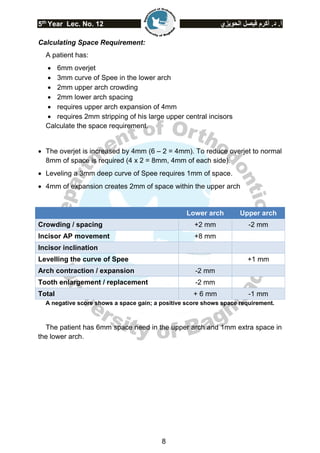
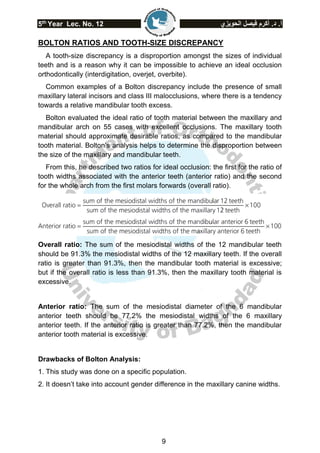
SPACE ANALYSIS
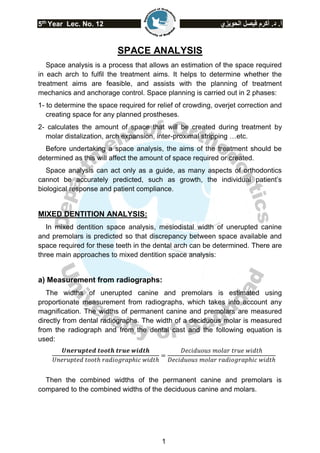
Space analysis is a process that allows an estimation of the space required
in each arch to fulfil the treatment aims. It helps to determine whether the
treatment aims are feasible, and assists with the planning of treatment
mechanics and anchorage control. Space planning is carried out in 2 phases:
1- to determine the space required for relief of crowding, overjet correction and
creating space for any planned prostheses.
2- calculates the amount of space that will be created during treatment by
molar distalization, arch expansion, inter-proximal stripping …etc.
Before undertaking a space analysis, the aims of the treatment should be
determined as this will affect the amount of space required or created.
Space analysis can act only as a guide, as many aspects of orthodontics
cannot be accurately predicted, such as growth, the individual patient’s
biological response and patient compliance.
MIXED DENTITION ANALYSIS:
In mixed dentition space analysis, mesiodistal width of unerupted canine
and premolars is predicted so that discrepancy between space available and
space required for these teeth in the dental arch can be determined. There are
three main approaches to mixed dentition space analysis:
a) Measurement from radiographs:
The widths of unerupted canine and premolars is estimated using
proportionate measurement from radiographs, which takes into account any
magnification. The widths of permanent canine and premolars are measured
directly from dental radiographs. The width of a deciduous molar is measured
from the radiograph and from the dental cast and the following equation is
used:
𝑼𝒏𝒆𝒓𝒖𝒑𝒕𝒆𝒅 𝒕𝒐𝒐𝒕𝒉 𝒕𝒓𝒖𝒆 𝒘𝒊𝒅𝒕𝒉
𝑈𝑛𝑒𝑟𝑢𝑝𝑡𝑒𝑑 𝑡𝑜𝑜𝑡ℎ 𝑟𝑎𝑑𝑖𝑜𝑔𝑟𝑎𝑝ℎ𝑖𝑐 𝑤𝑖𝑑𝑡ℎ
=
𝐷𝑒𝑐𝑖𝑑𝑢𝑜𝑢𝑠 𝑚𝑜𝑙𝑎𝑟 𝑡𝑟𝑢𝑒 𝑤𝑖𝑑𝑡ℎ
𝐷𝑒𝑐𝑖𝑑𝑢𝑜𝑢𝑠 𝑚𝑜𝑙𝑎𝑟 𝑟𝑎𝑑𝑖𝑜𝑔𝑟𝑎𝑝ℎ𝑖𝑐 𝑤𝑖𝑑𝑡ℎ
Then the combined widths of the permanent canine and premolars is
compared to the combined widths of the deciduous canine and molars.
5th
Year Lec. No. 12 ‫الحويزي‬ ‫فيصل‬ ‫أكرم‬ .‫د‬ .‫أ‬
2
b) Prediction tables or equation:
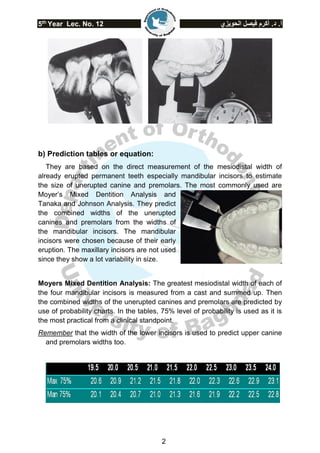
They are based on the direct measurement of the mesiodistal width of
already erupted permanent teeth especially mandibular incisors to estimate
the size of unerupted canine and premolars. The most commonly used are
Moyer’s Mixed Dentition Analysis and
Tanaka and Johnson Analysis. They predict
the combined widths of the unerupted
canines and premolars from the widths of
the mandibular incisors. The mandibular
incisors were chosen because of their early
eruption. The maxillary incisors are not used
since they show a lot variability in size.
Moyers Mixed Dentition Analysis: The greatest mesiodistal width of each of
the four mandibular incisors is measured from a cast and summed up. Then
the combined widths of the unerupted canines and premolars are predicted by
use of probability charts. In the tables, 75% level of probability is used as it is
the most practical from a clinical standpoint.
Remember that the width of the lower incisors is used to predict upper canine
and premolars widths too.
5th
Year Lec. No. 12 ‫الحويزي‬ ‫فيصل‬ ‫أكرم‬ .‫د‬ .‫أ‬
3
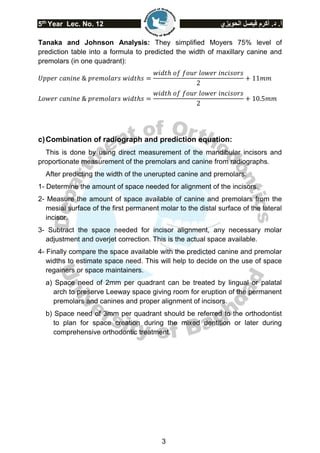
Tanaka and Johnson Analysis: They simplified Moyers 75% level of
prediction table into a formula to predicted the width of maxillary canine and
premolars (in one quadrant):
𝑈𝑝𝑝𝑒𝑟 𝑐𝑎𝑛𝑖𝑛𝑒 & 𝑝𝑟𝑒𝑚𝑜𝑙𝑎𝑟𝑠 𝑤𝑖𝑑𝑡ℎ𝑠 =
𝑤𝑖𝑑𝑡ℎ 𝑜𝑓 𝑓𝑜𝑢𝑟 𝑙𝑜𝑤𝑒𝑟 𝑖𝑛𝑐𝑖𝑠𝑜𝑟𝑠
2
+ 11𝑚𝑚
𝐿𝑜𝑤𝑒𝑟 𝑐𝑎𝑛𝑖𝑛𝑒 & 𝑝𝑟𝑒𝑚𝑜𝑙𝑎𝑟𝑠 𝑤𝑖𝑑𝑡ℎ𝑠 =
𝑤𝑖𝑑𝑡ℎ 𝑜𝑓 𝑓𝑜𝑢𝑟 𝑙𝑜𝑤𝑒𝑟 𝑖𝑛𝑐𝑖𝑠𝑜𝑟𝑠
2
+ 10.5𝑚𝑚
c)Combination of radiograph and prediction equation:
This is done by using direct measurement of the mandibular incisors and
proportionate measurement of the premolars and canine from radiographs.
After predicting the width of the unerupted canine and premolars:
1- Determine the amount of space needed for alignment of the incisors.
2- Measure the amount of space available of canine and premolars from the
mesial surface of the first permanent molar to the distal surface of the lateral
incisor.
3- Subtract the space needed for incisor alignment, any necessary molar
adjustment and overjet correction. This is the actual space available.
4- Finally compare the space available with the predicted canine and premolar
widths to estimate space need. This will help to decide on the use of space
regainers or space maintainers.
a) Space need of 2mm per quadrant can be treated by lingual or palatal
arch to preserve Leeway space giving room for eruption of the permanent
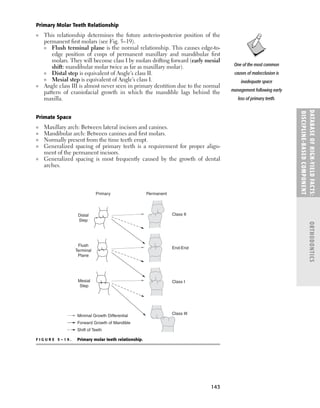
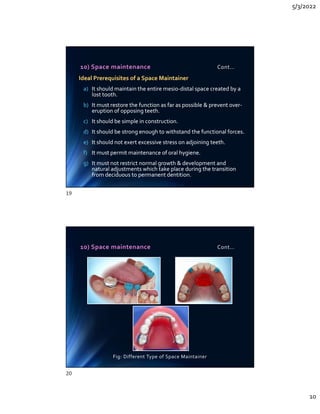
premolars and canines and proper alignment of incisors.
b) Space need of 3mm per quadrant should be referred to the orthodontist
to plan for space creation during the mixed dentition or later during
comprehensive orthodontic treatment.
5th
Year Lec. No. 12 ‫الحويزي‬ ‫فيصل‬ ‫أكرم‬ .‫د‬ .‫أ‬
4
PERMANENT DENTITION ANALYSIS:
The aim of space analysis is to determine the space and anchorage
requirements for orthodontic treatment.
Commonly Used Methods
1- Visualization is the most commonly used method but is inaccurate in
quantifying crowding.
2- The amount of crowding can be calculated by measuring the mesiodistal
width of any misaligned tooth in relation to the available space in the arch.
This process is repeated for all the misaligned teeth in the arch to give the
total extent of crowding.
3- Arch perimeter/ Carey’s Analysis: the
mesiodistal widths of the incisors,
canines and premolars are measured by
a divider and the sum represents the
space needed. A soft brass wire is
passed from the mesial surface of the
first molar to the contra-lateral side. The
wire passes along the buccal cusps of
premolars and incisal edges of the
anteriors. In crowded arches, the wire should
be pass according to the arch form that
reflects the majority of the teeth. The wire
should pass along the cingula of anterior
teeth if they are proclined and along their
labial surfaces if they are retroclined. The
wire is then straightened to measure the
space available. The difference is the space
need or excess.
5th
Year Lec. No. 12 ‫الحويزي‬ ‫فيصل‬ ‫أكرم‬ .‫د‬ .‫أ‬
5
4- Segmental arch analysis: The same as
Carey’s Analysis but done in three segments;
from the mesial of the first molars to the mesial
of the canines for the distal segments and
between the mesial of the canines for the
anterior segment.
5- Digital 3D scanning: Many software programs are equipped with a facility to
plot contact points in order to identify the arch form, as well as a ‘virtual
ruler’ that can measure mesiodistal tooth widths.
5th
Year Lec. No. 12 ‫الحويزي‬ ‫فيصل‬ ‫أكرم‬ .‫د‬ .‫أ‬
6
Malocclusion Features to Consider in Space Analysis:
1) Crowding and spacing:
Crowding and spacing should be measured mesial to the first permanent
molars in relationship to the archform that fits the majority of teeth. The
mesiodistal width of the malaligned teeth is measured followed by the
available space within the archform. Crowding can be quantified as mild (<4
mm), moderate (4–8 mm) or severe (≥8 mm).
If the second deciduous molars are retained, approximately 1 mm of space
per quadrant will be available following exfoliation and eruption of second
premolars in the upper arch and 2 mm in each quadrant in the lower arch.
2) Incisor anteroposterior movement
With few exceptions, the lower incisor anteroposterior (AP) position should
be accepted to maximize stability. In Class II malocclusions, the upper incisors
must be retracted for overjet reduction.
Conversely, in Class III malocclusions
the upper incisors may be advanced and
the lowers retracted to correct a reverse
overjet. For every 1 mm all four incisors
are retracted, 2 mm of space (1 mm per
quadrant) is required. Conversely, for
every 1 mm all four incisors are
advanced, 2 mm of space will be created.
3) Correction of upper incisor angulation and inclination
Changing the inclination (torque) of incisors has space
implications. When the upper incisors are
proclined, the overjet increases and space is
required to normalise this increase. When
proclined incisors are retroclined, every 5° of
retroclination will reduce the overjet by
0.5mm and requires 1mm of space.
The space requirement to correct incisor
angulation (mesiodistal tip) is usually minimal.
5th
Year Lec. No. 12 ‫الحويزي‬ ‫فيصل‬ ‫أكرم‬ .‫د‬ .‫أ‬
7
4) Levelling the curve of Spee
Where there is no occlusal stop the lower incisors may over-erupt resulting
in an occlusal curve which runs from the molars to the incisors (Curve of
Spee). Levelling an increased curve of Spee requires 1 to 2mm of space
depending on the depth of the curve, which is measured from the premolar
cusps to a flat plane joining the distal cusps of first permanent molars and
incisors. Flattening deep curves of Spee increasing arch length and labially
proclines the incisor teeth.
5) Arch contraction and expansion
Upper arch lateral expansion is undertaken for posterior crossbite correction
and is useful in providing space for the relief of crowding and/or overjet
reduction. Every 1 mm of lateral expansion creates approximately 0.5 mm of
space within the arch. While, arch contraction requires space.
6) Tooth reshaping or replacement
Mesiodistal enlargement of microdont teeth and replacement of missing
teeth require space. Also, extremely large teeth need to be stripped to normal
size. This needs to be taken into account when determining total arch space
requirements.
Once all of the above factors have been considered, it is possible to
calculate the space required within each arch.
5th
Year Lec. No. 12 ‫الحويزي‬ ‫فيصل‬ ‫أكرم‬ .‫د‬ .‫أ‬
8
Calculating Space Requirement:
A patient has:
 6mm overjet
 3mm curve of Spee in the lower arch
 2mm upper arch crowding
 2mm lower arch spacing
 requires upper arch expansion of 4mm
 requires 2mm stripping of his large upper central incisors
Calculate the space requirement.
 The overjet is increased by 4mm (6 – 2 = 4mm). To reduce overjet to normal
8mm of space is required (4 x 2 = 8mm, 4mm of each side).
 Leveling a 3mm deep curve of Spee requires 1mm of space.
 4mm of expansion creates 2mm of space within the upper arch
Lower arch Upper arch
Crowding / spacing +2 mm -2 mm
Incisor AP movement +8 mm
Incisor inclination
Levelling the curve of Spee +1 mm
Arch contraction / expansion -2 mm
Tooth enlargement / replacement -2 mm
Total + 6 mm -1 mm
A negative score shows a space gain; a positive score shows space requirement.
The patient has 6mm space need in the upper arch and 1mm extra space in
the lower arch.
5th
Year Lec. No. 12 ‫الحويزي‬ ‫فيصل‬ ‫أكرم‬ .‫د‬ .‫أ‬
9
BOLTON RATIOS AND TOOTH-SIZE DISCREPANCY
A tooth-size discrepancy is a disproportion amongst the sizes of individual
teeth and is a reason why it can be impossible to achieve an ideal occlusion
orthodontically (interdigitation, overjet, overbite).
Common examples of a Bolton discrepancy include the presence of small
maxillary lateral incisors and class III malocclusions, where there is a tendency
towards a relative mandibular tooth excess.
Bolton evaluated the ideal ratio of tooth material between the maxillary and
mandibular arch on 55 cases with excellent occlusions. The maxillary tooth
material should approximate desirable ratios, as compared to the mandibular
tooth material. Bolton’s analysis helps to determine the disproportion between
the size of the maxillary and mandibular teeth.
From this, he described two ratios for ideal occlusion: the first for the ratio of
tooth widths associated with the anterior teeth (anterior ratio) and the second
for the whole arch from the first molars forwards (overall ratio).
Overall ratio: The sum of the mesiodistal widths of the 12 mandibular teeth
should be 91.3% the mesiodistal widths of the 12 maxillary teeth. If the overall
ratio is greater than 91.3%, then the mandibular tooth material is excessive;
but if the overall ratio is less than 91.3%, then the maxillary tooth material is
excessive.
Anterior ratio: The sum of the mesiodistal diameter of the 6 mandibular
anterior teeth should be 77.2% the mesiodistal widths of the 6 maxillary
anterior teeth. If the anterior ratio is greater than 77.2%, then the mandibular
anterior tooth material is excessive.
Drawbacks of Bolton Analysis:
1. This study was done on a specific population.
2. It doesn’t take into account gender difference in the maxillary canine widths.
C H A P T E R 5
Orthodontics
Jamin Cho, DMD,
Ivana Chow, DMD and
Hong Yin, DDS
Malocclusion 123
CLASSIFICATION OF OCCLUSION 123
SIGNS OF INCIPIENT MALOCCLUSION 124
SPEECH DIFFICULTIES RELATED TO MALOCCLUSION 124
MOLAR UPRIGHTING 125
IMPACTED TEETH 125
Cephalometrics 126
RADIOGRAPHIC CEPHALOMETRY 126
LANDMARKS 127
MANDIBULAR PLANE 128
SNA ANGLE, SNB ANGLE, AND ANB ANGLE 128
Removable Appliances 128
INDICATIONS FOR REMOVABLE APPLIANCES 128
MAJOR COMPONENTS OF A REMOVABLE APPLIANCE 128
ADVANTAGES AND DISADVANTAGES OF REMOVABLE APPLIANCES VS. THE FIXED APPLIANCES 129
HEADGEAR 129
Functional Appliances 129
Fixed Appliances 131
EDGEWISE APPLIANCE 131
STRAIGHT-WIRE APPLIANCE 131
BANDING AND BONDING 131
ARCHWIRE 132
POSSIBLE NEGATIVE SEQUELLA ASSOCIATED WITH ORTHODONTIC TREATMENT 132
Crossbite and Open Bite 132
CROSSBITE DEFINITION AND ETIOLOGY 132
CROSSBITE CLASSIFICATION 133
CROSSBITE TREATMENT 133
OPEN BITE DEFINITION AND ETIOLOGY 134
OPEN BITE CLASSIFICATION 134
121
Copyright © 2008 by The McGraw-Hill Companies, Inc. Click here for terms of use.
122
OPEN BITE TREATMENT 134
Space Maintenance 138
TYPES OF APPLIANCES 138
CONSEQUENCES OF EARLY LOSS OF PRIMARY DENTITION 140
MANAGEMENT OF EARLY LOSS OF TEETH 140
Retention 140
FIXED 140
REMOVABLE 140
RATIONALE FOR RETENTION 142
POSTORTHODONTIC CIRCUMFERENTIAL SUPRACRESTAL FIBROTOMY 142
PRIMARY MOLAR TEETH RELATIONSHIP 143
PRIMATE SPACE 143
Mixed Dentition 144
MIXED DENTITION ANALYSIS 144
DIASTEMA 145
Growth and Development 145
EFFECTS OF ENVIRONMENTAL INFLUENCES DURING GROWTH AND DEVELOPMENT 145
GROWTH OF THE MANDIBLE 146
GROWTH OF THE MAXILLA 146
FORMATION OF BONE 147
GROWTH OF BONE 147
GROWTH OF CARTILAGE 147
GROWTH OF ALVEOLAR PROCESS 147
ERUPTION PATTERNS 147
FAILURE OR DELAYED TOOTH ERUPTION PATTERNS 148
ECTOPIC ERUPTION 148
WRIST-HAND RADIOGRAPH 149
LATERAL CEPHALOGRAM 149
SUPERNUMERARY TEETH 149
OLIGODONTIA 150
SERIAL EXTRACTION 150
Orthodontic Terms 151
OVERBITE 151
OVERJET 151
PHYSIOLOGIC OCCLUSION 151
PATHOLOGICAL OCCLUSION 152
LEEWAY SPACE 152
ORTHODONTIC MOVEMENTS 152
123
DATABASE
OF
H
IG
H-YI
E
LD
FACTS:
DISC
I
PLI
N
E-BASE
D
COM
PON
E
NT
ORTHODONTICS
 MALOCCLUSION
Classification of Occlusion (See Fig. 5–1)
■ Class I:
■ 70% of population.
■ The mesiobuccal cusp of the maxillary first molar lines up with the
buccal groove of the mandibular first molar.
■ The maxillary central incisors overlap the mandibular incisors.
■ The maxillary canine lies between the mandibular canine and first
premolar.
■ Class II:
■ Can also be referred to as a distoclusion, retrognathism, or overbite.
■ 25% of population.
■ The mesiobuccal cusp of the maxillary first molar falls between the
mandibular first molar and the second premolar.
■ The lower jaw and chin may also appear small and withdrawn.
■ Maxillary canine is mesial to mandibular canine.
■ Class II, Division 1: Maxillary incisors (centrals and laterals) in extreme
labioversion (protruded).
■ Class II, Division 2: Maxillary centrals tipped palatally and in a
retruded position (linguoversion). The maxillary laterals are typically
tipped labially and mesially.
■ Subdivision: The malocclusion occurs on one side of the dental arch
only.
■ Example: Class II, Division 1 subdivision right—The right molar is in
a class II relationship while the left molar is in a class I relationship.
■ Class III:
■ Less than 5% of the population.
■ The mesiobuccal cusp of the maxillary first molar falls between the
mandibular first molar and the second molar.
■ The chin may be in a protrusive position.
■ The maxillary canine is distal to the mandibular canine.
■ Can also be referred to as a mesioclusion, prognathism, or underbite.
F I G U R E 5 – 1 . Classification of occlusion.
Class II Malocclusion
Normal Occlusion Class I Malocclusion
Class III Malocclusion
124
DATABASE
OF
H
IG
H-YI
E
LD
FACTS:
DISC
I
PLI
N
E-BASE
D
COM
PON
E
NT
ORTHODONTICS
■ Class III malocclusions are those in which the body of the mandible
and its superimposed dental arch are in a mesial relationship to the
skull base and maxilla. The maxillary first molar therefore occludes dis-
tal to the mandibular first molar, while the maxillary canine is in an ex-
aggerated distal relationship to the mandibular canine.
■ The overjet in a class I occlusion is 1–2 mm. In a class III malocclu-
sion, the overjet is 0 mm (edge-to-edge bite) or negative. (The mandibu-
lar incisors are forward relative to the maxillary incisors.)
■ Pseudo Class III malocclusion:
■ Describes a situation in which the patient adopts a jaw position
upon closure which is forward to normal.
■ Typically, the pseudo class III patient presents with an edge-to-edge
bite.
■ In order to avoid interference and achieve maximal intercuspation,
the patient slides his/her jaw forward.
■ This patient has the ability to bring the mandible back without
strain so that the mandibular incisors touch the maxillary incisors.
■ This type is therefore a milder form of the class III malocclusion and
more amenable to conservative orthodontic treatment than the “true”
class III malocclusion which often requires surgical correction.
Signs of Incipient Malocclusion
■ The lack of interdental spacing in the primary dentition.
■ The significance of the lack of spacing relates to the increased mesio-
distal width of the permanent teeth.
■ The crowding of the permanent incisors in the mixed dentition.
■ Arch perimeter increases slightly after the eruption of the incisors, but
after this stage of dental development, arch length reduces as a result of
the loss of E space. Hence, crowding of the permanent incisors in the
early mixed dentition typically results in crowding in the permanent
dentition.
■ The premature loss of the primary canines, particularly in the mandibular
arch.
■ This phenomenon is indicative of insufficient arch size in the anterior
region. During eruption of the lateral incisors, the crown of the laterals
impinge on the roots of the primary canines and causes them to resorb.
When the canine is shed, the midline will shift in the direction of the
lost tooth. You will have lateral and lingual migration of the mandibular
incisors.
Speech Difficulties Related to Malocclusion
Speech Sound Related Malocclusion
s, z Anterior open bite, large gap between incisors
t, d Irregular incisors (especially lingual position of
maxillary incisors)
f, v Skeletal class III
th, sh, ch Anterior open bite
An anterior crossbite of
multiple teeth in the primary
dentition usually indicates a
skeletal growth problem.
DATABASE
OF
H
IG
H-YI
E
LD
FACTS:
DISC
I
PLI
N
E-BASE
D
COM
PON
E
NT
ORTHODONTICS
Molar Uprighting
■ Long-term loss of a mandibular permanent first molar:
■ Causes tipping, migration, and rotation of adjacent teeth into edentu-
lous space.
■ Common reason why molar uprighting of second molar is required.
■ Reasons why normal angulation of a molar is desirable:
■ Improves the direction and distribution of occlusal forces.
■ Decreases the amount of tooth reduction required for parallelism of the
abutments.
■ Decreases the possibility of endodontic, periodontic, or more complex
prosthodontic procedures.
■ Increases the durability of the restorations, due to better force distribution.
■ Improves the periodontal environment by eliminating plaque-retentive
areas.
■ Improves the alveolar contour.
■ Improves crown-to-root ratio.
■ Best treatment method: Tipping the crown of second molar distally and
opening up space for a pontic to replace missing first molar.
■ Upright with fixed edgewise orthodontic appliance.
■ Bracket slot size: 0.022 in. or (alternatively, 0.018 in.).
■ Tipped second molar should be banded because of the considerable
posterior masticatory forces produced can easily shear off bonded
brackets.
■ Time frame: 6–12 months.
■ Considerations:
■ Severely lingually tipped mandibular molar is more difficult to control
and upright properly.
■ Stabilization should last until the lamina dura and PDL reorganize.
■ 2 months for simple uprighting.
■ 6 months for uprighting, osseous surgery, grafts, and the like.
■ Retention can be provided by an appliance or by a well-fitting provi-
sional restoration.
■ Slow progress in molar uprighting in an adult patient is most likely
due to occlusal interferences.
■ Conditions that may complicate molar uprighting:
■ High mandibular plane:
■ If unsuccessful, it can lead to an increased open bite and loss of anterior
guidance.
■ Open bite.
■ Presence of periodontal disease.
■ Poor crown-to-root ration and/or short roots.
■ Presence of root resorption.
■ Significant centric relation-to-maximum intercuspation discrepancy.
■ Severe lingual inclination of the tooth in addition to mesial tipping.
■ Occlusal plane disharmony (i.e., extruded maxillary and mandibular molars).
■ Severe skeletal discrepancies.
Impacted Teeth
■ Most common: Maxillary canine
■ May cause:
■ Damage to the roots of adjacent teeth.
■ Create severe orthodontic problem.
■ Create future prosthodontic problems to restore the missing tooth.
125
126
DATABASE
OF
H
IG
H-YI
E
LD
FACTS:
DISC
I
PLI
N
E-BASE
D
COM
PON
E
NT
ORTHODONTICS
■ Diagnosis:
■ Can be first observed on an X-ray.
■ Association of impacted canines with missing lateral incisors or short-
ened roots of lateral incisors.
■ Distal aspect of the root of lateral incisors guides the eruption of
canines.
■ Older patients have an increased risk of having the impacted tooth becom-
ing ankylosed.
■ Treatment: Can be brought to the arch through orthodontic traction after
being surgically exposed (see Fig. 5–2).
■ Treatment planning considerations:
■ The overretained primary tooth should be considered for extraction
based on its position and potential for eruption.
■ The prognosis should be based on the extent of displacement and the
surgical trauma required for exposure.
■ During surgical exposure, flaps should be reflected so that the tooth is
ultimately pulled into the arch through keratinized tissue, not through
alveolar mucosa.
■ Adequate space should be provided in the arch before attempting to
pull the impacted tooth into position.
 CEPHALOMETRICS
Radiographic Cephalometry
■ Method of making indirect skull measurements utilizing X-rays and radi-
ographic film.
■ Linear and angular measurements are obtained utilizing known anatomi-
cal landmarks in the lateral head radiography of the patient.
F I G U R E 5 – 2 . Exposure of maxillary canine.
(Reproduced, with permission, from Profitt WR, Fields HW, Sarver DM. Contemporary
Orthodontics, 4h ed. Philadelphia, PA: Elsevier, 2007.)
DATABASE
OF
H
IG
H-YI
E
LD
FACTS:
DISC
I
PLI
N
E-BASE
D
COM
PON
E
NT
ORTHODONTICS
127
■ These measurements are then compared with those considered within
normal limits and in that way enable the orthodontist to assess aberration
in the dentition and jaw structures which result in malocclusion.
■ The etiology of a particular malocclusion may have a dental component
or a skeletal component or both.
■ Application of cephalometric films:
■ To clarify the anatomic basis for a malocclusion and serve as a critical
tool in orthodontic diagnosis.
■ To analyze treatment results. Cephalometric films taken before, during,
and after treatment (serial cephalometrics) can be superimposed to
study changes in jaw and tooth positions that have occurred due to or-
thodontic therapy.
■ To show the amount and direction of craniofacial growth.
Landmarks (See Fig. 5–3)
■ Bolton (Bo): The highest point in the concavity behind the occipital
condyle.
■ Basion (Ba): The most forward and highest point of the anterior margin of
foramen magnum.
■ Articulare (Ar): The point of intersection of the contour of the posterior
cranial base and the posterior contour of the condylar process.
■ Porion (Po): Outer upper margin of the external auditory canal.
■ Sphenooccipital synchondrosis (SO): Junction between the occipital and
basisphenoid bones.
■ Sella (S): The midpoint of sella turcica as determined by inspection.
■ Pterygomaxillary fissure (Ptm): Point at base of fissure where anterior and
posterior walls meet.
1 2 3
4
5
6
7
8
10
9
11
12
13
14
F I G U R E 5 – 3 . Lateral cephalometric tracing.
1 Bo; 2 Ba; 3 Ar; 4 Po; 5 SO; 6 S; 7 Ptm; 8 Or; 9 ANS; 10 Point A; 11 Point B; 12 Pog; 13 Me; 14 Go.
128
■ Orbitale (Or): Lowest point on the inferior margin of the orbit.
■ Anterior nasal spine (ANS): Tip of anterior nasal spine.
■ Point A (Subspinale): Innermost point on contour of premaxilla between
anterior nasal spine and incisor tooth.
■ Point B (Supramentale): Innermost point on contour of mandible between
incisor tooth and bony chin.
■ Pogonion (Pog): Most anterior point of the contour of chin.
■ Menton (Me): Most inferior point on the mandibular symphysis, the button
of the chin.
■ Gonion (Go): Lowest most posterior point on the mandible with the teeth
in occlusion.
Mandibular Plane
■ The mandibular plane angle can be visualized clinically by placing a mirror
handle or other flat-edge instrument along the border of the mandible.
■ Cephalometrically, the mandibular plane is the line connecting points gonion
and menton (or gnathion).
■ The mandibular plane angle is measured at the intersection formed by the
mandibular plane and the sella-nasion line.
■ A steep mandibular plane angle correlates with a long anterior vertical
dimension and an anterior open bite malocclusion.
■ A flat mandibular plane angle correlates with a short anterior facial vertical
dimension and a deep bite malocclusion.
SNA Angle, SNB Angle, and ANB Angle
■ An SNA angle of greater than 84o in the Caucasian population indicates
maxillary prognathism.
■ An SNB angle of less than 78o indicates mandibular retrognathism.
■ An ANB angle of 2–4o indicates a class I skeletal pattern.
 REMOVABLE APPLIANCES
Indications for Removable Appliances
■ Limited tipping movements.
■ Retention after comprehensive treatment.
■ Growth modification during the mixed dentition.
Major Components of a Removable Appliance
■ Retentive component: Examples include Adams clasp, ball clasp, C clasp,
and arrow clasp.
■ A framework or baseplate: This is typically made of acrylic and provides
anchorage.
■ Active component or tooth moving component: This consists of springs,
jacks screws, or elastics.
■ Anchorage component: This resists force of active component (e.g.,
acrylic base plate or labial bow or soldered arm).
DATABASE
OF
H
IG
H-YI
E
LD
FACTS:
DISC
I
PLI
N
E-BASE
D
COM
PON
E
NT
ORTHODONTICS
The Frankfort-Horizontal
Plane is constructed by
drawing line connecting
porion and orbital. This has
been adopted as the best
horizontal orientation from
which to assess the lateral
representation of the skull.
The most common type of
retainer is the Hawley
retainer. (Other types of
removable retainers include
the Positioner and Essex
retainer.)
129
Advantages and Disadvantages of Removable
Appliances vs. the Fixed Appliances
■ Advantages:
■ Improved hygiene.
■ Patient comfort increased.
■ Lab fabrication decreases chair time.
■ Disadvantages:
■ Results heavily dependent on patient compliance.
■ Cannot achieve two-point tooth contact, thereby making bodily tooth
movement impossible.
■ Removable appliances can only accomplish tooth tipping.
Headgear
■ Headgear is typically used in skeletal class II growing patients to hold the
growth of the maxilla back and to allow the mandible to catch up.
■ Headgear needs to be worn 10–14 hours/day in order to be effective.
■ Treatment length is typically 6–18 months, depending on the severity of
the malocclusion.
■ Headgear can also be used in adults for the maintenance of anchorage.
■ Extraoral anchorage with the use of headgear allows the orthodontist to
keep the posterior segment back without adversely disturbing the opposite
arch.
■ High-pull headgear consists of a head cap connected to a face bow. This
appliance places a distal and intrusive force on the maxillary molars and
maxilla.
■ Cervical-pull headgear consists of a neck strap connected to a face bow.
This appliance produces a distal and extrusive force against the maxillary
teeth and maxilla.
■ Straight-pull headgear is similar to the cervical-pull headgear. However,
this appliance places a force in a straight distal direction.
■ Reverse-pull headgear has an extraoral component that is supported by
the chin and forehead. It is used in skeletal class III malocclusions to pro-
tract the maxilla.
 FUNCTIONAL APPLIANCES
■ These appliances are designed to modify growth during mixed dentition.
■ Functional appliances have a dental as well as a skeletal effect.
■ Functional appliances can be categorized as tissue borne or tooth borne.
■ Tooth-borne appliance:
■ Bionator: Advances the mandible to an edge-to-edge position to
stimulate mandibular growth for correction of class II malocclusion
(see Fig. 5–4).
■ Herbst: Maxillary and mandibular framework splinted together via
pin and tube device that holds the mandible forward (see Fig. 5–5).
■ Tissue-borne appliance:
■ The Frankel functional appliance is the only tissue-borne appliance.
■ It alters both mandibular posture and contour of facial soft tissue
(see Fig. 5–6).
DATABASE
OF
H
IG
H-YI
E
LD
FACTS:
DISC
I
PLI
N
E-BASE
D
COM
PON
E
NT
ORTHODONTICS
130
DATABASE
OF
H
IG
H-YI
E
LD
FACTS:
DISC
I
PLI
N
E-BASE
D
COM
PON
E
NT
ORTHODONTICS
Bionator
F I G U R E 5 – 4 . Bionator.
(Courtesy of Dockstader Dental Lab, Fresno, CA, www.dockstader.com.)
F I G U R E 5 – 5 . Herbst appliance.
(Courtesy of Dynaflex Laboratories, St. Louis, MO, www.dynaflex.com.)
131
 FIXED APPLIANCES
Edgewise Appliance
■ Horizontally positioned slot. (Earlier fixed appliances such as the Begg
appliance used a vertically positioned slot.)
■ Siamese twin bracket: Double wings for increased rotational and tip con-
trol of roots.
Straight-Wire Appliance
■ A variation of the edgewise appliance.
■ The brackets are designed with a built-in “prescription” to eliminate wire
bends that had been necessary up to that time to compensate for differ-
ences in tooth anatomy.
■ Variation in bracket thickness compensates for the varying thickness of in-
dividual teeth.
■ Angulation of bracket slot relative to the long axis of the tooth allow for
proper positioning of the roots.
■ Torque in bracket slots compensate for inclination of facial surface of
teeth.
Banding and Bonding
■ 35–50% unbuffered phosphoric acid is used as an etching agent before
direct bonding of orthodontic brackets.
■ Tooth surface must not be contaminated with saliva, which promotes
immediate remineralization, until bonding is completed.
■ Glass ionomer cements are used to cement bands because of their fluoride
releasing properties.
DATABASE
OF
H
IG
H-YI
E
LD
FACTS:
DISC
I
PLI
N
E-BASE
D
COM
PON
E
NT
ORTHODONTICS
F I G U R E 5 – 6 . Frankel appliance.
(Courtesy of Dynaflex Laboratories, St. Louis, MO, www.dynaflex.com.)
The four basic components of
fixed appliances include
bands, brackets, arch wires,
and auxiliaries (elastics or
ligatures to hold the archwire
in brackets).
132
■ Indications for using bands instead of brackets:
■ To better resist breakage, especially in areas of heavy mastication or
cuspal interference.
■ For teeth that will need both a lingual and a labial attachment.
■ Teeth with short clinical crowns.
■ Tooth surfaces that are incompatible with successful bonding (e.g.,
amelogenesis imperfecta, stainless steel crown).
Archwire
■ The properties of an ideal arch-wire:
■ High strength.
■ Low stiffness.
■ High range.
■ High formability.
■ The stiffness of an orthodontic wire is a function of the length of the wire,
the diameter, and the alloy composition.
■ Various alloy composition of orthodontic arch-wires:
■ Stainless steel and cobalt chromium alloy.
■ Nickle titanium.
■ Beta-titanium (titanium and molybdenum alloy).
Possible Negative Sequella Associated with Orthodontic Treatment
■ Orthodontic appliances may cause irritation or trauma to the gingiva or
buccal or labial mucosa.
■ They may act as plaque harbors.
■ May interfere with proper oral hygiene.
■ Prolonged orthodontic treatment is associated with root resorption.
■ Prolonged orthodontic treatment is associated with decalcification stains
on enamel surfaces.
■ Orthodontic appliances increase the risk for gingivitis and caries.
 CROSSBITE AND OPEN BITE
Crossbite Definition and Etiology
■ A crossbite is clinically observed as when teeth are on the wrong side of
the opposing dentition.
■ Crossbites can be skeletal, dental, or functional in origin.
■ A skeletal crossbite has smooth closure to centric occlusion.
■ A functional crossbite demonstrates a deviation in maxillary and
mandibular midlines as the patient closes, often times a mandibular
shift is noted.
■ Crossbite may be associated with any of the following:
■ Heredity.
■ Maxillary/mandibular jaw size discrepancies such as reverse overjet
scenarios sometimes observed in patients with class III skeletal tendencies
where more than two maxillary anterior teeth are lingual to the mandibular
anterior teeth.
DATABASE
OF
H
IG
H-YI
E
LD
FACTS:
DISC
I
PLI
N
E-BASE
D
COM
PON
E
NT
ORTHODONTICS
133
■ Oral habits such as a prolonged sucking habit.
■ A labially situated supernumerary tooth, trauma, or arch length
discrepancy.
■ Anterior crossbite of one or more of the permanent incisors is often
associated with prolonged retention of a primary tooth.
Crossbite Classification
■ Unilateral or bilateral.
■ Anterior or posterior.
Crossbites can occur in any of the above the combinations, such as bilat-
eral posterior crossbite.
■ An anterior crossbite of multiple maxillary teeth in the primary dentition is
often an indication of a skeletal growth problem or a developing class III
malocclusion.
■ Children with class III tendencies will usually have end-on contact of
the primary incisors, and will not develop the anterior crossbite until
eruption of the permanent incisors.
■ Posterior crossbites may be associated with a mandibular shift.
Crossbite Treatment
■ Posterior crossbites and mild anterior crossbites need to be corrected in the
first stage of treatment (as soon as possible), as the transverse dimension is
the first to stop growth.
■ Posterior crossbites are usually corrected with palatal expansion (see Fig. 5–7):
■ Rapid palatal expansion (RPE) devices are usually used.
■ Expander is activated two times a day (0.25 mm each turn); length of
time will depend on amount of expansion desired.
■ After activation is completed, the expander remains in the mouth for
3–6 months for bone to form in the midpalatal suture region.
DATABASE
OF
H
IG
H-YI
E
LD
FACTS:
DISC
I
PLI
N
E-BASE
D
COM
PON
E
NT
ORTHODONTICS
F I G U R E 5 – 7 . Rapid palatal expander.
(Courtesy of Dockstader Dental Lab, Fresno, CA, www.dockstader.com.)
134
■ After palatal expansion:
■ Dentally: A diastema is observed between the central incisors. Diastema
closure usually occurs spontaneously.
■ Skeletally: Expansion of nasal floor as a result of widening of the midpalatal
suture.
■ Mild cases such as anterior crossbite of one or more permanent incisors
should be treated as soon as possible, otherwise complications such as loss
of arch length can occur.
■ Be certain to create enough space mesiodistally for correction of ante-
rior crossbite.
■ Severe anterior crossbites are usually corrected in the second stage of con-
ventional treatment.
■ Corrected anterior crossbite is best retained by the normal incisor relation-
ship.
Open Bite Definition and Etiology
■ An open bite is a situation where the dentition in opposite arches cannot
be brought into occlusion.
■ Open bites can be skeletal or dental in origin.
■ Anterior open bites are most commonly due to a finger habit.
■ Maxillary constriction results from increased pressure on the buccinator
muscles from sucking.
■ As a result of the maxillary constriction from the finger habit, patients
will have a tendency toward bilateral crossbite. They tend to shift the
mandible to one side or another for better intercuspation, which may
later on guide the eruption of posterior dentition (premolars and molars)
into crossbite relationships.
■ Proclination of the maxillary incisors, retroclination of the mandibular
incisors.
■ If the habit involves the hand resting on the chin, mandibular growth is
sometimes retarded and produces a class II retrognathic profile.
■ Compensatory tongue thrust habit is often observed in patients with open
bites.
Open Bite Classification
■ Open bite can be classified as:
■ Anterior open bite.
■ Posterior open bite.
Anterior open bites are more commonly seen in African Americans than
Caucasians.
Open Bite Treatment
■ Early management:
■ Habit control
■ Orthodontic appliances (see Figs. 5–8A and B):
■ Tongue crib
■ Bluegrass
DATABASE
OF
H
IG
H-YI
E
LD
FACTS:
DISC
I
PLI
N
E-BASE
D
COM
PON
E
NT
ORTHODONTICS
135
DATABASE
OF
H
IG
H-YI
E
LD
FACTS:
DISC
I
PLI
N
E-BASE
D
COM
PON
E
NT
ORTHODONTICS
F I G U R E 5 – 8 A . Tongue crib.
(Courtesy of QC Orthodontics Laboratory Inc., Fuquay Varina, NC, www.qcortho.com.)
F I G U R E 5 – 8 B . Bluegrass appliance.
(Courtesy of QC Orthodontics Laboratory Inc., Fuquay Varina, NC, www.qcortho.com.)
136
DATABASE
OF
H
IG
H-YI
E
LD
FACTS:
DISC
I
PLI
N
E-BASE
D
COM
PON
E
NT
ORTHODONTICS
F I G U R E 5 – 9 A . Transpalatal bar.
(Courtesy of Dynaflex Laboratories, St. Louis, MO, www.dynaflex.com.)
F I G U R E 5 – 9 B . Lower lingual holding arch.
(Courtesy of Dockstader Dental Lab, Fresno, CA, www.dockstader.com.)
■ Palatal expansion in cases of narrow maxillas.
■ Palatal bars and lingual arches to reduce the vertical eruption of molars
(see Figs. 5–9A and B).
■ Posterior bite plates (see Fig. 5–10).
■ High pull facebows (see Fig. 5–11).
■ Myofunctional therapy in more severe cases.
■ Orthodontic treatment only:
■ Usually limited in cases where the open bite is due to environmental
factors.
■ More predictable treatment in patients with average or short lower facial
height (average- to low-angle cases).
137
■ Combined orthodontic and surgical treatment:
■ Required in most cases where skeletal open bites are involved, such as
patients who show an excess of anterior vertical facial height, steep
mandibular plane angle, or long lower facial heights.
■ Retention:
■ Habit-control appliances such as tongue cribs can be included as part
of the removal Hawley appliance.
■ Positioners can also be considered as part of retention because of their
bite closing effect (see Fig. 5–12).
DATABASE
OF
H
IG
H-YI
E
LD
FACTS:
DISC
I
PLI
N
E-BASE
D
COM
PON
E
NT
ORTHODONTICS
F I G U R E 5 – 1 0 . Posterior bite plate.
(Courtesy of Precision Orthodontic Laboratory, North Hollywood, CA, http://polusa.org)
F I G U R E 5 – 1 1 . High-pull headgear.
(Courtesy of American Orthodontics, www.americanortho.com.)
138
 SPACE MAINTENANCE
Types of Appliances
■ Natural tooth is the best space maintainer.
■ Evaluate the patient’s dental age and skeletal age if space maintenance
will be needed in the case of a lost primary tooth.
■ If a broken down primary tooth is to be preserved, proper pulpal therapy
in conjunction with a restoration would be needed.
■ Space maintainer to replace one prematurely missing primary tooth.
■ Band and loop—prevents mesial migration of the primary second molar
after unilateral loss of the primary first molar (see Fig. 5–13).
DATABASE
OF
H
IG
H-YI
E
LD
FACTS:
DISC
I
PLI
N
E-BASE
D
COM
PON
E
NT
ORTHODONTICS
F I G U R E 5 – 1 3 . Band and loop space maintainer.
(Courtesy of JR Orthodontic Laboratory, San Diego, CA, www.jrortholab.com.)
Whenever possible, it is best
to use fixed appliances as they
do not require patient
cooperation.
F I G U R E 5 – 1 2 . Positioners.
(Courtesy of Dynaflex Laboratories, St. Louis, MO, www.dynaflex.com.)
139
■ Distal shoe—used when the primary second molar is lost prior to the
eruption of the permanent first molar (see Fig. 5–14).
■ Space maintainer to replace multiple missing primary teeth.
■ Lingual arc/arch—maintains space after multiple primary teeth are
missing and the permanent incisors are erupted (see Fig. 5–9B).
■ Nance/transpalatal appliance (see Fig. 5–15):
■ Used for bilateral loss of primary maxillary molars.
■ Prevents mesial rotation and mesial drift of the permanent maxillary
molars.
■ Partial denture—for bilateral posterior space maintenance prior to
eruption of eruption of permanent incisors.
DATABASE
OF
H
IG
H-YI
E
LD
FACTS:
DISC
I
PLI
N
E-BASE
D
COM
PON
E
NT
ORTHODONTICS
F I G U R E 5 – 1 4 . Distal shoe.
(Courtesy of QC Orthodontics Laboratory Inc., Fuquay Varina, NC, www.qcortho.com.)
F I G U R E 5 – 1 5 . Nance appliance.
(Courtesy of Dynaflex Laboratories, St. Louis, MO, www.dynaflex.com.)
140
Consequences of Early Loss of Primary Dentition
■ Early loss of a primary maxillary second molar will result in a class II molar
relationship on the affected side if space is not maintained.
■ Premature loss of a primary canine may be due to arch length deficiency
and result in lingual collapse of the mandibular anteriors.
Management of Early Loss of Teeth
■ Early loss of primary second molar:
■ The most rapid loss of arch perimeter.
■ Due to mesial tipping and rotation of the permanent first molar after
removal of the primary second molar.
■ When primary second molar is lost, always maintain space until arrival
of the second premolar.
■ Space maintainer can be removed as soon as the permanent tooth
begins to erupt through the gingiva.
■ The most reliable indicator of readiness of eruption of a succeda-
neous tooth is the extent of root development determined by radi-
ographic evaluation.
■ 1/2–3/4 root formation indicates succedaneous tooth mature
enough for eruption.
■ Loss of permanent first molar before eruption of permanent second molar:
■ Allow eruption and mesial drifting of the permanent second molar
naturally.
 RETENTION
Fixed
■ Mandibular lingual bonded retainer (see Fig. 5–16):
■ Often bonded canine to canine.
■ Palatal bonded retainer:
■ Not used as frequently due to occlusal interference.
■ Good in cases where persistent spacing remains, such as midline diastemas.
Removable
■ Conventional wire and acrylic :
■ Wrap-around (see Fig. 5–17A).
■ Standard Hawley (see Fig. 5–17B).
■ Vacuum-formed (Essix) (see Fig. 5–18):
■ Rapid, economical, and esthetic.
DATABASE
OF
H
IG
H-YI
E
LD
FACTS:
DISC
I
PLI
N
E-BASE
D
COM
PON
E
NT
ORTHODONTICS
DATABASE
OF
H
IG
H-YI
E
LD
FACTS:
DISC
I
PLI
N
E-BASE
D
COM
PON
E
NT
ORTHODONTICS
F I G U R E 5 – 1 6 . Mandibular lingual bonded retainer.
(Courtesy of Dynaflex Laboratories, St. Louis, MO, www.dynaflex.com.)
F I G U R E 5 – 1 7 A . Wrap-around Hawley.
(Courtesy of JR Orthodontic Laboratory, San Diego, CA, www.jrortholab.com.)
F I G U R E 5 – 1 7 B . Standard Hawley.
(Courtesy of JR Orthodontic Laboratory, San Diego, CA, www.jrortholab.com.)
141
142
Rationale for Retention
■ Minimize changes due to growth.
■ Maintain teeth in unstable conditions.
■ Allow for reorganization of the gingival and periodontal tissue.
■ After malposed teeth have been moved into the desired position, they
must be mechanically supported until the hard and soft tissues have
been thoroughly modified both in structure and in function to meet
the demands of the new position.
■ Occlusal result of hard tissue is modified by orthodontic treatment.
■ Occlusal result of soft tissue is modified and maintained by retention.
■ Retention can be accomplished with either fixed or removable retainers.
■ Anterior crossbite is easily retained after orthodontic correction by the
overbite achieved during treatment.
Postorthodontic Circumferential Supracrestal Fibrotomy
■ Indicated for rotated maxillary lateral incisor because the supraalveolar
tissue is significantly responsible for the relapse of orthodontically rotated
teeth.
■ Procedure: Incision in sulcus is made to the crest of the bone where all to
the collagen fibers are inserted into the root of the tooth.
■ Eliminate potential for relapse due to collagen fiber retraction.
■ Allow new fibers to form that will help retain the tooth in its new position.
DATABASE
OF
H
IG
H-YI
E
LD
FACTS:
DISC
I
PLI
N
E-BASE
D
COM
PON
E
NT
ORTHODONTICS
F I G U R E 5 – 1 8 . Essix retainer.
(Courtesy of Dynaflex Laboratories, St. Louis, MO, www.dynaflex.com.)
143
Primary Molar Teeth Relationship
■ This relationship determines the future anterio-posterior position of the
permanent first molars (see Fig. 5–19).
■ Flush terminal plane is the normal relationship. This causes edge-to-
edge position of cusps of permanent maxillary and mandibular first
molars. They will become class I by molars drifting forward (early mesial
shift: mandibular molar twice as far as maxillary molar).
■ Distal step is equivalent of Angle’s class II.
■ Mesial step is equivalent of Angle’s class I.
■ Angle class III is almost never seen in primary dentition due to the normal
pattern of craniofacial growth in which the mandible lags behind the
maxilla.
Primate Space
■ Maxillary arch: Between lateral incisors and canines.
■ Mandibular arch: Between canines and first molars.
■ Normally present from the time teeth erupt.
■ Generalized spacing of primary teeth is a requirement for proper align-
ment of the permanent incisors.
■ Generalized spacing is most frequently caused by the growth of dental
arches.
DATABASE
OF
H
IG
H-YI
E
LD
FACTS:
DISC
I
PLI
N
E-BASE
D
COM
PON
E
NT
ORTHODONTICS
Primary
Distal
Step
Mesial
Step
Class III
Class I
Class II
End-End
Flush
Terminal
Plane
Permanent
Minimal Growth Differential
Forward Growth of Mandible
Shift of Teeth
F I G U R E 5 – 1 9 . Primary molar teeth relationship.
One of the most common
causes of malocclusion is
inadequate space
management following early
loss of primary teeth.
144
■ If spacing is present, adjacent teeth may drift if there is a loss of a primary
incisor.
■ If there is no spacing present and primary anterior teeth were in contact
before the loss, there is usually a collapse in arch after the loss of one of
the primary incisors.
■ However, space closure occurs rapidly in the case of a lost permanent incisor.
Thus space maintenance is indicated.
 MIXED DENTITION
Mixed Dentition Analysis
■ Used to predict the amount of crowding after the permanent teeth erupt
based on a correlation of tooth size.
■ Performed during mixed dentition.
■ Performed with Boley gauge, study models, and a prediction table.
■ Procedure for mandibular arch:
1. Anterior region:
A. Measure the mesial–distal diameter of the mandibular incisors
(lower central and lateral incisors) and add them together.
B. Measure the space available for the mandibular incisor (arch circum-
ference in the mandibular incisor region over the alveolar ridge).
■ B minus A = C
■ Negative number = Crowding in incisor region.
2. Posterior regions (per side):
D. Measure the space available for the canine and premolars on each
side of the arch.
E. Calculate from the prediction table the size of the canine and premolar.
■ E minus D on each side = F  G
■ Negative number = Crowding in this particular side of the arch.
3. Overall:
■ C = Crowding/spacing in incisor region.
■ F = Crowding/spacing in right canine and premolar region.
■ G = Crowding/spacing in left canine and premolar region.
■ Add these three numbers together:
■ Negative number = Overall crowding.
■ Positive number = Overall spacing.
■ Procedure for maxillary arch:
1. Anterior region:
A. Measure the mesial–distal diameter of the maxillary incisors (lower
central and lateral incisors) and add them together.
B. Measure the space available for the maxillary incisor (arch circum-
ference in the mandibular incisor region over the alveolar ridge).
■ B minus A = C
■ Negative number = Crowding in incisor region.
2. Posterior region:
C. Measure the space available for the canine and premolars on each
side of the arch.
DATABASE
OF
H
IG
H-YI
E
LD
FACTS:
DISC
I
PLI
N
E-BASE
D
COM
PON
E
NT
ORTHODONTICS
145
D. Use mandibular incisors to predict the size of the maxillary canines
and premolars due to the wide variation of sizes of maxillary incisors.
Thus, mandibular incisors are deemed to be more reliable for such
prediction.
■ E minus D on each side = F  G
■ Negative number = Crowding in this particular side of the arch.
3. Overall:
■ C = Crowding/spacing in incisor region.
■ F = Crowding/spacing in right canine and premolar region.
■ G = Crowding/spacing in left canine and premolar region.
■ Add these three numbers together
■ Negative number = Overall crowding
■ Positive number = Overall spacing
Diastema
■ 98% of 6-year-olds have diastema.
■ 49% of 11-year-olds have diastema.
■ Cause of diastema:
■ Tooth-size discrepancy.
■ Mesiodens.
■ Abnormal frenum attachment.
■ Normal stage of development.
■ Treatment:
■ Spaces tend to close as permanent canines erupt:
■ However, the greater amount of spacing, the less likely the diastema
space will close on its own.
■ Diastema usually closes spontaneously if space is 2 mm or less and
the lateral incisors are in good position.
■ If diastema is caused by an abnormal frenum:
■ Align teeth orthodontically first.
■ Followed by a frenectomy after permanent canines have erupted.
■ Methods of closing diastema:
■ Lingual arch with finger spring.
■ Hawley appliance with finger spring.
■ Cemented orthodontic bands with intertooth traction.
 GROWTH AND DEVELOPMENT
Effects of Environmental Influences during Growth and Development
■ Patients with excessive overbite or anterior open bite usually have posterior
teeth that are infra- or supraerupted respectively.
■ Nonnutritive sucking habit leads to malocclusion only if it continues during
the mixed dentition stage.
■ Negative pressure created within the mouth during sucking is not consid-
ered a cause of constriction of the maxillary arch.
■ “Adenoids,” which lead to mouth breathing, cannot be indicted with cer-
tainty as an etiologic agent of a long-face pattern of malocclusion because
studies show that the majority of the long-face population has no nasal
obstruction.
DATABASE
OF
H
IG
H-YI
E
LD
FACTS:
DISC
I
PLI
N
E-BASE
D
COM
PON
E
NT
ORTHODONTICS
Supervision of a child’s
development of occlusion is
most critical at age 7–10.
146
■ Tongue thrust swallowing:
■ The tendency to place the tongue forward as patient swallows.
■ Appears to originate from the need to attain an oral seal, especially in
cases of anterior open bite.
■ Thus, tongue thrust swallow should be considered the result of displaced
incisors, not the cause.
Growth of the Mandible
■ Major site of growth: Condylar cartilage.
■ Occurs by:
■ Proliferation of cartilage at the condyles.
■ Selective apposition and resorption of bone at the membrane surfaces
of the mandible itself (remodeling).
■ Resorption occurs along the anterior surface of the ramus.
■ Apposition of bone occurs along the posterior surface of the ramus.
■ Growth at the mandibular condyle during puberty usually results in an
increase in posterior facial height.
■ Major site of vertical growth in the mandible.
■ Provide space between the jaws into which the teeth erupt (especially
molars).
■ Main growth thrust: Upward and backward process to fill in the resultant
space to maintain contact with the base of the skull.
■ Meanwhile soft tissue carries the mandible forward and downward.
■ Mandible can and does undergo more growth in the late teens than the
maxilla.
■ Timeline of growth:
■ In infancy:
■ Ramus is located at the approximately where the primary first molar
will erupt.
■ Progressive posterior remodeling creates space for the second primary
molar and then for the sequential eruption of the permanent molar
teeth.
■ If this process ceases before enough space is created for eruption of
the third permanent molars, they will become impacted.
■ At age 6, the greatest increase in size of the mandible occurs distal to
the first molar.
■ Late mandibular growth theory:
■ The tendency for mandibular anterior crowding (late incisor crowding)
during the late teens and early twenties period.
■ Mandibular incisors move distally relative to the body of the mandible
late in mandibular growth.
■ Also occurs in individuals with congenitally missing third molars.
■ Most critical variable = extent of late mandibular growth.
Growth of the Maxilla
■ Deposition of bone in the tuberosity region → the increase in height and
elongation of maxillary arch in the posterior direction.
DATABASE
OF
H
IG
H-YI
E
LD
FACTS:
DISC
I
PLI
N
E-BASE
D
COM
PON
E
NT
ORTHODONTICS
147
Formation of Bone
■ Begins in the embryo where mesenchymal cells differentiate into either
fibrous membrane or cartilage leading to two paths of bone development:
■ Intramembranous ossification:
■ Takes place in membranes of connective tissue.
■ Osteoprogenitor cells in the membrane differentiate into osteoblasts.
■ This collagen matrix formed undergoes ossification.
■ Formation of maxilla and mandible.
■ Endochondral ossification:
■ Takes place within a hyaline cartilage model.
■ Cartilage cells (chondrocytes) are replaced by bone cells (osteocytes)
where calcium and phosphate are deposited into the organic matrix
that has been laid down.
■ Formation of short and long bones, and ethmoid, sphenoid, and
temporal bones.
Growth of Bone
■ Appositional growth: Growth by the addition of new layers on those previ-
ously formed.
■ This is how bone grows once it is formed.
■ Do not confuse this with formation of bone (via intramembranous and
endochondral ossification).
Growth of Cartilage
■ Occurs in two ways:
■ Appositional growth:
■ Recruitment of fresh cells, chondroblasts, perichondral stem cells,
and the addition of new matrix to the surface.
■ Perichondrium consists of a fibrous outer layer and chondroblastic
inner layer.
■ Interstitial growth:
■ Mitotic division of and deposition of more matrix around the exist-
ing chondrocytes already established in the cartilage.
■ Does not occur in bone growth.
Growth of Alveolar Process
■ Grows in height and length to accommodate the developing dentition.
■ Exists only to support teeth:
■ If tooth fails to erupt → alveolar process will never form.
■ If tooth is extracted → alveolar ridge completely atrophies over time.
Eruption Patterns
■ Incisors:
■ In both maxillary and mandibular arches, permanent incisor tooth
buds lie lingual and apical to primary incisors.
DATABASE
OF
H
IG
H-YI
E
LD
FACTS:
DISC
I
PLI
N
E-BASE
D
COM
PON
E
NT
ORTHODONTICS
148
■ Canines:
■ Relative to primary mandibular canine, permanent mandibular canine
erupt more facially but most often right in line. Thus, if there is lack of
room for permanent canine to erupt, it can be displaced either lingually or
labially.
■ Permanent teeth move occlusally and buccally during eruption.
■ During active eruption, there is apposition of bone on all surfaces of alve-
olar crest and on the walls of the bony socket.
■ Maxillary arch is slightly longer (~128 mm) than the mandibular arch
(~126 mm).
Failure or Delayed Tooth Eruption Patterns
■ Caused by the failure of the eruption mechanism itself.
■ Systemic causes:
■ Hereditary gingival fibromatosis.
■ Down’s syndrome.
■ Rickets.
■ Hyperthyroidism can result in premature exfoliation of primary teeth.
■ Localized causes:
■ Congenital absence.
■ Abnormal position of the crest.
■ Lack of space in the arch (crowding).
■ Supernumerary teeth.
■ Dilacerated roots.
Ectopic Eruption
■ When a tooth erupts in the wrong place.
■ Most likely to occur in the eruption of maxillary first molars and mandibu-
lar incisors.
■ Frequency:
■ Much more common in the maxilla.
■ Often associated with developing skeletal class II pattern.
■ 2–6% of population.
■ 60% of cases are corrected spontaneously.
■ Ectopic eruption of the permanent first molar:
■ When erupting too mesially and can potentially damage the roots of
the primary second molars.
■ If untreated:
■ Will cause crowding in the arch.
■ Will be more susceptible to decay.
■ If decay is detected, extract primary second molar immediately
and place space maintainer.
■ Treatment: Brass wire placed between primary second molar and
permanent first molar to tip the permanent tooth distally.
■ Ectopic eruption of mandibular lateral incisors.
■ May lead to transposition of the lateral incisor and canine.
DATABASE
OF
H
IG
H-YI
E
LD
FACTS:
DISC
I
PLI
N
E-BASE
D
COM
PON
E
NT
ORTHODONTICS
149
Wrist-Hand Radiograph (See Fig. 5–20)
■ Used in predicting the time of the pubertal growth spurt because physical
maturity and skeletal development correlates well with jaw growth.
■ Can be used to judge physiologic (development) age by looking at the
ossification and development of:
■ Carpal bones of the wrist
■ Metacarpals of the hands
■ Phalanges of the fingers
■ After sexual maturity, much less growth is expected.
Lateral Cephalogram (See Fig. 5–21)
■ Can be used to evaluate whether growth has stopped or is continuing.
Supernumerary Teeth
■ Extra teeth that are usually small, peg-shaped, and do not resemble the
teeth normal to the site.
■ Most common site: between central incisors. (It is called mesiodens.)
■ 2:1 predilection for males.
DATABASE
OF
H
IG
H-YI
E
LD
FACTS:
DISC
I
PLI
N
E-BASE
D
COM
PON
E
NT
ORTHODONTICS
F I G U R E 5 – 2 0 . Wrist-hand radiograph.
(Courtesy of Wikipedia, http://en.wikipedia.org/wiki/Image:X-ray_boy_hand.jpg.)
150
■ They can cause:
■ Diastema or spacing between maxillary central incisors if they are
mesiodens.
■ Crowding of normal teeth.
■ May delay the eruption of permanent teeth.
■ For example, inverted mesiodens can cause delayed eruption of
maxillary central incisors.
■ Treatment: surgically remove and observe progress of permanent teeth.
■ Conditions associated with multiple supernumerary teeth:
■ Gardener’s syndrome
■ Down’s syndrome
■ Cleidocranial dysplasia
■ Sturge–Weber syndrome
Oligodontia
■ Absence of one or more teeth
■ More common in female than male
■ Often associated with smaller than average tooth-to-size ratio
Serial Extraction (See Fig. 5–22)
■ The orderly removal of selected primary and permanent teeth in a prede-
termined sequence.
■ Indications: Severe class I malocclusion in mixed dentition that has insuf-
ficient arch length.
■ Sequence: Primary canine → primary first molars → permanent first premolars.
DATABASE
OF
H
IG
H-YI
E
LD
FACTS:
DISC
I
PLI
N
E-BASE
D
COM
PON
E
NT
ORTHODONTICS
F I G U R E 5 – 2 1 . Lateral cephalometric radiograph.
(Courtesy of Dr. Abed Alkhatib, Division of Dentistry, Oral and Maxillofacial Surgery, New
York Presbyterian Hospital, Cornell Campus.)
151
■ KEY:
■ Extract first premolars before permanent canines erupt.
■ Should always use with a lingual arch in mandible and Hawley appli-
ance in the maxilla for support and retention.
■ Usually followed by full orthodontic treatment
■ Severe arch space deficiency in permanent dentition (over 10 mm)
will almost always require extractions to properly align teeth.
 ORTHODONTIC TERMS
Overbite
■ The vertical overlapping of the maxillary anterior teeth over the mandibu-
lar anterior teeth.
Overjet
■ The horizontal projection of the maxillary anterior teeth beyond the
mandibular anterior teeth.
Physiologic Occlusion
■ An occlusion that is not necessarily an ideal class I occlusion but one that
adapts to stress of function and can be maintained indefinitely.
DATABASE
OF
H
IG
H-YI
E
LD
FACTS:
DISC
I
PLI
N
E-BASE
D
COM
PON
E
NT
ORTHODONTICS
A B
D
C
F I G U R E 5 – 2 2 . Serial extractions.
152
Pathological Occlusion
■ An occlusion that cannot function without contributing to its own destruction.
■ May manifest itself by any combination of:
■ Excessive wear of the teeth without sufficient compensatory mechanisms.
■ TMJ problems.
■ Pulpal changes ranging from pulpitis to necrosis.
■ Periodontal changes.
Leeway Space
■ Definition: The difference between:
■ Mesiodistal widths between primary canine + first molar + second molar
■ Mesiodistal widths between permanent canine + first premolar + second
premolar
■ Mandibular leeway space is approximately 3–4 mm.
■ Maxillary leeway space is approximately 2–2.5 mm.
■ During canine–premolar transition period, the permanent first molars
generally move mesially into the leeway space after the primary second
molars are shed → loss in arch length (a.k.a. late mesial shift of a perma-
nent first molar).
■ Permanent successors of primary first and second molars are most often
smaller than their primary predecessors.
Orthodontic Movements
■ Extrusion: The displacement of a tooth from the socket in the direction
of eruption.
■ Intrusion: Movement into the socket along the long axis of the tooth.
■ Difficult to accomplish.
■ Tipping: The crown moves in one direction, while the tooth tip is dis-
placed in the opposite direction due to rotation or pivoting of tooth around
the axis of rotation (at the junction of the apical and middle 1/3 of root).
■ Accomplished most easily with anterior incisor teeth.
■ Translation (bodily movement): Coupled force is applied to the crown
to control root movement in the same direction as crown movement by
applying force through the tooth’s center of resistance.
■ Difficult to accomplish.
■ Torque: Controlled root movement labiolingually or mesiodistally while
the crown is held relatively stable.
■ Controlled root movement mesiodistally is also referred as uprighting.
■ Rotation: Revolving the tooth around its long axis.
■ Recurrence occurs after orthodontic correction because of the persis-
tence of the elastic supracrestal gingival fibers (free gingival and
transseptal fibers mainly).
■ Collagen fibers are the primary components of attached gingiva.
■ Need long-term retention to prevent relapse.
■ Osteoclasts are present on the side toward which the tooth is being
moved.
■ Osteoblasts are present on the side of the root from which the tooth
moves.
DATABASE
OF
H
IG
H-YI
E
LD
FACTS:
DISC
I
PLI
N
E-BASE
D
COM
PON
E
NT
ORTHODONTICS
Permanent molars have a
natural tendency to drift
mesially.
C H A P T E R 6
Pediatric Dentistry
Paul Li, DDS
Odontogenic Development 155
PRIMARY DENTITION 155
PERMANENT DENTITION 157
Occlusion and Facial Appearance 158
Fluoride 161
BACKGROUND 161
HIGH RISK FOR CARIES 161
FLUORIDE FACTS 161
FLUORIDE TOXICITY 162
SYMPTOMS OF FLUORIDE TOXICITY 163
TREATMENT OF FLUORIDE TOXICITY 163
Pediatric Pathology 163
ODONTOGENIC DEVELOPMENT 163
TOOTH HISTOGENESIS (CHRONOLOGIC ORDER) 163
LIFE CYCLE OF A TOOTH (CHRONOLOGIC ORDER) 163
Odontogenic Pathology 164
AMELOGENESIS IMPERFECTA 166
DENTINOGENESIS IMPERFECTA 166
EARLY CHILDHOOD CARIES (ECC) 168
ACUTE NECROTIZING ULCERATIVE GINGIVITIS (ANUG) 168
Systemic Pathology 168
ACHONDROPLASIA 168
GIGANTISM 168
GINGIVOSTOMATITIS 169
COXSACKIE VIRUS 169
CRETINISM 169
Craniofacial Anomalies 169
FACIAL CLEFTS 169
CLEFT PALATE (CP) 170
CLEFT LIP (CL) 170
153
Copyright © 2008 by The McGraw-Hill Companies, Inc. Click here for terms of use.
5/3/2022
1
PREVENTIVE AND
INTERCEPTIVE
ORTHODONTICS
DR. MD. KAMAL ABDULLAH
BDS, MS
Assistant Professor
Islami Bank Medical College Dental Unit, Rajshahi
Preventive Orthodontics
Definition:
It is the action taken to preserve the integrity of what
appears to be the normal occlusion at a specific time
(Graber-1966).
Many of the procedures are common in preventive and
interceptive orthodontics but the timings are different.
Preventive procedures are undertaken in anticipation of
development of a problem. Whereas interceptive procedures
are taken when the problem has already manifested.
Definition:
It is the action taken to preserve the integrity of what
appears to be the normal occlusion at a specific time
(Graber-1966).
Many of the procedures are common in preventive and
interceptive orthodontics but the timings are different.
Preventive procedures are undertaken in anticipation of
development of a problem. Whereas interceptive procedures
are taken when the problem has already manifested.
1
2
5/3/2022
2
The following are some of the procedures
undertaken in preventive orthodontics:
1) Parent  patient education
2) Caries control
3) Care of deciduous dentition
4) Management of ankylosed tooth
5) Maintenance of quadrant wise tooth shedding time table
6) Checkup for oral habits and habit breaking appliance if
necessary
7) Occlusal equilibrium if there are any occlusal prematurity
8) Prevention of damage to occlusion.eg:-milwaukee braces
1) Parent  patient education
2) Caries control
3) Care of deciduous dentition
4) Management of ankylosed tooth
5) Maintenance of quadrant wise tooth shedding time table
6) Checkup for oral habits and habit breaking appliance if
necessary
7) Occlusal equilibrium if there are any occlusal prematurity
8) Prevention of damage to occlusion.eg:-milwaukee braces
The following are some of the procedures
undertaken in preventive orthodontics: Cont...
9) Extraction of supernumerary teeth
10) Space maintenance
11) Management of deeply locked first permanent molar
12) Management of abnormal frenal attachments
9) Extraction of supernumerary teeth
10) Space maintenance
11) Management of deeply locked first permanent molar
12) Management of abnormal frenal attachments
3
4
5/3/2022
3
1) Parent  patient education
 Expecting mother- Nutrition, ideal environment for
developing fetus, avoid certain drugs.
 Soon after birth- Proper nursing and care of child.
 If bottle fed- Use physiologic nipple and not conventional
nipple (do not permit suckling by movement of tongue and
lower jaw) leading to various orthodontic problems.
 Expecting mother- Nutrition, ideal environment for
developing fetus, avoid certain drugs.
 Soon after birth- Proper nursing and care of child.
 If bottle fed- Use physiologic nipple and not conventional
nipple (do not permit suckling by movement of tongue and
lower jaw) leading to various orthodontic problems.
Physiologic Nipple
Conventional Nipple Conventional vs Physiologic Nipple
1) Parent  patient education Cont…
 Do not use pacifiers for a long time.
 Prevention of nursing bottle syndrome: (Bottle feeding
during night-upper teeth caries. But no lower caries)
• Proper nutrition of the child  proper nursing care of the
infant.
• Correct method of brushing teeth
 Do not use pacifiers for a long time.
 Prevention of nursing bottle syndrome: (Bottle feeding
during night-upper teeth caries. But no lower caries)
• Proper nutrition of the child  proper nursing care of the
infant.
• Correct method of brushing teeth
Pacifier Nursing bottle syndrome
5
6
5/3/2022
4
2) Caries control
Caries in proximal surface of deciduous teeth if not restored
leads to loss of arch length by movement of adjacent teeth into
the space and thus cause discrepancies between arch length
and tooth material when larger permanent teeth erupt into the
oral cavity.
Caries in proximal surface of deciduous teeth if not restored
leads to loss of arch length by movement of adjacent teeth into
the space and thus cause discrepancies between arch length
and tooth material when larger permanent teeth erupt into the
oral cavity.
Fig: SS Crown to prevent further caries as well as prevention of
movement of adjacent teeth to maintain arch integrity
3) Care of deciduous dentition
• Prevention and timely restoration of carious teeth.
• All efforts to prevent early loss of deciduous teeth (they are
natural space maintainers)
• Simple preventive procedures like: Application of topical
fluorides, Pit  fissure sealants etc.
• Prevention and timely restoration of carious teeth.
• All efforts to prevent early loss of deciduous teeth (they are
natural space maintainers)
• Simple preventive procedures like: Application of topical
fluorides, Pit  fissure sealants etc.
Topical fluorides Pit  fissure sealants
7
8
5/3/2022
5
3) Care of deciduous dentition Cont…
• Supernumerary  supplemental teeth can interfere with
eruption of nearby normal teeth.They deflect adjacent teeth
and erupt in abnormal positions. They should be identified
and extracted before they cause displacement of other teeth.
• Supernumerary  supplemental teeth can interfere with
eruption of nearby normal teeth.They deflect adjacent teeth
and erupt in abnormal positions. They should be identified
and extracted before they cause displacement of other teeth.
Supernumerary teeth Supplemental teeth
4) Management of ankylosed tooth
Ankylosis is a condition characterized by absence of the
periodontal ligament in small area or whole of the root surface.
They do not resorb → prevent permanent teeth from erupting
→ deflect them to erupt in abnormal positions.
• They should be removed surgically at appropriate time to
allow emergence of the successor.
Ankylosis is a condition characterized by absence of the
periodontal ligament in small area or whole of the root surface.
They do not resorb → prevent permanent teeth from erupting
→ deflect them to erupt in abnormal positions.
• They should be removed surgically at appropriate time to
allow emergence of the successor.
Fig: Ankylosis of teeth
9
10
5/3/2022
6
5) Maintenance of quadrant wise tooth
shedding time table
5) Maintenance of quadrant wise tooth shedding time
table Cont…
After shedding of
deciduous teeth it should
not take more than 3
months for eruption of
permanent teeth.
11
12
5/3/2022
7
6) Checkup for oral habits and habit
breaking appliance if necessary
Identify and stop habits such asThumb sucking , nail biting,
tongue thrusting and lip biting.
Prevention starts with proper
nursing nipple and pacifiers to
enhance normal functional and deglutition activity.
Identify and stop habits such asThumb sucking , nail biting,
tongue thrusting and lip biting.
Prevention starts with proper
nursing nipple and pacifiers to
enhance normal functional and deglutition activity.
7) Occlusal equilibrium if there are any
occlusal prematurity
Cuspal interference should be removed by selective
grinding of the tooth. Abnormal anatomical features
like enamel pearl, may cause premature contact.
Problem:
• Deviation in the mandibular path of closure
• Predispose to bruxism
Dx:
Detected by using articulating paper and premature
contact removed by selective grinding is carried out.
Cuspal interference should be removed by selective
grinding of the tooth. Abnormal anatomical features
like enamel pearl, may cause premature contact.
Problem:
• Deviation in the mandibular path of closure
• Predispose to bruxism
Dx:
Detected by using articulating paper and premature
contact removed by selective grinding is carried out.
13
14
5/3/2022
8
8) Prevention of damage to occlusion.
Preventing MILWAUKEE Brace damage:
 Orthopedic appliance used for correction of
scoliosis.
• It applies tremendous force on the mandible and the
developing occlusion leading to retardation of
mandibular growth and possible deformities.
• whenever such appliance used, occlusion should be
protected using functional appliance or positioners.
made of soft materials.
Preventing MILWAUKEE Brace damage:
 Orthopedic appliance used for correction of
scoliosis.
• It applies tremendous force on the mandible and the
developing occlusion leading to retardation of
mandibular growth and possible deformities.
• whenever such appliance used, occlusion should be
protected using functional appliance or positioners.
made of soft materials.
MILWAUKEE Brace
MILWAUKEE Brace
15
16
5/3/2022
9
9) Extraction of supernumerary teeth
• Supernumerary  supplemental teeth can interfere
with eruption of nearby normal teeth.
• They deflect adjacent teeth and erupt in abnormal
positions.
• They should be identified and extracted before they
cause displacement of other teeth.
• Supernumerary  supplemental teeth can interfere
with eruption of nearby normal teeth.
• They deflect adjacent teeth and erupt in abnormal
positions.
• They should be identified and extracted before they
cause displacement of other teeth.
10) Space maintenance
Premature loss of deciduous teeth can cause drifting of
the adjacent teeth into the space. Space maintainers
must be inserted in appropriate cases after the loss of
teeth, particularly after the loss of deciduous molars in
inadequate arches.
Space Maintainer: (Definition)
Space maintenance can be defined as the provision of
an appliance (active or passive) which is concerned
only with the control of space loss without taking into
consideration measures to supervise the development
of dentition.
Premature loss of deciduous teeth can cause drifting of
the adjacent teeth into the space. Space maintainers
must be inserted in appropriate cases after the loss of
teeth, particularly after the loss of deciduous molars in
inadequate arches.
Space Maintainer: (Definition)
Space maintenance can be defined as the provision of
an appliance (active or passive) which is concerned
only with the control of space loss without taking into
consideration measures to supervise the development
of dentition.
17
18
5/3/2022
10
10) Space maintenance Cont…
Ideal Prerequisites of a Space Maintainer
a) It should maintain the entire mesio-distal space created by a
lost tooth.
b) It must restore the function as far as possible  prevent over-
eruption of opposing teeth.
c) It should be simple in construction.
d) It should be strong enough to withstand the functional forces.
e) It should not exert excessive stress on adjoining teeth.
f) It must permit maintenance of oral hygiene.
g) It must not restrict normal growth  development and
natural adjustments which take place during the transition
from deciduous to permanent dentition.
Ideal Prerequisites of a Space Maintainer
a) It should maintain the entire mesio-distal space created by a
lost tooth.
b) It must restore the function as far as possible  prevent over-
eruption of opposing teeth.
c) It should be simple in construction.
d) It should be strong enough to withstand the functional forces.
e) It should not exert excessive stress on adjoining teeth.
f) It must permit maintenance of oral hygiene.
g) It must not restrict normal growth  development and
natural adjustments which take place during the transition
from deciduous to permanent dentition.
10) Space maintenance Cont…
Fig: Different Type of Space Maintainer
19
20
5/3/2022
11
11) Management of deeply locked first
permanent molar
Occasionally the deciduous second molar have a
prominent distal bulge which prevents the eruption of
the first permanent molars. Slicing these distal
surface helps in guiding the eruption of first
permanent molars.
Occasionally the deciduous second molar have a
prominent distal bulge which prevents the eruption of
the first permanent molars. Slicing these distal
surface helps in guiding the eruption of first
permanent molars.
12) Management of abnormal frenal
attachments
A.Thick and fleshy maxillary
labial frenum leads midline
diastema.
Diagnosis → Blanch test.
A.Thick and fleshy maxillary
labial frenum leads midline
diastema.
Diagnosis → Blanch test.
Treated by Frenectomy at an early stage for prevention.
21
22
5/3/2022
12
12) Management of abnormal frenal attachments
Cont…
Ankyloglossia or tongue tie → Abnormal development
of Lingual frenum → Difficulty in speech and swallowing
Surgically treated.
Ankyloglossia or tongue tie → Abnormal development
of Lingual frenum → Difficulty in speech and swallowing
Surgically treated.
Interceptive Orthodontics
Definition:
“Defined as that phase of the science and art of
orthodontics, employed to recognize and eliminate
potential irregularities and malpositions in the
developing dentofacial complex. (Graber  AAO)
Unlike preventive orthodontic procedures, interceptive
orthodontics is undertaken at a time when the
malocclusion has already developed or is developing.
Definition:
“Defined as that phase of the science and art of
orthodontics, employed to recognize and eliminate
potential irregularities and malpositions in the
developing dentofacial complex. (Graber  AAO)
Unlike preventive orthodontic procedures, interceptive
orthodontics is undertaken at a time when the
malocclusion has already developed or is developing.
23
24
5/3/2022
13
Procedures undertaken in interceptive
orthodontics:
1) Serial extraction.
2) Correction of developing crossbite.
3) Control of abnormal habits.
4) Space regaining.
5) Muscle exercises .
6) Interception of skeletal malrelation.
7) Removal of soft tissue or bony barrier to enable
eruption of teeth.
1) Serial extraction.
2) Correction of developing crossbite.
3) Control of abnormal habits.
4) Space regaining.
5) Muscle exercises .
6) Interception of skeletal malrelation.
7) Removal of soft tissue or bony barrier to enable
eruption of teeth.
1) Serial extraction.
Definition:
Planned and timely Removal od certain deciduous
teeth followed by certain permanent teeth to allow
normal alignment of permanent teeth.
History:
KJELLGREN –1929 → Coined the term
NANCE –1940 → popularized –“Planned  progressive
extraction”
Definition:
Planned and timely Removal od certain deciduous
teeth followed by certain permanent teeth to allow
normal alignment of permanent teeth.
History:
KJELLGREN –1929 → Coined the term
NANCE –1940 → popularized –“Planned  progressive
extraction”
25
26
5/3/2022
14
1) Serial extraction. Cont…
Rationale:
Based on 2 basic principles:
A. Arch-length tooth material discrepancy-
Tooth material  Arch length
Hence, teeth extracted → So that rest of tooth
occlude normally.
B. Physiologic tooth movement-
Removal some teeth → let’s the rest of the teeth
(which are erupting) to be guided by natural forces
towards extraction spaces.
Rationale:
Based on 2 basic principles:
A. Arch-length tooth material discrepancy-
Tooth material  Arch length
Hence, teeth extracted → So that rest of tooth
occlude normally.
B. Physiologic tooth movement-
Removal some teeth → let’s the rest of the teeth
(which are erupting) to be guided by natural forces
towards extraction spaces.
1) Serial extraction. Cont…
27
28
5/3/2022
15
1) Serial extraction. Cont…
Serial extraction protocol:
A. Removal of the upper and lower deciduous canines allows
for an improvement in the alignment of the upper and lower
incisors.
B. The removal of the deciduous first molars encourages the
eruption of the first premolars.
C. The removal of the first premolars encourages the eruption
and posterior movement of the permanent canines.
D. The remaining teeth tend to tip toward the extraction sites.
The lower incisors often tip lingually as well.
E. After the lower second premolars near emergence, fixed
appliances are used to align the teeth and level the occlusal
plane.
Serial extraction protocol:
A. Removal of the upper and lower deciduous canines allows
for an improvement in the alignment of the upper and lower
incisors.
B. The removal of the deciduous first molars encourages the
eruption of the first premolars.
C. The removal of the first premolars encourages the eruption
and posterior movement of the permanent canines.
D. The remaining teeth tend to tip toward the extraction sites.
The lower incisors often tip lingually as well.
E. After the lower second premolars near emergence, fixed
appliances are used to align the teeth and level the occlusal
plane.
1) Serial extraction. Cont…
Procedure:
Three popular methods are:
1. Dewel’s method: (CD4)
 3 step-C (8-9yrs); D (9-10yrs); Erupting 4’s
2. Tweed’s method: (D4C)
 D (8yrs); Erupting 4’s  C
3. Nance method: (D4C)
 Similar to tweed’s
Procedure:
Three popular methods are:
1. Dewel’s method: (CD4)
 3 step-C (8-9yrs); D (9-10yrs); Erupting 4’s
2. Tweed’s method: (D4C)
 D (8yrs); Erupting 4’s  C
3. Nance method: (D4C)
 Similar to tweed’s
29
30
5/3/2022
16
Serial extraction protocol (CD4):
A. Removal of the upper and lower deciduous canines allows
for an improvement in the alignment of the upper and lower
incisors.
B. The removal of the deciduous first molars encourages the
eruption of the first premolars.
Serial extraction protocol (CD4):
A. Removal of the upper and lower deciduous canines allows
for an improvement in the alignment of the upper and lower
incisors.
B. The removal of the deciduous first molars encourages the
eruption of the first premolars.
1) Serial extraction. Cont…
A B
1) Serial extraction. Cont…
C. The removal of the first premolars encourages the eruption
and posterior movement of the permanent canines.
D. The remaining teeth tend to tip toward the extraction sites.
The lower incisors often tip lingually as well.
C. The removal of the first premolars encourages the eruption
and posterior movement of the permanent canines.
D. The remaining teeth tend to tip toward the extraction sites.
The lower incisors often tip lingually as well.
C D
31
32
5/3/2022
17
1) Serial extraction. Cont…
E. After the lower second premolars near emergence, fixed
appliances are used to align the teeth and level the occlusal
plane.
E. After the lower second premolars near emergence, fixed
appliances are used to align the teeth and level the occlusal
plane.
E
1) Serial extraction. Cont…
Factors to be considered in case selection are:
• Class I malocclusion with normal overbite  overjet
• Moderate crowding
• All Deciduous teeth should be present
• All successor teeth should be present and normal in size, shape,
position  inclination
• No caries untreated
• Where there is no doubt about the long term prognosis of the first
permanent molars.
• Doctor’s knowledge, confidence, timing and selection of methods
of serial extraction.
• Patient should be available for close supervision
Factors to be considered in case selection are:
• Class I malocclusion with normal overbite  overjet
• Moderate crowding
• All Deciduous teeth should be present
• All successor teeth should be present and normal in size, shape,
position  inclination
• No caries untreated
• Where there is no doubt about the long term prognosis of the first
permanent molars.
• Doctor’s knowledge, confidence, timing and selection of methods
of serial extraction.
• Patient should be available for close supervision
33
34
5/3/2022
18
1) Serial extraction. Cont…
Indication:
• Child with potential for moderate to severe crowding
• Arch length deficiency as compared to the tooth material
(8 mm or more of arch discrepancy)
• Where growth is not enough to overcome the discrepancy
between tooth material and basal bone.
• Patients with straight profile and pleasing appearance
Indication:
• Child with potential for moderate to severe crowding
• Arch length deficiency as compared to the tooth material
(8 mm or more of arch discrepancy)
• Where growth is not enough to overcome the discrepancy
between tooth material and basal bone.
• Patients with straight profile and pleasing appearance
1) Serial extraction. Cont…
Contraindications
• Class II  III malocclusion with skeletal abnormalities.
• Mild disproportion between arch length  tooth material.
• Spacing
• Anodontia / oligodontia.
• Open bite  deep bite.
• Midline diastema.
• Unerupted or malformed teeth. Eg. Dilacerations.
• Extensive caries
Contraindications
• Class II  III malocclusion with skeletal abnormalities.
• Mild disproportion between arch length  tooth material.
• Spacing
• Anodontia / oligodontia.
• Open bite  deep bite.
• Midline diastema.
• Unerupted or malformed teeth. Eg. Dilacerations.
• Extensive caries
35
36
5/3/2022
19
2) Correction of developing crossbite.
Definition:
Anterior cross bite is a condition characterized by reverse
overjet wherein one or more maxillary anterior teeth are in
lingual relation to the mandibular teeth.
Should be intercepted and treated at an early stage to
prevent a minor orthodontic problem from progressing into a
major dento-facial anomaly.as an old maxim states
“The best time to treat a crossbite is the first time it is
seen” Or else it may grow into skeletal malocclusion
Definition:
Anterior cross bite is a condition characterized by reverse
overjet wherein one or more maxillary anterior teeth are in
lingual relation to the mandibular teeth.
Should be intercepted and treated at an early stage to
prevent a minor orthodontic problem from progressing into a
major dento-facial anomaly.as an old maxim states
“The best time to treat a crossbite is the first time it is
seen” Or else it may grow into skeletal malocclusion
2) Correction of developing crossbite. Cont…
Classification:
1. Dento-alveolar
2. Skeletal
3. Functional
Classification:
1. Dento-alveolar
2. Skeletal
3. Functional Dento-alveolar
Functional
Skeletal
37
38
5/3/2022
20
2) Correction of developing crossbite. Cont…
Methods of correction of developing Ant. Crossbite:
TONGUE BLADE
2) Correction of developing crossbite. Cont…
Methods of correction of developing Ant. Crossbite:
Catlan’s
Appliance
Double Cantilever Spring
39
40
5/3/2022
21
3) Control of abnormal Oral habits.
Definition:
Habit’s refers to certain actions involving the teeth and
other oral or perioral structures which are repeated
often enough by some patients to have a profound
and deleterious effect on the positions of teeth and
occlusion.
Deleterious oral habits should be recognized early
and patient should be helped to give up by
motivation or by fitting a suitable habit breaking
appliance.
Definition:
Habit’s refers to certain actions involving the teeth and
other oral or perioral structures which are repeated
often enough by some patients to have a profound
and deleterious effect on the positions of teeth and
occlusion.
Deleterious oral habits should be recognized early
and patient should be helped to give up by
motivation or by fitting a suitable habit breaking
appliance.
3) Control of abnormal Oral habits. Cont…
Some common habits:
 Thumb / digit sucking
 Tongue thrusting
 Mouth breathing
 Lip sucking / biting
Some common habits:
 Thumb / digit sucking
 Tongue thrusting
 Mouth breathing
 Lip sucking / biting
41
42
5/3/2022
22
3) Control of abnormal Oral habits. Cont…
• Thumb / digit sucking prevention  interception
3) Control of abnormal Oral habits. Cont…
• Tongue thrusting and Preventing appliance:
43
44
5/3/2022
23
3) Control of abnormal Oral habits. Cont…
• Mouth breathing correction: Intercepted by identifying and
removing the cause (Nasal polyps ,tumors, deviated septum).
If persists,Vestibular Screen / Oral Screen can be used.
• Mouth breathing correction: Intercepted by identifying and
removing the cause (Nasal polyps ,tumors, deviated septum).
If persists,Vestibular Screen / Oral Screen can be used.
3) Control of abnormal Oral habits. Cont…
• Lip sucking / biting Prevention:
Lip Bumper
OrthodonticTrainer
45
46
5/3/2022
24
4) Space regaining.
Premature loss of deciduous teeth causes migration of the
adjacent teeth into the edentulous space and this cause
inadequate space for the eruption of the succedaneous
permanent teeth.
Space regainers in the form of removable appliances or fixed
appliances used to regain the space by moving the drifted
teeth back to their original position.
Premature loss of deciduous teeth causes migration of the
adjacent teeth into the edentulous space and this cause
inadequate space for the eruption of the succedaneous
permanent teeth.
Space regainers in the form of removable appliances or fixed
appliances used to regain the space by moving the drifted
teeth back to their original position.
4) Space regaining. Cont…
Types Space Regainer:
A. Fixed appliances
i. Gerber space regainer (most commonly used)
ii. Open coil / herbst space regainer
iii. Jackscrew space regainer
B. Removable appliance
 Hawley’s appliance
a) With helical spring
b) Split acrylic dumb-bell spring
c) With sling shot elastic
d) Palatal spring
e) Expansion screws
Types Space Regainer:
A. Fixed appliances
i. Gerber space regainer (most commonly used)
ii. Open coil / herbst space regainer
iii. Jackscrew space regainer
B. Removable appliance
 Hawley’s appliance
a) With helical spring
b) Split acrylic dumb-bell spring
c) With sling shot elastic
d) Palatal spring
e) Expansion screws
47
48
5/3/2022
25
49
Interceptive Orthodontic Treatment:
Efficient Early Correction of Malocclusions
Cameron Mashouf, DDS, MS
Kayhan L. Mashouf, DMD, MSD
January 2014
www.interceptiveortho.com
1
Introduction
When deciding on a treatment protocol for young children (7- 8 years old) with newly erupted
crooked teeth, a dentist faces questions such as whether treatment should be recommended
or not, and if orthodontic treatment is recommended, what technical protocol should be
suggested to the concerned parents of a young child?
Social aspects should be considered when evaluating the timing of orthodontic treatment. By
age 8, children’s criteria for attractiveness are the same as those of adults, and the
appearance of the smile is considered to be an important criterion when judging facial
attractiveness [1]. Thus, interceptive treatment, such as the correction of jaw deformities and
dental irregularities, can help raise a young child’s self-esteem.
While there are some who question the benefits of interceptive treatment [2-6], there are
others who have argued in favor of some form of intervention. A survey by College of
Diplomates of the American Board of Orthodontics (CDABO) shows that a majority of the ABO
diplomats value interceptive orthodontics and are actively involved in some sort of mixed
dentition treatment [7]. One thing that is clear is there has been minimal progress in the
development of appliances and techniques that can efficiently move young children’s teeth [8].
Functional appliances used alone or in combination with fixed appliances have not produced
predictable results quickly [9, 10].
This paper is intended for dental and orthodontic professionals, and it presents new
approaches that use deciduous molars and canines as anchors to accelerate treatment of
many mixed dentition cases such as: anterior crowding, open bite, overbite, and crossbite.
2
Correcting Crowding: Creating Space through Expansion
The primary way to create space in the mixed dentition protocol proposed in this paper is
through expansion of the transverse dimension. The recommended period to begin this
protocol is at 7-8 years of age. This coincides with the eruption of the permanent first molars
and permanent incisors during the early mixed dentition period. One of the key benefits of this
early expansion is a reduction in the need to remove deciduous teeth in grade school children
and permanent teeth in middle school and high school children.
The protocol follows McNamara’s method [11], with some changes to make it more practical.
These changes include avoiding occlusal coverage for the maxillary expander and using fixed
expansion in the mandible instead of a removable Schwarz.
Early expansion of the maxilla is a stable and effective way to correct arch length
deficiencies [12-15]. Conversely, the effectiveness of expansion in the mandibular arch
has been disputed [16-20]. Disagreement with regard to the effectiveness of the mandibular
arch expansion may be related to the differences in the timing of treatment or the methods
being used.
The expansion appliances used in this protocol for the maxillary and the mandibular arches
take advantage of different growth mechanisms in the corresponding jawbones. In the maxilla,
the increase in the transverse dimension is accomplished through skeletal expansion at the
intermaxillary suture. In the mandible, dentoaveolar expansion of the buccal segments is used
to increase the arch width.
Maxillary Expansion
Expansion of the maxilla is achieved with a 2-banded maxillary expansion appliance (MEA)
attached to the first permanent molars. This produces expansion of the maxilla equivalent to
the more traditional 4-banded appliance [21,22].
A 12mm expansion screw ∗
is used with additional 0.036” arms extending from the first
permanent molars mesially to the deciduous canines on the palatal side (Figure 1). The
appliance is activated once a day until the
palatal cusps of the maxillary posterior teeth
touch the buccal cusps of the mandibular
posterior teeth. In the maxillary arch,
deciduous molars and canines are expanded
simultaneously with the permanent molars by
the MEA arms.
The maxillary deciduous canines are ideal
anchors for crowded maxillary incisors
∗
(Dentaurum, Ispringen, Germany) Figure 1. Maxillary Expansion Appliance prior to activation
3
because they are close to the
permanent incisors. Premolar
brackets are used on the
deciduous canines because they
adapt to their buccal surface better
than other brackets [23].
Deciduous canines are bonded at
the same time as the permanent
maxillary incisors. Resilient arch
wires align the incisors and move
them together. The space
developed in the midline is transferred
distally to the lateral incisor and canine
areas (Figure 2).
Once the desired amount of expansion is achieved, the MEA is left in place for two months to
allow for skeletal stability. A benefit of this early expansion is a reduction in the incidence of
impaction for maxillary permanent canines [24]. Figure 3A shows an upper left canine at risk
of impaction before expansion. Figure 3B depicts the canine following expansion, with
adequate space to erupt.
Figure 3. Creating adequate space for proper canine eruption
Figure 2. Closure of anterior spaces after activation of Maxillary
Expansion Appliance
A B
4
Mandibular Expansion
Step 1 – Expand the mandibular permanent molars. A removable 0.030” lingual arch,∗∗
inserted into the horizontal lingual sheaths of the mandibular permanent first molars, expands
these teeth. The appliance does not touch the deciduous teeth of the buccal segments and
lies passively against the lingual surfaces of the permanent incisors (Figure 4). The lower
lingual arch (LLA) is removed and activated approximately every four weeks by adding
expansion and buccal crown torque to the doubled-over distal ends, and then it is reinserted.
Activation of the lingual arch is repeated until the mandibular permanent first molars establish
a normal buccal-lingual relationship with their maxillary counterparts.
Step 2 - Expand the mandibular deciduous
molars and canines.
In the mandibular arch, all the deciduous molars
and deciduous canines are bonded along with
the permanent incisors. Again, premolar
brackets are used for the deciduous molars and
canines. Resilient arch wires are used to move
the deciduous molars and canines buccally to
the expanded position of the permanent molars
(Figure 5).
Figure 5. Expansion of mandibular deciduous molars and canines using expanded permanent molars
as anchors
Expanding the mandibular buccal segments reestablishes arch coordination with the upper
posterior teeth. It also creates space for the alignment of the permanent incisors by increasing
the arch width.
∗∗
(3M Unitek, Monrovia, CA)
Figure 4. Mandibular lingual arch prior to activation
5
This additional arch space eliminates the need for extraction of the deciduous canines or
deciduous first molars when aligning the permanent incisors. Furthermore, expansion of the
mandibular deciduous molars and canines can enhance appositional growth of the buccal
alveolar surfaces [25].The resulting appositional growth of the alveolar bone potentially
improves the environment for the periodontal support system of the developing permanent
canines and premolars.
Expanding the mandibular buccal segments allows for further expansion of the maxilla [26].
This is often required in cases of severe crowding.
Correcting Open Bite and Overbite
Deciduous teeth can provide temporary anchorage to jump-start extrusion or intrusion of the
incisors in cases where open bite or overbite is caused by under- or over-eruption of the
permanent incisors. This is accomplished by changing the angle of brackets when bonding the
deciduous teeth, producing extrusive or intrusive forces on the permanent incisors (Figure 6).
These angle changes are called E-I tips, where E stands for extrusion and I for intrusion.
In the maxillary arch, the deciduous canines provide anchorage for extrusion or intrusion of
the permanent incisors. Maxillary deciduous canines are usually the last deciduous teeth to
exfoliate and they maintain adequate root lengths until late mixed dentition. They are also
close to the permanent incisors, providing mechanical efficiency for extrusion or intrusion of
the incisors. Maxillary deciduous first or second molars can be used if the deciduous canines
are missing or loose.
Figure 6. Position of deciduous brackets determines the position of
permanent incisors
6
To elicit extrusion, the mesial wing of the canine bracket is tipped incisally. Conversely, it is
tipped gingivally to cause intrusion of the permanent incisors (Figures 7, 8).
Figure 7. E-I tips of the maxillary deciduous canine brackets for extrusion or intrusion of
permanent incisors
Figure 8. E-I tips applied to deciduous canine brackets for extrusion (A) or intrusion (B) of maxillary
permanent incisors
In the mandibular arch, the deciduous molars and deciduous canines are used for extrusion or
intrusion of the permanent incisors. The mandibular deciduous canines exfoliate earlier than
the deciduous molars and do not have enough root length to serve as anchors by themselves.
Using the mandibular deciduous molars and canines together for anchorage provides support
for extrusion or intrusion of the permanent incisors. Gradual upward or downward sloping of
the deciduous molars and deciduous canine brackets provides the E-I tips in the mandibular
arch. Extending mesially from first permanent molars, the brackets are bonded with a more
occlusal or gingival angulation. Deciduous second molar brackets receive a minimal tip while
the deciduous canine brackets receive a maximum tip.
7
An upward slope of the buccal segment brackets extending from distal to mesial results in
extrusion, while a downward slope causes intrusion of the permanent incisors (Figure 9).
Figure 9. E-I tips of the mandibular deciduous brackets for extrusion or intrusion of permanent
incisors
Accelerated extrusion of the incisors helps correct open bites related to sucking habits and
tongue posture problems (Figure 10).
Figure 10. Bonded brackets on maxillary deciduous canines for accelerated extrusion of permanent
incisors
8
Likewise, early intrusion of permanent incisors eliminates the need for bite turbos***
when
treating overbites (Figure11).
Figure 11. Accelerated opening of the bite by using deciduous teeth as anchors
Bonding of brackets on the mandibular deciduous molars and canines allows for expansion of
the buccal deciduous teeth and for extrusion and intrusion of the permanent incisors. When
deciduous teeth are used as anchors, only round arch wires are used. Arch wire selection is
based on the incisor irregularity, starting with the more elastic variety and ending with 0.018”
stainless steel.
***
Bite turbo: a small acrylic block that is bonded on the lingual surfaces of the maxillary anterior teeth or
the occlusal surfaces of the posterior teeth to temporarily open the bite and facilitate movement of teeth.
9
Correcting Anterior Crossbite
Correcting anterior crossbite is desirable during the early mixed dentition period. Bonding
deciduous teeth adjacent to the permanent teeth that are locked in crossbite increases the
mechanical efficiency of the appliances ( Figure 12).
Figure 12. Bonding deciduous teeth adds efficiency in correction of anterior crossbite
Using I-tips for early intrusion of the mandibular permanent incisors eliminates the interference
with the maxillary permanent incisors. This eliminates the need for bite turbos when correcting
an anterior crossbite.
Debonding of Deciduous Brackets
Deciduous teeth are used as anchors for a relatively short period. Deciduous teeth brackets
are removed once a rigid rectangular arch wire, such as .017”X.022”, can be engaged in the
incisor region.
A maxillary expansion appliance and a lower lingual arch are generally used for less than six
months. Once the expansion is completed and permanent the incisors are well aligned, the
MEA and LLA can be removed.
At this point, a heavy rectangular arch wire (2X4 appliance) stabilizes the expansion and
improves the buccal-lingual angulation (torque) of the permanent molars and incisors.
10
Auxiliary Mechanics
The flexibility of the fixed appliance system allows intermaxillary elastics to be incorporated
(Figure 13). Various orthopedic appliances such as headgear, facemask,
Herbst, and chin cup can be used to correct skeletal discrepancies.
Figure 13. Using intermaxillary elastics, Class II (A) or Class III (B)
during 2x4 stage
A
B
11
Conclusion
Creating a normal occlusal relationship and a balanced neuromuscular environment at an
early age can help the normal growth of the facial skeleton in an otherwise healthy child [27].
Although some debate still exists regarding interceptive orthodontics, early treatment is
advantageous in correcting certain forms of malocclusion such as crowding, overbite, open
bite, and crossbite [28-32].
The mixed dentition protocol presented in this paper uses expansion in the transverse
dimension as the primary method to create space. An MEA device is used to expand the
maxilla. Early expansion of the maxillary skeletal complex in non-crossbite individuals can
correct maxillary arch length deficiencies [11, 14]. Using maxillary deciduous canines as
anchorage helps align the maxillary permanent incisors. In the mandible, expansion of the
buccal segments, including deciduous molars and canines, can increase the arch width to
accommodate crowded permanent incisors.
The protocol uses E-I tips to carefully position the deciduous brackets and improve the
mechanical efficiency of appliances to accelerate the correction of open bite, overbite, and
crossbite conditions.
Benefits of the protocol include:
1. Accelerates treatment time
2. Reduces the occurrence of impaction of maxillary permanent canines
3. Eliminates the need to extract the deciduous canines or deciduous first molars
4. Reduces the need to remove permanent teeth
5. Raises a young child’s self-esteem
To get more information about mixed dentition orthodontics and to participate in an open
discussion about the subject, please visit www.interceptiveortho.com.
12
References
1. Devi R, Oliva B, Macrì L, Clementini M, De Vito E, Nicolotti N, La Torre G. The
impact of social context on the perception of dental appearance in 8-9 years old
children. Italian Journal of Public Health 6:172-176, 2009.
2. King GJ, McGorray SP, Wheeler TT, Dolce C, Taylor M. Comparison of peer
assessment ratings (PAR) from 1-phase and 2-phase treatment protocols for
class II malocclusions. Am J Orthod Dentofacial Orthop 123: 489-96, 2003.
3. Tulloch JFC, Proffit WR, Phillips C. Outcomes in a 2-phase randomized clinical
trial of early Class II treatment. Am J Orthod Dentofacial Orthop 125:657-67,
2004.
4. Dolce C, McGorray S, Brazeau L, King G, Wheeler T. Timing of Class II
treatment: Skeletal changes comparing 1-phase and 2-phase treatment. Am J
Orthod Dentofacial Orthop 132:481-9, 2007.
5. O’Brien K, Wright J, Conboy F, Appelbe P, Davies L, Connolly I, et al. Early
treatment for Class II Division 1 malocclusion with the Twin-block appliance: A
multi-center, randomized, controlled trial. Am J Orthod Dentofacial Orthop
135:573-9, 2009.
6. Wortham JR, Dolce C, McGorray SP, Le H, King GJ, Wheeler TT. Comparison of
arch dimension changes in 1-phase vs 2-phase treatment of Class II
malocclusion. Am J Orthod Dentofacial Orthop 136:65-74, 2009.
7. Bishara SE, Justus R, Graber TM. Proceedings of the Workshop Discussions on
Early Treatment. Am J Orthod Dentofacial Orthop 113:5-6, 1998.
8. Carlson DS. Biological rationale for early treatment of dentofacial deformities.
Am J Orthod Dentofacial Orthop 121:554-8, 2002.
13
9. Pancherz H. Treatment timing and outcome. Am J Orthod Dentofacial Orthop
121:559, 2002.
10. Freeman CS, McNamara JA, Baccetti T, Franchi L, Graff TW. Treatment effects
of the bionator and high-pull facebow combination followed by fixed appliances
in patients with increased vertical dimensions, Am J Orthod Dentofacial Orthop
131:184-95, 2007.
11. McNamara JA Jr. Early intervention in the transverse dimension: Is it worth the
effort?. Am J Orthod Dentofacial Orthop 121:572-4, 2002.
12. McInaney JB, Adams RM, Freeman M. A nonextraction approach to crowded
dentitions in young children: early recognition and treatment. J Am Dent Assoc
101:251-7. 1980.
13. Haas AJ. Long-term posttreatment evaluation of rapid palatal expansion. Angle
Orthod 50:189-217, 1980.
14. Geran RG, McNamara JA Jr, Baccetti T, Franchi L, Shapiro LM. A prospective
long-term study on the effects of rapid maxillary expansion in the early mixed
dentition. Am J Orthod Dentofacial Orthop 129:631-40, 2006.
15. Vargo J, Buschang PH, Boley JC, English JD, Behrents RG, Owen AH III.
Treatment effects and short-term relapse of maxillomandibular expansion during
the early to mid mixed dentition. Am J Orthod Dentofacial Orthop 131:456-63,
2007.
16. BeGole EA, Fox DL, Sadowsky C. Analysis of change in arch form with premolar
expansion. Am J Orthod Dentofacial Orthop 113:307-15, 1998.
17. Johnston LE Jr. Answers in search of questioners. Am J Orthod Dentofacial
Orthop 121:552-3, 2002.
18. Gianelly AA. Treatment of crowding in the mixed dentition. Am J Orthod
Dentofacial Orthop 121:569-71, 2002.
14
19. Little RM. Stability and relapse: Early treatment of arch length deficiency. Am J
Orthod Dentofacial Orthop 121:578-81, 2002.
20. Tai K, Hotokezaka H, Park JH, Tai H, Miyajima K, Choi M, et al. Preliminary
cone-beam computed tomography study evaluating dental and skeletal changes
after treatment with a Mandibular Schwarz appliance. Am J Orthod Dentofacial
Orthop 138:262-3, 2010.
21. Lamparski DG Jr, Rinchuse DJ, Close JM, Sciote JJ. Comparison of skeletal and
dental changes between 2-point and 4-point rapid palatal expanders. Am J
Orthod Dentofacial Orthop 123:321-8, 2003.
22. Davidovitch M, Efstathiou S, Sarne O, Vardimon AD. Skeletal and dental
response to rapid maxillary expansion with 2- versus 4-band appliance. Am J
Orthod Dentofacial Orthop 127:483-92, 2005.
23. Endo T, Ozoe R, Shinkai K, Shimomura J, Katoh Y, Shimooka S. Comparison of
shear bond strengths of orthodontic brackets bonded to deciduous and
permanent teeth. Am J Orthod Dentofacial Orthop 134:198-202, 2008.
24. Baccetti T, Mucedero M, Leonardi M, Cozza P. Interceptive treatment of palatal
impaction of maxillary canines with rapid maxillary expansion: A randomized
clinical trial. Am J Orthod Dentofacial Orthop 136:657-61, 2009.
25. Moss ML. The functional matrix hypothesis revisited. 2. The role of an osseous
connected cellular network. Am J Orthod Dentofacial Orthop 112:221-26, 1997.
26. O’Grady PW, McNamara JA, Baccetti T, Franchi L. A long-term evaluation of the
Mandibular Schwarz appliance and the acrylic splint expander in early mixed
dentition patients. Am J Orthod Dentofacial Orthop 130:202-13, 2006.
27. Hinton RJ, Carlson DS. Effect of function on growth and remodeling of the
temporomandibular joint. In: McNeil C,editor. Science and practice of occlusion.
Chicago:Quintessence p. 95-110, 1997.
15
28. Hamilton DC. The emancipation of dentofacial orthopedics. Am J Orthod
Dentofacial Orthop 113:7-10, 1998.
29. Arvystas MG. The rationale for early orthodontic treatment. Am J Orthod
Dentofacial Orthop 113:15-8, 1998.
30. White L. Early orthodontic intervention. Am J Orthod Dentofacial Orthop 113:24-
8, 1998.
31. Woodside DG. Do functional appliances have an orthopedic effect?. Am J
Orthod Dentofacial Orthop 113:11-4, 1998.
32. Pangrazio-Kulbersh V, Kaczynski R, Shunock M. Early treatment outcome
assessed by the Peer Assessment Rating index. Am J Orthod Dentofacial Orthop
115:544-50, 1999.
5/3/2022
1
SPACE REGAINER
1
o Space Management:- It includes the measures that diagnose
and prevent or intercept situations, so as to guide the
development of dentition and occlusion.
o Space Maintainer:- According to Boucher space maintainer
is a fixed or removable appliance designed to preserve the
space created by the premature loss of a primary tooth or a
group of teeth.
• Martinez and Elsbach - space maintainer are the orthodontic
appliances used to prevent loss of arch length.
2
1
2
5/3/2022
2
• Space Regaining:
The process of gaining the space lost by drifting f adjacent teeth
following premature loss of deciduous teeth.
• Space Regainer:
A fixed or removable appliance capable of moving a displaced
permanent tooth into its proper position in dental aech
3
SPACE LOSS
o Most Common Reasons for Space Loss:-
 Ectopic eruption of teeth.
 Premature loss of primary teeth.
 Congenitally missing teeth.
 Teeth lost due to trauma.
 Unrestored proximal carious lesions.
 Delayed eruption
 Ankylosis of primary molars
 Disproportionate tooth size
4
3
4
5/3/2022
3
CAUSES OF PREMATURE LOSS:
o Caries
o Trauma
o Failure of endodontic treatment in primary teeth
o Systemic causes
o Resorption of roots
5
Diagnostic records 
Analysis
• Clinical examination.
• Study models.
• Space analysis.
• Radiographs.
6
5
6
5/3/2022
4
MIXED DENTITION
ANALYSIS
1) MOYERS MIXED DENTITION ANALYSIS
2) TANAKAAND JOHNSTON ANALYSIS
3) NANCE MIXED DENTITION ANALYSIS
4) HUCKABA’S MIXED DENTITION ANALYSIS
(RADIOGRAPHIC METHOD)
5) HIXON OLDFATHER ANALYSIS
7
Methods
• Methods are divided into:
1. Fixed appliance
2. Removable appliance
8
7
8
5/3/2022
5
Fixed appliance
• Open coiled space regainer
• Jackscrew space regainer
• King appliance
• Gerber space regainer
• Hotz lingual arch
• Lip bumper appliance
9
OPEN COIL SPACE REGAINER
- Band adapted on to tooth
 an open coil inserted
into a U shaped wire.
Wire is inserted into
molar tube on the band
 whole assembly is
cemented on tooth
10
9
10
5/3/2022
6
Fabrication:
- Band adapted on tooth
- Molar tubes welded to the band
- Tubes should be parallel to one another
- Impression with alginate; cast is
prepared
- 0.7mm wire is bent to a ‘U’ shape to fit
molar tubes
- Anterior part of wire contacts the tooth
mesial to edentulous area 11
• At junction of straight part  curved part of wire, both
bucally  lingually, solder is flowed to make a stop
• Open coil spring is cut enough, so as to extend from
the stop to a point about 2mm distal to anterior limit
of tube on molar band
• Coil spring is slipped on wire, wire is put in tubes
• Band with the wire  compressed spring is cemented
on molar
12
11
12
5/3/2022
7
JACKSCREW SPACE REGAINER
- Consists of 2 banded adjacent teeth  a threaded
shaft with a screw  a locknut
Fabrication:
- Band is adapted  impression made; cast prepared
- A 0.036 buccal tube is welded to molar band
- Jackscrew unit consists of one adjustment nut  one
lock nut on a threaded shaft. Slide the threaded end of
the shaft into the molar tube
13
• Mesial end of shaft is
trimmed and contoured to
band on tooth mesial to
edentulous space
• End of shaft should be
trimmed so that it extends
2 mm from distal end of
tube
• Cemented
14
13
14
5/3/2022
8
KING’S APPLIANCE (1977)
- Anchorage unit is a fixed lingual arch with bands fitted
on the first deciduous molar of the treatment side and
the fist permanent molar on the opposite side
- Edgewise bracket is spot welded to the buccal surface
of the primary molar band, and the completed
anchorage unit is cemented in place
15
• A band with an angulated buccal tube is cemented on
the malpositioned molar, and a straight section of wire
with an open coil spring is introduced into the buccal
tube and ligated into the bracket
• A millimeter a month is satisfactory progress in the
repositioning of first molar
16
15
16
5/3/2022
9
GERBER SPACE REGAINER
17
HOTZ LINGUAL ARCH
• Hitchcock in 1974 introduced a modification of
lingual arch – “Hotz lingual arch” with U loops
which is used for moving molars distally.
• The loop on the active side is adjusted periodically
once a month.
18
17
18
5/3/2022
10
LIP BUMPER
• Lip bumper appliance is used in the mandibular arch
for gaining space or for distalization of molar and its
counterpart in the maxillary arch is Denholtz
appliance
19
REMOVABLE SPACE REGAINER
 Sling shot space regainer
 Split saddle space regainer
 Finger spring
 Jack screw
20
19
20
5/3/2022
11
Sling Shot Space regainer
- consists of a wire elastic
holder with hooks
- the distalizing force is
produced by the elastic
stretched on the middle of
the lingual surface of the
molar to be moved.
- The other is arranged in the
same position on the buccal
surface of the molar
21
• Elastic between the hooks while the appliance is outside
the mouth
• The elastic can be changed once each day
22
21
22
5/3/2022
12
SPLIT SADDLE SPACE
REGAINER
- consists of an acrylic block
that is split buccolingually
and joined by wire in the
form of a buccal and a
lingual loop
- appliance is activated by
periodic spreading of the
loops
- The activator block is split
with a disk after the
appliance has processed
23
- Using canine retractors,
using screws, quad helix
24
23
24
5/3/2022
13
FOLLOW UP
Removable type:
• Check whether the patient is using it or not
• Whether there is any distortion or breakage of the appliance
or irritation of soft tissue
• If the teeth are emerging underneath the appliance the portion
of the acrylic is cut off to give way for the teeth to erupt into
position
25
Fixed appliances
• Check for any breakage of the appliance at the soldered
joints or band material
• Appliance is removed every 3 to 6 months and abutment
tooth is checked for any caries or decalcification.
• Polishing of the abutment is done followed by fluoride
application. Then the appliance is recemented in position
26
25
26
5/3/2022
14
REFERENCES
• Orthodontic current principles and techniques. -
Graber
• Hand book of Orthodontics -Moyers
• Fundamental of Pediatric Dentistry- Mathewson
• Textbook of Pedodontics-Shobha Tandon
27
THANK YOU
27
28
5/3/2022
1
Fixed appliances
• Open coiled space regainer
• Jackscrew space regainer
• Gerber space regainer
Removable appliances
• Hawley’s appliance
1
2
5/3/2022
2
3
4
5/3/2022
3
5
6
5/3/2022
4
OPEN COIL HERBST SPACE
REGAINER
JACK SCREW SPACE
REGAINER
7
8
5/3/2022
5
Hawley’s appliance with split acrylic
dumb-bell spring
The spring should be adjusted
twice a month, creating an
increment of opening in a split
acrylic area of 0.5mm at a
time.
It is used in the
mandibular arch.
Space regained is upto
2mm by this appliance.
It is an effective 
comfortable appliance.
Hawley’s appliance with palatal
spring
It is made up of
0.5mm stainless
steel wire.
The active arm of
palatal spring is
placed mesial to the
permanent molar to
be distalized.
The activation is
2mm by opening the
spring.
9
10
5/3/2022
6
Hawley’s appliance with slingshot
elastic:
 In this appliance instead of using a
specially contoured wire springs that
transmits a force against the molar to
be distalised, a wire elastic holder is
used with hooks.
 Also called as ‘SLINGSHOT APPLIANCE,’
since the distalizing force is produced by
the elastic stretched between 2 hooks.
 One hook is located on the middle
one third of the lingual aspect 
the other hook in the same position
on the buccal aspect of the molar
to be distalized.
11
12
5/3/2022
7
1.Hawley’s appliance with helical
spring:
It can be used for both mandibular 
maxillary molars.
It consist of:
Short labial bow, as it gives more
anchorage.
Adam’s clasp on contralateral molars
Helical spring with the active arm
towards the tissue
Helical spring is in 2 configurations:
Single
Double
Double helical spring requires
slightly more time to bend but is
more effective.
These helical springs should be
adjusted with little or no pressure
exerted distally against the molar
during the 1st week of treatment.
13
14
5/3/2022
8
At the 2nd week  thereafter at
intervals of 2 weeks, the spring should
be adjusted to produce a slight distal
pressure against the permanent 1st
molar.
Usually it takes about 2-4 months to
move a molar distally by a distance of
2mm.
To decrease the treatment time if
excessive pressure is applied than it will
lead to sore tooth  possible tissue
necrosis in the peridontium of the molar
under treatment.
The active arm of the helical spring
lies in the mesial undercut of the
molar.
Placing the spring in the undercut
also aids in the retention of the
appliance.
15
16
5/3/2022
9
2. Hawley’s appliance with split
acrylic dumb-bell spring:
It is used in the mandibular arch.
Space regained is upto 2mm by
this appliance.
It is an effective  comfortable
appliance.
17
18
5/3/2022
10
19
4/23/2022
1
SEMINAR
ON
SPACE MAINTAINER AND REGAINER
DEPARTMENT OF PEDODONTICS
SUBMITTED TO:-
Dr. JASHEENA SINGH
Prof. and H.O.D
Department of pedodontics
GUIDED BY:-
Dr. SUBHASH SINGH SUBMITTED BY:-
(MDS,Sr. Lecturer) ANKUR SAHU
Dr. GARIMA SINGH Final year
(MDS,Sr. Lecturer) Roll no.- 10
Dr. SHIVIKA MEHTA Batch- B
(MDS,Sr. Lecturer)
1
2
4/23/2022
2
CONTENTS
• SPACE MAINTAINER
• INTRODUCTION
• CLASSIFICATION
• FIXED SPACE MAINTAINER
» BAND AND LOOP
» LINGUAL ARCH
» TRANSPALATAL ARCH
» NANCE PALATAL ARCH
» DISTAL SHOE
• REMOVABLE SPACE MAINTAINER
• SPACE REGAINER
• INTRODUCTION
• CLASSIFICATION
• REMOVABLE SPACE REGAINER
• FIXED SPACE REGAINER
3
4
4/23/2022
3
INTRODUCTION
Space Maintainers:
“Space maintainers can be defined as appliances
used to maintain space or regain minor amount of
space lost, so as to guide the unerupted tooth into a
proper position in the arch.”
IDEAL REQUIRMENTS
1. It should maintain the desired mesiodistal
dimension of the space created by loss of tooth
2. It should not interfere with eruption of occluding
teeth.
3. It should not interfere with the eruption of the
replacing permanent teeth.
4. It should provide mesiodistal space opening
when it is required.
5. It should not interfere with speech, mastication.
5
6
4/23/2022
4
INDICATIONS
• When malocclusion exists or abnormal oral habits are
present.
• Delayed eruption of permanent teeth.
• Congenital absence of permanent teeth.
• Maximum closure occurs within 6 months after extraction,
therefore it is best time to insert an appliance.
CONTRAINDICATIONS
• When there is no alveolar bone overlying the crown
of erupting teeth and there is sufficient space for its
eruption.
• When gross space discrepancy present requiring future
extractions and orthodontic treatment.
• When succeeding tooth is congenitally absent and space
closure is required.
CLASSIFICATION
1. ACCORDING TO HITCHCOCK:
a) Removable, fixed or semifixed
b) With bands or without bands
c) Functional or non functional
d) Active or passive
e) Certain combinations of above.
2. ACCORDING TO RAYMOND C THROW:
a) Removable
b) Complete arch
- Lingual arch
- Extraoral anchorage
c) Individual tooth space maintainer
7
8
4/23/2022
5
3. ACCORDING TO HEINRICHSEN:
a) Fixed space maintainer
Class 1-
Non functional
- Bar type
- Loop type
Functional
-Pontic type
-Lingual arch type
Class 2-
Cantilever type (distal shoe, band and loop)
b) Removable space maintainer
APPLIANCE THERAPY
Fixed space
maintainers-
Band  loop space
maintainer.
Crown  loop
space maintainer.
Lingual arch.
Palatal arch
appliance.
Transpalatal arch.
Distal shoe.
Band  Bar type
space maintainer.
Bonded space
maintainer
Removable
space
maintainers-
Acrylic partial
dentures.
Full or
complete
dentures.
Removable
distal shoe
space
maintainer.
9
10
4/23/2022
6
FIXED SPACE MAINTAINER
“Space maintainers which are fixed or fitted onto the teeth
are called fixed space maintainers.”
ADVANTAGES:-
• Patient cooperation is not required.
• Jaw growth is not hampered.
• Masticatory function is restored if pontics are
placed.
DISADVANTAGES
• Instrumentation with skill is required.
• Cement loss and solder failure occur
• It results in decalcification of tooth
material under the bands.
BAND AND LOOP
Unilateral, fixed, non functional and passive
space maintainer.
• INDICATIONS:-
1. Unilateral loss of primary 1st molar.
2. Bilateral loss of primary molar before
eruption of permanent incisors.
3. Loss of 2nd primary molar.
•CONTRAINDICATION:-
1. High caries activity.
2. Marked space loss.
3. More than one adjoining teeth is missing.
11
12
4/23/2022
7
CONSTRUCTION
SEPERATION OF TEETH
Orthodontic separators can placed if tight inter proximal
contacts are present for creating space for band material.
METHODS:
1. BRASS WIRE
2. ELASTIC THREADS
3. OTHERS
DIRECT BAND FORMATION
1.BAND PINCHING
• Band strips are contoured
in an occluso gingival
direction using the
Johnson’s contouring
pliers.
• The end of strips are
welded and a loop is made
for reception of Howlett
band forming pliers.
13
14
4/23/2022
8
2. FESTOONING
• The process of contouring the band in order to follow the
gingival margin proximally.
• The level of band at marginal ridge is also adjusted such that it
is approximately 1mm below mesial and distal marginal
ridges.
• )
3. TRIMMING
• Adjusts the occluso-cervical length of the band by
reducing buccal and lingual side if required.
4. FOLDED FLAP METHOD
• Band is folded neatly against the lingual surface of the
tooth.
• The folded over remnant is then spot welded.
• Buccally it should placed just below the level where
the opposing cusps touch the grooves.
• Lingually it should placed just below deepest portion
of deep developmental groove.
15
16
4/23/2022
9
WELDING
• It is the process during which a portion of the
metal being joined is melted  flowed together.
• Bands are generally joined by welding.
IMPRESSION MAKING
• Make an impression of arch with alginate
impression material.
• Band is removed after impression and stabilize in impression
CAST PREPRATION
• Cast is prepared by pouring impression in dental stone.
LOOP CONSTRUCTION
• The loop is constructed of 0.030 inch to 0.035 inch and is
soldered to the band.
• The loop should be parallel to edentulous ridge and should
contact the abutment tooth below the contact point.
• The faciolingual dimension of the loop should be
approximately 8mm
17
18
4/23/2022
10
SOLDERING
It is the process by which the two metals are joined together by an
intermediary metal of a lower fusion temperature.
CEMENTATION
Band is cemented with glass ionomer cement, polycarboxylate
or zinc phosphate cement with tooth.
MODIFICATIONS
Crown and loop space maintainer
- if abutment tooth is grossly carious.
Reverse band and loop
- if distal abutment tooth cannot be
banded.
Band and bar space maintainer
- both the abutment teeth are banded.
- bar is placed in between them insteadof loop.
Occlusal rest is given on the tooth.
- To overcome the disadvantage of appliance
slipping gingivally.
Bonded space maintainer.
- no band is placed.
- loop is bonded with resin on teeth.
19
20
4/23/2022
11
LINGUAL ARCH
• It is bilateral, fixed or semifixed, nonfucnctional , passive
space maintainer.
• INDICATIONS
Bilateral loss of posterior teeth after the eruption of
permanent incisors in lower arch.
• CONTRAINDICATIONS
It should not given before the eruption of permanent
incisors because it may interfere with eruption of
permanent incisors.
MODIFICATIONS
Semi fixed or removable lingual arch
- Band is fixed and arch wire is removable.
Canine spurs
- Spur added to the arch wire at distal end of
canine and prevent distal collapse of
the canine.
Looped lingual arch
- 1 or 2 ‘U’ loops incorporated in arch wire to
make it active.
Ellis loop lingual arch wires
- Preformed arch wires.
- Time saving
21
22
4/23/2022
12
TRANSPALATAL ARCH
 It is used in maxillary arch.
 The arch wire is soldered to both sides, straight, without
button and without touching the palate.
INDICATION
• It is indicated when there is unilateral loss of
deciduous molar.
CONTRAINDICATION
• It is not given in bilateral missing case because
both permanent molars can move mesially
simultaneously.
NANCE PALATAL ARCH
• It extends up to the rugae area and is embedded in an acrylic
button.
INDICATION
- Bilateral loss of the deciduous molar.
- Combined with a habit breaking appliance.
CONTRAINDICATION
- Palatal lesions
- If either of the molars has not erupted.
- Patients allergic to acrylic.
23
24
4/23/2022
13
DISTAL SHOE
(Intralveolar Appliance/Eruption guidance appliance)
• It is unilateral, fixed, non functional and passive
space maintainer.
• It is intra-alveolar appliance, in which portion of the appliance is extending into
alveolus.
• INDICATIONS
- Early loss of second deciduous molar
before the eruption of first permanent molar.
• CONTRAINDICATIONS
- Inadequate abutments due to
multiple loss of teeth.
- poor oral hygiene
- Poor patient cooperation.
- Congenitally missing first molar.
- Medically compromised patient.
Blood dyscrasias
Immunosuppression
Chronic inflammatory
disease
Congenital cardiac
defect
Sub acute bacterial
endocarditis
Rheumatic fever
diabetes
MEDICAL CONDITIONS
• Early version was called as Willet’s distal shoe and was
made of cast gold and had bar type gingival extension.
• Present design which is commonly used is Roche’s
modified distal shoe and had a ‘ V ‘ shaped gingival
extension.
25
26
4/23/2022
14
REMOVABLE SPACE MAINTAINER
Definition:
They are the space maintainer that can be removed and
reinserted by the patient into the oral cavity.
Types:
It can be functional or non functional.
FUNCTIONAL NON FUNCTIONAL
• INDICATIONS
- Multiple teeth loss is seen.
- Masticatory function is important.
- Premature loss of anterior teeth having effect on speech
and esthetics.
- When space maintainer is required for short period.
• CONTRAINDICATIONS
- Uncooperative patients.
- Epileptic patient.
- Patient allergic to acrylic.
27
28
4/23/2022
15
SPACE REGAINERS
• It is removable or fixed, active space maintainers.
• The main goal of space regainer is the recovery of lost arch
width or improved eruptive position of succedaneous teeth.
INDICATION
• When there is need to re-establish about 3 mm or less
of space.
TYPES
1. fixed space regainer
2. removable space regainer
29
30
4/23/2022
16
REMOVABLE SPACE
REGAINERS
• It consists of retentive components like Adams and clasp, an
active component such as springs and screw and acrylic base
plat.
• It takes about 3-4 months to regain 3mm of space.
• TYPES
Free end loop Split saddle Sling shot Jack screw
REMOVABLE SPACE REGAINER
Free end loop space regainer
• Labial arch wire with back action loop
spring is constructed.
• Base of appliance is made of acrylic resin.
Split saddle/ split block
• It differ from free end spring type in that the functional part
consists of an acrylic block that split bucco lingually.
Sling shot space regaine
• It consist of wire elastic holder with hooks instead of a wire
string.
Jack screw
• Expansion screws are used in the edentulous space.
• Space is opened by expanding the plates anteroposteriorly.
31
32
4/23/2022
17
FIXED SPACE REGAINER
HOTZ LINGUAL
ARCH
LIP BUMPER
GERBER SPACE
REGAINER
OPEN COIL
FIXED SPACE REGAINER
OPEN COIL SPACE REGAINER
• A reciprocal active fixed regainer used to in the
mandibular arch when the first premolar has erupted into
the oral cavity.
• It consists of an open coil inserted into a “U” shaped wire.
• The wire is inserted into the molar tube on the band.
GERBER SPACE REGAINER
• It is used where the lower first permanent molar has
drifted mesially ,but the premolar or cuspid has not drifted
distally.
HOTZ LINGUAL ARCH
33
34
4/23/2022
18
LIP BUMPER
• Indicated when bilateral movement is desired.
• It is used to distalize molars and to align lower incisors.
• It consists of
- heavy labial arch wire
- acrylic flange is prepared over it in the anterior region
such that it does not contact the lower anteriors.
• It is used to relieve the lip pressure.
• It align lower incisors under tongue pressure.
pre-treatment post-treatment
CONCLUSION
• The best space maintainer is a well maintained primary
tooth. But when these are lost, it is essential to have space
management strategy that is giving the space maintainer.
But if space maintainer is not used, then it may result in
the removal of some teeth along with costly orthodontic
treatment in future.
35
36
4/23/2022
19
REFERENCES
1. Dentistry for the child and adolescent ;
McDonaldAveryDean ; 8th
edition
2. Textbook of Pedodontics ; Shobha Tandon; 2nd
edition
3. Pediatric dentistry; Pinkham Casamassimo Fields
McTigue Nowak; 4th
edition
4. Principle and practice of pedodontics; Arathi Rao; 3rd
edition
5. Internet
dentalbooks-drbassam.blogspot.com
depts.washington.edu/peddent/AtlasDemo/space024.html
37
38
5/3/2022
1
INTERCEPTIVE
ORTHODONTICS
Defined as that phase of the
science and art of orthodontics
employed to recognize and
eliminate potential irregularities
and malpositions of the
developing dento-facial complex.
1
2
5/3/2022
2
PROCEDURES UNDERTAKEN
IN INTERCEPTIVE
ORTHODONTICS
• Serial extraction
• Correction of developing crossbite
• Control of abnormal habits
• Space regaining
• Muscle exercises
• Interception of skeletal malrelation
• Removal of soft tissue or bony barrier to
enable eruption of teeth
SERIAL EXTRACTION
Planned and sequential removal of the primary and
permanent teeth to intercept and reduce dental
crowding problems.
-- Tweed
Term given by Kjellgren {1929}
Popularized by Nance {1940}
3
4
5/3/2022
3
• Indications –
1) Arch length tooth size discrepancy with one
of the following features :
a) Absence of physiologic spacing.
b) Ectopically erupted teeth.
c) Mesial migration of buccal segment.
2) Skeletal class I malocclusion, straight profile.
3) Growth is not enough to overcome
discrepancy.
CONTRAINDICATIONS
1) Spaced dentition.
2) Class II or III skeletal malocclusion.
3) Anodontia/ oligodontia.
4) Open bite / deep bite cases.
5) Mild arch length discrepancy.
5
6
5/3/2022
4
RATIONALE
• Arch length tooth material discrepancy
• Physiologic tooth movement
PROCEDURE
• Dewel’s method c d 4
• Tweed’s method d{4c}
• Nance method d 4 c
7
8
5/3/2022
5
PROCEDURE
A) Dewel’s Method –
1st step - extract deciduous canine to create space for
alignment of incisors.
2nd step – extract deciduous first molars.
3rd step – extract 1st premolars to permit permanent
canines to erupt.
9
10
5/3/2022
6
B) Tweed’s method – Extraction of deciduous 1st
molars followed by extraction of 1st premolars 
deciduous canine.
12
5/3/2022
CROSS BITE
Definition
An abnormal relationship of one or more teeth to one
or more teeth of the opposing arch in the bucco-lingual
or labio-lingual direction
11
12
5/3/2022
7
13
5/3/2022
14
5/3/2022
CLASSIFICATION OF
CROSS BITE
• Cross bite can be :
1.Anterior / posterior cross bite
2.Buccal / lingual cross bite
3.Dental / skeletal / functional in etiology
13
14
5/3/2022
8
15
5/3/2022
SCISSOR BITE
• Situation in which posterior teeth overlap vertically in
habitual occlusion with their antagonists without
contact of their occlusal surfaces
• The deviation of the affected teeth from their ideal
positions could occur either in a buccal or a lingual
direction.
16
5/3/2022
DENTAL CROSS BITE
• An abnormal relationship between antagonist teeth,
that is due to deviations in the position or inclination of
one or few teeth.
• The relationship between the maxilla and the mandible
is harmonious.
• Such cross bites are treated by tooth movement alone.
15
16
5/3/2022
9
Free template from
www.brainybetty.com
17
5/3/2022
Free template from
www.brainybetty.com
18
5/3/2022
17
18
5/3/2022
10
19
5/3/2022
SKELETAL CROSS BITE
• Anterior or posterior (unilateral or bilateral) cross bite
that is due to a sagittal or transverse in coordination in
the size or shape of the maxilla and or mandible.
• Treatment usually requires a skeletal expansion by
means of rapid maxillary expansion or orthognathic
surgery.
Free template from
www.brainybetty.com
20
5/3/2022
19
20
5/3/2022
11
Free template from
www.brainybetty.com
21
5/3/2022
22
5/3/2022
FUNCTIONAL CROSS BITE
PSEUDO CROSS BITE
• A cross bite that is due to a shift of mandible into faulty
habitual occlusion because of premature occlusal
interference.
• This shift may occur in an anterior and or lateral
direction.
21
22
5/3/2022
12
Free template from
www.brainybetty.com
23
5/3/2022
Free template from
www.brainybetty.com
24
5/3/2022
23
24
5/3/2022
13
CORRECTION OF CROSSBITE
• Tongue blade therapy
• Inclined planes
• Composite inclines
• Hawleys appliance with Z
spring
• Quad helix
INTERCEPTION OF HABITS
• Thumb sucking
• Tongue thrusting
• Mouth breathing
Fixed tongue
rake
25
26
5/3/2022
14
Habit:
• Habit in the orthodontic sense refer to certain actions
involving the teeth  other oral or perioral structures .
• Which are repeated often enough by some patients to have
profound  deleterious effect on position of teeth  occlusion.
• Habit that can affect the oral structures are, thumb sucking,
tongue thrusting , mouth breathing, etc.
Thumb sucking:
• Presence of this habit upto 2.5 - 3years is consider quite
normal.
• Beyond 3.5 - 4years of age can have a damaging
influence on the dentoalveolar structure.
Tongue thrust:
• Is defined as a condition in which the tongue makes
contact with any teeth anterior to the molar during
swallowing.
• Present with open bite  anterior proclination.
• Intercepted by using habit breaker.
• Trained  educated on the correct technique of
swallowing.
27
28
5/3/2022
15
Mouth breathing :
• Can be obstructive or
habitual in nature.
• Nasal obstructive such as
nasal polyps ,nasal tumors,
chronic nasal inflammatory
conditions  deviated nasal
septum.
• Persistence of habitual oral
breathing is an indication to
use a vestibular screen to
intercept the habit.
MUSCLE EXERCISES
• Exercises for masseter muscle
• Exercises for circum-oral muscle
• Exercises for tongue
29
30
5/3/2022
16
MUSCLE EXERCISE
a. Exercise for the masseter muscle:
• To strengthen the masseter muscle .
• Clenching of teeth by the patient while
counting to ten.
• Repeat the exercise for some duration of
time.
b. Exercise for the lip [circum oral muscles]
I. Upper lip is stretched in the posteroinferior direction by
overlapping the lower lip .such muscular lip allow the
hypotonic lips to form oral seal labially.
II. Hypotonic lips can also be exercised by holding a piece
of paper between the lips.
III. Parent can stretch the lips of the child in the
posteroinferior direction at regular interval.
IV. Swashing of water between the lips until they get tired .
V. Massaging of the lips.
VI. Use of oral screen with a holder-to exercise the lips.
VII. Button pull exercise.
VIII. Tug of war exercise.
31
32
5/3/2022
17
c. Exercise for the tongue:
i. One elastic swallow.
ii. Two elastic swallow.
iii. Tongue hold exercise.
iv. The hold pull exercise.
SPACE REGAINING
Fixed appliances
• Herbst space regainer
• Jackscrew space
regainer
• Gerber space regainer
Removable appliances
• Hawley’s appliance with
helical spring
• Hawley’s with split
acrylic dumb-bell spring
• Hawley’s with sling shot
elastics
• Hawley’s with palatal
spring
• Hawley’s with expansion
screws
33
34
5/3/2022
18
INTERCEPTION OF SKELETAL
MALRELATION
• Interception of class II
malocclusion
Maxillary excess- face bow with
headgear
Mandibular deficiency -
myofunctional appliances
Twin-block
• Interception of class III
malocclusion
Maxillary deficiency - face mask
therapy or Frankel III
Mandibular excess - chin cup
therapy with headgear
35
36
5/3/2022
19
REMOVAL OF SOFT TISSUE
AND BONY BARRIERS
• Removal of retained deciduous tooth /teeth
• Supernumerary teeth
• Fibrous/bony obstruction of the
erupting tooth bud mesiodens
THANK YOU
37
38
AJO-DO 1972 Sep (296-309): The six keys to normal occlusion - Andrews
The six keys to normal occlusion
Lawrence F. Andrews, D.D.S.
San Diego, Calif.
This article will discuss six significant characteristics observed in a study of 120 casts of
nonorthodontic patients with normal occlusion. These constants will be referred to as the six
keys to normal occlusion. The article will also discuss the importance of the six keys,
individually and collectively, in successful orthodontic treatment.
Orthodontists have the advantage of a classic guideline in orthodontic diagnosis, that is, the
concept given to the specialty a half-century ago by Angle that, as a sine qua non of proper
occlusion, the cusp of the upper first permanent molar must occlude in the groove between the
mesial and middle buccal cusps of the lower first permanent molar.
But Angle, of course, had not contended that this factor alone was enough. Clinical
experience and observations of treatment exhibits at national meetings and elsewhere had
increasingly pointed to a corollary fact— that even with respect to the molar relationship itself,
the positioning of that critical mesiobuccal cusp within that specified space could be inadequate.
Too many models displaying that vital cusp-embrasure relationship had, even after orthodontic
treatment, obvious inadequacies, despite the acceptable molar relationship as described by
Angle.
Recognizing conditions in treated cases that were obviously less than ideal was not difficult,
but neither was it sufficient, for it was subjective, impressionistic, and merely negative. A
reversal of approach seemed indicated: a deliberate seeking, first, of data about what was
significantly characteristic in models which, by professional judgment, needed no orthodontic
treatment. Such data, if systematically reduced to ordered, coherent paradigms, could constitute
a group of referents, that is, basic standards against which deviations could be recognized and
measured. The concept was, in brief, that if one knew what constituted right, he could then
directly, consistently, and methodically identify and quantify what was wrong.
A gathering of data was begun, and during a period of four years (1960 to 1964), 120
nonorthodontic normal models were acquired with the cooperation of local dentists,
orthodontists, and a major university. Models selected were of teeth which (1) had never had
orthodontic treatment, (2) were straight and pleasing in appearance, (3) had a bite which looked
generally correct, and (4) in my judgment would not benefit from orthodontic treatment.
The crowns of this multisource collection were then studied intensively to ascertain which
characteristics, if any, would be found consistently in all the models. Some theories took form
but soon had to be discarded; others required modification and then survived. Angle's molar
cusp groove concept was validated still again. But there was growing realization that the molar
relationship in these healthy normal models exhibited two qualities when viewed buccally, not
just the classic one, and that the second was equally important.
Other findings emerged. Angulation (mesiodistal tip) and inclination (labiolingual or
Article Text 1
AJO-DO 1972 Sep (296-309): The six keys to normal occlusion - Andrews
buccolingual inclination) began to show predictable natures as related to individual tooth types.
These 120 non-orthodontic normals had no rotations. There were no spaces between teeth. The
occlusal plane was not identical throughout the battery of examples but fell neatly into so
limited a range of variation that it clearly was a differential attribute.
Tentative conclusions were reached, and six characteristics were formulated in general terms.
However, a return was needed now to the complementary bank of information made available
by many of this nation's most skilled orthodontists— the treated cases on display at national
meetings. Eleven hundred fifty of these cases were studied, from 1965 to 1971, for the purpose
of learning to what degree the six characteristics were present and whether the absence of any
one permitted prediction of other error factors, such as the existence of spaces or of poor
posterior occlusal relations.
American orthodontic treatment can be considered to be about the finest in the world. Most
of our leaders in this field spent 10 or 15 years in successful practice before submitting their
work at these national meetings. There can be no disparagement of their competency. The fact
that some range of excellence was found within the 1,150 models implies no adverse criticism;
instead, that finding simply reflected the present state of the art. Few would claim that
orthodontics, even on the high level seen at the meetings, has reached its ultimate development.
Last to make such a claim would be the masters whose work is there displayed for closest
scrutiny by peers as well as by neophytes.
Having long since benefited from the good examples offered by such men, I at this point in
the research assumed that a comparison of the best in treatment results (the 1,150 treated cases)
and the best in nature (the 120 nonorthodontic normals) would reveal differences which, once
systematically identified, could provide significant insight on how we could improve ourselves
orthodontically. Deliberately, we sought those differences.
The six keys
The six differential qualities were thus validated. They were established as meaningful not
solely because all were present in each of the 120 nonorthodontic normals, but also because the
lack of even one of the six was a defect predictive of an incomplete end result in treated models.
Subsequent work elaborated and refined the measurements involved and provided statistical
analysis of the findings. These matters will be reported in future papers. For the present article, a
summary is offered chiefly in verbal form.
The significant characteristics shared by all of the nonorthodontic normals are as follows:
1. Molar relationship. The distal surface of the distobuccal cusp of the upper first permanent
molar made contact and occluded with the mesial surface of the mesiobuccal cusp of the
lower second molar. The mesiodistal cusp of the upper first permanent molar fell within the
groove between the mesial and middle cusps of the lower first permanent molar. (The
canines and premolars enjoyed a cusp-embrasure relationship buccally, and a cusp fossa
relationship lingually.)
2. Crown angulation, the mesiodistal tip (Fig. 4). In this article, the term crown angulation
Article Text 2
AJO-DO 1972 Sep (296-309): The six keys to normal occlusion - Andrews
refers to angulation (or tip) of the long axis of the crown, not to angulation of the long axis
of the entire tooth. As orthodontists, we work specifically with the crowns of teeth and,
therefore, crowns should be our communication base or referent, just as they are our
clinical base. The gingival portion of the long axis of each crown was distal to the incisal
portion, varying with the individual tooth type. The long axis of the crown for all teeth,
except molars, is judged to be the middevelopmental ridge, which is the most prominent
and centermost vertical portion of the labial or buccal surface of the crown. The long axis
of the molar crown is identified by the dominant vertical groove on the buccal surface of
the crown.
3. Crown inclination (labiolingual or buccolingual inclination). Crown inclination refers to
the labiolingual or buccolingual inclination of the long axis of the crown, not to the
inclination of the long axis of the entire tooth. (See Fig. 6.) The inclination of all the
crowns had a consistent scheme:
A. ANTERIOER TEETH ( CENTRAL AND LATERAL INCISORS): Upper and lower
anterior crown inclination was sufficient to resist overeruption of anterior teeth and
sufficient also to allow proper distal positioning of the contact points of the upper teeth
in their relationship to the lower teeth, permitting proper occlusion of the posterior
crowns.
B . UPPER POSTERIOR TEETH ( CANINES THROUGH MOLARS ): A lingual crown
inclination existed in the upper posterior crowns. It was constant and similar from the
canines through the second premolars and was slightly more pronounced in the molars.
C . LOWER POSTERIOR ( CANINES THROUGH MOLARS ) . The lingual crown
inclination in the lower posterior teeth progressively increased from the canines through
the second molars.
4. Rotations. There were no rotations.
5. Spaces. There were no spaces; contact points were tight.
6. Occlusal plane. The plane of occlusion varied from generally flat to a slight curve of Spee.
The six keys to normal occlusion contribute individually and collectively to the total scheme
of occlusion and, therefore, are viewed as essential to successful orthodontic treatment.
Key I. Molar relationship. The first of the six keys is molar relationship. The nonorthodontic
normal models consistently demonstrated that the distal surface of the distobuccal cusp of the
upper first permanent molar occluded with the mesial surface of the mesiobuccal cusp of the
lower second molar (Fig. 1). Therefore, one must question the sufficiency of the traditional
description of normal molar relationship. As Fig. 2, 1 shows, it is possible for the mesiobuccal
cusp of the upper first year molar to occlude in the groove between the mesial and middle cusps
of the lower first permanent molar (as sought by Angle ) while leaving a situation unreceptive to
normal occlusion.
The closer the distal surface of the distobuccal cusp of the upper first permanent molar
Article Text 3
AJO-DO 1972 Sep (296-309): The six keys to normal occlusion - Andrews
approaches the mesial surfaces of the mesiobuccal cusp of the lower second molar, the better the
opportunity for normal occlusion (Fig. 2,2,3,4). Fig. 1 and 2, 4 exhibit the molar relationship
found, without exception, in every one of the 120 nonorthodontic normal models; that is, the
distal surface of the upper first permanent molar contacted the mesial surface of the lower
second permanent molar.
Key II. Crown angulation (tip). The gingival portion of the long axes of all crowns was more
distal than the incisal portion (Fig. 3). In Fig. 4, crown tip is expressed in degrees, plus or
minus. The degree of crown tip is the angle between the long axis of the crown (as viewed from
the labial or buccal surface) and a line bearing 90 degrees from the occlusal plane. A plus
reading is awarded when the gingival portion of the long axis of the crown is distal to the
incisal portion. A minus reading is assigned when the gingival portion of the long axis of the
crown is mesial to the incisal portion.
Each nonorthodontic normal model had a distal inclination of the gingival portion of each
crown; this was a constant. It varied with each tooth type, but within each type the tip pattern
was consistent from individual to individual (quite as the locations of contact points were found
by Wheeler, in An Atlas of Tooth Form, to be consistent for each tooth type).
Normal occlusion is dependent upon proper distal crown tip, especially of the upper anterior
teeth since they have the longest crowns. Let us consider that a rectangle occupies a wider space
when tipped than when upright (Fig. 5). Thus, the degree of tip of incisors, for example,
determines the amount of mesiodistal space they consume and, therefore, has a considerable
effect on posterior occlusion as well as anterior esthetics.
Key III. Crown inclination (labiolingual of buccolingual inclination). The third key to normal
occlusion is crown inclination (Fig. 6). In this article, crown inclination is expressed in plus or
minus degrees, representing the angle formed by a line which bears 90 degrees to the occlusal
plane and a line that is tangent to the bracket site (which is in the middle of the labial or buccal
long axis of the clinical crown, as viewed from the mesial or distal). A plus reading is given if
the gingival portion of the tangent line (or of the crown) is lingual to the incisal portion, as
shown in Fig. 6, A. A minus reading is recorded when the gingival portion of the tangent line
(or of the crown) is labial to the incisal portion, as illustrated in Fig. 6, B.
A. ANTERIOR CROWN INCLINATION. Upper and lower anterior crown inclinations are
intricately complementary and significantly affect overbite and posterior occlusion. Properly
inclined anterior crowns contribute to normal overbite and posterior occlusion, when too
straight-up and -down they lose their functional harmony and overeruption results. In Fig. 7, A
the upper posterior crowns are forward of their normal position when the upper anterior crowns
are insufficiently inclined. When anterior crowns are properly inclined, as on the overlay of Fig.
7, B, one can see how the posterior teeth are encouraged into their normal positions. The contact
points move distally in concert with the increase in positive (+) upper anterior crown inclination.
Even when the upper posterior teeth are in proper occlusion with the lower posterior teeth,
undesirable spaces will result somewhere between the anterior and posterior teeth, as shown in
Fig. 8, if the inclination of the anterior crowns is not sufficient. This space, in treated cases, is
often incorrectly blamed on tooth size discrepancy.
Article Text 4
AJO-DO 1972 Sep (296-309): The six keys to normal occlusion - Andrews
B. POSTERIOR CROWN INCLINATION— UPPER. The pattern of upper posterior crown
inclination was consistent in the nonorthodontic normal models. A minus crown inclination
existed in each crown from the upper canine through the upper second premolar. A slightly
more negative crown inclination existed in the upper first and second permanent molars (Fig. 9).
C. POSTERIOR CROWN INCLINATION— LOWER. The lower posterior crown
inclination pattern also was consistent among all the nonorthodontic normal models. A
progressively greater minus crown inclination existed from the lower canines through the
lower second molars (Fig. 10).
Tip and torque. Before continuing to the fourth key to normal occlusion, let us more
thoroughly discuss a very important factor involving the clinical amplications of the second and
third keys to occlusion (angulation and inclination) and how they collectively affect the upper
anterior crowns and then the total occlusion.
As the anterior portion of an upper rectangular arch wire is lingually torqued, a proportional
amount of mesial tip of the anterior crowns occurs. If you ever felt you were losing ground in tip
when increasing anterior torque, you were right.
To better understand the mechanics involved in tip and torque, let us picture an unbent
rectangular arch wire with vertical wires soldered at 90 degrees, spaced to represent the upper
central and lateral incisors, as in A and B of Fig. 11. As the anterior portion of the arch wire is
torqued lingually, the vertical wires begin to converge until they become the spokes of a wheel
when the arch wire is torqued 90 degrees as progressively seen in Fig. 11, C, D, and E.
The ratio is approximately 4:1. For every 4 degrees of lingual crown torque, there is 1 degree
of mesial convergence of the gingival portion of the central and lateral crowns. For example, as
in C, if the arch wire is lingually torqued 20 degrees in the area of the central incisors, then there
would be a resultant – 5° mesial convergence of each central and lateral incisor. In that the
average distal tip of the central incisors is +5°, it would then be necessary to place +10 degrees
distal tip in the arch wire to accomplish a clinical +5 degree distal tip of the crown. This
mechanical problem can be greatly eased if tip and torque are constructed in the brackets rather
than the arch wire.
Key IV. Rotations. The fourth key to normal occlusion is that the teeth should be free of
undesirable rotations. An example of the problem is seen in Fig. 12, a superimposed molar
outline showing how the molar, if rotated, would occupy more space than normal, creating a
situation unreceptive to normal occlusion.
Key V. Tight contacts. The fifth key is that the contact points should be tight (no spaces).
Persons who have genuine tooth-size discrepancies pose special problems, but in the absence of
such abnormalities tight contact should exist. Without exception, the contact points on the
nonorthodontic normals were tight. (Serious tooth-size discrepancies should be corrected with
jackets or crowns, so the orthodontist will not have to close spaces at the expense of good
occlusion.)
Key VI. Occlusal plane. The planes of occlusion found on the nonorthodontic normal models
Article Text 5
AJO-DO 1972 Sep (296-309): The six keys to normal occlusion - Andrews
ranged from flat to slight curves of Spee. Even though not all of the nonorthodontic normals had
flat planes of occlusion, I believe that a flat plane should be a treatment goal as a form of
overtreatment. There is a natural tendency for the curve of Spee to deepen with time, for the
lower jaw's growth downward and forward sometimes is faster and continues longer than that of
the upper jaw, and this causes the lower anterior teeth, which are confined by the upper anterior
teeth and lips, to be forced back and up, resulting in crowded lower anterior teeth and/or a
deeper overbite and deeper curve of Spee.
At the molar end of the lower dentition, the molars (especially the third molars) are pushing
forward, even after growth has stopped, creating essentially the same results. If the lower
anterior teeth can be held until after growth has stopped and the third molar threat has been
eliminated by eruption or extraction, then all should remain stable below, assuming that
treatment has otherwise been proper. Lower anterior teeth need not be retained after maturity
and extraction of the third molars, except in cases where it was not possible to honor the
masculature during treatment and those cases in which abnormal environmental or hereditary
factors exist.
Intercuspation of teeth is best when the plane of occlusion is relatively flat (Fig. 13, B). There
is a tendency for the plane of occlusion to deepen after treatment, for the reasons mentioned. It
seems only reasonable to treat the plane of occlusion until it is somewhat flat or reverse to allow
for this tendency. In most instances one must band the second permanent molars to get an
effective foundation for leveling of the lower and upper planes of occlusion.
A deep curve of Spee results in a more contained area for the upper teeth, making normal
occlusion impossible. In Fig. 13, A, only the upper first premolar is properly intercuspally
placed. The remaining upper teeth, anterior and posterior to the first premolar, are progressively
in error.
A reverse curve of Spee is an extreme form of overtreatment, allowing excessive space for
each tooth to be intercuspally placed (Fig. 13, C).
Conclusion and comment
Although normal persons are as one of a kind as snowflakes, they nevertheless have much in
common (one head, two arms, two legs, etc.). The 120 nonorthodontic normal models studied in
this research differed in some respects, but all shared the six characteristics described in this
report. The absence of any one or more of the six results in occlusion that is proportionally less
than normal.
It is possible, of course, to visualize and to find models which have deficiencies, such as the
need for caps, preventing proper contact, but these are dental problems, not orthodontic ones.
Sometimes there are compromises to be weighed, and these pose the true challenge to the
professional judgment of the orthodontist. As responsible specialists, we are here to attempt to
achieve the maximum possible benefit for our patients. We have no better example for
emulation than nature's best, and in the absence of an abnormality outside our control, why
should any compromise be accepted?
Article Text 6
AJO-DO 1972 Sep (296-309): The six keys to normal occlusion - Andrews
Successful orthodontic treatment involves many disciplines, not all of which are always
within our control. Compromise treatment is acceptable when patient cooperation or genetics
demands it. Compromise treatment should not be acceptable when treatment limitations do not
exist. In that nature's nonorthodontic normal models provide such a beautiful and consistent
guideline, it seems that we should, when possible, let these guidelines be our measure of the
static relationship of successful orthodontic treatment. Achieving the final desired occlusion is
the purpose of attending to the six keys to normal occlusion.
1. Wheeler, R. C.: An atlas of tooth form, ed. 4, Philadelphia, 1969, W. B. Saunders Company.
Fig. 1. Improper molar relationship.
Figures 7
AJO-DO 1972 Sep (296-309): The six keys to normal occlusion - Andrews
Fig. 2. 1, Improper molar relationship. 2, Improved molar relationship. 3, More improved molar relationship. 4,
Proper molar relationship.
Fig. 3. Normally occluded teeth demonstrate gingival portion of crown more distal than occlusal portion of crown.
(After specimen in possession of Dr. F. A. Peeso, from Turner American Textbook of Prosthetic Dentistry,
Philadelphia, 1913, Lea  Febiger.)
Figures 8
AJO-DO 1972 Sep (296-309): The six keys to normal occlusion - Andrews
Fig. 4. Crown angulation (tip)— long axis of crown measured from line 90 degrees to occlusal plane.
Fig. 5. A rectangle that is angulated occupies more mesiodistal space than a nonangulated rectangle (that is,
upper central and lateral incisors).
Figures 9
AJO-DO 1972 Sep (296-309): The six keys to normal occlusion - Andrews
Fig. 6. Crown inclination is determined by the resulting angle between a line 90 degrees to the occlusal plane and
a line tangent to the middle of the labial or buccal clinical crown.
Figures 10
AJO-DO 1972 Sep (296-309): The six keys to normal occlusion - Andrews
Fig. 7. A, Improperly inclined anterior crowns result in all upper contact points being mesial, leading to improper
occlusion. B, Demonstration, on an overlay, that when the anterior crowns are properly inclined the contact points
move distally, allowing for normal occlusion.
Figures 11
AJO-DO 1972 Sep (296-309): The six keys to normal occlusion - Andrews
Fig. 8. Spaces resulting from normally occluded posterior teeth and insufficiently inclined anterior teeth are often
falsely blamed on tooth size descrepancy.
Fig. 9. A lingual crown inclination generally occurs in normally occluded upper posterior crowns. The inclination is
constant and similar from the canines through the second premolars and slightly more pronounced in the molars.
Fig. 10. The lingual crown inclination of normally occluded lower posterior teeth progressively increases from the
canines through the second molars.
Figures 12
AJO-DO 1972 Sep (296-309): The six keys to normal occlusion - Andrews
Fig. 11. The wagon wheel. Anterior arch wire torque negates arch wire tip in a ratio of four to one.
Fig. 12. A rotated molar occupies more mesiodistal space, creating a situation unreceptive to normal occlusion.
Figures 13
AJO-DO 1972 Sep (296-309): The six keys to normal occlusion - Andrews
Fig. 13. A, A deep curve of Spee results in a more confined area for the upper teeth, creating spillage of the upper
teeth progressively mesially and distally. B, A flat plane of occlusion is most receptive to normal occlusion. C, A
reverse curve of Spee results in excessive room for the upper teeth.
Figures 14
This document was created with Win2PDF available at http://www.daneprairie.com.
The unregistered version of Win2PDF is for evaluation or non-commercial use only.
SPACE MAINTENANCE I A Class II molar relationship needs referral to an orthodontist By age 9, all the
mandibular incisors should have erupted. At age 11-12, there is competition for space from the
eruption of maxillay . Systemic causes of delay in eruption (1)cleidocranial
dysplasia(2)hypothyroidism(3)hypopituitarism Systemic factors causing premature loss of primary
teeth1.Familial fibrous dysplasia2.Hypophosphatasia3.Nonlipid reticuloendothelioses4.Cyclic
neutropenia5.Papillon-Lefevre syndrome CASE #1 Tooth #B is extracted on a seven year old due to
caries through the furcation. You plan a space maintainer between Teeth #A and #C. Are these good
choices for abutments? Tooth #A will exfoliate at 11 years, #C will exfoliate at 11-12 years, #5 erupts at
age 10. Thus, both abutment teeth will remain in the arch until after Tooth #5 erupts. CASE #2 Tooth #S
is extracted on a seven-year-old who has lower anterior crowding. Tooth #28 will erupt at age 10-11.
You plan a space maintainer between Teeth #T and #R. Are these good choices for abutments? Tooth #R
will exfoliate at age 9, Tooth #T will exfoliate at age 11, Tooth #28 will erupt at age 10. Thus, you need
to select a different abutment than Tooth #R, since #R will exfoliate before the #28 erupts. A bilateral
appliance is indicated. CASE #4 A six-year-old with lower anterior crowding had Tooth #S extracted. On
the radiograph there was 8 mm of bone covering the premolar. How long before #28 erupts? Do you need
a space maintainer? spacer is indicated.CASE #5 A seven year old girl with Class I molar relationship
has crowded mandibular incisors (arch length analysis shows you have 3 mm of crowding). Tooth #S is
extracted, and Tooth #28 should erupt at age 10. Why do you need a space maintainer? CASE #5 The
molars will most likely not drift mesially since they are locked into a Class I occlusion, Teeth #A and #T
are holding their position as well. However, the forces from the mandibular incisors to relieve the 3mm
of crowding will push the canines distally into the space left by the extraction of #S. You will need a
space maintainer to keep the incisor teeth from distally migrating into the “S” space?????. CASE #6 Nine
year old girl with Class I molar relationship and no crowding, has Tooth #S extracted. Tooth #28 will
erupt at age 10. Do you need a space maintainer? CASE #6 No space maintainer is indicated ??.( always
consider the bone covering the permanent teeth) If this child were six years old and all four mandibular
incisors had not erupted, then we would put a space maintainer in until the eruptive forces have
diminished (all four incisors erupted and no crowding). CASE #7 A seven year old with a Class I molar
relationship and without any crowding or space loss has Tooth “I” extracted. Tooth #12 should erupt at
age 10. Is a space maintainer indicated?In evaluating the forces, the major concern is the fact that the
extraction site is in the maxillary arch and Tooth #14 will start to drift mesially due to the erupting path
forces on maxillary molars. We recommend putting a space maintainer on the maxillary arch since the
maxillary molars will move mesially out of Class I.?????
CASE #8 A five year old girl presents with an un-spaced primary dentition (i.e., there are no primate
spaces and no generalized spacing) and the permanent molars have erupted edge-to-edge. How will the
dentition become Class I?
The molars will assume a Class I relationship as a result of a “Late Mesial Drift” (using up the leeway
space at age 10-12). The girl has tooth #K planned for an extraction. Do you need a space maintainer????
In evaluating the forces, you realize that there is the force on Tooth #19 to drift mesially into the Class I
relationship.. You should definitely place a space maintainer in order to prevent Tooth #19 from moving
forward. The most commonly ankylosed primary teeth are: Mandibular primary first molar Mandibular
primary second molar Maxillary primary first molar Maxillary primary second molar
SPACE MAINTENANCE II Ectopic eruption is a path of eruption that causes the resorption of a part or
all of the root of the adjacent tooth. In maxillary molars, there is a 3 to 4% prevalence and of these 65%
will self-correct when the molar “Jumps” or moves distally into correct position. We recommend a 3 to 6
month observation period. Treatment of ectopic molars: a.The goal is to move the ectopicly erupting
molar away from the resorbing tooth. b.If there is sufficient room, a brass wire (.020) can be placed as a
separator. c.Continue to tighten the wire at one to two week intervals d. For greater movement use an
orthodontic band+ helical spring . This is called a modified Humphrey appliance. e.In sever cases
primary second molar would need to be extracted. The permanent molar will erupt in a Class II position.
Even with space maintenance, space regaining may be necessary. Mandibular Lateral Incisors 1.A
second type of ectopic eruption involves the mandibular lateral incisors, which get caught under the
primary canines. The primary canines usually exfoliate prematurely due to the eruptive forces from the
lateral incisors. This can be unilaterally or bilaterally. Treatment of ectopic lateral incisors: As an
interceptive treatment, extraction of both canines may also be done. Mandibular Premolars A third type
of ectopic eruption is seen in the area of the mandibular first/second primary molar, where the premolar is
not aligned directly under the furcation. Treatment of ectopic premolars:
a.The primary tooth should be extracted to allow proper eruption of the premolar Maxillary Anterior
Region (D, E, F, G) Fixed appliance: A Modified Nance is used for esthetics and functional replacement
of anterior teeth. Removable appliance: A Partial Denture may use C-clasps around the cuspids and has
acrylic covering the palate.
Primary FIRST Molar (B, I, L, or S) 1.PERMANENT MOLARS ERUPTED AND LOCKED IN
CLASS I, NO CROWDING, PERMANENT INCISORS IN PLACE (AGE EIGHT-NINE). a.Mandibular
arch – watch (no forces)
b.Maxillary arch – place a space maintainer to prevent permanent molars from drifting mesially!!.C.Type:
Band and Loop , Crown and Loop, Some times Lower lingual holding arch appliances are also used???.
Second Primary Molar (A, J, K, or T) 1.Goal: prevent mesial migration and tipping of 6-year molar.
Need bilateral anchorage to keep the permanent molars in place. Mandibular second primary molar
missing with unerupted six year molar. 1. Distal Shoe Appliance This appliance is Indicated for
premature loss of the maxillary or mandibular second primary molar when the permanent first molar has
not yet erupted, (child is less than 6 years of age). It is an “intra-osseous” appliance. Difficult to
construct, fit, and maintain. Mandibular second primary molar missing with partially erupted six
year molar. 2.Reverse Band and Loop is an alternative to a distal shoe. The primary first molar is
banded and the loop wire braces against the mesial surface of the permanent molar as it erupts. Timing is
critical when eruption is imminent. Mandibular second primary molar missing with unerupted six year
molar. 3.Acrylic Partial Denture with guide plane can act the same as a distal shoe. If the
permanent molars are partially erupted the removable appliance will act as a reverse band and loop
Maxillary second primary molar missing with partially erupted permanent molar, and space is lost
1.Humphrey Appliance: you could regain space wit this appliance 2.Traspalatal with omega loop
/Nance with omega loop (after full eruption of permanent molars)Canines (C, H, M, or R)1.Premature
loss due to caries/trauma (but not ectopic eruption)???? A. Extract the contralateral canine in order to
avoid mid-line shift. B.Maxillary arch (when needed) – The maxilla requires a bilateral appliance such as
a Nance, since the band and loop’s abutment tooth would be the permanent lateral incisor which would
not be an adequate abutment. C. Normal mandibular arches – bilateral loss (no permanent incisor
crowding, class I occlusion-. This situation does not require a space maintainer need to
observe D.Crowded arch: The mandibular arch would require a lingual arch in order to prevent lingual
collapse of the mandibular incisors Clinical considerations for appliance selection
Johnston
Distal of lateral to mesial of first permanent molar is measured
The MD width of the four MD incisors ( do each separately and add them up ),,then divide the number
by 2,,that number is added to 10.5 = amount space needed to canine and pre molar in MD
Same original number added to 11 mm= space needed for upper canine and premolar
Bolton:
Measure the MD of each tooth from first molar on one side to the first molar on the other side, in md
and mx
For measurement of anterior :
Sum of mandibular anterior 6 teeth and divide by sum of maxillary 6 anterior teeth and multiply that
number by 100 = give us the percentage of “ anterior bolton ratio “ so for example is the number ends
up being 70% that means the mandibular teeth are much smaller than maxilla 6 anterior teeth
(md first molar wider than mx first molar )
To calculate Over all ratio
We have to ad 3 more teeth to the above formula : sum of mandibular 122 teeth ( first molar of one
quad to the first molar of quad ) and imagine you get 91.3% …
If pt has Normal bolton ratio , ( bolton ratio of 77.2% bolton overall ratio : 91.3% ) then pt could end up
with class 1 molar and class 1 canine relationship , normal over jet and overbite and no space or
diastema
In case we have peg lateral in mx ,,, overall ratio will increase , so bolton discrepancy increase ,,
definitely more than 77% and more than over all 91%.
How to convert the percentage to mm ?
So we want to know how much the space we have to have in mxialla to get to the normal 77% .,.soo we
get the sum of 6 md anterior teeth and divide by 77.2 and multiply by 100 = gives us the number .. so
now , if pt is missing lateral incisor … we will have space in the arch and we try to close the space and
keep canine and molar in class 1 we have to retract the incisors which weill result in reverse overjet. And
overbite inceases . and if u want to close the space while keeping the overjet and overbite normal ,, you
have to move the upper canine and molar to the class 2 relationship .
So if pt is missing second pre molar in md , the overall ratio goes down ,, so now the the space is in
lower arch and if we want to close the space without moving the molar we get increase in over jet and if
u want to keep the overject then you get class 3 molar..

ilovepdf_merged (1).pdf

  • 1.
    6 The orthodonticpatient examination and diagnosis Successful orthodontic treatment begins with the correct diagnosis, which involves patient interview, examination and the collection of appropriate records. At the end of this process, the orthodontist should have assimilated a comprehensive database for each patient, from which the appropriate treatment plan can be formulated. Examination and record collection are discussed in this chapter, whilst treatment planning is the subject of Chapter 7. Patient’s complaint and motivation The demand for orthodontic treatment is primarily patient-driven and one of the most important components of an examination is the initial interview with the patient and their parent or guardian. It is important to ascertain what their main concerns are and the expectations of treatment. Over the past two decades there has been an increasing uptake in orthodontic treatment, with a greater awareness and demand for improved dental and facial aesthetics. Unfortunately this does not always accompany an appreciation of what orthodontic treatment involves (Tulloch et al, 1984). It can also be the case that the patient has no particular concerns regarding his/her dentition and it is the parent or dentist who has requested the consultation, which may make the acceptance of orthodontic treatment more difficult to obtain. Dental history Patients being considered for orthodontic treatment should be in good dental health and under the care of a general dental practitioner. It is important that the orthodontist and dental practitioner have a good working relationship because the orthodontist may often need to work closely with the dentist in a number of circumstances: • Achieving a high enough standard of oral hygiene to allow orthodontic treatment; • Treatment of any dental pathology as orthodontic appliance therapy should not be carried out in the presence of active dental disease; • Facilitating elective tooth extraction; • Requesting or coordinating any restorative work that may be required, either prior to or following orthodontic treatment (particularly in cases of hypodontia or trauma); and • Assessing the occlusal impact of early tooth loss due to caries or trauma. The general dental practitioner should be fully aware of the orthodontic treatment goals and good communication between the orthodontist, patient and dentist is therefore essential. Medical history A number of medical conditions may impact upon the provision of orthodontic treatment: • Heart defects (with risk of endocarditis); The orthodontic patient: examination and diagnosis Pocket Dentistry Fastest Clinical Dentistry Insight Engine Home Log in Category » About Contact Gold Member Video Terms and Condition Search...
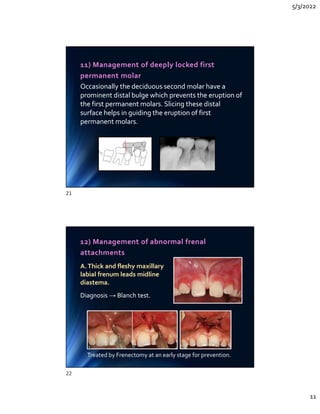
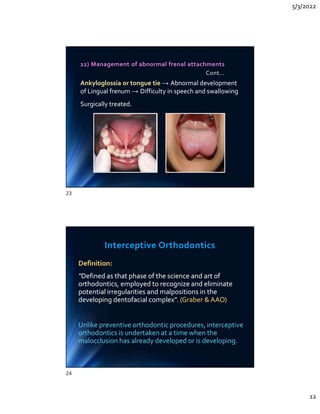
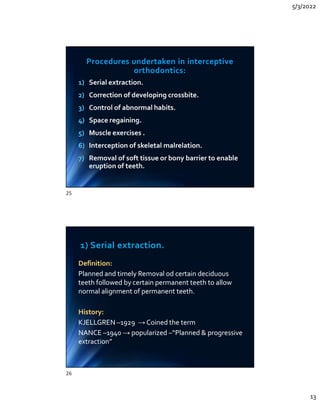
  • 2.
    • Bleeding disorders; •Childhood malignancies; • Diabetes; • Immunosuppression; • Epilepsy; • Asthma; and • Allergies. Infective endocarditis Infective endocarditis (IE) is a serious condition characterized by colonization or invasion of the heart valves or mural endocardium by a microbiological agent, following a transient entry into the bloodstream (bacteraemia). A number of factors can put a patient at high risk of developing an endocarditis: • Previous IE; • Acquired valvular heart disease with stenosis or regurgitation; • Heart valve replacement; • Structural congenital heart disease, including surgically corrected structural conditions (but excluding isolated atrial-septal defect, fully repaired ventricular- septal defect and fully repaired patent ductus arteriosus); and • Hypertrophic cardiomyopathy. A number of invasive medical procedures have been causally associated with bacteraemia and endocarditis in susceptible patients and these include dental treatment. The British Society for Antimicrobial Chemotherapy previously recommended the use of antibiotic prophylaxis for any form of dentogingival manipulation in high-risk patients. These recommendations have now changed in the UK. The National Institute of Health and Clinical Excellence (NICE) now advise that antibiotics to prevent IE should not be given to adults and children with structural cardiac defects at risk of IE who are undergoing dental interventional procedures and this includes orthodontic treatment. According to NICE, current evidence suggests that such antibiotic prophylaxis is not cost effective and may lead to a greater number of deaths through fatal anaphylactic reactions than from not using preventive antibiotics. Bleeding disorders Severe bleeding disorders such as haemophilia A do not contraindicate orthodontic treatment, but factor transfusion will be required to achieve haemostasis if dental extractions are necessary. Any risks of potential bleeding in the oral cavity during orthodontic treatment can be kept to a minimum by: • Maintaining a high standard of oral hygiene; and • Careful checking of appliances at each visit to ensure there are no wires or sharp surfaces traumatizing the soft tissues. These minor intraoral bleeds are an irritation to most patients, but can be a serious problem in this group. The orthodontist should also be aware of the increased risk of these patients being carriers for hepatitis or the human immunodeficiency virus (HIV). Childhood malignancy The commonest malignancies in childhood are the leukaemias, and amongst these, acute lymphoblastic leukaemia accounts for around 80% of cases. This condition mostly occurs in early childhood, before orthodontic treatment is routinely carried out. Treatment for a variety of malignancies in children often involves the use of radiotherapy, which can affect the tooth-bearing tissues. This may result in tooth agenesis and root shortening (Fig. 6.1). Orthodontic treatment should be delayed for these patients until they are in a period of remission and if diagnosis occurs during orthodontic treatment it is usually advisable to suspend treatment and remove the appliances. For patients with severe root shortening orthodontic treatment is contraindicated. Figure 6.1 Localized root shortening in the upper right quadrant following cranial radiotherapy for treatment of a retinoblastoma.
  • 3.
    Diabetes Patients with insulin-dependentdiabetes are more susceptible to periodontal disease and therefore excellent oral hygiene accompanied by regular periodontal maintenance is essential during orthodontic treatment. Immunosuppression Immunosuppressant drugs such as cyclosporin, which are routinely used in transplant patients to prevent rejection of the donor organ, can cause gingival hyperplasia, which can be exacerbated by orthodontic appliances. Excellent oral hygiene needs to be maintained during treatment and this can be reinforced with a chlorhexidine mouthwash. Gingivectomy of hyperplastic tissue may be necessary before or even during treatment. Epilepsy Removable orthodontic appliances should be avoided in the poorly controlled epileptic as there is a potential risk to the airway from displacement during seizures. These patients can also be at risk from gingival hyperplasia due to the use of certain anticonvulsant drugs; therefore a high standard of oral hygiene must be maintained during treatment. Asthma The regular use of steroid-based inhalers can result in oral candida infections on the palate, which can be made worse by the use of palate-covering removable appliances. Patients with autoimmune and hyper-allergenic conditions can also be more prone to root resorption during orthodontic treatment. Allergies A patient may present with a reported history of allergic reaction. Although many materials used in orthodontics are capable of inducing an allergic response, the most relevant are natural rubber latex and nickel. Allergy to latex was first recognized in the 1970s and its occurrence has increased in recent years, particularly amongst healthcare workers following the universal adoption of wearing protective gloves. Latex allergy has been reported in orthodontic practice in relation to gloves and orthodontic elastics. The most common allergic response is a type IV delayed hypersensitivity reaction triggered by the chemical accelerators used in the manufacture of latex. This causes a localized contact dermatitis, typically associated with a pruritic eczematous rash. The IgE-mediated type I reaction is less common but has more serious consequences, including anaphylaxis. Amongst the general public, type I sensitivity has been estimated to occur in around 6% of the population (Ownby et al, 1996). Investigation is via skin prick testing or immunoassay. Patients with a confirmed type I allergy should be treated in a ‘latex-screened’ environment where potential exposure to any allergens is minimized. Synthetic gloves composed of vinyl or nitrile are available as an alternative to latex gloves, whilst the use of orthodontic elastomeric auxiliaries containing natural rubber latex should be avoided. Latex-free silicone elastics are available but show greater force decay and as such, require more frequent replacement. Orthodontic wires and brackets contain nickel and nickel allergy is thought to be present in approximately 10% of Western populations and more common in females. It is usually a type IV allergic reaction related to the wearing of jewellery or watches and body piercing. Fortunately, oral reactions are rare, although prolonged exposure to nickel-containing oral appliances may increase sensitivity to nickel (Bass et al, 1993). Intraoral signs are nonspecific and have been reported to include erythema, soreness at the side of the tongue and severe gingivitis, despite good oral hygiene. Definitive diagnosis is usually achieved via patch testing. Stainless steel wires and brackets contain a relatively low proportion of nickel and are considered safe to use in a patient with diagnosed nickel allergy although titanium or cobalt chromium nickel-free brackets are available. In contrast, nickel titanium archwires have a much higher content, and should be avoided in these patients. Extraoral examination Assessment of the patient should begin with an examination of the facial features because orthodontic treatment can impact on the soft tissues of the face. Although a number of absolute measurements can be taken, a comprehensive facial assessment involves looking at the balance and harmony between component parts of the face and noting any areas of disharmony. Extraoral examination should start as the patient enters the room and it is important to look at the face and soft tissues both passively and in an animated state. Once in the dental chair, the patient should be asked to sit and the face examined from the front and in profile, in a position of natural head posture (Box 6.1). Box 6.1 Natural head posture
  • 4.
    Natural head posture(NHP) is the position that the patient naturally carries their head and is therefore the most relevant for assessing skeletal relationships and facial deformity. It is determined physiologically rather than anatomically and varies between individuals; however, it is relatively constant for each individual (Moorrees & Keane, 1958). As such, NHP should be used whenever possible to assess the orthodontic patient. The patient is asked to sit upright and look straight ahead to a point at eye level in the middle distance. This can be a point on the wall in front of them, or a mirror so that they look into their own eyes. Ideally NHP should also be used when taking a lateral skull radiograph, allowing the clinical examination to be related more accurately to the cephalometric data. Frontal view The frontal view of the face should be assessed vertically and transversely, with attention being paid to the presence of any asymmetry. In addition, the relationship of the lips within the face is examined in detail. Vertical relationship Vertically the face is split into thirds, with these dimensions being approximately equidistant. Any discrepancy in this rule of thirds will give an indication of disharmony within the facial proportions and where this lies. Of particular relevance is an increase or decrease in the lower face height. The lower third of the face can be further subdivided into thirds, with the upper lip falling into the upper third and the lower lip into the lower two-thirds (Fig. 6.2). Figure 6.2 The face can be divided into thirds. The upper face extends from the hairline or top of forehead (trichion) to the base of the forehead between the eyebrows (glabellar). The midface extends from the base of the forehead to the base of the nose (subnasale). The lower face extends from the base of the nose to the bottom of the chin (menton). The lower third of the face can be further subdivided into thirds, with the upper lip in the upper one-third and the lower lip in the lower two-thirds. Lip relationship The relationship of the lips should also be evaluated from the frontal view (Fig. 6.3): • Competent lips are together at rest; • Potentially competent lips are apart at rest, but this is due to a physical obstruction, such as the lower lip resting behind the upper incisors; and • Incompetent lips are apart at rest and require excessive muscular activity to obtain a lip seal. Figure 6.3 Competent (left), potentially competent (middle) and incompetent (right) lips. Lip incompetence is common in preadolescent children and competence increases with age due to vertical growth of the soft tissues, especially in males (Mamandras, 1988).
  • 5.
    Incisor show atrest In adolescents and young adults, 3 to 4-mm of the maxillary incisor should be displayed at rest (Fig. 6.4). In general, females tend to show more upper incisor than males, with the amount of incisor show reducing with age in both sexes. An increased incisor show is usually due to an increase in anterior maxillary dentoalveolar height or vertical maxillary excess. Occasionally it is due to a short upper lip. The average upper lip length is 22-mm in adult males and 20-mm in females. Figure 6.4 Normal upper incisor shown at rest (upper) and on smiling (middle). Increased upper incisor shown on smiling (lower panel). Incisor show on smiling Ideally 75 to 100% of the maxillary incisor should be shown when smiling (Fig. 6.4), but this also reduces with age. Some gingival display is acceptable, although excessive show or a ‘gummy smile’ is considered unattractive (Fig. 6.4). Smile aesthetics is also an important component of orthodontic treatment planning and should be formally assessed (Box 6.2). Box 6.2 Aesthetics of the smile During examination of an orthodontic patient the soft tissues should be assessed in animation and not just at rest. A key component of this is the smile. Smiling is an important part of communication and an unattractive smile can be a considerable social handicap, often providing a reason to seek treatment. Creating a pleasing smile is therefore a fundamental aim in orthodontics. Three principle characteristics of the smile need to be assessed (Sarver, 2001): • Incisal and gingival show—the full height of the maxillary incisor crowns should be visible on smiling. Some gingival show is acceptable, but this should not be excessive. Generally, males show less tooth substance and gingiva then females on smiling, and in both groups this reduces with age; therefore, a full smile gives a youthful appearance. In addition, the gingival margins of the maxillary central incisors and canines should be level, with those of the maxillary lateral incisors being around 1-mm more incisal. Pleasing gingival aesthetics. The gingival margin of the maxillary central incisors and canines are level, with the lateral incisor margin situated slightly below this. The embrasure spaces between the teeth (dotted lines) increase in size from the maxillary central incisors back. The connector areas (where the teeth appear to meet and indicated by red arrows) should be approximately 50, 40 and 30% of the maxillary central incisor crown length for the maxillary central incisors, central-lateral incisors and lateral incisors-canines, respectively (left panel). The maxillary incisor edges should also lie parallel to the curvature of the lower lip to produce a consonant smile arc (right panel) (Gill et al, 2007). • Width—the lips should correctly frame the maxillary dentition with bilateral buccal corridors (the space between the buccal surface of the distal-most maxillary molar and the angle of the mouth on smiling) visible but not excessive. This relationship is affected by both the width of the dental arch and its anteroposterior position. However, excessive orthodontic expansion can result in complete elimination of the buccal corridors and an artifical denture-like smile.
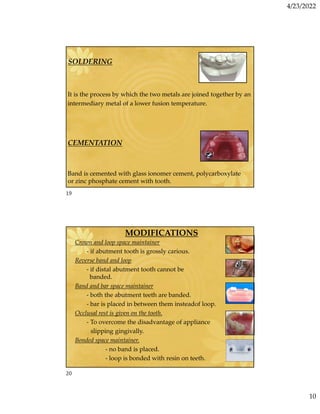
  • 6.
    • Relationship ofthe upper incisor edges with the lower lip—the upper incisor edges should be parallel to the curvature of the lower lip on smiling. This is known as the smile arc. Flattening of the smile arc will result in a less attractive smile, which can also be associated with premature aging. Transverse relationship and symmetry The transverse proportions of the face should divide approximately into fifths (Fig. 6.5). No face is truly symmetrical; however, any significant facial asymmetry and the level at which it occurs should be noted. This can be done by assessing the patient from the front and also from behind and above, looking down the face (Fig. 6.6). The relative position of each dental midline to the relevant dental base should be recorded. Asymmetries of the lower face are particularly common in class III malocclusion with mandibular prognathism. Figure 6.5 Transverse facial proportions should divide approximately into fifths (each one the width of the eye). Figure 6.6 Facial asymmetry viewed from above and behind. Mandibular asymmetry has been described as primarily of two types (Obwegeser & Makek, 1986): • Hemimandibular hyperplasia—characterized by three-dimensional enlargement of the mandible, which terminates at the symphysis. There is an increase in height on the affected side, usually accompanied by a marked cant of the occlusal plane. This can be seen by asking the patient to bite onto a wooden tongue spatula. • Hemimandibular elongation—characterized by a horizontal displacement of the mandible and chin-point towards the unaffected side. There is usually a marked centreline shift and a crossbite on the contralateral side, but no occlusal cant. Profile view The facial profile should be assessed anteroposteriorly and vertically. Anteroposterior relationship An assessment should be made of the skeletal dental base relationship between the upper and lower jaws in the anteroposterior plane (Fig. 6.7). This can be achieved by mentally dropping a true vertical line down from the bridge of the nose (often called the zero meridian). The upper lip should rest on or slightly in front of this line and the chin slightly behind. Alternatively, the dental bases can be palpated labially.
  • 7.
    Figure 6.7 Skeletalclass I (left), class II (middle) and class III (right) profiles. Facial convexity can also be described in relation to the angle between the upper and lower face. • In a normal or skeletal class 1 relationship, the upper jaw should be approximately 2 to 4-mm in front of the lower; • In a skeletal class 2 relationship the lower jaw is greater than 4-mm behind the upper; and • In a skeletal class 3 relationship the lower jaw is less than 2-mm behind the upper. An assessment can also be made of the angle between the middle and lower third of the face (Fig. 6.7), with the profile being described as: • Normal or straight; • Convex; or • Concave. Nasolabial angle and lip protrusion The nasolabial angle is formed between the upper lip and base of the nose (columella) and should be between 90° and 110° (Fig. 6.8). It gives an indication of upper lip drape in relation to the upper incisor position. A high or obtuse nasolabial angle implies a retrusive upper lip, whilst a low or acute angle is associated with lip protrusion. Figure 6.8 Normal nasolabial angle. The lips should be slightly everted at their base, with several millimetres of vermillion show at rest, although they do tend to become more retrusive with age. Protrusion of the lips varies between ethnic groups, with patients of African origin being more protrusive than Caucasians. Lip protrusion is also relative to the size and shape of the chin. Generally, lips are considered too protrusive when both are prominent and incompetent.
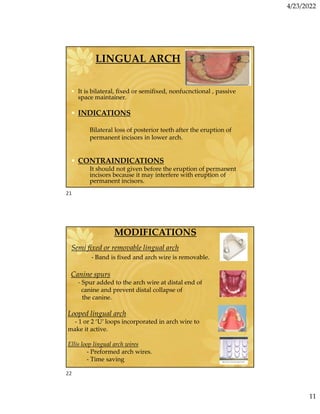
  • 8.
    Vertical relationship The facecan also be divided into thirds as described earlier and direct measurements made of the facial heights (Fig. 6.9). Figure 6.9 Facial profile divided into thirds. The angle of the lower border of the mandible to the cranium should also be assessed. This can be done by placing an index finger along the lower border and approximating where this line points. If it points to the base of the skull around the occipital region, the angle is considered average. If it points below this, the angle is reduced, whilst above it the angle is increased (Fig. 6.10). This usually, but not always, correlates with measurements made of the anterior face height. Figure 6.10 Clinical assessment of the vertical facial relationship. Intraoral examination The intraoral examination is concerned primarily with the teeth in each dental arch, in both isolation and occlusion. Dental health The teeth present clinically should be noted and an assessment made of the general dental condition, including the presence of untreated caries, existing restorations and the standard of oral hygiene. Evidence of previous dentoalveolar trauma, such as chipped or discoloured incisor teeth, should also be recorded. Previous trauma will warrant further investigation in the form of vitality testing and radiographs. Other pathological signs, such as erosion or attrition, should also be noted. Dental arches Each dental arch is assessed independently, with the mandible usually described first. The following features should be recorded for both arches:
  • 9.
    • Presence ofcrowding or spacing in the labial and buccal segments (Box 6.3) (Fig. 6.11); • Tooth rotations, described in relation to the most displaced aspect of the coronal edge and the line of the dental arch; • Tooth displacement in a labial or lingual direction in relation to the line of the arch; • Position and inclination of the labial segment relative to the dental base. These are described as being average, proclined or retroclined. In the mandibular arch, the incisors should be approximately 90° to the lower border of the mandible. This can be assessed by retracting the lower lip in profile and visualizing the lower incisor inclination in relation to a finger or ruler placed along the lower border of the mandible. In the maxilla, the incisors should be approximately 110° to the maxillary plane, but this can be more difficult to assess clinically. Alternatively, the labial face of the maxillary incisors should be roughly parallel to the true vertical or zero meridian; • Presence and position of the maxillary canines, which should be palpable buccally from the age of 10 years; • Angulation of erupted canines, which should be recorded as mesial, upright or distal (Fig. 6.12); and • Depth of the curve of Spee, which is described as normal, increased or decreased (Fig. 6.13). This will have a direct bearing on space requirements as an increased curve of Spee is a manifestation of crowding in the vertical plane and, as such, will require space to correct. Box 6.3 How is crowding measured? Crowding represents a discrepancy between the size of the dental arch and the size of the teeth. It is important that the degree of crowding is assessed as accurately as possible. Ideally the mesiodistal widths of the teeth in each dental arch should be measured, added together and compared to the overall size of the arch. During the initial examination this can be done in the patient’s mouth using a small metal ruler; however, a more detailed assessment can be made from the dental study casts during treatment planning. An important aspect of this process is deciding upon a suitable dental arch form. A number of ideal arch forms have been suggested in the orthodontic literature, but as a general rule the orthodontist should not attempt to change the existing arch form significantly. Generally it is best to decide on which of the incisors represents the ideal arch form for an individual patient and base the assessment of crowding upon this. It should also be borne in mind that rotations in the labial segments are a manifestation of crowding, whilst in the buccal segments they represent spacing. In general, crowding is usually described as mild (0 to 4-mm), moderate (5 to 8-mm) or severe (greater than 9-mm). Figure 6.11 Upper and lower dental arch crowding. Figure 6.12 Mandibular canine angulation. Mesial (left); upright (middle); distal (right). Figure 6.13 The normal occlusal plane of the maxillary and mandibular dental arches follows a curve in the anteroposterior plane, producing the curve of Spee. Any significant increase or decrease of the curve along either occlusal plane can influence the vertical dental relationship.
  • 10.
    Static occlusion When eachdental arch has been assessed the patient is asked to occlude in intercuspal position (ICP) and the static occlusal relationship is recorded. Incisor relationship The incisor relationship is described using the British Standards Classification, but also needs to be supplemented with a description of the overjet and overbite. Overjet The overjet should be measured from the labial surface of the most prominent maxillary incisor to the labial surface of the mandibular incisors (Fig. 6.14). The normal range is 2 to 4-mm. If there is a reverse overjet, as can occur in a class III incisor relationship, this is also measured and given a negative value. Figure 6.14 Occlusal variation. Class I occlusion; reduced overjet associated with a class II division 2 incisor relationship (the buccal segment relationship is half a unit class II); increased overjet associated with a class II division 1 incisor relationship (the buccal segment relationship is a full unit class II); reverse overjet associated with a class III incisor relationship. Overbite The normal range is for the maxillary incisors to overlap the mandibular by 2 to 4-mm vertically, or one-third to one-half of their crown height (Fig. 6.15). Overbite is described as: • Increased if the maxillary incisors overlap the mandibular incisor crowns vertically by greater than one-half of the lower incisor crown height; • Decreased if the maxillary incisors overlap the mandibular incisors by less than one-third of the lower incisor crown height. If there is no vertical overlap between the anterior teeth, this is described as an anterior open bite and a measurement should be made of the incisor separation; • Complete if there is contact between incisors, or the incisors and opposing mucosa; and
  • 11.
    • Incomplete ifthere is no contact between incisors, or the incisors and opposing mucosa. Figure 6.15 Variation in overbite. Normal (upper left), reduced (upper right), increased (lower left) and anterior open bite (lower right). If the overbite is complete to the gingival tissues, it is described as traumatic if there is evidence of damage. This is most commonly seen on the palatal aspect of the upper incisors or labial aspect of the lower (Fig. 6.16). Figure 6.16 Traumatic overbites causing palatal (left panels) and labial (right panels) gingival trauma. Anterior crossbite Teeth in anterior crossbite should also be noted along with the presence and size of any displacement of the mandible that may occur when closing in the retruded contact position (RCP) into the intercuspal position (ICP) (Fig. 6.17). An anterior crossbite with displacement can cause labial gingival recession associated with the lower incisors in traumatic occlusion, which if present, should be recorded.
  • 12.
    Figure 6.17 Anteriorcrossbite with a forward mandibular displacement on closing, which worsens the class III incisor relationship. Centrelines Maxillary and mandibular dental centrelines are assessed in relation to the facial midline and to each other. Displacement of a centreline can be due to: • Asymmetric dental crowding (Fig. 6.18); • Buccal crossbite with a mandibular displacement on closing (Fig. 6.19); and • Skeletal asymmetry of the jaws (Fig. 6.20). Figure 6.18 Centreline discrepancies due to asymmetric crowding. Figure 6.19 Lower-centreline displacement to the right, secondary to a mandibular buccal crossbite associated with a mandibular displacement to the right.
  • 13.
    Figure 6.20 Skeletalasymmetries of the mandible producing centreline discrepancies to the right. Buccal segments The buccal segment relationship is described using the Angle classification (see Chapter 1). The molar and canine relationships should also be noted (see Fig. 6.14). Posterior crossbite The transverse relationship of the dental arches is described in occlusion. Crossbites are described in relation to the arch, whether they are localized or affect the whole segment of the dentition and if they occur uni- or bilaterally: • A mandibular buccal crossbite exists when the buccal cusps of the mandibular dentition occlude buccally to the buccal cusps of the maxillary dentition (Fig. 6.21); • A mandibular lingual crossbite exists when the buccal cusps of the mandibular dentition occlude lingually to the palatal cusps of the maxillary dentition (this can also be referred to as a scissors bite) (Fig. 6.22); • A unilateral crossbite affects one side of the dental arch; and • A bilateral crossbite affects both sides of the dental arch. Figure 6.21 Mandibular buccal crossbite. Figure 6.22 Mandibular lingual crossbite. Teeth in crossbite should be recorded and any associated displacement of the mandible on closing from RCP to ICP. This can be achieved by ensuring the mandible is fully retruded by placing gentle pressure on the chin and asking the patient to put the tip of their tongue up towards the soft palate until initial occlusal contact is made on closing.
  • 14.
    Functional occlusion Any discrepancybetween RCP and ICP should be recorded. The patient should also be asked to slide from ICP to the left and right, and the following should be detailed for each lateral excursion: • Canine guidance or group function; and • Non-working side interferences. The patient should also be asked to slide the mandible forwards to check for disclusion of the posterior teeth. Temporomandibular joint The patient should be questioned about and examined for any signs and symptoms associated with both temporomandibular joints. These include: • Clicking; • Crepitus (a grinding noise or sensation within the joint); • Pain (muscular and neurological); and • Locking or limited opening. Although some occlusal traits have a weak correlation with temporomandibular dysfunction, orthodontic treatment should be regarded as being neutral in relation to this condition. Treating a malocclusion is unlikely to have any long-term effect on symptoms, either positive or negative. However, a baseline record of temporomandibular joint health should be taken and any signs or symptoms should be recorded. If these represent the main complaint, they should be investigated further and managed before orthodontic treatment is considered. Orthodontic records Clinical orthodontic records are used primarily for diagnosis, monitoring of growth and development, and are a medico-legal requirement. They provide an accurate representation of the patient prior to orthodontic treatment, demonstrate treatment progress and allow communication between orthodontists, other healthcare professionals and the patient. Records also play an important role in research and clinical audit. It is essential that accurate clinical records are taken before commencing orthodontic treatment. Study models Impressions showing all the erupted teeth, full depth of the palate and good soft tissue extension are needed. These can be taken in alginate for study models and poured in dental stone (Fig. 6.23). A wax or polysiloxane bite should be taken with the teeth in ICP (Box 6.4). Orthodontic models should be trimmed with the occlusal plane parallel to the bases, so the teeth are in occlusion when the models are placed on their back. The bases are also trimmed symmetrically so the archform can be assessed and they are neat enough to be used for demonstration to the patient.
  • 15.
    Figure 6.23 Angletrimmed cast stone orthodontic study models. Box 6.4 Should articulated study models be used for orthodontic diagnosis? The use of articulated study models has been advocated as a potential aid to orthodontic diagnosis and treatment planning. There is often a discrepancy between the occlusal relation in RCP and the full or habitual occlusion in ICP. Whilst a small shift is very common and not generally considered to be clinically important, larger shifts have been considered potentially damaging for both periodontal and temporomandibular joint health, although there is little substantial evidence for this. Small shifts can only be detected by articulating study models, but if these are unimportant, th/> Only gold members can continue reading. Log In or Register to continue
  • 16.
    You may alsoneed The orthodontic patient: treatment planning Management of the developing dentition Orthodontic tooth movement Adult orthodontics Posterior crossbite in the deciduous dentition period, its relation with sucking habits, irregular orofacial functions, and otolaryngological findings Management of the permanent dentition Development of the dentition Cleft lip and palate, and syndromes affecting the craniofacial region Contemporary fixed appliances Contemporary removable appliances 4: Orthodontic Records and Case Evaluation Occlusion and malocclusion Postnatal growth of the craniofacial region Prenatal development of the craniofacial region Orthodontic Assessment and Treatment Planning Strategies The effect of digital diagnostic setups on orthodontic treatment planning Load more posts Load more posts Share this: Jan 1, 2015 | Posted by mrzezo in Orthodontics | Comments Off   
  • 17.
    WordPress theme byUFO themes Citrus North
  • 18.
    4/23/2022 1 SEMINAR ON SPACE MAINTAINER ANDREGAINER DEPARTMENT OF PEDODONTICS SUBMITTED TO:- Dr. JASHEENA SINGH Prof. and H.O.D Department of pedodontics GUIDED BY:- Dr. SUBHASH SINGH SUBMITTED BY:- (MDS,Sr. Lecturer) ANKUR SAHU Dr. GARIMA SINGH Final year (MDS,Sr. Lecturer) Roll no.- 10 Dr. SHIVIKA MEHTA Batch- B (MDS,Sr. Lecturer) 1 2
  • 19.
    4/23/2022 2 CONTENTS • SPACE MAINTAINER •INTRODUCTION • CLASSIFICATION • FIXED SPACE MAINTAINER » BAND AND LOOP » LINGUAL ARCH » TRANSPALATAL ARCH » NANCE PALATAL ARCH » DISTAL SHOE • REMOVABLE SPACE MAINTAINER • SPACE REGAINER • INTRODUCTION • CLASSIFICATION • REMOVABLE SPACE REGAINER • FIXED SPACE REGAINER 3 4
  • 20.
    4/23/2022 3 INTRODUCTION Space Maintainers: “Space maintainerscan be defined as appliances used to maintain space or regain minor amount of space lost, so as to guide the unerupted tooth into a proper position in the arch.” IDEAL REQUIRMENTS 1. It should maintain the desired mesiodistal dimension of the space created by loss of tooth 2. It should not interfere with eruption of occluding teeth. 3. It should not interfere with the eruption of the replacing permanent teeth. 4. It should provide mesiodistal space opening when it is required. 5. It should not interfere with speech, mastication. 5 6
  • 21.
    4/23/2022 4 INDICATIONS • When malocclusionexists or abnormal oral habits are present. • Delayed eruption of permanent teeth. • Congenital absence of permanent teeth. • Maximum closure occurs within 6 months after extraction, therefore it is best time to insert an appliance. CONTRAINDICATIONS • When there is no alveolar bone overlying the crown of erupting teeth and there is sufficient space for its eruption. • When gross space discrepancy present requiring future extractions and orthodontic treatment. • When succeeding tooth is congenitally absent and space closure is required. CLASSIFICATION 1. ACCORDING TO HITCHCOCK: a) Removable, fixed or semifixed b) With bands or without bands c) Functional or non functional d) Active or passive e) Certain combinations of above. 2. ACCORDING TO RAYMOND C THROW: a) Removable b) Complete arch - Lingual arch - Extraoral anchorage c) Individual tooth space maintainer 7 8
  • 22.
    4/23/2022 5 3. ACCORDING TOHEINRICHSEN: a) Fixed space maintainer Class 1- Non functional - Bar type - Loop type Functional -Pontic type -Lingual arch type Class 2- Cantilever type (distal shoe, band and loop) b) Removable space maintainer APPLIANCE THERAPY Fixed space maintainers- Band & loop space maintainer. Crown & loop space maintainer. Lingual arch. Palatal arch appliance. Transpalatal arch. Distal shoe. Band & Bar type space maintainer. Bonded space maintainer Removable space maintainers- Acrylic partial dentures. Full or complete dentures. Removable distal shoe space maintainer. 9 10
  • 23.
    4/23/2022 6 FIXED SPACE MAINTAINER “Spacemaintainers which are fixed or fitted onto the teeth are called fixed space maintainers.” ADVANTAGES:- • Patient cooperation is not required. • Jaw growth is not hampered. • Masticatory function is restored if pontics are placed. DISADVANTAGES • Instrumentation with skill is required. • Cement loss and solder failure occur • It results in decalcification of tooth material under the bands. BAND AND LOOP Unilateral, fixed, non functional and passive space maintainer. • INDICATIONS:- 1. Unilateral loss of primary 1st molar. 2. Bilateral loss of primary molar before eruption of permanent incisors. 3. Loss of 2nd primary molar. •CONTRAINDICATION:- 1. High caries activity. 2. Marked space loss. 3. More than one adjoining teeth is missing. 11 12
  • 24.
    4/23/2022 7 CONSTRUCTION SEPERATION OF TEETH Orthodonticseparators can placed if tight inter proximal contacts are present for creating space for band material. METHODS: 1. BRASS WIRE 2. ELASTIC THREADS 3. OTHERS DIRECT BAND FORMATION 1.BAND PINCHING • Band strips are contoured in an occluso gingival direction using the Johnson’s contouring pliers. • The end of strips are welded and a loop is made for reception of Howlett band forming pliers. 13 14
  • 25.
    4/23/2022 8 2. FESTOONING • Theprocess of contouring the band in order to follow the gingival margin proximally. • The level of band at marginal ridge is also adjusted such that it is approximately 1mm below mesial and distal marginal ridges. • ) 3. TRIMMING • Adjusts the occluso-cervical length of the band by reducing buccal and lingual side if required. 4. FOLDED FLAP METHOD • Band is folded neatly against the lingual surface of the tooth. • The folded over remnant is then spot welded. • Buccally it should placed just below the level where the opposing cusps touch the grooves. • Lingually it should placed just below deepest portion of deep developmental groove. 15 16
  • 26.
    4/23/2022 9 WELDING • It isthe process during which a portion of the metal being joined is melted & flowed together. • Bands are generally joined by welding. IMPRESSION MAKING • Make an impression of arch with alginate impression material. • Band is removed after impression and stabilize in impression CAST PREPRATION • Cast is prepared by pouring impression in dental stone. LOOP CONSTRUCTION • The loop is constructed of 0.030 inch to 0.035 inch and is soldered to the band. • The loop should be parallel to edentulous ridge and should contact the abutment tooth below the contact point. • The faciolingual dimension of the loop should be approximately 8mm 17 18
  • 27.
    4/23/2022 10 SOLDERING It is theprocess by which the two metals are joined together by an intermediary metal of a lower fusion temperature. CEMENTATION Band is cemented with glass ionomer cement, polycarboxylate or zinc phosphate cement with tooth. MODIFICATIONS Crown and loop space maintainer - if abutment tooth is grossly carious. Reverse band and loop - if distal abutment tooth cannot be banded. Band and bar space maintainer - both the abutment teeth are banded. - bar is placed in between them insteadof loop. Occlusal rest is given on the tooth. - To overcome the disadvantage of appliance slipping gingivally. Bonded space maintainer. - no band is placed. - loop is bonded with resin on teeth. 19 20
  • 28.
    4/23/2022 11 LINGUAL ARCH • Itis bilateral, fixed or semifixed, nonfucnctional , passive space maintainer. • INDICATIONS Bilateral loss of posterior teeth after the eruption of permanent incisors in lower arch. • CONTRAINDICATIONS It should not given before the eruption of permanent incisors because it may interfere with eruption of permanent incisors. MODIFICATIONS Semi fixed or removable lingual arch - Band is fixed and arch wire is removable. Canine spurs - Spur added to the arch wire at distal end of canine and prevent distal collapse of the canine. Looped lingual arch - 1 or 2 ‘U’ loops incorporated in arch wire to make it active. Ellis loop lingual arch wires - Preformed arch wires. - Time saving 21 22
  • 29.
    4/23/2022 12 TRANSPALATAL ARCH  Itis used in maxillary arch.  The arch wire is soldered to both sides, straight, without button and without touching the palate. INDICATION • It is indicated when there is unilateral loss of deciduous molar. CONTRAINDICATION • It is not given in bilateral missing case because both permanent molars can move mesially simultaneously. NANCE PALATAL ARCH • It extends up to the rugae area and is embedded in an acrylic button. INDICATION - Bilateral loss of the deciduous molar. - Combined with a habit breaking appliance. CONTRAINDICATION - Palatal lesions - If either of the molars has not erupted. - Patients allergic to acrylic. 23 24
  • 30.
    4/23/2022 13 DISTAL SHOE (Intralveolar Appliance/Eruptionguidance appliance) • It is unilateral, fixed, non functional and passive space maintainer. • It is intra-alveolar appliance, in which portion of the appliance is extending into alveolus. • INDICATIONS - Early loss of second deciduous molar before the eruption of first permanent molar. • CONTRAINDICATIONS - Inadequate abutments due to multiple loss of teeth. - poor oral hygiene - Poor patient cooperation. - Congenitally missing first molar. - Medically compromised patient. Blood dyscrasias Immunosuppression Chronic inflammatory disease Congenital cardiac defect Sub acute bacterial endocarditis Rheumatic fever diabetes MEDICAL CONDITIONS • Early version was called as Willet’s distal shoe and was made of cast gold and had bar type gingival extension. • Present design which is commonly used is Roche’s modified distal shoe and had a ‘ V ‘ shaped gingival extension. 25 26
  • 31.
    4/23/2022 14 REMOVABLE SPACE MAINTAINER Definition: Theyare the space maintainer that can be removed and reinserted by the patient into the oral cavity. Types: It can be functional or non functional. FUNCTIONAL NON FUNCTIONAL • INDICATIONS - Multiple teeth loss is seen. - Masticatory function is important. - Premature loss of anterior teeth having effect on speech and esthetics. - When space maintainer is required for short period. • CONTRAINDICATIONS - Uncooperative patients. - Epileptic patient. - Patient allergic to acrylic. 27 28
  • 32.
    4/23/2022 15 SPACE REGAINERS • Itis removable or fixed, active space maintainers. • The main goal of space regainer is the recovery of lost arch width or improved eruptive position of succedaneous teeth. INDICATION • When there is need to re-establish about 3 mm or less of space. TYPES 1. fixed space regainer 2. removable space regainer 29 30
  • 33.
    4/23/2022 16 REMOVABLE SPACE REGAINERS • Itconsists of retentive components like Adams and clasp, an active component such as springs and screw and acrylic base plat. • It takes about 3-4 months to regain 3mm of space. • TYPES Free end loop Split saddle Sling shot Jack screw REMOVABLE SPACE REGAINER Free end loop space regainer • Labial arch wire with back action loop spring is constructed. • Base of appliance is made of acrylic resin. Split saddle/ split block • It differ from free end spring type in that the functional part consists of an acrylic block that split bucco lingually. Sling shot space regaine • It consist of wire elastic holder with hooks instead of a wire string. Jack screw • Expansion screws are used in the edentulous space. • Space is opened by expanding the plates anteroposteriorly. 31 32
  • 34.
    4/23/2022 17 FIXED SPACE REGAINER HOTZLINGUAL ARCH LIP BUMPER GERBER SPACE REGAINER OPEN COIL FIXED SPACE REGAINER OPEN COIL SPACE REGAINER • A reciprocal active fixed regainer used to in the mandibular arch when the first premolar has erupted into the oral cavity. • It consists of an open coil inserted into a “U” shaped wire. • The wire is inserted into the molar tube on the band. GERBER SPACE REGAINER • It is used where the lower first permanent molar has drifted mesially ,but the premolar or cuspid has not drifted distally. HOTZ LINGUAL ARCH 33 34
  • 35.
    4/23/2022 18 LIP BUMPER • Indicatedwhen bilateral movement is desired. • It is used to distalize molars and to align lower incisors. • It consists of - heavy labial arch wire - acrylic flange is prepared over it in the anterior region such that it does not contact the lower anteriors. • It is used to relieve the lip pressure. • It align lower incisors under tongue pressure. pre-treatment post-treatment CONCLUSION • The best space maintainer is a well maintained primary tooth. But when these are lost, it is essential to have space management strategy that is giving the space maintainer. But if space maintainer is not used, then it may result in the removal of some teeth along with costly orthodontic treatment in future. 35 36
  • 36.
    4/23/2022 19 REFERENCES 1. Dentistry forthe child and adolescent ; McDonaldAveryDean ; 8th edition 2. Textbook of Pedodontics ; Shobha Tandon; 2nd edition 3. Pediatric dentistry; Pinkham Casamassimo Fields McTigue Nowak; 4th edition 4. Principle and practice of pedodontics; Arathi Rao; 3rd edition 5. Internet dentalbooks-drbassam.blogspot.com depts.washington.edu/peddent/AtlasDemo/space024.html 37 38
  • 37.
    7 The orthodonticpatient treatment planning One of the most difficult, but important aspects of orthodontic management is treatment planning. With the advent of modern fixed appliance systems it is deceptively easy to straighten teeth. The skill of the orthodontist lies in placing the dentition in the optimal position and achieving the correct aesthetic and occlusal result for each patient. This process starts with clinical examination, record collection and diagnosis. The next stage is treatment planning, which should ideally be carried out in a formal manner and away from the patient, using the clinical data and collected records. It is a two-stage process, initially defining the treatment aims and then deciding how these are to be achieved. In this chapter, treatment aims and the general principles of treatment planning are discussed. The specifics of treatment for different types of malocclusion are covered in Chapters 10 and 11. Timing of treatment Many traits of a malocclusion can manifest in the early mixed dentition and there is often a temptation to begin treatment at this stage. In particular, both ‘arch development’ (or expansion) to relieve crowding and growth modification to correct a skeletal discrepancy have been proposed by some to benefit from an early approach. Advocates of these early treatment strategies suggest that they maximize growth potential, compliance and orthopedic change in the young patient, reduce the risk of trauma when maxillary incisors are prominent, simplify any further treatment that may be required in the permanent dentition, reduce the need for extractions and ultimately establish a more stable result. They can also have a psychological benefit, promoting self-esteem by correcting potentially socially debilitating malocclusions early. However, there are disadvantages associated with starting treatment too soon. The overall duration will be extended, because almost inevitably a second phase of treatment will be required in the permanent dentition and this can lead to problems with compliance over the longer term. The original arch form and growth patterns will tend to reimpose themselves following the first phase of early treatment and a prolonged retention period may be required to maintain any correction during the transition from mixed to permanent dentition. Finally, there is a growing body of evidence to suggest that the treatment result for growth modification will be the same whether carried out in the early mixed or permanent dentition, the only difference being the increased duration if started early (Harrison et al, 2007). In the case of arch development in the early mixed dentition, the long-term results are poor, particularly with regard to the stability of tooth alignment (Little et al, 1990). The most appropriate time to start treatment aimed at growth modification is usually the late mixed dentition, essentially just before loss of the second deciduous molars. This results in the shortest treatment time, whilst still utilizing growth potential and is least demanding upon compliance. The majority of routine orthodontic treatment with fixed appliances is carried out in the early permanent dentition and this is generally the best time to address problems of crowding. However, there are exceptions and some malocclusions will benefit from earlier treatment: • Class III cases associated with maxillary hypoplasia can benefit from interceptive treatment to move the maxilla forward with protraction headgear. This appears to be more effective if carried out in the early mixed dentition (see Figs 10.45 and 10.46) (Kim et al, 1999). • Treatment to correct a class II skeletal base relationship is most effective during the adolescent growth spurt. In females, this will generally occur earlier than in males and is poorly correlated with dental age. Therefore, this type of treatment should often be started earlier in females than males. • Certain malocclusions, especially an increased overjet, can be a source of teasing and bullying, which can be very distressing. In these circumstances, early treatment may be indicated. The orthodontic patient: treatment planning Pocket Dentistry Fastest Clinical Dentistry Insight Engine Home Log in Category » About Contact Gold Member Video Terms and Condition Search...
  • 38.
    • An increasedoverjet increases the risk of dentoalveolar trauma, especially before the age of ten. Early treatment to reduce the overjet is indicated in those individuals where little protection is provided by the lips, due to gross lip incompetence and marked maxillary protrusion. • Early treatment of a posterior crossbite associated with a displacement can prevent perpetuation into the permanent dentition (Harrison & Ashby, 2001). An anterior crossbite can result in mucogingival problems associated with the lower incisors (see Fig. 10.42). Both these forms of malocclusion are amendable to simple removable appliance treatment in the early mixed dentition. Aims of treatment The principle aims of orthodontic treatment relate to aesthetics and function: • Positioning the dentition within the skeletal and soft tissue environment for optimal facial and dental aesthetics; and • Achieving a stable and ideal static, and functional occlusion. The extent to which these aims need to be considered will vary between patients and depend upon the diagnosis. The treatment required to achieve them may range from simple occlusal change to complex multidisciplinary intervention. Facial aims There is a greater awareness amongst orthodontists of the importance associated with facial and soft tissue aesthetics in treatment planning (Box 7.1). Obtaining a class I incisor and canine relationship is usually a fundamental aim of treatment, but this must not be achieved at the expense of the soft tissue profile. Reconciling the facial and occlusal aims of treatment can be difficult and will depend in part on the underlying skeletal relationship: • In the absence of any significant discrepancy in the skeletal pattern, treatment planning will be concerned primarily with obtaining the correct occlusal relationship (Fig. 7.1). • If there is a mild to moderate skeletal discrepancy, appliances aimed at growth modification can be used in an attempt to improve the skeletal relationship. These appliances tend to rely on good patient compliance combined with favourable facial growth, results can be variable and they are much more effective at correcting class II discrepancies than class III. Alternatively, orthodontic camouflage may be appropriate, accepting the skeletal pattern and planning the necessary occlusal changes to correct the malocclusion (Fig. 7.2) (Box 7.2). • If the skeletal discrepancy is severe and the patient is growing, growth modification should certainly be considered, but success will be less predictable. However, orthodontic camouflage in these cases can be more problematic, particularly in terms of achieving good facial aesthetics. Surgical repositioning of the jaws is a definitive method of changing a more severe skeletal pattern, but this is only carried out once facial growth is complete. Attempts have been made to define the relative limits of orthodontic and surgical tooth movement for the correction of malocclusion, but these can only ever represent a guide (Fig. 7.3). Box 7.1 Planning treatment around the face Orthodontic treatment planning should begin with the position of the dentition, particularly the upper incisors, within the face. This represents something of a shift in emphasis from planning based around the lower incisor position and treating to isolated static occlusal goals. In the infancy of orthodontics it was assumed that if all the teeth were aligned and the occlusal goals achieved, each individual would have ideal facial aesthetics. However, it soon become apparent that this was not the case, resulting in extreme protrusion of the dentition in some cases and extensive relapse in others. With the advent of cephalometric analysis, it was argued that facial growth was genetically determined and that orthodontic treatment could have little influence on the facial skeleton. Treatment became based around arbitrary hard tissue cephalometric standards, especially in relation to lower incisor position, even though these bear little relation to the soft tissues and facial profile (Park & Burstone, 1986). Since then, conventional thinking has shifted again, with the soft tissues defining the limits of orthodontic treatment in each individual (Ackerman & Proffit, 1997). The main reasons for this are a resurgence of interest in functional appliance therapy, advances in orthognathic surgical techniques, a greater understanding of orthodontic relapse and the acceptance of long-term retention strategies. There is also an appreciation of how the face ages and therefore how treatment carried out in the teenage years will impact on facial appearance many years into the future.
  • 39.
    Figure 7.1 Occlusalcorrection of a crowded class I case using fixed appliances following the extraction of four first premolar teeth. Figure 7.2 Correction of class II division 1 malocclusion. A case with a moderate class II skeletal base relationship treated initially with a functional appliance to correct the anteroposterior discrepancy. This was followed by the extraction of four premolars to alleviate crowding and fixed appliances to detail the occlusion (upper four panels). A case with a milder skeletal discrepancy treated with orthodontic camouflage involving premolar extraction and fixed appliances (lower two panels). Box 7.2 Camouflage treatment In a young patient with a class II skeletal discrepancy, utilizing growth with a functional appliance can facilitate treatment, which is not possible in an older patient or adult, where growth potential either is poor or has disappeared. In these cases there are two treatment options: surgically repositioning the jaws or moving the teeth to mask the skeletal discrepancy. The latter is known as camouflage treatment and can be very successful in mild to moderately severe skeletal class II cases. One of the main limiting factors in this type of treatment is the soft tissue profile, as treatment will involve retraction of the upper incisors and with them, the upper lip. If the upper lip is protrusive, some retraction will be beneficial to the profile. However, if the lip profile is retrusive and the nasolabial angle obtuse, any further retraction will increase prominence of the nose and worsen aesthetics. Similarly, over-retraction of the lower incisors to camouflage a class III skeletal discrepancy can result in unacceptable prominence of the chin. Therefore, when planning camouflage treatment, although it may be possible to achieve a good occlusal result, it should not be done at the expense of facial aesthetics. Generally the more severe the skeletal discrepancy, the harder it is to achieve camouflage with tooth movement alone. Figure 7.3 The envelope of discrepancy showing the tooth movements theoretically possible for correcting a malocclusion. With the ideal position shown at the origin of the x and y axes, the movement possible with orthodontics alone (inner black envelope), growth modification (middle red envelope) and surgery (outer red envelope) are shown.
  • 40.
    Redrawn from ProffitWR, White RP Jr and Sarver DM (2003). Contemporary Treatment of Facial Deformity (St Louis: Mosby). Occlusal aims The occlusal aims of treatment are defined in terms of dental aesthetics and both static and functional occlusion (Table 7.1) and are generally listed in the order in which they will be corrected. Whilst these will vary between cases, in practical terms occlusal correction will usually require some or all of the following: • Creating space to relieve crowding; • Levelling and aligning the dental arches; • Correcting the buccal segment relationship; and • Correcting the incisor relationship. Table 7.1 Occlusal aims of orthodontic treatment • Andrews six keys; • Canine guidance or group function; • No non-working side interferences; • Anterior guidance; and • RCP and ICP coincident. A further consideration related to the occlusion is health of the temporomandibular joints, but this is a contentious area. Despite evidence showing orthodontic treatment having little impact on temporomandibular dysfunction (Luther, 2007a, b), much conjecture exists regarding the ideal position for the condyle at the end of treatment and the need to treat to an ideal functional occlusion. However, orthodontics is one area in dentistry where treatment can result in significant occlusal change. Therefore it would seem sensible practice to aim for an ideal static and functional occlusion wherever possible. Planning to achieve the facial aims of treatment Treatment planning should begin with some consideration regarding the upper incisor position and whether this needs to be changed (Table 7.2). Achieving an ideal position for these teeth will be more difficult in the presence of a skeletal discrepancy and in some cases may not be possible with orthodontic treatment alone. Table 7.2 Positioning the upper incisors within the face • Vertically around 3–4 mm of the upper central incisors should be shown at rest; • The labial face should be parallel to the true vertical and adequately support the upper lip; • Curvature of the incisal edges should be parallel with the lower lip on smiling; and • The dental centreline should be coincident with the facial midline. Anteroposterior position of the upper incisors The upper incisors can be positioned too far forward within the face as a result of maxillary skeletal excess or simple dentoalveolar disproportion. The skeletal and soft tissue morphology will influence the resulting incisor relationship: • The overjet can be increased, resulting in a class II division 1 relationship. The upper incisors are normally inclined or proclined. If they are proclined this is often due to the position of the lower lip or a digit sucking habit. • The upper incisors can be retroclined, resulting in a class II division 2 relationship with an increased overbite, which is usually due to a high lower lip position (see Fig. 1.8). In a growing child with skeletal maxillary excess, restraint of maxillary growth can be achieved with extraoral force, although the use of a functional appliance can also provide some maxillary restraint, particularly when used in combination with headgear. Any associated mandibular retrognathia is indicative of the need for a functional appliance. Alternatively, the position of the maxilla can be accepted and orthodontic camouflage carried out to retract the upper incisors into a class I occlusion, by either tipping or bodily movement, depending upon their position. In many cases, space will be required to facilitate this movement and this can be achieved by retraction of the buccal segments using headgear or by extractions. Conversely, the upper incisors can be positioned too far back within the face, resulting in a class III relationship. This can again be associated with dentoalveolar disproportion but is more commonly due to skeletal maxillary deficiency. A patient in the mixed dentition with marked maxillary deficiency may be a candidate for attempted growth modification to improve the maxillary position. This will require extraoral force to the maxilla provided by a facemask and
  • 41.
    reverse headgear. Arapid improvement in the incisor relationship can be achieved using this type of treatment; however, it requires excellent cooperation and the subsequent pattern of facial growth will significantly influence long-term stability of any change achieved (see Figs 10.45 and 10.46). A class III incisor relationship can also be associated with mandibular excess, either alone or in combination with maxillary deficiency. These cases are even less amenable to growth modification and likely to worsen with age. Definitive treatment will almost always require surgical intervention, which should be delayed until facial growth is complete. Vertical position of the upper incisors Any significant vertical excess in the upper incisor position, particularly when associated with a gummy smile, can be difficult to correct with orthodontic intrusion and ideally will require either growth modification or surgery for correction. As the face ages there is a tendency to show less upper incisor and it is important that these teeth are not overintruded during treatment; otherwise, the smile can become prematurely aged. In a growing child, a full-coverage maxillary intrusion splint in combination with high-pull headgear can be used to restrict vertical maxillary growth and reduce upper incisor show. However, treatment of this type is difficult, requiring excellent compliance and favourable growth to be successful. In an adult, excess incisor show in the vertical plane will require surgical impaction of the maxilla for definitive correction. Lower incisor position The planned upper incisor position will also need to be decided in relation to the lower incisors to achieve a class I relationship—a fundamental aim of treatment in most cases. Longitudinal studies have demonstrated that any labial movement of the lower incisors with an orthodontic appliance is inherently prone to relapse in the long-term (Mills, 1966, 1968). Therefore, as a general rule it is advisable to avoid proclining these teeth to any significant extent during treatment, although some exceptions to this do exist (Table 7.3). Table 7.3 Clinical situations where lower incisor proclination may be acceptable • Mild lower incisor crowding; • Class II division 2 cases with retroclined lower incisors; • Lower incisors retroclined by an active lower lip; and • Decompensation prior to orthognathic surgery. Class I malocclusion If the incisor relationship is initially class I, the anteroposterior position will not require correction during treatment and labiolingual movement of the lower incisors to any great extent can be easily avoided. An exception to this is a class I incisor relationship with significant bimaxillary proclination. If a goal of treatment is the correction of this position, some retraction of the lower incisors will be required and this will usually mean extractions to provide the necessary space. Class II malocclusion The lower incisors can be set back within the face in association with mandibular retrognathia, which will also give rise to a class II relationship. In common with class II cases associated with maxillary excess, more severe mandibular deficiency and habitual positioning of the lower lip behind the upper incisors tends to result in an increased overjet and class II division 1 incisor relationship; whilst class II division 2 cases are more commonly seen with milder skeletal discrepancies, reduced vertical proportions and a high lower lip line. A class II incisor relationship will require some change in the position of these teeth to obtain the goal of a class I occlusion. How this is achieved will depend upon the underlying skeletal and soft tissue relationships and it should be remembered that wide variation is seen in the extent and combinations of skeletal patterns that occur. For class II cases associated with a normal or only mild skeletal discrepancy and an acceptable profile, the existing lower incisor position will generally be accepted and a class I incisor relationship achieved by changing the upper incisor position. The necessary tooth movement is often relatively minor and rarely has any negative consequences for the facial profile. In moderate class II malocclusions, it may be possible to achieve a class I incisor relationship with orthodontic tooth movement alone. Camouflage treatment of this kind will usually involve mid-arch premolar extractions, maxillary incisor retraction and maintenance of lower incisor position (although some class II division 2 cases can be very demanding to treat in this manner without some lower incisor proclination). More severe class II cases, particularly those associated with mandibular retrognathia, may require significant upper incisor retraction to achieve camouflage, which can worsen a retrusive soft tissue profile as the lips move back with the teeth. There is not a simple relationship between incisor retraction and lip movement, and how far the lips can be acceptably retracted depends
  • 42.
    upon many factors,including their thickness and competence, the original incisor position and the underlying skeletal anatomy (Handelman, 1996; Ramos et al, 2005). However, care must be taken not to over-retract incisors, particularly in the more severe cases that already have a retrusive soft tissue profile. In a growing child with a moderate or severe class II skeletal pattern associated with mandibular deficiency, treatment with a functional appliance aimed at modifying growth should always be considered in an attempt to improve the incisor relationship. In successful cases this will improve the lower incisor position through advantageous jaw growth and dentoalveolar change prior to a second phase of treatment aimed at achieving th/> You may also need The orthodontic patient: examination and diagnosis Occlusion and malocclusion Development of the dentition Adult orthodontics Interdisciplinary treatment of an adult with complete bilateral cleft lip and palate Management of the permanent dentition Management of the developing dentition Cleft lip and palate, and syndromes affecting the craniofacial region Orthodontic tooth movement Concepts of Retention Contemporary removable appliances Prenatal development of the craniofacial region Contemporary fixed appliances Postnatal growth of the craniofacial region 10 Orthognathic Surgery Only gold members can continue reading. Log In or Register to continue
  • 43.
    WordPress theme byUFO themes A 22-year follow-up of the nonsurgical expansion of maxillary and mandibular arches in a young adult: Are the outcomes stable, relapsed, or unstable with aging? Load more posts Load more posts Share this: Jan 1, 2015 | Posted by mrzezo in Orthodontics | Comments Off Citrus North    Related 25 Orthodontic Treatment for the Special Needs Child 8: Orthodontics and Periodontal Health Diagnosis and treatment planning in the three-dimensional era December 31, 2014 In "Orthodontics" January 17, 2015 In "Periodontics" January 16, 2022 In "General Dentistry"
  • 44.
    5th Year Lec. No.12 ‫الحويزي‬ ‫فيصل‬ ‫أكرم‬ .‫د‬ .‫أ‬ 1 SPACE ANALYSIS Space analysis is a process that allows an estimation of the space required in each arch to fulfil the treatment aims. It helps to determine whether the treatment aims are feasible, and assists with the planning of treatment mechanics and anchorage control. Space planning is carried out in 2 phases: 1- to determine the space required for relief of crowding, overjet correction and creating space for any planned prostheses. 2- calculates the amount of space that will be created during treatment by molar distalization, arch expansion, inter-proximal stripping …etc. Before undertaking a space analysis, the aims of the treatment should be determined as this will affect the amount of space required or created. Space analysis can act only as a guide, as many aspects of orthodontics cannot be accurately predicted, such as growth, the individual patient’s biological response and patient compliance. MIXED DENTITION ANALYSIS: In mixed dentition space analysis, mesiodistal width of unerupted canine and premolars is predicted so that discrepancy between space available and space required for these teeth in the dental arch can be determined. There are three main approaches to mixed dentition space analysis: a) Measurement from radiographs: The widths of unerupted canine and premolars is estimated using proportionate measurement from radiographs, which takes into account any magnification. The widths of permanent canine and premolars are measured directly from dental radiographs. The width of a deciduous molar is measured from the radiograph and from the dental cast and the following equation is used: 𝑼𝒏𝒆𝒓𝒖𝒑𝒕𝒆𝒅 𝒕𝒐𝒐𝒕𝒉 𝒕𝒓𝒖𝒆 𝒘𝒊𝒅𝒕𝒉 𝑈𝑛𝑒𝑟𝑢𝑝𝑡𝑒𝑑 𝑡𝑜𝑜𝑡ℎ 𝑟𝑎𝑑𝑖𝑜𝑔𝑟𝑎𝑝ℎ𝑖𝑐 𝑤𝑖𝑑𝑡ℎ = 𝐷𝑒𝑐𝑖𝑑𝑢𝑜𝑢𝑠 𝑚𝑜𝑙𝑎𝑟 𝑡𝑟𝑢𝑒 𝑤𝑖𝑑𝑡ℎ 𝐷𝑒𝑐𝑖𝑑𝑢𝑜𝑢𝑠 𝑚𝑜𝑙𝑎𝑟 𝑟𝑎𝑑𝑖𝑜𝑔𝑟𝑎𝑝ℎ𝑖𝑐 𝑤𝑖𝑑𝑡ℎ Then the combined widths of the permanent canine and premolars is compared to the combined widths of the deciduous canine and molars.
  • 45.
    5th Year Lec. No.12 ‫الحويزي‬ ‫فيصل‬ ‫أكرم‬ .‫د‬ .‫أ‬ 2 b) Prediction tables or equation: They are based on the direct measurement of the mesiodistal width of already erupted permanent teeth especially mandibular incisors to estimate the size of unerupted canine and premolars. The most commonly used are Moyer’s Mixed Dentition Analysis and Tanaka and Johnson Analysis. They predict the combined widths of the unerupted canines and premolars from the widths of the mandibular incisors. The mandibular incisors were chosen because of their early eruption. The maxillary incisors are not used since they show a lot variability in size. Moyers Mixed Dentition Analysis: The greatest mesiodistal width of each of the four mandibular incisors is measured from a cast and summed up. Then the combined widths of the unerupted canines and premolars are predicted by use of probability charts. In the tables, 75% level of probability is used as it is the most practical from a clinical standpoint. Remember that the width of the lower incisors is used to predict upper canine and premolars widths too.
  • 46.
    5th Year Lec. No.12 ‫الحويزي‬ ‫فيصل‬ ‫أكرم‬ .‫د‬ .‫أ‬ 3 Tanaka and Johnson Analysis: They simplified Moyers 75% level of prediction table into a formula to predicted the width of maxillary canine and premolars (in one quadrant): 𝑈𝑝𝑝𝑒𝑟 𝑐𝑎𝑛𝑖𝑛𝑒 & 𝑝𝑟𝑒𝑚𝑜𝑙𝑎𝑟𝑠 𝑤𝑖𝑑𝑡ℎ𝑠 = 𝑤𝑖𝑑𝑡ℎ 𝑜𝑓 𝑓𝑜𝑢𝑟 𝑙𝑜𝑤𝑒𝑟 𝑖𝑛𝑐𝑖𝑠𝑜𝑟𝑠 2 + 11𝑚𝑚 𝐿𝑜𝑤𝑒𝑟 𝑐𝑎𝑛𝑖𝑛𝑒 & 𝑝𝑟𝑒𝑚𝑜𝑙𝑎𝑟𝑠 𝑤𝑖𝑑𝑡ℎ𝑠 = 𝑤𝑖𝑑𝑡ℎ 𝑜𝑓 𝑓𝑜𝑢𝑟 𝑙𝑜𝑤𝑒𝑟 𝑖𝑛𝑐𝑖𝑠𝑜𝑟𝑠 2 + 10.5𝑚𝑚 c)Combination of radiograph and prediction equation: This is done by using direct measurement of the mandibular incisors and proportionate measurement of the premolars and canine from radiographs. After predicting the width of the unerupted canine and premolars: 1- Determine the amount of space needed for alignment of the incisors. 2- Measure the amount of space available of canine and premolars from the mesial surface of the first permanent molar to the distal surface of the lateral incisor. 3- Subtract the space needed for incisor alignment, any necessary molar adjustment and overjet correction. This is the actual space available. 4- Finally compare the space available with the predicted canine and premolar widths to estimate space need. This will help to decide on the use of space regainers or space maintainers. a) Space need of 2mm per quadrant can be treated by lingual or palatal arch to preserve Leeway space giving room for eruption of the permanent premolars and canines and proper alignment of incisors. b) Space need of 3mm per quadrant should be referred to the orthodontist to plan for space creation during the mixed dentition or later during comprehensive orthodontic treatment.
  • 47.
    5th Year Lec. No.12 ‫الحويزي‬ ‫فيصل‬ ‫أكرم‬ .‫د‬ .‫أ‬ 4 PERMANENT DENTITION ANALYSIS: The aim of space analysis is to determine the space and anchorage requirements for orthodontic treatment. Commonly Used Methods 1- Visualization is the most commonly used method but is inaccurate in quantifying crowding. 2- The amount of crowding can be calculated by measuring the mesiodistal width of any misaligned tooth in relation to the available space in the arch. This process is repeated for all the misaligned teeth in the arch to give the total extent of crowding. 3- Arch perimeter/ Carey’s Analysis: the mesiodistal widths of the incisors, canines and premolars are measured by a divider and the sum represents the space needed. A soft brass wire is passed from the mesial surface of the first molar to the contra-lateral side. The wire passes along the buccal cusps of premolars and incisal edges of the anteriors. In crowded arches, the wire should be pass according to the arch form that reflects the majority of the teeth. The wire should pass along the cingula of anterior teeth if they are proclined and along their labial surfaces if they are retroclined. The wire is then straightened to measure the space available. The difference is the space need or excess.
  • 48.
    5th Year Lec. No.12 ‫الحويزي‬ ‫فيصل‬ ‫أكرم‬ .‫د‬ .‫أ‬ 5 4- Segmental arch analysis: The same as Carey’s Analysis but done in three segments; from the mesial of the first molars to the mesial of the canines for the distal segments and between the mesial of the canines for the anterior segment. 5- Digital 3D scanning: Many software programs are equipped with a facility to plot contact points in order to identify the arch form, as well as a ‘virtual ruler’ that can measure mesiodistal tooth widths.
  • 49.
    5th Year Lec. No.12 ‫الحويزي‬ ‫فيصل‬ ‫أكرم‬ .‫د‬ .‫أ‬ 6 Malocclusion Features to Consider in Space Analysis: 1) Crowding and spacing: Crowding and spacing should be measured mesial to the first permanent molars in relationship to the archform that fits the majority of teeth. The mesiodistal width of the malaligned teeth is measured followed by the available space within the archform. Crowding can be quantified as mild (<4 mm), moderate (4–8 mm) or severe (≥8 mm). If the second deciduous molars are retained, approximately 1 mm of space per quadrant will be available following exfoliation and eruption of second premolars in the upper arch and 2 mm in each quadrant in the lower arch. 2) Incisor anteroposterior movement With few exceptions, the lower incisor anteroposterior (AP) position should be accepted to maximize stability. In Class II malocclusions, the upper incisors must be retracted for overjet reduction. Conversely, in Class III malocclusions the upper incisors may be advanced and the lowers retracted to correct a reverse overjet. For every 1 mm all four incisors are retracted, 2 mm of space (1 mm per quadrant) is required. Conversely, for every 1 mm all four incisors are advanced, 2 mm of space will be created. 3) Correction of upper incisor angulation and inclination Changing the inclination (torque) of incisors has space implications. When the upper incisors are proclined, the overjet increases and space is required to normalise this increase. When proclined incisors are retroclined, every 5° of retroclination will reduce the overjet by 0.5mm and requires 1mm of space. The space requirement to correct incisor angulation (mesiodistal tip) is usually minimal.
  • 50.
    5th Year Lec. No.12 ‫الحويزي‬ ‫فيصل‬ ‫أكرم‬ .‫د‬ .‫أ‬ 7 4) Levelling the curve of Spee Where there is no occlusal stop the lower incisors may over-erupt resulting in an occlusal curve which runs from the molars to the incisors (Curve of Spee). Levelling an increased curve of Spee requires 1 to 2mm of space depending on the depth of the curve, which is measured from the premolar cusps to a flat plane joining the distal cusps of first permanent molars and incisors. Flattening deep curves of Spee increasing arch length and labially proclines the incisor teeth. 5) Arch contraction and expansion Upper arch lateral expansion is undertaken for posterior crossbite correction and is useful in providing space for the relief of crowding and/or overjet reduction. Every 1 mm of lateral expansion creates approximately 0.5 mm of space within the arch. While, arch contraction requires space. 6) Tooth reshaping or replacement Mesiodistal enlargement of microdont teeth and replacement of missing teeth require space. Also, extremely large teeth need to be stripped to normal size. This needs to be taken into account when determining total arch space requirements. Once all of the above factors have been considered, it is possible to calculate the space required within each arch.
  • 51.
    5th Year Lec. No.12 ‫الحويزي‬ ‫فيصل‬ ‫أكرم‬ .‫د‬ .‫أ‬ 8 Calculating Space Requirement: A patient has:  6mm overjet  3mm curve of Spee in the lower arch  2mm upper arch crowding  2mm lower arch spacing  requires upper arch expansion of 4mm  requires 2mm stripping of his large upper central incisors Calculate the space requirement.  The overjet is increased by 4mm (6 – 2 = 4mm). To reduce overjet to normal 8mm of space is required (4 x 2 = 8mm, 4mm of each side).  Leveling a 3mm deep curve of Spee requires 1mm of space.  4mm of expansion creates 2mm of space within the upper arch Lower arch Upper arch Crowding / spacing +2 mm -2 mm Incisor AP movement +8 mm Incisor inclination Levelling the curve of Spee +1 mm Arch contraction / expansion -2 mm Tooth enlargement / replacement -2 mm Total + 6 mm -1 mm A negative score shows a space gain; a positive score shows space requirement. The patient has 6mm space need in the upper arch and 1mm extra space in the lower arch.
  • 52.
    5th Year Lec. No.12 ‫الحويزي‬ ‫فيصل‬ ‫أكرم‬ .‫د‬ .‫أ‬ 9 BOLTON RATIOS AND TOOTH-SIZE DISCREPANCY A tooth-size discrepancy is a disproportion amongst the sizes of individual teeth and is a reason why it can be impossible to achieve an ideal occlusion orthodontically (interdigitation, overjet, overbite). Common examples of a Bolton discrepancy include the presence of small maxillary lateral incisors and class III malocclusions, where there is a tendency towards a relative mandibular tooth excess. Bolton evaluated the ideal ratio of tooth material between the maxillary and mandibular arch on 55 cases with excellent occlusions. The maxillary tooth material should approximate desirable ratios, as compared to the mandibular tooth material. Bolton’s analysis helps to determine the disproportion between the size of the maxillary and mandibular teeth. From this, he described two ratios for ideal occlusion: the first for the ratio of tooth widths associated with the anterior teeth (anterior ratio) and the second for the whole arch from the first molars forwards (overall ratio). Overall ratio: The sum of the mesiodistal widths of the 12 mandibular teeth should be 91.3% the mesiodistal widths of the 12 maxillary teeth. If the overall ratio is greater than 91.3%, then the mandibular tooth material is excessive; but if the overall ratio is less than 91.3%, then the maxillary tooth material is excessive. Anterior ratio: The sum of the mesiodistal diameter of the 6 mandibular anterior teeth should be 77.2% the mesiodistal widths of the 6 maxillary anterior teeth. If the anterior ratio is greater than 77.2%, then the mandibular anterior tooth material is excessive. Drawbacks of Bolton Analysis: 1. This study was done on a specific population. 2. It doesn’t take into account gender difference in the maxillary canine widths.
  • 53.
    C H AP T E R 5 Orthodontics Jamin Cho, DMD, Ivana Chow, DMD and Hong Yin, DDS Malocclusion 123 CLASSIFICATION OF OCCLUSION 123 SIGNS OF INCIPIENT MALOCCLUSION 124 SPEECH DIFFICULTIES RELATED TO MALOCCLUSION 124 MOLAR UPRIGHTING 125 IMPACTED TEETH 125 Cephalometrics 126 RADIOGRAPHIC CEPHALOMETRY 126 LANDMARKS 127 MANDIBULAR PLANE 128 SNA ANGLE, SNB ANGLE, AND ANB ANGLE 128 Removable Appliances 128 INDICATIONS FOR REMOVABLE APPLIANCES 128 MAJOR COMPONENTS OF A REMOVABLE APPLIANCE 128 ADVANTAGES AND DISADVANTAGES OF REMOVABLE APPLIANCES VS. THE FIXED APPLIANCES 129 HEADGEAR 129 Functional Appliances 129 Fixed Appliances 131 EDGEWISE APPLIANCE 131 STRAIGHT-WIRE APPLIANCE 131 BANDING AND BONDING 131 ARCHWIRE 132 POSSIBLE NEGATIVE SEQUELLA ASSOCIATED WITH ORTHODONTIC TREATMENT 132 Crossbite and Open Bite 132 CROSSBITE DEFINITION AND ETIOLOGY 132 CROSSBITE CLASSIFICATION 133 CROSSBITE TREATMENT 133 OPEN BITE DEFINITION AND ETIOLOGY 134 OPEN BITE CLASSIFICATION 134 121 Copyright © 2008 by The McGraw-Hill Companies, Inc. Click here for terms of use.
  • 54.
    122 OPEN BITE TREATMENT134 Space Maintenance 138 TYPES OF APPLIANCES 138 CONSEQUENCES OF EARLY LOSS OF PRIMARY DENTITION 140 MANAGEMENT OF EARLY LOSS OF TEETH 140 Retention 140 FIXED 140 REMOVABLE 140 RATIONALE FOR RETENTION 142 POSTORTHODONTIC CIRCUMFERENTIAL SUPRACRESTAL FIBROTOMY 142 PRIMARY MOLAR TEETH RELATIONSHIP 143 PRIMATE SPACE 143 Mixed Dentition 144 MIXED DENTITION ANALYSIS 144 DIASTEMA 145 Growth and Development 145 EFFECTS OF ENVIRONMENTAL INFLUENCES DURING GROWTH AND DEVELOPMENT 145 GROWTH OF THE MANDIBLE 146 GROWTH OF THE MAXILLA 146 FORMATION OF BONE 147 GROWTH OF BONE 147 GROWTH OF CARTILAGE 147 GROWTH OF ALVEOLAR PROCESS 147 ERUPTION PATTERNS 147 FAILURE OR DELAYED TOOTH ERUPTION PATTERNS 148 ECTOPIC ERUPTION 148 WRIST-HAND RADIOGRAPH 149 LATERAL CEPHALOGRAM 149 SUPERNUMERARY TEETH 149 OLIGODONTIA 150 SERIAL EXTRACTION 150 Orthodontic Terms 151 OVERBITE 151 OVERJET 151 PHYSIOLOGIC OCCLUSION 151 PATHOLOGICAL OCCLUSION 152 LEEWAY SPACE 152 ORTHODONTIC MOVEMENTS 152
  • 55.
    123 DATABASE OF H IG H-YI E LD FACTS: DISC I PLI N E-BASE D COM PON E NT ORTHODONTICS MALOCCLUSION Classification ofOcclusion (See Fig. 5–1) ■ Class I: ■ 70% of population. ■ The mesiobuccal cusp of the maxillary first molar lines up with the buccal groove of the mandibular first molar. ■ The maxillary central incisors overlap the mandibular incisors. ■ The maxillary canine lies between the mandibular canine and first premolar. ■ Class II: ■ Can also be referred to as a distoclusion, retrognathism, or overbite. ■ 25% of population. ■ The mesiobuccal cusp of the maxillary first molar falls between the mandibular first molar and the second premolar. ■ The lower jaw and chin may also appear small and withdrawn. ■ Maxillary canine is mesial to mandibular canine. ■ Class II, Division 1: Maxillary incisors (centrals and laterals) in extreme labioversion (protruded). ■ Class II, Division 2: Maxillary centrals tipped palatally and in a retruded position (linguoversion). The maxillary laterals are typically tipped labially and mesially. ■ Subdivision: The malocclusion occurs on one side of the dental arch only. ■ Example: Class II, Division 1 subdivision right—The right molar is in a class II relationship while the left molar is in a class I relationship. ■ Class III: ■ Less than 5% of the population. ■ The mesiobuccal cusp of the maxillary first molar falls between the mandibular first molar and the second molar. ■ The chin may be in a protrusive position. ■ The maxillary canine is distal to the mandibular canine. ■ Can also be referred to as a mesioclusion, prognathism, or underbite. F I G U R E 5 – 1 . Classification of occlusion. Class II Malocclusion Normal Occlusion Class I Malocclusion Class III Malocclusion
  • 56.
    124 DATABASE OF H IG H-YI E LD FACTS: DISC I PLI N E-BASE D COM PON E NT ORTHODONTICS ■ Class IIImalocclusions are those in which the body of the mandible and its superimposed dental arch are in a mesial relationship to the skull base and maxilla. The maxillary first molar therefore occludes dis- tal to the mandibular first molar, while the maxillary canine is in an ex- aggerated distal relationship to the mandibular canine. ■ The overjet in a class I occlusion is 1–2 mm. In a class III malocclu- sion, the overjet is 0 mm (edge-to-edge bite) or negative. (The mandibu- lar incisors are forward relative to the maxillary incisors.) ■ Pseudo Class III malocclusion: ■ Describes a situation in which the patient adopts a jaw position upon closure which is forward to normal. ■ Typically, the pseudo class III patient presents with an edge-to-edge bite. ■ In order to avoid interference and achieve maximal intercuspation, the patient slides his/her jaw forward. ■ This patient has the ability to bring the mandible back without strain so that the mandibular incisors touch the maxillary incisors. ■ This type is therefore a milder form of the class III malocclusion and more amenable to conservative orthodontic treatment than the “true” class III malocclusion which often requires surgical correction. Signs of Incipient Malocclusion ■ The lack of interdental spacing in the primary dentition. ■ The significance of the lack of spacing relates to the increased mesio- distal width of the permanent teeth. ■ The crowding of the permanent incisors in the mixed dentition. ■ Arch perimeter increases slightly after the eruption of the incisors, but after this stage of dental development, arch length reduces as a result of the loss of E space. Hence, crowding of the permanent incisors in the early mixed dentition typically results in crowding in the permanent dentition. ■ The premature loss of the primary canines, particularly in the mandibular arch. ■ This phenomenon is indicative of insufficient arch size in the anterior region. During eruption of the lateral incisors, the crown of the laterals impinge on the roots of the primary canines and causes them to resorb. When the canine is shed, the midline will shift in the direction of the lost tooth. You will have lateral and lingual migration of the mandibular incisors. Speech Difficulties Related to Malocclusion Speech Sound Related Malocclusion s, z Anterior open bite, large gap between incisors t, d Irregular incisors (especially lingual position of maxillary incisors) f, v Skeletal class III th, sh, ch Anterior open bite An anterior crossbite of multiple teeth in the primary dentition usually indicates a skeletal growth problem.
  • 57.
    DATABASE OF H IG H-YI E LD FACTS: DISC I PLI N E-BASE D COM PON E NT ORTHODONTICS Molar Uprighting ■ Long-termloss of a mandibular permanent first molar: ■ Causes tipping, migration, and rotation of adjacent teeth into edentu- lous space. ■ Common reason why molar uprighting of second molar is required. ■ Reasons why normal angulation of a molar is desirable: ■ Improves the direction and distribution of occlusal forces. ■ Decreases the amount of tooth reduction required for parallelism of the abutments. ■ Decreases the possibility of endodontic, periodontic, or more complex prosthodontic procedures. ■ Increases the durability of the restorations, due to better force distribution. ■ Improves the periodontal environment by eliminating plaque-retentive areas. ■ Improves the alveolar contour. ■ Improves crown-to-root ratio. ■ Best treatment method: Tipping the crown of second molar distally and opening up space for a pontic to replace missing first molar. ■ Upright with fixed edgewise orthodontic appliance. ■ Bracket slot size: 0.022 in. or (alternatively, 0.018 in.). ■ Tipped second molar should be banded because of the considerable posterior masticatory forces produced can easily shear off bonded brackets. ■ Time frame: 6–12 months. ■ Considerations: ■ Severely lingually tipped mandibular molar is more difficult to control and upright properly. ■ Stabilization should last until the lamina dura and PDL reorganize. ■ 2 months for simple uprighting. ■ 6 months for uprighting, osseous surgery, grafts, and the like. ■ Retention can be provided by an appliance or by a well-fitting provi- sional restoration. ■ Slow progress in molar uprighting in an adult patient is most likely due to occlusal interferences. ■ Conditions that may complicate molar uprighting: ■ High mandibular plane: ■ If unsuccessful, it can lead to an increased open bite and loss of anterior guidance. ■ Open bite. ■ Presence of periodontal disease. ■ Poor crown-to-root ration and/or short roots. ■ Presence of root resorption. ■ Significant centric relation-to-maximum intercuspation discrepancy. ■ Severe lingual inclination of the tooth in addition to mesial tipping. ■ Occlusal plane disharmony (i.e., extruded maxillary and mandibular molars). ■ Severe skeletal discrepancies. Impacted Teeth ■ Most common: Maxillary canine ■ May cause: ■ Damage to the roots of adjacent teeth. ■ Create severe orthodontic problem. ■ Create future prosthodontic problems to restore the missing tooth. 125
  • 58.
    126 DATABASE OF H IG H-YI E LD FACTS: DISC I PLI N E-BASE D COM PON E NT ORTHODONTICS ■ Diagnosis: ■ Canbe first observed on an X-ray. ■ Association of impacted canines with missing lateral incisors or short- ened roots of lateral incisors. ■ Distal aspect of the root of lateral incisors guides the eruption of canines. ■ Older patients have an increased risk of having the impacted tooth becom- ing ankylosed. ■ Treatment: Can be brought to the arch through orthodontic traction after being surgically exposed (see Fig. 5–2). ■ Treatment planning considerations: ■ The overretained primary tooth should be considered for extraction based on its position and potential for eruption. ■ The prognosis should be based on the extent of displacement and the surgical trauma required for exposure. ■ During surgical exposure, flaps should be reflected so that the tooth is ultimately pulled into the arch through keratinized tissue, not through alveolar mucosa. ■ Adequate space should be provided in the arch before attempting to pull the impacted tooth into position. CEPHALOMETRICS Radiographic Cephalometry ■ Method of making indirect skull measurements utilizing X-rays and radi- ographic film. ■ Linear and angular measurements are obtained utilizing known anatomi- cal landmarks in the lateral head radiography of the patient. F I G U R E 5 – 2 . Exposure of maxillary canine. (Reproduced, with permission, from Profitt WR, Fields HW, Sarver DM. Contemporary Orthodontics, 4h ed. Philadelphia, PA: Elsevier, 2007.)
  • 59.
    DATABASE OF H IG H-YI E LD FACTS: DISC I PLI N E-BASE D COM PON E NT ORTHODONTICS 127 ■ These measurementsare then compared with those considered within normal limits and in that way enable the orthodontist to assess aberration in the dentition and jaw structures which result in malocclusion. ■ The etiology of a particular malocclusion may have a dental component or a skeletal component or both. ■ Application of cephalometric films: ■ To clarify the anatomic basis for a malocclusion and serve as a critical tool in orthodontic diagnosis. ■ To analyze treatment results. Cephalometric films taken before, during, and after treatment (serial cephalometrics) can be superimposed to study changes in jaw and tooth positions that have occurred due to or- thodontic therapy. ■ To show the amount and direction of craniofacial growth. Landmarks (See Fig. 5–3) ■ Bolton (Bo): The highest point in the concavity behind the occipital condyle. ■ Basion (Ba): The most forward and highest point of the anterior margin of foramen magnum. ■ Articulare (Ar): The point of intersection of the contour of the posterior cranial base and the posterior contour of the condylar process. ■ Porion (Po): Outer upper margin of the external auditory canal. ■ Sphenooccipital synchondrosis (SO): Junction between the occipital and basisphenoid bones. ■ Sella (S): The midpoint of sella turcica as determined by inspection. ■ Pterygomaxillary fissure (Ptm): Point at base of fissure where anterior and posterior walls meet. 1 2 3 4 5 6 7 8 10 9 11 12 13 14 F I G U R E 5 – 3 . Lateral cephalometric tracing. 1 Bo; 2 Ba; 3 Ar; 4 Po; 5 SO; 6 S; 7 Ptm; 8 Or; 9 ANS; 10 Point A; 11 Point B; 12 Pog; 13 Me; 14 Go.
  • 60.
    128 ■ Orbitale (Or):Lowest point on the inferior margin of the orbit. ■ Anterior nasal spine (ANS): Tip of anterior nasal spine. ■ Point A (Subspinale): Innermost point on contour of premaxilla between anterior nasal spine and incisor tooth. ■ Point B (Supramentale): Innermost point on contour of mandible between incisor tooth and bony chin. ■ Pogonion (Pog): Most anterior point of the contour of chin. ■ Menton (Me): Most inferior point on the mandibular symphysis, the button of the chin. ■ Gonion (Go): Lowest most posterior point on the mandible with the teeth in occlusion. Mandibular Plane ■ The mandibular plane angle can be visualized clinically by placing a mirror handle or other flat-edge instrument along the border of the mandible. ■ Cephalometrically, the mandibular plane is the line connecting points gonion and menton (or gnathion). ■ The mandibular plane angle is measured at the intersection formed by the mandibular plane and the sella-nasion line. ■ A steep mandibular plane angle correlates with a long anterior vertical dimension and an anterior open bite malocclusion. ■ A flat mandibular plane angle correlates with a short anterior facial vertical dimension and a deep bite malocclusion. SNA Angle, SNB Angle, and ANB Angle ■ An SNA angle of greater than 84o in the Caucasian population indicates maxillary prognathism. ■ An SNB angle of less than 78o indicates mandibular retrognathism. ■ An ANB angle of 2–4o indicates a class I skeletal pattern. REMOVABLE APPLIANCES Indications for Removable Appliances ■ Limited tipping movements. ■ Retention after comprehensive treatment. ■ Growth modification during the mixed dentition. Major Components of a Removable Appliance ■ Retentive component: Examples include Adams clasp, ball clasp, C clasp, and arrow clasp. ■ A framework or baseplate: This is typically made of acrylic and provides anchorage. ■ Active component or tooth moving component: This consists of springs, jacks screws, or elastics. ■ Anchorage component: This resists force of active component (e.g., acrylic base plate or labial bow or soldered arm). DATABASE OF H IG H-YI E LD FACTS: DISC I PLI N E-BASE D COM PON E NT ORTHODONTICS The Frankfort-Horizontal Plane is constructed by drawing line connecting porion and orbital. This has been adopted as the best horizontal orientation from which to assess the lateral representation of the skull. The most common type of retainer is the Hawley retainer. (Other types of removable retainers include the Positioner and Essex retainer.)
  • 61.
    129 Advantages and Disadvantagesof Removable Appliances vs. the Fixed Appliances ■ Advantages: ■ Improved hygiene. ■ Patient comfort increased. ■ Lab fabrication decreases chair time. ■ Disadvantages: ■ Results heavily dependent on patient compliance. ■ Cannot achieve two-point tooth contact, thereby making bodily tooth movement impossible. ■ Removable appliances can only accomplish tooth tipping. Headgear ■ Headgear is typically used in skeletal class II growing patients to hold the growth of the maxilla back and to allow the mandible to catch up. ■ Headgear needs to be worn 10–14 hours/day in order to be effective. ■ Treatment length is typically 6–18 months, depending on the severity of the malocclusion. ■ Headgear can also be used in adults for the maintenance of anchorage. ■ Extraoral anchorage with the use of headgear allows the orthodontist to keep the posterior segment back without adversely disturbing the opposite arch. ■ High-pull headgear consists of a head cap connected to a face bow. This appliance places a distal and intrusive force on the maxillary molars and maxilla. ■ Cervical-pull headgear consists of a neck strap connected to a face bow. This appliance produces a distal and extrusive force against the maxillary teeth and maxilla. ■ Straight-pull headgear is similar to the cervical-pull headgear. However, this appliance places a force in a straight distal direction. ■ Reverse-pull headgear has an extraoral component that is supported by the chin and forehead. It is used in skeletal class III malocclusions to pro- tract the maxilla. FUNCTIONAL APPLIANCES ■ These appliances are designed to modify growth during mixed dentition. ■ Functional appliances have a dental as well as a skeletal effect. ■ Functional appliances can be categorized as tissue borne or tooth borne. ■ Tooth-borne appliance: ■ Bionator: Advances the mandible to an edge-to-edge position to stimulate mandibular growth for correction of class II malocclusion (see Fig. 5–4). ■ Herbst: Maxillary and mandibular framework splinted together via pin and tube device that holds the mandible forward (see Fig. 5–5). ■ Tissue-borne appliance: ■ The Frankel functional appliance is the only tissue-borne appliance. ■ It alters both mandibular posture and contour of facial soft tissue (see Fig. 5–6). DATABASE OF H IG H-YI E LD FACTS: DISC I PLI N E-BASE D COM PON E NT ORTHODONTICS
  • 62.
    130 DATABASE OF H IG H-YI E LD FACTS: DISC I PLI N E-BASE D COM PON E NT ORTHODONTICS Bionator F I GU R E 5 – 4 . Bionator. (Courtesy of Dockstader Dental Lab, Fresno, CA, www.dockstader.com.) F I G U R E 5 – 5 . Herbst appliance. (Courtesy of Dynaflex Laboratories, St. Louis, MO, www.dynaflex.com.)
  • 63.
    131 FIXED APPLIANCES EdgewiseAppliance ■ Horizontally positioned slot. (Earlier fixed appliances such as the Begg appliance used a vertically positioned slot.) ■ Siamese twin bracket: Double wings for increased rotational and tip con- trol of roots. Straight-Wire Appliance ■ A variation of the edgewise appliance. ■ The brackets are designed with a built-in “prescription” to eliminate wire bends that had been necessary up to that time to compensate for differ- ences in tooth anatomy. ■ Variation in bracket thickness compensates for the varying thickness of in- dividual teeth. ■ Angulation of bracket slot relative to the long axis of the tooth allow for proper positioning of the roots. ■ Torque in bracket slots compensate for inclination of facial surface of teeth. Banding and Bonding ■ 35–50% unbuffered phosphoric acid is used as an etching agent before direct bonding of orthodontic brackets. ■ Tooth surface must not be contaminated with saliva, which promotes immediate remineralization, until bonding is completed. ■ Glass ionomer cements are used to cement bands because of their fluoride releasing properties. DATABASE OF H IG H-YI E LD FACTS: DISC I PLI N E-BASE D COM PON E NT ORTHODONTICS F I G U R E 5 – 6 . Frankel appliance. (Courtesy of Dynaflex Laboratories, St. Louis, MO, www.dynaflex.com.) The four basic components of fixed appliances include bands, brackets, arch wires, and auxiliaries (elastics or ligatures to hold the archwire in brackets).
  • 64.
    132 ■ Indications forusing bands instead of brackets: ■ To better resist breakage, especially in areas of heavy mastication or cuspal interference. ■ For teeth that will need both a lingual and a labial attachment. ■ Teeth with short clinical crowns. ■ Tooth surfaces that are incompatible with successful bonding (e.g., amelogenesis imperfecta, stainless steel crown). Archwire ■ The properties of an ideal arch-wire: ■ High strength. ■ Low stiffness. ■ High range. ■ High formability. ■ The stiffness of an orthodontic wire is a function of the length of the wire, the diameter, and the alloy composition. ■ Various alloy composition of orthodontic arch-wires: ■ Stainless steel and cobalt chromium alloy. ■ Nickle titanium. ■ Beta-titanium (titanium and molybdenum alloy). Possible Negative Sequella Associated with Orthodontic Treatment ■ Orthodontic appliances may cause irritation or trauma to the gingiva or buccal or labial mucosa. ■ They may act as plaque harbors. ■ May interfere with proper oral hygiene. ■ Prolonged orthodontic treatment is associated with root resorption. ■ Prolonged orthodontic treatment is associated with decalcification stains on enamel surfaces. ■ Orthodontic appliances increase the risk for gingivitis and caries. CROSSBITE AND OPEN BITE Crossbite Definition and Etiology ■ A crossbite is clinically observed as when teeth are on the wrong side of the opposing dentition. ■ Crossbites can be skeletal, dental, or functional in origin. ■ A skeletal crossbite has smooth closure to centric occlusion. ■ A functional crossbite demonstrates a deviation in maxillary and mandibular midlines as the patient closes, often times a mandibular shift is noted. ■ Crossbite may be associated with any of the following: ■ Heredity. ■ Maxillary/mandibular jaw size discrepancies such as reverse overjet scenarios sometimes observed in patients with class III skeletal tendencies where more than two maxillary anterior teeth are lingual to the mandibular anterior teeth. DATABASE OF H IG H-YI E LD FACTS: DISC I PLI N E-BASE D COM PON E NT ORTHODONTICS
  • 65.
    133 ■ Oral habitssuch as a prolonged sucking habit. ■ A labially situated supernumerary tooth, trauma, or arch length discrepancy. ■ Anterior crossbite of one or more of the permanent incisors is often associated with prolonged retention of a primary tooth. Crossbite Classification ■ Unilateral or bilateral. ■ Anterior or posterior. Crossbites can occur in any of the above the combinations, such as bilat- eral posterior crossbite. ■ An anterior crossbite of multiple maxillary teeth in the primary dentition is often an indication of a skeletal growth problem or a developing class III malocclusion. ■ Children with class III tendencies will usually have end-on contact of the primary incisors, and will not develop the anterior crossbite until eruption of the permanent incisors. ■ Posterior crossbites may be associated with a mandibular shift. Crossbite Treatment ■ Posterior crossbites and mild anterior crossbites need to be corrected in the first stage of treatment (as soon as possible), as the transverse dimension is the first to stop growth. ■ Posterior crossbites are usually corrected with palatal expansion (see Fig. 5–7): ■ Rapid palatal expansion (RPE) devices are usually used. ■ Expander is activated two times a day (0.25 mm each turn); length of time will depend on amount of expansion desired. ■ After activation is completed, the expander remains in the mouth for 3–6 months for bone to form in the midpalatal suture region. DATABASE OF H IG H-YI E LD FACTS: DISC I PLI N E-BASE D COM PON E NT ORTHODONTICS F I G U R E 5 – 7 . Rapid palatal expander. (Courtesy of Dockstader Dental Lab, Fresno, CA, www.dockstader.com.)
  • 66.
    134 ■ After palatalexpansion: ■ Dentally: A diastema is observed between the central incisors. Diastema closure usually occurs spontaneously. ■ Skeletally: Expansion of nasal floor as a result of widening of the midpalatal suture. ■ Mild cases such as anterior crossbite of one or more permanent incisors should be treated as soon as possible, otherwise complications such as loss of arch length can occur. ■ Be certain to create enough space mesiodistally for correction of ante- rior crossbite. ■ Severe anterior crossbites are usually corrected in the second stage of con- ventional treatment. ■ Corrected anterior crossbite is best retained by the normal incisor relation- ship. Open Bite Definition and Etiology ■ An open bite is a situation where the dentition in opposite arches cannot be brought into occlusion. ■ Open bites can be skeletal or dental in origin. ■ Anterior open bites are most commonly due to a finger habit. ■ Maxillary constriction results from increased pressure on the buccinator muscles from sucking. ■ As a result of the maxillary constriction from the finger habit, patients will have a tendency toward bilateral crossbite. They tend to shift the mandible to one side or another for better intercuspation, which may later on guide the eruption of posterior dentition (premolars and molars) into crossbite relationships. ■ Proclination of the maxillary incisors, retroclination of the mandibular incisors. ■ If the habit involves the hand resting on the chin, mandibular growth is sometimes retarded and produces a class II retrognathic profile. ■ Compensatory tongue thrust habit is often observed in patients with open bites. Open Bite Classification ■ Open bite can be classified as: ■ Anterior open bite. ■ Posterior open bite. Anterior open bites are more commonly seen in African Americans than Caucasians. Open Bite Treatment ■ Early management: ■ Habit control ■ Orthodontic appliances (see Figs. 5–8A and B): ■ Tongue crib ■ Bluegrass DATABASE OF H IG H-YI E LD FACTS: DISC I PLI N E-BASE D COM PON E NT ORTHODONTICS
  • 67.
    135 DATABASE OF H IG H-YI E LD FACTS: DISC I PLI N E-BASE D COM PON E NT ORTHODONTICS F I GU R E 5 – 8 A . Tongue crib. (Courtesy of QC Orthodontics Laboratory Inc., Fuquay Varina, NC, www.qcortho.com.) F I G U R E 5 – 8 B . Bluegrass appliance. (Courtesy of QC Orthodontics Laboratory Inc., Fuquay Varina, NC, www.qcortho.com.)
  • 68.
    136 DATABASE OF H IG H-YI E LD FACTS: DISC I PLI N E-BASE D COM PON E NT ORTHODONTICS F I GU R E 5 – 9 A . Transpalatal bar. (Courtesy of Dynaflex Laboratories, St. Louis, MO, www.dynaflex.com.) F I G U R E 5 – 9 B . Lower lingual holding arch. (Courtesy of Dockstader Dental Lab, Fresno, CA, www.dockstader.com.) ■ Palatal expansion in cases of narrow maxillas. ■ Palatal bars and lingual arches to reduce the vertical eruption of molars (see Figs. 5–9A and B). ■ Posterior bite plates (see Fig. 5–10). ■ High pull facebows (see Fig. 5–11). ■ Myofunctional therapy in more severe cases. ■ Orthodontic treatment only: ■ Usually limited in cases where the open bite is due to environmental factors. ■ More predictable treatment in patients with average or short lower facial height (average- to low-angle cases).
  • 69.
    137 ■ Combined orthodonticand surgical treatment: ■ Required in most cases where skeletal open bites are involved, such as patients who show an excess of anterior vertical facial height, steep mandibular plane angle, or long lower facial heights. ■ Retention: ■ Habit-control appliances such as tongue cribs can be included as part of the removal Hawley appliance. ■ Positioners can also be considered as part of retention because of their bite closing effect (see Fig. 5–12). DATABASE OF H IG H-YI E LD FACTS: DISC I PLI N E-BASE D COM PON E NT ORTHODONTICS F I G U R E 5 – 1 0 . Posterior bite plate. (Courtesy of Precision Orthodontic Laboratory, North Hollywood, CA, http://polusa.org) F I G U R E 5 – 1 1 . High-pull headgear. (Courtesy of American Orthodontics, www.americanortho.com.)
  • 70.
    138 SPACE MAINTENANCE Typesof Appliances ■ Natural tooth is the best space maintainer. ■ Evaluate the patient’s dental age and skeletal age if space maintenance will be needed in the case of a lost primary tooth. ■ If a broken down primary tooth is to be preserved, proper pulpal therapy in conjunction with a restoration would be needed. ■ Space maintainer to replace one prematurely missing primary tooth. ■ Band and loop—prevents mesial migration of the primary second molar after unilateral loss of the primary first molar (see Fig. 5–13). DATABASE OF H IG H-YI E LD FACTS: DISC I PLI N E-BASE D COM PON E NT ORTHODONTICS F I G U R E 5 – 1 3 . Band and loop space maintainer. (Courtesy of JR Orthodontic Laboratory, San Diego, CA, www.jrortholab.com.) Whenever possible, it is best to use fixed appliances as they do not require patient cooperation. F I G U R E 5 – 1 2 . Positioners. (Courtesy of Dynaflex Laboratories, St. Louis, MO, www.dynaflex.com.)
  • 71.
    139 ■ Distal shoe—usedwhen the primary second molar is lost prior to the eruption of the permanent first molar (see Fig. 5–14). ■ Space maintainer to replace multiple missing primary teeth. ■ Lingual arc/arch—maintains space after multiple primary teeth are missing and the permanent incisors are erupted (see Fig. 5–9B). ■ Nance/transpalatal appliance (see Fig. 5–15): ■ Used for bilateral loss of primary maxillary molars. ■ Prevents mesial rotation and mesial drift of the permanent maxillary molars. ■ Partial denture—for bilateral posterior space maintenance prior to eruption of eruption of permanent incisors. DATABASE OF H IG H-YI E LD FACTS: DISC I PLI N E-BASE D COM PON E NT ORTHODONTICS F I G U R E 5 – 1 4 . Distal shoe. (Courtesy of QC Orthodontics Laboratory Inc., Fuquay Varina, NC, www.qcortho.com.) F I G U R E 5 – 1 5 . Nance appliance. (Courtesy of Dynaflex Laboratories, St. Louis, MO, www.dynaflex.com.)
  • 72.
    140 Consequences of EarlyLoss of Primary Dentition ■ Early loss of a primary maxillary second molar will result in a class II molar relationship on the affected side if space is not maintained. ■ Premature loss of a primary canine may be due to arch length deficiency and result in lingual collapse of the mandibular anteriors. Management of Early Loss of Teeth ■ Early loss of primary second molar: ■ The most rapid loss of arch perimeter. ■ Due to mesial tipping and rotation of the permanent first molar after removal of the primary second molar. ■ When primary second molar is lost, always maintain space until arrival of the second premolar. ■ Space maintainer can be removed as soon as the permanent tooth begins to erupt through the gingiva. ■ The most reliable indicator of readiness of eruption of a succeda- neous tooth is the extent of root development determined by radi- ographic evaluation. ■ 1/2–3/4 root formation indicates succedaneous tooth mature enough for eruption. ■ Loss of permanent first molar before eruption of permanent second molar: ■ Allow eruption and mesial drifting of the permanent second molar naturally. RETENTION Fixed ■ Mandibular lingual bonded retainer (see Fig. 5–16): ■ Often bonded canine to canine. ■ Palatal bonded retainer: ■ Not used as frequently due to occlusal interference. ■ Good in cases where persistent spacing remains, such as midline diastemas. Removable ■ Conventional wire and acrylic : ■ Wrap-around (see Fig. 5–17A). ■ Standard Hawley (see Fig. 5–17B). ■ Vacuum-formed (Essix) (see Fig. 5–18): ■ Rapid, economical, and esthetic. DATABASE OF H IG H-YI E LD FACTS: DISC I PLI N E-BASE D COM PON E NT ORTHODONTICS
  • 73.
    DATABASE OF H IG H-YI E LD FACTS: DISC I PLI N E-BASE D COM PON E NT ORTHODONTICS F I GU R E 5 – 1 6 . Mandibular lingual bonded retainer. (Courtesy of Dynaflex Laboratories, St. Louis, MO, www.dynaflex.com.) F I G U R E 5 – 1 7 A . Wrap-around Hawley. (Courtesy of JR Orthodontic Laboratory, San Diego, CA, www.jrortholab.com.) F I G U R E 5 – 1 7 B . Standard Hawley. (Courtesy of JR Orthodontic Laboratory, San Diego, CA, www.jrortholab.com.) 141
  • 74.
    142 Rationale for Retention ■Minimize changes due to growth. ■ Maintain teeth in unstable conditions. ■ Allow for reorganization of the gingival and periodontal tissue. ■ After malposed teeth have been moved into the desired position, they must be mechanically supported until the hard and soft tissues have been thoroughly modified both in structure and in function to meet the demands of the new position. ■ Occlusal result of hard tissue is modified by orthodontic treatment. ■ Occlusal result of soft tissue is modified and maintained by retention. ■ Retention can be accomplished with either fixed or removable retainers. ■ Anterior crossbite is easily retained after orthodontic correction by the overbite achieved during treatment. Postorthodontic Circumferential Supracrestal Fibrotomy ■ Indicated for rotated maxillary lateral incisor because the supraalveolar tissue is significantly responsible for the relapse of orthodontically rotated teeth. ■ Procedure: Incision in sulcus is made to the crest of the bone where all to the collagen fibers are inserted into the root of the tooth. ■ Eliminate potential for relapse due to collagen fiber retraction. ■ Allow new fibers to form that will help retain the tooth in its new position. DATABASE OF H IG H-YI E LD FACTS: DISC I PLI N E-BASE D COM PON E NT ORTHODONTICS F I G U R E 5 – 1 8 . Essix retainer. (Courtesy of Dynaflex Laboratories, St. Louis, MO, www.dynaflex.com.)
  • 75.
    143 Primary Molar TeethRelationship ■ This relationship determines the future anterio-posterior position of the permanent first molars (see Fig. 5–19). ■ Flush terminal plane is the normal relationship. This causes edge-to- edge position of cusps of permanent maxillary and mandibular first molars. They will become class I by molars drifting forward (early mesial shift: mandibular molar twice as far as maxillary molar). ■ Distal step is equivalent of Angle’s class II. ■ Mesial step is equivalent of Angle’s class I. ■ Angle class III is almost never seen in primary dentition due to the normal pattern of craniofacial growth in which the mandible lags behind the maxilla. Primate Space ■ Maxillary arch: Between lateral incisors and canines. ■ Mandibular arch: Between canines and first molars. ■ Normally present from the time teeth erupt. ■ Generalized spacing of primary teeth is a requirement for proper align- ment of the permanent incisors. ■ Generalized spacing is most frequently caused by the growth of dental arches. DATABASE OF H IG H-YI E LD FACTS: DISC I PLI N E-BASE D COM PON E NT ORTHODONTICS Primary Distal Step Mesial Step Class III Class I Class II End-End Flush Terminal Plane Permanent Minimal Growth Differential Forward Growth of Mandible Shift of Teeth F I G U R E 5 – 1 9 . Primary molar teeth relationship. One of the most common causes of malocclusion is inadequate space management following early loss of primary teeth.
  • 76.
    144 ■ If spacingis present, adjacent teeth may drift if there is a loss of a primary incisor. ■ If there is no spacing present and primary anterior teeth were in contact before the loss, there is usually a collapse in arch after the loss of one of the primary incisors. ■ However, space closure occurs rapidly in the case of a lost permanent incisor. Thus space maintenance is indicated. MIXED DENTITION Mixed Dentition Analysis ■ Used to predict the amount of crowding after the permanent teeth erupt based on a correlation of tooth size. ■ Performed during mixed dentition. ■ Performed with Boley gauge, study models, and a prediction table. ■ Procedure for mandibular arch: 1. Anterior region: A. Measure the mesial–distal diameter of the mandibular incisors (lower central and lateral incisors) and add them together. B. Measure the space available for the mandibular incisor (arch circum- ference in the mandibular incisor region over the alveolar ridge). ■ B minus A = C ■ Negative number = Crowding in incisor region. 2. Posterior regions (per side): D. Measure the space available for the canine and premolars on each side of the arch. E. Calculate from the prediction table the size of the canine and premolar. ■ E minus D on each side = F G ■ Negative number = Crowding in this particular side of the arch. 3. Overall: ■ C = Crowding/spacing in incisor region. ■ F = Crowding/spacing in right canine and premolar region. ■ G = Crowding/spacing in left canine and premolar region. ■ Add these three numbers together: ■ Negative number = Overall crowding. ■ Positive number = Overall spacing. ■ Procedure for maxillary arch: 1. Anterior region: A. Measure the mesial–distal diameter of the maxillary incisors (lower central and lateral incisors) and add them together. B. Measure the space available for the maxillary incisor (arch circum- ference in the mandibular incisor region over the alveolar ridge). ■ B minus A = C ■ Negative number = Crowding in incisor region. 2. Posterior region: C. Measure the space available for the canine and premolars on each side of the arch. DATABASE OF H IG H-YI E LD FACTS: DISC I PLI N E-BASE D COM PON E NT ORTHODONTICS
  • 77.
    145 D. Use mandibularincisors to predict the size of the maxillary canines and premolars due to the wide variation of sizes of maxillary incisors. Thus, mandibular incisors are deemed to be more reliable for such prediction. ■ E minus D on each side = F G ■ Negative number = Crowding in this particular side of the arch. 3. Overall: ■ C = Crowding/spacing in incisor region. ■ F = Crowding/spacing in right canine and premolar region. ■ G = Crowding/spacing in left canine and premolar region. ■ Add these three numbers together ■ Negative number = Overall crowding ■ Positive number = Overall spacing Diastema ■ 98% of 6-year-olds have diastema. ■ 49% of 11-year-olds have diastema. ■ Cause of diastema: ■ Tooth-size discrepancy. ■ Mesiodens. ■ Abnormal frenum attachment. ■ Normal stage of development. ■ Treatment: ■ Spaces tend to close as permanent canines erupt: ■ However, the greater amount of spacing, the less likely the diastema space will close on its own. ■ Diastema usually closes spontaneously if space is 2 mm or less and the lateral incisors are in good position. ■ If diastema is caused by an abnormal frenum: ■ Align teeth orthodontically first. ■ Followed by a frenectomy after permanent canines have erupted. ■ Methods of closing diastema: ■ Lingual arch with finger spring. ■ Hawley appliance with finger spring. ■ Cemented orthodontic bands with intertooth traction. GROWTH AND DEVELOPMENT Effects of Environmental Influences during Growth and Development ■ Patients with excessive overbite or anterior open bite usually have posterior teeth that are infra- or supraerupted respectively. ■ Nonnutritive sucking habit leads to malocclusion only if it continues during the mixed dentition stage. ■ Negative pressure created within the mouth during sucking is not consid- ered a cause of constriction of the maxillary arch. ■ “Adenoids,” which lead to mouth breathing, cannot be indicted with cer- tainty as an etiologic agent of a long-face pattern of malocclusion because studies show that the majority of the long-face population has no nasal obstruction. DATABASE OF H IG H-YI E LD FACTS: DISC I PLI N E-BASE D COM PON E NT ORTHODONTICS Supervision of a child’s development of occlusion is most critical at age 7–10.
  • 78.
    146 ■ Tongue thrustswallowing: ■ The tendency to place the tongue forward as patient swallows. ■ Appears to originate from the need to attain an oral seal, especially in cases of anterior open bite. ■ Thus, tongue thrust swallow should be considered the result of displaced incisors, not the cause. Growth of the Mandible ■ Major site of growth: Condylar cartilage. ■ Occurs by: ■ Proliferation of cartilage at the condyles. ■ Selective apposition and resorption of bone at the membrane surfaces of the mandible itself (remodeling). ■ Resorption occurs along the anterior surface of the ramus. ■ Apposition of bone occurs along the posterior surface of the ramus. ■ Growth at the mandibular condyle during puberty usually results in an increase in posterior facial height. ■ Major site of vertical growth in the mandible. ■ Provide space between the jaws into which the teeth erupt (especially molars). ■ Main growth thrust: Upward and backward process to fill in the resultant space to maintain contact with the base of the skull. ■ Meanwhile soft tissue carries the mandible forward and downward. ■ Mandible can and does undergo more growth in the late teens than the maxilla. ■ Timeline of growth: ■ In infancy: ■ Ramus is located at the approximately where the primary first molar will erupt. ■ Progressive posterior remodeling creates space for the second primary molar and then for the sequential eruption of the permanent molar teeth. ■ If this process ceases before enough space is created for eruption of the third permanent molars, they will become impacted. ■ At age 6, the greatest increase in size of the mandible occurs distal to the first molar. ■ Late mandibular growth theory: ■ The tendency for mandibular anterior crowding (late incisor crowding) during the late teens and early twenties period. ■ Mandibular incisors move distally relative to the body of the mandible late in mandibular growth. ■ Also occurs in individuals with congenitally missing third molars. ■ Most critical variable = extent of late mandibular growth. Growth of the Maxilla ■ Deposition of bone in the tuberosity region → the increase in height and elongation of maxillary arch in the posterior direction. DATABASE OF H IG H-YI E LD FACTS: DISC I PLI N E-BASE D COM PON E NT ORTHODONTICS
  • 79.
    147 Formation of Bone ■Begins in the embryo where mesenchymal cells differentiate into either fibrous membrane or cartilage leading to two paths of bone development: ■ Intramembranous ossification: ■ Takes place in membranes of connective tissue. ■ Osteoprogenitor cells in the membrane differentiate into osteoblasts. ■ This collagen matrix formed undergoes ossification. ■ Formation of maxilla and mandible. ■ Endochondral ossification: ■ Takes place within a hyaline cartilage model. ■ Cartilage cells (chondrocytes) are replaced by bone cells (osteocytes) where calcium and phosphate are deposited into the organic matrix that has been laid down. ■ Formation of short and long bones, and ethmoid, sphenoid, and temporal bones. Growth of Bone ■ Appositional growth: Growth by the addition of new layers on those previ- ously formed. ■ This is how bone grows once it is formed. ■ Do not confuse this with formation of bone (via intramembranous and endochondral ossification). Growth of Cartilage ■ Occurs in two ways: ■ Appositional growth: ■ Recruitment of fresh cells, chondroblasts, perichondral stem cells, and the addition of new matrix to the surface. ■ Perichondrium consists of a fibrous outer layer and chondroblastic inner layer. ■ Interstitial growth: ■ Mitotic division of and deposition of more matrix around the exist- ing chondrocytes already established in the cartilage. ■ Does not occur in bone growth. Growth of Alveolar Process ■ Grows in height and length to accommodate the developing dentition. ■ Exists only to support teeth: ■ If tooth fails to erupt → alveolar process will never form. ■ If tooth is extracted → alveolar ridge completely atrophies over time. Eruption Patterns ■ Incisors: ■ In both maxillary and mandibular arches, permanent incisor tooth buds lie lingual and apical to primary incisors. DATABASE OF H IG H-YI E LD FACTS: DISC I PLI N E-BASE D COM PON E NT ORTHODONTICS
  • 80.
    148 ■ Canines: ■ Relativeto primary mandibular canine, permanent mandibular canine erupt more facially but most often right in line. Thus, if there is lack of room for permanent canine to erupt, it can be displaced either lingually or labially. ■ Permanent teeth move occlusally and buccally during eruption. ■ During active eruption, there is apposition of bone on all surfaces of alve- olar crest and on the walls of the bony socket. ■ Maxillary arch is slightly longer (~128 mm) than the mandibular arch (~126 mm). Failure or Delayed Tooth Eruption Patterns ■ Caused by the failure of the eruption mechanism itself. ■ Systemic causes: ■ Hereditary gingival fibromatosis. ■ Down’s syndrome. ■ Rickets. ■ Hyperthyroidism can result in premature exfoliation of primary teeth. ■ Localized causes: ■ Congenital absence. ■ Abnormal position of the crest. ■ Lack of space in the arch (crowding). ■ Supernumerary teeth. ■ Dilacerated roots. Ectopic Eruption ■ When a tooth erupts in the wrong place. ■ Most likely to occur in the eruption of maxillary first molars and mandibu- lar incisors. ■ Frequency: ■ Much more common in the maxilla. ■ Often associated with developing skeletal class II pattern. ■ 2–6% of population. ■ 60% of cases are corrected spontaneously. ■ Ectopic eruption of the permanent first molar: ■ When erupting too mesially and can potentially damage the roots of the primary second molars. ■ If untreated: ■ Will cause crowding in the arch. ■ Will be more susceptible to decay. ■ If decay is detected, extract primary second molar immediately and place space maintainer. ■ Treatment: Brass wire placed between primary second molar and permanent first molar to tip the permanent tooth distally. ■ Ectopic eruption of mandibular lateral incisors. ■ May lead to transposition of the lateral incisor and canine. DATABASE OF H IG H-YI E LD FACTS: DISC I PLI N E-BASE D COM PON E NT ORTHODONTICS
  • 81.
    149 Wrist-Hand Radiograph (SeeFig. 5–20) ■ Used in predicting the time of the pubertal growth spurt because physical maturity and skeletal development correlates well with jaw growth. ■ Can be used to judge physiologic (development) age by looking at the ossification and development of: ■ Carpal bones of the wrist ■ Metacarpals of the hands ■ Phalanges of the fingers ■ After sexual maturity, much less growth is expected. Lateral Cephalogram (See Fig. 5–21) ■ Can be used to evaluate whether growth has stopped or is continuing. Supernumerary Teeth ■ Extra teeth that are usually small, peg-shaped, and do not resemble the teeth normal to the site. ■ Most common site: between central incisors. (It is called mesiodens.) ■ 2:1 predilection for males. DATABASE OF H IG H-YI E LD FACTS: DISC I PLI N E-BASE D COM PON E NT ORTHODONTICS F I G U R E 5 – 2 0 . Wrist-hand radiograph. (Courtesy of Wikipedia, http://en.wikipedia.org/wiki/Image:X-ray_boy_hand.jpg.)
  • 82.
    150 ■ They cancause: ■ Diastema or spacing between maxillary central incisors if they are mesiodens. ■ Crowding of normal teeth. ■ May delay the eruption of permanent teeth. ■ For example, inverted mesiodens can cause delayed eruption of maxillary central incisors. ■ Treatment: surgically remove and observe progress of permanent teeth. ■ Conditions associated with multiple supernumerary teeth: ■ Gardener’s syndrome ■ Down’s syndrome ■ Cleidocranial dysplasia ■ Sturge–Weber syndrome Oligodontia ■ Absence of one or more teeth ■ More common in female than male ■ Often associated with smaller than average tooth-to-size ratio Serial Extraction (See Fig. 5–22) ■ The orderly removal of selected primary and permanent teeth in a prede- termined sequence. ■ Indications: Severe class I malocclusion in mixed dentition that has insuf- ficient arch length. ■ Sequence: Primary canine → primary first molars → permanent first premolars. DATABASE OF H IG H-YI E LD FACTS: DISC I PLI N E-BASE D COM PON E NT ORTHODONTICS F I G U R E 5 – 2 1 . Lateral cephalometric radiograph. (Courtesy of Dr. Abed Alkhatib, Division of Dentistry, Oral and Maxillofacial Surgery, New York Presbyterian Hospital, Cornell Campus.)
  • 83.
    151 ■ KEY: ■ Extractfirst premolars before permanent canines erupt. ■ Should always use with a lingual arch in mandible and Hawley appli- ance in the maxilla for support and retention. ■ Usually followed by full orthodontic treatment ■ Severe arch space deficiency in permanent dentition (over 10 mm) will almost always require extractions to properly align teeth. ORTHODONTIC TERMS Overbite ■ The vertical overlapping of the maxillary anterior teeth over the mandibu- lar anterior teeth. Overjet ■ The horizontal projection of the maxillary anterior teeth beyond the mandibular anterior teeth. Physiologic Occlusion ■ An occlusion that is not necessarily an ideal class I occlusion but one that adapts to stress of function and can be maintained indefinitely. DATABASE OF H IG H-YI E LD FACTS: DISC I PLI N E-BASE D COM PON E NT ORTHODONTICS A B D C F I G U R E 5 – 2 2 . Serial extractions.
  • 84.
    152 Pathological Occlusion ■ Anocclusion that cannot function without contributing to its own destruction. ■ May manifest itself by any combination of: ■ Excessive wear of the teeth without sufficient compensatory mechanisms. ■ TMJ problems. ■ Pulpal changes ranging from pulpitis to necrosis. ■ Periodontal changes. Leeway Space ■ Definition: The difference between: ■ Mesiodistal widths between primary canine + first molar + second molar ■ Mesiodistal widths between permanent canine + first premolar + second premolar ■ Mandibular leeway space is approximately 3–4 mm. ■ Maxillary leeway space is approximately 2–2.5 mm. ■ During canine–premolar transition period, the permanent first molars generally move mesially into the leeway space after the primary second molars are shed → loss in arch length (a.k.a. late mesial shift of a perma- nent first molar). ■ Permanent successors of primary first and second molars are most often smaller than their primary predecessors. Orthodontic Movements ■ Extrusion: The displacement of a tooth from the socket in the direction of eruption. ■ Intrusion: Movement into the socket along the long axis of the tooth. ■ Difficult to accomplish. ■ Tipping: The crown moves in one direction, while the tooth tip is dis- placed in the opposite direction due to rotation or pivoting of tooth around the axis of rotation (at the junction of the apical and middle 1/3 of root). ■ Accomplished most easily with anterior incisor teeth. ■ Translation (bodily movement): Coupled force is applied to the crown to control root movement in the same direction as crown movement by applying force through the tooth’s center of resistance. ■ Difficult to accomplish. ■ Torque: Controlled root movement labiolingually or mesiodistally while the crown is held relatively stable. ■ Controlled root movement mesiodistally is also referred as uprighting. ■ Rotation: Revolving the tooth around its long axis. ■ Recurrence occurs after orthodontic correction because of the persis- tence of the elastic supracrestal gingival fibers (free gingival and transseptal fibers mainly). ■ Collagen fibers are the primary components of attached gingiva. ■ Need long-term retention to prevent relapse. ■ Osteoclasts are present on the side toward which the tooth is being moved. ■ Osteoblasts are present on the side of the root from which the tooth moves. DATABASE OF H IG H-YI E LD FACTS: DISC I PLI N E-BASE D COM PON E NT ORTHODONTICS Permanent molars have a natural tendency to drift mesially.
  • 85.
    C H AP T E R 6 Pediatric Dentistry Paul Li, DDS Odontogenic Development 155 PRIMARY DENTITION 155 PERMANENT DENTITION 157 Occlusion and Facial Appearance 158 Fluoride 161 BACKGROUND 161 HIGH RISK FOR CARIES 161 FLUORIDE FACTS 161 FLUORIDE TOXICITY 162 SYMPTOMS OF FLUORIDE TOXICITY 163 TREATMENT OF FLUORIDE TOXICITY 163 Pediatric Pathology 163 ODONTOGENIC DEVELOPMENT 163 TOOTH HISTOGENESIS (CHRONOLOGIC ORDER) 163 LIFE CYCLE OF A TOOTH (CHRONOLOGIC ORDER) 163 Odontogenic Pathology 164 AMELOGENESIS IMPERFECTA 166 DENTINOGENESIS IMPERFECTA 166 EARLY CHILDHOOD CARIES (ECC) 168 ACUTE NECROTIZING ULCERATIVE GINGIVITIS (ANUG) 168 Systemic Pathology 168 ACHONDROPLASIA 168 GIGANTISM 168 GINGIVOSTOMATITIS 169 COXSACKIE VIRUS 169 CRETINISM 169 Craniofacial Anomalies 169 FACIAL CLEFTS 169 CLEFT PALATE (CP) 170 CLEFT LIP (CL) 170 153 Copyright © 2008 by The McGraw-Hill Companies, Inc. Click here for terms of use.
  • 86.
    5/3/2022 1 PREVENTIVE AND INTERCEPTIVE ORTHODONTICS DR. MD.KAMAL ABDULLAH BDS, MS Assistant Professor Islami Bank Medical College Dental Unit, Rajshahi Preventive Orthodontics Definition: It is the action taken to preserve the integrity of what appears to be the normal occlusion at a specific time (Graber-1966). Many of the procedures are common in preventive and interceptive orthodontics but the timings are different. Preventive procedures are undertaken in anticipation of development of a problem. Whereas interceptive procedures are taken when the problem has already manifested. Definition: It is the action taken to preserve the integrity of what appears to be the normal occlusion at a specific time (Graber-1966). Many of the procedures are common in preventive and interceptive orthodontics but the timings are different. Preventive procedures are undertaken in anticipation of development of a problem. Whereas interceptive procedures are taken when the problem has already manifested. 1 2
  • 87.
    5/3/2022 2 The following aresome of the procedures undertaken in preventive orthodontics: 1) Parent patient education 2) Caries control 3) Care of deciduous dentition 4) Management of ankylosed tooth 5) Maintenance of quadrant wise tooth shedding time table 6) Checkup for oral habits and habit breaking appliance if necessary 7) Occlusal equilibrium if there are any occlusal prematurity 8) Prevention of damage to occlusion.eg:-milwaukee braces 1) Parent patient education 2) Caries control 3) Care of deciduous dentition 4) Management of ankylosed tooth 5) Maintenance of quadrant wise tooth shedding time table 6) Checkup for oral habits and habit breaking appliance if necessary 7) Occlusal equilibrium if there are any occlusal prematurity 8) Prevention of damage to occlusion.eg:-milwaukee braces The following are some of the procedures undertaken in preventive orthodontics: Cont... 9) Extraction of supernumerary teeth 10) Space maintenance 11) Management of deeply locked first permanent molar 12) Management of abnormal frenal attachments 9) Extraction of supernumerary teeth 10) Space maintenance 11) Management of deeply locked first permanent molar 12) Management of abnormal frenal attachments 3 4
  • 88.
    5/3/2022 3 1) Parent patient education  Expecting mother- Nutrition, ideal environment for developing fetus, avoid certain drugs.  Soon after birth- Proper nursing and care of child.  If bottle fed- Use physiologic nipple and not conventional nipple (do not permit suckling by movement of tongue and lower jaw) leading to various orthodontic problems.  Expecting mother- Nutrition, ideal environment for developing fetus, avoid certain drugs.  Soon after birth- Proper nursing and care of child.  If bottle fed- Use physiologic nipple and not conventional nipple (do not permit suckling by movement of tongue and lower jaw) leading to various orthodontic problems. Physiologic Nipple Conventional Nipple Conventional vs Physiologic Nipple 1) Parent patient education Cont…  Do not use pacifiers for a long time.  Prevention of nursing bottle syndrome: (Bottle feeding during night-upper teeth caries. But no lower caries) • Proper nutrition of the child proper nursing care of the infant. • Correct method of brushing teeth  Do not use pacifiers for a long time.  Prevention of nursing bottle syndrome: (Bottle feeding during night-upper teeth caries. But no lower caries) • Proper nutrition of the child proper nursing care of the infant. • Correct method of brushing teeth Pacifier Nursing bottle syndrome 5 6
  • 89.
    5/3/2022 4 2) Caries control Cariesin proximal surface of deciduous teeth if not restored leads to loss of arch length by movement of adjacent teeth into the space and thus cause discrepancies between arch length and tooth material when larger permanent teeth erupt into the oral cavity. Caries in proximal surface of deciduous teeth if not restored leads to loss of arch length by movement of adjacent teeth into the space and thus cause discrepancies between arch length and tooth material when larger permanent teeth erupt into the oral cavity. Fig: SS Crown to prevent further caries as well as prevention of movement of adjacent teeth to maintain arch integrity 3) Care of deciduous dentition • Prevention and timely restoration of carious teeth. • All efforts to prevent early loss of deciduous teeth (they are natural space maintainers) • Simple preventive procedures like: Application of topical fluorides, Pit fissure sealants etc. • Prevention and timely restoration of carious teeth. • All efforts to prevent early loss of deciduous teeth (they are natural space maintainers) • Simple preventive procedures like: Application of topical fluorides, Pit fissure sealants etc. Topical fluorides Pit fissure sealants 7 8
  • 90.
    5/3/2022 5 3) Care ofdeciduous dentition Cont… • Supernumerary supplemental teeth can interfere with eruption of nearby normal teeth.They deflect adjacent teeth and erupt in abnormal positions. They should be identified and extracted before they cause displacement of other teeth. • Supernumerary supplemental teeth can interfere with eruption of nearby normal teeth.They deflect adjacent teeth and erupt in abnormal positions. They should be identified and extracted before they cause displacement of other teeth. Supernumerary teeth Supplemental teeth 4) Management of ankylosed tooth Ankylosis is a condition characterized by absence of the periodontal ligament in small area or whole of the root surface. They do not resorb → prevent permanent teeth from erupting → deflect them to erupt in abnormal positions. • They should be removed surgically at appropriate time to allow emergence of the successor. Ankylosis is a condition characterized by absence of the periodontal ligament in small area or whole of the root surface. They do not resorb → prevent permanent teeth from erupting → deflect them to erupt in abnormal positions. • They should be removed surgically at appropriate time to allow emergence of the successor. Fig: Ankylosis of teeth 9 10
  • 91.
    5/3/2022 6 5) Maintenance ofquadrant wise tooth shedding time table 5) Maintenance of quadrant wise tooth shedding time table Cont… After shedding of deciduous teeth it should not take more than 3 months for eruption of permanent teeth. 11 12
  • 92.
    5/3/2022 7 6) Checkup fororal habits and habit breaking appliance if necessary Identify and stop habits such asThumb sucking , nail biting, tongue thrusting and lip biting. Prevention starts with proper nursing nipple and pacifiers to enhance normal functional and deglutition activity. Identify and stop habits such asThumb sucking , nail biting, tongue thrusting and lip biting. Prevention starts with proper nursing nipple and pacifiers to enhance normal functional and deglutition activity. 7) Occlusal equilibrium if there are any occlusal prematurity Cuspal interference should be removed by selective grinding of the tooth. Abnormal anatomical features like enamel pearl, may cause premature contact. Problem: • Deviation in the mandibular path of closure • Predispose to bruxism Dx: Detected by using articulating paper and premature contact removed by selective grinding is carried out. Cuspal interference should be removed by selective grinding of the tooth. Abnormal anatomical features like enamel pearl, may cause premature contact. Problem: • Deviation in the mandibular path of closure • Predispose to bruxism Dx: Detected by using articulating paper and premature contact removed by selective grinding is carried out. 13 14
  • 93.
    5/3/2022 8 8) Prevention ofdamage to occlusion. Preventing MILWAUKEE Brace damage:  Orthopedic appliance used for correction of scoliosis. • It applies tremendous force on the mandible and the developing occlusion leading to retardation of mandibular growth and possible deformities. • whenever such appliance used, occlusion should be protected using functional appliance or positioners. made of soft materials. Preventing MILWAUKEE Brace damage:  Orthopedic appliance used for correction of scoliosis. • It applies tremendous force on the mandible and the developing occlusion leading to retardation of mandibular growth and possible deformities. • whenever such appliance used, occlusion should be protected using functional appliance or positioners. made of soft materials. MILWAUKEE Brace MILWAUKEE Brace 15 16
  • 94.
    5/3/2022 9 9) Extraction ofsupernumerary teeth • Supernumerary supplemental teeth can interfere with eruption of nearby normal teeth. • They deflect adjacent teeth and erupt in abnormal positions. • They should be identified and extracted before they cause displacement of other teeth. • Supernumerary supplemental teeth can interfere with eruption of nearby normal teeth. • They deflect adjacent teeth and erupt in abnormal positions. • They should be identified and extracted before they cause displacement of other teeth. 10) Space maintenance Premature loss of deciduous teeth can cause drifting of the adjacent teeth into the space. Space maintainers must be inserted in appropriate cases after the loss of teeth, particularly after the loss of deciduous molars in inadequate arches. Space Maintainer: (Definition) Space maintenance can be defined as the provision of an appliance (active or passive) which is concerned only with the control of space loss without taking into consideration measures to supervise the development of dentition. Premature loss of deciduous teeth can cause drifting of the adjacent teeth into the space. Space maintainers must be inserted in appropriate cases after the loss of teeth, particularly after the loss of deciduous molars in inadequate arches. Space Maintainer: (Definition) Space maintenance can be defined as the provision of an appliance (active or passive) which is concerned only with the control of space loss without taking into consideration measures to supervise the development of dentition. 17 18
  • 95.
    5/3/2022 10 10) Space maintenanceCont… Ideal Prerequisites of a Space Maintainer a) It should maintain the entire mesio-distal space created by a lost tooth. b) It must restore the function as far as possible prevent over- eruption of opposing teeth. c) It should be simple in construction. d) It should be strong enough to withstand the functional forces. e) It should not exert excessive stress on adjoining teeth. f) It must permit maintenance of oral hygiene. g) It must not restrict normal growth development and natural adjustments which take place during the transition from deciduous to permanent dentition. Ideal Prerequisites of a Space Maintainer a) It should maintain the entire mesio-distal space created by a lost tooth. b) It must restore the function as far as possible prevent over- eruption of opposing teeth. c) It should be simple in construction. d) It should be strong enough to withstand the functional forces. e) It should not exert excessive stress on adjoining teeth. f) It must permit maintenance of oral hygiene. g) It must not restrict normal growth development and natural adjustments which take place during the transition from deciduous to permanent dentition. 10) Space maintenance Cont… Fig: Different Type of Space Maintainer 19 20
  • 96.
    5/3/2022 11 11) Management ofdeeply locked first permanent molar Occasionally the deciduous second molar have a prominent distal bulge which prevents the eruption of the first permanent molars. Slicing these distal surface helps in guiding the eruption of first permanent molars. Occasionally the deciduous second molar have a prominent distal bulge which prevents the eruption of the first permanent molars. Slicing these distal surface helps in guiding the eruption of first permanent molars. 12) Management of abnormal frenal attachments A.Thick and fleshy maxillary labial frenum leads midline diastema. Diagnosis → Blanch test. A.Thick and fleshy maxillary labial frenum leads midline diastema. Diagnosis → Blanch test. Treated by Frenectomy at an early stage for prevention. 21 22
  • 97.
    5/3/2022 12 12) Management ofabnormal frenal attachments Cont… Ankyloglossia or tongue tie → Abnormal development of Lingual frenum → Difficulty in speech and swallowing Surgically treated. Ankyloglossia or tongue tie → Abnormal development of Lingual frenum → Difficulty in speech and swallowing Surgically treated. Interceptive Orthodontics Definition: “Defined as that phase of the science and art of orthodontics, employed to recognize and eliminate potential irregularities and malpositions in the developing dentofacial complex. (Graber AAO) Unlike preventive orthodontic procedures, interceptive orthodontics is undertaken at a time when the malocclusion has already developed or is developing. Definition: “Defined as that phase of the science and art of orthodontics, employed to recognize and eliminate potential irregularities and malpositions in the developing dentofacial complex. (Graber AAO) Unlike preventive orthodontic procedures, interceptive orthodontics is undertaken at a time when the malocclusion has already developed or is developing. 23 24
  • 98.
    5/3/2022 13 Procedures undertaken ininterceptive orthodontics: 1) Serial extraction. 2) Correction of developing crossbite. 3) Control of abnormal habits. 4) Space regaining. 5) Muscle exercises . 6) Interception of skeletal malrelation. 7) Removal of soft tissue or bony barrier to enable eruption of teeth. 1) Serial extraction. 2) Correction of developing crossbite. 3) Control of abnormal habits. 4) Space regaining. 5) Muscle exercises . 6) Interception of skeletal malrelation. 7) Removal of soft tissue or bony barrier to enable eruption of teeth. 1) Serial extraction. Definition: Planned and timely Removal od certain deciduous teeth followed by certain permanent teeth to allow normal alignment of permanent teeth. History: KJELLGREN –1929 → Coined the term NANCE –1940 → popularized –“Planned progressive extraction” Definition: Planned and timely Removal od certain deciduous teeth followed by certain permanent teeth to allow normal alignment of permanent teeth. History: KJELLGREN –1929 → Coined the term NANCE –1940 → popularized –“Planned progressive extraction” 25 26
  • 99.
    5/3/2022 14 1) Serial extraction.Cont… Rationale: Based on 2 basic principles: A. Arch-length tooth material discrepancy- Tooth material Arch length Hence, teeth extracted → So that rest of tooth occlude normally. B. Physiologic tooth movement- Removal some teeth → let’s the rest of the teeth (which are erupting) to be guided by natural forces towards extraction spaces. Rationale: Based on 2 basic principles: A. Arch-length tooth material discrepancy- Tooth material Arch length Hence, teeth extracted → So that rest of tooth occlude normally. B. Physiologic tooth movement- Removal some teeth → let’s the rest of the teeth (which are erupting) to be guided by natural forces towards extraction spaces. 1) Serial extraction. Cont… 27 28
  • 100.
    5/3/2022 15 1) Serial extraction.Cont… Serial extraction protocol: A. Removal of the upper and lower deciduous canines allows for an improvement in the alignment of the upper and lower incisors. B. The removal of the deciduous first molars encourages the eruption of the first premolars. C. The removal of the first premolars encourages the eruption and posterior movement of the permanent canines. D. The remaining teeth tend to tip toward the extraction sites. The lower incisors often tip lingually as well. E. After the lower second premolars near emergence, fixed appliances are used to align the teeth and level the occlusal plane. Serial extraction protocol: A. Removal of the upper and lower deciduous canines allows for an improvement in the alignment of the upper and lower incisors. B. The removal of the deciduous first molars encourages the eruption of the first premolars. C. The removal of the first premolars encourages the eruption and posterior movement of the permanent canines. D. The remaining teeth tend to tip toward the extraction sites. The lower incisors often tip lingually as well. E. After the lower second premolars near emergence, fixed appliances are used to align the teeth and level the occlusal plane. 1) Serial extraction. Cont… Procedure: Three popular methods are: 1. Dewel’s method: (CD4)  3 step-C (8-9yrs); D (9-10yrs); Erupting 4’s 2. Tweed’s method: (D4C)  D (8yrs); Erupting 4’s C 3. Nance method: (D4C)  Similar to tweed’s Procedure: Three popular methods are: 1. Dewel’s method: (CD4)  3 step-C (8-9yrs); D (9-10yrs); Erupting 4’s 2. Tweed’s method: (D4C)  D (8yrs); Erupting 4’s C 3. Nance method: (D4C)  Similar to tweed’s 29 30
  • 101.
    5/3/2022 16 Serial extraction protocol(CD4): A. Removal of the upper and lower deciduous canines allows for an improvement in the alignment of the upper and lower incisors. B. The removal of the deciduous first molars encourages the eruption of the first premolars. Serial extraction protocol (CD4): A. Removal of the upper and lower deciduous canines allows for an improvement in the alignment of the upper and lower incisors. B. The removal of the deciduous first molars encourages the eruption of the first premolars. 1) Serial extraction. Cont… A B 1) Serial extraction. Cont… C. The removal of the first premolars encourages the eruption and posterior movement of the permanent canines. D. The remaining teeth tend to tip toward the extraction sites. The lower incisors often tip lingually as well. C. The removal of the first premolars encourages the eruption and posterior movement of the permanent canines. D. The remaining teeth tend to tip toward the extraction sites. The lower incisors often tip lingually as well. C D 31 32
  • 102.
    5/3/2022 17 1) Serial extraction.Cont… E. After the lower second premolars near emergence, fixed appliances are used to align the teeth and level the occlusal plane. E. After the lower second premolars near emergence, fixed appliances are used to align the teeth and level the occlusal plane. E 1) Serial extraction. Cont… Factors to be considered in case selection are: • Class I malocclusion with normal overbite overjet • Moderate crowding • All Deciduous teeth should be present • All successor teeth should be present and normal in size, shape, position inclination • No caries untreated • Where there is no doubt about the long term prognosis of the first permanent molars. • Doctor’s knowledge, confidence, timing and selection of methods of serial extraction. • Patient should be available for close supervision Factors to be considered in case selection are: • Class I malocclusion with normal overbite overjet • Moderate crowding • All Deciduous teeth should be present • All successor teeth should be present and normal in size, shape, position inclination • No caries untreated • Where there is no doubt about the long term prognosis of the first permanent molars. • Doctor’s knowledge, confidence, timing and selection of methods of serial extraction. • Patient should be available for close supervision 33 34
  • 103.
    5/3/2022 18 1) Serial extraction.Cont… Indication: • Child with potential for moderate to severe crowding • Arch length deficiency as compared to the tooth material (8 mm or more of arch discrepancy) • Where growth is not enough to overcome the discrepancy between tooth material and basal bone. • Patients with straight profile and pleasing appearance Indication: • Child with potential for moderate to severe crowding • Arch length deficiency as compared to the tooth material (8 mm or more of arch discrepancy) • Where growth is not enough to overcome the discrepancy between tooth material and basal bone. • Patients with straight profile and pleasing appearance 1) Serial extraction. Cont… Contraindications • Class II III malocclusion with skeletal abnormalities. • Mild disproportion between arch length tooth material. • Spacing • Anodontia / oligodontia. • Open bite deep bite. • Midline diastema. • Unerupted or malformed teeth. Eg. Dilacerations. • Extensive caries Contraindications • Class II III malocclusion with skeletal abnormalities. • Mild disproportion between arch length tooth material. • Spacing • Anodontia / oligodontia. • Open bite deep bite. • Midline diastema. • Unerupted or malformed teeth. Eg. Dilacerations. • Extensive caries 35 36
  • 104.
    5/3/2022 19 2) Correction ofdeveloping crossbite. Definition: Anterior cross bite is a condition characterized by reverse overjet wherein one or more maxillary anterior teeth are in lingual relation to the mandibular teeth. Should be intercepted and treated at an early stage to prevent a minor orthodontic problem from progressing into a major dento-facial anomaly.as an old maxim states “The best time to treat a crossbite is the first time it is seen” Or else it may grow into skeletal malocclusion Definition: Anterior cross bite is a condition characterized by reverse overjet wherein one or more maxillary anterior teeth are in lingual relation to the mandibular teeth. Should be intercepted and treated at an early stage to prevent a minor orthodontic problem from progressing into a major dento-facial anomaly.as an old maxim states “The best time to treat a crossbite is the first time it is seen” Or else it may grow into skeletal malocclusion 2) Correction of developing crossbite. Cont… Classification: 1. Dento-alveolar 2. Skeletal 3. Functional Classification: 1. Dento-alveolar 2. Skeletal 3. Functional Dento-alveolar Functional Skeletal 37 38
  • 105.
    5/3/2022 20 2) Correction ofdeveloping crossbite. Cont… Methods of correction of developing Ant. Crossbite: Methods of correction of developing Ant. Crossbite: TONGUE BLADE 2) Correction of developing crossbite. Cont… Methods of correction of developing Ant. Crossbite: Methods of correction of developing Ant. Crossbite: Catlan’s Appliance Double Cantilever Spring 39 40
  • 106.
    5/3/2022 21 3) Control ofabnormal Oral habits. Definition: Habit’s refers to certain actions involving the teeth and other oral or perioral structures which are repeated often enough by some patients to have a profound and deleterious effect on the positions of teeth and occlusion. Deleterious oral habits should be recognized early and patient should be helped to give up by motivation or by fitting a suitable habit breaking appliance. Definition: Habit’s refers to certain actions involving the teeth and other oral or perioral structures which are repeated often enough by some patients to have a profound and deleterious effect on the positions of teeth and occlusion. Deleterious oral habits should be recognized early and patient should be helped to give up by motivation or by fitting a suitable habit breaking appliance. 3) Control of abnormal Oral habits. Cont… Some common habits:  Thumb / digit sucking  Tongue thrusting  Mouth breathing  Lip sucking / biting Some common habits:  Thumb / digit sucking  Tongue thrusting  Mouth breathing  Lip sucking / biting 41 42
  • 107.
    5/3/2022 22 3) Control ofabnormal Oral habits. Cont… • Thumb / digit sucking prevention interception • Thumb / digit sucking prevention interception 3) Control of abnormal Oral habits. Cont… • Tongue thrusting and Preventing appliance: • Tongue thrusting and Preventing appliance: 43 44
  • 108.
    5/3/2022 23 3) Control ofabnormal Oral habits. Cont… • Mouth breathing correction: Intercepted by identifying and removing the cause (Nasal polyps ,tumors, deviated septum). If persists,Vestibular Screen / Oral Screen can be used. • Mouth breathing correction: Intercepted by identifying and removing the cause (Nasal polyps ,tumors, deviated septum). If persists,Vestibular Screen / Oral Screen can be used. 3) Control of abnormal Oral habits. Cont… • Lip sucking / biting Prevention: • Lip sucking / biting Prevention: Lip Bumper OrthodonticTrainer 45 46
  • 109.
    5/3/2022 24 4) Space regaining. Prematureloss of deciduous teeth causes migration of the adjacent teeth into the edentulous space and this cause inadequate space for the eruption of the succedaneous permanent teeth. Space regainers in the form of removable appliances or fixed appliances used to regain the space by moving the drifted teeth back to their original position. Premature loss of deciduous teeth causes migration of the adjacent teeth into the edentulous space and this cause inadequate space for the eruption of the succedaneous permanent teeth. Space regainers in the form of removable appliances or fixed appliances used to regain the space by moving the drifted teeth back to their original position. 4) Space regaining. Cont… Types Space Regainer: A. Fixed appliances i. Gerber space regainer (most commonly used) ii. Open coil / herbst space regainer iii. Jackscrew space regainer B. Removable appliance  Hawley’s appliance a) With helical spring b) Split acrylic dumb-bell spring c) With sling shot elastic d) Palatal spring e) Expansion screws Types Space Regainer: A. Fixed appliances i. Gerber space regainer (most commonly used) ii. Open coil / herbst space regainer iii. Jackscrew space regainer B. Removable appliance  Hawley’s appliance a) With helical spring b) Split acrylic dumb-bell spring c) With sling shot elastic d) Palatal spring e) Expansion screws 47 48
  • 110.
  • 111.
    Interceptive Orthodontic Treatment: EfficientEarly Correction of Malocclusions Cameron Mashouf, DDS, MS Kayhan L. Mashouf, DMD, MSD January 2014 www.interceptiveortho.com
  • 112.
    1 Introduction When deciding ona treatment protocol for young children (7- 8 years old) with newly erupted crooked teeth, a dentist faces questions such as whether treatment should be recommended or not, and if orthodontic treatment is recommended, what technical protocol should be suggested to the concerned parents of a young child? Social aspects should be considered when evaluating the timing of orthodontic treatment. By age 8, children’s criteria for attractiveness are the same as those of adults, and the appearance of the smile is considered to be an important criterion when judging facial attractiveness [1]. Thus, interceptive treatment, such as the correction of jaw deformities and dental irregularities, can help raise a young child’s self-esteem. While there are some who question the benefits of interceptive treatment [2-6], there are others who have argued in favor of some form of intervention. A survey by College of Diplomates of the American Board of Orthodontics (CDABO) shows that a majority of the ABO diplomats value interceptive orthodontics and are actively involved in some sort of mixed dentition treatment [7]. One thing that is clear is there has been minimal progress in the development of appliances and techniques that can efficiently move young children’s teeth [8]. Functional appliances used alone or in combination with fixed appliances have not produced predictable results quickly [9, 10]. This paper is intended for dental and orthodontic professionals, and it presents new approaches that use deciduous molars and canines as anchors to accelerate treatment of many mixed dentition cases such as: anterior crowding, open bite, overbite, and crossbite.
  • 113.
    2 Correcting Crowding: CreatingSpace through Expansion The primary way to create space in the mixed dentition protocol proposed in this paper is through expansion of the transverse dimension. The recommended period to begin this protocol is at 7-8 years of age. This coincides with the eruption of the permanent first molars and permanent incisors during the early mixed dentition period. One of the key benefits of this early expansion is a reduction in the need to remove deciduous teeth in grade school children and permanent teeth in middle school and high school children. The protocol follows McNamara’s method [11], with some changes to make it more practical. These changes include avoiding occlusal coverage for the maxillary expander and using fixed expansion in the mandible instead of a removable Schwarz. Early expansion of the maxilla is a stable and effective way to correct arch length deficiencies [12-15]. Conversely, the effectiveness of expansion in the mandibular arch has been disputed [16-20]. Disagreement with regard to the effectiveness of the mandibular arch expansion may be related to the differences in the timing of treatment or the methods being used. The expansion appliances used in this protocol for the maxillary and the mandibular arches take advantage of different growth mechanisms in the corresponding jawbones. In the maxilla, the increase in the transverse dimension is accomplished through skeletal expansion at the intermaxillary suture. In the mandible, dentoaveolar expansion of the buccal segments is used to increase the arch width. Maxillary Expansion Expansion of the maxilla is achieved with a 2-banded maxillary expansion appliance (MEA) attached to the first permanent molars. This produces expansion of the maxilla equivalent to the more traditional 4-banded appliance [21,22]. A 12mm expansion screw ∗ is used with additional 0.036” arms extending from the first permanent molars mesially to the deciduous canines on the palatal side (Figure 1). The appliance is activated once a day until the palatal cusps of the maxillary posterior teeth touch the buccal cusps of the mandibular posterior teeth. In the maxillary arch, deciduous molars and canines are expanded simultaneously with the permanent molars by the MEA arms. The maxillary deciduous canines are ideal anchors for crowded maxillary incisors ∗ (Dentaurum, Ispringen, Germany) Figure 1. Maxillary Expansion Appliance prior to activation
  • 114.
    3 because they areclose to the permanent incisors. Premolar brackets are used on the deciduous canines because they adapt to their buccal surface better than other brackets [23]. Deciduous canines are bonded at the same time as the permanent maxillary incisors. Resilient arch wires align the incisors and move them together. The space developed in the midline is transferred distally to the lateral incisor and canine areas (Figure 2). Once the desired amount of expansion is achieved, the MEA is left in place for two months to allow for skeletal stability. A benefit of this early expansion is a reduction in the incidence of impaction for maxillary permanent canines [24]. Figure 3A shows an upper left canine at risk of impaction before expansion. Figure 3B depicts the canine following expansion, with adequate space to erupt. Figure 3. Creating adequate space for proper canine eruption Figure 2. Closure of anterior spaces after activation of Maxillary Expansion Appliance A B
  • 115.
    4 Mandibular Expansion Step 1– Expand the mandibular permanent molars. A removable 0.030” lingual arch,∗∗ inserted into the horizontal lingual sheaths of the mandibular permanent first molars, expands these teeth. The appliance does not touch the deciduous teeth of the buccal segments and lies passively against the lingual surfaces of the permanent incisors (Figure 4). The lower lingual arch (LLA) is removed and activated approximately every four weeks by adding expansion and buccal crown torque to the doubled-over distal ends, and then it is reinserted. Activation of the lingual arch is repeated until the mandibular permanent first molars establish a normal buccal-lingual relationship with their maxillary counterparts. Step 2 - Expand the mandibular deciduous molars and canines. In the mandibular arch, all the deciduous molars and deciduous canines are bonded along with the permanent incisors. Again, premolar brackets are used for the deciduous molars and canines. Resilient arch wires are used to move the deciduous molars and canines buccally to the expanded position of the permanent molars (Figure 5). Figure 5. Expansion of mandibular deciduous molars and canines using expanded permanent molars as anchors Expanding the mandibular buccal segments reestablishes arch coordination with the upper posterior teeth. It also creates space for the alignment of the permanent incisors by increasing the arch width. ∗∗ (3M Unitek, Monrovia, CA) Figure 4. Mandibular lingual arch prior to activation
  • 116.
    5 This additional archspace eliminates the need for extraction of the deciduous canines or deciduous first molars when aligning the permanent incisors. Furthermore, expansion of the mandibular deciduous molars and canines can enhance appositional growth of the buccal alveolar surfaces [25].The resulting appositional growth of the alveolar bone potentially improves the environment for the periodontal support system of the developing permanent canines and premolars. Expanding the mandibular buccal segments allows for further expansion of the maxilla [26]. This is often required in cases of severe crowding. Correcting Open Bite and Overbite Deciduous teeth can provide temporary anchorage to jump-start extrusion or intrusion of the incisors in cases where open bite or overbite is caused by under- or over-eruption of the permanent incisors. This is accomplished by changing the angle of brackets when bonding the deciduous teeth, producing extrusive or intrusive forces on the permanent incisors (Figure 6). These angle changes are called E-I tips, where E stands for extrusion and I for intrusion. In the maxillary arch, the deciduous canines provide anchorage for extrusion or intrusion of the permanent incisors. Maxillary deciduous canines are usually the last deciduous teeth to exfoliate and they maintain adequate root lengths until late mixed dentition. They are also close to the permanent incisors, providing mechanical efficiency for extrusion or intrusion of the incisors. Maxillary deciduous first or second molars can be used if the deciduous canines are missing or loose. Figure 6. Position of deciduous brackets determines the position of permanent incisors
  • 117.
    6 To elicit extrusion,the mesial wing of the canine bracket is tipped incisally. Conversely, it is tipped gingivally to cause intrusion of the permanent incisors (Figures 7, 8). Figure 7. E-I tips of the maxillary deciduous canine brackets for extrusion or intrusion of permanent incisors Figure 8. E-I tips applied to deciduous canine brackets for extrusion (A) or intrusion (B) of maxillary permanent incisors In the mandibular arch, the deciduous molars and deciduous canines are used for extrusion or intrusion of the permanent incisors. The mandibular deciduous canines exfoliate earlier than the deciduous molars and do not have enough root length to serve as anchors by themselves. Using the mandibular deciduous molars and canines together for anchorage provides support for extrusion or intrusion of the permanent incisors. Gradual upward or downward sloping of the deciduous molars and deciduous canine brackets provides the E-I tips in the mandibular arch. Extending mesially from first permanent molars, the brackets are bonded with a more occlusal or gingival angulation. Deciduous second molar brackets receive a minimal tip while the deciduous canine brackets receive a maximum tip.
  • 118.
    7 An upward slopeof the buccal segment brackets extending from distal to mesial results in extrusion, while a downward slope causes intrusion of the permanent incisors (Figure 9). Figure 9. E-I tips of the mandibular deciduous brackets for extrusion or intrusion of permanent incisors Accelerated extrusion of the incisors helps correct open bites related to sucking habits and tongue posture problems (Figure 10). Figure 10. Bonded brackets on maxillary deciduous canines for accelerated extrusion of permanent incisors
  • 119.
    8 Likewise, early intrusionof permanent incisors eliminates the need for bite turbos*** when treating overbites (Figure11). Figure 11. Accelerated opening of the bite by using deciduous teeth as anchors Bonding of brackets on the mandibular deciduous molars and canines allows for expansion of the buccal deciduous teeth and for extrusion and intrusion of the permanent incisors. When deciduous teeth are used as anchors, only round arch wires are used. Arch wire selection is based on the incisor irregularity, starting with the more elastic variety and ending with 0.018” stainless steel. *** Bite turbo: a small acrylic block that is bonded on the lingual surfaces of the maxillary anterior teeth or the occlusal surfaces of the posterior teeth to temporarily open the bite and facilitate movement of teeth.
  • 120.
    9 Correcting Anterior Crossbite Correctinganterior crossbite is desirable during the early mixed dentition period. Bonding deciduous teeth adjacent to the permanent teeth that are locked in crossbite increases the mechanical efficiency of the appliances ( Figure 12). Figure 12. Bonding deciduous teeth adds efficiency in correction of anterior crossbite Using I-tips for early intrusion of the mandibular permanent incisors eliminates the interference with the maxillary permanent incisors. This eliminates the need for bite turbos when correcting an anterior crossbite. Debonding of Deciduous Brackets Deciduous teeth are used as anchors for a relatively short period. Deciduous teeth brackets are removed once a rigid rectangular arch wire, such as .017”X.022”, can be engaged in the incisor region. A maxillary expansion appliance and a lower lingual arch are generally used for less than six months. Once the expansion is completed and permanent the incisors are well aligned, the MEA and LLA can be removed. At this point, a heavy rectangular arch wire (2X4 appliance) stabilizes the expansion and improves the buccal-lingual angulation (torque) of the permanent molars and incisors.
  • 121.
    10 Auxiliary Mechanics The flexibilityof the fixed appliance system allows intermaxillary elastics to be incorporated (Figure 13). Various orthopedic appliances such as headgear, facemask, Herbst, and chin cup can be used to correct skeletal discrepancies. Figure 13. Using intermaxillary elastics, Class II (A) or Class III (B) during 2x4 stage A B
  • 122.
    11 Conclusion Creating a normalocclusal relationship and a balanced neuromuscular environment at an early age can help the normal growth of the facial skeleton in an otherwise healthy child [27]. Although some debate still exists regarding interceptive orthodontics, early treatment is advantageous in correcting certain forms of malocclusion such as crowding, overbite, open bite, and crossbite [28-32]. The mixed dentition protocol presented in this paper uses expansion in the transverse dimension as the primary method to create space. An MEA device is used to expand the maxilla. Early expansion of the maxillary skeletal complex in non-crossbite individuals can correct maxillary arch length deficiencies [11, 14]. Using maxillary deciduous canines as anchorage helps align the maxillary permanent incisors. In the mandible, expansion of the buccal segments, including deciduous molars and canines, can increase the arch width to accommodate crowded permanent incisors. The protocol uses E-I tips to carefully position the deciduous brackets and improve the mechanical efficiency of appliances to accelerate the correction of open bite, overbite, and crossbite conditions. Benefits of the protocol include: 1. Accelerates treatment time 2. Reduces the occurrence of impaction of maxillary permanent canines 3. Eliminates the need to extract the deciduous canines or deciduous first molars 4. Reduces the need to remove permanent teeth 5. Raises a young child’s self-esteem To get more information about mixed dentition orthodontics and to participate in an open discussion about the subject, please visit www.interceptiveortho.com.
  • 123.
    12 References 1. Devi R,Oliva B, Macrì L, Clementini M, De Vito E, Nicolotti N, La Torre G. The impact of social context on the perception of dental appearance in 8-9 years old children. Italian Journal of Public Health 6:172-176, 2009. 2. King GJ, McGorray SP, Wheeler TT, Dolce C, Taylor M. Comparison of peer assessment ratings (PAR) from 1-phase and 2-phase treatment protocols for class II malocclusions. Am J Orthod Dentofacial Orthop 123: 489-96, 2003. 3. Tulloch JFC, Proffit WR, Phillips C. Outcomes in a 2-phase randomized clinical trial of early Class II treatment. Am J Orthod Dentofacial Orthop 125:657-67, 2004. 4. Dolce C, McGorray S, Brazeau L, King G, Wheeler T. Timing of Class II treatment: Skeletal changes comparing 1-phase and 2-phase treatment. Am J Orthod Dentofacial Orthop 132:481-9, 2007. 5. O’Brien K, Wright J, Conboy F, Appelbe P, Davies L, Connolly I, et al. Early treatment for Class II Division 1 malocclusion with the Twin-block appliance: A multi-center, randomized, controlled trial. Am J Orthod Dentofacial Orthop 135:573-9, 2009. 6. Wortham JR, Dolce C, McGorray SP, Le H, King GJ, Wheeler TT. Comparison of arch dimension changes in 1-phase vs 2-phase treatment of Class II malocclusion. Am J Orthod Dentofacial Orthop 136:65-74, 2009. 7. Bishara SE, Justus R, Graber TM. Proceedings of the Workshop Discussions on Early Treatment. Am J Orthod Dentofacial Orthop 113:5-6, 1998. 8. Carlson DS. Biological rationale for early treatment of dentofacial deformities. Am J Orthod Dentofacial Orthop 121:554-8, 2002.
  • 124.
    13 9. Pancherz H.Treatment timing and outcome. Am J Orthod Dentofacial Orthop 121:559, 2002. 10. Freeman CS, McNamara JA, Baccetti T, Franchi L, Graff TW. Treatment effects of the bionator and high-pull facebow combination followed by fixed appliances in patients with increased vertical dimensions, Am J Orthod Dentofacial Orthop 131:184-95, 2007. 11. McNamara JA Jr. Early intervention in the transverse dimension: Is it worth the effort?. Am J Orthod Dentofacial Orthop 121:572-4, 2002. 12. McInaney JB, Adams RM, Freeman M. A nonextraction approach to crowded dentitions in young children: early recognition and treatment. J Am Dent Assoc 101:251-7. 1980. 13. Haas AJ. Long-term posttreatment evaluation of rapid palatal expansion. Angle Orthod 50:189-217, 1980. 14. Geran RG, McNamara JA Jr, Baccetti T, Franchi L, Shapiro LM. A prospective long-term study on the effects of rapid maxillary expansion in the early mixed dentition. Am J Orthod Dentofacial Orthop 129:631-40, 2006. 15. Vargo J, Buschang PH, Boley JC, English JD, Behrents RG, Owen AH III. Treatment effects and short-term relapse of maxillomandibular expansion during the early to mid mixed dentition. Am J Orthod Dentofacial Orthop 131:456-63, 2007. 16. BeGole EA, Fox DL, Sadowsky C. Analysis of change in arch form with premolar expansion. Am J Orthod Dentofacial Orthop 113:307-15, 1998. 17. Johnston LE Jr. Answers in search of questioners. Am J Orthod Dentofacial Orthop 121:552-3, 2002. 18. Gianelly AA. Treatment of crowding in the mixed dentition. Am J Orthod Dentofacial Orthop 121:569-71, 2002.
  • 125.
    14 19. Little RM.Stability and relapse: Early treatment of arch length deficiency. Am J Orthod Dentofacial Orthop 121:578-81, 2002. 20. Tai K, Hotokezaka H, Park JH, Tai H, Miyajima K, Choi M, et al. Preliminary cone-beam computed tomography study evaluating dental and skeletal changes after treatment with a Mandibular Schwarz appliance. Am J Orthod Dentofacial Orthop 138:262-3, 2010. 21. Lamparski DG Jr, Rinchuse DJ, Close JM, Sciote JJ. Comparison of skeletal and dental changes between 2-point and 4-point rapid palatal expanders. Am J Orthod Dentofacial Orthop 123:321-8, 2003. 22. Davidovitch M, Efstathiou S, Sarne O, Vardimon AD. Skeletal and dental response to rapid maxillary expansion with 2- versus 4-band appliance. Am J Orthod Dentofacial Orthop 127:483-92, 2005. 23. Endo T, Ozoe R, Shinkai K, Shimomura J, Katoh Y, Shimooka S. Comparison of shear bond strengths of orthodontic brackets bonded to deciduous and permanent teeth. Am J Orthod Dentofacial Orthop 134:198-202, 2008. 24. Baccetti T, Mucedero M, Leonardi M, Cozza P. Interceptive treatment of palatal impaction of maxillary canines with rapid maxillary expansion: A randomized clinical trial. Am J Orthod Dentofacial Orthop 136:657-61, 2009. 25. Moss ML. The functional matrix hypothesis revisited. 2. The role of an osseous connected cellular network. Am J Orthod Dentofacial Orthop 112:221-26, 1997. 26. O’Grady PW, McNamara JA, Baccetti T, Franchi L. A long-term evaluation of the Mandibular Schwarz appliance and the acrylic splint expander in early mixed dentition patients. Am J Orthod Dentofacial Orthop 130:202-13, 2006. 27. Hinton RJ, Carlson DS. Effect of function on growth and remodeling of the temporomandibular joint. In: McNeil C,editor. Science and practice of occlusion. Chicago:Quintessence p. 95-110, 1997.
  • 126.
    15 28. Hamilton DC.The emancipation of dentofacial orthopedics. Am J Orthod Dentofacial Orthop 113:7-10, 1998. 29. Arvystas MG. The rationale for early orthodontic treatment. Am J Orthod Dentofacial Orthop 113:15-8, 1998. 30. White L. Early orthodontic intervention. Am J Orthod Dentofacial Orthop 113:24- 8, 1998. 31. Woodside DG. Do functional appliances have an orthopedic effect?. Am J Orthod Dentofacial Orthop 113:11-4, 1998. 32. Pangrazio-Kulbersh V, Kaczynski R, Shunock M. Early treatment outcome assessed by the Peer Assessment Rating index. Am J Orthod Dentofacial Orthop 115:544-50, 1999.
  • 127.
    5/3/2022 1 SPACE REGAINER 1 o SpaceManagement:- It includes the measures that diagnose and prevent or intercept situations, so as to guide the development of dentition and occlusion. o Space Maintainer:- According to Boucher space maintainer is a fixed or removable appliance designed to preserve the space created by the premature loss of a primary tooth or a group of teeth. • Martinez and Elsbach - space maintainer are the orthodontic appliances used to prevent loss of arch length. 2 1 2
  • 128.
    5/3/2022 2 • Space Regaining: Theprocess of gaining the space lost by drifting f adjacent teeth following premature loss of deciduous teeth. • Space Regainer: A fixed or removable appliance capable of moving a displaced permanent tooth into its proper position in dental aech 3 SPACE LOSS o Most Common Reasons for Space Loss:-  Ectopic eruption of teeth.  Premature loss of primary teeth.  Congenitally missing teeth.  Teeth lost due to trauma.  Unrestored proximal carious lesions.  Delayed eruption  Ankylosis of primary molars  Disproportionate tooth size 4 3 4
  • 129.
    5/3/2022 3 CAUSES OF PREMATURELOSS: o Caries o Trauma o Failure of endodontic treatment in primary teeth o Systemic causes o Resorption of roots 5 Diagnostic records Analysis • Clinical examination. • Study models. • Space analysis. • Radiographs. 6 5 6
  • 130.
    5/3/2022 4 MIXED DENTITION ANALYSIS 1) MOYERSMIXED DENTITION ANALYSIS 2) TANAKAAND JOHNSTON ANALYSIS 3) NANCE MIXED DENTITION ANALYSIS 4) HUCKABA’S MIXED DENTITION ANALYSIS (RADIOGRAPHIC METHOD) 5) HIXON OLDFATHER ANALYSIS 7 Methods • Methods are divided into: 1. Fixed appliance 2. Removable appliance 8 7 8
  • 131.
    5/3/2022 5 Fixed appliance • Opencoiled space regainer • Jackscrew space regainer • King appliance • Gerber space regainer • Hotz lingual arch • Lip bumper appliance 9 OPEN COIL SPACE REGAINER - Band adapted on to tooth an open coil inserted into a U shaped wire. Wire is inserted into molar tube on the band whole assembly is cemented on tooth 10 9 10
  • 132.
    5/3/2022 6 Fabrication: - Band adaptedon tooth - Molar tubes welded to the band - Tubes should be parallel to one another - Impression with alginate; cast is prepared - 0.7mm wire is bent to a ‘U’ shape to fit molar tubes - Anterior part of wire contacts the tooth mesial to edentulous area 11 • At junction of straight part curved part of wire, both bucally lingually, solder is flowed to make a stop • Open coil spring is cut enough, so as to extend from the stop to a point about 2mm distal to anterior limit of tube on molar band • Coil spring is slipped on wire, wire is put in tubes • Band with the wire compressed spring is cemented on molar 12 11 12
  • 133.
    5/3/2022 7 JACKSCREW SPACE REGAINER -Consists of 2 banded adjacent teeth a threaded shaft with a screw a locknut Fabrication: - Band is adapted impression made; cast prepared - A 0.036 buccal tube is welded to molar band - Jackscrew unit consists of one adjustment nut one lock nut on a threaded shaft. Slide the threaded end of the shaft into the molar tube 13 • Mesial end of shaft is trimmed and contoured to band on tooth mesial to edentulous space • End of shaft should be trimmed so that it extends 2 mm from distal end of tube • Cemented 14 13 14
  • 134.
    5/3/2022 8 KING’S APPLIANCE (1977) -Anchorage unit is a fixed lingual arch with bands fitted on the first deciduous molar of the treatment side and the fist permanent molar on the opposite side - Edgewise bracket is spot welded to the buccal surface of the primary molar band, and the completed anchorage unit is cemented in place 15 • A band with an angulated buccal tube is cemented on the malpositioned molar, and a straight section of wire with an open coil spring is introduced into the buccal tube and ligated into the bracket • A millimeter a month is satisfactory progress in the repositioning of first molar 16 15 16
  • 135.
    5/3/2022 9 GERBER SPACE REGAINER 17 HOTZLINGUAL ARCH • Hitchcock in 1974 introduced a modification of lingual arch – “Hotz lingual arch” with U loops which is used for moving molars distally. • The loop on the active side is adjusted periodically once a month. 18 17 18
  • 136.
    5/3/2022 10 LIP BUMPER • Lipbumper appliance is used in the mandibular arch for gaining space or for distalization of molar and its counterpart in the maxillary arch is Denholtz appliance 19 REMOVABLE SPACE REGAINER  Sling shot space regainer  Split saddle space regainer  Finger spring  Jack screw 20 19 20
  • 137.
    5/3/2022 11 Sling Shot Spaceregainer - consists of a wire elastic holder with hooks - the distalizing force is produced by the elastic stretched on the middle of the lingual surface of the molar to be moved. - The other is arranged in the same position on the buccal surface of the molar 21 • Elastic between the hooks while the appliance is outside the mouth • The elastic can be changed once each day 22 21 22
  • 138.
    5/3/2022 12 SPLIT SADDLE SPACE REGAINER -consists of an acrylic block that is split buccolingually and joined by wire in the form of a buccal and a lingual loop - appliance is activated by periodic spreading of the loops - The activator block is split with a disk after the appliance has processed 23 - Using canine retractors, using screws, quad helix 24 23 24
  • 139.
    5/3/2022 13 FOLLOW UP Removable type: •Check whether the patient is using it or not • Whether there is any distortion or breakage of the appliance or irritation of soft tissue • If the teeth are emerging underneath the appliance the portion of the acrylic is cut off to give way for the teeth to erupt into position 25 Fixed appliances • Check for any breakage of the appliance at the soldered joints or band material • Appliance is removed every 3 to 6 months and abutment tooth is checked for any caries or decalcification. • Polishing of the abutment is done followed by fluoride application. Then the appliance is recemented in position 26 25 26
  • 140.
    5/3/2022 14 REFERENCES • Orthodontic currentprinciples and techniques. - Graber • Hand book of Orthodontics -Moyers • Fundamental of Pediatric Dentistry- Mathewson • Textbook of Pedodontics-Shobha Tandon 27 THANK YOU 27 28
  • 141.
    5/3/2022 1 Fixed appliances • Opencoiled space regainer • Jackscrew space regainer • Gerber space regainer Removable appliances • Hawley’s appliance 1 2
  • 142.
  • 143.
  • 144.
    5/3/2022 4 OPEN COIL HERBSTSPACE REGAINER JACK SCREW SPACE REGAINER 7 8
  • 145.
    5/3/2022 5 Hawley’s appliance withsplit acrylic dumb-bell spring The spring should be adjusted twice a month, creating an increment of opening in a split acrylic area of 0.5mm at a time. It is used in the mandibular arch. Space regained is upto 2mm by this appliance. It is an effective comfortable appliance. Hawley’s appliance with palatal spring It is made up of 0.5mm stainless steel wire. The active arm of palatal spring is placed mesial to the permanent molar to be distalized. The activation is 2mm by opening the spring. 9 10
  • 146.
    5/3/2022 6 Hawley’s appliance withslingshot elastic:  In this appliance instead of using a specially contoured wire springs that transmits a force against the molar to be distalised, a wire elastic holder is used with hooks.  Also called as ‘SLINGSHOT APPLIANCE,’ since the distalizing force is produced by the elastic stretched between 2 hooks.  One hook is located on the middle one third of the lingual aspect the other hook in the same position on the buccal aspect of the molar to be distalized. 11 12
  • 147.
    5/3/2022 7 1.Hawley’s appliance withhelical spring: It can be used for both mandibular maxillary molars. It consist of: Short labial bow, as it gives more anchorage. Adam’s clasp on contralateral molars Helical spring with the active arm towards the tissue Helical spring is in 2 configurations: Single Double Double helical spring requires slightly more time to bend but is more effective. These helical springs should be adjusted with little or no pressure exerted distally against the molar during the 1st week of treatment. 13 14
  • 148.
    5/3/2022 8 At the 2ndweek thereafter at intervals of 2 weeks, the spring should be adjusted to produce a slight distal pressure against the permanent 1st molar. Usually it takes about 2-4 months to move a molar distally by a distance of 2mm. To decrease the treatment time if excessive pressure is applied than it will lead to sore tooth possible tissue necrosis in the peridontium of the molar under treatment. The active arm of the helical spring lies in the mesial undercut of the molar. Placing the spring in the undercut also aids in the retention of the appliance. 15 16
  • 149.
    5/3/2022 9 2. Hawley’s appliancewith split acrylic dumb-bell spring: It is used in the mandibular arch. Space regained is upto 2mm by this appliance. It is an effective comfortable appliance. 17 18
  • 150.
  • 151.
    4/23/2022 1 SEMINAR ON SPACE MAINTAINER ANDREGAINER DEPARTMENT OF PEDODONTICS SUBMITTED TO:- Dr. JASHEENA SINGH Prof. and H.O.D Department of pedodontics GUIDED BY:- Dr. SUBHASH SINGH SUBMITTED BY:- (MDS,Sr. Lecturer) ANKUR SAHU Dr. GARIMA SINGH Final year (MDS,Sr. Lecturer) Roll no.- 10 Dr. SHIVIKA MEHTA Batch- B (MDS,Sr. Lecturer) 1 2
  • 152.
    4/23/2022 2 CONTENTS • SPACE MAINTAINER •INTRODUCTION • CLASSIFICATION • FIXED SPACE MAINTAINER » BAND AND LOOP » LINGUAL ARCH » TRANSPALATAL ARCH » NANCE PALATAL ARCH » DISTAL SHOE • REMOVABLE SPACE MAINTAINER • SPACE REGAINER • INTRODUCTION • CLASSIFICATION • REMOVABLE SPACE REGAINER • FIXED SPACE REGAINER 3 4
  • 153.
    4/23/2022 3 INTRODUCTION Space Maintainers: “Space maintainerscan be defined as appliances used to maintain space or regain minor amount of space lost, so as to guide the unerupted tooth into a proper position in the arch.” IDEAL REQUIRMENTS 1. It should maintain the desired mesiodistal dimension of the space created by loss of tooth 2. It should not interfere with eruption of occluding teeth. 3. It should not interfere with the eruption of the replacing permanent teeth. 4. It should provide mesiodistal space opening when it is required. 5. It should not interfere with speech, mastication. 5 6
  • 154.
    4/23/2022 4 INDICATIONS • When malocclusionexists or abnormal oral habits are present. • Delayed eruption of permanent teeth. • Congenital absence of permanent teeth. • Maximum closure occurs within 6 months after extraction, therefore it is best time to insert an appliance. CONTRAINDICATIONS • When there is no alveolar bone overlying the crown of erupting teeth and there is sufficient space for its eruption. • When gross space discrepancy present requiring future extractions and orthodontic treatment. • When succeeding tooth is congenitally absent and space closure is required. CLASSIFICATION 1. ACCORDING TO HITCHCOCK: a) Removable, fixed or semifixed b) With bands or without bands c) Functional or non functional d) Active or passive e) Certain combinations of above. 2. ACCORDING TO RAYMOND C THROW: a) Removable b) Complete arch - Lingual arch - Extraoral anchorage c) Individual tooth space maintainer 7 8
  • 155.
    4/23/2022 5 3. ACCORDING TOHEINRICHSEN: a) Fixed space maintainer Class 1- Non functional - Bar type - Loop type Functional -Pontic type -Lingual arch type Class 2- Cantilever type (distal shoe, band and loop) b) Removable space maintainer APPLIANCE THERAPY Fixed space maintainers- Band loop space maintainer. Crown loop space maintainer. Lingual arch. Palatal arch appliance. Transpalatal arch. Distal shoe. Band Bar type space maintainer. Bonded space maintainer Removable space maintainers- Acrylic partial dentures. Full or complete dentures. Removable distal shoe space maintainer. 9 10
  • 156.
    4/23/2022 6 FIXED SPACE MAINTAINER “Spacemaintainers which are fixed or fitted onto the teeth are called fixed space maintainers.” ADVANTAGES:- • Patient cooperation is not required. • Jaw growth is not hampered. • Masticatory function is restored if pontics are placed. DISADVANTAGES • Instrumentation with skill is required. • Cement loss and solder failure occur • It results in decalcification of tooth material under the bands. BAND AND LOOP Unilateral, fixed, non functional and passive space maintainer. • INDICATIONS:- 1. Unilateral loss of primary 1st molar. 2. Bilateral loss of primary molar before eruption of permanent incisors. 3. Loss of 2nd primary molar. •CONTRAINDICATION:- 1. High caries activity. 2. Marked space loss. 3. More than one adjoining teeth is missing. 11 12
  • 157.
    4/23/2022 7 CONSTRUCTION SEPERATION OF TEETH Orthodonticseparators can placed if tight inter proximal contacts are present for creating space for band material. METHODS: 1. BRASS WIRE 2. ELASTIC THREADS 3. OTHERS DIRECT BAND FORMATION 1.BAND PINCHING • Band strips are contoured in an occluso gingival direction using the Johnson’s contouring pliers. • The end of strips are welded and a loop is made for reception of Howlett band forming pliers. 13 14
  • 158.
    4/23/2022 8 2. FESTOONING • Theprocess of contouring the band in order to follow the gingival margin proximally. • The level of band at marginal ridge is also adjusted such that it is approximately 1mm below mesial and distal marginal ridges. • ) 3. TRIMMING • Adjusts the occluso-cervical length of the band by reducing buccal and lingual side if required. 4. FOLDED FLAP METHOD • Band is folded neatly against the lingual surface of the tooth. • The folded over remnant is then spot welded. • Buccally it should placed just below the level where the opposing cusps touch the grooves. • Lingually it should placed just below deepest portion of deep developmental groove. 15 16
  • 159.
    4/23/2022 9 WELDING • It isthe process during which a portion of the metal being joined is melted flowed together. • Bands are generally joined by welding. IMPRESSION MAKING • Make an impression of arch with alginate impression material. • Band is removed after impression and stabilize in impression CAST PREPRATION • Cast is prepared by pouring impression in dental stone. LOOP CONSTRUCTION • The loop is constructed of 0.030 inch to 0.035 inch and is soldered to the band. • The loop should be parallel to edentulous ridge and should contact the abutment tooth below the contact point. • The faciolingual dimension of the loop should be approximately 8mm 17 18
  • 160.
    4/23/2022 10 SOLDERING It is theprocess by which the two metals are joined together by an intermediary metal of a lower fusion temperature. CEMENTATION Band is cemented with glass ionomer cement, polycarboxylate or zinc phosphate cement with tooth. MODIFICATIONS Crown and loop space maintainer - if abutment tooth is grossly carious. Reverse band and loop - if distal abutment tooth cannot be banded. Band and bar space maintainer - both the abutment teeth are banded. - bar is placed in between them insteadof loop. Occlusal rest is given on the tooth. - To overcome the disadvantage of appliance slipping gingivally. Bonded space maintainer. - no band is placed. - loop is bonded with resin on teeth. 19 20
  • 161.
    4/23/2022 11 LINGUAL ARCH • Itis bilateral, fixed or semifixed, nonfucnctional , passive space maintainer. • INDICATIONS Bilateral loss of posterior teeth after the eruption of permanent incisors in lower arch. • CONTRAINDICATIONS It should not given before the eruption of permanent incisors because it may interfere with eruption of permanent incisors. MODIFICATIONS Semi fixed or removable lingual arch - Band is fixed and arch wire is removable. Canine spurs - Spur added to the arch wire at distal end of canine and prevent distal collapse of the canine. Looped lingual arch - 1 or 2 ‘U’ loops incorporated in arch wire to make it active. Ellis loop lingual arch wires - Preformed arch wires. - Time saving 21 22
  • 162.
    4/23/2022 12 TRANSPALATAL ARCH  Itis used in maxillary arch.  The arch wire is soldered to both sides, straight, without button and without touching the palate. INDICATION • It is indicated when there is unilateral loss of deciduous molar. CONTRAINDICATION • It is not given in bilateral missing case because both permanent molars can move mesially simultaneously. NANCE PALATAL ARCH • It extends up to the rugae area and is embedded in an acrylic button. INDICATION - Bilateral loss of the deciduous molar. - Combined with a habit breaking appliance. CONTRAINDICATION - Palatal lesions - If either of the molars has not erupted. - Patients allergic to acrylic. 23 24
  • 163.
    4/23/2022 13 DISTAL SHOE (Intralveolar Appliance/Eruptionguidance appliance) • It is unilateral, fixed, non functional and passive space maintainer. • It is intra-alveolar appliance, in which portion of the appliance is extending into alveolus. • INDICATIONS - Early loss of second deciduous molar before the eruption of first permanent molar. • CONTRAINDICATIONS - Inadequate abutments due to multiple loss of teeth. - poor oral hygiene - Poor patient cooperation. - Congenitally missing first molar. - Medically compromised patient. Blood dyscrasias Immunosuppression Chronic inflammatory disease Congenital cardiac defect Sub acute bacterial endocarditis Rheumatic fever diabetes MEDICAL CONDITIONS • Early version was called as Willet’s distal shoe and was made of cast gold and had bar type gingival extension. • Present design which is commonly used is Roche’s modified distal shoe and had a ‘ V ‘ shaped gingival extension. 25 26
  • 164.
    4/23/2022 14 REMOVABLE SPACE MAINTAINER Definition: Theyare the space maintainer that can be removed and reinserted by the patient into the oral cavity. Types: It can be functional or non functional. FUNCTIONAL NON FUNCTIONAL • INDICATIONS - Multiple teeth loss is seen. - Masticatory function is important. - Premature loss of anterior teeth having effect on speech and esthetics. - When space maintainer is required for short period. • CONTRAINDICATIONS - Uncooperative patients. - Epileptic patient. - Patient allergic to acrylic. 27 28
  • 165.
    4/23/2022 15 SPACE REGAINERS • Itis removable or fixed, active space maintainers. • The main goal of space regainer is the recovery of lost arch width or improved eruptive position of succedaneous teeth. INDICATION • When there is need to re-establish about 3 mm or less of space. TYPES 1. fixed space regainer 2. removable space regainer 29 30
  • 166.
    4/23/2022 16 REMOVABLE SPACE REGAINERS • Itconsists of retentive components like Adams and clasp, an active component such as springs and screw and acrylic base plat. • It takes about 3-4 months to regain 3mm of space. • TYPES Free end loop Split saddle Sling shot Jack screw REMOVABLE SPACE REGAINER Free end loop space regainer • Labial arch wire with back action loop spring is constructed. • Base of appliance is made of acrylic resin. Split saddle/ split block • It differ from free end spring type in that the functional part consists of an acrylic block that split bucco lingually. Sling shot space regaine • It consist of wire elastic holder with hooks instead of a wire string. Jack screw • Expansion screws are used in the edentulous space. • Space is opened by expanding the plates anteroposteriorly. 31 32
  • 167.
    4/23/2022 17 FIXED SPACE REGAINER HOTZLINGUAL ARCH LIP BUMPER GERBER SPACE REGAINER OPEN COIL FIXED SPACE REGAINER OPEN COIL SPACE REGAINER • A reciprocal active fixed regainer used to in the mandibular arch when the first premolar has erupted into the oral cavity. • It consists of an open coil inserted into a “U” shaped wire. • The wire is inserted into the molar tube on the band. GERBER SPACE REGAINER • It is used where the lower first permanent molar has drifted mesially ,but the premolar or cuspid has not drifted distally. HOTZ LINGUAL ARCH 33 34
  • 168.
    4/23/2022 18 LIP BUMPER • Indicatedwhen bilateral movement is desired. • It is used to distalize molars and to align lower incisors. • It consists of - heavy labial arch wire - acrylic flange is prepared over it in the anterior region such that it does not contact the lower anteriors. • It is used to relieve the lip pressure. • It align lower incisors under tongue pressure. pre-treatment post-treatment CONCLUSION • The best space maintainer is a well maintained primary tooth. But when these are lost, it is essential to have space management strategy that is giving the space maintainer. But if space maintainer is not used, then it may result in the removal of some teeth along with costly orthodontic treatment in future. 35 36
  • 169.
    4/23/2022 19 REFERENCES 1. Dentistry forthe child and adolescent ; McDonaldAveryDean ; 8th edition 2. Textbook of Pedodontics ; Shobha Tandon; 2nd edition 3. Pediatric dentistry; Pinkham Casamassimo Fields McTigue Nowak; 4th edition 4. Principle and practice of pedodontics; Arathi Rao; 3rd edition 5. Internet dentalbooks-drbassam.blogspot.com depts.washington.edu/peddent/AtlasDemo/space024.html 37 38
  • 170.
    5/3/2022 1 INTERCEPTIVE ORTHODONTICS Defined as thatphase of the science and art of orthodontics employed to recognize and eliminate potential irregularities and malpositions of the developing dento-facial complex. 1 2
  • 171.
    5/3/2022 2 PROCEDURES UNDERTAKEN IN INTERCEPTIVE ORTHODONTICS •Serial extraction • Correction of developing crossbite • Control of abnormal habits • Space regaining • Muscle exercises • Interception of skeletal malrelation • Removal of soft tissue or bony barrier to enable eruption of teeth SERIAL EXTRACTION Planned and sequential removal of the primary and permanent teeth to intercept and reduce dental crowding problems. -- Tweed Term given by Kjellgren {1929} Popularized by Nance {1940} 3 4
  • 172.
    5/3/2022 3 • Indications – 1)Arch length tooth size discrepancy with one of the following features : a) Absence of physiologic spacing. b) Ectopically erupted teeth. c) Mesial migration of buccal segment. 2) Skeletal class I malocclusion, straight profile. 3) Growth is not enough to overcome discrepancy. CONTRAINDICATIONS 1) Spaced dentition. 2) Class II or III skeletal malocclusion. 3) Anodontia/ oligodontia. 4) Open bite / deep bite cases. 5) Mild arch length discrepancy. 5 6
  • 173.
    5/3/2022 4 RATIONALE • Arch lengthtooth material discrepancy • Physiologic tooth movement PROCEDURE • Dewel’s method c d 4 • Tweed’s method d{4c} • Nance method d 4 c 7 8
  • 174.
    5/3/2022 5 PROCEDURE A) Dewel’s Method– 1st step - extract deciduous canine to create space for alignment of incisors. 2nd step – extract deciduous first molars. 3rd step – extract 1st premolars to permit permanent canines to erupt. 9 10
  • 175.
    5/3/2022 6 B) Tweed’s method– Extraction of deciduous 1st molars followed by extraction of 1st premolars deciduous canine. 12 5/3/2022 CROSS BITE Definition An abnormal relationship of one or more teeth to one or more teeth of the opposing arch in the bucco-lingual or labio-lingual direction 11 12
  • 176.
    5/3/2022 7 13 5/3/2022 14 5/3/2022 CLASSIFICATION OF CROSS BITE •Cross bite can be : 1.Anterior / posterior cross bite 2.Buccal / lingual cross bite 3.Dental / skeletal / functional in etiology 13 14
  • 177.
    5/3/2022 8 15 5/3/2022 SCISSOR BITE • Situationin which posterior teeth overlap vertically in habitual occlusion with their antagonists without contact of their occlusal surfaces • The deviation of the affected teeth from their ideal positions could occur either in a buccal or a lingual direction. 16 5/3/2022 DENTAL CROSS BITE • An abnormal relationship between antagonist teeth, that is due to deviations in the position or inclination of one or few teeth. • The relationship between the maxilla and the mandible is harmonious. • Such cross bites are treated by tooth movement alone. 15 16
  • 178.
    5/3/2022 9 Free template from www.brainybetty.com 17 5/3/2022 Freetemplate from www.brainybetty.com 18 5/3/2022 17 18
  • 179.
    5/3/2022 10 19 5/3/2022 SKELETAL CROSS BITE •Anterior or posterior (unilateral or bilateral) cross bite that is due to a sagittal or transverse in coordination in the size or shape of the maxilla and or mandible. • Treatment usually requires a skeletal expansion by means of rapid maxillary expansion or orthognathic surgery. Free template from www.brainybetty.com 20 5/3/2022 19 20
  • 180.
    5/3/2022 11 Free template from www.brainybetty.com 21 5/3/2022 22 5/3/2022 FUNCTIONALCROSS BITE PSEUDO CROSS BITE • A cross bite that is due to a shift of mandible into faulty habitual occlusion because of premature occlusal interference. • This shift may occur in an anterior and or lateral direction. 21 22
  • 181.
    5/3/2022 12 Free template from www.brainybetty.com 23 5/3/2022 Freetemplate from www.brainybetty.com 24 5/3/2022 23 24
  • 182.
    5/3/2022 13 CORRECTION OF CROSSBITE •Tongue blade therapy • Inclined planes • Composite inclines • Hawleys appliance with Z spring • Quad helix INTERCEPTION OF HABITS • Thumb sucking • Tongue thrusting • Mouth breathing Fixed tongue rake 25 26
  • 183.
    5/3/2022 14 Habit: • Habit inthe orthodontic sense refer to certain actions involving the teeth other oral or perioral structures . • Which are repeated often enough by some patients to have profound deleterious effect on position of teeth occlusion. • Habit that can affect the oral structures are, thumb sucking, tongue thrusting , mouth breathing, etc. Thumb sucking: • Presence of this habit upto 2.5 - 3years is consider quite normal. • Beyond 3.5 - 4years of age can have a damaging influence on the dentoalveolar structure. Tongue thrust: • Is defined as a condition in which the tongue makes contact with any teeth anterior to the molar during swallowing. • Present with open bite anterior proclination. • Intercepted by using habit breaker. • Trained educated on the correct technique of swallowing. 27 28
  • 184.
    5/3/2022 15 Mouth breathing : •Can be obstructive or habitual in nature. • Nasal obstructive such as nasal polyps ,nasal tumors, chronic nasal inflammatory conditions deviated nasal septum. • Persistence of habitual oral breathing is an indication to use a vestibular screen to intercept the habit. MUSCLE EXERCISES • Exercises for masseter muscle • Exercises for circum-oral muscle • Exercises for tongue 29 30
  • 185.
    5/3/2022 16 MUSCLE EXERCISE a. Exercisefor the masseter muscle: • To strengthen the masseter muscle . • Clenching of teeth by the patient while counting to ten. • Repeat the exercise for some duration of time. b. Exercise for the lip [circum oral muscles] I. Upper lip is stretched in the posteroinferior direction by overlapping the lower lip .such muscular lip allow the hypotonic lips to form oral seal labially. II. Hypotonic lips can also be exercised by holding a piece of paper between the lips. III. Parent can stretch the lips of the child in the posteroinferior direction at regular interval. IV. Swashing of water between the lips until they get tired . V. Massaging of the lips. VI. Use of oral screen with a holder-to exercise the lips. VII. Button pull exercise. VIII. Tug of war exercise. 31 32
  • 186.
    5/3/2022 17 c. Exercise forthe tongue: i. One elastic swallow. ii. Two elastic swallow. iii. Tongue hold exercise. iv. The hold pull exercise. SPACE REGAINING Fixed appliances • Herbst space regainer • Jackscrew space regainer • Gerber space regainer Removable appliances • Hawley’s appliance with helical spring • Hawley’s with split acrylic dumb-bell spring • Hawley’s with sling shot elastics • Hawley’s with palatal spring • Hawley’s with expansion screws 33 34
  • 187.
    5/3/2022 18 INTERCEPTION OF SKELETAL MALRELATION •Interception of class II malocclusion Maxillary excess- face bow with headgear Mandibular deficiency - myofunctional appliances Twin-block • Interception of class III malocclusion Maxillary deficiency - face mask therapy or Frankel III Mandibular excess - chin cup therapy with headgear 35 36
  • 188.
    5/3/2022 19 REMOVAL OF SOFTTISSUE AND BONY BARRIERS • Removal of retained deciduous tooth /teeth • Supernumerary teeth • Fibrous/bony obstruction of the erupting tooth bud mesiodens THANK YOU 37 38
  • 189.
    AJO-DO 1972 Sep(296-309): The six keys to normal occlusion - Andrews The six keys to normal occlusion Lawrence F. Andrews, D.D.S. San Diego, Calif. This article will discuss six significant characteristics observed in a study of 120 casts of nonorthodontic patients with normal occlusion. These constants will be referred to as the six keys to normal occlusion. The article will also discuss the importance of the six keys, individually and collectively, in successful orthodontic treatment. Orthodontists have the advantage of a classic guideline in orthodontic diagnosis, that is, the concept given to the specialty a half-century ago by Angle that, as a sine qua non of proper occlusion, the cusp of the upper first permanent molar must occlude in the groove between the mesial and middle buccal cusps of the lower first permanent molar. But Angle, of course, had not contended that this factor alone was enough. Clinical experience and observations of treatment exhibits at national meetings and elsewhere had increasingly pointed to a corollary fact— that even with respect to the molar relationship itself, the positioning of that critical mesiobuccal cusp within that specified space could be inadequate. Too many models displaying that vital cusp-embrasure relationship had, even after orthodontic treatment, obvious inadequacies, despite the acceptable molar relationship as described by Angle. Recognizing conditions in treated cases that were obviously less than ideal was not difficult, but neither was it sufficient, for it was subjective, impressionistic, and merely negative. A reversal of approach seemed indicated: a deliberate seeking, first, of data about what was significantly characteristic in models which, by professional judgment, needed no orthodontic treatment. Such data, if systematically reduced to ordered, coherent paradigms, could constitute a group of referents, that is, basic standards against which deviations could be recognized and measured. The concept was, in brief, that if one knew what constituted right, he could then directly, consistently, and methodically identify and quantify what was wrong. A gathering of data was begun, and during a period of four years (1960 to 1964), 120 nonorthodontic normal models were acquired with the cooperation of local dentists, orthodontists, and a major university. Models selected were of teeth which (1) had never had orthodontic treatment, (2) were straight and pleasing in appearance, (3) had a bite which looked generally correct, and (4) in my judgment would not benefit from orthodontic treatment. The crowns of this multisource collection were then studied intensively to ascertain which characteristics, if any, would be found consistently in all the models. Some theories took form but soon had to be discarded; others required modification and then survived. Angle's molar cusp groove concept was validated still again. But there was growing realization that the molar relationship in these healthy normal models exhibited two qualities when viewed buccally, not just the classic one, and that the second was equally important. Other findings emerged. Angulation (mesiodistal tip) and inclination (labiolingual or Article Text 1
  • 190.
    AJO-DO 1972 Sep(296-309): The six keys to normal occlusion - Andrews buccolingual inclination) began to show predictable natures as related to individual tooth types. These 120 non-orthodontic normals had no rotations. There were no spaces between teeth. The occlusal plane was not identical throughout the battery of examples but fell neatly into so limited a range of variation that it clearly was a differential attribute. Tentative conclusions were reached, and six characteristics were formulated in general terms. However, a return was needed now to the complementary bank of information made available by many of this nation's most skilled orthodontists— the treated cases on display at national meetings. Eleven hundred fifty of these cases were studied, from 1965 to 1971, for the purpose of learning to what degree the six characteristics were present and whether the absence of any one permitted prediction of other error factors, such as the existence of spaces or of poor posterior occlusal relations. American orthodontic treatment can be considered to be about the finest in the world. Most of our leaders in this field spent 10 or 15 years in successful practice before submitting their work at these national meetings. There can be no disparagement of their competency. The fact that some range of excellence was found within the 1,150 models implies no adverse criticism; instead, that finding simply reflected the present state of the art. Few would claim that orthodontics, even on the high level seen at the meetings, has reached its ultimate development. Last to make such a claim would be the masters whose work is there displayed for closest scrutiny by peers as well as by neophytes. Having long since benefited from the good examples offered by such men, I at this point in the research assumed that a comparison of the best in treatment results (the 1,150 treated cases) and the best in nature (the 120 nonorthodontic normals) would reveal differences which, once systematically identified, could provide significant insight on how we could improve ourselves orthodontically. Deliberately, we sought those differences. The six keys The six differential qualities were thus validated. They were established as meaningful not solely because all were present in each of the 120 nonorthodontic normals, but also because the lack of even one of the six was a defect predictive of an incomplete end result in treated models. Subsequent work elaborated and refined the measurements involved and provided statistical analysis of the findings. These matters will be reported in future papers. For the present article, a summary is offered chiefly in verbal form. The significant characteristics shared by all of the nonorthodontic normals are as follows: 1. Molar relationship. The distal surface of the distobuccal cusp of the upper first permanent molar made contact and occluded with the mesial surface of the mesiobuccal cusp of the lower second molar. The mesiodistal cusp of the upper first permanent molar fell within the groove between the mesial and middle cusps of the lower first permanent molar. (The canines and premolars enjoyed a cusp-embrasure relationship buccally, and a cusp fossa relationship lingually.) 2. Crown angulation, the mesiodistal tip (Fig. 4). In this article, the term crown angulation Article Text 2
  • 191.
    AJO-DO 1972 Sep(296-309): The six keys to normal occlusion - Andrews refers to angulation (or tip) of the long axis of the crown, not to angulation of the long axis of the entire tooth. As orthodontists, we work specifically with the crowns of teeth and, therefore, crowns should be our communication base or referent, just as they are our clinical base. The gingival portion of the long axis of each crown was distal to the incisal portion, varying with the individual tooth type. The long axis of the crown for all teeth, except molars, is judged to be the middevelopmental ridge, which is the most prominent and centermost vertical portion of the labial or buccal surface of the crown. The long axis of the molar crown is identified by the dominant vertical groove on the buccal surface of the crown. 3. Crown inclination (labiolingual or buccolingual inclination). Crown inclination refers to the labiolingual or buccolingual inclination of the long axis of the crown, not to the inclination of the long axis of the entire tooth. (See Fig. 6.) The inclination of all the crowns had a consistent scheme: A. ANTERIOER TEETH ( CENTRAL AND LATERAL INCISORS): Upper and lower anterior crown inclination was sufficient to resist overeruption of anterior teeth and sufficient also to allow proper distal positioning of the contact points of the upper teeth in their relationship to the lower teeth, permitting proper occlusion of the posterior crowns. B . UPPER POSTERIOR TEETH ( CANINES THROUGH MOLARS ): A lingual crown inclination existed in the upper posterior crowns. It was constant and similar from the canines through the second premolars and was slightly more pronounced in the molars. C . LOWER POSTERIOR ( CANINES THROUGH MOLARS ) . The lingual crown inclination in the lower posterior teeth progressively increased from the canines through the second molars. 4. Rotations. There were no rotations. 5. Spaces. There were no spaces; contact points were tight. 6. Occlusal plane. The plane of occlusion varied from generally flat to a slight curve of Spee. The six keys to normal occlusion contribute individually and collectively to the total scheme of occlusion and, therefore, are viewed as essential to successful orthodontic treatment. Key I. Molar relationship. The first of the six keys is molar relationship. The nonorthodontic normal models consistently demonstrated that the distal surface of the distobuccal cusp of the upper first permanent molar occluded with the mesial surface of the mesiobuccal cusp of the lower second molar (Fig. 1). Therefore, one must question the sufficiency of the traditional description of normal molar relationship. As Fig. 2, 1 shows, it is possible for the mesiobuccal cusp of the upper first year molar to occlude in the groove between the mesial and middle cusps of the lower first permanent molar (as sought by Angle ) while leaving a situation unreceptive to normal occlusion. The closer the distal surface of the distobuccal cusp of the upper first permanent molar Article Text 3
  • 192.
    AJO-DO 1972 Sep(296-309): The six keys to normal occlusion - Andrews approaches the mesial surfaces of the mesiobuccal cusp of the lower second molar, the better the opportunity for normal occlusion (Fig. 2,2,3,4). Fig. 1 and 2, 4 exhibit the molar relationship found, without exception, in every one of the 120 nonorthodontic normal models; that is, the distal surface of the upper first permanent molar contacted the mesial surface of the lower second permanent molar. Key II. Crown angulation (tip). The gingival portion of the long axes of all crowns was more distal than the incisal portion (Fig. 3). In Fig. 4, crown tip is expressed in degrees, plus or minus. The degree of crown tip is the angle between the long axis of the crown (as viewed from the labial or buccal surface) and a line bearing 90 degrees from the occlusal plane. A plus reading is awarded when the gingival portion of the long axis of the crown is distal to the incisal portion. A minus reading is assigned when the gingival portion of the long axis of the crown is mesial to the incisal portion. Each nonorthodontic normal model had a distal inclination of the gingival portion of each crown; this was a constant. It varied with each tooth type, but within each type the tip pattern was consistent from individual to individual (quite as the locations of contact points were found by Wheeler, in An Atlas of Tooth Form, to be consistent for each tooth type). Normal occlusion is dependent upon proper distal crown tip, especially of the upper anterior teeth since they have the longest crowns. Let us consider that a rectangle occupies a wider space when tipped than when upright (Fig. 5). Thus, the degree of tip of incisors, for example, determines the amount of mesiodistal space they consume and, therefore, has a considerable effect on posterior occlusion as well as anterior esthetics. Key III. Crown inclination (labiolingual of buccolingual inclination). The third key to normal occlusion is crown inclination (Fig. 6). In this article, crown inclination is expressed in plus or minus degrees, representing the angle formed by a line which bears 90 degrees to the occlusal plane and a line that is tangent to the bracket site (which is in the middle of the labial or buccal long axis of the clinical crown, as viewed from the mesial or distal). A plus reading is given if the gingival portion of the tangent line (or of the crown) is lingual to the incisal portion, as shown in Fig. 6, A. A minus reading is recorded when the gingival portion of the tangent line (or of the crown) is labial to the incisal portion, as illustrated in Fig. 6, B. A. ANTERIOR CROWN INCLINATION. Upper and lower anterior crown inclinations are intricately complementary and significantly affect overbite and posterior occlusion. Properly inclined anterior crowns contribute to normal overbite and posterior occlusion, when too straight-up and -down they lose their functional harmony and overeruption results. In Fig. 7, A the upper posterior crowns are forward of their normal position when the upper anterior crowns are insufficiently inclined. When anterior crowns are properly inclined, as on the overlay of Fig. 7, B, one can see how the posterior teeth are encouraged into their normal positions. The contact points move distally in concert with the increase in positive (+) upper anterior crown inclination. Even when the upper posterior teeth are in proper occlusion with the lower posterior teeth, undesirable spaces will result somewhere between the anterior and posterior teeth, as shown in Fig. 8, if the inclination of the anterior crowns is not sufficient. This space, in treated cases, is often incorrectly blamed on tooth size discrepancy. Article Text 4
  • 193.
    AJO-DO 1972 Sep(296-309): The six keys to normal occlusion - Andrews B. POSTERIOR CROWN INCLINATION— UPPER. The pattern of upper posterior crown inclination was consistent in the nonorthodontic normal models. A minus crown inclination existed in each crown from the upper canine through the upper second premolar. A slightly more negative crown inclination existed in the upper first and second permanent molars (Fig. 9). C. POSTERIOR CROWN INCLINATION— LOWER. The lower posterior crown inclination pattern also was consistent among all the nonorthodontic normal models. A progressively greater minus crown inclination existed from the lower canines through the lower second molars (Fig. 10). Tip and torque. Before continuing to the fourth key to normal occlusion, let us more thoroughly discuss a very important factor involving the clinical amplications of the second and third keys to occlusion (angulation and inclination) and how they collectively affect the upper anterior crowns and then the total occlusion. As the anterior portion of an upper rectangular arch wire is lingually torqued, a proportional amount of mesial tip of the anterior crowns occurs. If you ever felt you were losing ground in tip when increasing anterior torque, you were right. To better understand the mechanics involved in tip and torque, let us picture an unbent rectangular arch wire with vertical wires soldered at 90 degrees, spaced to represent the upper central and lateral incisors, as in A and B of Fig. 11. As the anterior portion of the arch wire is torqued lingually, the vertical wires begin to converge until they become the spokes of a wheel when the arch wire is torqued 90 degrees as progressively seen in Fig. 11, C, D, and E. The ratio is approximately 4:1. For every 4 degrees of lingual crown torque, there is 1 degree of mesial convergence of the gingival portion of the central and lateral crowns. For example, as in C, if the arch wire is lingually torqued 20 degrees in the area of the central incisors, then there would be a resultant – 5° mesial convergence of each central and lateral incisor. In that the average distal tip of the central incisors is +5°, it would then be necessary to place +10 degrees distal tip in the arch wire to accomplish a clinical +5 degree distal tip of the crown. This mechanical problem can be greatly eased if tip and torque are constructed in the brackets rather than the arch wire. Key IV. Rotations. The fourth key to normal occlusion is that the teeth should be free of undesirable rotations. An example of the problem is seen in Fig. 12, a superimposed molar outline showing how the molar, if rotated, would occupy more space than normal, creating a situation unreceptive to normal occlusion. Key V. Tight contacts. The fifth key is that the contact points should be tight (no spaces). Persons who have genuine tooth-size discrepancies pose special problems, but in the absence of such abnormalities tight contact should exist. Without exception, the contact points on the nonorthodontic normals were tight. (Serious tooth-size discrepancies should be corrected with jackets or crowns, so the orthodontist will not have to close spaces at the expense of good occlusion.) Key VI. Occlusal plane. The planes of occlusion found on the nonorthodontic normal models Article Text 5
  • 194.
    AJO-DO 1972 Sep(296-309): The six keys to normal occlusion - Andrews ranged from flat to slight curves of Spee. Even though not all of the nonorthodontic normals had flat planes of occlusion, I believe that a flat plane should be a treatment goal as a form of overtreatment. There is a natural tendency for the curve of Spee to deepen with time, for the lower jaw's growth downward and forward sometimes is faster and continues longer than that of the upper jaw, and this causes the lower anterior teeth, which are confined by the upper anterior teeth and lips, to be forced back and up, resulting in crowded lower anterior teeth and/or a deeper overbite and deeper curve of Spee. At the molar end of the lower dentition, the molars (especially the third molars) are pushing forward, even after growth has stopped, creating essentially the same results. If the lower anterior teeth can be held until after growth has stopped and the third molar threat has been eliminated by eruption or extraction, then all should remain stable below, assuming that treatment has otherwise been proper. Lower anterior teeth need not be retained after maturity and extraction of the third molars, except in cases where it was not possible to honor the masculature during treatment and those cases in which abnormal environmental or hereditary factors exist. Intercuspation of teeth is best when the plane of occlusion is relatively flat (Fig. 13, B). There is a tendency for the plane of occlusion to deepen after treatment, for the reasons mentioned. It seems only reasonable to treat the plane of occlusion until it is somewhat flat or reverse to allow for this tendency. In most instances one must band the second permanent molars to get an effective foundation for leveling of the lower and upper planes of occlusion. A deep curve of Spee results in a more contained area for the upper teeth, making normal occlusion impossible. In Fig. 13, A, only the upper first premolar is properly intercuspally placed. The remaining upper teeth, anterior and posterior to the first premolar, are progressively in error. A reverse curve of Spee is an extreme form of overtreatment, allowing excessive space for each tooth to be intercuspally placed (Fig. 13, C). Conclusion and comment Although normal persons are as one of a kind as snowflakes, they nevertheless have much in common (one head, two arms, two legs, etc.). The 120 nonorthodontic normal models studied in this research differed in some respects, but all shared the six characteristics described in this report. The absence of any one or more of the six results in occlusion that is proportionally less than normal. It is possible, of course, to visualize and to find models which have deficiencies, such as the need for caps, preventing proper contact, but these are dental problems, not orthodontic ones. Sometimes there are compromises to be weighed, and these pose the true challenge to the professional judgment of the orthodontist. As responsible specialists, we are here to attempt to achieve the maximum possible benefit for our patients. We have no better example for emulation than nature's best, and in the absence of an abnormality outside our control, why should any compromise be accepted? Article Text 6
  • 195.
    AJO-DO 1972 Sep(296-309): The six keys to normal occlusion - Andrews Successful orthodontic treatment involves many disciplines, not all of which are always within our control. Compromise treatment is acceptable when patient cooperation or genetics demands it. Compromise treatment should not be acceptable when treatment limitations do not exist. In that nature's nonorthodontic normal models provide such a beautiful and consistent guideline, it seems that we should, when possible, let these guidelines be our measure of the static relationship of successful orthodontic treatment. Achieving the final desired occlusion is the purpose of attending to the six keys to normal occlusion. 1. Wheeler, R. C.: An atlas of tooth form, ed. 4, Philadelphia, 1969, W. B. Saunders Company. Fig. 1. Improper molar relationship. Figures 7
  • 196.
    AJO-DO 1972 Sep(296-309): The six keys to normal occlusion - Andrews Fig. 2. 1, Improper molar relationship. 2, Improved molar relationship. 3, More improved molar relationship. 4, Proper molar relationship. Fig. 3. Normally occluded teeth demonstrate gingival portion of crown more distal than occlusal portion of crown. (After specimen in possession of Dr. F. A. Peeso, from Turner American Textbook of Prosthetic Dentistry, Philadelphia, 1913, Lea Febiger.) Figures 8
  • 197.
    AJO-DO 1972 Sep(296-309): The six keys to normal occlusion - Andrews Fig. 4. Crown angulation (tip)— long axis of crown measured from line 90 degrees to occlusal plane. Fig. 5. A rectangle that is angulated occupies more mesiodistal space than a nonangulated rectangle (that is, upper central and lateral incisors). Figures 9
  • 198.
    AJO-DO 1972 Sep(296-309): The six keys to normal occlusion - Andrews Fig. 6. Crown inclination is determined by the resulting angle between a line 90 degrees to the occlusal plane and a line tangent to the middle of the labial or buccal clinical crown. Figures 10
  • 199.
    AJO-DO 1972 Sep(296-309): The six keys to normal occlusion - Andrews Fig. 7. A, Improperly inclined anterior crowns result in all upper contact points being mesial, leading to improper occlusion. B, Demonstration, on an overlay, that when the anterior crowns are properly inclined the contact points move distally, allowing for normal occlusion. Figures 11
  • 200.
    AJO-DO 1972 Sep(296-309): The six keys to normal occlusion - Andrews Fig. 8. Spaces resulting from normally occluded posterior teeth and insufficiently inclined anterior teeth are often falsely blamed on tooth size descrepancy. Fig. 9. A lingual crown inclination generally occurs in normally occluded upper posterior crowns. The inclination is constant and similar from the canines through the second premolars and slightly more pronounced in the molars. Fig. 10. The lingual crown inclination of normally occluded lower posterior teeth progressively increases from the canines through the second molars. Figures 12
  • 201.
    AJO-DO 1972 Sep(296-309): The six keys to normal occlusion - Andrews Fig. 11. The wagon wheel. Anterior arch wire torque negates arch wire tip in a ratio of four to one. Fig. 12. A rotated molar occupies more mesiodistal space, creating a situation unreceptive to normal occlusion. Figures 13
  • 202.
    AJO-DO 1972 Sep(296-309): The six keys to normal occlusion - Andrews Fig. 13. A, A deep curve of Spee results in a more confined area for the upper teeth, creating spillage of the upper teeth progressively mesially and distally. B, A flat plane of occlusion is most receptive to normal occlusion. C, A reverse curve of Spee results in excessive room for the upper teeth. Figures 14
  • 203.
    This document wascreated with Win2PDF available at http://www.daneprairie.com. The unregistered version of Win2PDF is for evaluation or non-commercial use only.
  • 204.
    SPACE MAINTENANCE IA Class II molar relationship needs referral to an orthodontist By age 9, all the mandibular incisors should have erupted. At age 11-12, there is competition for space from the eruption of maxillay . Systemic causes of delay in eruption (1)cleidocranial dysplasia(2)hypothyroidism(3)hypopituitarism Systemic factors causing premature loss of primary teeth1.Familial fibrous dysplasia2.Hypophosphatasia3.Nonlipid reticuloendothelioses4.Cyclic neutropenia5.Papillon-Lefevre syndrome CASE #1 Tooth #B is extracted on a seven year old due to caries through the furcation. You plan a space maintainer between Teeth #A and #C. Are these good choices for abutments? Tooth #A will exfoliate at 11 years, #C will exfoliate at 11-12 years, #5 erupts at age 10. Thus, both abutment teeth will remain in the arch until after Tooth #5 erupts. CASE #2 Tooth #S is extracted on a seven-year-old who has lower anterior crowding. Tooth #28 will erupt at age 10-11. You plan a space maintainer between Teeth #T and #R. Are these good choices for abutments? Tooth #R will exfoliate at age 9, Tooth #T will exfoliate at age 11, Tooth #28 will erupt at age 10. Thus, you need to select a different abutment than Tooth #R, since #R will exfoliate before the #28 erupts. A bilateral appliance is indicated. CASE #4 A six-year-old with lower anterior crowding had Tooth #S extracted. On the radiograph there was 8 mm of bone covering the premolar. How long before #28 erupts? Do you need a space maintainer? spacer is indicated.CASE #5 A seven year old girl with Class I molar relationship has crowded mandibular incisors (arch length analysis shows you have 3 mm of crowding). Tooth #S is extracted, and Tooth #28 should erupt at age 10. Why do you need a space maintainer? CASE #5 The molars will most likely not drift mesially since they are locked into a Class I occlusion, Teeth #A and #T are holding their position as well. However, the forces from the mandibular incisors to relieve the 3mm of crowding will push the canines distally into the space left by the extraction of #S. You will need a space maintainer to keep the incisor teeth from distally migrating into the “S” space?????. CASE #6 Nine year old girl with Class I molar relationship and no crowding, has Tooth #S extracted. Tooth #28 will erupt at age 10. Do you need a space maintainer? CASE #6 No space maintainer is indicated ??.( always consider the bone covering the permanent teeth) If this child were six years old and all four mandibular incisors had not erupted, then we would put a space maintainer in until the eruptive forces have diminished (all four incisors erupted and no crowding). CASE #7 A seven year old with a Class I molar relationship and without any crowding or space loss has Tooth “I” extracted. Tooth #12 should erupt at age 10. Is a space maintainer indicated?In evaluating the forces, the major concern is the fact that the extraction site is in the maxillary arch and Tooth #14 will start to drift mesially due to the erupting path forces on maxillary molars. We recommend putting a space maintainer on the maxillary arch since the maxillary molars will move mesially out of Class I.????? CASE #8 A five year old girl presents with an un-spaced primary dentition (i.e., there are no primate spaces and no generalized spacing) and the permanent molars have erupted edge-to-edge. How will the dentition become Class I? The molars will assume a Class I relationship as a result of a “Late Mesial Drift” (using up the leeway space at age 10-12). The girl has tooth #K planned for an extraction. Do you need a space maintainer???? In evaluating the forces, you realize that there is the force on Tooth #19 to drift mesially into the Class I relationship.. You should definitely place a space maintainer in order to prevent Tooth #19 from moving forward. The most commonly ankylosed primary teeth are: Mandibular primary first molar Mandibular primary second molar Maxillary primary first molar Maxillary primary second molar SPACE MAINTENANCE II Ectopic eruption is a path of eruption that causes the resorption of a part or all of the root of the adjacent tooth. In maxillary molars, there is a 3 to 4% prevalence and of these 65% will self-correct when the molar “Jumps” or moves distally into correct position. We recommend a 3 to 6 month observation period. Treatment of ectopic molars: a.The goal is to move the ectopicly erupting molar away from the resorbing tooth. b.If there is sufficient room, a brass wire (.020) can be placed as a separator. c.Continue to tighten the wire at one to two week intervals d. For greater movement use an orthodontic band+ helical spring . This is called a modified Humphrey appliance. e.In sever cases primary second molar would need to be extracted. The permanent molar will erupt in a Class II position. Even with space maintenance, space regaining may be necessary. Mandibular Lateral Incisors 1.A second type of ectopic eruption involves the mandibular lateral incisors, which get caught under the
  • 205.
    primary canines. Theprimary canines usually exfoliate prematurely due to the eruptive forces from the lateral incisors. This can be unilaterally or bilaterally. Treatment of ectopic lateral incisors: As an interceptive treatment, extraction of both canines may also be done. Mandibular Premolars A third type of ectopic eruption is seen in the area of the mandibular first/second primary molar, where the premolar is not aligned directly under the furcation. Treatment of ectopic premolars: a.The primary tooth should be extracted to allow proper eruption of the premolar Maxillary Anterior Region (D, E, F, G) Fixed appliance: A Modified Nance is used for esthetics and functional replacement of anterior teeth. Removable appliance: A Partial Denture may use C-clasps around the cuspids and has acrylic covering the palate. Primary FIRST Molar (B, I, L, or S) 1.PERMANENT MOLARS ERUPTED AND LOCKED IN CLASS I, NO CROWDING, PERMANENT INCISORS IN PLACE (AGE EIGHT-NINE). a.Mandibular arch – watch (no forces) b.Maxillary arch – place a space maintainer to prevent permanent molars from drifting mesially!!.C.Type: Band and Loop , Crown and Loop, Some times Lower lingual holding arch appliances are also used???. Second Primary Molar (A, J, K, or T) 1.Goal: prevent mesial migration and tipping of 6-year molar. Need bilateral anchorage to keep the permanent molars in place. Mandibular second primary molar missing with unerupted six year molar. 1. Distal Shoe Appliance This appliance is Indicated for premature loss of the maxillary or mandibular second primary molar when the permanent first molar has not yet erupted, (child is less than 6 years of age). It is an “intra-osseous” appliance. Difficult to construct, fit, and maintain. Mandibular second primary molar missing with partially erupted six year molar. 2.Reverse Band and Loop is an alternative to a distal shoe. The primary first molar is banded and the loop wire braces against the mesial surface of the permanent molar as it erupts. Timing is critical when eruption is imminent. Mandibular second primary molar missing with unerupted six year molar. 3.Acrylic Partial Denture with guide plane can act the same as a distal shoe. If the permanent molars are partially erupted the removable appliance will act as a reverse band and loop Maxillary second primary molar missing with partially erupted permanent molar, and space is lost 1.Humphrey Appliance: you could regain space wit this appliance 2.Traspalatal with omega loop /Nance with omega loop (after full eruption of permanent molars)Canines (C, H, M, or R)1.Premature loss due to caries/trauma (but not ectopic eruption)???? A. Extract the contralateral canine in order to avoid mid-line shift. B.Maxillary arch (when needed) – The maxilla requires a bilateral appliance such as a Nance, since the band and loop’s abutment tooth would be the permanent lateral incisor which would not be an adequate abutment. C. Normal mandibular arches – bilateral loss (no permanent incisor crowding, class I occlusion-. This situation does not require a space maintainer need to observe D.Crowded arch: The mandibular arch would require a lingual arch in order to prevent lingual collapse of the mandibular incisors Clinical considerations for appliance selection
  • 206.
    Johnston Distal of lateralto mesial of first permanent molar is measured The MD width of the four MD incisors ( do each separately and add them up ),,then divide the number by 2,,that number is added to 10.5 = amount space needed to canine and pre molar in MD Same original number added to 11 mm= space needed for upper canine and premolar Bolton: Measure the MD of each tooth from first molar on one side to the first molar on the other side, in md and mx For measurement of anterior : Sum of mandibular anterior 6 teeth and divide by sum of maxillary 6 anterior teeth and multiply that number by 100 = give us the percentage of “ anterior bolton ratio “ so for example is the number ends up being 70% that means the mandibular teeth are much smaller than maxilla 6 anterior teeth (md first molar wider than mx first molar ) To calculate Over all ratio We have to ad 3 more teeth to the above formula : sum of mandibular 122 teeth ( first molar of one quad to the first molar of quad ) and imagine you get 91.3% … If pt has Normal bolton ratio , ( bolton ratio of 77.2% bolton overall ratio : 91.3% ) then pt could end up with class 1 molar and class 1 canine relationship , normal over jet and overbite and no space or diastema In case we have peg lateral in mx ,,, overall ratio will increase , so bolton discrepancy increase ,, definitely more than 77% and more than over all 91%. How to convert the percentage to mm ? So we want to know how much the space we have to have in mxialla to get to the normal 77% .,.soo we get the sum of 6 md anterior teeth and divide by 77.2 and multiply by 100 = gives us the number .. so now , if pt is missing lateral incisor … we will have space in the arch and we try to close the space and keep canine and molar in class 1 we have to retract the incisors which weill result in reverse overjet. And overbite inceases . and if u want to close the space while keeping the overjet and overbite normal ,, you have to move the upper canine and molar to the class 2 relationship .
  • 207.
    So if ptis missing second pre molar in md , the overall ratio goes down ,, so now the the space is in lower arch and if we want to close the space without moving the molar we get increase in over jet and if u want to keep the overject then you get class 3 molar..