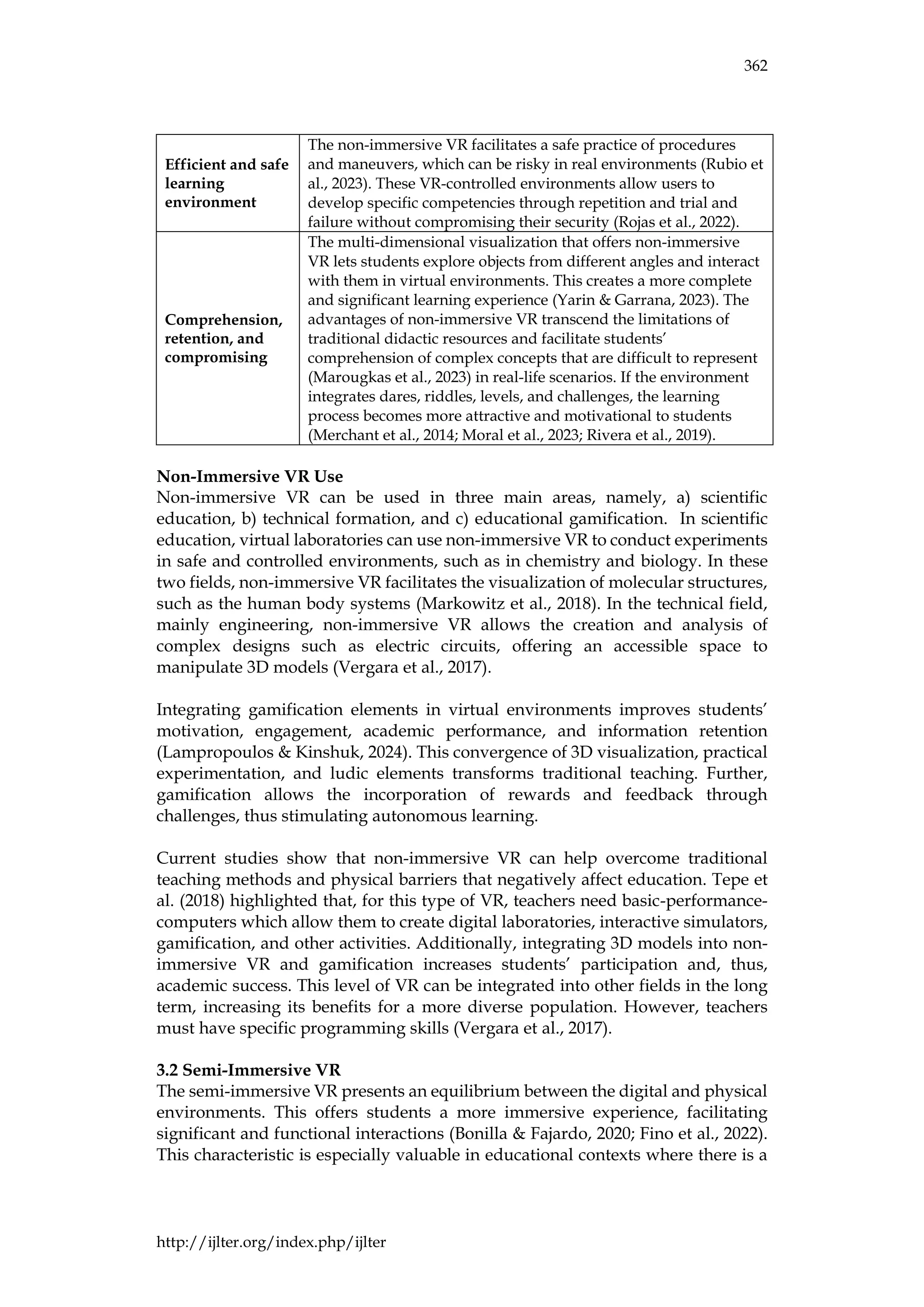
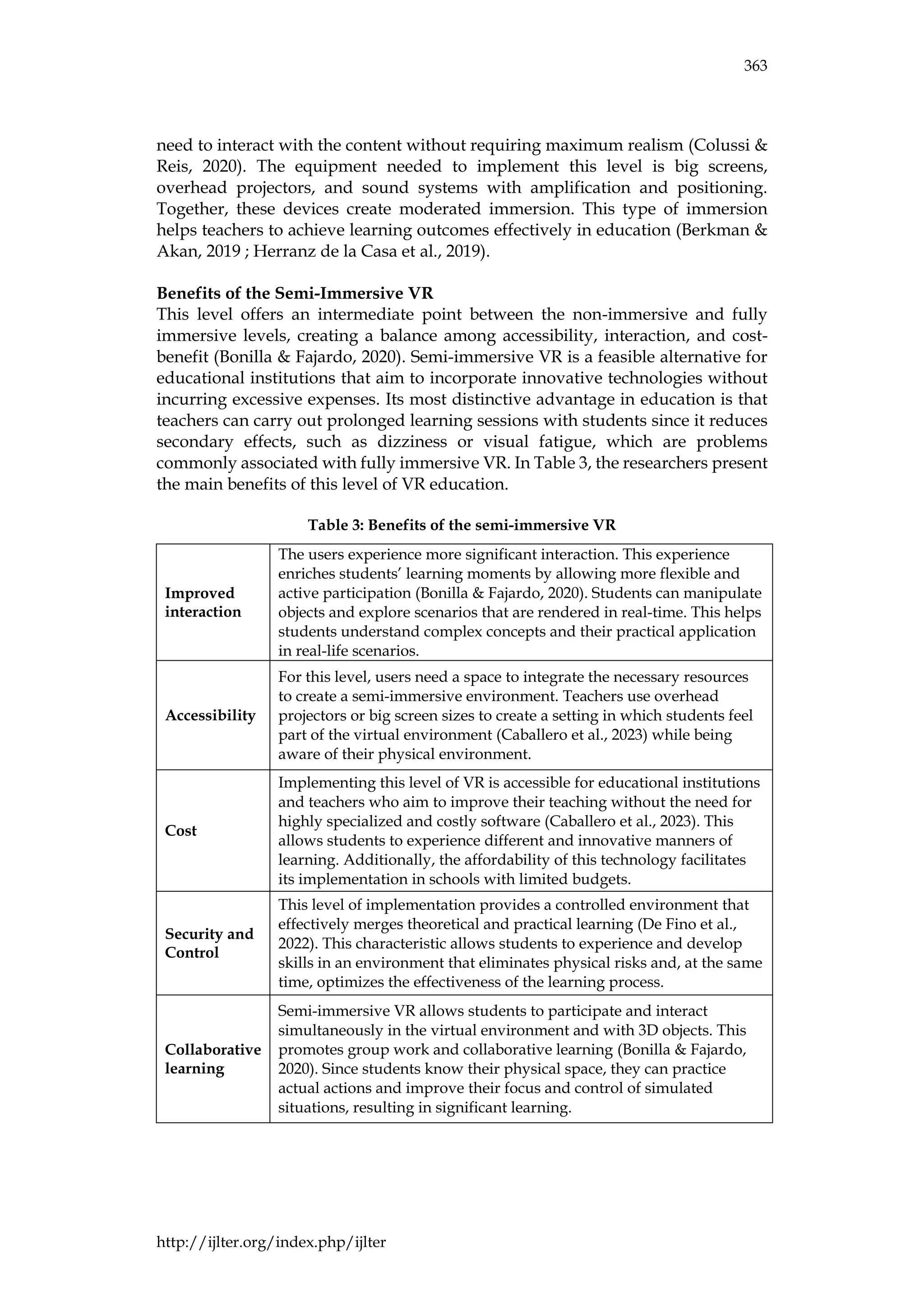
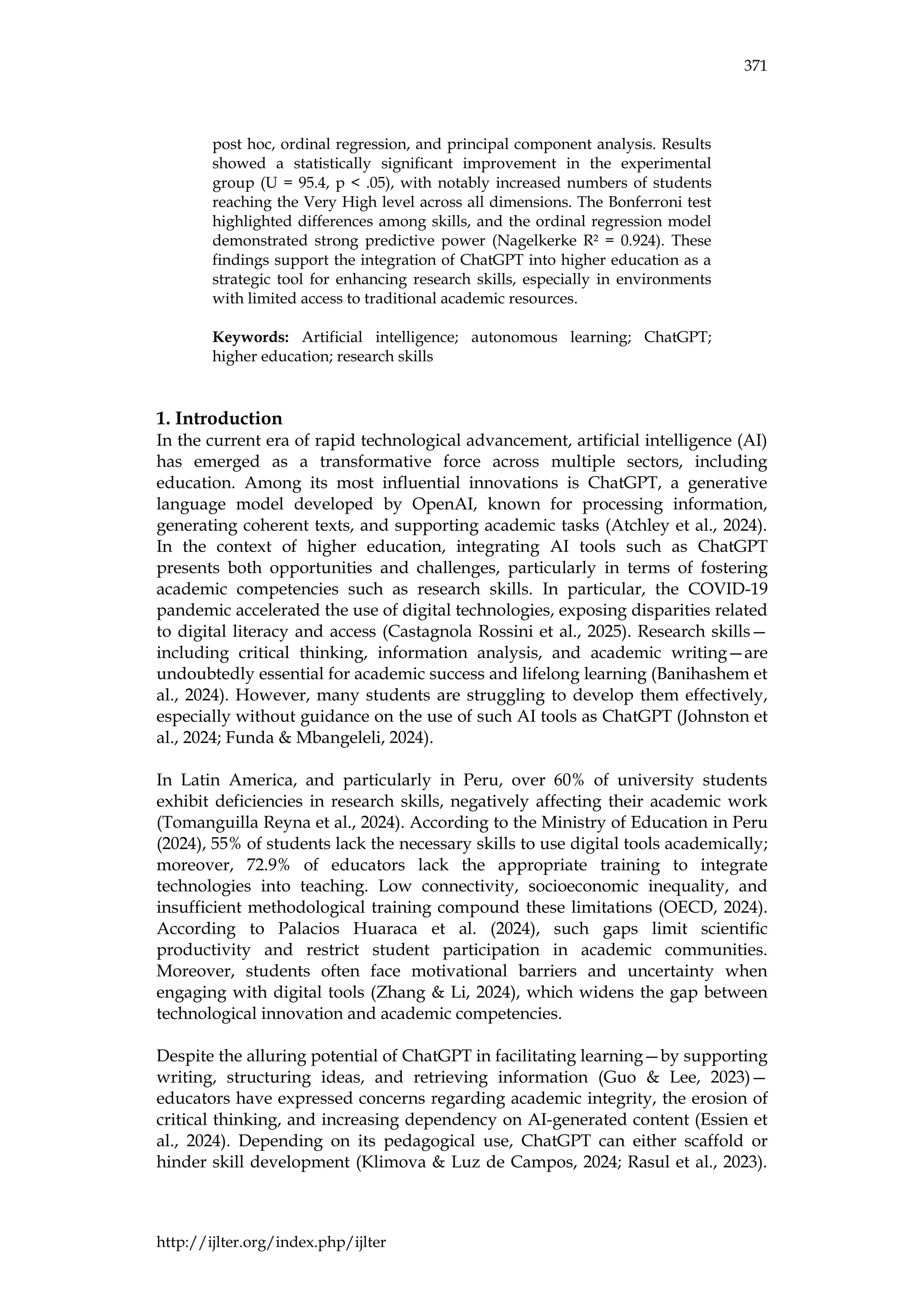
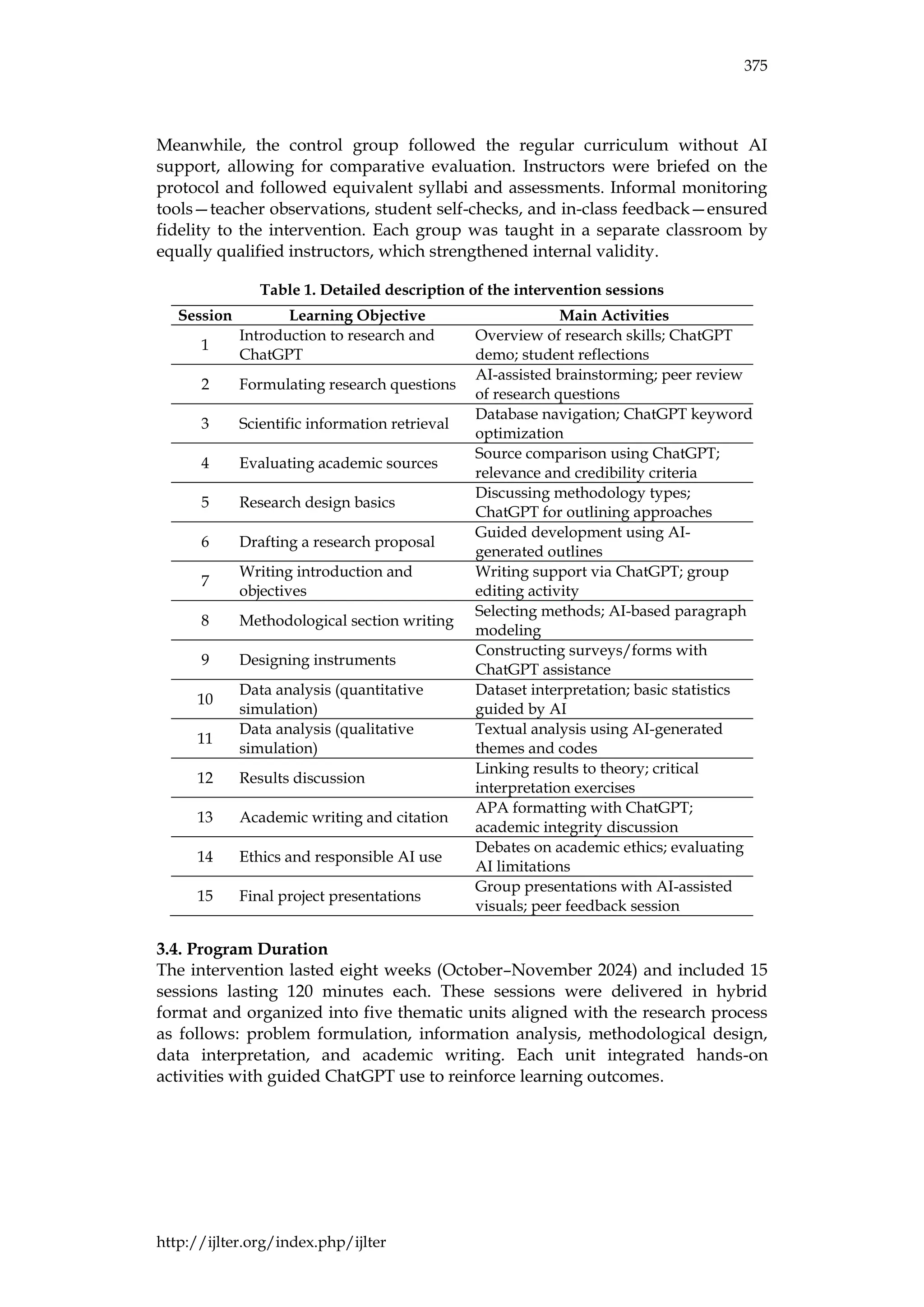
International Journal
of
Learning, Teaching
And
Educational Research
p-ISSN:
1694-2493
e-ISSN:
1694-2116
IJLTER.ORG
Vol.24 No.4
International Journal of Learning, Teaching and Educational Research
(IJLTER)
Vol. 24, No. 4 (April 2025)
Print version: 1694-2493
Online version: 1694-2116
IJLTER
International Journal of Learning, Teaching and Educational Research (IJLTER)
Vol. 24, No. 4
This work is subject to copyright. All rights are reserved by the Publisher, whether the whole or part
of the material is concerned, specifically those of translation, reprinting, re-use of illustrations,
broadcasting, reproduction by photocopying machines or similar means, and storage in data banks.
Society for Research and Knowledge Management
International Journal of Learning, Teaching and Educational Research
The International Journal of Learning, Teaching and Educational
Research is a peer-reviewed open-access journal which has been
established for the dissemination of state-of-the-art knowledge in the
fields of learning, teaching and educational research.
Aims and Objectives
The main objective of this journal is to provide a platform for educators,
teachers, trainers, academicians, scientists and researchers from over the
world to present the results of their research activities in the following
fields: innovative methodologies in learning, teaching and assessment;
multimedia in digital learning; e-learning; m-learning; e-education;
knowledge management; infrastructure support for online learning;
virtual learning environments; open education; ICT and education;
digital classrooms; blended learning; social networks and education; e-
tutoring: learning management systems; educational portals, classroom
management issues, educational case studies, etc.
Indexing and Abstracting
The International Journal of Learning, Teaching and Educational
Research is indexed in Scopus since 2018. The Journal is also indexed in
Google Scholar and CNKI. All articles published in IJLTER are assigned
a unique DOI number.
Foreword
We are very happy to publish this issue of the International Journal of
Learning, Teaching and Educational Research.
The International Journal of Learning, Teaching and Educational
Research is a peer-reviewed open-access journal committed to
publishing high-quality articles in the field of education. Submissions
may include full-length articles, case studies and innovative solutions to
problems faced by students, educators and directors of educational
organisations. To learn more about this journal, please visit the website
http://www.ijlter.org.
We are grateful to the editor-in-chief, members of the Editorial Board
and the reviewers for accepting only high quality articles in this issue.
We seize this opportunity to thank them for their great collaboration.
The Editorial Board is composed of renowned people from across the
world. Each paper is reviewed by at least two blind reviewers.
We will endeavour to ensure the reputation and quality of this journal
with this issue.
Editors of the April 2025 Issue
VOLUME 24 NUMBER 4 April 2025
Table of Contents
Exploring the Impacts of Academic Self-Efficacy on Learning Engagement and Academic Success Among
Chinese Master’s Students.....................................................................................................................................................1
Yuhan Zhang
The Effectiveness of Using GenAI Tools for Developing Digital Learning Resources: Evidence from Educators’
Perceptions............................................................................................................................................................................. 28
Taghreed A Almuqayteeb
Integration of Web-Based Intelligent Tutoring System (TuinLec) into Text Structure Strategy to Improve Text
Strategy Memory and Reading Comprehension Skills....................................................................................................52
Endah Tri Kusumawati, Nani Solihati, Zamah Sari
Tech-Enhanced Teacher Training: Evaluating Pre-Service Early Childhood Teachers’ Experiences and
Perceptions............................................................................................................................................................................. 72
Martin Chukwudi Ekeh, Blanche Ntombizodwa Hadebe-Ndlovu
Research Engagement in Practice: From EFL University Lecturers’ Perceived Effects to Strategies for Integration
into Teaching......................................................................................................................................................................... 93
Tat Thien Thu, Trinh Quoc Lap, Nguyen Trung Cang
The Voice of Primary Teacher Education Alumni: From Satisfaction to Suggestions for Training Enhancement 111
Trinh Thi Huong, Lu Hung Minh, Nguyen Thi Linh, Phan Ngoc Tuong Vy
Balancing Growth, Inclusivity, and Technology: Rethinking Student-Centered Learning in South African Higher
Education............................................................................................................................................................................. 127
James Ojochenemi David
Digital Leadership Pioneers: Navigating Outstanding School Principals' Successes in the Evolving Educational
Landscape ............................................................................................................................................................................ 154
Philip R. Baldera, Crisanto C. Saunil, Aljay Marc Curugan Patiam, Ma. Kristina Angelica B. Agpaoa, Emelyn R.
Villanueva, Kreisler I. Fontamillas, Leonora V. Divina, Rommel Pelayo, Renato N. Felipe Jr, Medardo T. Mercado, Rey M.
Valenzuela
Interplay of Principal Instructional Leadership, School Organizational Climate, and Teacher Job Satisfaction:
Evidence from Secondary Schools in Northwest China ................................................................................................ 178
Han Guo, Bity Salwana Alias, Mohd Izwan Mamud
Inclusive Education for Students with Autism Spectrum Disorder in an Indonesian Bilingual Elementary School:
A Program Evaluation Study Using CIPP Model........................................................................................................... 199
Kadek Sintya Dewi, Ni Nyoman Padmadewi, Luh Putu Artini, Ni Luh Putu Sri Adnyani, Made Hery Santosa, Yeo Siang
Lee
The Evolution of Online Physics Education: Insights from a Bibliometric Study...................................................... 221
Huy Thanh Le, Cuong H. Nguyen-Dinh, Hung Tran Van, Minh Duc Nguyen
Assessing Concept Mastery in Physical Sciences: Implementing Formative Assessment Interventions for
Teaching and Learning Electricity and Magnetism........................................................................................................ 250
Sam Mabune Ramaila, Halalisani Mngomezulu
The Outcome of STEM Education-Based Learning Using an Engineering Design Process with Training Packages
for Industrial Internet of Things (IIoT) in Vocational Thailand.................................................................................... 277
Choochat Seetao, Pornwilai Sukmak, Meechai Lohakan, Kanyawit Klinbumrung
ESL Students’ Technical Challenges in Web-Based Learning: A Bibliometric Analysis ........................................... 298
Isyaku Hassan, Mohd Nazri Latiff Azmi, Mohd Hazli Yah @ Alias, Mahendran A/L Maniam
The Impact of Artificial Intelligence Applications on Developing Levels of Cognitive Depth of Information
among Postgraduate Students .......................................................................................................................................... 316
Ahmed sadek Abdelmagid, Abdullah Yahya Al-Mohaya, Asem Mohammed Ibrahim, Ahmed Ali Teleb, Naif Mohammed
Jabli
Studies with Students on the Spectrum in Higher Education: A Systematic Literature Review using PRISMA ..334
Benjamin Carcamo
Levels of Virtual Reality Immersion and their Use in Education: A Systematic Literature Review........................ 354
Karla Esther Espinoza, Jheyson Steven Gaona Pineda, Diego Eduardo Apolo Buenaño, José Luis Plaza Chalco
Evaluation of the Impact of ChatGPT on the Development of Research Skills in Higher Education...................... 370
Jorge David Ríos Gonzales, Janeth Tomanguilla Reyna, Elvis Amado Vereau Amaya, Irene Gregoria Vásquez Luján
Perceived Transformational Leadership and Career Success Among Chinese University Teachers: The Mediating
Role of Career Adaptability............................................................................................................................................... 391
xinlai Zhao, Man Jiang
Adopting a Hexagonal Inter-Activity Model for Integrating Digital Technologies in South African Secondary
Schools.................................................................................................................................................................................. 409
Olika Moila, Bongani Bantwini
International Students’ Navigating Challenges in a Vietnamese English-Medium Instruction Program: Self-
Determination and Resilience Perspectives..................................................................................................................... 447
Hung Thanh Nguyen, Trinh Quoc Lap, Vo Doan Tho
Bridging AI and ELL in Indonesia and India: International Insights on Perceptions and Challenges.................... 479
Anak Agung Putri Maharani, I Komang Budiarta, Ni Luh Putu Dian Sawitri, Harvinder Kumar Negi
Competency-Based Assessment of High School Students in Physical Education in Vietnam: Perspectives and
Practices................................................................................................................................................................................ 501
Tu Thi Tran, Ma Duc Tuan, Dang Quy Quyen
Soft Skills Development through Task-Based Language Learning: Insights from Higher Education in the
Malaysian Context.............................................................................................................................................................. 525
Haida Umiera Hashim, Erikson Saragih Sumbayak, Nurfarah Saiful Azam, Hanna Insyirah Mohd Sukri, Nur Asyrani Che
Ismail, Norfarida Filzah Mohd Sobri Paridaluddin
Teachers’ Perspectives on the Challenges of Implementing Vygotsky’s Social Constructivist Outcome-Based
Assessment in Secondary Schools in Botswana.............................................................................................................. 545
End Salani, Grace Goabaone Salani, Moffat Fanah Kgotlaetsile, Wazha Bickie Maundeni
Direction of Gamification in Science Education: Literature Review and Indexed Bibliography ............................. 568
Nurfadilah Nurfadilah, Hartono Bancong, Rezkawati Saad, Tri Hastiti Fiskawarni
A Systematic Review of Factors Shaping Vocational Teacher Professional Education Implementation................ 592
Ahmad Mursyidun Nidhom, Fathiyah Mohd Kamaruzaman, Marlissa Binti Omar
Integrating isiXhosa with Inquiry-Based Learning to Develop Scientific Skills in Early Childhood Development
Classrooms: towards Teacher Professional Development............................................................................................. 616
Nhase Zukiswa, Mdodana-Zide Lulama
Bridging Entrepreneurship Education and Digital Transformation: A Novel Experiential Learning Model for
Entrepreneurial Mindset Development ........................................................................................................................... 640
Elvi Rahmi, Darmansyah Darmansyah, Asmar Yulastri, Ciptro Handrianto
Revolutionizing Writing Learning: How Electronic Blogs Contribute to Enhancing Writing Expression Skills in
Primary School Pupils........................................................................................................................................................ 661
Ali Ahmad Al-Barakat, Omayya M. Al-Hassan, Rommel Mahmoud AlAli, Mohammad F. Hawamdeh, Ashraf Mahrous
Zaher, Nahla Abbas Ibrahim
Teaching Students with Special Educational Needs in Inclusive Settings: Are Malaysian Teachers Ready? ........ 676
Mohd Syaubari Othman, Mohd Ridhuan Mohd Jamil, Nik Muhammad Hanis Nek Rakemi, Mohd Muslim Md Zalli
Design of Vocational High School Students’ Skills Test Instrument Based on Construction Services Needs........ 692
Rolly Oroh, Nova A. R. A. Mamarimbing, Morris S. S. S. Tumanduk, Sonny D. J. Mailangkay, Ferdinan S. R. P. Terok,
Muhammad M. Attaufiq, Jenly D. I. Manongko
Does AI Knowledge Encourage Cheating? Investigating Student Perceptions, Ethical Engagement, and Academic
Integrity in the Digital Age................................................................................................................................................ 708
Chinyere Ori Elom, Musa Adekunle Ayanwale, Ikechukwu Ogeze Ukeje, Goodness Amaka Offiah, Chukwudum Collins
Umoke, Chisom Esther Ogbonnaya
Distance Learning in Focus: A Bibliometric and Thematic Network Analysis of the Global Research Trends..... 730
Jeannie C. Abantas, Sabrie E. Akmad, Rogelio B. Bonggat Jr., Al-jayson U. Abubakar, Nahdiyya H. Nuruddin, Bonjovi H.
Hajan, Clarissa Ayangco-Derramas, Jovito C. Anito Jr.
Virtues for Principals to Enact Ethical Leadership: An Education Policy Perspective.............................................. 755
Edwin Darrell De Klerk, Sipiwe Mudadigwa
Evaluating the Efficacy of Vocational Training in Transition Services for Saudi Arabian Students with Disabilities
............................................................................................................................................................................................... 782
Mohamad Ahmad Saleem Khasawneh
The Main Causes of Early School Leaving at the Remote and Rural Areas: Practical Implications for Educational
Planning and Policy............................................................................................................................................................ 794
Dung Ngoc Phuong Nguyen, Linh Phuong Nguyen
Breaking Barriers: Assistive Technology for Visually Impaired EFL Educators........................................................ 813
Walaa Fares Talafhah, Ruba Fahmi Bataineh
1
©Authors
This work is licensed under a Creative Commons Attribution-NonCommercial-NoDerivatives 4.0
International License (CC BY-NC-ND 4.0).
International Journal of Learning, Teaching and Educational Research
Vol. 24, No. 4, pp. 1-27, April 2025
https://doi.org/10.26803/ijlter.24.4.1
Received Feb 5, 2025; Revised Mar 20, 2025; Accepted Mar 28, 2025
Exploring the Impacts of Academic Self-Efficacy
on Learning Engagement and Academic Success
Among Chinese Master’s Students
Yuhan Zhang*
University of Edinburgh, Edinburgh, England
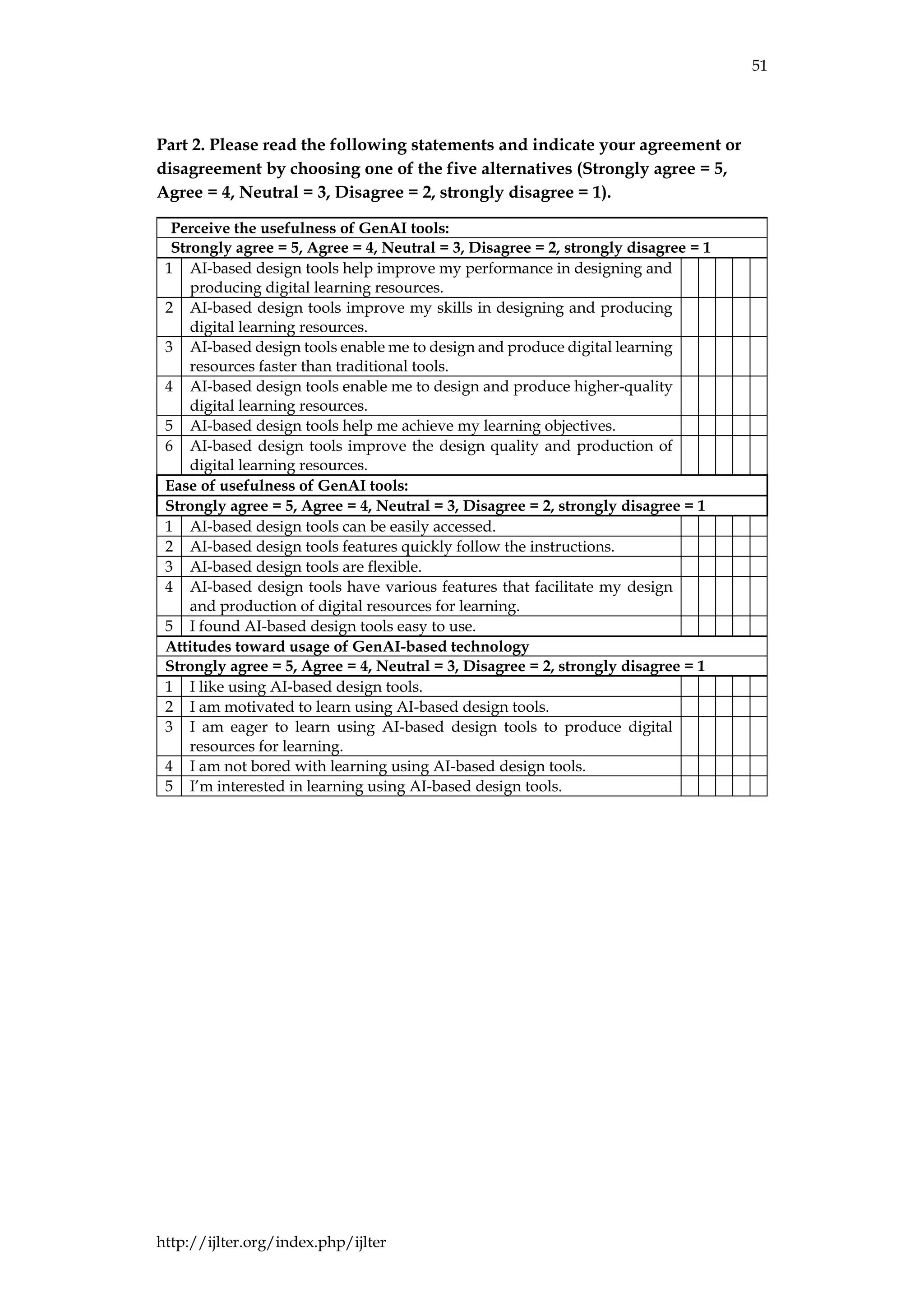
Abstract. This study examines the correlation of academic self-efficacy,
learning engagement, and academic achievement among Chinese
master’s students. Reviewing prior research reveals that while there is
ample theoretical knowledge on the positive impact of self-efficacy on
academic achievement, there is a lack of detailed case studies providing
practical guidance, particularly in the context of Chinese students. This
paper builds this gap using a quantitative research design that allows the
collection of primary data in the form of structured questionnaires and
testing hypotheses using multiple regression analysis to draw inferences
from a sample size of 214. The research finds that: (1) academic self-
efficacy significantly and positively impacts academic achievement. The
dimensions of grades, verbalising, and studying contribute positively,
whereas attendance shows no significant effect; (2) academic self-efficacy
positively influences learning engagement, with grades, studying, and
attendance playing significant roles, while verbalising does not; and (3)
learning engagement significantly improves academic achievement,
indicating that higher engagement correlates with greater academic
success. The results of R-square of 0.514 indicate 51.4% variance in
academic achievement, showing a significant impact of self-efficacy and
learning engagement. Based on this, the study recommends that
universities and institutions build confidence in students’ academic
abilities and adopt proactive learning habits to enhance self-efficacy.
Keywords: academic self-efficacy; academic achievement; Chinese
master’s students; learning engagement; multiple regression analysis
1. Introduction
Graduate education is central to cultivating high-calibre talent and plays a pivotal
role in driving scientific innovation and national progress in China (Yang et al.,
2023). The quality of graduate education directly impacts the training of advanced
professionals, particularly given the dual pressures of global competition and
China’s modernisation goals (Xu et al., 2022; Zhang, 2024). Over the past decade,
*
Corresponding author: Yuhan Zhang; zhangyuhan0296@gmail.com
2
http://ijlter.org/index.php/ijlter
China has witnessed rapid expansion in its graduate education system. By 2023,
the number of newly enrolled graduate students had risen to approximately 1.3
million, with 1.15 million being master’s students (National Bureau of Statistics of
China, 2023). This figure marks a near doubling of enrolments since 2011, making
master’s students the dominant cohort within China’s graduate education
landscape.
However, this growth has brought significant challenges. Concerns about the
declining quality of master’s education have sparked considerable public debate
(Chan & Zhang, 2021; Dong et al., 2024). The expansion has exposed issues such
as uneven academic standards and insufficient research skills among students.
These challenges highlight the need for strategies to improve the quality of
master’s education in China. Academic achievement is often regarded as a key
indicator of graduate education quality (Liu et al., 2020).
Academic achievement, however, is not limited to acquiring professional
knowledge. It also involves the ability to think critically, solve problems, innovate,
and apply knowledge across varying contexts (Wang et al., 2018). Previous studies
have identified significant obstacles faced by Chinese master’s students in
achieving these goals. For instance, Liu et al. (2020) reported that many master’s
students lack the research skills needed to conduct independent, high-level
projects. Similarly, Li et al. (2022) noted deficiencies in students’ innovative and
practical research capabilities, with nearly half of master’s students producing no
research outputs or publications during their studies (Qiu & Li, 2021). Sun (2023)
further highlighted that some students struggle to apply professional knowledge
flexibly, especially in interdisciplinary or innovative contexts. These findings
point to an urgent need for initiatives aimed at enhancing the academic
performance of master’s students.
While much research has focused on external factors influencing academic
achievement, such as policy frameworks (Tang, 2022), social support systems
(Zhang et al., 2024), and family dynamics (Liu et al., 2020), the role of individual
factors is often overlooked. Yet, at the master’s level, academic success depends
heavily on personal attributes such as motivation, learning engagement, and self-
efficacy (Lu et al., 2022; Wu et al., 2020). Adopting a micro-level perspective to
explore how these individual factors shape academic achievement is, therefore,
essential.
One critical factor is academic self-efficacy, which refers to a person’s belief in
their ability to perform academic tasks effectively. Academic self-efficacy has been
shown to significantly influence learning behaviours and outcomes (Alhadabi &
Karpinski, 2020; Hwang et al., 2016). For example, Kolo et al. (2017) identified
academic self-efficacy as a key determinant of academic success among university
students. At the master’s level, where students face substantial academic and
research pressures, a lack of self-efficacy can lead to feelings of inadequacy,
disengagement, and even dropout (Hwang et al., 2016). Self-efficacy influences
motivation, learning engagement, and persistence, making it a reliable predictor
of academic achievement (Alhadabi & Karpinski, 2020; Mehmood et al., 2019).
3
http://ijlter.org/index.php/ijlter
Academic self-efficacy influences LE, which in turn shapes academic outcomes
(Honicke & Broadbent, 2016; Luo et al., 2023; Olivier et al., 2019). Despite its
significance, the relationship between academic self-efficacy and academic
achievement remains insufficiently understood, particularly in terms of how self-
efficacy interacts with learning engagement for master’s students in Chinese
universities. The existing studies focus on the psychological effects of academic
self-efficacy and LE (Chen, 2024; Wang et al., 2017). However, the mechanisms
through which academic self-efficacy and LE jointly affect academic achievement
remain unclear, particularly in the context of Chinese master’s students.
To address this gap, this study explores the relationship between academic self-
efficacy, LE, and academic achievement among Chinese master’s students,
focusing on three key questions:
1. How does academic self-efficacy influence academic achievement?
2. How does academic self-efficacy affect learning engagement?
3. How does learning engagement impact academic achievement?
The objectives of this research are threefold:
1. To investigate the effect of academic self-efficacy on academic
achievement.
2. To examine how academic self-efficacy shapes learning engagement.
3. To assess the influence of learning engagement on academic achievement.
This study offers both theoretical and practical contributions. Theoretically, it
extends the application of self-efficacy and learning engagement literature to the
context of master’s students from China (Chen, 2024; Wang et al., 2017), using
quantitative methods. This study provides a more nuanced understanding of how
these factors influence academic achievement. Practically, the findings can inform
teaching strategies and learning environments that foster self-efficacy and
engagement among master’s students. By identifying actionable pathways for
improving academic performance, this research aims to support the development
of high-quality talent in Chinese universities and contribute to the broader goal of
enriching graduate education. Its aims are beneficial for policy makers and
educators to design and implement strategies such as course structure
modifications and workshops on self-efficacy to enhance academic self-efficacy
and LE.
2. Literature Review
Academic self-efficacy plays a pivotal role in fostering learning engagement (LE)
and academic achievement among postgraduate students (Luo et al., 2023; Noreen
et al., 2018; Wu et al., 2020). Higher levels of academic self-efficacy equip students
with the confidence to set clear goals, adopt effective learning strategies, and
actively engage in academic tasks (Brown et al., 2016; Khan, 2023; Li et al., 2022;
Satici & Can, 2016). Academic self-efficacy influences how students approach
learning challenges, with those possessing high academic self-efficacy
demonstrating resilience, seeking appropriate assistance, and adapting their
learning methods effectively (Celik, 2022; Gutiérrez & Tomás, 2019). For Chinese
4
http://ijlter.org/index.php/ijlter
graduate students, this is particularly relevant due to their significant academic
workloads and research pressures, where academic self-efficacy emerges as a
critical determinant of academic success. This section explores academic self-
efficacy, LE, and academic achievement through existing literature, leading to the
development of a conceptual framework for this study.
2.1 Academic Self-Efficacy
Self-efficacy, as defined by Bandura (1977), is an individual’s belief in their ability
to successfully perform a specific task in a given context. His social cognitive
theory explains the role of observation learning and social experiences. According
to Bandura, an individual learning by observing others and their behaviour is
influenced by the interaction of personal factors, environmental influences, and
behaviour patterns. Based on this, Bandura (1986, 1993) primarily identifies four
primary sources of self-efficacy: mastery experience, vicarious experience, verbal
persuasion, and physiological states. Among these, mastery experience is the most
influential as it builds self-efficacy through successful task completion. Vicarious
experience strengthens self-belief by observing others achieve success in similar
tasks. Verbal persuasion involves encouragement and support from others,
fostering confidence. Finally, physiological states influence self-efficacy, with
stress and anxiety diminishing it, while relaxation and positive emotions increase
it.
Expanding on Bandura’s framework, Sander and Sanders (2009) define academic
self-efficacy as university students’ confidence in their academic abilities.
Similarly, Pintrich and De Groot (1990) highlight students’ belief in their capacity
to complete academic tasks. While these definitions emphasise confidence, they
may oversimplify academic self-efficacy by neglecting other essential factors such
as adaptability and resilience. Academic self-efficacy is typically measured using
four dimensions: grades, verbalising, studying, and attendance (Sander & de la
Fuente, 2022; Sander & Sanders, 2009). The study employs these four dimensions
by adopting Sander’s approach, a valuable and effective method for
comprehending students’ self-efficacy and developing tools for improvement,
which is the primary goal of the research. Grades represent confidence in
achieving high marks, though this focus on outcomes may undervalue the
learning process itself. Verbalising reflects confidence in class participation, which
does not necessarily equate to understanding or mastery. Studying denotes
confidence in planning and preparation, yet effective strategies are crucial for
ensuring success. Attendance captures confidence in attending classes regularly,
but this alone does not guarantee meaningful engagement in learning activities.
The role of academic self-efficacy in influencing university students’ motivation,
engagement, and academic success is significant (Alemayehu & Chen, 2023;
Martins & Santos, 2019). High academic self-efficacy empowers students to face
challenges, actively participate in classroom discussions, and engage more deeply
in their studies, often resulting in better learning outcomes (Luo et al., 2023).
However, excessively high academic self-efficacy can lead to complacency, where
students underestimate task difficulty, overlook potential challenges, and fail to
prepare adequately. This overconfidence can result in missed study goals or lower
5
http://ijlter.org/index.php/ijlter
academic performance (Soner, 2019). Conversely, low academic self-efficacy often
leads to self-doubt, decreased motivation, and disengagement, posing significant
obstacles to academic achievement (Adams et al., 2020).
Academic self-efficacy, defined as the belief in one’s ability to achieve academic
goals, is a key factor influencing academic performance (Bandura, 1986, 1997).
High academic self-efficacy allows students to set ambitious goals, adopt effective
strategies, and persist in the face of challenges, resulting in better academic
outcomes (Alegre, 2014; Bhati et al., 2022). Graduate students with high academic
self-efficacy are particularly equipped to handle the demanding academic tasks
and research requirements of their programmes. They are proactive in seeking
feedback, collaborating with mentors and peers, and refining their work,
contributing to greater research productivity and academic success (Cheng et al.,
2019; Lu et al., 2022; Mehmood et al., 2019; Salimi et al., 2022). There is a variation
in how gender, age, major, and economic background impact self-efficacy (Satici
& Can, 2016). Studies show that males and females tend to show strengths in
different subjects (Huang, 2013). This takes gender, age, and major variables to
test the hypothesis and its correlation with self-efficacy.
Hypothesis 1: Academic self-efficacy positively influences the academic achievement of
Chinese master’s students.
Academic self-efficacy also influences coping mechanisms. Students with high
academic self-efficacy are more likely to adopt positive strategies, such as seeking
help and improving study methods, while those with low academic self-efficacy
may exhibit avoidance behaviours that hinder academic progress (Al-Abyadh et
al., 2022). Beyond academic performance, high academic self-efficacy supports
mental well-being by reducing stress, enhancing academic satisfaction, and
improving overall psychological resilience (Azila-Gbettor et al., 2022; Hauck et al.,
2020; Shehadeh et al., 2020; Zhen et al., 2017).
2.2 Learning Engagement
Learning engagement (LE) refers to the degree of cognitive, emotional, and
behavioural investment that students dedicate to their studies. Fredricks et al.
(2004) define LE as the extent to which students are actively involved in the
learning process. For graduate students, LE includes their effort and active
participation in academic activities, research, and other related tasks. According
to Zimmerman and Schunk (2003), students actively control their learning
processes through planning, monitoring, and evaluating their actions. It reflects
their cognitive and emotional investment in academic work, as well as their
engagement in essential learning activities, including overcoming challenges and
frustrations (Cazan, 2015). LE is often conceptualised as a multidimensional
construct comprising three key facets (Chhetri & Baniya, 2022; Park & Yun, 2018):
1. Behavioural engagement, which pertains to students’ participation in
classroom activities and extracurricular pursuits.
2. Emotional engagement, which captures students’ emotional responses to
learning tasks and their affective connection to academic activities.
3. Cognitive engagement, which represents the mental effort and strategic
thinking students invest in their learning processes.
6
http://ijlter.org/index.php/ijlter
This multidimensional perspective highlights the comprehensive nature of LE
and its significance in shaping students’ overall academic experiences. Various
factors influence LE, which are broadly categorised into personal and
environmental aspects. Personal factors include academic self-efficacy, intrinsic
motivation, interest, and personality traits (Azila-Gbettor et al., 2021; Wu et al.,
2020). Environmental factors, on the other hand, include teaching methods, peer
support, school resources, and family environments (Yang & Wang, 2019).
Research by Noreen et al. (2018) and Alemayehu and Chen (2023) demonstrates
that higher academic self-efficacy can significantly improve LE by boosting
students’ confidence and proactivity, particularly when tackling complex tasks.
However, external factors, such as the quality of the learning environment,
teacher support, and peer interactions, also play a substantial role in influencing
engagement (Tao et al., 2023).
Learner engagement (LE) is widely recognised as a critical determinant of
students’ academic performance and success. High levels of engagement are often
associated with better academic outcomes, including the ability to complete tasks
effectively and contribute meaningfully to research (Northey et al., 2018; Raza et
al., 2020). However, the relationship between LE and academic achievement is not
always linear or straightforward. While highly engaged students may achieve
strong academic results, some studies highlight the potential downsides of over-
engagement. For instance, Caruth (2018) and Firat et al. (2019) suggest that
excessive engagement can lead to stress and burnout, ultimately impairing
academic performance. Similarly, Gutiérrez and Tomás (2019) and Kim et al.
(2019) highlight the nuanced nature of LE, noting that its effectiveness often
depends on a balance of personal and environmental factors. Understanding the
complex interplay between LE, academic performance, and external influences is
essential for fostering an optimal learning environment that supports students’
academic and personal growth.
Academic self-efficacy also significantly affects LE, which includes behavioural,
cognitive, and emotional dimensions (Fredricks et al., 2004). Students with high
academic self-efficacy exhibit greater motivation, persistence, and cognitive
flexibility, enabling them to engage deeply with complex academic tasks (Noreen
et al., 2018; Wu et al., 2020). Such students employ proactive strategies like goal
setting, self-monitoring, and time management (Rigg et al., 2013; Shi & Ko, 2022).
For Chinese graduate students, high academic self-efficacy is crucial in sustaining
motivation and engagement amid high workloads and research demands (Yang
& Wang, 2019; Zhong et al., 2020). These students actively participate in classroom
discussions, research collaborations, and academic societies, enriching their
learning experiences and academic capabilities (Han et al., 2021; Luo et al., 2023).
Additionally, high academic self-efficacy fosters positive emotional experiences
such as satisfaction and pride, further increasing LE (Chen et al., 2023; Fokkens-
Bruinsma et al., 2021).
Hypothesis 2: Academic self-efficacy positively influences the learning engagement of
Chinese master’s students.
7
http://ijlter.org/index.php/ijlter
2.3 Academic Achievement
Academic achievement (AA) entails the knowledge, skills, and research capacities
that graduate students acquire throughout their academic journey (Banarjee &
Kumar, 2014; Michael et al., 1983). It is developed through three primary domains:
coursework, research activities, and social practice. Coursework involves
completing assignments, exams, and projects, which help students master
professional knowledge and enhance their academic competencies. Research
activities focus on building students’ capabilities to conduct effective research,
fostering innovative thinking, and engaging in academic projects, paper writing,
and conference presentations. Social practice, on the other hand, allows students
to apply theoretical knowledge in real-world contexts, such as internships and
volunteer services, which contribute to their practical skills and holistic
development (Rudakov & Roshchin, 2019). Collectively, these dimensions
provide a comprehensive measure of graduate students’ growth, reflecting their
proficiency in academics, research, and practical applications (Byrne, 2022).
Academic achievement is often seen as a symbol of graduate students’
development and a predictor of their career prospects. While it reflects academic
abilities and professional competencies (Brown et al., 2016), this perspective may
oversimplify the multifaceted nature of academic success. High levels of academic
achievement often signify students’ proficiency and confer recognition within the
academic community (Amida et al., 2021). However, focusing solely on academic
achievement risks overlooking critical skills such as creativity and critical
thinking. Although strong academic records and research experience enhance
career competitiveness (Alhadabi & Karpinski, 2020; Banarjee & Kumar, 2014),
they are not the sole determinants of career success. Factors like networking,
resilience, and interpersonal skills also play essential roles. Furthermore, strong
academic achievement can facilitate access to advanced doctoral programmes and
academic opportunities (Caruth, 2018; Celik, 2022), yet overemphasis on academic
achievement risks marginalising students who excel in non-academic areas.
Several factors influence academic achievement, including personal and external
elements. Personal factors such as academic self-efficacy, motivation, and time
management directly affect academic achievement. High academic self-efficacy
can increase students’ confidence and encourage active engagement in learning
and research (Bouih et al., 2021). However, excessive self-confidence can lead to
overconfidence, causing the neglect of essential details and ultimately hindering
performance. External factors, such as the learning environment, teacher support,
peer relationships, and institutional resources, also play significant roles (Descals-
Tomás et al., 2021). A conducive learning environment and adequate resources
can promote academic achievement (Rafiq et al., 2022), but overreliance on these
external factors may undervalue individual adaptability and resilience
Learning engagement (LE), which includes behavioural, cognitive, and emotional
involvement, directly influences academic achievement (Fredricks et al., 2004; Lin,
2020). High LE promotes deep understanding and critical thinking through active
participation in learning activities and the adoption of self-regulated learning
strategies (Caruth, 2018; Vizoso et al., 2018). Emotional engagement, such as
8
http://ijlter.org/index.php/ijlter
satisfaction and intrinsic motivation, further reinforces such behaviours, driving
improved academic outcomes (Ketonen et al., 2016; Martínez et al., 2019).
In the context of Chinese graduate education, LE plays a critical role in meeting
the demands of coursework, research, and social practice. Engaged students are
more likely to participate actively in research projects, internships, and academic
discussions, fostering their research capabilities and practical skills (Anokye-
Effah & Nkwantabisa, 2022; Ayala & Manzano, 2018). Furthermore, students with
high LE demonstrate stronger adaptability and creativity, translating into better
academic outputs (Glapaththi et al., 2019; Luo et al., 2023).
Hypothesis 3: Learning engagement positively influences the academic achievement of
Chinese master’s students.
4. Methodology
This study employs a self-administered questionnaire as the primary data
collection method, adopting a deductive and positivist approach. Positivism
emphasises the testing of research hypotheses through observed and measurable
data, making it well-suited to the structured survey and quantitative analysis
methods used in this research (Bell et al., 2018; Ghauri & Grønhaug, 2019;
Saunders et al., 2019). By using quantitative techniques, this study objectively
examines the impacts of academic self-efficacy on academic achievement and LE
among Chinese master’s students.
Quantitative methods allow for the collection of large-scale data, facilitating the
objective measurement of variables such as academic self-efficacy, LE, and
academic achievement. The structured format of the survey ensures standardised
data collection, which can then be statistically analysed to identify relationships
between variables and rigorously test hypotheses. This approach improves the
reliability, validity, and generalisability of findings (Hair et al., 2019; Saunders et
al., 2019). The focus of this paper is to test the hypothesis of the correlation
between variables, emphasising a quantitative study approach centered on
hypothesis testing and large-sample analysis (Bell et al., 2018; Bryman & Bell,
2019). Additionally, quantitative methods allow for comparison between different
groups and variables and identify developing trends (Yilmaz, 2013).
The questionnaire is designed to align with the research objectives and is divided
into four sections. The first section gathers demographic information, which
serves as the independent variable. This includes gender, grade, and major of the
respondents. The subsequent three sections use Likert five-point scales to measure
the study’s key dependent variables: academic self-efficacy, LE, and academic
achievement. Respondents rate the extent to which they agree with specific item
expressions for each dependent variable. The average scores of these items
represent the values of the respective variables. The following subsections detail
the measurement items for each variable.
9
http://ijlter.org/index.php/ijlter
3.1 Measurement Scale for Academic Self-Efficacy
Academic self-efficacy was measured using a 17-item scale covering four facets:
grades, verbalising, studying, and attendance (see Appendix A). The scale,
informed by the research of Pintrich and De Groot (1990) and Luo et al. (2023),
assessed the extent to which students felt confident in their ability to perform
various academic tasks. Responses were recorded on a five-point Likert scale,
ranging from “1 = Not at all confident” to “5 = Very confident,” providing a
comprehensive measure of academic self-efficacy.
3.2 Measurement Scale for Learning Engagement
Learning engagement (LE) was measured using a six-item scale (Table 1) based
on items from Schaufeli (2002) and Noreen et al. (2018). The scale assessed key
aspects of engagement, such as active participation in discussions, connecting
course material to personal interests, and maintaining motivation outside class.
Respondents rated their engagement on a five-point Likert scale, ranging from “1
= Strongly Disagree” to “5 = Strongly Agree”, with higher scores indicating
stronger levels of engagement. This method ensured a well-rounded evaluation
of students’ behavioural, cognitive, and emotional involvement in learning.
Table 1: Measures of Learning Engagement
Symbol Items References
LEE1 Finding ways to make the course material relevant to my life
Schaufeli,
2002; Noreen
et al., 2018
LEE2
Looking over class notes between classes to make sure I
understand the material
LEE3 Finding ways to make the course interesting to me
LEE4 Thinking about the course between class meetings
LEE5 Really desiring to learn the material
LEE6 Participating actively in small group discussions
3.3 Measurement Scale for Academic Achievement
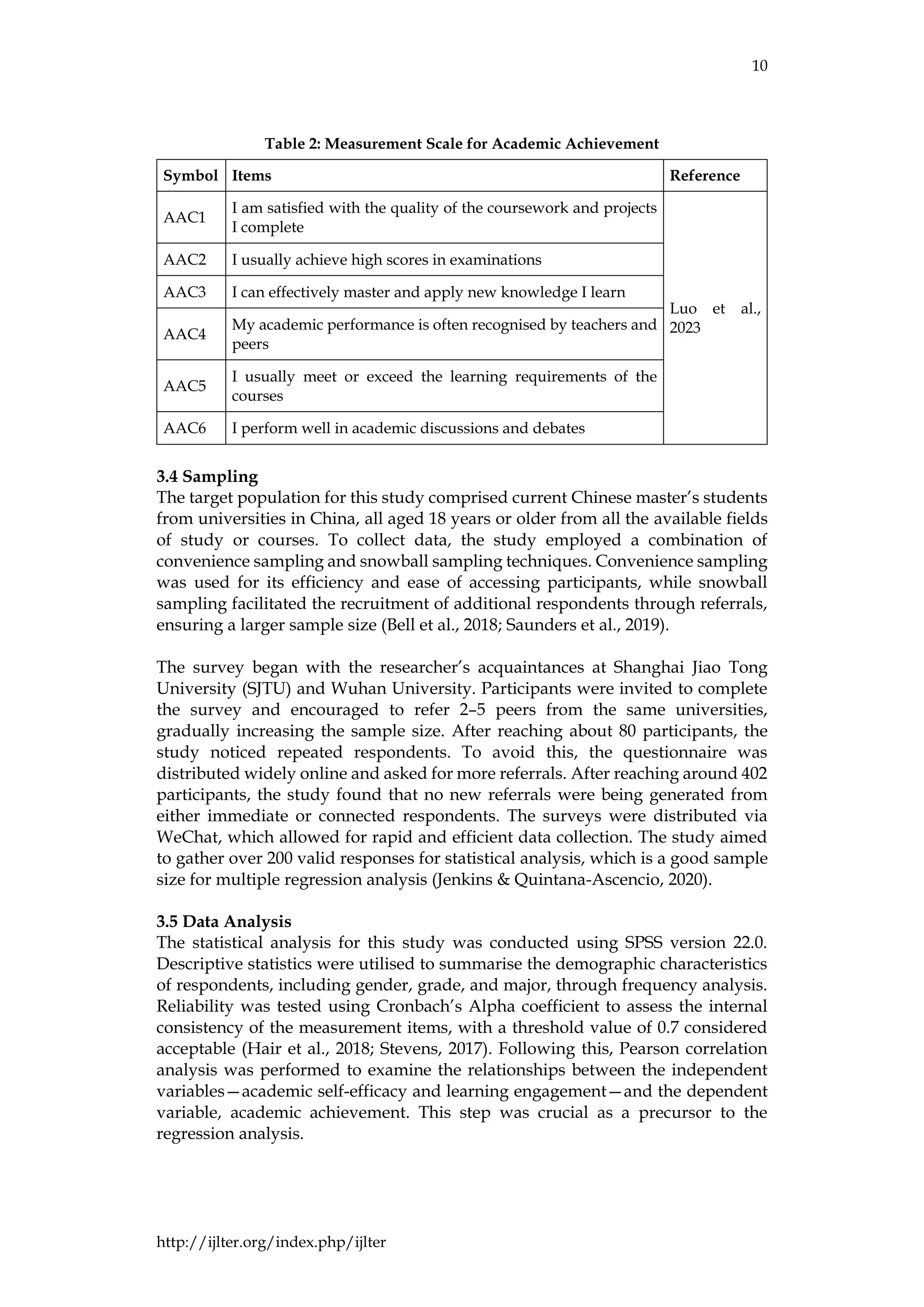
Academic achievement was assessed using a six-item scale (Table 2) adapted from
Luo et al. (2023). The scale evaluated various aspects of academic performance,
including coursework quality, examination scores, knowledge application, peer
and teacher recognition, and participation in academic discussions. Respondents
rated their level of agreement with each statement on a five-point Likert scale,
ranging from “1 = Strongly Disagree” to “5 = Strongly Agree”. Higher scores
indicated greater levels of academic achievement, capturing both objective
performance and perceived academic success.
10
http://ijlter.org/index.php/ijlter
Table 2: Measurement Scale for Academic Achievement
Symbol Items Reference
AAC1
I am satisfied with the quality of the coursework and projects
I complete
Luo et al.,
2023
AAC2 I usually achieve high scores in examinations
AAC3 I can effectively master and apply new knowledge I learn
AAC4
My academic performance is often recognised by teachers and
peers
AAC5
I usually meet or exceed the learning requirements of the
courses
AAC6 I perform well in academic discussions and debates
3.4 Sampling
The target population for this study comprised current Chinese master’s students
from universities in China, all aged 18 years or older from all the available fields
of study or courses. To collect data, the study employed a combination of
convenience sampling and snowball sampling techniques. Convenience sampling
was used for its efficiency and ease of accessing participants, while snowball
sampling facilitated the recruitment of additional respondents through referrals,
ensuring a larger sample size (Bell et al., 2018; Saunders et al., 2019).
The survey began with the researcher’s acquaintances at Shanghai Jiao Tong
University (SJTU) and Wuhan University. Participants were invited to complete
the survey and encouraged to refer 2–5 peers from the same universities,
gradually increasing the sample size. After reaching about 80 participants, the
study noticed repeated respondents. To avoid this, the questionnaire was
distributed widely online and asked for more referrals. After reaching around 402
participants, the study found that no new referrals were being generated from
either immediate or connected respondents. The surveys were distributed via
WeChat, which allowed for rapid and efficient data collection. The study aimed
to gather over 200 valid responses for statistical analysis, which is a good sample
size for multiple regression analysis (Jenkins & Quintana-Ascencio, 2020).
3.5 Data Analysis
The statistical analysis for this study was conducted using SPSS version 22.0.
Descriptive statistics were utilised to summarise the demographic characteristics
of respondents, including gender, grade, and major, through frequency analysis.
Reliability was tested using Cronbach’s Alpha coefficient to assess the internal
consistency of the measurement items, with a threshold value of 0.7 considered
acceptable (Hair et al., 2018; Stevens, 2017). Following this, Pearson correlation
analysis was performed to examine the relationships between the independent
variables—academic self-efficacy and learning engagement—and the dependent
variable, academic achievement. This step was crucial as a precursor to the
regression analysis.
11
http://ijlter.org/index.php/ijlter
The primary method for hypothesis testing involved two multiple linear
regression models. The first model assessed the effects of academic self-efficacy
(Hypothesis 1) and LE (Hypothesis 3) on academic achievement, while the second
model examined the influence of academic self-efficacy (Hypothesis 2) on
learning engagement. Independent demographic variables, such as gender, grade,
and major, were controlled in both models to ensure the robustness of the
analysis. A p-value of 0.05 was used as the threshold for determining the statistical
significance of the regression coefficients (Anderson et al., 2019).
3.6 Ethical Considerations
Throughout this research, ethical standards were rigorously observed, including
informed consent, risk avoidance, privacy protection, and confidentiality, to
ensure the appropriate treatment of participants (Bell et al., 2018; Saunders et al.,
2019). All participants were provided with an information sheet explaining the
purpose of the research and the reasons for their invitation to participate.
Informed consent forms were obtained, and respondents were assured that their
participation was entirely voluntary.
To minimise risks, the distribution and collection of questionnaires were
conducted via social media platforms, avoiding face-to-face interactions and
eliminating potential physical risks. The survey questions were carefully
reviewed to ensure they contained no sensitive or potentially distressing content,
thereby preventing psychological discomfort among respondents. Privacy and
confidentiality were also prioritised. The questionnaire was anonymous, and
returned responses were assigned unique IDs, ensuring that individual
participants could not be identified. Survey data were encrypted and securely
stored on the researcher’s computer, accessible only to the research team.
4. Findings
The research findings reveal significant insights into how academic self-efficacy
and student engagement (LE) affect the academic performance of master’s
students in China. A total of 400 questionnaires were distributed for this study,
and 218 were returned, yielding a response rate of 54.5%. Of the returned
questionnaires, four were excluded due to missing over ten responses, leaving 214
valid responses for analysis. These valid responses formed the basis for the
statistical analyses conducted in this study. This section begins by presenting the
demographic characteristics of the respondents using frequency analysis. The
demographics are reported in terms of gender (Figure 1), age (Figure 2), and major
(Figure 3). These descriptive statistics provide a foundational understanding of
the respondent population and help contextualise subsequent analyses. As shown
in Figure 1, the gender distribution of the sample is relatively balanced, with
52.34% of respondents identifying as female and 47.66% as male. Figure 2
illustrates the age distribution, revealing that participants in the 18 to 25-year and
26 to 35-year age groups made up similar proportions. This indicates that the
majority of respondents were young adults, which aligns with the study’s target
population of Chinese master’s students.
12
http://ijlter.org/index.php/ijlter
Figure 1: Gender Distribution (N = 214)
Figure 2: Age Distribution (N = 214)
Figure 3: Major Distribution (N = 214)
13
http://ijlter.org/index.php/ijlter
Figure 3 displays the distribution of respondents across different majors. The
majority of participants were concentrated on economics (29.91%), management
(25.70%), and education (21.50%). In contrast, the representation from other
majors, including philosophy, law, literature, history, and science, was relatively
low, with each accounting for less than 10% of the sample.
4.1 Reliability Test
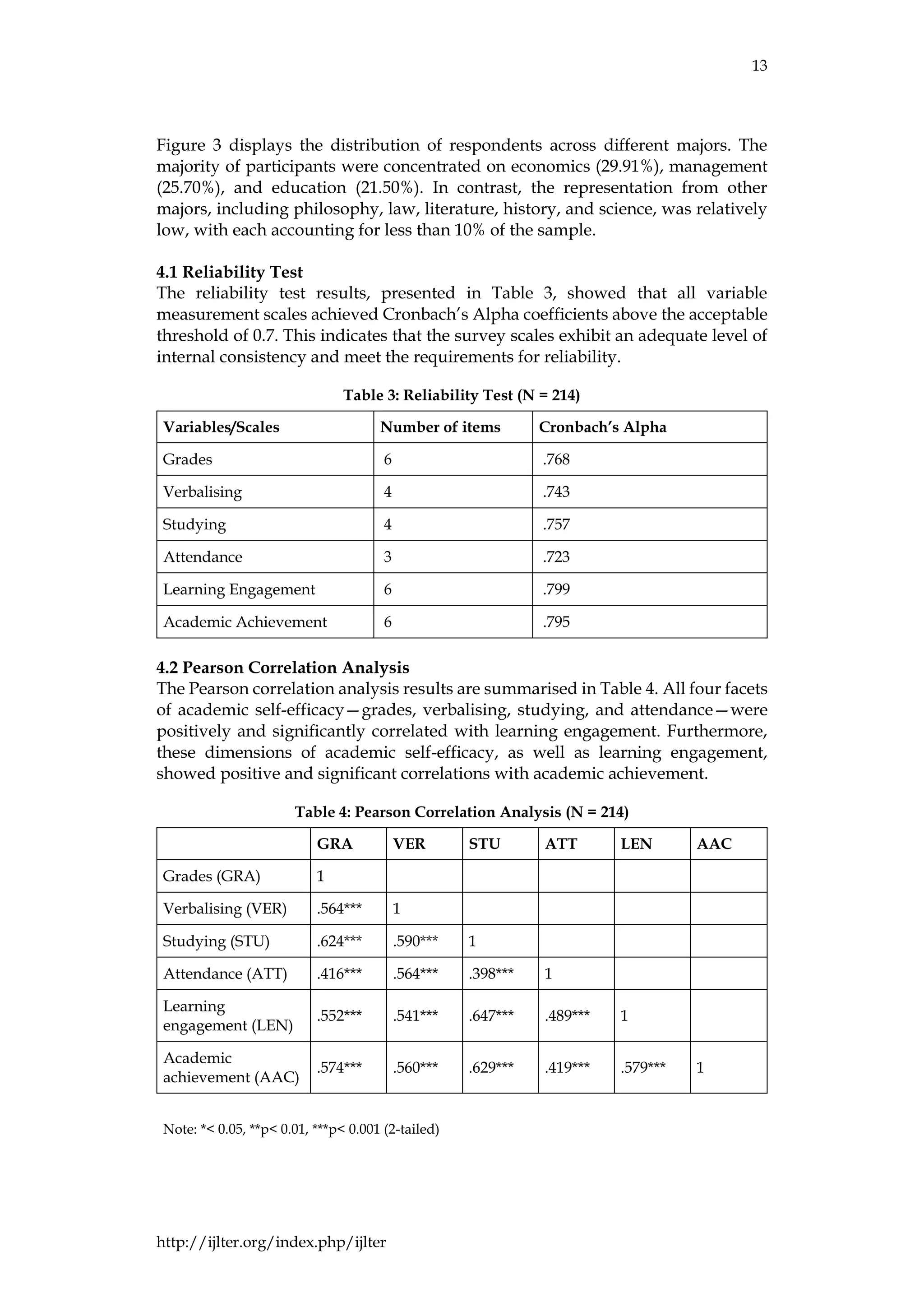
The reliability test results, presented in Table 3, showed that all variable
measurement scales achieved Cronbach’s Alpha coefficients above the acceptable
threshold of 0.7. This indicates that the survey scales exhibit an adequate level of
internal consistency and meet the requirements for reliability.
Table 3: Reliability Test (N = 214)
Variables/Scales Number of items Cronbach’s Alpha
Grades 6 .768
Verbalising 4 .743
Studying 4 .757
Attendance 3 .723
Learning Engagement 6 .799
Academic Achievement 6 .795
4.2 Pearson Correlation Analysis
The Pearson correlation analysis results are summarised in Table 4. All four facets
of academic self-efficacy—grades, verbalising, studying, and attendance—were
positively and significantly correlated with learning engagement. Furthermore,
these dimensions of academic self-efficacy, as well as learning engagement,
showed positive and significant correlations with academic achievement.
Table 4: Pearson Correlation Analysis (N = 214)
GRA VER STU ATT LEN AAC
Grades (GRA) 1
Verbalising (VER) .564*** 1
Studying (STU) .624*** .590*** 1
Attendance (ATT) .416*** .564*** .398*** 1
Learning
engagement (LEN)
.552*** .541*** .647*** .489*** 1
Academic
achievement (AAC)
.574*** .560*** .629*** .419*** .579*** 1
Note: *< 0.05, **p< 0.01, ***p< 0.001 (2-tailed)
14
http://ijlter.org/index.php/ijlter
4.3 Multiple Linear Regressions
4.3.1 Tests of Hypothesis 1 and Hypothesis 3
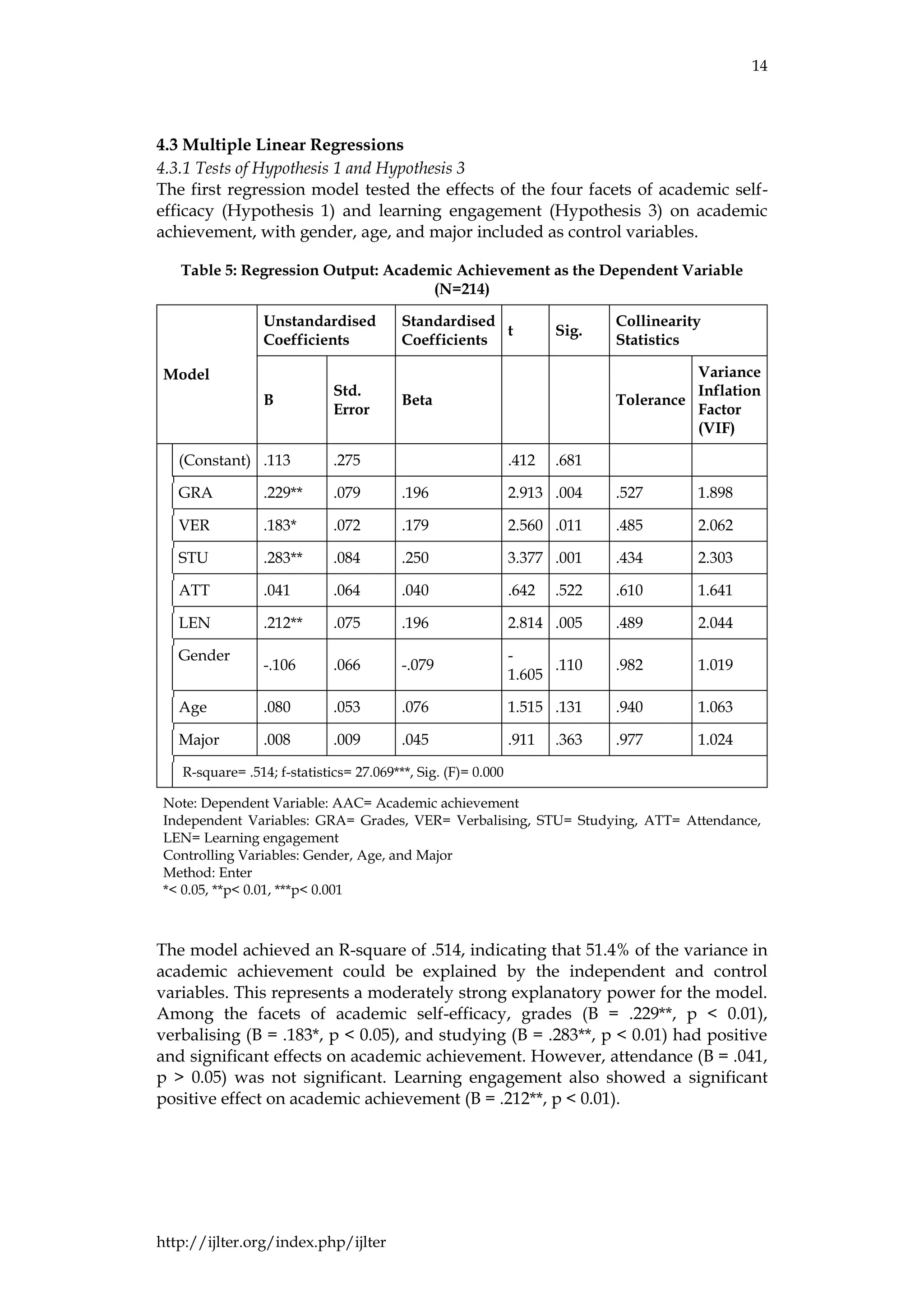
The first regression model tested the effects of the four facets of academic self-
efficacy (Hypothesis 1) and learning engagement (Hypothesis 3) on academic
achievement, with gender, age, and major included as control variables.
Table 5: Regression Output: Academic Achievement as the Dependent Variable
(N=214)
Model
Unstandardised
Coefficients
Standardised
Coefficients
t Sig.
Collinearity
Statistics
B
Std.
Error
Beta Tolerance
Variance
Inflation
Factor
(VIF)
(Constant) .113 .275 .412 .681
GRA .229** .079 .196 2.913 .004 .527 1.898
VER .183* .072 .179 2.560 .011 .485 2.062
STU .283** .084 .250 3.377 .001 .434 2.303
ATT .041 .064 .040 .642 .522 .610 1.641
LEN .212** .075 .196 2.814 .005 .489 2.044
Gender
-.106 .066 -.079
-
1.605
.110 .982 1.019
Age .080 .053 .076 1.515 .131 .940 1.063
Major .008 .009 .045 .911 .363 .977 1.024
R-square= .514; f-statistics= 27.069***, Sig. (F)= 0.000
Note: Dependent Variable: AAC= Academic achievement
Independent Variables: GRA= Grades, VER= Verbalising, STU= Studying, ATT= Attendance,
LEN= Learning engagement
Controlling Variables: Gender, Age, and Major
Method: Enter
*< 0.05, **p< 0.01, ***p< 0.001
The model achieved an R-square of .514, indicating that 51.4% of the variance in
academic achievement could be explained by the independent and control
variables. This represents a moderately strong explanatory power for the model.
Among the facets of academic self-efficacy, grades (B = .229**, p < 0.01),
verbalising (B = .183*, p < 0.05), and studying (B = .283**, p < 0.01) had positive
and significant effects on academic achievement. However, attendance (B = .041,
p > 0.05) was not significant. Learning engagement also showed a significant
positive effect on academic achievement (B = .212**, p < 0.01).
15
http://ijlter.org/index.php/ijlter
The non-significance of attendance could be attributed to the possibility that
attendance alone does not ensure active participation or engagement in academic
tasks. Similarly, verbalising, while significant in Hypothesis 1, showed lower
explanatory power, potentially due to variations in classroom dynamics or
cultural factors influencing participation in Chinese academic settings.
4.3.2 Test of Hypothesis 2
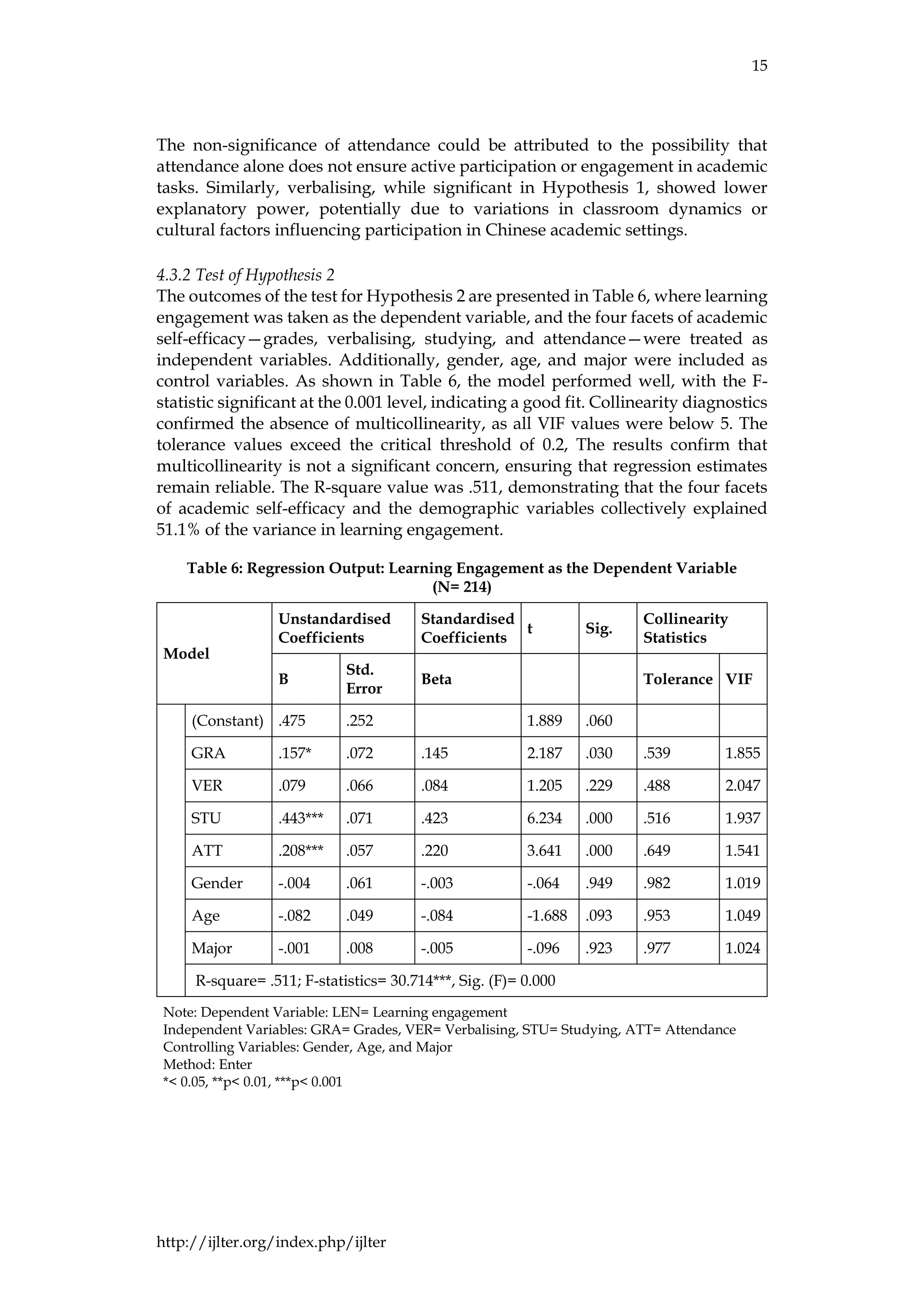
The outcomes of the test for Hypothesis 2 are presented in Table 6, where learning
engagement was taken as the dependent variable, and the four facets of academic
self-efficacy—grades, verbalising, studying, and attendance—were treated as
independent variables. Additionally, gender, age, and major were included as
control variables. As shown in Table 6, the model performed well, with the F-
statistic significant at the 0.001 level, indicating a good fit. Collinearity diagnostics
confirmed the absence of multicollinearity, as all VIF values were below 5. The
tolerance values exceed the critical threshold of 0.2, The results confirm that
multicollinearity is not a significant concern, ensuring that regression estimates
remain reliable. The R-square value was .511, demonstrating that the four facets
of academic self-efficacy and the demographic variables collectively explained
51.1% of the variance in learning engagement.
Table 6: Regression Output: Learning Engagement as the Dependent Variable
(N= 214)
Model
Unstandardised
Coefficients
Standardised
Coefficients
t Sig.
Collinearity
Statistics
B
Std.
Error
Beta Tolerance VIF
(Constant) .475 .252 1.889 .060
GRA .157* .072 .145 2.187 .030 .539 1.855
VER .079 .066 .084 1.205 .229 .488 2.047
STU .443*** .071 .423 6.234 .000 .516 1.937
ATT .208*** .057 .220 3.641 .000 .649 1.541
Gender -.004 .061 -.003 -.064 .949 .982 1.019
Age -.082 .049 -.084 -1.688 .093 .953 1.049
Major -.001 .008 -.005 -.096 .923 .977 1.024
R-square= .511; F-statistics= 30.714***, Sig. (F)= 0.000
Note: Dependent Variable: LEN= Learning engagement
Independent Variables: GRA= Grades, VER= Verbalising, STU= Studying, ATT= Attendance
Controlling Variables: Gender, Age, and Major
Method: Enter
*< 0.05, **p< 0.01, ***p< 0.001
16
http://ijlter.org/index.php/ijlter
Regarding the regression coefficients, three facets of academic self-efficacy—
grades (B = .157*, p < 0.05), studying (B = .443***, p < 0.001), and attendance (B =
.208***, p < 0.001)—showed positive and significant effects on learning
engagement. However, verbalising (B = .079, p > 0.05) did not have a significant
impact. In conclusion, academic self-efficacy positively influences learning
engagement among Chinese master’s students, providing empirical support for
Hypothesis 2.
5. Discussion
5.1 Academic Self-Efficacy and Academic Achievement
This study highlights the positive influence of academic self-efficacy on academic
achievement among Chinese master’s students, providing empirical support for
Hypothesis 1. These findings align with prior research (Azila-Gbettor et al., 2021;
Azila-Gbettor et al., 2022; Hauck et al., 2020; Zhen et al., 2017), which emphasises
that students with stronger self-efficacy are more likely to excel academically.
Academic self-efficacy reflects a student’s belief in their ability to successfully
complete academic tasks. Higher self-efficacy motivates students to invest more
time and effort in their studies, leading to enhanced academic performance. This
study reinforces the notion that academic self-efficacy is one of the key
determinants of educational success. These findings align with the social cognitive
theory of Bandura (1993) that emphasises an individual’s belief in their ability to
succeed in accomplishing a task.
The results also reveal that the dimensions of academic self-efficacy—grades,
verbalising, and studying—have significant positive effects on academic
achievement. Confidence in achieving good grades encourages students to plan
effectively, invest time, and strive for excellence in exams and assignments (Zhen
et al., 2017). Verbalising, which reflects confidence in managing study tasks and
independent learning, supports better time management and reduces
procrastination, thus improving study efficiency (Cheng et al., 2019; Salimi et al.,
2022). Similarly, studying, which encompasses confidence in answering
questions, giving presentations, and engaging in academic discussions, fosters
verbal communication, critical thinking, and knowledge mastery, all of which
enhance academic performance.
Interestingly, the study found that attendance did not significantly influence
academic achievement. This could be due to the unique learning behaviours of
Chinese master’s students, who often engage in self-directed study or use other
sources for learning, such as online or tutoring. Additionally, it could be because
attendance is not part of the assessment for all the courses. They allocate
significant time to independent research and data analysis outside of class (Salimi
et al., 2022; Zhen et al., 2017). Attendance alone may not strongly influence
academic success in this context, as these students rely more on self-regulation
and independent study than traditional classroom participation.
5.2 Academic Self-Efficacy and Learning Engagement
The findings also demonstrate that academic self-efficacy has a direct relationship
with learning engagement among Chinese master’s students, supporting
17
http://ijlter.org/index.php/ijlter
Hypothesis 2. This aligns with prior research (Luo et al., 2023; Wu et al., 2020),
which shows that students with high self-efficacy are more motivated and active
in learning environments, leading to better outcomes. These findings highlight the
importance of fostering academic self-efficacy in students. Educators and
institutions could achieve this by creating supportive learning environments,
providing constructive feedback, and encouraging self-reflection practices to help
students recognise their capabilities and achievements. Interventions such as
workshops and counselling sessions designed to build self-efficacy could further
enhance learning engagement and academic performance.
The study found that the dimensions of grades, studying, and attendance within
academic self-efficacy positively influence learning engagement. Confidence in
achieving high grades motivates students to study attentively, make reasonable
plans, and review course content comprehensively for mastery (Luo et al., 2023;
Zhong et al., 2020). Similarly, studying boosts confidence in participating in
academic discussions and presenting ideas, which enhances knowledge
internalisation and fosters learning enthusiasm (Shi & Ko, 2022). Attendance also
contributes directly to engagement, as regular attendance promotes collaboration,
class participation, and deeper involvement in shared learning activities.
However, verbalising did not show a significant impact on learning engagement.
This finding differs from earlier studies (Adams et al., 2020) and may be explained
by the autonomous and flexible learning environments of Chinese master’s
students. This may have potential cultural factors such as passive learning styles,
fear of speaking up in the class, and teacher-centered approach (Zhao, 2025),
While verbalising helps students organise study plans and manage tasks, its
immediate impact on learning engagement may be less pronounced than other
dimensions. Additionally, factors such as motivation, access to resources, and
peer support may mediate learning engagement, diminishing the role of
verbalising. Sampling limitations could also have influenced this finding, as the
sample primarily included students from specific disciplines, such as economics,
management, and education, limiting generalisability to other fields.
5.3 Learning Engagement and Academic Achievement
The study also establishes that learning engagement significantly enhances
academic achievement, supporting Hypothesis 3. This finding is consistent with
previous research (Anokye-Effah & Nkwantabisa, 2022; Bertheussen & Myrland,
2016; Luo et al., 2023), which shows that engaged students tend to perform better
academically. Learning engagement involves active participation, effort, and
interest in academic activities, which improves understanding and mastery of
course material. The theory of student involvement supports this relationship,
asserting that engagement is a critical determinant of academic success.
For Chinese master’s students, learning engagement plays a particularly
important role in enhancing academic achievement (B = .212**, p < 0.01).
Behaviours such as promptly reviewing course notes help students consolidate
their knowledge and fully comprehend course content, improving test
performance and the practical application of knowledge (Ayala & Manzano, 2018;
18
http://ijlter.org/index.php/ijlter
Luo et al., 2023). Sustained attention to course material between classes also
ensures long-term retention and coherent understanding. Participation in group
discussions enables the exchange of diverse perspectives, fostering critical
thinking and deeper insights into learning materials.
High levels of learning engagement also make students more proactive,
improving their academic performance both inside and outside the classroom. For
instance, students who connect course content to real-life applications often
develop a positive attitude toward learning, which enhances their intrinsic
motivation and persistence (Anokye-Effah & Nkwantabisa, 2022). Similarly,
making courses interesting encourages students to remain active and motivated,
helping them overcome academic challenges with greater confidence. Overall,
learning engagement stimulates interest, cultivates intrinsic motivation, and
fosters positive learning behaviours, which collectively lead to enhanced
academic performance.
6. Limitations
This study acknowledges several limitations that may influence its findings and
their broader applicability. Firstly, the relatively small sample size of 214
respondents limits the representativeness of the results. While the study provides
valuable insights, the majority of respondents were from fields such as economics,
management, and education. The study habits, academic pressures, and
requirements of master’s students in other disciplines may differ significantly,
potentially affecting the relationships among academic self-efficacy, learning
engagement, and academic achievement. In addition, the snowball sampling
method introduces bias, as participants are recruited through referrals, which
may not accurately represent the broader population. Therefore, the findings
cannot be generalized. To enhance the generalisability and robustness of future
research, expanding the sample size to include students from a wider range of
disciplines is essential.
Another limitation stems from the reliance on self-reported measures for
academic achievement. Respondents may have provided inaccurate or overly
positive responses due to social desirability bias or self-perception bias, which
could impair the validity of the results. Future studies could address this issue by
incorporating more objective indicators of academic achievement, such as course
grades, academic publications, and supervisor evaluations. These objective
metrics would provide a more accurate and reliable assessment of students’
academic performance, reducing the potential for bias introduced by self-
reporting.
Furthermore, this study employed a purely quantitative approach, which, while
effective in identifying relationships and correlations between variables, may not
provide a comprehensive understanding of the underlying mechanisms.
Quantitative analysis is limited in uncovering the specific processes through
which academic self-efficacy influences learning engagement and academic
achievement. Incorporating qualitative methods, such as interviews or focus
groups, could provide richer, more nuanced insights into students’ experiences
19
http://ijlter.org/index.php/ijlter
and perspectives. For instance, interviews could explore students’ perceptions of
their self-efficacy, learning engagement, and academic challenges, offering a
deeper understanding of how these factors interact in different contexts.
7. Conclusion
This study highlights the important connections between academic self-efficacy,
learning engagement, and academic achievement among Chinese master’s
students. Using a quantitative approach with 214 valid responses, the research
sheds light on how these factors interact. Academic self-efficacy emerged as a key
driver of both academic performance and learning engagement. Specific
dimensions like grades, verbalising, and studying significantly influenced
academic achievement, while grades, studying, and attendance played a notable
role in enhancing learning engagement. Interestingly, attendance had no
significant impact on academic achievement, and verbalising did not notably
influence learning engagement, suggesting the need to explore the contextual
factors that shape these dynamics.
The findings suggest that students with higher levels of academic self-efficacy are
more likely to employ effective learning strategies, such as setting clear goals,
managing their study schedules, and actively engaging in academic discussions.
These behaviours contribute to better academic outcomes. Similarly, learning
engagement, marked by consistent participation in class, regular review of
materials, and collaborative discussions, was identified as a key factor in driving
academic success. Together, these insights deepen our understanding of how self-
efficacy and engagement contribute to students’ academic achievements.
The study also points to practical implications for students, educators, and
institutions. For students, building confidence in their academic abilities and
adopting proactive learning habits are essential. Educators and universities can
play a significant role in supporting this process by fostering positive learning
environments, providing constructive feedback, and offering resources such as
workshops or mentoring programmes. Supervisors, in particular, can help by
setting realistic goals, offering guidance, and encouraging research initiatives to
build both self-efficacy and engagement.
While the findings provide valuable insights, the study acknowledges certain
limitations. The sample size was relatively small, and given its limited
applicability, the results are robust in explaining the correlation between self-
efficacy, LE, and academic achievement. Certainly, future research should
consider larger and more diverse samples to capture a fuller picture of these
dynamics. Increasing the sample size and further research on contextual factors
that influence the relationship between attendance and academic achievement, as
well as verbalising and learning experience (De Clercq, Galand, Hospel, & Frenay,
2013, p. 765), will aid in understanding why these dimensions did not impact the
outcomes and provide a more comprehensive view.
This research highlights the critical roles of academic self-efficacy and learning
engagement in promoting academic achievement. The findings offer practical
20
http://ijlter.org/index.php/ijlter
guidance for creating supportive educational environments that empower
students and improve their academic performance, contributing to the overall
improvement of graduate education in China.
8. References
Adams, A. M., Wilson, H., Money, J., Palmer-Conn, S., & Fearn, J. (2020). Student
engagement with feedback and attainment: The role of academic self-efficacy.
Assessment & Evaluation in Higher Education, 45(2), 317-329.
https://doi.org/10.1080/02602938.2019.1640184
Al-Abyadh, M. H. A., & Abdel Azeem, H. A. H. (2022). Academic achievement: Influences
of university students’ self-management and perceived self-efficacy. Journal of
Intelligence, 10(3), 55. https://doi.org/10.3390/jintelligence10030055
Alegre, A. A. (2014). Academic self-efficacy, self-regulated learning and academic
performance in first-year university students. Journal of Educational Psychology-
Propositos y Representaciones, 2(1), 101-120.
http://dx.doi.org/10.20511/pyr2014.v2n1.54
Alemayehu, L., & Chen, H. L. (2023). The influence of motivation on learning engagement:
The mediating role of learning self-efficacy and self-monitoring in online learning
environments. Interactive Learning Environments, 31(7), 4605-4618.
10.1080/10494820.2021.1977962
Alhadabi, A., & Karpinski, A. C. (2020). Grit, self-efficacy, achievement orientation goals,
and academic performance in university students. International Journal of
Adolescence and Youth, 25(1), 519-535.
https://doi.org/10.1080/02673843.2019.1679202
Amida, A., Algarni, S., & Stupnisky, R. (2021). Testing the relationships of motivation,
time management and career aspirations on graduate students’ academic success.
Journal of Applied Research in Higher Education, 13(5), 1305-1322.
https://eric.ed.gov/?id=EJ1335367
Anderson, D. R., Sweeney, D. J., Williams, T. A., Camm, J. D., & Cochran, J. J. (2019).
Statistics for business & economics (14th ed.). Cengage Learning.
https://students.aiu.edu/submissions/profiles/resources/onlineBook/J2i4G6_
Statistics_for_Business_and_Economics-_12_edition.pdf
Anokye-Effah, N. A., & Nkwantabisa, A. O. (2022). The influence of academic engagement
on academic performance of university accounting students in Ghana. South
African Journal of Accounting Research, 36(2), 105-122.
https://doi.org/10.1080/10291954.2021.1988204
Ayala, J. C., & Manzano, G. (2018). Academic performance of first-year university
students: The influence of resilience and engagement. Higher Education Research &
Development, 37(7), 1321-1335. https://doi.org/10.1080/07294360.2018.1502258
Azila-Gbettor, E. M., Mensah, C., Abiemo, M. K., & Bokor, M. (2021). Predicting student
engagement from self-efficacy and autonomous motivation: A cross-sectional
study. Cogent Education, 8(1), 1942638.
https://doi.org/10.1080/2331186X.2021.1942638
Azila-Gbettor, E. M., Mensah, C., & Abiemo, M. K. (2022). Self-efficacy and academic
programme satisfaction: Mediating effect of meaningfulness of study.
International Journal of Educational Management, 36(3), 261-276.
https://eric.ed.gov/?id=EJ1334014
Banarjee, P., & Kumar, K. (2014). A study on self-regulated learning and academic
achievement among the science graduate students. International Journal of
Multidisciplinary Approach and Studies, 1(6), 329-342. https://doi.org/10.2991/aes-
18.2019.67
21
http://ijlter.org/index.php/ijlter
Bandura, A. (1977). Self-efficacy: Toward a unifying theory of behavioural change.
Psychological Review, 84(2), 191–215. https://doi.org/10.1016/0146-
6402(78)90002-4
Bandura, A. (1986). Social foundations of thought and action. Prentice-Hall.
https://sk.sagepub.com/book/edvol/the-health-psychology-
reader/chpt/social-foundations-thought-action
Bandura, A. (1993). Perceived self-efficacy in cognitive development and functioning.
Educational Psychologist, 28(2), 117–148.
https://doi.org/10.1207/s15326985ep2802_3
Bell, E., Bryman, A., & Harley, B. (2018). Business research methods. Oxford University Press.
https://global.oup.com/ukhe/product/business-research-methods-
9780198869443?cc=gb&lang=en&
Bertheussen, B. A., & Myrland, Ø. (2016). Relation between academic performance and
students’ engagement in digital learning activities. Journal of Education for Business,
91(3), 125-131. https://doi.org/10.1080/08832323.2016.1140113
Bhati, K., Baral, R., & Meher, V. (2022). Academic self-efficacy and academic performance
among undergraduate students in relation to gender and streams of education.
Indonesian Journal of Contemporary Education, 4(2), 80-88.
https://doi.org/10.33122/ijoce.v4i2.35
Bouih, A., Nadif, B., & Benattabou, D. (2021). Assessing the effect of general self-efficacy
on academic achievement using path analysis: A preliminary study. Journal of
English Language Teaching and Applied Linguistics, 3(4), 18-24.
https://doi.org/10.32996/jeltal.2021.3.4.3
Brown, G. T., Peterson, E. R., & Yao, E. S. (2016). Student conceptions of feedback: Impact
on self‐regulation, self‐efficacy, and academic achievement. British Journal of
Educational Psychology, 86(4), 606-629. https://doi.org/10.1111/bjep.12126
Bryman, A., & Bell, E. (2019). Business research methods (5th ed.). Oxford University Press.
https://global.oup.com/ukhe/product/business-research-methods-
9780198869443?cc=gb&lang=en&
Byrne, C. (2022). What determines perceived graduate employability? Exploring the
effects of personal characteristics, academic achievements and graduate skills in a
survey experiment. Studies in Higher Education, 47(1), 159-176.
https://doi.org/10.1080/03075079.2020.1735329
Caruth, G. D. (2018). Student engagement, retention, and motivation: Assessing academic
success in today’s college students. Participatory Educational Research, 5(1), 17-30.
https://doi.org/10.17275/per.18.4.5.1
Cazan, A. M. (2015). Learning motivation, engagement and burnout among university
students. Procedia-Social and Behavioral Sciences, 187, 413-417.
https://doi.org/10.1016/j.sbspro.2015.03.077
Celik, B. (2022). The effect of metacognitive strategies on self-efficacy, motivation and
academic achievement of university students. Canadian Journal of Educational and
Social Studies, 2(4), 37-55. https://doi.org/10.53103/cjess.v2i4.49
Chan, W. K., & Zhang, J. (2021). Can university qualification promote social mobility? A
review of higher education expansion and graduate employment in China.
International Journal of Educational Development, 84, 102423.
https://doi.org/10.1016/j.ijedudev.2021.102423
Chen, Q., Zhang, Q., Yu, F., & Hou, B. (2023). Investigating structural relationships
between professional identity, learning engagement, academic self-efficacy, and
university support: Evidence from tourism students in China. Behavioral Sciences,
14(1), 26. https://doi.org/10.3390/bs14010026
Chen, S. (2024). Structural modeling of Chinese students’ academic achievement identity
and basic psychological needs: Do academic self-efficacy, and mindfulness play a
22
http://ijlter.org/index.php/ijlter
mediating role? BMC Psychology, 12, Article
142. https://doi.org/10.1186/s40359-024-01571-6
Cheng, Y. H., Tsai, C. C., & Liang, J. C. (2019). Academic hardiness and academic self-
efficacy in graduate studies. Higher Education Research & Development, 38(5), 907-
921. https://doi.org/10.1080/07294360.2019.1612858
Chhetri, S. B., & Baniya, R. (2022). Influence of student-faculty interaction on graduate
outcomes of undergraduate management students: The mediating role of
behavioral, emotional and cognitive engagement. The International Journal of
Management Education, 20(2), 100640. https://doi.org/10.1016/j.ijme.2022.100640
Descals-Tomás, A., Rocabert-Beut, E., Abellán-Roselló, L., Gómez-Artiga, A., &
Doménech-Betoret, F. (2021). Influence of teacher and family support on
university student motivation and engagement. International Journal of
Environmental Research and Public Health, 18(5), 2606.
https://doi.org/10.3390/ijerph18052606
Dong, J., He, Y., Jiang, F., Liu, Z., Ni, Y., Tang, Y., ... & Huang, Y. (2024). Teacher-student
relationships and mental disorders of undergraduate and graduate students in
online education: A moderated mediation model of mobile phone addiction and
hometown setting. Computers in Human Behavior Reports, 14, 100406.
https://doi.org/10.1016/j.chbr.2024.100406
Firat, M., Ozturk, A., Gunes, I., Çolak, E., Beyaz, M., & Buyuk, K. (2019). How e-learning
engagement time affects academic achievement in e-learning environments. A
large-scale study of open and distance learners. Open Praxis, 11(2), 129-141.
https://doi.org/10.5944/openpraxis.11.2.920
Fokkens-Bruinsma, M., Vermue, C., Deinum, J. F., & Van Rooij, E. (2021). First-year
academic achievement: The role of academic self-efficacy, self-regulated learning
and beyond classroom engagement. Assessment & Evaluation in Higher Education,
46(7), 1115-1126. https://doi.org/10.1080/02602938.2020.1845606
Fredricks, J. A., Blumenfeld, P. C., & Paris, A. H. (2004). School engagement: Potential of
the concept, state of the evidence. Review of Educational Research, 74, 59–109.
https://doi.org/10.3102/00346543074001059
Ghauri, P., & Grønhaug, K. (2019). Research methods in business studies: A practical guide.
Pearson Education Limited.
https://www.researchgate.net/publication/248818202_Research_Methods_in_
Business_Studies_A_Practical_Guide
Glapaththi, I., Dissanayake, R., Welgama, T., Somachandara, U., & Sachinthana, R. (2019).
A study on the relationship between student engagement and their academic
achievements. Asian Social Science, 15(11), 1.
https://doi.org/10.5539/ass.v15n11p1
Gutiérrez, M., & Tomás, J. M. (2019). The role of perceived autonomy support in predicting
university students’ academic success mediated by academic self-efficacy and
school engagement. Educational Psychology, 39(6), 729-748.
https://doi.org/10.1080/01443410.2019.1566519
Hair, J. F., Page, M., & Brunsveld, N. (2019). Essentials of business research methods.
Routledge. https://www.routledge.com/Essentials-of-Business-Research-
Methods/HairJr-Page-Brunsveld-Merkle-
Cleton/p/book/9781032426280?srsltid=AfmBOor-QbFICWdLlwA6H5_IJt0-
uIBeUTelaa0uL6Y-WgnanjrleqX4
Hair, J. F., Black, W. C., Babin, B. J., & Anderson, R. E. (2018). Multivariate data analysis (8th
ed.). Cengage Learning.
https://eli.johogo.com/Class/CCU/SEM/_Multivariate%20Data%20Analysis_
Hair.pdf
Han, J., Geng, X., & Wang, Q. (2021). Sustainable development of university EFL learners’
engagement, satisfaction, and self-efficacy in online learning environments:
23
http://ijlter.org/index.php/ijlter
Chinese experiences. Sustainability, 13(21), 11655.
https://doi.org/10.3390/su132111655
Han, X., Xu, Q., Xiao, J., & Liu, Z. (2024). Academic atmosphere and graduate students’
innovation ability: The role of scientific research self-efficacy and scientific
engagement. European Journal of Psychology of Education, 39, 1027-1044.
https://doi.org/10.1007/s10212-023-00737-x
Hauck, A. A., Ward, C., Persutte-Manning, S. L., & Vaughan, A. L. (2020). Assessing first-
year seminar performance with college engagement, academic self-efficacy, and
student achievement. Journal of Higher Education Theory and Practice, 20(4), 88-101.
https://doi.org/10.33423/jhetp.v20i4.2988
Honicke, T., & Broadbent, J. (2016). The influence of academic self-efficacy on academic
performance: A systematic review. Educational Research Review, 17, 63-84.
https://doi.org/10.1016/j.edurev.2015.11.002
Huang, C. (2013). Gender differences in academic self-efficacy: A meta-analysis. European
Journal of Psychology of Education, 28(1), 1–35. https://doi.org/10.1007/s10212-
011-0097-y
Hwang, M. H., Choi, H. C., Lee, A., Culver, J. D., & Hutchison, B. (2016). The relationship
between self-efficacy and academic achievement: A 5-year panel analysis. The
Asia-Pacific Education Researcher, 25, 89-98. https://doi.org/10.1007/s40299-015-
0236-3
Jenkins, D. G., & Quintana-Ascencio, P. F. (2020). A solution to minimum sample size for
regressions. PLOS ONE, 15(2), e0229345.
https://doi.org/10.1371/journal.pone.0229345
Ketonen, E. E., Haarala-Muhonen, A., Hirsto, L., Hänninen, J. J., Wähälä, K., & Lonka, K.
(2016). Am I in the right place? Academic engagement and study success during
the first years at university. Learning and Individual Differences, 51, 141-148.
https://doi.org/10.1016/j.lindif.2016.08.017
Khan, M. (2023). Academic self-efficacy, coping, and academic performance in college.
International Journal of Undergraduate Research and Creative Activities, 5(1), 3.
https://doi.org/10.7710/2168-0620.1006
Kim, H. J., Hong, A. J., & Song, H. D. (2019). The roles of academic engagement and digital
readiness in students’ achievements in university e-learning environments.
International Journal of Educational Technology in Higher Education, 16(1), 1-18.
https://doi.org/10.1186/s41239-019-0152-3
Kolo, A. G., Jaafar, W. M. B. W., & Ahmad, N. B. (2017). Relationship between academic
self-efficacy believed of college students and academic performance. IOSR Journal
of Humanities and Social Science (IOSR-JHSS), 22(1), 75-80.
https://doi.org/10.9790/0837-2201067580
Li, Z. (2022). Family background, academic performance, and access to opportunities for
graduate education. Chinese Education & Society, 55(1-2), 45-69.
https://doi.org/10.1080/10611932.2022.2037402
Lin, Y. T. (2020). The interrelationship among psychological capital, mindful learning, and
English learning engagement of university students in Taiwan. Sage Open, 10(1),
2158244020901603. https://doi.org/10.1177/2158244020901603
Liu, J., Peng, P., & Luo, L. (2020). The relation between family socioeconomic status and
academic achievement in China: A meta-analysis. Educational Psychology Review,
32, 49-76. https://doi.org/10.1007/s10648-019-09494-0
Lu, S., Cheng, L., & Chahine, S. (2022). Chinese university students’ conceptions of
feedback and the relationships with self-regulated learning, self-efficacy, and
English language achievement. Frontiers in Psychology, 13, 1047323.
https://doi.org/10.3389/fpsyg.2022.1047323
Luo, Q., Chen, L., Yu, D., & Zhang, K. (2023). The mediating role of learning engagement
between self-efficacy and academic achievement among Chinese college students.
24
http://ijlter.org/index.php/ijlter
Psychology Research and Behavior Management, 1533-1543.
https://doi.org/10.2147/PRBM.S401145
Martínez, I. M., Youssef-Morgan, C. M., Chambel, M. J., & Marques-Pinto, A. (2019).
Antecedents of academic performance of university students: Academic
engagement and psychological capital resources. Educational Psychology, 39(8),
1047-1067. https://doi.org/10.1080/01443410.2019.1623382
Martins, R. M. M., & Santos, A. A. A. D. (2019). Learning strategies and academic self-
efficacy in university students: A correlational study. Psicologia Escolar e
Educacional, 23, e176346. https://doi.org/10.1590/2175-35392019016346
Mehmood, A., Adnan, M., Shahzad, A., & Shabbir, F. (2019). The effect of self-efficacy on
academic performance at higher level of learning: A case study of Punjab
University Lahore. Journal of Educational Sciences, 6(1), 33-47.
https://www.researchgate.net/profile/Aaqib-
Alvi/publication/344387401_The_Effect_of_Self-
Efficacy_on_Academic_Performance_at_Higher_Level_of_Learning_A_Case_St
udy_of_Punjab_University_Lahore/links/624be9127931cc7ccf170113/The-
Effect-of-Self-Efficacy-on-Academic-Performance-at-Higher-Level-of-Learning-
A-Case-Study-of-Punjab-University-Lahore.pdf
Michael, J. J., Nadson, J. S., & Michael, W. B. (1983). The prediction of academic
achievement in graduate study in education. Educational and Psychological
Measurement, 43(4), 1133-1139. https://doi.org/10.1177/001316448304300423
National Bureau of Statistics of China. (n.d.). National Bureau of Statistics of China.
Retrieved April 11, 2025, from https://www.stats.gov.cn/english/.
Noreen, S., Hasan, A., Batool, I., & Ali, A. (2018). The impacts of academic self-efficacy on
academic outcomes: The mediating effect of student engagement. International
Journal of Academic Research in Business and Social Sciences, 8(11), 315-327.
https://doi.org/10.6007/IJARBSS/v8-i11/4904
Northey, G., Govind, R., Bucic, T., Chylinski, M., Dolan, R., & van Esch, P. (2018). The
effect of “here and now” learning on student engagement and academic
achievement. British Journal of Educational Technology, 49(2), 321-333.
https://doi.org/10.1111/bjet.12589
Olivier, E., Archambault, I., De Clercq, M., & Galand, B. (2019). Student self-efficacy,
classroom engagement, and academic achievement: Comparing three theoretical
frameworks. Journal of Youth and Adolescence, 48, 326-340.
https://doi.org/10.1007/s10964-018-0952-0
Park, S., & Yun, H. (2018). The influence of motivational regulation strategies on online
students’ behavioral, emotional, and cognitive engagement. American Journal of
Distance Education, 32(1), 43-56. https://doi.org/10.1080/08923647.2018.1412738
Pintrich, P. R., & De Groot, E. V. (1990). Motivational and self-regulated learning
components of classroom academic performance. Journal of Educational Psychology,
82(1), 33-40. https://doi.org/10.1037/0022-0663.82.1.33
Qiu, X., & Li, L. (2021). A structural equation modeling study on the influencing factors of
postgraduates’ academic achievement. The Science Education Article Collects, 26, 23-
25. https://doi.org/10.1155/2014/490371
Rafiq, S., Afzal, A., & Kamran, F. (2022). Impact of school environment on students’
academic achievements at the university level. VFAST Transactions on Education
and Social Sciences, 10(4), 19-30. https://doi.org/10.21015/vtess.v10i4.1216
Raza, S. A., Qazi, W., & Umer, B. (2020). Examining the impact of case-based learning on
student engagement, learning motivation and learning performance among
university students. Journal of Applied Research in Higher Education, 12(3), 517-533.
https://doi.org/10.1108/JARHE-05-2019-0105
25
http://ijlter.org/index.php/ijlter
Rigg, J., Day, J., & Adler, H. (2013). Emotional exhaustion in graduate students: The role
of engagement, self-efficacy and social support. Journal of Educational and
Developmental Psychology, 3(2), 138. https://doi.org/10.5539/jedp.v3n2p138
Rudakov, V., & Roshchin, S. (2019). The impact of student academic achievement on
graduate salaries: The case of a leading Russian university. Journal of Education and
Work, 32(2), 156-180. https://doi.org/10.1080/13639080.2019.1617839
Salimi, G., Heidari, E., Mohammadjani, M., & Mousavi, A. (2022). Structural relationship
of academic self-efficacy, mobile learning readiness, and academic performance
among graduate students: A mediation study. Interactive Learning Environments,
11, 1-15. https://doi.org/10.1080/10494820.2022.2146142
Sander, P., & de la Fuente, J. (2022). Modelling students’ academic confidence, personality
and academic emotions. Current Psychology, 41(7), 4329-4340.
https://doi.org/10.1007/s12144-020-00957-0
Sander, P., & Sanders, L. (2009). Measuring academic behavioural confidence: The ABC
scale revisited. Studies in Higher Education, 34(1), 19-35.
https://doi.org/10.1080/03075070802457058
Satici, S. A., & Can, G. (2016). Investigating academic self-efficacy of university students
in terms of socio-demographic variables. Universal Journal of Educational Research,
4(8), 1874-1880. https://doi.org/10.13189/ujer.2016.040817
Saunders, M., Lewis, P., & Thornhill, A. (2019). Research methods for business students (8th
ed.). Pearson Education Limited. https://www.pearson.com/se/Nordics-
Higher-Education/subject-catalogue/business-and-management/Research-
methods-for-business-students-8e-saunders.html
Shehadeh, J., Hamdan-Mansour, A. M., Halasa, S. N., Hani, M. H. B., Nabolsi, M. M.,
Thultheen, I., & Nassar, O. S. (2020). Academic stress and self-efficacy as
predictors of academic satisfaction among nursing students. The Open Nursing
Journal, 14(1), 92-99. https://doi.org/10.2174/1874434602014010092
Shi, Y., & Ko, Y. C. (2022). A study on the influence of academic self-efficacy and learning
engagement on academic performance among English educational college major
students. Applied & Educational Psychology, 3(2), 25-35.
https://doi.org/10.23977/appep.2022.030204
Soner, A. R. I. K. (2019). The relations among university students’ academic self-efficacy,
academic motivation, and self-control and self-management levels. International
Journal of Education and Literacy Studies, 7(4), 23-34.
https://doi.org/10.7575/aiac.ijels.v.7n.4p.23
Stevens, J. P. (2017). Applied multivariate statistics for the social sciences (6th ed.). Routledge.
https://www.routledge.com/Applied-Multivariate-Statistics-for-the-Social-
Sciences-Analyses-with-SAS-and-IBMs-SPSS-Sixth-Edition/Pituch-
Stevens/p/book/9780415836661?srsltid=AfmBOooIuFkh6LkbsYQ016vZ507vIlV
TcLtkT1JpsNA-JYa2054dQ5f_
Sun, X. (2023). The dilemma and path selection of academic innovation for university
graduate students from the perspective of structure and initiative. The Guide of
Science & Education, 11, 4-7. https://doi.org/10.1007/s10734-021-00679-7
Tang, E. (2022). Public objectives and policy instruments for improving the quality of
postgraduate education in China. Frontiers in Psychology, 13, 968773.
https://doi.org/10.3389/fpsyg.2022.968773
Tao, Y., Meng, Y., Gao, Z., & Yang, X. (2022). Perceived teacher support, student
engagement, and academic achievement: A meta-analysis. Educational Psychology,
42(4), 401-420. https://doi.org/10.1080/01443410.2022.2033168
Vizoso, C., Rodríguez, C., & Arias-Gundín, O. (2018). Coping, academic engagement and
performance in university students. Higher Education Research & Development,
37(7), 1515-1529. https://doi.org/10.1080/07294360.2018.1504006
26
http://ijlter.org/index.php/ijlter
Wang, C., Shim, S. S., & Wolters, C. A. (2017). Achievement goals, motivational self-talk,
and academic engagement among Chinese students. Asia Pacific Education Review,
18(3), 295–307. https://doi.org/10.1007/s12564-017-9495-4
Wang, H., Cheng, Z., & Smyth, R. (2018). Do migrant students affect local students’
academic achievements in urban China? Economics of Education Review, 63, 64-77.
https://doi.org/10.1016/j.econedurev.2018.01.007
Wu, H., Li, S., Zheng, J., & Guo, J. (2020). Medical students’ motivation and academic
performance: The mediating roles of self-efficacy and learning engagement.
Medical Education Online, 25(1), 1742964.
https://doi.org/10.1080/10872981.2020.1742964
Xu, Y., Su, F., & Hong, Z. (2022). The mode exploration of industry-education integration
of graduate education in China. In 4th International Seminar on Education Research
and Social Science (ISERSS 2021) (pp. 352-356). Atlantis Press.
https://doi.org/10.2991/assehr.k.220107.068
Yang, J., Li, S., & Li, C. (2023). Graduate education and enterprise innovation. Applied
Economics Letters, 10, 1-7. https://doi.org/10.1080/13504851.2023.2272695
Yang, J., & Wang, X. (2019). The impact of perceived social support on college students’
learning engagement: The mediating role of academic self-efficacy. In 2nd
International Conference on Humanities Education and Social Sciences (ICHESS 2019)
(pp. 442-452). Atlantis Press. https://doi.org/10.2991/ichess-19.2019.94
Yilmaz, K. (2013). Comparison of quantitative and qualitative research traditions:
Epistemological, theoretical, and methodological differences. European Journal of
Education, 48(2), 311-325. https://doi.org/10.1111/ejed.12014
Zhang, B., Yin, X., & Ren, Z. (2024). Can perceived social support influence academic
achievement of master’s students? Evidence from a university in China. Education
and Information Technologies, 5, 1-27. https://doi.org/10.1007/s10639-024-12693-
Zhang, Z. (2024). The impact of graduate education scale on the innovation capability of
the tertiary industry. International Journal of Education and Humanities, 13(2), 7-10.
https://doi.org/10.54097/g5yb5d05
Zhen, R., Liu, R. D., Ding, Y., Wang, J., Liu, Y., & Xu, L. (2017). The mediating roles of
academic self-efficacy and academic emotions in the relation between basic
psychological needs satisfaction and learning engagement among Chinese
adolescent students. Learning and Individual Differences, 54, 210-216.
https://doi.org/10.1016/j.lindif.2017.01.017
Zhao, W. (2025). The study of cultural comparison and teaching in Chinese international
education. Journal of International Education and Development, 9(1), 39-43.
https://doi.org/10.47297/wspiedWSP2516-250008.20250901
Zhong, L., Qian, Z., & Wang, D. (2020). How does the servant supervisor influence the
employability of postgraduates? Exploring the mechanisms of self-efficacy and
academic engagement. Frontiers of Business Research in China, 14, 1-20.
https://doi.org/10.1186/s11782-020-00079-1
Zimmerman, B. J., & Schunk, D. H. (2003). Educational psychology: A century of contributions.
Erlbaum. https://psycnet.apa.org/record/2003-02627-000
27
http://ijlter.org/index.php/ijlter
9. Appendix
Appendix A: Measurement Scale for Academic Self-Efficacy
Facets Symbol Items References
Grades
GRA1
Produce your best work under examination
conditions
Pintrich & De
Groot, 1990;
Luo et al.,
2023
GRA2 Attain good grades in your work
GRA3
Produce coursework at the required
standard
GRA4 Write in an appropriate academic style
GRA5 Pass assessments at the first attempt
GRA6
Produce your best work in coursework
assignments
Verbalising
VER1
Study effectively on your own in
independent/ private study
VER2
Manage your workload to meet coursework
deadlines
VER3 Plan appropriate revision schedules
VER4 Remain adequately motivated throughout
Studying
STU1
Respond to questions asked by a lecturer in
front of a full lecture theatre
STU2
Give a presentation to a small group of
fellow students
STU3
Engage in profitable academic debate with
your peers
STU4
Ask lecturers questions about the material
they are teaching during a lecture
Attendance
ATT1 Attend most taught sessions
ATT2 Be on time for lectures
ATT3 Attend tutorials
28
©Authors
This work is licensed under a Creative Commons Attribution-NonCommercial-NoDerivatives 4.0
International License (CC BY-NC-ND 4.0).
International Journal of Learning, Teaching and Educational Research
Vol. 24, No. 4, pp. 28-51, April 2025
https://doi.org/10.26803/ijlter.24.4.2
Received Jan 18, 2025; Revised Mar 15, 2025; Accepted Mar 26, 2025
The Effectiveness of Using GenAI Tools for
Developing Digital Learning Resources:
Evidence from Educators’ Perceptions
Taghreed Abdulaziz Almuqayteeb*
College of Education, Imam Abdulrahman Bin Faisal University, Dammam,
Kingdom of Saudi Arabia
Abstract. This study aimed to examine the integration of Generative
Artificial Intelligence (GenAI) tools in education, focusing on educators’
perceptions according to the Technology Acceptance Model. The study
followed the quasi-experimental design using a one-group design to
determine educators’ perceptions of usefulness, ease of use, and attitude
toward designing and producing digital learning. Data were collected
from 10 participants enrolled in a graduate course via a questionnaire and
an in-depth interview with 8 educators to share their experiences with
GenAI-based tools. Findings revealed that educators view GenAI tools
positively, particularly for their efficiency, ease of use, and ability to
enhance content creation and visual resources. Practical, hands-on
exposure through targeted training significantly enhanced educators’
perceptions of technology use and their attitudes, highlighting the value
of experiential learning in promoting technology acceptance. Although
GenAI tools help simplify workload management and design/produce
digital materials, there were challenges related to linguistic and cultural
adaptability, particularly for non-English languages like Arabic. This
study highlighted that GenAI is complementary to education, enhancing
traditional methods rather than replacing them. Also, it highlights the
need for educators’ strategic training, addressing language barriers in
GenAI tools, and adopting blended approaches. Further studies should
explore the long-term impacts of GenAI tools on teaching practices and
student outcomes, focusing on their efficacy in diverse educational
contexts and subject areas.
Keywords: educators; generative artificial intelligence; design; digital
learning resources; perception
*
Corresponding author: Taghreed Abdulaziz Almuqayteeb; talmuqayteeb@iau.edu.sa
29
http://ijlter.org/index.php/ijlter
1. Introduction
Artificial intelligence (AI) has become a pervasive technology in daily life. It is
increasingly embedded in everyday life with new products, services, and systems
(Stoimenova & Price, 2020). AI has shown great educational potential to
revolutionise teaching and learning at all levels, from elementary to higher
education. AI has become a valuable resource for personalising education,
automating administrative tasks, providing intelligent tutoring, and providing
predictive analytics (Grájeda et al., 2023). According to research, AI-based tools
significantly improve students’ learning by fostering their capacity for creative
problem-solving, communication, and thinking (Darwin et al., 2023).
Additionally, AI technologies are considered adequate in educational settings
since they serve a variety of learning demands and encourage engagement, self-
learning, and fun. Further, incorporating AI into education provides personalised
learning experiences that effectively address each student’s diverse needs (Chen
et al., 2020). AI advancements have created both new opportunities and
difficulties for teaching and learning in K–12 and higher education, which could
drastically change these institutions’ internal structure and governance (Murphy,
2019; Singh & Hiran, 2022).
In the Kingdom of Saudi Arabia, there have been continued efforts toward
developing teaching methods and curricula using new technology, including AI
and its applications. In KSA, on 30 August 2019, the Saudi Data and Artificial
Intelligence Authority (SDAIA) was established as a government agency
concerned with big data and AI. It launched several training programs to train
teachers on AI and machine learning principles to keep them updated with
technological advances (SDAIA, 2024). Also, national guidelines were developed
for using Generative Artificial Intelligence (GenAI) and its applications in
education. Artificial intelligence (AI) technology, known as GenAI, can create a
wide range of content, including text, images, music, video, and synthetic data
(SDAIA, 2023). In this sense, it is essential to emphasise that this is not just a matter
of technological knowledge. Still, in education, knowledge should also be on a
pedagogical and instructional level (Mosquera-Gende, 2023).
Considering teaching practices, although most teachers report enjoying their jobs,
they did not report enjoying grading papers, creating lesson plans and resources,
or filling out endless paperwork (Bryant et al., 2020). Further, teachers are
responsible for designing learning resources that meet different students’ needs
(Sofia, 2023). This required teachers to share students with various learning
materials to maximise their learning and provide meaningful experiences. In
education contexts, some educators have already started testing the efficiency of
GAI; for example, ChatGPT has the potential to enhance teaching practices and
save teachers time by developing customised instructional materials, preparing
assessment tasks, and offering immediate feedback in real-time on student
performance (Seo et al., 2021; Terwiesch, 2023). Consequently, using ChatGPT
saved teachers time for other essential activities like spending more time with
students (Terwiesch, 2023). Therefore, for teachers, effectively integrating AI into
the classroom and increasing their level of AI literacy is now an essential goal for
30
http://ijlter.org/index.php/ijlter
teachers’ long-term professional growth (Zhao et al., 2022). Lastly, effectively
using AI tools will empower teachers to develop innovative instructional methods
(Sofia, 2023).
Given everything discussed above, teacher education is essential for equipping
teachers with the knowledge and skills to integrate technology into the classroom
effectively. It encompasses the techniques, plans, and guidelines that prepare
educators with professional expertise, instructional skills, and assessment
methods needed to carry out their teaching responsibilities and contribute to
societal development (Salas-Pilco et al., 2022). Most teachers now acknowledge
the significance of technology in teaching and learning. However, technology
integration can be impacted by several factors, including the availability of
resources and the teachers’ attitudes, knowledge, and skills (Farjon et al., 2019;
Sergeeva et al., 2024). Similarly, Cooper et al. (2019) reported that the potential of
technology to improve teaching and learning experiences is linked to pre-service
teachers’ positive perceptions of evolving technologies. In this study, “in-service
teachers,” “pre-service teachers,” and “teachers” are all referred to as “educators”.
Several authors (e.g., Tlili et al., 2023; Zhao et al., 2022) have written about the
implications that AI, specifically ChatGPT, might have on education in different
countries. Also, previous efforts research focused on the effects of AI on students’
learning (Mosquera-Gende, 2023; Yilmaz & Yilmaz, 2023), teaching of AI literacy
in an education setting (Chiu & Chai, 2020; Zhao et al., 2022); or generating lesson
planning (Van den Berg & du Plessis, 2023). Further, a recent review of AI in
education has highlighted the lack of studies on teachers’ perspectives (Zhang &
Aslan, 2021). However, no research has studied teachers’ perceptions of GenAI as
a support tool for designing/producing digital learning resources, specifically in
the Saudi context. For this reason, this research aims to investigate how teachers
perceived GenAI’s usefulness and ease of use and their attitudes toward using
GenAI-based technology as a support tool to design and produce digital learning
resources. This study attempted to understand the teachers’ choice of action in
designing learning resource materials and the personal reasoning behind the
teachers’ usage of GenAI. For this purpose, the TAM model (Davis, 1989) was
adapted to investigate teachers’ perceptions of usefulness, ease of use, and
attitude toward using GenAI-based technology to design and produce digital
learning resources. The TAM is a theoretical model that helps understand how
users accept and utilise technology (Davis, 1989; Davis et al., 1989). This research
refers to the TAM model, which assumes three aspects of the user’s beliefs:
perceived usefulness, perceived ease of use, and attitude toward usage (Figure 1).
In light of the previous review, the research questions for this study were as
follows:
RQ 1: What are the educators’ primary uses of GenAI tools?
RQ 2: How do educators perceive the usefulness of GenAI tools in
designing and producing digital learning resources before and after
experiencing their application?
RQ 3: How do educators perceive the ease of using GenAI tools in
designing and producing digital learning resources before and after
experiencing their application?
31
http://ijlter.org/index.php/ijlter
RQ 4: Do educators’ attitudes toward using GenAI tools in designing
digital learning resources differ before and after experiencing their
application?
Figure 1: Technology acceptance model (Davis, 1989; Davis et al., 1989)
2. Literature Review
2.1 Generative AI Tools Use in Education
AI has emerged as a key driver of innovation and change in education, just as
innovative technology fosters the growth of other industries. The integration of
AI in education holds promise in revolutionising the teaching, assessment, and
analytics landscape, supporting teachers’ roles through augmentation and
automation, and personalising learning content and experience (Milberg, 2024).
Artificial intelligence (AI) refers to digital devices and systems that simulate
human intelligence to help people carry out a variety of jobs and resolve complex
problems (Wang, 2019). Further, GenAI refers to AI applications aimed at
generating new content such as text, images, video, music, artwork, and synthetic
data depending on a variety of machine learning algorithms (Chan & Hu, 2023).
These applications are not explicitly designed to generate particular content, even
when produced in response to user input. Instead, these systems create new
content by learning and analysing statistical structures and rules from a large
dataset (Tanwar et al., 2023). In the field of education, GenAI presents exciting
possibilities for lesson design, individualised instruction, assessment and
feedback, and resolving student challenges (Rahman & Watanobe, 2023). This
calls for universities and schools to embrace technological advancements in the
teaching and learning process to provide creative and meaningful ways to achieve
learning outcomes (Tlili et al., 2023).
AI can be a powerful technology for enhancing teaching and learning. Using
Generative AI for instructional purposes has significantly improved instructors’
work effectiveness, efficiency, and quality (Chen et al., 2020). According to
Namatherdhala et al. (2022), three primary ways AI integration is demonstrated
in education are instructional design, teaching process, and administrative
aspects. Different researchers proved that AI is a valuable technology for
educators, particularly those needing support in instructional design (Arvin et al.,
2023; Baker & Smith, 2019; Zhao et al., 2022). It provides guidance and resources
for planning and executing activities while also assisting in implementing
practices and tasks (Arvin et al., 2023; Zhao et al., 2022). Also, AI tools can enhance
education in several ways, including simplifying the creation of teaching
resources by teachers and offering novel approaches to student learning and
collaboration (Carvalho et al., 2022). Therefore, educators and instructional
32
http://ijlter.org/index.php/ijlter
designers should utilise the potential of advanced digital technology to transform
education (Namatherdhala et al., 2022).
Moreover, designing learning materials is crucial. To provide the students with
meaningful experiences, designed learning materials should be relevant to
students’ needs, interests, and goals (Sofia, 2023). For instance, teachers have
found AI tools like ChatGPT and Twee to help design lesson plans, support
learning materials such as worksheets, and improve their teaching by
empowering them to innovate teaching methods (Van den Berg & du Plessis,
2023). Further, AI tools support teachers in creating a variety of assignments and
provide plenty of opportunities for students to reflect and provide feedback
(Sofia, 2023). Also, AI tools helped reduce teacher workload and improved the
quality of their work (Chan & Hu, 2023). A study conducted by McKinsey in 2017
showed that although teachers dedicate an average of fifty hours a week, they
only spend less than half of that time interacting with students. Teachers can use
AI tools to devote more time to instruction and individualised student
interactions. Additionally, they can use teacher-facing technologies such as
ChatGPT to reduce their workload and improve the efficiency of various tasks,
including feedback, assessment, and plagiarism detection (Baker & Smith, 2019;
Van den Berg & du Plessis, 2023). Another example is that AI can assist teachers
by automating administrative tasks, allowing them to concentrate more on
teaching and personal interactions with students, thus enhancing human-led
teaching instead of replacing it (Milberg, 2024).
Furthermore, the application of AI in education has also affected how students
learn. AI can improve student learning in several ways, including improving
students’ skills and fostering a collaborative environment in higher education
(Kuleto et al., 2021). Different studies showed that the use of AI tools increases
students’ performance. For example, a study by Utami et al. (2023) revealed that
AI tools positively influenced Indonesian students’ writing skills. AI-based
learning tools assisted students during the written academic research planning
stage, such as identifying and developing the topics and creating the paper draft.
Also, students thought that AI-based learning tools are flexible in accessibility
even though they cannot cover all the necessities students require in the writing
process. However, the researchers pointed out that AI tools have not positively
impacted the quality of students’ academic papers across all measures (Utami et
al., 2023). This implies that AI should be utilised as a supplementary tool rather
than a substitute for critical thinking, creativity, and in-depth writing skills
requiring human intervention. It also highlighted the necessity of integrating AI
into education in a balanced way that allows students to take advantage of its
advantages while simultaneously developing their academic skills.
Further, other studies revealed that GenAI tools, such as ChatGPT, significantly
affect students’ computational thinking skills and programming self-efficacy.
However, the use of ChatGPT did not substantially increase student motivation
(Yilmaz & Yilmaz, 2023). This could be due to several reasons, such as students
missing human interaction and/or the passive learning experience, which may
not be as motivating as interactive or hands-on learning methods. This suggests
33
http://ijlter.org/index.php/ijlter
that while AI tools help develop skills, they should be integrated with engaging
teaching strategies, peer collaboration, and real-world problem-solving to
enhance student motivation. The researcher concluded that utilising AI tools such
as ChatGPT in programming education improves students’ learning processes
and outcomes (Yilmaz & Yilmaz, 2023). Further, students can participate in a
dialogue or conversation-based task with the help of task-oriented chatbots to
improve their skills and learning. Ruan et al. (2019) piloted the BookBuddy
chatbot to transform reading materials into interactive, conversational tasks for
learning English. According to the study, students’ performance improved in
learning basic English through interacting with the chatbot and completing short
language learning exercises.
Furthermore, Neto and Fernandes (2019) created a chatbot to enhance the
automation of collaborative learning tasks by assisting student groups in
interacting and collaborating through networked discussions. The researcher
concluded that the chatbot could help with group formation, cohesiveness, and
the execution of group activities. Further, Chang et al. (2023) examined how
educational chatbots can enhance students’ self-regulation and self-evaluation
during learning. The researchers recommended that chatbot designers consider
pedagogical concepts such as goal setting, planning, self-assessment, and
personalisation to ensure the chatbot enhances and supports student learning.
They also emphasised how chatbots may provide students tailored feedback on
how well they understand the course material and promote self-assessment by
encouraging them to reflect on their learning experiences (Chang et al., 2023).
2.2 Perceptions of AI in Education
Teachers’ perceptions of AI as a supportive educational tool vary significantly
across different contexts. Understanding these perceptions is crucial for designing
interventions that align with teachers’ attitudes and address their concerns,
facilitating smoother AI technology adoption (Chiu & Chai, 2020). Studies
exploring teachers’ views (Arvin et al., 2023; Chiu & Chai, 2020) illustrated the
diverse attitudes toward AI in education. In the study by Arvin et al., teachers
expressed a growing interest in using AI to support teaching and learning. The
researcher found that teachers view AI as a valuable tool for personalised
learning, student engagement, and automated grading. However, successful AI
integration requires ongoing teacher training to enhance their understanding of
its applications and ethical implications. The study also highlighted the need to
address concerns about privacy and fairness to ensure responsible AI use in
education.
Moreover, Chiu and Chai (2020) examined teachers’ perspectives on developing
and improving AI curricula in K-12 education. The results revealed that while
teachers were skilled in ICT, they faced anxiety and lacked confidence in teaching
AI. The study emphasised the need to address these concerns to support
educational innovation. The researchers proposed a development cycle for AI
curricula that prioritises teachers’ needs and fosters professional growth via
interconnected school and leadership networks. Furthermore, teacher AI training
programs should be reconsidered and offered at all levels as a continuous learning
34
http://ijlter.org/index.php/ijlter
process, utilising the various aspects of competence from technical domains to AI
innovations to produce qualified educators who successfully and appropriately
integrate AI in their classrooms (Zhao et al., 2022). Finally, despite the various
advantages of using AI to support teaching, teachers’ perceptions and usages of
AI are mainly challenged by a lack of teaching experiences, insufficient
background knowledge, challenges in course development, limited instructional
tools and resources, and a shortage of class hours (Song et al., 2023).
In the Saudi context, a study by Alammari (2024) revealed a significant correlation
between educators’ use of Generative AI in their instruction and their knowledge
of it. The researcher reported a noticeable readiness for educators’ adoption.
Moreover, the study’s results emphasised the perceived benefit and ease of use
related to the integration of GAI, thus reinforcing that educators are motivated
and desire to integrate GAI tools like ChatGPT into their teaching. However,
drawbacks were also identified, including potential overreliance on technology,
plagiarism-related issues, and the necessity for a balanced approach. Similarly,
Aljohani (2021) investigated teachers’ and students’ perceptions of using AI to
improve English language learning. The results showed that teachers and
students had a positive attitude toward using artificial intelligence in learning
English.
Moreover, Alnasib (2023) examined the factors influencing the readiness of Saudi
faculty members to integrate artificial intelligence into their teaching practices.
The findings showed that the faculty demonstrated average readiness to
incorporate AI into their teaching. Significant statistical correlations were
identified between the faculty members’ readiness to use AI in their teaching and
several factors, including their perceived benefits of AI in higher education,
attitudes toward AI, behavioural intentions to utilise AI, and the supportive
conditions necessary for using AI effectively. Alnasib (2023) concluded that
teachers’ perceptions are helpful tools that influence their behaviour. Teachers
with a positive attitude toward technology also perform better and are more
motivated. This is relevant to the technology acceptance model, a theoretical
model that helps understand how users accept and employ technology (Davis,
1989). Three assumptions concerning user beliefs reinforce the TAM model:
perceived usefulness, perceived ease of use, and attitude toward usage. That is,
confidence in utilising technology to enhance their performance and capabilities
is reflected in their perceived usefulness. The TAM model helped assess how well
users integrate technology into their daily lives. A study by Utami et al. (2023)
found that most Indonesian students positively perceive the usefulness and ease
of use of AI technology in their writing classes. However, a significant challenge
in incorporating AI into education was ensuring equitable access to these tools
and the necessary skills and training data for their practical use. For instance,
students with access to AI tools are likely to benefit more than those without,
which could exacerbate the digital divide (Zhang et al., 2025) and result in
disparities in academic achievement (Chan & Hu, 2023).
35
http://ijlter.org/index.php/ijlter
3. Methodology
Table 1: Frequencies and percentages of participants’ characteristics (N=10)
Variables Categories Frequency Percentage
Teaching Experience No experience 1 10%
Less than 5 years 3 30%
5-10 years 5 50%
More than 10 years 1 10%
Total 10 100%
Previous experience
with GenAI tools
Yes 8 80%
No 2 20%
Total 10 100%
Primary uses of GenAI
tools
Asking general knowledge
questions
7 16.67%
Scientific research 3 7.14%
Lesson planning 3 7.14%
Preparing training content 3 7.14%
Producing learning resources 5 11.90%
Writing articles 2 4.76%
Solving assignments and tasks 3 7.14%
Ask specialized questions in
the field of expertise
4 9.52%
Translation 2 4.76%
Proofreading 1 2.38%
GenAI tools used
previously
Chat GPT 7 70%
Gamma 2 20%
Fliki 1 10%
Leonardo. Ai 1 10%
Copilot 2 20%
Poe 3 30%
3.1 Participants
The participants were selected purposefully from educators enrolled in the course
“Design and Production of Digital Learning Resources,” a three-credit semester
course for students in their first year of master’s degree in the Instructional
Technology master’s program in the College of Education, Imam Abdulrahman
bin Faisal University, Saudi Arabia. The cohort consisted of only 12 students; due
to the limited cohort size, the researcher purposefully selected the entire group to
ensure full representation of the available participants. Studying the whole
population in small, specialised educational settings, such as postgraduate
instructional technology programs, ensures comprehensive insights. While the
sample size limits broad generalizability, this study provides an in-depth
exploratory analysis, aligning with small-scale educational research
methodologies (Creswell & Creswell, 2018). Ten participants agreed to participate
in the research and complete the survey. Among the participants, 50% had
teaching experience, 30% had less than five years, 10% had no experience, and
10% had more than 10 years of experience (Table 1).
36
http://ijlter.org/index.php/ijlter
3.2 Study Design and Procedure
A quasi-experimental design was employed in the research to determine
educators’ perceptions of usefulness, ease of use, and attitude toward designing
and producing digital learning resources (videos, presentations, activities, etc.).
The quasi-experimental design helps to answer research questions and explore
the impact of interventions (Creswell & Creswell, 2018). The researcher assessed
educators’ perceptions of AI, specifically regarding using two GenAI tools. A one-
group pre-post-test design was used. The pre-post-test of the study instruments
was applied to the experimental research group see Table 2.
The course introduced the concept of digital learning resources and how
educators could design and produce different digital learning resources, such as
presentations, digital learning objects, online exams, infographics, digital stories,
etc. First, using a TAM-based questionnaire, the researcher assessed the
educator’s perceptions (usefulness, easiness, and attitude). Then, two GenAI tools
were introduced to educators so they could learn how to design and create digital
learning resources. All students were permitted free access to the selected GenAI
tools. The first program was Fliki, a tool for creating videos using AI. It allows
users to quickly create video, audio, and images with prior technical expertise.
Further, it allows the creation of videos in all languages and enables editing the
video after its creation, adding effects and pictures to make it suitable for the
target audience (Fliki, n.d.). The second program was Gamma, a tool that uses AI
to help users create presentations, documents, and web pages quickly and
efficiently. It allows users to create content through simple instructions for AI, as
the system organises and designs the texts appealingly (Gamma, n.d.). Users can
also customise and modify the generated content to suit their needs. The
educators were asked to create digital learning resources using those GenAI tools
as a part of their course tasks. Then, educators’ perceptions were assessed using a
questionnaire of three parts: perceptions of usefulness, ease of use, and attitude
toward using GenAI-based technology. Finally, a follow-up interview was
conducted to learn more about educators’ perceptions regarding the process and
quality of the digital learning resources.
Table 2: The experimental design of the study
Week Design
Week 11 The instructor delivered practical lectures on using technology tools to
design digital learning resources (Hands-on activity).
Week
11-12
Educators designed and produced digital learning resources using
traditional tools (e.g., PowerPoint- i-movie).
Week 12 The instructor created a guidebook on GenAI tools (Fliki, Gamma) and
provided instructions for educators.
Week 13 Pret-test: TAM scale of educator’s perceived usefulness, ease of use, and
attitude toward GenAI use.
Week 13 The instructor delivered a practical lecture on using GenAI-based tools
(Hands-on activity).
Week
13-14
Educators designed and produced digital learning resources using GenAI
tools (Fliki, Gamma).
Week 15 Post-test: TAM scale of educator’s perceived usefulness, ease of use, and
attitude toward GenAI use.
Week 15 In-depth Interview
37
http://ijlter.org/index.php/ijlter
3.3. Instruments and Data Collection
The data for the study was collected using a questionnaire, which was followed
by in-depth interviews. The questionnaire consisted of sixteen items adapted from
Utami et al. (2023), which was designed to assess students’ perceptions of
usefulness, ease of use, and attitude toward using AI as a writing learning tool.
Utami et al. (2023) developed the questionnaire based on the theoretical
construction of TAM (Davis, 1989; Davis et al., 1989). Three experts in education
and technology validated the questionnaire in Arabic and English. To ensure
content validity, they were asked to evaluate the items’ appropriateness,
relevance to the assessed theme, and clarity of wording. Out of 16 items, 12 were
used based on the expert’s views, and minor changes were made.
The questionnaire consisted of two parts. The first part was to collect participants’
demographic information. In the second part, participants were asked about their
perceptions of usefulness (6 items), ease of use (5 items), and attitudes toward
usage of GenAI-based technology (5 items). The responses for the second part
were measured using a five-point Likert scale under the options of answers as
follows: 5 for strongly agree (SA), 4 for agree (A), 3 for neutral (N), 2 for disagree
(D), and 1 for strongly disagree (SD) (Appendix 1). Moreover, the internal
reliability of the questionnaire and each subscale was determined by using
Cronbach’s Alpha: Overall (α = 0.70), usefulness (α = 0.71), ease of use (α = 0.64),
and attitudes (α = 0.75).
Furthermore, an in-depth interview was conducted to follow up on the
questionnaire. The interview consisted of 4 questions. Eight participants agreed
to participate in the interview, which consisted of four questions, and share their
experiences with GenAI-based tools in designing digital learning resources. The
interview questions were as follows:
Question 1. What features of GenAI-based design tools were identified
after designing the video/presentation?
Question 2. What challenges were faced while using GenAI-based design
tools?
Question 3. How do the design steps using traditional tools (such as
PowerPoint or iMovie) compare to those using GenAI-based design tools
regarding procedures, ease of use, flexibility, steps to reach the final
product, and time spent?
Question 4. How does the quality of the final product created with GenAI-based
design tools compare to that produced using traditional tools?
3.4 Data Analysis
The quantitative data from the questionnaire were calculated using the mean,
standard deviation, and t-value of the scores of the educators in the experimental
group for the pre- and post-test in the TAM scale of educators’ beliefs: perceived
usefulness, perceived ease of use, and attitude toward GenAI usage. The
qualitative data was derived from interviews which explained the process of
using GenAI tools. The researcher recorded the responses to score the answers,
using a numerical code for each participant’s identification. The naming of the
38
http://ijlter.org/index.php/ijlter
subjects was coded with numbers. During the process, the researcher removed
duplicate and unnecessary data. The results of the interview are reported below.
4. Results
The study achieved a response rate of 83.3%, with 10 out of the 12 master’s
students completing the questionnaire. The first section of the survey gathered
demographic information, including participants’ teaching experience, previous
experience with GenAI tools, primary uses of GenAI tools, and GenAI tools used
previously. This information helped to understand the backgrounds of all the
participants. Table 1 provides the participants’ characteristics.
Research question 1: What are the educators’ primary uses of GenAI tools?
The descriptive analysis of the first question revealed a variety of applications by
participants. The most common use was asking general knowledge questions
(16.67%). Other frequent uses included producing learning resources (11.90%)
and asking specialised questions in the field of expertise (9.52%). Several
participants used GenAI tools for lesson planning, preparing training content,
solving assignments and tasks, and scientific research (7.14%). Less common uses
included writing articles and translation (4.76%) and proofreading (2.38%).
Notably, all respondents indicated prior use of GenAI tools.
Research question 2: How do educators perceive the usefulness of GenAI tools in designing
and producing digital learning resources before and after experiencing their application?
Research question 3: How do educators perceive the ease of using GenAI tools in
designing and producing digital learning resources before and after experiencing their
application?
Research question 4: Do educators’ attitudes toward using GenAI tools in designing
digital learning resources differ before and after experiencing their application?
Quantitative and qualitative data were analysed to answer questions 2, 3, and 4.
A paired t-test analysis was conducted to determine whether there were
significant differences in usefulness, ease of use, and attitudes toward GenAI tools
before and after experiencing their application. The results showed an increase in
the perceived usefulness of GenAI after delivering the practical lecture (Mean
increase from 24.40 to 27.10). However, the change was not statistically significant
(t = -1.570, p = 0.075). This suggests that, while participants found GenAI slightly
more helpful after the lecture, the increase was not enough to indicate that the
practical lecture directly impacted this perception (Table 3). Also, this could be
explained by the answer to the first research question, where teachers had varied
uses of GenAI tools.
39
http://ijlter.org/index.php/ijlter
Table 3: The Mean scores of the pre-test and post-test in the experimental group
Test Pretest Post-test t Sig Cohen’s
d
Effect
size
Mean SD Mean SD
Perceived
Usefulness
24.40 4.59 27.10 4.25 1.570 .075 - -
Ease of use 21.40 3.59 23.30 1.33 1.980 .040 0.5 Medium
Attitudes 21.00 3.74 22.90 2.72 1.956 .041 0.6 Medium
Moreover, the t-test revealed a significant increase in perceived ease of use of
GenAI (p < 0.05), indicating that participants felt more comfortable and found
GenAI tools more straightforward to use after the practical lecture because they
were trained and practised how to use it in their lessons (Table 3). This suggests
that the hands-on experience provided by the lecture played an essential role in
improving participants’ familiarity with the tools, thereby making them feel more
competent in using this technology.
The results also showed a significant positive change in attitudes toward GenAI
(p < 0.05), indicating that participants developed more favourable attitudes
toward using GenAI after the lecture (Table 3). This change shows that using
GenAI tools in a practical context likely improved confidence and contributed to
a more positive view of its use.
Interview questions: The interviews’ results provided an in-depth understanding
of educators’ use of GenAI tools, the challenges they face, and their perceived
competency levels. The insights revealed a balanced view of GenAI’s potential
and limitations in educational design, with a strong appreciation for its speed and
efficiency and a need for customisation and cultural adaptability improvement.
Below are the summarised findings, organised by interview questions.
Question 1. What features of GenAI-based design tools were identified after designing the
video/presentation?
The analysis of educators’ responses reveals three prominent themes in their
experiences with GenAI-based design tools: ease of content creation, visual
quality, editing options, and saving time and effort (Table 4).
Table 4: Emerging themes of features of GenAI-based design tools
Emerging themes Educators’ responses
1 Ease of Content
Creation
Educator 1: “Ease of content presentation and sentence
paraphrasing – Fliki make quickly and impressively
transformed a blog into a video. These tools made it
easier to brainstorm and structure ideas quickly”.
Educator 2: “Using Gamma makes it easy to generate
ideas and sounds. Also, writing content suitable for all
ages without programming”.
Educator 3: “Gamma helped me to arrange ideas, link
topics, and produce new topics based on old ones. When
adding a new word, it generates new information and
ideas.
40
http://ijlter.org/index.php/ijlter
Educator 7: These tools are easy to use and have good
images that can be edited.
2 Visual Quality and
Editing Options
Educator 1: “The images are very attractive and high
quality”.
Educator 4:” GenAI tools offer multiple designs in
various templates, and I can export and edit content
across different platforms”.
Educator 5: “GenAI tools have very high-quality images
and good characters. GenAI easiness the use of
infographics and visually appealing designs. They are
excellent at organizing and improving content”.
Educator 7: “GenAI tools allow me to reorder and
rephrase titles and ideas, giving me control over design
colours, size, and background colours.”
3 Saving Time and
Effort
Educator 2: “Using Gamma is easy, fast, and useful for
teachers”.
Educator 5: “GenAI tools saved time and effort for
teachers”.
Educator 6: “These tools save time and effort to create
content by starting with specific content and help us to
improve it”.
Overall, the results revealed that GenAI tools do more than automate—they also
empower users to engage creatively with their content. Another advantage was
the considerable time and effort savings. This has a particularly significant
influence on educational environments, where time is frequently scarce.
Question 2. What challenges were faced while using GenAI-based design tools?
The findings reveal several notable challenges educators encountered while using
GenAI-based design tools, which fall under three key themes: incompatibility
with cultural and language preferences, formatting issues, and image
appropriateness (Table 5).
Table 5: Emerging themes for challenges while using GenAI-based design tools
Emerging Themes Educators’ responses
1 Incompatibility with
Cultural and Language
Preferences
Educator 1: “The Arabic language needs review
because it is inaccurate in these tools.
Educator 5: “Gamma did not support Arabic when a
slide was retranslated”.
Educator 6: “I noticed that the sentence structure is
incorrect. It is not suitable for the target audience,
especially in Arabic, and the formatting of text
directions is not good”.
Educator 8: “It is not suitable for Arabic culture, the
Arabic language, or the pronunciation of words. I
noticed that when Gamma and Fliki generated the
presentation and video, the content needed revision
and could not be fully relied upon.
41
http://ijlter.org/index.php/ijlter
2 Formatting Issues Educator 1: “When exporting the generated
presentation in Gamma, the layout changed and cost
me quite a time to fix it”.
Educator 2:” When downloading the presentation
from Gamma to PowerPoint, the background colours
and text were inverted, and the formatting changed
according to the devices. Sending the link to the
students is better than downloading it as a
PowerPoint”.
Educator 6: “The formatting of text directions was not
good and accurate.”
3 Image Appropriateness Educator 3: The images are not appropriate for the
target audience. They are real images—gamma—and
not cartoon images.
Educator 7: “Sometimes images are inappropriate”.
Educator 8: “Images are not suitable for the age
group”.
Educators identified several key challenges when using GenAI tools like Gamma
and Fliki. A primary concern was the limited support for Arabic language and
cultural context, including inaccurate sentence structures, poor pronunciation,
and culturally inappropriate content. This lack of localisation reduces the tools’
reliability and demands additional revision time from educators. Formatting
issues also disrupted workflow, mainly when exporting content to PowerPoint,
where layout shifts and colour changes were familiar. These technical
inconsistencies undermine the efficiency that GenAI tools are intended to offer.
Additionally, educators raised concerns about the inappropriateness of generated
images for younger learners. The frequent use of real-life images, rather than age-
appropriate visuals such as cartoons or illustrations, indicated a lack of contextual
awareness in image generation. These challenges highlight the need for more
culturally adaptive, technically stable, and audience-sensitive GenAI design tools
in educational contexts.
Question 3. How do you compare the design steps using traditional tools (for example,
PowerPoint- i-movie) to GenAI-based design tools regarding procedures, ease, flexibility,
steps followed to reach the final product, and time spent?
Educators had mixed responses when comparing GenAI tools to traditional
design tools. Regarding ease and speed, educators generally found GenAI tools
quicker and simpler to use than conventional tools. For example, educator 8
emphasised the “reduced time needed to create presentations”, while educators 5
and 6 appreciated the guided steps that GenAI tools offer, making the design
experience more efficient and accessible. On the other hand, quality and
customisation were concerns. Several educators noted that traditional tools
allowed for greater flexibility and customisation. Educators 1 and 3 preferred the
control over quality that traditional tools provide, particularly for design elements
like colour and impactful images - something they found lacking in GenAI tools.
Finally, some educators preferred combining both tools. Educator 2, for instance,
42
http://ijlter.org/index.php/ijlter
noted that “traditional tools produce higher-quality outputs, but GenAI tools are
more practical for time constraints”.
These results highlighted a significant contradiction between effectiveness and
creative autonomy in educational design practices. Although GenAI technologies
make design more accessible by easing procedures and reducing workload, they
might not yet be able to match traditional tools’ level of control or aesthetic
accuracy. In their current form, this implies that GenAI tools are best suited for
quick prototyping or time-constrained situations rather than producing high-end
customised outputs.
Question 4. How does the quality of the final product created with GenAI-based design
tools compare to that produced using traditional tools?
Educators reported varied perspectives on the quality of outputs produced by
GenAI-based design tools compared to traditional design methods. Three key
themes emerged: visual appeal, dependence on user skills, and audience
appropriateness (Table 6).
Table 6: Emerging themes for the quality of the product from GenAI-based design
tools vs traditional tools
Emerging Themes Educators’ responses
1 Visual Appeal Educator 1 reported that “the quality of GenAI-produced
content is superior in terms of colours, animation, and
infographics”. However, all the educators noted the distinct
appearance of GenAI-created content, which sometimes led
to minor formatting inconsistencies.
Educator 5: “The content generated by GenAI needs review,
and its images are of higher quality. Traditional
presentations offer more freedom in choosing templates, but
GenAI applications are faster in content creation”.
Educator 6: “Traditional tools for designing presentations
give more freedom in choosing templates, but GenAI tools
create content faster”.
Educator 7: “The traditional method is better because the
user creates the content from scratch and does not need to
change the color or images, which are sometimes unrealistic
(suitable for the age group and topic)”.
Educator 8: “The traditional approach has better quality
because it is built from scratch, whereas GenAI is not of high
quality”.
2 Dependence on
User Skills
Educator 3 mentioned that “product quality largely
depended on the user’s experience level in which
experienced users could produce higher quality with
traditional tools, while beginners might benefit more from
GenAI assistance.”
Educator 7: “If the teacher has the experience and good skills
in using AI tools, it will help design the digital learning
materials.”
43
http://ijlter.org/index.php/ijlter
3 Audience
Appropriateness
Educator 4 mentioned that “while GenAI-based tools
produce high-quality visuals, traditional tools allow more
adaptability to tailor content for different age groups and
target audiences”.
Educator 7: “Sometimes the content generated is unsuitable
for the age group and topic”.
The results revealed that while GenAI tools produced visually appealing content,
they lacked the adaptability to tailor materials for specific age groups or cultural
contexts. Traditional tools were seen as better suited for context-aware, learner-
sensitive design, highlighting the need for improved customisation features in
GenAI platforms.
5. Discussion
Educators play a vital role in the successful integration of GenAI tools. The
efficient use of these tools in the classroom can be determined by their
methodological and technical proficiency and their perceptions (Grájeda et al.,
2023). Therefore, examining educators’ perceptions of using GenAI tools is
essential. This research showed that most educators positively perceive GenAI
technology in designing and producing digital learning resources that meet
diverse students’ needs. This was clear from three indicators: usefulness, ease of
use, and attitude. This is consistent with Alammari’s (2024) research, which
revealed that educators were encouraged and more likely to use GenAI in their
teaching methods due to its perceived value and ease. Also, he concluded that
exposure to AI technology promotes trust and integration into educational
practices.
Furthermore, this study’s findings revealed essential insights into the role of
practical learning experiences in shaping educators’ perceptions of GenAI tools.
Specifically, giving them a chance to experience the application of GenAI tools
significantly impacted their perceptions of using them. These results align with
research by Arvin et al. (2023), who concluded that developing educators’
knowledge of AI and its uses is crucial to creating a classroom atmosphere that
promotes creativity, ethical reasoning, and critical thinking.
Moreover, educators perceived positive ease of use and usefulness in using
GenAI, as reported in the interview. Educators asserted that GenAI tools can assist
them in generating content quickly and managing their growing workload, as
they save time and effort. The alignment of this study with previous research
highlights a shared recognition of the critical role of GenAI in offering
opportunities for designing digital learning materials (Sofia, 2023; Van den Berg
& du Plessis, 2023). Also, AI systems can quickly generate course materials and
syllabi to assist teachers in creating individualised content (Carvalho et al., 2022).
It emphasises the need for a concerted effort to enhance teacher competencies in
adopting AI tools (Arvin et al., 2023). Further, AI tools allow teachers to focus on
more critical issues, such as improving student achievement (Singh & Hiran,
2022).
44
http://ijlter.org/index.php/ijlter
Nevertheless, the non-significant change in perceived usefulness suggests that
participants may have entered the study with a pre-existing belief that GenAI
tools benefit educational and professional tasks. Since 80% of the participants had
prior experience with GenAI tools (e.g., ChatGPT, Copilot), they have already
recognised their value in lesson preparation, solving assignments and tasks,
scientific research, and learning resource production. This result aligns with
research by Alammari (2024), which found that educators in Saudi Arabia who
had prior exposure to GAI exhibited high levels of perceived usefulness and
readiness to adopt such tools that motivate them to integrate GAI into their
teaching. Additionally, Davis’s (1989) Technology Acceptance Model supports
the idea that perceived usefulness can be relatively stable if users have already
established confidence in the technology’s ability to enhance performance.
Moreover, the significant enhancement in the perceived ease of use after the
practical experience highlighted the importance of hands-on engagement with
technology. In the Saudi context, universities and other institutions such as
SADIA make enormous efforts to train teachers on AI principles to keep them up
to date with technological advances (SDAIA, 2024). This aligns with the findings
of Zhao et al. (2022), who reported that users’ proficiency with new technologies
improved dramatically when given hands-on, guided experiences. Furthermore,
Chen et al. (2020) emphasised the value of instructional support in helping
teachers and learners reduce perceived barriers to technology use. Also, the TAM
model demonstrates that ease of use is a crucial predictor of technological
acceptance, making this study’s increase in perceived ease of use very significant.
Further, the results revealed that the practical lecture’s hands-on approach made
GenAI tools seem less complicated than they are, which made educators feel more
comfortable with the technology. By helping educators incorporate digital
learning materials like videos, images, audio, and visual presentations into their
lessons, they can better tailor their instruction to meet their students’ needs. This
approach ultimately assists students in mastering the subject content. Teachers
can enhance lesson plans and materials created by AI, such as ChatGPT, to be
effective in their teaching, as AI tools cannot replace or act as substitutes for
teachers (Van den Berg & du Plessis, 2023).
Furthermore, the significant positive shift in attitudes toward GenAI indicated
that practical exposure makes the GenAI tools more straightforward and
cultivates a more positive attitude toward implementing them. Previous research,
such as the study by Arvin et al. (2023), noted that educators who receive
professional development in AI technologies tend to exhibit more positive
attitudes, particularly when they better understand how these tools can enhance
teaching and learning. Similarly, Alnasib (2023) found that positive attitudes
toward AI in education often correlate with increased familiarity and perceived
ease of use. By engaging directly with GenAI tools, participants in this study likely
experienced reduced anxiety as they gained firsthand insight into how GenAI
could support their professional tasks and ease their production of digital learning
resources.
45
http://ijlter.org/index.php/ijlter
Despite GenAI tools demonstrating strong potential for easing the design and
production process of learning resources, participants identified some challenges
of GenAI tools during the interview. They reported some language and cultural
adaptability challenges. The inability of some tools to fully cater to Arabic
language needs and age-appropriate content emerged as a recurring concern,
underscoring a gap in localised and culturally sensitive design. The findings align
with those of Zaki and Ali (2024), who reported significant linguistic challenges
in AI tools. These challenges included the overuse of nominal sentences, frequent
verb misuse, pronoun errors, and inconsistent vocabulary repetition.
Furthermore, their study highlighted the significant influence of English on AI-
generated Arabic texts, leading to unnatural expressions and syntactic
inconsistencies. Teachers can use AI tools to create materials and exercises tailored
to their students to increase student engagement. However, they must ensure
rigorous quality control to avoid linguistic errors and cultural mismatches
(Allaithy & Zaki, 2024). Similarly, Chaka (2024) concluded that there is a
significant lack of generative multilingual capabilities in five low-resource
languages and suggested the need for more inclusive training datasets for the
GenAI models for other languages. These issues are not simply technical flaws
but imply the need for a broader view of inclusive AI development. GenAI
platforms must evolve to accommodate diverse users—not only in language but
also in cultural relevance and educational appropriateness.
6. Conclusion
Given the increase in using AI in education, integrating GenAI tools in the
classroom and training teachers on how to use them constructively and safely is
vital. This study concludes that hands-on, practical training improves educators’
perceptions of GenAI tools, increasing their usefulness, ease of use, and positive
attitudes toward adoption. Further, while GenAI tools are appreciated for
enhancing efficiency and content quality, challenges like cultural adaptability,
formatting, and customisation remain. Further, the findings confirmed that while
GenAI tools cannot fully replace traditional methods, they are valuable
complementary tools, particularly in time-constrained scenarios. This helps
prevent over-reliance on automation and ensures students continue to develop
critical thinking, creativity, and analytical skills.
7. Implications and Future Research
Based on the findings, the researcher proposed three recommendations: (1) The
integration of GenAI tools in education can be maximised through strategic
training and careful application. Strategic training involves learning how to use
these tools technically and understanding when, why, and how to use them
effectively in specific pedagogical scenarios. Careful application implies aligning
the use of GenAI tools with learning objectives and ensuring that their integration
supports—not distracts from—student learning; (2) Technology specialists and
developers need to address language and cultural barriers by improving support
for non-English languages and customising GenAI tools to meet the artistic and
pedagogical needs of diverse audiences. Otherwise, language and cultural biases
might widen educational gaps and reduce the accessibility of GenAI-assisted
46
http://ijlter.org/index.php/ijlter
learning for non-English speakers or other communities; (3) Combining the
flexibility and quality control of traditional tools with the speed and efficiency of
GenAI results offers the advantages of both tools for optimal design outcomes.
GenAI tools currently may function best as supportive tools rather than
replacements. They serve well for rapid prototyping, ideation, and enhancing
visual design, but require human oversight and customisation to ensure
educational relevance and audience alignment.
Furthermore, the adoption of GenAI tools in education is still in its early stages,
and their long-term impacts on student learning and teaching practices are not yet
fully understood. Future studies should explore the long-term effects of GenAI
tools on teaching practices and student learning outcomes. Additionally, ethical
considerations – such as data privacy, fairness, and intellectual property – must
be investigated. Lastly, studies should examine how students use GenAI tools, for
example, for homework, writing, or idea generation, and their impact on learning
habits, academic integrity, cognitive skills, and educational equity. Finally, this
study has three limitations. First, the sample was a small number of participants
enrolled in a graduate course; this reduces the generalizability of the findings.
Future studies may expand on this work by including more extensive or diverse
participant groups. Second, the participants were all from a single college in Saudi
Arabia and might not be representative of all students in SA. Third, data were
collected from self-reported questionnaires and interviews, thus prone to
subjective information.
8. References
Alammari, A. (2024). Evaluating generative AI integration in Saudi Arabian education: A
mixed-methods study. PeerJ Computer Science, 10, e1879.
https://doi.org/10.7717/peerj-cs.1879
Aljohani, R. A. (2021). Teachers and students’ perceptions on the impact of artificial
intelligence on English language learning in Saudi Arabia. Journal of Applied
Linguistics and Language Research, 8(1), 36–47.
Allaithy, A., & Zaki, M. (2024). Evaluation of AI-generated reading comprehension
materials for Arabic language teaching. Linguistic and Philosophical Investigations,
23(1). http://dx.doi.org/10.1080/09588221.2025.2474037
Alnasib, B. N. (2023). Factors affecting faculty members’ readiness to integrate artificial
intelligence into their teaching practices: A study from the Saudi higher
education context. International Journal of Learning, Teaching and Educational
Research, 22(8), 465–491. https://doi.org/10.26803/ijlter.22.8.24
Arvin, N., Hoseinabady, M., Bayat, B., & Zahmatkesh, E. (2023). Teacher experiences
with AI-based educational tools. AI and Tech in Behavioral and Social Sciences, 1(2),
26–32. https://doi.org/10.61838/kman.aitech.1.2.5
Baker, T., & Smith, L. (2019). Education rebooted: Exploring the future of artificial intelligence
in schools and colleges.
https://media.nesta.org.uk/documents/Future_of_AI_and_education_v5_WEB
.pdf
Bryant, J., Heitz, C., Sanghvi, S., & Wagle, D. (2020). How artificial intelligence will impact
K–12 teachers. https://www.mckinsey.com/industries/education/our-
insights/how-artificial-intelligence-will-impact-k-12-teachers
Carvalho, R. N., Monteiro, C. E. F., & Martins, M. N. P. (2022). Challenges for university
teacher education in Brazil posed by the Alpha Generation. Research in Education
47
http://ijlter.org/index.php/ijlter
and Learning Innovation Archives, 28, 61–76.
https://doi.org/10.7203/realia.28.21408
Chaka, C. (2024). Currently available GenAI-powered large language models and low-
resource languages: any offerings? Wait until you see. International Journal of
Learning, Teaching and Educational Research, 23(12), 148–173.
https://doi.org/10.26803/ijlter.23.12.9
Chan, C. K. Y., & Hu, W. (2023). Students’ voices on generative AI: Perceptions, benefits,
and challenges in higher education. International Journal of Educational Technology
in Higher Education, 20, 43. https://doi.org/10.1186/s41239-023-00411-8
Chang, D. H., Lin, M. P.-C., Hajian, S., & Wang, Q. Q. (2023). Educational design
principles of using AI chatbot that supports self-regulated learning in education:
Goal setting, feedback, and personalization. Sustainability, 15, 12921.
https://doi.org/10.3390/su151712921
Chen, L., Chen, P., & Lin, Z. (2020). Artificial intelligence in education: A review. IEEE
Access, 8, 75264–75278. https://doi.org/10.1109/ACCESS.2020.2988510
Chiu, T. K. F., & Chai, C.-S. (2020). Sustainable curriculum planning for artificial
intelligence education: A self-determination theory perspective. Sustainability,
12(14), 5568. https://doi.org/10.3390/su12145568
Cooper, G., Park, H., Nasr, Z., Thong, L. P., & Johnson, R. (2019). Using virtual reality in
the classroom: Preservice teachers’ perceptions of its use as a teaching and
learning tool. Educational Media International, 56(1), 1–13.
https://doi.org/10.1080/09523987.2019.1583461
Creswell, J. W., & Creswell, J. D. (2018). Research design: qualitative, quantitative, and mixed
methods approaches (5th ed.). SAGE.
Darwin, Rusdin, D., Mukminatien, N., Suryati, N., Laksmi, E. D., & Marzuki. (2023).
Critical thinking in the AI era: An exploration of EFL students’ perceptions,
benefits, and limitations. Cogent Education, 11(1).
https://doi.org/10.1080/2331186X.2023.2290342
Davis, F. D. (1989). Perceived usefulness, perceived ease of use, and user acceptance of
information technology. MIS Quarterly, 13(3), 319–340.
http://dx.doi.org/10.2307/249008
Davis, F. D., Bagozzi, R. P., & Warshaw, P. R. (1989). User acceptance of computer
technology: A comparison of two theoretical models. Management Science, 35(8),
982–1003. https://doi.org/10.1287/mnsc.35.8.982
Farjon, D., Smits, A., & Voogt, J. (2019). Technology integration of pre-service teachers
explained by attitudes and beliefs, competency, access, and experience.
Computers & Education, 130, 81–93.
https://doi.org/10.1016/j.compedu.2018.11.010
Fliki. (n.d.). Text to video with AI voiceovers. https://fliki.ai/
Gamma. (n.d.). Create beautiful presentations in seconds with AI. https://gamma.app/
Grájeda, A., Burgos, J., Córdova, P., & Sanjinés, A. (2023). Assessing student-perceived
impact of using artificial intelligence tools: Construction of a synthetic index of
application in higher education. Cogent Education, 11(1).
https://doi.org/10.1080/2331186x.2023.2287917
Kuleto, V., Ilić, M., Dumangiu, M., Ranković, M., Martins, O. M. D., Păun, D., &
Mihoreanu, L. (2021). Exploring opportunities and challenges of artificial
intelligence and machine learning in higher education institutions. Sustainability,
13(18), 10424. https://doi.org/10.3390/su131810424
McKinsey Global Teacher and Student Survey. (2017). Average of Canada, Singapore,
United Kingdom, and United States in 2017. How artificial intelligence will impact K–
48
http://ijlter.org/index.php/ijlter
12 teachers. https://www.mckinsey.com/industries/education/our-
insights/how-artificial-intelligence-will-impact-k-12-teachers
Milberg, T. (2024). The future of learning: How AI is revolutionizing education 4.0. World
Economic Forum. https://www.weforum.org/stories/2024/04/future-learning-
ai-revolutionizing-education-4-0/
Mosquera-Gende, I. (2023). Digital tools and active learning in an online
university: Improving the academic performance of future teachers. Journal
of Technology and Science Education, 13(3), 632–
645. https://doi.org/10.3926/jotse.2084
Murphy, R. (2019, January 23). Artificial intelligence applications to support K–12 teachers
and teaching: A review of promising applications, challenges, and risks. RAND.
https://doi.org/10.7249/pe315
Namatherdhala, B., Mazher, N., & Sriram, G. (2022). A comprehensive overview of
artificial intelligence trends in education. International Research Journal of
Modernization in Engineering Technology and Science, 4(7).
https://www.researchgate.net/publication/361912952_A_COMPREHENSIVE_
OVERVIEW_OF_ARTIFICIAL_INTELLIGENCE_TENDS_IN_EDUCATION
Neto, A. J., & Fernandes, M. A. (2019). Chatbot and conversational analysis to promote
collaborative learning in distance education. 2019 IEEE 19th International
Conference on Advanced Learning Technologies (ICALT), 2161-377X, 324–326.
http://dx.doi.org/10.1109/ICALT.2019.00102
Rahman, M. M., & Watanobe, Y. (2023). ChatGPT for education and research:
Opportunities, threats, and strategies. Applied Sciences, 13, 5783.
https://doi.org/10.20944/preprints202303.0473.v1
Ruan, S., Willis, A., Xu, Q., Davis, G. M., Jiang, L., Brunskill, E., & Landay, J. A. (2019).
BookBuddy: Turning digital materials into interactive foreign language lessons
through a voice chatbot. Proceedings of the Sixth (2019) ACM Conference on
Learning @ Scale, L@S’19. https://doi.org/10.1145/3330430.3330431
Salas-Pilco, S. Z., Xiao, K., & Hu, X. (2022). Artificial intelligence and learning analytics
in teacher education: A systematic review. Educ. Sci, 12, 569.
https://doi.org/10.3390/educsci12080569
Saudi Data & AI Authority. (2023). Generative AI in education.
https://sdaia.gov.sa/en/MediaCenter/KnowledgeCenter/ResearchLibrary/Ge
nAIE.pdf
Saudi Data & AI Authority. (2024). SDAIA academy.
https://sdaia.gov.sa/ar/Sectors/BuildingCapacity/academy/bootcamps/Page
s/default.aspx
Seo, K., Tang, J., Roll, I., Fels, S., & Yoon, D. (2021). The impact of artificial intelligence on
learner–instructor interaction in online learning. International Journal of
Educational Technology in Higher Education, 18(1), 1–23.
https://doi.org/10.1186/s41239-021-00292-9
Sergeeva, O. V., Zheltukhina, M. R., Sizova, Z. M., Ishmuradova, A. M., Khlusyanov, O.
V., & Kalashnikova, E. P. (2024). Exploring pre-service teachers’ ICT competence
beliefs. Contemporary Educational Technology, 16(2), ep500.
https://doi.org/10.30935/cedtech/14331
Singh, S. V., & Hiran, K. K. (2022). The impact of AI on teaching and learning in higher
education technology. Journal of Higher Education Theory and Practice, 22(13).
https://doi.org/10.33423/jhetp.v22i13.5514
Sofia, H. (2023). Embracing digital tools to design materials for a new humanity.
International Journal of English, 12(1), 444–51.
https://doi.org/10.34293/rtdh.v12iS1-Dec.139
49
http://ijlter.org/index.php/ijlter
Song, J., Yu, J., Yan, L., Zhang, L., Liu, B., Zhang, Y., & Lu, Y. (2023). Develop AI teaching
and learning resources for compulsory education in China. Proceedings of the
AAAI Conference on Artificial Intelligence, 37(13), 16033–16039.
https://doi.org/10.1609/aaai.v37i13.26904
Stoimenova, N., & Price, R. (2020). Exploring the nuances of designing (with/for)
artificial intelligence. Design Issues, 36(4), 45–55.
https://doi.org/10.1162/desi_a_00613
Tanwar, R., Bhatia, S., Sapra, V., & Ahuja, N. J. (Eds.). (2023). Artificial intelligence and
machine learning: An intelligent perspective of emerging technologies (1st ed.). CRC
Press. https://doi.org/10.1201/9781003388319
Terwiesch, C. (2023). Would Chat GPT3 get a Wharton MBA? A prediction based on its
performance in the operations management course. Mack Institute for Innovation
Management at the Wharton School, University of Pennsylvania.
Tlili, A., Shehata, B., Adarkwah, M. A., Bozkurt, A., Hickey, D. T., Huang, R., &
Agyemang, B. (2023). What if the devil is my guardian angel: ChatGPT as a case
study of using chatbots in education. Smart Learning Environments, 10(15).
https://doi.org/10.1186/s40561-023-00237-x
Utami, S. P. T., Andayani, A., Winarni, R., & Sumarwati, S. (2023). Utilization of artificial
intelligence technology in an academic writing class: How do Indonesian
students perceive? Contemporary Educational Technology, 15(4), ep450.
https://doi.org/10.30935/cedtech/13419
Van den Berg, G., & du Plessis, E. (2023). ChatGPT and generative AI: Possibilities for its
contribution to lesson planning, critical thinking, and openness in teacher
education. Education Sciences, 13(10), 998.
https://doi.org/10.3390/educsci13100998
Wang, P. (2019). On Defining Artificial Intelligence. Journal of Artificial General
Intelligence, 10(2), 1–37. https://doi.org/10.2478/jagi-2019-0002
Yilmaz, R., & Yilmaz, F. G. (2023). The effect of generative artificial intelligence (AI)-
based tool use on students’ computational thinking skills, programming self-
efficacy, and motivation. Computers and Education: Artificial Intelligence, 4, 100147.
https://doi.org/10.1016/j.caeai.2023.100147
Zaki, M., & Ali, A. (2024). Can AI-generated materials help in Arabic teaching? A study
of potential and pitfalls. The Sharjah International Conference on AI & Linguistics,
1(1). https://doi.org/10.54878/h5j8b767
Zhang, C. (Xinyi), Wang, L. H., & Rice, R. E. (2025). U.S. college students’ acceptability
and educational benefits of ChatGPT from a digital divide perspective.
Computers and Education: Artificial Intelligence, 8, 100385.
https://doi.org/10.1016/j.caeai.2025.100385
Zhang, K., & Aslan, A. B. (2021). AI technologies for education: Recent research and
future directions. Computers and Education: Artificial Intelligence, 2, 100025.
https://doi.org/10.1016/j.caeai.2021.100025
Zhao, L., Wu, X., & Luo, H. (2022). Developing AI literacy for primary and middle school
teachers in China: Based on a structural equation modeling analysis.
Sustainability, 14(11), 14549. https://doi.org/10.3390/su142114549
50
©Authors
This work is licensed under a Creative Commons Attribution-NonCommercial-NoDerivatives 4.0
International License (CC BY-NC-ND 4.0).
Appendix 1
Dear Educator,
Thank you for agreeing to participate in the study and complete this
questionnaire. The researcher is conducting a study titled “The Effectiveness of
Using GenAI Tools for Developing Digital Learning Resources: Evidence from
Educators’ Perceptions”. The following questions will be used to collect data on
your perceptions of using generative artificial intelligence (GenAI) tools to design
and produce digital learning resources. Please take a few minutes to answer the
following questions. All the information will be kept confidential and will be used
for scientific research purposes.
Part 1. Personal information:
1. Number of years of teaching experience:
No experience Less than 5 years 5-10 years more than 10 years
2. Do you have previous experience using GenAI tools?
Yes No
3. Specify your primary uses of GenAI tools:
- Asking general knowledge questions
- Scientific research
- Lesson planning
- Producing learning resources
- Writing articles
- Solving assignments and tasks
- Ask specialized questions in the field of expertise
- Translation
- Proofreading
4. Specify the GenAI tools you used previously:
- ChatGPT
- Other……..
51
http://ijlter.org/index.php/ijlter
Part 2. Please read the following statements and indicate your agreement or
disagreement by choosing one of the five alternatives (Strongly agree = 5,
Agree = 4, Neutral = 3, Disagree = 2, strongly disagree = 1).
Perceive the usefulness of GenAI tools:
Strongly agree = 5, Agree = 4, Neutral = 3, Disagree = 2, strongly disagree = 1
1 AI-based design tools help improve my performance in designing and
producing digital learning resources.
2 AI-based design tools improve my skills in designing and producing
digital learning resources.
3 AI-based design tools enable me to design and produce digital learning
resources faster than traditional tools.
4 AI-based design tools enable me to design and produce higher-quality
digital learning resources.
5 AI-based design tools help me achieve my learning objectives.
6 AI-based design tools improve the design quality and production of
digital learning resources.
Ease of usefulness of GenAI tools:
Strongly agree = 5, Agree = 4, Neutral = 3, Disagree = 2, strongly disagree = 1
1 AI-based design tools can be easily accessed.
2 AI-based design tools features quickly follow the instructions.
3 AI-based design tools are flexible.
4 AI-based design tools have various features that facilitate my design
and production of digital resources for learning.
5 I found AI-based design tools easy to use.
Attitudes toward usage of GenAI-based technology
Strongly agree = 5, Agree = 4, Neutral = 3, Disagree = 2, strongly disagree = 1
1 I like using AI-based design tools.
2 I am motivated to learn using AI-based design tools.
3 I am eager to learn using AI-based design tools to produce digital
resources for learning.
4 I am not bored with learning using AI-based design tools.
5 I’m interested in learning using AI-based design tools.
52
©Authors
This work is licensed under a Creative Commons Attribution-NonCommercial-NoDerivatives 4.0
International License (CC BY-NC-ND 4.0).
International Journal of Learning, Teaching and Educational Research
Vol. 24, No. 4, pp. 52-71, April 2025
https://doi.org/10.26803/ijlter.24.4.3
Received Feb 9, 2025; Revised Apr 7, 2025; Accepted Apr 14, 2025
Integration of Web-Based Intelligent Tutoring
System (TuinLec) into Text Structure Strategy to
Improve Text Strategy Memory and Reading
Comprehension Skills
Endah Tri Kusumawati* , Nani Solihati and Zamah Sari
Department of Indonesian Language Education, Universitas Muhammadiyah
Prof. Dr. Hamka, Indonesia
Abstract. Text strategy memory is an essential element in students’
reading comprehension level, so the function of this element must be
optimized through the right strategy. This study aimed to investigate the
impact of a web-based intelligent tutoring system (TuinLec) integrated
with text structure strategy on text strategy memory and reading
comprehension skills. TuinLec emphasizes procedural strategies or
approaches that emphasize content so that various discussion variations
are created. This study used a quasi-experimental method involving 300
elementary school students who focused on grades four and five because
they were transitioning to understand more complex texts. Multinomial
logistic regression data analysis with Statistical Analysis System to
investigate whether students in the intervention group showed an
increase in organized memory structures better than students in the
control group. The results showed that integrating a web-based
intelligent tutoring system (TuinLec) in a text structure strategy proved
effective in improving text strategy memory and reading comprehension
skills. The improvement of memory structure is seen in the organization
of the written reading memory structure from the beginning, which was
random, and only a list of memories was written to be well organized. In
addition, the improvement of reading comprehension skills and text
strategy memory skills is also seen in several competencies, namely the
problem and solution memory structure, the ability to analyze the issues
and solutions, the memory structure of comparison, the ability to analyze
comparisons, the main idea memory structure, and the ability to identify
main ideas. This study implies that text structure can be used as an
alternative strategy for understanding text comprehensively. Through
this study, text structure can become a strategy by integrating it with
technology to facilitate students in gaining a comprehensive
understanding.
* Corresponding author: Endah Tri Kusumawati, endah.tri@uhamka.ac.id
53
http://ijlter.org/index.php/ijlter
Keywords: reading comprehension skills; text strategy memory; text
structure strategy; web-based intelligent guidance system (TuinLec)
1. Introduction
Hierarchical strategic memory is one of the most critical aspects supporting
academic achievement, professionalism, and personality. Based on previous
studies, one of the distinguishing features among experts from various domains
is hierarchical strategic memory. Some evidence that hierarchical strategic
memory is a success factor among chess athletes can vary movements and strong
photographic memory to choose and respond to movements (Hoffman et al., 2024;
Kortecamp & Peters, 2024). This is reinforced by a physicist’s statement that when
a problem is given, novice readers are trapped in the details of the situation and
the bottom-up process but rely less on hierarchical strategic memory abilities. The
aspect of hierarchical memory structure is essential in helping students master the
field of science (Scholes, 2024; Stangeland et al., 2023). Based on previous studies,
expert readers have a memory structure that is interrelated hierarchically and
logically (Kim et al., 2021; Lenhart et al., 2022; Nevo & Vaknin-Nusbaum, 2018).
The findings are also called the integration construction model and strategic
memory in the reading comprehension text structure model. One of elementary
school students’ main competencies is reading comprehension, which includes
identifying essential ideas, activating schemata, confirming with new knowledge,
and encoding vital strategic memory (Dong et al., 2022; Hebbecker et al., 2019).
However, the ability to create hierarchical strategy memory is not easy to achieve
in reading comprehension in students.
Based on the results of a study from the National Education Assessment from
2020-2023 at the elementary school level, more than 50% of students do not have
hierarchical strategy memory skills that support reading comprehension skills
(Almadhi & Alanazi, 2024; Hadianto et al., 2021). Of course, this is a challenge for
teachers in facilitating students to acquire reading comprehension skills that are
much needed at higher school levels. This reading comprehension challenge
needs to be addressed as early as possible so that students can achieve a good
academic level. An important aspect that supports upper elementary school
reading skills is a more complex type of text. Expository text needs to be
understood by grades 4 and 5 of elementary school, who are starting to switch
from narrative text types. However, the transition of reading mastery from one
type to a more complex type of text requires a method to bridge it (Alireza &
Karimnia, 2019; Peura et al., 2018). The expository text type has different
characteristics from the narrative text type, starting from the organization, use of
vocabulary, and complexity of ideas. This text no longer contains the elements
contained in the narrative (Mekuria et al., 2024; Vidal-Abarca et al., 2014).
Students in upper elementary grades must face aspects of facts, information, and
complex text organization. Previous studies have revealed that a web-based
intelligent guidance system integrated into a text structure strategy has proven
effective in rearranging mental functions that support increased reading
comprehension skills (Ong’ayi et al., 2020; Torr, 2019). This guidance system is
interpreted as a derivative concept of cognitive technology and mind tools. This
software plays a role in modifying the content and flow of cognitive processes that
54
http://ijlter.org/index.php/ijlter
occur to facilitate students in solving problems, and the device also plays a role in
rearranging students’ mental functions.
This web-based intelligent tutoring system (TuinLec) contains instructions for five
text structures presented with interactive, practical, evaluative, and quality
feedback models to improve the quality of the learning process (Altun et al., 2022;
Sirén & Sulkunen, 2023). This study focuses on the ability to identify and code
strategic memory in reading comprehension of elementary school students in
grades 4 and 5. Teaching uses a web-based intelligent tutoring system (TuinLec)
to present learning through demonstrations, provide practical instructions, assess
student responses, and provide feedback on student work results (Mekuria et al.,
2024; Vidal-Abarca et al., 2014). The instructional teaching model with TuinLec
presents interactions between teachers and students recorded in video form. This
teaching approach is one form of strategy that emphasizes content, which is called
a structured strategy (McNally et al., 2024; Zhang et al., 2024). The difference
between this study and previous studies is that the researcher integrated TuinLec
technology into text structure strategies as an intervention. In addition, this study
focuses on reading comprehension skills and memory structures that greatly
support reading comprehension. So, in this study, students receive instructions
through TuinLec to identify text structures, such as identifying main ideas, coding
strategic memory structures, concluding, and monitoring student understanding.
Based on the background explanation, this study aims to explore the impact of the
web-based intelligent tutoring system (TuinLec) on students’ strategic memory
and reading comprehension skills. Based on this explanation, the formulation of
the problem in this study is:
1) Can the web-based intelligent tutoring system (TuinLec) with a text structure
strategy improve students’ strategic memory?
2) Can the web-based intelligent tutoring system (TuinLec) improve students’
reading comprehension skills using text structure strategies?
2. Literature Review
2.1 Reading Comprehension
Reading skills for text comprehension require several efforts, including selecting
important ideas, connecting between ideas, activating previous schemata, and
integrating new information (Galea et al., 2024; Kortecamp & Peters, 2024).
Teachers must make various efforts to facilitate students in mastering reading
comprehension skills, one of which is content-based or strategy-based instruction
in the curriculum. Some of the instructions in the intelligent guidance system are
summarizing, asking questions, determining reading purposes, and discussing
reading content (Alramamneh et al., 2023; Pfost & Heyne, 2023). This approach
emphasizes reading instruction but does not provide direct scaffolding from
strategic memory structures. The reading comprehension text structure model
focuses on producing hierarchical and strategic memory, especially in identifying
essential ideas and encoding memory structures through five text structures
(Stocker et al., 2024; Yan & Pan, 2023). The five text structures include comparative
analysis, problems, getting solutions, causal analysis, sequencing, explaining, and
nested structures. The text structure strategy is a strategy that applies instructions
55
http://ijlter.org/index.php/ijlter
from the model developed by Meyer (2010). The Student Reading Development
institution has recognized this text structure model. Currently, this model is also
a concern of the Common Core State. The text structure is presently one of the
core aspects of the curriculum and books.
Furthermore, the text structure strategy focuses on the text structure as the basis
for strategic memory, depicted in a summary, conclusion, and elaboration of the
reading (Muhammadpour & Khalili, 2024; Young-Suk et al., 2024). Understanding
the term check structure is not enough to master reading comprehension skills.
Still, strategic and metacognitive text structure abilities are needed to understand
the reading comprehensively. This has been proven by previous studies showing
that mastery of the names and concepts of the five text structures is not enough to
be an effective structure strategy.
Students need further instruction to demonstrate strategic text structures, select
and analyze text ideas, and create practical and strategic memory (Alqahtani, n.d.;
Giazitzidou et al., 2024). Practice and feedback are required so that students can
use metacognitive knowledge and text structure cues in expository texts.
Instruction in (TuinLec) is designed to teach students how to use text structures
strategically to create hierarchical memory and integrate important ideas
effectively with previous schemata (Reading & Maghsoudi, 2021; Viersen et al.,
2024). The text structure strategy integrates content with strategic instruction.
Several previous studies have revealed how expert readers use the memory of
texts they have read (Alqahtani, n.d.; Muhammadpour & Khalili, 2024; Stocker et
al., 2024). Expert readers can select information from texts to create hierarchically
organized strategic memories in a text. Hierarchical structures can be used to
understand reading more efficiently through classification and logical correlation
between ideas in the text. The text structure model owns most of the reading
comprehension component processes (Lee et al., 2021; Maghsoudi et al., 2020). The
process is identified by integrating construction and reading comprehension
landscape models. All of these models emphasize the role of memory structures.
The purpose of the model is to connect text ideas with previously owned schemata
(Aro et al., 2024; F. Chen et al., 2021).
2.2 Text Structure Strategy
Text structure strategy is a reading strategy that directs students to focus on
instructions for selecting essential ideas in the text based on explicit or implicit
correlations in five text structures. Several signal words can guide reading,
analyzing text structures, and integrating ideas into memory structures
(Alramamneh et al., 2023; Ismail et al., 2023). When students encounter an
essential concept, there are two choices: memorizing the idea or using a strategic
approach to comparing concepts. The approach used by a reader replaces the
concept with a simple interpretation and must be understood. However, strategic
readers will use the parallel structure of the text to create a tree memory structure
that is broken down and connected to other ideas. This hierarchically organized
memory, like a tree, becomes a strong foundation of initial knowledge and is
compared with new concepts in the future. The memory structure can also
monitor understanding by identifying incomplete information (Hoover, 2024;
56
http://ijlter.org/index.php/ijlter
Young-Suk et al., 2024). The memory structure tree can also be used as an example
for students and to explain the form of a strategic memory structure for novice
readers. Instruction focusing on content encourages students to analyze ideas,
create questions, and be asked to discuss. The strategy-based approach to the
structure facilitates students to discuss as a discussion guide, for example,
through queries and instructions (Megard et al., 2024; Özdemir & Tosun, 2024).
This process is a characteristic of the structure strategy that can produce strategic
memory that can function to develop reading comprehension skills. The
difference between readers with a text structure strategy and those without is that
the pattern that describes each critical idea in the text is more organized and not
random.
2.3 Web-Based Intelligent Tutoring System (TuinLec)
Web-Based Intelligent Tutoring System (TuinLec) was developed to teach
students consistent text structure strategies. This web-based tutor is considered
capable of overcoming students’ varying knowledge backgrounds. In addition,
TuinLec can also present high-quality learning models, consistently presenting
various practical tasks, evaluations, as scaffolding, and providing powerful
feedback according to student needs (Lee et al., 2021; Vidal-Abarca et al., 2014).
TuinLec is a development that results from observations of the expert reader
process. The interaction model was developed so that students and teachers get
an overview of various activities in the guidance process. The scaffolding and
feedback process are also designed based on the results of observations of
interactions during the reading process (Hoffman et al., 2024; Torr, 2019). The
TuinLec system uses good signals, single text structure sections, nested text
structures, and actual life sections. This process aims to give students an overview
of the expert reader’s process in understanding information.
Students are grouped based on their reading ability level. According to their
ability level, this is done to adjust to the reading topic, such as science, social
studies, sports, and reading assignments. Reading assignments include
identifying the reading’s main idea or nature/purpose. A teacher will read the
reading, demonstrate the selection of essential ideas, create a draft of the main
idea, instruct students to participate in answering several questions, and guide
students during the learning process (Chen et al., 2019; Kim et al., 2024).
Instruction begins by presenting a video first and inviting students to participate
in various practical tasks. Based on the student’s answers, the teacher will provide
scaffolding by adding other instructions through feedback or other reading
alternatives. Student responses and logic are coded (F. Chen et al., 2021;
Maghsoudi et al., 2020). Furthermore, this response pattern will be updated when
new student responses are received on a more extensive research scale.
3. Methodology
3.1 Design and Participants
This study used a quasi-experimental design involving 250 fourth-grade students
and 300 fifth-grade elementary school students. The gender percentage of the
participants involved was 60% female and 40% male. The experimental group
received the web-based intelligent tutoring system (TuinLec) intervention, while
the control group received teaching according to the language curriculum at
57
http://ijlter.org/index.php/ijlter
school. The intervention time used ranged from 30-45 minutes. Participants who
participated in this study were confirmed to be compatible with computers and
internet devices supporting them. Participants were recruited by filling out a
willingness form in advance, so that participants participated in all activities in
this study voluntarily. This study also received permission from the participating
universities and children’s schools. Participating schools are in rural and urban
areas with low, middle, and high socioeconomic status. This study also involved
150 fourth and fifth-grade teachers who were participants.
3.2 Instrument
Reading comprehension ability was assessed using a reading comprehension test
in the form of a multiple-choice test. Reading comprehension was assessed using
a memory and primary idea test designed by the researcher. The reading
comprehension ability test adopted the standard reading comprehension test
from Wiederholt and Blalock (2000). This test was used in both pretest and
posttest phases. The pretest score for reading comprehension ability was used for
data analysis as covariates and to investigate the effects of TuinLec on reading
comprehension ability. The analysis showed that Cronbach’s Alpha on reading
comprehension was relatively high, with an alpha value of 0.90. The results of this
assessment serve as a guideline for researchers in grouping students with low,
middle, or high reading comprehension abilities. Furthermore, researchers
designed an instrument to assess students’ strategic memory by adopting a test
developed by Meyer (2010). This test is conducted to test students’ level of
understanding through the test structure and presentation of problems, solutions,
and comparisons.
Problems and solutions are designed with two texts with the same number of
words and idea units. In addition, the values on the aspects of readability, text
structure, and use of traditional signs are also equal. The texts created present
problems and solutions. This text is about a mouse and a cat. The mouse article is
taken from a real newspaper. Students are instructed to write all readings
containing problems and solutions that must be stored in an envelope.
Furthermore, the results of the analysis of inter-rater agreement on the series of
problem and solution texts are in the percentage range of 88%-97%. Two other
texts are presented as comparison texts: a) Pygmy monkeys versus emperor
monkeys and (b) Adélie versus emperor penguins. Each comparison text has 130
words, 16 sentences, and 97 units. In addition, there are two comparison structure
tasks, namely the problem and solution memory task and the comparative
primary idea analysis. In the main idea task, students are asked to write the main
idea in two sentences. The results of the analysis of the inter-rater reliability
coefficient on the memory task and the comparative main idea showed a
percentage of 87%-98%. The results of students’ writing with the main idea and
free recall tasks were analyzed to strengthen the organized memory structure. The
hierarchical text structure was given a top-level structure code of 1-3. Memory
structure 1 means a text memory structure without evidence.
Furthermore, memory structure 2 has the characteristics of the main idea, and
memory is already loaded by covering problems and solutions, comparisons,
58
http://ijlter.org/index.php/ijlter
cause and effect, and systematics. Memory structure 3 means a memory structure
with a good organization that already contains the main idea and organized
memory in the same way as the text structure, such as comparison, problems,
solutions, cause and effect, and systematic problem. Examples of the three
categories of memory structure are presented in Table 1.
3.3 Procedure
This study began with a pretest at the beginning of the school year to determine
students’ initial abilities (strategic text memory ability and reading
comprehension ability). Reading ability assessment was carried out using Gray
Silent Reading (GSRT). Experimental group students received a TuinLec
intervention three times a week, with 30–45 minutes each session. At the end of
the intervention, it was carried out for six months. Furthermore, the study ended
with a posttest after receiving the intervention. The posttest was carried out
simultaneously with the end of one school semester.
3.4 Data Analysis
The researcher used several data analyses, including multinomial logistic
regression data analysis with Statistical Analysis System, to investigate whether
students in the intervention group showed an increase in better-organized
memory structure than students in the control group. The analysis was carried
out on each memory structure, including problem and solution memory, memory
comparison, and main idea analysis comparison. Student gender code (1=female
and 0=male), reading level (1=below grade level at pretest, 0=at or above grade
level), memory structure code (1=low, 2=middle, 3-high at posttest), and school
location code (1=rural, 0=urban) were all controlled in the analysis model. The
odds ratio of the TuinLec intervention is used to control conditions to achieve
medium and high levels of organized memory structure group. Data analysis was
conducted with two- and three-level models to accommodate the multilevel
nature of the data. Next, interaction terms between the two groups (1=TuinLec
intervention, 0=control) and codes for reading ability level and memory structure
at the initial phase. Statistically significant interactions will be used as examples
to check the interaction pattern. The memory structure assessment is presented in
Table 1.
59
http://ijlter.org/index.php/ijlter
Table 1: Organized memory structure assessment with hierarchical logic
Logical and
hierarchical organized
memory structure
assessment scale
Student writing samples: text structure, text topic, and task
or activity
1=No evidence
attached: Just wrote a
list
The text structure presents problems and solutions (Topic:
Rats and Cats) and writes complete memories without
looking at the text (aspects of the problem and solution
memory structure, and the ability to analyze problems and
solutions).
a) Humans become friends with rats and mice. Humans
use animal urine samples
b) Psychiatrists tested allergies on mice, and the person
was an allergy expert
c) Kania likes the taste and aroma of chocolate beans
d) Based on my memory, caramel and chocolate have a
relationship or something that makes kittens run or
something with a chocolate flavor.
The structure of the comparison text (Topic: Penguins and
Monkeys) is with the task of writing complete memories of
the text without looking. Analysis of the variables of the
memory structure, comparing and the ability to compare:
a) Penguins weigh approximately 92 pounds and can be up
to 5 feet tall
b) Penguins grow up to 5 feet tall and weigh 92 pounds. In
my opinion, all penguins are all over the world
c) When there is a rainforest, there must be monkeys
d) Pygmy monkeys can grow up to 6 inches. This monkey
has a V-shaped jaw, which is all that can be remembered
Comparison of main ideas (penguin or monkey topics) on
the variables of the main idea memory structure and the
ability to identify main ideas:
a) Monkeys can eat bananas. Monkeys can also
sometimes eat fleas from other monkeys
b) The main idea in the text is that dwarf monkeys
2=Partially organized Memory of problems and solutions (topic: mice or cats)
a) There are people who keep mice and do not give them
urine to create allergies. There are scientists who are
studying mice
b) Cats will be colored if they get cocoa beans. If cats are
colored, they will be studied. Cats are walking with
black feet in the park. Cats can be poisoned if they eat
cocoa beans. Cats should eat other foods that do not
contain poison.
Comparative memory (Topic: Penguins or Monkeys)
a) Adélie penguins and other penguins are different. Their
food is krill. Both of these penguins can only grow to 2
feet. They have short beaks and fur, their eyes are like
beads
60
http://ijlter.org/index.php/ijlter
Logical and
hierarchical organized
memory structure
assessment scale
Student writing samples: text structure, text topic, and task
or activity
b) I remember pygmy monkeys are the smallest monkeys
in the world. They live in warm rainforests in the South
American region. Their food is fruit. That’s all I
remember.
Comparative Main Ideas (Topic: Penguins or Monkeys)
a) The emperor penguin is larger than the others
b) The emperor penguin is different from the Adélie
penguin. Both have strange characteristics
c) The type of dwarf monkey is different from the
emperor monkey
3= Evidence of well-
organized memory
structures
Problem and solution recall (rat or cat topic)
a) Doctors often get allergic to cocoa shells when handling
rats and mice. This is dangerous because they spend 1-2
weeks. Doctors advise being more careful.
b) These rats and mice can make doctors sick. This doctor
is allergic to rats and mice. This is caused by the protein
in the animals. Doctors hold a meeting to discuss the
problem to solve it
c) Dogs that like the taste and smell of cocoa bean shells
will have digestive problems. This is dangerous because
the food is poisonous.
Comparison recall (penguin or monkey topic)
a) The text discusses two different types of penguins. The
emperor penguin weighs about 92 pounds and is 5 feet
tall. The Adélie penguin has a smaller body size and can
grow up to 2 feet. These penguins can weigh up to 11
pounds.
b) The pygmy monkey type has differences from the
emperor monkey. The difference is in the jaw, with a V
shape, while the emperor is U-shaped. Both live in the
rainforests of South America
Comparison of main ideas (penguins or monkeys)
a) The comparison of emperor and Adélie penguins is the
color and body parts that have differences
b) The main idea of the text is the difference between the
types of emperor and Adélie penguins. The differences
lie in their height, weight, and habitat
c) Emperor monkeys have larger bodies than pygmy
monkeys. Pygmy monkeys do not like to be slaves like
emperor monkeys
3.5 Missing Data
There was missing data before the analysis was carried out, but the amount did
not matter because the size was tiny. Missing data in the fourth grade was around
0.4%, while missing data in the fifth grade was 0.3%. Based on the results of the
missing data test, the Little test revealed that the fourth grade showed a value of
61
http://ijlter.org/index.php/ijlter
X2 = 38.642, df = 25, p =.053, and the value in the fifth grade showed a value of X2
= 49.675, df = 27, p =.004. Students not taking the initial reading test tended to
show low memory structure values. Based on the missing data, the percentage of
missing data was less than 5% with a relatively large sample; the data was not
included in the analysis model to optimize sample analysis on each variable. The
researcher used data on the initial reading ability level and organized memory
structure as covariates in the analysis model used to minimize biased data.
4. Results
The results of the descriptive statistical analysis in the fourth grade are presented
in Table 2, and the descriptive statistical analysis in the fifth grade is presented in
Table 3. The analysis was carried out on all variables. The variables analyzed
included the memorization structure of problem and solution texts, the ability to
analyze problem and solution texts, the memory structure of comparative texts,
the ability to analyze comparative texts, the memory structure of main ideas, and
the ability to identify main ideas. TuinLec had a statistically significant impact on
the posttest phase except for the memory structure of problems and solutions in
both classes, which was influenced by the gender of the students, the initial
reading level, and the level of the initial memory structure. Thus, students who
received the intervention (TuinLec) showed better strategic memory
improvements than students in the control group by controlling for covariates.
The logical estimates in the TuinLec group and the odds ratios of the primary
effect model are presented in Table 4. Based on these data, the strategic memory
abilities of students in the intervention group have a better chance of being at the
high and intermediate levels of organized memory structure than the control
group at the following levels. Comparison of fourth-grade competencies in each
aspect assessed, namely (odds ratio = 1.4 at high level with medium; 1/.763 = 1.4
at medium level with low), strategic memory of main ideas has an odds ratio =
2.3 at high level with medium; 1/.521 = 1.10 at medium level with low), and the
ability to identify main ideas ((odds ratio = 2.2 at high level with medium; 1/.512
= 2.2 for medium vs. low); and in the ability to analyze main ideas of fifth grade
(odds ratio = 2.3 at high level with medium; 1/.57 = 1.9 at medium level with low).
Table 2: Fourth-grade memory structure skills in both groups
Posttest
levels
Pretest low Pretest middle Pretest high
Memory structure problems and solutions
TuinLec
(n=150)
Control
(n=150)
TuinLec
(n=150)
Control
(n=150)
TuinLec
(n=150)
Control
(n=150)
Low level 80.02 88.70 60.12 77.21 54.91 62.24
Middle
level
7.06 5.71 6.72 4.82 9.64 9.92
High level 16.90 7.70 35.31 20.45 38.72 31.45
Ability to analyze problems and solutions
TuinLec
(n=150)
Control
(n=150)
TuinLec
(n=150)
Control
(n=150)
TuinLec
(n=150)
Control
(n=150)
Low level 50.82 57.31 34 32.62 25.52 28.82
Middle
level
36.02 38.21 42.6 38.83 38.61 52.61
62
http://ijlter.org/index.php/ijlter
Posttest
levels
Pretest low Pretest middle Pretest high
High level 16.31 7.45 31.6 31.50 38.83 22.71
Memory structure comparison
TuinLec
(n=150)
Control
(n=150)
TuinLec
(n=150)
Control
(n=150)
TuinLec
(n=150)
Control
(n=150)
Low level 32.42 44.41 16.72 22.71 9.82 11.72
Middle
level
29.31 27.50 22.73 29.78 22.41 23.61
High level 42.42 31.21 63.46 50.61 70.84 67.81
Ability to compare
TuinLec
(n=150)
Control
(n=150)
TuinLec
(n=150)
Control
(n=150)
TuinLec
(n=150)
Control
(n=150)
Low level 51.20 62.51 29.07 28.91 23.81 27.61
Middle
level
18.43 15.72 24.51 27.31 21.10 18.60
High level 33.51 24.89 49.48 46.89 58.15 56.87
Main idea memory structure
TuinLec
(n=150)
Control
(n=150)
TuinLec
(n=150)
Control
(n=150)
TuinLec
(n=150)
Control
(n=150)
Low level 36.31 56.89 23.08 40.89 16.85 32.20
Middle
level
42.40 33.03 58.23 52.61 54.07 58.12
High level 24.41 13.08 21.83 9.45 32.13 13.82
Ability to identify main ideas
TuinLec
(n=150)
Control
(n=150)
TuinLec
(n=150)
Control
(n=150)
TuinLec
(n=150)
Control
(n=150)
Low level 43.50 67.2 26.72 44.41 23.60 40.56
Middle
level
38.89 26.06 51.26 48.10 50.61 51
High level 20.62 9.78 25.13 9.61 28.76 11.40
Table 3: Fifth-grade memory structure skills in both groups
Posttest
levels
Pretest
low
Pretest
middle
Pretest
high
Memory structure problems and solutions
TuinLec
(n=150)
Control
(n=150)
TuinLec
(n=150)
Control
(n=150)
TuinLec
(n=150)
Control
(n=150)
Low level 71.82 78.82 56.40 67.17 42.72 52.05
Middle
level
8.73 6.60 6.82 7.31 6.42 5.78
High level 22.61 17.82 39.89 27.73 55.02 44.20
Ability to analyze problems and solutions
TuinLec
(n=150)
Control
(n=150)
TuinLec
(n=150)
Control
(n=150)
TuinLec
(n=150)
Control
(n=150)
Low level 42.20 46.50 22.91 26.13 18.20 21.87
Middle
level
38.91 38.42 39.89 45.78 32.27 37.82
High level 22.97 18.15 40.31 31.06 52.61 43.41
Memory structure comparison
TuinLec Control TuinLec Control TuinLec Control
63
http://ijlter.org/index.php/ijlter
Posttest
levels
Pretest
low
Pretest
middle
Pretest
high
(n=150) (n=150) (n=150) (n=150) (n=150) (n=150)
Low level 27.41 33.52 11.70 16.34 5.91 9.36
Middle
level
18.82 27.81 20.58 33.21 12.80 14.89
High level 56.91 42.85 70.31 53.50 84.40 78.81
Ability to compare
TuinLec
(n=150)
Control
(n=150)
TuinLec
(n=150)
Control
(n=150)
TuinLec
(n=150)
Control
(n=150)
Low level 39.85 52.72 19.89 24.78 13.80 18.41
Middle
level
19.41 17.34 25.41 24.89 17.89 19.29
High level 43.80 32.89 57.74 53.25 71.31 65.39
Main idea memory structure
TuinLec
(n=150)
Control
(n=150)
TuinLec
(n=150)
Control
(n=150)
TuinLec
(n=150)
Control
(n=150)
Low level 34.41 45.50 15.60 27.75 11.89 23.51
Middle
level
46.45 42.78 60.44 59.15 54.42 66.29
High level 22.15 14.70 26.89 16.13 36.81 13.28
Ability to identify main ideas
TuinLec
(n=150)
Control
(n=150)
TuinLec
(n=150)
Control
(n=150)
TuinLec
(n=150)
Control
(n=150)
Low level 36.31 53.41 21 36.1 14.72 30.09
Middle
level
46.72 37.31 54.78 52 51.80 61.81
High level 19.78 12.35 27.19 14.6 36.7 11.14
The intervention group showed opportunities at the high and medium levels of
organized memory structure compared to the control group. However, the
opportunities at the medium and low levels were not different from the control
group. The differences were seen in several measurements as follows. The ability
to analyze problems and solutions in fourth grade showed an opportunity ratio
value = 1.8 at the high and medium levels; the ability to analyze the issues and
solutions showed an opportunity ratio value = 1.6 at the high and medium levels.
In addition, the comparison of memory structures showed an opportunity ratio
value = 1.9 at the high and medium levels. However, the opportunities at the
medium and low levels of organized memory structures were more significant
and higher in the intervention group compared to the control group. Several
opportunities at the high and medium levels did not show significant differences,
especially in the fourth-grade comparison competency, with an opportunity ratio
value = 1 /.772 or 1.4 at the medium and low levels. In addition, the comparison
competency in fifth grade showed an opportunity ratio value = 1 /.732 or 1.5 at
the medium and low levels and the ability of the main idea memory structure
with an opportunity ratio value = 1 /.64 or 1.7 at the medium and low levels.
64
http://ijlter.org/index.php/ijlter
Table 4: Results of the multinomial logistic regression effect estimation analysis in
the intervention group
Logit estimate (SE) Odds ratio [95% CI]
Outcomes Low vs.
Middle
High vs.
Middle
Low vs. Middle High vs. Middle
Grade 4
Memory structure
of problems and
solutions
_0.35 (0.20) 0.23 (0.22) 0.821 [0.572,
1.043]
1.352 [0.831,
1.973]
Ability to analyze
problems and
solutions
_0.04 (0.12) 0.55**
(0.15)
0.981 [0.889,
1.302]
1.734 [1.420,
2.341]
Memory structure
of comparing
_0.31* (0.15) 0.25* (0.13) 0.763 [0.682,
0.976]
1.281 [1.021,
1.567]
Ability to
compare
_0.28* (0.14) 0.09 (0.14) 0.872 [0.689,
0.989]
1.089 [0.840,
1.510]
Memory structure
of main ideas
_0.68**
(0.12)
0.73**
(0.15)
0.621 [0.524,
0.752]
3.052 [1.663,
2.782]
Ability to identify
main ideas
_0.74**
(0.12)
0.71** 0.16) 0.572 [0.482,
0.683]
3.012 [1.534,
2.701]
Grade 5
Memory structure
of problems and
solutions
_0.18 (0.22) 0.35 (0.21) 0.951 [0.682,
1.352]
1.510 [0.952,
2.125]
Ability to analyze
problems and
solutions
_0.08 (0.12) 0.39**
(0.12)
0.942 [0.762,
1.271]
1.561 [1.173,
1.832]
Memory structure
of comparing
_0.02 (0.18) 0.61**
(0.13)
0.985 [0.720,
1.481]
1.770 [1.491,
2.251]
Ability to
compare
_0.42* (0.15) 0.21 (0.13) 0.741 [0.564,
0.957]
1.215 [0.852,
1.632]
Memory structure
of main ideas
_0.47**
(0.13)
0.91 (0.13) 0.642 [0.489,
0.784]
2.541 [1.925,
3.086]
Ability to identify
main ideas
_0.72**
(0.12)
0.82**
(0.14)
0.562 [0.451,
0.692]
2.351 [1.842,
2.892]
Based on the explanation, the TuinLec intervention significantly improved the
organized memory structure of grades four and five in every aspect assessed,
except for memory structure and solutions. Students with demographic
backgrounds, reading skills, and memory structures that were equivalent in the
TuinLec intervention group tended to show higher improvements in organized
memory structures than in the control group. Another finding was a significant
interaction between the experimental group and early organized memory
structures on the competence of main idea memory structures and the ability to
analyze main ideas in the posttest phase. A significant interaction pattern was also
found between the pretest conditions and memory structures that were at a high
level. This interaction showed that students who received the TuinLec
intervention showed a more significant increase in organized memory structures
compared to the control group. So, TuinLec was also able to promote students’
hierarchical memory structures and improve reading comprehension skills.
Improvements in students’ memory structures and reading comprehension skills
65
http://ijlter.org/index.php/ijlter
were found at all levels of students’ early reading. These results indicate that the
TuinLec intervention consistently improved reading comprehension and memory
structures regardless of all levels of reading literacy in the pretest phase.
Table 5: Improvement in organized memory structures in the pretest and posttest
phases
Pretest Condition Posttest Condition
1=No evidence attached: Just wrote a list
Cocoa beans can cure dogs
3= Well-organized Memory Structure
Psychologists who often work and study
rats or mice will be more susceptible to
disease. Doctors advise to be kind to rats
and mice. People who speak and behave
kindly to rats are less susceptible to
disease.
1=No evidence attached: Just wrote a list
I only remember the psychologist. Lots of
cocoa, death atmosphere, and canines
3=Evidence of Well-Organized Memory
Structure
Many doctors are allergic because they do
experiments on mice. Dr. Andri said that
mice will not pee on you.
1=No Evidence Attached: Just Write a
List
The pygmy monkey is the smallest type
of monkey, eats tree sap, and has V-
shaped teeth that function to bite hard
3=Evidence of Well-Organized Memory
Structure
Emperor penguins are tall, can reach 4
feet tall and weigh up to 90 pounds.
Adélie penguins are small, 2 feet tall and
11 pounds.
2=Partially organized indication
There are two types of monkeys that have
some differences
3=Evidence of Well-Organized Memory
Structure
Emperor and Adélie penguins have
differences. In my opinion, emperor
penguins are tall and eat fish. They live in
the Antarctic ice sheet. Unlike emperor
penguins, Adélie penguins are small in
size and eat krill and live in the Antarctic
ice sheet.
5. Discussion
The study’s results indicate that reading comprehension skills are primarily
determined by the ability to find, select, and encode text strategy memory.
TuinLec, in this study, was developed to demonstrate, present various activities,
assess, and provide organized feedback to improve text structure strategy skills
so that students can improve text strategy memory and reading comprehension
skills. Previous studies have revealed that students’ mental processes greatly
influence students’ reading comprehension skills in reconstructing the knowledge
information obtained and integrating it with existing schemas through strategic
memory skills (Mekuria et al., 2024; Vidal-Abarca et al., 2014). Through this study,
researchers prove that students who use text structure strategies can select and
encode important ideas and integrate them with their memory. The chances of
66
http://ijlter.org/index.php/ijlter
students who receive the TuinLec intervention to achieve high-level strategic
memory are more significant than students who do not receive intervention. This
indicates that TuinLec’s integrated text structure can explore the ability to identify
correlations of essential ideas and incorporate them with previously owned
schemas (Cheung et al., 2024; Li et al., 2024).
The integration of technology in language learning is currently experiencing very
rapid development. The integration of TuinLec technology must be adjusted to
the theoretical basis and learning objectives (Dong et al., 2022; Hebbecker et al.,
2019). Integrating TuinLec into the text structure strategy helps teachers teach
students to find and incorporate essential information components in the text and
combine them. This process facilitates students’ getting comprehensive
information from reading activities. This finding aligns with previous studies that
revealed that reading comprehension skills can be improved by optimizing the
ability to analyze essential ideas in text structures (Kanonire et al., 2020; Stocker
et al., 2024). The results of this study also support the idea that this web-based
intelligent guidance system (TuinLec) can rearrange mental functions to create
strategy memory during reading activities. Furthermore, TuinLec can help
elementary school students understand expository texts with more complex
structures and ideas with text structure strategies (Muhammadpour & Khalili,
2024; Yan & Pan, 2023). So, this study is expected to be able to expand further
studies using computer scaffolding and other reading strategies.
Based on the findings of this study, the TuinLec intervention was also able to
improve students’ reading strategies so that they were able to get better reading
comprehension. Improving reading comprehension skills and text strategy
memory includes problem and solution text memory structure, problem and
solution text analysis ability, comparative text memory structure, comparative
text analysis ability, main idea memory structure, and the ability to identify main
ideas. This finding is in line with previous studies that revealed that good reading
strategies are strongly correlated with a more comprehensive level of reading
comprehension (Gok et al., 2023; Kiss et al., 2024; Muhammadpour & Khalili,
2024). Several other studies have also proven that reading comprehension
strategies are strongly associated with understanding text structure (F. Chen et
al., 2021; Hoffman et al., 2024). This study also uses text structure as a discourse
marker in reading strategy training in TuinLec with a larger sample size.
Memory structure is an essential element in intervention strategies to improve
reading skills. However, most reading approaches separate this text structure as
a separate activity in reading comprehension. Learning this text structure is often
divided by teachers and becomes a separate learning topic (Almadhi & Alanazi,
2024; Kortecamp & Peters, 2024). Through this study, TuinLec, which is integrated
into the text structure strategy, becomes a very effective intervention in facilitating
elementary school students’ understanding of more complex texts. For example,
one of the text structure strategies analyzes the essential components of the main
idea and other important ideas and summarizes the text based on the text
structure. This study illustrates that using text structure strategies can improve
reading comprehension skills (Alqahtani, n.d.; Maghsoudi et al., 2020). In
67
http://ijlter.org/index.php/ijlter
addition, this study also adds evidence that a web-based intelligent tutoring
system (TuinLec), if appropriately designed and modified to provide instructions
as needed, can significantly impact students’ reading comprehension skills. In
addition, TuinLec can also be used in other fields of study to improve other
language skills, such as writing and speaking skills.
6. Conclusion, Implication, and Recommendation
Based on the study’s results, integrating a web-based intelligent tutoring system
(TuinLec) into the text structure strategy has improved text strategy memory and
reading comprehension skills. Text strategy memory is an essential element in the
level of students’ reading comprehension, so the function of this element must be
optimized through the right strategy. Improvement in reading comprehension
and text strategy memory skills is seen in several competencies, namely problem
and solution memory structure, problem and solution analysis ability,
comparison memory structure, comparison analysis ability, main idea memory
structure, and central idea identification ability. Text structure strategy integrates
content and strategy through pragmatic, transparent, and structured instructions.
This web-based intelligent guidance system, or TuinLec, is designed and
packaged as consistent and quality instructions to train several reading strategies,
such as identifying main ideas, coding strategic memory structures, concluding,
and monitoring student understanding. So, the integration of TuinLec integration
in this text structure strategy can optimize and rearrange mental functions to
create strategic memory during reading activities.
The implication of this study is that text structure can be used as an alternative
strategy for understanding text comprehensively. Most text structure learning
becomes separate learning and is only used to recognize text types. Through this
study, text structure can be a strategy to help students gain a comprehensive
understanding. This study has several limitations, including the sample that only
focuses on fourth and fifth-grade elementary school students, focusing on
quantitative data analysis, focusing on text strategy memory and reading
comprehension skills, concentrating on expository text types, and using memory
as a proxy. Based on these limitations, this study recommends several aspects for
further research, including trying to involve higher-level participants; data
analysis needs to be complemented with qualitative analysis; the variables
studied can be added; investigating several types of texts, and higher cognitive
levels must be involved. Researchers also recommend several things in the
educational aspect, including the need to adopt technology in language learning,
integrating teaching text structure into text-based language teaching, and using
web-based teaching as an alternative to avoid boredom in the learning process.
68
http://ijlter.org/index.php/ijlter
7. References
Alireza, A., & Karimnia, A. (2019). Investigating Iranian medical students ‘ second
language reading motivation. Reading Psychology, 1–24.
https://doi.org/10.1080/02702711.2018.1482851
Almadhi, M. A., & Alanazi, M. Z. (2024). The effect of E-book reading on EFL Saudi
learners’ reading comprehension and reading attitudes. Cogent Education, 11(1).
https://doi.org/10.1080/2331186X.2024.2416356
Alqahtani, S. S. (n.d.). A meta-analysis of technology-based interventions for elementary
students with reading difficulties. Humanities and Social Sciences Communications,
2024, 1–10. https://doi.org/10.1057/s41599-024-04159-y
Alramamneh, Y., Saqr, S., & Areepattamannil, S. (2023). Investigating the relationship
between parental attitudes toward reading, early literacy activities, and reading
literacy in Arabic among Emirati children. Large-scale Assess Education, 11, 36.
https://doi.org/10.1186/s40536-023-00187-3
Altun, D., Tantekin Erden, F., & Hartman, D. K. (2022). Preliterate Young Children’s
Reading Attitudes: Connections to the Home Literacy Environment and
Maternal Factors. Early Childhood Education Journal, 50(4), 567–578.
https://doi.org/10.1007/s10643-021-01177-2
Aro, T., Koponen, T., Peura, P., Räikkönen, E., & Viholainen, H. (2024). Do cognitive and
non-cognitive factors predict responses to reading fluency interventions? The
Journal of Experimental Education, 1–19.
https://doi.org/10.1080/00220973.2024.2358501
Chen, F., Sakyi, A., & Cui, Y. (2021). Linking student, home, and school factors to
reading achievement : the mediating role of reading self-efficacy. Educational
Psychology, 1–20. https://doi.org/10.1080/01443410.2021.1953445
Chen, Y. T., Liou, S., & Chen, L. F. (2019). The relationships among gender, cognitive
styles, learning strategies, and learning performance in the flipped classroom.
International Journal of Human-Computer Interaction, 35(4–5), 395–403.
https://doi.org/10.1080/10447318.2018.1543082
Cheung, K. K. C., Pun, J., Kenneth-Li, W., & Mai, J. (2024). Exploring students’
multimodal representations of ideas about epistemic reading of scientific texts in
generative AI tools. Journal of Science Education and Technology, 0123456789.
https://doi.org/10.1007/s10956-024-10182-0
Dong, Y., Yu, X., Alharbi, A., & Ahmad, S. (2022). AI-based production and application
of English multimode online reading using multi-criteria decision support
system. Soft Computing, 26(20), 10927–10937. https://doi.org/10.1007/s00500-
022-07209-2
Galea, C., Robidoux, S., Salins, A., Noble, C., & McArthur, G. (2024). The impact of
shared book reading on children and families: A study of Dolly Parton’s
Imagination Library in Tamworth, Australia. Journal of Research in Childhood
Education, 1–30. https://doi.org/10.1080/02568543.2024.2322731
Giazitzidou, S., Mouzaki, A., & Padeliadu, S. (2024). Pathways from morphological
awareness to reading fluency : the mediating role of phonological awareness and
vocabulary. Reading and Writing, 37(5), 1109–1131.
https://doi.org/10.1007/s11145-023-10426-2
Gok, D., Bozoglan, H., & Bozoglan, B. (2023). Effects of online flipped classroom on
foreign language classroom anxiety and reading anxiety. Computer Assisted
Language Learning, 36(4), 840–860.
https://doi.org/10.1080/09588221.2021.1950191
Hadianto, D., Damaianti, V. S., Mulyati, Y., & Sastromiharjo, A. (2021). Does reading
comprehension competence determine level of solving mathematical word
69
http://ijlter.org/index.php/ijlter
problems competence? Journal of Physics: Conference Series, 1806(1).
https://doi.org/10.1088/1742-6596/1806/1/012049
Hebbecker, K., Förster, N., Souvignier, E., Förster, N., & Souvignier, E. (2019). Scientific
studies of reading reciprocal effects between reading achievement and intrinsic
and extrinsic reading motivation reciprocal effects between reading achievement
and intrinsic and extrinsic reading motivation. Scientific Studies of Reading, 1–18.
https://doi.org/10.1080/10888438.2019.1598413
Pfost, M., & Heyne, N. Fostering children’s reading comprehension: The importance of
fiction reading. Z f Bildungsforsch, 13, 127–137. https://doi.org/10.1007/s35834-
022-00376-0
Hoffman, J. A., Hermelbracht, J., Carr, S., Medeiros, H., Burr, J. A., Volpe, R. J., Briesch,
A. M., Codding, R. S., Mutchler, J. E., & Miller, E. A. (2024). The online
intergenerational tutoring program: Older adults using technology to improve
children’s early literacy skills. Journal of Intergenerational Relationships, 1–20.
https://doi.org/10.1080/15350770.2024.2370981
Hoover, W. A. (2024). The simple view of reading and its broad types of reading
difficulties. Reading and Writing, 37(9), 2277–2298.
https://doi.org/10.1007/s11145-023-10471-x
Ismail, S. M., Wang, C., & Jamalyar, R. (2023). The impact of task ‑ based instruction on
learners ‘ reading comprehension, L2 grit, anxiety, and motivation for L2
reading. Asian-Pacific Journal of Second and Foreign Language Education.
https://doi.org/10.1186/s40862-023-00216-2
Kanonire, T., Lubenko, J., & Kuzmina, Y. (2020). The effects of intrinsic and extrinsic
reading motivation on reading performance in elementary school. Journal of
Research in Childhood Education, 36(1), 1–13.
https://doi.org/10.1080/02568543.2020.1822961
Kim, Y. S. G., Harris, K. R., Goldstone, R., Camping, A., & Graham, S. (2024). The science
of teaching reading is incomplete without the science of writing: A randomized
control trial of integrated teaching of reading and writing. Scientific Studies of
Reading, 29(1), 32–54. https://doi.org/10.1080/10888438.2024.2380272
Kim, Y. S. G., Petscher, Y., & Vorstius, C. (2021). The relations of online reading
processes (eye movements) with working memory, emergent literacy skills, and
reading proficiency. Scientific Studies of Reading, 25(4), 351–369.
https://doi.org/10.i1080/10888438.2020.1791129
Kiss, R., Szili, K., Csapó, B., & Molnár, G. (2024). Empowering first graders with
computer-based training to master pre-reading skills and bridge the learning
gap. Education and Information Technologies, 29(10), 12863–12886.
https://doi.org/10.1007/s10639-023-12356-6
Kortecamp, K., & Peters, M. L. (2024). The impact of a high-dosage tutoring program on
reading achievement of beginning readers: A multi-level analysis. Journal of
Education for Students Placed at Risk, 29(3), 291–309.
https://doi.org/10.1080/10824669.2023.2179056
Lee, Y., Cho, Y. H., Park, T., & Choi, J. (2021). Situational interest during individual
reading and peer reading activities using PALS : Its relationship to students ‘
reading skills and reading motivations. Educational Studies, 49(5), 1–19.
https://doi.org/10.1080/03055698.2021.1898341
Lenhart, J., Suggate, S. P., & Lenhard, W. (2022). Shared-reading onset and emergent
literacy development. Early Education and Development, 33(4), 589–607.
https://doi.org/10.1080/10409289.2021.1915651
Li, J., Huang, J., Wu, W., & Whipple, P. B. (2024). Evaluating the role of ChatGPT in
enhancing EFL writing assessments in classroom settings: A preliminary
70
http://ijlter.org/index.php/ijlter
investigation. Humanities and Social Sciences Communications, 11(1), 1–9.
https://doi.org/10.1057/s41599-024-03755-2
Maghsoudi, M., Talebi, S. H., & Khodamoradi, A. (2020). The effect of Iranian EFL
learners ‘ reading motivation on their reading comprehension ability regarding
their university fields of study. Journal of College Reading and Learning, 51(3), 1–22.
https://doi.org/10.1080/10790195.2020.1823911
McNally, S., Leech, K. A., Corriveau, K. H., & Daly, M. (2024). Indirect effects of early
shared reading and access to books on reading vocabulary in middle childhood.
Scientific Studies of Reading, 28(1), 42–59.
https://doi.org/10.1080/10888438.2023.2220846
Megard, K., Bente, G., Walgermo, R., & McTigue, E. M. (2024). Teachers ‘ feedback on
oral reading : a critical review of its effects and the use of theory in research. In
Educational Psychology Review, 36(4). https://doi.org/10.1007/s10648-024-09957-
z
Mekuria, A., Bushisho, E. W., & Wubshet, H. (2024). The effects of reading strategy
training on students’ reading strategy use and critical reading ability in EFL
reading classes. Cogent Education, 11(1).
https://doi.org/10.1080/2331186X.2024.2310444
Muhammadpour, M., & Khalili, M. (2024). The impact of an online hybrid reading
intervention on the reading comprehension and strategy use of Iranian English
for specific purposes students in relation to an evaluated researcher ‑ made ESP
textbook. Discover Education. https://doi.org/10.1007/s44217-024-00162-2
Nevo, E., & Vaknin-Nusbaum, V. (2018). Joint reading of informational science text
versus narrative stories: How does each affect language and literacy abilities
among kindergarteners? Reading Psychology, 39(8), 787–819.
https://doi.org/10.1080/02702711.2018.1547343
Ong’ayi, D. M. M., Dede Yildirim, E., & Roopnarine, J. L. (2020). Fathers’, mothers’, and
other household members’ involvement in reading, storytelling, and play and
preschoolers’ literacy skills in Kenya. Early Education and Development, 31(3), 442–
454. https://doi.org/10.1080/10409289.2019.1669125
Özdemir, Ş., & Tosun, C. (2024). Investigation of eighth-grade students ‘ processes of
solving skill- based science questions by eye tracking technique. Education and
Information Technologies, 30, 2237–2275. https://doi.org/10.1007/s10639-024-
12841-6
Peura, P. I., Viholainen, H. J. K., Aro, T. I., Räikkönen, E. M., Ellen, L., Sorvo, R. M. A.,
Klassen, R. M., & Aro, M. T. (2018). Specificity of reading self-efficacy among
primary school children. The Journal of Experimental Education, 87(3), 1–21.
https://doi.org/10.1080/00220973.2018.1527279
Reading, L., & Maghsoudi, M. (2021). Contributions of motivation to read in L2,
proficiency and L1 reading strategy awareness. Reading & Writing Quarterly,
38(3), 1–21. https://doi.org/10.1080/10573569.2021.1931591
Scholes, L. (2024). Reading for digital futures: A lens to consider social justice issues in
student literacy experiences in the digital age. Cambridge Journal of Education,
54(1), 71–88. https://doi.org/10.1080/0305764X.2023.2281695
Sirén, M., & Sulkunen, S. (2023). Critical literacy in the PISA 2018 reading literacy
assessment. Scandinavian Journal of Educational Research, 69(2), 1–14.
https://doi.org/10.1080/00313831.2023.2287458
Stangeland, E. B., Campbell, J. A., Kucirkova, N., & Hoel, T. (2023). Shared book reading:
a Norwegian survey of reading practices in families. Scandinavian Journal of
Educational Research, 68(6), 1304–1319.
https://doi.org/10.1080/00313831.2023.2229369
71
http://ijlter.org/index.php/ijlter
Stocker, K. L., Fox, R. A., Swain, N. R., & Leif, E. S. (2024). Between the lines: Integrating
the science of reading and the science of behavior to improve reading outcomes
for Australian children. Behavior and Social Issues, 33(1), 504–531.
https://doi.org/10.1007/s42822-023-00149-y
Torr, J. (2019). Infants’ experiences of shared reading with their educators in early
childhood education and care centres: An observational study. Early Childhood
Education Journal, 47(5), 519–529. https://doi.org/10.1007/s10643-019-00948-2
Vidal-Abarca, E., Gilabert, R., Ferrer, A., Ávila, V., Martínez, T., Mañá, A., Llorens, A. C.,
Gil, L., Cerdán, R., Ramos, L., & Serrano, M. Á. (2014). TuinLEC, an intelligent
tutoring system to improve reading literacy skills/TuinLEC, un tutor inteligente
para mejorar la competencia lectora. Infancia y Aprendizaje, 37(1), 25–56.
https://doi.org/10.1080/02103702.2014.881657
Van Viersen, S., Altani, A., de Jong, P. F., & Protopapas, A. (2024). Between-word
processing and text-level skills contributing to fluent reading of (non) word lists
and text. Reading and Writing, 38, 671–697. https://doi.org/10.1007/s11145-024-
10533-8
Yan, M., & Pan, J. (2023). Joint effects of individual reading skills and word properties on
Chinese children’s eye movements during sentence reading. Scientific Reports, 13,
1–10. https://doi.org/10.1038/s41598-023-41041-4
Young-Suk, G. K., Stern, J., Mohohlwane, N., & Taylor, S. (2024). Instruction influences
cross‑language transfer of reading skills: Evidence from a longitudinal
randomized controlled trial. Reading and Writing, 38, 171–194.
https://doi.org/10.1007/s11145-023-10508-1
Zhang, S. Z., Inoue, T., Zhang, D., Jin, D., & Georgiou, G. K. (2024). Intergenerational
effects on children’s reading comprehension in Chinese: Evidence from a 3-year
longitudinal study. Scientific Studies of Reading, 28(6), 636–655.
https://doi.org/10.1080/10888438.2024.2382204
72
©Authors
This work is licensed under a Creative Commons Attribution-NonCommercial-NoDerivatives 4.0
International License (CC BY-NC-ND 4.0).
International Journal of Learning, Teaching and Educational Research
Vol. 24, No. 4, pp. 72-92, April 2025
https://doi.org/10.26803/ijlter.24.4.4
Received Feb 9, 2025; Revised Apr 7, 2025; Accepted Apr 14, 2025
Tech-Enhanced Teacher Training: Evaluating
Pre-Service Early Childhood Teachers’
Experiences and Perceptions
Martin Chukwudi Ekeh*
Department of Childhood Education, Faculty of Education
University of Johannesburg, Johannesburg, South Africa
Blanche Hadebe-Ndlovu
Department of Childhood Education and Development, Teacher Education,
University of South Africa, Pretoria, South Africa
Abstract. This qualitative case study explored the experiences of pre-
service early childhood educators with technology integration during
their teacher preparation programmes in Nigeria. Through semi-
structured interviews with five final-year students, this study examined
the influence of technology use on the development of technological
pedagogical content knowledge and attitudes toward educational
technology among pre-service teachers. Thematic analysis identified the
authors’ principal themes: the duality of technology integration,
disparities and institutional infrastructure support, professional
development needs, and pedagogical adaptation and professional
identity. The findings reveal significant discrepancies between theoretical
training and practical application of technology in early childhood
settings. Pre-service teachers expressed ambivalence toward technology,
acknowledging its potential while contending with its challenges in
implementation. Inequalities and insufficient support systems emerged
as the primary obstacles. Participants highlighted the necessity of
comprehensive, ongoing professional development and mentoring to
facilitate effective technology integration. This study underscores the
complex nature of technology integration in early childhood teacher
preparation, emphasising the need for more structured approaches that
address allocation, institutional support, and identity development.
Recommendations include enhancing infrastructure, revising curricula to
better align theory and practice, and establishing partnerships between
teacher preparation programmes and early childhood centres to provide
authentic technology integration experiences.
*
Corresponding author: Martin Chukwudi Ekeh; mekeh@uj.ac.za
73
http://ijlter.org/index.php/ijlter
Keywords. early childhood teachers; pre-service teachers; students; tech-
enhanced; technology; teacher training
1. Introduction
As teacher educators specialising in early childhood education, the authors have
observed the evolving landscape of technology integration in teacher training
institutions. Their experience in preparing future early childhood teachers reveals
a critical intersection between traditional pedagogy and technological
advancement, necessitating careful consideration of teacher preparation. While
educational technologies have transformed teaching practices, their
implementation in early childhood settings presents unique challenges that
require specialised preparation. At a high-tech university, the authors faced
difficulties integrating advanced technologies such as interactive whiteboards
into early childhood teacher preparation. This highlights a gap: while teachers are
expected to create technology-rich environments, their training often lacks
adequate preparation for age-appropriate technology integration. Recent meta-
analyses show that while early childhood centres invest in technology,
developing pre-service teachers’ capacity to use these tools effectively often falls
short (Park et al., 2023; Starkey, 2019).
As researchers in early childhood pedagogy, we observed that traditional
technology integration approaches in teacher education may be insufficient.
Studies indicate gaps between theoretical knowledge and practical challenges in
implementing developmentally appropriate technology-enhanced learning
strategies (Uerz et al., 2018). This disconnect is evident in early childhood settings,
where teachers must balance technical competence, developmental
appropriateness, play-based learning, and social and emotional needs. The
implications of this study extend beyond teacher education to influence
educational policy, curriculum design, and practice. As early learning
environments worldwide face the challenge of preparing teachers for technology-
dependent settings, understanding pre-service teachers’ perceptions of
technology during their preparation is crucial. This understanding is vital for
identifying intervention points that enhance technological pedagogical content
knowledge while maintaining developmentally appropriate practice. Building on
these observations, this study aims to explore the following research questions
and objectives.
1.1 Research Questions
1. What are the experiences of pre-service early childhood teachers in
technology-enhanced training programmes?
2. How do they perceive the effectiveness of technology integration in their
training to be?
3. What challenges do they face in utilising technology during training?
4. How does technology-enhanced training influence their readiness for
classroom teaching?
74
http://ijlter.org/index.php/ijlter
1.2 Research Objectives
1. To explore and analyse the experiences of pre-service early childhood
teachers in technology-enhanced training programmes.
2. To examine their perceptions regarding the effectiveness of technology
integration in their training.
3. To identify and evaluate the challenges pre-service early childhood
teachers face in utilising technology during training.
4. To assess the influence of technology-enhanced training on pre-service
early childhood teachers’ readiness for future roles.
2. Literature Review
This literature review explores technology-enhanced teacher training through key
themes: the historical evolution of technology in teacher preparation
programmes, current trends, challenges and opportunities, and theoretical
frameworks guiding its implementation, among others. It synthesises recent
research findings and identifies gaps in the phenomenon that this study aims to
address
2.1 Historical Evolution of Technology in Teacher Preparation Programmes
Technology integration in early childhood teacher preparation has evolved
significantly, reflecting changing views on the role of technology in early learning.
In the 1980s and the early 1990s, the focus was on basic computer literacy, with
limited pedagogical applications for young children (McClanahan, 2017;
Molenda, 2021). Teachers were trained to use computers mainly for
administrative tasks, reflecting uncertainties about technology in early learning
environments.
The late 1990s and the early 2000s marked a shift towards more integrated
approaches. This era saw the introduction of specialised courses to help future
teachers integrate technology in developmentally appropriate ways (Lim, 2023).
The focus has expanded to include how technology can support play-based
learning and early literacy. However, many programmes struggled to fully
integrate technology, often treating it as an add-on.
The mid-2000s to the early 2010s were transformative, with Web 2.0 technologies
and social media introducing new possibilities for collaborative learning
(McClanahan, 2017; Molenda, 2021). Education programmes have begun
incorporating these tools, recognising their potential for fostering engagement
and constructivist learning. The rise of mobile technologies and cloud computing
has led to more flexible learning opportunities, changing how technology is used
in teacher preparation (Park et al., 2023).
2.2 Technology in Early Childhood Settings: Current Trends and Practices
In the authors’ exploration of technology integration in early childhood settings,
they have witnessed remarkable transformations in the approach to digital tools
in early years education. The authors’ experience visiting various early childhood
centres across Nigeria has revealed diverse approaches to technology
implementation. One of the authors recalls walking into a preschool classroom in
75
http://ijlter.org/index.php/ijlter
Lagos where a teacher used an interactive whiteboard to engage three-year-olds
in a collaborative storytelling session. This experience contrasts with observations
in rural areas, where limited resources often necessitate more creative approaches
to technology integration (Ottenbreit-Leftwich & Kimmons, 2018). The authors’
research and personal observations have revealed a significant shift in how
technology is viewed in early childhood settings. When the authors began their
careers in early childhood education twenty-three years ago, there was
considerable resistance to introducing technology in early years classrooms.
However, recent experiences suggest growing acceptance, considering
developmental appropriateness. One author recalls a conversation with a veteran
educator who said, “It is not about whether we should use technology anymore, but how
we can use it meaningfully.”
This study revealed varying levels of technology integration across different
settings. In urban early childhood centres, teachers have been observed using
tablets for documentation and assessment, digital cameras for children’s project
work, and interactive displays for group activities. The most successful
implementations always maintain a balance with traditional, hands-on
experiences. The authors recall observing a lesson in which a teacher combined
digital documentation with nature exploration, allowing children to photograph
and record their discoveries during outdoor play. One teacher’s innovative
approach stood out: creating virtual morning circles that maintained social-
emotional connections crucial for young children’s development during COVID-
19.
Research across different socioeconomic contexts has shown that access to
technology varies significantly, creating a ‘digital opportunity gap’ in early
childhood education. Visits to Nigeria’s private and public early childhood
centres have demonstrated how resource disparities affect technology integration.
They remember visiting a well-funded private preschool with smart boards in
every classroom, while a public centre just kilometres away struggled to access
basic digital resources. These observations, which pose a challenge to early
childhood, have influenced the authors’ perspective on the need for equitable
access to technology in early childhood settings.
2.3 Challenges and Opportunities in Digital Early Childhood Teacher
Education
Anecdotal observations in early childhood teacher education show that digital
transformation presents unique challenges and opportunities specific to the
preparation of early years teachers. One pressing challenge is the rapid evolution
of technology, which often outpaces the ability of preparation programmes to
adapt (Foulger et al., 2017). In their observation, early childhood teachers
struggled to maintain current technological knowledge while aligning it with
developmentally appropriate practices for young children.
The authors’ experiences revealed a significant disconnect between the
technology available during teacher preparation and what pre-service teachers
encounter in early-year practicum placements. As Tondeur et al. (2019) noted, this
theory-practice gap is particularly evident in early childhood contexts, where
76
http://ijlter.org/index.php/ijlter
resources and technological infrastructure vary dramatically between settings.
Digital transformation has opened new doors for enhancing early childhood
teacher education. The authors witnessed how open educational resources
enabled pre-service early childhood teachers to access diverse learning materials
on developmentally appropriate technology integration (Fessl et al., 2022). Digital
technologies have allowed the creation of more personalised learning experiences
for pre-service teachers, helping them understand how to adapt technology for
different early childhood age groups (Romero-Hall, 2021).
2.4 Understanding Pre-Service Early Childhood Teachers’ Digital Literacy
Needs
Research on pre-service early childhood teachers shows that their digital literacy
needs have evolved significantly. Beyond basic technology skills, teachers require
a complex understanding of digital literacy, including developmentally
appropriate practices, information literacy, and digital citizenship (Lo et al., 2024).
Classroom observations revealed varying digital literacy levels among incoming
teachers, which posed unique challenges. Hence, the need for innovative
frameworks which include (1) comprehensive assessment frameworks for
evaluating digital literacy needs, (2) contextual digital literacy training tailored to
age groups, (3) partnerships to address infrastructure challenges, (4) integration
with pedagogical practices focusing on developmentally appropriate technology
use, and (5) evolving curricula encompassing appropriate practices, information
literacy, and digital citizenship (Han & Kwak, 2024).
The assessments revealed interesting patterns. As Instefjord and Munthe (2017)
found, many students overestimate their digital competencies. While they are
comfortable with personal technology, they struggle with developmentally
appropriate integration for young children. This has led to the development of
comprehensive assessment frameworks for early childhood contexts. Digital
literacy needs are highly contextual in nature. As Lo et al. (2024) suggest, pre-
service teachers need different skills depending on the age group they work with,
such as toddlers and kindergarteners. This understanding influences the
integration of technology into teacher preparation programmes. Moreover,
infrastructure challenges in early childhood settings are significant and require
urgent attention. Visits to learning centres showed disparities in technology
access, aligning with the findings of Liu et al. (2023) and Molenda (2021) on
budget constraints affecting resource provision.
This study highlights the importance of digital literacy in pedagogical practices.
Successful technology integration requires an understanding of child
development and play-based learning principles. As Falloon (2020) suggests,
digital literacy extends beyond technical skills to include critical thinking about
technology use and the evaluation of digital resources for young children.
2.5 Factors Influencing Technology Adoption Among Pre-Service Early
Childhood Teachers
A unique combination of personal, institutional, and environmental factors
influences the adoption of educational technology by pre-service early childhood
teachers. Tondeur et al. (2019) identified self-efficacy as crucial in settings where
77
http://ijlter.org/index.php/ijlter
teachers balance technological integration with developmentally appropriate
practices. Teachers who are confident in selecting age-appropriate technology are
more likely to integrate it meaningfully. Prior experience with child-centred
technology applications shapes attitudes toward technology adoption. Studies
have shown that positive experiences with early childhood-specific technology
during teacher preparation increase the likelihood of future integration (Naida et
al., 2024).
Institutional support and infrastructure are critical components. Liu et al. (2023)
emphasise that access to age-appropriate technology resources, technical support,
and professional development opportunities for early years settings significantly
influences teachers’ willingness to adopt new technologies. The quality of
technology integration modelling is crucial, especially in demonstrating how
technology can enhance hands-on learning. Alignment between technology
training and practical teaching experiences during practicum placements is
critical for sustainable technology adoption (Instefjord &Munthe, 2017).
Barriers to technology adoption present unique challenges to the industry.
Although first-order barriers, such as a lack of resources or support, are
significant, second-order barriers are more challenging. These include beliefs
about development, attitudes toward screen time, and perceived value of
technology in play-based learning (Gath et al., 2025). Research highlights the
importance of addressing these barriers through support systems that combine
technical training with pedagogical guidance.
2.6 Pre-Service Early Childhood Teachers’ Attitudes Towards Educational
Technology
Pre-service early childhood teachers’ attitudes toward educational technology are
shaped by their understanding of child development and play-based learning
principles. These attitudes are influenced by perceived developmental
appropriateness, ease of implementation, and relevance to early childhood
teaching (Naida et al., 2024). Throughout preparation programmes, attitudes
evolve as pre-service teachers discover how technology can enhance their hands-
on learning experiences.
The development of attitudes toward educational technology in early childhood
settings is linked to practical experience. Successful integration during practicum
placement can improve attitudes, particularly when technology supports
traditional learning approaches (Naida et al., 2024). Research emphasises the need
for structured support to help pre-service teachers balance technology use with
young children’s developmental needs.
Social influences are crucial in shaping early childhood pre-service teachers’
attitudes. Vongkulluksn et al. (2018) noted that perspectives of experienced
teachers, centre policies, and societal concerns about screen time influence
attitude formation. The study revealed that an emphasis on digital literacy in early
years education creates tension between traditional practices and technological
integration.
78
http://ijlter.org/index.php/ijlter
2.7 Building Digital Confidence in Pre-Service Early Childhood Teachers
Developing digital confidence in pre-service early childhood teachers requires a
focus on developmental appropriateness and play-based learning. Galindo-
Domínguez and Bezanilla (2021) showed that those exposed to age-appropriate
technology in play-based settings have higher digital confidence. This research
highlights the importance of supportive environments for exploring technology
within the principles of early childhood development.
Digital confidence is linked to understanding child development and age-
appropriate practices. Pre-service teachers’ beliefs about effective technology
integration are shaped by their preparation experiences (Gath et al., 2025;
Vongkulluksn et al., 2018). Confidence building includes peer modelling of
appropriate technology use and challenges aligned with early childhood
pedagogy. Emotional factors are crucial during early childhood. Main and
Prestridge (2020) noted that anxiety about screen time and technology’s impact
can affect teachers’ willingness to use educational technology. Effective
programmes address these issues through support strategies, mentoring along
with experienced teachers, and reflection opportunities on the role of technology
in early learning (Diab & Green, 2024).
2.8 Assessment of Technology Competency in Early Childhood Teacher
Education
Assessing technology competency in early childhood teacher education requires
specialised frameworks that consider technical skills and pedagogical
applications. Redecker and Punie (2017) supported multidimensional approaches
that examine the knowledge, skills, and attitudes related to technology integration
in early learning settings. Authentic tasks reflecting real-world scenarios are
essential, requiring pre-service teachers to make informed technology-use
decisions while maintaining developmentally appropriate practice. Research
indicates that effective strategies should include formative and summative
components to support ongoing competency development in early years settings.
Performance-based approaches are valuable in early childhood education. Tasks
requiring pre-service teachers to demonstrate technology integration in authentic
situations provide more accurate competency measures than do traditional
assessments (Redecker & Punie, 2017). Researchers have highlighted the use of
specialised rubrics to evaluate technical proficiency, developmental
appropriateness, and impact on learning. Incorporating peer and self-assessment
to promote reflection on technology use is emphasised. Digital portfolios and
continuous assessments are crucial for evaluating competency. Lokollo and
Arman. (2021) demonstrated the effectiveness of portfolio-based approaches,
allowing pre-service teachers to document technology integration in play-based
environments.
2.9 Supporting Pre-service Early Childhood Teachers’ Technology
Implementation
Adequate support for pre-service early childhood teachers’ technology
implementation requires a specialised approach that addresses technical aspects
and pedagogical integration. Tondeur et al. (2019) identified the critical elements
of successful support systems, including mentoring relationships with
79
http://ijlter.org/index.php/ijlter
experienced teachers, collaborative learning communities, and ongoing
professional development specific to early learning environments. Scaffolded
support that gradually increases teachers’ autonomy in play-based learning
contexts is thus crucial. Effective strategies should address individual needs,
recognising that pre-service teachers enter programmes with diverse technology
experiences and varying understandings of child development principles.
Mentoring is vital for supporting technology implementation. Liu et al. (2023)
found that mentoring relationships focusing on developmentally appropriate
technology can enhance pre-service teachers’ confidence and competence with
digital tools. This research highlights the pairing of pre-service teachers with
mentors skilled in technology integration and early childhood development.
Structured mentoring programmes with regular observation, co-planning, and
reflection on technology-enhanced learning experiences are particularly valuable
for this purpose.
Recent research has explored technology-mediated support systems for pre-
service teachers. Instefjord and Munthe (2017) affirmed the effectiveness of online
communities of practice and digital coaching platforms in supporting appropriate
technology implementation in teacher education. These approaches offer flexible,
on-demand support and facilitate peer learning. This research emphasises the
design of systems that promote active engagement while addressing challenges
in early learning environments. The findings suggest that combining face-to-face
and digital support strategies may best meet the diverse needs of pre-service
teachers developing skills in technology implementation.
2.10 Impact of Technology-Enhanced Early Childhood Teacher Training
Studies on technology-enhanced early childhood teacher training programmes
offer crucial insights into preparing teachers for digital integration in early
learning environments. Tondeur et al. (2019) conducted a systematic review
highlighting the positive effects of integrated, developmentally appropriate
technology training on pre-service early childhood teachers’ attitudes, self-
efficacy, and technology use. The study emphasises the importance of
longitudinal research designs in tracking the impact of training programmes from
graduation through early career experiences. Programmes that combine
theoretical knowledge of child development with hands-on practice significantly
impact teachers’ technology integration practices.
Recent studies have focused on specific pedagogical approaches to technology-
enhanced early childhood teacher training. According to Uerz (2018),
programmes incorporating play-based learning, child-centred approaches, and
developmentally appropriate design thinking show promising results in
developing pre-service early childhood teachers’ technology integration skills.
These strategies enhance pre-service teachers’ ability to apply technology to
support young children’s development and learning (Bueno-Alastuey &
Villarreal, 2021). This research emphasises the importance of aligning technology
training with early childhood educational theories to ensure coherence and
relevance in teacher preparation programmes.
80
http://ijlter.org/index.php/ijlter
Studies examining the impact of technology-enhanced early childhood teacher
training on young children’s outcomes have gained prominence. Uerz et al. (2018)
explored the relationship between early childhood teachers’ technology
preparation and their students’ digital literacy development. The research shows
that pre-service teachers receiving comprehensive, developmentally appropriate
technology training are better equipped to foster age-appropriate digital skills
among young learners. Their findings emphasise the need for rigorous impact
studies to establish causal links between early childhood teacher training
approaches and child outcomes in technology-enhanced environments.
2.11 Theoretical Frameworks for Early Childhood Technology Integration
Several theoretical frameworks guide technology integration in early childhood
education teacher training programmes. The technological pedagogical content
knowledge (TPACK) framework, developed by Mishra and Koehler, has been
adapted for early childhood contexts (Kim & Lee, 2018). In early years education,
TPACK emphasises the interplay between technology, developmentally
appropriate pedagogy, and early childhood content knowledge. This framework
has been widely adopted in early childhood teacher education programmes,
informing curriculum design and assessment practices that are specific to the
learning needs of young children (Kim & Lee, 2018). Critics argue that while
TPACK provides a useful conceptual model, it may not adequately address the
contextual factors unique to early childhood settings, such as play-based learning
and developmental appropriateness (Naida et al., 2024).
The TPACK framework is a theoretical lens for teacher learning and development
in the 21st century. Grounded in components, it captures teachers’ dynamic
knowledge by interacting with several bodies of knowledge teachers use. TPACK
is situated within the context of modern classrooms through technology
application. It is pivotal in preparing teachers to craft high-quality student
learning experiences, support teachers in resolving teaching and learning
challenges, and offer strategies for transforming learning principles into practice.
The TPACK framework provides a foundation for research inquiries into teacher
education programmes. This pedagogical framework was employed to examine
the perceptions of pre-service teachers specialising in early childhood by
integrating concepts of today’s digital society, intertwined with areas of students’
lives.
The TPACK model involves a comprehensive understanding of content and
pedagogy incorporated in a context-specific means of instruction through a
network of teachers’ understanding. It encompasses three primary bodies of
knowledge operating simultaneously: content knowledge, pedagogical
knowledge, and technological pedagogical knowledge (TPK). TPK encompasses
the capabilities necessary for teachers to effectively utilise technological tools as
part of their pedagogical skill set. This amalgamation of knowledge is referred to
as the TPACK framework. The focal position considered in a profession or area of
expertise is where the common understanding of expertise in education is
embedded.
81
http://ijlter.org/index.php/ijlter
Information and Communication Technology has significant potential to enhance
student learning and outcomes across all grade levels. Pre-service teachers can
model the best practices for meaningful technology integration. Despite the
theoretical appreciation of Information and Communication Technology
integration in teacher training, a research gap exists regarding how pre-service
teachers are prepared to use technology meaningfully after instructor support
incorporates technology uniquely. Teacher preparatory programmes have
adopted ICT to ensure that pre-service early childhood teachers have the
necessary skills, attitudes, knowledge, and resources to prepare future students.
While existing scholarship emphasises faculty integration of technology in pre-
service teacher education, few studies have directly examined its impact on
students.
2.12 Developing TPACK in Early Childhood Education
Developing TPACK is essential for preparing early childhood teachers for
technology-rich environments. Naida et al. (2024) show that effective technology
integration requires technological knowledge, pedagogical understanding, and
content knowledge. TPACK emphasises reimagining learning through the
appropriate use of technology. Developing TPACK involves designing learning
experiences that integrate technology with play-based pedagogy. Kim and Lee
(2018) suggest strategies like modelling by experienced teachers, hands-on
activities, and reflection on technology and learning principles. Research stresses
the importance of providing pre-service teachers with authentic experiences in
early childhood settings (Scherer et al., 2020).
Recent studies have explored the dynamic nature of TPACK in early childhood
contexts. Naida et al. (2024) highlight TPACK as an evolving construct needing
ongoing professional development. Key factors in TPACK development include
prior technology experience, beliefs about development, and integration contexts.
Holistic models consider broader contextual factors. The TPACK in Practice
model adapts to the early years, incorporating play-based learning and centre
culture influences (Lim, 2023).
Research shows that this approach helps pre-service teachers develop context-
sensitive strategies. The emphasis is on navigating the factors influencing
technology integration in real-world settings. Technology-enhanced teacher
education demands the investigation of appropriate practices. Effective
integration requires an understanding of the connection between technology,
pedagogy, and expertise (Bwalya et al., 2023; Galindo-Domínguez & Bezanilla,
2021). Evidence suggests that attitudes and competencies in technology affect
experiences during preparation (Park et al., 2023).
3. Methodology
The authors used a qualitative case study approach to investigate pre-service
teachers’ experiences with technology-enhanced teacher training. Using Naeem
et al. (2023) qualitative inquiry framework, which emphasises exploring complex
phenomena within their contexts, enabled an exploration of participants’ lived
82
http://ijlter.org/index.php/ijlter
experiences as they unfolded in their educational contexts. The research was
conducted within Nigeria’s specialised universities of education, particularly in
the Faculty of Education, which offers a curriculum on early childhood education.
This curriculum prepares educators to teach children aged 3–12 years, covering
the pre-primary and primary education levels. Following the case study
framework, the authors devised a purposive sampling technique to explore the
experiences of the target demographic.
3.1 Sampling Approach
To explore pre-service early childhood teachers’ experiences and perceptions, the
study utilised a purposive sampling technique, using descriptive statistics to
capture diverse perspectives. The inclusion criteria for participants were
enrollment in early childhood education programmes, active participation in
technology-enhanced training modules, and willingness to participate
voluntarily. Five final-year students were selected: three females and two males,
aged 22–28 years. This decision balanced the depth of exploration and practical
feasibility. A rigorous sampling approach enhanced the validity and credibility of
the study.
3.2 Validity and Credibility
Multiple validation techniques were employed to enhance the credibility and
comprehensiveness of thematic analysis. An external qualitative researcher
specialising in educational technology independently reviewed the coding
process and the emergent themes. Discrepancies identified during the peer review
were collaboratively addressed to ensure consistency and depth. Member
checking was conducted by sharing summaries of the initial findings with the
participants to confirm the interpretations. Incorporating participant feedback
enhances the accuracy and reliability of the findings.
3.3 Data Collection
Hsu (2016) was instrumental in crafting a protocol for conducting the semi-
structured interviews used in data collection. The open-ended questions were
designed to elicit insights into technology integration practices, perceptions of
institutional support, and evaluation of the effectiveness of training. Participants
selected private and comfortable interview venues, which contributed to the
richness of the data. All interviews were conducted with the participants’ consent
and were audio-recorded. Detailed field notes documented the nonverbal cues
and environmental context. Upon completing the interviews, the authors amassed
substantial data, recordings, and field notes, setting the stage for a thorough
thematic analysis.
3.4 Data Analysis
The interviews underwent thematic analysis, employing the six-step framework
established by Braun and Clarke (Naeem et al.,2023)
1. Familiarisation with Data: Pseudonyms were used for participants, and
data were read repeatedly to become familiar with the participants’ stories
and understand the data.
2. Generating Initial Codes: The authors adopted a data-driven, indirect
coding approach, with codes emerging from the data without being
83
http://ijlter.org/index.php/ijlter
constrained to predefined theoretical frameworks. Two researchers
conducted independent manual coding to ensure reliability and reduce
any potential bias.
3. Identifying themes: The initial codes were systematically reviewed, and
preliminary themes were developed to identify similarities and patterns
in the data.
4. Reviewing and Refinement of Themes: Authors conducted multiple
iterations of the review to ensure internal consistency within themes and
maintain distinctiveness between them, frequently revisiting original
transcripts and initial codes.
5. Defining and Naming of Themes: Themes were clearly defined, and
subthemes were identified as necessary to capture nuances in participants’
experiences. For example, initial codes like “limited technical support,”
“limited access to resources”, and “institutional support” were clustered
under a broader theme of “Resource Disparities and Institutional
Infrastructure Support Systems.”
6. Reporting Findings: Final themes are presented clearly, with quotations
from participants used to exemplify and support analytical
interpretations. The analysis was enhanced by writing detailed analytical
memos throughout the process, documenting decision-making, emergent
interpretations, and reflections, and maximising the transparency and
rigour of the qualitative inquiry.
3.5 Ethical Considerations
Multiple validation strategies were employed to establish trustworthiness,
including data triangulation, member checking with participants, and peer
reviews by experienced colleagues in educational technology. These measures
helped ensure the credibility and reliability of the research outcomes. Ethical
considerations were paramount throughout the study. The researchers obtained
formal approval from the Faculty of Specialised Education at Alvan Ikoku Federal
University of Education, with a FSE-EC 2024/54 research ethics code. All
participants provided informed consent after receiving detailed information
about the study’s purpose and procedures. The researchers used
pseudonymisation and secure data storage practices to protect confidentiality,
with access restricted to the authors and supervisory team. Participants were
assured of their right to withdraw from the study at any time.
4. Results and Discussion of Findings
Pre-service teachers’ experiences with technology integration were critically
analysed using participants’ responses, current literature, and the researchers’
interpretations. The analysis was thematically integrated to ensure an inclusive
understanding of the complex dynamics of technology integration in early
childhood education settings.
4.1 Theme 1: The Duality of Technology Integration
4.1.1 Sub-theme 1.1: Ambivalence Toward Technology Integration
The analysis revealed a significant pattern of uncertainty among the pre-service
teachers regarding technology integration. This uncertainty manifested
84
http://ijlter.org/index.php/ijlter
particularly in their reflections on daily classroom implementation and the use of
technology as perceived benefits versus challenges. Participant 3 noted:
“I find it bothersome. The more technology you utilise in the classroom,
the more difficult things become, and the more likely something will go
wrong. Today, while creating an exercise, I considered making a
slideshow to show the terms I wanted to utilise. But I concluded that I
would need too much work, have a high risk of failure, and limit my
capacity to merely execute the activity freely, such as adjusting the
difficulty based on rapid feedback.”
This uncertainty aligns with Tondeur et al.’s (2019) findings on the complex
nature of technology adoption among pre-service teachers. Hu et al. (2021)
similarly identified this tension between recognising technology’s potential and
the practical challenges of implementation. The participants’ candid reflections
reveal a deep-seated tension between technological innovation and practical
implementation, highlighting the need for more concerted approaches to
technology integration in teacher preparation programmes.
4.1.2 Sub-theme 1.2: Transformative Potential
Despite these challenges, other participants recognised the transformative
potential of technology in education, particularly its ability to reshape traditional
learning environments and approaches. Participant 2 acknowledged the
following:
“Technology has completely changed the game for education. It’s no
longer about textbooks and whiteboards; it’s about smart tools, immersive
experiences, and personalised learning journeys. The classroom is no
longer confined to walls—it’s wherever the learner is. Every learner is
unique, and technology makes it possible to meet them where they are.”
This viewpoint agrees with Bueno-Alastuey and Villarreal’s (2021) research on the
transformative potential of technology in education. Kim and Lee’s (2018) work
further supports this view, particularly regarding the role of technology in
creating personalised learning experiences. The unambiguous contrast between
these participants’ perspectives highlights the complex nature of technological
integration in early childhood education, suggesting the need for differentiated
support systems.
4.2 Theme 2: Resource Disparities and Institutional Infrastructure Support
Systems
The findings showed significant concerns about resource allocation and
institutional support structures, particularly in public education settings.
Participant 4 confirmed the challenges of equitable resource distribution and its
impact on effective technology integration, as mentioned in the following excerpt:
“Very unfortunately, the public community college where I teach has
tended to invest limited resources in equipping a few classrooms with a
lot of bells and whistles that most people don’t know how to use, rather
than just simple laptop projection with internet connection for every
single classroom.”
85
http://ijlter.org/index.php/ijlter
In affirmation of the views of participant 4, participant 1 stated, “The disparity is
stark. Some classrooms have everything, while others lack basic connectivity. It’s not just
about having fancy equipment; it’s about having reliable, accessible technology that
teachers can actually use effectively in their daily teaching.” This observation
corroborates Liu et al.’s (2023) findings regarding the critical importance of
equitable resource distribution. Bwalya et al. (2023) further emphasised how
resource inequalities impact the effectiveness of technology integration.
Moreover, McClanahan (2017) argued that uneven resource allocation can create
“technology deserts” within educational institutions, leading to inequitable
learning opportunities. The participants’ responses revealed a significant
disconnect between institutional technology investments and practical teaching
needs. The findings revealed a concerning pattern where advanced technology
was concentrated in select spaces, while basic technological needs remained
unmet in others. This has created what the researchers term a “technological
divide” within institutions.
Following the voice of participant 5, it is safe to say that institutions lack or
inadequately provide support systems for technological infrastructure.
“The author’s institution provides the hardware but lacks the support
structure. We have smart boards in every classroom, but when something
goes wrong, we might wait days for technical support. What we really
need is ongoing training and immediate technical assistance. It’s not just
about having the technology; it’s about having the support system to use
it effectively.”
These infrastructure challenges echo Starkey (2019) and Park et al. (2023), who, in
their research, mentioned the importance of institutional readiness for technology
integration. Starkey’s (2019) study further stressed the importance of robust
technical support systems in educational settings. The gap between technology
provision and support infrastructure suggests the need for more comprehensive
institutional planning, considering hardware requirements and ongoing support
needs.
4.3 Theme 3: Professional Development, Support Needs and Student Learning
Considering that participants kept mentioning the need for comprehensive
training and ongoing support for technology integration, professional
development and support needs emerged as themes. In their responses,
participant 5 revealed: “Lack of training... teachers may not have the training or
professional development to use technology effectively. Poor infrastructure, resistance to
change and lack of motivation.” Participants showed concern about the impact of
inadequate professional development and their need for support on learners;
thus, participant 1 voiced:
“It has, in some ways, made my students’ work more difficult. The ease of
using Google wrecks their research skills, and it takes multiple years to
break them off. Somewhat ironically, the scholarly sources are all now
available in databases, and thus they should be equally as easy to search
as Google is, but students have trouble making that leap.”
86
http://ijlter.org/index.php/ijlter
This observation correlates with Uerz et al.’s (2018) study on the challenges of
developing critical research skills in technology-rich environments. Park et al.
(2023) further emphasised the need for structured guidance in developing digital
literacy skills. His findings support the importance of scaffolding students’
transition from general internet searches to academic database utilisation. The
participants’ insights reveal a critical tautness between the user-friendliness of
information and the development of robust research skills, suggesting the need
for more structured approaches to teaching digital literacy and academic research
methods. What can teachers do when they are not professionally developed in
this area, considering that they are not digital natives?
4.4 Theme 4: Pedagogical Adaptation, Innovation and Professional Identity
This study shows a paradigm shift in pedagogical approaches, with teachers
navigating technology in their teaching practices. This is traceable in how they
accommodate technological tools while maintaining effectiveness. Participant 3
avowed:
“I’ve had to completely rethink my teaching approach. It’s not just about
using technology as a tool, but about redesigning learning experiences.
Sometimes, I find myself creating hybrid approaches – combining
traditional hands-on activities with digital elements. For example, during
the author’s nature study unit, students use tablets to document and
research plants in school garden, then create physical artwork based on
their digital observations.”
Zhang and Liu (2019) endorsed transformative pedagogy in hybrid learning
environments for early childhood education. Additionally, as cited by Kim and
Lee (2018), Mishra and Koehler’s updated TPACK framework emphasises the
importance of such integrated approaches to technology-enhanced teaching. The
emergence of these pedagogical practices reflects an understanding of the role of
technology in education, suggesting that successful integration requires technical
competency and pedagogical innovation. When teachers adapt their pedagogical
practices, it leads to professional identity, a situation in which they perceive
themselves as more knowledgeable and equipped to perform their tasks.
Participant 1 narrated:
“Initially, I saw myself as a traditional early childhood educator. Now,
I’m learning to be both a tech facilitator and a teacher. It’s challenging
but exciting. Some days I feel like I’m pioneering new ways of teaching,
other days I worry about losing the essential human connection that’s so
crucial in early childhood education.”
This professional identity transformation aligns with the research of Gertsog et al.
(2017) on teacher identity in digital-age classrooms. Lee et al.’s (2022) work further
supports the notion of evolving professional identities in technology-enhanced
educational settings. The evolution of professional identity among early
childhood educators reflects the broader transformation of education in the digital
age, suggesting the need for professional development that addresses both
technical skills and identity-related challenges in the digital age.
87
http://ijlter.org/index.php/ijlter
5. Recommendations
The research findings highlight critical areas requiring attention to enhance
technological integration in early childhood teacher preparation programmes.
The recommendations stem from an analysis of participant experiences and
observed patterns, offering practical solutions to address the identified
challenges.
Institutions must prioritise developing robust infrastructure and equitable
resource distribution. The findings revealed disparities in technology access
across learning spaces, creating “technology deserts” within institutions. To
address this, the study recommends that university management implement a
resource management system to ensure equal access to technological tools across
all learning environments. This system should include regular maintenance
schedules and dedicated technical support. One participant noted, “Having the
technology isn’t enough; we need reliable support systems to use it effectively.”
Establishing technology resource centres for early childhood education would
provide spaces for pre-service teachers to experiment with educational
technologies.
Professional development has emerged as a crucial area that requires
enhancement. The research indicates that current training programmes often fail
to meet pre-service teachers’ practical needs. This study therefore recommends
that the government, school managers, and education stakeholders develop
comprehensive, ongoing professional development programmes beyond basic
technology skills. These should emphasise age-appropriate technology
integration strategies and provide hands-on experience with educational
technology tools. Regular workshops on emerging technologies should
complement mentoring programmes that pair experienced technology-using
teachers with pre-service teachers.
The alignment of the curriculum with practical needs requires attention. The
findings suggest a gap between theoretical knowledge and practical application
in teacher training programmes. The study recommends that the Ministry of
Education revise the curricula to better integrate technology across all aspects of
training. This revision should incorporate more hands-on technology experiences
throughout the programmes. Specific modules on developmentally appropriate
technology integration should be developed, with assessment methods for
evaluating technical competency and pedagogical application. One participant
emphasised, “We need to move beyond teaching about technology to teaching with
technology.”
Institutional support systems play a vital role in the successful integration of
technology. The research indicates that clear policies and support networks are
essential for pre-service teachers, particularly during practicum experiences. This
study recommends that university management and policymakers establish
comprehensive support frameworks with guidelines for technology integration in
early childhood settings, feedback mechanisms, and partnerships with
technology providers for sustainable resource access.
88
http://ijlter.org/index.php/ijlter
Additionally, the study recommends developing partnerships between teacher
preparation institutions and early childhood centres to provide authentic
experiences in technology-rich environments for pre-service teachers. These
partnerships should facilitate exposure to real-world technology applications,
allowing pre-service teachers to observe and practice effective integration
strategies. One participant reflected, “Seeing technology successfully integrated into
actual classroom settings makes a significant difference in understanding its potential.”
This study emphasises the need to create sustainable evaluation mechanisms to
assess and improve technology integration. Regular assessments of pre-service
teachers’ needs and programme effectiveness should inform ongoing adjustments
to support the systems and resource allocation. This ensures that technology
integration strategies remain relevant and effective in preparing future early
childhood educators for their evolving profession. However, this study has some
limitations, as outlined below.
5.1 Limitations of the Study
1. Small sample size: Only five participants were included, limiting
generalisability. A larger and more diverse sample would provide more
robust insights.
2. Limited geographical scope: The study focused on pre-service teachers
from a specific Nigerian region. Expanding to other regions or countries
may reveal different perspectives.
3. Self-reported data: Relied on interviews and self-reported experiences,
possibly biased or limited by participants’ recall and articulation.
4. Lack of longitudinal data: Captured views at a single point in time. A
longitudinal approach could show how perceptions change during
teacher training programmes.
5. Focus on pre-service teachers only: Excluded perspectives from teacher
educators, mentor teachers, or other stakeholders in technology
integration efforts.
5.2 Directions for Future Research
1. Conduct large-scale studies with diverse samples across multiple regions
and countries.
2. Implement mixed methods by combining qualitative insights with
quantitative data on technology use and competencies.
3. Design longitudinal studies to track pre-service teachers’ experiences and
perceptions throughout their preparation and early teaching careers.
4. Investigate the perspectives of other stakeholders (e.g. teacher educators
and mentor teachers) for a comprehensive view of technology integration.
5. The impact of specific technology integration interventions or training on
pre-service teachers’ competencies and attitudes was explored.
6. Conclusion
This study provides valuable insights into the experiences and perceptions of pre-
service early childhood teachers regarding technology integration in their teacher
preparation programmes. The findings reveal a complex landscape characterised
89
http://ijlter.org/index.php/ijlter
by opportunities and challenges in preparing future educators to leverage
technology effectively in early childhood settings.
Several key themes emerged from the analysis, including the duality of
technology integration, resource disparities and institutional support issues,
professional development needs, and the evolution of pedagogical approaches
and professional identities. Pre-service teachers demonstrated ambivalence
toward technology, recognising its potential, while grappling with
implementation challenges. Significant gaps between theoretical training and
practical application were identified, highlighting the need for more authentic
and context-specific learning experiences.
This study underscores the critical importance of robust institutional support
systems, equitable resource allocation, and ongoing professional development
opportunities in fostering successful technology integration. Partnerships
between teacher preparation programmes and early childhood centres have
emerged as a promising avenue for providing pre-service teachers with authentic
technology integration experiences. These findings have important implications
for designing and implementing early childhood teacher preparation
programmes. Recommendations include revising curricula to better align theory
and practice, enhancing infrastructure and support systems, and developing
comprehensive, ongoing professional development initiatives focused on
developmentally appropriate technology integration.
Future research should focus on developing and evaluating specific interventions
based on these findings to enhance the effectiveness of technology-enhanced
teacher training in early childhood education settings. By addressing the
challenges and leveraging the opportunities identified in this study, teacher
preparation programmes can better equip future early childhood educators with
the knowledge, skills, and confidence needed to effectively integrate technology
in support of young children’s learning and development.
6.1 Declaration of AI in Scientific Writing
The authors acknowledge the use of Monica AI, an artificial intelligence language
model, as a language enhancement tool in preparing this work. While Monica AI
assisted with language refinement, clarity, and structural organisation, all ideas,
research findings, analyses, and intellectual content presented in this study are
the authors’ original work.
6.2 Funding Details
The researchers received no funding from any public or non-governmental
organisations.
6.3 Ethical Approval
Approval to conduct the research was granted by the Faculty of Specialised
Education at Alvan Ikoku Federal University of Education (FSE-EC 2024/54).
90
http://ijlter.org/index.php/ijlter
6.4 Disclosure Statement
The authors declare that there are no competing interests that could influence the
research or its outcomes. Neither of us has any financial, professional, or personal
relationships that could have inappropriately impacted or biased our work.
6.5 Acknowledgement
The researchers acknowledge the research participants for their willingness to
respond to the interview questions, which led to the realisation of this study.
7. References
Bueno-Alastuey, M. C., & Villarreal, I. (2021). Pre-service teachers’ perceptions and
training contributions to ICT use. Estudios Sobre Educación, 41, 107-129.
http://dx.doi.org/10.15581/004.41.002
Bwalya, A., Rutegwa, M., Tukahabwa, D., & Mapulanga, T. (2023). Enhancing pre-
service biology teachers’ technological pedagogical content knowledge through
a TPACK-based technology integration course. Journal of Baltic Science Education,
22(6), 956–973. https://doi.org/10.33225/jbse/23.22.956
Diab, A., & Green, E. (2024). Cultivating resilience and success: Support systems for
novice teachers in diverse contexts. Education Sciences, 14(7), 711.
https://doi.org/10.3390/educsci14070711
Falloon, G. (2020). From digital literacy to digital competence: The teacher digital
competency (TDC) framework. Educational Technology Research and Development,
68, 2449-2472. https://doi.org/10.1007/s11423-020-09767-4
Fessl, A., Maitz, K., Paleczek, L., Köhler, T., Irnleitner, S., & Divitini, M. (2022).
Designing a curriculum for digital competencies for teaching and learning.
European Conference on E-Learning, 21(1), 469–471.
https://doi.org/10.34190/ecel.21.1.723
Foulger, T. S., Graziano, K. J., Schmidt-Crawford, D., & Slykhuis, D. A. (2017). Teacher
educators’ technology competencies. Journal of Technology and Teacher
Education, 25(4), 413–448. https://www.learntechlib.org/primary/p/181966
Galindo-Domínguez, H., & Bezanilla, M. (2021). Digital competence in the training of
pre-service teachers: Perceptions of students in the degrees of early childhood
education and primary education. Journal of Digital Learning in Teacher Education,
37, 262–278. https://doi.org/10.1080/21532974.2021.1934757
Gath, M., Horwood, L., Gillon, G., McNeill, B., & Woodward, L. (2025). Longitudinal
associations between screen time and children’s language, early educational
skills, and peer social functioning. Developmental Psychology [Ahead of Print].
https://doi.org/10.1037/de v0001907
Gertsog, G. A., Danilova, V. V., Savchenkov, A. V., & Korneev, D. N. (2017). Professional
identity for successful adaptation of students' participative approach. Rupkatha
journal on Interdisciplinary Studies in Humanities, 9(1), 301–311.
http://dx.doi.org/10.21659/rupkatha.v9n1.30
Hsu, P. S. (2016). Examining current beliefs, practices, and barriers to technology
integration: A case study. TechTrends, 60, 30–40.
https://doi.org/10.1007/s11528-015-0014-3
Hu, X., Chiu, M. M., Leung, W. M. V., & Yelland, N. (2021). Technology integration for
young children during COVID‐19: Towards future online teaching. British
Journal of Educational Technology, 52(4), 1513–
1537. https://doi.org/10.1111/bjet.13106
91
http://ijlter.org/index.php/ijlter
Instefjord, E. J., & Munthe, E. (2017). Educating digitally competent teachers: A study of
integration of professional digital competence in teacher education. Teaching and
Teacher Education, 67, 37–45. https://doi.org/10.1016/j.tate.2017.05.016
Kim, S. W., & Lee, Y. (2018). Development and application of the TPACK-P education
program for pre-service teachers’ TPACK. International Journal of Engineering &
Technology, 7(3.34), 636–643. https://doi.org/10.14419/ijet.v7i3.34.19408
Lim, B., Lake, V., Beisly, A., & Ross-Lightfoot, R. (2023). Preservice teachers’ TPACK
growth after technology integration in early childhood education. Early
Education and Development, 35, 114–131.
https://doi.org/10.1080/10409289.2023.2224219
Liu, T., Zhang, Z., & Gao, X. (2023). Pedagogical design in technology-enhanced
language education research: A scoping review. Sustainability, 15, 6069.
https://doi.org/10.3390/su15076069
Lo, H., Wang, T., & Chen, R. (2024). Enhancing critical digital literacy of preservice
preschool teachers through service learning: The moderator of online social
capital. Sustainability, 16(6), 2253. https://doi.org/10.3390/su16062253
Lokollo, L., & Arman, A. (2021). The development of e-portfolios model for value-added
assessment for pre-service teacher education. Jurnal Pendidikan: Teori, Penelitian,
dan Pengembangan, 6(12). https://doi.org/10.17977/jptpp.v6i12.15174
Main, K., & Prestridge, S. (2020). Cooperative learning and collaborative teaching.
Teaching Primary Years, 352–371. https://doi.org/10.4324/9781003117797-18
McClanahan, B. (2017). Transforming teacher education with digital technology: An
informative journey. The Delta Kappa Gamma Bulletin, 83, 15.
https://www.researchgate.net/publication/329011234_Transforming_teacher_e
ducation_w
Molenda, M. (2021). Historical foundations. Hinduism.
https://www.semanticscholar.org/paper/Historical-Foundations-
Molenda/9fab1f8be7a5e20e211349675fa9b6c4acb4a6be
Naeem, M., Ozuem, W., Howell, K., & Ranfagni, S. (2023). A step-by-step process of
thematic analysis to develop a conceptual model in qualitative
research. International Journal of Qualitative Methods, 22.
https://doi.org/10.1177/16094069231205789
Naida, R., Berezovska, L., Bulgakova, O., Kravets, N., & Savchenkova, M. (2024).
Integrating innovative pedagogical technologies into early childhood education
training programs. Conhecimento & Diversidade, 16(41).
https://doi.org/10.18316/rcd.v16i41.11551
Ottenbreit-Leftwich, A., & Kimmons, R. (2020). The K-12 educational technology handbook.
EdTech. https://doi.org/10.59668/7
Park, J., Gremp, M., & Ok, M. (2023). Effects of assistive technology instruction on pre-
service teachers: A systematic review. Journal of Special Education Technology,
39(3). https://doi.org/10.1177/01626434231210988
Redecker, C., & Punie, Y. (2017). Digital competence of teachers. Joint Research Centre.
https://www.scirp.org/reference/referencespapers?referenceid=3722871
Romero-Hall, E. (2021). Undergraduate students in online social communities: An
exploratory investigation of deliberate informal learning practices. Journal of
Applied Instructional Design, 10(3). http://dx.doi.org/10.51869/103/erh
Starkey, L. (2019). A review of research exploring teacher preparation for the digital
age. Cambridge Journal of Education, 50, 37–56.
https://doi.org/10.1080/0305764X.2019.1625867
Tondeur, J., Scherer, R., Baran, E., Siddiq, F., Valtonen, T., & Sointu, E. (2019). Teacher
teachers as gatekeepers: Preparing the next generation of teachers for technology
92
http://ijlter.org/index.php/ijlter
integration in education. British Journal of Educational Technology, 50(3), 1189-
1209. https://doi.org/10.1111/bjet.12748
Uerz, D., Volman, M., & Kral, M. (2018). Teachers’ competencies in fostering student
teachers’ proficiency in teaching and learning with technology: An overview of
relevant research literature. Teaching and Teacher Education, 70, 12–23.
https://doi.org/10.1016/J.TATE.2017.11.005
Vongkulluksn, V. W., Xie, K., & Bowman, M. A. (2018). The role of value in teachers’
internalisation of external barriers and externalisation of personal beliefs for
classroom technology integration. Computers & Education, 118, 70–81.
https://doi.org/10.1016/j.compedu.2017.11.009
93
©Authors
This work is licensed under a Creative Commons Attribution-NonCommercial-NoDerivatives 4.0
International License (CC BY-NC-ND 4.0).
International Journal of Learning, Teaching and Educational Research
Vol. 24, No. 4, pp. 93-110, April 2025
https://doi.org/10.26803/ijlter.24.4.5
Received Feb 18, 2025; Revised Mar 29, 2025; Accepted Apr 9, 2025
Research Engagement in Practice: From EFL
University Lecturers’ Perceived Effects to
Strategies for Integration into Teaching
Tat Thien Thu* , Trinh Quoc Lap
Can Tho University, Can Tho, Vietnam
Nguyen Trung Cang
Kien Giang University, Kien Giang, Vietnam
Abstract. Research engagement is crucial in higher education, fostering
lecturers’ professional growth, institutional development, and
pedagogical advancements. However, university lecturers in English as a
Foreign Language (EFL) in Vietnam face various challenges that affect
their participation and involvement in research-related activities, and
there is limited literature addressing these challenges in the Vietnamese
context. This study explored EFL university lecturers’ frequency of
research engagement, their perceived effects on teaching practices, and
strategies for integrating research into teaching. Using a convergent
mixed-methods approach, the research data were collected from 97 EFL
lecturers across five public universities in the south of Vietnam through a
structured questionnaire and open-ended responses. The findings reveal
that lecturers engage in research-related activities to various extents,
ranging from occasionally to usually, with the most frequent activity
being the application of research findings in their teaching. This aligns
with the high level of agreement among lecturers regarding the positive
impacts of research on teaching and learning outcomes. As for qualitative
findings, lecturers employed strategies across the four dimensions of the
research-teaching nexus, with challenges from heavy workloads, limited
training, and inadequate resource access demanding further support. The
study implicates the need for training program justification and enhanced
support systems to cultivate a sustainable research culture in EFL
education.
Keywords: EFL lecturers, research engagement, frequency, effects,
teaching practices
*
Corresponding author: Tat Thien Thu, thutat@ctu.edu.vn
94
http://ijlter.org/index.php/ijlter
1. Introduction
Research engagement is widely recognized as a fundamental component of
professional development in higher education, contributing to lecturers’ academic
growth, institutional advancement, and overall educational improvement. The
National Center for Education Research emphasizes that research engagement
fosters evidence-based teaching practices, enhances student learning outcomes,
and strengthens the academic environment (Dean & Hubbell, 2012). Similarly,
previous studies have highlighted that participation in research not only refines
instructional methods but also reinforces professional identity and fosters
pedagogical innovation (Lakshmi et al., 2024; Sato & Loewen, 2018).
Recognizing these benefits, higher education institutions worldwide, including
those in Vietnam, have made research engagement an essential faculty
responsibility. The Vietnam Ministry of Education and Training (VMoET) has
institutionalized this expectation through Circular No. 20/2020/TT-BGDĐT,
which requires university lecturers to allocate a substantial portion of their
workload to research-related activities (VMoET, 2020). This policy reflects the
government’s commitment to fostering a research-driven academic culture.
However, despite these formal requirements, studies indicate a gap between
policy expectations and actual research engagement among EFL university
lecturers. Many reported low levels of motivation as well as struggling to
integrate research into their professional routines, suggesting that cognitive
factors of understanding, beliefs, and attitudes play a crucial role in shaping their
engagement with research.
Given this context, understanding how EFL university lecturers engage with
research is essential, particularly concerning their teaching practices. While prior
research has examined barriers to research participation, less attention has been
given to determining how lecturers perceive its impact on their instructional
approaches. Investigating this relationship is particularly relevant in Vietnam,
where research output serves as a key performance metric for academics. This
study examines the extent of EFL university lecturers’ engagement in research-
related activities and their perceptions of its impact on their teaching practices. It
explores how frequently lecturers participate in research and how they integrate
research-related activities into their instructional approaches. By analysing these
aspects, the study aims to provide insights into the role of research engagement
in shaping teaching practices and how institutional policies and support
mechanisms can enhance lecturers’ research involvement. To achieve these
objectives, the study addresses the following research questions:
1. Which research-related activities do EFL lecturers engage in the most and
the least?
2. What are EFL lecturers’ perceived effects of research-related activities on
their teaching practices?
3. What strategies do EFL lecturers suggest to integrate research-related
activities into their teaching practices?
95
http://ijlter.org/index.php/ijlter
2. Literature Review
2.1 Research Engagement in Practice
Research engagement in higher education involves various activities that
contribute to knowledge production, dissemination, and application (Queirós et
al., 2022). However, the extent to which university lecturers engage in research is
influenced by multiple cognitive factors, including knowledge, beliefs, and self-
efficacy (Feng et al., 2024). Knowledge of research methodologies, academic
writing conventions, and disciplinary trends significantly impacts their
confidence and willingness to engage in scholarly activities (Balle et al., 2020).
Regarding affective factors, beliefs about the value of research shape motivation;
lecturers who perceive research as integral to professional growth and academic
contribution are more likely to participate actively in research endeavours
(Nicholson & Lander, 2017). Specifically, self-efficacy, defined as an individual’s
belief in their ability to conduct research successfully, also determines persistence
and resilience in overcoming research challenges (Livinƫi et al., 2021). Lecturers
with high levels of self-efficacy are more inclined to undertake research initiatives,
whereas those with low confidence may experience hesitation, avoidance, or
disengagement (Gu & Xu, 2021). These psychological components collectively
influence the frequency and depth of research engagement among university
lecturers, making it essential to investigate practices as evidence of their impact in
higher education contexts.
Research engagement manifests through a range of scholarly activities,
encompassing both independent and collaborative efforts that contribute to
academic discourse and professional development (PD) (Perkmann et al., 2020).
Perkmann et al. (2020) pointed out that research-related activities include
reviewing literature, identifying research gaps, designing studies, collecting and
analyzing data, and disseminating findings through peer-reviewed publications
and conference presentations. Beyond research production, lecturers engage in
reviewing academic manuscripts, participating in dissertation defence
committees, mentoring junior researchers, and contributing to university research
and training committees (Wong et al., 2021). Furthermore, some lecturers apply
research findings to teaching, curriculum development, and instructional design,
integrating research-based practices into classroom pedagogy (Yuen & Wong,
2022). Institutional engagement in research projects, securing research grants, and
collaborating with national and international academic networks further enhance
professional expertise (Smith et al., 2022). It could be contended that while
research engagement is often framed as a voluntary scholarly pursuit,
institutional policies and facilitations increasingly formalize research
expectations, making it an essential component of academic roles.
The frequency of research engagement among university lecturers varies
depending on institutional policies, workload distribution, and access to research
resources (Huynh et al., 2019). In higher education contexts worldwide, research
productivity is often a core performance indicator, with institutions setting
specific publication targets and funding mechanisms to encourage scholarly
output (Ocampo et al., 2022). In Vietnam, national policies require lecturers to
allocate a portion of their workload to research-related activities as research could
96
http://ijlter.org/index.php/ijlter
offer benefits for enhancing their subject expertise, improving teaching quality,
and fostering professional ranking (Nguyen, 2021). Active research engagement
keep lecturers updated with academic advancements, enabling them to integrate
new knowledge into their teaching, enhance critical thinking and problem-solving
skills, and expand professional networks for collaboration and career growth
(Tran, 2024). Despite policy expectations, research engagement among EFL
university lecturers remains inconsistent owing to heavy teaching and
administrative workloads, limited funding, and challenges in academic writing in
English (Le, 2023). These supporting and limiting factors directly shape research
engagement frequency and indirectly impact teaching practices, as research
engagement serves as a means to enhance pedagogical effectiveness and
professional development.
2.2 Impact of Research Engagement on Teaching Practices
Globally, research engagement among EFL university lecturers has been linked to
improved pedagogical practices and curriculum development. Recent studies
have consistently demonstrated the crucial role of research engagement in
enhancing teachers’ professional learning and pedagogical practices, ultimately
leading to improved student learning outcomes and more effective school
restructuring (Alhassan & Ali, 2020; Crain-Dorough & Elder, 2021) Research-
informed teaching enables lecturers to remain updated with linguistic theories,
teaching methodologies, and assessment frameworks, enhancing the overall
quality of education (Treffinger et al., 2021). Regarding teacher autonomy,
engaging in research fosters high-order analytical skills, encouraging lecturers to
evaluate and adapt their teaching materials based on empirical findings (Trinh &
Le, 2022).
Countries with strong research cultures have established structured systems that
integrate research with teaching, encouraging lecturers to align their classroom
practices with ongoing studies in applied linguistics and TESOL (McKinley, 2019).
In Asian higher education institutions, the application of research engagement in
teaching varies depending on institutional priorities and national education
policies. Research in Chinese contexts suggests that lecturers who engage in
systematic inquiry are more likely to implement innovative teaching approaches,
such as corpus-based learning, task-based language teaching, and data-driven
learning (Li et al., 2023). In many Southeast Asian countries, research engagement
is often seen as a requirement for career progression rather than a tool for
improving classroom instruction. Studies indicate that while lecturers
acknowledge the importance of research, they often perceive it as a separate
academic duty rather than an integral part of their teaching practice (Cheng & Li,
2020; Heng et al., 2022; Ngo, 2024). Their research engagement was mainly driven
by institutional requirements or policies considering promotion, rather than their
intrinsic motivation for professional development (Gironzetti & Muñoz-Basols,
2022).
In Vietnam, research engagement among EFL university lecturers has gained
increasing attention as part of national education reforms aimed at improving
higher education quality (Vu, 2021). While existing Vietnamese literature has
explored various benefits and constraints on lecturers’ scholarly activities, such as
97
http://ijlter.org/index.php/ijlter
publication challenges and conference participation (Le et al., 2024; Nguyen et al.,
2021; Pho & Tran, 2016), the practical application of research in teaching remains
underexplored. This underrepresentation of studies about researching-teaching
dynamics in the Vietnamese context lags behind international studies on English
language teaching, where research-informed pedagogy is more extensively
examined. As a result, further studies are needed to investigate how EFL lecturers
perceive and assess the impact of research engagement on their role as teacher
educators. This study collected and synthesized previous findings to develop a
list of effects of research engagement on EFL university lecturers’ teaching
practices (see Table 1).
Table 1: Effects of research engagement on EFL lecturers’ teaching practices
Teaching Component Research–Teaching Activity
Designing curriculum and
materials (Shawer, 2017)
Integrating research-based principles into curriculum
development
Selecting instructional materials based on research
evidence
Aligning teaching objectives with research-informed
learning outcomes
Implementing teaching
strategies and engaging
students (Mitchell et al.,
2017)
Applying research-informed teaching methodologies
Employing strategies to enhance student motivation
and engagement
Using differentiated instruction approaches based on
research
Incorporating technology-enhanced learning from
research for better student outcomes
Assessing learning and
managing classrooms
(Pardede, 2019)
Evaluating student learning needs using research
techniques
Designing authentic assessments aligned with
research insights
Applying research findings on learner variables to
improve classroom management strategies
Building an immediate inclusive and supportive
classroom environment through action research
Developing professional
teacher identity (Rahimi &
Weisi, 2018)
Building teacher self-efficacy and confidence in
teaching through research
Enhancing teachers and students’ inquiry and critical
thinking skills through research
Gaining empowerment and autonomy in teaching
due to research engagement
Adopting the Teaching-Research Nexus of Brew and Weir (2004) as a framework,
the study examined the extent to which EFL lecturers integrate research into their
teaching, whether through research-led content, research-oriented skill
development, research-based student participation, or research-informed
pedagogical strategies (see Figure 1). Research-led teaching emphasizes the
inclusion of contemporary research findings and theoretical advancements within
the course content, ensuring that students engage with current disciplinary
knowledge. Research-oriented teaching prioritizes the development of students’
98
http://ijlter.org/index.php/ijlter
research competencies by fostering analytical skills, methodological awareness,
and an understanding of research design. Research-based teaching involves
students directly in the research process, enabling them to participate in data
collection, analysis, and dissemination to cultivate deeper engagement with
scholarly inquiry. Finally, research-informed teaching applies insights from
existing research to refine pedagogical practices, enhancing instruction, classroom
management, and assessment methods based on empirical evidence.
Figure 1: Theoretical framework of the study
3. Methodology
3.1 Research Design and Participant Recruitment
This research adopted a convergent mixed-methods design, integrating both
quantitative and qualitative approaches to simultaneously explore multiple
aspects of the current participant group in educational research (McCrudden et
al., 2019). By combining survey responses with open-ended questions and
answers (OQA), the study aimed to identify overarching patterns related to
research engagement frequency and the collective effect of lecturers’ involvement
in research-related activities on their teaching practices.
The research took place at five public universities in the south of Vietnam, all
overseen by the VMoET and home to the Department of Foreign Languages.
Given that research engagement is one of the three mandatory responsibilities
academic staff must fulfil each year, these institutions provided a suitable setting
for the study. A purposive sampling method was applied to recruit full-time EFL
lecturers from these universities, ensuring that participants held at least a master’s
degree in English teacher education or a closely related field (Zirkel et al., 2015).
This selection criterion guaranteed that all participants shared similar
professional obligations and were actively engaged in teaching. Ultimately, 97
EFL lecturers from the five universities participated in the survey, as summarized
in Table 2. These lecturers have been actively working as full-time teachers and
researchers for a minimum of one year.
Research-
Teaching
Research-
led
Research-
oriented
Research-
based
Research-
informed
99
http://ijlter.org/index.php/ijlter
Table 2: The demographic information of the participant lecturers
Demographic features Number (N=97)
(%)
Gender Male 34 (35.05)
Female 63 (64.95)
Academic degree Master’s Degree 83 (85.57)
Doctoral Degree 14 (14.43)
Years as a full-time lecturer 1-10 Years 36 (37.11)
11-20 Years 23 (23.71)
Over 20 Years 38 (39.18)
3.2 Research Instrument and Data Collection
This study used a questionnaire as the main instrument, comprising three sections
designed to assess participants’ research engagement frequency and its perceived
impact on teaching practices. The questionnaire included two clusters with
categorical Likert scales: a seven-point frequency scale (“Never” to “Almost
always”) measuring the extent of engagement in research-related activities and a
five-point agreement scale (“Strongly disagree” to “Strongly agree”) evaluating
the perceived effects of research on teaching practices. An open-ended question
was included to capture participants’ qualitative insights, allowing for the sharing
of actionable strategies in research-related activity application on teaching
practices. To maximize data collection, the questionnaire was administered
electronically via both Google Forms and in a paper-based format. Participants
received a survey invitation with clear introductions and an explanation of its
purpose before inputting their responses.
Table 3: Summarization of the questionnaire components
Items Components Aims Response format
I, II,
III
Demographic
Background
Collect participants’
demographic information
Fill-in short
answers
1-15
Frequency of
research-related
activities
Measure the extent of
engagement in research-
related activities
7-point Likert scale
(1 = Never → 7 =
Almost Always)
16-29
Perceived effect of
research-related
activities on teaching
practices
Evaluate how research-
related activities influence
teaching practices
5-point Likert scale
(1 = Strongly
Disagree → 5 =
Strongly Agree)
30 OQA
Explore strategies for
applying research-related
activities to teaching
practices
Fill-in paragraph
3.3 Data Analysis
To analyze the quantitative data, this study used SPSS Version 26 (Statistical
Package for the Social Sciences) to identify patterns and relationships among
variables (Trafimow & MacDonald, 2017). The first phase, data cleaning, involved
converting raw data into numerical values and entering them into an SPSS
dataset. In the second phase, descriptive statistics were applied to summarize the
dataset’s main characteristics, calculating measures such as mean, standard
100
http://ijlter.org/index.php/ijlter
deviation, and frequency distributions for all variables. The final phase, inferential
statistics, employed various statistical tests to examine relationships among
variables and test the study’s hypotheses. Pearson correlation, independent t-
tests, and one-way ANOVA were used to analyze how participants’ demographic
factors (gender, academic degree, and years of experience) influence their
responses (Tashakkori et al., 2020). The reliability of the questionnaire was
assessed through Cronbach’s alpha of 0.941 (Cluster 1) and 0.967 (Cluster 2),
indicating strong internal consistency among the survey items. The data were
interpreted using Oxford’s rating scale (Oxford, 2001), which classifies response
frequencies into five levels: Always (4.5–5.0), Usually (3.5–4.4), Sometimes (2.5–
3.4), Rarely (1.5–2.4), and Never (1.0–1.4), providing a structured framework for
analysis. For qualitative data from the open-ended responses, thematic analysis
was conducted based on Braun and Clarke’s (2006) six-phase framework (Braun
& Clarke, 2006).
The first and second steps, familiarization and generating initial codes, required
the researcher to immerse themselves in the data through multiple readings and
note-taking, identify patterns, and assign labels to relevant data segments for
better organization. In the third and fourth steps, searching for and reviewing
themes, related codes were grouped into broader themes, which were then refined
for consistency and alignment with the research objectives. The fifth step, defining
and naming themes, involved articulating their significance to ensure they
accurately reflected the data’s meaning, while the final step, producing the
thematic report, presented emerging themes with illustrative quotes to depict
how participants’ experiences shaped their research integration in teaching
activities. To enhance credibility, member checking gathered participant
feedback, and finding triangulation ensured consistency across data sources.
4. Results and Discussion
4.1 EFL Lecturers’ Frequency of Research-Related Activities
Cluster 1 examined EFL lecturers’ frequency of taking part in research
engagement activities through Cluster 1, with 15 items in the questionnaire. The
overall mean score for Cluster 1 was relatively moderate (MF=3.63, SD=1.734) (as
shown in Table 4):
Table 4: Descriptive statistics Cluster 1 – Frequency of research-related activities
(N=97)
Items Mean SD
Cluster 1: Frequency of research-related activities 3.63 1.734
1. I read studies published in scholarly work. 3.04 1.732
2. I initiate research studies from research gaps. 4.42 1.560
3. I conduct research studies. 4.25 1.614
4. I write and publish scholarly work. 3.97 1.765
5. I am a presenter at a symposium. 3.72 1.539
6. I build connections with other researchers. 4.32 1.538
7. I apply research findings in the classroom. 4.79 1.594
8. I develop curriculum materials based on research evidence. 3.36 1.883
9. I supervise students to do research work. 4.30 1.763
10. I compile coursebooks for university curricula. 3.66 1.785
101
http://ijlter.org/index.php/ijlter
Items Mean SD
11. I am a reviewer (for conferences, proceedings or journals). 3.00 1.915
12. I am a member of dissertation defense committees. 3.32 1.945
13. I collaborate with other institutions to conduct research. 2.92 1.868
14. I investigate the impact of educational policies and practices. 2.51 1.763
15. I am a university’s scientific and training committee member. 2.86 1.750
The overall mean score of 3.63 suggests that participants sometimes engage in
research-related activities, with the frequency varying across specific activities.
The high frequency of applying research findings in the classroom (M = 4.79)
(Item 7) highlights the usual presence of integrating research into teaching,
reflecting a practical approach to academic work. In addition, the frequent
initiation of research studies from research gaps (M = 4.42) (Item 2) and
conducting research studies (M = 4.25) (Item 3) indicate an active engagement in
scholarly inquiry.
Presenting at symposiums (M = 3.72) (Item 5) and developing curriculum
materials based on research evidence (M = 3.36) (Item 8) emphasize lecturers’
efforts to contribute to academic discourse and improve educational practices,
echoing findings from Pho and Tran (2016). The substantial engagement in
building connections with other researchers (M = 4.32) (Item 6) suggests a strong
academic networking culture, aligning with the collectivist nature of Vietnamese
academia. Writing and publishing scholarly work (M = 3.97) (Item 4) and
supervising students in research (M = 4.30) (Item 9) occur at relatively high
frequencies but may still be constrained by time and institutional support
(Behforouz et al., 2023; Truong et al., 2021).
Less frequent activities include compiling coursebooks (M = 3.66) (Item 10),
reviewing for conferences or journals (M = 3.00) (Item 11), serving on dissertation
defence committees (M = 3.32) (Item 12), and being part of a university’s scientific
and training committee (M = 2.86) (Item 15), indicating that while these tasks are
undertaken, they may not be a central focus of lecturers’ research engagement. As
non-native English users, Vietnamese lecturers may find it more difficult to carry
out academic writing activities owing to strict language standards (Canli & Yağız,
2024). The least frequent activities, including collaborating with other institutions
for research (M = 2.92) (Item 13) and investigating the impact of educational
policies (M = 2.51) (Item 14), suggest that large-scale or institutional-level research
initiatives are more challenging or less prioritized. These activities often require
higher levels of administrative responsibility or cross-institutional collaboration,
demanding additional resources and support that may not be readily available or
prioritized within the institutional setting.
In conclusion, EFL lecturers tend to engage more in research activities that directly
enhance their teaching practices and student learning (M = 4.79), with a strong
focus on practical classroom-related outcomes. In contrast, more peripheral
activities, such as investigating the impact of educational policies (M = 2.51), are
the least frequently undertaken. This pattern showed an emphasis on research
with immediate, tangible benefits for teaching and student engagement, while
broader institutional or policy-related research remains less prioritized (Chart 1).
102
http://ijlter.org/index.php/ijlter
Chart 1: EFL lecturers’ frequency of research activities
4.2 Perceived Effect of Research-Related Activities on Teaching Practices
Cluster 2 examined EFL lecturers’ perceived effect of research-related activities on
their teaching practices through the next 14 items of the questionnaire. The overall
mean score for Cluster 2 was relatively high (ME=3.82, SD=0.901) (as shown in
Table 5).
Table 5: Descriptive statistics Cluster 2 – Perceived effect of research-related activities
on teaching practices (N=97)
Items Mean SD
Cluster 2: Perceived effect of research-related activities on teaching
practices
3.82 .901
16. I can incorporate principles found in literature into my curriculum
development process.
3.61 .798
17. Research findings can significantly influence my instructional
materials selection.
3.81 .808
18. I can apply research-informed teaching strategies in my
classroom.
4.01 .743
2.51
2.86
2.92
3
3.04
3.32
3.36
3.66
3.72
3.97
4.25
4.3
4.32
4.42
4.79
0 1 2 3 4 5 6
Investigating the impact of educational
policies and practices
Being a university’s scientific and training
committee member
Collaborating with other institutions to
conduct research
Reviewing for conferences, proceedings, or
journals
Reading studies published in scholarly work
Serving as a member of dissertation defense
committees
Developing curriculum materials based on
research evidence
Compiling coursebooks for university
curricula
Presenting at a symposium
Writing and publishing scholarly work
Conducting research studies
Supervising students to do research work
Building connections with other researchers
Initiating research studies from research gaps
Applying research findings in the classroom
103
http://ijlter.org/index.php/ijlter
Items Mean SD
19. Research-related activities can guide my choice of teaching
methodologies.
3.94 .814
20. I can align my teaching objectives with learning outcomes based
on research evidence.
3.69 .882
21. Research can accommodate me to assess student learning needs. 3.96 .877
22. I can develop and adapt authentic teaching or assessing materials
through academic resources
3.89 .828
23. I can employ strategies found in literature to increase student
motivation and engagement.
3.91 .914
24. Research-related activities can inform my development of
differentiated instructional approaches.
4.03 .822
25. I can utilize technology-enhanced learning based on research
findings to improve student outcomes.
3.99 .761
26. Research findings can inform me to create a more inclusive and
supportive learning environment for all students.
3.91 .879
27. Research-related activities can boost my teaching self-efficacy. 3.90 .835
28. Research can help me develop inquiry and critical thinking skills
in teaching and guiding students.
3.84 .886
29. Research engagement makes me feel more empowered and
autonomous in my teaching practices.
3.90 .930
The overall mean score for Cluster 2 (M = 3.82, SD = 0.901) suggests that lecturers
generally recognize the significant role of research in shaping their teaching
approaches. While the mean values across individual items indicate a positive
perception, some areas show stronger endorsement than others, reflecting
variations in how research informs different aspects of teaching. Among the
highest-rated items, applying research-informed teaching strategies in the
classroom (M = 4.01, SD = 0.743) and developing differentiated instructional
approaches based on research (M = 4.03, SD = 0.822) show that lecturers perceive
research as a crucial tool for enhancing instructional effectiveness, concurring
with numerous existing studies (Nguyen et al., 2021; Vu, 2021). Similarly, research
is acknowledged for its role in guiding teaching methodologies (M = 3.94, SD =
0.814) and assessing student learning needs (M = 3.96, SD = 0.877), accentuating
the contribution of research strategic interventions to pedagogical decision-
making. This aligns with previous research emphasizing the importance of
evidence-based teaching practices (Heng et al., 2022).
Mean scores for using technology-enhanced learning (M = 3.99, SD = 0.761) and
strategies to boost student motivation (M = 3.91, SD = 0.914) were fairly high,
indicating lecturers’ recognition of the need to adapt teaching strategies to
contemporary trends, especially in integrating technology for engagement
(Ocampo et al., 2022). Research is also seen as instrumental in creating a more
inclusive and supportive learning environment (M = 3.91, SD = 0.879). The
findings suggest that engaging in research enhances teaching self-efficacy (M =
3.90, SD = 0.835), promotes empowerment and autonomy in teaching practices (M
= 3.90, SD = 0.930), and develops inquiry and critical thinking skills (M = 3.84, SD
= 0.886). On the lower end, incorporating principles found in literature into
curriculum development (M = 3.61, SD = 0.798) and aligning teaching objectives
with research-based learning outcomes (M = 3.69, SD = 0.882) have relatively
104
http://ijlter.org/index.php/ijlter
lower mean scores. This suggests that while lecturers see value in research, its
direct influence on curriculum design and alignment with institutional learning
goals may require more external support or collaborative professional
development, as proper divisions of labour could ease the burden lecturers have
to carry ( Trinh et al., 2025).
Two independent t-tests and one one-way ANOVA were run to compare EFL
lecturers’ research engagement frequencies and their perceived effect on teaching
practices, regarding research engagement between demographic groups. The
results showed that varying genders, highest academic qualifications, and years
of full-time lecturing do not impact their responses.
4.3 EFL Lecturers’ Suggestions to Integrate Research-Related Activities into
Teaching
4.3.1 Applying task-based or inquiry-based language learning
Many lecturers reported using task-based or inquiry-based learning as an
effective strategy to introduce students to research principles. Through problem-
solving tasks and exploratory activities, students develop a habit of critical
thinking before being introduced to any kind of tasks. L25 noted the importance
of guiding students to develop critical thinking, “At first, my students just agreed
with everything I said, but now they are bolder. They dare to disagree and explain why.
And I am happy for that.” L43, a senior lecturer, added, “I realize that my students
often neglect how to give credit or citations, so I lead them to cite properly by incorporating
citation exercises into tasks.” These approaches are not solely academic reflections
from lecturers themselves but further inspire their students to engage with
research materials and avoid plagiarism.
Under the lens of Brew and Weir’s nexus, lecturers emphasized the role of
academic notes and research materials in their teaching, not only to enhance the
professionalism of classroom discussions but also to instil a habit of engaging with
credible sources. This strategy was underpinned by a research-oriented
dimension since it fosters students’ familiarity with academic discourse, research
methodologies, and structured inquiry. Echoing findings from Bedeker and
Kerimkulova (2024), insights from this study suggest that through research-
informed tasks and guidance in methodological awareness, lecturers equip
students with foundational skills for independent academic exploration, ensuring
they actively construct knowledge rather than passively receive information.
4.3.2 Integrating research-based language teaching
About 51.55% of participants mentioned research-based teaching techniques
through student-led research projects as a more advanced step following task-
based learning. These opportunities allow students to transition from EFL
learners to becoming “amateur” researchers. L41 shared. Through mini-research
projects, students analyze language learning issues, justify their viewpoints, and
engage in scholarly discourse. Incorporating student-led research projects aligns
with the research-based principle within the researching-teaching nexus. By
analyzing language learning issues through mini-research projects, students can
question prevailing assumptions, identify gaps in the literature, and propose
innovative solutions. Beyond conducting research, some lecturers encourage
105
http://ijlter.org/index.php/ijlter
students to co-publish their work. By mentoring students in research writing, they
lay the foundation for deeper engagement in research-based learning. Such
activities, in turn, stimulate reflective practices, prompting both students and
teachers to evaluate and refine the learning process continually. L13 additionally
supported this idea, “Only when learners uncover language issues on their own will
they truly be convinced by the results. If we, as instructors, always provide the answers,
they won’t fully internalize or believe in the outcomes.” It could be inferred that
research-based activities could support learners’ intellectual development and
cultivate a sense of ownership over their learning.
4.3.3 Conducting needs analysis and action research on learners’ learning process
A few lecturers reported the value of collaborative action research, such as lesson
study, critical friend groups, and school rounds, in refining teaching practices and
engaging students’ language learning outcomes. These approaches stem from the
research-led aspect of teaching, where educators actively participate in research
processes alongside their colleagues to explore and address specific challenges in
the classroom. By engaging in collaborative inquiry, lecturers can continuously
refine their teaching strategies based on firsthand research experience (Cravens &
Hunter, 2021). At the same time, they integrate research-informed techniques,
such as needs analysis and psychological assessments. L90, a novice lecturer,
shared that, “My learners are Gen Z, they are addicted to the MBTI test. I also combine
with multiple intelligences and learning style inventories to better communicate and
group them.” L33 elaborated, “When I analyzed my students’ learning styles, I realized
that many of them struggled with traditional lecture-based lessons. It helped me adjust my
approach.” These responses demonstrate how research findings can be applied
directly and easily to teaching practice, allowing lecturers to adapt their methods
to better align with student needs. Such interventions suggest that research can be
viewed as practically accessible rather than a complex, burdensome task. By
reconceptualizing research engagement in this way, lecturers can find it enjoyable
and manageable to enrich teaching and learning experiences with emotional
connections with students.
4.3.4 Formulating research interest groups and communities of practice
In addition to individual research efforts, some lecturers suggested the creation of
research interest groups as a way to enhance collaboration and collective inquiry
within the teaching community. These groups can provide a platform for lecturers
to share ideas, explore common challenges, and discuss emerging trends in
language education research. As L22 highlighted, “By collaborating with colleagues
who share similar research interests, we can pool our resources, exchange feedback, and
develop more robust research questions, or introduce potential participants and
researchers to know each other.” The formation of these groups helps establish a
sense of academic community and accountability, encouraging the development
of more focused, collaborative research projects that can directly inform teaching
practices across contexts (Trinh & Le, 2022). By working together, lecturers can
share research findings, bringing valuable insights to a wider readership. These
groups provide a space for continuous professional development, allowing
lecturers to remain updated on recent research advancements and to apply these
insights to their classroom activities. Regarding collaborative PD, there should be
more opportunities for peer mentoring, where more experienced researchers can
106
http://ijlter.org/index.php/ijlter
guide novices, thus creating a supportive environment for the entire teaching staff
(Mullen et al., 2020). In this way, research interest groups help establish a culture
of shared inquiry and reflection that bridges the gap between research and
teaching, empowering lecturers to become both researchers and practitioners in a
dynamically interconnected process.
5. Conclusion
In conclusion, quantitative findings show that lecturers engage in research-related
activities to varying degrees, mainly applying research in teaching, while
qualitative insights present challenges in workload, training, and resource
accessibility across the research-teaching nexus. Since Vietnam adopted the
Renovation policy in 1986 and opened to the global market in 1990, the demand
for English learning has surged, especially after the U.S. lifted its trade embargo
in 1995. To meet this demand, EFL lecturers have prioritized teaching over
research, limiting their research identity. As research requires higher-order
thinking skills, professional training has lacked a focus on developing these
abilities. As a result, many lecturers primarily see themselves as classroom
practitioners, with only a few engaging in research to inform their teaching.
To bridge the research-teaching gap, training programmes should foster research
habits through classroom-based action research, making inquiry more applicable
to teaching. Professional development in research skills and academic writing can
further support lecturers in strengthening their research identities, refining
teaching, and preparing students for global competition. This study shows that
lecturers engage in research-related activities but struggle to balance both roles.
Findings align with the strong belief, as stated by L45, that “teaching and learning
are the ultimate goals and the most crucial targets that teachers aim to achieve.”
Research should be dedicated to learners’ development, linking directly to
teaching innovations. Early and ongoing training should provide hands-on
experience, encouraging frequent engagement. Additionally, logistical support,
technology, and access to international networks are essential to easing
apprehension and promoting sustained participation in research.
6. Limitations and Implications
Although this study has brought considerable insights into its current contexts,
several limitations should be noted. First, the reliance on self-reported data might
introduce biases, such as social desirability or personal perspectives, rather than
accurately reflecting lecturers’ actual engagement extent with research. To
enhance the findings, future research could include document analysis, such as
reviewing research output, course syllabi, and institutional policies, or outsider
comments from colleagues and leaders, which would provide a more objective
view of lecturers’ involvement in research. Additionally, increasing the sample
size and including participants from different institutions and geographical areas
would potentially improve the external validity and make the results more
applicable to broader contexts. In this study, the use of statistical tests such as the
independent t-test and ANOVA did not yield significant results, likely owing to
the limited sample size, which may have restricted the ability to detect meaningful
differences.
107
http://ijlter.org/index.php/ijlter
Future comparative studies among institutions with different research
expectations, resources, and academic cultures could offer a clearer
understanding of how these factors influence lecturers’ research engagement in
practices. By addressing these limitations, future research could provide a more
holistic and data-driven understanding of research engagement among EFL
lecturers in more varied circumstances.
Author Contributions. Author 1: overseeing the study, conceptualizing the study,
ensuring the quality; Author 2: reviewing literature, collecting and interpreting
data, writing the dissertation draft; Author 3: consulting on the data collection and
interpretation procedure, reviewing the final manuscript.
Conflicts of Interest. The authors declare no conflict of interest.
Funding. The researchers received no funding for this project.
Ethical Approval. Research objectives and data collection using classroom
observations and interviews for the project were assessed to meet ethical
standards.
Data Availability Statement. Data is available by the corresponding author upon
official request.
7. References
Alhassan, A., & Ali, H. I. H. (2020). EFL teacher research engagement: Towards a
research-pedagogy nexus. Cogent Arts & Humanities, 7(1), 1840732.
https://doi.org/10.1080/23311983.2020.1840732
Balle, A., Oliveira, M., & Curado, C. (2020). Knowledge sharing and absorptive capacity:
interdependency and complementarity. Journal of Knowledge Management, 24(8),
1943-1964. https://doi.org/10.1108/jkm-12-2019-0686
Bedeker, M., & Kerimkulova, S. (2024). “I notice I'm getting more involved, interested,
and excited about my future topic.” Action research as a transition from research
steps to navigating graduate students' scholarly dispositions. Journal of English
for Academic Purposes, 68. https://doi.org/10.1016/j.jeap.2024.101365
Behforouz, B., Ghaithi, A. A., & Weshahi, S. J. S. A. (2023). Lecturers’ perceptions of
action research and current challenges. International Journal of Learning, Teaching
and Educational Research, 22(3). https://doi.org/10.26803/ijlter.22.3.9
Braun, V., & Clarke, V. (2006). Using thematic analysis in psychology. Qualitative research
in psychology, 3(2), 77-101. https://doi.org/10.1191/1478088706qp063oa
Brew, A., & Weir, J. (2004). Teaching-research nexus benchmarking project: The University of
Sydney and Monash University. https://doi.org/10.25910/6mvb-yd23
Canli, Z., & Yağız, O. (2024). A contrastive investigation into the non-native speakers of
English academicians’ academic writing cognitions and challenges in the first
and second languages. Arab World English Journal, 15(1), 117–131.
https://doi.org/10.24093/awej/vol15no1.8
Cheng, M., & Li, D. (2020). Implementing practitioner research as a teacher professional
development strategy in an Asia-Pacific context. Journal of Education for Teaching,
46, 55-70. https://doi.org/10.1080/02607476.2019.1708627
Crain-Dorough, M., & Elder, A. C. (2021). Absorptive capacity as a means of
understanding and addressing the disconnects between research and practice.
108
http://ijlter.org/index.php/ijlter
Review of Research in Education, 45(1), 67-100.
https://doi.org/10.3102/0091732X21990614
Cravens, X., & Hunter, S. (2021). Assessing the impact of collaborative inquiry on teacher
performance and effectiveness. School Effectiveness and School Improvement, 32,
564-606. https://doi.org/10.1080/09243453.2021.1923532
Dean, C. B., & Hubbell, E. R. (2012). Classroom instruction that works: Research-based
strategies for increasing student achievement. ASCD.
Feng, R., Xie, Y., & Wu, J. (2024). How is personality related to research performance?
The mediating effect of research engagement. Frontiers in Psychology, 14.
https://doi.org/10.3389/fpsyg.2023.1257166
Gironzetti, E., & Muñoz-Basols, J. (2022). Research engagement and research culture in
Spanish Language Teaching (SLT): Empowering the profession. Applied
Linguistics, 43(5), 978-1005. https://doi.org/10.1093/applin/amac016
Gu, X., & Xu, Z. (2021). Sustainable development of EFL learners’ research writing
competence and their identity construction: Chinese novice writer-researchers’
metadiscourse use in English research articles. Sustainability.
https://doi.org/10.3390/su13179523
Heng, K., Hamid, M., & Khan, A. (2022). Research engagement of academics in the
Global South: The case of Cambodian academics. Globalisation, Societies and
Education, 21, 322-337. https://doi.org/10.1080/14767724.2022.2040355
Huynh, T. T., Nguyen, H. T., & Huynh, V. T. (2019). A case study: Institutional factors
affecting lecturers’ research engagement in a university in Mekong Delta region,
Vietnam. International Education and Research Journal, 5, 459-469.
https://consensus.app/papers/a-case-study-institutional-factors-affecting-
lecturers-%E2%80%99-tien-hai/664fdb69e2225e58a96ae680f6bd2abd/
Lakshmi, V., Dass, P., Srivali, B., & Ugandhar, T. (2024). Enhancing learning outcomes in
social sciences through the integration of research-based teaching strategies.
International Research Journal on Advanced Engineering and Management (IRJAEM),
2(3). https://doi.org/10.47392/irjaem.2024.0072
Le, A. T. P. (2023). How to encourage scientific research activities for students: A case
study in a Vietnamese higher education institution. Proceedings of the 2023 5th
World Symposium on Software Engineering (pp. 154–158). ACM.
https://doi.org/10.1145/3631991.3632014
Le, A. T. T., Tran, T. V., Tran, T. M., & Phan, T. H. (2024). Intrinsic and extrinsic factors as
motivation roles in scientific research activities of professors at several
Vietnamese universities. SAGE Open.
https://doi.org/10.1177/21582440241230838
Li, S., Li, Y., & Lin, H. (2023). Research on sustainable teaching models of new business-
take Chinese university business school as an example. Sustainability.
https://doi.org/10.3390/su15108037
Livinƫi, R., Gunnesch-Luca, G., & Iliescu, D. (2021). Research self-efficacy: A meta-
analysis. Educational Psychologist, 56, 215-242.
https://doi.org/10.1080/00461520.2021.1886103
McCrudden, M., Marchand, G., & Schutz, P. (2019). Mixed methods in educational
psychology inquiry. Contemporary Educational Psychology, 57, 1–8.
https://doi.org/10.1016/J.CEDPSYCH.2019.01.008
McKinley, J. (2019). Evolving the TESOL teaching–research nexus. Tesol Quarterly.
https://doi.org/10.1002/TESQ.509
Mitchell, B., Hirn, R., & Lewis, T. (2017). Enhancing effective classroom management in
schools: Structures for changing teacher behavior. Teacher Education and Special
Education, 40, 140-153. https://doi.org/10.1177/0888406417700961
109
http://ijlter.org/index.php/ijlter
Mullen, C., Boyles, E., Witcher, A., & Klimaitis, C. (2020). Dynamics shaping
collaborative peer group mentoring among educational leaders. Mentoring &
Tutoring: Partnership in Learning, 28, 416-438.
https://doi.org/10.1080/13611267.2020.1793087
Ngo, H. H. N., Le, C. T., & Trinh, Q. L. (2024). Các yếu tố tác động đến quá trình hình
thành bản sắc nghiên cứu khoa học của giảng viên tiếng Anh tại Trường Đại học
Cần Thơ. Tạp chí Giáo dục, 24(17), 48-53.
https://tcgd.tapchigiaoduc.edu.vn/index.php/tapchi/article/view/2426
Nguyen, L. N. (2021). The effects of leader expectation and coworker pressure on
research engagement in higher education: the moderating role of achievement
value. Journal of Applied Research in Higher Education.
https://doi.org/10.1108/JARHE-04-2021-0123
Nguyen, T. B. T., Moore, S. H., & Nguyen, V. Q. N. (2021). Coping strategies of
Vietnamese overseas-trained returnees to do research in home university
contexts. International Journal of Comparative Education and Development.
https://doi.org/10.1108/IJCED-10-2020-0072
Nicholson, L., & Lander, V. (2017). Control beliefs of teacher educators regarding their
research engagement. Educational Review, 74, 862-881.
https://doi.org/10.1080/00131911.2020.1816908
Ocampo, L., Aro, J. L., Evangelista, S. S., Maturan, F., Yamagishi, K., Mamhot, D.,
Mamhot, D. F., Calibo-Senit, D. I., Tibay, E., Pepito, J., & Quiñones, R. (2022).
Research productivity for augmenting the innovation potential of higher
education institutions: An interpretive structural modeling approach and
MICMAC analysis. Journal of Open Innovation: Technology, Market, and Complexity,
8(3). https://doi.org/10.3390/joitmc8030148
Oxford, R. L. (2001). Language learning styles and strategies. In M. Celece-Murcia (Ed).
Teaching English as a second or foreign language (pp. 359–366). Heinle & Heinle.
Pardede, P. (2019). Action research in EFL learning and teaching. In EFL Theory and
Practice: Voice of EED UKI (Proceeding of EED Collegiate Forum 2015-2018) (pp.136-
146). UKI Press.
Perkmann, M., Salandra, R., Tartari, V., McKelvey, M., & Hughes, A. (2020). Academic
engagement: A review of the literature 2011-2019. Development of Innovation
eJournal, 50(1). https://doi.org/10.2139/ssrn.3461621
Pho, P. D., & Tran, T. M. P. (2016). Obstacles to scholarly publishing in the social sciences
and humanities: A case study of Vietnamese scholars. Publications, 4(3), 19.
https://doi.org/10.3390/publications4030019
Queirós, A., Carvalho, T., Rosa, M., Biscaia, R., Manatos, M., Videira, P., Teixeira, P.,
Diogo, S., Melo, A., Figueiredo, H., & Mendes, R. A. (2022). Academic
engagement in Portugal: the role of institutional diversity, individual
characteristics and modes of knowledge production. Studies in Higher Education,
47, 2239-2252. https://doi.org/10.1080/03075079.2022.2042241
Rahimi, M., & Weisi, H. (2018). The impact of research practice on professional teaching
practice: Exploring EFL teachers’ perception. Cogent Education, 5(1).
https://doi.org/10.1080/2331186X.2018.1480340
Sato, M., & Loewen, S. (2018). Do teachers care about research? The research–pedagogy
dialogue. ELT Journal, 73(1). https://doi.org/10.1093/ELT/CCY048
Shawer, S. (2017). Teacher-driven curriculum development at the classroom level:
Implications for curriculum, pedagogy and teacher training. Teaching and teacher
education, 63, 296-313. https://doi.org/10.1016/J.TATE.2016.12.017
110
http://ijlter.org/index.php/ijlter
Smith, M., Sarabi, Y., & Christopoulos, D. (2022). Understanding collaboration patterns
on funded research projects: A network analysis. Network Science, 11, 143-173.
https://doi.org/10.1017/nws.2022.33
Tashakkori, A., Johnson, R. B., & Teddlie, C. (2020). Foundations of mixed methods research:
Integrating quantitative and qualitative approaches in the social and behavioral sciences.
Sage publications.
Trafimow, D., & MacDonald, J. (2017). Performing inferential statistics prior to data
collection. Educational and Psychological Measurement, 77, 204-219.
https://doi.org/10.1177/0013164416659745
Tran, D. T. B. (2024). The interplay between faculty research and development activities
and effective teaching practices in higher education. Vinh University Journal of
Science. https://doi.org/10.56824/vujs.2024.htkhgd204
Treffinger, D. J., Schoonover, P. F., & Selby, E. C. (2021). Educating for creativity and
innovation: A comprehensive guide for research-based practice. Routledge.
https://doi.org/10.4324/9781003234784
Thi Hau, T., & Hoan, L. N. (2022). Role of scientific research for lecturers of current
universities. Journal of Humanities and Education Development, 4(3), 113–115.
https://doi.org/10.22161/jhed.4.3.13
Huong, T. T., Hao, P. N., & Vy, P. N. T. (2025). Needs for primary school teacher
educators’ continuing professional development responding to academic
program quality assurance. Journal of Ecohumanism, 4(1), 3920–3932-3920–3932.
https://doi.org/10.62754/joe.v4i1.6254
Lap, T. Q., & Thanh Tao, L. (2022). Why formulate a research team? International Journal
for Academic Development, 27(4), 350-351.
https://doi.org/10.1080/1360144X.2023.2172527
Truong, H., Le, H., Anh, D., Le, D. A., Nguyen, H., & Nguyen, T. K. (2021). Impact of
governance factors over lecturers’ scientific research output: An empirical
evidence. Education Sciences, 11(9). https://doi.org/10.3390/educsci11090553
Vu, M. T. (2021). Between two worlds? Research engagement dilemmas of university
English language teachers in Vietnam. RELC Journal, 52(3), 574-587.
https://doi.org/10.1177/0033688219884782
Wong, C., Song, W., Jiao, M., O’Brien, E., Ubel, P., Wang, G., & Scales, C. (2021).
Strategies for research participant engagement: A synthetic review and
conceptual framework. Clinical Trials, 18, 457-465.
https://doi.org/10.1177/17407745211011068
Yuen, K., & Wong, A. (2022). Research-informed teaching curriculum development for
social network analysis. 2022 IEEE International Conference on Teaching,
Assessment and Learning for Engineering (TALE), 753-756.
https://doi.org/10.1109/TALE54877.2022.00135
Zirkel, S., Garcia, J., & Murphy, M. (2015). Experience-sampling research methods and
their potential for education research. Educational Researcher, 44, 16-17.
https://doi.org/10.3102/0013189X14566879
Vietnam Ministry of Education and Training. (2020). Circular No. 20/2020/TT-BGDĐT.
https://thuvienphapluat.vn/van-ban/Giao-duc/Thong-tu-20-2020-TT-BGDDT-
che-do-lam-viec-cua-giang-vien-co-so-giao-duc-dai-hoc-448333.aspx
111
©Authors
This work is licensed under a Creative Commons Attribution-NonCommercial-NoDerivatives 4.0
International License (CC BY-NC-ND 4.0).
International Journal of Learning, Teaching and Educational Research
Vol. 24, No. 4, pp. 111-126, April 2025
https://doi.org/10.26803/ijlter.24.4.6
Received Feb 25, 2025; Revised Apr 2, 2025; Accepted Apr 11, 2025
The Voice of Primary Teacher Education Alumni:
From Satisfaction to Suggestions for Training
Enhancement
Trinh Thi Huong , Lu Hung Minh , Nguyen Thi Linh
and Phan Ngoc Tuong Vy
Can Tho University, Can Tho, Vietnam
Abstract. This study explores the satisfaction of Vietnamese Primary
Teacher Education (PTE) alumni of their academic undergraduate
programs and their suggestions for training enhancement. Utilizing a
divergent mixed-methods case design with an explanatory sequential
approach, data were collected through surveys and structured
interviews with alumni graduating between 2021 and 2024. The
quantitative phase aimed to identify patterns in 88 alumni’s satisfaction
towards their gained knowledge, competence, and attitude/value.
Subsequently, the qualitative phase with 12 participants, sought to
clarify these results by exploring alumni reflections and suggestions for
program improvement based on their real-world teaching experiences.
Guided by Kirkpatrick’s Four-Level Model, the study aligns alumni
responses about their academic training and real-world teaching
practice. Findings revealed high overall satisfaction, particularly with
foundational pedagogical knowledge and professional values. However,
alumni expressed a need for additional support in practical training,
emotional education, and the integration of modern technologies in
teaching. In short, the study brings attention to the value of alumni
feedback to help the target university enhance its strengths and address
its limitations, offering transferable insights for similar institutional
contexts. It contributes to understanding Vietnamese PTE alumni
satisfaction and suggests future research to explore the long-term impact
of these factors on teaching effectiveness and student outcomes.
Keywords: alumni satisfaction, primary teacher education, suggestions,
interdisciplinary, emotional education.
1. Introduction
In education, alumni satisfaction is a key measure of both personal and
professional development, influencing graduates’ confidence, engagement, and
real-world application of their skills (Hanson, 2024, p. 4). In teacher education,
alumni satisfaction is more than an indicator of immediate academic success; it
112
http://ijlter.org/index.php/ijlter
reflects how well a program prepares future educators to navigate the evolving
challenges of modern classrooms (Wiranto & Slameto, 2021). Alumni
perspectives offer a unique lens through which institutions can evaluate the
long-term effectiveness of their programs, particularly as former students bridge
the gap between academic theory and practical application in school
environments. Teacher training programs have been expected to adapt
accordingly, ensuring that graduates are well-equipped to meet the complex
demands of primary education (Langelaan et al., 2024). In the context of
Vietnamese Primary Teacher Education (PTE), the need to examine alumni
satisfaction is especially critical. The Vietnamese education system has
undergone substantial reforms, including curriculum updates and a shift toward
competency-based learning, driven by national policies and global educational
trends (Trinh, Phan, & Phan, 2025). Yet, there remains a gap in understanding
how these programs are perceived by their graduates and whether they
effectively prepare teachers for diverse and dynamic classroom settings. This
study aims to fill that gap by investigating the satisfaction levels of Vietnamese
PTE alumni across three core areas, knowledge, competence, and attitude/value,
while also capturing their reflections and suggestions for program enhancement.
In doing so, this research contributes to the broader discourse on primary
teacher education quality, emphasizing the importance of alumni voices in
shaping future curricula and training strategies. Insights gained from this study
could hold considerable implications for policymakers, educators, and
institutions to prepare primary teachers who are not only knowledgeable and
competent but also adaptable, empathetic, and equipped to thrive in modern
educational landscapes.
2. Literature Review
2.1 The role of alumni’s satisfaction on academic program
Human satisfaction is often described as a psychological state resulting from the
fulfillment of desires, needs, or expectations (Martela & Sheldon, 2019). In
educational settings, this translates into learners’ perceptions of the quality of
instruction, curriculum relevance, learning resources, and classroom
infrastructure (Weerasinghe & Fernando, 2017). Satisfaction is not “merely about
academic achievement”; it also involves personal growth, the development of
critical thinking, and the acquisition of skills necessary for professional success
(Wach et al., 2016, p. 3). Numerous studies emphasize the directly proportional
role of learner satisfaction in academic success, motivation, and long-term
learning outcomes (Mohamed, 2024; Rooij, Jansen, & Grift, 2018). For learners,
when they perceive that their educational experiences have positively influenced
their personal and professional development, they report higher levels of
satisfaction (Vasileva-Stojanovska et al., 2015). In addition to acting as an
intrinsic motivator for learners, satisfaction is a critical indicator of educational
quality and effectiveness. There are many ways and diverse targets for gathering
feedback, including current learners, faculty members, staff, short-term trainees,
and external cooperators, each offering collective insights to inform the
evaluation and development of academic programs. Among these, alumni
feedback holds particular value, as former students provide unique perspectives
based on their workforce experiences, highlighting the practical applicability of
the knowledge and skills they acquired (Schenkenfelder, 2020). Riegel (2021)
113
http://ijlter.org/index.php/ijlter
inferred that the satisfaction rate of program completers helps educators
understand the evolving demands of the job market, enabling them to adapt
curricula to better prepare future graduates. Gere et al.’s (2021) investigation
into the impact of undergraduate coursework on alumni suggested that alumni
perspectives provide valuable contextual and empirical contributions to ongoing
educational goals, offering an inclusive view of program effectiveness beyond
immediate academic achievements. Additionally, Doyle et al.’s (2022)
exploration of alumni engagement implicated that satisfied alumni are more
likely to contribute to their alma mater through mentorship, donations, and
advocacy, thereby supporting institutional growth and sustainability. High
levels of alumni satisfaction are also linked to favorable program outcomes,
including higher employability rates, stronger alumni networks, and an
enhanced institutional reputation that attracts prospective newcomers with a
culture of excellence (Steward, Walk, & Kuenzi, 2020).
2.2 Overview of Primary teacher education in Vietnam
Vietnamese PTE has experienced significant transformations in response to
curriculum reforms and evolving educational standards. Internal quality
assurance (IQA) practices play a pivotal role in maintaining and enhancing the
quality of teacher education programs. Thai and Phan (2020) explored IQA
practices in five Vietnamese teacher education programs through survey
questionnaires targeting teachers/managers, student teachers/alumni, and
employers. Their findings indicated that while programs had integrated IQA
policies to align with stakeholder expectations, gaps remained in equipping
future teachers with practical teaching skills. The study suggested the need for
closer collaboration between academic institutions and schools to ensure that
expected learning outcomes meet real-world classroom demands. Professional
development (PD) is another cornerstone of PTE in Vietnam. Nguyen, Ha and
Tran (2022) examined PD needs among primary school teachers during
curriculum reforms, revealing a strong demand for practical and work-relevant
training. Teachers valued hands-on activities and interactive learning
opportunities, highlighting the importance of PD programs that directly address
their classroom challenges. Similarly, Pham et al. (2024) analysed PD practices
from a sociocultural perspective, identifying self-directedness, collegiality, and
situatedness as key characteristics. However, barriers such as limited IT access,
financial constraints, and unsupportive family conditions often hinder teachers’
full participation in PD activities. The study also clarified the influential role of
school leadership in fostering collaborative professional environments. Despite
these insights, research gaps remain, particularly regarding alumni satisfaction
with primary education programs. In the evolving educational landscape,
elaborating on former learners’ perspectives can inform timely improvements
and ensure that teacher education programs dynamically prepare graduates for
their professional roles. By understanding alumni reflections on their academic
preparation and the real-world demands they face, institutions can identify
strengths and areas for strategic development in ongoing training programs.
2.3 Conceptual and theoretical frameworks underlying the research questions
According to Circular No. 02/2021/TT-BGDĐT by the Ministry of Education
and Training (MoET), Vietnamese PTE programs are designed to align with
114
http://ijlter.org/index.php/ijlter
national standards for teacher qualifications, competencies, and ethical practices.
The circular called for the adaptation of international frameworks, concurring
with Tuning Model and Singapore Educational Standards, to enhance the
quality of teacher training while meeting local educational demands. The
Tuning Model offers a structured approach to defining and distributing learning
outcomes, competencies, and objectives with international benchmarks (Ferreras
& Wagenaar, 2023). Meanwhile, the Singapore Standards, recognized for their
emphasis on high-quality education and practical teaching competencies,
provide a framework that ensures the program meets both academic rigor and
practical classroom needs (Bui et al., 2017). In this case study at a university in
the south of Vietnam, the Vietnamese PTE program focuses on three core areas
for alumni satisfaction evaluation: knowledge, competence, and attitude/value.
This specified approach ensures a holistic assessment of the program’s
effectiveness, capturing not only the academic preparedness of graduates but
also their ability to apply skills and uphold professional values in real-world
teaching contexts. To unpack alumni satisfaction comprehensively, this study
employs Kirkpatrick’s Four-Level Model as its primary theoretical framework
(see Figure 1).
Figure 1. Kirkpatrick’s four-level model of evaluation, adapted from Niemann
and Thielsch (2020, p. 4)
Commonly used in program evaluation, this model assesses the effectiveness of
training and education through four interconnected levels (Alsalamah &
Callinan, 2021). As a result, it serves as an appropriate adopted paradigm for the
current study to unravel alumni satisfaction and suggestions for continuing
training programs. According to Kirkpatrick and Kirkpatrick (2016), reaction
focuses on alumni’s perceptions and overall satisfaction with the program,
reflecting their initial impressions and engagement. Learning assesses the extent
to which alumni acquired the intended knowledge, skills, and attitudes during
their studies, highlighting the program’s academic effectiveness. Behaviour
evaluates how effectively alumni apply their learning in real-world teaching
contexts, demonstrating the transfer of theory into practice. Finally, Results
RQ1: Alumni’s satisfaction
Knowledge
Competence
Attitude/Value
RQ2: Alumni’s suggestions
115
http://ijlter.org/index.php/ijlter
considers the broader impact of the program on alumni’s professional success
and their contributions to student learning outcomes, capturing the value of the
education received. By using these frameworks above, this study has captured
alumni reflections not only on their academic experiences but also on how these
experiences have translated into professional practice through two aims:
First, it aims to explore Vietnamese PTE alumni’s satisfaction with their
academic programs, focusing on their perceptions of the knowledge, skills, and
attitudes/values acquired during their training.
RQ1: To what extent are Vietnamese PTE alumni satisfied with their academic
programs, and which aspects of knowledge, skills, and attitudes/values do they
find most and least satisfactory?
Second, it seeks to gather alumni suggestions on how PTE programs can be
improved to better equip future teachers with the competencies required to
navigate the challenges of real-world primary education settings.
RQ2: What suggestions do alumni offer for PTE programs to align with real-
world teaching demands?
3. Methodology
3.1 Research design and participant selection
This study adopted a divergent mixed-methods case design through an
explanatory sequential approach, beginning with a quantitative phase followed
by a qualitative phase (Creswell & Poth, 2016; Subedi, 2016). The research setting
was at a university, given a pseudonym as Briar University, in the South of
Vietnam. The participants graduated between 2021 and 2024, ensuring that they
experienced a consistent curriculum without significant reforms, which allowed
for a more uniform evaluation of the academic program. To further ensure
relevance and consistency in the responses, all alumni were currently employed
in primary schools, enabling the study to directly assess how their academic
preparation translated into real-world teaching contexts. The study began with a
quantitative phase for answering research question 1, where a questionnaire was
conducted to explore key patterns and connections in the participants’ self-
reported insights. A total of 88 alumni through purposive sampling took part in
the online survey, chosen for its convenience and ability to reach graduates now
working in primary schools across different regions in the South of Vietnam (as
summarized in Table 1).
Table 1. Questionnaire participants’ demographic features
The qualitative phase followed, aiming to address research question 2 regarding
alumni suggestions for improving primary teacher education programs.
Structured interviews were conducted with 12 PTE alumni, purposefully
Variables Demographic features Number (N=88)
Gender Male 13 (14.8%)
Female 75 (85.2%)
Year of graduation 2021-2022 38 (43.2%)
2023-2024 50 (56.8%)
116
http://ijlter.org/index.php/ijlter
selected based on insights from the quantitative phase. Participants were chosen
through purposive sampling (Robinson, 2024), considering demographic factors
such as gender and year of graduation. To capture diverse perspectives, alumni
were grouped based on their graduation years: 2021, 2022, 2023, and 2024. Three
alumni from each group were selected to explore how their academic
experiences shaped their views and to gather targeted suggestions for enhancing
the program (as detailed in Table 2).
Table 2. Participants’ demographic features for interviews
Alumni ID Gender Graduation Year
A1 Male 2021
A2 Male
A3 Female
A4 Female 2022
A5 Male
A6 Male
A7 Female 2023
A8 Female
A9 Male
A10 Male 2024
A11 Female
A12 Female
3.2 Research instruments and data collection
Two primary instruments were utilized to collect data for this study. The
questionnaire was designed to capture alumni’s evaluations of their PTE
program, focusing on their satisfaction with the knowledge, competence, and
attitude/value components they have been equipped with. Following this,
structured interviews were carried out to explore alumni’s suggestions for
improving the program application into real-world teaching demands,
providing qualitative insights to enrich the survey findings (see Table 3).
Table 3. Research instruments and their purposes
Instrument Purpose
Questionnaire Examine PTE alumni’s evaluations of their academic
program, focusing on knowledge, competence, and
attitude/value.
Structured
interviews
Explore PTE alumni’s suggestions for improving the
program to better align with real-world teaching demands.
A questionnaire is cost-effective, quick, and anonymous for broad data collection
within a thesis timeline (Belisario et al., 2015). This study’s Likert-scale
questionnaire included a demographic section covering gender and graduation
year, along with evaluations of the academic program across three core areas: (1)
knowledge, (2) competence, and (3) attitude/value, to address research question
1. Items were structured using a 5-point Likert scale for these clusters (1. Very
Dissatisfied – 2. Dissatisfied – 3. Neutral – 4. Satisfied – 5. Very Satisfied) (see
Table 4).
117
http://ijlter.org/index.php/ijlter
Table 4. Summary of the questionnaire components
Cluster Items Conceptual references
Knowledge 1, 2, 3, 4, 5, 6, 7, 8,
9
Subject matter understanding (PTE
program, Briar University)
Competence 10, 11, 12, 13, 14,
15, 16, 17, 18
Practical teaching abilities (PTE program,
Briar University)
Attitude/Value 19, 20, 21, 22, 23,
24, 25
Professional ethics and values (PTE
program, Briar University)
The structured interviews, lasting approximately 30 minutes each, were
conducted to systematically explore participants’ reflections and suggestions for
improving the academic program, guided by Kirkpatrick’s Four-Level Model.
The interview questions were designed to address the study’s second research
question, focusing on alumni’s perceptions of how their academic experiences
prepared them for real-world teaching demands and their suggestions for
ongoing program enhancement. The interviews explored four key areas based
on Kirkpatrick’s framework: Reaction (alumni’s immediate feelings about the
program), Learning (knowledge, skills, and attitudes gained), Behaviour (how
they applied acquired skills in their current teaching roles), and Results (the
impact on their professional practices and student outcomes). Participants were
asked to reflect on their academic experiences, their transition into primary
education, and the specific aspects of the program that either supported or
hindered their professional readiness. Interviews were scheduled at mutually
convenient times and conducted either online or at participants’ workplaces.
Ethical standards, including informed consent, anonymity, and voluntary
participation, were strictly upheld throughout the study.
3.3 Data analysis
The questionnaire underwent a rigorous development process, including
piloting and expert consultations to ensure item clarity, relevance, and
alignment with the study’s objectives. Following finalization, reliability testing
using SPSS 26.0 revealed a high internal consistency, with a Cronbach’s alpha
coefficient of 0.955. Descriptive statistics were utilized to summarize
participants’ demographic information and their responses across the three
clusters: knowledge, competence, and attitude/value. To examine potential
differences in alumni satisfaction based on demographic factors, an independent
t-test was conducted to compare responses between male and female
participants, while a one-way ANOVA was applied to analyse variations among
alumni based on their graduation years (2021–2024). The quantitative findings
were interpreted using Oxford’s scale for 5-point Likert scale items, providing
clear insights into alumni satisfaction levels (Khatri et al., 2024).
The qualitative data were gathered through structured interviews conducted in
Vietnamese, allowing participants to express their perspectives and suggestions
in their native language, fostering richer and more authentic responses. With
participants’ consent, all interviews were audio-recorded, transcribed verbatim,
and translated into English for analysis, while the original Vietnamese
transcripts were retained to ensure confirmability. Thematic analysis was
118
http://ijlter.org/index.php/ijlter
applied, guided by Kirkpatrick’s Four-Level Model, with a focus on alumni
reflections regarding their academic experiences and their suggestions for
program improvement. To ensure the credibility and trustworthiness of the
qualitative findings, the study employed member checking, triangulation with
quantitative data, and peer debriefing, enhancing the reliability and depth of the
interpretations.
4. Findings and discussion
4.1 PTE alumni’s satisfaction with their training program
The questionnaire, comprising three clusters with a total of 25 items, was
completed by 88 PTE alumni. This instrument aimed to evaluate their
satisfaction with the academic program based on knowledge, competence, and
attitude/value dimensions. Descriptive statistical analysis was conducted to
assess participants’ responses, providing an overview of alumni satisfaction
levels. The results of this analysis are presented in Table 5. To address RQ1 on
overall satisfaction and the most and least satisfactory aspects, Table 5 colors the
highest-rated items in red and the lowest-rated in blue for clarity.
Table 5. Descriptive statistics (N=88)
Cluster 1: Satisfaction with learnt knowledge (MK=4.16)
I have been equipped with knowledge of …
Mean SD
1. political science, social sciences, and legal studies. 4.14 .730
2. physical education and national defense education. 4.10 .743
3. the use of Vietnamese in daily communication. 4.10 .712
4. the use of Vietnamese in educational professional activities. 4.33 .707
5. use of English or French equivalent to level B1 (CEFR). 4.03 .780
6. educational sciences, developmental psychology, and
pedagogical psychology for teaching primary school children.
4.20 .697
7. teaching trends and principles for designing primary school
curricula.
4.18 .670
8. assessment methods and evaluation techniques for primary
education.
4.20 .745
9. educational policy and how it affects primary education. 4.17 .731
Cluster 2: Satisfaction with achieved competences (MC=4.15)
I have been given chances to develop my skills to…
10. design lesson plans that promote the development of
students’ qualities and capabilities.
4.23 .601
11. applying teaching methods and techniques to meet
educational goals.
4.31 .575
12. assess student learning and provide constructive feedback. 4.13 .692
13. apply effective classroom management techniques. 4.24 .695
14. use educational technology to enhance teaching and
learning.
4.24 .625
15. provide psychological counselling and support to students. 3.65 1.018
16. adapt teaching strategies to meet diverse learning needs. 4.22 .633
17. collaborate effectively with colleagues in a school
environment.
4.15 .751
119
http://ijlter.org/index.php/ijlter
18. guide and support students’ personal development. 4.17 .698
Cluster 3: Satisfaction with gained attitude/value (MA=4.18)
I have been supported to develop…
19. a professional attitude toward teaching and education. 4.20 .590
20. a sense of responsibility toward my students, school, and
community.
4.23 .690
21. a sense of belonging with colleagues, students, and parents. 4.18 .653
22. a mindset of lifelong learning and professional
development.
4.20 .714
23. an awareness of ethical standards in education. 4.27 .638
24. a sense of self-discipline in education. 4.31 .667
25. a sense of agency in educational contexts with evolving
challenges.
3.90 .898
Participants expressed a high level of satisfaction with their acquired knowledge
(MK=4.16), particularly in professional communication (M=4.33, SD=.707), child
development and assessment (M=4.20, SD=.697; M=4.20, SD=.745), curriculum
design (M=4.18, SD=.670), and educational policy (M=4.17, SD=.731), indicating
their perceived relevance to primary education. Moderate satisfaction was
reported for political science (M=4.14, SD=.730) and physical education (M=4.10,
SD=.743), suggesting these subjects were valuable but not central to their
teaching roles. The lowest-rated area was foreign language proficiency (M=4.03,
SD=.780), reflecting a need for improvement in multilingual competency within
the training program.
Regarding achieved competencies, participants were most satisfied with their
ability to select effective teaching methods (M=4.31, SD=.575), design student-
centered lesson plans (M=4.23, SD=.601), and utilize educational technology
(M=4.24, SD=.625), highlighting strengths in modern instructional approaches.
They also rated classroom management (M=4.24, SD=.695) and inclusive
teaching strategies (M=4.22, SD=.633) positively, underscoring the program’s
emphasis on fostering adaptable teaching skills. However, moderate satisfaction
was observed in assessment practices (M=4.13, SD=.692) and collaboration with
colleagues (M=4.15, SD=.751), suggesting room for further development in these
areas. The lowest-rated competence was psychological counselling and student
support (M=3.65, SD=1.018), indicating that training in emotional and
psychological aspects of education remains insufficient.
In terms of attitudes and professional values, participants highly valued
fostering self-discipline (M=4.31, SD=.667), ethical awareness (M=4.27, SD=.638),
and a strong sense of responsibility toward students and the community
(M=4.23, SD=.690), reflecting the influence of Vietnam’s Confucian educational
values. They also appreciated the focus on lifelong learning (M=4.20, SD=.714)
and professional engagement (M=4.18, SD=.653), reinforcing the program’s role
in promoting continuous teacher development. However, adaptability to
evolving educational contexts (M=3.90, SD=.898) received the lowest rating,
suggesting that participants felt less prepared to navigate changes and
challenges in their teaching environments.
120
http://ijlter.org/index.php/ijlter
The correlation analysis reveals significant positive relationships among MK
(knowledge), MC (competence), and MA (attitude/value), indicating that these
constructs are closely interrelated (see Table 6). The strongest correlation (r =
.677, p < .01) shows that higher levels of competence are strongly associated with
more positive attitudes and values. This suggests that alumni who perceive
themselves as more competent tend to hold stronger attitudes and values
aligned with effective educational practices. The correlation between knowledge
and attitude/value (r = .604, p < .01) indicates that greater satisfaction with
learnt knowledge is linked to more positive attitudes and values, implying that
foundational knowledge supports the development of constructive mindsets.
Finally, the correlation between knowledge and competence (r = .583, p < .01)
highlights that a solid knowledge base contributes to alumni’s perceived
competence in professional practices.
Table 6. Pearson Correlation results (N=88)
Variables Pearson Correlation (r) Sig. (2-tailed)
MK – MC (Knowledge &
Competence)
0.583** 0.000
MK – MA (Knowledge &
Attitude/Value)
0.604** 0.000
MC – MA (Competence &
Attitude/Value)
0.677** 0.000
To further explore these relationships, two independent t-tests and a one-way
ANOVA were conducted to compare alumni’ satisfaction levels regarding learnt
knowledge, achieved competences, and gained attitudes/values across
demographic groups. The findings revealed that neither gender nor years since
graduation significantly influenced their satisfaction with the PTE program.
4.2 PTE alumni’s suggestions for their training program
4.2.1 Promoting interdisciplinary teaching through foreign language integration
Alumni emphasized the importance of integrating foreign languages into
various subjects in a gradual and flexible manner to enhance both language
skills and subject knowledge among primary school students. Rather than fully
conducting lessons in English or French, they suggested a balanced approach
that allows for seamless code-switching, making the learning process more
engaging and accessible. A2 explained, “It’s about gradually and slowly integrating
English, seamlessly code-switching to get learners’ attention, especially during key
moments in lessons. Kids are happy to see teachers sing or speak in other languages in
the classrooms…” This method helps avoid overwhelming young learners while
still exposing them to authentic language use in meaningful contexts. A3 further
highlighted how primary students are already exposed to English through
everyday media, which can be leveraged in the classroom. “Young learners
nowadays engage with many video games, movies, and fast-forward commercials, so
English naturally sparks their curiosity, like some catchy slogans and everyday phrases
related to food, clothes, and transport…” By tapping into these familiar references,
121
http://ijlter.org/index.php/ijlter
teachers can make both content learning and foreign language acquisition feel
more relevant and enjoyable for students.
Their suggestions concur with the broader shift in educational goals toward
interdisciplinary teaching, aligning with frameworks like Science, Technology,
Engineering, Arts, and Mathematics (STEAM) and Science, Technology,
Engineering, and Mathematics (STEM) that promote creativity, problem-solving,
and critical thinking from a young age (Abd Ghani, Rosli, & Maat, 2025).
Integrating foreign languages into subjects like science, mathematics, and social
studies not only supports bilingual development but also fosters cognitive
flexibility and global awareness, which are key objectives in modern education
(Abdulah & Mahmud, 2025; Trinh, Phan, & Ngo, 2025). Traditionally,
Vietnamese learners began studying English later in their academic journey,
typically in secondary or even high school (Nguyen & Lo, 2022). However,
educational reforms have recognized the advantages of earlier language
exposure, leading to primary students now starting English much sooner
(Nguyen, Ha, & Tran, 2022). This aligns with established principles of language
acquisition, which emphasize the benefits of early and consistent input for long-
term language development (Huang et al., 2018). When framed under
Kirkpatrick’s learning-result level, alumni, through their field experiences, see
the value in these evolving methods and advocate for teacher education
programs to better prepare future educators for this integrated approach. Their
reflections show the massive needs of equipping PTE with strategies for gradual
language integration and culturally responsive practices, ensuring that young
learners are engaged and supported in bilingual learning environments.
4.2.2 Integrating psychological studies to address young learners’ needs
Alumni highlighted the importance of embedding psychological studies into
teacher education programs to better equip future primary educators in
understanding and supporting young learners’ diverse emotional and cognitive
needs. A8 emphasized, “Teachers need more than just subject knowledge; we must
recognize signs of anxiety, stress, or behavioural changes in children. But it’s uneasy,
every child is unique.” A12 added, “In modern classrooms, especially in urban areas,
cases of depression, autism, or social withdrawal are becoming more visible, and teachers
need the skills to respond appropriately. In the past, teachers often considered kids like
that were rebellious and deserved punishment. That’s not simple like that these days.”
Alumni suggested including modules on child psychology, emotional
regulation, and inclusive education strategies to help future teachers create
supportive and inclusive learning environments without misinterpretation
about misbehaviours or off-tasks.
Their recommendations share the growing awareness of mental health issues
among young learners, particularly in urban and modern contexts where
children face increased academic pressures, social expectations, and exposure to
excessive technology. Rising cases of depression, anxiety, and autism spectrum
disorders have made it crucial for primary educators to recognize early signs
and apply supportive interventions. Despite this, alumni expressed concern that
these areas remain underexplored in current teacher education programs,
echoing findings from (Çelikkaleli & Ökmen, 2021). These responses echoed the
122
http://ijlter.org/index.php/ijlter
questionnaire results, where alumni reported low satisfaction with how the
training prepared them to consult and support young learners with
psychological disorders. When viewed through Kirkpatrick’s model, particularly
at the Behaviour level, it becomes clear that while alumni were exposed to
substantial theoretical knowledge in psychology, this did not translate into
practical classroom competencies. Alumni noted that much of their coursework
focused on reading and presenting psychological theories, rather than engaging
in hands-on strategies or case-based practices. As a result, their ability to apply
psychological principles to real-life classroom situations remained limited.
Alumni advocated for more experiential learning, such as role-playing,
classroom simulations, and real-life case studies, to narrow down the gap
between theoretical understanding and practical application, ensuring future
teachers can responsively and proactively deal with the complex emotional and
developmental needs of young learners.
4.2.3 Developing multipurpose digital competence in the AI era
With the growing influence of technology in education, alumni called for a
stronger focus on building digital skills, especially the use of AI tools to create
engaging learning experiences. They suggested that future teachers should be
trained to integrate educational technology into lessons to make learning more
interactive and adaptable to individual student needs. A5 shared, “Kids today are
digital natives. As geography teachers, we need to use tech-driven tools and other AI
tools to make lessons more exciting and relevant.” A9 additionally emphasized, “It’s
not just about using technology in teaching Maths, it’s about using it creatively to foster
critical thinking and problem-solving. If we as teachers do not go a step ahead about tech
use, disasters are coming as we cannot prevent our learners from using it with the
wrong purpose.”
Alumni further highlighted that young learners tend to trust and feel more
connected to teachers who they perceive as “modern” and “trendy.” In today’s
classrooms, where students are already familiar with AI-driven games, social
media, and interactive apps, teachers who skilfully incorporate similar tools into
their lessons are often seen as more relatable and engaging (Torres-Peña et al.,
2024). In line with Dickman (2023), human-technology connection fosters a
stronger sense of belonging among students, as they feel that their interests,
preferences, and ways of learning are acknowledged and valued. A8 reported,
“My subject focus is Vietnamese literature, which is often perceived as long and hard to
swallow. If I can skillfully use technology to refresh the traditional value into their ‘gen
Alpha languages’ that learners recognize or enjoy, it breaks down barriers. It shows
students that their teacher understands them, which boosts motivation and classroom
participation.” Through Kirkpatrick’s framework, particularly at the level of
learning behaviour, these alumni illuminate a clear desire to develop their
professional agency. While they were trained by adult educators, their field
experiences with much younger, tech-savvy learners revealed the pressing need
to adapt and innovate. They recognized that simply applying traditional
approaches falls short in today’s dynamic classrooms. Instead, they seek training
that empowers them to harmonize the energies across generational gaps. This
opens much optimism about the alumni’s proactive stance in reshaping their
teaching practices to align with the evolving needs of primary school learners,
123
http://ijlter.org/index.php/ijlter
then advocating for teacher education programs that support their adaptive and
forward-thinking mindset.
Findings revealed that while alumni were satisfied with the foundational
pedagogical knowledge and professional values instilled by their lecturers, they
found the lack of hands-on training and limited focus on psychological and
emotional education problematic. Despite valuing their lecturers’ expertise, they
still felt unprepared for real-world teaching, particularly in managing diverse
learning needs, student behaviors, and integrating modern technology. To
address these gaps, they strongly advocated for lớp học thực chiến (real-life
classroom simulations) to enhance problem-solving skills, adaptability, and
confidence. They also emphasized the need for interdisciplinary learning and
cross-faculty collaboration to refine teaching strategies. Alumni mentioned
limited training facilities and access to modern teaching technologies as barriers
to effective practice. They called for the integration of digital tools like
interactive whiteboards, e-learning platforms, and AI-assisted teaching aids to
align training with contemporary classrooms. Emotional education was another
key concern, especially in Vietnamese classrooms, where the traditional mindset
of “spare the rod, spoil the child” still influences teaching philosophies. Alumni
urged a shift toward structured guidance, metacognitive strategies, and
emotional support instead of physical discipline, fostering resilience,
accountability, and student well-being. While their training provided strong
theoretical foundations, they often felt unprepared for classroom complexities.
These insights underscore the need for PTE programs to enhance hands-on
learning, update technological resources, and embed emotional education to
bridge the gap between theory and practice.
4.3 Limitations and recommendations
While this study has provided valuable insights into Vietnamese PTE alumni’s
satisfaction with their academic programs, certain limitations should be
acknowledged. Firstly, the reliance on self-reported data may introduce biases,
such as social desirability or subjective perceptions, which may not fully capture
the actual impact of the academic programs on alumni’s professional
competence. Future research could mitigate the limitations of self-reported data
by incorporating diverse data sources of classroom observations, school leader
evaluations, or student learning outcome analyses, to provide a more objective
and comprehensive assessment of how training translates into real teaching
practices. Expanding the sample size and including alumni from various
institutions and regions would enhance the generalizability of findings and offer
a broader perspective on program effectiveness. About the lack of statistically
significant results, possibly due to sample size constraints, comparative studies
could be conducted across institutions with different training models, resources,
and educational priorities. Addressing these limitations would allow future
research to generate deeper, more nuanced insights into how PTE programs can
be refined to better prepare future primary school teachers for their specific
teaching contexts.
124
http://ijlter.org/index.php/ijlter
5. Conclusion
This study has explored PTE alumni’s satisfaction with their academic programs
and identified their suggestions for improvement. Findings indicate that while
alumni recognized the program’s efforts in providing strong theoretical
foundations, they expressed concerns over the limited practical training and
insufficient exposure to real-world teaching challenges. Many emphasized the
need for hands-on experiences that simulate actual classroom scenarios,
enabling pre-service teachers to develop problem-solving skills, adaptability,
and confidence in managing diverse learning environments. Alumni also
advocated for more interdisciplinary learning and collaboration with other
education-related fields to enhance teaching effectiveness, allowing future
educators to gain a broader perspective on pedagogy and classroom
management. The study also highlighted the growing importance of emotional
education in primary classrooms, with alumni calling for a shift from rigid
disciplinary methods to a more structured yet empathetic approach that fosters
students’ emotional and social well-being. They stressed the need for teacher
training programs to integrate strategies that promote student engagement,
resilience, and inclusivity. These insights reinforce the necessity for PTE
programs to evolve in response to the complexities of modern teaching, ensuring
that future educators are equipped not only with pedagogical expertise but also
with the practical competencies and emotional intelligence needed to create
supportive and effective learning environments.
6. References
Abd Ghani, A., Rosli, R., & Maat, S. M. (2025). Beliefs and attitudes of primary school
mathematics teachers towards STEM education. Educational Process:
International Journal. https://doi.org/10.22521/edupij.2025.14.6
Abdulah, N. N., & Mahmud, M. S. (2025). Teaching competencies of mathematics
teachers in inclusive education at primary schools. International Journal of
Learning, Teaching and Educational Research, 24(1), 190-208.
https://doi.org/10.26803/ijlter.24.1.10
Alsalamah, A., & Callinan, C. (2021). Adaptation of Kirkpatrick’s Four-Level model of
training criteria to evaluate training programmes for head teachers. Education
Sciences, 11, 116. https://doi.org/10.3390/EDUCSCI11030116
Belisario, J. M., Jamšek, J., Huckvale, K., O'Donoghue, J., Morrison, C., & Car, J. (2015).
Comparison of self-administered survey questionnaire responses collected using
mobile apps versus other methods. The Cochrane database of systematic
reviews, 7. https://doi.org/10.1002/14651858.MR000042.pub2
Bui, M. D., Nguyen, N. T., Dao, T. V. A., & Hoan, T. K. H. (2017). In the development of
professional standards for Vietnamese teachers: Studies on Singapore’s
experience. International Journal of Educational Science and Research, 7(2), 149-
154.
Çelikkaleli, Ö., & Ökmen, A. (2021). The role of empathic tendency, belief in teaching
competency and job satisfaction in predicting attitudes towards the teaching
profession in primary and secondary school teachers. Educational Process
International Journal. https://doi.org/10.22521/edupij.2021.104.6
Creswell, J. W., & Poth, C. N. (2016). Qualitative inquiry and research design: Choosing
among five approaches (4th ed.). Sage publications.
125
http://ijlter.org/index.php/ijlter
Dickman, K. (2023). Forging connections and fostering belonging: The role of positive
psychology in the virtual classroom. Journal of Teaching and Learning with
Technology. https://doi.org/10.14434/jotlt.v12i1.36379
Ferreras, J. M. G., & Wagenaar, R. (2023). Tuning in higher education: Ten years on.
Tuning Journal for Higher Education, 11(1), 33-47.
https://doi.org/10.18543/tjhe.2879
Hanson, J. (2024). Music education alumni perceptions of undergraduate degree
experiences, skills development, and job satisfaction. International Journal of
Music Education. https://doi.org/10.1177/02557614241268336
Huang, B., Chang, Y., Zhi, M., & Niu, L. (2018). The effect of input on bilingual
adolescents’ long-term language outcomes in a foreign language instruction
context. International Journal of Bilingualism, 24, 25-28.
https://doi.org/10.1177/1367006918768311
Khatri, C., Harrison, C. J., MacDonald, D., Clement, N., Scott, C. E., Metcalfe, A. J., &
Rodrigues, J. N. (2024). Item response theory validation of the Oxford knee score
and Activity and Participation Questionnaire: a step toward a common metric.
Journal of Clinical Epidemiology, 175, 111515.
https://doi.org/10.1016/j.jclinepi.2024.111515
Kirkpatrick, J. D., & Kirkpatrick, W. K. (2016). Kirkpatrick's four levels of training
evaluation. Association for Talent Development.
Langelaan, B., Gaikhorst, L., Smets, W., & Oostdam, R. (2024). Differentiating
instruction: Understanding the key elements for successful teacher preparation
and development. Teaching and teacher education.
https://doi.org/10.1016/j.tate.2023.104464
Martela, F., & Sheldon, K. (2019). Clarifying the concept of well-being: psychological
need satisfaction as the common core connecting eudaimonic and subjective
well-being. Review of General Psychology, 23, 458-474.
https://doi.org/10.1177/1089268019880886
Mohamed, W. (2024). Impact of educating faculty on student assessment: beyond
satisfaction level. Journal of Applied Research in Higher Education, 16(5), 2108-2125.
https://doi.org/10.1108/JARHE-12-2022-0383
Nguyen, T. B., & Lo, Y. (2022). Perceptions of Vietnamese EFL high school teachers and
students towards English as a lingua franca. International Journal of TESOL
&amp; Education. https://doi.org/10.54855/ijte.222120
Nguyen, Y. T. X., Ha, X. V., & Tran, N. H. (2022). Vietnamese primary school teachers’
needs for professional development in response to curriculum reform. Education
Research International, 2022(1), 4585376. https://doi.org/10.1155/2022/4585376
Niemann, L., & Thielsch, M. T. (2020). Evaluation of basic trainings for rescue forces.
Journal of Homeland Security and Emergency Management, 17(3), 20190062.
https://doi.org/10.1515/jhsem-2019-0062
Pham, K. T., Thi Do, L.-H., Dinh, H.-V. T., Nguyen, Q. A. T., Phan, Q.-N., & Ha, X. V.
(2024). Professional development of primary school teachers in Vietnamese
educational reform context: an analysis from a sociocultural perspective.
Education 3-13, 52(3), 428-443. https://doi.org/10.1080/03004279.2023.2168502
Riegel, C. (2021). Examining completer and employer satisfaction in advanced-level
programs. Educational Planning, 28(2), 59-76.
Rooij, E., Jansen, E., & Grift, W. (2018). First-year university students’ academic success:
The importance of academic adjustment. European Journal of Psychology of
Education, 33, 749-767. https://doi.org/10.1007/S10212-017-0347-8
Robinson, R. S. (2024). Purposive sampling. In Encyclopedia of quality of life and well-
being research (pp. 5645-5647). Springer.
126
http://ijlter.org/index.php/ijlter
Schenkenfelder, M. (2020). Faculty behaviours predicting student satisfaction: A self-
determination approach using basic psychological needs and academic
motivation (Doctoral dissertation, Iowa State University).
https://doi.org/10.31274/etd-20200902-138
Stewart, A., Walk, M., & Kuenzi, K. (2020). Competencies and reputation: What appeals
to nonprofit graduate alumni? Journal of Public Affairs Education, 27, 16-33.
https://doi.org/10.1080/15236803.2020.1807190
Subedi, D. (2016). Explanatory sequential mixed method design as the third research
community of knowledge claim. American Journal of Educational Research, 4(7),
570-577. https://doi.org/10.12691/education-4-7-10
Thai, V. T., & Phan, T. H. (2020). Internal quality assurance of initial teacher education
programs in Vietnam: A descriptive study. International Journal of Innovation,
Creativity and Change, 12(10).
Torres-Peña, R., Peña-González, D., Chacuto-López, E., Ariza, E., & Vergara, D. (2024).
Updating calculus teaching with AI: A classroom experience. Education
Sciences. https://doi.org/10.3390/educsci14091019
Trinh, H. T., Phan, H. N., & Phan, V. N. T. (2025). Needs for Primary School Teacher
Educators’ Continuing Professional Development Responding to Academic
Program Quality Assurance. Journal of Ecohumanism, 4(1), 3920–3932-3920–
3932. https://doi.org/10.62754/joe.v4i1.6254
Trinh, L. Q., Phan, V. N. T., & Ngo, N. H. H. (2025). Second-career EFL teachers’
experiences of adaptability and sustainability in English language teaching.
Educational Process: International Journal.
https://doi.org/10.22521/edupij.2025.14.46
Vasileva-Stojanovska, T., Malinovski, T., Vasileva, M., Jovevski, D., & Trajkovik, V.
(2015). Impact of satisfaction, personality, and learning style on educational
outcomes in a blended learning environment. Learning and Individual
Differences, 38, 127-135. https://doi.org/10.1016/J.LINDIF.2015.01.018
Wach, F.-S., Karbach, J., Ruffing, S., Brünken, R., & Spinath, F. M. (2016). University
students' satisfaction with their academic studies: Personality and motivation
matter. Frontiers in Psychology, 7, 55. https://doi.org/10.3389/fpsyg.2016.00055
Weerasinghe, I. S., & Fernando, R. L. (2017). Students' satisfaction in higher education.
American Journal of Educational Research, 5(5), 533-539.
https://doi.org/10.12691/EDUCATION-5-5-9
Wiranto, R., & Slameto, S. (2021). Alumni satisfaction in terms of classroom
infrastructure, lecturer professionalism, and curriculum. Heliyon, 7.
https://doi.org/10.1016/j.heliyon.2021.e06679
127
©Authors
This work is licensed under a Creative Commons Attribution-NonCommercial-NoDerivatives 4.0
International License (CC BY-NC-ND 4.0).
International Journal of Learning, Teaching and Educational Research
Vol. 24, No. 4, pp. 127-153, April 2025
https://doi.org/10.26803/ijlter.24.4.7
Received Feb 25, 2025; Revised Mar 16, 2025; Accepted Mar 16, 2025
Balancing Growth, Inclusivity, and Technology:
Rethinking Student-Centered Learning in South
African Higher Education
James Ojochenemi David
University of South Africa
Johannesburg
Abstract. South African higher education faces persistent challenges
related to massification, curriculum decolonization, and digital
inequities, particularly in resource-constrained institutions. These
factors place significant strain on student support systems, impacting
teaching quality and necessitating innovative, adaptive strategies to
foster inclusive, student-centered learning.
This study critically examines the intersection of these challenges and
explores strategies to enhance student support in higher education.
Employing a qualitative research design, the study integrates document
analysis with autoethnographic reflections from the author’s experiences
in academia. Thematic analysis identifies key barriers and interventions
for strengthening student-centered learning in the South African
context.
Findings indicate that massification has strained student support
structures, reducing opportunities for personalized engagement. While
curriculum decolonization policies exist, inconsistent implementation—
due to faculty training gaps and institutional inertia—limits their
impact. Additionally, digital inequalities continue to hinder equitable
access to learning resources, exacerbating disparities in student
engagement. However, targeted interventions such as blended learning
models, structured peer mentorship programs, and flexible assessment
strategies offer viable pathways to mitigate these challenges.
The study underscores the need for comprehensive reforms that
integrate faculty development, digital infrastructure enhancement, and
curriculum transformation. Strengthening student support systems
through inclusive and adaptive strategies is critical for ensuring the
sustainability and equity of higher education. By addressing structural
barriers, this study contributes to ongoing discussions on educational
transformation, offering practical insights into improving student
success and institutional resilience in South African universities.
Keywords: Student-Centered Learning; Massification; Decolonization;
Digital Inequity; Student Support Strategies
128
http://ijlter.org/index.php/ijlter
1. Introduction
A student-centered teaching and learning space is critically instrumental to the
overall quest for students’ self-actualization especially as envisioned within the
decolonization goal of Higher Education Institutions (HEIs) in South Africa, and
Africa at large (Hassan, 2022). Student-centered teaching and learning are
characterized by active engagement of learners in the learning process,
emphasizing collaboration, problem-solving, and participation in discussions
(Arman, 2018). This approach prioritizes individual learner needs, promotes
self-motivation, and enhances cognitive, emotional, and physical development
through personalized attention and tailored learning experiences. However, the
pursuit of student-centered learning in South African higher education is
fraught with challenges, particularly as higher education policies in South Africa
have been focusing on redressing historical exclusion, decolonizing pedagogies,
and increasingly adopting technology. This challenge is significant when viewed
through the lenses of social constructivism and decolonization theories.
Social constructivism highlights the importance of collaborative knowledge-
building and active student participation (Vygotsky, 1978), while the
decolonization theory calls for integrating Indigenous knowledge and culturally
relevant teaching methods to address historical marginalization, as seen in South
Africa (Heleta, 2016). Meanwhile the three forces—massification
(growth), decolonization (inclusivity), and technological innovation—create both
opportunities and tensions within higher education, shaping the landscape of
teaching and learning in complex and often contradictory ways. For instance,
extant literature extensively documents the tensions between widening access
and resource constraints (Fouche et al., 2021; Nyagope, 2023; Pillay, 2020).
Essentially, improved access to higher education has not necessarily led to a
corresponding enhancement in educational quality, as HEIs continue to grapple
with overcrowded classrooms, limited academic support, and inequitable access
to digital learning resources (Adonis & Silinda, 2021; Faloye & Ajayi, 2022). As
National Development Plan (NDP, 2011) highlighted, ”While enrolment and
attainment gaps have narrowed across different race groups, the quality of
education for the vast majority has remained poor at all levels. The higher
education therefore tends to be a low-participation, high-attrition system.” This
creates a paradox: how can meaningful student-centered learning be achieved
when massification overwhelms resources, decolonization requires substantial
curricular transformation, and technology integration remains uneven, despite
its potential benefits? These intersecting challenges highlight a critical gap in
understanding how they collectively shape pedagogical strategies, particularly
in fostering learner-centered approaches.
Accordingly, this study seeks to address this gap by exploring how lecturers
navigate these challenges and by proposing strategies to enhance student-
centered teaching and learning in South African higher education. By engaging
contemporary scholarships and reflecting on the author’s lived experiences,
through the lens of social constructivism and decolonization theories, this
research offers an analysis of student support dynamics, and how they can be
129
http://ijlter.org/index.php/ijlter
optimized to sustain effective student-centered teaching and learning amidst
these transformations. The study focuses on recent scholarships, particularly
from 2016 onward, to acknowledge this period that brought to light some of the
challenges of massification and decolonization. For instance, recent studies
suggest that the effects of massification, such as the challenges of large class
sizes, are relatively recent, stemming from the #FeesMustFall activism, which
resulted in many changes including the introduction of free education for the
poor in 2018 (CHE, 2018, p. 11; Mokoena, 2021).
Thus, it is pertinent to understand how lecturers are navigating the various
transformations taking place to facilitate a student-centered pedagogy that
promotes the necessary engaging and personalized education experience for the
student. Accordingly, this study evaluates: (1) the impact of massification on
teaching and learning, (2) how decolonization efforts are experienced within this
space, and (3) how technology integration can either bridge or exacerbate
existing inequalities in South African HEIs. Given the increasing adoption of
digital learning, particularly in the post-COVID-19 era, this study also explores
digital pedagogy through connectivism (Mafenya, 2022), underscoring the
significance of networked learning in the Fourth Industrial Revolution (4IR). It
provides insight into relevant trends pre- and post-COVID experiences, given
the pandemic’s relationship with the general trends in technology integration in
SA HEIs. This study aims to advance student success in South Africa by
bridging theoretical insights with practical recommendations. As the country
navigates the legacy of apartheid, its higher education sector faces crossroads:
managing massification, decolonization, and technology integration could either
reinforce inequalities or drive social mobility and economic development. This
study is structured into the following sections: literature review and theoretical
framework, methodology and method, findings and analysis, discussion,
conclusion, and recommendations.
2. Literature Review and Theoretical Framework
2.1 Massification in Higher Education.
Massification, the expansion of higher education to accommodate more
students, has been observed in higher education institutions globally over the
years. This is particularly noticeable in South Africa, where access was
historically limited for certain racial groups (Nyagope, 2023). Although
generally viewed as beneficial for social and economic progress (Cloete, 2014),
massification has its challenges including the straining of resources due to
insufficient infrastructure and staff, exacerbated by declining government
funding (Fouche et al., 2021). Fouche et al. (2021) note the negative impacts of
massification, including the challenges it poses to student-centered learning, as it
undermines the opportunity to provide detailed individual feedback.
Corroborating, Pillay (2020) also observed challenges such as decreased student
engagement and superficial thinking and highlighted issues like insufficient
professional development and infrastructure limitations for lecturers. Pillay also
underscores the importance of understanding learning theories, like social
constructivism, to enhance teaching in large classes. Adopting student-centered
130
http://ijlter.org/index.php/ijlter
learning promotes an inclusive educational environment. Strategies such as
group work help instructors manage larger student cohorts effectively.
Engelbrecht and Harding (2017) note that these strategies address massification
challenges, by improving student participation and reducing anonymity. This is
consistent with the ideals of social constructivism advocated by Pillay (2020),
which emphasizes the social nature of learning.
2.2 Decolonization
Decolonization is a concept with varied and contested meanings (de Oliveira
Andreotti et al., 2015, p. 22), but at its core, it involves challenging Eurocentric
structures, disrupting power hierarchies, and promoting cultural relevance in
knowledge construction (Hassan, 2022). Thus, decolonization is portrayed as a
political and anti-colonial struggle against exploitation and oppression. In the
context of education, it is an advocacy for a transformative re-evaluation of
educational practices to address historical legacies and promote inclusivity.
Decolonization involves challenging and transforming colonial legacies in
curriculum, pedagogy, and institutional practices, to promote diverse
perspectives, Indigenous knowledge systems, and inclusive learning
environments (Heleta, 2016; Luckett, 2023).
In higher education, decolonization focuses on epistemological aspects, such as
foregrounding Indigenous and non-Western knowledge and their holders,
including both teachers and students (Hassan, 2022; Heleta, 2016). This approach
challenges the exclusive status of Western knowledge traditions and opens
possibilities for Indigenous knowledge systems that were marginalized under
colonialism. For instance, language policies, particularly the use of English as the
medium of instruction, are highlighted as impacting inclusivity, with a call for
mother-tongue education, which has emerged as one of the demands for the
decolonization of HE in South Africa. In this regard, Hassan (2022) proposes
Ubuntu-centered educational initiatives to reshape and reimagine development
and decolonization, advocating for a curriculum overhaul based on Ubuntu
principles. The author underscores the significance of cultural capital, language
policies, and student-centered teaching approaches in promoting decolonization
and inclusivity within the educational system (Hassan, 2022).
2.3 Technology Integration
Education technology (edtech) has become prevalent in supporting personalized
learning and meeting the evolving demands of a growing student population
(Moll et al., 2022). Technology has played a pivotal role in shaping student-
centered learning, with institutions implementing e-learning platforms, hybrid
learning models, and digital resource hubs to enhance accessibility (Nyagope,
2023). Considering the challenges of massification in higher education, Pillay
(2020) suggests strategies such as leveraging technology and subdividing classes
into smaller groups. This viewpoint aligns with findings from prior research
(cited in Pillay, 2020).
While well-resourced universities have been successful in integrating these
technologies, underfunded institutions continue to grapple with infrastructure
limitations and digital literacy challenges (Dlamini, 2023; Faloye & Ajayi, 2022).
131
http://ijlter.org/index.php/ijlter
As Turner (2023, p. 580) observed “When universities shut down during Covid-
19 and #FeesMustFall, access as a key indicator of inequality in higher education
shifted from formal admission, funding, and system navigation to access to
connectivity and digital literacy.” For instance, in their exploration of the
challenges faced by undergraduate students at the University of Venda during
the Covid-19 pandemic Sadiki et al. (2023), revealed significant barriers to
effective e-learning participation. The authors highlighted access issues,
including limited digital skills, financial constraints, and poor internet
connectivity, which restricted students’ ability to engage with electronic learning
platforms (E-LPs). Additionally, home environments characterized by domestic
responsibilities and overcrowded living conditions further disrupted study time
and focus. The study also identified limited interaction with lecturers, resulting
in reduced academic support and engagement. Similarly, the Council on Higher
Education (CHE, 2018) confirms that issues with infrastructure, policy
development, and practitioner understanding, limit the potential of technology
for educational change. These observations align closely with the author’s
experiences as an educator at a historically disadvantaged institution in South
Africa.
Hence, this study examines the complexities of fostering an inclusive, equitable,
and effective educational environment. The exploration aims to develop
nuanced strategies that balance scalability, cultural relevance, and technological
advancement while addressing systemic inequities. By doing so, to deepen the
understanding of the tensions and opportunities in transforming higher
education in South Africa.
2.4 Theoretical Framework and Application
The analysis draws on the social constructivism and decolonization theories to
examine student-centered learning in South African higher education. On the
one hand, social constructivism emphasizes collaborative knowledge
construction and the active role of students in meaning-making (Vygotsky,
1978). This aligns with learner-centered approaches that promote active
engagement and co-creation (Arman, 2018; Du Plessis, 2020). In the context of
massification, it offers insights into fostering meaningful interactions despite
resource constraints (Pillay, 2020). Zimba et al. (2021) observe the core principles
of social constructivism, including the importance of student agency in the
learning process, and how it fosters a more engaging and personalized
educational experience.
On the other hand, the decolonization theory challenges Eurocentric knowledge
systems, advocating for the inclusion of Indigenous perspectives to counter
apartheid-era marginalizations. This framework critiques traditional curricula
and teaching methods, promoting culturally relevant education that empowers
students (Chasi & Rodny-Gumede, 2019; Hassan, 2022). However, the
implementation of decolonization efforts is often hindered by structural barriers,
such as large class sizes and insufficient faculty training, which limit the ability
to create inclusive and participatory learning environments (Hardman, 2024).
The impact is also notable in the ongoing digitalization, with potential
ramifications for a student-centered pedagogy (Turner, 2023).
132
http://ijlter.org/index.php/ijlter
This integration of both frameworks in this study provides a theoretical
foundation for understanding how these antecedent variables influence the
consequent variables—student engagement, inclusivity, and learning outcomes.
For instance, Massification negatively impacts student engagement by limiting
personalized feedback and interaction, undermining the collaborative learning
central to social constructivism (Maringe & Sing, 2014; Mulryan-Kyne, 2010).
Decolonization enhances inclusivity by integrating Indigenous knowledge and
culturally relevant pedagogies, yet structural barriers, such as large class sizes
and faculty resistance, constrain its effectiveness (Heleta, 2016; Luckett, 2023).
The integration of education technologies (Edtech) offers adaptive and
personalized learning opportunities, but its potential is curtailed by the digital
divide, particularly for historically disadvantaged students (Ng'ambi et al., 2016;
Oyedemi, 2021). Thus, massification, decolonization, and technological
integration shape student engagement in complex ways, presenting both
challenges and opportunities for transformative learning.
The interplay of these forces underscores the need for a balanced approach that
mitigates structural constraints while leveraging technology to foster inclusive,
student-centered learning, as supported by both social constructivism and
decolonization theories (Hassan, 2022; Mcinziba, 2020; Moloi & Salawu, 2022).
While existing research often examines these issues in isolation, this study
explores their combined impact on student-centered learning, offering a holistic
framework for understanding and addressing systemic inequities. By leveraging
social constructivism and decolonization, this study advocates for equitable
access to digital resources, fostering inclusive and culturally responsive learning
environments.
3. Methodology and Method
This study adopts a qualitative research design that is grounded in an
interpretivist paradigm, recognizing the subjective and context-dependent
nature of educational realities (Jacobs, 2023). Hence, a focused literature review
is used to engage with the academic literature on student-centered pedagogy,
massification, decolonization, and technological integration in higher education,
especially in South Africa, within an autoethnographic framework. Defined as "a
form of self-narrative that places the self within a social context" (Reed-Danahay,
1997, p. 9, as cited in Butz & Besio, 2009) autoethnography enables a rigorous
self-reflection. Such reflexivity allows for a critical engagement with the
structural and institutional dimensions of higher education while drawing from
personal pedagogical encounters as an educator. This approach enables a critical
and reflexive examination of the author’s lived experiences as an educator
within a resource-constrained higher education setting (Adams et al., 2017; Butz
& Besio, 2009). In this regard, the researcher is both an observer and a
participant, engaging in identity work that is simultaneously introspective and
outward-facing (DeNora, 2000, cited in Butz & Besio, 2009).
3.1 Data Collection
This study draws on literature analysis as its primary data source, alongside an
“insider research typology” of autoethnographic reflection. Sources, including
academic literature, policy documents, and institutional reports are used to
133
http://ijlter.org/index.php/ijlter
establish the theoretical and empirical foundations. Among these are academic
publications such as journal articles, book chapters, thesis, and reports from the
Department of Higher Education and Training (DHET) and the Council on
Higher Education (CHE), covering discussions on massification, decolonization,
and digital transformation from 2016–2024, particularly post-#FeesMustFall and
the COVID-19 pandemic. Search terms included variations of “massification,”
“decolonization,” “technology integration,” “student-centered learning,” and
“South African higher education.” Sources were selected based on relevance and
credibility in addressing systemic challenges and interventions. The focused
timeframe (2016–2024) is driven by my interest in scholarly discussions on
decolonization emerging from the #FeesMustFall movement (2015–2016) while
also capturing shifts in technology integration before and after the COVID-19
pandemic in South African HEIs. Furthermore, the author's experiences serve as
both a source of insider knowledge as well as a critical lens for interpreting
literature and identifying practical strategies for overcoming institutional
constraints. An autoethnographic narrative helps researchers to "scrutinize,
publicize, and reflexively rework their self-understandings as a way to shape
understandings of and in the wider world" (Butz & Besio, 2009, p. 1661).
3.2 Data Analysis
A thematic analysis is utilized in identifying and interpreting recurring patterns
and insights across the collected data (Creswell & Poth, 2016). The analysis
follows an inductive approach, allowing themes to emerge from literature,
policy reviews, and reflective narratives. Findings are triangulated through
cross-referencing personal experience with established research and policy
discussions to enhance the credibility of the study. However, the study
acknowledges the subjectivity of interpretive analysis and the selective nature of
the literature review. While the author’s experiences provide valuable context, it
remains a singular perspective. This study is primarily document-based and
reflective, so ethical concerns are minimal. Nonetheless, the author is committed
to academic integrity and transparency in presenting experiences and
interpretations of data.
4. Finding and Analysis
The following have been identified in the complex interplay between
decolonization massification and technology integration in HEIs, and the
implications for student-centered teaching and learning in South Africa.
4.1 Growth and Inclusivity
Although increasing access to education has been a priority for the government
since the end of apartheid, the rising demand for decolonization among students
particularly reinforced the surge in enrollment. This was especially noticeable
following the #FeesMustFall activism in 2015/16, which led to the introduction
of free education for the poor and resulted in a significant increase in enrollment
in 2018. A DHET report shows that “Enrolment of first-time entering students at
public HEIs increased by 3.1 percent (5 157) over the 13 years between 2009-
2021. (See figure 1 below). This is in keeping with the NDP’s Vision 2030 to
increase enrolments in both public and private higher education institutions to
1,620,000, up from 950,000 in 2010 (NDP, 2011, p. 17).
134
http://ijlter.org/index.php/ijlter
Similarly, the data on the Gross Enrollment Ratio (GER), which represents the
percentage of all eligible children enrolled in higher education, indicates a
steady increase from 18.86 percent in 2015 to 27.1 percent in 2022. The pace of
massification accelerated significantly between 2017 and 2020, rising from 21.4
percent to 25.13 percent. However, post-2020 growth stabilized, likely due to
pandemic-related disruptions, with only a marginal increase from 25.36 percent
in 2021 to 27.17 percent in 2022. Besides, despite these gains, the GER in South
Africa remains significantly lower than the global average of 55.47 percent in
2022. Figure 2 below illustrates the Gross National Enrollment in Post-Secondary
Education and Training (PSET) between 2015 and 2021, alongside first-time first-
year enrollment in public higher education institutions. With an average growth
rate of 1.4 percent between 2014 and 2021—or 2.3 percent when private
universities are included (DHET, 2024, p. 28)—enrollment expansion remains
insufficient to meet the National Development Plan (NDP) 2030 targets(DHET,
2024, p. 28).
Figure 1: Number of first-time undergraduate students enrolled in public HEIs (2009 –
2021)
Figure 2: First-year Enrollment in Public HEIs and Gross Enrolment (PSET) 2015-2021
Data source: (DHET, 2021b, p. 120; 2024)
This increase in access stems from various factors including policy shifts,
increased funding, and structural expansions. For instance, in terms of funding,
The “38.6% increase in bursary and loan recipients between 2011 and 2017, from
332 187 to 460 341” is illustrative (DHET, 2021a, p. 28). This effort sought to
address the inequalities of the apartheid era, and diversify student
demographics, especially raising the participation of the black population which
0
50000
100000
150000
200000
250000
Undergraduate enrollment
0
200,000
400,000
600,000
800,000
1,000,000
1,200,000
2015 2016 2017 2018 2019 2020 2021
Gross Enrolment PSET 1st Year Enrolments in Public HEIs
135
http://ijlter.org/index.php/ijlter
has been historically disadvantaged. As Akala (2023, p. np) has observed, “the
most significant goal after the 1994 transformation of a highly racialized system
was to aspire to an inclusive higher education and guarantee the right to higher
education”. The annual average enrollment growth rate of 3.2% among Black
South Africans from 2014 to 2021, compared to a decline of –0.3% for Coloured
students, –4.5% for Indian/Asian students, and –5.8% for White students,
highlights significant progress in expanding access to higher education for
historically disadvantaged populations (DHET, 2024, p. 26).
Figure 3: Public universities: Total enrolments and GER by race, 2010–2021
Data source: (DHET, 2024, p. 26)
Figure 4: Government spending on Education, Gross Tertiary Enrolment.
Data source: (DHET, 2024).
Figure 4 indicates that education is a priority, with spending exceeding
UNESCO benchmarks (15-20% of government expenditure). South Africa
outspends most BRICS countries in education as a percentage of both
government spending and GDP, trailing only Brazil in the latter. The rise in the
GER is not commensurate with government spending on education overall (see
Figure 4). Besides, spending per GDP on higher education has remained
relatively low, hovering around below 1 percent as shown in Figure 5. DHET
(2021b) also noted a decline in the total number of permanent staff members in
public HEIs by 1.4 percent (884 staff members) from 2020 to 2021, dropping from
64,551 to 65,435. Of this, only 31.2% (or 20 414) are instruction and research staff,
thus impacting the teacher-to-student ratio necessary for quality education. This
0
10
20
30
40
50
60
2014 2015 2016 2017 2018 2019 2020 2021
Percentage
Black Africa Coloured Indian/Asian
Whites Linear (Black Africa)
18.86 18.96
21.42
23.39 24.02 25.13 25.36
27.17
0
5
10
15
20
25
30
2015 2016 2017 2018 2019 2020 2021 2022 2023
%
Govt public spending Education GTR
136
http://ijlter.org/index.php/ijlter
suggests that work overload continues to intensify, adversely affecting the
teacher-student ratio.
4.1.1 Macro-Economic underpinning
The reality is not divorced from South Africa's overall macroeconomic and
political realities over the years that implicate the quality of education. The rise
in GER, while addressing historical political issues, is confronted with resource
constraints. For instance, as Figure 5 indicates the economic indicators remain
unfavorable for implementing the post-apartheid agenda for reducing racial
inequality, especially through higher education deemed as a pathway to social
mobility (NDP, 2011). Economic growth has been volatile, with a sharp decline
to -6.75% in 2020, likely due to the COVID-19 pandemic. Recovery is seen in
subsequent years, but growth rates remain modest. The modest economic
growth rates challenge both quality and sustainability, which calls for efficient
allocation and utilization of resources to achieve sustainable expansion in higher
education.
Figure 5: Percentage spending on Education, HE and GDP growth rate.
Data sources: (DHET, World Bank)
This economic reality directly affects resource allocation, exacerbating the
challenges of massification and significantly influencing student engagement.
For instance, the resultant large class sizes and the imbalance in the teacher-
student ratio impede meaningful student participation.
4.1.2 Large Classes and Student Engagement
Despite the gains in access, the literature highlights the adverse effects of
massification on student engagement, the depth of learning, and the feasibility
of personalized feedback mechanisms. In a student-centered and decolonized
educational framework, large class sizes undermine effective teaching and
learning by fostering anonymity, reducing student motivation, and limiting
20
15
20
16
20
17
20
18
20
19
20
20
20
21
20
22
20
23
% spending of GDP 4.55 5.6 5.64 5.91 6.17 6.55 6.15 6.14
Econmic Growth(GDP) 1.3 0.66 1.16 1.56 0.26 -6.17 4.96 0.91 0.7
% GDP spending on Tertiary 0.76 0 0.87 0.94 1.13 0
-8
-6
-4
-2
0
2
4
6
8
%
% spending of GDP Econmic Growth(GDP)
% GDP spending on Tertiary
137
http://ijlter.org/index.php/ijlter
opportunities for interactive and personalized learning experiences (Mulryan-
Kyne, 2010).
Also, inadequate resources, including insufficient support materials and poor
infrastructure, limit educators' ability to facilitate interactive and collaborative
learning experiences (CHE, 2010, 2019). Constructivist learning environments
thrive on active engagement, collaboration, and dialogue, yet large classes often
rely on lecture-centered teaching, limiting students' ability to share diverse
perspectives and engage in meaningful discussions (Mulryan-Kyne, 2010;
Nyagope, 2023). In such contexts, classroom management difficulties, including
distractions such as late arrivals, side conversations, and digital device usage,
further weaken the student-centered approach, making it harder for academics
to cultivate an inclusive and participatory learning space (Matoti & Lenong,
2018). Large classes restrict personalized instruction, making it difficult for
students to engage in peer discussions and scaffold their understanding through
social interactions. This limitation reinforces passive learning and reliance on
memorization rather than critical thinking (Maringe & Sing, 2014).
The legacy of apartheid-era inequalities has left many students from
marginalized communities underprepared for university-level learning. Little
wonder, significant disparities in throughput rates persist, with dropout rates
among Black South African students remaining disproportionately high
compared to their counterparts (Otu & Mkhize, 2018). It is important to clarify
that in academic literature, the term "Black" is often used broadly to encompass
individuals of African, African American, Afro-Caribbean, or Afro-Latin descent
(Browdy & Milu, 2022). I will limit the scope of the term "Black" in this context to
individuals of African descent. This distinction is particularly relevant to my
teaching experience, which has primarily involved Black African students at
Durban University of Technology (DUT).
Furthermore, the diverse backgrounds of students further complicate
engagement, as many are first-generation university attendees who often lack
the academic preparedness to navigate higher education effectively (Mulryan-
Kyne, 2010). Moreover, the lack of consensus on an optimum class size
exacerbates these issues, as increasing student numbers diminish opportunities
for interaction, thereby threatening the development of essential skills and
competence (Biggs, 1999; Cuseo, 2007; Hornsby & Osman, 2014). Hence, the
literature emphasizes the need to address overcrowding and its impact on
learner-centered teaching approaches.
Assessment and feedback, crucial for student-centered and constructivist
learning, are particularly challenging in large classes. As Pika (2024, p. 126)
observed, the principle of a student-centered approach “values transparency of
learning outcomes and assessment practices and the overall relevance to the
development of the student. Hence, providing timely, formative feedback that
helps students reflect and improve their learning becomes nearly impossible
when academics must assess large numbers of students (Moodley, 2015). While
peer assessment has been proposed as a partial solution to enhance engagement
138
http://ijlter.org/index.php/ijlter
(Msiza, Zondi, & Couch, 2020), the absence of direct, personalized feedback
negatively impacts student retention and overall success (Maringe & Sing, 2014).
4.1.3 Small Group Learning as a Response to Massification
Tutorials and small group learning have been implemented to counteract the
negative effects of massification, as these allow for more focused interaction,
enhanced participation, and personalized academic support. For instance,
tutorials at institutions like the University of Johannesburg, the University of the
Free State, and Cape Peninsula University of Technology aim to tackle academic
challenges and improve student outcomes (Hassan, 2022). However, small
group tutorials are also challenged by massification in South Africa HEI for
various reasons, including diminishing funds, and the quality of tutorials.
Besides, Ohei (2019) underscores the need for well-structured tutorials to
manage the growing student influx given that poorly arranged tutorials
compromise academic standards.
4.2 Curriculum Transformation
Decolonization calls for pedagogical approaches that validate Indigenous ways
of knowing, integrating African epistemologies, and fostering learning
environments that accommodate students' linguistic and cultural diversities. In a
country as socially, culturally, and linguistically diverse as South Africa, the
'social and cultural backgrounds and positionalities' that students bring to the
classroom are considered valuable (Fouche et al., 2021).
Meanwhile, Vandeyar (2020, p. 783) argues that the “Achilles’ heels” in the
decolonization effort are the academics themselves, and merely changing the
curriculum without addressing the role of academics will not lead to meaningful
educational change. In this regard, Hardman (2024) observed decolonization in
education faces significant challenges, beginning with resistance to change from
those invested in traditional systems of knowledge. The author suggests that any
attempt to alter established epistemologies tends to be perceived as epistemic
violence, leading to pushbacks from institutions and educators who view these
changes as undermining academic rigor.
Furthermore, the structure of the curriculum itself poses a barrier, as its content-
heavy nature prioritizes standardized testing over deep student understanding,
creating a contradiction between assessment-driven education and the goals of
decolonial pedagogy (Hardman, 2024). The decolonization quest further
challenges this structure, as the dominant Eurocentric pedagogical models often
fail to integrate Indigenous knowledge systems, collaborative learning rooted in
African communalism, and critical reflexivity that could make learning more
relevant to students’ lived realities (Hassan, 2022).
The challenge of decolonizing assessment practices is further compounded by
traditional Eurocentric evaluation methods that often fail to capture the diverse
ways African students engage with knowledge. As Hardman (2024) argues
without culturally relevant and individualized feedback, students struggle to
self-regulate their learning, distancing them from the core principles of social
constructivism, student-centered pedagogy, and decolonial education. Further
139
http://ijlter.org/index.php/ijlter
complicating the process are persistent disparities in resources and training
between wealthy and poor students, which reinforce systemic inequalities.
Consequently, many students feel disconnected from their learning
environment, reducing attendance, increasing dropout rates, and creating
unequal learning opportunities (Luckett, 2023; Oyedemi, 2021). Poor
engagement weakens academic performance, motivation, and the ability to
construct and apply knowledge collaboratively.
4.2.1 Intersection with Massification
The persistence of large classes due to financial and political incentives limits the
ability to decolonize education in meaningful ways, as massified teaching
models reinforce hierarchical, authoritative learning environments rather than
fostering democratic, participatory, and contextually relevant knowledge
production (Wood & Tanner, 2012). Decolonization efforts call for alternative
teaching strategies, such as using Indigenous knowledge systems, African
storytelling, and collective learning methods to make education more inclusive
and responsive to students' realities. However, the review suggests large classes
often hinder such decolonial efforts, as one-size-fits-all teaching approaches fail
to recognize students' varied historical and socio-economic contexts (Mokoena,
2021; Nyagope, 2023).
These challenges have broader systemic implications, particularly in South
Africa, where weak tertiary-level preparation, resulting from poor-quality
secondary education, perpetuates a cycle of underperformance (CHE, 2019).
Ultimately, inadequate educational preparation continues to hinder the social
mobility of South Africans, particularly those from impoverished backgrounds
shaped by apartheid legacies, thereby obstructing broader economic
transformation
4.3 Edtech to the rescue?
Over the past two decades, technology-enhanced learning in South Africa has
undergone significant changes, reflecting global advancements while addressing
local realities (Ng'ambi et al., 2016). In their review, Ng'ambi et al. (2016) trace
the journey of digitalization, particularly pre-COVID, dividing it into four
distinct phases. The first phase (1996-2000) focused on experimenting with new
media technologies such as texts, images, sounds, and videos to enhance
learning and teaching. However, concerns about the digital divide hindered
equitable access to these technologies. The second phase (2001-2005) saw a shift
towards leveraging the internet, mobile technologies, and wireless connectivity
for active learning and collaborative knowledge production. This phase involved
the further development and consolidation of ICT infrastructure and policies to
ensure equitable access.
As technology integration became more strategic, the years 2006-2010 were
marked by the institutional incorporation of ICT, with research emphasizing
pedagogical agendas and leveraging ICT-mediated practices for teaching,
learning, and professional development. Finally, from 2011-2016, there was a
surge in mobile learning and social media use, prompting questions about the
140
http://ijlter.org/index.php/ijlter
role of higher education institutions in a digitally connected world where
students are adept at using digital devices and accessing content online.
Throughout these phases, the focus remained on overcoming disparities in
access, integrating technology strategically, and leveraging ICT for enhanced
pedagogy and scholarship in a rapidly digitizing world.
4.3.1 Reinforcement under COVID-19
Since the above study, there has been a notable surge in the utilization of ICT,
significantly accentuated by the onset of the COVID-19 pandemic. The pandemic
prompted South African universities to make substantial investments in ICT
infrastructure and support for both students and faculty (Nkoala & Matsilele,
2023). The was an acceleration in the use of existing technologies, procurement
of new tools, and provisioning of ongoing training for staff to enhance their
competency in a technology-driven environment (Mokoena, 2021; Moloi &
Salawu, 2022). As a diagnostic study by Moloi and Salawu (2022) on the
institutionalization of technology in higher education reveals, Universities
deployed fifty-seven different technologies to facilitate teaching and learning
activities. Among the common ones are Learning Management Systems (LMS),
Microsoft Package, Google, WhatsApp, Camtasia, smartboard, Lightboard,
Virtual Reality (VR)/Augmented Reality (AR), Artificial Intelligence, Simulation
Laboratories, High Fidelity Rooms, and Facebook. Technology integration
enabled the institutions to maintain the academic calendar and ensure the
continuity of classes, even under lockdown conditions.
The positive impact has been notable. Moloi and Salawu (2022) observed that
engaging students through online learning led to increased participation in
assessments and reduced sick leave applications. In this regard, this integration
has played a pivotal role in addressing the challenges associated with
massification, as it has facilitated broader access to educational resources and
opportunities (Dlamini, 2023). Bolstered by the passion of the digital native
modern generation, the integration of various educational technologies has also
been crucial in facilitating a student-centered pedagogy (Mcinziba, 2020). For
instance, social media tools have provided platforms for collaborative learning,
knowledge creation management, personalized content, and interactive and
autonomous learning experiences (Mcinziba, 2020). These tools enable students
to engage actively, participate creatively, and build a sense of community,
ultimately enhancing educational opportunities and student engagement. While
traditional institutional learning management systems may struggle to
incorporate social media features, emerging learning platforms like Edmodo are
becoming increasingly popular in both higher education institutions and schools
in South Africa (Ng'ambi et al., 2016).
4.3.2 The 4IR and Education
The Fourth Industrial Revolution (4IR) also shapes the complex interplay
between massification, decolonization, and the pursuit of student-centered
learning, both within South Africa and across the African continent.
Characterized by the convergence of digital, physical, and biological
technologies, the 4IR serves as a transformative force, reshaping global
education systems, societal structures, and economic landscapes. Its potential to
141
http://ijlter.org/index.php/ijlter
enhance access, engagement, and inclusivity in higher education underscores
the need for strategic integration that aligns with localized educational priorities
and decolonization efforts (Arek-Bawa & Reddy, 2023; Fox & Signé, 2022). Its
potential to address systemic challenges such as poverty, inequality, and low
human capital makes it highly significant for South Africa's development and,
by extension, the broader education sector. In this regard, recent government
initiative especially the presidential commission aimed at leveraging the 4IR for
capacity development and industrialization in South Africa. This commission is
tasked with formulating technology-responsive policies and legislation to
address the skills gap in the workforce, emphasizing the need for universities to
align their curricula and training programs with the skills 4IR-relevant skills.
The initiative reflects a commitment to improving education and equipping the
youth with the necessary skills to meet the demands of a changing economy,
intending to increase employment capacity from 16.1 million in 2016 to 20.7
million by 2030 (Moloi & Salawu, 2022). Accordingly, Dlamini (2023) and Fox &
Signé (2022) argue that the 4IR presents transformative opportunities to enhance
education quality, improve teaching and learning outcomes, and introduce
dynamic technology-driven learning methods. By leveraging these
advancements, Africa has the potential to bypass conventional educational
constraints and adopt innovative, future-ready approaches that foster greater
accessibility, inclusivity, and efficiency in education (Dlamini, 2023).
4.3.3 Challenges of Digitalization
The prevailing ‘digital divide’ in Africa—marked by limited access to the
necessary infrastructure and connectivity for digital learning—poses a
significant threat to the successful integration of 4IR technologies in education.
Despite a decrease in the cost of digital devices over recent years, the
affordability of these devices remains a major challenge for Africa’s large,
impoverished population, including South Africa. Relative to the rest of the
world, a high population of sub-Saharan Africa still struggles with access to
reliable internet services. As the figure below illustrates, South Africa's internet
penetration, which has grown steadily from 54 percent in 2016 to 74.7 percent in
2022, suggests a relatively mature digital infrastructure compared to the broader
Sub-Saharan African region, where penetration remains significantly lower at
36.7 percent in 2023. Although above global averages (67.4 percent in 2023),
South Africa still lags behind OECD nations, where penetration has nearly
reached saturation levels at 89.81 percent.
142
http://ijlter.org/index.php/ijlter
Figure 3: Individuals using the Internet (percent of the population)
Data source: UNESCO, World Bank
Furthermore, South Africa faces a complex challenge of enhancing the quality,
affordability, and inclusivity of its ICT ecosystem. While global trends indicate
increasing efforts to bridge digital inequalities, South Africa must navigate its
position as a middle-income country that still faces economic disparities, which
affect ICT adoption rates. Limited ICT infrastructure, especially in rural areas,
further restricts access to digital devices and high-speed internet, hampering the
development of digital literacy and STEM (Science, Technology, Engineering,
and Mathematics) skills. Additionally, a shortage of trained educators remains a
critical challenge, as inadequate professional development opportunities hinder
the successful integration of the 4IR technologies into teaching practices (Arek-
Bawa & Reddy, 2023).
Furthermore, Lubinga et al. (2023) reveal that many HEIs have not effectively
utilized technologies like big data analytics, AR/VR, and innovative lecture
halls, indicating a lack of successful implementation and a limited focus on
digitization over digitalization. While the former which is more concerned with
converting physical materials (e.g., books, lecture notes) into digital formats, is
foundational, it is the latter that drives meaningful pedagogical change. Pika
(2024) observed that many academics lack the necessary knowledge and
competencies to effectively integrate technology into their teaching, limiting
student engagement and comprehensive assessment. Inadequate facilities, such
as limited access to computers, internet connectivity, and software, hinder the
creation and dissemination of digital learning materials.
Socioeconomic factors, including poverty and inequality, further impact the
students' ability to access and utilize technology effectively. The digital divide
exacerbates disparities, disproportionately affecting students from
socioeconomically disadvantaged backgrounds and making inclusive education
more challenging. Socioeconomic factors, including poverty and inequality,
further impact students' ability to access and utilize technology effectively,
0
20
40
60
80
100
2016 2017 2018 2019 2020 2021 2022 2023
Sub-Saharan Africa South Africa
World OECD Member
143
http://ijlter.org/index.php/ijlter
thereby constraining collaborative learning and feedback opportunities (Pika,
2024; Sadiki et al., 2023).
4.3.4 Implication for Decolonization
The dominance of the Eurocentric education system is further reinforced by the
scarcity of local content, particularly in African languages, which undermines
the effectiveness of digital education across the continent. For instance, Turner
(2023, p. 580) argued that ”Digitalization at universities did not automatically
result in an investment in language diversity. Despite making it technically
possible, digitalization does not per se bring about diversification in terms of
communicative practices.” This gap poses a significant challenge to the
decolonization of higher education curricula, diminishing the cultural relevance
of learning materials in South Africa and beyond. Addressing these issues
requires a strategic approach that accounts for massification, resource
constraints, and the imperative for culturally inclusive digital education.
5. Discussion
In 2021, South Africa's Post-School Education and Training (PSET) system
included 26 Public Higher Education Institutions, 124 Private Higher Education
Institutions, 50 Technical and Vocational Education and Training (TVET)
colleges, 133 Private Colleges, and 9 Community Education and Training (CET)
colleges, collectively offering a diverse range of academic, vocational, and
community-focused programs to support skills development, higher education,
and lifelong learning across the country (DHET, 2021b). Compared to the
apartheid era, when access to higher education and vocational training was
heavily restricted along racial lines, with only 19 public HEIs, this is indeed a
significant achievement in terms of expansion and diversification of the PSET
system. Under apartheid, higher education was segregated by race, with
historically white institutions receiving disproportionately higher funding and
resources than historically black institutions (Bunting, 2006).
The foregoing analysis highlights how the post-1994 government has sought to
redress these inequities, resulting in both significant gains and ongoing
challenges. Meanwhile, the challenges at the intersection of decolonization,
massification, and technological integration have profound implications for
achieving quality education through student-centered pedagogy. Specifically,
these challenges focus on ensuring that educational expansion does not
compromise pedagogical quality, aligning technological advancements with
equitable access, and ensuring that decolonization efforts create culturally
relevant and contextually appropriate learning. To enhance the quality of
education, ensuring it remains relevant, equitable, and accessible to all students
requires an adoption of a student-centered and inclusive approach.
My introduction to the concept of student-centered teaching and learning
philosophy at a South African University of Technology in 2018 was pivotal in
deepening my appreciation for the complexities of massification. This period
coincided with a rise in student protests, highlighting the struggles of
historically disadvantaged Black populations in accessing a quality educational
experience. Despite efforts to increase overall access to education and transform
144
http://ijlter.org/index.php/ijlter
the demographics of higher education admissions, a significant disparity in
throughput rates persisted. The reality exposed the need for a more targeted,
and personalized approach to meet the challenges of historically disadvantaged
students. Many students enter higher education with habits rooted in rote
memorization rather than critical inquiry, which complicates the learning
process (Hornsby & Osman, 2014).
Social constructivism and decolonization, which advocate for active, self-
directed learning, present opportunities to target such students and create
relevant platforms for their transformation. Consistent with my experience, the
findings suggest that strategies such as small group tutorials and peer
mentorship programs have proven effective in addressing some of the
challenges posed by massification. These approaches emphasize collaborative
learning, active student engagement, and knowledge co-construction. By
fostering a more inclusive and interactive learning environment, they help
mitigate the limitations of large class sizes. Efforts in this regard are evident in
South African universities, including DUT, where tutorial programs, peer-
assisted learning models, and digital learning platforms are being implemented
to enhance student engagement, provide academic support, and improve
learning outcomes.
Accordingly, Vygotsky’s concept of mediation offers a theoretical foundation for
promoting decolonial pedagogy that supports student-centeredness, given its
emphasis on collaborative knowledge construction (Hardman, 2024; Vygotsky,
1978). His idea of the Zone of Proximal Development (ZPD) supports the role of
educators in guiding students through their learning journey, enabling them to
engage with both abstract and culturally relevant content. This is particularly
vital in a decolonial context, such as South Africa, where education must
transcend rigid curricular structures to incorporate diverse ways of knowing.
Mediation underscores the importance of cultural tools and social contexts in
learning, reinforcing the decolonial imperative to validate and integrate multiple
cultural perspectives. By adopting Vygotskian principles, educators can create
more inclusive and responsive learning environments that challenge epistemic
hierarchies and promote active, student-centered learning.
In this context, teaching methods that engage learners in collaborative processes,
allowing them to interact with one another to explore and share new knowledge,
are promoted. Unlike the traditional teacher-led approach, educators serve as
facilitators, coaches, and mentors, fostering a more inquiry-based and
collaborative learning environment. In my experience, tutorial classes bridge the
gap between educators and students, fostering a personalized and inclusive
learning environment. Smaller tutorial groups (20–30 students) enhance
engagement and comprehension, unlike large first-year classes of over 200
students, where traditional methods are less effective. Tutorials allow tutors to
engage directly with students, addressing their specific learning needs in a more
approachable and less formal manner, thereby reducing the power distance
between educators and students (Hassan, 2022; Wood & Tanner, 2012). Where
feasible, the use of local languages further tends to enhance comprehension and
145
http://ijlter.org/index.php/ijlter
a sense of belonging, particularly for students who may feel lost in the
anonymity of large lecture halls. This personalized approach not only improves
academic support but also cultivates a sense of community, making students feel
seen, heard, and valued in their educational journey, thereby advancing the
decolonization objective (Hassan, 2022).
Although efforts to decolonize the curriculum have faced significant barriers,
including faculty resistance and a lack of institutional support (Hardman, 2024),
integrating Indigenous knowledge systems and culturally relevant pedagogies
makes education more inclusive and meaningful for students. For instance,
occasionally promoting the adoption of local languages in tutorials has proven
to be reliable in promoting inclusivity in my classes. This approach also
challenges the dominance of Eurocentric knowledge systems.
Consistent with the ideals of social constructivism, collaborative e-learning tools
have become increasingly popular and offer significant benefits for large
classrooms. While South African universities have advanced digital
integration—accelerated by the COVID-19 pandemic—significant gaps remain
in ensuring equitable access to digital learning resources. Unlike OECD
countries, where robust digital infrastructures facilitate seamless technology
integration, South African institutions—especially historically disadvantaged
ones—struggle with a range of issues. For instance, blended learning in rural
universities still faces several challenges, including insufficient technological
pedagogical expertise, inadequate infrastructure, the digital outcome divide,
socioeconomic constraints, and poor network coverage (Pika, 2024). In the few
institutions where I have taught, competition for technology-equipped lecture
halls has posed challenges to integrating digital tools into teaching. In this
context, timetable clashes often force lecturers into under-equipped classrooms.
This demonstrates that overcrowding and inadequate infrastructure, including
limited access to functional computer laboratories, undermine quality (Moloi &
Salawu, 2022).
At my institution during the pandemic the abrupt shift to online platforms led to
increased failure rates, prompting the introduction of a "carry-over" session for
struggling students. Assessment methods that relied on group collaboration and
presentations also struggled to adapt, raising concerns about learning
effectiveness. Moreover, poor network coverage disrupts access to online
resources, slows internet speeds, and limits real-time engagement, thereby
constraining collaborative learning and feedback opportunities. My experience
is corroborated by the observations of Sadiki et al. (2023) at another rural
university, where students often face unstable connections that frequently
disrupt their sessions, even when they manage to log in. In this regard, the
deepening of edtech remains crucial, particularly in supporting massification
and decolonization policies.
Various studies demonstrate that digital tools and artificial intelligence (AI) can
facilitate personalized and adaptive learning experiences by “making it more
inclusive and equitable, and by improving the cost-efficiency of the sector”
146
http://ijlter.org/index.php/ijlter
(Schleicher, 2024, p. 4). For instance, digitalization enhances performance, with
VR-based learning improving pass rates by 23% and engagement by 180%
compared to traditional distance learning (Grewe & Gie, 2023). Studies in
various settings demonstrate how the integration of AI in classrooms can
enhance teaching and learning through robotic technology and sensors (Ali et
al., 2020). Technological advancements are leveraged to address the growing
demand for accessible and scalable learning solutions. Similarly, AI-based
assessment systems have been used to evaluate students' knowledge, skills, and
traits like collaboration and motivation (Alam, 2023), reflecting a shift toward
more inclusive and holistic educational practices. This resonates with the
principles of decolonization that seek to move beyond rigid, Western-centric
models of assessment. Furthermore, in supporting the efficiency required in
massified systems and creating personalized and culturally responsive
instruction, AI’s assistance comes in handy with administrative tasks such as
grading and lesson planning (Kabudi, 2022). Hence, despite achievement in
technology integration, there is a need to invest in sustainable digital
infrastructure, ensure equitable access to technology, and develop pedagogical
strategies that address massification and decolonization.
Meanwhile, funding challenges remain critical, undermining the benefits of
technology in managing the increased access and the sustainability thereof.
Persistent economic stagnation over the last two decades continues to negatively
impact funding of higher education. According to DHET (2021a, p. 85), “all
PSET sectors are chronically underfunded, and funding will need to significantly
improve if increased access is to be accompanied by enhanced success”. South
Africa's tertiary education spending is low relative to similar-income countries
but high per GDP. The poor economic growth performance raises concerns
about the sustainability of education spending. This directly impacts the rising
enrollment numbers in higher education, as there is not a commensurate rise in
spending with the increase in student enrollment. For the country to sustain its
support for massification, it requires corresponding improvements in funding,
as the student numbers grow.
6. Conclusion
This study has examined the interplay of massification, decolonization,
and technological integration in South African higher education, noting their
impact on student-centered teaching and learning. The findings highlight the
critical importance of adopting learner-centered approaches to enhance student
engagement and foster inclusivity, despite the significant challenges posed by
growing class sizes, resource constraints, and the persistent digital divide. The
identified challenges call for adequate resources, smaller class sizes, and
equitable access to technology. Initiatives aimed at decolonizing the
curriculum have sought to transform teaching practices by integrating
Indigenous knowledge systems and promoting cultural relevance. By leveraging
digital tools, educators can create dynamic learning environments that foster
critical thinking and prepare students for the digital-age workforce.
Ultimately, the study suggests that effective integration of technology in
education is crucial to a student-centered pedagogy in modern terms as it
147
http://ijlter.org/index.php/ijlter
significantly enhances students' learning experiences by providing access to
diverse resources, promoting interactive and collaborative learning, and
accommodating various learning styles. While technology integration holds
immense potential to enhance pedagogy and bridge educational gaps, the digital
divide, particularly for students from historically disadvantaged backgrounds
needs adequate attention. These insights are crucial for driving meaningful
change and fostering an inclusive, effective, and forward-thinking educational
environment.
7. Recommendations and implementation strategies
Considering the demand for a decolonized curriculum that reflects the realities
of the massifying educational contexts in Africa, as well as the unique challenges
associated with technology integration, the following recommendations are put
forward to enhance student-centered teaching and learning approaches for both
lecturers and institutions as well as for policymakers.
7.1 For Lecturers
To foster more inclusive and collaborative learning environments, educators
should consolidate the use of small group discussions and peer-assisted
learning. Incorporating culturally relevant examples and Indigenous knowledge
systems into assignments will enhance inclusivity and align with the
decolonization agenda. Additionally, educators should utilize various digital
tools available in different contexts to provide timely feedback. Resistance to
cost-effective platforms that benefit students, such as WhatsApp, should be
carefully reconsidered in the interest of student-centered learning.
To leverage technology effectively, lecturers must make continuous efforts to
deepen the integration of interactive tools while ensuring that students receive
adequate training on the effective use of digital resources. Blended learning
should be maintained wherever possible to accommodate diverse learning needs
and enhance accessibility.
In line with decolonization and digitalization goals, lecturers should adopt
flexible assessment methods. Implementing formative assessment strategies,
such as peer reviews, group work, and reflective journals—including e-
portfolios—can promote continuous learning and self-regulation. Additionally,
culturally responsive assessment practices should be employed to value
diversity and foster inclusion.
7.2 For Institutions
To improve teaching and learning in higher education, institutions should invest
in faculty development and support by providing regular professional
development workshops on student-centered pedagogies, decolonization, and
technology integration. Establishing mentorship programs where experienced
educators guide newer faculty members in adopting innovative teaching
practices can further enhance instructional quality. In addition, allocating
resources and funding for lecturers to attend conferences and training sessions
on emerging educational trends will ensure that the faculty remain informed
and adaptable.
148
http://ijlter.org/index.php/ijlter
Enhancing digital infrastructure and accessibility is crucial for bridging
technological gaps and promoting inclusive learning. Institutions should
upgrade ICT infrastructure to provide reliable internet access and modern
digital tools for both students and staff. Collaborating with telecommunications
companies to offer affordable data packages can alleviate financial barriers for
low-income students. Moreover, developing offline digital resources, such as
downloadable lecture materials, will ensure continued access to learning content
for students with limited internet connectivity.
Promoting decolonization through curriculum reform is essential for fostering
inclusivity and diverse perspectives in education. Institutions should establish
curriculum review committees to identify and integrate Indigenous knowledge
systems and culturally relevant content. Encouraging interdisciplinary
collaboration can facilitate the development of courses that address both local
and global challenges. Additionally, faculty training on decolonial pedagogies
and the ethical integration of Indigenous knowledge will strengthen efforts to
create a more representative and equitable learning environment.
7.3 For Policymakers
To sustain quality education and support institutional improvements,
policymakers must increase funding for higher education. Allocating additional
government resources for expanding higher education while maintaining
quality standards is essential. Public-private partnerships should be introduced
to secure financial support for infrastructure development, particularly in
historically disadvantaged institutions. Targeted grants should also be provided
for initiatives that advance student-centered learning, decolonization, and
technological innovation.
Addressing the digital divide is critical to ensuring equitable access to education.
Policymakers should implement national broadband initiatives to improve
internet connectivity in rural and underserved areas. For effective ICT
integration, South Africa must focus on reducing data costs, improving rural
connectivity, and ensuring digital skills development to fully leverage its
existing infrastructure. Subsidizing the cost of digital devices for students from
low-income households can further reduce technological barriers. In addition,
developing digital literacy programs in secondary schools will prepare students
for technology-enhanced learning in higher education, fostering greater
adaptability and readiness.
Supporting decolonization efforts at the national level is vital for fostering an
inclusive and representative education system. Policymakers should develop
national guidelines for decolonizing curricula and promoting inclusivity in
higher education. Funding research initiatives that examine the impact of
decolonization on student outcomes and institutional practices will provide
valuable insights for policy formulation. Encouraging collaboration between
universities to share best practices and resources will further strengthen
decolonial efforts across institutions.
149
http://ijlter.org/index.php/ijlter
7.4 For Further Study
Future research should incorporate empirical studies involving diverse
stakeholders to broaden the understanding of the lived experiences of both
students and educators navigating the intersection of massification,
decolonization, and technology integration, given some of the methodological
limitations of this review. Such studies should explore innovative teaching and
learning strategies tailored to the diverse student population, as well as
professional development programs that assist lecturers in navigating the
challenges of massification and technological integration in education.
8. References
Adams, T. E., Ellis, C., & Jones, S. H. (2017). Autoethnography. In The International
Encyclopedia of Communication Research Methods (pp. 1-11).
https://doi.org/https://doi.org/10.1002/9781118901731.iecrm0011
Adonis, C. K., & Silinda, F. (2021). Institutional culture and transformation in higher
education in post-1994 South Africa: a critical race theory analysis. Critical
African Studies, 13(1), 73-94. https://doi.org/10.1080/21681392.2021.1911448
Akala, B. (2023). Policy initiative on the right to higher education: South Africa (Tracing good
and emerging practices on the right to higher education around the world. UNESCO
IESALC.
Alam, A. (2023). Harnessing the Power of AI to Create Intelligent Tutoring Systems for
Enhanced Classroom Experience and Improved Learning Outcomes. Intelligent
Communication Technologies and Virtual Mobile Networks, Singapore.
Ali, M. Y., Naeem, S. B., & Bhatti, R. (2020). Artificial intelligence tools and perspectives
of university librarians: An overview. Business Information Review, 37(3), 116-124.
https://doi.org/10.1177/0266382120952016
Arek-Bawa, O., & Reddy, S. (2023). “Are we Producing Teachers for the 4IR Digitized
Classroom?”–A Case Study of a School of Education. African Journal of
Inter/Multidisciplinary Studies, 5(1), 1-14.
https://doi.org/10.51415/ajims.v5i1.1197
Arman, M. S. (2018). Student-centered approach to teaching: It takes two to tango. Ahfad
Journal, 35(2), 64-71.
Biggs, J. (1999). What the Student Does: teaching for enhanced learning. Higher Education
Research & Development, 18(1), 57-75. https://doi.org/10.1080/0729436990180105
Browdy, R., & Milu, E. (2022). Global Black Rhetorics: A New Framework for Engaging
African and Afro-Diasporic Rhetorical Traditions. Rhetoric Society Quarterly,
52(3), 219-241. https://doi.org/10.1080/02773945.2022.2077624
Bunting, I. (2006). The Higher Education Landscape Under Apartheid. In N. Cloete, P.
Maassen, R. Fehnel, T. Moja, T. Gibbon, & H. Perold (Eds.), Transformation in
Higher Education: Global Pressures and Local Realities (pp. 35-52). Springer
Netherlands. https://doi.org/10.1007/1-4020-4006-7_3
Butz, D., & Besio, K. (2009). Autoethnography. Geography Compass, 3(5), 1660-1674.
https://doi.org/10.1111/j.1749-8198.2009.00279.x
Chasi, C., & Rodny-Gumede, Y. (2019). No pain no gain? Reflections on decolonisation
and higher education in South Africa. Africa Education Review, 16(5), 120-133.
https://doi.org/10.1080/18146627.2018.1455060
CHE. (2010). Teaching and learning beyond formal access. Assessment through the looking
glass. Reading below the surface (Vol. 10). Council on Higher Education.
CHE. (2018). “The National Plan for Higher Education (2001) targets: Have they been met?”
Briefly Speaking 6 April. Council on Higher Education.
150
http://ijlter.org/index.php/ijlter
https://www.che.ac.za/sites/default/files/publications/BS%206%20National
%20Plan%20for%20Higher%20Education%20%282001%29%20targets%20-
%20Final_0.pdf
CHE. (2019). A proposed undergraduate curriculum reform in South Africa: The case for a
flexible curriculum structure. Council on Higher Education.
https://www.che.ac.za/publications/research/proposal-undergraduate-
curriculum-reform-south-africa-case-flexible
Cloete, N. (2014). The South African higher education system: Performance and policy.
Studies in higher education, 39(8), 1355-1368.
https://doi.org/10.1080/03075079.2014.949533
Creswell, J. W., & Poth, C. N. (2016). Qualitative inquiry and research design: Choosing
among five approaches. Sage publications.
Cuseo, J. (2007). The empirical case against large class size: Adverse effects on the
teaching, learning, and retention of first-year students. The Journal of Faculty
Development, 21(1), 5-21. https://classsizematters.org/wp-
content/uploads/2012/11/Week-13-Cuseo-1.pdf
DHET. (2021a). National Plan for Post-School Education And Training 2021–2030.
https://www.dhet.gov.za/SiteAssets/NPPSET/DHET%20NPPSET%20_%20W
eb%20version%2018092023.pdf
DHET. (2021b). Statistics on Post-School Education and Training in South Africa, 2020. 2021
HEMIS database, data extracted in November 2022.
https://www.dhet.gov.za/DHET%20Statistics%20Publication/Statistics%20on
%20Post-
School%20Education%20and%20Training%20in%20South%20Africa%202021.pd
f
DHET. (2024). Statistics on Post-School Education and Training in South Africa, 2020. 2021
HEMIS database, data extracted in November 2022. https://lmi-
research.org.za/wp-content/uploads/2024/08/LMI-5-3-1-PSET-Monitor-
Report-Tables-and-figures-WEB.pdf
Dlamini, R. (2023). Digital Revolution in Higher Education in the Covid-19 and Post
Covid-19 Era. In Online Teaching and Learning in the COVID-19 Era: Perspectives on
Equity and Epistemic Justice (pp. 115-132). Springer.
https://doi.org/https://doi.org/10.1007/978-3-031-42402-1_6
Du Plessis, E. (2020). Student teachers’ perceptions, experiences, and challenges
regarding learner-centred teaching. South African Journal of Education, 40(1), 1-10.
https://doi.org/10.15700/saje.v40n1a1631
Engelbrecht, J., & Harding, A. (2017). Strategies involved in teaching large groups of
Undergraduate students. Journal of Educational Studies, 16(2), 63-81.
https://hdl.handle.net/10520/EJC-f84b779fe
Faloye, S. T., & Ajayi, N. (2022). Understanding the impact of the digital divide on South
African students in higher educational institutions. African Journal of Science,
Technology, Innovation and Development, 14(7), 1734-1744.
https://doi.org/10.1080/20421338.2021.1983118
Fouche, I., Andrews, G., Dison, L., & Prozesky, M. (2021). Pedagogical and decolonial
affordances of group portfolio assessments for learning in South African
universities. Critical studies in teaching and learning, 9(SI).
https://doi.org/10.14426/cristal.v9iSI.325
Fox, L., & Signé, L. (2022). Inclusion, inequality, and the Fourth Industrial Revolution (4IR) in
Africa. Retrieved March 16, 2023 from https://www.brookings.edu/blog/africa-
in-focus/2022/09/23/inclusion-inequality-and-the-fourth-industrial-revolution-
4ir-in-africa/
151
http://ijlter.org/index.php/ijlter
Grewe, M., & Gie, L. (2023). Can virtual reality have a positive influence on student
engagement? South African Journal of Higher Education, 37(5), 124-141.
https://hdl.handle.net/10520/ejc-high_v37_n5_a10
Hardman, J. (2024). Decolonising pedagogy: A critical engagement with debates in the
university in South Africa. Journal of Education (94), 146-160.
https://doi.org/10.17159/2520-9868/i94a09
Hassan, S. (2022). Reducing the colonial footprint through tutorials: A South African
perspective on the decolonisation of education. South African Journal of Higher
Education, 36(5), 77-97. https://hdl.handle.net/10520/ejc-high_v36_n5_a5
Heleta, S. (2016). Decolonisation of higher education: Dismantling epistemic violence
and Eurocentrism in South Africa. Transformation in Higher Education, 1(1), 1-8.
https://hdl.handle.net/10520/EJC-57acdfafc
Hornsby, D. J., & Osman, R. (2014). Massification in higher education: Large classes and
student learning. Higher education, 67, 711-719. https://doi.org/10.1007/s10734-
014-9733-1
Jacobs, C. (2023). Contextually responsive and knowledge-focused teaching: disrupting
the notion of ‘best practices’. Critical studies in teaching and learning, 9(SI).
https://doi.org/10.14426/cristal.v9iSI.1782
Kabudi, T. M. (2022). Artificial intelligence for quality education: Successes and
challenges for AI in meeting SDG4. International Conference on Social
Implications of Computers in Developing Countries,
Lubinga, S. N., Maramura, T. C., & Masiya, T. (2023). Adoption of Fourth Industrial
Revolution: challenges in South African higher education institutions. Journal of
Culture and Values in Education, 6(2), 1-17.
https://doi.org/https://doi.org/10.46303/jcve.2023.5
Luckett, K. (2023). Reflections from South Africa on Language, Culture and
Decolonisation. South African Journal of Science, 119(4), 1.
https://doi.org/10.17159/sajs.2023/15640
Mafenya, N. P. (2022). Exploring technology as enabler for sustainable teaching and
learning during Covid-19 at a university in South Africa. Perspectives in
Education, 40(3), 212-223. https://hdl.handle.net/10520/ejc-persed_v40_n3_a14
Maringe, F., & Sing, N. (2014). Teaching large classes in an increasingly
internationalising higher education environment: pedagogical, quality and
equity issues. Higher education, 67(6), 761-782. https://doi.org/10.1007/s10734-
013-9710-0
Matoti, S. N., & Lenong, B. (2018). Teaching large classes at an institution of higher
learning in South Africa. Proceedings of International Academic Conferences,
Mcinziba, D. Z. (2020). An analysis of the role of social media in teaching and learning at a
higher education institution in South Africa Cape Peninsula University of
Technology].
Mokoena, T. D. (2021). Teaching in the Time of Massification: Exploring Education Academics’
Experiences of Teaching Large Classes in South African Higher Education [Master
Thesis, University of KwaZulu-Natal]. Edgewood, Durban.
Moloi, T., & Salawu, M. (2022). Institutionalizing technologies in South African
universities towards the fourth industrial revolution. International Journal of
Emerging Technologies in Learning (iJET), 17(3), 204-227.
https://doi.org/10.3991/ijet.v17i03.25631
Moodley, P. (2015). Student overload at university: large class teaching challenges: part
1. South African Journal of Higher Education, 29(3), 150-167.
https://hdl.handle.net/10520/EJC176230
152
http://ijlter.org/index.php/ijlter
Mulryan-Kyne, C. (2010). Teaching large classes at college and university level:
challenges and opportunities. Teaching in Higher Education, 15(2), 175-185.
https://doi.org/10.1080/13562511003620001
NDP. (2011). National planning Commision: National Development Plans 2030. Republic of
South Africa.
https://www.gov.za/sites/default/files/gcis_document/201409/devplan2.pdf
Ng'ambi, D., Brown, C., Bozalek, V., Gachago, D., & Wood, D. (2016). Technology
enhanced teaching and learning in South African higher education–A rearview
of a 20 year journey. British Journal of Educational Technology, 47(5), 843-858.
https://doi.org/10.1111/bjet.12485
Nkoala, S., & Matsilele, T. (2023). The influence of the digital divide on emergency
remote student-centred learning during the COVID-19 pandemic: a case study of
journalism education. SN Social Sciences, 3(3), 47.
https://doi.org/10.1007/s43545-023-00626-6
Nyagope, T. S. (2023). Massification at higher education institutions; Challenges
associated with teaching large classes and how it impacts the quality of teaching
and learning in South Africa. EDUCATIO: Journal of Education, 8(3), 216-232.
https://doi.org/10.29138/educatio.v8i3.1276
Ohei, K. N. (2019). Integration of social media technologies and applications to serve as
blended approaches to traditional teaching and learning method: a case study of
South African universities. International Journal of Social Media and Interactive
Learning Environments, 6(2), 150-167.
https://doi.org/10.1504/IJSMILE.2019.102174
Otu, M. N., & Mkhize, Z. (2018). Understanding black African student attrition in the
context of transformation in South African higher education institutions. Journal
of African Foreign Affairs, 5(1), 149-171. https://hdl.handle.net/10520/EJC-
ea219d044
Oyedemi, T. D. (2021). Postcolonial casualties: ‘Born-frees’ and decolonisation in South
Africa. Journal of Contemporary African Studies, 39(2), 214-229.
https://doi.org/10.1080/02589001.2020.1864305
Pika, S. (2024). Humanising digital pedagogy for equitable learning in South African rural
universities (B. Iqbal, Ed.). Batalea Publishers.
Pillay, P. (2020). Massification at universities of higher learning in South Africa. Gender &
Behaviour, 18(1), 14784-14799. https://hdl.handle.net/10520/ejc-genbeh-v18-n1-
a16
Sadiki, A., Tshifhumulo, R., Mpatlanyane, V., & Amaechi, K. E. (2023). Undergraduate
Students’ Experiences with Electronic Learning Platforms During the Covid-19
Pandemic at a Rural-Based Tertiary Institution in South Africa. International
Journal of Learning, Teaching and Educational Research, 22(8), 83-103.
https://doi.org/10.26803/ijlter.22.8.5
Schleicher, A. (2024). Toward the Digital Transformation in Education. Frontiers of Digital
Education, 1(1), 4-25. https://doi.org/10.1007/s44366-024-0018-7
Turner, I. (2023). Decolonisation through Digitalisation? African Languages at South
African Universities. Curriculum Perspectives, 43(1), 73-82.
https://doi.org/10.1007/s41297-023-00196-w
Vandeyar, S. (2020). Why decolonising the South African university curriculum will fail.
Teaching in Higher Education, 25(7), 783-796.
https://doi.org/10.1080/13562517.2019.1592149
Vygotsky, L. S. (1978). Mind in society: Development of higher psychological processes.
Harvard University Press.
153
http://ijlter.org/index.php/ijlter
Wood, W. B., & Tanner, K. D. (2012). The role of the lecturer as tutor: Doing what
effective tutors do in a large lecture class. CBE—Life Sciences Education, 11(1), 3-9.
https://doi.org/10.1187/cbe.11-12-0110
Zimba, Z. F., Khosa, P., & Pillay, R. (2021). Using blended learning in South African
social work education to facilitate student engagement. Social Work Education,
40(2), 263-278. https://doi.org/10.1080/02615479.2020.1746261
154
©Authors
This work is licensed under a Creative Commons Attribution-NonCommercial-NoDerivatives 4.0
International License (CC BY-NC-ND 4.0).
International Journal of Learning, Teaching and Educational Research
Vol. 24, No. 4, pp. 154-177, April 2025
https://doi.org/10.26803/ijlter.24.4.8
Received Jan 18, 2025; Revised Mar 14, 2025; Accepted Mar 27, 2025
Digital Leadership Pioneers: Navigating
Outstanding School Principals' Successes in the
Evolving Educational Landscape
Philip R. Baldera
Romblon State University
Romblon, Philippines
Crisanto C. Saunil
Romblon State University/ Department of Education – Manila
Manila, Philippines
Aljay Marc C. Patiam
Romblon State University
Romblon, Philippines
Ma. Kristina Angelica B. Agpaoa
Romblon State University/ Department of Education – Manila
Romblon, Philippines
Emelyn R. Villanueva
Romblon State University
Romblon, Philippines
Kreisler I. Fontamillas
Romblon State University
Romblon, Philippines
Leonora V. Divina
Romblon State University
Romblon, Philippines
Rommel Pelayo
Al Itqan American School
Sharjah, United Arab Emirates
155
http://ijlter.org/index.php/ijlter
Renato N. Felipe Jr
Romblon State University/ Department of Education – Manila
Romblon, Philippines
Medardo T. Mercado
Romblon State University/ Department of Education – Manila
Romblon, Philippines
Rey M. Valenzuela
Romblon State University/ Department of Education – Calabarzon
Romblon, Philippines
Abstract. The need for a comprehensive study on digital leadership in
education, particularly in developing countries such as the Philippines,
arose from a critical gap in the literature. Despite the widespread
adoption of digital technologies, limited empirical research explored the
specific practices, challenges, and strategies of school leaders in urban
settings. This study examined the leadership behaviors, strategies, and
outcomes associated with successful technology adoption in schools,
focusing on visionary principals in the Division of City Schools, Manila.
Using a qualitative descriptive research design, it captured the lived
experiences of six purposively selected school principals recognized for
their success in leading digital transformation. Data were collected
through semi-structured interviews, document analysis, and classroom
observations, ensuring a comprehensive understanding of digital
leadership practices. Thematic analysis identified recurring patterns,
revealing that effective digital leaders exhibit visionary leadership,
collaborative management, adaptability, and strategic resource allocation
to drive technology integration. Their leadership resulted in enhanced
student learning, improved school climate, and increased teacher morale.
The study underscores the pivotal role of school principals in fostering
digital literacy, promoting innovation, and addressing infrastructure
challenges. It contributes to policy development by offering a framework
for digital leadership, guiding future leaders and policymakers in
designing strategic interventions for sustainable technology-driven
education. Recommendations include investment in ICT infrastructure,
continuous professional development for educators, and policies
ensuring equitable access to digital tools.
Keywords: Digital Leadership; Educational Leadership; Technology
Integration in Education; Leadership Strategies in Education; Framework
for Digital Leadership Practices
1. Introduction
Integrating digital technologies into educational environments signifies a pivotal
transformation in teaching and learning processes, necessitating a reevaluation of
leadership roles within academic institutions. This shift demands that school
leaders embrace digital tools to bolster educational outcomes and navigate the
156
http://ijlter.org/index.php/ijlter
intricate landscape of global educational reforms effectively. The imperative for
adept digital leadership is underscored by successful case studies that explored
the impact of 1:1 iPad programs in Canadian school districts (Karsenti &
Bugmann, 2017). Kirkpatrick (2018) found mixed effects on student achievement,
while Willocks (2014) reported positive learning opportunities and motivation
outcomes. The programs were also found to support equity and inclusion
(Kirkpatrick, 2017) and positively impact student learning (Johnson, 2013).
However, challenges such as off-task behaviors (Willocks, 2014), the need for
infrastructure and professional development (Crichton, 2012; Johnson, 2013), and
the potential for inequitable distribution (Thieman, 2017) were also identified.
Despite these challenges, the programs could potentially transform pedagogy and
learning environments (Geer, 2017; Thumlert, 2018). The studies have
significantly enhanced student engagement and learning outcomes. These
instances exemplify the transformative power of visionary leadership paired with
strategic technology implementation, highlighting the essential role of leadership
in aligning technological advancements with pedagogical objectives to cultivate
21st-century learning environments.
Furthermore, the disparity in digital education leadership challenges between
developed and developing countries presents a complex spectrum of
considerations, from resource abundance to innovative solutions necessitated by
resource scarcity in the latter. With its unique blend of socio-economic, cultural,
and infrastructural factors, the Manila context offers a distinctive case for
examining digital leadership. Studies reveal how urban school leaders in Manila
have adeptly navigated these challenges through community partnerships and
innovative funding models, underscoring the strategic adaptability and nuanced
understanding required for effective digital leadership (Tanucan, Negrido, &
Malaga, 2023). Additionally, the emphasis on equitable access and digital literacy,
as seen in digital literacy initiatives within Manila schools, is crucial for realizing
the broader implications of digital leadership in developing countries.
The evolving narrative of digital leadership emphasizes the need for a nuanced,
strategic approach to technology integration, mindful of both global trends and
local realities. This study, set within the unique educational landscape of Division
of City Schools, Manila, aimed to delve into outstanding school principals' lived
experiences, challenges, and adaptive strategies, shedding light on the intricate
dynamics of navigating digital transformation to enrich educational outcomes. By
exploring these leadership journeys, this research aspired to contribute to the
global discourse on educational leadership in the digital age, offering insights into
fostering environments that support digital innovation and learning (Tanucan,
Negrido, & Malaga, 2023).
1.1. The rationale of the Study
The rapid digital transformation in education demands visionary leadership,
particularly in developing countries where resource limitations pose significant
challenges. Despite the increasing reliance on digital tools, empirical research on
how school leaders in urban, resource-constrained environments navigate digital
integration remains scarce. Addressing this gap, this study examines the digital
157
http://ijlter.org/index.php/ijlter
leadership practices of outstanding school principals in the Division of City
Schools, Manila, highlighting their strategies, challenges, and impact on
educational outcomes.
Anchored in Transformational Leadership Theory (Burns, 1978; Bass, 1985) and
Technology Leadership Theory (Anderson & Dexter, 2005), this study explores
how school leaders foster innovation, build digital capacity, and enhance ICT
infrastructures to create an inclusive and technology-driven learning
environment. Furthermore, it extends theoretical discourse by integrating Fullan’s
(2014) Change Leadership Model and Puentedura’s (2010) SAMR Model,
emphasizing leadership adaptability, strategic ICT integration, and digital equity.
Through offering a framework for effective digital leadership, this research may
contribute to both theory and practice, guiding policymakers in designing
strategic interventions for digital literacy, ICT investment, and leadership
development. Ultimately, this study seeks to bridge the empirical void in digital
education leadership, providing locally relevant yet globally applicable insights
into leading digital transformation in schools.
1.2. Conceptual Framework
The conceptual framework for this research on digital leadership in education,
particularly among school principals in the Division of City Schools, Manila,
synthesizes theoretical insights from educational leadership, technology
integration, and change management. It articulates a multidimensional
understanding of digital leadership, focusing on the competencies, practices, and
systemic changes essential for navigating the digital transformation in
educational settings.
Figure 1. Conceptual Framework for Digital Leadership in Education
158
http://ijlter.org/index.php/ijlter
Figure 1 shows the visual representation to elucidate the complex dynamics of
digital leadership in education, showcasing how theoretical models like TPACK
(Mishra & Koehler, 2006) and SAMR (Puentedura, 2010), along with Change
Management Principles (Fullan, 2001; Kotter, 1996), underpin effective digital
leadership practices. Additionally, it highlights the importance of strategic
components of digital leadership in driving positive educational outcomes,
offering a comprehensive overview of the interrelations within the framework.
Encircling these elements is the "Components of Digital Leadership," a dashed
rectangle encapsulating several key facets vital to digital leadership practice. This
includes Strategic Visioning and Planning, emphasizing the necessity of setting
informed, strategic goals for technology use; Culture of Digital Learning,
highlighting the creation of an environment conducive to digital innovation;
Professional Development, aligning with Fullan’s (2001) assertion that
continuous learning for educators is crucial for sustainable change; Data-Driven
Decision Making, focusing on the role of data in guiding leadership decisions;
and Promoting Equity and Access, underscoring the commitment to ensuring
equitable access to technology for all students. Though not interconnected by
lines, these components are collectively positioned to signify their
encompassment within the broader digital leadership framework.
Beneath this lies another dashed rectangle titled "Impact on Educational
Outcomes," capturing the transformative effects of digital leadership on
education. This includes enhancing student learning, developing teachers, and
fostering a positive school climate, illustrating that the interplay between digital
leadership, its theoretical bases, and its core components culminates in substantial
advancements in educational outcomes. This comprehensive representation
underscores the multifaceted nature of digital leadership and its critical role in
shaping the future of education through technology integration.
1.3. Research Questions
This study aimed to achieve the following objectives:
1. Identify the key characteristics and leadership behaviors of outstanding
school principals who successfully integrate technology into their
schools.
2. Explore the strategies and practices these principals employ to leverage
technology for improved learning and student outcomes.
3. Explore the impact of successful digital leadership on student learning,
school climate, and teacher morale within the Division of City Schools,
Manila.
4. Develop a framework for understanding and replicating the success of
these digital leadership pioneers, informing professional development
programs, and supporting aspiring and current principals.
2. Literature Review
This portion extensively reviews the literature relevant to digital leadership in
educational settings. It synthesizes research findings, theoretical frameworks, and
159
http://ijlter.org/index.php/ijlter
empirical studies to explore the intricacies of digital leadership and its impact on
educational outcomes.
2.1 The Evolution of Digital Leadership in Education
The evolution of digital leadership in education is a complex and multifaceted
process influenced by various factors. Karakose (2022) and Tigre (2022) provided
comprehensive field analyses, identifying key themes and research clusters.
Qolamani (2023) and Yuting (2022) focused on the specific impact of digital
leadership in higher education, with Qolamani highlighting the potential of
technology to enhance learning and Yuting emphasizing the need for e-leadership
practices. Butler-Henderson (2020) and Cortellazzo (2019) explore leadership's
role in the digital age, with Butler-Henderson emphasizing the importance of
authentic leadership in empowering students and Cortellazzo highlighting the
need for leaders to create a digital culture. Maheshwari (2020) and Solheim (2022)
discuss the changing paradigms and challenges of leadership in the digital age.
Maheshwari calls for new skills and competencies, and Solheim emphasizes the
context-dependent nature of leadership in digital learning.
2.2 Leadership Practices and Strategies for Technology Integration
A range of studies have explored leadership practices and strategies for
technology integration. Dexter (2020) and Torrato (2021) both emphasized the
importance of professional development and support for teachers, with the latter
also highlighting the role of school policy development. Larson (2020) and Băeșu
(2020) provided broader perspective, discussing the impact of digital technologies
on teamwork and the need for leaders to understand the digital revolution. Yanti
(2020) and Blair (2020) focused on specific contexts, with the former offering
practical techniques for technology integration in English language teaching and
the latter discussing the requirements for leadership in the new technological
society. Kurzhals (2020) and Pagano (2023) provided a more theoretical and
practical perspective, with the former reviewing the relationship between
strategic leadership and technological innovation and the latter offering strategies
for managing technological change. These studies collectively highlight the need
for leaders to support teachers, understand the digital revolution, and adapt to
the new technological society.
2.3 Digital Leadership and Educational Outcomes
Many studies have explored the relationship between digital leadership and
educational outcomes. Antonopoulou (2021) and Franciosi (2012) highlighted the
importance of transformational leadership in higher education, particularly in
digital culture. This leadership style is crucial for facilitating successful adaptation
to technology-driven changes and innovation. Passey (2014) and Fedorova (2021)
further emphasized the role of digital leaders, such as student digital leaders, in
promoting positive outcomes in schools. Akcil (2017) and Gruzina (2020) focused
on the skills and behaviors needed for digital leadership, particularly
emphasizing technology acceptance, self-efficacy, and the transformation of
hierarchical models into generative leadership models. Zhong (2017) and
Rikkerink (2016) provided specific indicators and models for digital leadership in
K-12 education, including the need for visionary leadership, a digital-age learning
160
http://ijlter.org/index.php/ijlter
culture, and the incorporation of distributed leadership and collective sense-
making.
This review of related literature on digital leadership in educational settings offers
a comprehensive exploration into the nuances of digital leadership and its
profound impact on educational outcomes, spanning various levels and contexts
of education. The literature presents a well-rounded understanding of the field,
from the evolution of digital leadership through leadership practices for
technology integration to the direct effects on educational outcomes. However, a
discernible research gap emerges in the context-specific exploration of digital
leadership within the unique educational landscape of Division of City Schools,
Manila, particularly regarding the lived experiences and successes of school
principals.
The evolution of digital leadership, as detailed by scholars like Karakose (2022)
and Tigre (2022), along with the emphasis on higher education by Qolamani
(2023) and Yuting (2022), provides a foundational understanding of digital
leadership's broad impacts. However, these studies predominantly generalize
digital leadership without delving into the specific challenges and strategies
school principals employ in navigating the technological and educational reforms
at the primary and secondary levels within a localized context.
Similarly, while the literature on leadership practices and strategies for
technology integration, including works by Dexter (2020) and Torrato (2021),
highlights the importance of professional development and policy development
for successful technology integration, there remains a lacuna in examining how
principals in Manila's schools actualize these practices. This region's specific
technological, infrastructural, and socio-cultural challenges necessitate a tailored
exploration of leadership strategies that transcend general recommendations.
Furthermore, studies focusing on digital leadership's impact on educational
outcomes, like those by Antonopoulou (2021) and Franciosi (2012), underscored
the critical role of transformational leadership in fostering technological
adaptability and innovation. However, there is a need for more focus on the
empirical linkage between specific digital leadership practices of school principals
and measurable improvements in student learning, teacher development, and
school climate within the Philippine educational framework.
Therefore, the research gap identified through this literature synthesis
underscores the need for an in-depth qualitative study on the digital leadership
practices of outstanding school principals in Division of City Schools, Manila.
Such a study would provide context-specific insights into the challenges and
successes of digital leadership in an urban Philippine setting while contributing
to the global discourse on effective digital leadership. By examining the lived
experiences, strategies, and achievements of these principals, the study, "Digital
Leadership Pioneers: A Qualitative Study of Outstanding School Principals' Successes in
Navigating the Evolving Educational Landscape in D.C.S., Manila," seeks to bridge
161
http://ijlter.org/index.php/ijlter
this gap, offering valuable frameworks to inform policy and practice in similar
contexts.
Additionally, the study assessed the impact of digital technology integration on
student outcomes by analyzing key indicators such as engagement, academic
performance, and digital literacy. It explored how school leaders leverage
technology to enhance curriculum delivery, support differentiated instruction,
and foster innovative learning environments. These insights may provide a
comprehensive understanding of how digital leadership drives student success
and institutional progress, reinforcing the need for strategic, evidence-based
educational technology policies.
3. Methods
3.1. Research Design
This study adopted a descriptive qualitative case study approach to explore
digital leadership among school principals in Division of City Schools, Manila,
focusing on technology integration and leadership practices. This methodology
provided an in-depth examination of real-world leadership behaviors, capturing
the complexities of digital adoption, pedagogical adaptation, and administrative
strategies. The descriptive nature of the study allowed for a structured portrayal
of digital leadership practices within a specific urban educational context.
To measure the impact of digital leadership using qualitative data, the study
relied on thematic analysis of semi-structured interviews, classroom observations,
and document reviews. The impact was assessed through indicators such as
perceived student engagement, teacher professional growth, and improvements
in school climate, as reported by principals and corroborated through observed
practices and institutional records. While qualitative research does not calculate
effect size in numerical terms, the depth of responses and frequency of recurring
themes helped gauge the magnitude of digital leadership's influence. Patterns
emerging from the data provided qualitative effect sizes, represented by the
strength of themes across multiple data sources, ensuring a robust interpretation
of findings.
To ensure reliability and validity, the study employed triangulation, member
checking, and peer debriefing. Triangulation involved cross-validating findings
across interviews, observations, and document analysis. Member checking
allowed participants to review and confirm their responses, ensuring accurate
representation. Peer debriefing with educational leadership experts helped refine
interpretations and reduce researcher bias. Additionally, a clear audit trail
documented research decisions, ensuring transparency and methodological rigor.
Despite challenges such as researcher reflexivity and subjective interpretation
(Coimbra, 2013), qualitative case studies remain effective for evaluating
educational programs (Fetterman, 1988) and examining school-oriented
leadership dynamics (Kariyana, 2014). This study’s approach provides a rich,
evidence-backed portrayal of digital leadership in Manila’s schools, offering
insights applicable to broader educational contexts.
162
http://ijlter.org/index.php/ijlter
3.2. Population and Samples of the Study
This study focused on school principals from the Division of City Schools, Manila,
recognized for their effective digital leadership in technology integration,
instructional leadership, and school-wide digital transformation. The sampling
frame consisted of a comprehensive list of school principals obtained from official
Division of City Schools records, ensuring the selection of principals actively
leading digital initiatives. Using a purposive sampling technique, six principals
from high-performing schools were selected based on their proven success in
technology-driven education. The sample size was determined following
qualitative case study methodologies (Creswell & Creswell, 2017) to provide in-
depth insights into digital leadership practices.
Selection was guided by inclusion criteria, requiring principals to lead established
digital transformation programs, implement ICT-based teaching strategies, and
have at least three years of leadership experience in digital integration. Principals
from schools without documented digital initiatives or those not actively engaged
in policy-making or administrative digital leadership were excluded. Conducted
from October 2023 to February 2024, this study explored the lived experiences,
strategies, and challenges of digital leadership, contributing a framework for best
practices in urban educational settings.
3.3. Sampling Procedure
A purposive sampling technique was employed to select principals exemplifying
best practices in digital leadership, allowing for a targeted approach focused on
technology integration expertise. The sampling procedure involved three key
steps: (1) Identification and Screening, where a comprehensive list of principals
was compiled from Division of City Schools records based on digital
transformation success, ICT integration leadership, and a positive school climate;
(2) Validation Process, which included consultations with district officials and
education experts to ensure selection accuracy and diverse representation; and (3)
Final Selection and Ethical Considerations, where principals were formally
invited, provided with ethical guidelines, and gave informed consent to ensure
voluntary participation and confidentiality.
To mitigate biases, the study ensured diverse representation by selecting schools
from varied locations, sizes, and socio-economic contexts. A blind review process
was implemented during initial screening to minimize reputational biases, and
stakeholder input from district officials and educators further refined the selection
process, ensuring objectivity and methodological rigor. This rigorous approach
reinforced the study’s credibility and applicability, strengthening its contribution
to digital leadership and technology-enhanced education research.
3.4. Research Instruments
The development of research instruments for this study was a critical process,
ensuring methodological rigor, contextual relevance, and alignment with
international qualitative research standards. The research instruments were
meticulously designed to explore digital leadership among school principals in
the Division of City Schools, Manila, through a triangulated approach comprising
semi-structured interviews, document review, and classroom observations. This
163
http://ijlter.org/index.php/ijlter
multi-method strategy, supported by existing literature and validated by experts,
provided a comprehensive and nuanced understanding of digital leadership in
urban educational settings.
3.4.1 Semi-structured Interviews
Semi-structured interviews served as the primary method for gathering in-depth
insights into principals' experiences, challenges, and successes in integrating
digital technologies. The interview protocol was developed based on established
theoretical frameworks in digital leadership, including Fullan (2001), Mishra and
Koehler’s (2006) TPACK model, and Puentedura’s (2010) SAMR model.
The development process involved:
1. Expert Validation – The interview guide underwent expert review by
educational leadership specialists to ensure conceptual clarity, relevance,
and alignment with digital leadership constructs.
2. Pilot Testing – A preliminary round of interviews was conducted with a
small sample of school principals outside the study cohort. Feedback from
this phase led to refinements in question phrasing and scope.
3. Contextual Adjustments – The interview questions were tailored to reflect
the digital infrastructure, policy environment, and socio-economic
conditions of Manila’s urban schools, ensuring context-specific
applicability.
The interview guide covered four key dimensions:
• Leadership Vision: Strategies and philosophies regarding digital
transformation in schools.
• Technology Integration Strategies: Approaches to digital tool adoption,
teacher training, and infrastructure development.
• Challenges and Solutions: Barriers to technology adoption and strategies
for overcoming them.
• Impact on Learning and School Climate: The perceived effects of digital
leadership on student engagement, instructional quality, and institutional
culture.
Open-ended and follow-up questions were incorporated to allow for deeper
exploration of themes, capturing the lived experiences of school principals.
3.4.2 Document Review
Document analysis provided an additional layer of data triangulation, offering
objective evidence of digital leadership practices. Documents were selected based
on their relevance to the study’s objectives and their potential to illuminate the
policy, administrative, and instructional dimensions of digital transformation in
schools. The document review process was structured around:
• Technology Integration Plans: Analyzing school-level strategies for
implementing digital tools.
• Professional Development Records: Evaluating initiatives aimed at
enhancing teachers' digital competencies.
• Student Achievement Reports: Identifying potential correlations between
digital leadership practices and student performance.
164
http://ijlter.org/index.php/ijlter
• School Policies and Memos: Examining administrative decisions and
policy directives related to digital transformation.
Each document was analyzed using a thematic coding framework to identify
patterns, trends, and gaps in digital leadership implementation.
3.4.3 Classroom Observations
Classroom observations enabled the direct assessment of technology integration
in instructional settings. A structured non-participant observation approach was
employed to minimize disruption while capturing authentic interactions between
teachers, students, and digital tools. The observation checklist focused on:
• Teachers' Use of Digital Tools: The extent and manner of technology
integration in lesson delivery.
• Student Engagement: Levels of student participation and interaction with
digital resources.
• School-wide Digital Initiatives: The implementation of ICT-based
communication systems and e-learning platforms.
To enhance reliability, inter-rater agreement was ensured by training multiple
observers and cross-validating observation data against interview and document
review findings.
3.4.4 Methodological Rigor and Data Triangulation
To strengthen the validity and reliability of the research instruments, multiple
strategies were employed:
• Triangulation: Combining interviews, document analysis, and
observations to cross-verify findings (Creswell & Creswell, 2017).
• Reflexivity: Maintaining a researcher journal to document biases,
interpretations, and methodological decisions (Lincoln & Guba, 1985).
• Peer Debriefing: Engaging research colleagues for critical feedback on
data collection procedures and findings.
3.5. Validation and Refinement
Upon their initial drafting, the research instruments were subjected to a rigorous
validation process that involved scrutiny by four experts, encompassing two
specialists in qualitative research methodologies and two Department of
Education (DepEd) supervisors renowned for their active engagement in
qualitative studies. Additionally, a language expert was consulted to ensure
clarity and coherence in the instruments' wording. This expert panel's feedback
was instrumental in refining the interview guide, document review protocol, and
classroom observation checklist, significantly improving their clarity, relevance,
and capacity to elicit meaningful insights into digital leadership practices.
Following this expert validation, a pilot test was conducted with a select group of
school principals outside the main study cohort to further assess and enhance the
instruments' applicability and effectiveness. This comprehensive validation and
refinement process, underpinned by both academic literature and field-specific
expertise, fortified the research tools, ensuring they were well-equipped to
explore the complex dynamics of digital leadership within the educational
landscape of Division of City Schools, Manila.
165
http://ijlter.org/index.php/ijlter
3.6. Data Gathering Procedure
The data collection process followed a structured approach to ensure accuracy
and reliability.
1. Preparation Phase – The researcher secured necessary approvals from the
Division of City Schools, Manila, and obtained informed consent from
selected school principals. A schedule for data collection was coordinated
with participants.
2. Data Collection – The researcher conducted interviews, gathered relevant
documents, and observed classrooms over a specified period. Interviews
were recorded and transcribed for analysis. Documents were collected and
categorized, while observations were conducted using a structured
checklist to maintain consistency.
3. Validation and Triangulation – After data collection, interviews were
reviewed through member checking, allowing participants to verify their
responses. Findings from different sources were cross-validated to ensure
consistency and credibility. Peer debriefing with educational experts
further refined interpretations and minimized bias.
4. Data Organization and Storage – All collected data were securely stored
and systematically categorized for analysis. Transcriptions, notes, and
documents were organized to facilitate thematic coding and
interpretation.
This structured process ensured a rigorous and ethical approach to gathering data
on digital leadership in Manila’s schools.
3.8. Ethical Considerations and Confidentiality Measures
Across all data gathering methods, ethical considerations and confidentiality
measures were paramount. The study adhered to ethical guidelines for research
involving human subjects, ensuring that participation was voluntary, informed
consent was obtained, and the anonymity and privacy of participants were
protected (American Educational Research Association [AERA], 2011). Data
storage and handling procedures were designed to ensure that all collected data
were secure and accessible only to the research team, with electronic data
encrypted and stored in password-protected files.
By implementing these rigorous ethical and confidentiality measures, the study
aimed to uphold the highest standards of research integrity and respect for
participants. These measures not only safeguarded the participants' rights and
welfare but also enhanced the credibility and trustworthiness of the research
findings.
3.9. Data Processing and Analysis
This study employed thematic analysis to analyze data from semi-structured
interviews (primary), document reviews, and classroom observations
(supplementary), ensuring a comprehensive and credible understanding of
digital leadership among school principals in the Division of City Schools, Manila.
166
http://ijlter.org/index.php/ijlter
Trustworthiness and Triangulation
To establish credibility, dependability, and confirmability, the research
instruments underwent expert validation, pilot testing, and iterative refinement.
Triangulation was employed by cross-validating interviews (firsthand
narratives), document reviews (institutional records), and classroom observations
(practical validation of leadership practices). Member checking allowed
participants to verify the accuracy of interpretations, while peer debriefing with
educational leadership experts minimized researcher bias and enhanced
reliability.
Thematic Analysis Procedure
The analysis followed a structured, iterative process to ensure methodological
rigor:
1. Data Familiarization – The researcher immersed in the data by
thoroughly reviewing interview transcripts, observation notes, and
institutional documents, ensuring a deep understanding before coding.
2. Initial Coding – Data was segmented into meaningful units, with both
deductive (theory-driven) and inductive (data-driven) coding applied.
This approach allowed the identification of predefined concepts while
remaining open to emerging insights.
3. Theme Development – Coded data were grouped into categories that
reflected key aspects of digital leadership. Emerging themes were refined,
ensuring coherence and distinctiveness.
4. Theme Review and Refinement – Themes were rigorously reviewed for
consistency and alignment with the research objectives. Any discrepancies
were resolved through iterative refinement.
5. Defining and Naming Themes – Themes were clearly articulated,
ensuring they accurately represented the patterns in the data.
6. Final Narrative Integration – Themes were woven into a coherent
narrative supported by direct excerpts from interviews, documents, and
observations. Qualitative data analysis software assisted in managing and
organizing the data for enhanced accuracy.
This approach ensured depth, credibility, and methodological rigor, reinforcing
the reliability of the study’s findings on digital leadership in urban educational
settings.
4. Results
4.1. Key Characteristics and Leadership Behaviors of Digital Principals
The research findings underscore the essential characteristics and behaviors that
define outstanding school principals who have successfully integrated digital
technology in schools. The analysis revealed a shared commitment to visionary
leadership, collaboration, adaptability, strategic resource allocation, and fostering
a digital culture. These attributes collectively contribute to the effective
implementation of technology-driven educational reforms.
4.1.1 Visionary Leadership
Principals demonstrated a forward-thinking mindset, envisioning the
transformative potential of technology in enhancing student learning. Their
167
http://ijlter.org/index.php/ijlter
ability to set a strategic direction was instrumental in fostering an environment
that embraced digital education. As highlighted in Fullan’s (2014) Change
Leadership Model, visionary leaders act as catalysts for meaningful
transformation. This study corroborates Fullan’s (2014) assertion by illustrating
how Manila-based school principals established long-term technology integration
goals that aligned with the evolving demands of the education sector.
One principal articulated, "My vision is for us to genuinely keep pace with the
evolving landscape of 21st-century education, ensuring that our students here in
the Philippines aren't left behind." This forward-thinking mindset was crucial for
setting the direction and motivation for digital adoption within their schools.
4.1.2 Collaborative and Consultative Approach
The research aligns with Dexter’s (2020) assertion that digital transformation in
schools thrives in collaborative settings. The findings indicate that principals
actively engaged teachers, ICT coordinators, and other stakeholders in decision-
making processes. This participatory approach facilitated shared ownership of
digital initiatives and increased the likelihood of successful implementation. Such
collaboration mirrors the findings of Băeșu and Bejinaru (2020), who emphasized
the role of distributed leadership in fostering technological innovation.
One principal highlighted, "I always make sure to consult with my teachers...It's
not about being a lone wolf; I empower all my master teachers and teachers to be
part of the decision-making process." This inclusive approach fosters a shared
sense of ownership and commitment to the school's digital transformation goals.
4.1.3 Adaptability and Continuous Learning
The study found that adaptability was a defining trait among the principals. In
line with Anderson and Dexter’s (2005) Technology Leadership Theory,
successful leaders exhibited a commitment to continuous learning. Their
willingness to explore emerging digital tools and methodologies ensured that
technology adoption remained relevant and effective. Prior research (Kirkpatrick,
2018) similarly highlights the necessity of adaptive leadership in addressing the
rapidly evolving digital landscape in education.
"Even though I'm not that knowledgeable about technology, I ask questions and
study," shared one principal, underscoring the importance of being a lifelong
learner in the digital age.
4.1.4 Strategic Resource Allocation
Resource management emerged as a key competency among effective digital
leaders. Given financial constraints in public education, principals employed
strategic planning to allocate funds toward digital infrastructure, teacher training,
and ICT resources. This approach aligns with the work of Passey (2014), which
underscores the significance of data-driven decision-making in educational
leadership.
168
http://ijlter.org/index.php/ijlter
"Procurements...We're talking about getting TVs, getting equipment to improve
our internet connection," a principal stated, emphasizing the practical steps taken
to equip their schools for digital learning.
4.2. Strategies for Technology-Driven Learning
School principals employed diverse strategies to integrate technology effectively,
each tailored to their school’s specific context. The research findings highlight five
primary approaches:
4.2.1 Integration of Digital Platforms and Tools
The study reveals that platforms such as Google Classroom, school websites, and
digital communication channels were widely adopted to enhance instructional
delivery and streamline administrative processes. This corroborates findings from
Yuting (2022), who identified similar digital transformation trends in educational
institutions.
One principal shared, "We use platforms like Google Drive, school websites,
pages, parent groups, teacher groups...almost everyone communicates through
those platforms because they're faster and more convenient."
4.2.2 Professional Development and Training
A critical strategy observed was the emphasis on teacher capacity building.
Principals organized training sessions on pedagogical applications of technology,
ensuring that teachers could effectively integrate digital tools into their lessons.
This is consistent with Maheshwari’s (2020) call for targeted professional
development in technology leadership.
By providing them with all their needs inside the classroom such as television and
Wi-Fi connections, I also conduct class observations," one principal explained,
highlighting efforts to equip teachers with the necessary digital skills and tools.
4.2.3 Infrastructure Enhancement
Investments in ICT infrastructure, such as interactive smartboards and high-
speed internet connectivity, played a crucial role in supporting digital learning.
Prior research by Crichton et al. (2012) affirms that infrastructure is a foundational
element in successful technology integration efforts.
4.2.4 Encouraging Innovation and Creativity
Principals encouraged teachers to experiment with digital tools and explore
innovative teaching methodologies. "They use videos, they use...let's say things
they know how to do like the teacher broadcasters...It's that simple; they can use
it. We just need to integrate it," shared one principal, demonstrating an openness
to new and innovative teaching practices.
4.3. Impact on Learning, School Climate, and Teacher Morale.
In analyzing the impact of successful digital leadership on student learning,
school climate, and teacher morale within the schools of Division of City Schools,
Manila, the comprehensive insights gleaned from the interviews with school
principals revealed a multifaceted transformation. These leaders have not only
169
http://ijlter.org/index.php/ijlter
embraced but also skillfully navigated the complexities of integrating digital
technologies into the educational sphere, bringing about significant
advancements in educational outcomes, fostering a positive and inclusive school
environment, and enhancing teacher engagement and morale.
4.3.1 Impact on Student Learning
School principals reported significant improvements in student learning
outcomes due to digital tool integration. One principal noted, "With digital
technology, things have become much easier, especially for teachers. It’s more
engaging for the kids." Increased student motivation, higher test scores, and
greater classroom participation reflect this impact.
4.3.2 School Climate and Teacher Morale
The transition to a digitally enhanced learning environment has also positively
influenced the school climate. "I found that they had already accepted it...The
pandemic acted as a sort of catalyst for us," remarked one principal, highlighting
the shift towards a culture more open to change and innovation.
Digital leadership has had a profound impact on teacher morale. "Teachers
collaborate with their colleagues... This collaborative effort simplifies their work,"
noted Principal A, emphasizing the positive effects of digital initiatives on
workload and teamwork.
4.4. A Framework for Digital Leadership in Education
Figure 1. Proposed Framework
The framework highlights key competencies and strategies for effective digital
leadership among school principals. It emphasizes visionary leadership,
170
http://ijlter.org/index.php/ijlter
adaptability, empowerment, and professional development as core foundations.
Through strategic implementation, principals enhance infrastructure, digital
culture, and ethical practices to improve student learning and school climate.
The model ensures sustainability through policy development and community
engagement while using data-driven decision-making and feedback loops for
continuous improvement. Through adopting this framework, professional
development programs can guide current and aspiring principals in successfully
leading digital transformation in schools.
5. Conclusions
This study examined the digital leadership practices of outstanding school
principals in the Division of City Schools, Manila. By analyzing their leadership
behaviors, challenges, strategies, and impacts, the research provided valuable
insights into how digital transformation is successfully implemented in schools.
The conclusions drawn from the findings address the research problem
formulation as follows:
1. The findings of this study highlight the pivotal role of outstanding school
principals in navigating digital transformation within the Division of City
Schools, Manila. Addressing the first research problem, the study revealed
that these leaders employ a strategic approach to digital leadership by
integrating innovative technologies, fostering digital literacy, and
strengthening ICT infrastructure. Their leadership style, anchored in
transformational and technology leadership theories, enables them to
create inclusive and technology-driven learning environments.
2. The challenges faced by these principals include limited funding,
resistance to change, and gaps in digital skills among teachers and
students. However, they overcame these obstacles through strategic
partnerships, professional development programs, and adaptive
leadership strategies, showcasing resilience and innovation in addressing
digital education gaps.
3. The impact of digital leadership on student learning, school climate, and
teacher morale was evident. The integration of digital tools enhanced
student engagement, improved academic performance, and fostered an
interactive learning experience. Additionally, the shift to a digital-driven
environment cultivated a more collaborative and supportive school
climate, while teacher morale was significantly boosted through capacity-
building initiatives and access to digital resources.
4. Lastly, the successful implementation of digital projects and initiatives,
such as Plaridel TV, underscores the effectiveness of digital leadership in
transforming educational practices. These projects not only modernized
instructional delivery but also provided a platform for innovative teaching
strategies, ultimately contributing to improved educational outcomes.
Acknowledgement
The researchers sincerely acknowledge the significant efforts of school principals
who have embraced digital leadership, transforming education through
171
http://ijlter.org/index.php/ijlter
technology integration and inspiring meaningful change in their schools. Their
innovative strategies and unwavering commitment to fostering digital learning
serve as a guiding light for educational excellence in a rapidly evolving world.
Funding
No funding source is reported for this study.
7. References
Abbott, J. (1971). The research method. In Elsevier eBooks (pp. 107–132).
https://doi.org/10.1016/b978-0-08-015654-5.50009-8
Adam, I. O. (2020). Using a qualitative interpretive approach in educational technology
implementation. In Advances in Information Quality and Management (pp. 318–331).
https://doi.org/10.4018/978-1-7998-2610-1.ch015
Afshari, M., Kamariah, A. B., Luan, W. S., Samah, A., & Fooi, F. S. (n.d.). School principal
as a change facilitator in ICT integration. UniMAP Repository.
http://dspace.unimap.edu.my/dspace/bitstream/123456789/5824/1/SCHOO
L%20PRINCIPAL%20AS%20A%20CHANGE%20FACILITATOR%20IN%20ICT
%20INTEGRATION.pdf
Akbar, M. (2016). Digital technology shaping teaching practices in higher education.
Frontiers in ICT, 3. https://doi.org/10.3389/fict.2016.00001
Akçıl, U., Aksal, F. A., Mukhametzyanova, F. S., & Gazi, Z. A. (2017). An examination of
open and technology leadership in managerial practices of the education system.
Eurasia Journal of Mathematics, Science and Technology Education, 13(1).
https://doi.org/10.12973/eurasia.2017.00607a
Akcil, U., Altınay, Z., Dagli, G., & Altınay, F. (2019). The role of technology leadership:
Innovation for school leadership in the digital age. eLearning and Software for
Education. https://doi.org/10.12753/2066-026x-19-115
Akram, H., Abdelrady, A. H., Al‐Adwan, A. S., & Ramzan, M. (2022). Teachers’
perceptions of technology integration in teaching-learning practices: A systematic
review. Frontiers in Psychology, 13. https://doi.org/10.3389/fpsyg.2022.920317
Alekhina, E., Parakhina, V., & Boris, O. A. (2020). Innovative and motivational competence
of leaders and its transformation in the context of digitalization. International
Journal of Circuits, Systems and Signal Processing.
https://doi.org/10.46300/9106.2020.14.75
Altrogge, V. E., & Parks, R. L. (2021). Digital leadership and professional development. In
Advances in Educational Technologies and Instructional Design Book Series (pp. 163–
182). https://doi.org/10.4018/978-1-7998-6944-3.ch009
Anderson, R. E., & Dexter, S. L. (2005). School technology leadership: An empirical
investigation of prevalence and effect. Educational Administration Quarterly, 41(1),
49-82. https://doi.org/10.1177/0013161X04269517
Antonopoulou, H., Halkiopoulos, C., Barlou, O., & Beligiannis, G. N. (2021).
Transformational leadership and digital skills in higher education institutes:
During the COVID-19 pandemic. Emerging Science Journal, 5(1), 1–15.
https://doi.org/10.28991/esj-2021-01252
172
http://ijlter.org/index.php/ijlter
Băeşu, C., & Bejinaru, R. (2020). Knowledge management strategies for leadership in the
digital business environment. Proceedings of the International Conference on Business
Excellence, 14(1), 646–656. https://doi.org/10.2478/picbe-2020-0061
Bass, B. M. (1985). Leadership and performance beyond expectations. Free Press
Batanero, J. M. F., Rueda, M. M., Fernández‐Cerero, J., & García‐Martínez, I. (2020). Digital
competences for teacher professional development: Systematic review. European
Journal of Teacher Education, 45(4), 513–531.
https://doi.org/10.1080/02619768.2020.1827389
Bhatta, N. (2021). Emerging ethical challenges of leadership in the digital era: A multi-
vocal literature review. European Journal of Business and Management, 26(1), 30–46.
http://ejbo.jyu.fi/pdf/ejbo_vol26_no1_pages_30-46.pdf
Brown, B., et al. (2020). Ethical use of technology in digital learning environments:
Graduate student perspectives. https://doi.org/10.11575/ant1-kb38
Burns, J. M. (1978). Leadership. Harper & Row
Cortellazzo, L., Bruni, E., & Zampieri, R. (2019). The role of leadership in a digitalized
world: A review. Frontiers in Psychology, 10.
https://doi.org/10.3389/fpsyg.2019.01938
Côté-Boileau, É., Gaboury, I., Bréton, M., & Denis, J. (2020). Organizational ethnographic
case studies: Toward a new generative in-depth qualitative methodology for
healthcare research? International Journal of Qualitative Methods, 19,
160940692092690. https://doi.org/10.1177/1609406920926904
Crichton, S., Pegler, K. S., & White, D. (2012). Personal devices in public settings: Lessons
learned from an iPod Touch/iPad project. Electronic Journal of e-Learning, 10, 23–
31. https://files.eric.ed.gov/fulltext/EJ969433.pdf
Coimbra, M. D. C. T., & Martins, A. M. D. O. (2013). Case studying educational research:
A way of looking at reality. American Journal of Educational Research, 1(9), 391–395.
https://doi.org/10.12691/education-1-9-7
Dexter, S., & Richardson, J. W. (2019). What does technology integration research tell us
about the leadership of technology? Journal of Research on Technology in Education,
52(1), 17–36. https://doi.org/10.1080/15391523.2019.1668316
Driscoll, D. L. (2011). Introduction to primary research: Observations, surveys, and
interviews. Writing Spaces.
https://wac.colostate.edu/books/writingspaces2/driscoll--introduction-to-
primary-research.pdf
Drugova, E., Zhuravleva, I., Aiusheeva, M., & Grits, D. (2021). Toward a model of learning
innovation integration: TPACK-SAMR based analysis of the introduction of a
digital learning environment in three Russian universities. Education and
Information Technologies, 26(4), 4925–4942. https://doi.org/10.1007/s10639-021-
10514-2
Fatmi, H., & Chouari, A. (2019). A model for professional development in technology
integration. In Advances in educational technologies and instructional design (pp.
211–240). https://doi.org/10.4018/978-1-5225-3223-1.ch009
173
http://ijlter.org/index.php/ijlter
Fazekas, N. (2021). Learning organizations and organizational digital competencies in the
field of public education. New Horizons in Business and Management Studies.
https://doi.org/10.14267/978-963-503-867-1_03
Fedorova, S. I., Krylova, Y., Nesterova, A. Y., Plotnikova, V. S., & Yanushkina, G. M. (2021).
Leadership for education in a digital age. SHS Web of Conferences.
https://doi.org/10.1051/shsconf/202112102014
Fetterman, D. M. (1988). Qualitative approaches to evaluating education. Educational
Researcher, 17(8), 17–23. https://doi.org/10.3102/0013189x017008017
Franciosi, S. J. (2012). Transformational leadership for education in a digital culture. Digital
Culture & Education, 4, 235–247.
Fullan, M. (2014). Leading in a culture of change (2nd ed.). Jossey-Bass.
Gabriel, F., Marrone, R., Van Sebille, Y. Z., Kovanović, V., & De Laat, M. (2022). Digital
education strategies around the world: Practices and policies. Irish Educational
Studies, 41(1), 85–106. https://doi.org/10.1080/03323315.2021.2022513
Geer, R., White, B., Zeegers, Y., Au, W., & Barnes, A. (2015). Emerging pedagogies for the
use of iPads in schools. British Journal of Educational Technology, 48(2), 490–498.
https://doi.org/10.1111/bjet.12381
Gill, P., Stewart, K., Treasure, E., & Chadwick, B. L. (2008). Methods of data collection in
qualitative research: Interviews and focus groups. British Dental Journal, 204(6),
291–295. https://doi.org/10.1038/bdj.2008.192
Gupta, A., Singh, S., Aravindakshan, R., & Kakkar, R. (2022). Netiquette and ethics
regarding digital education across institutions: A narrative review. Journal of
Clinical and Diagnostic Research. https://doi.org/10.7860/jcdr/2022/56978.17150
Hakimi, L., Eynon, R., & Murphy, V. A. (2021). The ethics of using digital trace data in
education: A thematic review of the research landscape. Review of Educational
Research, 91(5), 671–717. https://doi.org/10.3102/00346543211020116
Harwood, E. M. (2009). Data collection methods series. Journal of Wound Ostomy and
Continence Nursing, 36(3), 246–250.
https://doi.org/10.1097/won.0b013e3181a1a4d3
Hauge, T. E., & Norenes, S. O. (2014). Collaborative leadership development with ICT:
Experiences from three exemplary schools. International Journal of Leadership in
Education, 18(3), 340–364. https://doi.org/10.1080/13603124.2014.963689
Hora, M. T., Bouwma-Gearhart, J., & Park, H. J. (2017). Data driven decision-making in
the era of accountability: Fostering faculty data cultures for learning. The Review
of Higher Education, 40(3), 391–426. https://doi.org/10.1353/rhe.2017.0013
Hughes, J. M., & Burke, A. (n.d.). The digital principal: How to encourage a technology-
rich learning environment that meets the needs of teachers and students.
Ibrahim, M. G., & Victoria, V. D. M. (2022). Reflections on the use of qualitative case study
design in education policy research: Contributing to the debate of generalisation
in research. International Journal of Social Sciences and Humanities Invention, 9(09),
7250–7258. https://doi.org/10.18535/ijsshi/v9i09.09
Johnson, D. (n.d.). Implementing a One-to-One iPad program in a secondary school.
https://digitalcommons.unomaha.edu/cgi/viewcontent.cgi?article=4493&conte
xt=studentwork
174
http://ijlter.org/index.php/ijlter
Johnson, R., Williams, T., & Smith, L. (2021). Digital leadership in education: Strategies for
transformation. Educational Technology Journal, 35(4), 112-130.
Kariyana, I., & Sonn, R. A. (2014). School-oriented issues affecting the quality of education:
A qualitative study for academic improvement. Journal of Social Sciences (Print),
41(3), 313–323. https://doi.org/10.1080/09718923.2014.11893366
Karsenti, T., & Bugmann, J. (2017, March). Educational impacts of 1-1 tablet projects in
Canadian schools. International Conference on Education and New Learning
Technologies. https://doi.org/10.21125/edulearn.2017.0200
Kim, J. H., & Jensen, L. J. (2020). Pedagogical cases in integrating technology into
instruction. In Advances in higher education and professional development (pp.
140–162). https://doi.org/10.4018/978-1-5225-9232-7.ch009
Kirkpatrick, L. C., Brown, H., Searle, M., Sauder, A. E., & Smiley, E. (n.d.). The impact of
a school board’s One-to-One iPad initiative on equity and inclusion.
Exceptionality Education International, 27(2).
https://doi.org/10.5206/eei.v27i2.7751
Klein, M. (2020). Leadership characteristics in the era of digital transformation. Business
& Management Studies: An International Journal (Online), 8(1), 883–902.
https://doi.org/10.15295/bmij.v8i1.1441
Kotter (1996): Kotter, J.P. (1996). Leading Change. Harvard Business School Press.
Kurzhals, C., Graf‐Vlachy, L., & König, A. (2020). Strategic leadership and technological
innovation: A comprehensive review and research agenda. Corporate Governance
(Print), 28(6), 437–464. https://doi.org/10.1111/corg.12351
Larson, L. E., & DeChurch, L. A. (2020). Leading teams in the digital age: Four perspectives
on technology and what they mean for leading teams. The Leadership Quarterly,
31(1), Article 101377. https://doi.org/10.1016/j.leaqua.2019.101377
Lee, M., & Gaffney, M. (2008). Leading a digital school: Principles and practice.
https://doi.org/10.1080/09585170902975957
Lin, Z. (2017). Indicators of digital leadership in the context of K-12 education. Journal of
Educational Technology Development and Exchange (Print), 10(1).
https://doi.org/10.18785/jetde.1001.03
Lindqvist, M. J. P. H. (2019). School leaders’ practices for innovative use of digital
technologies in schools. British Journal of Educational Technology, 50(3), 1226–1240.
https://doi.org/10.1111/bjet.12782
Lü, J. (2020). Data analytics research-informed teaching in a digital technologies
curriculum. Informs Transactions on Education, 20(2), 57–72.
https://doi.org/10.1287/ited.2019.0215
Maheshwari, S. K., & Yadav, J. (2020). Leadership in the digital age: Emerging paradigms
and challenges. International Journal of Business and Globalisation, 26(3), 220.
https://doi.org/10.1504/ijbg.2020.10032716
Makri, A., & Vlachopoulos, D. (2019). Professional development for school leaders: A
focus on soft and digital skills. EDULEARN Proceedings.
https://doi.org/10.21125/edulearn.2019.1492
175
http://ijlter.org/index.php/ijlter
Marsh, J. A., & Farrell, C. C. (2014). How leaders can support teachers with data-driven
decision making. Educational Management Administration & Leadership, 43(2), 269–
289. https://doi.org/10.1177/1741143214537229
Mazhar, S. A. (2021). Methods of data collection: A fundamental tool of research. Journal
of Integrated Community Health, 10(01), 6–10.
https://doi.org/10.24321/2319.9113.202101
McLoughlin, C. (2011). Leading pedagogical change with innovative web tools and social
media. International Journal of Adult Vocational Education and Technology, 2, 13–22.
https://doi.org/10.4018/javet.2011010102
Mishra, M., Gorakhnath, I., Lata, P., Rani, R., & Chopra, P. (2022). Integration of
technological pedagogical content knowledge (TPACK) in classrooms through a
teacher’s lens. International Journal of Health Sciences (IJHS) (En Línea), 12505–
12512. https://doi.org/10.53730/ijhs.v6ns3.9536
Misra, P. K. (2019). Equipping teacher educators for digital teaching and learning. In
Advances in Educational Technologies and Instructional Design Book Series (pp.
119–139). https://doi.org/10.4018/978-1-5225-8476-6.ch007
Mojkowski, C. (1987). Using the new technologies in the curriculum—How principals can
assess their effectiveness. NASSP Bulletin, 71(500), 63–75.
https://doi.org/10.1177/019263658707150010
Molnár, G., & Nagy, K. (2022). Digital competences of teachers in the digitalising
education sector and in the smart learning environment. In Symposium on
Intelligent Systems and Informatics.
https://doi.org/10.1109/sisy56759.2022.10036290
Morris, T. H., & Rohs, M. (2021). The potential for digital technology to support self-
directed learning in formal education of children: A scoping review. Interactive
Learning Environments, 31(4), 1974–1987.
https://doi.org/10.1080/10494820.2020.1870501
Murray, J. (2013). Critical issues facing school leaders concerning data-informed decision-
making. School Leadership & Management, 33(2), 169–177.
https://doi.org/10.1080/13632434.2013.773882
Nababan, T. M., Zainuddin, Z.-., Purba, S., Batu, J. S. L., & Sianipar, G. (2021). School
leadership strategies in the digital era. In Advances in Social Science, Education
and Humanities Research. https://doi.org/10.2991/assehr.k.211110.068
Nyayu, S. Y., Setiawan, H., & Sulaiman, M. (2019). The use of technology integration
SAMR model in teaching English. Ideas: Journal on English Language and Learning,
Linguistics and Literature, 7(1). https://doi.org/10.24256/ideas.v7i1.720
Omeni, E. (2019). Research methods and study design. Springer eBooks, 69–94.
https://doi.org/10.1007/978-3-658-27452-8_4
Pagano, R., & Blair, G. (2023). Strategies for managing technological change: Insights from
practitioners. TASAMBO Journal of Language, Literature and Culture, 1(1), 94–102.
https://doi.org/10.36349/tjllc.2023.v01i01.011
Papachashvili, N. (2021). Digital transformations and the challenges of higher education
institutions. Education, Computer Science, Economics.
https://doi.org/10.18690/978-961-286-464-4.14
176
http://ijlter.org/index.php/ijlter
Passey, D. (2014). Intergenerational learning practices—Digital leaders in schools.
Education and Information Technologies, 19(3), 473–494.
https://doi.org/10.1007/s10639-014-9322-z
Praničević, D. G., Spremić, M., & Jaković, B. (2018). Technology and educational
leadership: The role of leaders vs. national education policies. Springer eBooks, 97–
116. https://doi.org/10.1007/978-3-319-99677-6_7
Puentedura, R. R. (2010). SAMR and TPCK: Intro to advanced practice. Hippasus.
Qolamani, K. I. B., & Mohammed, M. M. I. A. R. (2023). The digital revolution in higher
education: Transforming teaching and learning. Qalamuna: Jurnal Pendidikan,
Sosial, dan Agama, 15(2), 837–846.
https://doi.org/10.37680/qalamuna.v15i2.3905
Qureshi, M. I., Khan, N., Raza, H., Imran, A., & Ismail, F. (2021). Digital technologies in
education 4.0: Does it enhance the effectiveness of learning? A systematic
literature review. International Journal of Interactive Mobile Technologies, 15(4), 31.
https://doi.org/10.3991/ijim.v15i04.20291
Rahim, M. N. (2021). A critical review of the impacts of digital citizenship on teachers and
students’ educational development. International Journal of Multidisciplinary
(Online), 2(7), 557–564. https://doi.org/10.11594/ijmaber.02.07.03
Rikkerink, M., Verbeeten, H., Simons, R., & Ritzen, H. (2015). A new model of educational
innovation: Exploring the nexus of organizational learning, distributed
leadership, and digital technologies. Journal of Educational Change, 17(2), 223–249.
https://doi.org/10.1007/s10833-015-9253-5
Rodrigues, S. (2010). Using analytical frameworks for classroom research. Routledge eBooks.
https://doi.org/10.4324/9780203857991
Schmidt, J., & Min, T. (2020). Digitalization in education: Challenges, trends and
transformative potential. Springer eBooks, 287–312. https://doi.org/10.1007/978-
3-658-28670-5_16
Seufert, S., Guggemos, J., & Tarantini, E. (2019). Design for system change: Developing
digital competences of vocational teachers. Communications in Computer and
Information Science, 393–407. https://doi.org/10.1007/978-3-030-20798-4_34
Seufert, S., Guggemos, J., & Tarantini, E. (2020). Online professional learning communities
for developing teachers’ digital competences. In Cognition and exploratory learning
in the digital age (pp. 159–173). https://doi.org/10.1007/978-3-030-48194-0_9
Sheffield, R., Blackley, S., & Moro, P. (2018). A professional learning model supporting
teachers to integrate digital technologies. Issues in Educational Research, 28, 487–
510. https://www.iier.org.au/iier28/sheffield.pdf
Shirokolobova, A., Larionova, Y. O., Achkasova, O., & Shirokolobov, G. (2022).
Pedagogical staff and digital competencies: Professional development in the
academic digitalization. Vestnik Kemerovskogo Gosudarstvennogo Universiteta. Seriâ:
Gumanitarnye I Obŝestvennye Nauki, 2022(3), 189–197.
https://doi.org/10.21603/2542-1840-2022-6-3-189-197
Shrestha, M. (2020). Transformational leadership and its dimensions: Contributions in
organizational change among schools. BSSS Journal of Management.
https://doi.org/10.51767/jm1107
177
http://ijlter.org/index.php/ijlter
Skantz-Åberg, E., Lantz-Andersson, A., Lundin, M., & Williams, P. (2022). Teachers’
professional digital competence: An overview of conceptualisations in the
literature. Cogent Education, 9(1). https://doi.org/10.1080/2331186x.2022.2063224
Smith, J., & Brown, K. (2020). Transformational leadership and technology integration in
schools. Journal of Educational Leadership, 28(3), 89-105.
Stоšić, L., & Mikhailova, O. B. (2023). Leadership and innovativeness as the basis for
developing teachers’ digital competences. Vestnik Rossijskogo Universiteta Družby
Narodov, 20(1), 126–144. https://doi.org/10.22363/2313-1683-2023-20-1-126-144
Suárez, L. M. C., Núñez-Valdés, K., & Alpera, S. Q. Y. (2021). A systemic perspective for
understanding digital transformation in higher education: Overview and
subregional context in Latin America as evidence. Sustainability (Basel), 13(23),
12956. https://doi.org/10.3390/su132312956
Tanucan, J. C. M., Negrido, C. V., & Malaga, G. N. (2023). Digital leadership of school
heads and job satisfaction of teachers in the Philippines during the pandemic.
International Journal of Learning, Teaching and Educational Research, 22(3), 1-15.
https://ijlter.org/index.php/ijlter/article/viewFile/6061/pdf
Thumlert (2018): Thumlert, K. (2018). Learning Through Game Design: A Production
Pedagogy. ECGBL 2018 12th European Conference on Game-Based Learning.
Willocks (2014): Willocks, T. (2014). The Twelve Children of Paris. Vintage Books
Thieman (2017): Thieman, G.Y., & Cevallos, T. (2017). Promoting educational opportunity
and achievement through 1:1 iPads. International Journal of Information and Learning
Technology, 34(5), 409-427.
178
©Authors
This work is licensed under a Creative Commons Attribution-NonCommercial-NoDerivatives 4.0
International License (CC BY-NC-ND 4.0).
International Journal of Learning, Teaching and Educational Research
Vol. 24, No. 4, pp. 178-198, April 2025
https://doi.org/10.26803/ijlter.24.4.9
Received Jan 18, 2025; Revised Mar 14, 2025; Accepted Mar 27, 2025
Interplay of Principal Instructional Leadership,
School Organizational Climate, and Teacher Job
Satisfaction: Evidence from Secondary Schools in
Northwest China
Han Guo* , Bity Salwana Alias and Mohd Izwan Mamud
University Kebangsaan Malaysia
Bangi Selangor, Malaysia
Abstract. Principal instructional leadership is crucial for improving
educational quality, shaping school climate, and influencing teacher job
satisfaction. However, empirical research on its impact in
underdeveloped regions of Northwest China is limited, revealing a
significant gap in understanding local educational dynamics. This study
examined how principal instructional leadership shapes school
organizational climate and influences teacher job satisfaction in
secondary schools across northwest China. Using a survey of 366
teachers from 63 schools, structural equation modeling was applied to
analyze the effects of instructional leadership on school climate and
teacher satisfaction. The research revealed that principals' leadership
behaviors, particularly in managing instructional programs and setting
a clear school mission, played a pivotal role in creating a positive school
climate and enhancing teacher satisfaction. A supportive and collegial
environment was found to be especially critical in boosting teachers’
sense of fulfillment and professional well-being. The study offers
actionable insights for educational leaders seeking to foster an
environment that supports both teacher satisfaction and educational
excellence, especially in underdeveloped regions.
Keywords: Education management; Instructional leadership; School
organizational climate; Teacher job satisfaction; Secondary school
1. Introduction
The management of education in China is deeply shaped by the country’s
unique cultural, political, and social contexts, which give rise to its distinct
characteristics and challenges. As one of the largest and most complex education
systems in the world, China’s schools operate under a centralized governance
structure that emphasizes hierarchy, accountability, and strict adherence to
*
Corresponding author: Han Guo, P114507@siswa.ukm.edu.my
179
http://ijlter.org/index.php/ijlter
national educational standards (Lin et al., 2023). While this system has led to
significant achievements, such as improved literacy rates and expanded
educational access, it also presents critical challenges, particularly in balancing
academic performance with the well-being and professional satisfaction of
teachers (Wang, 2023). Educational management in China is increasingly
recognized as a crucial area for reform, especially as the country shifts its focus
from quantity to quality and strives to promote innovation and creativity among
students and educators (Q. Zhang et al., 2022).
Principals play a vital role in this transformation. Their leadership is key to
enhancing educational quality and advancing school development (Zhang &
Nirantranon, 2023). Accordingly, national and local authorities have introduced
several policies, such as the New Curriculum Reform and China’s Education
Modernization 2035, aimed at improving educational quality, cultivating a
positive school climate, and increasing teacher job satisfaction. In this context,
the evolving role of principals, from administrative managers to instructional
leaders, has become increasingly important, as this shift is essential for
improving the school organizational climate and promoting teacher job
satisfaction (J. Zhang et al., 2022). This transformation is especially critical in
underdeveloped and northwestern regions, where improving educational
quality remains a pressing concern.
However, principals’ shortcomings in fostering a positive learning culture and
enhancing teachers’ job satisfaction have significantly affected teachers’ sense of
belonging and professional identity on campus (Zhai & Wang, 2021). Previous
research in China has largely focused on principals’ leadership in general,
without examining specific leadership styles, such as instructional leadership,
which is particularly relevant in China’s educational landscape, given its
centralized governance, performance-oriented evaluation systems, and the
growing demand for innovation and teacher support.
Moreover, most studies have concentrated on developed countries, with limited
exploration of China and other developing nations (Madhakomala & Hanafi,
2021; Xin & Tahir, 2024). Although attention to instructional leadership in China
is gradually increasing (Shengnan & Hallinger, 2021; Thien et al., 2024), much of
the research within the Chinese context has focused on the instructional
leadership model itself (Walker & Qian, 2022) and its relationship with teacher
effectiveness (Entong & Aziz, 2023; Liu et al., 2022). While existing studies have
highlighted the significant impact of instructional leadership and school
organizational climate on teacher job satisfaction (Ariansyah, 2021; Dutta &
Sahney, 2022; Harahap & Suriansyah, 2019; Liu et al., 2021), few have examined
the interrelationships among instructional leadership, school organizational
climate, and teacher job satisfaction specifically within the Chinese context.
This study aims to explore how the instructional leadership of junior high
schools principals affects teacher job satisfaction by influencing the school
organizational climate. Specifically, it examines how various dimensions of
principal instructional leadership (e.g., defining the school’s mission, managing
180
http://ijlter.org/index.php/ijlter
instructional programs, developing a positive learning climate, and seeking
support for instruction within and outside the school) shape the school
organizational climate and how different aspects of this climate (e.g., supportive,
collegial, and restrictive behaviors) affect teacher job satisfaction. This study
seeks to fill a gap in the current literature and provide a scientific basis for
enhancing principal leadership and improving school management practices,
ultimately promoting better educational quality and supporting teachers’
professional well-being.
The impact of instructional leadership is multifaceted, with growing global
academic attention on its influence on school organizational climate.
Instructional leadership involves principals enhancing overall teaching quality
by setting instructional goals, monitoring progress, and supporting teachers’
professional development (Dutta & Sahney, 2022). School organizational climate
refers to the shared perceptions and attitudes of teachers and staff toward the
work environment, including leadership qualities, interpersonal relationships,
resource availability, and workplace culture (Don et al., 2021). Effective
instructional leadership requires principals to be actively involved in curriculum
coordination, teacher supervision, and the creation of a supportive teaching
environment (Dutta & Sahney, 2022; Liu et al., 2021; Yuanyuan & Alias, 2025). In
addition to administrative responsibilities, effective principals set clear
educational goals, support instructional practices, and foster a positive school
culture. J. Wang (2020) and Xiao (2021) explored the relationship between
leadership and school climate in the Chinese context and found that principal
instructional leadership practices enhance teacher collaboration and teaching
efficacy, emphasizing the role of leadership in creating a balanced and equitable
campus climate.
Another area of research focuses on the impact of instructional leadership on
teacher job satisfaction, which refers to teachers’ overall perceptions of their
work environment, professional development opportunities, and leadership
support—all of which directly influence their performance and long-term career
development (Harahap & Suriansyah, 2019). Therefore, the design and
implementation of principal instructional leadership strategies are pivotal in the
educational domain. Liu et al. (2021), using a multilevel structural equation
model to analyze international teaching survey data, found that principal
instructional leadership significantly improves teaching quality, primarily
through the mediating effects of teacher collaboration and job satisfaction.
Similarly, Kurnia et al. (2021) indicated that effective instructional leadership
significantly enhances teacher job satisfaction. However, Kouali (2017)
highlighted a key nuance; although teachers often hold high expectations for
principal instructional leadership, these expectations do not always translate
into higher satisfaction levels, reflecting potential gaps between leadership
practices and teachers’ needs.
A positive school climate has been consistently associated with greater teacher
satisfaction, as it fosters an environment conducive to effective teaching and
learning (Noori et al., 2024). Nabella et al. (2022) and Zakariya et al. (2020)
181
http://ijlter.org/index.php/ijlter
support this view, emphasizing that both leaders and employees strive to create
a more enjoyable work environment, which brings various benefits, including
improved job performance and increased career satisfaction. A supportive and
collaborative climate can strengthen teachers' professional identity, promote
professional growth, enhance job satisfaction, and ultimately contribute to the
overall development of the school (Harahap & Suriansyah, 2019; Heinla &
Kuurme, 2024; Hu & Mi, 2024). Additionally, Zakariya (2020) found a direct
relationship between organizational climate and job satisfaction, suggesting that
schools with a positive work environment can significantly enhance teacher
satisfaction. Don et al. (2021) showed that factors such as student relationships,
teamwork, and participatory decision-making significantly influence the job
satisfaction of Malaysian primary school teachers. Similarly, Noori et al. (2021)
observed a strong positive relationship between school climate and job
satisfaction among high school teachers in Afghanistan, highlighting the vital
role of a supportive environment in promoting teacher well-being, even under
challenging conditions.
Teacher job satisfaction is a key factor in educational quality and student
development. It is influenced by multiple variables, including the school
organizational climate (Otrębski, 2022; Rezaee et al., 2020), the principal’s
leadership style (Ambon et al., 2025; Purwanto & Sulaiman, 2023), and working
conditions (Jentsch et al., 2023; Toropova et al., 2021). High levels of job
satisfaction contribute to increased teaching enthusiasm and professional
growth, which, in turn, improve student learning outcomes and overall school
performance (Don et al., 2021; Liu et al., 2025). Juhji et al. (2023) further
highlighted the impact of professional development opportunities on job
satisfaction during the pandemic, showing that teachers who perceived their
work environment as supportive and felt their contributions were valued
reported higher levels of satisfaction.
Although principals' leadership is critical in shaping the overall school climate
and influencing teachers' instructional behaviors, their authority in instructional
leadership is often constrained by factors such as limited educational resources
and rigid administrative systems. Amina (2022) found that some principals rely
on outdated pedagogical approaches, which hinder their ability to set effective
instructional goals and construct a forward-looking school vision aligned with
current educational developments. In underdeveloped areas, these challenges
are exacerbated by resource shortages and policy implementation gaps, resulting
in particularly low levels of teacher job satisfaction (Wahab et al., 2020; Wang et
al., 2022). Teacher satisfaction is influenced by various factors, including
compensation, work environment, interpersonal relationships, and
opportunities for professional advancement (Zebon et al., 2025). However,
inequitable pay, limited promotion prospects, and excessive workloads have
been shown to undermine teachers’ sense of professional identity and overall
satisfaction (Xiao, 2021; Yu & Liu, 2020).
The development of positive school climates in China—particularly in the
northwest—remains limited. Nguyen et al. (2021) highlighted the stark contrast
182
http://ijlter.org/index.php/ijlter
between school climates in rural schools and those in more affluent regions,
emphasizing the substantial need for improvement. However, research focusing
on these dynamics within the Chinese context remains relatively scarce. This
lack of attention to the interplay among instructional leadership, school climate,
and teacher satisfaction has contributed to the persistence of an administration-
heavy leadership model. Liu and Hallinger (2018) observed that principals in
underdeveloped regions—especially in China’s central and western areas—often
prioritize political tasks and daily management over instructional leadership,
leading to insufficient support for teacher professional development. These
findings underscore the urgent need for research and interventions aimed at
strengthening principal instructional leadership capabilities, particularly in
resource-constrained and administratively burdened environments.
Therefore, the feasibility of this research is well established. This study is
grounded in Path Goal Theory and Organizational Culture Theory, which
together offer a strong perspective for understanding how principal
instructional leadership shapes school organizational climate and influences
teacher job satisfaction.
Path Goal Theory (House, 1971) suggests that leaders enhance employee
motivation and performance by clarifying goals, reducing obstacles, and offering
appropriate support. In schools, principals achieve this through instructional
leadership behaviors that guide, support, and empower teachers (Dou et al.,
2017). Specifically, defining the school mission and managing instructional
programs reflect directive leadership, helping reduce uncertainty and provide
structure (Kurnia et al., 2021; Zhan et al., 2023). Developing a positive school
climate aligns with supportive leadership, promoting trust and motivation
(Dutta & Sahney, 2022). Seeking instructional support represents participative
and supportive leadership, enabling access to internal and external resources
that empower staff (Nguyen et al., 2023). These leadership actions create a school
environment marked by direction, clarity, and support—conditions conducive to
improved job satisfaction.
Organizational Culture Theory (Schein, 2010) complements this by explaining
how shared values and norms shape teacher behavior and attitudes. School
climate dimensions reflect these cultural traits. Supportive and collegial
behaviors indicate a culture of trust and collaboration that enhances morale
(Heinla & Kuurme, 2024). Committed behavior represents shared dedication to
school goals, strengthening professional identity (Noori et al., 2024). Directive
behavior aligns with hierarchical norms prevalent in Chinese schools, offering
structure but requiring balance with autonomy (Ito et al., 2024). In contrast,
restrictive and disengaged behaviors signal bureaucratic rigidity or separation,
which may weaken satisfaction satisfaction if not comforted by stronger positive
climates (Madhakomala & Hanafi, 2021). These theories clarify how principals
influence school climate and, through it, teacher job satisfaction. The framework
supports the idea that targeted instructional leadership practices can enhance
school culture, promote teacher engagement, and improve overall educational
quality—particularly in the underdeveloped regions of northwest China.
183
http://ijlter.org/index.php/ijlter
This study examines the relationships among principal instructional leadership,
school organizational climate, and teacher job satisfaction in junior high schools.
As illustrated in Figure 1, the conceptual framework explores how principal
instructional leadership relates to both school organizational climate and teacher
job satisfaction, as well as how school organizational climate influences teacher
job satisfaction. The analysis considers both the overall constructs and their key
dimensions to understand their interconnections within the school context.
Figure 1: Conceptual Framework
Based on this framework, the study is guided by the following research
questions:
1.Is there a relationship between principal instructional leadership and school
organizational climate in junior high schools in China?
2. Is there a relationship between principal instructional leadership and teacher
job satisfaction in junior high schools in China?
3. Is there a relationship between school organizational climate and teacher job
satisfaction in junior high schools in China?
4. Which dimension of principal instructional leadership affect school
organizational climate in junior high schools in China?
5. Which dimension of principal instructional leadership affect teacher job
satisfaction in junior high schools in China?
6. Which dimension of school organizational climate affect teacher job
satisfaction in junior high schools in China?
184
http://ijlter.org/index.php/ijlter
2. Methodology
2.1 Research Design
This study employs a quantitative research design to investigate the
relationships between principal instructional leadership, school organizational
climate, and teacher job satisfaction in junior high schools. A quantitative
approach is most appropriate, as it allows for the measurement of leadership
behaviors, climate indicators, and satisfaction metrics, facilitates statistical
analysis of relationships among constructs, and supports the generalizability of
findings across a broader population.
A structural equation modeling (SEM) approach using SmartPLS was applied to
comprehensively explore the relationships among the variables. This method is
suitable due to its ability to model complex relationships among multiple latent
variables and to assess both direct and indirect effects within the proposed
conceptual framework.
This research focuses on specific dimensions of principal instructional leadership,
including defining school missions, managing instructional programs,
developing a positive school learning climate, and seeking support for
instruction within and from outside the school. These dimensions were
hypothesized to have a significant impact on the various aspects of the school
organizational climate, including supportive, directive, restrictive, collegial,
committed, and disengaged behaviors. Furthermore, the study examines how
different dimensions of school organizational climate influence teacher job
satisfaction.
2.2 Research Sample
The accessible population for this study comprised 5,611 teachers from 63 junior
high schools across five districts in Ningxia, a region in northwest China. The
sample included both urban and rural areas, ensuring representativeness. Using
Cochran’s formula for sample size determination, an ideal sample size of 400
teachers was calculated to ensure adequate statistical power. To minimize
selection bias and enhance representativeness, respondents were selected
through a systematic random sampling method, facilitated by a random number
generator. This approach enabled the selection of participants at regular
intervals from a comprehensive list of eligible teachers. Additionally, reference
to Krejcie and Morgan’s (1970) sample size table confirmed that a minimum
sample size of 366 would be statistically sufficient for the given population size,
thereby supporting the adequacy of the chosen sample. The use of systematic
random sampling was justified by its ability to provide a more structured and
evenly distributed representation of the target population, critical for the
generalizability and validity of the study’s findings.
With the cooperation of school principals and supervisors, the questionnaires
were distributed to the randomly selected teachers within a one-week period. A
total of 366 teachers completed the questionnaires with informed consent,
resulting in a response rate of 91.5%. This high response rate enhanced the
reliability and representativeness of the collected data. According to Creswell
185
http://ijlter.org/index.php/ijlter
(2012), surveys in the field of education typically yield a response rate of at least
50%; therefore, the sample size in this study is considered both representative
and appropriate for quantitative research.
According to Table 1, the sex distribution of sample shows that females account
for 62.57%, while males account for 37.43%. Regarding educational attainment,
the majority of teachers hold undergraduate or master’s degrees, representing
97.54% of the total. In terms of age, most teachers fall within the 25 to 45 age
range, totaling 291 individuals and accounting for 79.51% of the sample. The
distribution of teaching experience is relatively balanced: teachers with 0–5 years
of experience represent 29.51%, those with 6–10 years account for 20.49%, 11–15
years make up 18.85%, and those with more than 16 years comprise 31.15%.
Table 1: Demographic information of respondents
Teacher sample (N = 366)
Characteristic Measure Frequency %
Sex Male 137 37.43
Female 229 62.57
Qualification Bachelor 211 57.65
Master 146 39.89
PhD 9 2.46
Age 25-35 149 40.71
36-45 142 38.80
46-55 75 20.49
Teaching Experience 0-5 108 29.51
6-10 75 20.49
11-15 69 18.85
16 and above 114 31.15
2.3 Research Instruments and its validity
This study employed a questionnaire for data collection, adapted from
established and validated instruments. Principal instructional leadership was
measured using the Principal Instructional Leadership (PIL) scale developed by
Wei et al. (2018), which includes four dimensions: defining the school mission
(PIL1), managing instructional programs (PIL2), developing a positive school
learning climate (PIL3), and seeking instructional support within and outside the
school (PIL4). The School Organizational Climate (SOC) scale, developed by
Hoy et al. (1996), was used to assess school climate across six dimensions:
supportive (SOC1), directive (SOC2), restrictive (SOC3), collegial (SOC4),
committed (SOC5), and disengaged (SOC6). Teacher job satisfaction was
measured using the Teacher Job Satisfaction (TJS) questionnaire developed by
Lester (1987), which consists of nine dimensions: supervision, colleagues
working conditions, pay, responsibility, work itself, advancement, security, and
recognition.
Before the formal study, the questionnaire was reviewed by three experts in the
field of educational management to ensure content validity. Following their
feedback, the questionnaire was translated into Chinese and reviewed by two
Chinese junior high school teachers. Some expressions and wordings were
186
http://ijlter.org/index.php/ijlter
adjusted to align with respondents’ educational backgrounds and cultural
context. After finalizing the instrument, an online link to the questionnaire was
distributed to each respondent together with instructions on how to complete it.
According to the results in Table 2, the construct reliability test shows that the
Cronbach's alpha values for PIL (Principal Instructional Leadership), SOC
(School Organizational Climate), and TJS (Teacher Job Satisfaction) are all above
0.70, indicating acceptable construct reliability (Ghozali, 2014). Generally, when
both composite reliability and Cronbach's alpha exceed 0.70, the construct is
considered reliable. Additionally, if the average variance extracted (AVE)
exceeds 0.50, the measure demonstrates adequate convergent validity (Hair et al.,
2011). As shown in Table 2, the AVE values for all variables are above 0.50,
further confirming that PIL, SOC, and TJS possess strong reliability and validity,
with no evident measurement issues.
Table 2: Construct Reliability Test Result
Cronbach’s
Alpha
rho_a Composite
Reliability
AVE
Principal Instructional
Leadership
(PIL)
0.748 0.765 0.840 0.568
School Organizational
Climate
(SOC)
0.816 0.820 0.867 0.520
Teacher Job Satisfaction
(TJS)
0.886 0.888 0.908 0.523
AVE: average variance extracted
The purpose of discriminant validity is to ensure that each latent variable is
conceptually distinct from the others. According to Ghozali (2014), when the
square root of the AVE for each latent variable (values on the diagonal) is greater
than the correlation coefficients between that variable and the other latent
variables (values below the diagonal), the model is considered to have good
discriminant validity. The results of the discriminant validity test using the
Fornell-Larcker criterion (i.e., the square root of AVE) are presented below.
According to the results of the discriminant validity test in Table 3, the square
root of the AVE for all latent variables is higher than the correlations between
them. This indicates that the model meets the criteria for discriminant validity,
confirming the conceptual independence of the latent variables. Specifically, the
three latent variables in the model, PIL (Principal Instructional Leadership), SOC
(School Organizational Climate), and TJS (Teacher Job Satisfaction), all
demonstrated acceptable discriminant validity. The square root of the AVE for
each latent variable exceeds its correlations with the other latent variables: the
AVE square root for PIL is 0.754, which is greater than its correlations with SOC
(0.423) and TJS (0.432); the AVE square root for SOC is 0.721, which is higher
than its correlations with PIL (0.423) and TJS (0.496); and the AVE square root
for TJS is 0.723, which exceeds its correlations with PIL (0.432) and SOC (0.496).
187
http://ijlter.org/index.php/ijlter
Table 3: Discriminant Validity
PIL SOC TJS
PIL 0.754
SOC 0.423 0.721
TJS 0.432 0.496 0.723
2.4 Data Collection Process
Data were collected through a structured online questionnaire administered to
secondary school teachers in Ningxia, a province in northwest China
characterized by relatively underdeveloped socio-economic conditions. Previous
research indicates that the levels of principals' instructional leadership and
teacher job satisfaction in this region remain suboptimal (Q. Wang, 2020; Yang,
2022). Furthermore, a review of the literature revealed a significant gap in
studies exploring the interrelationships among instructional leadership, school
organizational climate, and teacher job satisfaction in this context.
2.5 Data Analysis
The data analysis for this study follows a structured approach, using partial least
squares structural equation modeling (PLS-SEM) through SmartPLS. This
method was selected for its capacity to handle complex models and relatively
small sample sizes, which is particularly appropriate given the exploratory
nature of the study. Moreover, PLS-SEM is especially advantageous for
examining latent constructs, as it allows for the simultaneous assessment of
measurement models (to evaluate the reliability and validity of constructs) and
structural models (to analyze the relationships between constructs).
3. Results
Table 4 shows the interactions among the three variables. To address the first
research question: Is there a relationship between principal instructional
leadership and school organizational climate in junior high schools in China?
The findings reveal a moderate and statistically significant positive relationship
between principal instructional leadership and school organizational climate,
with a path coefficient of 0.424. This relationship indicates that principal
instructional leadership explains 18% of the variance in school organizational
climate (R² = 0.180). This suggests that principals' behaviors, such as defining the
school mission and fostering a positive learning climate, play a substantial role
in enhancing the overall organizational climate of the school.
Table 4: Partial least squares-structural equation results on the relationship between
principal instructional leadership, school organizational climate and teacher job
satisfaction
Path Coefficients P values R-square
PIL SOC 0.424 0.000 0.180
PIL TJS 0.439 0.000 0.192
SOC TJS 0.497 0.000 0.247
Regarding the second research question: Is there a relationship between
principal instructional leadership and teachers’ job satisfaction in junior high
188
http://ijlter.org/index.php/ijlter
schools in China? The results show a moderate positive effect of principal
instructional leadership on teacher job satisfaction, with a path coefficient of
0.439. This indicates that improvements in principal instructional leadership are
associated with a moderate increase in teacher job satisfaction, with principal
instructional leadership accounting for 19.2% of the variance in teacher job
satisfaction (R² = 0.192). These findings underscore the importance of effective
instructional leadership in shaping teacher morale and satisfaction.
For the third research question: Is there a relationship between school
organizational climate and teachers’ job satisfaction in junior high schools in
China? The analysis demonstrates a strong and statistically significant positive
relationship between school organizational climate and teacher job satisfaction.
The path coefficient of 0.497 indicates that a favorable school organizational
climate substantially improves teacher job satisfaction, with school
organizational climate explaining 24.7% of the variance in teacher job
satisfaction (R² = 0.247). This highlights the critical role of a supportive, collegial,
and well-structured school environment in fostering teacher satisfaction.
The structural model assesses the impact of the principal instructional
leadership dimensions on school organizational climate, as shown in Figure 1.
Among the four dimensions, managing instructional programs (PIL2) had the
greatest impact on school organizational climate, with a path coefficient of 0.201
(p<.05), highlighting the importance of effective instructional management in
shaping a positive school climate. Defining the school mission (PIL1) also
showed a statistically significant positive impact, with a path coefficient of 0.171
(p<.05), emphasizing the value of clear goal setting. Seeking instructional
support (PIL4) made a moderate contribution, with a path coefficient of 0.108
(p<.05), indicating the relevance of both internal and external support in
enhancing organizational climate. However, developing a positive school
learning climate (PIL3) had a smaller and non-significant impact, with a path
coefficient of 0.075 (p = .091).
Figure 1: Structural Model of Principal Instructional Leadership and School
Organizational Climate
189
http://ijlter.org/index.php/ijlter
As shown in Figure 2, among the four dimensions, managing the instructional
program (PIL2) demonstrated the strongest positive effect on teacher job
satisfaction, with a path coefficient of 0.264 (p<.05), indicating a statistically
significant and substantial contribution. This highlights the key role of effective
instructional management in enhancing teacher satisfaction. Defining the school
mission (PIL1) and developing a positive school learning climate (PIL3) showed
weak positive effects on teacher job satisfaction, with path coefficients of 0.092 (p
= .055) and 0.099 (p = .055), respectively; however, these effects did not reach
conventional levels of statistical significance. These findings suggest that clear
goal setting and fostering a conducive learning environment may have limited
direct influence on teacher satisfaction. Seeking instructional support (PIL4) had
the smallest and non-significant effect, with a path coefficient of 0.094 (p = .078).
Although its direct impact is limited in this model, it remains a relevant
dimension of leadership and may exert indirect effects through other mediating
factors.
Figure 2: Structural Model of Principal Instructional Leadership and Teacher Job
Satisfaction
Figure 3 illustrates the impact of each dimension of school organizational
climate on teacher job satisfaction. Path coefficient analysis revealed that the
supportive behavior dimension (SOC1) had the strongest and statistically
significant positive effect on teacher job satisfaction, with a path coefficient of
0.216 (p<.05), highlighting the critical role of a supportive school environment in
enhancing teacher satisfaction. Directive behavior (SOC2) also demonstrated a
statistically significant positive relationship with teacher job satisfaction,
although the effect was weaker, with a path coefficient of 0.122 (p<.05),
indicating that clear leadership and guidance can improve satisfaction, albeit to
a lesser extent than supportive behavior. Collegial behavior (SOC4) showed a
moderate positive effect on teacher job satisfaction (β = 0.104, p<.05),
emphasizing the importance of collaboration and mutual respect in the school
climate. Similarly, committed behavior (SOC5) exhibited a moderate positive
190
http://ijlter.org/index.php/ijlter
effect (β = 0.107, p<.05), reflecting the value of collective dedication to shared
school goals. In contrast, restrictive behavior (SOC3) had a small and non-
significant effect on teacher job satisfaction (β = 0.051, p = .326), while
disengaged behavior (SOC6) showed a non-significant negative relationship (β =
–0.078, p = .102), suggesting that these dimensions may not directly influence
teacher satisfaction. These findings underscore the importance of cultivating a
supportive, collegial, and committed organizational climate to foster higher
levels of teacher job satisfaction.
Figure 3: Structural Model of School Organizational Climate and Teacher Job
Satisfaction
4. Discussion
The results show that principal instructional leadership plays an important role
in shaping the school organizational climate and affects teacher job satisfaction.
The findings of this study are consistent with those of Liu et al. (2021),
Madhakomala and Hanafi (2021), and Noori et al. (2024). Among the dimensions
of principal instructional leadership, managing the instructional programs
(PIL2) was consistently the most influential predictor. It had a strong positive
impact on both school organizational climate and teacher job satisfaction,
highlighting the importance of structured and purposeful leadership in
managing instructional programs and creating a stable, focused environment
conducive to teacher and organizational well-being. This aligns with the
directive leadership component of Path Goal Theory (House, 1971), where
leaders reduce ambiguity by structuring tasks, clarifying expectations, and
providing explicit guidance, key mechanisms through which principals’
management of instructional programs enhances both climate and satisfaction.
This finding also supports Hallinger et al.’s (2020) emphasis on instructional
leadership as a cornerstone of school improvement.
While defining the school mission (PIL1) had a moderate positive impact on
school organizational climate, it showed a weak and non-significant effect on
teacher job satisfaction. This suggests that although clear goal setting can foster
collective focus, it may not directly improve how teachers feel about their jobs.
Path Goal Theory emphasizes that leaders who clarify goals and pathways to
achievement (Dare & Saleem, 2022) foster intrinsic motivation, which explains
191
http://ijlter.org/index.php/ijlter
the role of school mission definition in improving school organizational climate
by aligning collective efforts toward a shared vision. However, in hierarchical
education systems like China’s, top-down goal directives may limit teachers’
sense of ownership, thereby reducing their motivational impact. This contrasts
with findings from more participative contexts (Licki & Van Der Walt, 2021),
where collaborative goal-setting has been shown to enhance satisfaction.
Similarly, seeking instructional support (PIL4) significantly influenced school
organizational climate but had the weakest and a non-significant effect on
teacher job satisfaction. While access to resources and external collaboration
helps build a stronger climate, such efforts may not immediately affect teachers’
satisfaction (Tiippana et al., 2024). Teachers may also perceive these efforts as
administrative or policy-driven rather than responsive to their immediate needs,
which could diminish their impact on personal satisfaction. While Path Goal
Theory underscores the importance of support in removing work-related
barriers (House, 1971), its short-term motivational value may be limited unless
coupled with meaningful engagement and sustained follow-up.
Developing a positive school learning climate (PIL3) showed small and non-
significant effects on both school organizational climate and teacher job
satisfaction. This may reflect a mismatch between leadership intentions and
teacher priorities. In exam-driven, high-pressure contexts, teachers often value
practical support, such as manageable workloads or incentives, more than
abstract culture-building efforts (Levatino et al., 2024). Additionally, if climate-
related initiatives are not well communicated or aligned with teachers’ needs,
their impact may be limited (Noori et al., 2024). These results suggest the need
for more context-sensitive leadership practices that balance cultural vision with
practical support. This contrasts with studies like Don et al. (2021), which
highlight climate-building as a key factor in satisfaction, though often in
different national or institutional contexts. It is also possible that developing a
positive climate has indirect effects not captured in this model or operates
through longer-term changes that are difficult to measure in a cross-sectional
study.
Likewise, this study supports existing research on the critical role that
organizational climate plays in improving teacher satisfaction (Noori et al., 2024;
Zakariya, 2020). The significant effect of supportive behavior on teacher job
satisfaction echoes previous findings by Liu et al. (2021) and Xin and Tahir (2024)
who emphasized that a supportive principal could help teachers realize their
self-worth while enhancing their satisfaction and enjoyment of the work
environment. This aligns with Schein’s (2010) organizational culture theory,
which posits that shared norm of support and recognition, artifacts of
organizational culture, foster psychological safety and a sense of belonging, both
key drivers of employee satisfaction. Directive behavior (SOC2) had a weaker
but still positive effect on teacher satisfaction, as it provides structure and clarity.
Organizational culture theory suggests that directive leadership aligns with
hierarchical norms, which are valued in educational systems like China’s, where
top-down decision-making is common (Liu, 2024). This leadership style
192
http://ijlter.org/index.php/ijlter
enhances teachers’ understanding of expectations. However, its weaker impact
compared to supportive behavior underscores the need to balance structure with
emotional support.
Collegial behavior (SOC4) and committed behavior (SOC5) also emerged as
important predictors of teacher job satisfaction, aligning with the findings of
Meredith et al. (2023), who emphasized that emotional commitment, fostered
through strong interpersonal relationships and shared resources among
colleagues, enhances professional growth and student achievement, thereby
increasing job satisfaction. From the perspective of organizational culture theory,
such behaviors reflect collaborative, goal-focused school cultures marked by
shared values and teamwork, which boost teacher motivation (Don et al., 2021;
Noori et al., 2024). In China’s education system, where team harmony and long-
term interpersonal bonds are highly valued, such cultures foster belonging and
purpose. This, in turn, helps sustain teacher motivation and reduce burnout.
Schools should focus not only on academic outcomes but also on nurturing
strong relationships and shared values.
Restrictive and disengaged behaviors in the school climate had minimal impact
on teacher job satisfaction, diverging from previous research (Otrębski, 2022),
which indicated that negative climate aspects directly reduce teacher satisfaction.
One possible explanation is the buffering effect of strong professional norms,
such as collective commitment or peer support, which may help offset the
impact of negative climate factors (Kaya et al., 2024). According to
organizational culture theory, shared values can mitigate the effects of
bureaucratic constraints (Schein, 2010). It is also possible that the negative
impacts of these behaviors are indirect, mediated by variables such as stress or
burnout, which were not included in this study.
The findings of the study have important implications for China’s ongoing
education reforms. School improvement efforts should focus on creating
supportive, collaborative environments through practical strategies such as peer
mentoring, team teaching, and recognizing teachers’ contributions. In alignment
with national policies such as the Double Reduction reforms and the Ministry of
Education’s teaching system guidelines, leadership training should prioritize
instructional program management and clarifcations of school missions, both of
which have been shown to influence school climate and teacher satisfaction.
Local governments should fund teacher learning communities and involve
teachers in decision-making processes. Additionally, they should address
regional disparities by establishing partnerships with urban schools, universities,
and nonprofit organizations to provide training and resources, especially in
under-resourced areas like Northwest China. Principals must balance providing
direction with granting teachers autonomy, avoiding overly rigid control while
maintaining alignment with national educational goals. Structured support for
teacher collaboration, career development, and workload relief remains essential
to sustain China’s transition toward a more student-centered educational system.
193
http://ijlter.org/index.php/ijlter
5. Conclusion
This study highlights the critical role of principal instructional leadership and
school organizational climate in shaping teacher job satisfaction. By identifying
the most influential dimensions of leadership and climate, it provides actionable
insights for school leaders and policymakers seeking to create supportive and
satisfying environments for teachers. These findings underscore the importance
of leadership behaviors that align with organizational goals, foster collaboration,
provide support, and ultimately contribute to teacher well-being and student
success.
The findings reveal that managing instructional programs is the most significant
predictor of both school organizational climate and teacher job satisfaction,
underscoring the importance of structured and purposeful leadership. Defining
the school mission and seeking instructional support showed moderate impacts
on school organizational climate, with limited influence on teacher job
satisfaction. Conversely, developing a positive school learning climate
demonstrated weak or non-significant effects, suggesting a potential disconnect
between leadership strategies and teacher expectations in high-pressure
educational settings.
School organizational climate exhibited a robust and statistically significant
positive influence on teacher job satisfaction, with supportive and collegial
behaviors being particularly effective. This highlights the importance of
cultivating an environment characterized by mutual respect, collaboration, and a
shared commitment to school goals. In contrast, restrictive and disengaged
behaviors were found to have minimal effects, emphasizing the need to reduce
such counterproductive elements.
The limitations of this study are that it focuses on the Ningxia region in
Northwest China, limiting its generalizability to other regions with different
cultural and economic backgrounds. The study did not look at demographic
factors. Future studies should include these. The study did not cover all parts of
teacher job satisfaction. Future research should look deeper into this. The study
only focused on middle school teachers. The findings may not apply to
elementary or high school teachers. The study used SmartPLS and PLS-SEM.
These methods are good for early-stage and single-time analysis. But they
cannot show cause and effect. The study only looked at three variables. It may
miss other factors like teacher freedom and policy support. Future studies
should include more regions and school levels. They should use long-term
methods to find causes. They should add more variables. Using both numbers
and detailed interviews would give a better understanding of how leadership,
school climate, and teacher satisfaction connect.
6. References
Ambon, J., Alias, B. S., & Mansor, A. N. (2025). A significant systematic review: impact of
school head leadership competencies on teacher development. International
Journal of Evaluation and Research in Education, 14(1), 114-123.
https://doi.org/10.11591/ijere.v14i1.31595
194
http://ijlter.org/index.php/ijlter
Amina Erkin. (2022). Research on strategies to improve the teaching leadership of
primary school principals. Gansu Education Research, (02), 139–141.
https://www.cnki.net/KCMS/detail/detail.aspx?filename=JYGS202202024&db
code=CJFD
Ariansyah, N. (2021). The relationship between instructional leadership and teacher
commitment to organizational climate and teacher job satisfaction at TK
Strawberry Banjarmasin Utara. Journal of K6 Education Management, 4(3), 319-330.
https://doi.org/10.11594/jk6em.04.03.06
Creswell, J. W. (2012). Educational research: Planning, conducting, and evaluating quantitative
and qualitative research (4th ed.). Pearson.
Dare, P. S., & Saleem, A. (2022). Toward success while tackling the change in a pandemic
age: Path-goal theory leadership as a win-win gadget. Frontiers in Psychology, 13,
944145. https://doi.org/10.3389/fpsyg.2022.944145
Don, Y., Yaakob, M. F. M., WanHanafi, W. R., Yusof, M. R., Kasa, M. D., Omar-Fauzee,
M. S., & In-Keeree, H. K. (2021). Challenges for using organizational climate
tools for measuring teacher job satisfaction. International Journal of Evaluation and
Research in Education, 10(2), 465-475. https://doi.org/10.11591/ijere.v10i2.20703
Dou, D., Devos, G., & Valcke, M. (2017). The relationships between school autonomy
gap, principal leadership, teachers ’ job satisfaction and organizational
commitment. Educational Management Administration & Leadership, 45(6), 959-977.
https://doi.org/10.1177/17411432166539
Dutta, V., & Sahney, S. (2022). Relation of principal instructional leadership, school
climate, teacher job performance, and student achievement. Journal of Educational
Administration, 60(2), 148-166. https://doi.org/10.1108/JEA-01-2021-0010
Entong, Z., & Aziz, N. A. A. (2023).The relationship between principals’ instructional
leadership and teachers’ efficacy in Xuzhou, China. International Journal of
Academic Research in Business and Social Sciences, 13(10), 1727–1740.
https://doi.org/10.6007/IJARBSS/v13-i10/19068
Ghozali, I. (2014). Structural equation modeling: Alternative method with partial least square
(PLS). Diponegoro University Publishing Agency.
Hair, J. F., Ringle, C. M., & Sarstedt, M. (2011). PLS-SEM: Indeed a silver bullet. Journal of
Marketing Theory and Practice, 19(2), 139-152. https://doi.org/10.2753/MTP1069-
6679190202
Hallinger, P., Gümüş, S., & Bellibaş, M. Ş. (2020). 'Are principals instructional leaders
yet?' A science map of the knowledge base on instructional leadership, 1940–
2018. Scientometrics, 122(3), 1629-1650. https://doi.org/10.1007/s11192-020-
03360-5
Harahap, M. E., & Suriansyah, A. (2019). Relationship of instructional leadership,
organizational climate, and teacher’s commitment to job satisfaction. Journal of
K6 Education Management, 2(4), 260-270.
https://doi.org/10.11594/jk6em.02.04.01
Heinla, E., & Kuurme, T. (2024). The impact of school culture, school climate, and
teachers’ job satisfaction on the teacher-student relationship: A case study in
four Estonian schools. Research Papers in Education, 39(3), 439-465.
https://doi.org/10.1080/02671522.2022.2150883
House, R. J. (1971). A path goal theory of leader effectiveness. Administrative Science
Quarterly, 16(3), 321–339. https://doi.org/10.2307/2391905
Hoy, W. K., Hoffman, J., Sabo, D., & Bliss, J. (1996). The organizational climate of middle
schools: The development and test of the OCDQ‐RM. Journal of Educational
Administration, 34(1), 41–59. https://doi.org/10.1108/09578239610107156
195
http://ijlter.org/index.php/ijlter
Hu, H., & Mi, A. (2024). Localisation of content and language integrated learning in China:
Tensions in teacher professional development. Journal of Multilingual and Multicultural
Development. Advanced online publication.
https://doi.org/10.1080/01434632.2024.2380099
Ito, T., Umemoto, T., & Nakaya, M. (2024). Providing and receiving of autonomy support
promotes self-efficacy and value for group activities in university and the
workplace. International Journal of Educational Research Open, 7, 100339.
https://doi.org/10.1016/j.ijedro.2024.100339
Jentsch, A., Hoferichter, F., Blömeke, S., König, J., & Kaiser, G. (2023). Investigating
teachers' job satisfaction, stress, and working environment: The roles of self‐
efficacy and school leadership. Psychology in the Schools, 60(3), 679-690.
https://doi.org/10.1002/pits.22788
Juhji, J., Syarifudin, E., Supardi, S., Paiman, P., Indriana, D., Sutanto, S., ... & Rahmawati,
I. (2023). Exploring the relationship between teacher job satisfaction and
professional development in urban schools during a pandemic. International
Journal of Evaluation and Research in Education (IJERE), 12(4), 1755-1763.
https://doi.org/10.11591/ijere.v12i4.24510
Kaya, K., Erdoğan, O., Yeşil, Y., & Sezgin, F. (2024). The roles of collective teacher
efficacy and commitment in the relationship between Turkish language teachers’
job satisfaction and school principal distributed leadership. SAGE Open, 14(3).
https://doi.org/10.1177/21582440241271136
Kouali, G. (2017). The instructional practice of school principals and its effect on teachers
’ job satisfaction. International Journal of Educational Management, 31(7), 958-972.
https://doi.org/10.1108/IJEM-11-2016-0253
Krejcie, R. V., & Morgan, D. W. (1970). Determining sample size for research activities.
Educational and Psychological Measurement, 30(3), 607–610.
https://doi.org/10.1177/00131644700300030
Kurnia, H., Purwanto, N., & Fitoriyati, I. (2021). The influence of the principal
instructional leadership on teachers' job satisfaction at vocational secondary
schools. Jurnal Pendidikan Vokasi, 11(2), 171–181.
https://doi.org/10.21831/jpv.v11i2.42193
Lester, P. E. (1987). Development and factor analysis of the teacher job satisfaction
questionnaire (TJSQ). Educational and Psychological Measurement, 47(1), 223-233.
https://doi.org/10.1177/0013164487471031
Levatino, A., Ferrer-Esteban, G., & Verger, A. (2024). Unveiling teachers’ work
preferences: A conjoint experiment on the implications of school governance
reform across three countries. Teaching and Teacher Education, 146, 104631.
https://doi.org/10.1016/j.tate.2024.104631
Licki, M. M. P., & Van Der Walt, F. (2021). The influence of perceived cultural
intelligence of school principals on teachers' job satisfaction and trust.
Management Dynamics: Journal of the Southern African Institute of Management
Sciences, 30(2), 5–20. https://hdl.handle.net/10520/ejc-mandyn-v30-n2-a2
Lin, P., Courtney, S. J., Heffernan, A., & Armstrong, P. (2023). System leadership in
China? Conceptualising “education collectives” as formal school partnerships
through the dragon boat metaphor. International Journal of Educational Research,
122, 102268. https://doi.org/10.1016/j.ijer.2023.102268
Liu, J. (2024). China: A systematic approach to rural school improvement: Teachers,
technologies and leadership. In Rural school improvement in developing countries
(pp. 37–60). Springer Nature Singapore. https://doi.org/10.1007/978-981-97-
4917-1_2
196
http://ijlter.org/index.php/ijlter
Liu, S., & Hallinger, P. (2018). Teacher development in rural China: How ineffective
school leadership fails to make a difference. International Journal of Leadership in
Education, 21(6), 633-650. https://doi.org/10.1080/13603124.2017.1294266
Liu, Y., Li, L., & Huang, C. (2022). To what extent is shared instructional leadership
related to teacher self-efficacy and student academic performance in China?
School Effectiveness and School Improvement, 33(3), 381-402.
https://doi.org/10.1080/09243453.2022.2029746
Liu, Y., Bellibaş, M. Ş., & Gümüş, S. (2021). The effect of instructional leadership and
distributed leadership on teacher self-efficacy and job satisfaction: Mediating
roles of supportive school culture and teacher collaboration. Educational
Management Administration & Leadership, 49(3), 430-453.
https://doi.org/10.1177/174114322091043
Liu, Y., Alias, B. S., & Hamid, A. H. A. (2025). Exploring Teacher Organizational
Commitment for Promoting Sustainable Development in Higher Education: A
Systematic Literature Review and Analysis of Theories and Methodologies in
Chinese Studies. Journal of Ecohumanisim, 4(1), 544-549.
https://doi.org/10.62754/joe.v4i1.5836
Madhakomala, S., & Hanafi, I. (2021). Productive teacher job satisfaction: Disentangling
organizational climate, facility management, and organizational citizenship
behavior. International Journal of Evaluation and Research in Education, 10(4), 1352-
1358. https://doi.org/10.11591/ijere.v10i4.21299
Meredith, C., Moolenaar, N., Struyve, C., Vandecandelaere, M., Gielen, S., & Kyndt, E.
(2023). The importance of a collaborative culture for teachers’ job satisfaction
and affective commitment. European Journal of Psychology of Education, 38(1), 43-
62. https://doi.org/10.1007/s10212-022-00598-w
Nabella, S. D., Rivaldo, Y., Kurniawan, R., Nurmayunita, N., Sari, D. P., Luran, M. F., ...
& Sova, M. (2022). The influence of leadership and organizational culture
mediated by organizational climate on governance at senior high school in
Batam City. Journal of Educational and Social Research, 12(5), 119-130.
https://doi.org/10.36941/jesr-2022-0127
Nguyen, A. J., McDaniel, H., Braun, S. S., Chen, L., & Bradshaw, C. P. (2021).
Contextualizing the association between school climate and student well ‐
being: The moderating role of rurality. Journal of School Health, 91(6), 463–472.
https://doi.org/10.1111/josh.13026
Nguyen, H. T., Vu, N. T. T., Ha, X. V., Dinh, H. V. T., Truong, T. D., & Reynolds, B. L.
(2023). Principal instructional leadership and its influence on teachers’
professional development at Vietnamese primary schools. Education 3–13, 1–9.
https://doi.org/10.1080/03004279.2023.2195409
Noori, A. Q., Said, H., Orfan, S. N., & Anis, S. N. M. (2024). The influence of school
climate on high school teachers’ job satisfaction in a conflict-affected country.
International Journal of Evaluation and Research in Education, 13(1), 321-328.
https://doi.org/10.11591/ijere.v13i1.22890
Otrębski, W. (2022). The correlation between organizational (school) climate and teacher
job satisfaction — the type of educational institution moderating role.
International Journal of Environmental Research and Public Health, 19(11), Article
6520. https://doi.org/10.3390/ijerph19116520
Purwanto, A., & Sulaiman, A. (2023). The role of transformational and transactional
leadership on job satisfaction of millennial teachers: A CB-SEM AMOS analysis.
Universal Journal of Science and Technology, 2(2), 1-8.
https://doi.org/10.11111/ujost.v2i2.114
197
http://ijlter.org/index.php/ijlter
Rezaee, A., Khoshsima, H., Zare-Behtash, E., & Sarani, A. (2020). English teachers’ job
satisfaction: Assessing contributions of the Iranian school organizational climate
in a mixed methods study. Cogent Education, 7(1), 1613007.
https://doi.org/10.1080/2331186X.2019.1613007
Schein, E. H. (2010). Organizational culture and leadership (2nd ed.). John Wiley & Sons.
Shengnan, S., & Hallinger, P. (2021). Unpacking the effects of culture on school
leadership and teacher learning in China. Educational Management Administration
& Leadership, 49(2), 214-233. https://doi.org/10.1177/1741143219896042
Thien, L. M., Lim, S. Y., & Adams, D. (2024). The evolving dynamics between
instructional leadership, collective teacher efficacy, and dimensions of teacher
commitment: What can Chinese independent high schools tell us? International
Journal of Leadership in Education, 27(4), 739-761.
https://doi.org/10.1080/13603124.2021.1913236
Tiippana, N., Korhonen, T., & Hakkarainen, K. (2024). Teachers’ external networking:
Expanding pedagogical practices in Finland. The Teacher Educator, 59(4), 480–501.
https://doi.org/10.1080/08878730.2024.2341379
Toropova, A., Myrberg, E., & Johansson, S. (2021). Teacher job satisfaction: The
importance of school working conditions and teacher characteristics. Educational
Review, 73(1), 71-97. https://doi.org/10.1080/00131911.2019.1705247
Walab, J. A., Mansor, A. Z., Hussin, M., & Kumarasamy, S. (2020). Headmasters'
instructional leadership and its relationship with teachers performance.
Universal Journal of Educational Research, 8(11A), 97-102. https://doi.org
10.13189/ujer.2020.082112
Walker, A., & Qian, H. (2022). Developing a model of instructional leadership in China.
Compare: A Journal of Comparative and International Education, 52(1), 147-167.
https://doi.org/10.1080/03057925.2020.1747396
Wang, H., Cousineau, C., Wang, B., Zeng, L., Sun, A., Kohrman, E., Medina, A., Loyalka,
P., & Rozelle, S. (2022). Exploring teacher job satisfaction in rural China:
Prevalence and correlates. International Journal of Environmental Research and
Public Health, 19(6), 3537. https://doi.org/10.3390/ijerph19063537
Wang, J. (2020). The impact of principals' instructional leadership on teachers' professional
learning community (Master’s thesis, Qufu Normal University, Shandong
Province, China). China National Knowledge Infrastructure (CNKI).
https://kns.cnki.net/KCMS/detail/detail.aspx?dbname=CMFD202101&filena
me=1020120335.nh
Wang, Q. (2020). Research on strategies for improving the instructional leadership of primary
school principals (Master’s thesis, Ningxia University, Yinchuan City, China).
China National Knowledge Infrastructure (CNKI).
https://kns.cnki.net/KCMS/detail/detail.aspx?dbname=CMFD202201&filena
me=1020140251.nh
Wang, S. (2023). The impact of occupational stress on the professional mentality of junior high
school teachers (Master’s thesis, Central China Normal University, Wuhan,
Hubei). China National Knowledge Infrastructure (CNKI).
https://kns.cnki.net/KCMS/detail/detail.aspx?dbname=CMFD202402&filena
me=1023923347.nh
Wei, G., Lu, J., & Qian, H. (2018). Principal instructional leadership: Chinese PIMRS
development and validation. Chinese Education and Society, 51(5), 337-358.
https://doi.org/10.1080/10611932.2018.1510688
Xiao, T. (2021). Research on the relationship between organizational management atmosphere
and teacher job satisfaction in secondary vocational schools (Master’s thesis, Shihezi
University, Xinjiang, China). China National Knowledge Infrastructure (CNKI).
198
http://ijlter.org/index.php/ijlter
https://kns.cnki.net/KCMS/detail/detail.aspx?dbname=CMFD202201&filena
me=1021838963.nh
Xiang, Y., & Alias, B. S. (2025). Principal instructional leadership practice and its
relationship with teacher job performance. International Journal of Evaluation
and Research in Education, 14(2), 1097-1104.
https://doi.org/10.11591/ijere.v14i2.31127
Xin, Z., & Tahir, S. B. (2024). Ensuring teacher’s job satisfaction through distributed and
instructional leadership of Chinese school principals: Mediating role of reward,
motivation, and effectiveness. South Asian Journal of Social Sciences and
Humanities, 5(1), 238-264. https://doi.org/10.48165/sajssh.2024.5114
Yang, L. (2022). A study on the job satisfaction of grassroots teachers (Master’s thesis, Ningxia
University, Yinchuan city, China). China National Knowledge Infrastructure
(CNKI).
https://kns.cnki.net/KCMS/detail/detail.aspx?dbname=CMFD202301&filena
me=1022060276.nh
Yu, M., & Liu, J. (2020). Research on the satisfaction of teachers in compulsory education:
Based on the perspective of teacher questionnaire survey in 7 counties (districts)
of N Province. Journal of Ningxia University (Humanities Social Science Edition),
(06), 180-186. https://doi.org/10.3969/j.issn.1001-5744.2020.06.032
Zakariya, Y. F., Bjørkestøl, K., & Nilsen, H. K. (2020). Teacher job satisfaction across 38
countries and economies: An alignment optimization approach to a cross-
cultural mean comparison. International Journal of Educational Research, 101,
101573. https://doi.org/10.1016/j.ijer.2020.101573
Zhai, J., & Wang, C. (2021). Characteristics and enlightenment of Shanghai junior high
school atmosphere from an international comparative perspective: An analysis
based on TALIS 2018 data. Journal of Comparative Education, (06), 72-87.
https://doi.org/10.3969/j.issn.2096-7810.2021.06.006
Zhan, Q., Wang, X., & Song, H. (2023). The relationship between principals’ instructional
leadership and teacher retention in the undeveloped regions of Central and
Western China: The chain-mediating role of role stress and affective
commitment. Behavioral Sciences, 13(9), 738.
https://doi.org/10.3390/bs13090738
Zhang, J., Huang, Q., & Xu, J. (2022). The relationships among transformational
leadership, professional learning communities and teachers’ job satisfaction in
China: What do the principals think? Sustainability, 14(4), 2362.
https://doi.org/10.3390/su14042362
Zhang, Q., Meng, Q., & Yang, H. (2022). View the reform direction of higher education
evaluation from the importance of education evaluation to the cultivation of
innovative talents. In Proceedings of the 2022 International Conference on Creative
Industry and Knowledge Economy (CIKE 2022) (pp. 419-422). Atlantis Press.
https://doi.org/10.2991/aebmr.k.220404.080
Zhang, X., & Nirantranon, W. (2023). Construction of an evaluation index system for the
implementation of the new curriculum standards (2022 edition) of physical
education and health curriculum for middle schools in Guangdong Province.
International Journal of Sociologies and Anthropology Science Review, 3(5), 45-60.
https://doi.org/10.60027/ijsasr.2023.3249
Zebon, M. A. H., Sattar, A., & Ahamed, M. S. (2025). An empirical study of exploring the
predictors of university teachers’ job satisfaction in Bangladesh: A structural
equation modeling approach. Heliyon, 11(2), e41740.
https://doi.org/10.1016/j.heliyon.2025.e41740
199
©Authors
This work is licensed under a Creative Commons Attribution-NonCommercial-NoDerivatives 4.0
International License (CC BY-NC-ND 4.0).
International Journal of Learning, Teaching and Educational Research
Vol. 24, No. 4, pp. 199-220, April 2025
https://doi.org/10.26803/ijlter.24.4.10
Received Feb 15, 2025; Revised Apr 1, 2025; Accepted Apr 8, 2025
Inclusive Education for Students with Autism
Spectrum Disorder in an Indonesian Bilingual
Elementary School: A Program Evaluation Study
Using CIPP Model
Kadek Sintya Dewi , Ni Nyoman Padmadewi ,
Luh Putu Artini , Ni Luh Putu Sri Adnyani , Made Hery Santosa
Universitas Pendidikan Ganesha, Indonesia
Yeo Siang Lee
Universiti of Malaya, Kuala Lumpur, Malaysia
Abstract. Cases of students with Autism Spectrum Disorder (henceforth
referred to as ASD) who could reach university level led the researcher to
dig into more information on ASD and education. Observing the unique
phenomenon of the daily routines of ASD students in bilingual-inclusive
education inspired this study that aimed at evaluating the inclusive
education program for children with ASD in a Bilingual Elementary
School in North Bali, Indonesia. The program evaluation used the CIPP
model by Stufflebean and Coryn (2014). Observations and in-depth
interviews were conducted intensively to analyse the context, input,
process and product of the program. It was found that the program was
carefully designed and implemented with a clear purpose and
meaningful results. The context covers the availability of the fundamental
requirements and facilities needed to support the program. The input
elements provide special education plans for different individuals and
qualified human resources. The process elements include instructional
practices for maximising the learning process to benefit students with
ASD. The product consisted of the assessment instruments, covering both
formative and summative assessments. This study concludes that the
Bilingual-Inclusive Education Program for students with ASD was well-
implemented and can be used as an appropriate source to manage
inclusive education for students with ASD in the Indonesian context and
other developing countries in Asia.
Keywords: Autism Spectrum Disorder; bilingual program; bilingual
elementary school; inclusive education
200
http://ijlter.org/index.php/ijlter
1. Introduction
The Indonesian Health Ministry has reported on the increasing number of Autistic
Spectrum Disorder (ASD) cases year by year. In 2022, there were 5,530 cases of
developmental disorders in children recorded, including autism spectrum
disorders at 500 cases per year (Kemenkes, 2022). Children with autism spectrum
disorders (ASD) have communication and social skills that are impaired, show
repetitive and exhibit typical behaviour patterns, reject environmental changes or
changes in their daily routines, and exhibit excessive sensory sensitivity
(Abdullah et al., 2022; Vlachou & Drigas, 2017; Galligan et al., 2021). Children with
ASD also exhibit traits that point to interpersonal communication challenges and
show very early literacy skills (Varlamov, 2020; Hughes et al., 2021). ASD can be
distinguished from other neurotypical children's conduct by a number of
behavioural signs (Vlachou & Drigas, 2017). ASD is defined as involving
impairments in interpersonal interaction and communication as well as restricted
and recurrent behaviours, hobbies, or activities. Less often than their neurotypical
peers, students with autism spectrum disorder (ASD) struggle to initiate
conversations, respond appropriately when the subject shifts, and comprehend
the meaning and impact of language (Erasmus et al., 2019; Bolourian et al., 2019;
Amsbary et al., 2020). Children with autism frequently struggle to read others'
emotions as well as convey their own feelings through facial expressions.
Understanding difficulties are common in autistic children.
Given the high amount of ASD cases in Indonesia and based on the ASD
children’s parents' preference to have inclusive regular schools for their children,
the constitution of the Republic of Indonesia (UUD 1945) guarantees the right to
education for all citizens without discrimination. It emphasises the importance of
inclusive education and equal opportunities for students with disabilities and
other special needs. Ministerial Regulation No. 70/2009 on Inclusive Education
issued by the Ministry of National Education (now the Ministry of Education and
Culture) provides guidelines for the implementation of inclusive education
(Kemdikbudristek, 2022). It emphasises the inclusion of students with disabilities
and special needs in regular schools, the adaptation of teaching methods, and the
provision of support services and facilities to enhance their learning. These
regulations clearly state that inclusive education aims to provide equal
educational opportunities for all students, including those with Autism Spectrum
Disorder (ASD). It aims to create an inclusive and supportive learning
environment that respects and values the diversity of students, promotes their
academic and social development, and prepares them for active participation in
society (Kemdikbudristek, 2022; Padmadewi et al., 2021). The education of
students with Autism Spectrum Disorder (ASD) requires specialised approaches
to cater to their unique learning needs (Hampshire & Hourcade, 2014; Fleury et
al., 2021; Basso et al., 2021; Azano et al., 2017). Although inclusive education
regulation has been established for years, there are still schools that cannot handle
ASD students.
An interesting case comes from a famous Bilingual School in Bali that offers
inclusive education for ASD students. This school is known for its detailed
inclusive education program that supports the optimum development of ASD
children in their communication and social skills. Based on the results of
201
http://ijlter.org/index.php/ijlter
interviews with the school principal and three shadow teachers, this school has
attracted the attention of experts and practitioners in bilingual education,
inclusive education, and special education regarding students with ASD from
different countries. This private school employs Indonesian and English native
speaker teachers to support the bilingual program. It is important for a research
to be conducted to describe how the bilingual-inclusive education program for
ASD in this school is implemented. In bilingual schools where English is used as
the medium for instruction, some adaptation to the curriculum and its
implementation could be expected to occur. In addition, the careful designing and
planning of the context, input, process and product should become the main
elements of the program leading to implementation success. For these reasons,
this study employed the CIPP model of Evaluation Study to evaluate the
effectiveness of English language instruction for students with ASD. Previous
research by Lei et al. (2022); and Padmadewi (2013) have been treated as empirical
evidence of how ASD children’s learning could be developed in inclusive
education.
There have been several previous studies that have been conducted in the area of
evaluating inclusive education programs (see Indriani & Satrianawati, 2019;
Basaran et al., 2021; Rubio-Alcalá et al., 2021; Agustina & Mukhtaruddin, 2019) as
well as bilingual education (Raudhatul, 2016; Bialystok & Ellen, 2018). However,
a study that specifically evaluates the practice of inclusive bilingual education for
students with ASD is rare. The urgency behind conducting this research lies in the
need for evidence-based practices to enhance the English language learning
experience of students with ASD in bilingual schools. By utilising the CIPP
evaluation model, this study aims to evaluate the Bilingual-Inclusive Education
Program for ASD children in a Bilingual Elementary School in Bali regarding the
context, input, process, and product aspects. The results of this study will provide
information on the strengths and weaknesses of the current teaching practices,
inform policy recommendations, and contribute to the overall improvement of
English language programs for ASD students in bilingual schools. In summary,
evaluating English language teaching for ASD students in bilingual schools using
the CIPP evaluation model has the potential to enhance their language learning
experience (Indriani & Satrianawati, 2019; Basaran et al., 2021; Agustina &
Mukhtaruddin, 2019). This research aims to provide valuable insights to support
evidence-based instructional practices and the academic and social integration of
ASD students in bilingual education settings by systematically assessing the
context, input, process, and product. Several research questions were formulated
to guide the program evaluation in this study:
1. What are the context, input, process and product elements implemented in
inclusive education for students with ASD in an Indonesian bilingual
elementary school?
2. How are the context, input, process and product elements implemented in
inclusive education for students with ASD in an Indonesian bilingual
elementary school?
202
http://ijlter.org/index.php/ijlter
2. Review of the Related Literature
2.1 Autism Spectrum Disorder (ASD)
ASD stands for autism spectrum disorder. ASD can affect the way a person
interacts with others, as well as how they communicate and experience the world
around them, caused by neurodevelopmental disorders (Abdullah et al., 2022;
Vlachou & Drigas, 2017; Galligan et al., 2021). It is referred to as a "spectrum"
disorder because it is characterised by a variety of symptoms and behaviours
(Varlamov, 2020; Hughes et al., 2021). Some of the common signs and symptoms
of ASD include social difficulties, communication challenges, repetitive
behaviours and restricted interests, sensory sensitivities, cognitive and learning
differences (Amsbary et al., 2020; Bolourian et al., 2019). People with ASD may
have social difficulties or have trouble communicating with others and
understanding social cues (Erasmus et al., 2019; Padmadewi et al., 2021). They
frequently have trouble making eye contact, initiating or maintaining
conversations, and developing friendships. They also often fail to understand
nonverbal cues like facial expression, voice tone and body language (Fardani &
Sayatman, 2020; Hammel & Hourigan, 2020; Padmadewi et al., 2021). They often
fail when they have to start or get their turn in conversations. They mostly prefer
to keep silent and focus on their own interests rather than asking questions of
others and making friends. Communication is a big challenge for them.
Repetitive behaviours and restricted interests are mostly experienced by people
with ASD. They tend to frequently engage in repeated actions or have intensely
focused and narrowly defined interests (Erasmus et al., 2019; Padmadewi et al.,
2021). They usually follow strict routines, and even minor variations or changes
to their surroundings or daily schedule can frighten them. Meeting a new teacher
and a new friend may bother them. Increased sensitivity to sensory stimuli, such
as certain noises, textures, or lighting, is also common in people with ASD
(Hammel & Hourigan, 2020; Hornby, 2014; Meeks, 2017). They could be
excessively or insufficiently sensitive to sensory input, which can affect how they
function on a daily basis and cause sensory overload or avoidance. Autism also
can affect cognitive functioning, with some individuals experiencing intellectual
disabilities, while others may have average or above-average intelligence (Fleury
et al., 2021). People with ASD often have specific strengths and weaknesses in
areas such as attention, memory, and problem-solving. It's important to note that
each person with ASD is unique, and that individuals may experience a
combination of these characteristics to varying degrees. Early intervention and
appropriate support services can help individuals with ASD lead fulfilling lives
and reach their full potential.
2.2 Bilingual-Inclusive Education Program
Bilingual-inclusive education program refers to an educational program
implementation approach that incorporates the use of multiple languages and
promotes inclusivity for students from diverse linguistic backgrounds (Baca &
Cervantes, 2008; Baca & Amato, 1989). It aims to provide equal educational
opportunities for students who are proficient in different languages and cultures.
203
http://ijlter.org/index.php/ijlter
According to Baca and Cervantes (2008) the main objective of a bilingual-inclusive
education program is develop the students' proficiency in two or more languages.
It recognises and values the students' native language and provides instruction in
both their native language and a second language, typically the language of
instruction in broader society. This approach aims to ensure that students attain
high levels of academic achievement in all subject areas. It includes literacy,
numeracy, and other content areas in both languages of instruction. Bilingual-
inclusive education acknowledges that preserving the students’ cultural and
linguistic identities is important. It enhances a positive self-image and stimulates
pride in one’s cultural heritage while increasing the understanding and
appreciation of other cultures. This approach looks to pursue an inclusive and
equitable learning environment where all students have equal access to quality
education, no matter their linguistic background. It can address educational
disparities and promote social integration among students from diverse linguistic
and cultural backgrounds. Research demonstrates that bilingual education
provides cognitive benefits, such as increased executive functioning, problem-
solving skills, and mental flexibility. Bilingual-inclusive education aims to expand
these advantages to support the students' overall cognitive development. It can
also take various forms, such as dual language programs or bilingual classrooms.
Particular approaches may vary depending on the educational context, available
resources, and community needs. It aims to offer a complete bilingual inclusive
education, acknowledge and value the students' linguistic and cultural diversity,
and aspire to create an inclusive and empowering learning environment that
supports their academic, linguistic, and sociocultural development.
2.3 CIPP Evaluation Model
The CIPP evaluation model is a comprehensive framework used for assessing
various programs and projects. CIPP is short for Context, Input, Process, and
Product. It was developed by Stufflebeam (2023). This model offers a structure
through which to evaluate the effectiveness and efficiency of educational
programs and interventions. Each element of this model targets distinct aspects
of evaluation, as outlined below:
1. Context Evaluation: This aspect focuses on understanding the program's
context. It involves identifying needs, challenges, and opportunities within the
program setting. This context examines the social, political, cultural, and
economic influences that may affect the program outcomes and identifies
external factors that could impact its success.
2. Input Evaluation: This component evaluates the resources and strategies
utilised in the program implementation. It assesses the sufficiency and
relevance of resources such as funding, personnel, infrastructure, and
materials. Input evaluation ensures that the program's design aligns with
research-based best practices and adheres to relevant policies or standards.
3. Process Evaluation: This element evaluates the program's implementation. It
emphasises how the program is carried out, such as the strategies, methods,
and activities employed. Process evaluation assesses the consistency of the
program’s execution, the quality of the instruction or service delivery, and the
extent to which the program efficiently reaches its target audience. It also
204
http://ijlter.org/index.php/ijlter
involves feedback collection from the participants and stakeholders to
understand their experiences and perceptions.
4. Product Evaluation: This assesses the program outcomes and overall impact.
Product evaluation measures the extent to which the program has achieved its
intended goals and objectives while identifying the united effects. It involves
collecting data to assess the program's effectiveness, efficiency, and relevance.
This also includes identifying academic performance, behavioural or
attitudinal changes, and other key indicators of success.
The CIPP evaluation model is frequently used in an iterative manner, with each
component being assessed at various stages of a program’s lifecycle, from initial
planning and development to implementation and beyond (Stufflebeam & Coryn,
2014). This model highlights the importance of evaluating the program's context,
available resources, implementation process, and outcome to support informed
decision-making, to increase program effectiveness, and to scaffold future
improvements. Utilising the CIPP model is beneficial for evaluators because they
can systematically examine different aspects of a program, offering a
comprehensive analysis of its strengths, weaknesses, and areas needing
improvement.
3. Materials and Methods
This case study aimed to explore the phenomenon of bilingual-inclusive
education for students with ASD in a bilingual school in Bali. This research
adopted the CIPP evaluation model by Stufflebeam and Coryn (2014) to assess the
various aspects of the program. The data was gathered through observations and
in-depth interviews with three shadow teachers (a shadow teacher is a teacher
who assists and provides one-on-one support to students with ASD in an
inclusive context), twelve regular class teachers, four students with ASD in the
special class, twelve students with ASD in the regular classes (who were
transitioned from special class to regular classes after receiving special treatment
in the special class), the school principal, and an expert in inclusive education (a
Canadian male teacher working at the school).
4. Findings
There were five data sets collected to describe the implementation of a bilingual
inclusive program for students with ASD. Each of them is presented below.
4.1 Context
The context component involved understanding the background, environment,
and needs of the ASD students on the bilingual program. The evaluators needed
to assess the relevance of the program within this context and identify any
contextual factors that may impact its effectiveness.
205
http://ijlter.org/index.php/ijlter
Table 1. Context components of the Program
No Aspect to be valued Findings Availability
Yes No
1. Students Health
Report
ASD diagnosis letter ✓
2. Inclusive Classes Two inclusive classes ✓
3. Human Resources a. Three Shadow Teachers:
One man and two women
✓
b. Experts on ASD regularly
visit
✓
c. Bilingual Teachers (local
and international)
✓
4. Facilities a. Seats, whiteboards, LCD
projectors, screens,
speakers, personal
computers, information
boards, lockers for each
student, many kinds of
interactive and instructional
visual media for ASD
students and computers.
✓
b. Tablet, interactive digital
media
✓
The Bilingual Elementary School that provides the most effective inclusive
education program in the city meets the needs of ASD students to help them get
an appropriate education, which is the focus of the context evaluation here. ASD
students need to prepare a “Students with ASD Health Report” which is a basic
requirement to enrol ASD students at this school. During the registration process,
the Health Report for students with Autism Spectrum Disorder (ASD) plays a
significant role (Abdullah, 2021; Bolourian et al., 2019). This report provides
important details that allow the school to understand and address potential health
issues, such as any medical conditions, allergies, or sensitivities that a student may
have or risks that may arise while the student is at school.
In addition to helping the school staff and administrators be aware of preventive
measures and emergency protocols, this information is also important to
effectively manage the students’ health and ensure their safety while at school. To
support student health, inclusive schools actively collaborate with doctors,
therapists and specialised service providers. Health reports help professionals to
communicate and coordinate with schools. The school is aware of specific
recommendations, therapies or interventions from this report. Schools use health
reports to plan and provide appropriate support services. This report serves to
identify the special needs of students by considering the accommodations or
modifications needed in the classroom environment, in the curriculum, and in
their daily routines. The information obtained can be used to design effective
strategies to enhance the learning experience, distribute resources appropriately,
and assign support staff as needed. This report also helps deepen the
206
http://ijlter.org/index.php/ijlter
understanding of the students’ health condition and other considerations, which
can help the school staff create an environment that supports the overall well-
being of the students.
During the inclusive school registration process, it is essential to prepare a health
report of students with ASD. This helps to ensure the student’s safety, well-being,
and appropriate support, as well as facilitating collaborative care, and enabling
the school to provide an inclusive and nurturing environment that promotes the
student's overall development and success. Based on the health reports of the
students with ASD, the placement was done in two different classes. This school
provides two classes for inclusive students. Based on the observation results, there
were one student in A class and three students in B class. This separation was
done due to the different levels of the students with ASD. There were three
shadow teachers in charge of teaching and intensively controlling the four
students development in the school. Before starting a lesson, the shadow teachers
prepared the lesson plans that support the curriculum. The lesson plans are
organised based on the topics in the syllabus and they serve as a method of
instruction utilised by the teachers to help the students reach their learning
objectives. They are also organised based on the students’ needs, preferences and
academic level. The shadow teachers here used the Indonesian and English as the
daily instruction languages while teaching. Most of the instructional media and
also the interactive visual media used both languages to present the bilingual
education in the class.
Having three shadow teachers present to take the control of four students with
ASD is more than sufficient. They are qualified and competent to teach students
with ASD because they were trained. They also attended professional
development activities regularly on teaching children with ASD. They also
mastered both the English and Indonesian languages as well. The three shadow
teachers were also assisted by regular teachers who taught Sport, Art and Music
when the students with ASD join the regular classes.
This Bilingual Elementary School’s structures and facilities were very supportive
of the establishment of bilingual programs to make an inclusive educational
context. Young (2003) notes that having nice school facilities can inspire pride in
the educational system and foster positive attitudes toward learning, which will
benefit the students' academic performance. Modern amenities such tables, seats,
white boards, LCD projectors, screens, speakers, information boards, lockers for
each student, many kinds of interactive and instructional media for ASD students,
and computers in each class furnish the classroom buildings. Students can use the
science and language labs at this school to put the theories and materials they have
learned about into practice. The language lab is furnished with contemporary
teaching tools such as computers, LCD projectors, screens, speakers, and
multimedia. Additionally, the computer lab and library offer a variety of sources
for the students to search. Wi-Fi was enabled in the computer lab to assist the
educational program and to make it simpler for students to connect to the internet
and view websites.
207
http://ijlter.org/index.php/ijlter
4.2 Input
The input component focuses on the resources, materials, and supports provided
for the bilingual program. In bilingual programs for students with ASD, it is
important to evaluate the adequacy and relevance of bilingual learning regarding
the effectiveness of teaching strategies, the application of specific interventions,
and assistive technology. The evaluator must ensure that these aspects are well-
aligned to support the academic success and communication of students with
ASD in a bilingual environment.
Table 2. Input Components of the Program
No Aspect to be
valued
Findings Availability
Yes No
1. Curriculum Individualised Education Plans
(IEPs)
✓
2. Teaching Materials a. My Body
b. My Hobby
c. My Habits
d. My Family
e. My Environment
✓
3. Teaching
Methodologies
a. Visual Supports ✓
b. Structured Teaching ✓
c. Multi-sensory Approaches ✓
d. Social Stories ✓
e. Applied Behaviour Analysis
(ABA) Techniques
✓
4. Assistive
Technologies
a. Laptop / Personal Computer ✓
b. Speakers ✓
c. Digital Timer ✓
d. Tablets ✓
5. Bilingual Teacher
Qualifications
a. Mastering Indonesian
Language
✓
b. Mastering English Language ✓
c. Mastering Math ✓
d. Mastering Art and Music ✓
e. Mastering Sport ✓
6. Teachers’
Professional
Development
a. Training for Teaching in
Inclusive Education
✓
b. Training for Teaching ASD
Students
✓
In the United States, supporting the learning needs of students with disabilities is
specifically mandated through plans involving developed Individualised
Education Programs (henceforth referred to as IEPs). This program ensures that
each student receives suitable educational interventions and has their needs met
(Choi et al., 2020; Hornby, 2014; Nur, 2022; Thompson et al., 2001). IEPs were
developed to design bilingual teaching strategies that involve the collaboration of
educators, parents or guardians, and educational professionals by including
accommodations and modifications according to the specific needs of students
208
http://ijlter.org/index.php/ijlter
with disabilities. They consider the student’s strengths and weaknesses, set clear
and measurable goals, establish educational support, and provide services to
support their academic and social development (Choi et al., 2020; Hornby, 2014;
Thompson et al., 2001). Through designing the learning objectives,
accommodations, and adaptive modification in English language teaching and
implementing the Individualised Education Plans (IEPs), the school can provide
appropriate support to ASD students. In addition, this strategy in teaching means
that this program is widely recognised in society in Bali. The inclusive education
in this school was designed based on the characteristics of students with ASD.
There are six basic courses taught to ASD students covering Math, Indonesian
Language, English Language, Art, Music and Sport. The courses are taught
differently. The Math and Indonesian Language courses are taught in a special
class where the students with ASD learn with the shadow teachers in an exclusive
class. This strategy aims to maintain the effectiveness of the regular class because
the ASD students only learn the basic material of the course. Therefore, the ASD
students are placed in a special class for them to receive more effective learning
based on their academic level. The English Language, Art, Music, and Sport
courses are taught in the form of a regular class where the students with ASD are
involved with normal students and learned together. This strategy aims to
provide chances for the students with ASD to socialise within the school
environment and to make friends. Additionally, the ASD students also had fifteen
minutes screen time during the last session of the school day. They are able to
play, draw, watch learning videos, and learn using the PCs. This IEPs omitted
Science and Social courses for ASD students due to their academic level and
characteristics.
Teaching materials play a crucial role in supporting English language learning for
ASD students (Lei et al., 2022; Indriani & Satrianawati, 2019) . There were five
basic integrated materials for ASD students in this school covering (1) My Body,
(2) My Hobby, (3) My Habits, (4) My Family, and (5) My Environment. These basic
materials were taught and integrated into the Mathematics, Indonesian Language,
English Language, Art, Music, and Sports courses. The materials were taught
repeatedly to meet the characteristics of students with ASD. Assistive
technologies can provide additional support in their English language learning
journey (Vlachou & Drigas, 2017). These technologies may include speech-to-text
or text-to-speech software, augmentative and alternative communication (AAC)
devices, visual timers, and apps specifically designed for language development
and communication skills. Based on the observation and interview results, there
was no specific software in the form of gamification, while interactive media and
other education apps for teaching children with ASD were found. There was only
YouTube that was used to play children’s songs and interactive videos for
learning, and a painting application for them to practice drawing on the computer.
Other media was still in the form of visual hard copies and interactive hard copies.
According to Richards (2005), instructors play a crucial role in the effective
implementation of a program. Successful instructors are those who are able to
recognise the challenges, aspirations, and hopes of their students as they are
learning from them (Azano et al, 2017). Teachers should be qualified according to
a number of criteria in numerous circumstances, including (1) language
209
http://ijlter.org/index.php/ijlter
proficiency; (2) teaching experience; (3) skill and expertise; (4) training and
qualification; (5) morale and motivation; and (7) teaching style. The bilingual
shadow teachers are well-versed in both languages they teach in. Even though
some of them didn't have a background in ASD teaching, the institution set up
training and initiatives to help the teachers enhance their teaching skills for the
purpose of enabling inclusive education, especially for students with ASD. In
order to be able to treat ASD students correctly, the school management invited
experts regularly to the school to provide training as well as to relay additional
knowledge to the shadow teachers. The shadow teachers here had sufficient
enough skills and knowledge to teach and provide the needed treatments to the
students. There were also special requirements when enrolling at the bilingual
elementary school for ASD students. Parents need to complete the registration by
attaching their children's health reports. This was done to place the students in
appropriate classes, giving them the most suitable treatment and enabling the
students with ASD to obtain academic achievements. Additionally, there are
levels of ASD severity that cannot be handled at this school.
4.3 Process
The process component examines the implementation and delivery of the
bilingual program. For students with ASD, this involves assessing the quality of
the teaching and support provided, the collaboration between bilingual and
special education professionals, the individualised support plans, and the
strategies used to promote language development and social-emotional skills. The
evaluators need to assess how well the program is implemented and whether the
processes are effective at meeting the unique needs of students with ASD in a
bilingual context.
Table 3. Process Components of the Program
No Aspect to be
valued
Findings Availability
Yes No
1. Instructional
Practices
a. IEP-based Lesson Plans ✓
b. Visual Support ✓
c. Structured and Predictable Routines ✓
d. Multi-sensory Approaches ✓
2. Classroom
Management
Strategies
a. Visual Support for Behaviour ✓
b. Positive Reinforcement ✓
c. Proactive Behaviour Management ✓
3. Individualised
Support and
Differentiation
a. Individualised Education Plans (IEPs) ✓
b. Small Group or One-on-One
Instruction
✓
c. Differentiated Instruction ✓
4. Collaboration
between Special
Education and
English Language
Teachers
a. Co-Planning and Co-Teaching ✓
b. Regular Communication and
Information Sharing
✓
c. Professional Development and
Training
✓
210
http://ijlter.org/index.php/ijlter
During the observation of the bilingual inclusive classes for students with ASD,
the researcher found there to be a meaningful teaching and learning process
involved. The lesson plans, the visual aids and the assessment were ready and
effective at leading and monitoring the students' achievements and behaviour.
The lesson plans consist of daily progress reports, the materials to be taught,
teaching and learning activities from the pre-activity, activity, post-activity,
recess, and activities before going home. These activities were monitored and
given four different codes that assessed the students' achievement and ability
using a range from ‘not able’ to ‘independent’.
Before the class starts, the students entered the class and put all of their stuff in
their named lockers. After that, they proceeded to the sticky schedule and moved
the schedule to what they needed to do first, making themselves ready for the first
course. Alongside the teaching and learning process, positive reinforcement such
as rewards and praise were implemented to motivate and encourage the ASD
students to actively participate and engage in the English language activities, as
well as the other courses (Ela and Sari, 2021). Before the class starts, the shadow
teachers always asked them about their feelings by assigning them to choose the
“feeling wheel aid” that has different colours for different feelings. After that, they
did “Social Stories” in a semi-circle to develop their literacy and curiosity when
reading. In every activity, the teachers mixed the two languages and differentiated
the dominant language from the different language backgrounds of the students
(Padmadewi, 2013). The use of visual aids here is dominant due to the ASD
characteristic of them being visual learners (Fleury et al., 2021; Abdullah et al.,
2022).
During the activity, the students were involved in regular classes for four courses:
English Language, Art, Music and Sport. They were then pulled out to special
classes for two courses: Mathematics and the Indonesian Language. This system
can be done if all behaviours of the students with ASD are under control and
stable. This also could be changed whenever there were unpredictable or out-of-
control behaviours or conditions. This program was made to be flexible to give
the ASD students a chance to make friends and socialise them with other students.
Although the ASD students joined in for the regular class learning, there were
differentiated instructions for them. They listened to the regular teachers'
explanations as well as doing the tasks provided like they were to other students.
However, the shadow teachers were always with them to monitor their condition,
progress and to consider whether the tasks and worksheets were suitable for them
to do.
In the post-activity, the students confirmed what had been learned. The shadow
teachers asked questions about what the students had learned repeatedly until
they could answer the question correctly. Repetition is needed to teach ASD
students to enhance and practice their focus with the assistance of visual aids.
After that, recess was used to train them to be independent in having their meals
by themselves. The shadow teachers monitor their activity during the recess and
let them to take their meal and tumbler by themselves, as well as enabling them
to eat, drink and clean up their meal stuff alone. This activity could help to train
their social functional skills. It was done repeatedly and assessed everyday to be
211
http://ijlter.org/index.php/ijlter
reported on at the end of the term. Not only were they encouraged to have meals
by themselves, the students with ASD were also given the chance to play outside
the class with other students while still under the shadow teachers’ control.
When all courses have ended, ASD students have to move the sticky schedule to
the “finish” place to indicate that they have done all courses, and they were
automatically going to the computer lab to do the next activity before going home.
In the computer lab, the students with ASD could choose whether they wanted to
draw or watch videos on the PC. This activity only last for fifteen minutes due to
the screen management for students with ASD.
4.4 Product
The product component evaluates the outcomes and impact of the bilingual
program. This includes assessing the progress and achievements of students with
ASD in areas such as language acquisition, academic performance, social skills
development, and overall well-being. Evaluators need to examine the data and
evidence from the student outcomes to determine the effectiveness of the program
and identify areas for improvement.
Table 4. Product Components of the Program
No Aspect to be
valued
Findings Availability
Yes No
1. Formative
Assessment
a. Daily Progress Report ✓
b. Daily Verbal Report ✓
2. Summative
Assessment
a. Final Term Report ✓
b. Final Term Verbal Report ✓
The availability of formative and summative assessments makes this bilingual
inclusive program more effective (Thompson, 2001). These records could enhance
the parents' satisfaction of the program. Verbal consultations could also improve
the teachers' prior knowledge to help them cope with the students at school as
well as improve the parents’ control at home (Hornby, 2014). A frequently
discussed barrier was about screen time. When at home, parents forgot to limit
screen time and this affected the students' behaviour at school. Assessing students
with ASD is different to assessing regular students (Thompson, 2001; Varlamov,
2020). Therefore, daily progress reports are needed to record their achievements
and behaviour progress. The compilation of this daily progress is used when
writing the Final Term Report. This report shows the students’ progress over three
months of learning and illustrates what has improved, what still needs to be
improved and the students’ language preferences, activities preferences and
learning preferences. This report can also be used as a consideration to develop
the students with ASD’s vocational skills.
5. Discussion
Implementing bilingual education for students with Autism Spectrum Disorder
(ASD) can support their language development in both their daily-used language
and the national language, Bahasa Indonesia, as well as the global language of
English since some students grow with English and some with other languages.
This must be done with careful consideration of their unique learning needs.
212
http://ijlter.org/index.php/ijlter
There are strategies and benefits for effectively implementing bilingual education
for students with ASD. First of all, the use of IEPs is developed to carefully plan
the needs of the students based on their characteristics and condition. It modifies
bilingual education to each student’s language proficiency, cognitive abilities, and
communication needs. It also incorporates goals in both languages, focusing on
functional use for daily interactions and academic purposes (Choi et al, 2020;
Hornby, 2014; Thompson et al., 2001).
The selective use of visual aids, gestures, and technology can also reinforce
understanding and facilitate language acquisition in a manner that benefits
students with ASD in terms of their academic development. This can include
multimedia tools like bilingual storybooks, apps, and videos that pair spoken and
written language with imagery. This, along with the quality of the instructors and
the learning materials, and visual aids (like pictures, charts, and graphic
organisers) can help facilitate the comprehension and organisation of information
in bilingual schools for students with ASD (Azano & Sigmon, 2017; Padmadewi
& Artini, 2017). Simplified texts and materials in a clear and concise language can
aid understanding. The use of multimedia resources, such as videos or interactive
digital platforms, can engage students with ASD and reinforce language concepts.
There were found to be commonly employed strategies among the shadow
teachers in this school including visual supports, such as visual schedules, visual
cues, visual prompts, instruction tags, and visual worksheets, all of which are able
to enhance understanding and assist the students in following instructions and
keeping to daily routines (Azano & Sigmon, 2017; Padmadewi & Artini, 2017).
Structured teaching approaches, such as the TEACCH (Treatment and Education
of Autistic and Communication Handicapped Children) method, provide clear
organisation and predictability, helping students with ASD comprehend and
engage with the learning tasks (Brower et al., 2008; Jennet et al., 2003; Mesibov &
Shea, 2004). Incorporating multi-sensory activities, such as hands-on
manipulatives, gestures, and movement, can reinforce language concepts and
engage students with ASD in the learning process (Moustafa & Ghani, 2017).
Implementing social stories and narrative-based interventions that help students
with ASD understand social situations and appropriate language use were also
found to be very useful in this context. They can be used to teach social
communication skills in English and promote social interaction (Bordoff et al.,
2021; Almutlaq, 2018; Sani et al., 2017). Using ABA techniques, such as discrete
trial training, can be utilised to break down language skills into small, manageable
steps and provide repeated practice and reinforcement (Jennett, Harris, &
Mesibov, 2003; Kazdin, 2001).
Providing consistent exposure to both languages in natural and meaningful
contexts like the use of colloquialisms at home and Bahasa Indonesia and English
in structured school activities is needed. It is important to ensure consistent
reinforcement by involving parents, teachers and therapists (Ding & Toran, 2024).
Focusing on the practical vocabulary and sentence structures that students can
use in everyday life as well as in their academic tasks will be more contextual.
Bridging concepts between the two languages with parallel teaching methods,
213
http://ijlter.org/index.php/ijlter
involving similar words, phrases and grammar completed by pictures will benefit
the progress of students with ASD (Azano & Sigmon, 2017; Padmadewi & Artini,
2017). Teaching bilingual pairs for key vocabulary, such as "apel" in Indonesian
and "apple" in English, can be done so then the students can build connections
between the two languages. Supporting students with limited verbal abilities can
be done using augmentative and alternative communication (AAC) tools, such as
picture exchange systems or sound generating devices, that are available in both
languages. The use of timetables and other visual cues make it easier for students
to navigate the dual-language environment. It is also important to integrate the
cultural context of both languages into the curriculum to make the learning
process more comprehensible and engaging (Ding & Toran, 2025). Role-playing
activities can also be implemented to practice social interactions in both
languages. By meeting the unique needs of students with ASD and implementing
a structured, supportive and individualised bilingual education approach,
students will have the opportunity to gain proficiency in their vernacular Bahasa
Indonesia as well as English, or vice versa. This will not only improve their
communication skills in various situations but also empower them to succeed in
the standardised tests while stimulating their academic and personal growth.
6. Conclusion
This study assessed a Bilingual Inclusive Education Program aimed at students
with Autism Spectrum Disorder (ASD) in a bilingual primary school in Bali,
Indonesia, using the CIPP evaluation model. The results revealed that the
program was implemented effectively, with an emphasis on student health
reports as the first step in the school enrolment process. In addition, the
availability of inclusive classrooms, human resources, and facilities were also
important elements that influenced the effectiveness of the program in the
context analysis. The input elements, such as Individualised Education Plans
(IEPs), teaching materials, methodologies, assistive technologies, bilingual
teachers’ qualifications, and the teachers' professional development, were
provided to meet the needs of students with ASD and to support their academic
experiences based on their characteristics. The process stage included
instructional practices, classroom management strategies, individualised support
and differentiation, as well as collaboration between shadow teachers, language
teachers, special class teachers, and regular class teachers. These elements are
crucial in supporting the Bilingual- Inclusive Education Program. The teachers
conducted formative and summative assessments based on the IEPs. A daily
progress report was used to evaluate the final judgment of students with ASD.
Therefore, the student’s everyday progress was able to be recorded and used in
decision-making, such as whether the students with ASD were able to move from
the special class to a regular inclusive classroom or not. The study found that there
was a need to provide digital activities for students with ASD, such as interactive
mobile applications, to encourage them to practice their digital literacy and both
basic English as well as Indonesian literacy.
7. Limitations and Recommendations
This study is limited on evaluating a program in a school. It was done by
considering its success in handling students with ASD properly and inclusively
214
http://ijlter.org/index.php/ijlter
within the Bilingual Education Program. Although the scope of this study
involves only a school, but its result can be used widely to support the
implementation of inclusive education. Therefore, evaluation research regarding
to inclusive education needs to be conducted in the future to identify any
advantages and challenges face by the teachers, parents and stakeholders.
Besides, the findings of this research could give insights about proper inclusive
education for ASD students in bilingual and even monolingual contexts. Essential
elements found during the analysis phases regarding the context, input, process
and product evaluation could be a beneficial consideration for the government,
especially Kemdikbudristek, to take or create further revision plans and programs
to improve the quality of inclusive education in Indonesia. This is because there
are hundreds of cases reporting on the increasing number of children with ASD
in Indonesia per year. Besides, many teachers in regular schools in Indonesia have
lack knowledge and skill on the correct procedures for handling students with
ASD. Thus, by reading the results of this research, the Indonesian government,
parents and teachers can prepare children with ASD with appropriate academic
solutions for their future.
8. Acknowledgement
The authors acknowledge the Ganesha University of Education and its
postgraduate program as well as the Univesiti of Malaya for the support and
collaboration provided during this study.
9. References
Abdullah, A., Tunas, B., & Entang, M. (2021). Inclusive education program development:
Program evaluation. JHSS (JOURNAL OF HUMANITIES AND SOCIAL
STUDIES), 5(2), 203-207. https://doi.org/10.33751/jhss.v5i2.3913
Abdullah, H., Asraf, R. M., Mohd Ali, M. A., Wahab, N. A., & Baharudin, D. F. (2022). The
challenges in raising autistic children: The voices of mothers. International Journal
of Evaluation and Research in Education (IJERE), 11(1), 78.
https://doi.org/10.11591/ijere.v11i1.21837
Abdullah, M. H. (n.d.). Technology-based intervention for supporting the development of
children with autism spectrum disorder.
https://doi.org/10.5204/thesis.eprints.122561
Agustina, N. Q., & Mukhtaruddin, F. (2019). The Cipp model-based evaluation on
integrated English learning (IEL) program at language center. English Language
Teaching Educational Journal, 2(1), 22. https://doi.org/10.12928/eltej.v2i1.1043
Amsbary, J., Able, H., Schertz, H. H., & Odom, S. L. (2020). Parents’ voices regarding
using interventions for toddlers with autism spectrum disorder. Journal of Early
Intervention, 43(1), 38-59. https://doi.org/10.1177/1053815120910744
Azano, A. P., Tackett, M., & Sigmon, M. (2017). Understanding the puzzle behind the
pictures. AERA Open, 3(2), 233285841770168.
https://doi.org/10.1177/2332858417701682
Baca, L., & Amato, C. (1989). Bilingual special education: Training issues. Exceptional
Children, 56(2), 168-173. https://doi.org/10.1177/001440298905600209
Baines, P., & Yates, A. (2018). Autism spectrum disorder in Aotearoa New Zealand:
Strategies for teachers. Teachers' Work, 15(2), 89-93.
https://doi.org/10.24135/teacherswork.v15i2.261
Basaran, M., Dursun, B., Gur Dortok, H. D., & Yilmaz, G. (2021). Evaluation of preschool
education program according to CIPP model. Pedagogical Research, 6(2), em0091.
https://doi.org/10.29333/pr/9701
215
http://ijlter.org/index.php/ijlter
Basso, T., Charlop, M. H., & Gumaer, C. B. (2021). Using a functional play intervention to
increase joint attention of school-aged, non-verbal children with autism spectrum
disorder (ASD). lnternational Electronic Journal of Elementary Education, 13(3), 323-
331. https://doi.org/10.26822/iejee.2021.193
Bolourian, Y., K.M. Stavropoulos, K., & Blacher, J. (2019). Autism in the classroom:
Educational issues across the lifespan. Autism Spectrum Disorders - Advances at the
End of the Second Decade of the 21st Century.
https://doi.org/10.5772/intechopen.84790
Bordoff-Gerken, S., & Asaro-Saddler, K. (2021). Using social StoriesTM on the iPad to
improve classroom behavior for students with autism spectrum disorder: A pilot
study. The Journal of Special Education
Apprenticeship, 10(1). https://doi.org/10.58729/2167-3454.1122
Choi, J. H., McCart, A. B., & Sailor, W. (2020). Achievement of students with IEPs and
associated relationships with an inclusive MTSS framework. The Journal of Special
Education, 54(3), 157-168. https://doi.org/10.1177/0022466919897408
Ding, Y., & Toran, H. (2024). Assessing the need for a teaching module on self-care skills
for children with autism aged three to six years old. International Journal of
Learning, Teaching and Educational Research, 23(7), 1-
21. https://doi.org/10.26803/ijlter.23.7.1
Ding, Y., & Toran, H. (2025). Application of ADDIE as an instructional design model in
the teaching and rehabilitation of children with autism: A review. International
Journal of Learning, Teaching and Educational Research, 24(1), 87-
115. https://doi.org/10.26803/ijlter.24.1.5
Ela Kizilkaya, A., & Sari, H. (2021). Effectiveness of the reinforcement parent education
program designed for parents of children with autism spectrum disorder on
supporting positive behaviours. Asian Journal of Education and Training, 7(2),
103-114. https://doi.org/10.20448/journal.522.2021.72.103.114
Erasmus, S., Kritzinger, A., & Van der Linde, J. (2019). Profiles of public and private
autism-specific schools in Gauteng. South African Journal of Childhood Education,
9(1). https://doi.org/10.4102/sajce.v9i1.691
Fauziyah, N., Budayasa, I. K., & Juniati, D. (2022). Cognition processes of ASD students:
Recommendations for mathematics teaching and learning process. International
Journal of Instruction, 15(3), 805-830. https://doi.org/10.29333/iji.2022.15344a
Fleury, V. P., Whalon, K., Gilmore, C., Wang, X., & Marks, R. (2021). Building
comprehension skills of young children with autism one Storybook at a time.
Language, Speech, and Hearing Services in Schools, 52(1), 153-164.
https://doi.org/10.1044/2020_lshss-20-00026
Galligan, M. L., Heyman, M., Bolourian, Y., Stavropoulos, K., & Blacher, J. (2021). Brief
report: Emotional and behavioral problems among young children with ASD: An
exploratory study of ADOS E-codes and child characteristics. Journal of Autism and
Developmental Disorders, 52(10), 4597-4604. https://doi.org/10.1007/s10803-021-
05313-0
Hampshire, P. K., & Hourcade, J. J. (2014). Teaching play skills to children with autism
using visually structured tasks. TEACHING Exceptional Children, 46(3), 26-31.
https://doi.org/10.1177/004005991404600303
Hornby, G. (2014). Effective teaching strategies for inclusive special education. Inclusive
Special Education, 61-82. https://doi.org/10.1007/978-1-4939-1483-8_4
Hughes, M. T., Magaña, S., Gonzales, W., Núñez, G., & Moreno-Angarita, M. (2021).
Colombian parents of children with autism spectrum disorder: Perceptions,
experiences, and expectations. Journal of International Special Needs Education, 25(1),
25-36. https://doi.org/10.9782/jisne-d-20-00051
216
http://ijlter.org/index.php/ijlter
Indriani, F., & Satrianawati, S. (2019). The evaluation inclusive education program-based
Pancasila values in Giwangan elementary school Yogyakarta. KnE Social Sciences.
https://doi.org/10.18502/kss.v3i17.4661
Jackson, E. M., & Hanline, M. F. (2019). Using a concept map with RECALL to increase the
comprehension of science texts for children with autism. Focus on Autism and Other
Developmental Disabilities, 35(2), 90-100.
https://doi.org/10.1177/1088357619889933
Jennett, H. K., Harris, S. L., & Mesibov, G. B. (2003). Commitment to philosophy, teacher
efficacy, and burnout among teachers of children with autism. Journal of Autism
and Developmental Disorders, 33(6), 583-
593. https://doi.org/10.1023/b:jadd.0000005996.19417.57
Kemdikbudristek. (2022). Sistem Informasi Kurikulum Nasional -
Kemendikbudristek. https://kurikulum.kemdikbud.go.id/wp-
content/uploads/2022/08/Panduan-Pelaksanaan-Pendidikan-Inklusif.pdf
Lai, S., & Ho, F. (2022). Teaching students with autism social skills through a home-
centred collaborative computer programme. Advancing Inclusive and Special
Education in the Asia-Pacific, 153-163. https://doi.org/10.1007/978-981-16-6417-
5_11
Lei, M., Qu, M., Zhu, J., & Wang, Y. (2022). Effective educational inclusion for ASD
students. Proceedings of the 2022 3rd International Conference on Mental Health,
Education and Human Development (MHEHD 2022).
https://doi.org/10.2991/assehr.k.220704.023
Mesibov, G. B., Shea, V., Schopler, E., Adams, L., Merkler, E., Burgess, S., Mosconi, M.,
Chapman, S. M., Tanner, C., & Van Bourgondien, M. E. (2004). The culture of
autism. The Teacch Approach to Autism Spectrum Disorders, 19-
32. https://doi.org/10.1007/978-0-306-48647-0_3
Mesibov, G. B., Shea, V., Schopler, E., Adams, L., Merkler, E., Burgess, S., Mosconi, M.,
Chapman, S. M., Tanner, C., & Van Bourgondien, M. E. (2004). The Teacch
approach to autism spectrum disorders. https://doi.org/10.1007/978-0-306-
48647-0
Moustafa, A., & Ghani, M. Z. (2017). The effectiveness of a multi sensory approach in
improving reading CVC words among mild intellectual disabled students in State
of Kuwait. IOSR Journal of Research & Method in Education (IOSRJRME), 07(01), 43-
49. https://doi.org/10.9790/7388-0701014349
Nur. A. F (2022). Identification of the processes of preparing individualized education
programs (IEP) by special education teachers, and of problems encountered
therein. Educational Research and Reviews, 17(1), 31-45.
https://doi.org/10.5897/err2021.4217
Padmadewi NN, Tantra DK, Ratminingsih NM, Artini LP, Nitiasih PK. Pembelajaran
Bahasa Inggris di Kelas Inklusif. Singaraja: UD Surya Grafika; 2021.
Padmadewi N. N. (2013). “Yes We Can”: Integrating a Special Need Student in a Bilingual
Classroom. An article presented in CamTESOL Cambodia. CamTESOL.
Padmadewi N. N. (2013). Differentiated instruction and task based learning: meeting the
needs of heterogeneous students in a bilingual classroom. New English Teach, 7, 46–
67.
Polat, H., Taslibeyaz, E., & Kayalar, M. T. (2022). A systematic review of studies on online
education for autism spectrum disorder. Turkish Online Journal of Distance
Education, 23(3), 49-67. https://doi.org/10.17718/tojde.1137184
Raiu, S. (2021). Research report - Alternative public policies in providing integrated
specialized services for children with autism spectrum disorders and for their
families. Journal of Educational Sciences, 44(2), 93-120.
https://doi.org/10.35923/jes.2021.2.07
217
http://ijlter.org/index.php/ijlter
Sani-Bozkurt, S., Vuran, S., & Akbulut, Y. (2017). Design and use of interactive social
stories for children with autism spectrum disorder (ASD). Contemporary
Educational Technology, 8(1). https://doi.org/10.30935/cedtech/6184
Sefotho, M. M., & Onyishi, C. N. (2020). Transition to higher education for students with
autism: Challenges and support needs. International Journal of Higher Education,
10(1), 201. https://doi.org/10.5430/ijhe.v10n1p201
Senouci, M. (2021). Autism spectrum as a communication disorder: A case study. African
Educational Research Journal, 9(3), 687-695.
https://doi.org/10.30918/aerj.93.21.104
Stufflebeam, D. L. (2003). The CIPP model for evaluation. International Handbook of
Educational Evaluation, 31-62. https://doi.org/10.1007/978-94-010-0309-4_4
Stufflebeam, D. L., & Coryn, C. L. (2014). Evaluation theory, models, and applications (Vol.
50). John Wiley & Sons.
Thompson, S. J., Thurlow, M. L., Esler, A., & Whetstone, P. J. (2001). Addressing
standards and assessments on the IEP. Assessment for Effective Intervention, 26(2),
77-84. https://doi.org/10.1177/073724770102600213
Varlamov, A., Skorokhodov, I. V., & Shpitsberg, I. (2020). Achievements and challenges of
autism support system in Russia: Multidimensional stakeholder survey.
https://doi.org/10.31234/osf.io/dgz8a
Vlachou, J., & Drigas, A. (2017). Mobile technology for students & Adults with autistic
spectrum disorders (ASD). International Journal of Interactive Mobile Technologies
(iJIM), 11(1), 4. https://doi.org/10.3991/ijim.v11i1.5922
Zeedyk, S. M., Cohen, S. R., Blacher, J., & Eisenhower, A. (2021). Building classroom
communities for children with autism spectrum disorder. International Journal of
Inclusive Education, 1-15. https://doi.org/10.1080/13603116.2021.1978002
Ziadat, A.H., Khalaf, A., & Abdelkarim, O. (2022). Dance movement-based intervention
reduces stereotypical behavior in children with autism spectrum disorder.
https://doi.org/10.12973/eu-jer.11.3.1877
218
http://ijlter.org/index.php/ijlter
Appendix 1. Observation Sheet
Input aspect to be
valued
Findings Availability
Yes No
1. Curriculum
2. Teaching Materials
3. Teaching
Methodologies
4. Assistive
Technologies
5. Bilingual Teacher
Qualifications
6. Teachers’
Professional
Development
No Process aspect to
be valued
Findings Availability
Yes No
1. Instructional
Practices
2. Classroom
Management
Strategies
3.
No Context aspect to be
valued
Findings Availability
Yes No
1. Student’s Health
Report
2. Inclusive Classes
3. Human Resources
4. Facilities
219
http://ijlter.org/index.php/ijlter
Individualised
Support and
Differentiation
4. Collaboration
between Special
Education and
English Language
Teachers
No Product aspect to
be valued
Findings Availability
Yes No
1. Formative
Assessment ✓
2. Summative
Assessment
✓
✓
Appendix 2. Interview Guide
No Interview Questions for Context Aspects
1. What is the student’s health report?
2. When should parents bring this document to school?
3. How important is this document for school registration as a requirement
for those with ASD?
4. What happens if parents do not have this health report document?
5. What is an inclusive class?
6. What is a special class?
7. What is a regular class?
8. Which class will be where beginner students with ASD are placed?
9. What procedures should be passed by the students with ASD for them to
be able to join the inclusive and regular classes?
No Interview Questions for Input Aspects
1. What curriculum was used to implement the bilingual-inclusive
education program at this school for students with ASD?
2. What teaching materials are chosen to be taught to the students with ASD
in this program?
3. What teaching methodologies are implemented in this program?
4. Are there any assistive technologies used to support this program and
maximise the progress of the students with ASD?
5. What are the teachers’ qualifications who are involved teaching on this
program?
6. What activities are joined in by the teachers as part of their Professional
Development program?
220
http://ijlter.org/index.php/ijlter
No Interview Questions for Process Aspects
1. What kind of instructional practices are involved in this program?
2. What strategies are used in the classroom management of this program?
3. What kind of individualised support and differentiation strategies are
used in this program?
4. How does the collaboration between Special Education and English
Language Teachers take place in this program?
How many students with ASD are there in this school?
How many students with ASD are there in the special class?
How many students with ASD are there joining the bilingual-inclusive
education program in the regular classes?
How many teachers are there handling the students with ASD in the
special classes?
How many teachers are there handling students with ASD in the
bilingual-inclusive education program of regular classes?
Can the facilities support the student’s academic development?
No Interview Questions for Product Aspects
1. What kind of formative assessments are used to record the students with
ASD’s daily progress within the program?
2. What kind of summative assessments are used to record the students’ final
progress within a semester to make decisions for further academic levels?
221
©Authors
This work is licensed under a Creative Commons Attribution-NonCommercial-NoDerivatives 4.0
International License (CC BY-NC-ND 4.0).
International Journal of Learning, Teaching and Educational Research
Vol. 24, No. 4, pp. 221-249, April 2025
https://doi.org/10.26803/ijlter.24.4.11
Received Feb 19, 2025; Revised Mar 30, 2025; Accepted Apr 25, 2025
The Evolution of Online Physics Education:
Insights from a Bibliometric Study
Huy Thanh Le
The University of Danang – University of Science and Education, Danang,
Vietnam
Cuong H. Nguyen-Dinh
Phu Xuan University, Hue, Vietnam
Hung Tran Van
The University of Danang – University of Science and Education, Danang,
Vietnam
Minh Duc Nguyen*
Department of Economic Information Systems, University of Economics, Hue
University, Hue, Vietnam
Abstract. The transformation of physics education through online
teaching has prompted the need to understand its development on a
global scale. However, a comprehensive bibliometric assessment of this
field remains limited. This study addresses this gap by conducting a
bibliometric analysis of 1,118 publications from 1990 to 2024 indexed in
Scopus, aiming to uncover publication trends, key contributors,
collaboration patterns, and emerging research themes. Data were
refined through multiple filtering steps and analyzed using Python and
Gephi for network visualization. The findings reveal a significant
increase in publication output over time, with a notable surge during the
COVID-19 pandemic. Notably, journal articles exhibit higher citation
rates than conference papers, indicating greater long-term impact. The
United States, United Kingdom, and Spain emerged as the most
productive countries, while Indonesia and Mexico are among the most
active emerging contributors. Co-authorship analysis highlights strong
collaboration networks, particularly in Europe, with key contributors
such as C. Aramo and L. Caccianiga playing central roles. Thematic
analysis through keyword co-occurrence identified dominant research
topics such as e-learning, virtual laboratories, augmented reality, and
learning analytics, signaling a shift toward technology-enhanced
* Corresponding author: Minh Duc Nguyen, nguyenminhduc@hueuni.edu.vn
222
http://ijlter.org/index.php/ijlter
instructional methods. This study provides critical implications for
future research, including the need for greater international
collaboration, interdisciplinary application of technologies, and
increased attention to accessibility and inclusivity. Additionally, it
highlights the importance of exploring socio-emotional factors such as
student motivation and well-being through longitudinal studies. These
insights offer a roadmap for advancing effective, equitable, and
emotionally supportive online physics education.
Keywords: bibliometric analysis; online teaching; physics education;
research trends; academic collaboration
Introduction
Driven by advancements in digital technologies and the increasing demand for
flexible learning environments, the landscape of education has seen a rapid
evolution in recent years (Cui et al., 2023). As such, online education has become
a critical alternative to traditional classroom-based teaching (Alajmi et al., 2020).
However, while online learning offers several advantages, including flexibility,
greater access to educational resources, personalized learning experiences, and
the ability to study at one’s own pace, it also presents challenges such as
maintaining student engagement, ensuring the effectiveness of instructional
tools, and replicating hands-on learning experiences in digital formats
(Bitzenbauer, 2021; Nasution, 2024). As digital platforms continue to play an
essential role in education, particularly after the COVID-19 pandemic, educators
and researchers are increasingly focused on improving methods for delivering
effective online instruction (Jamali et al., 2017; Raman et al., 2022).
Physics education, in particular, poses unique challenges when transitioning to
online formats as it often relies heavily on laboratory experiments, physical
demonstrations, and direct interactions between students and instructors, which
are difficult to replicate in digital environments. While virtual laboratories and
simulations have been developed to help bridge this gap, their effectiveness in
fostering deep conceptual understanding remains a topic of ongoing research
(Çevik et al., 2022; Raman et al., 2022). In addition, online physics education
continues to face challenges related to accessibility for students with limited
internet or device access, inclusivity for learners from diverse backgrounds or
with special needs, and sustaining engagement with abstract and
mathematically intensive subject matter (Godsk & Møller, 2024; Jamali et al.,
2017). These difficulties underscore the need for a deeper understanding of how
online teaching methods can be optimized for the teaching of physics (Hollister
et al., 2022).
Quantitative methods, such as bibliometric analysis, provide an essential tool for
assessing trends, collaboration networks, and the impact of research in any
given field. Bibliometric analysis allows researchers to track the evolution of
scientific knowledge, identify key contributors, and map out emerging research
themes (Anasi & Harjunowibowo, 2023; Jing et al., 2024). By analyzing trends in
publication outputs, citation patterns, and co-authorship networks, this
223
http://ijlter.org/index.php/ijlter
approach offers valuable insights into the development of educational practices,
including online teaching in physics (Bitzenbauer, 2021; Hew et al., 2018). While
some studies have applied bibliometric methods to physics education, such as
Jatmiko et al. (2021), which focused on online physics learning during the
COVID-19 pandemic (2020 to 2021), and Alhusni et al. (2024), which analyzed
scientific literacy in physics learning from 1977 to 2023, they are, however,
limited either in time span or by focusing on general physics education rather
than online learning. As far as we are aware, there has been no comprehensive
bibliometric analysis that examines the evolution of online physics education
over multiple decades. Accordingly, this study is guided by the following
research questions:
1. What are the major publication trends and research themes in online
physics education from 1990 to 2024?
2. Who are the most influential authors, institutions, and countries
contributing to this field, and what are the patterns of collaboration
among them?
3. What are the emerging topics, technologies, and methodological
approaches that characterize recent studies in online physics education?
4. What are the potential gaps and future directions for improving
accessibility, collaboration, and socio-emotional outcomes in this
domain?
This work presents a comprehensive overview of the current state of online
physics education through detailed bibliometric analysis of 1,118 publications
spanning from 1990 to 2024, covering the full period available in the Scopus
database and capturing key developments from the early adoption of online
learning technologies to the post-pandemic transformation of digital education.
The study’s primary objective is to systematically identify global research trends,
leading contributors, co-authorship networks, and thematic developments
within this domain. By uncovering how online physics education has developed
and which areas are gaining momentum, the study contributes to a clearer
understanding of where the field currently stands and where it is headed. These
insights are intended to support educators in adopting effective digital teaching
strategies, assist researchers in identifying research gaps and collaboration
opportunities, and guide policymakers in making informed decisions to
promote inclusive and innovative physics education in online environments.
Materials and methodology
Data source
This bibliometric analysis focuses on publications related to online physics
education as retrieved from the Scopus database. While other major databases
such as Web of Science (WoS), Google Scholar, and Dimensions were
considered, Scopus was selected as the sole data source due to its comprehensive
coverage of peer-reviewed literature, reliable citation tracking, and efficient data
export functionalities. In comparison, WoS offers more limited coverage of
educational conference proceedings, Google Scholar lacks transparency in
indexing and consistent metadata, and Dimensions provides restricted export
options (Harzing, 2019; Martín-Martín et al., 2018; Mongeon & Paul-Hus, 2016).
224
http://ijlter.org/index.php/ijlter
However, Scopus provides broad indexing of journals, conference proceedings,
and book chapters in both the fields of physics and education, thereby making it
the most suitable database for this bibliometric research (Mongeon & Paul-Hus,
2016).
A search query was developed using combinations of keywords related to online
teaching, physics education, blended learning, and other associated terms. The
search targeted the title, abstract, and keyword fields to ensure the inclusion of
relevant documents. The dataset covers publications from 1990 to 2024, and the
data were accessed on August 1, 2024.
Data refinement
After the initial retrieval of publications, a multi-step refinement process was
carried out to ensure the dataset included only relevant and high-quality
records. This process is summarized in Figure 1.
Figure 1: Process flow of record refinement
225
http://ijlter.org/index.php/ijlter
The refinement process consisted of the following steps:
1. Initial retrieval: The initial search returned 1,268 records from the Scopus
database.
2. Language filtering: Non-English documents were excluded, resulting in
1,225 records. The excluded languages included Spanish (12 records),
Portuguese (11 records), Russian (6 records), Korean (4 records), and
several others. This step was taken to ensure consistency in metadata and
keyword analysis.
3. Document type exclusion: Non-research document types, such as
editorials, conference reviews, notes, and letters, were removed. After
this step, 1,127 records remained.
4. Metadata validation: Finally, records with missing or incomplete
metadata, such as missing author affiliations or incomplete publication
details, were excluded. This resulted in a final dataset of 1,118 records,
which were used for further analysis.
Before being processed, the dataset was manually reviewed to correct missing
information or existing typos, as such inconsistencies could lead to inaccurate
author counts, misattributed publications, or incorrect keyword analysis. This
step ensured that the analysis would generate reliable and valid results.
Data analysis tools and procedure
The bibliometric analysis was conducted using Python* as the primary tool for
data processing, along with key libraries for specific tasks:
• Pandas: Employed for data cleaning and manipulation, ensuring the
dataset was accurate, complete, and ready for analysis.
• Matplotlib: Used to generate visualizations such as publication trends, and
other metrics relevant to the bibliometric analysis.
For network analysis, Gephi† was utilized to visualize both co-authorship
networks and keyword co-occurrence networks. The ForceAtlas2 layout in
Gephi was chosen due to its effectiveness in clustering closely related nodes,
making it easier to identify key research groups and thematic clusters within the
dataset.
The analysis was conducted in three interconnected stages in order to
systematically explore the structure and evolution of online physics education
research:
1. Descriptive analysis: This stage involved examining the general
characteristics of the dataset, such as the total number of publications,
document types, and citation counts. These metrics provided an
overview of the growth, visibility, and impact of the field, thereby
establishing a foundation for deeper analyses.
* https://www.python.org/
† https://gephi.org/
226
http://ijlter.org/index.php/ijlter
2. Citation and co-authorship analysis: Building on the descriptive results,
this stage identified the most influential contributors, institutions, and
sources based on document and citation counts. Co-authorship network
analysis further revealed collaboration patterns among scholars and
countries, offering insights into the structure and dynamics of the
research community.
3. Keyword co-occurrence analysis: Finally, a keyword co-occurrence
network was constructed to uncover the primary research themes and
trends. This analysis revealed how different research topics are
interconnected and highlighted emerging areas of interest within the
field of online physics education.
These comprehensive analyses provide valuable insights into the development
of research in online physics education (Anasi & Harjunowibowo, 2023; Jing et
al., 2024). The key findings are presented in the following section.
Results
General statistical information and publication trends
An overview of the dataset is shown in Table 1 and Table 2. The dataset
analyzed in this study spans from 1990 to 2024, comprising a total of 1,118
documents related to online physics education. The data were sourced from 478
different data sources, reflecting the broad scope of research in this domain. The
total number of citations across these documents is 8,377, with an average of 7.5
citations per document. This indicates that while some studies have significantly
contributed to the field, the average influence per document remains moderate.
The dataset also includes a rich variety of topics, as reflected by the 3,583
keywords, with 756 unique author-provided keywords. This diversity illustrates
the broad range of research themes within the field of online physics education,
from technological tools to pedagogical approaches.
Table 1: Overview of the dataset
Content Result
General information
Period 1990 - 2024
Number of data sources 478
Total number of documents 1,118
Average number of citations per document 7.5
Total documents cited 8,377
Information about document content
Total keywords 3,583
Author’s keywords 756
Information about author
Total unique authors 3,534
Total authors of single-author document 162
Total authors of multi-author document 3,387
227
http://ijlter.org/index.php/ijlter
Total authors of both single and multi-author
documents
15
Information about author’s collaboration
Total documents of single author 182
Total documents per author 0.3
Total authors per document 3.2
In terms of author contributions, there are 3,534 unique authors in the dataset. A
large proportion of the publications involved multiple authors, with 3,387
documents authored by more than one individual, highlighting the collaborative
nature of research in this field, where interdisciplinary collaboration is often
necessary for addressing complex educational challenges. Single-author
publications, on the other hand, account for only 162 documents, reflecting a
preference for collaborative research in this domain. On average, each document
was co-authored by 3.2 authors, indicating a high level of joint effort in
advancing the field.
Collaboration patterns further support this trend, with 182 single-author
documents compared to the predominance of multi-author works. The average
number of documents per author is 0.3, underscoring the extensive collaboration
that characterizes this research area. These figures suggest that online physics
education is a field where knowledge-sharing and collaborative efforts are
highly valued, leading to the formation of research clusters that drive innovation
and progress.
The distribution of document types reveals interesting patterns. As presented in
Table 2, conference papers make up the largest portion, with 676 documents
contributing a total of 1,762 citations. Despite the volume of conference papers,
their citation rate stands at 2.61 citations per document, indicating that while
frequently presented, they tend to have less long-term impact compared to other
document types. This is likely because conference papers often present
preliminary findings and are less frequently indexed or cited than peer-reviewed
journal articles, which are viewed as more authoritative and enduring sources of
knowledge. Journal articles, on the other hand, make up 395 documents,
accumulating 5,853 citations, resulting in a citation rate of 14.82 citations per
document. This higher citation rate suggests that journal publications tend to
have a more substantial influence on the field of online physics education.
Table 2: Types of documents and their associated information
Document type Total documents (a) Total citations (b) Citation rate (b/a)
Article 395 (35.3%) 5,853 (69.9%) 14.82
Book chapter 31 (2.8%) 73 (0.9%) 2.35
Conference paper 676 (60.5%) 1,762 (21.0%) 2.61
Review 14 (1.3%) 478 (5.7%) 34.14
Short survey 2 (0.2%) 211 (2.5%) 105.5
Sum 1,118 (100%) 8,377 (100%) 7.49
228
http://ijlter.org/index.php/ijlter
Further analysis of document types shows that book chapters represent 31
documents, with a citation rate of 2.35 citations per document, while review
articles - though only 14 in number - have a much greater impact, with 478 total
citations and an impressive citation rate of 34.14 citations per document. This
underscores the importance of reviews in providing comprehensive syntheses
that guide future research. Short surveys, though limited to just two documents,
show the highest citation rate of 105.5 citations per document, indicating their
significant influence despite their small representation in the dataset.
In Figure 2, the bar and line graph illustrates the annual publications (blue bars)
and the cumulative citations (red line) related to online physics education from
1990 to 2024. The trends observed in this figure reflect the growing interest in the
field over the last three decades.
Figure 2: The increment of annual publications and cumulative citations
Between 1990 and 2009, the number of publications remained relatively low,
with fewer than 30 publications per year, indicating that research on online
physics education was still in its nascent stages. However, starting around 2010,
the number of annual publications began to increase steadily, likely driven by
advancements in digital learning technologies and a growing interest in
integrating online teaching methods into physics education. The most significant
surge occurred after 2019, reaching a peak in 2021 with around 175 publications,
corresponding to the rapid shift toward online learning during the COVID-19
pandemic. After the peak, the number of annual publications declined but
remained higher than pre-pandemic levels, reflecting sustained interest in the
field.
229
http://ijlter.org/index.php/ijlter
The cumulative citation trend (red line) shows a consistent and steep rise,
especially after 2010, indicating the increasing influence of research in this
domain. By 2022, cumulative citations exceeded 8,000, demonstrating the long-
term impact of studies published in this field. Notably, the cumulative citations
continued to grow sharply even after the peak of annual publications in 2021,
suggesting that many studies published during the pandemic have had lasting
influence. The continued rise in citations, despite a slight drop in annual
publications, reflects the high quality and relevance of the research conducted
during and immediately following the pandemic.
The trends presented in Figure 2 have important implications for the field of
online physics education. The surge in publications during the pandemic period
highlights the global response to the urgent need for effective online teaching
methods, while the subsequent decline in publications may indicate a transition
from exploratory research to more focused, refined studies aimed at improving
existing methodologies. The sustained growth in cumulative citations can be
attributed to the increasing relevance of online physics education, especially
during and after the COVID-19 pandemic, when digital learning became
essential. This growth emphasizes the importance and influence of research
produced during this time, which continues to shape future studies and
innovations in online teaching strategies.
Key contributors: Leading countries, institutions, and scholars
To identify key contributors in online physics education, we analyzed the top
countries, institutions, and scholars regarding their total documents and
citations.
3.2.1. Leading countries
A total of 89 countries have contributed to research in this domain, reflecting the
global interest in the field. Table 3 highlights the top 10 countries based on total
documents, total citations, and citation rate. Notably, if a document has multiple
authors from different countries, it is credited to each unique country.
Table 3: The 10 leading countries in online physics education
No. Country TD TC CR
1 United States 239 2,371 (#1) 9.92 (#19)
2 Indonesia 108 487 (#8) 4.51 (#36)
3 China 78 284 (#12) 3.64 (#44)
4 Germany 57 445 (#9) 7.81 (#22)
5 Spain 42 749 (#4) 17.83 (#8)
6 Russian Federation 42 134 (#19) 3.19 (#49)
7 Italy 40 162 (#16) 4.05 (#40)
8 India 36 123 (#21) 3.42 (#47)
9 United Kingdom 35 972 (#2) 27.77 (#5)
10 Brazil 33 126 (#20) 3.82 (#43)
TD: Total documents; TC: Total citations; CR: Citation rate (citations per document).
230
http://ijlter.org/index.php/ijlter
The United States leads with the highest number of publications (239) and total
citations (2,371). Despite this, its citation rate of 9.92 indicates that the average
impact per publication is moderate compared to other countries. This suggests
that while the United States produces a significant volume of research, not every
publication has a high citation impact, making its contribution substantial in
quantity but more varied in terms of influence.
Countries like the United Kingdom and Spain are distinguished by their high
citation rates relative to the number of publications. The United Kingdom, with
only 35 publications, has a remarkable citation rate of 27.77, indicating that each
of its publications is highly influential. Similarly, Spain has a citation rate of
17.83 from 42 publications, showing that its research is well-regarded and
frequently cited. These countries contribute fewer publications but achieve
significant impact per document, highlighting the quality of their research in
online physics education.
On the other hand, Indonesia and China, which rank second and third in terms
of publication volume, show lower citation rates, at 4.51 and 3.64, respectively.
While these countries are emerging as key contributors in terms of research
output, their work has not yet achieved the same level of international
recognition. Their relatively low citation rates suggest that the research may be
more regionally focused or that the global influence of their work is still
developing. Germany, with 57 publications and a citation rate of 7.81, shows a
balance between productivity and influence, indicating that its research has a
growing international presence, though not yet at the same level as that of the
United Kingdom or Spain.
Countries like Russia, Italy, India, and Brazil have moderate publication
numbers but relatively low citation rates. For example, Russia and Italy both
have around 40 publications, yet their citation rates are 3.19 and 4.05,
respectively, reflecting limited global influence. India and Brazil also have lower
citation rates, suggesting that while these countries are contributing to the
research volume, their publications have not yet reached a high level of impact
internationally. Increasing visibility through international collaborations or
targeting high-impact journals could help these countries enhance the
recognition and influence of their research in the future.
3.2.2. Leading institutions
Table 4 shows the top 10 institutions contributing to research on online physics
education, ranked by total documents and citations. The percentage contribution
for both documents and citations shows each institution’s share of the global
research output in this field. As with Table 3, if a document has multiple authors
from different institutions, it is counted for each unique institution.
231
http://ijlter.org/index.php/ijlter
Table 4: The 10 leading institutions in online physics education
No. Institution Country
Documents Citations
Count % Count %
1 Tecnológico de Monterrey Mexico 21 1.88 132 (#22) 1.58
2 Universitas Negeri Padang Indonesia 11 0.98 76 (#44) 0.91
3 Universitas Pendidikan Indonesia Indonesia 11 0.98 28 (#120) 0.33
4 University of Ljubljana Slovenia 10 0.89 43 (#78) 0.51
5 University of Pittsburgh United States 8 0.72 129 (#24) 1.54
6 Harvard University United States 8 0.72 62 (#55) 0.74
7 Universitas Negeri Jakarta Indonesia 8 0.72 22 (#153) 0.26
8 Universitas Negeri Surabaya Indonesia 7 0.63 50 (#62) 0.6
9
Massachusetts Institute of
Technology
United States 7 0.63 47 (#69) 0.56
10 Charles University Czech Republic 7 0.63 44 (#75) 0.53
Specifically, Tecnológico de Monterrey in Mexico leads with 21 publications
(1.88% of global output) and 132 citations (1.58%), demonstrating high
productivity, although its citation impact is only moderate, ranked #22 globally.
Indonesia is well-represented with Universitas Negeri Padang, Universitas
Pendidikan Indonesia, Universitas Negeri Jakarta, and Universitas Negeri
Surabaya making the top 10. However, while these institutions contribute
significantly in terms of document count, their citation impact, particularly for
Universitas Pendidikan Indonesia and Universitas Negeri Jakarta, is limited,
indicating that their research may be more regionally focused or lacking broader
international visibility. In the United States, the University of Pittsburgh stands
out with eight publications and 129 citations, placing it #24 globally for citations,
showing strong impact relative to its output. In comparison, Harvard University
and Massachusetts Institute of Technology have similar publication counts but
lower citation impacts, suggesting that while they are active in the field, their
contributions have not achieved the same level of influence. European
institutions, such as the University of Ljubljana and Charles University, also
appear among the leaders, but both institutions show relatively low citation
counts (ranked #78 and #75, respectively), suggesting that their research, while
productive, has yet to make a significant mark on the global stage. This indicates
that, for many of these institutions, there is potential for growth in terms of
increasing the international visibility and citation impact of their research,
despite their contributions to the overall volume of work in the field.
3.2.3. Leading scholars
Table 5 presents the top 10 scholars contributing to research on online physics
education, based on their total documents, total citations, and citation rate. The
years of the first and last articles indicate the active period of each scholar in this
domain, providing a clearer view of their research timeline and impact.
Scholars from Tecnológico de Monterrey, including Luis Neri, Julieta Noguez,
and Victor Robledo-Rella, lead in publication volume, with nine and seven
publications, respectively. However, despite their productivity, their citation
rates (5.89 for Neri and Noguez and 4.71 for Robledo-Rella) suggest a moderate
232
http://ijlter.org/index.php/ijlter
impact. In contrast, Teresa L. Larkin from American University has a higher
citation rate of 10.33 from six publications, reflecting stronger influence per
paper while P. Sprawls from Sprawls Educational Foundation, although having
six publications, shows a lower impact with just eight citations and a citation
rate of 1.33.
Scholars like Viktor Yurjevich Shurygin from Kazan Federal University and Dan
Budny from the University of Pittsburgh stand out for their high impact, with
citation rates of 14.2 and 12 from five publications each, indicating that their
research is well-regarded. On the other hand, J.A. Tiili from Tampere University
and Oleg Yavoruk, an independent scholar, have low citation rates of 0.67 and
0.8 despite similar publication counts, suggesting that their work is yet to gain
wider recognition. Niwat Srisawasdi from Khon Kaen University shows
moderate impact with a citation rate of 4.4 from five publications, positioning
him as a contributor with potential for further growth.
Prominent sources and influential documents
3.3.1. Prominent sources
Table 6 lists the top 10 journals contributing to research on online physics
education by publication volume, with their quartile (Q) classification. Journals
are ranked into quartiles based on their impact factor and citation influence in
the field.
233
http://ijlter.org/index.php/ijlter
Table 5: The 10 leading scholars in online physics education
No. Author name Affiliation
Year of
first
article
Year
of last
article
TD TC CR
1 Neri, Luis Tecnológico de Monterrey, Mexico 2007 2016 9 53 (#105) 5.89 (#886)
2 Noguez, Julieta Tecnológico de Monterrey, Mexico 2007 2016 9 53 (#105) 5.89 (#886)
3 Robledo-Rella, Victor Tecnológico de Monterrey, Mexico 2007 2022 7 33 (#200) 4.71 (#1034)
4 Larkin, Teresa L. American University, United States 2001 2023 6 62 (#96) 10.33 (#503)
5 Sprawls, P. Sprawls Educational Foundation, United States 2005 2012 6 8 (#693) 1.33 (#1808)
6 Tiili, J.A. Tampere University of Applied Sciences, Finland 2015 2021 6 4 (#1119) 0.67 (#2324)
7 Shurygin, Viktor Yurjevich Kazan Federal University, Russian Federation 2017 2020 5 71 (#84) 14.2 (#335)
8 Budny, Dan University of Pittsburgh, United States 2001 2003 5 60 (#97) 12.0 (#386)
9 Srisawasdi, Niwat Khon Kaen University, Thailand 2015 2023 5 22 (#279) 4.4 (#1040)
10 Yavoruk, Oleg Independent Scholar, Russian Federation 2019 2024 5 4 (#1119) 0.8 (#2323)
TD: Total documents; TC: Total citations; CR: Citation rate (citations per document).
Table 6: The 10 leading journals in online physics education
No. Journal title Publisher Quartile TD TC CR
1 Physics Education IOP Publishing Ltd. Q2 30 180 (#8) 6.0 (#90)
2 European Journal of Physics Institute of Physics Q2 21 224 (#3) 10.67 (#62)
3 Physics Teacher American Institute of Physics Q2 20 157 (#11) 7.85 (#80)
4 Education Sciences Multidisciplinary Digital Publishing Institute Q2 14 91 (#20) 6.5 (#88)
5 Physical Review Physics Education Research American Physical Society Q1 10 220 (#4) 22.0 (#36)
6 Computers and Education Elsevier Ltd. Q1 8 1268 (#1) 158.5 (#5)
7 Computer Applications in Engineering Education John Wiley and Sons Inc. Q1 7 246 (#2) 35.14 (#20)
8 Int. J. of Emerging Technologies in Learning Int. Association of Online Engineering N/A 7 105 (#18) 15.0 (#49)
9 Int. J. of Science and Mathematics Education Springer Netherlands Q1 6 74 (#23) 12.33 (#55)
10 Sustainability (Switzerland) Multidisciplinary Digital Publishing Institute Q1 5 73 (#24) 14.6 (#50)
Quartile is classified by the SCImago Journal & Country Rank (https://www.scimagojr.com), retrieved on Sep. 01, 2024.
TD: Total documents; TC: Total citations; CR: Citation rate (citations per document).
234
http://ijlter.org/index.php/ijlter
Physics Education, ranked Q2, leads with 30 publications and 180 citations,
though its citation rate of 6.0 reflects moderate influence relative to higher-
ranking journals. Despite being Q2, the European Journal of Physics stands out
with 21 publications and a citation rate of 10.67, indicating stronger per-
document impact, and a solid global standing. Physics Teacher and Education
Sciences, both Q2 journals, also contribute significantly, with 20 and 14
publications, respectively. However, the former performs better in terms of
citation rate (7.85) compared to the latter (6.5), indicating a higher impact per
publication. On the other hand, Physical Review Physics Education Research and
Computers and Education, both Q1 journals, demonstrate much higher influence.
The former has a high citation rate of 22.0, underscoring its global reputation as
a top-tier journal, despite contributing fewer articles (10 publications) although
the latter is the most impactful, with 1,268 citations and a remarkable citation
rate of 158.5, reflecting the journal’s prominence in educational technology
research. Computer Applications in Engineering Education (Q1) and the International
Journal of Emerging Technologies in Learning show strong influence, with citation
rates of 35.14 and 15.0, respectively. These journals, while not leading in
publication volume, consistently publish high-impact research. Lastly,
Sustainability (Switzerland), though classified as Q1, demonstrates a moderate
citation rate of 14.6, showing its growing influence in interdisciplinary
educational research.
Journals ranked in Q1 (such as Computers and Education, Physical Review Physics
Education Research, and Computer Applications in Engineering Education) are the
most impactful in terms of citation rates, highlighting their strong influence in
the field. On the other hand, Q2 journals like Physics Education and European
Journal of Physics produce a high volume of research, but their influence per
document is more moderate, suggesting they are respected venues but not as
high-impact as Q1 journals. The quartile ranking thus provides additional
context about the journals’ overall standing in the broader academic publishing
landscape.
Regarding conference studies, the top 10 conferences contributing significantly
to research on online physics education are shown in Table 7. These conferences
serve as major platforms for presenting and disseminating research, playing a
crucial role in shaping advancements in the field.
The Journal of Physics: Conference Series leads with 131 publications but has a
moderate citation rate of 3.05, reflecting lower impact per paper despite high
volume. Similarly, the ASEE Annual Conference ranks second with 43 documents
and a citation rate of 2.44, showing moderate influence. AIP Conference
Proceedings, with 34 publications, has one of the lowest citation rates (0.56),
suggesting limited impact despite its productivity. Lecture Notes in Computer
Science, with 19 publications, stands out with the highest citation rate (7.11),
indicating strong influence despite a smaller publication volume. Other notable
conferences include the ACM International Conference Proceeding Series (30
publications, 2.3 citation rate) and Frontiers in Education (18 publications, 2.94
citation rate), which show moderate productivity and impact. At the lower end,
235
http://ijlter.org/index.php/ijlter
Proceedings of Science and AIP Conference Proceedings have low citation rates (0.36
and 0.56, respectively), reflecting limited recognition within the academic
community.
3.3.2. Influential documents
Based on citation counts, Table 8 highlights the top 10 most influential
documents in online physics education. These documents span key areas of
educational innovation and continue to shape research in the field.
The most cited paper is “Virtual laboratories for education in science,
technology, and engineering: A review” by Potkonjak et al. (2016), with 604
citations, emphasizing the importance of virtual labs in physics education.
Similarly, Martín-Blas and Serrano-Fernández’s (2009) article on Moodle as a
teaching tool has 279 citations, reflecting the long-term relevance of learning
management systems in physics education. Older works such as Linn et al.
(2006), Garvin-Doxas and Klymkowsky (2008), and Nye et al. (2014) remain
highly influential, with 211, 163, and 198 citations, respectively. These studies
highlight key topics like knowledge integration, randomness in learning, and
intelligent tutoring systems, showing that foundational research from the 2000s
continues to be widely referenced. Recent publications related to the COVID-19
pandemic, such as those by Azlan et al. (2020) and Lancaster and Cotarlan
(2021) have quickly garnered 136 and 144 citations, respectively. These papers
address the shift to online education and ethical challenges, indicating the field’s
responsiveness to current educational issues.
In short, older foundational papers from the 2000s continue to dominate
citations, reflecting their lasting relevance in physics education research. Review
articles, in particular, are key resources. Meanwhile, recent works related to the
pandemic are rapidly gaining influence, demonstrating the field’s ability to
adapt to emerging educational challenges. This blend of long-standing and
contemporary research highlights the dynamic nature of online physics
education.
Co-authorship network analysis
In this subsection, we analyze the co-authorship networks in online physics
education, focusing on two key aspects: international cooperation among
countries and collaboration among individual scholars. Understanding these
networks helps reveal the patterns of cooperation and the central contributors to
the field.
3.4.1. International cooperation among countries
Figure 3 highlights the global collaboration patterns in research on online
physics education. The network is constructed using countries that have
collaborated with others on at least one published paper. The size of each node
reflects the total number of publications associated with each country, while the
thickness of the links between nodes indicates the strength of cooperation
between two countries. Countries with frequent collaborations are grouped into
clusters, represented by similar colors, illustrating regional or thematic patterns
of cooperation.
236
http://ijlter.org/index.php/ijlter
Table 7: The 10 leading conferences in online physics education by publication volume
No. Conference title Publisher TD TC CR
1 Journal of Physics: Conference Series IOP Publishing Ltd. 131 399 (#1) 3.05 (#49)
2
ASEE Annual Conference and Exposition, Conference
Proceedings
N/A 43 105 (#3) 2.44 (#67)
3 AIP Conference Proceedings American Institute of Physics 34 19 (#17) 0.56 (#145)
4 ACM International Conference Proceeding Series
Association for Computing
Machinery
30 69 (#5) 2.3 (#69)
5
Lecture Notes in Computer Science (including subseries Lecture
Notes in Artificial Intelligence and Lecture Notes in
Bioinformatics)
Springer Verlag 19 135 (#2) 7.11 (#23)
6 Proceedings - Frontiers in Education Conference, FIE
Institute of Electrical and
Electronics Engineers Inc.
18 53 (#7) 2.94 (#64)
7 IEEE Global Engineering Education Conference, EDUCON N/A 12 57 (#6) 4.75 (#38)
8 CEUR Workshop Proceedings CEUR-WS 12 26 (#11) 2.17 (#71)
9 Proceedings of Science Sissa Medialab Srl 11 4 (#62) 0.36 (#154)
10 Communications in Computer and Information Science
Springer Science and Business
Media Deutschland GmbH
10 26 (#11) 2.6 (#65)
TD: Total documents; TC: Total citations; CR: Citation rate (citations per document).
237
http://ijlter.org/index.php/ijlter
Table 8: The 10 influential documents in online physics education by number of citations
No. Title
Documen
t type
Source Citing
No. of
Citations
1
Virtual laboratories for education in science, technology, and
engineering: A review
Article Computers and Education Potkonjak et al. (2016) 604
2
The role of new technologies in the learning process: Moodle as
a teaching tool in Physics
Article Computers and Education
Martín-Blas & Serrano-
Fernández (2009)
279
3 Teaching and assessing knowledge integration in science
Short
survey
Science Linn et al. (2006) 211
4
A review of research on augmented reality in education:
Advantages and applications
Article
International Education
Studies
Saidin et al. (2015) 207
5
AutoTutor and family: A review of 17 years of natural language
tutoring
Review
International Journal of
Artificial Intelligence in
Education
Nye et al. (2014) 198
6
Understanding randomness and its impact on student learning:
Lessons learned from building the Biology Concept Inventory
(BCI)
Review
CBE Life Sciences
Education
Garvin-Doxas &
Klymkowsky (2008)
163
7
Contract cheating by STEM students through a file sharing
website: a Covid-19 pandemic perspective
Article
International Journal for
Educational Integrity
Lancaster & Cotarlan
(2021)
144
8
ALAS-KA: A learning analytics extension for better
understanding the learning process in the Khan Academy
platform
Article
Computers in Human
Behavior
Ruipérez-Valiente et al.
(2015)
140
9
Teaching and learning of postgraduate medical physics using
Internet-based e-learning during the COVID-19 pandemic – A
case study from Malaysia
Article Physica Medica Azlan et al. (2020) 136
10
The effect of the flipped classroom approach to
OpenCourseWare instruction on students’ self-regulation
Article
British Journal of
Educational Technology
Sun et al. (2017) 134
238
http://ijlter.org/index.php/ijlter
Figure 3: Network of international cooperation among countries in research on online
physics education
Specifically, the United States emerges as the most central and influential
country in this network, with the largest node and numerous connections to
other countries. This reflects its leading role in fostering international
collaboration in the field of online physics education. The United States
maintains strong partnerships with many European nations, including
Germany, Italy, Spain, Belgium, and Greece, as well as other key countries such
as Australia, India, and Brazil. This extensive network suggests that the United
States is a major hub of global research cooperation, contributing significantly to
the exchange of knowledge and expertise across borders.
Germany and United Kingdom are also prominent nodes, indicating their active
participation in international collaborations. Both countries show strong ties
with European neighbors such as France, Switzerland, Italy, and Spain,
239
http://ijlter.org/index.php/ijlter
underscoring the importance of regional cooperation within Europe. The United
Kingdom also exhibits connections to countries in Asia and Oceania, reflecting
its global research partnerships.
Interestingly, several countries from regions like Eastern Europe and Southeast
Asia (such as Lithuania, Slovakia, Bulgaria, Malaysia, and Indonesia) have
smaller but notable roles in this network, often linked to larger hubs like the
United States or Germany. This suggests emerging collaborations from these
regions, contributing to the growing diversity of perspectives in the field.
Countries from regions such as the Middle East (e.g., Saudi Arabia, United Arab
Emirates, Turkey) and Central Asia (e.g., Kazakhstan, Russian Federation) show
more localized collaboration, often connected to neighboring countries rather
than participating in broad international networks. This could indicate region-
specific research priorities or constraints in establishing broader global
partnerships.
Smaller nodes such as South Korea, Vietnam, and Laos appear more isolated
with fewer international collaborations, reflecting limited participation in global
research on online physics education. This highlights the potential for future
growth in international cooperation from these countries.
3.4.2. Collaboration among individual scholars
As shown in Figure 4, the relationships and collaborations among individual
scholars in the field of online physics education were analyzed. The network is
created with scholars who have collaborated with others on at least three
published studies. The size of each node reflects the publication volume of each
author, while the thickness of the links indicates the strength of collaboration
between two scholars. Scholars with frequent collaborations are grouped into
clusters, represented by similar colors, which helps to visualize the dynamics of
co-authorship and the emergence of collaborative research groups.
240
http://ijlter.org/index.php/ijlter
Figure 4: Network of collaboration among individual scholars in research on online
physics education
At the center of the network, C. Aramo (Aramo et al., 2021) and L. Caccianiga
(Hemmer et al., 2022) stand out as key figures with large nodes and strong
connections, indicating their high productivity and significant collaborative
efforts. These scholars are part of a dense purple cluster that includes A. Tiberio,
V. Bocci, and R. Munini, among others (Aramo et al., 2021; Hemmer et al., 2022).
This group forms a highly interconnected research team, suggesting they are
likely involved in joint projects or large-scale collaborations in the field. Their
close-knit structure reflects a strong research alliance that may be driving
significant advancements in online physics education.
Another prominent group is the green cluster, where S. Hemmer, A. Giampaoli,
and M. Schioppa are key contributors. This cluster is closely linked to the purple
group, indicating overlapping or related research interests. The frequent
collaborations among these scholars suggest they are part of a larger research
initiative, fostering innovation and collective progress through joint
publications.
241
http://ijlter.org/index.php/ijlter
On the network’s periphery, scholars like L. Neri, J. Noguez, and V. Robledo-
Rella form a smaller blue cluster, signifying a more specialized or focused
research group. While they are active contributors, their work appears more
independent from the central hubs, possibly representing niche research areas or
separate project efforts. Similarly, the orange cluster featuring C. Sánchez-
Azqueta and S. Celma reflects smaller-scale collaborations that may be
regionally or project-based, with limited connections to the broader network.
Smaller, isolated collaborations are also present in the network. For instance,
scholars like J. Pavlin and M. Čepič in the red cluster and C.-D. Munz and S.
Rudlof in the gray cluster are part of tightly-knit but independent groups. These
scholars work closely with a few collaborators but are not integrated into the
larger co-authorship network, suggesting they may be focused on emerging or
highly specialized areas within online physics education.
In summary, the author collaboration network reveals a clear distinction
between central, highly collaborative research groups and more isolated,
independent clusters. Key scholars like C. Aramo, L. Caccianiga, and A. Tiberio
are influential drivers of research through their extensive networks, while
smaller groups like those involving L. Neri and C. Sánchez-Azqueta suggest the
presence of niche or emerging research areas. Increasing collaboration between
these central and peripheral groups could enhance the diversity and impact of
research in the field.
Keyword co-occurrence network analysis
In this subsection, we explore the co-occurrence of keywords used in
publications on online physics education. By analyzing how frequently certain
keywords appear together, we can gain insights into the main research themes,
emerging trends, and potential areas for future investigation in the field. In this
network (Figure 5), the size of each node represents the frequency of the
keyword’s occurrence in the dataset, while the links between keywords indicate
how often they appear together in the same publications. Keywords frequently
appearing together are clustered into thematic groups, represented by distinct
colors. It is important to note that keyword pairs appearing less than three times
were filtered out from the network.
242
http://ijlter.org/index.php/ijlter
Figure 5: Keywords that appear most frequently and occur in at least three keyword
pairs
Key research themes
At the center of the network, “physics” and “education” are the most prominent
terms, reflecting the primary focus of research in this domain. The frequent co-
occurrence of these terms with others such as “e-learning,” “online learning,”
and “virtual reality” suggests that a significant portion of research is dedicated
to exploring the intersection of technology and physics education. The
integration of digital tools and online environments into physics instruction is a
central theme in the field.
Terms like “virtual laboratory,” “simulation,” and “active learning” are also
highly connected to the main nodes, indicating a focus on practical, hands-on
learning experiences in virtual settings. These keywords reflect ongoing efforts
to replicate or enhance traditional laboratory experiences using digital
platforms, which is a core aspect of online physics education.
Emerging trends
Several clusters in the network highlight emerging trends in the field. The
purple cluster includes terms such as “augmented reality,” “virtual reality,” and
243
http://ijlter.org/index.php/ijlter
“simulations,” pointing to growing interest in immersive technologies. These
tools are being increasingly explored for their potential to create interactive,
engaging learning environments in physics education.
The red cluster, featuring terms like “learning analytics” and “student activity,”
suggests an emerging focus on data-driven approaches to monitor and enhance
student performance. The application of learning analytics in online physics
education is becoming more prominent, reflecting a shift toward personalized
and adaptive learning experiences based on student data.
Another key trend is represented by the blue cluster, where “COVID-19” is a
central term. This cluster includes related keywords like “online teaching,”
“pandemic,” and “distance learning,” highlighting the impact of the pandemic
on the rapid adoption of online learning tools. The global shift to remote
education due to COVID-19 has prompted extensive research into online
teaching practices and the challenges associated with it, especially in physics
education.
Areas for future research
As digital learning becomes more widespread, ensuring that all students benefit
from these tools, regardless of their background or location, remains a critical
area for further exploration. The network reveals significant gaps in addressing
“accessibility,” “equity,” and “inclusivity” in online physics education,
suggesting these areas have not yet received sufficient attention. Future research
should prioritize developing affordable and scalable technologies, such as
mobile-first solutions and low-cost virtual labs, that can be widely adopted in
regions with limited technological infrastructure. Additionally, interdisciplinary
tools from other fields, such as medical simulations and crowdsourced research
platforms, could be adapted to enhance the accessibility and engagement of
physics education.
The socio-emotional impact of online learning remains an underexplored area in
the current research landscape. Topics such as “well-being” and “stress” are not
widely represented in the dataset, indicating the need for more research on how
online learning environments affect students’ emotional and psychological
health. As physics is often considered a challenging subject, it is crucial that
online learning strategies address not only academic challenges but also the
emotional well-being of students.
Discussion
This bibliometric analysis provides a comprehensive overview of the research
trends, collaboration patterns, and thematic areas in online physics education.
The study reveals several key insights, along with implications for the future of
research in this domain.
Key findings from this study include:
1. Growth and trends in publication: The data from 1990 to 2024 show a steady
increase in research on online physics education, with a notable surge during
244
http://ijlter.org/index.php/ijlter
the COVID-19 pandemic. The pandemic accelerated the global adoption of
online education, leading to a surge in related publications, particularly in
2020 and 2021. The subsequent stabilization of publication volume suggests
that researchers are transitioning from exploratory research to more focused
and refined studies. This highlights the growing importance of online
education in physics and signals a sustained interest in improving digital
teaching methods.
2. Key contributors and global collaboration: The United States, Spain, and the
United Kingdom are the most influential contributors in this field, as
reflected by their high number of publications and citation rates. The United
States, in particular, plays a central role in international collaborations, as
shown in the co-authorship network. However, countries like Indonesia and
China are emerging as major contributors, although their work is yet to
achieve the same global recognition as some European counterparts. This
suggests opportunities for enhancing the international visibility of research
from these regions through increased global collaboration. Institutions such
as Tecnológico de Monterrey in Mexico and Universitas Negeri Padang in
Indonesia are significant contributors to the volume of publications.
However, their citation rates indicate moderate impact, suggesting that
while these institutions are productive, further steps could be taken to
improve the global influence of their research.
3. Influential scholars and collaborative networks: Scholars such as C. Aramo
and L. Caccianiga have emerged as key figures in the field, actively
contributing to dense and well-connected research clusters. The co-
authorship network analysis suggests that these collaborative groups,
particularly among European researchers, are associated with higher citation
rates and broader research visibility, indicating a positive impact on the
quality and influence of the work produced. In contrast, more isolated
research groups, such as those involving L. Neri and J. Noguez, tend to have
fewer collaborative ties, which may limit the dissemination and impact of
their research. These patterns highlight the importance of frequent and
diverse collaboration, which can enhance methodological rigor, enable
interdisciplinary perspectives, and increase the overall reach and relevance
of online physics education research.
4. Keyword co-occurrence and emerging research themes: The keyword co-
occurrence analysis reveals several dominant themes in the field. The terms
“physics,” “education,” and “e-learning” are central, reflecting the field’s
focus on integrating digital tools into physics education. Emerging trends
include the use of “augmented reality,” “learning analytics,” and “virtual
laboratory,” highlighting the innovative approaches being developed to
enhance student engagement and learning outcomes. The impact of COVID-
19 on research is also evident, with terms like “pandemic” and “distance
learning” appearing prominently in recent studies. This shift toward online
teaching during the pandemic has accelerated research into effective digital
teaching methods, particularly in STEM fields like physics.
To advance the field, we propose the following implications for future research:
245
http://ijlter.org/index.php/ijlter
1. Global collaboration and visibility: While countries such as the United States
and the United Kingdom lead in research contributions, emerging regions
like Southeast Asia and Latin America show growing potential. To further
enhance the global impact of research from these regions, promoting
international collaboration and increasing visibility through high-impact
publications is crucial (Okamura, 2023). This can lead to region-specific
solutions that address the unique challenges faced in online physics
education. Additionally, fostering collaboration within emerging regions
could help develop localized innovations suited to their specific contexts.
2. Key contributors and collaborative networks: The analysis highlights
influential scholars and institutions driving innovation in the field. However,
there are also isolated research groups with fewer collaborations, thereby
limiting the broader impact of their work. To address this, future efforts
should aim to bridge the gap between centralized and isolated research
groups, fostering more interdisciplinary collaboration and idea-sharing. This
would enhance the exchange of methodologies and encourage diverse
contributions to the global research landscape (Paraskevopoulos et al., 2021).
3. Document types and research impact: Different document types exhibit
varying levels of impact, with journal articles showing higher citation rates
than conference papers and book chapters. Future research seeking broader
influence should prioritize publishing in high-impact journals, while review
articles offer a valuable way to synthesize knowledge and guide new
research directions. Specific topics such as virtual reality, learning analytics,
and virtual laboratories are ripe for review articles, which can consolidate
existing knowledge and provide a roadmap for future technological
advancements (Li & Liang, 2025).
4. Keyword trends and emerging research themes: The keyword co-occurrence
analysis reveals that virtual laboratories, augmented reality, and learning
analytics are central themes in online physics education. Future research
should not only expand these areas but also explore their interdisciplinary
applications. For example, integrating technologies from fields like medical
simulations could introduce more immersive and engaging learning
experiences for physics students. These themes should also be explored in
the context of accessibility, ensuring that such technologies are available to
students across diverse socioeconomic backgrounds (Vidak et al., 2024).
5. Technological innovation and student engagement: The increasing
integration of digital tools into physics education highlights the need for
refining technologies like virtual reality, adaptive learning platforms, and
learning analytics (Vidak et al., 2022). These tools have the potential to
revolutionize student engagement in online learning environments. Future
research should explore how these technologies can be used to create
personalized learning experiences, address academic challenges, and
enhance student participation.
6. Socio-emotional impacts and longitudinal studies: Socio-emotional factors,
such as motivation, well-being, and stress, remain underexplored in online
physics education (Balta & Mohammad, 2017). Future research should focus
246
http://ijlter.org/index.php/ijlter
on understanding these aspects through longitudinal mixed-methods studies
that combine quantitative measures (e.g., validated surveys on student
motivation, anxiety, or engagement) with qualitative approaches (e.g., in-
depth interviews or reflective journals) to capture changes over time. Studies
could also incorporate experience sampling methods to assess real-time
emotional states during online learning sessions. Additionally, comparing
outcomes across different instructional modalities (e.g., synchronous vs
asynchronous, simulation-based vs traditional video lectures) could shed
light on how various design elements impact socio-emotional well-being.
This line of inquiry would provide deeper insights into how students’
emotional states evolve in response to online learning environments,
particularly in cognitively demanding subjects like physics. Addressing
these factors is essential to designing holistic and supportive online learning
strategies that foster both academic achievement and emotional resilience.
Conclusion
This bibliometric study provides a comprehensive overview of the evolution and
current landscape of online physics education research. The analysis of 1,118
publications from 1990 to 2024 reveals several key insights. First, research output
has significantly increased over the past decade, with notable contributions from
countries such as the United States and the United Kingdom. However,
emerging regions like Southeast Asia and Latin America are showing growing
participation, highlighting the potential for more inclusive global collaboration.
The identification of leading authors and institutions also emphasizes the role of
strong collaborative networks in shaping the field. Keyword co-occurrence
analysis indicates that topics such as virtual laboratories, augmented reality, and
learning analytics are at the forefront of current research. These technologies
offer promising avenues for enhancing student engagement and learning
outcomes in physics education. However, challenges remain in ensuring
equitable access and addressing the socio-emotional dimensions of online
learning. Future research should focus on evaluating the long-term effectiveness
of these emerging technologies, exploring strategies to improve accessibility, and
understanding the emotional and motivational experiences of diverse learner
populations.
Statements and Declarations
Competing Interest
The authors declare that they have no conflict of interest.
Data Availability Statement
The data supporting the findings of this study are sourced from the Scopus
database. However, access to these data is restricted due to licensing
agreements, and they are not publicly available. The authors can provide the
data upon reasonable request.
References
Alajmi, Q., Al-Sharafi, M. A., & Abuali, A. (2020). Smart learning gateways for Omani
HEIs towards educational technology: benefits, challenges and solutions.
International Journal of Information Technology and Language Studies, 4(1), 12–17.
247
http://ijlter.org/index.php/ijlter
Alhusni, H. Z., Habibbulloh, M., Lestari, N. A., Realita, A., Jatmiko, B., & Deta, U. A.
(2024). Scientific literacy in physics learning: A bibliometric analysis from 1977
until 2023 and its impact on quality education. E3S Web Conf., 513.
https://doi.org/10.1051/e3sconf/202451304012
Anasi, W. A., & Harjunowibowo, D. (2023). Project based learning in physics teaching:
Bibliometric analysis and research trends in last ten years. Proceedings of the 6th
International Conference on Learning Innovation and Quality Education (ICLIQE 2022),
304–318. https://doi.org/10.2991/978-2-38476-114-2_28
Aramo, C., Antolini, R., Bocci, V., Buscemi, M., Caccianiga, L., Candela, A., Cataldi, G.,
Colalillo, R., Convenga, F., Coluccia, M. R., & others. (2021). The online laboratories
for OCRA-Outreach Cosmic Ray Activities INFN project. PoS (ICRC2021), 1379.
Azlan, C. A., Wong, J. H. D., Tan, L. K., Muhammad Shahrun, M. S. N., Ung, N. M.,
Pallath, V., Tan, C. P. L., Yeong, C. H., & Ng, K. H. (2020). Teaching and learning of
postgraduate medical physics using Internet-based e-learning during the COVID-
19 pandemic – A case study from Malaysia. Physica Medica, 80, 10–16.
https://doi.org/10.1016/J.EJMP.2020.10.002
Balta, N., & Mohammad. (2017). The Effect of Student Collaboration in Solving Physics
Problems Using an Online Interactive Response System. Başlık, volume-6-
2017(volume6-issue3.html), 385–394. https://doi.org/10.12973/eu-jer.6.3.385
Bitzenbauer, P. (2021). Quantum physics education research over the last two decades: A
bibliometric analysis. Education Sciences, 11(11).
https://doi.org/10.3390/educsci11110699
Çevik, A., Metin, M., & Kaya, H. (2022). A bibliographic perspective of flipped classroom
studies in science education. International Journal of Technology in Education and
Science, 6(2), 286–305.
Cui, Y., Ma, Z., Wang, L., Yang, A., Liu, Q., Kong, S., & Wang, H. (2023). A survey on big
data-enabled innovative online education systems during the COVID-19 pandemic.
Journal of Innovation & Knowledge, 8(1), 100295.
https://doi.org/https://doi.org/10.1016/j.jik.2022.100295
Garvin-Doxas, K., & Klymkowsky, M. W. (2008). Understanding randomness and its
impact on student learning: lessons learned from building the Biology Concept
Inventory (BCI). CBE—Life Sciences Education, 7(2), 227–233.
Godsk, M., & Møller, K. L. (2024). Engaging students in higher education with
educational technology. Education and Information Technologies.
https://doi.org/10.1007/s10639-024-12901-x
Harzing, A.-W. (2019). Two new kids on the block: How do Crossref and Dimensions
compare with Google Scholar, Microsoft Academic, Scopus and the Web of
Science? Scientometrics, 120(1), 341–349. https://doi.org/10.1007/s11192-019-03114-
y
Hemmer, S., Aramo, C., Bissaldi, E., Bocci, V., Bottino, B., Buscemi, M., Caccianiga, L.,
Cataldi, G., Dimiccoli, F., Di Pierro, F., & others. (2022). Discovering cosmic rays
with OCRA: outreach activities for students and teachers. Proceedings of ICRC2021
PoS (ICRC2021), 1375.
Hew, K. F., Qiao, C., & Tang, Y. (2018). Understanding student engagement in large-
scale open online courses: A machine learning facilitated analysis of student’s
reflections in 18 highly rated MOOCs. The International Review of Research in Open
and Distributed Learning, 19(3). https://doi.org/10.19173/irrodl.v19i3.3596
Hollister, B., Nair, P., Hill-Lindsay, S., & Chukoskie, L. (2022). Engagement in online
learning: Student attitudes and behavior during COVID-19. Frontiers in Education,
7. https://doi.org/10.3389/feduc.2022.851019
248
http://ijlter.org/index.php/ijlter
Jamali, S. M., Zain, A. N. M., Samsudin, M. A., & Ebrahim, N. A. (2017). Publication
trends in physics education: A bibliometric study. ArXiv Preprint ArXiv:1706.01632.
Jatmiko, B., Prahani, B. K., Suprapto, N., Admoko, S., Deta, U. A., Lestari, N. A.,
Jauhariyah, M. N. R., Yantidewi, M., & Muliyati, D. (2021). Bibliometric Analysis on
Online Physics Learning during COVID-19 Pandemic: Contribution to Physics
Education Undergraduate Program. Journal of Physics: Conference Series, 2110(1),
012018. https://doi.org/10.1088/1742-6596/2110/1/012018
Jing, Y., Wang, C., Chen, Y., Wang, H., Yu, T., & Shadiev, R. (2024). Bibliometric
mapping techniques in educational technology research: A systematic literature
review. Education and Information Technologies, 29(8), 9283–9311.
https://doi.org/10.1007/s10639-023-12178-6
Lancaster, T., & Cotarlan, C. (2021). Contract cheating by STEM students through a file
sharing website: a Covid-19 pandemic perspective. International Journal for
Educational Integrity, 17(1), 3. https://doi.org/10.1007/s40979-021-00070-0
Li, J., & Liang, W. (2025). Effectiveness of virtual laboratory in engineering education: A
meta-analysis. PLOS ONE, 19(12), e0316269-.
https://doi.org/10.1371/journal.pone.0316269
Linn, M. C., Lee, H.-S., Tinker, R., Husic, F., & Chiu, J. L. (2006). Teaching and assessing
knowledge integration in science. Science, 313(5790), 1049–1050.
https://doi.org/10.1126/science.1131408
Martín-Blas, T., & Serrano-Fernández, A. (2009). The role of new technologies in the
learning process: Moodle as a teaching tool in Physics. Computers & Education,
52(1), 35–44. https://doi.org/10.1016/J.COMPEDU.2008.06.005
Martín-Martín, A., Orduna-Malea, E., Thelwall, M., & Delgado López-Cózar, E. (2018).
Google Scholar, Web of Science, and Scopus: A systematic comparison of citations
in 252 subject categories. Journal of Informetrics, 12(4), 1160–1177.
https://doi.org/https://doi.org/10.1016/j.joi.2018.09.002
Mongeon, P., & Paul-Hus, A. (2016). The journal coverage of Web of Science and Scopus:
a comparative analysis. Scientometrics, 106(1), 213–228.
https://doi.org/10.1007/s11192-015-1765-5
Nasution, A. K. P. (2024). Analyzing the use of social media in education: A bibliometric
review of research publications. Education and Information Technologies, 29(8), 9495–
9516. https://doi.org/10.1007/s10639-023-12179-5
Nye, B. D., Graesser, A. C., & Hu, X. (2014). AutoTutor and Family: A review of 17 years
of natural language tutoring. International Journal of Artificial Intelligence in
Education, 24(4), 427–469. https://doi.org/10.1007/s40593-014-0029-5
Okamura, K. (2023). A half-century of global collaboration in science and the “Shrinking
World.” Quantitative Science Studies, 4(4), 938–959.
Paraskevopoulos, P., Boldrini, C., Passarella, A., & Conti, M. (2021). The academic
wanderer: structure of collaboration network and relation with research
performance. Applied Network Science, 6(1), 31. https://doi.org/10.1007/s41109-021-
00369-4
Potkonjak, V., Gardner, M., Callaghan, V., Mattila, P., Guetl, C., Petrović, V. M., &
Jovanović, K. (2016). Virtual laboratories for education in science, technology, and
engineering: A review. Computers & Education, 95, 309–327.
https://doi.org/10.1016/J.COMPEDU.2016.02.002
Raman, R., Achuthan, K., Nair, V. K., & Nedungadi, P. (2022). Virtual Laboratories- A
historical review and bibliometric analysis of the past three decades. Education and
Information Technologies, 27(8), 11055–11087. https://doi.org/10.1007/s10639-022-
11058-9
249
http://ijlter.org/index.php/ijlter
Ruipérez-Valiente, J. A., Muñoz-Merino, P. J., Leony, D., & Delgado Kloos, C. (2015).
ALAS-KA: A learning analytics extension for better understanding the learning
process in the Khan Academy platform. Computers in Human Behavior, 47, 139–148.
https://doi.org/10.1016/J.CHB.2014.07.002
Saidin, N. F., Halim, N. D. A., & Yahaya, N. (2015). A review of research on augmented
reality in education: Advantages and applications. International Education Studies,
8(13), 1–8.
Sun, J. C.-Y., Wu, Y.-T., & Lee, W.-I. (2017). The effect of the flipped classroom approach
to OpenCourseWare instruction on students’ self-regulation. British Journal of
Educational Technology, 48(3), 713–729.
Vidak, A., Movre Šapić, I., & Mešić, V. (2022). Augmented reality in teaching about
physics: first findings from a systematic review. Journal of Physics: Conference Series,
2415(1), 012008. https://doi.org/10.1088/1742-6596/2415/1/012008
Vidak, A., Movre Šapić, I., Mešić, V., & Gomzi, V. (2024). Augmented reality technology
in teaching about physics: a systematic review of opportunities and challenges.
European Journal of Physics, 45(2), 023002. https://doi.org/10.1088/1361-
6404/ad0e84
250
©Authors
This work is licensed under a Creative Commons Attribution-Non-commercial-No Derivatives 4.0
International License (CC BY-NC-ND 4.0).
International Journal of Learning, Teaching and Educational Research
Vol. 24, No. 4, pp. 250-276, April 2025
https://doi.org/10.26803/ijlter.24.4.12
Received Feb 21, 2025; Revised Mar 30, 2025; Accepted Apr 5, 2025
Assessing Concept Mastery in Physical Sciences:
Implementing Formative Assessment Interventions for
Teaching and Learning Electricity and Magnetism
Sam Ramaila*
University of Johannesburg
Johannesburg, South Africa
Halalisani Mngomezulu
University of Johannesburg
Johannesburg, South Africa
Abstract. This study examines the impact of formative assessment
practices on concept mastery in Physical Sciences, with a particular focus
on Electricity and Magnetism among Grade 10 learners. A quasi-
experimental design was utilized, involving a purposive sample of 175
learners from five secondary schools in the uMkhanyakude district.
Schools A–C constituted the experimental group, while schools D–E
served as the control group. The intervention based on formative
assessment practices was implemented in the experimental group. To
assess concept mastery, a Physical Sciences test on Electricity and
Magnetism was administered as both a pre-test and post-test for both
groups. The findings revealed that the experimental group significantly
outperformed the control group, highlighting the positive impact of
formative assessment on learners’ concept mastery. The study concludes
that formative assessment is an effective strategy for enhancing concept
mastery in Physical Sciences and recommends its integration into the
teaching of Electricity and Magnetism. Additionally, it suggests further
research to examine the long-term effects of formative assessment on
learners' overall academic performance in the sciences.
Keywords: Concept Mastery, Formative Assessment, Physical Sciences,
Assessment Interventions, Pedagogical Strategies
1. Introduction
The teaching of Physical Sciences, particularly topics such as Electricity and
Magnetism, presents challenges for both teachers and learners due to the abstract
nature of the concepts involved. Effective instruction in this area requires clear
*
Corresponding author: Sam Ramaila, samr@uj.ac.za
251
http://ijlter.org/index.php/ijlter
explanations, engaging demonstrations, and continuous assessment of learners’
understanding. Formative assessment, conducted during the learning process
rather than at its conclusion, plays a crucial role in evaluating and enhancing
learners' mastery of concepts like Electricity and Magnetism (Lichtenberger et al.,
2024). This approach enables teachers to identify misconceptions early, adapt
teaching strategies, and provide real-time support for learners' progress
(Elbasyouny, 2021).
In the context of Electricity and Magnetism, formative assessment techniques
must accommodate the dynamic and complex nature of the subject. Learners often
struggle with abstract concepts such as electric current and the behaviour of
magnetic fields (Hernandez et al., 2022). Given that these concepts form the
foundation of many scientific and technological fields, it is essential for teachers
to implement diverse formative assessment strategies that promote both
conceptual understanding and problem-solving skills. Techniques such as
concept mapping, peer reviews, and interactive quizzes provide timely feedback,
helping both learners and teachers gauge comprehension at different stages of
learning (Akhmadkulovna, 2024).
Additionally, formative assessments can effectively address common
misconceptions about Electricity and Magnetism. Research by Carpenter et al.
(2022) indicates that learners often carry incorrect mental models from previous
learning experiences, which can hinder their ability to grasp more complex
physical phenomena. Strategies such as think-pair-share, real-time quizzes, and
concept inventories help uncover these misconceptions, enabling targeted
interventions and more effective teaching methods. Moreover, these assessments
foster active engagement and reflection, both of which are essential for concept
mastery (Elbasyouny, 2021).
2. Background to the study
The teaching and learning of Physical Sciences, particularly in the domains of
Electricity and Magnetism, present unique challenges for both educators and
students. These topics often introduce abstract concepts that are fundamental to
understanding numerous scientific phenomena and technological applications.
Despite their importance, students commonly struggle to grasp the intricate
relationships and principles involved in these areas. As a result, misconceptions
and gaps in understanding can hinder students' ability to make meaningful
connections between theoretical knowledge and real-world applications (Radović
et al., 2020).
In recent years, the educational landscape has seen a shift toward more dynamic
and interactive approaches to teaching science. Central to these approaches is the
incorporation of formative assessment interventions. Formative assessment,
defined as assessments conducted during the learning process rather than at its
conclusion, plays a crucial role in identifying students' strengths and weaknesses,
providing feedback for improvement, and guiding instruction (Adarkwah, 2021).
Unlike traditional summative assessments, formative assessments are intended to
foster learning by continuously monitoring students’ progress and responding to
252
http://ijlter.org/index.php/ijlter
their individual learning needs (Ndlovu, 2025). This allows for timely intervention
to correct misconceptions and reinforce key concepts, thereby promoting deeper
understanding.
In the context of Electricity and Magnetism, formative assessments can be
particularly valuable in addressing common challenges students face. These
topics often require students to integrate abstract theoretical knowledge with
practical problem-solving skills. Effective formative assessment strategies can
guide students in refining their conceptual understanding, building confidence,
and enhancing their ability to apply knowledge in diverse contexts (Putri et al.,
2024). Previous research has highlighted the potential of formative assessment
strategies in improving science education outcomes, particularly in STEM subjects
(Atasoy & Kaya, 2022; Wafubwa, 2020). However, there remains a need for more
focused studies that explore how these interventions can specifically support
students' mastery of complex topics like Electricity and Magnetism. Additionally,
while the value of formative assessment is widely acknowledged, there is limited
research on how teachers can implement these strategies effectively in diverse
classroom settings, particularly in resource-constrained environments
(Schildkamp et al., 2020).
This study aims to fill this gap by exploring the impact of formative assessment
interventions on students' concept mastery in Electricity and Magnetism. The
focus will be on assessing how these interventions can enhance student
engagement, conceptual understanding, and problem-solving abilities. By
examining both the perspectives of students and teachers, the study seeks to
contribute valuable insights into the practical applications of formative
assessment in the teaching and learning of Physical Sciences. Ultimately, the goal
of this research is to provide evidence-based recommendations for educators,
policy makers, and curriculum developers on how to better support students in
mastering key concepts in Electricity and Magnetism. Through this, the study
seeks to contribute to the broader effort of improving science education and
enhancing students' preparedness for future scientific and technological
challenges.
3. Literature Review
The review of literature in this study was structured as follows:
Figure 1: Literature review framework
The role of formative assessment in science education
Challenges in teaching electricity and magnetism
Effective formative assessment intervention for concept mastery
253
http://ijlter.org/index.php/ijlter
3.1 The Role of Formative Assessment in Science Education
Formative assessment is crucial in the learning process, especially in the context
of physical sciences, where learners often face challenges with abstract concepts,
including electricity and magnetism. Leenknecht et al. (2021) argue that formative
assessments, which occur during the learning process, provide valuable feedback
to help teachers and learners adjust their strategies for better understanding. This
continuous feedback loop enables teachers to identify learners’ strengths and
weaknesses in real-time, fostering an environment that supports mastery
learning. In physical sciences, where understanding builds progressively,
formative assessments are particularly beneficial for monitoring how well
learners grasp foundational concepts, such as electricity and magnetism.
Incorporating formative assessments into science teaching and learning allows
teachers to adapt their teaching methods, clarify misconceptions, and provide
targeted interventions. According to Kamran (2024), formative assessment
supports the idea of "assessment for learning," wherein the goal is not simply to
grade learners but to use assessment to guide instructional strategies and enhance
learners’ engagement with content. Teachers can ensure learners memorize facts
and develop a deeper conceptual understanding of scientific principles by
adopting formative assessment techniques in learning electricity and magnetism.
3.2 Challenges in Learning Electricity and Magnetism
Teaching electricity and magnetism presents unique challenges due to their
abstract and often counterintuitive nature. Concept mastery in this domain
requires learners to develop a deep understanding of electric fields, magnetic
forces, and the interactions between charged particles, which are not directly
observable. Assem et al. (2024) highlight that many learners struggle with
visualizing these phenomena, leading to persistent misconceptions that hinder
comprehension. For instance, distinguishing between static and dynamic electric
fields or understanding the behaviour of magnetic fields in three-dimensional
space poses significant cognitive challenges. Moreover, the strong mathematical
foundation required to grasp concepts such as vector fields, electromotive force,
and Maxwell’s equations can create additional barriers for learners with limited
mathematical proficiency.
Globally, research indicates that misconceptions in electricity and magnetism are
widespread across different educational systems. Carpenter et al. (2022) note that
learners often develop incorrect mental models from early exposure to simplistic
analogies—such as comparing electric current to water flow in pipes—that persist
despite formal instruction. These misconceptions are not limited to a specific
region but have been observed in diverse educational contexts, from high-income
countries with advanced laboratory resources to low-income settings where
access to hands-on experimentation is limited. Addressing these challenges
requires instructional approaches that emphasize conceptual understanding
rather than rote memorization of equations and formulas.
In the country-specific context, challenges in teaching electricity and magnetism
are further influenced by curriculum design, teaching methodologies, and
resource availability. In many developing countries, limited access to laboratory
equipment and digital simulations hinders experiential learning, making it
254
http://ijlter.org/index.php/ijlter
difficult for students to test and refine their understanding through
experimentation (Macayana & Mangarin, 2024). Additionally, teacher training
programs may not adequately prepare educators to diagnose and address
misconceptions effectively (Zhang et al., 2024). This gap underscores the need for
innovative pedagogical strategies, such as inquiry-based learning and
technology-enhanced instruction, to bridge the conceptual gaps in student
understanding. To facilitate concept mastery, formative assessments play a crucial
role in identifying and addressing misconceptions early in the learning process
(Schildkamp et al., 2020). Structured interventions, including interactive
simulations, problem-based learning, and guided discussions, can help learners
confront and revise their misunderstandings (Wijnia et al., 2024). As educational
research continues to explore effective strategies, integrating multimodal teaching
resources and leveraging digital tools can enhance conceptual clarity and
engagement in learning electricity and magnetism.
3.3 Effective Formative Assessment Intervention for Concept Mastery
A variety of formative assessment techniques have been identified as effective for
teaching electricity and magnetism. Concept mapping, peer assessment, think-
pair-share, and interactive quizzes are commonly used strategies in science
education to gauge and enhance learners’ learning. Concept mapping has been
shown to help learners visually organize and connect ideas, which is particularly
useful for abstract concepts like electric fields and magnetic induction
(Mngomezulu, 2020). Through mapping out relationships between key concepts,
learners are encouraged to think critically about how electricity and magnetism
interrelate even with other subjects. Peer assessments, where learners review and
provide feedback on each other’s work, foster collaborative learning and help
reinforce understanding through dialogue. In the context of physical sciences, this
technique can allow learners to articulate their understanding and clarify any
misunderstandings in a social context (Assem et al., 2023). Moreover, techniques
such as interactive quizzes or formative multiple-choice tests offer immediate
feedback, allowing teachers to gauge learners’ understanding quickly and
identify areas that need further explanation (Morris, 2021). When used in tandem,
these techniques provide comprehensive insights into learners' progress and
facilitate the timely adjustment of teaching strategies.
4. Theoretical Framework
This study adopted a Cognitive Load Theory (CLT) as a theoretical framework
that underpins the study by providing insights into how to structure the learning
and assessment of complex scientific concepts, such as electricity and magnetism,
to maximize learners’ learning. CLT posits that human cognitive capacity is
limited, particularly in working memory, and if information is presented in a
manner that overwhelms this limited capacity, learning can be hindered (Siregar,
2024). This theory is critical in designing effective formative assessment activities,
as it emphasizes the need to carefully manage the amount and complexity of
information presented to learners (Chew, et al., 2021). Teaching electricity and
magnetism suggests that the topics should be broken down into smaller, more
manageable parts, allowing learners to build their understanding gradually
255
http://ijlter.org/index.php/ijlter
without feeling overloaded. The CLT is made up of intrinsic load, extraneous load,
and germane load, as illustrated in the figure 2 below.
Figure 2: Cognitive Load Theory (Sweller, 1988)
This study aims to assess concept mastery in electricity and magnetism. Cognitive
Load Theory (CLT) highlights the importance of managing different types of
cognitive load—extraneous, intrinsic, and germane—to optimize learning. While
reducing extraneous cognitive load is crucial to minimizing distractions and
unnecessary complexity, it is equally important to consider the interplay between
intrinsic and germane load. Intrinsic cognitive load arises from the inherent
complexity of a subject. In electricity and magnetism, topics such as Ohm’s Law
or Faraday’s Law involve mathematical relationships that require substantial
cognitive effort to grasp. To manage this intrinsic load, teachers should scaffold
instruction by breaking down complex concepts into smaller, digestible
components. For example, before introducing electromagnetic induction,
students should first develop a solid understanding of electric fields and currents.
This ensures that their working memory is not overwhelmed when encountering
more advanced topics.
Germane cognitive load, on the other hand, refers to the cognitive resources
devoted to processing, understanding, and integrating new information into
existing knowledge structures (Debue & van de Leemput, 2014). Teachers can
enhance germane load by employing instructional strategies that encourage
deeper engagement with the material (Haramain & Alih, 2021). For instance,
formative assessments designed with problem-solving tasks, guided inquiry, and
concept mapping can help students actively construct knowledge rather than
passively receive information (Schildkamp et al., 2020). Dual coding—using
diagrams alongside verbal explanations—also facilitates deeper processing by
Cognitive Load
Theory
Intrinsic Load
Complexity of new
information
Extraneous Load
Unnecessary and
distracting
information
Germane Load
Linking new
information with
current information
256
http://ijlter.org/index.php/ijlter
reinforcing conceptual understanding through multiple modalities (Barbieri,
2020).
Faber et al. (2024) emphasize the role of scaffolding in preventing cognitive
overload while supporting conceptual mastery. Since electricity and magnetism
concepts build upon one another, structuring learning experiences to
incrementally increase complexity ensures that students develop a strong
conceptual foundation. Formative assessments aligned with CLT principles
should, therefore, not only eliminate unnecessary extraneous load but also
optimize intrinsic and germane loads. This balanced approach enhances students’
ability to process, retain, and apply complex concepts effectively (Siregar, 2024).
5. Research Problem
Concept mastery in Physical Sciences, particularly in topics such as Electricity and
Magnetism, remains a persistent challenge for many learners. These topics
involve abstract concepts, complex principles, and mathematical applications that
often lead to misconceptions and gaps in understanding. Traditional instructional
approaches, which primarily rely on summative assessments, may not adequately
address these learning difficulties, as they focus on evaluating outcomes rather
than guiding the learning process (Quamer et al., 2024). Formative assessment has
been widely recognized as an effective strategy for enhancing learning by
providing continuous feedback, identifying misconceptions early, and allowing
for instructional adjustments (Yan, King & Haw, 2021). However, there is limited
empirical research on the impact of formative assessment interventions
specifically in the context of teaching Electricity and Magnetism (Schildkamp et
al., 2020). The lack of structured implementation of formative assessment
strategies in science classrooms further exacerbates learning difficulties,
hindering learners’ ability to develop a deep understanding of key concepts
(Ayilimba, Tindan, & Dorsah, 2024). This study seeks to address this gap by
investigating how formative assessment interventions influence concept mastery
in Electricity and Magnetism among Grade 10 learners. By assessing the
effectiveness of these interventions, the study aims to provide insights into best
practices for integrating formative assessment into science instruction, ultimately
improving teaching strategies and learner outcomes in Physical Sciences.
6. Purpose of the study
The purpose of this study is to explore the effectiveness of formative assessment
interventions in enhancing concept mastery in Physical Sciences, with a particular
emphasis on the topics of Electricity and Magnetism. These topics are notoriously
difficult to teach due to their abstract nature, which often results in
misconceptions and challenges in comprehension for learners. By incorporating
formative assessment strategies into the teaching process, this study aims to assess
their impact on learners' understanding of these complex concepts. The central
research question guiding this study is: How do formative assessment
interventions influence concept mastery in Electricity and Magnetism among
Grade 10 learners? Through this investigation, the study seeks to identify best
practices for integrating formative assessment techniques into science instruction
and to determine the extent to which these interventions can improve students'
257
http://ijlter.org/index.php/ijlter
grasp of the subject matter. Ultimately, the findings of this research will contribute
valuable insights to the field of science education. By providing evidence-based
recommendations for effective teaching practices, this study aims to enhance
pedagogical approaches, promote a deeper conceptual understanding of Physical
Sciences, and support the development of instructional strategies that address
common learning challenges.
7. Methodology
7.1 Research Design
This study employed a quantitative approach and a pretest-posttest control group
quasi-experimental design, selected to allow for manipulation of the independent
variable (Gopalan et al., 2020). This design facilitates the creation of a hypothetical
scenario or probable outcome in the absence of intervention, providing a baseline
for estimating causal effects and understanding the impact of the intervention. It
uses non-experimental variations in the primary independent variables of
interest, simulating experimental conditions where specific individuals are
randomly exposed to the intervention while others are not (Gopalan et al., 2020).
The control group was taught using a conventional instructional strategy.
7.2 Targeted Population and Sampling Procedure
This study focused on Grade 10 Physical Science learners from five secondary
schools within the uMkhanyakude District. A total of 175 learners participated,
divided into two groups: the experimental group, consisting of 118 learners, and
the control group, which included 57 learners. These groups were from different
schools, which introduces a potential source of bias in terms of school-based
factors (e.g., school resources, teacher experience, or student demographics) that
could influence the results. To address this, the authors justified the choice of
different schools by ensuring that the schools were matched based on key
characteristics such as socioeconomic status, previous academic performance, and
availability of teaching resources. This matching was done to minimize the bias
and ensure that the groups were as comparable as possible. Table 1 provides a
detailed breakdown of the distribution of participants between the intervention
and control groups across the five schools. For each school, the table shows the
number of learners in the intervention group along with the percentage they
represent of the total intervention group. It also displays the number of learners
in the control group and their corresponding percentage of the total control group.
For instance, in School A, 26 learners (22.0% of the intervention group) were
assigned to the experimental group, while 18 learners (31.6% of the control group)
were assigned to the control group. This structure is replicated for each of the five
schools, offering a clear overview of the participant allocation. The table concludes
with totals summarizing the number of learners in each group across all schools,
along with their respective percentages.
258
http://ijlter.org/index.php/ijlter
Table 1: Number of learners by school and by group
Intervention Intervention Control Control Total Total
School n % n % n %
A 26 22.0% 26 14.9
B 40 33.9% 40 22.9
C 52 44.1% 52 29.8
D 18 31.6% 18 10.3
E 39 68.4% 39 22.9
Total 118 100.0% 57 100.0% 175 100.0
7.3 Formative Assessment Intervention Practices
This study seeks to examine the impact of implementing a formative assessment
intervention on learners' concept mastery within the experimental group. To
assess the influence of the intervention, it is essential to explore the specific
formative assessment strategies employed in the experimental group and
compare them with the conditions in the control group. The intervention was
guided by the framework proposed by Ozan and Kincal (2018), with
modifications made by the researchers to ensure its alignment with the context of
the study. The intervention instructions were structured around the four key
formative assessment strategies identified by Ozan and Kincal (2018), which
include feedback, peer assessment, self-assessment, and questioning techniques.
These strategies served as the foundation for the treatment protocols. By focusing
on these strategies, the study aims to provide insights into how formative
assessment can support and enhance concept mastery in Physical Sciences.
7.4 Experimental schools’ teachers' training
Teachers in the experimental schools received comprehensive training on
integrating formative assessment practices into their teaching as part of the
intervention. This training emphasized the use of various formative assessment
strategies, including concept mapping, peer assessment, think-pair-share
activities, and interactive quizzes, to continuously monitor and support learners'
progress. Teachers were guided on how to implement these assessment
techniques effectively, such as providing regular feedback, conducting peer
assessments, encouraging self-assessments, and using questioning strategies to
actively engage learners and evaluate their understanding of key concepts. The
goal was to create an interactive learning environment where assessments not
only measured learners' current knowledge but also informed instructional
adjustments, promoting deeper understanding. The ultimate aim was to help
teachers develop reflective practices that would enhance learners' mastery of
Electricity and Magnetism concepts throughout the learning process. In contrast,
teachers in the control group were not exposed to these intervention practices and
instead taught the concepts using their traditional instructional methods before
and after the study.
7.4.1 Assessment Methods Used in the Intervention
In this intervention, four distinct methods of assessment were employed to gauge
student understanding and engagement. These methods were carefully selected
to align with the learning objectives and provide a comprehensive approach to
assessing both individual and collaborative learning.
259
http://ijlter.org/index.php/ijlter
Concept Mapping
Students were tasked with creating concept maps as part of the assessment
process. This activity allowed them to visually represent the relationships
between key concepts introduced throughout the intervention. The purpose of the
concept mapping was to assess students' understanding of how these concepts
interconnect, helping to identify their grasp of both the individual concepts and
the overarching themes. Students worked on these maps individually, with the
results used to provide feedback on their comprehension and to highlight areas
that required further exploration.
Peer Assessment
Peer assessment played a central role in the intervention, fostering collaborative
learning and critical thinking. After completing their assignments, students were
asked to review each other’s work using a set of predefined criteria. This process
enabled students to evaluate the quality of their peers' work, offering constructive
feedback and reflecting on their own understanding. The peer assessment
activities were structured to encourage dialogue and engagement, helping
students refine their ideas and learn from each other.
Think-Pair-Share
The Think-Pair-Share strategy was used to facilitate formative assessment during
group discussions. Students were presented with a question or topic and given
time to reflect on it individually. They then paired up with a peer to discuss their
thoughts, before sharing their insights with the entire class. This method not only
encouraged critical thinking but also provided an opportunity for students to
articulate their understanding in a supportive environment. The responses shared
in the larger group were evaluated based on their depth and relevance to the topic
at hand.
Interactive Quizzes
Interactive quizzes were implemented at the end of each lesson to assess students'
comprehension and immediate retention of the material covered. The quizzes
were designed with a variety of question types, including multiple-choice,
true/false, and short-answer questions. These assessments provided immediate
feedback to students, helping to identify areas of strength and areas needing
improvement. The results of these quizzes were used to gauge individual
understanding and inform any necessary adjustments in the delivery of the
content.
260
http://ijlter.org/index.php/ijlter
Table 2: Actual practices took place during the integration of formative
assessment intervention practices in both groups.
Lessons content: Electricity and Magnetism (3-weeks content)
Action
(Formative
assessment
intervention)
Experimental Group Control Group
Explaining
Learning
Objectives
Clear explanation of
learning objectives at the
start, with ongoing
reminders throughout the
lesson.
No explanation; teachers
relied on prior knowledge
checks from students.
Effective
Dialogue and
Inquiry
Heterogeneous cooperative
groups; high-order thinking
questions encouraged
dialogue.
Students chose non-
heterogeneous groups; the
questions did not address all
cognitive levels.
Feedback to
Move Learners
Forward
Feedback is provided in
comments, not scores; there
are ample opportunities for
learners to engage with
feedback.
Scores dominate feedback;
there are limited
opportunities for learners to
engage with feedback due to
time constraints.
Self and Peer
Assessment
Consistent integration of
self and peer assessments
with clear instructions and
discussions.
Unintentional integration of
self and peer assessments.
7.5 Instrument and Data Collection
In this study, learners' mastery of the presented concepts was assessed by
evaluating their understanding through a set of 25 multiple-choice questions.
These questions included 21 individual items, one of which contained five sub-
questions, and were administered in both the Pre-test and Post-test sessions
(Grade 10 Physical Science Test on Electricity and Magnetism) (Appendices 1 &
2). Prior to data collection, the research instrument (the test) underwent validation
and reliability checks. Subject advisors and senior Physical Science teachers
served as moderators to ensure the test's quality. The validation process focused
on assessing the test's content and face validity. The test's reliability was measured
using both KR-20 and KR-21, and reliability coefficients were found to be
satisfactory. These values met the established standards for a reliable and valid
instrument (Taherdoost, 2016). The same test was administered consistently to all
Grade 10 Physical Science learners as a class test before and after the interventions
involving formative assessment strategies.
8. Findings
The pre- and post-test results revealed that learners who participated in the
intervention showed significant improvement in their mastery of electricity and
magnetism concepts. This improvement was evident from the marked increase in
their scores from the pre-test to the post-test. The intervention group, which was
exposed to formative assessment practices, demonstrated a deeper understanding
261
http://ijlter.org/index.php/ijlter
of the material, as reflected in their higher post-test scores compared to their
pretest performance. This positive change was consistent across various statistical
measures, including the median, mean, and standard deviation.
Statistical analysis showed that the mean score of the intervention group in the
post-test was notably higher than in the pretest, indicating the positive impact of
the intervention on learners' understanding. The median score also showed an
upward shift, further confirming the overall improvement in the group's mastery
of the concepts. Additionally, the standard deviation was smaller in the post-test,
suggesting a more consistent performance among the learners after the
intervention. This reduction in variability indicates that the formative assessment
practices helped enhance overall understanding and promote more uniform
comprehension across the group.
Figure 3: Presentation of findings
8.1 Pre-intervention findings
Table 3 below presents the summary statistics for the pre-intervention scores from
both the experimental and control groups. The pre-test was administered during
the ongoing teaching of Electricity and Magnetism, a topic covered over three
weeks with a total of eleven hours in Grade 10. It is assumed that the learners had
similar characteristics prior to the intervention. The table summarizes the dataset,
offering insights into the central tendency, variability, and range of the scores. The
mean represents the average score, while the median is the middle value when
the data is ordered in ascending order. The mode indicates the most frequently
occurring score, and the standard deviation reflects the extent of dispersion
around the mean. The minimum and maximum values show the range within the
dataset, providing additional context to the scores.
Table 3: Learner performance on Pre-Test (N=175)
Mean Median Mode Std.
Deviation
Minimum Maximum
23.50 24.00 18 8.214 4 48
The pre-test, designed to assess learners' basic understanding of electricity and
magnetism, was scored out of a total of 50 marks. As shown in the table above,
the lowest score obtained was 4, which corresponded to answering 2 questions
correctly, while the highest score recorded was 48, indicating that 24 out of 25
questions were answered correctly. The passing score for the test was set at 25/50,
representing 50% of the total possible marks. The mean score for the pre-test was
23.50, or 47% of the total possible marks, while the median score was 24.00, or
Performance of
learners in Pre-
Intervention test
Performance of
learners in the
Post-
Intervention
Test
Formative assessment
intervention practices
262
http://ijlter.org/index.php/ijlter
48%. These results suggest that a significant portion of learners demonstrated a
basic understanding of the topic of electricity and magnetism. However, it is
important to note that a substantial percentage of learners (53%) scored below
both the mean and median scores of 47% and 48%, respectively, and therefore
failed the pre-test. This indicates that many learners had an inadequate grasp of
the concepts related to electricity and magnetism. While the overall mean and
median reflect a general level of competency, they also highlight that a
considerable number of learners lacked sufficient understanding of the material
covered in the pre-test.
8.2 Performance of control and experimental groups on post-intervention test
Table 4 below presents the summary statistics for the test scores of both the control
and experimental groups.
Table 4: Post-intervention test scores for experimental and control groups
Group n Mean Median Std. Deviation Minimum Maximum
Experimental 118 40.32 40.00 5.06 26 50
Control 57 20.60 20.00 7.79 8 40
An independent samples t-test was conducted to compare the average post-
intervention test scores between the experimental and control groups. The results
revealed a significant difference in the mean scores of the two groups (t = 17.419,
df = 79.594, p = 0.000). This indicates that, on average, the experimental group
performed significantly better than the control group, as evidenced by their
higher mean scores. Additionally, the experimental group showed less variability
in their scores compared to the control group, suggesting more consistent
performance among the learners.
These findings suggest that the formative assessment intervention had a positive
and significant impact on the experimental group. The higher mean scores and
reduced variability in the experimental group imply that the intervention
enhanced learners' understanding of electricity and magnetism, leading to
improved overall performance. Furthermore, the consistent results within the
experimental group suggest that the formative assessment practices helped
promote a more uniform level of mastery among the learners. In contrast, the
control group did not exhibit similar improvements, highlighting the
effectiveness of the formative assessment intervention. The diagram below
visually summarizes the pre- and post-intervention test scores for both groups.
263
http://ijlter.org/index.php/ijlter
Figure 4: Pre- and post-marks for intervention and control groups
9. Discussion
The findings of this study reveal that the implementation of formative assessment
interventions significantly enhances concept mastery in Electricity and
Magnetism among Grade 10 learners. The quasi-experimental design, which
compared an experimental group exposed to formative assessment strategies with
a control group receiving conventional instruction, demonstrated notable
differences in learners’ conceptual understanding. The post-test results showed
that learners in the experimental group outperformed those in the control group,
reinforcing the effectiveness of formative assessment as a pedagogical strategy.
The formative assessment practices adopted in this study, including concept
mapping, peer review, and interactive quizzes, contributed to improved
engagement and understanding of abstract scientific concepts. These strategies
enabled learners to actively reflect on their learning, identify misconceptions, and
apply corrective measures in real time. The results align with previous research
(Leenknecht et al., 2021; Kamran, 2024), which highlights formative assessment as
a critical tool for reinforcing learning and promoting conceptual comprehension
in science education.
One of the key findings was the effectiveness of formative assessment in
uncovering and addressing misconceptions related to Electricity and Magnetism.
Learners in the experimental group demonstrated a significant reduction in
misconceptions compared to those in the control group. The analysis of learners’
responses revealed common misunderstandings, such as the belief that electric
current flows similarly to water through pipes and confusion between static and
dynamic electric fields. Formative assessment techniques such as think-pair-share
and real-time quizzes allowed teachers to diagnose and address these
misconceptions effectively. By providing immediate feedback and corrective
explanations, learners had opportunities to refine their understanding and replace
incorrect mental models with scientifically accurate concepts. These findings
corroborate the arguments made by Carpenter et al. (2022), who emphasized that
formative assessment plays a crucial role in reshaping learners’ conceptual
frameworks in science education. The application of Cognitive Load Theory (CLT)
in designing formative assessment interventions proved instrumental in
enhancing learning efficiency. The findings indicated that breaking down
0
5
10
15
20
25
30
35
40
45
Pre Post
Mark
Intervention Control
264
http://ijlter.org/index.php/ijlter
complex concepts into manageable units, reducing extraneous cognitive load, and
scaffolding learning progression contributed to better knowledge retention and
application.
For instance, the stepwise introduction of key principles—starting with basic
electrical concepts before progressing to advanced topics such as electromagnetic
induction—helped learners manage cognitive load effectively. The reduction in
unnecessary complexity, coupled with guided problem-solving exercises, enabled
learners to develop a coherent and structured understanding of Electricity and
Magnetism. These findings support Siregar (2024) and Chew et al. (2021), who
emphasize the importance of cognitive load management in optimizing
educational interventions. Another significant finding was the positive influence
of formative assessment on learner engagement and motivation. Learners in the
experimental group exhibited higher levels of participation and enthusiasm
towards learning Electricity and Magnetism. Interactive assessment methods,
such as peer discussions and quizzes, fostered a more collaborative and dynamic
learning environment. Observational data and learner feedback indicated that
formative assessment practices encouraged active participation, self-reflection,
and a deeper appreciation for science learning. The study echoes findings from
Assem et al. (2023), which suggest that formative assessments enhance learner
motivation by promoting a sense of ownership and responsibility for learning
progress.
10. Interpretations of the findings in relation the Cognitive Load Theory
The results from the t-test strongly align with the principles of Cognitive Load
Theory (CLT), which emphasizes the importance of optimizing the cognitive load
placed on working memory during learning. The findings suggest that the
formative assessment intervention in the experimental group effectively
supported cognitive load management, leading to improved learning outcomes.
The experimental group demonstrated a higher mean score and less variability in
their post-test scores, indicating that the formative assessment intervention
successfully reduced unnecessary cognitive load. According to CLT, learners'
working memory has a limited capacity, and excessive cognitive load can hinder
learning (Paas & van Merriënboer, 2020). By incorporating formative assessments,
the experimental group received timely feedback and opportunities to process
information incrementally, preventing cognitive overload. This structured
approach likely facilitated better consolidation of knowledge, allowing learners to
deepen their understanding of electricity and magnetism without overwhelming
their cognitive resources.
The lower variability in the experimental group’s post-test scores further supports
the idea that formative assessments contribute to more consistent learning
outcomes. CLT suggests that reducing extraneous cognitive load enables learners
to focus more effectively on the content, leading to a more uniform mastery of
concepts (Gkintoni et al., 2025). In this case, the intervention likely helped learners
break down complex material in a manageable way, providing clear guidance and
reducing the cognitive strain typically associated with learning challenging topics.
As a result, learners exhibited more consistent performance, reinforcing the
265
http://ijlter.org/index.php/ijlter
benefits of formative assessments in promoting steady progress. CLT also
emphasizes the importance of scaffolding and targeted support, which help
learners gradually build expertise (Yildiz & Celik, 2020). The experimental
group’s improved performance can be attributed to the formative assessment
practices, which provided learners with opportunities for deliberate practice and
corrective feedback. These strategies likely helped learners reduce their cognitive
load over time by allowing them to build knowledge incrementally. With each
cycle of feedback and practice, learners were able to make more efficient use of
their cognitive resources, leading to better overall performance in the post-test
compared to the control group.
The significant difference between the experimental and control groups
underscores the effectiveness of formative assessments in managing cognitive
load. By offering frequent feedback, formative assessments allow learners to
process smaller, more manageable chunks of information at a time, reducing the
need to process large amounts of unstructured data all at once. This minimizes
extraneous cognitive load and enhances the retention of key concepts. The
findings indicate that formative assessments enabled learners to focus on essential
aspects of the content, promoting deeper understanding and more effective
learning. The findings of this study are consistent with the principles of Cognitive
Load Theory. The formative assessment intervention helped learners optimize
their cognitive load, enhancing their ability to process information effectively. The
higher mean scores and lower variability observed in the experimental group
suggest that the intervention was successful in supporting efficient learning,
allowing learners to manage their cognitive resources more effectively and
achieve better learning outcomes. Overall, the study reinforces the value of
formative assessments in aligning with cognitive load principles to improve
student performance and mastery of complex concepts.
11. Implications for meaning teaching and learning
The findings from this study offer important insights for enhancing teaching and
learning in the context of Physical Sciences education. The study highlights the
role of formative assessments in fostering a deeper understanding of complex
scientific concepts, such as electricity and magnetism. The significant
improvement in the experimental group’s mean scores and consistency in
performance suggests that when strategically implemented, formative
assessments can effectively enhance students' mastery of challenging topics.
Through ongoing feedback, formative assessments allow learners to identify gaps
in their understanding, address misconceptions, and reinforce their knowledge
(Ndlovu, 2025). This underscores that formative assessments should not be seen
as isolated tools, but rather as continuous learning processes integrated
throughout instruction. Teachers can leverage these insights to better support
students in achieving a deeper, more comprehensive understanding of content.
The reduced variability in the experimental group’s scores highlights how
formative assessment interventions can help standardize learning outcomes. This
consistency in performance suggests that the intervention created a more
structured and supportive learning environment, enabling all learners to engage
with the material in ways that promoted conceptual clarity. Teachers can use
266
http://ijlter.org/index.php/ijlter
formative assessment strategies to ensure that learners, regardless of their initial
ability levels, can achieve a consistent level of mastery over time (Schildkamp et
al., 2020). This promotes equity in learning by ensuring that each learner’s
progress is tracked and supported according to their individual needs.
The alignment of the study’s findings with Cognitive Load Theory (CLT) further
reinforces the importance of optimizing cognitive resources in the classroom. By
reducing extraneous cognitive load, formative assessments offer timely, targeted
feedback that helps prevent cognitive overload, allowing learners to focus their
cognitive resources on mastering core concepts like electricity and magnetism.
Instructors can use formative assessments to structure learning tasks that are
appropriately challenging without overwhelming students, which can enhance
learners' retention and understanding of scientific principles (Schildkamp et al.,
2020). The study also emphasizes the value of scaffolding in the learning process.
Formative assessments help teachers identify where students struggle and
provide the necessary support to guide them toward mastery (Ndlovu, 2025). This
tailored approach ensures that no student is left behind and can progress at a pace
suited to their individual needs. Personalized feedback enables students to build
on their strengths and address weaknesses, leading to a balanced learning
experience (Obilor, 2019). Teachers can use formative assessments to modify
instructional strategies, adjust pacing, and provide resources that address specific
challenges faced by students, promoting meaningful learning experiences that
cater to diverse needs (Ndlovu, 2025).
Another important implication of the study is the potential for formative
assessments to foster collaborative learning environments. By incorporating peer
assessments and group discussions as part of formative feedback, students can
engage in deeper learning through social interaction (Adarkwah, 2021).
Collaborative learning allows students to exchange ideas, explain concepts to one
another, and collectively solve problems (Taggart & Wheeler, 2023). This peer-
based approach not only distributes cognitive load but also enhances
understanding of difficult topics like electricity and magnetism. Teachers can
design formative assessment tasks that encourage peer collaboration, benefiting
both individual learners and the overall classroom culture (Hansen, 2020). Finally,
the study suggests that formative assessments can help develop self-regulation
skills among learners. By encouraging students to reflect on their performance, set
learning goals, and adjust strategies, formative assessments contribute to the
growth of independent, self-directed learners (Vishwakarma & Tyagi, 2023). This
reflective practice empowers students to take ownership of their learning journey,
which is vital for long-term success in complex subjects such as Physical Sciences.
Teachers can guide students in using formative assessments to reflect on their
progress, identify areas for improvement, and develop strategies for continued
growth (Ndlovu, 2025).
Incorporating formative assessments into the teaching and learning of Physical
Sciences, particularly for complex topics like electricity and magnetism, can
significantly enhance learners' understanding and mastery. By providing timely
feedback, reducing cognitive load, promoting consistent learning outcomes, and
267
http://ijlter.org/index.php/ijlter
fostering collaborative learning, formative assessments can create more
meaningful and effective educational experiences (Adarkwah, 2021). The
implications of this study suggest that teachers should integrate formative
assessment practices throughout the learning process to maximize student
engagement, improve academic performance, and develop critical thinking skills.
This approach will not only enhance content mastery but also cultivate reflective,
self-regulated learners equipped to navigate challenges in higher education and
beyond.
12. Limitations
The study had a small sample size, limiting the generalizability of the results to a
broader population. The participants were from a specific educational setting and
demographic, which restricts applicability to different age groups, educational
levels, or socio-economic backgrounds. The interventions were focused on
Electricity and Magnetism, meaning the findings may not be applicable to other
areas of the Physical Sciences. The context-specific nature of the intervention
limits its broader application in other subjects or teaching contexts. Variations in
teaching experience, instructional styles, and students’ prior knowledge or
attitudes toward the subject could have influenced the results, making it difficult
to apply a universal approach to formative assessments.
The study was conducted over a fixed period, which prevented an assessment of
the long-term effects of formative assessments on concept mastery. Longer studies
would be needed to explore sustained learning outcomes. The tools used to
measure student understanding may not have captured the full complexity of the
Electricity and Magnetism concepts. Traditional formative assessment methods,
such as quizzes, may not account for all forms of learning, such as hands-on
activities or collaborative work. Factors like the classroom environment, resource
availability, and students’ socio-emotional well-being were not controlled, which
may have influenced the outcomes. The role of technology in formative
assessments was also not explored. In summary, while the study offers valuable
insights, its limitations suggest the need for further research with larger, more
diverse samples, extended timeframes, and varied assessment tools to better
understand how formative assessments can enhance concept mastery in Physical
Sciences across different educational settings.
13. Recommendations
To enhance the effectiveness of formative assessments, it is essential for teachers
to integrate these assessments more frequently throughout the learning process.
By offering continuous feedback, teachers can help learners identify and address
any gaps in their understanding before they become barriers to further learning.
The use of a variety of assessment methods ensures that learners remain engaged
and that the assessments are inclusive of different learning styles. This approach
fosters an environment where all students can actively participate and
demonstrate their understanding in a way that best suits them. Clear scaffolding
and support are also critical components of effective formative assessment.
Breaking down complex concepts into manageable chunks can help students
make sense of difficult material, reducing cognitive overload and facilitating
268
http://ijlter.org/index.php/ijlter
deeper learning. Moreover, teachers should continuously monitor learners'
progress through formative assessments and adjust their teaching strategies based
on the data collected. This adaptive approach ensures that instruction is
personalized, catering to individual learners' needs and allowing for more
targeted interventions when necessary. In addition to these strategies, promoting
collaborative learning activities can further enhance the learning process.
Through peer interactions, students can distribute cognitive load, allowing them
to share ideas, clarify misunderstandings, and build on each other's strengths.
This collaborative approach not only supports individual learning but also fosters
a sense of community within the classroom, where learners can develop a deeper
understanding through shared experiences.
14. Recommendations for Further Research
Long-term Impact of Frequent Formative Assessments: Future research could
investigate how the frequent use of formative assessments influences students'
academic achievement over time. Specifically, examining the long-term effects on
students' ability to retain and apply knowledge in various contexts could provide
valuable insights into the sustained benefits of formative assessments.
Role of Digital Tools and Technologies: Exploring how digital tools and technologies
can support formative assessments is another promising avenue for research. This
includes examining how these tools enhance feedback delivery and create
personalized learning pathways, making the assessment process more efficient
and tailored to each student's needs.
Effectiveness of Collaborative Learning Activities: Further studies could explore the
role of collaborative learning in reducing cognitive overload during formative
assessments. Research could focus on how group activities, peer discussions, and
collaborative problem-solving contribute to improved learner outcomes and help
students manage the cognitive demands of the learning process.
Diverse Assessment Methods: Investigating the strategic integration of various
assessment methods—such as peer assessments, self-assessments, quizzes, or
reflections—could reveal how these tools address diverse student needs. Research
could focus on how these methods contribute to deeper learning and support
different types of learners throughout the educational process.
Professional Development for Teachers: Assessing the professional development
needs of teachers is crucial for ensuring effective formative assessment practices.
Research could explore how teachers can be better equipped with the knowledge,
skills, and tools to effectively use formative assessments in a way that promotes
individualized learning, ultimately leading to more impactful assessment
practices.
By exploring these areas, educators and researchers can further refine and
optimize formative assessment practices, ensuring that they support diverse
learners and improve academic outcomes in meaningful ways.
269
http://ijlter.org/index.php/ijlter
15. Conclusion
This study demonstrates the positive impact of formative assessment
interventions on learners’ understanding of electricity and magnetism. The results
of the independent samples t-test revealed that the experimental group, which
received the intervention, achieved significantly higher mean test scores
compared to the control group. Moreover, the reduced variability in the
experimental group's performance suggests that the intervention fostered more
consistent learning outcomes, ensuring a standardized level of mastery across the
learners. These findings directly answer the research question, highlighting that
formative assessments not only enhance academic performance but also promote
more reliable improvements in learners’ achievements. This is in alignment with
the introduction, which anticipated that formative assessments would have a
positive impact on learning outcomes and supports the central theme of the
study—the value of formative assessments in fostering more effective learning
experiences. Cognitive Load Theory provides a theoretical explanation for these
outcomes, as the intervention helped optimize cognitive resources by reducing
extraneous cognitive load. By providing timely feedback and structured learning
opportunities, the formative assessments allowed learners to focus on mastering
key concepts without becoming overwhelmed. Consequently, the intervention
facilitated more effective processing of complex material, leading to improved
learning results. Overall, this study underscores the importance of formative
assessments in promoting deeper understanding and consistent performance,
reinforcing the central argument that effective learning strategies, supported by
Cognitive Load Theory, can significantly enhance students' mastery of content.
16. References
Adarkwah, M. (2021). The power of assessment feedback in teaching and learning: A
narrative review and synthesis of the literature. SN Social Sciences, 1(3), 75.
https://doi.org/10.1007/s43545-021-00086-w
Atasoy, V., & Kaya, G. (2022). Formative assessment practices in science education: A
meta-synthesis study. Studies in Educational Evaluation, 75, 101186.
https://doi.org/10.1016/j.stueduc.2022.101186
Akhmadkulovna, E. N. (2024). Enhancing biology education: The integral role of
interactive teaching methods. International Journal of Advance Scientific Research,
4(02), 113-121.
Assem, H. D., Owusu, M., Issah, S., & Issah, B. (2024). Identifying and dispelling students’
misconceptions about electricity and magnetism using inquiry-based learning in
selected junior high schools. ASEAN Journal for Science Education, 3(1), 13-32.
Assem, H. D., Nartey, L., Appiah, E., & Aidoo, J. K. (2023). A review of student’s academic
performance in physics: Attitude, instructional methods, misconceptions, and
teachers’ qualification. European Journal of Education and Pedagogy, 4(1), 84-92.
Ayilimba, A., Tindan, T. N., & Dorsah, P. (2024). Exploring science teachers' strategies in
formative assessments. International Journal of Innovative Research and Development,
13(12), 91–98. https://doi.org/10.24940/ijird/2024/v13/i12/DEC24001
Barbieri, C. A., Rodrigues, J., Dyson, N., & Jordan, N. C. (2020). Improving fraction
understanding in sixth graders with mathematics difficulties: Effects of a number
line approach combined with cognitive learning strategies. Journal of Educational
Psychology, 112(3), 628.
270
http://ijlter.org/index.php/ijlter
Carpenter, S. K., Pan, S. C., & Butler, A. C. (2022). The science of effective learning with
spacing and retrieval practice. Nature Reviews Psychology, 1(9), 496-511.
Chew, S. L., & Cerbin, W. J. (2021). The cognitive challenges of effective teaching. The
Journal of Economic Education, 52(1), 17-40.
Debue, N., & van de Leemput, C. (2014). What does germane load mean? An empirical
contribution to the cognitive load theory. Frontiers in Psychology, 5, 1099.
https://doi.org/10.3389/fpsyg.2014.01099
Elbasyouny, T. R. B. (2021). Enhancing students’ learning and engagement through formative
assessment using online learning tools (Master's thesis, The British University in
Dubai).
Faber, T. J., Dankbaar, M. E., van den Broek, W. W., Bruinink, L. J., Hogeveen, M., & van
Merriënboer, J. J. (2024). Effects of adaptive scaffolding on performance, cognitive
load and engagement in game-based learning: a randomized controlled trial. BMC
Medical Education, 24(1), 943.
Gkintoni, E., Antonopoulou, H., Sortwell, A., & Halkiopoulos, C. (2025). Challenging
cognitive load theory: The role of educational neuroscience and artificial
intelligence in redefining learning efficacy. Brain Sciences, 15(2), 203.
https://doi.org/10.3390/brainsci15020203
Gopalan, M., Rosinger, K., & Ahn, J. B. (2020). Use of quasi-experimental research designs
in education research: Growth, promise, and challenges. Review of Research in
Education, 44(1), 218-243.
Hansen, G. (2020). Formative assessment as a collaborative act: Teachers' intention and
students' experience: Two sides of the same coin, or? Studies in Educational
Evaluation, 66, 100904. https://doi.org/10.1016/j.stueduc.2020.100904
Haramain, J., & Alih, S. K. (2021). Instructional strategies employed by public elementary
school teachers in South Central Mindanao, Philippines. European Research Studies
Journal, 4(6), 159-179.
Hernandez, E., Campos, E., Barniol, P., & Zavala, G. (2022). Phenomenographic analysis
of students’ conceptual understanding of electric and magnetic
interactions. Physical Review Physics Education Research, 18(2), 020101.
Kamran, F. (2024). Relevance of formative assessment and feedback practices of language
and science teachers for students' motivation and self-regulation at public higher
education institutions in Pakistan (Doctoral dissertation, Friedrich-Alexander-
Universität Erlangen-Nürnberg, Germany).
Leenknecht, M., Wijnia, L., Köhlen, M., Fryer, L., Rikers, R., & Loyens, S. (2021). Formative
assessment as practice: The role of students’ motivation. Assessment & Evaluation in
Higher Education, 46(2), 236-255.
Lichtenberger, A., Hofer, S. I., Stern, E., & Vaterlaus, A. (2024). Enhanced conceptual
understanding through formative assessment: results of a randomized controlled
intervention study in physics classes. Educational Assessment, Evaluation and
Accountability, 1-29.
Macayana, L. B., & Mangarin, R. (2024). Why schools lack laboratory and equipment in
science? Through the lens of research studies. International Journal of Research and
Innovation in Social Science, 8(10), 2845-2840.
https://doi.org/10.47772/IJRISS.2024.8100238
Mngomezulu, H. (2020). Teachers’ perspectives on embedding formative assessment in grade 10
physical sciences at Inkosi Sambane Circuit schools (master’s dissertation, University of
Zululand).
Morris, R., Perry, T., & Wardle, L. (2021). Formative assessment and feedback for learning
in higher education: A systematic review. Review of Education, 9(3), e3292.
271
http://ijlter.org/index.php/ijlter
Ndlovu, B. B. (2025). Exploring teachers’ practices when using formative assessment in
improving quality education. Cogent Education, 12(1), Article: 2451489.
https://doi.org/10.1080/2331186X.2025.2451489
Obilor, E. I. (2019). Feedback and students' learning. International Journal of Innovative
Research in Education, 7(2), 40-47.
Ozan, C., & Kincal, R. Y. (2018). The effects of formative assessment on academic
achievement, attitudes toward the lesson, and self-regulation skills. Educational
Sciences: Theory and Practice, 18(1), 85–118.
Paas, F., & van Merriënboer, J. J. G. (2020). Cognitive-load theory: Methods to manage
working memory load in the learning of complex tasks. Current Directions in
Psychological Science, 29(4), 394-398. https://doi.org/10.1177/0963721420922183
Putri, N., Wahyuni, V., Festiyed, F., & Emillianur, E. (2024). Implementation of formative
assessment in physics learning to improve students' conceptual understanding.
Jurnal Ilmiah Pendidikan Fisika, 8(3), 426. https://doi.org/10.20527/jipf.v8i3.12769
Quamer, Z., Quamer, Z., Rizwan, S., Dadwal, S., Dadwal, S., & Naaz, S. (2024). A
comparative analysis of task-based and traditional instruction in English language
acquisition. Community Practitioner: The Journal of the Community Practitioners' &
Health Visitors' Association, 21(3), 906–919.
Radović, S., Firssova, O., Hummel, H. G. K., & Vermeulen, M. (2020). Strengthening the
ties between theory and practice in higher education: an investigation into different
levels of authenticity and processes of re- and de-contextualisation. Studies in Higher
Education, 46(12), 2710–2725. https://doi.org/10.1080/03075079.2020.1767053
Schildkamp, K., van der Kleij, F. M., Heitink, M. C., Kippers, W. B., & Veldkamp, B. P.
(2020). Formative assessment: A systematic review of critical teacher prerequisites
for classroom practice. International Journal of Educational Research, 103, 101602.
https://doi.org/10.1016/j.ijer.2020.101602
Siregar, T. (2024). Differentiated Instruction from the Perspective of Cognitive Load
Theory.
Taggart, J., & Wheeler, L. B. (2023). Collaborative learning as constructivist practice: An
exploratory qualitative descriptive study of faculty approaches to student group
work. Active Learning in Higher Education, 26(1), 59-76.
https://doi.org/10.1177/14697874231193938
Taherdoost, H. (2016). Validity and reliability of the research instrument: How to test the
validation of a questionnaire/survey in research. International Journal of Academic
Research in Management (IJARM), 5.
Vishwakarma, A., & Tyagi, N. (2023). Strategies for promoting self-regulation in online
learning environments: An analytical review. Journal of Positive School Psychology,
6(2), 4258–4271.
Wafubwa, R. (2020). Role of formative assessment in improving students' motivation,
engagement, and achievement: A systematic review of literature. International
Journal of Assessment and Evaluation, 28(1), 17-31. https://doi.org/10.18848/2327-
7920/CGP/v28i01/17-31
Wijnia, L., Noordzij, G., Arends, L. R., et al. (2024). The effects of problem-based, project-
based, and case-based learning on students’ motivation: A meta-analysis.
Educational Psychology Review, 36(29). https://doi.org/10.1007/s10648-024-09864-3
Yan, Z., King, R. B., & Haw, J. Y. (2021). Formative assessment, growth mindset, and
achievement: examining their relations in the East and the West. Assessment in
Education: Principles, Policy & Practice, 28(5–6), 676–702.
https://doi.org/10.1080/0969594X.2021.1988510
272
http://ijlter.org/index.php/ijlter
Yildiz, Y., & Celik, B. (2020). The use of scaffolding techniques in language learning:
Extending the level of understanding. International Journal of Social Sciences and
Educational Studies, 7(3), 148-153. https://doi.org/10.23918/ijsses.v7i3p148
Zhang, Y., Zhou, S., Wu, X., & Cheung, A. C. K. (2024). The effect of teacher training
programs on pre-service and in-service teachers’ global competence: A meta-
analysis. Educational Research Review, 45, 100627.
https://doi.org/10.1016/j.edurev.2024.100627
273
http://ijlter.org/index.php/ijlter
Appendix 1
GRADE 10 PHYSICAL SCIENCES
TEST
ELECTRICITY AND MAGNETISM
MARKS: 50
TIME: 1 HOUR
INSTRUCTION AND INFORMATION
1. This question paper consists of twenty-one (21) multiple-choice questions
2. Each question is allocated 2 marks
3. Write only the correct letter next to the question number
4. Number correctly according to the numbering system used in this question paper
5. You may use a non-programmable calculator
6. You may use appropriate mathematical instruments
7. Write neatly and legibly
QUESTIONS (1-21)
Four options are provided to answer the following questions. Each question has only ONE correct answer. Write down
only the letter (A-D/ or F) next to the question number (1-21) in the answer book, for example 1. C
1. A glass rod is POSITIVELY charged by rubbing it with a silk cloth. Which one of the following statements is
TRUE?
(2)
A. Electrons are transferred from the glass rod to the silk cloth.
B. Electrons are transferred from silk cloth to the glass rod.
C. Protons are transferred from the glass rod to the silk cloth.
D. Protons are transferred from silk cloth to glass rod.
2. Which of the following terms best describes the ability of a metal to change shape on hammering
(2)
A. Brittle
B. Density
C. Ductile
D. Malleable
3. The process when solid change directly into the gaseous phase is called…
(2)
A. Condensation
B. Sublimation
C. Freezing
D. Combustion
4. The energy released when an electron is added to an atom or molecule is called…
(2)
A. Electron affinity
B. Electronegativity
C. Ionisation energy
D. 1 ionisation energy
5. The bond between two nitrogen atoms in the N2 molecule is known as a/an
(2)
A. Ionic bond
B. Dative covalent bond
C. Metallic bond
D. Covalent bond
6. The N ‘’ion is known as the … ion
(2)
A. Nitrite
B. Nitride
C. Nitrate
D. Nitrogen
274
http://ijlter.org/index.php/ijlter
7. Use the following substances to answer the questions that follow.
A Iron
B Copper
C Sulphur
D Silicon
E Air
F Ammonium Sulphate
7.1. Identify the ELEMENT that has a dull surface and cannot conduct electricity
(2)
7.2. Identify substances that are brittle
(2)
7.3. Which element has magnetic properties
(2)
7.4. Identify the metalloid that is used in computers
(2)
7.5. Identify the mixture in the table
(2)
8. Which ONE of the following regarding thermal conductivity and electrical conductivity in most metals is
TRUE?
(2)
THERMAL CONDUCTIVITY ELECTRICAL CONDUCTIVITY
A Good Bad
B Good Good
C Bad Good
D Bad Bad
9. A permanent magnet is placed close to a bar of soft iron
Permanent Magnet Soft iron bar
After some time, what happens to the soft iron bar?
(2)
A. The pole of the magnetic are reversed
B. PQ does not become magnetic
C. P becomes the North Pole
D. P becomes the South Pole
10. What do magnets do?
(2)
A. Attract all types of objects
B. Attract plastic objects
C. Attract wooden objects
D. Attract iron objects
11. What is found at the centre of an atom?
(2)
A. Electrons
B. The nucleus
C. Ions
D. The orbital shell
12. In electricity, a current is
(2)
A. A flow of electrons
B. The price we pay for electricity
C. A flow of atoms
D. A device engineers use to measure electricity
13. The north pole of one magnet attracts
(2)
A. The north pole of another magnet
B. The south pole of another magnet
C. Either the north pole or the south pole of another magnet
D. None of the above
14. Which object listed below, does not use electricity?
(2)
A. Microwave oven
B. Car
S N P Q
275
http://ijlter.org/index.php/ijlter
C. Candle
D. Light bulb
15. The current that flows in an electric circuit carries…
(2)
A. Chemical energy
B. Mechanical energy
C. Thermal energy
D. Electrical energy
16. A house mother is ironing a bulk of clean clothes using electric iron. What is the main energy conversion that
takes place while she continues with the ironing?
(2)
A. Mechanical to Heat
B. Mechanical to Electrical
C. Kinetic to Potential
D. Electric to Heat
17. There is a repulsive force between two charged objects when…
(2)
A. Charges are of unlike sign
B. Charges are of like sign
C. They have the same number of protons
D. They have the same number of electrons
18. There is an attractive force between two charged objects when…
(2)
A. Charges are of unlike sign
B. Charges are of like sign
C. They have the same number of protons
D. They have the same number of electrons
19. Which of the following allows electrons to move through it easily?
(2)
A. Conductor
B. Insulator
C. Fuse
D. Circuit breaker
20. Which of the following does not allow electrons to move through it?
(2)
A. Conductor
B. Insulator
C. Fuse
D. Circuit breaker
21. …Contains a piece of metal that melts if the current becomes too high
(2)
A. Conductor
B. Insulator
C. Fuse
D. Circuit breaker
276
http://ijlter.org/index.php/ijlter
Appendix 2
GRADE 10 PHYSICAL SCIENCES TEST MEMORANDUM
1. A √√
2. D √√
3. B √√
4. A √√
5. D √√
6. B √√
7. (7.1) C √√
(7.2) C or F √√
(7.3) A √√
(7.4) D √√
(7.5) E √√
8. B √√
9. D √√
10. D √√
11. B √√
12. A √√
13. B √√
14. C √√
15. D √√
16. D √√
17. B √√
18. A √√
19. A √√
20. B √√
21. C √√
277
©Authors
This work is licensed under a Creative Commons Attribution-NonCommercial-NoDerivatives 4.0
International License (CC BY-NC-ND 4.0).
International Journal of Learning, Teaching and Educational Research
Vol. 24, No. 4, pp. 277-297, April 2025
https://doi.org/10.26803/ijlter.24.4.13
Received Feb 25, 2025; Revised Apr 8, 2025; Accepted Apr 11, 2025
The Outcome of STEM Education-Based
Learning Using an Engineering Design Process
with Training Packages for Industrial Internet of
Things (IIoT) in Vocational Thailand
Choochat Seetao , Pornwilai Sukmak , Meechai Lohakan
and Kanyawit Klinbumrung*
King Mongkut's University of Technology North Bangkok,
Bangkok, Thailand
Abstract. This research aimed to develop science, technology,
engineering and mathematics (STEM) education-based learning using an
engineering design process with Training Packages for use in the
Industrial Internet of Things (IIoT) in vocational Thailand. The purposive
sample consisted of 134 participants who were vocational certificate
students in Thailand, selected using a quasi-experiment framework with
a one-group pretest and posttest design method. The research tool
consists of 1) the training packages, 2) the achievement test, and 3) the
student satisfaction assessment form. The statistical approaches involved
the Mean (M), standard deviation (SD.), and t-test for the dependent
samples. The research results found that 1) the evaluation result of the
training packages is at a high level (M = 4.64, SD. = 0.13), 2) the evaluation
result of the STEM education-based learning using the engineering
design process is at a high level, 3) the learning achievement of students
after studying is significantly higher than before studying at a statistically
significant level of .05. (p<.05), and 4) the students are highly satisfied
with STEM education-based learning using the engineering design
process with training packages for Industrial Internet of Things (IIoT) (M
= 4.50, SD. = 0.28). The practical implication of the developed STEM
education-based learning is that it can effectively promote the knowledge
and skills required for engineering skills.
Keywords: Engineering Design Process; Training Packages; STEM
education; Industrial Internet of Things
*
Corresponding author: Kanyawit Klinbumrung, kanyawit.k@fte.kmutnb.ac.th
278
http://ijlter.org/index.php/ijlter
1. Introduction
Industry 4.0 in Thailand (Belmonte et al., 2023; Siddoo et al., 2019) is widely
prepared to transform classical factories into smart factories. (Adebanjo et al.,
2023). Preparing a highly skilled workforce for Thailand's industrial sector is
crucial as part of strengthening the country's development, enabling it to
appropriately adapt to the impacts of changes (Adebanjo et al., 2023). Modern
factories have implemented automation technology to control industrial
machinery (Banmairuroy et al., 2022; Gualtieri et al., 2024). The goal is to manage
industrial operations by maintaining various parameters, such as temperature,
pressure, and position detection. To achieve the specified values, industries are
required to meet global standards. The automatic control systems used in most
industrial factories are controlled by programable logic control (PLC) (Borrett &
Beckerleg, 2024). The advantages of using PLCs include reducing the size of the
control system, replacing wiring with programming, easily changing circuits,
expanding systems, and ease of maintenance.
In the post-COVID educational system, industrial vocational students learning
online lack practical skills and possess professional competencies that do not align
with the rapidly changing technological advancements (Kareemullah et al., 2023).
Industrial vocational students are a crucial workforce in the industrial sector,
resulting in a shortage of skilled technicians who possess knowledge that aligns
with the needs of enterprises (Lozano-Osorio et al., 2024; Zhang et al., 2024).
Additionally, the educational equipment is insufficient and simulated work
laboratories are lacking. Industrial students are a vital workforce in the industrial
sector, resulting in a shortage of skilled workers whose knowledge meets the
needs of establishments, as well as there being insufficient educational equipment
and no virtual simulation laboratories.
The Ministry of Education of Thailand has a policy to promote student
development in innovation creation (Ladachart et al., 2019). STEM education is an
educational approach that fosters fundamental competencies for students in
innovation development (Cotabish et al., 2013). STEM education is an integration
of knowledge across four disciplines: science, engineering, technology, and
mathematics (Wang & Wang, 2023; Zhong et al., 2024). The engineering design
process is a crucial component of the learning process (Cotabish et al., 2013). The
engineering design process is a systematic approach used for product
development and problem-solving. This process serves as a crucial tool in
effectively fostering analytical thinking skills, problem-solving abilities, creative
thinking, and collaborative skills among students effectively. (Sopakitiboon et al.,
2023).
This research innovates training packages for the Industrial Internet of Things
(IIoT) that focus on learning using the engineering design process with STEM
education for vocational students in Thailand. The engineering design process
consists of six steps: problem identification, related information search, solution
design, planning and development, design improvement, and presentation.
Students gain practical skills and acquire professional competencies that align
with industry requirements.
279
http://ijlter.org/index.php/ijlter
1.1 Research Objectives
1. To construct training packages for the Industrial Internet of Things (IIoT).
2. To develop the process of teaching and learning in the form of STEM
education-based learning using the engineering design process.
3. To evaluate the vocational students' learning outcomes using training
packages integrated with STEM education which emphasises the
engineering learning process.
4. To monitor student engagement with the training packages integrated
with STEM education which emphasises the engineering learning process.
1.2 Research questions
The training packages for IIoT using STEM education emphasising the
engineering learning process were evaluated using the following research
questions:
• RQ1: Does the developed training package and STEM education have a
quality that is suitable for training?
• RQ2: How does STEM education, which emphasises the engineering
learning process (Aziz et al., 2022; Sadam & Al Mamun, 2024), help students
integrate knowledge from various fields into the IIoT?
• RQ3: Can the training packages and STEM education that emphasise the
engineering learning process enhance the student’s learning achievements?
(Pimdee et al., 2024; Shen, 2024)?
• RQ4: How do the students engage (Ferreira et al., 2024; Henry et al., 2021)
with the training packages and STEM education that emphasises the engineering
learning process?
1.3 Research hypotheses
The study proposes the following hypothesis:
• The students’ learning achievement after learning will be higher than
before with a statistical significance at the .05 level.
• Student satisfaction with the training packages and STEM education will
be at a high level of satisfaction.
2. Training Course Analysis
In this study, the analysis of the training curriculum begins with a survey of the
needs of the industrial and educational sectors in Thailand drawing on the views
of experts, revealing that: 1) the survey of workforce skill requirements (Deekaew
& Chomsuwan, 2021) conducted through interviews with experts in Industry 4.0
identified essential skills such as PLC programming, IoT system management,
SCADA operation, and automation control. These skills are crucial in addressing
the growing demand in Thailand's industries, including smart farming, smart
factories, and intelligent transportation systems. Notably, the industrial
workforce is largely comprised of vocational education students. 2) The analysis
of the learners' knowledge and skills reveals that most students lack a
foundational understanding of the Industrial Internet of Things (IIoT), which is
necessary to begin instruction with fundamental topics, such as the operation of
280
http://ijlter.org/index.php/ijlter
IoT networks and the basic use of devices. The students lack opportunities for
hands-on practice in scenarios that closely mimic real industrial environments,
and the teaching process should focus on activities that foster practical and
experiential learning. From the survey of the training curriculum development
needs and recommendations from experts, it was found that:
Developing a training curriculum tailored for the application of the Industrial
Internet of Things (IIoT) to enhance its relevance to industry requires the
integration of knowledge from science, technology, engineering, and mathematics
with practical applications in Industrial Internet of Things (IIoT) systems. This
approach is essential for preparing the workforce for Industry 4.0 by emphasising
a fundamental understanding of IoT concepts such as device configuration, data
management, and real-time processing. The students gain an understanding of
the application of these technologies in industrial contexts, such as enhancing
factory efficiency, implementing smart farming systems, and automating
production processes.
Developing teaching and learning approaches that encourage students to engage
in hands-on activities, aligning their practical work with real-world scenarios in
the industrial sector, such as the design of a smart farm system integrated with
the Industrial Internet of Things (IIoT), the development of an energy control
system in factories, etc. The students engage in diverse activities that enhance
their motivation and develop essential skills, such as analytical thinking,
systematic problem-solving, teamwork, and communication.
Development of Industrial Internet of Things (IIoT) Training Packages that align
with the practical skills required in the workplace, addressing both current
demands and future trends. This approach enhances the students' confidence and
improves their readiness to enter a highly competitive labour market.
The design of the training content in this research includes the IoT architecture,
IoT gateway, input/output devices, and supervisory control and data acquisition
(SCADA) (Sonsiri et al., 2019; Vargas-Salgado et al., 2019), as shown in Figure 1.
281
http://ijlter.org/index.php/ijlter
Figure 1: Training content for the Industrial Internet of Things training set
3. Training Course Analysis Developing the Process of Teaching and
Learning in STEM Education
In this study, the design of the STEM education framework including factors
related to STEM education management can be conceptualised into four
components: goals, the nature and scope of integration, implementation, and
outcomes, as shown in Figure 2. The goals involve setting the objectives of the
research, which include STEM literacy, 21st competencies, workforce readiness,
and interest and engagement. The nature and scope of integration involves
defining the content boundaries of IoT for the industrial sector for vocational
certificate students in the appropriate fields. The implementation details
encompass instructional design, trainer assistance, learning adaptation, and the
learning environment for IIoT applications. The outcomes cover a comprehensive
overview of the learners' knowledge, learning achievements, and their satisfaction
with the implemented learning model.
Figure 2: Training content for the Industrial Internet of Things training set
282
http://ijlter.org/index.php/ijlter
The conceptual framework from the design phase is shown in Figure 3. The STEM
education learning model emphasises the engineering learning process along
with the integration of IoT content and the four disciplines (science, technology,
engineering, and mathematics). The engineering learning process consists of 6
steps: problem identification (P), related information search (R), solution design
(S), planning and development (P), design improvement (D), and presentation (P).
The engineering learning process learning steps are as shown in Table 1 which
shows the details of the learning process and the learning activities for each step.
The STEM education activity is as shown in Table 2, including the content
characteristics and learning activities for each discipline.
Figure 3: Design of the learning model for STEM education
Table 1: Engineer’s learning steps and the learning process and learning activities.
Learning Steps Details of the learning process Learning activities
Step 1:
Problem
Identification (P)
The teacher presents the
situation of the problem that is
close to the student. Students
consider the problem or sub-
activity and then analyse the
problem to find guidelines to
solve the problem.
Solve the problem of electrical
energy appropriately and
efficiently, addressing
temperature suitability and
person detection.
Step 2:
Related
Information
Search (R)
Students collect information
through research and various
activities to understand
concepts in mathematics, science
and technology to apply to solve
problems.
Research from documents and
learning resources such as
websites, content sheets, etc.
283
http://ijlter.org/index.php/ijlter
Learning Steps Details of the learning process Learning activities
Step 3:
Solution Design
(S)
Students utilise the knowledge
and concepts acquired from the
research and data collection to
design methods, projects, and
problem-solving approaches.
The students must reference the
scientific, mathematical, and
technological knowledge that
they have gathered to evaluate
and make decisions, and use
this knowledge to outline the
problem-solving methods.
Divide into groups, divide the
work, exchange ideas, and
jointly design the
methodology.
Step 4:
Planning and
Development (P)
Students proceed to create a
prototype as designed. In
addition, they define the sub-
steps of the work, and set goals
for the period as part of
implementing each step.
Create hardware and software,
map sensor tags, and create a
user experience (UX) and user
interface (UI) dashboard.
Step 5:
Design
Improvement (D)
Students test the effectiveness of
the project or problem-solving
method and observe any issues
that arise during testing.
Students enhance the efficiency
of the project.
Test the compatibility of the
developed hardware and
software such as the power
control system and
temperature control system.
Table 2: STEM education activity.
Integration Content characteristics Learning activities
Science
(S)
Learn the scientific basics related
to IoT and sensors such as the
operation of the sensors and
principles of IoT.
Learn about the sensors to
measure temperature, light,
humidity, wattmeter, and the
power factor.
Technology
(T)
Learn about the technologies used
in IoT such as basic
programming, connecting the
device, and related software.
Learn to program using the IoT
gateway to control the pilot
lamp, PLC and switch.
Engineering
(E)
Design and build a dashboard for
the IoT system, sensor, and
temperature control system.
Design and build a temperature
control system using cloud IoT
to create a working system, such
as a temperature and humidity
control system for power
management.
Mathematics
(M)
Read the sensor to calculate the
average and use the acquired
average for logical decisions in
the programming.
Analyse the temperature data
measured by the sensor to
calculate the humidity value
and use the measured value
from the sensor as basic data
for programming.
284
http://ijlter.org/index.php/ijlter
4. Training Packages
4.1 Experimental Set
The experimental set for the IIoT structure was designed to support mobility
(Ahmed et al., 2023), with carrying ease. The safety standard uses an emergency
switch and circuit breaker. The training kit is designed as a metal box measuring
54 × 60 × 23 cm. Additionally, it can be adjusted from 0 to 60 degrees to facilitate
the convenient viewing of various parameters, as illustrated in Figure 4. The
internal structure is comprised of a circuit breaker and power meter, IoT gateway,
alert system, monitor (HMI), status switch, input/output IoT gateway, and
input/output for PLC as in Figure 5.
(a) Box size (b) Side view
Figure 4: The developed experimental set
Figure 5: Front view of the experimental set
285
http://ijlter.org/index.php/ijlter
4.2 Web service platforms
The web service platform located at https://asean.v-box.net/ managed the input
and output devices in the IIoT training media (Alulema et al., 2023), as shown in
Figure 7. The service included two modules. The first module was a device-list
panel that shows all devices linked to each IoT gateway.
Figure 6: The home page of the web service platforms
The second module, on the top panel, processes real-time data from the input and
output to display its key values. The power meter (PM) tab shows frequency,
voltage, current, and power. The teacher assigned students to groups based on
the component functions (Figure 7). Cloud SCADA (Dangwal et al., 2024) serves
as a dashboard developed via Web Cloud Config (Figure 8). Virtual instruments
like switches, indicators, and graphs were designed based on behaviour. The
vocational students were tasked with creating a dashboard.
Figure 7: Real-time service for the IIoT learning package
286
http://ijlter.org/index.php/ijlter
Figure 8: SCADA for the IIoT learning package
5. Methodology
5.1 Research Design
The research design used in this study was a quasi-experiment with a one-group
pretest and posttest design, as shown in Fig. 11. Observation#1 (O1) evaluated
students using a pretest (30 questions). Following treatment (X), the learners were
assessed using observation#2, a posttest (30 questions). Both observations were
used to estimate the students’ learning achievement. To maintain consistency,
both tests utilised identical questions (Al Hakim et al., 2022).
Figure 9: Research design
5.2 Participants
The participants consisted of 134 vocational certificate students from Thailand
who were studying the electrical and electronic program in 2023. Table 3 lists the
participant data for each college or school. The study used a quasi-experiment
design with a one-group pretest and posttest method where the duration of
learning was one day (and eight hours). All participants in this study provided
consent for picture publishing. Parental agreement was gained prior to the data
collection. The investigative process was carefully described to the parents. The
investigation acquired authorisation from the institute director. The experimental
process was approved by the Human Research Ethics Committee of the STEM
Education Center, King Mongkut’s University of Technology North Bangkok,
Thailand (Reference Number: KMUTNB-STEM-20-03-2567).
287
http://ijlter.org/index.php/ijlter
Table 3: Participant data.
College/School Number of participants
Thai-German, Pre-Engineering School 23
Mahasarakham Technical College 21
Khon Kaen Technical College 46
Phetchabun Technical College 21
Roi Et Technical College 23
Total 134
5.3 Research Tool
The research tools for STEM education-based learning using an engineering
design process with training packages for Industrial Internet of Things (IIoT) in
vocational Thailand were as follows:
• The training packages consisted of an experimental set, teaching plan,
manual, and lab sheets, as shown in Fig. 10, all of which were evaluated for quality
by a panel of seven experts.
• The achievement test consisted of four multiple-choice sections with 30
questions, each worth one point (30 points in total). The questions and
corresponding behavioural objectives were assessed for content validity by seven
experts. The Item-Objective Congruence (IOC) values ranged from 0.50 to 1.00,
with values of 0.50 and above considered acceptable within the established
criteria.
• Questionnaire on the students' satisfaction with the activity training
packages, divided into two parts: Part 1 was a rating scale questionnaire with a 5-
option rating system as shown in Table 4. (Poonputta & Nuangchalerm, 2024)
(Sisamud et al., 2025), while part 2 consisted of open-ended questions.
Table 4. Range of average scores and interpretation of the results
Range of average scores Interpretation of appropriateness.
4.50 – 5.00 Very high level of satisfaction
3.50 – 4.49 High level of satisfaction
2.50 – 3.49 Average level of satisfaction
1.50 – 2.49 Low level of satisfaction
0.00 – 1.49 Lowest level of satisfaction
5.4 Research procedure
The experimental procedure following the research plan took a day and eight
hours with a sample group consisting of 134 students. The participants completed
a pretest consisting of 30 questions prior to instruction. At the end of the training,
the participants undertook a 30-question achievement test to evaluate their
training achievement. To maintain consistency, the pretest and posttest consisted
of identical questions as follows:
• Defining the training content, including the IoT architecture, IoT gateway
use, connecting input/output devices, and SCADA, as described in Fig. 1.
• The design of the learning model of STEM education for the IIoT in Fig. 3
emphasises the engineering learning process along with the integration of IoT
content and the four disciplines (science, technology, engineering, mathematics).
The engineering learning process consists of 6 steps: 1) problem identification (P),
related information search (R), solution design (S), planning and development (P),
288
http://ijlter.org/index.php/ijlter
design improvement (D), and presentation (P). This is followed by the design
learning activity of the engineer learning process steps and the STEM education
activity.
• Create the research tools and assess their quality using seven experts.
• Analyse the results using statistical values: the t-test followed the pre-test
and posttest data, and the student satisfaction assessment was examined using
mean value and standard deviation (SD). The study compared the results of the
pretest and posttest achievements. The satisfaction with the training packages for
IIoT using STEM education was evaluated using descriptive statistics.
6. Research Results
6.1 The quality of the training packages for Industrial Internet of Things (IIoT)
The training packages for Industrial Internet of Things (IIoT) were evaluated by
seven experts who have teaching experience in the fields of electricity, electronics,
and automation, as shown in Figure 10. The topics evaluated were the hardware
design and learning documents. The result quality is of a high level (M=4.64 and
SD.=0.13)
6.2 The quality of the learning process for STEM education and the engineering
design process
Before conducting the on-site instruction, the designed training packages for IIoT
using STEM education underwent a quality assessment by experts. Topics for
assessment included the organisation of training activities, measurement, and
evaluation, as shown in Figure 10. The organisation of training activities was at a
high level and appropriate (M=4.39, SD.=0.13). Measurement and evaluation were
also to a high level and appropriate (M=4.36, SD.=0.38).
Figure 10: The quality of the developed training packages for IIoT using
STEM education
The overall quality of the IIoT training packages using STEM education was
appropriate at a high level (M=4.46, SD.=0.15).
289
http://ijlter.org/index.php/ijlter
6.2 Learning Achievement
In this study, paired sample tests were utilised to assess learning achievement by
comparing the pretest and posttest scores for the students. This involved 134
students who took a 30-question pre-training test and conducted the training
according to the process. After completing the training, students took a 30-
question post-training test. The data was collected and analysed using the t-test
dependent (Intasena & Worapun, 2024). The results of the large-scale experiment
are presented in Tables 5 to 9, showing there to be significant differences in
learning performance for each school (p< .05).
Table 5. The learning achievement of the Thai-German Pre-Engineering School
(N=23)
Achievement score Mean SD. t df p*
Pretest 30 16.09 4.54 9.75* 22 0.000
Posttest 30 25.17 3.64
*p < .05, one-tailed
Table 6. The learning achievement of Phetchabun Technical College.
(N=21)
Achievement score Mean SD. t df p*
Pretest 30 14.33 4.15 10.30* 20 0.000
Posttest 30 23.14 4.53
*p < .05, one-tailed
Table 7. The learning achievement of Khon Kaen Technical College. (N=46)
Achievement score Mean SD. t df p*
Pretest 30 14.28 3.91 13.56* 45 0.000
Posttest 30 22.15 3.78
*p < .05, one-tailed
Table 8. The learning achievement of Roi Et Technical College. (N=21)
Achievement score Mean SD. t df p*
Pretest 30 13.48 3.22 12.84* 20 0.000
Posttest 30 21.86 4.13
*p < .05, one-tailed
Table 9. The learning achievement of Mahasarakham Technical College.
(N=23)
Achievement score Mean SD. t df p*
Pretest 30 13.35 2.87 13.80* 22 0.000
Posttest 30 22.04 3.11
*p < .05, one-tailed
The overall learning achievement of all schools (N=134) is shown in Table 10. The
results showed significant differences in learning performance (p< .05) with
t=26.20 (p< .05). After the procedure, the students' average scores increased from
290
http://ijlter.org/index.php/ijlter
14.31 to 22.76, implying that training can enhance their knowledge and that there
will be less variation in the mean scores.
Table 10. The learning achievement of students.
(N=134)
Achievement score Mean SD. t df p*
Pretest 30 14.31 3.86 26.20* 133 0.000
Posttest 30 22.76 3.96
*p < .05, one-tailed
Figure 11 illustrates the data-scattering characteristics for the entire student cohort
(N=134). The pretest group (blue dot) was markedly lower compared to the
posttest group (orange dot). Although the students showed improved learning
outcomes after the test, some students still require additional support to acquire
the necessary skills for future industrial work.
Figure 11: Scatter plot of the pretest and posttest data
6.3 Satisfaction Evaluation of the Participants
The satisfaction of the vocational participants from the five schools (Thai-German
Pre-Engineering School, Mahasarakham Technical College, Khon Kaen Technical
College, Phetchabun Technical, and Roi Et Technical College) was assessed after
training using the training package with STEM education. After completing the
learning achievement process, the researcher assessed the participants'
satisfaction using a questionnaire that included the following evaluation topics:
the training package and training activities, utilisation, and measurement and
evaluation.
Table 11 shows the results of the evaluation of the participants’ satisfaction in
terms of the training packages for IIoT using STEM education. The overall student
291
http://ijlter.org/index.php/ijlter
satisfaction with the set of media was at a very high level (M=4.50, SD.=0.28). The
training activities were found to be interesting with a very high level of
satisfaction (M=4.75, SD.=0.47). This was followed by satisfaction with the
training packages to support learning, which was also at a very high level
(M=4.73, SD.=0.49). The students were mostly satisfied with the training packages
and training activities (M=4.67, SD.=0.42). Regarding utilisation, the benefit to
further study received very high satisfaction (M=4.73, SD.=0.49). The benefit to
future work was also rated as very high (M=4.74, SD.=0.46). The students were
satisfied with the overall utilisation (M=4.66, SD.=0.42). In the measurement and
evaluation, the assessment focused on authentic assessment, which received a
high level of satisfaction (M=4.32, SD.=0.61). The duration of the evaluation
period was appropriate, resulting in high satisfaction (M=4.25, SD.=0.67). The
students were the most satisfied with the measurement and evaluation
(mean=4.18, SD=0.32). The results comparing the average satisfaction levels of the
trainees from five schools are shown in Figure 12.
Table 11. Satisfaction evaluation of the students (N=134)
Topics M SD. Interpretation
Training Packages and Training Activities
1. Training activities are interesting 4.75 0.47 Very high
2. Training packages to support learning 4.73 0.49 Very high
3. Training activities are diverse 4.55 0.12 Very high
4. Process of content transmission focuses
on programming skills in the 21st century.
4.68 0.51 Very high
5. Trainees participate in the learning
activities.
4.58 0.55 Very high
Average 4.67 0.42 Very high
Utilisation
6. Implementation in learning 4.63 0.60 Very high
7. Application in further study 4.73 0.49 Very high
8. Application in daily life 4.52 0.66 Very high
9. Future work 4.74 0.46 Very high
Average 4.66 0.42 Very high
Measurement and Evaluation
10. Evaluation covers the training objectives 4.15 0.72 High
11. Assessment focuses on authentic
assessment.
4.32 0.61 High
12. Evaluation is clear 4.00 0.67 High
13. Duration of the evaluation period is
appropriate
4.25 0.67 High
Average 4.18 0.32 High
Total average 4.50 0.28 Very high
292
http://ijlter.org/index.php/ijlter
Figure 12: Comparing the average satisfaction levels of the trainees from 5 schools
7. Discussion
This study's importance was focused on STEM education-based learning using an
engineering design process with training packages for the Industrial Internet of
Things (IIoT) in Vocational Thailand. This part examines the experimental
outcomes. The findings answer the research questions.
7.1 RQ1: Does the developed training package for the Industrial Internet of
Things (IIoT) have a quality that is suitable for training?
According to the results, the quality is of a high level because the developed
training package corresponds to the learning objectives and activities. The
modern design and mobility are advantageous for real-world problems. Learning
difficulties span the range from simple to complex. This corresponds to the
findings (Voicu et al., 2022).
7.2 RQ2: How does STEM education-based learning using the engineering
design process help students integrate knowledge from various fields in the
IIoT?
The training package was created with a methodology emphasising the
engineering learning process. Additionally, the instructional media for the IIoT
was able to stimulate the students' motivation in the learning process and make it
convenient to use. This corresponds to research (Montesdeoca & Rivera, 2023) that
investigated the development of a training package for IIoT systems. The first and
second research objectives of this investigation are achieved by the answer to RQ2.
7.3 RQ3: Can STEM education-based learning using the engineering design
process with training packages for the Industrial Internet of Things (IIoT)
enhance student learning achievements?
The onsite teaching results from five schools demonstrated the level of student
engagement with the activities using training packages integrated with STEM
education focused on the IIoT training package. The posttest comparison of the
293
http://ijlter.org/index.php/ijlter
students' learning achievement was significantly higher than the pretest scores at
the .05 significance level, validating the first hypothesis as described in Table 10.
Theory combined with practice follows sequential steps according to the training
plan that is designed to cover the content in line with the third research objective.
The principles and components involved in producing the training packages
systematically align with the results of the study (Al Hakim et al., 2022), which
incorporates a systematic process for designing and developing said training
packages.
7.3 RQ4: How do students engage with STEM education-based learning using
the engineering design process with training packages for the Industrial
Internet of Things (IIoT)?
The evaluation results for trainee satisfaction with the educational administration
indicated they are extremely satisfied. The training program that has been
developed enables participants to engage in industrial control tasks, which
motivates them to learn. The students were actively engaged in practical activities,
using knowledge and skills from relevant fields to solve real-world challenges.
Additionally, they collaborated with teammates to accomplish the group
assignments. The final hypothesis and research objective were confirmed by the
students, as indicated by the data in Table 11. The learners expressed satisfaction
with the software, hardware, and educational experience.
8. Limitations and Practical Implications
This study had the following constraints:
• The learning package has input and output components that require
computers for programming and linking to the internet. The next version should
integrate a single-board computer, Raspberry Pi, running a Linux operating
system conveniently. The keyboard and mouse will be included in the training
set.
• The experimental packaging is made from metal to protect the industrial
components. The total weight of the experimental set is quite heavy.
Subsequently, this may be reduced by using plastic case in the next generation.
• To increase the capability of the learning package, an auxiliary box should
be created for specific IIoT operations, including the sensors and components.
• The learning package requires an AC220V power supply for operation and
is restricted to indoor use only. The updated version should integrate an internal
battery inside the experimental box for outdoor teaching activities.
The conclusions of the practical implications in this investigation are as
follows:
• The training package can be used for other subjects in vocational colleges,
such as control systems, industrial management, and programmable logic control.
• A meta-disciplinary framework using an IIoT learning package for
vocational students provides extensive relevance. Consequently, active learning
models, including problem-based and project-based learning, can be potentially
applied to provide IIoT learning packages and enhance the students’ learning
achievements.
294
http://ijlter.org/index.php/ijlter
9. Conclusions
The findings have developed the IIoT training package for STEM education for
vocational students in Thailand. The training box is a unique design to facilitate
industrial application. The tailored design incorporates an IoT gateway and an
electrical instrument. SCADA with LUA programming language was applied to
operate the IIoT training package over the IoT cloud network. A PLC was used to
run the input and output components. The HMI was included as a control panel.
The core method of communication used the RS-485 protocol to link all modules.
The learning package is a portable unit that is appropriate for on-site teaching.
The training content was divided into four units: IoT architecture, IoT gateway,
industrial input/output devices, and supervisory control and data acquisition.
The topics covered industrial applications, including dashboard design with
cloud SCADA, data acquisition for monitoring, sequential programming with
LUA script, network configuration, and pass-through for PLC. The framework of
STEM education was examined and aligned with the PRSPDP learning model to
formulate the learning process and activities. Before teaching, the quality of the
training packages was assessed by seven experts to a high level.
The participants consisted of 134 vocational certificate students enrolled on
electrical and electronic programs in 2024. The learning achievements revealed
that the students' posttest results were markedly higher than their pretest scores
at the .05 significance level. The evaluation results of student satisfaction with the
training packages using STEM education learning indicated that the students
were very satisfied. The students expressed satisfaction with the hardware and
educational methods used throughout the class activities.
In future improvements, a single board computer will be integrated with the
learning for convenience. No additional computer is required to conduct the
teaching. The artificial intelligence for industrial use (Tabuenca et al., 2024) will
be developed in the IIoT learning package. A camera will be added to the
experimental package to extend its capability. STEM education and an active
learning framework will be implemented for high school and undergraduate
students.
7. References
Adebanjo, D., Laosirihongthong, T., Samaranayake, P., & Teh, P.-L. (2023). Key Enablers
of Industry 4.0 Development at Firm Level: Findings From an Emerging
Economy. IEEE Transactions on Engineering Management, 70(2), 400–416.
https://doi.org/10.1109/TEM.2020.3046764
Ahmed, S. F., Alam, M. S. Bin, Hoque, M., Lameesa, A., Afrin, S., Farah, T., Kabir, M.,
Shafiullah, G. M., & Muyeen, S. M. (2023). Industrial Internet of Things enabled
technologies, challenges, and future directions. Computers and Electrical
Engineering, 110, 108847. https://doi.org/10.1016/j.compeleceng.2023.108847
Al Hakim, V. G., Yang, S.-H., Liyanawatta, M., Wang, J.-H., & Chen, G.-D. (2022). Robots
in situated learning classrooms with immediate feedback mechanisms to improve
students’ learning performance. Computers & Education, 182, 104483.
https://doi.org/10.1016/J.COMPEDU.2022.104483
295
http://ijlter.org/index.php/ijlter
Alulema, D., Criado, J., Iribarne, L., Fernández-García, A. J., & Ayala, R. (2023). SI4IoT: A
methodology based on models and services for the integration of IoT systems.
Future Generation Computer Systems, 143, 132–151.
https://doi.org/10.1016/j.future.2023.01.023
Aziz, A., Saddhono, K., & Setyawan, B. W. (2022). A parental guidance patterns in the
online learning process during the COVID-19 pandemic: case study in
Indonesian school. Heliyon, 8(12), e12158.
https://doi.org/10.1016/j.heliyon.2022.e12158
Banmairuroy, W., Kritjaroen, T., & Homsombat, W. (2022). The effect of knowledge-
oriented leadership and human resource development on sustainable competitive
advantage through organizational innovation’s component factors: Evidence
from Thailand ’s new S- curve industries. Asia Pacific Management Review, 27(3),
200–209. https://doi.org/10.1016/j.apmrv.2021.09.001
Belmonte, L. M., Segura, E., de la Rosa, F. L., Gómez-Sirvent, J. L., Fernández-Caballero,
A., & Morales, R. (2023). Training industrial engineers in Logistics 4.0. Computers
& Industrial Engineering, 184, 109550. https://doi.org/10.1016/j.cie.2023.109550
Borrett, F., & Beckerleg, M. (2024). The Virtual Programmable Logic Device, a Novel Machine
Learning Architecture. 2024 IEEE Congress on Evolutionary Computation (CEC),
Yokohama, Japan, 1–8. https://doi.org/10.1109/CEC60901.2024.10612129
Cotabish, A., Dailey, D., Robinson, A., & Hughes, G. (2013). The Effects of a STEM
Intervention on Elementary Students’ Science Knowledge and Skills. School
Science and Mathematics, 113 (5), 215-226.
Dangwal, G., Mittal, S., Wazid, M., Singh, J., Das, A. K., Giri, D., & Alenazi, M. J. F. (2024).
An effective intrusion detection scheme for Distributed Network Protocol 3
(DNP3) applied in SCADA-enabled IoT applications. Computers and Electrical
Engineering, 120, 109828. https://doi.org/10.1016/j.compeleceng.2024.109828
Deekaew, P., & Chomsuwan, K. (2021). Application of CDIO Initiative on High-Skill
Workforce Development to Reduce Losses in Production Process. 6th International
STEM Education Conference (ISTEM-Ed), Pattaya, Thailand, 1–4.
https://doi.org/10.1109/iSTEM-Ed52129.2021.9625095
Ferreira, R., Sabino, C., Canesche, M., Neto, O. P. V, & Nacif, J. A. (2024). AIoT tool
integration for enriching teaching resources and monitoring student
engagement. Internet of Things, 26, 101045.
https://doi.org/https://doi.org/10.1016/j.iot.2023.101045
Gualtieri, L., Öhler, M., Revolti, A., & Dallasega, P. (2024). A visual management and
augmented-reality-based training module for the enhancement of short and long-
term procedural knowledge retention in complex machinery setup. Computers &
Industrial Engineering, 196, 110478. https://doi.org/10.1016/j.cie.2024.110478
Henry, J., Tang, S., Mukhopadhyay, S., & Yap, M. H. (2021). A randomised control trial
for measuring student engagement through the Internet of Things and serious
games. Internet of Things, 13, 100332. https://doi.org/10.1016/j.iot.2020.100332
Intasena, A., & Worapun, W. (2024). Exploring the Efficacy of HyFlex Learning for
Enhancing Reading Comprehension Skills of Secondary School Students: A
Research and Development Study. International Journal of Learning, Teaching and
Educational Research, 23(1), 24-38. https://doi.org/10.26803/ijlter.23.1.2
Kareemullah, H., Najumnissa, D., Shajahan, M. S. M., Abhineshjayram, M., Mohan, V., &
Sheerin, S. A. (2023). Robotic Arm controlled using IoT application. Computers
and Electrical Engineering, 105, 108539.
https://doi.org/10.1016/j.compeleceng.2022.108539
296
http://ijlter.org/index.php/ijlter
Ladachart, L., Phothong, W., Rittikoop, W., & Ladachart, L. (2019). Teachers'
understandings and views about STEM education and engineering design.
Silpakorn University Journal, 39(9), 133–149.
https://so05.tci-thaijo.org/index.php/sujthai/article/view/122924
Lozano-Osorio, I., Ruiz-Olmedilla, S., Pérez-Marín, D., & Paredes-Velasco, M. (2024).
Learning by Teaching: Creation of Tutorials in the Field of Vocational Training.
IEEE Transactions on Education, 67(4), 602–609.
https://doi.org/10.1109/TE.2024.3387336
Montesdeoca, J., & Rivera, F. (2023). STEM Education, a Powerful Tool on Industry 4.0.
2023 IEEE World Engineering Education Conference (EDUNINE), 1–4.
https://doi.org/10.1109/EDUNINE57531.2023.10102824
Pimdee, P., Sukkamart, A., Nantha, C., Kantathanawat, T., & Leekitchwatana, P. (2024).
Enhancing Thai student-teacher problem-solving skills and academic
achievement through a blended problem-based learning approach in online
flipped classrooms. Heliyon, 10(7), e29172.
https://doi.org/10.1016/j.heliyon.2024.e29172
Poonputta, A., & Nuangchalerm, P. (2024). A Model Framework for Enhancing Twenty-
First Century Competencies in Primary School Teachers within Northeastern
Thailand's SubArea. International Journal of Learning, Teaching and Educational
Research, 23(1), 98-113. https://doi.org/10.26803/ijlter.23.1.6
Sadam, N. Y. S., & Al Mamun, M. A. (2024). Polytechnic students’ perceived satisfaction
of using technology in the learning process: The context of Bangladesh TVET.
Heliyon, 10(16), e35977. https://doi.org/10.1016/j.heliyon.2024.e35977
Shen, Y. (2024). Harmonious passion and academic achievement in higher education:
The mediating influence of exploratory and exploitative learning strategies.
Heliyon, 10(9), e29943. https://doi.org/10.1016/j.heliyon.2024.e29943
Siddoo, V., Sawattawee, J., Janchai, W., & Thinnukool, O. (2019). An exploratory study of
digital workforce competency in Thailand. Heliyon, 5(5), e01723.
https://doi.org/10.1016/j.heliyon.2019.e01723
Sisamud, K., Chatwattana, P., & Piriyasurawong, P. (2025). The Outcomes of Project-Based
Learning System on Metaverse through Design Thinking for Buddhism
Innovators. International Journal of Engineering Pedagogy (iJEP), 15(1), 56–74.
https://doi.org/10.3991/ijep.v15i1.51461
Sonsiri, A., Punyakum, V., & Radpukdee, T. (2019). Optimal variables estimation for
energy reduction via a remote supervisory control: application to a counter-flow
rotary dryer. Heliyon, 5(1), e01087.
https://doi.org/10.1016/j.heliyon.2018.e01087
Sopakitiboon, T., Tuampoemsab, S., Howimanporn, S., & Chookaew, S. (2023).
Implementation of New-Product Creativity through an Engineering Design
Process to Foster Engineering Students’ Higher-Order Thinking Skills.
International Journal of Engineering Pedagogy (iJEP), 13(5), 4–15.
https://doi.org/10.3991/ijep.v13i5.38863
Tabuenca, B., Uche-Soria, M., Greller, W., Hernández-Leo, D., Balcells-Falgueras, P.,
Gloor, P., & Garbajosa, J. (2024). Greening smart learning environments with
Artificial Intelligence of Things. Internet of Things, 25, 101051.
https://doi.org/10.1016/j.iot.2023.101051
Vargas-Salgado, C., Aguila-Leon, J., Chiñas-Palacios, C., & Hurtado-Perez, E. (2019).
Low-cost web-based Supervisory Control and Data Acquisition system for a
microgrid testbed: A case study in design and implementation for academic and
research applications. Heliyon, 5(9), e02474.
https://doi.org/10.1016/j.heliyon.2019.e02474
297
http://ijlter.org/index.php/ijlter
Voicu, V., Petreus, D., Cebuc, E., & Etz, R. (2022). Industrial IoT (IIOT) Architecture for
Remote Solar Plant Monitoring. 2022 21st RoEduNet Conference: Networking in
Education and Research (RoEduNet), Sovata, Romania, 1–4.
https://doi.org/10.1109/RoEduNet57163.2022.9921045
Wang, J. C., & Wang, T. H. (2023). Learning effectiveness of energy education in junior
high schools: Implementation of action research and the predict–observe–
explain model to STEM course. Heliyon, 9(3), e14058.
https://doi.org/https://doi.org/10.1016/j.heliyon.2023.e14058
Zhang, Y., Sun, X., & Yu, J. (2024). Transformative Technologies in the Evaluation of a
Vocational Education System. Journal of Web Engineering, 23(2), 275–298.
https://doi.org/10.13052/jwe1540-9589.2324
Zhong, B., Liu, X., & Li, X. (2024). Effects of reverse engineering pedagogy on students’
learning performance in STEM education: The bridge-design project as an
example. Heliyon, 10(2), e24278. https://doi.org/10.1016/j.heliyon.2024.e24278
298
©Authors
This work is licensed under a Creative Commons Attribution-NonCommercial-NoDerivatives 4.0
International License (CC BY-NC-ND 4.0).
International Journal of Learning, Teaching and Educational Research
Vol. 24, No. 4, pp. 298-315, April 2025
https://doi.org/10.26803/ijlter.24.4.14
Received Oct 13, 2024; Revised Jan 22, 2025; Accepted Apr 11, 2025
ESL Students’ Technical Challenges in Web-
Based Learning: A Bibliometric Analysis
Isyaku Hassan , Mohd Nazri Latiff Azmi , Mohd Hazli Yah @ Alias
and Mahendran A/L Maniam
Universiti Sultan Zainal Abidin (UniSZA)
Terengganu, Malaysia
Abstract. Web-based learning has transformed the educational
environment in recent years. A key question that requires specific
contextual answers is how technological advancements have influenced
teaching and learning practices in language education across all levels.
Consequently, research underscores the need for ongoing investigations
to help discover solutions and prevent pedagogical issues resulting from
technological factors. Therefore, this study aimed to identify the most
used relevant terms and recurring topics regarding the technical
challenges of English as a Second Language (ESL) students in web-based
learning and their frequency over time. The study focused on a 10-year
bibliometric analysis of 19,725 research articles on the technical
challenges of ESL learners in the web-based learning environment. The
analysis used “ESL learners”, “technical challenges”, and “web-based
learning” as keywords. An internet-based search was performed to locate
recent and relevant articles published between 2014 and 2024 from the
Web of Science database. The findings revealed contributions from 41,124
authors. A total of 5,771 of these documents were single-authored. On
average, each document featured 2.85 co-authors, suggesting
collaborative efforts among researchers. In particular, 21.72% of these
documents were internationally co-authored, which reveals a degree of
global collaboration. The analysis also showed sustained interest in issues
regarding foundational language learning among ESL students, with a
significant focus on key terms such as “language”, “English”, and
“acquisition”. The emerging trends highlighted the increased relevance
of learner engagement and artificial intelligence. This study could direct
future research in exploring dominant themes to help educators and
researchers develop effective instructional strategies to enhance the
learning experiences of ESL students in digital environments.
Keywords: bibliometric analysis; English as a second language; learner
engagement; technical challenges; web-based learning
299
1. Introduction
Education is crucial in human development, encompassing morals, values,
beliefs, creativity, innovation, and talent. Advancing education contributes to
sustainable development (Nasri, Husnin, Mahmud, & Halim, 2020). However,
significant concerns have arisen regarding how web-based educational practices
can be implemented across all levels. A key question that requires specific
contextual answers is how technological advancements have influenced teaching
and learning practices (Al Arif et al., 2024; Onojah & Onojah, 2020; Wen & Kim
Hua, 2020). This inquiry underscores the need for ongoing research to help find
solutions and prevent pedagogical issues resulting from technological factors.
Consequently, this area has become a promising avenue for pedagogical research,
particularly regarding second language teaching and learning. This renewed
focus is accompanied by a keen interest in understanding the circumstances and
methods through which technology affects the conduct of educational activities
and students’ academic achievements.
The outbreak of COVID-19 was a significant factor that augmented the
implementation of web-based learning across the globe as governments
implemented the movement control order. This condition resulted in the
immediate closure of schools and universities. Consequently, teaching and
learning were “instantaneously transformed into distant and remote formats”
(Nasri et al., 2020, p. 546). Following this, teaching and learning shifted to the
online environment, using pedagogical tools such as Webex, Zoom, and Google
Classroom to ensure the continuity of pedagogical activities (Bunyan, 2020; Wen
& Kim Hua, 2020).
Web-based learning has transformed the educational environment, particularly
English as a Second Language (ESL). As institutions increasingly adopt online
platforms to facilitate learning, ESL learners face unique technical challenges that
can impede their language learning success. These challenges are particularly
pronounced among ESL learners, especially those who may not have equal access
to reliable internet connections or the modern devices that are necessary for
effective online language learning (Zhang, 2022). Additionally, varying levels of
digital literacy among students can exacerbate these issues, as some students may
struggle to navigate online platforms effectively. Addressing these technical
barriers is crucial for creating an inclusive learning environment to support
students in achieving positive learning outcomes.
Additionally, language learning inherently requires interaction to facilitate
effective communication, practice, and social engagement. However, web-based
learning environments may limit these opportunities for ESL learners. Hence,
while web-based tools offer flexibility and accessibility, they may inadvertently
hinder the collaborative and interactive aspects that are essential for language
acquisition. As web-based learning becomes critical, researchers have
investigated technical challenges in English learning practices (Aiju & Abdullah,
2024; Clement & Yunus, 2021; Karuppannan & Mohammed, 2020; Wen & Kim
Hua, 2020). Therefore, this study focused on a bibliometric analysis to examine
the research trends over the 2014–2024 decade regarding the technical challenges
300
of ESL learners. This focus could be valuable in revealing how research on the
technical challenges of ESL learners has evolved. Additionally, understanding
trends in the research context could provide insights into emerging issues and
shifts in research focus to help determine the direction of future research.
Specifically, the analysis aimed to achieve the following objectives.
1. To identify the most used relevant terms for the technical challenges of ESL
students in web-based learning and their frequency over time.
2. To ascertain the recurring topics and trends in research regarding the technical
challenges of ESL students in web-based learning over time.
2. Benefits and Technical Challenges in Web-Based ESL Education
One of the most contentious areas of growing interest is the field of web-based
learning and its associated benefits and challenges (Abd Rahman & Razali, 2024;
Aiju & Abdullah, 2024; Baber, 2020; Du et al., 2022; Krishnan et al., 2020). Recently,
studies have focused on how online technologies are applied in ESL teaching and
learning. The studies employed various research approaches, including surveys
(e.g., Al Arif, Kurniawan, & Handayani, 2024; Wen & Kim Hua, 2020), interviews
(e.g., Abd Rahman & Razali, 2024), literature reviews (e.g., Aiju, & Abdullah, 2024;
Karuppannan & Mohammed, 2020), and mixed methods (e.g., Clement & Yunus,
2021). The findings illustrate how ESL instructors and students perceive, adopt,
and use web technologies. For example, Onojah and Onojah (2020) examined the
role of online technologies in addressing the learning gaps created by COVID-19
and students’ willingness to engage with these technologies. The study concluded
that tools such as Google Classroom, Zoom, and mobile learning can enhance
students’ academic performance and improve teachers’ job effectiveness.
Moreover, Krishnan et al. (2020) employed quantitative and qualitative
approaches to explore the perceived usefulness of online resources among
pre-elementary intensive English students. According to the findings, online
resources are perceived to be valuable tools for learning English, especially
reading, conversation, and vocabulary development. As a result of the shift of
educational activities toward the online environment, some studies have focused
on the perceived quality of teaching and learning outcomes. For example, Baber
(2020) examined the determinants of perceived learning benefits and their impact
on learners’ satisfaction among undergraduates in India and South Korea. The
study found that interaction, course structure, teachers’ knowledge, resources,
and motivation positively influence students’ perceived learning outcomes and
satisfaction. Similarly, another study established that learners’ attitudes and
experiences are likely to have contributed moderately to the success of the
“transition from face-to-face to online learning” (Johnson et al., 2021, p. 1).
The literature, however, highlights the significant challenges that ESL learners
face in a web-based environment. In this regard, Hassan et al. (2021) explored the
challenges and benefits of Web 2.0-based learning among international students
in Cyprus. According to the findings, students face challenges such as a lack of
engagement and technological barriers. Similarly, Wahas (2023) conducted a case
study that identified the various difficulties that ESL learners encountered,
including technological barriers, lack of social interaction, and decreased
301
motivation, and these hindered their language acquisition during web-based
learning. In addition, Sornasekaran et al. (2020) proposed a conceptual framework
that addresses the specific challenges associated with web-based learning among
ESL undergraduates in Malaysia. The research outlines factors that contribute to
the challenges faced by students in adapting to web-based learning, such as
inadequate access to technology and insufficient instructional support.
The technical challenges ESL learners face in web-based environments have been
extensively documented in recent literature, revealing a complex interplay of
factors that hinder effective language acquisition. Sornasekaran et al. (2020)
outlined a conceptual framework that identifies key obstacles such as inadequate
technological infrastructure, limited digital literacy among students, and the lack
of interactive learning experiences, all of which contribute to the difficulties
students encounter in Malaysia. Ying et al. (2021) added to this discourse by
revealing how the abrupt shift to e-learning necessitated the integration of social
media and video-conferencing tools. In this situation, many learners struggled
with speaking skills due to anxiety and lack of confidence in virtual settings.
Wahas (2023) further emphasized these challenges during the COVID-19
pandemic, highlighting issues such as reduced social interaction and increased
feelings of isolation that negatively affected learners' motivation and engagement.
The foregoing studies underscore the pressing need for targeted interventions to
address the technological barriers that ESL learners face in online environments.
Furthermore, Aljuaid (2021) examined the difficulties encountered in English
language courses via platforms such as Blackboard at Saudi universities. In
addition to identifying challenges, recent research also points toward potential
opportunities for enhancing ESL learning through technology. Hanafiah and Aziz
(2022) reviewed the literature and highlighted innovative pedagogical
approaches that could improve language mastery despite existing obstacles. They
argue that while challenges persist, integrating technology offers unique
opportunities for personalized learning experiences and greater accessibility to
educational resources. Aljuaid’s (2021) study suggested that training for
instructors and students on these technologies could mitigate some of the
identified challenges. These findings illustrate that understanding the
multifaceted nature of technical challenges can inform future research and
pedagogical practices and enhance ESL education in web-based environments. By
addressing the challenges and opportunities presented by technology, educators
can better support ESL learners in achieving their language acquisition goals.
Additionally, previous studies have explored the factors and perceived usefulness
of web technologies among ESL learners. For instance, Karuppannan and
Mohammed (2020) investigated the factors affecting web-based learning among
English language learners in Malaysia. According to the study, there is increasing
concern over web-based ESL learning, particularly regarding language
proficiency. In summary, previous studies have focused on various aspects
regarding web-based technical challenges in ESL education, including access to
resources, infrastructure, and technological competence. Technical challenges in
the learning process have always been a major priority (Baber, 2020) and thus,
302
researchers have keenly explored how educational activities are conducted in the
web-based learning environment (Baber, 2020; Krishnan et al., 2020; Wen & Kim
Hua, 2020). Hence, to investigate this research context more comprehensively, this
study focused on a bibliometric analysis of 19,725 studies regarding technical
challenges in ESL learning.
2.1 Pedagogical Impact of Web-Based Learning in the ESL Context
Web-based learning has emerged as a transformative force in ESL education
(Dewi et al., 2024). Recent studies have demonstrated how this advancement
influences ESL pedagogical practices across various language skills such as
grammar, speaking, reading, and writing (e.g., Ahmadnejad et al., 2024; Dewi et
al., 2024; Jassni et al., 2024; Yazid et al., 2024). For instance, Yazid et al. (2024)
conducted a systematic review that examined the intersection of web-based
learning, particularly grammar, and digital pedagogies. The outcomes suggest
that web-based learning can enhance grammar education. According to the
findings, while digital tools can facilitate language acquisition, educators must
adapt effective teaching strategies to engage students and address specific
learning needs.
Moreover, Mohammed and Yaakoub (2024) employed a qualitative method to
explore how web-based technologies improve students’ speaking skills in Algeria.
The findings indicated that web-based learning enhances speaking proficiency.
However, the study highlighted concerns regarding technical challenges and the
need for adequate training. Similarly, Dewi et al. (2024) emphasize that web-based
learning is crucial for ESL education. Their study underscores the importance of
understanding learners’ experiences and attitudes toward technology to foster
effective language learning environments.
Furthermore, Jassni et al. (2024) investigated how web-based technologies
contribute to the development of 21st-century skills among ESL learners in
Malaysia. The findings showed that web-based learning enhances language
proficiency and fosters critical thinking and collaboration skills that are essential
for success in the digital world. Likewise, Ahmadnejad et al. (2024) examined the
effect of Web 2.0 technologies on language achievement and self-regulated
learning among English learners. The findings indicate that these technologies
significantly improve student engagement and motivation. The study also
highlighted the importance of incorporating user-friendly digital tools into
language curricula. Additionally, Hassan et al. (2023) employed a cross-sectional
survey to examine ESL undergraduates’ engagement with web-based tools at a
Malaysian public university. According to the findings, web-based tools facilitate
active participation and improve ESL students’ language skills.
In essence, previous research findings illustrate that while web-based learning
offers substantial benefits for ESL education, certain challenges must be
addressed through effective pedagogical strategies. This outcome suggests the
need for ongoing research to explore innovative approaches that enhance
instructional practices and learner outcomes in web-based learning
environments. Therefore, the current study focused on a bibliometric analysis to
303
explore research trends regarding ESL students' technical challenges and to
suggest proactive measures and future research directions.
3. Methodology
3.1 Search Procedure and Inclusion Criteria
A bibliometric analysis of 19,725 research articles on the technical challenges of
ESL learners in the web-based learning environment was conducted. The
rationale for choosing a bibliometric analysis lies in its ability to analyze a large
number of documents systematically to identify trends, patterns, and gaps (Ab
Rashid, 2023). Previous studies have successfully employed bibliometric analysis
(e.g., Chen, 2023; Bulut et al., 2023; Levidze, 2024). This bibliometric analysis was
envisaged to uncover trends regarding the technical challenges of ESL students
and to determine critical areas requiring attention. The bibliometric analysis
sought to suggest future research directions by identifying underexplored topics.
An internet-based search was performed to locate recent and relevant articles
published between 2014 and 2024. The search keywords included “ESL learners”,
“technical challenges”, and “web-based learning. These keywords were selected
based on their relevance to the study’s focus since they reflected the primary
themes in the literature regarding ESL education in digital contexts. Additional
words such as “ESL students” and “technical issues” were considered during the
preliminary searches to ensure comprehensive coverage.
Table 1: Inclusion and exclusion criteria
Criteria Inclusion Exclusion
Population ESL learners in various
educational settings
Non-ESL learners or studies
not focused on ESL
Publication Type Empirical and review articles Opinion pieces, editorials,
conference abstracts
Language Articles published in English Articles published in
languages other than English
Timeframe Studies published between
2014 and 2024
Studies published outside
this timeframe
Focus Area Technical challenges in web-
based learning environments
Studies not addressing
technical challenges
As shown in Table 1, only empirical and review articles focusing on the technical
challenges of ESL learners and published in English within the mentioned period
were considered for analysis. The articles were collected from the Web of Science
database. This is because relevant, reliable, and up-to-date information can be
sourced from this database. The Web of Science database has extensive coverage
and rigorous indexing criteria that ensure high-quality peer-reviewed literature
that is relevant to ESL learning research. These potentials made the chosen
database an ideal resource for collecting relevant documents for bibliometric
analysis. The literature search was inclusive within the data pool consisting of
empirical and review papers from various academic research journals. The
following figure depicts information on the article selection process.
304
Figure 1: Search procedure
Figure 1 shows that the search process commenced with an initial open search
that yielded 306,138 articles. A subsequent refinement specifying the period
of 2014 to 2024 resulted in 230,328 articles. Further narrowing down the results to
include only empirical and review papers led to 183,819 articles. Additionally,
applying discipline-specific filters reduced this number to 20,166 articles. Finally,
excluding articles published in languages other than English resulted in 19,725
articles being considered for analysis. This systematic approach ensured that the
selected literature was both relevant and focused on the technical challenges faced
by ESL learners in web-based learning environments.
3.2 Analysis Procedure
A quantitative analysis of 19,725 documents was conducted using RStudio
software, which facilitated a comprehensive bibliometric evaluation of research
trends regarding the technical challenges faced by ESL learners. The research
systematically quantified trends, patterns, and relationships within the literature.
The data were initially imported into RStudio. Subsequently, various bibliometric
packages were used to generate descriptive statistics to assess publication trends,
citation counts, and author contributions over the specified period of 2014 to 2024.
This technique helped to generate key metrics such as annual growth rates and
305
co-authorship patterns (Ab Rashid, 2023; Bhat et al., 2023). Additionally, term
frequency analysis was performed to identify and quantify recurring themes in
the literature. This systematic approach provided insights into critical areas that
required further exploration.
4. Findings
The analysis included contributions from 41,124 authors. A total of 5,771 of the
documents were single authored. On average, each document featured 2.85
co-authors, suggesting collaborative efforts among researchers. In
particular, 21.72% of these documents were internationally co-authored, which
reveals a degree of global collaboration. These data provide a comprehensive
overview of the research context and collaborative publications over the specified
period.
Table 2: Main information of the data
SN Description Results
1 Timespan 2014–2024
2 Documents 19,725
3 Annual growth rate (%) -46.31
4 Authors 41,124
5 Single-authored documents 5,771
6 Co-authors per documents 2.85
7 International co-authorships (%) 21.72
8 Average citations per document 9.765
As shown in Table 2, the bibliometric analysis spanned the decade of 2014 to 2024
and consisted of 19,725 documents related to the technical challenges of ESL
students in web-based learning. Each document averaged approximately 9.765
citations, which shows a moderate impact within the academic community. The
dataset revealed a significant annual growth rate of -46.31%, indicating a decline
in the volume of published research in recent years. This decrease in research on
ESL technical challenges may stem from a shift in focus toward other emerging
areas within language education such as the integration of artificial intelligence
or personalized learning approaches. This outcome suggests a potential gap in
addressing the ongoing technical difficulties among ESL students.
The first objective of this bibliometric analysis was to identify the most used
relevant terms relating to the technical challenges of ESL students in web-based
learning and their frequency over time. Figure 2 represents the most commonly
occurring terms in research concerning ESL learners’ technical challenges. The
size of these terms suggests their high frequency and importance in the literature.
The prominence of words such as “English”, “language”, “acquisition”,
“learners”, and “students” indicates that they are central themes in the research
context.
306
Figure 2: Most used terms
Figure 2 also shows other significant terms, including “comprehension”,
“communication”, “knowledge”, and “education”, and these highlight key areas
of focus within the field. The terms are crucial for identifying the main topics and
trends in ESL research. The emphasis on “acquisition” and “learners” points to a
strong interest in the processes and experiences of students learning English as a
second language. The occurrence of terms such as “comprehension” and
“communication” underscores the importance of understanding and effectively
using the language. These findings indicate a broader trend within ESL research
that prioritizes learner-centered approaches, emphasizing the importance of
fostering effective communication skills alongside foundational language
competencies. By highlighting these key terms, this research contributes to a
deeper understanding of the multifaceted nature of ESL education, suggesting
that effective teaching must address both linguistic proficiency and the contextual
factors that have an impact on learners' experiences. Identifying these significant
terms can guide future research endeavors to explore innovative pedagogical
strategies and technological interventions that enhance comprehension and
communication skills among ESL learners. Ultimately, by focusing on these
critical areas, researchers can better inform educational practices that support the
diverse needs of students in an increasingly interconnected world. Table 3
presents a bibliometric analysis of the frequency terms used over the decade of
2014 to 2024.
Table 3: Frequency of terms over time
Year
Language
English
Students
Acquisition
Education
Learners
Knowledge
Performance
Children
2nd
Language
2024 2193 1785 1410 1229 1176 948 831 694 674 647
2023 1923 1581 1242 1101 1002 824 740 612 600 575
2022 1614 1308 1008 957 817 673 626 518 517 491
2021 1317 1036 816 812 652 539 511 412 436 412
2020 1052 836 649 668 497 424 419 325 357 333
2019 840 657 507 526 365 331 319 252 297 266
307
2018 580 461 375 407 276 236 235 194 237 192
2017 440 341 284 319 208 175 187 144 193 153
2016 339 246 198 235 152 126 133 90 134 96
2015 212 161 115 141 97 72 89 55 86 65
2014 110 61 64 50 47 27 50 26 35 22
Table 3 represents the frequency of key terms associated with the technical
challenges of ESL students from 2014 to 2024. The term “Language” appeared
most frequently each year, reflecting a strong and consistent focus on linguistic
studies, and was followed closely by “English” and “Students”, which suggested
a particular interest in English language education and student-related research.
The data revealed a marked increase in the frequency of terms such as
“Language” (2,193), “English” (1,785), and “Acquisition” (1,230), indicating a
sustained focus on foundational language learning issues within the research
community. In particular, 2024 showed the highest frequencies for these terms,
suggesting a growing recognition of their importance in web-based learning
contexts. Additionally, a noticeable trend in the data was the significant increase
in the use of all terms over time, indicating a growing interest and emphasis in
these areas. The term “2nd Language” was less frequent but showed an
expanding research interest in second language acquisition. Generally, the data
highlighted a steady increase in scholarly attention to language acquisition.
Additionally, the analysis revealed a noticeable trend of increasing usage across
all identified terms over time, reflecting an expanding scholarly interest in
language acquisition and its associated challenges. While “2nd Language” was
mentioned less frequently, its use indicates an emerging research focus on
second-language acquisition processes. This gradual shift toward recognizing the
complexities of language learning further emphasizes the importance of
understanding linguistic competencies and the contextual factors that influence
learners' experiences. The steady increase in these key areas suggests that
researchers are increasingly aware of the multifaceted nature of ESL education,
particularly in view of technological advancements and changing educational
paradigms. These findings highlight critical areas for future inquiry and
intervention, reinforcing the necessity for ongoing research to enhance
instructional practices and learner outcomes in web-based learning
environments.
The second objective of this analysis aimed to ascertain the recurring topics and
trends in research on the technical challenges of ESL students in web-based
learning over time. Figure 2 illustrates the frequency of specific terms related to
the technical challenges of ESL learners in web-based learning. The distribution
of dots along the horizontal lines for each term indicates the number of times the
term has appeared in the research context during a given year. The concentration
of dots in certain periods suggests trends in research focus, highlighting how
certain topics have gained or lost prominence within the field.
308
Figure 3: Topic trends
As shown in Figure 3, terms such as “artificial intelligence”, “learner
engagement”, and “perceived ease” have been on trend over the years. The data
show the prevalence of these terms in the research context over time. This
outcome provides valuable insights into past and current research trends, which
could help researchers understand the evolving research regarding the technical
challenges of ESL learners in web-based learning and identify potential future
areas of interest. Table 3 details topic trends related to the technical challenges of
ESL learners and highlights the frequency of various topics over the decade
(2014−2024).
Additionally, Table 3 further elaborates on topic trends related to the technical
challenges of ESL learners, highlighting the frequency of various topics over the
decade of 2014 to 2024. This comprehensive overview reinforces the importance
of understanding technological integration in language learning and emphasizes
the need for ongoing inquiry into how these elements interact with traditional
language acquisition processes. The findings suggest that as technology continues
to evolve, the pedagogical approaches employed by educators ensure that they
effectively meet the diverse needs of ESL learners. By examining the intersection
of technology and language education, this research contributes to understanding
how to enhance instructional practices and improve learner outcomes in
increasingly digital learning environments. Ultimately, these insights might
inform future studies that are exploring innovative strategies for integrating
technology into ESL curricula to foster more engaging and effective learning for
students.
Table 4: Topic trends regarding technical challenges of ESL learners
SN Term Frequency Year (Q1) Year (Median) Year (Q3)
1 Perceived ease 8 2023 2024 2024
2 Learner engagement 10 2023 2024 2024
3 Artificial intelligence 18 2023 2024 2024
309
4 Information
technology
39 2021 2023 2024
5 Enjoyment 61 2022 2023 2024
6 Emotions 82 2021 2023 2024
7 Anxiety 204 2020 2022 2024
8 Experiences 208 2019 2022 2023
9 Engagement 220 2020 2022 2023
10 Students 1,410 2018 2021 2023
11 English 1,785 2018 2021 2023
12 Language 2,193 2018 2021 2023
13 Children 674 2017 2020 2022
14 Knowledge 831 2018 2020 2022
15 Acquisition 1,230 2017 2020 2022
16 Form 144 2017 2019 2022
17 Organization 149 2017 2019 2022
18 Discourse 226 2017 2019 2022
19 Duration 48 2016 2018 2022
20 Conversation 53 2016 2018 2022
21 Repair 58 2016 2018 2022
22 Language production 25 2016 2017 2020
23 Ambiguity 33 2015 2017 2021
24 Phonology 46 2015 2017 2022
25 Primary care 13 2015 2016 2021
26 Learning environment 13 2015 2016 2021
27 1st year 13 2015 2016 2022
28 Abuse 5 2015 2015 2018
29 Mortality 7 2014 2015 2016
30 Health professions 13 2015 2015 2021
As depicted in Table 4, the most frequently mentioned term is “Language”, with
a total frequency of 2,193. This outcome indicates the central role of language in
discussions about ESL education. The term is followed by “English” (1,785) and
“Acquisition” (1,230), suggesting a strong focus on language-learning processes.
Notably, terms such as “Anxiety” (204) and “Experiences” (208) reflect significant
emotional and experiential dimensions of the technical challenges in ESL learning.
Nevertheless, “Learner engagement” and “Perceived ease”, both recorded
in 2023, indicate emerging concerns in recent years. The data also revealed a shift
toward integrating technology in language learning, as evidenced by the
increasing mentions of emerging terms such as “Information-technology” (39)
and “Artificial intelligence” (18). Overall, the trends illustrate a dynamic research
landscape that evolves to address both foundational language acquisition issues
and contemporary challenges posed by technology and learner engagement.
The foundational themes indicate shifting priorities in recent years and highlight
an increasing concern for how students interact with digital learning
310
environments and the importance of user-friendly technology in facilitating
effective language acquisition. The data also reveal a notable shift toward
integrating technology into language learning. This trend illustrates a dynamic
research context that addresses longstanding issues related to language
acquisition and embraces contemporary challenges posed by technological
advancements. By examining these evolving trends, researchers can better
understand how to create more engaging and effective ESL learning experiences
that meet the diverse needs of students in web-based learning environments. The
current study underscores the necessity for ongoing research to explore
innovative pedagogical strategies and technological tools to enhance language
proficiency and learner engagement.
5. Discussion
This bibliometric analysis of 19,725 documents relating to the technical challenges
of ESL learners in web-based environments revealed significant insights into the
evolving research in this field. The findings were centered around two main
objectives. First, the analysis sought to identify the most used relevant terms for
the technical challenges of ESL student in web-based learning and their frequency
over time. This objective aimed to pinpoint specific concepts frequently discussed
in the literature. Identifying these concepts will help establish a foundational
understanding of the key issues in the research context. Second, the study was set
to ascertain the recurring topics and trends in research regarding the technical
challenges of ESL students in web-based learning over time. This objective
focused on how discussions around the technical challenges of ESL students have
evolved. Understanding the trends can provide insights into emerging issues and
shifts in research focus.
The analysis revealed several significant outcomes. For instance, the findings
indicate a decrease in the volume of published research in recent years. This
decline in research output on the technical challenges of ESL learners in
web-based learning environments may be attributed to shifting academic
priorities and the emergence of other pressing topics within language education.
For example, recent studies have increasingly focused on broader technological
advancements such as artificial intelligence and blended learning, which may
overshadow specific investigations into technical challenges (Jassni et al., 2024;
Yazid et al., 2024). The COVID-19 pandemic prompted a surge in research on
web-based learning, but as the immediate urgency subsided, attention may have
shifted to other areas of educational innovation (Dewi et al., 2024). This decline
suggests a potential gap in addressing ongoing technical issues in the ESL context
such as digital literacy, which remains critical for equitable access to web-based
education.
The implications of this trend are significant for future research and policy
development. A reduced focus on the technical challenges of ESL students could
hinder efforts to design inclusive digital learning environments that cater to
diverse learner needs. Policymakers and educators must recognize the technical
barriers of ESL students as highlighted in studies by Dewi et al. (2024) and Hassan
et al. (2023). Addressing these issues requires targeted research funding and
311
policy development that prioritizes technology integration and educators’
professional development. By reviving research in this area, future studies can
provide actionable insights to enhance web-based ESL learning experiences and
ensure that technological advancements benefit learners effectively.
Central to the findings is the prominence of key terms such as “Language”,
“English”, and “Acquisition”, which collectively indicate a sustained research
focus on the technical challenges of ESL learners in language acquisition. The
frequency of these terms reflects the critical importance of linguistic studies in the
research context, particularly the increasing concern over language proficiency in
the web-based learning environment (Abd Rahman & Razali, 2024; Aiju &
Abdullah, 2024; Karuppannan & Mohammed, 2020). In addition, terms such as
“Anxiety” and “Experiences” highlight the emotional dimensions of language
acquisition. This outcome suggests that emotional factors are critical in ESL
learners’ engagement and success in web-based environments. Equally, Johnson
et al. (2021) found that learners’ attitudes affect the success of web-based learning.
Moreover, the data highlight trends in ESL research, particularly the increasing
relevance of emerging technology-related terms such as “Learner engagement”,
“Perceived ease”, “Information technology”, and “Artificial intelligence”.
Specifically, the emphasis on these topics indicates a shift toward understanding
how to foster active participation among ESL students in web-based contexts. This
aspect in particular is discussed in previous research (Al Arif et al., 2024; Hassan
et al., 2021; Wahas, 2023). This alignment with technological advancements
suggests that researchers are increasingly interested in integrating innovative
solutions to address students’ challenges and enhance ESL education. In essence,
the data indicate specific research attention toward foundational language
acquisition issues while concurrently addressing contemporary technological
challenges. This dual focus reflects a dynamic research context that adapts to the
needs of ESL learners in the evolving digital environment. The year 2024 in
particular, showed heightened frequencies for terms related to language
acquisition and technology integration.
Additionally, language learning inherently requires interaction to facilitate
effective communication, practice, and social engagement; however, web-based
learning environments can significantly limit these opportunities for ESL learners.
The reliance on digital platforms often reduces face-to-face interactions, which are
crucial for developing conversational skills and building confidence in language
use (Baber, 2020). This lack of peer engagement can lead to feelings of isolation
and anxiety, as indicated by the increasing frequency of terms such as “anxiety”
and “engagement” (Table 4) that highlight the emotional challenges faced by
learners in online settings. Consequently, while web-based tools offer flexibility
and accessibility, they may unconsciously hinder the collaborative and interactive
aspects that are essential for language acquisition. In this analysis, the data
demonstrated that a specific focus on addressing technical barriers to enhance
positive web-based learning outcomes is crucial, especially for second language
(L2) acquisition.
312
6. Conclusion
This study focused on a bibliometric analysis concerning the technical challenges
of ESL learners in web-based environments. The findings revealed critical themes
and trends that define the current research context in this field. The themes
particularly emphasized the challenges faced by ESL learners in language
acquisition. This outcome underscores the significance of linguistic studies in ESL
education. Concurrently, the emergence of technology-related terms indicated a
notable shift toward understanding how challenges posed by digital tools and
platforms affect the language acquisition of ESL learners. The findings suggest a
dual focus within the research community that addresses both the challenges of
language acquisition and the contemporary issues posed by technological
integration. Additionally, the current study revealed a marked increase in
research attention toward emotional factors. This outcome suggests that
understanding learners’ emotional dimensions is crucial for fostering effective
web-based learning environments. The growing recognition of the relationship
between cognitive, technological, and emotional factors calls for a more holistic
approach to ESL research that considers how these variables influence learner
outcomes in web-based contexts.
The significance of this research lies in its comprehensive bibliometric analysis of
19,725 documents concerning ESL learners' technical challenges in web-based
environments, which elucidates critical trends and themes within the field. The
findings highlight ESL learners’ challenges and emphasize the importance of
emotional factors such as anxiety and motivation in web-based learning contexts.
Additionally, this study could serve as a valuable resource for educators and
researchers aiming to develop effective instructional strategies that enhance the
learning experiences of ESL students in digital environments. Educators and
institutions could address the technical challenges of ESL students by providing
targeted training programs for teachers and students’ digital literacy to ensure the
effective use of web-based tools. Additionally, implementing user-friendly
platforms that facilitate interactive learning experiences can help engage learners
and support their language acquisition more effectively. Ultimately, the
contributions of this study underscore the necessity for ongoing exploration and
innovation in ESL education to meet the evolving needs of learners in an
increasingly digital world. This information could help researchers in quickly
grasping the dominant themes and in identifying potential areas for further
investigation in the research context.
6.1 Limitations and Future Research Directions
Acknowledging the limitations of this study is essential. For instance, the current
study relied on the Web of Science database, which may not have captured all
relevant literature, particularly non-English publications or journals indexed in
other databases. Additionally, the focus on bibliometric analysis may have
overlooked qualitative insights that could provide a deeper understanding of the
technical challenges of ESL students. As mentioned in the conclusion, the
contributions of this analysis underscore the need for continued research into the
technical challenges of ESL learners in the web-based environment. To advance
the field, future research should prioritize exploring the emotional dimensions of
313
ESL learning, particularly how anxiety and other psychological factors influence
learner engagement and success in online environments. To develop effective
support systems for ESL learners, further research could investigate strategies to
mitigate anxiety and enhance positive web-based learning experiences.
Additionally, researchers could examine the role of technology in shaping these
emotional experiences, focusing on how specific digital tools could be designed
to foster a supportive and engaging learning atmosphere. Research could explore
how adaptive learning technologies, artificial intelligence, and interactive
platforms could create personalized learning experiences that cater to the needs
of individual ESL learners. This research focus would provide valuable insights
into best practices for integrating technology into ESL instruction. In addition,
interdisciplinary approaches incorporating insights from psychology, education
technology, and linguistics would enrich the experiences of ESL learners in
web-based environments. Collaborative studies involving researchers in
language education, technology, and psychology could yield comprehensive
frameworks that could address foundational language acquisition issues and the
contemporary challenges posed by technology. By pursuing these directions,
researchers could contribute to developing innovative educational practices that
enhance ESL learning outcomes in an increasingly digital world.
7. Acknowledgments
The authors of this paper would like to thank the Center for Research Excellence
and Incubation Management (CREIM), Universiti Sultan Zainal Abidin (UniSZA),
for funding this research with project code R0328 and research code
UniSZA/2021/DPU2.0/01.
8. References
Ab Rashid, M. F. (2023). How to conduct a bibliometric analysis using R packages: A
comprehensive guidelines. Journal of Tourism, Hospitality and Culinary Arts, 15(1),
24–39. https://doi.org/10.52783/eel.v13i3.350
Abd Rahman, S. N., & Razali, A. B. (2024). Adapting to change: Facing the challenges in
developing ESL students' communicative competence online. Pertanika Journal of
Social Sciences & Humanities, 32(1), 1–16. https://doi.org/10.47836/pjssh.32.1.01
Ahmadnejad, M., Rahimi, N., & Ghaslani, R. (2024). The effect of Web 2.0 technology on
language achievement and self-regulated learning of EFL learners: A case of
WhatsApp. Journal of English Language Teaching and Learning, 16(33), 46–
73. https://doi.org/10.22034/elt.2024.60600.2613
Aiju, L., & Abdullah, A. (2024). Using e-modules to support EFL/ESL learning in Asian
contexts: A systematic literature review. The English Teacher, 53(1), 57–72.
https://doi.org/10.52696/nvtf8043
Al Arif, T. Z. Z., Kurniawan, D., & Handayani, R. (2024). EFL university students’
acceptance and readiness for e-learning: A structural equation modeling
approach. Electronic Journal of E-Learning, 22(1), 01–16.
https://doi.org/10.34190/ejel.22.1.3063
Aljuaid, H. (2021). Online learning of English language courses via Blackboard at Saudi
universities during Covid-19: Challenges and difficulties. Journal of Asia
TEFL, 18(3), 780. https://doi.org/10.18823/asiatefl.2021.18.3.3.780
314
Baber, H. (2020). Determinants of students’ perceived learning outcome and satisfaction
in online learning during the pandemic of COVID-19. Journal of Education and E-
Learning Research, 7(3), 285–292.
https://doi.org/10.20448/journal.509.2020.73.285.292
Bhat, W. A., Khan, N. L., Manzoor, A., Dada, Z. A., & Qureshi, R. A. (2023). How to
conduct bibliometric analysis using R-Studio: A practical guide. European
Economic Letters, 13(3), 681–700. https://doi.org/10.52783/eel.v13i3.350
Bulut, M., Bulut, A., & Kaban, A. (2023). Bibliometric analysis of the studies on web-based
language teaching. International Journal of Technology in Education, 6(3), 455–
474. https://doi.org/10.46328/ijte.543
Bunyan, J. (2020, March 16). PM: Malaysia under movement control order from Wed until
March 31, all shops closed except for essential services. Malay Mail.
https://www.malaymail.com/news/malaysia/2020/03/16/pm-malaysia-in-
lockdown-from-wed-until-march-31-all-shops-closed-except-for/1847204
Chen, F. (2023). A ten-year bibliometric analysis of e-learning in English as a foreign
language (EFL) context. International Journal of Information and Communication
Technology Education, 19(1), 1–20.
https://doi.org/10.4018/IJICTE.327359
Clement, B. P. S., & Yunus, M. M. (2021). English teaching amidst the Covid-19 pandemic:
Teacher issues and challenges. Malaysian Journal of Social Sciences and Humanities,
6(5), 103–116. https://doi.org/10.47405/mjssh.v6i5.797
Dewi, V. K., Degeng, P. D. D., & Razali, K. A. (2024). Exploring the students’ perceptions
of the integration of web-based and non-web-based ICT in ELT at the vocational
high school in Indonesia. Journal on English as a Foreign Language, 14(1), 285–315.
https://doi.org/10.23971/jefl.v14i1.7818
Du, X., Zhang, M., Shelton, B. E., & Hung, J. L. (2022). Learning anytime, anywhere: A
spatio-temporal analysis for online learning. Interactive Learning Environments,
30(1), 34–48. https://doi.org/10.1080/10494820.2019.1633546
Hanafiah, A. D., & Aziz, A. A. (2022). Opportunities and challenges in ESL online learning
environment: A review of literature. Sciences, 12(1), 1721–1730.
https://doi.org/10.6007/ijarbss/v12-i1/12062
Hassan, I., Azmi, M. N. L., Alias, M. H. Y., Ismail, W. I. K., & Maniam, M. A. (2023). ESL
undergraduates’ engagement with web-based tools at a Malaysian public
university. In M. Rahim, A. A. Ab Aziz, I. Saja @ Mearaj, N. A. Kamarudin, O. L.
Chong, N. Zaini, A. Bidin, N. Mohamad Ayob, Z. Mohd Sulaiman, Y. S. Chan, &
N. H. M. Saad (Eds.), Embracing change: Emancipating the landscape of research in
linguistic, language and literature. Vol 7. European Proceedings of Educational
Sciences (pp. 34–42). European Publisher.
https://doi.org/10.15405/epes.23097.4
Hassan, I., Gamji, M. B., Nasidi, Q. Y., & Azmi, M. N. L. (2021). Challenges and benefits of
Web 2.0-based learning among international students of English during the
Covid-19 pandemic in Cyprus. Arab World English Journal, 12(4), 70–84.
https://doi.org/10.24093/awej/covid.22
Jassni, N. F., Ismail, H. H., & Yunus, M. M. (2024). Blended learning in Malaysian higher
education: The use of web-based technologies and ESL learners’ 21st-century
skills. International Journal of Academic Research in Business and Social Sciences, 14(8),
922–936. https://doi.org/10.6007/ijarbss/v14-i8/22457
Johnson, J. B., Reddy, P., Chand, R., & Naiker, M. (2021). Attitudes and awareness of
regional Pacific Island students towards e-learning. International Journal of
Educational Technology in Higher Education, 18(1), 1–20.
https://doi.org/10.1186/s41239-021-00248-z
315
Karuppannan, S., & Mohammed, L. A. (2020). Predictive factors associated with online
learning during Covid-19 pandemic in Malaysia: A conceptual framework.
International Journal of Management and Human Science, 4(4), 19–29.
https://ejournal.lucp.net/index.php/ijmhs/article/view/1236
Krishnan, I. A., Ching, H. S., Ramalingam, S., Maruthai, E., Kandasamy, P., De Mello, G.,
Munian, S., & Ling, W. W. (2020). Challenges of learning English in the 21st
century: Online vs. traditional during Covid-19. Malaysian Journal of Social Sciences
and Humanities, 5(9), 1–15. https://doi.org/10.47405/mjssh.v5i9.494
Levidze, M. (2024). Mapping the research landscape: A bibliometric analysis of e-learning
during the COVID-19 pandemic. Heliyon, 10(13), 1–18.
https://doi.org/10.1016/j.heliyon.2024.e33875
Mohammed, B. A., & Yaakoub, L. E. (2024). Teachers' and students' perspectives towards the
use of web-based technologies to enhance speaking skills of EFL students [Doctoral
dissertation, University Center of Abdalhafid Boussouf, Mila, Algeria].
Nasri, M. N., Husnin, H., Mahmud, S. N. D., & Halim, L. (2020). Mitigating the Covid-19
pandemic: A snapshot from Malaysia into the coping strategies for pre-service
teachers’ education. Journal of Education for Teaching, 46(4), 546–553.
https://doi.org/10.1080/02607476.2020.1802582
Onojah, A., & Onojah, A. A. (2020). Inspiration of technology; effect of Covid-19 pandemic
on education. AIJR Preprints, 120(1). 20–28.
https://doi.org/10.21467/preprints.120
Sornasekaran, H., Mohammed, L. A., & Amidi, A. (2020). Challenges associated with e-
learning among ESL undergraduates in Malaysia: A conceptual
framework. International Journal of Management and Human Science, 4(4), 30–38.
https://ejournal.lucp.net/index.php/ijmhs/article/view/1239
Wahas, Y. (2023). Challenges of e-learning faced by ESL learners during the Covid-19
pandemic: A case study. International Journal of Language and Translation
Research, 3(1), 41–58. https://doi.org/10.22034/IJLTR.2023.169033
Wen, K. Y. K., & Kim Hua, T. (2020). ESL teachers' intention in adopting online educational
technologies during the Covid-19 pandemic. Journal of Education and E-Learning
Research, 7(4), 387–394.
http://doi.org/10.20448/journal.509.2020.74.387.394
Yazid, N. H. M., Sulaiman, N. A., & Hashim, H. (2024). A systematic literature review of
web-based learning and digital pedagogies in grammar education (2015-2024).
International Journal of Academic Research in Business and Social Sciences, 14(9), 2524–
2542. https://doi.org/10.6007/ijarbss/v14-i9/22858
Ying, Y. H., Siang, W. E. W., & Mohamad, M. (2021). The challenges of learning English
skills and the integration of social media and video conferencing tools to help ESL
learners coping with the challenges during COVID-19 pandemic: A literature
review. Creative Education, 12(7), 1503–1516.
https://doi.org/10.4236/ce.2021.127115
Zhang, X. (2022). Demystifying the challenges of university students’ web-based learning:
A qualitative case study. Education and Information Technologies, 27(7), 10161–
10178. https://doi.org/10.1007/s10639-022-10974-0
316
©Authors
This work is licensed under a Creative Commons Attribution-NonCommercial-NoDerivatives 4.0
International License (CC BY-NC-ND 4.0).
International Journal of Learning, Teaching and Educational Research
Vol. 24, No. 4, pp. 316-333, April 2025
https://doi.org/10.26803/ijlter.24.4.15
Received Feb 24, 2025; Revised Apr 10, 2025; Accepted Apr 14, 2025
The Impact of Artificial Intelligence Applications
on Developing Levels of Cognitive Depth of
Information among Postgraduate Students
Ahmed Sadek Abdelmagid* , Abdullah Yahya Al-Mohaya ,
Asem Mohammed Ibrahim , Ahmed Ali Teleb
and Naif Mohammed Jabli
King Khalid University
Abha, Saudi Arabia
Abstract. This study explores the unique impact of artificial intelligence
(AI) platforms—specifically ChatGPT—on developing cognitive depth
among graduate students, distinguishing itself from previous research by
focusing not only on academic achievement but also on higher-order
thinking skills such as analysis, synthesis, and evaluation. A quasi-
experimental method was employed involving two experimental groups
(n = 35) from the College of Education at King Khalid University. The first
group (n = 17) received instruction through AI platforms, while the
second group (n = 18) used traditional methods via the Blackboard
system. Pre- and post-tests were conducted to measure cognitive depth
using a validated instrument with a reliability coefficient of 0.89. Findings
revealed statistically significant differences in favor of the AI group, who
showed marked improvement in levels of recall, application, strategic
thinking, and extended reasoning. The AI platforms’ features—such as
personalized content, instant feedback, and interactive interfaces—
contributed to enhanced critical and creative thinking and a more
engaged learning experience. This research demonstrates the
effectiveness of AI in deepening students' understanding and
recommends its integration into university curricula. It also suggests
faculty training and the development of AI-based assessment tools to
further support digital-age learning needs.
Keywords: electronic platforms; artificial intelligence; depth of
knowledge
*
abdelmagid@kku.edu.sa
Corresponding author: Ahmed Sadek Abdelmagid;
317
http://ijlter.org/index.php/ijlter
1. Introduction
The rapid advancement of artificial intelligence (AI) technologies has brought
about significant transformations in the field of education, especially in higher
education. AI platforms such as ChatGPT, machine learning (ML) systems, and
adaptive learning technologies are increasingly integrated into academic
environments to personalize instruction, enhance digital learning, and support
students’ abilities to analyze, evaluate, and create knowledge. Numerous studies
have emphasized the role of AI in boosting academic achievement and improving
self-directed learning by offering interactive and intelligent tools that help
students engage with content more deeply (Lu, 2025; Hwang & Chang, 2024).
However, while these technological advancements are promising, there remains
a gap in the literature regarding their actual effectiveness in developing cognitive
depth, particularly at the postgraduate level. Most prior research has focused on
surface-level outcomes, such as test performance or engagement, but has not
thoroughly examined how AI tools affect students' ability to process information
critically, apply strategic thinking, or develop extended reasoning. Moreover,
concerns have been raised that over-reliance on AI may hinder students’
intellectual independence, encouraging superficial learning instead of deep
comprehension (Capella, 2025; Al-Rashidi & Al-Farani, 2024).
Rapid advances in artificial intelligence (AI) have revolutionized teaching and
learning methods within higher education institutions. AI applications such as
intelligent recommendation systems, adaptive learning, and virtual assistants are
powerful tools to support student learning, contributing to improved academic
performance and providing more personalized learning environments that
respond to their individual needs (Zawacki-Richter et al., 2024). However, the
impact of these applications on students’ cognitive depth remains a matter of
academic debate, with questions being raised about whether they enhance critical
and analytical thinking or limit intellectual independence and the ability to
process information deeply. Cognitive depth is an essential component of
university learning, referring to students’ ability to critically analyze and interpret
information, make deep cognitive connections, and generate innovative ideas
based on prior knowledge (Hwang & Chang, 2024).
Cognitive depth is one of the essential goals of university education, as it refers to
students’ ability to understand knowledge in depth, reshape it critically, and
relate it to multiple contexts (Abu Muqaddam, 2024). Despite the tremendous
developments in the field of educational technology, there remains a challenge in
how to enhance cognitive depth in a way that improves the ability to think
analytically and reason cognitively, especially considering the spread of artificial
intelligence technologies and applications that may contribute to facilitating
access to information but not necessarily deepening its understanding (Hamed,
2024).
Through the OpenAI platform, the ChatGPT application can be used to help
students organize their thoughts and generate new creative ideas and plans and
to enhance and develop their innovation and entrepreneurship skills. Students
318
http://ijlter.org/index.php/ijlter
can also collaborate with the teacher to discuss and analyze ideas and information
obtained from artificial intelligence platforms and then obtain deep and useful
ideas and information that can contribute significantly to producing
entrepreneurial ideas that serve society. The learner can also use ChatGPT to
create an article on a specific topic, design a presentation followed by an audio
recording and modify it, generate illustrative images, design symbolic images on
a specific topic, design integrated electronic lessons, and many other uses of
modern artificial intelligence platforms; therefore, it can be said that the ChatGPT
platform is a platform for preparing individuals for future professions.
Concerning this, the study of Halaweh (2023) concluded that the ChatGPT
platform can be used to evaluate the credibility of learning and develop critical
and creative thinking skills by having the teacher create content for a specific
topic; then, students evaluate the information contained in it and verify its
accuracy. It can also be used to improve students' writing and generate innovative
ideas and information. Alternatively, Zhai (2022) wrote a complete scientific
paper on the ChatGPT user experience and its effects on education, concluding
that it is necessary to design learning tasks and activities to integrate artificial
intelligence into them to help students think critically and creatively and solve
real problems in society.
Dhikr Allah (2022) indicated that artificial intelligence platforms would enhance
workplace environments, improve safety, and simultaneously boost productivity.
Additionally, a report by McKinsey suggested that artificial intelligence has the
potential to contribute approximately 1.2% annually to the global GDP,
anticipating that AI could add nearly 13 trillion dollars to the global economy over
the next decade. Conversely, Oki et al. (2022) argued that university curricula
often emphasize superficial comprehension skills and students' interest in
obtaining the main ideas of the content without delving into the knowledge and
information contained in the educational content; therefore, there was a call for
the need to make students think and innovate instead of reading the content
superficially or writing down the most important notes contained in the
educational content.
The levels of information literacy depth are known as a logical organization of
knowledge and skills that a student must be able to master in any field of study
according to their degree of depth and strength in four levels starting with the
least in depth and strength, which is the level of memorization and reproduction,
then the level of application, then strategic thinking, and finally extended
thinking, which is the deepest and strongest level (Al-Feel, 2018). In this regard,
the study by Robertson (2013) indicated that students who practice information
literacy skills ask why and not how. Through asking these questions, they learn
to understand and become more curious and interested and examine all topics,
not just those topics they are presently learning. They also increase their habits of
organizing ideas, processing them, and linking them together, which helps them
integrate into the learning process and retain the educational material for a longer
period, along with increasing their ability to apply what they have learned in their
practical life.
319
http://ijlter.org/index.php/ijlter
Students in our schools learn the same content and take the same test, whether the
educational content is new, well-known, or even expertly performed. In other
words, one size of education fits all. However, today’s students need to focus on
21st-century skills by developing levels of depth of information literacy through
critical thinking, information problem solving, creativity, invention, innovation,
communication, and collaboration with others. They also need to become more
cultured in multiple areas, including information, media, and digital literacies, the
most important of which is artificial intelligence (Schrum et al., 2018).
The importance of the depth of information knowledge is to achieve meaningful
learning and link new knowledge to previous knowledge, which leads to
interconnected ideas and the ability to distinguish, compare, and understand
contradictory ideas (Thomas, 2017). The depth of knowledge of the information
provided to learners in educational institutions cannot be achieved without
providing them with meaningful experiences that link the knowledge and skills
they learn inside educational institutions to their application outside them
(Wamdat, 2020). The study of Al-Ubaid (2020) indicated the importance of the
levels of depth of knowledge for learners in that they contribute to developing
their skills and motivating them to understand things around them and get the
learner to ask not how did this happen, but why did it happen. This is what creates
a curious learner with a mind hungry for knowledge. This undoubtedly elevates
the learner to the highest levels of understanding and develops his skills of
connection, analysis, criticism, and thinking, making him look forward to
continuous self-learning, especially in this era of artificial intelligence, to develop
his skills and answer his questions. Indeed, this is the highest goal of the
educational process.
Although many studies have focused on the role of AI in improving the quality
of education, there is a research gap in the limited research that systematically and
practically examines the impact of AI applications on students’ cognitive depth
levels (Al-Rashidi & Al-Farani, 2024). Most previous studies have focused on
improving academic achievement, personalizing educational content, and
enhancing learners’ self-confidence, but they have not provided sufficient
answers on how to enrich critical thinking and profound analysis among graduate
students through AI (Lu, 2025).
In addition, there are growing concerns about the possibility of students relying
excessively on AI tools to obtain information, which may lead to superficial
understanding rather than developing critical analysis and deep-thinking skills
(Capella, 2025). Therefore, there is a need for an in-depth study that explores how
AI can be used not only as a tool for obtaining information but also as a means of
developing higher mental skills, such as critical analysis, synthesis, and
evaluation.
The above data demonstrates that achieving success in educational institutions
requires a deep understanding of academic content, along with the ability to
develop innovative projects and ideas that align with contemporary
320
http://ijlter.org/index.php/ijlter
requirements. This approach is increasingly important in light of the rapid
acceleration of modern technologies and the radical transformations imposed by
the Fourth Industrial Revolution in the nature of knowledge and the labor
market. Conversely, relying solely on traditional learning methods, such as
superficial browsing of websites, passive attendance at lectures, and taking notes
without genuine engagement with the content, not only contributes to weakening
cognitive comprehension but also hinders the development of creativity,
innovation, and leadership skills among university students, reducing their
readiness to effectively engage with future challenges.
1.1. Research Problem
As the use of AI tools spreads across educational settings, students are
increasingly relying on adaptive learning systems and digital assistants to access
information and solve academic problems, raising questions about the impact of
this reliance on the quality of learning and the extent to which they develop
critical thinking skills.
A study by Stanford University found that students who used AI applications to
analyze scientific material showed significant improvements in their
understanding of complex concepts, as these tools helped them simplify data and
draw conclusions faster and more accurately (Lu, 2025). However, another study
at the University of the Balearic Islands found that students who rely on AI
technologies may suffer from a decline in critical analysis skills and the ability to
independently verify information, as the system performs the tasks for them,
reducing the mental challenges they face (Capella, 2025).
Considering the reality of teaching in university education, it is noticed that the
usual method is still prevalent and still focuses on using the lecture method: the
course professor takes up the largest part of the lecture time to deliver the content.
This, however, negatively affects the level of depth of knowledge among learners,
creating a lack of interest in preparing educational situations that motivate
learners and develop their depth of knowledge, in addition to relying on
university books and their cramming. This, in turn, leads to repeated complaints
about the difficulty of courses and the low level of student comprehension, thus
revealing and confirming the necessity of using modern learning resources that
create learner positivity (Abdul-Alim & Ibrahim, 2022).
Al-Zain (2021) found that 90% of students watch and read what the teacher
teaches but do not participate, comment on it, or engage with the educational
content and are called “Lurkers,” while 9% participate in creating and
commenting on the educational content and publish it and are called
“Commentators.” Meanwhile, 1% are those who continuously create the
educational content and add new elements to it and are called “Creators.” As a
result, there is an urgent need to achieve a deep understanding of the content of
the courses presented by the teacher so that they are based on a deep
understanding of the information included in any educational content and the
active participation of students and their retention (Abdul Samee, 2019). In this
regard, the study of Ritter et al. (2018) confirms that the educational programs
offered by universities do not help students to deeply understand the information
321
http://ijlter.org/index.php/ijlter
contained in these various courses, especially the practical ones. Thus, the study
recommended the need to pay attention to designing educational content that
helps students to participate effectively through behavioral interaction and
enhance positive responses.
The study of Al-Lawzi and Metwally (2021) showed that there is a clear weakness
in the levels of depth of knowledge among students resulting from their failure to
process the scientific content they study correctly, as well as their failure to train
them properly to apply what they have learned in different situations. The study
also indicated that this weakness can be developed when the content is presented
in a way that is meaningful by linking it to reality and technological
developments. The study of Abdel-Alim and Ibrahim (2022) indicated that 87% of
the students of the Faculty of Education had scores less than 50% in the test of
depth of knowledge levels in the course “Cloud Computing Applications.”
Therefore, the study recommended the necessity of developing depth of
knowledge levels as one of the important learning outcomes in educational
curricula at various stages.
From the above, the problem of the current research was identified as the weak
levels of information literacy depth among university students; therefore, the
current research seeks to address this weakness by using modern artificial
intelligence platforms to develop their levels of information literacy depth.
1.2. Research Questions
The current research attempted to answer the question, “What is the effect of
using artificial intelligence platforms to develop the levels of cognitive depth of
information among graduate students?”
1.3. Research Hypothesis
The current research attempted to verify the validity of the hypothesis, “There is
no statistically significant difference at the level of 0.05 between the average ranks
of the first experimental group, which used artificial intelligence platforms, and
the second experimental group, which used the usual software, in the post-
application of the cognitive depth test of information among graduate students.”
1.4. Research Objective
The current research aimed to develop the levels of cognitive depth in the
Computers in Education course among graduate students at the College of
Education through the use of modern artificial intelligence platforms.
1.5. Research Importance
The present research is important for many reasons. First, it brings to the attention
of university education officials the need to focus on employing artificial
intelligence applications in the field of university education. Second, it provides a
smart training environment based on modern artificial intelligence platforms,
which can benefit graduate students in developing deep understanding skills for
academic courses, as well as producing pioneering digital works that can benefit
society. Finally, it brings to the attention of university officials the need to focus
on deep learning skills in all academic courses.
322
http://ijlter.org/index.php/ijlter
2. Methodology
2.1. Research Design
This study employed a quasi-experimental design with a pre-test and post-test for
two non-randomized experimental groups. One group received instruction via
artificial intelligence platforms (n=17), while the other was taught using
traditional digital tools (Blackboard) (n=18). This design was chosen to compare
the effectiveness of AI-enhanced instruction on cognitive depth development
among postgraduate students.
2.2. Research Participants and Sampling Process
Participants were postgraduate students enrolled in the Computers in Education
course at the College of Education, King Khalid University. A total of 35 students
were selected using random sampling and were then divided into two equal
groups. Prior to the intervention, Mann-Whitney U tests confirmed there were no
statistically significant differences between the groups, ensuring their equivalence
at baseline.
2.3. Research Instruments
The research utilized a Cognitive Depth Test designed to assess four levels of
information processing: recall, application, strategic thinking, and extended
reasoning. The instrument demonstrated high internal consistency with a
reliability coefficient (Cronbach’s alpha) of 0.89.
2.4. Data Collection Procedures
Data collection involved the pre- and post-application of the cognitive depth test.
Both experimental groups underwent the same evaluation procedures. AI tools
were introduced only to the experimental group during the learning intervention,
while the control group continued with Blackboard.
Training content for the AI group was structured around five modules using
platforms like ChatGPT, Durable, Tome, Elai, and others. Formative assessments
were embedded within each lesson, with final evaluations conducted after the
intervention period.
2.5. Data Analysis
Statistical analysis was conducted using non-parametric tests, primarily the
Mann–Whitney U test, to compare performance between the two groups. The
significance level was set at p ≤ 0.05. In addition, effect size was calculated using
eta-squared (η²).
2.6. Ethical Considerations
All procedures followed institutional ethical guidelines. Participants were
informed of the study's purpose and provided informed consent. Participation
was voluntary, with the right to withdraw at any point. Data confidentiality and
anonymity were maintained. The study received approval from the relevant
academic and ethics committee at King Khalid University.
323
http://ijlter.org/index.php/ijlter
3. Research Procedures
To identify the effectiveness of artificial intelligence platforms in developing the
levels of cognitive depth of information among graduate students at the College
of Education, King Khalid University, the following was done:
3.1. Selecting the Research Sample
The research sample was selected from the graduate students at the College of
Education, King Khalid University, Saudi Arabia, in a random manner and
represented in two groups: the first experimental group numbered 17 students,
all of whom were trained through artificial intelligence platforms; the second
experimental group numbered 18 students, all of whom were trained in the usual
way at the university through the Blackboard platform available at the university.
To ensure the equivalence of the two groups, the research tools were applied
beforehand, and the results are shown below in Table 1.
Table 1: Mann-Whitney test results in the depth of knowledge test in the pre-
application
Tool Used
Numbe
r
Group
Averag
e Rank
Total
Rank
s
U Z
Sig
Leve
l
Sig
Informatio
n Literacy
Depth Test
17 First 15.97
271.5
0 118.5
0
-
1.21
0
0.226
Not
Significan
t
18
Secon
d
19.92
358.5
0
Table 1 shows that the calculated Z value of (-1210) in the information knowledge
depth test is not significant at a significance level of 0.05, which indicates that there
is no statistically significant difference between the two groups in the pre-
application of the information knowledge depth test, which indicates the
homogeneity of the two groups.
3.2. Preparing Research Materials
Designing a learning environment is based on artificial intelligence platforms,
where some previous studies were reviewed, such as Al-Muhammadi's 2020
study and Mansour's 2021 study, and the general ADDIE design model was
conducted as follows:
3.2.1. First Stage: Analysis
In this stage, the following procedures were carried out: first, the researchers
started with determining the general objectives of the learning environment based
on artificial intelligence platforms. The general objective of this environment is to
develop levels of deep understanding of information and digital entrepreneurship
in the Computer Science in Education–6000 Technology-2 course among the
students in the research sample. Next, there comes the determining of the
characteristics of learners, who, in this case, are graduate students at the College
of Education at King Khalid University in Abha, Saudi Arabia, and are studying
the course Computer Science in Education–6000 Technology-2 during the second
semester of the academic year 2022/2023. Also, both groups have similar skills in
324
http://ijlter.org/index.php/ijlter
using computers and the Internet, and they share the same environment. There
were 17 students in the first experimental group and 18 students in the second
experimental group. Finally, there are the capabilities of the educational
environment where artificial intelligence platforms were used (poe.com), and the
educational material included five training units.
3.2.2. Second Stage: Design
The design stage includes defining the procedural objectives of the learning
environment based on artificial intelligence platforms, developing a
comprehensive vision of the content, the learning strategy, the various activities
appropriate for it, and the evaluation methods, which include the procedural
objectives of the learning environment based on artificial intelligence platforms as
follows:
3.2.2.1. Topic One: Computer Software
After completing this content, the student should be able to discuss what software
is, explain the types of software, compare different application software, and
design a professional presentation.
3.2.2.2. Topic Two: Uses of Computers
After completing this content, the student should be able to explain the uses of
computers in education, discuss the patterns of computer use in educational
contexts, use electronic content authoring tools, and design interactive electronic
content.
3.2.2.3. Topic Three: Electronic Mind Maps
After completing this content, the student should be able to understand what
electronic mind maps are, explain their importance, design an electronic mind
map, and publish it effectively.
3.2.2.4. Topic Four: The Internet and Education
After completing this content, the student should be able to understand what the
internet is, differentiate between the internet, an intranet, and the World Wide
Web, then discuss the most important internet services used in education and
design an interactive educational website.
3.2.2.5. Topic Five: E-learning
After completing this lesson, the student should be able to discuss what e-learning
is, explain its importance, differentiate between its various types, and design a
professional interactive video. Moreover, based on artificial intelligence
platforms, the content of the learning environment included the following topics:
computer software, computer uses, electronic mind maps, internet and education,
and e-learning. Furthermore, taking into consideration the procedural objectives
and the content of the learning environment, the learning strategy using artificial
intelligence platforms proceeded according to the following flow map:
325
http://ijlter.org/index.php/ijlter
Figure 1: Flowchart of the learning strategy via artificial intelligence platforms
Finally, in the last part of Stage 2, the evaluation methods varied to include pre-
evaluation at the beginning of each topic to assess previous learning, formative
evaluation during each content to guide student learning and provide feedback,
and final evaluation, which is done after completing the study of all training
content designed according to artificial intelligence platforms to assess the
development of levels of depth of information knowledge among the research
sample.
3.3. Stage Three: Development Stage
In this stage, researchers used some of the following artificial intelligence
platforms:
1. To run ChatGPT: poe.com
2. To design professional videos: elai.io
3. To design professional presentations: tome.app
4. To design electronic mind maps: whimsical.com
5. To convert images to a professional video: www.d-id.com
6. To design a professional website: durable.co
7. To design and create an educational lesson: www.tutorai.me
3.4. Stage Four: Implementation Stage
In this stage, the electronic content was applied to artificial intelligence platforms
for 50 users. Additionally, how to access these platforms and the tasks required to
be performed were also explained.
3.5. The Fifth Stage
In this stage, the training content designed according to artificial intelligence
platforms was presented to a group of specialists in the field of educational
technologies and information technologies. After studying all the training content
Topic
Lesson
Start
Objectives
Lesson
The project has
.
completed
been
Exit or move to a new
lesson.
Lesson
Study the
Content
Access to AI
Applications
Teachers
, and
Between Applications, Students
Interactions
urable
D .io
elai ChatGPT
Completion
Project
326
http://ijlter.org/index.php/ijlter
among the students of the research sample, measurement tools were also applied,
including the information depth cognitive test, the digital entrepreneurship scale,
and a product evaluation card.
3.6. Preparing Performance Measures
The test aimed to measure the levels of depth of information literacy among
graduate students at the College of Education, King Khalid University, Abah,
Saudi Arabia, in the Computers in Education course. The first level was recall and
reproduction, where each paragraph at this level is given one point. This level
consisted of 10 paragraphs. After presenting the test to a group of arbitrators and
assessing it exploratorily on 14 students, the test reliability was calculated using
the Pearson equation, and it was found to be equal to 0.89, an appropriate
percentage for the test reliability.
3.7. Conducting the Research Experiment
Students received two-hour training sessions at the beginning of the study, which
included a practical explanation of how to use each of the AI tools used in the
study, like ChatGPT, Tome, Elai, Whimsical, and Durable, for example.
Application examples and practical exercises were provided for each tool. A
digital interactive electronic guide was provided to the students containing steps
for using the platforms, frequently asked questions, and screencasts to ensure self-
mastery. Furthermore, during the implementation period, weekly online support
sessions of 45 minutes were held to answer questions and assist students in
implementing AI-related projects and activities.
4. Research Results and Discussion
After monitoring the students’ grades in the post-application of the information
knowledge depth test in the Computers in Education course, the research
questions were answered as follows:
The first question was, “What is the effectiveness of using artificial intelligence
platforms to develop the levels of information knowledge depth among graduate
students?” To answer this question, the following hypothesis was formulated:
There is no statistically significant difference at the level of 0.05 between the
average ranks of the first experimental group and the second experimental group
in the post-application of the information knowledge depth test among graduate
students.
To assess the validity of this hypothesis, statistical processing was conducted
using the Mann–Whitney U test for two independent samples to compare the
scores of the information knowledge depth test application for the first
experimental group and the other experimental group. Table 3 shows the results
of applying the test to indicate the difference between the ranks of the first
experimental group and the other experimental group in the information
knowledge depth test in the Computers in Education course.
327
http://ijlter.org/index.php/ijlter
Table 2: Results of the Mann-Whitney test in the information literacy depth test in the
post-application
Tool
Numbe
r
Group
Averag
e Rank
Total
Rank
s
U Z
Sig
Leve
l
Sig
Informatio
n Literacy
Depth Test
17 First 27.00
459.0
0 00.0
0
-
51.064
*
0.001
Significan
t
18
Secon
d
9.50
171.0
0
Table 2 shows that the calculated Z value of -5.064 in the information literacy
depth test is significant at a significance level of 0.05, which indicates the existence
of a statistically significant difference between the two groups in the post-
application of the information literacy depth test in favor of the higher average
ranks, that is, in favor of the first experimental group that used artificial
intelligence platforms.
Thus, the first hypothesis of the research hypotheses was rejected. There is a
statistically significant difference at the level of 0.05 between the average ranks of
the first experimental group and the second experimental group in the post-
application of the cognitive depth test of information in favor of the first
experimental group that used artificial intelligence platforms.
The researchers believe that the previous result can be attributed to the following:
These platforms provide user-friendly interfaces, allowing easy and quick access
to scientific content and seamless sharing with both students and instructors.
These features facilitated student engagement and greater engagement in the
learning process of the Computers in Education course. Furthermore, AI
platforms provided immediate support for understanding complex and difficult
topics, allowing students to ask questions and receive immediate and relevant
answers. The integration of AI with content-sharing technologies enhanced peer
interaction, contributing to a deeper understanding of the material.
These platforms also created personalized learning environments, where each
student could access specific information tailored to their individual needs
without the need for technical expertise, promoting deeper levels of knowledge
acquisition. Furthermore, the availability of immediate feedback, along with the
ability to store and retrieve information at any time, contributed to enhanced
student understanding. AI platforms are primarily based on the philosophy of
deep learning, providing access to comprehensive databases and prompting
learners to ask additional questions related to the content to enhance critical
thinking and understanding. As a result, the use of these platforms has
significantly contributed to developing the depth of knowledge of graduate
students in the Computers in Education course.
328
http://ijlter.org/index.php/ijlter
Figure 2: Students discussing academic content with AI
The results of this research are partially consistent with Lu (2025), who
highlighted the benefits of AI in simplifying complex academic content. However,
unlike Capella (2025), who raised concerns about overreliance on AI tools
potentially impairing critical thinking, the current findings suggest that when
intentionally integrated into structured learning environments, AI enhances—
rather than hinders—cognitive depth. Participants reported using AI platforms
not only to retrieve information but also to synthesize and evaluate ideas,
supporting the transition from passive to active learning.
Moreover, qualitative feedback from participants supports the statistical findings.
Over 90% of participants indicated that ChatGPT helped them break down
complex concepts into manageable steps, making studying less daunting. One
said, “I was able to immediately test my understanding and rephrase my
questions, something that would not have been easy for me to do in regular
lectures.” These responses demonstrate the vital role AI platforms have played in
promoting deep learning behaviors. The findings of this research expand upon
previous work by Chai (2022), which emphasized the importance of designing
learning tasks that actively engage students in the use of AI. Our approach
included these structured tasks, which may explain the significant differences
observed between the experimental and control groups. The combination of
immediate feedback, personalized content, and student-led interaction in this
study presents an AI-based learning model that promotes higher-order thinking.
In conclusion, while this research supports previous claims about the usefulness
of AI in education, it also makes a unique contribution by providing empirical
evidence of the development of cognitive depth in graduate students. Future
research should explore the long-term effects of these interventions and examine
their applicability across different academic fields and learner types.
Scientific and Practical Significance of the Research Results
Through Table 2, the researchers explain the practical or applied importance of
the research results by finding the effect size of the independent variable on the
dependent variables.
329
http://ijlter.org/index.php/ijlter
Table 3: Scientific and applied importance of the research results
It is clear from Table 3 that the effect size of artificial intelligence platforms on
developing levels of cognitive depth of information among graduate students at
the College of Education, King Khalid University, is 0.75, which is a large
percentage, and the rest is due to various other factors, including the students’
previous experience and technological skills, the students’ environment, peers,
and other factors.
5. Discussion of the Research Results
The research results revealed statistically significant differences between students
in the first experimental group, who used AI platforms, and students in the
second group, who relied on traditional methods. Students in the first group
outperformed in the depth of information literacy test, indicating the effectiveness
of AI in promoting deep understanding, conceptual comprehension and
application, and strategic and extended thinking. These results can be explained
by the characteristics of AI platforms, such as an easy interface, quick access to
content, immediate interaction, and personalized support tailored to each
student's needs (Lu, 2025; Halaweh, 2023). These platforms enabled students to
organize their thoughts, generate innovative ideas, receive immediate feedback,
and enhance their analytical and critical skills, leading to a deeper level of
knowledge.
The results indicate that integrating AI into learning environments can transform
university education by enhancing critical thinking, increasing student
engagement, empowering students to learn independently, and producing
creative digital works. These results underscore the need to develop modern AI-
based educational strategies to meet the demands of the digital age (Zawacki-
Richter et al., 2024; Hwang & Chang, 2024).
Despite the positive results, the study suffers from some limitations, including a
relatively small sample size (only 35 students), which limits the generalizability
of the results; a reliance on a single discipline (the "Computer Science in
Education" course), which calls for caution in applying the results to other
disciplines; and a short duration of the experiment, which may not reflect the
long-term impact of AI use on the depth of knowledge.
Traditional methods, such as the typical use of Blackboard, rely on the direct
transmission of information from teacher to student without promoting
interaction or analytical thinking. Furthermore, students in traditional settings
tend to be passive recipients and are required to memorize content rather than
analyze it or apply it to new contexts, limiting access to higher levels of cognitive
thinking. The lack of immediate feedback and student-level-specific activities in
Independent
Variable
Independent Variable (Z)
Eta Square
2

Effect Size
AI Platforms
Depth Of Information
Knowledge
-5.064 0.75 Big
330
http://ijlter.org/index.php/ijlter
traditional methods also weakens motivation and engagement, reducing
opportunities for strategic or expansive thinking.
Based on the above, this research recommends the integration of AI technologies
into university courses, particularly those related to computing and education; the
development of training programs for faculty members to effectively employ AI
in teaching and assessment; the development of interactive AI-based assessment
tools to measure the depth of knowledge and higher-order thinking skills; and the
conduct of future studies that examine the impact of AI on other skills such as
creativity, problem-solving, and self-learning across multiple academic
disciplines.
6. Conclusion and Recommendations
This research makes a unique contribution to the field of AI-based learning by
empirically demonstrating that structured use of AI platforms significantly
enhances cognitive depth among graduate students, not merely academic
achievement. Unlike prior studies that focus on content personalization or
surface-level outcomes, this study highlights the role of AI in fostering higher-
order thinking skills such as analysis, synthesis, and strategic reasoning. By
leveraging platforms like ChatGPT, students engaged more deeply with the
material, illustrating that AI tools, when thoughtfully integrated, can transition
learners from passive content consumers to active knowledge constructors. This
contribution fills a critical gap in the literature and paves the way for rethinking
how AI can be harnessed in higher education to advance meaningful learning.
In conclusion, this research proves that AI represents a qualitative shift in
university education, as it is no longer just an assistant tool but has become an
essential element in achieving effective learning. Therefore, investing in the
development of AI-based learning environments is an imperative necessity to
keep pace with rapid digital transformations and to ensure the preparation of
more efficient students who can interact with the challenges of the digital age.
Research Recommendations
Based on the current research results, the following recommendations can be
made:
1. Pilot and Scale Research on AI’s Impact in Various Educational Contexts:
Encourage future longitudinal and cross-disciplinary studies that explore the
role of AI in enhancing soft skills (e.g., creativity, collaboration) and
professional readiness. This can support policymaking in digital
transformation strategies in education.
2. Design AI-Based Assessment Tools to Evaluate Higher-Order Thinking
Skills: Develop robust AI-driven evaluation systems that can assess students’
critical thinking, reasoning, and problem-solving skills. These tools should
provide real-time feedback and enable adaptive testing environments that
cater to students' evolving learning needs.
3. Develop Faculty Training Programs Focused on Pedagogical Use of AI:
Universities should offer structured, practical training sessions to faculty
members. These should focus on designing AI-enhanced lessons, using AI for
331
http://ijlter.org/index.php/ijlter
formative assessments, and developing strategies to mitigate overreliance on
AI, ensuring students remain active participants in the learning process.
4. Integrate AI Platforms into University Curricula Across Disciplines:
University decision-makers should implement AI-supported learning
environments not only in computer-related courses but across various
academic fields to promote cognitive depth, critical analysis, and synthesis of
knowledge.
5. This research recommends the development of clear regulatory and ethical
frameworks for the use of artificial intelligence in education, balancing the
benefits of technological capabilities with the reduction of associated risks,
particularly in educational environments that seek to develop deep thinking
and cognitive independence.
6. Conduct longitudinal studies to measure the sustainability of the cognitive
impact resulting from the use of artificial intelligence and the extent to which
acquired skills remain after varying periods of time.
Conflict of Interest
The authors declare that there is no conflict regarding the publication of this
paper.
Acknowledgments
The authors extend their appreciation to the Deanship of Research and Graduate
Studies at King Khalid University for funding this work through small
group research under grant number (RGP1/125/45 AH).
7. References
Abdel Aleem, Saudi, & Ibrahim, W. S. E. (2022). The effectiveness of a website based on
the depth of knowledge model in developing levels of cognitive depth associated
with the skills of using cloud computing applications among educational
technology students. Educational Technology, 2(32), 3–47.
https://doi.org/10.30935/cedtech/16046
Abdel Samee, M. A. H. (2019). Student integration as an introduction to the quality of learning
outcomes. Dar Al-Masirah for Publishing, Distribution and Printing.
Abdul Latif, O. G., Mahdi, Y. H., & Ibrahim, S. K. (2020). The effectiveness of an artificial
intelligence-based teaching system to develop a deep understanding of nuclear
reactions and the ability to learn independently among secondary school
students. Journal of Scientific Research in Education, 21(4), 307–349.
https://doi.org/10.47750/pegegog.12.03.18
Abdullah, A. G. (2022). Using Google interactive applications in teaching mathematics to
develop levels of depth of mathematical knowledge and technological literacy
among first-year secondary school students. Journal of Mathematics Education,
25(1), 209–275. https://doi.org/10.21608/armin.2022.232845
Abu Muqaddam, R. A. (2024). The degree of use of artificial intelligence applications in self-
learning among graduate students in Jordanian universities [Unpublished master's
thesis]. Middle East University.
Al-Feel, H. (2018). Modern educational variables in the Arab environment – authentication and
localization. Anglo-Egyptian Library.
Ali, S. A. H. (2021). Using a platform-based reciprocal teaching strategy and its impact on
developing the skills of designing educational situations and the levels of depth
332
http://ijlter.org/index.php/ijlter
of knowledge for students of educational technology at the Faculty of Specific
Education. Journal of the Faculty of Education, 45(1), 379–428.
https://doi.org/10.3390/educsci14121323
Al-Lawzi, A. M., & Metwally, S. B. (2021). Employing e-learning anchors in teaching an
educational assessment course to develop levels of depth of knowledge,
evaluation competencies and professional self-affirmation for student teachers at
the Faculty of Home Economics. Journal of the Faculty of Education, Sohag, 1(82),
313–406.https://doi.org/10.1016/j.stueduc.2014.05.003
Al-Muhammadi, G. A. (2020). Designing an adaptive learning environment based on artificial
intelligence and its effectiveness in developing digital technology application skills in
scientific research and future information awareness among gifted female students in
secondary school [Unpublished PhD thesis]. Umm Al-Qura University.
Al-Rashidi, S., & Al-Farani, L. (2024). The effectiveness of using the artificial intelligence
program Typeset.io in developing scientific research skills and graduate students’
attitudes towards it. International Journal of Humanities and Social Sciences, 44(1),
136–170. https://doi.org/10.18576/isl/130304
Al-Ubaid, A. A. R. (2020). The effect of employing project-based learning to develop
educational design skills for mobile learning and develop levels of depth of
knowledge among e-learning diploma students at Princess Nourah bint Abdul
Rahman University. Journal of the Association of Arab Universities, 18(2), 65–121.
https://doi.org/10.31246/mjn-2019-0072
Al-Zain, A. A. (2021). Smart content industry. Intellectual Creativity for Publishing and
Distribution.
Capella, M. (2025, February 13). La inteligencia artificial, aliada y riesgo en el aprendizaje
universitario, según un estudio de la UIB. Cadena SER.
Dhikr Allah, A. (2022). The penetration of technology as a substitute for humans and its
impact on the economy. In A. Amr (Ed.), Posthumanism – Virtual worlds and their
impact on humans (pp. 205–229). Afak Al-Ma'rifa Publishing and Distribution
Company.
Fares, N. M. (2020). Using a learning environment based on content sharing networks and
its impact on achievement, reflective thinking, and cognitive absorption among
students of educational technology. Educational Journal, 79(1), 765–809.
https://doi.org/10.58837/chula.educu.48.1.12
Halaweh, M. (2023). ChatGPT in education: Strategies for responsible implementation.
Contemporary Educational Technology, 15(2), ep421.
https://doi.org/10.30935/cedtech/13036
Hamed, M. A. (2024). The effect of smart educational support through an interactive
website based on artificial intelligence on the development of the academic
performance of graduate students. Journal of the Faculty of Education, 40(8), 2–91.
https://doi.org/10.52098/airdj.202138
Hwang, G. J., & Chang, C. Y. (2024). The impact of AI-based learning systems on higher
education: A systematic review. Computers & Education, 195, 104823.
https://doi.org/10.21428/8c225f6e.33570bb1
Ibrahim, M. N., & Al-Omari, A. B. (2021). Open educational resources: Unlimited options. Al-
Obeikan Library.
Lo, C. K. (2023). What is the impact of ChatGPT on education? A rapid review of the
literature. Education Sciences, 13(4), 410.
https://doi.org/10.3390/educsci13040410
Lu, H. (2025, February 25). AI doesn’t shortchange learning. It enhances it. Stanford
Graduate School of Business.
333
http://ijlter.org/index.php/ijlter
https://www.sfchronicle.com/opinion/openforum/article/ai-education-
20168638.php
Mansour, M. M. (2021). The effect of the difference in the two patterns of collaborative
learning based on artificial intelligence through chatbot on the development of
deep understanding skills and the ability to learn independently among students
of the professional diploma in education. International Journal of E-Learning, 4(3),
357–437. https://doi.org/10.1080/19415257.2019.1665571
Mohamed, A. A. S., & Mohamed, K. M. (2020). Artificial intelligence applications and the
future of educational technology. Arab Publishing Group.
Mohamed, H. R. (2021). Artificial intelligence systems and the future of education. Studies
in University. Education, 52(52), 573–587. https://doi.org/10.1007/978-3-030-
72080-3_4
Oki, B., Rogowski, B., & Sijnowski, T. J. (2022). Learning outside the ordinary (E. Al-Khadhra
& D. Al-Qurna, Trans.). Al-Obeikan Library.
Omar, A. A. R. (2022). Introduction to modern entrepreneurship. Dar Al-Ebdaa Al-Thaqafi.
Ritter, S., Murray, R. C., & Hausmann, R. G. (2018). Educational software design:
Education, engagement, and productivity concerns. In R. D. Roscoe, S. D. Craig,
& I. Douglas (Eds.), End-user considerations in educational technology design (pp. 35–
51). IGI Global. https://doi.org/10.4018/978-1-5225-2639-1.ch002
Robertson, C. M. (2013). The mediating role of learning styles and strategies in the relationship
between cognitive ability and academic performance [Unpublished doctoral
dissertation]. University of Pretoria.
Shrum, B. L. (2018). Leading 21st century schools – Harnessing technology for integration and
achievement (I. A. Al-Saadoun, Trans.). King Saud University House. (Original
work published in 2015)
Thomas, J. (2017). Noticing and knowledge: Exploring theoretical connections between
professional noticing and mathematical knowledge for teaching. The Mathematics
Educator, 26(2), 3–25. https://doi.org/10.63301/tme.v26i2.2030
Wamdat. (2020). Promoting the culture of innovation in preparation for the fifties. Wamdat
Journal, 5(69), 13–15. https://doi.org/10.1007/978-3-662-61874-5_3
Zawacki-Richter, O., Dolch, C., & Qayyum, A. (2024). Artificial intelligence in higher
education: Opportunities and challenges. Journal of Educational Technology
Research, 41(2), 112–130. https://doi.org/10.47408/jldhe.vi30.1137
Zhai, X. (2022, December 27). ChatGPT user experience: Implications for education. SSRN.
https://ssrn.com/abstract=4312418 or http://dx.doi.org/10.2139/ssrn.4312418
334
©Authors
This work is licensed under a Creative Commons Attribution-NonCommercial-NoDerivatives 4.0
International License (CC BY-NC-ND 4.0).
International Journal of Learning, Teaching and Educational Research
Vol. 24, No. 4, pp. 334-353, April 2025
https://doi.org/10.26803/ijlter.24.4.16
Received Feb 27, 2025; Revised Apr 4, 2025; Accepted Apr 7, 2025
Studies with Students on the Spectrum in Higher
Education: A Systematic Literature Review using
PRISMA
Benjamin Carcamo*
Universidad de Las Américas, Santiago, Chile
Centro de Investigación en Cognición e Inclusión
para la Alfabetización Académica en Educación Superior (CIPAES)
Abstract. Systematic reviews have been periodically conducted to
examine the experiences of students with autism spectrum disorder
(ASD) at university. However, these have not focused on general trends
in methodology for ASD research. The present review aims to identify
trends related to research methodology, such as sampling procedures,
demographics, data collection instruments, and research topics. For this
purpose, Scopus-indexed research articles were identified following
inclusion and exclusion criteria. The final sample included 39 empirical
studies in which autistic students in higher education participated. The
results of the systematic literature review underscore important issues
related to research method trends: the use of open invitations to recruit
participants, the use of interviews for data collection, and a slight
predominance of qualitative studies. ASD research has largely
overlooked differences related to majors, academic years, and gender,
which is a methodological limitation in these studies. Most of the studies
have been conducted in the United Kingdom and the United States,
neglecting the experiences of autistic students in Latin America, Africa
and Asia. The main current concerns in ASD research are the students’
experience and profiles, the factors of academic success, and mental
health. It is suggested that future systematic reviews consider increasing
the databases used to account for all the currently available ASD research.
Keywords: autism; higher education; methods; PRISMA; Systemic
review
1. Introduction
Autism spectrum disorder (ASD) is defined as a neurodevelopmental condition
that is diagnosed based on social communication and behavioural challenges
(American Psychiatric Association, 2013). This condition usually manifests within
the first three years of a person’s life and remains present for the entire lifespan
*
Corresponding author: Benjamin Carcamo, bcarcamo@udla.cl
335
http://ijlter.org/index.php/ijlter
(Geurts et al., 2021). This spectrum may present challenges, such as repetitive
behaviours, lack of flexibility, sensory abnormalities and comorbidity, which
often includes mental health problems (Knott & Taylor, 2014; Van Hees et al.,
2015). Nonetheless, researchers have also identified strengths that may be
conducive to academic study (Fabri et al., 2020), such as attention to detail,
capacity for logical thinking, good memory and an unconventional approach to
problem solving (Grant & Davis, 2009; Russell et al., 2019). Moreover, due to the
strong interests ASD students have, it is not strange that they feel a strong desire
to pursue higher education (Hamilton et al., 2016), which aligns with international
agreements favouring inclusion (United Nations, 2015; United Nations
Educational, Scientific and Cultural Organization, 2015). Owing to these policies
supporting inclusion, ASD students’ enrollment in higher education institutions
has significantly increased over the last five years in most parts of the world
(Bakker et al., 2019; Johnson et al., 2024).
Students with ASD face several obstacles in higher education. Empirical research
has shown that activities that are deeply ingrained in academic life may be
especially demanding for students with autism. Examples of these are engaging
in group work, adjusting to sudden timetable changes, dealing with noisy spaces,
understanding implicit norms and establishing social networks (Adreon &
Durocher, 2007; Cox et al., 2021; Fabri & Andrews, 2016). In line with these
findings, research has shown that ASD students’ experiences tend to be negative
in both social and academic domains (Cage & Howes, 2020; Cox et al., 2021; Noble
et al., 2024). These challenges have a negative impact, leading to more frequent
thoughts about dropping out, experiencing higher rates of burnout, facing
potential limits in college success, having lower graduation rates and needing
support programmes (Bakker et al., 2023; Cage & Howes, 2020; Cage &
McManemy, 2022; Gurbuz et al., 2019; Rowe, 2022; Viezel et al., 2022).
Although there have been previous systematic reviews attempting to find
patterns in ASD research (see Anderson et al., 2017; Davies et al., 2021; Gelbar et
al., 2014; Syriopoulou-Delli et al., 2024), they have concentrated on the perceptions
of students with ASD and the support they are provided with while disregarding
methodological concerns beyond the study design. Nonetheless, systematic
literature reviews focused on methods are crucial for advancing research as they
help identify best practices and areas for improvement (Carcamo, 2024; Gentles et
al., 2016). The present systematic review seeks to contribute to this neglected
aspect: current trends and topics regarding ASD research. This systematic review
focuses on methodological aspects, such as data collection methods and sampling
procedures, and the main topics currently explored in ASD research.
The research questions that guided the study were:
a) What methodological procedures are followed by researchers when
conducting studies with ASD higher education students?
b) What topics have been studied in recent ASD research?
336
http://ijlter.org/index.php/ijlter
2. Literature Review
As autistic students’ enrollment rates in higher education continue increasing,
autism research has experienced significant growth and increasing interest (Kim
et al., 2021). Systematic literature reviews have been conducted to identify the
state-of-the-art trends. The first literature review on ASD and higher education
was conducted by Gelbar et al. (2014). Their study justifies the need for a
systematic review due to the limited knowledge available about the intersection
of ASD and postsecondary education. The researchers focused on studies that
explored firsthand experiences of ASD students attending higher education. After
examining 20 articles that met their inclusion criteria, the researchers concluded
that research concerning the experiences of college students with ASD was scarce.
Moreover, they identified a predominance of case studies with few participants.
In fact, the total number of participants in the 20 studies only reached 69. All but
one of the studies took place in the United States (US) or the United Kingdom
(UK).
Anderson et al. (2017) conducted a systematic literature review with 23 studies
reported in 29 research articles, whose participants taken together totalled 378.
These articles focused on the barriers, challenges and benefits autistic students
experienced and their satisfaction with the support they received. Eligibility
criteria for the articles were similar to Gelbar et al.’s (2014): (a) the study aimed to
examine the experiences of students and/or supports provided, (b) the study
included data collection and analysis procedures, (c) the participants had an ASD
diagnosis, and (d) the study included firsthand accounts of ASD students. Among
the results, the systematic review showed that learners on the autism spectrum
experienced a diverse range of difficulties related to socio-emotional and sensory
challenges as well as struggles with disclosing their diagnosis. The study also
highlighted that ASD students were eager to receive individualised non-academic
support. Similar to Gelbar et al.’s (2014) results, most studies were in the US
(43.47%) and the UK (30.44%). Only five other nations conducted studies of this
kind. The average sample size continued to be small, reaching 16 participants.
Kuder and Accardo (2018) concentrated on programmes designed to support ASD
students in higher education. The eligibility criteria were: (a) studies investigated
the interventions’ success, (b) participants were in either two- or four-year degree
programmes, and (c) articles were published between 2012 and 2017. The final
number of articles was eight, which collectively included 147 participants. The
researchers found that the literature provided mixed results based on limited
data. The analysis indicated that several of the studies were conducted as single-
subject designs. The authors concluded that the analysed studies suggest that
support services specialising in non-academic support are likely to have positive
results with ASD college students. They suggested that researchers conduct
comprehensive research on how to support students throughout higher
education.
Building on the interest in ASD students’ experiences in higher education,
Anderson et al. (2019) sought to analyse the studies that reported interventions.
The researchers compiled 24 research articles that met their inclusion criteria.
337
http://ijlter.org/index.php/ijlter
They analysed these studies, considering the participants’ demographic features,
study design and variables. The total number of participants was 291. In their
findings, the authors indicated that the study designs are of poor quality, noting
that only one of the studies was experimental and that the majority were pre-
experimental, thus, they could not be used to establish causation. The researchers
also identified a trend towards favouring individualised needs and investigating
non-academic supports rather than traditional academic supports. Although this
may be positive, the authors warned about undervaluing the academic
dimension. Similar to earlier systematic reviews, most studies were conducted in
the US.
Davis et al. (2021) conducted a systematic review of 24 studies, which included
587 participants. In their findings, Davis et al. (2021) reported that, consistent with
earlier findings, ASD students tend to experience feelings of loneliness and
anxiety while struggling with social difficulties. Moreover, though infrequently
reported, ASD students in higher education value academic support, such as
mentoring programmes, alternative exam arrangements, and modifications to
coursework. Also, the study identified increasing available non-academic
supports, such as social skills training and counseling. However, the authors
noted that if students have not disclosed their ASD diagnosis, they cannot use
these supports. Most reported studies were conducted in the US (11.46%).
In a recent review, Syriopolou-Delli et al. (2024) aimed to examine research
programmes and services designed to support ASD students in higher education.
The inclusion criteria were: (a) the participants of the study were individuals with
ASD attending college or university, (b) the study focused on training, support or
intervention, (c) the study considered students with ASD’s opinions, and (d) the
study was published between 2013 and 2023. Eleven articles were identified,
which included a total of 117 participants. The analysis included demographic
characteristics in the samples and methodological aspects such as the type of
intervention, the dependent variable, the measurement and the outcomes. The
results suggested that the interventions were highly successful, but the varied
methodologies limited comparability.
Table 1 shows previous systematic reviews published, along with the number of
studies included in their revisions.
Table 1: Previous systematic reviews
Systematic review Number of studies Total participants
Gelbar et al. (2014) 20 69
Anderson et al. (2017) 23 378
Kuder & Accardo (2018) 8 147
Anderson et al. (2019) 24 291
Davis et al. (2021) 24 587
Syriopoulou-Delli et al.
(2024)
11 117
Collectively, these systematic reviews have traced the advances of ASD research.
Three concerns can be identified in the examination of these earlier reviews. First,
338
http://ijlter.org/index.php/ijlter
there is a lack of attention to methodological trends that are essential for
conducting high-quality ASD research, except for Syriopolou-Delli et al.’s (2024)
review. Second, there are concerns about whether the results apply to situations
in the Global South (McPeake et al., 2023; Sato & Carcamo, 2024). Third, there is a
missing comprehensive review of the topics explored in ASD research to shed
light on general trends.
3. Methodology
3.1 Design
For the systematic review, the Preferred Reporting Items for Systematic Reviews
and Meta-Analyses (PRISMA) guidelines were considered (Moher et al., 2009), as
displayed in Figure 1. Though originally developed for health studies, PRISMA is
now recognised as a standard protocol in other areas, such as education (Abelha
et al., 2020; Morris et al., 2023). PRISMA guidelines suggest making decisions
explicit, such as the databases used for the search, the criteria articles met to be
eligible, the number of studies selected in each step and the procedures for data
analysis. Following PRISMA guidelines ensures credibility and replicability
(Shamseer et al., 2015).
The following are the inclusion criteria for the present review:
1) Studies were empirical.
2) Studies were published in Scopus-indexed journals.
3) Studies were published between 2019 and 2024.
4) Studies were written in English.
5) Studies included students with ASD in higher education.
Exclusion criteria were as follows: (a) the articles did not report details about
research methods, (b) they were not published in English, and (c) they were
theoretical.
339
http://ijlter.org/index.php/ijlter
Figure 1: PRISMA inclusion flow diagram
3.2 Search Methods
An initial search was conducted in the SCOPUS database. Scopus was chosen due
to its extensive global coverage of high-quality journals, especially in fields like
health and education (Crosthwaite et al., 2022; Zhu & Liu, 2020). The terms autism
and higher education were used in the search fields ‘article title, abstract,
keywords.’ This search yielded 874 documents. Then, the database was
downloaded, and after removing duplicates, the inclusion criteria were applied.
Applying criteria 1 to 4 resulted in 67 articles. The screening guided by the fifth
criterion was initially done with titles and abstracts; however, reading the
methods sections was necessary to confirm that ASD students at the university
were the ones who participated. This revision resulted in 39 articles, with a total
of 3,533 ASD higher education students. The final distribution based on year of
publication was as follows: 2019 (12.8%), 2020 (10.3%), 2021 (15.4%), 2022 (15.4%),
2023 (28.2%), and 2024 (17.9%). Appendix A includes the complete list of articles
included.
340
http://ijlter.org/index.php/ijlter
3.3 Criteria for Analysis
Nine indicators were used to identify trends in ASD research.
1. Country: This category was developed following a bottom-up approach.
2. Cohorts: Cohort(s) considered to select participants. Provisory top-down
categories were used and later refined.
3. Field of study: This was a dichotomous category to identify whether the study
had a particular focus on a major or study programme.
4. Comorbidity: A dichotomous top-down approach was taken to identify
whether the study considered comorbidity or not.
5. Compared to other populations: A top-down approach was taken to identify
whether ASD students were compared to other populations.
6. Research approach: Three options were pre-established: Mixed, quantitative,
and qualitative.
7. Sampling: Two indicators were included. First, how the participants were
selected and, second, the number of participants.
8. Instruments: Data collection instruments were identified.
9. Topic: This category was developed bottom-up.
4. Results
The first analysis was to determine the countries where ASD research is being
conducted. Table 2 shows the distribution.
Table 2: Country distribution
Country Frequency Per cent
USA 13 33.3
The UK 12 30.8
Netherlands 5 12.8
Australia 2 5.1
Israel 2 5.1
Brazil 1 2.6
China 1 2.6
France 1 2.6
Spain 1 2.6
Mixed 1 2.6
Total 39 100
As shown in Table 2, over 60% of the studies were conducted in the USA and the
UK. The Netherlands occupies the third place with five studies, representing
12.8% of the sample. Interestingly, only one study came from Latin America
(Brazil), two from Asia (China and Israel), and none from Africa, revealing an
underrepresentation of the ASD experience around the world. Regarding cohorts,
no studies focused only on intermediate stages of undergraduate studies, such as
the second or third year. Instead, studies focused on the first year, last year
(usually combined with recent graduates), combined cohorts, and dropouts. Table
3 displays the results.
341
http://ijlter.org/index.php/ijlter
Table 3: Cohorts distribution
Studies in university Frequency Per cent
First year 9 23.1
Last year and graduated 4 10.3
Combined 25 64.1
Dropouts 1 2.6
Total 39 100
The findings revealed that most studies (64.1%) are conducted with a combined
sample of ASD students. This might be attributed to the difficulties in contacting
ASD students for the studies and the notion that the ASD students’ experience
does not change much throughout their studies.
Criteria three, four, and five were dichotomous and sought to identify whether
there was research that addressed three key aspects: field of study, comorbidity
and population differences. Consistent with the results related to cohorts, there is
a trend towards grouping ASD individuals. The examination showed that the
field of study is not considered a variable of importance (other than to account for
demographics), thus resulting in 100% of the studies not making distinctions in
this aspect. Likewise, comorbidity is addressed in only 10.3% of the studies,
suggesting that this factor remains largely unexplored. Studies comparing ASD
students to others reached 25.6%. These studies compared ASD students to
neurotypical students or students with other disabilities. The seventh criterion
was the research approach taken to study ASD students at university. Table 4
shows the findings.
Table 4: Research approach
Research approach Frequency Per cent
Mixed 9 23.1
Quantitative 14 35.9
Qualitative 16 41
Total 39 100
The results show a relatively balanced distribution across the three research
approaches. Researchers preferred qualitative studies, while mixed studies were
the least employed. A concern for researchers was ensuring participant
recruitment for the study. Considering this, approaches to obtaining samples
were identified, which are shown in Table 5.
Table 5: Sampling approach
Sampling approach Frequency Per cent
University/government
database
11 28.2
Convenience 12 30.8
Open invitation 16 41
Total 39 100
One of the approaches identified was using a university/government database
(28.2%). In this approach, researchers already had a database at their disposal, so
342
http://ijlter.org/index.php/ijlter
they did not directly contact students. The second approach was convenience
sampling (30.8%), which usually involved the researcher approaching a class. The
third approach was by open invitation (41%), which involved various methods,
both online and/or on campus, such as using on-campus posters and social media
posts. Another dimension considered was the appropriate number of participants
for the study. Means of central tendency (mean and median) were calculated
based on the research approach.
Table 6: Means of Central Tendency for Sample Size
Mean Median
Mixed 43.3 33
Quantitative 199.8 87.5
Qualitative 21.5 17
As expected, the means and medians varied depending on the research approach
employed. Whereas quantitative studies reached a mean of approximately 200
participants, in the case of mixed and qualitative studies, the mean went down to
43 and 22, respectively. Although there are procedures to estimate sample size,
especially for quantitative studies (e.g. based on statistical power), these numbers
can serve as a reference for researchers. The following criterion was the data
collection instruments. Table 7 lists the identified instruments.
Table 7: Instruments
Instrument Frequency Per cent
Interview 13 33.3
Survey 17 43.6
Interview and survey 4 10.3
Interview and focus group 2 5.1
Observational 1 2.6
Meeting notes 1 2.6
Interview and behavioural
register
1 2.6
Total 39 100
The two most frequent data collection instruments were the exclusive use of
interviews (33.3%) and surveys (43.6%). These were also used together (10.3%)
and with other techniques, such as focus groups. Rarely used instruments were
notes from meetings and observation. Regarding the topics addressed by the
research, nine topics were identified under which all studies could be classified.
Table 8 displays them.
343
http://ijlter.org/index.php/ijlter
Table 8: Topic
Topic Frequency Per cent
Programme efficacy 4 10.3
Transition into university 2 5.1
Future employment 1 2.6
Academic success 6 15.4
Violence and mental health 4 10.3
Transition out of the
university
2 5.1
Experience in university 13 33.3
Dropping out 3 7.7
Student’s profiles 4 10.3
Total 39 100
The most frequently investigated topic was ASD students’ overall experience
(33.3%), which encompassed issues such as the challenges they faced and how
they viewed disability services in their institutions. The second most frequent
topic was academic success. This category included predictive studies that sought
to identify variables that would account for students’ performance and studies
that delved into what students understood as academic success. The third
majority was shared by programme efficacy, violence/mental health and student
profiles. These three topics appear to be emerging interests in ASD research. On
the other hand, an understudied topic was the transition in and out of university
(5.1%). The least studied topic was ASD students’ future employment.
5. Discussion
The present systematic review examined 39 studies in which autistic students in
higher education participated. The study’s objective was to shed light on trends
related to methodological procedures and topics that have been investigated over
the last five years. The first findings can be grouped under the concept of
demographics. Most studies included in this review were conducted in the US
and the UK, echoing what earlier reviews have noted (see Anderson et al., 2017,
2019; Davis et al., 2021; Gelbar et al., 2014). These findings indicate that the
experience of Global South countries is still underrepresented. As McPeake et al.
(2023) indicate, qualitative research is context specific and not likely to account for
cultural variations. Therefore, the field would benefit from research conducted in
Asia, Africa and Latin America, as their experiences are not currently represented
in empirical studies.
Different reasons can explain this difference, such as a lack of specialised
professionals, a gap between research and practice and limited funding (Okyere
et al., 2019; Sepúlveda Opazo & Castillo Armijo, 2021). However, the increasing
diagnosis rate and the influence of international trends on national policies offer
a valuable opportunity to advance ASD research in these other geographical
areas. By exploring these contexts, researchers and educators can gain further
understanding of the global experiences of autistic students in higher education
to support them accordingly (Kuder & Accardo, 2018; Yáñez et al., 2021).
Another important finding is the trends in participant recruitment procedures. By
far, the most used approach was combined cohorts, possibly to ensure larger
344
http://ijlter.org/index.php/ijlter
samples. The second and third were the first and last years combined with
graduated students with 21.1% and 10.3%, respectively. Although recruiting
participants from different cohorts may increase the sample, it may lead to
neglecting nuances in the students’ experiences. Likewise, no studies focused on
specific programmes, which may be a relevant factor as they are more naturally
involved with inclusion. In addition, comorbidity was also an aspect rarely
addressed in the studies. Including comorbidities as a variable in sampling is
particularly relevant as research suggests that comorbidities are common among
individuals with autism and that addressing them is essential to meet their needs
(Kirsch et al., 2020; Hossain et al., 2020). There appears to be interest in comparing
students with ASD to neurotypical students and students with other disabilities,
which may be indicative of a concern for the specificities and commonalities
among these populations.
Another finding relates to the use of open invitations to reach participants. To
complement this procedure, research teams implemented filtering techniques that
allowed them to identify whether the students met the inclusion criteria. Some of
the strategies were personal and on-phone interviews, requests for diagnosis and
preliminary surveys. However, using open invitations may reduce reliability and
validity, as students might self-diagnose to participate in a study, overlook
conflicts of interest or have strong biases that could influence the results. In
addition, variables such as motivation and self-acceptance may not be considered,
further compromising the research outcomes (Showalter & Mullet, 2017;
Underhill et al., 2024). As for sample size, there was a trend towards larger
samples. More specifically, sample size was found to vary depending on the study
design. While qualitative studies had an average of 22 students, mixed studies
included 43, and quantitative studies, 200. This signals that more studies followed
a quantitative paradigm, and qualitative studies had larger samples. Previous
reviews reported a sample size average between 11 (Syriopoulou-Delli et al., 2024)
and 24 (Davis et al., 2021).
The most frequently researched topic was the experience of students with ASD at
university and factors that predicted their academic success. On the other hand,
there was a scarcity of research on transitioning out of university and dropping
out of higher education, which is alarming. Graduating and transitioning to work
is an important landmark in the life of students with ASD. Some of the problems
they may experience are living independently, being competitive in the job market
and sustaining good relationships (Van Hees et al., 2015). More research is
necessary to understand what kind of support can be offered to the students at
this stage so that they can successfully overcome these difficulties. If transitioning
out of university is not successful, it is likely that the students will not establish
successful identities as working adults with ASD, which can potentially be
detrimental to their mental health (Cage et al., 2020; Lucas et al., 2022). To reduce
dropout rates, institutions should raise awareness about the importance of
training faculty and staff about inclusion so that they can help students with
disabilities succeed in higher education (Cage & McManemy, 2022). Research on
the best practices to achieve this is imperative.
345
http://ijlter.org/index.php/ijlter
Higher education institutions should cultivate a research culture that fosters
interest in participating in research while ensuring clear ethical procedures, as
more students would be eager to get involved. In this way, researchers are more
likely to overcome limitations in sampling considering years of study, majors and
comorbidities. Inclusive practices that normalise research for minority groups are
necessary in higher education institutions for research to accurately represent the
nuances within neurodiversity (Clouder et al., 2020). A possible solution is
promoting participatory research, which is a term used to account for research
approaches that involve the intended beneficiaries not only as participants but
also as members of the research team (Macaulay, 2016).
6. Conclusion
The findings of the present study show trends that can guide researchers towards
common practices in the field and to what needs to be further developed. An
important concern that has been identified is the lack of research conducted in
countries in Latin America, Asia and Africa. In addition, the review has shown
that for sampling, researchers tend to rely on open invitations and pool cohorts.
Regarding topics, there is a predominance of studies exploring the experiences
and perceptions of higher education, while there is a scarcity of studies
investigating the experiences after graduating or dropping out.
For future research, variables such as comorbidities, time at university and majors
should be included, as they are likely to influence the experience of students
(Kirsch et al., 2020; Hossain et al., 2020). By comprehensively understanding the
autistic experience at university, institutions can create more impactful,
personalised and appropriate support for their students. Additional variables not
considered in our analysis that may be of importance, such as ASD severity and
gender, could also be explored. Moreover, higher education institutions should
actively promote inclusive research practices that motivate students with
disabilities to be part of research. Participatory research may be an interesting
avenue to address this challenge (Macaulay, 2016). Finally, more studies should
be conducted in regions such as Africa, Asia and Latin America, which have
experienced a surge in ASD diagnoses (Kuder & Accardo, 2018; Yáñez et al., 2021).
Consequently, international collaboration with local institutions and researchers
may be necessary. A limitation of the present systematic review is that only
Scopus-indexed articles were examined, so it is possible that other relevant studies
have not been included in this review. Future studies ought to expand the scope
to support or complement these findings.
7. Acknowledgements
This paper was funded by the Grant for Research Centers from UDLA and
conducted within the Centro de Investigación en Cognición e Inclusión para la
Alfabetización Académica en Educación Superior (CIPAES).
346
http://ijlter.org/index.php/ijlter
8. References
Abelha, M., Fernandes, S., Mesquita, D., Seabra, F., & Ferreira-Oliveira, A. (2020).
Graduate employability and competence development in higher education—A
systematic literature review using PRISMA. Sustainability, 12(5).
https://doi.org/10.3390/su12155900
Adreon, D., & Durocher, J. (2007). Evaluating the college transition needs of individuals
with high-functioning autism spectrum disorders. Intervention in School and Clinic,
42(5), 271–279. https://doi.org/10.1177/10534512070420050201
American Psychiatric Association. (2013). Diagnostic and statistical manual of mental
disorders: DSM-5 (5th ed.) American Psychiatric Publishing.
Anderson, A., Stephenson, J., & Carter, M. (2017). A systematic literature review of the
experiences and supports of students with autism disorder in post-secondary
education. Research in Autism Spectrum Disorders, 39, 33–53.
https://doi.org/10.1016/j.rasd.2017.04.002
Anderson, A., Stephenson, J., Carter, M., & Carlon, S. (2019). A systematic literature
review of empirical research on postsecondary students with autism spectrum
disorder. Journal of Autism and Developmental Disorders, 49(4), 1531–1558.
https://doi.org/10.1007/s10803-018-3840-2
Bakker, T., Krabbendam, L., Bhulai, S., & Begeer, S. (2019). Background and enrollment
characteristics of students with autism in higher education. Research in Autism
Spectrum Disorders, 67, 101424. https://doi.org/10.1016/j.rasd.2019.101424
Bakker, T., Krabbendam, L., Bhulai, S., Meeter, M., & Begeer, S. (2023). Predicting
academic success of autistic students in higher education. Autism, 27(6), 1803-
1816. https://doi.org/10.1177/13623613221146439
Cage, E., De Andres, M., & Mahoney, P. (2020). Understanding the factors that affect
university completion for autistic people. Research in Autism Spectrum Disorders,
72, 101519. https://doi.org/10.1016/j.rasd.2020.101519
Cage, E., & Howes, J. (2020). Dropping out and moving on: A qualitative study of autistic
people’s experiences of university. Autism, 24(7), 1664–1675.
https://doi.org/10.1177/1362361320918750
Cage, E., & McManemy, E. (2022). Burn out and dropping out: A comparison of the
experiences of autistic and non-autistic students during the COVID-19 pandemic.
Frontiers in Psychology, 12, 792945. https://doi.org/10.3389/fpsyg.2021.792945
Carcamo, B. (2024). Measuring the impact of written corrective feedback (WCF): The
methodological ins and outs. World Journal of English Language, 14(6), 270-278.
https://doi.org/10.5430/wjel.v14n6p270
Clouder, L., Karakus, M., Cinotti, A., Ferreyra, M., Fierros, G., & Rojo, P. (2020).
Neurodiversity in higher education: a narrative synthesis. Higher Education, 80,
757-778. https://doi.org/10.1007/s10734-020-00513-6
Cox, B., Edelstein, J., Brogdon, B., & Roy, A. (2021). Navigating challenges to facilitate
success for college students with autism. The Journal of Higher Education, 92(2), 252-
278. https://doi.org/10.1080/00221546.2020.1798203
Crosthwaite, P., Ningrum, S., & Lee, I. (2022). Research trends in L2 written corrective
feedback: A bibliometric analysis of three decades of Scopus-indexed research on
L2 WCF. Journal of Second Language Writing, 58, 100934.
https://doi.org/10.1016/j.jslw.2022.100934
Davis, M., Watts, G., & López, E. (2021). A systematic review of firsthand experiences and
supports for students with autism spectrum disorder in higher education.
Research in Autism Spectrum Disorders, 84, 101769.
https://doi.org/10.1016/j.rasd.2021.101769
347
http://ijlter.org/index.php/ijlter
Fabri, M., & Andrews, P. (2016). Hurdles and drivers affecting autistic students’ higher
education experience: Lessons learnt from the multinational Autism & Uni
research study. In 10th Annual International Teaching, Education and Development
Conference (INTED), Valencia (Spain).
http://dx.doi.org/10.21125/inted.2016.1373
Fabri, M., Fenton, G., Andrews, P., & Beaton, M. (2020). Experiences of higher education
students on the Autism Spectrum: Stories of low mood and high resilience.
International Journal of Disability, Development and Education, 69(4), 1411–1429.
http://dx.doi.org/10.1080/1034912X.2020.1767764
Gelbar., N., Smith, I., & Reichow, B. (2014). Systematic review of articles describing
experience and supports of individuals with autism enrolled in college and
university programs. Journal of Developmental Disorders, 44(10), 2593–2601.
https://doi.org/10.1007/s10803-014-2135-5
Gentles, S., Charles, C., Nicholas, D., Ploeg, J., & McKibbon, K. (2016). Reviewing the
research methods literature: principles and strategies illustrated by a systematic
overview of sampling in qualitative research. Systematic Reviews, 5.
https://doi.org/10.1186/s13643-016-0343-0
Geurts, H., Van Rentergem, J., Radhoe, T., Torenvliet, C., Van Der Putten, W., &
Groenman, A. (2021). Ageing and heterogeneity regarding autism spectrum
conditions: a protocol paper of an accelerated longitudinal study. BMJ Open, 11.
https://doi.org/10.1136/bmjopen-2020-040943
Grant, K. P., & Davis, G. (2009). Perception and apperception in autism: Rejecting the
inverse assumption. Biological Sciences, 364(1522), 1393–1398.
https://doi.org/10.1098/rstb.2009.0001
Gurbuz, E., Hanley, M., & Riby, D. (2019). University students with autism: The social and
academic experiences of university in the UK. Journal of Autism and Developmental
Disorders, 49(6), 617–631. https://doi.org/10.1007/s10803-018-3741-4
Hamilton, J., Stevens, G., & Girdler, S. (2016). Becoming a mentor: The impact of training
and the experience of mentoring university students on the autism spectrum.
PLoS one, 11(4), 1–13. https://doi.org/10.1371/journal.pone.0153204
Hossain, M., Khan, N., Sultana, A., Ma, P., McKyer, E., Ahmed, H., & Purohit, N. (2020).
Prevalence of comorbid psychiatric disorders among people with autism
spectrum disorder: An umbrella review of systematic reviews and meta-analyses.
Psychiatry Research, 287. https://doi.org/10.31124/advance.11497014.v1
Johnson, J., Dodds, R., & Wood, J. (2024). Experiences of autistic college students in higher
education and their relations with faculty. Journal of Autism and Developmental
Disorders, 54, 2902-2916. https://doi.org/10.1007/s10803-023-06017-3
Kim, S. Y., & Crowley, S. (2021). Understanding perceptions and experiences of autistic
undergraduate students toward disability support offices of their higher
education institutions. Res Dev Disability, 113, 103956.
https://doi.org/10.1016/j.ridd.2021.103956
Kim, S., Crowley, S., & Bottema-Beutel, K. (2021). Autism undergraduate students’
transition and adjustment to higher education institutions. Research in Autism
Spectrum Disorders, 89. https://doi.org/10.1016/j.rasd.2021.101883
Kirsch, A., Huebner, A., Mehta, S., Howie, F., Weaver, A., Myers, S., Voight, R., & Katusic,
S. (2020). Association of comorbid mood and anxiety disorders with autism
spectrum disorder. JAMA Pediatrics Journal, 174(1), 63–70.
https://doi.org/10.1001/jamapediatrics.2019.4368
Knott, F., & Taylor, A. (2014). Life at university with Asperger syndrome: A comparison
of student and staff perspectives. International Journal of Inclusive Education, 18(4),
411-426. https://doi.org/10.1080/13603116.2013.781236
348
http://ijlter.org/index.php/ijlter
Kuder, S. J., & Accardo, A. (2018). What Works for College Students with Autism
Spectrum Disorder. Journal of Autism and Developmental Disorders, 48(3), 722–731.
https://doi.org/10.1007/s10803-017-3434-4
Lucas, R., Cage, E., & James, A. (2022). Supporting effective transitions from university to
post-graduation for autistic students. Frontiers in Psychology, 12.
https://doi.org/10.3389/fpsyg.2021.768429
Macaulay, A. (2016). Participatory research: What is the history? Has the purpose
changed? Family Practice, 34(3), 256–258.
https://doi.org/10.1093/fampra/cmw117
McPeake, E., Lamore, K., Boujut, E., El Khoury, J., Pellenq, C., Plumet, M-H., & Cappe, E.
(2023). “I just need a little more support”: A thematic analysis of autistic students’
experience of university in France. Research in Autism Spectrum Disorders, 105,
102172. http://dx.doi.org/10.1016/j.rasd.2023.102172
Morris, S., O’Reilly, G., & Nayyar, J. (2023). Classroom-based peer interventions targeting
autism ignorance, prejudice and/or discrimination: a systematic PRISMA review.
International Journal of Inclusive Education, 27(13), 1389-1433.
https://doi.org/10.1080/13603116.2021.1900421
Noble, N., Bueno, N., Zatopek, A., & Hernandez, J. (2023). Helping college students with
autism spectrum disorder: Exploring factors affecting use of counselling.
Counselling & Psychotherapy Research, 24(4), 1310-1321.
https://doi.org/10.1002/capr.12751
Okyere, C., Aldersey, H., Lysaght, R., & Sulaiman, S. (2019). Implementation of inclusive
education for children with intellectual and developmental disabilities in African
countries: a scoping review. Disability and Rehabilitation, 41, 2578–2595.
https://doi.org/10.1080/09638288.2018.1465132
Rowe, T. (2022). Mentoring university students with ASD on campus: A supplemental
program model. Journal of College Reading and Learning, 52(2), 97–112.
https://doi.org/10.1080/10790195.2022.2033647
Russell, G., Kapp, S. K., Elliott, D., Elphick, C., Gwernan-Jones, R., & Owens, C. (2019).
Mapping the autistic advantage from the accounts of adults diagnosed with
Autism: A qualitative study. Autism in Adulthood, 1(2), 124–133.
https://doi.org/10.1089/aut.2018.0035
Sato, M., & Carcamo, B. (2024). Be(coming) an educational researcher in the global south
(and beyond): A focus on the research-practice relationship. Educational
Researcher, 53(6), 359–369. https://doi.org/10.3102/0013189X241231548
Sepúlveda Opazo, F., & Castillo Armijo, P. (2021). Percepciones sobre la inclusión
educativa en una comunidad escolar de la ciudad de Pelarco, Chile. Revista de
Estudios y Experiencias en Educación, 20(44), 183–197.
http://dx.doi.org/10.21703/0718-5162.v20.n43.2021.011
Shamseer, L., Moher, D., Clarke, M., Ghersi, D., Liberati, A., Petticrew, M., Shekelle, P., &
Stewart, L. (2015). Preferred reporting items for systematic review and meta-
analysis protocols (PRISMA-P) 2015: elaboration and explanation. BMJ: British
Medical Journal, 349. https://doi.org/10.1136/bmj.g7647
Showalter, D. A., & Mullet, L. B. (2017). Sniffing out the secret poison: Selection bias in
educational research. Mid-Western Educational Researcher, 29(3), 207–234.
https://scholarworks.bgsu.edu/mwer/vol29/iss3/2
Syriopoulou-Delli, C.; Sarri, K.; Papaefstathiou, E.; Filiou, A-E.; & Gkiolnta, E. (2024).
Educational programs supporting higher education individuals with autism
spectrum disorder: A systematic literature review. Trends Higher Education, 3, 710–
724. https://doi.org/10.3390/higheredu3030040
349
http://ijlter.org/index.php/ijlter
Underhill, R., & Foulkes, L. (2024). Self-diagnosis of mental disorders: A qualitative study
of attitudes on Reddit. Qualitative Health Research.
https://doi.org/10.1177/10497323241288785
United Nations Educational, Scientific and Cultural Organization. (2015). Education 2030:
Incheon declaration and framework for action for the implementation of
sustainable development goal 4.
https://uis.unesco.org/sites/default/files/documents/education-2030-
incheon-framework-for-action-implementation-of-sdg4-2016-en_2.pdf
United Nations. (2015). Sustainable development goals.
https://www.un.org/sustainabledevelopment/sustainable-development-goals
Van Hees, V., Moyson, T., & Roeyers, H. (2015). Higher education experiences of students
with autism spectrum disorder: Challenges, benefits and support needs. Journal of
Autism and Developmental Disorders, 45(6), 1673–1688.
https://doi.org/10.1007/s10803-014-2324-2
Viezel, K., Freer, B., & Morgan, C. (2022). Adaptive behavior of college students with
autism. Focus on Autism and Other Developmental Disabilities, 37(1), 56–65.
https://doi.org/10.1177/10883576211056291
Yáñez, C., Maira, P., Elgueta, C., Brito, M., Crook, M., Troncoso, L., López, C., & Troncoso,
M. (2021). Estimación de la prevalencia de Trastorno Espectro Autista en
población urbana chilena. Andes Pediátrica, 92(4), 519–525.
http://dx.doi.org/10.32641/andespediatr.v92i4.2503
Zhu, J., & Liu, W. (2020). A tale of two databases: the use of Web of Science and Scopus in
academic papers. Scientometrics, 123, 321-335. https://doi.org/10.1007/s11192-
020-03387-8
350
http://ijlter.org/index.php/ijlter
Appendix A: Articles Included in the Systematic Review
Author(s) Year Title
Lei, J., Ashwin, C., Brosnan,
M., & Russell, A.
2019 Developing an online tool to measure social
network structure and perceived social
support amongst autistic students in higher
education: A feasibility study
Bakker, T., Krabbendam, L.,
Bhulai, S., & Begeer, S.
2019 Background and enrollment characteristics of
students with autism in higher education
Davidovitch, N.,
Ponomaryova, A.,
Guterman, H., & Shapira, Y.
2019 The test of accessibility of higher education in
Israel: Instructors’ attitudes toward high-
functioning autistic spectrum students
Vincent, J. 2019 It’s the fear of the unknown: Transition from
higher education for young autistic adults
Searle, K., Ellis, L., Kourti,
M., MacLeod, A., Lear, C.,
Duckworth, C., Irvine, D.,
Jones, H., King, M., Ling, J.,
& Simpson, J.
2019 Participatory autism research with students at
a UK university: evidence from a small-scale
empirical project
Cage, E., & Howes, J. 2020 Dropping out and moving on: A qualitative
study of autistic people’s experiences of
university
Silva, S., Schneider, D.,
Kaszubowski, E., &
Nuernberg, A.
2020 Students with Autism Spectrum Disorder in
higher education: Analyzing INEP data
Cage, E., Andres, M., &
Mahoney, P.
2020 Understanding the factors that affect
university completion for autistic people
Dijkhuis, R., Sonneville, L.,
Ziermans, T., Staal, W., &
Swaab, H.
2020 Autism symptoms, executive functioning and
academic progress in higher education
students
Lei, J., & Russell, A. 2021 Understanding the role of self-determination
in shaping university experiences for autistic
and typically developing students in the
United Kingdom
Kim, S., & Crowley, S. 2021 Understanding perceptions and experiences
of autistic undergraduate students toward
disability support offices of their higher
education institutions
Petcu, S., Zhang, D., & Li,
Y-F.
2021 Students with autism spectrum disorders and
their first-year college experiences
351
http://ijlter.org/index.php/ijlter
Kim, S., Crowley, S., &
Bottema-Beutel, K.
2021
Autistic undergraduate students’ transition
and adjustment to higher education
institutions
Cox, B., Edelstein, J.,
Brogdon, B., & Roy, A.
2021 Navigating challenges to facilitate success for
college students with autism
Scott, M., & Sedgewick, F. 2021 ‘I have more control over my life’: A
qualitative exploration of challenges,
opportunities, and support needs among
autistic university students
Viezel, K., Freer, B., &
Morgan, C.
2022 Adaptive behavior of college students with
autism
Zukerman, G., Yahav, G., &
Ben-Itzchak, E.
2022 Adaptive behavior and psychiatric symptoms
in university students with ASD: One-year
longitudinal study
Cage, E., & McManemy, E. 2022 Burnt out and dropping out: A comparison of
the experiences of autistic and non-autistic
students during the COVID-19 pandemic
Lucas, R., Cage, E., & James,
A.
2022 Supporting effective transitions from
university to post-graduation for autistic
students
Rowe, T. 2022 Mentoring university students with ASD on
campus: A supplemental program model
Fabri, M., Fenton, G.,
Andrews, P., & Beaton, M.
2022 Experiences of higher education students on
the autism spectrum: Stories of low mood and
high resilience
Brownlow, C., Martin, N.,
Thompson, D-M., Dowe, A.,
Abawi, D., Harrison, J., &
March, S.
2023 Navigating university: The design and
evaluation of a holistic support programme
for autistic students in higher education
McPeake, E., Lamore, K.,
Boujut, E., Khoury, J.,
Pellenq, C., Plumet, M-H.,
& Cappe, E.
2023 “I just need a little more support”: A thematic
analysis of autistic students’ experience of
university in France
Barry, A., Syurina, E., &
Waltz, M.
2023 Support priorities of autistic university
students and careers advisors: Understanding
differences, building on strengths
Bakker, T., Krabbendam, L.,
Bhulai, S., Meeter, M., &
Begeer, S.
2023 Predicting academic success of autistic
students in higher education
352
http://ijlter.org/index.php/ijlter
Howorth, S., Rooks-Ellis,
D., Cobo-Lewis, A., Taylor,
J. & Moody, C.
2023 Effects of an Abbreviated and Adapted
PEERS® Curriculum as Part of a College
Transition Program for Young Adults on the
Autism Spectrum
Lao, U., Li, Y., Bai, W.,
Wang, Y., Li, Y., Xie, Y.,
Huang, X., Zhu, H., & Zou,
X.
2023 Adaptation and Feasibility of the Mandarin
Version of PEERS® for Autistic Adolescents
Pesonen, H., Nieminen, J.,
Vincent, J., Waltz, M.,
Lahdelma, M., Syurina, E.,
& Fabri, M.
2023
A socio-political approach on autistic
students’ sense of belonging in higher
education
Rothman, E., Heller, S., &
Holmes, L.
2023 Sexual, physical, and emotional aggression,
experienced by autistic vs. non-autistic U.S.
college students
Evans, D., Granson, M.,
Langford, D., & Hirsch, S.
2023 Autism spectrum disorder: reconceptualising
support for neurodiverse students in higher
education
Libster, N., Kasari, C., &
Sturm, A.
2023 Predictors of Sexual Victimization Among
Autistic and Non-Autistic College Students
Bakker, T., Krabbendam, L.,
Bhulai, S., Meeter, M., &
Begeer, S.
2023 Study progression and degree completion of
autistic students in higher education: a
longitudinal study
Johnson, J., Dodds, R., &
Wood, J.
2024 Experiences of Autistic College Students in
Higher Education and Their Relations with
Faculty
Tan, D., Rabuka, M., Haar,
T., & Pellicano, E.
2024 ‘It’s a symbolic violence’: Autistic people’s
experiences of discrimination at universities
in Australia
Lubin, J. 2024 Self-Determination Skills of Students with
Autism in Postsecondary Settings
Dexter, S., Grace, K.,
Quinnell, S-L., Surrey, A., &
Crane, L.
2024 Towards ‘A Level Playing Field’: A
Participatory Study of Autistic University
Students’ Experiences with Academic Support
in England
353
http://ijlter.org/index.php/ijlter
Noble, N., Bueno, N.,
Zatopek, A., & Hernandez,
J.
2024 Helping college students with autism
spectrum disorder: Exploring factors affecting
use of counselling
Barrera Ciurana, M., &
Moliner García, O.
2024 ‘How does universal design for learning help
me to learn?’: students with autism spectrum
disorder voices in higher education
O’Neill, S. & Smyth, S. 2024 Using off-the-shelf solutions as assistive
technology to support the self-management of
academic tasks for autistic university students
354
©Authors
This work is licensed under a Creative Commons Attribution-NonCommercial-NoDerivatives 4.0
International License (CC BY-NC-ND 4.0).
International Journal of Learning, Teaching and Educational Research
Vol. 24, No. 4, pp. 354-369, April 2025
https://doi.org/10.26803/ijlter.24.4.17
Received Jan 21, 2025; Revised Apr 4, 2025; Accepted Apr 7, 2025
Levels of Virtual Reality Immersion and their Use
in Education: A Systematic Literature Review
Karla Esther Espinoza Castro
Universidad Nacional de Educación (UNAE)
Azogues, Ecuador
Jheyson Steven Gaona Pineda
Universidad Católica de Cuenca (UCACUE)
Cuenca, Ecuador
Diego Eduardo Apolo Buenaño
Universidad Nacional de Educación (UNAE)
Azogues, Ecuador
José Luis Plaza Chalco
Universidad Nacional de Educación (UNAE)
Azogues, Ecuador
Abstract. Virtual reality transforms traditional educational paradigms by
offering dynamic and personalized spaces focused on students’ needs.
Thus, it is crucial to understand the different levels of immersion for
effective and practical implementation in educational contexts. This
article aimed to identify and analyze three levels of virtual reality and its
characteristics in the academic context, and examined its particularities
and advantages. The researchers conducted a systematic literature review
following the preferred reporting items for systematic reviews and meta-
analyses protocol to attain this objective. Using the SCOPUS database, the
researchers analyzed academic articles related to different levels of virtual
reality immersion published from 2014 to 2024 in English and Spanish.
These articles were selected using descriptors associated with the use of
virtual reality in education, double-blind peer review, and empirical
studies about virtual reality implementation in educational contexts. This
resulted in identifying 58 articles; however, of this number, 23 fulfilled all
the inclusion criteria. The results showed that three levels of immersion
positively impact students’ learning results. The non-immersive virtual
reality offers a balance between accessibility and improved interaction,
while semi and fully immersive virtual reality provide experiences that
enhance students’ motivation and knowledge retention, particularly in
areas such as medicine and science. The three different virtual reality
355
http://ijlter.org/index.php/ijlter
levels offer various learning options and advantages, from accessibility
and low cost, to fully immersive experiences. Nevertheless, more research
is needed regarding the accessibility of virtual reality and its role in pre-
service education to optimize its use in education.
Keywords: Virtual reality; educational technology; teaching methods;
pedagogical innovation; interactive learning.
1. Introduction
The current society is characterized by digital transformation and knowledge
management, information and communication technologies, particularly virtual
reality (VR). These aspects are changing traditional educational paradigms
(Marougkas et al., 2023). Conversely, conventional educational methods work
with limited resources and physical static methods. Thus, there is a need to
introduce change and innovation.
Consistent with modern times, digital simulation tools allow teachers to create
dynamic, personalized learning spaces, focusing on each student’s needs
(Merchant et al., 2014). In these spaces, students can interact safely in real-time,
optimizing learning processes and significantly reducing the costs of materials,
equipment, and instruments needed in real-life situations. According to Espinoza
et al. (2024), VR facilitates the implementation of complex experimental practices
that helps students immerse in virtual environments.
The level of immersion, a fundamental concept of VR, refers to the system’s
capacity to stimulate users’ senses by facilitating their interactions with the feeling
of a physical presence in the virtual environment. The literature has identified
three primary levels: non-immersive, semi-immersive, and fully immersive. Each
of these levels has specific characteristics and applications. Thus, understanding
how these levels operate is essential for VR’s practical implementation and
application development in diverse fields such as education, medicine,
engineering, and professional development (Rojas et al., 2022; Vergara et al.,
2017).
The versatility of VR has transformed the way different academic disciplines are
taught. For example, sciences, engineering, architecture, psychology, linguistics,
and medicine are introducing VR in their teaching methods. For this reason, this
technology has transcended its initial perception as an entertainment tool.
Nowadays, VR has become a versatile pedagogical facilitator that can be used in
formal and autonomous learning contexts due to its capacity to simulate
controlled scenarios, making it an ideal tool for training situations, especially
when they have to be carried out in dangerous or impracticable real contexts
(Espinoza et al., 2024; De Fino et al., 2022; Rivera et al., 2019; Rubio et al., 2023).
Considering this technology’s relevance and transformational potential, this
study aimed to identify and systematically analyze the VR levels and their
characteristics and uses in educational contexts. Additionally, through a
systematic literature review based on empirical evidence, the researchers
examined the characteristics of each immersion level and their advantages,
356
http://ijlter.org/index.php/ijlter
applicability, and efficacy in different contexts. The results explain how the
different immersion levels enrich users’ experience based on educational potential
and practical relevance in schools.
2. Materials and Methods
This study employed the preferred reporting items for systematic reviews and
meta-analyses (PRISMA) protocol. Urrútia and Bonfill (2010) recommended using
PRISMA because it establishes guidelines to guarantee the transparency and
replicability of results. The systematic revision had four main phases:
identification, screening, inclusion, and exclusion, as explained in Figure 1.
Figure 1: PRISMA protocol process
Identification
Screening
Inclusion
Exclusion
Records identified from:
Databases (n = 1)
Registers (n = 58)
− The researchers explored the
SCOPUS data base to identify the
academic articles.
− The researchers used descriptors to
identify the academic articles from
2014 to 2024.
Exclusion criteria:
- Theoretical or literature review articles about the implementation of the
VR without empirical data.
- Studies that do not specify the VR immersion level used.
- Articles which do not present quantitative or qualitative data about the
impact that VR has on learning.
Articles that met the stablished criteria (n = 23)
Identification of studies via databases and registers
Articles eliminated (n=35)
Inclusion criteria:
- Journals that have a double-blind review process.
- Empirical studies about the implementation of VR in educational
contexts at all educational levels.
- Articles written in English and Spanish.
- Open access articles.
357
http://ijlter.org/index.php/ijlter
2.1 Identification
Using the SCOPUS database, the researchers systematically searched academic
articles related to VR and its use in education. This database was selected because
it is one of the primary sources of international scientific literature, which is blind
peer reviewed. Furthermore, the researchers established a period of 10 years (from
2014 to 2024). The search strategy was structured using the following combination
of Booleans descriptors and operators: TITLE-ABS-KEY (“virtual reality” OR
“realidad virtual”) AND (“education” OR “learning” OR “teaching” OR
“educación” OR “aprendizaje” OR “enseñanza”) AND PUBYEAR > 2013 AND
PUBYEAR < 2025 AND (LIMIT-TO (DOCTYPE, “ar”)) AND (LIMIT-TO (OA,
“all”)).
With regards to the inclusion and exclusion criteria, the researchers established
the following: 1) articles published in academic journals that have a blind peer
review process, 2) empirical studies about the implementation of VR in
educational contexts at all educational levels, 3) English and Spanish publications
that analyze the VR immersion levels and its impact on learning, 4) open-access
articles published from 2014 to 2024. Journals that have a blind peer review
process guarantee that the accepted studies have high quality. Selecting empirical
studies provided experiential information that showed a practical use of VR.
Regarding the language, the researchers carried out this study in Ecuador, where
the official language is Spanish. Thus, articles in this language were chosen; the
selection of English was because it is a global language. Finally, considering
accessibility, open- access articles were selected.
The exclusion criteria were: 1) theoretical or literature review articles about the
implementation of the VR without empirical data, 2) studies that do not specify
the VR immersion level used, and 3) articles that do not show quantitative or
qualitative data about the impact of VR on learning. The theoretical articles were
excluded because they did not provide experiential data regarding the application
of VR in education. Since these articles remain theoretical, it was difficult for the
researchers to infer the actual use of the different levels of VR immersion in
education. In the same manner, the researchers excluded articles without data
since the conclusions and recommendations of the articles were not data-driven.
2.2 Screening
Following the methodology proposed by Apolo et al. (2018), in which he proposed
an initial review of the titles and abstracts of the selected scientific articles to verify
whether they met the selection criteria, the researchers read the titles and abstracts
of the relevant studies to identify and analyze the characteristics of the different
VR immersion levels and organized the articles to proceed with the next phase.
2.3 Inclusion
Following the inclusion criteria, the researchers selected 23 articles and made a
thorough text analysis. For this analysis, the researchers considered the following
aspects: 1) author, 2) publication year, 3) country of origin, 4) educational level of
implementation, 5) VR level of immersion used, 6) objectives of the study, and 7)
main results.
358
http://ijlter.org/index.php/ijlter
In a second level of analysis, the researchers grouped the results of the selected
articles in three main categories, namely, 1) the effectiveness of the VR levels of
immersion in educational contexts, 2) the characteristics and benefits of each VR
level, and 3) application and challenges of the application of the VR levels.
The articles selected are presented in Table 1 and the subsequent results are
presented in the results and discussion sections.
Table 1: Selected articles based on the inclusion criteria
Authors and
Publication
Date
Type of VR
Used
Title Highlights of the Article
Vergara et al.,
2017
Immersive
and non-
immersive VR
On the Design of VR
Learning Environments in
Engineering
Application of non-immersive VR on
engineering students.
Shows individualized and collaborative
learning suggestions facilitated by
immersive VR.
Tepe et al.,
2018
Non-
immersive VR
VR Applications in
Education
VR applications in education and the
benefits that technology based on VR has
on creating a real digital environment for
students.
Mas et al.,
2022
Fully
immersive VR
Digitization and VR
projects in archaeological
heritage. the case of the
archaeological site of
Motilla.
Accessibility of VR to historical sites.
Promotion of historical education with
cost reduction.
López et al.,
2019
Fully
immersive VR
Digital competence of
future teachers to carry
out a process of teaching
and learning through VR
VR helps increase students’ digital,
information, literacy, and communication
competencies.
VR allows teachers to create digital
content that helps students develop their
capacity to solve problems.
Alemán 2023
Non-
immersive,
semi-
immersive,
and fully
immersive VR
Mesh retopology applied
to three dimensional (3D)
models of cultural heritage
for interactive
visualization enhancement
in VR and augmented
reality
The developed models for interactive
museums have high quality and low cost.
VR allows users to have an interactive
visualization of virtual objects.
Codina et al.,
2022
Fully
immersive VR
Polyhedral with Neotrie
VR immersive VR
software, an experience
with prospective teachers
NeoTrie VR improves the identification of
polyhedral, reduces errors and promotes
significative learning.
Paíno and
Rodríguez,
2020
Fully
immersive VR
From passive to
experiential spectator: VR
in sports information
The immersive narratives transform
spectators in active participants. Priority is
given to the experience over the
information. Promotes advanced
interaction.
Rodriguez et
al., 2024
Fully
immersive VR
Immersive VR and its
influence on physiological
parameters in healthy
people
The VR intervention showed significant
physiological increase.
High satisfaction among patients, safety
and minimum adverse effects.
Rubio et al.,
2023
Non-
immersive
and fully
immersive VR
VR teaches
cardiopulmonary
reanimation in primary
education. A comparative
study.
Key ideas of how non-immersive VR
minimizes the risks of medicine practicum
in real environments and maximizes the
acquisition of competencies and skills.
Benefits of fully immersive VR to enhance
collaborative and individualized learning.
Yarin and
Garrana, 2023
Non-
immersive VR
VR and its effect on spatial
ability: a case study
How the use of VR in non-immersive 3D
activities helped students develop their
spatial ability and their capacity to
359
http://ijlter.org/index.php/ijlter
focused on the teaching of
descriptive Geography.
comprehend and retain knowledge as well
as students’ commitment.
Moral et al.,
2023
Non-
immersive VR
Use of VR in Geometry to
develop spatial skills.
How immersive contexts of VR help the
comprehension of spatial abilities and
improve students’ errors.
Rivera et al.,
2019
Non-
immersive VR
Digital application as
didactic tools to study
Medic Parasitology.
Efficacy of non-immersive VR applications
in motivating students to study
parasitology.
Markowitz et
al., 2018
Fully
immersive VR
Immersive VR Field Trips
Facilitate Learning About
Climate Change
Utility of fully immersive VR to evaluate
social and psychological phenomena in
education.
Low-cost experiments based on VR that
resemble real-life experiences.
Bonilla and
Fajardo, 2020
Semi-
immersive VR
The movie without
frames: a scale proposal
for implication narratives
in VR .
Benefits of semi-immersive VR to improve
students’ interests and cooperative
learning.
De Fino et al.,
2022
Semi-
immersive VR
Dissemination,
assessment, and
management of historic
buildings by thematic
virtual tours and 3D
model
Semi-immersive VR helps with security
and control in practical and theoretical
learning.
Colussi and
Reis, 2020
Semi-
immersive VR
Immersive journalism. A
narrative analysis of VR.
Benefits of using VR in educational
contexts.
Herranz de la
Casa et al.,
2019
Semi-
immersive
and fully
immersive VR
VR in 360º videos in
enterprise and
institutional
communication.
Use of VR in education, communication,
and marketing.
Suggests devices to use when creating
immersive contexts.
Christopoulos
et al., 2024
Semi-
immersive VR
The Impact of Immersive
VR on Knowledge
Acquisition and
Adolescent Perceptions in
Cultural Education.
Advantages of using semi-immersive VR
in different fields.
François et al.,
2021
Fully
immersive VR
VR as a versatile tool for
research, dissemination,
and mediation in the
humanities
The use of fully immersive VR to digitally
reconstruct an XVIII theater avoids
possible dangers to people.
Campo et al.,
2021
Fully
immersive VR
Immersive VR in older
people: Case study
Positive, entertaining and useful
experience.
Participants were willing to repeat the
experience and to recommend it.
González and
Mesías, 2023
Fully
immersive VR
VR for the teaching and
learning of perspective in
drawing
Design an innovative methodology based
on VR to teach perspective in artistic
drawing.
Improve visual perception and spatial
comprehension through immersive
experiences.
Improvement of chronic perspective,
motivation and self-learning.
More effective in improving grades
compared to traditional methods.
Hernández
and Garcia,
2023
Fully
immersive VR
I enjoy 360° video news
more but understand them
less! Gratification gained
in VR journalism research
360° offers enjoyment and satisfaction.
Traditional formats are more effective in
transmitting knowledge and
comprehension without differences
between creativity and empathy.
Marin and
Gea, 2022
Non-
immersive
and fully
immersive VR
The virtual and
augmented reality in
secondary education class
VR is a tool that improves learning,
motivation, and creativity among
students. However, this is not fully
integrated in the institutions yet.
360
http://ijlter.org/index.php/ijlter
3. Results
The VR immersion levels refer to the capacity of the system to generate the feeling
of being physically present in a virtual environment. This concept integrates three
fundamental factors, namely, 1) sensory participation, which refers to the
stimulation of the user’s senses; 2) interaction, which allows the manipulation of
objects and navigation in virtual environments; and 3) realism, which refers to the
fidelity of how virtual elements are represented (Vergara et al., 2017). These
aspects are materialized through a combination of specific hardware and
software, which determines how much a person can experience and interact with
the virtual environment (Tepe et al., 2018).
Teachers are helped by VR to use a constructivist methodology (Marougkas et al.,
2023). Using different electronic devices, students can experiment with immersive
experiences that resemble the real world. In other words, by using VR, teachers
can move from their traditional classes to more dynamic and interesting ones.
These classes promote students’ active participation and collaboration, which is
the basis of constructivism. Considering the importance of VR, it is vital to
highlight the relationship between VR and education.
According to the analyzed studies, VR has three clearly defined immersion levels:
non-immersive, semi-immersive, and fully immersive. Each level determines how
users perceive, interact, and take part in the virtual environments. This directly
impacts students’ learning process, information retention, and practical
application (Rojas et al., 2022). The different levels of immersion also offer diverse
possibilities to transform the educational process, adapting to the current digital
ecosystem’s different contexts and learning needs.
In the following section, the researchers present a detailed analysis of each VR
immersion level, characteristics, benefits, and specific applications.
3.1 Non-Immersive VR
Non-immersive VR maintains the users’ awareness of their physical world
without complete immersion in the virtual environment (Berkman & Akan, 2019).
This level prioritizes visualizing the information in two dimensional or 3D
formats. Content interaction is essential and does not require specialized devices
(Lampropoulos & Kinshuk, 2024). The interface is presented through
conventional computer screens and the interconnection is done through standard
peripherals, such as a keyword, mouse, or controllers. This facilitates
implementation and accessibility.
In this context, non-immersive VR is an accessible and economical option for
educational institutions since it does not require specialized or expensive devices.
Additionally, teachers only need a computer to use the non-immersive VR in their
classes to connect theory with practice in different areas. In this way, they can
improve the learning process to benefit their students.
361
http://ijlter.org/index.php/ijlter
Benefits of the Non-Immersive VR
This level, though non-immersive, offers significant benefits for education. First,
it helps increase the students’ participation and motivation because they can
experience interactive learning experiences that traditional teaching methods
cannot provide. As a result of the exposure to non-immersive VR, students can
increase their retention and comprehension of complex topics since they can
visualize and manipulate theoretical concepts in a virtual environment.
Additionally, teachers can use non-immersive VR to facilitate personalized
learning, which can adapt to students’ experiences, needs, and learning styles.
Non-immersive VR also promotes collaborative learning, allowing students to
work in groups in virtual spaces. This improves students’ social skills and group
work (Merchant et al., 2014). Teachers can adapt the academic content according
to students’ learning styles. This adaptation also motivates students to continue
learning autonomously and focus more on their personal learning interests due to
the access and flexibility that non-immersive VR offers. Another benefit of non-
immersive VR revolves around accessibility. Marougkas et al. (2023) mentioned
that people who use this technology can access it anywhere and at any time.
Teachers can implement non-immersive VR in their classes using only a standard
computer without the need for expensive devices.
Though this level of VR is beneficial, it also has limitations. For example, some
teachers lack knowledge in this area and need proper training. There is also a risk
that teachers may depend excessively on VR to teach their academic content. Table
2 shows the most relevant benefits of using non-immersive VR in educational
contexts.
Table 2: Benefits of implementing non-immersive VR in education non-immersive
VR use
Implementation
The technical implementation of this level of VR only requires
computers with basic performance specifications. This facilitates
its installation and configuration (Tepe et al., 2018). However,
content development needs specific programming skills, which
vary according to the desired degree of realism and complexity of
the virtual experience (Vergara et al., 2017).
Accessibility
Students can access it from any computer. It allows users to
interact with the virtual environment at any moment and place
without the need to be physically present in the educational
institution (Marougkas et al., 2023). This versatility facilitates its
implementation in diverse contexts, both academic and
professional.
Costs
One of the most significant advantages of non-immersive VR is
that it does not require specialized equipment, such as VR visors
(head-mounted display—HMD). This allows educational
institutions to implement non-immersive VR without costly
hardware investments (Rodriguez et al., 2022). Resource
optimization also extends to the physical space and infrastructure
since it can be implemented in laboratories or existing computer
classrooms. This results in benefits, particularly for institutions
with limited economic resources.
362
http://ijlter.org/index.php/ijlter
Efficient and safe
learning
environment
The non-immersive VR facilitates a safe practice of procedures
and maneuvers, which can be risky in real environments (Rubio et
al., 2023). These VR-controlled environments allow users to
develop specific competencies through repetition and trial and
failure without compromising their security (Rojas et al., 2022).
Comprehension,
retention, and
compromising
The multi-dimensional visualization that offers non-immersive
VR lets students explore objects from different angles and interact
with them in virtual environments. This creates a more complete
and significant learning experience (Yarin & Garrana, 2023). The
advantages of non-immersive VR transcend the limitations of
traditional didactic resources and facilitate students’
comprehension of complex concepts that are difficult to represent
(Marougkas et al., 2023) in real-life scenarios. If the environment
integrates dares, riddles, levels, and challenges, the learning
process becomes more attractive and motivational to students
(Merchant et al., 2014; Moral et al., 2023; Rivera et al., 2019).
Non-Immersive VR Use
Non-immersive VR can be used in three main areas, namely, a) scientific
education, b) technical formation, and c) educational gamification. In scientific
education, virtual laboratories can use non-immersive VR to conduct experiments
in safe and controlled environments, such as in chemistry and biology. In these
two fields, non-immersive VR facilitates the visualization of molecular structures,
such as the human body systems (Markowitz et al., 2018). In the technical field,
mainly engineering, non-immersive VR allows the creation and analysis of
complex designs such as electric circuits, offering an accessible space to
manipulate 3D models (Vergara et al., 2017).
Integrating gamification elements in virtual environments improves students’
motivation, engagement, academic performance, and information retention
(Lampropoulos & Kinshuk, 2024). This convergence of 3D visualization, practical
experimentation, and ludic elements transforms traditional teaching. Further,
gamification allows the incorporation of rewards and feedback through
challenges, thus stimulating autonomous learning.
Current studies show that non-immersive VR can help overcome traditional
teaching methods and physical barriers that negatively affect education. Tepe et
al. (2018) highlighted that, for this type of VR, teachers need basic-performance-
computers which allow them to create digital laboratories, interactive simulators,
gamification, and other activities. Additionally, integrating 3D models into non-
immersive VR and gamification increases students’ participation and, thus,
academic success. This level of VR can be integrated into other fields in the long
term, increasing its benefits for a more diverse population. However, teachers
must have specific programming skills (Vergara et al., 2017).
3.2 Semi-Immersive VR
The semi-immersive VR presents an equilibrium between the digital and physical
environments. This offers students a more immersive experience, facilitating
significant and functional interactions (Bonilla & Fajardo, 2020; Fino et al., 2022).
This characteristic is especially valuable in educational contexts where there is a
363
http://ijlter.org/index.php/ijlter
need to interact with the content without requiring maximum realism (Colussi &
Reis, 2020). The equipment needed to implement this level is big screens,
overhead projectors, and sound systems with amplification and positioning.
Together, these devices create moderated immersion. This type of immersion
helps teachers to achieve learning outcomes effectively in education (Berkman &
Akan, 2019 ; Herranz de la Casa et al., 2019).
Benefits of the Semi-Immersive VR
This level offers an intermediate point between the non-immersive and fully
immersive levels, creating a balance among accessibility, interaction, and cost-
benefit (Bonilla & Fajardo, 2020). Semi-immersive VR is a feasible alternative for
educational institutions that aim to incorporate innovative technologies without
incurring excessive expenses. Its most distinctive advantage in education is that
teachers can carry out prolonged learning sessions with students since it reduces
secondary effects, such as dizziness or visual fatigue, which are problems
commonly associated with fully immersive VR. In Table 3, the researchers present
the main benefits of this level of VR education.
Table 3: Benefits of the semi-immersive VR
Improved
interaction
The users experience more significant interaction. This experience
enriches students’ learning moments by allowing more flexible and
active participation (Bonilla & Fajardo, 2020). Students can manipulate
objects and explore scenarios that are rendered in real-time. This helps
students understand complex concepts and their practical application
in real-life scenarios.
Accessibility
For this level, users need a space to integrate the necessary resources
to create a semi-immersive environment. Teachers use overhead
projectors or big screen sizes to create a setting in which students feel
part of the virtual environment (Caballero et al., 2023) while being
aware of their physical environment.
Cost
Implementing this level of VR is accessible for educational institutions
and teachers who aim to improve their teaching without the need for
highly specialized and costly software (Caballero et al., 2023). This
allows students to experience different and innovative manners of
learning. Additionally, the affordability of this technology facilitates
its implementation in schools with limited budgets.
Security and
Control
This level of implementation provides a controlled environment that
effectively merges theoretical and practical learning (De Fino et al.,
2022). This characteristic allows students to experience and develop
skills in an environment that eliminates physical risks and, at the same
time, optimizes the effectiveness of the learning process.
Collaborative
learning
Semi-immersive VR allows students to participate and interact
simultaneously in the virtual environment and with 3D objects. This
promotes group work and collaborative learning (Bonilla & Fajardo,
2020). Since students know their physical space, they can practice
actual actions and improve their focus and control of simulated
situations, resulting in significant learning.
364
http://ijlter.org/index.php/ijlter
Contextual
diversity
Due to the versatility of semi-immersive VR, multiple studies
conclude that its application in various fields, namely cultural
education, professional development, medicine, rehabilitation, and
entertainment, is practical (Christopoulos et al., 2024). This shows that
this technology can prepare students to be successful professionals.
Semi-Immersive VR Use
Semi-immersive VR has significant advantages in education. For example,
teachers can create virtual laboratories in which students can conduct experiments
in safe and controlled scenarios. Also, teachers can organize virtual visits to
museums and create complex scientific simulations (Ramos & Júnior, 2024) using
a limited budget. Teachers can construct learning objects and move from
traditional learning resources to interactive materials. These materials may enable
students to engage in activities that simulate real-life situations, fostering
problem-solving relevant to their future professional lives.
In fields such as engineering, mechanics and aviation, semi-immersive VR enables
students to engage with complex machines models and practice tasks such as
assembling or simulating the operation of industrial plants. This helps them
improve students’ comprehension and technical skills (Freina & Ott, 2015). In
military education, students can virtually experience how to manage emergencies
and training in security. Since semi-immersive VR recreates real-life situations in
controlled environments, learners enhance their capacities for making fast and
effective decisions under pressure.
Semi-immersive VR is a versatile and powerful tool that helps students improve
their technical and cognitive skills to face real-life situations professionally. This
is because learners can virtually experience scenarios that can, in real life, be
complex, expensive, and dangerous to recreate, thus making it difficult for
students to be a part of it.
3.3 Fully Immersive VR
Fully immersive VR is the highest level of this technology, in which all users are
immersed in digital environments that simulate reality in high definition
(François et al., 2021). In these environments, students can have more authentic
virtual experiences. This facilitates the exploration of concepts and theories more
tangibly, compared to the previous levels. This complete immersion is achieved
by integrating specialized hardware, such as HMD visors, tactile feedback gloves,
movement sensors, and interactive platforms. These devices isolate the perception
of the physical world together, replacing it with synchronized virtual stimuli
(Berkman & Akan, 2019).
Popular HMD devices are Oculus Quest, HTC Vive Pro, and HoloLens because
they allow users to be completely immersed in virtual environments (Herranz de
la Casa et al., 2019). It is essential to highlight that developing these experiences
requires specialized platforms integrating 3D models, audiovisual elements, and
advanced programming. This results in the highest cost of implementation
compared to the other levels of VR. Research shows that people use development
engines, such as Unity Engine, and specific platforms, such as WebVR, CoSpaces,
365
http://ijlter.org/index.php/ijlter
and ARTutor, for this level. Each engine offers specific capacities for creating
virtual environments (Caballero et al., 2023).
Table 4: Benefits of the fully immersive VR
Retention and
comprehension
improvement
Using this level, teachers can potentially increase the retention of
information and comprehension of complex concepts among their
students. This is possible because learners can interact directly with
the content in a 3D environment (Merchant et al., 2014).
Security
This level allows teachers to facilitate professional skills development
in controlled environments, eliminating the risks that occur in real-life
situations among students (González & Mesías, 2023). This is a
valuable characteristic, particularly in medicine, aviation, and
engineering (Rojas et al., 2022). It also allows users to explore scenarios
that are usually inaccessible or high-risk. These scenarios may include
historical sites, unique environments, and military training that
expand the possibilities of having experiential learning (François et al.,
2021).
Cost
Implementing this level of VR requires a significant investment due to
the high cost of specialized hardware such as HMD visors, sensors,
and haptic devices. However, the investment is justified due to the
high impact on students’ learning and experiences, especially in cases
in which real-life experiences can be more expensive and risky
(Caballero et al., 2023).
Personalized
and
collaborative
learning
At this level, teachers can create adaptive learning experiences in
which students can advance at their own pace and deepen complex
contexts due to repetitive practice (Rubio et al., 2023). Moreover, using
this technology, teachers can promote collaborative learning among
their students by interacting and solving problems, improving their
communication, and working in groups (Vergara et al., 2017).
Inclusion of
people with
disabilities
This level of immersion offers accessible and personalized experiences
that overcome the physical, sensorial, and cognitive limitations that
may occur in the real world. This level is used in rehabilitation, motor
training communication, hearing impairment, intellectual disabilities,
evaluation, diagnosis, etc. (Rojas et al., 2022).
Fully immersive VR utility
In higher education, fully-immersive VR facilitates the comprehension of complex
anatomy concepts (Mendoza et al., 2023). Rivera et al. (2019) highlighted that,
through this technology, students can explore and analyze the human body and
its components without needing real bodies, which are challenging to find.
Regarding critical medical skills, university students can practice
cardiopulmonary resuscitation effectively. In psychology, students can use
controlled experiences to develop clinical skills (Seivane & Brenlla, 2022).
4. Discussion
Fundamentally, VR is an innovative tool that allows teachers to move from
traditional methodologies to advanced and interactive ways of teaching. All levels
of the implementation of VR are, in general, beneficial for education; however,
there are advantages and disadvantages. For instance, regarding accessibility and
cost, Rodríguez et al. (2022) mentioned that non-immersive VR is the most
366
http://ijlter.org/index.php/ijlter
accessible due to its low cost but offers a limited full immersion level. Semi-
immersive VR presents an equilibrium between price and interactivity, offering
better interaction than non-immersive VR, yet it is not as complete as fully
immersive. Ramos and Júnior (2024) stated that this tool allows simulations in a
safe and controlled environment in which students can be engaged in complex
simulations in short or controlled periods that facilitate decision-making and
cooperation. Fully immersive VR, according to Caballero et al. (2023), offers high
realistic experiences. However, for it to work properly, it is necessary to have
specialized hardware, which is expensive to implement, making it less accessible
due to the high cost associated with the devices.
Using VR at any immersion level in educational institutions is always cheaper
than creating physical laboratories. For instance, Seivane and Brenlla (2022)
highlighted that through using fully immersive VR, students can interact with the
parts of the human body and carry out experiments without risking the patients’
safety.
Additionally, VR can be applied in different fields of education (Vergara et al.,
2017); VR has been used in scientific education, vocational formation, and
educational gamification, particularly in areas such as chemistry and biology.
Freina and Ott (2025) added that VR also prepares students to face real-life
problems in engineering, mechanics, aviation, and military education.
5. Conclusion
This systematic literature review evidenced the transformative impact that VR has
in the teaching-learning process and its growing integration into different
academic disciplines. The three levels of immersion presented in this paper have
various degrees of interaction, characteristics, and specific applications in
education. For instance, non-immersive VR provides interactive and personalized
learning experiences at a low cost. Semi-immersive and fully immersive VR offer
simulations with high fidelity, allowing students to understand complex concepts
and significantly increase students’ motivation and knowledge retention. The
practical implementation of these two levels, however, faces significant
challenges. For example, there is a need to purchase expensive specialized
hardware and teacher training.
Each immersion level presents unique benefits. Therefore, school stakeholders
must carefully select the VR implementation level they want to use according to
their needs and resources. In this way, they will facilitate innovation in a digital
world that is increasing daily. The future perspectives for VR in education are
promising so there is a need to develop more accessible and economical solutions
to increase its adoption in diverse educational contexts and institutions.
In this context, more research should be conducted about the use of each of the
VR immersion levels in education and teaching methodologies. Also, researchers
may investigate ways to reduce the cost of fully immersive VR, so educational
institutions with limited economical resources can take advantage of this
367
http://ijlter.org/index.php/ijlter
technology and offer students innovative learning experiences. Furthermore, it is
necessary to study the long-term effects that the use of VR can have on students.
Acknowledgments. This is part of the research project entitled CORI-UNAE-
2022-1 “BIOCHEM-ARSIMLAB”. funded by the Universidad Nacional de
Educación, Azogues, Ecuador.
6. References
Alemán, M. (2023). Retopologia de malha aplicada a modelos 3D de património cultural
para melhorar a visualização interativa em rea. Ge-Conservacion, 24(1), 87–98.
https://doi.org/10.37558/GEC.V24I1.1147
Apolo, D., Garcia, P., Sáenz, A., Quiróz, M., & Cordova, M. (2018). Investigación sobre
representaciones sociales e imaginarios sociales en universidades de posgrado de Ecuador.
Una revisión sistemática. Ediciones USTA. https://doi.org/10.2307/j.ctvckq982.9
Berkman, M. I., & Akan, E. (2019). Presence and Immersion in Virtual Reality. In N. Lee
(Ed.), Encyclopedia of Computer Graphics and Games (pp. 1–10). Springer
International Publishing. https://doi.org/10.1007/978-3-319-08234-9_162-1
Bonilla, D., & Fajardo, H. G. (2020). El cine sin encuadre: Propuesta de Escala de
Implicación Narrativa en Realidad Virtual. Anuario Electrónico de Estudios en
Comunicación Social Disertaciones, 13(2).
https://doi.org/10.12804/revistas.urosario.edu.co/disertaciones/a.8252https:/
/doi.org/10.12804/revistas.urosario.edu.co/disertaciones/a.8252
Caballero, J. A., Rojas, J. R., Sánchez, A., & Lázaro, A. F. (2023). Revisión sistemática sobre
la aplicación de la realidad virtual en la educación universitaria. Revista Electrónica
Educare, 27(3). https://doi.org/10.15359/ree.27-3.17271
Campo, P., Cancela Carral, J. M., Machado de Oliveira, I., & Rodríguez-Fuentes, G. (2021).
Realidad Virtual Inmersiva en personas mayores: estudio de casos. Retos, 39,
1001–1005. https://doi.org/10.47197/retos.v0i39.78195
Christopoulos, A., Styliou, M., Ntalas, N., & Stylios, C. (2024). The Impact of Immersive
Virtual Reality on Knowledge Acquisition and Adolescent Perceptions in Cultural
Education. Information, 15(5). https://doi.org/10.3390/info15050261
Codina, A., Rodríguez, J. y Morales, C. (2023). Neotrie VR, Realidad Virtual inmersiva
para el aprendizaje de la geometría 3D. En Cuevas, C., Martínez, M., Páez, R. y
Hernández, J. (Coords.). Investigaciones y Experiencias en Enseñanza de las Ciencias y
la Matemática. Universidad Autónoma del Estado de México y de Aldus.
http://ri.uaemex.mx/bitstream/handle/20.500.11799/138309/Invest_Exper_En
senanza_Cs_Mate.pdf?sequence=1
González, P., & Mesías, J. M. (2023). Virtual Reality for the teaching and learning of
perspective in drawing. Edutec, Revista Electrónica De Tecnología Educativa, (83),
188–207. https://doi.org/10.21556/edutec.2023.83.2681
Colussi, J., & Reis, T. A. (2020). Periodismo inmersivo. Análisis de la narrativa en
aplicaciones de realidad virtual. Revista Latina de Comunicación Social, 77.
https://doi.org/10.4185/RLCS-2020-1447
Espinoza, K. E., Apolo, D. E., Sánchez, R. N., & Bravo, B. F. (2024). Laboratorios digitales
y plataformas de acceso abierto: Retos y propuestas para la democratización del
aprendizaje. Edutec, Revista Electrónica de Tecnología Educativa, 87.
https://doi.org/10.21556/edutec.2024.87.3069
De Fino, M., Bruno, S. y Fatiguso, F. (2022). Divulgación, Evaluación y Gestión de Edificios
Históricos Mediante Visitas Virtuales Temáticas y Modelos 3D. Virtual
Archaeology Review, 13(26), 88–102. https://doi.org/10.4995/VAR.2022.15426
François, P., Leichman, J., Laroche, F., & Rubellin, F. (2021). Virtual reality as a versatile
tool for research, dissemination and mediation in the humanities. Virtual
Archaeology Review, 12(25). https://doi.org/10.4995/var.2021.14880
368
http://ijlter.org/index.php/ijlter
Freina, L., & Ott, M. (2015). A literature review on immersive virtual reality in education: state
of the art and perspectives. eLearning and Software for Education (eLSE), Bucharest
(Romania). https://doi.org/10.12753/2066-026X-15-020
Herranz de la Casa, J. M., Caerols, R., & Sidorenko, P. (2019). La realidad virtual y el vídeo
360o en la comunicación empresarial e institucional. Revista de Comunicación, 18(2).
https://doi.org/10.26441/RC18.2-2019-A9
Hernández-Rodríguez, J. C., & García-Perdomo, V. (2023). ¡Disfruto más, pero comprendo
menos, las noticias en video 360! Gratificaciones obtenidas en la investigación del
periodismo de realidad virtual. Cuadernos Info, (56), 313–333.
https://doi.org/10.7764/cdi.56.60193
Lampropoulos, G., & Kinshuk. (2024). Virtual reality and gamification in education: A
systematic review. Educational Technology Research and Development, 72(3), 1691-
1785. https://doi.org/10.1007/s11423-024-10351-3
López Belmonte, J., Pozo Sánchez, S., Morales Cevallos, M. B., & López
IJLTER.ORG Volume 24 Number 4 April 2025

IJLTER.ORG Volume 24 Number 4 April 2025

  • 1.
    International Journal of Learning, Teaching And EducationalResearch p-ISSN: 1694-2493 e-ISSN: 1694-2116 IJLTER.ORG Vol.24 No.4
  • 2.
    International Journal ofLearning, Teaching and Educational Research (IJLTER) Vol. 24, No. 4 (April 2025) Print version: 1694-2493 Online version: 1694-2116 IJLTER International Journal of Learning, Teaching and Educational Research (IJLTER) Vol. 24, No. 4 This work is subject to copyright. All rights are reserved by the Publisher, whether the whole or part of the material is concerned, specifically those of translation, reprinting, re-use of illustrations, broadcasting, reproduction by photocopying machines or similar means, and storage in data banks. Society for Research and Knowledge Management
  • 3.
    International Journal ofLearning, Teaching and Educational Research The International Journal of Learning, Teaching and Educational Research is a peer-reviewed open-access journal which has been established for the dissemination of state-of-the-art knowledge in the fields of learning, teaching and educational research. Aims and Objectives The main objective of this journal is to provide a platform for educators, teachers, trainers, academicians, scientists and researchers from over the world to present the results of their research activities in the following fields: innovative methodologies in learning, teaching and assessment; multimedia in digital learning; e-learning; m-learning; e-education; knowledge management; infrastructure support for online learning; virtual learning environments; open education; ICT and education; digital classrooms; blended learning; social networks and education; e- tutoring: learning management systems; educational portals, classroom management issues, educational case studies, etc. Indexing and Abstracting The International Journal of Learning, Teaching and Educational Research is indexed in Scopus since 2018. The Journal is also indexed in Google Scholar and CNKI. All articles published in IJLTER are assigned a unique DOI number.
  • 4.
    Foreword We are veryhappy to publish this issue of the International Journal of Learning, Teaching and Educational Research. The International Journal of Learning, Teaching and Educational Research is a peer-reviewed open-access journal committed to publishing high-quality articles in the field of education. Submissions may include full-length articles, case studies and innovative solutions to problems faced by students, educators and directors of educational organisations. To learn more about this journal, please visit the website http://www.ijlter.org. We are grateful to the editor-in-chief, members of the Editorial Board and the reviewers for accepting only high quality articles in this issue. We seize this opportunity to thank them for their great collaboration. The Editorial Board is composed of renowned people from across the world. Each paper is reviewed by at least two blind reviewers. We will endeavour to ensure the reputation and quality of this journal with this issue. Editors of the April 2025 Issue
  • 5.
    VOLUME 24 NUMBER4 April 2025 Table of Contents Exploring the Impacts of Academic Self-Efficacy on Learning Engagement and Academic Success Among Chinese Master’s Students.....................................................................................................................................................1 Yuhan Zhang The Effectiveness of Using GenAI Tools for Developing Digital Learning Resources: Evidence from Educators’ Perceptions............................................................................................................................................................................. 28 Taghreed A Almuqayteeb Integration of Web-Based Intelligent Tutoring System (TuinLec) into Text Structure Strategy to Improve Text Strategy Memory and Reading Comprehension Skills....................................................................................................52 Endah Tri Kusumawati, Nani Solihati, Zamah Sari Tech-Enhanced Teacher Training: Evaluating Pre-Service Early Childhood Teachers’ Experiences and Perceptions............................................................................................................................................................................. 72 Martin Chukwudi Ekeh, Blanche Ntombizodwa Hadebe-Ndlovu Research Engagement in Practice: From EFL University Lecturers’ Perceived Effects to Strategies for Integration into Teaching......................................................................................................................................................................... 93 Tat Thien Thu, Trinh Quoc Lap, Nguyen Trung Cang The Voice of Primary Teacher Education Alumni: From Satisfaction to Suggestions for Training Enhancement 111 Trinh Thi Huong, Lu Hung Minh, Nguyen Thi Linh, Phan Ngoc Tuong Vy Balancing Growth, Inclusivity, and Technology: Rethinking Student-Centered Learning in South African Higher Education............................................................................................................................................................................. 127 James Ojochenemi David Digital Leadership Pioneers: Navigating Outstanding School Principals' Successes in the Evolving Educational Landscape ............................................................................................................................................................................ 154 Philip R. Baldera, Crisanto C. Saunil, Aljay Marc Curugan Patiam, Ma. Kristina Angelica B. Agpaoa, Emelyn R. Villanueva, Kreisler I. Fontamillas, Leonora V. Divina, Rommel Pelayo, Renato N. Felipe Jr, Medardo T. Mercado, Rey M. Valenzuela Interplay of Principal Instructional Leadership, School Organizational Climate, and Teacher Job Satisfaction: Evidence from Secondary Schools in Northwest China ................................................................................................ 178 Han Guo, Bity Salwana Alias, Mohd Izwan Mamud Inclusive Education for Students with Autism Spectrum Disorder in an Indonesian Bilingual Elementary School: A Program Evaluation Study Using CIPP Model........................................................................................................... 199 Kadek Sintya Dewi, Ni Nyoman Padmadewi, Luh Putu Artini, Ni Luh Putu Sri Adnyani, Made Hery Santosa, Yeo Siang Lee The Evolution of Online Physics Education: Insights from a Bibliometric Study...................................................... 221 Huy Thanh Le, Cuong H. Nguyen-Dinh, Hung Tran Van, Minh Duc Nguyen
  • 6.
    Assessing Concept Masteryin Physical Sciences: Implementing Formative Assessment Interventions for Teaching and Learning Electricity and Magnetism........................................................................................................ 250 Sam Mabune Ramaila, Halalisani Mngomezulu The Outcome of STEM Education-Based Learning Using an Engineering Design Process with Training Packages for Industrial Internet of Things (IIoT) in Vocational Thailand.................................................................................... 277 Choochat Seetao, Pornwilai Sukmak, Meechai Lohakan, Kanyawit Klinbumrung ESL Students’ Technical Challenges in Web-Based Learning: A Bibliometric Analysis ........................................... 298 Isyaku Hassan, Mohd Nazri Latiff Azmi, Mohd Hazli Yah @ Alias, Mahendran A/L Maniam The Impact of Artificial Intelligence Applications on Developing Levels of Cognitive Depth of Information among Postgraduate Students .......................................................................................................................................... 316 Ahmed sadek Abdelmagid, Abdullah Yahya Al-Mohaya, Asem Mohammed Ibrahim, Ahmed Ali Teleb, Naif Mohammed Jabli Studies with Students on the Spectrum in Higher Education: A Systematic Literature Review using PRISMA ..334 Benjamin Carcamo Levels of Virtual Reality Immersion and their Use in Education: A Systematic Literature Review........................ 354 Karla Esther Espinoza, Jheyson Steven Gaona Pineda, Diego Eduardo Apolo Buenaño, José Luis Plaza Chalco Evaluation of the Impact of ChatGPT on the Development of Research Skills in Higher Education...................... 370 Jorge David Ríos Gonzales, Janeth Tomanguilla Reyna, Elvis Amado Vereau Amaya, Irene Gregoria Vásquez Luján Perceived Transformational Leadership and Career Success Among Chinese University Teachers: The Mediating Role of Career Adaptability............................................................................................................................................... 391 xinlai Zhao, Man Jiang Adopting a Hexagonal Inter-Activity Model for Integrating Digital Technologies in South African Secondary Schools.................................................................................................................................................................................. 409 Olika Moila, Bongani Bantwini International Students’ Navigating Challenges in a Vietnamese English-Medium Instruction Program: Self- Determination and Resilience Perspectives..................................................................................................................... 447 Hung Thanh Nguyen, Trinh Quoc Lap, Vo Doan Tho Bridging AI and ELL in Indonesia and India: International Insights on Perceptions and Challenges.................... 479 Anak Agung Putri Maharani, I Komang Budiarta, Ni Luh Putu Dian Sawitri, Harvinder Kumar Negi Competency-Based Assessment of High School Students in Physical Education in Vietnam: Perspectives and Practices................................................................................................................................................................................ 501 Tu Thi Tran, Ma Duc Tuan, Dang Quy Quyen Soft Skills Development through Task-Based Language Learning: Insights from Higher Education in the Malaysian Context.............................................................................................................................................................. 525 Haida Umiera Hashim, Erikson Saragih Sumbayak, Nurfarah Saiful Azam, Hanna Insyirah Mohd Sukri, Nur Asyrani Che Ismail, Norfarida Filzah Mohd Sobri Paridaluddin Teachers’ Perspectives on the Challenges of Implementing Vygotsky’s Social Constructivist Outcome-Based Assessment in Secondary Schools in Botswana.............................................................................................................. 545 End Salani, Grace Goabaone Salani, Moffat Fanah Kgotlaetsile, Wazha Bickie Maundeni Direction of Gamification in Science Education: Literature Review and Indexed Bibliography ............................. 568 Nurfadilah Nurfadilah, Hartono Bancong, Rezkawati Saad, Tri Hastiti Fiskawarni
  • 7.
    A Systematic Reviewof Factors Shaping Vocational Teacher Professional Education Implementation................ 592 Ahmad Mursyidun Nidhom, Fathiyah Mohd Kamaruzaman, Marlissa Binti Omar Integrating isiXhosa with Inquiry-Based Learning to Develop Scientific Skills in Early Childhood Development Classrooms: towards Teacher Professional Development............................................................................................. 616 Nhase Zukiswa, Mdodana-Zide Lulama Bridging Entrepreneurship Education and Digital Transformation: A Novel Experiential Learning Model for Entrepreneurial Mindset Development ........................................................................................................................... 640 Elvi Rahmi, Darmansyah Darmansyah, Asmar Yulastri, Ciptro Handrianto Revolutionizing Writing Learning: How Electronic Blogs Contribute to Enhancing Writing Expression Skills in Primary School Pupils........................................................................................................................................................ 661 Ali Ahmad Al-Barakat, Omayya M. Al-Hassan, Rommel Mahmoud AlAli, Mohammad F. Hawamdeh, Ashraf Mahrous Zaher, Nahla Abbas Ibrahim Teaching Students with Special Educational Needs in Inclusive Settings: Are Malaysian Teachers Ready? ........ 676 Mohd Syaubari Othman, Mohd Ridhuan Mohd Jamil, Nik Muhammad Hanis Nek Rakemi, Mohd Muslim Md Zalli Design of Vocational High School Students’ Skills Test Instrument Based on Construction Services Needs........ 692 Rolly Oroh, Nova A. R. A. Mamarimbing, Morris S. S. S. Tumanduk, Sonny D. J. Mailangkay, Ferdinan S. R. P. Terok, Muhammad M. Attaufiq, Jenly D. I. Manongko Does AI Knowledge Encourage Cheating? Investigating Student Perceptions, Ethical Engagement, and Academic Integrity in the Digital Age................................................................................................................................................ 708 Chinyere Ori Elom, Musa Adekunle Ayanwale, Ikechukwu Ogeze Ukeje, Goodness Amaka Offiah, Chukwudum Collins Umoke, Chisom Esther Ogbonnaya Distance Learning in Focus: A Bibliometric and Thematic Network Analysis of the Global Research Trends..... 730 Jeannie C. Abantas, Sabrie E. Akmad, Rogelio B. Bonggat Jr., Al-jayson U. Abubakar, Nahdiyya H. Nuruddin, Bonjovi H. Hajan, Clarissa Ayangco-Derramas, Jovito C. Anito Jr. Virtues for Principals to Enact Ethical Leadership: An Education Policy Perspective.............................................. 755 Edwin Darrell De Klerk, Sipiwe Mudadigwa Evaluating the Efficacy of Vocational Training in Transition Services for Saudi Arabian Students with Disabilities ............................................................................................................................................................................................... 782 Mohamad Ahmad Saleem Khasawneh The Main Causes of Early School Leaving at the Remote and Rural Areas: Practical Implications for Educational Planning and Policy............................................................................................................................................................ 794 Dung Ngoc Phuong Nguyen, Linh Phuong Nguyen Breaking Barriers: Assistive Technology for Visually Impaired EFL Educators........................................................ 813 Walaa Fares Talafhah, Ruba Fahmi Bataineh
  • 8.
    1 ©Authors This work islicensed under a Creative Commons Attribution-NonCommercial-NoDerivatives 4.0 International License (CC BY-NC-ND 4.0). International Journal of Learning, Teaching and Educational Research Vol. 24, No. 4, pp. 1-27, April 2025 https://doi.org/10.26803/ijlter.24.4.1 Received Feb 5, 2025; Revised Mar 20, 2025; Accepted Mar 28, 2025 Exploring the Impacts of Academic Self-Efficacy on Learning Engagement and Academic Success Among Chinese Master’s Students Yuhan Zhang* University of Edinburgh, Edinburgh, England Abstract. This study examines the correlation of academic self-efficacy, learning engagement, and academic achievement among Chinese master’s students. Reviewing prior research reveals that while there is ample theoretical knowledge on the positive impact of self-efficacy on academic achievement, there is a lack of detailed case studies providing practical guidance, particularly in the context of Chinese students. This paper builds this gap using a quantitative research design that allows the collection of primary data in the form of structured questionnaires and testing hypotheses using multiple regression analysis to draw inferences from a sample size of 214. The research finds that: (1) academic self- efficacy significantly and positively impacts academic achievement. The dimensions of grades, verbalising, and studying contribute positively, whereas attendance shows no significant effect; (2) academic self-efficacy positively influences learning engagement, with grades, studying, and attendance playing significant roles, while verbalising does not; and (3) learning engagement significantly improves academic achievement, indicating that higher engagement correlates with greater academic success. The results of R-square of 0.514 indicate 51.4% variance in academic achievement, showing a significant impact of self-efficacy and learning engagement. Based on this, the study recommends that universities and institutions build confidence in students’ academic abilities and adopt proactive learning habits to enhance self-efficacy. Keywords: academic self-efficacy; academic achievement; Chinese master’s students; learning engagement; multiple regression analysis 1. Introduction Graduate education is central to cultivating high-calibre talent and plays a pivotal role in driving scientific innovation and national progress in China (Yang et al., 2023). The quality of graduate education directly impacts the training of advanced professionals, particularly given the dual pressures of global competition and China’s modernisation goals (Xu et al., 2022; Zhang, 2024). Over the past decade, * Corresponding author: Yuhan Zhang; zhangyuhan0296@gmail.com
  • 9.
    2 http://ijlter.org/index.php/ijlter China has witnessedrapid expansion in its graduate education system. By 2023, the number of newly enrolled graduate students had risen to approximately 1.3 million, with 1.15 million being master’s students (National Bureau of Statistics of China, 2023). This figure marks a near doubling of enrolments since 2011, making master’s students the dominant cohort within China’s graduate education landscape. However, this growth has brought significant challenges. Concerns about the declining quality of master’s education have sparked considerable public debate (Chan & Zhang, 2021; Dong et al., 2024). The expansion has exposed issues such as uneven academic standards and insufficient research skills among students. These challenges highlight the need for strategies to improve the quality of master’s education in China. Academic achievement is often regarded as a key indicator of graduate education quality (Liu et al., 2020). Academic achievement, however, is not limited to acquiring professional knowledge. It also involves the ability to think critically, solve problems, innovate, and apply knowledge across varying contexts (Wang et al., 2018). Previous studies have identified significant obstacles faced by Chinese master’s students in achieving these goals. For instance, Liu et al. (2020) reported that many master’s students lack the research skills needed to conduct independent, high-level projects. Similarly, Li et al. (2022) noted deficiencies in students’ innovative and practical research capabilities, with nearly half of master’s students producing no research outputs or publications during their studies (Qiu & Li, 2021). Sun (2023) further highlighted that some students struggle to apply professional knowledge flexibly, especially in interdisciplinary or innovative contexts. These findings point to an urgent need for initiatives aimed at enhancing the academic performance of master’s students. While much research has focused on external factors influencing academic achievement, such as policy frameworks (Tang, 2022), social support systems (Zhang et al., 2024), and family dynamics (Liu et al., 2020), the role of individual factors is often overlooked. Yet, at the master’s level, academic success depends heavily on personal attributes such as motivation, learning engagement, and self- efficacy (Lu et al., 2022; Wu et al., 2020). Adopting a micro-level perspective to explore how these individual factors shape academic achievement is, therefore, essential. One critical factor is academic self-efficacy, which refers to a person’s belief in their ability to perform academic tasks effectively. Academic self-efficacy has been shown to significantly influence learning behaviours and outcomes (Alhadabi & Karpinski, 2020; Hwang et al., 2016). For example, Kolo et al. (2017) identified academic self-efficacy as a key determinant of academic success among university students. At the master’s level, where students face substantial academic and research pressures, a lack of self-efficacy can lead to feelings of inadequacy, disengagement, and even dropout (Hwang et al., 2016). Self-efficacy influences motivation, learning engagement, and persistence, making it a reliable predictor of academic achievement (Alhadabi & Karpinski, 2020; Mehmood et al., 2019).
  • 10.
    3 http://ijlter.org/index.php/ijlter Academic self-efficacy influencesLE, which in turn shapes academic outcomes (Honicke & Broadbent, 2016; Luo et al., 2023; Olivier et al., 2019). Despite its significance, the relationship between academic self-efficacy and academic achievement remains insufficiently understood, particularly in terms of how self- efficacy interacts with learning engagement for master’s students in Chinese universities. The existing studies focus on the psychological effects of academic self-efficacy and LE (Chen, 2024; Wang et al., 2017). However, the mechanisms through which academic self-efficacy and LE jointly affect academic achievement remain unclear, particularly in the context of Chinese master’s students. To address this gap, this study explores the relationship between academic self- efficacy, LE, and academic achievement among Chinese master’s students, focusing on three key questions: 1. How does academic self-efficacy influence academic achievement? 2. How does academic self-efficacy affect learning engagement? 3. How does learning engagement impact academic achievement? The objectives of this research are threefold: 1. To investigate the effect of academic self-efficacy on academic achievement. 2. To examine how academic self-efficacy shapes learning engagement. 3. To assess the influence of learning engagement on academic achievement. This study offers both theoretical and practical contributions. Theoretically, it extends the application of self-efficacy and learning engagement literature to the context of master’s students from China (Chen, 2024; Wang et al., 2017), using quantitative methods. This study provides a more nuanced understanding of how these factors influence academic achievement. Practically, the findings can inform teaching strategies and learning environments that foster self-efficacy and engagement among master’s students. By identifying actionable pathways for improving academic performance, this research aims to support the development of high-quality talent in Chinese universities and contribute to the broader goal of enriching graduate education. Its aims are beneficial for policy makers and educators to design and implement strategies such as course structure modifications and workshops on self-efficacy to enhance academic self-efficacy and LE. 2. Literature Review Academic self-efficacy plays a pivotal role in fostering learning engagement (LE) and academic achievement among postgraduate students (Luo et al., 2023; Noreen et al., 2018; Wu et al., 2020). Higher levels of academic self-efficacy equip students with the confidence to set clear goals, adopt effective learning strategies, and actively engage in academic tasks (Brown et al., 2016; Khan, 2023; Li et al., 2022; Satici & Can, 2016). Academic self-efficacy influences how students approach learning challenges, with those possessing high academic self-efficacy demonstrating resilience, seeking appropriate assistance, and adapting their learning methods effectively (Celik, 2022; Gutiérrez & Tomás, 2019). For Chinese
  • 11.
    4 http://ijlter.org/index.php/ijlter graduate students, thisis particularly relevant due to their significant academic workloads and research pressures, where academic self-efficacy emerges as a critical determinant of academic success. This section explores academic self- efficacy, LE, and academic achievement through existing literature, leading to the development of a conceptual framework for this study. 2.1 Academic Self-Efficacy Self-efficacy, as defined by Bandura (1977), is an individual’s belief in their ability to successfully perform a specific task in a given context. His social cognitive theory explains the role of observation learning and social experiences. According to Bandura, an individual learning by observing others and their behaviour is influenced by the interaction of personal factors, environmental influences, and behaviour patterns. Based on this, Bandura (1986, 1993) primarily identifies four primary sources of self-efficacy: mastery experience, vicarious experience, verbal persuasion, and physiological states. Among these, mastery experience is the most influential as it builds self-efficacy through successful task completion. Vicarious experience strengthens self-belief by observing others achieve success in similar tasks. Verbal persuasion involves encouragement and support from others, fostering confidence. Finally, physiological states influence self-efficacy, with stress and anxiety diminishing it, while relaxation and positive emotions increase it. Expanding on Bandura’s framework, Sander and Sanders (2009) define academic self-efficacy as university students’ confidence in their academic abilities. Similarly, Pintrich and De Groot (1990) highlight students’ belief in their capacity to complete academic tasks. While these definitions emphasise confidence, they may oversimplify academic self-efficacy by neglecting other essential factors such as adaptability and resilience. Academic self-efficacy is typically measured using four dimensions: grades, verbalising, studying, and attendance (Sander & de la Fuente, 2022; Sander & Sanders, 2009). The study employs these four dimensions by adopting Sander’s approach, a valuable and effective method for comprehending students’ self-efficacy and developing tools for improvement, which is the primary goal of the research. Grades represent confidence in achieving high marks, though this focus on outcomes may undervalue the learning process itself. Verbalising reflects confidence in class participation, which does not necessarily equate to understanding or mastery. Studying denotes confidence in planning and preparation, yet effective strategies are crucial for ensuring success. Attendance captures confidence in attending classes regularly, but this alone does not guarantee meaningful engagement in learning activities. The role of academic self-efficacy in influencing university students’ motivation, engagement, and academic success is significant (Alemayehu & Chen, 2023; Martins & Santos, 2019). High academic self-efficacy empowers students to face challenges, actively participate in classroom discussions, and engage more deeply in their studies, often resulting in better learning outcomes (Luo et al., 2023). However, excessively high academic self-efficacy can lead to complacency, where students underestimate task difficulty, overlook potential challenges, and fail to prepare adequately. This overconfidence can result in missed study goals or lower
  • 12.
    5 http://ijlter.org/index.php/ijlter academic performance (Soner,2019). Conversely, low academic self-efficacy often leads to self-doubt, decreased motivation, and disengagement, posing significant obstacles to academic achievement (Adams et al., 2020). Academic self-efficacy, defined as the belief in one’s ability to achieve academic goals, is a key factor influencing academic performance (Bandura, 1986, 1997). High academic self-efficacy allows students to set ambitious goals, adopt effective strategies, and persist in the face of challenges, resulting in better academic outcomes (Alegre, 2014; Bhati et al., 2022). Graduate students with high academic self-efficacy are particularly equipped to handle the demanding academic tasks and research requirements of their programmes. They are proactive in seeking feedback, collaborating with mentors and peers, and refining their work, contributing to greater research productivity and academic success (Cheng et al., 2019; Lu et al., 2022; Mehmood et al., 2019; Salimi et al., 2022). There is a variation in how gender, age, major, and economic background impact self-efficacy (Satici & Can, 2016). Studies show that males and females tend to show strengths in different subjects (Huang, 2013). This takes gender, age, and major variables to test the hypothesis and its correlation with self-efficacy. Hypothesis 1: Academic self-efficacy positively influences the academic achievement of Chinese master’s students. Academic self-efficacy also influences coping mechanisms. Students with high academic self-efficacy are more likely to adopt positive strategies, such as seeking help and improving study methods, while those with low academic self-efficacy may exhibit avoidance behaviours that hinder academic progress (Al-Abyadh et al., 2022). Beyond academic performance, high academic self-efficacy supports mental well-being by reducing stress, enhancing academic satisfaction, and improving overall psychological resilience (Azila-Gbettor et al., 2022; Hauck et al., 2020; Shehadeh et al., 2020; Zhen et al., 2017). 2.2 Learning Engagement Learning engagement (LE) refers to the degree of cognitive, emotional, and behavioural investment that students dedicate to their studies. Fredricks et al. (2004) define LE as the extent to which students are actively involved in the learning process. For graduate students, LE includes their effort and active participation in academic activities, research, and other related tasks. According to Zimmerman and Schunk (2003), students actively control their learning processes through planning, monitoring, and evaluating their actions. It reflects their cognitive and emotional investment in academic work, as well as their engagement in essential learning activities, including overcoming challenges and frustrations (Cazan, 2015). LE is often conceptualised as a multidimensional construct comprising three key facets (Chhetri & Baniya, 2022; Park & Yun, 2018): 1. Behavioural engagement, which pertains to students’ participation in classroom activities and extracurricular pursuits. 2. Emotional engagement, which captures students’ emotional responses to learning tasks and their affective connection to academic activities. 3. Cognitive engagement, which represents the mental effort and strategic thinking students invest in their learning processes.
  • 13.
    6 http://ijlter.org/index.php/ijlter This multidimensional perspectivehighlights the comprehensive nature of LE and its significance in shaping students’ overall academic experiences. Various factors influence LE, which are broadly categorised into personal and environmental aspects. Personal factors include academic self-efficacy, intrinsic motivation, interest, and personality traits (Azila-Gbettor et al., 2021; Wu et al., 2020). Environmental factors, on the other hand, include teaching methods, peer support, school resources, and family environments (Yang & Wang, 2019). Research by Noreen et al. (2018) and Alemayehu and Chen (2023) demonstrates that higher academic self-efficacy can significantly improve LE by boosting students’ confidence and proactivity, particularly when tackling complex tasks. However, external factors, such as the quality of the learning environment, teacher support, and peer interactions, also play a substantial role in influencing engagement (Tao et al., 2023). Learner engagement (LE) is widely recognised as a critical determinant of students’ academic performance and success. High levels of engagement are often associated with better academic outcomes, including the ability to complete tasks effectively and contribute meaningfully to research (Northey et al., 2018; Raza et al., 2020). However, the relationship between LE and academic achievement is not always linear or straightforward. While highly engaged students may achieve strong academic results, some studies highlight the potential downsides of over- engagement. For instance, Caruth (2018) and Firat et al. (2019) suggest that excessive engagement can lead to stress and burnout, ultimately impairing academic performance. Similarly, Gutiérrez and Tomás (2019) and Kim et al. (2019) highlight the nuanced nature of LE, noting that its effectiveness often depends on a balance of personal and environmental factors. Understanding the complex interplay between LE, academic performance, and external influences is essential for fostering an optimal learning environment that supports students’ academic and personal growth. Academic self-efficacy also significantly affects LE, which includes behavioural, cognitive, and emotional dimensions (Fredricks et al., 2004). Students with high academic self-efficacy exhibit greater motivation, persistence, and cognitive flexibility, enabling them to engage deeply with complex academic tasks (Noreen et al., 2018; Wu et al., 2020). Such students employ proactive strategies like goal setting, self-monitoring, and time management (Rigg et al., 2013; Shi & Ko, 2022). For Chinese graduate students, high academic self-efficacy is crucial in sustaining motivation and engagement amid high workloads and research demands (Yang & Wang, 2019; Zhong et al., 2020). These students actively participate in classroom discussions, research collaborations, and academic societies, enriching their learning experiences and academic capabilities (Han et al., 2021; Luo et al., 2023). Additionally, high academic self-efficacy fosters positive emotional experiences such as satisfaction and pride, further increasing LE (Chen et al., 2023; Fokkens- Bruinsma et al., 2021). Hypothesis 2: Academic self-efficacy positively influences the learning engagement of Chinese master’s students.
  • 14.
    7 http://ijlter.org/index.php/ijlter 2.3 Academic Achievement Academicachievement (AA) entails the knowledge, skills, and research capacities that graduate students acquire throughout their academic journey (Banarjee & Kumar, 2014; Michael et al., 1983). It is developed through three primary domains: coursework, research activities, and social practice. Coursework involves completing assignments, exams, and projects, which help students master professional knowledge and enhance their academic competencies. Research activities focus on building students’ capabilities to conduct effective research, fostering innovative thinking, and engaging in academic projects, paper writing, and conference presentations. Social practice, on the other hand, allows students to apply theoretical knowledge in real-world contexts, such as internships and volunteer services, which contribute to their practical skills and holistic development (Rudakov & Roshchin, 2019). Collectively, these dimensions provide a comprehensive measure of graduate students’ growth, reflecting their proficiency in academics, research, and practical applications (Byrne, 2022). Academic achievement is often seen as a symbol of graduate students’ development and a predictor of their career prospects. While it reflects academic abilities and professional competencies (Brown et al., 2016), this perspective may oversimplify the multifaceted nature of academic success. High levels of academic achievement often signify students’ proficiency and confer recognition within the academic community (Amida et al., 2021). However, focusing solely on academic achievement risks overlooking critical skills such as creativity and critical thinking. Although strong academic records and research experience enhance career competitiveness (Alhadabi & Karpinski, 2020; Banarjee & Kumar, 2014), they are not the sole determinants of career success. Factors like networking, resilience, and interpersonal skills also play essential roles. Furthermore, strong academic achievement can facilitate access to advanced doctoral programmes and academic opportunities (Caruth, 2018; Celik, 2022), yet overemphasis on academic achievement risks marginalising students who excel in non-academic areas. Several factors influence academic achievement, including personal and external elements. Personal factors such as academic self-efficacy, motivation, and time management directly affect academic achievement. High academic self-efficacy can increase students’ confidence and encourage active engagement in learning and research (Bouih et al., 2021). However, excessive self-confidence can lead to overconfidence, causing the neglect of essential details and ultimately hindering performance. External factors, such as the learning environment, teacher support, peer relationships, and institutional resources, also play significant roles (Descals- Tomás et al., 2021). A conducive learning environment and adequate resources can promote academic achievement (Rafiq et al., 2022), but overreliance on these external factors may undervalue individual adaptability and resilience Learning engagement (LE), which includes behavioural, cognitive, and emotional involvement, directly influences academic achievement (Fredricks et al., 2004; Lin, 2020). High LE promotes deep understanding and critical thinking through active participation in learning activities and the adoption of self-regulated learning strategies (Caruth, 2018; Vizoso et al., 2018). Emotional engagement, such as
  • 15.
    8 http://ijlter.org/index.php/ijlter satisfaction and intrinsicmotivation, further reinforces such behaviours, driving improved academic outcomes (Ketonen et al., 2016; Martínez et al., 2019). In the context of Chinese graduate education, LE plays a critical role in meeting the demands of coursework, research, and social practice. Engaged students are more likely to participate actively in research projects, internships, and academic discussions, fostering their research capabilities and practical skills (Anokye- Effah & Nkwantabisa, 2022; Ayala & Manzano, 2018). Furthermore, students with high LE demonstrate stronger adaptability and creativity, translating into better academic outputs (Glapaththi et al., 2019; Luo et al., 2023). Hypothesis 3: Learning engagement positively influences the academic achievement of Chinese master’s students. 4. Methodology This study employs a self-administered questionnaire as the primary data collection method, adopting a deductive and positivist approach. Positivism emphasises the testing of research hypotheses through observed and measurable data, making it well-suited to the structured survey and quantitative analysis methods used in this research (Bell et al., 2018; Ghauri & Grønhaug, 2019; Saunders et al., 2019). By using quantitative techniques, this study objectively examines the impacts of academic self-efficacy on academic achievement and LE among Chinese master’s students. Quantitative methods allow for the collection of large-scale data, facilitating the objective measurement of variables such as academic self-efficacy, LE, and academic achievement. The structured format of the survey ensures standardised data collection, which can then be statistically analysed to identify relationships between variables and rigorously test hypotheses. This approach improves the reliability, validity, and generalisability of findings (Hair et al., 2019; Saunders et al., 2019). The focus of this paper is to test the hypothesis of the correlation between variables, emphasising a quantitative study approach centered on hypothesis testing and large-sample analysis (Bell et al., 2018; Bryman & Bell, 2019). Additionally, quantitative methods allow for comparison between different groups and variables and identify developing trends (Yilmaz, 2013). The questionnaire is designed to align with the research objectives and is divided into four sections. The first section gathers demographic information, which serves as the independent variable. This includes gender, grade, and major of the respondents. The subsequent three sections use Likert five-point scales to measure the study’s key dependent variables: academic self-efficacy, LE, and academic achievement. Respondents rate the extent to which they agree with specific item expressions for each dependent variable. The average scores of these items represent the values of the respective variables. The following subsections detail the measurement items for each variable.
  • 16.
    9 http://ijlter.org/index.php/ijlter 3.1 Measurement Scalefor Academic Self-Efficacy Academic self-efficacy was measured using a 17-item scale covering four facets: grades, verbalising, studying, and attendance (see Appendix A). The scale, informed by the research of Pintrich and De Groot (1990) and Luo et al. (2023), assessed the extent to which students felt confident in their ability to perform various academic tasks. Responses were recorded on a five-point Likert scale, ranging from “1 = Not at all confident” to “5 = Very confident,” providing a comprehensive measure of academic self-efficacy. 3.2 Measurement Scale for Learning Engagement Learning engagement (LE) was measured using a six-item scale (Table 1) based on items from Schaufeli (2002) and Noreen et al. (2018). The scale assessed key aspects of engagement, such as active participation in discussions, connecting course material to personal interests, and maintaining motivation outside class. Respondents rated their engagement on a five-point Likert scale, ranging from “1 = Strongly Disagree” to “5 = Strongly Agree”, with higher scores indicating stronger levels of engagement. This method ensured a well-rounded evaluation of students’ behavioural, cognitive, and emotional involvement in learning. Table 1: Measures of Learning Engagement Symbol Items References LEE1 Finding ways to make the course material relevant to my life Schaufeli, 2002; Noreen et al., 2018 LEE2 Looking over class notes between classes to make sure I understand the material LEE3 Finding ways to make the course interesting to me LEE4 Thinking about the course between class meetings LEE5 Really desiring to learn the material LEE6 Participating actively in small group discussions 3.3 Measurement Scale for Academic Achievement Academic achievement was assessed using a six-item scale (Table 2) adapted from Luo et al. (2023). The scale evaluated various aspects of academic performance, including coursework quality, examination scores, knowledge application, peer and teacher recognition, and participation in academic discussions. Respondents rated their level of agreement with each statement on a five-point Likert scale, ranging from “1 = Strongly Disagree” to “5 = Strongly Agree”. Higher scores indicated greater levels of academic achievement, capturing both objective performance and perceived academic success.
  • 17.
    10 http://ijlter.org/index.php/ijlter Table 2: MeasurementScale for Academic Achievement Symbol Items Reference AAC1 I am satisfied with the quality of the coursework and projects I complete Luo et al., 2023 AAC2 I usually achieve high scores in examinations AAC3 I can effectively master and apply new knowledge I learn AAC4 My academic performance is often recognised by teachers and peers AAC5 I usually meet or exceed the learning requirements of the courses AAC6 I perform well in academic discussions and debates 3.4 Sampling The target population for this study comprised current Chinese master’s students from universities in China, all aged 18 years or older from all the available fields of study or courses. To collect data, the study employed a combination of convenience sampling and snowball sampling techniques. Convenience sampling was used for its efficiency and ease of accessing participants, while snowball sampling facilitated the recruitment of additional respondents through referrals, ensuring a larger sample size (Bell et al., 2018; Saunders et al., 2019). The survey began with the researcher’s acquaintances at Shanghai Jiao Tong University (SJTU) and Wuhan University. Participants were invited to complete the survey and encouraged to refer 2–5 peers from the same universities, gradually increasing the sample size. After reaching about 80 participants, the study noticed repeated respondents. To avoid this, the questionnaire was distributed widely online and asked for more referrals. After reaching around 402 participants, the study found that no new referrals were being generated from either immediate or connected respondents. The surveys were distributed via WeChat, which allowed for rapid and efficient data collection. The study aimed to gather over 200 valid responses for statistical analysis, which is a good sample size for multiple regression analysis (Jenkins & Quintana-Ascencio, 2020). 3.5 Data Analysis The statistical analysis for this study was conducted using SPSS version 22.0. Descriptive statistics were utilised to summarise the demographic characteristics of respondents, including gender, grade, and major, through frequency analysis. Reliability was tested using Cronbach’s Alpha coefficient to assess the internal consistency of the measurement items, with a threshold value of 0.7 considered acceptable (Hair et al., 2018; Stevens, 2017). Following this, Pearson correlation analysis was performed to examine the relationships between the independent variables—academic self-efficacy and learning engagement—and the dependent variable, academic achievement. This step was crucial as a precursor to the regression analysis.
  • 18.
    11 http://ijlter.org/index.php/ijlter The primary methodfor hypothesis testing involved two multiple linear regression models. The first model assessed the effects of academic self-efficacy (Hypothesis 1) and LE (Hypothesis 3) on academic achievement, while the second model examined the influence of academic self-efficacy (Hypothesis 2) on learning engagement. Independent demographic variables, such as gender, grade, and major, were controlled in both models to ensure the robustness of the analysis. A p-value of 0.05 was used as the threshold for determining the statistical significance of the regression coefficients (Anderson et al., 2019). 3.6 Ethical Considerations Throughout this research, ethical standards were rigorously observed, including informed consent, risk avoidance, privacy protection, and confidentiality, to ensure the appropriate treatment of participants (Bell et al., 2018; Saunders et al., 2019). All participants were provided with an information sheet explaining the purpose of the research and the reasons for their invitation to participate. Informed consent forms were obtained, and respondents were assured that their participation was entirely voluntary. To minimise risks, the distribution and collection of questionnaires were conducted via social media platforms, avoiding face-to-face interactions and eliminating potential physical risks. The survey questions were carefully reviewed to ensure they contained no sensitive or potentially distressing content, thereby preventing psychological discomfort among respondents. Privacy and confidentiality were also prioritised. The questionnaire was anonymous, and returned responses were assigned unique IDs, ensuring that individual participants could not be identified. Survey data were encrypted and securely stored on the researcher’s computer, accessible only to the research team. 4. Findings The research findings reveal significant insights into how academic self-efficacy and student engagement (LE) affect the academic performance of master’s students in China. A total of 400 questionnaires were distributed for this study, and 218 were returned, yielding a response rate of 54.5%. Of the returned questionnaires, four were excluded due to missing over ten responses, leaving 214 valid responses for analysis. These valid responses formed the basis for the statistical analyses conducted in this study. This section begins by presenting the demographic characteristics of the respondents using frequency analysis. The demographics are reported in terms of gender (Figure 1), age (Figure 2), and major (Figure 3). These descriptive statistics provide a foundational understanding of the respondent population and help contextualise subsequent analyses. As shown in Figure 1, the gender distribution of the sample is relatively balanced, with 52.34% of respondents identifying as female and 47.66% as male. Figure 2 illustrates the age distribution, revealing that participants in the 18 to 25-year and 26 to 35-year age groups made up similar proportions. This indicates that the majority of respondents were young adults, which aligns with the study’s target population of Chinese master’s students.
  • 19.
    12 http://ijlter.org/index.php/ijlter Figure 1: GenderDistribution (N = 214) Figure 2: Age Distribution (N = 214) Figure 3: Major Distribution (N = 214)
  • 20.
    13 http://ijlter.org/index.php/ijlter Figure 3 displaysthe distribution of respondents across different majors. The majority of participants were concentrated on economics (29.91%), management (25.70%), and education (21.50%). In contrast, the representation from other majors, including philosophy, law, literature, history, and science, was relatively low, with each accounting for less than 10% of the sample. 4.1 Reliability Test The reliability test results, presented in Table 3, showed that all variable measurement scales achieved Cronbach’s Alpha coefficients above the acceptable threshold of 0.7. This indicates that the survey scales exhibit an adequate level of internal consistency and meet the requirements for reliability. Table 3: Reliability Test (N = 214) Variables/Scales Number of items Cronbach’s Alpha Grades 6 .768 Verbalising 4 .743 Studying 4 .757 Attendance 3 .723 Learning Engagement 6 .799 Academic Achievement 6 .795 4.2 Pearson Correlation Analysis The Pearson correlation analysis results are summarised in Table 4. All four facets of academic self-efficacy—grades, verbalising, studying, and attendance—were positively and significantly correlated with learning engagement. Furthermore, these dimensions of academic self-efficacy, as well as learning engagement, showed positive and significant correlations with academic achievement. Table 4: Pearson Correlation Analysis (N = 214) GRA VER STU ATT LEN AAC Grades (GRA) 1 Verbalising (VER) .564*** 1 Studying (STU) .624*** .590*** 1 Attendance (ATT) .416*** .564*** .398*** 1 Learning engagement (LEN) .552*** .541*** .647*** .489*** 1 Academic achievement (AAC) .574*** .560*** .629*** .419*** .579*** 1 Note: *< 0.05, **p< 0.01, ***p< 0.001 (2-tailed)
  • 21.
    14 http://ijlter.org/index.php/ijlter 4.3 Multiple LinearRegressions 4.3.1 Tests of Hypothesis 1 and Hypothesis 3 The first regression model tested the effects of the four facets of academic self- efficacy (Hypothesis 1) and learning engagement (Hypothesis 3) on academic achievement, with gender, age, and major included as control variables. Table 5: Regression Output: Academic Achievement as the Dependent Variable (N=214) Model Unstandardised Coefficients Standardised Coefficients t Sig. Collinearity Statistics B Std. Error Beta Tolerance Variance Inflation Factor (VIF) (Constant) .113 .275 .412 .681 GRA .229** .079 .196 2.913 .004 .527 1.898 VER .183* .072 .179 2.560 .011 .485 2.062 STU .283** .084 .250 3.377 .001 .434 2.303 ATT .041 .064 .040 .642 .522 .610 1.641 LEN .212** .075 .196 2.814 .005 .489 2.044 Gender -.106 .066 -.079 - 1.605 .110 .982 1.019 Age .080 .053 .076 1.515 .131 .940 1.063 Major .008 .009 .045 .911 .363 .977 1.024 R-square= .514; f-statistics= 27.069***, Sig. (F)= 0.000 Note: Dependent Variable: AAC= Academic achievement Independent Variables: GRA= Grades, VER= Verbalising, STU= Studying, ATT= Attendance, LEN= Learning engagement Controlling Variables: Gender, Age, and Major Method: Enter *< 0.05, **p< 0.01, ***p< 0.001 The model achieved an R-square of .514, indicating that 51.4% of the variance in academic achievement could be explained by the independent and control variables. This represents a moderately strong explanatory power for the model. Among the facets of academic self-efficacy, grades (B = .229**, p < 0.01), verbalising (B = .183*, p < 0.05), and studying (B = .283**, p < 0.01) had positive and significant effects on academic achievement. However, attendance (B = .041, p > 0.05) was not significant. Learning engagement also showed a significant positive effect on academic achievement (B = .212**, p < 0.01).
  • 22.
    15 http://ijlter.org/index.php/ijlter The non-significance ofattendance could be attributed to the possibility that attendance alone does not ensure active participation or engagement in academic tasks. Similarly, verbalising, while significant in Hypothesis 1, showed lower explanatory power, potentially due to variations in classroom dynamics or cultural factors influencing participation in Chinese academic settings. 4.3.2 Test of Hypothesis 2 The outcomes of the test for Hypothesis 2 are presented in Table 6, where learning engagement was taken as the dependent variable, and the four facets of academic self-efficacy—grades, verbalising, studying, and attendance—were treated as independent variables. Additionally, gender, age, and major were included as control variables. As shown in Table 6, the model performed well, with the F- statistic significant at the 0.001 level, indicating a good fit. Collinearity diagnostics confirmed the absence of multicollinearity, as all VIF values were below 5. The tolerance values exceed the critical threshold of 0.2, The results confirm that multicollinearity is not a significant concern, ensuring that regression estimates remain reliable. The R-square value was .511, demonstrating that the four facets of academic self-efficacy and the demographic variables collectively explained 51.1% of the variance in learning engagement. Table 6: Regression Output: Learning Engagement as the Dependent Variable (N= 214) Model Unstandardised Coefficients Standardised Coefficients t Sig. Collinearity Statistics B Std. Error Beta Tolerance VIF (Constant) .475 .252 1.889 .060 GRA .157* .072 .145 2.187 .030 .539 1.855 VER .079 .066 .084 1.205 .229 .488 2.047 STU .443*** .071 .423 6.234 .000 .516 1.937 ATT .208*** .057 .220 3.641 .000 .649 1.541 Gender -.004 .061 -.003 -.064 .949 .982 1.019 Age -.082 .049 -.084 -1.688 .093 .953 1.049 Major -.001 .008 -.005 -.096 .923 .977 1.024 R-square= .511; F-statistics= 30.714***, Sig. (F)= 0.000 Note: Dependent Variable: LEN= Learning engagement Independent Variables: GRA= Grades, VER= Verbalising, STU= Studying, ATT= Attendance Controlling Variables: Gender, Age, and Major Method: Enter *< 0.05, **p< 0.01, ***p< 0.001
  • 23.
    16 http://ijlter.org/index.php/ijlter Regarding the regressioncoefficients, three facets of academic self-efficacy— grades (B = .157*, p < 0.05), studying (B = .443***, p < 0.001), and attendance (B = .208***, p < 0.001)—showed positive and significant effects on learning engagement. However, verbalising (B = .079, p > 0.05) did not have a significant impact. In conclusion, academic self-efficacy positively influences learning engagement among Chinese master’s students, providing empirical support for Hypothesis 2. 5. Discussion 5.1 Academic Self-Efficacy and Academic Achievement This study highlights the positive influence of academic self-efficacy on academic achievement among Chinese master’s students, providing empirical support for Hypothesis 1. These findings align with prior research (Azila-Gbettor et al., 2021; Azila-Gbettor et al., 2022; Hauck et al., 2020; Zhen et al., 2017), which emphasises that students with stronger self-efficacy are more likely to excel academically. Academic self-efficacy reflects a student’s belief in their ability to successfully complete academic tasks. Higher self-efficacy motivates students to invest more time and effort in their studies, leading to enhanced academic performance. This study reinforces the notion that academic self-efficacy is one of the key determinants of educational success. These findings align with the social cognitive theory of Bandura (1993) that emphasises an individual’s belief in their ability to succeed in accomplishing a task. The results also reveal that the dimensions of academic self-efficacy—grades, verbalising, and studying—have significant positive effects on academic achievement. Confidence in achieving good grades encourages students to plan effectively, invest time, and strive for excellence in exams and assignments (Zhen et al., 2017). Verbalising, which reflects confidence in managing study tasks and independent learning, supports better time management and reduces procrastination, thus improving study efficiency (Cheng et al., 2019; Salimi et al., 2022). Similarly, studying, which encompasses confidence in answering questions, giving presentations, and engaging in academic discussions, fosters verbal communication, critical thinking, and knowledge mastery, all of which enhance academic performance. Interestingly, the study found that attendance did not significantly influence academic achievement. This could be due to the unique learning behaviours of Chinese master’s students, who often engage in self-directed study or use other sources for learning, such as online or tutoring. Additionally, it could be because attendance is not part of the assessment for all the courses. They allocate significant time to independent research and data analysis outside of class (Salimi et al., 2022; Zhen et al., 2017). Attendance alone may not strongly influence academic success in this context, as these students rely more on self-regulation and independent study than traditional classroom participation. 5.2 Academic Self-Efficacy and Learning Engagement The findings also demonstrate that academic self-efficacy has a direct relationship with learning engagement among Chinese master’s students, supporting
  • 24.
    17 http://ijlter.org/index.php/ijlter Hypothesis 2. Thisaligns with prior research (Luo et al., 2023; Wu et al., 2020), which shows that students with high self-efficacy are more motivated and active in learning environments, leading to better outcomes. These findings highlight the importance of fostering academic self-efficacy in students. Educators and institutions could achieve this by creating supportive learning environments, providing constructive feedback, and encouraging self-reflection practices to help students recognise their capabilities and achievements. Interventions such as workshops and counselling sessions designed to build self-efficacy could further enhance learning engagement and academic performance. The study found that the dimensions of grades, studying, and attendance within academic self-efficacy positively influence learning engagement. Confidence in achieving high grades motivates students to study attentively, make reasonable plans, and review course content comprehensively for mastery (Luo et al., 2023; Zhong et al., 2020). Similarly, studying boosts confidence in participating in academic discussions and presenting ideas, which enhances knowledge internalisation and fosters learning enthusiasm (Shi & Ko, 2022). Attendance also contributes directly to engagement, as regular attendance promotes collaboration, class participation, and deeper involvement in shared learning activities. However, verbalising did not show a significant impact on learning engagement. This finding differs from earlier studies (Adams et al., 2020) and may be explained by the autonomous and flexible learning environments of Chinese master’s students. This may have potential cultural factors such as passive learning styles, fear of speaking up in the class, and teacher-centered approach (Zhao, 2025), While verbalising helps students organise study plans and manage tasks, its immediate impact on learning engagement may be less pronounced than other dimensions. Additionally, factors such as motivation, access to resources, and peer support may mediate learning engagement, diminishing the role of verbalising. Sampling limitations could also have influenced this finding, as the sample primarily included students from specific disciplines, such as economics, management, and education, limiting generalisability to other fields. 5.3 Learning Engagement and Academic Achievement The study also establishes that learning engagement significantly enhances academic achievement, supporting Hypothesis 3. This finding is consistent with previous research (Anokye-Effah & Nkwantabisa, 2022; Bertheussen & Myrland, 2016; Luo et al., 2023), which shows that engaged students tend to perform better academically. Learning engagement involves active participation, effort, and interest in academic activities, which improves understanding and mastery of course material. The theory of student involvement supports this relationship, asserting that engagement is a critical determinant of academic success. For Chinese master’s students, learning engagement plays a particularly important role in enhancing academic achievement (B = .212**, p < 0.01). Behaviours such as promptly reviewing course notes help students consolidate their knowledge and fully comprehend course content, improving test performance and the practical application of knowledge (Ayala & Manzano, 2018;
  • 25.
    18 http://ijlter.org/index.php/ijlter Luo et al.,2023). Sustained attention to course material between classes also ensures long-term retention and coherent understanding. Participation in group discussions enables the exchange of diverse perspectives, fostering critical thinking and deeper insights into learning materials. High levels of learning engagement also make students more proactive, improving their academic performance both inside and outside the classroom. For instance, students who connect course content to real-life applications often develop a positive attitude toward learning, which enhances their intrinsic motivation and persistence (Anokye-Effah & Nkwantabisa, 2022). Similarly, making courses interesting encourages students to remain active and motivated, helping them overcome academic challenges with greater confidence. Overall, learning engagement stimulates interest, cultivates intrinsic motivation, and fosters positive learning behaviours, which collectively lead to enhanced academic performance. 6. Limitations This study acknowledges several limitations that may influence its findings and their broader applicability. Firstly, the relatively small sample size of 214 respondents limits the representativeness of the results. While the study provides valuable insights, the majority of respondents were from fields such as economics, management, and education. The study habits, academic pressures, and requirements of master’s students in other disciplines may differ significantly, potentially affecting the relationships among academic self-efficacy, learning engagement, and academic achievement. In addition, the snowball sampling method introduces bias, as participants are recruited through referrals, which may not accurately represent the broader population. Therefore, the findings cannot be generalized. To enhance the generalisability and robustness of future research, expanding the sample size to include students from a wider range of disciplines is essential. Another limitation stems from the reliance on self-reported measures for academic achievement. Respondents may have provided inaccurate or overly positive responses due to social desirability bias or self-perception bias, which could impair the validity of the results. Future studies could address this issue by incorporating more objective indicators of academic achievement, such as course grades, academic publications, and supervisor evaluations. These objective metrics would provide a more accurate and reliable assessment of students’ academic performance, reducing the potential for bias introduced by self- reporting. Furthermore, this study employed a purely quantitative approach, which, while effective in identifying relationships and correlations between variables, may not provide a comprehensive understanding of the underlying mechanisms. Quantitative analysis is limited in uncovering the specific processes through which academic self-efficacy influences learning engagement and academic achievement. Incorporating qualitative methods, such as interviews or focus groups, could provide richer, more nuanced insights into students’ experiences
  • 26.
    19 http://ijlter.org/index.php/ijlter and perspectives. Forinstance, interviews could explore students’ perceptions of their self-efficacy, learning engagement, and academic challenges, offering a deeper understanding of how these factors interact in different contexts. 7. Conclusion This study highlights the important connections between academic self-efficacy, learning engagement, and academic achievement among Chinese master’s students. Using a quantitative approach with 214 valid responses, the research sheds light on how these factors interact. Academic self-efficacy emerged as a key driver of both academic performance and learning engagement. Specific dimensions like grades, verbalising, and studying significantly influenced academic achievement, while grades, studying, and attendance played a notable role in enhancing learning engagement. Interestingly, attendance had no significant impact on academic achievement, and verbalising did not notably influence learning engagement, suggesting the need to explore the contextual factors that shape these dynamics. The findings suggest that students with higher levels of academic self-efficacy are more likely to employ effective learning strategies, such as setting clear goals, managing their study schedules, and actively engaging in academic discussions. These behaviours contribute to better academic outcomes. Similarly, learning engagement, marked by consistent participation in class, regular review of materials, and collaborative discussions, was identified as a key factor in driving academic success. Together, these insights deepen our understanding of how self- efficacy and engagement contribute to students’ academic achievements. The study also points to practical implications for students, educators, and institutions. For students, building confidence in their academic abilities and adopting proactive learning habits are essential. Educators and universities can play a significant role in supporting this process by fostering positive learning environments, providing constructive feedback, and offering resources such as workshops or mentoring programmes. Supervisors, in particular, can help by setting realistic goals, offering guidance, and encouraging research initiatives to build both self-efficacy and engagement. While the findings provide valuable insights, the study acknowledges certain limitations. The sample size was relatively small, and given its limited applicability, the results are robust in explaining the correlation between self- efficacy, LE, and academic achievement. Certainly, future research should consider larger and more diverse samples to capture a fuller picture of these dynamics. Increasing the sample size and further research on contextual factors that influence the relationship between attendance and academic achievement, as well as verbalising and learning experience (De Clercq, Galand, Hospel, & Frenay, 2013, p. 765), will aid in understanding why these dimensions did not impact the outcomes and provide a more comprehensive view. This research highlights the critical roles of academic self-efficacy and learning engagement in promoting academic achievement. The findings offer practical
  • 27.
    20 http://ijlter.org/index.php/ijlter guidance for creatingsupportive educational environments that empower students and improve their academic performance, contributing to the overall improvement of graduate education in China. 8. References Adams, A. M., Wilson, H., Money, J., Palmer-Conn, S., & Fearn, J. (2020). Student engagement with feedback and attainment: The role of academic self-efficacy. Assessment & Evaluation in Higher Education, 45(2), 317-329. https://doi.org/10.1080/02602938.2019.1640184 Al-Abyadh, M. H. A., & Abdel Azeem, H. A. H. (2022). Academic achievement: Influences of university students’ self-management and perceived self-efficacy. Journal of Intelligence, 10(3), 55. https://doi.org/10.3390/jintelligence10030055 Alegre, A. A. (2014). Academic self-efficacy, self-regulated learning and academic performance in first-year university students. Journal of Educational Psychology- Propositos y Representaciones, 2(1), 101-120. http://dx.doi.org/10.20511/pyr2014.v2n1.54 Alemayehu, L., & Chen, H. L. (2023). The influence of motivation on learning engagement: The mediating role of learning self-efficacy and self-monitoring in online learning environments. Interactive Learning Environments, 31(7), 4605-4618. 10.1080/10494820.2021.1977962 Alhadabi, A., & Karpinski, A. C. (2020). Grit, self-efficacy, achievement orientation goals, and academic performance in university students. International Journal of Adolescence and Youth, 25(1), 519-535. https://doi.org/10.1080/02673843.2019.1679202 Amida, A., Algarni, S., & Stupnisky, R. (2021). Testing the relationships of motivation, time management and career aspirations on graduate students’ academic success. Journal of Applied Research in Higher Education, 13(5), 1305-1322. https://eric.ed.gov/?id=EJ1335367 Anderson, D. R., Sweeney, D. J., Williams, T. A., Camm, J. D., & Cochran, J. J. (2019). Statistics for business & economics (14th ed.). Cengage Learning. https://students.aiu.edu/submissions/profiles/resources/onlineBook/J2i4G6_ Statistics_for_Business_and_Economics-_12_edition.pdf Anokye-Effah, N. A., & Nkwantabisa, A. O. (2022). The influence of academic engagement on academic performance of university accounting students in Ghana. South African Journal of Accounting Research, 36(2), 105-122. https://doi.org/10.1080/10291954.2021.1988204 Ayala, J. C., & Manzano, G. (2018). Academic performance of first-year university students: The influence of resilience and engagement. Higher Education Research & Development, 37(7), 1321-1335. https://doi.org/10.1080/07294360.2018.1502258 Azila-Gbettor, E. M., Mensah, C., Abiemo, M. K., & Bokor, M. (2021). Predicting student engagement from self-efficacy and autonomous motivation: A cross-sectional study. Cogent Education, 8(1), 1942638. https://doi.org/10.1080/2331186X.2021.1942638 Azila-Gbettor, E. M., Mensah, C., & Abiemo, M. K. (2022). Self-efficacy and academic programme satisfaction: Mediating effect of meaningfulness of study. International Journal of Educational Management, 36(3), 261-276. https://eric.ed.gov/?id=EJ1334014 Banarjee, P., & Kumar, K. (2014). A study on self-regulated learning and academic achievement among the science graduate students. International Journal of Multidisciplinary Approach and Studies, 1(6), 329-342. https://doi.org/10.2991/aes- 18.2019.67
  • 28.
    21 http://ijlter.org/index.php/ijlter Bandura, A. (1977).Self-efficacy: Toward a unifying theory of behavioural change. Psychological Review, 84(2), 191–215. https://doi.org/10.1016/0146- 6402(78)90002-4 Bandura, A. (1986). Social foundations of thought and action. Prentice-Hall. https://sk.sagepub.com/book/edvol/the-health-psychology- reader/chpt/social-foundations-thought-action Bandura, A. (1993). Perceived self-efficacy in cognitive development and functioning. Educational Psychologist, 28(2), 117–148. https://doi.org/10.1207/s15326985ep2802_3 Bell, E., Bryman, A., & Harley, B. (2018). Business research methods. Oxford University Press. https://global.oup.com/ukhe/product/business-research-methods- 9780198869443?cc=gb&lang=en& Bertheussen, B. A., & Myrland, Ø. (2016). Relation between academic performance and students’ engagement in digital learning activities. Journal of Education for Business, 91(3), 125-131. https://doi.org/10.1080/08832323.2016.1140113 Bhati, K., Baral, R., & Meher, V. (2022). Academic self-efficacy and academic performance among undergraduate students in relation to gender and streams of education. Indonesian Journal of Contemporary Education, 4(2), 80-88. https://doi.org/10.33122/ijoce.v4i2.35 Bouih, A., Nadif, B., & Benattabou, D. (2021). Assessing the effect of general self-efficacy on academic achievement using path analysis: A preliminary study. Journal of English Language Teaching and Applied Linguistics, 3(4), 18-24. https://doi.org/10.32996/jeltal.2021.3.4.3 Brown, G. T., Peterson, E. R., & Yao, E. S. (2016). Student conceptions of feedback: Impact on self‐regulation, self‐efficacy, and academic achievement. British Journal of Educational Psychology, 86(4), 606-629. https://doi.org/10.1111/bjep.12126 Bryman, A., & Bell, E. (2019). Business research methods (5th ed.). Oxford University Press. https://global.oup.com/ukhe/product/business-research-methods- 9780198869443?cc=gb&lang=en& Byrne, C. (2022). What determines perceived graduate employability? Exploring the effects of personal characteristics, academic achievements and graduate skills in a survey experiment. Studies in Higher Education, 47(1), 159-176. https://doi.org/10.1080/03075079.2020.1735329 Caruth, G. D. (2018). Student engagement, retention, and motivation: Assessing academic success in today’s college students. Participatory Educational Research, 5(1), 17-30. https://doi.org/10.17275/per.18.4.5.1 Cazan, A. M. (2015). Learning motivation, engagement and burnout among university students. Procedia-Social and Behavioral Sciences, 187, 413-417. https://doi.org/10.1016/j.sbspro.2015.03.077 Celik, B. (2022). The effect of metacognitive strategies on self-efficacy, motivation and academic achievement of university students. Canadian Journal of Educational and Social Studies, 2(4), 37-55. https://doi.org/10.53103/cjess.v2i4.49 Chan, W. K., & Zhang, J. (2021). Can university qualification promote social mobility? A review of higher education expansion and graduate employment in China. International Journal of Educational Development, 84, 102423. https://doi.org/10.1016/j.ijedudev.2021.102423 Chen, Q., Zhang, Q., Yu, F., & Hou, B. (2023). Investigating structural relationships between professional identity, learning engagement, academic self-efficacy, and university support: Evidence from tourism students in China. Behavioral Sciences, 14(1), 26. https://doi.org/10.3390/bs14010026 Chen, S. (2024). Structural modeling of Chinese students’ academic achievement identity and basic psychological needs: Do academic self-efficacy, and mindfulness play a
  • 29.
    22 http://ijlter.org/index.php/ijlter mediating role? BMCPsychology, 12, Article 142. https://doi.org/10.1186/s40359-024-01571-6 Cheng, Y. H., Tsai, C. C., & Liang, J. C. (2019). Academic hardiness and academic self- efficacy in graduate studies. Higher Education Research & Development, 38(5), 907- 921. https://doi.org/10.1080/07294360.2019.1612858 Chhetri, S. B., & Baniya, R. (2022). Influence of student-faculty interaction on graduate outcomes of undergraduate management students: The mediating role of behavioral, emotional and cognitive engagement. The International Journal of Management Education, 20(2), 100640. https://doi.org/10.1016/j.ijme.2022.100640 Descals-Tomás, A., Rocabert-Beut, E., Abellán-Roselló, L., Gómez-Artiga, A., & Doménech-Betoret, F. (2021). Influence of teacher and family support on university student motivation and engagement. International Journal of Environmental Research and Public Health, 18(5), 2606. https://doi.org/10.3390/ijerph18052606 Dong, J., He, Y., Jiang, F., Liu, Z., Ni, Y., Tang, Y., ... & Huang, Y. (2024). Teacher-student relationships and mental disorders of undergraduate and graduate students in online education: A moderated mediation model of mobile phone addiction and hometown setting. Computers in Human Behavior Reports, 14, 100406. https://doi.org/10.1016/j.chbr.2024.100406 Firat, M., Ozturk, A., Gunes, I., Çolak, E., Beyaz, M., & Buyuk, K. (2019). How e-learning engagement time affects academic achievement in e-learning environments. A large-scale study of open and distance learners. Open Praxis, 11(2), 129-141. https://doi.org/10.5944/openpraxis.11.2.920 Fokkens-Bruinsma, M., Vermue, C., Deinum, J. F., & Van Rooij, E. (2021). First-year academic achievement: The role of academic self-efficacy, self-regulated learning and beyond classroom engagement. Assessment & Evaluation in Higher Education, 46(7), 1115-1126. https://doi.org/10.1080/02602938.2020.1845606 Fredricks, J. A., Blumenfeld, P. C., & Paris, A. H. (2004). School engagement: Potential of the concept, state of the evidence. Review of Educational Research, 74, 59–109. https://doi.org/10.3102/00346543074001059 Ghauri, P., & Grønhaug, K. (2019). Research methods in business studies: A practical guide. Pearson Education Limited. https://www.researchgate.net/publication/248818202_Research_Methods_in_ Business_Studies_A_Practical_Guide Glapaththi, I., Dissanayake, R., Welgama, T., Somachandara, U., & Sachinthana, R. (2019). A study on the relationship between student engagement and their academic achievements. Asian Social Science, 15(11), 1. https://doi.org/10.5539/ass.v15n11p1 Gutiérrez, M., & Tomás, J. M. (2019). The role of perceived autonomy support in predicting university students’ academic success mediated by academic self-efficacy and school engagement. Educational Psychology, 39(6), 729-748. https://doi.org/10.1080/01443410.2019.1566519 Hair, J. F., Page, M., & Brunsveld, N. (2019). Essentials of business research methods. Routledge. https://www.routledge.com/Essentials-of-Business-Research- Methods/HairJr-Page-Brunsveld-Merkle- Cleton/p/book/9781032426280?srsltid=AfmBOor-QbFICWdLlwA6H5_IJt0- uIBeUTelaa0uL6Y-WgnanjrleqX4 Hair, J. F., Black, W. C., Babin, B. J., & Anderson, R. E. (2018). Multivariate data analysis (8th ed.). Cengage Learning. https://eli.johogo.com/Class/CCU/SEM/_Multivariate%20Data%20Analysis_ Hair.pdf Han, J., Geng, X., & Wang, Q. (2021). Sustainable development of university EFL learners’ engagement, satisfaction, and self-efficacy in online learning environments:
  • 30.
    23 http://ijlter.org/index.php/ijlter Chinese experiences. Sustainability,13(21), 11655. https://doi.org/10.3390/su132111655 Han, X., Xu, Q., Xiao, J., & Liu, Z. (2024). Academic atmosphere and graduate students’ innovation ability: The role of scientific research self-efficacy and scientific engagement. European Journal of Psychology of Education, 39, 1027-1044. https://doi.org/10.1007/s10212-023-00737-x Hauck, A. A., Ward, C., Persutte-Manning, S. L., & Vaughan, A. L. (2020). Assessing first- year seminar performance with college engagement, academic self-efficacy, and student achievement. Journal of Higher Education Theory and Practice, 20(4), 88-101. https://doi.org/10.33423/jhetp.v20i4.2988 Honicke, T., & Broadbent, J. (2016). The influence of academic self-efficacy on academic performance: A systematic review. Educational Research Review, 17, 63-84. https://doi.org/10.1016/j.edurev.2015.11.002 Huang, C. (2013). Gender differences in academic self-efficacy: A meta-analysis. European Journal of Psychology of Education, 28(1), 1–35. https://doi.org/10.1007/s10212- 011-0097-y Hwang, M. H., Choi, H. C., Lee, A., Culver, J. D., & Hutchison, B. (2016). The relationship between self-efficacy and academic achievement: A 5-year panel analysis. The Asia-Pacific Education Researcher, 25, 89-98. https://doi.org/10.1007/s40299-015- 0236-3 Jenkins, D. G., & Quintana-Ascencio, P. F. (2020). A solution to minimum sample size for regressions. PLOS ONE, 15(2), e0229345. https://doi.org/10.1371/journal.pone.0229345 Ketonen, E. E., Haarala-Muhonen, A., Hirsto, L., Hänninen, J. J., Wähälä, K., & Lonka, K. (2016). Am I in the right place? Academic engagement and study success during the first years at university. Learning and Individual Differences, 51, 141-148. https://doi.org/10.1016/j.lindif.2016.08.017 Khan, M. (2023). Academic self-efficacy, coping, and academic performance in college. International Journal of Undergraduate Research and Creative Activities, 5(1), 3. https://doi.org/10.7710/2168-0620.1006 Kim, H. J., Hong, A. J., & Song, H. D. (2019). The roles of academic engagement and digital readiness in students’ achievements in university e-learning environments. International Journal of Educational Technology in Higher Education, 16(1), 1-18. https://doi.org/10.1186/s41239-019-0152-3 Kolo, A. G., Jaafar, W. M. B. W., & Ahmad, N. B. (2017). Relationship between academic self-efficacy believed of college students and academic performance. IOSR Journal of Humanities and Social Science (IOSR-JHSS), 22(1), 75-80. https://doi.org/10.9790/0837-2201067580 Li, Z. (2022). Family background, academic performance, and access to opportunities for graduate education. Chinese Education & Society, 55(1-2), 45-69. https://doi.org/10.1080/10611932.2022.2037402 Lin, Y. T. (2020). The interrelationship among psychological capital, mindful learning, and English learning engagement of university students in Taiwan. Sage Open, 10(1), 2158244020901603. https://doi.org/10.1177/2158244020901603 Liu, J., Peng, P., & Luo, L. (2020). The relation between family socioeconomic status and academic achievement in China: A meta-analysis. Educational Psychology Review, 32, 49-76. https://doi.org/10.1007/s10648-019-09494-0 Lu, S., Cheng, L., & Chahine, S. (2022). Chinese university students’ conceptions of feedback and the relationships with self-regulated learning, self-efficacy, and English language achievement. Frontiers in Psychology, 13, 1047323. https://doi.org/10.3389/fpsyg.2022.1047323 Luo, Q., Chen, L., Yu, D., & Zhang, K. (2023). The mediating role of learning engagement between self-efficacy and academic achievement among Chinese college students.
  • 31.
    24 http://ijlter.org/index.php/ijlter Psychology Research andBehavior Management, 1533-1543. https://doi.org/10.2147/PRBM.S401145 Martínez, I. M., Youssef-Morgan, C. M., Chambel, M. J., & Marques-Pinto, A. (2019). Antecedents of academic performance of university students: Academic engagement and psychological capital resources. Educational Psychology, 39(8), 1047-1067. https://doi.org/10.1080/01443410.2019.1623382 Martins, R. M. M., & Santos, A. A. A. D. (2019). Learning strategies and academic self- efficacy in university students: A correlational study. Psicologia Escolar e Educacional, 23, e176346. https://doi.org/10.1590/2175-35392019016346 Mehmood, A., Adnan, M., Shahzad, A., & Shabbir, F. (2019). The effect of self-efficacy on academic performance at higher level of learning: A case study of Punjab University Lahore. Journal of Educational Sciences, 6(1), 33-47. https://www.researchgate.net/profile/Aaqib- Alvi/publication/344387401_The_Effect_of_Self- Efficacy_on_Academic_Performance_at_Higher_Level_of_Learning_A_Case_St udy_of_Punjab_University_Lahore/links/624be9127931cc7ccf170113/The- Effect-of-Self-Efficacy-on-Academic-Performance-at-Higher-Level-of-Learning- A-Case-Study-of-Punjab-University-Lahore.pdf Michael, J. J., Nadson, J. S., & Michael, W. B. (1983). The prediction of academic achievement in graduate study in education. Educational and Psychological Measurement, 43(4), 1133-1139. https://doi.org/10.1177/001316448304300423 National Bureau of Statistics of China. (n.d.). National Bureau of Statistics of China. Retrieved April 11, 2025, from https://www.stats.gov.cn/english/. Noreen, S., Hasan, A., Batool, I., & Ali, A. (2018). The impacts of academic self-efficacy on academic outcomes: The mediating effect of student engagement. International Journal of Academic Research in Business and Social Sciences, 8(11), 315-327. https://doi.org/10.6007/IJARBSS/v8-i11/4904 Northey, G., Govind, R., Bucic, T., Chylinski, M., Dolan, R., & van Esch, P. (2018). The effect of “here and now” learning on student engagement and academic achievement. British Journal of Educational Technology, 49(2), 321-333. https://doi.org/10.1111/bjet.12589 Olivier, E., Archambault, I., De Clercq, M., & Galand, B. (2019). Student self-efficacy, classroom engagement, and academic achievement: Comparing three theoretical frameworks. Journal of Youth and Adolescence, 48, 326-340. https://doi.org/10.1007/s10964-018-0952-0 Park, S., & Yun, H. (2018). The influence of motivational regulation strategies on online students’ behavioral, emotional, and cognitive engagement. American Journal of Distance Education, 32(1), 43-56. https://doi.org/10.1080/08923647.2018.1412738 Pintrich, P. R., & De Groot, E. V. (1990). Motivational and self-regulated learning components of classroom academic performance. Journal of Educational Psychology, 82(1), 33-40. https://doi.org/10.1037/0022-0663.82.1.33 Qiu, X., & Li, L. (2021). A structural equation modeling study on the influencing factors of postgraduates’ academic achievement. The Science Education Article Collects, 26, 23- 25. https://doi.org/10.1155/2014/490371 Rafiq, S., Afzal, A., & Kamran, F. (2022). Impact of school environment on students’ academic achievements at the university level. VFAST Transactions on Education and Social Sciences, 10(4), 19-30. https://doi.org/10.21015/vtess.v10i4.1216 Raza, S. A., Qazi, W., & Umer, B. (2020). Examining the impact of case-based learning on student engagement, learning motivation and learning performance among university students. Journal of Applied Research in Higher Education, 12(3), 517-533. https://doi.org/10.1108/JARHE-05-2019-0105
  • 32.
    25 http://ijlter.org/index.php/ijlter Rigg, J., Day,J., & Adler, H. (2013). Emotional exhaustion in graduate students: The role of engagement, self-efficacy and social support. Journal of Educational and Developmental Psychology, 3(2), 138. https://doi.org/10.5539/jedp.v3n2p138 Rudakov, V., & Roshchin, S. (2019). The impact of student academic achievement on graduate salaries: The case of a leading Russian university. Journal of Education and Work, 32(2), 156-180. https://doi.org/10.1080/13639080.2019.1617839 Salimi, G., Heidari, E., Mohammadjani, M., & Mousavi, A. (2022). Structural relationship of academic self-efficacy, mobile learning readiness, and academic performance among graduate students: A mediation study. Interactive Learning Environments, 11, 1-15. https://doi.org/10.1080/10494820.2022.2146142 Sander, P., & de la Fuente, J. (2022). Modelling students’ academic confidence, personality and academic emotions. Current Psychology, 41(7), 4329-4340. https://doi.org/10.1007/s12144-020-00957-0 Sander, P., & Sanders, L. (2009). Measuring academic behavioural confidence: The ABC scale revisited. Studies in Higher Education, 34(1), 19-35. https://doi.org/10.1080/03075070802457058 Satici, S. A., & Can, G. (2016). Investigating academic self-efficacy of university students in terms of socio-demographic variables. Universal Journal of Educational Research, 4(8), 1874-1880. https://doi.org/10.13189/ujer.2016.040817 Saunders, M., Lewis, P., & Thornhill, A. (2019). Research methods for business students (8th ed.). Pearson Education Limited. https://www.pearson.com/se/Nordics- Higher-Education/subject-catalogue/business-and-management/Research- methods-for-business-students-8e-saunders.html Shehadeh, J., Hamdan-Mansour, A. M., Halasa, S. N., Hani, M. H. B., Nabolsi, M. M., Thultheen, I., & Nassar, O. S. (2020). Academic stress and self-efficacy as predictors of academic satisfaction among nursing students. The Open Nursing Journal, 14(1), 92-99. https://doi.org/10.2174/1874434602014010092 Shi, Y., & Ko, Y. C. (2022). A study on the influence of academic self-efficacy and learning engagement on academic performance among English educational college major students. Applied & Educational Psychology, 3(2), 25-35. https://doi.org/10.23977/appep.2022.030204 Soner, A. R. I. K. (2019). The relations among university students’ academic self-efficacy, academic motivation, and self-control and self-management levels. International Journal of Education and Literacy Studies, 7(4), 23-34. https://doi.org/10.7575/aiac.ijels.v.7n.4p.23 Stevens, J. P. (2017). Applied multivariate statistics for the social sciences (6th ed.). Routledge. https://www.routledge.com/Applied-Multivariate-Statistics-for-the-Social- Sciences-Analyses-with-SAS-and-IBMs-SPSS-Sixth-Edition/Pituch- Stevens/p/book/9780415836661?srsltid=AfmBOooIuFkh6LkbsYQ016vZ507vIlV TcLtkT1JpsNA-JYa2054dQ5f_ Sun, X. (2023). The dilemma and path selection of academic innovation for university graduate students from the perspective of structure and initiative. The Guide of Science & Education, 11, 4-7. https://doi.org/10.1007/s10734-021-00679-7 Tang, E. (2022). Public objectives and policy instruments for improving the quality of postgraduate education in China. Frontiers in Psychology, 13, 968773. https://doi.org/10.3389/fpsyg.2022.968773 Tao, Y., Meng, Y., Gao, Z., & Yang, X. (2022). Perceived teacher support, student engagement, and academic achievement: A meta-analysis. Educational Psychology, 42(4), 401-420. https://doi.org/10.1080/01443410.2022.2033168 Vizoso, C., Rodríguez, C., & Arias-Gundín, O. (2018). Coping, academic engagement and performance in university students. Higher Education Research & Development, 37(7), 1515-1529. https://doi.org/10.1080/07294360.2018.1504006
  • 33.
    26 http://ijlter.org/index.php/ijlter Wang, C., Shim,S. S., & Wolters, C. A. (2017). Achievement goals, motivational self-talk, and academic engagement among Chinese students. Asia Pacific Education Review, 18(3), 295–307. https://doi.org/10.1007/s12564-017-9495-4 Wang, H., Cheng, Z., & Smyth, R. (2018). Do migrant students affect local students’ academic achievements in urban China? Economics of Education Review, 63, 64-77. https://doi.org/10.1016/j.econedurev.2018.01.007 Wu, H., Li, S., Zheng, J., & Guo, J. (2020). Medical students’ motivation and academic performance: The mediating roles of self-efficacy and learning engagement. Medical Education Online, 25(1), 1742964. https://doi.org/10.1080/10872981.2020.1742964 Xu, Y., Su, F., & Hong, Z. (2022). The mode exploration of industry-education integration of graduate education in China. In 4th International Seminar on Education Research and Social Science (ISERSS 2021) (pp. 352-356). Atlantis Press. https://doi.org/10.2991/assehr.k.220107.068 Yang, J., Li, S., & Li, C. (2023). Graduate education and enterprise innovation. Applied Economics Letters, 10, 1-7. https://doi.org/10.1080/13504851.2023.2272695 Yang, J., & Wang, X. (2019). The impact of perceived social support on college students’ learning engagement: The mediating role of academic self-efficacy. In 2nd International Conference on Humanities Education and Social Sciences (ICHESS 2019) (pp. 442-452). Atlantis Press. https://doi.org/10.2991/ichess-19.2019.94 Yilmaz, K. (2013). Comparison of quantitative and qualitative research traditions: Epistemological, theoretical, and methodological differences. European Journal of Education, 48(2), 311-325. https://doi.org/10.1111/ejed.12014 Zhang, B., Yin, X., & Ren, Z. (2024). Can perceived social support influence academic achievement of master’s students? Evidence from a university in China. Education and Information Technologies, 5, 1-27. https://doi.org/10.1007/s10639-024-12693- Zhang, Z. (2024). The impact of graduate education scale on the innovation capability of the tertiary industry. International Journal of Education and Humanities, 13(2), 7-10. https://doi.org/10.54097/g5yb5d05 Zhen, R., Liu, R. D., Ding, Y., Wang, J., Liu, Y., & Xu, L. (2017). The mediating roles of academic self-efficacy and academic emotions in the relation between basic psychological needs satisfaction and learning engagement among Chinese adolescent students. Learning and Individual Differences, 54, 210-216. https://doi.org/10.1016/j.lindif.2017.01.017 Zhao, W. (2025). The study of cultural comparison and teaching in Chinese international education. Journal of International Education and Development, 9(1), 39-43. https://doi.org/10.47297/wspiedWSP2516-250008.20250901 Zhong, L., Qian, Z., & Wang, D. (2020). How does the servant supervisor influence the employability of postgraduates? Exploring the mechanisms of self-efficacy and academic engagement. Frontiers of Business Research in China, 14, 1-20. https://doi.org/10.1186/s11782-020-00079-1 Zimmerman, B. J., & Schunk, D. H. (2003). Educational psychology: A century of contributions. Erlbaum. https://psycnet.apa.org/record/2003-02627-000
  • 34.
    27 http://ijlter.org/index.php/ijlter 9. Appendix Appendix A:Measurement Scale for Academic Self-Efficacy Facets Symbol Items References Grades GRA1 Produce your best work under examination conditions Pintrich & De Groot, 1990; Luo et al., 2023 GRA2 Attain good grades in your work GRA3 Produce coursework at the required standard GRA4 Write in an appropriate academic style GRA5 Pass assessments at the first attempt GRA6 Produce your best work in coursework assignments Verbalising VER1 Study effectively on your own in independent/ private study VER2 Manage your workload to meet coursework deadlines VER3 Plan appropriate revision schedules VER4 Remain adequately motivated throughout Studying STU1 Respond to questions asked by a lecturer in front of a full lecture theatre STU2 Give a presentation to a small group of fellow students STU3 Engage in profitable academic debate with your peers STU4 Ask lecturers questions about the material they are teaching during a lecture Attendance ATT1 Attend most taught sessions ATT2 Be on time for lectures ATT3 Attend tutorials
  • 35.
    28 ©Authors This work islicensed under a Creative Commons Attribution-NonCommercial-NoDerivatives 4.0 International License (CC BY-NC-ND 4.0). International Journal of Learning, Teaching and Educational Research Vol. 24, No. 4, pp. 28-51, April 2025 https://doi.org/10.26803/ijlter.24.4.2 Received Jan 18, 2025; Revised Mar 15, 2025; Accepted Mar 26, 2025 The Effectiveness of Using GenAI Tools for Developing Digital Learning Resources: Evidence from Educators’ Perceptions Taghreed Abdulaziz Almuqayteeb* College of Education, Imam Abdulrahman Bin Faisal University, Dammam, Kingdom of Saudi Arabia Abstract. This study aimed to examine the integration of Generative Artificial Intelligence (GenAI) tools in education, focusing on educators’ perceptions according to the Technology Acceptance Model. The study followed the quasi-experimental design using a one-group design to determine educators’ perceptions of usefulness, ease of use, and attitude toward designing and producing digital learning. Data were collected from 10 participants enrolled in a graduate course via a questionnaire and an in-depth interview with 8 educators to share their experiences with GenAI-based tools. Findings revealed that educators view GenAI tools positively, particularly for their efficiency, ease of use, and ability to enhance content creation and visual resources. Practical, hands-on exposure through targeted training significantly enhanced educators’ perceptions of technology use and their attitudes, highlighting the value of experiential learning in promoting technology acceptance. Although GenAI tools help simplify workload management and design/produce digital materials, there were challenges related to linguistic and cultural adaptability, particularly for non-English languages like Arabic. This study highlighted that GenAI is complementary to education, enhancing traditional methods rather than replacing them. Also, it highlights the need for educators’ strategic training, addressing language barriers in GenAI tools, and adopting blended approaches. Further studies should explore the long-term impacts of GenAI tools on teaching practices and student outcomes, focusing on their efficacy in diverse educational contexts and subject areas. Keywords: educators; generative artificial intelligence; design; digital learning resources; perception * Corresponding author: Taghreed Abdulaziz Almuqayteeb; talmuqayteeb@iau.edu.sa
  • 36.
    29 http://ijlter.org/index.php/ijlter 1. Introduction Artificial intelligence(AI) has become a pervasive technology in daily life. It is increasingly embedded in everyday life with new products, services, and systems (Stoimenova & Price, 2020). AI has shown great educational potential to revolutionise teaching and learning at all levels, from elementary to higher education. AI has become a valuable resource for personalising education, automating administrative tasks, providing intelligent tutoring, and providing predictive analytics (Grájeda et al., 2023). According to research, AI-based tools significantly improve students’ learning by fostering their capacity for creative problem-solving, communication, and thinking (Darwin et al., 2023). Additionally, AI technologies are considered adequate in educational settings since they serve a variety of learning demands and encourage engagement, self- learning, and fun. Further, incorporating AI into education provides personalised learning experiences that effectively address each student’s diverse needs (Chen et al., 2020). AI advancements have created both new opportunities and difficulties for teaching and learning in K–12 and higher education, which could drastically change these institutions’ internal structure and governance (Murphy, 2019; Singh & Hiran, 2022). In the Kingdom of Saudi Arabia, there have been continued efforts toward developing teaching methods and curricula using new technology, including AI and its applications. In KSA, on 30 August 2019, the Saudi Data and Artificial Intelligence Authority (SDAIA) was established as a government agency concerned with big data and AI. It launched several training programs to train teachers on AI and machine learning principles to keep them updated with technological advances (SDAIA, 2024). Also, national guidelines were developed for using Generative Artificial Intelligence (GenAI) and its applications in education. Artificial intelligence (AI) technology, known as GenAI, can create a wide range of content, including text, images, music, video, and synthetic data (SDAIA, 2023). In this sense, it is essential to emphasise that this is not just a matter of technological knowledge. Still, in education, knowledge should also be on a pedagogical and instructional level (Mosquera-Gende, 2023). Considering teaching practices, although most teachers report enjoying their jobs, they did not report enjoying grading papers, creating lesson plans and resources, or filling out endless paperwork (Bryant et al., 2020). Further, teachers are responsible for designing learning resources that meet different students’ needs (Sofia, 2023). This required teachers to share students with various learning materials to maximise their learning and provide meaningful experiences. In education contexts, some educators have already started testing the efficiency of GAI; for example, ChatGPT has the potential to enhance teaching practices and save teachers time by developing customised instructional materials, preparing assessment tasks, and offering immediate feedback in real-time on student performance (Seo et al., 2021; Terwiesch, 2023). Consequently, using ChatGPT saved teachers time for other essential activities like spending more time with students (Terwiesch, 2023). Therefore, for teachers, effectively integrating AI into the classroom and increasing their level of AI literacy is now an essential goal for
  • 37.
    30 http://ijlter.org/index.php/ijlter teachers’ long-term professionalgrowth (Zhao et al., 2022). Lastly, effectively using AI tools will empower teachers to develop innovative instructional methods (Sofia, 2023). Given everything discussed above, teacher education is essential for equipping teachers with the knowledge and skills to integrate technology into the classroom effectively. It encompasses the techniques, plans, and guidelines that prepare educators with professional expertise, instructional skills, and assessment methods needed to carry out their teaching responsibilities and contribute to societal development (Salas-Pilco et al., 2022). Most teachers now acknowledge the significance of technology in teaching and learning. However, technology integration can be impacted by several factors, including the availability of resources and the teachers’ attitudes, knowledge, and skills (Farjon et al., 2019; Sergeeva et al., 2024). Similarly, Cooper et al. (2019) reported that the potential of technology to improve teaching and learning experiences is linked to pre-service teachers’ positive perceptions of evolving technologies. In this study, “in-service teachers,” “pre-service teachers,” and “teachers” are all referred to as “educators”. Several authors (e.g., Tlili et al., 2023; Zhao et al., 2022) have written about the implications that AI, specifically ChatGPT, might have on education in different countries. Also, previous efforts research focused on the effects of AI on students’ learning (Mosquera-Gende, 2023; Yilmaz & Yilmaz, 2023), teaching of AI literacy in an education setting (Chiu & Chai, 2020; Zhao et al., 2022); or generating lesson planning (Van den Berg & du Plessis, 2023). Further, a recent review of AI in education has highlighted the lack of studies on teachers’ perspectives (Zhang & Aslan, 2021). However, no research has studied teachers’ perceptions of GenAI as a support tool for designing/producing digital learning resources, specifically in the Saudi context. For this reason, this research aims to investigate how teachers perceived GenAI’s usefulness and ease of use and their attitudes toward using GenAI-based technology as a support tool to design and produce digital learning resources. This study attempted to understand the teachers’ choice of action in designing learning resource materials and the personal reasoning behind the teachers’ usage of GenAI. For this purpose, the TAM model (Davis, 1989) was adapted to investigate teachers’ perceptions of usefulness, ease of use, and attitude toward using GenAI-based technology to design and produce digital learning resources. The TAM is a theoretical model that helps understand how users accept and utilise technology (Davis, 1989; Davis et al., 1989). This research refers to the TAM model, which assumes three aspects of the user’s beliefs: perceived usefulness, perceived ease of use, and attitude toward usage (Figure 1). In light of the previous review, the research questions for this study were as follows: RQ 1: What are the educators’ primary uses of GenAI tools? RQ 2: How do educators perceive the usefulness of GenAI tools in designing and producing digital learning resources before and after experiencing their application? RQ 3: How do educators perceive the ease of using GenAI tools in designing and producing digital learning resources before and after experiencing their application?
  • 38.
    31 http://ijlter.org/index.php/ijlter RQ 4: Doeducators’ attitudes toward using GenAI tools in designing digital learning resources differ before and after experiencing their application? Figure 1: Technology acceptance model (Davis, 1989; Davis et al., 1989) 2. Literature Review 2.1 Generative AI Tools Use in Education AI has emerged as a key driver of innovation and change in education, just as innovative technology fosters the growth of other industries. The integration of AI in education holds promise in revolutionising the teaching, assessment, and analytics landscape, supporting teachers’ roles through augmentation and automation, and personalising learning content and experience (Milberg, 2024). Artificial intelligence (AI) refers to digital devices and systems that simulate human intelligence to help people carry out a variety of jobs and resolve complex problems (Wang, 2019). Further, GenAI refers to AI applications aimed at generating new content such as text, images, video, music, artwork, and synthetic data depending on a variety of machine learning algorithms (Chan & Hu, 2023). These applications are not explicitly designed to generate particular content, even when produced in response to user input. Instead, these systems create new content by learning and analysing statistical structures and rules from a large dataset (Tanwar et al., 2023). In the field of education, GenAI presents exciting possibilities for lesson design, individualised instruction, assessment and feedback, and resolving student challenges (Rahman & Watanobe, 2023). This calls for universities and schools to embrace technological advancements in the teaching and learning process to provide creative and meaningful ways to achieve learning outcomes (Tlili et al., 2023). AI can be a powerful technology for enhancing teaching and learning. Using Generative AI for instructional purposes has significantly improved instructors’ work effectiveness, efficiency, and quality (Chen et al., 2020). According to Namatherdhala et al. (2022), three primary ways AI integration is demonstrated in education are instructional design, teaching process, and administrative aspects. Different researchers proved that AI is a valuable technology for educators, particularly those needing support in instructional design (Arvin et al., 2023; Baker & Smith, 2019; Zhao et al., 2022). It provides guidance and resources for planning and executing activities while also assisting in implementing practices and tasks (Arvin et al., 2023; Zhao et al., 2022). Also, AI tools can enhance education in several ways, including simplifying the creation of teaching resources by teachers and offering novel approaches to student learning and collaboration (Carvalho et al., 2022). Therefore, educators and instructional
  • 39.
    32 http://ijlter.org/index.php/ijlter designers should utilisethe potential of advanced digital technology to transform education (Namatherdhala et al., 2022). Moreover, designing learning materials is crucial. To provide the students with meaningful experiences, designed learning materials should be relevant to students’ needs, interests, and goals (Sofia, 2023). For instance, teachers have found AI tools like ChatGPT and Twee to help design lesson plans, support learning materials such as worksheets, and improve their teaching by empowering them to innovate teaching methods (Van den Berg & du Plessis, 2023). Further, AI tools support teachers in creating a variety of assignments and provide plenty of opportunities for students to reflect and provide feedback (Sofia, 2023). Also, AI tools helped reduce teacher workload and improved the quality of their work (Chan & Hu, 2023). A study conducted by McKinsey in 2017 showed that although teachers dedicate an average of fifty hours a week, they only spend less than half of that time interacting with students. Teachers can use AI tools to devote more time to instruction and individualised student interactions. Additionally, they can use teacher-facing technologies such as ChatGPT to reduce their workload and improve the efficiency of various tasks, including feedback, assessment, and plagiarism detection (Baker & Smith, 2019; Van den Berg & du Plessis, 2023). Another example is that AI can assist teachers by automating administrative tasks, allowing them to concentrate more on teaching and personal interactions with students, thus enhancing human-led teaching instead of replacing it (Milberg, 2024). Furthermore, the application of AI in education has also affected how students learn. AI can improve student learning in several ways, including improving students’ skills and fostering a collaborative environment in higher education (Kuleto et al., 2021). Different studies showed that the use of AI tools increases students’ performance. For example, a study by Utami et al. (2023) revealed that AI tools positively influenced Indonesian students’ writing skills. AI-based learning tools assisted students during the written academic research planning stage, such as identifying and developing the topics and creating the paper draft. Also, students thought that AI-based learning tools are flexible in accessibility even though they cannot cover all the necessities students require in the writing process. However, the researchers pointed out that AI tools have not positively impacted the quality of students’ academic papers across all measures (Utami et al., 2023). This implies that AI should be utilised as a supplementary tool rather than a substitute for critical thinking, creativity, and in-depth writing skills requiring human intervention. It also highlighted the necessity of integrating AI into education in a balanced way that allows students to take advantage of its advantages while simultaneously developing their academic skills. Further, other studies revealed that GenAI tools, such as ChatGPT, significantly affect students’ computational thinking skills and programming self-efficacy. However, the use of ChatGPT did not substantially increase student motivation (Yilmaz & Yilmaz, 2023). This could be due to several reasons, such as students missing human interaction and/or the passive learning experience, which may not be as motivating as interactive or hands-on learning methods. This suggests
  • 40.
    33 http://ijlter.org/index.php/ijlter that while AItools help develop skills, they should be integrated with engaging teaching strategies, peer collaboration, and real-world problem-solving to enhance student motivation. The researcher concluded that utilising AI tools such as ChatGPT in programming education improves students’ learning processes and outcomes (Yilmaz & Yilmaz, 2023). Further, students can participate in a dialogue or conversation-based task with the help of task-oriented chatbots to improve their skills and learning. Ruan et al. (2019) piloted the BookBuddy chatbot to transform reading materials into interactive, conversational tasks for learning English. According to the study, students’ performance improved in learning basic English through interacting with the chatbot and completing short language learning exercises. Furthermore, Neto and Fernandes (2019) created a chatbot to enhance the automation of collaborative learning tasks by assisting student groups in interacting and collaborating through networked discussions. The researcher concluded that the chatbot could help with group formation, cohesiveness, and the execution of group activities. Further, Chang et al. (2023) examined how educational chatbots can enhance students’ self-regulation and self-evaluation during learning. The researchers recommended that chatbot designers consider pedagogical concepts such as goal setting, planning, self-assessment, and personalisation to ensure the chatbot enhances and supports student learning. They also emphasised how chatbots may provide students tailored feedback on how well they understand the course material and promote self-assessment by encouraging them to reflect on their learning experiences (Chang et al., 2023). 2.2 Perceptions of AI in Education Teachers’ perceptions of AI as a supportive educational tool vary significantly across different contexts. Understanding these perceptions is crucial for designing interventions that align with teachers’ attitudes and address their concerns, facilitating smoother AI technology adoption (Chiu & Chai, 2020). Studies exploring teachers’ views (Arvin et al., 2023; Chiu & Chai, 2020) illustrated the diverse attitudes toward AI in education. In the study by Arvin et al., teachers expressed a growing interest in using AI to support teaching and learning. The researcher found that teachers view AI as a valuable tool for personalised learning, student engagement, and automated grading. However, successful AI integration requires ongoing teacher training to enhance their understanding of its applications and ethical implications. The study also highlighted the need to address concerns about privacy and fairness to ensure responsible AI use in education. Moreover, Chiu and Chai (2020) examined teachers’ perspectives on developing and improving AI curricula in K-12 education. The results revealed that while teachers were skilled in ICT, they faced anxiety and lacked confidence in teaching AI. The study emphasised the need to address these concerns to support educational innovation. The researchers proposed a development cycle for AI curricula that prioritises teachers’ needs and fosters professional growth via interconnected school and leadership networks. Furthermore, teacher AI training programs should be reconsidered and offered at all levels as a continuous learning
  • 41.
    34 http://ijlter.org/index.php/ijlter process, utilising thevarious aspects of competence from technical domains to AI innovations to produce qualified educators who successfully and appropriately integrate AI in their classrooms (Zhao et al., 2022). Finally, despite the various advantages of using AI to support teaching, teachers’ perceptions and usages of AI are mainly challenged by a lack of teaching experiences, insufficient background knowledge, challenges in course development, limited instructional tools and resources, and a shortage of class hours (Song et al., 2023). In the Saudi context, a study by Alammari (2024) revealed a significant correlation between educators’ use of Generative AI in their instruction and their knowledge of it. The researcher reported a noticeable readiness for educators’ adoption. Moreover, the study’s results emphasised the perceived benefit and ease of use related to the integration of GAI, thus reinforcing that educators are motivated and desire to integrate GAI tools like ChatGPT into their teaching. However, drawbacks were also identified, including potential overreliance on technology, plagiarism-related issues, and the necessity for a balanced approach. Similarly, Aljohani (2021) investigated teachers’ and students’ perceptions of using AI to improve English language learning. The results showed that teachers and students had a positive attitude toward using artificial intelligence in learning English. Moreover, Alnasib (2023) examined the factors influencing the readiness of Saudi faculty members to integrate artificial intelligence into their teaching practices. The findings showed that the faculty demonstrated average readiness to incorporate AI into their teaching. Significant statistical correlations were identified between the faculty members’ readiness to use AI in their teaching and several factors, including their perceived benefits of AI in higher education, attitudes toward AI, behavioural intentions to utilise AI, and the supportive conditions necessary for using AI effectively. Alnasib (2023) concluded that teachers’ perceptions are helpful tools that influence their behaviour. Teachers with a positive attitude toward technology also perform better and are more motivated. This is relevant to the technology acceptance model, a theoretical model that helps understand how users accept and employ technology (Davis, 1989). Three assumptions concerning user beliefs reinforce the TAM model: perceived usefulness, perceived ease of use, and attitude toward usage. That is, confidence in utilising technology to enhance their performance and capabilities is reflected in their perceived usefulness. The TAM model helped assess how well users integrate technology into their daily lives. A study by Utami et al. (2023) found that most Indonesian students positively perceive the usefulness and ease of use of AI technology in their writing classes. However, a significant challenge in incorporating AI into education was ensuring equitable access to these tools and the necessary skills and training data for their practical use. For instance, students with access to AI tools are likely to benefit more than those without, which could exacerbate the digital divide (Zhang et al., 2025) and result in disparities in academic achievement (Chan & Hu, 2023).
  • 42.
    35 http://ijlter.org/index.php/ijlter 3. Methodology Table 1:Frequencies and percentages of participants’ characteristics (N=10) Variables Categories Frequency Percentage Teaching Experience No experience 1 10% Less than 5 years 3 30% 5-10 years 5 50% More than 10 years 1 10% Total 10 100% Previous experience with GenAI tools Yes 8 80% No 2 20% Total 10 100% Primary uses of GenAI tools Asking general knowledge questions 7 16.67% Scientific research 3 7.14% Lesson planning 3 7.14% Preparing training content 3 7.14% Producing learning resources 5 11.90% Writing articles 2 4.76% Solving assignments and tasks 3 7.14% Ask specialized questions in the field of expertise 4 9.52% Translation 2 4.76% Proofreading 1 2.38% GenAI tools used previously Chat GPT 7 70% Gamma 2 20% Fliki 1 10% Leonardo. Ai 1 10% Copilot 2 20% Poe 3 30% 3.1 Participants The participants were selected purposefully from educators enrolled in the course “Design and Production of Digital Learning Resources,” a three-credit semester course for students in their first year of master’s degree in the Instructional Technology master’s program in the College of Education, Imam Abdulrahman bin Faisal University, Saudi Arabia. The cohort consisted of only 12 students; due to the limited cohort size, the researcher purposefully selected the entire group to ensure full representation of the available participants. Studying the whole population in small, specialised educational settings, such as postgraduate instructional technology programs, ensures comprehensive insights. While the sample size limits broad generalizability, this study provides an in-depth exploratory analysis, aligning with small-scale educational research methodologies (Creswell & Creswell, 2018). Ten participants agreed to participate in the research and complete the survey. Among the participants, 50% had teaching experience, 30% had less than five years, 10% had no experience, and 10% had more than 10 years of experience (Table 1).
  • 43.
    36 http://ijlter.org/index.php/ijlter 3.2 Study Designand Procedure A quasi-experimental design was employed in the research to determine educators’ perceptions of usefulness, ease of use, and attitude toward designing and producing digital learning resources (videos, presentations, activities, etc.). The quasi-experimental design helps to answer research questions and explore the impact of interventions (Creswell & Creswell, 2018). The researcher assessed educators’ perceptions of AI, specifically regarding using two GenAI tools. A one- group pre-post-test design was used. The pre-post-test of the study instruments was applied to the experimental research group see Table 2. The course introduced the concept of digital learning resources and how educators could design and produce different digital learning resources, such as presentations, digital learning objects, online exams, infographics, digital stories, etc. First, using a TAM-based questionnaire, the researcher assessed the educator’s perceptions (usefulness, easiness, and attitude). Then, two GenAI tools were introduced to educators so they could learn how to design and create digital learning resources. All students were permitted free access to the selected GenAI tools. The first program was Fliki, a tool for creating videos using AI. It allows users to quickly create video, audio, and images with prior technical expertise. Further, it allows the creation of videos in all languages and enables editing the video after its creation, adding effects and pictures to make it suitable for the target audience (Fliki, n.d.). The second program was Gamma, a tool that uses AI to help users create presentations, documents, and web pages quickly and efficiently. It allows users to create content through simple instructions for AI, as the system organises and designs the texts appealingly (Gamma, n.d.). Users can also customise and modify the generated content to suit their needs. The educators were asked to create digital learning resources using those GenAI tools as a part of their course tasks. Then, educators’ perceptions were assessed using a questionnaire of three parts: perceptions of usefulness, ease of use, and attitude toward using GenAI-based technology. Finally, a follow-up interview was conducted to learn more about educators’ perceptions regarding the process and quality of the digital learning resources. Table 2: The experimental design of the study Week Design Week 11 The instructor delivered practical lectures on using technology tools to design digital learning resources (Hands-on activity). Week 11-12 Educators designed and produced digital learning resources using traditional tools (e.g., PowerPoint- i-movie). Week 12 The instructor created a guidebook on GenAI tools (Fliki, Gamma) and provided instructions for educators. Week 13 Pret-test: TAM scale of educator’s perceived usefulness, ease of use, and attitude toward GenAI use. Week 13 The instructor delivered a practical lecture on using GenAI-based tools (Hands-on activity). Week 13-14 Educators designed and produced digital learning resources using GenAI tools (Fliki, Gamma). Week 15 Post-test: TAM scale of educator’s perceived usefulness, ease of use, and attitude toward GenAI use. Week 15 In-depth Interview
  • 44.
    37 http://ijlter.org/index.php/ijlter 3.3. Instruments andData Collection The data for the study was collected using a questionnaire, which was followed by in-depth interviews. The questionnaire consisted of sixteen items adapted from Utami et al. (2023), which was designed to assess students’ perceptions of usefulness, ease of use, and attitude toward using AI as a writing learning tool. Utami et al. (2023) developed the questionnaire based on the theoretical construction of TAM (Davis, 1989; Davis et al., 1989). Three experts in education and technology validated the questionnaire in Arabic and English. To ensure content validity, they were asked to evaluate the items’ appropriateness, relevance to the assessed theme, and clarity of wording. Out of 16 items, 12 were used based on the expert’s views, and minor changes were made. The questionnaire consisted of two parts. The first part was to collect participants’ demographic information. In the second part, participants were asked about their perceptions of usefulness (6 items), ease of use (5 items), and attitudes toward usage of GenAI-based technology (5 items). The responses for the second part were measured using a five-point Likert scale under the options of answers as follows: 5 for strongly agree (SA), 4 for agree (A), 3 for neutral (N), 2 for disagree (D), and 1 for strongly disagree (SD) (Appendix 1). Moreover, the internal reliability of the questionnaire and each subscale was determined by using Cronbach’s Alpha: Overall (α = 0.70), usefulness (α = 0.71), ease of use (α = 0.64), and attitudes (α = 0.75). Furthermore, an in-depth interview was conducted to follow up on the questionnaire. The interview consisted of 4 questions. Eight participants agreed to participate in the interview, which consisted of four questions, and share their experiences with GenAI-based tools in designing digital learning resources. The interview questions were as follows: Question 1. What features of GenAI-based design tools were identified after designing the video/presentation? Question 2. What challenges were faced while using GenAI-based design tools? Question 3. How do the design steps using traditional tools (such as PowerPoint or iMovie) compare to those using GenAI-based design tools regarding procedures, ease of use, flexibility, steps to reach the final product, and time spent? Question 4. How does the quality of the final product created with GenAI-based design tools compare to that produced using traditional tools? 3.4 Data Analysis The quantitative data from the questionnaire were calculated using the mean, standard deviation, and t-value of the scores of the educators in the experimental group for the pre- and post-test in the TAM scale of educators’ beliefs: perceived usefulness, perceived ease of use, and attitude toward GenAI usage. The qualitative data was derived from interviews which explained the process of using GenAI tools. The researcher recorded the responses to score the answers, using a numerical code for each participant’s identification. The naming of the
  • 45.
    38 http://ijlter.org/index.php/ijlter subjects was codedwith numbers. During the process, the researcher removed duplicate and unnecessary data. The results of the interview are reported below. 4. Results The study achieved a response rate of 83.3%, with 10 out of the 12 master’s students completing the questionnaire. The first section of the survey gathered demographic information, including participants’ teaching experience, previous experience with GenAI tools, primary uses of GenAI tools, and GenAI tools used previously. This information helped to understand the backgrounds of all the participants. Table 1 provides the participants’ characteristics. Research question 1: What are the educators’ primary uses of GenAI tools? The descriptive analysis of the first question revealed a variety of applications by participants. The most common use was asking general knowledge questions (16.67%). Other frequent uses included producing learning resources (11.90%) and asking specialised questions in the field of expertise (9.52%). Several participants used GenAI tools for lesson planning, preparing training content, solving assignments and tasks, and scientific research (7.14%). Less common uses included writing articles and translation (4.76%) and proofreading (2.38%). Notably, all respondents indicated prior use of GenAI tools. Research question 2: How do educators perceive the usefulness of GenAI tools in designing and producing digital learning resources before and after experiencing their application? Research question 3: How do educators perceive the ease of using GenAI tools in designing and producing digital learning resources before and after experiencing their application? Research question 4: Do educators’ attitudes toward using GenAI tools in designing digital learning resources differ before and after experiencing their application? Quantitative and qualitative data were analysed to answer questions 2, 3, and 4. A paired t-test analysis was conducted to determine whether there were significant differences in usefulness, ease of use, and attitudes toward GenAI tools before and after experiencing their application. The results showed an increase in the perceived usefulness of GenAI after delivering the practical lecture (Mean increase from 24.40 to 27.10). However, the change was not statistically significant (t = -1.570, p = 0.075). This suggests that, while participants found GenAI slightly more helpful after the lecture, the increase was not enough to indicate that the practical lecture directly impacted this perception (Table 3). Also, this could be explained by the answer to the first research question, where teachers had varied uses of GenAI tools.
  • 46.
    39 http://ijlter.org/index.php/ijlter Table 3: TheMean scores of the pre-test and post-test in the experimental group Test Pretest Post-test t Sig Cohen’s d Effect size Mean SD Mean SD Perceived Usefulness 24.40 4.59 27.10 4.25 1.570 .075 - - Ease of use 21.40 3.59 23.30 1.33 1.980 .040 0.5 Medium Attitudes 21.00 3.74 22.90 2.72 1.956 .041 0.6 Medium Moreover, the t-test revealed a significant increase in perceived ease of use of GenAI (p < 0.05), indicating that participants felt more comfortable and found GenAI tools more straightforward to use after the practical lecture because they were trained and practised how to use it in their lessons (Table 3). This suggests that the hands-on experience provided by the lecture played an essential role in improving participants’ familiarity with the tools, thereby making them feel more competent in using this technology. The results also showed a significant positive change in attitudes toward GenAI (p < 0.05), indicating that participants developed more favourable attitudes toward using GenAI after the lecture (Table 3). This change shows that using GenAI tools in a practical context likely improved confidence and contributed to a more positive view of its use. Interview questions: The interviews’ results provided an in-depth understanding of educators’ use of GenAI tools, the challenges they face, and their perceived competency levels. The insights revealed a balanced view of GenAI’s potential and limitations in educational design, with a strong appreciation for its speed and efficiency and a need for customisation and cultural adaptability improvement. Below are the summarised findings, organised by interview questions. Question 1. What features of GenAI-based design tools were identified after designing the video/presentation? The analysis of educators’ responses reveals three prominent themes in their experiences with GenAI-based design tools: ease of content creation, visual quality, editing options, and saving time and effort (Table 4). Table 4: Emerging themes of features of GenAI-based design tools Emerging themes Educators’ responses 1 Ease of Content Creation Educator 1: “Ease of content presentation and sentence paraphrasing – Fliki make quickly and impressively transformed a blog into a video. These tools made it easier to brainstorm and structure ideas quickly”. Educator 2: “Using Gamma makes it easy to generate ideas and sounds. Also, writing content suitable for all ages without programming”. Educator 3: “Gamma helped me to arrange ideas, link topics, and produce new topics based on old ones. When adding a new word, it generates new information and ideas.
  • 47.
    40 http://ijlter.org/index.php/ijlter Educator 7: Thesetools are easy to use and have good images that can be edited. 2 Visual Quality and Editing Options Educator 1: “The images are very attractive and high quality”. Educator 4:” GenAI tools offer multiple designs in various templates, and I can export and edit content across different platforms”. Educator 5: “GenAI tools have very high-quality images and good characters. GenAI easiness the use of infographics and visually appealing designs. They are excellent at organizing and improving content”. Educator 7: “GenAI tools allow me to reorder and rephrase titles and ideas, giving me control over design colours, size, and background colours.” 3 Saving Time and Effort Educator 2: “Using Gamma is easy, fast, and useful for teachers”. Educator 5: “GenAI tools saved time and effort for teachers”. Educator 6: “These tools save time and effort to create content by starting with specific content and help us to improve it”. Overall, the results revealed that GenAI tools do more than automate—they also empower users to engage creatively with their content. Another advantage was the considerable time and effort savings. This has a particularly significant influence on educational environments, where time is frequently scarce. Question 2. What challenges were faced while using GenAI-based design tools? The findings reveal several notable challenges educators encountered while using GenAI-based design tools, which fall under three key themes: incompatibility with cultural and language preferences, formatting issues, and image appropriateness (Table 5). Table 5: Emerging themes for challenges while using GenAI-based design tools Emerging Themes Educators’ responses 1 Incompatibility with Cultural and Language Preferences Educator 1: “The Arabic language needs review because it is inaccurate in these tools. Educator 5: “Gamma did not support Arabic when a slide was retranslated”. Educator 6: “I noticed that the sentence structure is incorrect. It is not suitable for the target audience, especially in Arabic, and the formatting of text directions is not good”. Educator 8: “It is not suitable for Arabic culture, the Arabic language, or the pronunciation of words. I noticed that when Gamma and Fliki generated the presentation and video, the content needed revision and could not be fully relied upon.
  • 48.
    41 http://ijlter.org/index.php/ijlter 2 Formatting IssuesEducator 1: “When exporting the generated presentation in Gamma, the layout changed and cost me quite a time to fix it”. Educator 2:” When downloading the presentation from Gamma to PowerPoint, the background colours and text were inverted, and the formatting changed according to the devices. Sending the link to the students is better than downloading it as a PowerPoint”. Educator 6: “The formatting of text directions was not good and accurate.” 3 Image Appropriateness Educator 3: The images are not appropriate for the target audience. They are real images—gamma—and not cartoon images. Educator 7: “Sometimes images are inappropriate”. Educator 8: “Images are not suitable for the age group”. Educators identified several key challenges when using GenAI tools like Gamma and Fliki. A primary concern was the limited support for Arabic language and cultural context, including inaccurate sentence structures, poor pronunciation, and culturally inappropriate content. This lack of localisation reduces the tools’ reliability and demands additional revision time from educators. Formatting issues also disrupted workflow, mainly when exporting content to PowerPoint, where layout shifts and colour changes were familiar. These technical inconsistencies undermine the efficiency that GenAI tools are intended to offer. Additionally, educators raised concerns about the inappropriateness of generated images for younger learners. The frequent use of real-life images, rather than age- appropriate visuals such as cartoons or illustrations, indicated a lack of contextual awareness in image generation. These challenges highlight the need for more culturally adaptive, technically stable, and audience-sensitive GenAI design tools in educational contexts. Question 3. How do you compare the design steps using traditional tools (for example, PowerPoint- i-movie) to GenAI-based design tools regarding procedures, ease, flexibility, steps followed to reach the final product, and time spent? Educators had mixed responses when comparing GenAI tools to traditional design tools. Regarding ease and speed, educators generally found GenAI tools quicker and simpler to use than conventional tools. For example, educator 8 emphasised the “reduced time needed to create presentations”, while educators 5 and 6 appreciated the guided steps that GenAI tools offer, making the design experience more efficient and accessible. On the other hand, quality and customisation were concerns. Several educators noted that traditional tools allowed for greater flexibility and customisation. Educators 1 and 3 preferred the control over quality that traditional tools provide, particularly for design elements like colour and impactful images - something they found lacking in GenAI tools. Finally, some educators preferred combining both tools. Educator 2, for instance,
  • 49.
    42 http://ijlter.org/index.php/ijlter noted that “traditionaltools produce higher-quality outputs, but GenAI tools are more practical for time constraints”. These results highlighted a significant contradiction between effectiveness and creative autonomy in educational design practices. Although GenAI technologies make design more accessible by easing procedures and reducing workload, they might not yet be able to match traditional tools’ level of control or aesthetic accuracy. In their current form, this implies that GenAI tools are best suited for quick prototyping or time-constrained situations rather than producing high-end customised outputs. Question 4. How does the quality of the final product created with GenAI-based design tools compare to that produced using traditional tools? Educators reported varied perspectives on the quality of outputs produced by GenAI-based design tools compared to traditional design methods. Three key themes emerged: visual appeal, dependence on user skills, and audience appropriateness (Table 6). Table 6: Emerging themes for the quality of the product from GenAI-based design tools vs traditional tools Emerging Themes Educators’ responses 1 Visual Appeal Educator 1 reported that “the quality of GenAI-produced content is superior in terms of colours, animation, and infographics”. However, all the educators noted the distinct appearance of GenAI-created content, which sometimes led to minor formatting inconsistencies. Educator 5: “The content generated by GenAI needs review, and its images are of higher quality. Traditional presentations offer more freedom in choosing templates, but GenAI applications are faster in content creation”. Educator 6: “Traditional tools for designing presentations give more freedom in choosing templates, but GenAI tools create content faster”. Educator 7: “The traditional method is better because the user creates the content from scratch and does not need to change the color or images, which are sometimes unrealistic (suitable for the age group and topic)”. Educator 8: “The traditional approach has better quality because it is built from scratch, whereas GenAI is not of high quality”. 2 Dependence on User Skills Educator 3 mentioned that “product quality largely depended on the user’s experience level in which experienced users could produce higher quality with traditional tools, while beginners might benefit more from GenAI assistance.” Educator 7: “If the teacher has the experience and good skills in using AI tools, it will help design the digital learning materials.”
  • 50.
    43 http://ijlter.org/index.php/ijlter 3 Audience Appropriateness Educator 4mentioned that “while GenAI-based tools produce high-quality visuals, traditional tools allow more adaptability to tailor content for different age groups and target audiences”. Educator 7: “Sometimes the content generated is unsuitable for the age group and topic”. The results revealed that while GenAI tools produced visually appealing content, they lacked the adaptability to tailor materials for specific age groups or cultural contexts. Traditional tools were seen as better suited for context-aware, learner- sensitive design, highlighting the need for improved customisation features in GenAI platforms. 5. Discussion Educators play a vital role in the successful integration of GenAI tools. The efficient use of these tools in the classroom can be determined by their methodological and technical proficiency and their perceptions (Grájeda et al., 2023). Therefore, examining educators’ perceptions of using GenAI tools is essential. This research showed that most educators positively perceive GenAI technology in designing and producing digital learning resources that meet diverse students’ needs. This was clear from three indicators: usefulness, ease of use, and attitude. This is consistent with Alammari’s (2024) research, which revealed that educators were encouraged and more likely to use GenAI in their teaching methods due to its perceived value and ease. Also, he concluded that exposure to AI technology promotes trust and integration into educational practices. Furthermore, this study’s findings revealed essential insights into the role of practical learning experiences in shaping educators’ perceptions of GenAI tools. Specifically, giving them a chance to experience the application of GenAI tools significantly impacted their perceptions of using them. These results align with research by Arvin et al. (2023), who concluded that developing educators’ knowledge of AI and its uses is crucial to creating a classroom atmosphere that promotes creativity, ethical reasoning, and critical thinking. Moreover, educators perceived positive ease of use and usefulness in using GenAI, as reported in the interview. Educators asserted that GenAI tools can assist them in generating content quickly and managing their growing workload, as they save time and effort. The alignment of this study with previous research highlights a shared recognition of the critical role of GenAI in offering opportunities for designing digital learning materials (Sofia, 2023; Van den Berg & du Plessis, 2023). Also, AI systems can quickly generate course materials and syllabi to assist teachers in creating individualised content (Carvalho et al., 2022). It emphasises the need for a concerted effort to enhance teacher competencies in adopting AI tools (Arvin et al., 2023). Further, AI tools allow teachers to focus on more critical issues, such as improving student achievement (Singh & Hiran, 2022).
  • 51.
    44 http://ijlter.org/index.php/ijlter Nevertheless, the non-significantchange in perceived usefulness suggests that participants may have entered the study with a pre-existing belief that GenAI tools benefit educational and professional tasks. Since 80% of the participants had prior experience with GenAI tools (e.g., ChatGPT, Copilot), they have already recognised their value in lesson preparation, solving assignments and tasks, scientific research, and learning resource production. This result aligns with research by Alammari (2024), which found that educators in Saudi Arabia who had prior exposure to GAI exhibited high levels of perceived usefulness and readiness to adopt such tools that motivate them to integrate GAI into their teaching. Additionally, Davis’s (1989) Technology Acceptance Model supports the idea that perceived usefulness can be relatively stable if users have already established confidence in the technology’s ability to enhance performance. Moreover, the significant enhancement in the perceived ease of use after the practical experience highlighted the importance of hands-on engagement with technology. In the Saudi context, universities and other institutions such as SADIA make enormous efforts to train teachers on AI principles to keep them up to date with technological advances (SDAIA, 2024). This aligns with the findings of Zhao et al. (2022), who reported that users’ proficiency with new technologies improved dramatically when given hands-on, guided experiences. Furthermore, Chen et al. (2020) emphasised the value of instructional support in helping teachers and learners reduce perceived barriers to technology use. Also, the TAM model demonstrates that ease of use is a crucial predictor of technological acceptance, making this study’s increase in perceived ease of use very significant. Further, the results revealed that the practical lecture’s hands-on approach made GenAI tools seem less complicated than they are, which made educators feel more comfortable with the technology. By helping educators incorporate digital learning materials like videos, images, audio, and visual presentations into their lessons, they can better tailor their instruction to meet their students’ needs. This approach ultimately assists students in mastering the subject content. Teachers can enhance lesson plans and materials created by AI, such as ChatGPT, to be effective in their teaching, as AI tools cannot replace or act as substitutes for teachers (Van den Berg & du Plessis, 2023). Furthermore, the significant positive shift in attitudes toward GenAI indicated that practical exposure makes the GenAI tools more straightforward and cultivates a more positive attitude toward implementing them. Previous research, such as the study by Arvin et al. (2023), noted that educators who receive professional development in AI technologies tend to exhibit more positive attitudes, particularly when they better understand how these tools can enhance teaching and learning. Similarly, Alnasib (2023) found that positive attitudes toward AI in education often correlate with increased familiarity and perceived ease of use. By engaging directly with GenAI tools, participants in this study likely experienced reduced anxiety as they gained firsthand insight into how GenAI could support their professional tasks and ease their production of digital learning resources.
  • 52.
    45 http://ijlter.org/index.php/ijlter Despite GenAI toolsdemonstrating strong potential for easing the design and production process of learning resources, participants identified some challenges of GenAI tools during the interview. They reported some language and cultural adaptability challenges. The inability of some tools to fully cater to Arabic language needs and age-appropriate content emerged as a recurring concern, underscoring a gap in localised and culturally sensitive design. The findings align with those of Zaki and Ali (2024), who reported significant linguistic challenges in AI tools. These challenges included the overuse of nominal sentences, frequent verb misuse, pronoun errors, and inconsistent vocabulary repetition. Furthermore, their study highlighted the significant influence of English on AI- generated Arabic texts, leading to unnatural expressions and syntactic inconsistencies. Teachers can use AI tools to create materials and exercises tailored to their students to increase student engagement. However, they must ensure rigorous quality control to avoid linguistic errors and cultural mismatches (Allaithy & Zaki, 2024). Similarly, Chaka (2024) concluded that there is a significant lack of generative multilingual capabilities in five low-resource languages and suggested the need for more inclusive training datasets for the GenAI models for other languages. These issues are not simply technical flaws but imply the need for a broader view of inclusive AI development. GenAI platforms must evolve to accommodate diverse users—not only in language but also in cultural relevance and educational appropriateness. 6. Conclusion Given the increase in using AI in education, integrating GenAI tools in the classroom and training teachers on how to use them constructively and safely is vital. This study concludes that hands-on, practical training improves educators’ perceptions of GenAI tools, increasing their usefulness, ease of use, and positive attitudes toward adoption. Further, while GenAI tools are appreciated for enhancing efficiency and content quality, challenges like cultural adaptability, formatting, and customisation remain. Further, the findings confirmed that while GenAI tools cannot fully replace traditional methods, they are valuable complementary tools, particularly in time-constrained scenarios. This helps prevent over-reliance on automation and ensures students continue to develop critical thinking, creativity, and analytical skills. 7. Implications and Future Research Based on the findings, the researcher proposed three recommendations: (1) The integration of GenAI tools in education can be maximised through strategic training and careful application. Strategic training involves learning how to use these tools technically and understanding when, why, and how to use them effectively in specific pedagogical scenarios. Careful application implies aligning the use of GenAI tools with learning objectives and ensuring that their integration supports—not distracts from—student learning; (2) Technology specialists and developers need to address language and cultural barriers by improving support for non-English languages and customising GenAI tools to meet the artistic and pedagogical needs of diverse audiences. Otherwise, language and cultural biases might widen educational gaps and reduce the accessibility of GenAI-assisted
  • 53.
    46 http://ijlter.org/index.php/ijlter learning for non-Englishspeakers or other communities; (3) Combining the flexibility and quality control of traditional tools with the speed and efficiency of GenAI results offers the advantages of both tools for optimal design outcomes. GenAI tools currently may function best as supportive tools rather than replacements. They serve well for rapid prototyping, ideation, and enhancing visual design, but require human oversight and customisation to ensure educational relevance and audience alignment. Furthermore, the adoption of GenAI tools in education is still in its early stages, and their long-term impacts on student learning and teaching practices are not yet fully understood. Future studies should explore the long-term effects of GenAI tools on teaching practices and student learning outcomes. Additionally, ethical considerations – such as data privacy, fairness, and intellectual property – must be investigated. Lastly, studies should examine how students use GenAI tools, for example, for homework, writing, or idea generation, and their impact on learning habits, academic integrity, cognitive skills, and educational equity. Finally, this study has three limitations. First, the sample was a small number of participants enrolled in a graduate course; this reduces the generalizability of the findings. Future studies may expand on this work by including more extensive or diverse participant groups. Second, the participants were all from a single college in Saudi Arabia and might not be representative of all students in SA. Third, data were collected from self-reported questionnaires and interviews, thus prone to subjective information. 8. References Alammari, A. (2024). Evaluating generative AI integration in Saudi Arabian education: A mixed-methods study. PeerJ Computer Science, 10, e1879. https://doi.org/10.7717/peerj-cs.1879 Aljohani, R. A. (2021). Teachers and students’ perceptions on the impact of artificial intelligence on English language learning in Saudi Arabia. Journal of Applied Linguistics and Language Research, 8(1), 36–47. Allaithy, A., & Zaki, M. (2024). Evaluation of AI-generated reading comprehension materials for Arabic language teaching. Linguistic and Philosophical Investigations, 23(1). http://dx.doi.org/10.1080/09588221.2025.2474037 Alnasib, B. N. (2023). Factors affecting faculty members’ readiness to integrate artificial intelligence into their teaching practices: A study from the Saudi higher education context. International Journal of Learning, Teaching and Educational Research, 22(8), 465–491. https://doi.org/10.26803/ijlter.22.8.24 Arvin, N., Hoseinabady, M., Bayat, B., & Zahmatkesh, E. (2023). Teacher experiences with AI-based educational tools. AI and Tech in Behavioral and Social Sciences, 1(2), 26–32. https://doi.org/10.61838/kman.aitech.1.2.5 Baker, T., & Smith, L. (2019). Education rebooted: Exploring the future of artificial intelligence in schools and colleges. https://media.nesta.org.uk/documents/Future_of_AI_and_education_v5_WEB .pdf Bryant, J., Heitz, C., Sanghvi, S., & Wagle, D. (2020). How artificial intelligence will impact K–12 teachers. https://www.mckinsey.com/industries/education/our- insights/how-artificial-intelligence-will-impact-k-12-teachers Carvalho, R. N., Monteiro, C. E. F., & Martins, M. N. P. (2022). Challenges for university teacher education in Brazil posed by the Alpha Generation. Research in Education
  • 54.
    47 http://ijlter.org/index.php/ijlter and Learning InnovationArchives, 28, 61–76. https://doi.org/10.7203/realia.28.21408 Chaka, C. (2024). Currently available GenAI-powered large language models and low- resource languages: any offerings? Wait until you see. International Journal of Learning, Teaching and Educational Research, 23(12), 148–173. https://doi.org/10.26803/ijlter.23.12.9 Chan, C. K. Y., & Hu, W. (2023). Students’ voices on generative AI: Perceptions, benefits, and challenges in higher education. International Journal of Educational Technology in Higher Education, 20, 43. https://doi.org/10.1186/s41239-023-00411-8 Chang, D. H., Lin, M. P.-C., Hajian, S., & Wang, Q. Q. (2023). Educational design principles of using AI chatbot that supports self-regulated learning in education: Goal setting, feedback, and personalization. Sustainability, 15, 12921. https://doi.org/10.3390/su151712921 Chen, L., Chen, P., & Lin, Z. (2020). Artificial intelligence in education: A review. IEEE Access, 8, 75264–75278. https://doi.org/10.1109/ACCESS.2020.2988510 Chiu, T. K. F., & Chai, C.-S. (2020). Sustainable curriculum planning for artificial intelligence education: A self-determination theory perspective. Sustainability, 12(14), 5568. https://doi.org/10.3390/su12145568 Cooper, G., Park, H., Nasr, Z., Thong, L. P., & Johnson, R. (2019). Using virtual reality in the classroom: Preservice teachers’ perceptions of its use as a teaching and learning tool. Educational Media International, 56(1), 1–13. https://doi.org/10.1080/09523987.2019.1583461 Creswell, J. W., & Creswell, J. D. (2018). Research design: qualitative, quantitative, and mixed methods approaches (5th ed.). SAGE. Darwin, Rusdin, D., Mukminatien, N., Suryati, N., Laksmi, E. D., & Marzuki. (2023). Critical thinking in the AI era: An exploration of EFL students’ perceptions, benefits, and limitations. Cogent Education, 11(1). https://doi.org/10.1080/2331186X.2023.2290342 Davis, F. D. (1989). Perceived usefulness, perceived ease of use, and user acceptance of information technology. MIS Quarterly, 13(3), 319–340. http://dx.doi.org/10.2307/249008 Davis, F. D., Bagozzi, R. P., & Warshaw, P. R. (1989). User acceptance of computer technology: A comparison of two theoretical models. Management Science, 35(8), 982–1003. https://doi.org/10.1287/mnsc.35.8.982 Farjon, D., Smits, A., & Voogt, J. (2019). Technology integration of pre-service teachers explained by attitudes and beliefs, competency, access, and experience. Computers & Education, 130, 81–93. https://doi.org/10.1016/j.compedu.2018.11.010 Fliki. (n.d.). Text to video with AI voiceovers. https://fliki.ai/ Gamma. (n.d.). Create beautiful presentations in seconds with AI. https://gamma.app/ Grájeda, A., Burgos, J., Córdova, P., & Sanjinés, A. (2023). Assessing student-perceived impact of using artificial intelligence tools: Construction of a synthetic index of application in higher education. Cogent Education, 11(1). https://doi.org/10.1080/2331186x.2023.2287917 Kuleto, V., Ilić, M., Dumangiu, M., Ranković, M., Martins, O. M. D., Păun, D., & Mihoreanu, L. (2021). Exploring opportunities and challenges of artificial intelligence and machine learning in higher education institutions. Sustainability, 13(18), 10424. https://doi.org/10.3390/su131810424 McKinsey Global Teacher and Student Survey. (2017). Average of Canada, Singapore, United Kingdom, and United States in 2017. How artificial intelligence will impact K–
  • 55.
    48 http://ijlter.org/index.php/ijlter 12 teachers. https://www.mckinsey.com/industries/education/our- insights/how-artificial-intelligence-will-impact-k-12-teachers Milberg,T. (2024). The future of learning: How AI is revolutionizing education 4.0. World Economic Forum. https://www.weforum.org/stories/2024/04/future-learning- ai-revolutionizing-education-4-0/ Mosquera-Gende, I. (2023). Digital tools and active learning in an online university: Improving the academic performance of future teachers. Journal of Technology and Science Education, 13(3), 632– 645. https://doi.org/10.3926/jotse.2084 Murphy, R. (2019, January 23). Artificial intelligence applications to support K–12 teachers and teaching: A review of promising applications, challenges, and risks. RAND. https://doi.org/10.7249/pe315 Namatherdhala, B., Mazher, N., & Sriram, G. (2022). A comprehensive overview of artificial intelligence trends in education. International Research Journal of Modernization in Engineering Technology and Science, 4(7). https://www.researchgate.net/publication/361912952_A_COMPREHENSIVE_ OVERVIEW_OF_ARTIFICIAL_INTELLIGENCE_TENDS_IN_EDUCATION Neto, A. J., & Fernandes, M. A. (2019). Chatbot and conversational analysis to promote collaborative learning in distance education. 2019 IEEE 19th International Conference on Advanced Learning Technologies (ICALT), 2161-377X, 324–326. http://dx.doi.org/10.1109/ICALT.2019.00102 Rahman, M. M., & Watanobe, Y. (2023). ChatGPT for education and research: Opportunities, threats, and strategies. Applied Sciences, 13, 5783. https://doi.org/10.20944/preprints202303.0473.v1 Ruan, S., Willis, A., Xu, Q., Davis, G. M., Jiang, L., Brunskill, E., & Landay, J. A. (2019). BookBuddy: Turning digital materials into interactive foreign language lessons through a voice chatbot. Proceedings of the Sixth (2019) ACM Conference on Learning @ Scale, L@S’19. https://doi.org/10.1145/3330430.3330431 Salas-Pilco, S. Z., Xiao, K., & Hu, X. (2022). Artificial intelligence and learning analytics in teacher education: A systematic review. Educ. Sci, 12, 569. https://doi.org/10.3390/educsci12080569 Saudi Data & AI Authority. (2023). Generative AI in education. https://sdaia.gov.sa/en/MediaCenter/KnowledgeCenter/ResearchLibrary/Ge nAIE.pdf Saudi Data & AI Authority. (2024). SDAIA academy. https://sdaia.gov.sa/ar/Sectors/BuildingCapacity/academy/bootcamps/Page s/default.aspx Seo, K., Tang, J., Roll, I., Fels, S., & Yoon, D. (2021). The impact of artificial intelligence on learner–instructor interaction in online learning. International Journal of Educational Technology in Higher Education, 18(1), 1–23. https://doi.org/10.1186/s41239-021-00292-9 Sergeeva, O. V., Zheltukhina, M. R., Sizova, Z. M., Ishmuradova, A. M., Khlusyanov, O. V., & Kalashnikova, E. P. (2024). Exploring pre-service teachers’ ICT competence beliefs. Contemporary Educational Technology, 16(2), ep500. https://doi.org/10.30935/cedtech/14331 Singh, S. V., & Hiran, K. K. (2022). The impact of AI on teaching and learning in higher education technology. Journal of Higher Education Theory and Practice, 22(13). https://doi.org/10.33423/jhetp.v22i13.5514 Sofia, H. (2023). Embracing digital tools to design materials for a new humanity. International Journal of English, 12(1), 444–51. https://doi.org/10.34293/rtdh.v12iS1-Dec.139
  • 56.
    49 http://ijlter.org/index.php/ijlter Song, J., Yu,J., Yan, L., Zhang, L., Liu, B., Zhang, Y., & Lu, Y. (2023). Develop AI teaching and learning resources for compulsory education in China. Proceedings of the AAAI Conference on Artificial Intelligence, 37(13), 16033–16039. https://doi.org/10.1609/aaai.v37i13.26904 Stoimenova, N., & Price, R. (2020). Exploring the nuances of designing (with/for) artificial intelligence. Design Issues, 36(4), 45–55. https://doi.org/10.1162/desi_a_00613 Tanwar, R., Bhatia, S., Sapra, V., & Ahuja, N. J. (Eds.). (2023). Artificial intelligence and machine learning: An intelligent perspective of emerging technologies (1st ed.). CRC Press. https://doi.org/10.1201/9781003388319 Terwiesch, C. (2023). Would Chat GPT3 get a Wharton MBA? A prediction based on its performance in the operations management course. Mack Institute for Innovation Management at the Wharton School, University of Pennsylvania. Tlili, A., Shehata, B., Adarkwah, M. A., Bozkurt, A., Hickey, D. T., Huang, R., & Agyemang, B. (2023). What if the devil is my guardian angel: ChatGPT as a case study of using chatbots in education. Smart Learning Environments, 10(15). https://doi.org/10.1186/s40561-023-00237-x Utami, S. P. T., Andayani, A., Winarni, R., & Sumarwati, S. (2023). Utilization of artificial intelligence technology in an academic writing class: How do Indonesian students perceive? Contemporary Educational Technology, 15(4), ep450. https://doi.org/10.30935/cedtech/13419 Van den Berg, G., & du Plessis, E. (2023). ChatGPT and generative AI: Possibilities for its contribution to lesson planning, critical thinking, and openness in teacher education. Education Sciences, 13(10), 998. https://doi.org/10.3390/educsci13100998 Wang, P. (2019). On Defining Artificial Intelligence. Journal of Artificial General Intelligence, 10(2), 1–37. https://doi.org/10.2478/jagi-2019-0002 Yilmaz, R., & Yilmaz, F. G. (2023). The effect of generative artificial intelligence (AI)- based tool use on students’ computational thinking skills, programming self- efficacy, and motivation. Computers and Education: Artificial Intelligence, 4, 100147. https://doi.org/10.1016/j.caeai.2023.100147 Zaki, M., & Ali, A. (2024). Can AI-generated materials help in Arabic teaching? A study of potential and pitfalls. The Sharjah International Conference on AI & Linguistics, 1(1). https://doi.org/10.54878/h5j8b767 Zhang, C. (Xinyi), Wang, L. H., & Rice, R. E. (2025). U.S. college students’ acceptability and educational benefits of ChatGPT from a digital divide perspective. Computers and Education: Artificial Intelligence, 8, 100385. https://doi.org/10.1016/j.caeai.2025.100385 Zhang, K., & Aslan, A. B. (2021). AI technologies for education: Recent research and future directions. Computers and Education: Artificial Intelligence, 2, 100025. https://doi.org/10.1016/j.caeai.2021.100025 Zhao, L., Wu, X., & Luo, H. (2022). Developing AI literacy for primary and middle school teachers in China: Based on a structural equation modeling analysis. Sustainability, 14(11), 14549. https://doi.org/10.3390/su142114549
  • 57.
    50 ©Authors This work islicensed under a Creative Commons Attribution-NonCommercial-NoDerivatives 4.0 International License (CC BY-NC-ND 4.0). Appendix 1 Dear Educator, Thank you for agreeing to participate in the study and complete this questionnaire. The researcher is conducting a study titled “The Effectiveness of Using GenAI Tools for Developing Digital Learning Resources: Evidence from Educators’ Perceptions”. The following questions will be used to collect data on your perceptions of using generative artificial intelligence (GenAI) tools to design and produce digital learning resources. Please take a few minutes to answer the following questions. All the information will be kept confidential and will be used for scientific research purposes. Part 1. Personal information: 1. Number of years of teaching experience: No experience Less than 5 years 5-10 years more than 10 years 2. Do you have previous experience using GenAI tools? Yes No 3. Specify your primary uses of GenAI tools: - Asking general knowledge questions - Scientific research - Lesson planning - Producing learning resources - Writing articles - Solving assignments and tasks - Ask specialized questions in the field of expertise - Translation - Proofreading 4. Specify the GenAI tools you used previously: - ChatGPT - Other……..
  • 58.
    51 http://ijlter.org/index.php/ijlter Part 2. Pleaseread the following statements and indicate your agreement or disagreement by choosing one of the five alternatives (Strongly agree = 5, Agree = 4, Neutral = 3, Disagree = 2, strongly disagree = 1). Perceive the usefulness of GenAI tools: Strongly agree = 5, Agree = 4, Neutral = 3, Disagree = 2, strongly disagree = 1 1 AI-based design tools help improve my performance in designing and producing digital learning resources. 2 AI-based design tools improve my skills in designing and producing digital learning resources. 3 AI-based design tools enable me to design and produce digital learning resources faster than traditional tools. 4 AI-based design tools enable me to design and produce higher-quality digital learning resources. 5 AI-based design tools help me achieve my learning objectives. 6 AI-based design tools improve the design quality and production of digital learning resources. Ease of usefulness of GenAI tools: Strongly agree = 5, Agree = 4, Neutral = 3, Disagree = 2, strongly disagree = 1 1 AI-based design tools can be easily accessed. 2 AI-based design tools features quickly follow the instructions. 3 AI-based design tools are flexible. 4 AI-based design tools have various features that facilitate my design and production of digital resources for learning. 5 I found AI-based design tools easy to use. Attitudes toward usage of GenAI-based technology Strongly agree = 5, Agree = 4, Neutral = 3, Disagree = 2, strongly disagree = 1 1 I like using AI-based design tools. 2 I am motivated to learn using AI-based design tools. 3 I am eager to learn using AI-based design tools to produce digital resources for learning. 4 I am not bored with learning using AI-based design tools. 5 I’m interested in learning using AI-based design tools.
  • 59.
    52 ©Authors This work islicensed under a Creative Commons Attribution-NonCommercial-NoDerivatives 4.0 International License (CC BY-NC-ND 4.0). International Journal of Learning, Teaching and Educational Research Vol. 24, No. 4, pp. 52-71, April 2025 https://doi.org/10.26803/ijlter.24.4.3 Received Feb 9, 2025; Revised Apr 7, 2025; Accepted Apr 14, 2025 Integration of Web-Based Intelligent Tutoring System (TuinLec) into Text Structure Strategy to Improve Text Strategy Memory and Reading Comprehension Skills Endah Tri Kusumawati* , Nani Solihati and Zamah Sari Department of Indonesian Language Education, Universitas Muhammadiyah Prof. Dr. Hamka, Indonesia Abstract. Text strategy memory is an essential element in students’ reading comprehension level, so the function of this element must be optimized through the right strategy. This study aimed to investigate the impact of a web-based intelligent tutoring system (TuinLec) integrated with text structure strategy on text strategy memory and reading comprehension skills. TuinLec emphasizes procedural strategies or approaches that emphasize content so that various discussion variations are created. This study used a quasi-experimental method involving 300 elementary school students who focused on grades four and five because they were transitioning to understand more complex texts. Multinomial logistic regression data analysis with Statistical Analysis System to investigate whether students in the intervention group showed an increase in organized memory structures better than students in the control group. The results showed that integrating a web-based intelligent tutoring system (TuinLec) in a text structure strategy proved effective in improving text strategy memory and reading comprehension skills. The improvement of memory structure is seen in the organization of the written reading memory structure from the beginning, which was random, and only a list of memories was written to be well organized. In addition, the improvement of reading comprehension skills and text strategy memory skills is also seen in several competencies, namely the problem and solution memory structure, the ability to analyze the issues and solutions, the memory structure of comparison, the ability to analyze comparisons, the main idea memory structure, and the ability to identify main ideas. This study implies that text structure can be used as an alternative strategy for understanding text comprehensively. Through this study, text structure can become a strategy by integrating it with technology to facilitate students in gaining a comprehensive understanding. * Corresponding author: Endah Tri Kusumawati, endah.tri@uhamka.ac.id
  • 60.
    53 http://ijlter.org/index.php/ijlter Keywords: reading comprehensionskills; text strategy memory; text structure strategy; web-based intelligent guidance system (TuinLec) 1. Introduction Hierarchical strategic memory is one of the most critical aspects supporting academic achievement, professionalism, and personality. Based on previous studies, one of the distinguishing features among experts from various domains is hierarchical strategic memory. Some evidence that hierarchical strategic memory is a success factor among chess athletes can vary movements and strong photographic memory to choose and respond to movements (Hoffman et al., 2024; Kortecamp & Peters, 2024). This is reinforced by a physicist’s statement that when a problem is given, novice readers are trapped in the details of the situation and the bottom-up process but rely less on hierarchical strategic memory abilities. The aspect of hierarchical memory structure is essential in helping students master the field of science (Scholes, 2024; Stangeland et al., 2023). Based on previous studies, expert readers have a memory structure that is interrelated hierarchically and logically (Kim et al., 2021; Lenhart et al., 2022; Nevo & Vaknin-Nusbaum, 2018). The findings are also called the integration construction model and strategic memory in the reading comprehension text structure model. One of elementary school students’ main competencies is reading comprehension, which includes identifying essential ideas, activating schemata, confirming with new knowledge, and encoding vital strategic memory (Dong et al., 2022; Hebbecker et al., 2019). However, the ability to create hierarchical strategy memory is not easy to achieve in reading comprehension in students. Based on the results of a study from the National Education Assessment from 2020-2023 at the elementary school level, more than 50% of students do not have hierarchical strategy memory skills that support reading comprehension skills (Almadhi & Alanazi, 2024; Hadianto et al., 2021). Of course, this is a challenge for teachers in facilitating students to acquire reading comprehension skills that are much needed at higher school levels. This reading comprehension challenge needs to be addressed as early as possible so that students can achieve a good academic level. An important aspect that supports upper elementary school reading skills is a more complex type of text. Expository text needs to be understood by grades 4 and 5 of elementary school, who are starting to switch from narrative text types. However, the transition of reading mastery from one type to a more complex type of text requires a method to bridge it (Alireza & Karimnia, 2019; Peura et al., 2018). The expository text type has different characteristics from the narrative text type, starting from the organization, use of vocabulary, and complexity of ideas. This text no longer contains the elements contained in the narrative (Mekuria et al., 2024; Vidal-Abarca et al., 2014). Students in upper elementary grades must face aspects of facts, information, and complex text organization. Previous studies have revealed that a web-based intelligent guidance system integrated into a text structure strategy has proven effective in rearranging mental functions that support increased reading comprehension skills (Ong’ayi et al., 2020; Torr, 2019). This guidance system is interpreted as a derivative concept of cognitive technology and mind tools. This software plays a role in modifying the content and flow of cognitive processes that
  • 61.
    54 http://ijlter.org/index.php/ijlter occur to facilitatestudents in solving problems, and the device also plays a role in rearranging students’ mental functions. This web-based intelligent tutoring system (TuinLec) contains instructions for five text structures presented with interactive, practical, evaluative, and quality feedback models to improve the quality of the learning process (Altun et al., 2022; Sirén & Sulkunen, 2023). This study focuses on the ability to identify and code strategic memory in reading comprehension of elementary school students in grades 4 and 5. Teaching uses a web-based intelligent tutoring system (TuinLec) to present learning through demonstrations, provide practical instructions, assess student responses, and provide feedback on student work results (Mekuria et al., 2024; Vidal-Abarca et al., 2014). The instructional teaching model with TuinLec presents interactions between teachers and students recorded in video form. This teaching approach is one form of strategy that emphasizes content, which is called a structured strategy (McNally et al., 2024; Zhang et al., 2024). The difference between this study and previous studies is that the researcher integrated TuinLec technology into text structure strategies as an intervention. In addition, this study focuses on reading comprehension skills and memory structures that greatly support reading comprehension. So, in this study, students receive instructions through TuinLec to identify text structures, such as identifying main ideas, coding strategic memory structures, concluding, and monitoring student understanding. Based on the background explanation, this study aims to explore the impact of the web-based intelligent tutoring system (TuinLec) on students’ strategic memory and reading comprehension skills. Based on this explanation, the formulation of the problem in this study is: 1) Can the web-based intelligent tutoring system (TuinLec) with a text structure strategy improve students’ strategic memory? 2) Can the web-based intelligent tutoring system (TuinLec) improve students’ reading comprehension skills using text structure strategies? 2. Literature Review 2.1 Reading Comprehension Reading skills for text comprehension require several efforts, including selecting important ideas, connecting between ideas, activating previous schemata, and integrating new information (Galea et al., 2024; Kortecamp & Peters, 2024). Teachers must make various efforts to facilitate students in mastering reading comprehension skills, one of which is content-based or strategy-based instruction in the curriculum. Some of the instructions in the intelligent guidance system are summarizing, asking questions, determining reading purposes, and discussing reading content (Alramamneh et al., 2023; Pfost & Heyne, 2023). This approach emphasizes reading instruction but does not provide direct scaffolding from strategic memory structures. The reading comprehension text structure model focuses on producing hierarchical and strategic memory, especially in identifying essential ideas and encoding memory structures through five text structures (Stocker et al., 2024; Yan & Pan, 2023). The five text structures include comparative analysis, problems, getting solutions, causal analysis, sequencing, explaining, and nested structures. The text structure strategy is a strategy that applies instructions
  • 62.
    55 http://ijlter.org/index.php/ijlter from the modeldeveloped by Meyer (2010). The Student Reading Development institution has recognized this text structure model. Currently, this model is also a concern of the Common Core State. The text structure is presently one of the core aspects of the curriculum and books. Furthermore, the text structure strategy focuses on the text structure as the basis for strategic memory, depicted in a summary, conclusion, and elaboration of the reading (Muhammadpour & Khalili, 2024; Young-Suk et al., 2024). Understanding the term check structure is not enough to master reading comprehension skills. Still, strategic and metacognitive text structure abilities are needed to understand the reading comprehensively. This has been proven by previous studies showing that mastery of the names and concepts of the five text structures is not enough to be an effective structure strategy. Students need further instruction to demonstrate strategic text structures, select and analyze text ideas, and create practical and strategic memory (Alqahtani, n.d.; Giazitzidou et al., 2024). Practice and feedback are required so that students can use metacognitive knowledge and text structure cues in expository texts. Instruction in (TuinLec) is designed to teach students how to use text structures strategically to create hierarchical memory and integrate important ideas effectively with previous schemata (Reading & Maghsoudi, 2021; Viersen et al., 2024). The text structure strategy integrates content with strategic instruction. Several previous studies have revealed how expert readers use the memory of texts they have read (Alqahtani, n.d.; Muhammadpour & Khalili, 2024; Stocker et al., 2024). Expert readers can select information from texts to create hierarchically organized strategic memories in a text. Hierarchical structures can be used to understand reading more efficiently through classification and logical correlation between ideas in the text. The text structure model owns most of the reading comprehension component processes (Lee et al., 2021; Maghsoudi et al., 2020). The process is identified by integrating construction and reading comprehension landscape models. All of these models emphasize the role of memory structures. The purpose of the model is to connect text ideas with previously owned schemata (Aro et al., 2024; F. Chen et al., 2021). 2.2 Text Structure Strategy Text structure strategy is a reading strategy that directs students to focus on instructions for selecting essential ideas in the text based on explicit or implicit correlations in five text structures. Several signal words can guide reading, analyzing text structures, and integrating ideas into memory structures (Alramamneh et al., 2023; Ismail et al., 2023). When students encounter an essential concept, there are two choices: memorizing the idea or using a strategic approach to comparing concepts. The approach used by a reader replaces the concept with a simple interpretation and must be understood. However, strategic readers will use the parallel structure of the text to create a tree memory structure that is broken down and connected to other ideas. This hierarchically organized memory, like a tree, becomes a strong foundation of initial knowledge and is compared with new concepts in the future. The memory structure can also monitor understanding by identifying incomplete information (Hoover, 2024;
  • 63.
    56 http://ijlter.org/index.php/ijlter Young-Suk et al.,2024). The memory structure tree can also be used as an example for students and to explain the form of a strategic memory structure for novice readers. Instruction focusing on content encourages students to analyze ideas, create questions, and be asked to discuss. The strategy-based approach to the structure facilitates students to discuss as a discussion guide, for example, through queries and instructions (Megard et al., 2024; Özdemir & Tosun, 2024). This process is a characteristic of the structure strategy that can produce strategic memory that can function to develop reading comprehension skills. The difference between readers with a text structure strategy and those without is that the pattern that describes each critical idea in the text is more organized and not random. 2.3 Web-Based Intelligent Tutoring System (TuinLec) Web-Based Intelligent Tutoring System (TuinLec) was developed to teach students consistent text structure strategies. This web-based tutor is considered capable of overcoming students’ varying knowledge backgrounds. In addition, TuinLec can also present high-quality learning models, consistently presenting various practical tasks, evaluations, as scaffolding, and providing powerful feedback according to student needs (Lee et al., 2021; Vidal-Abarca et al., 2014). TuinLec is a development that results from observations of the expert reader process. The interaction model was developed so that students and teachers get an overview of various activities in the guidance process. The scaffolding and feedback process are also designed based on the results of observations of interactions during the reading process (Hoffman et al., 2024; Torr, 2019). The TuinLec system uses good signals, single text structure sections, nested text structures, and actual life sections. This process aims to give students an overview of the expert reader’s process in understanding information. Students are grouped based on their reading ability level. According to their ability level, this is done to adjust to the reading topic, such as science, social studies, sports, and reading assignments. Reading assignments include identifying the reading’s main idea or nature/purpose. A teacher will read the reading, demonstrate the selection of essential ideas, create a draft of the main idea, instruct students to participate in answering several questions, and guide students during the learning process (Chen et al., 2019; Kim et al., 2024). Instruction begins by presenting a video first and inviting students to participate in various practical tasks. Based on the student’s answers, the teacher will provide scaffolding by adding other instructions through feedback or other reading alternatives. Student responses and logic are coded (F. Chen et al., 2021; Maghsoudi et al., 2020). Furthermore, this response pattern will be updated when new student responses are received on a more extensive research scale. 3. Methodology 3.1 Design and Participants This study used a quasi-experimental design involving 250 fourth-grade students and 300 fifth-grade elementary school students. The gender percentage of the participants involved was 60% female and 40% male. The experimental group received the web-based intelligent tutoring system (TuinLec) intervention, while the control group received teaching according to the language curriculum at
  • 64.
    57 http://ijlter.org/index.php/ijlter school. The interventiontime used ranged from 30-45 minutes. Participants who participated in this study were confirmed to be compatible with computers and internet devices supporting them. Participants were recruited by filling out a willingness form in advance, so that participants participated in all activities in this study voluntarily. This study also received permission from the participating universities and children’s schools. Participating schools are in rural and urban areas with low, middle, and high socioeconomic status. This study also involved 150 fourth and fifth-grade teachers who were participants. 3.2 Instrument Reading comprehension ability was assessed using a reading comprehension test in the form of a multiple-choice test. Reading comprehension was assessed using a memory and primary idea test designed by the researcher. The reading comprehension ability test adopted the standard reading comprehension test from Wiederholt and Blalock (2000). This test was used in both pretest and posttest phases. The pretest score for reading comprehension ability was used for data analysis as covariates and to investigate the effects of TuinLec on reading comprehension ability. The analysis showed that Cronbach’s Alpha on reading comprehension was relatively high, with an alpha value of 0.90. The results of this assessment serve as a guideline for researchers in grouping students with low, middle, or high reading comprehension abilities. Furthermore, researchers designed an instrument to assess students’ strategic memory by adopting a test developed by Meyer (2010). This test is conducted to test students’ level of understanding through the test structure and presentation of problems, solutions, and comparisons. Problems and solutions are designed with two texts with the same number of words and idea units. In addition, the values on the aspects of readability, text structure, and use of traditional signs are also equal. The texts created present problems and solutions. This text is about a mouse and a cat. The mouse article is taken from a real newspaper. Students are instructed to write all readings containing problems and solutions that must be stored in an envelope. Furthermore, the results of the analysis of inter-rater agreement on the series of problem and solution texts are in the percentage range of 88%-97%. Two other texts are presented as comparison texts: a) Pygmy monkeys versus emperor monkeys and (b) Adélie versus emperor penguins. Each comparison text has 130 words, 16 sentences, and 97 units. In addition, there are two comparison structure tasks, namely the problem and solution memory task and the comparative primary idea analysis. In the main idea task, students are asked to write the main idea in two sentences. The results of the analysis of the inter-rater reliability coefficient on the memory task and the comparative main idea showed a percentage of 87%-98%. The results of students’ writing with the main idea and free recall tasks were analyzed to strengthen the organized memory structure. The hierarchical text structure was given a top-level structure code of 1-3. Memory structure 1 means a text memory structure without evidence. Furthermore, memory structure 2 has the characteristics of the main idea, and memory is already loaded by covering problems and solutions, comparisons,
  • 65.
    58 http://ijlter.org/index.php/ijlter cause and effect,and systematics. Memory structure 3 means a memory structure with a good organization that already contains the main idea and organized memory in the same way as the text structure, such as comparison, problems, solutions, cause and effect, and systematic problem. Examples of the three categories of memory structure are presented in Table 1. 3.3 Procedure This study began with a pretest at the beginning of the school year to determine students’ initial abilities (strategic text memory ability and reading comprehension ability). Reading ability assessment was carried out using Gray Silent Reading (GSRT). Experimental group students received a TuinLec intervention three times a week, with 30–45 minutes each session. At the end of the intervention, it was carried out for six months. Furthermore, the study ended with a posttest after receiving the intervention. The posttest was carried out simultaneously with the end of one school semester. 3.4 Data Analysis The researcher used several data analyses, including multinomial logistic regression data analysis with Statistical Analysis System, to investigate whether students in the intervention group showed an increase in better-organized memory structure than students in the control group. The analysis was carried out on each memory structure, including problem and solution memory, memory comparison, and main idea analysis comparison. Student gender code (1=female and 0=male), reading level (1=below grade level at pretest, 0=at or above grade level), memory structure code (1=low, 2=middle, 3-high at posttest), and school location code (1=rural, 0=urban) were all controlled in the analysis model. The odds ratio of the TuinLec intervention is used to control conditions to achieve medium and high levels of organized memory structure group. Data analysis was conducted with two- and three-level models to accommodate the multilevel nature of the data. Next, interaction terms between the two groups (1=TuinLec intervention, 0=control) and codes for reading ability level and memory structure at the initial phase. Statistically significant interactions will be used as examples to check the interaction pattern. The memory structure assessment is presented in Table 1.
  • 66.
    59 http://ijlter.org/index.php/ijlter Table 1: Organizedmemory structure assessment with hierarchical logic Logical and hierarchical organized memory structure assessment scale Student writing samples: text structure, text topic, and task or activity 1=No evidence attached: Just wrote a list The text structure presents problems and solutions (Topic: Rats and Cats) and writes complete memories without looking at the text (aspects of the problem and solution memory structure, and the ability to analyze problems and solutions). a) Humans become friends with rats and mice. Humans use animal urine samples b) Psychiatrists tested allergies on mice, and the person was an allergy expert c) Kania likes the taste and aroma of chocolate beans d) Based on my memory, caramel and chocolate have a relationship or something that makes kittens run or something with a chocolate flavor. The structure of the comparison text (Topic: Penguins and Monkeys) is with the task of writing complete memories of the text without looking. Analysis of the variables of the memory structure, comparing and the ability to compare: a) Penguins weigh approximately 92 pounds and can be up to 5 feet tall b) Penguins grow up to 5 feet tall and weigh 92 pounds. In my opinion, all penguins are all over the world c) When there is a rainforest, there must be monkeys d) Pygmy monkeys can grow up to 6 inches. This monkey has a V-shaped jaw, which is all that can be remembered Comparison of main ideas (penguin or monkey topics) on the variables of the main idea memory structure and the ability to identify main ideas: a) Monkeys can eat bananas. Monkeys can also sometimes eat fleas from other monkeys b) The main idea in the text is that dwarf monkeys 2=Partially organized Memory of problems and solutions (topic: mice or cats) a) There are people who keep mice and do not give them urine to create allergies. There are scientists who are studying mice b) Cats will be colored if they get cocoa beans. If cats are colored, they will be studied. Cats are walking with black feet in the park. Cats can be poisoned if they eat cocoa beans. Cats should eat other foods that do not contain poison. Comparative memory (Topic: Penguins or Monkeys) a) Adélie penguins and other penguins are different. Their food is krill. Both of these penguins can only grow to 2 feet. They have short beaks and fur, their eyes are like beads
  • 67.
    60 http://ijlter.org/index.php/ijlter Logical and hierarchical organized memorystructure assessment scale Student writing samples: text structure, text topic, and task or activity b) I remember pygmy monkeys are the smallest monkeys in the world. They live in warm rainforests in the South American region. Their food is fruit. That’s all I remember. Comparative Main Ideas (Topic: Penguins or Monkeys) a) The emperor penguin is larger than the others b) The emperor penguin is different from the Adélie penguin. Both have strange characteristics c) The type of dwarf monkey is different from the emperor monkey 3= Evidence of well- organized memory structures Problem and solution recall (rat or cat topic) a) Doctors often get allergic to cocoa shells when handling rats and mice. This is dangerous because they spend 1-2 weeks. Doctors advise being more careful. b) These rats and mice can make doctors sick. This doctor is allergic to rats and mice. This is caused by the protein in the animals. Doctors hold a meeting to discuss the problem to solve it c) Dogs that like the taste and smell of cocoa bean shells will have digestive problems. This is dangerous because the food is poisonous. Comparison recall (penguin or monkey topic) a) The text discusses two different types of penguins. The emperor penguin weighs about 92 pounds and is 5 feet tall. The Adélie penguin has a smaller body size and can grow up to 2 feet. These penguins can weigh up to 11 pounds. b) The pygmy monkey type has differences from the emperor monkey. The difference is in the jaw, with a V shape, while the emperor is U-shaped. Both live in the rainforests of South America Comparison of main ideas (penguins or monkeys) a) The comparison of emperor and Adélie penguins is the color and body parts that have differences b) The main idea of the text is the difference between the types of emperor and Adélie penguins. The differences lie in their height, weight, and habitat c) Emperor monkeys have larger bodies than pygmy monkeys. Pygmy monkeys do not like to be slaves like emperor monkeys 3.5 Missing Data There was missing data before the analysis was carried out, but the amount did not matter because the size was tiny. Missing data in the fourth grade was around 0.4%, while missing data in the fifth grade was 0.3%. Based on the results of the missing data test, the Little test revealed that the fourth grade showed a value of
  • 68.
    61 http://ijlter.org/index.php/ijlter X2 = 38.642,df = 25, p =.053, and the value in the fifth grade showed a value of X2 = 49.675, df = 27, p =.004. Students not taking the initial reading test tended to show low memory structure values. Based on the missing data, the percentage of missing data was less than 5% with a relatively large sample; the data was not included in the analysis model to optimize sample analysis on each variable. The researcher used data on the initial reading ability level and organized memory structure as covariates in the analysis model used to minimize biased data. 4. Results The results of the descriptive statistical analysis in the fourth grade are presented in Table 2, and the descriptive statistical analysis in the fifth grade is presented in Table 3. The analysis was carried out on all variables. The variables analyzed included the memorization structure of problem and solution texts, the ability to analyze problem and solution texts, the memory structure of comparative texts, the ability to analyze comparative texts, the memory structure of main ideas, and the ability to identify main ideas. TuinLec had a statistically significant impact on the posttest phase except for the memory structure of problems and solutions in both classes, which was influenced by the gender of the students, the initial reading level, and the level of the initial memory structure. Thus, students who received the intervention (TuinLec) showed better strategic memory improvements than students in the control group by controlling for covariates. The logical estimates in the TuinLec group and the odds ratios of the primary effect model are presented in Table 4. Based on these data, the strategic memory abilities of students in the intervention group have a better chance of being at the high and intermediate levels of organized memory structure than the control group at the following levels. Comparison of fourth-grade competencies in each aspect assessed, namely (odds ratio = 1.4 at high level with medium; 1/.763 = 1.4 at medium level with low), strategic memory of main ideas has an odds ratio = 2.3 at high level with medium; 1/.521 = 1.10 at medium level with low), and the ability to identify main ideas ((odds ratio = 2.2 at high level with medium; 1/.512 = 2.2 for medium vs. low); and in the ability to analyze main ideas of fifth grade (odds ratio = 2.3 at high level with medium; 1/.57 = 1.9 at medium level with low). Table 2: Fourth-grade memory structure skills in both groups Posttest levels Pretest low Pretest middle Pretest high Memory structure problems and solutions TuinLec (n=150) Control (n=150) TuinLec (n=150) Control (n=150) TuinLec (n=150) Control (n=150) Low level 80.02 88.70 60.12 77.21 54.91 62.24 Middle level 7.06 5.71 6.72 4.82 9.64 9.92 High level 16.90 7.70 35.31 20.45 38.72 31.45 Ability to analyze problems and solutions TuinLec (n=150) Control (n=150) TuinLec (n=150) Control (n=150) TuinLec (n=150) Control (n=150) Low level 50.82 57.31 34 32.62 25.52 28.82 Middle level 36.02 38.21 42.6 38.83 38.61 52.61
  • 69.
    62 http://ijlter.org/index.php/ijlter Posttest levels Pretest low Pretestmiddle Pretest high High level 16.31 7.45 31.6 31.50 38.83 22.71 Memory structure comparison TuinLec (n=150) Control (n=150) TuinLec (n=150) Control (n=150) TuinLec (n=150) Control (n=150) Low level 32.42 44.41 16.72 22.71 9.82 11.72 Middle level 29.31 27.50 22.73 29.78 22.41 23.61 High level 42.42 31.21 63.46 50.61 70.84 67.81 Ability to compare TuinLec (n=150) Control (n=150) TuinLec (n=150) Control (n=150) TuinLec (n=150) Control (n=150) Low level 51.20 62.51 29.07 28.91 23.81 27.61 Middle level 18.43 15.72 24.51 27.31 21.10 18.60 High level 33.51 24.89 49.48 46.89 58.15 56.87 Main idea memory structure TuinLec (n=150) Control (n=150) TuinLec (n=150) Control (n=150) TuinLec (n=150) Control (n=150) Low level 36.31 56.89 23.08 40.89 16.85 32.20 Middle level 42.40 33.03 58.23 52.61 54.07 58.12 High level 24.41 13.08 21.83 9.45 32.13 13.82 Ability to identify main ideas TuinLec (n=150) Control (n=150) TuinLec (n=150) Control (n=150) TuinLec (n=150) Control (n=150) Low level 43.50 67.2 26.72 44.41 23.60 40.56 Middle level 38.89 26.06 51.26 48.10 50.61 51 High level 20.62 9.78 25.13 9.61 28.76 11.40 Table 3: Fifth-grade memory structure skills in both groups Posttest levels Pretest low Pretest middle Pretest high Memory structure problems and solutions TuinLec (n=150) Control (n=150) TuinLec (n=150) Control (n=150) TuinLec (n=150) Control (n=150) Low level 71.82 78.82 56.40 67.17 42.72 52.05 Middle level 8.73 6.60 6.82 7.31 6.42 5.78 High level 22.61 17.82 39.89 27.73 55.02 44.20 Ability to analyze problems and solutions TuinLec (n=150) Control (n=150) TuinLec (n=150) Control (n=150) TuinLec (n=150) Control (n=150) Low level 42.20 46.50 22.91 26.13 18.20 21.87 Middle level 38.91 38.42 39.89 45.78 32.27 37.82 High level 22.97 18.15 40.31 31.06 52.61 43.41 Memory structure comparison TuinLec Control TuinLec Control TuinLec Control
  • 70.
    63 http://ijlter.org/index.php/ijlter Posttest levels Pretest low Pretest middle Pretest high (n=150) (n=150) (n=150)(n=150) (n=150) (n=150) Low level 27.41 33.52 11.70 16.34 5.91 9.36 Middle level 18.82 27.81 20.58 33.21 12.80 14.89 High level 56.91 42.85 70.31 53.50 84.40 78.81 Ability to compare TuinLec (n=150) Control (n=150) TuinLec (n=150) Control (n=150) TuinLec (n=150) Control (n=150) Low level 39.85 52.72 19.89 24.78 13.80 18.41 Middle level 19.41 17.34 25.41 24.89 17.89 19.29 High level 43.80 32.89 57.74 53.25 71.31 65.39 Main idea memory structure TuinLec (n=150) Control (n=150) TuinLec (n=150) Control (n=150) TuinLec (n=150) Control (n=150) Low level 34.41 45.50 15.60 27.75 11.89 23.51 Middle level 46.45 42.78 60.44 59.15 54.42 66.29 High level 22.15 14.70 26.89 16.13 36.81 13.28 Ability to identify main ideas TuinLec (n=150) Control (n=150) TuinLec (n=150) Control (n=150) TuinLec (n=150) Control (n=150) Low level 36.31 53.41 21 36.1 14.72 30.09 Middle level 46.72 37.31 54.78 52 51.80 61.81 High level 19.78 12.35 27.19 14.6 36.7 11.14 The intervention group showed opportunities at the high and medium levels of organized memory structure compared to the control group. However, the opportunities at the medium and low levels were not different from the control group. The differences were seen in several measurements as follows. The ability to analyze problems and solutions in fourth grade showed an opportunity ratio value = 1.8 at the high and medium levels; the ability to analyze the issues and solutions showed an opportunity ratio value = 1.6 at the high and medium levels. In addition, the comparison of memory structures showed an opportunity ratio value = 1.9 at the high and medium levels. However, the opportunities at the medium and low levels of organized memory structures were more significant and higher in the intervention group compared to the control group. Several opportunities at the high and medium levels did not show significant differences, especially in the fourth-grade comparison competency, with an opportunity ratio value = 1 /.772 or 1.4 at the medium and low levels. In addition, the comparison competency in fifth grade showed an opportunity ratio value = 1 /.732 or 1.5 at the medium and low levels and the ability of the main idea memory structure with an opportunity ratio value = 1 /.64 or 1.7 at the medium and low levels.
  • 71.
    64 http://ijlter.org/index.php/ijlter Table 4: Resultsof the multinomial logistic regression effect estimation analysis in the intervention group Logit estimate (SE) Odds ratio [95% CI] Outcomes Low vs. Middle High vs. Middle Low vs. Middle High vs. Middle Grade 4 Memory structure of problems and solutions _0.35 (0.20) 0.23 (0.22) 0.821 [0.572, 1.043] 1.352 [0.831, 1.973] Ability to analyze problems and solutions _0.04 (0.12) 0.55** (0.15) 0.981 [0.889, 1.302] 1.734 [1.420, 2.341] Memory structure of comparing _0.31* (0.15) 0.25* (0.13) 0.763 [0.682, 0.976] 1.281 [1.021, 1.567] Ability to compare _0.28* (0.14) 0.09 (0.14) 0.872 [0.689, 0.989] 1.089 [0.840, 1.510] Memory structure of main ideas _0.68** (0.12) 0.73** (0.15) 0.621 [0.524, 0.752] 3.052 [1.663, 2.782] Ability to identify main ideas _0.74** (0.12) 0.71** 0.16) 0.572 [0.482, 0.683] 3.012 [1.534, 2.701] Grade 5 Memory structure of problems and solutions _0.18 (0.22) 0.35 (0.21) 0.951 [0.682, 1.352] 1.510 [0.952, 2.125] Ability to analyze problems and solutions _0.08 (0.12) 0.39** (0.12) 0.942 [0.762, 1.271] 1.561 [1.173, 1.832] Memory structure of comparing _0.02 (0.18) 0.61** (0.13) 0.985 [0.720, 1.481] 1.770 [1.491, 2.251] Ability to compare _0.42* (0.15) 0.21 (0.13) 0.741 [0.564, 0.957] 1.215 [0.852, 1.632] Memory structure of main ideas _0.47** (0.13) 0.91 (0.13) 0.642 [0.489, 0.784] 2.541 [1.925, 3.086] Ability to identify main ideas _0.72** (0.12) 0.82** (0.14) 0.562 [0.451, 0.692] 2.351 [1.842, 2.892] Based on the explanation, the TuinLec intervention significantly improved the organized memory structure of grades four and five in every aspect assessed, except for memory structure and solutions. Students with demographic backgrounds, reading skills, and memory structures that were equivalent in the TuinLec intervention group tended to show higher improvements in organized memory structures than in the control group. Another finding was a significant interaction between the experimental group and early organized memory structures on the competence of main idea memory structures and the ability to analyze main ideas in the posttest phase. A significant interaction pattern was also found between the pretest conditions and memory structures that were at a high level. This interaction showed that students who received the TuinLec intervention showed a more significant increase in organized memory structures compared to the control group. So, TuinLec was also able to promote students’ hierarchical memory structures and improve reading comprehension skills. Improvements in students’ memory structures and reading comprehension skills
  • 72.
    65 http://ijlter.org/index.php/ijlter were found atall levels of students’ early reading. These results indicate that the TuinLec intervention consistently improved reading comprehension and memory structures regardless of all levels of reading literacy in the pretest phase. Table 5: Improvement in organized memory structures in the pretest and posttest phases Pretest Condition Posttest Condition 1=No evidence attached: Just wrote a list Cocoa beans can cure dogs 3= Well-organized Memory Structure Psychologists who often work and study rats or mice will be more susceptible to disease. Doctors advise to be kind to rats and mice. People who speak and behave kindly to rats are less susceptible to disease. 1=No evidence attached: Just wrote a list I only remember the psychologist. Lots of cocoa, death atmosphere, and canines 3=Evidence of Well-Organized Memory Structure Many doctors are allergic because they do experiments on mice. Dr. Andri said that mice will not pee on you. 1=No Evidence Attached: Just Write a List The pygmy monkey is the smallest type of monkey, eats tree sap, and has V- shaped teeth that function to bite hard 3=Evidence of Well-Organized Memory Structure Emperor penguins are tall, can reach 4 feet tall and weigh up to 90 pounds. Adélie penguins are small, 2 feet tall and 11 pounds. 2=Partially organized indication There are two types of monkeys that have some differences 3=Evidence of Well-Organized Memory Structure Emperor and Adélie penguins have differences. In my opinion, emperor penguins are tall and eat fish. They live in the Antarctic ice sheet. Unlike emperor penguins, Adélie penguins are small in size and eat krill and live in the Antarctic ice sheet. 5. Discussion The study’s results indicate that reading comprehension skills are primarily determined by the ability to find, select, and encode text strategy memory. TuinLec, in this study, was developed to demonstrate, present various activities, assess, and provide organized feedback to improve text structure strategy skills so that students can improve text strategy memory and reading comprehension skills. Previous studies have revealed that students’ mental processes greatly influence students’ reading comprehension skills in reconstructing the knowledge information obtained and integrating it with existing schemas through strategic memory skills (Mekuria et al., 2024; Vidal-Abarca et al., 2014). Through this study, researchers prove that students who use text structure strategies can select and encode important ideas and integrate them with their memory. The chances of
  • 73.
    66 http://ijlter.org/index.php/ijlter students who receivethe TuinLec intervention to achieve high-level strategic memory are more significant than students who do not receive intervention. This indicates that TuinLec’s integrated text structure can explore the ability to identify correlations of essential ideas and incorporate them with previously owned schemas (Cheung et al., 2024; Li et al., 2024). The integration of technology in language learning is currently experiencing very rapid development. The integration of TuinLec technology must be adjusted to the theoretical basis and learning objectives (Dong et al., 2022; Hebbecker et al., 2019). Integrating TuinLec into the text structure strategy helps teachers teach students to find and incorporate essential information components in the text and combine them. This process facilitates students’ getting comprehensive information from reading activities. This finding aligns with previous studies that revealed that reading comprehension skills can be improved by optimizing the ability to analyze essential ideas in text structures (Kanonire et al., 2020; Stocker et al., 2024). The results of this study also support the idea that this web-based intelligent guidance system (TuinLec) can rearrange mental functions to create strategy memory during reading activities. Furthermore, TuinLec can help elementary school students understand expository texts with more complex structures and ideas with text structure strategies (Muhammadpour & Khalili, 2024; Yan & Pan, 2023). So, this study is expected to be able to expand further studies using computer scaffolding and other reading strategies. Based on the findings of this study, the TuinLec intervention was also able to improve students’ reading strategies so that they were able to get better reading comprehension. Improving reading comprehension skills and text strategy memory includes problem and solution text memory structure, problem and solution text analysis ability, comparative text memory structure, comparative text analysis ability, main idea memory structure, and the ability to identify main ideas. This finding is in line with previous studies that revealed that good reading strategies are strongly correlated with a more comprehensive level of reading comprehension (Gok et al., 2023; Kiss et al., 2024; Muhammadpour & Khalili, 2024). Several other studies have also proven that reading comprehension strategies are strongly associated with understanding text structure (F. Chen et al., 2021; Hoffman et al., 2024). This study also uses text structure as a discourse marker in reading strategy training in TuinLec with a larger sample size. Memory structure is an essential element in intervention strategies to improve reading skills. However, most reading approaches separate this text structure as a separate activity in reading comprehension. Learning this text structure is often divided by teachers and becomes a separate learning topic (Almadhi & Alanazi, 2024; Kortecamp & Peters, 2024). Through this study, TuinLec, which is integrated into the text structure strategy, becomes a very effective intervention in facilitating elementary school students’ understanding of more complex texts. For example, one of the text structure strategies analyzes the essential components of the main idea and other important ideas and summarizes the text based on the text structure. This study illustrates that using text structure strategies can improve reading comprehension skills (Alqahtani, n.d.; Maghsoudi et al., 2020). In
  • 74.
    67 http://ijlter.org/index.php/ijlter addition, this studyalso adds evidence that a web-based intelligent tutoring system (TuinLec), if appropriately designed and modified to provide instructions as needed, can significantly impact students’ reading comprehension skills. In addition, TuinLec can also be used in other fields of study to improve other language skills, such as writing and speaking skills. 6. Conclusion, Implication, and Recommendation Based on the study’s results, integrating a web-based intelligent tutoring system (TuinLec) into the text structure strategy has improved text strategy memory and reading comprehension skills. Text strategy memory is an essential element in the level of students’ reading comprehension, so the function of this element must be optimized through the right strategy. Improvement in reading comprehension and text strategy memory skills is seen in several competencies, namely problem and solution memory structure, problem and solution analysis ability, comparison memory structure, comparison analysis ability, main idea memory structure, and central idea identification ability. Text structure strategy integrates content and strategy through pragmatic, transparent, and structured instructions. This web-based intelligent guidance system, or TuinLec, is designed and packaged as consistent and quality instructions to train several reading strategies, such as identifying main ideas, coding strategic memory structures, concluding, and monitoring student understanding. So, the integration of TuinLec integration in this text structure strategy can optimize and rearrange mental functions to create strategic memory during reading activities. The implication of this study is that text structure can be used as an alternative strategy for understanding text comprehensively. Most text structure learning becomes separate learning and is only used to recognize text types. Through this study, text structure can be a strategy to help students gain a comprehensive understanding. This study has several limitations, including the sample that only focuses on fourth and fifth-grade elementary school students, focusing on quantitative data analysis, focusing on text strategy memory and reading comprehension skills, concentrating on expository text types, and using memory as a proxy. Based on these limitations, this study recommends several aspects for further research, including trying to involve higher-level participants; data analysis needs to be complemented with qualitative analysis; the variables studied can be added; investigating several types of texts, and higher cognitive levels must be involved. Researchers also recommend several things in the educational aspect, including the need to adopt technology in language learning, integrating teaching text structure into text-based language teaching, and using web-based teaching as an alternative to avoid boredom in the learning process.
  • 75.
    68 http://ijlter.org/index.php/ijlter 7. References Alireza, A.,& Karimnia, A. (2019). Investigating Iranian medical students ‘ second language reading motivation. Reading Psychology, 1–24. https://doi.org/10.1080/02702711.2018.1482851 Almadhi, M. A., & Alanazi, M. Z. (2024). The effect of E-book reading on EFL Saudi learners’ reading comprehension and reading attitudes. Cogent Education, 11(1). https://doi.org/10.1080/2331186X.2024.2416356 Alqahtani, S. S. (n.d.). A meta-analysis of technology-based interventions for elementary students with reading difficulties. Humanities and Social Sciences Communications, 2024, 1–10. https://doi.org/10.1057/s41599-024-04159-y Alramamneh, Y., Saqr, S., & Areepattamannil, S. (2023). Investigating the relationship between parental attitudes toward reading, early literacy activities, and reading literacy in Arabic among Emirati children. Large-scale Assess Education, 11, 36. https://doi.org/10.1186/s40536-023-00187-3 Altun, D., Tantekin Erden, F., & Hartman, D. K. (2022). Preliterate Young Children’s Reading Attitudes: Connections to the Home Literacy Environment and Maternal Factors. Early Childhood Education Journal, 50(4), 567–578. https://doi.org/10.1007/s10643-021-01177-2 Aro, T., Koponen, T., Peura, P., Räikkönen, E., & Viholainen, H. (2024). Do cognitive and non-cognitive factors predict responses to reading fluency interventions? The Journal of Experimental Education, 1–19. https://doi.org/10.1080/00220973.2024.2358501 Chen, F., Sakyi, A., & Cui, Y. (2021). Linking student, home, and school factors to reading achievement : the mediating role of reading self-efficacy. Educational Psychology, 1–20. https://doi.org/10.1080/01443410.2021.1953445 Chen, Y. T., Liou, S., & Chen, L. F. (2019). The relationships among gender, cognitive styles, learning strategies, and learning performance in the flipped classroom. International Journal of Human-Computer Interaction, 35(4–5), 395–403. https://doi.org/10.1080/10447318.2018.1543082 Cheung, K. K. C., Pun, J., Kenneth-Li, W., & Mai, J. (2024). Exploring students’ multimodal representations of ideas about epistemic reading of scientific texts in generative AI tools. Journal of Science Education and Technology, 0123456789. https://doi.org/10.1007/s10956-024-10182-0 Dong, Y., Yu, X., Alharbi, A., & Ahmad, S. (2022). AI-based production and application of English multimode online reading using multi-criteria decision support system. Soft Computing, 26(20), 10927–10937. https://doi.org/10.1007/s00500- 022-07209-2 Galea, C., Robidoux, S., Salins, A., Noble, C., & McArthur, G. (2024). The impact of shared book reading on children and families: A study of Dolly Parton’s Imagination Library in Tamworth, Australia. Journal of Research in Childhood Education, 1–30. https://doi.org/10.1080/02568543.2024.2322731 Giazitzidou, S., Mouzaki, A., & Padeliadu, S. (2024). Pathways from morphological awareness to reading fluency : the mediating role of phonological awareness and vocabulary. Reading and Writing, 37(5), 1109–1131. https://doi.org/10.1007/s11145-023-10426-2 Gok, D., Bozoglan, H., & Bozoglan, B. (2023). Effects of online flipped classroom on foreign language classroom anxiety and reading anxiety. Computer Assisted Language Learning, 36(4), 840–860. https://doi.org/10.1080/09588221.2021.1950191 Hadianto, D., Damaianti, V. S., Mulyati, Y., & Sastromiharjo, A. (2021). Does reading comprehension competence determine level of solving mathematical word
  • 76.
    69 http://ijlter.org/index.php/ijlter problems competence? Journalof Physics: Conference Series, 1806(1). https://doi.org/10.1088/1742-6596/1806/1/012049 Hebbecker, K., Förster, N., Souvignier, E., Förster, N., & Souvignier, E. (2019). Scientific studies of reading reciprocal effects between reading achievement and intrinsic and extrinsic reading motivation reciprocal effects between reading achievement and intrinsic and extrinsic reading motivation. Scientific Studies of Reading, 1–18. https://doi.org/10.1080/10888438.2019.1598413 Pfost, M., & Heyne, N. Fostering children’s reading comprehension: The importance of fiction reading. Z f Bildungsforsch, 13, 127–137. https://doi.org/10.1007/s35834- 022-00376-0 Hoffman, J. A., Hermelbracht, J., Carr, S., Medeiros, H., Burr, J. A., Volpe, R. J., Briesch, A. M., Codding, R. S., Mutchler, J. E., & Miller, E. A. (2024). The online intergenerational tutoring program: Older adults using technology to improve children’s early literacy skills. Journal of Intergenerational Relationships, 1–20. https://doi.org/10.1080/15350770.2024.2370981 Hoover, W. A. (2024). The simple view of reading and its broad types of reading difficulties. Reading and Writing, 37(9), 2277–2298. https://doi.org/10.1007/s11145-023-10471-x Ismail, S. M., Wang, C., & Jamalyar, R. (2023). The impact of task ‑ based instruction on learners ‘ reading comprehension, L2 grit, anxiety, and motivation for L2 reading. Asian-Pacific Journal of Second and Foreign Language Education. https://doi.org/10.1186/s40862-023-00216-2 Kanonire, T., Lubenko, J., & Kuzmina, Y. (2020). The effects of intrinsic and extrinsic reading motivation on reading performance in elementary school. Journal of Research in Childhood Education, 36(1), 1–13. https://doi.org/10.1080/02568543.2020.1822961 Kim, Y. S. G., Harris, K. R., Goldstone, R., Camping, A., & Graham, S. (2024). The science of teaching reading is incomplete without the science of writing: A randomized control trial of integrated teaching of reading and writing. Scientific Studies of Reading, 29(1), 32–54. https://doi.org/10.1080/10888438.2024.2380272 Kim, Y. S. G., Petscher, Y., & Vorstius, C. (2021). The relations of online reading processes (eye movements) with working memory, emergent literacy skills, and reading proficiency. Scientific Studies of Reading, 25(4), 351–369. https://doi.org/10.i1080/10888438.2020.1791129 Kiss, R., Szili, K., Csapó, B., & Molnár, G. (2024). Empowering first graders with computer-based training to master pre-reading skills and bridge the learning gap. Education and Information Technologies, 29(10), 12863–12886. https://doi.org/10.1007/s10639-023-12356-6 Kortecamp, K., & Peters, M. L. (2024). The impact of a high-dosage tutoring program on reading achievement of beginning readers: A multi-level analysis. Journal of Education for Students Placed at Risk, 29(3), 291–309. https://doi.org/10.1080/10824669.2023.2179056 Lee, Y., Cho, Y. H., Park, T., & Choi, J. (2021). Situational interest during individual reading and peer reading activities using PALS : Its relationship to students ‘ reading skills and reading motivations. Educational Studies, 49(5), 1–19. https://doi.org/10.1080/03055698.2021.1898341 Lenhart, J., Suggate, S. P., & Lenhard, W. (2022). Shared-reading onset and emergent literacy development. Early Education and Development, 33(4), 589–607. https://doi.org/10.1080/10409289.2021.1915651 Li, J., Huang, J., Wu, W., & Whipple, P. B. (2024). Evaluating the role of ChatGPT in enhancing EFL writing assessments in classroom settings: A preliminary
  • 77.
    70 http://ijlter.org/index.php/ijlter investigation. Humanities andSocial Sciences Communications, 11(1), 1–9. https://doi.org/10.1057/s41599-024-03755-2 Maghsoudi, M., Talebi, S. H., & Khodamoradi, A. (2020). The effect of Iranian EFL learners ‘ reading motivation on their reading comprehension ability regarding their university fields of study. Journal of College Reading and Learning, 51(3), 1–22. https://doi.org/10.1080/10790195.2020.1823911 McNally, S., Leech, K. A., Corriveau, K. H., & Daly, M. (2024). Indirect effects of early shared reading and access to books on reading vocabulary in middle childhood. Scientific Studies of Reading, 28(1), 42–59. https://doi.org/10.1080/10888438.2023.2220846 Megard, K., Bente, G., Walgermo, R., & McTigue, E. M. (2024). Teachers ‘ feedback on oral reading : a critical review of its effects and the use of theory in research. In Educational Psychology Review, 36(4). https://doi.org/10.1007/s10648-024-09957- z Mekuria, A., Bushisho, E. W., & Wubshet, H. (2024). The effects of reading strategy training on students’ reading strategy use and critical reading ability in EFL reading classes. Cogent Education, 11(1). https://doi.org/10.1080/2331186X.2024.2310444 Muhammadpour, M., & Khalili, M. (2024). The impact of an online hybrid reading intervention on the reading comprehension and strategy use of Iranian English for specific purposes students in relation to an evaluated researcher ‑ made ESP textbook. Discover Education. https://doi.org/10.1007/s44217-024-00162-2 Nevo, E., & Vaknin-Nusbaum, V. (2018). Joint reading of informational science text versus narrative stories: How does each affect language and literacy abilities among kindergarteners? Reading Psychology, 39(8), 787–819. https://doi.org/10.1080/02702711.2018.1547343 Ong’ayi, D. M. M., Dede Yildirim, E., & Roopnarine, J. L. (2020). Fathers’, mothers’, and other household members’ involvement in reading, storytelling, and play and preschoolers’ literacy skills in Kenya. Early Education and Development, 31(3), 442– 454. https://doi.org/10.1080/10409289.2019.1669125 Özdemir, Ş., & Tosun, C. (2024). Investigation of eighth-grade students ‘ processes of solving skill- based science questions by eye tracking technique. Education and Information Technologies, 30, 2237–2275. https://doi.org/10.1007/s10639-024- 12841-6 Peura, P. I., Viholainen, H. J. K., Aro, T. I., Räikkönen, E. M., Ellen, L., Sorvo, R. M. A., Klassen, R. M., & Aro, M. T. (2018). Specificity of reading self-efficacy among primary school children. The Journal of Experimental Education, 87(3), 1–21. https://doi.org/10.1080/00220973.2018.1527279 Reading, L., & Maghsoudi, M. (2021). Contributions of motivation to read in L2, proficiency and L1 reading strategy awareness. Reading & Writing Quarterly, 38(3), 1–21. https://doi.org/10.1080/10573569.2021.1931591 Scholes, L. (2024). Reading for digital futures: A lens to consider social justice issues in student literacy experiences in the digital age. Cambridge Journal of Education, 54(1), 71–88. https://doi.org/10.1080/0305764X.2023.2281695 Sirén, M., & Sulkunen, S. (2023). Critical literacy in the PISA 2018 reading literacy assessment. Scandinavian Journal of Educational Research, 69(2), 1–14. https://doi.org/10.1080/00313831.2023.2287458 Stangeland, E. B., Campbell, J. A., Kucirkova, N., & Hoel, T. (2023). Shared book reading: a Norwegian survey of reading practices in families. Scandinavian Journal of Educational Research, 68(6), 1304–1319. https://doi.org/10.1080/00313831.2023.2229369
  • 78.
    71 http://ijlter.org/index.php/ijlter Stocker, K. L.,Fox, R. A., Swain, N. R., & Leif, E. S. (2024). Between the lines: Integrating the science of reading and the science of behavior to improve reading outcomes for Australian children. Behavior and Social Issues, 33(1), 504–531. https://doi.org/10.1007/s42822-023-00149-y Torr, J. (2019). Infants’ experiences of shared reading with their educators in early childhood education and care centres: An observational study. Early Childhood Education Journal, 47(5), 519–529. https://doi.org/10.1007/s10643-019-00948-2 Vidal-Abarca, E., Gilabert, R., Ferrer, A., Ávila, V., Martínez, T., Mañá, A., Llorens, A. C., Gil, L., Cerdán, R., Ramos, L., & Serrano, M. Á. (2014). TuinLEC, an intelligent tutoring system to improve reading literacy skills/TuinLEC, un tutor inteligente para mejorar la competencia lectora. Infancia y Aprendizaje, 37(1), 25–56. https://doi.org/10.1080/02103702.2014.881657 Van Viersen, S., Altani, A., de Jong, P. F., & Protopapas, A. (2024). Between-word processing and text-level skills contributing to fluent reading of (non) word lists and text. Reading and Writing, 38, 671–697. https://doi.org/10.1007/s11145-024- 10533-8 Yan, M., & Pan, J. (2023). Joint effects of individual reading skills and word properties on Chinese children’s eye movements during sentence reading. Scientific Reports, 13, 1–10. https://doi.org/10.1038/s41598-023-41041-4 Young-Suk, G. K., Stern, J., Mohohlwane, N., & Taylor, S. (2024). Instruction influences cross‑language transfer of reading skills: Evidence from a longitudinal randomized controlled trial. Reading and Writing, 38, 171–194. https://doi.org/10.1007/s11145-023-10508-1 Zhang, S. Z., Inoue, T., Zhang, D., Jin, D., & Georgiou, G. K. (2024). Intergenerational effects on children’s reading comprehension in Chinese: Evidence from a 3-year longitudinal study. Scientific Studies of Reading, 28(6), 636–655. https://doi.org/10.1080/10888438.2024.2382204
  • 79.
    72 ©Authors This work islicensed under a Creative Commons Attribution-NonCommercial-NoDerivatives 4.0 International License (CC BY-NC-ND 4.0). International Journal of Learning, Teaching and Educational Research Vol. 24, No. 4, pp. 72-92, April 2025 https://doi.org/10.26803/ijlter.24.4.4 Received Feb 9, 2025; Revised Apr 7, 2025; Accepted Apr 14, 2025 Tech-Enhanced Teacher Training: Evaluating Pre-Service Early Childhood Teachers’ Experiences and Perceptions Martin Chukwudi Ekeh* Department of Childhood Education, Faculty of Education University of Johannesburg, Johannesburg, South Africa Blanche Hadebe-Ndlovu Department of Childhood Education and Development, Teacher Education, University of South Africa, Pretoria, South Africa Abstract. This qualitative case study explored the experiences of pre- service early childhood educators with technology integration during their teacher preparation programmes in Nigeria. Through semi- structured interviews with five final-year students, this study examined the influence of technology use on the development of technological pedagogical content knowledge and attitudes toward educational technology among pre-service teachers. Thematic analysis identified the authors’ principal themes: the duality of technology integration, disparities and institutional infrastructure support, professional development needs, and pedagogical adaptation and professional identity. The findings reveal significant discrepancies between theoretical training and practical application of technology in early childhood settings. Pre-service teachers expressed ambivalence toward technology, acknowledging its potential while contending with its challenges in implementation. Inequalities and insufficient support systems emerged as the primary obstacles. Participants highlighted the necessity of comprehensive, ongoing professional development and mentoring to facilitate effective technology integration. This study underscores the complex nature of technology integration in early childhood teacher preparation, emphasising the need for more structured approaches that address allocation, institutional support, and identity development. Recommendations include enhancing infrastructure, revising curricula to better align theory and practice, and establishing partnerships between teacher preparation programmes and early childhood centres to provide authentic technology integration experiences. * Corresponding author: Martin Chukwudi Ekeh; mekeh@uj.ac.za
  • 80.
    73 http://ijlter.org/index.php/ijlter Keywords. early childhoodteachers; pre-service teachers; students; tech- enhanced; technology; teacher training 1. Introduction As teacher educators specialising in early childhood education, the authors have observed the evolving landscape of technology integration in teacher training institutions. Their experience in preparing future early childhood teachers reveals a critical intersection between traditional pedagogy and technological advancement, necessitating careful consideration of teacher preparation. While educational technologies have transformed teaching practices, their implementation in early childhood settings presents unique challenges that require specialised preparation. At a high-tech university, the authors faced difficulties integrating advanced technologies such as interactive whiteboards into early childhood teacher preparation. This highlights a gap: while teachers are expected to create technology-rich environments, their training often lacks adequate preparation for age-appropriate technology integration. Recent meta- analyses show that while early childhood centres invest in technology, developing pre-service teachers’ capacity to use these tools effectively often falls short (Park et al., 2023; Starkey, 2019). As researchers in early childhood pedagogy, we observed that traditional technology integration approaches in teacher education may be insufficient. Studies indicate gaps between theoretical knowledge and practical challenges in implementing developmentally appropriate technology-enhanced learning strategies (Uerz et al., 2018). This disconnect is evident in early childhood settings, where teachers must balance technical competence, developmental appropriateness, play-based learning, and social and emotional needs. The implications of this study extend beyond teacher education to influence educational policy, curriculum design, and practice. As early learning environments worldwide face the challenge of preparing teachers for technology- dependent settings, understanding pre-service teachers’ perceptions of technology during their preparation is crucial. This understanding is vital for identifying intervention points that enhance technological pedagogical content knowledge while maintaining developmentally appropriate practice. Building on these observations, this study aims to explore the following research questions and objectives. 1.1 Research Questions 1. What are the experiences of pre-service early childhood teachers in technology-enhanced training programmes? 2. How do they perceive the effectiveness of technology integration in their training to be? 3. What challenges do they face in utilising technology during training? 4. How does technology-enhanced training influence their readiness for classroom teaching?
  • 81.
    74 http://ijlter.org/index.php/ijlter 1.2 Research Objectives 1.To explore and analyse the experiences of pre-service early childhood teachers in technology-enhanced training programmes. 2. To examine their perceptions regarding the effectiveness of technology integration in their training. 3. To identify and evaluate the challenges pre-service early childhood teachers face in utilising technology during training. 4. To assess the influence of technology-enhanced training on pre-service early childhood teachers’ readiness for future roles. 2. Literature Review This literature review explores technology-enhanced teacher training through key themes: the historical evolution of technology in teacher preparation programmes, current trends, challenges and opportunities, and theoretical frameworks guiding its implementation, among others. It synthesises recent research findings and identifies gaps in the phenomenon that this study aims to address 2.1 Historical Evolution of Technology in Teacher Preparation Programmes Technology integration in early childhood teacher preparation has evolved significantly, reflecting changing views on the role of technology in early learning. In the 1980s and the early 1990s, the focus was on basic computer literacy, with limited pedagogical applications for young children (McClanahan, 2017; Molenda, 2021). Teachers were trained to use computers mainly for administrative tasks, reflecting uncertainties about technology in early learning environments. The late 1990s and the early 2000s marked a shift towards more integrated approaches. This era saw the introduction of specialised courses to help future teachers integrate technology in developmentally appropriate ways (Lim, 2023). The focus has expanded to include how technology can support play-based learning and early literacy. However, many programmes struggled to fully integrate technology, often treating it as an add-on. The mid-2000s to the early 2010s were transformative, with Web 2.0 technologies and social media introducing new possibilities for collaborative learning (McClanahan, 2017; Molenda, 2021). Education programmes have begun incorporating these tools, recognising their potential for fostering engagement and constructivist learning. The rise of mobile technologies and cloud computing has led to more flexible learning opportunities, changing how technology is used in teacher preparation (Park et al., 2023). 2.2 Technology in Early Childhood Settings: Current Trends and Practices In the authors’ exploration of technology integration in early childhood settings, they have witnessed remarkable transformations in the approach to digital tools in early years education. The authors’ experience visiting various early childhood centres across Nigeria has revealed diverse approaches to technology implementation. One of the authors recalls walking into a preschool classroom in
  • 82.
    75 http://ijlter.org/index.php/ijlter Lagos where ateacher used an interactive whiteboard to engage three-year-olds in a collaborative storytelling session. This experience contrasts with observations in rural areas, where limited resources often necessitate more creative approaches to technology integration (Ottenbreit-Leftwich & Kimmons, 2018). The authors’ research and personal observations have revealed a significant shift in how technology is viewed in early childhood settings. When the authors began their careers in early childhood education twenty-three years ago, there was considerable resistance to introducing technology in early years classrooms. However, recent experiences suggest growing acceptance, considering developmental appropriateness. One author recalls a conversation with a veteran educator who said, “It is not about whether we should use technology anymore, but how we can use it meaningfully.” This study revealed varying levels of technology integration across different settings. In urban early childhood centres, teachers have been observed using tablets for documentation and assessment, digital cameras for children’s project work, and interactive displays for group activities. The most successful implementations always maintain a balance with traditional, hands-on experiences. The authors recall observing a lesson in which a teacher combined digital documentation with nature exploration, allowing children to photograph and record their discoveries during outdoor play. One teacher’s innovative approach stood out: creating virtual morning circles that maintained social- emotional connections crucial for young children’s development during COVID- 19. Research across different socioeconomic contexts has shown that access to technology varies significantly, creating a ‘digital opportunity gap’ in early childhood education. Visits to Nigeria’s private and public early childhood centres have demonstrated how resource disparities affect technology integration. They remember visiting a well-funded private preschool with smart boards in every classroom, while a public centre just kilometres away struggled to access basic digital resources. These observations, which pose a challenge to early childhood, have influenced the authors’ perspective on the need for equitable access to technology in early childhood settings. 2.3 Challenges and Opportunities in Digital Early Childhood Teacher Education Anecdotal observations in early childhood teacher education show that digital transformation presents unique challenges and opportunities specific to the preparation of early years teachers. One pressing challenge is the rapid evolution of technology, which often outpaces the ability of preparation programmes to adapt (Foulger et al., 2017). In their observation, early childhood teachers struggled to maintain current technological knowledge while aligning it with developmentally appropriate practices for young children. The authors’ experiences revealed a significant disconnect between the technology available during teacher preparation and what pre-service teachers encounter in early-year practicum placements. As Tondeur et al. (2019) noted, this theory-practice gap is particularly evident in early childhood contexts, where
  • 83.
    76 http://ijlter.org/index.php/ijlter resources and technologicalinfrastructure vary dramatically between settings. Digital transformation has opened new doors for enhancing early childhood teacher education. The authors witnessed how open educational resources enabled pre-service early childhood teachers to access diverse learning materials on developmentally appropriate technology integration (Fessl et al., 2022). Digital technologies have allowed the creation of more personalised learning experiences for pre-service teachers, helping them understand how to adapt technology for different early childhood age groups (Romero-Hall, 2021). 2.4 Understanding Pre-Service Early Childhood Teachers’ Digital Literacy Needs Research on pre-service early childhood teachers shows that their digital literacy needs have evolved significantly. Beyond basic technology skills, teachers require a complex understanding of digital literacy, including developmentally appropriate practices, information literacy, and digital citizenship (Lo et al., 2024). Classroom observations revealed varying digital literacy levels among incoming teachers, which posed unique challenges. Hence, the need for innovative frameworks which include (1) comprehensive assessment frameworks for evaluating digital literacy needs, (2) contextual digital literacy training tailored to age groups, (3) partnerships to address infrastructure challenges, (4) integration with pedagogical practices focusing on developmentally appropriate technology use, and (5) evolving curricula encompassing appropriate practices, information literacy, and digital citizenship (Han & Kwak, 2024). The assessments revealed interesting patterns. As Instefjord and Munthe (2017) found, many students overestimate their digital competencies. While they are comfortable with personal technology, they struggle with developmentally appropriate integration for young children. This has led to the development of comprehensive assessment frameworks for early childhood contexts. Digital literacy needs are highly contextual in nature. As Lo et al. (2024) suggest, pre- service teachers need different skills depending on the age group they work with, such as toddlers and kindergarteners. This understanding influences the integration of technology into teacher preparation programmes. Moreover, infrastructure challenges in early childhood settings are significant and require urgent attention. Visits to learning centres showed disparities in technology access, aligning with the findings of Liu et al. (2023) and Molenda (2021) on budget constraints affecting resource provision. This study highlights the importance of digital literacy in pedagogical practices. Successful technology integration requires an understanding of child development and play-based learning principles. As Falloon (2020) suggests, digital literacy extends beyond technical skills to include critical thinking about technology use and the evaluation of digital resources for young children. 2.5 Factors Influencing Technology Adoption Among Pre-Service Early Childhood Teachers A unique combination of personal, institutional, and environmental factors influences the adoption of educational technology by pre-service early childhood teachers. Tondeur et al. (2019) identified self-efficacy as crucial in settings where
  • 84.
    77 http://ijlter.org/index.php/ijlter teachers balance technologicalintegration with developmentally appropriate practices. Teachers who are confident in selecting age-appropriate technology are more likely to integrate it meaningfully. Prior experience with child-centred technology applications shapes attitudes toward technology adoption. Studies have shown that positive experiences with early childhood-specific technology during teacher preparation increase the likelihood of future integration (Naida et al., 2024). Institutional support and infrastructure are critical components. Liu et al. (2023) emphasise that access to age-appropriate technology resources, technical support, and professional development opportunities for early years settings significantly influences teachers’ willingness to adopt new technologies. The quality of technology integration modelling is crucial, especially in demonstrating how technology can enhance hands-on learning. Alignment between technology training and practical teaching experiences during practicum placements is critical for sustainable technology adoption (Instefjord &Munthe, 2017). Barriers to technology adoption present unique challenges to the industry. Although first-order barriers, such as a lack of resources or support, are significant, second-order barriers are more challenging. These include beliefs about development, attitudes toward screen time, and perceived value of technology in play-based learning (Gath et al., 2025). Research highlights the importance of addressing these barriers through support systems that combine technical training with pedagogical guidance. 2.6 Pre-Service Early Childhood Teachers’ Attitudes Towards Educational Technology Pre-service early childhood teachers’ attitudes toward educational technology are shaped by their understanding of child development and play-based learning principles. These attitudes are influenced by perceived developmental appropriateness, ease of implementation, and relevance to early childhood teaching (Naida et al., 2024). Throughout preparation programmes, attitudes evolve as pre-service teachers discover how technology can enhance their hands- on learning experiences. The development of attitudes toward educational technology in early childhood settings is linked to practical experience. Successful integration during practicum placement can improve attitudes, particularly when technology supports traditional learning approaches (Naida et al., 2024). Research emphasises the need for structured support to help pre-service teachers balance technology use with young children’s developmental needs. Social influences are crucial in shaping early childhood pre-service teachers’ attitudes. Vongkulluksn et al. (2018) noted that perspectives of experienced teachers, centre policies, and societal concerns about screen time influence attitude formation. The study revealed that an emphasis on digital literacy in early years education creates tension between traditional practices and technological integration.
  • 85.
    78 http://ijlter.org/index.php/ijlter 2.7 Building DigitalConfidence in Pre-Service Early Childhood Teachers Developing digital confidence in pre-service early childhood teachers requires a focus on developmental appropriateness and play-based learning. Galindo- Domínguez and Bezanilla (2021) showed that those exposed to age-appropriate technology in play-based settings have higher digital confidence. This research highlights the importance of supportive environments for exploring technology within the principles of early childhood development. Digital confidence is linked to understanding child development and age- appropriate practices. Pre-service teachers’ beliefs about effective technology integration are shaped by their preparation experiences (Gath et al., 2025; Vongkulluksn et al., 2018). Confidence building includes peer modelling of appropriate technology use and challenges aligned with early childhood pedagogy. Emotional factors are crucial during early childhood. Main and Prestridge (2020) noted that anxiety about screen time and technology’s impact can affect teachers’ willingness to use educational technology. Effective programmes address these issues through support strategies, mentoring along with experienced teachers, and reflection opportunities on the role of technology in early learning (Diab & Green, 2024). 2.8 Assessment of Technology Competency in Early Childhood Teacher Education Assessing technology competency in early childhood teacher education requires specialised frameworks that consider technical skills and pedagogical applications. Redecker and Punie (2017) supported multidimensional approaches that examine the knowledge, skills, and attitudes related to technology integration in early learning settings. Authentic tasks reflecting real-world scenarios are essential, requiring pre-service teachers to make informed technology-use decisions while maintaining developmentally appropriate practice. Research indicates that effective strategies should include formative and summative components to support ongoing competency development in early years settings. Performance-based approaches are valuable in early childhood education. Tasks requiring pre-service teachers to demonstrate technology integration in authentic situations provide more accurate competency measures than do traditional assessments (Redecker & Punie, 2017). Researchers have highlighted the use of specialised rubrics to evaluate technical proficiency, developmental appropriateness, and impact on learning. Incorporating peer and self-assessment to promote reflection on technology use is emphasised. Digital portfolios and continuous assessments are crucial for evaluating competency. Lokollo and Arman. (2021) demonstrated the effectiveness of portfolio-based approaches, allowing pre-service teachers to document technology integration in play-based environments. 2.9 Supporting Pre-service Early Childhood Teachers’ Technology Implementation Adequate support for pre-service early childhood teachers’ technology implementation requires a specialised approach that addresses technical aspects and pedagogical integration. Tondeur et al. (2019) identified the critical elements of successful support systems, including mentoring relationships with
  • 86.
    79 http://ijlter.org/index.php/ijlter experienced teachers, collaborativelearning communities, and ongoing professional development specific to early learning environments. Scaffolded support that gradually increases teachers’ autonomy in play-based learning contexts is thus crucial. Effective strategies should address individual needs, recognising that pre-service teachers enter programmes with diverse technology experiences and varying understandings of child development principles. Mentoring is vital for supporting technology implementation. Liu et al. (2023) found that mentoring relationships focusing on developmentally appropriate technology can enhance pre-service teachers’ confidence and competence with digital tools. This research highlights the pairing of pre-service teachers with mentors skilled in technology integration and early childhood development. Structured mentoring programmes with regular observation, co-planning, and reflection on technology-enhanced learning experiences are particularly valuable for this purpose. Recent research has explored technology-mediated support systems for pre- service teachers. Instefjord and Munthe (2017) affirmed the effectiveness of online communities of practice and digital coaching platforms in supporting appropriate technology implementation in teacher education. These approaches offer flexible, on-demand support and facilitate peer learning. This research emphasises the design of systems that promote active engagement while addressing challenges in early learning environments. The findings suggest that combining face-to-face and digital support strategies may best meet the diverse needs of pre-service teachers developing skills in technology implementation. 2.10 Impact of Technology-Enhanced Early Childhood Teacher Training Studies on technology-enhanced early childhood teacher training programmes offer crucial insights into preparing teachers for digital integration in early learning environments. Tondeur et al. (2019) conducted a systematic review highlighting the positive effects of integrated, developmentally appropriate technology training on pre-service early childhood teachers’ attitudes, self- efficacy, and technology use. The study emphasises the importance of longitudinal research designs in tracking the impact of training programmes from graduation through early career experiences. Programmes that combine theoretical knowledge of child development with hands-on practice significantly impact teachers’ technology integration practices. Recent studies have focused on specific pedagogical approaches to technology- enhanced early childhood teacher training. According to Uerz (2018), programmes incorporating play-based learning, child-centred approaches, and developmentally appropriate design thinking show promising results in developing pre-service early childhood teachers’ technology integration skills. These strategies enhance pre-service teachers’ ability to apply technology to support young children’s development and learning (Bueno-Alastuey & Villarreal, 2021). This research emphasises the importance of aligning technology training with early childhood educational theories to ensure coherence and relevance in teacher preparation programmes.
  • 87.
    80 http://ijlter.org/index.php/ijlter Studies examining theimpact of technology-enhanced early childhood teacher training on young children’s outcomes have gained prominence. Uerz et al. (2018) explored the relationship between early childhood teachers’ technology preparation and their students’ digital literacy development. The research shows that pre-service teachers receiving comprehensive, developmentally appropriate technology training are better equipped to foster age-appropriate digital skills among young learners. Their findings emphasise the need for rigorous impact studies to establish causal links between early childhood teacher training approaches and child outcomes in technology-enhanced environments. 2.11 Theoretical Frameworks for Early Childhood Technology Integration Several theoretical frameworks guide technology integration in early childhood education teacher training programmes. The technological pedagogical content knowledge (TPACK) framework, developed by Mishra and Koehler, has been adapted for early childhood contexts (Kim & Lee, 2018). In early years education, TPACK emphasises the interplay between technology, developmentally appropriate pedagogy, and early childhood content knowledge. This framework has been widely adopted in early childhood teacher education programmes, informing curriculum design and assessment practices that are specific to the learning needs of young children (Kim & Lee, 2018). Critics argue that while TPACK provides a useful conceptual model, it may not adequately address the contextual factors unique to early childhood settings, such as play-based learning and developmental appropriateness (Naida et al., 2024). The TPACK framework is a theoretical lens for teacher learning and development in the 21st century. Grounded in components, it captures teachers’ dynamic knowledge by interacting with several bodies of knowledge teachers use. TPACK is situated within the context of modern classrooms through technology application. It is pivotal in preparing teachers to craft high-quality student learning experiences, support teachers in resolving teaching and learning challenges, and offer strategies for transforming learning principles into practice. The TPACK framework provides a foundation for research inquiries into teacher education programmes. This pedagogical framework was employed to examine the perceptions of pre-service teachers specialising in early childhood by integrating concepts of today’s digital society, intertwined with areas of students’ lives. The TPACK model involves a comprehensive understanding of content and pedagogy incorporated in a context-specific means of instruction through a network of teachers’ understanding. It encompasses three primary bodies of knowledge operating simultaneously: content knowledge, pedagogical knowledge, and technological pedagogical knowledge (TPK). TPK encompasses the capabilities necessary for teachers to effectively utilise technological tools as part of their pedagogical skill set. This amalgamation of knowledge is referred to as the TPACK framework. The focal position considered in a profession or area of expertise is where the common understanding of expertise in education is embedded.
  • 88.
    81 http://ijlter.org/index.php/ijlter Information and CommunicationTechnology has significant potential to enhance student learning and outcomes across all grade levels. Pre-service teachers can model the best practices for meaningful technology integration. Despite the theoretical appreciation of Information and Communication Technology integration in teacher training, a research gap exists regarding how pre-service teachers are prepared to use technology meaningfully after instructor support incorporates technology uniquely. Teacher preparatory programmes have adopted ICT to ensure that pre-service early childhood teachers have the necessary skills, attitudes, knowledge, and resources to prepare future students. While existing scholarship emphasises faculty integration of technology in pre- service teacher education, few studies have directly examined its impact on students. 2.12 Developing TPACK in Early Childhood Education Developing TPACK is essential for preparing early childhood teachers for technology-rich environments. Naida et al. (2024) show that effective technology integration requires technological knowledge, pedagogical understanding, and content knowledge. TPACK emphasises reimagining learning through the appropriate use of technology. Developing TPACK involves designing learning experiences that integrate technology with play-based pedagogy. Kim and Lee (2018) suggest strategies like modelling by experienced teachers, hands-on activities, and reflection on technology and learning principles. Research stresses the importance of providing pre-service teachers with authentic experiences in early childhood settings (Scherer et al., 2020). Recent studies have explored the dynamic nature of TPACK in early childhood contexts. Naida et al. (2024) highlight TPACK as an evolving construct needing ongoing professional development. Key factors in TPACK development include prior technology experience, beliefs about development, and integration contexts. Holistic models consider broader contextual factors. The TPACK in Practice model adapts to the early years, incorporating play-based learning and centre culture influences (Lim, 2023). Research shows that this approach helps pre-service teachers develop context- sensitive strategies. The emphasis is on navigating the factors influencing technology integration in real-world settings. Technology-enhanced teacher education demands the investigation of appropriate practices. Effective integration requires an understanding of the connection between technology, pedagogy, and expertise (Bwalya et al., 2023; Galindo-Domínguez & Bezanilla, 2021). Evidence suggests that attitudes and competencies in technology affect experiences during preparation (Park et al., 2023). 3. Methodology The authors used a qualitative case study approach to investigate pre-service teachers’ experiences with technology-enhanced teacher training. Using Naeem et al. (2023) qualitative inquiry framework, which emphasises exploring complex phenomena within their contexts, enabled an exploration of participants’ lived
  • 89.
    82 http://ijlter.org/index.php/ijlter experiences as theyunfolded in their educational contexts. The research was conducted within Nigeria’s specialised universities of education, particularly in the Faculty of Education, which offers a curriculum on early childhood education. This curriculum prepares educators to teach children aged 3–12 years, covering the pre-primary and primary education levels. Following the case study framework, the authors devised a purposive sampling technique to explore the experiences of the target demographic. 3.1 Sampling Approach To explore pre-service early childhood teachers’ experiences and perceptions, the study utilised a purposive sampling technique, using descriptive statistics to capture diverse perspectives. The inclusion criteria for participants were enrollment in early childhood education programmes, active participation in technology-enhanced training modules, and willingness to participate voluntarily. Five final-year students were selected: three females and two males, aged 22–28 years. This decision balanced the depth of exploration and practical feasibility. A rigorous sampling approach enhanced the validity and credibility of the study. 3.2 Validity and Credibility Multiple validation techniques were employed to enhance the credibility and comprehensiveness of thematic analysis. An external qualitative researcher specialising in educational technology independently reviewed the coding process and the emergent themes. Discrepancies identified during the peer review were collaboratively addressed to ensure consistency and depth. Member checking was conducted by sharing summaries of the initial findings with the participants to confirm the interpretations. Incorporating participant feedback enhances the accuracy and reliability of the findings. 3.3 Data Collection Hsu (2016) was instrumental in crafting a protocol for conducting the semi- structured interviews used in data collection. The open-ended questions were designed to elicit insights into technology integration practices, perceptions of institutional support, and evaluation of the effectiveness of training. Participants selected private and comfortable interview venues, which contributed to the richness of the data. All interviews were conducted with the participants’ consent and were audio-recorded. Detailed field notes documented the nonverbal cues and environmental context. Upon completing the interviews, the authors amassed substantial data, recordings, and field notes, setting the stage for a thorough thematic analysis. 3.4 Data Analysis The interviews underwent thematic analysis, employing the six-step framework established by Braun and Clarke (Naeem et al.,2023) 1. Familiarisation with Data: Pseudonyms were used for participants, and data were read repeatedly to become familiar with the participants’ stories and understand the data. 2. Generating Initial Codes: The authors adopted a data-driven, indirect coding approach, with codes emerging from the data without being
  • 90.
    83 http://ijlter.org/index.php/ijlter constrained to predefinedtheoretical frameworks. Two researchers conducted independent manual coding to ensure reliability and reduce any potential bias. 3. Identifying themes: The initial codes were systematically reviewed, and preliminary themes were developed to identify similarities and patterns in the data. 4. Reviewing and Refinement of Themes: Authors conducted multiple iterations of the review to ensure internal consistency within themes and maintain distinctiveness between them, frequently revisiting original transcripts and initial codes. 5. Defining and Naming of Themes: Themes were clearly defined, and subthemes were identified as necessary to capture nuances in participants’ experiences. For example, initial codes like “limited technical support,” “limited access to resources”, and “institutional support” were clustered under a broader theme of “Resource Disparities and Institutional Infrastructure Support Systems.” 6. Reporting Findings: Final themes are presented clearly, with quotations from participants used to exemplify and support analytical interpretations. The analysis was enhanced by writing detailed analytical memos throughout the process, documenting decision-making, emergent interpretations, and reflections, and maximising the transparency and rigour of the qualitative inquiry. 3.5 Ethical Considerations Multiple validation strategies were employed to establish trustworthiness, including data triangulation, member checking with participants, and peer reviews by experienced colleagues in educational technology. These measures helped ensure the credibility and reliability of the research outcomes. Ethical considerations were paramount throughout the study. The researchers obtained formal approval from the Faculty of Specialised Education at Alvan Ikoku Federal University of Education, with a FSE-EC 2024/54 research ethics code. All participants provided informed consent after receiving detailed information about the study’s purpose and procedures. The researchers used pseudonymisation and secure data storage practices to protect confidentiality, with access restricted to the authors and supervisory team. Participants were assured of their right to withdraw from the study at any time. 4. Results and Discussion of Findings Pre-service teachers’ experiences with technology integration were critically analysed using participants’ responses, current literature, and the researchers’ interpretations. The analysis was thematically integrated to ensure an inclusive understanding of the complex dynamics of technology integration in early childhood education settings. 4.1 Theme 1: The Duality of Technology Integration 4.1.1 Sub-theme 1.1: Ambivalence Toward Technology Integration The analysis revealed a significant pattern of uncertainty among the pre-service teachers regarding technology integration. This uncertainty manifested
  • 91.
    84 http://ijlter.org/index.php/ijlter particularly in theirreflections on daily classroom implementation and the use of technology as perceived benefits versus challenges. Participant 3 noted: “I find it bothersome. The more technology you utilise in the classroom, the more difficult things become, and the more likely something will go wrong. Today, while creating an exercise, I considered making a slideshow to show the terms I wanted to utilise. But I concluded that I would need too much work, have a high risk of failure, and limit my capacity to merely execute the activity freely, such as adjusting the difficulty based on rapid feedback.” This uncertainty aligns with Tondeur et al.’s (2019) findings on the complex nature of technology adoption among pre-service teachers. Hu et al. (2021) similarly identified this tension between recognising technology’s potential and the practical challenges of implementation. The participants’ candid reflections reveal a deep-seated tension between technological innovation and practical implementation, highlighting the need for more concerted approaches to technology integration in teacher preparation programmes. 4.1.2 Sub-theme 1.2: Transformative Potential Despite these challenges, other participants recognised the transformative potential of technology in education, particularly its ability to reshape traditional learning environments and approaches. Participant 2 acknowledged the following: “Technology has completely changed the game for education. It’s no longer about textbooks and whiteboards; it’s about smart tools, immersive experiences, and personalised learning journeys. The classroom is no longer confined to walls—it’s wherever the learner is. Every learner is unique, and technology makes it possible to meet them where they are.” This viewpoint agrees with Bueno-Alastuey and Villarreal’s (2021) research on the transformative potential of technology in education. Kim and Lee’s (2018) work further supports this view, particularly regarding the role of technology in creating personalised learning experiences. The unambiguous contrast between these participants’ perspectives highlights the complex nature of technological integration in early childhood education, suggesting the need for differentiated support systems. 4.2 Theme 2: Resource Disparities and Institutional Infrastructure Support Systems The findings showed significant concerns about resource allocation and institutional support structures, particularly in public education settings. Participant 4 confirmed the challenges of equitable resource distribution and its impact on effective technology integration, as mentioned in the following excerpt: “Very unfortunately, the public community college where I teach has tended to invest limited resources in equipping a few classrooms with a lot of bells and whistles that most people don’t know how to use, rather than just simple laptop projection with internet connection for every single classroom.”
  • 92.
    85 http://ijlter.org/index.php/ijlter In affirmation ofthe views of participant 4, participant 1 stated, “The disparity is stark. Some classrooms have everything, while others lack basic connectivity. It’s not just about having fancy equipment; it’s about having reliable, accessible technology that teachers can actually use effectively in their daily teaching.” This observation corroborates Liu et al.’s (2023) findings regarding the critical importance of equitable resource distribution. Bwalya et al. (2023) further emphasised how resource inequalities impact the effectiveness of technology integration. Moreover, McClanahan (2017) argued that uneven resource allocation can create “technology deserts” within educational institutions, leading to inequitable learning opportunities. The participants’ responses revealed a significant disconnect between institutional technology investments and practical teaching needs. The findings revealed a concerning pattern where advanced technology was concentrated in select spaces, while basic technological needs remained unmet in others. This has created what the researchers term a “technological divide” within institutions. Following the voice of participant 5, it is safe to say that institutions lack or inadequately provide support systems for technological infrastructure. “The author’s institution provides the hardware but lacks the support structure. We have smart boards in every classroom, but when something goes wrong, we might wait days for technical support. What we really need is ongoing training and immediate technical assistance. It’s not just about having the technology; it’s about having the support system to use it effectively.” These infrastructure challenges echo Starkey (2019) and Park et al. (2023), who, in their research, mentioned the importance of institutional readiness for technology integration. Starkey’s (2019) study further stressed the importance of robust technical support systems in educational settings. The gap between technology provision and support infrastructure suggests the need for more comprehensive institutional planning, considering hardware requirements and ongoing support needs. 4.3 Theme 3: Professional Development, Support Needs and Student Learning Considering that participants kept mentioning the need for comprehensive training and ongoing support for technology integration, professional development and support needs emerged as themes. In their responses, participant 5 revealed: “Lack of training... teachers may not have the training or professional development to use technology effectively. Poor infrastructure, resistance to change and lack of motivation.” Participants showed concern about the impact of inadequate professional development and their need for support on learners; thus, participant 1 voiced: “It has, in some ways, made my students’ work more difficult. The ease of using Google wrecks their research skills, and it takes multiple years to break them off. Somewhat ironically, the scholarly sources are all now available in databases, and thus they should be equally as easy to search as Google is, but students have trouble making that leap.”
  • 93.
    86 http://ijlter.org/index.php/ijlter This observation correlateswith Uerz et al.’s (2018) study on the challenges of developing critical research skills in technology-rich environments. Park et al. (2023) further emphasised the need for structured guidance in developing digital literacy skills. His findings support the importance of scaffolding students’ transition from general internet searches to academic database utilisation. The participants’ insights reveal a critical tautness between the user-friendliness of information and the development of robust research skills, suggesting the need for more structured approaches to teaching digital literacy and academic research methods. What can teachers do when they are not professionally developed in this area, considering that they are not digital natives? 4.4 Theme 4: Pedagogical Adaptation, Innovation and Professional Identity This study shows a paradigm shift in pedagogical approaches, with teachers navigating technology in their teaching practices. This is traceable in how they accommodate technological tools while maintaining effectiveness. Participant 3 avowed: “I’ve had to completely rethink my teaching approach. It’s not just about using technology as a tool, but about redesigning learning experiences. Sometimes, I find myself creating hybrid approaches – combining traditional hands-on activities with digital elements. For example, during the author’s nature study unit, students use tablets to document and research plants in school garden, then create physical artwork based on their digital observations.” Zhang and Liu (2019) endorsed transformative pedagogy in hybrid learning environments for early childhood education. Additionally, as cited by Kim and Lee (2018), Mishra and Koehler’s updated TPACK framework emphasises the importance of such integrated approaches to technology-enhanced teaching. The emergence of these pedagogical practices reflects an understanding of the role of technology in education, suggesting that successful integration requires technical competency and pedagogical innovation. When teachers adapt their pedagogical practices, it leads to professional identity, a situation in which they perceive themselves as more knowledgeable and equipped to perform their tasks. Participant 1 narrated: “Initially, I saw myself as a traditional early childhood educator. Now, I’m learning to be both a tech facilitator and a teacher. It’s challenging but exciting. Some days I feel like I’m pioneering new ways of teaching, other days I worry about losing the essential human connection that’s so crucial in early childhood education.” This professional identity transformation aligns with the research of Gertsog et al. (2017) on teacher identity in digital-age classrooms. Lee et al.’s (2022) work further supports the notion of evolving professional identities in technology-enhanced educational settings. The evolution of professional identity among early childhood educators reflects the broader transformation of education in the digital age, suggesting the need for professional development that addresses both technical skills and identity-related challenges in the digital age.
  • 94.
    87 http://ijlter.org/index.php/ijlter 5. Recommendations The researchfindings highlight critical areas requiring attention to enhance technological integration in early childhood teacher preparation programmes. The recommendations stem from an analysis of participant experiences and observed patterns, offering practical solutions to address the identified challenges. Institutions must prioritise developing robust infrastructure and equitable resource distribution. The findings revealed disparities in technology access across learning spaces, creating “technology deserts” within institutions. To address this, the study recommends that university management implement a resource management system to ensure equal access to technological tools across all learning environments. This system should include regular maintenance schedules and dedicated technical support. One participant noted, “Having the technology isn’t enough; we need reliable support systems to use it effectively.” Establishing technology resource centres for early childhood education would provide spaces for pre-service teachers to experiment with educational technologies. Professional development has emerged as a crucial area that requires enhancement. The research indicates that current training programmes often fail to meet pre-service teachers’ practical needs. This study therefore recommends that the government, school managers, and education stakeholders develop comprehensive, ongoing professional development programmes beyond basic technology skills. These should emphasise age-appropriate technology integration strategies and provide hands-on experience with educational technology tools. Regular workshops on emerging technologies should complement mentoring programmes that pair experienced technology-using teachers with pre-service teachers. The alignment of the curriculum with practical needs requires attention. The findings suggest a gap between theoretical knowledge and practical application in teacher training programmes. The study recommends that the Ministry of Education revise the curricula to better integrate technology across all aspects of training. This revision should incorporate more hands-on technology experiences throughout the programmes. Specific modules on developmentally appropriate technology integration should be developed, with assessment methods for evaluating technical competency and pedagogical application. One participant emphasised, “We need to move beyond teaching about technology to teaching with technology.” Institutional support systems play a vital role in the successful integration of technology. The research indicates that clear policies and support networks are essential for pre-service teachers, particularly during practicum experiences. This study recommends that university management and policymakers establish comprehensive support frameworks with guidelines for technology integration in early childhood settings, feedback mechanisms, and partnerships with technology providers for sustainable resource access.
  • 95.
    88 http://ijlter.org/index.php/ijlter Additionally, the studyrecommends developing partnerships between teacher preparation institutions and early childhood centres to provide authentic experiences in technology-rich environments for pre-service teachers. These partnerships should facilitate exposure to real-world technology applications, allowing pre-service teachers to observe and practice effective integration strategies. One participant reflected, “Seeing technology successfully integrated into actual classroom settings makes a significant difference in understanding its potential.” This study emphasises the need to create sustainable evaluation mechanisms to assess and improve technology integration. Regular assessments of pre-service teachers’ needs and programme effectiveness should inform ongoing adjustments to support the systems and resource allocation. This ensures that technology integration strategies remain relevant and effective in preparing future early childhood educators for their evolving profession. However, this study has some limitations, as outlined below. 5.1 Limitations of the Study 1. Small sample size: Only five participants were included, limiting generalisability. A larger and more diverse sample would provide more robust insights. 2. Limited geographical scope: The study focused on pre-service teachers from a specific Nigerian region. Expanding to other regions or countries may reveal different perspectives. 3. Self-reported data: Relied on interviews and self-reported experiences, possibly biased or limited by participants’ recall and articulation. 4. Lack of longitudinal data: Captured views at a single point in time. A longitudinal approach could show how perceptions change during teacher training programmes. 5. Focus on pre-service teachers only: Excluded perspectives from teacher educators, mentor teachers, or other stakeholders in technology integration efforts. 5.2 Directions for Future Research 1. Conduct large-scale studies with diverse samples across multiple regions and countries. 2. Implement mixed methods by combining qualitative insights with quantitative data on technology use and competencies. 3. Design longitudinal studies to track pre-service teachers’ experiences and perceptions throughout their preparation and early teaching careers. 4. Investigate the perspectives of other stakeholders (e.g. teacher educators and mentor teachers) for a comprehensive view of technology integration. 5. The impact of specific technology integration interventions or training on pre-service teachers’ competencies and attitudes was explored. 6. Conclusion This study provides valuable insights into the experiences and perceptions of pre- service early childhood teachers regarding technology integration in their teacher preparation programmes. The findings reveal a complex landscape characterised
  • 96.
    89 http://ijlter.org/index.php/ijlter by opportunities andchallenges in preparing future educators to leverage technology effectively in early childhood settings. Several key themes emerged from the analysis, including the duality of technology integration, resource disparities and institutional support issues, professional development needs, and the evolution of pedagogical approaches and professional identities. Pre-service teachers demonstrated ambivalence toward technology, recognising its potential, while grappling with implementation challenges. Significant gaps between theoretical training and practical application were identified, highlighting the need for more authentic and context-specific learning experiences. This study underscores the critical importance of robust institutional support systems, equitable resource allocation, and ongoing professional development opportunities in fostering successful technology integration. Partnerships between teacher preparation programmes and early childhood centres have emerged as a promising avenue for providing pre-service teachers with authentic technology integration experiences. These findings have important implications for designing and implementing early childhood teacher preparation programmes. Recommendations include revising curricula to better align theory and practice, enhancing infrastructure and support systems, and developing comprehensive, ongoing professional development initiatives focused on developmentally appropriate technology integration. Future research should focus on developing and evaluating specific interventions based on these findings to enhance the effectiveness of technology-enhanced teacher training in early childhood education settings. By addressing the challenges and leveraging the opportunities identified in this study, teacher preparation programmes can better equip future early childhood educators with the knowledge, skills, and confidence needed to effectively integrate technology in support of young children’s learning and development. 6.1 Declaration of AI in Scientific Writing The authors acknowledge the use of Monica AI, an artificial intelligence language model, as a language enhancement tool in preparing this work. While Monica AI assisted with language refinement, clarity, and structural organisation, all ideas, research findings, analyses, and intellectual content presented in this study are the authors’ original work. 6.2 Funding Details The researchers received no funding from any public or non-governmental organisations. 6.3 Ethical Approval Approval to conduct the research was granted by the Faculty of Specialised Education at Alvan Ikoku Federal University of Education (FSE-EC 2024/54).
  • 97.
    90 http://ijlter.org/index.php/ijlter 6.4 Disclosure Statement Theauthors declare that there are no competing interests that could influence the research or its outcomes. Neither of us has any financial, professional, or personal relationships that could have inappropriately impacted or biased our work. 6.5 Acknowledgement The researchers acknowledge the research participants for their willingness to respond to the interview questions, which led to the realisation of this study. 7. References Bueno-Alastuey, M. C., & Villarreal, I. (2021). Pre-service teachers’ perceptions and training contributions to ICT use. Estudios Sobre Educación, 41, 107-129. http://dx.doi.org/10.15581/004.41.002 Bwalya, A., Rutegwa, M., Tukahabwa, D., & Mapulanga, T. (2023). Enhancing pre- service biology teachers’ technological pedagogical content knowledge through a TPACK-based technology integration course. Journal of Baltic Science Education, 22(6), 956–973. https://doi.org/10.33225/jbse/23.22.956 Diab, A., & Green, E. (2024). Cultivating resilience and success: Support systems for novice teachers in diverse contexts. Education Sciences, 14(7), 711. https://doi.org/10.3390/educsci14070711 Falloon, G. (2020). From digital literacy to digital competence: The teacher digital competency (TDC) framework. Educational Technology Research and Development, 68, 2449-2472. https://doi.org/10.1007/s11423-020-09767-4 Fessl, A., Maitz, K., Paleczek, L., Köhler, T., Irnleitner, S., & Divitini, M. (2022). Designing a curriculum for digital competencies for teaching and learning. European Conference on E-Learning, 21(1), 469–471. https://doi.org/10.34190/ecel.21.1.723 Foulger, T. S., Graziano, K. J., Schmidt-Crawford, D., & Slykhuis, D. A. (2017). Teacher educators’ technology competencies. Journal of Technology and Teacher Education, 25(4), 413–448. https://www.learntechlib.org/primary/p/181966 Galindo-Domínguez, H., & Bezanilla, M. (2021). Digital competence in the training of pre-service teachers: Perceptions of students in the degrees of early childhood education and primary education. Journal of Digital Learning in Teacher Education, 37, 262–278. https://doi.org/10.1080/21532974.2021.1934757 Gath, M., Horwood, L., Gillon, G., McNeill, B., & Woodward, L. (2025). Longitudinal associations between screen time and children’s language, early educational skills, and peer social functioning. Developmental Psychology [Ahead of Print]. https://doi.org/10.1037/de v0001907 Gertsog, G. A., Danilova, V. V., Savchenkov, A. V., & Korneev, D. N. (2017). Professional identity for successful adaptation of students' participative approach. Rupkatha journal on Interdisciplinary Studies in Humanities, 9(1), 301–311. http://dx.doi.org/10.21659/rupkatha.v9n1.30 Hsu, P. S. (2016). Examining current beliefs, practices, and barriers to technology integration: A case study. TechTrends, 60, 30–40. https://doi.org/10.1007/s11528-015-0014-3 Hu, X., Chiu, M. M., Leung, W. M. V., & Yelland, N. (2021). Technology integration for young children during COVID‐19: Towards future online teaching. British Journal of Educational Technology, 52(4), 1513– 1537. https://doi.org/10.1111/bjet.13106
  • 98.
    91 http://ijlter.org/index.php/ijlter Instefjord, E. J.,& Munthe, E. (2017). Educating digitally competent teachers: A study of integration of professional digital competence in teacher education. Teaching and Teacher Education, 67, 37–45. https://doi.org/10.1016/j.tate.2017.05.016 Kim, S. W., & Lee, Y. (2018). Development and application of the TPACK-P education program for pre-service teachers’ TPACK. International Journal of Engineering & Technology, 7(3.34), 636–643. https://doi.org/10.14419/ijet.v7i3.34.19408 Lim, B., Lake, V., Beisly, A., & Ross-Lightfoot, R. (2023). Preservice teachers’ TPACK growth after technology integration in early childhood education. Early Education and Development, 35, 114–131. https://doi.org/10.1080/10409289.2023.2224219 Liu, T., Zhang, Z., & Gao, X. (2023). Pedagogical design in technology-enhanced language education research: A scoping review. Sustainability, 15, 6069. https://doi.org/10.3390/su15076069 Lo, H., Wang, T., & Chen, R. (2024). Enhancing critical digital literacy of preservice preschool teachers through service learning: The moderator of online social capital. Sustainability, 16(6), 2253. https://doi.org/10.3390/su16062253 Lokollo, L., & Arman, A. (2021). The development of e-portfolios model for value-added assessment for pre-service teacher education. Jurnal Pendidikan: Teori, Penelitian, dan Pengembangan, 6(12). https://doi.org/10.17977/jptpp.v6i12.15174 Main, K., & Prestridge, S. (2020). Cooperative learning and collaborative teaching. Teaching Primary Years, 352–371. https://doi.org/10.4324/9781003117797-18 McClanahan, B. (2017). Transforming teacher education with digital technology: An informative journey. The Delta Kappa Gamma Bulletin, 83, 15. https://www.researchgate.net/publication/329011234_Transforming_teacher_e ducation_w Molenda, M. (2021). Historical foundations. Hinduism. https://www.semanticscholar.org/paper/Historical-Foundations- Molenda/9fab1f8be7a5e20e211349675fa9b6c4acb4a6be Naeem, M., Ozuem, W., Howell, K., & Ranfagni, S. (2023). A step-by-step process of thematic analysis to develop a conceptual model in qualitative research. International Journal of Qualitative Methods, 22. https://doi.org/10.1177/16094069231205789 Naida, R., Berezovska, L., Bulgakova, O., Kravets, N., & Savchenkova, M. (2024). Integrating innovative pedagogical technologies into early childhood education training programs. Conhecimento & Diversidade, 16(41). https://doi.org/10.18316/rcd.v16i41.11551 Ottenbreit-Leftwich, A., & Kimmons, R. (2020). The K-12 educational technology handbook. EdTech. https://doi.org/10.59668/7 Park, J., Gremp, M., & Ok, M. (2023). Effects of assistive technology instruction on pre- service teachers: A systematic review. Journal of Special Education Technology, 39(3). https://doi.org/10.1177/01626434231210988 Redecker, C., & Punie, Y. (2017). Digital competence of teachers. Joint Research Centre. https://www.scirp.org/reference/referencespapers?referenceid=3722871 Romero-Hall, E. (2021). Undergraduate students in online social communities: An exploratory investigation of deliberate informal learning practices. Journal of Applied Instructional Design, 10(3). http://dx.doi.org/10.51869/103/erh Starkey, L. (2019). A review of research exploring teacher preparation for the digital age. Cambridge Journal of Education, 50, 37–56. https://doi.org/10.1080/0305764X.2019.1625867 Tondeur, J., Scherer, R., Baran, E., Siddiq, F., Valtonen, T., & Sointu, E. (2019). Teacher teachers as gatekeepers: Preparing the next generation of teachers for technology
  • 99.
    92 http://ijlter.org/index.php/ijlter integration in education.British Journal of Educational Technology, 50(3), 1189- 1209. https://doi.org/10.1111/bjet.12748 Uerz, D., Volman, M., & Kral, M. (2018). Teachers’ competencies in fostering student teachers’ proficiency in teaching and learning with technology: An overview of relevant research literature. Teaching and Teacher Education, 70, 12–23. https://doi.org/10.1016/J.TATE.2017.11.005 Vongkulluksn, V. W., Xie, K., & Bowman, M. A. (2018). The role of value in teachers’ internalisation of external barriers and externalisation of personal beliefs for classroom technology integration. Computers & Education, 118, 70–81. https://doi.org/10.1016/j.compedu.2017.11.009
  • 100.
    93 ©Authors This work islicensed under a Creative Commons Attribution-NonCommercial-NoDerivatives 4.0 International License (CC BY-NC-ND 4.0). International Journal of Learning, Teaching and Educational Research Vol. 24, No. 4, pp. 93-110, April 2025 https://doi.org/10.26803/ijlter.24.4.5 Received Feb 18, 2025; Revised Mar 29, 2025; Accepted Apr 9, 2025 Research Engagement in Practice: From EFL University Lecturers’ Perceived Effects to Strategies for Integration into Teaching Tat Thien Thu* , Trinh Quoc Lap Can Tho University, Can Tho, Vietnam Nguyen Trung Cang Kien Giang University, Kien Giang, Vietnam Abstract. Research engagement is crucial in higher education, fostering lecturers’ professional growth, institutional development, and pedagogical advancements. However, university lecturers in English as a Foreign Language (EFL) in Vietnam face various challenges that affect their participation and involvement in research-related activities, and there is limited literature addressing these challenges in the Vietnamese context. This study explored EFL university lecturers’ frequency of research engagement, their perceived effects on teaching practices, and strategies for integrating research into teaching. Using a convergent mixed-methods approach, the research data were collected from 97 EFL lecturers across five public universities in the south of Vietnam through a structured questionnaire and open-ended responses. The findings reveal that lecturers engage in research-related activities to various extents, ranging from occasionally to usually, with the most frequent activity being the application of research findings in their teaching. This aligns with the high level of agreement among lecturers regarding the positive impacts of research on teaching and learning outcomes. As for qualitative findings, lecturers employed strategies across the four dimensions of the research-teaching nexus, with challenges from heavy workloads, limited training, and inadequate resource access demanding further support. The study implicates the need for training program justification and enhanced support systems to cultivate a sustainable research culture in EFL education. Keywords: EFL lecturers, research engagement, frequency, effects, teaching practices * Corresponding author: Tat Thien Thu, thutat@ctu.edu.vn
  • 101.
    94 http://ijlter.org/index.php/ijlter 1. Introduction Research engagementis widely recognized as a fundamental component of professional development in higher education, contributing to lecturers’ academic growth, institutional advancement, and overall educational improvement. The National Center for Education Research emphasizes that research engagement fosters evidence-based teaching practices, enhances student learning outcomes, and strengthens the academic environment (Dean & Hubbell, 2012). Similarly, previous studies have highlighted that participation in research not only refines instructional methods but also reinforces professional identity and fosters pedagogical innovation (Lakshmi et al., 2024; Sato & Loewen, 2018). Recognizing these benefits, higher education institutions worldwide, including those in Vietnam, have made research engagement an essential faculty responsibility. The Vietnam Ministry of Education and Training (VMoET) has institutionalized this expectation through Circular No. 20/2020/TT-BGDĐT, which requires university lecturers to allocate a substantial portion of their workload to research-related activities (VMoET, 2020). This policy reflects the government’s commitment to fostering a research-driven academic culture. However, despite these formal requirements, studies indicate a gap between policy expectations and actual research engagement among EFL university lecturers. Many reported low levels of motivation as well as struggling to integrate research into their professional routines, suggesting that cognitive factors of understanding, beliefs, and attitudes play a crucial role in shaping their engagement with research. Given this context, understanding how EFL university lecturers engage with research is essential, particularly concerning their teaching practices. While prior research has examined barriers to research participation, less attention has been given to determining how lecturers perceive its impact on their instructional approaches. Investigating this relationship is particularly relevant in Vietnam, where research output serves as a key performance metric for academics. This study examines the extent of EFL university lecturers’ engagement in research- related activities and their perceptions of its impact on their teaching practices. It explores how frequently lecturers participate in research and how they integrate research-related activities into their instructional approaches. By analysing these aspects, the study aims to provide insights into the role of research engagement in shaping teaching practices and how institutional policies and support mechanisms can enhance lecturers’ research involvement. To achieve these objectives, the study addresses the following research questions: 1. Which research-related activities do EFL lecturers engage in the most and the least? 2. What are EFL lecturers’ perceived effects of research-related activities on their teaching practices? 3. What strategies do EFL lecturers suggest to integrate research-related activities into their teaching practices?
  • 102.
    95 http://ijlter.org/index.php/ijlter 2. Literature Review 2.1Research Engagement in Practice Research engagement in higher education involves various activities that contribute to knowledge production, dissemination, and application (Queirós et al., 2022). However, the extent to which university lecturers engage in research is influenced by multiple cognitive factors, including knowledge, beliefs, and self- efficacy (Feng et al., 2024). Knowledge of research methodologies, academic writing conventions, and disciplinary trends significantly impacts their confidence and willingness to engage in scholarly activities (Balle et al., 2020). Regarding affective factors, beliefs about the value of research shape motivation; lecturers who perceive research as integral to professional growth and academic contribution are more likely to participate actively in research endeavours (Nicholson & Lander, 2017). Specifically, self-efficacy, defined as an individual’s belief in their ability to conduct research successfully, also determines persistence and resilience in overcoming research challenges (Livinƫi et al., 2021). Lecturers with high levels of self-efficacy are more inclined to undertake research initiatives, whereas those with low confidence may experience hesitation, avoidance, or disengagement (Gu & Xu, 2021). These psychological components collectively influence the frequency and depth of research engagement among university lecturers, making it essential to investigate practices as evidence of their impact in higher education contexts. Research engagement manifests through a range of scholarly activities, encompassing both independent and collaborative efforts that contribute to academic discourse and professional development (PD) (Perkmann et al., 2020). Perkmann et al. (2020) pointed out that research-related activities include reviewing literature, identifying research gaps, designing studies, collecting and analyzing data, and disseminating findings through peer-reviewed publications and conference presentations. Beyond research production, lecturers engage in reviewing academic manuscripts, participating in dissertation defence committees, mentoring junior researchers, and contributing to university research and training committees (Wong et al., 2021). Furthermore, some lecturers apply research findings to teaching, curriculum development, and instructional design, integrating research-based practices into classroom pedagogy (Yuen & Wong, 2022). Institutional engagement in research projects, securing research grants, and collaborating with national and international academic networks further enhance professional expertise (Smith et al., 2022). It could be contended that while research engagement is often framed as a voluntary scholarly pursuit, institutional policies and facilitations increasingly formalize research expectations, making it an essential component of academic roles. The frequency of research engagement among university lecturers varies depending on institutional policies, workload distribution, and access to research resources (Huynh et al., 2019). In higher education contexts worldwide, research productivity is often a core performance indicator, with institutions setting specific publication targets and funding mechanisms to encourage scholarly output (Ocampo et al., 2022). In Vietnam, national policies require lecturers to allocate a portion of their workload to research-related activities as research could
  • 103.
    96 http://ijlter.org/index.php/ijlter offer benefits forenhancing their subject expertise, improving teaching quality, and fostering professional ranking (Nguyen, 2021). Active research engagement keep lecturers updated with academic advancements, enabling them to integrate new knowledge into their teaching, enhance critical thinking and problem-solving skills, and expand professional networks for collaboration and career growth (Tran, 2024). Despite policy expectations, research engagement among EFL university lecturers remains inconsistent owing to heavy teaching and administrative workloads, limited funding, and challenges in academic writing in English (Le, 2023). These supporting and limiting factors directly shape research engagement frequency and indirectly impact teaching practices, as research engagement serves as a means to enhance pedagogical effectiveness and professional development. 2.2 Impact of Research Engagement on Teaching Practices Globally, research engagement among EFL university lecturers has been linked to improved pedagogical practices and curriculum development. Recent studies have consistently demonstrated the crucial role of research engagement in enhancing teachers’ professional learning and pedagogical practices, ultimately leading to improved student learning outcomes and more effective school restructuring (Alhassan & Ali, 2020; Crain-Dorough & Elder, 2021) Research- informed teaching enables lecturers to remain updated with linguistic theories, teaching methodologies, and assessment frameworks, enhancing the overall quality of education (Treffinger et al., 2021). Regarding teacher autonomy, engaging in research fosters high-order analytical skills, encouraging lecturers to evaluate and adapt their teaching materials based on empirical findings (Trinh & Le, 2022). Countries with strong research cultures have established structured systems that integrate research with teaching, encouraging lecturers to align their classroom practices with ongoing studies in applied linguistics and TESOL (McKinley, 2019). In Asian higher education institutions, the application of research engagement in teaching varies depending on institutional priorities and national education policies. Research in Chinese contexts suggests that lecturers who engage in systematic inquiry are more likely to implement innovative teaching approaches, such as corpus-based learning, task-based language teaching, and data-driven learning (Li et al., 2023). In many Southeast Asian countries, research engagement is often seen as a requirement for career progression rather than a tool for improving classroom instruction. Studies indicate that while lecturers acknowledge the importance of research, they often perceive it as a separate academic duty rather than an integral part of their teaching practice (Cheng & Li, 2020; Heng et al., 2022; Ngo, 2024). Their research engagement was mainly driven by institutional requirements or policies considering promotion, rather than their intrinsic motivation for professional development (Gironzetti & Muñoz-Basols, 2022). In Vietnam, research engagement among EFL university lecturers has gained increasing attention as part of national education reforms aimed at improving higher education quality (Vu, 2021). While existing Vietnamese literature has explored various benefits and constraints on lecturers’ scholarly activities, such as
  • 104.
    97 http://ijlter.org/index.php/ijlter publication challenges andconference participation (Le et al., 2024; Nguyen et al., 2021; Pho & Tran, 2016), the practical application of research in teaching remains underexplored. This underrepresentation of studies about researching-teaching dynamics in the Vietnamese context lags behind international studies on English language teaching, where research-informed pedagogy is more extensively examined. As a result, further studies are needed to investigate how EFL lecturers perceive and assess the impact of research engagement on their role as teacher educators. This study collected and synthesized previous findings to develop a list of effects of research engagement on EFL university lecturers’ teaching practices (see Table 1). Table 1: Effects of research engagement on EFL lecturers’ teaching practices Teaching Component Research–Teaching Activity Designing curriculum and materials (Shawer, 2017) Integrating research-based principles into curriculum development Selecting instructional materials based on research evidence Aligning teaching objectives with research-informed learning outcomes Implementing teaching strategies and engaging students (Mitchell et al., 2017) Applying research-informed teaching methodologies Employing strategies to enhance student motivation and engagement Using differentiated instruction approaches based on research Incorporating technology-enhanced learning from research for better student outcomes Assessing learning and managing classrooms (Pardede, 2019) Evaluating student learning needs using research techniques Designing authentic assessments aligned with research insights Applying research findings on learner variables to improve classroom management strategies Building an immediate inclusive and supportive classroom environment through action research Developing professional teacher identity (Rahimi & Weisi, 2018) Building teacher self-efficacy and confidence in teaching through research Enhancing teachers and students’ inquiry and critical thinking skills through research Gaining empowerment and autonomy in teaching due to research engagement Adopting the Teaching-Research Nexus of Brew and Weir (2004) as a framework, the study examined the extent to which EFL lecturers integrate research into their teaching, whether through research-led content, research-oriented skill development, research-based student participation, or research-informed pedagogical strategies (see Figure 1). Research-led teaching emphasizes the inclusion of contemporary research findings and theoretical advancements within the course content, ensuring that students engage with current disciplinary knowledge. Research-oriented teaching prioritizes the development of students’
  • 105.
    98 http://ijlter.org/index.php/ijlter research competencies byfostering analytical skills, methodological awareness, and an understanding of research design. Research-based teaching involves students directly in the research process, enabling them to participate in data collection, analysis, and dissemination to cultivate deeper engagement with scholarly inquiry. Finally, research-informed teaching applies insights from existing research to refine pedagogical practices, enhancing instruction, classroom management, and assessment methods based on empirical evidence. Figure 1: Theoretical framework of the study 3. Methodology 3.1 Research Design and Participant Recruitment This research adopted a convergent mixed-methods design, integrating both quantitative and qualitative approaches to simultaneously explore multiple aspects of the current participant group in educational research (McCrudden et al., 2019). By combining survey responses with open-ended questions and answers (OQA), the study aimed to identify overarching patterns related to research engagement frequency and the collective effect of lecturers’ involvement in research-related activities on their teaching practices. The research took place at five public universities in the south of Vietnam, all overseen by the VMoET and home to the Department of Foreign Languages. Given that research engagement is one of the three mandatory responsibilities academic staff must fulfil each year, these institutions provided a suitable setting for the study. A purposive sampling method was applied to recruit full-time EFL lecturers from these universities, ensuring that participants held at least a master’s degree in English teacher education or a closely related field (Zirkel et al., 2015). This selection criterion guaranteed that all participants shared similar professional obligations and were actively engaged in teaching. Ultimately, 97 EFL lecturers from the five universities participated in the survey, as summarized in Table 2. These lecturers have been actively working as full-time teachers and researchers for a minimum of one year. Research- Teaching Research- led Research- oriented Research- based Research- informed
  • 106.
    99 http://ijlter.org/index.php/ijlter Table 2: Thedemographic information of the participant lecturers Demographic features Number (N=97) (%) Gender Male 34 (35.05) Female 63 (64.95) Academic degree Master’s Degree 83 (85.57) Doctoral Degree 14 (14.43) Years as a full-time lecturer 1-10 Years 36 (37.11) 11-20 Years 23 (23.71) Over 20 Years 38 (39.18) 3.2 Research Instrument and Data Collection This study used a questionnaire as the main instrument, comprising three sections designed to assess participants’ research engagement frequency and its perceived impact on teaching practices. The questionnaire included two clusters with categorical Likert scales: a seven-point frequency scale (“Never” to “Almost always”) measuring the extent of engagement in research-related activities and a five-point agreement scale (“Strongly disagree” to “Strongly agree”) evaluating the perceived effects of research on teaching practices. An open-ended question was included to capture participants’ qualitative insights, allowing for the sharing of actionable strategies in research-related activity application on teaching practices. To maximize data collection, the questionnaire was administered electronically via both Google Forms and in a paper-based format. Participants received a survey invitation with clear introductions and an explanation of its purpose before inputting their responses. Table 3: Summarization of the questionnaire components Items Components Aims Response format I, II, III Demographic Background Collect participants’ demographic information Fill-in short answers 1-15 Frequency of research-related activities Measure the extent of engagement in research- related activities 7-point Likert scale (1 = Never → 7 = Almost Always) 16-29 Perceived effect of research-related activities on teaching practices Evaluate how research- related activities influence teaching practices 5-point Likert scale (1 = Strongly Disagree → 5 = Strongly Agree) 30 OQA Explore strategies for applying research-related activities to teaching practices Fill-in paragraph 3.3 Data Analysis To analyze the quantitative data, this study used SPSS Version 26 (Statistical Package for the Social Sciences) to identify patterns and relationships among variables (Trafimow & MacDonald, 2017). The first phase, data cleaning, involved converting raw data into numerical values and entering them into an SPSS dataset. In the second phase, descriptive statistics were applied to summarize the dataset’s main characteristics, calculating measures such as mean, standard
  • 107.
    100 http://ijlter.org/index.php/ijlter deviation, and frequencydistributions for all variables. The final phase, inferential statistics, employed various statistical tests to examine relationships among variables and test the study’s hypotheses. Pearson correlation, independent t- tests, and one-way ANOVA were used to analyze how participants’ demographic factors (gender, academic degree, and years of experience) influence their responses (Tashakkori et al., 2020). The reliability of the questionnaire was assessed through Cronbach’s alpha of 0.941 (Cluster 1) and 0.967 (Cluster 2), indicating strong internal consistency among the survey items. The data were interpreted using Oxford’s rating scale (Oxford, 2001), which classifies response frequencies into five levels: Always (4.5–5.0), Usually (3.5–4.4), Sometimes (2.5– 3.4), Rarely (1.5–2.4), and Never (1.0–1.4), providing a structured framework for analysis. For qualitative data from the open-ended responses, thematic analysis was conducted based on Braun and Clarke’s (2006) six-phase framework (Braun & Clarke, 2006). The first and second steps, familiarization and generating initial codes, required the researcher to immerse themselves in the data through multiple readings and note-taking, identify patterns, and assign labels to relevant data segments for better organization. In the third and fourth steps, searching for and reviewing themes, related codes were grouped into broader themes, which were then refined for consistency and alignment with the research objectives. The fifth step, defining and naming themes, involved articulating their significance to ensure they accurately reflected the data’s meaning, while the final step, producing the thematic report, presented emerging themes with illustrative quotes to depict how participants’ experiences shaped their research integration in teaching activities. To enhance credibility, member checking gathered participant feedback, and finding triangulation ensured consistency across data sources. 4. Results and Discussion 4.1 EFL Lecturers’ Frequency of Research-Related Activities Cluster 1 examined EFL lecturers’ frequency of taking part in research engagement activities through Cluster 1, with 15 items in the questionnaire. The overall mean score for Cluster 1 was relatively moderate (MF=3.63, SD=1.734) (as shown in Table 4): Table 4: Descriptive statistics Cluster 1 – Frequency of research-related activities (N=97) Items Mean SD Cluster 1: Frequency of research-related activities 3.63 1.734 1. I read studies published in scholarly work. 3.04 1.732 2. I initiate research studies from research gaps. 4.42 1.560 3. I conduct research studies. 4.25 1.614 4. I write and publish scholarly work. 3.97 1.765 5. I am a presenter at a symposium. 3.72 1.539 6. I build connections with other researchers. 4.32 1.538 7. I apply research findings in the classroom. 4.79 1.594 8. I develop curriculum materials based on research evidence. 3.36 1.883 9. I supervise students to do research work. 4.30 1.763 10. I compile coursebooks for university curricula. 3.66 1.785
  • 108.
    101 http://ijlter.org/index.php/ijlter Items Mean SD 11.I am a reviewer (for conferences, proceedings or journals). 3.00 1.915 12. I am a member of dissertation defense committees. 3.32 1.945 13. I collaborate with other institutions to conduct research. 2.92 1.868 14. I investigate the impact of educational policies and practices. 2.51 1.763 15. I am a university’s scientific and training committee member. 2.86 1.750 The overall mean score of 3.63 suggests that participants sometimes engage in research-related activities, with the frequency varying across specific activities. The high frequency of applying research findings in the classroom (M = 4.79) (Item 7) highlights the usual presence of integrating research into teaching, reflecting a practical approach to academic work. In addition, the frequent initiation of research studies from research gaps (M = 4.42) (Item 2) and conducting research studies (M = 4.25) (Item 3) indicate an active engagement in scholarly inquiry. Presenting at symposiums (M = 3.72) (Item 5) and developing curriculum materials based on research evidence (M = 3.36) (Item 8) emphasize lecturers’ efforts to contribute to academic discourse and improve educational practices, echoing findings from Pho and Tran (2016). The substantial engagement in building connections with other researchers (M = 4.32) (Item 6) suggests a strong academic networking culture, aligning with the collectivist nature of Vietnamese academia. Writing and publishing scholarly work (M = 3.97) (Item 4) and supervising students in research (M = 4.30) (Item 9) occur at relatively high frequencies but may still be constrained by time and institutional support (Behforouz et al., 2023; Truong et al., 2021). Less frequent activities include compiling coursebooks (M = 3.66) (Item 10), reviewing for conferences or journals (M = 3.00) (Item 11), serving on dissertation defence committees (M = 3.32) (Item 12), and being part of a university’s scientific and training committee (M = 2.86) (Item 15), indicating that while these tasks are undertaken, they may not be a central focus of lecturers’ research engagement. As non-native English users, Vietnamese lecturers may find it more difficult to carry out academic writing activities owing to strict language standards (Canli & Yağız, 2024). The least frequent activities, including collaborating with other institutions for research (M = 2.92) (Item 13) and investigating the impact of educational policies (M = 2.51) (Item 14), suggest that large-scale or institutional-level research initiatives are more challenging or less prioritized. These activities often require higher levels of administrative responsibility or cross-institutional collaboration, demanding additional resources and support that may not be readily available or prioritized within the institutional setting. In conclusion, EFL lecturers tend to engage more in research activities that directly enhance their teaching practices and student learning (M = 4.79), with a strong focus on practical classroom-related outcomes. In contrast, more peripheral activities, such as investigating the impact of educational policies (M = 2.51), are the least frequently undertaken. This pattern showed an emphasis on research with immediate, tangible benefits for teaching and student engagement, while broader institutional or policy-related research remains less prioritized (Chart 1).
  • 109.
    102 http://ijlter.org/index.php/ijlter Chart 1: EFLlecturers’ frequency of research activities 4.2 Perceived Effect of Research-Related Activities on Teaching Practices Cluster 2 examined EFL lecturers’ perceived effect of research-related activities on their teaching practices through the next 14 items of the questionnaire. The overall mean score for Cluster 2 was relatively high (ME=3.82, SD=0.901) (as shown in Table 5). Table 5: Descriptive statistics Cluster 2 – Perceived effect of research-related activities on teaching practices (N=97) Items Mean SD Cluster 2: Perceived effect of research-related activities on teaching practices 3.82 .901 16. I can incorporate principles found in literature into my curriculum development process. 3.61 .798 17. Research findings can significantly influence my instructional materials selection. 3.81 .808 18. I can apply research-informed teaching strategies in my classroom. 4.01 .743 2.51 2.86 2.92 3 3.04 3.32 3.36 3.66 3.72 3.97 4.25 4.3 4.32 4.42 4.79 0 1 2 3 4 5 6 Investigating the impact of educational policies and practices Being a university’s scientific and training committee member Collaborating with other institutions to conduct research Reviewing for conferences, proceedings, or journals Reading studies published in scholarly work Serving as a member of dissertation defense committees Developing curriculum materials based on research evidence Compiling coursebooks for university curricula Presenting at a symposium Writing and publishing scholarly work Conducting research studies Supervising students to do research work Building connections with other researchers Initiating research studies from research gaps Applying research findings in the classroom
  • 110.
    103 http://ijlter.org/index.php/ijlter Items Mean SD 19.Research-related activities can guide my choice of teaching methodologies. 3.94 .814 20. I can align my teaching objectives with learning outcomes based on research evidence. 3.69 .882 21. Research can accommodate me to assess student learning needs. 3.96 .877 22. I can develop and adapt authentic teaching or assessing materials through academic resources 3.89 .828 23. I can employ strategies found in literature to increase student motivation and engagement. 3.91 .914 24. Research-related activities can inform my development of differentiated instructional approaches. 4.03 .822 25. I can utilize technology-enhanced learning based on research findings to improve student outcomes. 3.99 .761 26. Research findings can inform me to create a more inclusive and supportive learning environment for all students. 3.91 .879 27. Research-related activities can boost my teaching self-efficacy. 3.90 .835 28. Research can help me develop inquiry and critical thinking skills in teaching and guiding students. 3.84 .886 29. Research engagement makes me feel more empowered and autonomous in my teaching practices. 3.90 .930 The overall mean score for Cluster 2 (M = 3.82, SD = 0.901) suggests that lecturers generally recognize the significant role of research in shaping their teaching approaches. While the mean values across individual items indicate a positive perception, some areas show stronger endorsement than others, reflecting variations in how research informs different aspects of teaching. Among the highest-rated items, applying research-informed teaching strategies in the classroom (M = 4.01, SD = 0.743) and developing differentiated instructional approaches based on research (M = 4.03, SD = 0.822) show that lecturers perceive research as a crucial tool for enhancing instructional effectiveness, concurring with numerous existing studies (Nguyen et al., 2021; Vu, 2021). Similarly, research is acknowledged for its role in guiding teaching methodologies (M = 3.94, SD = 0.814) and assessing student learning needs (M = 3.96, SD = 0.877), accentuating the contribution of research strategic interventions to pedagogical decision- making. This aligns with previous research emphasizing the importance of evidence-based teaching practices (Heng et al., 2022). Mean scores for using technology-enhanced learning (M = 3.99, SD = 0.761) and strategies to boost student motivation (M = 3.91, SD = 0.914) were fairly high, indicating lecturers’ recognition of the need to adapt teaching strategies to contemporary trends, especially in integrating technology for engagement (Ocampo et al., 2022). Research is also seen as instrumental in creating a more inclusive and supportive learning environment (M = 3.91, SD = 0.879). The findings suggest that engaging in research enhances teaching self-efficacy (M = 3.90, SD = 0.835), promotes empowerment and autonomy in teaching practices (M = 3.90, SD = 0.930), and develops inquiry and critical thinking skills (M = 3.84, SD = 0.886). On the lower end, incorporating principles found in literature into curriculum development (M = 3.61, SD = 0.798) and aligning teaching objectives with research-based learning outcomes (M = 3.69, SD = 0.882) have relatively
  • 111.
    104 http://ijlter.org/index.php/ijlter lower mean scores.This suggests that while lecturers see value in research, its direct influence on curriculum design and alignment with institutional learning goals may require more external support or collaborative professional development, as proper divisions of labour could ease the burden lecturers have to carry ( Trinh et al., 2025). Two independent t-tests and one one-way ANOVA were run to compare EFL lecturers’ research engagement frequencies and their perceived effect on teaching practices, regarding research engagement between demographic groups. The results showed that varying genders, highest academic qualifications, and years of full-time lecturing do not impact their responses. 4.3 EFL Lecturers’ Suggestions to Integrate Research-Related Activities into Teaching 4.3.1 Applying task-based or inquiry-based language learning Many lecturers reported using task-based or inquiry-based learning as an effective strategy to introduce students to research principles. Through problem- solving tasks and exploratory activities, students develop a habit of critical thinking before being introduced to any kind of tasks. L25 noted the importance of guiding students to develop critical thinking, “At first, my students just agreed with everything I said, but now they are bolder. They dare to disagree and explain why. And I am happy for that.” L43, a senior lecturer, added, “I realize that my students often neglect how to give credit or citations, so I lead them to cite properly by incorporating citation exercises into tasks.” These approaches are not solely academic reflections from lecturers themselves but further inspire their students to engage with research materials and avoid plagiarism. Under the lens of Brew and Weir’s nexus, lecturers emphasized the role of academic notes and research materials in their teaching, not only to enhance the professionalism of classroom discussions but also to instil a habit of engaging with credible sources. This strategy was underpinned by a research-oriented dimension since it fosters students’ familiarity with academic discourse, research methodologies, and structured inquiry. Echoing findings from Bedeker and Kerimkulova (2024), insights from this study suggest that through research- informed tasks and guidance in methodological awareness, lecturers equip students with foundational skills for independent academic exploration, ensuring they actively construct knowledge rather than passively receive information. 4.3.2 Integrating research-based language teaching About 51.55% of participants mentioned research-based teaching techniques through student-led research projects as a more advanced step following task- based learning. These opportunities allow students to transition from EFL learners to becoming “amateur” researchers. L41 shared. Through mini-research projects, students analyze language learning issues, justify their viewpoints, and engage in scholarly discourse. Incorporating student-led research projects aligns with the research-based principle within the researching-teaching nexus. By analyzing language learning issues through mini-research projects, students can question prevailing assumptions, identify gaps in the literature, and propose innovative solutions. Beyond conducting research, some lecturers encourage
  • 112.
    105 http://ijlter.org/index.php/ijlter students to co-publishtheir work. By mentoring students in research writing, they lay the foundation for deeper engagement in research-based learning. Such activities, in turn, stimulate reflective practices, prompting both students and teachers to evaluate and refine the learning process continually. L13 additionally supported this idea, “Only when learners uncover language issues on their own will they truly be convinced by the results. If we, as instructors, always provide the answers, they won’t fully internalize or believe in the outcomes.” It could be inferred that research-based activities could support learners’ intellectual development and cultivate a sense of ownership over their learning. 4.3.3 Conducting needs analysis and action research on learners’ learning process A few lecturers reported the value of collaborative action research, such as lesson study, critical friend groups, and school rounds, in refining teaching practices and engaging students’ language learning outcomes. These approaches stem from the research-led aspect of teaching, where educators actively participate in research processes alongside their colleagues to explore and address specific challenges in the classroom. By engaging in collaborative inquiry, lecturers can continuously refine their teaching strategies based on firsthand research experience (Cravens & Hunter, 2021). At the same time, they integrate research-informed techniques, such as needs analysis and psychological assessments. L90, a novice lecturer, shared that, “My learners are Gen Z, they are addicted to the MBTI test. I also combine with multiple intelligences and learning style inventories to better communicate and group them.” L33 elaborated, “When I analyzed my students’ learning styles, I realized that many of them struggled with traditional lecture-based lessons. It helped me adjust my approach.” These responses demonstrate how research findings can be applied directly and easily to teaching practice, allowing lecturers to adapt their methods to better align with student needs. Such interventions suggest that research can be viewed as practically accessible rather than a complex, burdensome task. By reconceptualizing research engagement in this way, lecturers can find it enjoyable and manageable to enrich teaching and learning experiences with emotional connections with students. 4.3.4 Formulating research interest groups and communities of practice In addition to individual research efforts, some lecturers suggested the creation of research interest groups as a way to enhance collaboration and collective inquiry within the teaching community. These groups can provide a platform for lecturers to share ideas, explore common challenges, and discuss emerging trends in language education research. As L22 highlighted, “By collaborating with colleagues who share similar research interests, we can pool our resources, exchange feedback, and develop more robust research questions, or introduce potential participants and researchers to know each other.” The formation of these groups helps establish a sense of academic community and accountability, encouraging the development of more focused, collaborative research projects that can directly inform teaching practices across contexts (Trinh & Le, 2022). By working together, lecturers can share research findings, bringing valuable insights to a wider readership. These groups provide a space for continuous professional development, allowing lecturers to remain updated on recent research advancements and to apply these insights to their classroom activities. Regarding collaborative PD, there should be more opportunities for peer mentoring, where more experienced researchers can
  • 113.
    106 http://ijlter.org/index.php/ijlter guide novices, thuscreating a supportive environment for the entire teaching staff (Mullen et al., 2020). In this way, research interest groups help establish a culture of shared inquiry and reflection that bridges the gap between research and teaching, empowering lecturers to become both researchers and practitioners in a dynamically interconnected process. 5. Conclusion In conclusion, quantitative findings show that lecturers engage in research-related activities to varying degrees, mainly applying research in teaching, while qualitative insights present challenges in workload, training, and resource accessibility across the research-teaching nexus. Since Vietnam adopted the Renovation policy in 1986 and opened to the global market in 1990, the demand for English learning has surged, especially after the U.S. lifted its trade embargo in 1995. To meet this demand, EFL lecturers have prioritized teaching over research, limiting their research identity. As research requires higher-order thinking skills, professional training has lacked a focus on developing these abilities. As a result, many lecturers primarily see themselves as classroom practitioners, with only a few engaging in research to inform their teaching. To bridge the research-teaching gap, training programmes should foster research habits through classroom-based action research, making inquiry more applicable to teaching. Professional development in research skills and academic writing can further support lecturers in strengthening their research identities, refining teaching, and preparing students for global competition. This study shows that lecturers engage in research-related activities but struggle to balance both roles. Findings align with the strong belief, as stated by L45, that “teaching and learning are the ultimate goals and the most crucial targets that teachers aim to achieve.” Research should be dedicated to learners’ development, linking directly to teaching innovations. Early and ongoing training should provide hands-on experience, encouraging frequent engagement. Additionally, logistical support, technology, and access to international networks are essential to easing apprehension and promoting sustained participation in research. 6. Limitations and Implications Although this study has brought considerable insights into its current contexts, several limitations should be noted. First, the reliance on self-reported data might introduce biases, such as social desirability or personal perspectives, rather than accurately reflecting lecturers’ actual engagement extent with research. To enhance the findings, future research could include document analysis, such as reviewing research output, course syllabi, and institutional policies, or outsider comments from colleagues and leaders, which would provide a more objective view of lecturers’ involvement in research. Additionally, increasing the sample size and including participants from different institutions and geographical areas would potentially improve the external validity and make the results more applicable to broader contexts. In this study, the use of statistical tests such as the independent t-test and ANOVA did not yield significant results, likely owing to the limited sample size, which may have restricted the ability to detect meaningful differences.
  • 114.
    107 http://ijlter.org/index.php/ijlter Future comparative studiesamong institutions with different research expectations, resources, and academic cultures could offer a clearer understanding of how these factors influence lecturers’ research engagement in practices. By addressing these limitations, future research could provide a more holistic and data-driven understanding of research engagement among EFL lecturers in more varied circumstances. Author Contributions. Author 1: overseeing the study, conceptualizing the study, ensuring the quality; Author 2: reviewing literature, collecting and interpreting data, writing the dissertation draft; Author 3: consulting on the data collection and interpretation procedure, reviewing the final manuscript. Conflicts of Interest. The authors declare no conflict of interest. Funding. The researchers received no funding for this project. Ethical Approval. Research objectives and data collection using classroom observations and interviews for the project were assessed to meet ethical standards. Data Availability Statement. Data is available by the corresponding author upon official request. 7. References Alhassan, A., & Ali, H. I. H. (2020). EFL teacher research engagement: Towards a research-pedagogy nexus. Cogent Arts & Humanities, 7(1), 1840732. https://doi.org/10.1080/23311983.2020.1840732 Balle, A., Oliveira, M., & Curado, C. (2020). Knowledge sharing and absorptive capacity: interdependency and complementarity. Journal of Knowledge Management, 24(8), 1943-1964. https://doi.org/10.1108/jkm-12-2019-0686 Bedeker, M., & Kerimkulova, S. (2024). “I notice I'm getting more involved, interested, and excited about my future topic.” Action research as a transition from research steps to navigating graduate students' scholarly dispositions. Journal of English for Academic Purposes, 68. https://doi.org/10.1016/j.jeap.2024.101365 Behforouz, B., Ghaithi, A. A., & Weshahi, S. J. S. A. (2023). Lecturers’ perceptions of action research and current challenges. International Journal of Learning, Teaching and Educational Research, 22(3). https://doi.org/10.26803/ijlter.22.3.9 Braun, V., & Clarke, V. (2006). Using thematic analysis in psychology. Qualitative research in psychology, 3(2), 77-101. https://doi.org/10.1191/1478088706qp063oa Brew, A., & Weir, J. (2004). Teaching-research nexus benchmarking project: The University of Sydney and Monash University. https://doi.org/10.25910/6mvb-yd23 Canli, Z., & Yağız, O. (2024). A contrastive investigation into the non-native speakers of English academicians’ academic writing cognitions and challenges in the first and second languages. Arab World English Journal, 15(1), 117–131. https://doi.org/10.24093/awej/vol15no1.8 Cheng, M., & Li, D. (2020). Implementing practitioner research as a teacher professional development strategy in an Asia-Pacific context. Journal of Education for Teaching, 46, 55-70. https://doi.org/10.1080/02607476.2019.1708627 Crain-Dorough, M., & Elder, A. C. (2021). Absorptive capacity as a means of understanding and addressing the disconnects between research and practice.
  • 115.
    108 http://ijlter.org/index.php/ijlter Review of Researchin Education, 45(1), 67-100. https://doi.org/10.3102/0091732X21990614 Cravens, X., & Hunter, S. (2021). Assessing the impact of collaborative inquiry on teacher performance and effectiveness. School Effectiveness and School Improvement, 32, 564-606. https://doi.org/10.1080/09243453.2021.1923532 Dean, C. B., & Hubbell, E. R. (2012). Classroom instruction that works: Research-based strategies for increasing student achievement. ASCD. Feng, R., Xie, Y., & Wu, J. (2024). How is personality related to research performance? The mediating effect of research engagement. Frontiers in Psychology, 14. https://doi.org/10.3389/fpsyg.2023.1257166 Gironzetti, E., & Muñoz-Basols, J. (2022). Research engagement and research culture in Spanish Language Teaching (SLT): Empowering the profession. Applied Linguistics, 43(5), 978-1005. https://doi.org/10.1093/applin/amac016 Gu, X., & Xu, Z. (2021). Sustainable development of EFL learners’ research writing competence and their identity construction: Chinese novice writer-researchers’ metadiscourse use in English research articles. Sustainability. https://doi.org/10.3390/su13179523 Heng, K., Hamid, M., & Khan, A. (2022). Research engagement of academics in the Global South: The case of Cambodian academics. Globalisation, Societies and Education, 21, 322-337. https://doi.org/10.1080/14767724.2022.2040355 Huynh, T. T., Nguyen, H. T., & Huynh, V. T. (2019). A case study: Institutional factors affecting lecturers’ research engagement in a university in Mekong Delta region, Vietnam. International Education and Research Journal, 5, 459-469. https://consensus.app/papers/a-case-study-institutional-factors-affecting- lecturers-%E2%80%99-tien-hai/664fdb69e2225e58a96ae680f6bd2abd/ Lakshmi, V., Dass, P., Srivali, B., & Ugandhar, T. (2024). Enhancing learning outcomes in social sciences through the integration of research-based teaching strategies. International Research Journal on Advanced Engineering and Management (IRJAEM), 2(3). https://doi.org/10.47392/irjaem.2024.0072 Le, A. T. P. (2023). How to encourage scientific research activities for students: A case study in a Vietnamese higher education institution. Proceedings of the 2023 5th World Symposium on Software Engineering (pp. 154–158). ACM. https://doi.org/10.1145/3631991.3632014 Le, A. T. T., Tran, T. V., Tran, T. M., & Phan, T. H. (2024). Intrinsic and extrinsic factors as motivation roles in scientific research activities of professors at several Vietnamese universities. SAGE Open. https://doi.org/10.1177/21582440241230838 Li, S., Li, Y., & Lin, H. (2023). Research on sustainable teaching models of new business- take Chinese university business school as an example. Sustainability. https://doi.org/10.3390/su15108037 Livinƫi, R., Gunnesch-Luca, G., & Iliescu, D. (2021). Research self-efficacy: A meta- analysis. Educational Psychologist, 56, 215-242. https://doi.org/10.1080/00461520.2021.1886103 McCrudden, M., Marchand, G., & Schutz, P. (2019). Mixed methods in educational psychology inquiry. Contemporary Educational Psychology, 57, 1–8. https://doi.org/10.1016/J.CEDPSYCH.2019.01.008 McKinley, J. (2019). Evolving the TESOL teaching–research nexus. Tesol Quarterly. https://doi.org/10.1002/TESQ.509 Mitchell, B., Hirn, R., & Lewis, T. (2017). Enhancing effective classroom management in schools: Structures for changing teacher behavior. Teacher Education and Special Education, 40, 140-153. https://doi.org/10.1177/0888406417700961
  • 116.
    109 http://ijlter.org/index.php/ijlter Mullen, C., Boyles,E., Witcher, A., & Klimaitis, C. (2020). Dynamics shaping collaborative peer group mentoring among educational leaders. Mentoring & Tutoring: Partnership in Learning, 28, 416-438. https://doi.org/10.1080/13611267.2020.1793087 Ngo, H. H. N., Le, C. T., & Trinh, Q. L. (2024). Các yếu tố tác động đến quá trình hình thành bản sắc nghiên cứu khoa học của giảng viên tiếng Anh tại Trường Đại học Cần Thơ. Tạp chí Giáo dục, 24(17), 48-53. https://tcgd.tapchigiaoduc.edu.vn/index.php/tapchi/article/view/2426 Nguyen, L. N. (2021). The effects of leader expectation and coworker pressure on research engagement in higher education: the moderating role of achievement value. Journal of Applied Research in Higher Education. https://doi.org/10.1108/JARHE-04-2021-0123 Nguyen, T. B. T., Moore, S. H., & Nguyen, V. Q. N. (2021). Coping strategies of Vietnamese overseas-trained returnees to do research in home university contexts. International Journal of Comparative Education and Development. https://doi.org/10.1108/IJCED-10-2020-0072 Nicholson, L., & Lander, V. (2017). Control beliefs of teacher educators regarding their research engagement. Educational Review, 74, 862-881. https://doi.org/10.1080/00131911.2020.1816908 Ocampo, L., Aro, J. L., Evangelista, S. S., Maturan, F., Yamagishi, K., Mamhot, D., Mamhot, D. F., Calibo-Senit, D. I., Tibay, E., Pepito, J., & Quiñones, R. (2022). Research productivity for augmenting the innovation potential of higher education institutions: An interpretive structural modeling approach and MICMAC analysis. Journal of Open Innovation: Technology, Market, and Complexity, 8(3). https://doi.org/10.3390/joitmc8030148 Oxford, R. L. (2001). Language learning styles and strategies. In M. Celece-Murcia (Ed). Teaching English as a second or foreign language (pp. 359–366). Heinle & Heinle. Pardede, P. (2019). Action research in EFL learning and teaching. In EFL Theory and Practice: Voice of EED UKI (Proceeding of EED Collegiate Forum 2015-2018) (pp.136- 146). UKI Press. Perkmann, M., Salandra, R., Tartari, V., McKelvey, M., & Hughes, A. (2020). Academic engagement: A review of the literature 2011-2019. Development of Innovation eJournal, 50(1). https://doi.org/10.2139/ssrn.3461621 Pho, P. D., & Tran, T. M. P. (2016). Obstacles to scholarly publishing in the social sciences and humanities: A case study of Vietnamese scholars. Publications, 4(3), 19. https://doi.org/10.3390/publications4030019 Queirós, A., Carvalho, T., Rosa, M., Biscaia, R., Manatos, M., Videira, P., Teixeira, P., Diogo, S., Melo, A., Figueiredo, H., & Mendes, R. A. (2022). Academic engagement in Portugal: the role of institutional diversity, individual characteristics and modes of knowledge production. Studies in Higher Education, 47, 2239-2252. https://doi.org/10.1080/03075079.2022.2042241 Rahimi, M., & Weisi, H. (2018). The impact of research practice on professional teaching practice: Exploring EFL teachers’ perception. Cogent Education, 5(1). https://doi.org/10.1080/2331186X.2018.1480340 Sato, M., & Loewen, S. (2018). Do teachers care about research? The research–pedagogy dialogue. ELT Journal, 73(1). https://doi.org/10.1093/ELT/CCY048 Shawer, S. (2017). Teacher-driven curriculum development at the classroom level: Implications for curriculum, pedagogy and teacher training. Teaching and teacher education, 63, 296-313. https://doi.org/10.1016/J.TATE.2016.12.017
  • 117.
    110 http://ijlter.org/index.php/ijlter Smith, M., Sarabi,Y., & Christopoulos, D. (2022). Understanding collaboration patterns on funded research projects: A network analysis. Network Science, 11, 143-173. https://doi.org/10.1017/nws.2022.33 Tashakkori, A., Johnson, R. B., & Teddlie, C. (2020). Foundations of mixed methods research: Integrating quantitative and qualitative approaches in the social and behavioral sciences. Sage publications. Trafimow, D., & MacDonald, J. (2017). Performing inferential statistics prior to data collection. Educational and Psychological Measurement, 77, 204-219. https://doi.org/10.1177/0013164416659745 Tran, D. T. B. (2024). The interplay between faculty research and development activities and effective teaching practices in higher education. Vinh University Journal of Science. https://doi.org/10.56824/vujs.2024.htkhgd204 Treffinger, D. J., Schoonover, P. F., & Selby, E. C. (2021). Educating for creativity and innovation: A comprehensive guide for research-based practice. Routledge. https://doi.org/10.4324/9781003234784 Thi Hau, T., & Hoan, L. N. (2022). Role of scientific research for lecturers of current universities. Journal of Humanities and Education Development, 4(3), 113–115. https://doi.org/10.22161/jhed.4.3.13 Huong, T. T., Hao, P. N., & Vy, P. N. T. (2025). Needs for primary school teacher educators’ continuing professional development responding to academic program quality assurance. Journal of Ecohumanism, 4(1), 3920–3932-3920–3932. https://doi.org/10.62754/joe.v4i1.6254 Lap, T. Q., & Thanh Tao, L. (2022). Why formulate a research team? International Journal for Academic Development, 27(4), 350-351. https://doi.org/10.1080/1360144X.2023.2172527 Truong, H., Le, H., Anh, D., Le, D. A., Nguyen, H., & Nguyen, T. K. (2021). Impact of governance factors over lecturers’ scientific research output: An empirical evidence. Education Sciences, 11(9). https://doi.org/10.3390/educsci11090553 Vu, M. T. (2021). Between two worlds? Research engagement dilemmas of university English language teachers in Vietnam. RELC Journal, 52(3), 574-587. https://doi.org/10.1177/0033688219884782 Wong, C., Song, W., Jiao, M., O’Brien, E., Ubel, P., Wang, G., & Scales, C. (2021). Strategies for research participant engagement: A synthetic review and conceptual framework. Clinical Trials, 18, 457-465. https://doi.org/10.1177/17407745211011068 Yuen, K., & Wong, A. (2022). Research-informed teaching curriculum development for social network analysis. 2022 IEEE International Conference on Teaching, Assessment and Learning for Engineering (TALE), 753-756. https://doi.org/10.1109/TALE54877.2022.00135 Zirkel, S., Garcia, J., & Murphy, M. (2015). Experience-sampling research methods and their potential for education research. Educational Researcher, 44, 16-17. https://doi.org/10.3102/0013189X14566879 Vietnam Ministry of Education and Training. (2020). Circular No. 20/2020/TT-BGDĐT. https://thuvienphapluat.vn/van-ban/Giao-duc/Thong-tu-20-2020-TT-BGDDT- che-do-lam-viec-cua-giang-vien-co-so-giao-duc-dai-hoc-448333.aspx
  • 118.
    111 ©Authors This work islicensed under a Creative Commons Attribution-NonCommercial-NoDerivatives 4.0 International License (CC BY-NC-ND 4.0). International Journal of Learning, Teaching and Educational Research Vol. 24, No. 4, pp. 111-126, April 2025 https://doi.org/10.26803/ijlter.24.4.6 Received Feb 25, 2025; Revised Apr 2, 2025; Accepted Apr 11, 2025 The Voice of Primary Teacher Education Alumni: From Satisfaction to Suggestions for Training Enhancement Trinh Thi Huong , Lu Hung Minh , Nguyen Thi Linh and Phan Ngoc Tuong Vy Can Tho University, Can Tho, Vietnam Abstract. This study explores the satisfaction of Vietnamese Primary Teacher Education (PTE) alumni of their academic undergraduate programs and their suggestions for training enhancement. Utilizing a divergent mixed-methods case design with an explanatory sequential approach, data were collected through surveys and structured interviews with alumni graduating between 2021 and 2024. The quantitative phase aimed to identify patterns in 88 alumni’s satisfaction towards their gained knowledge, competence, and attitude/value. Subsequently, the qualitative phase with 12 participants, sought to clarify these results by exploring alumni reflections and suggestions for program improvement based on their real-world teaching experiences. Guided by Kirkpatrick’s Four-Level Model, the study aligns alumni responses about their academic training and real-world teaching practice. Findings revealed high overall satisfaction, particularly with foundational pedagogical knowledge and professional values. However, alumni expressed a need for additional support in practical training, emotional education, and the integration of modern technologies in teaching. In short, the study brings attention to the value of alumni feedback to help the target university enhance its strengths and address its limitations, offering transferable insights for similar institutional contexts. It contributes to understanding Vietnamese PTE alumni satisfaction and suggests future research to explore the long-term impact of these factors on teaching effectiveness and student outcomes. Keywords: alumni satisfaction, primary teacher education, suggestions, interdisciplinary, emotional education. 1. Introduction In education, alumni satisfaction is a key measure of both personal and professional development, influencing graduates’ confidence, engagement, and real-world application of their skills (Hanson, 2024, p. 4). In teacher education, alumni satisfaction is more than an indicator of immediate academic success; it
  • 119.
    112 http://ijlter.org/index.php/ijlter reflects how wella program prepares future educators to navigate the evolving challenges of modern classrooms (Wiranto & Slameto, 2021). Alumni perspectives offer a unique lens through which institutions can evaluate the long-term effectiveness of their programs, particularly as former students bridge the gap between academic theory and practical application in school environments. Teacher training programs have been expected to adapt accordingly, ensuring that graduates are well-equipped to meet the complex demands of primary education (Langelaan et al., 2024). In the context of Vietnamese Primary Teacher Education (PTE), the need to examine alumni satisfaction is especially critical. The Vietnamese education system has undergone substantial reforms, including curriculum updates and a shift toward competency-based learning, driven by national policies and global educational trends (Trinh, Phan, & Phan, 2025). Yet, there remains a gap in understanding how these programs are perceived by their graduates and whether they effectively prepare teachers for diverse and dynamic classroom settings. This study aims to fill that gap by investigating the satisfaction levels of Vietnamese PTE alumni across three core areas, knowledge, competence, and attitude/value, while also capturing their reflections and suggestions for program enhancement. In doing so, this research contributes to the broader discourse on primary teacher education quality, emphasizing the importance of alumni voices in shaping future curricula and training strategies. Insights gained from this study could hold considerable implications for policymakers, educators, and institutions to prepare primary teachers who are not only knowledgeable and competent but also adaptable, empathetic, and equipped to thrive in modern educational landscapes. 2. Literature Review 2.1 The role of alumni’s satisfaction on academic program Human satisfaction is often described as a psychological state resulting from the fulfillment of desires, needs, or expectations (Martela & Sheldon, 2019). In educational settings, this translates into learners’ perceptions of the quality of instruction, curriculum relevance, learning resources, and classroom infrastructure (Weerasinghe & Fernando, 2017). Satisfaction is not “merely about academic achievement”; it also involves personal growth, the development of critical thinking, and the acquisition of skills necessary for professional success (Wach et al., 2016, p. 3). Numerous studies emphasize the directly proportional role of learner satisfaction in academic success, motivation, and long-term learning outcomes (Mohamed, 2024; Rooij, Jansen, & Grift, 2018). For learners, when they perceive that their educational experiences have positively influenced their personal and professional development, they report higher levels of satisfaction (Vasileva-Stojanovska et al., 2015). In addition to acting as an intrinsic motivator for learners, satisfaction is a critical indicator of educational quality and effectiveness. There are many ways and diverse targets for gathering feedback, including current learners, faculty members, staff, short-term trainees, and external cooperators, each offering collective insights to inform the evaluation and development of academic programs. Among these, alumni feedback holds particular value, as former students provide unique perspectives based on their workforce experiences, highlighting the practical applicability of the knowledge and skills they acquired (Schenkenfelder, 2020). Riegel (2021)
  • 120.
    113 http://ijlter.org/index.php/ijlter inferred that thesatisfaction rate of program completers helps educators understand the evolving demands of the job market, enabling them to adapt curricula to better prepare future graduates. Gere et al.’s (2021) investigation into the impact of undergraduate coursework on alumni suggested that alumni perspectives provide valuable contextual and empirical contributions to ongoing educational goals, offering an inclusive view of program effectiveness beyond immediate academic achievements. Additionally, Doyle et al.’s (2022) exploration of alumni engagement implicated that satisfied alumni are more likely to contribute to their alma mater through mentorship, donations, and advocacy, thereby supporting institutional growth and sustainability. High levels of alumni satisfaction are also linked to favorable program outcomes, including higher employability rates, stronger alumni networks, and an enhanced institutional reputation that attracts prospective newcomers with a culture of excellence (Steward, Walk, & Kuenzi, 2020). 2.2 Overview of Primary teacher education in Vietnam Vietnamese PTE has experienced significant transformations in response to curriculum reforms and evolving educational standards. Internal quality assurance (IQA) practices play a pivotal role in maintaining and enhancing the quality of teacher education programs. Thai and Phan (2020) explored IQA practices in five Vietnamese teacher education programs through survey questionnaires targeting teachers/managers, student teachers/alumni, and employers. Their findings indicated that while programs had integrated IQA policies to align with stakeholder expectations, gaps remained in equipping future teachers with practical teaching skills. The study suggested the need for closer collaboration between academic institutions and schools to ensure that expected learning outcomes meet real-world classroom demands. Professional development (PD) is another cornerstone of PTE in Vietnam. Nguyen, Ha and Tran (2022) examined PD needs among primary school teachers during curriculum reforms, revealing a strong demand for practical and work-relevant training. Teachers valued hands-on activities and interactive learning opportunities, highlighting the importance of PD programs that directly address their classroom challenges. Similarly, Pham et al. (2024) analysed PD practices from a sociocultural perspective, identifying self-directedness, collegiality, and situatedness as key characteristics. However, barriers such as limited IT access, financial constraints, and unsupportive family conditions often hinder teachers’ full participation in PD activities. The study also clarified the influential role of school leadership in fostering collaborative professional environments. Despite these insights, research gaps remain, particularly regarding alumni satisfaction with primary education programs. In the evolving educational landscape, elaborating on former learners’ perspectives can inform timely improvements and ensure that teacher education programs dynamically prepare graduates for their professional roles. By understanding alumni reflections on their academic preparation and the real-world demands they face, institutions can identify strengths and areas for strategic development in ongoing training programs. 2.3 Conceptual and theoretical frameworks underlying the research questions According to Circular No. 02/2021/TT-BGDĐT by the Ministry of Education and Training (MoET), Vietnamese PTE programs are designed to align with
  • 121.
    114 http://ijlter.org/index.php/ijlter national standards forteacher qualifications, competencies, and ethical practices. The circular called for the adaptation of international frameworks, concurring with Tuning Model and Singapore Educational Standards, to enhance the quality of teacher training while meeting local educational demands. The Tuning Model offers a structured approach to defining and distributing learning outcomes, competencies, and objectives with international benchmarks (Ferreras & Wagenaar, 2023). Meanwhile, the Singapore Standards, recognized for their emphasis on high-quality education and practical teaching competencies, provide a framework that ensures the program meets both academic rigor and practical classroom needs (Bui et al., 2017). In this case study at a university in the south of Vietnam, the Vietnamese PTE program focuses on three core areas for alumni satisfaction evaluation: knowledge, competence, and attitude/value. This specified approach ensures a holistic assessment of the program’s effectiveness, capturing not only the academic preparedness of graduates but also their ability to apply skills and uphold professional values in real-world teaching contexts. To unpack alumni satisfaction comprehensively, this study employs Kirkpatrick’s Four-Level Model as its primary theoretical framework (see Figure 1). Figure 1. Kirkpatrick’s four-level model of evaluation, adapted from Niemann and Thielsch (2020, p. 4) Commonly used in program evaluation, this model assesses the effectiveness of training and education through four interconnected levels (Alsalamah & Callinan, 2021). As a result, it serves as an appropriate adopted paradigm for the current study to unravel alumni satisfaction and suggestions for continuing training programs. According to Kirkpatrick and Kirkpatrick (2016), reaction focuses on alumni’s perceptions and overall satisfaction with the program, reflecting their initial impressions and engagement. Learning assesses the extent to which alumni acquired the intended knowledge, skills, and attitudes during their studies, highlighting the program’s academic effectiveness. Behaviour evaluates how effectively alumni apply their learning in real-world teaching contexts, demonstrating the transfer of theory into practice. Finally, Results RQ1: Alumni’s satisfaction Knowledge Competence Attitude/Value RQ2: Alumni’s suggestions
  • 122.
    115 http://ijlter.org/index.php/ijlter considers the broaderimpact of the program on alumni’s professional success and their contributions to student learning outcomes, capturing the value of the education received. By using these frameworks above, this study has captured alumni reflections not only on their academic experiences but also on how these experiences have translated into professional practice through two aims: First, it aims to explore Vietnamese PTE alumni’s satisfaction with their academic programs, focusing on their perceptions of the knowledge, skills, and attitudes/values acquired during their training. RQ1: To what extent are Vietnamese PTE alumni satisfied with their academic programs, and which aspects of knowledge, skills, and attitudes/values do they find most and least satisfactory? Second, it seeks to gather alumni suggestions on how PTE programs can be improved to better equip future teachers with the competencies required to navigate the challenges of real-world primary education settings. RQ2: What suggestions do alumni offer for PTE programs to align with real- world teaching demands? 3. Methodology 3.1 Research design and participant selection This study adopted a divergent mixed-methods case design through an explanatory sequential approach, beginning with a quantitative phase followed by a qualitative phase (Creswell & Poth, 2016; Subedi, 2016). The research setting was at a university, given a pseudonym as Briar University, in the South of Vietnam. The participants graduated between 2021 and 2024, ensuring that they experienced a consistent curriculum without significant reforms, which allowed for a more uniform evaluation of the academic program. To further ensure relevance and consistency in the responses, all alumni were currently employed in primary schools, enabling the study to directly assess how their academic preparation translated into real-world teaching contexts. The study began with a quantitative phase for answering research question 1, where a questionnaire was conducted to explore key patterns and connections in the participants’ self- reported insights. A total of 88 alumni through purposive sampling took part in the online survey, chosen for its convenience and ability to reach graduates now working in primary schools across different regions in the South of Vietnam (as summarized in Table 1). Table 1. Questionnaire participants’ demographic features The qualitative phase followed, aiming to address research question 2 regarding alumni suggestions for improving primary teacher education programs. Structured interviews were conducted with 12 PTE alumni, purposefully Variables Demographic features Number (N=88) Gender Male 13 (14.8%) Female 75 (85.2%) Year of graduation 2021-2022 38 (43.2%) 2023-2024 50 (56.8%)
  • 123.
    116 http://ijlter.org/index.php/ijlter selected based oninsights from the quantitative phase. Participants were chosen through purposive sampling (Robinson, 2024), considering demographic factors such as gender and year of graduation. To capture diverse perspectives, alumni were grouped based on their graduation years: 2021, 2022, 2023, and 2024. Three alumni from each group were selected to explore how their academic experiences shaped their views and to gather targeted suggestions for enhancing the program (as detailed in Table 2). Table 2. Participants’ demographic features for interviews Alumni ID Gender Graduation Year A1 Male 2021 A2 Male A3 Female A4 Female 2022 A5 Male A6 Male A7 Female 2023 A8 Female A9 Male A10 Male 2024 A11 Female A12 Female 3.2 Research instruments and data collection Two primary instruments were utilized to collect data for this study. The questionnaire was designed to capture alumni’s evaluations of their PTE program, focusing on their satisfaction with the knowledge, competence, and attitude/value components they have been equipped with. Following this, structured interviews were carried out to explore alumni’s suggestions for improving the program application into real-world teaching demands, providing qualitative insights to enrich the survey findings (see Table 3). Table 3. Research instruments and their purposes Instrument Purpose Questionnaire Examine PTE alumni’s evaluations of their academic program, focusing on knowledge, competence, and attitude/value. Structured interviews Explore PTE alumni’s suggestions for improving the program to better align with real-world teaching demands. A questionnaire is cost-effective, quick, and anonymous for broad data collection within a thesis timeline (Belisario et al., 2015). This study’s Likert-scale questionnaire included a demographic section covering gender and graduation year, along with evaluations of the academic program across three core areas: (1) knowledge, (2) competence, and (3) attitude/value, to address research question 1. Items were structured using a 5-point Likert scale for these clusters (1. Very Dissatisfied – 2. Dissatisfied – 3. Neutral – 4. Satisfied – 5. Very Satisfied) (see Table 4).
  • 124.
    117 http://ijlter.org/index.php/ijlter Table 4. Summaryof the questionnaire components Cluster Items Conceptual references Knowledge 1, 2, 3, 4, 5, 6, 7, 8, 9 Subject matter understanding (PTE program, Briar University) Competence 10, 11, 12, 13, 14, 15, 16, 17, 18 Practical teaching abilities (PTE program, Briar University) Attitude/Value 19, 20, 21, 22, 23, 24, 25 Professional ethics and values (PTE program, Briar University) The structured interviews, lasting approximately 30 minutes each, were conducted to systematically explore participants’ reflections and suggestions for improving the academic program, guided by Kirkpatrick’s Four-Level Model. The interview questions were designed to address the study’s second research question, focusing on alumni’s perceptions of how their academic experiences prepared them for real-world teaching demands and their suggestions for ongoing program enhancement. The interviews explored four key areas based on Kirkpatrick’s framework: Reaction (alumni’s immediate feelings about the program), Learning (knowledge, skills, and attitudes gained), Behaviour (how they applied acquired skills in their current teaching roles), and Results (the impact on their professional practices and student outcomes). Participants were asked to reflect on their academic experiences, their transition into primary education, and the specific aspects of the program that either supported or hindered their professional readiness. Interviews were scheduled at mutually convenient times and conducted either online or at participants’ workplaces. Ethical standards, including informed consent, anonymity, and voluntary participation, were strictly upheld throughout the study. 3.3 Data analysis The questionnaire underwent a rigorous development process, including piloting and expert consultations to ensure item clarity, relevance, and alignment with the study’s objectives. Following finalization, reliability testing using SPSS 26.0 revealed a high internal consistency, with a Cronbach’s alpha coefficient of 0.955. Descriptive statistics were utilized to summarize participants’ demographic information and their responses across the three clusters: knowledge, competence, and attitude/value. To examine potential differences in alumni satisfaction based on demographic factors, an independent t-test was conducted to compare responses between male and female participants, while a one-way ANOVA was applied to analyse variations among alumni based on their graduation years (2021–2024). The quantitative findings were interpreted using Oxford’s scale for 5-point Likert scale items, providing clear insights into alumni satisfaction levels (Khatri et al., 2024). The qualitative data were gathered through structured interviews conducted in Vietnamese, allowing participants to express their perspectives and suggestions in their native language, fostering richer and more authentic responses. With participants’ consent, all interviews were audio-recorded, transcribed verbatim, and translated into English for analysis, while the original Vietnamese transcripts were retained to ensure confirmability. Thematic analysis was
  • 125.
    118 http://ijlter.org/index.php/ijlter applied, guided byKirkpatrick’s Four-Level Model, with a focus on alumni reflections regarding their academic experiences and their suggestions for program improvement. To ensure the credibility and trustworthiness of the qualitative findings, the study employed member checking, triangulation with quantitative data, and peer debriefing, enhancing the reliability and depth of the interpretations. 4. Findings and discussion 4.1 PTE alumni’s satisfaction with their training program The questionnaire, comprising three clusters with a total of 25 items, was completed by 88 PTE alumni. This instrument aimed to evaluate their satisfaction with the academic program based on knowledge, competence, and attitude/value dimensions. Descriptive statistical analysis was conducted to assess participants’ responses, providing an overview of alumni satisfaction levels. The results of this analysis are presented in Table 5. To address RQ1 on overall satisfaction and the most and least satisfactory aspects, Table 5 colors the highest-rated items in red and the lowest-rated in blue for clarity. Table 5. Descriptive statistics (N=88) Cluster 1: Satisfaction with learnt knowledge (MK=4.16) I have been equipped with knowledge of … Mean SD 1. political science, social sciences, and legal studies. 4.14 .730 2. physical education and national defense education. 4.10 .743 3. the use of Vietnamese in daily communication. 4.10 .712 4. the use of Vietnamese in educational professional activities. 4.33 .707 5. use of English or French equivalent to level B1 (CEFR). 4.03 .780 6. educational sciences, developmental psychology, and pedagogical psychology for teaching primary school children. 4.20 .697 7. teaching trends and principles for designing primary school curricula. 4.18 .670 8. assessment methods and evaluation techniques for primary education. 4.20 .745 9. educational policy and how it affects primary education. 4.17 .731 Cluster 2: Satisfaction with achieved competences (MC=4.15) I have been given chances to develop my skills to… 10. design lesson plans that promote the development of students’ qualities and capabilities. 4.23 .601 11. applying teaching methods and techniques to meet educational goals. 4.31 .575 12. assess student learning and provide constructive feedback. 4.13 .692 13. apply effective classroom management techniques. 4.24 .695 14. use educational technology to enhance teaching and learning. 4.24 .625 15. provide psychological counselling and support to students. 3.65 1.018 16. adapt teaching strategies to meet diverse learning needs. 4.22 .633 17. collaborate effectively with colleagues in a school environment. 4.15 .751
  • 126.
    119 http://ijlter.org/index.php/ijlter 18. guide andsupport students’ personal development. 4.17 .698 Cluster 3: Satisfaction with gained attitude/value (MA=4.18) I have been supported to develop… 19. a professional attitude toward teaching and education. 4.20 .590 20. a sense of responsibility toward my students, school, and community. 4.23 .690 21. a sense of belonging with colleagues, students, and parents. 4.18 .653 22. a mindset of lifelong learning and professional development. 4.20 .714 23. an awareness of ethical standards in education. 4.27 .638 24. a sense of self-discipline in education. 4.31 .667 25. a sense of agency in educational contexts with evolving challenges. 3.90 .898 Participants expressed a high level of satisfaction with their acquired knowledge (MK=4.16), particularly in professional communication (M=4.33, SD=.707), child development and assessment (M=4.20, SD=.697; M=4.20, SD=.745), curriculum design (M=4.18, SD=.670), and educational policy (M=4.17, SD=.731), indicating their perceived relevance to primary education. Moderate satisfaction was reported for political science (M=4.14, SD=.730) and physical education (M=4.10, SD=.743), suggesting these subjects were valuable but not central to their teaching roles. The lowest-rated area was foreign language proficiency (M=4.03, SD=.780), reflecting a need for improvement in multilingual competency within the training program. Regarding achieved competencies, participants were most satisfied with their ability to select effective teaching methods (M=4.31, SD=.575), design student- centered lesson plans (M=4.23, SD=.601), and utilize educational technology (M=4.24, SD=.625), highlighting strengths in modern instructional approaches. They also rated classroom management (M=4.24, SD=.695) and inclusive teaching strategies (M=4.22, SD=.633) positively, underscoring the program’s emphasis on fostering adaptable teaching skills. However, moderate satisfaction was observed in assessment practices (M=4.13, SD=.692) and collaboration with colleagues (M=4.15, SD=.751), suggesting room for further development in these areas. The lowest-rated competence was psychological counselling and student support (M=3.65, SD=1.018), indicating that training in emotional and psychological aspects of education remains insufficient. In terms of attitudes and professional values, participants highly valued fostering self-discipline (M=4.31, SD=.667), ethical awareness (M=4.27, SD=.638), and a strong sense of responsibility toward students and the community (M=4.23, SD=.690), reflecting the influence of Vietnam’s Confucian educational values. They also appreciated the focus on lifelong learning (M=4.20, SD=.714) and professional engagement (M=4.18, SD=.653), reinforcing the program’s role in promoting continuous teacher development. However, adaptability to evolving educational contexts (M=3.90, SD=.898) received the lowest rating, suggesting that participants felt less prepared to navigate changes and challenges in their teaching environments.
  • 127.
    120 http://ijlter.org/index.php/ijlter The correlation analysisreveals significant positive relationships among MK (knowledge), MC (competence), and MA (attitude/value), indicating that these constructs are closely interrelated (see Table 6). The strongest correlation (r = .677, p < .01) shows that higher levels of competence are strongly associated with more positive attitudes and values. This suggests that alumni who perceive themselves as more competent tend to hold stronger attitudes and values aligned with effective educational practices. The correlation between knowledge and attitude/value (r = .604, p < .01) indicates that greater satisfaction with learnt knowledge is linked to more positive attitudes and values, implying that foundational knowledge supports the development of constructive mindsets. Finally, the correlation between knowledge and competence (r = .583, p < .01) highlights that a solid knowledge base contributes to alumni’s perceived competence in professional practices. Table 6. Pearson Correlation results (N=88) Variables Pearson Correlation (r) Sig. (2-tailed) MK – MC (Knowledge & Competence) 0.583** 0.000 MK – MA (Knowledge & Attitude/Value) 0.604** 0.000 MC – MA (Competence & Attitude/Value) 0.677** 0.000 To further explore these relationships, two independent t-tests and a one-way ANOVA were conducted to compare alumni’ satisfaction levels regarding learnt knowledge, achieved competences, and gained attitudes/values across demographic groups. The findings revealed that neither gender nor years since graduation significantly influenced their satisfaction with the PTE program. 4.2 PTE alumni’s suggestions for their training program 4.2.1 Promoting interdisciplinary teaching through foreign language integration Alumni emphasized the importance of integrating foreign languages into various subjects in a gradual and flexible manner to enhance both language skills and subject knowledge among primary school students. Rather than fully conducting lessons in English or French, they suggested a balanced approach that allows for seamless code-switching, making the learning process more engaging and accessible. A2 explained, “It’s about gradually and slowly integrating English, seamlessly code-switching to get learners’ attention, especially during key moments in lessons. Kids are happy to see teachers sing or speak in other languages in the classrooms…” This method helps avoid overwhelming young learners while still exposing them to authentic language use in meaningful contexts. A3 further highlighted how primary students are already exposed to English through everyday media, which can be leveraged in the classroom. “Young learners nowadays engage with many video games, movies, and fast-forward commercials, so English naturally sparks their curiosity, like some catchy slogans and everyday phrases related to food, clothes, and transport…” By tapping into these familiar references,
  • 128.
    121 http://ijlter.org/index.php/ijlter teachers can makeboth content learning and foreign language acquisition feel more relevant and enjoyable for students. Their suggestions concur with the broader shift in educational goals toward interdisciplinary teaching, aligning with frameworks like Science, Technology, Engineering, Arts, and Mathematics (STEAM) and Science, Technology, Engineering, and Mathematics (STEM) that promote creativity, problem-solving, and critical thinking from a young age (Abd Ghani, Rosli, & Maat, 2025). Integrating foreign languages into subjects like science, mathematics, and social studies not only supports bilingual development but also fosters cognitive flexibility and global awareness, which are key objectives in modern education (Abdulah & Mahmud, 2025; Trinh, Phan, & Ngo, 2025). Traditionally, Vietnamese learners began studying English later in their academic journey, typically in secondary or even high school (Nguyen & Lo, 2022). However, educational reforms have recognized the advantages of earlier language exposure, leading to primary students now starting English much sooner (Nguyen, Ha, & Tran, 2022). This aligns with established principles of language acquisition, which emphasize the benefits of early and consistent input for long- term language development (Huang et al., 2018). When framed under Kirkpatrick’s learning-result level, alumni, through their field experiences, see the value in these evolving methods and advocate for teacher education programs to better prepare future educators for this integrated approach. Their reflections show the massive needs of equipping PTE with strategies for gradual language integration and culturally responsive practices, ensuring that young learners are engaged and supported in bilingual learning environments. 4.2.2 Integrating psychological studies to address young learners’ needs Alumni highlighted the importance of embedding psychological studies into teacher education programs to better equip future primary educators in understanding and supporting young learners’ diverse emotional and cognitive needs. A8 emphasized, “Teachers need more than just subject knowledge; we must recognize signs of anxiety, stress, or behavioural changes in children. But it’s uneasy, every child is unique.” A12 added, “In modern classrooms, especially in urban areas, cases of depression, autism, or social withdrawal are becoming more visible, and teachers need the skills to respond appropriately. In the past, teachers often considered kids like that were rebellious and deserved punishment. That’s not simple like that these days.” Alumni suggested including modules on child psychology, emotional regulation, and inclusive education strategies to help future teachers create supportive and inclusive learning environments without misinterpretation about misbehaviours or off-tasks. Their recommendations share the growing awareness of mental health issues among young learners, particularly in urban and modern contexts where children face increased academic pressures, social expectations, and exposure to excessive technology. Rising cases of depression, anxiety, and autism spectrum disorders have made it crucial for primary educators to recognize early signs and apply supportive interventions. Despite this, alumni expressed concern that these areas remain underexplored in current teacher education programs, echoing findings from (Çelikkaleli & Ökmen, 2021). These responses echoed the
  • 129.
    122 http://ijlter.org/index.php/ijlter questionnaire results, wherealumni reported low satisfaction with how the training prepared them to consult and support young learners with psychological disorders. When viewed through Kirkpatrick’s model, particularly at the Behaviour level, it becomes clear that while alumni were exposed to substantial theoretical knowledge in psychology, this did not translate into practical classroom competencies. Alumni noted that much of their coursework focused on reading and presenting psychological theories, rather than engaging in hands-on strategies or case-based practices. As a result, their ability to apply psychological principles to real-life classroom situations remained limited. Alumni advocated for more experiential learning, such as role-playing, classroom simulations, and real-life case studies, to narrow down the gap between theoretical understanding and practical application, ensuring future teachers can responsively and proactively deal with the complex emotional and developmental needs of young learners. 4.2.3 Developing multipurpose digital competence in the AI era With the growing influence of technology in education, alumni called for a stronger focus on building digital skills, especially the use of AI tools to create engaging learning experiences. They suggested that future teachers should be trained to integrate educational technology into lessons to make learning more interactive and adaptable to individual student needs. A5 shared, “Kids today are digital natives. As geography teachers, we need to use tech-driven tools and other AI tools to make lessons more exciting and relevant.” A9 additionally emphasized, “It’s not just about using technology in teaching Maths, it’s about using it creatively to foster critical thinking and problem-solving. If we as teachers do not go a step ahead about tech use, disasters are coming as we cannot prevent our learners from using it with the wrong purpose.” Alumni further highlighted that young learners tend to trust and feel more connected to teachers who they perceive as “modern” and “trendy.” In today’s classrooms, where students are already familiar with AI-driven games, social media, and interactive apps, teachers who skilfully incorporate similar tools into their lessons are often seen as more relatable and engaging (Torres-Peña et al., 2024). In line with Dickman (2023), human-technology connection fosters a stronger sense of belonging among students, as they feel that their interests, preferences, and ways of learning are acknowledged and valued. A8 reported, “My subject focus is Vietnamese literature, which is often perceived as long and hard to swallow. If I can skillfully use technology to refresh the traditional value into their ‘gen Alpha languages’ that learners recognize or enjoy, it breaks down barriers. It shows students that their teacher understands them, which boosts motivation and classroom participation.” Through Kirkpatrick’s framework, particularly at the level of learning behaviour, these alumni illuminate a clear desire to develop their professional agency. While they were trained by adult educators, their field experiences with much younger, tech-savvy learners revealed the pressing need to adapt and innovate. They recognized that simply applying traditional approaches falls short in today’s dynamic classrooms. Instead, they seek training that empowers them to harmonize the energies across generational gaps. This opens much optimism about the alumni’s proactive stance in reshaping their teaching practices to align with the evolving needs of primary school learners,
  • 130.
    123 http://ijlter.org/index.php/ijlter then advocating forteacher education programs that support their adaptive and forward-thinking mindset. Findings revealed that while alumni were satisfied with the foundational pedagogical knowledge and professional values instilled by their lecturers, they found the lack of hands-on training and limited focus on psychological and emotional education problematic. Despite valuing their lecturers’ expertise, they still felt unprepared for real-world teaching, particularly in managing diverse learning needs, student behaviors, and integrating modern technology. To address these gaps, they strongly advocated for lớp học thực chiến (real-life classroom simulations) to enhance problem-solving skills, adaptability, and confidence. They also emphasized the need for interdisciplinary learning and cross-faculty collaboration to refine teaching strategies. Alumni mentioned limited training facilities and access to modern teaching technologies as barriers to effective practice. They called for the integration of digital tools like interactive whiteboards, e-learning platforms, and AI-assisted teaching aids to align training with contemporary classrooms. Emotional education was another key concern, especially in Vietnamese classrooms, where the traditional mindset of “spare the rod, spoil the child” still influences teaching philosophies. Alumni urged a shift toward structured guidance, metacognitive strategies, and emotional support instead of physical discipline, fostering resilience, accountability, and student well-being. While their training provided strong theoretical foundations, they often felt unprepared for classroom complexities. These insights underscore the need for PTE programs to enhance hands-on learning, update technological resources, and embed emotional education to bridge the gap between theory and practice. 4.3 Limitations and recommendations While this study has provided valuable insights into Vietnamese PTE alumni’s satisfaction with their academic programs, certain limitations should be acknowledged. Firstly, the reliance on self-reported data may introduce biases, such as social desirability or subjective perceptions, which may not fully capture the actual impact of the academic programs on alumni’s professional competence. Future research could mitigate the limitations of self-reported data by incorporating diverse data sources of classroom observations, school leader evaluations, or student learning outcome analyses, to provide a more objective and comprehensive assessment of how training translates into real teaching practices. Expanding the sample size and including alumni from various institutions and regions would enhance the generalizability of findings and offer a broader perspective on program effectiveness. About the lack of statistically significant results, possibly due to sample size constraints, comparative studies could be conducted across institutions with different training models, resources, and educational priorities. Addressing these limitations would allow future research to generate deeper, more nuanced insights into how PTE programs can be refined to better prepare future primary school teachers for their specific teaching contexts.
  • 131.
    124 http://ijlter.org/index.php/ijlter 5. Conclusion This studyhas explored PTE alumni’s satisfaction with their academic programs and identified their suggestions for improvement. Findings indicate that while alumni recognized the program’s efforts in providing strong theoretical foundations, they expressed concerns over the limited practical training and insufficient exposure to real-world teaching challenges. Many emphasized the need for hands-on experiences that simulate actual classroom scenarios, enabling pre-service teachers to develop problem-solving skills, adaptability, and confidence in managing diverse learning environments. Alumni also advocated for more interdisciplinary learning and collaboration with other education-related fields to enhance teaching effectiveness, allowing future educators to gain a broader perspective on pedagogy and classroom management. The study also highlighted the growing importance of emotional education in primary classrooms, with alumni calling for a shift from rigid disciplinary methods to a more structured yet empathetic approach that fosters students’ emotional and social well-being. They stressed the need for teacher training programs to integrate strategies that promote student engagement, resilience, and inclusivity. These insights reinforce the necessity for PTE programs to evolve in response to the complexities of modern teaching, ensuring that future educators are equipped not only with pedagogical expertise but also with the practical competencies and emotional intelligence needed to create supportive and effective learning environments. 6. References Abd Ghani, A., Rosli, R., & Maat, S. M. (2025). Beliefs and attitudes of primary school mathematics teachers towards STEM education. Educational Process: International Journal. https://doi.org/10.22521/edupij.2025.14.6 Abdulah, N. N., & Mahmud, M. S. (2025). Teaching competencies of mathematics teachers in inclusive education at primary schools. International Journal of Learning, Teaching and Educational Research, 24(1), 190-208. https://doi.org/10.26803/ijlter.24.1.10 Alsalamah, A., & Callinan, C. (2021). Adaptation of Kirkpatrick’s Four-Level model of training criteria to evaluate training programmes for head teachers. Education Sciences, 11, 116. https://doi.org/10.3390/EDUCSCI11030116 Belisario, J. M., Jamšek, J., Huckvale, K., O'Donoghue, J., Morrison, C., & Car, J. (2015). Comparison of self-administered survey questionnaire responses collected using mobile apps versus other methods. The Cochrane database of systematic reviews, 7. https://doi.org/10.1002/14651858.MR000042.pub2 Bui, M. D., Nguyen, N. T., Dao, T. V. A., & Hoan, T. K. H. (2017). In the development of professional standards for Vietnamese teachers: Studies on Singapore’s experience. International Journal of Educational Science and Research, 7(2), 149- 154. Çelikkaleli, Ö., & Ökmen, A. (2021). The role of empathic tendency, belief in teaching competency and job satisfaction in predicting attitudes towards the teaching profession in primary and secondary school teachers. Educational Process International Journal. https://doi.org/10.22521/edupij.2021.104.6 Creswell, J. W., & Poth, C. N. (2016). Qualitative inquiry and research design: Choosing among five approaches (4th ed.). Sage publications.
  • 132.
    125 http://ijlter.org/index.php/ijlter Dickman, K. (2023).Forging connections and fostering belonging: The role of positive psychology in the virtual classroom. Journal of Teaching and Learning with Technology. https://doi.org/10.14434/jotlt.v12i1.36379 Ferreras, J. M. G., & Wagenaar, R. (2023). Tuning in higher education: Ten years on. Tuning Journal for Higher Education, 11(1), 33-47. https://doi.org/10.18543/tjhe.2879 Hanson, J. (2024). Music education alumni perceptions of undergraduate degree experiences, skills development, and job satisfaction. International Journal of Music Education. https://doi.org/10.1177/02557614241268336 Huang, B., Chang, Y., Zhi, M., & Niu, L. (2018). The effect of input on bilingual adolescents’ long-term language outcomes in a foreign language instruction context. International Journal of Bilingualism, 24, 25-28. https://doi.org/10.1177/1367006918768311 Khatri, C., Harrison, C. J., MacDonald, D., Clement, N., Scott, C. E., Metcalfe, A. J., & Rodrigues, J. N. (2024). Item response theory validation of the Oxford knee score and Activity and Participation Questionnaire: a step toward a common metric. Journal of Clinical Epidemiology, 175, 111515. https://doi.org/10.1016/j.jclinepi.2024.111515 Kirkpatrick, J. D., & Kirkpatrick, W. K. (2016). Kirkpatrick's four levels of training evaluation. Association for Talent Development. Langelaan, B., Gaikhorst, L., Smets, W., & Oostdam, R. (2024). Differentiating instruction: Understanding the key elements for successful teacher preparation and development. Teaching and teacher education. https://doi.org/10.1016/j.tate.2023.104464 Martela, F., & Sheldon, K. (2019). Clarifying the concept of well-being: psychological need satisfaction as the common core connecting eudaimonic and subjective well-being. Review of General Psychology, 23, 458-474. https://doi.org/10.1177/1089268019880886 Mohamed, W. (2024). Impact of educating faculty on student assessment: beyond satisfaction level. Journal of Applied Research in Higher Education, 16(5), 2108-2125. https://doi.org/10.1108/JARHE-12-2022-0383 Nguyen, T. B., & Lo, Y. (2022). Perceptions of Vietnamese EFL high school teachers and students towards English as a lingua franca. International Journal of TESOL &amp; Education. https://doi.org/10.54855/ijte.222120 Nguyen, Y. T. X., Ha, X. V., & Tran, N. H. (2022). Vietnamese primary school teachers’ needs for professional development in response to curriculum reform. Education Research International, 2022(1), 4585376. https://doi.org/10.1155/2022/4585376 Niemann, L., & Thielsch, M. T. (2020). Evaluation of basic trainings for rescue forces. Journal of Homeland Security and Emergency Management, 17(3), 20190062. https://doi.org/10.1515/jhsem-2019-0062 Pham, K. T., Thi Do, L.-H., Dinh, H.-V. T., Nguyen, Q. A. T., Phan, Q.-N., & Ha, X. V. (2024). Professional development of primary school teachers in Vietnamese educational reform context: an analysis from a sociocultural perspective. Education 3-13, 52(3), 428-443. https://doi.org/10.1080/03004279.2023.2168502 Riegel, C. (2021). Examining completer and employer satisfaction in advanced-level programs. Educational Planning, 28(2), 59-76. Rooij, E., Jansen, E., & Grift, W. (2018). First-year university students’ academic success: The importance of academic adjustment. European Journal of Psychology of Education, 33, 749-767. https://doi.org/10.1007/S10212-017-0347-8 Robinson, R. S. (2024). Purposive sampling. In Encyclopedia of quality of life and well- being research (pp. 5645-5647). Springer.
  • 133.
    126 http://ijlter.org/index.php/ijlter Schenkenfelder, M. (2020).Faculty behaviours predicting student satisfaction: A self- determination approach using basic psychological needs and academic motivation (Doctoral dissertation, Iowa State University). https://doi.org/10.31274/etd-20200902-138 Stewart, A., Walk, M., & Kuenzi, K. (2020). Competencies and reputation: What appeals to nonprofit graduate alumni? Journal of Public Affairs Education, 27, 16-33. https://doi.org/10.1080/15236803.2020.1807190 Subedi, D. (2016). Explanatory sequential mixed method design as the third research community of knowledge claim. American Journal of Educational Research, 4(7), 570-577. https://doi.org/10.12691/education-4-7-10 Thai, V. T., & Phan, T. H. (2020). Internal quality assurance of initial teacher education programs in Vietnam: A descriptive study. International Journal of Innovation, Creativity and Change, 12(10). Torres-Peña, R., Peña-González, D., Chacuto-López, E., Ariza, E., & Vergara, D. (2024). Updating calculus teaching with AI: A classroom experience. Education Sciences. https://doi.org/10.3390/educsci14091019 Trinh, H. T., Phan, H. N., & Phan, V. N. T. (2025). Needs for Primary School Teacher Educators’ Continuing Professional Development Responding to Academic Program Quality Assurance. Journal of Ecohumanism, 4(1), 3920–3932-3920– 3932. https://doi.org/10.62754/joe.v4i1.6254 Trinh, L. Q., Phan, V. N. T., & Ngo, N. H. H. (2025). Second-career EFL teachers’ experiences of adaptability and sustainability in English language teaching. Educational Process: International Journal. https://doi.org/10.22521/edupij.2025.14.46 Vasileva-Stojanovska, T., Malinovski, T., Vasileva, M., Jovevski, D., & Trajkovik, V. (2015). Impact of satisfaction, personality, and learning style on educational outcomes in a blended learning environment. Learning and Individual Differences, 38, 127-135. https://doi.org/10.1016/J.LINDIF.2015.01.018 Wach, F.-S., Karbach, J., Ruffing, S., Brünken, R., & Spinath, F. M. (2016). University students' satisfaction with their academic studies: Personality and motivation matter. Frontiers in Psychology, 7, 55. https://doi.org/10.3389/fpsyg.2016.00055 Weerasinghe, I. S., & Fernando, R. L. (2017). Students' satisfaction in higher education. American Journal of Educational Research, 5(5), 533-539. https://doi.org/10.12691/EDUCATION-5-5-9 Wiranto, R., & Slameto, S. (2021). Alumni satisfaction in terms of classroom infrastructure, lecturer professionalism, and curriculum. Heliyon, 7. https://doi.org/10.1016/j.heliyon.2021.e06679
  • 134.
    127 ©Authors This work islicensed under a Creative Commons Attribution-NonCommercial-NoDerivatives 4.0 International License (CC BY-NC-ND 4.0). International Journal of Learning, Teaching and Educational Research Vol. 24, No. 4, pp. 127-153, April 2025 https://doi.org/10.26803/ijlter.24.4.7 Received Feb 25, 2025; Revised Mar 16, 2025; Accepted Mar 16, 2025 Balancing Growth, Inclusivity, and Technology: Rethinking Student-Centered Learning in South African Higher Education James Ojochenemi David University of South Africa Johannesburg Abstract. South African higher education faces persistent challenges related to massification, curriculum decolonization, and digital inequities, particularly in resource-constrained institutions. These factors place significant strain on student support systems, impacting teaching quality and necessitating innovative, adaptive strategies to foster inclusive, student-centered learning. This study critically examines the intersection of these challenges and explores strategies to enhance student support in higher education. Employing a qualitative research design, the study integrates document analysis with autoethnographic reflections from the author’s experiences in academia. Thematic analysis identifies key barriers and interventions for strengthening student-centered learning in the South African context. Findings indicate that massification has strained student support structures, reducing opportunities for personalized engagement. While curriculum decolonization policies exist, inconsistent implementation— due to faculty training gaps and institutional inertia—limits their impact. Additionally, digital inequalities continue to hinder equitable access to learning resources, exacerbating disparities in student engagement. However, targeted interventions such as blended learning models, structured peer mentorship programs, and flexible assessment strategies offer viable pathways to mitigate these challenges. The study underscores the need for comprehensive reforms that integrate faculty development, digital infrastructure enhancement, and curriculum transformation. Strengthening student support systems through inclusive and adaptive strategies is critical for ensuring the sustainability and equity of higher education. By addressing structural barriers, this study contributes to ongoing discussions on educational transformation, offering practical insights into improving student success and institutional resilience in South African universities. Keywords: Student-Centered Learning; Massification; Decolonization; Digital Inequity; Student Support Strategies
  • 135.
    128 http://ijlter.org/index.php/ijlter 1. Introduction A student-centeredteaching and learning space is critically instrumental to the overall quest for students’ self-actualization especially as envisioned within the decolonization goal of Higher Education Institutions (HEIs) in South Africa, and Africa at large (Hassan, 2022). Student-centered teaching and learning are characterized by active engagement of learners in the learning process, emphasizing collaboration, problem-solving, and participation in discussions (Arman, 2018). This approach prioritizes individual learner needs, promotes self-motivation, and enhances cognitive, emotional, and physical development through personalized attention and tailored learning experiences. However, the pursuit of student-centered learning in South African higher education is fraught with challenges, particularly as higher education policies in South Africa have been focusing on redressing historical exclusion, decolonizing pedagogies, and increasingly adopting technology. This challenge is significant when viewed through the lenses of social constructivism and decolonization theories. Social constructivism highlights the importance of collaborative knowledge- building and active student participation (Vygotsky, 1978), while the decolonization theory calls for integrating Indigenous knowledge and culturally relevant teaching methods to address historical marginalization, as seen in South Africa (Heleta, 2016). Meanwhile the three forces—massification (growth), decolonization (inclusivity), and technological innovation—create both opportunities and tensions within higher education, shaping the landscape of teaching and learning in complex and often contradictory ways. For instance, extant literature extensively documents the tensions between widening access and resource constraints (Fouche et al., 2021; Nyagope, 2023; Pillay, 2020). Essentially, improved access to higher education has not necessarily led to a corresponding enhancement in educational quality, as HEIs continue to grapple with overcrowded classrooms, limited academic support, and inequitable access to digital learning resources (Adonis & Silinda, 2021; Faloye & Ajayi, 2022). As National Development Plan (NDP, 2011) highlighted, ”While enrolment and attainment gaps have narrowed across different race groups, the quality of education for the vast majority has remained poor at all levels. The higher education therefore tends to be a low-participation, high-attrition system.” This creates a paradox: how can meaningful student-centered learning be achieved when massification overwhelms resources, decolonization requires substantial curricular transformation, and technology integration remains uneven, despite its potential benefits? These intersecting challenges highlight a critical gap in understanding how they collectively shape pedagogical strategies, particularly in fostering learner-centered approaches. Accordingly, this study seeks to address this gap by exploring how lecturers navigate these challenges and by proposing strategies to enhance student- centered teaching and learning in South African higher education. By engaging contemporary scholarships and reflecting on the author’s lived experiences, through the lens of social constructivism and decolonization theories, this research offers an analysis of student support dynamics, and how they can be
  • 136.
    129 http://ijlter.org/index.php/ijlter optimized to sustaineffective student-centered teaching and learning amidst these transformations. The study focuses on recent scholarships, particularly from 2016 onward, to acknowledge this period that brought to light some of the challenges of massification and decolonization. For instance, recent studies suggest that the effects of massification, such as the challenges of large class sizes, are relatively recent, stemming from the #FeesMustFall activism, which resulted in many changes including the introduction of free education for the poor in 2018 (CHE, 2018, p. 11; Mokoena, 2021). Thus, it is pertinent to understand how lecturers are navigating the various transformations taking place to facilitate a student-centered pedagogy that promotes the necessary engaging and personalized education experience for the student. Accordingly, this study evaluates: (1) the impact of massification on teaching and learning, (2) how decolonization efforts are experienced within this space, and (3) how technology integration can either bridge or exacerbate existing inequalities in South African HEIs. Given the increasing adoption of digital learning, particularly in the post-COVID-19 era, this study also explores digital pedagogy through connectivism (Mafenya, 2022), underscoring the significance of networked learning in the Fourth Industrial Revolution (4IR). It provides insight into relevant trends pre- and post-COVID experiences, given the pandemic’s relationship with the general trends in technology integration in SA HEIs. This study aims to advance student success in South Africa by bridging theoretical insights with practical recommendations. As the country navigates the legacy of apartheid, its higher education sector faces crossroads: managing massification, decolonization, and technology integration could either reinforce inequalities or drive social mobility and economic development. This study is structured into the following sections: literature review and theoretical framework, methodology and method, findings and analysis, discussion, conclusion, and recommendations. 2. Literature Review and Theoretical Framework 2.1 Massification in Higher Education. Massification, the expansion of higher education to accommodate more students, has been observed in higher education institutions globally over the years. This is particularly noticeable in South Africa, where access was historically limited for certain racial groups (Nyagope, 2023). Although generally viewed as beneficial for social and economic progress (Cloete, 2014), massification has its challenges including the straining of resources due to insufficient infrastructure and staff, exacerbated by declining government funding (Fouche et al., 2021). Fouche et al. (2021) note the negative impacts of massification, including the challenges it poses to student-centered learning, as it undermines the opportunity to provide detailed individual feedback. Corroborating, Pillay (2020) also observed challenges such as decreased student engagement and superficial thinking and highlighted issues like insufficient professional development and infrastructure limitations for lecturers. Pillay also underscores the importance of understanding learning theories, like social constructivism, to enhance teaching in large classes. Adopting student-centered
  • 137.
    130 http://ijlter.org/index.php/ijlter learning promotes aninclusive educational environment. Strategies such as group work help instructors manage larger student cohorts effectively. Engelbrecht and Harding (2017) note that these strategies address massification challenges, by improving student participation and reducing anonymity. This is consistent with the ideals of social constructivism advocated by Pillay (2020), which emphasizes the social nature of learning. 2.2 Decolonization Decolonization is a concept with varied and contested meanings (de Oliveira Andreotti et al., 2015, p. 22), but at its core, it involves challenging Eurocentric structures, disrupting power hierarchies, and promoting cultural relevance in knowledge construction (Hassan, 2022). Thus, decolonization is portrayed as a political and anti-colonial struggle against exploitation and oppression. In the context of education, it is an advocacy for a transformative re-evaluation of educational practices to address historical legacies and promote inclusivity. Decolonization involves challenging and transforming colonial legacies in curriculum, pedagogy, and institutional practices, to promote diverse perspectives, Indigenous knowledge systems, and inclusive learning environments (Heleta, 2016; Luckett, 2023). In higher education, decolonization focuses on epistemological aspects, such as foregrounding Indigenous and non-Western knowledge and their holders, including both teachers and students (Hassan, 2022; Heleta, 2016). This approach challenges the exclusive status of Western knowledge traditions and opens possibilities for Indigenous knowledge systems that were marginalized under colonialism. For instance, language policies, particularly the use of English as the medium of instruction, are highlighted as impacting inclusivity, with a call for mother-tongue education, which has emerged as one of the demands for the decolonization of HE in South Africa. In this regard, Hassan (2022) proposes Ubuntu-centered educational initiatives to reshape and reimagine development and decolonization, advocating for a curriculum overhaul based on Ubuntu principles. The author underscores the significance of cultural capital, language policies, and student-centered teaching approaches in promoting decolonization and inclusivity within the educational system (Hassan, 2022). 2.3 Technology Integration Education technology (edtech) has become prevalent in supporting personalized learning and meeting the evolving demands of a growing student population (Moll et al., 2022). Technology has played a pivotal role in shaping student- centered learning, with institutions implementing e-learning platforms, hybrid learning models, and digital resource hubs to enhance accessibility (Nyagope, 2023). Considering the challenges of massification in higher education, Pillay (2020) suggests strategies such as leveraging technology and subdividing classes into smaller groups. This viewpoint aligns with findings from prior research (cited in Pillay, 2020). While well-resourced universities have been successful in integrating these technologies, underfunded institutions continue to grapple with infrastructure limitations and digital literacy challenges (Dlamini, 2023; Faloye & Ajayi, 2022).
  • 138.
    131 http://ijlter.org/index.php/ijlter As Turner (2023,p. 580) observed “When universities shut down during Covid- 19 and #FeesMustFall, access as a key indicator of inequality in higher education shifted from formal admission, funding, and system navigation to access to connectivity and digital literacy.” For instance, in their exploration of the challenges faced by undergraduate students at the University of Venda during the Covid-19 pandemic Sadiki et al. (2023), revealed significant barriers to effective e-learning participation. The authors highlighted access issues, including limited digital skills, financial constraints, and poor internet connectivity, which restricted students’ ability to engage with electronic learning platforms (E-LPs). Additionally, home environments characterized by domestic responsibilities and overcrowded living conditions further disrupted study time and focus. The study also identified limited interaction with lecturers, resulting in reduced academic support and engagement. Similarly, the Council on Higher Education (CHE, 2018) confirms that issues with infrastructure, policy development, and practitioner understanding, limit the potential of technology for educational change. These observations align closely with the author’s experiences as an educator at a historically disadvantaged institution in South Africa. Hence, this study examines the complexities of fostering an inclusive, equitable, and effective educational environment. The exploration aims to develop nuanced strategies that balance scalability, cultural relevance, and technological advancement while addressing systemic inequities. By doing so, to deepen the understanding of the tensions and opportunities in transforming higher education in South Africa. 2.4 Theoretical Framework and Application The analysis draws on the social constructivism and decolonization theories to examine student-centered learning in South African higher education. On the one hand, social constructivism emphasizes collaborative knowledge construction and the active role of students in meaning-making (Vygotsky, 1978). This aligns with learner-centered approaches that promote active engagement and co-creation (Arman, 2018; Du Plessis, 2020). In the context of massification, it offers insights into fostering meaningful interactions despite resource constraints (Pillay, 2020). Zimba et al. (2021) observe the core principles of social constructivism, including the importance of student agency in the learning process, and how it fosters a more engaging and personalized educational experience. On the other hand, the decolonization theory challenges Eurocentric knowledge systems, advocating for the inclusion of Indigenous perspectives to counter apartheid-era marginalizations. This framework critiques traditional curricula and teaching methods, promoting culturally relevant education that empowers students (Chasi & Rodny-Gumede, 2019; Hassan, 2022). However, the implementation of decolonization efforts is often hindered by structural barriers, such as large class sizes and insufficient faculty training, which limit the ability to create inclusive and participatory learning environments (Hardman, 2024). The impact is also notable in the ongoing digitalization, with potential ramifications for a student-centered pedagogy (Turner, 2023).
  • 139.
    132 http://ijlter.org/index.php/ijlter This integration ofboth frameworks in this study provides a theoretical foundation for understanding how these antecedent variables influence the consequent variables—student engagement, inclusivity, and learning outcomes. For instance, Massification negatively impacts student engagement by limiting personalized feedback and interaction, undermining the collaborative learning central to social constructivism (Maringe & Sing, 2014; Mulryan-Kyne, 2010). Decolonization enhances inclusivity by integrating Indigenous knowledge and culturally relevant pedagogies, yet structural barriers, such as large class sizes and faculty resistance, constrain its effectiveness (Heleta, 2016; Luckett, 2023). The integration of education technologies (Edtech) offers adaptive and personalized learning opportunities, but its potential is curtailed by the digital divide, particularly for historically disadvantaged students (Ng'ambi et al., 2016; Oyedemi, 2021). Thus, massification, decolonization, and technological integration shape student engagement in complex ways, presenting both challenges and opportunities for transformative learning. The interplay of these forces underscores the need for a balanced approach that mitigates structural constraints while leveraging technology to foster inclusive, student-centered learning, as supported by both social constructivism and decolonization theories (Hassan, 2022; Mcinziba, 2020; Moloi & Salawu, 2022). While existing research often examines these issues in isolation, this study explores their combined impact on student-centered learning, offering a holistic framework for understanding and addressing systemic inequities. By leveraging social constructivism and decolonization, this study advocates for equitable access to digital resources, fostering inclusive and culturally responsive learning environments. 3. Methodology and Method This study adopts a qualitative research design that is grounded in an interpretivist paradigm, recognizing the subjective and context-dependent nature of educational realities (Jacobs, 2023). Hence, a focused literature review is used to engage with the academic literature on student-centered pedagogy, massification, decolonization, and technological integration in higher education, especially in South Africa, within an autoethnographic framework. Defined as "a form of self-narrative that places the self within a social context" (Reed-Danahay, 1997, p. 9, as cited in Butz & Besio, 2009) autoethnography enables a rigorous self-reflection. Such reflexivity allows for a critical engagement with the structural and institutional dimensions of higher education while drawing from personal pedagogical encounters as an educator. This approach enables a critical and reflexive examination of the author’s lived experiences as an educator within a resource-constrained higher education setting (Adams et al., 2017; Butz & Besio, 2009). In this regard, the researcher is both an observer and a participant, engaging in identity work that is simultaneously introspective and outward-facing (DeNora, 2000, cited in Butz & Besio, 2009). 3.1 Data Collection This study draws on literature analysis as its primary data source, alongside an “insider research typology” of autoethnographic reflection. Sources, including academic literature, policy documents, and institutional reports are used to
  • 140.
    133 http://ijlter.org/index.php/ijlter establish the theoreticaland empirical foundations. Among these are academic publications such as journal articles, book chapters, thesis, and reports from the Department of Higher Education and Training (DHET) and the Council on Higher Education (CHE), covering discussions on massification, decolonization, and digital transformation from 2016–2024, particularly post-#FeesMustFall and the COVID-19 pandemic. Search terms included variations of “massification,” “decolonization,” “technology integration,” “student-centered learning,” and “South African higher education.” Sources were selected based on relevance and credibility in addressing systemic challenges and interventions. The focused timeframe (2016–2024) is driven by my interest in scholarly discussions on decolonization emerging from the #FeesMustFall movement (2015–2016) while also capturing shifts in technology integration before and after the COVID-19 pandemic in South African HEIs. Furthermore, the author's experiences serve as both a source of insider knowledge as well as a critical lens for interpreting literature and identifying practical strategies for overcoming institutional constraints. An autoethnographic narrative helps researchers to "scrutinize, publicize, and reflexively rework their self-understandings as a way to shape understandings of and in the wider world" (Butz & Besio, 2009, p. 1661). 3.2 Data Analysis A thematic analysis is utilized in identifying and interpreting recurring patterns and insights across the collected data (Creswell & Poth, 2016). The analysis follows an inductive approach, allowing themes to emerge from literature, policy reviews, and reflective narratives. Findings are triangulated through cross-referencing personal experience with established research and policy discussions to enhance the credibility of the study. However, the study acknowledges the subjectivity of interpretive analysis and the selective nature of the literature review. While the author’s experiences provide valuable context, it remains a singular perspective. This study is primarily document-based and reflective, so ethical concerns are minimal. Nonetheless, the author is committed to academic integrity and transparency in presenting experiences and interpretations of data. 4. Finding and Analysis The following have been identified in the complex interplay between decolonization massification and technology integration in HEIs, and the implications for student-centered teaching and learning in South Africa. 4.1 Growth and Inclusivity Although increasing access to education has been a priority for the government since the end of apartheid, the rising demand for decolonization among students particularly reinforced the surge in enrollment. This was especially noticeable following the #FeesMustFall activism in 2015/16, which led to the introduction of free education for the poor and resulted in a significant increase in enrollment in 2018. A DHET report shows that “Enrolment of first-time entering students at public HEIs increased by 3.1 percent (5 157) over the 13 years between 2009- 2021. (See figure 1 below). This is in keeping with the NDP’s Vision 2030 to increase enrolments in both public and private higher education institutions to 1,620,000, up from 950,000 in 2010 (NDP, 2011, p. 17).
  • 141.
    134 http://ijlter.org/index.php/ijlter Similarly, the dataon the Gross Enrollment Ratio (GER), which represents the percentage of all eligible children enrolled in higher education, indicates a steady increase from 18.86 percent in 2015 to 27.1 percent in 2022. The pace of massification accelerated significantly between 2017 and 2020, rising from 21.4 percent to 25.13 percent. However, post-2020 growth stabilized, likely due to pandemic-related disruptions, with only a marginal increase from 25.36 percent in 2021 to 27.17 percent in 2022. Besides, despite these gains, the GER in South Africa remains significantly lower than the global average of 55.47 percent in 2022. Figure 2 below illustrates the Gross National Enrollment in Post-Secondary Education and Training (PSET) between 2015 and 2021, alongside first-time first- year enrollment in public higher education institutions. With an average growth rate of 1.4 percent between 2014 and 2021—or 2.3 percent when private universities are included (DHET, 2024, p. 28)—enrollment expansion remains insufficient to meet the National Development Plan (NDP) 2030 targets(DHET, 2024, p. 28). Figure 1: Number of first-time undergraduate students enrolled in public HEIs (2009 – 2021) Figure 2: First-year Enrollment in Public HEIs and Gross Enrolment (PSET) 2015-2021 Data source: (DHET, 2021b, p. 120; 2024) This increase in access stems from various factors including policy shifts, increased funding, and structural expansions. For instance, in terms of funding, The “38.6% increase in bursary and loan recipients between 2011 and 2017, from 332 187 to 460 341” is illustrative (DHET, 2021a, p. 28). This effort sought to address the inequalities of the apartheid era, and diversify student demographics, especially raising the participation of the black population which 0 50000 100000 150000 200000 250000 Undergraduate enrollment 0 200,000 400,000 600,000 800,000 1,000,000 1,200,000 2015 2016 2017 2018 2019 2020 2021 Gross Enrolment PSET 1st Year Enrolments in Public HEIs
  • 142.
    135 http://ijlter.org/index.php/ijlter has been historicallydisadvantaged. As Akala (2023, p. np) has observed, “the most significant goal after the 1994 transformation of a highly racialized system was to aspire to an inclusive higher education and guarantee the right to higher education”. The annual average enrollment growth rate of 3.2% among Black South Africans from 2014 to 2021, compared to a decline of –0.3% for Coloured students, –4.5% for Indian/Asian students, and –5.8% for White students, highlights significant progress in expanding access to higher education for historically disadvantaged populations (DHET, 2024, p. 26). Figure 3: Public universities: Total enrolments and GER by race, 2010–2021 Data source: (DHET, 2024, p. 26) Figure 4: Government spending on Education, Gross Tertiary Enrolment. Data source: (DHET, 2024). Figure 4 indicates that education is a priority, with spending exceeding UNESCO benchmarks (15-20% of government expenditure). South Africa outspends most BRICS countries in education as a percentage of both government spending and GDP, trailing only Brazil in the latter. The rise in the GER is not commensurate with government spending on education overall (see Figure 4). Besides, spending per GDP on higher education has remained relatively low, hovering around below 1 percent as shown in Figure 5. DHET (2021b) also noted a decline in the total number of permanent staff members in public HEIs by 1.4 percent (884 staff members) from 2020 to 2021, dropping from 64,551 to 65,435. Of this, only 31.2% (or 20 414) are instruction and research staff, thus impacting the teacher-to-student ratio necessary for quality education. This 0 10 20 30 40 50 60 2014 2015 2016 2017 2018 2019 2020 2021 Percentage Black Africa Coloured Indian/Asian Whites Linear (Black Africa) 18.86 18.96 21.42 23.39 24.02 25.13 25.36 27.17 0 5 10 15 20 25 30 2015 2016 2017 2018 2019 2020 2021 2022 2023 % Govt public spending Education GTR
  • 143.
    136 http://ijlter.org/index.php/ijlter suggests that workoverload continues to intensify, adversely affecting the teacher-student ratio. 4.1.1 Macro-Economic underpinning The reality is not divorced from South Africa's overall macroeconomic and political realities over the years that implicate the quality of education. The rise in GER, while addressing historical political issues, is confronted with resource constraints. For instance, as Figure 5 indicates the economic indicators remain unfavorable for implementing the post-apartheid agenda for reducing racial inequality, especially through higher education deemed as a pathway to social mobility (NDP, 2011). Economic growth has been volatile, with a sharp decline to -6.75% in 2020, likely due to the COVID-19 pandemic. Recovery is seen in subsequent years, but growth rates remain modest. The modest economic growth rates challenge both quality and sustainability, which calls for efficient allocation and utilization of resources to achieve sustainable expansion in higher education. Figure 5: Percentage spending on Education, HE and GDP growth rate. Data sources: (DHET, World Bank) This economic reality directly affects resource allocation, exacerbating the challenges of massification and significantly influencing student engagement. For instance, the resultant large class sizes and the imbalance in the teacher- student ratio impede meaningful student participation. 4.1.2 Large Classes and Student Engagement Despite the gains in access, the literature highlights the adverse effects of massification on student engagement, the depth of learning, and the feasibility of personalized feedback mechanisms. In a student-centered and decolonized educational framework, large class sizes undermine effective teaching and learning by fostering anonymity, reducing student motivation, and limiting 20 15 20 16 20 17 20 18 20 19 20 20 20 21 20 22 20 23 % spending of GDP 4.55 5.6 5.64 5.91 6.17 6.55 6.15 6.14 Econmic Growth(GDP) 1.3 0.66 1.16 1.56 0.26 -6.17 4.96 0.91 0.7 % GDP spending on Tertiary 0.76 0 0.87 0.94 1.13 0 -8 -6 -4 -2 0 2 4 6 8 % % spending of GDP Econmic Growth(GDP) % GDP spending on Tertiary
  • 144.
    137 http://ijlter.org/index.php/ijlter opportunities for interactiveand personalized learning experiences (Mulryan- Kyne, 2010). Also, inadequate resources, including insufficient support materials and poor infrastructure, limit educators' ability to facilitate interactive and collaborative learning experiences (CHE, 2010, 2019). Constructivist learning environments thrive on active engagement, collaboration, and dialogue, yet large classes often rely on lecture-centered teaching, limiting students' ability to share diverse perspectives and engage in meaningful discussions (Mulryan-Kyne, 2010; Nyagope, 2023). In such contexts, classroom management difficulties, including distractions such as late arrivals, side conversations, and digital device usage, further weaken the student-centered approach, making it harder for academics to cultivate an inclusive and participatory learning space (Matoti & Lenong, 2018). Large classes restrict personalized instruction, making it difficult for students to engage in peer discussions and scaffold their understanding through social interactions. This limitation reinforces passive learning and reliance on memorization rather than critical thinking (Maringe & Sing, 2014). The legacy of apartheid-era inequalities has left many students from marginalized communities underprepared for university-level learning. Little wonder, significant disparities in throughput rates persist, with dropout rates among Black South African students remaining disproportionately high compared to their counterparts (Otu & Mkhize, 2018). It is important to clarify that in academic literature, the term "Black" is often used broadly to encompass individuals of African, African American, Afro-Caribbean, or Afro-Latin descent (Browdy & Milu, 2022). I will limit the scope of the term "Black" in this context to individuals of African descent. This distinction is particularly relevant to my teaching experience, which has primarily involved Black African students at Durban University of Technology (DUT). Furthermore, the diverse backgrounds of students further complicate engagement, as many are first-generation university attendees who often lack the academic preparedness to navigate higher education effectively (Mulryan- Kyne, 2010). Moreover, the lack of consensus on an optimum class size exacerbates these issues, as increasing student numbers diminish opportunities for interaction, thereby threatening the development of essential skills and competence (Biggs, 1999; Cuseo, 2007; Hornsby & Osman, 2014). Hence, the literature emphasizes the need to address overcrowding and its impact on learner-centered teaching approaches. Assessment and feedback, crucial for student-centered and constructivist learning, are particularly challenging in large classes. As Pika (2024, p. 126) observed, the principle of a student-centered approach “values transparency of learning outcomes and assessment practices and the overall relevance to the development of the student. Hence, providing timely, formative feedback that helps students reflect and improve their learning becomes nearly impossible when academics must assess large numbers of students (Moodley, 2015). While peer assessment has been proposed as a partial solution to enhance engagement
  • 145.
    138 http://ijlter.org/index.php/ijlter (Msiza, Zondi, &Couch, 2020), the absence of direct, personalized feedback negatively impacts student retention and overall success (Maringe & Sing, 2014). 4.1.3 Small Group Learning as a Response to Massification Tutorials and small group learning have been implemented to counteract the negative effects of massification, as these allow for more focused interaction, enhanced participation, and personalized academic support. For instance, tutorials at institutions like the University of Johannesburg, the University of the Free State, and Cape Peninsula University of Technology aim to tackle academic challenges and improve student outcomes (Hassan, 2022). However, small group tutorials are also challenged by massification in South Africa HEI for various reasons, including diminishing funds, and the quality of tutorials. Besides, Ohei (2019) underscores the need for well-structured tutorials to manage the growing student influx given that poorly arranged tutorials compromise academic standards. 4.2 Curriculum Transformation Decolonization calls for pedagogical approaches that validate Indigenous ways of knowing, integrating African epistemologies, and fostering learning environments that accommodate students' linguistic and cultural diversities. In a country as socially, culturally, and linguistically diverse as South Africa, the 'social and cultural backgrounds and positionalities' that students bring to the classroom are considered valuable (Fouche et al., 2021). Meanwhile, Vandeyar (2020, p. 783) argues that the “Achilles’ heels” in the decolonization effort are the academics themselves, and merely changing the curriculum without addressing the role of academics will not lead to meaningful educational change. In this regard, Hardman (2024) observed decolonization in education faces significant challenges, beginning with resistance to change from those invested in traditional systems of knowledge. The author suggests that any attempt to alter established epistemologies tends to be perceived as epistemic violence, leading to pushbacks from institutions and educators who view these changes as undermining academic rigor. Furthermore, the structure of the curriculum itself poses a barrier, as its content- heavy nature prioritizes standardized testing over deep student understanding, creating a contradiction between assessment-driven education and the goals of decolonial pedagogy (Hardman, 2024). The decolonization quest further challenges this structure, as the dominant Eurocentric pedagogical models often fail to integrate Indigenous knowledge systems, collaborative learning rooted in African communalism, and critical reflexivity that could make learning more relevant to students’ lived realities (Hassan, 2022). The challenge of decolonizing assessment practices is further compounded by traditional Eurocentric evaluation methods that often fail to capture the diverse ways African students engage with knowledge. As Hardman (2024) argues without culturally relevant and individualized feedback, students struggle to self-regulate their learning, distancing them from the core principles of social constructivism, student-centered pedagogy, and decolonial education. Further
  • 146.
    139 http://ijlter.org/index.php/ijlter complicating the processare persistent disparities in resources and training between wealthy and poor students, which reinforce systemic inequalities. Consequently, many students feel disconnected from their learning environment, reducing attendance, increasing dropout rates, and creating unequal learning opportunities (Luckett, 2023; Oyedemi, 2021). Poor engagement weakens academic performance, motivation, and the ability to construct and apply knowledge collaboratively. 4.2.1 Intersection with Massification The persistence of large classes due to financial and political incentives limits the ability to decolonize education in meaningful ways, as massified teaching models reinforce hierarchical, authoritative learning environments rather than fostering democratic, participatory, and contextually relevant knowledge production (Wood & Tanner, 2012). Decolonization efforts call for alternative teaching strategies, such as using Indigenous knowledge systems, African storytelling, and collective learning methods to make education more inclusive and responsive to students' realities. However, the review suggests large classes often hinder such decolonial efforts, as one-size-fits-all teaching approaches fail to recognize students' varied historical and socio-economic contexts (Mokoena, 2021; Nyagope, 2023). These challenges have broader systemic implications, particularly in South Africa, where weak tertiary-level preparation, resulting from poor-quality secondary education, perpetuates a cycle of underperformance (CHE, 2019). Ultimately, inadequate educational preparation continues to hinder the social mobility of South Africans, particularly those from impoverished backgrounds shaped by apartheid legacies, thereby obstructing broader economic transformation 4.3 Edtech to the rescue? Over the past two decades, technology-enhanced learning in South Africa has undergone significant changes, reflecting global advancements while addressing local realities (Ng'ambi et al., 2016). In their review, Ng'ambi et al. (2016) trace the journey of digitalization, particularly pre-COVID, dividing it into four distinct phases. The first phase (1996-2000) focused on experimenting with new media technologies such as texts, images, sounds, and videos to enhance learning and teaching. However, concerns about the digital divide hindered equitable access to these technologies. The second phase (2001-2005) saw a shift towards leveraging the internet, mobile technologies, and wireless connectivity for active learning and collaborative knowledge production. This phase involved the further development and consolidation of ICT infrastructure and policies to ensure equitable access. As technology integration became more strategic, the years 2006-2010 were marked by the institutional incorporation of ICT, with research emphasizing pedagogical agendas and leveraging ICT-mediated practices for teaching, learning, and professional development. Finally, from 2011-2016, there was a surge in mobile learning and social media use, prompting questions about the
  • 147.
    140 http://ijlter.org/index.php/ijlter role of highereducation institutions in a digitally connected world where students are adept at using digital devices and accessing content online. Throughout these phases, the focus remained on overcoming disparities in access, integrating technology strategically, and leveraging ICT for enhanced pedagogy and scholarship in a rapidly digitizing world. 4.3.1 Reinforcement under COVID-19 Since the above study, there has been a notable surge in the utilization of ICT, significantly accentuated by the onset of the COVID-19 pandemic. The pandemic prompted South African universities to make substantial investments in ICT infrastructure and support for both students and faculty (Nkoala & Matsilele, 2023). The was an acceleration in the use of existing technologies, procurement of new tools, and provisioning of ongoing training for staff to enhance their competency in a technology-driven environment (Mokoena, 2021; Moloi & Salawu, 2022). As a diagnostic study by Moloi and Salawu (2022) on the institutionalization of technology in higher education reveals, Universities deployed fifty-seven different technologies to facilitate teaching and learning activities. Among the common ones are Learning Management Systems (LMS), Microsoft Package, Google, WhatsApp, Camtasia, smartboard, Lightboard, Virtual Reality (VR)/Augmented Reality (AR), Artificial Intelligence, Simulation Laboratories, High Fidelity Rooms, and Facebook. Technology integration enabled the institutions to maintain the academic calendar and ensure the continuity of classes, even under lockdown conditions. The positive impact has been notable. Moloi and Salawu (2022) observed that engaging students through online learning led to increased participation in assessments and reduced sick leave applications. In this regard, this integration has played a pivotal role in addressing the challenges associated with massification, as it has facilitated broader access to educational resources and opportunities (Dlamini, 2023). Bolstered by the passion of the digital native modern generation, the integration of various educational technologies has also been crucial in facilitating a student-centered pedagogy (Mcinziba, 2020). For instance, social media tools have provided platforms for collaborative learning, knowledge creation management, personalized content, and interactive and autonomous learning experiences (Mcinziba, 2020). These tools enable students to engage actively, participate creatively, and build a sense of community, ultimately enhancing educational opportunities and student engagement. While traditional institutional learning management systems may struggle to incorporate social media features, emerging learning platforms like Edmodo are becoming increasingly popular in both higher education institutions and schools in South Africa (Ng'ambi et al., 2016). 4.3.2 The 4IR and Education The Fourth Industrial Revolution (4IR) also shapes the complex interplay between massification, decolonization, and the pursuit of student-centered learning, both within South Africa and across the African continent. Characterized by the convergence of digital, physical, and biological technologies, the 4IR serves as a transformative force, reshaping global education systems, societal structures, and economic landscapes. Its potential to
  • 148.
    141 http://ijlter.org/index.php/ijlter enhance access, engagement,and inclusivity in higher education underscores the need for strategic integration that aligns with localized educational priorities and decolonization efforts (Arek-Bawa & Reddy, 2023; Fox & Signé, 2022). Its potential to address systemic challenges such as poverty, inequality, and low human capital makes it highly significant for South Africa's development and, by extension, the broader education sector. In this regard, recent government initiative especially the presidential commission aimed at leveraging the 4IR for capacity development and industrialization in South Africa. This commission is tasked with formulating technology-responsive policies and legislation to address the skills gap in the workforce, emphasizing the need for universities to align their curricula and training programs with the skills 4IR-relevant skills. The initiative reflects a commitment to improving education and equipping the youth with the necessary skills to meet the demands of a changing economy, intending to increase employment capacity from 16.1 million in 2016 to 20.7 million by 2030 (Moloi & Salawu, 2022). Accordingly, Dlamini (2023) and Fox & Signé (2022) argue that the 4IR presents transformative opportunities to enhance education quality, improve teaching and learning outcomes, and introduce dynamic technology-driven learning methods. By leveraging these advancements, Africa has the potential to bypass conventional educational constraints and adopt innovative, future-ready approaches that foster greater accessibility, inclusivity, and efficiency in education (Dlamini, 2023). 4.3.3 Challenges of Digitalization The prevailing ‘digital divide’ in Africa—marked by limited access to the necessary infrastructure and connectivity for digital learning—poses a significant threat to the successful integration of 4IR technologies in education. Despite a decrease in the cost of digital devices over recent years, the affordability of these devices remains a major challenge for Africa’s large, impoverished population, including South Africa. Relative to the rest of the world, a high population of sub-Saharan Africa still struggles with access to reliable internet services. As the figure below illustrates, South Africa's internet penetration, which has grown steadily from 54 percent in 2016 to 74.7 percent in 2022, suggests a relatively mature digital infrastructure compared to the broader Sub-Saharan African region, where penetration remains significantly lower at 36.7 percent in 2023. Although above global averages (67.4 percent in 2023), South Africa still lags behind OECD nations, where penetration has nearly reached saturation levels at 89.81 percent.
  • 149.
    142 http://ijlter.org/index.php/ijlter Figure 3: Individualsusing the Internet (percent of the population) Data source: UNESCO, World Bank Furthermore, South Africa faces a complex challenge of enhancing the quality, affordability, and inclusivity of its ICT ecosystem. While global trends indicate increasing efforts to bridge digital inequalities, South Africa must navigate its position as a middle-income country that still faces economic disparities, which affect ICT adoption rates. Limited ICT infrastructure, especially in rural areas, further restricts access to digital devices and high-speed internet, hampering the development of digital literacy and STEM (Science, Technology, Engineering, and Mathematics) skills. Additionally, a shortage of trained educators remains a critical challenge, as inadequate professional development opportunities hinder the successful integration of the 4IR technologies into teaching practices (Arek- Bawa & Reddy, 2023). Furthermore, Lubinga et al. (2023) reveal that many HEIs have not effectively utilized technologies like big data analytics, AR/VR, and innovative lecture halls, indicating a lack of successful implementation and a limited focus on digitization over digitalization. While the former which is more concerned with converting physical materials (e.g., books, lecture notes) into digital formats, is foundational, it is the latter that drives meaningful pedagogical change. Pika (2024) observed that many academics lack the necessary knowledge and competencies to effectively integrate technology into their teaching, limiting student engagement and comprehensive assessment. Inadequate facilities, such as limited access to computers, internet connectivity, and software, hinder the creation and dissemination of digital learning materials. Socioeconomic factors, including poverty and inequality, further impact the students' ability to access and utilize technology effectively. The digital divide exacerbates disparities, disproportionately affecting students from socioeconomically disadvantaged backgrounds and making inclusive education more challenging. Socioeconomic factors, including poverty and inequality, further impact students' ability to access and utilize technology effectively, 0 20 40 60 80 100 2016 2017 2018 2019 2020 2021 2022 2023 Sub-Saharan Africa South Africa World OECD Member
  • 150.
    143 http://ijlter.org/index.php/ijlter thereby constraining collaborativelearning and feedback opportunities (Pika, 2024; Sadiki et al., 2023). 4.3.4 Implication for Decolonization The dominance of the Eurocentric education system is further reinforced by the scarcity of local content, particularly in African languages, which undermines the effectiveness of digital education across the continent. For instance, Turner (2023, p. 580) argued that ”Digitalization at universities did not automatically result in an investment in language diversity. Despite making it technically possible, digitalization does not per se bring about diversification in terms of communicative practices.” This gap poses a significant challenge to the decolonization of higher education curricula, diminishing the cultural relevance of learning materials in South Africa and beyond. Addressing these issues requires a strategic approach that accounts for massification, resource constraints, and the imperative for culturally inclusive digital education. 5. Discussion In 2021, South Africa's Post-School Education and Training (PSET) system included 26 Public Higher Education Institutions, 124 Private Higher Education Institutions, 50 Technical and Vocational Education and Training (TVET) colleges, 133 Private Colleges, and 9 Community Education and Training (CET) colleges, collectively offering a diverse range of academic, vocational, and community-focused programs to support skills development, higher education, and lifelong learning across the country (DHET, 2021b). Compared to the apartheid era, when access to higher education and vocational training was heavily restricted along racial lines, with only 19 public HEIs, this is indeed a significant achievement in terms of expansion and diversification of the PSET system. Under apartheid, higher education was segregated by race, with historically white institutions receiving disproportionately higher funding and resources than historically black institutions (Bunting, 2006). The foregoing analysis highlights how the post-1994 government has sought to redress these inequities, resulting in both significant gains and ongoing challenges. Meanwhile, the challenges at the intersection of decolonization, massification, and technological integration have profound implications for achieving quality education through student-centered pedagogy. Specifically, these challenges focus on ensuring that educational expansion does not compromise pedagogical quality, aligning technological advancements with equitable access, and ensuring that decolonization efforts create culturally relevant and contextually appropriate learning. To enhance the quality of education, ensuring it remains relevant, equitable, and accessible to all students requires an adoption of a student-centered and inclusive approach. My introduction to the concept of student-centered teaching and learning philosophy at a South African University of Technology in 2018 was pivotal in deepening my appreciation for the complexities of massification. This period coincided with a rise in student protests, highlighting the struggles of historically disadvantaged Black populations in accessing a quality educational experience. Despite efforts to increase overall access to education and transform
  • 151.
    144 http://ijlter.org/index.php/ijlter the demographics ofhigher education admissions, a significant disparity in throughput rates persisted. The reality exposed the need for a more targeted, and personalized approach to meet the challenges of historically disadvantaged students. Many students enter higher education with habits rooted in rote memorization rather than critical inquiry, which complicates the learning process (Hornsby & Osman, 2014). Social constructivism and decolonization, which advocate for active, self- directed learning, present opportunities to target such students and create relevant platforms for their transformation. Consistent with my experience, the findings suggest that strategies such as small group tutorials and peer mentorship programs have proven effective in addressing some of the challenges posed by massification. These approaches emphasize collaborative learning, active student engagement, and knowledge co-construction. By fostering a more inclusive and interactive learning environment, they help mitigate the limitations of large class sizes. Efforts in this regard are evident in South African universities, including DUT, where tutorial programs, peer- assisted learning models, and digital learning platforms are being implemented to enhance student engagement, provide academic support, and improve learning outcomes. Accordingly, Vygotsky’s concept of mediation offers a theoretical foundation for promoting decolonial pedagogy that supports student-centeredness, given its emphasis on collaborative knowledge construction (Hardman, 2024; Vygotsky, 1978). His idea of the Zone of Proximal Development (ZPD) supports the role of educators in guiding students through their learning journey, enabling them to engage with both abstract and culturally relevant content. This is particularly vital in a decolonial context, such as South Africa, where education must transcend rigid curricular structures to incorporate diverse ways of knowing. Mediation underscores the importance of cultural tools and social contexts in learning, reinforcing the decolonial imperative to validate and integrate multiple cultural perspectives. By adopting Vygotskian principles, educators can create more inclusive and responsive learning environments that challenge epistemic hierarchies and promote active, student-centered learning. In this context, teaching methods that engage learners in collaborative processes, allowing them to interact with one another to explore and share new knowledge, are promoted. Unlike the traditional teacher-led approach, educators serve as facilitators, coaches, and mentors, fostering a more inquiry-based and collaborative learning environment. In my experience, tutorial classes bridge the gap between educators and students, fostering a personalized and inclusive learning environment. Smaller tutorial groups (20–30 students) enhance engagement and comprehension, unlike large first-year classes of over 200 students, where traditional methods are less effective. Tutorials allow tutors to engage directly with students, addressing their specific learning needs in a more approachable and less formal manner, thereby reducing the power distance between educators and students (Hassan, 2022; Wood & Tanner, 2012). Where feasible, the use of local languages further tends to enhance comprehension and
  • 152.
    145 http://ijlter.org/index.php/ijlter a sense ofbelonging, particularly for students who may feel lost in the anonymity of large lecture halls. This personalized approach not only improves academic support but also cultivates a sense of community, making students feel seen, heard, and valued in their educational journey, thereby advancing the decolonization objective (Hassan, 2022). Although efforts to decolonize the curriculum have faced significant barriers, including faculty resistance and a lack of institutional support (Hardman, 2024), integrating Indigenous knowledge systems and culturally relevant pedagogies makes education more inclusive and meaningful for students. For instance, occasionally promoting the adoption of local languages in tutorials has proven to be reliable in promoting inclusivity in my classes. This approach also challenges the dominance of Eurocentric knowledge systems. Consistent with the ideals of social constructivism, collaborative e-learning tools have become increasingly popular and offer significant benefits for large classrooms. While South African universities have advanced digital integration—accelerated by the COVID-19 pandemic—significant gaps remain in ensuring equitable access to digital learning resources. Unlike OECD countries, where robust digital infrastructures facilitate seamless technology integration, South African institutions—especially historically disadvantaged ones—struggle with a range of issues. For instance, blended learning in rural universities still faces several challenges, including insufficient technological pedagogical expertise, inadequate infrastructure, the digital outcome divide, socioeconomic constraints, and poor network coverage (Pika, 2024). In the few institutions where I have taught, competition for technology-equipped lecture halls has posed challenges to integrating digital tools into teaching. In this context, timetable clashes often force lecturers into under-equipped classrooms. This demonstrates that overcrowding and inadequate infrastructure, including limited access to functional computer laboratories, undermine quality (Moloi & Salawu, 2022). At my institution during the pandemic the abrupt shift to online platforms led to increased failure rates, prompting the introduction of a "carry-over" session for struggling students. Assessment methods that relied on group collaboration and presentations also struggled to adapt, raising concerns about learning effectiveness. Moreover, poor network coverage disrupts access to online resources, slows internet speeds, and limits real-time engagement, thereby constraining collaborative learning and feedback opportunities. My experience is corroborated by the observations of Sadiki et al. (2023) at another rural university, where students often face unstable connections that frequently disrupt their sessions, even when they manage to log in. In this regard, the deepening of edtech remains crucial, particularly in supporting massification and decolonization policies. Various studies demonstrate that digital tools and artificial intelligence (AI) can facilitate personalized and adaptive learning experiences by “making it more inclusive and equitable, and by improving the cost-efficiency of the sector”
  • 153.
    146 http://ijlter.org/index.php/ijlter (Schleicher, 2024, p.4). For instance, digitalization enhances performance, with VR-based learning improving pass rates by 23% and engagement by 180% compared to traditional distance learning (Grewe & Gie, 2023). Studies in various settings demonstrate how the integration of AI in classrooms can enhance teaching and learning through robotic technology and sensors (Ali et al., 2020). Technological advancements are leveraged to address the growing demand for accessible and scalable learning solutions. Similarly, AI-based assessment systems have been used to evaluate students' knowledge, skills, and traits like collaboration and motivation (Alam, 2023), reflecting a shift toward more inclusive and holistic educational practices. This resonates with the principles of decolonization that seek to move beyond rigid, Western-centric models of assessment. Furthermore, in supporting the efficiency required in massified systems and creating personalized and culturally responsive instruction, AI’s assistance comes in handy with administrative tasks such as grading and lesson planning (Kabudi, 2022). Hence, despite achievement in technology integration, there is a need to invest in sustainable digital infrastructure, ensure equitable access to technology, and develop pedagogical strategies that address massification and decolonization. Meanwhile, funding challenges remain critical, undermining the benefits of technology in managing the increased access and the sustainability thereof. Persistent economic stagnation over the last two decades continues to negatively impact funding of higher education. According to DHET (2021a, p. 85), “all PSET sectors are chronically underfunded, and funding will need to significantly improve if increased access is to be accompanied by enhanced success”. South Africa's tertiary education spending is low relative to similar-income countries but high per GDP. The poor economic growth performance raises concerns about the sustainability of education spending. This directly impacts the rising enrollment numbers in higher education, as there is not a commensurate rise in spending with the increase in student enrollment. For the country to sustain its support for massification, it requires corresponding improvements in funding, as the student numbers grow. 6. Conclusion This study has examined the interplay of massification, decolonization, and technological integration in South African higher education, noting their impact on student-centered teaching and learning. The findings highlight the critical importance of adopting learner-centered approaches to enhance student engagement and foster inclusivity, despite the significant challenges posed by growing class sizes, resource constraints, and the persistent digital divide. The identified challenges call for adequate resources, smaller class sizes, and equitable access to technology. Initiatives aimed at decolonizing the curriculum have sought to transform teaching practices by integrating Indigenous knowledge systems and promoting cultural relevance. By leveraging digital tools, educators can create dynamic learning environments that foster critical thinking and prepare students for the digital-age workforce. Ultimately, the study suggests that effective integration of technology in education is crucial to a student-centered pedagogy in modern terms as it
  • 154.
    147 http://ijlter.org/index.php/ijlter significantly enhances students'learning experiences by providing access to diverse resources, promoting interactive and collaborative learning, and accommodating various learning styles. While technology integration holds immense potential to enhance pedagogy and bridge educational gaps, the digital divide, particularly for students from historically disadvantaged backgrounds needs adequate attention. These insights are crucial for driving meaningful change and fostering an inclusive, effective, and forward-thinking educational environment. 7. Recommendations and implementation strategies Considering the demand for a decolonized curriculum that reflects the realities of the massifying educational contexts in Africa, as well as the unique challenges associated with technology integration, the following recommendations are put forward to enhance student-centered teaching and learning approaches for both lecturers and institutions as well as for policymakers. 7.1 For Lecturers To foster more inclusive and collaborative learning environments, educators should consolidate the use of small group discussions and peer-assisted learning. Incorporating culturally relevant examples and Indigenous knowledge systems into assignments will enhance inclusivity and align with the decolonization agenda. Additionally, educators should utilize various digital tools available in different contexts to provide timely feedback. Resistance to cost-effective platforms that benefit students, such as WhatsApp, should be carefully reconsidered in the interest of student-centered learning. To leverage technology effectively, lecturers must make continuous efforts to deepen the integration of interactive tools while ensuring that students receive adequate training on the effective use of digital resources. Blended learning should be maintained wherever possible to accommodate diverse learning needs and enhance accessibility. In line with decolonization and digitalization goals, lecturers should adopt flexible assessment methods. Implementing formative assessment strategies, such as peer reviews, group work, and reflective journals—including e- portfolios—can promote continuous learning and self-regulation. Additionally, culturally responsive assessment practices should be employed to value diversity and foster inclusion. 7.2 For Institutions To improve teaching and learning in higher education, institutions should invest in faculty development and support by providing regular professional development workshops on student-centered pedagogies, decolonization, and technology integration. Establishing mentorship programs where experienced educators guide newer faculty members in adopting innovative teaching practices can further enhance instructional quality. In addition, allocating resources and funding for lecturers to attend conferences and training sessions on emerging educational trends will ensure that the faculty remain informed and adaptable.
  • 155.
    148 http://ijlter.org/index.php/ijlter Enhancing digital infrastructureand accessibility is crucial for bridging technological gaps and promoting inclusive learning. Institutions should upgrade ICT infrastructure to provide reliable internet access and modern digital tools for both students and staff. Collaborating with telecommunications companies to offer affordable data packages can alleviate financial barriers for low-income students. Moreover, developing offline digital resources, such as downloadable lecture materials, will ensure continued access to learning content for students with limited internet connectivity. Promoting decolonization through curriculum reform is essential for fostering inclusivity and diverse perspectives in education. Institutions should establish curriculum review committees to identify and integrate Indigenous knowledge systems and culturally relevant content. Encouraging interdisciplinary collaboration can facilitate the development of courses that address both local and global challenges. Additionally, faculty training on decolonial pedagogies and the ethical integration of Indigenous knowledge will strengthen efforts to create a more representative and equitable learning environment. 7.3 For Policymakers To sustain quality education and support institutional improvements, policymakers must increase funding for higher education. Allocating additional government resources for expanding higher education while maintaining quality standards is essential. Public-private partnerships should be introduced to secure financial support for infrastructure development, particularly in historically disadvantaged institutions. Targeted grants should also be provided for initiatives that advance student-centered learning, decolonization, and technological innovation. Addressing the digital divide is critical to ensuring equitable access to education. Policymakers should implement national broadband initiatives to improve internet connectivity in rural and underserved areas. For effective ICT integration, South Africa must focus on reducing data costs, improving rural connectivity, and ensuring digital skills development to fully leverage its existing infrastructure. Subsidizing the cost of digital devices for students from low-income households can further reduce technological barriers. In addition, developing digital literacy programs in secondary schools will prepare students for technology-enhanced learning in higher education, fostering greater adaptability and readiness. Supporting decolonization efforts at the national level is vital for fostering an inclusive and representative education system. Policymakers should develop national guidelines for decolonizing curricula and promoting inclusivity in higher education. Funding research initiatives that examine the impact of decolonization on student outcomes and institutional practices will provide valuable insights for policy formulation. Encouraging collaboration between universities to share best practices and resources will further strengthen decolonial efforts across institutions.
  • 156.
    149 http://ijlter.org/index.php/ijlter 7.4 For FurtherStudy Future research should incorporate empirical studies involving diverse stakeholders to broaden the understanding of the lived experiences of both students and educators navigating the intersection of massification, decolonization, and technology integration, given some of the methodological limitations of this review. Such studies should explore innovative teaching and learning strategies tailored to the diverse student population, as well as professional development programs that assist lecturers in navigating the challenges of massification and technological integration in education. 8. References Adams, T. E., Ellis, C., & Jones, S. H. (2017). Autoethnography. In The International Encyclopedia of Communication Research Methods (pp. 1-11). https://doi.org/https://doi.org/10.1002/9781118901731.iecrm0011 Adonis, C. K., & Silinda, F. (2021). Institutional culture and transformation in higher education in post-1994 South Africa: a critical race theory analysis. Critical African Studies, 13(1), 73-94. https://doi.org/10.1080/21681392.2021.1911448 Akala, B. (2023). Policy initiative on the right to higher education: South Africa (Tracing good and emerging practices on the right to higher education around the world. UNESCO IESALC. Alam, A. (2023). Harnessing the Power of AI to Create Intelligent Tutoring Systems for Enhanced Classroom Experience and Improved Learning Outcomes. Intelligent Communication Technologies and Virtual Mobile Networks, Singapore. Ali, M. Y., Naeem, S. B., & Bhatti, R. (2020). Artificial intelligence tools and perspectives of university librarians: An overview. Business Information Review, 37(3), 116-124. https://doi.org/10.1177/0266382120952016 Arek-Bawa, O., & Reddy, S. (2023). “Are we Producing Teachers for the 4IR Digitized Classroom?”–A Case Study of a School of Education. African Journal of Inter/Multidisciplinary Studies, 5(1), 1-14. https://doi.org/10.51415/ajims.v5i1.1197 Arman, M. S. (2018). Student-centered approach to teaching: It takes two to tango. Ahfad Journal, 35(2), 64-71. Biggs, J. (1999). What the Student Does: teaching for enhanced learning. Higher Education Research & Development, 18(1), 57-75. https://doi.org/10.1080/0729436990180105 Browdy, R., & Milu, E. (2022). Global Black Rhetorics: A New Framework for Engaging African and Afro-Diasporic Rhetorical Traditions. Rhetoric Society Quarterly, 52(3), 219-241. https://doi.org/10.1080/02773945.2022.2077624 Bunting, I. (2006). The Higher Education Landscape Under Apartheid. In N. Cloete, P. Maassen, R. Fehnel, T. Moja, T. Gibbon, & H. Perold (Eds.), Transformation in Higher Education: Global Pressures and Local Realities (pp. 35-52). Springer Netherlands. https://doi.org/10.1007/1-4020-4006-7_3 Butz, D., & Besio, K. (2009). Autoethnography. Geography Compass, 3(5), 1660-1674. https://doi.org/10.1111/j.1749-8198.2009.00279.x Chasi, C., & Rodny-Gumede, Y. (2019). No pain no gain? Reflections on decolonisation and higher education in South Africa. Africa Education Review, 16(5), 120-133. https://doi.org/10.1080/18146627.2018.1455060 CHE. (2010). Teaching and learning beyond formal access. Assessment through the looking glass. Reading below the surface (Vol. 10). Council on Higher Education. CHE. (2018). “The National Plan for Higher Education (2001) targets: Have they been met?” Briefly Speaking 6 April. Council on Higher Education.
  • 157.
    150 http://ijlter.org/index.php/ijlter https://www.che.ac.za/sites/default/files/publications/BS%206%20National %20Plan%20for%20Higher%20Education%20%282001%29%20targets%20- %20Final_0.pdf CHE. (2019). Aproposed undergraduate curriculum reform in South Africa: The case for a flexible curriculum structure. Council on Higher Education. https://www.che.ac.za/publications/research/proposal-undergraduate- curriculum-reform-south-africa-case-flexible Cloete, N. (2014). The South African higher education system: Performance and policy. Studies in higher education, 39(8), 1355-1368. https://doi.org/10.1080/03075079.2014.949533 Creswell, J. W., & Poth, C. N. (2016). Qualitative inquiry and research design: Choosing among five approaches. Sage publications. Cuseo, J. (2007). The empirical case against large class size: Adverse effects on the teaching, learning, and retention of first-year students. The Journal of Faculty Development, 21(1), 5-21. https://classsizematters.org/wp- content/uploads/2012/11/Week-13-Cuseo-1.pdf DHET. (2021a). National Plan for Post-School Education And Training 2021–2030. https://www.dhet.gov.za/SiteAssets/NPPSET/DHET%20NPPSET%20_%20W eb%20version%2018092023.pdf DHET. (2021b). Statistics on Post-School Education and Training in South Africa, 2020. 2021 HEMIS database, data extracted in November 2022. https://www.dhet.gov.za/DHET%20Statistics%20Publication/Statistics%20on %20Post- School%20Education%20and%20Training%20in%20South%20Africa%202021.pd f DHET. (2024). Statistics on Post-School Education and Training in South Africa, 2020. 2021 HEMIS database, data extracted in November 2022. https://lmi- research.org.za/wp-content/uploads/2024/08/LMI-5-3-1-PSET-Monitor- Report-Tables-and-figures-WEB.pdf Dlamini, R. (2023). Digital Revolution in Higher Education in the Covid-19 and Post Covid-19 Era. In Online Teaching and Learning in the COVID-19 Era: Perspectives on Equity and Epistemic Justice (pp. 115-132). Springer. https://doi.org/https://doi.org/10.1007/978-3-031-42402-1_6 Du Plessis, E. (2020). Student teachers’ perceptions, experiences, and challenges regarding learner-centred teaching. South African Journal of Education, 40(1), 1-10. https://doi.org/10.15700/saje.v40n1a1631 Engelbrecht, J., & Harding, A. (2017). Strategies involved in teaching large groups of Undergraduate students. Journal of Educational Studies, 16(2), 63-81. https://hdl.handle.net/10520/EJC-f84b779fe Faloye, S. T., & Ajayi, N. (2022). Understanding the impact of the digital divide on South African students in higher educational institutions. African Journal of Science, Technology, Innovation and Development, 14(7), 1734-1744. https://doi.org/10.1080/20421338.2021.1983118 Fouche, I., Andrews, G., Dison, L., & Prozesky, M. (2021). Pedagogical and decolonial affordances of group portfolio assessments for learning in South African universities. Critical studies in teaching and learning, 9(SI). https://doi.org/10.14426/cristal.v9iSI.325 Fox, L., & Signé, L. (2022). Inclusion, inequality, and the Fourth Industrial Revolution (4IR) in Africa. Retrieved March 16, 2023 from https://www.brookings.edu/blog/africa- in-focus/2022/09/23/inclusion-inequality-and-the-fourth-industrial-revolution- 4ir-in-africa/
  • 158.
    151 http://ijlter.org/index.php/ijlter Grewe, M., &Gie, L. (2023). Can virtual reality have a positive influence on student engagement? South African Journal of Higher Education, 37(5), 124-141. https://hdl.handle.net/10520/ejc-high_v37_n5_a10 Hardman, J. (2024). Decolonising pedagogy: A critical engagement with debates in the university in South Africa. Journal of Education (94), 146-160. https://doi.org/10.17159/2520-9868/i94a09 Hassan, S. (2022). Reducing the colonial footprint through tutorials: A South African perspective on the decolonisation of education. South African Journal of Higher Education, 36(5), 77-97. https://hdl.handle.net/10520/ejc-high_v36_n5_a5 Heleta, S. (2016). Decolonisation of higher education: Dismantling epistemic violence and Eurocentrism in South Africa. Transformation in Higher Education, 1(1), 1-8. https://hdl.handle.net/10520/EJC-57acdfafc Hornsby, D. J., & Osman, R. (2014). Massification in higher education: Large classes and student learning. Higher education, 67, 711-719. https://doi.org/10.1007/s10734- 014-9733-1 Jacobs, C. (2023). Contextually responsive and knowledge-focused teaching: disrupting the notion of ‘best practices’. Critical studies in teaching and learning, 9(SI). https://doi.org/10.14426/cristal.v9iSI.1782 Kabudi, T. M. (2022). Artificial intelligence for quality education: Successes and challenges for AI in meeting SDG4. International Conference on Social Implications of Computers in Developing Countries, Lubinga, S. N., Maramura, T. C., & Masiya, T. (2023). Adoption of Fourth Industrial Revolution: challenges in South African higher education institutions. Journal of Culture and Values in Education, 6(2), 1-17. https://doi.org/https://doi.org/10.46303/jcve.2023.5 Luckett, K. (2023). Reflections from South Africa on Language, Culture and Decolonisation. South African Journal of Science, 119(4), 1. https://doi.org/10.17159/sajs.2023/15640 Mafenya, N. P. (2022). Exploring technology as enabler for sustainable teaching and learning during Covid-19 at a university in South Africa. Perspectives in Education, 40(3), 212-223. https://hdl.handle.net/10520/ejc-persed_v40_n3_a14 Maringe, F., & Sing, N. (2014). Teaching large classes in an increasingly internationalising higher education environment: pedagogical, quality and equity issues. Higher education, 67(6), 761-782. https://doi.org/10.1007/s10734- 013-9710-0 Matoti, S. N., & Lenong, B. (2018). Teaching large classes at an institution of higher learning in South Africa. Proceedings of International Academic Conferences, Mcinziba, D. Z. (2020). An analysis of the role of social media in teaching and learning at a higher education institution in South Africa Cape Peninsula University of Technology]. Mokoena, T. D. (2021). Teaching in the Time of Massification: Exploring Education Academics’ Experiences of Teaching Large Classes in South African Higher Education [Master Thesis, University of KwaZulu-Natal]. Edgewood, Durban. Moloi, T., & Salawu, M. (2022). Institutionalizing technologies in South African universities towards the fourth industrial revolution. International Journal of Emerging Technologies in Learning (iJET), 17(3), 204-227. https://doi.org/10.3991/ijet.v17i03.25631 Moodley, P. (2015). Student overload at university: large class teaching challenges: part 1. South African Journal of Higher Education, 29(3), 150-167. https://hdl.handle.net/10520/EJC176230
  • 159.
    152 http://ijlter.org/index.php/ijlter Mulryan-Kyne, C. (2010).Teaching large classes at college and university level: challenges and opportunities. Teaching in Higher Education, 15(2), 175-185. https://doi.org/10.1080/13562511003620001 NDP. (2011). National planning Commision: National Development Plans 2030. Republic of South Africa. https://www.gov.za/sites/default/files/gcis_document/201409/devplan2.pdf Ng'ambi, D., Brown, C., Bozalek, V., Gachago, D., & Wood, D. (2016). Technology enhanced teaching and learning in South African higher education–A rearview of a 20 year journey. British Journal of Educational Technology, 47(5), 843-858. https://doi.org/10.1111/bjet.12485 Nkoala, S., & Matsilele, T. (2023). The influence of the digital divide on emergency remote student-centred learning during the COVID-19 pandemic: a case study of journalism education. SN Social Sciences, 3(3), 47. https://doi.org/10.1007/s43545-023-00626-6 Nyagope, T. S. (2023). Massification at higher education institutions; Challenges associated with teaching large classes and how it impacts the quality of teaching and learning in South Africa. EDUCATIO: Journal of Education, 8(3), 216-232. https://doi.org/10.29138/educatio.v8i3.1276 Ohei, K. N. (2019). Integration of social media technologies and applications to serve as blended approaches to traditional teaching and learning method: a case study of South African universities. International Journal of Social Media and Interactive Learning Environments, 6(2), 150-167. https://doi.org/10.1504/IJSMILE.2019.102174 Otu, M. N., & Mkhize, Z. (2018). Understanding black African student attrition in the context of transformation in South African higher education institutions. Journal of African Foreign Affairs, 5(1), 149-171. https://hdl.handle.net/10520/EJC- ea219d044 Oyedemi, T. D. (2021). Postcolonial casualties: ‘Born-frees’ and decolonisation in South Africa. Journal of Contemporary African Studies, 39(2), 214-229. https://doi.org/10.1080/02589001.2020.1864305 Pika, S. (2024). Humanising digital pedagogy for equitable learning in South African rural universities (B. Iqbal, Ed.). Batalea Publishers. Pillay, P. (2020). Massification at universities of higher learning in South Africa. Gender & Behaviour, 18(1), 14784-14799. https://hdl.handle.net/10520/ejc-genbeh-v18-n1- a16 Sadiki, A., Tshifhumulo, R., Mpatlanyane, V., & Amaechi, K. E. (2023). Undergraduate Students’ Experiences with Electronic Learning Platforms During the Covid-19 Pandemic at a Rural-Based Tertiary Institution in South Africa. International Journal of Learning, Teaching and Educational Research, 22(8), 83-103. https://doi.org/10.26803/ijlter.22.8.5 Schleicher, A. (2024). Toward the Digital Transformation in Education. Frontiers of Digital Education, 1(1), 4-25. https://doi.org/10.1007/s44366-024-0018-7 Turner, I. (2023). Decolonisation through Digitalisation? African Languages at South African Universities. Curriculum Perspectives, 43(1), 73-82. https://doi.org/10.1007/s41297-023-00196-w Vandeyar, S. (2020). Why decolonising the South African university curriculum will fail. Teaching in Higher Education, 25(7), 783-796. https://doi.org/10.1080/13562517.2019.1592149 Vygotsky, L. S. (1978). Mind in society: Development of higher psychological processes. Harvard University Press.
  • 160.
    153 http://ijlter.org/index.php/ijlter Wood, W. B.,& Tanner, K. D. (2012). The role of the lecturer as tutor: Doing what effective tutors do in a large lecture class. CBE—Life Sciences Education, 11(1), 3-9. https://doi.org/10.1187/cbe.11-12-0110 Zimba, Z. F., Khosa, P., & Pillay, R. (2021). Using blended learning in South African social work education to facilitate student engagement. Social Work Education, 40(2), 263-278. https://doi.org/10.1080/02615479.2020.1746261
  • 161.
    154 ©Authors This work islicensed under a Creative Commons Attribution-NonCommercial-NoDerivatives 4.0 International License (CC BY-NC-ND 4.0). International Journal of Learning, Teaching and Educational Research Vol. 24, No. 4, pp. 154-177, April 2025 https://doi.org/10.26803/ijlter.24.4.8 Received Jan 18, 2025; Revised Mar 14, 2025; Accepted Mar 27, 2025 Digital Leadership Pioneers: Navigating Outstanding School Principals' Successes in the Evolving Educational Landscape Philip R. Baldera Romblon State University Romblon, Philippines Crisanto C. Saunil Romblon State University/ Department of Education – Manila Manila, Philippines Aljay Marc C. Patiam Romblon State University Romblon, Philippines Ma. Kristina Angelica B. Agpaoa Romblon State University/ Department of Education – Manila Romblon, Philippines Emelyn R. Villanueva Romblon State University Romblon, Philippines Kreisler I. Fontamillas Romblon State University Romblon, Philippines Leonora V. Divina Romblon State University Romblon, Philippines Rommel Pelayo Al Itqan American School Sharjah, United Arab Emirates
  • 162.
    155 http://ijlter.org/index.php/ijlter Renato N. FelipeJr Romblon State University/ Department of Education – Manila Romblon, Philippines Medardo T. Mercado Romblon State University/ Department of Education – Manila Romblon, Philippines Rey M. Valenzuela Romblon State University/ Department of Education – Calabarzon Romblon, Philippines Abstract. The need for a comprehensive study on digital leadership in education, particularly in developing countries such as the Philippines, arose from a critical gap in the literature. Despite the widespread adoption of digital technologies, limited empirical research explored the specific practices, challenges, and strategies of school leaders in urban settings. This study examined the leadership behaviors, strategies, and outcomes associated with successful technology adoption in schools, focusing on visionary principals in the Division of City Schools, Manila. Using a qualitative descriptive research design, it captured the lived experiences of six purposively selected school principals recognized for their success in leading digital transformation. Data were collected through semi-structured interviews, document analysis, and classroom observations, ensuring a comprehensive understanding of digital leadership practices. Thematic analysis identified recurring patterns, revealing that effective digital leaders exhibit visionary leadership, collaborative management, adaptability, and strategic resource allocation to drive technology integration. Their leadership resulted in enhanced student learning, improved school climate, and increased teacher morale. The study underscores the pivotal role of school principals in fostering digital literacy, promoting innovation, and addressing infrastructure challenges. It contributes to policy development by offering a framework for digital leadership, guiding future leaders and policymakers in designing strategic interventions for sustainable technology-driven education. Recommendations include investment in ICT infrastructure, continuous professional development for educators, and policies ensuring equitable access to digital tools. Keywords: Digital Leadership; Educational Leadership; Technology Integration in Education; Leadership Strategies in Education; Framework for Digital Leadership Practices 1. Introduction Integrating digital technologies into educational environments signifies a pivotal transformation in teaching and learning processes, necessitating a reevaluation of leadership roles within academic institutions. This shift demands that school leaders embrace digital tools to bolster educational outcomes and navigate the
  • 163.
    156 http://ijlter.org/index.php/ijlter intricate landscape ofglobal educational reforms effectively. The imperative for adept digital leadership is underscored by successful case studies that explored the impact of 1:1 iPad programs in Canadian school districts (Karsenti & Bugmann, 2017). Kirkpatrick (2018) found mixed effects on student achievement, while Willocks (2014) reported positive learning opportunities and motivation outcomes. The programs were also found to support equity and inclusion (Kirkpatrick, 2017) and positively impact student learning (Johnson, 2013). However, challenges such as off-task behaviors (Willocks, 2014), the need for infrastructure and professional development (Crichton, 2012; Johnson, 2013), and the potential for inequitable distribution (Thieman, 2017) were also identified. Despite these challenges, the programs could potentially transform pedagogy and learning environments (Geer, 2017; Thumlert, 2018). The studies have significantly enhanced student engagement and learning outcomes. These instances exemplify the transformative power of visionary leadership paired with strategic technology implementation, highlighting the essential role of leadership in aligning technological advancements with pedagogical objectives to cultivate 21st-century learning environments. Furthermore, the disparity in digital education leadership challenges between developed and developing countries presents a complex spectrum of considerations, from resource abundance to innovative solutions necessitated by resource scarcity in the latter. With its unique blend of socio-economic, cultural, and infrastructural factors, the Manila context offers a distinctive case for examining digital leadership. Studies reveal how urban school leaders in Manila have adeptly navigated these challenges through community partnerships and innovative funding models, underscoring the strategic adaptability and nuanced understanding required for effective digital leadership (Tanucan, Negrido, & Malaga, 2023). Additionally, the emphasis on equitable access and digital literacy, as seen in digital literacy initiatives within Manila schools, is crucial for realizing the broader implications of digital leadership in developing countries. The evolving narrative of digital leadership emphasizes the need for a nuanced, strategic approach to technology integration, mindful of both global trends and local realities. This study, set within the unique educational landscape of Division of City Schools, Manila, aimed to delve into outstanding school principals' lived experiences, challenges, and adaptive strategies, shedding light on the intricate dynamics of navigating digital transformation to enrich educational outcomes. By exploring these leadership journeys, this research aspired to contribute to the global discourse on educational leadership in the digital age, offering insights into fostering environments that support digital innovation and learning (Tanucan, Negrido, & Malaga, 2023). 1.1. The rationale of the Study The rapid digital transformation in education demands visionary leadership, particularly in developing countries where resource limitations pose significant challenges. Despite the increasing reliance on digital tools, empirical research on how school leaders in urban, resource-constrained environments navigate digital integration remains scarce. Addressing this gap, this study examines the digital
  • 164.
    157 http://ijlter.org/index.php/ijlter leadership practices ofoutstanding school principals in the Division of City Schools, Manila, highlighting their strategies, challenges, and impact on educational outcomes. Anchored in Transformational Leadership Theory (Burns, 1978; Bass, 1985) and Technology Leadership Theory (Anderson & Dexter, 2005), this study explores how school leaders foster innovation, build digital capacity, and enhance ICT infrastructures to create an inclusive and technology-driven learning environment. Furthermore, it extends theoretical discourse by integrating Fullan’s (2014) Change Leadership Model and Puentedura’s (2010) SAMR Model, emphasizing leadership adaptability, strategic ICT integration, and digital equity. Through offering a framework for effective digital leadership, this research may contribute to both theory and practice, guiding policymakers in designing strategic interventions for digital literacy, ICT investment, and leadership development. Ultimately, this study seeks to bridge the empirical void in digital education leadership, providing locally relevant yet globally applicable insights into leading digital transformation in schools. 1.2. Conceptual Framework The conceptual framework for this research on digital leadership in education, particularly among school principals in the Division of City Schools, Manila, synthesizes theoretical insights from educational leadership, technology integration, and change management. It articulates a multidimensional understanding of digital leadership, focusing on the competencies, practices, and systemic changes essential for navigating the digital transformation in educational settings. Figure 1. Conceptual Framework for Digital Leadership in Education
  • 165.
    158 http://ijlter.org/index.php/ijlter Figure 1 showsthe visual representation to elucidate the complex dynamics of digital leadership in education, showcasing how theoretical models like TPACK (Mishra & Koehler, 2006) and SAMR (Puentedura, 2010), along with Change Management Principles (Fullan, 2001; Kotter, 1996), underpin effective digital leadership practices. Additionally, it highlights the importance of strategic components of digital leadership in driving positive educational outcomes, offering a comprehensive overview of the interrelations within the framework. Encircling these elements is the "Components of Digital Leadership," a dashed rectangle encapsulating several key facets vital to digital leadership practice. This includes Strategic Visioning and Planning, emphasizing the necessity of setting informed, strategic goals for technology use; Culture of Digital Learning, highlighting the creation of an environment conducive to digital innovation; Professional Development, aligning with Fullan’s (2001) assertion that continuous learning for educators is crucial for sustainable change; Data-Driven Decision Making, focusing on the role of data in guiding leadership decisions; and Promoting Equity and Access, underscoring the commitment to ensuring equitable access to technology for all students. Though not interconnected by lines, these components are collectively positioned to signify their encompassment within the broader digital leadership framework. Beneath this lies another dashed rectangle titled "Impact on Educational Outcomes," capturing the transformative effects of digital leadership on education. This includes enhancing student learning, developing teachers, and fostering a positive school climate, illustrating that the interplay between digital leadership, its theoretical bases, and its core components culminates in substantial advancements in educational outcomes. This comprehensive representation underscores the multifaceted nature of digital leadership and its critical role in shaping the future of education through technology integration. 1.3. Research Questions This study aimed to achieve the following objectives: 1. Identify the key characteristics and leadership behaviors of outstanding school principals who successfully integrate technology into their schools. 2. Explore the strategies and practices these principals employ to leverage technology for improved learning and student outcomes. 3. Explore the impact of successful digital leadership on student learning, school climate, and teacher morale within the Division of City Schools, Manila. 4. Develop a framework for understanding and replicating the success of these digital leadership pioneers, informing professional development programs, and supporting aspiring and current principals. 2. Literature Review This portion extensively reviews the literature relevant to digital leadership in educational settings. It synthesizes research findings, theoretical frameworks, and
  • 166.
    159 http://ijlter.org/index.php/ijlter empirical studies toexplore the intricacies of digital leadership and its impact on educational outcomes. 2.1 The Evolution of Digital Leadership in Education The evolution of digital leadership in education is a complex and multifaceted process influenced by various factors. Karakose (2022) and Tigre (2022) provided comprehensive field analyses, identifying key themes and research clusters. Qolamani (2023) and Yuting (2022) focused on the specific impact of digital leadership in higher education, with Qolamani highlighting the potential of technology to enhance learning and Yuting emphasizing the need for e-leadership practices. Butler-Henderson (2020) and Cortellazzo (2019) explore leadership's role in the digital age, with Butler-Henderson emphasizing the importance of authentic leadership in empowering students and Cortellazzo highlighting the need for leaders to create a digital culture. Maheshwari (2020) and Solheim (2022) discuss the changing paradigms and challenges of leadership in the digital age. Maheshwari calls for new skills and competencies, and Solheim emphasizes the context-dependent nature of leadership in digital learning. 2.2 Leadership Practices and Strategies for Technology Integration A range of studies have explored leadership practices and strategies for technology integration. Dexter (2020) and Torrato (2021) both emphasized the importance of professional development and support for teachers, with the latter also highlighting the role of school policy development. Larson (2020) and Băeșu (2020) provided broader perspective, discussing the impact of digital technologies on teamwork and the need for leaders to understand the digital revolution. Yanti (2020) and Blair (2020) focused on specific contexts, with the former offering practical techniques for technology integration in English language teaching and the latter discussing the requirements for leadership in the new technological society. Kurzhals (2020) and Pagano (2023) provided a more theoretical and practical perspective, with the former reviewing the relationship between strategic leadership and technological innovation and the latter offering strategies for managing technological change. These studies collectively highlight the need for leaders to support teachers, understand the digital revolution, and adapt to the new technological society. 2.3 Digital Leadership and Educational Outcomes Many studies have explored the relationship between digital leadership and educational outcomes. Antonopoulou (2021) and Franciosi (2012) highlighted the importance of transformational leadership in higher education, particularly in digital culture. This leadership style is crucial for facilitating successful adaptation to technology-driven changes and innovation. Passey (2014) and Fedorova (2021) further emphasized the role of digital leaders, such as student digital leaders, in promoting positive outcomes in schools. Akcil (2017) and Gruzina (2020) focused on the skills and behaviors needed for digital leadership, particularly emphasizing technology acceptance, self-efficacy, and the transformation of hierarchical models into generative leadership models. Zhong (2017) and Rikkerink (2016) provided specific indicators and models for digital leadership in K-12 education, including the need for visionary leadership, a digital-age learning
  • 167.
    160 http://ijlter.org/index.php/ijlter culture, and theincorporation of distributed leadership and collective sense- making. This review of related literature on digital leadership in educational settings offers a comprehensive exploration into the nuances of digital leadership and its profound impact on educational outcomes, spanning various levels and contexts of education. The literature presents a well-rounded understanding of the field, from the evolution of digital leadership through leadership practices for technology integration to the direct effects on educational outcomes. However, a discernible research gap emerges in the context-specific exploration of digital leadership within the unique educational landscape of Division of City Schools, Manila, particularly regarding the lived experiences and successes of school principals. The evolution of digital leadership, as detailed by scholars like Karakose (2022) and Tigre (2022), along with the emphasis on higher education by Qolamani (2023) and Yuting (2022), provides a foundational understanding of digital leadership's broad impacts. However, these studies predominantly generalize digital leadership without delving into the specific challenges and strategies school principals employ in navigating the technological and educational reforms at the primary and secondary levels within a localized context. Similarly, while the literature on leadership practices and strategies for technology integration, including works by Dexter (2020) and Torrato (2021), highlights the importance of professional development and policy development for successful technology integration, there remains a lacuna in examining how principals in Manila's schools actualize these practices. This region's specific technological, infrastructural, and socio-cultural challenges necessitate a tailored exploration of leadership strategies that transcend general recommendations. Furthermore, studies focusing on digital leadership's impact on educational outcomes, like those by Antonopoulou (2021) and Franciosi (2012), underscored the critical role of transformational leadership in fostering technological adaptability and innovation. However, there is a need for more focus on the empirical linkage between specific digital leadership practices of school principals and measurable improvements in student learning, teacher development, and school climate within the Philippine educational framework. Therefore, the research gap identified through this literature synthesis underscores the need for an in-depth qualitative study on the digital leadership practices of outstanding school principals in Division of City Schools, Manila. Such a study would provide context-specific insights into the challenges and successes of digital leadership in an urban Philippine setting while contributing to the global discourse on effective digital leadership. By examining the lived experiences, strategies, and achievements of these principals, the study, "Digital Leadership Pioneers: A Qualitative Study of Outstanding School Principals' Successes in Navigating the Evolving Educational Landscape in D.C.S., Manila," seeks to bridge
  • 168.
    161 http://ijlter.org/index.php/ijlter this gap, offeringvaluable frameworks to inform policy and practice in similar contexts. Additionally, the study assessed the impact of digital technology integration on student outcomes by analyzing key indicators such as engagement, academic performance, and digital literacy. It explored how school leaders leverage technology to enhance curriculum delivery, support differentiated instruction, and foster innovative learning environments. These insights may provide a comprehensive understanding of how digital leadership drives student success and institutional progress, reinforcing the need for strategic, evidence-based educational technology policies. 3. Methods 3.1. Research Design This study adopted a descriptive qualitative case study approach to explore digital leadership among school principals in Division of City Schools, Manila, focusing on technology integration and leadership practices. This methodology provided an in-depth examination of real-world leadership behaviors, capturing the complexities of digital adoption, pedagogical adaptation, and administrative strategies. The descriptive nature of the study allowed for a structured portrayal of digital leadership practices within a specific urban educational context. To measure the impact of digital leadership using qualitative data, the study relied on thematic analysis of semi-structured interviews, classroom observations, and document reviews. The impact was assessed through indicators such as perceived student engagement, teacher professional growth, and improvements in school climate, as reported by principals and corroborated through observed practices and institutional records. While qualitative research does not calculate effect size in numerical terms, the depth of responses and frequency of recurring themes helped gauge the magnitude of digital leadership's influence. Patterns emerging from the data provided qualitative effect sizes, represented by the strength of themes across multiple data sources, ensuring a robust interpretation of findings. To ensure reliability and validity, the study employed triangulation, member checking, and peer debriefing. Triangulation involved cross-validating findings across interviews, observations, and document analysis. Member checking allowed participants to review and confirm their responses, ensuring accurate representation. Peer debriefing with educational leadership experts helped refine interpretations and reduce researcher bias. Additionally, a clear audit trail documented research decisions, ensuring transparency and methodological rigor. Despite challenges such as researcher reflexivity and subjective interpretation (Coimbra, 2013), qualitative case studies remain effective for evaluating educational programs (Fetterman, 1988) and examining school-oriented leadership dynamics (Kariyana, 2014). This study’s approach provides a rich, evidence-backed portrayal of digital leadership in Manila’s schools, offering insights applicable to broader educational contexts.
  • 169.
    162 http://ijlter.org/index.php/ijlter 3.2. Population andSamples of the Study This study focused on school principals from the Division of City Schools, Manila, recognized for their effective digital leadership in technology integration, instructional leadership, and school-wide digital transformation. The sampling frame consisted of a comprehensive list of school principals obtained from official Division of City Schools records, ensuring the selection of principals actively leading digital initiatives. Using a purposive sampling technique, six principals from high-performing schools were selected based on their proven success in technology-driven education. The sample size was determined following qualitative case study methodologies (Creswell & Creswell, 2017) to provide in- depth insights into digital leadership practices. Selection was guided by inclusion criteria, requiring principals to lead established digital transformation programs, implement ICT-based teaching strategies, and have at least three years of leadership experience in digital integration. Principals from schools without documented digital initiatives or those not actively engaged in policy-making or administrative digital leadership were excluded. Conducted from October 2023 to February 2024, this study explored the lived experiences, strategies, and challenges of digital leadership, contributing a framework for best practices in urban educational settings. 3.3. Sampling Procedure A purposive sampling technique was employed to select principals exemplifying best practices in digital leadership, allowing for a targeted approach focused on technology integration expertise. The sampling procedure involved three key steps: (1) Identification and Screening, where a comprehensive list of principals was compiled from Division of City Schools records based on digital transformation success, ICT integration leadership, and a positive school climate; (2) Validation Process, which included consultations with district officials and education experts to ensure selection accuracy and diverse representation; and (3) Final Selection and Ethical Considerations, where principals were formally invited, provided with ethical guidelines, and gave informed consent to ensure voluntary participation and confidentiality. To mitigate biases, the study ensured diverse representation by selecting schools from varied locations, sizes, and socio-economic contexts. A blind review process was implemented during initial screening to minimize reputational biases, and stakeholder input from district officials and educators further refined the selection process, ensuring objectivity and methodological rigor. This rigorous approach reinforced the study’s credibility and applicability, strengthening its contribution to digital leadership and technology-enhanced education research. 3.4. Research Instruments The development of research instruments for this study was a critical process, ensuring methodological rigor, contextual relevance, and alignment with international qualitative research standards. The research instruments were meticulously designed to explore digital leadership among school principals in the Division of City Schools, Manila, through a triangulated approach comprising semi-structured interviews, document review, and classroom observations. This
  • 170.
    163 http://ijlter.org/index.php/ijlter multi-method strategy, supportedby existing literature and validated by experts, provided a comprehensive and nuanced understanding of digital leadership in urban educational settings. 3.4.1 Semi-structured Interviews Semi-structured interviews served as the primary method for gathering in-depth insights into principals' experiences, challenges, and successes in integrating digital technologies. The interview protocol was developed based on established theoretical frameworks in digital leadership, including Fullan (2001), Mishra and Koehler’s (2006) TPACK model, and Puentedura’s (2010) SAMR model. The development process involved: 1. Expert Validation – The interview guide underwent expert review by educational leadership specialists to ensure conceptual clarity, relevance, and alignment with digital leadership constructs. 2. Pilot Testing – A preliminary round of interviews was conducted with a small sample of school principals outside the study cohort. Feedback from this phase led to refinements in question phrasing and scope. 3. Contextual Adjustments – The interview questions were tailored to reflect the digital infrastructure, policy environment, and socio-economic conditions of Manila’s urban schools, ensuring context-specific applicability. The interview guide covered four key dimensions: • Leadership Vision: Strategies and philosophies regarding digital transformation in schools. • Technology Integration Strategies: Approaches to digital tool adoption, teacher training, and infrastructure development. • Challenges and Solutions: Barriers to technology adoption and strategies for overcoming them. • Impact on Learning and School Climate: The perceived effects of digital leadership on student engagement, instructional quality, and institutional culture. Open-ended and follow-up questions were incorporated to allow for deeper exploration of themes, capturing the lived experiences of school principals. 3.4.2 Document Review Document analysis provided an additional layer of data triangulation, offering objective evidence of digital leadership practices. Documents were selected based on their relevance to the study’s objectives and their potential to illuminate the policy, administrative, and instructional dimensions of digital transformation in schools. The document review process was structured around: • Technology Integration Plans: Analyzing school-level strategies for implementing digital tools. • Professional Development Records: Evaluating initiatives aimed at enhancing teachers' digital competencies. • Student Achievement Reports: Identifying potential correlations between digital leadership practices and student performance.
  • 171.
    164 http://ijlter.org/index.php/ijlter • School Policiesand Memos: Examining administrative decisions and policy directives related to digital transformation. Each document was analyzed using a thematic coding framework to identify patterns, trends, and gaps in digital leadership implementation. 3.4.3 Classroom Observations Classroom observations enabled the direct assessment of technology integration in instructional settings. A structured non-participant observation approach was employed to minimize disruption while capturing authentic interactions between teachers, students, and digital tools. The observation checklist focused on: • Teachers' Use of Digital Tools: The extent and manner of technology integration in lesson delivery. • Student Engagement: Levels of student participation and interaction with digital resources. • School-wide Digital Initiatives: The implementation of ICT-based communication systems and e-learning platforms. To enhance reliability, inter-rater agreement was ensured by training multiple observers and cross-validating observation data against interview and document review findings. 3.4.4 Methodological Rigor and Data Triangulation To strengthen the validity and reliability of the research instruments, multiple strategies were employed: • Triangulation: Combining interviews, document analysis, and observations to cross-verify findings (Creswell & Creswell, 2017). • Reflexivity: Maintaining a researcher journal to document biases, interpretations, and methodological decisions (Lincoln & Guba, 1985). • Peer Debriefing: Engaging research colleagues for critical feedback on data collection procedures and findings. 3.5. Validation and Refinement Upon their initial drafting, the research instruments were subjected to a rigorous validation process that involved scrutiny by four experts, encompassing two specialists in qualitative research methodologies and two Department of Education (DepEd) supervisors renowned for their active engagement in qualitative studies. Additionally, a language expert was consulted to ensure clarity and coherence in the instruments' wording. This expert panel's feedback was instrumental in refining the interview guide, document review protocol, and classroom observation checklist, significantly improving their clarity, relevance, and capacity to elicit meaningful insights into digital leadership practices. Following this expert validation, a pilot test was conducted with a select group of school principals outside the main study cohort to further assess and enhance the instruments' applicability and effectiveness. This comprehensive validation and refinement process, underpinned by both academic literature and field-specific expertise, fortified the research tools, ensuring they were well-equipped to explore the complex dynamics of digital leadership within the educational landscape of Division of City Schools, Manila.
  • 172.
    165 http://ijlter.org/index.php/ijlter 3.6. Data GatheringProcedure The data collection process followed a structured approach to ensure accuracy and reliability. 1. Preparation Phase – The researcher secured necessary approvals from the Division of City Schools, Manila, and obtained informed consent from selected school principals. A schedule for data collection was coordinated with participants. 2. Data Collection – The researcher conducted interviews, gathered relevant documents, and observed classrooms over a specified period. Interviews were recorded and transcribed for analysis. Documents were collected and categorized, while observations were conducted using a structured checklist to maintain consistency. 3. Validation and Triangulation – After data collection, interviews were reviewed through member checking, allowing participants to verify their responses. Findings from different sources were cross-validated to ensure consistency and credibility. Peer debriefing with educational experts further refined interpretations and minimized bias. 4. Data Organization and Storage – All collected data were securely stored and systematically categorized for analysis. Transcriptions, notes, and documents were organized to facilitate thematic coding and interpretation. This structured process ensured a rigorous and ethical approach to gathering data on digital leadership in Manila’s schools. 3.8. Ethical Considerations and Confidentiality Measures Across all data gathering methods, ethical considerations and confidentiality measures were paramount. The study adhered to ethical guidelines for research involving human subjects, ensuring that participation was voluntary, informed consent was obtained, and the anonymity and privacy of participants were protected (American Educational Research Association [AERA], 2011). Data storage and handling procedures were designed to ensure that all collected data were secure and accessible only to the research team, with electronic data encrypted and stored in password-protected files. By implementing these rigorous ethical and confidentiality measures, the study aimed to uphold the highest standards of research integrity and respect for participants. These measures not only safeguarded the participants' rights and welfare but also enhanced the credibility and trustworthiness of the research findings. 3.9. Data Processing and Analysis This study employed thematic analysis to analyze data from semi-structured interviews (primary), document reviews, and classroom observations (supplementary), ensuring a comprehensive and credible understanding of digital leadership among school principals in the Division of City Schools, Manila.
  • 173.
    166 http://ijlter.org/index.php/ijlter Trustworthiness and Triangulation Toestablish credibility, dependability, and confirmability, the research instruments underwent expert validation, pilot testing, and iterative refinement. Triangulation was employed by cross-validating interviews (firsthand narratives), document reviews (institutional records), and classroom observations (practical validation of leadership practices). Member checking allowed participants to verify the accuracy of interpretations, while peer debriefing with educational leadership experts minimized researcher bias and enhanced reliability. Thematic Analysis Procedure The analysis followed a structured, iterative process to ensure methodological rigor: 1. Data Familiarization – The researcher immersed in the data by thoroughly reviewing interview transcripts, observation notes, and institutional documents, ensuring a deep understanding before coding. 2. Initial Coding – Data was segmented into meaningful units, with both deductive (theory-driven) and inductive (data-driven) coding applied. This approach allowed the identification of predefined concepts while remaining open to emerging insights. 3. Theme Development – Coded data were grouped into categories that reflected key aspects of digital leadership. Emerging themes were refined, ensuring coherence and distinctiveness. 4. Theme Review and Refinement – Themes were rigorously reviewed for consistency and alignment with the research objectives. Any discrepancies were resolved through iterative refinement. 5. Defining and Naming Themes – Themes were clearly articulated, ensuring they accurately represented the patterns in the data. 6. Final Narrative Integration – Themes were woven into a coherent narrative supported by direct excerpts from interviews, documents, and observations. Qualitative data analysis software assisted in managing and organizing the data for enhanced accuracy. This approach ensured depth, credibility, and methodological rigor, reinforcing the reliability of the study’s findings on digital leadership in urban educational settings. 4. Results 4.1. Key Characteristics and Leadership Behaviors of Digital Principals The research findings underscore the essential characteristics and behaviors that define outstanding school principals who have successfully integrated digital technology in schools. The analysis revealed a shared commitment to visionary leadership, collaboration, adaptability, strategic resource allocation, and fostering a digital culture. These attributes collectively contribute to the effective implementation of technology-driven educational reforms. 4.1.1 Visionary Leadership Principals demonstrated a forward-thinking mindset, envisioning the transformative potential of technology in enhancing student learning. Their
  • 174.
    167 http://ijlter.org/index.php/ijlter ability to seta strategic direction was instrumental in fostering an environment that embraced digital education. As highlighted in Fullan’s (2014) Change Leadership Model, visionary leaders act as catalysts for meaningful transformation. This study corroborates Fullan’s (2014) assertion by illustrating how Manila-based school principals established long-term technology integration goals that aligned with the evolving demands of the education sector. One principal articulated, "My vision is for us to genuinely keep pace with the evolving landscape of 21st-century education, ensuring that our students here in the Philippines aren't left behind." This forward-thinking mindset was crucial for setting the direction and motivation for digital adoption within their schools. 4.1.2 Collaborative and Consultative Approach The research aligns with Dexter’s (2020) assertion that digital transformation in schools thrives in collaborative settings. The findings indicate that principals actively engaged teachers, ICT coordinators, and other stakeholders in decision- making processes. This participatory approach facilitated shared ownership of digital initiatives and increased the likelihood of successful implementation. Such collaboration mirrors the findings of Băeșu and Bejinaru (2020), who emphasized the role of distributed leadership in fostering technological innovation. One principal highlighted, "I always make sure to consult with my teachers...It's not about being a lone wolf; I empower all my master teachers and teachers to be part of the decision-making process." This inclusive approach fosters a shared sense of ownership and commitment to the school's digital transformation goals. 4.1.3 Adaptability and Continuous Learning The study found that adaptability was a defining trait among the principals. In line with Anderson and Dexter’s (2005) Technology Leadership Theory, successful leaders exhibited a commitment to continuous learning. Their willingness to explore emerging digital tools and methodologies ensured that technology adoption remained relevant and effective. Prior research (Kirkpatrick, 2018) similarly highlights the necessity of adaptive leadership in addressing the rapidly evolving digital landscape in education. "Even though I'm not that knowledgeable about technology, I ask questions and study," shared one principal, underscoring the importance of being a lifelong learner in the digital age. 4.1.4 Strategic Resource Allocation Resource management emerged as a key competency among effective digital leaders. Given financial constraints in public education, principals employed strategic planning to allocate funds toward digital infrastructure, teacher training, and ICT resources. This approach aligns with the work of Passey (2014), which underscores the significance of data-driven decision-making in educational leadership.
  • 175.
    168 http://ijlter.org/index.php/ijlter "Procurements...We're talking aboutgetting TVs, getting equipment to improve our internet connection," a principal stated, emphasizing the practical steps taken to equip their schools for digital learning. 4.2. Strategies for Technology-Driven Learning School principals employed diverse strategies to integrate technology effectively, each tailored to their school’s specific context. The research findings highlight five primary approaches: 4.2.1 Integration of Digital Platforms and Tools The study reveals that platforms such as Google Classroom, school websites, and digital communication channels were widely adopted to enhance instructional delivery and streamline administrative processes. This corroborates findings from Yuting (2022), who identified similar digital transformation trends in educational institutions. One principal shared, "We use platforms like Google Drive, school websites, pages, parent groups, teacher groups...almost everyone communicates through those platforms because they're faster and more convenient." 4.2.2 Professional Development and Training A critical strategy observed was the emphasis on teacher capacity building. Principals organized training sessions on pedagogical applications of technology, ensuring that teachers could effectively integrate digital tools into their lessons. This is consistent with Maheshwari’s (2020) call for targeted professional development in technology leadership. By providing them with all their needs inside the classroom such as television and Wi-Fi connections, I also conduct class observations," one principal explained, highlighting efforts to equip teachers with the necessary digital skills and tools. 4.2.3 Infrastructure Enhancement Investments in ICT infrastructure, such as interactive smartboards and high- speed internet connectivity, played a crucial role in supporting digital learning. Prior research by Crichton et al. (2012) affirms that infrastructure is a foundational element in successful technology integration efforts. 4.2.4 Encouraging Innovation and Creativity Principals encouraged teachers to experiment with digital tools and explore innovative teaching methodologies. "They use videos, they use...let's say things they know how to do like the teacher broadcasters...It's that simple; they can use it. We just need to integrate it," shared one principal, demonstrating an openness to new and innovative teaching practices. 4.3. Impact on Learning, School Climate, and Teacher Morale. In analyzing the impact of successful digital leadership on student learning, school climate, and teacher morale within the schools of Division of City Schools, Manila, the comprehensive insights gleaned from the interviews with school principals revealed a multifaceted transformation. These leaders have not only
  • 176.
    169 http://ijlter.org/index.php/ijlter embraced but alsoskillfully navigated the complexities of integrating digital technologies into the educational sphere, bringing about significant advancements in educational outcomes, fostering a positive and inclusive school environment, and enhancing teacher engagement and morale. 4.3.1 Impact on Student Learning School principals reported significant improvements in student learning outcomes due to digital tool integration. One principal noted, "With digital technology, things have become much easier, especially for teachers. It’s more engaging for the kids." Increased student motivation, higher test scores, and greater classroom participation reflect this impact. 4.3.2 School Climate and Teacher Morale The transition to a digitally enhanced learning environment has also positively influenced the school climate. "I found that they had already accepted it...The pandemic acted as a sort of catalyst for us," remarked one principal, highlighting the shift towards a culture more open to change and innovation. Digital leadership has had a profound impact on teacher morale. "Teachers collaborate with their colleagues... This collaborative effort simplifies their work," noted Principal A, emphasizing the positive effects of digital initiatives on workload and teamwork. 4.4. A Framework for Digital Leadership in Education Figure 1. Proposed Framework The framework highlights key competencies and strategies for effective digital leadership among school principals. It emphasizes visionary leadership,
  • 177.
    170 http://ijlter.org/index.php/ijlter adaptability, empowerment, andprofessional development as core foundations. Through strategic implementation, principals enhance infrastructure, digital culture, and ethical practices to improve student learning and school climate. The model ensures sustainability through policy development and community engagement while using data-driven decision-making and feedback loops for continuous improvement. Through adopting this framework, professional development programs can guide current and aspiring principals in successfully leading digital transformation in schools. 5. Conclusions This study examined the digital leadership practices of outstanding school principals in the Division of City Schools, Manila. By analyzing their leadership behaviors, challenges, strategies, and impacts, the research provided valuable insights into how digital transformation is successfully implemented in schools. The conclusions drawn from the findings address the research problem formulation as follows: 1. The findings of this study highlight the pivotal role of outstanding school principals in navigating digital transformation within the Division of City Schools, Manila. Addressing the first research problem, the study revealed that these leaders employ a strategic approach to digital leadership by integrating innovative technologies, fostering digital literacy, and strengthening ICT infrastructure. Their leadership style, anchored in transformational and technology leadership theories, enables them to create inclusive and technology-driven learning environments. 2. The challenges faced by these principals include limited funding, resistance to change, and gaps in digital skills among teachers and students. However, they overcame these obstacles through strategic partnerships, professional development programs, and adaptive leadership strategies, showcasing resilience and innovation in addressing digital education gaps. 3. The impact of digital leadership on student learning, school climate, and teacher morale was evident. The integration of digital tools enhanced student engagement, improved academic performance, and fostered an interactive learning experience. Additionally, the shift to a digital-driven environment cultivated a more collaborative and supportive school climate, while teacher morale was significantly boosted through capacity- building initiatives and access to digital resources. 4. Lastly, the successful implementation of digital projects and initiatives, such as Plaridel TV, underscores the effectiveness of digital leadership in transforming educational practices. These projects not only modernized instructional delivery but also provided a platform for innovative teaching strategies, ultimately contributing to improved educational outcomes. Acknowledgement The researchers sincerely acknowledge the significant efforts of school principals who have embraced digital leadership, transforming education through
  • 178.
    171 http://ijlter.org/index.php/ijlter technology integration andinspiring meaningful change in their schools. Their innovative strategies and unwavering commitment to fostering digital learning serve as a guiding light for educational excellence in a rapidly evolving world. Funding No funding source is reported for this study. 7. References Abbott, J. (1971). The research method. In Elsevier eBooks (pp. 107–132). https://doi.org/10.1016/b978-0-08-015654-5.50009-8 Adam, I. O. (2020). Using a qualitative interpretive approach in educational technology implementation. In Advances in Information Quality and Management (pp. 318–331). https://doi.org/10.4018/978-1-7998-2610-1.ch015 Afshari, M., Kamariah, A. B., Luan, W. S., Samah, A., & Fooi, F. S. (n.d.). School principal as a change facilitator in ICT integration. UniMAP Repository. http://dspace.unimap.edu.my/dspace/bitstream/123456789/5824/1/SCHOO L%20PRINCIPAL%20AS%20A%20CHANGE%20FACILITATOR%20IN%20ICT %20INTEGRATION.pdf Akbar, M. (2016). Digital technology shaping teaching practices in higher education. Frontiers in ICT, 3. https://doi.org/10.3389/fict.2016.00001 Akçıl, U., Aksal, F. A., Mukhametzyanova, F. S., & Gazi, Z. A. (2017). An examination of open and technology leadership in managerial practices of the education system. Eurasia Journal of Mathematics, Science and Technology Education, 13(1). https://doi.org/10.12973/eurasia.2017.00607a Akcil, U., Altınay, Z., Dagli, G., & Altınay, F. (2019). The role of technology leadership: Innovation for school leadership in the digital age. eLearning and Software for Education. https://doi.org/10.12753/2066-026x-19-115 Akram, H., Abdelrady, A. H., Al‐Adwan, A. S., & Ramzan, M. (2022). Teachers’ perceptions of technology integration in teaching-learning practices: A systematic review. Frontiers in Psychology, 13. https://doi.org/10.3389/fpsyg.2022.920317 Alekhina, E., Parakhina, V., & Boris, O. A. (2020). Innovative and motivational competence of leaders and its transformation in the context of digitalization. International Journal of Circuits, Systems and Signal Processing. https://doi.org/10.46300/9106.2020.14.75 Altrogge, V. E., & Parks, R. L. (2021). Digital leadership and professional development. In Advances in Educational Technologies and Instructional Design Book Series (pp. 163– 182). https://doi.org/10.4018/978-1-7998-6944-3.ch009 Anderson, R. E., & Dexter, S. L. (2005). School technology leadership: An empirical investigation of prevalence and effect. Educational Administration Quarterly, 41(1), 49-82. https://doi.org/10.1177/0013161X04269517 Antonopoulou, H., Halkiopoulos, C., Barlou, O., & Beligiannis, G. N. (2021). Transformational leadership and digital skills in higher education institutes: During the COVID-19 pandemic. Emerging Science Journal, 5(1), 1–15. https://doi.org/10.28991/esj-2021-01252
  • 179.
    172 http://ijlter.org/index.php/ijlter Băeşu, C., &Bejinaru, R. (2020). Knowledge management strategies for leadership in the digital business environment. Proceedings of the International Conference on Business Excellence, 14(1), 646–656. https://doi.org/10.2478/picbe-2020-0061 Bass, B. M. (1985). Leadership and performance beyond expectations. Free Press Batanero, J. M. F., Rueda, M. M., Fernández‐Cerero, J., & García‐Martínez, I. (2020). Digital competences for teacher professional development: Systematic review. European Journal of Teacher Education, 45(4), 513–531. https://doi.org/10.1080/02619768.2020.1827389 Bhatta, N. (2021). Emerging ethical challenges of leadership in the digital era: A multi- vocal literature review. European Journal of Business and Management, 26(1), 30–46. http://ejbo.jyu.fi/pdf/ejbo_vol26_no1_pages_30-46.pdf Brown, B., et al. (2020). Ethical use of technology in digital learning environments: Graduate student perspectives. https://doi.org/10.11575/ant1-kb38 Burns, J. M. (1978). Leadership. Harper & Row Cortellazzo, L., Bruni, E., & Zampieri, R. (2019). The role of leadership in a digitalized world: A review. Frontiers in Psychology, 10. https://doi.org/10.3389/fpsyg.2019.01938 Côté-Boileau, É., Gaboury, I., Bréton, M., & Denis, J. (2020). Organizational ethnographic case studies: Toward a new generative in-depth qualitative methodology for healthcare research? International Journal of Qualitative Methods, 19, 160940692092690. https://doi.org/10.1177/1609406920926904 Crichton, S., Pegler, K. S., & White, D. (2012). Personal devices in public settings: Lessons learned from an iPod Touch/iPad project. Electronic Journal of e-Learning, 10, 23– 31. https://files.eric.ed.gov/fulltext/EJ969433.pdf Coimbra, M. D. C. T., & Martins, A. M. D. O. (2013). Case studying educational research: A way of looking at reality. American Journal of Educational Research, 1(9), 391–395. https://doi.org/10.12691/education-1-9-7 Dexter, S., & Richardson, J. W. (2019). What does technology integration research tell us about the leadership of technology? Journal of Research on Technology in Education, 52(1), 17–36. https://doi.org/10.1080/15391523.2019.1668316 Driscoll, D. L. (2011). Introduction to primary research: Observations, surveys, and interviews. Writing Spaces. https://wac.colostate.edu/books/writingspaces2/driscoll--introduction-to- primary-research.pdf Drugova, E., Zhuravleva, I., Aiusheeva, M., & Grits, D. (2021). Toward a model of learning innovation integration: TPACK-SAMR based analysis of the introduction of a digital learning environment in three Russian universities. Education and Information Technologies, 26(4), 4925–4942. https://doi.org/10.1007/s10639-021- 10514-2 Fatmi, H., & Chouari, A. (2019). A model for professional development in technology integration. In Advances in educational technologies and instructional design (pp. 211–240). https://doi.org/10.4018/978-1-5225-3223-1.ch009
  • 180.
    173 http://ijlter.org/index.php/ijlter Fazekas, N. (2021).Learning organizations and organizational digital competencies in the field of public education. New Horizons in Business and Management Studies. https://doi.org/10.14267/978-963-503-867-1_03 Fedorova, S. I., Krylova, Y., Nesterova, A. Y., Plotnikova, V. S., & Yanushkina, G. M. (2021). Leadership for education in a digital age. SHS Web of Conferences. https://doi.org/10.1051/shsconf/202112102014 Fetterman, D. M. (1988). Qualitative approaches to evaluating education. Educational Researcher, 17(8), 17–23. https://doi.org/10.3102/0013189x017008017 Franciosi, S. J. (2012). Transformational leadership for education in a digital culture. Digital Culture & Education, 4, 235–247. Fullan, M. (2014). Leading in a culture of change (2nd ed.). Jossey-Bass. Gabriel, F., Marrone, R., Van Sebille, Y. Z., Kovanović, V., & De Laat, M. (2022). Digital education strategies around the world: Practices and policies. Irish Educational Studies, 41(1), 85–106. https://doi.org/10.1080/03323315.2021.2022513 Geer, R., White, B., Zeegers, Y., Au, W., & Barnes, A. (2015). Emerging pedagogies for the use of iPads in schools. British Journal of Educational Technology, 48(2), 490–498. https://doi.org/10.1111/bjet.12381 Gill, P., Stewart, K., Treasure, E., & Chadwick, B. L. (2008). Methods of data collection in qualitative research: Interviews and focus groups. British Dental Journal, 204(6), 291–295. https://doi.org/10.1038/bdj.2008.192 Gupta, A., Singh, S., Aravindakshan, R., & Kakkar, R. (2022). Netiquette and ethics regarding digital education across institutions: A narrative review. Journal of Clinical and Diagnostic Research. https://doi.org/10.7860/jcdr/2022/56978.17150 Hakimi, L., Eynon, R., & Murphy, V. A. (2021). The ethics of using digital trace data in education: A thematic review of the research landscape. Review of Educational Research, 91(5), 671–717. https://doi.org/10.3102/00346543211020116 Harwood, E. M. (2009). Data collection methods series. Journal of Wound Ostomy and Continence Nursing, 36(3), 246–250. https://doi.org/10.1097/won.0b013e3181a1a4d3 Hauge, T. E., & Norenes, S. O. (2014). Collaborative leadership development with ICT: Experiences from three exemplary schools. International Journal of Leadership in Education, 18(3), 340–364. https://doi.org/10.1080/13603124.2014.963689 Hora, M. T., Bouwma-Gearhart, J., & Park, H. J. (2017). Data driven decision-making in the era of accountability: Fostering faculty data cultures for learning. The Review of Higher Education, 40(3), 391–426. https://doi.org/10.1353/rhe.2017.0013 Hughes, J. M., & Burke, A. (n.d.). The digital principal: How to encourage a technology- rich learning environment that meets the needs of teachers and students. Ibrahim, M. G., & Victoria, V. D. M. (2022). Reflections on the use of qualitative case study design in education policy research: Contributing to the debate of generalisation in research. International Journal of Social Sciences and Humanities Invention, 9(09), 7250–7258. https://doi.org/10.18535/ijsshi/v9i09.09 Johnson, D. (n.d.). Implementing a One-to-One iPad program in a secondary school. https://digitalcommons.unomaha.edu/cgi/viewcontent.cgi?article=4493&conte xt=studentwork
  • 181.
    174 http://ijlter.org/index.php/ijlter Johnson, R., Williams,T., & Smith, L. (2021). Digital leadership in education: Strategies for transformation. Educational Technology Journal, 35(4), 112-130. Kariyana, I., & Sonn, R. A. (2014). School-oriented issues affecting the quality of education: A qualitative study for academic improvement. Journal of Social Sciences (Print), 41(3), 313–323. https://doi.org/10.1080/09718923.2014.11893366 Karsenti, T., & Bugmann, J. (2017, March). Educational impacts of 1-1 tablet projects in Canadian schools. International Conference on Education and New Learning Technologies. https://doi.org/10.21125/edulearn.2017.0200 Kim, J. H., & Jensen, L. J. (2020). Pedagogical cases in integrating technology into instruction. In Advances in higher education and professional development (pp. 140–162). https://doi.org/10.4018/978-1-5225-9232-7.ch009 Kirkpatrick, L. C., Brown, H., Searle, M., Sauder, A. E., & Smiley, E. (n.d.). The impact of a school board’s One-to-One iPad initiative on equity and inclusion. Exceptionality Education International, 27(2). https://doi.org/10.5206/eei.v27i2.7751 Klein, M. (2020). Leadership characteristics in the era of digital transformation. Business & Management Studies: An International Journal (Online), 8(1), 883–902. https://doi.org/10.15295/bmij.v8i1.1441 Kotter (1996): Kotter, J.P. (1996). Leading Change. Harvard Business School Press. Kurzhals, C., Graf‐Vlachy, L., & König, A. (2020). Strategic leadership and technological innovation: A comprehensive review and research agenda. Corporate Governance (Print), 28(6), 437–464. https://doi.org/10.1111/corg.12351 Larson, L. E., & DeChurch, L. A. (2020). Leading teams in the digital age: Four perspectives on technology and what they mean for leading teams. The Leadership Quarterly, 31(1), Article 101377. https://doi.org/10.1016/j.leaqua.2019.101377 Lee, M., & Gaffney, M. (2008). Leading a digital school: Principles and practice. https://doi.org/10.1080/09585170902975957 Lin, Z. (2017). Indicators of digital leadership in the context of K-12 education. Journal of Educational Technology Development and Exchange (Print), 10(1). https://doi.org/10.18785/jetde.1001.03 Lindqvist, M. J. P. H. (2019). School leaders’ practices for innovative use of digital technologies in schools. British Journal of Educational Technology, 50(3), 1226–1240. https://doi.org/10.1111/bjet.12782 Lü, J. (2020). Data analytics research-informed teaching in a digital technologies curriculum. Informs Transactions on Education, 20(2), 57–72. https://doi.org/10.1287/ited.2019.0215 Maheshwari, S. K., & Yadav, J. (2020). Leadership in the digital age: Emerging paradigms and challenges. International Journal of Business and Globalisation, 26(3), 220. https://doi.org/10.1504/ijbg.2020.10032716 Makri, A., & Vlachopoulos, D. (2019). Professional development for school leaders: A focus on soft and digital skills. EDULEARN Proceedings. https://doi.org/10.21125/edulearn.2019.1492
  • 182.
    175 http://ijlter.org/index.php/ijlter Marsh, J. A.,& Farrell, C. C. (2014). How leaders can support teachers with data-driven decision making. Educational Management Administration & Leadership, 43(2), 269– 289. https://doi.org/10.1177/1741143214537229 Mazhar, S. A. (2021). Methods of data collection: A fundamental tool of research. Journal of Integrated Community Health, 10(01), 6–10. https://doi.org/10.24321/2319.9113.202101 McLoughlin, C. (2011). Leading pedagogical change with innovative web tools and social media. International Journal of Adult Vocational Education and Technology, 2, 13–22. https://doi.org/10.4018/javet.2011010102 Mishra, M., Gorakhnath, I., Lata, P., Rani, R., & Chopra, P. (2022). Integration of technological pedagogical content knowledge (TPACK) in classrooms through a teacher’s lens. International Journal of Health Sciences (IJHS) (En Línea), 12505– 12512. https://doi.org/10.53730/ijhs.v6ns3.9536 Misra, P. K. (2019). Equipping teacher educators for digital teaching and learning. In Advances in Educational Technologies and Instructional Design Book Series (pp. 119–139). https://doi.org/10.4018/978-1-5225-8476-6.ch007 Mojkowski, C. (1987). Using the new technologies in the curriculum—How principals can assess their effectiveness. NASSP Bulletin, 71(500), 63–75. https://doi.org/10.1177/019263658707150010 Molnár, G., & Nagy, K. (2022). Digital competences of teachers in the digitalising education sector and in the smart learning environment. In Symposium on Intelligent Systems and Informatics. https://doi.org/10.1109/sisy56759.2022.10036290 Morris, T. H., & Rohs, M. (2021). The potential for digital technology to support self- directed learning in formal education of children: A scoping review. Interactive Learning Environments, 31(4), 1974–1987. https://doi.org/10.1080/10494820.2020.1870501 Murray, J. (2013). Critical issues facing school leaders concerning data-informed decision- making. School Leadership & Management, 33(2), 169–177. https://doi.org/10.1080/13632434.2013.773882 Nababan, T. M., Zainuddin, Z.-., Purba, S., Batu, J. S. L., & Sianipar, G. (2021). School leadership strategies in the digital era. In Advances in Social Science, Education and Humanities Research. https://doi.org/10.2991/assehr.k.211110.068 Nyayu, S. Y., Setiawan, H., & Sulaiman, M. (2019). The use of technology integration SAMR model in teaching English. Ideas: Journal on English Language and Learning, Linguistics and Literature, 7(1). https://doi.org/10.24256/ideas.v7i1.720 Omeni, E. (2019). Research methods and study design. Springer eBooks, 69–94. https://doi.org/10.1007/978-3-658-27452-8_4 Pagano, R., & Blair, G. (2023). Strategies for managing technological change: Insights from practitioners. TASAMBO Journal of Language, Literature and Culture, 1(1), 94–102. https://doi.org/10.36349/tjllc.2023.v01i01.011 Papachashvili, N. (2021). Digital transformations and the challenges of higher education institutions. Education, Computer Science, Economics. https://doi.org/10.18690/978-961-286-464-4.14
  • 183.
    176 http://ijlter.org/index.php/ijlter Passey, D. (2014).Intergenerational learning practices—Digital leaders in schools. Education and Information Technologies, 19(3), 473–494. https://doi.org/10.1007/s10639-014-9322-z Praničević, D. G., Spremić, M., & Jaković, B. (2018). Technology and educational leadership: The role of leaders vs. national education policies. Springer eBooks, 97– 116. https://doi.org/10.1007/978-3-319-99677-6_7 Puentedura, R. R. (2010). SAMR and TPCK: Intro to advanced practice. Hippasus. Qolamani, K. I. B., & Mohammed, M. M. I. A. R. (2023). The digital revolution in higher education: Transforming teaching and learning. Qalamuna: Jurnal Pendidikan, Sosial, dan Agama, 15(2), 837–846. https://doi.org/10.37680/qalamuna.v15i2.3905 Qureshi, M. I., Khan, N., Raza, H., Imran, A., & Ismail, F. (2021). Digital technologies in education 4.0: Does it enhance the effectiveness of learning? A systematic literature review. International Journal of Interactive Mobile Technologies, 15(4), 31. https://doi.org/10.3991/ijim.v15i04.20291 Rahim, M. N. (2021). A critical review of the impacts of digital citizenship on teachers and students’ educational development. International Journal of Multidisciplinary (Online), 2(7), 557–564. https://doi.org/10.11594/ijmaber.02.07.03 Rikkerink, M., Verbeeten, H., Simons, R., & Ritzen, H. (2015). A new model of educational innovation: Exploring the nexus of organizational learning, distributed leadership, and digital technologies. Journal of Educational Change, 17(2), 223–249. https://doi.org/10.1007/s10833-015-9253-5 Rodrigues, S. (2010). Using analytical frameworks for classroom research. Routledge eBooks. https://doi.org/10.4324/9780203857991 Schmidt, J., & Min, T. (2020). Digitalization in education: Challenges, trends and transformative potential. Springer eBooks, 287–312. https://doi.org/10.1007/978- 3-658-28670-5_16 Seufert, S., Guggemos, J., & Tarantini, E. (2019). Design for system change: Developing digital competences of vocational teachers. Communications in Computer and Information Science, 393–407. https://doi.org/10.1007/978-3-030-20798-4_34 Seufert, S., Guggemos, J., & Tarantini, E. (2020). Online professional learning communities for developing teachers’ digital competences. In Cognition and exploratory learning in the digital age (pp. 159–173). https://doi.org/10.1007/978-3-030-48194-0_9 Sheffield, R., Blackley, S., & Moro, P. (2018). A professional learning model supporting teachers to integrate digital technologies. Issues in Educational Research, 28, 487– 510. https://www.iier.org.au/iier28/sheffield.pdf Shirokolobova, A., Larionova, Y. O., Achkasova, O., & Shirokolobov, G. (2022). Pedagogical staff and digital competencies: Professional development in the academic digitalization. Vestnik Kemerovskogo Gosudarstvennogo Universiteta. Seriâ: Gumanitarnye I Obŝestvennye Nauki, 2022(3), 189–197. https://doi.org/10.21603/2542-1840-2022-6-3-189-197 Shrestha, M. (2020). Transformational leadership and its dimensions: Contributions in organizational change among schools. BSSS Journal of Management. https://doi.org/10.51767/jm1107
  • 184.
    177 http://ijlter.org/index.php/ijlter Skantz-Åberg, E., Lantz-Andersson,A., Lundin, M., & Williams, P. (2022). Teachers’ professional digital competence: An overview of conceptualisations in the literature. Cogent Education, 9(1). https://doi.org/10.1080/2331186x.2022.2063224 Smith, J., & Brown, K. (2020). Transformational leadership and technology integration in schools. Journal of Educational Leadership, 28(3), 89-105. Stоšić, L., & Mikhailova, O. B. (2023). Leadership and innovativeness as the basis for developing teachers’ digital competences. Vestnik Rossijskogo Universiteta Družby Narodov, 20(1), 126–144. https://doi.org/10.22363/2313-1683-2023-20-1-126-144 Suárez, L. M. C., Núñez-Valdés, K., & Alpera, S. Q. Y. (2021). A systemic perspective for understanding digital transformation in higher education: Overview and subregional context in Latin America as evidence. Sustainability (Basel), 13(23), 12956. https://doi.org/10.3390/su132312956 Tanucan, J. C. M., Negrido, C. V., & Malaga, G. N. (2023). Digital leadership of school heads and job satisfaction of teachers in the Philippines during the pandemic. International Journal of Learning, Teaching and Educational Research, 22(3), 1-15. https://ijlter.org/index.php/ijlter/article/viewFile/6061/pdf Thumlert (2018): Thumlert, K. (2018). Learning Through Game Design: A Production Pedagogy. ECGBL 2018 12th European Conference on Game-Based Learning. Willocks (2014): Willocks, T. (2014). The Twelve Children of Paris. Vintage Books Thieman (2017): Thieman, G.Y., & Cevallos, T. (2017). Promoting educational opportunity and achievement through 1:1 iPads. International Journal of Information and Learning Technology, 34(5), 409-427.
  • 185.
    178 ©Authors This work islicensed under a Creative Commons Attribution-NonCommercial-NoDerivatives 4.0 International License (CC BY-NC-ND 4.0). International Journal of Learning, Teaching and Educational Research Vol. 24, No. 4, pp. 178-198, April 2025 https://doi.org/10.26803/ijlter.24.4.9 Received Jan 18, 2025; Revised Mar 14, 2025; Accepted Mar 27, 2025 Interplay of Principal Instructional Leadership, School Organizational Climate, and Teacher Job Satisfaction: Evidence from Secondary Schools in Northwest China Han Guo* , Bity Salwana Alias and Mohd Izwan Mamud University Kebangsaan Malaysia Bangi Selangor, Malaysia Abstract. Principal instructional leadership is crucial for improving educational quality, shaping school climate, and influencing teacher job satisfaction. However, empirical research on its impact in underdeveloped regions of Northwest China is limited, revealing a significant gap in understanding local educational dynamics. This study examined how principal instructional leadership shapes school organizational climate and influences teacher job satisfaction in secondary schools across northwest China. Using a survey of 366 teachers from 63 schools, structural equation modeling was applied to analyze the effects of instructional leadership on school climate and teacher satisfaction. The research revealed that principals' leadership behaviors, particularly in managing instructional programs and setting a clear school mission, played a pivotal role in creating a positive school climate and enhancing teacher satisfaction. A supportive and collegial environment was found to be especially critical in boosting teachers’ sense of fulfillment and professional well-being. The study offers actionable insights for educational leaders seeking to foster an environment that supports both teacher satisfaction and educational excellence, especially in underdeveloped regions. Keywords: Education management; Instructional leadership; School organizational climate; Teacher job satisfaction; Secondary school 1. Introduction The management of education in China is deeply shaped by the country’s unique cultural, political, and social contexts, which give rise to its distinct characteristics and challenges. As one of the largest and most complex education systems in the world, China’s schools operate under a centralized governance structure that emphasizes hierarchy, accountability, and strict adherence to * Corresponding author: Han Guo, P114507@siswa.ukm.edu.my
  • 186.
    179 http://ijlter.org/index.php/ijlter national educational standards(Lin et al., 2023). While this system has led to significant achievements, such as improved literacy rates and expanded educational access, it also presents critical challenges, particularly in balancing academic performance with the well-being and professional satisfaction of teachers (Wang, 2023). Educational management in China is increasingly recognized as a crucial area for reform, especially as the country shifts its focus from quantity to quality and strives to promote innovation and creativity among students and educators (Q. Zhang et al., 2022). Principals play a vital role in this transformation. Their leadership is key to enhancing educational quality and advancing school development (Zhang & Nirantranon, 2023). Accordingly, national and local authorities have introduced several policies, such as the New Curriculum Reform and China’s Education Modernization 2035, aimed at improving educational quality, cultivating a positive school climate, and increasing teacher job satisfaction. In this context, the evolving role of principals, from administrative managers to instructional leaders, has become increasingly important, as this shift is essential for improving the school organizational climate and promoting teacher job satisfaction (J. Zhang et al., 2022). This transformation is especially critical in underdeveloped and northwestern regions, where improving educational quality remains a pressing concern. However, principals’ shortcomings in fostering a positive learning culture and enhancing teachers’ job satisfaction have significantly affected teachers’ sense of belonging and professional identity on campus (Zhai & Wang, 2021). Previous research in China has largely focused on principals’ leadership in general, without examining specific leadership styles, such as instructional leadership, which is particularly relevant in China’s educational landscape, given its centralized governance, performance-oriented evaluation systems, and the growing demand for innovation and teacher support. Moreover, most studies have concentrated on developed countries, with limited exploration of China and other developing nations (Madhakomala & Hanafi, 2021; Xin & Tahir, 2024). Although attention to instructional leadership in China is gradually increasing (Shengnan & Hallinger, 2021; Thien et al., 2024), much of the research within the Chinese context has focused on the instructional leadership model itself (Walker & Qian, 2022) and its relationship with teacher effectiveness (Entong & Aziz, 2023; Liu et al., 2022). While existing studies have highlighted the significant impact of instructional leadership and school organizational climate on teacher job satisfaction (Ariansyah, 2021; Dutta & Sahney, 2022; Harahap & Suriansyah, 2019; Liu et al., 2021), few have examined the interrelationships among instructional leadership, school organizational climate, and teacher job satisfaction specifically within the Chinese context. This study aims to explore how the instructional leadership of junior high schools principals affects teacher job satisfaction by influencing the school organizational climate. Specifically, it examines how various dimensions of principal instructional leadership (e.g., defining the school’s mission, managing
  • 187.
    180 http://ijlter.org/index.php/ijlter instructional programs, developinga positive learning climate, and seeking support for instruction within and outside the school) shape the school organizational climate and how different aspects of this climate (e.g., supportive, collegial, and restrictive behaviors) affect teacher job satisfaction. This study seeks to fill a gap in the current literature and provide a scientific basis for enhancing principal leadership and improving school management practices, ultimately promoting better educational quality and supporting teachers’ professional well-being. The impact of instructional leadership is multifaceted, with growing global academic attention on its influence on school organizational climate. Instructional leadership involves principals enhancing overall teaching quality by setting instructional goals, monitoring progress, and supporting teachers’ professional development (Dutta & Sahney, 2022). School organizational climate refers to the shared perceptions and attitudes of teachers and staff toward the work environment, including leadership qualities, interpersonal relationships, resource availability, and workplace culture (Don et al., 2021). Effective instructional leadership requires principals to be actively involved in curriculum coordination, teacher supervision, and the creation of a supportive teaching environment (Dutta & Sahney, 2022; Liu et al., 2021; Yuanyuan & Alias, 2025). In addition to administrative responsibilities, effective principals set clear educational goals, support instructional practices, and foster a positive school culture. J. Wang (2020) and Xiao (2021) explored the relationship between leadership and school climate in the Chinese context and found that principal instructional leadership practices enhance teacher collaboration and teaching efficacy, emphasizing the role of leadership in creating a balanced and equitable campus climate. Another area of research focuses on the impact of instructional leadership on teacher job satisfaction, which refers to teachers’ overall perceptions of their work environment, professional development opportunities, and leadership support—all of which directly influence their performance and long-term career development (Harahap & Suriansyah, 2019). Therefore, the design and implementation of principal instructional leadership strategies are pivotal in the educational domain. Liu et al. (2021), using a multilevel structural equation model to analyze international teaching survey data, found that principal instructional leadership significantly improves teaching quality, primarily through the mediating effects of teacher collaboration and job satisfaction. Similarly, Kurnia et al. (2021) indicated that effective instructional leadership significantly enhances teacher job satisfaction. However, Kouali (2017) highlighted a key nuance; although teachers often hold high expectations for principal instructional leadership, these expectations do not always translate into higher satisfaction levels, reflecting potential gaps between leadership practices and teachers’ needs. A positive school climate has been consistently associated with greater teacher satisfaction, as it fosters an environment conducive to effective teaching and learning (Noori et al., 2024). Nabella et al. (2022) and Zakariya et al. (2020)
  • 188.
    181 http://ijlter.org/index.php/ijlter support this view,emphasizing that both leaders and employees strive to create a more enjoyable work environment, which brings various benefits, including improved job performance and increased career satisfaction. A supportive and collaborative climate can strengthen teachers' professional identity, promote professional growth, enhance job satisfaction, and ultimately contribute to the overall development of the school (Harahap & Suriansyah, 2019; Heinla & Kuurme, 2024; Hu & Mi, 2024). Additionally, Zakariya (2020) found a direct relationship between organizational climate and job satisfaction, suggesting that schools with a positive work environment can significantly enhance teacher satisfaction. Don et al. (2021) showed that factors such as student relationships, teamwork, and participatory decision-making significantly influence the job satisfaction of Malaysian primary school teachers. Similarly, Noori et al. (2021) observed a strong positive relationship between school climate and job satisfaction among high school teachers in Afghanistan, highlighting the vital role of a supportive environment in promoting teacher well-being, even under challenging conditions. Teacher job satisfaction is a key factor in educational quality and student development. It is influenced by multiple variables, including the school organizational climate (Otrębski, 2022; Rezaee et al., 2020), the principal’s leadership style (Ambon et al., 2025; Purwanto & Sulaiman, 2023), and working conditions (Jentsch et al., 2023; Toropova et al., 2021). High levels of job satisfaction contribute to increased teaching enthusiasm and professional growth, which, in turn, improve student learning outcomes and overall school performance (Don et al., 2021; Liu et al., 2025). Juhji et al. (2023) further highlighted the impact of professional development opportunities on job satisfaction during the pandemic, showing that teachers who perceived their work environment as supportive and felt their contributions were valued reported higher levels of satisfaction. Although principals' leadership is critical in shaping the overall school climate and influencing teachers' instructional behaviors, their authority in instructional leadership is often constrained by factors such as limited educational resources and rigid administrative systems. Amina (2022) found that some principals rely on outdated pedagogical approaches, which hinder their ability to set effective instructional goals and construct a forward-looking school vision aligned with current educational developments. In underdeveloped areas, these challenges are exacerbated by resource shortages and policy implementation gaps, resulting in particularly low levels of teacher job satisfaction (Wahab et al., 2020; Wang et al., 2022). Teacher satisfaction is influenced by various factors, including compensation, work environment, interpersonal relationships, and opportunities for professional advancement (Zebon et al., 2025). However, inequitable pay, limited promotion prospects, and excessive workloads have been shown to undermine teachers’ sense of professional identity and overall satisfaction (Xiao, 2021; Yu & Liu, 2020). The development of positive school climates in China—particularly in the northwest—remains limited. Nguyen et al. (2021) highlighted the stark contrast
  • 189.
    182 http://ijlter.org/index.php/ijlter between school climatesin rural schools and those in more affluent regions, emphasizing the substantial need for improvement. However, research focusing on these dynamics within the Chinese context remains relatively scarce. This lack of attention to the interplay among instructional leadership, school climate, and teacher satisfaction has contributed to the persistence of an administration- heavy leadership model. Liu and Hallinger (2018) observed that principals in underdeveloped regions—especially in China’s central and western areas—often prioritize political tasks and daily management over instructional leadership, leading to insufficient support for teacher professional development. These findings underscore the urgent need for research and interventions aimed at strengthening principal instructional leadership capabilities, particularly in resource-constrained and administratively burdened environments. Therefore, the feasibility of this research is well established. This study is grounded in Path Goal Theory and Organizational Culture Theory, which together offer a strong perspective for understanding how principal instructional leadership shapes school organizational climate and influences teacher job satisfaction. Path Goal Theory (House, 1971) suggests that leaders enhance employee motivation and performance by clarifying goals, reducing obstacles, and offering appropriate support. In schools, principals achieve this through instructional leadership behaviors that guide, support, and empower teachers (Dou et al., 2017). Specifically, defining the school mission and managing instructional programs reflect directive leadership, helping reduce uncertainty and provide structure (Kurnia et al., 2021; Zhan et al., 2023). Developing a positive school climate aligns with supportive leadership, promoting trust and motivation (Dutta & Sahney, 2022). Seeking instructional support represents participative and supportive leadership, enabling access to internal and external resources that empower staff (Nguyen et al., 2023). These leadership actions create a school environment marked by direction, clarity, and support—conditions conducive to improved job satisfaction. Organizational Culture Theory (Schein, 2010) complements this by explaining how shared values and norms shape teacher behavior and attitudes. School climate dimensions reflect these cultural traits. Supportive and collegial behaviors indicate a culture of trust and collaboration that enhances morale (Heinla & Kuurme, 2024). Committed behavior represents shared dedication to school goals, strengthening professional identity (Noori et al., 2024). Directive behavior aligns with hierarchical norms prevalent in Chinese schools, offering structure but requiring balance with autonomy (Ito et al., 2024). In contrast, restrictive and disengaged behaviors signal bureaucratic rigidity or separation, which may weaken satisfaction satisfaction if not comforted by stronger positive climates (Madhakomala & Hanafi, 2021). These theories clarify how principals influence school climate and, through it, teacher job satisfaction. The framework supports the idea that targeted instructional leadership practices can enhance school culture, promote teacher engagement, and improve overall educational quality—particularly in the underdeveloped regions of northwest China.
  • 190.
    183 http://ijlter.org/index.php/ijlter This study examinesthe relationships among principal instructional leadership, school organizational climate, and teacher job satisfaction in junior high schools. As illustrated in Figure 1, the conceptual framework explores how principal instructional leadership relates to both school organizational climate and teacher job satisfaction, as well as how school organizational climate influences teacher job satisfaction. The analysis considers both the overall constructs and their key dimensions to understand their interconnections within the school context. Figure 1: Conceptual Framework Based on this framework, the study is guided by the following research questions: 1.Is there a relationship between principal instructional leadership and school organizational climate in junior high schools in China? 2. Is there a relationship between principal instructional leadership and teacher job satisfaction in junior high schools in China? 3. Is there a relationship between school organizational climate and teacher job satisfaction in junior high schools in China? 4. Which dimension of principal instructional leadership affect school organizational climate in junior high schools in China? 5. Which dimension of principal instructional leadership affect teacher job satisfaction in junior high schools in China? 6. Which dimension of school organizational climate affect teacher job satisfaction in junior high schools in China?
  • 191.
    184 http://ijlter.org/index.php/ijlter 2. Methodology 2.1 ResearchDesign This study employs a quantitative research design to investigate the relationships between principal instructional leadership, school organizational climate, and teacher job satisfaction in junior high schools. A quantitative approach is most appropriate, as it allows for the measurement of leadership behaviors, climate indicators, and satisfaction metrics, facilitates statistical analysis of relationships among constructs, and supports the generalizability of findings across a broader population. A structural equation modeling (SEM) approach using SmartPLS was applied to comprehensively explore the relationships among the variables. This method is suitable due to its ability to model complex relationships among multiple latent variables and to assess both direct and indirect effects within the proposed conceptual framework. This research focuses on specific dimensions of principal instructional leadership, including defining school missions, managing instructional programs, developing a positive school learning climate, and seeking support for instruction within and from outside the school. These dimensions were hypothesized to have a significant impact on the various aspects of the school organizational climate, including supportive, directive, restrictive, collegial, committed, and disengaged behaviors. Furthermore, the study examines how different dimensions of school organizational climate influence teacher job satisfaction. 2.2 Research Sample The accessible population for this study comprised 5,611 teachers from 63 junior high schools across five districts in Ningxia, a region in northwest China. The sample included both urban and rural areas, ensuring representativeness. Using Cochran’s formula for sample size determination, an ideal sample size of 400 teachers was calculated to ensure adequate statistical power. To minimize selection bias and enhance representativeness, respondents were selected through a systematic random sampling method, facilitated by a random number generator. This approach enabled the selection of participants at regular intervals from a comprehensive list of eligible teachers. Additionally, reference to Krejcie and Morgan’s (1970) sample size table confirmed that a minimum sample size of 366 would be statistically sufficient for the given population size, thereby supporting the adequacy of the chosen sample. The use of systematic random sampling was justified by its ability to provide a more structured and evenly distributed representation of the target population, critical for the generalizability and validity of the study’s findings. With the cooperation of school principals and supervisors, the questionnaires were distributed to the randomly selected teachers within a one-week period. A total of 366 teachers completed the questionnaires with informed consent, resulting in a response rate of 91.5%. This high response rate enhanced the reliability and representativeness of the collected data. According to Creswell
  • 192.
    185 http://ijlter.org/index.php/ijlter (2012), surveys inthe field of education typically yield a response rate of at least 50%; therefore, the sample size in this study is considered both representative and appropriate for quantitative research. According to Table 1, the sex distribution of sample shows that females account for 62.57%, while males account for 37.43%. Regarding educational attainment, the majority of teachers hold undergraduate or master’s degrees, representing 97.54% of the total. In terms of age, most teachers fall within the 25 to 45 age range, totaling 291 individuals and accounting for 79.51% of the sample. The distribution of teaching experience is relatively balanced: teachers with 0–5 years of experience represent 29.51%, those with 6–10 years account for 20.49%, 11–15 years make up 18.85%, and those with more than 16 years comprise 31.15%. Table 1: Demographic information of respondents Teacher sample (N = 366) Characteristic Measure Frequency % Sex Male 137 37.43 Female 229 62.57 Qualification Bachelor 211 57.65 Master 146 39.89 PhD 9 2.46 Age 25-35 149 40.71 36-45 142 38.80 46-55 75 20.49 Teaching Experience 0-5 108 29.51 6-10 75 20.49 11-15 69 18.85 16 and above 114 31.15 2.3 Research Instruments and its validity This study employed a questionnaire for data collection, adapted from established and validated instruments. Principal instructional leadership was measured using the Principal Instructional Leadership (PIL) scale developed by Wei et al. (2018), which includes four dimensions: defining the school mission (PIL1), managing instructional programs (PIL2), developing a positive school learning climate (PIL3), and seeking instructional support within and outside the school (PIL4). The School Organizational Climate (SOC) scale, developed by Hoy et al. (1996), was used to assess school climate across six dimensions: supportive (SOC1), directive (SOC2), restrictive (SOC3), collegial (SOC4), committed (SOC5), and disengaged (SOC6). Teacher job satisfaction was measured using the Teacher Job Satisfaction (TJS) questionnaire developed by Lester (1987), which consists of nine dimensions: supervision, colleagues working conditions, pay, responsibility, work itself, advancement, security, and recognition. Before the formal study, the questionnaire was reviewed by three experts in the field of educational management to ensure content validity. Following their feedback, the questionnaire was translated into Chinese and reviewed by two Chinese junior high school teachers. Some expressions and wordings were
  • 193.
    186 http://ijlter.org/index.php/ijlter adjusted to alignwith respondents’ educational backgrounds and cultural context. After finalizing the instrument, an online link to the questionnaire was distributed to each respondent together with instructions on how to complete it. According to the results in Table 2, the construct reliability test shows that the Cronbach's alpha values for PIL (Principal Instructional Leadership), SOC (School Organizational Climate), and TJS (Teacher Job Satisfaction) are all above 0.70, indicating acceptable construct reliability (Ghozali, 2014). Generally, when both composite reliability and Cronbach's alpha exceed 0.70, the construct is considered reliable. Additionally, if the average variance extracted (AVE) exceeds 0.50, the measure demonstrates adequate convergent validity (Hair et al., 2011). As shown in Table 2, the AVE values for all variables are above 0.50, further confirming that PIL, SOC, and TJS possess strong reliability and validity, with no evident measurement issues. Table 2: Construct Reliability Test Result Cronbach’s Alpha rho_a Composite Reliability AVE Principal Instructional Leadership (PIL) 0.748 0.765 0.840 0.568 School Organizational Climate (SOC) 0.816 0.820 0.867 0.520 Teacher Job Satisfaction (TJS) 0.886 0.888 0.908 0.523 AVE: average variance extracted The purpose of discriminant validity is to ensure that each latent variable is conceptually distinct from the others. According to Ghozali (2014), when the square root of the AVE for each latent variable (values on the diagonal) is greater than the correlation coefficients between that variable and the other latent variables (values below the diagonal), the model is considered to have good discriminant validity. The results of the discriminant validity test using the Fornell-Larcker criterion (i.e., the square root of AVE) are presented below. According to the results of the discriminant validity test in Table 3, the square root of the AVE for all latent variables is higher than the correlations between them. This indicates that the model meets the criteria for discriminant validity, confirming the conceptual independence of the latent variables. Specifically, the three latent variables in the model, PIL (Principal Instructional Leadership), SOC (School Organizational Climate), and TJS (Teacher Job Satisfaction), all demonstrated acceptable discriminant validity. The square root of the AVE for each latent variable exceeds its correlations with the other latent variables: the AVE square root for PIL is 0.754, which is greater than its correlations with SOC (0.423) and TJS (0.432); the AVE square root for SOC is 0.721, which is higher than its correlations with PIL (0.423) and TJS (0.496); and the AVE square root for TJS is 0.723, which exceeds its correlations with PIL (0.432) and SOC (0.496).
  • 194.
    187 http://ijlter.org/index.php/ijlter Table 3: DiscriminantValidity PIL SOC TJS PIL 0.754 SOC 0.423 0.721 TJS 0.432 0.496 0.723 2.4 Data Collection Process Data were collected through a structured online questionnaire administered to secondary school teachers in Ningxia, a province in northwest China characterized by relatively underdeveloped socio-economic conditions. Previous research indicates that the levels of principals' instructional leadership and teacher job satisfaction in this region remain suboptimal (Q. Wang, 2020; Yang, 2022). Furthermore, a review of the literature revealed a significant gap in studies exploring the interrelationships among instructional leadership, school organizational climate, and teacher job satisfaction in this context. 2.5 Data Analysis The data analysis for this study follows a structured approach, using partial least squares structural equation modeling (PLS-SEM) through SmartPLS. This method was selected for its capacity to handle complex models and relatively small sample sizes, which is particularly appropriate given the exploratory nature of the study. Moreover, PLS-SEM is especially advantageous for examining latent constructs, as it allows for the simultaneous assessment of measurement models (to evaluate the reliability and validity of constructs) and structural models (to analyze the relationships between constructs). 3. Results Table 4 shows the interactions among the three variables. To address the first research question: Is there a relationship between principal instructional leadership and school organizational climate in junior high schools in China? The findings reveal a moderate and statistically significant positive relationship between principal instructional leadership and school organizational climate, with a path coefficient of 0.424. This relationship indicates that principal instructional leadership explains 18% of the variance in school organizational climate (R² = 0.180). This suggests that principals' behaviors, such as defining the school mission and fostering a positive learning climate, play a substantial role in enhancing the overall organizational climate of the school. Table 4: Partial least squares-structural equation results on the relationship between principal instructional leadership, school organizational climate and teacher job satisfaction Path Coefficients P values R-square PIL SOC 0.424 0.000 0.180 PIL TJS 0.439 0.000 0.192 SOC TJS 0.497 0.000 0.247 Regarding the second research question: Is there a relationship between principal instructional leadership and teachers’ job satisfaction in junior high
  • 195.
    188 http://ijlter.org/index.php/ijlter schools in China?The results show a moderate positive effect of principal instructional leadership on teacher job satisfaction, with a path coefficient of 0.439. This indicates that improvements in principal instructional leadership are associated with a moderate increase in teacher job satisfaction, with principal instructional leadership accounting for 19.2% of the variance in teacher job satisfaction (R² = 0.192). These findings underscore the importance of effective instructional leadership in shaping teacher morale and satisfaction. For the third research question: Is there a relationship between school organizational climate and teachers’ job satisfaction in junior high schools in China? The analysis demonstrates a strong and statistically significant positive relationship between school organizational climate and teacher job satisfaction. The path coefficient of 0.497 indicates that a favorable school organizational climate substantially improves teacher job satisfaction, with school organizational climate explaining 24.7% of the variance in teacher job satisfaction (R² = 0.247). This highlights the critical role of a supportive, collegial, and well-structured school environment in fostering teacher satisfaction. The structural model assesses the impact of the principal instructional leadership dimensions on school organizational climate, as shown in Figure 1. Among the four dimensions, managing instructional programs (PIL2) had the greatest impact on school organizational climate, with a path coefficient of 0.201 (p<.05), highlighting the importance of effective instructional management in shaping a positive school climate. Defining the school mission (PIL1) also showed a statistically significant positive impact, with a path coefficient of 0.171 (p<.05), emphasizing the value of clear goal setting. Seeking instructional support (PIL4) made a moderate contribution, with a path coefficient of 0.108 (p<.05), indicating the relevance of both internal and external support in enhancing organizational climate. However, developing a positive school learning climate (PIL3) had a smaller and non-significant impact, with a path coefficient of 0.075 (p = .091). Figure 1: Structural Model of Principal Instructional Leadership and School Organizational Climate
  • 196.
    189 http://ijlter.org/index.php/ijlter As shown inFigure 2, among the four dimensions, managing the instructional program (PIL2) demonstrated the strongest positive effect on teacher job satisfaction, with a path coefficient of 0.264 (p<.05), indicating a statistically significant and substantial contribution. This highlights the key role of effective instructional management in enhancing teacher satisfaction. Defining the school mission (PIL1) and developing a positive school learning climate (PIL3) showed weak positive effects on teacher job satisfaction, with path coefficients of 0.092 (p = .055) and 0.099 (p = .055), respectively; however, these effects did not reach conventional levels of statistical significance. These findings suggest that clear goal setting and fostering a conducive learning environment may have limited direct influence on teacher satisfaction. Seeking instructional support (PIL4) had the smallest and non-significant effect, with a path coefficient of 0.094 (p = .078). Although its direct impact is limited in this model, it remains a relevant dimension of leadership and may exert indirect effects through other mediating factors. Figure 2: Structural Model of Principal Instructional Leadership and Teacher Job Satisfaction Figure 3 illustrates the impact of each dimension of school organizational climate on teacher job satisfaction. Path coefficient analysis revealed that the supportive behavior dimension (SOC1) had the strongest and statistically significant positive effect on teacher job satisfaction, with a path coefficient of 0.216 (p<.05), highlighting the critical role of a supportive school environment in enhancing teacher satisfaction. Directive behavior (SOC2) also demonstrated a statistically significant positive relationship with teacher job satisfaction, although the effect was weaker, with a path coefficient of 0.122 (p<.05), indicating that clear leadership and guidance can improve satisfaction, albeit to a lesser extent than supportive behavior. Collegial behavior (SOC4) showed a moderate positive effect on teacher job satisfaction (β = 0.104, p<.05), emphasizing the importance of collaboration and mutual respect in the school climate. Similarly, committed behavior (SOC5) exhibited a moderate positive
  • 197.
    190 http://ijlter.org/index.php/ijlter effect (β =0.107, p<.05), reflecting the value of collective dedication to shared school goals. In contrast, restrictive behavior (SOC3) had a small and non- significant effect on teacher job satisfaction (β = 0.051, p = .326), while disengaged behavior (SOC6) showed a non-significant negative relationship (β = –0.078, p = .102), suggesting that these dimensions may not directly influence teacher satisfaction. These findings underscore the importance of cultivating a supportive, collegial, and committed organizational climate to foster higher levels of teacher job satisfaction. Figure 3: Structural Model of School Organizational Climate and Teacher Job Satisfaction 4. Discussion The results show that principal instructional leadership plays an important role in shaping the school organizational climate and affects teacher job satisfaction. The findings of this study are consistent with those of Liu et al. (2021), Madhakomala and Hanafi (2021), and Noori et al. (2024). Among the dimensions of principal instructional leadership, managing the instructional programs (PIL2) was consistently the most influential predictor. It had a strong positive impact on both school organizational climate and teacher job satisfaction, highlighting the importance of structured and purposeful leadership in managing instructional programs and creating a stable, focused environment conducive to teacher and organizational well-being. This aligns with the directive leadership component of Path Goal Theory (House, 1971), where leaders reduce ambiguity by structuring tasks, clarifying expectations, and providing explicit guidance, key mechanisms through which principals’ management of instructional programs enhances both climate and satisfaction. This finding also supports Hallinger et al.’s (2020) emphasis on instructional leadership as a cornerstone of school improvement. While defining the school mission (PIL1) had a moderate positive impact on school organizational climate, it showed a weak and non-significant effect on teacher job satisfaction. This suggests that although clear goal setting can foster collective focus, it may not directly improve how teachers feel about their jobs. Path Goal Theory emphasizes that leaders who clarify goals and pathways to achievement (Dare & Saleem, 2022) foster intrinsic motivation, which explains
  • 198.
    191 http://ijlter.org/index.php/ijlter the role ofschool mission definition in improving school organizational climate by aligning collective efforts toward a shared vision. However, in hierarchical education systems like China’s, top-down goal directives may limit teachers’ sense of ownership, thereby reducing their motivational impact. This contrasts with findings from more participative contexts (Licki & Van Der Walt, 2021), where collaborative goal-setting has been shown to enhance satisfaction. Similarly, seeking instructional support (PIL4) significantly influenced school organizational climate but had the weakest and a non-significant effect on teacher job satisfaction. While access to resources and external collaboration helps build a stronger climate, such efforts may not immediately affect teachers’ satisfaction (Tiippana et al., 2024). Teachers may also perceive these efforts as administrative or policy-driven rather than responsive to their immediate needs, which could diminish their impact on personal satisfaction. While Path Goal Theory underscores the importance of support in removing work-related barriers (House, 1971), its short-term motivational value may be limited unless coupled with meaningful engagement and sustained follow-up. Developing a positive school learning climate (PIL3) showed small and non- significant effects on both school organizational climate and teacher job satisfaction. This may reflect a mismatch between leadership intentions and teacher priorities. In exam-driven, high-pressure contexts, teachers often value practical support, such as manageable workloads or incentives, more than abstract culture-building efforts (Levatino et al., 2024). Additionally, if climate- related initiatives are not well communicated or aligned with teachers’ needs, their impact may be limited (Noori et al., 2024). These results suggest the need for more context-sensitive leadership practices that balance cultural vision with practical support. This contrasts with studies like Don et al. (2021), which highlight climate-building as a key factor in satisfaction, though often in different national or institutional contexts. It is also possible that developing a positive climate has indirect effects not captured in this model or operates through longer-term changes that are difficult to measure in a cross-sectional study. Likewise, this study supports existing research on the critical role that organizational climate plays in improving teacher satisfaction (Noori et al., 2024; Zakariya, 2020). The significant effect of supportive behavior on teacher job satisfaction echoes previous findings by Liu et al. (2021) and Xin and Tahir (2024) who emphasized that a supportive principal could help teachers realize their self-worth while enhancing their satisfaction and enjoyment of the work environment. This aligns with Schein’s (2010) organizational culture theory, which posits that shared norm of support and recognition, artifacts of organizational culture, foster psychological safety and a sense of belonging, both key drivers of employee satisfaction. Directive behavior (SOC2) had a weaker but still positive effect on teacher satisfaction, as it provides structure and clarity. Organizational culture theory suggests that directive leadership aligns with hierarchical norms, which are valued in educational systems like China’s, where top-down decision-making is common (Liu, 2024). This leadership style
  • 199.
    192 http://ijlter.org/index.php/ijlter enhances teachers’ understandingof expectations. However, its weaker impact compared to supportive behavior underscores the need to balance structure with emotional support. Collegial behavior (SOC4) and committed behavior (SOC5) also emerged as important predictors of teacher job satisfaction, aligning with the findings of Meredith et al. (2023), who emphasized that emotional commitment, fostered through strong interpersonal relationships and shared resources among colleagues, enhances professional growth and student achievement, thereby increasing job satisfaction. From the perspective of organizational culture theory, such behaviors reflect collaborative, goal-focused school cultures marked by shared values and teamwork, which boost teacher motivation (Don et al., 2021; Noori et al., 2024). In China’s education system, where team harmony and long- term interpersonal bonds are highly valued, such cultures foster belonging and purpose. This, in turn, helps sustain teacher motivation and reduce burnout. Schools should focus not only on academic outcomes but also on nurturing strong relationships and shared values. Restrictive and disengaged behaviors in the school climate had minimal impact on teacher job satisfaction, diverging from previous research (Otrębski, 2022), which indicated that negative climate aspects directly reduce teacher satisfaction. One possible explanation is the buffering effect of strong professional norms, such as collective commitment or peer support, which may help offset the impact of negative climate factors (Kaya et al., 2024). According to organizational culture theory, shared values can mitigate the effects of bureaucratic constraints (Schein, 2010). It is also possible that the negative impacts of these behaviors are indirect, mediated by variables such as stress or burnout, which were not included in this study. The findings of the study have important implications for China’s ongoing education reforms. School improvement efforts should focus on creating supportive, collaborative environments through practical strategies such as peer mentoring, team teaching, and recognizing teachers’ contributions. In alignment with national policies such as the Double Reduction reforms and the Ministry of Education’s teaching system guidelines, leadership training should prioritize instructional program management and clarifcations of school missions, both of which have been shown to influence school climate and teacher satisfaction. Local governments should fund teacher learning communities and involve teachers in decision-making processes. Additionally, they should address regional disparities by establishing partnerships with urban schools, universities, and nonprofit organizations to provide training and resources, especially in under-resourced areas like Northwest China. Principals must balance providing direction with granting teachers autonomy, avoiding overly rigid control while maintaining alignment with national educational goals. Structured support for teacher collaboration, career development, and workload relief remains essential to sustain China’s transition toward a more student-centered educational system.
  • 200.
    193 http://ijlter.org/index.php/ijlter 5. Conclusion This studyhighlights the critical role of principal instructional leadership and school organizational climate in shaping teacher job satisfaction. By identifying the most influential dimensions of leadership and climate, it provides actionable insights for school leaders and policymakers seeking to create supportive and satisfying environments for teachers. These findings underscore the importance of leadership behaviors that align with organizational goals, foster collaboration, provide support, and ultimately contribute to teacher well-being and student success. The findings reveal that managing instructional programs is the most significant predictor of both school organizational climate and teacher job satisfaction, underscoring the importance of structured and purposeful leadership. Defining the school mission and seeking instructional support showed moderate impacts on school organizational climate, with limited influence on teacher job satisfaction. Conversely, developing a positive school learning climate demonstrated weak or non-significant effects, suggesting a potential disconnect between leadership strategies and teacher expectations in high-pressure educational settings. School organizational climate exhibited a robust and statistically significant positive influence on teacher job satisfaction, with supportive and collegial behaviors being particularly effective. This highlights the importance of cultivating an environment characterized by mutual respect, collaboration, and a shared commitment to school goals. In contrast, restrictive and disengaged behaviors were found to have minimal effects, emphasizing the need to reduce such counterproductive elements. The limitations of this study are that it focuses on the Ningxia region in Northwest China, limiting its generalizability to other regions with different cultural and economic backgrounds. The study did not look at demographic factors. Future studies should include these. The study did not cover all parts of teacher job satisfaction. Future research should look deeper into this. The study only focused on middle school teachers. The findings may not apply to elementary or high school teachers. The study used SmartPLS and PLS-SEM. These methods are good for early-stage and single-time analysis. But they cannot show cause and effect. The study only looked at three variables. It may miss other factors like teacher freedom and policy support. Future studies should include more regions and school levels. They should use long-term methods to find causes. They should add more variables. Using both numbers and detailed interviews would give a better understanding of how leadership, school climate, and teacher satisfaction connect. 6. References Ambon, J., Alias, B. S., & Mansor, A. N. (2025). A significant systematic review: impact of school head leadership competencies on teacher development. International Journal of Evaluation and Research in Education, 14(1), 114-123. https://doi.org/10.11591/ijere.v14i1.31595
  • 201.
    194 http://ijlter.org/index.php/ijlter Amina Erkin. (2022).Research on strategies to improve the teaching leadership of primary school principals. Gansu Education Research, (02), 139–141. https://www.cnki.net/KCMS/detail/detail.aspx?filename=JYGS202202024&db code=CJFD Ariansyah, N. (2021). The relationship between instructional leadership and teacher commitment to organizational climate and teacher job satisfaction at TK Strawberry Banjarmasin Utara. Journal of K6 Education Management, 4(3), 319-330. https://doi.org/10.11594/jk6em.04.03.06 Creswell, J. W. (2012). Educational research: Planning, conducting, and evaluating quantitative and qualitative research (4th ed.). Pearson. Dare, P. S., & Saleem, A. (2022). Toward success while tackling the change in a pandemic age: Path-goal theory leadership as a win-win gadget. Frontiers in Psychology, 13, 944145. https://doi.org/10.3389/fpsyg.2022.944145 Don, Y., Yaakob, M. F. M., WanHanafi, W. R., Yusof, M. R., Kasa, M. D., Omar-Fauzee, M. S., & In-Keeree, H. K. (2021). Challenges for using organizational climate tools for measuring teacher job satisfaction. International Journal of Evaluation and Research in Education, 10(2), 465-475. https://doi.org/10.11591/ijere.v10i2.20703 Dou, D., Devos, G., & Valcke, M. (2017). The relationships between school autonomy gap, principal leadership, teachers ’ job satisfaction and organizational commitment. Educational Management Administration & Leadership, 45(6), 959-977. https://doi.org/10.1177/17411432166539 Dutta, V., & Sahney, S. (2022). Relation of principal instructional leadership, school climate, teacher job performance, and student achievement. Journal of Educational Administration, 60(2), 148-166. https://doi.org/10.1108/JEA-01-2021-0010 Entong, Z., & Aziz, N. A. A. (2023).The relationship between principals’ instructional leadership and teachers’ efficacy in Xuzhou, China. International Journal of Academic Research in Business and Social Sciences, 13(10), 1727–1740. https://doi.org/10.6007/IJARBSS/v13-i10/19068 Ghozali, I. (2014). Structural equation modeling: Alternative method with partial least square (PLS). Diponegoro University Publishing Agency. Hair, J. F., Ringle, C. M., & Sarstedt, M. (2011). PLS-SEM: Indeed a silver bullet. Journal of Marketing Theory and Practice, 19(2), 139-152. https://doi.org/10.2753/MTP1069- 6679190202 Hallinger, P., Gümüş, S., & Bellibaş, M. Ş. (2020). 'Are principals instructional leaders yet?' A science map of the knowledge base on instructional leadership, 1940– 2018. Scientometrics, 122(3), 1629-1650. https://doi.org/10.1007/s11192-020- 03360-5 Harahap, M. E., & Suriansyah, A. (2019). Relationship of instructional leadership, organizational climate, and teacher’s commitment to job satisfaction. Journal of K6 Education Management, 2(4), 260-270. https://doi.org/10.11594/jk6em.02.04.01 Heinla, E., & Kuurme, T. (2024). The impact of school culture, school climate, and teachers’ job satisfaction on the teacher-student relationship: A case study in four Estonian schools. Research Papers in Education, 39(3), 439-465. https://doi.org/10.1080/02671522.2022.2150883 House, R. J. (1971). A path goal theory of leader effectiveness. Administrative Science Quarterly, 16(3), 321–339. https://doi.org/10.2307/2391905 Hoy, W. K., Hoffman, J., Sabo, D., & Bliss, J. (1996). The organizational climate of middle schools: The development and test of the OCDQ‐RM. Journal of Educational Administration, 34(1), 41–59. https://doi.org/10.1108/09578239610107156
  • 202.
    195 http://ijlter.org/index.php/ijlter Hu, H., &Mi, A. (2024). Localisation of content and language integrated learning in China: Tensions in teacher professional development. Journal of Multilingual and Multicultural Development. Advanced online publication. https://doi.org/10.1080/01434632.2024.2380099 Ito, T., Umemoto, T., & Nakaya, M. (2024). Providing and receiving of autonomy support promotes self-efficacy and value for group activities in university and the workplace. International Journal of Educational Research Open, 7, 100339. https://doi.org/10.1016/j.ijedro.2024.100339 Jentsch, A., Hoferichter, F., Blömeke, S., König, J., & Kaiser, G. (2023). Investigating teachers' job satisfaction, stress, and working environment: The roles of self‐ efficacy and school leadership. Psychology in the Schools, 60(3), 679-690. https://doi.org/10.1002/pits.22788 Juhji, J., Syarifudin, E., Supardi, S., Paiman, P., Indriana, D., Sutanto, S., ... & Rahmawati, I. (2023). Exploring the relationship between teacher job satisfaction and professional development in urban schools during a pandemic. International Journal of Evaluation and Research in Education (IJERE), 12(4), 1755-1763. https://doi.org/10.11591/ijere.v12i4.24510 Kaya, K., Erdoğan, O., Yeşil, Y., & Sezgin, F. (2024). The roles of collective teacher efficacy and commitment in the relationship between Turkish language teachers’ job satisfaction and school principal distributed leadership. SAGE Open, 14(3). https://doi.org/10.1177/21582440241271136 Kouali, G. (2017). The instructional practice of school principals and its effect on teachers ’ job satisfaction. International Journal of Educational Management, 31(7), 958-972. https://doi.org/10.1108/IJEM-11-2016-0253 Krejcie, R. V., & Morgan, D. W. (1970). Determining sample size for research activities. Educational and Psychological Measurement, 30(3), 607–610. https://doi.org/10.1177/00131644700300030 Kurnia, H., Purwanto, N., & Fitoriyati, I. (2021). The influence of the principal instructional leadership on teachers' job satisfaction at vocational secondary schools. Jurnal Pendidikan Vokasi, 11(2), 171–181. https://doi.org/10.21831/jpv.v11i2.42193 Lester, P. E. (1987). Development and factor analysis of the teacher job satisfaction questionnaire (TJSQ). Educational and Psychological Measurement, 47(1), 223-233. https://doi.org/10.1177/0013164487471031 Levatino, A., Ferrer-Esteban, G., & Verger, A. (2024). Unveiling teachers’ work preferences: A conjoint experiment on the implications of school governance reform across three countries. Teaching and Teacher Education, 146, 104631. https://doi.org/10.1016/j.tate.2024.104631 Licki, M. M. P., & Van Der Walt, F. (2021). The influence of perceived cultural intelligence of school principals on teachers' job satisfaction and trust. Management Dynamics: Journal of the Southern African Institute of Management Sciences, 30(2), 5–20. https://hdl.handle.net/10520/ejc-mandyn-v30-n2-a2 Lin, P., Courtney, S. J., Heffernan, A., & Armstrong, P. (2023). System leadership in China? Conceptualising “education collectives” as formal school partnerships through the dragon boat metaphor. International Journal of Educational Research, 122, 102268. https://doi.org/10.1016/j.ijer.2023.102268 Liu, J. (2024). China: A systematic approach to rural school improvement: Teachers, technologies and leadership. In Rural school improvement in developing countries (pp. 37–60). Springer Nature Singapore. https://doi.org/10.1007/978-981-97- 4917-1_2
  • 203.
    196 http://ijlter.org/index.php/ijlter Liu, S., &Hallinger, P. (2018). Teacher development in rural China: How ineffective school leadership fails to make a difference. International Journal of Leadership in Education, 21(6), 633-650. https://doi.org/10.1080/13603124.2017.1294266 Liu, Y., Li, L., & Huang, C. (2022). To what extent is shared instructional leadership related to teacher self-efficacy and student academic performance in China? School Effectiveness and School Improvement, 33(3), 381-402. https://doi.org/10.1080/09243453.2022.2029746 Liu, Y., Bellibaş, M. Ş., & Gümüş, S. (2021). The effect of instructional leadership and distributed leadership on teacher self-efficacy and job satisfaction: Mediating roles of supportive school culture and teacher collaboration. Educational Management Administration & Leadership, 49(3), 430-453. https://doi.org/10.1177/174114322091043 Liu, Y., Alias, B. S., & Hamid, A. H. A. (2025). Exploring Teacher Organizational Commitment for Promoting Sustainable Development in Higher Education: A Systematic Literature Review and Analysis of Theories and Methodologies in Chinese Studies. Journal of Ecohumanisim, 4(1), 544-549. https://doi.org/10.62754/joe.v4i1.5836 Madhakomala, S., & Hanafi, I. (2021). Productive teacher job satisfaction: Disentangling organizational climate, facility management, and organizational citizenship behavior. International Journal of Evaluation and Research in Education, 10(4), 1352- 1358. https://doi.org/10.11591/ijere.v10i4.21299 Meredith, C., Moolenaar, N., Struyve, C., Vandecandelaere, M., Gielen, S., & Kyndt, E. (2023). The importance of a collaborative culture for teachers’ job satisfaction and affective commitment. European Journal of Psychology of Education, 38(1), 43- 62. https://doi.org/10.1007/s10212-022-00598-w Nabella, S. D., Rivaldo, Y., Kurniawan, R., Nurmayunita, N., Sari, D. P., Luran, M. F., ... & Sova, M. (2022). The influence of leadership and organizational culture mediated by organizational climate on governance at senior high school in Batam City. Journal of Educational and Social Research, 12(5), 119-130. https://doi.org/10.36941/jesr-2022-0127 Nguyen, A. J., McDaniel, H., Braun, S. S., Chen, L., & Bradshaw, C. P. (2021). Contextualizing the association between school climate and student well ‐ being: The moderating role of rurality. Journal of School Health, 91(6), 463–472. https://doi.org/10.1111/josh.13026 Nguyen, H. T., Vu, N. T. T., Ha, X. V., Dinh, H. V. T., Truong, T. D., & Reynolds, B. L. (2023). Principal instructional leadership and its influence on teachers’ professional development at Vietnamese primary schools. Education 3–13, 1–9. https://doi.org/10.1080/03004279.2023.2195409 Noori, A. Q., Said, H., Orfan, S. N., & Anis, S. N. M. (2024). The influence of school climate on high school teachers’ job satisfaction in a conflict-affected country. International Journal of Evaluation and Research in Education, 13(1), 321-328. https://doi.org/10.11591/ijere.v13i1.22890 Otrębski, W. (2022). The correlation between organizational (school) climate and teacher job satisfaction — the type of educational institution moderating role. International Journal of Environmental Research and Public Health, 19(11), Article 6520. https://doi.org/10.3390/ijerph19116520 Purwanto, A., & Sulaiman, A. (2023). The role of transformational and transactional leadership on job satisfaction of millennial teachers: A CB-SEM AMOS analysis. Universal Journal of Science and Technology, 2(2), 1-8. https://doi.org/10.11111/ujost.v2i2.114
  • 204.
    197 http://ijlter.org/index.php/ijlter Rezaee, A., Khoshsima,H., Zare-Behtash, E., & Sarani, A. (2020). English teachers’ job satisfaction: Assessing contributions of the Iranian school organizational climate in a mixed methods study. Cogent Education, 7(1), 1613007. https://doi.org/10.1080/2331186X.2019.1613007 Schein, E. H. (2010). Organizational culture and leadership (2nd ed.). John Wiley & Sons. Shengnan, S., & Hallinger, P. (2021). Unpacking the effects of culture on school leadership and teacher learning in China. Educational Management Administration & Leadership, 49(2), 214-233. https://doi.org/10.1177/1741143219896042 Thien, L. M., Lim, S. Y., & Adams, D. (2024). The evolving dynamics between instructional leadership, collective teacher efficacy, and dimensions of teacher commitment: What can Chinese independent high schools tell us? International Journal of Leadership in Education, 27(4), 739-761. https://doi.org/10.1080/13603124.2021.1913236 Tiippana, N., Korhonen, T., & Hakkarainen, K. (2024). Teachers’ external networking: Expanding pedagogical practices in Finland. The Teacher Educator, 59(4), 480–501. https://doi.org/10.1080/08878730.2024.2341379 Toropova, A., Myrberg, E., & Johansson, S. (2021). Teacher job satisfaction: The importance of school working conditions and teacher characteristics. Educational Review, 73(1), 71-97. https://doi.org/10.1080/00131911.2019.1705247 Walab, J. A., Mansor, A. Z., Hussin, M., & Kumarasamy, S. (2020). Headmasters' instructional leadership and its relationship with teachers performance. Universal Journal of Educational Research, 8(11A), 97-102. https://doi.org 10.13189/ujer.2020.082112 Walker, A., & Qian, H. (2022). Developing a model of instructional leadership in China. Compare: A Journal of Comparative and International Education, 52(1), 147-167. https://doi.org/10.1080/03057925.2020.1747396 Wang, H., Cousineau, C., Wang, B., Zeng, L., Sun, A., Kohrman, E., Medina, A., Loyalka, P., & Rozelle, S. (2022). Exploring teacher job satisfaction in rural China: Prevalence and correlates. International Journal of Environmental Research and Public Health, 19(6), 3537. https://doi.org/10.3390/ijerph19063537 Wang, J. (2020). The impact of principals' instructional leadership on teachers' professional learning community (Master’s thesis, Qufu Normal University, Shandong Province, China). China National Knowledge Infrastructure (CNKI). https://kns.cnki.net/KCMS/detail/detail.aspx?dbname=CMFD202101&filena me=1020120335.nh Wang, Q. (2020). Research on strategies for improving the instructional leadership of primary school principals (Master’s thesis, Ningxia University, Yinchuan City, China). China National Knowledge Infrastructure (CNKI). https://kns.cnki.net/KCMS/detail/detail.aspx?dbname=CMFD202201&filena me=1020140251.nh Wang, S. (2023). The impact of occupational stress on the professional mentality of junior high school teachers (Master’s thesis, Central China Normal University, Wuhan, Hubei). China National Knowledge Infrastructure (CNKI). https://kns.cnki.net/KCMS/detail/detail.aspx?dbname=CMFD202402&filena me=1023923347.nh Wei, G., Lu, J., & Qian, H. (2018). Principal instructional leadership: Chinese PIMRS development and validation. Chinese Education and Society, 51(5), 337-358. https://doi.org/10.1080/10611932.2018.1510688 Xiao, T. (2021). Research on the relationship between organizational management atmosphere and teacher job satisfaction in secondary vocational schools (Master’s thesis, Shihezi University, Xinjiang, China). China National Knowledge Infrastructure (CNKI).
  • 205.
    198 http://ijlter.org/index.php/ijlter https://kns.cnki.net/KCMS/detail/detail.aspx?dbname=CMFD202201&filena me=1021838963.nh Xiang, Y., &Alias, B. S. (2025). Principal instructional leadership practice and its relationship with teacher job performance. International Journal of Evaluation and Research in Education, 14(2), 1097-1104. https://doi.org/10.11591/ijere.v14i2.31127 Xin, Z., & Tahir, S. B. (2024). Ensuring teacher’s job satisfaction through distributed and instructional leadership of Chinese school principals: Mediating role of reward, motivation, and effectiveness. South Asian Journal of Social Sciences and Humanities, 5(1), 238-264. https://doi.org/10.48165/sajssh.2024.5114 Yang, L. (2022). A study on the job satisfaction of grassroots teachers (Master’s thesis, Ningxia University, Yinchuan city, China). China National Knowledge Infrastructure (CNKI). https://kns.cnki.net/KCMS/detail/detail.aspx?dbname=CMFD202301&filena me=1022060276.nh Yu, M., & Liu, J. (2020). Research on the satisfaction of teachers in compulsory education: Based on the perspective of teacher questionnaire survey in 7 counties (districts) of N Province. Journal of Ningxia University (Humanities Social Science Edition), (06), 180-186. https://doi.org/10.3969/j.issn.1001-5744.2020.06.032 Zakariya, Y. F., Bjørkestøl, K., & Nilsen, H. K. (2020). Teacher job satisfaction across 38 countries and economies: An alignment optimization approach to a cross- cultural mean comparison. International Journal of Educational Research, 101, 101573. https://doi.org/10.1016/j.ijer.2020.101573 Zhai, J., & Wang, C. (2021). Characteristics and enlightenment of Shanghai junior high school atmosphere from an international comparative perspective: An analysis based on TALIS 2018 data. Journal of Comparative Education, (06), 72-87. https://doi.org/10.3969/j.issn.2096-7810.2021.06.006 Zhan, Q., Wang, X., & Song, H. (2023). The relationship between principals’ instructional leadership and teacher retention in the undeveloped regions of Central and Western China: The chain-mediating role of role stress and affective commitment. Behavioral Sciences, 13(9), 738. https://doi.org/10.3390/bs13090738 Zhang, J., Huang, Q., & Xu, J. (2022). The relationships among transformational leadership, professional learning communities and teachers’ job satisfaction in China: What do the principals think? Sustainability, 14(4), 2362. https://doi.org/10.3390/su14042362 Zhang, Q., Meng, Q., & Yang, H. (2022). View the reform direction of higher education evaluation from the importance of education evaluation to the cultivation of innovative talents. In Proceedings of the 2022 International Conference on Creative Industry and Knowledge Economy (CIKE 2022) (pp. 419-422). Atlantis Press. https://doi.org/10.2991/aebmr.k.220404.080 Zhang, X., & Nirantranon, W. (2023). Construction of an evaluation index system for the implementation of the new curriculum standards (2022 edition) of physical education and health curriculum for middle schools in Guangdong Province. International Journal of Sociologies and Anthropology Science Review, 3(5), 45-60. https://doi.org/10.60027/ijsasr.2023.3249 Zebon, M. A. H., Sattar, A., & Ahamed, M. S. (2025). An empirical study of exploring the predictors of university teachers’ job satisfaction in Bangladesh: A structural equation modeling approach. Heliyon, 11(2), e41740. https://doi.org/10.1016/j.heliyon.2025.e41740
  • 206.
    199 ©Authors This work islicensed under a Creative Commons Attribution-NonCommercial-NoDerivatives 4.0 International License (CC BY-NC-ND 4.0). International Journal of Learning, Teaching and Educational Research Vol. 24, No. 4, pp. 199-220, April 2025 https://doi.org/10.26803/ijlter.24.4.10 Received Feb 15, 2025; Revised Apr 1, 2025; Accepted Apr 8, 2025 Inclusive Education for Students with Autism Spectrum Disorder in an Indonesian Bilingual Elementary School: A Program Evaluation Study Using CIPP Model Kadek Sintya Dewi , Ni Nyoman Padmadewi , Luh Putu Artini , Ni Luh Putu Sri Adnyani , Made Hery Santosa Universitas Pendidikan Ganesha, Indonesia Yeo Siang Lee Universiti of Malaya, Kuala Lumpur, Malaysia Abstract. Cases of students with Autism Spectrum Disorder (henceforth referred to as ASD) who could reach university level led the researcher to dig into more information on ASD and education. Observing the unique phenomenon of the daily routines of ASD students in bilingual-inclusive education inspired this study that aimed at evaluating the inclusive education program for children with ASD in a Bilingual Elementary School in North Bali, Indonesia. The program evaluation used the CIPP model by Stufflebean and Coryn (2014). Observations and in-depth interviews were conducted intensively to analyse the context, input, process and product of the program. It was found that the program was carefully designed and implemented with a clear purpose and meaningful results. The context covers the availability of the fundamental requirements and facilities needed to support the program. The input elements provide special education plans for different individuals and qualified human resources. The process elements include instructional practices for maximising the learning process to benefit students with ASD. The product consisted of the assessment instruments, covering both formative and summative assessments. This study concludes that the Bilingual-Inclusive Education Program for students with ASD was well- implemented and can be used as an appropriate source to manage inclusive education for students with ASD in the Indonesian context and other developing countries in Asia. Keywords: Autism Spectrum Disorder; bilingual program; bilingual elementary school; inclusive education
  • 207.
    200 http://ijlter.org/index.php/ijlter 1. Introduction The IndonesianHealth Ministry has reported on the increasing number of Autistic Spectrum Disorder (ASD) cases year by year. In 2022, there were 5,530 cases of developmental disorders in children recorded, including autism spectrum disorders at 500 cases per year (Kemenkes, 2022). Children with autism spectrum disorders (ASD) have communication and social skills that are impaired, show repetitive and exhibit typical behaviour patterns, reject environmental changes or changes in their daily routines, and exhibit excessive sensory sensitivity (Abdullah et al., 2022; Vlachou & Drigas, 2017; Galligan et al., 2021). Children with ASD also exhibit traits that point to interpersonal communication challenges and show very early literacy skills (Varlamov, 2020; Hughes et al., 2021). ASD can be distinguished from other neurotypical children's conduct by a number of behavioural signs (Vlachou & Drigas, 2017). ASD is defined as involving impairments in interpersonal interaction and communication as well as restricted and recurrent behaviours, hobbies, or activities. Less often than their neurotypical peers, students with autism spectrum disorder (ASD) struggle to initiate conversations, respond appropriately when the subject shifts, and comprehend the meaning and impact of language (Erasmus et al., 2019; Bolourian et al., 2019; Amsbary et al., 2020). Children with autism frequently struggle to read others' emotions as well as convey their own feelings through facial expressions. Understanding difficulties are common in autistic children. Given the high amount of ASD cases in Indonesia and based on the ASD children’s parents' preference to have inclusive regular schools for their children, the constitution of the Republic of Indonesia (UUD 1945) guarantees the right to education for all citizens without discrimination. It emphasises the importance of inclusive education and equal opportunities for students with disabilities and other special needs. Ministerial Regulation No. 70/2009 on Inclusive Education issued by the Ministry of National Education (now the Ministry of Education and Culture) provides guidelines for the implementation of inclusive education (Kemdikbudristek, 2022). It emphasises the inclusion of students with disabilities and special needs in regular schools, the adaptation of teaching methods, and the provision of support services and facilities to enhance their learning. These regulations clearly state that inclusive education aims to provide equal educational opportunities for all students, including those with Autism Spectrum Disorder (ASD). It aims to create an inclusive and supportive learning environment that respects and values the diversity of students, promotes their academic and social development, and prepares them for active participation in society (Kemdikbudristek, 2022; Padmadewi et al., 2021). The education of students with Autism Spectrum Disorder (ASD) requires specialised approaches to cater to their unique learning needs (Hampshire & Hourcade, 2014; Fleury et al., 2021; Basso et al., 2021; Azano et al., 2017). Although inclusive education regulation has been established for years, there are still schools that cannot handle ASD students. An interesting case comes from a famous Bilingual School in Bali that offers inclusive education for ASD students. This school is known for its detailed inclusive education program that supports the optimum development of ASD children in their communication and social skills. Based on the results of
  • 208.
    201 http://ijlter.org/index.php/ijlter interviews with theschool principal and three shadow teachers, this school has attracted the attention of experts and practitioners in bilingual education, inclusive education, and special education regarding students with ASD from different countries. This private school employs Indonesian and English native speaker teachers to support the bilingual program. It is important for a research to be conducted to describe how the bilingual-inclusive education program for ASD in this school is implemented. In bilingual schools where English is used as the medium for instruction, some adaptation to the curriculum and its implementation could be expected to occur. In addition, the careful designing and planning of the context, input, process and product should become the main elements of the program leading to implementation success. For these reasons, this study employed the CIPP model of Evaluation Study to evaluate the effectiveness of English language instruction for students with ASD. Previous research by Lei et al. (2022); and Padmadewi (2013) have been treated as empirical evidence of how ASD children’s learning could be developed in inclusive education. There have been several previous studies that have been conducted in the area of evaluating inclusive education programs (see Indriani & Satrianawati, 2019; Basaran et al., 2021; Rubio-Alcalá et al., 2021; Agustina & Mukhtaruddin, 2019) as well as bilingual education (Raudhatul, 2016; Bialystok & Ellen, 2018). However, a study that specifically evaluates the practice of inclusive bilingual education for students with ASD is rare. The urgency behind conducting this research lies in the need for evidence-based practices to enhance the English language learning experience of students with ASD in bilingual schools. By utilising the CIPP evaluation model, this study aims to evaluate the Bilingual-Inclusive Education Program for ASD children in a Bilingual Elementary School in Bali regarding the context, input, process, and product aspects. The results of this study will provide information on the strengths and weaknesses of the current teaching practices, inform policy recommendations, and contribute to the overall improvement of English language programs for ASD students in bilingual schools. In summary, evaluating English language teaching for ASD students in bilingual schools using the CIPP evaluation model has the potential to enhance their language learning experience (Indriani & Satrianawati, 2019; Basaran et al., 2021; Agustina & Mukhtaruddin, 2019). This research aims to provide valuable insights to support evidence-based instructional practices and the academic and social integration of ASD students in bilingual education settings by systematically assessing the context, input, process, and product. Several research questions were formulated to guide the program evaluation in this study: 1. What are the context, input, process and product elements implemented in inclusive education for students with ASD in an Indonesian bilingual elementary school? 2. How are the context, input, process and product elements implemented in inclusive education for students with ASD in an Indonesian bilingual elementary school?
  • 209.
    202 http://ijlter.org/index.php/ijlter 2. Review ofthe Related Literature 2.1 Autism Spectrum Disorder (ASD) ASD stands for autism spectrum disorder. ASD can affect the way a person interacts with others, as well as how they communicate and experience the world around them, caused by neurodevelopmental disorders (Abdullah et al., 2022; Vlachou & Drigas, 2017; Galligan et al., 2021). It is referred to as a "spectrum" disorder because it is characterised by a variety of symptoms and behaviours (Varlamov, 2020; Hughes et al., 2021). Some of the common signs and symptoms of ASD include social difficulties, communication challenges, repetitive behaviours and restricted interests, sensory sensitivities, cognitive and learning differences (Amsbary et al., 2020; Bolourian et al., 2019). People with ASD may have social difficulties or have trouble communicating with others and understanding social cues (Erasmus et al., 2019; Padmadewi et al., 2021). They frequently have trouble making eye contact, initiating or maintaining conversations, and developing friendships. They also often fail to understand nonverbal cues like facial expression, voice tone and body language (Fardani & Sayatman, 2020; Hammel & Hourigan, 2020; Padmadewi et al., 2021). They often fail when they have to start or get their turn in conversations. They mostly prefer to keep silent and focus on their own interests rather than asking questions of others and making friends. Communication is a big challenge for them. Repetitive behaviours and restricted interests are mostly experienced by people with ASD. They tend to frequently engage in repeated actions or have intensely focused and narrowly defined interests (Erasmus et al., 2019; Padmadewi et al., 2021). They usually follow strict routines, and even minor variations or changes to their surroundings or daily schedule can frighten them. Meeting a new teacher and a new friend may bother them. Increased sensitivity to sensory stimuli, such as certain noises, textures, or lighting, is also common in people with ASD (Hammel & Hourigan, 2020; Hornby, 2014; Meeks, 2017). They could be excessively or insufficiently sensitive to sensory input, which can affect how they function on a daily basis and cause sensory overload or avoidance. Autism also can affect cognitive functioning, with some individuals experiencing intellectual disabilities, while others may have average or above-average intelligence (Fleury et al., 2021). People with ASD often have specific strengths and weaknesses in areas such as attention, memory, and problem-solving. It's important to note that each person with ASD is unique, and that individuals may experience a combination of these characteristics to varying degrees. Early intervention and appropriate support services can help individuals with ASD lead fulfilling lives and reach their full potential. 2.2 Bilingual-Inclusive Education Program Bilingual-inclusive education program refers to an educational program implementation approach that incorporates the use of multiple languages and promotes inclusivity for students from diverse linguistic backgrounds (Baca & Cervantes, 2008; Baca & Amato, 1989). It aims to provide equal educational opportunities for students who are proficient in different languages and cultures.
  • 210.
    203 http://ijlter.org/index.php/ijlter According to Bacaand Cervantes (2008) the main objective of a bilingual-inclusive education program is develop the students' proficiency in two or more languages. It recognises and values the students' native language and provides instruction in both their native language and a second language, typically the language of instruction in broader society. This approach aims to ensure that students attain high levels of academic achievement in all subject areas. It includes literacy, numeracy, and other content areas in both languages of instruction. Bilingual- inclusive education acknowledges that preserving the students’ cultural and linguistic identities is important. It enhances a positive self-image and stimulates pride in one’s cultural heritage while increasing the understanding and appreciation of other cultures. This approach looks to pursue an inclusive and equitable learning environment where all students have equal access to quality education, no matter their linguistic background. It can address educational disparities and promote social integration among students from diverse linguistic and cultural backgrounds. Research demonstrates that bilingual education provides cognitive benefits, such as increased executive functioning, problem- solving skills, and mental flexibility. Bilingual-inclusive education aims to expand these advantages to support the students' overall cognitive development. It can also take various forms, such as dual language programs or bilingual classrooms. Particular approaches may vary depending on the educational context, available resources, and community needs. It aims to offer a complete bilingual inclusive education, acknowledge and value the students' linguistic and cultural diversity, and aspire to create an inclusive and empowering learning environment that supports their academic, linguistic, and sociocultural development. 2.3 CIPP Evaluation Model The CIPP evaluation model is a comprehensive framework used for assessing various programs and projects. CIPP is short for Context, Input, Process, and Product. It was developed by Stufflebeam (2023). This model offers a structure through which to evaluate the effectiveness and efficiency of educational programs and interventions. Each element of this model targets distinct aspects of evaluation, as outlined below: 1. Context Evaluation: This aspect focuses on understanding the program's context. It involves identifying needs, challenges, and opportunities within the program setting. This context examines the social, political, cultural, and economic influences that may affect the program outcomes and identifies external factors that could impact its success. 2. Input Evaluation: This component evaluates the resources and strategies utilised in the program implementation. It assesses the sufficiency and relevance of resources such as funding, personnel, infrastructure, and materials. Input evaluation ensures that the program's design aligns with research-based best practices and adheres to relevant policies or standards. 3. Process Evaluation: This element evaluates the program's implementation. It emphasises how the program is carried out, such as the strategies, methods, and activities employed. Process evaluation assesses the consistency of the program’s execution, the quality of the instruction or service delivery, and the extent to which the program efficiently reaches its target audience. It also
  • 211.
    204 http://ijlter.org/index.php/ijlter involves feedback collectionfrom the participants and stakeholders to understand their experiences and perceptions. 4. Product Evaluation: This assesses the program outcomes and overall impact. Product evaluation measures the extent to which the program has achieved its intended goals and objectives while identifying the united effects. It involves collecting data to assess the program's effectiveness, efficiency, and relevance. This also includes identifying academic performance, behavioural or attitudinal changes, and other key indicators of success. The CIPP evaluation model is frequently used in an iterative manner, with each component being assessed at various stages of a program’s lifecycle, from initial planning and development to implementation and beyond (Stufflebeam & Coryn, 2014). This model highlights the importance of evaluating the program's context, available resources, implementation process, and outcome to support informed decision-making, to increase program effectiveness, and to scaffold future improvements. Utilising the CIPP model is beneficial for evaluators because they can systematically examine different aspects of a program, offering a comprehensive analysis of its strengths, weaknesses, and areas needing improvement. 3. Materials and Methods This case study aimed to explore the phenomenon of bilingual-inclusive education for students with ASD in a bilingual school in Bali. This research adopted the CIPP evaluation model by Stufflebeam and Coryn (2014) to assess the various aspects of the program. The data was gathered through observations and in-depth interviews with three shadow teachers (a shadow teacher is a teacher who assists and provides one-on-one support to students with ASD in an inclusive context), twelve regular class teachers, four students with ASD in the special class, twelve students with ASD in the regular classes (who were transitioned from special class to regular classes after receiving special treatment in the special class), the school principal, and an expert in inclusive education (a Canadian male teacher working at the school). 4. Findings There were five data sets collected to describe the implementation of a bilingual inclusive program for students with ASD. Each of them is presented below. 4.1 Context The context component involved understanding the background, environment, and needs of the ASD students on the bilingual program. The evaluators needed to assess the relevance of the program within this context and identify any contextual factors that may impact its effectiveness.
  • 212.
    205 http://ijlter.org/index.php/ijlter Table 1. Contextcomponents of the Program No Aspect to be valued Findings Availability Yes No 1. Students Health Report ASD diagnosis letter ✓ 2. Inclusive Classes Two inclusive classes ✓ 3. Human Resources a. Three Shadow Teachers: One man and two women ✓ b. Experts on ASD regularly visit ✓ c. Bilingual Teachers (local and international) ✓ 4. Facilities a. Seats, whiteboards, LCD projectors, screens, speakers, personal computers, information boards, lockers for each student, many kinds of interactive and instructional visual media for ASD students and computers. ✓ b. Tablet, interactive digital media ✓ The Bilingual Elementary School that provides the most effective inclusive education program in the city meets the needs of ASD students to help them get an appropriate education, which is the focus of the context evaluation here. ASD students need to prepare a “Students with ASD Health Report” which is a basic requirement to enrol ASD students at this school. During the registration process, the Health Report for students with Autism Spectrum Disorder (ASD) plays a significant role (Abdullah, 2021; Bolourian et al., 2019). This report provides important details that allow the school to understand and address potential health issues, such as any medical conditions, allergies, or sensitivities that a student may have or risks that may arise while the student is at school. In addition to helping the school staff and administrators be aware of preventive measures and emergency protocols, this information is also important to effectively manage the students’ health and ensure their safety while at school. To support student health, inclusive schools actively collaborate with doctors, therapists and specialised service providers. Health reports help professionals to communicate and coordinate with schools. The school is aware of specific recommendations, therapies or interventions from this report. Schools use health reports to plan and provide appropriate support services. This report serves to identify the special needs of students by considering the accommodations or modifications needed in the classroom environment, in the curriculum, and in their daily routines. The information obtained can be used to design effective strategies to enhance the learning experience, distribute resources appropriately, and assign support staff as needed. This report also helps deepen the
  • 213.
    206 http://ijlter.org/index.php/ijlter understanding of thestudents’ health condition and other considerations, which can help the school staff create an environment that supports the overall well- being of the students. During the inclusive school registration process, it is essential to prepare a health report of students with ASD. This helps to ensure the student’s safety, well-being, and appropriate support, as well as facilitating collaborative care, and enabling the school to provide an inclusive and nurturing environment that promotes the student's overall development and success. Based on the health reports of the students with ASD, the placement was done in two different classes. This school provides two classes for inclusive students. Based on the observation results, there were one student in A class and three students in B class. This separation was done due to the different levels of the students with ASD. There were three shadow teachers in charge of teaching and intensively controlling the four students development in the school. Before starting a lesson, the shadow teachers prepared the lesson plans that support the curriculum. The lesson plans are organised based on the topics in the syllabus and they serve as a method of instruction utilised by the teachers to help the students reach their learning objectives. They are also organised based on the students’ needs, preferences and academic level. The shadow teachers here used the Indonesian and English as the daily instruction languages while teaching. Most of the instructional media and also the interactive visual media used both languages to present the bilingual education in the class. Having three shadow teachers present to take the control of four students with ASD is more than sufficient. They are qualified and competent to teach students with ASD because they were trained. They also attended professional development activities regularly on teaching children with ASD. They also mastered both the English and Indonesian languages as well. The three shadow teachers were also assisted by regular teachers who taught Sport, Art and Music when the students with ASD join the regular classes. This Bilingual Elementary School’s structures and facilities were very supportive of the establishment of bilingual programs to make an inclusive educational context. Young (2003) notes that having nice school facilities can inspire pride in the educational system and foster positive attitudes toward learning, which will benefit the students' academic performance. Modern amenities such tables, seats, white boards, LCD projectors, screens, speakers, information boards, lockers for each student, many kinds of interactive and instructional media for ASD students, and computers in each class furnish the classroom buildings. Students can use the science and language labs at this school to put the theories and materials they have learned about into practice. The language lab is furnished with contemporary teaching tools such as computers, LCD projectors, screens, speakers, and multimedia. Additionally, the computer lab and library offer a variety of sources for the students to search. Wi-Fi was enabled in the computer lab to assist the educational program and to make it simpler for students to connect to the internet and view websites.
  • 214.
    207 http://ijlter.org/index.php/ijlter 4.2 Input The inputcomponent focuses on the resources, materials, and supports provided for the bilingual program. In bilingual programs for students with ASD, it is important to evaluate the adequacy and relevance of bilingual learning regarding the effectiveness of teaching strategies, the application of specific interventions, and assistive technology. The evaluator must ensure that these aspects are well- aligned to support the academic success and communication of students with ASD in a bilingual environment. Table 2. Input Components of the Program No Aspect to be valued Findings Availability Yes No 1. Curriculum Individualised Education Plans (IEPs) ✓ 2. Teaching Materials a. My Body b. My Hobby c. My Habits d. My Family e. My Environment ✓ 3. Teaching Methodologies a. Visual Supports ✓ b. Structured Teaching ✓ c. Multi-sensory Approaches ✓ d. Social Stories ✓ e. Applied Behaviour Analysis (ABA) Techniques ✓ 4. Assistive Technologies a. Laptop / Personal Computer ✓ b. Speakers ✓ c. Digital Timer ✓ d. Tablets ✓ 5. Bilingual Teacher Qualifications a. Mastering Indonesian Language ✓ b. Mastering English Language ✓ c. Mastering Math ✓ d. Mastering Art and Music ✓ e. Mastering Sport ✓ 6. Teachers’ Professional Development a. Training for Teaching in Inclusive Education ✓ b. Training for Teaching ASD Students ✓ In the United States, supporting the learning needs of students with disabilities is specifically mandated through plans involving developed Individualised Education Programs (henceforth referred to as IEPs). This program ensures that each student receives suitable educational interventions and has their needs met (Choi et al., 2020; Hornby, 2014; Nur, 2022; Thompson et al., 2001). IEPs were developed to design bilingual teaching strategies that involve the collaboration of educators, parents or guardians, and educational professionals by including accommodations and modifications according to the specific needs of students
  • 215.
    208 http://ijlter.org/index.php/ijlter with disabilities. Theyconsider the student’s strengths and weaknesses, set clear and measurable goals, establish educational support, and provide services to support their academic and social development (Choi et al., 2020; Hornby, 2014; Thompson et al., 2001). Through designing the learning objectives, accommodations, and adaptive modification in English language teaching and implementing the Individualised Education Plans (IEPs), the school can provide appropriate support to ASD students. In addition, this strategy in teaching means that this program is widely recognised in society in Bali. The inclusive education in this school was designed based on the characteristics of students with ASD. There are six basic courses taught to ASD students covering Math, Indonesian Language, English Language, Art, Music and Sport. The courses are taught differently. The Math and Indonesian Language courses are taught in a special class where the students with ASD learn with the shadow teachers in an exclusive class. This strategy aims to maintain the effectiveness of the regular class because the ASD students only learn the basic material of the course. Therefore, the ASD students are placed in a special class for them to receive more effective learning based on their academic level. The English Language, Art, Music, and Sport courses are taught in the form of a regular class where the students with ASD are involved with normal students and learned together. This strategy aims to provide chances for the students with ASD to socialise within the school environment and to make friends. Additionally, the ASD students also had fifteen minutes screen time during the last session of the school day. They are able to play, draw, watch learning videos, and learn using the PCs. This IEPs omitted Science and Social courses for ASD students due to their academic level and characteristics. Teaching materials play a crucial role in supporting English language learning for ASD students (Lei et al., 2022; Indriani & Satrianawati, 2019) . There were five basic integrated materials for ASD students in this school covering (1) My Body, (2) My Hobby, (3) My Habits, (4) My Family, and (5) My Environment. These basic materials were taught and integrated into the Mathematics, Indonesian Language, English Language, Art, Music, and Sports courses. The materials were taught repeatedly to meet the characteristics of students with ASD. Assistive technologies can provide additional support in their English language learning journey (Vlachou & Drigas, 2017). These technologies may include speech-to-text or text-to-speech software, augmentative and alternative communication (AAC) devices, visual timers, and apps specifically designed for language development and communication skills. Based on the observation and interview results, there was no specific software in the form of gamification, while interactive media and other education apps for teaching children with ASD were found. There was only YouTube that was used to play children’s songs and interactive videos for learning, and a painting application for them to practice drawing on the computer. Other media was still in the form of visual hard copies and interactive hard copies. According to Richards (2005), instructors play a crucial role in the effective implementation of a program. Successful instructors are those who are able to recognise the challenges, aspirations, and hopes of their students as they are learning from them (Azano et al, 2017). Teachers should be qualified according to a number of criteria in numerous circumstances, including (1) language
  • 216.
    209 http://ijlter.org/index.php/ijlter proficiency; (2) teachingexperience; (3) skill and expertise; (4) training and qualification; (5) morale and motivation; and (7) teaching style. The bilingual shadow teachers are well-versed in both languages they teach in. Even though some of them didn't have a background in ASD teaching, the institution set up training and initiatives to help the teachers enhance their teaching skills for the purpose of enabling inclusive education, especially for students with ASD. In order to be able to treat ASD students correctly, the school management invited experts regularly to the school to provide training as well as to relay additional knowledge to the shadow teachers. The shadow teachers here had sufficient enough skills and knowledge to teach and provide the needed treatments to the students. There were also special requirements when enrolling at the bilingual elementary school for ASD students. Parents need to complete the registration by attaching their children's health reports. This was done to place the students in appropriate classes, giving them the most suitable treatment and enabling the students with ASD to obtain academic achievements. Additionally, there are levels of ASD severity that cannot be handled at this school. 4.3 Process The process component examines the implementation and delivery of the bilingual program. For students with ASD, this involves assessing the quality of the teaching and support provided, the collaboration between bilingual and special education professionals, the individualised support plans, and the strategies used to promote language development and social-emotional skills. The evaluators need to assess how well the program is implemented and whether the processes are effective at meeting the unique needs of students with ASD in a bilingual context. Table 3. Process Components of the Program No Aspect to be valued Findings Availability Yes No 1. Instructional Practices a. IEP-based Lesson Plans ✓ b. Visual Support ✓ c. Structured and Predictable Routines ✓ d. Multi-sensory Approaches ✓ 2. Classroom Management Strategies a. Visual Support for Behaviour ✓ b. Positive Reinforcement ✓ c. Proactive Behaviour Management ✓ 3. Individualised Support and Differentiation a. Individualised Education Plans (IEPs) ✓ b. Small Group or One-on-One Instruction ✓ c. Differentiated Instruction ✓ 4. Collaboration between Special Education and English Language Teachers a. Co-Planning and Co-Teaching ✓ b. Regular Communication and Information Sharing ✓ c. Professional Development and Training ✓
  • 217.
    210 http://ijlter.org/index.php/ijlter During the observationof the bilingual inclusive classes for students with ASD, the researcher found there to be a meaningful teaching and learning process involved. The lesson plans, the visual aids and the assessment were ready and effective at leading and monitoring the students' achievements and behaviour. The lesson plans consist of daily progress reports, the materials to be taught, teaching and learning activities from the pre-activity, activity, post-activity, recess, and activities before going home. These activities were monitored and given four different codes that assessed the students' achievement and ability using a range from ‘not able’ to ‘independent’. Before the class starts, the students entered the class and put all of their stuff in their named lockers. After that, they proceeded to the sticky schedule and moved the schedule to what they needed to do first, making themselves ready for the first course. Alongside the teaching and learning process, positive reinforcement such as rewards and praise were implemented to motivate and encourage the ASD students to actively participate and engage in the English language activities, as well as the other courses (Ela and Sari, 2021). Before the class starts, the shadow teachers always asked them about their feelings by assigning them to choose the “feeling wheel aid” that has different colours for different feelings. After that, they did “Social Stories” in a semi-circle to develop their literacy and curiosity when reading. In every activity, the teachers mixed the two languages and differentiated the dominant language from the different language backgrounds of the students (Padmadewi, 2013). The use of visual aids here is dominant due to the ASD characteristic of them being visual learners (Fleury et al., 2021; Abdullah et al., 2022). During the activity, the students were involved in regular classes for four courses: English Language, Art, Music and Sport. They were then pulled out to special classes for two courses: Mathematics and the Indonesian Language. This system can be done if all behaviours of the students with ASD are under control and stable. This also could be changed whenever there were unpredictable or out-of- control behaviours or conditions. This program was made to be flexible to give the ASD students a chance to make friends and socialise them with other students. Although the ASD students joined in for the regular class learning, there were differentiated instructions for them. They listened to the regular teachers' explanations as well as doing the tasks provided like they were to other students. However, the shadow teachers were always with them to monitor their condition, progress and to consider whether the tasks and worksheets were suitable for them to do. In the post-activity, the students confirmed what had been learned. The shadow teachers asked questions about what the students had learned repeatedly until they could answer the question correctly. Repetition is needed to teach ASD students to enhance and practice their focus with the assistance of visual aids. After that, recess was used to train them to be independent in having their meals by themselves. The shadow teachers monitor their activity during the recess and let them to take their meal and tumbler by themselves, as well as enabling them to eat, drink and clean up their meal stuff alone. This activity could help to train their social functional skills. It was done repeatedly and assessed everyday to be
  • 218.
    211 http://ijlter.org/index.php/ijlter reported on atthe end of the term. Not only were they encouraged to have meals by themselves, the students with ASD were also given the chance to play outside the class with other students while still under the shadow teachers’ control. When all courses have ended, ASD students have to move the sticky schedule to the “finish” place to indicate that they have done all courses, and they were automatically going to the computer lab to do the next activity before going home. In the computer lab, the students with ASD could choose whether they wanted to draw or watch videos on the PC. This activity only last for fifteen minutes due to the screen management for students with ASD. 4.4 Product The product component evaluates the outcomes and impact of the bilingual program. This includes assessing the progress and achievements of students with ASD in areas such as language acquisition, academic performance, social skills development, and overall well-being. Evaluators need to examine the data and evidence from the student outcomes to determine the effectiveness of the program and identify areas for improvement. Table 4. Product Components of the Program No Aspect to be valued Findings Availability Yes No 1. Formative Assessment a. Daily Progress Report ✓ b. Daily Verbal Report ✓ 2. Summative Assessment a. Final Term Report ✓ b. Final Term Verbal Report ✓ The availability of formative and summative assessments makes this bilingual inclusive program more effective (Thompson, 2001). These records could enhance the parents' satisfaction of the program. Verbal consultations could also improve the teachers' prior knowledge to help them cope with the students at school as well as improve the parents’ control at home (Hornby, 2014). A frequently discussed barrier was about screen time. When at home, parents forgot to limit screen time and this affected the students' behaviour at school. Assessing students with ASD is different to assessing regular students (Thompson, 2001; Varlamov, 2020). Therefore, daily progress reports are needed to record their achievements and behaviour progress. The compilation of this daily progress is used when writing the Final Term Report. This report shows the students’ progress over three months of learning and illustrates what has improved, what still needs to be improved and the students’ language preferences, activities preferences and learning preferences. This report can also be used as a consideration to develop the students with ASD’s vocational skills. 5. Discussion Implementing bilingual education for students with Autism Spectrum Disorder (ASD) can support their language development in both their daily-used language and the national language, Bahasa Indonesia, as well as the global language of English since some students grow with English and some with other languages. This must be done with careful consideration of their unique learning needs.
  • 219.
    212 http://ijlter.org/index.php/ijlter There are strategiesand benefits for effectively implementing bilingual education for students with ASD. First of all, the use of IEPs is developed to carefully plan the needs of the students based on their characteristics and condition. It modifies bilingual education to each student’s language proficiency, cognitive abilities, and communication needs. It also incorporates goals in both languages, focusing on functional use for daily interactions and academic purposes (Choi et al, 2020; Hornby, 2014; Thompson et al., 2001). The selective use of visual aids, gestures, and technology can also reinforce understanding and facilitate language acquisition in a manner that benefits students with ASD in terms of their academic development. This can include multimedia tools like bilingual storybooks, apps, and videos that pair spoken and written language with imagery. This, along with the quality of the instructors and the learning materials, and visual aids (like pictures, charts, and graphic organisers) can help facilitate the comprehension and organisation of information in bilingual schools for students with ASD (Azano & Sigmon, 2017; Padmadewi & Artini, 2017). Simplified texts and materials in a clear and concise language can aid understanding. The use of multimedia resources, such as videos or interactive digital platforms, can engage students with ASD and reinforce language concepts. There were found to be commonly employed strategies among the shadow teachers in this school including visual supports, such as visual schedules, visual cues, visual prompts, instruction tags, and visual worksheets, all of which are able to enhance understanding and assist the students in following instructions and keeping to daily routines (Azano & Sigmon, 2017; Padmadewi & Artini, 2017). Structured teaching approaches, such as the TEACCH (Treatment and Education of Autistic and Communication Handicapped Children) method, provide clear organisation and predictability, helping students with ASD comprehend and engage with the learning tasks (Brower et al., 2008; Jennet et al., 2003; Mesibov & Shea, 2004). Incorporating multi-sensory activities, such as hands-on manipulatives, gestures, and movement, can reinforce language concepts and engage students with ASD in the learning process (Moustafa & Ghani, 2017). Implementing social stories and narrative-based interventions that help students with ASD understand social situations and appropriate language use were also found to be very useful in this context. They can be used to teach social communication skills in English and promote social interaction (Bordoff et al., 2021; Almutlaq, 2018; Sani et al., 2017). Using ABA techniques, such as discrete trial training, can be utilised to break down language skills into small, manageable steps and provide repeated practice and reinforcement (Jennett, Harris, & Mesibov, 2003; Kazdin, 2001). Providing consistent exposure to both languages in natural and meaningful contexts like the use of colloquialisms at home and Bahasa Indonesia and English in structured school activities is needed. It is important to ensure consistent reinforcement by involving parents, teachers and therapists (Ding & Toran, 2024). Focusing on the practical vocabulary and sentence structures that students can use in everyday life as well as in their academic tasks will be more contextual. Bridging concepts between the two languages with parallel teaching methods,
  • 220.
    213 http://ijlter.org/index.php/ijlter involving similar words,phrases and grammar completed by pictures will benefit the progress of students with ASD (Azano & Sigmon, 2017; Padmadewi & Artini, 2017). Teaching bilingual pairs for key vocabulary, such as "apel" in Indonesian and "apple" in English, can be done so then the students can build connections between the two languages. Supporting students with limited verbal abilities can be done using augmentative and alternative communication (AAC) tools, such as picture exchange systems or sound generating devices, that are available in both languages. The use of timetables and other visual cues make it easier for students to navigate the dual-language environment. It is also important to integrate the cultural context of both languages into the curriculum to make the learning process more comprehensible and engaging (Ding & Toran, 2025). Role-playing activities can also be implemented to practice social interactions in both languages. By meeting the unique needs of students with ASD and implementing a structured, supportive and individualised bilingual education approach, students will have the opportunity to gain proficiency in their vernacular Bahasa Indonesia as well as English, or vice versa. This will not only improve their communication skills in various situations but also empower them to succeed in the standardised tests while stimulating their academic and personal growth. 6. Conclusion This study assessed a Bilingual Inclusive Education Program aimed at students with Autism Spectrum Disorder (ASD) in a bilingual primary school in Bali, Indonesia, using the CIPP evaluation model. The results revealed that the program was implemented effectively, with an emphasis on student health reports as the first step in the school enrolment process. In addition, the availability of inclusive classrooms, human resources, and facilities were also important elements that influenced the effectiveness of the program in the context analysis. The input elements, such as Individualised Education Plans (IEPs), teaching materials, methodologies, assistive technologies, bilingual teachers’ qualifications, and the teachers' professional development, were provided to meet the needs of students with ASD and to support their academic experiences based on their characteristics. The process stage included instructional practices, classroom management strategies, individualised support and differentiation, as well as collaboration between shadow teachers, language teachers, special class teachers, and regular class teachers. These elements are crucial in supporting the Bilingual- Inclusive Education Program. The teachers conducted formative and summative assessments based on the IEPs. A daily progress report was used to evaluate the final judgment of students with ASD. Therefore, the student’s everyday progress was able to be recorded and used in decision-making, such as whether the students with ASD were able to move from the special class to a regular inclusive classroom or not. The study found that there was a need to provide digital activities for students with ASD, such as interactive mobile applications, to encourage them to practice their digital literacy and both basic English as well as Indonesian literacy. 7. Limitations and Recommendations This study is limited on evaluating a program in a school. It was done by considering its success in handling students with ASD properly and inclusively
  • 221.
    214 http://ijlter.org/index.php/ijlter within the BilingualEducation Program. Although the scope of this study involves only a school, but its result can be used widely to support the implementation of inclusive education. Therefore, evaluation research regarding to inclusive education needs to be conducted in the future to identify any advantages and challenges face by the teachers, parents and stakeholders. Besides, the findings of this research could give insights about proper inclusive education for ASD students in bilingual and even monolingual contexts. Essential elements found during the analysis phases regarding the context, input, process and product evaluation could be a beneficial consideration for the government, especially Kemdikbudristek, to take or create further revision plans and programs to improve the quality of inclusive education in Indonesia. This is because there are hundreds of cases reporting on the increasing number of children with ASD in Indonesia per year. Besides, many teachers in regular schools in Indonesia have lack knowledge and skill on the correct procedures for handling students with ASD. Thus, by reading the results of this research, the Indonesian government, parents and teachers can prepare children with ASD with appropriate academic solutions for their future. 8. Acknowledgement The authors acknowledge the Ganesha University of Education and its postgraduate program as well as the Univesiti of Malaya for the support and collaboration provided during this study. 9. References Abdullah, A., Tunas, B., & Entang, M. (2021). Inclusive education program development: Program evaluation. JHSS (JOURNAL OF HUMANITIES AND SOCIAL STUDIES), 5(2), 203-207. https://doi.org/10.33751/jhss.v5i2.3913 Abdullah, H., Asraf, R. M., Mohd Ali, M. A., Wahab, N. A., & Baharudin, D. F. (2022). The challenges in raising autistic children: The voices of mothers. International Journal of Evaluation and Research in Education (IJERE), 11(1), 78. https://doi.org/10.11591/ijere.v11i1.21837 Abdullah, M. H. (n.d.). Technology-based intervention for supporting the development of children with autism spectrum disorder. https://doi.org/10.5204/thesis.eprints.122561 Agustina, N. Q., & Mukhtaruddin, F. (2019). The Cipp model-based evaluation on integrated English learning (IEL) program at language center. English Language Teaching Educational Journal, 2(1), 22. https://doi.org/10.12928/eltej.v2i1.1043 Amsbary, J., Able, H., Schertz, H. H., & Odom, S. L. (2020). Parents’ voices regarding using interventions for toddlers with autism spectrum disorder. Journal of Early Intervention, 43(1), 38-59. https://doi.org/10.1177/1053815120910744 Azano, A. P., Tackett, M., & Sigmon, M. (2017). Understanding the puzzle behind the pictures. AERA Open, 3(2), 233285841770168. https://doi.org/10.1177/2332858417701682 Baca, L., & Amato, C. (1989). Bilingual special education: Training issues. Exceptional Children, 56(2), 168-173. https://doi.org/10.1177/001440298905600209 Baines, P., & Yates, A. (2018). Autism spectrum disorder in Aotearoa New Zealand: Strategies for teachers. Teachers' Work, 15(2), 89-93. https://doi.org/10.24135/teacherswork.v15i2.261 Basaran, M., Dursun, B., Gur Dortok, H. D., & Yilmaz, G. (2021). Evaluation of preschool education program according to CIPP model. Pedagogical Research, 6(2), em0091. https://doi.org/10.29333/pr/9701
  • 222.
    215 http://ijlter.org/index.php/ijlter Basso, T., Charlop,M. H., & Gumaer, C. B. (2021). Using a functional play intervention to increase joint attention of school-aged, non-verbal children with autism spectrum disorder (ASD). lnternational Electronic Journal of Elementary Education, 13(3), 323- 331. https://doi.org/10.26822/iejee.2021.193 Bolourian, Y., K.M. Stavropoulos, K., & Blacher, J. (2019). Autism in the classroom: Educational issues across the lifespan. Autism Spectrum Disorders - Advances at the End of the Second Decade of the 21st Century. https://doi.org/10.5772/intechopen.84790 Bordoff-Gerken, S., & Asaro-Saddler, K. (2021). Using social StoriesTM on the iPad to improve classroom behavior for students with autism spectrum disorder: A pilot study. The Journal of Special Education Apprenticeship, 10(1). https://doi.org/10.58729/2167-3454.1122 Choi, J. H., McCart, A. B., & Sailor, W. (2020). Achievement of students with IEPs and associated relationships with an inclusive MTSS framework. The Journal of Special Education, 54(3), 157-168. https://doi.org/10.1177/0022466919897408 Ding, Y., & Toran, H. (2024). Assessing the need for a teaching module on self-care skills for children with autism aged three to six years old. International Journal of Learning, Teaching and Educational Research, 23(7), 1- 21. https://doi.org/10.26803/ijlter.23.7.1 Ding, Y., & Toran, H. (2025). Application of ADDIE as an instructional design model in the teaching and rehabilitation of children with autism: A review. International Journal of Learning, Teaching and Educational Research, 24(1), 87- 115. https://doi.org/10.26803/ijlter.24.1.5 Ela Kizilkaya, A., & Sari, H. (2021). Effectiveness of the reinforcement parent education program designed for parents of children with autism spectrum disorder on supporting positive behaviours. Asian Journal of Education and Training, 7(2), 103-114. https://doi.org/10.20448/journal.522.2021.72.103.114 Erasmus, S., Kritzinger, A., & Van der Linde, J. (2019). Profiles of public and private autism-specific schools in Gauteng. South African Journal of Childhood Education, 9(1). https://doi.org/10.4102/sajce.v9i1.691 Fauziyah, N., Budayasa, I. K., & Juniati, D. (2022). Cognition processes of ASD students: Recommendations for mathematics teaching and learning process. International Journal of Instruction, 15(3), 805-830. https://doi.org/10.29333/iji.2022.15344a Fleury, V. P., Whalon, K., Gilmore, C., Wang, X., & Marks, R. (2021). Building comprehension skills of young children with autism one Storybook at a time. Language, Speech, and Hearing Services in Schools, 52(1), 153-164. https://doi.org/10.1044/2020_lshss-20-00026 Galligan, M. L., Heyman, M., Bolourian, Y., Stavropoulos, K., & Blacher, J. (2021). Brief report: Emotional and behavioral problems among young children with ASD: An exploratory study of ADOS E-codes and child characteristics. Journal of Autism and Developmental Disorders, 52(10), 4597-4604. https://doi.org/10.1007/s10803-021- 05313-0 Hampshire, P. K., & Hourcade, J. J. (2014). Teaching play skills to children with autism using visually structured tasks. TEACHING Exceptional Children, 46(3), 26-31. https://doi.org/10.1177/004005991404600303 Hornby, G. (2014). Effective teaching strategies for inclusive special education. Inclusive Special Education, 61-82. https://doi.org/10.1007/978-1-4939-1483-8_4 Hughes, M. T., Magaña, S., Gonzales, W., Núñez, G., & Moreno-Angarita, M. (2021). Colombian parents of children with autism spectrum disorder: Perceptions, experiences, and expectations. Journal of International Special Needs Education, 25(1), 25-36. https://doi.org/10.9782/jisne-d-20-00051
  • 223.
    216 http://ijlter.org/index.php/ijlter Indriani, F., &Satrianawati, S. (2019). The evaluation inclusive education program-based Pancasila values in Giwangan elementary school Yogyakarta. KnE Social Sciences. https://doi.org/10.18502/kss.v3i17.4661 Jackson, E. M., & Hanline, M. F. (2019). Using a concept map with RECALL to increase the comprehension of science texts for children with autism. Focus on Autism and Other Developmental Disabilities, 35(2), 90-100. https://doi.org/10.1177/1088357619889933 Jennett, H. K., Harris, S. L., & Mesibov, G. B. (2003). Commitment to philosophy, teacher efficacy, and burnout among teachers of children with autism. Journal of Autism and Developmental Disorders, 33(6), 583- 593. https://doi.org/10.1023/b:jadd.0000005996.19417.57 Kemdikbudristek. (2022). Sistem Informasi Kurikulum Nasional - Kemendikbudristek. https://kurikulum.kemdikbud.go.id/wp- content/uploads/2022/08/Panduan-Pelaksanaan-Pendidikan-Inklusif.pdf Lai, S., & Ho, F. (2022). Teaching students with autism social skills through a home- centred collaborative computer programme. Advancing Inclusive and Special Education in the Asia-Pacific, 153-163. https://doi.org/10.1007/978-981-16-6417- 5_11 Lei, M., Qu, M., Zhu, J., & Wang, Y. (2022). Effective educational inclusion for ASD students. Proceedings of the 2022 3rd International Conference on Mental Health, Education and Human Development (MHEHD 2022). https://doi.org/10.2991/assehr.k.220704.023 Mesibov, G. B., Shea, V., Schopler, E., Adams, L., Merkler, E., Burgess, S., Mosconi, M., Chapman, S. M., Tanner, C., & Van Bourgondien, M. E. (2004). The culture of autism. The Teacch Approach to Autism Spectrum Disorders, 19- 32. https://doi.org/10.1007/978-0-306-48647-0_3 Mesibov, G. B., Shea, V., Schopler, E., Adams, L., Merkler, E., Burgess, S., Mosconi, M., Chapman, S. M., Tanner, C., & Van Bourgondien, M. E. (2004). The Teacch approach to autism spectrum disorders. https://doi.org/10.1007/978-0-306- 48647-0 Moustafa, A., & Ghani, M. Z. (2017). The effectiveness of a multi sensory approach in improving reading CVC words among mild intellectual disabled students in State of Kuwait. IOSR Journal of Research & Method in Education (IOSRJRME), 07(01), 43- 49. https://doi.org/10.9790/7388-0701014349 Nur. A. F (2022). Identification of the processes of preparing individualized education programs (IEP) by special education teachers, and of problems encountered therein. Educational Research and Reviews, 17(1), 31-45. https://doi.org/10.5897/err2021.4217 Padmadewi NN, Tantra DK, Ratminingsih NM, Artini LP, Nitiasih PK. Pembelajaran Bahasa Inggris di Kelas Inklusif. Singaraja: UD Surya Grafika; 2021. Padmadewi N. N. (2013). “Yes We Can”: Integrating a Special Need Student in a Bilingual Classroom. An article presented in CamTESOL Cambodia. CamTESOL. Padmadewi N. N. (2013). Differentiated instruction and task based learning: meeting the needs of heterogeneous students in a bilingual classroom. New English Teach, 7, 46– 67. Polat, H., Taslibeyaz, E., & Kayalar, M. T. (2022). A systematic review of studies on online education for autism spectrum disorder. Turkish Online Journal of Distance Education, 23(3), 49-67. https://doi.org/10.17718/tojde.1137184 Raiu, S. (2021). Research report - Alternative public policies in providing integrated specialized services for children with autism spectrum disorders and for their families. Journal of Educational Sciences, 44(2), 93-120. https://doi.org/10.35923/jes.2021.2.07
  • 224.
    217 http://ijlter.org/index.php/ijlter Sani-Bozkurt, S., Vuran,S., & Akbulut, Y. (2017). Design and use of interactive social stories for children with autism spectrum disorder (ASD). Contemporary Educational Technology, 8(1). https://doi.org/10.30935/cedtech/6184 Sefotho, M. M., & Onyishi, C. N. (2020). Transition to higher education for students with autism: Challenges and support needs. International Journal of Higher Education, 10(1), 201. https://doi.org/10.5430/ijhe.v10n1p201 Senouci, M. (2021). Autism spectrum as a communication disorder: A case study. African Educational Research Journal, 9(3), 687-695. https://doi.org/10.30918/aerj.93.21.104 Stufflebeam, D. L. (2003). The CIPP model for evaluation. International Handbook of Educational Evaluation, 31-62. https://doi.org/10.1007/978-94-010-0309-4_4 Stufflebeam, D. L., & Coryn, C. L. (2014). Evaluation theory, models, and applications (Vol. 50). John Wiley & Sons. Thompson, S. J., Thurlow, M. L., Esler, A., & Whetstone, P. J. (2001). Addressing standards and assessments on the IEP. Assessment for Effective Intervention, 26(2), 77-84. https://doi.org/10.1177/073724770102600213 Varlamov, A., Skorokhodov, I. V., & Shpitsberg, I. (2020). Achievements and challenges of autism support system in Russia: Multidimensional stakeholder survey. https://doi.org/10.31234/osf.io/dgz8a Vlachou, J., & Drigas, A. (2017). Mobile technology for students & Adults with autistic spectrum disorders (ASD). International Journal of Interactive Mobile Technologies (iJIM), 11(1), 4. https://doi.org/10.3991/ijim.v11i1.5922 Zeedyk, S. M., Cohen, S. R., Blacher, J., & Eisenhower, A. (2021). Building classroom communities for children with autism spectrum disorder. International Journal of Inclusive Education, 1-15. https://doi.org/10.1080/13603116.2021.1978002 Ziadat, A.H., Khalaf, A., & Abdelkarim, O. (2022). Dance movement-based intervention reduces stereotypical behavior in children with autism spectrum disorder. https://doi.org/10.12973/eu-jer.11.3.1877
  • 225.
    218 http://ijlter.org/index.php/ijlter Appendix 1. ObservationSheet Input aspect to be valued Findings Availability Yes No 1. Curriculum 2. Teaching Materials 3. Teaching Methodologies 4. Assistive Technologies 5. Bilingual Teacher Qualifications 6. Teachers’ Professional Development No Process aspect to be valued Findings Availability Yes No 1. Instructional Practices 2. Classroom Management Strategies 3. No Context aspect to be valued Findings Availability Yes No 1. Student’s Health Report 2. Inclusive Classes 3. Human Resources 4. Facilities
  • 226.
    219 http://ijlter.org/index.php/ijlter Individualised Support and Differentiation 4. Collaboration betweenSpecial Education and English Language Teachers No Product aspect to be valued Findings Availability Yes No 1. Formative Assessment ✓ 2. Summative Assessment ✓ ✓ Appendix 2. Interview Guide No Interview Questions for Context Aspects 1. What is the student’s health report? 2. When should parents bring this document to school? 3. How important is this document for school registration as a requirement for those with ASD? 4. What happens if parents do not have this health report document? 5. What is an inclusive class? 6. What is a special class? 7. What is a regular class? 8. Which class will be where beginner students with ASD are placed? 9. What procedures should be passed by the students with ASD for them to be able to join the inclusive and regular classes? No Interview Questions for Input Aspects 1. What curriculum was used to implement the bilingual-inclusive education program at this school for students with ASD? 2. What teaching materials are chosen to be taught to the students with ASD in this program? 3. What teaching methodologies are implemented in this program? 4. Are there any assistive technologies used to support this program and maximise the progress of the students with ASD? 5. What are the teachers’ qualifications who are involved teaching on this program? 6. What activities are joined in by the teachers as part of their Professional Development program?
  • 227.
    220 http://ijlter.org/index.php/ijlter No Interview Questionsfor Process Aspects 1. What kind of instructional practices are involved in this program? 2. What strategies are used in the classroom management of this program? 3. What kind of individualised support and differentiation strategies are used in this program? 4. How does the collaboration between Special Education and English Language Teachers take place in this program? How many students with ASD are there in this school? How many students with ASD are there in the special class? How many students with ASD are there joining the bilingual-inclusive education program in the regular classes? How many teachers are there handling the students with ASD in the special classes? How many teachers are there handling students with ASD in the bilingual-inclusive education program of regular classes? Can the facilities support the student’s academic development? No Interview Questions for Product Aspects 1. What kind of formative assessments are used to record the students with ASD’s daily progress within the program? 2. What kind of summative assessments are used to record the students’ final progress within a semester to make decisions for further academic levels?
  • 228.
    221 ©Authors This work islicensed under a Creative Commons Attribution-NonCommercial-NoDerivatives 4.0 International License (CC BY-NC-ND 4.0). International Journal of Learning, Teaching and Educational Research Vol. 24, No. 4, pp. 221-249, April 2025 https://doi.org/10.26803/ijlter.24.4.11 Received Feb 19, 2025; Revised Mar 30, 2025; Accepted Apr 25, 2025 The Evolution of Online Physics Education: Insights from a Bibliometric Study Huy Thanh Le The University of Danang – University of Science and Education, Danang, Vietnam Cuong H. Nguyen-Dinh Phu Xuan University, Hue, Vietnam Hung Tran Van The University of Danang – University of Science and Education, Danang, Vietnam Minh Duc Nguyen* Department of Economic Information Systems, University of Economics, Hue University, Hue, Vietnam Abstract. The transformation of physics education through online teaching has prompted the need to understand its development on a global scale. However, a comprehensive bibliometric assessment of this field remains limited. This study addresses this gap by conducting a bibliometric analysis of 1,118 publications from 1990 to 2024 indexed in Scopus, aiming to uncover publication trends, key contributors, collaboration patterns, and emerging research themes. Data were refined through multiple filtering steps and analyzed using Python and Gephi for network visualization. The findings reveal a significant increase in publication output over time, with a notable surge during the COVID-19 pandemic. Notably, journal articles exhibit higher citation rates than conference papers, indicating greater long-term impact. The United States, United Kingdom, and Spain emerged as the most productive countries, while Indonesia and Mexico are among the most active emerging contributors. Co-authorship analysis highlights strong collaboration networks, particularly in Europe, with key contributors such as C. Aramo and L. Caccianiga playing central roles. Thematic analysis through keyword co-occurrence identified dominant research topics such as e-learning, virtual laboratories, augmented reality, and learning analytics, signaling a shift toward technology-enhanced * Corresponding author: Minh Duc Nguyen, nguyenminhduc@hueuni.edu.vn
  • 229.
    222 http://ijlter.org/index.php/ijlter instructional methods. Thisstudy provides critical implications for future research, including the need for greater international collaboration, interdisciplinary application of technologies, and increased attention to accessibility and inclusivity. Additionally, it highlights the importance of exploring socio-emotional factors such as student motivation and well-being through longitudinal studies. These insights offer a roadmap for advancing effective, equitable, and emotionally supportive online physics education. Keywords: bibliometric analysis; online teaching; physics education; research trends; academic collaboration Introduction Driven by advancements in digital technologies and the increasing demand for flexible learning environments, the landscape of education has seen a rapid evolution in recent years (Cui et al., 2023). As such, online education has become a critical alternative to traditional classroom-based teaching (Alajmi et al., 2020). However, while online learning offers several advantages, including flexibility, greater access to educational resources, personalized learning experiences, and the ability to study at one’s own pace, it also presents challenges such as maintaining student engagement, ensuring the effectiveness of instructional tools, and replicating hands-on learning experiences in digital formats (Bitzenbauer, 2021; Nasution, 2024). As digital platforms continue to play an essential role in education, particularly after the COVID-19 pandemic, educators and researchers are increasingly focused on improving methods for delivering effective online instruction (Jamali et al., 2017; Raman et al., 2022). Physics education, in particular, poses unique challenges when transitioning to online formats as it often relies heavily on laboratory experiments, physical demonstrations, and direct interactions between students and instructors, which are difficult to replicate in digital environments. While virtual laboratories and simulations have been developed to help bridge this gap, their effectiveness in fostering deep conceptual understanding remains a topic of ongoing research (Çevik et al., 2022; Raman et al., 2022). In addition, online physics education continues to face challenges related to accessibility for students with limited internet or device access, inclusivity for learners from diverse backgrounds or with special needs, and sustaining engagement with abstract and mathematically intensive subject matter (Godsk & Møller, 2024; Jamali et al., 2017). These difficulties underscore the need for a deeper understanding of how online teaching methods can be optimized for the teaching of physics (Hollister et al., 2022). Quantitative methods, such as bibliometric analysis, provide an essential tool for assessing trends, collaboration networks, and the impact of research in any given field. Bibliometric analysis allows researchers to track the evolution of scientific knowledge, identify key contributors, and map out emerging research themes (Anasi & Harjunowibowo, 2023; Jing et al., 2024). By analyzing trends in publication outputs, citation patterns, and co-authorship networks, this
  • 230.
    223 http://ijlter.org/index.php/ijlter approach offers valuableinsights into the development of educational practices, including online teaching in physics (Bitzenbauer, 2021; Hew et al., 2018). While some studies have applied bibliometric methods to physics education, such as Jatmiko et al. (2021), which focused on online physics learning during the COVID-19 pandemic (2020 to 2021), and Alhusni et al. (2024), which analyzed scientific literacy in physics learning from 1977 to 2023, they are, however, limited either in time span or by focusing on general physics education rather than online learning. As far as we are aware, there has been no comprehensive bibliometric analysis that examines the evolution of online physics education over multiple decades. Accordingly, this study is guided by the following research questions: 1. What are the major publication trends and research themes in online physics education from 1990 to 2024? 2. Who are the most influential authors, institutions, and countries contributing to this field, and what are the patterns of collaboration among them? 3. What are the emerging topics, technologies, and methodological approaches that characterize recent studies in online physics education? 4. What are the potential gaps and future directions for improving accessibility, collaboration, and socio-emotional outcomes in this domain? This work presents a comprehensive overview of the current state of online physics education through detailed bibliometric analysis of 1,118 publications spanning from 1990 to 2024, covering the full period available in the Scopus database and capturing key developments from the early adoption of online learning technologies to the post-pandemic transformation of digital education. The study’s primary objective is to systematically identify global research trends, leading contributors, co-authorship networks, and thematic developments within this domain. By uncovering how online physics education has developed and which areas are gaining momentum, the study contributes to a clearer understanding of where the field currently stands and where it is headed. These insights are intended to support educators in adopting effective digital teaching strategies, assist researchers in identifying research gaps and collaboration opportunities, and guide policymakers in making informed decisions to promote inclusive and innovative physics education in online environments. Materials and methodology Data source This bibliometric analysis focuses on publications related to online physics education as retrieved from the Scopus database. While other major databases such as Web of Science (WoS), Google Scholar, and Dimensions were considered, Scopus was selected as the sole data source due to its comprehensive coverage of peer-reviewed literature, reliable citation tracking, and efficient data export functionalities. In comparison, WoS offers more limited coverage of educational conference proceedings, Google Scholar lacks transparency in indexing and consistent metadata, and Dimensions provides restricted export options (Harzing, 2019; Martín-Martín et al., 2018; Mongeon & Paul-Hus, 2016).
  • 231.
    224 http://ijlter.org/index.php/ijlter However, Scopus providesbroad indexing of journals, conference proceedings, and book chapters in both the fields of physics and education, thereby making it the most suitable database for this bibliometric research (Mongeon & Paul-Hus, 2016). A search query was developed using combinations of keywords related to online teaching, physics education, blended learning, and other associated terms. The search targeted the title, abstract, and keyword fields to ensure the inclusion of relevant documents. The dataset covers publications from 1990 to 2024, and the data were accessed on August 1, 2024. Data refinement After the initial retrieval of publications, a multi-step refinement process was carried out to ensure the dataset included only relevant and high-quality records. This process is summarized in Figure 1. Figure 1: Process flow of record refinement
  • 232.
    225 http://ijlter.org/index.php/ijlter The refinement processconsisted of the following steps: 1. Initial retrieval: The initial search returned 1,268 records from the Scopus database. 2. Language filtering: Non-English documents were excluded, resulting in 1,225 records. The excluded languages included Spanish (12 records), Portuguese (11 records), Russian (6 records), Korean (4 records), and several others. This step was taken to ensure consistency in metadata and keyword analysis. 3. Document type exclusion: Non-research document types, such as editorials, conference reviews, notes, and letters, were removed. After this step, 1,127 records remained. 4. Metadata validation: Finally, records with missing or incomplete metadata, such as missing author affiliations or incomplete publication details, were excluded. This resulted in a final dataset of 1,118 records, which were used for further analysis. Before being processed, the dataset was manually reviewed to correct missing information or existing typos, as such inconsistencies could lead to inaccurate author counts, misattributed publications, or incorrect keyword analysis. This step ensured that the analysis would generate reliable and valid results. Data analysis tools and procedure The bibliometric analysis was conducted using Python* as the primary tool for data processing, along with key libraries for specific tasks: • Pandas: Employed for data cleaning and manipulation, ensuring the dataset was accurate, complete, and ready for analysis. • Matplotlib: Used to generate visualizations such as publication trends, and other metrics relevant to the bibliometric analysis. For network analysis, Gephi† was utilized to visualize both co-authorship networks and keyword co-occurrence networks. The ForceAtlas2 layout in Gephi was chosen due to its effectiveness in clustering closely related nodes, making it easier to identify key research groups and thematic clusters within the dataset. The analysis was conducted in three interconnected stages in order to systematically explore the structure and evolution of online physics education research: 1. Descriptive analysis: This stage involved examining the general characteristics of the dataset, such as the total number of publications, document types, and citation counts. These metrics provided an overview of the growth, visibility, and impact of the field, thereby establishing a foundation for deeper analyses. * https://www.python.org/ † https://gephi.org/
  • 233.
    226 http://ijlter.org/index.php/ijlter 2. Citation andco-authorship analysis: Building on the descriptive results, this stage identified the most influential contributors, institutions, and sources based on document and citation counts. Co-authorship network analysis further revealed collaboration patterns among scholars and countries, offering insights into the structure and dynamics of the research community. 3. Keyword co-occurrence analysis: Finally, a keyword co-occurrence network was constructed to uncover the primary research themes and trends. This analysis revealed how different research topics are interconnected and highlighted emerging areas of interest within the field of online physics education. These comprehensive analyses provide valuable insights into the development of research in online physics education (Anasi & Harjunowibowo, 2023; Jing et al., 2024). The key findings are presented in the following section. Results General statistical information and publication trends An overview of the dataset is shown in Table 1 and Table 2. The dataset analyzed in this study spans from 1990 to 2024, comprising a total of 1,118 documents related to online physics education. The data were sourced from 478 different data sources, reflecting the broad scope of research in this domain. The total number of citations across these documents is 8,377, with an average of 7.5 citations per document. This indicates that while some studies have significantly contributed to the field, the average influence per document remains moderate. The dataset also includes a rich variety of topics, as reflected by the 3,583 keywords, with 756 unique author-provided keywords. This diversity illustrates the broad range of research themes within the field of online physics education, from technological tools to pedagogical approaches. Table 1: Overview of the dataset Content Result General information Period 1990 - 2024 Number of data sources 478 Total number of documents 1,118 Average number of citations per document 7.5 Total documents cited 8,377 Information about document content Total keywords 3,583 Author’s keywords 756 Information about author Total unique authors 3,534 Total authors of single-author document 162 Total authors of multi-author document 3,387
  • 234.
    227 http://ijlter.org/index.php/ijlter Total authors ofboth single and multi-author documents 15 Information about author’s collaboration Total documents of single author 182 Total documents per author 0.3 Total authors per document 3.2 In terms of author contributions, there are 3,534 unique authors in the dataset. A large proportion of the publications involved multiple authors, with 3,387 documents authored by more than one individual, highlighting the collaborative nature of research in this field, where interdisciplinary collaboration is often necessary for addressing complex educational challenges. Single-author publications, on the other hand, account for only 162 documents, reflecting a preference for collaborative research in this domain. On average, each document was co-authored by 3.2 authors, indicating a high level of joint effort in advancing the field. Collaboration patterns further support this trend, with 182 single-author documents compared to the predominance of multi-author works. The average number of documents per author is 0.3, underscoring the extensive collaboration that characterizes this research area. These figures suggest that online physics education is a field where knowledge-sharing and collaborative efforts are highly valued, leading to the formation of research clusters that drive innovation and progress. The distribution of document types reveals interesting patterns. As presented in Table 2, conference papers make up the largest portion, with 676 documents contributing a total of 1,762 citations. Despite the volume of conference papers, their citation rate stands at 2.61 citations per document, indicating that while frequently presented, they tend to have less long-term impact compared to other document types. This is likely because conference papers often present preliminary findings and are less frequently indexed or cited than peer-reviewed journal articles, which are viewed as more authoritative and enduring sources of knowledge. Journal articles, on the other hand, make up 395 documents, accumulating 5,853 citations, resulting in a citation rate of 14.82 citations per document. This higher citation rate suggests that journal publications tend to have a more substantial influence on the field of online physics education. Table 2: Types of documents and their associated information Document type Total documents (a) Total citations (b) Citation rate (b/a) Article 395 (35.3%) 5,853 (69.9%) 14.82 Book chapter 31 (2.8%) 73 (0.9%) 2.35 Conference paper 676 (60.5%) 1,762 (21.0%) 2.61 Review 14 (1.3%) 478 (5.7%) 34.14 Short survey 2 (0.2%) 211 (2.5%) 105.5 Sum 1,118 (100%) 8,377 (100%) 7.49
  • 235.
    228 http://ijlter.org/index.php/ijlter Further analysis ofdocument types shows that book chapters represent 31 documents, with a citation rate of 2.35 citations per document, while review articles - though only 14 in number - have a much greater impact, with 478 total citations and an impressive citation rate of 34.14 citations per document. This underscores the importance of reviews in providing comprehensive syntheses that guide future research. Short surveys, though limited to just two documents, show the highest citation rate of 105.5 citations per document, indicating their significant influence despite their small representation in the dataset. In Figure 2, the bar and line graph illustrates the annual publications (blue bars) and the cumulative citations (red line) related to online physics education from 1990 to 2024. The trends observed in this figure reflect the growing interest in the field over the last three decades. Figure 2: The increment of annual publications and cumulative citations Between 1990 and 2009, the number of publications remained relatively low, with fewer than 30 publications per year, indicating that research on online physics education was still in its nascent stages. However, starting around 2010, the number of annual publications began to increase steadily, likely driven by advancements in digital learning technologies and a growing interest in integrating online teaching methods into physics education. The most significant surge occurred after 2019, reaching a peak in 2021 with around 175 publications, corresponding to the rapid shift toward online learning during the COVID-19 pandemic. After the peak, the number of annual publications declined but remained higher than pre-pandemic levels, reflecting sustained interest in the field.
  • 236.
    229 http://ijlter.org/index.php/ijlter The cumulative citationtrend (red line) shows a consistent and steep rise, especially after 2010, indicating the increasing influence of research in this domain. By 2022, cumulative citations exceeded 8,000, demonstrating the long- term impact of studies published in this field. Notably, the cumulative citations continued to grow sharply even after the peak of annual publications in 2021, suggesting that many studies published during the pandemic have had lasting influence. The continued rise in citations, despite a slight drop in annual publications, reflects the high quality and relevance of the research conducted during and immediately following the pandemic. The trends presented in Figure 2 have important implications for the field of online physics education. The surge in publications during the pandemic period highlights the global response to the urgent need for effective online teaching methods, while the subsequent decline in publications may indicate a transition from exploratory research to more focused, refined studies aimed at improving existing methodologies. The sustained growth in cumulative citations can be attributed to the increasing relevance of online physics education, especially during and after the COVID-19 pandemic, when digital learning became essential. This growth emphasizes the importance and influence of research produced during this time, which continues to shape future studies and innovations in online teaching strategies. Key contributors: Leading countries, institutions, and scholars To identify key contributors in online physics education, we analyzed the top countries, institutions, and scholars regarding their total documents and citations. 3.2.1. Leading countries A total of 89 countries have contributed to research in this domain, reflecting the global interest in the field. Table 3 highlights the top 10 countries based on total documents, total citations, and citation rate. Notably, if a document has multiple authors from different countries, it is credited to each unique country. Table 3: The 10 leading countries in online physics education No. Country TD TC CR 1 United States 239 2,371 (#1) 9.92 (#19) 2 Indonesia 108 487 (#8) 4.51 (#36) 3 China 78 284 (#12) 3.64 (#44) 4 Germany 57 445 (#9) 7.81 (#22) 5 Spain 42 749 (#4) 17.83 (#8) 6 Russian Federation 42 134 (#19) 3.19 (#49) 7 Italy 40 162 (#16) 4.05 (#40) 8 India 36 123 (#21) 3.42 (#47) 9 United Kingdom 35 972 (#2) 27.77 (#5) 10 Brazil 33 126 (#20) 3.82 (#43) TD: Total documents; TC: Total citations; CR: Citation rate (citations per document).
  • 237.
    230 http://ijlter.org/index.php/ijlter The United Statesleads with the highest number of publications (239) and total citations (2,371). Despite this, its citation rate of 9.92 indicates that the average impact per publication is moderate compared to other countries. This suggests that while the United States produces a significant volume of research, not every publication has a high citation impact, making its contribution substantial in quantity but more varied in terms of influence. Countries like the United Kingdom and Spain are distinguished by their high citation rates relative to the number of publications. The United Kingdom, with only 35 publications, has a remarkable citation rate of 27.77, indicating that each of its publications is highly influential. Similarly, Spain has a citation rate of 17.83 from 42 publications, showing that its research is well-regarded and frequently cited. These countries contribute fewer publications but achieve significant impact per document, highlighting the quality of their research in online physics education. On the other hand, Indonesia and China, which rank second and third in terms of publication volume, show lower citation rates, at 4.51 and 3.64, respectively. While these countries are emerging as key contributors in terms of research output, their work has not yet achieved the same level of international recognition. Their relatively low citation rates suggest that the research may be more regionally focused or that the global influence of their work is still developing. Germany, with 57 publications and a citation rate of 7.81, shows a balance between productivity and influence, indicating that its research has a growing international presence, though not yet at the same level as that of the United Kingdom or Spain. Countries like Russia, Italy, India, and Brazil have moderate publication numbers but relatively low citation rates. For example, Russia and Italy both have around 40 publications, yet their citation rates are 3.19 and 4.05, respectively, reflecting limited global influence. India and Brazil also have lower citation rates, suggesting that while these countries are contributing to the research volume, their publications have not yet reached a high level of impact internationally. Increasing visibility through international collaborations or targeting high-impact journals could help these countries enhance the recognition and influence of their research in the future. 3.2.2. Leading institutions Table 4 shows the top 10 institutions contributing to research on online physics education, ranked by total documents and citations. The percentage contribution for both documents and citations shows each institution’s share of the global research output in this field. As with Table 3, if a document has multiple authors from different institutions, it is counted for each unique institution.
  • 238.
    231 http://ijlter.org/index.php/ijlter Table 4: The10 leading institutions in online physics education No. Institution Country Documents Citations Count % Count % 1 Tecnológico de Monterrey Mexico 21 1.88 132 (#22) 1.58 2 Universitas Negeri Padang Indonesia 11 0.98 76 (#44) 0.91 3 Universitas Pendidikan Indonesia Indonesia 11 0.98 28 (#120) 0.33 4 University of Ljubljana Slovenia 10 0.89 43 (#78) 0.51 5 University of Pittsburgh United States 8 0.72 129 (#24) 1.54 6 Harvard University United States 8 0.72 62 (#55) 0.74 7 Universitas Negeri Jakarta Indonesia 8 0.72 22 (#153) 0.26 8 Universitas Negeri Surabaya Indonesia 7 0.63 50 (#62) 0.6 9 Massachusetts Institute of Technology United States 7 0.63 47 (#69) 0.56 10 Charles University Czech Republic 7 0.63 44 (#75) 0.53 Specifically, Tecnológico de Monterrey in Mexico leads with 21 publications (1.88% of global output) and 132 citations (1.58%), demonstrating high productivity, although its citation impact is only moderate, ranked #22 globally. Indonesia is well-represented with Universitas Negeri Padang, Universitas Pendidikan Indonesia, Universitas Negeri Jakarta, and Universitas Negeri Surabaya making the top 10. However, while these institutions contribute significantly in terms of document count, their citation impact, particularly for Universitas Pendidikan Indonesia and Universitas Negeri Jakarta, is limited, indicating that their research may be more regionally focused or lacking broader international visibility. In the United States, the University of Pittsburgh stands out with eight publications and 129 citations, placing it #24 globally for citations, showing strong impact relative to its output. In comparison, Harvard University and Massachusetts Institute of Technology have similar publication counts but lower citation impacts, suggesting that while they are active in the field, their contributions have not achieved the same level of influence. European institutions, such as the University of Ljubljana and Charles University, also appear among the leaders, but both institutions show relatively low citation counts (ranked #78 and #75, respectively), suggesting that their research, while productive, has yet to make a significant mark on the global stage. This indicates that, for many of these institutions, there is potential for growth in terms of increasing the international visibility and citation impact of their research, despite their contributions to the overall volume of work in the field. 3.2.3. Leading scholars Table 5 presents the top 10 scholars contributing to research on online physics education, based on their total documents, total citations, and citation rate. The years of the first and last articles indicate the active period of each scholar in this domain, providing a clearer view of their research timeline and impact. Scholars from Tecnológico de Monterrey, including Luis Neri, Julieta Noguez, and Victor Robledo-Rella, lead in publication volume, with nine and seven publications, respectively. However, despite their productivity, their citation rates (5.89 for Neri and Noguez and 4.71 for Robledo-Rella) suggest a moderate
  • 239.
    232 http://ijlter.org/index.php/ijlter impact. In contrast,Teresa L. Larkin from American University has a higher citation rate of 10.33 from six publications, reflecting stronger influence per paper while P. Sprawls from Sprawls Educational Foundation, although having six publications, shows a lower impact with just eight citations and a citation rate of 1.33. Scholars like Viktor Yurjevich Shurygin from Kazan Federal University and Dan Budny from the University of Pittsburgh stand out for their high impact, with citation rates of 14.2 and 12 from five publications each, indicating that their research is well-regarded. On the other hand, J.A. Tiili from Tampere University and Oleg Yavoruk, an independent scholar, have low citation rates of 0.67 and 0.8 despite similar publication counts, suggesting that their work is yet to gain wider recognition. Niwat Srisawasdi from Khon Kaen University shows moderate impact with a citation rate of 4.4 from five publications, positioning him as a contributor with potential for further growth. Prominent sources and influential documents 3.3.1. Prominent sources Table 6 lists the top 10 journals contributing to research on online physics education by publication volume, with their quartile (Q) classification. Journals are ranked into quartiles based on their impact factor and citation influence in the field.
  • 240.
    233 http://ijlter.org/index.php/ijlter Table 5: The10 leading scholars in online physics education No. Author name Affiliation Year of first article Year of last article TD TC CR 1 Neri, Luis Tecnológico de Monterrey, Mexico 2007 2016 9 53 (#105) 5.89 (#886) 2 Noguez, Julieta Tecnológico de Monterrey, Mexico 2007 2016 9 53 (#105) 5.89 (#886) 3 Robledo-Rella, Victor Tecnológico de Monterrey, Mexico 2007 2022 7 33 (#200) 4.71 (#1034) 4 Larkin, Teresa L. American University, United States 2001 2023 6 62 (#96) 10.33 (#503) 5 Sprawls, P. Sprawls Educational Foundation, United States 2005 2012 6 8 (#693) 1.33 (#1808) 6 Tiili, J.A. Tampere University of Applied Sciences, Finland 2015 2021 6 4 (#1119) 0.67 (#2324) 7 Shurygin, Viktor Yurjevich Kazan Federal University, Russian Federation 2017 2020 5 71 (#84) 14.2 (#335) 8 Budny, Dan University of Pittsburgh, United States 2001 2003 5 60 (#97) 12.0 (#386) 9 Srisawasdi, Niwat Khon Kaen University, Thailand 2015 2023 5 22 (#279) 4.4 (#1040) 10 Yavoruk, Oleg Independent Scholar, Russian Federation 2019 2024 5 4 (#1119) 0.8 (#2323) TD: Total documents; TC: Total citations; CR: Citation rate (citations per document). Table 6: The 10 leading journals in online physics education No. Journal title Publisher Quartile TD TC CR 1 Physics Education IOP Publishing Ltd. Q2 30 180 (#8) 6.0 (#90) 2 European Journal of Physics Institute of Physics Q2 21 224 (#3) 10.67 (#62) 3 Physics Teacher American Institute of Physics Q2 20 157 (#11) 7.85 (#80) 4 Education Sciences Multidisciplinary Digital Publishing Institute Q2 14 91 (#20) 6.5 (#88) 5 Physical Review Physics Education Research American Physical Society Q1 10 220 (#4) 22.0 (#36) 6 Computers and Education Elsevier Ltd. Q1 8 1268 (#1) 158.5 (#5) 7 Computer Applications in Engineering Education John Wiley and Sons Inc. Q1 7 246 (#2) 35.14 (#20) 8 Int. J. of Emerging Technologies in Learning Int. Association of Online Engineering N/A 7 105 (#18) 15.0 (#49) 9 Int. J. of Science and Mathematics Education Springer Netherlands Q1 6 74 (#23) 12.33 (#55) 10 Sustainability (Switzerland) Multidisciplinary Digital Publishing Institute Q1 5 73 (#24) 14.6 (#50) Quartile is classified by the SCImago Journal & Country Rank (https://www.scimagojr.com), retrieved on Sep. 01, 2024. TD: Total documents; TC: Total citations; CR: Citation rate (citations per document).
  • 241.
    234 http://ijlter.org/index.php/ijlter Physics Education, rankedQ2, leads with 30 publications and 180 citations, though its citation rate of 6.0 reflects moderate influence relative to higher- ranking journals. Despite being Q2, the European Journal of Physics stands out with 21 publications and a citation rate of 10.67, indicating stronger per- document impact, and a solid global standing. Physics Teacher and Education Sciences, both Q2 journals, also contribute significantly, with 20 and 14 publications, respectively. However, the former performs better in terms of citation rate (7.85) compared to the latter (6.5), indicating a higher impact per publication. On the other hand, Physical Review Physics Education Research and Computers and Education, both Q1 journals, demonstrate much higher influence. The former has a high citation rate of 22.0, underscoring its global reputation as a top-tier journal, despite contributing fewer articles (10 publications) although the latter is the most impactful, with 1,268 citations and a remarkable citation rate of 158.5, reflecting the journal’s prominence in educational technology research. Computer Applications in Engineering Education (Q1) and the International Journal of Emerging Technologies in Learning show strong influence, with citation rates of 35.14 and 15.0, respectively. These journals, while not leading in publication volume, consistently publish high-impact research. Lastly, Sustainability (Switzerland), though classified as Q1, demonstrates a moderate citation rate of 14.6, showing its growing influence in interdisciplinary educational research. Journals ranked in Q1 (such as Computers and Education, Physical Review Physics Education Research, and Computer Applications in Engineering Education) are the most impactful in terms of citation rates, highlighting their strong influence in the field. On the other hand, Q2 journals like Physics Education and European Journal of Physics produce a high volume of research, but their influence per document is more moderate, suggesting they are respected venues but not as high-impact as Q1 journals. The quartile ranking thus provides additional context about the journals’ overall standing in the broader academic publishing landscape. Regarding conference studies, the top 10 conferences contributing significantly to research on online physics education are shown in Table 7. These conferences serve as major platforms for presenting and disseminating research, playing a crucial role in shaping advancements in the field. The Journal of Physics: Conference Series leads with 131 publications but has a moderate citation rate of 3.05, reflecting lower impact per paper despite high volume. Similarly, the ASEE Annual Conference ranks second with 43 documents and a citation rate of 2.44, showing moderate influence. AIP Conference Proceedings, with 34 publications, has one of the lowest citation rates (0.56), suggesting limited impact despite its productivity. Lecture Notes in Computer Science, with 19 publications, stands out with the highest citation rate (7.11), indicating strong influence despite a smaller publication volume. Other notable conferences include the ACM International Conference Proceeding Series (30 publications, 2.3 citation rate) and Frontiers in Education (18 publications, 2.94 citation rate), which show moderate productivity and impact. At the lower end,
  • 242.
    235 http://ijlter.org/index.php/ijlter Proceedings of Scienceand AIP Conference Proceedings have low citation rates (0.36 and 0.56, respectively), reflecting limited recognition within the academic community. 3.3.2. Influential documents Based on citation counts, Table 8 highlights the top 10 most influential documents in online physics education. These documents span key areas of educational innovation and continue to shape research in the field. The most cited paper is “Virtual laboratories for education in science, technology, and engineering: A review” by Potkonjak et al. (2016), with 604 citations, emphasizing the importance of virtual labs in physics education. Similarly, Martín-Blas and Serrano-Fernández’s (2009) article on Moodle as a teaching tool has 279 citations, reflecting the long-term relevance of learning management systems in physics education. Older works such as Linn et al. (2006), Garvin-Doxas and Klymkowsky (2008), and Nye et al. (2014) remain highly influential, with 211, 163, and 198 citations, respectively. These studies highlight key topics like knowledge integration, randomness in learning, and intelligent tutoring systems, showing that foundational research from the 2000s continues to be widely referenced. Recent publications related to the COVID-19 pandemic, such as those by Azlan et al. (2020) and Lancaster and Cotarlan (2021) have quickly garnered 136 and 144 citations, respectively. These papers address the shift to online education and ethical challenges, indicating the field’s responsiveness to current educational issues. In short, older foundational papers from the 2000s continue to dominate citations, reflecting their lasting relevance in physics education research. Review articles, in particular, are key resources. Meanwhile, recent works related to the pandemic are rapidly gaining influence, demonstrating the field’s ability to adapt to emerging educational challenges. This blend of long-standing and contemporary research highlights the dynamic nature of online physics education. Co-authorship network analysis In this subsection, we analyze the co-authorship networks in online physics education, focusing on two key aspects: international cooperation among countries and collaboration among individual scholars. Understanding these networks helps reveal the patterns of cooperation and the central contributors to the field. 3.4.1. International cooperation among countries Figure 3 highlights the global collaboration patterns in research on online physics education. The network is constructed using countries that have collaborated with others on at least one published paper. The size of each node reflects the total number of publications associated with each country, while the thickness of the links between nodes indicates the strength of cooperation between two countries. Countries with frequent collaborations are grouped into clusters, represented by similar colors, illustrating regional or thematic patterns of cooperation.
  • 243.
    236 http://ijlter.org/index.php/ijlter Table 7: The10 leading conferences in online physics education by publication volume No. Conference title Publisher TD TC CR 1 Journal of Physics: Conference Series IOP Publishing Ltd. 131 399 (#1) 3.05 (#49) 2 ASEE Annual Conference and Exposition, Conference Proceedings N/A 43 105 (#3) 2.44 (#67) 3 AIP Conference Proceedings American Institute of Physics 34 19 (#17) 0.56 (#145) 4 ACM International Conference Proceeding Series Association for Computing Machinery 30 69 (#5) 2.3 (#69) 5 Lecture Notes in Computer Science (including subseries Lecture Notes in Artificial Intelligence and Lecture Notes in Bioinformatics) Springer Verlag 19 135 (#2) 7.11 (#23) 6 Proceedings - Frontiers in Education Conference, FIE Institute of Electrical and Electronics Engineers Inc. 18 53 (#7) 2.94 (#64) 7 IEEE Global Engineering Education Conference, EDUCON N/A 12 57 (#6) 4.75 (#38) 8 CEUR Workshop Proceedings CEUR-WS 12 26 (#11) 2.17 (#71) 9 Proceedings of Science Sissa Medialab Srl 11 4 (#62) 0.36 (#154) 10 Communications in Computer and Information Science Springer Science and Business Media Deutschland GmbH 10 26 (#11) 2.6 (#65) TD: Total documents; TC: Total citations; CR: Citation rate (citations per document).
  • 244.
    237 http://ijlter.org/index.php/ijlter Table 8: The10 influential documents in online physics education by number of citations No. Title Documen t type Source Citing No. of Citations 1 Virtual laboratories for education in science, technology, and engineering: A review Article Computers and Education Potkonjak et al. (2016) 604 2 The role of new technologies in the learning process: Moodle as a teaching tool in Physics Article Computers and Education Martín-Blas & Serrano- Fernández (2009) 279 3 Teaching and assessing knowledge integration in science Short survey Science Linn et al. (2006) 211 4 A review of research on augmented reality in education: Advantages and applications Article International Education Studies Saidin et al. (2015) 207 5 AutoTutor and family: A review of 17 years of natural language tutoring Review International Journal of Artificial Intelligence in Education Nye et al. (2014) 198 6 Understanding randomness and its impact on student learning: Lessons learned from building the Biology Concept Inventory (BCI) Review CBE Life Sciences Education Garvin-Doxas & Klymkowsky (2008) 163 7 Contract cheating by STEM students through a file sharing website: a Covid-19 pandemic perspective Article International Journal for Educational Integrity Lancaster & Cotarlan (2021) 144 8 ALAS-KA: A learning analytics extension for better understanding the learning process in the Khan Academy platform Article Computers in Human Behavior Ruipérez-Valiente et al. (2015) 140 9 Teaching and learning of postgraduate medical physics using Internet-based e-learning during the COVID-19 pandemic – A case study from Malaysia Article Physica Medica Azlan et al. (2020) 136 10 The effect of the flipped classroom approach to OpenCourseWare instruction on students’ self-regulation Article British Journal of Educational Technology Sun et al. (2017) 134
  • 245.
    238 http://ijlter.org/index.php/ijlter Figure 3: Networkof international cooperation among countries in research on online physics education Specifically, the United States emerges as the most central and influential country in this network, with the largest node and numerous connections to other countries. This reflects its leading role in fostering international collaboration in the field of online physics education. The United States maintains strong partnerships with many European nations, including Germany, Italy, Spain, Belgium, and Greece, as well as other key countries such as Australia, India, and Brazil. This extensive network suggests that the United States is a major hub of global research cooperation, contributing significantly to the exchange of knowledge and expertise across borders. Germany and United Kingdom are also prominent nodes, indicating their active participation in international collaborations. Both countries show strong ties with European neighbors such as France, Switzerland, Italy, and Spain,
  • 246.
    239 http://ijlter.org/index.php/ijlter underscoring the importanceof regional cooperation within Europe. The United Kingdom also exhibits connections to countries in Asia and Oceania, reflecting its global research partnerships. Interestingly, several countries from regions like Eastern Europe and Southeast Asia (such as Lithuania, Slovakia, Bulgaria, Malaysia, and Indonesia) have smaller but notable roles in this network, often linked to larger hubs like the United States or Germany. This suggests emerging collaborations from these regions, contributing to the growing diversity of perspectives in the field. Countries from regions such as the Middle East (e.g., Saudi Arabia, United Arab Emirates, Turkey) and Central Asia (e.g., Kazakhstan, Russian Federation) show more localized collaboration, often connected to neighboring countries rather than participating in broad international networks. This could indicate region- specific research priorities or constraints in establishing broader global partnerships. Smaller nodes such as South Korea, Vietnam, and Laos appear more isolated with fewer international collaborations, reflecting limited participation in global research on online physics education. This highlights the potential for future growth in international cooperation from these countries. 3.4.2. Collaboration among individual scholars As shown in Figure 4, the relationships and collaborations among individual scholars in the field of online physics education were analyzed. The network is created with scholars who have collaborated with others on at least three published studies. The size of each node reflects the publication volume of each author, while the thickness of the links indicates the strength of collaboration between two scholars. Scholars with frequent collaborations are grouped into clusters, represented by similar colors, which helps to visualize the dynamics of co-authorship and the emergence of collaborative research groups.
  • 247.
    240 http://ijlter.org/index.php/ijlter Figure 4: Networkof collaboration among individual scholars in research on online physics education At the center of the network, C. Aramo (Aramo et al., 2021) and L. Caccianiga (Hemmer et al., 2022) stand out as key figures with large nodes and strong connections, indicating their high productivity and significant collaborative efforts. These scholars are part of a dense purple cluster that includes A. Tiberio, V. Bocci, and R. Munini, among others (Aramo et al., 2021; Hemmer et al., 2022). This group forms a highly interconnected research team, suggesting they are likely involved in joint projects or large-scale collaborations in the field. Their close-knit structure reflects a strong research alliance that may be driving significant advancements in online physics education. Another prominent group is the green cluster, where S. Hemmer, A. Giampaoli, and M. Schioppa are key contributors. This cluster is closely linked to the purple group, indicating overlapping or related research interests. The frequent collaborations among these scholars suggest they are part of a larger research initiative, fostering innovation and collective progress through joint publications.
  • 248.
    241 http://ijlter.org/index.php/ijlter On the network’speriphery, scholars like L. Neri, J. Noguez, and V. Robledo- Rella form a smaller blue cluster, signifying a more specialized or focused research group. While they are active contributors, their work appears more independent from the central hubs, possibly representing niche research areas or separate project efforts. Similarly, the orange cluster featuring C. Sánchez- Azqueta and S. Celma reflects smaller-scale collaborations that may be regionally or project-based, with limited connections to the broader network. Smaller, isolated collaborations are also present in the network. For instance, scholars like J. Pavlin and M. Čepič in the red cluster and C.-D. Munz and S. Rudlof in the gray cluster are part of tightly-knit but independent groups. These scholars work closely with a few collaborators but are not integrated into the larger co-authorship network, suggesting they may be focused on emerging or highly specialized areas within online physics education. In summary, the author collaboration network reveals a clear distinction between central, highly collaborative research groups and more isolated, independent clusters. Key scholars like C. Aramo, L. Caccianiga, and A. Tiberio are influential drivers of research through their extensive networks, while smaller groups like those involving L. Neri and C. Sánchez-Azqueta suggest the presence of niche or emerging research areas. Increasing collaboration between these central and peripheral groups could enhance the diversity and impact of research in the field. Keyword co-occurrence network analysis In this subsection, we explore the co-occurrence of keywords used in publications on online physics education. By analyzing how frequently certain keywords appear together, we can gain insights into the main research themes, emerging trends, and potential areas for future investigation in the field. In this network (Figure 5), the size of each node represents the frequency of the keyword’s occurrence in the dataset, while the links between keywords indicate how often they appear together in the same publications. Keywords frequently appearing together are clustered into thematic groups, represented by distinct colors. It is important to note that keyword pairs appearing less than three times were filtered out from the network.
  • 249.
    242 http://ijlter.org/index.php/ijlter Figure 5: Keywordsthat appear most frequently and occur in at least three keyword pairs Key research themes At the center of the network, “physics” and “education” are the most prominent terms, reflecting the primary focus of research in this domain. The frequent co- occurrence of these terms with others such as “e-learning,” “online learning,” and “virtual reality” suggests that a significant portion of research is dedicated to exploring the intersection of technology and physics education. The integration of digital tools and online environments into physics instruction is a central theme in the field. Terms like “virtual laboratory,” “simulation,” and “active learning” are also highly connected to the main nodes, indicating a focus on practical, hands-on learning experiences in virtual settings. These keywords reflect ongoing efforts to replicate or enhance traditional laboratory experiences using digital platforms, which is a core aspect of online physics education. Emerging trends Several clusters in the network highlight emerging trends in the field. The purple cluster includes terms such as “augmented reality,” “virtual reality,” and
  • 250.
    243 http://ijlter.org/index.php/ijlter “simulations,” pointing togrowing interest in immersive technologies. These tools are being increasingly explored for their potential to create interactive, engaging learning environments in physics education. The red cluster, featuring terms like “learning analytics” and “student activity,” suggests an emerging focus on data-driven approaches to monitor and enhance student performance. The application of learning analytics in online physics education is becoming more prominent, reflecting a shift toward personalized and adaptive learning experiences based on student data. Another key trend is represented by the blue cluster, where “COVID-19” is a central term. This cluster includes related keywords like “online teaching,” “pandemic,” and “distance learning,” highlighting the impact of the pandemic on the rapid adoption of online learning tools. The global shift to remote education due to COVID-19 has prompted extensive research into online teaching practices and the challenges associated with it, especially in physics education. Areas for future research As digital learning becomes more widespread, ensuring that all students benefit from these tools, regardless of their background or location, remains a critical area for further exploration. The network reveals significant gaps in addressing “accessibility,” “equity,” and “inclusivity” in online physics education, suggesting these areas have not yet received sufficient attention. Future research should prioritize developing affordable and scalable technologies, such as mobile-first solutions and low-cost virtual labs, that can be widely adopted in regions with limited technological infrastructure. Additionally, interdisciplinary tools from other fields, such as medical simulations and crowdsourced research platforms, could be adapted to enhance the accessibility and engagement of physics education. The socio-emotional impact of online learning remains an underexplored area in the current research landscape. Topics such as “well-being” and “stress” are not widely represented in the dataset, indicating the need for more research on how online learning environments affect students’ emotional and psychological health. As physics is often considered a challenging subject, it is crucial that online learning strategies address not only academic challenges but also the emotional well-being of students. Discussion This bibliometric analysis provides a comprehensive overview of the research trends, collaboration patterns, and thematic areas in online physics education. The study reveals several key insights, along with implications for the future of research in this domain. Key findings from this study include: 1. Growth and trends in publication: The data from 1990 to 2024 show a steady increase in research on online physics education, with a notable surge during
  • 251.
    244 http://ijlter.org/index.php/ijlter the COVID-19 pandemic.The pandemic accelerated the global adoption of online education, leading to a surge in related publications, particularly in 2020 and 2021. The subsequent stabilization of publication volume suggests that researchers are transitioning from exploratory research to more focused and refined studies. This highlights the growing importance of online education in physics and signals a sustained interest in improving digital teaching methods. 2. Key contributors and global collaboration: The United States, Spain, and the United Kingdom are the most influential contributors in this field, as reflected by their high number of publications and citation rates. The United States, in particular, plays a central role in international collaborations, as shown in the co-authorship network. However, countries like Indonesia and China are emerging as major contributors, although their work is yet to achieve the same global recognition as some European counterparts. This suggests opportunities for enhancing the international visibility of research from these regions through increased global collaboration. Institutions such as Tecnológico de Monterrey in Mexico and Universitas Negeri Padang in Indonesia are significant contributors to the volume of publications. However, their citation rates indicate moderate impact, suggesting that while these institutions are productive, further steps could be taken to improve the global influence of their research. 3. Influential scholars and collaborative networks: Scholars such as C. Aramo and L. Caccianiga have emerged as key figures in the field, actively contributing to dense and well-connected research clusters. The co- authorship network analysis suggests that these collaborative groups, particularly among European researchers, are associated with higher citation rates and broader research visibility, indicating a positive impact on the quality and influence of the work produced. In contrast, more isolated research groups, such as those involving L. Neri and J. Noguez, tend to have fewer collaborative ties, which may limit the dissemination and impact of their research. These patterns highlight the importance of frequent and diverse collaboration, which can enhance methodological rigor, enable interdisciplinary perspectives, and increase the overall reach and relevance of online physics education research. 4. Keyword co-occurrence and emerging research themes: The keyword co- occurrence analysis reveals several dominant themes in the field. The terms “physics,” “education,” and “e-learning” are central, reflecting the field’s focus on integrating digital tools into physics education. Emerging trends include the use of “augmented reality,” “learning analytics,” and “virtual laboratory,” highlighting the innovative approaches being developed to enhance student engagement and learning outcomes. The impact of COVID- 19 on research is also evident, with terms like “pandemic” and “distance learning” appearing prominently in recent studies. This shift toward online teaching during the pandemic has accelerated research into effective digital teaching methods, particularly in STEM fields like physics. To advance the field, we propose the following implications for future research:
  • 252.
    245 http://ijlter.org/index.php/ijlter 1. Global collaborationand visibility: While countries such as the United States and the United Kingdom lead in research contributions, emerging regions like Southeast Asia and Latin America show growing potential. To further enhance the global impact of research from these regions, promoting international collaboration and increasing visibility through high-impact publications is crucial (Okamura, 2023). This can lead to region-specific solutions that address the unique challenges faced in online physics education. Additionally, fostering collaboration within emerging regions could help develop localized innovations suited to their specific contexts. 2. Key contributors and collaborative networks: The analysis highlights influential scholars and institutions driving innovation in the field. However, there are also isolated research groups with fewer collaborations, thereby limiting the broader impact of their work. To address this, future efforts should aim to bridge the gap between centralized and isolated research groups, fostering more interdisciplinary collaboration and idea-sharing. This would enhance the exchange of methodologies and encourage diverse contributions to the global research landscape (Paraskevopoulos et al., 2021). 3. Document types and research impact: Different document types exhibit varying levels of impact, with journal articles showing higher citation rates than conference papers and book chapters. Future research seeking broader influence should prioritize publishing in high-impact journals, while review articles offer a valuable way to synthesize knowledge and guide new research directions. Specific topics such as virtual reality, learning analytics, and virtual laboratories are ripe for review articles, which can consolidate existing knowledge and provide a roadmap for future technological advancements (Li & Liang, 2025). 4. Keyword trends and emerging research themes: The keyword co-occurrence analysis reveals that virtual laboratories, augmented reality, and learning analytics are central themes in online physics education. Future research should not only expand these areas but also explore their interdisciplinary applications. For example, integrating technologies from fields like medical simulations could introduce more immersive and engaging learning experiences for physics students. These themes should also be explored in the context of accessibility, ensuring that such technologies are available to students across diverse socioeconomic backgrounds (Vidak et al., 2024). 5. Technological innovation and student engagement: The increasing integration of digital tools into physics education highlights the need for refining technologies like virtual reality, adaptive learning platforms, and learning analytics (Vidak et al., 2022). These tools have the potential to revolutionize student engagement in online learning environments. Future research should explore how these technologies can be used to create personalized learning experiences, address academic challenges, and enhance student participation. 6. Socio-emotional impacts and longitudinal studies: Socio-emotional factors, such as motivation, well-being, and stress, remain underexplored in online physics education (Balta & Mohammad, 2017). Future research should focus
  • 253.
    246 http://ijlter.org/index.php/ijlter on understanding theseaspects through longitudinal mixed-methods studies that combine quantitative measures (e.g., validated surveys on student motivation, anxiety, or engagement) with qualitative approaches (e.g., in- depth interviews or reflective journals) to capture changes over time. Studies could also incorporate experience sampling methods to assess real-time emotional states during online learning sessions. Additionally, comparing outcomes across different instructional modalities (e.g., synchronous vs asynchronous, simulation-based vs traditional video lectures) could shed light on how various design elements impact socio-emotional well-being. This line of inquiry would provide deeper insights into how students’ emotional states evolve in response to online learning environments, particularly in cognitively demanding subjects like physics. Addressing these factors is essential to designing holistic and supportive online learning strategies that foster both academic achievement and emotional resilience. Conclusion This bibliometric study provides a comprehensive overview of the evolution and current landscape of online physics education research. The analysis of 1,118 publications from 1990 to 2024 reveals several key insights. First, research output has significantly increased over the past decade, with notable contributions from countries such as the United States and the United Kingdom. However, emerging regions like Southeast Asia and Latin America are showing growing participation, highlighting the potential for more inclusive global collaboration. The identification of leading authors and institutions also emphasizes the role of strong collaborative networks in shaping the field. Keyword co-occurrence analysis indicates that topics such as virtual laboratories, augmented reality, and learning analytics are at the forefront of current research. These technologies offer promising avenues for enhancing student engagement and learning outcomes in physics education. However, challenges remain in ensuring equitable access and addressing the socio-emotional dimensions of online learning. Future research should focus on evaluating the long-term effectiveness of these emerging technologies, exploring strategies to improve accessibility, and understanding the emotional and motivational experiences of diverse learner populations. Statements and Declarations Competing Interest The authors declare that they have no conflict of interest. Data Availability Statement The data supporting the findings of this study are sourced from the Scopus database. However, access to these data is restricted due to licensing agreements, and they are not publicly available. The authors can provide the data upon reasonable request. References Alajmi, Q., Al-Sharafi, M. A., & Abuali, A. (2020). Smart learning gateways for Omani HEIs towards educational technology: benefits, challenges and solutions. International Journal of Information Technology and Language Studies, 4(1), 12–17.
  • 254.
    247 http://ijlter.org/index.php/ijlter Alhusni, H. Z.,Habibbulloh, M., Lestari, N. A., Realita, A., Jatmiko, B., & Deta, U. A. (2024). Scientific literacy in physics learning: A bibliometric analysis from 1977 until 2023 and its impact on quality education. E3S Web Conf., 513. https://doi.org/10.1051/e3sconf/202451304012 Anasi, W. A., & Harjunowibowo, D. (2023). Project based learning in physics teaching: Bibliometric analysis and research trends in last ten years. Proceedings of the 6th International Conference on Learning Innovation and Quality Education (ICLIQE 2022), 304–318. https://doi.org/10.2991/978-2-38476-114-2_28 Aramo, C., Antolini, R., Bocci, V., Buscemi, M., Caccianiga, L., Candela, A., Cataldi, G., Colalillo, R., Convenga, F., Coluccia, M. R., & others. (2021). The online laboratories for OCRA-Outreach Cosmic Ray Activities INFN project. PoS (ICRC2021), 1379. Azlan, C. A., Wong, J. H. D., Tan, L. K., Muhammad Shahrun, M. S. N., Ung, N. M., Pallath, V., Tan, C. P. L., Yeong, C. H., & Ng, K. H. (2020). Teaching and learning of postgraduate medical physics using Internet-based e-learning during the COVID- 19 pandemic – A case study from Malaysia. Physica Medica, 80, 10–16. https://doi.org/10.1016/J.EJMP.2020.10.002 Balta, N., & Mohammad. (2017). The Effect of Student Collaboration in Solving Physics Problems Using an Online Interactive Response System. Başlık, volume-6- 2017(volume6-issue3.html), 385–394. https://doi.org/10.12973/eu-jer.6.3.385 Bitzenbauer, P. (2021). Quantum physics education research over the last two decades: A bibliometric analysis. Education Sciences, 11(11). https://doi.org/10.3390/educsci11110699 Çevik, A., Metin, M., & Kaya, H. (2022). A bibliographic perspective of flipped classroom studies in science education. International Journal of Technology in Education and Science, 6(2), 286–305. Cui, Y., Ma, Z., Wang, L., Yang, A., Liu, Q., Kong, S., & Wang, H. (2023). A survey on big data-enabled innovative online education systems during the COVID-19 pandemic. Journal of Innovation & Knowledge, 8(1), 100295. https://doi.org/https://doi.org/10.1016/j.jik.2022.100295 Garvin-Doxas, K., & Klymkowsky, M. W. (2008). Understanding randomness and its impact on student learning: lessons learned from building the Biology Concept Inventory (BCI). CBE—Life Sciences Education, 7(2), 227–233. Godsk, M., & Møller, K. L. (2024). Engaging students in higher education with educational technology. Education and Information Technologies. https://doi.org/10.1007/s10639-024-12901-x Harzing, A.-W. (2019). Two new kids on the block: How do Crossref and Dimensions compare with Google Scholar, Microsoft Academic, Scopus and the Web of Science? Scientometrics, 120(1), 341–349. https://doi.org/10.1007/s11192-019-03114- y Hemmer, S., Aramo, C., Bissaldi, E., Bocci, V., Bottino, B., Buscemi, M., Caccianiga, L., Cataldi, G., Dimiccoli, F., Di Pierro, F., & others. (2022). Discovering cosmic rays with OCRA: outreach activities for students and teachers. Proceedings of ICRC2021 PoS (ICRC2021), 1375. Hew, K. F., Qiao, C., & Tang, Y. (2018). Understanding student engagement in large- scale open online courses: A machine learning facilitated analysis of student’s reflections in 18 highly rated MOOCs. The International Review of Research in Open and Distributed Learning, 19(3). https://doi.org/10.19173/irrodl.v19i3.3596 Hollister, B., Nair, P., Hill-Lindsay, S., & Chukoskie, L. (2022). Engagement in online learning: Student attitudes and behavior during COVID-19. Frontiers in Education, 7. https://doi.org/10.3389/feduc.2022.851019
  • 255.
    248 http://ijlter.org/index.php/ijlter Jamali, S. M.,Zain, A. N. M., Samsudin, M. A., & Ebrahim, N. A. (2017). Publication trends in physics education: A bibliometric study. ArXiv Preprint ArXiv:1706.01632. Jatmiko, B., Prahani, B. K., Suprapto, N., Admoko, S., Deta, U. A., Lestari, N. A., Jauhariyah, M. N. R., Yantidewi, M., & Muliyati, D. (2021). Bibliometric Analysis on Online Physics Learning during COVID-19 Pandemic: Contribution to Physics Education Undergraduate Program. Journal of Physics: Conference Series, 2110(1), 012018. https://doi.org/10.1088/1742-6596/2110/1/012018 Jing, Y., Wang, C., Chen, Y., Wang, H., Yu, T., & Shadiev, R. (2024). Bibliometric mapping techniques in educational technology research: A systematic literature review. Education and Information Technologies, 29(8), 9283–9311. https://doi.org/10.1007/s10639-023-12178-6 Lancaster, T., & Cotarlan, C. (2021). Contract cheating by STEM students through a file sharing website: a Covid-19 pandemic perspective. International Journal for Educational Integrity, 17(1), 3. https://doi.org/10.1007/s40979-021-00070-0 Li, J., & Liang, W. (2025). Effectiveness of virtual laboratory in engineering education: A meta-analysis. PLOS ONE, 19(12), e0316269-. https://doi.org/10.1371/journal.pone.0316269 Linn, M. C., Lee, H.-S., Tinker, R., Husic, F., & Chiu, J. L. (2006). Teaching and assessing knowledge integration in science. Science, 313(5790), 1049–1050. https://doi.org/10.1126/science.1131408 Martín-Blas, T., & Serrano-Fernández, A. (2009). The role of new technologies in the learning process: Moodle as a teaching tool in Physics. Computers & Education, 52(1), 35–44. https://doi.org/10.1016/J.COMPEDU.2008.06.005 Martín-Martín, A., Orduna-Malea, E., Thelwall, M., & Delgado López-Cózar, E. (2018). Google Scholar, Web of Science, and Scopus: A systematic comparison of citations in 252 subject categories. Journal of Informetrics, 12(4), 1160–1177. https://doi.org/https://doi.org/10.1016/j.joi.2018.09.002 Mongeon, P., & Paul-Hus, A. (2016). The journal coverage of Web of Science and Scopus: a comparative analysis. Scientometrics, 106(1), 213–228. https://doi.org/10.1007/s11192-015-1765-5 Nasution, A. K. P. (2024). Analyzing the use of social media in education: A bibliometric review of research publications. Education and Information Technologies, 29(8), 9495– 9516. https://doi.org/10.1007/s10639-023-12179-5 Nye, B. D., Graesser, A. C., & Hu, X. (2014). AutoTutor and Family: A review of 17 years of natural language tutoring. International Journal of Artificial Intelligence in Education, 24(4), 427–469. https://doi.org/10.1007/s40593-014-0029-5 Okamura, K. (2023). A half-century of global collaboration in science and the “Shrinking World.” Quantitative Science Studies, 4(4), 938–959. Paraskevopoulos, P., Boldrini, C., Passarella, A., & Conti, M. (2021). The academic wanderer: structure of collaboration network and relation with research performance. Applied Network Science, 6(1), 31. https://doi.org/10.1007/s41109-021- 00369-4 Potkonjak, V., Gardner, M., Callaghan, V., Mattila, P., Guetl, C., Petrović, V. M., & Jovanović, K. (2016). Virtual laboratories for education in science, technology, and engineering: A review. Computers & Education, 95, 309–327. https://doi.org/10.1016/J.COMPEDU.2016.02.002 Raman, R., Achuthan, K., Nair, V. K., & Nedungadi, P. (2022). Virtual Laboratories- A historical review and bibliometric analysis of the past three decades. Education and Information Technologies, 27(8), 11055–11087. https://doi.org/10.1007/s10639-022- 11058-9
  • 256.
    249 http://ijlter.org/index.php/ijlter Ruipérez-Valiente, J. A.,Muñoz-Merino, P. J., Leony, D., & Delgado Kloos, C. (2015). ALAS-KA: A learning analytics extension for better understanding the learning process in the Khan Academy platform. Computers in Human Behavior, 47, 139–148. https://doi.org/10.1016/J.CHB.2014.07.002 Saidin, N. F., Halim, N. D. A., & Yahaya, N. (2015). A review of research on augmented reality in education: Advantages and applications. International Education Studies, 8(13), 1–8. Sun, J. C.-Y., Wu, Y.-T., & Lee, W.-I. (2017). The effect of the flipped classroom approach to OpenCourseWare instruction on students’ self-regulation. British Journal of Educational Technology, 48(3), 713–729. Vidak, A., Movre Šapić, I., & Mešić, V. (2022). Augmented reality in teaching about physics: first findings from a systematic review. Journal of Physics: Conference Series, 2415(1), 012008. https://doi.org/10.1088/1742-6596/2415/1/012008 Vidak, A., Movre Šapić, I., Mešić, V., & Gomzi, V. (2024). Augmented reality technology in teaching about physics: a systematic review of opportunities and challenges. European Journal of Physics, 45(2), 023002. https://doi.org/10.1088/1361- 6404/ad0e84
  • 257.
    250 ©Authors This work islicensed under a Creative Commons Attribution-Non-commercial-No Derivatives 4.0 International License (CC BY-NC-ND 4.0). International Journal of Learning, Teaching and Educational Research Vol. 24, No. 4, pp. 250-276, April 2025 https://doi.org/10.26803/ijlter.24.4.12 Received Feb 21, 2025; Revised Mar 30, 2025; Accepted Apr 5, 2025 Assessing Concept Mastery in Physical Sciences: Implementing Formative Assessment Interventions for Teaching and Learning Electricity and Magnetism Sam Ramaila* University of Johannesburg Johannesburg, South Africa Halalisani Mngomezulu University of Johannesburg Johannesburg, South Africa Abstract. This study examines the impact of formative assessment practices on concept mastery in Physical Sciences, with a particular focus on Electricity and Magnetism among Grade 10 learners. A quasi- experimental design was utilized, involving a purposive sample of 175 learners from five secondary schools in the uMkhanyakude district. Schools A–C constituted the experimental group, while schools D–E served as the control group. The intervention based on formative assessment practices was implemented in the experimental group. To assess concept mastery, a Physical Sciences test on Electricity and Magnetism was administered as both a pre-test and post-test for both groups. The findings revealed that the experimental group significantly outperformed the control group, highlighting the positive impact of formative assessment on learners’ concept mastery. The study concludes that formative assessment is an effective strategy for enhancing concept mastery in Physical Sciences and recommends its integration into the teaching of Electricity and Magnetism. Additionally, it suggests further research to examine the long-term effects of formative assessment on learners' overall academic performance in the sciences. Keywords: Concept Mastery, Formative Assessment, Physical Sciences, Assessment Interventions, Pedagogical Strategies 1. Introduction The teaching of Physical Sciences, particularly topics such as Electricity and Magnetism, presents challenges for both teachers and learners due to the abstract nature of the concepts involved. Effective instruction in this area requires clear * Corresponding author: Sam Ramaila, samr@uj.ac.za
  • 258.
    251 http://ijlter.org/index.php/ijlter explanations, engaging demonstrations,and continuous assessment of learners’ understanding. Formative assessment, conducted during the learning process rather than at its conclusion, plays a crucial role in evaluating and enhancing learners' mastery of concepts like Electricity and Magnetism (Lichtenberger et al., 2024). This approach enables teachers to identify misconceptions early, adapt teaching strategies, and provide real-time support for learners' progress (Elbasyouny, 2021). In the context of Electricity and Magnetism, formative assessment techniques must accommodate the dynamic and complex nature of the subject. Learners often struggle with abstract concepts such as electric current and the behaviour of magnetic fields (Hernandez et al., 2022). Given that these concepts form the foundation of many scientific and technological fields, it is essential for teachers to implement diverse formative assessment strategies that promote both conceptual understanding and problem-solving skills. Techniques such as concept mapping, peer reviews, and interactive quizzes provide timely feedback, helping both learners and teachers gauge comprehension at different stages of learning (Akhmadkulovna, 2024). Additionally, formative assessments can effectively address common misconceptions about Electricity and Magnetism. Research by Carpenter et al. (2022) indicates that learners often carry incorrect mental models from previous learning experiences, which can hinder their ability to grasp more complex physical phenomena. Strategies such as think-pair-share, real-time quizzes, and concept inventories help uncover these misconceptions, enabling targeted interventions and more effective teaching methods. Moreover, these assessments foster active engagement and reflection, both of which are essential for concept mastery (Elbasyouny, 2021). 2. Background to the study The teaching and learning of Physical Sciences, particularly in the domains of Electricity and Magnetism, present unique challenges for both educators and students. These topics often introduce abstract concepts that are fundamental to understanding numerous scientific phenomena and technological applications. Despite their importance, students commonly struggle to grasp the intricate relationships and principles involved in these areas. As a result, misconceptions and gaps in understanding can hinder students' ability to make meaningful connections between theoretical knowledge and real-world applications (Radović et al., 2020). In recent years, the educational landscape has seen a shift toward more dynamic and interactive approaches to teaching science. Central to these approaches is the incorporation of formative assessment interventions. Formative assessment, defined as assessments conducted during the learning process rather than at its conclusion, plays a crucial role in identifying students' strengths and weaknesses, providing feedback for improvement, and guiding instruction (Adarkwah, 2021). Unlike traditional summative assessments, formative assessments are intended to foster learning by continuously monitoring students’ progress and responding to
  • 259.
    252 http://ijlter.org/index.php/ijlter their individual learningneeds (Ndlovu, 2025). This allows for timely intervention to correct misconceptions and reinforce key concepts, thereby promoting deeper understanding. In the context of Electricity and Magnetism, formative assessments can be particularly valuable in addressing common challenges students face. These topics often require students to integrate abstract theoretical knowledge with practical problem-solving skills. Effective formative assessment strategies can guide students in refining their conceptual understanding, building confidence, and enhancing their ability to apply knowledge in diverse contexts (Putri et al., 2024). Previous research has highlighted the potential of formative assessment strategies in improving science education outcomes, particularly in STEM subjects (Atasoy & Kaya, 2022; Wafubwa, 2020). However, there remains a need for more focused studies that explore how these interventions can specifically support students' mastery of complex topics like Electricity and Magnetism. Additionally, while the value of formative assessment is widely acknowledged, there is limited research on how teachers can implement these strategies effectively in diverse classroom settings, particularly in resource-constrained environments (Schildkamp et al., 2020). This study aims to fill this gap by exploring the impact of formative assessment interventions on students' concept mastery in Electricity and Magnetism. The focus will be on assessing how these interventions can enhance student engagement, conceptual understanding, and problem-solving abilities. By examining both the perspectives of students and teachers, the study seeks to contribute valuable insights into the practical applications of formative assessment in the teaching and learning of Physical Sciences. Ultimately, the goal of this research is to provide evidence-based recommendations for educators, policy makers, and curriculum developers on how to better support students in mastering key concepts in Electricity and Magnetism. Through this, the study seeks to contribute to the broader effort of improving science education and enhancing students' preparedness for future scientific and technological challenges. 3. Literature Review The review of literature in this study was structured as follows: Figure 1: Literature review framework The role of formative assessment in science education Challenges in teaching electricity and magnetism Effective formative assessment intervention for concept mastery
  • 260.
    253 http://ijlter.org/index.php/ijlter 3.1 The Roleof Formative Assessment in Science Education Formative assessment is crucial in the learning process, especially in the context of physical sciences, where learners often face challenges with abstract concepts, including electricity and magnetism. Leenknecht et al. (2021) argue that formative assessments, which occur during the learning process, provide valuable feedback to help teachers and learners adjust their strategies for better understanding. This continuous feedback loop enables teachers to identify learners’ strengths and weaknesses in real-time, fostering an environment that supports mastery learning. In physical sciences, where understanding builds progressively, formative assessments are particularly beneficial for monitoring how well learners grasp foundational concepts, such as electricity and magnetism. Incorporating formative assessments into science teaching and learning allows teachers to adapt their teaching methods, clarify misconceptions, and provide targeted interventions. According to Kamran (2024), formative assessment supports the idea of "assessment for learning," wherein the goal is not simply to grade learners but to use assessment to guide instructional strategies and enhance learners’ engagement with content. Teachers can ensure learners memorize facts and develop a deeper conceptual understanding of scientific principles by adopting formative assessment techniques in learning electricity and magnetism. 3.2 Challenges in Learning Electricity and Magnetism Teaching electricity and magnetism presents unique challenges due to their abstract and often counterintuitive nature. Concept mastery in this domain requires learners to develop a deep understanding of electric fields, magnetic forces, and the interactions between charged particles, which are not directly observable. Assem et al. (2024) highlight that many learners struggle with visualizing these phenomena, leading to persistent misconceptions that hinder comprehension. For instance, distinguishing between static and dynamic electric fields or understanding the behaviour of magnetic fields in three-dimensional space poses significant cognitive challenges. Moreover, the strong mathematical foundation required to grasp concepts such as vector fields, electromotive force, and Maxwell’s equations can create additional barriers for learners with limited mathematical proficiency. Globally, research indicates that misconceptions in electricity and magnetism are widespread across different educational systems. Carpenter et al. (2022) note that learners often develop incorrect mental models from early exposure to simplistic analogies—such as comparing electric current to water flow in pipes—that persist despite formal instruction. These misconceptions are not limited to a specific region but have been observed in diverse educational contexts, from high-income countries with advanced laboratory resources to low-income settings where access to hands-on experimentation is limited. Addressing these challenges requires instructional approaches that emphasize conceptual understanding rather than rote memorization of equations and formulas. In the country-specific context, challenges in teaching electricity and magnetism are further influenced by curriculum design, teaching methodologies, and resource availability. In many developing countries, limited access to laboratory equipment and digital simulations hinders experiential learning, making it
  • 261.
    254 http://ijlter.org/index.php/ijlter difficult for studentsto test and refine their understanding through experimentation (Macayana & Mangarin, 2024). Additionally, teacher training programs may not adequately prepare educators to diagnose and address misconceptions effectively (Zhang et al., 2024). This gap underscores the need for innovative pedagogical strategies, such as inquiry-based learning and technology-enhanced instruction, to bridge the conceptual gaps in student understanding. To facilitate concept mastery, formative assessments play a crucial role in identifying and addressing misconceptions early in the learning process (Schildkamp et al., 2020). Structured interventions, including interactive simulations, problem-based learning, and guided discussions, can help learners confront and revise their misunderstandings (Wijnia et al., 2024). As educational research continues to explore effective strategies, integrating multimodal teaching resources and leveraging digital tools can enhance conceptual clarity and engagement in learning electricity and magnetism. 3.3 Effective Formative Assessment Intervention for Concept Mastery A variety of formative assessment techniques have been identified as effective for teaching electricity and magnetism. Concept mapping, peer assessment, think- pair-share, and interactive quizzes are commonly used strategies in science education to gauge and enhance learners’ learning. Concept mapping has been shown to help learners visually organize and connect ideas, which is particularly useful for abstract concepts like electric fields and magnetic induction (Mngomezulu, 2020). Through mapping out relationships between key concepts, learners are encouraged to think critically about how electricity and magnetism interrelate even with other subjects. Peer assessments, where learners review and provide feedback on each other’s work, foster collaborative learning and help reinforce understanding through dialogue. In the context of physical sciences, this technique can allow learners to articulate their understanding and clarify any misunderstandings in a social context (Assem et al., 2023). Moreover, techniques such as interactive quizzes or formative multiple-choice tests offer immediate feedback, allowing teachers to gauge learners’ understanding quickly and identify areas that need further explanation (Morris, 2021). When used in tandem, these techniques provide comprehensive insights into learners' progress and facilitate the timely adjustment of teaching strategies. 4. Theoretical Framework This study adopted a Cognitive Load Theory (CLT) as a theoretical framework that underpins the study by providing insights into how to structure the learning and assessment of complex scientific concepts, such as electricity and magnetism, to maximize learners’ learning. CLT posits that human cognitive capacity is limited, particularly in working memory, and if information is presented in a manner that overwhelms this limited capacity, learning can be hindered (Siregar, 2024). This theory is critical in designing effective formative assessment activities, as it emphasizes the need to carefully manage the amount and complexity of information presented to learners (Chew, et al., 2021). Teaching electricity and magnetism suggests that the topics should be broken down into smaller, more manageable parts, allowing learners to build their understanding gradually
  • 262.
    255 http://ijlter.org/index.php/ijlter without feeling overloaded.The CLT is made up of intrinsic load, extraneous load, and germane load, as illustrated in the figure 2 below. Figure 2: Cognitive Load Theory (Sweller, 1988) This study aims to assess concept mastery in electricity and magnetism. Cognitive Load Theory (CLT) highlights the importance of managing different types of cognitive load—extraneous, intrinsic, and germane—to optimize learning. While reducing extraneous cognitive load is crucial to minimizing distractions and unnecessary complexity, it is equally important to consider the interplay between intrinsic and germane load. Intrinsic cognitive load arises from the inherent complexity of a subject. In electricity and magnetism, topics such as Ohm’s Law or Faraday’s Law involve mathematical relationships that require substantial cognitive effort to grasp. To manage this intrinsic load, teachers should scaffold instruction by breaking down complex concepts into smaller, digestible components. For example, before introducing electromagnetic induction, students should first develop a solid understanding of electric fields and currents. This ensures that their working memory is not overwhelmed when encountering more advanced topics. Germane cognitive load, on the other hand, refers to the cognitive resources devoted to processing, understanding, and integrating new information into existing knowledge structures (Debue & van de Leemput, 2014). Teachers can enhance germane load by employing instructional strategies that encourage deeper engagement with the material (Haramain & Alih, 2021). For instance, formative assessments designed with problem-solving tasks, guided inquiry, and concept mapping can help students actively construct knowledge rather than passively receive information (Schildkamp et al., 2020). Dual coding—using diagrams alongside verbal explanations—also facilitates deeper processing by Cognitive Load Theory Intrinsic Load Complexity of new information Extraneous Load Unnecessary and distracting information Germane Load Linking new information with current information
  • 263.
    256 http://ijlter.org/index.php/ijlter reinforcing conceptual understandingthrough multiple modalities (Barbieri, 2020). Faber et al. (2024) emphasize the role of scaffolding in preventing cognitive overload while supporting conceptual mastery. Since electricity and magnetism concepts build upon one another, structuring learning experiences to incrementally increase complexity ensures that students develop a strong conceptual foundation. Formative assessments aligned with CLT principles should, therefore, not only eliminate unnecessary extraneous load but also optimize intrinsic and germane loads. This balanced approach enhances students’ ability to process, retain, and apply complex concepts effectively (Siregar, 2024). 5. Research Problem Concept mastery in Physical Sciences, particularly in topics such as Electricity and Magnetism, remains a persistent challenge for many learners. These topics involve abstract concepts, complex principles, and mathematical applications that often lead to misconceptions and gaps in understanding. Traditional instructional approaches, which primarily rely on summative assessments, may not adequately address these learning difficulties, as they focus on evaluating outcomes rather than guiding the learning process (Quamer et al., 2024). Formative assessment has been widely recognized as an effective strategy for enhancing learning by providing continuous feedback, identifying misconceptions early, and allowing for instructional adjustments (Yan, King & Haw, 2021). However, there is limited empirical research on the impact of formative assessment interventions specifically in the context of teaching Electricity and Magnetism (Schildkamp et al., 2020). The lack of structured implementation of formative assessment strategies in science classrooms further exacerbates learning difficulties, hindering learners’ ability to develop a deep understanding of key concepts (Ayilimba, Tindan, & Dorsah, 2024). This study seeks to address this gap by investigating how formative assessment interventions influence concept mastery in Electricity and Magnetism among Grade 10 learners. By assessing the effectiveness of these interventions, the study aims to provide insights into best practices for integrating formative assessment into science instruction, ultimately improving teaching strategies and learner outcomes in Physical Sciences. 6. Purpose of the study The purpose of this study is to explore the effectiveness of formative assessment interventions in enhancing concept mastery in Physical Sciences, with a particular emphasis on the topics of Electricity and Magnetism. These topics are notoriously difficult to teach due to their abstract nature, which often results in misconceptions and challenges in comprehension for learners. By incorporating formative assessment strategies into the teaching process, this study aims to assess their impact on learners' understanding of these complex concepts. The central research question guiding this study is: How do formative assessment interventions influence concept mastery in Electricity and Magnetism among Grade 10 learners? Through this investigation, the study seeks to identify best practices for integrating formative assessment techniques into science instruction and to determine the extent to which these interventions can improve students'
  • 264.
    257 http://ijlter.org/index.php/ijlter grasp of thesubject matter. Ultimately, the findings of this research will contribute valuable insights to the field of science education. By providing evidence-based recommendations for effective teaching practices, this study aims to enhance pedagogical approaches, promote a deeper conceptual understanding of Physical Sciences, and support the development of instructional strategies that address common learning challenges. 7. Methodology 7.1 Research Design This study employed a quantitative approach and a pretest-posttest control group quasi-experimental design, selected to allow for manipulation of the independent variable (Gopalan et al., 2020). This design facilitates the creation of a hypothetical scenario or probable outcome in the absence of intervention, providing a baseline for estimating causal effects and understanding the impact of the intervention. It uses non-experimental variations in the primary independent variables of interest, simulating experimental conditions where specific individuals are randomly exposed to the intervention while others are not (Gopalan et al., 2020). The control group was taught using a conventional instructional strategy. 7.2 Targeted Population and Sampling Procedure This study focused on Grade 10 Physical Science learners from five secondary schools within the uMkhanyakude District. A total of 175 learners participated, divided into two groups: the experimental group, consisting of 118 learners, and the control group, which included 57 learners. These groups were from different schools, which introduces a potential source of bias in terms of school-based factors (e.g., school resources, teacher experience, or student demographics) that could influence the results. To address this, the authors justified the choice of different schools by ensuring that the schools were matched based on key characteristics such as socioeconomic status, previous academic performance, and availability of teaching resources. This matching was done to minimize the bias and ensure that the groups were as comparable as possible. Table 1 provides a detailed breakdown of the distribution of participants between the intervention and control groups across the five schools. For each school, the table shows the number of learners in the intervention group along with the percentage they represent of the total intervention group. It also displays the number of learners in the control group and their corresponding percentage of the total control group. For instance, in School A, 26 learners (22.0% of the intervention group) were assigned to the experimental group, while 18 learners (31.6% of the control group) were assigned to the control group. This structure is replicated for each of the five schools, offering a clear overview of the participant allocation. The table concludes with totals summarizing the number of learners in each group across all schools, along with their respective percentages.
  • 265.
    258 http://ijlter.org/index.php/ijlter Table 1: Numberof learners by school and by group Intervention Intervention Control Control Total Total School n % n % n % A 26 22.0% 26 14.9 B 40 33.9% 40 22.9 C 52 44.1% 52 29.8 D 18 31.6% 18 10.3 E 39 68.4% 39 22.9 Total 118 100.0% 57 100.0% 175 100.0 7.3 Formative Assessment Intervention Practices This study seeks to examine the impact of implementing a formative assessment intervention on learners' concept mastery within the experimental group. To assess the influence of the intervention, it is essential to explore the specific formative assessment strategies employed in the experimental group and compare them with the conditions in the control group. The intervention was guided by the framework proposed by Ozan and Kincal (2018), with modifications made by the researchers to ensure its alignment with the context of the study. The intervention instructions were structured around the four key formative assessment strategies identified by Ozan and Kincal (2018), which include feedback, peer assessment, self-assessment, and questioning techniques. These strategies served as the foundation for the treatment protocols. By focusing on these strategies, the study aims to provide insights into how formative assessment can support and enhance concept mastery in Physical Sciences. 7.4 Experimental schools’ teachers' training Teachers in the experimental schools received comprehensive training on integrating formative assessment practices into their teaching as part of the intervention. This training emphasized the use of various formative assessment strategies, including concept mapping, peer assessment, think-pair-share activities, and interactive quizzes, to continuously monitor and support learners' progress. Teachers were guided on how to implement these assessment techniques effectively, such as providing regular feedback, conducting peer assessments, encouraging self-assessments, and using questioning strategies to actively engage learners and evaluate their understanding of key concepts. The goal was to create an interactive learning environment where assessments not only measured learners' current knowledge but also informed instructional adjustments, promoting deeper understanding. The ultimate aim was to help teachers develop reflective practices that would enhance learners' mastery of Electricity and Magnetism concepts throughout the learning process. In contrast, teachers in the control group were not exposed to these intervention practices and instead taught the concepts using their traditional instructional methods before and after the study. 7.4.1 Assessment Methods Used in the Intervention In this intervention, four distinct methods of assessment were employed to gauge student understanding and engagement. These methods were carefully selected to align with the learning objectives and provide a comprehensive approach to assessing both individual and collaborative learning.
  • 266.
    259 http://ijlter.org/index.php/ijlter Concept Mapping Students weretasked with creating concept maps as part of the assessment process. This activity allowed them to visually represent the relationships between key concepts introduced throughout the intervention. The purpose of the concept mapping was to assess students' understanding of how these concepts interconnect, helping to identify their grasp of both the individual concepts and the overarching themes. Students worked on these maps individually, with the results used to provide feedback on their comprehension and to highlight areas that required further exploration. Peer Assessment Peer assessment played a central role in the intervention, fostering collaborative learning and critical thinking. After completing their assignments, students were asked to review each other’s work using a set of predefined criteria. This process enabled students to evaluate the quality of their peers' work, offering constructive feedback and reflecting on their own understanding. The peer assessment activities were structured to encourage dialogue and engagement, helping students refine their ideas and learn from each other. Think-Pair-Share The Think-Pair-Share strategy was used to facilitate formative assessment during group discussions. Students were presented with a question or topic and given time to reflect on it individually. They then paired up with a peer to discuss their thoughts, before sharing their insights with the entire class. This method not only encouraged critical thinking but also provided an opportunity for students to articulate their understanding in a supportive environment. The responses shared in the larger group were evaluated based on their depth and relevance to the topic at hand. Interactive Quizzes Interactive quizzes were implemented at the end of each lesson to assess students' comprehension and immediate retention of the material covered. The quizzes were designed with a variety of question types, including multiple-choice, true/false, and short-answer questions. These assessments provided immediate feedback to students, helping to identify areas of strength and areas needing improvement. The results of these quizzes were used to gauge individual understanding and inform any necessary adjustments in the delivery of the content.
  • 267.
    260 http://ijlter.org/index.php/ijlter Table 2: Actualpractices took place during the integration of formative assessment intervention practices in both groups. Lessons content: Electricity and Magnetism (3-weeks content) Action (Formative assessment intervention) Experimental Group Control Group Explaining Learning Objectives Clear explanation of learning objectives at the start, with ongoing reminders throughout the lesson. No explanation; teachers relied on prior knowledge checks from students. Effective Dialogue and Inquiry Heterogeneous cooperative groups; high-order thinking questions encouraged dialogue. Students chose non- heterogeneous groups; the questions did not address all cognitive levels. Feedback to Move Learners Forward Feedback is provided in comments, not scores; there are ample opportunities for learners to engage with feedback. Scores dominate feedback; there are limited opportunities for learners to engage with feedback due to time constraints. Self and Peer Assessment Consistent integration of self and peer assessments with clear instructions and discussions. Unintentional integration of self and peer assessments. 7.5 Instrument and Data Collection In this study, learners' mastery of the presented concepts was assessed by evaluating their understanding through a set of 25 multiple-choice questions. These questions included 21 individual items, one of which contained five sub- questions, and were administered in both the Pre-test and Post-test sessions (Grade 10 Physical Science Test on Electricity and Magnetism) (Appendices 1 & 2). Prior to data collection, the research instrument (the test) underwent validation and reliability checks. Subject advisors and senior Physical Science teachers served as moderators to ensure the test's quality. The validation process focused on assessing the test's content and face validity. The test's reliability was measured using both KR-20 and KR-21, and reliability coefficients were found to be satisfactory. These values met the established standards for a reliable and valid instrument (Taherdoost, 2016). The same test was administered consistently to all Grade 10 Physical Science learners as a class test before and after the interventions involving formative assessment strategies. 8. Findings The pre- and post-test results revealed that learners who participated in the intervention showed significant improvement in their mastery of electricity and magnetism concepts. This improvement was evident from the marked increase in their scores from the pre-test to the post-test. The intervention group, which was exposed to formative assessment practices, demonstrated a deeper understanding
  • 268.
    261 http://ijlter.org/index.php/ijlter of the material,as reflected in their higher post-test scores compared to their pretest performance. This positive change was consistent across various statistical measures, including the median, mean, and standard deviation. Statistical analysis showed that the mean score of the intervention group in the post-test was notably higher than in the pretest, indicating the positive impact of the intervention on learners' understanding. The median score also showed an upward shift, further confirming the overall improvement in the group's mastery of the concepts. Additionally, the standard deviation was smaller in the post-test, suggesting a more consistent performance among the learners after the intervention. This reduction in variability indicates that the formative assessment practices helped enhance overall understanding and promote more uniform comprehension across the group. Figure 3: Presentation of findings 8.1 Pre-intervention findings Table 3 below presents the summary statistics for the pre-intervention scores from both the experimental and control groups. The pre-test was administered during the ongoing teaching of Electricity and Magnetism, a topic covered over three weeks with a total of eleven hours in Grade 10. It is assumed that the learners had similar characteristics prior to the intervention. The table summarizes the dataset, offering insights into the central tendency, variability, and range of the scores. The mean represents the average score, while the median is the middle value when the data is ordered in ascending order. The mode indicates the most frequently occurring score, and the standard deviation reflects the extent of dispersion around the mean. The minimum and maximum values show the range within the dataset, providing additional context to the scores. Table 3: Learner performance on Pre-Test (N=175) Mean Median Mode Std. Deviation Minimum Maximum 23.50 24.00 18 8.214 4 48 The pre-test, designed to assess learners' basic understanding of electricity and magnetism, was scored out of a total of 50 marks. As shown in the table above, the lowest score obtained was 4, which corresponded to answering 2 questions correctly, while the highest score recorded was 48, indicating that 24 out of 25 questions were answered correctly. The passing score for the test was set at 25/50, representing 50% of the total possible marks. The mean score for the pre-test was 23.50, or 47% of the total possible marks, while the median score was 24.00, or Performance of learners in Pre- Intervention test Performance of learners in the Post- Intervention Test Formative assessment intervention practices
  • 269.
    262 http://ijlter.org/index.php/ijlter 48%. These resultssuggest that a significant portion of learners demonstrated a basic understanding of the topic of electricity and magnetism. However, it is important to note that a substantial percentage of learners (53%) scored below both the mean and median scores of 47% and 48%, respectively, and therefore failed the pre-test. This indicates that many learners had an inadequate grasp of the concepts related to electricity and magnetism. While the overall mean and median reflect a general level of competency, they also highlight that a considerable number of learners lacked sufficient understanding of the material covered in the pre-test. 8.2 Performance of control and experimental groups on post-intervention test Table 4 below presents the summary statistics for the test scores of both the control and experimental groups. Table 4: Post-intervention test scores for experimental and control groups Group n Mean Median Std. Deviation Minimum Maximum Experimental 118 40.32 40.00 5.06 26 50 Control 57 20.60 20.00 7.79 8 40 An independent samples t-test was conducted to compare the average post- intervention test scores between the experimental and control groups. The results revealed a significant difference in the mean scores of the two groups (t = 17.419, df = 79.594, p = 0.000). This indicates that, on average, the experimental group performed significantly better than the control group, as evidenced by their higher mean scores. Additionally, the experimental group showed less variability in their scores compared to the control group, suggesting more consistent performance among the learners. These findings suggest that the formative assessment intervention had a positive and significant impact on the experimental group. The higher mean scores and reduced variability in the experimental group imply that the intervention enhanced learners' understanding of electricity and magnetism, leading to improved overall performance. Furthermore, the consistent results within the experimental group suggest that the formative assessment practices helped promote a more uniform level of mastery among the learners. In contrast, the control group did not exhibit similar improvements, highlighting the effectiveness of the formative assessment intervention. The diagram below visually summarizes the pre- and post-intervention test scores for both groups.
  • 270.
    263 http://ijlter.org/index.php/ijlter Figure 4: Pre-and post-marks for intervention and control groups 9. Discussion The findings of this study reveal that the implementation of formative assessment interventions significantly enhances concept mastery in Electricity and Magnetism among Grade 10 learners. The quasi-experimental design, which compared an experimental group exposed to formative assessment strategies with a control group receiving conventional instruction, demonstrated notable differences in learners’ conceptual understanding. The post-test results showed that learners in the experimental group outperformed those in the control group, reinforcing the effectiveness of formative assessment as a pedagogical strategy. The formative assessment practices adopted in this study, including concept mapping, peer review, and interactive quizzes, contributed to improved engagement and understanding of abstract scientific concepts. These strategies enabled learners to actively reflect on their learning, identify misconceptions, and apply corrective measures in real time. The results align with previous research (Leenknecht et al., 2021; Kamran, 2024), which highlights formative assessment as a critical tool for reinforcing learning and promoting conceptual comprehension in science education. One of the key findings was the effectiveness of formative assessment in uncovering and addressing misconceptions related to Electricity and Magnetism. Learners in the experimental group demonstrated a significant reduction in misconceptions compared to those in the control group. The analysis of learners’ responses revealed common misunderstandings, such as the belief that electric current flows similarly to water through pipes and confusion between static and dynamic electric fields. Formative assessment techniques such as think-pair-share and real-time quizzes allowed teachers to diagnose and address these misconceptions effectively. By providing immediate feedback and corrective explanations, learners had opportunities to refine their understanding and replace incorrect mental models with scientifically accurate concepts. These findings corroborate the arguments made by Carpenter et al. (2022), who emphasized that formative assessment plays a crucial role in reshaping learners’ conceptual frameworks in science education. The application of Cognitive Load Theory (CLT) in designing formative assessment interventions proved instrumental in enhancing learning efficiency. The findings indicated that breaking down 0 5 10 15 20 25 30 35 40 45 Pre Post Mark Intervention Control
  • 271.
    264 http://ijlter.org/index.php/ijlter complex concepts intomanageable units, reducing extraneous cognitive load, and scaffolding learning progression contributed to better knowledge retention and application. For instance, the stepwise introduction of key principles—starting with basic electrical concepts before progressing to advanced topics such as electromagnetic induction—helped learners manage cognitive load effectively. The reduction in unnecessary complexity, coupled with guided problem-solving exercises, enabled learners to develop a coherent and structured understanding of Electricity and Magnetism. These findings support Siregar (2024) and Chew et al. (2021), who emphasize the importance of cognitive load management in optimizing educational interventions. Another significant finding was the positive influence of formative assessment on learner engagement and motivation. Learners in the experimental group exhibited higher levels of participation and enthusiasm towards learning Electricity and Magnetism. Interactive assessment methods, such as peer discussions and quizzes, fostered a more collaborative and dynamic learning environment. Observational data and learner feedback indicated that formative assessment practices encouraged active participation, self-reflection, and a deeper appreciation for science learning. The study echoes findings from Assem et al. (2023), which suggest that formative assessments enhance learner motivation by promoting a sense of ownership and responsibility for learning progress. 10. Interpretations of the findings in relation the Cognitive Load Theory The results from the t-test strongly align with the principles of Cognitive Load Theory (CLT), which emphasizes the importance of optimizing the cognitive load placed on working memory during learning. The findings suggest that the formative assessment intervention in the experimental group effectively supported cognitive load management, leading to improved learning outcomes. The experimental group demonstrated a higher mean score and less variability in their post-test scores, indicating that the formative assessment intervention successfully reduced unnecessary cognitive load. According to CLT, learners' working memory has a limited capacity, and excessive cognitive load can hinder learning (Paas & van Merriënboer, 2020). By incorporating formative assessments, the experimental group received timely feedback and opportunities to process information incrementally, preventing cognitive overload. This structured approach likely facilitated better consolidation of knowledge, allowing learners to deepen their understanding of electricity and magnetism without overwhelming their cognitive resources. The lower variability in the experimental group’s post-test scores further supports the idea that formative assessments contribute to more consistent learning outcomes. CLT suggests that reducing extraneous cognitive load enables learners to focus more effectively on the content, leading to a more uniform mastery of concepts (Gkintoni et al., 2025). In this case, the intervention likely helped learners break down complex material in a manageable way, providing clear guidance and reducing the cognitive strain typically associated with learning challenging topics. As a result, learners exhibited more consistent performance, reinforcing the
  • 272.
    265 http://ijlter.org/index.php/ijlter benefits of formativeassessments in promoting steady progress. CLT also emphasizes the importance of scaffolding and targeted support, which help learners gradually build expertise (Yildiz & Celik, 2020). The experimental group’s improved performance can be attributed to the formative assessment practices, which provided learners with opportunities for deliberate practice and corrective feedback. These strategies likely helped learners reduce their cognitive load over time by allowing them to build knowledge incrementally. With each cycle of feedback and practice, learners were able to make more efficient use of their cognitive resources, leading to better overall performance in the post-test compared to the control group. The significant difference between the experimental and control groups underscores the effectiveness of formative assessments in managing cognitive load. By offering frequent feedback, formative assessments allow learners to process smaller, more manageable chunks of information at a time, reducing the need to process large amounts of unstructured data all at once. This minimizes extraneous cognitive load and enhances the retention of key concepts. The findings indicate that formative assessments enabled learners to focus on essential aspects of the content, promoting deeper understanding and more effective learning. The findings of this study are consistent with the principles of Cognitive Load Theory. The formative assessment intervention helped learners optimize their cognitive load, enhancing their ability to process information effectively. The higher mean scores and lower variability observed in the experimental group suggest that the intervention was successful in supporting efficient learning, allowing learners to manage their cognitive resources more effectively and achieve better learning outcomes. Overall, the study reinforces the value of formative assessments in aligning with cognitive load principles to improve student performance and mastery of complex concepts. 11. Implications for meaning teaching and learning The findings from this study offer important insights for enhancing teaching and learning in the context of Physical Sciences education. The study highlights the role of formative assessments in fostering a deeper understanding of complex scientific concepts, such as electricity and magnetism. The significant improvement in the experimental group’s mean scores and consistency in performance suggests that when strategically implemented, formative assessments can effectively enhance students' mastery of challenging topics. Through ongoing feedback, formative assessments allow learners to identify gaps in their understanding, address misconceptions, and reinforce their knowledge (Ndlovu, 2025). This underscores that formative assessments should not be seen as isolated tools, but rather as continuous learning processes integrated throughout instruction. Teachers can leverage these insights to better support students in achieving a deeper, more comprehensive understanding of content. The reduced variability in the experimental group’s scores highlights how formative assessment interventions can help standardize learning outcomes. This consistency in performance suggests that the intervention created a more structured and supportive learning environment, enabling all learners to engage with the material in ways that promoted conceptual clarity. Teachers can use
  • 273.
    266 http://ijlter.org/index.php/ijlter formative assessment strategiesto ensure that learners, regardless of their initial ability levels, can achieve a consistent level of mastery over time (Schildkamp et al., 2020). This promotes equity in learning by ensuring that each learner’s progress is tracked and supported according to their individual needs. The alignment of the study’s findings with Cognitive Load Theory (CLT) further reinforces the importance of optimizing cognitive resources in the classroom. By reducing extraneous cognitive load, formative assessments offer timely, targeted feedback that helps prevent cognitive overload, allowing learners to focus their cognitive resources on mastering core concepts like electricity and magnetism. Instructors can use formative assessments to structure learning tasks that are appropriately challenging without overwhelming students, which can enhance learners' retention and understanding of scientific principles (Schildkamp et al., 2020). The study also emphasizes the value of scaffolding in the learning process. Formative assessments help teachers identify where students struggle and provide the necessary support to guide them toward mastery (Ndlovu, 2025). This tailored approach ensures that no student is left behind and can progress at a pace suited to their individual needs. Personalized feedback enables students to build on their strengths and address weaknesses, leading to a balanced learning experience (Obilor, 2019). Teachers can use formative assessments to modify instructional strategies, adjust pacing, and provide resources that address specific challenges faced by students, promoting meaningful learning experiences that cater to diverse needs (Ndlovu, 2025). Another important implication of the study is the potential for formative assessments to foster collaborative learning environments. By incorporating peer assessments and group discussions as part of formative feedback, students can engage in deeper learning through social interaction (Adarkwah, 2021). Collaborative learning allows students to exchange ideas, explain concepts to one another, and collectively solve problems (Taggart & Wheeler, 2023). This peer- based approach not only distributes cognitive load but also enhances understanding of difficult topics like electricity and magnetism. Teachers can design formative assessment tasks that encourage peer collaboration, benefiting both individual learners and the overall classroom culture (Hansen, 2020). Finally, the study suggests that formative assessments can help develop self-regulation skills among learners. By encouraging students to reflect on their performance, set learning goals, and adjust strategies, formative assessments contribute to the growth of independent, self-directed learners (Vishwakarma & Tyagi, 2023). This reflective practice empowers students to take ownership of their learning journey, which is vital for long-term success in complex subjects such as Physical Sciences. Teachers can guide students in using formative assessments to reflect on their progress, identify areas for improvement, and develop strategies for continued growth (Ndlovu, 2025). Incorporating formative assessments into the teaching and learning of Physical Sciences, particularly for complex topics like electricity and magnetism, can significantly enhance learners' understanding and mastery. By providing timely feedback, reducing cognitive load, promoting consistent learning outcomes, and
  • 274.
    267 http://ijlter.org/index.php/ijlter fostering collaborative learning,formative assessments can create more meaningful and effective educational experiences (Adarkwah, 2021). The implications of this study suggest that teachers should integrate formative assessment practices throughout the learning process to maximize student engagement, improve academic performance, and develop critical thinking skills. This approach will not only enhance content mastery but also cultivate reflective, self-regulated learners equipped to navigate challenges in higher education and beyond. 12. Limitations The study had a small sample size, limiting the generalizability of the results to a broader population. The participants were from a specific educational setting and demographic, which restricts applicability to different age groups, educational levels, or socio-economic backgrounds. The interventions were focused on Electricity and Magnetism, meaning the findings may not be applicable to other areas of the Physical Sciences. The context-specific nature of the intervention limits its broader application in other subjects or teaching contexts. Variations in teaching experience, instructional styles, and students’ prior knowledge or attitudes toward the subject could have influenced the results, making it difficult to apply a universal approach to formative assessments. The study was conducted over a fixed period, which prevented an assessment of the long-term effects of formative assessments on concept mastery. Longer studies would be needed to explore sustained learning outcomes. The tools used to measure student understanding may not have captured the full complexity of the Electricity and Magnetism concepts. Traditional formative assessment methods, such as quizzes, may not account for all forms of learning, such as hands-on activities or collaborative work. Factors like the classroom environment, resource availability, and students’ socio-emotional well-being were not controlled, which may have influenced the outcomes. The role of technology in formative assessments was also not explored. In summary, while the study offers valuable insights, its limitations suggest the need for further research with larger, more diverse samples, extended timeframes, and varied assessment tools to better understand how formative assessments can enhance concept mastery in Physical Sciences across different educational settings. 13. Recommendations To enhance the effectiveness of formative assessments, it is essential for teachers to integrate these assessments more frequently throughout the learning process. By offering continuous feedback, teachers can help learners identify and address any gaps in their understanding before they become barriers to further learning. The use of a variety of assessment methods ensures that learners remain engaged and that the assessments are inclusive of different learning styles. This approach fosters an environment where all students can actively participate and demonstrate their understanding in a way that best suits them. Clear scaffolding and support are also critical components of effective formative assessment. Breaking down complex concepts into manageable chunks can help students make sense of difficult material, reducing cognitive overload and facilitating
  • 275.
    268 http://ijlter.org/index.php/ijlter deeper learning. Moreover,teachers should continuously monitor learners' progress through formative assessments and adjust their teaching strategies based on the data collected. This adaptive approach ensures that instruction is personalized, catering to individual learners' needs and allowing for more targeted interventions when necessary. In addition to these strategies, promoting collaborative learning activities can further enhance the learning process. Through peer interactions, students can distribute cognitive load, allowing them to share ideas, clarify misunderstandings, and build on each other's strengths. This collaborative approach not only supports individual learning but also fosters a sense of community within the classroom, where learners can develop a deeper understanding through shared experiences. 14. Recommendations for Further Research Long-term Impact of Frequent Formative Assessments: Future research could investigate how the frequent use of formative assessments influences students' academic achievement over time. Specifically, examining the long-term effects on students' ability to retain and apply knowledge in various contexts could provide valuable insights into the sustained benefits of formative assessments. Role of Digital Tools and Technologies: Exploring how digital tools and technologies can support formative assessments is another promising avenue for research. This includes examining how these tools enhance feedback delivery and create personalized learning pathways, making the assessment process more efficient and tailored to each student's needs. Effectiveness of Collaborative Learning Activities: Further studies could explore the role of collaborative learning in reducing cognitive overload during formative assessments. Research could focus on how group activities, peer discussions, and collaborative problem-solving contribute to improved learner outcomes and help students manage the cognitive demands of the learning process. Diverse Assessment Methods: Investigating the strategic integration of various assessment methods—such as peer assessments, self-assessments, quizzes, or reflections—could reveal how these tools address diverse student needs. Research could focus on how these methods contribute to deeper learning and support different types of learners throughout the educational process. Professional Development for Teachers: Assessing the professional development needs of teachers is crucial for ensuring effective formative assessment practices. Research could explore how teachers can be better equipped with the knowledge, skills, and tools to effectively use formative assessments in a way that promotes individualized learning, ultimately leading to more impactful assessment practices. By exploring these areas, educators and researchers can further refine and optimize formative assessment practices, ensuring that they support diverse learners and improve academic outcomes in meaningful ways.
  • 276.
    269 http://ijlter.org/index.php/ijlter 15. Conclusion This studydemonstrates the positive impact of formative assessment interventions on learners’ understanding of electricity and magnetism. The results of the independent samples t-test revealed that the experimental group, which received the intervention, achieved significantly higher mean test scores compared to the control group. Moreover, the reduced variability in the experimental group's performance suggests that the intervention fostered more consistent learning outcomes, ensuring a standardized level of mastery across the learners. These findings directly answer the research question, highlighting that formative assessments not only enhance academic performance but also promote more reliable improvements in learners’ achievements. This is in alignment with the introduction, which anticipated that formative assessments would have a positive impact on learning outcomes and supports the central theme of the study—the value of formative assessments in fostering more effective learning experiences. Cognitive Load Theory provides a theoretical explanation for these outcomes, as the intervention helped optimize cognitive resources by reducing extraneous cognitive load. By providing timely feedback and structured learning opportunities, the formative assessments allowed learners to focus on mastering key concepts without becoming overwhelmed. Consequently, the intervention facilitated more effective processing of complex material, leading to improved learning results. Overall, this study underscores the importance of formative assessments in promoting deeper understanding and consistent performance, reinforcing the central argument that effective learning strategies, supported by Cognitive Load Theory, can significantly enhance students' mastery of content. 16. References Adarkwah, M. (2021). The power of assessment feedback in teaching and learning: A narrative review and synthesis of the literature. SN Social Sciences, 1(3), 75. https://doi.org/10.1007/s43545-021-00086-w Atasoy, V., & Kaya, G. (2022). Formative assessment practices in science education: A meta-synthesis study. Studies in Educational Evaluation, 75, 101186. https://doi.org/10.1016/j.stueduc.2022.101186 Akhmadkulovna, E. N. (2024). Enhancing biology education: The integral role of interactive teaching methods. International Journal of Advance Scientific Research, 4(02), 113-121. Assem, H. D., Owusu, M., Issah, S., & Issah, B. (2024). Identifying and dispelling students’ misconceptions about electricity and magnetism using inquiry-based learning in selected junior high schools. ASEAN Journal for Science Education, 3(1), 13-32. Assem, H. D., Nartey, L., Appiah, E., & Aidoo, J. K. (2023). A review of student’s academic performance in physics: Attitude, instructional methods, misconceptions, and teachers’ qualification. European Journal of Education and Pedagogy, 4(1), 84-92. Ayilimba, A., Tindan, T. N., & Dorsah, P. (2024). Exploring science teachers' strategies in formative assessments. International Journal of Innovative Research and Development, 13(12), 91–98. https://doi.org/10.24940/ijird/2024/v13/i12/DEC24001 Barbieri, C. A., Rodrigues, J., Dyson, N., & Jordan, N. C. (2020). Improving fraction understanding in sixth graders with mathematics difficulties: Effects of a number line approach combined with cognitive learning strategies. Journal of Educational Psychology, 112(3), 628.
  • 277.
    270 http://ijlter.org/index.php/ijlter Carpenter, S. K.,Pan, S. C., & Butler, A. C. (2022). The science of effective learning with spacing and retrieval practice. Nature Reviews Psychology, 1(9), 496-511. Chew, S. L., & Cerbin, W. J. (2021). The cognitive challenges of effective teaching. The Journal of Economic Education, 52(1), 17-40. Debue, N., & van de Leemput, C. (2014). What does germane load mean? An empirical contribution to the cognitive load theory. Frontiers in Psychology, 5, 1099. https://doi.org/10.3389/fpsyg.2014.01099 Elbasyouny, T. R. B. (2021). Enhancing students’ learning and engagement through formative assessment using online learning tools (Master's thesis, The British University in Dubai). Faber, T. J., Dankbaar, M. E., van den Broek, W. W., Bruinink, L. J., Hogeveen, M., & van Merriënboer, J. J. (2024). Effects of adaptive scaffolding on performance, cognitive load and engagement in game-based learning: a randomized controlled trial. BMC Medical Education, 24(1), 943. Gkintoni, E., Antonopoulou, H., Sortwell, A., & Halkiopoulos, C. (2025). Challenging cognitive load theory: The role of educational neuroscience and artificial intelligence in redefining learning efficacy. Brain Sciences, 15(2), 203. https://doi.org/10.3390/brainsci15020203 Gopalan, M., Rosinger, K., & Ahn, J. B. (2020). Use of quasi-experimental research designs in education research: Growth, promise, and challenges. Review of Research in Education, 44(1), 218-243. Hansen, G. (2020). Formative assessment as a collaborative act: Teachers' intention and students' experience: Two sides of the same coin, or? Studies in Educational Evaluation, 66, 100904. https://doi.org/10.1016/j.stueduc.2020.100904 Haramain, J., & Alih, S. K. (2021). Instructional strategies employed by public elementary school teachers in South Central Mindanao, Philippines. European Research Studies Journal, 4(6), 159-179. Hernandez, E., Campos, E., Barniol, P., & Zavala, G. (2022). Phenomenographic analysis of students’ conceptual understanding of electric and magnetic interactions. Physical Review Physics Education Research, 18(2), 020101. Kamran, F. (2024). Relevance of formative assessment and feedback practices of language and science teachers for students' motivation and self-regulation at public higher education institutions in Pakistan (Doctoral dissertation, Friedrich-Alexander- Universität Erlangen-Nürnberg, Germany). Leenknecht, M., Wijnia, L., Köhlen, M., Fryer, L., Rikers, R., & Loyens, S. (2021). Formative assessment as practice: The role of students’ motivation. Assessment & Evaluation in Higher Education, 46(2), 236-255. Lichtenberger, A., Hofer, S. I., Stern, E., & Vaterlaus, A. (2024). Enhanced conceptual understanding through formative assessment: results of a randomized controlled intervention study in physics classes. Educational Assessment, Evaluation and Accountability, 1-29. Macayana, L. B., & Mangarin, R. (2024). Why schools lack laboratory and equipment in science? Through the lens of research studies. International Journal of Research and Innovation in Social Science, 8(10), 2845-2840. https://doi.org/10.47772/IJRISS.2024.8100238 Mngomezulu, H. (2020). Teachers’ perspectives on embedding formative assessment in grade 10 physical sciences at Inkosi Sambane Circuit schools (master’s dissertation, University of Zululand). Morris, R., Perry, T., & Wardle, L. (2021). Formative assessment and feedback for learning in higher education: A systematic review. Review of Education, 9(3), e3292.
  • 278.
    271 http://ijlter.org/index.php/ijlter Ndlovu, B. B.(2025). Exploring teachers’ practices when using formative assessment in improving quality education. Cogent Education, 12(1), Article: 2451489. https://doi.org/10.1080/2331186X.2025.2451489 Obilor, E. I. (2019). Feedback and students' learning. International Journal of Innovative Research in Education, 7(2), 40-47. Ozan, C., & Kincal, R. Y. (2018). The effects of formative assessment on academic achievement, attitudes toward the lesson, and self-regulation skills. Educational Sciences: Theory and Practice, 18(1), 85–118. Paas, F., & van Merriënboer, J. J. G. (2020). Cognitive-load theory: Methods to manage working memory load in the learning of complex tasks. Current Directions in Psychological Science, 29(4), 394-398. https://doi.org/10.1177/0963721420922183 Putri, N., Wahyuni, V., Festiyed, F., & Emillianur, E. (2024). Implementation of formative assessment in physics learning to improve students' conceptual understanding. Jurnal Ilmiah Pendidikan Fisika, 8(3), 426. https://doi.org/10.20527/jipf.v8i3.12769 Quamer, Z., Quamer, Z., Rizwan, S., Dadwal, S., Dadwal, S., & Naaz, S. (2024). A comparative analysis of task-based and traditional instruction in English language acquisition. Community Practitioner: The Journal of the Community Practitioners' & Health Visitors' Association, 21(3), 906–919. Radović, S., Firssova, O., Hummel, H. G. K., & Vermeulen, M. (2020). Strengthening the ties between theory and practice in higher education: an investigation into different levels of authenticity and processes of re- and de-contextualisation. Studies in Higher Education, 46(12), 2710–2725. https://doi.org/10.1080/03075079.2020.1767053 Schildkamp, K., van der Kleij, F. M., Heitink, M. C., Kippers, W. B., & Veldkamp, B. P. (2020). Formative assessment: A systematic review of critical teacher prerequisites for classroom practice. International Journal of Educational Research, 103, 101602. https://doi.org/10.1016/j.ijer.2020.101602 Siregar, T. (2024). Differentiated Instruction from the Perspective of Cognitive Load Theory. Taggart, J., & Wheeler, L. B. (2023). Collaborative learning as constructivist practice: An exploratory qualitative descriptive study of faculty approaches to student group work. Active Learning in Higher Education, 26(1), 59-76. https://doi.org/10.1177/14697874231193938 Taherdoost, H. (2016). Validity and reliability of the research instrument: How to test the validation of a questionnaire/survey in research. International Journal of Academic Research in Management (IJARM), 5. Vishwakarma, A., & Tyagi, N. (2023). Strategies for promoting self-regulation in online learning environments: An analytical review. Journal of Positive School Psychology, 6(2), 4258–4271. Wafubwa, R. (2020). Role of formative assessment in improving students' motivation, engagement, and achievement: A systematic review of literature. International Journal of Assessment and Evaluation, 28(1), 17-31. https://doi.org/10.18848/2327- 7920/CGP/v28i01/17-31 Wijnia, L., Noordzij, G., Arends, L. R., et al. (2024). The effects of problem-based, project- based, and case-based learning on students’ motivation: A meta-analysis. Educational Psychology Review, 36(29). https://doi.org/10.1007/s10648-024-09864-3 Yan, Z., King, R. B., & Haw, J. Y. (2021). Formative assessment, growth mindset, and achievement: examining their relations in the East and the West. Assessment in Education: Principles, Policy & Practice, 28(5–6), 676–702. https://doi.org/10.1080/0969594X.2021.1988510
  • 279.
    272 http://ijlter.org/index.php/ijlter Yildiz, Y., &Celik, B. (2020). The use of scaffolding techniques in language learning: Extending the level of understanding. International Journal of Social Sciences and Educational Studies, 7(3), 148-153. https://doi.org/10.23918/ijsses.v7i3p148 Zhang, Y., Zhou, S., Wu, X., & Cheung, A. C. K. (2024). The effect of teacher training programs on pre-service and in-service teachers’ global competence: A meta- analysis. Educational Research Review, 45, 100627. https://doi.org/10.1016/j.edurev.2024.100627
  • 280.
    273 http://ijlter.org/index.php/ijlter Appendix 1 GRADE 10PHYSICAL SCIENCES TEST ELECTRICITY AND MAGNETISM MARKS: 50 TIME: 1 HOUR INSTRUCTION AND INFORMATION 1. This question paper consists of twenty-one (21) multiple-choice questions 2. Each question is allocated 2 marks 3. Write only the correct letter next to the question number 4. Number correctly according to the numbering system used in this question paper 5. You may use a non-programmable calculator 6. You may use appropriate mathematical instruments 7. Write neatly and legibly QUESTIONS (1-21) Four options are provided to answer the following questions. Each question has only ONE correct answer. Write down only the letter (A-D/ or F) next to the question number (1-21) in the answer book, for example 1. C 1. A glass rod is POSITIVELY charged by rubbing it with a silk cloth. Which one of the following statements is TRUE? (2) A. Electrons are transferred from the glass rod to the silk cloth. B. Electrons are transferred from silk cloth to the glass rod. C. Protons are transferred from the glass rod to the silk cloth. D. Protons are transferred from silk cloth to glass rod. 2. Which of the following terms best describes the ability of a metal to change shape on hammering (2) A. Brittle B. Density C. Ductile D. Malleable 3. The process when solid change directly into the gaseous phase is called… (2) A. Condensation B. Sublimation C. Freezing D. Combustion 4. The energy released when an electron is added to an atom or molecule is called… (2) A. Electron affinity B. Electronegativity C. Ionisation energy D. 1 ionisation energy 5. The bond between two nitrogen atoms in the N2 molecule is known as a/an (2) A. Ionic bond B. Dative covalent bond C. Metallic bond D. Covalent bond 6. The N ‘’ion is known as the … ion (2) A. Nitrite B. Nitride C. Nitrate D. Nitrogen
  • 281.
    274 http://ijlter.org/index.php/ijlter 7. Use thefollowing substances to answer the questions that follow. A Iron B Copper C Sulphur D Silicon E Air F Ammonium Sulphate 7.1. Identify the ELEMENT that has a dull surface and cannot conduct electricity (2) 7.2. Identify substances that are brittle (2) 7.3. Which element has magnetic properties (2) 7.4. Identify the metalloid that is used in computers (2) 7.5. Identify the mixture in the table (2) 8. Which ONE of the following regarding thermal conductivity and electrical conductivity in most metals is TRUE? (2) THERMAL CONDUCTIVITY ELECTRICAL CONDUCTIVITY A Good Bad B Good Good C Bad Good D Bad Bad 9. A permanent magnet is placed close to a bar of soft iron Permanent Magnet Soft iron bar After some time, what happens to the soft iron bar? (2) A. The pole of the magnetic are reversed B. PQ does not become magnetic C. P becomes the North Pole D. P becomes the South Pole 10. What do magnets do? (2) A. Attract all types of objects B. Attract plastic objects C. Attract wooden objects D. Attract iron objects 11. What is found at the centre of an atom? (2) A. Electrons B. The nucleus C. Ions D. The orbital shell 12. In electricity, a current is (2) A. A flow of electrons B. The price we pay for electricity C. A flow of atoms D. A device engineers use to measure electricity 13. The north pole of one magnet attracts (2) A. The north pole of another magnet B. The south pole of another magnet C. Either the north pole or the south pole of another magnet D. None of the above 14. Which object listed below, does not use electricity? (2) A. Microwave oven B. Car S N P Q
  • 282.
    275 http://ijlter.org/index.php/ijlter C. Candle D. Lightbulb 15. The current that flows in an electric circuit carries… (2) A. Chemical energy B. Mechanical energy C. Thermal energy D. Electrical energy 16. A house mother is ironing a bulk of clean clothes using electric iron. What is the main energy conversion that takes place while she continues with the ironing? (2) A. Mechanical to Heat B. Mechanical to Electrical C. Kinetic to Potential D. Electric to Heat 17. There is a repulsive force between two charged objects when… (2) A. Charges are of unlike sign B. Charges are of like sign C. They have the same number of protons D. They have the same number of electrons 18. There is an attractive force between two charged objects when… (2) A. Charges are of unlike sign B. Charges are of like sign C. They have the same number of protons D. They have the same number of electrons 19. Which of the following allows electrons to move through it easily? (2) A. Conductor B. Insulator C. Fuse D. Circuit breaker 20. Which of the following does not allow electrons to move through it? (2) A. Conductor B. Insulator C. Fuse D. Circuit breaker 21. …Contains a piece of metal that melts if the current becomes too high (2) A. Conductor B. Insulator C. Fuse D. Circuit breaker
  • 283.
    276 http://ijlter.org/index.php/ijlter Appendix 2 GRADE 10PHYSICAL SCIENCES TEST MEMORANDUM 1. A √√ 2. D √√ 3. B √√ 4. A √√ 5. D √√ 6. B √√ 7. (7.1) C √√ (7.2) C or F √√ (7.3) A √√ (7.4) D √√ (7.5) E √√ 8. B √√ 9. D √√ 10. D √√ 11. B √√ 12. A √√ 13. B √√ 14. C √√ 15. D √√ 16. D √√ 17. B √√ 18. A √√ 19. A √√ 20. B √√ 21. C √√
  • 284.
    277 ©Authors This work islicensed under a Creative Commons Attribution-NonCommercial-NoDerivatives 4.0 International License (CC BY-NC-ND 4.0). International Journal of Learning, Teaching and Educational Research Vol. 24, No. 4, pp. 277-297, April 2025 https://doi.org/10.26803/ijlter.24.4.13 Received Feb 25, 2025; Revised Apr 8, 2025; Accepted Apr 11, 2025 The Outcome of STEM Education-Based Learning Using an Engineering Design Process with Training Packages for Industrial Internet of Things (IIoT) in Vocational Thailand Choochat Seetao , Pornwilai Sukmak , Meechai Lohakan and Kanyawit Klinbumrung* King Mongkut's University of Technology North Bangkok, Bangkok, Thailand Abstract. This research aimed to develop science, technology, engineering and mathematics (STEM) education-based learning using an engineering design process with Training Packages for use in the Industrial Internet of Things (IIoT) in vocational Thailand. The purposive sample consisted of 134 participants who were vocational certificate students in Thailand, selected using a quasi-experiment framework with a one-group pretest and posttest design method. The research tool consists of 1) the training packages, 2) the achievement test, and 3) the student satisfaction assessment form. The statistical approaches involved the Mean (M), standard deviation (SD.), and t-test for the dependent samples. The research results found that 1) the evaluation result of the training packages is at a high level (M = 4.64, SD. = 0.13), 2) the evaluation result of the STEM education-based learning using the engineering design process is at a high level, 3) the learning achievement of students after studying is significantly higher than before studying at a statistically significant level of .05. (p<.05), and 4) the students are highly satisfied with STEM education-based learning using the engineering design process with training packages for Industrial Internet of Things (IIoT) (M = 4.50, SD. = 0.28). The practical implication of the developed STEM education-based learning is that it can effectively promote the knowledge and skills required for engineering skills. Keywords: Engineering Design Process; Training Packages; STEM education; Industrial Internet of Things * Corresponding author: Kanyawit Klinbumrung, kanyawit.k@fte.kmutnb.ac.th
  • 285.
    278 http://ijlter.org/index.php/ijlter 1. Introduction Industry 4.0in Thailand (Belmonte et al., 2023; Siddoo et al., 2019) is widely prepared to transform classical factories into smart factories. (Adebanjo et al., 2023). Preparing a highly skilled workforce for Thailand's industrial sector is crucial as part of strengthening the country's development, enabling it to appropriately adapt to the impacts of changes (Adebanjo et al., 2023). Modern factories have implemented automation technology to control industrial machinery (Banmairuroy et al., 2022; Gualtieri et al., 2024). The goal is to manage industrial operations by maintaining various parameters, such as temperature, pressure, and position detection. To achieve the specified values, industries are required to meet global standards. The automatic control systems used in most industrial factories are controlled by programable logic control (PLC) (Borrett & Beckerleg, 2024). The advantages of using PLCs include reducing the size of the control system, replacing wiring with programming, easily changing circuits, expanding systems, and ease of maintenance. In the post-COVID educational system, industrial vocational students learning online lack practical skills and possess professional competencies that do not align with the rapidly changing technological advancements (Kareemullah et al., 2023). Industrial vocational students are a crucial workforce in the industrial sector, resulting in a shortage of skilled technicians who possess knowledge that aligns with the needs of enterprises (Lozano-Osorio et al., 2024; Zhang et al., 2024). Additionally, the educational equipment is insufficient and simulated work laboratories are lacking. Industrial students are a vital workforce in the industrial sector, resulting in a shortage of skilled workers whose knowledge meets the needs of establishments, as well as there being insufficient educational equipment and no virtual simulation laboratories. The Ministry of Education of Thailand has a policy to promote student development in innovation creation (Ladachart et al., 2019). STEM education is an educational approach that fosters fundamental competencies for students in innovation development (Cotabish et al., 2013). STEM education is an integration of knowledge across four disciplines: science, engineering, technology, and mathematics (Wang & Wang, 2023; Zhong et al., 2024). The engineering design process is a crucial component of the learning process (Cotabish et al., 2013). The engineering design process is a systematic approach used for product development and problem-solving. This process serves as a crucial tool in effectively fostering analytical thinking skills, problem-solving abilities, creative thinking, and collaborative skills among students effectively. (Sopakitiboon et al., 2023). This research innovates training packages for the Industrial Internet of Things (IIoT) that focus on learning using the engineering design process with STEM education for vocational students in Thailand. The engineering design process consists of six steps: problem identification, related information search, solution design, planning and development, design improvement, and presentation. Students gain practical skills and acquire professional competencies that align with industry requirements.
  • 286.
    279 http://ijlter.org/index.php/ijlter 1.1 Research Objectives 1.To construct training packages for the Industrial Internet of Things (IIoT). 2. To develop the process of teaching and learning in the form of STEM education-based learning using the engineering design process. 3. To evaluate the vocational students' learning outcomes using training packages integrated with STEM education which emphasises the engineering learning process. 4. To monitor student engagement with the training packages integrated with STEM education which emphasises the engineering learning process. 1.2 Research questions The training packages for IIoT using STEM education emphasising the engineering learning process were evaluated using the following research questions: • RQ1: Does the developed training package and STEM education have a quality that is suitable for training? • RQ2: How does STEM education, which emphasises the engineering learning process (Aziz et al., 2022; Sadam & Al Mamun, 2024), help students integrate knowledge from various fields into the IIoT? • RQ3: Can the training packages and STEM education that emphasise the engineering learning process enhance the student’s learning achievements? (Pimdee et al., 2024; Shen, 2024)? • RQ4: How do the students engage (Ferreira et al., 2024; Henry et al., 2021) with the training packages and STEM education that emphasises the engineering learning process? 1.3 Research hypotheses The study proposes the following hypothesis: • The students’ learning achievement after learning will be higher than before with a statistical significance at the .05 level. • Student satisfaction with the training packages and STEM education will be at a high level of satisfaction. 2. Training Course Analysis In this study, the analysis of the training curriculum begins with a survey of the needs of the industrial and educational sectors in Thailand drawing on the views of experts, revealing that: 1) the survey of workforce skill requirements (Deekaew & Chomsuwan, 2021) conducted through interviews with experts in Industry 4.0 identified essential skills such as PLC programming, IoT system management, SCADA operation, and automation control. These skills are crucial in addressing the growing demand in Thailand's industries, including smart farming, smart factories, and intelligent transportation systems. Notably, the industrial workforce is largely comprised of vocational education students. 2) The analysis of the learners' knowledge and skills reveals that most students lack a foundational understanding of the Industrial Internet of Things (IIoT), which is necessary to begin instruction with fundamental topics, such as the operation of
  • 287.
    280 http://ijlter.org/index.php/ijlter IoT networks andthe basic use of devices. The students lack opportunities for hands-on practice in scenarios that closely mimic real industrial environments, and the teaching process should focus on activities that foster practical and experiential learning. From the survey of the training curriculum development needs and recommendations from experts, it was found that: Developing a training curriculum tailored for the application of the Industrial Internet of Things (IIoT) to enhance its relevance to industry requires the integration of knowledge from science, technology, engineering, and mathematics with practical applications in Industrial Internet of Things (IIoT) systems. This approach is essential for preparing the workforce for Industry 4.0 by emphasising a fundamental understanding of IoT concepts such as device configuration, data management, and real-time processing. The students gain an understanding of the application of these technologies in industrial contexts, such as enhancing factory efficiency, implementing smart farming systems, and automating production processes. Developing teaching and learning approaches that encourage students to engage in hands-on activities, aligning their practical work with real-world scenarios in the industrial sector, such as the design of a smart farm system integrated with the Industrial Internet of Things (IIoT), the development of an energy control system in factories, etc. The students engage in diverse activities that enhance their motivation and develop essential skills, such as analytical thinking, systematic problem-solving, teamwork, and communication. Development of Industrial Internet of Things (IIoT) Training Packages that align with the practical skills required in the workplace, addressing both current demands and future trends. This approach enhances the students' confidence and improves their readiness to enter a highly competitive labour market. The design of the training content in this research includes the IoT architecture, IoT gateway, input/output devices, and supervisory control and data acquisition (SCADA) (Sonsiri et al., 2019; Vargas-Salgado et al., 2019), as shown in Figure 1.
  • 288.
    281 http://ijlter.org/index.php/ijlter Figure 1: Trainingcontent for the Industrial Internet of Things training set 3. Training Course Analysis Developing the Process of Teaching and Learning in STEM Education In this study, the design of the STEM education framework including factors related to STEM education management can be conceptualised into four components: goals, the nature and scope of integration, implementation, and outcomes, as shown in Figure 2. The goals involve setting the objectives of the research, which include STEM literacy, 21st competencies, workforce readiness, and interest and engagement. The nature and scope of integration involves defining the content boundaries of IoT for the industrial sector for vocational certificate students in the appropriate fields. The implementation details encompass instructional design, trainer assistance, learning adaptation, and the learning environment for IIoT applications. The outcomes cover a comprehensive overview of the learners' knowledge, learning achievements, and their satisfaction with the implemented learning model. Figure 2: Training content for the Industrial Internet of Things training set
  • 289.
    282 http://ijlter.org/index.php/ijlter The conceptual frameworkfrom the design phase is shown in Figure 3. The STEM education learning model emphasises the engineering learning process along with the integration of IoT content and the four disciplines (science, technology, engineering, and mathematics). The engineering learning process consists of 6 steps: problem identification (P), related information search (R), solution design (S), planning and development (P), design improvement (D), and presentation (P). The engineering learning process learning steps are as shown in Table 1 which shows the details of the learning process and the learning activities for each step. The STEM education activity is as shown in Table 2, including the content characteristics and learning activities for each discipline. Figure 3: Design of the learning model for STEM education Table 1: Engineer’s learning steps and the learning process and learning activities. Learning Steps Details of the learning process Learning activities Step 1: Problem Identification (P) The teacher presents the situation of the problem that is close to the student. Students consider the problem or sub- activity and then analyse the problem to find guidelines to solve the problem. Solve the problem of electrical energy appropriately and efficiently, addressing temperature suitability and person detection. Step 2: Related Information Search (R) Students collect information through research and various activities to understand concepts in mathematics, science and technology to apply to solve problems. Research from documents and learning resources such as websites, content sheets, etc.
  • 290.
    283 http://ijlter.org/index.php/ijlter Learning Steps Detailsof the learning process Learning activities Step 3: Solution Design (S) Students utilise the knowledge and concepts acquired from the research and data collection to design methods, projects, and problem-solving approaches. The students must reference the scientific, mathematical, and technological knowledge that they have gathered to evaluate and make decisions, and use this knowledge to outline the problem-solving methods. Divide into groups, divide the work, exchange ideas, and jointly design the methodology. Step 4: Planning and Development (P) Students proceed to create a prototype as designed. In addition, they define the sub- steps of the work, and set goals for the period as part of implementing each step. Create hardware and software, map sensor tags, and create a user experience (UX) and user interface (UI) dashboard. Step 5: Design Improvement (D) Students test the effectiveness of the project or problem-solving method and observe any issues that arise during testing. Students enhance the efficiency of the project. Test the compatibility of the developed hardware and software such as the power control system and temperature control system. Table 2: STEM education activity. Integration Content characteristics Learning activities Science (S) Learn the scientific basics related to IoT and sensors such as the operation of the sensors and principles of IoT. Learn about the sensors to measure temperature, light, humidity, wattmeter, and the power factor. Technology (T) Learn about the technologies used in IoT such as basic programming, connecting the device, and related software. Learn to program using the IoT gateway to control the pilot lamp, PLC and switch. Engineering (E) Design and build a dashboard for the IoT system, sensor, and temperature control system. Design and build a temperature control system using cloud IoT to create a working system, such as a temperature and humidity control system for power management. Mathematics (M) Read the sensor to calculate the average and use the acquired average for logical decisions in the programming. Analyse the temperature data measured by the sensor to calculate the humidity value and use the measured value from the sensor as basic data for programming.
  • 291.
    284 http://ijlter.org/index.php/ijlter 4. Training Packages 4.1Experimental Set The experimental set for the IIoT structure was designed to support mobility (Ahmed et al., 2023), with carrying ease. The safety standard uses an emergency switch and circuit breaker. The training kit is designed as a metal box measuring 54 × 60 × 23 cm. Additionally, it can be adjusted from 0 to 60 degrees to facilitate the convenient viewing of various parameters, as illustrated in Figure 4. The internal structure is comprised of a circuit breaker and power meter, IoT gateway, alert system, monitor (HMI), status switch, input/output IoT gateway, and input/output for PLC as in Figure 5. (a) Box size (b) Side view Figure 4: The developed experimental set Figure 5: Front view of the experimental set
  • 292.
    285 http://ijlter.org/index.php/ijlter 4.2 Web serviceplatforms The web service platform located at https://asean.v-box.net/ managed the input and output devices in the IIoT training media (Alulema et al., 2023), as shown in Figure 7. The service included two modules. The first module was a device-list panel that shows all devices linked to each IoT gateway. Figure 6: The home page of the web service platforms The second module, on the top panel, processes real-time data from the input and output to display its key values. The power meter (PM) tab shows frequency, voltage, current, and power. The teacher assigned students to groups based on the component functions (Figure 7). Cloud SCADA (Dangwal et al., 2024) serves as a dashboard developed via Web Cloud Config (Figure 8). Virtual instruments like switches, indicators, and graphs were designed based on behaviour. The vocational students were tasked with creating a dashboard. Figure 7: Real-time service for the IIoT learning package
  • 293.
    286 http://ijlter.org/index.php/ijlter Figure 8: SCADAfor the IIoT learning package 5. Methodology 5.1 Research Design The research design used in this study was a quasi-experiment with a one-group pretest and posttest design, as shown in Fig. 11. Observation#1 (O1) evaluated students using a pretest (30 questions). Following treatment (X), the learners were assessed using observation#2, a posttest (30 questions). Both observations were used to estimate the students’ learning achievement. To maintain consistency, both tests utilised identical questions (Al Hakim et al., 2022). Figure 9: Research design 5.2 Participants The participants consisted of 134 vocational certificate students from Thailand who were studying the electrical and electronic program in 2023. Table 3 lists the participant data for each college or school. The study used a quasi-experiment design with a one-group pretest and posttest method where the duration of learning was one day (and eight hours). All participants in this study provided consent for picture publishing. Parental agreement was gained prior to the data collection. The investigative process was carefully described to the parents. The investigation acquired authorisation from the institute director. The experimental process was approved by the Human Research Ethics Committee of the STEM Education Center, King Mongkut’s University of Technology North Bangkok, Thailand (Reference Number: KMUTNB-STEM-20-03-2567).
  • 294.
    287 http://ijlter.org/index.php/ijlter Table 3: Participantdata. College/School Number of participants Thai-German, Pre-Engineering School 23 Mahasarakham Technical College 21 Khon Kaen Technical College 46 Phetchabun Technical College 21 Roi Et Technical College 23 Total 134 5.3 Research Tool The research tools for STEM education-based learning using an engineering design process with training packages for Industrial Internet of Things (IIoT) in vocational Thailand were as follows: • The training packages consisted of an experimental set, teaching plan, manual, and lab sheets, as shown in Fig. 10, all of which were evaluated for quality by a panel of seven experts. • The achievement test consisted of four multiple-choice sections with 30 questions, each worth one point (30 points in total). The questions and corresponding behavioural objectives were assessed for content validity by seven experts. The Item-Objective Congruence (IOC) values ranged from 0.50 to 1.00, with values of 0.50 and above considered acceptable within the established criteria. • Questionnaire on the students' satisfaction with the activity training packages, divided into two parts: Part 1 was a rating scale questionnaire with a 5- option rating system as shown in Table 4. (Poonputta & Nuangchalerm, 2024) (Sisamud et al., 2025), while part 2 consisted of open-ended questions. Table 4. Range of average scores and interpretation of the results Range of average scores Interpretation of appropriateness. 4.50 – 5.00 Very high level of satisfaction 3.50 – 4.49 High level of satisfaction 2.50 – 3.49 Average level of satisfaction 1.50 – 2.49 Low level of satisfaction 0.00 – 1.49 Lowest level of satisfaction 5.4 Research procedure The experimental procedure following the research plan took a day and eight hours with a sample group consisting of 134 students. The participants completed a pretest consisting of 30 questions prior to instruction. At the end of the training, the participants undertook a 30-question achievement test to evaluate their training achievement. To maintain consistency, the pretest and posttest consisted of identical questions as follows: • Defining the training content, including the IoT architecture, IoT gateway use, connecting input/output devices, and SCADA, as described in Fig. 1. • The design of the learning model of STEM education for the IIoT in Fig. 3 emphasises the engineering learning process along with the integration of IoT content and the four disciplines (science, technology, engineering, mathematics). The engineering learning process consists of 6 steps: 1) problem identification (P), related information search (R), solution design (S), planning and development (P),
  • 295.
    288 http://ijlter.org/index.php/ijlter design improvement (D),and presentation (P). This is followed by the design learning activity of the engineer learning process steps and the STEM education activity. • Create the research tools and assess their quality using seven experts. • Analyse the results using statistical values: the t-test followed the pre-test and posttest data, and the student satisfaction assessment was examined using mean value and standard deviation (SD). The study compared the results of the pretest and posttest achievements. The satisfaction with the training packages for IIoT using STEM education was evaluated using descriptive statistics. 6. Research Results 6.1 The quality of the training packages for Industrial Internet of Things (IIoT) The training packages for Industrial Internet of Things (IIoT) were evaluated by seven experts who have teaching experience in the fields of electricity, electronics, and automation, as shown in Figure 10. The topics evaluated were the hardware design and learning documents. The result quality is of a high level (M=4.64 and SD.=0.13) 6.2 The quality of the learning process for STEM education and the engineering design process Before conducting the on-site instruction, the designed training packages for IIoT using STEM education underwent a quality assessment by experts. Topics for assessment included the organisation of training activities, measurement, and evaluation, as shown in Figure 10. The organisation of training activities was at a high level and appropriate (M=4.39, SD.=0.13). Measurement and evaluation were also to a high level and appropriate (M=4.36, SD.=0.38). Figure 10: The quality of the developed training packages for IIoT using STEM education The overall quality of the IIoT training packages using STEM education was appropriate at a high level (M=4.46, SD.=0.15).
  • 296.
    289 http://ijlter.org/index.php/ijlter 6.2 Learning Achievement Inthis study, paired sample tests were utilised to assess learning achievement by comparing the pretest and posttest scores for the students. This involved 134 students who took a 30-question pre-training test and conducted the training according to the process. After completing the training, students took a 30- question post-training test. The data was collected and analysed using the t-test dependent (Intasena & Worapun, 2024). The results of the large-scale experiment are presented in Tables 5 to 9, showing there to be significant differences in learning performance for each school (p< .05). Table 5. The learning achievement of the Thai-German Pre-Engineering School (N=23) Achievement score Mean SD. t df p* Pretest 30 16.09 4.54 9.75* 22 0.000 Posttest 30 25.17 3.64 *p < .05, one-tailed Table 6. The learning achievement of Phetchabun Technical College. (N=21) Achievement score Mean SD. t df p* Pretest 30 14.33 4.15 10.30* 20 0.000 Posttest 30 23.14 4.53 *p < .05, one-tailed Table 7. The learning achievement of Khon Kaen Technical College. (N=46) Achievement score Mean SD. t df p* Pretest 30 14.28 3.91 13.56* 45 0.000 Posttest 30 22.15 3.78 *p < .05, one-tailed Table 8. The learning achievement of Roi Et Technical College. (N=21) Achievement score Mean SD. t df p* Pretest 30 13.48 3.22 12.84* 20 0.000 Posttest 30 21.86 4.13 *p < .05, one-tailed Table 9. The learning achievement of Mahasarakham Technical College. (N=23) Achievement score Mean SD. t df p* Pretest 30 13.35 2.87 13.80* 22 0.000 Posttest 30 22.04 3.11 *p < .05, one-tailed The overall learning achievement of all schools (N=134) is shown in Table 10. The results showed significant differences in learning performance (p< .05) with t=26.20 (p< .05). After the procedure, the students' average scores increased from
  • 297.
    290 http://ijlter.org/index.php/ijlter 14.31 to 22.76,implying that training can enhance their knowledge and that there will be less variation in the mean scores. Table 10. The learning achievement of students. (N=134) Achievement score Mean SD. t df p* Pretest 30 14.31 3.86 26.20* 133 0.000 Posttest 30 22.76 3.96 *p < .05, one-tailed Figure 11 illustrates the data-scattering characteristics for the entire student cohort (N=134). The pretest group (blue dot) was markedly lower compared to the posttest group (orange dot). Although the students showed improved learning outcomes after the test, some students still require additional support to acquire the necessary skills for future industrial work. Figure 11: Scatter plot of the pretest and posttest data 6.3 Satisfaction Evaluation of the Participants The satisfaction of the vocational participants from the five schools (Thai-German Pre-Engineering School, Mahasarakham Technical College, Khon Kaen Technical College, Phetchabun Technical, and Roi Et Technical College) was assessed after training using the training package with STEM education. After completing the learning achievement process, the researcher assessed the participants' satisfaction using a questionnaire that included the following evaluation topics: the training package and training activities, utilisation, and measurement and evaluation. Table 11 shows the results of the evaluation of the participants’ satisfaction in terms of the training packages for IIoT using STEM education. The overall student
  • 298.
    291 http://ijlter.org/index.php/ijlter satisfaction with theset of media was at a very high level (M=4.50, SD.=0.28). The training activities were found to be interesting with a very high level of satisfaction (M=4.75, SD.=0.47). This was followed by satisfaction with the training packages to support learning, which was also at a very high level (M=4.73, SD.=0.49). The students were mostly satisfied with the training packages and training activities (M=4.67, SD.=0.42). Regarding utilisation, the benefit to further study received very high satisfaction (M=4.73, SD.=0.49). The benefit to future work was also rated as very high (M=4.74, SD.=0.46). The students were satisfied with the overall utilisation (M=4.66, SD.=0.42). In the measurement and evaluation, the assessment focused on authentic assessment, which received a high level of satisfaction (M=4.32, SD.=0.61). The duration of the evaluation period was appropriate, resulting in high satisfaction (M=4.25, SD.=0.67). The students were the most satisfied with the measurement and evaluation (mean=4.18, SD=0.32). The results comparing the average satisfaction levels of the trainees from five schools are shown in Figure 12. Table 11. Satisfaction evaluation of the students (N=134) Topics M SD. Interpretation Training Packages and Training Activities 1. Training activities are interesting 4.75 0.47 Very high 2. Training packages to support learning 4.73 0.49 Very high 3. Training activities are diverse 4.55 0.12 Very high 4. Process of content transmission focuses on programming skills in the 21st century. 4.68 0.51 Very high 5. Trainees participate in the learning activities. 4.58 0.55 Very high Average 4.67 0.42 Very high Utilisation 6. Implementation in learning 4.63 0.60 Very high 7. Application in further study 4.73 0.49 Very high 8. Application in daily life 4.52 0.66 Very high 9. Future work 4.74 0.46 Very high Average 4.66 0.42 Very high Measurement and Evaluation 10. Evaluation covers the training objectives 4.15 0.72 High 11. Assessment focuses on authentic assessment. 4.32 0.61 High 12. Evaluation is clear 4.00 0.67 High 13. Duration of the evaluation period is appropriate 4.25 0.67 High Average 4.18 0.32 High Total average 4.50 0.28 Very high
  • 299.
    292 http://ijlter.org/index.php/ijlter Figure 12: Comparingthe average satisfaction levels of the trainees from 5 schools 7. Discussion This study's importance was focused on STEM education-based learning using an engineering design process with training packages for the Industrial Internet of Things (IIoT) in Vocational Thailand. This part examines the experimental outcomes. The findings answer the research questions. 7.1 RQ1: Does the developed training package for the Industrial Internet of Things (IIoT) have a quality that is suitable for training? According to the results, the quality is of a high level because the developed training package corresponds to the learning objectives and activities. The modern design and mobility are advantageous for real-world problems. Learning difficulties span the range from simple to complex. This corresponds to the findings (Voicu et al., 2022). 7.2 RQ2: How does STEM education-based learning using the engineering design process help students integrate knowledge from various fields in the IIoT? The training package was created with a methodology emphasising the engineering learning process. Additionally, the instructional media for the IIoT was able to stimulate the students' motivation in the learning process and make it convenient to use. This corresponds to research (Montesdeoca & Rivera, 2023) that investigated the development of a training package for IIoT systems. The first and second research objectives of this investigation are achieved by the answer to RQ2. 7.3 RQ3: Can STEM education-based learning using the engineering design process with training packages for the Industrial Internet of Things (IIoT) enhance student learning achievements? The onsite teaching results from five schools demonstrated the level of student engagement with the activities using training packages integrated with STEM education focused on the IIoT training package. The posttest comparison of the
  • 300.
    293 http://ijlter.org/index.php/ijlter students' learning achievementwas significantly higher than the pretest scores at the .05 significance level, validating the first hypothesis as described in Table 10. Theory combined with practice follows sequential steps according to the training plan that is designed to cover the content in line with the third research objective. The principles and components involved in producing the training packages systematically align with the results of the study (Al Hakim et al., 2022), which incorporates a systematic process for designing and developing said training packages. 7.3 RQ4: How do students engage with STEM education-based learning using the engineering design process with training packages for the Industrial Internet of Things (IIoT)? The evaluation results for trainee satisfaction with the educational administration indicated they are extremely satisfied. The training program that has been developed enables participants to engage in industrial control tasks, which motivates them to learn. The students were actively engaged in practical activities, using knowledge and skills from relevant fields to solve real-world challenges. Additionally, they collaborated with teammates to accomplish the group assignments. The final hypothesis and research objective were confirmed by the students, as indicated by the data in Table 11. The learners expressed satisfaction with the software, hardware, and educational experience. 8. Limitations and Practical Implications This study had the following constraints: • The learning package has input and output components that require computers for programming and linking to the internet. The next version should integrate a single-board computer, Raspberry Pi, running a Linux operating system conveniently. The keyboard and mouse will be included in the training set. • The experimental packaging is made from metal to protect the industrial components. The total weight of the experimental set is quite heavy. Subsequently, this may be reduced by using plastic case in the next generation. • To increase the capability of the learning package, an auxiliary box should be created for specific IIoT operations, including the sensors and components. • The learning package requires an AC220V power supply for operation and is restricted to indoor use only. The updated version should integrate an internal battery inside the experimental box for outdoor teaching activities. The conclusions of the practical implications in this investigation are as follows: • The training package can be used for other subjects in vocational colleges, such as control systems, industrial management, and programmable logic control. • A meta-disciplinary framework using an IIoT learning package for vocational students provides extensive relevance. Consequently, active learning models, including problem-based and project-based learning, can be potentially applied to provide IIoT learning packages and enhance the students’ learning achievements.
  • 301.
    294 http://ijlter.org/index.php/ijlter 9. Conclusions The findingshave developed the IIoT training package for STEM education for vocational students in Thailand. The training box is a unique design to facilitate industrial application. The tailored design incorporates an IoT gateway and an electrical instrument. SCADA with LUA programming language was applied to operate the IIoT training package over the IoT cloud network. A PLC was used to run the input and output components. The HMI was included as a control panel. The core method of communication used the RS-485 protocol to link all modules. The learning package is a portable unit that is appropriate for on-site teaching. The training content was divided into four units: IoT architecture, IoT gateway, industrial input/output devices, and supervisory control and data acquisition. The topics covered industrial applications, including dashboard design with cloud SCADA, data acquisition for monitoring, sequential programming with LUA script, network configuration, and pass-through for PLC. The framework of STEM education was examined and aligned with the PRSPDP learning model to formulate the learning process and activities. Before teaching, the quality of the training packages was assessed by seven experts to a high level. The participants consisted of 134 vocational certificate students enrolled on electrical and electronic programs in 2024. The learning achievements revealed that the students' posttest results were markedly higher than their pretest scores at the .05 significance level. The evaluation results of student satisfaction with the training packages using STEM education learning indicated that the students were very satisfied. The students expressed satisfaction with the hardware and educational methods used throughout the class activities. In future improvements, a single board computer will be integrated with the learning for convenience. No additional computer is required to conduct the teaching. The artificial intelligence for industrial use (Tabuenca et al., 2024) will be developed in the IIoT learning package. A camera will be added to the experimental package to extend its capability. STEM education and an active learning framework will be implemented for high school and undergraduate students. 7. References Adebanjo, D., Laosirihongthong, T., Samaranayake, P., & Teh, P.-L. (2023). Key Enablers of Industry 4.0 Development at Firm Level: Findings From an Emerging Economy. IEEE Transactions on Engineering Management, 70(2), 400–416. https://doi.org/10.1109/TEM.2020.3046764 Ahmed, S. F., Alam, M. S. Bin, Hoque, M., Lameesa, A., Afrin, S., Farah, T., Kabir, M., Shafiullah, G. M., & Muyeen, S. M. (2023). Industrial Internet of Things enabled technologies, challenges, and future directions. Computers and Electrical Engineering, 110, 108847. https://doi.org/10.1016/j.compeleceng.2023.108847 Al Hakim, V. G., Yang, S.-H., Liyanawatta, M., Wang, J.-H., & Chen, G.-D. (2022). Robots in situated learning classrooms with immediate feedback mechanisms to improve students’ learning performance. Computers & Education, 182, 104483. https://doi.org/10.1016/J.COMPEDU.2022.104483
  • 302.
    295 http://ijlter.org/index.php/ijlter Alulema, D., Criado,J., Iribarne, L., Fernández-García, A. J., & Ayala, R. (2023). SI4IoT: A methodology based on models and services for the integration of IoT systems. Future Generation Computer Systems, 143, 132–151. https://doi.org/10.1016/j.future.2023.01.023 Aziz, A., Saddhono, K., & Setyawan, B. W. (2022). A parental guidance patterns in the online learning process during the COVID-19 pandemic: case study in Indonesian school. Heliyon, 8(12), e12158. https://doi.org/10.1016/j.heliyon.2022.e12158 Banmairuroy, W., Kritjaroen, T., & Homsombat, W. (2022). The effect of knowledge- oriented leadership and human resource development on sustainable competitive advantage through organizational innovation’s component factors: Evidence from Thailand ’s new S- curve industries. Asia Pacific Management Review, 27(3), 200–209. https://doi.org/10.1016/j.apmrv.2021.09.001 Belmonte, L. M., Segura, E., de la Rosa, F. L., Gómez-Sirvent, J. L., Fernández-Caballero, A., & Morales, R. (2023). Training industrial engineers in Logistics 4.0. Computers & Industrial Engineering, 184, 109550. https://doi.org/10.1016/j.cie.2023.109550 Borrett, F., & Beckerleg, M. (2024). The Virtual Programmable Logic Device, a Novel Machine Learning Architecture. 2024 IEEE Congress on Evolutionary Computation (CEC), Yokohama, Japan, 1–8. https://doi.org/10.1109/CEC60901.2024.10612129 Cotabish, A., Dailey, D., Robinson, A., & Hughes, G. (2013). The Effects of a STEM Intervention on Elementary Students’ Science Knowledge and Skills. School Science and Mathematics, 113 (5), 215-226. Dangwal, G., Mittal, S., Wazid, M., Singh, J., Das, A. K., Giri, D., & Alenazi, M. J. F. (2024). An effective intrusion detection scheme for Distributed Network Protocol 3 (DNP3) applied in SCADA-enabled IoT applications. Computers and Electrical Engineering, 120, 109828. https://doi.org/10.1016/j.compeleceng.2024.109828 Deekaew, P., & Chomsuwan, K. (2021). Application of CDIO Initiative on High-Skill Workforce Development to Reduce Losses in Production Process. 6th International STEM Education Conference (ISTEM-Ed), Pattaya, Thailand, 1–4. https://doi.org/10.1109/iSTEM-Ed52129.2021.9625095 Ferreira, R., Sabino, C., Canesche, M., Neto, O. P. V, & Nacif, J. A. (2024). AIoT tool integration for enriching teaching resources and monitoring student engagement. Internet of Things, 26, 101045. https://doi.org/https://doi.org/10.1016/j.iot.2023.101045 Gualtieri, L., Öhler, M., Revolti, A., & Dallasega, P. (2024). A visual management and augmented-reality-based training module for the enhancement of short and long- term procedural knowledge retention in complex machinery setup. Computers & Industrial Engineering, 196, 110478. https://doi.org/10.1016/j.cie.2024.110478 Henry, J., Tang, S., Mukhopadhyay, S., & Yap, M. H. (2021). A randomised control trial for measuring student engagement through the Internet of Things and serious games. Internet of Things, 13, 100332. https://doi.org/10.1016/j.iot.2020.100332 Intasena, A., & Worapun, W. (2024). Exploring the Efficacy of HyFlex Learning for Enhancing Reading Comprehension Skills of Secondary School Students: A Research and Development Study. International Journal of Learning, Teaching and Educational Research, 23(1), 24-38. https://doi.org/10.26803/ijlter.23.1.2 Kareemullah, H., Najumnissa, D., Shajahan, M. S. M., Abhineshjayram, M., Mohan, V., & Sheerin, S. A. (2023). Robotic Arm controlled using IoT application. Computers and Electrical Engineering, 105, 108539. https://doi.org/10.1016/j.compeleceng.2022.108539
  • 303.
    296 http://ijlter.org/index.php/ijlter Ladachart, L., Phothong,W., Rittikoop, W., & Ladachart, L. (2019). Teachers' understandings and views about STEM education and engineering design. Silpakorn University Journal, 39(9), 133–149. https://so05.tci-thaijo.org/index.php/sujthai/article/view/122924 Lozano-Osorio, I., Ruiz-Olmedilla, S., Pérez-Marín, D., & Paredes-Velasco, M. (2024). Learning by Teaching: Creation of Tutorials in the Field of Vocational Training. IEEE Transactions on Education, 67(4), 602–609. https://doi.org/10.1109/TE.2024.3387336 Montesdeoca, J., & Rivera, F. (2023). STEM Education, a Powerful Tool on Industry 4.0. 2023 IEEE World Engineering Education Conference (EDUNINE), 1–4. https://doi.org/10.1109/EDUNINE57531.2023.10102824 Pimdee, P., Sukkamart, A., Nantha, C., Kantathanawat, T., & Leekitchwatana, P. (2024). Enhancing Thai student-teacher problem-solving skills and academic achievement through a blended problem-based learning approach in online flipped classrooms. Heliyon, 10(7), e29172. https://doi.org/10.1016/j.heliyon.2024.e29172 Poonputta, A., & Nuangchalerm, P. (2024). A Model Framework for Enhancing Twenty- First Century Competencies in Primary School Teachers within Northeastern Thailand's SubArea. International Journal of Learning, Teaching and Educational Research, 23(1), 98-113. https://doi.org/10.26803/ijlter.23.1.6 Sadam, N. Y. S., & Al Mamun, M. A. (2024). Polytechnic students’ perceived satisfaction of using technology in the learning process: The context of Bangladesh TVET. Heliyon, 10(16), e35977. https://doi.org/10.1016/j.heliyon.2024.e35977 Shen, Y. (2024). Harmonious passion and academic achievement in higher education: The mediating influence of exploratory and exploitative learning strategies. Heliyon, 10(9), e29943. https://doi.org/10.1016/j.heliyon.2024.e29943 Siddoo, V., Sawattawee, J., Janchai, W., & Thinnukool, O. (2019). An exploratory study of digital workforce competency in Thailand. Heliyon, 5(5), e01723. https://doi.org/10.1016/j.heliyon.2019.e01723 Sisamud, K., Chatwattana, P., & Piriyasurawong, P. (2025). The Outcomes of Project-Based Learning System on Metaverse through Design Thinking for Buddhism Innovators. International Journal of Engineering Pedagogy (iJEP), 15(1), 56–74. https://doi.org/10.3991/ijep.v15i1.51461 Sonsiri, A., Punyakum, V., & Radpukdee, T. (2019). Optimal variables estimation for energy reduction via a remote supervisory control: application to a counter-flow rotary dryer. Heliyon, 5(1), e01087. https://doi.org/10.1016/j.heliyon.2018.e01087 Sopakitiboon, T., Tuampoemsab, S., Howimanporn, S., & Chookaew, S. (2023). Implementation of New-Product Creativity through an Engineering Design Process to Foster Engineering Students’ Higher-Order Thinking Skills. International Journal of Engineering Pedagogy (iJEP), 13(5), 4–15. https://doi.org/10.3991/ijep.v13i5.38863 Tabuenca, B., Uche-Soria, M., Greller, W., Hernández-Leo, D., Balcells-Falgueras, P., Gloor, P., & Garbajosa, J. (2024). Greening smart learning environments with Artificial Intelligence of Things. Internet of Things, 25, 101051. https://doi.org/10.1016/j.iot.2023.101051 Vargas-Salgado, C., Aguila-Leon, J., Chiñas-Palacios, C., & Hurtado-Perez, E. (2019). Low-cost web-based Supervisory Control and Data Acquisition system for a microgrid testbed: A case study in design and implementation for academic and research applications. Heliyon, 5(9), e02474. https://doi.org/10.1016/j.heliyon.2019.e02474
  • 304.
    297 http://ijlter.org/index.php/ijlter Voicu, V., Petreus,D., Cebuc, E., & Etz, R. (2022). Industrial IoT (IIOT) Architecture for Remote Solar Plant Monitoring. 2022 21st RoEduNet Conference: Networking in Education and Research (RoEduNet), Sovata, Romania, 1–4. https://doi.org/10.1109/RoEduNet57163.2022.9921045 Wang, J. C., & Wang, T. H. (2023). Learning effectiveness of energy education in junior high schools: Implementation of action research and the predict–observe– explain model to STEM course. Heliyon, 9(3), e14058. https://doi.org/https://doi.org/10.1016/j.heliyon.2023.e14058 Zhang, Y., Sun, X., & Yu, J. (2024). Transformative Technologies in the Evaluation of a Vocational Education System. Journal of Web Engineering, 23(2), 275–298. https://doi.org/10.13052/jwe1540-9589.2324 Zhong, B., Liu, X., & Li, X. (2024). Effects of reverse engineering pedagogy on students’ learning performance in STEM education: The bridge-design project as an example. Heliyon, 10(2), e24278. https://doi.org/10.1016/j.heliyon.2024.e24278
  • 305.
    298 ©Authors This work islicensed under a Creative Commons Attribution-NonCommercial-NoDerivatives 4.0 International License (CC BY-NC-ND 4.0). International Journal of Learning, Teaching and Educational Research Vol. 24, No. 4, pp. 298-315, April 2025 https://doi.org/10.26803/ijlter.24.4.14 Received Oct 13, 2024; Revised Jan 22, 2025; Accepted Apr 11, 2025 ESL Students’ Technical Challenges in Web- Based Learning: A Bibliometric Analysis Isyaku Hassan , Mohd Nazri Latiff Azmi , Mohd Hazli Yah @ Alias and Mahendran A/L Maniam Universiti Sultan Zainal Abidin (UniSZA) Terengganu, Malaysia Abstract. Web-based learning has transformed the educational environment in recent years. A key question that requires specific contextual answers is how technological advancements have influenced teaching and learning practices in language education across all levels. Consequently, research underscores the need for ongoing investigations to help discover solutions and prevent pedagogical issues resulting from technological factors. Therefore, this study aimed to identify the most used relevant terms and recurring topics regarding the technical challenges of English as a Second Language (ESL) students in web-based learning and their frequency over time. The study focused on a 10-year bibliometric analysis of 19,725 research articles on the technical challenges of ESL learners in the web-based learning environment. The analysis used “ESL learners”, “technical challenges”, and “web-based learning” as keywords. An internet-based search was performed to locate recent and relevant articles published between 2014 and 2024 from the Web of Science database. The findings revealed contributions from 41,124 authors. A total of 5,771 of these documents were single-authored. On average, each document featured 2.85 co-authors, suggesting collaborative efforts among researchers. In particular, 21.72% of these documents were internationally co-authored, which reveals a degree of global collaboration. The analysis also showed sustained interest in issues regarding foundational language learning among ESL students, with a significant focus on key terms such as “language”, “English”, and “acquisition”. The emerging trends highlighted the increased relevance of learner engagement and artificial intelligence. This study could direct future research in exploring dominant themes to help educators and researchers develop effective instructional strategies to enhance the learning experiences of ESL students in digital environments. Keywords: bibliometric analysis; English as a second language; learner engagement; technical challenges; web-based learning
  • 306.
    299 1. Introduction Education iscrucial in human development, encompassing morals, values, beliefs, creativity, innovation, and talent. Advancing education contributes to sustainable development (Nasri, Husnin, Mahmud, & Halim, 2020). However, significant concerns have arisen regarding how web-based educational practices can be implemented across all levels. A key question that requires specific contextual answers is how technological advancements have influenced teaching and learning practices (Al Arif et al., 2024; Onojah & Onojah, 2020; Wen & Kim Hua, 2020). This inquiry underscores the need for ongoing research to help find solutions and prevent pedagogical issues resulting from technological factors. Consequently, this area has become a promising avenue for pedagogical research, particularly regarding second language teaching and learning. This renewed focus is accompanied by a keen interest in understanding the circumstances and methods through which technology affects the conduct of educational activities and students’ academic achievements. The outbreak of COVID-19 was a significant factor that augmented the implementation of web-based learning across the globe as governments implemented the movement control order. This condition resulted in the immediate closure of schools and universities. Consequently, teaching and learning were “instantaneously transformed into distant and remote formats” (Nasri et al., 2020, p. 546). Following this, teaching and learning shifted to the online environment, using pedagogical tools such as Webex, Zoom, and Google Classroom to ensure the continuity of pedagogical activities (Bunyan, 2020; Wen & Kim Hua, 2020). Web-based learning has transformed the educational environment, particularly English as a Second Language (ESL). As institutions increasingly adopt online platforms to facilitate learning, ESL learners face unique technical challenges that can impede their language learning success. These challenges are particularly pronounced among ESL learners, especially those who may not have equal access to reliable internet connections or the modern devices that are necessary for effective online language learning (Zhang, 2022). Additionally, varying levels of digital literacy among students can exacerbate these issues, as some students may struggle to navigate online platforms effectively. Addressing these technical barriers is crucial for creating an inclusive learning environment to support students in achieving positive learning outcomes. Additionally, language learning inherently requires interaction to facilitate effective communication, practice, and social engagement. However, web-based learning environments may limit these opportunities for ESL learners. Hence, while web-based tools offer flexibility and accessibility, they may inadvertently hinder the collaborative and interactive aspects that are essential for language acquisition. As web-based learning becomes critical, researchers have investigated technical challenges in English learning practices (Aiju & Abdullah, 2024; Clement & Yunus, 2021; Karuppannan & Mohammed, 2020; Wen & Kim Hua, 2020). Therefore, this study focused on a bibliometric analysis to examine the research trends over the 2014–2024 decade regarding the technical challenges
  • 307.
    300 of ESL learners.This focus could be valuable in revealing how research on the technical challenges of ESL learners has evolved. Additionally, understanding trends in the research context could provide insights into emerging issues and shifts in research focus to help determine the direction of future research. Specifically, the analysis aimed to achieve the following objectives. 1. To identify the most used relevant terms for the technical challenges of ESL students in web-based learning and their frequency over time. 2. To ascertain the recurring topics and trends in research regarding the technical challenges of ESL students in web-based learning over time. 2. Benefits and Technical Challenges in Web-Based ESL Education One of the most contentious areas of growing interest is the field of web-based learning and its associated benefits and challenges (Abd Rahman & Razali, 2024; Aiju & Abdullah, 2024; Baber, 2020; Du et al., 2022; Krishnan et al., 2020). Recently, studies have focused on how online technologies are applied in ESL teaching and learning. The studies employed various research approaches, including surveys (e.g., Al Arif, Kurniawan, & Handayani, 2024; Wen & Kim Hua, 2020), interviews (e.g., Abd Rahman & Razali, 2024), literature reviews (e.g., Aiju, & Abdullah, 2024; Karuppannan & Mohammed, 2020), and mixed methods (e.g., Clement & Yunus, 2021). The findings illustrate how ESL instructors and students perceive, adopt, and use web technologies. For example, Onojah and Onojah (2020) examined the role of online technologies in addressing the learning gaps created by COVID-19 and students’ willingness to engage with these technologies. The study concluded that tools such as Google Classroom, Zoom, and mobile learning can enhance students’ academic performance and improve teachers’ job effectiveness. Moreover, Krishnan et al. (2020) employed quantitative and qualitative approaches to explore the perceived usefulness of online resources among pre-elementary intensive English students. According to the findings, online resources are perceived to be valuable tools for learning English, especially reading, conversation, and vocabulary development. As a result of the shift of educational activities toward the online environment, some studies have focused on the perceived quality of teaching and learning outcomes. For example, Baber (2020) examined the determinants of perceived learning benefits and their impact on learners’ satisfaction among undergraduates in India and South Korea. The study found that interaction, course structure, teachers’ knowledge, resources, and motivation positively influence students’ perceived learning outcomes and satisfaction. Similarly, another study established that learners’ attitudes and experiences are likely to have contributed moderately to the success of the “transition from face-to-face to online learning” (Johnson et al., 2021, p. 1). The literature, however, highlights the significant challenges that ESL learners face in a web-based environment. In this regard, Hassan et al. (2021) explored the challenges and benefits of Web 2.0-based learning among international students in Cyprus. According to the findings, students face challenges such as a lack of engagement and technological barriers. Similarly, Wahas (2023) conducted a case study that identified the various difficulties that ESL learners encountered, including technological barriers, lack of social interaction, and decreased
  • 308.
    301 motivation, and thesehindered their language acquisition during web-based learning. In addition, Sornasekaran et al. (2020) proposed a conceptual framework that addresses the specific challenges associated with web-based learning among ESL undergraduates in Malaysia. The research outlines factors that contribute to the challenges faced by students in adapting to web-based learning, such as inadequate access to technology and insufficient instructional support. The technical challenges ESL learners face in web-based environments have been extensively documented in recent literature, revealing a complex interplay of factors that hinder effective language acquisition. Sornasekaran et al. (2020) outlined a conceptual framework that identifies key obstacles such as inadequate technological infrastructure, limited digital literacy among students, and the lack of interactive learning experiences, all of which contribute to the difficulties students encounter in Malaysia. Ying et al. (2021) added to this discourse by revealing how the abrupt shift to e-learning necessitated the integration of social media and video-conferencing tools. In this situation, many learners struggled with speaking skills due to anxiety and lack of confidence in virtual settings. Wahas (2023) further emphasized these challenges during the COVID-19 pandemic, highlighting issues such as reduced social interaction and increased feelings of isolation that negatively affected learners' motivation and engagement. The foregoing studies underscore the pressing need for targeted interventions to address the technological barriers that ESL learners face in online environments. Furthermore, Aljuaid (2021) examined the difficulties encountered in English language courses via platforms such as Blackboard at Saudi universities. In addition to identifying challenges, recent research also points toward potential opportunities for enhancing ESL learning through technology. Hanafiah and Aziz (2022) reviewed the literature and highlighted innovative pedagogical approaches that could improve language mastery despite existing obstacles. They argue that while challenges persist, integrating technology offers unique opportunities for personalized learning experiences and greater accessibility to educational resources. Aljuaid’s (2021) study suggested that training for instructors and students on these technologies could mitigate some of the identified challenges. These findings illustrate that understanding the multifaceted nature of technical challenges can inform future research and pedagogical practices and enhance ESL education in web-based environments. By addressing the challenges and opportunities presented by technology, educators can better support ESL learners in achieving their language acquisition goals. Additionally, previous studies have explored the factors and perceived usefulness of web technologies among ESL learners. For instance, Karuppannan and Mohammed (2020) investigated the factors affecting web-based learning among English language learners in Malaysia. According to the study, there is increasing concern over web-based ESL learning, particularly regarding language proficiency. In summary, previous studies have focused on various aspects regarding web-based technical challenges in ESL education, including access to resources, infrastructure, and technological competence. Technical challenges in the learning process have always been a major priority (Baber, 2020) and thus,
  • 309.
    302 researchers have keenlyexplored how educational activities are conducted in the web-based learning environment (Baber, 2020; Krishnan et al., 2020; Wen & Kim Hua, 2020). Hence, to investigate this research context more comprehensively, this study focused on a bibliometric analysis of 19,725 studies regarding technical challenges in ESL learning. 2.1 Pedagogical Impact of Web-Based Learning in the ESL Context Web-based learning has emerged as a transformative force in ESL education (Dewi et al., 2024). Recent studies have demonstrated how this advancement influences ESL pedagogical practices across various language skills such as grammar, speaking, reading, and writing (e.g., Ahmadnejad et al., 2024; Dewi et al., 2024; Jassni et al., 2024; Yazid et al., 2024). For instance, Yazid et al. (2024) conducted a systematic review that examined the intersection of web-based learning, particularly grammar, and digital pedagogies. The outcomes suggest that web-based learning can enhance grammar education. According to the findings, while digital tools can facilitate language acquisition, educators must adapt effective teaching strategies to engage students and address specific learning needs. Moreover, Mohammed and Yaakoub (2024) employed a qualitative method to explore how web-based technologies improve students’ speaking skills in Algeria. The findings indicated that web-based learning enhances speaking proficiency. However, the study highlighted concerns regarding technical challenges and the need for adequate training. Similarly, Dewi et al. (2024) emphasize that web-based learning is crucial for ESL education. Their study underscores the importance of understanding learners’ experiences and attitudes toward technology to foster effective language learning environments. Furthermore, Jassni et al. (2024) investigated how web-based technologies contribute to the development of 21st-century skills among ESL learners in Malaysia. The findings showed that web-based learning enhances language proficiency and fosters critical thinking and collaboration skills that are essential for success in the digital world. Likewise, Ahmadnejad et al. (2024) examined the effect of Web 2.0 technologies on language achievement and self-regulated learning among English learners. The findings indicate that these technologies significantly improve student engagement and motivation. The study also highlighted the importance of incorporating user-friendly digital tools into language curricula. Additionally, Hassan et al. (2023) employed a cross-sectional survey to examine ESL undergraduates’ engagement with web-based tools at a Malaysian public university. According to the findings, web-based tools facilitate active participation and improve ESL students’ language skills. In essence, previous research findings illustrate that while web-based learning offers substantial benefits for ESL education, certain challenges must be addressed through effective pedagogical strategies. This outcome suggests the need for ongoing research to explore innovative approaches that enhance instructional practices and learner outcomes in web-based learning environments. Therefore, the current study focused on a bibliometric analysis to
  • 310.
    303 explore research trendsregarding ESL students' technical challenges and to suggest proactive measures and future research directions. 3. Methodology 3.1 Search Procedure and Inclusion Criteria A bibliometric analysis of 19,725 research articles on the technical challenges of ESL learners in the web-based learning environment was conducted. The rationale for choosing a bibliometric analysis lies in its ability to analyze a large number of documents systematically to identify trends, patterns, and gaps (Ab Rashid, 2023). Previous studies have successfully employed bibliometric analysis (e.g., Chen, 2023; Bulut et al., 2023; Levidze, 2024). This bibliometric analysis was envisaged to uncover trends regarding the technical challenges of ESL students and to determine critical areas requiring attention. The bibliometric analysis sought to suggest future research directions by identifying underexplored topics. An internet-based search was performed to locate recent and relevant articles published between 2014 and 2024. The search keywords included “ESL learners”, “technical challenges”, and “web-based learning. These keywords were selected based on their relevance to the study’s focus since they reflected the primary themes in the literature regarding ESL education in digital contexts. Additional words such as “ESL students” and “technical issues” were considered during the preliminary searches to ensure comprehensive coverage. Table 1: Inclusion and exclusion criteria Criteria Inclusion Exclusion Population ESL learners in various educational settings Non-ESL learners or studies not focused on ESL Publication Type Empirical and review articles Opinion pieces, editorials, conference abstracts Language Articles published in English Articles published in languages other than English Timeframe Studies published between 2014 and 2024 Studies published outside this timeframe Focus Area Technical challenges in web- based learning environments Studies not addressing technical challenges As shown in Table 1, only empirical and review articles focusing on the technical challenges of ESL learners and published in English within the mentioned period were considered for analysis. The articles were collected from the Web of Science database. This is because relevant, reliable, and up-to-date information can be sourced from this database. The Web of Science database has extensive coverage and rigorous indexing criteria that ensure high-quality peer-reviewed literature that is relevant to ESL learning research. These potentials made the chosen database an ideal resource for collecting relevant documents for bibliometric analysis. The literature search was inclusive within the data pool consisting of empirical and review papers from various academic research journals. The following figure depicts information on the article selection process.
  • 311.
    304 Figure 1: Searchprocedure Figure 1 shows that the search process commenced with an initial open search that yielded 306,138 articles. A subsequent refinement specifying the period of 2014 to 2024 resulted in 230,328 articles. Further narrowing down the results to include only empirical and review papers led to 183,819 articles. Additionally, applying discipline-specific filters reduced this number to 20,166 articles. Finally, excluding articles published in languages other than English resulted in 19,725 articles being considered for analysis. This systematic approach ensured that the selected literature was both relevant and focused on the technical challenges faced by ESL learners in web-based learning environments. 3.2 Analysis Procedure A quantitative analysis of 19,725 documents was conducted using RStudio software, which facilitated a comprehensive bibliometric evaluation of research trends regarding the technical challenges faced by ESL learners. The research systematically quantified trends, patterns, and relationships within the literature. The data were initially imported into RStudio. Subsequently, various bibliometric packages were used to generate descriptive statistics to assess publication trends, citation counts, and author contributions over the specified period of 2014 to 2024. This technique helped to generate key metrics such as annual growth rates and
  • 312.
    305 co-authorship patterns (AbRashid, 2023; Bhat et al., 2023). Additionally, term frequency analysis was performed to identify and quantify recurring themes in the literature. This systematic approach provided insights into critical areas that required further exploration. 4. Findings The analysis included contributions from 41,124 authors. A total of 5,771 of the documents were single authored. On average, each document featured 2.85 co-authors, suggesting collaborative efforts among researchers. In particular, 21.72% of these documents were internationally co-authored, which reveals a degree of global collaboration. These data provide a comprehensive overview of the research context and collaborative publications over the specified period. Table 2: Main information of the data SN Description Results 1 Timespan 2014–2024 2 Documents 19,725 3 Annual growth rate (%) -46.31 4 Authors 41,124 5 Single-authored documents 5,771 6 Co-authors per documents 2.85 7 International co-authorships (%) 21.72 8 Average citations per document 9.765 As shown in Table 2, the bibliometric analysis spanned the decade of 2014 to 2024 and consisted of 19,725 documents related to the technical challenges of ESL students in web-based learning. Each document averaged approximately 9.765 citations, which shows a moderate impact within the academic community. The dataset revealed a significant annual growth rate of -46.31%, indicating a decline in the volume of published research in recent years. This decrease in research on ESL technical challenges may stem from a shift in focus toward other emerging areas within language education such as the integration of artificial intelligence or personalized learning approaches. This outcome suggests a potential gap in addressing the ongoing technical difficulties among ESL students. The first objective of this bibliometric analysis was to identify the most used relevant terms relating to the technical challenges of ESL students in web-based learning and their frequency over time. Figure 2 represents the most commonly occurring terms in research concerning ESL learners’ technical challenges. The size of these terms suggests their high frequency and importance in the literature. The prominence of words such as “English”, “language”, “acquisition”, “learners”, and “students” indicates that they are central themes in the research context.
  • 313.
    306 Figure 2: Mostused terms Figure 2 also shows other significant terms, including “comprehension”, “communication”, “knowledge”, and “education”, and these highlight key areas of focus within the field. The terms are crucial for identifying the main topics and trends in ESL research. The emphasis on “acquisition” and “learners” points to a strong interest in the processes and experiences of students learning English as a second language. The occurrence of terms such as “comprehension” and “communication” underscores the importance of understanding and effectively using the language. These findings indicate a broader trend within ESL research that prioritizes learner-centered approaches, emphasizing the importance of fostering effective communication skills alongside foundational language competencies. By highlighting these key terms, this research contributes to a deeper understanding of the multifaceted nature of ESL education, suggesting that effective teaching must address both linguistic proficiency and the contextual factors that have an impact on learners' experiences. Identifying these significant terms can guide future research endeavors to explore innovative pedagogical strategies and technological interventions that enhance comprehension and communication skills among ESL learners. Ultimately, by focusing on these critical areas, researchers can better inform educational practices that support the diverse needs of students in an increasingly interconnected world. Table 3 presents a bibliometric analysis of the frequency terms used over the decade of 2014 to 2024. Table 3: Frequency of terms over time Year Language English Students Acquisition Education Learners Knowledge Performance Children 2nd Language 2024 2193 1785 1410 1229 1176 948 831 694 674 647 2023 1923 1581 1242 1101 1002 824 740 612 600 575 2022 1614 1308 1008 957 817 673 626 518 517 491 2021 1317 1036 816 812 652 539 511 412 436 412 2020 1052 836 649 668 497 424 419 325 357 333 2019 840 657 507 526 365 331 319 252 297 266
  • 314.
    307 2018 580 461375 407 276 236 235 194 237 192 2017 440 341 284 319 208 175 187 144 193 153 2016 339 246 198 235 152 126 133 90 134 96 2015 212 161 115 141 97 72 89 55 86 65 2014 110 61 64 50 47 27 50 26 35 22 Table 3 represents the frequency of key terms associated with the technical challenges of ESL students from 2014 to 2024. The term “Language” appeared most frequently each year, reflecting a strong and consistent focus on linguistic studies, and was followed closely by “English” and “Students”, which suggested a particular interest in English language education and student-related research. The data revealed a marked increase in the frequency of terms such as “Language” (2,193), “English” (1,785), and “Acquisition” (1,230), indicating a sustained focus on foundational language learning issues within the research community. In particular, 2024 showed the highest frequencies for these terms, suggesting a growing recognition of their importance in web-based learning contexts. Additionally, a noticeable trend in the data was the significant increase in the use of all terms over time, indicating a growing interest and emphasis in these areas. The term “2nd Language” was less frequent but showed an expanding research interest in second language acquisition. Generally, the data highlighted a steady increase in scholarly attention to language acquisition. Additionally, the analysis revealed a noticeable trend of increasing usage across all identified terms over time, reflecting an expanding scholarly interest in language acquisition and its associated challenges. While “2nd Language” was mentioned less frequently, its use indicates an emerging research focus on second-language acquisition processes. This gradual shift toward recognizing the complexities of language learning further emphasizes the importance of understanding linguistic competencies and the contextual factors that influence learners' experiences. The steady increase in these key areas suggests that researchers are increasingly aware of the multifaceted nature of ESL education, particularly in view of technological advancements and changing educational paradigms. These findings highlight critical areas for future inquiry and intervention, reinforcing the necessity for ongoing research to enhance instructional practices and learner outcomes in web-based learning environments. The second objective of this analysis aimed to ascertain the recurring topics and trends in research on the technical challenges of ESL students in web-based learning over time. Figure 2 illustrates the frequency of specific terms related to the technical challenges of ESL learners in web-based learning. The distribution of dots along the horizontal lines for each term indicates the number of times the term has appeared in the research context during a given year. The concentration of dots in certain periods suggests trends in research focus, highlighting how certain topics have gained or lost prominence within the field.
  • 315.
    308 Figure 3: Topictrends As shown in Figure 3, terms such as “artificial intelligence”, “learner engagement”, and “perceived ease” have been on trend over the years. The data show the prevalence of these terms in the research context over time. This outcome provides valuable insights into past and current research trends, which could help researchers understand the evolving research regarding the technical challenges of ESL learners in web-based learning and identify potential future areas of interest. Table 3 details topic trends related to the technical challenges of ESL learners and highlights the frequency of various topics over the decade (2014−2024). Additionally, Table 3 further elaborates on topic trends related to the technical challenges of ESL learners, highlighting the frequency of various topics over the decade of 2014 to 2024. This comprehensive overview reinforces the importance of understanding technological integration in language learning and emphasizes the need for ongoing inquiry into how these elements interact with traditional language acquisition processes. The findings suggest that as technology continues to evolve, the pedagogical approaches employed by educators ensure that they effectively meet the diverse needs of ESL learners. By examining the intersection of technology and language education, this research contributes to understanding how to enhance instructional practices and improve learner outcomes in increasingly digital learning environments. Ultimately, these insights might inform future studies that are exploring innovative strategies for integrating technology into ESL curricula to foster more engaging and effective learning for students. Table 4: Topic trends regarding technical challenges of ESL learners SN Term Frequency Year (Q1) Year (Median) Year (Q3) 1 Perceived ease 8 2023 2024 2024 2 Learner engagement 10 2023 2024 2024 3 Artificial intelligence 18 2023 2024 2024
  • 316.
    309 4 Information technology 39 20212023 2024 5 Enjoyment 61 2022 2023 2024 6 Emotions 82 2021 2023 2024 7 Anxiety 204 2020 2022 2024 8 Experiences 208 2019 2022 2023 9 Engagement 220 2020 2022 2023 10 Students 1,410 2018 2021 2023 11 English 1,785 2018 2021 2023 12 Language 2,193 2018 2021 2023 13 Children 674 2017 2020 2022 14 Knowledge 831 2018 2020 2022 15 Acquisition 1,230 2017 2020 2022 16 Form 144 2017 2019 2022 17 Organization 149 2017 2019 2022 18 Discourse 226 2017 2019 2022 19 Duration 48 2016 2018 2022 20 Conversation 53 2016 2018 2022 21 Repair 58 2016 2018 2022 22 Language production 25 2016 2017 2020 23 Ambiguity 33 2015 2017 2021 24 Phonology 46 2015 2017 2022 25 Primary care 13 2015 2016 2021 26 Learning environment 13 2015 2016 2021 27 1st year 13 2015 2016 2022 28 Abuse 5 2015 2015 2018 29 Mortality 7 2014 2015 2016 30 Health professions 13 2015 2015 2021 As depicted in Table 4, the most frequently mentioned term is “Language”, with a total frequency of 2,193. This outcome indicates the central role of language in discussions about ESL education. The term is followed by “English” (1,785) and “Acquisition” (1,230), suggesting a strong focus on language-learning processes. Notably, terms such as “Anxiety” (204) and “Experiences” (208) reflect significant emotional and experiential dimensions of the technical challenges in ESL learning. Nevertheless, “Learner engagement” and “Perceived ease”, both recorded in 2023, indicate emerging concerns in recent years. The data also revealed a shift toward integrating technology in language learning, as evidenced by the increasing mentions of emerging terms such as “Information-technology” (39) and “Artificial intelligence” (18). Overall, the trends illustrate a dynamic research landscape that evolves to address both foundational language acquisition issues and contemporary challenges posed by technology and learner engagement. The foundational themes indicate shifting priorities in recent years and highlight an increasing concern for how students interact with digital learning
  • 317.
    310 environments and theimportance of user-friendly technology in facilitating effective language acquisition. The data also reveal a notable shift toward integrating technology into language learning. This trend illustrates a dynamic research context that addresses longstanding issues related to language acquisition and embraces contemporary challenges posed by technological advancements. By examining these evolving trends, researchers can better understand how to create more engaging and effective ESL learning experiences that meet the diverse needs of students in web-based learning environments. The current study underscores the necessity for ongoing research to explore innovative pedagogical strategies and technological tools to enhance language proficiency and learner engagement. 5. Discussion This bibliometric analysis of 19,725 documents relating to the technical challenges of ESL learners in web-based environments revealed significant insights into the evolving research in this field. The findings were centered around two main objectives. First, the analysis sought to identify the most used relevant terms for the technical challenges of ESL student in web-based learning and their frequency over time. This objective aimed to pinpoint specific concepts frequently discussed in the literature. Identifying these concepts will help establish a foundational understanding of the key issues in the research context. Second, the study was set to ascertain the recurring topics and trends in research regarding the technical challenges of ESL students in web-based learning over time. This objective focused on how discussions around the technical challenges of ESL students have evolved. Understanding the trends can provide insights into emerging issues and shifts in research focus. The analysis revealed several significant outcomes. For instance, the findings indicate a decrease in the volume of published research in recent years. This decline in research output on the technical challenges of ESL learners in web-based learning environments may be attributed to shifting academic priorities and the emergence of other pressing topics within language education. For example, recent studies have increasingly focused on broader technological advancements such as artificial intelligence and blended learning, which may overshadow specific investigations into technical challenges (Jassni et al., 2024; Yazid et al., 2024). The COVID-19 pandemic prompted a surge in research on web-based learning, but as the immediate urgency subsided, attention may have shifted to other areas of educational innovation (Dewi et al., 2024). This decline suggests a potential gap in addressing ongoing technical issues in the ESL context such as digital literacy, which remains critical for equitable access to web-based education. The implications of this trend are significant for future research and policy development. A reduced focus on the technical challenges of ESL students could hinder efforts to design inclusive digital learning environments that cater to diverse learner needs. Policymakers and educators must recognize the technical barriers of ESL students as highlighted in studies by Dewi et al. (2024) and Hassan et al. (2023). Addressing these issues requires targeted research funding and
  • 318.
    311 policy development thatprioritizes technology integration and educators’ professional development. By reviving research in this area, future studies can provide actionable insights to enhance web-based ESL learning experiences and ensure that technological advancements benefit learners effectively. Central to the findings is the prominence of key terms such as “Language”, “English”, and “Acquisition”, which collectively indicate a sustained research focus on the technical challenges of ESL learners in language acquisition. The frequency of these terms reflects the critical importance of linguistic studies in the research context, particularly the increasing concern over language proficiency in the web-based learning environment (Abd Rahman & Razali, 2024; Aiju & Abdullah, 2024; Karuppannan & Mohammed, 2020). In addition, terms such as “Anxiety” and “Experiences” highlight the emotional dimensions of language acquisition. This outcome suggests that emotional factors are critical in ESL learners’ engagement and success in web-based environments. Equally, Johnson et al. (2021) found that learners’ attitudes affect the success of web-based learning. Moreover, the data highlight trends in ESL research, particularly the increasing relevance of emerging technology-related terms such as “Learner engagement”, “Perceived ease”, “Information technology”, and “Artificial intelligence”. Specifically, the emphasis on these topics indicates a shift toward understanding how to foster active participation among ESL students in web-based contexts. This aspect in particular is discussed in previous research (Al Arif et al., 2024; Hassan et al., 2021; Wahas, 2023). This alignment with technological advancements suggests that researchers are increasingly interested in integrating innovative solutions to address students’ challenges and enhance ESL education. In essence, the data indicate specific research attention toward foundational language acquisition issues while concurrently addressing contemporary technological challenges. This dual focus reflects a dynamic research context that adapts to the needs of ESL learners in the evolving digital environment. The year 2024 in particular, showed heightened frequencies for terms related to language acquisition and technology integration. Additionally, language learning inherently requires interaction to facilitate effective communication, practice, and social engagement; however, web-based learning environments can significantly limit these opportunities for ESL learners. The reliance on digital platforms often reduces face-to-face interactions, which are crucial for developing conversational skills and building confidence in language use (Baber, 2020). This lack of peer engagement can lead to feelings of isolation and anxiety, as indicated by the increasing frequency of terms such as “anxiety” and “engagement” (Table 4) that highlight the emotional challenges faced by learners in online settings. Consequently, while web-based tools offer flexibility and accessibility, they may unconsciously hinder the collaborative and interactive aspects that are essential for language acquisition. In this analysis, the data demonstrated that a specific focus on addressing technical barriers to enhance positive web-based learning outcomes is crucial, especially for second language (L2) acquisition.
  • 319.
    312 6. Conclusion This studyfocused on a bibliometric analysis concerning the technical challenges of ESL learners in web-based environments. The findings revealed critical themes and trends that define the current research context in this field. The themes particularly emphasized the challenges faced by ESL learners in language acquisition. This outcome underscores the significance of linguistic studies in ESL education. Concurrently, the emergence of technology-related terms indicated a notable shift toward understanding how challenges posed by digital tools and platforms affect the language acquisition of ESL learners. The findings suggest a dual focus within the research community that addresses both the challenges of language acquisition and the contemporary issues posed by technological integration. Additionally, the current study revealed a marked increase in research attention toward emotional factors. This outcome suggests that understanding learners’ emotional dimensions is crucial for fostering effective web-based learning environments. The growing recognition of the relationship between cognitive, technological, and emotional factors calls for a more holistic approach to ESL research that considers how these variables influence learner outcomes in web-based contexts. The significance of this research lies in its comprehensive bibliometric analysis of 19,725 documents concerning ESL learners' technical challenges in web-based environments, which elucidates critical trends and themes within the field. The findings highlight ESL learners’ challenges and emphasize the importance of emotional factors such as anxiety and motivation in web-based learning contexts. Additionally, this study could serve as a valuable resource for educators and researchers aiming to develop effective instructional strategies that enhance the learning experiences of ESL students in digital environments. Educators and institutions could address the technical challenges of ESL students by providing targeted training programs for teachers and students’ digital literacy to ensure the effective use of web-based tools. Additionally, implementing user-friendly platforms that facilitate interactive learning experiences can help engage learners and support their language acquisition more effectively. Ultimately, the contributions of this study underscore the necessity for ongoing exploration and innovation in ESL education to meet the evolving needs of learners in an increasingly digital world. This information could help researchers in quickly grasping the dominant themes and in identifying potential areas for further investigation in the research context. 6.1 Limitations and Future Research Directions Acknowledging the limitations of this study is essential. For instance, the current study relied on the Web of Science database, which may not have captured all relevant literature, particularly non-English publications or journals indexed in other databases. Additionally, the focus on bibliometric analysis may have overlooked qualitative insights that could provide a deeper understanding of the technical challenges of ESL students. As mentioned in the conclusion, the contributions of this analysis underscore the need for continued research into the technical challenges of ESL learners in the web-based environment. To advance the field, future research should prioritize exploring the emotional dimensions of
  • 320.
    313 ESL learning, particularlyhow anxiety and other psychological factors influence learner engagement and success in online environments. To develop effective support systems for ESL learners, further research could investigate strategies to mitigate anxiety and enhance positive web-based learning experiences. Additionally, researchers could examine the role of technology in shaping these emotional experiences, focusing on how specific digital tools could be designed to foster a supportive and engaging learning atmosphere. Research could explore how adaptive learning technologies, artificial intelligence, and interactive platforms could create personalized learning experiences that cater to the needs of individual ESL learners. This research focus would provide valuable insights into best practices for integrating technology into ESL instruction. In addition, interdisciplinary approaches incorporating insights from psychology, education technology, and linguistics would enrich the experiences of ESL learners in web-based environments. Collaborative studies involving researchers in language education, technology, and psychology could yield comprehensive frameworks that could address foundational language acquisition issues and the contemporary challenges posed by technology. By pursuing these directions, researchers could contribute to developing innovative educational practices that enhance ESL learning outcomes in an increasingly digital world. 7. Acknowledgments The authors of this paper would like to thank the Center for Research Excellence and Incubation Management (CREIM), Universiti Sultan Zainal Abidin (UniSZA), for funding this research with project code R0328 and research code UniSZA/2021/DPU2.0/01. 8. References Ab Rashid, M. F. (2023). How to conduct a bibliometric analysis using R packages: A comprehensive guidelines. Journal of Tourism, Hospitality and Culinary Arts, 15(1), 24–39. https://doi.org/10.52783/eel.v13i3.350 Abd Rahman, S. N., & Razali, A. B. (2024). Adapting to change: Facing the challenges in developing ESL students' communicative competence online. Pertanika Journal of Social Sciences & Humanities, 32(1), 1–16. https://doi.org/10.47836/pjssh.32.1.01 Ahmadnejad, M., Rahimi, N., & Ghaslani, R. (2024). The effect of Web 2.0 technology on language achievement and self-regulated learning of EFL learners: A case of WhatsApp. Journal of English Language Teaching and Learning, 16(33), 46– 73. https://doi.org/10.22034/elt.2024.60600.2613 Aiju, L., & Abdullah, A. (2024). Using e-modules to support EFL/ESL learning in Asian contexts: A systematic literature review. The English Teacher, 53(1), 57–72. https://doi.org/10.52696/nvtf8043 Al Arif, T. Z. Z., Kurniawan, D., & Handayani, R. (2024). EFL university students’ acceptance and readiness for e-learning: A structural equation modeling approach. Electronic Journal of E-Learning, 22(1), 01–16. https://doi.org/10.34190/ejel.22.1.3063 Aljuaid, H. (2021). Online learning of English language courses via Blackboard at Saudi universities during Covid-19: Challenges and difficulties. Journal of Asia TEFL, 18(3), 780. https://doi.org/10.18823/asiatefl.2021.18.3.3.780
  • 321.
    314 Baber, H. (2020).Determinants of students’ perceived learning outcome and satisfaction in online learning during the pandemic of COVID-19. Journal of Education and E- Learning Research, 7(3), 285–292. https://doi.org/10.20448/journal.509.2020.73.285.292 Bhat, W. A., Khan, N. L., Manzoor, A., Dada, Z. A., & Qureshi, R. A. (2023). How to conduct bibliometric analysis using R-Studio: A practical guide. European Economic Letters, 13(3), 681–700. https://doi.org/10.52783/eel.v13i3.350 Bulut, M., Bulut, A., & Kaban, A. (2023). Bibliometric analysis of the studies on web-based language teaching. International Journal of Technology in Education, 6(3), 455– 474. https://doi.org/10.46328/ijte.543 Bunyan, J. (2020, March 16). PM: Malaysia under movement control order from Wed until March 31, all shops closed except for essential services. Malay Mail. https://www.malaymail.com/news/malaysia/2020/03/16/pm-malaysia-in- lockdown-from-wed-until-march-31-all-shops-closed-except-for/1847204 Chen, F. (2023). A ten-year bibliometric analysis of e-learning in English as a foreign language (EFL) context. International Journal of Information and Communication Technology Education, 19(1), 1–20. https://doi.org/10.4018/IJICTE.327359 Clement, B. P. S., & Yunus, M. M. (2021). English teaching amidst the Covid-19 pandemic: Teacher issues and challenges. Malaysian Journal of Social Sciences and Humanities, 6(5), 103–116. https://doi.org/10.47405/mjssh.v6i5.797 Dewi, V. K., Degeng, P. D. D., & Razali, K. A. (2024). Exploring the students’ perceptions of the integration of web-based and non-web-based ICT in ELT at the vocational high school in Indonesia. Journal on English as a Foreign Language, 14(1), 285–315. https://doi.org/10.23971/jefl.v14i1.7818 Du, X., Zhang, M., Shelton, B. E., & Hung, J. L. (2022). Learning anytime, anywhere: A spatio-temporal analysis for online learning. Interactive Learning Environments, 30(1), 34–48. https://doi.org/10.1080/10494820.2019.1633546 Hanafiah, A. D., & Aziz, A. A. (2022). Opportunities and challenges in ESL online learning environment: A review of literature. Sciences, 12(1), 1721–1730. https://doi.org/10.6007/ijarbss/v12-i1/12062 Hassan, I., Azmi, M. N. L., Alias, M. H. Y., Ismail, W. I. K., & Maniam, M. A. (2023). ESL undergraduates’ engagement with web-based tools at a Malaysian public university. In M. Rahim, A. A. Ab Aziz, I. Saja @ Mearaj, N. A. Kamarudin, O. L. Chong, N. Zaini, A. Bidin, N. Mohamad Ayob, Z. Mohd Sulaiman, Y. S. Chan, & N. H. M. Saad (Eds.), Embracing change: Emancipating the landscape of research in linguistic, language and literature. Vol 7. European Proceedings of Educational Sciences (pp. 34–42). European Publisher. https://doi.org/10.15405/epes.23097.4 Hassan, I., Gamji, M. B., Nasidi, Q. Y., & Azmi, M. N. L. (2021). Challenges and benefits of Web 2.0-based learning among international students of English during the Covid-19 pandemic in Cyprus. Arab World English Journal, 12(4), 70–84. https://doi.org/10.24093/awej/covid.22 Jassni, N. F., Ismail, H. H., & Yunus, M. M. (2024). Blended learning in Malaysian higher education: The use of web-based technologies and ESL learners’ 21st-century skills. International Journal of Academic Research in Business and Social Sciences, 14(8), 922–936. https://doi.org/10.6007/ijarbss/v14-i8/22457 Johnson, J. B., Reddy, P., Chand, R., & Naiker, M. (2021). Attitudes and awareness of regional Pacific Island students towards e-learning. International Journal of Educational Technology in Higher Education, 18(1), 1–20. https://doi.org/10.1186/s41239-021-00248-z
  • 322.
    315 Karuppannan, S., &Mohammed, L. A. (2020). Predictive factors associated with online learning during Covid-19 pandemic in Malaysia: A conceptual framework. International Journal of Management and Human Science, 4(4), 19–29. https://ejournal.lucp.net/index.php/ijmhs/article/view/1236 Krishnan, I. A., Ching, H. S., Ramalingam, S., Maruthai, E., Kandasamy, P., De Mello, G., Munian, S., & Ling, W. W. (2020). Challenges of learning English in the 21st century: Online vs. traditional during Covid-19. Malaysian Journal of Social Sciences and Humanities, 5(9), 1–15. https://doi.org/10.47405/mjssh.v5i9.494 Levidze, M. (2024). Mapping the research landscape: A bibliometric analysis of e-learning during the COVID-19 pandemic. Heliyon, 10(13), 1–18. https://doi.org/10.1016/j.heliyon.2024.e33875 Mohammed, B. A., & Yaakoub, L. E. (2024). Teachers' and students' perspectives towards the use of web-based technologies to enhance speaking skills of EFL students [Doctoral dissertation, University Center of Abdalhafid Boussouf, Mila, Algeria]. Nasri, M. N., Husnin, H., Mahmud, S. N. D., & Halim, L. (2020). Mitigating the Covid-19 pandemic: A snapshot from Malaysia into the coping strategies for pre-service teachers’ education. Journal of Education for Teaching, 46(4), 546–553. https://doi.org/10.1080/02607476.2020.1802582 Onojah, A., & Onojah, A. A. (2020). Inspiration of technology; effect of Covid-19 pandemic on education. AIJR Preprints, 120(1). 20–28. https://doi.org/10.21467/preprints.120 Sornasekaran, H., Mohammed, L. A., & Amidi, A. (2020). Challenges associated with e- learning among ESL undergraduates in Malaysia: A conceptual framework. International Journal of Management and Human Science, 4(4), 30–38. https://ejournal.lucp.net/index.php/ijmhs/article/view/1239 Wahas, Y. (2023). Challenges of e-learning faced by ESL learners during the Covid-19 pandemic: A case study. International Journal of Language and Translation Research, 3(1), 41–58. https://doi.org/10.22034/IJLTR.2023.169033 Wen, K. Y. K., & Kim Hua, T. (2020). ESL teachers' intention in adopting online educational technologies during the Covid-19 pandemic. Journal of Education and E-Learning Research, 7(4), 387–394. http://doi.org/10.20448/journal.509.2020.74.387.394 Yazid, N. H. M., Sulaiman, N. A., & Hashim, H. (2024). A systematic literature review of web-based learning and digital pedagogies in grammar education (2015-2024). International Journal of Academic Research in Business and Social Sciences, 14(9), 2524– 2542. https://doi.org/10.6007/ijarbss/v14-i9/22858 Ying, Y. H., Siang, W. E. W., & Mohamad, M. (2021). The challenges of learning English skills and the integration of social media and video conferencing tools to help ESL learners coping with the challenges during COVID-19 pandemic: A literature review. Creative Education, 12(7), 1503–1516. https://doi.org/10.4236/ce.2021.127115 Zhang, X. (2022). Demystifying the challenges of university students’ web-based learning: A qualitative case study. Education and Information Technologies, 27(7), 10161– 10178. https://doi.org/10.1007/s10639-022-10974-0
  • 323.
    316 ©Authors This work islicensed under a Creative Commons Attribution-NonCommercial-NoDerivatives 4.0 International License (CC BY-NC-ND 4.0). International Journal of Learning, Teaching and Educational Research Vol. 24, No. 4, pp. 316-333, April 2025 https://doi.org/10.26803/ijlter.24.4.15 Received Feb 24, 2025; Revised Apr 10, 2025; Accepted Apr 14, 2025 The Impact of Artificial Intelligence Applications on Developing Levels of Cognitive Depth of Information among Postgraduate Students Ahmed Sadek Abdelmagid* , Abdullah Yahya Al-Mohaya , Asem Mohammed Ibrahim , Ahmed Ali Teleb and Naif Mohammed Jabli King Khalid University Abha, Saudi Arabia Abstract. This study explores the unique impact of artificial intelligence (AI) platforms—specifically ChatGPT—on developing cognitive depth among graduate students, distinguishing itself from previous research by focusing not only on academic achievement but also on higher-order thinking skills such as analysis, synthesis, and evaluation. A quasi- experimental method was employed involving two experimental groups (n = 35) from the College of Education at King Khalid University. The first group (n = 17) received instruction through AI platforms, while the second group (n = 18) used traditional methods via the Blackboard system. Pre- and post-tests were conducted to measure cognitive depth using a validated instrument with a reliability coefficient of 0.89. Findings revealed statistically significant differences in favor of the AI group, who showed marked improvement in levels of recall, application, strategic thinking, and extended reasoning. The AI platforms’ features—such as personalized content, instant feedback, and interactive interfaces— contributed to enhanced critical and creative thinking and a more engaged learning experience. This research demonstrates the effectiveness of AI in deepening students' understanding and recommends its integration into university curricula. It also suggests faculty training and the development of AI-based assessment tools to further support digital-age learning needs. Keywords: electronic platforms; artificial intelligence; depth of knowledge * abdelmagid@kku.edu.sa Corresponding author: Ahmed Sadek Abdelmagid;
  • 324.
    317 http://ijlter.org/index.php/ijlter 1. Introduction The rapidadvancement of artificial intelligence (AI) technologies has brought about significant transformations in the field of education, especially in higher education. AI platforms such as ChatGPT, machine learning (ML) systems, and adaptive learning technologies are increasingly integrated into academic environments to personalize instruction, enhance digital learning, and support students’ abilities to analyze, evaluate, and create knowledge. Numerous studies have emphasized the role of AI in boosting academic achievement and improving self-directed learning by offering interactive and intelligent tools that help students engage with content more deeply (Lu, 2025; Hwang & Chang, 2024). However, while these technological advancements are promising, there remains a gap in the literature regarding their actual effectiveness in developing cognitive depth, particularly at the postgraduate level. Most prior research has focused on surface-level outcomes, such as test performance or engagement, but has not thoroughly examined how AI tools affect students' ability to process information critically, apply strategic thinking, or develop extended reasoning. Moreover, concerns have been raised that over-reliance on AI may hinder students’ intellectual independence, encouraging superficial learning instead of deep comprehension (Capella, 2025; Al-Rashidi & Al-Farani, 2024). Rapid advances in artificial intelligence (AI) have revolutionized teaching and learning methods within higher education institutions. AI applications such as intelligent recommendation systems, adaptive learning, and virtual assistants are powerful tools to support student learning, contributing to improved academic performance and providing more personalized learning environments that respond to their individual needs (Zawacki-Richter et al., 2024). However, the impact of these applications on students’ cognitive depth remains a matter of academic debate, with questions being raised about whether they enhance critical and analytical thinking or limit intellectual independence and the ability to process information deeply. Cognitive depth is an essential component of university learning, referring to students’ ability to critically analyze and interpret information, make deep cognitive connections, and generate innovative ideas based on prior knowledge (Hwang & Chang, 2024). Cognitive depth is one of the essential goals of university education, as it refers to students’ ability to understand knowledge in depth, reshape it critically, and relate it to multiple contexts (Abu Muqaddam, 2024). Despite the tremendous developments in the field of educational technology, there remains a challenge in how to enhance cognitive depth in a way that improves the ability to think analytically and reason cognitively, especially considering the spread of artificial intelligence technologies and applications that may contribute to facilitating access to information but not necessarily deepening its understanding (Hamed, 2024). Through the OpenAI platform, the ChatGPT application can be used to help students organize their thoughts and generate new creative ideas and plans and to enhance and develop their innovation and entrepreneurship skills. Students
  • 325.
    318 http://ijlter.org/index.php/ijlter can also collaboratewith the teacher to discuss and analyze ideas and information obtained from artificial intelligence platforms and then obtain deep and useful ideas and information that can contribute significantly to producing entrepreneurial ideas that serve society. The learner can also use ChatGPT to create an article on a specific topic, design a presentation followed by an audio recording and modify it, generate illustrative images, design symbolic images on a specific topic, design integrated electronic lessons, and many other uses of modern artificial intelligence platforms; therefore, it can be said that the ChatGPT platform is a platform for preparing individuals for future professions. Concerning this, the study of Halaweh (2023) concluded that the ChatGPT platform can be used to evaluate the credibility of learning and develop critical and creative thinking skills by having the teacher create content for a specific topic; then, students evaluate the information contained in it and verify its accuracy. It can also be used to improve students' writing and generate innovative ideas and information. Alternatively, Zhai (2022) wrote a complete scientific paper on the ChatGPT user experience and its effects on education, concluding that it is necessary to design learning tasks and activities to integrate artificial intelligence into them to help students think critically and creatively and solve real problems in society. Dhikr Allah (2022) indicated that artificial intelligence platforms would enhance workplace environments, improve safety, and simultaneously boost productivity. Additionally, a report by McKinsey suggested that artificial intelligence has the potential to contribute approximately 1.2% annually to the global GDP, anticipating that AI could add nearly 13 trillion dollars to the global economy over the next decade. Conversely, Oki et al. (2022) argued that university curricula often emphasize superficial comprehension skills and students' interest in obtaining the main ideas of the content without delving into the knowledge and information contained in the educational content; therefore, there was a call for the need to make students think and innovate instead of reading the content superficially or writing down the most important notes contained in the educational content. The levels of information literacy depth are known as a logical organization of knowledge and skills that a student must be able to master in any field of study according to their degree of depth and strength in four levels starting with the least in depth and strength, which is the level of memorization and reproduction, then the level of application, then strategic thinking, and finally extended thinking, which is the deepest and strongest level (Al-Feel, 2018). In this regard, the study by Robertson (2013) indicated that students who practice information literacy skills ask why and not how. Through asking these questions, they learn to understand and become more curious and interested and examine all topics, not just those topics they are presently learning. They also increase their habits of organizing ideas, processing them, and linking them together, which helps them integrate into the learning process and retain the educational material for a longer period, along with increasing their ability to apply what they have learned in their practical life.
  • 326.
    319 http://ijlter.org/index.php/ijlter Students in ourschools learn the same content and take the same test, whether the educational content is new, well-known, or even expertly performed. In other words, one size of education fits all. However, today’s students need to focus on 21st-century skills by developing levels of depth of information literacy through critical thinking, information problem solving, creativity, invention, innovation, communication, and collaboration with others. They also need to become more cultured in multiple areas, including information, media, and digital literacies, the most important of which is artificial intelligence (Schrum et al., 2018). The importance of the depth of information knowledge is to achieve meaningful learning and link new knowledge to previous knowledge, which leads to interconnected ideas and the ability to distinguish, compare, and understand contradictory ideas (Thomas, 2017). The depth of knowledge of the information provided to learners in educational institutions cannot be achieved without providing them with meaningful experiences that link the knowledge and skills they learn inside educational institutions to their application outside them (Wamdat, 2020). The study of Al-Ubaid (2020) indicated the importance of the levels of depth of knowledge for learners in that they contribute to developing their skills and motivating them to understand things around them and get the learner to ask not how did this happen, but why did it happen. This is what creates a curious learner with a mind hungry for knowledge. This undoubtedly elevates the learner to the highest levels of understanding and develops his skills of connection, analysis, criticism, and thinking, making him look forward to continuous self-learning, especially in this era of artificial intelligence, to develop his skills and answer his questions. Indeed, this is the highest goal of the educational process. Although many studies have focused on the role of AI in improving the quality of education, there is a research gap in the limited research that systematically and practically examines the impact of AI applications on students’ cognitive depth levels (Al-Rashidi & Al-Farani, 2024). Most previous studies have focused on improving academic achievement, personalizing educational content, and enhancing learners’ self-confidence, but they have not provided sufficient answers on how to enrich critical thinking and profound analysis among graduate students through AI (Lu, 2025). In addition, there are growing concerns about the possibility of students relying excessively on AI tools to obtain information, which may lead to superficial understanding rather than developing critical analysis and deep-thinking skills (Capella, 2025). Therefore, there is a need for an in-depth study that explores how AI can be used not only as a tool for obtaining information but also as a means of developing higher mental skills, such as critical analysis, synthesis, and evaluation. The above data demonstrates that achieving success in educational institutions requires a deep understanding of academic content, along with the ability to develop innovative projects and ideas that align with contemporary
  • 327.
    320 http://ijlter.org/index.php/ijlter requirements. This approachis increasingly important in light of the rapid acceleration of modern technologies and the radical transformations imposed by the Fourth Industrial Revolution in the nature of knowledge and the labor market. Conversely, relying solely on traditional learning methods, such as superficial browsing of websites, passive attendance at lectures, and taking notes without genuine engagement with the content, not only contributes to weakening cognitive comprehension but also hinders the development of creativity, innovation, and leadership skills among university students, reducing their readiness to effectively engage with future challenges. 1.1. Research Problem As the use of AI tools spreads across educational settings, students are increasingly relying on adaptive learning systems and digital assistants to access information and solve academic problems, raising questions about the impact of this reliance on the quality of learning and the extent to which they develop critical thinking skills. A study by Stanford University found that students who used AI applications to analyze scientific material showed significant improvements in their understanding of complex concepts, as these tools helped them simplify data and draw conclusions faster and more accurately (Lu, 2025). However, another study at the University of the Balearic Islands found that students who rely on AI technologies may suffer from a decline in critical analysis skills and the ability to independently verify information, as the system performs the tasks for them, reducing the mental challenges they face (Capella, 2025). Considering the reality of teaching in university education, it is noticed that the usual method is still prevalent and still focuses on using the lecture method: the course professor takes up the largest part of the lecture time to deliver the content. This, however, negatively affects the level of depth of knowledge among learners, creating a lack of interest in preparing educational situations that motivate learners and develop their depth of knowledge, in addition to relying on university books and their cramming. This, in turn, leads to repeated complaints about the difficulty of courses and the low level of student comprehension, thus revealing and confirming the necessity of using modern learning resources that create learner positivity (Abdul-Alim & Ibrahim, 2022). Al-Zain (2021) found that 90% of students watch and read what the teacher teaches but do not participate, comment on it, or engage with the educational content and are called “Lurkers,” while 9% participate in creating and commenting on the educational content and publish it and are called “Commentators.” Meanwhile, 1% are those who continuously create the educational content and add new elements to it and are called “Creators.” As a result, there is an urgent need to achieve a deep understanding of the content of the courses presented by the teacher so that they are based on a deep understanding of the information included in any educational content and the active participation of students and their retention (Abdul Samee, 2019). In this regard, the study of Ritter et al. (2018) confirms that the educational programs offered by universities do not help students to deeply understand the information
  • 328.
    321 http://ijlter.org/index.php/ijlter contained in thesevarious courses, especially the practical ones. Thus, the study recommended the need to pay attention to designing educational content that helps students to participate effectively through behavioral interaction and enhance positive responses. The study of Al-Lawzi and Metwally (2021) showed that there is a clear weakness in the levels of depth of knowledge among students resulting from their failure to process the scientific content they study correctly, as well as their failure to train them properly to apply what they have learned in different situations. The study also indicated that this weakness can be developed when the content is presented in a way that is meaningful by linking it to reality and technological developments. The study of Abdel-Alim and Ibrahim (2022) indicated that 87% of the students of the Faculty of Education had scores less than 50% in the test of depth of knowledge levels in the course “Cloud Computing Applications.” Therefore, the study recommended the necessity of developing depth of knowledge levels as one of the important learning outcomes in educational curricula at various stages. From the above, the problem of the current research was identified as the weak levels of information literacy depth among university students; therefore, the current research seeks to address this weakness by using modern artificial intelligence platforms to develop their levels of information literacy depth. 1.2. Research Questions The current research attempted to answer the question, “What is the effect of using artificial intelligence platforms to develop the levels of cognitive depth of information among graduate students?” 1.3. Research Hypothesis The current research attempted to verify the validity of the hypothesis, “There is no statistically significant difference at the level of 0.05 between the average ranks of the first experimental group, which used artificial intelligence platforms, and the second experimental group, which used the usual software, in the post- application of the cognitive depth test of information among graduate students.” 1.4. Research Objective The current research aimed to develop the levels of cognitive depth in the Computers in Education course among graduate students at the College of Education through the use of modern artificial intelligence platforms. 1.5. Research Importance The present research is important for many reasons. First, it brings to the attention of university education officials the need to focus on employing artificial intelligence applications in the field of university education. Second, it provides a smart training environment based on modern artificial intelligence platforms, which can benefit graduate students in developing deep understanding skills for academic courses, as well as producing pioneering digital works that can benefit society. Finally, it brings to the attention of university officials the need to focus on deep learning skills in all academic courses.
  • 329.
    322 http://ijlter.org/index.php/ijlter 2. Methodology 2.1. ResearchDesign This study employed a quasi-experimental design with a pre-test and post-test for two non-randomized experimental groups. One group received instruction via artificial intelligence platforms (n=17), while the other was taught using traditional digital tools (Blackboard) (n=18). This design was chosen to compare the effectiveness of AI-enhanced instruction on cognitive depth development among postgraduate students. 2.2. Research Participants and Sampling Process Participants were postgraduate students enrolled in the Computers in Education course at the College of Education, King Khalid University. A total of 35 students were selected using random sampling and were then divided into two equal groups. Prior to the intervention, Mann-Whitney U tests confirmed there were no statistically significant differences between the groups, ensuring their equivalence at baseline. 2.3. Research Instruments The research utilized a Cognitive Depth Test designed to assess four levels of information processing: recall, application, strategic thinking, and extended reasoning. The instrument demonstrated high internal consistency with a reliability coefficient (Cronbach’s alpha) of 0.89. 2.4. Data Collection Procedures Data collection involved the pre- and post-application of the cognitive depth test. Both experimental groups underwent the same evaluation procedures. AI tools were introduced only to the experimental group during the learning intervention, while the control group continued with Blackboard. Training content for the AI group was structured around five modules using platforms like ChatGPT, Durable, Tome, Elai, and others. Formative assessments were embedded within each lesson, with final evaluations conducted after the intervention period. 2.5. Data Analysis Statistical analysis was conducted using non-parametric tests, primarily the Mann–Whitney U test, to compare performance between the two groups. The significance level was set at p ≤ 0.05. In addition, effect size was calculated using eta-squared (η²). 2.6. Ethical Considerations All procedures followed institutional ethical guidelines. Participants were informed of the study's purpose and provided informed consent. Participation was voluntary, with the right to withdraw at any point. Data confidentiality and anonymity were maintained. The study received approval from the relevant academic and ethics committee at King Khalid University.
  • 330.
    323 http://ijlter.org/index.php/ijlter 3. Research Procedures Toidentify the effectiveness of artificial intelligence platforms in developing the levels of cognitive depth of information among graduate students at the College of Education, King Khalid University, the following was done: 3.1. Selecting the Research Sample The research sample was selected from the graduate students at the College of Education, King Khalid University, Saudi Arabia, in a random manner and represented in two groups: the first experimental group numbered 17 students, all of whom were trained through artificial intelligence platforms; the second experimental group numbered 18 students, all of whom were trained in the usual way at the university through the Blackboard platform available at the university. To ensure the equivalence of the two groups, the research tools were applied beforehand, and the results are shown below in Table 1. Table 1: Mann-Whitney test results in the depth of knowledge test in the pre- application Tool Used Numbe r Group Averag e Rank Total Rank s U Z Sig Leve l Sig Informatio n Literacy Depth Test 17 First 15.97 271.5 0 118.5 0 - 1.21 0 0.226 Not Significan t 18 Secon d 19.92 358.5 0 Table 1 shows that the calculated Z value of (-1210) in the information knowledge depth test is not significant at a significance level of 0.05, which indicates that there is no statistically significant difference between the two groups in the pre- application of the information knowledge depth test, which indicates the homogeneity of the two groups. 3.2. Preparing Research Materials Designing a learning environment is based on artificial intelligence platforms, where some previous studies were reviewed, such as Al-Muhammadi's 2020 study and Mansour's 2021 study, and the general ADDIE design model was conducted as follows: 3.2.1. First Stage: Analysis In this stage, the following procedures were carried out: first, the researchers started with determining the general objectives of the learning environment based on artificial intelligence platforms. The general objective of this environment is to develop levels of deep understanding of information and digital entrepreneurship in the Computer Science in Education–6000 Technology-2 course among the students in the research sample. Next, there comes the determining of the characteristics of learners, who, in this case, are graduate students at the College of Education at King Khalid University in Abha, Saudi Arabia, and are studying the course Computer Science in Education–6000 Technology-2 during the second semester of the academic year 2022/2023. Also, both groups have similar skills in
  • 331.
    324 http://ijlter.org/index.php/ijlter using computers andthe Internet, and they share the same environment. There were 17 students in the first experimental group and 18 students in the second experimental group. Finally, there are the capabilities of the educational environment where artificial intelligence platforms were used (poe.com), and the educational material included five training units. 3.2.2. Second Stage: Design The design stage includes defining the procedural objectives of the learning environment based on artificial intelligence platforms, developing a comprehensive vision of the content, the learning strategy, the various activities appropriate for it, and the evaluation methods, which include the procedural objectives of the learning environment based on artificial intelligence platforms as follows: 3.2.2.1. Topic One: Computer Software After completing this content, the student should be able to discuss what software is, explain the types of software, compare different application software, and design a professional presentation. 3.2.2.2. Topic Two: Uses of Computers After completing this content, the student should be able to explain the uses of computers in education, discuss the patterns of computer use in educational contexts, use electronic content authoring tools, and design interactive electronic content. 3.2.2.3. Topic Three: Electronic Mind Maps After completing this content, the student should be able to understand what electronic mind maps are, explain their importance, design an electronic mind map, and publish it effectively. 3.2.2.4. Topic Four: The Internet and Education After completing this content, the student should be able to understand what the internet is, differentiate between the internet, an intranet, and the World Wide Web, then discuss the most important internet services used in education and design an interactive educational website. 3.2.2.5. Topic Five: E-learning After completing this lesson, the student should be able to discuss what e-learning is, explain its importance, differentiate between its various types, and design a professional interactive video. Moreover, based on artificial intelligence platforms, the content of the learning environment included the following topics: computer software, computer uses, electronic mind maps, internet and education, and e-learning. Furthermore, taking into consideration the procedural objectives and the content of the learning environment, the learning strategy using artificial intelligence platforms proceeded according to the following flow map:
  • 332.
    325 http://ijlter.org/index.php/ijlter Figure 1: Flowchartof the learning strategy via artificial intelligence platforms Finally, in the last part of Stage 2, the evaluation methods varied to include pre- evaluation at the beginning of each topic to assess previous learning, formative evaluation during each content to guide student learning and provide feedback, and final evaluation, which is done after completing the study of all training content designed according to artificial intelligence platforms to assess the development of levels of depth of information knowledge among the research sample. 3.3. Stage Three: Development Stage In this stage, researchers used some of the following artificial intelligence platforms: 1. To run ChatGPT: poe.com 2. To design professional videos: elai.io 3. To design professional presentations: tome.app 4. To design electronic mind maps: whimsical.com 5. To convert images to a professional video: www.d-id.com 6. To design a professional website: durable.co 7. To design and create an educational lesson: www.tutorai.me 3.4. Stage Four: Implementation Stage In this stage, the electronic content was applied to artificial intelligence platforms for 50 users. Additionally, how to access these platforms and the tasks required to be performed were also explained. 3.5. The Fifth Stage In this stage, the training content designed according to artificial intelligence platforms was presented to a group of specialists in the field of educational technologies and information technologies. After studying all the training content Topic Lesson Start Objectives Lesson The project has . completed been Exit or move to a new lesson. Lesson Study the Content Access to AI Applications Teachers , and Between Applications, Students Interactions urable D .io elai ChatGPT Completion Project
  • 333.
    326 http://ijlter.org/index.php/ijlter among the studentsof the research sample, measurement tools were also applied, including the information depth cognitive test, the digital entrepreneurship scale, and a product evaluation card. 3.6. Preparing Performance Measures The test aimed to measure the levels of depth of information literacy among graduate students at the College of Education, King Khalid University, Abah, Saudi Arabia, in the Computers in Education course. The first level was recall and reproduction, where each paragraph at this level is given one point. This level consisted of 10 paragraphs. After presenting the test to a group of arbitrators and assessing it exploratorily on 14 students, the test reliability was calculated using the Pearson equation, and it was found to be equal to 0.89, an appropriate percentage for the test reliability. 3.7. Conducting the Research Experiment Students received two-hour training sessions at the beginning of the study, which included a practical explanation of how to use each of the AI tools used in the study, like ChatGPT, Tome, Elai, Whimsical, and Durable, for example. Application examples and practical exercises were provided for each tool. A digital interactive electronic guide was provided to the students containing steps for using the platforms, frequently asked questions, and screencasts to ensure self- mastery. Furthermore, during the implementation period, weekly online support sessions of 45 minutes were held to answer questions and assist students in implementing AI-related projects and activities. 4. Research Results and Discussion After monitoring the students’ grades in the post-application of the information knowledge depth test in the Computers in Education course, the research questions were answered as follows: The first question was, “What is the effectiveness of using artificial intelligence platforms to develop the levels of information knowledge depth among graduate students?” To answer this question, the following hypothesis was formulated: There is no statistically significant difference at the level of 0.05 between the average ranks of the first experimental group and the second experimental group in the post-application of the information knowledge depth test among graduate students. To assess the validity of this hypothesis, statistical processing was conducted using the Mann–Whitney U test for two independent samples to compare the scores of the information knowledge depth test application for the first experimental group and the other experimental group. Table 3 shows the results of applying the test to indicate the difference between the ranks of the first experimental group and the other experimental group in the information knowledge depth test in the Computers in Education course.
  • 334.
    327 http://ijlter.org/index.php/ijlter Table 2: Resultsof the Mann-Whitney test in the information literacy depth test in the post-application Tool Numbe r Group Averag e Rank Total Rank s U Z Sig Leve l Sig Informatio n Literacy Depth Test 17 First 27.00 459.0 0 00.0 0 - 51.064 * 0.001 Significan t 18 Secon d 9.50 171.0 0 Table 2 shows that the calculated Z value of -5.064 in the information literacy depth test is significant at a significance level of 0.05, which indicates the existence of a statistically significant difference between the two groups in the post- application of the information literacy depth test in favor of the higher average ranks, that is, in favor of the first experimental group that used artificial intelligence platforms. Thus, the first hypothesis of the research hypotheses was rejected. There is a statistically significant difference at the level of 0.05 between the average ranks of the first experimental group and the second experimental group in the post- application of the cognitive depth test of information in favor of the first experimental group that used artificial intelligence platforms. The researchers believe that the previous result can be attributed to the following: These platforms provide user-friendly interfaces, allowing easy and quick access to scientific content and seamless sharing with both students and instructors. These features facilitated student engagement and greater engagement in the learning process of the Computers in Education course. Furthermore, AI platforms provided immediate support for understanding complex and difficult topics, allowing students to ask questions and receive immediate and relevant answers. The integration of AI with content-sharing technologies enhanced peer interaction, contributing to a deeper understanding of the material. These platforms also created personalized learning environments, where each student could access specific information tailored to their individual needs without the need for technical expertise, promoting deeper levels of knowledge acquisition. Furthermore, the availability of immediate feedback, along with the ability to store and retrieve information at any time, contributed to enhanced student understanding. AI platforms are primarily based on the philosophy of deep learning, providing access to comprehensive databases and prompting learners to ask additional questions related to the content to enhance critical thinking and understanding. As a result, the use of these platforms has significantly contributed to developing the depth of knowledge of graduate students in the Computers in Education course.
  • 335.
    328 http://ijlter.org/index.php/ijlter Figure 2: Studentsdiscussing academic content with AI The results of this research are partially consistent with Lu (2025), who highlighted the benefits of AI in simplifying complex academic content. However, unlike Capella (2025), who raised concerns about overreliance on AI tools potentially impairing critical thinking, the current findings suggest that when intentionally integrated into structured learning environments, AI enhances— rather than hinders—cognitive depth. Participants reported using AI platforms not only to retrieve information but also to synthesize and evaluate ideas, supporting the transition from passive to active learning. Moreover, qualitative feedback from participants supports the statistical findings. Over 90% of participants indicated that ChatGPT helped them break down complex concepts into manageable steps, making studying less daunting. One said, “I was able to immediately test my understanding and rephrase my questions, something that would not have been easy for me to do in regular lectures.” These responses demonstrate the vital role AI platforms have played in promoting deep learning behaviors. The findings of this research expand upon previous work by Chai (2022), which emphasized the importance of designing learning tasks that actively engage students in the use of AI. Our approach included these structured tasks, which may explain the significant differences observed between the experimental and control groups. The combination of immediate feedback, personalized content, and student-led interaction in this study presents an AI-based learning model that promotes higher-order thinking. In conclusion, while this research supports previous claims about the usefulness of AI in education, it also makes a unique contribution by providing empirical evidence of the development of cognitive depth in graduate students. Future research should explore the long-term effects of these interventions and examine their applicability across different academic fields and learner types. Scientific and Practical Significance of the Research Results Through Table 2, the researchers explain the practical or applied importance of the research results by finding the effect size of the independent variable on the dependent variables.
  • 336.
    329 http://ijlter.org/index.php/ijlter Table 3: Scientificand applied importance of the research results It is clear from Table 3 that the effect size of artificial intelligence platforms on developing levels of cognitive depth of information among graduate students at the College of Education, King Khalid University, is 0.75, which is a large percentage, and the rest is due to various other factors, including the students’ previous experience and technological skills, the students’ environment, peers, and other factors. 5. Discussion of the Research Results The research results revealed statistically significant differences between students in the first experimental group, who used AI platforms, and students in the second group, who relied on traditional methods. Students in the first group outperformed in the depth of information literacy test, indicating the effectiveness of AI in promoting deep understanding, conceptual comprehension and application, and strategic and extended thinking. These results can be explained by the characteristics of AI platforms, such as an easy interface, quick access to content, immediate interaction, and personalized support tailored to each student's needs (Lu, 2025; Halaweh, 2023). These platforms enabled students to organize their thoughts, generate innovative ideas, receive immediate feedback, and enhance their analytical and critical skills, leading to a deeper level of knowledge. The results indicate that integrating AI into learning environments can transform university education by enhancing critical thinking, increasing student engagement, empowering students to learn independently, and producing creative digital works. These results underscore the need to develop modern AI- based educational strategies to meet the demands of the digital age (Zawacki- Richter et al., 2024; Hwang & Chang, 2024). Despite the positive results, the study suffers from some limitations, including a relatively small sample size (only 35 students), which limits the generalizability of the results; a reliance on a single discipline (the "Computer Science in Education" course), which calls for caution in applying the results to other disciplines; and a short duration of the experiment, which may not reflect the long-term impact of AI use on the depth of knowledge. Traditional methods, such as the typical use of Blackboard, rely on the direct transmission of information from teacher to student without promoting interaction or analytical thinking. Furthermore, students in traditional settings tend to be passive recipients and are required to memorize content rather than analyze it or apply it to new contexts, limiting access to higher levels of cognitive thinking. The lack of immediate feedback and student-level-specific activities in Independent Variable Independent Variable (Z) Eta Square 2  Effect Size AI Platforms Depth Of Information Knowledge -5.064 0.75 Big
  • 337.
    330 http://ijlter.org/index.php/ijlter traditional methods alsoweakens motivation and engagement, reducing opportunities for strategic or expansive thinking. Based on the above, this research recommends the integration of AI technologies into university courses, particularly those related to computing and education; the development of training programs for faculty members to effectively employ AI in teaching and assessment; the development of interactive AI-based assessment tools to measure the depth of knowledge and higher-order thinking skills; and the conduct of future studies that examine the impact of AI on other skills such as creativity, problem-solving, and self-learning across multiple academic disciplines. 6. Conclusion and Recommendations This research makes a unique contribution to the field of AI-based learning by empirically demonstrating that structured use of AI platforms significantly enhances cognitive depth among graduate students, not merely academic achievement. Unlike prior studies that focus on content personalization or surface-level outcomes, this study highlights the role of AI in fostering higher- order thinking skills such as analysis, synthesis, and strategic reasoning. By leveraging platforms like ChatGPT, students engaged more deeply with the material, illustrating that AI tools, when thoughtfully integrated, can transition learners from passive content consumers to active knowledge constructors. This contribution fills a critical gap in the literature and paves the way for rethinking how AI can be harnessed in higher education to advance meaningful learning. In conclusion, this research proves that AI represents a qualitative shift in university education, as it is no longer just an assistant tool but has become an essential element in achieving effective learning. Therefore, investing in the development of AI-based learning environments is an imperative necessity to keep pace with rapid digital transformations and to ensure the preparation of more efficient students who can interact with the challenges of the digital age. Research Recommendations Based on the current research results, the following recommendations can be made: 1. Pilot and Scale Research on AI’s Impact in Various Educational Contexts: Encourage future longitudinal and cross-disciplinary studies that explore the role of AI in enhancing soft skills (e.g., creativity, collaboration) and professional readiness. This can support policymaking in digital transformation strategies in education. 2. Design AI-Based Assessment Tools to Evaluate Higher-Order Thinking Skills: Develop robust AI-driven evaluation systems that can assess students’ critical thinking, reasoning, and problem-solving skills. These tools should provide real-time feedback and enable adaptive testing environments that cater to students' evolving learning needs. 3. Develop Faculty Training Programs Focused on Pedagogical Use of AI: Universities should offer structured, practical training sessions to faculty members. These should focus on designing AI-enhanced lessons, using AI for
  • 338.
    331 http://ijlter.org/index.php/ijlter formative assessments, anddeveloping strategies to mitigate overreliance on AI, ensuring students remain active participants in the learning process. 4. Integrate AI Platforms into University Curricula Across Disciplines: University decision-makers should implement AI-supported learning environments not only in computer-related courses but across various academic fields to promote cognitive depth, critical analysis, and synthesis of knowledge. 5. This research recommends the development of clear regulatory and ethical frameworks for the use of artificial intelligence in education, balancing the benefits of technological capabilities with the reduction of associated risks, particularly in educational environments that seek to develop deep thinking and cognitive independence. 6. Conduct longitudinal studies to measure the sustainability of the cognitive impact resulting from the use of artificial intelligence and the extent to which acquired skills remain after varying periods of time. Conflict of Interest The authors declare that there is no conflict regarding the publication of this paper. Acknowledgments The authors extend their appreciation to the Deanship of Research and Graduate Studies at King Khalid University for funding this work through small group research under grant number (RGP1/125/45 AH). 7. References Abdel Aleem, Saudi, & Ibrahim, W. S. E. (2022). The effectiveness of a website based on the depth of knowledge model in developing levels of cognitive depth associated with the skills of using cloud computing applications among educational technology students. Educational Technology, 2(32), 3–47. https://doi.org/10.30935/cedtech/16046 Abdel Samee, M. A. H. (2019). Student integration as an introduction to the quality of learning outcomes. Dar Al-Masirah for Publishing, Distribution and Printing. Abdul Latif, O. G., Mahdi, Y. H., & Ibrahim, S. K. (2020). The effectiveness of an artificial intelligence-based teaching system to develop a deep understanding of nuclear reactions and the ability to learn independently among secondary school students. Journal of Scientific Research in Education, 21(4), 307–349. https://doi.org/10.47750/pegegog.12.03.18 Abdullah, A. G. (2022). Using Google interactive applications in teaching mathematics to develop levels of depth of mathematical knowledge and technological literacy among first-year secondary school students. Journal of Mathematics Education, 25(1), 209–275. https://doi.org/10.21608/armin.2022.232845 Abu Muqaddam, R. A. (2024). The degree of use of artificial intelligence applications in self- learning among graduate students in Jordanian universities [Unpublished master's thesis]. Middle East University. Al-Feel, H. (2018). Modern educational variables in the Arab environment – authentication and localization. Anglo-Egyptian Library. Ali, S. A. H. (2021). Using a platform-based reciprocal teaching strategy and its impact on developing the skills of designing educational situations and the levels of depth
  • 339.
    332 http://ijlter.org/index.php/ijlter of knowledge forstudents of educational technology at the Faculty of Specific Education. Journal of the Faculty of Education, 45(1), 379–428. https://doi.org/10.3390/educsci14121323 Al-Lawzi, A. M., & Metwally, S. B. (2021). Employing e-learning anchors in teaching an educational assessment course to develop levels of depth of knowledge, evaluation competencies and professional self-affirmation for student teachers at the Faculty of Home Economics. Journal of the Faculty of Education, Sohag, 1(82), 313–406.https://doi.org/10.1016/j.stueduc.2014.05.003 Al-Muhammadi, G. A. (2020). Designing an adaptive learning environment based on artificial intelligence and its effectiveness in developing digital technology application skills in scientific research and future information awareness among gifted female students in secondary school [Unpublished PhD thesis]. Umm Al-Qura University. Al-Rashidi, S., & Al-Farani, L. (2024). The effectiveness of using the artificial intelligence program Typeset.io in developing scientific research skills and graduate students’ attitudes towards it. International Journal of Humanities and Social Sciences, 44(1), 136–170. https://doi.org/10.18576/isl/130304 Al-Ubaid, A. A. R. (2020). The effect of employing project-based learning to develop educational design skills for mobile learning and develop levels of depth of knowledge among e-learning diploma students at Princess Nourah bint Abdul Rahman University. Journal of the Association of Arab Universities, 18(2), 65–121. https://doi.org/10.31246/mjn-2019-0072 Al-Zain, A. A. (2021). Smart content industry. Intellectual Creativity for Publishing and Distribution. Capella, M. (2025, February 13). La inteligencia artificial, aliada y riesgo en el aprendizaje universitario, según un estudio de la UIB. Cadena SER. Dhikr Allah, A. (2022). The penetration of technology as a substitute for humans and its impact on the economy. In A. Amr (Ed.), Posthumanism – Virtual worlds and their impact on humans (pp. 205–229). Afak Al-Ma'rifa Publishing and Distribution Company. Fares, N. M. (2020). Using a learning environment based on content sharing networks and its impact on achievement, reflective thinking, and cognitive absorption among students of educational technology. Educational Journal, 79(1), 765–809. https://doi.org/10.58837/chula.educu.48.1.12 Halaweh, M. (2023). ChatGPT in education: Strategies for responsible implementation. Contemporary Educational Technology, 15(2), ep421. https://doi.org/10.30935/cedtech/13036 Hamed, M. A. (2024). The effect of smart educational support through an interactive website based on artificial intelligence on the development of the academic performance of graduate students. Journal of the Faculty of Education, 40(8), 2–91. https://doi.org/10.52098/airdj.202138 Hwang, G. J., & Chang, C. Y. (2024). The impact of AI-based learning systems on higher education: A systematic review. Computers & Education, 195, 104823. https://doi.org/10.21428/8c225f6e.33570bb1 Ibrahim, M. N., & Al-Omari, A. B. (2021). Open educational resources: Unlimited options. Al- Obeikan Library. Lo, C. K. (2023). What is the impact of ChatGPT on education? A rapid review of the literature. Education Sciences, 13(4), 410. https://doi.org/10.3390/educsci13040410 Lu, H. (2025, February 25). AI doesn’t shortchange learning. It enhances it. Stanford Graduate School of Business.
  • 340.
    333 http://ijlter.org/index.php/ijlter https://www.sfchronicle.com/opinion/openforum/article/ai-education- 20168638.php Mansour, M. M.(2021). The effect of the difference in the two patterns of collaborative learning based on artificial intelligence through chatbot on the development of deep understanding skills and the ability to learn independently among students of the professional diploma in education. International Journal of E-Learning, 4(3), 357–437. https://doi.org/10.1080/19415257.2019.1665571 Mohamed, A. A. S., & Mohamed, K. M. (2020). Artificial intelligence applications and the future of educational technology. Arab Publishing Group. Mohamed, H. R. (2021). Artificial intelligence systems and the future of education. Studies in University. Education, 52(52), 573–587. https://doi.org/10.1007/978-3-030- 72080-3_4 Oki, B., Rogowski, B., & Sijnowski, T. J. (2022). Learning outside the ordinary (E. Al-Khadhra & D. Al-Qurna, Trans.). Al-Obeikan Library. Omar, A. A. R. (2022). Introduction to modern entrepreneurship. Dar Al-Ebdaa Al-Thaqafi. Ritter, S., Murray, R. C., & Hausmann, R. G. (2018). Educational software design: Education, engagement, and productivity concerns. In R. D. Roscoe, S. D. Craig, & I. Douglas (Eds.), End-user considerations in educational technology design (pp. 35– 51). IGI Global. https://doi.org/10.4018/978-1-5225-2639-1.ch002 Robertson, C. M. (2013). The mediating role of learning styles and strategies in the relationship between cognitive ability and academic performance [Unpublished doctoral dissertation]. University of Pretoria. Shrum, B. L. (2018). Leading 21st century schools – Harnessing technology for integration and achievement (I. A. Al-Saadoun, Trans.). King Saud University House. (Original work published in 2015) Thomas, J. (2017). Noticing and knowledge: Exploring theoretical connections between professional noticing and mathematical knowledge for teaching. The Mathematics Educator, 26(2), 3–25. https://doi.org/10.63301/tme.v26i2.2030 Wamdat. (2020). Promoting the culture of innovation in preparation for the fifties. Wamdat Journal, 5(69), 13–15. https://doi.org/10.1007/978-3-662-61874-5_3 Zawacki-Richter, O., Dolch, C., & Qayyum, A. (2024). Artificial intelligence in higher education: Opportunities and challenges. Journal of Educational Technology Research, 41(2), 112–130. https://doi.org/10.47408/jldhe.vi30.1137 Zhai, X. (2022, December 27). ChatGPT user experience: Implications for education. SSRN. https://ssrn.com/abstract=4312418 or http://dx.doi.org/10.2139/ssrn.4312418
  • 341.
    334 ©Authors This work islicensed under a Creative Commons Attribution-NonCommercial-NoDerivatives 4.0 International License (CC BY-NC-ND 4.0). International Journal of Learning, Teaching and Educational Research Vol. 24, No. 4, pp. 334-353, April 2025 https://doi.org/10.26803/ijlter.24.4.16 Received Feb 27, 2025; Revised Apr 4, 2025; Accepted Apr 7, 2025 Studies with Students on the Spectrum in Higher Education: A Systematic Literature Review using PRISMA Benjamin Carcamo* Universidad de Las Américas, Santiago, Chile Centro de Investigación en Cognición e Inclusión para la Alfabetización Académica en Educación Superior (CIPAES) Abstract. Systematic reviews have been periodically conducted to examine the experiences of students with autism spectrum disorder (ASD) at university. However, these have not focused on general trends in methodology for ASD research. The present review aims to identify trends related to research methodology, such as sampling procedures, demographics, data collection instruments, and research topics. For this purpose, Scopus-indexed research articles were identified following inclusion and exclusion criteria. The final sample included 39 empirical studies in which autistic students in higher education participated. The results of the systematic literature review underscore important issues related to research method trends: the use of open invitations to recruit participants, the use of interviews for data collection, and a slight predominance of qualitative studies. ASD research has largely overlooked differences related to majors, academic years, and gender, which is a methodological limitation in these studies. Most of the studies have been conducted in the United Kingdom and the United States, neglecting the experiences of autistic students in Latin America, Africa and Asia. The main current concerns in ASD research are the students’ experience and profiles, the factors of academic success, and mental health. It is suggested that future systematic reviews consider increasing the databases used to account for all the currently available ASD research. Keywords: autism; higher education; methods; PRISMA; Systemic review 1. Introduction Autism spectrum disorder (ASD) is defined as a neurodevelopmental condition that is diagnosed based on social communication and behavioural challenges (American Psychiatric Association, 2013). This condition usually manifests within the first three years of a person’s life and remains present for the entire lifespan * Corresponding author: Benjamin Carcamo, bcarcamo@udla.cl
  • 342.
    335 http://ijlter.org/index.php/ijlter (Geurts et al.,2021). This spectrum may present challenges, such as repetitive behaviours, lack of flexibility, sensory abnormalities and comorbidity, which often includes mental health problems (Knott & Taylor, 2014; Van Hees et al., 2015). Nonetheless, researchers have also identified strengths that may be conducive to academic study (Fabri et al., 2020), such as attention to detail, capacity for logical thinking, good memory and an unconventional approach to problem solving (Grant & Davis, 2009; Russell et al., 2019). Moreover, due to the strong interests ASD students have, it is not strange that they feel a strong desire to pursue higher education (Hamilton et al., 2016), which aligns with international agreements favouring inclusion (United Nations, 2015; United Nations Educational, Scientific and Cultural Organization, 2015). Owing to these policies supporting inclusion, ASD students’ enrollment in higher education institutions has significantly increased over the last five years in most parts of the world (Bakker et al., 2019; Johnson et al., 2024). Students with ASD face several obstacles in higher education. Empirical research has shown that activities that are deeply ingrained in academic life may be especially demanding for students with autism. Examples of these are engaging in group work, adjusting to sudden timetable changes, dealing with noisy spaces, understanding implicit norms and establishing social networks (Adreon & Durocher, 2007; Cox et al., 2021; Fabri & Andrews, 2016). In line with these findings, research has shown that ASD students’ experiences tend to be negative in both social and academic domains (Cage & Howes, 2020; Cox et al., 2021; Noble et al., 2024). These challenges have a negative impact, leading to more frequent thoughts about dropping out, experiencing higher rates of burnout, facing potential limits in college success, having lower graduation rates and needing support programmes (Bakker et al., 2023; Cage & Howes, 2020; Cage & McManemy, 2022; Gurbuz et al., 2019; Rowe, 2022; Viezel et al., 2022). Although there have been previous systematic reviews attempting to find patterns in ASD research (see Anderson et al., 2017; Davies et al., 2021; Gelbar et al., 2014; Syriopoulou-Delli et al., 2024), they have concentrated on the perceptions of students with ASD and the support they are provided with while disregarding methodological concerns beyond the study design. Nonetheless, systematic literature reviews focused on methods are crucial for advancing research as they help identify best practices and areas for improvement (Carcamo, 2024; Gentles et al., 2016). The present systematic review seeks to contribute to this neglected aspect: current trends and topics regarding ASD research. This systematic review focuses on methodological aspects, such as data collection methods and sampling procedures, and the main topics currently explored in ASD research. The research questions that guided the study were: a) What methodological procedures are followed by researchers when conducting studies with ASD higher education students? b) What topics have been studied in recent ASD research?
  • 343.
    336 http://ijlter.org/index.php/ijlter 2. Literature Review Asautistic students’ enrollment rates in higher education continue increasing, autism research has experienced significant growth and increasing interest (Kim et al., 2021). Systematic literature reviews have been conducted to identify the state-of-the-art trends. The first literature review on ASD and higher education was conducted by Gelbar et al. (2014). Their study justifies the need for a systematic review due to the limited knowledge available about the intersection of ASD and postsecondary education. The researchers focused on studies that explored firsthand experiences of ASD students attending higher education. After examining 20 articles that met their inclusion criteria, the researchers concluded that research concerning the experiences of college students with ASD was scarce. Moreover, they identified a predominance of case studies with few participants. In fact, the total number of participants in the 20 studies only reached 69. All but one of the studies took place in the United States (US) or the United Kingdom (UK). Anderson et al. (2017) conducted a systematic literature review with 23 studies reported in 29 research articles, whose participants taken together totalled 378. These articles focused on the barriers, challenges and benefits autistic students experienced and their satisfaction with the support they received. Eligibility criteria for the articles were similar to Gelbar et al.’s (2014): (a) the study aimed to examine the experiences of students and/or supports provided, (b) the study included data collection and analysis procedures, (c) the participants had an ASD diagnosis, and (d) the study included firsthand accounts of ASD students. Among the results, the systematic review showed that learners on the autism spectrum experienced a diverse range of difficulties related to socio-emotional and sensory challenges as well as struggles with disclosing their diagnosis. The study also highlighted that ASD students were eager to receive individualised non-academic support. Similar to Gelbar et al.’s (2014) results, most studies were in the US (43.47%) and the UK (30.44%). Only five other nations conducted studies of this kind. The average sample size continued to be small, reaching 16 participants. Kuder and Accardo (2018) concentrated on programmes designed to support ASD students in higher education. The eligibility criteria were: (a) studies investigated the interventions’ success, (b) participants were in either two- or four-year degree programmes, and (c) articles were published between 2012 and 2017. The final number of articles was eight, which collectively included 147 participants. The researchers found that the literature provided mixed results based on limited data. The analysis indicated that several of the studies were conducted as single- subject designs. The authors concluded that the analysed studies suggest that support services specialising in non-academic support are likely to have positive results with ASD college students. They suggested that researchers conduct comprehensive research on how to support students throughout higher education. Building on the interest in ASD students’ experiences in higher education, Anderson et al. (2019) sought to analyse the studies that reported interventions. The researchers compiled 24 research articles that met their inclusion criteria.
  • 344.
    337 http://ijlter.org/index.php/ijlter They analysed thesestudies, considering the participants’ demographic features, study design and variables. The total number of participants was 291. In their findings, the authors indicated that the study designs are of poor quality, noting that only one of the studies was experimental and that the majority were pre- experimental, thus, they could not be used to establish causation. The researchers also identified a trend towards favouring individualised needs and investigating non-academic supports rather than traditional academic supports. Although this may be positive, the authors warned about undervaluing the academic dimension. Similar to earlier systematic reviews, most studies were conducted in the US. Davis et al. (2021) conducted a systematic review of 24 studies, which included 587 participants. In their findings, Davis et al. (2021) reported that, consistent with earlier findings, ASD students tend to experience feelings of loneliness and anxiety while struggling with social difficulties. Moreover, though infrequently reported, ASD students in higher education value academic support, such as mentoring programmes, alternative exam arrangements, and modifications to coursework. Also, the study identified increasing available non-academic supports, such as social skills training and counseling. However, the authors noted that if students have not disclosed their ASD diagnosis, they cannot use these supports. Most reported studies were conducted in the US (11.46%). In a recent review, Syriopolou-Delli et al. (2024) aimed to examine research programmes and services designed to support ASD students in higher education. The inclusion criteria were: (a) the participants of the study were individuals with ASD attending college or university, (b) the study focused on training, support or intervention, (c) the study considered students with ASD’s opinions, and (d) the study was published between 2013 and 2023. Eleven articles were identified, which included a total of 117 participants. The analysis included demographic characteristics in the samples and methodological aspects such as the type of intervention, the dependent variable, the measurement and the outcomes. The results suggested that the interventions were highly successful, but the varied methodologies limited comparability. Table 1 shows previous systematic reviews published, along with the number of studies included in their revisions. Table 1: Previous systematic reviews Systematic review Number of studies Total participants Gelbar et al. (2014) 20 69 Anderson et al. (2017) 23 378 Kuder & Accardo (2018) 8 147 Anderson et al. (2019) 24 291 Davis et al. (2021) 24 587 Syriopoulou-Delli et al. (2024) 11 117 Collectively, these systematic reviews have traced the advances of ASD research. Three concerns can be identified in the examination of these earlier reviews. First,
  • 345.
    338 http://ijlter.org/index.php/ijlter there is alack of attention to methodological trends that are essential for conducting high-quality ASD research, except for Syriopolou-Delli et al.’s (2024) review. Second, there are concerns about whether the results apply to situations in the Global South (McPeake et al., 2023; Sato & Carcamo, 2024). Third, there is a missing comprehensive review of the topics explored in ASD research to shed light on general trends. 3. Methodology 3.1 Design For the systematic review, the Preferred Reporting Items for Systematic Reviews and Meta-Analyses (PRISMA) guidelines were considered (Moher et al., 2009), as displayed in Figure 1. Though originally developed for health studies, PRISMA is now recognised as a standard protocol in other areas, such as education (Abelha et al., 2020; Morris et al., 2023). PRISMA guidelines suggest making decisions explicit, such as the databases used for the search, the criteria articles met to be eligible, the number of studies selected in each step and the procedures for data analysis. Following PRISMA guidelines ensures credibility and replicability (Shamseer et al., 2015). The following are the inclusion criteria for the present review: 1) Studies were empirical. 2) Studies were published in Scopus-indexed journals. 3) Studies were published between 2019 and 2024. 4) Studies were written in English. 5) Studies included students with ASD in higher education. Exclusion criteria were as follows: (a) the articles did not report details about research methods, (b) they were not published in English, and (c) they were theoretical.
  • 346.
    339 http://ijlter.org/index.php/ijlter Figure 1: PRISMAinclusion flow diagram 3.2 Search Methods An initial search was conducted in the SCOPUS database. Scopus was chosen due to its extensive global coverage of high-quality journals, especially in fields like health and education (Crosthwaite et al., 2022; Zhu & Liu, 2020). The terms autism and higher education were used in the search fields ‘article title, abstract, keywords.’ This search yielded 874 documents. Then, the database was downloaded, and after removing duplicates, the inclusion criteria were applied. Applying criteria 1 to 4 resulted in 67 articles. The screening guided by the fifth criterion was initially done with titles and abstracts; however, reading the methods sections was necessary to confirm that ASD students at the university were the ones who participated. This revision resulted in 39 articles, with a total of 3,533 ASD higher education students. The final distribution based on year of publication was as follows: 2019 (12.8%), 2020 (10.3%), 2021 (15.4%), 2022 (15.4%), 2023 (28.2%), and 2024 (17.9%). Appendix A includes the complete list of articles included.
  • 347.
    340 http://ijlter.org/index.php/ijlter 3.3 Criteria forAnalysis Nine indicators were used to identify trends in ASD research. 1. Country: This category was developed following a bottom-up approach. 2. Cohorts: Cohort(s) considered to select participants. Provisory top-down categories were used and later refined. 3. Field of study: This was a dichotomous category to identify whether the study had a particular focus on a major or study programme. 4. Comorbidity: A dichotomous top-down approach was taken to identify whether the study considered comorbidity or not. 5. Compared to other populations: A top-down approach was taken to identify whether ASD students were compared to other populations. 6. Research approach: Three options were pre-established: Mixed, quantitative, and qualitative. 7. Sampling: Two indicators were included. First, how the participants were selected and, second, the number of participants. 8. Instruments: Data collection instruments were identified. 9. Topic: This category was developed bottom-up. 4. Results The first analysis was to determine the countries where ASD research is being conducted. Table 2 shows the distribution. Table 2: Country distribution Country Frequency Per cent USA 13 33.3 The UK 12 30.8 Netherlands 5 12.8 Australia 2 5.1 Israel 2 5.1 Brazil 1 2.6 China 1 2.6 France 1 2.6 Spain 1 2.6 Mixed 1 2.6 Total 39 100 As shown in Table 2, over 60% of the studies were conducted in the USA and the UK. The Netherlands occupies the third place with five studies, representing 12.8% of the sample. Interestingly, only one study came from Latin America (Brazil), two from Asia (China and Israel), and none from Africa, revealing an underrepresentation of the ASD experience around the world. Regarding cohorts, no studies focused only on intermediate stages of undergraduate studies, such as the second or third year. Instead, studies focused on the first year, last year (usually combined with recent graduates), combined cohorts, and dropouts. Table 3 displays the results.
  • 348.
    341 http://ijlter.org/index.php/ijlter Table 3: Cohortsdistribution Studies in university Frequency Per cent First year 9 23.1 Last year and graduated 4 10.3 Combined 25 64.1 Dropouts 1 2.6 Total 39 100 The findings revealed that most studies (64.1%) are conducted with a combined sample of ASD students. This might be attributed to the difficulties in contacting ASD students for the studies and the notion that the ASD students’ experience does not change much throughout their studies. Criteria three, four, and five were dichotomous and sought to identify whether there was research that addressed three key aspects: field of study, comorbidity and population differences. Consistent with the results related to cohorts, there is a trend towards grouping ASD individuals. The examination showed that the field of study is not considered a variable of importance (other than to account for demographics), thus resulting in 100% of the studies not making distinctions in this aspect. Likewise, comorbidity is addressed in only 10.3% of the studies, suggesting that this factor remains largely unexplored. Studies comparing ASD students to others reached 25.6%. These studies compared ASD students to neurotypical students or students with other disabilities. The seventh criterion was the research approach taken to study ASD students at university. Table 4 shows the findings. Table 4: Research approach Research approach Frequency Per cent Mixed 9 23.1 Quantitative 14 35.9 Qualitative 16 41 Total 39 100 The results show a relatively balanced distribution across the three research approaches. Researchers preferred qualitative studies, while mixed studies were the least employed. A concern for researchers was ensuring participant recruitment for the study. Considering this, approaches to obtaining samples were identified, which are shown in Table 5. Table 5: Sampling approach Sampling approach Frequency Per cent University/government database 11 28.2 Convenience 12 30.8 Open invitation 16 41 Total 39 100 One of the approaches identified was using a university/government database (28.2%). In this approach, researchers already had a database at their disposal, so
  • 349.
    342 http://ijlter.org/index.php/ijlter they did notdirectly contact students. The second approach was convenience sampling (30.8%), which usually involved the researcher approaching a class. The third approach was by open invitation (41%), which involved various methods, both online and/or on campus, such as using on-campus posters and social media posts. Another dimension considered was the appropriate number of participants for the study. Means of central tendency (mean and median) were calculated based on the research approach. Table 6: Means of Central Tendency for Sample Size Mean Median Mixed 43.3 33 Quantitative 199.8 87.5 Qualitative 21.5 17 As expected, the means and medians varied depending on the research approach employed. Whereas quantitative studies reached a mean of approximately 200 participants, in the case of mixed and qualitative studies, the mean went down to 43 and 22, respectively. Although there are procedures to estimate sample size, especially for quantitative studies (e.g. based on statistical power), these numbers can serve as a reference for researchers. The following criterion was the data collection instruments. Table 7 lists the identified instruments. Table 7: Instruments Instrument Frequency Per cent Interview 13 33.3 Survey 17 43.6 Interview and survey 4 10.3 Interview and focus group 2 5.1 Observational 1 2.6 Meeting notes 1 2.6 Interview and behavioural register 1 2.6 Total 39 100 The two most frequent data collection instruments were the exclusive use of interviews (33.3%) and surveys (43.6%). These were also used together (10.3%) and with other techniques, such as focus groups. Rarely used instruments were notes from meetings and observation. Regarding the topics addressed by the research, nine topics were identified under which all studies could be classified. Table 8 displays them.
  • 350.
    343 http://ijlter.org/index.php/ijlter Table 8: Topic TopicFrequency Per cent Programme efficacy 4 10.3 Transition into university 2 5.1 Future employment 1 2.6 Academic success 6 15.4 Violence and mental health 4 10.3 Transition out of the university 2 5.1 Experience in university 13 33.3 Dropping out 3 7.7 Student’s profiles 4 10.3 Total 39 100 The most frequently investigated topic was ASD students’ overall experience (33.3%), which encompassed issues such as the challenges they faced and how they viewed disability services in their institutions. The second most frequent topic was academic success. This category included predictive studies that sought to identify variables that would account for students’ performance and studies that delved into what students understood as academic success. The third majority was shared by programme efficacy, violence/mental health and student profiles. These three topics appear to be emerging interests in ASD research. On the other hand, an understudied topic was the transition in and out of university (5.1%). The least studied topic was ASD students’ future employment. 5. Discussion The present systematic review examined 39 studies in which autistic students in higher education participated. The study’s objective was to shed light on trends related to methodological procedures and topics that have been investigated over the last five years. The first findings can be grouped under the concept of demographics. Most studies included in this review were conducted in the US and the UK, echoing what earlier reviews have noted (see Anderson et al., 2017, 2019; Davis et al., 2021; Gelbar et al., 2014). These findings indicate that the experience of Global South countries is still underrepresented. As McPeake et al. (2023) indicate, qualitative research is context specific and not likely to account for cultural variations. Therefore, the field would benefit from research conducted in Asia, Africa and Latin America, as their experiences are not currently represented in empirical studies. Different reasons can explain this difference, such as a lack of specialised professionals, a gap between research and practice and limited funding (Okyere et al., 2019; Sepúlveda Opazo & Castillo Armijo, 2021). However, the increasing diagnosis rate and the influence of international trends on national policies offer a valuable opportunity to advance ASD research in these other geographical areas. By exploring these contexts, researchers and educators can gain further understanding of the global experiences of autistic students in higher education to support them accordingly (Kuder & Accardo, 2018; Yáñez et al., 2021). Another important finding is the trends in participant recruitment procedures. By far, the most used approach was combined cohorts, possibly to ensure larger
  • 351.
    344 http://ijlter.org/index.php/ijlter samples. The secondand third were the first and last years combined with graduated students with 21.1% and 10.3%, respectively. Although recruiting participants from different cohorts may increase the sample, it may lead to neglecting nuances in the students’ experiences. Likewise, no studies focused on specific programmes, which may be a relevant factor as they are more naturally involved with inclusion. In addition, comorbidity was also an aspect rarely addressed in the studies. Including comorbidities as a variable in sampling is particularly relevant as research suggests that comorbidities are common among individuals with autism and that addressing them is essential to meet their needs (Kirsch et al., 2020; Hossain et al., 2020). There appears to be interest in comparing students with ASD to neurotypical students and students with other disabilities, which may be indicative of a concern for the specificities and commonalities among these populations. Another finding relates to the use of open invitations to reach participants. To complement this procedure, research teams implemented filtering techniques that allowed them to identify whether the students met the inclusion criteria. Some of the strategies were personal and on-phone interviews, requests for diagnosis and preliminary surveys. However, using open invitations may reduce reliability and validity, as students might self-diagnose to participate in a study, overlook conflicts of interest or have strong biases that could influence the results. In addition, variables such as motivation and self-acceptance may not be considered, further compromising the research outcomes (Showalter & Mullet, 2017; Underhill et al., 2024). As for sample size, there was a trend towards larger samples. More specifically, sample size was found to vary depending on the study design. While qualitative studies had an average of 22 students, mixed studies included 43, and quantitative studies, 200. This signals that more studies followed a quantitative paradigm, and qualitative studies had larger samples. Previous reviews reported a sample size average between 11 (Syriopoulou-Delli et al., 2024) and 24 (Davis et al., 2021). The most frequently researched topic was the experience of students with ASD at university and factors that predicted their academic success. On the other hand, there was a scarcity of research on transitioning out of university and dropping out of higher education, which is alarming. Graduating and transitioning to work is an important landmark in the life of students with ASD. Some of the problems they may experience are living independently, being competitive in the job market and sustaining good relationships (Van Hees et al., 2015). More research is necessary to understand what kind of support can be offered to the students at this stage so that they can successfully overcome these difficulties. If transitioning out of university is not successful, it is likely that the students will not establish successful identities as working adults with ASD, which can potentially be detrimental to their mental health (Cage et al., 2020; Lucas et al., 2022). To reduce dropout rates, institutions should raise awareness about the importance of training faculty and staff about inclusion so that they can help students with disabilities succeed in higher education (Cage & McManemy, 2022). Research on the best practices to achieve this is imperative.
  • 352.
    345 http://ijlter.org/index.php/ijlter Higher education institutionsshould cultivate a research culture that fosters interest in participating in research while ensuring clear ethical procedures, as more students would be eager to get involved. In this way, researchers are more likely to overcome limitations in sampling considering years of study, majors and comorbidities. Inclusive practices that normalise research for minority groups are necessary in higher education institutions for research to accurately represent the nuances within neurodiversity (Clouder et al., 2020). A possible solution is promoting participatory research, which is a term used to account for research approaches that involve the intended beneficiaries not only as participants but also as members of the research team (Macaulay, 2016). 6. Conclusion The findings of the present study show trends that can guide researchers towards common practices in the field and to what needs to be further developed. An important concern that has been identified is the lack of research conducted in countries in Latin America, Asia and Africa. In addition, the review has shown that for sampling, researchers tend to rely on open invitations and pool cohorts. Regarding topics, there is a predominance of studies exploring the experiences and perceptions of higher education, while there is a scarcity of studies investigating the experiences after graduating or dropping out. For future research, variables such as comorbidities, time at university and majors should be included, as they are likely to influence the experience of students (Kirsch et al., 2020; Hossain et al., 2020). By comprehensively understanding the autistic experience at university, institutions can create more impactful, personalised and appropriate support for their students. Additional variables not considered in our analysis that may be of importance, such as ASD severity and gender, could also be explored. Moreover, higher education institutions should actively promote inclusive research practices that motivate students with disabilities to be part of research. Participatory research may be an interesting avenue to address this challenge (Macaulay, 2016). Finally, more studies should be conducted in regions such as Africa, Asia and Latin America, which have experienced a surge in ASD diagnoses (Kuder & Accardo, 2018; Yáñez et al., 2021). Consequently, international collaboration with local institutions and researchers may be necessary. A limitation of the present systematic review is that only Scopus-indexed articles were examined, so it is possible that other relevant studies have not been included in this review. Future studies ought to expand the scope to support or complement these findings. 7. Acknowledgements This paper was funded by the Grant for Research Centers from UDLA and conducted within the Centro de Investigación en Cognición e Inclusión para la Alfabetización Académica en Educación Superior (CIPAES).
  • 353.
    346 http://ijlter.org/index.php/ijlter 8. References Abelha, M.,Fernandes, S., Mesquita, D., Seabra, F., & Ferreira-Oliveira, A. (2020). Graduate employability and competence development in higher education—A systematic literature review using PRISMA. Sustainability, 12(5). https://doi.org/10.3390/su12155900 Adreon, D., & Durocher, J. (2007). Evaluating the college transition needs of individuals with high-functioning autism spectrum disorders. Intervention in School and Clinic, 42(5), 271–279. https://doi.org/10.1177/10534512070420050201 American Psychiatric Association. (2013). Diagnostic and statistical manual of mental disorders: DSM-5 (5th ed.) American Psychiatric Publishing. Anderson, A., Stephenson, J., & Carter, M. (2017). A systematic literature review of the experiences and supports of students with autism disorder in post-secondary education. Research in Autism Spectrum Disorders, 39, 33–53. https://doi.org/10.1016/j.rasd.2017.04.002 Anderson, A., Stephenson, J., Carter, M., & Carlon, S. (2019). A systematic literature review of empirical research on postsecondary students with autism spectrum disorder. Journal of Autism and Developmental Disorders, 49(4), 1531–1558. https://doi.org/10.1007/s10803-018-3840-2 Bakker, T., Krabbendam, L., Bhulai, S., & Begeer, S. (2019). Background and enrollment characteristics of students with autism in higher education. Research in Autism Spectrum Disorders, 67, 101424. https://doi.org/10.1016/j.rasd.2019.101424 Bakker, T., Krabbendam, L., Bhulai, S., Meeter, M., & Begeer, S. (2023). Predicting academic success of autistic students in higher education. Autism, 27(6), 1803- 1816. https://doi.org/10.1177/13623613221146439 Cage, E., De Andres, M., & Mahoney, P. (2020). Understanding the factors that affect university completion for autistic people. Research in Autism Spectrum Disorders, 72, 101519. https://doi.org/10.1016/j.rasd.2020.101519 Cage, E., & Howes, J. (2020). Dropping out and moving on: A qualitative study of autistic people’s experiences of university. Autism, 24(7), 1664–1675. https://doi.org/10.1177/1362361320918750 Cage, E., & McManemy, E. (2022). Burn out and dropping out: A comparison of the experiences of autistic and non-autistic students during the COVID-19 pandemic. Frontiers in Psychology, 12, 792945. https://doi.org/10.3389/fpsyg.2021.792945 Carcamo, B. (2024). Measuring the impact of written corrective feedback (WCF): The methodological ins and outs. World Journal of English Language, 14(6), 270-278. https://doi.org/10.5430/wjel.v14n6p270 Clouder, L., Karakus, M., Cinotti, A., Ferreyra, M., Fierros, G., & Rojo, P. (2020). Neurodiversity in higher education: a narrative synthesis. Higher Education, 80, 757-778. https://doi.org/10.1007/s10734-020-00513-6 Cox, B., Edelstein, J., Brogdon, B., & Roy, A. (2021). Navigating challenges to facilitate success for college students with autism. The Journal of Higher Education, 92(2), 252- 278. https://doi.org/10.1080/00221546.2020.1798203 Crosthwaite, P., Ningrum, S., & Lee, I. (2022). Research trends in L2 written corrective feedback: A bibliometric analysis of three decades of Scopus-indexed research on L2 WCF. Journal of Second Language Writing, 58, 100934. https://doi.org/10.1016/j.jslw.2022.100934 Davis, M., Watts, G., & López, E. (2021). A systematic review of firsthand experiences and supports for students with autism spectrum disorder in higher education. Research in Autism Spectrum Disorders, 84, 101769. https://doi.org/10.1016/j.rasd.2021.101769
  • 354.
    347 http://ijlter.org/index.php/ijlter Fabri, M., &Andrews, P. (2016). Hurdles and drivers affecting autistic students’ higher education experience: Lessons learnt from the multinational Autism & Uni research study. In 10th Annual International Teaching, Education and Development Conference (INTED), Valencia (Spain). http://dx.doi.org/10.21125/inted.2016.1373 Fabri, M., Fenton, G., Andrews, P., & Beaton, M. (2020). Experiences of higher education students on the Autism Spectrum: Stories of low mood and high resilience. International Journal of Disability, Development and Education, 69(4), 1411–1429. http://dx.doi.org/10.1080/1034912X.2020.1767764 Gelbar., N., Smith, I., & Reichow, B. (2014). Systematic review of articles describing experience and supports of individuals with autism enrolled in college and university programs. Journal of Developmental Disorders, 44(10), 2593–2601. https://doi.org/10.1007/s10803-014-2135-5 Gentles, S., Charles, C., Nicholas, D., Ploeg, J., & McKibbon, K. (2016). Reviewing the research methods literature: principles and strategies illustrated by a systematic overview of sampling in qualitative research. Systematic Reviews, 5. https://doi.org/10.1186/s13643-016-0343-0 Geurts, H., Van Rentergem, J., Radhoe, T., Torenvliet, C., Van Der Putten, W., & Groenman, A. (2021). Ageing and heterogeneity regarding autism spectrum conditions: a protocol paper of an accelerated longitudinal study. BMJ Open, 11. https://doi.org/10.1136/bmjopen-2020-040943 Grant, K. P., & Davis, G. (2009). Perception and apperception in autism: Rejecting the inverse assumption. Biological Sciences, 364(1522), 1393–1398. https://doi.org/10.1098/rstb.2009.0001 Gurbuz, E., Hanley, M., & Riby, D. (2019). University students with autism: The social and academic experiences of university in the UK. Journal of Autism and Developmental Disorders, 49(6), 617–631. https://doi.org/10.1007/s10803-018-3741-4 Hamilton, J., Stevens, G., & Girdler, S. (2016). Becoming a mentor: The impact of training and the experience of mentoring university students on the autism spectrum. PLoS one, 11(4), 1–13. https://doi.org/10.1371/journal.pone.0153204 Hossain, M., Khan, N., Sultana, A., Ma, P., McKyer, E., Ahmed, H., & Purohit, N. (2020). Prevalence of comorbid psychiatric disorders among people with autism spectrum disorder: An umbrella review of systematic reviews and meta-analyses. Psychiatry Research, 287. https://doi.org/10.31124/advance.11497014.v1 Johnson, J., Dodds, R., & Wood, J. (2024). Experiences of autistic college students in higher education and their relations with faculty. Journal of Autism and Developmental Disorders, 54, 2902-2916. https://doi.org/10.1007/s10803-023-06017-3 Kim, S. Y., & Crowley, S. (2021). Understanding perceptions and experiences of autistic undergraduate students toward disability support offices of their higher education institutions. Res Dev Disability, 113, 103956. https://doi.org/10.1016/j.ridd.2021.103956 Kim, S., Crowley, S., & Bottema-Beutel, K. (2021). Autism undergraduate students’ transition and adjustment to higher education institutions. Research in Autism Spectrum Disorders, 89. https://doi.org/10.1016/j.rasd.2021.101883 Kirsch, A., Huebner, A., Mehta, S., Howie, F., Weaver, A., Myers, S., Voight, R., & Katusic, S. (2020). Association of comorbid mood and anxiety disorders with autism spectrum disorder. JAMA Pediatrics Journal, 174(1), 63–70. https://doi.org/10.1001/jamapediatrics.2019.4368 Knott, F., & Taylor, A. (2014). Life at university with Asperger syndrome: A comparison of student and staff perspectives. International Journal of Inclusive Education, 18(4), 411-426. https://doi.org/10.1080/13603116.2013.781236
  • 355.
    348 http://ijlter.org/index.php/ijlter Kuder, S. J.,& Accardo, A. (2018). What Works for College Students with Autism Spectrum Disorder. Journal of Autism and Developmental Disorders, 48(3), 722–731. https://doi.org/10.1007/s10803-017-3434-4 Lucas, R., Cage, E., & James, A. (2022). Supporting effective transitions from university to post-graduation for autistic students. Frontiers in Psychology, 12. https://doi.org/10.3389/fpsyg.2021.768429 Macaulay, A. (2016). Participatory research: What is the history? Has the purpose changed? Family Practice, 34(3), 256–258. https://doi.org/10.1093/fampra/cmw117 McPeake, E., Lamore, K., Boujut, E., El Khoury, J., Pellenq, C., Plumet, M-H., & Cappe, E. (2023). “I just need a little more support”: A thematic analysis of autistic students’ experience of university in France. Research in Autism Spectrum Disorders, 105, 102172. http://dx.doi.org/10.1016/j.rasd.2023.102172 Morris, S., O’Reilly, G., & Nayyar, J. (2023). Classroom-based peer interventions targeting autism ignorance, prejudice and/or discrimination: a systematic PRISMA review. International Journal of Inclusive Education, 27(13), 1389-1433. https://doi.org/10.1080/13603116.2021.1900421 Noble, N., Bueno, N., Zatopek, A., & Hernandez, J. (2023). Helping college students with autism spectrum disorder: Exploring factors affecting use of counselling. Counselling & Psychotherapy Research, 24(4), 1310-1321. https://doi.org/10.1002/capr.12751 Okyere, C., Aldersey, H., Lysaght, R., & Sulaiman, S. (2019). Implementation of inclusive education for children with intellectual and developmental disabilities in African countries: a scoping review. Disability and Rehabilitation, 41, 2578–2595. https://doi.org/10.1080/09638288.2018.1465132 Rowe, T. (2022). Mentoring university students with ASD on campus: A supplemental program model. Journal of College Reading and Learning, 52(2), 97–112. https://doi.org/10.1080/10790195.2022.2033647 Russell, G., Kapp, S. K., Elliott, D., Elphick, C., Gwernan-Jones, R., & Owens, C. (2019). Mapping the autistic advantage from the accounts of adults diagnosed with Autism: A qualitative study. Autism in Adulthood, 1(2), 124–133. https://doi.org/10.1089/aut.2018.0035 Sato, M., & Carcamo, B. (2024). Be(coming) an educational researcher in the global south (and beyond): A focus on the research-practice relationship. Educational Researcher, 53(6), 359–369. https://doi.org/10.3102/0013189X241231548 Sepúlveda Opazo, F., & Castillo Armijo, P. (2021). Percepciones sobre la inclusión educativa en una comunidad escolar de la ciudad de Pelarco, Chile. Revista de Estudios y Experiencias en Educación, 20(44), 183–197. http://dx.doi.org/10.21703/0718-5162.v20.n43.2021.011 Shamseer, L., Moher, D., Clarke, M., Ghersi, D., Liberati, A., Petticrew, M., Shekelle, P., & Stewart, L. (2015). Preferred reporting items for systematic review and meta- analysis protocols (PRISMA-P) 2015: elaboration and explanation. BMJ: British Medical Journal, 349. https://doi.org/10.1136/bmj.g7647 Showalter, D. A., & Mullet, L. B. (2017). Sniffing out the secret poison: Selection bias in educational research. Mid-Western Educational Researcher, 29(3), 207–234. https://scholarworks.bgsu.edu/mwer/vol29/iss3/2 Syriopoulou-Delli, C.; Sarri, K.; Papaefstathiou, E.; Filiou, A-E.; & Gkiolnta, E. (2024). Educational programs supporting higher education individuals with autism spectrum disorder: A systematic literature review. Trends Higher Education, 3, 710– 724. https://doi.org/10.3390/higheredu3030040
  • 356.
    349 http://ijlter.org/index.php/ijlter Underhill, R., &Foulkes, L. (2024). Self-diagnosis of mental disorders: A qualitative study of attitudes on Reddit. Qualitative Health Research. https://doi.org/10.1177/10497323241288785 United Nations Educational, Scientific and Cultural Organization. (2015). Education 2030: Incheon declaration and framework for action for the implementation of sustainable development goal 4. https://uis.unesco.org/sites/default/files/documents/education-2030- incheon-framework-for-action-implementation-of-sdg4-2016-en_2.pdf United Nations. (2015). Sustainable development goals. https://www.un.org/sustainabledevelopment/sustainable-development-goals Van Hees, V., Moyson, T., & Roeyers, H. (2015). Higher education experiences of students with autism spectrum disorder: Challenges, benefits and support needs. Journal of Autism and Developmental Disorders, 45(6), 1673–1688. https://doi.org/10.1007/s10803-014-2324-2 Viezel, K., Freer, B., & Morgan, C. (2022). Adaptive behavior of college students with autism. Focus on Autism and Other Developmental Disabilities, 37(1), 56–65. https://doi.org/10.1177/10883576211056291 Yáñez, C., Maira, P., Elgueta, C., Brito, M., Crook, M., Troncoso, L., López, C., & Troncoso, M. (2021). Estimación de la prevalencia de Trastorno Espectro Autista en población urbana chilena. Andes Pediátrica, 92(4), 519–525. http://dx.doi.org/10.32641/andespediatr.v92i4.2503 Zhu, J., & Liu, W. (2020). A tale of two databases: the use of Web of Science and Scopus in academic papers. Scientometrics, 123, 321-335. https://doi.org/10.1007/s11192- 020-03387-8
  • 357.
    350 http://ijlter.org/index.php/ijlter Appendix A: ArticlesIncluded in the Systematic Review Author(s) Year Title Lei, J., Ashwin, C., Brosnan, M., & Russell, A. 2019 Developing an online tool to measure social network structure and perceived social support amongst autistic students in higher education: A feasibility study Bakker, T., Krabbendam, L., Bhulai, S., & Begeer, S. 2019 Background and enrollment characteristics of students with autism in higher education Davidovitch, N., Ponomaryova, A., Guterman, H., & Shapira, Y. 2019 The test of accessibility of higher education in Israel: Instructors’ attitudes toward high- functioning autistic spectrum students Vincent, J. 2019 It’s the fear of the unknown: Transition from higher education for young autistic adults Searle, K., Ellis, L., Kourti, M., MacLeod, A., Lear, C., Duckworth, C., Irvine, D., Jones, H., King, M., Ling, J., & Simpson, J. 2019 Participatory autism research with students at a UK university: evidence from a small-scale empirical project Cage, E., & Howes, J. 2020 Dropping out and moving on: A qualitative study of autistic people’s experiences of university Silva, S., Schneider, D., Kaszubowski, E., & Nuernberg, A. 2020 Students with Autism Spectrum Disorder in higher education: Analyzing INEP data Cage, E., Andres, M., & Mahoney, P. 2020 Understanding the factors that affect university completion for autistic people Dijkhuis, R., Sonneville, L., Ziermans, T., Staal, W., & Swaab, H. 2020 Autism symptoms, executive functioning and academic progress in higher education students Lei, J., & Russell, A. 2021 Understanding the role of self-determination in shaping university experiences for autistic and typically developing students in the United Kingdom Kim, S., & Crowley, S. 2021 Understanding perceptions and experiences of autistic undergraduate students toward disability support offices of their higher education institutions Petcu, S., Zhang, D., & Li, Y-F. 2021 Students with autism spectrum disorders and their first-year college experiences
  • 358.
    351 http://ijlter.org/index.php/ijlter Kim, S., Crowley,S., & Bottema-Beutel, K. 2021 Autistic undergraduate students’ transition and adjustment to higher education institutions Cox, B., Edelstein, J., Brogdon, B., & Roy, A. 2021 Navigating challenges to facilitate success for college students with autism Scott, M., & Sedgewick, F. 2021 ‘I have more control over my life’: A qualitative exploration of challenges, opportunities, and support needs among autistic university students Viezel, K., Freer, B., & Morgan, C. 2022 Adaptive behavior of college students with autism Zukerman, G., Yahav, G., & Ben-Itzchak, E. 2022 Adaptive behavior and psychiatric symptoms in university students with ASD: One-year longitudinal study Cage, E., & McManemy, E. 2022 Burnt out and dropping out: A comparison of the experiences of autistic and non-autistic students during the COVID-19 pandemic Lucas, R., Cage, E., & James, A. 2022 Supporting effective transitions from university to post-graduation for autistic students Rowe, T. 2022 Mentoring university students with ASD on campus: A supplemental program model Fabri, M., Fenton, G., Andrews, P., & Beaton, M. 2022 Experiences of higher education students on the autism spectrum: Stories of low mood and high resilience Brownlow, C., Martin, N., Thompson, D-M., Dowe, A., Abawi, D., Harrison, J., & March, S. 2023 Navigating university: The design and evaluation of a holistic support programme for autistic students in higher education McPeake, E., Lamore, K., Boujut, E., Khoury, J., Pellenq, C., Plumet, M-H., & Cappe, E. 2023 “I just need a little more support”: A thematic analysis of autistic students’ experience of university in France Barry, A., Syurina, E., & Waltz, M. 2023 Support priorities of autistic university students and careers advisors: Understanding differences, building on strengths Bakker, T., Krabbendam, L., Bhulai, S., Meeter, M., & Begeer, S. 2023 Predicting academic success of autistic students in higher education
  • 359.
    352 http://ijlter.org/index.php/ijlter Howorth, S., Rooks-Ellis, D.,Cobo-Lewis, A., Taylor, J. & Moody, C. 2023 Effects of an Abbreviated and Adapted PEERS® Curriculum as Part of a College Transition Program for Young Adults on the Autism Spectrum Lao, U., Li, Y., Bai, W., Wang, Y., Li, Y., Xie, Y., Huang, X., Zhu, H., & Zou, X. 2023 Adaptation and Feasibility of the Mandarin Version of PEERS® for Autistic Adolescents Pesonen, H., Nieminen, J., Vincent, J., Waltz, M., Lahdelma, M., Syurina, E., & Fabri, M. 2023 A socio-political approach on autistic students’ sense of belonging in higher education Rothman, E., Heller, S., & Holmes, L. 2023 Sexual, physical, and emotional aggression, experienced by autistic vs. non-autistic U.S. college students Evans, D., Granson, M., Langford, D., & Hirsch, S. 2023 Autism spectrum disorder: reconceptualising support for neurodiverse students in higher education Libster, N., Kasari, C., & Sturm, A. 2023 Predictors of Sexual Victimization Among Autistic and Non-Autistic College Students Bakker, T., Krabbendam, L., Bhulai, S., Meeter, M., & Begeer, S. 2023 Study progression and degree completion of autistic students in higher education: a longitudinal study Johnson, J., Dodds, R., & Wood, J. 2024 Experiences of Autistic College Students in Higher Education and Their Relations with Faculty Tan, D., Rabuka, M., Haar, T., & Pellicano, E. 2024 ‘It’s a symbolic violence’: Autistic people’s experiences of discrimination at universities in Australia Lubin, J. 2024 Self-Determination Skills of Students with Autism in Postsecondary Settings Dexter, S., Grace, K., Quinnell, S-L., Surrey, A., & Crane, L. 2024 Towards ‘A Level Playing Field’: A Participatory Study of Autistic University Students’ Experiences with Academic Support in England
  • 360.
    353 http://ijlter.org/index.php/ijlter Noble, N., Bueno,N., Zatopek, A., & Hernandez, J. 2024 Helping college students with autism spectrum disorder: Exploring factors affecting use of counselling Barrera Ciurana, M., & Moliner García, O. 2024 ‘How does universal design for learning help me to learn?’: students with autism spectrum disorder voices in higher education O’Neill, S. & Smyth, S. 2024 Using off-the-shelf solutions as assistive technology to support the self-management of academic tasks for autistic university students
  • 361.
    354 ©Authors This work islicensed under a Creative Commons Attribution-NonCommercial-NoDerivatives 4.0 International License (CC BY-NC-ND 4.0). International Journal of Learning, Teaching and Educational Research Vol. 24, No. 4, pp. 354-369, April 2025 https://doi.org/10.26803/ijlter.24.4.17 Received Jan 21, 2025; Revised Apr 4, 2025; Accepted Apr 7, 2025 Levels of Virtual Reality Immersion and their Use in Education: A Systematic Literature Review Karla Esther Espinoza Castro Universidad Nacional de Educación (UNAE) Azogues, Ecuador Jheyson Steven Gaona Pineda Universidad Católica de Cuenca (UCACUE) Cuenca, Ecuador Diego Eduardo Apolo Buenaño Universidad Nacional de Educación (UNAE) Azogues, Ecuador José Luis Plaza Chalco Universidad Nacional de Educación (UNAE) Azogues, Ecuador Abstract. Virtual reality transforms traditional educational paradigms by offering dynamic and personalized spaces focused on students’ needs. Thus, it is crucial to understand the different levels of immersion for effective and practical implementation in educational contexts. This article aimed to identify and analyze three levels of virtual reality and its characteristics in the academic context, and examined its particularities and advantages. The researchers conducted a systematic literature review following the preferred reporting items for systematic reviews and meta- analyses protocol to attain this objective. Using the SCOPUS database, the researchers analyzed academic articles related to different levels of virtual reality immersion published from 2014 to 2024 in English and Spanish. These articles were selected using descriptors associated with the use of virtual reality in education, double-blind peer review, and empirical studies about virtual reality implementation in educational contexts. This resulted in identifying 58 articles; however, of this number, 23 fulfilled all the inclusion criteria. The results showed that three levels of immersion positively impact students’ learning results. The non-immersive virtual reality offers a balance between accessibility and improved interaction, while semi and fully immersive virtual reality provide experiences that enhance students’ motivation and knowledge retention, particularly in areas such as medicine and science. The three different virtual reality
  • 362.
    355 http://ijlter.org/index.php/ijlter levels offer variouslearning options and advantages, from accessibility and low cost, to fully immersive experiences. Nevertheless, more research is needed regarding the accessibility of virtual reality and its role in pre- service education to optimize its use in education. Keywords: Virtual reality; educational technology; teaching methods; pedagogical innovation; interactive learning. 1. Introduction The current society is characterized by digital transformation and knowledge management, information and communication technologies, particularly virtual reality (VR). These aspects are changing traditional educational paradigms (Marougkas et al., 2023). Conversely, conventional educational methods work with limited resources and physical static methods. Thus, there is a need to introduce change and innovation. Consistent with modern times, digital simulation tools allow teachers to create dynamic, personalized learning spaces, focusing on each student’s needs (Merchant et al., 2014). In these spaces, students can interact safely in real-time, optimizing learning processes and significantly reducing the costs of materials, equipment, and instruments needed in real-life situations. According to Espinoza et al. (2024), VR facilitates the implementation of complex experimental practices that helps students immerse in virtual environments. The level of immersion, a fundamental concept of VR, refers to the system’s capacity to stimulate users’ senses by facilitating their interactions with the feeling of a physical presence in the virtual environment. The literature has identified three primary levels: non-immersive, semi-immersive, and fully immersive. Each of these levels has specific characteristics and applications. Thus, understanding how these levels operate is essential for VR’s practical implementation and application development in diverse fields such as education, medicine, engineering, and professional development (Rojas et al., 2022; Vergara et al., 2017). The versatility of VR has transformed the way different academic disciplines are taught. For example, sciences, engineering, architecture, psychology, linguistics, and medicine are introducing VR in their teaching methods. For this reason, this technology has transcended its initial perception as an entertainment tool. Nowadays, VR has become a versatile pedagogical facilitator that can be used in formal and autonomous learning contexts due to its capacity to simulate controlled scenarios, making it an ideal tool for training situations, especially when they have to be carried out in dangerous or impracticable real contexts (Espinoza et al., 2024; De Fino et al., 2022; Rivera et al., 2019; Rubio et al., 2023). Considering this technology’s relevance and transformational potential, this study aimed to identify and systematically analyze the VR levels and their characteristics and uses in educational contexts. Additionally, through a systematic literature review based on empirical evidence, the researchers examined the characteristics of each immersion level and their advantages,
  • 363.
    356 http://ijlter.org/index.php/ijlter applicability, and efficacyin different contexts. The results explain how the different immersion levels enrich users’ experience based on educational potential and practical relevance in schools. 2. Materials and Methods This study employed the preferred reporting items for systematic reviews and meta-analyses (PRISMA) protocol. Urrútia and Bonfill (2010) recommended using PRISMA because it establishes guidelines to guarantee the transparency and replicability of results. The systematic revision had four main phases: identification, screening, inclusion, and exclusion, as explained in Figure 1. Figure 1: PRISMA protocol process Identification Screening Inclusion Exclusion Records identified from: Databases (n = 1) Registers (n = 58) − The researchers explored the SCOPUS data base to identify the academic articles. − The researchers used descriptors to identify the academic articles from 2014 to 2024. Exclusion criteria: - Theoretical or literature review articles about the implementation of the VR without empirical data. - Studies that do not specify the VR immersion level used. - Articles which do not present quantitative or qualitative data about the impact that VR has on learning. Articles that met the stablished criteria (n = 23) Identification of studies via databases and registers Articles eliminated (n=35) Inclusion criteria: - Journals that have a double-blind review process. - Empirical studies about the implementation of VR in educational contexts at all educational levels. - Articles written in English and Spanish. - Open access articles.
  • 364.
    357 http://ijlter.org/index.php/ijlter 2.1 Identification Using theSCOPUS database, the researchers systematically searched academic articles related to VR and its use in education. This database was selected because it is one of the primary sources of international scientific literature, which is blind peer reviewed. Furthermore, the researchers established a period of 10 years (from 2014 to 2024). The search strategy was structured using the following combination of Booleans descriptors and operators: TITLE-ABS-KEY (“virtual reality” OR “realidad virtual”) AND (“education” OR “learning” OR “teaching” OR “educación” OR “aprendizaje” OR “enseñanza”) AND PUBYEAR > 2013 AND PUBYEAR < 2025 AND (LIMIT-TO (DOCTYPE, “ar”)) AND (LIMIT-TO (OA, “all”)). With regards to the inclusion and exclusion criteria, the researchers established the following: 1) articles published in academic journals that have a blind peer review process, 2) empirical studies about the implementation of VR in educational contexts at all educational levels, 3) English and Spanish publications that analyze the VR immersion levels and its impact on learning, 4) open-access articles published from 2014 to 2024. Journals that have a blind peer review process guarantee that the accepted studies have high quality. Selecting empirical studies provided experiential information that showed a practical use of VR. Regarding the language, the researchers carried out this study in Ecuador, where the official language is Spanish. Thus, articles in this language were chosen; the selection of English was because it is a global language. Finally, considering accessibility, open- access articles were selected. The exclusion criteria were: 1) theoretical or literature review articles about the implementation of the VR without empirical data, 2) studies that do not specify the VR immersion level used, and 3) articles that do not show quantitative or qualitative data about the impact of VR on learning. The theoretical articles were excluded because they did not provide experiential data regarding the application of VR in education. Since these articles remain theoretical, it was difficult for the researchers to infer the actual use of the different levels of VR immersion in education. In the same manner, the researchers excluded articles without data since the conclusions and recommendations of the articles were not data-driven. 2.2 Screening Following the methodology proposed by Apolo et al. (2018), in which he proposed an initial review of the titles and abstracts of the selected scientific articles to verify whether they met the selection criteria, the researchers read the titles and abstracts of the relevant studies to identify and analyze the characteristics of the different VR immersion levels and organized the articles to proceed with the next phase. 2.3 Inclusion Following the inclusion criteria, the researchers selected 23 articles and made a thorough text analysis. For this analysis, the researchers considered the following aspects: 1) author, 2) publication year, 3) country of origin, 4) educational level of implementation, 5) VR level of immersion used, 6) objectives of the study, and 7) main results.
  • 365.
    358 http://ijlter.org/index.php/ijlter In a secondlevel of analysis, the researchers grouped the results of the selected articles in three main categories, namely, 1) the effectiveness of the VR levels of immersion in educational contexts, 2) the characteristics and benefits of each VR level, and 3) application and challenges of the application of the VR levels. The articles selected are presented in Table 1 and the subsequent results are presented in the results and discussion sections. Table 1: Selected articles based on the inclusion criteria Authors and Publication Date Type of VR Used Title Highlights of the Article Vergara et al., 2017 Immersive and non- immersive VR On the Design of VR Learning Environments in Engineering Application of non-immersive VR on engineering students. Shows individualized and collaborative learning suggestions facilitated by immersive VR. Tepe et al., 2018 Non- immersive VR VR Applications in Education VR applications in education and the benefits that technology based on VR has on creating a real digital environment for students. Mas et al., 2022 Fully immersive VR Digitization and VR projects in archaeological heritage. the case of the archaeological site of Motilla. Accessibility of VR to historical sites. Promotion of historical education with cost reduction. López et al., 2019 Fully immersive VR Digital competence of future teachers to carry out a process of teaching and learning through VR VR helps increase students’ digital, information, literacy, and communication competencies. VR allows teachers to create digital content that helps students develop their capacity to solve problems. Alemán 2023 Non- immersive, semi- immersive, and fully immersive VR Mesh retopology applied to three dimensional (3D) models of cultural heritage for interactive visualization enhancement in VR and augmented reality The developed models for interactive museums have high quality and low cost. VR allows users to have an interactive visualization of virtual objects. Codina et al., 2022 Fully immersive VR Polyhedral with Neotrie VR immersive VR software, an experience with prospective teachers NeoTrie VR improves the identification of polyhedral, reduces errors and promotes significative learning. Paíno and Rodríguez, 2020 Fully immersive VR From passive to experiential spectator: VR in sports information The immersive narratives transform spectators in active participants. Priority is given to the experience over the information. Promotes advanced interaction. Rodriguez et al., 2024 Fully immersive VR Immersive VR and its influence on physiological parameters in healthy people The VR intervention showed significant physiological increase. High satisfaction among patients, safety and minimum adverse effects. Rubio et al., 2023 Non- immersive and fully immersive VR VR teaches cardiopulmonary reanimation in primary education. A comparative study. Key ideas of how non-immersive VR minimizes the risks of medicine practicum in real environments and maximizes the acquisition of competencies and skills. Benefits of fully immersive VR to enhance collaborative and individualized learning. Yarin and Garrana, 2023 Non- immersive VR VR and its effect on spatial ability: a case study How the use of VR in non-immersive 3D activities helped students develop their spatial ability and their capacity to
  • 366.
    359 http://ijlter.org/index.php/ijlter focused on theteaching of descriptive Geography. comprehend and retain knowledge as well as students’ commitment. Moral et al., 2023 Non- immersive VR Use of VR in Geometry to develop spatial skills. How immersive contexts of VR help the comprehension of spatial abilities and improve students’ errors. Rivera et al., 2019 Non- immersive VR Digital application as didactic tools to study Medic Parasitology. Efficacy of non-immersive VR applications in motivating students to study parasitology. Markowitz et al., 2018 Fully immersive VR Immersive VR Field Trips Facilitate Learning About Climate Change Utility of fully immersive VR to evaluate social and psychological phenomena in education. Low-cost experiments based on VR that resemble real-life experiences. Bonilla and Fajardo, 2020 Semi- immersive VR The movie without frames: a scale proposal for implication narratives in VR . Benefits of semi-immersive VR to improve students’ interests and cooperative learning. De Fino et al., 2022 Semi- immersive VR Dissemination, assessment, and management of historic buildings by thematic virtual tours and 3D model Semi-immersive VR helps with security and control in practical and theoretical learning. Colussi and Reis, 2020 Semi- immersive VR Immersive journalism. A narrative analysis of VR. Benefits of using VR in educational contexts. Herranz de la Casa et al., 2019 Semi- immersive and fully immersive VR VR in 360º videos in enterprise and institutional communication. Use of VR in education, communication, and marketing. Suggests devices to use when creating immersive contexts. Christopoulos et al., 2024 Semi- immersive VR The Impact of Immersive VR on Knowledge Acquisition and Adolescent Perceptions in Cultural Education. Advantages of using semi-immersive VR in different fields. François et al., 2021 Fully immersive VR VR as a versatile tool for research, dissemination, and mediation in the humanities The use of fully immersive VR to digitally reconstruct an XVIII theater avoids possible dangers to people. Campo et al., 2021 Fully immersive VR Immersive VR in older people: Case study Positive, entertaining and useful experience. Participants were willing to repeat the experience and to recommend it. González and Mesías, 2023 Fully immersive VR VR for the teaching and learning of perspective in drawing Design an innovative methodology based on VR to teach perspective in artistic drawing. Improve visual perception and spatial comprehension through immersive experiences. Improvement of chronic perspective, motivation and self-learning. More effective in improving grades compared to traditional methods. Hernández and Garcia, 2023 Fully immersive VR I enjoy 360° video news more but understand them less! Gratification gained in VR journalism research 360° offers enjoyment and satisfaction. Traditional formats are more effective in transmitting knowledge and comprehension without differences between creativity and empathy. Marin and Gea, 2022 Non- immersive and fully immersive VR The virtual and augmented reality in secondary education class VR is a tool that improves learning, motivation, and creativity among students. However, this is not fully integrated in the institutions yet.
  • 367.
    360 http://ijlter.org/index.php/ijlter 3. Results The VRimmersion levels refer to the capacity of the system to generate the feeling of being physically present in a virtual environment. This concept integrates three fundamental factors, namely, 1) sensory participation, which refers to the stimulation of the user’s senses; 2) interaction, which allows the manipulation of objects and navigation in virtual environments; and 3) realism, which refers to the fidelity of how virtual elements are represented (Vergara et al., 2017). These aspects are materialized through a combination of specific hardware and software, which determines how much a person can experience and interact with the virtual environment (Tepe et al., 2018). Teachers are helped by VR to use a constructivist methodology (Marougkas et al., 2023). Using different electronic devices, students can experiment with immersive experiences that resemble the real world. In other words, by using VR, teachers can move from their traditional classes to more dynamic and interesting ones. These classes promote students’ active participation and collaboration, which is the basis of constructivism. Considering the importance of VR, it is vital to highlight the relationship between VR and education. According to the analyzed studies, VR has three clearly defined immersion levels: non-immersive, semi-immersive, and fully immersive. Each level determines how users perceive, interact, and take part in the virtual environments. This directly impacts students’ learning process, information retention, and practical application (Rojas et al., 2022). The different levels of immersion also offer diverse possibilities to transform the educational process, adapting to the current digital ecosystem’s different contexts and learning needs. In the following section, the researchers present a detailed analysis of each VR immersion level, characteristics, benefits, and specific applications. 3.1 Non-Immersive VR Non-immersive VR maintains the users’ awareness of their physical world without complete immersion in the virtual environment (Berkman & Akan, 2019). This level prioritizes visualizing the information in two dimensional or 3D formats. Content interaction is essential and does not require specialized devices (Lampropoulos & Kinshuk, 2024). The interface is presented through conventional computer screens and the interconnection is done through standard peripherals, such as a keyword, mouse, or controllers. This facilitates implementation and accessibility. In this context, non-immersive VR is an accessible and economical option for educational institutions since it does not require specialized or expensive devices. Additionally, teachers only need a computer to use the non-immersive VR in their classes to connect theory with practice in different areas. In this way, they can improve the learning process to benefit their students.
  • 368.
    361 http://ijlter.org/index.php/ijlter Benefits of theNon-Immersive VR This level, though non-immersive, offers significant benefits for education. First, it helps increase the students’ participation and motivation because they can experience interactive learning experiences that traditional teaching methods cannot provide. As a result of the exposure to non-immersive VR, students can increase their retention and comprehension of complex topics since they can visualize and manipulate theoretical concepts in a virtual environment. Additionally, teachers can use non-immersive VR to facilitate personalized learning, which can adapt to students’ experiences, needs, and learning styles. Non-immersive VR also promotes collaborative learning, allowing students to work in groups in virtual spaces. This improves students’ social skills and group work (Merchant et al., 2014). Teachers can adapt the academic content according to students’ learning styles. This adaptation also motivates students to continue learning autonomously and focus more on their personal learning interests due to the access and flexibility that non-immersive VR offers. Another benefit of non- immersive VR revolves around accessibility. Marougkas et al. (2023) mentioned that people who use this technology can access it anywhere and at any time. Teachers can implement non-immersive VR in their classes using only a standard computer without the need for expensive devices. Though this level of VR is beneficial, it also has limitations. For example, some teachers lack knowledge in this area and need proper training. There is also a risk that teachers may depend excessively on VR to teach their academic content. Table 2 shows the most relevant benefits of using non-immersive VR in educational contexts. Table 2: Benefits of implementing non-immersive VR in education non-immersive VR use Implementation The technical implementation of this level of VR only requires computers with basic performance specifications. This facilitates its installation and configuration (Tepe et al., 2018). However, content development needs specific programming skills, which vary according to the desired degree of realism and complexity of the virtual experience (Vergara et al., 2017). Accessibility Students can access it from any computer. It allows users to interact with the virtual environment at any moment and place without the need to be physically present in the educational institution (Marougkas et al., 2023). This versatility facilitates its implementation in diverse contexts, both academic and professional. Costs One of the most significant advantages of non-immersive VR is that it does not require specialized equipment, such as VR visors (head-mounted display—HMD). This allows educational institutions to implement non-immersive VR without costly hardware investments (Rodriguez et al., 2022). Resource optimization also extends to the physical space and infrastructure since it can be implemented in laboratories or existing computer classrooms. This results in benefits, particularly for institutions with limited economic resources.
  • 369.
    362 http://ijlter.org/index.php/ijlter Efficient and safe learning environment Thenon-immersive VR facilitates a safe practice of procedures and maneuvers, which can be risky in real environments (Rubio et al., 2023). These VR-controlled environments allow users to develop specific competencies through repetition and trial and failure without compromising their security (Rojas et al., 2022). Comprehension, retention, and compromising The multi-dimensional visualization that offers non-immersive VR lets students explore objects from different angles and interact with them in virtual environments. This creates a more complete and significant learning experience (Yarin & Garrana, 2023). The advantages of non-immersive VR transcend the limitations of traditional didactic resources and facilitate students’ comprehension of complex concepts that are difficult to represent (Marougkas et al., 2023) in real-life scenarios. If the environment integrates dares, riddles, levels, and challenges, the learning process becomes more attractive and motivational to students (Merchant et al., 2014; Moral et al., 2023; Rivera et al., 2019). Non-Immersive VR Use Non-immersive VR can be used in three main areas, namely, a) scientific education, b) technical formation, and c) educational gamification. In scientific education, virtual laboratories can use non-immersive VR to conduct experiments in safe and controlled environments, such as in chemistry and biology. In these two fields, non-immersive VR facilitates the visualization of molecular structures, such as the human body systems (Markowitz et al., 2018). In the technical field, mainly engineering, non-immersive VR allows the creation and analysis of complex designs such as electric circuits, offering an accessible space to manipulate 3D models (Vergara et al., 2017). Integrating gamification elements in virtual environments improves students’ motivation, engagement, academic performance, and information retention (Lampropoulos & Kinshuk, 2024). This convergence of 3D visualization, practical experimentation, and ludic elements transforms traditional teaching. Further, gamification allows the incorporation of rewards and feedback through challenges, thus stimulating autonomous learning. Current studies show that non-immersive VR can help overcome traditional teaching methods and physical barriers that negatively affect education. Tepe et al. (2018) highlighted that, for this type of VR, teachers need basic-performance- computers which allow them to create digital laboratories, interactive simulators, gamification, and other activities. Additionally, integrating 3D models into non- immersive VR and gamification increases students’ participation and, thus, academic success. This level of VR can be integrated into other fields in the long term, increasing its benefits for a more diverse population. However, teachers must have specific programming skills (Vergara et al., 2017). 3.2 Semi-Immersive VR The semi-immersive VR presents an equilibrium between the digital and physical environments. This offers students a more immersive experience, facilitating significant and functional interactions (Bonilla & Fajardo, 2020; Fino et al., 2022). This characteristic is especially valuable in educational contexts where there is a
  • 370.
    363 http://ijlter.org/index.php/ijlter need to interactwith the content without requiring maximum realism (Colussi & Reis, 2020). The equipment needed to implement this level is big screens, overhead projectors, and sound systems with amplification and positioning. Together, these devices create moderated immersion. This type of immersion helps teachers to achieve learning outcomes effectively in education (Berkman & Akan, 2019 ; Herranz de la Casa et al., 2019). Benefits of the Semi-Immersive VR This level offers an intermediate point between the non-immersive and fully immersive levels, creating a balance among accessibility, interaction, and cost- benefit (Bonilla & Fajardo, 2020). Semi-immersive VR is a feasible alternative for educational institutions that aim to incorporate innovative technologies without incurring excessive expenses. Its most distinctive advantage in education is that teachers can carry out prolonged learning sessions with students since it reduces secondary effects, such as dizziness or visual fatigue, which are problems commonly associated with fully immersive VR. In Table 3, the researchers present the main benefits of this level of VR education. Table 3: Benefits of the semi-immersive VR Improved interaction The users experience more significant interaction. This experience enriches students’ learning moments by allowing more flexible and active participation (Bonilla & Fajardo, 2020). Students can manipulate objects and explore scenarios that are rendered in real-time. This helps students understand complex concepts and their practical application in real-life scenarios. Accessibility For this level, users need a space to integrate the necessary resources to create a semi-immersive environment. Teachers use overhead projectors or big screen sizes to create a setting in which students feel part of the virtual environment (Caballero et al., 2023) while being aware of their physical environment. Cost Implementing this level of VR is accessible for educational institutions and teachers who aim to improve their teaching without the need for highly specialized and costly software (Caballero et al., 2023). This allows students to experience different and innovative manners of learning. Additionally, the affordability of this technology facilitates its implementation in schools with limited budgets. Security and Control This level of implementation provides a controlled environment that effectively merges theoretical and practical learning (De Fino et al., 2022). This characteristic allows students to experience and develop skills in an environment that eliminates physical risks and, at the same time, optimizes the effectiveness of the learning process. Collaborative learning Semi-immersive VR allows students to participate and interact simultaneously in the virtual environment and with 3D objects. This promotes group work and collaborative learning (Bonilla & Fajardo, 2020). Since students know their physical space, they can practice actual actions and improve their focus and control of simulated situations, resulting in significant learning.
  • 371.
    364 http://ijlter.org/index.php/ijlter Contextual diversity Due to theversatility of semi-immersive VR, multiple studies conclude that its application in various fields, namely cultural education, professional development, medicine, rehabilitation, and entertainment, is practical (Christopoulos et al., 2024). This shows that this technology can prepare students to be successful professionals. Semi-Immersive VR Use Semi-immersive VR has significant advantages in education. For example, teachers can create virtual laboratories in which students can conduct experiments in safe and controlled scenarios. Also, teachers can organize virtual visits to museums and create complex scientific simulations (Ramos & Júnior, 2024) using a limited budget. Teachers can construct learning objects and move from traditional learning resources to interactive materials. These materials may enable students to engage in activities that simulate real-life situations, fostering problem-solving relevant to their future professional lives. In fields such as engineering, mechanics and aviation, semi-immersive VR enables students to engage with complex machines models and practice tasks such as assembling or simulating the operation of industrial plants. This helps them improve students’ comprehension and technical skills (Freina & Ott, 2015). In military education, students can virtually experience how to manage emergencies and training in security. Since semi-immersive VR recreates real-life situations in controlled environments, learners enhance their capacities for making fast and effective decisions under pressure. Semi-immersive VR is a versatile and powerful tool that helps students improve their technical and cognitive skills to face real-life situations professionally. This is because learners can virtually experience scenarios that can, in real life, be complex, expensive, and dangerous to recreate, thus making it difficult for students to be a part of it. 3.3 Fully Immersive VR Fully immersive VR is the highest level of this technology, in which all users are immersed in digital environments that simulate reality in high definition (François et al., 2021). In these environments, students can have more authentic virtual experiences. This facilitates the exploration of concepts and theories more tangibly, compared to the previous levels. This complete immersion is achieved by integrating specialized hardware, such as HMD visors, tactile feedback gloves, movement sensors, and interactive platforms. These devices isolate the perception of the physical world together, replacing it with synchronized virtual stimuli (Berkman & Akan, 2019). Popular HMD devices are Oculus Quest, HTC Vive Pro, and HoloLens because they allow users to be completely immersed in virtual environments (Herranz de la Casa et al., 2019). It is essential to highlight that developing these experiences requires specialized platforms integrating 3D models, audiovisual elements, and advanced programming. This results in the highest cost of implementation compared to the other levels of VR. Research shows that people use development engines, such as Unity Engine, and specific platforms, such as WebVR, CoSpaces,
  • 372.
    365 http://ijlter.org/index.php/ijlter and ARTutor, forthis level. Each engine offers specific capacities for creating virtual environments (Caballero et al., 2023). Table 4: Benefits of the fully immersive VR Retention and comprehension improvement Using this level, teachers can potentially increase the retention of information and comprehension of complex concepts among their students. This is possible because learners can interact directly with the content in a 3D environment (Merchant et al., 2014). Security This level allows teachers to facilitate professional skills development in controlled environments, eliminating the risks that occur in real-life situations among students (González & Mesías, 2023). This is a valuable characteristic, particularly in medicine, aviation, and engineering (Rojas et al., 2022). It also allows users to explore scenarios that are usually inaccessible or high-risk. These scenarios may include historical sites, unique environments, and military training that expand the possibilities of having experiential learning (François et al., 2021). Cost Implementing this level of VR requires a significant investment due to the high cost of specialized hardware such as HMD visors, sensors, and haptic devices. However, the investment is justified due to the high impact on students’ learning and experiences, especially in cases in which real-life experiences can be more expensive and risky (Caballero et al., 2023). Personalized and collaborative learning At this level, teachers can create adaptive learning experiences in which students can advance at their own pace and deepen complex contexts due to repetitive practice (Rubio et al., 2023). Moreover, using this technology, teachers can promote collaborative learning among their students by interacting and solving problems, improving their communication, and working in groups (Vergara et al., 2017). Inclusion of people with disabilities This level of immersion offers accessible and personalized experiences that overcome the physical, sensorial, and cognitive limitations that may occur in the real world. This level is used in rehabilitation, motor training communication, hearing impairment, intellectual disabilities, evaluation, diagnosis, etc. (Rojas et al., 2022). Fully immersive VR utility In higher education, fully-immersive VR facilitates the comprehension of complex anatomy concepts (Mendoza et al., 2023). Rivera et al. (2019) highlighted that, through this technology, students can explore and analyze the human body and its components without needing real bodies, which are challenging to find. Regarding critical medical skills, university students can practice cardiopulmonary resuscitation effectively. In psychology, students can use controlled experiences to develop clinical skills (Seivane & Brenlla, 2022). 4. Discussion Fundamentally, VR is an innovative tool that allows teachers to move from traditional methodologies to advanced and interactive ways of teaching. All levels of the implementation of VR are, in general, beneficial for education; however, there are advantages and disadvantages. For instance, regarding accessibility and cost, Rodríguez et al. (2022) mentioned that non-immersive VR is the most
  • 373.
    366 http://ijlter.org/index.php/ijlter accessible due toits low cost but offers a limited full immersion level. Semi- immersive VR presents an equilibrium between price and interactivity, offering better interaction than non-immersive VR, yet it is not as complete as fully immersive. Ramos and Júnior (2024) stated that this tool allows simulations in a safe and controlled environment in which students can be engaged in complex simulations in short or controlled periods that facilitate decision-making and cooperation. Fully immersive VR, according to Caballero et al. (2023), offers high realistic experiences. However, for it to work properly, it is necessary to have specialized hardware, which is expensive to implement, making it less accessible due to the high cost associated with the devices. Using VR at any immersion level in educational institutions is always cheaper than creating physical laboratories. For instance, Seivane and Brenlla (2022) highlighted that through using fully immersive VR, students can interact with the parts of the human body and carry out experiments without risking the patients’ safety. Additionally, VR can be applied in different fields of education (Vergara et al., 2017); VR has been used in scientific education, vocational formation, and educational gamification, particularly in areas such as chemistry and biology. Freina and Ott (2025) added that VR also prepares students to face real-life problems in engineering, mechanics, aviation, and military education. 5. Conclusion This systematic literature review evidenced the transformative impact that VR has in the teaching-learning process and its growing integration into different academic disciplines. The three levels of immersion presented in this paper have various degrees of interaction, characteristics, and specific applications in education. For instance, non-immersive VR provides interactive and personalized learning experiences at a low cost. Semi-immersive and fully immersive VR offer simulations with high fidelity, allowing students to understand complex concepts and significantly increase students’ motivation and knowledge retention. The practical implementation of these two levels, however, faces significant challenges. For example, there is a need to purchase expensive specialized hardware and teacher training. Each immersion level presents unique benefits. Therefore, school stakeholders must carefully select the VR implementation level they want to use according to their needs and resources. In this way, they will facilitate innovation in a digital world that is increasing daily. The future perspectives for VR in education are promising so there is a need to develop more accessible and economical solutions to increase its adoption in diverse educational contexts and institutions. In this context, more research should be conducted about the use of each of the VR immersion levels in education and teaching methodologies. Also, researchers may investigate ways to reduce the cost of fully immersive VR, so educational institutions with limited economical resources can take advantage of this
  • 374.
    367 http://ijlter.org/index.php/ijlter technology and offerstudents innovative learning experiences. Furthermore, it is necessary to study the long-term effects that the use of VR can have on students. Acknowledgments. This is part of the research project entitled CORI-UNAE- 2022-1 “BIOCHEM-ARSIMLAB”. funded by the Universidad Nacional de Educación, Azogues, Ecuador. 6. References Alemán, M. (2023). Retopologia de malha aplicada a modelos 3D de património cultural para melhorar a visualização interativa em rea. Ge-Conservacion, 24(1), 87–98. https://doi.org/10.37558/GEC.V24I1.1147 Apolo, D., Garcia, P., Sáenz, A., Quiróz, M., & Cordova, M. (2018). Investigación sobre representaciones sociales e imaginarios sociales en universidades de posgrado de Ecuador. Una revisión sistemática. Ediciones USTA. https://doi.org/10.2307/j.ctvckq982.9 Berkman, M. I., & Akan, E. (2019). Presence and Immersion in Virtual Reality. In N. Lee (Ed.), Encyclopedia of Computer Graphics and Games (pp. 1–10). Springer International Publishing. https://doi.org/10.1007/978-3-319-08234-9_162-1 Bonilla, D., & Fajardo, H. G. (2020). El cine sin encuadre: Propuesta de Escala de Implicación Narrativa en Realidad Virtual. Anuario Electrónico de Estudios en Comunicación Social Disertaciones, 13(2). https://doi.org/10.12804/revistas.urosario.edu.co/disertaciones/a.8252https:/ /doi.org/10.12804/revistas.urosario.edu.co/disertaciones/a.8252 Caballero, J. A., Rojas, J. R., Sánchez, A., & Lázaro, A. F. (2023). Revisión sistemática sobre la aplicación de la realidad virtual en la educación universitaria. Revista Electrónica Educare, 27(3). https://doi.org/10.15359/ree.27-3.17271 Campo, P., Cancela Carral, J. M., Machado de Oliveira, I., & Rodríguez-Fuentes, G. (2021). Realidad Virtual Inmersiva en personas mayores: estudio de casos. Retos, 39, 1001–1005. https://doi.org/10.47197/retos.v0i39.78195 Christopoulos, A., Styliou, M., Ntalas, N., & Stylios, C. (2024). The Impact of Immersive Virtual Reality on Knowledge Acquisition and Adolescent Perceptions in Cultural Education. Information, 15(5). https://doi.org/10.3390/info15050261 Codina, A., Rodríguez, J. y Morales, C. (2023). Neotrie VR, Realidad Virtual inmersiva para el aprendizaje de la geometría 3D. En Cuevas, C., Martínez, M., Páez, R. y Hernández, J. (Coords.). Investigaciones y Experiencias en Enseñanza de las Ciencias y la Matemática. Universidad Autónoma del Estado de México y de Aldus. http://ri.uaemex.mx/bitstream/handle/20.500.11799/138309/Invest_Exper_En senanza_Cs_Mate.pdf?sequence=1 González, P., & Mesías, J. M. (2023). Virtual Reality for the teaching and learning of perspective in drawing. Edutec, Revista Electrónica De Tecnología Educativa, (83), 188–207. https://doi.org/10.21556/edutec.2023.83.2681 Colussi, J., & Reis, T. A. (2020). Periodismo inmersivo. Análisis de la narrativa en aplicaciones de realidad virtual. Revista Latina de Comunicación Social, 77. https://doi.org/10.4185/RLCS-2020-1447 Espinoza, K. E., Apolo, D. E., Sánchez, R. N., & Bravo, B. F. (2024). Laboratorios digitales y plataformas de acceso abierto: Retos y propuestas para la democratización del aprendizaje. Edutec, Revista Electrónica de Tecnología Educativa, 87. https://doi.org/10.21556/edutec.2024.87.3069 De Fino, M., Bruno, S. y Fatiguso, F. (2022). Divulgación, Evaluación y Gestión de Edificios Históricos Mediante Visitas Virtuales Temáticas y Modelos 3D. Virtual Archaeology Review, 13(26), 88–102. https://doi.org/10.4995/VAR.2022.15426 François, P., Leichman, J., Laroche, F., & Rubellin, F. (2021). Virtual reality as a versatile tool for research, dissemination and mediation in the humanities. Virtual Archaeology Review, 12(25). https://doi.org/10.4995/var.2021.14880
  • 375.
    368 http://ijlter.org/index.php/ijlter Freina, L., &Ott, M. (2015). A literature review on immersive virtual reality in education: state of the art and perspectives. eLearning and Software for Education (eLSE), Bucharest (Romania). https://doi.org/10.12753/2066-026X-15-020 Herranz de la Casa, J. M., Caerols, R., & Sidorenko, P. (2019). La realidad virtual y el vídeo 360o en la comunicación empresarial e institucional. Revista de Comunicación, 18(2). https://doi.org/10.26441/RC18.2-2019-A9 Hernández-Rodríguez, J. C., & García-Perdomo, V. (2023). ¡Disfruto más, pero comprendo menos, las noticias en video 360! Gratificaciones obtenidas en la investigación del periodismo de realidad virtual. Cuadernos Info, (56), 313–333. https://doi.org/10.7764/cdi.56.60193 Lampropoulos, G., & Kinshuk. (2024). Virtual reality and gamification in education: A systematic review. Educational Technology Research and Development, 72(3), 1691- 1785. https://doi.org/10.1007/s11423-024-10351-3 López Belmonte, J., Pozo Sánchez, S., Morales Cevallos, M. B., & López