IJEEE - MACHINE LEARNING BASED LIVE VECHICLE TRACKING AND COUNTING.pdf
1.
i
A MAJOR PROJECTREPORT
ON
“MACHINE LEARNING BASED LIVE VECHICLE TRACKING
AND COUNTING”
Submitted to
SRI INDU COLLEGE OF ENGINEERING & TECHNOLOGY, HYDERABAD
In partial fulfillment of the requirements for the award of degree of
BACHELOR OF TECHNOLOGY
IN
COMPUTER SCIENCE AND ENGINEERING
Submitted by
N. GAYATHRI [ 20D41A05E4]
MD. SUFIYAN [ 20D41A05D6]
P. SAIPRIYA [20D41A05H0]
M. VIJAY [20D41A05C8]
Under the esteemed guidance of
Mr. BUKYA SURESH
(Assistant Professor)
DEPARTMENT OF COMPUTER SCIENCE AND ENGINEERING
SRI INDU COLLEGE OF ENGINEERING AND TECHNOLOGY
(An Autonomous Institution under UGC, Accredited by NBA, Affiliated to JNTUH)
Sheriguda (V), Ibrahimpatnam (M), Rangareddy Dist-501510
(2023-2024)
2.
ii
SRI INDU COLLEGEOF ENGINEERING AND TECHNOLOGY
(An Autonomous Institution under UGC, Accredited by NBA, Affiliated to JNTUH)
DEPARTMENT OF COMPUTER SCIENCE AND ENGINEERING
CERTIFICATE
Certified that the Major project entitled “MACHINE LEARNING BASED LIVE
VECHICLE TRACKING AND COUNTING” is a bonafide work carried out by
N. GAYATHRI [20D41A05E4], MD. SUFIYAN [20D41A05D6], P. SAIPRIYA
[20D41A05H0], M. VIJAY [20D41A05C8], in partial fulfillment for the award of degree of
Bachelor of Technology in Computer Science and Engineering of SICET, Hyderabad for
the academic year 2023-2024. The project has been approved as it satisfies academic
requirements in respect of the work prescribed for IV Year, II-Semester of B. Tech course.
INTERNAL GUIDE HEAD OF THE DEPARTMENT
(Mr. B. SURESH) (Prof.Ch. GVN. Prasad)
(Assistant professor)
EXTERNAL EXAMINER
3.
iii
ACKNOWLEDGEMENT
The satisfaction thataccompanies the successful completion of the task would be put
incomplete without the mention of the people who made it possible, whose constant guidance
and encouragement crown all the efforts with success. We are thankful to Principal
Dr. G. SURESH for giving us the permission to carry out this project. We are highly indebted
to Prof. Ch. GVN. Prasad, Head of the Department of Computer Science Engineering, for
providing necessary infrastructure andlabs and also valuable guidance at every stageof this
project. We are grateful to our internal project guide Mr. B. SURESH, Assistant Professor for
his constant motivation and guidance given by him during the execution of this project work.
We would like to thank the Teaching & Non-Teaching staff of Department of Computer
Science and engineering for sharing their knowledge with us, last but not least we express our
sincere thanks to everyone who helped directly or indirectly for the completion of this project.
N. GAYATHRI [20D41A05E4]
MD. SUFIYAN [20D41A05D6]
P. SAIPRIYA [20D41A05H0]
M.VIJAY [20D41A05C8]
4.
iv
ABSTRACT
Traffic Analysis hasbeen a problem that city planners have dealt with for years. Smarter
ways are being developed to analyze traffic and streamline the process. Analysis of traffic
may account for the number of vehicles in an area per some arbitrary time period and the
class of vehicles. People have designed such mechanism for decades now but most of them
involve use of sensors to detect the vehicles i.e. a couple of proximity sensors to calculate the
direction of the moving vehicle and to keep the vehicle count.
Even though over the time these systems have matured and are highly effective, they are not
very budget friendly. The problem is such systems require maintenance and periodic
calibration. Therefore, this study has purposed a vision-based vehicle counting and
classification system. The system involves capturing of frames from the video to perform
background subtraction in order detect and count the vehicles using Gaussian Mixture Model
(GMM) background subtraction then it classifies the vehicles by comparing the contour areas
to the assumed values. The substantial contribution of the work is the comparison of two
classification methods. Classification has been implemented using Contour Comparison (CC)
as well as Bag of Features (BoF) method.
Traffic monitoring on road needs to be done, the counting of the number of
vehicles passing the road is necessary. It is more emphasized for highway transportation
management in order to prevent efforts. Therefore, it is necessary to develop a system that is
able to counting the number of vehicles automatically. Video processing method is able to
counting the number of vehicles automatically. This system includes processes of video
acquisition, frame extraction, and image processing for each frame. This project has a system
of vehicle counting on wide road. This system employs of background subtraction and
morphology methods on gray scale images for vehicle counting. This presents a developed
system which achieves vehicle detection by using background image subtraction algorithm.
5.
v
CONTENTS
S.No. Chapters PageNo.
i. List of Figures……………………………………………………………. vii
ii. List of Screenshots…………………………………………………………viii
1. INTRODUCTION……………………………………………………… 1
1.1 MODULES DESCRIPTION………………………………………… 3
2. LITERATURE SURVEY……………………………………………… 4
3. SYSTEM ANALYSIS
3.1 EXISTING SYSTEM AND ITS DISADVANTAGES…………….. 7
3.2 PROPOSED SYSTEM AND ITS ADVANTAGES……………….. 8
4. FEASIBILITY STUDY
4.1 E ECONOMIC FEASIBILITY……………………………………… 9
4.2 TECHNICAL FEASIBILITY……………………………………….. 10
4.3 SOCIAL FEASIBILITY
5. SYSTEM REQUIREMENTS SPECIFICATIONS
5.1 INTRODUCTION TO PYTHON…………………………………… 11
5.2 PURPOSE
5.3 FUNCTIONAL REQUIREMENTS
5.4 INPUT AND OUTPUT DESIGN…………………………………… 12
5.5 HARDWARE REQUIREMENTS………………………………….. 14
5.6 SOFTWARE REQUIREMENTS
6. SYSTEM DESIGN
6.1 SYSTEM ARCHITECHTURE………………………………………. 15
6.2 UML DIAGRAMS…………………………………………………… 16
6.2.1 CLASS DIAGRAM………………………………………………… 17
6.2.2 USECASE DIAGRAM…………………………………………….. 17
6.2.3 SEQUENCE DIAGRAM………………………………………….. 18
6.2.4 ACTIVITY DIAGRAM…………………………………………… 19
6.2.5 COMPONENT DIAGRAM……………………………………….. 20
6.2.6 DEPLOYMENT DIAGRAM………………………………………. 21
6.
vi
7. TECHNOLOGY DISCRIPTION
7.1WHAT IS PYTHON………………………………………………… 22
7.2 PYTHON INSTALL…………………………………………………. 24
7.3 INTRODUCTION TO ARTIFICIAL INTELLIGENCE……………. 28
7.4 MACHINE LEARNING…………………………………………….. 30
7.5 INTRODUCTION TO DEEP LEARNING…………………………. 36
8. IMPLEMENTATION
8.1 SOFTWARE ENVIRONMENT
8.1.1 PYTHON……………………………………………………….. 37
8.1.2 SOURCE CODE……………………………………………….. 38
9. SYSTEM TESTNG
9.1 TESTING METHODOLOGIES……………………………………….46
9.2 TYPES OF TESTS……………………………………………………..47
9.3 TEST STRATEGY AND APPROACH………………………………..47
10. SCREENSHOTS…………………………………………………………. 49
11. CONCLUSION……………………………………………………………52
12. REFERENCES……………………………………………………………53
7.
vii
LIST OF FIGURES
FigNo Name Page No
Fig.1 Architecture Diagram 15
Fig.2 Class Diagram 17
Fig.3 Use Case Diagram 17
Fig.4 Sequence Diagram 18
Fig.5 Activity Diagram 19
Fig.6 Component Diagram 20
Fig.7 Deployment Diagram 21
8.
viii
LIST OF SCREENSHOTS
FigNo Name Page No
Fig.1 Click On Browse System Views Button To Browse System Videos 49
Fig.2 Click Open Button To Load The Video 49
Fig.3
Application Start Tracking Objects From Video And Mark Them With
Bounding Boxes
50
Fig.4 Click On Another Button Called Start Webcam Video Tracking
50
Fig.5 Objects Getting Tracked From Webcam
51
9.
1
1.INTRODUCTION
The need ofefficient management and monitoring of road traffic has increased in last few
decades because of the increase in the road networks, the number and most importantly the size
of vehicles. Intelligent traffic surveillance systems are very important part of modern-day traffic
management but the regular traffic management techniques such as wireless sensor networks
[1], Inductive loops [2] and EM microwave detectors [3] are expensive, bulky and are difficult
to install without interrupting the traffic. A good alternative to these techniques can be video
based surveillance systems
Video surveillance systems [4-8] have become cheaper and better because of the increase in
the storage capabilities, computational power and video encryption algorithms [9]. The videos
stored by these surveillance systems are generally analyzed by humans, which is a time-
consuming Job. To overcome this constraint, the need of more robust, automatic video-based
surveillance systems has increased interest in field of computer vision
The objectives of a traffic surveillance system are to detect, track and classify the vehicles
but they can be used to do complex tasks such as driver activity recognition, lane recognition
etc. The traffic surveillance systems can have applications in a range of fields such as, public
security, detection of anomalous behavior, accident detection, vehicle theft detection, parking
areas, and person identification. A Traffic surveillance system usually contains two parts,
hardware and software.
Hardware is a static camera installed on the roadside that captures the video feed and the
software part of the system is concerned with processing and analyses. These systems could be
portable with a microcontroller attached to the camera for the real-time processing and analyses
or just the cameras that transmit the video feed to a centralized computer for further processing.
Various approaches were made to develop such systems that can detect, count and classify
the vehicles and can be used for traffic surveillance in intelligent transportation systems. This
section covers the discussion about such systems and the knowledge about the methods used to
develop such systems.
Computer vision technology is using for traffic monitoring in many countries [10], [11].
10.
2
The development ofcomputer vision technology over video-based traffic monitoring for
detecting moving vehicles in video streams become an essential part in ITS [12], [13]. A good
number of works has been done on vehicle tracking and detection using computer vision
technology. In 2005, Hasegawa and Kanade [14] introduced a system for detecting and
classifying the moving objects by its type and color. In this process, a series of images of a
specific location were supplied and vehicles from these images were identified. In 2013, Nilesh
et al. designed and developed a system using python with OpenCV for detecting and counting
moving vehicles.
It can automatically identify and count moving objects as vehicle in real-time or from
recorded videos, which basically used background subtraction, image filtering, image binary
and segmentation method. In 2014, Da Li et al. developed real-time moving vehicle detection,
tracking, and counting system also using python with OpenCV including adaptive subtracted
background method in combination with virtual detector and blob tracking technology.
Virtual detector constructs a set of rectangular regions in each input image frame and blob
tracking method generates input image frames, the absolute difference between the background
image and foreground blobs corresponding to the vehicles on the road. The above systems have
some limitations like tackling shadows, occlusion of multiple vehicles that appear in a single
region. Peak Traffic Corporation commercially developed several video traffic detection
systems at the present time.
11.
3
1.1 Modules Description:
BackgroundLearning Module
This is the first module in the system whose main purpose is to learn about the background
in a sense that how it is different from the foreground. Furthermore, as proposed system
works on a video feed, this module extracts the frames from it and learns about the
background. In a traffic scene captured with a static camera installed on the road side, the
moving objects can be considered as the foreground and static objects as the background.
Image processing algorithms are used to learn about the background using the above-
mentioned technique.
Foreground Extraction Module
This module consists of three steps, background subtraction, image enhancement and
foreground extraction. Background is subtracted so that foreground objects are visible. This is
done usually by static pixels of static objects to binary 0. After background subtraction image
enhancement techniques such as noise filtering, dilation and erosion are used to get proper
contours of the foreground objects. The final result obtained from this module is the
foreground
Vehicle Classification Module
The third and the last module in the proposed system is classification. After applying foreground
extraction module, proper contours are acquired. Features of these contours such as centroid, aspect
ratio, area, size and solidity are extracted and are used for the classification of the vehicles.
12.
4
2.LITERATURE SURVEY
Tursun Mand amrulla G proposed a video based real-time vehicle counting
system using optimized virtual loop method. They used real time traffic surveillance cameras
deployed over roads and compute how many vehicles pass the road. In this system counting is
completed in three steps by tracking vehicle movements within a tracking zone called virtual loop.
Another video-based vehicle counting system was proposed by lei, m., et al. In this system
surveillance cameras were used and mounted at relatively high place to acquire the traffic video
stream, the adaptive background estimation and the gaussian shadow elimination are the two main
methods that were used in this system. The accuracy rate of the system depends on the visual angle
and ability to remove shadows and ghost effects. The system’s incompetency to classify vehicle
type is the core limitation of the system
Bas et al. Proposed a video analysis method to count vehicles [10] based on an
adaptive bounding box size to detect and track vehicles in accordance with estimated distance from
the camera. The region of interest (ROI) is identified by defining a boundary for each outbound and
inbound in the image. Although the algorithm is improved to deal with some weather conditions it
is unable to track vehicles when they change their directions.
Mithun, N.C., et al proposed a vehicle detection and classification system using
time spatial image and multiple virtual detection line [6]. A two-step k nearest neighborhood (KNN)
algorithm is adopted to classify vehicles via shape invariant and texture-based features.
Experiments confirm the better accuracy and low error rate of proposed method over existing
methods since it also considers the various illumination conditions
Habibu Rabiu proposed a vehicle detection and classification for cluttered urban
intersection. In this system background subtraction and Kalman filter algorithm are used to detect
and track the vehicles and linear discriminant analysis classifier is used for proper classification of
vehicles.
Detection of vehicles in a video-based traffic surveillance system is first and very important phase
as it greatly impacts the other algorithms such as tracking and classification of the vehicles hence
an accurate detection and segmentation of the foreground moving object is very important. Many of
the techniques are used for foreground detection like frame differencing [12]. Frame differencing
can be considered as the simplest foreground detection and segmentation method as it is based on
13.
5
the close relationshipamong the sequence of motion images.
An improved frame differencing method was presented by Collins [7] which uses
difference between multiple frames to compute the foreground instead of just using the initial frame.
Another method named as optical flow field method was brought out by Gibson [13]. Wu, k, et al.
Proposed that the optical flow represents the velocity of mode within an image [14]. optical flow
method takes image within the detecting area as a vector field of velocity; each vector represents
the transient variation of the position for a pixel in the scenery. Another method used to detect
foreground is average model [8]. In average model the average grey value of a pixel in a sequence
of frames is considered as the background value of same pixel. A GMM was proposed by Friedman,
n. And s. Russell.[15] and was refined for real time tracking by Stauffer, C. And W.E.L. Grimson.
Gaussian mixture model relies on assumptions that the background is visible more
frequently than any foreground regions. Elgammal proposed kernel density estimation based
nonparametric background model [18]. Kernel density estimation method evaluates the samples of
video data using kernel functions and it samples data which has maximal probability density as
background is selected. A bag of features model is the one which represents images as order less
collections of local features [19]. The name bag of features came from the bag of words
representation used in text-based information retrieval.
Scale invariant feature transform algorithm (SIFT) was introduced by David
Lowe in 1999 [20] and refined in 2004 [21]. Sift is used to extract the features from dataset. In sift
features are invariant to image scaling, rotation and partially invariant to change in illumination and
3d camera viewpoint [21]. Sift with SVM requires a smaller number of datasets. With any
supervised learning model, first SVM is trained to cross validate the classifier.
Then trained machine is used to make predictions and classify the data [22]. Bhushan et al. [23],
proposed a vehicle detection method based on morphological operations including binarization,
edge detection, and top-hat processing, masking operation. Proposed system fails to give good
results n cloudy environment. Raúl et al. [24], proposed a classification technique for moving
objects in which information processing is employed via clustering and classification algorithms.
Proposed methodology provides sufficient accuracy for it to be employed for real-time applications
but still the system can be further improved for vehicle classification in complex scenarios such as
weather and illumination conditions.
14.
6
A Suryatali andV.B. Dharmadhikari in [25], proposed a computer vision-based vehicle
detection that counts and also classifies the vehicles in to heavy and light weight vehicles;
object detection is accomplished by making use of kalman filter for background subtraction
and then OpenCV library is used finally to detect the object in processed frame. Nila Korn et
al. [26], proposed vehicle detection and counting prototype
which uses different steps for background subtraction and object detection then uses cv
techniques such as thresholding, hole-filling and adaptive morphological dilation to remove
noise and enhance the foreground objects in particular frame from video. Proposed system
provides limited functionality for the objects appearing in detection zone if they are occluded
or small
15.
7
3.SYSTEM ANALYSIS
3.1 EXISTINGSYSTEM
A vehicle detection and classification system using time spatial
image and multiple virtual detection line [6]. A two-step K nearest neighborhood (KNN)
algorithm is adopted to classify vehicles via shape invariant and texture-based features.
Experiments confirm the better accuracy and low error rate of proposed method over existing
methods since it also considers the various illumination conditions. People have designed
such mechanism for decades now but most of them involve use of sensors to detect the
vehicles i.e. a couple of proximity sensors to calculate the direction of the moving vehicle
and to keep the vehicle count. Even though over the time these systems have matured and are
highly effective, they are not very budget friendly. The problem is such systems require
maintenance and periodic calibration.
DISADVANTAGES:
1.Limited Accuracy
2.High Computational Demands
3.Vulnerability to Lighting Conditions
3.2 PROPOSED SYSTEM
The system could be used for detection, recognition and tracking
of the vehicles in the video frames and then classify the detected vehicles according to their
size in three different classes. The proposed system is based on three modules which are
background learning, foreground extraction and vehicle classification as shown in fig. 1.
Background subtraction is a classical approach to obtain the foreground image or in other
words to detect the moving objects. We have proposed an adaptive video-based vehicle
detection, classification, counting for real-time traffic data collection. The proposed system
was built using python programming language and OpenCV.
The main objective for developing this system is to collect vehicle count and classification
16.
8
data. So thatwe can build intelligent transportation network based on historical traffic data.
The proposed system can engender traffic data by detecting, classifying, counting It’s a plug
& play system and applied YOLO algorithm as a background subtraction technique. The
proposed system was tested at different six locations in Hyderabad under different traffic and
environmental conditions.
ADVANTAGES:
1.Enhanced Accuracy
2. Optimized Resource Usage
3. Robustness to Environmental Factors
17.
9
4. FEASIBILITY STUDY
Thefeasibility of the project is analyzed in this phase and business
proposal is put forth with a very general plan for the project and some cost estimates.
During system analysis the feasibility study of the proposed system is to be carried out.
This is to ensure that the proposed system is not a burden to the company. For feasibility
analysis, some understanding of the major requirements for the system is essential.
Three key considerations involved in the feasibility analysis are,
ECONOMICAL FEASIBILITY
TECHNICAL FEASIBILITY
SOCIAL FEASIBILITY
4.1 ECONOMIC FEASIBILITY
This study is carried out to check the economic impact that the system will have
on the organization. The amount of fund that the company can pour into the research and
development of the system is limited. The expenditures must be justified. Thus the developed
system as well within the budget and this was achieved because most of the technologies
used are freely available. Only the customized products had to be purchased.
4.2 TECHNICAL FEASIBILITY
This study is carried out to check the technical feasibility, that is, the
technical requirements of the system. Any system developed must not have a high demand on
the available technical resources. This will lead to high demands on the available technical
resources. This will lead to high demands being placed on the client. The developed system
must have a modest requirement, as only minimal or null changes are required for
implementing this system.
18.
10
4.3 SOCIAL FEASIBILITY
Theaspect of study is to check the level of acceptance of the system
by the user. This includes the process of training the user to use the system efficiently. The
user must not feel threatened by the system, instead must accept it as a necessity. The level of
acceptance by the users solely depends on the methods that are employed to educate the user
about the system and to make him familiar with it. His level of confidence must be raised so
that he is also able to make some constructive criticism, which is welcomed, as he is the final
user of the system.
19.
11
5.SYSTEM REQUIREMENTS SPECIFICATION
5.1INTRODUCTION OF PYTHON
Python is a general-purpose interpreted, interactive, object-oriented, and high-level
programming language. An interpreted language, Python has a design philosophy that
emphasizes code readability (notably using whitespace indentation to delimit code blocks
rather than curly brackets or keywords), and a syntax that allows programmers to express
concepts in fewer lines of code than might be used in languages such as C++or Java. It
provides constructs that enable clear programming on both small and large scales. Python
interpreters are available for many operating systems. Python, the reference implementation
of Python, is open-source software and has a community-based development model, as do
nearly all of its variant implementations. Python is managed by the non-profit Python
Software Foundation. Python features a dynamic type system and automatic memory
management. It supports multiple programming paradigms, including object-oriented,
imperative, functional and procedural, and has a large and comprehensive standard library
5.2 PURPOSE
The project involved analyzing the design of few applications so as to make the application
more users friendly. To do so, it was really important to keep the navigations from one screen
to the other well-ordered and at the same time reducing the amount of typing the user needs
to do. In order to make the application more accessible, the browser version had to be chosen
so that it is compatible with most of the Browsers.
5.3 FUNCTIONAL REQUIREMENTS
Graphical User interface with the User.
NON-FUNCTIONAL REQUIREMENTS
• Maintainability: Maintainability is used to make future maintenance easier, meet new
requirements. Our project can support expansion.
• Robustness: Robustness is the quality of being able to withstand stress, pressures or
changes in procedure or circumstance. Our project also provides it.
• Reliability: Reliability is an ability of a person or system to perform and maintain its
20.
12
functions in circumstances.Our project also provides it.
• Size: The size of a particular application plays a major role, if the size is less then efficiency
will be high. The size of database we have developed is 5.05 MB.
• Speed: If the speed is high then it is good. Since the no of lines in our code is less, hence
the speed is high.
• Power Consumption: In battery-powered systems, power consumption is very important.
In the requirement stage, power can be specified in terms of battery life.
However, the allowable wattage can’t be defined by the customer. Since the no of lines
of code is less CPU uses less time to execute hence power usage will be less.
5.4 INPUT & OUTPUT DESIGN
INPUT DESIGN
The input design is the link between the information system and the user. It
comprises the developing specification and procedures for data preparation and those steps
are necessary to put transaction data in to a usable form for processing can be achieved by
inspecting the computer to read data from a written or printed document or it can occur by
having people keying the data directly into the system. The design of input focuses on
controlling the amount of input required, controlling the errors, avoiding delay, avoiding
extra steps and keeping the process simple. The input is designed in such a way so that it
provides security and ease of use with retaining the privacy. Input Design considered the
following things:
What data should be given as input?
How the data should be arranged or coded?
The dialog to guide the operating personnel in providing input.
Methods for preparing input validations and steps to follow when error occur.
21.
13
OBJECTIVES
1.Input Design isthe process of converting a user-oriented description of the input into a
computer-based system. This design is important to avoid errors in the data input process and
show the correct direction to the management for getting correct information from the
computerized system.
2. It is achieved by creating user-friendly screens for the data entry to handle large volume
of data. The goal of designing input is to make data entry easier and to be free from errors.
The data entry screen is designed in such a way that all the data manipulates can be
performed. It also provides record viewing facilities.
3.When the data is entered it will check for its validity. Data can be entered with the help of
screens. Appropriate messages are provided as when needed so that the user will not be in
maize of instant. Thus, the objective of input design is to create an input layout that is easy to
follow
OUTPUT DESIGN
A quality output is one, which meets the requirements of the end user and
presents the information clearly. In any system results of processing are communicated to the
users and to other system through outputs. In output design it is determined how the
information is to be displaced for immediate need and also the hard copy output. It is the
most important and direct source information to the user. Efficient and intelligent output
design improves the system’s relationship to help user decision-making.
1. Designing computer output should proceed in an organized, well thought out manner; the
right output must be developed while ensuring that each output element is designed so that
people will find the system can use easily and effectively. When analysis design computer
output, they should Identify the specific output that is needed to meet the requirements.
2.Select methods for presenting information.
3.Create document, report, or other formats that contain information produced by the
system.
22.
14
The output formof an information system should accomplish one or more of the following
objectives.
Convey information about past activities, current status or projections of the
Future.
Signal important events, opportunities, problems, or warnings.
Trigger an action.
Confirm an action.
5.5 HARDWARE REQUIREMENTS
System : Intel i3
Hard Disk : 500 GB.
RAM : 4GB
5.6 SOFTWARE REQUIREMENTS
Operating system : Windows 10.
Coding Language : Python 3.7.0.
23.
15
6.SYSTEM DESIGN
6.1 SYSTEMARCHITECTURE
Fig:1
Block diagram of proposed vehicle detection, counting and classification system.
24.
16
6.2 UML DIAGRAMS
•UML stands for Unified Modeling Language. UML is a standardized general-purpose
modeling language in the field of object-oriented software engineering. The standard
is managed, and was created by, the Object Management Group.
• The goal is for UML to become a common language for creating models of object-
oriented computer software. In its current form UML is comprised of two major
components: a Meta-model and a notation. In the future, some form of method or
process may also be added to; or associated with, UML.
• The Unified Modeling Language is a standard language for specifying, Visualization,
Constructing and documenting the artifacts of software system, as well as for business
modeling and other non-software systems.
• The UML represents a collection of best engineering practices that have proven
successful in the modeling of large and complex systems.
• The UML is a very important part of developing objects-oriented software and the
software development process. The UML uses mostly graphical notations to express
the design of software projects.
GOALS:
The Primary goals in the design of the UML are as follows:
1. Provide users a ready-to-use, expressive visual modeling Language so that they can
develop and exchange meaningful models.
2. Provide extendibility and specialization mechanisms to extend the core concepts.
3. Be independent of particular programming languages and development process.
4. Provide a formal basis for understanding the modeling language.
5. Encourage the growth of OO tools market.
6. Support higher level development concepts such as collaborations, frameworks,
patterns and components.
7. Integrate best practices.
25.
17
6.2.1 CLASS DIAGRAM
Insoftware engineering, a class diagram in the Unified Modeling Language (UML) is a type
of static structure diagram that describes the structure of a system by showing the system's
classes, their attributes, operations (or methods), and the relationships among the classes. It
explains which class contains information.
Figure No:2
6.2.2 USE CASE DIAGRAM
A use case diagram in the Unified Modeling Language (UML) is a type of
behavioral diagram defined by and created from a Use-case analysis. Its purpose is to present
a graphical overview of the functionality provided by a system in terms of actors, their goals
(represented as use cases), and any dependencies between those use cases. The main purpose
of a use case diagram is to show what system functions are performed for which actor. Roles
of the actors in the system can be depicted.
26.
18
Figure No:3
6.2.3 SEQUENCEDIAGRAM
A sequence diagram in Unified Modeling Language (UML) is a kind of
interaction diagram that shows how processes operate with one another and in what order. It
is a construct of a Message Sequence Chart. Sequence diagrams are sometimes called event
diagrams, event scenarios, and timing diagrams.
Figure No:4
27.
19
6.2.4 ACTIVITY DIAGRAMS
Activitydiagrams are graphical representations of workflows of stepwise activities and
actions [1] with support for choice, iteration and concurrency. In the Unified Modeling
Language, activity diagrams are intended to model both computational and organizational
processes (i.e., workflows), as well as the data flows intersecting with the related
activities.[2][3] Although activity diagrams primarily show the overall flow of control,
they can also include elements showing the flow of data between activities through one or
more data stores.
Activity diagrams are graphical representations of workflows of stepwise activities and
actions with support for choice, iteration and concurrency. In the Unified Modeling
Language, activity diagrams are intended to model both computational and organizational
processes (i.e., workflows), as well as the data flows intersecting with the related
activities.[2][3] Although activity diagrams primarily show the overall flow of control,
they can also include elements showing the flow of data between activities through one or
more data stores. [citation needed]
Figure No:5
28.
20
6.2.5 COMPONENT DIAGRAM
Thecomponent diagram extends the information given in a component
notation element. One way of illustrating the provided and required interfaces by the
specified component is in the form of a rectangular compartment attached to the
component element.[2] Another accepted way of presenting the interfaces is to use the
ball-and-socket graphic convention. A provided dependency from a component to an
interface is illustrated with a solid line to the component using the interface from a
"lollipop", or ball, labelled with the name of the interface. A required usage dependency
from a component to an interface is illustrated by a half-circle, or socket, labelled with the
name of the interface, attached by a solid line to the component that requires this interface.
Inherited interfaces may be shown with a lollipop, preceding the name label with a caret
symbol. To illustrate dependencies between the two, use a solid line with a plain
arrowhead joining the socket to the lollipop.
Figure No:6
29.
21
6.2.6 DEPLOYMENT DIAGRAM
Adeployment diagram in the Unified Modeling Language models the physical deployment of
artifacts on nodes. To describe a web site, for example, a deployment diagram would show
what hardware components ("nodes") exist (e.g., a web server, an application server, and a
database server), what software components ("artifacts") run on each node (e.g., web
application, database), and how the different pieces are connected (e.g. JDBC, REST, RMI).
The nodes appear as boxes, and the artifacts allocated to each node appear as rectangles
within the boxes. Nodes may have sub nodes, which appear as nested boxes. A single node in
a deployment diagram may conceptually represent multiple physical nodes, such as a cluster
of database servers.
Figure No:7
30.
22
7.TECHNOLOGY DESCRIPTION
Python isa general-purpose interpreted, interactive, object-oriented, and high-level
programming language. An interpreted language, Python has a design philosophy that
emphasizes code readability (notably using whitespace indentation to delimit code
blocks rather than curly brackets or keywords), and a syntax that allows programmers to
express concepts in fewer lines of code than might be used in languages such
as C++or Java. It provides constructs that enable clear programming on both small and
large scales. Python interpreters are available for many operating systems. CPython,
the reference implementation of Python, is open source software and has a community-
based development model, as do nearly all of its variant implementations. CPython is
managed by the non-profit Python Software Foundation. Python features a dynamic
type system and automatic memory management. It supports multiple programming
paradigms, including object-oriented, imperative, functional and procedural, and has a
large and comprehensive standard library
7.1 What is Python
Python is a popular programming language. It was created by Guido van Rossum, and
released in 1991.
It is used for:
web development (server-side),
software development,
mathematics,
system scripting.
What can Python do
Python can be used on a server to create web applications.
31.
23
Python canbe used alongside software to create workflows.
Python can connect to database systems. It can also read and modify files.
Python can be used to handle big data and perform complex mathematics.
Python can be used for rapid prototyping, or for production-ready software
development.
Why Python
Python works on different platforms (Windows, Mac, Linux, Raspberry Pi, etc).
Python has a simple syntax similar to the English language.
Python has syntax that allows developers to write programs with fewer lines than
some other programming languages.
Python runs on an interpreter system, meaning that code can be executed as soon as it
is written. This means that prototyping can be very quick.
Python can be treated in a procedural way, an object-orientated way or a functional
way.
Python Syntax compared to other programming languages
Python was designed for readability, and has some similarities to the English
language with influence from mathematics.
Python uses new lines to complete a command, as opposed to other programming
languages which often use semicolons or parentheses.
Python relies on indentation, using whitespace, to define scope; such as the scope of
loops, functions and classes. Other programming languages often use curly-brackets
for this purpose.
32.
24
7.2 Python Install
ManyPCs and Macs will have python already installed.
To check if you have python installed on a Windows PC, search in the start bar for
Python or run the following on the Command Line (cmd.exe):
C:UsersYour Name>python --version
To check if you have python installed on a Linux or Mac, then on Linux open the
command line or on Mac open the Terminal and type:
python --version
If you find that you do not have python installed on your computer, then you can
download it for free from the following website: https://www.python.org/
Python QuickStart
Python is an interpreted programming language; this means that as a developer you write
Python (.py) files in a text editor and then put those files into the python interpreter to be
executed.
The way to run a python file is like this on the command line:
C:UsersYour Name>python helloworld.py
Where "helloworld.py" is the name of your python file.
Let's write our first Python file, called helloworld.py, which can be done in any text editor.
helloworld.py
print ("Hello, World!")
Simple as that. Save your file. Open your command line, navigate to the directory where
you saved your file, and run:
C:UsersYour Name>python helloworld.py
The output should read:
Hello, World!
Congratulations, you have written and executed your first Python program.
The Python Command Line
To test a short amount of code in python sometimes it is quickest and easiest not to write
the code in a file. This is made possible because Python can be run as a command line
itself.
Type the following on the Windows, Mac or Linux command line:
C:UsersYour Name>python
33.
25
Or, if the"python" command did not work, you can try "py":
C:UsersYour Name>py
From there you can write any python, including our hello world example from earlier in
the tutorial:
C:UsersYour Name>python
Python 3.6.4 (v3.6.4: d48eceb, Dec 19 2017, 06:04:45) [MSC v.1900 32 bit (Intel)] on
win32
Type "help", "copyright", "credits" or "license" for more information.
>>>print ("Hello, World!")
Which will write "Hello, World!" in the command line:
C:UsersYour Name>python
Python 3.6.4 (v3.6.4: d48eceb, Dec 19 2017, 06:04:45) [MSC v.1900 32 bit (Intel)] on
win32
Type "help", "copyright", "credits" or "license" for more information.
>>>print ("Hello, World!")
Hello, World!
Whenever you are done in the python command line, you can simply type the following
to quit the python command line interface:
Exit ()
Cross Platform
Platform. Architecture (executable=sys. executable, bits='', linkage='')
Queries the given executable (defaults to the Python interpreter binary) for various
architecture information.
Returns a tuple (bits, linkage) which contain information about the bit architecture and the
linkage format used for the executable. Both values are returned as strings.
Values that cannot be determined are returned as given by the parameter presets. If bits is
given as '', the size of(pointer) (or size of(long) on Python version < 1.5.2) is used as
indicator for the supported pointer size.
34.
26
The function relieson the system’s file command to do the actual work. This is available
on most if not all Unix platforms and some non-Unix platforms and then only if the
executable points to the Python interpreter. Reasonable defaults are used when the above
needs are not met.
Note On Mac OS X (and perhaps other platforms), executable files may be universal files
containing multiple architectures.
To get at the “64-bitness” of the current interpreter, it is more reliable to query the sys.
maxsize attribute:
is_64bits = sys. maxsize> 2**32
platform. Machine ()
Returns the machine type, e.g. 'i386'. An empty string is returned if the value cannot be
determined.
platform. Node ()
Returns the computer’s network name (may not be fully qualified!). An empty string is
returned if the value cannot be determined.
platform. Platform (aliased=0, terse=0)
Returns a single string identifying the underlying platform with as much useful
information as possible.
The output is intended to be human readable rather than machine parse able. It may look
different on different platforms and this is intended.
If aliased is true, the function will use aliases for various platforms that report system
names which differ from their common names, for example SunOS will be reported as
Solaris. The system alias () function is used to implement this.
Setting terse to true causes the function to return only the absolute minimum information
needed to identify the platform.
platform. Processor ()
Returns the (real) processor name, e.g. 'amdk6'.
An empty string is returned if the value cannot be determined. Note that many platforms
do not provide this information or simply return the same value as for machine ().
NetBSD does this.
35.
27
Java Platform
platform.java_ver (release='',vendor='', vminfo= ('', '', ''), osinfo= ('', '', ''))
Version interface for Python.
Returns a tuple (release, vendor, vminfo, osinfo) with vminfo being a tuple (vm_name,
vm_release, vm_vendor) and osinfo being a tuple (os_name, os_version, os_arch). Values
which cannot be determined are set to the defaults given as parameters (which all default
to '').
Windows Platform
platform. win32_ver (release='', version='', csd='', ptype='')
Get additional version information from the Windows Registry and return a tuple (release,
version, csd, ptype) referring to OS release, version number, CSD level (service pack)
and OS type (multi/single processor).
As a hint: ptype is 'Uniprocessor Free' on single processor NT machines and
'Multiprocessor Free' on multi-processor machines. The ‘Free’ refers to the OS version
being free of debugging code. It could also state ‘Checked’ which means the OS version
uses debugging code, i.e. code that checks arguments, ranges, etc.
Note This function works best with Mark Hammond’s win32all package installed, but
also on Python 2.3 and later (support for this was added in Python 2.6). It obviously only
runs on Win32 compatible platforms.
Unix Platforms
platform. dist(distname='', version='', id='', supported_dists=('SuSE', 'debian', 'red hat',
'mandrake', ...))
This is an old version of the functionality now provided by Linux distribution (). For new
code, please use the Linux distribution ().
The only difference between the two is that dist () always returns the short name of the
distribution taken from the supported_dists parameter.
Deprecated since version 2.6.
platform. Linux distribution (distname='', version='', id='', supported_dists=('SuSE',
36.
28
'debian', 'redhat', 'mandrake',...), full_distribution_name=1)
Tries to determine the name of the Linux OS distribution name.
supported_dists may be given to define the set of Linux distributions to look for. It
defaults to a list of currently supported Linux distributions identified by their release file
name.
If full_distribution_name is true (default), the full distribution read from the OS is
returned. Otherwise, the short name taken from supported_dists is used.
Returns a tuple (distname, version, id) which defaults to the args given as parameters. id
is the item in parentheses after the version number. It is usually the version codename.
Note This function is deprecated since Python 3.5 and removed in Python 3.8. See
alternative like the distro package.
New in version 2.6.
platform. libc_ver(executable=sys.executable, lib='', version='', chunk size=2048)
Tries to determine the libc version against which the file executable (defaults to the
Python interpreter) is linked. Returns a tuple of strings (lib, version) which default to the
given parameters in case the lookup fails.
Note that this function has intimate knowledge of how different libc versions add symbols
to the executable is probably only usable for executables compiled using gcc. The file is
read and scanned in chunks of chunk size bytes.
# -*- coding: cp1252 -*-
7.3 Introduction to Artificial Intelligence
“The science and engineering of making intelligent machines, especially intelligent computer
programs”. -John McCarthy-
Artificial Intelligence is an approach to make a computer, a robot, or a product to think how
smart human think. AI is a study of how human brain think, learn, decide and work, when it
tries to solve problems. And finally this study outputs intelligent software systems.The aim of
AI is to improve computer functions which are related to human knowledge, for example,
reasoning, learning, and problem-solving.
The intelligence is intangible. It is composed of
Reasoning
37.
29
Learning
ProblemSolving
Perception
Linguistic Intelligence
The objectives of AI research are reasoning, knowledge representation, planning, learning,
natural language processing, realization, and ability to move and manipulate objects. There are
long-term goals in the general intelligence sector.
Approaches include statistical methods, computational intelligence, and traditional coding AI.
During the AI research related to search and mathematical optimization, artificial neural
networks and methods based on statistics, probability, and economics, we use many tools.
Computer science attracts AI in the field of science, mathematics, psychology, linguistics,
philosophy and so on.
Trending AI Articles:
1. Cheat Sheets for AI, Neural Networks, Machine Learning, Deep Learning & Big Data
2. Data Science Simplified Part 1: Principles and Process
3. Getting Started with Building Realtime API Infrastructure
4.AI & NLP Workshop
Applications of AI
• Gaming − AI plays important role for machine to think of large number of possible
positions based on deep knowledge in strategic games. for example, chess, river
crossing, N-queen’s problems and etc.
• Natural Language Processing − Interact with the computer that understands natural
language spoken by humans.
• Expert Systems − Machine or software provide explanation and advice to the users.
• Vision Systems − Systems understand, explain, and describe visual input on the
computer.
• Speech Recognition − There are some AI based speech recognition systems have
ability to hear and express as sentences and understand their meanings while a person
talks to it. For example, Siri and Google assistant.
38.
30
• Handwriting Recognition− The handwriting recognition software reads the text
written on paper and recognize the shapes of the letters and convert it into editable text.
• Intelligent Robots − Robots are able to perform the instructions given by a human.
Major Goals
Knowledge reasoning
Planning
Machine Learning
Natural Language Processing
Computer Vision
Robotics
7.4 Machine learning
Introduction
Machine learning is a subfield of artificial intelligence (AI). The goal of machine
learning generally is to understand the structure of data and fit that data into models that can
be understood and utilized by people.
Although machine learning is a field within computer science, it differs from traditional
computational approaches. In traditional computing, algorithms are sets of explicitly
programmed instructions used by computers to calculate or problem solve. Machine learning
algorithms instead allow for computers to train on data inputs and use statistical analysis in
order to output values that fall within a specific range. Because of this, machine learning
facilitates computers in building models from sample data in order to automate decision-
making processes based on data inputs.
Any technology user today has benefitted from machine learning. Facial recognition
technology allows social media platforms to help users tag and share photos of friends.
Optical character recognition (OCR) technology converts images of text into movable type.
39.
31
Recommendation engines, poweredby machine learning, suggest what movies or television
shows to watch next based on user preferences. Self-driving cars that rely on machine
learning to navigate may soon be available to consumers.
Machine learning is a continuously developing field. Because of this, there are some
considerations to keep in mind as you work with machine learning methodologies, or analyze
the impact of machine learning processes.
In this tutorial, we’ll look into the common machine learning methods of supervised and
unsupervised learning, and common algorithmic approaches in machine learning, including
the k-nearest neighbor algorithm, decision tree learning, and deep learning. We’ll explore
which programming languages are most used in machine learning, providing you with some
of the positive and negative attributes of each. Additionally, we’ll discuss biases that are
perpetuated by machine learning algorithms, and consider what can be kept in mind to
prevent these biases when building algorithms.
Machine learning methods
In machine learning, tasks are generally classified into broad categories. These categories are
based on how learning is received or how feedback on the learning is given to the system
developed.
Two of the most widely adopted machine learning methods are supervised learning which
trains algorithms based on example input and output data that is labeled by humans,
and unsupervised learning which provides the algorithm with no labeled data in order to
allow it to find structure within its input data. Let’s explore these methods in more detail.
Supervised learning
In supervised learning, the computer is provided with example inputs that are labeled with
their desired outputs. The purpose of this method is for the algorithm to be able to “learn” by
comparing its actual output with the “taught” outputs to find errors, and modify the model
accordingly. Supervised learning therefore uses patterns to predict label values on additional
unlabeled data.
40.
32
For example, withsupervised learning, an algorithm may be fed data with images of sharks
labeled as fish and images of oceans labeled as water. By being trained on this data, the
supervised learning algorithm should be able to later identify unlabeled shark images
as fish and unlabeled ocean images as water.
A common use case of supervised learning is to use historical data to predict statistically
likely future events. It may use historical stock market information to anticipate upcoming
fluctuations, or be employed to filter out spam emails. In supervised learning, tagged photos
of dogs can be used as input data to classify untagged photos of dogs.
Unsupervised learning
In unsupervised learning, data is unlabeled, so the learning algorithm is left to find
commonalities among its input data. As unlabeled data are more abundant than labeled data,
machine learning methods that facilitate unsupervised learning are particularly valuable.
The goal of unsupervised learning may be as straightforward as discovering hidden patterns
within a dataset, but it may also have a goal of feature learning, which allows the
computational machine to automatically discover the representations that are needed to
classify raw data.
Unsupervised learning is commonly used for transactional data. You may have a large dataset
of customers and their purchases, but as a human you will likely not be able to make sense of
what similar attributes can be drawn from customer profiles and their types of purchases.
With this data fed into an unsupervised learning algorithm, it may be determined that women
of a certain age range who buy unscented soaps are likely to be pregnant, and therefore a
marketing campaign related to pregnancy and baby products can be targeted to this audience
in order to increase their number of purchases.
Without being told a “correct” answer, unsupervised learning methods can look at complex
data that is more expansive and seemingly unrelated in order to organize it in potentially
meaningful ways. Unsupervised learning is often used for anomaly detection including for
fraudulent credit card purchases, and recommender systems that recommend what products to
buy next. In unsupervised learning, untagged photos of dogs can be used as input data for the
algorithm to find likenesses and classify dog photos together.
41.
33
K-nearest neighbor
The k-nearestneighbor algorithm is a pattern recognition model that can be used for
classification as well as regression. Often abbreviated as k-nn, the k in k-nearest neighbor is a
positive integer, which is typically small. In either classification or regression, the input will
consist of the k closest training examples within a space.
We will focus on k-nn classification. In this method, the output is class membership. This
will assign a new object to the class most common among its k nearest neighbors. In the case
of k = 1, the object is assigned to the class of the single nearest neighbor.
Let’s look at an example of k-nearest neighbor. In the diagram below, there are blue diamond
objects and orange star objects. These belong to two separate classes: the diamond class and
the star class.
When a new object is added to the space — in this case a green heart — we will want the
machine learning algorithm to classify the heart to a certain class.
42.
34
When we choosek = 3, the algorithm will find the three nearest neighbors of the green heart
in order to classify it to either the diamond class or the star class.
In our diagram, the three nearest neighbors of the green heart are one diamond and two stars.
Therefore, the algorithm will classify the heart with the star class.
43.
35
Decision tree learning
Forgeneral use, decision trees are employed to visually represent decisions and show or
inform decision making. When working with machine learning and data mining, decision
trees are used as a predictive model. These models map observations about data to
conclusions about the data’s target value.
The goal of decision tree learning is to create a model that will predict the value of a target
based on input variables.
In the predictive model, the data’s attributes that are determined through observation are
represented by the branches, while the conclusions about the data’s target value are
represented in the leaves.
When “learning” a tree, the source data is divided into subsets based on an attribute value test,
which is repeated on each of the derived subsets recursively. Once the subset at a node has
the equivalent value as its target value has, the recursion process will be complete.
Let’s look at an example of various conditions that can determine whether or not someone
should go fishing. This includes weather conditions as well as barometric pressure conditions.
44.
36
In the simplifieddecision tree above, an example is classified by sorting it through the tree to
the appropriate leaf node. This then returns the classification associated with the particular
leaf, which in this case is either a yes or a no. The tree classifies a day’s conditions based on
whether or not it is suitable for going fishing.
A true classification tree data set would have a lot more features than what is outlined above,
but relationships should be straightforward to determine. When working with decision tree
learning, several determinations need to be made, including what features to choose, what
conditions to use for splitting, and understanding when the decision tree has reached a clear
ending.
7.5 Introduction to deep learning
What is deep learning
Deep learning is a branch of machine learning which is completely based
on artificial neural networks, as neural network is going to mimic the human brain so deep
learning is also a kind of mimic of human brain. In deep learning, we don’t need to explicitly
program everything. The concept of deep learning is not new. It has been around for a couple
of years now. It’s on hype nowadays because earlier we did not have that much processing
power and a lot of data. As in the last 20 years, the processing power increases exponentially,
deep learning and machine learning came in the picture.
A formal definition of deep learning is- neurons Deep learning is a particular kind of machine
learning that achieves great power and flexibility by learning to represent the world as a
nested hierarchy of concepts, with each concept defined in relation to simpler concepts, and
more abstract representations computed in terms of less abstract ones.
45.
37
8.IMPLEMENTATION
8.1 SOFTWARE ENVIRONMENT
8.1.1PYTHON
Python is a general-purpose interpreted, interactive, object-oriented, and high-level
programming language. An interpreted language, Python has a design philosophy that
emphasizes code readability (notably using whitespace indentation to delimit code blocks
rather than curly brackets or keywords), and a syntax that allows programmers to express
concepts in fewer lines of code than might be used in languages such as C++or Java. It
provides constructs that enable clear programming on both small and large scales. Python
interpreters are available for many operating systems. C, Python, the reference
implementation of Python, is open source software and has a community-based
development model, as do nearly all of its variant implementations. C, Python is managed
by the non-profit Python Software Foundation. Python features a dynamic type system
and automatic memory management. Interactive Mode Programming
CODING
8.2 SOURCE CODE
import tkinter as tk
from tkinter import file dialog
from tkinter import *
import os
import subprocess
import NumPy
#Initialise GUI
top=tk.Tk()
top. Geometry('1200x720')
top. Title ('Realtime Vehicle Project')
bg = Photo Image (file = "a.png")
canvas1 = Canvas (top, width = 800, height = 800)
42
upload.configure(background='#364156', foreground='white',font=('arial',10,'bold'))
upload.pack(side=BOTTOM,pady=50)
button1_canvas =canvas1.create_window( 600, 500, anchor = "nw", window = upload)
sign_image.pack(side=BOTTOM,expand=True)
label.pack(side=BOTTOM,expand=True)
heading = Label(top, text="RealTime Vechicle Project",pady=20, font=('arial',20,'bold'))
heading.configure(background='#CDCDCD',foreground='#364156')
heading.pack()
button2_canvas = canvas1.create_window( 500, 100, anchor = "nw", window = heading)
top.mainloop()
import cv2
import numpy as np
from time import sleep
largura_min=80 #Largura minima do retangulo
altura_min=80 #Altura minima do retangulo
offset=6 #Erro permitido entre pixel
pos_linha=550 #Posição da linha de contagem
delay= 60 #FPS do vídeo
detec = []
carros= 0
def pega_centro(x, y, w, h):
x1 = int(w / 2)
y1 = int(h / 2)
cx = x + x1
cy = y + y1
51.
43
return cx,cy
cap =cv2.VideoCapture('inputVideos/video1.mp4')
# cap = cv2.VideoCapture('inputVideos/bridge.mp4')
subtracao = cv2.bgsegm.createBackgroundSubtractorMOG()
while True:
ret , frame1 = cap.read()
tempo = float(1/delay)
sleep(tempo)
grey = cv2.cvtColor(frame1,cv2.COLOR_BGR2GRAY)
blur = cv2.GaussianBlur(grey,(3,3),5)
img_sub = subtracao.apply(blur)
dilat = cv2.dilate(img_sub,np.ones((5,5)))
kernel = cv2.getStructuringElement(cv2.MORPH_ELLIPSE, (5, 5))
dilatada = cv2.morphologyEx (dilat, cv2. MORPH_CLOSE , kernel)
dilatada = cv2.morphologyEx (dilatada, cv2. MORPH_CLOSE , kernel)
contorno,h=cv2.findContours(dilatada,cv2.RETR_TREE,cv2.CHAIN_APPROX_SIMPLE)
cv2.line(frame1, (25, pos_linha), (1200, pos_linha), (255,127,0), 3)
for(i,c) in enumerate(contorno):
(x,y,w,h) = cv2.boundingRect(c)
validar_contorno = (w >= largura_min) and (h >= altura_min)
if not validar_contorno:
continue
cv2.rectangle(frame1,(x,y),(x+w,y+h),(0,255,0),2)
centro = pega_centro(x, y, w, h)
detec.append(centro)
52.
44
cv2.circle(frame1, centro, 4,(0, 0,255), -1)
for (x,y) in detec:
if y<(pos_linha+offset) and y>(pos_linha-offset):
cv2.putText(frame1, "VEHICLE COUNT : "+str(carros), (450, 70),
cv2.FONT_HERSHEY_SIMPLEX, 2, (0, 0, 255),5)
cv2.imshow("Video Original" , frame1)
cv2.imshow("Detectar",dilatada)
if cv2.waitKey(1) == 27:
break
cv2.destroyAllWindows()
cap.release()
53.
45
9.SYSTEM TESTING
9.1 TESTINGMETHODOLOGIES
The purpose of testing is to discover errors. Testing is the process of trying to discover every
conceivable fault or weakness in a work product. It provides a way to check the functionality
of components, sub-assemblies, assemblies and/or a finished product It is the process of
exercising software with the intent of ensuring that the Software system meets its
requirements and user expectations and does not fail in an unacceptable manner. There are
various types of tests. Each test type addresses a specific testing requirement.
9.2 TYPES OF TESTS
Unit testing
Unit testing involves the design of test cases that validate that the internal
program logic is functioning properly, and that program inputs produce valid outputs. All
decision branches and internal code flow should be validated. It is the testing of individual
software units of the application .it is done after the completion of an individual unit before
integration. This is a structural testing, that relies on knowledge of its construction and is
invasive. Unit tests perform basic tests at component level and test a specific business process,
application, and/or system configuration. Unit tests ensure that each unique path of a business
process performs accurately to the documented specifications and contains clearly defined
inputs and expected results.
Integration testing
Integration tests are designed to test integrated software components to
determine if they actually run as one program. Testing is event driven and is more concerned
with the basic outcome of screens or fields. Integration tests demonstrate that although the
components were individually satisfaction, as shown by successfully unit testing, the
combination of components is correct and consistent. Integration testing is specifically aimed
at exposing the problems that arise from the combination of components.
54.
46
Functional test
Functional testsprovide systematic demonstrations that functions tested are
available as specified by the business and technical requirements, system documentation, and
user manuals.
Functional testing is centered on the following items:
Valid Input : identified classes of valid input must be accepted.
Invalid Input : identified classes of invalid input must be rejected.
Functions : identified functions must be exercised.
Output : identified classes of application outputs must be exercised.
Systems/Procedures : interfacing systems or procedures must be invoked.
Organization and preparation of functional tests is focused on requirements,
key functions, or special test cases. In addition, systematic coverage pertaining to identify
Business process flows; data fields, predefined processes, and successive processes must be
considered for testing. Before functional testing is complete, additional tests are identified
and the effective value of current tests is determined.
System Test
System testing ensures that the entire integrated software system meets
requirements. It tests a configuration to ensure known and predictable results. An example of
system testing is the configuration-oriented system integration test. System testing is based
on process descriptions and flows, emphasizing pre-driven process links and integration
points.
White Box Testing
White Box Testing is a testing in which in which the software tester has
knowledge of the inner workings, structure and language of the software, or at least its
purpose. It is purpose. It is used to test areas that cannot be reached from a black box level.
55.
47
Black Box Testing
BlackBox Testing is testing the software without any knowledge of the inner
workings, structure or language of the module being tested. Black box tests, as most other
kinds of tests, must be written from a definitive source document, such as specification or
requirements document, such as specification or requirements document. It is a testing in
which the software under test is treated, as a black box. you cannot “see” into it. The test
provides inputs and responds to outputs without considering how the software works.
Unit Testing
Unit testing is usually conducted as part of a combined code and unit test
phase of the software lifecycle, although it is not uncommon for coding and unit testing to be
conducted as two distinct phases.
9.3 Test strategy and approach
Field testing will be performed manually and functional tests will be written
in detail.
Test objectives
All field entries must work properly.
Pages must be activated from the identified link.
The entry screen, messages and responses must not be delayed.
Features to be tested
Verify that the entries are of the correct format
No duplicate entries should be allowed
All links should take the user to the correct page.
56.
48
Integration Testing
Software integrationtesting is the incremental integration testing of two or
more integrated software components on a single platform to produce failures caused by
interface defects.
The task of the integration test is to check that components or software applications, e.g.
components in a software system or – one step up – software applications at the company
level – interact without error.
Test Results: All the test cases mentioned above passed successfully. No defects
encountered.
Acceptance Testing
User Acceptance Testing is a critical phase of any project and requires
significant participation by the end user. It also ensures that the system meets the functional
requirements.
Test Results: All the test cases mentioned above passed successfully. No defects
encountered
52
11.CONCLUSION
The proposed solutionis implemented on python, using the OpenCV bindings. The traffic
camera footages from variety of sources are in implementation. A simple interface is
developed for the user to select the region of interest to be analyzed and then image
processing techniques are applied to calculate vehicle count and classified the vehicles.
We have developed video-based vehicle detection, classification, counting for real-time
traffic data collection. We have used Background Subtraction Yolo algorithm, OpenCV, and
python for developing the system. In the proposed system, we have considered all day and
night shadowing, and different lighting situations. Also, we have considered the moving
shadow of moving vehicles.
61.
53
12.REFERENCES
1. Alam, M.F. Ahmed, M. Alam, J. Ulisses, D. M. Farid, S. Shatabdi, and R. J. F. Rossetti,
“Pattern mining from historical traffic big data,” in IEEE Technologies for Smart Cities
(TENSYMP 2017). IEEE, July 2017, pp. 1–5.
2. I. Alam, D. M. Farid, and R. J. F. Rossetti, “The prediction of traffic flow with regression
analysis,” in Emerging Technologies in Data Mining and Information Security, ser. Advances
in Intelligent Systems and Computing, A. A., D. P., M. J., B. A., and D. S., Eds. Springer,
Singapore, 2019, vol. 813, pp. 661–671.
3. A. Talebpour, H. S. Mahmassani, and S. H. Hamdar, “Effect of information availability on
stability of traffic flow: Percolation theory approach,” Transportation Research Procedia, vol.
23, pp. 81–100, 2017.
4. ] M. Dell’Orco and M. Marinelli, “Modeling the dynamic effect of information on drivers’
choice behavior in the context of an advanced traveler information system,” Transportation
Research Part C: Emerging Technologies, vol. 85, pp. 168–183, 2017.
5. A. Csikos, T. Charalambous, H. Farhadi, B. Kulcs ´ ar, and H. Wymeersch, ´ “Network traffic
flow optimization under performance constraints,” Transportation Research Part C: Emerging
Technologies, vol. 83, pp. 120–133, 2017.
6. M. Zhou, X. Qu, and X. Li, “A recurrent neural network based microscopic car following
model to predict traffic oscillation,” Transportation Research Part C: Emerging Technologies,
vol. 84, pp. 245–264, 2017.
7. F. B. Ghorghi and H. Zhou, “Traffic control devices for deterring wrong way driving:
historical evolution and current practice,” Journal of Traffic and Transportation Engineering,
vol. 4, pp. 280–289, 2017.
8. A. Abadi, T. Rajabioun, and P. A. Ioannou, “Traffic flow prediction for road transportation
networks with limited traffic data,” IEEE Transactions on Intelligent Transportation Systems,
vol. 16, no. 2, pp. 653–662, 2015.
9. S.-Y. Cheung, and P.P. Varaiya, “Traffic surveillance by wireless sensor networks: Final
report”, PhD diss., University of California at Berkeley, 2006.
10. S. Oh, S. Ritchie, and C. Oh, “Real-time traffic measurement from single loop inductive
signatures”, Transportation Research Reco
![i
A MAJOR PROJECT REPORT
ON
“MACHINE LEARNING BASED LIVE VECHICLE TRACKING
AND COUNTING”
Submitted to
SRI INDU COLLEGE OF ENGINEERING & TECHNOLOGY, HYDERABAD
In partial fulfillment of the requirements for the award of degree of
BACHELOR OF TECHNOLOGY
IN
COMPUTER SCIENCE AND ENGINEERING
Submitted by
N. GAYATHRI [ 20D41A05E4]
MD. SUFIYAN [ 20D41A05D6]
P. SAIPRIYA [20D41A05H0]
M. VIJAY [20D41A05C8]
Under the esteemed guidance of
Mr. BUKYA SURESH
(Assistant Professor)
DEPARTMENT OF COMPUTER SCIENCE AND ENGINEERING
SRI INDU COLLEGE OF ENGINEERING AND TECHNOLOGY
(An Autonomous Institution under UGC, Accredited by NBA, Affiliated to JNTUH)
Sheriguda (V), Ibrahimpatnam (M), Rangareddy Dist-501510
(2023-2024)](https://image.slidesharecdn.com/ijeee-machinelearningbasedlivevechicletrackingandcounting-250225060005-5370e3d0/75/IJEEE-MACHINE-LEARNING-BASED-LIVE-VECHICLE-TRACKING-AND-COUNTING-pdf-1-2048.jpg)
![ii
SRI INDU COLLEGE OF ENGINEERING AND TECHNOLOGY
(An Autonomous Institution under UGC, Accredited by NBA, Affiliated to JNTUH)
DEPARTMENT OF COMPUTER SCIENCE AND ENGINEERING
CERTIFICATE
Certified that the Major project entitled “MACHINE LEARNING BASED LIVE
VECHICLE TRACKING AND COUNTING” is a bonafide work carried out by
N. GAYATHRI [20D41A05E4], MD. SUFIYAN [20D41A05D6], P. SAIPRIYA
[20D41A05H0], M. VIJAY [20D41A05C8], in partial fulfillment for the award of degree of
Bachelor of Technology in Computer Science and Engineering of SICET, Hyderabad for
the academic year 2023-2024. The project has been approved as it satisfies academic
requirements in respect of the work prescribed for IV Year, II-Semester of B. Tech course.
INTERNAL GUIDE HEAD OF THE DEPARTMENT
(Mr. B. SURESH) (Prof.Ch. GVN. Prasad)
(Assistant professor)
EXTERNAL EXAMINER](https://image.slidesharecdn.com/ijeee-machinelearningbasedlivevechicletrackingandcounting-250225060005-5370e3d0/75/IJEEE-MACHINE-LEARNING-BASED-LIVE-VECHICLE-TRACKING-AND-COUNTING-pdf-2-2048.jpg)
![iii
ACKNOWLEDGEMENT
The satisfaction that accompanies the successful completion of the task would be put
incomplete without the mention of the people who made it possible, whose constant guidance
and encouragement crown all the efforts with success. We are thankful to Principal
Dr. G. SURESH for giving us the permission to carry out this project. We are highly indebted
to Prof. Ch. GVN. Prasad, Head of the Department of Computer Science Engineering, for
providing necessary infrastructure andlabs and also valuable guidance at every stageof this
project. We are grateful to our internal project guide Mr. B. SURESH, Assistant Professor for
his constant motivation and guidance given by him during the execution of this project work.
We would like to thank the Teaching & Non-Teaching staff of Department of Computer
Science and engineering for sharing their knowledge with us, last but not least we express our
sincere thanks to everyone who helped directly or indirectly for the completion of this project.
N. GAYATHRI [20D41A05E4]
MD. SUFIYAN [20D41A05D6]
P. SAIPRIYA [20D41A05H0]
M.VIJAY [20D41A05C8]](https://image.slidesharecdn.com/ijeee-machinelearningbasedlivevechicletrackingandcounting-250225060005-5370e3d0/75/IJEEE-MACHINE-LEARNING-BASED-LIVE-VECHICLE-TRACKING-AND-COUNTING-pdf-3-2048.jpg)
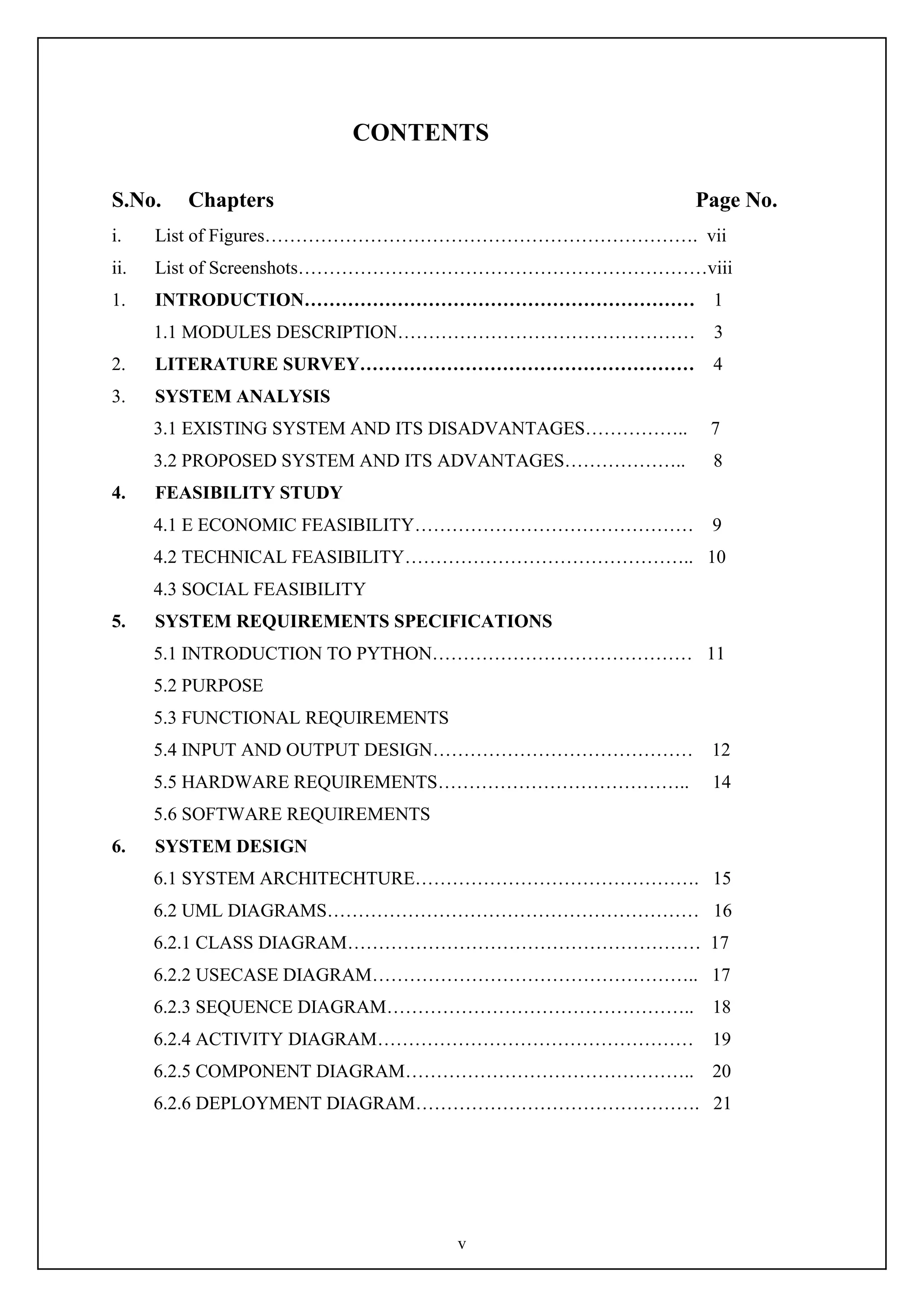
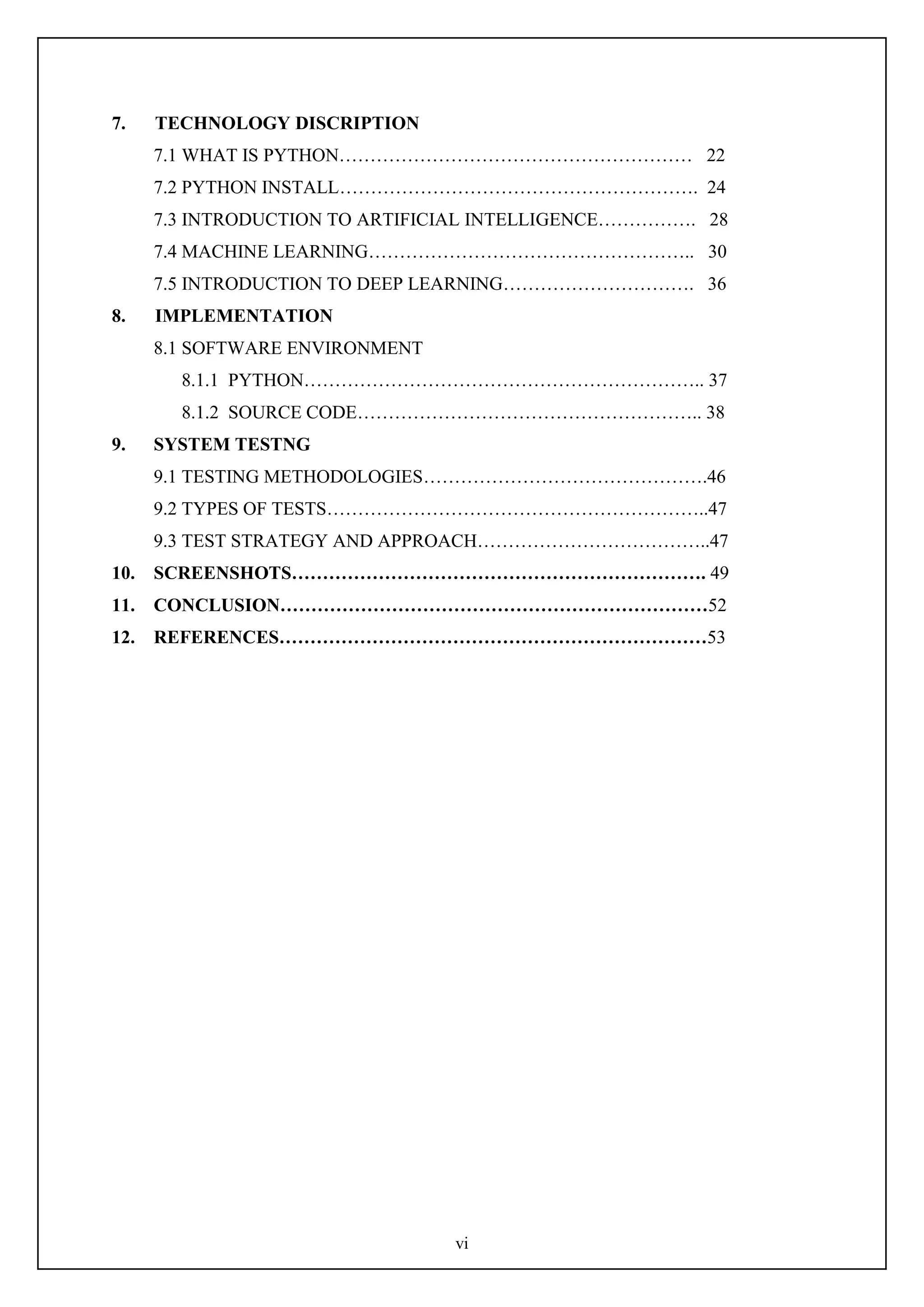
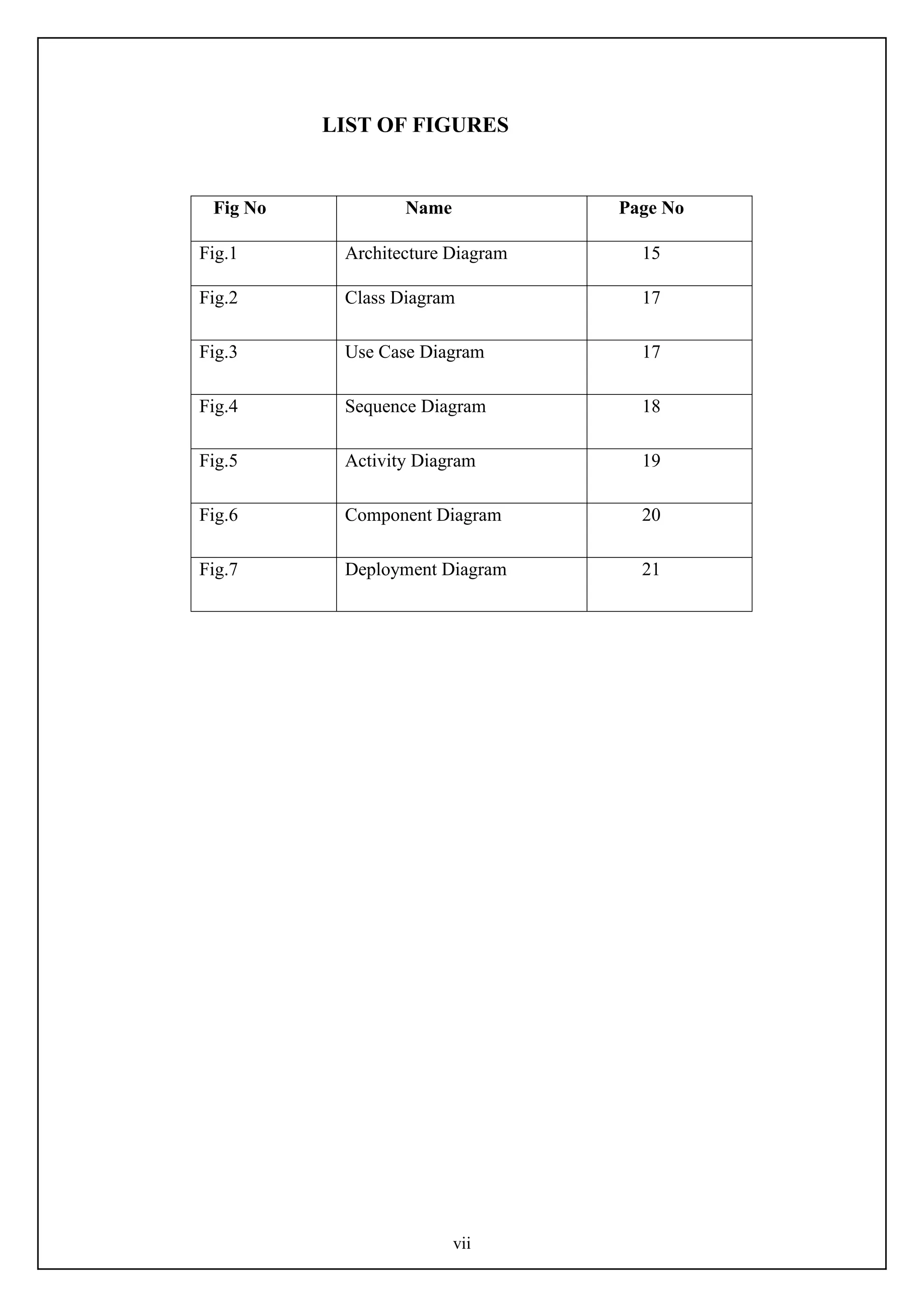
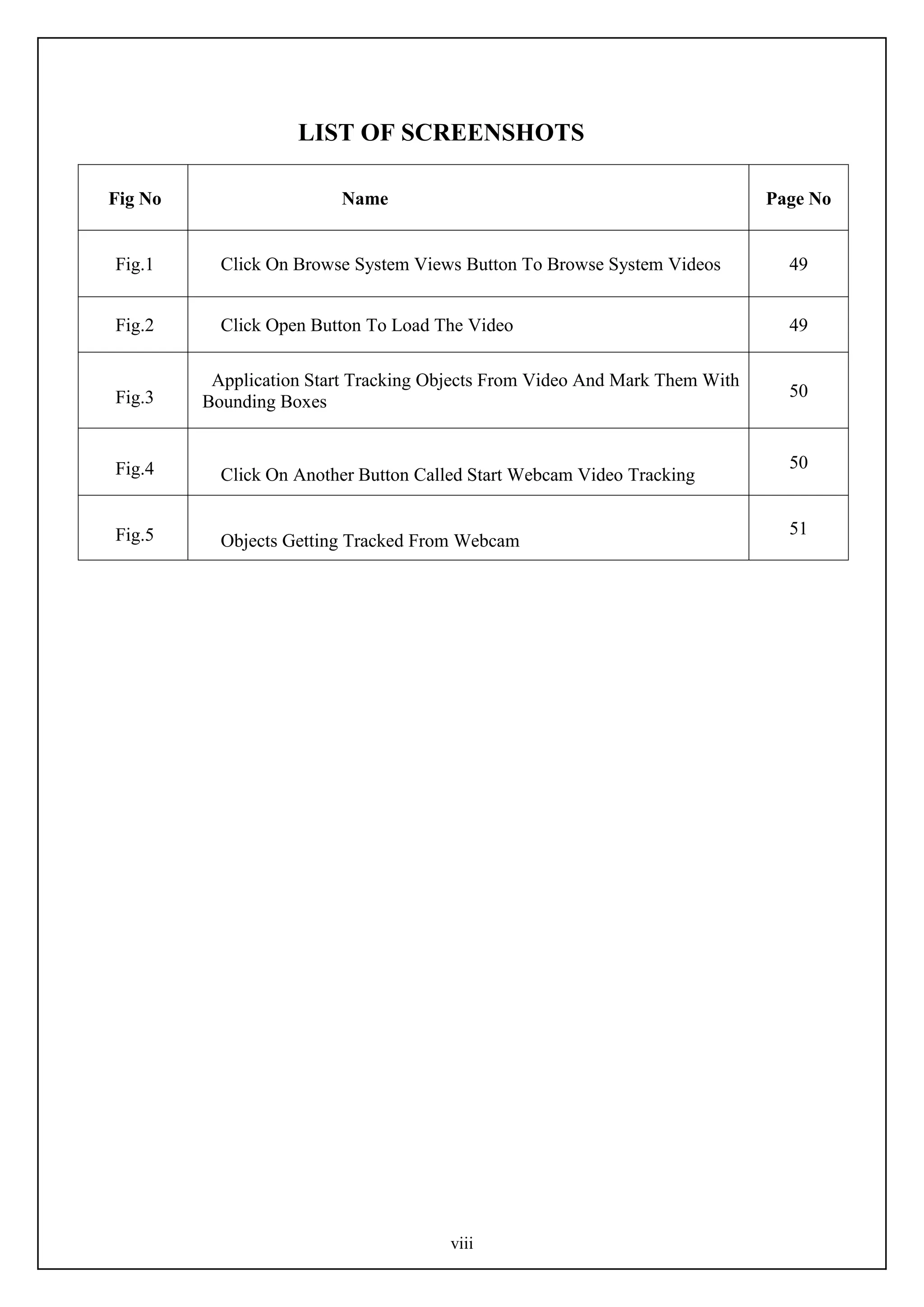
![1
1.INTRODUCTION
The need of efficient management and monitoring of road traffic has increased in last few
decades because of the increase in the road networks, the number and most importantly the size
of vehicles. Intelligent traffic surveillance systems are very important part of modern-day traffic
management but the regular traffic management techniques such as wireless sensor networks
[1], Inductive loops [2] and EM microwave detectors [3] are expensive, bulky and are difficult
to install without interrupting the traffic. A good alternative to these techniques can be video
based surveillance systems
Video surveillance systems [4-8] have become cheaper and better because of the increase in
the storage capabilities, computational power and video encryption algorithms [9]. The videos
stored by these surveillance systems are generally analyzed by humans, which is a time-
consuming Job. To overcome this constraint, the need of more robust, automatic video-based
surveillance systems has increased interest in field of computer vision
The objectives of a traffic surveillance system are to detect, track and classify the vehicles
but they can be used to do complex tasks such as driver activity recognition, lane recognition
etc. The traffic surveillance systems can have applications in a range of fields such as, public
security, detection of anomalous behavior, accident detection, vehicle theft detection, parking
areas, and person identification. A Traffic surveillance system usually contains two parts,
hardware and software.
Hardware is a static camera installed on the roadside that captures the video feed and the
software part of the system is concerned with processing and analyses. These systems could be
portable with a microcontroller attached to the camera for the real-time processing and analyses
or just the cameras that transmit the video feed to a centralized computer for further processing.
Various approaches were made to develop such systems that can detect, count and classify
the vehicles and can be used for traffic surveillance in intelligent transportation systems. This
section covers the discussion about such systems and the knowledge about the methods used to
develop such systems.
Computer vision technology is using for traffic monitoring in many countries [10], [11].](https://image.slidesharecdn.com/ijeee-machinelearningbasedlivevechicletrackingandcounting-250225060005-5370e3d0/75/IJEEE-MACHINE-LEARNING-BASED-LIVE-VECHICLE-TRACKING-AND-COUNTING-pdf-9-2048.jpg)
![2
The development of computer vision technology over video-based traffic monitoring for
detecting moving vehicles in video streams become an essential part in ITS [12], [13]. A good
number of works has been done on vehicle tracking and detection using computer vision
technology. In 2005, Hasegawa and Kanade [14] introduced a system for detecting and
classifying the moving objects by its type and color. In this process, a series of images of a
specific location were supplied and vehicles from these images were identified. In 2013, Nilesh
et al. designed and developed a system using python with OpenCV for detecting and counting
moving vehicles.
It can automatically identify and count moving objects as vehicle in real-time or from
recorded videos, which basically used background subtraction, image filtering, image binary
and segmentation method. In 2014, Da Li et al. developed real-time moving vehicle detection,
tracking, and counting system also using python with OpenCV including adaptive subtracted
background method in combination with virtual detector and blob tracking technology.
Virtual detector constructs a set of rectangular regions in each input image frame and blob
tracking method generates input image frames, the absolute difference between the background
image and foreground blobs corresponding to the vehicles on the road. The above systems have
some limitations like tackling shadows, occlusion of multiple vehicles that appear in a single
region. Peak Traffic Corporation commercially developed several video traffic detection
systems at the present time.](https://image.slidesharecdn.com/ijeee-machinelearningbasedlivevechicletrackingandcounting-250225060005-5370e3d0/75/IJEEE-MACHINE-LEARNING-BASED-LIVE-VECHICLE-TRACKING-AND-COUNTING-pdf-10-2048.jpg)
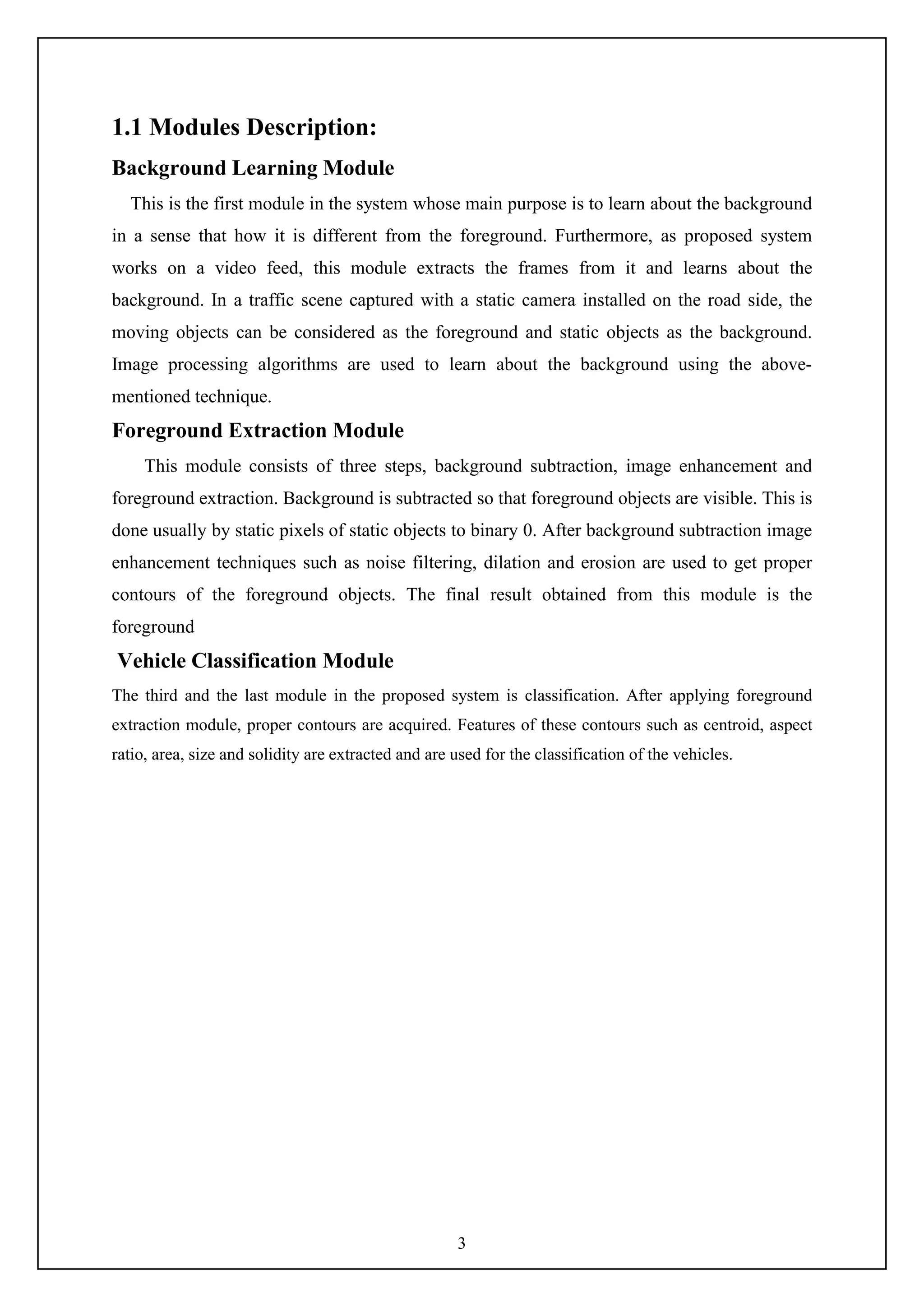
![4
2.LITERATURE SURVEY
Tursun M and amrulla G proposed a video based real-time vehicle counting
system using optimized virtual loop method. They used real time traffic surveillance cameras
deployed over roads and compute how many vehicles pass the road. In this system counting is
completed in three steps by tracking vehicle movements within a tracking zone called virtual loop.
Another video-based vehicle counting system was proposed by lei, m., et al. In this system
surveillance cameras were used and mounted at relatively high place to acquire the traffic video
stream, the adaptive background estimation and the gaussian shadow elimination are the two main
methods that were used in this system. The accuracy rate of the system depends on the visual angle
and ability to remove shadows and ghost effects. The system’s incompetency to classify vehicle
type is the core limitation of the system
Bas et al. Proposed a video analysis method to count vehicles [10] based on an
adaptive bounding box size to detect and track vehicles in accordance with estimated distance from
the camera. The region of interest (ROI) is identified by defining a boundary for each outbound and
inbound in the image. Although the algorithm is improved to deal with some weather conditions it
is unable to track vehicles when they change their directions.
Mithun, N.C., et al proposed a vehicle detection and classification system using
time spatial image and multiple virtual detection line [6]. A two-step k nearest neighborhood (KNN)
algorithm is adopted to classify vehicles via shape invariant and texture-based features.
Experiments confirm the better accuracy and low error rate of proposed method over existing
methods since it also considers the various illumination conditions
Habibu Rabiu proposed a vehicle detection and classification for cluttered urban
intersection. In this system background subtraction and Kalman filter algorithm are used to detect
and track the vehicles and linear discriminant analysis classifier is used for proper classification of
vehicles.
Detection of vehicles in a video-based traffic surveillance system is first and very important phase
as it greatly impacts the other algorithms such as tracking and classification of the vehicles hence
an accurate detection and segmentation of the foreground moving object is very important. Many of
the techniques are used for foreground detection like frame differencing [12]. Frame differencing
can be considered as the simplest foreground detection and segmentation method as it is based on](https://image.slidesharecdn.com/ijeee-machinelearningbasedlivevechicletrackingandcounting-250225060005-5370e3d0/75/IJEEE-MACHINE-LEARNING-BASED-LIVE-VECHICLE-TRACKING-AND-COUNTING-pdf-12-2048.jpg)
![5
the close relationship among the sequence of motion images.
An improved frame differencing method was presented by Collins [7] which uses
difference between multiple frames to compute the foreground instead of just using the initial frame.
Another method named as optical flow field method was brought out by Gibson [13]. Wu, k, et al.
Proposed that the optical flow represents the velocity of mode within an image [14]. optical flow
method takes image within the detecting area as a vector field of velocity; each vector represents
the transient variation of the position for a pixel in the scenery. Another method used to detect
foreground is average model [8]. In average model the average grey value of a pixel in a sequence
of frames is considered as the background value of same pixel. A GMM was proposed by Friedman,
n. And s. Russell.[15] and was refined for real time tracking by Stauffer, C. And W.E.L. Grimson.
Gaussian mixture model relies on assumptions that the background is visible more
frequently than any foreground regions. Elgammal proposed kernel density estimation based
nonparametric background model [18]. Kernel density estimation method evaluates the samples of
video data using kernel functions and it samples data which has maximal probability density as
background is selected. A bag of features model is the one which represents images as order less
collections of local features [19]. The name bag of features came from the bag of words
representation used in text-based information retrieval.
Scale invariant feature transform algorithm (SIFT) was introduced by David
Lowe in 1999 [20] and refined in 2004 [21]. Sift is used to extract the features from dataset. In sift
features are invariant to image scaling, rotation and partially invariant to change in illumination and
3d camera viewpoint [21]. Sift with SVM requires a smaller number of datasets. With any
supervised learning model, first SVM is trained to cross validate the classifier.
Then trained machine is used to make predictions and classify the data [22]. Bhushan et al. [23],
proposed a vehicle detection method based on morphological operations including binarization,
edge detection, and top-hat processing, masking operation. Proposed system fails to give good
results n cloudy environment. Raúl et al. [24], proposed a classification technique for moving
objects in which information processing is employed via clustering and classification algorithms.
Proposed methodology provides sufficient accuracy for it to be employed for real-time applications
but still the system can be further improved for vehicle classification in complex scenarios such as
weather and illumination conditions.](https://image.slidesharecdn.com/ijeee-machinelearningbasedlivevechicletrackingandcounting-250225060005-5370e3d0/75/IJEEE-MACHINE-LEARNING-BASED-LIVE-VECHICLE-TRACKING-AND-COUNTING-pdf-13-2048.jpg)
![6
A Suryatali and V.B. Dharmadhikari in [25], proposed a computer vision-based vehicle
detection that counts and also classifies the vehicles in to heavy and light weight vehicles;
object detection is accomplished by making use of kalman filter for background subtraction
and then OpenCV library is used finally to detect the object in processed frame. Nila Korn et
al. [26], proposed vehicle detection and counting prototype
which uses different steps for background subtraction and object detection then uses cv
techniques such as thresholding, hole-filling and adaptive morphological dilation to remove
noise and enhance the foreground objects in particular frame from video. Proposed system
provides limited functionality for the objects appearing in detection zone if they are occluded
or small](https://image.slidesharecdn.com/ijeee-machinelearningbasedlivevechicletrackingandcounting-250225060005-5370e3d0/75/IJEEE-MACHINE-LEARNING-BASED-LIVE-VECHICLE-TRACKING-AND-COUNTING-pdf-14-2048.jpg)
![7
3.SYSTEM ANALYSIS
3.1 EXISTING SYSTEM
A vehicle detection and classification system using time spatial
image and multiple virtual detection line [6]. A two-step K nearest neighborhood (KNN)
algorithm is adopted to classify vehicles via shape invariant and texture-based features.
Experiments confirm the better accuracy and low error rate of proposed method over existing
methods since it also considers the various illumination conditions. People have designed
such mechanism for decades now but most of them involve use of sensors to detect the
vehicles i.e. a couple of proximity sensors to calculate the direction of the moving vehicle
and to keep the vehicle count. Even though over the time these systems have matured and are
highly effective, they are not very budget friendly. The problem is such systems require
maintenance and periodic calibration.
DISADVANTAGES:
1.Limited Accuracy
2.High Computational Demands
3.Vulnerability to Lighting Conditions
3.2 PROPOSED SYSTEM
The system could be used for detection, recognition and tracking
of the vehicles in the video frames and then classify the detected vehicles according to their
size in three different classes. The proposed system is based on three modules which are
background learning, foreground extraction and vehicle classification as shown in fig. 1.
Background subtraction is a classical approach to obtain the foreground image or in other
words to detect the moving objects. We have proposed an adaptive video-based vehicle
detection, classification, counting for real-time traffic data collection. The proposed system
was built using python programming language and OpenCV.
The main objective for developing this system is to collect vehicle count and classification](https://image.slidesharecdn.com/ijeee-machinelearningbasedlivevechicletrackingandcounting-250225060005-5370e3d0/75/IJEEE-MACHINE-LEARNING-BASED-LIVE-VECHICLE-TRACKING-AND-COUNTING-pdf-15-2048.jpg)

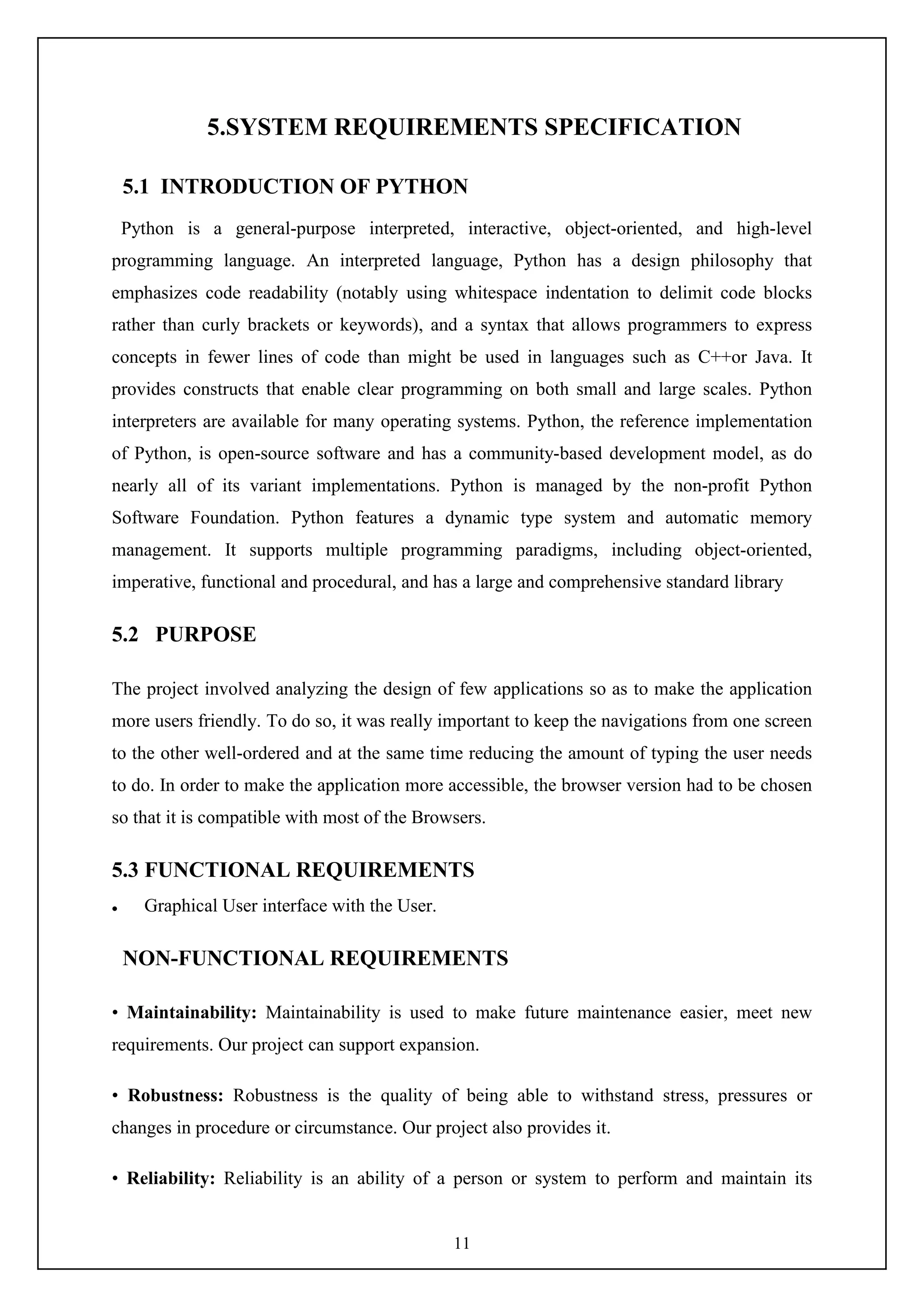
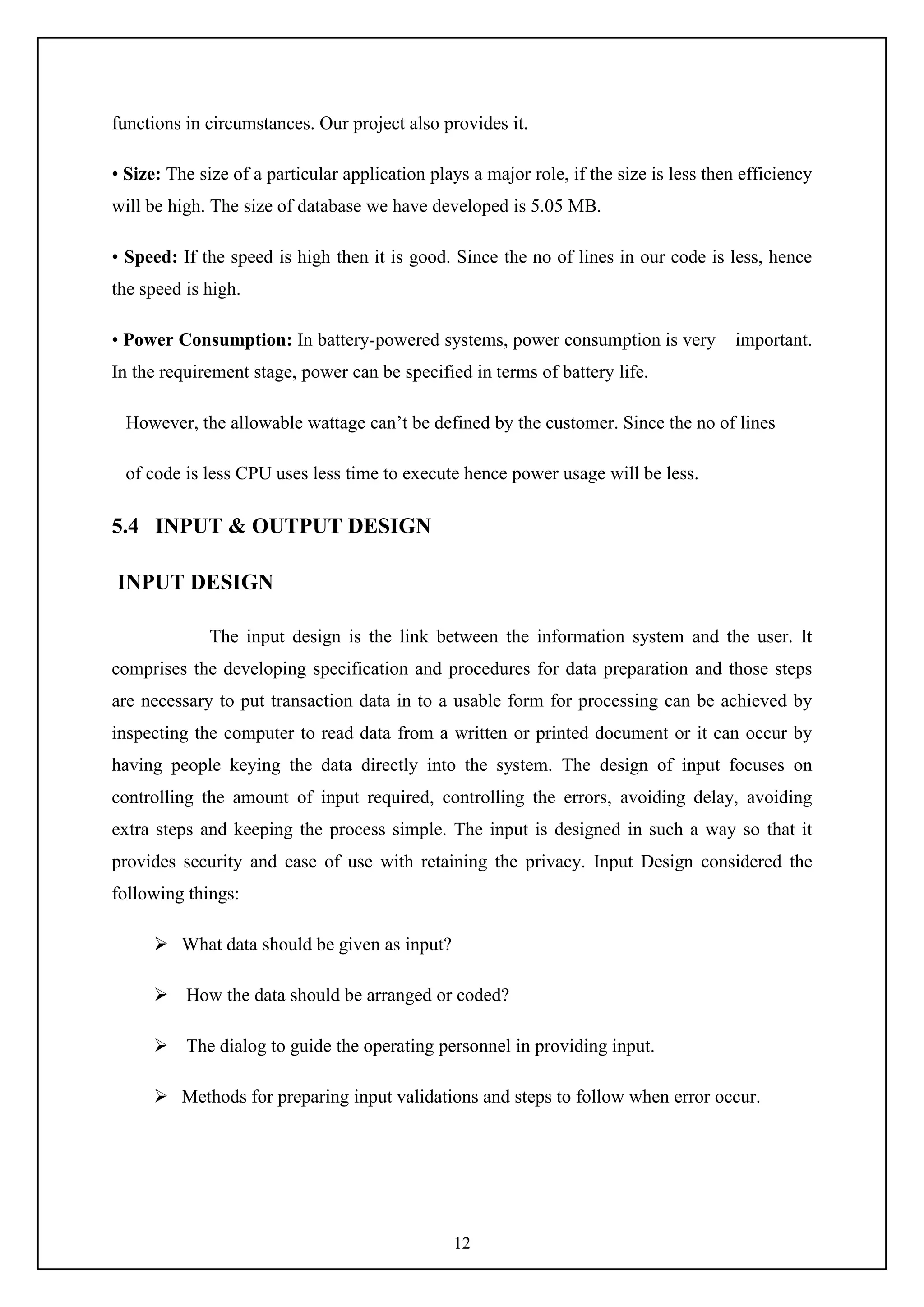
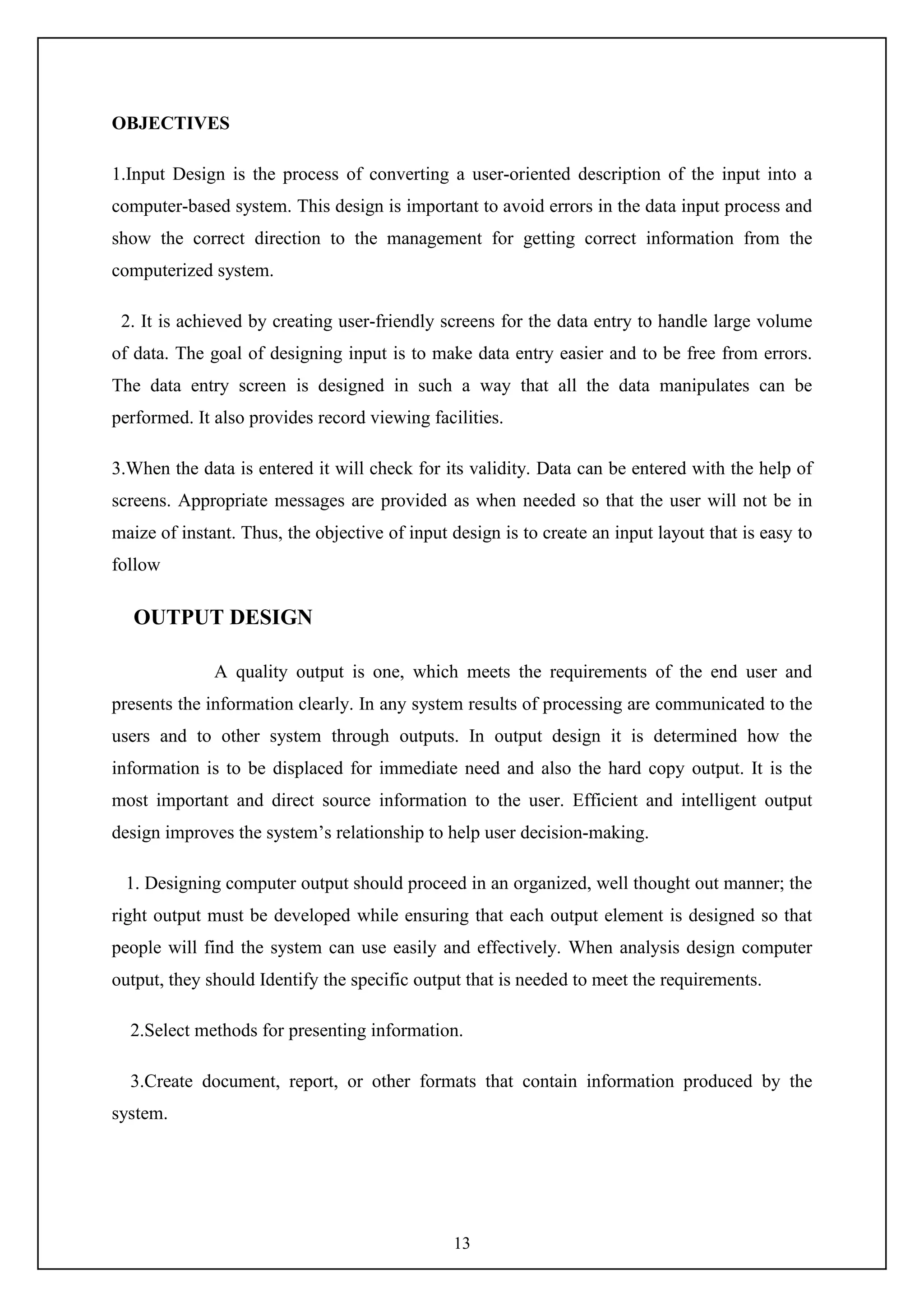
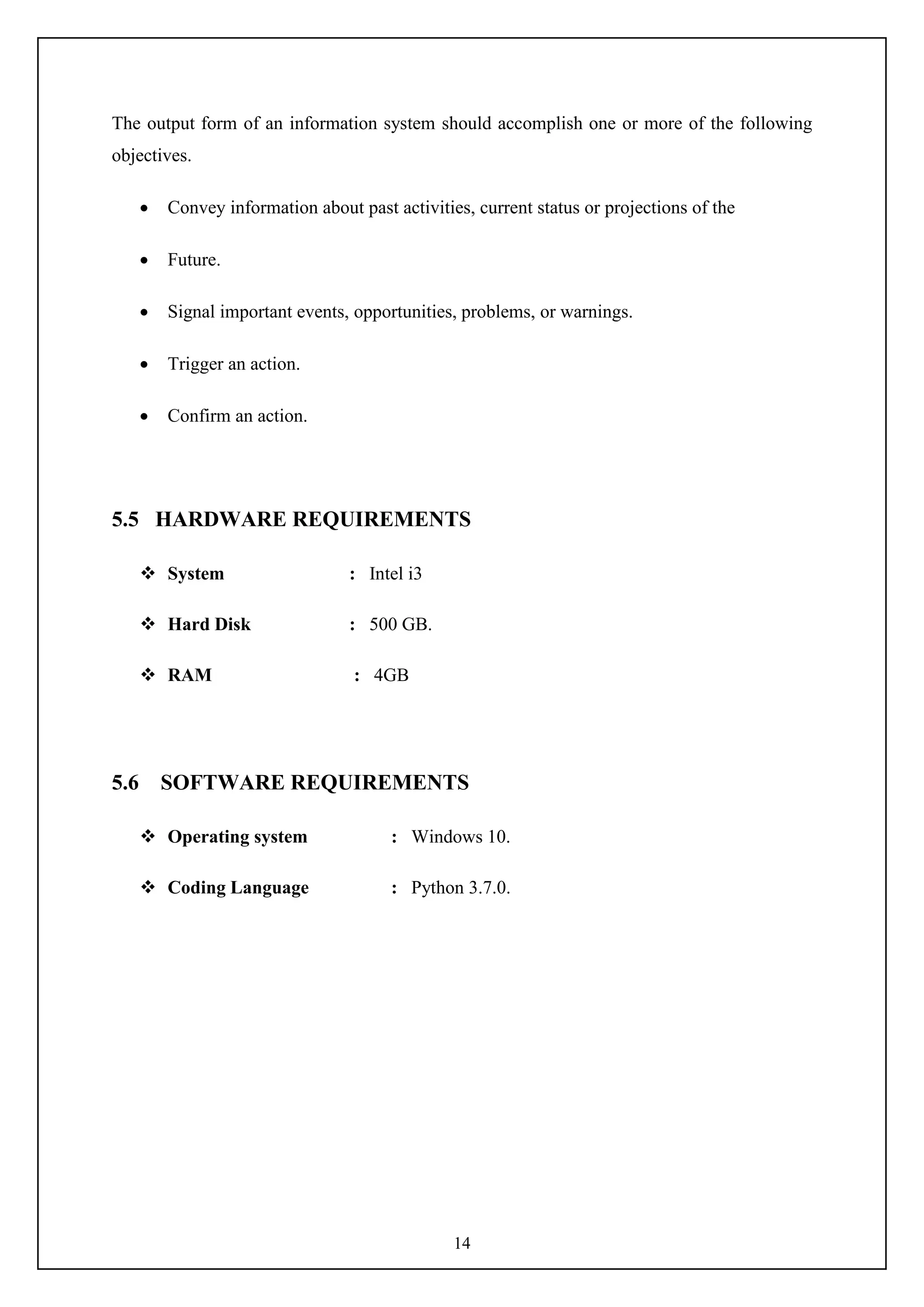
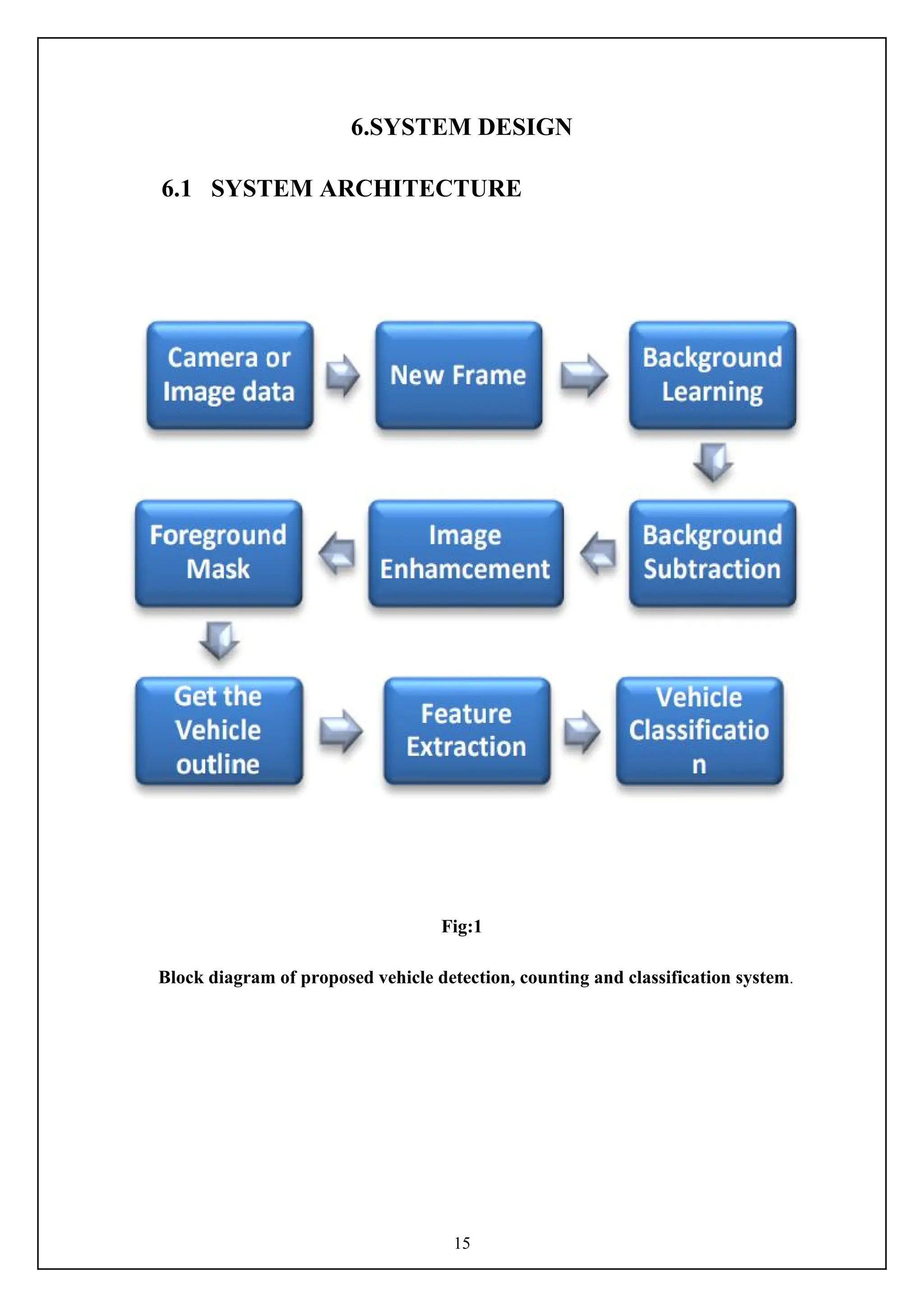

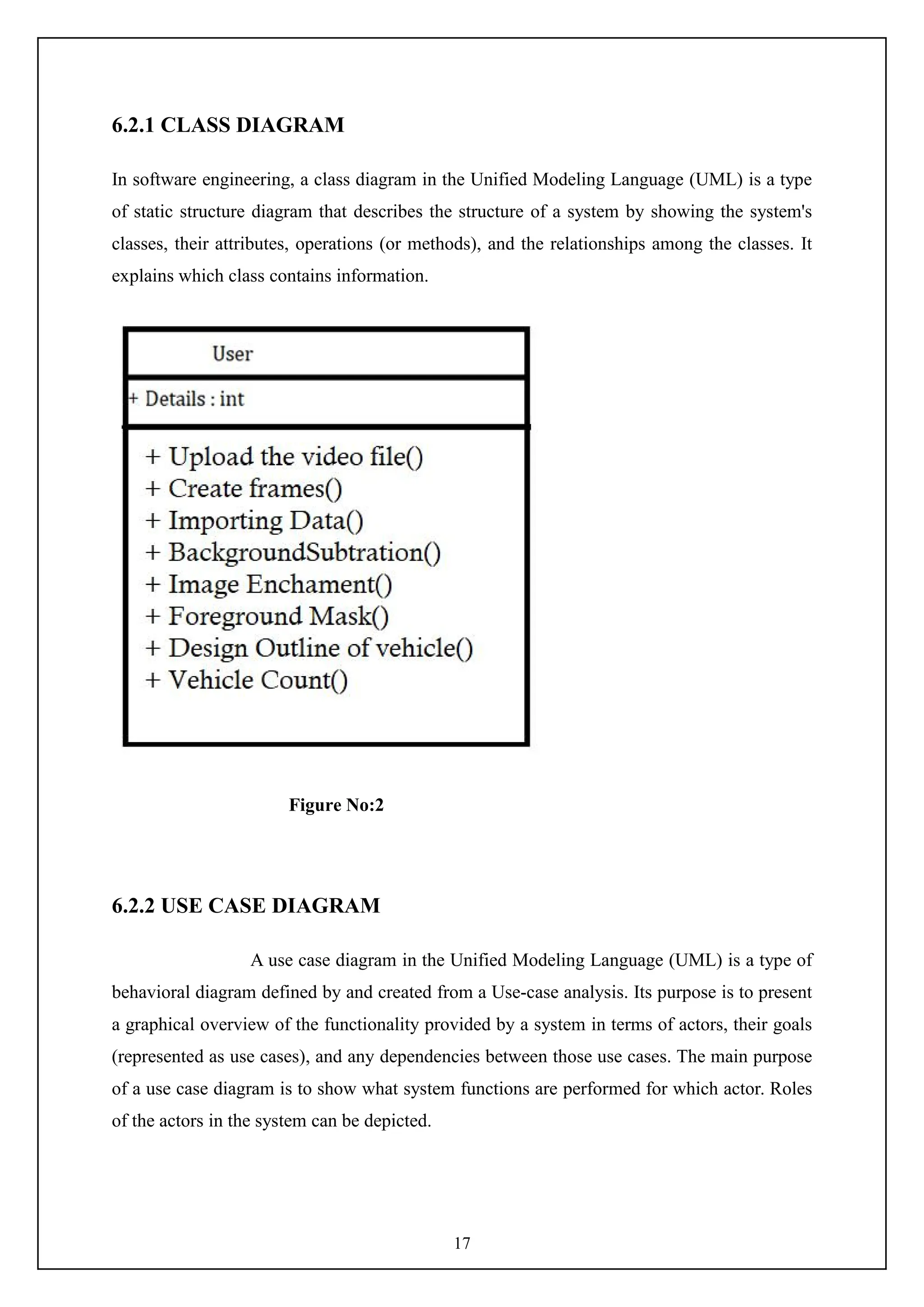
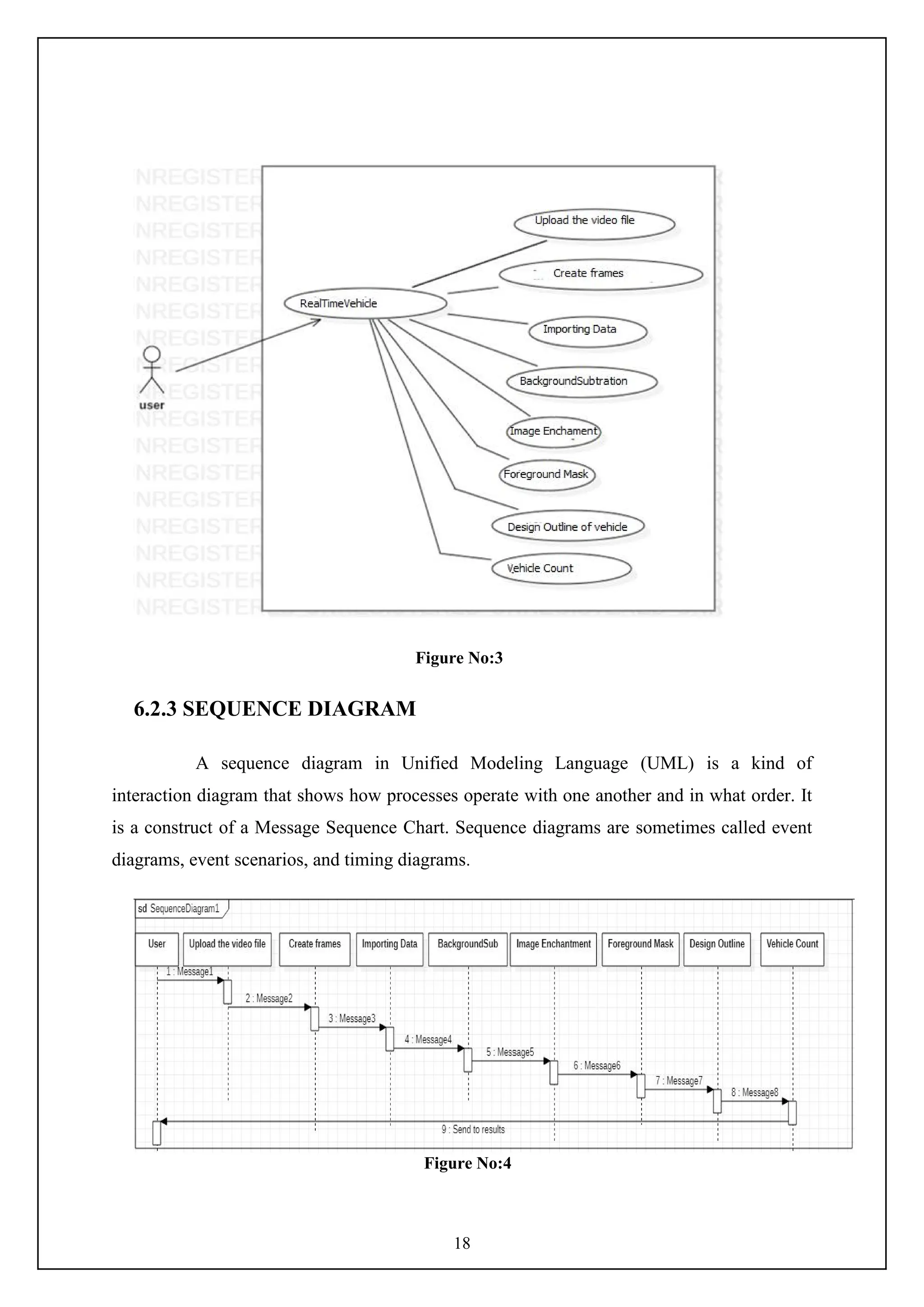
![19
6.2.4 ACTIVITY DIAGRAMS
Activity diagrams are graphical representations of workflows of stepwise activities and
actions [1] with support for choice, iteration and concurrency. In the Unified Modeling
Language, activity diagrams are intended to model both computational and organizational
processes (i.e., workflows), as well as the data flows intersecting with the related
activities.[2][3] Although activity diagrams primarily show the overall flow of control,
they can also include elements showing the flow of data between activities through one or
more data stores.
Activity diagrams are graphical representations of workflows of stepwise activities and
actions with support for choice, iteration and concurrency. In the Unified Modeling
Language, activity diagrams are intended to model both computational and organizational
processes (i.e., workflows), as well as the data flows intersecting with the related
activities.[2][3] Although activity diagrams primarily show the overall flow of control,
they can also include elements showing the flow of data between activities through one or
more data stores. [citation needed]
Figure No:5](https://image.slidesharecdn.com/ijeee-machinelearningbasedlivevechicletrackingandcounting-250225060005-5370e3d0/75/IJEEE-MACHINE-LEARNING-BASED-LIVE-VECHICLE-TRACKING-AND-COUNTING-pdf-27-2048.jpg)
![20
6.2.5 COMPONENT DIAGRAM
The component diagram extends the information given in a component
notation element. One way of illustrating the provided and required interfaces by the
specified component is in the form of a rectangular compartment attached to the
component element.[2] Another accepted way of presenting the interfaces is to use the
ball-and-socket graphic convention. A provided dependency from a component to an
interface is illustrated with a solid line to the component using the interface from a
"lollipop", or ball, labelled with the name of the interface. A required usage dependency
from a component to an interface is illustrated by a half-circle, or socket, labelled with the
name of the interface, attached by a solid line to the component that requires this interface.
Inherited interfaces may be shown with a lollipop, preceding the name label with a caret
symbol. To illustrate dependencies between the two, use a solid line with a plain
arrowhead joining the socket to the lollipop.
Figure No:6](https://image.slidesharecdn.com/ijeee-machinelearningbasedlivevechicletrackingandcounting-250225060005-5370e3d0/75/IJEEE-MACHINE-LEARNING-BASED-LIVE-VECHICLE-TRACKING-AND-COUNTING-pdf-28-2048.jpg)
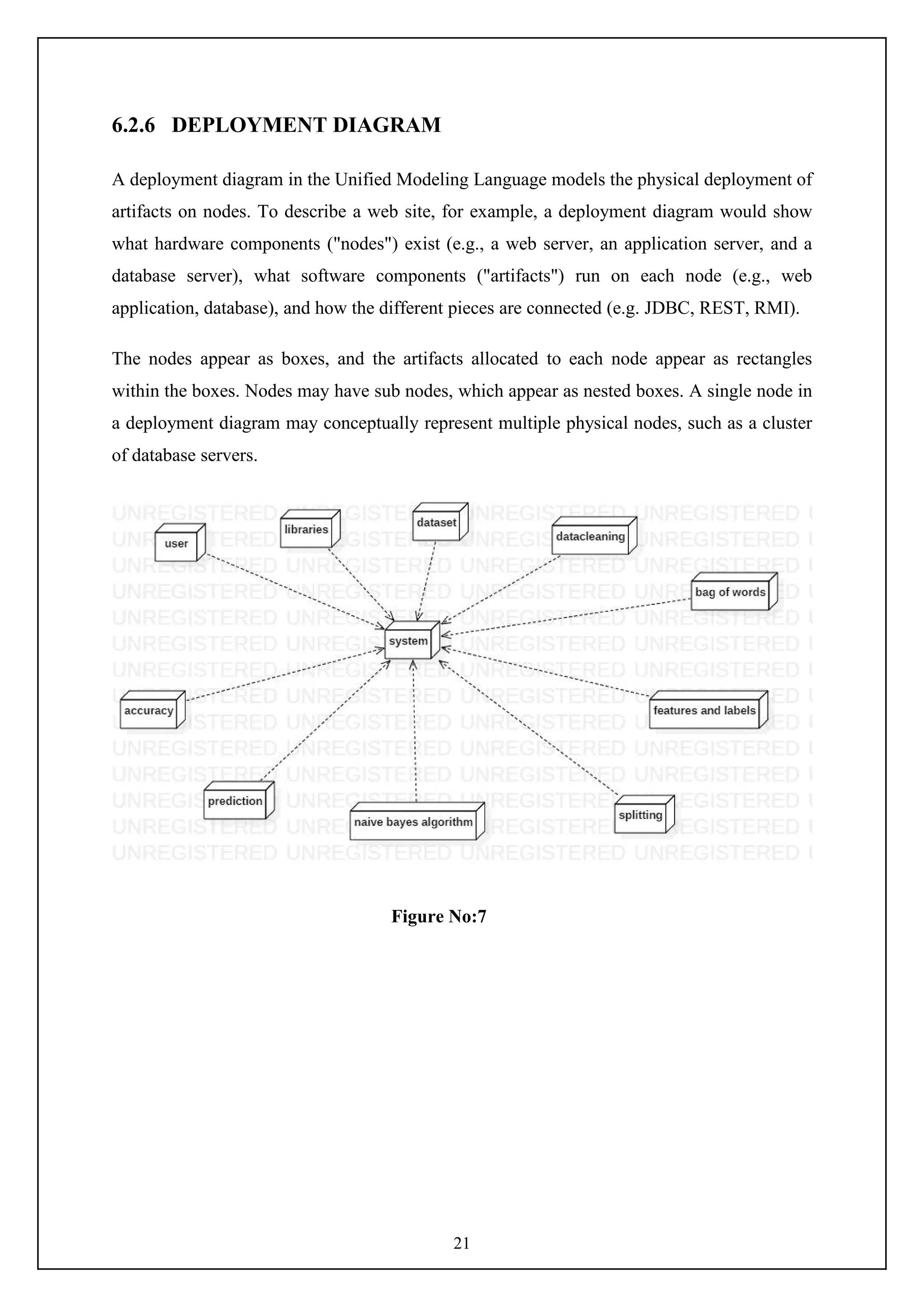
![25
Or, if the "python" command did not work, you can try "py":
C:UsersYour Name>py
From there you can write any python, including our hello world example from earlier in
the tutorial:
C:UsersYour Name>python
Python 3.6.4 (v3.6.4: d48eceb, Dec 19 2017, 06:04:45) [MSC v.1900 32 bit (Intel)] on
win32
Type "help", "copyright", "credits" or "license" for more information.
>>>print ("Hello, World!")
Which will write "Hello, World!" in the command line:
C:UsersYour Name>python
Python 3.6.4 (v3.6.4: d48eceb, Dec 19 2017, 06:04:45) [MSC v.1900 32 bit (Intel)] on
win32
Type "help", "copyright", "credits" or "license" for more information.
>>>print ("Hello, World!")
Hello, World!
Whenever you are done in the python command line, you can simply type the following
to quit the python command line interface:
Exit ()
Cross Platform
Platform. Architecture (executable=sys. executable, bits='', linkage='')
Queries the given executable (defaults to the Python interpreter binary) for various
architecture information.
Returns a tuple (bits, linkage) which contain information about the bit architecture and the
linkage format used for the executable. Both values are returned as strings.
Values that cannot be determined are returned as given by the parameter presets. If bits is
given as '', the size of(pointer) (or size of(long) on Python version < 1.5.2) is used as
indicator for the supported pointer size.](https://image.slidesharecdn.com/ijeee-machinelearningbasedlivevechicletrackingandcounting-250225060005-5370e3d0/75/IJEEE-MACHINE-LEARNING-BASED-LIVE-VECHICLE-TRACKING-AND-COUNTING-pdf-33-2048.jpg)
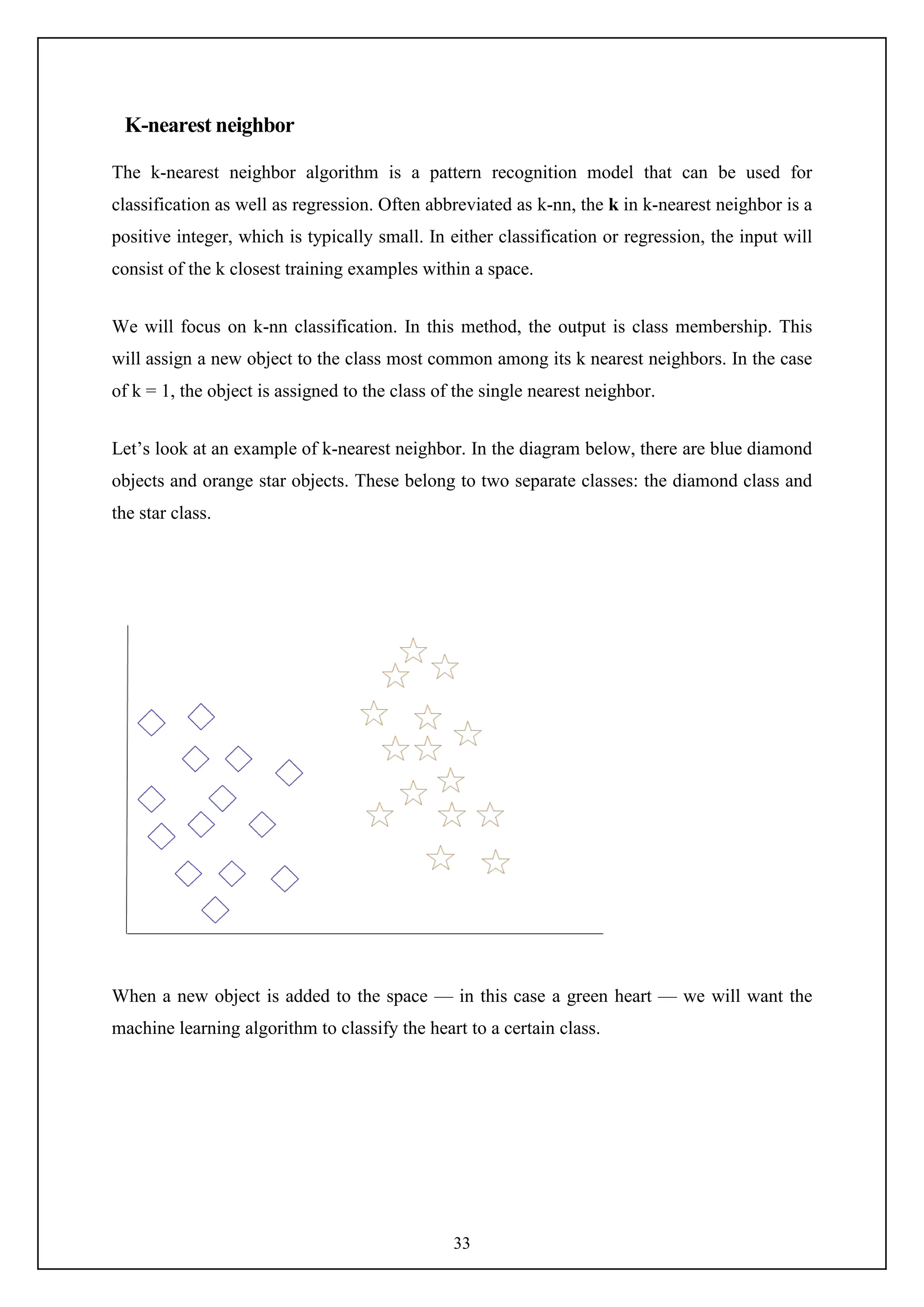
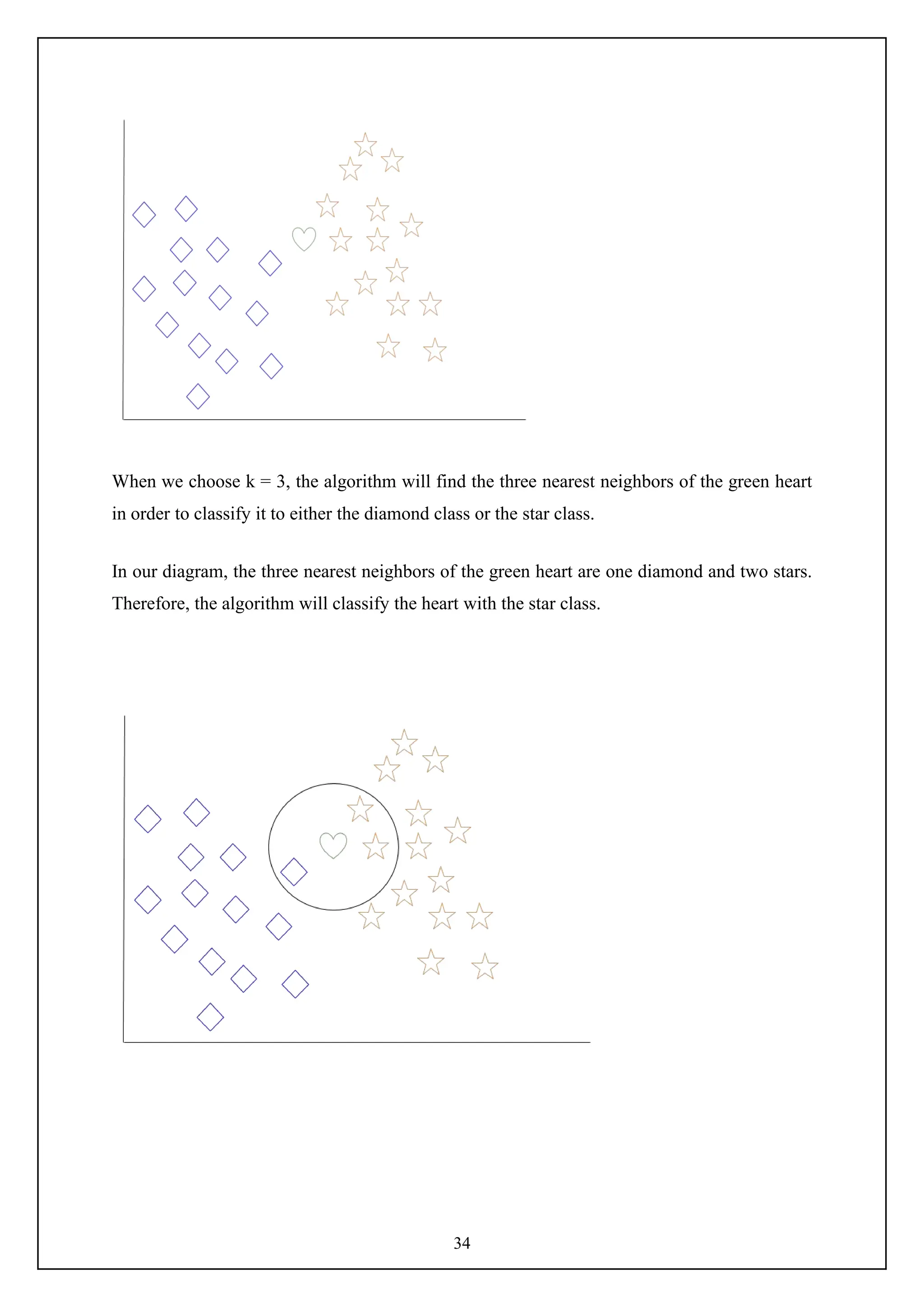
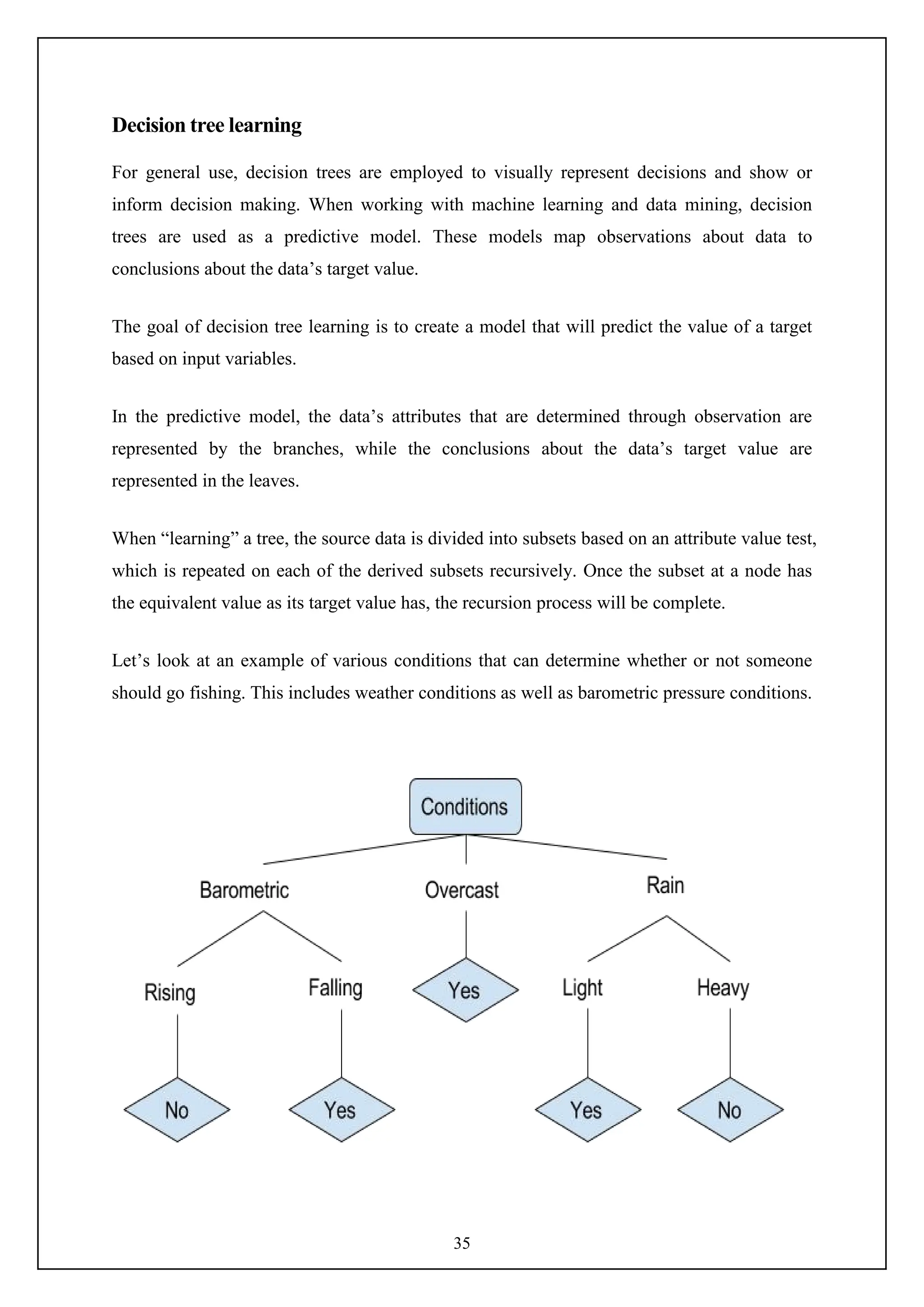
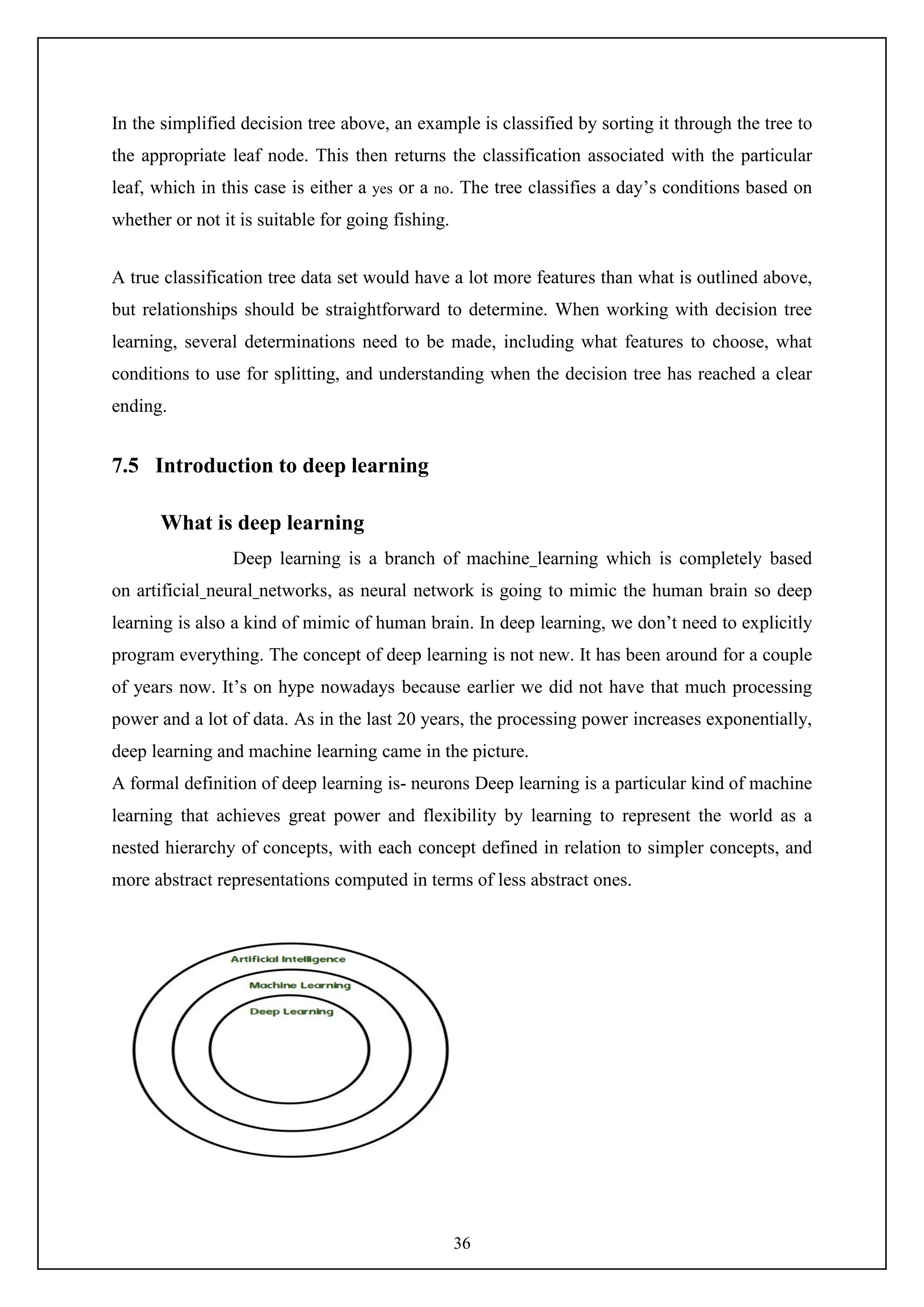
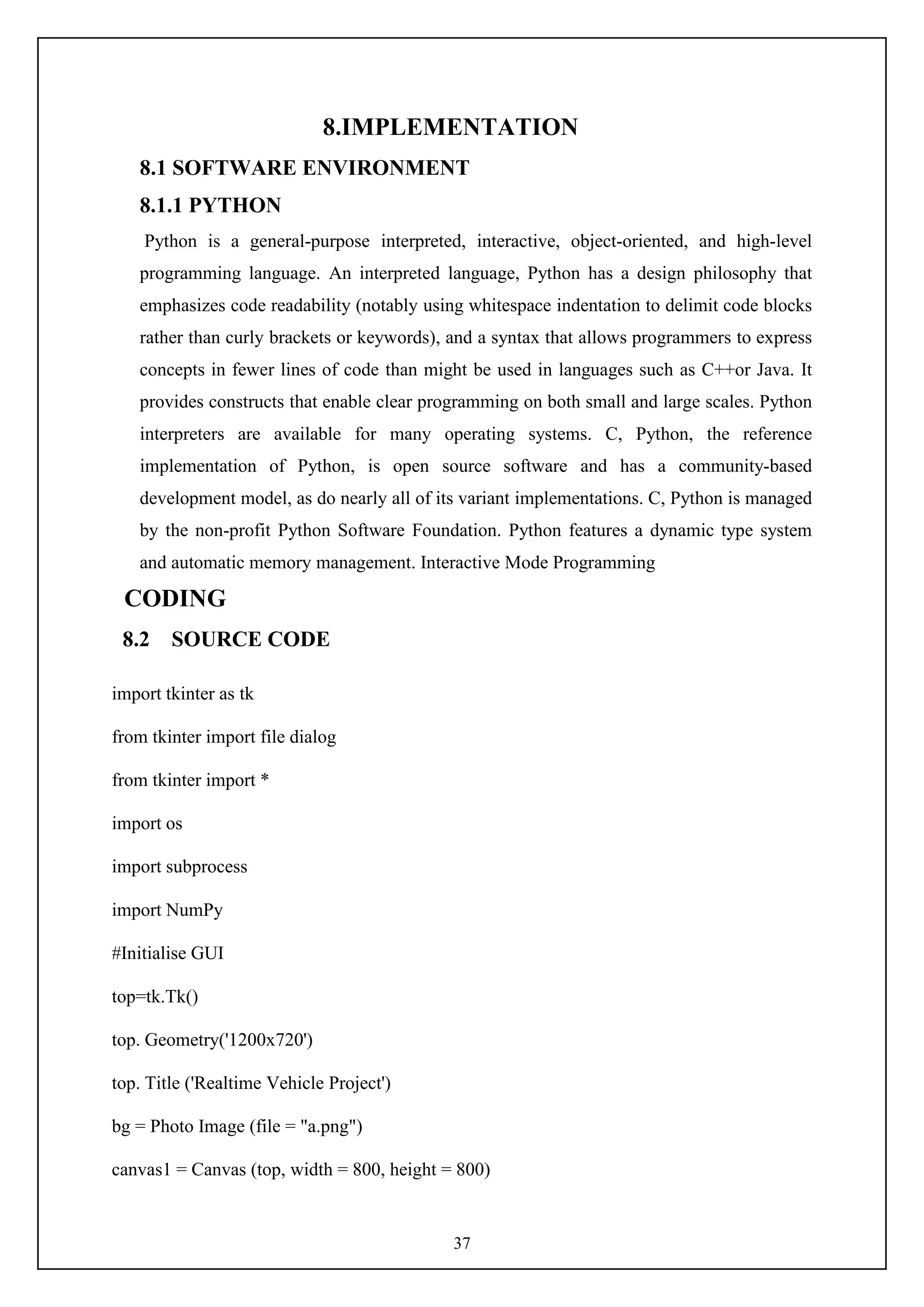
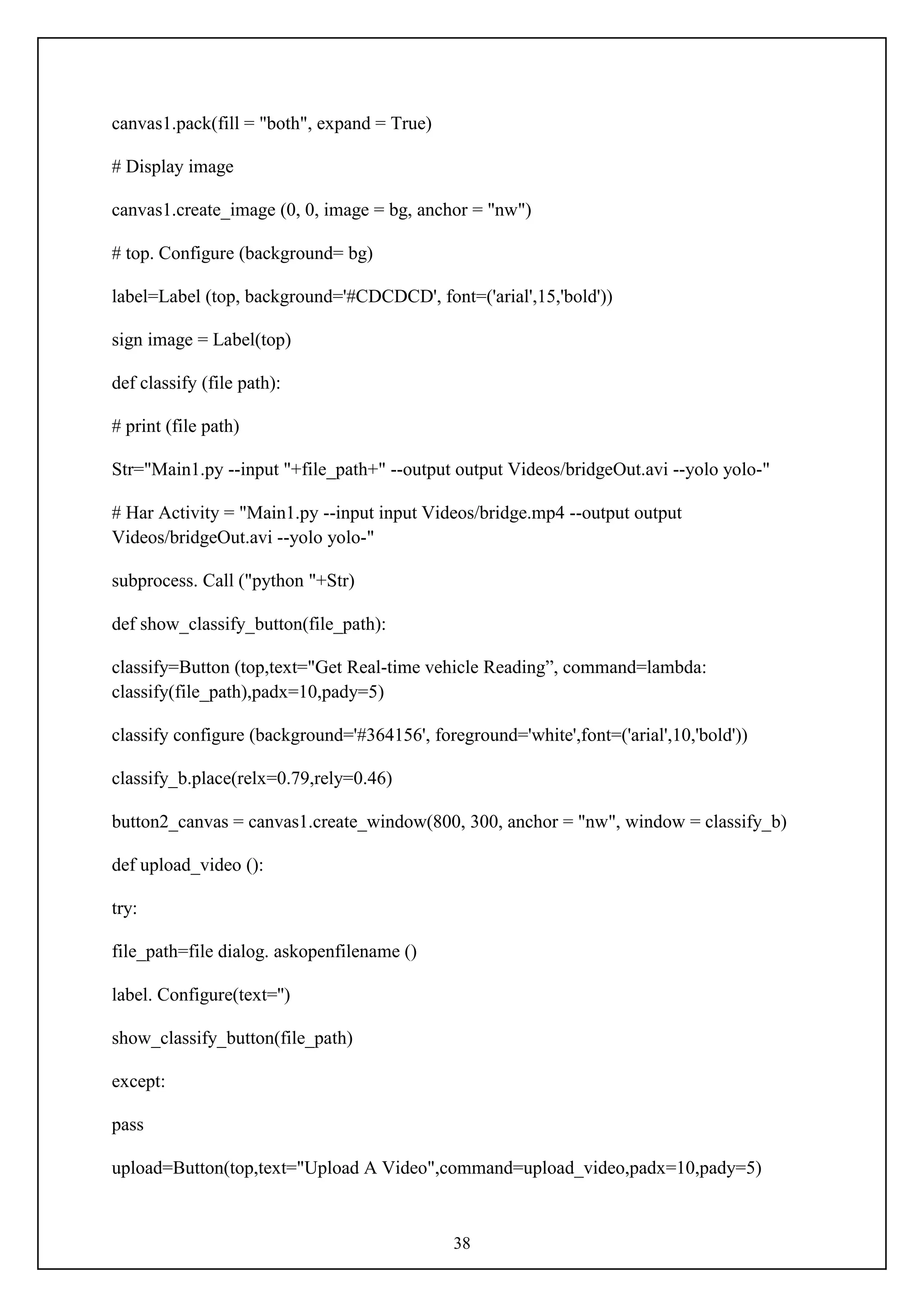
![39
upload.configure(background='#364156', foreground='white',font=('arial',10,'bold'))
upload.pack(side=BOTTOM,pady=50)
button1_canvas = canvas1.create_window( 600, 500, anchor = "nw", window = upload)
sign_image.pack(side=BOTTOM,expand=True)
label.pack(side=BOTTOM,expand=True)
heading = Label(top, text="RealTime Vechicle Project",pady=20, font=('arial',20,'bold'))
heading.configure(background='#CDCDCD',foreground='#364156')
heading.pack()
button2_canvas = canvas1.create_window( 500, 100, anchor = "nw", window = heading)
top.mainloop()
import cv2
import numpy as np
from time import sleep
largura_min=80 #Largura minima do retangulo
altura_min=80 #Altura minima do retangulo
offset=6 #Erro permitido entre pixel
pos_linha=550 #Posição da linha de contagem
delay= 60 #FPS do vídeo
detec = []
carros= 0
def pega_centro(x, y, w, h):
x1 = int(w / 2)
y1 = int(h / 2)
cx = x + x1
cy = y + y1](https://image.slidesharecdn.com/ijeee-machinelearningbasedlivevechicletrackingandcounting-250225060005-5370e3d0/75/IJEEE-MACHINE-LEARNING-BASED-LIVE-VECHICLE-TRACKING-AND-COUNTING-pdf-47-2048.jpg)
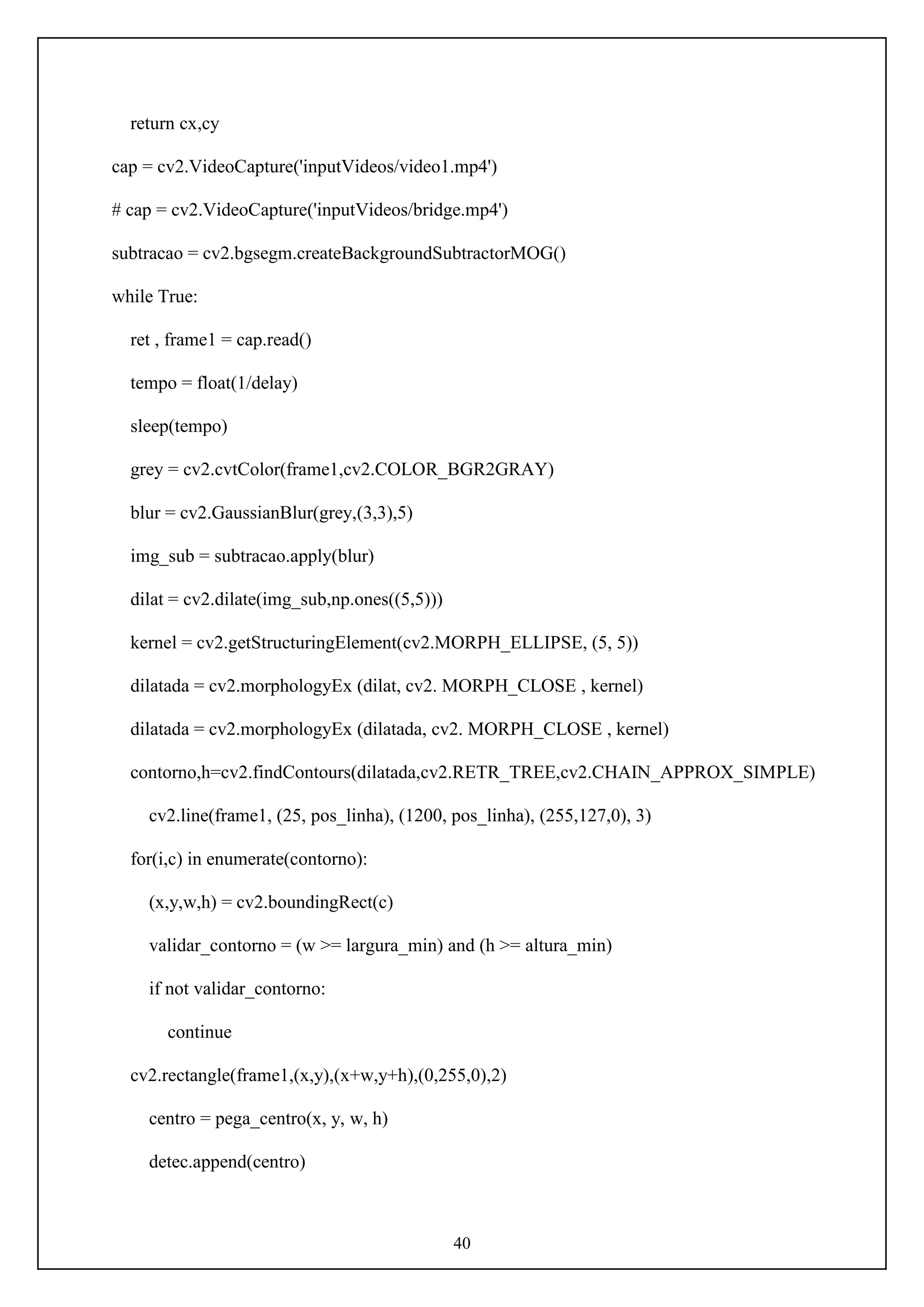
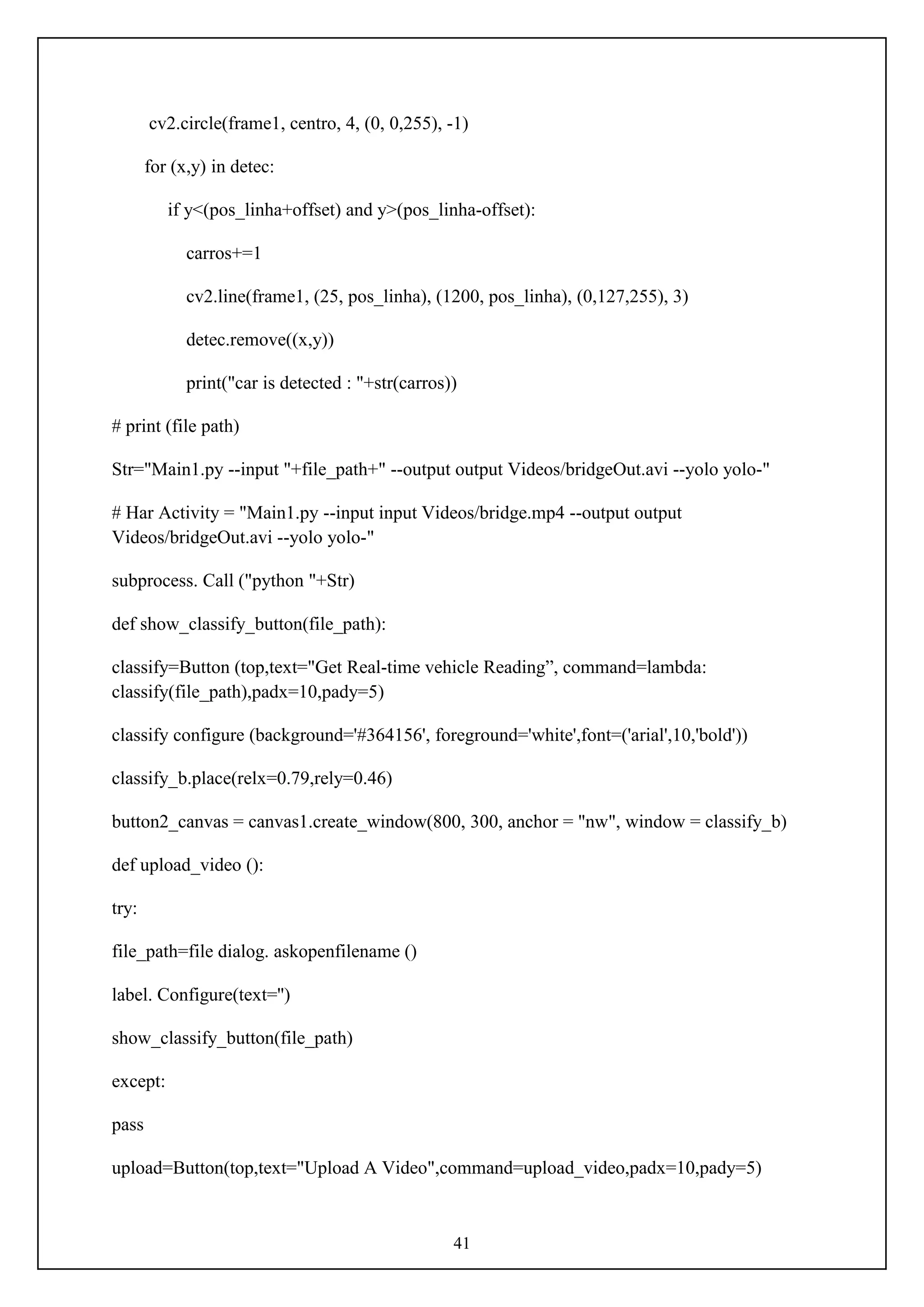
![42
upload.configure(background='#364156', foreground='white',font=('arial',10,'bold'))
upload.pack(side=BOTTOM,pady=50)
button1_canvas = canvas1.create_window( 600, 500, anchor = "nw", window = upload)
sign_image.pack(side=BOTTOM,expand=True)
label.pack(side=BOTTOM,expand=True)
heading = Label(top, text="RealTime Vechicle Project",pady=20, font=('arial',20,'bold'))
heading.configure(background='#CDCDCD',foreground='#364156')
heading.pack()
button2_canvas = canvas1.create_window( 500, 100, anchor = "nw", window = heading)
top.mainloop()
import cv2
import numpy as np
from time import sleep
largura_min=80 #Largura minima do retangulo
altura_min=80 #Altura minima do retangulo
offset=6 #Erro permitido entre pixel
pos_linha=550 #Posição da linha de contagem
delay= 60 #FPS do vídeo
detec = []
carros= 0
def pega_centro(x, y, w, h):
x1 = int(w / 2)
y1 = int(h / 2)
cx = x + x1
cy = y + y1](https://image.slidesharecdn.com/ijeee-machinelearningbasedlivevechicletrackingandcounting-250225060005-5370e3d0/75/IJEEE-MACHINE-LEARNING-BASED-LIVE-VECHICLE-TRACKING-AND-COUNTING-pdf-50-2048.jpg)
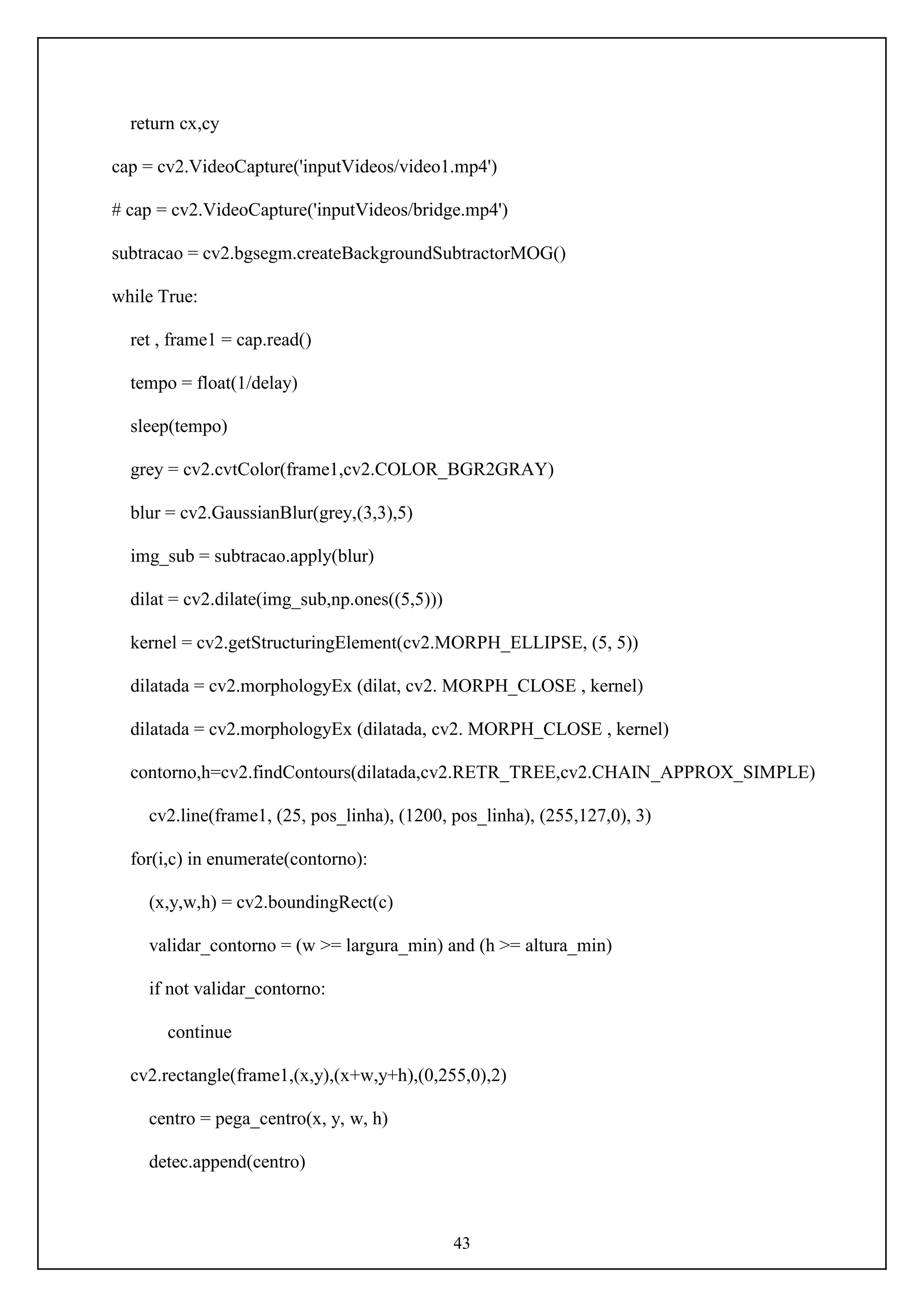
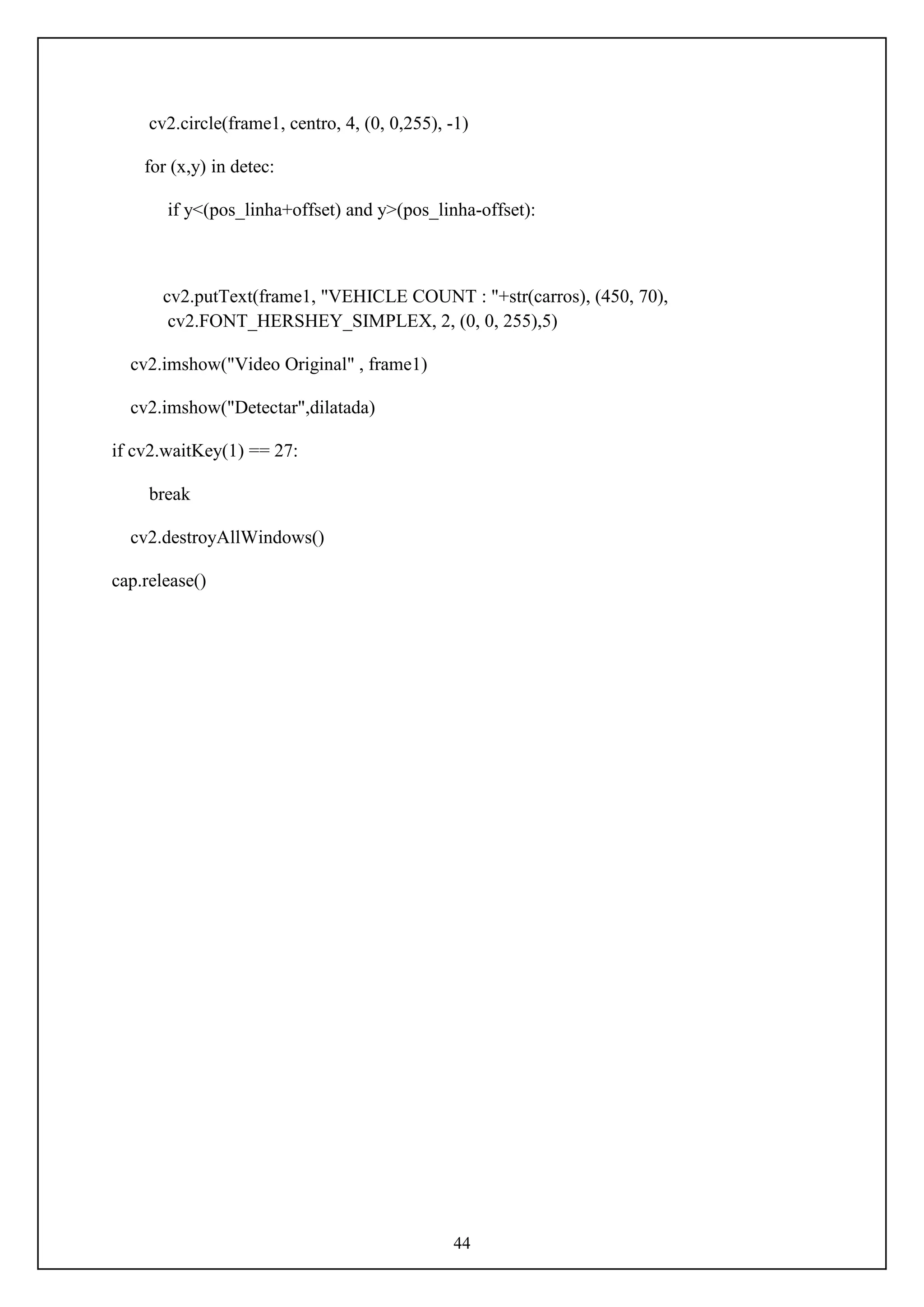
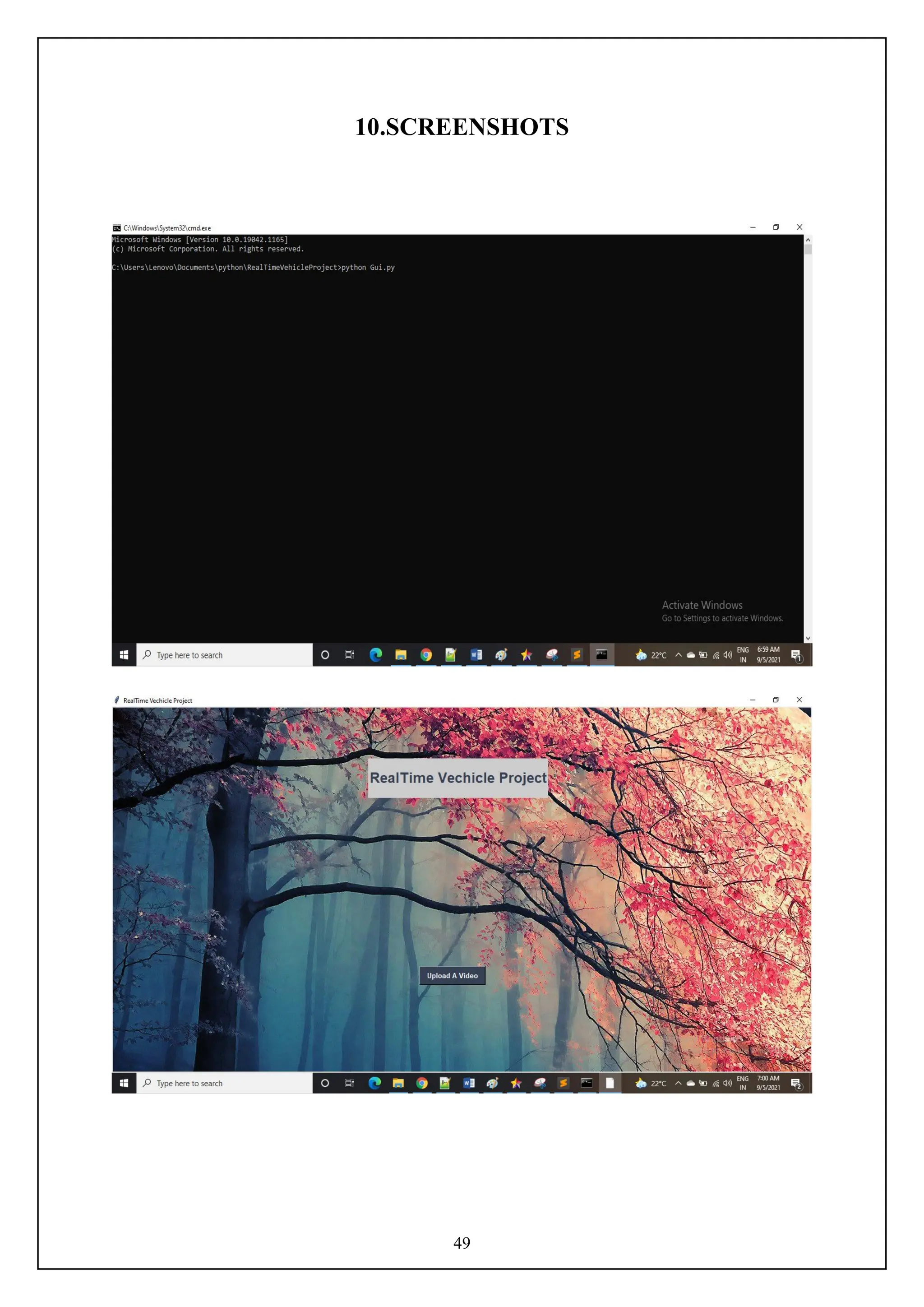
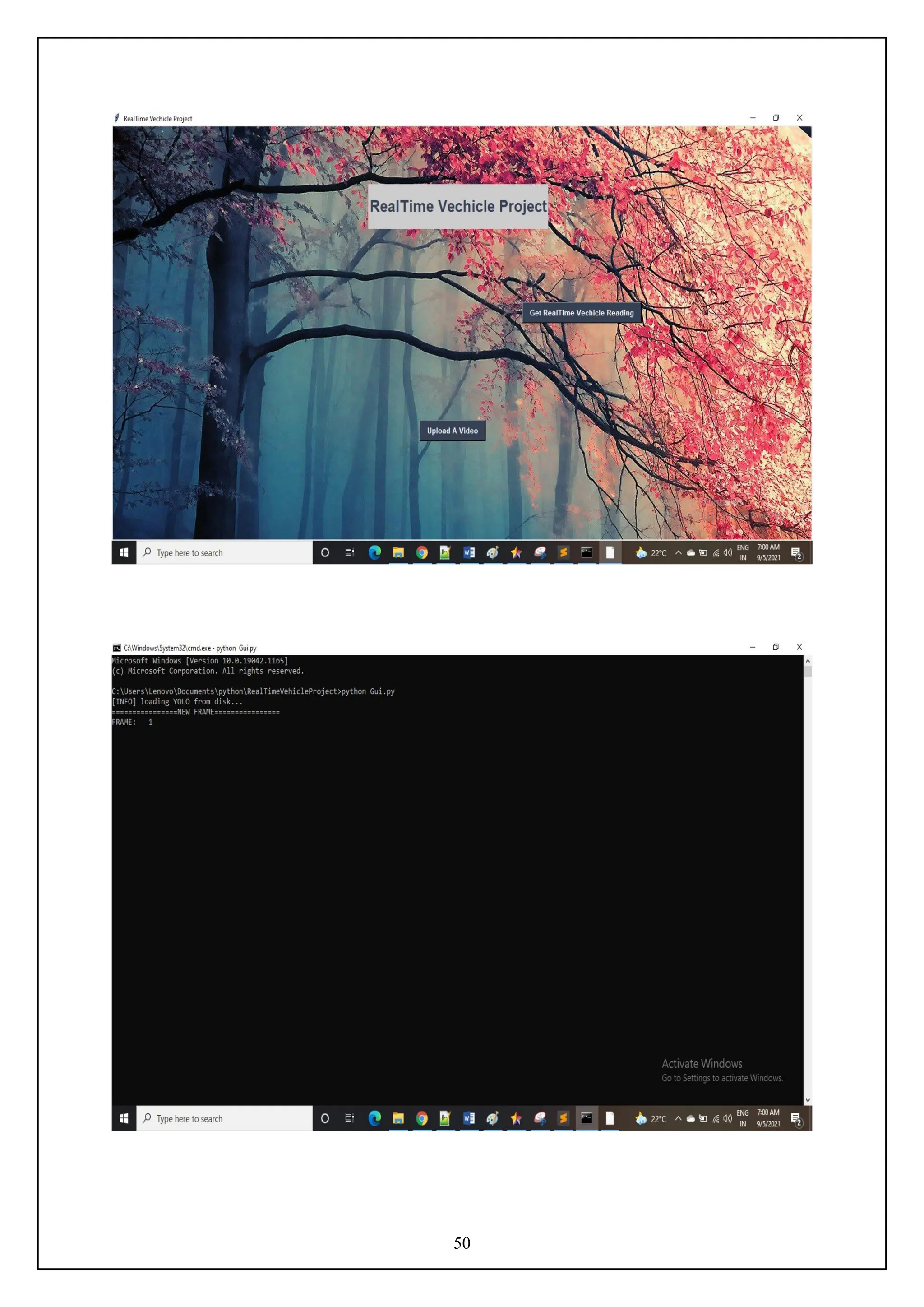
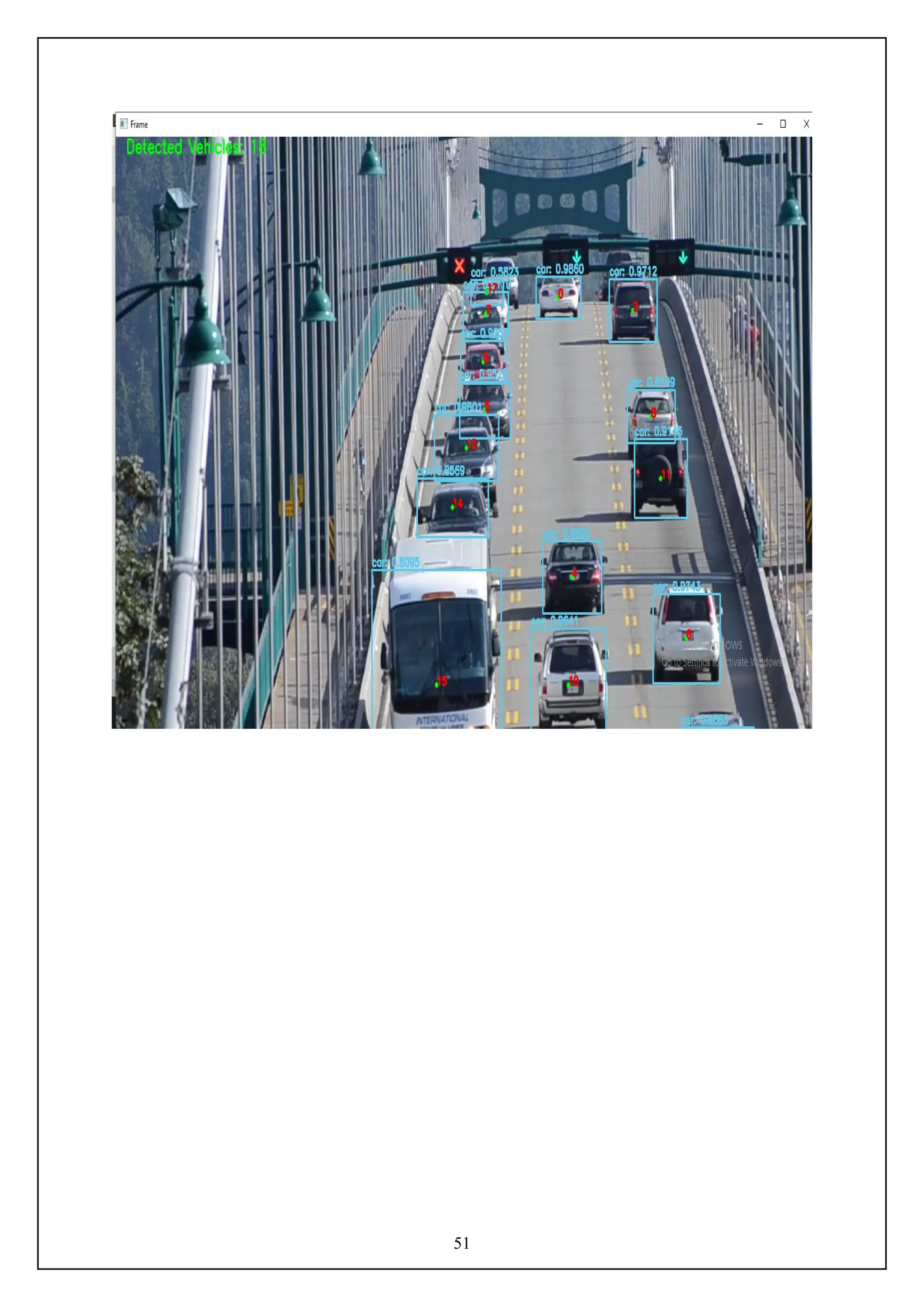
![53
12.REFERENCES
1. Alam, M. F. Ahmed, M. Alam, J. Ulisses, D. M. Farid, S. Shatabdi, and R. J. F. Rossetti,
“Pattern mining from historical traffic big data,” in IEEE Technologies for Smart Cities
(TENSYMP 2017). IEEE, July 2017, pp. 1–5.
2. I. Alam, D. M. Farid, and R. J. F. Rossetti, “The prediction of traffic flow with regression
analysis,” in Emerging Technologies in Data Mining and Information Security, ser. Advances
in Intelligent Systems and Computing, A. A., D. P., M. J., B. A., and D. S., Eds. Springer,
Singapore, 2019, vol. 813, pp. 661–671.
3. A. Talebpour, H. S. Mahmassani, and S. H. Hamdar, “Effect of information availability on
stability of traffic flow: Percolation theory approach,” Transportation Research Procedia, vol.
23, pp. 81–100, 2017.
4. ] M. Dell’Orco and M. Marinelli, “Modeling the dynamic effect of information on drivers’
choice behavior in the context of an advanced traveler information system,” Transportation
Research Part C: Emerging Technologies, vol. 85, pp. 168–183, 2017.
5. A. Csikos, T. Charalambous, H. Farhadi, B. Kulcs ´ ar, and H. Wymeersch, ´ “Network traffic
flow optimization under performance constraints,” Transportation Research Part C: Emerging
Technologies, vol. 83, pp. 120–133, 2017.
6. M. Zhou, X. Qu, and X. Li, “A recurrent neural network based microscopic car following
model to predict traffic oscillation,” Transportation Research Part C: Emerging Technologies,
vol. 84, pp. 245–264, 2017.
7. F. B. Ghorghi and H. Zhou, “Traffic control devices for deterring wrong way driving:
historical evolution and current practice,” Journal of Traffic and Transportation Engineering,
vol. 4, pp. 280–289, 2017.
8. A. Abadi, T. Rajabioun, and P. A. Ioannou, “Traffic flow prediction for road transportation
networks with limited traffic data,” IEEE Transactions on Intelligent Transportation Systems,
vol. 16, no. 2, pp. 653–662, 2015.
9. S.-Y. Cheung, and P.P. Varaiya, “Traffic surveillance by wireless sensor networks: Final
report”, PhD diss., University of California at Berkeley, 2006.
10. S. Oh, S. Ritchie, and C. Oh, “Real-time traffic measurement from single loop inductive
signatures”, Transportation Research Reco](https://image.slidesharecdn.com/ijeee-machinelearningbasedlivevechicletrackingandcounting-250225060005-5370e3d0/75/IJEEE-MACHINE-LEARNING-BASED-LIVE-VECHICLE-TRACKING-AND-COUNTING-pdf-61-2048.jpg)


![0th review MAIN 4th year[1].pptx](https://cdn.slidesharecdn.com/ss_thumbnails/0threviewmain4thyear1-231202165914-6ca5aed9-thumbnail.jpg?width=640&height=640&fit=bounds)


![FAKE SOCIAL MEDIA ACCOUNT DETECTION DOCUMENTATION[6][1] (1).docx](https://cdn.slidesharecdn.com/ss_thumbnails/fakesocialmediaaccountdetectiondocumentation611-250830044225-8915adf4-thumbnail.jpg?width=640&height=640&fit=bounds)


