GENERAL
CHEMISTRY 2
STRUCTURE
OF SOLIDS
OBJECTIVES
Describe the difference in structure of
crystalline and amorphous solids.
STEM_G11/IMFIIIa-c-104
20XX PITCH DECK 3
?????
4
Do you
know how
liquids differ
from solids?
Have you tried
soaking the
stones in water?
Have you tried
pressing the
stone too or have
you also tried
hammering the
stone?
What have you
noticed in the
structure
inside the
stone?
What have
you
observed?
ACTIVITY 1
20XX 5
Crystalline or
Amorphous
Directions: Describe the
photos in Column A. Identify
whether it is Crystalline or
Amorphous solid, put your
answer in Column B and
complete Column C with its
description. Write the answer
in a separate sheet of paper.
Ex. Fluorite _ crystalline
solid - a violet crystals with
four planes of cleavage and
is soft.
NAME TYPE OF SOLIDS
(Crystalline or
Amorphous)
DESCRIPTION
1. calcite
2.bottle
3. styrofoam
4. blue
sapphire
5. Rubber
tire
ARRANGEMENT OF PARTICLES
PITCH DECK 6
The components of solids can be arranged
in two general ways: they can form a
regular repeating three-dimensional
structure called a crystal lattice, thus
producing a crystalline solid, or they can
be aggregate with no particular long-range
order, and form an amorphous solid (from
the Greek word ámorphos, meaning
“shapeless”).
ARRANGEMENT OF PARTICLES
7
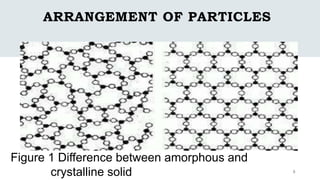
Crystalline solids are arranged in fixed geometric
patterns or lattices. Examples of crystalline solids are
ice and sodium chloride (NaCl), copper sulfate (CuSO4),
diamond, graphite, and sugar (C12H22O11). The ordered
arrangement of their units maximizes the space they
occupy and are essentially incompressible.
Amorphous solids have a random orientation of particles.
Examples of amorphous solids are glass, plastic, coal, and
rubber. They are considered super-cooled liquids where
molecules are arranged in a random manner similar to the
liquid state.
ARRANGEMENT OF PARTICLES
8
Figure 1 Difference between amorphous and
crystalline solid
20XX PITCH DECK 9
More than 90% of naturally occurring and artificially
prepared solids are crystalline. Minerals, sand, clay,
limestone, metals, alloys, carbon (diamond and
graphite), salts (e.g. NaCl and MgSO4), all have
crystalline structures. They have structures formed by
repeating three dimensional patterns of atoms, ions,
or molecules. The repetition of structural units of the
substance over long atomic distances is referred to as
long-range order.
Amorphous solids (e.g. glass), like liquids, do not have
long range order, but may have a limited, localized
order in their structures
10
Behavior of Solids when heated
The structures of crystalline solids are built from
repeating units called crystal lattices. The
surroundings of particles in the structure are
uniform, and the attractive forces experienced by
the particles are of similar types and strength.
These attractive forces are broken by the same
amount of energy, and thus, crystalline solids
become liquids at a specific temperature (i.e. the
melting point). At this temperature, physical
properties of the crystalline solids change sharply.
11
Behavior of Solids when heated
Amorphous solids soften gradually when
they are heated. They tend to melt over a
wide range of temperature. This behavior
is a result of the variation in the
arrangement of particles in their
structures, causing some parts of the solid
to melt ahead of other parts.
ACTIVITY 2:
CONCEPT
MAP
20XX PITCH DECK 12
Directions: Complete the diagram below to differentiate the
two types of solid. Write the answer on your answer sheet.
ACTIVITY 3.
BE LIKE
THE
DIAMONDS!
20XX PITCH DECK 13
Directions: Read the statement below and
answer the questions that follow.
Diamond is a crystalline solid. It is the
most expensive stone and the hardest
mineral known to man. It is the light, life,
and the sun. It is an emblem of purity
and perfection, of invincible spiritual
power, and it is the stone of commitment,
faithfulness and promise between
husband and wife. As a symbol of light
and brilliance, unconquerable treasures,
riches and intellectual knowledge
ACTIVITY 3.
BE LIKE THE
DIAMONDS!
20XX PITCH DECK 14
Questions:
1.Based on the above
statement, why is diamond
considered as an expensive
stone?
2. Why do diamonds given as
an engagement ring by many
couples?
GOOD
DAY
20XX 15
20XX PITCH DECK 18
Activity 1.A
1. Crystalline- Colorless or white crystals,
has perfect cleavage in three
directions.
2. Amorphous- Made of impermeable
materials (glass), transparent, and
seamless
3. Amorphous- An exceptionally light
weight material, an effective
insulator, a white plastic type of
polystyrene.
4. Crystalline- A very desirable gemstone
due to its excellent color, hardness,
durability and luster.
5. Amorphous- A highly elastic slid
substance, dark amber in color,
polymerized by the drying and
coagulation of the latex from rubber
tree.
Activity 2
Amorphous vs crystalline
Random fixed
Soften gradually become liquid
Wide range specific temp
Melting temp
Answer may vary
Rubber quartz
Activity 3
1. It is used in jewelries.
It is the hardest known crystalline
solid.
It is used to cut glasses.
2. Diamonds portray love, purity,
faithfulness, strength and beauty.
MEET THE TEAM
TAKUMA HAYASHI​
VP Marketing
GRAHAM BARNES
VP Product
ROWAN MURPHY
SEO Strategist
ELIZABETH MOORE
Product Designer
ROBIN KLINE
Content Developer
20XX PITCH DECK 19
20XX PITCH DECK 20
THANK YOU
20XX PITCH DECK 21

iii-STRUCTURE-OF-SOLIDS boracay beach.pptx

  • 1.
  • 2.
  • 3.
    OBJECTIVES Describe the differencein structure of crystalline and amorphous solids. STEM_G11/IMFIIIa-c-104 20XX PITCH DECK 3
  • 4.
    ????? 4 Do you know how liquidsdiffer from solids? Have you tried soaking the stones in water? Have you tried pressing the stone too or have you also tried hammering the stone? What have you noticed in the structure inside the stone? What have you observed?
  • 5.
    ACTIVITY 1 20XX 5 Crystallineor Amorphous Directions: Describe the photos in Column A. Identify whether it is Crystalline or Amorphous solid, put your answer in Column B and complete Column C with its description. Write the answer in a separate sheet of paper. Ex. Fluorite _ crystalline solid - a violet crystals with four planes of cleavage and is soft. NAME TYPE OF SOLIDS (Crystalline or Amorphous) DESCRIPTION 1. calcite 2.bottle 3. styrofoam 4. blue sapphire 5. Rubber tire
  • 6.
    ARRANGEMENT OF PARTICLES PITCHDECK 6 The components of solids can be arranged in two general ways: they can form a regular repeating three-dimensional structure called a crystal lattice, thus producing a crystalline solid, or they can be aggregate with no particular long-range order, and form an amorphous solid (from the Greek word ámorphos, meaning “shapeless”).
  • 7.
    ARRANGEMENT OF PARTICLES 7 Crystallinesolids are arranged in fixed geometric patterns or lattices. Examples of crystalline solids are ice and sodium chloride (NaCl), copper sulfate (CuSO4), diamond, graphite, and sugar (C12H22O11). The ordered arrangement of their units maximizes the space they occupy and are essentially incompressible. Amorphous solids have a random orientation of particles. Examples of amorphous solids are glass, plastic, coal, and rubber. They are considered super-cooled liquids where molecules are arranged in a random manner similar to the liquid state.
  • 8.
    ARRANGEMENT OF PARTICLES 8 Figure1 Difference between amorphous and crystalline solid
  • 9.
    20XX PITCH DECK9 More than 90% of naturally occurring and artificially prepared solids are crystalline. Minerals, sand, clay, limestone, metals, alloys, carbon (diamond and graphite), salts (e.g. NaCl and MgSO4), all have crystalline structures. They have structures formed by repeating three dimensional patterns of atoms, ions, or molecules. The repetition of structural units of the substance over long atomic distances is referred to as long-range order. Amorphous solids (e.g. glass), like liquids, do not have long range order, but may have a limited, localized order in their structures
  • 10.
    10 Behavior of Solidswhen heated The structures of crystalline solids are built from repeating units called crystal lattices. The surroundings of particles in the structure are uniform, and the attractive forces experienced by the particles are of similar types and strength. These attractive forces are broken by the same amount of energy, and thus, crystalline solids become liquids at a specific temperature (i.e. the melting point). At this temperature, physical properties of the crystalline solids change sharply.
  • 11.
    11 Behavior of Solidswhen heated Amorphous solids soften gradually when they are heated. They tend to melt over a wide range of temperature. This behavior is a result of the variation in the arrangement of particles in their structures, causing some parts of the solid to melt ahead of other parts.
  • 12.
    ACTIVITY 2: CONCEPT MAP 20XX PITCHDECK 12 Directions: Complete the diagram below to differentiate the two types of solid. Write the answer on your answer sheet.
  • 13.
    ACTIVITY 3. BE LIKE THE DIAMONDS! 20XXPITCH DECK 13 Directions: Read the statement below and answer the questions that follow. Diamond is a crystalline solid. It is the most expensive stone and the hardest mineral known to man. It is the light, life, and the sun. It is an emblem of purity and perfection, of invincible spiritual power, and it is the stone of commitment, faithfulness and promise between husband and wife. As a symbol of light and brilliance, unconquerable treasures, riches and intellectual knowledge
  • 14.
    ACTIVITY 3. BE LIKETHE DIAMONDS! 20XX PITCH DECK 14 Questions: 1.Based on the above statement, why is diamond considered as an expensive stone? 2. Why do diamonds given as an engagement ring by many couples?
  • 15.
  • 18.
    20XX PITCH DECK18 Activity 1.A 1. Crystalline- Colorless or white crystals, has perfect cleavage in three directions. 2. Amorphous- Made of impermeable materials (glass), transparent, and seamless 3. Amorphous- An exceptionally light weight material, an effective insulator, a white plastic type of polystyrene. 4. Crystalline- A very desirable gemstone due to its excellent color, hardness, durability and luster. 5. Amorphous- A highly elastic slid substance, dark amber in color, polymerized by the drying and coagulation of the latex from rubber tree. Activity 2 Amorphous vs crystalline Random fixed Soften gradually become liquid Wide range specific temp Melting temp Answer may vary Rubber quartz Activity 3 1. It is used in jewelries. It is the hardest known crystalline solid. It is used to cut glasses. 2. Diamonds portray love, purity, faithfulness, strength and beauty.
  • 19.
    MEET THE TEAM TAKUMAHAYASHI​ VP Marketing GRAHAM BARNES VP Product ROWAN MURPHY SEO Strategist ELIZABETH MOORE Product Designer ROBIN KLINE Content Developer 20XX PITCH DECK 19
  • 20.
  • 21.

Editor's Notes

  • #6 Compare your above description about the solids below. Solids can be categorized into two groups: the crystalline solids and the amorphous solids. The differences in properties of these two groups of solids .