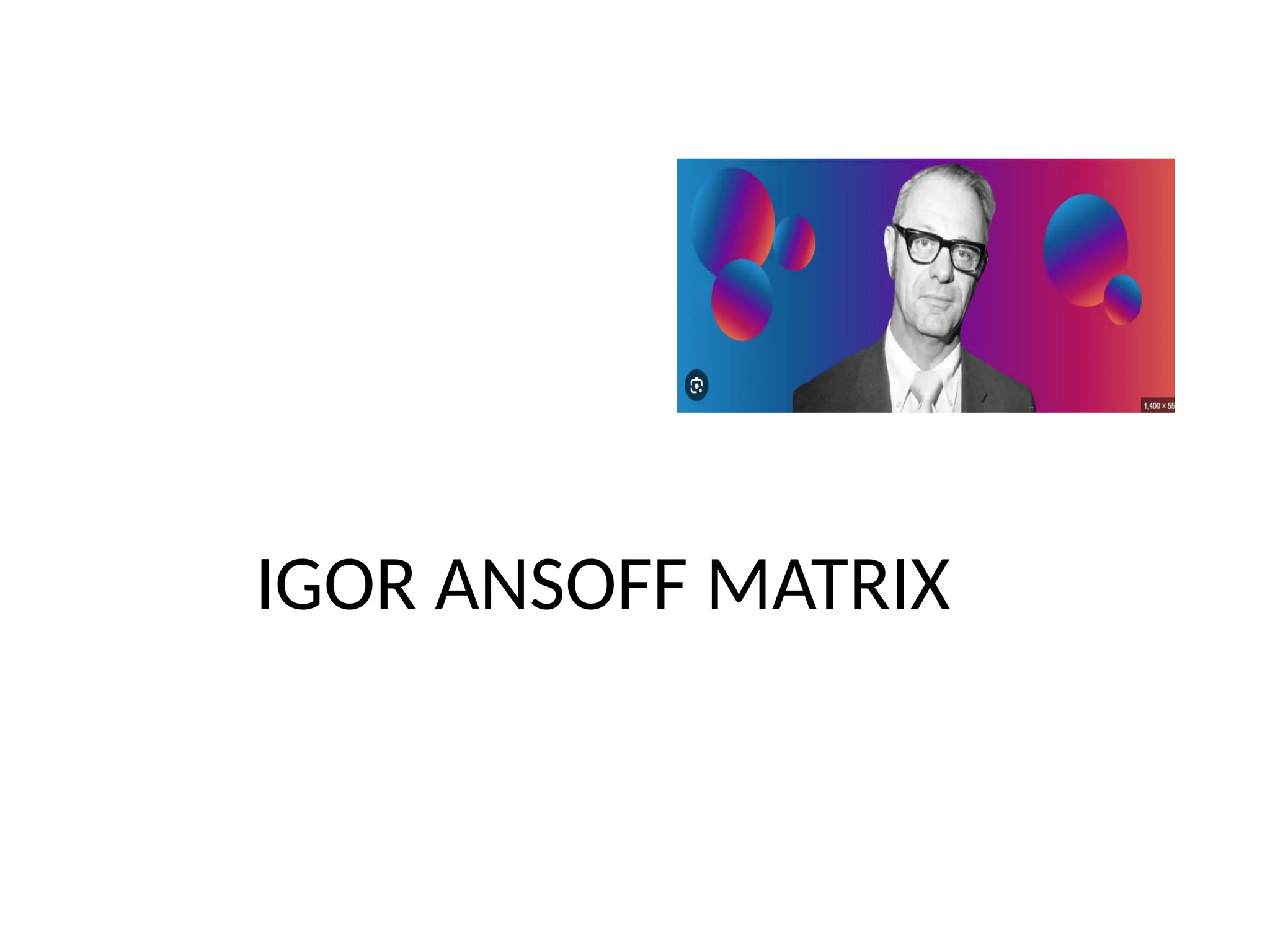
IGOR ANSOFF MATRIX
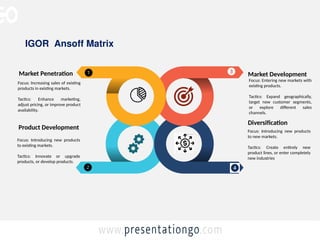
IGOR Ansoff Matrix
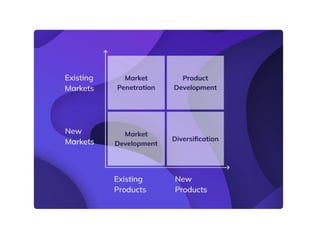
Product Development
Focus: Introducing new products
to existing markets.
Tactics: Innovate or upgrade
products, or develop products.
Market Penetration
Focus: Increasing sales of existing
products in existing markets.
Tactics: Enhance marketing,
adjust pricing, or improve product
availability.
Diversification
Focus: Introducing new products
to new markets.
Tactics: Create entirely new
product lines, or enter completely
new industries
Market Development
Focus: Entering new markets with
existing products.
Tactics: Expand geographically,
target new customer segments,
or explore different sales
channels.
MARKET PENETRATION
Overview: KitKat entered India in 1995, strategically positioning itself as an
affordable yet premium chocolate option amidst established competitors like
Cadbury.
Key Strategies:
Product Adaptation: KitKat tailored its offerings to local tastes while maintaining
its global brand identity, introducing smaller pack sizes to cater to price-sensitive
consumers.
Innovative Marketing: The brand employed creative advertising campaigns
centered around relaxation and enjoyment, effectively resonating with Indian
consumers.
Wide Distribution : Network: Ensuring availability across various retail formats
helped KitKat penetrate both urban and rural markets successfully.
Overview: Starbucks entered the Indian market in 2011 after a failed attempt in
2007. The company partnered with Tata Global Beverages, leveraging local
knowledge to enhance its market presence.
Key Strategies:
Joint Venture: Starbucks utilized a joint venture model to navigate the
complexities of the Indian market, gaining access to local supply chains and
consumer insights.
Adaptation: The brand adapted its product offerings to cater to local tastes,
including introducing beverages that resonate with Indian consumers
Market Positioning: Positioned as a premium coffee experience, Starbucks
capitalized on India's growing coffee culture, targeting urban professionals and
young consumers1.
Strategy: Market Penetration in the Paint Industry.
Strong Branding: Focused on strong branding and advertising campaigns to
enhance brand recognition.
Dealer Network: Expanded its dealer network to ensure availability in every nook
and corner of the country.
Loyalty Programs: Introduced loyalty programs for painters and contractors to
increase product loyalty and preference.
PRODUCT DEVELOPMENT
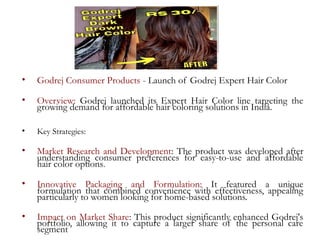
• Godrej Consumer Products - Launch of Godrej Expert Hair Color
• Overview: Godrej launched its Expert Hair Color line targeting the
growing demand for affordable hair coloring solutions in India.
• Key Strategies:
• Market Research and Development: The product was developed after
understanding consumer preferences for easy-to-use and affordable
hair color options.
• Innovative Packaging and Formulation: It featured a unique
formulation that combined convenience with effectiveness, appealing
particularly to women looking for home-based solutions.
• Impact on Market Share: This product significantly enhanced Godrej's
portfolio, allowing it to capture a larger share of the personal care
segment
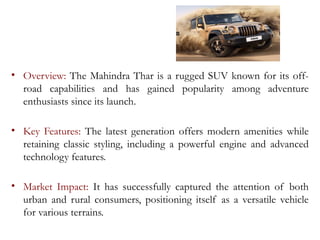
• Overview: The Mahindra Thar is a rugged SUV known for its off-
road capabilities and has gained popularity among adventure
enthusiasts since its launch.
• Key Features: The latest generation offers modern amenities while
retaining classic styling, including a powerful engine and advanced
technology features.
• Market Impact: It has successfully captured the attention of both
urban and rural consumers, positioning itself as a versatile vehicle
for various terrains.
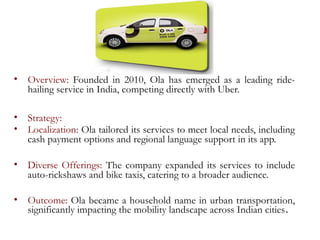
• Overview: Founded in 2010, Ola has emerged as a leading ride-
hailing service in India, competing directly with Uber.
• Strategy:
• Localization: Ola tailored its services to meet local needs, including
cash payment options and regional language support in its app.
• Diverse Offerings: The company expanded its services to include
auto-rickshaws and bike taxis, catering to a broader audience.
• Outcome: Ola became a household name in urban transportation,
significantly impacting the mobility landscape across Indian cities.
MARKET DEVELOPMENT
• Overview: McDonald's entered the Indian market in 1996, facing
significant cultural and operational challenges.
• Localization: To cater to Indian tastes, McDonald's introduced a menu
that excluded beef and pork, focusing on vegetarian options like the
McAloo Tikki burger.
• Affordability: The company launched value meals to make its offerings
more accessible to the price-sensitive Indian consumer.
• Outcome: This strategy allowed McDonald's to establish a strong
foothold in India, adapting to local preferences while maintaining its
global brand identity.
• Overview: HDFC Bank has consistently expanded its services across
different regions in India since its inception in 1994.
• Branch Expansion: HDFC Bank focused on increasing its branch
network in both urban and rural areas to reach a broader customer
base.
• Digital Banking Initiatives: The bank invested in technology to offer
online banking services, catering to the growing demand for digital
solutions.
• Outcome: HDFC Bank became one of India's leading private sector
banks, known for its customer service and innovative banking
products.
• Overview: Zomato started as a restaurant discovery platform and
evolved into a leading food delivery service in India.
• Hyperlocal Marketing: Zomato tailored its services based on local
culinary preferences and partnered with restaurants across diverse
regions.
• Expansion into New Cities: The platform expanded rapidly into tier
II and III cities, tapping into previously underserved markets.
• Outcome: Zomato became synonymous with food delivery in India,
significantly enhancing its market presence through localized
strategies
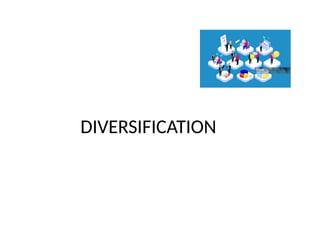
DIVERSIFICATION
• Overview: Tata Group is one of India’s largest conglomerates, with interests
spanning multiple industries including steel, automobiles, IT, and consumer
goods
• Conglomerate Diversification: Tata expanded into unrelated sectors such as
hospitality (Taj Hotels) and telecommunications (Tata Communications).
• Synergy Utilization: Leveraged its brand reputation and resources across
diverse industries to enhance overall profitability.
• Outcome: Tata Group has successfully built a diversified portfolio that
mitigates risks and capitalizes on growth opportunities across various sectors.
• Overview: Initially focused on two-wheelers, Bajaj Auto has diversified into
three-wheelers and electric vehicles.
• Product Diversification: Launched electric scooters under the brand "Chetak"
while expanding its three-wheeler range for urban transport solutions.
• International Markets Expansion: Entered markets in Africa and Latin America
with tailored products for local needs.
• Outcome: Bajaj Auto has strengthened its market position by expanding its
product portfolio beyond traditional motorcycles.

Igor Ansoff Matrix ppt marketing management

  • 1.
  • 3.
    IGOR Ansoff Matrix ProductDevelopment Focus: Introducing new products to existing markets. Tactics: Innovate or upgrade products, or develop products. Market Penetration Focus: Increasing sales of existing products in existing markets. Tactics: Enhance marketing, adjust pricing, or improve product availability. Diversification Focus: Introducing new products to new markets. Tactics: Create entirely new product lines, or enter completely new industries Market Development Focus: Entering new markets with existing products. Tactics: Expand geographically, target new customer segments, or explore different sales channels.
  • 4.
  • 5.
    Overview: KitKat enteredIndia in 1995, strategically positioning itself as an affordable yet premium chocolate option amidst established competitors like Cadbury. Key Strategies: Product Adaptation: KitKat tailored its offerings to local tastes while maintaining its global brand identity, introducing smaller pack sizes to cater to price-sensitive consumers. Innovative Marketing: The brand employed creative advertising campaigns centered around relaxation and enjoyment, effectively resonating with Indian consumers. Wide Distribution : Network: Ensuring availability across various retail formats helped KitKat penetrate both urban and rural markets successfully.
  • 6.
    Overview: Starbucks enteredthe Indian market in 2011 after a failed attempt in 2007. The company partnered with Tata Global Beverages, leveraging local knowledge to enhance its market presence. Key Strategies: Joint Venture: Starbucks utilized a joint venture model to navigate the complexities of the Indian market, gaining access to local supply chains and consumer insights. Adaptation: The brand adapted its product offerings to cater to local tastes, including introducing beverages that resonate with Indian consumers Market Positioning: Positioned as a premium coffee experience, Starbucks capitalized on India's growing coffee culture, targeting urban professionals and young consumers1.
  • 7.
    Strategy: Market Penetrationin the Paint Industry. Strong Branding: Focused on strong branding and advertising campaigns to enhance brand recognition. Dealer Network: Expanded its dealer network to ensure availability in every nook and corner of the country. Loyalty Programs: Introduced loyalty programs for painters and contractors to increase product loyalty and preference.
  • 8.
  • 9.
    • Godrej ConsumerProducts - Launch of Godrej Expert Hair Color • Overview: Godrej launched its Expert Hair Color line targeting the growing demand for affordable hair coloring solutions in India. • Key Strategies: • Market Research and Development: The product was developed after understanding consumer preferences for easy-to-use and affordable hair color options. • Innovative Packaging and Formulation: It featured a unique formulation that combined convenience with effectiveness, appealing particularly to women looking for home-based solutions. • Impact on Market Share: This product significantly enhanced Godrej's portfolio, allowing it to capture a larger share of the personal care segment
  • 10.
    • Overview: TheMahindra Thar is a rugged SUV known for its off- road capabilities and has gained popularity among adventure enthusiasts since its launch. • Key Features: The latest generation offers modern amenities while retaining classic styling, including a powerful engine and advanced technology features. • Market Impact: It has successfully captured the attention of both urban and rural consumers, positioning itself as a versatile vehicle for various terrains.
  • 11.
    • Overview: Foundedin 2010, Ola has emerged as a leading ride- hailing service in India, competing directly with Uber. • Strategy: • Localization: Ola tailored its services to meet local needs, including cash payment options and regional language support in its app. • Diverse Offerings: The company expanded its services to include auto-rickshaws and bike taxis, catering to a broader audience. • Outcome: Ola became a household name in urban transportation, significantly impacting the mobility landscape across Indian cities.
  • 12.
  • 13.
    • Overview: McDonald'sentered the Indian market in 1996, facing significant cultural and operational challenges. • Localization: To cater to Indian tastes, McDonald's introduced a menu that excluded beef and pork, focusing on vegetarian options like the McAloo Tikki burger. • Affordability: The company launched value meals to make its offerings more accessible to the price-sensitive Indian consumer. • Outcome: This strategy allowed McDonald's to establish a strong foothold in India, adapting to local preferences while maintaining its global brand identity.
  • 14.
    • Overview: HDFCBank has consistently expanded its services across different regions in India since its inception in 1994. • Branch Expansion: HDFC Bank focused on increasing its branch network in both urban and rural areas to reach a broader customer base. • Digital Banking Initiatives: The bank invested in technology to offer online banking services, catering to the growing demand for digital solutions. • Outcome: HDFC Bank became one of India's leading private sector banks, known for its customer service and innovative banking products.
  • 15.
    • Overview: Zomatostarted as a restaurant discovery platform and evolved into a leading food delivery service in India. • Hyperlocal Marketing: Zomato tailored its services based on local culinary preferences and partnered with restaurants across diverse regions. • Expansion into New Cities: The platform expanded rapidly into tier II and III cities, tapping into previously underserved markets. • Outcome: Zomato became synonymous with food delivery in India, significantly enhancing its market presence through localized strategies
  • 16.
  • 17.
    • Overview: TataGroup is one of India’s largest conglomerates, with interests spanning multiple industries including steel, automobiles, IT, and consumer goods • Conglomerate Diversification: Tata expanded into unrelated sectors such as hospitality (Taj Hotels) and telecommunications (Tata Communications). • Synergy Utilization: Leveraged its brand reputation and resources across diverse industries to enhance overall profitability. • Outcome: Tata Group has successfully built a diversified portfolio that mitigates risks and capitalizes on growth opportunities across various sectors.
  • 18.
    • Overview: Initiallyfocused on two-wheelers, Bajaj Auto has diversified into three-wheelers and electric vehicles. • Product Diversification: Launched electric scooters under the brand "Chetak" while expanding its three-wheeler range for urban transport solutions. • International Markets Expansion: Entered markets in Africa and Latin America with tailored products for local needs. • Outcome: Bajaj Auto has strengthened its market position by expanding its product portfolio beyond traditional motorcycles.
Editor's Notes

  • #3 © Copyright PresentationGO.com – Free Templates & Infographics for PowerPoint and Google Slides