Impact
Investing: Know
how it works
2
The concept of impact investment is
capturing the attention of investors. As
per the recent report by the Global
Impact Investing Network (GIIN), over
1,300 organizations manage $502 billion
in impact investing assets globally.
3
What is impact investing?
• Impact investing directs
capital to those firms that
generate social or
environmental benefits apart
from profits.
• As an investor, you make
investments with an intention
to generate positive,
measurable social and
environmental impact
alongside a financial return.
• For instance, investing in
sectors such as sustainable
agriculture, renewable
energy, conservation,
microfinance, and affordable
and accessible basic services
including housing,
healthcare, and education
would be clubbed under
impact investing.
4
How it is different?
• The difference today is that impact investors are
far more proactive in their intention for positive
impact as opposed to merely avoiding the
negative impacts.
• Similarly, it cannot be compared to other similar
ideas such as conscious capitalism, sustainable
investment, and ethical investment
• Impact investing differs from socially
responsible investment, which is a well-defined
framework for choosing investments based on
environmental, social and governance criteria.
• In fact, impact investing has evolved out of
socially responsible investment, to the broader
investment community.
5
Social venture funds
• According to a recent
Brookings report, the impact
investing sector
in India attracted over $5.2
billion between 2010 and
2016, with over $1.1 billion
invested in 2016 alone.
• In recent past, private capital
has flowed into sectors such
as microfinance, health
services, education and other
allied sectors.
6
Social venture funds
• This indicates a growing interest
in investing money for both profit
and social or environmental
good. Recently, private investors
have been putting their money
into areas like microfinance,
healthcare, and education in
India. This means funds are going
towards initiatives that provide
financial services to underserved
communities, improve healthcare
access, and enhance educational
opportunities. Overall, it reflects
a trend of using investments to
make positive changes in society.
7
Characteristics
.
• Intentionally Contribute to Positive
Social and Environmental Impact
through Investment alongside a
Financial Return.
8
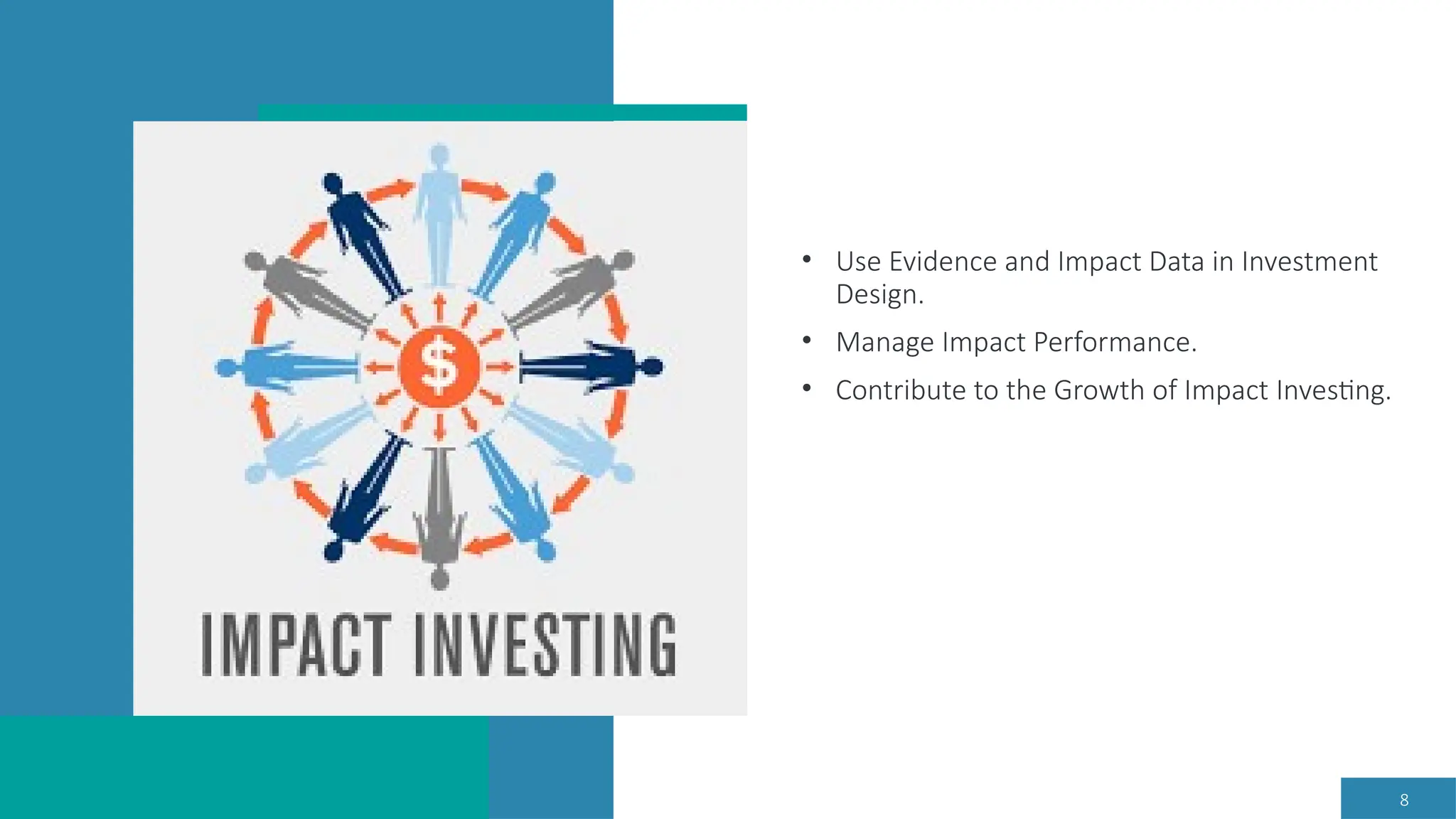
• Use Evidence and Impact Data in Investment
Design.
• Manage Impact Performance.
• Contribute to the Growth of Impact Investing.
9
Tremendous opportunity
• Based on the market scenario, an
impact fund would typically focus to
develop a diversified portfolio across
the segments. Let us take the
example of SME financing.
• India has a huge entrepreneurial
class of people who run their
business with no formal source of
financing.
• There exists a great demand-supply
gap which needs to be addressed.
The opportunity in the SME financing
segment with products such as asset
financing, working
capital financing, venture debt, loan
against mortgage, etc., is huge.
Click icon to add chart
10
Strengths:
Positive Social and Environmental Impact:
Impact investing is primarily focused on
generating positive social and environmental
outcomes alongside financial returns. This focus
attracts socially conscious investors and
contributes to sustainable development goals.
Alignment with Values: Impact investing allows
investors to align their financial goals with their
personal values. This alignment fosters a sense of
purpose and fulfillment, attracting individuals
and institutions seeking more than just monetary
gains.
SWOT ANALYSIS:
11
Weaknesses
• Limited Track Record: Compared to
traditional investment approaches,
impact investing has a relatively short
track record. This lack of historical
data may deter some investors who
prioritize certainty and predictability
in their investment decisions.
• Risk and Return Trade-offs: Balancing
financial returns with social and
environmental impact can be
challenging. Impact investments may
entail higher risks or lower financial
returns compared to conventional
investments, which could deter risk-
averse investors.
12
Opportunities:
• Market Growth: The growing
awareness of social and
environmental issues,
coupled with increasing
investor demand for
responsible investment
options, presents significant
growth opportunities for
impact investing. This trend is
fueled by millennials and
Generation Z, who prioritize
purpose-driven investments
• Innovation in Financial
Instruments: There is
potential for innovation in
financial instruments tailored
to impact investing, such as
green bonds, social impact
bonds, and thematic funds.
These instruments can attract
new investors and expand
the reach of impact investing
across different asset classes.
13
• Lack of Standardization: The absence of standardized impact
measurement and reporting frameworks hampers transparency and
comparability across impact investments. This lack of standardization
may hinder investor decision-making and impede the scalability of
impact investing.
• Socio-Political Factors: Socio-political factors, such as regulatory
changes, geopolitical instability, or shifts in public sentiment, can
influence the operating environment for impact investing.
Uncertainty or adverse developments in these areas may dampen
investor enthusiasm and impact investment flows.
Threats:
• Greenwashing: There is a risk of greenwashing, where
investments are marketed as impactful without delivering
meaningful social or environmental benefits. Greenwashing
undermines the credibility of impact investing and erodes
investor trust.
• Market Volatility: Economic downturns or market fluctuations
can affect investor confidence in impact investing, leading to
capital flight or reduced funding for impactful projects. Volatility
in financial markets may also exacerbate risk perceptions
associated with impact investments.
14
Impact investing holds immense potential to
drive positive social and environmental change
while generating financial returns. By capitalizing
on its strengths, addressing weaknesses,
leveraging opportunities, and mitigating threats,
impact investing can evolve into a mainstream
investment approach that contributes to a more
sustainable and inclusive global economy.
CONCLUSION
THANK YOU
P. Sushmna

IFS PPT.pptxxxxxxxxxxxxxxxxxxxxxxxxxxxxx

  • 1.
  • 2.
    2 The concept ofimpact investment is capturing the attention of investors. As per the recent report by the Global Impact Investing Network (GIIN), over 1,300 organizations manage $502 billion in impact investing assets globally.
  • 3.
    3 What is impactinvesting? • Impact investing directs capital to those firms that generate social or environmental benefits apart from profits. • As an investor, you make investments with an intention to generate positive, measurable social and environmental impact alongside a financial return. • For instance, investing in sectors such as sustainable agriculture, renewable energy, conservation, microfinance, and affordable and accessible basic services including housing, healthcare, and education would be clubbed under impact investing.
  • 4.
    4 How it isdifferent? • The difference today is that impact investors are far more proactive in their intention for positive impact as opposed to merely avoiding the negative impacts. • Similarly, it cannot be compared to other similar ideas such as conscious capitalism, sustainable investment, and ethical investment • Impact investing differs from socially responsible investment, which is a well-defined framework for choosing investments based on environmental, social and governance criteria. • In fact, impact investing has evolved out of socially responsible investment, to the broader investment community.
  • 5.
    5 Social venture funds •According to a recent Brookings report, the impact investing sector in India attracted over $5.2 billion between 2010 and 2016, with over $1.1 billion invested in 2016 alone. • In recent past, private capital has flowed into sectors such as microfinance, health services, education and other allied sectors.
  • 6.
    6 Social venture funds •This indicates a growing interest in investing money for both profit and social or environmental good. Recently, private investors have been putting their money into areas like microfinance, healthcare, and education in India. This means funds are going towards initiatives that provide financial services to underserved communities, improve healthcare access, and enhance educational opportunities. Overall, it reflects a trend of using investments to make positive changes in society.
  • 7.
    7 Characteristics . • Intentionally Contributeto Positive Social and Environmental Impact through Investment alongside a Financial Return.
  • 8.
    8 • Use Evidenceand Impact Data in Investment Design. • Manage Impact Performance. • Contribute to the Growth of Impact Investing.
  • 9.
    9 Tremendous opportunity • Basedon the market scenario, an impact fund would typically focus to develop a diversified portfolio across the segments. Let us take the example of SME financing. • India has a huge entrepreneurial class of people who run their business with no formal source of financing. • There exists a great demand-supply gap which needs to be addressed. The opportunity in the SME financing segment with products such as asset financing, working capital financing, venture debt, loan against mortgage, etc., is huge. Click icon to add chart
  • 10.
    10 Strengths: Positive Social andEnvironmental Impact: Impact investing is primarily focused on generating positive social and environmental outcomes alongside financial returns. This focus attracts socially conscious investors and contributes to sustainable development goals. Alignment with Values: Impact investing allows investors to align their financial goals with their personal values. This alignment fosters a sense of purpose and fulfillment, attracting individuals and institutions seeking more than just monetary gains. SWOT ANALYSIS:
  • 11.
    11 Weaknesses • Limited TrackRecord: Compared to traditional investment approaches, impact investing has a relatively short track record. This lack of historical data may deter some investors who prioritize certainty and predictability in their investment decisions. • Risk and Return Trade-offs: Balancing financial returns with social and environmental impact can be challenging. Impact investments may entail higher risks or lower financial returns compared to conventional investments, which could deter risk- averse investors.
  • 12.
    12 Opportunities: • Market Growth:The growing awareness of social and environmental issues, coupled with increasing investor demand for responsible investment options, presents significant growth opportunities for impact investing. This trend is fueled by millennials and Generation Z, who prioritize purpose-driven investments • Innovation in Financial Instruments: There is potential for innovation in financial instruments tailored to impact investing, such as green bonds, social impact bonds, and thematic funds. These instruments can attract new investors and expand the reach of impact investing across different asset classes.
  • 13.
    13 • Lack ofStandardization: The absence of standardized impact measurement and reporting frameworks hampers transparency and comparability across impact investments. This lack of standardization may hinder investor decision-making and impede the scalability of impact investing. • Socio-Political Factors: Socio-political factors, such as regulatory changes, geopolitical instability, or shifts in public sentiment, can influence the operating environment for impact investing. Uncertainty or adverse developments in these areas may dampen investor enthusiasm and impact investment flows. Threats: • Greenwashing: There is a risk of greenwashing, where investments are marketed as impactful without delivering meaningful social or environmental benefits. Greenwashing undermines the credibility of impact investing and erodes investor trust. • Market Volatility: Economic downturns or market fluctuations can affect investor confidence in impact investing, leading to capital flight or reduced funding for impactful projects. Volatility in financial markets may also exacerbate risk perceptions associated with impact investments.
  • 14.
    14 Impact investing holdsimmense potential to drive positive social and environmental change while generating financial returns. By capitalizing on its strengths, addressing weaknesses, leveraging opportunities, and mitigating threats, impact investing can evolve into a mainstream investment approach that contributes to a more sustainable and inclusive global economy. CONCLUSION
  • 15.