April 29-30, 2014
Union League Club of Chicago
2014 Primer
Presented by
©CarrClifton
SmarterMoney+
The Kellogg School of
Management
is proud to support the
Impact Capitalism
Summit
and its mission to maximize
impact and return, which
aligns with our vision of
sustainable capital as an
instrument of positive change.
About the Organizer
OVERVIEW: Watershed Capital Group is a specialty consulting firm assisting sustainable companies and fund
managers seeking solutions including raising capital and executing M&A transactions and in evaluating
strategic financial options. Watershed’s clients include entrepreneurs, companies, and fund managers scaling
sustainable solutions that lead to competitive advantages and long-term value creation.
A new model of value creation is emerging deploying capital in strategies that leverage the inherent link
between natural, social and financial capital. strategies that leverage the inherent link between natural, social
and financial capital. The global move toward sustainability represents one of the most attractive investment
opportunities of our era. In the face of increasing resource scarcity and growing global demand for these
resources, sustainable strategies are enabling differentiated competitive advantages that lead to long-term
value creation. Watershed’s clients are entrepreneurs, companies, and fund managers scaling sustainable
solutions.
EXPERIENCE: With over 100 years of experience and over seventy-five engagements, Watershed partners are
committed to assisting its clients achieve success and scale a sustainable economy. Each partner has
domain knowledge in multiple industries, in both operational and financial capacities making Watershed one
of the most experienced teams in the sector. Specific industry sector experience includes: organic foods,
renewable energy, energy efficiency, media, water, sustainable ag and aquaculture, green consumer
products, manufacturing, industrial technologies, recycling, bio-plastics, advanced lighting, green building
products, transportation and environmental services. The Watershed team brings a diverse set of functional
backgrounds to clients including private equity, venture capital, investment banking, securities law, and
operational management.
NETWORK: With an exclusive focus in the sustainable/impact sector, Watershed Capital Group represents one
of the most comprehensive global networks of companies, funds and institutional investors focused in this
sector. Watershed Capital Group maintains a reputation as an innovator in the sustainable sector launching
and developing several initiatives. Some of these initiatives are the Five Fund Forum, Impact Capitalism
Circle, and the Global Cleantech Cluster Association. These activities have given Watershed Capital Group
one of the broadest networks in the industry. Watershed is also proud to be a founding B Corp member.
Michael Whelchel Shawn Lesser Aaron L. Enz Lydia Miller
Managing Partner Managing Partner Partner Managing Director
michael@watershedcapital.com shawn@watershedcapital.com aaron@watershedcapital.com lydia@watershedcapital.com
(828) 251 4645 (404) 257 3382 (415) 686 0068 (773) 415-2063
www.watershedcapital.com
Securities offered through Intellivest Securities, Inc., Member FINRA/SIPC
Impact Capitalism Summit 2014 Primer 3
About the Primer
As Impact Investing mainstreams, Watershed Capital Group recognizes
the importance of the dissemination of research and thought-leadership to
those new and experienced in the sector. This primer, development for the
Impact Capital Summit, includes articles and excerpts articulating the value
and opportunity available to institutional investors interested in Impact
Investing. These capital initiatives harness the power of investment for
positive social and environmental impact alongside maximum return.
Impact Capital is SmarterMoney+.
Watershed Capital Group is pleased to be publishing this primer in
partnership with the Kellogg of School of Management. For the past five
years, under the leadership of Jamie Jones, Kellogg has been a leader in
the area of social enterprise and of impact investing, forming leaders for
the future. In addition to providing assistance in the preparation of this
primer, Kellogg will offer a white paper summary or lessons and findings
noted during the Summit.
The Primer demonstrates the movement of Impact Investing “from the
margins to the mainstream” - a phrase from the World Economic Forum
article. The astute voice and collective experience gathered in the Primer
challenge the traditional investment mindset and encourage, through
sound structure and rigor, an innovative capitalism that generates returns
and addresses world issues.
This compendium of excerpts advances the conversation around impact
investing and shifts the investment mentality around impact from why to
why not, from a defensive of posture of why invest in the sector to a
proactive why not invest. Savvy investors seek to maximize their returns.
These articles drive the point home that if investors are not looking at this
sector, they are forgoing an entire category and opportunity of return.
Regards,
Shawn Lesser Michael Whelchel
Co-Chairs, Impact Capitalism Summit
4 Impact Capitalism Summit 2014 Primer
Table of Contents
Article Contributed By
High-Impact Portfolios Can Outperform
Wall Street
HIP Investor 6
A Portfolio Approach to Impact
Investment: Framework for Balancing
Impact, Return, Risk
J.P. Morgan Social Finance 9
Impact Investing 2.0: 12 Outstanding
Funds Point the Way Forward
PCV, CASE, ImpactAssets 15
Impact investing as part of a responsible
investment portfolio
Principles for Responsible
Investment (PRI)
20
Building Impact Investing Portfolios: From
Strategy to Policy to Implementation
Sonen Capital 22
Agricultural Technology Impact
Assessment Framework
The CAPROCK Group 26
Total Portfolio Activation: A Framework
For Creating Social & Environmental
Impact Across Asset Classes
Trillium Asset Management &
Tellus Institute
30
A Historical Look at the SRI Industry and
Recent Industry Research
US SIF 33
Women, Wealth and Impact: Investing with
a Gender Lens
Veris Wealth Partners 36
From the Margins to the Mainstream World Economic Forum 39
From Ideas to Practice, Pilots to Strategy
Practical Solutions and Actionable Insights
on How to Do Impact Investing
World Economic Forum 43
Articles contained herein have been reprinted with permission
Impact Capitalism Summit 2014 Primer 5
NOTE: All investing risks loss of capital. Past performance does not indicate future results. This is not an offer of securities.
©2006-2014 HIP Investor Inc. and © 2014 HIP Investor Ratings LLC. All Rights Reserved.
The New Fundamentals of Investing
High-Impact Portfolios Can Outperform Wall Street
New Research Reveals a Diversified Portfolio, Rated for Future Risk,
Can Deliver Stronger Returns with Lower Risk + Positive Impact
Executive Summary:
+ Investor portfolios today, even those guided or managed by expert advisors, could achieve
stronger returns with lower risk, and more positive impact on society – if they use all the
meaningful information on future risk that is publicly available on their investments.
+ More than 20 quantifiable metrics of value-creation – which comprise up to 80% of the
S&P500 stock market value – are knowable yet ignored by the majority of investors.
+ For investors who seek a stronger portfolio, a diversified blend of mutual funds and
investments – optimized for future risk and potential return, as well as positive impact using
HIP Investor’s ratings – can produce lower portfolio volatility, higher portfolio returns
(relative to risk), and more positive net benefit to society.
More than $220 trillion is invested globally. Nearly all
investors, advisers, and fund managers evaluate their results
– and decisions to buy or sell – based on measures of past
risk and return. As we all hear: “Past performance is not
indicative of future results.” This is true. Looking forward,
value-creation and volatility depend on evaluating
future risk and return potential. According to interviews
with institutional investors representing trillions of investor
capital, the tools from Morningstar, Bloomberg, FactSet,
and other firms “primarily analyze historical risk and return,
not the full set of factors that drive future risk and return.”
Across the S&P500, 80% of the S&P 500 stock market valuation is driven by factors that are not
accurately captured on the financial statements (Ocean Tomo) – and typically ignored by investors, analysts,
advisers and fund managers. More than 20 quantifiable factors creating cash flow and profit, or lessening risk,
are not used by Wall Street experts. Most financial analysis focuses on historical results, but not all the forward-
looking sources and drivers of shareholder value creation. Also, no common standard is used by Wall Street
investors for measuring net beneficial impact on society. HIP Ratings measure meaningful knowable-yet-
ignored factors – and how they drive financial risk and return.
Investors can enhance return potential and lower risk by:
 Valuing people as an asset: A portfolio model of publicly
listed firms in Fortune’s Best Companies to Work For,
calculated by Wharton finance professor Alex Edmans,
typically outperforms the S&P500 (since 1998).
 Natural Resource Efficiency: The S&P Carbon-Efficient
Index of firms more efficiently using energy has
outperformed the S&P500 since its inception in 2011.
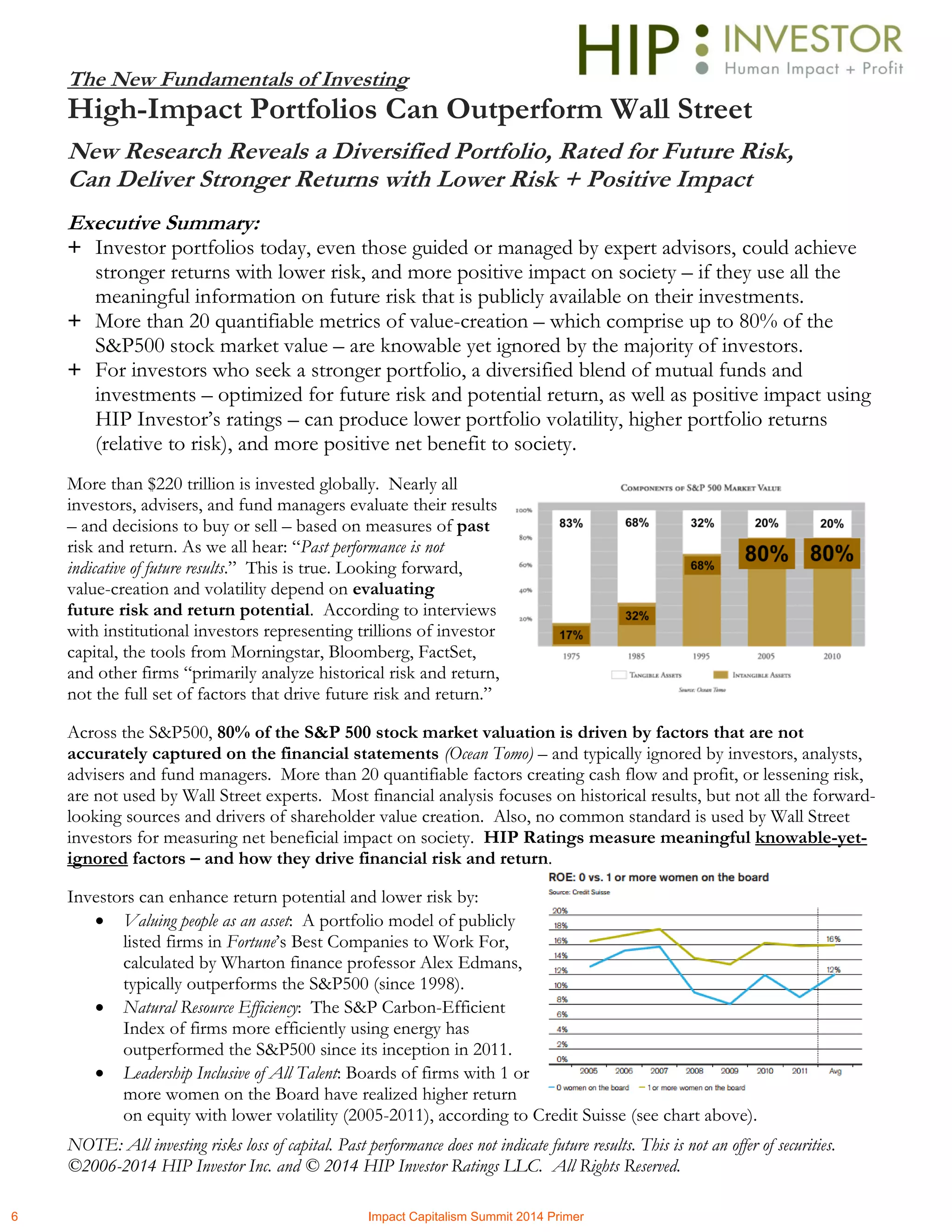
 Leadership Inclusive of All Talent: Boards of firms with 1 or
more women on the Board have realized higher return
on equity with lower volatility (2005-2011), according to Credit Suisse (see chart above).
6 Impact Capitalism Summit 2014 Primer
NOTE: All investing risks loss of capital. Past performance does not indicate future results. This is not an offer of securities.
©2006-2014 HIP Investor Inc. and © 2014 HIP Investor Ratings LLC. All Rights Reserved.
A Diversified Portfolio Built to Benefit Society Can Beat Wall Street
“The markets are efficient.” “All available information is built into the stock price as soon as it is available.”
“Index funds are the most reliable way to invest.” These investment mantras are embedded in Wall Street portfolios,
integrated into the curricula of leading business schools, and rewarded with Nobel Prizes in economics. But new
fundamentals of investing portfolios in the 21st
century have arrived – that can lessen risk and enhance returns.
Investors benefit from diversified portfolios across all asset classes. Modern Portfolio Theory (MPT), distilled in
1952 by Nobel-prize-winning Dr. Harry Markowitz at the University of Chicago, is seen as the gold standard of
portfolio construction. To apply MPT systematically, investors typically use index funds that follow the market.
However, the underlying assumptions are that the market prices are efficient and accurate, incorporating all
relevant information. Yet more than 20 factors of future risk, potential return, and net impact appear to be
ignored by the market, and miss out on capturing the full set of drivers of value-creation. Thus, trusting the
market-price based indexes can lead to a sub-optimal portfolio – with higher risk and lesser return.
Sustainable Portfolios Can Beat Wall Street and Modern Portfolio Theory
A more optimal portfolio that lowers risk and ONE-YEAR (2013) PERFORMANCE
enhances returns – and can beat Wall Street – is
possible. In 2006, HIP Investor developed a
unique methodology to rate investments and funds
globally. Today, HIP’s 6000 ratings include 4500
corporations (equity and debt) and 1500+ issues of
bonds (including governments and nonprofit muni-
bonds) on their future risk, return, and impact.
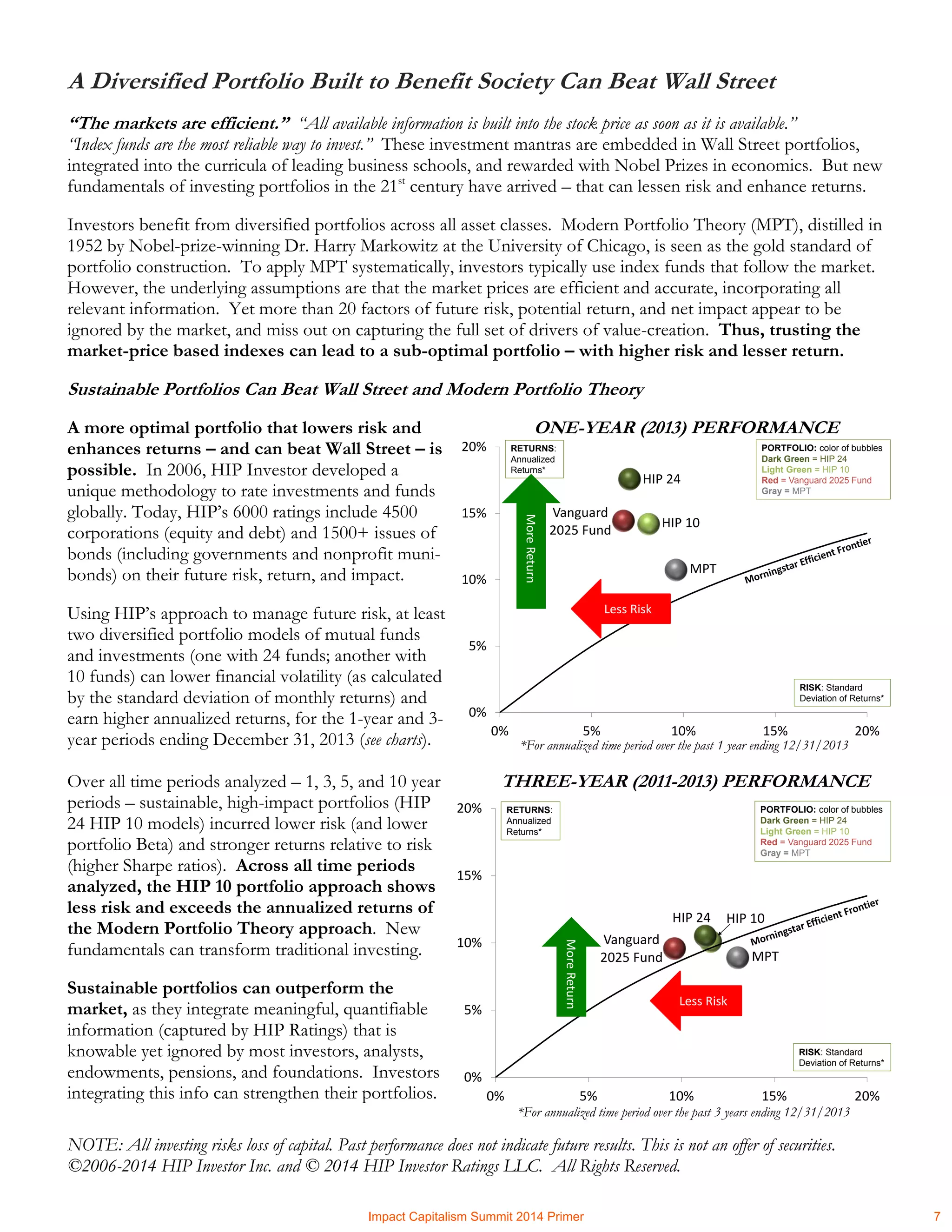
Using HIP’s approach to manage future risk, at least
two diversified portfolio models of mutual funds
and investments (one with 24 funds; another with
10 funds) can lower financial volatility (as calculated
by the standard deviation of monthly returns) and
earn higher annualized returns, for the 1-year and 3-
year periods ending December 31, 2013 (see charts).
Over all time periods analyzed – 1, 3, 5, and 10 year THREE-YEAR (2011-2013) PERFORMANCE
periods – sustainable, high-impact portfolios (HIP
24 HIP 10 models) incurred lower risk (and lower
portfolio Beta) and stronger returns relative to risk
(higher Sharpe ratios). Across all time periods
analyzed, the HIP 10 portfolio approach shows
less risk and exceeds the annualized returns of
the Modern Portfolio Theory approach. New
fundamentals can transform traditional investing.
Sustainable portfolios can outperform the
market, as they integrate meaningful, quantifiable
information (captured by HIP Ratings) that is
knowable yet ignored by most investors, analysts,
endowments, pensions, and foundations. Investors
integrating this info can strengthen their portfolios.
Vanguard
2025 Fund
HIP 10
HIP 24
MPT
0%
5%
10%
15%
20%
0% 5% 10% 15% 20%
Less Risk
RETURNS:
Annualized
Returns*
RISK: Standard
Deviation of Returns*
PORTFOLIO: color of bubbles:
Dark Green = HIP 24
Light Green = HIP 10
Red = Vanguard 2025 Fund
Gray = MPT
MoreReturn
Vanguard
2025 Fund
HIP 10HIP 24
MPT
0%
5%
10%
15%
20%
0% 5% 10% 15% 20%
Less Risk
MoreReturn
RETURNS:
Annualized
Returns*
RISK: Standard
Deviation of Returns*
PORTFOLIO: color of bubbles:
Dark Green = HIP 24
Light Green = HIP 10
Red = Vanguard 2025 Fund
Gray = MPT
*For annualized time period over the past 3 years ending 12/31/2013
*For annualized time period over the past 1 year ending 12/31/2013
Impact Capitalism Summit 2014 Primer 7
NOTE: All investing risks loss of capital. Past performance does not indicate future results. This is not an offer of securities.
©2006-2014 HIP Investor Inc. and © 2014 HIP Investor Ratings LLC. All Rights Reserved.
Smart Portfolios Include Funds & Investments that Can Realize Both Positive Impact + Profit
Smart investor portfolios diversify to mitigate the potential downside of future risks and seek the upside
associated with all the possible opportunities. More than $220 trillion of global financial assets – including
your portfolio – could be stronger and more resilient by measuring its future risk exposure and allocating to
funds and investments that can lower that risk, seek enhanced returns, and spur net positive impact for society.
US-SIF identifies $3.7 trillion in the USA and $4 trillion in Europe that is pursuing positive impact in portfolios.
Every investment – stock, bond, mutual fund, ETF – can be rated for its future risk, financial return potential,
and net impact on society. Investors can track their portfolio performance on all these dimensions. Color-
coded HIP Ratings can visualize future risk and upside potential in portfolios (red connotes riskier; green implies
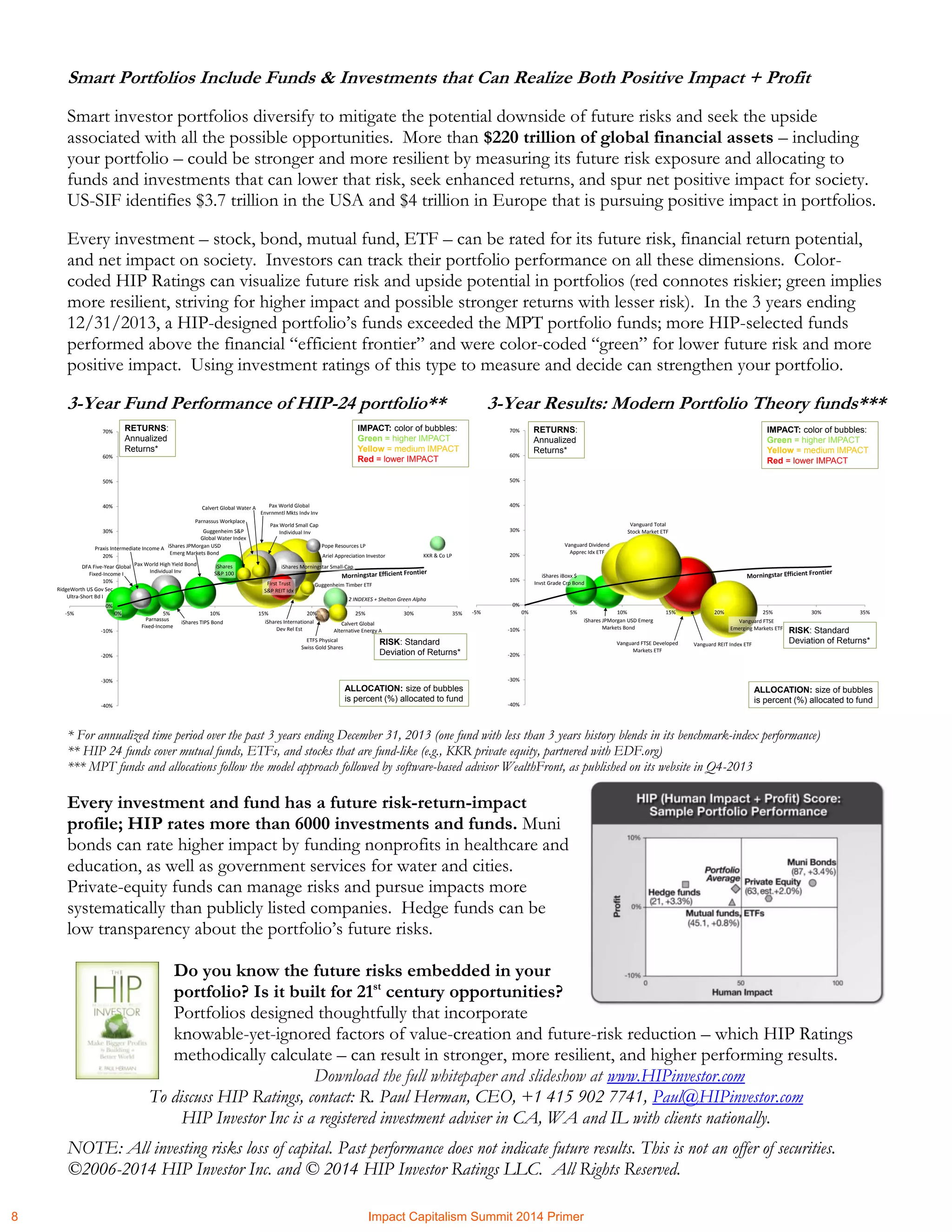
more resilient, striving for higher impact and possible stronger returns with lesser risk). In the 3 years ending
12/31/2013, a HIP-designed portfolio’s funds exceeded the MPT portfolio funds; more HIP-selected funds
performed above the financial “efficient frontier” and were color-coded “green” for lower future risk and more
positive impact. Using investment ratings of this type to measure and decide can strengthen your portfolio.
3-Year Fund Performance of HIP-24 portfolio** 3-Year Results: Modern Portfolio Theory funds***
* For annualized time period over the past 3 years ending December 31, 2013 (one fund with less than 3 years history blends in its benchmark-index performance)
** HIP 24 funds cover mutual funds, ETFs, and stocks that are fund-like (e.g., KKR private equity, partnered with EDF.org)
*** MPT funds and allocations follow the model approach followed by software-based advisor WealthFront, as published on its website in Q4-2013
Every investment and fund has a future risk-return-impact
profile; HIP rates more than 6000 investments and funds. Muni
bonds can rate higher impact by funding nonprofits in healthcare and
education, as well as government services for water and cities.
Private-equity funds can manage risks and pursue impacts more
systematically than publicly listed companies. Hedge funds can be
low transparency about the portfolio’s future risks.
Do you know the future risks embedded in your
portfolio? Is it built for 21st
century opportunities?
Portfolios designed thoughtfully that incorporate
knowable-yet-ignored factors of value-creation and future-risk reduction – which HIP Ratings
methodically calculate – can result in stronger, more resilient, and higher performing results.
Download the full whitepaper and slideshow at www.HIPinvestor.com
To discuss HIP Ratings, contact: R. Paul Herman, CEO, +1 415 902 7741, Paul@HIPinvestor.com
HIP Investor Inc is a registered investment adviser in CA, WA and IL with clients nationally.
iShares JPMorgan USD Emerg
Markets Bond
iShares iBoxx $
Invst Grade Crp Bond
Vanguard FTSE Developed
Markets ETF
Vanguard Dividend
Apprec Idx ETF
Vanguard REIT Index ETF
Vanguard Total
Stock Market ETF
Vanguard FTSE
Emerging Markets ETF
-40%
-30%
-20%
-10%
0%
10%
20%
30%
40%
50%
60%
70%
-5% 0% 5% 10% 15% 20% 25% 30% 35%
IMPACT: color of bubbles:
Green = higher IMPACT
Yellow = medium IMPACT
Red = lower IMPACT
ALLOCATION: size of bubbles
is percent (%) allocated to fund
RISK: Standard
Deviation of Returns*
RETURNS:
Annualized
Returns*
Ariel Appreciation Investor
DFA Five-Year Global
Fixed-Income I
iShares JPMorgan USD
Emerg Markets Bond
iShares International
Dev Rel Est
KKR & Co LP
2 INDEXES + Shelton Green Alpha
Pax World High Yield Bond
Individual Inv
Pax World Global
Envrnmntl Mkts Indv Inv
iShares Morningstar Small-Cap
Guggenheim Timber ETF
Pope Resources LP
First Trust
S&P REIT Idx
Parnassus
Fixed-Income
Pax World Small Cap
Individual Inv
Parnassus Workplace
Calvert Global
Alternative Energy A
Calvert Global Water A
iShares
S&P 100
ETFS Physical
Swiss Gold Shares
RidgeWorth US Gov Sec
Ultra-Short Bd I
iShares TIPS Bond
Praxis Intermediate Income A
Guggenheim S&P
Global Water Index
-40%
-30%
-20%
-10%
0%
10%
20%
30%
40%
50%
60%
70%
-5% 0% 5% 10% 15% 20% 25% 30% 35%
IMPACT: color of bubbles:
Green = higher IMPACT
Yellow = medium IMPACT
Red = lower IMPACT
ALLOCATION: size of bubbles
is percent (%) allocated to fund
RISK: Standard
Deviation of Returns*
RETURNS:
Annualized
Returns*
8 Impact Capitalism Summit 2014 Primer


A	
  Portfolio	
  Approach	
  to	
  Impact	
  Investment:	
  Framework	
  for	
  Balancing	
  Impact,	
  Return,	
  Risk	
  	
  
By	
  Yasemin	
  Saltuk,	
  Director	
  of	
  Research,	
  J.P.	
  Morgan	
  Social	
  Finance	


This	
  is	
  an	
  extract	
  from	
  A	
  Portfolio	
  Approach	
  to	
  Impact	
  Investment	
  (Y.	
  
Saltuk,	
  J.P.	
  Morgan	
  Social	
  Finance,	
  October	
  2012),	
  a	
  report	
  written	
  as	
  a	
  
practical	
  guide	
  to	
  building,	
  analysing	
  and	
  managing	
  portfolios	
  of	
  impact	
  
investments	
  for	
  professional	
  investors.	
  Since	
  completing	
  this	
  work,	
  we	
  
have	
  been	
  using	
  the	
  framework	
  for	
  managing	
  our	
  own	
  portfolio	
  and	
  
representing	
  the	
  profile	
  of	
  our	
  targets	
  and	
  investments.	
  For	
  the	
  full	
  
report,	
  visit:	
  www.jpmorganchase.com/socialfinance.	
  
In	
  traditional	
  financial	
  analysis,	
  investment	
  management	
  tools	
  allow	
  
investors	
  to	
  evaluate	
  the	
  return	
  and	
  risk	
  of	
  individual	
  investments	
  and	
  
portfolios.	
  This	
  research	
  presents	
  a	
  tool	
  to	
  analyse	
  impact	
  investments	
  
across	
  the	
  three	
  dimensions	
  that	
  determine	
  the	
  performance	
  of	
  these	
  assets:	
  impact,	
  return	
  and	
  
risk.	
  Throughout,	
  we	
  reference	
  the	
  experiences	
  of	
  impact	
  investors	
  with	
  case	
  studies	
  of	
  how	
  they	
  
approach	
  each	
  step	
  of	
  the	
  portfolio	
  construction	
  and	
  management	
  process.	
  The	
  content	
  for	
  this	
  
research	
  was	
  informed	
  by	
  our	
  own	
  investment	
  experience	
  as	
  well	
  as	
  that	
  of	
  23	
  institutional	
  investors	
  
that	
  we	
  interviewed.	
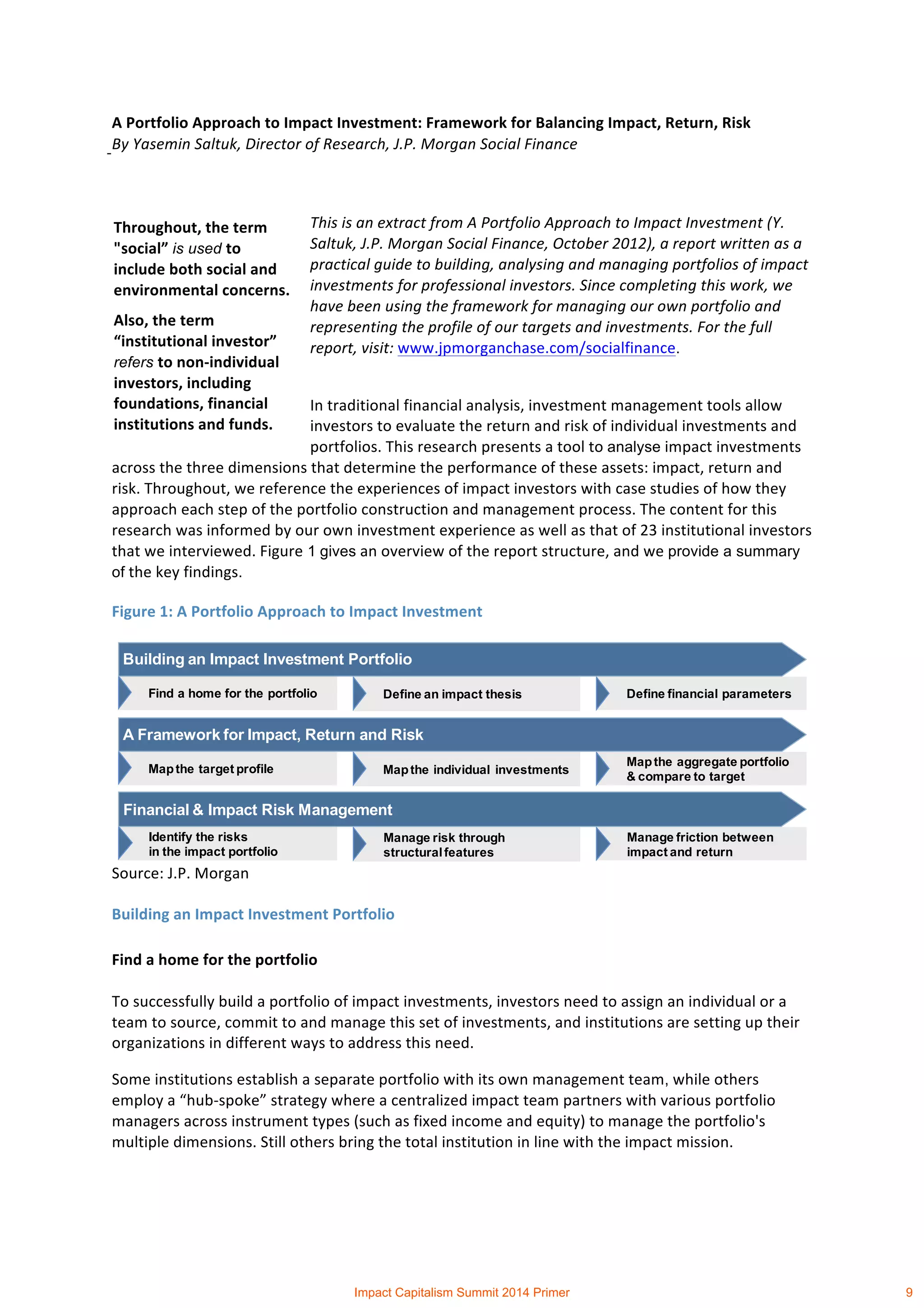
  Figure 1	
  gives	
  an	
  overview	
  of	
  the	
  report	
  structure,	
  and	
  we	
  provide a summary
of	
  the	
  key	
  findings. 	
  
Figure	
  1:	
  A	
  Portfolio	
  Approach	
  to	
  Impact	
  Investment	
  
Source:	
  J.P.	
  Morgan	
  
Building	
  an	
  Impact	
  Investment	
  Portfolio	
  
Find	
  a	
  home	
  for	
  the	
  portfolio	
  
To	
  successfully	
  build	
  a	
  portfolio	
  of	
  impact	
  investments,	
  investors	
  need	
  to	
  assign	
  an	
  individual	
  or	
  a	
  
team	
  to	
  source,	
  commit	
  to	
  and	
  manage	
  this	
  set	
  of	
  investments,	
  and	
  institutions	
  are	
  setting	
  up	
  their	
  
organizations	
  in	
  different	
  ways	
  to	
  address	
  this	
  need.	
  	
  
Some	
  institutions	
  establish	
  a	
  separate	
  portfolio	
  with	
  its	
  own	
  management	
  team,	
  while	
  others	
  
employ	
  a	
  “hub-­‐spoke”	
  strategy	
  where	
  a	
  centralized	
  impact	
  team	
  partners	
  with	
  various	
  portfolio	
  
managers	
  across	
  instrument	
  types	
  (such	
  as	
  fixed	
  income	
  and	
  equity)	
  to	
  manage	
  the	
  portfolio's	
  
multiple	
  dimensions.	
  Still	
  others	
  bring	
  the	
  total	
  institution	
  in	
  line	
  with	
  the	
  impact	
  mission.	
  	
  
Define an impact thesisFind a home for the portfolio Define financial parameters
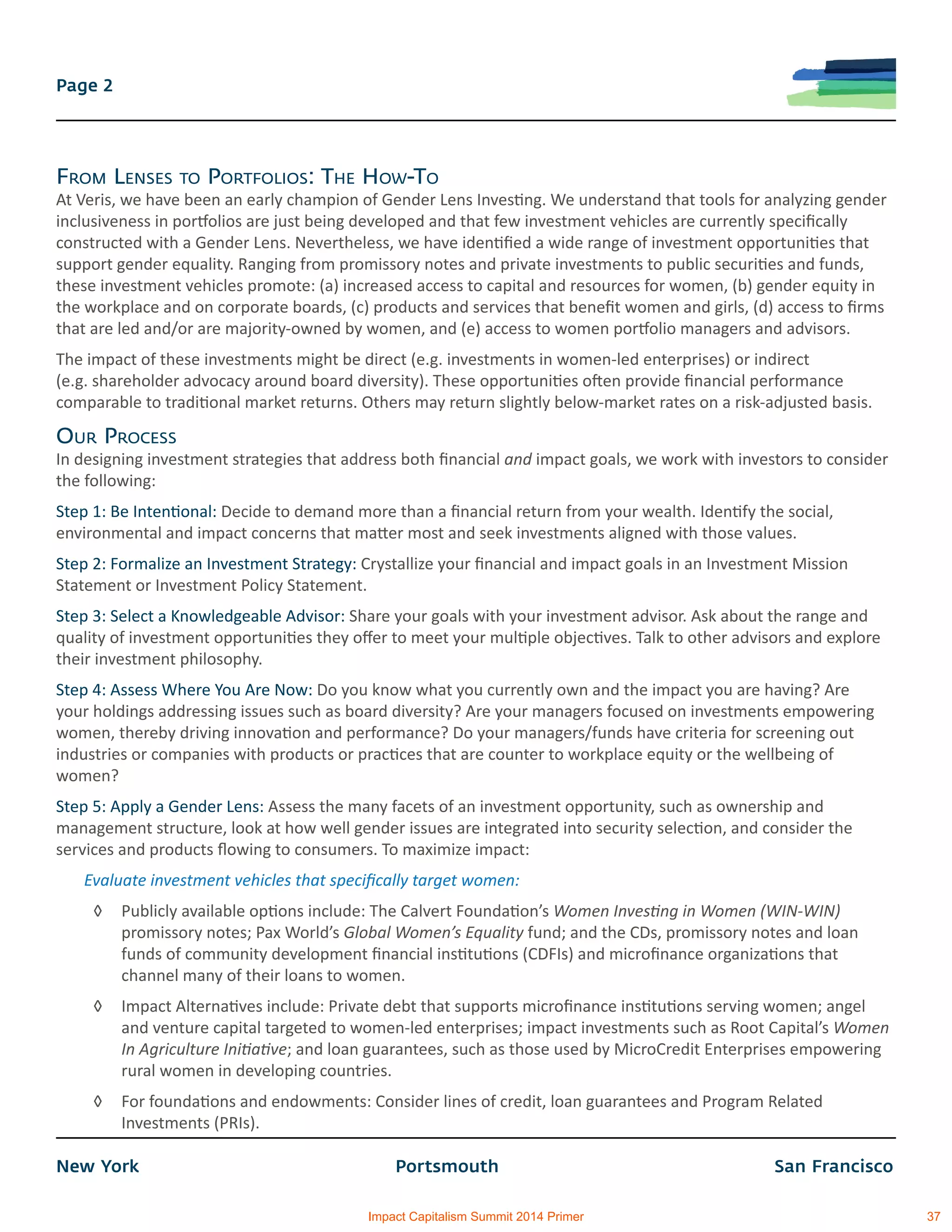
Building an Impact Investment Portfolio
Mapthe individual investmentsMapthe target profile
Mapthe aggregate portfolio
& compare to target
A Framework for Impact, Return and Risk
Manage risk through
structuralfeatures
Identify the risks
in the impact portfolio
Manage friction between
impact and return
Financial & Impact Risk Management
Throughout,	
  the	
  term	
  
"social”	
  is used to	
  
include	
  both	
  social	
  and	
  
environmental	
  concerns.	
  
Also,	
  the	
  term	
  
“institutional	
  investor”	
  
refers to	
  non-­‐individual	
  
investors,	
  including	
  
foundations,	
  financial	
  
institutions	
  and	
  funds.	
  
Impact Capitalism Summit 2014 Primer 9


Table	
  1	
  shows	
  some	
  examples	
  of	
  investors	
  including	
  foundations,	
  pension	
  funds,	
  financial	
  
institutions	
  and	
  fund	
  managers,	
  and	
  their	
  organizational	
  structures.	
  
Table 1:	
  Organizational	
  Structures	
  across	
  Institutional	
  Investors	
  
Investor	
  Type	
   Example	
   Portfolio	
  Management	
  
Foundation	
   The	
  Rockefeller	
  Foundation	
   Separate	
  team	
  
	
   The	
  F.B.	
  Heron	
  Foundation	
   Whole	
  institution	
  
Pension	
  fund	
   TIAA-­‐CREF	
   “Hub-­‐spoke”	
  partnership	
  
	
   PGGM	
   “Hub-­‐spoke”	
  partnership	
  
Financial	
  institution	
   Storebrand	
   Separate	
  team	
  
	
   J.P.	
  Morgan	
  Social	
  Finance	
   Separate	
  team	
  
Fund	
  manager	
   MicroVest	
   Whole	
  institution	
  
	
   Sarona	
  Asset	
  Management	
   Whole	
  institution	
  
Source:	
  J.P.	
  Morgan	
  
Define	
  an	
  impact	
  thesis	
  
Once	
  the	
  organizational	
  structure	
  is	
  in	
  place,	
  the	
  portfolio	
  management	
  team	
  will	
  need	
  to	
  articulate	
  
the	
  impact	
  mission	
  of	
  the	
  portfolio	
  to	
  set	
  the	
  scope	
  of	
  their	
  investable	
  universe.	
  For	
  many	
  impact	
  
investors,	
  the	
  impact	
  thesis	
  is	
  usually	
  driven	
  by	
  the	
  value	
  set	
  of	
  an	
  individual	
  or	
  organization	
  and	
  can	
  
reference	
  a	
  theory	
  of	
  change,	
  often	
  with	
  reference	
  to	
  specific	
  impact	
  objectives	
  such	
  as	
  access	
  to	
  
clean	
  water	
  or	
  affordable	
  housing.	
  An	
  impact	
  thesis	
  can	
  reference	
  a	
  target	
  population,	
  business	
  
model	
  or	
  set	
  of	
  outcomes	
  through	
  which	
  the	
  investor	
  intends	
  to	
  deliver	
  the	
  impact (see Table 2 for	
  
examples).
Table	
  2:	
  Illustrative	
  Components	
  of	
  an	
  Impact	
  Thesis	
  
Target	
  Population	
   Target	
  Business Model	
   Target	
  Impact	
  
Income	
  level	
  	
   Product/service	
  provider	
  to	
  
target	
  population	
  
Number	
  of	
  target	
  population	
  
reached	
  
Degree	
  of	
  inclusion	
   Utilizing	
  target	
  population	
  retail	
  
distribution	
  	
  
Per	
  cent	
  of	
  business	
  reaching	
  
target	
  population	
  
Region	
  of	
  inhabitation	
   Utilizing	
  target	
  population	
  
suppliers	
  
Scale	
  of	
  outputs	
  
	
   Implementing	
  energy	
  and	
  
natural	
  resource	
  efficiency	
  
Quality	
  of	
  outputs	
  
Source:	
  J.P.	
  Morgan
10 Impact Capitalism Summit 2014 Primer


Define	
  financial	
  parameters	
  
Alongside	
  the	
  impact	
  thesis,	
  the	
  investment	
  team	
  will	
  determine	
  the	
  investment	
  scope	
  with	
  respect	
  
to	
  the	
  parameters	
  that	
  can	
  drive	
  financial	
  performance.	
  These	
  parameters	
  include	
  the	
  instruments	
  
that	
  will	
  be	
  eligible	
  for	
  investments;	
  the	
  geographies	
  and	
  sectors	
  of	
  focus;	
  the	
  growth	
  stage	
  and	
  
scalability	
  of	
  the	
  businesses	
  that	
  will	
  be	
  targeted;	
  and	
  the	
  risk	
  appetite	
  of	
  the	
  investor.	
  	
  
Abandon	
  the	
  trade-­‐off	
  debate	
  for	
  economic	
  analysis	
  
In	
  setting	
  the	
  investment	
  scope	
  and	
  return	
  expectations,	
  we	
  encourage	
  investors	
  to	
  abandon	
  broad	
  
debates	
  about	
  whether	
  they	
  need	
  to	
  trade off	
  financial	
  return	
  in	
  exchange	
  for	
  impact.	
  We	
  rather	
  
propose	
  that	
  investors	
  rely	
  on	
  economic	
  analysis	
  on	
  a	
  deal-­‐by-­‐deal	
  basis	
  of	
  the	
  revenue	
  potential	
  
and	
  cost	
  profile	
  of	
  the	
  intervention	
  they	
  are	
  looking	
  to	
  fund,	
  and	
  set	
  risk-­‐adjusted	
  return	
  
expectations	
  accordingly.	
  
A	
  Framework	
  for	
  Impact,	
  Return	
  &	
  Risk	
  
Once	
  the	
  target	
  characteristics	
  of	
  the	
  portfolio	
  are	
  defined,	
  investors	
  can	
  map	
  the	
  following	
  across	
  
the	
  three	
  dimensions	
  of	
  impact,	
  return	
  and	
  risk:	
  a	
  target	
  profile	
  for	
  the	
  portfolio,	
  the	
  expected	
  
profile	
  of	
  the	
  individual	
  opportunities	
  and	
  the	
  profile	
  of	
  the	
  aggregate	
  portfolio,	
  which	
  can	
  then	
  be	
  
assessed	
  against	
  the	
  target.	
  
Map	
  the	
  target	
  profile	
  
To	
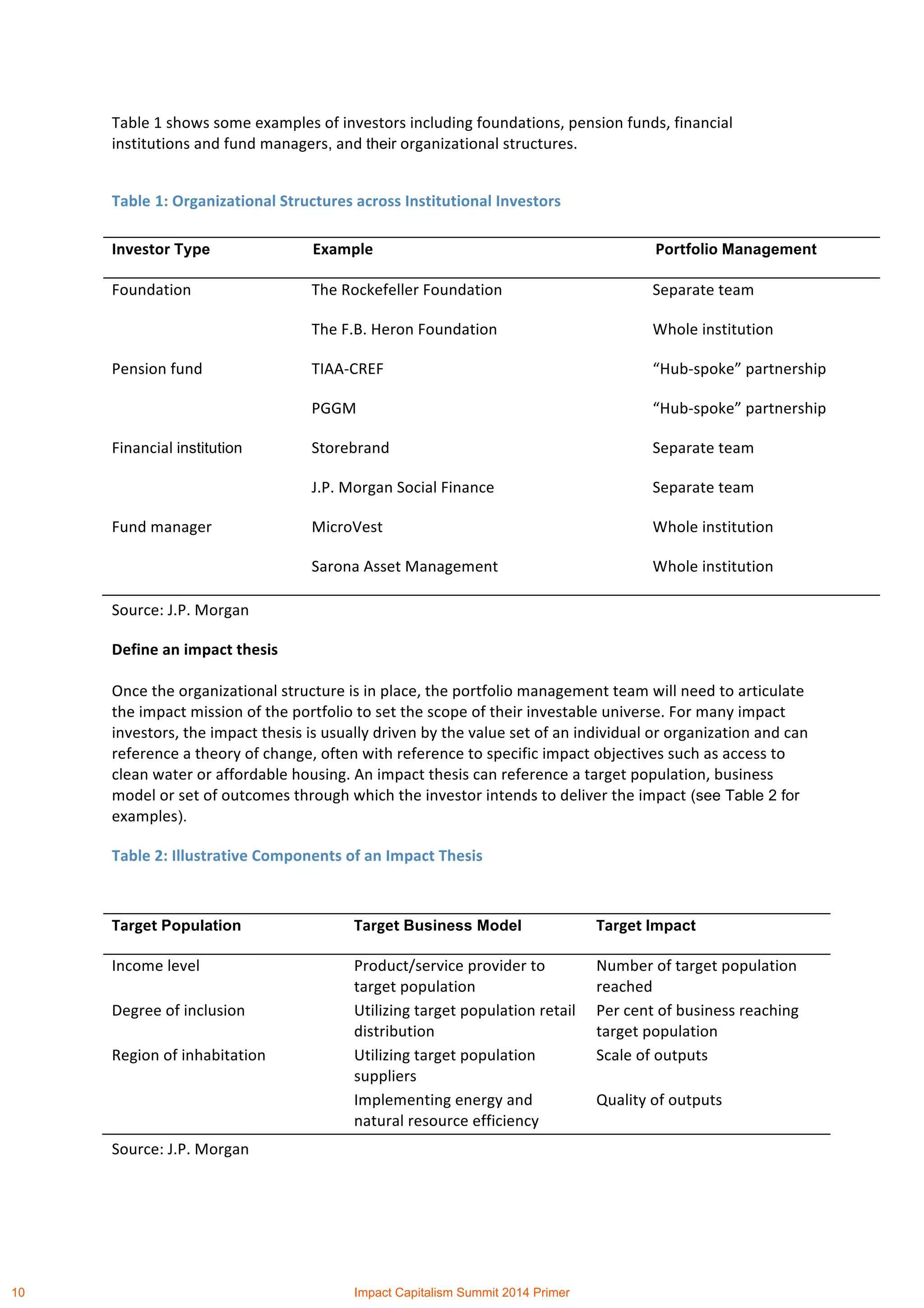
  illustrate	
  how	
  different	
  investors	
  might	
  map	
  their	
  portfolio	
  targets,	
  we	
  present	
  the	
  graph	
  of	
  our	
  
own	
  J.P.	
  Morgan	
  Social	
  Finance	
  target	
  portfolio	
  –	
  the	
  shaded	
  grey	
  area	
  in	
  Figure	
  2	
  –	
  alongside	
  the	
  
profile	
  that	
  might	
  be	
  targeted	
  by	
  an	
  investor	
  with	
  a	
  higher	
  risk	
  appetite	
  and	
  a	
  lower	
  return	
  threshold
(Figure	
  3),	
  and	
  the	
  graph	
  that	
  might	
  represent	
  the	
  target	
  for	
  an	
  investor	
  pursuing	
  only	
  non-­‐negative	
  
impact	
  with	
  a	
  low	
  risk	
  appetite (Figure	
  4).
i
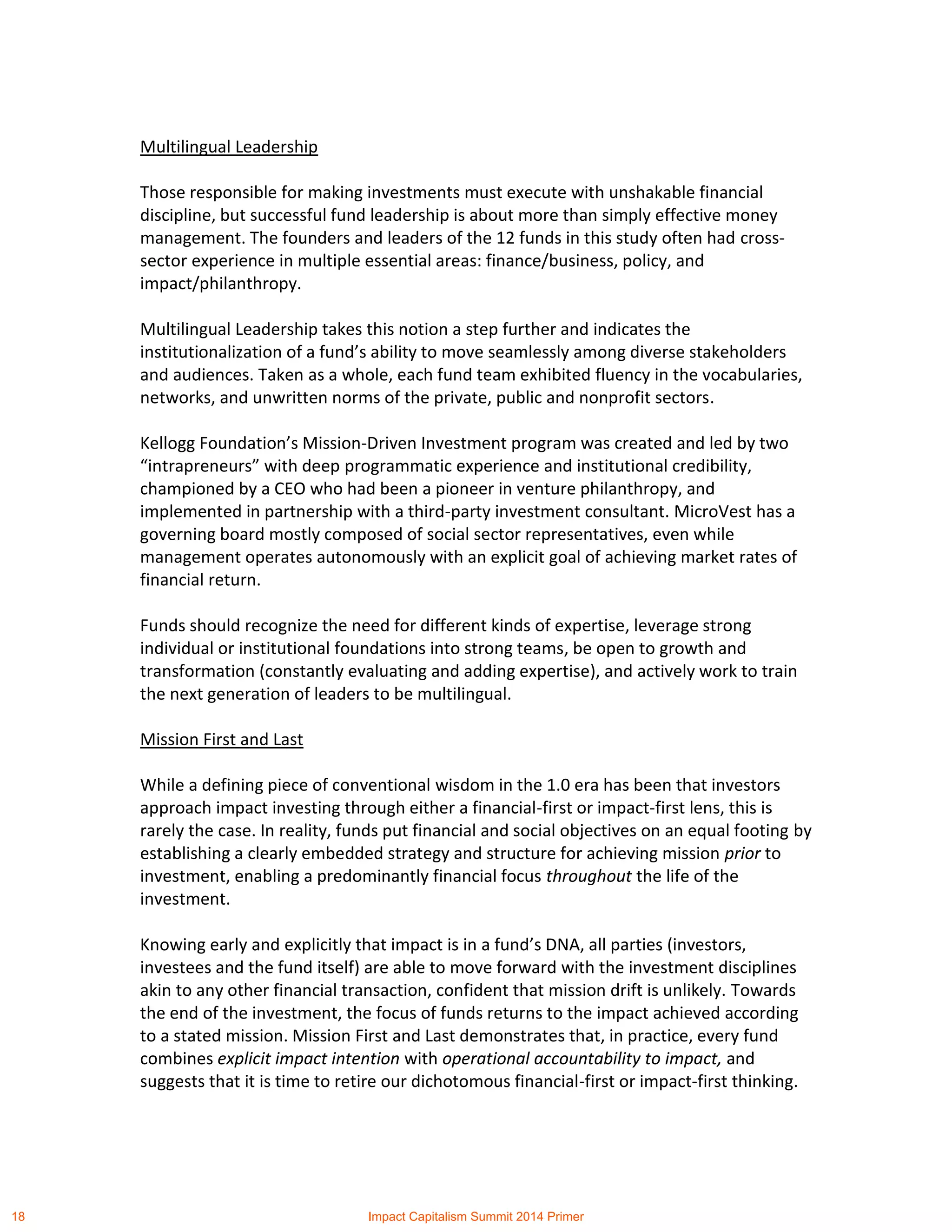
Figure 2: J.P. Morgan Social
Finance Target	
  Portfolio	
  Graph
Source: J.P. Morgan
Figure 3: High Risk Investor’s
Target Portfolio Graph
Source: J.P. Morgan
Figure 4: “Non-negative Impact”
Investor’s Target Portfolio Graph
Source: J.P. Morgan
	
  
Impact Capitalism Summit 2014 Primer 11


Map	
  the	
  individual	
  investments	
  
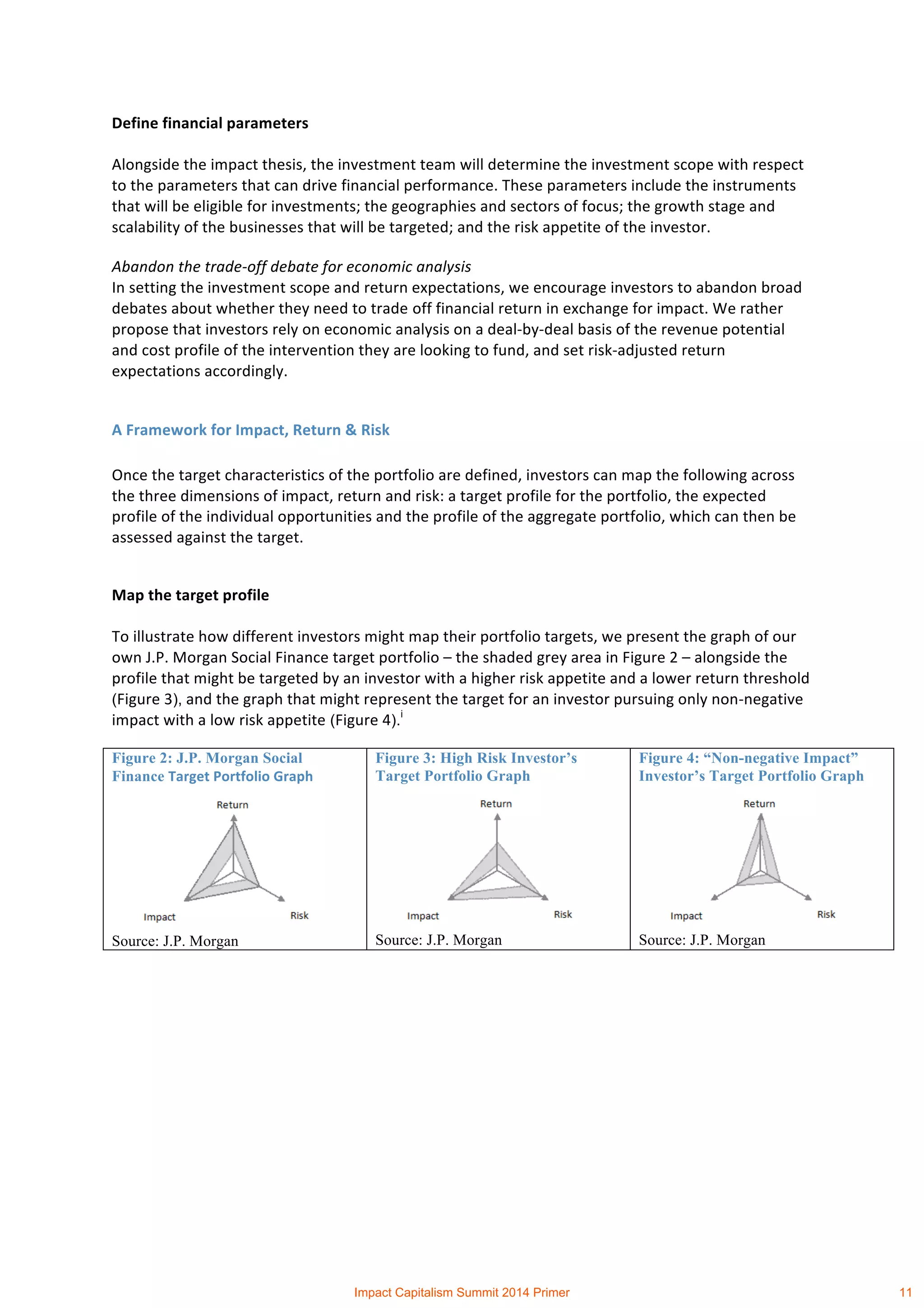
Next,	
  we	
  map	
  out	
  expectations	
  for	
  an	
  individual	
  investment	
  
based	
  on	
  assessments	
  of	
  the	
  impact,	
  return	
  and	
  risk.	
  Once	
  that	
  
investment	
  is	
  mapped,	
  we	
  can	
  then	
  compare	
  it	
  to	
  the	
  portfolio	
  
target	
  as	
  shown	
  in	
  Figure	
  5.	
  Although	
  we	
  show	
  an	
  example	
  in	
  
which	
  the	
  individual	
  investment	
  profile	
  does	
  fit	
  within	
  the	
  
portfolio	
  targets,	
  in	
  general	
  investors	
  may	
  not	
  require	
  that	
  each	
  
investment	
  necessarily	
  fits	
  within	
  the	
  target	
  range,	
  so	
  long	
  as	
  the	
  
aggregate	
  does.	
  
Map	
  the	
  aggregate	
  portfolio	
  and	
  compare	
  to	
  target	
  
Once	
  the	
  portfolio	
  begins	
  to	
  grow,	
  we	
  can	
  consolidate	
  the	
  
individual	
  investment	
  graphs	
  into	
  one	
  graph	
  representing	
  the	
  
characterization	
  of	
  the	
  portfolio	
  as	
  a	
  whole,	
  aggregating	
  the	
  
individual	
  graphs	
  by	
  either	
  overlaying	
  them	
  or	
  averaging	
  them	
  
(simply,	
  or	
  on	
  a	
  notional-­‐weighted	
  basis).	
  Then,	
  this	
  aggregate	
  
can	
  be	
  compared	
  to	
  the	
  target	
  profile	
  for	
  the	
  portfolio	
  to	
  ensure	
  
alignment.	
  
Expand	
  the	
  dimensions	
  of	
  the	
  graph,	
  if	
  desired	
  
Investors	
  should	
  consider	
  the	
  three-­‐dimensional	
  graph	
  as	
  a	
  template.	
  For	
  some,	
  the	
  simplicity	
  of	
  this	
  
approach	
  might	
  be	
  appropriate	
  for	
  aggregating	
  across	
  large	
  portfolios	
  at	
  a	
  high	
  level.	
  Others	
  might	
  
prefer	
  to	
  use	
  a	
  more	
  nuanced	
  framework	
  that	
  better	
  reflects	
  the	
  different	
  contributing	
  factors	
  of	
  the	
  
parameters	
  represented	
  on	
  each	
  axis	
  –	
  impact,	
  return	
  and	
  risk.ii	
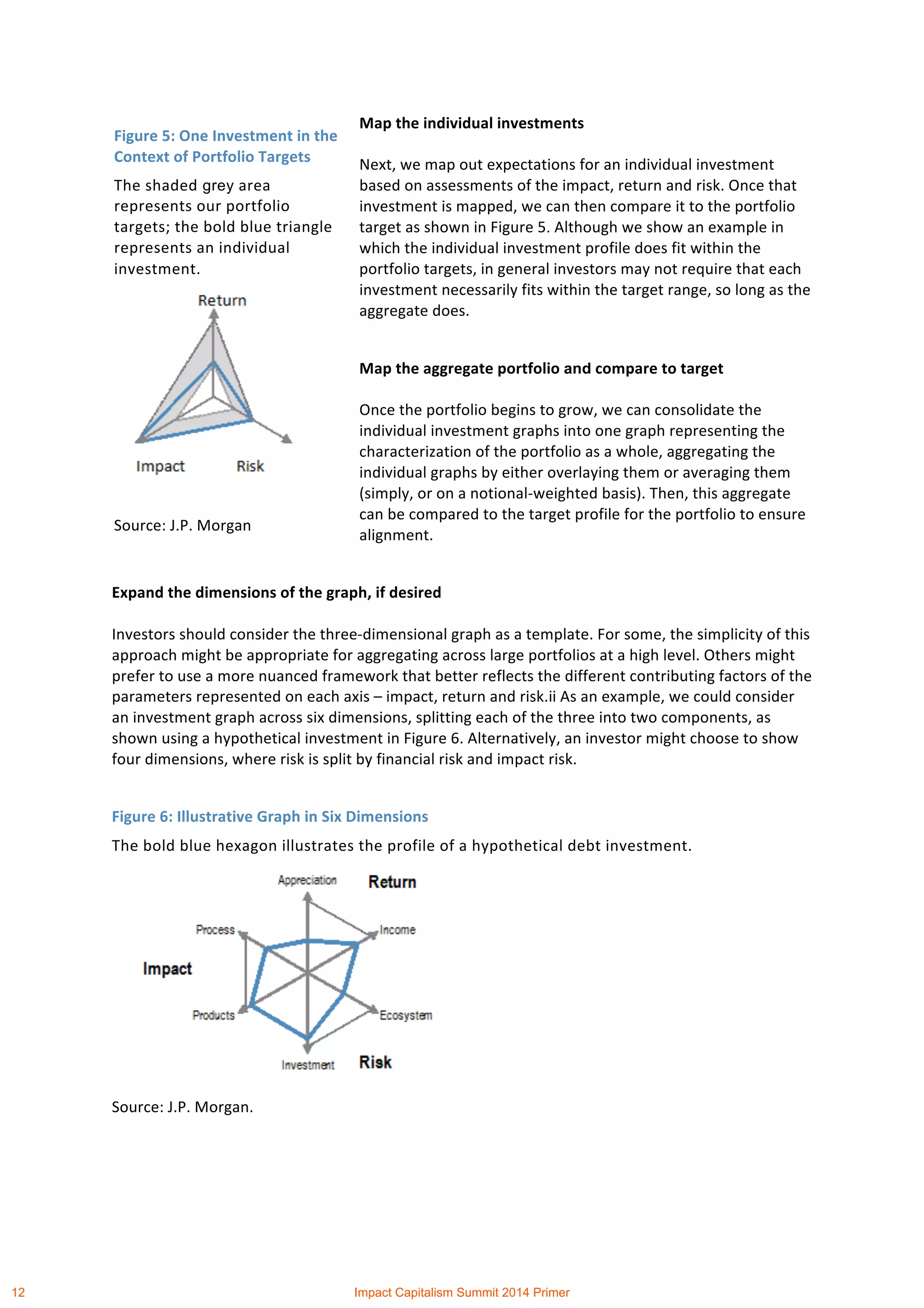
  As	
  an	
  example,	
  we	
  could	
  consider	
  
an	
  investment	
  graph	
  across	
  six	
  dimensions,	
  splitting	
  each	
  of	
  the	
  three	
  into	
  two	
  components,	
  as	
  
shown	
  using	
  a	
  hypothetical	
  investment	
  in	
  Figure	
  6.	
  Alternatively,	
  an	
  investor	
  might	
  choose	
  to	
  show	
  
four	
  dimensions,	
  where	
  risk	
  is	
  split	
  by	
  financial	
  risk	
  and	
  impact	
  risk.	
  
Figure	
  6:	
  Illustrative	
  Graph	
  in	
  Six	
  Dimensions	
  
The	
  bold	
  blue	
  hexagon	
  illustrates	
  the	
  profile	
  of	
  a	
  hypothetical	
  debt	
  investment.	


Source:	
  J.P.	
  Morgan.	
  
Figure	
  5:	
  One	
  Investment	
  in	
  the	
  
Context	
  of	
  Portfolio	
  Targets	
  
The	
  shaded grey	
  area	
  
represents	
  our	
  portfolio	
  
targets;	
  the	
  bold	
  blue	
  triangle	
  
represents	
  an	
  individual	
  
investment.	


Source:	
  J.P.	
  Morgan	
  
12 Impact Capitalism Summit 2014 Primer


Once	
  the	
  targets	
  have	
  been	
  set	
  and	
  the	
  portfolio	
  begins	
  to	
  grow,	
  investors	
  are	
  then	
  faced	
  with	
  
managing	
  the	
  investments	
  to	
  ensure	
  that	
  the	
  portfolio	
  delivers	
  both	
  impact	
  and	
  financial	
  returns	
  in	
  
line	
  with	
  the	
  targets.	
  
Financial	
  and	
  Impact	
  Risk	
  Management	
  
Identify	
  the	
  risks	
  in	
  the	
  impact	
  portfolio	
  
On	
  an	
  individual	
  investment	
  basis,	
  the	
  risks	
  that	
  arise	
  for	
  impact	
  investments	
  are	
  often	
  the	
  same	
  
risks	
  that	
  would	
  arise	
  for	
  a	
  traditional	
  investment	
  in	
  the	
  same	
  sector,	
  region	
  or	
  instrument.	
  Just	
  as	
  
we	
  abandon	
  the	
  trade-­‐off	
  debate	
  on	
  return	
  across	
  the	
  asset	
  class	
  and	
  encourage	
  deal-­‐by-­‐deal	
  
analysis,	
  we	
  encourage	
  investors	
  to	
  assess	
  the	
  risk	
  profile	
  that	
  results	
  from	
  their	
  particular	
  impact	
  
thesis	
  and	
  motivation.	
  	
  
There	
  are	
  also	
  some	
  cross-­‐market	
  risks	
  to	
  consider,	
  including	
  the	
  early	
  stage	
  of	
  the	
  market	
  and	
  its	
  
supporting	
  ecosystem;	
  mission	
  drift;	
  the	
  responsible	
  combination	
  of	
  different	
  types	
  of	
  capital	
  
(including	
  grants);	
  and	
  the	
  moral	
  hazard	
  of	
  recognizing	
  impact	
  failure	
  or	
  financial	
  loss.	
  The	
  
development	
  of	
  the	
  market	
  over	
  time	
  should	
  erode	
  some	
  of	
  the	
  risks	
  associated	
  with	
  its	
  early	
  stage	
  
and	
  ecosystem.	
  While	
  some	
  of	
  these	
  risks	
  will	
  remain	
  in	
  place,	
  investors	
  will	
  likely	
  develop	
  better	
  
processes	
  for	
  recognizing	
  and	
  dealing	
  with	
  them.	
  	
  
Manage	
  risk	
  through	
  structural	
  features	
  
Once	
  the	
  risk	
  profile	
  of	
  the	
  investment	
  is	
  determined,	
  investors	
  manage	
  it	
  using	
  structural	
  features	
  
such	
  as	
  seniority	
  in	
  the	
  capital	
  structure,	
  fund	
  intermediaries	
  and	
  compensation-­‐related	
  or	
  
covenant-­‐based	
  incentives.	
  With	
  respect	
  to	
  the	
  currency	
  risk	
  that	
  arises	
  for	
  investors	
  allocating	
  
capital	
  internationally,	
  some	
  investors	
  referenced	
  diversification	
  across	
  countries	
  as	
  the	
  preferred	
  
means	
  of	
  management.	
  
Manage	
  friction	
  between	
  impact	
  and	
  return	
  
Many	
  investors	
  cite	
  that	
  they	
  pursue	
  opportunities	
  where	
  the	
  impact	
  mission	
  is	
  synergetic	
  with	
  the	
  
financial	
  return	
  pursuit.	
  Several	
  organizations	
  also	
  acknowledged	
  that,	
  at	
  times,	
  friction	
  can	
  arise	
  
between	
  these	
  two	
  pursuits.	
  Some	
  of	
  the	
  challenges	
  referenced	
  include	
  the	
  investee’s	
  growth	
  
coinciding	
  with	
  a	
  reduction	
  in	
  jobs;	
  the	
  investee	
  maintaining	
  mission;	
  or	
  ensuring	
  impact	
  
measurement.	
  Some	
  investors	
  manage	
  these	
  challenges	
  by	
  building	
  covenants	
  referencing	
  the	
  
mission	
  into	
  the	
  deal.	
  
Portfolio	
  diversification	
  
Investors	
  often	
  find	
  a	
  softer	
  approach	
  to	
  diversification	
  to	
  be	
  more	
  suitable	
  to	
  the	
  private	
  nature	
  of	
  
this	
  market.	
  Rather	
  than	
  setting	
  exposure	
  limits	
  as	
  can	
  more	
  easily	
  be	
  done	
  for	
  public	
  equity	
  
portfolios,	
  impact	
  investors	
  tend	
  to	
  start	
  with	
  a	
  more	
  opportunistic	
  approach.	
  They	
  assess	
  the	
  merits	
  
of	
  investments	
  mostly	
  on	
  a	
  stand-­‐alone	
  basis,	
  while	
  monitoring	
  the	
  broader	
  concentrations	
  in	
  any	
  
sector,	
  geography,	
  instrument	
  or	
  impact	
  pursuit.	
  Once	
  the	
  portfolio	
  reaches	
  a	
  critical	
  mass,	
  many	
  of	
  
them	
  become	
  more	
  strategic	
  about	
  diversification,	
  considering	
  an	
  investment’s	
  individual	
  merits	
  
alongside	
  those	
  in	
  the	
  context	
  of	
  the	
  broader	
  portfolio.	
  
Impact Capitalism Summit 2014 Primer 13


Looking	
  Forward	
  
Challenges	
  should	
  ease	
  over	
  time	
  
To	
  be	
  successful	
  today,	
  investors	
  need	
  to	
  be	
  realistic	
  about	
  the	
  stage	
  of	
  the	
  market,	
  employing	
  
patient	
  capital,	
  bringing	
  a	
  dynamic	
  approach	
  and	
  taking	
  an	
  active	
  management	
  role	
  to	
  the	
  
investment.	
  Whether	
  investing	
  directly	
  or	
  indirectly,	
  they	
  need	
  to	
  navigate	
  a	
  broad	
  ecosystem	
  to	
  
ensure	
  success.	
  Investors	
  today	
  share	
  a	
  collaborative	
  spirit	
  in	
  meeting	
  these	
  challenges	
  with	
  the	
  
broader	
  goal	
  of	
  catalysing	
  capital	
  towards	
  impact	
  investments.	
  This	
  research	
  has	
  been	
  a	
  first	
  step	
  
towards	
  sharing	
  the	
  experiences	
  of	
  these	
  field	
  builders	
  to	
  help	
  investors	
  establish	
  a	
  strategic	
  
approach	
  to	
  portfolio	
  management	
  for	
  impact	
  investments.	


About	
  J.P.	
  Morgan	
  Social	
  Finance	
  
J.P.	
  Morgan	
  Social	
  Finance	
  was	
  launched	
  in	
  2007	
  to	
  catalyse	
  the	
  growing	
  market	
  for	
  impact	
  
investments	
  and	
  accelerate	
  the	
  delivery	
  of	
  market-­‐based	
  solutions	
  to	
  social,	
  economic	
  and	
  
environmental	
  challenges.	
  Our	
  business	
  is	
  dedicated	
  to	
  growing	
  this	
  market	
  through	
  client	
  advisory	
  
services,	
  principal	
  investments	
  and	
  research.	
  
Disclosures	
  
________________________________________	
  
J.P.	
  Morgan	
  is	
  the	
  global	
  brand	
  name	
  for	
  J.P.	
  Morgan	
  Securities	
  LLC	
  and	
  its	
  affiliates	
  worldwide.	
  This	
  
research	
  is	
  written	
  by	
  Social	
  Finance	
  Research	
  and	
  is	
  not	
  the	
  product	
  of	
  J.P.	
  Morgan’s	
  research	
  
departments. For further disclosures, please see the full publication at
www.jpmorganchase.com/socialfinance.
________________________________________	


Copyright	
  2012	
  JPMorgan	
  Chase	
  & Co.	


i
The term “non-negative” is used to indicate, for example, a socially responsible investor that might employ some
negative screening to exclude negative impact from a portfolio, but does not actively pursue positive impact.
Readers should note that no particular correlation or relationship between impact, return and risk is implied.
ii
To ensure the investment profile is not oversimplified, the use of this framework is advocated – whether in three
dimensions or more – in conjunction with a more detailed understanding of the investments, and never on a
stand-alone basis.
14 Impact Capitalism Summit 2014 Primer
Impact Investing 2.0: 12 Outstanding Funds Point the Way Forward
By Cathy Clark, Jed Emerson and Ben Thornley1
From its origins in socially responsible investing, community finance, microfinance, and
international development, impact investing has emerged as a distinct practice. This has
warranted the creation of new field-level infrastructure, like the Global Impact Investing
Network and Impact Investing Policy Collaborative, and motivated volumes of excellent
research adding tremendous depth to the conversation among practitioners.
All this has played out in the first, “1.0 era” of the market’s emergence – where
“observation” has necessarily trumped “evidence.” However while observation has so
far been sufficient to align key stakeholders, and drive product development and
demand from capital providers like high net worth individuals, private foundations, and
even commercial institutions, it is no longer enough. The market has not been growing
as fast as many practitioners had hoped, in part because the larger wealth advisors and
institutional investors on which growth depends are demanding a level of product and
performance specificity that only time and experience can provide. And to the extent
that impact investing can be more difficult to perfect than traditional investing –
operating as many impact investors do in newly forming markets, with financial tools
and infrastructure that necessitate extreme creativity and collaboration – the need for
evidence is even more acute.
The three of us, together with colleagues at Pacific Community Ventures and CASE at
Duke, have spent the last three years shifting the discussion from the “why” of impact
investing to the “how,” by examining the practices and performance of 12 outstanding
funds in detail, culled from an initial list of 350. Detailed case studies, information on
our research methods, and full findings are available at our project microsite:
www.pacificcommunityventures.org/impinv2. A recently released e-book, Collaborative
Capitalism and the Rise of Impact Investing (John Wiley & Sons), also connects the
experiences of the 12 funds to the bigger picture of a more outcomes-oriented,
transparent, and responsive form of business and finance writ large.
What the 12 funds demonstrate is that, while inherently diverse in its application,
impact investing is in fact a cohesive discipline. With decades of practice to draw upon,
there is no need to speculate on what impact investing might be or debate whether it is
1 The Impact Investor project – a research collaboration between Insight at Pacific Community Ventures,
CASE at Duke University and ImpactAssets – was made possible with the generous support of Omidyar
Network, Annie E Casey Foundation, RS Group, Heron Foundation, W.K. Kellogg Foundation, and Deutsche
Bank. This article is an edited excerpt from the final project report published in November 2013, Impact
Investing 2.0: The Way Forward – Insight from 12 Outstanding Funds. The 12 firms/funds studied include
Aaavishkaar, Accion Texas, Bridges Ventures, Business Partners Limited, Calvert Foundation, Deutsche
Bank, Elevar, Huntington Capital, The W.K. Kellogg Foundation, MicroVest, RSF Social Finance, and SEAF.
Impact Capitalism Summit 2014 Primer 15
possible for investors to receive financial returns along with social and/or environmental
impacts. This level of doubt was warranted in the 1.0 era, but the 12 funds we studied
prove the opposite.
The bottom line is this: a first generation of private impact investing funds has delivered
on the promise of concurrently delivering financial returns and explicit social outcomes.
Developed and emerging market equity and hybrid funds, all with some participation of
commercial investors aiming for market-rate performance, have generated financial
returns of 3-22 percent. Social debt funds – with primarily individual, philanthropic or
policy-driven bank investors – have returned 0-3 percent, matching their targets and
never losing a dime.
We can now enter a “2.0 generation” of impact investing with confidence, knowing
what practices undergird success and building on these lessons to bring the field to
scale.
Four Practices Common to 12 Outstanding Impact Investing Funds
Outstanding impact investing funds undertake many practices common to all asset
managers; they carefully nurture their brand, leverage all of the relationships at their
disposal, are often headed or backed by singularly reputable or experienced individuals
and institutions, demonstrate exceptional financial discipline, are models of operational
excellence, and work relentlessly to support the growth of their investees. However
there are four qualities that are distinct to impact investing:
1. Policy Symbiosis
2. Catalytic Capital
3. Multilingual Leadership
4. Mission First and Last
Policy Symbiosis
While many people believe that the most successful capital market is one in which
government is least involved, our 12 funds prove that impact investing is grounded in
deep cross-sector partnership that benefits from the government’s engagement. In fact
the public sector is ubiquitous in impact investing at all levels of government, consistent
with its strong interest in maximizing social and environmental benefits to society, and
the promise that impact investing can deliver these benefits at scale.
Many of our funds actively maintain relationships with government, either seeking
direct investment from public entities or leveraging other policy incentives. And the
16 Impact Capitalism Summit 2014 Primer
relationship is not one-sided. The funds also use their experience in the field to
influence the creation of more enabling and supportive public policy environments.
The UK Government played a foundational role helping to form Bridges Ventures and
provided a 1:1 investment match for every pound raised in the £40 million Sustainable
Growth Fund I. Business Partners Limited was created as a partnership between the
South African government and some of that country’s largest corporations. And
Huntington Capital’s second fund received investment from institutions motivated by
both the U.S. Community Reinvestment Act and California state-level regulations.
Funds should be aware of policies that apply to them, cultivate relationships with public
officials, be part of the field-level conversation, and invite policymakers to the table as a
real partners in impact investing.
Catalytic Capital
The concept of Catalytic Capital is relatively intuitive: one set of investments triggers
additional capital that may not have otherwise been available to a fund, enterprise,
sector or geography, thereby generating exponential social or environmental value. We
know that investors providing capital for strategic in addition to financial reasons have
been critical to the development of impact investing; however, we did not expect
Catalytic Capital to have been so prevalent. As it happens, every one of the 12 funds
benefitted from, or deploys, Catalytic Capital.
Catalytic Capital in the form of grants, guarantees, or concessionary or cornerstone
investments may have the potential to negatively distort markets, particularly at the
investee level. However at the fund level, our 12 case studies show Catalytic Capital has
been nothing short of transformative, unlocking billions of dollars of non-catalytic
investments.
Accion Texas receives half of its $14 million operating budget for making high-impact
microloans from grants—a proportion that is falling but will likely never reach zero.
Deutsche Bank’s Global Commercial Microfinance Consortium was made possible by a
grant from the Department for International Development in the UK, which provided
operating income during fund creation, and additional security to other investors. And
RSF Social Finance is becoming adept at using an “integrated” approach in its lending,
tapping philanthropic capital, at the margins, to make more borrowers eligible for
financing.
Funds should re-conceptualize the motivations of investors (with an awareness of the
wide range of factors for individuals and institutions that drive their engagement in
impact investing), target and partner with investors who are both mission- and strategy-
aligned, and create peer groups of structural innovators given the importance of layered
funds in making newer or more idiosyncratic markets investable.
Impact Capitalism Summit 2014 Primer 17
Multilingual Leadership
Those responsible for making investments must execute with unshakable financial
discipline, but successful fund leadership is about more than simply effective money
management. The founders and leaders of the 12 funds in this study often had cross-
sector experience in multiple essential areas: finance/business, policy, and
impact/philanthropy.
Multilingual Leadership takes this notion a step further and indicates the
institutionalization of a fund’s ability to move seamlessly among diverse stakeholders
and audiences. Taken as a whole, each fund team exhibited fluency in the vocabularies,
networks, and unwritten norms of the private, public and nonprofit sectors.
Kellogg Foundation’s Mission-Driven Investment program was created and led by two
“intrapreneurs” with deep programmatic experience and institutional credibility,
championed by a CEO who had been a pioneer in venture philanthropy, and
implemented in partnership with a third-party investment consultant. MicroVest has a
governing board mostly composed of social sector representatives, even while
management operates autonomously with an explicit goal of achieving market rates of
financial return.
Funds should recognize the need for different kinds of expertise, leverage strong
individual or institutional foundations into strong teams, be open to growth and
transformation (constantly evaluating and adding expertise), and actively work to train
the next generation of leaders to be multilingual.
Mission First and Last
While a defining piece of conventional wisdom in the 1.0 era has been that investors
approach impact investing through either a financial-first or impact-first lens, this is
rarely the case. In reality, funds put financial and social objectives on an equal footing by
establishing a clearly embedded strategy and structure for achieving mission prior to
investment, enabling a predominantly financial focus throughout the life of the
investment.
Knowing early and explicitly that impact is in a fund’s DNA, all parties (investors,
investees and the fund itself) are able to move forward with the investment disciplines
akin to any other financial transaction, confident that mission drift is unlikely. Towards
the end of the investment, the focus of funds returns to the impact achieved according
to a stated mission. Mission First and Last demonstrates that, in practice, every fund
combines explicit impact intention with operational accountability to impact, and
suggests that it is time to retire our dichotomous financial-first or impact-first thinking.
18 Impact Capitalism Summit 2014 Primer
There are a number of ways to essentially “lock in” mission. Calvert Foundation
manages a community investment note registered in all 50 U.S. states accessible to non-
accredited investors. The impact thesis and constraints of the fund are built into the
registered security. The Bridges Ventures Sustainable Growth Funds I and II focus on a
cluster of thematic areas where established social or environmental need creates a
commercial growth opportunity for market-rate or market-beating returns, and then
report rigorously on the impacts that its investees are delivering. RSF offers mortgage
loans, construction loans, and working capital lines of credit exclusively to nonprofit and
for-profit social enterprises that meet stringent impact criteria.
Funds should lock in their mission (establishing a clear “investment thesis of change”
highlighting the intentional social or environmental impacts they seek to create, and the
manner in which they will be delivered through investment), align accountabilities with
mission, track targeted metrics and strengthen feedback loops, and maintain absolute
financial discipline.
Looking Ahead
When taken together, the four themes help explain why building scale is a gradual and
deliberate endeavor:
 Funds take the time to build teams with multi-sector experiences, approaches
and skill sets;
 They become familiar with policy and spend energy cultivating mutually
beneficial relationships with philanthropists as well as governmental actors;
 They are less masters of the universe than they are both masters of
collaboration (soft skills) and financial structuring (hard skills); and
 They recognize and act on their accountability to multiple stakeholders.
We need to be careful about our generalizations and not claim them as universal too
soon. Yet we are pleased to celebrate the arrival of the 2.0 era in impact investing: a
core set of successful practices taken from illuminating, real-world examples of
investors, funds, entrepreneurs and beneficiaries doing well and doing good together.
Impact Capitalism Summit 2014 Primer 19
Impact	
  investing	
  as	
  part	
  of	
  a	
  responsible	
  investment	
  portfolio	
  
By	
  Karin	
  Malmberg	
  
Impact	
  investing	
  is	
  an	
  approach	
  to	
  responsible	
  investment	
  which	
  signatories	
  to	
  the	
  United	
  Nations-­‐
supported	
  Principles	
  for	
  Responsible	
  Investment	
  (PRI)	
  are	
  becoming	
  increasingly	
  interested	
  in.	
  We	
  
work	
  with	
  those	
  signatories	
  to	
  explore	
  investment	
  opportunities	
  that	
  deliver	
  positive	
  environmental	
  
and	
  social	
  benefits,	
  while	
  producing	
  attractive	
  financial	
  returns.	
  
PRI	
  signatories	
  have	
  fiduciary	
  responsibilities	
  which	
  means	
  all	
  their	
  investments	
  must	
  meet	
  certain	
  
risk	
  and	
  return	
  requirements.	
  We	
  might	
  therefore	
  talk	
  about	
  'finance	
  first'	
  impact	
  investing,	
  or	
  
environmental	
  and	
  social	
  (E&S)	
  themed	
  investing.	
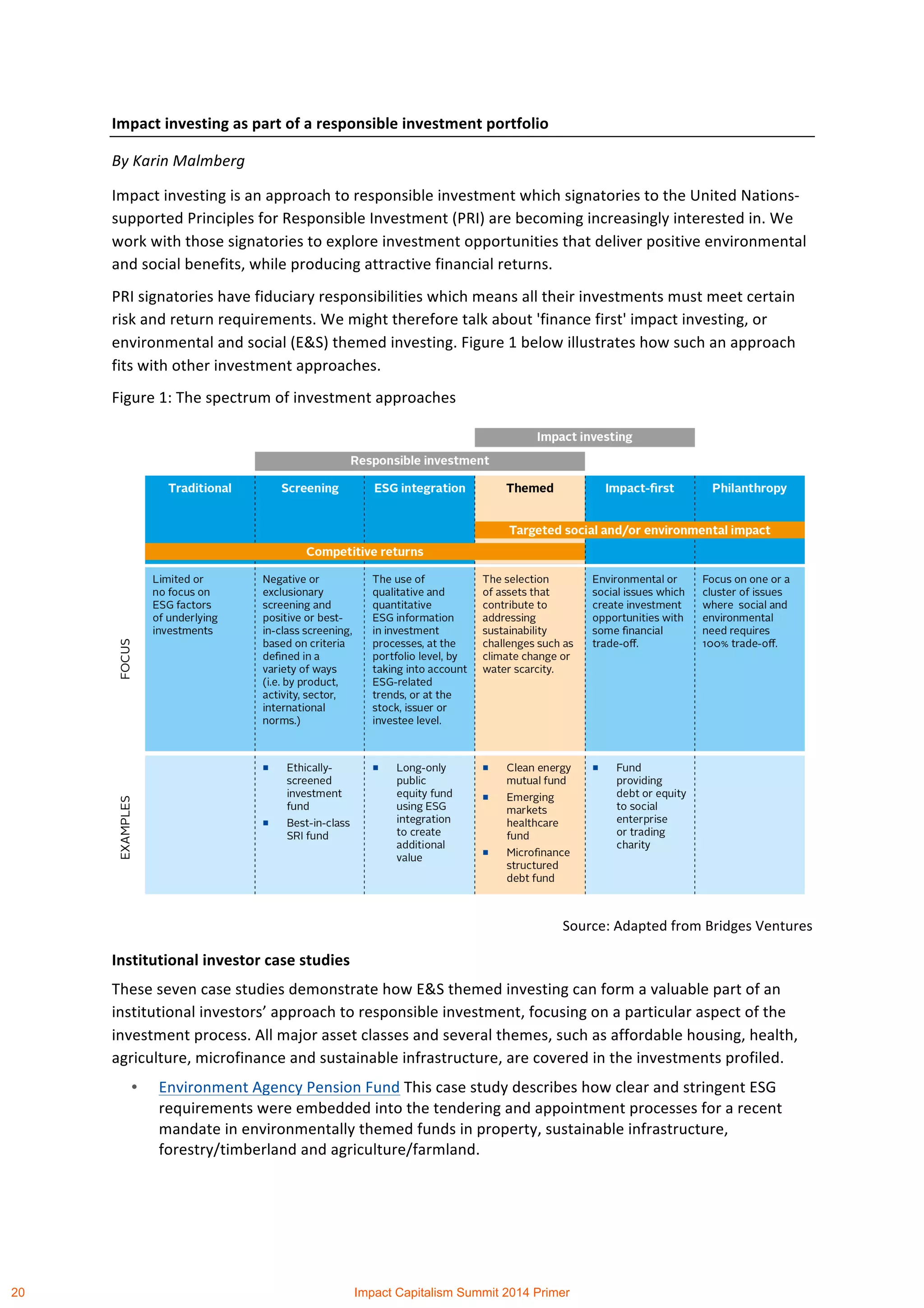
  Figure	
  1	
  below	
  illustrates	
  how	
  such	
  an	
  approach	
  
fits	
  with	
  other	
  investment	
  approaches.	
  
Figure	
  1:	
  The	
  spectrum	
  of	
  investment	
  approaches	


Source:	
  Adapted	
  from	
  Bridges	
  Ventures	
  
Institutional	
  investor	
  case	
  studies	
  
These	
  seven	
  case	
  studies	
  demonstrate	
  how	
  E&S	
  themed	
  investing	
  can	
  form	
  a	
  valuable	
  part	
  of	
  an	
  
institutional	
  investors’	
  approach	
  to	
  responsible	
  investment,	
  focusing	
  on	
  a	
  particular	
  aspect	
  of	
  the	
  
investment	
  process.	
  All	
  major	
  asset	
  classes	
  and	
  several	
  themes,	
  such	
  as	
  affordable	
  housing,	
  health,	
  
agriculture,	
  microfinance	
  and	
  sustainable	
  infrastructure,	
  are	
  covered	
  in	
  the	
  investments	
  profiled.	
  
• Environment	
  Agency	
  Pension	
  Fund	
  This	
  case	
  study	
  describes	
  how	
  clear	
  and	
  stringent	
  ESG	
  
requirements	
  were	
  embedded	
  into	
  the	
  tendering	
  and	
  appointment	
  processes	
  for	
  a	
  recent	
  
mandate	
  in	
  environmentally	
  themed	
  funds	
  in	
  property,	
  sustainable	
  infrastructure,	
  
forestry/timberland	
  and	
  agriculture/farmland.	
  
20 Impact Capitalism Summit 2014 Primer
• Wespath	
  Investment	
  Management	
  This	
  case	
  study	
  outlines	
  how	
  this	
  US	
  investor	
  developed	
  its	
  
highly	
  successful	
  Positive	
  Social	
  Purpose	
  Lending	
  Program	
  and	
  overcame	
  the	
  challenges	
  it	
  
faced.	
  
• Local	
  Government	
  Super	
  This	
  case	
  study	
  looks	
  at	
  the	
  Australian	
  pension	
  fund’s	
  environmental	
  
and	
  social	
  themed	
  investments	
  within	
  four	
  asset	
  classes:	
  international	
  listed	
  equities,	
  private	
  
equity,	
  sovereign	
  bonds	
  and	
  absolute	
  return	
  strategies.	
  It	
  describes	
  how	
  these	
  investments	
  
help	
  LG	
  Super	
  hedge	
  against	
  climate	
  change	
  risk,	
  their	
  performance	
  to	
  date	
  and	
  how	
  LGS	
  
identifies	
  and	
  executes	
  them.	
  	
  
• PGGM	
  This	
  case	
  study	
  outlines	
  how	
  the	
  Dutch	
  pension	
  administrator	
  goes	
  about	
  
understanding	
  the	
  direct	
  and	
  wider	
  impacts	
  of	
  its	
  E&S	
  themed	
  investments,	
  illustrated	
  using	
  
examples	
  of	
  how	
  it	
  applies	
  its	
  approach	
  to	
  microfinance	
  investments.	
  
• Storebrand	
  This	
  case	
  study	
  looks	
  at	
  the	
  Norwegian	
  insurance	
  company’s	
  investments	
  in	
  
health	
  and	
  agriculture	
  sectors	
  focusing	
  particularly	
  on	
  the	
  strict	
  criteria	
  Storebrand	
  uses	
  to	
  
identify	
  and	
  evaluate	
  these	
  investments.	
  	
  
• Merseyside	
  Pension	
  Fund	
  This	
  case	
  study	
  outlines	
  the	
  rationale	
  for,	
  and	
  the	
  structure	
  of,	
  
investments	
  made	
  to	
  support	
  local	
  regeneration.	
  
• Christian	
  Super	
  This	
  case	
  study	
  focuses	
  on	
  the	
  Australian	
  pension	
  fund’s	
  investments	
  in	
  
community	
  infrastructure	
  and	
  community	
  finance.	
  It	
  illustrates	
  the	
  clear	
  social	
  impacts	
  the	
  
selected	
  funds	
  aim	
  to	
  deliver.	
  It	
  also	
  outlines	
  the	
  investment	
  structures	
  and	
  risk	
  mitigation	
  
strategies	
  these	
  funds	
  employ	
  to	
  facilitate	
  institutional	
  investment.	


Measuring	
  impact	
  
The	
  paper	
  Understanding	
  the	
  environmental	
  and	
  social	
  impact	
  of	
  your	
  investments	
  explains	
  the	
  
value	
  of	
  measuring	
  impact,	
  provides	
  guidance	
  on	
  what	
  investors	
  should	
  be	
  tracking	
  and	
  summarises	
  
practical	
  tools	
  and	
  techniques	
  available.	
  
The	
  paper	
  is	
  supported	
  by	
  two	
  case	
  studies	
  looking	
  at	
  indirect	
  investor	
  approaches	
  to	
  measuring	
  
impact:	
  	
  
Obviam	
  	
  
Sarona	
  Asset	
  Management	
  
PRI	
  in	
  Person	
  2014	
  
PRI	
  in	
  Person	
  is	
  the	
  leading	
  global	
  responsible	
  investment	
  conference.	
  At	
  this	
  year’s	
  event,	
  taking	
  
place	
  in	
  Montréal	
  22-­‐26	
  September,	
  topics	
  discussed	
  will	
  include	
  green	
  bonds,	
  impact	
  measurement	
  
and	
  institutional	
  investor	
  case	
  studies.	
  Please	
  go	
  to	
  unpri.org/montreal	
  to	
  find	
  out	
  more.	
  
Find	
  out	
  more	
  
These	
  case	
  studies	
  and	
  other	
  resources	
  can	
  be	
  accessed	
  on	
  PRI’s	
  website:	
  
http://www.unpri.org/areas-­‐of-­‐work/implementation-­‐support/environmental-­‐and-­‐social-­‐themed/	
  	
  
Please	
  contact	
  Karin.malmberg@unpri.org	
  if	
  you	
  are	
  interested	
  in	
  finding	
  out	
  more.	
  
Karin	
  Malmberg	
  is	
  Manager,	
  Environmental	
  and	
  Social	
  Themed	
  Investing	
  at	
  The	
  United	
  Nations-­‐
supported	
  Principles	
  for	
  Responsible	
  Investment	
  (PRI)	
  Initiative.	
  	
  
PRI	
  is	
  an	
  international	
  network	
  of	
  over	
  1200	
  investors	
  and	
  intermediaries,	
  together	
  managing	
  over	
  
US$	
  34	
  trillion	
  in	
  assets.	
  These	
  signatories	
  work	
  together	
  to	
  put	
  the	
  six	
  Principles	
  for	
  Responsible	
  
Investment	
  into	
  practice.	
  Our	
  goal	
  is	
  to	
  understand	
  the	
  implications	
  of	
  sustainability	
  for	
  investors	
  
and	
  support	
  signatories	
  to	
  incorporate	
  these	
  issues	
  into	
  their	
  investment	
  decision	
  making	
  and	
  
ownership	
  practices.	
  	
  
Impact Capitalism Summit 2014 Primer 21


Building	
  Impact	
  Investing	
  Portfolios:	
  From	
  Strategy	
  to	
  Policy	
  to	
  Implementation	
  	
  
Sonen	
  Capital	
  LLC	
  Authors:	
  Justina	
  Lai,	
  Associate	
  Director;	
  Will	
  Morgan,	
  Director	
  of	
  Impact;	
  	
  
Joshua	
  Newman,	
  Investment	
  Analyst;	
  and	
  Raúl	
  Pomares,	
  Senior	
  Managing	
  Director.	


Key	
  Insights	
  	
  
• An	
   impact	
   investing	
   policy	
   is	
   the	
   critical	
   link	
   to	
   translating	
   an	
   impact	
   investing	
   strategy	
   into	
  
tangible	
  implementation	
  steps.	
  
• Impact	
  investors	
  can	
  benefit	
  from	
  an	
  additional	
  layer	
  of	
  due	
  diligence	
  by	
  using	
  specific	
  impact	
  
lenses	
  to	
  identify	
  investments	
  that	
  fit	
  clients’	
  financial	
  and	
  impact	
  requirements.	
  
• In	
  addition	
  to	
  diversifying	
  across	
  asset	
  classes,	
  impact	
  investors	
  can	
  increasingly	
  diversify	
  across	
  
impact	
  sectors	
  as	
  markets	
  deepen.	


Introduction:	
   The	
   following	
   was	
   adapted	
   from	
   Evolution	
   of	
   an	
   Impact	
   Portfolio:	
   From	
  
Implementation	
   to	
   Results,	
   a	
   landmark	
   report	
   released	
   in	
   October	
   2013	
   by	
   Sonen	
   Capital	
   in	
  
collaboration	
  with	
  the	
  KL	
  Felicitas	
  Foundation	
  (KLF,	
  or	
  the	
  Foundation).	
  The	
  report	
  demonstrates	
  to	
  
investors	
  that	
  impact	
  investments	
  can	
  compete	
  with,	
  and	
  at	
  times	
  outperform,	
  traditional	
  asset	
  class	
  
strategies	
  while	
  pursuing	
  meaningful	
  and	
  measurable	
  social	
  and	
  environmental	
  results.i


In	
   2004,	
   to	
   meaningfully	
   address	
   the	
   world’s	
   most	
   pressing	
   social	
   and	
   environmental	
   issues,	
   KLF	
  
began	
   a	
   process	
   that	
   would	
   eventually	
   allocate	
   100%	
   of	
   the	
   Foundation’s	
   capital	
   to	
   impact	
  
investments.	
  Over	
  the	
  seven-­‐year	
  period	
  of	
  2006-­‐2012,	
  the	
  Foundation	
  moved	
  from	
  2%	
  of	
  assets	
  
allocated	
   to	
   impact	
   to	
   over	
   85%,	
   while	
   generating	
   index-­‐competitive,	
   risk-­‐adjusted	
   returns.	
   This	
  
article	
   highlights	
   Sonen	
   Capital’s	
   strategy	
   for	
   building	
   impact	
   investment	
   portfolios,	
   utilizing	
   our	
  
experience	
  in	
  investing	
  KLF’s	
  assets	
  as	
  a	
  case	
  study	
  to	
  concretely	
  illustrate	
  this	
  approach.ii
	
  	
  The	
  full	
  
report	
  is	
  available	
  for	
  download	
  via	
  Sonen’s	
  website	
  at:	
  http://www.sonencapital.com/evolution-­‐of-­‐
impact.php	


Creating	
   an	
   Impact	
   Investment	
   Policy:	
   Constructing	
   KLF’s	
   impact	
   investment	
   portfolio	
   required	
  
following	
  a	
  framework	
  through	
  which	
  investors	
  could	
  move	
  towards	
  action	
  –	
  from	
  establishing	
  to	
  
executing	
  and	
  maintaining	
  an	
  impact	
  investing	
  strategy.	
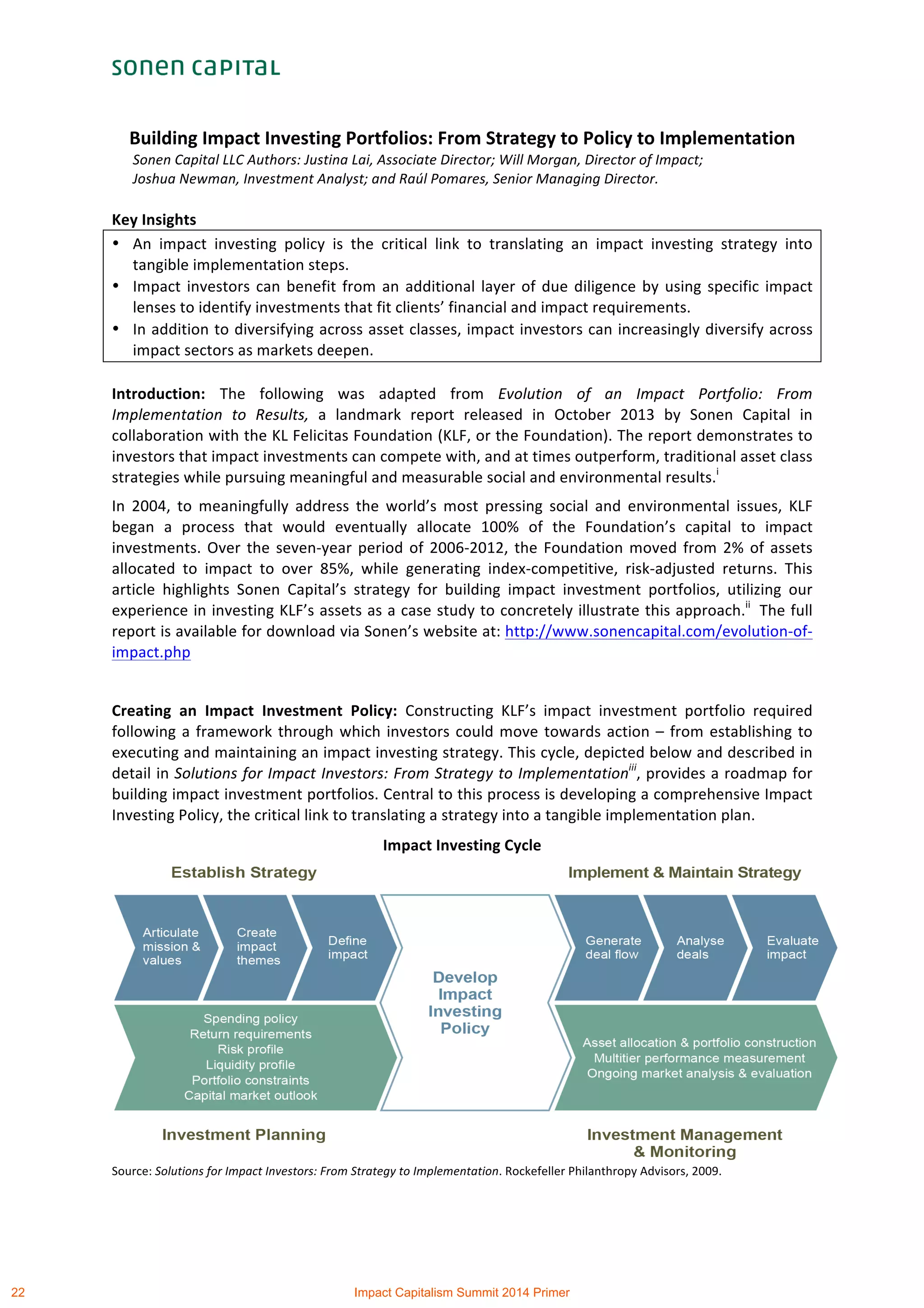
  This	
  cycle,	
  depicted	
  below	
  and	
  described	
  in	
  
detail	
  in	
  Solutions	
  for	
  Impact	
  Investors:	
  From	
  Strategy	
  to	
  Implementationiii
,	
  provides	
  a	
  roadmap	
  for	
  
building	
  impact	
  investment	
  portfolios.	
  Central	
  to	
  this	
  process	
  is	
  developing	
  a	
  comprehensive	
  Impact	
  
Investing	
  Policy,	
  the	
  critical	
  link	
  to	
  translating	
  a	
  strategy	
  into	
  a	
  tangible	
  implementation	
  plan.	
  	
  
Impact	
  Investing	
  Cycle	


Source:	
  Solutions	
  for	
  Impact	
  Investors:	
  From	
  Strategy	
  to	
  Implementation.	
  Rockefeller	
  Philanthropy	
  Advisors,	
  2009.	


22 Impact Capitalism Summit 2014 Primer
 
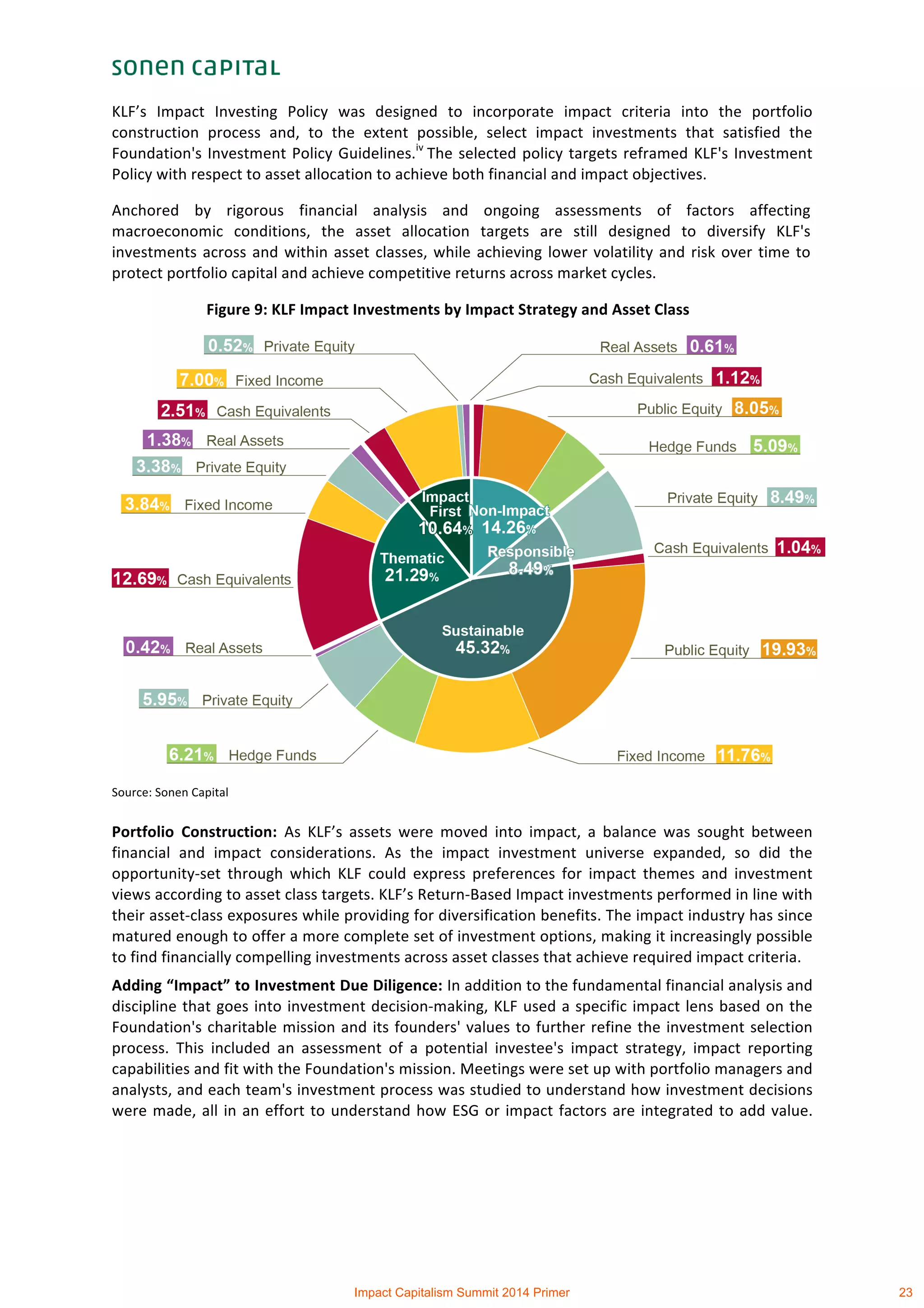
KLF’s	
   Impact	
   Investing	
   Policy	
   was	
   designed	
   to	
   incorporate	
   impact	
   criteria	
   into	
   the	
   portfolio	
  
construction	
   process	
   and,	
   to	
   the	
   extent	
   possible,	
   select	
   impact	
   investments	
   that	
   satisfied	
   the	
  
Foundation's	
  Investment	
  Policy	
  Guidelines.iv
	
  The	
  selected	
  policy	
  targets	
  reframed	
  KLF's	
  Investment	
  
Policy	
  with	
  respect	
  to	
  asset	
  allocation	
  to	
  achieve	
  both	
  financial	
  and	
  impact	
  objectives.	
  	
  
Anchored	
   by	
   rigorous	
   financial	
   analysis	
   and	
   ongoing	
   assessments	
   of	
   factors	
   affecting	
  
macroeconomic	
   conditions,	
   the	
   asset	
   allocation	
   targets	
   are	
   still	
   designed	
   to	
   diversify	
   KLF's	
  
investments	
  across	
  and	
  within	
  asset	
  classes,	
  while	
  achieving	
  lower	
  volatility	
  and	
  risk	
  over	
  time	
  to	
  
protect	
  portfolio	
  capital	
  and	
  achieve	
  competitive	
  returns	
  across	
  market	
  cycles.	
  
Figure	
  9:	
  KLF	
  Impact	
  Investments	
  by	
  Impact	
  Strategy	
  and	
  Asset	
  Class	


Source:	
  Sonen	
  Capital	


Portfolio	
   Construction:	
   As	
   KLF’s	
   assets	
   were	
   moved	
   into	
   impact,	
   a	
   balance	
   was	
   sought	
   between	
  
financial	
   and	
   impact	
   considerations.	
   As	
   the	
   impact	
   investment	
   universe	
   expanded,	
   so	
   did	
   the	
  
opportunity-­‐set	
   through	
   which	
   KLF	
   could	
   express	
   preferences	
   for	
   impact	
   themes	
   and	
   investment	
  
views	
  according	
  to	
  asset	
  class	
  targets.	
  KLF’s	
  Return-­‐Based	
  Impact	
  investments	
  performed	
  in	
  line	
  with	
  
their	
  asset-­‐class	
  exposures	
  while	
  providing	
  for	
  diversification	
  benefits.	
  The	
  impact	
  industry	
  has	
  since	
  
matured	
  enough	
  to	
  offer	
  a	
  more	
  complete	
  set	
  of	
  investment	
  options,	
  making	
  it	
  increasingly	
  possible	
  
to	
  find	
  financially	
  compelling	
  investments	
  across	
  asset	
  classes	
  that	
  achieve	
  required	
  impact	
  criteria.	
  	
  
Adding	
  “Impact”	
  to	
  Investment	
  Due	
  Diligence:	
  In	
  addition	
  to	
  the	
  fundamental	
  financial	
  analysis	
  and	
  
discipline	
  that	
  goes	
  into	
  investment	
  decision-­‐making,	
  KLF	
  used	
  a	
  specific	
  impact	
  lens	
  based	
  on	
  the	
  
Foundation's	
  charitable	
  mission	
  and	
  its	
  founders'	
  values	
  to	
  further	
  refine	
  the	
  investment	
  selection	
  
process.	
   This	
   included	
   an	
   assessment	
   of	
   a	
   potential	
   investee's	
   impact	
   strategy,	
   impact	
   reporting	
  
capabilities	
  and	
  fit	
  with	
  the	
  Foundation's	
  mission.	
  Meetings	
  were	
  set	
  up	
  with	
  portfolio	
  managers	
  and	
  
analysts,	
  and	
  each	
  team's	
  investment	
  process	
  was	
  studied	
  to	
  understand	
  how	
  investment	
  decisions	
  
were	
  made,	
  all	
  in	
  an	
  effort	
  to	
  understand	
  how	
  ESG	
  or	
  impact	
  factors	
  are	
  integrated	
  to	
  add	
  value.	


Impact Capitalism Summit 2014 Primer 23
 
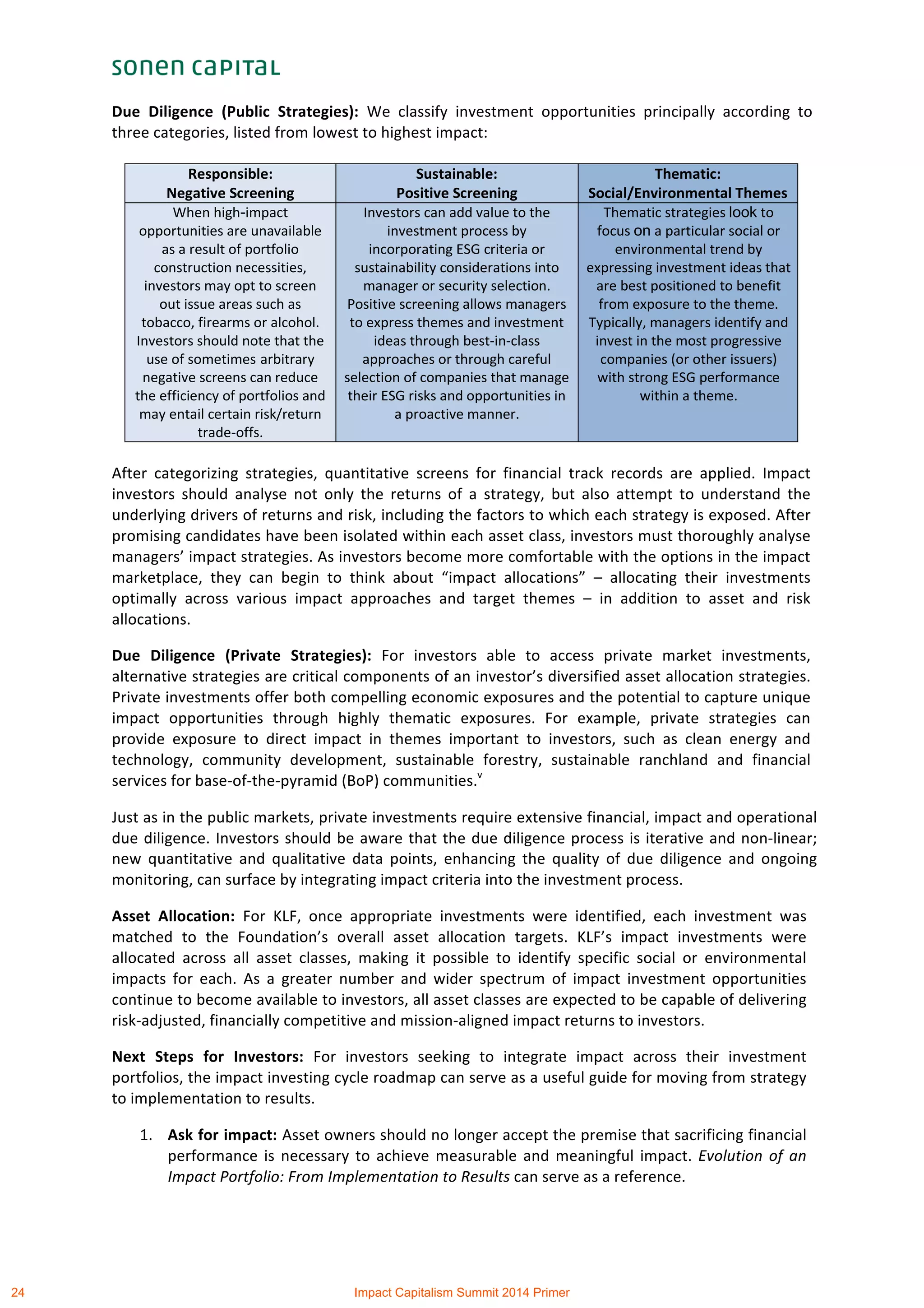
Due	
   Diligence	
   (Public	
   Strategies):	
   We	
   classify	
   investment	
   opportunities	
   principally	
   according	
   to	
  
three	
  categories,	
  listed	
  from	
  lowest	
  to	
  highest	
  impact:	


After	
   categorizing	
   strategies,	
   quantitative	
   screens	
   for	
   financial	
   track	
   records	
   are	
   applied.	
   Impact	
  
investors	
   should	
   analyse	
   not	
   only	
   the	
   returns	
   of	
   a	
   strategy,	
   but	
   also	
   attempt	
   to	
   understand	
   the	
  
underlying	
  drivers	
  of	
  returns	
  and	
  risk,	
  including	
  the	
  factors	
  to	
  which	
  each	
  strategy	
  is	
  exposed.	
  After	
  
promising	
  candidates	
  have	
  been	
  isolated	
  within	
  each	
  asset	
  class,	
  investors	
  must	
  thoroughly	
  analyse	
  
managers’	
  impact	
  strategies.	
  As	
  investors	
  become	
  more	
  comfortable	
  with	
  the	
  options	
  in	
  the	
  impact	
  
marketplace,	
   they	
   can	
   begin	
   to	
   think	
   about	
   “impact	
   allocations”	
   –	
   allocating	
   their	
   investments	
  
optimally	
   across	
   various	
   impact	
   approaches	
   and	
   target	
   themes	
   –	
   in	
   addition	
   to	
   asset	
   and	
   risk	
  
allocations.	
  
Due	
   Diligence	
   (Private	
   Strategies):	
   For	
   investors	
   able	
   to	
   access	
   private	
   market	
   investments,	
  
alternative	
  strategies	
  are	
  critical	
  components	
  of	
  an	
  investor’s	
  diversified	
  asset	
  allocation	
  strategies.	
  
Private	
  investments	
  offer	
  both	
  compelling	
  economic	
  exposures	
  and	
  the	
  potential	
  to	
  capture	
  unique	
  
impact	
   opportunities	
   through	
   highly	
   thematic	
   exposures.	
   For	
   example,	
   private	
   strategies	
   can	
  
provide	
   exposure	
   to	
   direct	
   impact	
   in	
   themes	
   important	
   to	
   investors,	
   such	
   as	
   clean	
   energy	
   and	
  
technology,	
   community	
   development,	
   sustainable	
   forestry,	
   sustainable	
   ranchland	
   and	
   financial	
  
services	
  for	
  base-­‐of-­‐the-­‐pyramid	
  (BoP)	
  communities.v
	
  
Just	
  as	
  in	
  the	
  public	
  markets,	
  private	
  investments	
  require	
  extensive	
  financial,	
  impact	
  and	
  operational	
  
due	
  diligence.	
  Investors	
  should	
  be	
  aware	
  that	
  the	
  due	
  diligence	
  process	
  is	
  iterative	
  and	
  non-­‐linear;	
  
new	
   quantitative	
   and	
   qualitative	
   data	
   points,	
   enhancing	
   the	
   quality	
   of	
   due	
   diligence	
   and	
   ongoing	
  
monitoring,	
  can	
  surface	
  by	
  integrating	
  impact	
  criteria	
  into	
  the	
  investment	
  process.	
  	
  
Asset	
   Allocation:	
   For	
   KLF,	
   once	
   appropriate	
   investments	
   were	
   identified,	
   each	
   investment	
   was	
  
matched	
   to	
   the	
   Foundation’s	
   overall	
   asset	
   allocation	
   targets.	
   KLF’s	
   impact	
   investments	
   were	
  
allocated	
   across	
   all	
   asset	
   classes,	
   making	
   it	
   possible	
   to	
   identify	
   specific	
   social	
   or	
   environmental	
  
impacts	
   for	
   each.	
   As	
   a	
   greater	
   number	
   and	
   wider	
   spectrum	
   of	
   impact	
   investment	
   opportunities	
  
continue	
  to	
  become	
  available	
  to	
  investors,	
  all	
  asset	
  classes	
  are	
  expected	
  to	
  be	
  capable	
  of	
  delivering	
  
risk-­‐adjusted,	
  financially	
  competitive	
  and	
  mission-­‐aligned	
  impact	
  returns	
  to	
  investors.	
  
Next	
   Steps	
   for	
   Investors:	
   For	
   investors	
   seeking	
   to	
   integrate	
   impact	
   across	
   their	
   investment	
  
portfolios,	
  the	
  impact	
  investing	
  cycle	
  roadmap	
  can	
  serve	
  as	
  a	
  useful	
  guide	
  for	
  moving	
  from	
  strategy	
  
to	
  implementation	
  to	
  results.	
  	
  
1. Ask	
  for	
  impact:	
  Asset	
  owners	
  should	
  no	
  longer	
  accept	
  the	
  premise	
  that	
  sacrificing	
  financial	
  
performance	
  is	
  necessary	
  to	
  achieve	
  measurable	
  and	
  meaningful	
  impact.	
  Evolution	
  of	
  an	
  
Impact	
  Portfolio:	
  From	
  Implementation	
  to	
  Results	
  can	
  serve	
  as	
  a	
  reference.	
  
Responsible:	
  
Negative	
  Screening	
  
Sustainable:	
  
Positive	
  Screening	
  
Thematic:	
  
Social/Environmental	
  Themes	
  
When	
  high-impact	
  
opportunities	
  are	
  unavailable	
  
as	
  a	
  result	
  of	
  portfolio	
  
construction	
  necessities,	
  
investors	
  may	
  opt	
  to	
  screen	
  
out	
  issue	
  areas	
  such	
  as	
  
tobacco,	
  firearms	
  or	
  alcohol.	
  
Investors	
  should	
  note	
  that	
  the	
  
use	
  of	
  sometimes arbitrary	
  
negative	
  screens	
  can	
  reduce	
  
the	
  efficiency	
  of	
  portfolios	
  and	
  
may	
  entail	
  certain	
  risk/return	
  
trade-­‐offs.	
  
Investors	
  can	
  add	
  value	
  to	
  the	
  
investment	
  process	
  by	
  
incorporating	
  ESG	
  criteria	
  or	
  
sustainability	
  considerations	
  into	
  
manager	
  or	
  security	
  selection.	
  
Positive	
  screening	
  allows	
  managers	
  
to	
  express	
  themes	
  and	
  investment	
  
ideas	
  through	
  best-­‐in-­‐class	
  
approaches	
  or	
  through	
  careful	
  
selection	
  of	
  companies	
  that	
  manage	
  
their	
  ESG	
  risks	
  and	
  opportunities	
  in	
  
a	
  proactive	
  manner.	
  
Thematic	
  strategies	
  look	
  to	
  
focus	
  on	
  a	
  particular	
  social	
  or	
  
environmental	
  trend	
  by	
  
expressing	
  investment	
  ideas	
  that	
  
are	
  best	
  positioned	
  to	
  benefit	
  
from	
  exposure	
  to	
  the	
  theme.	
  
Typically,	
  managers	
  identify	
  and	
  
invest	
  in	
  the	
  most	
  progressive	
  
companies	
  (or	
  other	
  issuers)	
  
with	
  strong	
  ESG	
  performance	
  
within	
  a	
  theme.	


24 Impact Capitalism Summit 2014 Primer
 
2. Reclaim	
  ownership	
  of	
  assets:	
  If	
  the	
  service	
  provider	
  is	
  not	
  willing	
  and/or	
  not	
  able	
  to	
  deploy	
  
assets	
  to	
  impact,	
  another	
  service	
  provider	
  should	
  be	
  found	
  who	
  is.	
  	
  
3. Become	
   more	
   educated:	
   Growing	
   industry	
   networks	
   and	
   an	
   abundant	
   set	
   of	
   topical	
  
resources	
  are	
  available	
  to	
  those	
  interested	
  in	
  learning	
  more.	
  
4. Widen	
  options:	
  The	
  industry	
  continues	
  to	
  evolve,	
  and	
  investors	
  today	
  have	
  an	
  increasing	
  
number	
   of	
   choices	
   to	
   implement	
   their	
   impact	
   strategies.	
   More	
   high-­‐quality,	
   turnkey	
  
solutions	
  are	
  available	
  in	
  the	
  marketplace	
  than	
  ever	
  before.	


i
	
  For	
  a	
  complete	
  understanding	
  of	
  the	
  strategies,	
  principles	
  and	
  performance	
  results,	
  please	
  see	
  Evolution	
  of	
  an	
  Impact	
  Portfolio:	
  From	
  
Implementation	
  to	
  Results,	
  October	
  2013.	
  San	
  Francisco,	
  CA:	
  Sonen	
  Capital,	
  http://www.sonencapital.com/evolution-­‐of-­‐impact.php.	
  
ii
	
  Sonen	
  Capital	
  was	
  founded	
  in	
  September	
  2011,	
  and	
  therefore	
  much	
  of	
  the	
  performance	
  commentary	
  relates	
  to	
  investments	
  made	
  under	
  
the	
  supervision	
  of	
  Raúl	
  Pomares	
  (with	
  significant	
  input	
  from	
  KLF)	
  before	
  the	
  existence	
  of	
  Sonen	
  Capital,	
  and	
  by	
  an	
  investment	
  team	
  that	
  is	
  
different	
  from	
  that	
  of	
  Sonen	
  Capital.	
  There	
  can	
  be	
  no	
  assurances	
  that	
  Sonen	
  Capital	
  would	
  have	
  achieved	
  similar	
  performance,	
  or	
  that	
  
investments	
  made	
  by	
  Sonen	
  Capital	
  in	
  the	
  future	
  will	
  achieve	
  their	
  stated	
  objectives	
  or	
  avoid	
  losses.	
  
iii
	
  Godeke,	
  S,	
  Pomares,	
  R.	
  Solutions	
  for	
  Impact	
  Investors:	
  From	
  Strategy	
  to	
  Implementation.	
  Rockefeller	
  Philanthropy	
  Advisors,	
  2009.	
  
iv
	
  The	
  complete	
  investment	
  policy	
  is	
  available	
  at	
  http://www.klfelicitasfoundation.org/	
  and	
  depicted	
  in	
  Evolution	
  of	
  an	
  Impact	
  Portfolio:	
  
From	
  Implementation	
  to	
  Results.	
  
v
	
  Base	
  of	
  the	
  pyramid	
  refers	
  to	
  the	
  4	
  billion	
  people	
  with	
  annual	
  income	
  under	
  US$	
  3,000	
  in	
  local	
  purchasing	
  power.	
  Hammond,	
  A,	
  
Kramer,	
  W,	
  Tran,	
  J,	
  Katz,	
  R	
  and	
  Walker,	
  C.	
  “The	
  Next	
  Four	
  Billion:	
  Market	
  Size	
  and	
  Business	
  Strategy	
  at	
  the	
  Base	
  of	
  the	
  Pyramid”.	
  
World	
  Resources	
  Institute,	
  2007.
Impact Capitalism Summit 2014 Primer 25
Agricultural Technology Impact Assessment Framework
The Agricultural Technology (AgTech) sector is emerging as the key weapon in the battle for global food
security. The triple threat of population growth, rising incomes among the emerging middle class, and
limited arable land and water resources are projected to cause widespread food shortages, high levels
of food price instability, and increased strain on existing environmental and governmental resources.
AgTech seeks to address the food security threat using technological solutions to raise agricultural
yields, improve supply chain efficiencies to lower food spoilage, improve water resource management,
and combat food safety issues. AgTech innovations could raise global crop yields by up to 67% and
lower food prices by up to 49% by 2050.1
From a financial perspective, the high demand for food
security solutions could result in attractive exit valuations and potentially compelling cash yields.
This said, several debates have emerged that question the ultimate beneficial impact of AgTech
investments beyond increased crop yields. Is there impact intentionality in AgTech, given that exits are
likely to involve strategic sales to large multi-nationals operating in the food and agri industries? Does
AgTech facilitate the industrialization of food production, with potentially negative environmental
consequences? Does it threaten organic/natural, local farming practices? Are production yields rising at
the potential expense of public health, due to the unknown consequences of genetically modified crops
and increased reliance on hormones and antibiotics in animal proteins? Is any AgTech benefit trickling
down to small scale farmers, notably those in developing economies?
The purpose of this paper is to provide investors with a framework for making informed decisions about
whether or not to pursue investments in the AgTech sector, considering all sides of the debate, most
notably the ultimate social benefits of an adequate food supply vs. the question of intrinsic impact. This
should be done within the context of the investor’s investment philosophy and financial objectives.
Decision points to frame an Investor’s AgTech strategy:
 To what extent does the investor want exposure to the AgTech sector? Why?
 What is the investor’s position on the lack of impact intentionality in most AgTech investments
vs. the end goal of increased food security? Does the meaningful benefit to society outweigh the
impact mission drift risk?
 Can an investor occupy a position of innovation leadership in impact investing, yet still invest in
the AgTech space? Does AgTech investing optimize the investor’s capacity to add value?
 Would direct investing in AgTech be a better strategy to pursue, as it would allow investors to
seek out specific AgTech investments that could offer intrinsic impact?
 If we define success as “the intention of an investment being materialized and fulfilled,” then
what does that look like in the AgTech context?
There are three reasons investors may want to participate in AgTech investing:
1. To generate positive financial return from a sector with projected high product
demand.
2. To enhance long-term food security through new technologies.
3. To ameliorate food inflation.
There are three primary strategies to pursue exposure to the AgTech sector:
1. Direct private investment into AgTech companies.
2. Investment in AgTech companies through the public securities’ markets.
3. Investment in private funds focused on AgTech, mainly using PE or VC vehicles.
26 Impact Capitalism Summit 2014 Primer
Backup Research/Thoughts on AgTech
Trends driving the AgTech debate:
 Population growth. While the rate of growth is slowing, world population continues to expand:
it is expected to reach 9.1 bn by 2050, a 70% increase.2
This will drive increased demand for
food, as well as higher prices.
 Rising food prices are driving more people into poverty. 110 million people were driven into
poverty, and 44 million more became undernourished, in 2008. 925 million people go hungry
because they cannot afford to pay for daily nutrition. In many developing countries, people
spend 50-80% of their income on food.3
 Growth in EMG middle class. Emerging markets are also seeing unprecedented growth in the
middle class, as income levels rise. GDP worldwide is projected to increase by 3.3% annually
over the next decade, but by 5.6% annually in emerging markets. This will increase demand for
animal protein and certain produce, both of which previously were too expensive for this group.
Meat consumption during this period is projected to rise 2.4% annually in emerging markets, vs.
0.9% in developed countries.4
Demand for livestock feed, and the land on which to grow it, will
rise as a result, putting additional pressure on traditional food resources.
 Food inflation. Despite declining per capita consumption of wheat and rice, the rising
population, particularly in developing countries, is expected to increase global demand for
staple food grains. According to the USDA, 82% of the increase in world wheat consumption
over the 2013-22 period will be driven by emerging markets.5
This could result in food inflation
spikes similar to that seen during the 2008 food crisis, as global supply curves destabilize.
 Increased transportation costs. Inexpensive transportation fuels have made the global food
supply chain profitable and efficient. Increased transportation costs threaten this supply chain,
as the countries who may experience sharp increases in food import needs are the same
countries least able to afford it.
 Limited land supply. There is a limited supply of arable land, water resources are becoming
more scarce, and desertification continues to claim previously arable land across the globe.
Farmland prices in the US are rising at unprecedented rates, up more than 400% over the last
ten years, and more than 90% over the past five. 6
This ultimately increases the end cost of food
to the consumer.
 Land grab in EMG. Increased demand for arable land is resulting in land grabs in emerging
markets, which is destroying rainforests and reducing carbon offsets, disrupting indigenous
populations, increasing the strain on the water supply, increasing the burden on the global food
supply chain and creating mono-cultures in previously diverse food ecosystems.
 Strain on water resources. Rising demand for food, and notably the growth in animal protein
consumption, will increase agriculturally-based water demand. 1 kg of rice production uses
3,500 liters of water, whereas 1 kg of beef requires 15,000 liters. Current water management
techniques in agriculture are changing ecosystems significantly, and rendering the provision of
ecosystem services ineffective. The external cost in the US is US$9–20 billion per year.7
 Food loss/waste. 30% of food production is lost or wasted each year, meaning the productive
inputs (water and land) are also wasted.8
 Greenhouse Gases. Agriculture contributes to greenhouse gas emmissions.9
 Biodiesel demand. Rising demand for biodiesel is increasing demand for vegetable oils in
emerging markets.
AgTech investments can ameliorate some of these issues:
Benefits:
Impact Capitalism Summit 2014 Primer 27
 Poised to raise crop yields by up to 67% and lower food prices by up to 49% by 2050.10
 Increase productivity and crop yields on existing farmland through technological advancements
in seed technology, fertilizers, agri equipment, and precision agriculture (notably irrigation).
 Improve animal protein yields through programs and investments promoting animal health and
innovations in livestock feed.
 Reduce food spoilage and loss through supply chain innovations, with cold storage being a
notable near-term opportunity. Similarly, vertical integration or direct
grower/distributor/consumer interaction can reduce food cost.
 Increase effective water management through improved irrigation techniques that reduce water
waste during the growing process; develop water recovery/repurposing systems to increase
water recapture.
 Reduce food safety issues through innovations in diagnostics, processing, and packaging.
 Solid investment exit opportunities exist through strategic sales. High demand for food security
solutions could result in attractive exit valuations and interest from multiple buyers.
However, there are concerns arising from the AgTech strategy:
Risks:
 Mission drift upon exit: Strategic sales would likely be to large companies in the food and agri
business, resulting in an increased industrialization of the food supply. Many of these
corporations are utterly devoid of impact intentionality (example: ConAgra).
 Higher crop and protein yields are often achieved through genetic modification to seeds and
crops, and hormones and antibiotics used in animal protein production. Debate continues over
the long-term public health impact of these techniques.
 AgTech innovations may not be environmentally friendly (ex: pesticides and fertilizers).
 Increased automation in the farming process could reduce jobs for LMI populations.
 The potential for higher profits via rising crop yields, plus a lack of environmental regulation
around land usage, could encourage additional transformation of rainforest/jungle to farmland,
resulting in the negative externalities mentioned above, but potentially impacting region-scale
ecosystems.
 Productivity improvements in emerging markets meant to support domestic consumption needs
may instead enhance the export market, depending on relative pricing.
Investor Interest:
 Increased awareness of the food security dilemma and the potential for solid returns is
attracting more investors to the sector. However, the development of AgTech-focused
investment vehicles is still nascent, resulting in fewer fund investment options for interested
AgTech investors.
 To our knowledge, there are no purely AgTech-focused funds that require impact intentionality
on behalf of their portfolio companies (funds that eschew the environmental and social
negatives mentioned above while also investing solely in AgTech).
 Investing in AgTech may result in deviation from parts of the investor’s stated investment policy.
Impact:
 AgTech investments bring an undeniable enhancement to global food security by raising the
productive capacity of existing farmland and the efficiency of the agricultural supply chain.
 Productivity increases could help control food inflation.
 More productive farmland could reduce the demand for land conversions in emerging markets (I
know this conflicts with a similar point listed under Risks; it could go either way).
 Water consumption and waste could be reduced.
28 Impact Capitalism Summit 2014 Primer
 A greater share of the value chain could be pulled to the producer, as technology-enabled
farmers can connect directly to end markets.
Complications:
 A debate has evolved within the impact investment community concerning the need for food
security (an adequate, affordable food supply, notably to emerging market populations) vs. the
environmental need for sustainable and natural farming, local agriculture and LMI livelihood
promotion, and concern over the public health unknowns related to productivity enhancements.
Impact investors recognize that all aspects of the argument present pressing concerns, but
disagree on which is most important. Does the investor need to formulate a view concerning
this debate?
 Does the investor’s commitment to impact intentionality outweigh the fact that most AgTech
funds do not invest with the goal of creating social impact, despite their ultimate goal of
increased food security?
 Can the investor occupy a position of innovation leadership in impact investing, yet ignore the
concerns above?
Notes:
1. http://www.ifpri.org/pressrelease/agricultural-technologies-could-increase-global-crop-yields-
much-67-percent-and-cut-foo
2. UN http://www.un.org/waterforlifedecade/food_security.shtml
3. Ibid.
4. http://www.ers.usda.gov/amber-waves/2013-august/developing-countries-dominate-world-
demand-for-agricultural-products.aspx#.Uzdgs1ydrwI
5. Ibid.
6. http://www.ncreif.org/farmland-returns.aspx
7. http://www.un.org/waterforlifedecade/food_security.shtml
8. Ibid.
9. Ibid.
10. http://www.ifpri.org/pressrelease/agricultural-technologies-could-increase-global-crop-yields-
much-67-percent-and-cut-foo
Disclosure: The CAPROCK Group, Inc. (‘CAPROCK”) is an SEC Registered Investment Adviser. CAPROCK provides individual
client services only in states in which it is filed or where an exemption or exclusion from such filing exists. Provided for informational
purposes only. Independent advice should be sought in all cases. Investment in securities or financial instruments involves the risk
of loss. Impact investing does not guarantee any level of performance. Past performance is not a guarantee of future performance.
Alternative and private investments, including private placements, involve additional risk, including lack of liquidity, restrictions on
withdrawal/redemption/transferability and the risk of loss of a full investment. Because these types of investments involve certain
additional degrees of risk, they should only be utilized when consistent with the client’s investment objectives, tolerance for risk,
liquidity and suitability.
Impact Capitalism Summit 2014 Primer 29
TOTAL	
  PORTFOLIO	
  ACTIVATION	
  	
  
A	
  FRAMEWORK	
  FOR	
  CREATING	
  SOCIAL	
  
AND	
  ENVIRONMENTAL	
  IMPACT	
  ACROSS	
  
ASSET	
  CLASSES	
  
A	
  paper	
  published	
  by	
  Tides,	
  Trillium	
  Asset	
  Management,	
  
and	
  Tellus	
  Institute	
  has	
  developed	
  a	
  novel	
  framework	
  
for	
  pursuing	
  social	
  and	
  environmental	
  impact	
  
opportunities	
  across	
  asset	
  classes.	
  
The	
  study	
  “Total	
  Portfolio	
  Activation,”	
  by	
  Joshua	
  
Humphreys,	
  Ann	
  Solomon	
  and	
  Christi	
  Electris,	
  provides	
  
concrete	
  steps	
  to	
  help	
  institutional	
  investors	
  begin	
  
working	
  toward	
  a	
  fuller	
  activation	
  of	
  their	
  portfolio	
  to	
  
advance	
  their	
  mission.	
  
The	
  basic	
  insight	
  that	
  drives	
  Total	
  Portfolio	
  Activation	
  is	
  
that	
  every	
  investment	
  across	
  every	
  asset	
  class	
  has	
  social	
  
and	
  environmental	
  impacts—positive	
  and	
  negative.	
  The	
  
paper	
  provides	
  both	
  a	
  framework	
  and	
  a	
  set	
  of	
  analytical	
  
tools	
  to	
  help	
  mission-­‐driven	
  investors	
  understand	
  the	
  
specific	
  impact	
  opportunity	
  set	
  that	
  can	
  be	
  pursued.	
  
In	
  addition	
  to	
  wide-­‐ranging	
  research	
  on	
  the	
  burgeoning	
  
field	
  of	
  sustainable,	
  responsible,	
  and	
  impact	
  investing,	
  
the	
  authors	
  relied	
  on	
  the	
  advice	
  and	
  examples	
  of	
  
numerous	
  investors,	
  investment	
  officers,	
  and	
  fund	
  
managers	
  who	
  agreed	
  to	
  speak	
  about	
  their	
  efforts	
  to	
  
pursue	
  investment	
  impact,	
  whether	
  across	
  their	
  
portfolios	
  or	
  within	
  asset	
  classes.	
  With	
  case	
  studies	
  of	
  
The	
  Oneida	
  Trust,	
  Equity	
  Foundation	
  and	
  Dominican	
  
Sisters	
  of	
  Hope	
  among	
  others,	
  the	
  report	
  provides	
  
specific	
  examples	
  of	
  investors	
  who	
  have	
  begun	
  to	
  
activate	
  increasing	
  allocations	
  of	
  their	
  portfolios	
  for	
  
deeper	
  social	
  and	
  environmental	
  impact.	
  	
  
Total	
  Portfolio	
  Activation	
  outlines	
  four	
  related	
  areas	
  of	
  
activity	
  where	
  opportunities	
  for	
  impact	
  can	
  be	
  readily	
  
seized	
  within	
  each	
  asset	
  class	
  and	
  ten	
  key	
  steps	
  that	
  
investors	
  can	
  take	
  in	
  order	
  to	
  implement	
  the	
  Total	
  
Portfolio	
  Activation	
  framework.	


Download	
  the	
  full	
  report,	
  Total	
  Portfolio	
  
Activation:	
  A	
  Framework	
  for	
  Creating	
  Social	
  
and	
  Environmental	
  Impact	
  across	
  Asset	
  Classes	
  
http://croataninstitute.org/publications/publicat
ion/total-­‐portfolio-­‐activation-­‐2012	
  	
  
The	
  following	
  is	
  an	
  excerpt	
  from	
  the	
  paper:	
  
nterest	
  in	
  investment	
  that	
  pursues	
  social	
  and	
  
environmental	
  impact	
  has	
  exploded	
  in	
  recent	
  
years.	
  	
  Although	
  opportunities	
  for	
  impact	
  investing	
  
have	
  emerged	
  across	
  asset	
  classes,	
  most	
  impact-­‐
investment	
  activity	
  has	
  remained	
  largely	
  confined	
  to	
  a	
  
I	
  
30 Impact Capitalism Summit 2014 Primer
limited	
  array	
  of	
  private	
  investments,	
  touching	
  only	
  a	
  
small	
  percentage	
  of	
  investor	
  portfolios.1	
  
For	
  organizations	
  and	
  individuals	
  seeking	
  greater	
  
impact	
  and	
  better	
  alignment	
  between	
  their	
  investment	
  
activities	
  and	
  their	
  mission	
  or	
  values,	
  there	
  remains	
  a	
  
pressing	
  need	
  for	
  tools	
  to	
  help	
  investors	
  identify	
  and	
  
seize	
  opportunities	
  to	
  activate	
  more	
  of	
  their	
  assets	
  for	
  
social	
  and	
  environmental	
  benefit.	
  
To	
  help	
  fill	
  this	
  gap,	
  this	
  paper	
  introduces	
  a	
  simple	
  
conceptual	
  framework:	
  Total	
  Portfolio	
  Activation.	


“Total	
  Portfolio	
  Activation”	
  is	
  a	
  framework	
  for	
  
conceptualizing	
  social	
  and	
  environmental	
  impact	
  
investment	
  not	
  as	
  an	
  asset	
  class,	
  but	
  rather	
  as	
  an	
  
approach	
  to	
  be	
  pursued	
  across	
  all	
  asset	
  classes	
  in	
  a	
  
diversified	
  portfolio.	
  	
  At	
  a	
  time	
  when	
  most	
  "impact	
  
investment"	
  has	
  seemingly	
  been	
  confined	
  to	
  private	
  
equity	
  and	
  private	
  debt	
  investments,	
  the	
  basic	
  insight	
  
that	
  drives	
  Total	
  Portfolio	
  Activation	
  (TPA)	
  is	
  that	
  
every	
  investment	
  across	
  every	
  asset	
  class	
  has	
  
potential	
  social	
  and	
  environmental	
  impacts	
  –	
  both	
  
positive	
  and	
  negative.	
  	
  However,	
  we	
  lack	
  a	
  coherent	
  
framework	
  for	
  evaluating	
  the	
  opportunity	
  for	
  impact	
  
across	
  all	
  holdings	
  in	
  a	
  diversified	
  portfolio.	
  	
  
Specifically,	
  the	
  paper	
  identifies	
  four	
  related	
  areas	
  of	
  
activity	
  where	
  opportunities	
  for	
  impact	
  can	
  be	
  readily	
  
seized	
  within	
  each	
  asset	
  class	
  in	
  order	
  to	
  increase	
  an	
  
investor’s	
  potential	
  for	
  social	
  or	
  environmental	
  
impact:	


1.	
  Investment	
  selection	
  –	
  incorporating	
  
environmental,	
  social	
  or	
  governance	
  (ESG)	
  issues	
  and	
  
impact	
  into	
  investment	
  review,	
  decision-­‐making	
  and	
  
performance	
  analysis.	
  	
  Investors	
  will	
  have	
  specific	
  
criteria	
  related	
  to	
  environmental	
  or	
  social	
  issue	
  areas	
  
or	
  targeted	
  geographies	
  around	
  which	
  they	
  structure	
  
their	
  investment	
  selection	
  process	
  and	
  then	
  monitor	
  
their	
  impact.	
  
2.	
  Active	
  ownership	
  –	
  exercising	
  the	
  stewardship	
  
rights	
  and	
  responsibilities,	
  voice	
  and	
  votes,	
  that	
  often	
  
accompany	
  owning	
  an	
  asset.	
  	
  Investing	
  in	
  assets	
  can	
  
often	
  open	
  opportunities	
  to	
  engage	
  in	
  activities	
  as	
  an	
  
owner,	
  whether	
  directly	
  or	
  indirectly.	


1	
  Yasemin	
  Saltuk,	
  Amit	
  Bouri,	
  and	
  Giselle	
  Leung,	
  
“Insight	
  into	
  the	
  Impact	
  Investment	
  Market,”	
  J.	
  P.	
  
Morgan	
  and	
  the	
  GIIN,	
  December	
  2011.	
  
3.	
  Networks	
  –	
  joining	
  wider	
  groups	
  and	
  coalitions	
  of	
  
stakeholders	
  around	
  common	
  environmental	
  and	
  
social	
  issues	
  of	
  concern,	
  in	
  order	
  to	
  leverage	
  collective	
  
power	
  to	
  generate	
  greater	
  impact	
  than	
  any	
  single	
  
investor	
  could	
  on	
  its	
  own.	
  
4.	
  Policy	
  –	
  engaging	
  in	
  public-­‐policy	
  activities	
  as	
  an	
  
investor	
  in	
  order	
  to	
  tap	
  government	
  resources	
  and	
  
incentives	
  or	
  encourage	
  regulatory	
  oversight	
  and	
  
intervention	
  in	
  support	
  of	
  impact	
  objectives.	
  	
  Policy	
  
activity	
  acknowledges	
  the	
  potential	
  role	
  government	
  
support,	
  regulation	
  and	
  intervention	
  can	
  play	
  in	
  the	
  
investment	
  process	
  to	
  encourage	
  positive	
  social	
  and	
  
environmental	
  outcomes.	


Each	
  activity	
  area	
  can	
  be	
  applied	
  within	
  each	
  asset	
  
class,	
  and	
  increasing	
  portfolio	
  activation	
  can	
  have	
  
significant	
  leveraging	
  effects	
  on	
  an	
  investors’	
  potential	
  
impact.	
  	
  At	
  the	
  same	
  time,	
  the	
  relative	
  importance	
  of	
  
each	
  activity	
  for	
  increasing	
  potential	
  impact	
  will	
  vary	
  
within	
  each	
  asset	
  class	
  and	
  depend	
  on	
  the	
  investor’s	
  
specific	
  social	
  or	
  environmental	
  concerns	
  or	
  goals.	
  	
  
The	
  process	
  of	
  selecting	
  an	
  investment	
  because	
  of	
  its	
  
impact	
  attributes	
  is	
  key	
  for	
  every	
  asset	
  class,	
  but	
  we	
  
Impact Capitalism Summit 2014 Primer 31
have	
  also	
  found	
  meaningful	
  opportunities	
  to	
  increase	
  
the	
  potential	
  for	
  impact	
  in	
  the	
  other	
  activity	
  areas	
  as	
  
well:	
  by	
  taking	
  more	
  active	
  ownership	
  of	
  assets,	
  
joining	
  with	
  other	
  stakeholders	
  in	
  networks	
  of	
  
common	
  concern,	
  and	
  using	
  policy	
  tools	
  and	
  
strategies.	
  
Specific	
  asset	
  classes	
  are	
  also	
  better	
  suited	
  for	
  
generating	
  particular	
  kinds	
  of	
  impact,	
  so	
  investors	
  
with	
  targeted	
  issue	
  areas	
  of	
  concern	
  will	
  need	
  to	
  place	
  
greater	
  stress	
  on	
  the	
  activities	
  and	
  investments	
  that	
  
align	
  with	
  their	
  impact	
  objectives.	
  	
  Cash	
  and	
  fixed-­‐
income	
  investments	
  in	
  community	
  development	
  
financial	
  institutions,	
  for	
  example,	
  are	
  particularly	
  
useful	
  ways	
  to	
  support	
  affordable	
  housing	
  in	
  targeted,	
  
low-­‐income	
  geographies.	
  	
  Active	
  ownership	
  initiatives,	
  
by	
  contrast,	
  appear	
  particularly	
  germane	
  to	
  
investments	
  in	
  public	
  and	
  private	
  equity	
  and	
  real	
  
assets,	
  though	
  they	
  take	
  very	
  different	
  forms	
  in	
  each	
  
asset	
  class,	
  ranging	
  from	
  high-­‐impact	
  shareholder	
  
engagement	
  with	
  publicly	
  traded	
  companies,	
  to	
  
directly	
  influencing	
  companies	
  through	
  a	
  board	
  seat	
  in	
  
private	
  equity,	
  to	
  sustainably	
  managing	
  timberlands	
  in	
  
real	
  assets.	


Ultimately,	
  each	
  investor	
  will	
  need	
  to	
  assess	
  the	
  
primary	
  social	
  and	
  environmental	
  issue	
  areas	
  that	
  are	
  
core	
  to	
  its	
  mission	
  and	
  then	
  evaluate	
  the	
  activities	
  
within	
  each	
  asset	
  class	
  that	
  are	
  most	
  appropriate	
  for	
  
increasing	
  its	
  potential	
  for	
  impact	
  in	
  those	
  areas.	
  	
  The	
  
framework	
  of	
  Total	
  Portfolio	
  Activation	
  provides	
  a	
  
clear	
  process	
  for	
  identifying	
  what	
  we	
  term	
  an	
  
investor’s	
  “impact	
  opportunity	
  set,”	
  by	
  assessing	
  the	
  
impact	
  activities	
  and	
  investment	
  opportunities	
  within	
  
each	
  asset	
  class	
  of	
  its	
  portfolio	
  that	
  are	
  most	
  relevant	
  
to	
  increasing	
  potential	
  social	
  or	
  environmental	
  impact.	


IMPACT	
  OF	
  EQUITY	
  
ENGAGEMENT	
  (IE2):	
  	
  
EVALUATING	
  THE	
  IMPACT	
  OF	
  
PUBLIC	
  EQUITY	
  INVESTING	
  IN	
  
TOTAL	
  PORTFOLIO	
  ACTIVATION	
  	
  
Since	
  the	
  report’s	
  release,	
  increasing	
  numbers	
  of	
  
investors	
  have	
  been	
  grappling	
  with	
  the	
  place	
  of	
  public	
  
equity	
  investments	
  within	
  impact	
  investing.	
  	
  	
  Given	
  
that	
  public	
  equity	
  investments	
  continue	
  to	
  constitute	
  
a	
  substantial	
  allocation	
  of	
  most	
  diversified	
  investment	
  
portfolios,	
  the	
  potential	
  for	
  increasing	
  the	
  positive	
  
impact	
  attributes	
  of	
  public	
  equity	
  investments	
  
presents	
  a	
  major	
  opportunity	
  for	
  the	
  impact	
  investing	
  
space.	
  
At	
  the	
  same	
  time,	
  a	
  growing	
  group	
  of	
  investors	
  have	
  
committed	
  to	
  becoming	
  active	
  owners	
  of	
  their	
  assets	
  
and	
  to	
  engaging	
  corporations	
  on	
  environmental,	
  
social	
  and	
  governance	
  issues	
  through	
  networks	
  such	
  
as	
  the	
  UN-­‐backed	
  Principles	
  for	
  Responsible	
  
Investment.	
  	
  Yet	
  the	
  impact	
  of	
  these	
  engagement	
  
activities	
  remains	
  poorly	
  understood.	


A	
  new	
  multi-­‐stakeholder	
  initiative,	
  known	
  as	
  the	
  
Impact	
  of	
  Equity	
  Engagement	
  (IE2),	
  is	
  exploring	
  these	
  
issues	
  and	
  developing	
  a	
  new	
  more	
  robust,	
  
standardized	
  framework	
  for	
  tracking	
  and	
  reporting	
  
engagement	
  activities	
  in	
  order	
  to	
  document	
  investor’s	
  
impact	
  through	
  engaged	
  listed	
  equity	
  investments.	
  	
  
Coordinated	
  by	
  Croatan	
  Institute,	
  a	
  new	
  sustainability	
  
research	
  center,	
  IE2	
  is	
  being	
  sponsored	
  by	
  the	
  original	
  
lead	
  sponsors	
  of	
  Total	
  Portfolio	
  Activation,	
  Tides	
  and	
  
Trillium	
  Asset	
  Management,	
  with	
  a	
  wider	
  group	
  of	
  
engaged	
  investors,	
  including	
  Calvert	
  Investments,	
  
Boston	
  Common	
  Asset	
  Management,	
  NorthStart	
  Asset	
  
Management,	
  Inc.,	
  and	
  Walden	
  Asset	
  Management.	
  	
  
Croatan	
  Institute	
  is	
  also	
  exploring	
  other	
  
opportunities	
  to	
  deepen	
  TPA	
  in	
  other	
  asset	
  classes,	
  
such	
  as	
  cash,	
  fixed	
  income,	
  private	
  equity	
  and	
  real	
  
property.	
  
For	
  more	
  information,	
  or	
  to	
  get	
  involved	
  in	
  these	
  
initiatives,	
  please	
  email	
  Joshua	
  Humphreys	
  
josh@croataninstitute.org	
  .	


32 Impact Capitalism Summit 2014 Primer
A	
  Historical	
  Look	
  at	
  the	
  SRI	
  Industry	
  and	
  Recent	
  Industry	
  Research	


At	
  the	
  start	
  of	
  2012,	
  $3.74	
  trillion—more	
  than	
  11	
  percent	
  of	
  the	
  $33.3	
  trillion	
  in	
  total	
  investments	
  under	
  
US	
  professional	
  management—was	
  invested	
  according	
  to	
  strategies	
  of	
  sustainable	
  and	
  responsible	
  
investing	
  according	
  to	
  the	
  US	
  SIF	
  Foundation’s	
  2012	
  Report	
  on	
  Sustainable	
  and	
  Responsible	
  Investing	
  
Trends	
  in	
  the	
  United	
  States.	
  	
  The	
  2014	
  edition	
  of	
  the	
  report	
  is	
  planned	
  for	
  release	
  at	
  the	
  end	
  of	
  the	
  year.	
  
The	
  US	
  SIF	
  Foundation	
  undertakes	
  research	
  on	
  behalf	
  of	
  US	
  SIF:	
  The	
  Forum	
  for	
  Sustainable	
  and	
  
Responsible	
  Investment,	
  the	
  US	
  membership	
  association	
  for	
  professionals,	
  firms,	
  institutions	
  and	
  
organizations	
  engaged	
  in	
  sustainable	
  and	
  responsible	
  investing	
  (SRI).	
  	
  
US	
  SIF	
  and	
  its	
  more	
  than	
  300	
  members	
  advance	
  investment	
  practices	
  that	
  consider	
  environmental,	
  
social	
  and	
  corporate	
  governance	
  (ESG)	
  criteria	
  to	
  generate	
  long-­‐term	
  competitive	
  financial	
  returns	
  and	
  
positive	
  societal	
  impact.	
  US	
  SIF	
  program	
  areas	
  to	
  support	
  SRI	
  practitioners	
  include	
  research,	
  an	
  annual	
  
conference,	
  policy	
  and	
  advocacy,	
  online	
  and	
  live	
  courses,	
  and	
  specialized	
  working	
  groups	
  and	
  
committees.	
  Learn	
  more	
  at	
  http://www.ussif.org/.	
  	
  
Historical	
  Developments	
  in	
  SRI	
  
While	
  investors	
  in	
  various	
  ways	
  have	
  long	
  considered	
  how	
  to	
  manage	
  their	
  wealth	
  for	
  impact,	
  we	
  might	
  
date	
  the	
  start	
  of	
  the	
  current	
  quest	
  to	
  the	
  1970s,	
  when	
  a	
  growing	
  number	
  of	
  universities,	
  faith-­‐based	
  
institutions,	
  foundations	
  and	
  others	
  began	
  to	
  inquire	
  if	
  they	
  had	
  responsibilities	
  to	
  correct	
  “social	
  injury”	
  
caused	
  by	
  the	
  companies	
  in	
  which	
  they	
  invested	
  as	
  minority	
  shareholders.	
  	
  
From	
  these	
  philosophical	
  underpinnings,	
  and	
  aided	
  by	
  regulatory	
  changes	
  by	
  the	
  Securities	
  and	
  
Exchange	
  Commission,	
  individual	
  and	
  institutional	
  investors	
  filed	
  the	
  first	
  dozens	
  of	
  shareholder	
  
resolutions	
  raising	
  questions	
  about	
  environmental	
  and	
  social	
  responsibility	
  at	
  US	
  publicly	
  traded	
  
companies.	
  Today,	
  hundreds	
  of	
  shareholder	
  resolutions	
  are	
  filed	
  each	
  year	
  at	
  US	
  companies	
  on	
  
environmental,	
  social	
  and	
  corporate	
  governance	
  issues.	
  
Several	
  developments	
  in	
  the	
  1980s	
  further	
  galvanized	
  responsible	
  investing	
  and	
  broadened	
  its	
  range.	
  	
  
The	
  anti-­‐apartheid	
  campaign	
  motivated	
  endowments	
  and	
  other	
  institutions	
  to	
  question	
  whether	
  
companies	
  doing	
  business	
  in	
  South	
  Africa	
  could	
  be	
  pushed	
  to	
  work	
  for	
  democratic	
  changes	
  in	
  that	
  
country.	
  The	
  environmental	
  catastrophes	
  at	
  Chernobyl	
  and	
  Bhopal	
  also	
  drew	
  investors’	
  attention	
  to	
  
whether	
  their	
  portfolio	
  companies	
  had	
  adequate	
  policies	
  to	
  reduce	
  and	
  manage	
  environmental	
  risk.	


Early	
  interest	
  in	
  sustainable	
  and	
  responsible	
  investing	
  was	
  not	
  limited	
  to	
  publicly	
  traded	
  securities	
  alone.	
  
Religious	
  investors	
  and	
  those	
  involved	
  in	
  the	
  social	
  transformations	
  of	
  the	
  1960s	
  and	
  1970s	
  also	
  sought	
  
to	
  use	
  their	
  investments	
  to	
  aid	
  in	
  community	
  development	
  through	
  the	
  United	
  States	
  and	
  abroad.	
  The	
  
Johnson	
  Administration’s	
  “War	
  on	
  Poverty”	
  helped	
  create	
  community	
  development	
  corporations.	
  The	
  
community	
  investing	
  industry	
  developed	
  further	
  in	
  the	
  mid-­‐1990s	
  with	
  the	
  formation	
  of	
  the	
  US	
  
Impact Capitalism Summit 2014 Primer 33
Treasury’s	
  Community	
  Development	
  Financial	
  Institution	
  (CDFI)	
  Fund,	
  revisions	
  to	
  the	
  Community	
  
Reinvestment	
  Act	
  of	
  1977,	
  and	
  creation	
  of	
  new	
  tax	
  incentives	
  like	
  the	
  New	
  Markets	
  Tax	
  Credit	
  that	
  
helped	
  to	
  usher	
  new	
  investing	
  into	
  low-­‐income	
  communities.	


For	
  30	
  years,	
  the	
  assets	
  committed	
  to	
  this	
  type	
  of	
  investing—alternatively	
  known	
  as	
  socially	
  responsible,	
  
sustainable	
  or	
  responsible	
  investing-­‐-­‐grew	
  rapidly,	
  extended	
  across	
  the	
  range	
  of	
  asset	
  classes,	
  and	
  
generated	
  organizations	
  such	
  as	
  US	
  SIF,	
  the	
  Interfaith	
  Center	
  on	
  Corporate	
  Responsibility,	
  Ceres,	
  the	
  
Council	
  of	
  Institutional	
  Investors,	
  and	
  the	
  Principles	
  for	
  Responsible	
  Investment.	
  
In	
  the	
  last	
  decade,	
  a	
  new	
  wave	
  of	
  investors	
  has	
  emerged.	
  They	
  have	
  sought	
  out	
  innovative	
  alternative	
  
investment	
  vehicles	
  such	
  as	
  private	
  equity	
  and	
  loan	
  funds	
  that	
  have	
  explicit	
  missions	
  to	
  support	
  such	
  
goals	
  as	
  economic	
  development,	
  sustainable	
  agriculture,	
  clean	
  energy,	
  transit-­‐oriented	
  development,	
  
quality	
  education,	
  fair	
  trade	
  or	
  access	
  to	
  health	
  care.	
  This	
  approach	
  represents	
  billions	
  of	
  dollars	
  of	
  
capital	
  and	
  has	
  forged	
  networks	
  such	
  as	
  the	
  Global	
  Impact	
  Investing	
  Network,	
  organizations	
  catering	
  to	
  
foundations	
  interested	
  in	
  mission	
  investing	
  and	
  the	
  100%	
  Network	
  focused	
  on	
  managing	
  total	
  portfolios	
  
(from	
  philanthropy	
  to	
  near	
  market	
  and	
  market	
  rate	
  capital)	
  for	
  impact.	


The	
  Impact	
  of	
  Sustainable	
  and	
  Responsible	
  Investment	
  
Over	
  the	
  decades,	
  sustainable	
  and	
  responsible	
  investment	
  professionals	
  have	
  changed	
  the	
  investment	
  
industry	
  by	
  challenging	
  and	
  shifting	
  traditional	
  notions	
  of	
  investment	
  practices.	
  In	
  so	
  doing,	
  they	
  have	
  
brought	
  to	
  market	
  new	
  investment	
  options	
  and	
  services	
  across	
  a	
  wide	
  range	
  of	
  asset	
  classes	
  that	
  appeal	
  
to	
  both	
  individual	
  and	
  institutional	
  investors	
  and	
  help	
  address	
  serious	
  social	
  and	
  environmental	
  
challenges.	
  
The	
  US	
  SIF	
  Foundation’s	
  2013	
  report,	
  The	
  Impact	
  of	
  Sustainable	
  and	
  Responsible	
  Investment,	
  presents	
  
examples	
  of	
  how	
  sustainable	
  and	
  responsible	
  investors	
  have:	
  
• changed	
  the	
  investment	
  industry	
  and	
  added	
  options	
  for	
  investors	
  in	
  public	
  equities,	
  depository	
  
institutions,	
  loan	
  funds,	
  and	
  private	
  equity	
  and	
  other	
  alternative	
  investments,	
  
• improved	
  companies	
  through	
  active	
  ownership	
  and	
  engagement,	
  
• helped	
  communities	
  and	
  individuals,	
  and	
  
• influenced	
  public	
  policy	
  and	
  developed	
  global	
  standard-­‐setting	
  organizations	
  
The	
  ideas	
  and	
  practices	
  advanced	
  through	
  sustainable	
  and	
  responsible	
  investment	
  have	
  captured	
  global	
  
attention	
  and	
  are	
  increasingly	
  being	
  integrated	
  into	
  investment	
  decisions.	
  Some	
  of	
  the	
  most	
  
sophisticated	
  investors	
  around	
  the	
  world	
  now	
  understand	
  that	
  sustainable	
  and	
  responsible	
  
investment	
  provides	
  important	
  insights	
  and	
  mitigates	
  risks	
  while	
  also	
  benefiting	
  society.	
  	
  
The	
  report	
  can	
  be	
  found	
  on	
  the	
  US	
  SIF	
  website	
  at	
  http://www.ussif.org/pubs.	
  	
  
Foundations	
  and	
  Impact	
  Investing	
  
A	
  segment	
  of	
  institutional	
  investors	
  that	
  has	
  grown	
  more	
  interested	
  in	
  various	
  aspects	
  of	
  sustainable	
  
and	
  responsible	
  investing	
  is	
  the	
  foundation	
  world.	
  	
  In	
  Unleashing	
  the	
  Potential	
  of	
  US	
  Foundation	
  
Endowments:	
  Using	
  Responsible	
  Investment	
  to	
  Strengthen	
  Endowment	
  Oversight	
  and	
  Enhance	
  
Impact,	
  the	
  US	
  SIF	
  Foundation	
  presents	
  extensive	
  data	
  from	
  primary	
  and	
  secondary	
  sources	
  to	
  assess	
  
34 Impact Capitalism Summit 2014 Primer
the	
  current	
  range	
  and	
  state	
  of	
  foundation	
  involvement	
  in	
  sustainable	
  and	
  responsible	
  investing.	
  It	
  
suggests	
  that	
  the	
  number	
  of	
  foundations	
  engaged	
  in	
  SRI,	
  often	
  employing	
  such	
  terms	
  as	
  mission-­‐related	
  
investing	
  and	
  impact	
  investing,	
  has	
  been	
  growing	
  in	
  the	
  last	
  few	
  years.	
  	
  
The	
  guide	
  encourages	
  foundations	
  to	
  adopt	
  SRI	
  strategies	
  in	
  order	
  to	
  have	
  tools,	
  in	
  addition	
  to	
  
grantmaking,	
  with	
  which	
  to	
  generate	
  positive	
  impact	
  and	
  to	
  fulfill	
  their	
  fiduciary	
  duties.	
  It	
  profiles	
  a	
  
number	
  of	
  foundations	
  whose	
  approaches	
  to	
  SRI—including	
  shareholder	
  advocacy	
  at	
  publicly	
  traded	
  
companies	
  and	
  investments	
  in	
  vehicles	
  supporting	
  community	
  development,	
  land	
  conservation	
  and	
  
other	
  sectors—	
  have	
  resulted	
  in	
  meaningful	
  environmental,	
  social	
  or	
  corporate	
  governance	
  outcomes.	
  
Another	
  strategy	
  foundations	
  employ	
  is	
  to	
  consider	
  ESG	
  criteria	
  in	
  addition	
  to	
  traditional	
  financial	
  
indicators	
  when	
  selecting	
  companies	
  for	
  their	
  portfolios.	
  Many	
  of	
  the	
  foundations	
  profiled	
  in	
  the	
  guide	
  
provide	
  background	
  on	
  the	
  process	
  they	
  followed—with	
  staff,	
  trustees	
  and	
  consultants—to	
  develop	
  or	
  
update	
  their	
  responsible	
  investing	
  policies	
  and	
  procedures.	
  	
  
The	
  report	
  concludes	
  with	
  a	
  list	
  of	
  practical	
  steps	
  that	
  foundation	
  staff	
  and	
  trustees	
  can	
  take	
  to	
  help	
  
their	
  institutions	
  align	
  a	
  broader	
  portion	
  of	
  their	
  assets	
  with	
  their	
  programmatic	
  or	
  broader	
  institutional	
  
goals.	
  To	
  assist	
  these	
  first	
  steps,	
  an	
  extensive	
  appendix	
  of	
  resources	
  provides	
  links	
  to:	
  
• organizations	
  offering	
  assistance	
  in	
  sustainable	
  and	
  responsible	
  	
  investing,	
  including	
  such	
  specialties	
  
as	
  impact	
  investing,	
  community	
  investing	
  and	
  shareholder	
  engagement,	
  
• research	
  papers	
  on	
  SRI	
  and	
  financial	
  performance	
  and	
  on	
  fiduciary	
  duty	
  for	
  foundations,	
  and	
  
• investment	
  policies,	
  proxy	
  voting	
  guidelines	
  and	
  case	
  studies	
  of	
  several	
  foundations	
  that	
  are	
  active	
  
sustainable	
  and	
  responsible	
  investors.	
  	
  
The	
  report	
  can	
  be	
  accessed	
  at	
  http://www.ussif.org/pubs.	


Impact Capitalism Summit 2014 Primer 35
New York			 Portsmouth			 San Francisco
New York 212-349-4172
Portsmouth 603-319-1917
San Francisco 415-814-0580
www.veriswp.com
Women, Wealth and Impact: Investing with a Gender Lens
The New Investing Paradigm: Female Positive and Carbon Neutral!
Impact investing is fundamentally changing the world for the better, but there is much more we can do. One
of the most exciting, emerging areas of opportunity is Gender Lens Investing. With its goal of directing capital
to investments that benefit women and girls, it is empowering them to address society’s most pressing social
challenges. While complementing impact investing’s long-standing focus on poverty alleviation, climate change and
sustainable technologies, Gender Lens Investing may ultimately produce a greater collective benefit.
Imagine the possibilities if 100% of the world’s population were fully engaged in creating positive change.
Gender Lens Investing Spots Opportunities Hiding in Plain Sight
Gender Lens Investing evaluates investments for their positive impact for girls and women. The underlying premise
is that women are powerful change agents, particularly when capital and opportunity flow to them. Gender Lens
Investing supports the financial, educational and political development of women and girls, accelerating economic
and social change. The opposite is also true: when women and girls are deprived of opportunity and capital,
innovation and economic activity are stifled. The well-being of companies, communities and entire countries is
also slowed or put at risk. Gender Lens Investing challenges capital markets to continually assess and support the
contributions of women and girls. By incorporating gender in capital allocation decisions, investors can demand
systemic change that actively values the contribution of women and girls. In the broadest context, investing in
women is critically important for men, business and society, not just women.
The Business Case for Gender Inclusiveness
The business case for gender equality is compelling, whether it’s advancing diversity on corporate boards
and executive suites, or channeling capital to under-funded entrepreneurs worldwide. Research repeatedly
demonstrates observable, positive impact when capital and opportunities flow to women. Findings include:
•	 Catalyst: Companies with three or more women corporate directors outperformed those with no women on
the board by 84% on return on sales, 60% on return on invested capital and 46% on return on equity. And
yet, women hold only 17% of board seats in the United States.
•	 Journal of Business Ethics: The quality of companies’ reported earnings positively correlates with greater
gender diversity in senior management.
•	 “Women and Repayment in Microfinance” (B. D’Espallier, et al): Microfinance institutions (MFIs) with more
women clients have lower write-offs and lower credit-loss provisions, supporting the common belief that
women are a better credit risk for MFIs.
•	 Illuminate Ventures White Paper: In Silicon Valley, a 2009 study found that venture-backed companies run by
a woman had annual revenues that were 12% higher and used an average of one-third less committed capital
with lower failure rates than those led by men.
•	 “Women in Agriculture” report of the UN’s Food and Agriculture Organization (FAO): While women are the
backbone of the rural economy in developing countries, they receive only a fraction of the credit, land,
training and inputs that men get. The FAO estimates that if women received resources on par with men, the
additional yield could reduce the number of undernourished people by 100 - 150 million (12 - 17%).
36 Impact Capitalism Summit 2014 Primer
New York			 Portsmouth			 San Francisco
Page 2
From Lenses to Portfolios: The How-To
At Veris, we have been an early champion of Gender Lens Investing. We understand that tools for analyzing gender
inclusiveness in portfolios are just being developed and that few investment vehicles are currently specifically
constructed with a Gender Lens. Nevertheless, we have identified a wide range of investment opportunities that
support gender equality. Ranging from promissory notes and private investments to public securities and funds,
these investment vehicles promote: (a) increased access to capital and resources for women, (b) gender equity in
the workplace and on corporate boards, (c) products and services that benefit women and girls, (d) access to firms
that are led and/or are majority-owned by women, and (e) access to women portfolio managers and advisors.
The impact of these investments might be direct (e.g. investments in women-led enterprises) or indirect
(e.g. shareholder advocacy around board diversity). These opportunities often provide financial performance
comparable to traditional market returns. Others may return slightly below-market rates on a risk-adjusted basis.
Our Process
In designing investment strategies that address both financial and impact goals, we work with investors to consider
the following:
Step 1: Be Intentional: Decide to demand more than a financial return from your wealth. Identify the social,
environmental and impact concerns that matter most and seek investments aligned with those values.
Step 2: Formalize an Investment Strategy: Crystallize your financial and impact goals in an Investment Mission
Statement or Investment Policy Statement.
Step 3: Select a Knowledgeable Advisor: Share your goals with your investment advisor. Ask about the range and
quality of investment opportunities they offer to meet your multiple objectives. Talk to other advisors and explore
their investment philosophy.
Step 4: Assess Where You Are Now: Do you know what you currently own and the impact you are having? Are
your holdings addressing issues such as board diversity? Are your managers focused on investments empowering
women, thereby driving innovation and performance? Do your managers/funds have criteria for screening out
industries or companies with products or practices that are counter to workplace equity or the wellbeing of
women?
Step 5: Apply a Gender Lens: Assess the many facets of an investment opportunity, such as ownership and
management structure, look at how well gender issues are integrated into security selection, and consider the
services and products flowing to consumers. To maximize impact:
Evaluate investment vehicles that specifically target women:
◊	 Publicly available options include: The Calvert Foundation’s Women Investing in Women (WIN-WIN)
promissory notes; Pax World’s Global Women’s Equality fund; and the CDs, promissory notes and loan
funds of community development financial institutions (CDFIs) and microfinance organizations that
channel many of their loans to women.
◊	 Impact Alternatives include: Private debt that supports microfinance institutions serving women; angel
and venture capital targeted to women-led enterprises; impact investments such as Root Capital’s Women
In Agriculture Initiative; and loan guarantees, such as those used by MicroCredit Enterprises empowering
rural women in developing countries.
◊	 For foundations and endowments: Consider lines of credit, loan guarantees and Program Related
Investments (PRIs).
Impact Capitalism Summit 2014 Primer 37
New York 212-349-4172
Portsmouth 603-319-1917
San Francisco 415-814-0580
www.veriswp.com
Page 3
◊	 In assessing funds and portfolio managers, look for investment criteria that address gender equity and
inclusiveness. Reference the UN Women’s Empowerment Principles and Calvert Women’s Principles® in
evaluating a corporation’s impact on women in the areas of (a) employment and compensation, (b) work-
life balance and career development, (c) health, safety and freedom from violence, (d) management and
governance, (e) civic and community engagement, and (f) transparency and accountability.
Seek out women-owned and managed investment firms: Ask advisors about the ownership and management
structure of their firms. When evaluating new investment professionals include women in your search.
Support shareholder initiatives and advocacy:
◊	 Evaluate managers and funds on the quality of their shareholder advocacy.
◊	 Participate in Pax World’s Just Say No To All-Male Boards campaign.
Support the movement: Many organizations are raising investors’ and the business community’s awareness
about the goals of Gender Lens Investing. These include:
◊	 Networks active in empowering women such as the Criterion Institute, 85 Broads, Women Moving
Millions, Women Donors Network, and Women’s Funding Network.
◊	 Organizations working to increase the number of women on boards such as 20/20 Women on Boards,
Catalyst and the 30% Coalition.
◊	 Non-profits increasing women entrepreneurs’ access to venture capital such as the Pipeline Fund and
Astia.
◊	 Angel investing networks such as Golden Seeds Network and 37 Angels.
Concluding Thoughts
Smart investors are rapidly pivoting toward impact investments that deliver both financial performance and social
change. The data unequivocally shows we can create better companies and communities by shifting the flow of
wealth and power to women to lift them out of poverty, bolster their leadership and support their entrepreneurial
pursuits. Investments with strategic impact empower all the world’ people to solve today’s complex challenges. The
opportunity is clear. The benefit for all is compelling.
The Authors
Luisamaria Ruiz Carlile, CFP ® with Lori Choi, CFA ®, Patricia Farrar-Rivas, CIMA ®, and Alison Pyott, CFP ®
About Veris Wealth Partners
Veris Wealth Partners, LLC is an independent, partner-owned wealth management firm that aligns investors’ wealth
with their financial and social objectives. Veris believes that superior investment performance and positive impact
are complementary parts of a holistic investment strategy. Veris is based in San Francisco, with offices in New York
City and Portsmouth.
Disclaimer
This material is for informational purposes only and does not constitute a solicitation in any jurisdiction. Any
reference to individual asset manages or securities does not constitute a recommendation or endorsement. It does
not constitute investment research. Opinions are current as of the date of appearing in this material.
38 Impact Capitalism Summit 2014 Primer
3From the Margins to the Mainstream
Contents Preface
3	Preface
4 	 1. Introduction to the Mainstreaming
Impact Investing Initiative
4		 1.1 Executive Summary
4	 1.2 Motivation
6	 1.3 Focus and Scope
7	 2. Definitional Alignment
7	 2.1 Clarifying the Taxonomy
8	 2.2 Areas of Definitional Confusion
10	 3. Impact Investment Sector
Assessment
10	 3.1 Harnessing the Hype
12	 3.2 Impact Investment Ecosystem:
The Landscape Today
18	 3.3 Case Studies: Examples of
Mainstream Investors in Impact
Investing
18	 3.4 Impact Investing Across Asset
Classes
21	 3.5 Voice of the Mainstream
Institutional Investor
23	 4. Challenges that Institutional
Investors Face
23	 4.1 Early-stage Ecosystem
24	 4.2 Small Average Deal Size
25	 4.3 Fit within Asset Allocation
Framework
26	 4.4. Double Bottom Line
27	 5. Recommendations
27	 5.1 Role of Impact Investment Funds
28	 5.2 Role of Impact Enterprises
28	 5.3 Role of Philanthropists and
Foundations
29	 5.4 Role of Governments
30	 5.5 Role of Intermediaries
31	 6. Conclusion
32	 Appendix: Institutional Investors
Interested in Getting Started
33	 References and Further Reading
34	Acknowledgements
Investors have significant influence over the social, environmental and
economic challenges of societies, yet continue to operate within a
market infrastructure and investment ecosystem where the incentives
do not generally balance social, environmental and economic impact.
Impact investing – an investment approach intentionally seeking to
create both financial return and positive social impact that is actively
measured – has been lauded as an emerging investment approach
with the potential to reconcile key shortcomings in traditional financial
markets. Yet with less than US$ 40 billion of capital committed
cumulatively to impact investments out of the tens of trillions in global
capital, it is no surprise that many have labelled impact investing “a
hype”.
At its Annual Meeting in Davos in January 2012, the World Economic
Forum brought together mainstream investors, impact investors and
social entrepreneurs to discuss how to harness the potential of impact
investing. What emerged was a list of constraints the sector faces,
such as the perception that a social impact responsibility conflicts with
a fiduciary duty, the fragmentation of the impact investing universe
with small intermediaries and small deal sizes, and the lack of an
established track record of exits for investors in double bottom line
companies. While the list of reasons why impact investing would
remain niche seemed overwhelming, bringing it into the mainstream
was too important an opportunity not to pursue.
Impact Investing is a multistakeholder issue. It engages governments
as impact investments offer opportunities for more efficient delivery
of public services. It engages civil society, from the non-profits that
design and implement projects to individual recipients of social
programmes. And it involves businesses, ranging from entrepreneurs
and lawyers to consultants and investors. Clearly, for impact investing
to reach its potential, it must be considered from the perspective of all
stakeholders. The focus of this report is the mainstream investor angle,
which offers the biggest opportunity to scale the sector at this stage.
With this context in mind, the World Economic Forum launched the
Mainstreaming Impact Investing initiative in 2012. This initiative builds
on the Forum’s 2011 report Accelerating the Transition towards
Sustainable Investing, which sought to stimulate the integration of
environmental, social and governance (ESG) factors into mainstream
investment analysis, as well as the 2011 Schwab Foundation for Social
Entrepreneurship report, The Social Investment Manual, which sought
to build absorptive capacity among prospective impact investees.
Undoubtedly, a number of leading global publications on impact
investing have graciously laid the foundation for this. What makes this
report different is the World Economic Forum’s access to the senior
most decision-makers and portfolio managers of the largest and most
innovative investors in the world; this uniquely helped facilitate a more
realistic vantage point on the challenges in scaling the sector. Working
with this group will also be instrumental in raising awareness and
knowledge among key stakeholders for taking impact investing from
the margins into the mainstream.
We recognize there remain many sceptics of impact investing. But,
we believe that the best way to develop and mature this promising
sector is through constructive criticism. So whether you believe impact
investing will inevitably be mainstreamed or believe it to be merely a
bellwether for what is not working in the economy, we look forward
to hearing from you. It is in this spirit that we offer this report not to be
filed in the archives of a library, but to start the journey to transform our
financial paradigms for the better.
For more information on the Impacting Investing initiatives of the World
Economic Forum, please contact us by e-mail at impactinvesting@
weforum.org.
Michael Drexler
Senior Director,
Head of Investors
Industries
World Economic
Forum USA
Abigail Noble
Associate Director,
Head of Impact
Investing Initiatives
World Economic
Forum USA
Impact Capitalism Summit 2014 Primer 39
The World Economic Forum is an independent international organization
committed to improving the state of the world by engaging business, political,
academic and other leaders of society to shape global, regional and industry
agendas. Incorporated as a not-for-profit foundation in 1971 and
headquartered in Geneva, Switzerland, the Forum is tied to no political,
partisan or national interests.
4 From the Margins to the Mainstream
1.1 Executive Summary
Over the last few years, much excitement has been generated
around the term “impact investing” – an investment approach that
intentionally seeks to create both financial return and measurable
positive social or environmental impact. Despite the buzz, there is
limited consensus among mainstream investors1
and specialized
niche players on what impact investing is, what asset classes
are most relevant, how the ecosystem is structured and what
constraints the sector faces. As a result, there is widespread
confusion regarding what impact investing promises and ultimately
delivers.
This report is a result of engaging over 150 mainstream investors,
business executives, philanthropic leaders and policy-makers
through interviews, workshops and conference calls. The overall
objective of the Mainstreaming Impact Investing initiative is to
provide an initial assessment of the sector and identify the factors
constraining the acceleration of capital into the field of impact
investing. The report is divided into five key sections.
Section 1 outlines the motivation, focus and scope of the initiative.
It concludes that the primary asset owners that are allocating
capital to impact investments today include development finance
institutions, family offices and high-net-worth individuals,2
but
that the sector can only realize its potential if other types of asset
owners will allocate additional capital towards impact investments.
Section 2 defines impact investing, and most importantly, identifies
areas of confusion in an effort to clarify how impact investing is
different from traditional investing. It cites two examples of large-
scale asset owners that are allocating capital towards investments
that intentionally seek to create social or environmental value in
addition to generating financial return.
Section 3 provides a snapshot of the state of the sector. It
identifies the participants that are most actively involved in
the impact investing ecosystem, and describes how these
organizations are making investments across the various asset
classes. It concludes with the observation that although the growth
in impact investing has been driven largely by niche players,
leading mainstream investors have now begun to allocate relatively
small pools of capital to impact investments.
1. Introduction to the
Mainstreaming Impact
Investing Initiative
Section 4 describes the constraints that asset owners face when
considering allocation of capital to impact investments. Most
of these constraints can be attributed to one of the four broad
overarching challenges: early-stage ecosystem, small average
deal size, fit within asset allocation framework and double bottom
line. The objective of this section is to identify and isolate the most
prevalent challenges so that they can begin to be addressed and
overcome by leading investors in the impact investing ecosystem.
Section 5 outlines key recommendations that various participants
should take to advance impact investing out of the margins
and into the mainstream. It concludes that mainstreaming
impact investing will require a concerted effort and collaborative
coordination among many participants, including impact
investment funds, impact enterprises (investment targets),
philanthropists and foundations, governments and financial
intermediaries. The appendix recognizes that mainstream investors
have a potential role to play as well, and outlines ideas for how
investors that are interested in becoming more active in the impact
investing sector could get started.
1.2 Motivation
The intended audience of this report will be investors interested
in clarifying what impact investing is and what it is not, what the
current sector landscape looks like and what is required for the
sector to progress into the mainstream. The impetus for the World
Economic Forum’s Mainstreaming Impact Investing initiative and
publishing of this report is four-fold:
First, private investment to address social challenges can create
tremendous societal change. Social issues continually present
significant fiscal challenges for governments of developed,
emerging and frontier economies; these challenges are particularly
difficult when government budgets are declining as a result of
burgeoning debt and fiscal austerity.3
Philanthropic organizations
– while noble and needed – will not be able to solve the most
pressing social problems alone due to their limited resources.
Given the nature of how resources are distributed in the world,
private investors have a potential role to play in addressing social
challenges, including development of impact enterprises, economic
development more broadly, and adjustment to major challenges
such as climate change, urbanization and wealth inequality. Impact
investing offers an opportunity to creatively fund projects that may
otherwise go unfunded, while also helping to scale organizations
with viable business models that meet pressing social or
environmental challenges.
1
Mainstream investors include asset owners (e.g. pension funds, insurance firms, etc.) and asset managers (e.g. private equity firms, mutual funds) that are not actively investing
in impact investments nor are informed about this emerging approach to investing.
2
Statement refers to global markets, more broadly; this may not be true for all individual markets or geographies.
3
Accenture and Oxford Economics projected total government spending on public services through 2025 and found an expenditure gap ranging from 1.3% to 5.4% of GDP for
the 10 countries included in the assessment (expenditure gap occurs when demand for public services outpaces expected delivery). (Source: Delivering Public Service for the
Future: Navigating the Shifts (2012), Accenture)
40 Impact Capitalism Summit 2014 Primer
5From the Margins to the Mainstream
To the extent that there is
demand from my investors,
we would participate in
this market.
Colin Teichholtz, Senior Portfolio Manager,
Pine River Capital Management, USA
Impact investing is part of our
multifaceted commitment to responsible
investment; it serves as a brand
distinction as well as fulfils our
participants’ demand for both financial
and social outcomes.
Amy O’Brien, Managing Director, Teachers Insurance and Annuity
Association College Retirement Equities Fund (TIAA-CREF), USA
4
John J. Havens and Paul G. Schervish (2003): Why the $41 Trillion Wealth Transfer Estimate is Still Valid: A Review of Challenges and Questions, Boston College Social Welfare
Research Institute. Note: The US$ 41 trillion is the researchers’ low-growth scenario estimate and assumes 2% real secular growth in assets. It will result in an approximately
US$ 5 to 10 billion transfer per annum. (Source: Arthur Wood (May 2013): Impact Investing: Potential Tool for Development, Total Impact Advisors)
5
“Millennials” are born after January 1982; those included in the study were Millennials from 18 countries who have a degree and are in full-time employment. Survey conducted
by Deloitte in 2012. To learn more, visit: http://www.deloitte.com/view/en_GX/global/about/global-initiatives/world-economic-forum/annual-meeting-at-davos/8182b8e049b3c3
10VgnVCM3000003456f70aRCRD.htm#.UeRCrvlOSSo
6
Nick O’Donohoe, Christina Leijonhufvud, Yasemin Saltuk, Antony Bugg-Levine, and Margot Brandenburg (2010): Impact Investments: An Emerging Asset Class, JP Morgan,
Rockefeller Foundation, and the Global Impact Investing Network.
7
The Economist (19 May 2012): Spreading Gospels of Wealth: America’s Billionaire Giving Pledgers Are Forming a Movement; Bloomberg BusinessWeek (6 June 2013): G8
Leaders Embrace Impact Investing with New Funds.
8
First Affirmative Financial Network, LLC (September 2012): 2013 To Be the Year of “Impact Investing”.
9
Usman Hayat (11 July 2013): Do Investment Professionals Know About Impact Investing? , CFA Institute.
Second, asset management is in a state of flux. Over the next 40
years, Generation X and the Millennial Generation will potentially
inherit an estimated US$ 41 trillion from the Baby Boomer
Generation.4
These generations have grown up in a culture that
calls on business to play a more active role in society. In fact, in a
recent study of 5,000 Millennials5
across 18 countries, respondents
ranked “to improve society” as the number one priority of business
(see Figure 1). This does not imply that the next generation of
investors will not seek market returns. Indeed, the investment
industry thrives as a result of the pursuit of investment returns, and
businesses are not sustained without a profitable revenue model.
However, the emerging generation of investors is also likely to seek
achievement of social objectives in addition to financial returns.
Figure 1: Primary Purpose of Business According to the Millennial Generation, % of Survey Respondents
Source: Deloitte
36% 35%
33%
29%
27%
25% 25%
20%
15%
0%
5%
10%
15%
20%
25%
30%
35%
40%
Improve
society
Generate
profit
Drive
innovation
Produce
goods &
services
Enhance
livilihoods
Enable
progress
Drive
efficiency
Exchange
goods and
services
Create
wealth
a result of their knowledge of the organization’s investment
approach. Although more work needs to be done to understand
the direct and indirect benefits that impact investing achieves for
the investor, mainstream investors agree that impact investing has
the potential to drive a distinct competitive advantage.
Fourth, there is widespread confusion regarding what impact
investing is. Since JP Morgan and Rockefeller Foundation
collaborated on the seminal report in 2010 which claimed that
the impact investment sector could reach US$ 1 trillion by 2020,6
a tremendous amount of buzz has been generated around the
term “impact investing”. It was a topic on the public panel for the
first time at the World Economic Forum Annual Meeting 2013 in
Davos, Switzerland, was a key area of focus by David Cameron,
Prime Minister of the United Kingdom, at the G8 meetings in
June 2013, and was a leading topic among the Giving Pledge’s
2012 convening.7
Furthermore, according to a survey by First
Affirmative Financial Network, impact investing was cited as the
aspect of responsible investing that will grow the fastest over the
next 12 months.8
Yet despite this buzz, the term “impact investing”
elicits mixed, and often inconsistent, responses from different
participants. In fact, in a survey conducted by the CFA institute,
66% of financial advisers claimed to be unaware of impact
investing.9
There is an obvious need for defined clarity about the
term itself.
Third, impact investing offers an opportunity to carve out a distinct
competitive advantage. As part of this initiative, the research
team interviewed a number of different institutional investors who
explained that their active participation in the impact investing
sector has helped to engage and motivate investment teams,
signal to shareholders an emphasis on long-term value creation,
and most importantly, drive higher investor commitments as
Impact Capitalism Summit 2014 Primer 41
The World Economic Forum
is an independent international
organization committed to
improving the state of the world
by engaging business, political,
academic and other leaders of
society to shape global, regional
and industry agendas.
Incorporated as a not-for-profit
foundation in 1971 and
headquartered in Geneva,
Switzerland, the Forum is
tied to no political, partisan
or national interests.
World Economic Forum
91–93 route de la Capite
CH-1223 Cologny/Geneva
Switzerland
Tel.: 	+41 (0) 22 869 1212
Fax: +41 (0) 22 786 2744
contact@weforum.org
www.weforum.org
42 Impact Capitalism Summit 2014 Primer
3From Ideas to Practice, Pilots to Strategy
Table of Contents 1. Preface
3	 1. Preface
4	 2. Introduction to the Mainstreaming
Impact Investing Initiative
7	 3. More than an Idea: Creating the Case
for Impact Investing
7		 3.1 Enhancing Financial Returns by 	
	 Targeting Social Impact
9		 3.2 Making Impact Investing an
	 Institutional Priority for Achieving 	
	 Superior Investment Performance
11		 3.3 Evaluating Past “Impactful” 	
	 Investments to Create a Future 	
	 Impact Investing Strategy
15 	 3.4 The Current Limits and Potential 	
	 Role of Institutional Investment 	
	 Culture and Fiduciary Responsibility
18	 4. Building a Strategy: Integrating Impact
Investing in the Mainstream Investor’s
Portfolio
18		 4.1 A Portfolio Approach to Impact 	
	 Investment: A Framework for 	
	 Balancing Impact, Return and Risk
22		 4.2 Leveraging Expertise across 	
	 Asset Classes for an Institutional 	
	 Impact Investment Mandate
26		 4.3 Incorporating Impact Criteria in 	
	 Portfolio Construction: From Policy to 	
	Implementation
29		 4.4 How to Evaluate Impact Investing 	
	 Fund Managers
32 		 4.5 Best Practices of
	 High-Performing Impact Investing 	
	 Fund Managers
36		 4.6 Achieving Portfolio Diversification 	
	 and Double Bottom Line through 	
	 Investing in Underserved Markets
40		 4.7 Impact Investing through Advisers 	
	 and Managers who Understand 	
	 Institutional Client Needs
43	 5. Innovations for Unlocking Mainstream
Capital
43		 5.1 Social Stock Exchanges: 		
	 Democratizing Impact Investing
47		 5.2 Commingling Funds: Scaling 	
	 Impact while Protecting the Interests 	
	 of Diverse Capital Providers
50		 5.3 The Social Impact Bond Market: 	
	 Three Scenarios for the Future
53	 6. Road Map: Next Steps for
Mainstreaming Impact Investing
55	 7. Acknowledgments and About
the Authors
From Ideas to Practice, Pilots to Strategy is both an attempt
– and an opportunity – to disseminate the best practices
and lessons learned from the first movers, early adopters
and bold innovators in the field of impact investing, with the
goal of further advancing the sector.
When we published From the Margins to the Mainstream:
Assessment of the Impact Investment Sector and
Opportunities to Engage Mainstream Investors in September
2013, we sought to add clarity to the field through a realistic,
current assessment. With over 10,000 people accessing
the report in the first two weeks, it became evident that we
touched on a strong need. However, given the relatively
small scale of impact investing, we realized that more than
clarification was needed. For active investors in the field,
to shift impact investing from a small part of their portfolios
to a full-fledged strategy requires operational and practical
knowledge. New players in the impact investing space,
looking to take it from a compelling idea to a real investment
approach, need to know how to get started in this nascent
and potentially rewarding sector. This codified know-how
and repository of best practice is currently as embryonic as
the sector itself.
Readers of the Margins to Mainstream report reached
out from far and wide to ask for advice on how to start
(or do even more) with impact investing. While we could
hypothesize and make suggestions, it is only experienced
impact investors who can speak with authority about what
does and doesn’t work, and why. With that in mind, we
curated this collection of short, action-oriented and insightful
thought pieces on how to put impact investing to work.
Because the sector is in a nascent stage and engages
diverse individuals, organizations and societies, no one
solution will apply to every situation. Rather, this publication
can serve as a trailhead and as a semi-trodden path for new
practitioners; but much more trail-blazing will be necessary
before the sector can call itself mature.
We advocate learning by doing, failing fast, synthesizing
feedback and quickly re-engineering shortcomings into
a more informed approach. Above all, we believe that
intentions (and certainly good ones) matter with every
action and step towards building a new sector. With these
principles in mind, we can collaboratively and proactively
ensure that the impact investing sector is on the best path
forward.
For the many key players whose wisdom and expertise
could not be represented here, we look forward to hearing
from you and, where possible, including your perspective
in future efforts to help bring the impact investing sector to
maturity.
Contact us at impactinvesting@weforum.org
Michael Drexler
Senior Director,
Head of Investors
Industries
World Economic
Forum USA
Abigail Noble
Associate Director,
Head of Impact
Investing Initiatives
World Economic
Forum USA
Impact Capitalism Summit 2014 Primer 43
4 From Ideas to Practice, Pilots to Strategy
2. Introduction to the
Mainstreaming Impact
Investing Initiative
Target Audience for Ideas to Practice, Pilots to
Strategy
This publication’s target audience includes three key groups:
(1) investors looking to start impact investing; 2) active
impact investors looking to expand impact investing from
a limited part of their work to a full-fledged strategy; and
(3) intermediaries, policy-makers and development finance
institutions whose support is vital for the sector’s growth.
Since large investors often have a proportionally large
influence on a sector, a key focus is on highlighting best
practices or frameworks from large asset owners and asset
managers.
Motivation and Scope of Ideas to Practice, Pilots
to Strategy
The report’s goals are to show how mainstream investors
and intermediaries have overcome the challenges in the
impact investment sector, and to democratize the insights
and expertise for anyone and everyone interested in the
field. Divided into four main sections, the report contains
lessons learned from practitioner’s experience, and
showcases best practices, organizational structures and
innovative instruments that asset owners, asset managers,
financial institutions and impact investors have successfully
implemented.
The strategic case for impact investing from the mainstream
investor’s perspective is the focus of “More than an Idea:
Creating the Case for Impact Investing”. This section
includes the following key messages:
–	 Reflecting environmental, social and governance (ESG)
standards in the investment process, across asset
classes and alongside traditional financial metrics and
competent risk management practices, can generate
superior risk-adjusted, long-term investment returns.
Moreover, inadequate ESG capability can lead to poor
financial performance.
–	 Institutional investors can shape markets and encourage
managers to design products with social impact. Recent
data indicates that many institutional investors look
to incorporate ESG standards into their investment
decision-making. However, so that impact investment
strategy becomes an institutional priority, decisions
Nearly two years ago, at its Annual Meeting in Davos in
January 2012, the World Economic Forum convened
a discussion among mainstream investors and social
entrepreneurs on how to harness the hype of Impact
Investing. While the list of reasons why impact investing
would remain niche seemed overwhelming, bringing it into
the mainstream was too important an opportunity not to
pursue.
With this in mind, the Forum launched the Mainstreaming
Impact Investing Initiative. The first milestone – From the
Margins to the Mainstream: Assessment of the Impact
Investment Sector and Opportunities to Engage Mainstream
Investors– was released in September 2013 and provided
an overview of the sector, identified challenges constraining
the flow of capital, and laid the groundwork for mainstream
investors to begin a meaningful discussion on impact
investment. Most of the constraints identified fit into one
of four broad, overarching challenges: an early-stage
ecosystem; small average deal size; the fit within an asset
allocation framework; and double bottom line.
From Ideas to Practice, Pilots to Strategy is the second
publication in the Forum’s Mainstreaming Impact Investing
Initiative. The report takes a deeper look at why and how
asset owners began to include impact investing in their
portfolios and continue to do so today, and how they
overcame operational and cultural constraints affecting
capital flow. Given that impact investing expertise is
spread among dozens if not hundreds of practitioners and
academics, the report is a curation of some –but certainly
not all –of those leading voices. The 15 articles are meant
to provide investors, intermediaries and policy-makers with
actionable insights on how to incorporate impact investing
into their work.
44 Impact Capitalism Summit 2014 Primer
The World Economic Forum is an independent international organization
committed to improving the state of the world by engaging business, political,
academic and other leaders of society to shape global, regional and industry
agendas. Incorporated as a not-for-profit foundation in 1971 and
headquartered in Geneva, Switzerland, the Forum is tied to no political,
partisan or national interests.
5From Ideas to Practice, Pilots to Strategy
must come from top leadership. Institutions that have a
commitment from top leadership for impact investing (or
a similar mission) find it easier to implement the strategy
as well as collaborate for shared successes.
–	 Reviewing past successes, those intended or not, can
help investors evaluate potential strategy within their
institutions. Large investors can conduct a rigorous
review and retroactively tag their investments as
“impactful” (i.e. those with a measurable social and
financial return, but without clear intent). By sharing
this knowledge, such investors help to set a reassuring
climate for future impact investment strategy that would
include explicit intention to generate measurable social
and financial returns.
–	 Traditional investors are seeing the benefits of diversifying
portfolios by working with socially minded investment
managers who generate reasonable returns that are
somewhat uncorrelated.
–	 Conventional interpretations of fiduciary duty can lead to
herding, which while providing safety of numbers, can
produce investment decisions that are not in investors’
long-term interests. For impact investing to engage
pension funds, there must be a clear account of how
impact investing is congruent with fiduciary duty, and
active engagement with asset owners on why impact
investments may require funds to reassess their own
attitudes towards what constitutes “conventional”
investment.
The section on “Building a Strategy” provides examples
of organizational structures, processes and strategies
employed by large asset owners and asset managers to
implement impact investing, while generating risk-adjusted
financial returns and meeting the fiduciary responsibilities
of institutional investors. Depending on the organizational
structure, the frameworks may include impact investing as
an investment approach across various asset classes; or,
focusing and developing expertise in a particular sector. This
section’s key messages include the following:
–	 Impact Investing can be done within a large institution
through a variety of operational approaches: a stand-
alone team, a hub-and-spoke structure, an outsourced
adviser or an institution-wide commitment and strategy.
Whatever the approach, the impact investment thesis
and criteria for selecting and evaluating impact should be
clear from the outset. In addition to diversifying across
asset classes, impact investors can increasingly diversify
across impact sectors as markets deepen
	
–	 Investors need to ensure that impact investing is
well-integrated into an organization’s decision-
making processes and has buy-in from major internal
stakeholders. If impact investing has received support
from top leadership, integration of it throughout
the organization is a matter of communication and
coordination. In other circumstances, it is up to the
teams to open communication channels laterally and
collaborate across teams for shared objectives such
as diversified portfolios and reduced costs of entering
new markets. Impact investors can diversify not only
across asset classes, but also and increasingly across
impact sectors, as markets deepen and the choice of
investment opportunities grows.
	
–	 Given impact investing is a nascent sector, focusing
due diligence on fund managers’ track records may
hold the industry back. Investors should rather seek to
understand the factors determining a fund manager’s
decision-making process.
	
–	 Partnership is critical for success. Successful impact
investing fund managers share four qualities: partnering
effectively with the public sector, using catalytic capital,
providing “multilingual” (i.e. cross-sector) leadership,
and placing financial and social objectives on equal
standing. Moreover, treating investors (LPs) as partners
from the outset on governance structures, financial
and development goals, as well as including impact
objectives early in the investment process, is important
to ensuring mission alignment among key players.
	
–	 Impact investing does not have to be “finance-first”
or “impact-first”, but can be “professional-first”. Asset
managers can apply the same degree of professionalism
to investment decision-making as to traditional investing,
and so comply with the fiduciary responsibility of
institutional investors. Investors can use a methodical
approach to building an impact investment portfolio
based on the risk, return and impact profile of individual
investments and the portfolio as a whole.	
“Innovations for Unlocking Mainstream Capital” looks at
innovative impact investing solutions that can meet the
needs of multiple stakeholders, including commercial
investors, philanthropic organizations, governments and
retail investors. The section’s key messages include the
following:
–	 Commingling funds serve as innovative forms of
partnership among previously isolated capital providers.
Set up correctly, they can multiply the impact of capital
while preserving their contributors’ interests.
–	 The Social Stock Exchange is a mechanism for opening
up impact investing to retail investors, as well as making
it more attractive to mainstream investment. A conducive
environment for issuers and investors, along with an
ecosystem within which they can interact, are important
requirements for creating a vibrant public impact
investing market.
–	 Social impact bonds (SIBs) are a novel way of finding
economic solutions to social problems and, as such,
have tremendous potential for channelling resources
to programmes that work. Development of a mature,
well-organized SIB market based on solid infrastructure
is still very much a work in progress; a robust pipeline of
SIB-ready projects, an ecosystem and a blended-value
investor pool are and will be key factors for success
Impact Capitalism Summit 2014 Primer 45
Notes:
_______________________________________________________________________________________________________
_______________________________________________________________________________________________________
_______________________________________________________________________________________________________
_______________________________________________________________________________________________________
_______________________________________________________________________________________________________
_______________________________________________________________________________________________________
_______________________________________________________________________________________________________
_______________________________________________________________________________________________________
_______________________________________________________________________________________________________
_______________________________________________________________________________________________________
_______________________________________________________________________________________________________
_______________________________________________________________________________________________________
_______________________________________________________________________________________________________
_______________________________________________________________________________________________________
_______________________________________________________________________________________________________
_______________________________________________________________________________________________________
_______________________________________________________________________________________________________
_______________________________________________________________________________________________________
_______________________________________________________________________________________________________
_______________________________________________________________________________________________________
_______________________________________________________________________________________________________
_______________________________________________________________________________________________________
_______________________________________________________________________________________________________
_______________________________________________________________________________________________________
_______________________________________________________________________________________________________
________________________________________________________________________________________________________
46 Impact Capitalism Summit 2014 Primer
Notes:
_______________________________________________________________________________________________________
_______________________________________________________________________________________________________
_______________________________________________________________________________________________________
_______________________________________________________________________________________________________
_______________________________________________________________________________________________________
_______________________________________________________________________________________________________
_______________________________________________________________________________________________________
_______________________________________________________________________________________________________
_______________________________________________________________________________________________________
_______________________________________________________________________________________________________
_______________________________________________________________________________________________________
_______________________________________________________________________________________________________
_______________________________________________________________________________________________________
_______________________________________________________________________________________________________
_______________________________________________________________________________________________________
_______________________________________________________________________________________________________
_______________________________________________________________________________________________________
_______________________________________________________________________________________________________
_______________________________________________________________________________________________________
_______________________________________________________________________________________________________
_______________________________________________________________________________________________________
_______________________________________________________________________________________________________
_______________________________________________________________________________________________________
_______________________________________________________________________________________________________
_______________________________________________________________________________________________________
________________________________________________________________________________________________________
Impact Capitalism Summit 2014 Primer 47
Thank you to all of our Sponsors!
Media Sponsors
©CarrClifton

Icsprimer final-140527084152-phpapp02

  • 1.
    April 29-30, 2014 UnionLeague Club of Chicago 2014 Primer Presented by ©CarrClifton SmarterMoney+
  • 2.
    The Kellogg Schoolof Management is proud to support the Impact Capitalism Summit and its mission to maximize impact and return, which aligns with our vision of sustainable capital as an instrument of positive change.
  • 3.
    About the Organizer OVERVIEW:Watershed Capital Group is a specialty consulting firm assisting sustainable companies and fund managers seeking solutions including raising capital and executing M&A transactions and in evaluating strategic financial options. Watershed’s clients include entrepreneurs, companies, and fund managers scaling sustainable solutions that lead to competitive advantages and long-term value creation. A new model of value creation is emerging deploying capital in strategies that leverage the inherent link between natural, social and financial capital. strategies that leverage the inherent link between natural, social and financial capital. The global move toward sustainability represents one of the most attractive investment opportunities of our era. In the face of increasing resource scarcity and growing global demand for these resources, sustainable strategies are enabling differentiated competitive advantages that lead to long-term value creation. Watershed’s clients are entrepreneurs, companies, and fund managers scaling sustainable solutions. EXPERIENCE: With over 100 years of experience and over seventy-five engagements, Watershed partners are committed to assisting its clients achieve success and scale a sustainable economy. Each partner has domain knowledge in multiple industries, in both operational and financial capacities making Watershed one of the most experienced teams in the sector. Specific industry sector experience includes: organic foods, renewable energy, energy efficiency, media, water, sustainable ag and aquaculture, green consumer products, manufacturing, industrial technologies, recycling, bio-plastics, advanced lighting, green building products, transportation and environmental services. The Watershed team brings a diverse set of functional backgrounds to clients including private equity, venture capital, investment banking, securities law, and operational management. NETWORK: With an exclusive focus in the sustainable/impact sector, Watershed Capital Group represents one of the most comprehensive global networks of companies, funds and institutional investors focused in this sector. Watershed Capital Group maintains a reputation as an innovator in the sustainable sector launching and developing several initiatives. Some of these initiatives are the Five Fund Forum, Impact Capitalism Circle, and the Global Cleantech Cluster Association. These activities have given Watershed Capital Group one of the broadest networks in the industry. Watershed is also proud to be a founding B Corp member. Michael Whelchel Shawn Lesser Aaron L. Enz Lydia Miller Managing Partner Managing Partner Partner Managing Director michael@watershedcapital.com shawn@watershedcapital.com aaron@watershedcapital.com lydia@watershedcapital.com (828) 251 4645 (404) 257 3382 (415) 686 0068 (773) 415-2063 www.watershedcapital.com Securities offered through Intellivest Securities, Inc., Member FINRA/SIPC Impact Capitalism Summit 2014 Primer 3
  • 4.
    About the Primer AsImpact Investing mainstreams, Watershed Capital Group recognizes the importance of the dissemination of research and thought-leadership to those new and experienced in the sector. This primer, development for the Impact Capital Summit, includes articles and excerpts articulating the value and opportunity available to institutional investors interested in Impact Investing. These capital initiatives harness the power of investment for positive social and environmental impact alongside maximum return. Impact Capital is SmarterMoney+. Watershed Capital Group is pleased to be publishing this primer in partnership with the Kellogg of School of Management. For the past five years, under the leadership of Jamie Jones, Kellogg has been a leader in the area of social enterprise and of impact investing, forming leaders for the future. In addition to providing assistance in the preparation of this primer, Kellogg will offer a white paper summary or lessons and findings noted during the Summit. The Primer demonstrates the movement of Impact Investing “from the margins to the mainstream” - a phrase from the World Economic Forum article. The astute voice and collective experience gathered in the Primer challenge the traditional investment mindset and encourage, through sound structure and rigor, an innovative capitalism that generates returns and addresses world issues. This compendium of excerpts advances the conversation around impact investing and shifts the investment mentality around impact from why to why not, from a defensive of posture of why invest in the sector to a proactive why not invest. Savvy investors seek to maximize their returns. These articles drive the point home that if investors are not looking at this sector, they are forgoing an entire category and opportunity of return. Regards, Shawn Lesser Michael Whelchel Co-Chairs, Impact Capitalism Summit 4 Impact Capitalism Summit 2014 Primer
  • 5.
    Table of Contents ArticleContributed By High-Impact Portfolios Can Outperform Wall Street HIP Investor 6 A Portfolio Approach to Impact Investment: Framework for Balancing Impact, Return, Risk J.P. Morgan Social Finance 9 Impact Investing 2.0: 12 Outstanding Funds Point the Way Forward PCV, CASE, ImpactAssets 15 Impact investing as part of a responsible investment portfolio Principles for Responsible Investment (PRI) 20 Building Impact Investing Portfolios: From Strategy to Policy to Implementation Sonen Capital 22 Agricultural Technology Impact Assessment Framework The CAPROCK Group 26 Total Portfolio Activation: A Framework For Creating Social & Environmental Impact Across Asset Classes Trillium Asset Management & Tellus Institute 30 A Historical Look at the SRI Industry and Recent Industry Research US SIF 33 Women, Wealth and Impact: Investing with a Gender Lens Veris Wealth Partners 36 From the Margins to the Mainstream World Economic Forum 39 From Ideas to Practice, Pilots to Strategy Practical Solutions and Actionable Insights on How to Do Impact Investing World Economic Forum 43 Articles contained herein have been reprinted with permission Impact Capitalism Summit 2014 Primer 5
  • 6.
    NOTE: All investingrisks loss of capital. Past performance does not indicate future results. This is not an offer of securities. ©2006-2014 HIP Investor Inc. and © 2014 HIP Investor Ratings LLC. All Rights Reserved. The New Fundamentals of Investing High-Impact Portfolios Can Outperform Wall Street New Research Reveals a Diversified Portfolio, Rated for Future Risk, Can Deliver Stronger Returns with Lower Risk + Positive Impact Executive Summary: + Investor portfolios today, even those guided or managed by expert advisors, could achieve stronger returns with lower risk, and more positive impact on society – if they use all the meaningful information on future risk that is publicly available on their investments. + More than 20 quantifiable metrics of value-creation – which comprise up to 80% of the S&P500 stock market value – are knowable yet ignored by the majority of investors. + For investors who seek a stronger portfolio, a diversified blend of mutual funds and investments – optimized for future risk and potential return, as well as positive impact using HIP Investor’s ratings – can produce lower portfolio volatility, higher portfolio returns (relative to risk), and more positive net benefit to society. More than $220 trillion is invested globally. Nearly all investors, advisers, and fund managers evaluate their results – and decisions to buy or sell – based on measures of past risk and return. As we all hear: “Past performance is not indicative of future results.” This is true. Looking forward, value-creation and volatility depend on evaluating future risk and return potential. According to interviews with institutional investors representing trillions of investor capital, the tools from Morningstar, Bloomberg, FactSet, and other firms “primarily analyze historical risk and return, not the full set of factors that drive future risk and return.” Across the S&P500, 80% of the S&P 500 stock market valuation is driven by factors that are not accurately captured on the financial statements (Ocean Tomo) – and typically ignored by investors, analysts, advisers and fund managers. More than 20 quantifiable factors creating cash flow and profit, or lessening risk, are not used by Wall Street experts. Most financial analysis focuses on historical results, but not all the forward- looking sources and drivers of shareholder value creation. Also, no common standard is used by Wall Street investors for measuring net beneficial impact on society. HIP Ratings measure meaningful knowable-yet- ignored factors – and how they drive financial risk and return. Investors can enhance return potential and lower risk by:  Valuing people as an asset: A portfolio model of publicly listed firms in Fortune’s Best Companies to Work For, calculated by Wharton finance professor Alex Edmans, typically outperforms the S&P500 (since 1998).  Natural Resource Efficiency: The S&P Carbon-Efficient Index of firms more efficiently using energy has outperformed the S&P500 since its inception in 2011.  Leadership Inclusive of All Talent: Boards of firms with 1 or more women on the Board have realized higher return on equity with lower volatility (2005-2011), according to Credit Suisse (see chart above). 6 Impact Capitalism Summit 2014 Primer
  • 7.
    NOTE: All investingrisks loss of capital. Past performance does not indicate future results. This is not an offer of securities. ©2006-2014 HIP Investor Inc. and © 2014 HIP Investor Ratings LLC. All Rights Reserved. A Diversified Portfolio Built to Benefit Society Can Beat Wall Street “The markets are efficient.” “All available information is built into the stock price as soon as it is available.” “Index funds are the most reliable way to invest.” These investment mantras are embedded in Wall Street portfolios, integrated into the curricula of leading business schools, and rewarded with Nobel Prizes in economics. But new fundamentals of investing portfolios in the 21st century have arrived – that can lessen risk and enhance returns. Investors benefit from diversified portfolios across all asset classes. Modern Portfolio Theory (MPT), distilled in 1952 by Nobel-prize-winning Dr. Harry Markowitz at the University of Chicago, is seen as the gold standard of portfolio construction. To apply MPT systematically, investors typically use index funds that follow the market. However, the underlying assumptions are that the market prices are efficient and accurate, incorporating all relevant information. Yet more than 20 factors of future risk, potential return, and net impact appear to be ignored by the market, and miss out on capturing the full set of drivers of value-creation. Thus, trusting the market-price based indexes can lead to a sub-optimal portfolio – with higher risk and lesser return. Sustainable Portfolios Can Beat Wall Street and Modern Portfolio Theory A more optimal portfolio that lowers risk and ONE-YEAR (2013) PERFORMANCE enhances returns – and can beat Wall Street – is possible. In 2006, HIP Investor developed a unique methodology to rate investments and funds globally. Today, HIP’s 6000 ratings include 4500 corporations (equity and debt) and 1500+ issues of bonds (including governments and nonprofit muni- bonds) on their future risk, return, and impact. Using HIP’s approach to manage future risk, at least two diversified portfolio models of mutual funds and investments (one with 24 funds; another with 10 funds) can lower financial volatility (as calculated by the standard deviation of monthly returns) and earn higher annualized returns, for the 1-year and 3- year periods ending December 31, 2013 (see charts). Over all time periods analyzed – 1, 3, 5, and 10 year THREE-YEAR (2011-2013) PERFORMANCE periods – sustainable, high-impact portfolios (HIP 24 HIP 10 models) incurred lower risk (and lower portfolio Beta) and stronger returns relative to risk (higher Sharpe ratios). Across all time periods analyzed, the HIP 10 portfolio approach shows less risk and exceeds the annualized returns of the Modern Portfolio Theory approach. New fundamentals can transform traditional investing. Sustainable portfolios can outperform the market, as they integrate meaningful, quantifiable information (captured by HIP Ratings) that is knowable yet ignored by most investors, analysts, endowments, pensions, and foundations. Investors integrating this info can strengthen their portfolios. Vanguard 2025 Fund HIP 10 HIP 24 MPT 0% 5% 10% 15% 20% 0% 5% 10% 15% 20% Less Risk RETURNS: Annualized Returns* RISK: Standard Deviation of Returns* PORTFOLIO: color of bubbles: Dark Green = HIP 24 Light Green = HIP 10 Red = Vanguard 2025 Fund Gray = MPT MoreReturn Vanguard 2025 Fund HIP 10HIP 24 MPT 0% 5% 10% 15% 20% 0% 5% 10% 15% 20% Less Risk MoreReturn RETURNS: Annualized Returns* RISK: Standard Deviation of Returns* PORTFOLIO: color of bubbles: Dark Green = HIP 24 Light Green = HIP 10 Red = Vanguard 2025 Fund Gray = MPT *For annualized time period over the past 3 years ending 12/31/2013 *For annualized time period over the past 1 year ending 12/31/2013 Impact Capitalism Summit 2014 Primer 7
  • 8.
    NOTE: All investingrisks loss of capital. Past performance does not indicate future results. This is not an offer of securities. ©2006-2014 HIP Investor Inc. and © 2014 HIP Investor Ratings LLC. All Rights Reserved. Smart Portfolios Include Funds & Investments that Can Realize Both Positive Impact + Profit Smart investor portfolios diversify to mitigate the potential downside of future risks and seek the upside associated with all the possible opportunities. More than $220 trillion of global financial assets – including your portfolio – could be stronger and more resilient by measuring its future risk exposure and allocating to funds and investments that can lower that risk, seek enhanced returns, and spur net positive impact for society. US-SIF identifies $3.7 trillion in the USA and $4 trillion in Europe that is pursuing positive impact in portfolios. Every investment – stock, bond, mutual fund, ETF – can be rated for its future risk, financial return potential, and net impact on society. Investors can track their portfolio performance on all these dimensions. Color- coded HIP Ratings can visualize future risk and upside potential in portfolios (red connotes riskier; green implies more resilient, striving for higher impact and possible stronger returns with lesser risk). In the 3 years ending 12/31/2013, a HIP-designed portfolio’s funds exceeded the MPT portfolio funds; more HIP-selected funds performed above the financial “efficient frontier” and were color-coded “green” for lower future risk and more positive impact. Using investment ratings of this type to measure and decide can strengthen your portfolio. 3-Year Fund Performance of HIP-24 portfolio** 3-Year Results: Modern Portfolio Theory funds*** * For annualized time period over the past 3 years ending December 31, 2013 (one fund with less than 3 years history blends in its benchmark-index performance) ** HIP 24 funds cover mutual funds, ETFs, and stocks that are fund-like (e.g., KKR private equity, partnered with EDF.org) *** MPT funds and allocations follow the model approach followed by software-based advisor WealthFront, as published on its website in Q4-2013 Every investment and fund has a future risk-return-impact profile; HIP rates more than 6000 investments and funds. Muni bonds can rate higher impact by funding nonprofits in healthcare and education, as well as government services for water and cities. Private-equity funds can manage risks and pursue impacts more systematically than publicly listed companies. Hedge funds can be low transparency about the portfolio’s future risks. Do you know the future risks embedded in your portfolio? Is it built for 21st century opportunities? Portfolios designed thoughtfully that incorporate knowable-yet-ignored factors of value-creation and future-risk reduction – which HIP Ratings methodically calculate – can result in stronger, more resilient, and higher performing results. Download the full whitepaper and slideshow at www.HIPinvestor.com To discuss HIP Ratings, contact: R. Paul Herman, CEO, +1 415 902 7741, Paul@HIPinvestor.com HIP Investor Inc is a registered investment adviser in CA, WA and IL with clients nationally. iShares JPMorgan USD Emerg Markets Bond iShares iBoxx $ Invst Grade Crp Bond Vanguard FTSE Developed Markets ETF Vanguard Dividend Apprec Idx ETF Vanguard REIT Index ETF Vanguard Total Stock Market ETF Vanguard FTSE Emerging Markets ETF -40% -30% -20% -10% 0% 10% 20% 30% 40% 50% 60% 70% -5% 0% 5% 10% 15% 20% 25% 30% 35% IMPACT: color of bubbles: Green = higher IMPACT Yellow = medium IMPACT Red = lower IMPACT ALLOCATION: size of bubbles is percent (%) allocated to fund RISK: Standard Deviation of Returns* RETURNS: Annualized Returns* Ariel Appreciation Investor DFA Five-Year Global Fixed-Income I iShares JPMorgan USD Emerg Markets Bond iShares International Dev Rel Est KKR & Co LP 2 INDEXES + Shelton Green Alpha Pax World High Yield Bond Individual Inv Pax World Global Envrnmntl Mkts Indv Inv iShares Morningstar Small-Cap Guggenheim Timber ETF Pope Resources LP First Trust S&P REIT Idx Parnassus Fixed-Income Pax World Small Cap Individual Inv Parnassus Workplace Calvert Global Alternative Energy A Calvert Global Water A iShares S&P 100 ETFS Physical Swiss Gold Shares RidgeWorth US Gov Sec Ultra-Short Bd I iShares TIPS Bond Praxis Intermediate Income A Guggenheim S&P Global Water Index -40% -30% -20% -10% 0% 10% 20% 30% 40% 50% 60% 70% -5% 0% 5% 10% 15% 20% 25% 30% 35% IMPACT: color of bubbles: Green = higher IMPACT Yellow = medium IMPACT Red = lower IMPACT ALLOCATION: size of bubbles is percent (%) allocated to fund RISK: Standard Deviation of Returns* RETURNS: Annualized Returns* 8 Impact Capitalism Summit 2014 Primer
  • 9.
        A  Portfolio  Approach  to  Impact  Investment:  Framework  for  Balancing  Impact,  Return,  Risk     By  Yasemin  Saltuk,  Director  of  Research,  J.P.  Morgan  Social  Finance     This  is  an  extract  from  A  Portfolio  Approach  to  Impact  Investment  (Y.   Saltuk,  J.P.  Morgan  Social  Finance,  October  2012),  a  report  written  as  a   practical  guide  to  building,  analysing  and  managing  portfolios  of  impact   investments  for  professional  investors.  Since  completing  this  work,  we   have  been  using  the  framework  for  managing  our  own  portfolio  and   representing  the  profile  of  our  targets  and  investments.  For  the  full   report,  visit:  www.jpmorganchase.com/socialfinance.   In  traditional  financial  analysis,  investment  management  tools  allow   investors  to  evaluate  the  return  and  risk  of  individual  investments  and   portfolios.  This  research  presents  a  tool  to  analyse  impact  investments   across  the  three  dimensions  that  determine  the  performance  of  these  assets:  impact,  return  and   risk.  Throughout,  we  reference  the  experiences  of  impact  investors  with  case  studies  of  how  they   approach  each  step  of  the  portfolio  construction  and  management  process.  The  content  for  this   research  was  informed  by  our  own  investment  experience  as  well  as  that  of  23  institutional  investors   that  we  interviewed.  Figure 1  gives  an  overview  of  the  report  structure,  and  we  provide a summary of  the  key  findings.   Figure  1:  A  Portfolio  Approach  to  Impact  Investment   Source:  J.P.  Morgan   Building  an  Impact  Investment  Portfolio   Find  a  home  for  the  portfolio   To  successfully  build  a  portfolio  of  impact  investments,  investors  need  to  assign  an  individual  or  a   team  to  source,  commit  to  and  manage  this  set  of  investments,  and  institutions  are  setting  up  their   organizations  in  different  ways  to  address  this  need.     Some  institutions  establish  a  separate  portfolio  with  its  own  management  team,  while  others   employ  a  “hub-­‐spoke”  strategy  where  a  centralized  impact  team  partners  with  various  portfolio   managers  across  instrument  types  (such  as  fixed  income  and  equity)  to  manage  the  portfolio's   multiple  dimensions.  Still  others  bring  the  total  institution  in  line  with  the  impact  mission.     Define an impact thesisFind a home for the portfolio Define financial parameters Building an Impact Investment Portfolio Mapthe individual investmentsMapthe target profile Mapthe aggregate portfolio & compare to target A Framework for Impact, Return and Risk Manage risk through structuralfeatures Identify the risks in the impact portfolio Manage friction between impact and return Financial & Impact Risk Management Throughout,  the  term   "social”  is used to   include  both  social  and   environmental  concerns.   Also,  the  term   “institutional  investor”   refers to  non-­‐individual   investors,  including   foundations,  financial   institutions  and  funds.   Impact Capitalism Summit 2014 Primer 9
  • 10.
        Table  1  shows  some  examples  of  investors  including  foundations,  pension  funds,  financial   institutions  and  fund  managers,  and  their  organizational  structures.   Table 1:  Organizational  Structures  across  Institutional  Investors   Investor  Type   Example   Portfolio  Management   Foundation   The  Rockefeller  Foundation   Separate  team     The  F.B.  Heron  Foundation   Whole  institution   Pension  fund   TIAA-­‐CREF   “Hub-­‐spoke”  partnership     PGGM   “Hub-­‐spoke”  partnership   Financial  institution   Storebrand   Separate  team     J.P.  Morgan  Social  Finance   Separate  team   Fund  manager   MicroVest   Whole  institution     Sarona  Asset  Management   Whole  institution   Source:  J.P.  Morgan   Define  an  impact  thesis   Once  the  organizational  structure  is  in  place,  the  portfolio  management  team  will  need  to  articulate   the  impact  mission  of  the  portfolio  to  set  the  scope  of  their  investable  universe.  For  many  impact   investors,  the  impact  thesis  is  usually  driven  by  the  value  set  of  an  individual  or  organization  and  can   reference  a  theory  of  change,  often  with  reference  to  specific  impact  objectives  such  as  access  to   clean  water  or  affordable  housing.  An  impact  thesis  can  reference  a  target  population,  business   model  or  set  of  outcomes  through  which  the  investor  intends  to  deliver  the  impact (see Table 2 for   examples). Table  2:  Illustrative  Components  of  an  Impact  Thesis   Target  Population   Target  Business Model   Target  Impact   Income  level     Product/service  provider  to   target  population   Number  of  target  population   reached   Degree  of  inclusion   Utilizing  target  population  retail   distribution     Per  cent  of  business  reaching   target  population   Region  of  inhabitation   Utilizing  target  population   suppliers   Scale  of  outputs     Implementing  energy  and   natural  resource  efficiency   Quality  of  outputs   Source:  J.P.  Morgan 10 Impact Capitalism Summit 2014 Primer
  • 11.
        Define  financial  parameters   Alongside  the  impact  thesis,  the  investment  team  will  determine  the  investment  scope  with  respect   to  the  parameters  that  can  drive  financial  performance.  These  parameters  include  the  instruments   that  will  be  eligible  for  investments;  the  geographies  and  sectors  of  focus;  the  growth  stage  and   scalability  of  the  businesses  that  will  be  targeted;  and  the  risk  appetite  of  the  investor.     Abandon  the  trade-­‐off  debate  for  economic  analysis   In  setting  the  investment  scope  and  return  expectations,  we  encourage  investors  to  abandon  broad   debates  about  whether  they  need  to  trade off  financial  return  in  exchange  for  impact.  We  rather   propose  that  investors  rely  on  economic  analysis  on  a  deal-­‐by-­‐deal  basis  of  the  revenue  potential   and  cost  profile  of  the  intervention  they  are  looking  to  fund,  and  set  risk-­‐adjusted  return   expectations  accordingly.   A  Framework  for  Impact,  Return  &  Risk   Once  the  target  characteristics  of  the  portfolio  are  defined,  investors  can  map  the  following  across   the  three  dimensions  of  impact,  return  and  risk:  a  target  profile  for  the  portfolio,  the  expected   profile  of  the  individual  opportunities  and  the  profile  of  the  aggregate  portfolio,  which  can  then  be   assessed  against  the  target.   Map  the  target  profile   To  illustrate  how  different  investors  might  map  their  portfolio  targets,  we  present  the  graph  of  our   own  J.P.  Morgan  Social  Finance  target  portfolio  –  the  shaded  grey  area  in  Figure  2  –  alongside  the   profile  that  might  be  targeted  by  an  investor  with  a  higher  risk  appetite  and  a  lower  return  threshold (Figure  3),  and  the  graph  that  might  represent  the  target  for  an  investor  pursuing  only  non-­‐negative   impact  with  a  low  risk  appetite (Figure  4). i Figure 2: J.P. Morgan Social Finance Target  Portfolio  Graph Source: J.P. Morgan Figure 3: High Risk Investor’s Target Portfolio Graph Source: J.P. Morgan Figure 4: “Non-negative Impact” Investor’s Target Portfolio Graph Source: J.P. Morgan   Impact Capitalism Summit 2014 Primer 11
  • 12.
        Map  the  individual  investments   Next,  we  map  out  expectations  for  an  individual  investment   based  on  assessments  of  the  impact,  return  and  risk.  Once  that   investment  is  mapped,  we  can  then  compare  it  to  the  portfolio   target  as  shown  in  Figure  5.  Although  we  show  an  example  in   which  the  individual  investment  profile  does  fit  within  the   portfolio  targets,  in  general  investors  may  not  require  that  each   investment  necessarily  fits  within  the  target  range,  so  long  as  the   aggregate  does.   Map  the  aggregate  portfolio  and  compare  to  target   Once  the  portfolio  begins  to  grow,  we  can  consolidate  the   individual  investment  graphs  into  one  graph  representing  the   characterization  of  the  portfolio  as  a  whole,  aggregating  the   individual  graphs  by  either  overlaying  them  or  averaging  them   (simply,  or  on  a  notional-­‐weighted  basis).  Then,  this  aggregate   can  be  compared  to  the  target  profile  for  the  portfolio  to  ensure   alignment.   Expand  the  dimensions  of  the  graph,  if  desired   Investors  should  consider  the  three-­‐dimensional  graph  as  a  template.  For  some,  the  simplicity  of  this   approach  might  be  appropriate  for  aggregating  across  large  portfolios  at  a  high  level.  Others  might   prefer  to  use  a  more  nuanced  framework  that  better  reflects  the  different  contributing  factors  of  the   parameters  represented  on  each  axis  –  impact,  return  and  risk.ii  As  an  example,  we  could  consider   an  investment  graph  across  six  dimensions,  splitting  each  of  the  three  into  two  components,  as   shown  using  a  hypothetical  investment  in  Figure  6.  Alternatively,  an  investor  might  choose  to  show   four  dimensions,  where  risk  is  split  by  financial  risk  and  impact  risk.   Figure  6:  Illustrative  Graph  in  Six  Dimensions   The  bold  blue  hexagon  illustrates  the  profile  of  a  hypothetical  debt  investment.     Source:  J.P.  Morgan.   Figure  5:  One  Investment  in  the   Context  of  Portfolio  Targets   The  shaded grey  area   represents  our  portfolio   targets;  the  bold  blue  triangle   represents  an  individual   investment.     Source:  J.P.  Morgan   12 Impact Capitalism Summit 2014 Primer
  • 13.
        Once  the  targets  have  been  set  and  the  portfolio  begins  to  grow,  investors  are  then  faced  with   managing  the  investments  to  ensure  that  the  portfolio  delivers  both  impact  and  financial  returns  in   line  with  the  targets.   Financial  and  Impact  Risk  Management   Identify  the  risks  in  the  impact  portfolio   On  an  individual  investment  basis,  the  risks  that  arise  for  impact  investments  are  often  the  same   risks  that  would  arise  for  a  traditional  investment  in  the  same  sector,  region  or  instrument.  Just  as   we  abandon  the  trade-­‐off  debate  on  return  across  the  asset  class  and  encourage  deal-­‐by-­‐deal   analysis,  we  encourage  investors  to  assess  the  risk  profile  that  results  from  their  particular  impact   thesis  and  motivation.     There  are  also  some  cross-­‐market  risks  to  consider,  including  the  early  stage  of  the  market  and  its   supporting  ecosystem;  mission  drift;  the  responsible  combination  of  different  types  of  capital   (including  grants);  and  the  moral  hazard  of  recognizing  impact  failure  or  financial  loss.  The   development  of  the  market  over  time  should  erode  some  of  the  risks  associated  with  its  early  stage   and  ecosystem.  While  some  of  these  risks  will  remain  in  place,  investors  will  likely  develop  better   processes  for  recognizing  and  dealing  with  them.     Manage  risk  through  structural  features   Once  the  risk  profile  of  the  investment  is  determined,  investors  manage  it  using  structural  features   such  as  seniority  in  the  capital  structure,  fund  intermediaries  and  compensation-­‐related  or   covenant-­‐based  incentives.  With  respect  to  the  currency  risk  that  arises  for  investors  allocating   capital  internationally,  some  investors  referenced  diversification  across  countries  as  the  preferred   means  of  management.   Manage  friction  between  impact  and  return   Many  investors  cite  that  they  pursue  opportunities  where  the  impact  mission  is  synergetic  with  the   financial  return  pursuit.  Several  organizations  also  acknowledged  that,  at  times,  friction  can  arise   between  these  two  pursuits.  Some  of  the  challenges  referenced  include  the  investee’s  growth   coinciding  with  a  reduction  in  jobs;  the  investee  maintaining  mission;  or  ensuring  impact   measurement.  Some  investors  manage  these  challenges  by  building  covenants  referencing  the   mission  into  the  deal.   Portfolio  diversification   Investors  often  find  a  softer  approach  to  diversification  to  be  more  suitable  to  the  private  nature  of   this  market.  Rather  than  setting  exposure  limits  as  can  more  easily  be  done  for  public  equity   portfolios,  impact  investors  tend  to  start  with  a  more  opportunistic  approach.  They  assess  the  merits   of  investments  mostly  on  a  stand-­‐alone  basis,  while  monitoring  the  broader  concentrations  in  any   sector,  geography,  instrument  or  impact  pursuit.  Once  the  portfolio  reaches  a  critical  mass,  many  of   them  become  more  strategic  about  diversification,  considering  an  investment’s  individual  merits   alongside  those  in  the  context  of  the  broader  portfolio.   Impact Capitalism Summit 2014 Primer 13
  • 14.
        Looking  Forward   Challenges  should  ease  over  time   To  be  successful  today,  investors  need  to  be  realistic  about  the  stage  of  the  market,  employing   patient  capital,  bringing  a  dynamic  approach  and  taking  an  active  management  role  to  the   investment.  Whether  investing  directly  or  indirectly,  they  need  to  navigate  a  broad  ecosystem  to   ensure  success.  Investors  today  share  a  collaborative  spirit  in  meeting  these  challenges  with  the   broader  goal  of  catalysing  capital  towards  impact  investments.  This  research  has  been  a  first  step   towards  sharing  the  experiences  of  these  field  builders  to  help  investors  establish  a  strategic   approach  to  portfolio  management  for  impact  investments.     About  J.P.  Morgan  Social  Finance   J.P.  Morgan  Social  Finance  was  launched  in  2007  to  catalyse  the  growing  market  for  impact   investments  and  accelerate  the  delivery  of  market-­‐based  solutions  to  social,  economic  and   environmental  challenges.  Our  business  is  dedicated  to  growing  this  market  through  client  advisory   services,  principal  investments  and  research.   Disclosures   ________________________________________   J.P.  Morgan  is  the  global  brand  name  for  J.P.  Morgan  Securities  LLC  and  its  affiliates  worldwide.  This   research  is  written  by  Social  Finance  Research  and  is  not  the  product  of  J.P.  Morgan’s  research   departments. For further disclosures, please see the full publication at www.jpmorganchase.com/socialfinance. ________________________________________     Copyright  2012  JPMorgan  Chase  & Co.                                                                                                                             i The term “non-negative” is used to indicate, for example, a socially responsible investor that might employ some negative screening to exclude negative impact from a portfolio, but does not actively pursue positive impact. Readers should note that no particular correlation or relationship between impact, return and risk is implied. ii To ensure the investment profile is not oversimplified, the use of this framework is advocated – whether in three dimensions or more – in conjunction with a more detailed understanding of the investments, and never on a stand-alone basis. 14 Impact Capitalism Summit 2014 Primer
  • 15.
    Impact Investing 2.0:12 Outstanding Funds Point the Way Forward By Cathy Clark, Jed Emerson and Ben Thornley1 From its origins in socially responsible investing, community finance, microfinance, and international development, impact investing has emerged as a distinct practice. This has warranted the creation of new field-level infrastructure, like the Global Impact Investing Network and Impact Investing Policy Collaborative, and motivated volumes of excellent research adding tremendous depth to the conversation among practitioners. All this has played out in the first, “1.0 era” of the market’s emergence – where “observation” has necessarily trumped “evidence.” However while observation has so far been sufficient to align key stakeholders, and drive product development and demand from capital providers like high net worth individuals, private foundations, and even commercial institutions, it is no longer enough. The market has not been growing as fast as many practitioners had hoped, in part because the larger wealth advisors and institutional investors on which growth depends are demanding a level of product and performance specificity that only time and experience can provide. And to the extent that impact investing can be more difficult to perfect than traditional investing – operating as many impact investors do in newly forming markets, with financial tools and infrastructure that necessitate extreme creativity and collaboration – the need for evidence is even more acute. The three of us, together with colleagues at Pacific Community Ventures and CASE at Duke, have spent the last three years shifting the discussion from the “why” of impact investing to the “how,” by examining the practices and performance of 12 outstanding funds in detail, culled from an initial list of 350. Detailed case studies, information on our research methods, and full findings are available at our project microsite: www.pacificcommunityventures.org/impinv2. A recently released e-book, Collaborative Capitalism and the Rise of Impact Investing (John Wiley & Sons), also connects the experiences of the 12 funds to the bigger picture of a more outcomes-oriented, transparent, and responsive form of business and finance writ large. What the 12 funds demonstrate is that, while inherently diverse in its application, impact investing is in fact a cohesive discipline. With decades of practice to draw upon, there is no need to speculate on what impact investing might be or debate whether it is 1 The Impact Investor project – a research collaboration between Insight at Pacific Community Ventures, CASE at Duke University and ImpactAssets – was made possible with the generous support of Omidyar Network, Annie E Casey Foundation, RS Group, Heron Foundation, W.K. Kellogg Foundation, and Deutsche Bank. This article is an edited excerpt from the final project report published in November 2013, Impact Investing 2.0: The Way Forward – Insight from 12 Outstanding Funds. The 12 firms/funds studied include Aaavishkaar, Accion Texas, Bridges Ventures, Business Partners Limited, Calvert Foundation, Deutsche Bank, Elevar, Huntington Capital, The W.K. Kellogg Foundation, MicroVest, RSF Social Finance, and SEAF. Impact Capitalism Summit 2014 Primer 15
  • 16.
    possible for investorsto receive financial returns along with social and/or environmental impacts. This level of doubt was warranted in the 1.0 era, but the 12 funds we studied prove the opposite. The bottom line is this: a first generation of private impact investing funds has delivered on the promise of concurrently delivering financial returns and explicit social outcomes. Developed and emerging market equity and hybrid funds, all with some participation of commercial investors aiming for market-rate performance, have generated financial returns of 3-22 percent. Social debt funds – with primarily individual, philanthropic or policy-driven bank investors – have returned 0-3 percent, matching their targets and never losing a dime. We can now enter a “2.0 generation” of impact investing with confidence, knowing what practices undergird success and building on these lessons to bring the field to scale. Four Practices Common to 12 Outstanding Impact Investing Funds Outstanding impact investing funds undertake many practices common to all asset managers; they carefully nurture their brand, leverage all of the relationships at their disposal, are often headed or backed by singularly reputable or experienced individuals and institutions, demonstrate exceptional financial discipline, are models of operational excellence, and work relentlessly to support the growth of their investees. However there are four qualities that are distinct to impact investing: 1. Policy Symbiosis 2. Catalytic Capital 3. Multilingual Leadership 4. Mission First and Last Policy Symbiosis While many people believe that the most successful capital market is one in which government is least involved, our 12 funds prove that impact investing is grounded in deep cross-sector partnership that benefits from the government’s engagement. In fact the public sector is ubiquitous in impact investing at all levels of government, consistent with its strong interest in maximizing social and environmental benefits to society, and the promise that impact investing can deliver these benefits at scale. Many of our funds actively maintain relationships with government, either seeking direct investment from public entities or leveraging other policy incentives. And the 16 Impact Capitalism Summit 2014 Primer
  • 17.
    relationship is notone-sided. The funds also use their experience in the field to influence the creation of more enabling and supportive public policy environments. The UK Government played a foundational role helping to form Bridges Ventures and provided a 1:1 investment match for every pound raised in the £40 million Sustainable Growth Fund I. Business Partners Limited was created as a partnership between the South African government and some of that country’s largest corporations. And Huntington Capital’s second fund received investment from institutions motivated by both the U.S. Community Reinvestment Act and California state-level regulations. Funds should be aware of policies that apply to them, cultivate relationships with public officials, be part of the field-level conversation, and invite policymakers to the table as a real partners in impact investing. Catalytic Capital The concept of Catalytic Capital is relatively intuitive: one set of investments triggers additional capital that may not have otherwise been available to a fund, enterprise, sector or geography, thereby generating exponential social or environmental value. We know that investors providing capital for strategic in addition to financial reasons have been critical to the development of impact investing; however, we did not expect Catalytic Capital to have been so prevalent. As it happens, every one of the 12 funds benefitted from, or deploys, Catalytic Capital. Catalytic Capital in the form of grants, guarantees, or concessionary or cornerstone investments may have the potential to negatively distort markets, particularly at the investee level. However at the fund level, our 12 case studies show Catalytic Capital has been nothing short of transformative, unlocking billions of dollars of non-catalytic investments. Accion Texas receives half of its $14 million operating budget for making high-impact microloans from grants—a proportion that is falling but will likely never reach zero. Deutsche Bank’s Global Commercial Microfinance Consortium was made possible by a grant from the Department for International Development in the UK, which provided operating income during fund creation, and additional security to other investors. And RSF Social Finance is becoming adept at using an “integrated” approach in its lending, tapping philanthropic capital, at the margins, to make more borrowers eligible for financing. Funds should re-conceptualize the motivations of investors (with an awareness of the wide range of factors for individuals and institutions that drive their engagement in impact investing), target and partner with investors who are both mission- and strategy- aligned, and create peer groups of structural innovators given the importance of layered funds in making newer or more idiosyncratic markets investable. Impact Capitalism Summit 2014 Primer 17
  • 18.
    Multilingual Leadership Those responsiblefor making investments must execute with unshakable financial discipline, but successful fund leadership is about more than simply effective money management. The founders and leaders of the 12 funds in this study often had cross- sector experience in multiple essential areas: finance/business, policy, and impact/philanthropy. Multilingual Leadership takes this notion a step further and indicates the institutionalization of a fund’s ability to move seamlessly among diverse stakeholders and audiences. Taken as a whole, each fund team exhibited fluency in the vocabularies, networks, and unwritten norms of the private, public and nonprofit sectors. Kellogg Foundation’s Mission-Driven Investment program was created and led by two “intrapreneurs” with deep programmatic experience and institutional credibility, championed by a CEO who had been a pioneer in venture philanthropy, and implemented in partnership with a third-party investment consultant. MicroVest has a governing board mostly composed of social sector representatives, even while management operates autonomously with an explicit goal of achieving market rates of financial return. Funds should recognize the need for different kinds of expertise, leverage strong individual or institutional foundations into strong teams, be open to growth and transformation (constantly evaluating and adding expertise), and actively work to train the next generation of leaders to be multilingual. Mission First and Last While a defining piece of conventional wisdom in the 1.0 era has been that investors approach impact investing through either a financial-first or impact-first lens, this is rarely the case. In reality, funds put financial and social objectives on an equal footing by establishing a clearly embedded strategy and structure for achieving mission prior to investment, enabling a predominantly financial focus throughout the life of the investment. Knowing early and explicitly that impact is in a fund’s DNA, all parties (investors, investees and the fund itself) are able to move forward with the investment disciplines akin to any other financial transaction, confident that mission drift is unlikely. Towards the end of the investment, the focus of funds returns to the impact achieved according to a stated mission. Mission First and Last demonstrates that, in practice, every fund combines explicit impact intention with operational accountability to impact, and suggests that it is time to retire our dichotomous financial-first or impact-first thinking. 18 Impact Capitalism Summit 2014 Primer
  • 19.
    There are anumber of ways to essentially “lock in” mission. Calvert Foundation manages a community investment note registered in all 50 U.S. states accessible to non- accredited investors. The impact thesis and constraints of the fund are built into the registered security. The Bridges Ventures Sustainable Growth Funds I and II focus on a cluster of thematic areas where established social or environmental need creates a commercial growth opportunity for market-rate or market-beating returns, and then report rigorously on the impacts that its investees are delivering. RSF offers mortgage loans, construction loans, and working capital lines of credit exclusively to nonprofit and for-profit social enterprises that meet stringent impact criteria. Funds should lock in their mission (establishing a clear “investment thesis of change” highlighting the intentional social or environmental impacts they seek to create, and the manner in which they will be delivered through investment), align accountabilities with mission, track targeted metrics and strengthen feedback loops, and maintain absolute financial discipline. Looking Ahead When taken together, the four themes help explain why building scale is a gradual and deliberate endeavor:  Funds take the time to build teams with multi-sector experiences, approaches and skill sets;  They become familiar with policy and spend energy cultivating mutually beneficial relationships with philanthropists as well as governmental actors;  They are less masters of the universe than they are both masters of collaboration (soft skills) and financial structuring (hard skills); and  They recognize and act on their accountability to multiple stakeholders. We need to be careful about our generalizations and not claim them as universal too soon. Yet we are pleased to celebrate the arrival of the 2.0 era in impact investing: a core set of successful practices taken from illuminating, real-world examples of investors, funds, entrepreneurs and beneficiaries doing well and doing good together. Impact Capitalism Summit 2014 Primer 19
  • 20.
    Impact  investing  as  part  of  a  responsible  investment  portfolio   By  Karin  Malmberg   Impact  investing  is  an  approach  to  responsible  investment  which  signatories  to  the  United  Nations-­‐ supported  Principles  for  Responsible  Investment  (PRI)  are  becoming  increasingly  interested  in.  We   work  with  those  signatories  to  explore  investment  opportunities  that  deliver  positive  environmental   and  social  benefits,  while  producing  attractive  financial  returns.   PRI  signatories  have  fiduciary  responsibilities  which  means  all  their  investments  must  meet  certain   risk  and  return  requirements.  We  might  therefore  talk  about  'finance  first'  impact  investing,  or   environmental  and  social  (E&S)  themed  investing.  Figure  1  below  illustrates  how  such  an  approach   fits  with  other  investment  approaches.   Figure  1:  The  spectrum  of  investment  approaches     Source:  Adapted  from  Bridges  Ventures   Institutional  investor  case  studies   These  seven  case  studies  demonstrate  how  E&S  themed  investing  can  form  a  valuable  part  of  an   institutional  investors’  approach  to  responsible  investment,  focusing  on  a  particular  aspect  of  the   investment  process.  All  major  asset  classes  and  several  themes,  such  as  affordable  housing,  health,   agriculture,  microfinance  and  sustainable  infrastructure,  are  covered  in  the  investments  profiled.   • Environment  Agency  Pension  Fund  This  case  study  describes  how  clear  and  stringent  ESG   requirements  were  embedded  into  the  tendering  and  appointment  processes  for  a  recent   mandate  in  environmentally  themed  funds  in  property,  sustainable  infrastructure,   forestry/timberland  and  agriculture/farmland.   20 Impact Capitalism Summit 2014 Primer
  • 21.
    • Wespath  Investment  Management  This  case  study  outlines  how  this  US  investor  developed  its   highly  successful  Positive  Social  Purpose  Lending  Program  and  overcame  the  challenges  it   faced.   • Local  Government  Super  This  case  study  looks  at  the  Australian  pension  fund’s  environmental   and  social  themed  investments  within  four  asset  classes:  international  listed  equities,  private   equity,  sovereign  bonds  and  absolute  return  strategies.  It  describes  how  these  investments   help  LG  Super  hedge  against  climate  change  risk,  their  performance  to  date  and  how  LGS   identifies  and  executes  them.     • PGGM  This  case  study  outlines  how  the  Dutch  pension  administrator  goes  about   understanding  the  direct  and  wider  impacts  of  its  E&S  themed  investments,  illustrated  using   examples  of  how  it  applies  its  approach  to  microfinance  investments.   • Storebrand  This  case  study  looks  at  the  Norwegian  insurance  company’s  investments  in   health  and  agriculture  sectors  focusing  particularly  on  the  strict  criteria  Storebrand  uses  to   identify  and  evaluate  these  investments.     • Merseyside  Pension  Fund  This  case  study  outlines  the  rationale  for,  and  the  structure  of,   investments  made  to  support  local  regeneration.   • Christian  Super  This  case  study  focuses  on  the  Australian  pension  fund’s  investments  in   community  infrastructure  and  community  finance.  It  illustrates  the  clear  social  impacts  the   selected  funds  aim  to  deliver.  It  also  outlines  the  investment  structures  and  risk  mitigation   strategies  these  funds  employ  to  facilitate  institutional  investment.     Measuring  impact   The  paper  Understanding  the  environmental  and  social  impact  of  your  investments  explains  the   value  of  measuring  impact,  provides  guidance  on  what  investors  should  be  tracking  and  summarises   practical  tools  and  techniques  available.   The  paper  is  supported  by  two  case  studies  looking  at  indirect  investor  approaches  to  measuring   impact:     Obviam     Sarona  Asset  Management   PRI  in  Person  2014   PRI  in  Person  is  the  leading  global  responsible  investment  conference.  At  this  year’s  event,  taking   place  in  Montréal  22-­‐26  September,  topics  discussed  will  include  green  bonds,  impact  measurement   and  institutional  investor  case  studies.  Please  go  to  unpri.org/montreal  to  find  out  more.   Find  out  more   These  case  studies  and  other  resources  can  be  accessed  on  PRI’s  website:   http://www.unpri.org/areas-­‐of-­‐work/implementation-­‐support/environmental-­‐and-­‐social-­‐themed/     Please  contact  Karin.malmberg@unpri.org  if  you  are  interested  in  finding  out  more.   Karin  Malmberg  is  Manager,  Environmental  and  Social  Themed  Investing  at  The  United  Nations-­‐ supported  Principles  for  Responsible  Investment  (PRI)  Initiative.     PRI  is  an  international  network  of  over  1200  investors  and  intermediaries,  together  managing  over   US$  34  trillion  in  assets.  These  signatories  work  together  to  put  the  six  Principles  for  Responsible   Investment  into  practice.  Our  goal  is  to  understand  the  implications  of  sustainability  for  investors   and  support  signatories  to  incorporate  these  issues  into  their  investment  decision  making  and   ownership  practices.     Impact Capitalism Summit 2014 Primer 21
  • 22.
        Building  Impact  Investing  Portfolios:  From  Strategy  to  Policy  to  Implementation     Sonen  Capital  LLC  Authors:  Justina  Lai,  Associate  Director;  Will  Morgan,  Director  of  Impact;     Joshua  Newman,  Investment  Analyst;  and  Raúl  Pomares,  Senior  Managing  Director.     Key  Insights     • An   impact   investing   policy   is   the   critical   link   to   translating   an   impact   investing   strategy   into   tangible  implementation  steps.   • Impact  investors  can  benefit  from  an  additional  layer  of  due  diligence  by  using  specific  impact   lenses  to  identify  investments  that  fit  clients’  financial  and  impact  requirements.   • In  addition  to  diversifying  across  asset  classes,  impact  investors  can  increasingly  diversify  across   impact  sectors  as  markets  deepen.       Introduction:   The   following   was   adapted   from   Evolution   of   an   Impact   Portfolio:   From   Implementation   to   Results,   a   landmark   report   released   in   October   2013   by   Sonen   Capital   in   collaboration  with  the  KL  Felicitas  Foundation  (KLF,  or  the  Foundation).  The  report  demonstrates  to   investors  that  impact  investments  can  compete  with,  and  at  times  outperform,  traditional  asset  class   strategies  while  pursuing  meaningful  and  measurable  social  and  environmental  results.i     In   2004,   to   meaningfully   address   the   world’s   most   pressing   social   and   environmental   issues,   KLF   began   a   process   that   would   eventually   allocate   100%   of   the   Foundation’s   capital   to   impact   investments.  Over  the  seven-­‐year  period  of  2006-­‐2012,  the  Foundation  moved  from  2%  of  assets   allocated   to   impact   to   over   85%,   while   generating   index-­‐competitive,   risk-­‐adjusted   returns.   This   article   highlights   Sonen   Capital’s   strategy   for   building   impact   investment   portfolios,   utilizing   our   experience  in  investing  KLF’s  assets  as  a  case  study  to  concretely  illustrate  this  approach.ii    The  full   report  is  available  for  download  via  Sonen’s  website  at:  http://www.sonencapital.com/evolution-­‐of-­‐ impact.php     Creating   an   Impact   Investment   Policy:   Constructing   KLF’s   impact   investment   portfolio   required   following  a  framework  through  which  investors  could  move  towards  action  –  from  establishing  to   executing  and  maintaining  an  impact  investing  strategy.  This  cycle,  depicted  below  and  described  in   detail  in  Solutions  for  Impact  Investors:  From  Strategy  to  Implementationiii ,  provides  a  roadmap  for   building  impact  investment  portfolios.  Central  to  this  process  is  developing  a  comprehensive  Impact   Investing  Policy,  the  critical  link  to  translating  a  strategy  into  a  tangible  implementation  plan.     Impact  Investing  Cycle     Source:  Solutions  for  Impact  Investors:  From  Strategy  to  Implementation.  Rockefeller  Philanthropy  Advisors,  2009.     22 Impact Capitalism Summit 2014 Primer
  • 23.
      KLF’s   Impact   Investing   Policy   was   designed   to   incorporate   impact   criteria   into   the   portfolio   construction   process   and,   to   the   extent   possible,   select   impact   investments   that   satisfied   the   Foundation's  Investment  Policy  Guidelines.iv  The  selected  policy  targets  reframed  KLF's  Investment   Policy  with  respect  to  asset  allocation  to  achieve  both  financial  and  impact  objectives.     Anchored   by   rigorous   financial   analysis   and   ongoing   assessments   of   factors   affecting   macroeconomic   conditions,   the   asset   allocation   targets   are   still   designed   to   diversify   KLF's   investments  across  and  within  asset  classes,  while  achieving  lower  volatility  and  risk  over  time  to   protect  portfolio  capital  and  achieve  competitive  returns  across  market  cycles.   Figure  9:  KLF  Impact  Investments  by  Impact  Strategy  and  Asset  Class     Source:  Sonen  Capital     Portfolio   Construction:   As   KLF’s   assets   were   moved   into   impact,   a   balance   was   sought   between   financial   and   impact   considerations.   As   the   impact   investment   universe   expanded,   so   did   the   opportunity-­‐set   through   which   KLF   could   express   preferences   for   impact   themes   and   investment   views  according  to  asset  class  targets.  KLF’s  Return-­‐Based  Impact  investments  performed  in  line  with   their  asset-­‐class  exposures  while  providing  for  diversification  benefits.  The  impact  industry  has  since   matured  enough  to  offer  a  more  complete  set  of  investment  options,  making  it  increasingly  possible   to  find  financially  compelling  investments  across  asset  classes  that  achieve  required  impact  criteria.     Adding  “Impact”  to  Investment  Due  Diligence:  In  addition  to  the  fundamental  financial  analysis  and   discipline  that  goes  into  investment  decision-­‐making,  KLF  used  a  specific  impact  lens  based  on  the   Foundation's  charitable  mission  and  its  founders'  values  to  further  refine  the  investment  selection   process.   This   included   an   assessment   of   a   potential   investee's   impact   strategy,   impact   reporting   capabilities  and  fit  with  the  Foundation's  mission.  Meetings  were  set  up  with  portfolio  managers  and   analysts,  and  each  team's  investment  process  was  studied  to  understand  how  investment  decisions   were  made,  all  in  an  effort  to  understand  how  ESG  or  impact  factors  are  integrated  to  add  value.             Impact Capitalism Summit 2014 Primer 23
  • 24.
      Due   Diligence   (Public   Strategies):   We   classify   investment   opportunities   principally   according   to   three  categories,  listed  from  lowest  to  highest  impact:       After   categorizing   strategies,   quantitative   screens   for   financial   track   records   are   applied.   Impact   investors   should   analyse   not   only   the   returns   of   a   strategy,   but   also   attempt   to   understand   the   underlying  drivers  of  returns  and  risk,  including  the  factors  to  which  each  strategy  is  exposed.  After   promising  candidates  have  been  isolated  within  each  asset  class,  investors  must  thoroughly  analyse   managers’  impact  strategies.  As  investors  become  more  comfortable  with  the  options  in  the  impact   marketplace,   they   can   begin   to   think   about   “impact   allocations”   –   allocating   their   investments   optimally   across   various   impact   approaches   and   target   themes   –   in   addition   to   asset   and   risk   allocations.   Due   Diligence   (Private   Strategies):   For   investors   able   to   access   private   market   investments,   alternative  strategies  are  critical  components  of  an  investor’s  diversified  asset  allocation  strategies.   Private  investments  offer  both  compelling  economic  exposures  and  the  potential  to  capture  unique   impact   opportunities   through   highly   thematic   exposures.   For   example,   private   strategies   can   provide   exposure   to   direct   impact   in   themes   important   to   investors,   such   as   clean   energy   and   technology,   community   development,   sustainable   forestry,   sustainable   ranchland   and   financial   services  for  base-­‐of-­‐the-­‐pyramid  (BoP)  communities.v   Just  as  in  the  public  markets,  private  investments  require  extensive  financial,  impact  and  operational   due  diligence.  Investors  should  be  aware  that  the  due  diligence  process  is  iterative  and  non-­‐linear;   new   quantitative   and   qualitative   data   points,   enhancing   the   quality   of   due   diligence   and   ongoing   monitoring,  can  surface  by  integrating  impact  criteria  into  the  investment  process.     Asset   Allocation:   For   KLF,   once   appropriate   investments   were   identified,   each   investment   was   matched   to   the   Foundation’s   overall   asset   allocation   targets.   KLF’s   impact   investments   were   allocated   across   all   asset   classes,   making   it   possible   to   identify   specific   social   or   environmental   impacts   for   each.   As   a   greater   number   and   wider   spectrum   of   impact   investment   opportunities   continue  to  become  available  to  investors,  all  asset  classes  are  expected  to  be  capable  of  delivering   risk-­‐adjusted,  financially  competitive  and  mission-­‐aligned  impact  returns  to  investors.   Next   Steps   for   Investors:   For   investors   seeking   to   integrate   impact   across   their   investment   portfolios,  the  impact  investing  cycle  roadmap  can  serve  as  a  useful  guide  for  moving  from  strategy   to  implementation  to  results.     1. Ask  for  impact:  Asset  owners  should  no  longer  accept  the  premise  that  sacrificing  financial   performance  is  necessary  to  achieve  measurable  and  meaningful  impact.  Evolution  of  an   Impact  Portfolio:  From  Implementation  to  Results  can  serve  as  a  reference.   Responsible:   Negative  Screening   Sustainable:   Positive  Screening   Thematic:   Social/Environmental  Themes   When  high-impact   opportunities  are  unavailable   as  a  result  of  portfolio   construction  necessities,   investors  may  opt  to  screen   out  issue  areas  such  as   tobacco,  firearms  or  alcohol.   Investors  should  note  that  the   use  of  sometimes arbitrary   negative  screens  can  reduce   the  efficiency  of  portfolios  and   may  entail  certain  risk/return   trade-­‐offs.   Investors  can  add  value  to  the   investment  process  by   incorporating  ESG  criteria  or   sustainability  considerations  into   manager  or  security  selection.   Positive  screening  allows  managers   to  express  themes  and  investment   ideas  through  best-­‐in-­‐class   approaches  or  through  careful   selection  of  companies  that  manage   their  ESG  risks  and  opportunities  in   a  proactive  manner.   Thematic  strategies  look  to   focus  on  a  particular  social  or   environmental  trend  by   expressing  investment  ideas  that   are  best  positioned  to  benefit   from  exposure  to  the  theme.   Typically,  managers  identify  and   invest  in  the  most  progressive   companies  (or  other  issuers)   with  strong  ESG  performance   within  a  theme.       24 Impact Capitalism Summit 2014 Primer
  • 25.
      2. Reclaim  ownership  of  assets:  If  the  service  provider  is  not  willing  and/or  not  able  to  deploy   assets  to  impact,  another  service  provider  should  be  found  who  is.     3. Become   more   educated:   Growing   industry   networks   and   an   abundant   set   of   topical   resources  are  available  to  those  interested  in  learning  more.   4. Widen  options:  The  industry  continues  to  evolve,  and  investors  today  have  an  increasing   number   of   choices   to   implement   their   impact   strategies.   More   high-­‐quality,   turnkey   solutions  are  available  in  the  marketplace  than  ever  before.                                                                                                                               i  For  a  complete  understanding  of  the  strategies,  principles  and  performance  results,  please  see  Evolution  of  an  Impact  Portfolio:  From   Implementation  to  Results,  October  2013.  San  Francisco,  CA:  Sonen  Capital,  http://www.sonencapital.com/evolution-­‐of-­‐impact.php.   ii  Sonen  Capital  was  founded  in  September  2011,  and  therefore  much  of  the  performance  commentary  relates  to  investments  made  under   the  supervision  of  Raúl  Pomares  (with  significant  input  from  KLF)  before  the  existence  of  Sonen  Capital,  and  by  an  investment  team  that  is   different  from  that  of  Sonen  Capital.  There  can  be  no  assurances  that  Sonen  Capital  would  have  achieved  similar  performance,  or  that   investments  made  by  Sonen  Capital  in  the  future  will  achieve  their  stated  objectives  or  avoid  losses.   iii  Godeke,  S,  Pomares,  R.  Solutions  for  Impact  Investors:  From  Strategy  to  Implementation.  Rockefeller  Philanthropy  Advisors,  2009.   iv  The  complete  investment  policy  is  available  at  http://www.klfelicitasfoundation.org/  and  depicted  in  Evolution  of  an  Impact  Portfolio:   From  Implementation  to  Results.   v  Base  of  the  pyramid  refers  to  the  4  billion  people  with  annual  income  under  US$  3,000  in  local  purchasing  power.  Hammond,  A,   Kramer,  W,  Tran,  J,  Katz,  R  and  Walker,  C.  “The  Next  Four  Billion:  Market  Size  and  Business  Strategy  at  the  Base  of  the  Pyramid”.   World  Resources  Institute,  2007. Impact Capitalism Summit 2014 Primer 25
  • 26.
    Agricultural Technology ImpactAssessment Framework The Agricultural Technology (AgTech) sector is emerging as the key weapon in the battle for global food security. The triple threat of population growth, rising incomes among the emerging middle class, and limited arable land and water resources are projected to cause widespread food shortages, high levels of food price instability, and increased strain on existing environmental and governmental resources. AgTech seeks to address the food security threat using technological solutions to raise agricultural yields, improve supply chain efficiencies to lower food spoilage, improve water resource management, and combat food safety issues. AgTech innovations could raise global crop yields by up to 67% and lower food prices by up to 49% by 2050.1 From a financial perspective, the high demand for food security solutions could result in attractive exit valuations and potentially compelling cash yields. This said, several debates have emerged that question the ultimate beneficial impact of AgTech investments beyond increased crop yields. Is there impact intentionality in AgTech, given that exits are likely to involve strategic sales to large multi-nationals operating in the food and agri industries? Does AgTech facilitate the industrialization of food production, with potentially negative environmental consequences? Does it threaten organic/natural, local farming practices? Are production yields rising at the potential expense of public health, due to the unknown consequences of genetically modified crops and increased reliance on hormones and antibiotics in animal proteins? Is any AgTech benefit trickling down to small scale farmers, notably those in developing economies? The purpose of this paper is to provide investors with a framework for making informed decisions about whether or not to pursue investments in the AgTech sector, considering all sides of the debate, most notably the ultimate social benefits of an adequate food supply vs. the question of intrinsic impact. This should be done within the context of the investor’s investment philosophy and financial objectives. Decision points to frame an Investor’s AgTech strategy:  To what extent does the investor want exposure to the AgTech sector? Why?  What is the investor’s position on the lack of impact intentionality in most AgTech investments vs. the end goal of increased food security? Does the meaningful benefit to society outweigh the impact mission drift risk?  Can an investor occupy a position of innovation leadership in impact investing, yet still invest in the AgTech space? Does AgTech investing optimize the investor’s capacity to add value?  Would direct investing in AgTech be a better strategy to pursue, as it would allow investors to seek out specific AgTech investments that could offer intrinsic impact?  If we define success as “the intention of an investment being materialized and fulfilled,” then what does that look like in the AgTech context? There are three reasons investors may want to participate in AgTech investing: 1. To generate positive financial return from a sector with projected high product demand. 2. To enhance long-term food security through new technologies. 3. To ameliorate food inflation. There are three primary strategies to pursue exposure to the AgTech sector: 1. Direct private investment into AgTech companies. 2. Investment in AgTech companies through the public securities’ markets. 3. Investment in private funds focused on AgTech, mainly using PE or VC vehicles. 26 Impact Capitalism Summit 2014 Primer
  • 27.
    Backup Research/Thoughts onAgTech Trends driving the AgTech debate:  Population growth. While the rate of growth is slowing, world population continues to expand: it is expected to reach 9.1 bn by 2050, a 70% increase.2 This will drive increased demand for food, as well as higher prices.  Rising food prices are driving more people into poverty. 110 million people were driven into poverty, and 44 million more became undernourished, in 2008. 925 million people go hungry because they cannot afford to pay for daily nutrition. In many developing countries, people spend 50-80% of their income on food.3  Growth in EMG middle class. Emerging markets are also seeing unprecedented growth in the middle class, as income levels rise. GDP worldwide is projected to increase by 3.3% annually over the next decade, but by 5.6% annually in emerging markets. This will increase demand for animal protein and certain produce, both of which previously were too expensive for this group. Meat consumption during this period is projected to rise 2.4% annually in emerging markets, vs. 0.9% in developed countries.4 Demand for livestock feed, and the land on which to grow it, will rise as a result, putting additional pressure on traditional food resources.  Food inflation. Despite declining per capita consumption of wheat and rice, the rising population, particularly in developing countries, is expected to increase global demand for staple food grains. According to the USDA, 82% of the increase in world wheat consumption over the 2013-22 period will be driven by emerging markets.5 This could result in food inflation spikes similar to that seen during the 2008 food crisis, as global supply curves destabilize.  Increased transportation costs. Inexpensive transportation fuels have made the global food supply chain profitable and efficient. Increased transportation costs threaten this supply chain, as the countries who may experience sharp increases in food import needs are the same countries least able to afford it.  Limited land supply. There is a limited supply of arable land, water resources are becoming more scarce, and desertification continues to claim previously arable land across the globe. Farmland prices in the US are rising at unprecedented rates, up more than 400% over the last ten years, and more than 90% over the past five. 6 This ultimately increases the end cost of food to the consumer.  Land grab in EMG. Increased demand for arable land is resulting in land grabs in emerging markets, which is destroying rainforests and reducing carbon offsets, disrupting indigenous populations, increasing the strain on the water supply, increasing the burden on the global food supply chain and creating mono-cultures in previously diverse food ecosystems.  Strain on water resources. Rising demand for food, and notably the growth in animal protein consumption, will increase agriculturally-based water demand. 1 kg of rice production uses 3,500 liters of water, whereas 1 kg of beef requires 15,000 liters. Current water management techniques in agriculture are changing ecosystems significantly, and rendering the provision of ecosystem services ineffective. The external cost in the US is US$9–20 billion per year.7  Food loss/waste. 30% of food production is lost or wasted each year, meaning the productive inputs (water and land) are also wasted.8  Greenhouse Gases. Agriculture contributes to greenhouse gas emmissions.9  Biodiesel demand. Rising demand for biodiesel is increasing demand for vegetable oils in emerging markets. AgTech investments can ameliorate some of these issues: Benefits: Impact Capitalism Summit 2014 Primer 27
  • 28.
     Poised toraise crop yields by up to 67% and lower food prices by up to 49% by 2050.10  Increase productivity and crop yields on existing farmland through technological advancements in seed technology, fertilizers, agri equipment, and precision agriculture (notably irrigation).  Improve animal protein yields through programs and investments promoting animal health and innovations in livestock feed.  Reduce food spoilage and loss through supply chain innovations, with cold storage being a notable near-term opportunity. Similarly, vertical integration or direct grower/distributor/consumer interaction can reduce food cost.  Increase effective water management through improved irrigation techniques that reduce water waste during the growing process; develop water recovery/repurposing systems to increase water recapture.  Reduce food safety issues through innovations in diagnostics, processing, and packaging.  Solid investment exit opportunities exist through strategic sales. High demand for food security solutions could result in attractive exit valuations and interest from multiple buyers. However, there are concerns arising from the AgTech strategy: Risks:  Mission drift upon exit: Strategic sales would likely be to large companies in the food and agri business, resulting in an increased industrialization of the food supply. Many of these corporations are utterly devoid of impact intentionality (example: ConAgra).  Higher crop and protein yields are often achieved through genetic modification to seeds and crops, and hormones and antibiotics used in animal protein production. Debate continues over the long-term public health impact of these techniques.  AgTech innovations may not be environmentally friendly (ex: pesticides and fertilizers).  Increased automation in the farming process could reduce jobs for LMI populations.  The potential for higher profits via rising crop yields, plus a lack of environmental regulation around land usage, could encourage additional transformation of rainforest/jungle to farmland, resulting in the negative externalities mentioned above, but potentially impacting region-scale ecosystems.  Productivity improvements in emerging markets meant to support domestic consumption needs may instead enhance the export market, depending on relative pricing. Investor Interest:  Increased awareness of the food security dilemma and the potential for solid returns is attracting more investors to the sector. However, the development of AgTech-focused investment vehicles is still nascent, resulting in fewer fund investment options for interested AgTech investors.  To our knowledge, there are no purely AgTech-focused funds that require impact intentionality on behalf of their portfolio companies (funds that eschew the environmental and social negatives mentioned above while also investing solely in AgTech).  Investing in AgTech may result in deviation from parts of the investor’s stated investment policy. Impact:  AgTech investments bring an undeniable enhancement to global food security by raising the productive capacity of existing farmland and the efficiency of the agricultural supply chain.  Productivity increases could help control food inflation.  More productive farmland could reduce the demand for land conversions in emerging markets (I know this conflicts with a similar point listed under Risks; it could go either way).  Water consumption and waste could be reduced. 28 Impact Capitalism Summit 2014 Primer
  • 29.
     A greatershare of the value chain could be pulled to the producer, as technology-enabled farmers can connect directly to end markets. Complications:  A debate has evolved within the impact investment community concerning the need for food security (an adequate, affordable food supply, notably to emerging market populations) vs. the environmental need for sustainable and natural farming, local agriculture and LMI livelihood promotion, and concern over the public health unknowns related to productivity enhancements. Impact investors recognize that all aspects of the argument present pressing concerns, but disagree on which is most important. Does the investor need to formulate a view concerning this debate?  Does the investor’s commitment to impact intentionality outweigh the fact that most AgTech funds do not invest with the goal of creating social impact, despite their ultimate goal of increased food security?  Can the investor occupy a position of innovation leadership in impact investing, yet ignore the concerns above? Notes: 1. http://www.ifpri.org/pressrelease/agricultural-technologies-could-increase-global-crop-yields- much-67-percent-and-cut-foo 2. UN http://www.un.org/waterforlifedecade/food_security.shtml 3. Ibid. 4. http://www.ers.usda.gov/amber-waves/2013-august/developing-countries-dominate-world- demand-for-agricultural-products.aspx#.Uzdgs1ydrwI 5. Ibid. 6. http://www.ncreif.org/farmland-returns.aspx 7. http://www.un.org/waterforlifedecade/food_security.shtml 8. Ibid. 9. Ibid. 10. http://www.ifpri.org/pressrelease/agricultural-technologies-could-increase-global-crop-yields- much-67-percent-and-cut-foo Disclosure: The CAPROCK Group, Inc. (‘CAPROCK”) is an SEC Registered Investment Adviser. CAPROCK provides individual client services only in states in which it is filed or where an exemption or exclusion from such filing exists. Provided for informational purposes only. Independent advice should be sought in all cases. Investment in securities or financial instruments involves the risk of loss. Impact investing does not guarantee any level of performance. Past performance is not a guarantee of future performance. Alternative and private investments, including private placements, involve additional risk, including lack of liquidity, restrictions on withdrawal/redemption/transferability and the risk of loss of a full investment. Because these types of investments involve certain additional degrees of risk, they should only be utilized when consistent with the client’s investment objectives, tolerance for risk, liquidity and suitability. Impact Capitalism Summit 2014 Primer 29
  • 30.
    TOTAL  PORTFOLIO  ACTIVATION     A  FRAMEWORK  FOR  CREATING  SOCIAL   AND  ENVIRONMENTAL  IMPACT  ACROSS   ASSET  CLASSES   A  paper  published  by  Tides,  Trillium  Asset  Management,   and  Tellus  Institute  has  developed  a  novel  framework   for  pursuing  social  and  environmental  impact   opportunities  across  asset  classes.   The  study  “Total  Portfolio  Activation,”  by  Joshua   Humphreys,  Ann  Solomon  and  Christi  Electris,  provides   concrete  steps  to  help  institutional  investors  begin   working  toward  a  fuller  activation  of  their  portfolio  to   advance  their  mission.   The  basic  insight  that  drives  Total  Portfolio  Activation  is   that  every  investment  across  every  asset  class  has  social   and  environmental  impacts—positive  and  negative.  The   paper  provides  both  a  framework  and  a  set  of  analytical   tools  to  help  mission-­‐driven  investors  understand  the   specific  impact  opportunity  set  that  can  be  pursued.   In  addition  to  wide-­‐ranging  research  on  the  burgeoning   field  of  sustainable,  responsible,  and  impact  investing,   the  authors  relied  on  the  advice  and  examples  of   numerous  investors,  investment  officers,  and  fund   managers  who  agreed  to  speak  about  their  efforts  to   pursue  investment  impact,  whether  across  their   portfolios  or  within  asset  classes.  With  case  studies  of   The  Oneida  Trust,  Equity  Foundation  and  Dominican   Sisters  of  Hope  among  others,  the  report  provides   specific  examples  of  investors  who  have  begun  to   activate  increasing  allocations  of  their  portfolios  for   deeper  social  and  environmental  impact.     Total  Portfolio  Activation  outlines  four  related  areas  of   activity  where  opportunities  for  impact  can  be  readily   seized  within  each  asset  class  and  ten  key  steps  that   investors  can  take  in  order  to  implement  the  Total   Portfolio  Activation  framework.         Download  the  full  report,  Total  Portfolio   Activation:  A  Framework  for  Creating  Social   and  Environmental  Impact  across  Asset  Classes   http://croataninstitute.org/publications/publicat ion/total-­‐portfolio-­‐activation-­‐2012     The  following  is  an  excerpt  from  the  paper:   nterest  in  investment  that  pursues  social  and   environmental  impact  has  exploded  in  recent   years.    Although  opportunities  for  impact  investing   have  emerged  across  asset  classes,  most  impact-­‐ investment  activity  has  remained  largely  confined  to  a   I   30 Impact Capitalism Summit 2014 Primer
  • 31.
    limited  array  of  private  investments,  touching  only  a   small  percentage  of  investor  portfolios.1   For  organizations  and  individuals  seeking  greater   impact  and  better  alignment  between  their  investment   activities  and  their  mission  or  values,  there  remains  a   pressing  need  for  tools  to  help  investors  identify  and   seize  opportunities  to  activate  more  of  their  assets  for   social  and  environmental  benefit.   To  help  fill  this  gap,  this  paper  introduces  a  simple   conceptual  framework:  Total  Portfolio  Activation.       “Total  Portfolio  Activation”  is  a  framework  for   conceptualizing  social  and  environmental  impact   investment  not  as  an  asset  class,  but  rather  as  an   approach  to  be  pursued  across  all  asset  classes  in  a   diversified  portfolio.    At  a  time  when  most  "impact   investment"  has  seemingly  been  confined  to  private   equity  and  private  debt  investments,  the  basic  insight   that  drives  Total  Portfolio  Activation  (TPA)  is  that   every  investment  across  every  asset  class  has   potential  social  and  environmental  impacts  –  both   positive  and  negative.    However,  we  lack  a  coherent   framework  for  evaluating  the  opportunity  for  impact   across  all  holdings  in  a  diversified  portfolio.     Specifically,  the  paper  identifies  four  related  areas  of   activity  where  opportunities  for  impact  can  be  readily   seized  within  each  asset  class  in  order  to  increase  an   investor’s  potential  for  social  or  environmental   impact:       1.  Investment  selection  –  incorporating   environmental,  social  or  governance  (ESG)  issues  and   impact  into  investment  review,  decision-­‐making  and   performance  analysis.    Investors  will  have  specific   criteria  related  to  environmental  or  social  issue  areas   or  targeted  geographies  around  which  they  structure   their  investment  selection  process  and  then  monitor   their  impact.   2.  Active  ownership  –  exercising  the  stewardship   rights  and  responsibilities,  voice  and  votes,  that  often   accompany  owning  an  asset.    Investing  in  assets  can   often  open  opportunities  to  engage  in  activities  as  an   owner,  whether  directly  or  indirectly.                                                                                                                             1  Yasemin  Saltuk,  Amit  Bouri,  and  Giselle  Leung,   “Insight  into  the  Impact  Investment  Market,”  J.  P.   Morgan  and  the  GIIN,  December  2011.   3.  Networks  –  joining  wider  groups  and  coalitions  of   stakeholders  around  common  environmental  and   social  issues  of  concern,  in  order  to  leverage  collective   power  to  generate  greater  impact  than  any  single   investor  could  on  its  own.   4.  Policy  –  engaging  in  public-­‐policy  activities  as  an   investor  in  order  to  tap  government  resources  and   incentives  or  encourage  regulatory  oversight  and   intervention  in  support  of  impact  objectives.    Policy   activity  acknowledges  the  potential  role  government   support,  regulation  and  intervention  can  play  in  the   investment  process  to  encourage  positive  social  and   environmental  outcomes.     Each  activity  area  can  be  applied  within  each  asset   class,  and  increasing  portfolio  activation  can  have   significant  leveraging  effects  on  an  investors’  potential   impact.    At  the  same  time,  the  relative  importance  of   each  activity  for  increasing  potential  impact  will  vary   within  each  asset  class  and  depend  on  the  investor’s   specific  social  or  environmental  concerns  or  goals.     The  process  of  selecting  an  investment  because  of  its   impact  attributes  is  key  for  every  asset  class,  but  we   Impact Capitalism Summit 2014 Primer 31
  • 32.
    have  also  found  meaningful  opportunities  to  increase   the  potential  for  impact  in  the  other  activity  areas  as   well:  by  taking  more  active  ownership  of  assets,   joining  with  other  stakeholders  in  networks  of   common  concern,  and  using  policy  tools  and   strategies.   Specific  asset  classes  are  also  better  suited  for   generating  particular  kinds  of  impact,  so  investors   with  targeted  issue  areas  of  concern  will  need  to  place   greater  stress  on  the  activities  and  investments  that   align  with  their  impact  objectives.    Cash  and  fixed-­‐ income  investments  in  community  development   financial  institutions,  for  example,  are  particularly   useful  ways  to  support  affordable  housing  in  targeted,   low-­‐income  geographies.    Active  ownership  initiatives,   by  contrast,  appear  particularly  germane  to   investments  in  public  and  private  equity  and  real   assets,  though  they  take  very  different  forms  in  each   asset  class,  ranging  from  high-­‐impact  shareholder   engagement  with  publicly  traded  companies,  to   directly  influencing  companies  through  a  board  seat  in   private  equity,  to  sustainably  managing  timberlands  in   real  assets.       Ultimately,  each  investor  will  need  to  assess  the   primary  social  and  environmental  issue  areas  that  are   core  to  its  mission  and  then  evaluate  the  activities   within  each  asset  class  that  are  most  appropriate  for   increasing  its  potential  for  impact  in  those  areas.    The   framework  of  Total  Portfolio  Activation  provides  a   clear  process  for  identifying  what  we  term  an   investor’s  “impact  opportunity  set,”  by  assessing  the   impact  activities  and  investment  opportunities  within   each  asset  class  of  its  portfolio  that  are  most  relevant   to  increasing  potential  social  or  environmental  impact.     IMPACT  OF  EQUITY   ENGAGEMENT  (IE2):     EVALUATING  THE  IMPACT  OF   PUBLIC  EQUITY  INVESTING  IN   TOTAL  PORTFOLIO  ACTIVATION     Since  the  report’s  release,  increasing  numbers  of   investors  have  been  grappling  with  the  place  of  public   equity  investments  within  impact  investing.      Given   that  public  equity  investments  continue  to  constitute   a  substantial  allocation  of  most  diversified  investment   portfolios,  the  potential  for  increasing  the  positive   impact  attributes  of  public  equity  investments   presents  a  major  opportunity  for  the  impact  investing   space.   At  the  same  time,  a  growing  group  of  investors  have   committed  to  becoming  active  owners  of  their  assets   and  to  engaging  corporations  on  environmental,   social  and  governance  issues  through  networks  such   as  the  UN-­‐backed  Principles  for  Responsible   Investment.    Yet  the  impact  of  these  engagement   activities  remains  poorly  understood.       A  new  multi-­‐stakeholder  initiative,  known  as  the   Impact  of  Equity  Engagement  (IE2),  is  exploring  these   issues  and  developing  a  new  more  robust,   standardized  framework  for  tracking  and  reporting   engagement  activities  in  order  to  document  investor’s   impact  through  engaged  listed  equity  investments.     Coordinated  by  Croatan  Institute,  a  new  sustainability   research  center,  IE2  is  being  sponsored  by  the  original   lead  sponsors  of  Total  Portfolio  Activation,  Tides  and   Trillium  Asset  Management,  with  a  wider  group  of   engaged  investors,  including  Calvert  Investments,   Boston  Common  Asset  Management,  NorthStart  Asset   Management,  Inc.,  and  Walden  Asset  Management.     Croatan  Institute  is  also  exploring  other   opportunities  to  deepen  TPA  in  other  asset  classes,   such  as  cash,  fixed  income,  private  equity  and  real   property.   For  more  information,  or  to  get  involved  in  these   initiatives,  please  email  Joshua  Humphreys   josh@croataninstitute.org  .       32 Impact Capitalism Summit 2014 Primer
  • 33.
    A  Historical  Look  at  the  SRI  Industry  and  Recent  Industry  Research     At  the  start  of  2012,  $3.74  trillion—more  than  11  percent  of  the  $33.3  trillion  in  total  investments  under   US  professional  management—was  invested  according  to  strategies  of  sustainable  and  responsible   investing  according  to  the  US  SIF  Foundation’s  2012  Report  on  Sustainable  and  Responsible  Investing   Trends  in  the  United  States.    The  2014  edition  of  the  report  is  planned  for  release  at  the  end  of  the  year.   The  US  SIF  Foundation  undertakes  research  on  behalf  of  US  SIF:  The  Forum  for  Sustainable  and   Responsible  Investment,  the  US  membership  association  for  professionals,  firms,  institutions  and   organizations  engaged  in  sustainable  and  responsible  investing  (SRI).     US  SIF  and  its  more  than  300  members  advance  investment  practices  that  consider  environmental,   social  and  corporate  governance  (ESG)  criteria  to  generate  long-­‐term  competitive  financial  returns  and   positive  societal  impact.  US  SIF  program  areas  to  support  SRI  practitioners  include  research,  an  annual   conference,  policy  and  advocacy,  online  and  live  courses,  and  specialized  working  groups  and   committees.  Learn  more  at  http://www.ussif.org/.     Historical  Developments  in  SRI   While  investors  in  various  ways  have  long  considered  how  to  manage  their  wealth  for  impact,  we  might   date  the  start  of  the  current  quest  to  the  1970s,  when  a  growing  number  of  universities,  faith-­‐based   institutions,  foundations  and  others  began  to  inquire  if  they  had  responsibilities  to  correct  “social  injury”   caused  by  the  companies  in  which  they  invested  as  minority  shareholders.     From  these  philosophical  underpinnings,  and  aided  by  regulatory  changes  by  the  Securities  and   Exchange  Commission,  individual  and  institutional  investors  filed  the  first  dozens  of  shareholder   resolutions  raising  questions  about  environmental  and  social  responsibility  at  US  publicly  traded   companies.  Today,  hundreds  of  shareholder  resolutions  are  filed  each  year  at  US  companies  on   environmental,  social  and  corporate  governance  issues.   Several  developments  in  the  1980s  further  galvanized  responsible  investing  and  broadened  its  range.     The  anti-­‐apartheid  campaign  motivated  endowments  and  other  institutions  to  question  whether   companies  doing  business  in  South  Africa  could  be  pushed  to  work  for  democratic  changes  in  that   country.  The  environmental  catastrophes  at  Chernobyl  and  Bhopal  also  drew  investors’  attention  to   whether  their  portfolio  companies  had  adequate  policies  to  reduce  and  manage  environmental  risk.       Early  interest  in  sustainable  and  responsible  investing  was  not  limited  to  publicly  traded  securities  alone.   Religious  investors  and  those  involved  in  the  social  transformations  of  the  1960s  and  1970s  also  sought   to  use  their  investments  to  aid  in  community  development  through  the  United  States  and  abroad.  The   Johnson  Administration’s  “War  on  Poverty”  helped  create  community  development  corporations.  The   community  investing  industry  developed  further  in  the  mid-­‐1990s  with  the  formation  of  the  US   Impact Capitalism Summit 2014 Primer 33
  • 34.
    Treasury’s  Community  Development  Financial  Institution  (CDFI)  Fund,  revisions  to  the  Community   Reinvestment  Act  of  1977,  and  creation  of  new  tax  incentives  like  the  New  Markets  Tax  Credit  that   helped  to  usher  new  investing  into  low-­‐income  communities.       For  30  years,  the  assets  committed  to  this  type  of  investing—alternatively  known  as  socially  responsible,   sustainable  or  responsible  investing-­‐-­‐grew  rapidly,  extended  across  the  range  of  asset  classes,  and   generated  organizations  such  as  US  SIF,  the  Interfaith  Center  on  Corporate  Responsibility,  Ceres,  the   Council  of  Institutional  Investors,  and  the  Principles  for  Responsible  Investment.   In  the  last  decade,  a  new  wave  of  investors  has  emerged.  They  have  sought  out  innovative  alternative   investment  vehicles  such  as  private  equity  and  loan  funds  that  have  explicit  missions  to  support  such   goals  as  economic  development,  sustainable  agriculture,  clean  energy,  transit-­‐oriented  development,   quality  education,  fair  trade  or  access  to  health  care.  This  approach  represents  billions  of  dollars  of   capital  and  has  forged  networks  such  as  the  Global  Impact  Investing  Network,  organizations  catering  to   foundations  interested  in  mission  investing  and  the  100%  Network  focused  on  managing  total  portfolios   (from  philanthropy  to  near  market  and  market  rate  capital)  for  impact.       The  Impact  of  Sustainable  and  Responsible  Investment   Over  the  decades,  sustainable  and  responsible  investment  professionals  have  changed  the  investment   industry  by  challenging  and  shifting  traditional  notions  of  investment  practices.  In  so  doing,  they  have   brought  to  market  new  investment  options  and  services  across  a  wide  range  of  asset  classes  that  appeal   to  both  individual  and  institutional  investors  and  help  address  serious  social  and  environmental   challenges.   The  US  SIF  Foundation’s  2013  report,  The  Impact  of  Sustainable  and  Responsible  Investment,  presents   examples  of  how  sustainable  and  responsible  investors  have:   • changed  the  investment  industry  and  added  options  for  investors  in  public  equities,  depository   institutions,  loan  funds,  and  private  equity  and  other  alternative  investments,   • improved  companies  through  active  ownership  and  engagement,   • helped  communities  and  individuals,  and   • influenced  public  policy  and  developed  global  standard-­‐setting  organizations   The  ideas  and  practices  advanced  through  sustainable  and  responsible  investment  have  captured  global   attention  and  are  increasingly  being  integrated  into  investment  decisions.  Some  of  the  most   sophisticated  investors  around  the  world  now  understand  that  sustainable  and  responsible   investment  provides  important  insights  and  mitigates  risks  while  also  benefiting  society.     The  report  can  be  found  on  the  US  SIF  website  at  http://www.ussif.org/pubs.     Foundations  and  Impact  Investing   A  segment  of  institutional  investors  that  has  grown  more  interested  in  various  aspects  of  sustainable   and  responsible  investing  is  the  foundation  world.    In  Unleashing  the  Potential  of  US  Foundation   Endowments:  Using  Responsible  Investment  to  Strengthen  Endowment  Oversight  and  Enhance   Impact,  the  US  SIF  Foundation  presents  extensive  data  from  primary  and  secondary  sources  to  assess   34 Impact Capitalism Summit 2014 Primer
  • 35.
    the  current  range  and  state  of  foundation  involvement  in  sustainable  and  responsible  investing.  It   suggests  that  the  number  of  foundations  engaged  in  SRI,  often  employing  such  terms  as  mission-­‐related   investing  and  impact  investing,  has  been  growing  in  the  last  few  years.     The  guide  encourages  foundations  to  adopt  SRI  strategies  in  order  to  have  tools,  in  addition  to   grantmaking,  with  which  to  generate  positive  impact  and  to  fulfill  their  fiduciary  duties.  It  profiles  a   number  of  foundations  whose  approaches  to  SRI—including  shareholder  advocacy  at  publicly  traded   companies  and  investments  in  vehicles  supporting  community  development,  land  conservation  and   other  sectors—  have  resulted  in  meaningful  environmental,  social  or  corporate  governance  outcomes.   Another  strategy  foundations  employ  is  to  consider  ESG  criteria  in  addition  to  traditional  financial   indicators  when  selecting  companies  for  their  portfolios.  Many  of  the  foundations  profiled  in  the  guide   provide  background  on  the  process  they  followed—with  staff,  trustees  and  consultants—to  develop  or   update  their  responsible  investing  policies  and  procedures.     The  report  concludes  with  a  list  of  practical  steps  that  foundation  staff  and  trustees  can  take  to  help   their  institutions  align  a  broader  portion  of  their  assets  with  their  programmatic  or  broader  institutional   goals.  To  assist  these  first  steps,  an  extensive  appendix  of  resources  provides  links  to:   • organizations  offering  assistance  in  sustainable  and  responsible    investing,  including  such  specialties   as  impact  investing,  community  investing  and  shareholder  engagement,   • research  papers  on  SRI  and  financial  performance  and  on  fiduciary  duty  for  foundations,  and   • investment  policies,  proxy  voting  guidelines  and  case  studies  of  several  foundations  that  are  active   sustainable  and  responsible  investors.     The  report  can  be  accessed  at  http://www.ussif.org/pubs.       Impact Capitalism Summit 2014 Primer 35
  • 36.
    New York Portsmouth San Francisco New York 212-349-4172 Portsmouth 603-319-1917 San Francisco 415-814-0580 www.veriswp.com Women, Wealth and Impact: Investing with a Gender Lens The New Investing Paradigm: Female Positive and Carbon Neutral! Impact investing is fundamentally changing the world for the better, but there is much more we can do. One of the most exciting, emerging areas of opportunity is Gender Lens Investing. With its goal of directing capital to investments that benefit women and girls, it is empowering them to address society’s most pressing social challenges. While complementing impact investing’s long-standing focus on poverty alleviation, climate change and sustainable technologies, Gender Lens Investing may ultimately produce a greater collective benefit. Imagine the possibilities if 100% of the world’s population were fully engaged in creating positive change. Gender Lens Investing Spots Opportunities Hiding in Plain Sight Gender Lens Investing evaluates investments for their positive impact for girls and women. The underlying premise is that women are powerful change agents, particularly when capital and opportunity flow to them. Gender Lens Investing supports the financial, educational and political development of women and girls, accelerating economic and social change. The opposite is also true: when women and girls are deprived of opportunity and capital, innovation and economic activity are stifled. The well-being of companies, communities and entire countries is also slowed or put at risk. Gender Lens Investing challenges capital markets to continually assess and support the contributions of women and girls. By incorporating gender in capital allocation decisions, investors can demand systemic change that actively values the contribution of women and girls. In the broadest context, investing in women is critically important for men, business and society, not just women. The Business Case for Gender Inclusiveness The business case for gender equality is compelling, whether it’s advancing diversity on corporate boards and executive suites, or channeling capital to under-funded entrepreneurs worldwide. Research repeatedly demonstrates observable, positive impact when capital and opportunities flow to women. Findings include: • Catalyst: Companies with three or more women corporate directors outperformed those with no women on the board by 84% on return on sales, 60% on return on invested capital and 46% on return on equity. And yet, women hold only 17% of board seats in the United States. • Journal of Business Ethics: The quality of companies’ reported earnings positively correlates with greater gender diversity in senior management. • “Women and Repayment in Microfinance” (B. D’Espallier, et al): Microfinance institutions (MFIs) with more women clients have lower write-offs and lower credit-loss provisions, supporting the common belief that women are a better credit risk for MFIs. • Illuminate Ventures White Paper: In Silicon Valley, a 2009 study found that venture-backed companies run by a woman had annual revenues that were 12% higher and used an average of one-third less committed capital with lower failure rates than those led by men. • “Women in Agriculture” report of the UN’s Food and Agriculture Organization (FAO): While women are the backbone of the rural economy in developing countries, they receive only a fraction of the credit, land, training and inputs that men get. The FAO estimates that if women received resources on par with men, the additional yield could reduce the number of undernourished people by 100 - 150 million (12 - 17%). 36 Impact Capitalism Summit 2014 Primer
  • 37.
    New York Portsmouth San Francisco Page 2 From Lenses to Portfolios: The How-To At Veris, we have been an early champion of Gender Lens Investing. We understand that tools for analyzing gender inclusiveness in portfolios are just being developed and that few investment vehicles are currently specifically constructed with a Gender Lens. Nevertheless, we have identified a wide range of investment opportunities that support gender equality. Ranging from promissory notes and private investments to public securities and funds, these investment vehicles promote: (a) increased access to capital and resources for women, (b) gender equity in the workplace and on corporate boards, (c) products and services that benefit women and girls, (d) access to firms that are led and/or are majority-owned by women, and (e) access to women portfolio managers and advisors. The impact of these investments might be direct (e.g. investments in women-led enterprises) or indirect (e.g. shareholder advocacy around board diversity). These opportunities often provide financial performance comparable to traditional market returns. Others may return slightly below-market rates on a risk-adjusted basis. Our Process In designing investment strategies that address both financial and impact goals, we work with investors to consider the following: Step 1: Be Intentional: Decide to demand more than a financial return from your wealth. Identify the social, environmental and impact concerns that matter most and seek investments aligned with those values. Step 2: Formalize an Investment Strategy: Crystallize your financial and impact goals in an Investment Mission Statement or Investment Policy Statement. Step 3: Select a Knowledgeable Advisor: Share your goals with your investment advisor. Ask about the range and quality of investment opportunities they offer to meet your multiple objectives. Talk to other advisors and explore their investment philosophy. Step 4: Assess Where You Are Now: Do you know what you currently own and the impact you are having? Are your holdings addressing issues such as board diversity? Are your managers focused on investments empowering women, thereby driving innovation and performance? Do your managers/funds have criteria for screening out industries or companies with products or practices that are counter to workplace equity or the wellbeing of women? Step 5: Apply a Gender Lens: Assess the many facets of an investment opportunity, such as ownership and management structure, look at how well gender issues are integrated into security selection, and consider the services and products flowing to consumers. To maximize impact: Evaluate investment vehicles that specifically target women: ◊ Publicly available options include: The Calvert Foundation’s Women Investing in Women (WIN-WIN) promissory notes; Pax World’s Global Women’s Equality fund; and the CDs, promissory notes and loan funds of community development financial institutions (CDFIs) and microfinance organizations that channel many of their loans to women. ◊ Impact Alternatives include: Private debt that supports microfinance institutions serving women; angel and venture capital targeted to women-led enterprises; impact investments such as Root Capital’s Women In Agriculture Initiative; and loan guarantees, such as those used by MicroCredit Enterprises empowering rural women in developing countries. ◊ For foundations and endowments: Consider lines of credit, loan guarantees and Program Related Investments (PRIs). Impact Capitalism Summit 2014 Primer 37
  • 38.
    New York 212-349-4172 Portsmouth603-319-1917 San Francisco 415-814-0580 www.veriswp.com Page 3 ◊ In assessing funds and portfolio managers, look for investment criteria that address gender equity and inclusiveness. Reference the UN Women’s Empowerment Principles and Calvert Women’s Principles® in evaluating a corporation’s impact on women in the areas of (a) employment and compensation, (b) work- life balance and career development, (c) health, safety and freedom from violence, (d) management and governance, (e) civic and community engagement, and (f) transparency and accountability. Seek out women-owned and managed investment firms: Ask advisors about the ownership and management structure of their firms. When evaluating new investment professionals include women in your search. Support shareholder initiatives and advocacy: ◊ Evaluate managers and funds on the quality of their shareholder advocacy. ◊ Participate in Pax World’s Just Say No To All-Male Boards campaign. Support the movement: Many organizations are raising investors’ and the business community’s awareness about the goals of Gender Lens Investing. These include: ◊ Networks active in empowering women such as the Criterion Institute, 85 Broads, Women Moving Millions, Women Donors Network, and Women’s Funding Network. ◊ Organizations working to increase the number of women on boards such as 20/20 Women on Boards, Catalyst and the 30% Coalition. ◊ Non-profits increasing women entrepreneurs’ access to venture capital such as the Pipeline Fund and Astia. ◊ Angel investing networks such as Golden Seeds Network and 37 Angels. Concluding Thoughts Smart investors are rapidly pivoting toward impact investments that deliver both financial performance and social change. The data unequivocally shows we can create better companies and communities by shifting the flow of wealth and power to women to lift them out of poverty, bolster their leadership and support their entrepreneurial pursuits. Investments with strategic impact empower all the world’ people to solve today’s complex challenges. The opportunity is clear. The benefit for all is compelling. The Authors Luisamaria Ruiz Carlile, CFP ® with Lori Choi, CFA ®, Patricia Farrar-Rivas, CIMA ®, and Alison Pyott, CFP ® About Veris Wealth Partners Veris Wealth Partners, LLC is an independent, partner-owned wealth management firm that aligns investors’ wealth with their financial and social objectives. Veris believes that superior investment performance and positive impact are complementary parts of a holistic investment strategy. Veris is based in San Francisco, with offices in New York City and Portsmouth. Disclaimer This material is for informational purposes only and does not constitute a solicitation in any jurisdiction. Any reference to individual asset manages or securities does not constitute a recommendation or endorsement. It does not constitute investment research. Opinions are current as of the date of appearing in this material. 38 Impact Capitalism Summit 2014 Primer
  • 39.
    3From the Marginsto the Mainstream Contents Preface 3 Preface 4 1. Introduction to the Mainstreaming Impact Investing Initiative 4 1.1 Executive Summary 4 1.2 Motivation 6 1.3 Focus and Scope 7 2. Definitional Alignment 7 2.1 Clarifying the Taxonomy 8 2.2 Areas of Definitional Confusion 10 3. Impact Investment Sector Assessment 10 3.1 Harnessing the Hype 12 3.2 Impact Investment Ecosystem: The Landscape Today 18 3.3 Case Studies: Examples of Mainstream Investors in Impact Investing 18 3.4 Impact Investing Across Asset Classes 21 3.5 Voice of the Mainstream Institutional Investor 23 4. Challenges that Institutional Investors Face 23 4.1 Early-stage Ecosystem 24 4.2 Small Average Deal Size 25 4.3 Fit within Asset Allocation Framework 26 4.4. Double Bottom Line 27 5. Recommendations 27 5.1 Role of Impact Investment Funds 28 5.2 Role of Impact Enterprises 28 5.3 Role of Philanthropists and Foundations 29 5.4 Role of Governments 30 5.5 Role of Intermediaries 31 6. Conclusion 32 Appendix: Institutional Investors Interested in Getting Started 33 References and Further Reading 34 Acknowledgements Investors have significant influence over the social, environmental and economic challenges of societies, yet continue to operate within a market infrastructure and investment ecosystem where the incentives do not generally balance social, environmental and economic impact. Impact investing – an investment approach intentionally seeking to create both financial return and positive social impact that is actively measured – has been lauded as an emerging investment approach with the potential to reconcile key shortcomings in traditional financial markets. Yet with less than US$ 40 billion of capital committed cumulatively to impact investments out of the tens of trillions in global capital, it is no surprise that many have labelled impact investing “a hype”. At its Annual Meeting in Davos in January 2012, the World Economic Forum brought together mainstream investors, impact investors and social entrepreneurs to discuss how to harness the potential of impact investing. What emerged was a list of constraints the sector faces, such as the perception that a social impact responsibility conflicts with a fiduciary duty, the fragmentation of the impact investing universe with small intermediaries and small deal sizes, and the lack of an established track record of exits for investors in double bottom line companies. While the list of reasons why impact investing would remain niche seemed overwhelming, bringing it into the mainstream was too important an opportunity not to pursue. Impact Investing is a multistakeholder issue. It engages governments as impact investments offer opportunities for more efficient delivery of public services. It engages civil society, from the non-profits that design and implement projects to individual recipients of social programmes. And it involves businesses, ranging from entrepreneurs and lawyers to consultants and investors. Clearly, for impact investing to reach its potential, it must be considered from the perspective of all stakeholders. The focus of this report is the mainstream investor angle, which offers the biggest opportunity to scale the sector at this stage. With this context in mind, the World Economic Forum launched the Mainstreaming Impact Investing initiative in 2012. This initiative builds on the Forum’s 2011 report Accelerating the Transition towards Sustainable Investing, which sought to stimulate the integration of environmental, social and governance (ESG) factors into mainstream investment analysis, as well as the 2011 Schwab Foundation for Social Entrepreneurship report, The Social Investment Manual, which sought to build absorptive capacity among prospective impact investees. Undoubtedly, a number of leading global publications on impact investing have graciously laid the foundation for this. What makes this report different is the World Economic Forum’s access to the senior most decision-makers and portfolio managers of the largest and most innovative investors in the world; this uniquely helped facilitate a more realistic vantage point on the challenges in scaling the sector. Working with this group will also be instrumental in raising awareness and knowledge among key stakeholders for taking impact investing from the margins into the mainstream. We recognize there remain many sceptics of impact investing. But, we believe that the best way to develop and mature this promising sector is through constructive criticism. So whether you believe impact investing will inevitably be mainstreamed or believe it to be merely a bellwether for what is not working in the economy, we look forward to hearing from you. It is in this spirit that we offer this report not to be filed in the archives of a library, but to start the journey to transform our financial paradigms for the better. For more information on the Impacting Investing initiatives of the World Economic Forum, please contact us by e-mail at impactinvesting@ weforum.org. Michael Drexler Senior Director, Head of Investors Industries World Economic Forum USA Abigail Noble Associate Director, Head of Impact Investing Initiatives World Economic Forum USA Impact Capitalism Summit 2014 Primer 39 The World Economic Forum is an independent international organization committed to improving the state of the world by engaging business, political, academic and other leaders of society to shape global, regional and industry agendas. Incorporated as a not-for-profit foundation in 1971 and headquartered in Geneva, Switzerland, the Forum is tied to no political, partisan or national interests.
  • 40.
    4 From theMargins to the Mainstream 1.1 Executive Summary Over the last few years, much excitement has been generated around the term “impact investing” – an investment approach that intentionally seeks to create both financial return and measurable positive social or environmental impact. Despite the buzz, there is limited consensus among mainstream investors1 and specialized niche players on what impact investing is, what asset classes are most relevant, how the ecosystem is structured and what constraints the sector faces. As a result, there is widespread confusion regarding what impact investing promises and ultimately delivers. This report is a result of engaging over 150 mainstream investors, business executives, philanthropic leaders and policy-makers through interviews, workshops and conference calls. The overall objective of the Mainstreaming Impact Investing initiative is to provide an initial assessment of the sector and identify the factors constraining the acceleration of capital into the field of impact investing. The report is divided into five key sections. Section 1 outlines the motivation, focus and scope of the initiative. It concludes that the primary asset owners that are allocating capital to impact investments today include development finance institutions, family offices and high-net-worth individuals,2 but that the sector can only realize its potential if other types of asset owners will allocate additional capital towards impact investments. Section 2 defines impact investing, and most importantly, identifies areas of confusion in an effort to clarify how impact investing is different from traditional investing. It cites two examples of large- scale asset owners that are allocating capital towards investments that intentionally seek to create social or environmental value in addition to generating financial return. Section 3 provides a snapshot of the state of the sector. It identifies the participants that are most actively involved in the impact investing ecosystem, and describes how these organizations are making investments across the various asset classes. It concludes with the observation that although the growth in impact investing has been driven largely by niche players, leading mainstream investors have now begun to allocate relatively small pools of capital to impact investments. 1. Introduction to the Mainstreaming Impact Investing Initiative Section 4 describes the constraints that asset owners face when considering allocation of capital to impact investments. Most of these constraints can be attributed to one of the four broad overarching challenges: early-stage ecosystem, small average deal size, fit within asset allocation framework and double bottom line. The objective of this section is to identify and isolate the most prevalent challenges so that they can begin to be addressed and overcome by leading investors in the impact investing ecosystem. Section 5 outlines key recommendations that various participants should take to advance impact investing out of the margins and into the mainstream. It concludes that mainstreaming impact investing will require a concerted effort and collaborative coordination among many participants, including impact investment funds, impact enterprises (investment targets), philanthropists and foundations, governments and financial intermediaries. The appendix recognizes that mainstream investors have a potential role to play as well, and outlines ideas for how investors that are interested in becoming more active in the impact investing sector could get started. 1.2 Motivation The intended audience of this report will be investors interested in clarifying what impact investing is and what it is not, what the current sector landscape looks like and what is required for the sector to progress into the mainstream. The impetus for the World Economic Forum’s Mainstreaming Impact Investing initiative and publishing of this report is four-fold: First, private investment to address social challenges can create tremendous societal change. Social issues continually present significant fiscal challenges for governments of developed, emerging and frontier economies; these challenges are particularly difficult when government budgets are declining as a result of burgeoning debt and fiscal austerity.3 Philanthropic organizations – while noble and needed – will not be able to solve the most pressing social problems alone due to their limited resources. Given the nature of how resources are distributed in the world, private investors have a potential role to play in addressing social challenges, including development of impact enterprises, economic development more broadly, and adjustment to major challenges such as climate change, urbanization and wealth inequality. Impact investing offers an opportunity to creatively fund projects that may otherwise go unfunded, while also helping to scale organizations with viable business models that meet pressing social or environmental challenges. 1 Mainstream investors include asset owners (e.g. pension funds, insurance firms, etc.) and asset managers (e.g. private equity firms, mutual funds) that are not actively investing in impact investments nor are informed about this emerging approach to investing. 2 Statement refers to global markets, more broadly; this may not be true for all individual markets or geographies. 3 Accenture and Oxford Economics projected total government spending on public services through 2025 and found an expenditure gap ranging from 1.3% to 5.4% of GDP for the 10 countries included in the assessment (expenditure gap occurs when demand for public services outpaces expected delivery). (Source: Delivering Public Service for the Future: Navigating the Shifts (2012), Accenture) 40 Impact Capitalism Summit 2014 Primer
  • 41.
    5From the Marginsto the Mainstream To the extent that there is demand from my investors, we would participate in this market. Colin Teichholtz, Senior Portfolio Manager, Pine River Capital Management, USA Impact investing is part of our multifaceted commitment to responsible investment; it serves as a brand distinction as well as fulfils our participants’ demand for both financial and social outcomes. Amy O’Brien, Managing Director, Teachers Insurance and Annuity Association College Retirement Equities Fund (TIAA-CREF), USA 4 John J. Havens and Paul G. Schervish (2003): Why the $41 Trillion Wealth Transfer Estimate is Still Valid: A Review of Challenges and Questions, Boston College Social Welfare Research Institute. Note: The US$ 41 trillion is the researchers’ low-growth scenario estimate and assumes 2% real secular growth in assets. It will result in an approximately US$ 5 to 10 billion transfer per annum. (Source: Arthur Wood (May 2013): Impact Investing: Potential Tool for Development, Total Impact Advisors) 5 “Millennials” are born after January 1982; those included in the study were Millennials from 18 countries who have a degree and are in full-time employment. Survey conducted by Deloitte in 2012. To learn more, visit: http://www.deloitte.com/view/en_GX/global/about/global-initiatives/world-economic-forum/annual-meeting-at-davos/8182b8e049b3c3 10VgnVCM3000003456f70aRCRD.htm#.UeRCrvlOSSo 6 Nick O’Donohoe, Christina Leijonhufvud, Yasemin Saltuk, Antony Bugg-Levine, and Margot Brandenburg (2010): Impact Investments: An Emerging Asset Class, JP Morgan, Rockefeller Foundation, and the Global Impact Investing Network. 7 The Economist (19 May 2012): Spreading Gospels of Wealth: America’s Billionaire Giving Pledgers Are Forming a Movement; Bloomberg BusinessWeek (6 June 2013): G8 Leaders Embrace Impact Investing with New Funds. 8 First Affirmative Financial Network, LLC (September 2012): 2013 To Be the Year of “Impact Investing”. 9 Usman Hayat (11 July 2013): Do Investment Professionals Know About Impact Investing? , CFA Institute. Second, asset management is in a state of flux. Over the next 40 years, Generation X and the Millennial Generation will potentially inherit an estimated US$ 41 trillion from the Baby Boomer Generation.4 These generations have grown up in a culture that calls on business to play a more active role in society. In fact, in a recent study of 5,000 Millennials5 across 18 countries, respondents ranked “to improve society” as the number one priority of business (see Figure 1). This does not imply that the next generation of investors will not seek market returns. Indeed, the investment industry thrives as a result of the pursuit of investment returns, and businesses are not sustained without a profitable revenue model. However, the emerging generation of investors is also likely to seek achievement of social objectives in addition to financial returns. Figure 1: Primary Purpose of Business According to the Millennial Generation, % of Survey Respondents Source: Deloitte 36% 35% 33% 29% 27% 25% 25% 20% 15% 0% 5% 10% 15% 20% 25% 30% 35% 40% Improve society Generate profit Drive innovation Produce goods & services Enhance livilihoods Enable progress Drive efficiency Exchange goods and services Create wealth a result of their knowledge of the organization’s investment approach. Although more work needs to be done to understand the direct and indirect benefits that impact investing achieves for the investor, mainstream investors agree that impact investing has the potential to drive a distinct competitive advantage. Fourth, there is widespread confusion regarding what impact investing is. Since JP Morgan and Rockefeller Foundation collaborated on the seminal report in 2010 which claimed that the impact investment sector could reach US$ 1 trillion by 2020,6 a tremendous amount of buzz has been generated around the term “impact investing”. It was a topic on the public panel for the first time at the World Economic Forum Annual Meeting 2013 in Davos, Switzerland, was a key area of focus by David Cameron, Prime Minister of the United Kingdom, at the G8 meetings in June 2013, and was a leading topic among the Giving Pledge’s 2012 convening.7 Furthermore, according to a survey by First Affirmative Financial Network, impact investing was cited as the aspect of responsible investing that will grow the fastest over the next 12 months.8 Yet despite this buzz, the term “impact investing” elicits mixed, and often inconsistent, responses from different participants. In fact, in a survey conducted by the CFA institute, 66% of financial advisers claimed to be unaware of impact investing.9 There is an obvious need for defined clarity about the term itself. Third, impact investing offers an opportunity to carve out a distinct competitive advantage. As part of this initiative, the research team interviewed a number of different institutional investors who explained that their active participation in the impact investing sector has helped to engage and motivate investment teams, signal to shareholders an emphasis on long-term value creation, and most importantly, drive higher investor commitments as Impact Capitalism Summit 2014 Primer 41
  • 42.
    The World EconomicForum is an independent international organization committed to improving the state of the world by engaging business, political, academic and other leaders of society to shape global, regional and industry agendas. Incorporated as a not-for-profit foundation in 1971 and headquartered in Geneva, Switzerland, the Forum is tied to no political, partisan or national interests. World Economic Forum 91–93 route de la Capite CH-1223 Cologny/Geneva Switzerland Tel.: +41 (0) 22 869 1212 Fax: +41 (0) 22 786 2744 contact@weforum.org www.weforum.org 42 Impact Capitalism Summit 2014 Primer
  • 43.
    3From Ideas toPractice, Pilots to Strategy Table of Contents 1. Preface 3 1. Preface 4 2. Introduction to the Mainstreaming Impact Investing Initiative 7 3. More than an Idea: Creating the Case for Impact Investing 7 3.1 Enhancing Financial Returns by Targeting Social Impact 9 3.2 Making Impact Investing an Institutional Priority for Achieving Superior Investment Performance 11 3.3 Evaluating Past “Impactful” Investments to Create a Future Impact Investing Strategy 15 3.4 The Current Limits and Potential Role of Institutional Investment Culture and Fiduciary Responsibility 18 4. Building a Strategy: Integrating Impact Investing in the Mainstream Investor’s Portfolio 18 4.1 A Portfolio Approach to Impact Investment: A Framework for Balancing Impact, Return and Risk 22 4.2 Leveraging Expertise across Asset Classes for an Institutional Impact Investment Mandate 26 4.3 Incorporating Impact Criteria in Portfolio Construction: From Policy to Implementation 29 4.4 How to Evaluate Impact Investing Fund Managers 32 4.5 Best Practices of High-Performing Impact Investing Fund Managers 36 4.6 Achieving Portfolio Diversification and Double Bottom Line through Investing in Underserved Markets 40 4.7 Impact Investing through Advisers and Managers who Understand Institutional Client Needs 43 5. Innovations for Unlocking Mainstream Capital 43 5.1 Social Stock Exchanges: Democratizing Impact Investing 47 5.2 Commingling Funds: Scaling Impact while Protecting the Interests of Diverse Capital Providers 50 5.3 The Social Impact Bond Market: Three Scenarios for the Future 53 6. Road Map: Next Steps for Mainstreaming Impact Investing 55 7. Acknowledgments and About the Authors From Ideas to Practice, Pilots to Strategy is both an attempt – and an opportunity – to disseminate the best practices and lessons learned from the first movers, early adopters and bold innovators in the field of impact investing, with the goal of further advancing the sector. When we published From the Margins to the Mainstream: Assessment of the Impact Investment Sector and Opportunities to Engage Mainstream Investors in September 2013, we sought to add clarity to the field through a realistic, current assessment. With over 10,000 people accessing the report in the first two weeks, it became evident that we touched on a strong need. However, given the relatively small scale of impact investing, we realized that more than clarification was needed. For active investors in the field, to shift impact investing from a small part of their portfolios to a full-fledged strategy requires operational and practical knowledge. New players in the impact investing space, looking to take it from a compelling idea to a real investment approach, need to know how to get started in this nascent and potentially rewarding sector. This codified know-how and repository of best practice is currently as embryonic as the sector itself. Readers of the Margins to Mainstream report reached out from far and wide to ask for advice on how to start (or do even more) with impact investing. While we could hypothesize and make suggestions, it is only experienced impact investors who can speak with authority about what does and doesn’t work, and why. With that in mind, we curated this collection of short, action-oriented and insightful thought pieces on how to put impact investing to work. Because the sector is in a nascent stage and engages diverse individuals, organizations and societies, no one solution will apply to every situation. Rather, this publication can serve as a trailhead and as a semi-trodden path for new practitioners; but much more trail-blazing will be necessary before the sector can call itself mature. We advocate learning by doing, failing fast, synthesizing feedback and quickly re-engineering shortcomings into a more informed approach. Above all, we believe that intentions (and certainly good ones) matter with every action and step towards building a new sector. With these principles in mind, we can collaboratively and proactively ensure that the impact investing sector is on the best path forward. For the many key players whose wisdom and expertise could not be represented here, we look forward to hearing from you and, where possible, including your perspective in future efforts to help bring the impact investing sector to maturity. Contact us at impactinvesting@weforum.org Michael Drexler Senior Director, Head of Investors Industries World Economic Forum USA Abigail Noble Associate Director, Head of Impact Investing Initiatives World Economic Forum USA Impact Capitalism Summit 2014 Primer 43
  • 44.
    4 From Ideasto Practice, Pilots to Strategy 2. Introduction to the Mainstreaming Impact Investing Initiative Target Audience for Ideas to Practice, Pilots to Strategy This publication’s target audience includes three key groups: (1) investors looking to start impact investing; 2) active impact investors looking to expand impact investing from a limited part of their work to a full-fledged strategy; and (3) intermediaries, policy-makers and development finance institutions whose support is vital for the sector’s growth. Since large investors often have a proportionally large influence on a sector, a key focus is on highlighting best practices or frameworks from large asset owners and asset managers. Motivation and Scope of Ideas to Practice, Pilots to Strategy The report’s goals are to show how mainstream investors and intermediaries have overcome the challenges in the impact investment sector, and to democratize the insights and expertise for anyone and everyone interested in the field. Divided into four main sections, the report contains lessons learned from practitioner’s experience, and showcases best practices, organizational structures and innovative instruments that asset owners, asset managers, financial institutions and impact investors have successfully implemented. The strategic case for impact investing from the mainstream investor’s perspective is the focus of “More than an Idea: Creating the Case for Impact Investing”. This section includes the following key messages: – Reflecting environmental, social and governance (ESG) standards in the investment process, across asset classes and alongside traditional financial metrics and competent risk management practices, can generate superior risk-adjusted, long-term investment returns. Moreover, inadequate ESG capability can lead to poor financial performance. – Institutional investors can shape markets and encourage managers to design products with social impact. Recent data indicates that many institutional investors look to incorporate ESG standards into their investment decision-making. However, so that impact investment strategy becomes an institutional priority, decisions Nearly two years ago, at its Annual Meeting in Davos in January 2012, the World Economic Forum convened a discussion among mainstream investors and social entrepreneurs on how to harness the hype of Impact Investing. While the list of reasons why impact investing would remain niche seemed overwhelming, bringing it into the mainstream was too important an opportunity not to pursue. With this in mind, the Forum launched the Mainstreaming Impact Investing Initiative. The first milestone – From the Margins to the Mainstream: Assessment of the Impact Investment Sector and Opportunities to Engage Mainstream Investors– was released in September 2013 and provided an overview of the sector, identified challenges constraining the flow of capital, and laid the groundwork for mainstream investors to begin a meaningful discussion on impact investment. Most of the constraints identified fit into one of four broad, overarching challenges: an early-stage ecosystem; small average deal size; the fit within an asset allocation framework; and double bottom line. From Ideas to Practice, Pilots to Strategy is the second publication in the Forum’s Mainstreaming Impact Investing Initiative. The report takes a deeper look at why and how asset owners began to include impact investing in their portfolios and continue to do so today, and how they overcame operational and cultural constraints affecting capital flow. Given that impact investing expertise is spread among dozens if not hundreds of practitioners and academics, the report is a curation of some –but certainly not all –of those leading voices. The 15 articles are meant to provide investors, intermediaries and policy-makers with actionable insights on how to incorporate impact investing into their work. 44 Impact Capitalism Summit 2014 Primer The World Economic Forum is an independent international organization committed to improving the state of the world by engaging business, political, academic and other leaders of society to shape global, regional and industry agendas. Incorporated as a not-for-profit foundation in 1971 and headquartered in Geneva, Switzerland, the Forum is tied to no political, partisan or national interests.
  • 45.
    5From Ideas toPractice, Pilots to Strategy must come from top leadership. Institutions that have a commitment from top leadership for impact investing (or a similar mission) find it easier to implement the strategy as well as collaborate for shared successes. – Reviewing past successes, those intended or not, can help investors evaluate potential strategy within their institutions. Large investors can conduct a rigorous review and retroactively tag their investments as “impactful” (i.e. those with a measurable social and financial return, but without clear intent). By sharing this knowledge, such investors help to set a reassuring climate for future impact investment strategy that would include explicit intention to generate measurable social and financial returns. – Traditional investors are seeing the benefits of diversifying portfolios by working with socially minded investment managers who generate reasonable returns that are somewhat uncorrelated. – Conventional interpretations of fiduciary duty can lead to herding, which while providing safety of numbers, can produce investment decisions that are not in investors’ long-term interests. For impact investing to engage pension funds, there must be a clear account of how impact investing is congruent with fiduciary duty, and active engagement with asset owners on why impact investments may require funds to reassess their own attitudes towards what constitutes “conventional” investment. The section on “Building a Strategy” provides examples of organizational structures, processes and strategies employed by large asset owners and asset managers to implement impact investing, while generating risk-adjusted financial returns and meeting the fiduciary responsibilities of institutional investors. Depending on the organizational structure, the frameworks may include impact investing as an investment approach across various asset classes; or, focusing and developing expertise in a particular sector. This section’s key messages include the following: – Impact Investing can be done within a large institution through a variety of operational approaches: a stand- alone team, a hub-and-spoke structure, an outsourced adviser or an institution-wide commitment and strategy. Whatever the approach, the impact investment thesis and criteria for selecting and evaluating impact should be clear from the outset. In addition to diversifying across asset classes, impact investors can increasingly diversify across impact sectors as markets deepen – Investors need to ensure that impact investing is well-integrated into an organization’s decision- making processes and has buy-in from major internal stakeholders. If impact investing has received support from top leadership, integration of it throughout the organization is a matter of communication and coordination. In other circumstances, it is up to the teams to open communication channels laterally and collaborate across teams for shared objectives such as diversified portfolios and reduced costs of entering new markets. Impact investors can diversify not only across asset classes, but also and increasingly across impact sectors, as markets deepen and the choice of investment opportunities grows. – Given impact investing is a nascent sector, focusing due diligence on fund managers’ track records may hold the industry back. Investors should rather seek to understand the factors determining a fund manager’s decision-making process. – Partnership is critical for success. Successful impact investing fund managers share four qualities: partnering effectively with the public sector, using catalytic capital, providing “multilingual” (i.e. cross-sector) leadership, and placing financial and social objectives on equal standing. Moreover, treating investors (LPs) as partners from the outset on governance structures, financial and development goals, as well as including impact objectives early in the investment process, is important to ensuring mission alignment among key players. – Impact investing does not have to be “finance-first” or “impact-first”, but can be “professional-first”. Asset managers can apply the same degree of professionalism to investment decision-making as to traditional investing, and so comply with the fiduciary responsibility of institutional investors. Investors can use a methodical approach to building an impact investment portfolio based on the risk, return and impact profile of individual investments and the portfolio as a whole. “Innovations for Unlocking Mainstream Capital” looks at innovative impact investing solutions that can meet the needs of multiple stakeholders, including commercial investors, philanthropic organizations, governments and retail investors. The section’s key messages include the following: – Commingling funds serve as innovative forms of partnership among previously isolated capital providers. Set up correctly, they can multiply the impact of capital while preserving their contributors’ interests. – The Social Stock Exchange is a mechanism for opening up impact investing to retail investors, as well as making it more attractive to mainstream investment. A conducive environment for issuers and investors, along with an ecosystem within which they can interact, are important requirements for creating a vibrant public impact investing market. – Social impact bonds (SIBs) are a novel way of finding economic solutions to social problems and, as such, have tremendous potential for channelling resources to programmes that work. Development of a mature, well-organized SIB market based on solid infrastructure is still very much a work in progress; a robust pipeline of SIB-ready projects, an ecosystem and a blended-value investor pool are and will be key factors for success Impact Capitalism Summit 2014 Primer 45
  • 46.
    Notes: _______________________________________________________________________________________________________ _______________________________________________________________________________________________________ _______________________________________________________________________________________________________ _______________________________________________________________________________________________________ _______________________________________________________________________________________________________ _______________________________________________________________________________________________________ _______________________________________________________________________________________________________ _______________________________________________________________________________________________________ _______________________________________________________________________________________________________ _______________________________________________________________________________________________________ _______________________________________________________________________________________________________ _______________________________________________________________________________________________________ _______________________________________________________________________________________________________ _______________________________________________________________________________________________________ _______________________________________________________________________________________________________ _______________________________________________________________________________________________________ _______________________________________________________________________________________________________ _______________________________________________________________________________________________________ _______________________________________________________________________________________________________ _______________________________________________________________________________________________________ _______________________________________________________________________________________________________ _______________________________________________________________________________________________________ _______________________________________________________________________________________________________ _______________________________________________________________________________________________________ _______________________________________________________________________________________________________ ________________________________________________________________________________________________________ 46 Impact CapitalismSummit 2014 Primer
  • 47.
    Notes: _______________________________________________________________________________________________________ _______________________________________________________________________________________________________ _______________________________________________________________________________________________________ _______________________________________________________________________________________________________ _______________________________________________________________________________________________________ _______________________________________________________________________________________________________ _______________________________________________________________________________________________________ _______________________________________________________________________________________________________ _______________________________________________________________________________________________________ _______________________________________________________________________________________________________ _______________________________________________________________________________________________________ _______________________________________________________________________________________________________ _______________________________________________________________________________________________________ _______________________________________________________________________________________________________ _______________________________________________________________________________________________________ _______________________________________________________________________________________________________ _______________________________________________________________________________________________________ _______________________________________________________________________________________________________ _______________________________________________________________________________________________________ _______________________________________________________________________________________________________ _______________________________________________________________________________________________________ _______________________________________________________________________________________________________ _______________________________________________________________________________________________________ _______________________________________________________________________________________________________ _______________________________________________________________________________________________________ ________________________________________________________________________________________________________ Impact Capitalism Summit2014 Primer 47
  • 48.
    Thank you toall of our Sponsors! Media Sponsors ©CarrClifton