Illustrative IFRS corporate consolidated
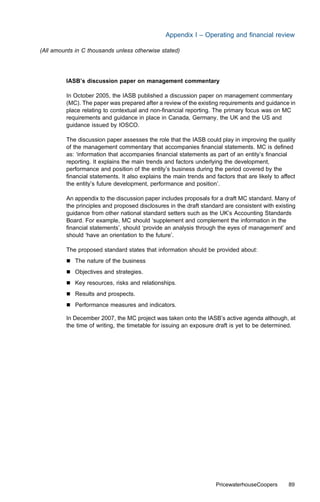
financial statements – 2008
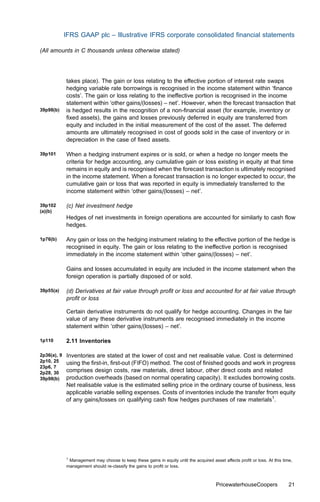
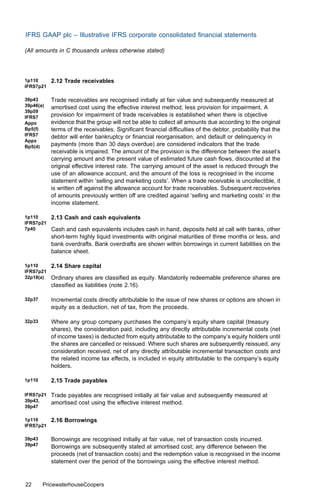
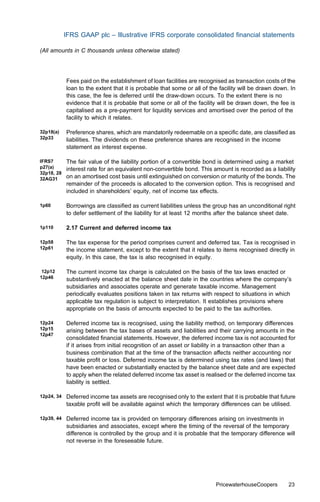
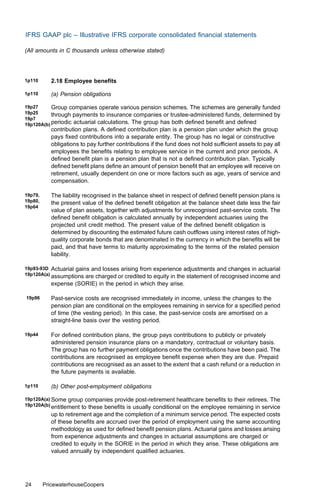
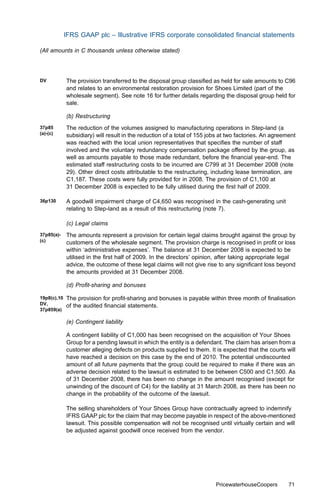
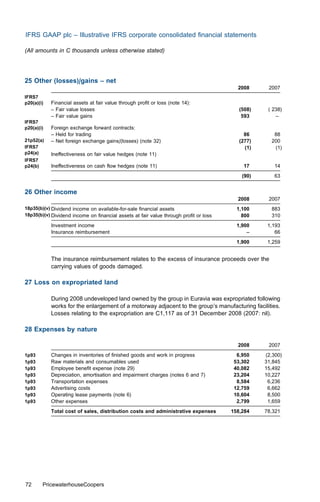
PricewaterhouseCoopers’ IFRS and corporate governance publications and tools 2008


IFRS technical publications
                                                              IFRS Pocket Guide 2008
         IFRS Manual of Accounting 2008                       Provides a summary of the IFRS recognition and
         Provides expert practical guidance on how            measurement requirements. Including currencies,
         groups should prepare their consolidated             assets, liabilities, equity, income, expenses,
         financial statements in accordance with IFRS.        business combinations and interim financial
         Comprehensive publication including hundreds         statements.
         of worked examples, extracts from company
         reports and model financial statements.
                                                              IFRS News
                                                              Monthly newsletter focusing on the business
                                                              implications of the IASB’s proposals and new
      A practical guide to segment reporting                  standards.
      Provides an overview of the key requirements of
      IFRS 8, ‘Operating Segments’ and some points to
      consider as entities prepare for the application of
      this standard for the first time. Includes a question
      and answer section.                                     IAS 39 – Achieving hedge accounting in practice
                                                              Covers in detail the practical issues in achieving
                                                              hedge accounting under IAS 39. It provides answers
                                                              to frequently asked questions and step-by-step
      Adopting IFRS – A step-by-step illustration of          illustrations of how to apply common hedging
      the transition to IFRS                                  strategies.
      Illustrates the steps involved in preparing the first
      IFRS financial statements. It takes into account the
      effect on IFRS 1 of the standards issued up to and      Illustrative interim financial information
      including March 2004.                                   for existing preparers
                                                              Illustrative information, prepared in accordance with
                                                              IAS 34, for a fictional existing IFRS preparer.
                                                              Includes a disclosure checklist and IAS 34
      Disclosure Checklist 2007
                                                              application guidance. Reflects standards issued up
      Outlines the disclosures required by all IFRSs
                                                              to 31 March 2008.
      published up to September 2006.

                                                              Illustrative Consolidated Financial Statements
                                                              • Banking, 2006           • Investment funds, 2006
                                                              • Corporate, 2008         • Investment property, 2006
                                                              • Insurance, 2006
      Financial instruments under IFRS                        Realistic sets of financial statements – for existing
      High-level summary of the revised financial             IFRS preparers in the above sectors – illustrating the
      instruments standards issued in December 2003,          required disclosure and presentation.
      updated to reflect IFRS 7 in September 2006. For
      existing IFRS preparers and first-time adopters.
                                                              Share-based Payment –
                                                              a practical guide to applying IFRS 2
                                                              Assesses the impact of the new standard, looking at
                                                              the requirements and providing a step-by-step
      Financial Reporting in Hyperinflationary                illustration of how to account for share-based
      Economies – Understanding IAS 29                        payment transactions.
      2006 update (reflecting impact of IFRIC 7) of a
      guide for entities applying IAS 29. Provides an         SIC-12 and FIN 46R – The Substance of Control
      overview of the standard’s concepts, descriptions       Helps those working with special purpose entities to
      of the procedures and an illustrative example of its    identify the differences between US GAAP and IFRS
      application.                                            in this area, including examples of transactions and
                                                              structures that may be impacted by the guidance.

      IFRS 3R: Impact on earnings –
      the crucial Q&A for decision-makers
                                                              Similarities and Differences –
      Guide aimed at finance directors, financial
                                                              a comparison of IFRS and US GAAP
      controllers and deal-makers, providing background
                                                              Presents the key similarities and differences
      to the standard, impact on the financial statements
                                                              between IFRS and US GAAP, focusing on the
      and controls, and summary differences with
                                                              differences commonly found in practice. It takes into
      US GAAP.
                                                              account all standards published up to August 2007.


      IFRS for SMEs (proposals) – Pocket Guide 2007           Understanding financial instruments –
      Provides a summary of the recognition and               A guide to IAS 32, IAS 39 and IFRS 7
      measurement requirements in the proposed ‘IFRS          Comprehensive guidance on all aspects of the
      for Small and Medium-Sized Entities’ published by       requirements for financial instruments accounting.
      the International Accounting Standards Board in         Detailed explanations illustrated through worked
      February 2007.                                          examples and extracts from company reports.
Illustrative IFRS corporate consolidated
financial statements – 2008


Global Accounting Consulting Services
PricewaterhouseCoopers LLP


145 London Road
Kingston-upon-Thames
Surrey
KT2 6SR
Tel: +44 (0) 870 777 2906
Fax: +44 (0) 870 247 1184
E-mail: info@cch.co.uk
Website: www.cch.co.uk
This book has been prepared for general guidance on matters of interest only, and does not
constitute professional advice. You should not act upon the information contained in this book
without obtaining specific professional advice. Accordingly, to the extent permitted by law,
PricewaterhouseCoopers LLP (and its members, employees and agents) and publisher accept no
liability, and disclaim all responsibility, for the consequences of you or anyone else acting, or
refraining from acting, in reliance on the information contained in this document or for any decision
based on it, or for any consequential, special or similar damages even if advised of the possibility of
such damages.

ISBN 978-1-84798-091-5

Printed in Great Britain.

British Library Cataloguing-in-Publication Data.
A catalogue record for this book is available from the British Library.

# 2008 PricewaterhouseCoopers

No part of this publication may be reproduced, stored in any system, or transmitted in any form or by
any means, electronic, mechanical, photocopying, recording, or otherwise without the prior
permission of PricewaterhouseCoopers LLP.
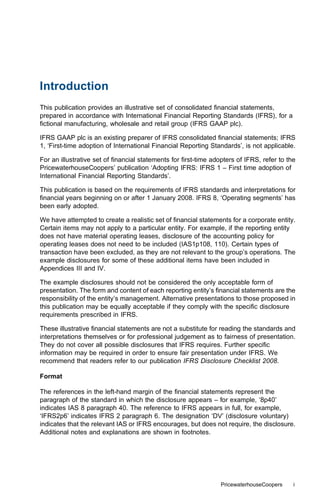
Introduction
This publication provides an illustrative set of consolidated financial statements,
prepared in accordance with International Financial Reporting Standards (IFRS), for a
fictional manufacturing, wholesale and retail group (IFRS GAAP plc).

IFRS GAAP plc is an existing preparer of IFRS consolidated financial statements; IFRS
1, ‘First-time adoption of International Financial Reporting Standards’, is not applicable.

For an illustrative set of financial statements for first-time adopters of IFRS, refer to the
PricewaterhouseCoopers’ publication ‘Adopting IFRS: IFRS 1 – First time adoption of
International Financial Reporting Standards’.

This publication is based on the requirements of IFRS standards and interpretations for
financial years beginning on or after 1 January 2008. IFRS 8, ‘Operating segments’ has
been early adopted.

We have attempted to create a realistic set of financial statements for a corporate entity.
Certain items may not apply to a particular entity. For example, if the reporting entity
does not have material operating leases, disclosure of the accounting policy for
operating leases does not need to be included (IAS1p108, 110). Certain types of
transaction have been excluded, as they are not relevant to the group’s operations. The
example disclosures for some of these additional items have been included in
Appendices III and IV.

The example disclosures should not be considered the only acceptable form of
presentation. The form and content of each reporting entity’s financial statements are the
responsibility of the entity’s management. Alternative presentations to those proposed in
this publication may be equally acceptable if they comply with the specific disclosure
requirements prescribed in IFRS.

These illustrative financial statements are not a substitute for reading the standards and
interpretations themselves or for professional judgement as to fairness of presentation.
They do not cover all possible disclosures that IFRS requires. Further specific
information may be required in order to ensure fair presentation under IFRS. We
recommend that readers refer to our publication IFRS Disclosure Checklist 2008.

Format

The references in the left-hand margin of the financial statements represent the
paragraph of the standard in which the disclosure appears – for example, ‘8p40’
indicates IAS 8 paragraph 40. The reference to IFRS appears in full, for example,
‘IFRS2p6’ indicates IFRS 2 paragraph 6. The designation ‘DV’ (disclosure voluntary)
indicates that the relevant IAS or IFRS encourages, but does not require, the disclosure.
Additional notes and explanations are shown in footnotes.


                                                                PricewaterhouseCoopers    i
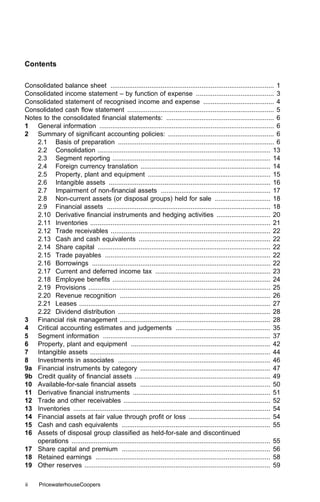
Contents

Consolidated balance sheet ........................................................................................ 1
Consolidated income statement – by function of expense .......................................... 3
Consolidated statement of recognised income and expense ...................................... 4
Consolidated cash flow statement ............................................................................... 5
Notes to the consolidated financial statements: .......................................................... 6
1 General information .............................................................................................. 6
2 Summary of significant accounting policies: ......................................................... 6
    2.1 Basis of preparation .................................................................................... 6
    2.2 Consolidation ............................................................................................. 13
    2.3 Segment reporting ..................................................................................... 14
    2.4 Foreign currency translation ...................................................................... 14
    2.5 Property, plant and equipment .................................................................. 15
    2.6 Intangible assets ....................................................................................... 16
    2.7 Impairment of non-financial assets ........................................................... 17
    2.8 Non-current assets (or disposal groups) held for sale .............................. 18
    2.9 Financial assets ........................................................................................ 18
    2.10 Derivative financial instruments and hedging activities ............................. 20
    2.11 Inventories ................................................................................................. 21
    2.12 Trade receivables ...................................................................................... 22
    2.13 Cash and cash equivalents ....................................................................... 22
    2.14 Share capital ............................................................................................. 22
    2.15 Trade payables ......................................................................................... 22
    2.16 Borrowings ................................................................................................ 22
    2.17 Current and deferred income tax .............................................................. 23
    2.18 Employee benefits ..................................................................................... 24
    2.19 Provisions .................................................................................................. 25
    2.20 Revenue recognition ................................................................................. 26
    2.21 Leases ....................................................................................................... 27
    2.22 Dividend distribution .................................................................................. 28
3 Financial risk management ................................................................................. 28
4 Critical accounting estimates and judgements ................................................... 35
5 Segment information .......................................................................................... 37
6 Property, plant and equipment ........................................................................... 42
7 Intangible assets ................................................................................................. 44
8 Investments in associates .................................................................................. 46
9a Financial instruments by category ...................................................................... 47
9b Credit quality of financial assets ......................................................................... 49
10 Available-for-sale financial assets ...................................................................... 50
11 Derivative financial instruments .......................................................................... 51
12 Trade and other receivables ............................................................................... 52
13 Inventories .......................................................................................................... 54
14 Financial assets at fair value through profit or loss ............................................ 54
15 Cash and cash equivalents ................................................................................ 55
16 Assets of disposal group classified as held-for-sale and discontinued
    operations ........................................................................................................... 55
17 Share capital and premium ................................................................................ 56
18 Retained earnings .............................................................................................. 58
19 Other reserves .................................................................................................... 59

ii    PricewaterhouseCoopers
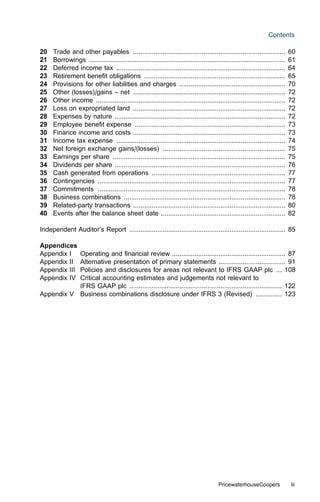
Contents

20   Trade and other payables ..................................................................................             60
21   Borrowings ..........................................................................................................   61
22   Deferred income tax ...........................................................................................         64
23   Retirement benefit obligations ............................................................................              65
24   Provisions for other liabilities and charges .........................................................                  70
25   Other (losses)/gains – net ..................................................................................           72
26   Other income ......................................................................................................     72
27   Loss on expropriated land ..................................................................................            72
28   Expenses by nature ............................................................................................         72
29   Employee benefit expense .................................................................................               73
30   Finance income and costs ..................................................................................             73
31   Income tax expense ...........................................................................................          74
32   Net foreign exchange gains/(losses) ..................................................................                  75
33   Earnings per share .............................................................................................        75
34   Dividends per share ............................................................................................        76
35   Cash generated from operations ........................................................................                 77
36   Contingencies .....................................................................................................     77
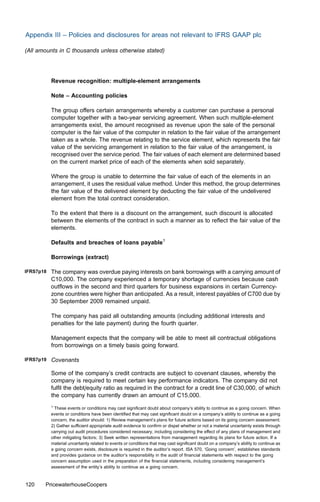
37   Commitments .....................................................................................................       78
38   Business combinations .......................................................................................           78
39   Related-party transactions ..................................................................................           80
40   Events after the balance sheet date ...................................................................                 82

Independent Auditor’s Report .................................................................................... 85

Appendices
Appendix I Operating and financial review ............................................................. 87
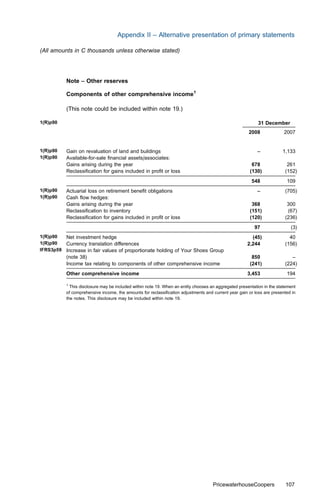
Appendix IIAlternative presentation of primary statements .................................... 91
Appendix III
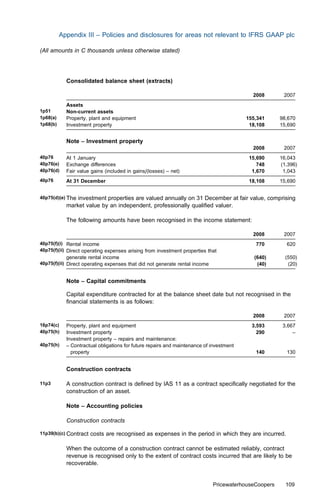
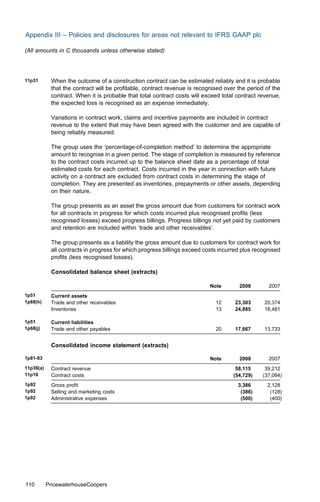
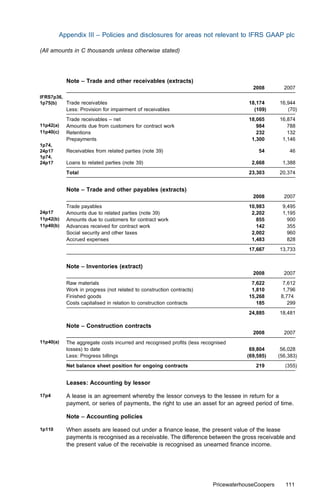
           Policies and disclosures for areas not relevant to IFRS GAAP plc ... 108
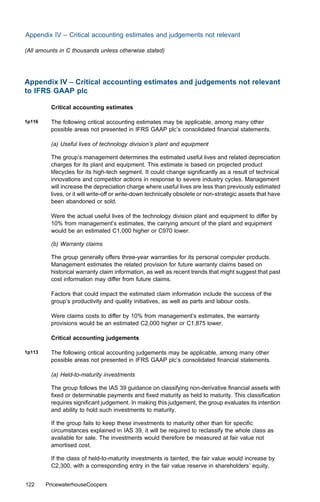
Appendix IVCritical accounting estimates and judgements not relevant to
           IFRS GAAP plc .................................................................................. 122
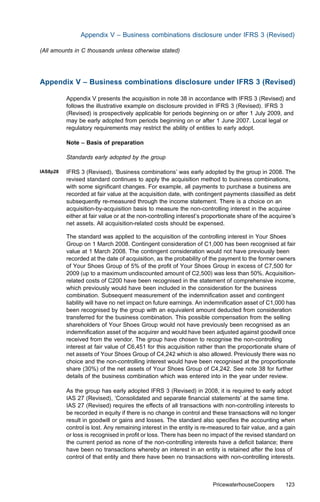
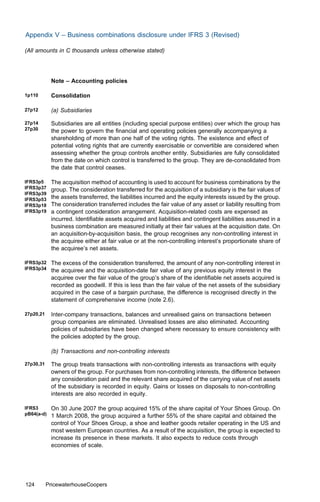
Appendix V Business combinations disclosure under IFRS 3 (Revised) .............. 123


                                                                                        PricewaterhouseCoopers               iii
iv   PricewaterhouseCoopers
IFRS GAAP plc – Illustrative IFRS corporate consolidated financial statements

(All amounts in C thousands unless otherwise stated)


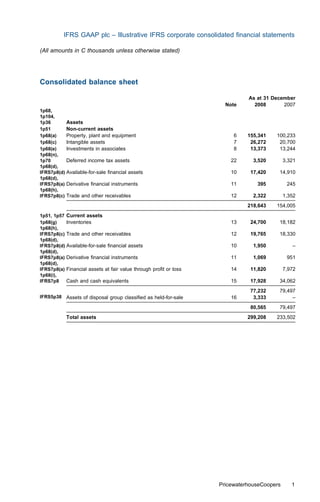
Consolidated balance sheet

                                                                            As at 31 December
                                                                    Note      2008       2007
1p68,
1p104,
1p36       Assets
1p51       Non-current assets
1p68(a)    Property, plant and equipment                               6    155,341   100,233
1p68(c)    Intangible assets                                           7     26,272    20,700
1p68(e)    Investments in associates                                   8     13,373    13,244
1p68(n),
1p70       Deferred income tax assets                                 22      3,520        3,321
1p68(d),
IFRS7p8(d) Available-for-sale financial assets                         10     17,420    14,910
1p68(d),
IFRS7p8(a) Derivative financial instruments                            11       395          245
1p68(h),
IFRS7p8(c) Trade and other receivables                                12      2,322        1,352
                                                                            218,643   154,005
1p51, 1p57 Current assets
1p68(g)    Inventories                                                13     24,700    18,182
1p68(h),
IFRS7p8(c) Trade and other receivables                                12     19,765    18,330
1p68(d),
IFRS7p8(d) Available-for-sale financial assets                         10      1,950           –
1p68(d),
IFRS7p8(a) Derivative financial instruments                            11      1,069         951
1p68(d),
IFRS7p8(a) Financial assets at fair value through profit or loss       14     11,820        7,972
1p68(i),
IFRS7p8    Cash and cash equivalents                                  15     17,928    34,062
                                                                             77,232    79,497
IFRS5p38 Assets of disposal group classified as held-for-sale          16      3,333         –
                                                                             80,565    79,497
           Total assets                                                     299,208   233,502


                                                                  PricewaterhouseCoopers      1
IFRS GAAP plc – Illustrative IFRS corporate consolidated financial statements

(All amounts in C thousands unless otherwise stated)


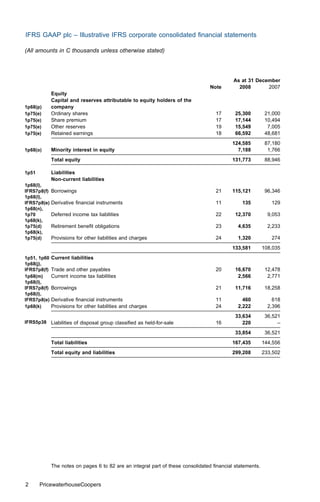
                                                                                           As at 31 December
                                                                                 Note        2008       2007
             Equity
             Capital and reserves attributable to equity holders of the
1p68(p)      company
1p75(e)      Ordinary shares                                                       17       25,300         21,000
1p75(e)      Share premium                                                         17       17,144         10,494
1p75(e)      Other reserves                                                        19       15,549          7,005
1p75(e)      Retained earnings                                                     18       66,592         48,681
                                                                                          124,585          87,180
1p68(o)      Minority interest in equity                                                    7,188           1,766
             Total equity                                                                 131,773          88,946

1p51         Liabilities
             Non-current liabilities
1p68(l),
IFRS7p8(f)   Borrowings                                                            21     115,121          96,346
1p68(l),
IFRS7p8(e)   Derivative financial instruments                                       11          135           129
1p68(n),
1p70         Deferred income tax liabilities                                       22       12,370          9,053
1p68(k),
1p75(d)      Retirement benefit obligations                                         23        4,635          2,233
1p68(k),
1p75(d)      Provisions for other liabilities and charges                          24        1,320           274
                                                                                          133,581         108,035
1p51, 1p60   Current liabilities
1p68(j),
IFRS7p8(f)   Trade and other payables                                              20       16,670         12,478
1p68(m)      Current income tax liabilities                                                  2,566          2,771
1p68(l),
IFRS7p8(f)   Borrowings                                                            21       11,716         18,258
1p68(l),
IFRS7p8(e)   Derivative financial instruments                                       11          460            618
1p68(k)      Provisions for other liabilities and charges                          24        2,222          2,396
                                                                                            33,634         36,521
IFRS5p38 Liabilities of disposal group classified as held-for-sale                  16          220              –
                                                                                            33,854         36,521
             Total liabilities                                                            167,435         144,556
             Total equity and liabilities                                                 299,208         233,502


             The notes on pages 6 to 82 are an integral part of these consolidated financial statements.


2      PricewaterhouseCoopers
IFRS GAAP plc – Illustrative IFRS corporate consolidated financial statements

(All amounts in C thousands unless otherwise stated)


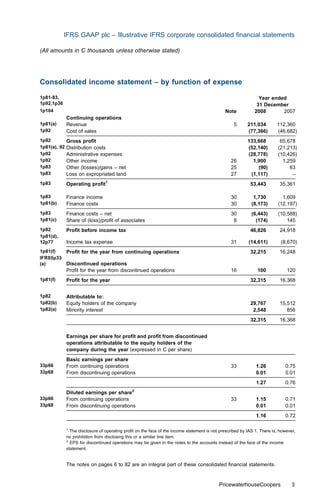
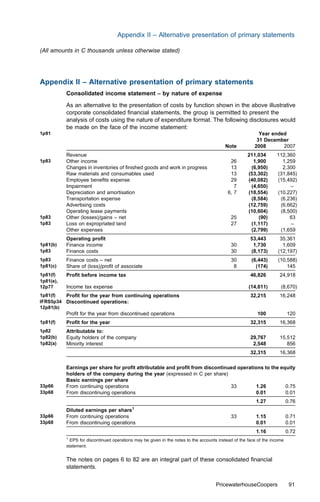
Consolidated income statement – by function of expense
1p81-83,                                                                                                      Year ended
1p92,1p36                                                                                                    31 December
1p104                                                                                        Note           2008       2007
            Continuing operations
1p81(a)     Revenue                                                                               5      211,034        112,360
1p92        Cost of sales                                                                                (77,366)       (46,682)
1p92        Gross profit                                                                                  133,668          65,678
1p81(a), 92 Distribution costs                                                                           (52,140)        (21,213)
1p92        Administrative expenses                                                                      (28,778)        (10,426)
1p92        Other income                                                                        26         1,900           1,259
1p83        Other (losses)/gains – net                                                          25           (90)             63
1p83        Loss on expropriated land                                                           27        (1,117)              –
1p83        Operating profit1                                                                              53,443         35,361

1p83        Finance income                                                                      30          1,730          1,609
1p81(b)     Finance costs                                                                       30         (8,173)       (12,197)
1p83        Finance costs – net                                                                 30         (6,443)       (10,588)
1p81(c)     Share of (loss)/profit of associates                                                  8           (174)           145
1p92        Profit before income tax                                                                       46,826         24,918
1p81(d),
12p77       Income tax expense                                                                  31       (14,611)         (8,670)
1p81(f)  Profit for the year from continuing operations                                                    32,215         16,248
IFRS5p33
(a)      Discontinued operations
            Profit for the year from discontinued operations                                     16            100            120
1p81(f)     Profit for the year                                                                            32,315         16,368


1p82        Attributable to:
1p82(b)     Equity holders of the company                                                                 29,767         15,512
1p82(a)     Minority interest                                                                              2,548            856
                                                                                                          32,315         16,368


            Earnings per share for profit and profit from discontinued
            operations attributable to the equity holders of the
            company during the year (expressed in C per share)
            Basic earnings per share
33p66       From continuing operations                                                          33           1.26           0.75
33p68       From discontinuing operations                                                                    0.01           0.01
                                                                                                             1.27           0.76
            Diluted earnings per share2
33p66       From continuing operations                                                          33           1.15           0.71
33p68       From discontinuing operations                                                                    0.01           0.01
                                                                                                             1.16           0.72

            1
              The disclosure of operating profit on the face of the income statement is not prescribed by IAS 1. There is, however,
            no prohibition from disclosing this or a similar line item.
            2
              EPS for discontinued operations may be given in the notes to the accounts instead of the face of the income
            statement.


            The notes on pages 6 to 82 are an integral part of these consolidated financial statements.


                                                                                          PricewaterhouseCoopers                3
IFRS GAAP plc – Illustrative IFRS corporate consolidated financial statements

(All amounts in C thousands unless otherwise stated)


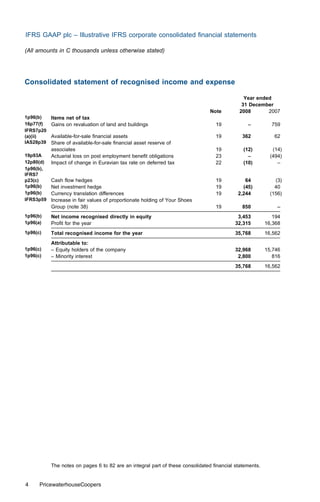
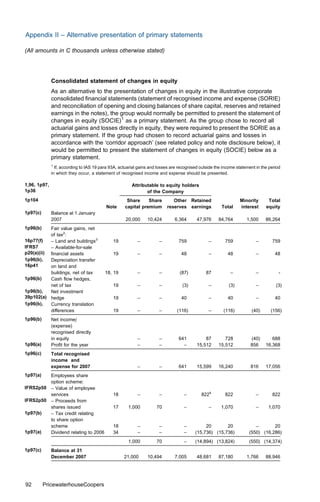
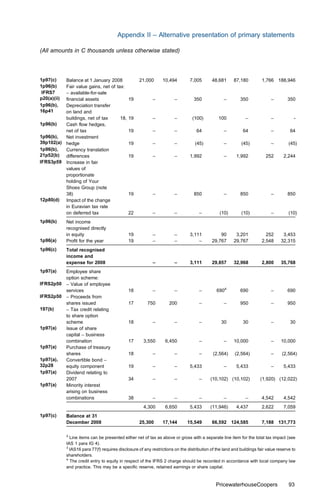
Consolidated statement of recognised income and expense

                                                                                              Year ended
                                                                                             31 December
                                                                               Note         2008       2007
1p96(b)    Items net of tax
16p77(f)   Gains on revaluation of land and buildings                            19            –          759
IFRS7p20
(a)(ii)    Available-for-sale financial assets                                    19          362           62
IAS28p39   Share of available-for-sale financial asset reserve of
           associates                                                            19          (12)          (14)
19p93A     Actuarial loss on post employment benefit obligations                  23            –          (494)
12p80(d)   Impact of change in Euravian tax rate on deferred tax                 22          (10)            –
1p96(b),
IFRS7
p23(c)     Cash flow hedges                                                       19           64            (3)
1p96(b)    Net investment hedge                                                  19          (45)           40
1p96(b)    Currency translation differences                                       19        2,244          (156)
IFRS3p59   Increase in fair values of proportionate holding of Your Shoes
           Group (note 38)                                                       19          850             –
1p96(b)    Net income recognised directly in equity                                        3,453           194
1p96(a)    Profit for the year                                                             32,315        16,368
1p96(c)    Total recognised income for the year                                           35,768        16,562
           Attributable to:
1p96(c)    – Equity holders of the company                                                32,968        15,746
1p96(c)    – Minority interest                                                             2,800           816
                                                                                          35,768        16,562


           The notes on pages 6 to 82 are an integral part of these consolidated financial statements.


4     PricewaterhouseCoopers
IFRS GAAP plc – Illustrative IFRS corporate consolidated financial statements

(All amounts in C thousands unless otherwise stated)


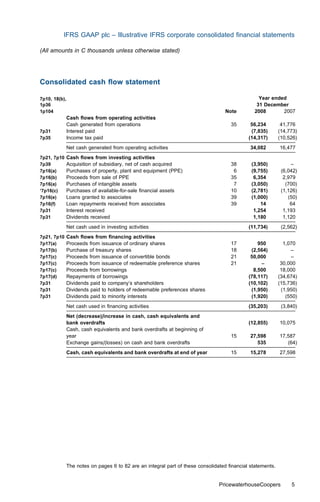
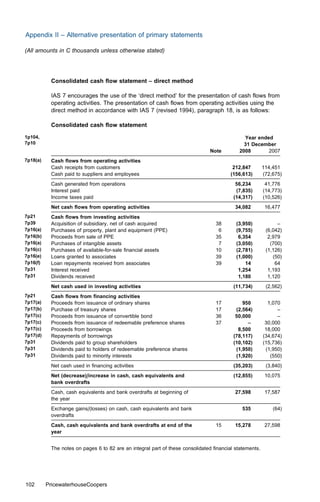
Consolidated cash flow statement

7p10, 18(b),                                                                                    Year ended
1p36                                                                                           31 December
1p104                                                                            Note         2008       2007
             Cash flows from operating activities
             Cash generated from operations                                        35       56,234         41,776
7p31         Interest paid                                                                  (7,835)       (14,773)
7p35         Income tax paid                                                               (14,317)       (10,526)
             Net cash generated from operating activities                                   34,082        16,477
7p21, 7p10   Cash flows from investing activities
7p39         Acquisition of subsidiary, net of cash acquired                       38       (3,950)            –
7p16(a)      Purchases of property, plant and equipment (PPE)                       6       (9,755)        (6,042)
7p16(b)      Proceeds from sale of PPE                                             35        6,354          2,979
7p16(a)      Purchases of intangible assets                                         7       (3,050)          (700)
‘7p16(c)     Purchases of available-for-sale financial assets                       10       (2,781)        (1,126)
7p16(e)      Loans granted to associates                                           39       (1,000)           (50)
7p16(f)      Loan repayments received from associates                              39           14             64
7p31         Interest received                                                               1,254          1,193
7p31         Dividends received                                                              1,180          1,120
             Net cash used in investing activities                                         (11,734)        (2,562)
7p21, 7p10   Cash flows from financing activities
7p17(a)      Proceeds from issuance of ordinary shares                             17          950          1,070
7p17(b)      Purchase of treasury shares                                           18       (2,564)            –
7p17(c)      Proceeds from issuance of convertible bonds                           21       50,000             –
7p17(c)      Proceeds from issuance of redeemable preference shares                21           –          30,000
7p17(c)      Proceeds from borrowings                                                        8,500         18,000
7p17(d)      Repayments of borrowings                                                      (78,117)       (34,674)
7p31         Dividends paid to company’s shareholders                                      (10,102)       (15,736)
7p31         Dividends paid to holders of redeemable preferences shares                     (1,950)        (1,950)
7p31         Dividends paid to minority interests                                           (1,920)          (550)
             Net cash used in financing activities                                          (35,203)        (3,840)
             Net (decrease)/increase in cash, cash equivalents and
             bank overdrafts                                                               (12,855)       10,075
             Cash, cash equivalents and bank overdrafts at beginning of
             year                                                                  15       27,598        17,587
             Exchange gains/(losses) on cash and bank overdrafts                               535           (64)
             Cash, cash equivalents and bank overdrafts at end of year             15       15,278        27,598


             The notes on pages 6 to 82 are an integral part of these consolidated financial statements.


                                                                              PricewaterhouseCoopers           5
IFRS GAAP plc – Illustrative IFRS corporate consolidated financial statements

(All amounts in C thousands unless otherwise stated)


Notes to the consolidated financial statements

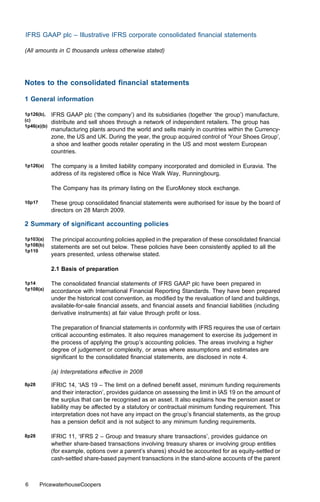
1 General information

1p126(b),    IFRS GAAP plc (‘the company’) and its subsidiaries (together ‘the group’) manufacture,
(c)          distribute and sell shoes through a network of independent retailers. The group has
1p46(a)(b)
             manufacturing plants around the world and sells mainly in countries within the Currency-
             zone, the US and UK. During the year, the group acquired control of ‘Your Shoes Group’,
             a shoe and leather goods retailer operating in the US and most western European
             countries.

1p126(a)     The company is a limited liability company incorporated and domiciled in Euravia. The
             address of its registered office is Nice Walk Way, Runningbourg.

             The Company has its primary listing on the EuroMoney stock exchange.

10p17        These group consolidated financial statements were authorised for issue by the board of
             directors on 28 March 2009.

2 Summary of significant accounting policies

1p103(a)     The principal accounting policies applied in the preparation of these consolidated financial
1p108(b)     statements are set out below. These policies have been consistently applied to all the
1p110
             years presented, unless otherwise stated.

             2.1 Basis of preparation

1p14         The consolidated financial statements of IFRS GAAP plc have been prepared in
1p108(a)     accordance with International Financial Reporting Standards. They have been prepared
             under the historical cost convention, as modified by the revaluation of land and buildings,
             available-for-sale financial assets, and financial assets and financial liabilities (including
             derivative instruments) at fair value through profit or loss.

             The preparation of financial statements in conformity with IFRS requires the use of certain
             critical accounting estimates. It also requires management to exercise its judgement in
             the process of applying the group’s accounting policies. The areas involving a higher
             degree of judgement or complexity, or areas where assumptions and estimates are
             significant to the consolidated financial statements, are disclosed in note 4.

             (a) Interpretations effective in 2008

8p28         IFRIC 14, ‘IAS 19 – The limit on a defined benefit asset, minimum funding requirements
             and their interaction’, provides guidance on assessing the limit in IAS 19 on the amount of
             the surplus that can be recognised as an asset. It also explains how the pension asset or
             liability may be affected by a statutory or contractual minimum funding requirement. This
             interpretation does not have any impact on the group’s financial statements, as the group
             has a pension deficit and is not subject to any minimum funding requirements.

8p28         IFRIC 11, ‘IFRS 2 – Group and treasury share transactions’, provides guidance on
             whether share-based transactions involving treasury shares or involving group entities
             (for example, options over a parent’s shares) should be accounted for as equity-settled or
             cash-settled share-based payment transactions in the stand-alone accounts of the parent


6       PricewaterhouseCoopers
IFRS GAAP plc – Illustrative IFRS corporate consolidated financial statements

(All amounts in C thousands unless otherwise stated)


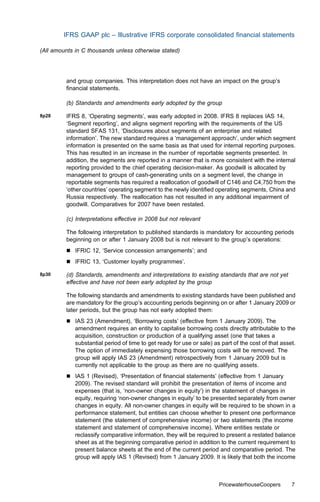
         and group companies. This interpretation does not have an impact on the group’s
         financial statements.

         (b) Standards and amendments early adopted by the group

8p28     IFRS 8, ‘Operating segments’, was early adopted in 2008. IFRS 8 replaces IAS 14,
         ‘Segment reporting’, and aligns segment reporting with the requirements of the US
         standard SFAS 131, ‘Disclosures about segments of an enterprise and related
         information’. The new standard requires a ‘management approach’, under which segment
         information is presented on the same basis as that used for internal reporting purposes.
         This has resulted in an increase in the number of reportable segments presented. In
         addition, the segments are reported in a manner that is more consistent with the internal
         reporting provided to the chief operating decision-maker. As goodwill is allocated by
         management to groups of cash-generating units on a segment level, the change in
         reportable segments has required a reallocation of goodwill of C146 and C4,750 from the
         ‘other countries’ operating segment to the newly identified operating segments, China and
         Russia respectively. The reallocation has not resulted in any additional impairment of
         goodwill. Comparatives for 2007 have been restated.

         (c) Interpretations effective in 2008 but not relevant

         The following interpretation to published standards is mandatory for accounting periods
         beginning on or after 1 January 2008 but is not relevant to the group’s operations:
         &   IFRIC 12, ‘Service concession arrangements’; and
         &   IFRIC 13, ‘Customer loyalty programmes’.

8p30     (d) Standards, amendments and interpretations to existing standards that are not yet
         effective and have not been early adopted by the group

         The following standards and amendments to existing standards have been published and
         are mandatory for the group’s accounting periods beginning on or after 1 January 2009 or
         later periods, but the group has not early adopted them:
         &   IAS 23 (Amendment), ‘Borrowing costs’ (effective from 1 January 2009). The
             amendment requires an entity to capitalise borrowing costs directly attributable to the
             acquisition, construction or production of a qualifying asset (one that takes a
             substantial period of time to get ready for use or sale) as part of the cost of that asset.
             The option of immediately expensing those borrowing costs will be removed. The
             group will apply IAS 23 (Amendment) retrospectively from 1 January 2009 but is
             currently not applicable to the group as there are no qualifying assets.
         &   IAS 1 (Revised), ‘Presentation of financial statements’ (effective from 1 January
             2009). The revised standard will prohibit the presentation of items of income and
             expenses (that is, ‘non-owner changes in equity’) in the statement of changes in
             equity, requiring ‘non-owner changes in equity’ to be presented separately from owner
             changes in equity. All non-owner changes in equity will be required to be shown in a
             performance statement, but entities can choose whether to present one performance
             statement (the statement of comprehensive income) or two statements (the income
             statement and statement of comprehensive income). Where entities restate or
             reclassify comparative information, they will be required to present a restated balance
             sheet as at the beginning comparative period in addition to the current requirement to
             present balance sheets at the end of the current period and comparative period. The
             group will apply IAS 1 (Revised) from 1 January 2009. It is likely that both the income


                                                                        PricewaterhouseCoopers        7
IFRS GAAP plc – Illustrative IFRS corporate consolidated financial statements

(All amounts in C thousands unless otherwise stated)


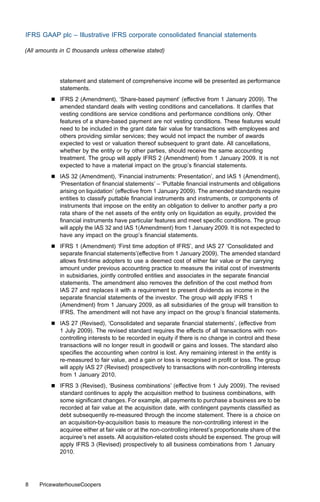
             statement and statement of comprehensive income will be presented as performance
             statements.
         &   IFRS 2 (Amendment), ‘Share-based payment’ (effective from 1 January 2009). The
             amended standard deals with vesting conditions and cancellations. It clarifies that
             vesting conditions are service conditions and performance conditions only. Other
             features of a share-based payment are not vesting conditions. These features would
             need to be included in the grant date fair value for transactions with employees and
             others providing similar services; they would not impact the number of awards
             expected to vest or valuation thereof subsequent to grant date. All cancellations,
             whether by the entity or by other parties, should receive the same accounting
             treatment. The group will apply IFRS 2 (Amendment) from 1 January 2009. It is not
             expected to have a material impact on the group’s financial statements.
         &   IAS 32 (Amendment), ‘Financial instruments: Presentation’, and IAS 1 (Amendment),
             ‘Presentation of financial statements’ – ‘Puttable financial instruments and obligations
             arising on liquidation’ (effective from 1 January 2009). The amended standards require
             entities to classify puttable financial instruments and instruments, or components of
             instruments that impose on the entity an obligation to deliver to another party a pro
             rata share of the net assets of the entity only on liquidation as equity, provided the
             financial instruments have particular features and meet specific conditions. The group
             will apply the IAS 32 and IAS 1(Amendment) from 1 January 2009. It is not expected to
             have any impact on the group’s financial statements.
         &   IFRS 1 (Amendment) ‘First time adoption of IFRS’, and IAS 27 ‘Consolidated and
             separate financial statements’(effective from 1 January 2009). The amended standard
             allows first-time adopters to use a deemed cost of either fair value or the carrying
             amount under previous accounting practice to measure the initial cost of investments
             in subsidiaries, jointly controlled entities and associates in the separate financial
             statements. The amendment also removes the definition of the cost method from
             IAS 27 and replaces it with a requirement to present dividends as income in the
             separate financial statements of the investor. The group will apply IFRS 1
             (Amendment) from 1 January 2009, as all subsidiaries of the group will transition to
             IFRS. The amendment will not have any impact on the group’s financial statements.
         &   IAS 27 (Revised), ‘Consolidated and separate financial statements’, (effective from
             1 July 2009). The revised standard requires the effects of all transactions with non-
             controlling interests to be recorded in equity if there is no change in control and these
             transactions will no longer result in goodwill or gains and losses. The standard also
             specifies the accounting when control is lost. Any remaining interest in the entity is
             re-measured to fair value, and a gain or loss is recognised in profit or loss. The group
             will apply IAS 27 (Revised) prospectively to transactions with non-controlling interests
             from 1 January 2010.
         &   IFRS 3 (Revised), ‘Business combinations’ (effective from 1 July 2009). The revised
             standard continues to apply the acquisition method to business combinations, with
             some significant changes. For example, all payments to purchase a business are to be
             recorded at fair value at the acquisition date, with contingent payments classified as
             debt subsequently re-measured through the income statement. There is a choice on
             an acquisition-by-acquisition basis to measure the non-controlling interest in the
             acquiree either at fair vale or at the non-controlling interest’s proportionate share of the
             acquiree’s net assets. All acquisition-related costs should be expensed. The group will
             apply IFRS 3 (Revised) prospectively to all business combinations from 1 January
             2010.


8    PricewaterhouseCoopers
IFRS GAAP plc – Illustrative IFRS corporate consolidated financial statements

(All amounts in C thousands unless otherwise stated)


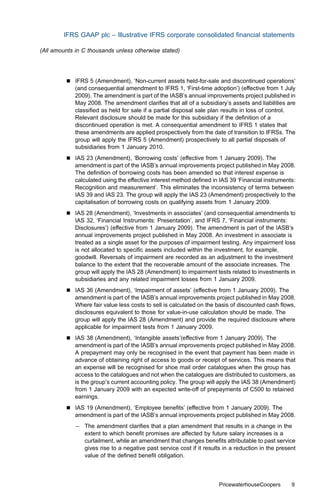
         &   IFRS 5 (Amendment), ‘Non-current assets held-for-sale and discontinued operations’
             (and consequential amendment to IFRS 1, ‘First-time adoption’) (effective from 1 July
             2009). The amendment is part of the IASB’s annual improvements project published in
             May 2008. The amendment clarifies that all of a subsidiary’s assets and liabilities are
             classified as held for sale if a partial disposal sale plan results in loss of control.
             Relevant disclosure should be made for this subsidiary if the definition of a
             discontinued operation is met. A consequential amendment to IFRS 1 states that
             these amendments are applied prospectively from the date of transition to IFRSs. The
             group will apply the IFRS 5 (Amendment) prospectively to all partial disposals of
             subsidiaries from 1 January 2010.
         &   IAS 23 (Amendment), ‘Borrowing costs’ (effective from 1 January 2009). The
             amendment is part of the IASB’s annual improvements project published in May 2008.
             The definition of borrowing costs has been amended so that interest expense is
             calculated using the effective interest method defined in IAS 39 ‘Financial instruments:
             Recognition and measurement’. This eliminates the inconsistency of terms between
             IAS 39 and IAS 23. The group will apply the IAS 23 (Amendment) prospectively to the
             capitalisation of borrowing costs on qualifying assets from 1 January 2009.
         &   IAS 28 (Amendment), ‘Investments in associates’ (and consequential amendments to
             IAS 32, ‘Financial Instruments: Presentation’, and IFRS 7, ‘Financial instruments:
             Disclosures’) (effective from 1 January 2009). The amendment is part of the IASB’s
             annual improvements project published in May 2008. An investment in associate is
             treated as a single asset for the purposes of impairment testing. Any impairment loss
             is not allocated to specific assets included within the investment, for example,
             goodwill. Reversals of impairment are recorded as an adjustment to the investment
             balance to the extent that the recoverable amount of the associate increases. The
             group will apply the IAS 28 (Amendment) to impairment tests related to investments in
             subsidiaries and any related impairment losses from 1 January 2009.
         &   IAS 36 (Amendment), ‘Impairment of assets’ (effective from 1 January 2009). The
             amendment is part of the IASB’s annual improvements project published in May 2008.
             Where fair value less costs to sell is calculated on the basis of discounted cash flows,
             disclosures equivalent to those for value-in-use calculation should be made. The
             group will apply the IAS 28 (Amendment) and provide the required disclosure where
             applicable for impairment tests from 1 January 2009.
         &   IAS 38 (Amendment), ‘Intangible assets’(effective from 1 January 2009). The
             amendment is part of the IASB’s annual improvements project published in May 2008.
             A prepayment may only be recognised in the event that payment has been made in
             advance of obtaining right of access to goods or receipt of services. This means that
             an expense will be recognised for shoe mail order catalogues when the group has
             access to the catalogues and not when the catalogues are distributed to customers, as
             is the group’s current accounting policy. The group will apply the IAS 38 (Amendment)
             from 1 January 2009 with an expected write-off of prepayments of C500 to retained
             earnings.
         &   IAS 19 (Amendment), ‘Employee benefits’ (effective from 1 January 2009). The
             amendment is part of the IASB’s annual improvements project published in May 2008.
             – The amendment clarifies that a plan amendment that results in a change in the
               extent to which benefit promises are affected by future salary increases is a
               curtailment, while an amendment that changes benefits attributable to past service
               gives rise to a negative past service cost if it results in a reduction in the present
               value of the defined benefit obligation.


                                                                      PricewaterhouseCoopers       9
IFRS GAAP plc – Illustrative IFRS corporate consolidated financial statements

(All amounts in C thousands unless otherwise stated)


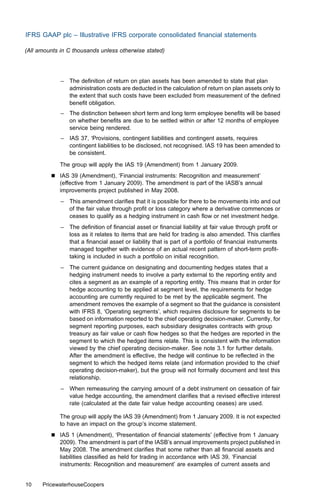
             – The definition of return on plan assets has been amended to state that plan
               administration costs are deducted in the calculation of return on plan assets only to
               the extent that such costs have been excluded from measurement of the defined
               benefit obligation.
             – The distinction between short term and long term employee benefits will be based
               on whether benefits are due to be settled within or after 12 months of employee
               service being rendered.
             – IAS 37, ‘Provisions, contingent liabilities and contingent assets, requires
               contingent liabilities to be disclosed, not recognised. IAS 19 has been amended to
               be consistent.
             The group will apply the IAS 19 (Amendment) from 1 January 2009.
         &   IAS 39 (Amendment), ‘Financial instruments: Recognition and measurement’
             (effective from 1 January 2009). The amendment is part of the IASB’s annual
             improvements project published in May 2008.
             – This amendment clarifies that it is possible for there to be movements into and out
               of the fair value through profit or loss category where a derivative commences or
               ceases to qualify as a hedging instrument in cash flow or net investment hedge.
             – The definition of financial asset or financial liability at fair value through profit or
               loss as it relates to items that are held for trading is also amended. This clarifies
               that a financial asset or liability that is part of a portfolio of financial instruments
               managed together with evidence of an actual recent pattern of short-term profit-
               taking is included in such a portfolio on initial recognition.
             – The current guidance on designating and documenting hedges states that a
               hedging instrument needs to involve a party external to the reporting entity and
               cites a segment as an example of a reporting entity. This means that in order for
               hedge accounting to be applied at segment level, the requirements for hedge
               accounting are currently required to be met by the applicable segment. The
               amendment removes the example of a segment so that the guidance is consistent
               with IFRS 8, ‘Operating segments’, which requires disclosure for segments to be
               based on information reported to the chief operating decision-maker. Currently, for
               segment reporting purposes, each subsidiary designates contracts with group
               treasury as fair value or cash flow hedges so that the hedges are reported in the
               segment to which the hedged items relate. This is consistent with the information
               viewed by the chief operating decision-maker. See note 3.1 for further details.
               After the amendment is effective, the hedge will continue to be reflected in the
               segment to which the hedged items relate (and information provided to the chief
               operating decision-maker), but the group will not formally document and test this
               relationship.
             – When remeasuring the carrying amount of a debt instrument on cessation of fair
               value hedge accounting, the amendment clarifies that a revised effective interest
               rate (calculated at the date fair value hedge accounting ceases) are used.

             The group will apply the IAS 39 (Amendment) from 1 January 2009. It is not expected
             to have an impact on the group’s income statement.
         &   IAS 1 (Amendment), ‘Presentation of financial statements’ (effective from 1 January
             2009). The amendment is part of the IASB’s annual improvements project published in
             May 2008. The amendment clarifies that some rather than all financial assets and
             liabilities classified as held for trading in accordance with IAS 39, ‘Financial
             instruments: Recognition and measurement’ are examples of current assets and


10    PricewaterhouseCoopers
IFRS GAAP plc – Illustrative IFRS corporate consolidated financial statements

(All amounts in C thousands unless otherwise stated)


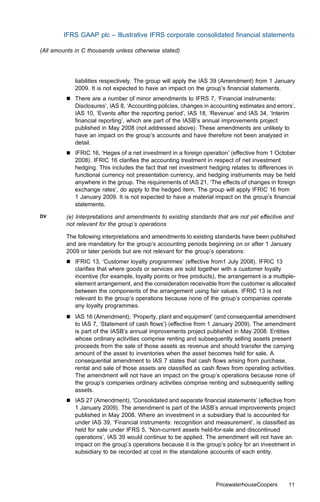
             liabilities respectively. The group will apply the IAS 39 (Amendment) from 1 January
             2009. It is not expected to have an impact on the group’s financial statements.
         &   There are a number of minor amendments to IFRS 7, ‘Financial instruments:
             Disclosures’, IAS 8, ‘Accounting policies, changes in accounting estimates and errors’,
             IAS 10, ‘Events after the reporting period’, IAS 18, ‘Revenue’ and IAS 34, ‘Interim
             financial reporting’, which are part of the IASB’s annual improvements project
             published in May 2008 (not addressed above). These amendments are unlikely to
             have an impact on the group’s accounts and have therefore not been analysed in
             detail.
         &   IFRIC 16, ‘Heges of a net investment in a foreign operation’ (effective from 1 October
             2008). IFRIC 16 clarifies the accounting treatment in respect of net investment
             hedging. This includes the fact that net investment hedging relates to differences in
             functional currency not presentation currency, and hedging instruments may be held
             anywhere in the group. The requirements of IAS 21, ‘The effects of changes in foreign
             exchange rates’, do apply to the hedged item. The group will apply IFRIC 16 from
             1 January 2009. It is not expected to have a material impact on the group’s financial
             statements.
DV       (e) Interpretations and amendments to existing standards that are not yet effective and
         not relevant for the group’s operations

         The following interpretations and amendments to existing standards have been published
         and are mandatory for the group’s accounting periods beginning on or after 1 January
         2009 or later periods but are not relevant for the group’s operations:
         &   IFRIC 13, ‘Customer loyalty programmes’ (effective from1 July 2008). IFRIC 13
             clarifies that where goods or services are sold together with a customer loyalty
             incentive (for example, loyalty points or free products), the arrangement is a multiple-
             element arrangement, and the consideration receivable from the customer is allocated
             between the components of the arrangement using fair values. IFRIC 13 is not
             relevant to the group’s operations because none of the group’s companies operate
             any loyalty programmes.
         &   IAS 16 (Amendment), ‘Property, plant and equipment’ (and consequential amendment
             to IAS 7, ‘Statement of cash flows’) (effective from 1 January 2009). The amendment
             is part of the IASB’s annual improvements project published in May 2008. Entities
             whose ordinary activities comprise renting and subsequently selling assets present
             proceeds from the sale of those assets as revenue and should transfer the carrying
             amount of the asset to inventories when the asset becomes held for sale. A
             consequential amendment to IAS 7 states that cash flows arising from purchase,
             rental and sale of those assets are classified as cash flows from operating activities.
             The amendment will not have an impact on the group’s operations because none of
             the group’s companies ordinary activities comprise renting and subsequently selling
             assets.
         &   IAS 27 (Amendment), ‘Consolidated and separate financial statements’ (effective from
             1 January 2009). The amendment is part of the IASB’s annual improvements project
             published in May 2008. Where an investment in a subsidiary that is accounted for
             under IAS 39, ‘Financial instruments: recognition and measurement’, is classified as
             held for sale under IFRS 5, ‘Non-current assets held-for-sale and discontinued
             operations’, IAS 39 would continue to be applied. The amendment will not have an
             impact on the group’s operations because it is the group’s policy for an investment in
             subsidiary to be recorded at cost in the standalone accounts of each entity.


                                                                     PricewaterhouseCoopers       11
IFRS GAAP plc – Illustrative IFRS corporate consolidated financial statements

(All amounts in C thousands unless otherwise stated)


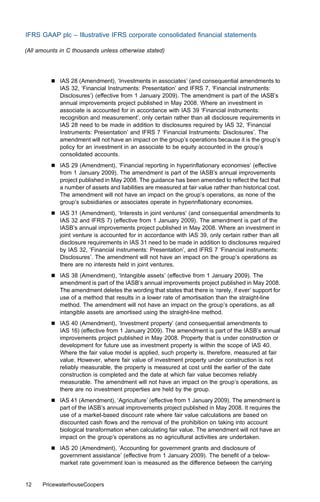
         &   IAS 28 (Amendment), ‘Investments in associates’ (and consequential amendments to
             IAS 32, ‘Financial Instruments: Presentation’ and IFRS 7, ‘Financial instruments:
             Disclosures’) (effective from 1 January 2009). The amendment is part of the IASB’s
             annual improvements project published in May 2008. Where an investment in
             associate is accounted for in accordance with IAS 39 ‘Financial instruments:
             recognition and measurement’, only certain rather than all disclosure requirements in
             IAS 28 need to be made in addition to disclosures required by IAS 32, ‘Financial
             Instruments: Presentation’ and IFRS 7 ‘Financial Instruments: Disclosures’. The
             amendment will not have an impact on the group’s operations because it is the group’s
             policy for an investment in an associate to be equity accounted in the group’s
             consolidated accounts.
         &   IAS 29 (Amendment), ‘Financial reporting in hyperinflationary economies’ (effective
             from 1 January 2009). The amendment is part of the IASB’s annual improvements
             project published in May 2008. The guidance has been amended to reflect the fact that
             a number of assets and liabilities are measured at fair value rather than historical cost.
             The amendment will not have an impact on the group’s operations, as none of the
             group’s subsidiaries or associates operate in hyperinflationary economies.
         &   IAS 31 (Amendment), ‘Interests in joint ventures’ (and consequential amendments to
             IAS 32 and IFRS 7) (effective from 1 January 2009). The amendment is part of the
             IASB’s annual improvements project published in May 2008. Where an investment in
             joint venture is accounted for in accordance with IAS 39, only certain rather than all
             disclosure requirements in IAS 31 need to be made in addition to disclosures required
             by IAS 32, ‘Financial instruments: Presentation’, and IFRS 7 ‘Financial instruments:
             Disclosures’. The amendment will not have an impact on the group’s operations as
             there are no interests held in joint ventures.
         &   IAS 38 (Amendment), ‘Intangible assets’ (effective from 1 January 2009). The
             amendment is part of the IASB’s annual improvements project published in May 2008.
             The amendment deletes the wording that states that there is ‘rarely, if ever’ support for
             use of a method that results in a lower rate of amortisation than the straight-line
             method. The amendment will not have an impact on the group’s operations, as all
             intangible assets are amortised using the straight-line method.
         &   IAS 40 (Amendment), ‘Investment property’ (and consequential amendments to
             IAS 16) (effective from 1 January 2009). The amendment is part of the IASB’s annual
             improvements project published in May 2008. Property that is under construction or
             development for future use as investment property is within the scope of IAS 40.
             Where the fair value model is applied, such property is, therefore, measured at fair
             value. However, where fair value of investment property under construction is not
             reliably measurable, the property is measured at cost until the earlier of the date
             construction is completed and the date at which fair value becomes reliably
             measurable. The amendment will not have an impact on the group’s operations, as
             there are no investment properties are held by the group.
         &   IAS 41 (Amendment), ‘Agriculture’ (effective from 1 January 2009). The amendment is
             part of the IASB’s annual improvements project published in May 2008. It requires the
             use of a market-based discount rate where fair value calculations are based on
             discounted cash flows and the removal of the prohibition on taking into account
             biological transformation when calculating fair value. The amendment will not have an
             impact on the group’s operations as no agricultural activities are undertaken.
         &   IAS 20 (Amendment), ‘Accounting for government grants and disclosure of
             government assistance’ (effective from 1 January 2009). The benefit of a below-
             market rate government loan is measured as the difference between the carrying


12    PricewaterhouseCoopers
IFRS GAAP plc – Illustrative IFRS corporate consolidated financial statements

(All amounts in C thousands unless otherwise stated)


                amount in accordance with IAS 39, ‘Financial instruments: Recognition and
                measurement’, and the proceeds received with the benefit accounted for in
                accordance with IAS 20. The amendment will not have an impact on the group’s
                operations as there are no loans received or other grants from the government.
            &   The minor amendments to IAS 20 ‘Accounting for government grants and disclosure
                of government assistance’, and IAS 29, ‘Financial reporting in hyperinflationary
                economies’, IAS 40, ‘Investment property’, and IAS 41, ‘Agriculture’, which are part of
                the IASB’s annual improvements project published in May 2008 (not addressed
                above). These amendments will not have an impact on the group’s operations as
                described above.
            &   IFRIC 15, ‘Agreements for construction of real estates’ (effective from 1 January
                2009). The interpretation clarifies whether IAS 18, ‘Revenue’, or IAS 11, ‘Construction
                contracts’, should be applied to particular transactions. It is likely to result in IAS 18
                being applied to a wider range of transactions. IFRIC 15 is not relevant to the group’s
                operations as all revenue transactions are accounted for under IAS 18 and not IAS 11.

1p110       2.2 Consolidation

27p12       (a) Subsidiaries

27p14       Subsidiaries are all entities (including special purpose entities) over which the group has
27p30       the power to govern the financial and operating policies generally accompanying a
            shareholding of more than one half of the voting rights. The existence and effect of
            potential voting rights that are currently exercisable or convertible are considered when
            assessing whether the group controls another entity. Subsidiaries are fully consolidated
            from the date on which control is transferred to the group. They are de-consolidated from
            the date that control ceases.

IFRS3p14 The purchase method of accounting is used to account for the acquisition of subsidiaries
IFRS3p24 by the group. The cost of an acquisition is measured as the fair value of the assets given,
IFRS3p28
IFRS3p36,equity instruments issued and liabilities incurred or assumed at the date of exchange, plus
37       costs directly attributable to the acquisition. Identifiable assets acquired and liabilities and
IFRS3p51 contingent liabilities assumed in a business combination are measured initially at their fair
         values at the acquisition date, irrespective of the extent of any minority interest. The
IFRS3p56
         excess of the cost of acquisition over the fair value of the group’s share of the identifiable
         net assets acquired is recorded as goodwill. If the cost of acquisition is less than the fair
         value of the net assets of the subsidiary acquired, the difference is recognised directly in
         the income statement (note 2.6).

27p24       Inter-company transactions, balances and unrealised gains on transactions between
            group companies are eliminated. Unrealised losses are also eliminated. Accounting
27p28
            policies of subsidiaries have been changed where necessary to ensure consistency with
            the policies adopted by the group.

            (b) Transactions and minority interests

            The group applies a policy of treating transactions with minority interests as transactions
            with parties external to the group. Disposals to minority interests result in gains and losses
            for the group and are recorded in the income statement. Purchases from minority
            interests result in goodwill, being the difference between any consideration paid and the
            relevant share acquired of the carrying value of net assets of the subsidiary1.
            1
              These consolidated financial statements are prepared on the basis of ‘parent company model’. See Appendix III for
            accounting policy if the economic entity model is adopted.


                                                                                      PricewaterhouseCoopers              13
IFRS GAAP plc – Illustrative IFRS corporate consolidated financial statements

(All amounts in C thousands unless otherwise stated)


1p110       (c) Associates

28p13       Associates are all entities over which the group has significant influence but not control,
28p11       generally accompanying a shareholding of between 20% and 50% of the voting rights.
            Investments in associates are accounted for using the equity method of accounting and
            are initially recognised at cost. The group’s investment in associates includes goodwill
            identified on acquisition, net of any accumulated impairment loss. See note 2.7 for the
            impairment of non-financial assets including goodwill.

28p29       The group’s share of its associates’ post-acquisition profits or losses is recognised in the
28p30       income statement, and its share of post-acquisition movements in reserves is recognised
            in reserves. The cumulative post-acquisition movements are adjusted against the carrying
            amount of the investment. When the group’s share of losses in an associate equals or
            exceeds its interest in the associate, including any other unsecured receivables, the group
            does not recognise further losses, unless it has incurred obligations or made payments on
            behalf of the associate.

28p22       Unrealised gains on transactions between the group and its associates are eliminated to
28p26       the extent of the group’s interest in the associates. Unrealised losses are also eliminated
            unless the transaction provides evidence of an impairment of the asset transferred.
            Accounting policies of associates have been changed where necessary to ensure
            consistency with the policies adopted by the group.

            Dilution gains and losses arising in investments in associates are recognised in the
            income statement1.

1p110       2.3 Segment reporting

 IFRS8p5    Operating segments are reported in a manner consistent with the internal reporting
(b)         provided to the chief operating decision-maker. The chief operating decision-maker, who
            is responsible for allocating resources and assessing performance of the operating
            segments, has been identified as the steering committee that makes strategic decisions.

1p110       2.4 Foreign currency translation

1p110       (a) Functional and presentation currency

21p17       Items included in the financial statements of each of the group’s entities are measured
21p9, 18    using the currency of the primary economic environment in which the entity operates (‘the
1p46(d)
            functional currency’). The consolidated financial statements are presented in ‘currency’
            (C), which is the company’s functional and the group’s presentation currency.

1p110       (b) Transactions and balances

21p21, 28   Foreign currency transactions are translated into the functional currency using the
21p32       exchange rates prevailing at the dates of the transactions or valuation where items are
39p95(a)
39p102(a)   remeasured. Foreign exchange gains and losses resulting from the settlement of such
            transactions and from the translation at year-end exchange rates of monetary assets and
            liabilities denominated in foreign currencies are recognised in the income statement,
            except when deferred in equity as qualifying cash flow hedges and qualifying net
            investment hedges.


            1
                The company may alternatively adopt an accounting policy to recognise dilution gains or losses in equity.


14      PricewaterhouseCoopers
IFRS GAAP plc – Illustrative IFRS corporate consolidated financial statements

(All amounts in C thousands unless otherwise stated)


           Foreign exchange gains and losses that relate to borrowings and cash and cash
           equivalents are presented in the income statement within ‘finance income or cost’. All
           other foreign exchange gains and losses are presented in the income statement within
           ‘other (losses)/gains – net.
39AG83     Changes in the fair value of monetary securities denominated in foreign currency classified
           as available for sale are analysed between translation differences resulting from changes
           in the amortised cost of the security and other changes in the carrying amount of the
           security. Translation differences related to changes in amortised cost are recognised in
           profit or loss, and other changes in carrying amount are recognised in equity.
21p30      Translation differences on non-monetary financial assets and liabilities such as equities
           held at fair value through profit or loss are recognised in profit or loss as part of the fair
           value gain or loss. Translation differences on non-monetary financial assets such as
           equities classified as available for sale are included in the available-for-sale reserve in
           equity.
1p110      (c) Group companies

21p39      The results and financial position of all the group entities (none of which has the currency
           of a hyper-inflationary economy) that have a functional currency different from the
           presentation currency are translated into the presentation currency as follows:
21p39(a)   (a) assets and liabilities for each balance sheet presented are translated at the closing
               rate at the date of that balance sheet;
21p39(b)   (b) income and expenses for each income statement are translated at average
21p39          exchange rates (unless this average is not a reasonable approximation of the
               cumulative effect of the rates prevailing on the transaction dates, in which case
               income and expenses are translated at the rate on the dates of the transactions); and
1p76(b)    (c) all resulting exchange differences are recognised as a separate component of equity.

1p76(b)    On consolidation, exchange differences arising from the translation of the net investment
21p39(c)   in foreign operations, and of borrowings and other currency instruments designated as
1p76(b)
39p102     hedges of such investments, are taken to shareholders’ equity. When a foreign operation
           is partially disposed of or sold, exchange differences that were recorded in equity are
           recognised in the income statement as part of the gain or loss on sale.
21p47      Goodwill and fair value adjustments arising on the acquisition of a foreign entity are
           treated as assets and liabilities of the foreign entity and translated at the closing rate.

1p110      2.5 Property, plant and equipment

16p73(a)   Land and buildings comprise mainly factories, retail outlets and offices. Land and
           buildings are shown at fair value, based on periodic, but at least triennial, valuations by
16p35(b)
16p15      external independent valuers, less subsequent depreciation for buildings. Any
16p17      accumulated depreciation at the date of revaluation is eliminated against the gross
           carrying amount of the asset, and the net amount is restated to the revalued amount of
           the asset. All other property, plant and equipment is stated at historical cost less
           depreciation. Historical cost includes expenditure that is directly attributable to the
           acquisition of the items. Cost may also include transfers from equity of any gains/losses
           on qualifying cash flow hedges of foreign currency purchases of property, plant and
           equipment1.
           1
             Management may choose to keep these gains/(losses) in equity until the acquired asset affects profit or loss. At this
           time, management should reclassify the gains/(losses) into profit or loss.


                                                                                       PricewaterhouseCoopers               15
IFRS GAAP plc – Illustrative IFRS corporate consolidated financial statements

(All amounts in C thousands unless otherwise stated)


16p12        Subsequent costs are included in the asset’s carrying amount or recognised as a
39p98(b)     separate asset, as appropriate, only when it is probable that future economic benefits
             associated with the item will flow to the group and the cost of the item can be measured
             reliably. The carrying amount of the replaced part is derecognised. All other repairs and
             maintenance are charged to the income statement during the financial period in which
             they are incurred.

16p39,       Increases in the carrying amount arising on revaluation of land and buildings are credited
1p76(b)      to other reserves in shareholders’ equity. Decreases that offset previous increases of the
1p76(b)
             same asset are charged against other reserves directly in equity; all other decreases are
16p40        charged to the income statement. Each year the difference between depreciation based
16p41        on the revalued carrying amount of the asset charged to the income statement and
             depreciation based on the asset’s original cost is transferred from ‘other reserves’ to
             ‘retained earnings’.

16p73(b),    Land is not depreciated. Depreciation on other assets is calculated using the straight-line
50           method to allocate their cost or revalued amounts to their residual values over their
16p73(c)
             estimated useful lives, as follows:

             –   Buildings                                  25-40 years
             –   Machinery                                  10-15 years
             –   Vehicles                                   3-5 years
             –   Furniture, fittings and equipment           3-8 years

16p51        The assets’ residual values and useful lives are reviewed, and adjusted if appropriate, at
             each balance sheet date.

36p59        An asset’s carrying amount is written down immediately to its recoverable amount if the
             asset’s carrying amount is greater than its estimated recoverable amount (note 2.7).

16p68, 71    Gains and losses on disposals are determined by comparing the proceeds with the
             carrying amount and are recognised within ‘Other (losses)/gains – net’ in the income
             statement.

16p41,       When revalued assets are sold, the amounts included in other reserves are transferred to
1p76(b)      retained earnings.

1p110        2.6 Intangible assets

1p110        (a) Goodwill

IFRS3p51     Goodwill represents the excess of the cost of an acquisition over the fair value of the
38p118(a)    group’s share of the net identifiable assets of the acquired subsidiary at the date of
IFRS3p54
36p124       acquisition. Goodwill on acquisitions of subsidiaries is included in ‘intangible assets’.
             Goodwill is tested annually for impairment and carried at cost less accumulated
             impairment losses. Impairment losses on goodwill are not reversed. Gains and losses on
             the disposal of an entity include the carrying amount of goodwill relating to the entity sold.

36p80        Goodwill is allocated to cash-generating units for the purpose of impairment testing. The
             allocation is made to those cash-generating units or groups of cash-generating units that
             are expected to benefit from the business combination in which the goodwill arose
             identified according to operating segment.


16        PricewaterhouseCoopers
IFRS GAAP plc – Illustrative IFRS corporate consolidated financial statements

(All amounts in C thousands unless otherwise stated)


1p110      (b) Trademarks and licences

38p74      Separately acquired trademarks and licences are shown at historical cost. Trademarks
38p97      and licences acquired in a business combination are recognised at fair value at the
38p118
(a)(b)     acquisition date. Trademarks and licences have a finite useful life and are carried at cost
           less accumulated amortisation. Amortisation is calculated using the straight-line method
           to allocate the cost of trademarks and licences over their estimated useful lives of 15 to 20
           years.

38p4       Acquired computer software licences are capitalised on the basis of the costs incurred to
38p118     acquire and bring to use the specific software. These costs are amortised over their
(a)(b)
           estimated useful lives of three to five years.

           (c) Contractual customer relationships

           Contractual customer relationships acquired in a business combination are recognised at
           fair value at the acquisition date. The contractual customer relations have a finite useful
           life and are carried at cost less accumulated amortisation. Amortisation is calculated
           using the straight-line method over the expected life of the customer relationship.

1p110      (d) Computer software

38p57      Costs associated with maintaining computer software programmes are recognised as an
           expense as incurred. Development costs that are directly attributable to the design and
           testing of identifiable and unique software products controlled by the group are
           recognised as intangible assets when the following criteria are met:
           –   it is technically feasible to complete the software product so that it will be available for
               use;
           –   management intends to complete the software product and use or sell it;
           –   there is an ability to use or sell the software product;
           –   it can be demonstrated how the software product will generate probable future
               economic benefits;
           –   adequate technical, financial and other resources to complete the development and
               to use or sell the software product are available; and
           –   the expenditure attributable to the software product during its development can be
               reliably measured.

38p66      Directly attributable costs that are capitalised as part of the software product include the
           software development employee costs and an appropriate portion of relevant overheads.
38p68,71   Other development expenditures that do not meet these criteria are recognised as an
           expense as incurred. Development costs previously recognised as an expense are not
           recognised as an asset in a subsequent period

38p97      Computer software development costs recognised as assets are amortised over their
38p118     estimated useful lives, which does not exceed three years.
(a)(b)

1p110      2.7 Impairment of non-financial assets

36p9       Assets that have an indefinite useful life, for example goodwill, are not subject to
36p10      amortisation and are tested annually for impairment. Assets that are subject to
           amortisation are reviewed for impairment whenever events or changes in circumstances
           indicate that the carrying amount may not be recoverable. An impairment loss is


                                                                         PricewaterhouseCoopers         17
IFRS GAAP plc – Illustrative IFRS corporate consolidated financial statements

(All amounts in C thousands unless otherwise stated)


            recognised for the amount by which the asset’s carrying amount exceeds its recoverable
            amount. The recoverable amount is the higher of an asset’s fair value less costs to sell
            and value in use. For the purposes of assessing impairment, assets are grouped at the
            lowest levels for which there are separately identifiable cash flows (cash-generating
            units). Non-financial assets other than goodwill that suffered an impairment are reviewed
            for possible reversal of the impairment at each reporting date.

1p110       2.8 Non-current assets (or disposal groups) held for sale

 IFRS5p6,   Non-current assets (or disposal groups) are classified as assets held for sale when their
15          carrying amount is to be recovered principally through a sale transaction and a sale is
            considered highly probable. They are stated at the lower of carrying amount and fair value
            less costs to sell if their carrying amount is to be recovered principally through a sale
            transaction rather than through continuing use.

1p110       2.9 Financial assets

            2.9.1 Classification

IFRS7p21    The group classifies its financial assets in the following categories: at fair value through
39p9        profit or loss, loans and receivables, and available for sale. The classification depends on
            the purpose for which the financial assets were acquired. Management determines the
            classification of its financial assets at initial recognition.

            (a) Financial assets at fair value through profit or loss

39p9      Financial assets at fair value through profit or loss are financial assets held for trading. A
          financial asset is classified in this category if acquired principally for the purpose of selling
41p57, 59 in the short-term. Derivatives are also categorised as held for trading unless they are
          designated as hedges. Assets in this category are classified as current assets.

            (b) Loans and receivables

39p9        Loans and receivables are non-derivative financial assets with fixed or determinable
1p57, 59    payments that are not quoted in an active market. They are included in current assets,
            except for maturities greater than 12 months after the balance sheet date. These are
            classified as non-current assets. The group’s loans and receivables comprise ‘trade and
            other receivables’ and cash and cash equivalents in the balance sheet (notes 2.11 and
            2.12).

            (c) Available-for-sale financial assets

39p9        Available-for-sale financial assets are non-derivatives that are either designated in this
1p57, 59    category or not classified in any of the other categories. They are included in non-current
IFRS7
AppxB5(b)   assets unless management intends to dispose of the investment within 12 months of the
            balance sheet date.


18      PricewaterhouseCoopers
IFRS GAAP plc – Illustrative IFRS corporate consolidated financial statements

(All amounts in C thousands unless otherwise stated)


           2.9.2 Recognition and measurement

39p38      Regular purchases and sales of financial assets are recognised on the trade-date – the
IFRS7      date on which the group commits to purchase or sell the asset. Investments are initially
Appx
Bp5(c)     recognised at fair value plus transaction costs for all financial assets not carried at fair
39p43      value through profit or loss. Financial assets carried at fair value through profit or loss are
           initially recognised at fair value, and transaction costs are expensed in the income
           statement. Financial assets are derecognised when the rights to receive cash flows from
           the investments have expired or have been transferred and the group has transferred
39p16      substantially all risks and rewards of ownership. Available-for-sale financial assets and
           financial assets at fair value through profit or loss are subsequently carried at fair value.
39p46      Loans and receivables are carried at amortised cost using the effective interest method.

39p55(a)   Gains or losses arising from changes in the fair value of the ‘financial assets at fair value
IFRS7      through profit or loss’ category are presented in the income statement within ‘other
Appx
Bp5(e)     (losses)/gains – net’ in the period in which they arise. Dividend income from financial
           assets at fair value through profit or loss is recognised in the income statement as part of
           other income when the group’s right to receive payments is established.

39p55(b)   Changes in the fair value of monetary securities denominated in a foreign currency and
IFRS7      classified as available for sale are analysed between translation differences resulting from
Appx
Bp5(e)     changes in amortised cost of the security and other changes in the carrying amount of the
39AG83     security. The translation differences on monetary securities are recognised in profit or
1p76(b)    loss; translation differences on non-monetary securities are recognised in equity.
           Changes in the fair value of monetary and non-monetary securities classified as available
           for sale are recognised in equity.

           When securities classified as available for sale are sold or impaired, the accumulated fair
           value adjustments recognised in equity are included in the income statement as ‘gains
           and losses from investment securities’.

39p67      Interest on available-for-sale securities calculated using the effective interest method is
           recognised in the income statement as part of other income. Dividends on available-for-
           sale equity instruments are recognised in the income statement as part of other income
           when the group’s right to receive payments is established.

IFRS7      The fair values of quoted investments are based on current bid prices. If the market for a
p27(a)     financial asset is not active (and for unlisted securities), the group establishes fair value
39AG72,
73         by using valuation techniques. These include the use of recent arm’s length transactions,
39AG74     reference to other instruments that are substantially the same, discounted cash flow
           analysis, and option pricing models, making maximum use of market inputs and relying as
           little as possible on entity-specific inputs.

39p58      The group assesses at each balance sheet date whether there is objective evidence that
39p67      a financial asset or a group of financial assets is impaired. In the case of equity securities
39p68
IFRS7      classified as available for sale, a significant or prolonged decline in the fair value of the
Appx       security below its cost is considered as an indicator that the securities are impaired. If any
Bp5(f)     such evidence exists for available-for-sale financial assets, the cumulative loss –
39p69      measured as the difference between the acquisition cost and the current fair value, less
           any impairment loss on that financial asset previously recognised in profit or loss – is
           removed from equity and recognised in the income statement. Impairment losses
           recognised in the income statement on equity instruments are not reversed through the
           income statement. Impairment testing of trade receivables is described in note 2.12.


                                                                        PricewaterhouseCoopers        19
IFRS GAAP plc – Illustrative IFRS corporate consolidated financial statements

(All amounts in C thousands unless otherwise stated)


1p110        2.10 Derivative financial instruments and hedging activities

IFRS7p21     Derivatives are initially recognised at fair value on the date a derivative contract is entered
IFRS7p22     into and are subsequently remeasured at their fair value. The method of recognising the
             resulting gain or loss depends on whether the derivative is designated as a hedging
             instrument, and if so, the nature of the item being hedged. The group designates certain
             derivatives as either:
             (a) hedges of the fair value of recognised assets or liabilities or a firm commitment (fair
                 value hedge);
             (b) hedges of a particular risk associated with a recognised asset or liability or a highly
                 probable forecast transaction (cash flow hedge); or
             (c) hedges of a net investment in a foreign operation (net investment hedge).

39p88        The group documents at the inception of the transaction the relationship between hedging
             instruments and hedged items, as well as its risk management objectives and strategy for
             undertaking various hedging transactions. The group also documents its assessment,
             both at hedge inception and on an ongoing basis, of whether the derivatives that are used
             in hedging transactions are highly effective in offsetting changes in fair values or cash
             flows of hedged items.

IFRS7p23,    The fair values of various derivative instruments used for hedging purposes are disclosed
24           in note 11. Movements on the hedging reserve in shareholders’ equity are shown in note
             19. The full fair value of a hedging derivative is classified as a non-current asset or liability
             when the remaining hedged item is more than 12 months, and as a current asset or
             liability when the remaining maturity of the hedged item is less than 12 months. Trading
             derivatives are classified as a current asset or liability.

39p89        (a) Fair value hedge

             Changes in the fair value of derivatives that are designated and qualify as fair value
             hedges are recorded in the income statement, together with any changes in the fair value
             of the hedged asset or liability that are attributable to the hedged risk. The group only
             applies fair value hedge accounting for hedging fixed interest risk on borrowings. The gain
             or loss relating to the effective portion of interest rate swaps hedging fixed rate borrowings
             is recognised in the income statement within ‘finance costs’. The gain or loss relating to
             the ineffective portion is recognised in the income statement within ‘other gains/(losses) –
             net’. Changes in the fair value of the hedge fixed rate borrowings attributable to interest
             rate risk are recognised in the income statement within ‘finance costs’.

39p92        If the hedge no longer meets the criteria for hedge accounting, the adjustment to the
             carrying amount of a hedged item for which the effective interest method is used is
             amortised to profit or loss over the period to maturity.

39p95        (b) Cash flow hedge

1p76(b)      The effective portion of changes in the fair value of derivatives that are designated and
             qualify as cash flow hedges is recognised in equity. The gain or loss relating to the
             ineffective portion is recognised immediately in the income statement within ‘other gains/
             (losses) – net’.

39p99, 100   Amounts accumulated in equity are recycled in the income statement in the periods when
             the hedged item affects profit or loss (for example, when the forecast sale that is hedged


20        PricewaterhouseCoopers
IFRS GAAP plc – Illustrative IFRS corporate consolidated financial statements

(All amounts in C thousands unless otherwise stated)


             takes place). The gain or loss relating to the effective portion of interest rate swaps
             hedging variable rate borrowings is recognised in the income statement within ‘finance
             costs’. The gain or loss relating to the ineffective portion is recognised in the income
             statement within ‘other gains/(losses) – net’. However, when the forecast transaction that
39p98(b)     is hedged results in the recognition of a non-financial asset (for example, inventory or
             fixed assets), the gains and losses previously deferred in equity are transferred from
             equity and included in the initial measurement of the cost of the asset. The deferred
             amounts are ultimately recognised in cost of goods sold in the case of inventory or in
             depreciation in the case of fixed assets.

39p101       When a hedging instrument expires or is sold, or when a hedge no longer meets the
             criteria for hedge accounting, any cumulative gain or loss existing in equity at that time
             remains in equity and is recognised when the forecast transaction is ultimately recognised
             in the income statement. When a forecast transaction is no longer expected to occur, the
             cumulative gain or loss that was reported in equity is immediately transferred to the
             income statement within ‘other gains/(losses) – net’.

39p102       (c) Net investment hedge
(a)(b)
             Hedges of net investments in foreign operations are accounted for similarly to cash flow
             hedges.

1p76(b)      Any gain or loss on the hedging instrument relating to the effective portion of the hedge is
             recognised in equity. The gain or loss relating to the ineffective portion is recognised
             immediately in the income statement within ‘other gains/(losses) – net’.

             Gains and losses accumulated in equity are included in the income statement when the
             foreign operation is partially disposed of or sold.

39p55(a)     (d) Derivatives at fair value through profit or loss and accounted for at fair value through
             profit or loss

             Certain derivative instruments do not qualify for hedge accounting. Changes in the fair
             value of any these derivative instruments are recognised immediately in the income
             statement within ‘other gains/(losses) – net’.

1p110        2.11 Inventories

2p36(a), 9   Inventories are stated at the lower of cost and net realisable value. Cost is determined
2p10, 25     using the first-in, first-out (FIFO) method. The cost of finished goods and work in progress
23p6, 7
2p28, 30     comprises design costs, raw materials, direct labour, other direct costs and related
39p98(b)     production overheads (based on normal operating capacity). It excludes borrowing costs.
             Net realisable value is the estimated selling price in the ordinary course of business, less
             applicable variable selling expenses. Costs of inventories include the transfer from equity
             of any gains/losses on qualifying cash flow hedges purchases of raw materials1.


             1
               Management may choose to keep these gains in equity until the acquired asset affects profit or loss. At this time,
             management should re-classify the gains to profit or loss.


                                                                                        PricewaterhouseCoopers               21
IFRS GAAP plc – Illustrative IFRS corporate consolidated financial statements

(All amounts in C thousands unless otherwise stated)


1p110      2.12 Trade receivables
IFRS7p21

39p43      Trade receivables are recognised initially at fair value and subsequently measured at
39p46(a)   amortised cost using the effective interest method, less provision for impairment. A
39p59
IFRS7      provision for impairment of trade receivables is established when there is objective
Appx       evidence that the group will not be able to collect all amounts due according to the original
Bp5(f)     terms of the receivables. Significant financial difficulties of the debtor, probability that the
IFRS7      debtor will enter bankruptcy or financial reorganisation, and default or delinquency in
Appx
Bp5(d)     payments (more than 30 days overdue) are considered indicators that the trade
           receivable is impaired. The amount of the provision is the difference between the asset’s
           carrying amount and the present value of estimated future cash flows, discounted at the
           original effective interest rate. The carrying amount of the asset is reduced through the
           use of an allowance account, and the amount of the loss is recognised in the income
           statement within ‘selling and marketing costs’. When a trade receivable is uncollectible, it
           is written off against the allowance account for trade receivables. Subsequent recoveries
           of amounts previously written off are credited against ‘selling and marketing costs’ in the
           income statement.

1p110      2.13 Cash and cash equivalents
IFRS7p21
7p45       Cash and cash equivalents includes cash in hand, deposits held at call with banks, other
           short-term highly liquid investments with original maturities of three months or less, and
           bank overdrafts. Bank overdrafts are shown within borrowings in current liabilities on the
           balance sheet.

1p110      2.14 Share capital
IFRS7p21
32p18(a)   Ordinary shares are classified as equity. Mandatorily redeemable preference shares are
           classified as liabilities (note 2.16).

32p37      Incremental costs directly attributable to the issue of new shares or options are shown in
           equity as a deduction, net of tax, from the proceeds.

32p33      Where any group company purchases the company’s equity share capital (treasury
           shares), the consideration paid, including any directly attributable incremental costs (net
           of income taxes) is deducted from equity attributable to the company’s equity holders until
           the shares are cancelled or reissued. Where such shares are subsequently reissued, any
           consideration received, net of any directly attributable incremental transaction costs and
           the related income tax effects, is included in equity attributable to the company’s equity
           holders.

1p110      2.15 Trade payables

IFRS7p21   Trade payables are recognised initially at fair value and subsequently measured at
39p43,     amortised cost using the effective interest method.
39p47

1p110      2.16 Borrowings
IFRS7p21

39p43      Borrowings are recognised initially at fair value, net of transaction costs incurred.
39p47      Borrowings are subsequently stated at amortised cost; any difference between the
           proceeds (net of transaction costs) and the redemption value is recognised in the income
           statement over the period of the borrowings using the effective interest method.


22      PricewaterhouseCoopers
IFRS GAAP plc – Illustrative IFRS corporate consolidated financial statements

(All amounts in C thousands unless otherwise stated)


            Fees paid on the establishment of loan facilities are recognised as transaction costs of the
            loan to the extent that it is probable that some or all of the facility will be drawn down. In
            this case, the fee is deferred until the draw-down occurs. To the extent there is no
            evidence that it is probable that some or all of the facility will be drawn down, the fee is
            capitalised as a pre-payment for liquidity services and amortised over the period of the
            facility to which it relates.

32p18(a)    Preference shares, which are mandatorily redeemable on a specific date, are classified as
32p33       liabilities. The dividends on these preference shares are recognised in the income
            statement as interest expense.

IFRS7       The fair value of the liability portion of a convertible bond is determined using a market
p27(a)      interest rate for an equivalent non-convertible bond. This amount is recorded as a liability
32p18, 28
32AG31      on an amortised cost basis until extinguished on conversion or maturity of the bonds. The
            remainder of the proceeds is allocated to the conversion option. This is recognised and
            included in shareholders’ equity, net of income tax effects.

1p60        Borrowings are classified as current liabilities unless the group has an unconditional right
            to defer settlement of the liability for at least 12 months after the balance sheet date.

1p110       2.17 Current and deferred income tax

12p58       The tax expense for the period comprises current and deferred tax. Tax is recognised in
12p61       the income statement, except to the extent that it relates to items recognised directly in
            equity. In this case, the tax is also recognised in equity.

 12p12      The current income tax charge is calculated on the basis of the tax laws enacted or
12p46       substantively enacted at the balance sheet date in the countries where the company’s
            subsidiaries and associates operate and generate taxable income. Management
            periodically evaluates positions taken in tax returns with respect to situations in which
            applicable tax regulation is subject to interpretation. It establishes provisions where
            appropriate on the basis of amounts expected to be paid to the tax authorities.

12p24       Deferred income tax is recognised, using the liability method, on temporary differences
12p15       arising between the tax bases of assets and liabilities and their carrying amounts in the
12p47
            consolidated financial statements. However, the deferred income tax is not accounted for
            if it arises from initial recognition of an asset or liability in a transaction other than a
            business combination that at the time of the transaction affects neither accounting nor
            taxable profit or loss. Deferred income tax is determined using tax rates (and laws) that
            have been enacted or substantially enacted by the balance sheet date and are expected
            to apply when the related deferred income tax asset is realised or the deferred income tax
            liability is settled.

12p24, 34   Deferred income tax assets are recognised only to the extent that it is probable that future
            taxable profit will be available against which the temporary differences can be utilised.

12p39, 44   Deferred income tax is provided on temporary differences arising on investments in
            subsidiaries and associates, except where the timing of the reversal of the temporary
            difference is controlled by the group and it is probable that the temporary difference will
            not reverse in the foreseeable future.


                                                                         PricewaterhouseCoopers        23
IFRS GAAP plc – Illustrative IFRS corporate consolidated financial statements

(All amounts in C thousands unless otherwise stated)


1p110       2.18 Employee benefits

1p110       (a) Pension obligations

19p27      Group companies operate various pension schemes. The schemes are generally funded
19p25      through payments to insurance companies or trustee-administered funds, determined by
19p7
19p120A(b) periodic actuarial calculations. The group has both defined benefit and defined
            contribution plans. A defined contribution plan is a pension plan under which the group
            pays fixed contributions into a separate entity. The group has no legal or constructive
            obligations to pay further contributions if the fund does not hold sufficient assets to pay all
            employees the benefits relating to employee service in the current and prior periods. A
            defined benefit plan is a pension plan that is not a defined contribution plan. Typically
            defined benefit plans define an amount of pension benefit that an employee will receive on
            retirement, usually dependent on one or more factors such as age, years of service and
            compensation.

19p79,      The liability recognised in the balance sheet in respect of defined benefit pension plans is
19p80,      the present value of the defined benefit obligation at the balance sheet date less the fair
19p64
            value of plan assets, together with adjustments for unrecognised past-service costs. The
            defined benefit obligation is calculated annually by independent actuaries using the
            projected unit credit method. The present value of the defined benefit obligation is
            determined by discounting the estimated future cash outflows using interest rates of high-
            quality corporate bonds that are denominated in the currency in which the benefits will be
            paid, and that have terms to maturity approximating to the terms of the related pension
            liability.

19p93-93D Actuarial gains and losses arising from experience adjustments and changes in actuarial
19p120A(a) assumptions are charged or credited to equity in the statement of recognised income and

            expense (SORIE) in the period in which they arise.

19p96       Past-service costs are recognised immediately in income, unless the changes to the
            pension plan are conditional on the employees remaining in service for a specified period
            of time (the vesting period). In this case, the past-service costs are amortised on a
            straight-line basis over the vesting period.

19p44       For defined contribution plans, the group pays contributions to publicly or privately
            administered pension insurance plans on a mandatory, contractual or voluntary basis.
            The group has no further payment obligations once the contributions have been paid. The
            contributions are recognised as employee benefit expense when they are due. Prepaid
            contributions are recognised as an asset to the extent that a cash refund or a reduction in
            the future payments is available.

1p110       (b) Other post-employment obligations

19p120A(a) Some group companies provide post-retirement healthcare benefits       to their retirees. The
19p120A(b) entitlement to these benefits is usually conditional on the employee   remaining in service
            up to retirement age and the completion of a minimum service period. The expected costs
            of these benefits are accrued over the period of employment using the same accounting
            methodology as used for defined benefit pension plans. Actuarial gains and losses arising
            from experience adjustments and changes in actuarial assumptions are charged or
            credited to equity in the SORIE in the period in which they arise. These obligations are
            valued annually by independent qualified actuaries.


24       PricewaterhouseCoopers
IFRS GAAP plc – Illustrative IFRS corporate consolidated financial statements

(All amounts in C thousands unless otherwise stated)


1p110      (c) Share-based compensation

IFRS2      The group operates a number of equity-settled, share-based compensation plans, under
p15(b)     which the entity receives services from employees as consideration for equity instruments
IFRS2p19
           (options) of the group. The fair value of the employee services received in exchange for
           the grant of the options is recognised as an expense. The total amount to be expensed is
           determined by reference to the fair value of the options granted, excluding the impact of
           any non-market service and performance vesting conditions (for example, profitability,
           sales growth targets and remaining an employee of the entity over a specified time
           period). Non-market vesting conditions are included in assumptions about the number of
           options that are expected to vest. The total amount expensed is recognised over the
           vesting period, which is the period over which all of the specified vesting conditions are to
           be satisfied. At each balance sheet date, the entity revises its estimates of the number of
           options that are expected to vest based on the non-marketing vesting conditions. It
           recognises the impact of the revision to original estimates, if any, in the income statement,
           with a corresponding adjustment to equity.

           The proceeds received net of any directly attributable transaction costs are credited to
           share capital (nominal value) and share premium when the options are exercised.

1p110      (d) Termination benefits

19p133     Termination benefits are payable when employment is terminated by the group before the
19p134     normal retirement date, or whenever an employee accepts voluntary redundancy in
19p139
           exchange for these benefits. The group recognises termination benefits when it is
           demonstrably committed to either: terminating the employment of current employees
           according to a detailed formal plan without possibility of withdrawal; or providing
           termination benefits as a result of an offer made to encourage voluntary redundancy.
           Benefits falling due more than 12 months after the balance sheet date are discounted to
           their present value.

1p110      (e) Profit-sharing and bonus plans

19p17      The group recognises a liability and an expense for bonuses and profit-sharing, based on
           a formula that takes into consideration the profit attributable to the company’s
           shareholders after certain adjustments. The group recognises a provision where
           contractually obliged or where there is a past practice that has created a constructive
           obligation.

1p110      2.19 Provisions

37p14      Provisions for environmental restoration, restructuring costs and legal claims are
37p72      recognised when: the group has a present legal or constructive obligation as a result of
37p63
           past events; it is probable that an outflow of resources will be required to settle the
           obligation; and the amount has been reliably estimated. Restructuring provisions
           comprise lease termination penalties and employee termination payments. Provisions are
           not recognised for future operating losses.

37p24      Where there are a number of similar obligations, the likelihood that an outflow will be
           required in settlement is determined by considering the class of obligations as a whole. A
           provision is recognised even if the likelihood of an outflow with respect to any one item
           included in the same class of obligations may be small.


                                                                       PricewaterhouseCoopers        25
IFRS GAAP plc – Illustrative IFRS corporate consolidated financial statements

(All amounts in C thousands unless otherwise stated)


37p45      Provisions are measured at the present value of the expenditures expected to be required
           to settle the obligation using a pre-tax rate that reflects current market assessments of the
           time value of money and the risks specific to the obligation. The increase in the provision
           due to passage of time is recognised as interest expense.

1p110      2.20 Revenue recognition

18p35(a)   Revenue comprises the fair value of the consideration received or receivable for the sale
           of goods and services in the ordinary course of the group’s activities. Revenue is shown
           net of value-added tax, returns, rebates and discounts and after eliminating sales within
           the group.

           The group recognises revenue when the amount of revenue can be reliably measured, it
           is probable that future economic benefits will flow to the entity and when specific criteria
           have been met for each of the group’s activities as described below. The amount of
           revenue is not considered to be reliably measurable until all contingencies relating to the
           sale have been resolved. The group bases its estimates on historical results, taking into
           consideration the type of customer, the type of transaction and the specifics of each
           arrangement.

18p14      (a) Sales of goods – wholesale

           The group manufactures and sells a range of footwear products in the wholesale market.
           Sales of goods are recognised when a group entity has delivered products to the
           wholesaler, the wholesaler has full discretion over the channel and price to sell the
           products, and there is no unfulfilled obligation that could affect the wholesaler’s
           acceptance of the products. Delivery does not occur until the products have been shipped
           to the specified location, the risks of obsolescence and loss have been transferred to the
           wholesaler, and either the wholesaler has accepted the products in accordance with the
           sales contract, the acceptance provisions have lapsed, or the group has objective
           evidence that all criteria for acceptance have been satisfied.

           The footwear products are often sold with volume discounts; customers have a right to
           return faulty products in the wholesale market. Sales are recorded based on the price
           specified in the sales contracts, net of the estimated volume discounts and returns at the
           time of sale. Accumulated experience is used to estimate and provide for the discounts
           and returns. The volume discounts are assessed based on anticipated annual purchases.
           No element of financing is deemed present as the sales are made with a credit term of 60
           days, which is consistent with the market practice.

18p14      (b) Sales of goods – retail

           The group operates a chain of retail outlets for selling shoes and other leather products.
           Sales of goods are recognised when a group entity sells a product to the customer. Retail
           sales are usually in cash or by credit card.

           It is the group’s policy to sell its products to the retail customer with a right to return within
           28 days. Accumulated experience is used to estimate and provide for such returns at the
           time of sale. The group does not operate any loyalty programmes.


26      PricewaterhouseCoopers
IFRS GAAP plc – Illustrative IFRS corporate consolidated financial statements

(All amounts in C thousands unless otherwise stated)


18p20      (c) Sales of services

           The group sells design services and transportation services to other shoe manufacturers.
           These services are provided on a time and material basis or as a fixed-price contract, with
           contract terms generally ranging from less than one year to three years.

           Revenue from time and material contracts, typically from delivering design services, is
           recognised under the percentage-of-completion method. Revenue is generally
           recognised at the contractual rates. For time contracts, the stage of completion is
           measured on the basis of labour hours delivered as a percentage of total hours to be
           delivered. For material contracts, the stage of completion is measured on the basis of
           direct expenses incurred as a percentage of the total expenses to be incurred.

           Revenue from fixed-price contracts for delivering design services is also recognised
           under the percentage-of-completion method. Revenue is generally recognised based on
           the services performed to date as a percentage of the total services to be performed.

           Revenue from fixed-price contracts for delivering transportation services is generally
           recognised in the period the services are provided, using a straight-line basis over the
           term of the contract.

           If circumstances arise that may change the original estimates of revenues, costs or extent
           of progress toward completion, estimates are revised. These revisions may result in
           increases or decreases in estimated revenues or costs and are reflected in income in the
           period in which the circumstances that give rise to the revision become known by
           management.

18p30(a)   (d) Interest income

39p93      Interest income is recognised on a time-proportion basis using the effective interest
           method. When a receivable is impaired, the group reduces the carrying amount to its
           recoverable amount, being the estimated future cash flow discounted at the original
           effective interest rate of the instrument, and continues unwinding the discount as interest
           income. Interest income on impaired loans is recognised using the original effective
           interest rate.

18p30(b)   (e) Royalty income

           Royalty income is recognised on an accruals basis in accordance with the substance of
           the relevant agreements.

18p30(c)   (f) Dividend income

           Dividend income is recognised when the right to receive payment is established.

1p110      2.21 Leases

17p33      Leases in which a significant portion of the risks and rewards of ownership are retained by
SIC-15p5   the lessor are classified as operating leases. Payments made under operating leases (net
           of any incentives received from the lessor) are charged to the income statement on a
           straight-line basis over the period of the lease.

1p110      The group leases certain property, plant and equipment. Leases of property, plant and
           equipment where the group has substantially all the risks and rewards of ownership are


                                                                     PricewaterhouseCoopers       27
IFRS GAAP plc – Illustrative IFRS corporate consolidated financial statements

(All amounts in C thousands unless otherwise stated)


             classified as finance leases. Finance leases are capitalised at the lease’s commencement
             at the lower of the fair value of the leased property and the present value of the minimum
             lease payments.

17p20        Each lease payment is allocated between the liability and finance charges so as to
17p27        achieve a constant rate on the finance balance outstanding. The corresponding rental
             obligations, net of finance charges, are included in other long-term payables. The interest
             element of the finance cost is charged to the income statement over the lease period so
             as to produce a constant periodic rate of interest on the remaining balance of the liability
             for each period. The property, plant and equipment acquired under finance leases is
             depreciated over the shorter of the useful life of the asset and the lease term.

1p110        2.22 Dividend distribution

10p12        Dividend distribution to the company’s shareholders is recognised as a liability in the
             group’s financial statements in the period in which the dividends are approved by the
             company’s shareholders.

3 Financial risk management

             3.1 Financial risk factors

IFRS7p31     The group’s activities expose it to a variety of financial risks: market risk (including
             currency risk, fair value interest rate risk, cash flow interest rate risk and price risk), credit
             risk and liquidity risk. The group’s overall risk management programme focuses on the
             unpredictability of financial markets and seeks to minimise potential adverse effects on
             the group’s financial performance. The group uses derivative financial instruments to
             hedge certain risk exposures.

             Risk management is carried out by a central treasury department (group treasury) under
             policies approved by the board of directors. Group treasury identifies, evaluates and
             hedges financial risks in close co-operation with the group’s operating units. The board
             provides written principles for overall risk management, as well as written policies
             covering specific areas, such as foreign exchange risk, interest rate risk, credit risk, use of
             derivative financial instruments and non-derivative financial instruments, and investment
             of excess liquidity.

             (a) Market risk

             (i) Foreign exchange risk
IFRS7        The group operates internationally and is exposed to foreign exchange risk arising from
p33(a)       various currency exposures, primarily with respect to the US dollar and the UK pound.
             Foreign exchange risk arises from future commercial transactions, recognised assets and
             liabilities and net investments in foreign operations.

IFRS7        Management has set up a policy to require group companies to manage their foreign
p33(b),      exchange risk against their functional currency. The group companies are required to
22(c)
             hedge their entire foreign exchange risk exposure with the group treasury. To manage
             their foreign exchange risk arising from future commercial transactions and recognised
             assets and liabilities, entities in the group use forward contracts, transacted with group
             treasury. Foreign exchange risk arises when future commercial transactions or
             recognised assets or liabilities are denominated in a currency that is not the entity’s
             functional currency.


28        PricewaterhouseCoopers
IFRS GAAP plc – Illustrative IFRS corporate consolidated financial statements

(All amounts in C thousands unless otherwise stated)


IFRS7       The group treasury’s risk management policy is to hedge between 75% and 100% of
p22(c)      anticipated cash flows (mainly export sales and purchase of inventory) in each major
            foreign currency for the subsequent 12 months. Approximately 90% (2007: 95%) of
            projected sales in each major currency qualify as ‘highly probable’ forecast transactions
            for hedge accounting purposes.

39p73       For segment reporting purposes, each subsidiary designates contracts with group
            treasury as fair value hedges or cash flow hedges, as appropriate. External foreign
            exchange contracts are designated at group level as hedges of foreign exchange risk on
            specific assets, liabilities or future transactions on a gross basis.

IFRS7       The group has certain investments in foreign operations, whose net assets are exposed
p33(a)(b)   to foreign currency translation risk. Currency exposure arising from the net assets of the
IFRS7
p22(c)      group’s foreign operations is managed primarily through borrowings denominated in the
            relevant foreign currencies.

IFRS7p40    At 31 December 2008, if the Currency had weakened/strengthened by 11% against the
IFRS7IG36   US dollar with all other variables held constant, post-tax profit for the year would have
            been C362 (2007: C51) higher/lower, mainly as a result of foreign exchange gains/losses
            on translation of US dollar-denominated trade receivables, financial assets at fair value
            through profit or loss, debt securities classified as available for sale and foreign exchange
            losses/gains on translation of US dollar-denominated borrowings. Profit is more sensitive
            to movement in currency/US dollar exchange rates in 2008 than 2007 because of the
            increased amount of US dollar-denominated borrowings.

            At 31 December 2008, if the Currency had weakened/strengthened by 4% against the UK
            pound with all other variables held constant, post-tax profit for the year would have been
            C135 (2007: C172) lower/higher, mainly as a result of foreign exchange gains/losses on
            translation of UK pound-denominated trade receivables, financial assets at fair value
            through profit or loss, debt securities classified as available for sale and foreign exchange
            losses/gains on translation of UK pound-denominated borrowings.

            (ii) Price risk
IFRS7       The group is exposed to equity securities price risk because of investments held by the
p33(a)(b)   group and classified on the consolidated balance sheet either as available for sale or at
            fair value through profit or loss. The group is not exposed to commodity price risk. To
            manage its price risk arising from investments in equity securities, the group diversifies its
            portfolio. Diversification of the portfolio is done in accordance with the limits set by the
            group.

            The group’s investments in equity of other entities that are publicly traded are included in
            one of the following three equity indexes: DAX equity index, Dow Jones equity index and
            FTSE 100 UK equity index.

IFRS7p40    The table below summarises the impact of increases/decreases of the FTSE 100 on the
IFRS7IG36   group’s post-tax profit for the year and on equity. The analysis is based on the assumption
            that the equity indexes had increased/decreased by 5% with all other variables held
            constant and all the group’s equity instruments moved according to the historical
            correlation with the index:


                                                                        PricewaterhouseCoopers        29
IFRS GAAP plc – Illustrative IFRS corporate consolidated financial statements

(All amounts in C thousands unless otherwise stated)


                                                                                        Impact on other
                                                              Impact on              components of equity
                                                          post-tax profit in C               in C

             Index                                         2008           2007          2008           2007
             DAX                                            200            120           290            290
             Dow Jones                                      150            120           200             70
             FTSE 100 UK                                     60             30           160            150


             Post-tax profit for the year would increase/decrease as a result of gains/losses on equity
             securities classified as at fair value through profit or loss. Other components of equity
             would increase/decrease as a result of gains/losses on equity securities classified as
             available for sale.

             (iii) Cash flow and fair value interest rate risk
IFRS7        As the group has no significant interest-bearing assets, the group’s income and operating
p33(a)       cash flows are substantially independent of changes in market interest rates.

IFRS7        The group’s interest rate risk arises from long-term borrowings. Borrowings issued at
p33(a)(b),   variable rates expose the group to cash flow interest rate risk. Borrowings issued at fixed
IFRS7
p22(c)       rates expose the group to fair value interest rate risk. Group policy is to maintain
             approximately 60% of its borrowings in fixed rate instruments. During 2008 and 2007, the
             group’s borrowings at variable rate were denominated in the Currency and the UK pound.

IFRS7        The group analyses its interest rate exposure on a dynamic basis. Various scenarios are
p22(b)(c)    simulated taking into consideration refinancing, renewal of existing positions, alternative
             financing and hedging. Based on these scenarios, the group calculates the impact on
             profit and loss of a defined interest rate shift. For each simulation, the same interest rate
             shift is used for all currencies. The scenarios are run only for liabilities that represent the
             major interest-bearing positions.

             Based on the simulations performed, the impact on post tax profit of a 0.1% shift would be
             a maximum increase of C41 (2007: C37) or decrease of C34 (2007: C29), respectively.
             The simulation is done on a quarterly basis to verify that the maximum loss potential is
             within the limit given by the management.

IFRS7        Based on the various scenarios, the group manages its cash flow interest rate risk by
p22(b)(c)    using floating-to-fixed interest rate swaps. Such interest rate swaps have the economic
             effect of converting borrowings from floating rates to fixed rates. Generally, the group
             raises long-term borrowings at floating rates and swaps them into fixed rates that are
             lower than those available if the group borrowed at fixed rates directly. Under the interest
             rate swaps, the group agrees with other parties to exchange, at specified intervals
             (primarily quarterly), the difference between fixed contract rates and floating-rate interest
             amounts calculated by reference to the agreed notional amounts.

IFRS7        Occasionally the group also enters into fixed-to-floating interest rate swaps to hedge the
p22(b)(c)    fair value interest rate risk arising where it has borrowed at fixed rates in excess of the
             60% target.


30       PricewaterhouseCoopers
IFRS GAAP plc – Illustrative IFRS corporate consolidated financial statements

(All amounts in C thousands unless otherwise stated)


IFRS7p40    At 31 December 2008, if interest rates on Currency-denominated borrowings had been
IFRS7IG36   0.1% higher/lower with all other variables held constant, post-tax profit for the year would
            have been C22 (2007: C21) lower/higher, mainly as a result of higher/lower interest
            expense on floating rate borrowings; other components of equity would have been C5
            (2007: C3) lower/higher mainly as a result of a decrease/increase in the fair value of fixed
            rate financial assets classified as available for sale. At 31 December 2008, if interest rates
            on UK pound-denominated borrowings at that date had been 0.5% higher/lower with all
            other variables held constant, post-tax profit for the year would have been C57 (2007:
            C38) lower/higher, mainly as a result of higher/lower interest expense on floating rate
            borrowings; other components of equity would have been C6 (2007: C4) lower/higher
            mainly as a result of a decrease/increase in the fair value of fixed rate financial assets
            classified as available for sale.

            (b) Credit risk

IFRS7       Credit risk is managed on group basis. Credit risk arises from cash and cash equivalents,
p33(a)(b)   derivative financial instruments and deposits with banks and financial institutions, as well
IFRS7
p34(a)      as credit exposures to wholesale and retail customers, including outstanding receivables
            and committed transactions. For banks and financial institutions, only independently rated
            parties with a minimum rating of ‘A’ are accepted. If wholesale customers are
            independently rated, these ratings are used. If there is no independent rating, risk control
            assesses the credit quality of the customer, taking into account its financial position, past
            experience and other factors. Individual risk limits are set based on internal or external
            ratings in accordance with limits set by the board. The utilisation of credit limits is regularly
            monitored. Sales to retail customers are settled in cash or using major credit cards. See
            note 9 for further disclosure on credit risk.

            No credit limits were exceeded during the reporting period, and management does not
            expect any losses from non-performance by these counterparties.

            (c) Liquidity risk

IFRS7p33,   Prudent liquidity risk management implies maintaining sufficient cash and marketable
39(b)       securities, the availability of funding through an adequate amount of committed credit
            facilities and the ability to close out market positions. Due to the dynamic nature of the
            underlying businesses, group treasury maintains flexibility in funding by maintaining
            availability under committed credit lines.

IFRS7       Management monitors rolling forecasts of the group’s liquidity reserve (comprises
p34(a)      undrawn borrowing facility (note 21) and cash and cash equivalents (note 15)) on the
            basis of expected cash flow. This is generally carried out at local level in the operating
            companies of the group in accordance with practice and limits set by the group. These
            limits vary by location to take into account the liquidity of the market in which the entity
            operates. In addition, the group’s liquidity management policy involves projecting
            cashflows in major currencies and considering the level of liquid assets necessary to meet
            these; monitoring balance sheet liquidity ratios against internal and external regulatory
            requirements; and maintaining debt financing plans.


                                                                           PricewaterhouseCoopers         31
IFRS GAAP plc – Illustrative IFRS corporate consolidated financial statements

(All amounts in C thousands unless otherwise stated)


IFRS7       The table below analyses the group’s financial liabilities and net-settled derivative
p39(a)      financial liabilities into relevant maturity groupings based on the remaining period at the
            balance sheet to the contractual maturity date. The amounts disclosed in the table are the
            contractual undiscounted cash flows1. Balances due within 12 months equal their carrying
            balances as the impact of discounting is not significant.
                                                                                     Between 1       Between 2
                                                                      Less than          and 2           and 5            Over 5
            At 31 December 2008                                         1 year2         years2          years2            years2
            Borrowings (excluding finance lease liabilities)               20,496          22,002          67,457          38,050
            Finance lease liabilities                                      2,749           1,573           4,719           2,063
            Derivative financial instruments                                   12              10             116              41
            Trade and other payables                                     15,6683               –               –               –


                                                                                     Between 1       Between 2
                                                                      Less than          and 2           and 5            Over 5
            At 31 December 2007                                         1 year2         years2          years2            years2
            Borrowings (excluding finance lease liabilities)               16,258          11,575          58,679          38,103
            Finance lease liabilities                                      3,203           1,790           5,370           2,891
            Derivative financial instruments                                   19              15              81              50
            Trade and other payables                                     11,5183               –               –               –

            1
IFRS7         As the amounts included in the table are the contractual undiscounted cash flows, these amounts will not reconcile to
p39(a)      the amounts disclosed on the balance sheet for borrowings, derivative financial instruments and trade and other
            payables. Entities can choose to add a reconciling column and a final total which ties into the balance sheet if they so
            wish.
            2
IFRS7         The specific time buckets presented are not mandated by the standard but are based on a choice by management.
            3
p39(a)        The maturity analysis applies to financial instruments only and therefore statutory liabilities are not included.

IFRS7       The table below analyses the group’s derivative financial instruments which will be settled
p39(a)      on a gross basis into relevant maturity groupings based on the remaining period at the
IFRS7
AppxB15     balance sheet to the contractual maturity date. The amounts disclosed in the table are the
            contractual undiscounted cash flows. Balances due within 12 months equal their carrying
            balances as the impact of discounting is not significant.


32       PricewaterhouseCoopers
IFRS GAAP plc – Illustrative IFRS corporate consolidated financial statements

(All amounts in C thousands unless otherwise stated)


                                                                                      Between 1        Between 2
                                                                     Less than 1          and 2            and 5            Over 5
            At 31 December 2008                                            year1         years1           years1            years1
            Forward foreign exchange contracts – cash
            flow hedges2
IFRS7
p39(a)
IFRS7       Outflow                                                         78,241                 –                –               –
AppxB15
DV          Inflow                                                          78,756                 –                –               –

            Forward foreign exchange contracts –
            held for trading2
IFRS7
p39(a)
IFRS7       Outflow                                                         14,129                 –                –               –
AppxB15
DV          Inflow                                                          14,222                 –                –               –


                                                                                      Between 1        Between 2
                                                                     Less than 1          and 2            and 5            Over 5
            At 31 December 2007                                            year1         years1           years1            years1
            Forward foreign exchange contracts – cash
            flow hedges2
IFRS7
p39(a)
IFRS7       Outflow                                                         83,077                 –                –               –
AppxB15
DV          Inflow                                                          83,366                 –                –               –

            Forward foreign exchange contracts –
            held for trading2
IFRS7
p39(a)
IFRS7       Outflow                                                           6,612                –                –               –
AppxB15
DV          Inflow                                                            6,635

            1
IFRS7           The specific time buckets presented are not mandated by the standard but are based on a choice by management.
p39(a)      2
              IFRS 7 requires a maturity analysis only for financial liabilities [IFRS 7 para 39(a)]. In addition, IFRS 7 appendix B
            paragraph 14 (d) specifies that contractual gross cash flows to be exchanged in a derivative contract should be
            presented in that analysis. In our view, as a minimum, for financial instruments that are liabilities at the balance sheet
            date, the cash outflows should be included in the maturity analysis. This will include the pay legs of gross-settled
            derivatives and commodity contracts that are liabilities at the balance sheet date. While the standard only requires the
            gross cash outflows (that is, the pay leg) to be included in the maturity analysis, separate disclosure of the
            corresponding inflows (that is, the receive leg) might make the information more meaningful.


1p124A,     3.2 Capital risk management
124B, IG5
            The group’s objectives when managing capital are to safeguard the group’s ability to
            continue as a going concern in order to provide returns for shareholders and benefits for
            other stakeholders and to maintain an optimal capital structure to reduce the cost of
            capital.

            In order to maintain or adjust the capital structure, the group may adjust the amount of
            dividends paid to shareholders, return capital to shareholders, issue new shares or sell
            assets to reduce debt.


                                                                                           PricewaterhouseCoopers                33
IFRS GAAP plc – Illustrative IFRS corporate consolidated financial statements

(All amounts in C thousands unless otherwise stated)


            Consistent with others in the industry, the group monitors capital on the basis of the
            gearing ratio. This ratio is calculated as net debt divided by total capital. Net debt is
            calculated as total borrowings (including ‘current and non-current borrowings’ as shown in
            the consolidated balance sheet) less cash and cash equivalents. Total capital is
            calculated as ‘equity’ as shown in the consolidated balance sheet plus net debt.

            During 2008, the group’s strategy, which was unchanged from 2007, was to maintain the
            gearing ratio within 45% to 50% and a BB credit rating. The gearing ratios at 31 December
            2008 and 2007 were as follows:

                                                                                       2008         2007
            Total borrowings (note 21)                                              126,837      114,604
            Less: cash and cash equivalents (note 15)                               (17,928)     (34,062)
            Net debt                                                                108,909       80,542
            Total equity                                                            131,773       88,946
            Total capital                                                           240,682      169,488
            Gearing ratio                                                               45%         48%

            The decrease in the gearing ratio during 2008 resulted primarily from the issue of share
            capital as part of the consideration for the acquisition of a subsidiary (notes 17 and 38).

            3.3 Fair value estimation

IFRS7p27    The fair value of financial instruments traded in active markets (such as trading and
            available-for-sale securities) is based on quoted market prices at the balance sheet date.
            The quoted market price used for financial assets held by the group is the current bid
            price.

            The fair value of financial instruments that are not traded in an active market (for example,
            over-the-counter derivatives) is determined by using valuation techniques. The group
            uses a variety of methods and makes assumptions that are based on market conditions
            existing at each balance sheet date. Quoted market prices or dealer quotes for similar
            instruments are used for long-term debt. Other techniques, such as estimated discounted
            cash flows, are used to determine fair value for the remaining financial instruments. The
            fair value of interest rate swaps is calculated as the present value of the estimated future
            cash flows. The fair value of forward foreign exchange contracts is determined using
            quoted forward exchange rates at the balance sheet date.

IFRS7       The carrying value less impairment provision of trade receivables and payables are
p29(a)      assumed to approximate their fair values. The fair value of financial liabilities for
IFRS7
p27(a)      disclosure purposes is estimated by discounting the future contractual cash flows at the
            current market interest rate that is available to the group for similar financial instruments.


34       PricewaterhouseCoopers
IFRS GAAP plc – Illustrative IFRS corporate consolidated financial statements

(All amounts in C thousands unless otherwise stated)


4 Critical accounting estimates and judgements

               Estimates and judgements are continually evaluated and are based on historical
               experience and other factors, including expectations of future events that are believed to
               be reasonable under the circumstances.

1p116          4.1 Critical accounting estimates and assumptions

               The group makes estimates and assumptions concerning the future. The resulting
               accounting estimates will, by definition, seldom equal the related actual results. The
               estimates and assumptions that have a significant risk of causing a material adjustment to
               the carrying amounts of assets and liabilities within the next financial year are addressed
               below.

               (a) Estimated impairment of goodwill

               The group tests annually whether goodwill has suffered any impairment, in accordance
               with the accounting policy stated in note 2.6. The recoverable amounts of cash-
               generating units have been determined based on value-in-use calculations. These
               calculations require the use of estimates (note 7).

1p120,         An impairment charge of C4,650 arose in the wholesale CGU in Step-land (included in the
36p134         Russian operating segment) during the course of the 2008 year, resulting in the carrying
(f)(i)-(iii)
               amount of the CGU being written down to its recoverable amount. If the budgeted gross
               margin used in the value-in-use calculation for the wholesale CGU in Step-land (included
               in ‘Other countries’) had been 10% lower than management’s estimates at 31 December
               2008 (for example, 46% instead of 56%), the group would have recognised a further
               impairment of goodwill by C100 and would need to reduce the carrying value of property,
               plant and equipment by C300.

               If the estimated pre-tax discount rate applied to the discounted cash flows for the
               wholesale CGU in Step-land had been 1% higher than management’s estimates (for
               example, 13.8% instead of 12.8%), the group would have recognised a further impairment
               against goodwill by C300.

               (b) Income taxes

               The group is subject to income taxes in numerous jurisdictions. Significant judgement is
               required in determining the worldwide provision for income taxes. There are many
               transactions and calculations for which the ultimate tax determination is uncertain. The
               group recognises liabilities for anticipated tax audit issues based on estimates of whether
               additional taxes will be due. Where the final tax outcome of these matters is different from
               the amounts that were initially recorded, such differences will impact the current and
               deferred income tax assets and liabilities in the period in which such determination is
               made.

               Were the actual final outcome (on the judgement areas) to differ by 10% from
               management’s estimates, the group would need to:
               –   increase the income tax liability by C120 and the deferred tax liability by C230, if
                   unfavourable; or
               –   decrease the income tax liability by C110 and the deferred tax liability by C215, if
                   favourable.


                                                                          PricewaterhouseCoopers       35
IFRS GAAP plc – Illustrative IFRS corporate consolidated financial statements

(All amounts in C thousands unless otherwise stated)


            (c) Fair value of derivatives and other financial instruments

IFRS7       The fair value of financial instruments that are not traded in an active market (for example,
p27(a)      over-the-counter derivatives) is determined by using valuation techniques. The group
            uses its judgement to select a variety of methods and make assumptions that are mainly
            based on market conditions existing at each balance sheet date. The group has used
            discounted cash flow analysis for various available-for-sale financial assets that are not
            traded in active markets.

            The carrying amount of available-for-sale financial assets would be an estimated C12
            lower or C15 higher were the discount rate used in the discount cash flow analysis to differ
            by 10% from management’s estimates.

            (d) Revenue recognition

            The group uses the percentage-of-completion method in accounting for its fixed-price
            contracts to deliver design services. Use of the percentage-of-completion method
            requires the group to estimate the services performed to date as a proportion of the total
            services to be performed. Were the proportion of services performed to total services to
            be performed to differ by 10% from management’s estimates, the amount of revenue
            recognised in the year would be increased by C175 if the proportion performed were
            increased, or would be decreased by C160 if the proportion performed were decreased.

            (e) Pension benefits

            The present value of the pension obligations depends on a number of factors that are
            determined on an actuarial basis using a number of assumptions. The assumptions used
            in determining the net cost (income) for pensions include the discount rate. Any changes
            in these assumptions will impact the carrying amount of pension obligations.

            The group determines the appropriate discount rate at the end of each year. This is the
            interest rate that should be used to determine the present value of estimated future cash
            outflows expected to be required to settle the pension obligations. In determining the
            appropriate discount rate, the group considers the interest rates of high-quality corporate
            bonds that are denominated in the currency in which the benefits will be paid, and that
            have terms to maturity approximating the terms of the related pension liability.

            Other key assumptions for pension obligations are based in part on current market
            conditions. Additional information is disclosed in note 23.

            Were the discount rate used to differ by 10% from management’s estimates, the carrying
            amount of pension obligations would be an estimated C425 lower or C450 higher.

1p113       4.2 Critical judgements in applying the entity’s accounting policies

            (a) Revenue recognition

            The group has recognised revenue amounting to C950 for sales of goods to L&Co in
            Euravia during 2008. The buyer has the right to return the goods if their customers are
            dissatisfied. The group believes that, based on past experience with similar sales, the
            dissatisfaction rate will not exceed 3%. The group has, therefore, recognised revenue on
            this transaction with a corresponding provision against revenue for estimated returns. If
            the estimate changes by 1%, revenue will be reduced/increased by C10.


36       PricewaterhouseCoopers
IFRS GAAP plc – Illustrative IFRS corporate consolidated financial statements

(All amounts in C thousands unless otherwise stated)


           (b) Impairment of available-for-sale financial assets

           The group follows the guidance of IAS 39 to determine when an available-for-sale
           financial asset is impaired. This determination requires significant judgement. In making
           this judgement, the group evaluates, among other factors, the duration and extent to
           which the fair value of an investment is less than its cost; and the financial health of and
           short-term business outlook for the investee, including factors such as industry and sector
           performance, changes in technology and operational and financing cash flow.

           If all of the declines in fair value below cost were considered significant or prolonged, the
           group would suffer an additional loss of C1,300 in its 2008 financial statements, being the
           transfer of the accumulated fair value adjustments recognised in equity on the impaired
           available-for-sale financial assets to the income statement.

5 Segment information

IFRS8      Management has determined the operating segments based on the reports reviewed by
p22(a)     the strategic steering committee that are used to make strategic decisions.

IFRS8      The committee considers the business from both a geographic and product perspective.
p22(a)     Geographically, management considers the performance of wholesale in the Currency-
           zone, US, China, Russia and the UK. The Currency-zone and US are further segregated
           into retail and wholesale, as all of the retail business is located in these two geographic
           areas.

IFRS       Although the China segment does not meet the quantitative thresholds required by
8p22(a)    IFRS 8, management has concluded that this segment should be reported, as it is closely
           monitored by the strategic steering committee as a potential growth region and is
           expected to materially contribute to group revenue in the future.

IFRS8      The reportable operating segments derive their revenue primarily from the manufacture
p22(b)     and sale of shoes on a wholesale basis, with the exception of the Currency-zone and US,
           which are further segregated into retail shoe and leather goods sales.

IFRS8p16   Other services included within the UK and Currency-zone segments include the sale of
           design services and goods transportation services to other shoe manufacturers. These
           are not included within the reportable operating segments, as they are not included in the
           reports provided to the strategic steering committee. The wholesale shoe revenue from
           the Central American region, mainly Mexico, is also not included, as this information is not
           reviewed by the strategic steering committee. The results of these operations are
           included in the ‘all other segments’ column.


                                                                       PricewaterhouseCoopers       37
IFRS GAAP plc – Illustrative IFRS corporate consolidated financial statements

(All amounts in C thousands unless otherwise stated)


             The segment information provided to the strategic steering committee for the reportable
             segments for the year ended 31 December 2008 is as follows:

                                                                                                          All other
                                      Currency-zone         US         Russia China                   UK segments           Total
                                     Wholesale Retail Wholesale Retail
             Total segment
             revenue                    46,638 43,257         28,820 42,672 26,273         5,818 40,273        13,155    246,906
IFRS8        Inter-segment
p23(b)       revenue                   (11,403)        –       (7,364)       – (5,255) (1,164) (8,055)          (2,631) (35,872)
IFRS8p23, Revenue from
p33(a)    external customers            35,235 43,257         21,456 42,672 21,018         4,654 32,218        10,524    211,034
IFRS8p23     Adjusted EBITDA            17,298    9,550         9,146    9,686 12,322      2,323 16,003         3,504     79,832
IFRS         Depreciation and
8p23(e)      amortisation               (3,226) (3,830)        (1,894) (3,789) (2,454)      (386) (2,706)         (269) (18,554)
IFRS 8
p23(i)
IAS 36p
129(a)       Goodwill impairment              –        –            –        – (4,650)         –        –            –     (4,650)
IFRS 8
p23(i)       Restructuring costs              –        –            –        – (1,986)         –        –            –     (1,986)
IFRS
8p23(h)      Income tax expense         (2,550) (2,840)        (1,395) (3,100) (1,591)      (365) (2,551)         (400) (14,792)
IFRS8        Share of profit/(loss)
p23(g)       from associates               200         –            –        –        –        –     (389)          15          (174)
IFRS8p23 Total assets                   45,201 24,495         41,195 13,988 15,067 24,899 33,571               61,285    259,701
             Total assets
             includes:
IFRS         Investments in
8p24(a)      associates                  7,207         –            –        –        –        –        –       6,166     13,373
IFRS         Additions to non-
8p24(b)      current assets (other
             than financial
             instruments and
             deferred tax assets)             – 35,543              – 39,817          – 11,380          –       1,500     88,204
IFRS 8p23 Total liabilities1             3,207    6,700         5,900    3,500      700    1,200    1,500       2,140     24,847

             1
              The measure of liabilities has been disclosed for each reportable segment as is regularly provided to the chief
             operating decision-maker.


38        PricewaterhouseCoopers
IFRS GAAP plc – Illustrative IFRS corporate consolidated financial statements

(All amounts in C thousands unless otherwise stated)


             The segment information for the year ended 31 December 2007 is as follows:

                                                                                                           All other
                                       Currency-zone              US Russia China                      UK segments           Total
                                     Wholesale Retail Wholesale Retail
             Total segment
             revenue                    57,284     1,682       33,990    2,390     8,778     3,209 26,223        5,724     139,280
IFRS8        Inter-segment
p23(b)       revenue                   (11,457)        –       (6,798)        – (1,756)       (642) (5,245)      (1,022) (26,920)
IFRS8
p23(a),      Revenue from
33(a)        external customers         45,827     1,682       27,192    2,390     7,022     2,567 20,978        4,702     112,360
IFRS 8p23 Adjusted EBITDA               17,183       800       10,369    1,298     3,471     1,506 10,755        1,682      47,064
IFRS8       Depreciation and
p23(e)      amortisation                 (3,801)    (201)      (2,448)     (199)    (453)     (286) (2,701)        (138) (10,227)
IFRS8p23(h) Income tax expense           (2,772)    (650)      (1,407)     (489)    (509)     (150) (2,201)        (687) (8,865)
IFRS8p23(g) Share of profit/(loss)
            from associates                 155        –             –        –        –         –       –          (10)         145
IFRS8p23 Total assets                   43,320     9,580       32,967    8,550     5,067 20,899 36,450          49,270     206,103
             Total assets
             includes:
IFRS8        Investments in
p24(a)       associates                   7,050        –             –        –        –         –       –       6,194      13,244
IFRS8        Additions to non-
p24(b)       current assets (other
             than financial
             instruments and
             deferred tax assets)             –       47             –       46        –     2,971       –       3,678       6,742
IFRS 8p23 Total liabilities1              4,221       55        6,054         –     250       800    2,537       3,464      17,381

             1
               The measure of liabilities has been disclosed for each reportable segment as is regularly provided to the chief
             operating decision-maker.


             During 2007, retail did not qualify as a reportable operating segment. However, with the
             acquisition in 2008, of Your Shoes Group (note 38), retail qualifies as a reportable
             operating segment and, therefore, the comparatives are consistent in this regard.

IFRS 8       See note 7 for details of the impairment of goodwill of C4,650 in the Russian operating
p23(i)       segment in 2008 relating to the decision to reduce manufacturing output. There has been
             no further impact on the measurement of the company’s assets and liabilities. There was
             no impairment charge or restructuring costs recognised in 2007.

IFRS         Sales between segments are carried out at arm’s length. The revenue from external
8p27(a)      parties reported to the strategic steering committee is measured in a manner consistent
             with that in the income statement.

IFRS8        The strategic steering committee assesses the performance of the operating segments
p27(b), 28   based on a measure of adjusted EBITDA. This measurement basis excludes the effects
             of non-recurring expenditure from the operating segments such as restructuring costs,
             legal expenses and goodwill impairments when the impairment is the result of an isolated,
             non-recurring event. The measure also excludes the effects of equity-settled share-based
             payments and unrealised gains/losses on financial instruments. Interest income and
             expenditure are not allocated to segments, as this type of activity is driven by the central
             treasury function, which manages the cash position of the group. Since the strategic
             steering committee reviews adjusted EBITDA, the results of discontinued operations are
             not included in the measure of adjusted EBITDA.


                                                                                            PricewaterhouseCoopers               39
IFRS GAAP plc – Illustrative IFRS corporate consolidated financial statements

(All amounts in C thousands unless otherwise stated)


IFRS         A reconciliation of adjusted EBITDA to profit before tax and discontinued operations is
8p28(b)      provided as follows:

                                                                                      2008          2007
             Adjusted EBITDA for reportable segments                                76,328        45,382
             Other segments EBITDA                                                   3,504         1,682
             Depreciation                                                          (17,754)       (9,662)
             Amortisation                                                             (800)         (565)
             Restructuring costs                                                    (1,986)            -
             Legal expenses                                                           (737)         (855)
             Goodwill impairment                                                    (4,650)            -
             Unrealised financial instrument gains                                      102           101
             Share options granted to directors and employees                         (690)         (820)
             Finance costs – net                                                    (6,443)      (10,588)
             Other                                                                     (48)          243
             Profit before tax and discontinued operations                           46,826        24,918


             The amounts provided to the strategic steering committee with respect to total assets are
             measured in a manner consistent with that of the financial statements. These assets are
             allocated based on the operations of the segment and the physical location of the asset.

             Investment in shares (classified as available-for-sale financial assets or financial assets at
             fair value through profit or loss) held by the group are not considered to be segment
             assets but rather are managed by the treasury function.

IFRS8        Reportable segments’ assets are reconciled to total assets as follows:
p27(c)
                                                                                      2008          2007
             Segment assets for reportable segments                                198,416       156,833
             Other segments assets                                                  61,285        49,270
             Unallocated:
             Deferred tax                                                            3,520         3,321
             Available-for-sale financial assets                                     19,370        14,910
             Financial assets at fair value through the profit and loss              11,820         7,972
             Derivatives                                                             1,464         1,196
             Assets of disposal group classified as held for resale                   3,333             -
             Total assets per the balance sheet                                    299,208       233,502


             The amounts provided to the strategic steering committee with respect to total liabilities
             are measured in a manner consistent with that of the financial statements. These liabilities
             are allocated based on the operations of the segment.

             The group’s interest-bearing liabilities are not considered to be segment liabilities but
             rather are managed by the treasury function.


40        PricewaterhouseCoopers
IFRS GAAP plc – Illustrative IFRS corporate consolidated financial statements

(All amounts in C thousands unless otherwise stated)


IFRS8      Reportable segments’ liabilities are reconciled to total liabilities as follows:
p27(d)
                                                                                      2008        2007
           Segment liabilities for reportable segments                              22,707       13,917
           Other segments liabilities                                                2,140        3,464
           Unallocated:
           Deferred tax                                                             12,370        9,053
           Current tax                                                               2,566        2,771
           Current borrowings                                                       11,716       18,258
           Non-current borrowings                                                  115,121       96,346
           Derivatives                                                                 595          747
           Liabilities of disposal group classified as held for resale                  220            –
           Total liabilities per the balance sheet                                 167,435    144,556


IFRS8      Due to the Currency-zone operations utilising excess capacity in certain Russian assets
p27(f)     that are geographically close to the Currency-zone region, a portion of the depreciation
           charge of C197 (2007: C50) relating to the Russian assets has been allocated to the
           Currency-zone segment to take account of this.

IFRS8p32   Revenues from external customers are derived from the sales of shoes on a wholesale
           and retail basis. The breakdown of retail and wholesale results are provided above. The
           wholesale of shoes relates only to the group’s own brand, Footsy Tootsy. The retail sales
           comprise not only the group’s own brand, but other major retail shoe brands.

           Breakdown of the revenue from all services is as follows:

           Analysis of revenue by category                                            2008        2007
           Sales of goods                                                          202,884    104,495
           Revenue from services                                                     8,000      7,800
           Royalty income                                                              150         65


IFRS8      The entity is domiciled in Euravia. The result of its revenue from external customers in
p33(a)     Euravia is C50,697 (2007: C48,951), and the total of revenue from external customers
           from other countries is C160,337 (2007: C63,409). The breakdown of the major
           component of the total of revenue from external customers from other countries is
           disclosed above.

IFRS8      The total of non-current assets other than financial instruments and deferred tax assets
p33(b)     (there are no employment benefit assets and rights arising under insurance contracts)
           located in Euravia is C49,696 (2007: C39,567), and the total of these non-current assets
           located in other countries is C146,762 (2007: C93,299).

IFRS8p34   Revenues of approximately C32,023 (2007: C28,034) are derived from a single external
           customer. These revenues are attributable to the US retail and wholesale segments.


                                                                        PricewaterhouseCoopers      41
IFRS GAAP plc – Illustrative IFRS corporate consolidated financial statements

(All amounts in C thousands unless otherwise stated)


6 Property, plant and equipment

                                                                                 Furniture,
                                                                   Vehicles        fittings
                                                    Land and            and            and
1p75(a)                                             buildings     machinery     equipment         Total
16p73(d)     At 1 January 2007
             Cost or valuation                         39,664         71,072        20,025     130,761
             Accumulated depreciation                  (2,333)       (17,524)       (3,690)    (23,547)
             Net book amount                           37,331         53,548        16,335     107,214


16p73(e)     Year ended 31 December 2007
             Opening net book amount                   37,331         53,548        16,335     107,214
16p73
(e)(viii)     Exchange differences                        (381)          (703)         (423)      (1,507)
16p73(e)(iv) Revaluation surplus (note 19)              1,133              –             –        1,133
16p73(e)(i) Additions                                   1,588          2,970         1,484        6,042
16p73(e)(ix) Disposals (note 35)                            –         (2,607)         (380)      (2,987)
16p73(e)(vii) Depreciation charge (note 28)              (636)        (4,186)       (4,840)      (9,662)
             Closing net book amount                   39,035         49,022        12,176     100,233


16p73(d)     At 31 December 2007
             Cost or valuation                         40,232         68,125        20,026     128,383
             Accumulated depreciation                  (1,197)       (19,103)       (7,850)    (28,150)
             Net book amount                           39,035         49,022        12,176     100,233


             Year ended 31 December 2008
16p73(e) Opening net book amount                       39,035         49,022        12,176     100,233
16p73(e)
(viii)        Exchange differences                       1,601          1,280           342        3,223
16p73(e)(iv) Acquisition of subsidiary (note 38)       49,072          5,513        13,199       67,784
16p73(e)(i) Additions                                   7,126            427         2,202        9,755
16p73(e)(ix) Disposals (note 35)                       (2,000)        (3,729)         (608)      (6,337)
16p73(e)(vii) Depreciation charge (note 28)            (3,545)        (4,768)       (9,441)     (17,754)
             Transferred to disposal group
IFRS5p38 classified as held for sale                      (341)        (1,222)            –       (1,563)
16p73(d)     Closing net book amount                   90,948         46,523        17,870     155,341


16p73(d)     At 31 December 2008
             Cost or valuation                         95,129         58,268        26,927     180,324
             Accumulated depreciation                  (4,181)       (11,745)       (9,057)    (24,983)
             Net book amount                           90,948         46,523        17,870     155,341


DV           Property, plant and equipment transferred to the disposal group classified as held for sale
             amounts to C1,563 and relates to assets which are used by Shoes Limited (part of the
             wholesale segment). See note 16 for further details regarding the disposal group held for
             sale.

16p77(a-d), The group’s land and buildings were last revalued on 1 January 2007 by independent
1p76(b)     valuers. Valuations were made on the basis of recent market transactions on arm’s length
             terms. The revaluation surplus net of applicable deferred income taxes was credited to
             ‘other reserves in shareholders’ equity (note 19).


42        PricewaterhouseCoopers
IFRS GAAP plc – Illustrative IFRS corporate consolidated financial statements

(All amounts in C thousands unless otherwise stated)


DV1p93     Depreciation expense of C8,054 (2007: C5,252) has been charged in ‘cost of goods sold’,
           C5,568 (2007: C2,410) in ‘selling and marketing costs’ and C4,132 (2007: C2,000) in
           ‘administrative expenses’.

17p35(c)   Lease rentals amounting to C1,172 (2007: C895) and C9,432 (2007: C7,605) relating to
           the lease of machinery and property, respectively, are included in the income statement
           (note 28).

16p77(e)   If land and buildings were stated on the historical cost basis, the amounts would be as
           follows:
                                                                             2008             2007
           Cost                                                            93,079            37,684
           Accumulated depreciation                                        (6,131)           (2,197)
           Net book amount                                                 86,948            35,487


16p74(a)   Bank borrowings are secured on land and buildings for the value of C37,680 (2007:
           C51,306) (note 21).

           Vehicles and machinery includes the following amounts where the group is a lessee under
           a finance lease:
                                                                             2008             2007
           Cost – capitalised finance leases                                13,996            14,074
           Accumulated depreciation                                        (5,150)           (3,926)
           Net book amount                                                   8,846           10,148


17p35(d)   The group leases various vehicles and machinery under non-cancellable finance lease
           agreements. The lease terms are between three and 15 years, and ownership of the
           assets lie within the group.


                                                                    PricewaterhouseCoopers      43
IFRS GAAP plc – Illustrative IFRS corporate consolidated financial statements

(All amounts in C thousands unless otherwise stated)


7 Intangible assets
                                                                                             Internally
                                                                                            generated
                                                                            Contractual       software
                                                              Trademarks      customer    development
                                                  Goodwill   and licences Relationships          costs      Total

38p118(c) At 1 January 2007
IFRS3p75(a) Cost                                   12,546          8,301             –          1,455     22,302
IFRS3p75(a) Accumulated amortisation and
               impairment                               –           (330)            –           (510)      (840)
               Net book amount                     12,546          7,971             –            945     21,462


38p118(e)      Year ended 31 December 2007
IFRS3p74       Opening net book amount             12,546          7,971             –            945     21,462
IFRS3p75(f)    Exchange differences                   (546)          (306)            –            (45)      (897)
38p118(e)(i)   Additions                                –            700             –              –        700
IFRS3
p75(a)         Amortisation charge (note 28)            –           (365)            –           (200)      (565)
               Closing net book amount             12,000          8,000             –            700     20,700


               At 31 December 2007
38p118(c) Cost                                     12,000          8,710             –         1,400      22,110
IFRS3p75(a) Accumulated amortisation and
               impairment                               –           (710)            –           (700)     (1,410)
IFRS3p75(a)
               Net book amount                     12,000          8,000             –            700     20,700


38p118(e) Year ended 31 December 2008
IFRS3p74 Opening net book amount                   12,000          8,000             –            700     20,700
IFRS3p75(f)Exchange differences                        341             96             –            134        571
38p118(e)(i)Additions                                   –            684             –          2,366      3,050
IFRS3p75(b) Acquisition of subsidiary (note 38)     4,501          3,000         1,000              –      8,501
IFRS3p75(e) Impairment charge (note 28)            (4,650)             –             –              –     (4,650)
IFRS3
p75(a)      Amortisation charge (note 28)               –           (402)         (278)          (120)      (800)
IFRS5p38 Transferred to disposal group
               classified as held for sale                         (1,000)            –           (100)    (1,100)
               Closing net book amount             12,192        10,378            722          2,980     26,272
38p118(c) At 31 December 2008
IFRS3p75(a) Cost                                   16,842        11,480          1,000          3,800     33,122
IFRS3p75(a) Accumulated amortisation and
               impairment                          (4,650)        (1,102)         (278)          (820)     (6,850)
               Net book amount                     12,192        10,378            722          2,980     26,272


36p126(a)      The carrying amount of the segment has been reduced to its recoverable amount through
               recognition of an impairment loss against goodwill. This loss has been included in ‘cost of
               goods sold’ in the income statement.

38p118(d)      Amortisation of C40 (2007: C100) is included in the ‘cost of goods sold’ the income
               statement; C680 (2007: C365) in ‘selling, and marketing costs’; and C80 (2007: C100) in
               ‘administrative expenses’.


44      PricewaterhouseCoopers
IFRS GAAP plc – Illustrative IFRS corporate consolidated financial statements

(All amounts in C thousands unless otherwise stated)


DV             The trademark transferred to the disposal group classified as held for sale relates to the
               Shoes Limited trademark (part of the wholesale segment), which was previously
               recognised by the group on the acquisition of the entity in 2005. A further net book amount
               of C100 transferred to the disposal group relates to software that was specifically
               developed for Shoes Limited. See note 16 for further details regarding the disposal group
               held-for-sale

               Impairment tests for goodwill

36p134(d)      Goodwill is allocated to the group’s cash-generating units (CGUs) identified according to
               operating segment.

               An operating segment-level summary of the goodwill allocation is presented below.

36p134(a)                                                  2008                                       2007
                                          Wholesale           Retail         Total     Wholesale          Retail          Total
               Currency-zone                     6,250         1,051        7,301             5,970           120         6,090
               US                                  325         2,501        2,826               125            30           155
               UK                                1,609             –        1,609               705             –           705
               Russia                              100             –          100             4,750             –         4,750
               China                               146             –          146               100             –           100
               All other segments                  210             –          210               200             –           200
                                                 8,640         3,552       12,192           11,850            150      12,000


               During 2007, retail did not qualify as a reportable operating segment. However, with the
               acquisition in 2008 of Your Shoes Group (note 38), retail qualifies as a separate
               reportable operating segment, and therefore the comparatives are consistent.

36p130(e)      The recoverable amount of a CGU is determined based on value-in-use calculations.
36p134(c)      These calculations use pre-tax cash flow projections based on financial budgets approved
36p134(d)
(iii)          by management covering a five-year period. Cash flows beyond the five-year period are
               extrapolated using the estimated growth rates stated below. The growth rate does not
               exceed the long-term average growth rate for the shoe business in which the CGU
               operates.

36p134(d)(i)   The key assumptions used for value-in-use calculations are as follows:

                                                      Wholesale                                                  Retail
                                        Currency-                                              All Other   Currency-
                                             zone        US         UK     Russia     China Segments           zone         US
36p134(d) Gross margin1                    60.0%     59.0%      60.0%      55.5%     57.0%       56.0%       58.0%     56.0%
36p134
(d)(iv)   Growth rate2                      1.8%       1.8%      1.8%       2.0%       2.0%        1.9%       1.1%        1.3%
36p134
(d)(v)
36p130(g) Discount rate3                   10.5%     10.0%      10.7%      12.8%     12.0%       12.8%       11.5%     11.0%
               1
                   Budgeted gross margin.
               2
                   Weighted average growth rate used to extrapolate cash flows beyond the budget period.
               3
                   Pre-tax discount rate applied to the cash flow projections.


36p134         These assumptions have been used for the analysis of each CGU within the operating
(d)(ii)        segment.


                                                                                         PricewaterhouseCoopers             45
IFRS GAAP plc – Illustrative IFRS corporate consolidated financial statements

(All amounts in C thousands unless otherwise stated)


36p134       Management determined budgeted gross margin based on past performance and its
(d)(ii)      expectations of market development. The weighted average growth rates used are
             consistent with the forecasts included in industry reports. The discount rates used are pre-
             tax and reflect specific risks relating to the relevant operating segments.

36p130(a)    The impairment charge arose in a wholesale CGU in Step-land (included in the Russian
             operating segment) following a decision in early 2008 to reduce the manufacturing output
             allocated to these operations (note 24). This was a result of a redefinition of the group’s
             allocation of manufacturing volumes across all CGUs in order to benefit from
             advantageous market conditions. Following this decision, the group reassessed the
             depreciation policies of its property, plant and equipment in this country and estimated
             that their useful lives would not be affected. No other class of asset than goodwill was
             impaired. The pre-tax discount rate used in the previous years for the wholesale CGU in
             Step-land was 12.0%.

8 Investments in associates

                                                                                                             2008                2007
             At 1 January                                                                                13,244                13,008
             Acquisition of subsidiary (note 38)                                                            389                     –
28p38        Share of (loss)/profit1                                                                        (174)                  145
             Exchange differences (note 19)                                                                  (74)                  105
             Other equity movements: available-for-sale reserve (note 19)                                   (12)                  (14)
28p38        At 31 December                                                                              13,373                13,244


IFRS3p29, Investments in associates at 31 December 2008 include goodwill of C1,020 (2007: C1,020).
28p23
             1
                 Share of profit/(loss) is after tax and minority interest in associates (IG14).

28p37(b)     The group’s share of the results of its principal associates, all of which are unlisted, and its aggregated
             assets (including goodwill) and liabilities, are as follows2:

                                         Country of                                                                         % interest
             Name                        incorporation           Assets Liabilities               Revenues Profit/(Loss)           held

             2007
             Alfa Limited                Cyprus                  27,345        20,295               35,012          155            25
             Beta SA                     Greece                   9,573         3,379               10,001          (10)           30
                                                                 36,918        23,674               45,013          145
             2008
             Alfa Limited                Cyprus                  32,381        25,174               31,123           200           25
             Beta SA                     Greece                  12,115         5,949                9,001            15           30
             Delta Limited               UK                      15,278        15,278               25,741          (389)          42
                                                                 59,774        46,401               65,865          (174)

             2
              An alternative method of presentation is to give the gross amounts of assets and liabilities (excluding goodwill) of
             associates and not of the group’s share.

28p37(g)     The group has not recognised losses amounting to C20 (2007: nil) for Delta Limited. The
             accumulated losses not recognised were C20 (2007: nil).


46        PricewaterhouseCoopers
IFRS GAAP plc – Illustrative IFRS corporate consolidated financial statements

(All amounts in C thousands unless otherwise stated)


9a Financial instruments by category
                                                             Assets at
                                                             fair value
                                                          through the            Derivatives
                                               Loans and    profit and              used for          Available
IFRS7p6                                       receivables          loss            hedging            for sale           Total
          31 December 2008
          Assets as per balance
          sheet
          Available-for-sale financial
          assets                                           –               –                 –          19,370         19,370
          Derivative financial
          instruments                                      –             361            1,103                 –          1,464
          Trade and other receivables
          excluding prepayments1                     20,787                –                 –                –        20,787
          Financial assets at fair value
          through profit or loss                          –            11,820                 –                –        11,820
          Cash and cash equivalents                  22,228               –                  –                –        22,228
          Total                                      43,015           12,181            1,103           19,370         75,669

          1
            Prepayments are excluded from the trade and other receivables balance as this analysis is required only for financial
          instruments.


                                                               Liabilities at                             Other
                                                                  fair value                          financial
                                                               through the       Derivatives      liabilities at
                                                                 profit and         used for         amortised
                                                                         loss      hedging                  cost         Total
          Liabilities as per balance
          sheet
          Borrowings (excluding
          finance lease liabilities)2                                       –                 –         117,839        117,839
          Finance lease liabilities2                                                                     8,998          8,998
          Derivative financial
          instruments                                                    268               327                –            595
          Trade and other payables
          excluding statutory liabilities3                                 –                 –          15,668         15,668
          Total                                                          268               327         142,505        143,100

          2
            The categories in this disclosure are determined by IAS 39. Finance leases are mostly outside the scope of IAS 39,
          but they remain within the scope of IFRS 7. Therefore finance leases have been shown separately.
          3
            Statutory liabilities are excluded from the trade payables balance, as this analysis is required only for financial
          instruments.


                                                                                       PricewaterhouseCoopers               47
IFRS GAAP plc – Illustrative IFRS corporate consolidated financial statements

(All amounts in C thousands unless otherwise stated)


                                                            Assets at
                                                            fair value
                                                         through the            Derivatives
                                              Loans and    profit and              used for          Available
                                             receivables          loss            hedging            for sale           Total
         31 December 2007
         Assets as per balance
         sheet
         Available-for-sale financial
         assets                                           –               –                 –          14,910         14,910
         Derivative financial
         instruments                                      –             321               875                –          1,196
         Trade and other receivables
         excluding prepayments1                     18,536                –                 –                –        18,536
         Financial assets at fair value
         through profit or loss                          –             7,972                 –                –         7,972
         Cash and cash equivalents                  36,212               –                  –                –        36,212
         Total                                      54,748            8,293               875          14,910         78,826

         1
           Prepayments are excluded from the trade and other receivables balance as this analysis is required only for financial
         instruments.


                                                              Liabilities at
                                                                 fair value
                                                              through the       Derivatives             Other
                                                                profit and         used for           financial
                                                                        loss      hedging           liabilities         Total
         Liabilities as per balance
         sheet
         Borrowings (excluding
         finance lease liabilities)2                                       –                 –         104,006        104,006
         Finance lease liabilities2                                                                    10,598         10,598
         Derivative financial
         instruments                                                    298               449                –            747
         Trade and other payables
         excluding statutory liabilities3                                 –                 –          11,518         11,518
         Total                                                          298               449         126,122        126,869

         2
           The categories in this disclosure are determined by IAS 39. Finance leases are mostly outside the scope of IAS 39,
         but they remain within the scope of IFRS 7. Therefore finance leases have been shown separately.
         3
           Statutory liabilities are excluded from the trade payables balance, as this analysis is required only for financial
         instruments.


48    PricewaterhouseCoopers
IFRS GAAP plc – Illustrative IFRS corporate consolidated financial statements

(All amounts in C thousands unless otherwise stated)


9b Credit quality of financial assets

IFRS7    The credit quality of financial assets that are neither past due nor impaired can be
p36(c)   assessed by reference to external credit ratings (if available) or to historical information
         about counterparty default rates:

                                                                                                2008            2007
         Trade receivables
         Counterparties with external credit rating (Moody’s)
         A                                                                                      5,895           5,757
         BB                                                                                     3,200           3,980
         BBB                                                                                    1,500           1,830
                                                                                               10,595          11,567


         Counterparties without external credit rating
         Group 1                                                                                  750             555
         Group 2                                                                                4,950           3,668
         Group 3                                                                                1,770           1,312
                                                                                                7,470           5,535
         Total trade receivables                                                               18,065          17,102


         Cash at bank and short-term bank deposits1
         AAA                                                                                    8,790          15,890
         AA                                                                                     5,300           7,840
         A                                                                                      6,789          11,257
                                                                                               20,879          34,987

         1
             The rest of the balance sheet item ‘cash and cash equivalents’ is cash on hand.


         Available-for-sale debt securities
         AA                                                                                      347             264
                                                                                                 347             264
         Derivative financial assets
         AAA                                                                                    1,046            826
         AA                                                                                       418            370
                                                                                                1,464           1,196
         Loans to related parties
         Group 2                                                                                2,501           1,301
         Group 3                                                                                  167              87
                                                                                                2,668           1,388


         &     Group 1 – new customers/related parties (less than 6 months).
         &     Group 2 – existing customers/related parties (more than 6 months) with no defaults in
               the past.
         &     Group 3 – existing customers/related parties (more than 6 months) with some defaults
               in the past. All defaults were fully recovered.

IFRS7    None of the financial assets that are fully performing has been renegotiated in the last
p36(d)   year. None of the loans to related parties is past due but not impaired.


                                                                                      PricewaterhouseCoopers      49
IFRS GAAP plc – Illustrative IFRS corporate consolidated financial statements

(All amounts in C thousands unless otherwise stated)


10 Available-for-sale financial assets

                                                                                   2008              2007
               At 1 January                                                       14,910           14,096
               Exchange differences                                                   646             (435)
               Acquisition of subsidiary (note 38)                                   473               –
               Additions                                                           2,781            1,126
               Net gains/(losses) transfer from equity (note 19)                    (130)            (152)
1p76(b)        Net gains/(losses) transfer to equity (note 19)                       690              275
               At 31 December                                                     19,370            14,910
1p57           Less: non-current portion                                         (17,420)          (14,910)
1p57           Current portion                                                     1,950                –


IFRS7          The group removed profits of C217 (2007: C187) and losses C87 (2007: C35) from equity
p20(a)(ii)     into the income statement. Losses in the amount of C55 (2007: C20) were due to
               impairments.

IFRS7
p27(b), 31,
34             Available-for-sale financial assets include the following:

                                                                                   2008              2007
               Listed securities:
               – Equity securities – Currency-zone                                 8,335            8,300
               – Equity securities – US                                            5,850            2,086
               – Equity securities – UK                                            4,550            4,260
               – Debentures with fixed interest of 6.5% and maturity date of
                  27 August 2012                                                     210                –
               – Non-cumulative 9.0% non-redeemable preference shares                 78                –
               Unlisted securities:
               – Debt securities with fixed interest ranging from 6.3% to
                 6.5% and maturity dates between July 2011 and May 2013              347              264
                                                                                  19,370           14,910


IFRS7          Available-for-sale financial assets are denominated in the following currencies:
p34(c)
                                                                                   2008              2007
               Currency                                                            7,897            8,121
               US dollar                                                           5,850            2,086
               UK pound                                                            4,550            4,260
               Other currencies                                                    1,073              443
                                                                                  19,370           14,910


IFRS7          The fair values of unlisted securities are based on cash flows discounted using a rate
p27(a), (b),   based on the market interest rate and the risk premium specific to the unlisted securities
1p76(b)
               (2008: 6%; 2007: 5.8%).

IFRS7          The maximum exposure to credit risk at the reporting date is the carrying value of the debt
p36(a)         securities classified as available for sale.

IFRS7          None of these financial assets is either past due or impaired.
p36(c)


50        PricewaterhouseCoopers
IFRS GAAP plc – Illustrative IFRS corporate consolidated financial statements

(All amounts in C thousands unless otherwise stated)


11 Derivative financial instruments

                                                               2008                       2007
                                                         Assets       Liabilities   Assets       Liabilities
IFRS7
p22(a)(b)   Interest rate swaps – cash flow hedges            351             110        220             121
IFRS7
p22(a)(b)   Interest rate swaps – fair value hedges           57              37         49              11
IFRS7       Forward foreign exchange contracts –
p22(a)(b)   cash flow hedges                                  695             180        606             317
            Forward foreign exchange contracts –
            held-for-trading                                 361             268        321             298
            Total                                          1,464             595      1,196             747
1p57        Less non-current portion:
            Interest rate swaps – cash flow hedges            345             100        200             120
            Interest rate swaps – fair value hedges           50              35         45               9
                                                             395             135        245             129
1p57        Current portion                                1,069             460        951             618


            Trading derivatives are classified as a current asset or liability. The full fair value of a
            hedging derivative is classified as a non-current asset or liability if the remaining maturity
            of the hedged item is more than 12 months and, as a current asset or liability, if the
            maturity of the hedged item is less than 12 months.

IFRS7p24    The ineffective portion recognised in the profit or loss that arises from fair value hedges
            amounts to a loss of C1 (2007: loss of C1) (note 25). The ineffective portion recognised in
            the profit or loss that arises from cash flow hedges amounts to a gain of C17 (2007: a gain
            of C14) (note 25). There was no ineffectiveness to be recorded from net investment in
            foreign entity hedges.

            (a) Forward foreign exchange contracts

IFRS7p31    The notional principal amounts of the outstanding forward foreign exchange contracts at
            31 December 2008 were C92,370 (2007: C89,689).

IFRS7       The hedged highly probable forecast transactions denominated in foreign currency are
p23(a)      expected to occur at various dates during the next 12 months. Gains and losses
39p100,
1p76(b)     recognised in the hedging reserve in equity (note 19) on forward foreign exchange
            contracts as of 31 December 2008 are recognised in the income statement in the period
            or periods during which the hedged forecast transaction affects the income statement.
            This is generally within 12 months from the balance sheet date unless the gain or loss is
            included in the initial amount recognised for the purchase of fixed assets, in which case
            recognition is over the lifetime of the asset (five to 10 years).

            (b) Interest rate swaps

IFRS7p31    The notional principal amounts of the outstanding interest rate swap contracts at
            31 December 2008 were C4,314 (2007: C3,839).

IFRS7       At 31 December 2008, the fixed interest rates vary from 6.9% to 7.4% (2007: 6.7% to
p23(a)      7.2%), and the main floating rates are EURIBOR and LIBOR. Gains and losses
            recognised in the hedging reserve in equity (note 19) on interest rate swap contracts as of


                                                                          PricewaterhouseCoopers        51
IFRS GAAP plc – Illustrative IFRS corporate consolidated financial statements

(All amounts in C thousands unless otherwise stated)


              31 December 2008 will be continuously released to the income statement until the
              repayment of the bank borrowings (note 21).

              (c) Hedge of net investment in foreign entity

IFRS7p22,     A proportion of the group’s US dollar-denominated borrowing amounting to C321 (2007:
1p76(b)       C321) is designated as a hedge of the net investment in the group’s US subsidiary. The
              fair value of the borrowing at 31 December 2008 was C370 (2007: C279). The foreign
              exchange loss of C45 (2007: gain of C40) on translation of the borrowing to currency at
              the balance sheet date is recognised in other reserves, in shareholders’ equity (note 19).

IFRS7         The maximum exposure to credit risk at the reporting date is the fair value of the
p36(a)        derivative assets in the balance sheet.

12 Trade and other receivables

                                                                                  2008              2007
IFRS7p36,
1p74      Trade receivables                                                     18,174             17,172
              Less: provision for impairment of trade receivables                 (109)               (70)
1p75(b)       Trade receivables – net                                           18,065             17,102
1p75(b)       Prepayments                                                        1,300              1,146
1p75(b),
24p17(b)      Receivables from related parties (note 39)                            54                 46
1p75(b),
24p17(b)      Loans to related parties (note 39)                                  2,668             1,388
                                                                                22,087             19,682
1p75(b),
1p57          Less non-current portion: loans to related parties                 (2,322)           (1,352)
1p57          Current portion                                                   19,765             18,330


              All non-current receivables are due within five years from the balance sheet date.

IFRS7p25      The fair values of trade and other receivables are as follows:

                                                                                  2008              2007
              Trade receivables                                                 18,065             17,172
              Receivables from related parties                                      54                 46
              Loans to related parties                                           2,722              1,398
                                                                                20,841             18,616


IFRS7         The fair values of loans to related parties are based on cash flows discounted using a rate
p27(a)        based on the borrowings rate of 7.5% (2007: 7.2%). The discount rate equals to LIBOR
              plus appropriate credit rating.

24p17(b)(i)   The effective interest rates on non-current receivables were as follows:

                                                                                  2008              2007
              Loans to related parties (note 39)                               6.5-7.0%        6.5-7.0%


52       PricewaterhouseCoopers
IFRS GAAP plc – Illustrative IFRS corporate consolidated financial statements

(All amounts in C thousands unless otherwise stated)


IFRS7p14   Certain European subsidiaries of the group transferred receivable balances amounting to
           C1,014 to a bank in exchange for cash during the year ended 31 December 2008. The
           transaction has been accounted for as a collateralised borrowing (note 21). In case the
           entities default under the loan agreement, the bank has the right to receive the cash flows
           from the receivables transferred. Without default, the entities will collect the receivables
           and allocate new receivables as collateral.

DV         As of 31 December 2008, trade receivables of C17,670 (2007:C16,595) were fully
           performing.

IFRS7      As of 31 December 2008, trade receivables of C277 (2007: C207) were past due but not
p37(a)     impaired. These relate to a number of independent customers for whom there is no recent
           history of default. The ageing analysis of these trade receivables is as follows:

                                                                                2008              2007
           Up to 3 months                                                        177               108
           3 to 6 months                                                         100                99
                                                                                 277               207


IFRS7      As of 31 December 2008, trade receivables of C227 (2007: C142) were impaired and
p37(b)     provided for. The amount of the provision was C109 as of 31 December 2008 (2007:
           C70). The individually impaired receivables mainly relate to wholesalers, which are in
           unexpectedly difficult economic situations. It was assessed that a portion of the
           receivables is expected to be recovered. The ageing of these receivables is as follows:

                                                                                2008              2007
           3 to 6 months                                                         177               108
           Over 6 months                                                          50                34
                                                                                 227               142


           The carrying amounts of the group’s trade and other receivables are denominated in the
           following currencies:
                                                                                2008              2007
           Currency                                                             9,846            8,669
           US dollar                                                            5,987             6,365
           UK pound                                                             6,098             4,500
           Other currencies                                                       156               148
                                                                               22,087           19,682


IFRS7p16   Movements on the group provision for impairment of trade receivables are as follows:

                                                                                2008              2007
           At 1 January                                                            70               38
IFRS7
p20(e)     Provision for receivables impairment                                    74                61
           Receivables written off during the year as uncollectible                (28)              (23)
           Unused amounts reversed                                                (10)               (8)
           Unwind of discount (note 30)                                             3                 2
           At 31 December                                                        109                70


                                                                       PricewaterhouseCoopers       53
IFRS GAAP plc – Illustrative IFRS corporate consolidated financial statements

(All amounts in C thousands unless otherwise stated)


              The creation and release of provision for impaired receivables have been included in
              ‘other expenses’ in the income statement (note 28). Unwind of discount is included in
              ‘finance costs’ in the income statement (note 30). Amounts charged to the allowance
              account are generally written off, when there is no expectation of recovering additional
              cash.

IFRS7p16      The other classes within trade and other receivables do not contain impaired assets.

IFRS7         The maximum exposure to credit risk at the reporting date is the carrying value of each
p36(a)        class of receivable mentioned above. The group does not hold any collateral as security.

13 Inventories

2p36(b),
1p75(c)                                                                                                   2008           2007
              Raw materials                                                                              7,622           7,612
              Work in progress                                                                           1,810           1,796
              Finished goods1                                                                           15,268           8,774
                                                                                                        24,700          18,182

              1
                  Separate disclosure of finished goods at fair value less cost to sell is required, where applicable.

2p36(d), 38 The   cost of inventories recognised as expense and included in ‘cost of sales’ amounted to
              C60,252 (2007: C29,545).

2p36 (f)(g)   The group reversed C603 of a previous inventory write-down in July 2007. The group has
36p126(b)     sold all the goods that were written down to an independent retailer in Australia at original
36p130(a)
              cost. The amount reversed has been included in ‘cost of sales’ in the income statement.


14 Financial assets at fair value through profit or loss

                                                                                                          2008           2007
IFRS7p8(a),
27(b), 31,
34(c)       Listed securities – held-for-trading
              –      Equity securities – Currency-zone                                                    5,850          3,560
              –      Equity securities – US                                                               4,250          3,540
              –      Equity securities – UK                                                               1,720            872
                                                                                                        11,820           7,972


7p15          Financial assets at fair value through profit or loss are presented within ‘operating
              activities’ as part of changes in working capital in the cash flow statement (note 35).

              Changes in fair values of financial assets at fair value through profit or loss are recorded in
              ‘other (losses)/gains – net’ in the income statement (note 25).

IFRS7         The fair value of all equity securities is based on their current bid prices in an active
p27(b)        market.


54       PricewaterhouseCoopers
IFRS GAAP plc – Illustrative IFRS corporate consolidated financial statements

(All amounts in C thousands unless otherwise stated)


15 Cash and cash equivalents

                                                                                                      2008                    2007
            Cash at bank and on hand                                                                  8,398                28,648
            Short-term bank deposits                                                                  9,530                 5,414
                                                                                                    17,928                 34,062


7p45        Cash, cash equivalents and bank overdrafts include the following for the purposes of the
            cash flow statement:

                                                                                                      2008                    2007
            Cash and cash equivalents                                                               17,928                 34,062
7p8         Bank overdrafts (note 21)                                                               (2,650)                (6,464)
                                                                                                    15,278                 27,598


16 Assets of disposal group classified as held-for-sale and discontinued
operations

IFRS5p41    The assets and liabilities related to company Shoes Limited (part of the wholesale
(a)(b)(d)   segment) have been presented as held for sale following the approval of the group’s
            management and shareholders on 23 September 2008 to sell company Shoes Limited in
            Euravia. The completion date for the transaction is expected by May 2009.

                                                                                                      2008                    2007
IFRS5p33(c) Operating cash flows1                                                                        300                    190
IFRS5p33(c) Investing cash flows1                                                                       (103)                   (20)
IFRS5p33(c) Financing cash flows1                                                                       (295)                   (66)
            Total cash flows                                                                              (98)                  104

            1
             Under this approach, the entity presents the cash flow statement as if no discontinued operation has occurred and
            makes the required IFRS 5 para 33 disclosures in the notes. It would also be acceptable to present the three categories
            separately on the face of the cash flow statement and present the line-by-line breakdown of the categories, either in the
            notes or on the face of the cash flow statement. It would not be acceptable to present all cash flows from discontinued
            operations in one line either as investing or operating activity.

IFRS5p38    (a) Assets of disposal group classified as held for sale
                                                                                                      2008                    2007


            Property, plant and equipment                                                             1,563                      –
            Intangible assets                                                                         1,100                      –
            Inventory                                                                                   442                      –
            Other current assets                                                                        228                      –
            Total                                                                                     3,333                      –


IFRS5p38    (b) Liabilities of disposal group classified as held for sale
                                                                                                      2008                    2007
            Trade and other payables                                                                    104                      –
            Other current liabilities                                                                    20                      –
            Provisions                                                                                   96                      –
            Total                                                                                       220                      –


                                                                                          PricewaterhouseCoopers                55
IFRS GAAP plc – Illustrative IFRS corporate consolidated financial statements

(All amounts in C thousands unless otherwise stated)


IFRS5p38     (c) Cumulative income or expense recognised directly in equity relating to disposal group
             classified as held for sale

                                                                                                       2008                   2007
                                                               1
             Foreign exchange translation adjustments                                                     –                      –
                                                                                                          –                      –

             1
               IFRS 5 requires the separate presentation of any cumulative income or expense recognised directly in equity relating
             to a non-current asset (or disposal group) classified as held for sale. There are no items recognised directly in equity
             relating to the disposal group classified as held for sale, but the line items are shown for illustrative purposes.

IFRS5p33     Analysis of the result of discontinued operations, and the result recognised on the
(b)          remeasurement of assets or disposal group, is as follows1:

                                                                                                       2008                   2007
             Revenue                                                                                   1,200                 1,150
             Expenses                                                                                   (960)                 (950)
             Profit before tax of discontinued operations                                                240                    200
12p81(h)(ii) Tax                                                                                        (96)                   (80)
             Profit after tax of discontinued operations                                                 144                    120
             Pre-tax gain/(loss) recognised on the remeasurement of
             assets of disposal group                                                                    (73)                    –
12p81(h)(ii) Tax                                                                                          29                     –
             After tax gain/(loss) recognised on the remeasurement of
             assets of disposal group                                                                    (44)                    –
             Profit for the year from discontinued operations                                            100                    120

             1
                 These disclosures can also be given on the face of the primary financial statements.


17 Share capital and premium

1p76                                                                 Number of
                                                                        shares         Ordinary            Share
                                                                   (thousands)          shares          premium              Total
             At 1 January 2007                                           20,000           20,000           10,424          30,424
             Employee share option scheme:
1p97(a), (c) – Proceeds from shares issued                                 1,000           1,000                 70          1,070
             At 31 December 2007                                         21,000           21,000           10,494          31,494
             Employee share option scheme:
1p97(a), (c) – Proceeds from shares issued                                   750              750               200            950
 IFRS3
p67(d)(ii)   Acquisition of subsidiary (note 38)                           3,550           3,550              6,450        10,000
1p76(a)      At 31 December 2008                                         25,300           25,300           17,144          42,444


1p76(a)      The total authorised number of ordinary shares is 50 million shares (2007: 50 million
             shares) with a par value of C1 per share (2007: C1 per share). All issued shares are fully
             paid.


56        PricewaterhouseCoopers
IFRS GAAP plc – Illustrative IFRS corporate consolidated financial statements

(All amounts in C thousands unless otherwise stated)


1p76(a)     The company acquired 875,000 of its own shares through purchases on the EuroMoney
            stock exchange on 18 April 2008. The total amount paid to acquire the shares, net of
            income tax, was C2,564 and has been deducted from retained earnings1 within
            shareholders’ equity (note 18). The shares are held as ‘treasury shares’. The company
            has the right to re-issue2 these shares at a later date. All shares issued by the company
            were fully paid.
            1
              The accounting treatment of treasury shares should be recorded in accordance with local company law and practice.
            Treasury shares may be disclosed separately on the balance sheet or deducted from retained earnings or a specific
            reserve.
            2
              Depending on the company law, the company could have the right to resell the treasury shares.


10p21       The company reissued 500,000 treasury shares for a total consideration of C1,500 on
            15 January 2008.

            Share options

IFRS2       Share options are granted to directors and to selected employees. The exercise price of
p45(a)      the granted options is equal to the market price of the shares less 15% on the date of the
            grant. Options are conditional on the employee completing three year’s service (the
            vesting period). The options are exercisable starting three years from the grant date,
            subject to the group achieving its target growth in earnings per share over the period of
            inflation plus 4%; the options have a contractual option term of five years. The group has
            no legal or constructive obligation to repurchase or settle the options in cash.

            Movements in the number of share options outstanding and their related weighted
            average exercise prices are as follows:

                                                                        2008                                2007
                                                              Average                              Average
                                                              exercise                             exercise
                                                             price in C          Options          price in C           Options
                                                             per share       (thousands)          per share        (thousands)
IFRS2p45
(b)(i)      At 1 January                                            1.73             4,744              1.29            4,150
IFRS2p45
(b)(ii)     Granted                                                 2.95               964              2.38            1,827
IFRS2p45
(b)(iii)    Forfeited                                                  –                 –              2.00             (200)
IFRS2p45
(b)(iv)     Exercised                                               1.28              (750)             1.08           (1,000)
IFRS2p2
(b)(v)      Expired                                                 2.30              (125)             0.80               (33)
IFRS2p2
(b)(vi)     At 31 December                                          2.03             4,833              1.73            4,744


IFRS2p45    Out of the 4,833 thousand outstanding options (2007: 4,744 thousand options), 400
(b)(vii),   thousand options (2007: 600 thousand) were exercisable. Options exercised in 2008
IFRS2
p45(c)      resulted in 750 thousand shares (2007: 1,000 thousand shares) being issued at a
            weighted average price of C1.28 each (2007: C1.08 each). The related weighted average
            share price at the time of exercise was C2.85 (2007: C2.65) per share. The related
            transaction costs amounting to C10 (2007: C10) have been netted off with the proceeds
            received.

IFRS2       Share options outstanding at the end of the year have the following expiry date and
p45(d)      exercise prices:


                                                                                       PricewaterhouseCoopers              57
IFRS GAAP plc – Illustrative IFRS corporate consolidated financial statements

(All amounts in C thousands unless otherwise stated)


             Expiry date – 1 July                                                Exercise price in                     Shares
                                                                                      C per share               2008         2007
             2008                                                                                1.10             –              500
             2009                                                                                1.20            800             900
             2010                                                                                1.35          1,200           1,250
             2011                                                                                2.00            217             267
             2012                                                                                2.38          1,777           1,827
             2013                                                                                2.95            964              –
                                                                                                               4,958           4,744

IFRS2        The weighted average fair value of options granted during the period determined using
p47(a)       the Black-Scholes valuation model was C0.86 per option (2007: C0.66). The significant
             inputs into the model were weighted average share price of C3.47 (2007: C2.80) at the
             grant date, exercise price shown above, volatility of 30% (2007: 27%), dividend yield of
             4.3% (2007: 3.5%), an expected option life of three years, and an annual risk-free interest
             rate of 5% (2007: 4%). The volatility measured at the standard deviation of continuously
             compounded share returns is based on statistical analysis of daily share prices over the
             last three years. See note 29 for the total expense recognised in the income statement for
             share options granted to directors and employees.
33p71(c)     On 1 January 2009, 1,200 thousand share options were granted to directors and
10p21,       employees with an exercise price set at the market share prices less 15% on that date of
22(f)
             C3.20 per share (share price: C3.68) (expiry date: 31 December 2014).
             The group issued 3,550 thousand shares on 1 March 2008 (14.5% of the total ordinary
             share capital issued) to the shareholders of Your Shoes Group as part of the purchase
             consideration for 70% of its ordinary share capital. The ordinary shares issued have the
             same rights as the other shares in issue. The fair value of the shares issued amounted to
             C10.05 million (C2.82 per share). The related transaction costs amounting to C50 each
             have been netted off with the deemed proceeds.


18 Retained earnings
1p97(b)  At 1 January 2007                                                                                                   48,470
         Profit for the year                                                                                                  15,512
1p97(a)  Dividends paid relating to 2006                                                                                    (15,736)
IFRS2p50 Value of employee services1                                                                                            822
16p41    Depreciation transfer on land and buildings net of tax                                                                  87
12p68C   Tax credit relating to share option scheme                                                                              20
19p93A   Actuarial loss on post employment benefit obligations net of tax                                                       (494)
             At 31 December 2007                                                                                             48,681

1p97(b)  At 1 January 2008                                                                                                   48,681
         Profit for the year                                                                                                  29,767
1p97(a)  Dividends relating to 2007                                                                                         (10,102)
IFRS2p50 Value of employee services1                                                                                            690
16p41    Depreciation transfer on land and buildings net of tax                                                                 100
12p68C   Tax credit relating to share option scheme                                                                              30
1p97(a)  Purchase of treasury shares2                                                                                        (2,564)
19p93A   Actuarial loss on post employment benefit obligations net of tax                                                         –
12p80(d) Impact of change in Euravian tax rate on deferred tax                                                                  (10)
             At 31 December 2008                                                                                             66,592
             1
               The credit entry to equity in respect of the IFRS 2 charge should be recorded in accordance with local company law
             and practice. This may be a specific reserve, retained earnings or share capital.
             2
               The accounting treatment of treasury shares should be recorded in accordance with local company law and practice.
             Treasury shares may be disclosed separately on the balance sheet or deducted from retained earnings or a specific reserve.


58        PricewaterhouseCoopers
IFRS GAAP plc – Illustrative IFRS corporate consolidated financial statements

(All amounts in C thousands unless otherwise stated)


19 Other reserves
                                                       Land and                Available-
                                                       buildings                 for-sale               Asset
                                         Convertible     revalu-    Hedging       Invest-   Trans- revaluation
                                              bond         ation1    reserve       ments     lation   surplus    Total

               At 1 January 2007                  –        1,152         65        1,320    3,827           –    6,364
16p39,
IFRS7          Revaluation – gross (notes
p20(a)(ii)     6 and 10)                          –        1,133          –          275        –                1,408
               Revaluation transfer –
               gross                                                                (152)                   –     (152)
12p61, 81(a)   Revaluation – tax (note 31)        –         (374)         –          (61)       –           –     (435)
28p39          Revaluation – associates
               (note 8)                           –           –           –          (14)       –           –      (14)
16p41          Depreciation transfer –
               gross                              –         (130)         –           –         –           –     (130)
16p41          Depreciation transfer – tax        –           43          –           –         –           –       43
1p96(b)        Cash flow hedges:
IFRS7p23(c)    – Fair value gains in year         –           –         300           –         –           –     300
12p61, 81(a)   – Tax on fair value gains
               (note 31)                          –           –        (101)          –         –           –     (101)
IFRS7p23(d)    – Transfers to sales               –           –        (236)          –         –           –     (236)
12p61, 81(a)   – Tax on transfers to sales
               (note 31)                          –           –          79           –         –           –       79
IFRS7p23(e)    – Transfers to inventory           –           –         (67)          –         –           –      (67)
12p61, 81(a)   – Tax on transfers to
               inventory (note 31)                –           –          22           –         –           –      22
39p102(a)      Net investment hedge
               (note 11)                          –           –           –           –        40           –      40
1p96(b)        Currency translation
               differences:
21p52(b)       – Group                            –          (50)         –           –      (171)          –     (221)
28p39          – Associates                       –           –           –           –       105           –      105
               At 31 December 2007                –        1,774         62        1,368    3,801           –    7,005


                                                                                    PricewaterhouseCoopers         59
IFRS GAAP plc – Illustrative IFRS corporate consolidated financial statements

(All amounts in C thousands unless otherwise stated)


                                                             Land and                   Available-
                                                             buildings                    for-sale                  Asset
                                             Convertible       revalu-      Hedging        Invest-      Trans- revaluation
                                                  bond           ation1      reserve        ments        lation   surplus          Total
16p39,
IFRS7          Revaluation – gross (note
p20(a)(ii)     10)                                      –             –            –           690           –              –       690
               Revaluation transfer –
               gross                                                                          (130)                         –      (130)
12p61, 81(a)   Revaluation – tax (note 31)              –             –            –          (198)          –              –      (198)
28p39          Revaluation – associates
               (note 8)                                 –             –            –           (12)          –              –        (12)
16p41          Depreciation transfer –
               gross                                    –          (149)           –             –           –              –      (149)
16p41          Depreciation transfer – tax              –            49            –             –           –              –        49
1p96(b)        Cash flow hedges:
IFRS7p23(c)    – Fair value gains in year               –             –          368             –           –              –       368
12p61, 81(a)   – Tax on fair value gains
               (note 31)                                –             –         (123)            –           –              –      (123)
IFRS7p23(d)    – Transfers sales                        –             –         (120)            –           –              –      (120)
12p61, 81(a)   – Tax on transfers to sales
               (note 31)                                –             –           40             –           –              –        40
IFRS7p23(e)    – Transfers to inventory                 –             –         (151)            –           –              –      (151)
12p61, 81(a)   – Tax on transfers to
               inventory (note 31)                      –             –           50             –           –              –         50
39p102(a)      Net investment hedge
               (note 11)                                –             –            –             –         (45)             –        (45)
1p96(b),       Currency translation
               differences:
21p52(b)       – Group                                  –            15            –             –       2,051              –     2,066
28p39          – Associates                             –            –             –             –         (74)             –       (74)
               Convertible bond – equity
               component (note 21)                  7,761             –            –             –           –              –     7,761
12p61, 81(a)   Tax on equity component
               on convertible bond
               (note 31)                           (2,328)            –            –             –           –              –    (2,328)
               Increase in fair values of
               proportionate holding of
               Your Shoes Group (note 38)               –             –            –             –           –            850       850
               At 31 December 2008                  5,433         1,689          126         1,718       5,733            850    15,549

               1
                 An entity should disclose in its financial statements whether there are any restrictions on the distribution of the ‘land
               and buildings’ fair value reserve to the equity holders of the company (IAS16p77(f)).
               2
                 It is assumed that the tax base on the convertible bond is not split between the debt and equity elements. If the tax
               base were split, this would impact the deferred tax position.


20 Trade and other payables
                                                                                                                  2008            2007
1p74           Trade payables                                                                                    10,983           9,495
24p17          Amounts due to related parties (note 39)                                                           2,202           1,195
               Social security and other taxes                                                                    2,002             960
               Accrued expenses                                                                                   1,483             828
                                                                                                                 16,670         12,478


60         PricewaterhouseCoopers
IFRS GAAP plc – Illustrative IFRS corporate consolidated financial statements

(All amounts in C thousands unless otherwise stated)


21 Borrowings
                                                                                  2008           2007
           Non-current
           Bank borrowings                                                       32,193         40,244
           Convertible bond                                                      42,822              -
           Debentures and other loans                                             3,300         18,092
           Redeemable preference shares                                          30,000         30,000
           Finance lease liabilities                                              6,806          8,010
                                                                                115,121         96,346
           Current
           Bank overdrafts (note 15)                                              2,650          6,464
           Collateralised borrowings (note 12)                                    1,014              -
           Bank borrowings                                                        3,368          4,598
           Debentures and other loans                                             2,492          4,608
           Finance lease liabilities                                              2,192          2,588
                                                                                 11,716         18,258
           Total borrowings                                                     126,837       114,604


           (a) Bank borrowings

IFRS7p31   Bank borrowings mature until 2014 and bear average coupons of 7.5% annually (2007:
           7.4% annually).

IFRS7p14   Total borrowings include secured liabilities (bank and collateralised borrowings) of
           C37,680 (2007: C51,306). Bank borrowings are secured by the land and buildings of the
           group (note 6). Collateralised borrowings are secured by trade receivables (note 12).

IFRS7p31   The exposure of the group’s borrowings to interest rate changes and the contractual
           repricing dates at the balance sheet dates are as follows:

                                                                                  2008           2007
           6 months or less                                                      10,496         16,748
           6-12 months                                                           36,713         29,100
           1-5 years                                                             47,722         38,555
           Over 5 years                                                          31,906         30,201
                                                                                126,837       114,604


IFRS7p25   The carrying amounts and fair value of the non-current borrowings are as follows:

                                                      Carrying amount                   Fair value
                                                      2008         2007          2008             2007
           Bank borrowings                          32,193       40,244        32,590           39,960
           Redeemable preference shares             30,000       30,000        28,450           28,850
           Debentures and other loans                3,300       18,092         3,240           17,730
           Convertible bond                         42,822            –        42,752                -
           Finance lease liabilities                 6,806        8,010         6,205            7,990
                                                   115,121       96,346       113,237           94,530


IFRS7      The fair value of current borrowings equals their carrying amount, as the impact of
p29(a)     discounting is not significant. The fair values are based on cash flows discounted using a
           rate based on the borrowing rate of 7.5% (2007: 7.2%).


                                                                    PricewaterhouseCoopers           61
IFRS GAAP plc – Illustrative IFRS corporate consolidated financial statements

(All amounts in C thousands unless otherwise stated)


IFRS7p25     The carrying amounts of short-term borrowings approximate their fair value.

IFRS7p31,    The carrying amounts of the group’s borrowings are denominated in the following
34(c)        currencies:
                                                                                     2008          2007
             Currency                                                              80,100        80,200
             UK pound                                                              28,353        16,142
             US dollar                                                             17,998        17,898
             Other currencies                                                         386           364
                                                                                  126,837       114,604


DV7p50(a)    The group has the following undrawn borrowing facilities:
                                                                                     2008          2007
             Floating rate:
             – Expiring within one year                                             6,150         4,100
             – Expiring beyond one year                                            14,000         8,400
             Fixed rate:
             – Expiring within one year                                            18,750        12,500
                                                                                   38,900        25,000


             The facilities expiring within one year are annual facilities subject to review at various
             dates during 2008. The other facilities have been arranged to help finance the proposed
             expansion of the group’s activities in Europe.

             (b) Convertible bond

IFRS7p17,    The company issued 500,000 5.0% convertible bonds at a par value of C50 million1 on
1p76(b)      2 January 2008. The bonds mature five years from the issue date at their nominal value of
             C50 million1 or can be converted into shares at the holder’s option at the maturity date at
             the rate of 33 shares per C5001. The values of the liability component and the equity
             conversion component were determined at issuance of the bond.

             The bonds mature five years from the issue date at their nominal value of C50 million1 or
             can be converted into shares at the holder’s option at the rate of 33 shares per C500.
             1
                 These amounts are not in C thousands.


32p28,       The fair value of the liability component, included in non-current borrowings, was
32p31,       calculated using a market interest rate for an equivalent non-convertible bond. The
1p76(b)
             residual amount, representing the value of the equity conversion option, is included in
             shareholders’ equity in other reserves (note 19), net of income taxes.

             The convertible bond recognised in the balance sheet is calculated as follows:

                                                                                       2008        2007
             Face value of convertible bond issued on 2 January 2008                 50,000            –
12AppxB
Ex4          Equity component (note 19)                                              (7,761)           –
             Liability component on initial recognition at 2 January 2008            42,239            –
             Interest expense (note 30)                                               3,083            –
             Interest paid                                                           (2,500)           –
             Liability component at 31 December 2008                                 42,822            –


62        PricewaterhouseCoopers
IFRS GAAP plc – Illustrative IFRS corporate consolidated financial statements

(All amounts in C thousands unless otherwise stated)


IFRS7      The fair value of the liability component of the convertible bond at 31 December 2008
p27(a)     amounted to C42,617. The fair value is calculated using cash flows discounted at a rate
           based on the borrowings rate of 7.5%.

           (c) Redeemable preference shares

32p15,     The group issued 30 million cumulative redeemable preference shares with a par value of
32p18(a)   C1 per share on 4 January 2007. The shares are mandatorily redeemable at their par
           value on 4 January 2013, and pay dividends at 6.5% annually.

10p21      On 1 February 2008, the group issued C6,777 6.5% US dollar bonds to finance its
           expansion programme and working capital requirements in the US. The bonds are
           repayable on 31 December 2013.

           (d) Finance lease liabilities

           Lease liabilities are effectively secured as the rights to the leased asset revert to the
           lessor in the event of default

                                                                                       2008         2007
17p31(b)   Gross finance lease liabilities – minimum lease payments
           No later than 1 year                                                       2,749         3,203
           Later than 1 year and no later than 5 years                                6,292         7,160
           Later than 5 years                                                         2,063         2,891
                                                                                     11,104        13,254
           Future finance charges on finance leases                                    (2,106)       (2,656)
           Present value of finance lease liabilities                                  8,998        10,598


17p31(b)   The present value of finance lease liabilities is as follows:
           No later than 1 year                                                       2,192         2,588
           Later than 1 year and no later than 5 years                                4,900         5,287
           Later than 5 years                                                         1,906         2,723
                                                                                      8,998        10,598


                                                                          PricewaterhouseCoopers      63
IFRS GAAP plc – Illustrative IFRS corporate consolidated financial statements

(All amounts in C thousands unless otherwise stated)


22 Deferred income tax

12p74      Deferred income tax assets and liabilities are offset when there is a legally enforceable
           right to offset current tax assets against current tax liabilities and when the deferred
           income taxes assets and liabilities relate to income taxes levied by the same taxation
           authority on either the taxable entity or different taxable entities where there is an intention
           to settle the balances on a net basis. The offset amounts are as follows:

                                                                                            2008        2007
           Deferred tax assets:
 1p52      – Deferred tax asset to be recovered after more than 12 months                  (2,873)     (3,257)
           – Deferred tax asset to be recovered within 12 months                             (647)        (64)
                                                                                           (3,520)     (3,321)
           Deferred tax liabilities:
           – Deferred tax liability to be recovered after more than 12 months              10,743       8,016
           – Deferred tax liability to be recovered within 12 months                        1,627       1,037
                                                                                           12,370       9,053
           Deferred tax liabilities (net)                                                   8,850       5,732


           The gross movement on the deferred income tax account is as follows:

                                                                                            2008        2007
           At 1 January                                                                     5,732       3,047
           Exchange differences                                                             (1,753)       (154)
           Acquisition of subsidiary (note 38)                                              1,953          –
           Income statement charge (note 31)                                                  379       2,635
           Tax charged directly to equity (note 19)                                         2,539         204
           At 31 December                                                                   8,850       5,732


12p81(g)(i) The movement in deferred income tax assets and liabilities during the year, without taking
12p81(g)(ii) into consideration the offsetting of balances within the same tax jurisdiction, is as follows:


                                                Accelerated
                                                         tax   Fair value   Convertible
           Deferred tax liabilities             depreciation        gains        bond         Other     Total
             At 1 January 2007                        6,058          272             –          284     6,614
12p81(g)(ii) Charged/(credited) to the income
             statement                                1,786           –              –          799     2,585
12p81(a) Charged directly to equity                      –           435             –           –        435
             Exchange differences                        241          100             –           –        341
12p81(g)(i) At 31 December 2007                       8,085          807             –        1,083     9,975
12p81(g)(ii) Charged/(credited) to the income
           statement                                    425           –            (193)        138       370
12p81(a)   Charged directly to equity                    –           231          2,328          –      2,559
           Acquisition of subsidiary                    553        1,375             –          275     2,203
           Exchange differences                         (571)        (263)            –         (123)     (957)
12p81(g)(i) At 31 December 2008                       8,492        2,150          2,135       1,373    14,150


64      PricewaterhouseCoopers
IFRS GAAP plc – Illustrative IFRS corporate consolidated financial statements

(All amounts in C thousands unless otherwise stated)


                                                  Retirement
                                                      benefit                  Impairment
            Deferred tax assets                    obligation   Provisions        losses    Tax losses       Other        Total

            At 1 January 2007                           (428)        (962)         (732)        (1,072)       (373)      (3,567)
12p81(g)(ii) Charged/(credited) to the income
            statement                                     –           181             –             –         (131)         50
12p81(a)    Charged/(credited) directly to
            equity                                      (211)           –             –            –              (20)    (231)
            Exchange differences                           –            (35)           –          (460)             –      (495)


12p81(g)(i) At 31 December 2007                         (639)        (816)         (732)        (1,532)       (524)      (4,243)
            (Credited)/charged to the income
            statement                                     –          (538)         (322)        1,000         (131)           9
12p81(a)    Charged/(credited) directly to
            equity                                       10            –              –            –           (30)        (20)
            Acquisition of subsidiary (note 38)         (250)          –              –            –            –         (250)
            Exchange differences                           –          (125)           (85)        (350)        (236)       (796)
12p81(g)(i) At 31 December 2008                         (879)       (1,479)       (1,139)        (882)        (921)      (5,300)


12p81(e)    Deferred income tax assets are recognised for tax loss carry-forwards to the extent that
            the realisation of the related tax benefit through future taxable profits is probable. The
            group did not recognise deferred income tax assets of C333 (2007: C1,588) in respect of
            losses amounting to C1,000 (2007: C5,294) that can be carried forward against future
            taxable income. Losses amounting to C900 (2007: C5,294) and C100 (2007: nil) expire in
            2011 and 2012 respectively.

12p81(f)    Deferred income tax liabilities of C3,141 (2007: C2,016) have not been recognised for the
            withholding tax and other taxes that would be payable on the unremitted earnings of
            certain subsidiaries. Such amounts are permanently reinvested. Unremitted earnings
            totalled C30,671 at 31 December 2008 (2007: C23,294).

23 Retirement benefit obligations
                                                                                                          2008           2007
            Balance sheet obligations for:
            Pension benefits                                                                               3,225          1,532
            Post-employment medical benefits                                                               1,410            701
                                                                                                          4,635          2,233
            Income statement charge for (note 29):
            Pension benefits                                                                                755             488
            Post-employment medical benefits                                                                149             107
                                                                                                           904             595
19p120A(h) Actuarial losses recognised in the SORIE in the period (before tax)                              –              705
19p120A(i) Cumulative actuarial losses recognised in the SORIE (before tax)                                203             203


            (a) Pension benefits
DV          The group operates defined benefit pension plans in Euravia and the US based on
            employee pensionable remuneration and length of service. The majority of plans are
            externally funded. Plan assets are held in trusts, foundations or similar entities, governed
            by local regulations and practice in each country, as is the nature of the relationship
            between the group and the trustees (or equivalent) and their composition.


                                                                                      PricewaterhouseCoopers                65
IFRS GAAP plc – Illustrative IFRS corporate consolidated financial statements

(All amounts in C thousands unless otherwise stated)


19p120A   The amounts recognised in the balance sheet are determined as follows:
(d)(f)
                                                                                                           2008             2007
          Present value of funded obligations                                                              6,155           2,943
          Fair value of plan assets                                                                       (5,991)         (2,797)
                                                                                                             164             146
          Present value of unfunded obligations                                                            3,206           1,549

          Unrecognised past service cost                                                                    (145)           (163)
          Liability in the balance sheet                                                                   3,225           1,532


19p120A(c) The   movement in the defined benefit obligation over the year is as follows:

                                                                                                           2008             2007
          At 1 January                                                                                     4,492           3,479
          Current service cost                                                                               751             498
          Interest cost                                                                                      431             214
          Contributions by plan participants                                                                  55              30
          Actuarial losses/(gains)                                                                           (15)            495
          Exchange differences                                                                                (43)           (103)
          Benefits paid                                                                                       (66)           (121)
          Liabilities acquired in a business combination (note 38)                                         3,691              —
          Curtailments                                                                                        65              —
          Settlements1                                                                                        —               —
          At 31 December                                                                                   9,361           4,492

          1
            IAS 19 requires the disclosure of settlements as part of the reconciliation of the opening and closing balances of the
          present value of the defined benefit obligation. There is no such movement on the defined benefit obligation relating to
          pension plans in these financial statements, but the line item has been shown for illustrative purposes.

19p120A(e) The   movement in the fair value of plan assets of the year is as follows:

                                                                                                           2008             2007
          At 1 January                                                                                     2,797           2,264
          Expected return on plan assets                                                                     510             240
          Actuarial (losses)/gains                                                                           (15)             (5)
          Exchange differences                                                                                 25             (22)
          Employer contributions                                                                             908             411
          Employee contributions                                                                              55              30
          Benefits paid                                                                                       (66)           (121)
          Business combinations (note 38)                                                                  1,777              —
          At 31 December                                                                                   5,991           2,797


19p120A(g) The   amounts recognised in the income statement are as follows:
                                                                                                           2008             2007
          Current service cost                                                                               751             498
          Interest cost                                                                                      431             214
          Expected return on plan assets                                                                    (510)           (240)
          Past service cost                                                                                   18              16
          Losses on curtailment                                                                               65              –
          Total, included in staff costs (note 29)                                                            755             488


66    PricewaterhouseCoopers
IFRS GAAP plc – Illustrative IFRS corporate consolidated financial statements

(All amounts in C thousands unless otherwise stated)


19p120A(g) Of  the total charge, C516 (2007: C319) and C239 (2007: C169) were included in ‘cost of
             goods sold’ and ‘administrative expenses’ respectively.

19p120A(m)The     actual return on plan assets was C495 (2007: C235).

             The principal actuarial assumptions used were as follows:

                                                                      2008                           2007
19p120A(n)                                                 Euravia              US         Euravia             US
             Discount rate                                     6.0%            6.1%          5.5%             5.6%
             Inflation rate                                     3.6%            3.0%          3.3%             2.7%
             Expected return on plan assets                    8.5%            8.3%          8.7%             8.7%
             Future salary increases                           5.0%            4.5%          4.5%             4.0%
             Future pension increases                          3.6%            2.8%          3.1%             2.7%


             Assumptions regarding future mortality experience are set based on actuarial advice in
             accordance with published statistics and experience in each territory. Mortality
             assumptions for the most important countries are based on the following post-retirement
             mortality tables: (i) Euravia: PNMA 00 and PNFA 00 with medium cohort adjustment
             subject to a minimum annual improvement of 1% and scaling factors of 110% for current
             male pensioners, 125% for current female pensioners and 105% for future male and
             female pensioners; and (ii) US: RP2000 with a projection period of 10-15 years.

             These tables translate into an average life expectancy in years of a pensioner retiring at
             age 65:
                                                                             2008                      2007
                                                                 Euravia              US     Euravia           US
             Retiring at the balance sheet date:
             – Male                                                    22             20          22            20
             – Female                                                  25             24          25            24
             Retiring 20 years after the balance sheet date:
             – Male                                                    24             23          24            23
             – Female                                                  27             26          27            26


DV           The sensitivity of the overall pension liability to changes in the weighted principal
             assumptions is:
                                                      Change in assumption             Impact on overall liability
             Discount rate                         Increase/decrease by 0.5%           Increase/decrease by 7.2%
             Inflation rate                         Increase/decrease by 0.5%           Increase/decrease by 5.1%
             Salary growth rate                    Increase/decrease by 0.5%           Increase/decrease by 3.3%
             Rate of mortality                             Increase by 1 year                   Increase by 5.2%

19p122(b)    (b) Post-employment medical benefits

             The group operates a number of post-employment medical benefit schemes, principally in
             the US. The method of accounting, assumptions and the frequency of valuations are
             similar to those used for defined benefit pension schemes. The majority of these plans are
             unfunded.

19p120A(n) In addition to the assumptions set out above, the main actuarial assumption is a long-term
             increase in health costs of 8.0% a year (2007: 7.6%).


                                                                                PricewaterhouseCoopers         67
IFRS GAAP plc – Illustrative IFRS corporate consolidated financial statements

(All amounts in C thousands unless otherwise stated)


19p120A   The amounts recognised in the balance sheet were determined as follows:
(d)(f)

                                                                                                             2008            2007
          Present value of funded obligations                                                                  705             340
          Fair value of plan assets                                                                           (620)           (302)
                                                                                                               85               38
          Present value of unfunded obligations                                                             1,325              663
          Liability in the balance sheet                                                                    1,410              701


19p120A(c) Movement      in the defined benefit obligation is as follows:

                                                                                                             2008            2007
          At 1 January                                                                                      1,003              708
          Current service cost                                                                                153              107
          Interest cost                                                                                        49               25
          Contributions by plan participants1                                                                  —                —
          Actuarial losses/(gains)                                                                             (2)             204
          Exchange differences                                                                                  25              (41)
          Benefits paid1                                                                                        —                —
          Liabilities acquired in a business combination (note 38)                                            802               —
          Curtailments1                                                                                        —                —
          Settlements1                                                                                         —                —
          At 31 December                                                                                    2,030            1,003

          1
            IAS 19 requires the disclosure of contributions by plan participants, benefits paid, curtailments and settlements as part
          of the reconciliation of the opening and closing balances of the present value of the defined benefit obligation. There is
          no such movement on the defined benefit obligation relating to post-employment medical benefits in these financial
          statements, but the line items have been shown for illustrative purposes.

19p120A(e) The   movement in the fair value of plan assets of the year is as follows:

                                                                                                             2008            2007
          At 1 January                                                                                         302             207
          Expected return on plan assets                                                                        53              25
          Actuarial gains/(losses)                                                                              (2)             (1)
          Exchange differences                                                                                    5              (2)
          Employer contributions                                                                               185              73
          Employee contributions2                                                                               —               —
          Benefits paid2                                                                                         —               —
          Business combinations (note 38)                                                                       77              —
          At 31 December                                                                                       620             302


19p120A(g) The   amounts recognised in the income statement were as follows2:

                                                                                                             2008            2007
          Current service cost                                                                                 153             107
          Interest cost                                                                                         49              25
          Expected return on plan assets                                                                       (53)            (25)
          Total, included in staff costs (note 29)                                                              149             107

          2
            IAS 19 requires the disclosure of employee contributions and employee contributions as part of the reconciliation of
          the opening and closing balances of plan assets. There is no such movement on the plan assets relating to post-
          employment medical benefits in these financial statements, but the line items have been shown for illustrative purposes.


68    PricewaterhouseCoopers
IFRS GAAP plc – Illustrative IFRS corporate consolidated financial statements

(All amounts in C thousands unless otherwise stated)


19p120A(g) Of   the total charge, C102 (2007: C71) and C47 (2007: C36) respectively were included in
             cost of goods sold and administrative expenses.

19p120A(m)The     actual return on plan assets was C51 (2007: C24).

19p120A(o) The    effect of a 1% movement in the assumed medical cost trend rate is as follows:

                                                                                       Increase     Decrease
             Effect on the aggregate of the current service cost and interest cost            24          (20)
             Effect on the defined benefit obligation                                          366         (313)


             (c) Post-employment benefits (pension and medical)

19p120A(j)   Plan assets are comprised as follows:
                                                                     2008                        2007
             Equity instruments                              3,256           49%         1,224          40%
             Debt instruments                                1,524           23%           571          18%
             Property                                        1,047           16%           943          30%
             Other                                             784           12%           361          12%
                                                             6,611          100%         3,099          100%


DV           Investments are well diversified, such that the failure of any single investment would not
             have a material impact on the overall level of assets. The largest proportion of assets is
             invested in equities, although the group also invests in property, bonds, hedge funds and
             cash. The group believes that equities offer the best returns over the long term with an
             acceptable level of risk. The majority of equities are in a globally diversified portfolio of
             international blue chip entities, with a target of 60% of equities held in the euro-zone and
             Europe, 30% in the US and the remainder in emerging markets.

19p120A(k) Pension   plan assets include the company’s ordinary shares with a fair value of C136
             (2007: C126) and a building occupied by the group with a fair value of C612 (2007: C609).

19p120A(l)   The expected return on plan assets is determined by considering the expected returns
             available on the assets underlying the current investment policy. Expected yields on fixed
             interest investments are based on gross redemption yields as at the balance sheet date.
             Expected returns on equity and property investments reflect long-term real rates of return
             experienced in the respective markets.

19p120(q)    Expected contributions to post-employment benefit plans for the year ending
             31 December 2008 are C1,150.

DV           The group has agreed that it will aim to eliminate the deficit over the next nine years.
             Funding levels are monitored on an annual basis and the current agreed regular
             contribution rate is 14% of pensionable salaries in Euravia and 12% in the US. The next
             triennial valuation is due to be completed as at 31 December 2009. The group considers
             that the contribution rates set at the last valuation date are sufficient to eliminate the
             deficit over the agreed period and that regular contributions, which are based on service
             costs, will not increase significantly.


                                                                              PricewaterhouseCoopers     69
IFRS GAAP plc – Illustrative IFRS corporate consolidated financial statements

(All amounts in C thousands unless otherwise stated)


DV           An alternative method of valuation to the projected unit credit method is a buy-out
             valuation. This assumes that the entire post-employment benefit liability will be settled by
             transferring all obligations to a suitable insurer. The group estimates the amount required
             to settle the post-employment benefit liabilities at the balance sheet date would be
             C15,500.

19p120A(p)                                                                      2008          2007              2006           20051
             At 31 December
             Present value of defined benefit obligation                      11,391            5,495             4,187          3,937
             Fair value of plan assets                                       6,611            3,099             2,471          2,222
             Deficit/(surplus) in the plan                                     4,780           2,396             1,716          1,715
             Experience adjustments on plan liabilities                          (326)          125                55            —
             Experience adjustments on plan assets                                (17)            (6)            (197)           —

             1
                 IAS 19 requires a five-year record, but this does not have to be applied retrospectively (IAS 19p160).


24 Provisions for other liabilities and charges

1p75(d)                                                                                                         Contingent
                                                                                                                   liability
                                                                                                    Profit-  arising on
                                            Environmental                           Legal     sharing and  a business
                                               restoration     Restructuring       claims        bonuses combination            Total

37p84(a)  At 1 January 2008                            842                  –          828          1,000                 – 2,670
          Charged/(credited) to the
          income statement:
37p84(b) – Additional provisions
            fair value adjustment
            on acquisition on Your
            Shoes Group                                316             1,986       2,405                500          1,000     6,207
37p84(d) – Unused amounts                                                                                                –
            reversed                                    (15)                –         (15)               (10)                  (40)
 37p84(e) – Unwinding of discount                        40                 –           –                  –              4     44
37p84(c) Used during year                              (233)             (886)     (3,059)              (990)             – (5,168)
          Exchange differences                            (7)                –         (68)                 –              –    (75)
IFRS5p38 Transferred to disposal
          group/classified as held
          for sale                                      (96)                –             –                –              –      (96)
37p84(a)     At 31 December 2008                       847             1,100             91             500          1,004     3,542


             Analysis of total provisions:
                                                                                                                2008           2007
1p60         Non-current (environmental restoration)                                                            1,320            274
1p60         Current                                                                                            2,222          2,396
                                                                                                                3,542          2,670


             (a) Environmental restoration
37p85        The group uses various chemicals in working with leather. A provision is recognised for
(a)-(c)      the present value of costs to be incurred for the restoration of the manufacturing sites. It is
             expected that C531 will be used during 2009 and C320 during 2010. Total expected costs
             to be incurred are C880 (2007: C760).


70        PricewaterhouseCoopers
IFRS GAAP plc – Illustrative IFRS corporate consolidated financial statements

(All amounts in C thousands unless otherwise stated)


DV           The provision transferred to the disposal group classified as held for sale amounts to C96
             and relates to an environmental restoration provision for Shoes Limited (part of the
             wholesale segment). See note 16 for further details regarding the disposal group held for
             sale.

             (b) Restructuring
37p85        The reduction of the volumes assigned to manufacturing operations in Step-land (a
(a)-(c)      subsidiary) will result in the reduction of a total of 155 jobs at two factories. An agreement
             was reached with the local union representatives that specifies the number of staff
             involved and the voluntary redundancy compensation package offered by the group, as
             well as amounts payable to those made redundant, before the financial year-end. The
             estimated staff restructuring costs to be incurred are C799 at 31 December 2008 (note
             29). Other direct costs attributable to the restructuring, including lease termination, are
             C1,187. These costs were fully provided for in 2008. The provision of C1,100 at
             31 December 2008 is expected to be fully utilised during the first half of 2009.

36p130       A goodwill impairment charge of C4,650 was recognised in the cash-generating unit
             relating to Step-land as a result of this restructuring (note 7).

             (c) Legal claims
37p85(a)-    The amounts represent a provision for certain legal claims brought against the group by
(c)          customers of the wholesale segment. The provision charge is recognised in profit or loss
             within ‘administrative expenses’. The balance at 31 December 2008 is expected to be
             utilised in the first half of 2009. In the directors’ opinion, after taking appropriate legal
             advice, the outcome of these legal claims will not give rise to any significant loss beyond
             the amounts provided at 31 December 2008.

             (d) Profit-sharing and bonuses

19p8(c),10   The provision for profit-sharing and bonuses is payable within three month of finalisation
DV,          of the audited financial statements.
37p859(a)

             (e) Contingent liability

             A contingent liability of C1,000 has been recognised on the acquisition of Your Shoes
             Group for a pending lawsuit in which the entity is a defendant. The claim has arisen from a
             customer alleging defects on products supplied to them. It is expected that the courts will
             have reached a decision on this case by the end of 2010. The potential undiscounted
             amount of all future payments that the group could be required to make if there was an
             adverse decision related to the lawsuit is estimated to be between C500 and C1,500. As
             of 31 December 2008, there has been no change in the amount recognised (except for
             unwinding of the discount of C4) for the liability at 31 March 2008, as there has been no
             change in the probability of the outcome of the lawsuit.

             The selling shareholders of Your Shoes Group have contractually agreed to indemnify
             IFRS GAAP plc for the claim that may become payable in respect of the above-mentioned
             lawsuit. This possible compensation will not be recognised until virtually certain and will
             be adjusted against goodwill once received from the vendor.


                                                                          PricewaterhouseCoopers        71
IFRS GAAP plc – Illustrative IFRS corporate consolidated financial statements

(All amounts in C thousands unless otherwise stated)


25 Other (losses)/gains – net
                                                                                       2008      2007
IFRS7
p20(a)(i)   Financial assets at fair value through profit or loss (note 14):
            – Fair value losses                                                         (508)    ( 238)
            – Fair value gains                                                           593        –
IFRS7
p20(a)(i)   Foreign exchange forward contracts:
            – Held for trading                                                            86       88
21p52(a)    – Net foreign exchange gains/(losses) (note 32)                             (277)     200
IFRS7                                                                                     (1)      (1)
p24(a)      Ineffectiveness on fair value hedges (note 11)
IFRS7
p24(b)      Ineffectiveness on cash flow hedges (note 11)                                  17         14
                                                                                         (90)       63


26 Other income
                                                                                       2008      2007
18p35(b)(v) Dividend income on available-for-sale financial assets                      1,100      883
18p35(b)(v) Dividend income on financial assets at fair value through profit or loss       800      310
            Investment income                                                          1,900     1,193
            Insurance reimbursement                                                        –        66
                                                                                       1,900     1,259


            The insurance reimbursement relates to the excess of insurance proceeds over the
            carrying values of goods damaged.

27 Loss on expropriated land

            During 2008 undeveloped land owned by the group in Euravia was expropriated following
            works for the enlargement of a motorway adjacent to the group’s manufacturing facilities.
            Losses relating to the expropriation are C1,117 as of 31 December 2008 (2007: nil).

28 Expenses by nature

                                                                                       2008      2007
1p93        Changes in inventories of finished goods and work in progress               6,950    (2,300)
1p93        Raw materials and consumables used                                        53,302    31,845
1p93        Employee benefit expense (note 29)                                         40,082    15,492
1p93        Depreciation, amortisation and impairment charges (notes 6 and 7)         23,204    10,227
1p93        Transportation expenses                                                    8,584     6,236
1p93        Advertising costs                                                         12,759     6,662
1p93        Operating lease payments (note 6)                                         10,604     8,500
1p93        Other expenses                                                             2,799     1,659
            Total cost of sales, distribution costs and administrative expenses      158,284    78,321


72       PricewaterhouseCoopers
IFRS GAAP plc – Illustrative IFRS corporate consolidated financial statements

(All amounts in C thousands unless otherwise stated)


29 Employee benefit expense

                                                                                             2008          2007
19p142       Wages and salaries, including restructuring costs C799 (2007: nil)
             (note 24) and other termination benefits C1,600 (2007: nil)                    28,363        10,041
             Social security costs                                                          9,369         3,802
IFRS2
p51(a)     Share options granted to directors and employees                                   690           822
19p46      Pension costs – defined contribution plans                                          756           232
19p120A(g) Pension costs – defined benefit plans (note 23)                                      755           488
19p120A(g) Other post-employment benefits (note 23)                                            149           107
DV                                                                                         40,082        15,492
             Number of employees                                                              535           210


30 Finance income and costs

                                                                                             2008          2007
IFRS7
p20(b)       Interest expense:
             – Bank borrowings                                                              (5,242)      (10,646)
             – Dividend on redeemable preference shares (note 21)                           (1,950)       (1,950)
             – Convertible bond (note 21)                                                   (3,083)            -
             – Finance lease liabilities                                                      (550)         (648)
37p84(e)     – Provisions: unwinding of discount (note 24)                                     (44)          (37)
21p52(a)     Net foreign exchange gains on financing activities (note 32)                     2,594           996

             Fair value gains on financial instruments:
IFRS7
p23(d)       – Interest rate swaps: cash flow hedges, transfer from equity                     102            88
IFRS7
p24(a)(i)    – Interest rate swaps: fair value hedges                                          16            31
IFRS7
p24(a)(ii)   Fair value adjustment of bank borrowings attributable to interest rate risk       (16)          (31)
             Finance costs                                                                  (8,173)      (12,197)
             Finance income:
21p52(a)     – Interest income on short-term bank deposits                                    550           489
IFRS7
p20(b)       – Interest income on available-for-sale financial assets                          963           984
IFRS7
p20(b)       – Interest income on loans to related parties (note 39)                          217           136
             Finance income                                                                 1,730         1,609
             Net finance costs                                                               (6,443)      (10,588)


                                                                                PricewaterhouseCoopers       73
IFRS GAAP plc – Illustrative IFRS corporate consolidated financial statements

(All amounts in C thousands unless otherwise stated)


31 Income tax expense

                                                                                          2008      2007
           Current tax:
12p80(a)   Current tax on profits for the year                                            14,082     6,035
12p80(b)   Adjustments in respect of prior years                                            150        –
           Total current tax                                                             14,232     6,035
           Deferred tax (note 22)
12p80(c)   Origination and reversal of temporary differences                                476      2,635
12p80(d)   Impact of change in Euravian tax rate                                           (97)        –
           Total deferred tax                                                              379      2,635
           Income tax expense                                                            14,611     8,670


12p81(c)   The tax on the group’s profit before tax differs from the theoretical amount that would arise
           using the weighted average tax rate applicable to profits of the consolidated entities as
           follows:

                                                                                          2008      2007
           Profit before tax                                                              46,826    24,918
           Tax calculated at domestic tax rates applicable to profits in the respective   15,453     7,475
           countries
           Tax effects of:
           – Associates’ results reported net of tax                                         57       (44)
           – Income not subject to tax                                                   (1,072)     (212)
           – Expenses not deductible for tax purposes                                     1,540     1,104
           – Utilisation of previously unrecognised tax losses                           (1,450)       –
           – Tax losses for which no deferred income tax asset was recognised                30       347
           Remeasurement of deferred tax – change in Euravian tax rate                      (97)         -
           Adjustment in respect of prior years                                             150          -
           Tax charge                                                                    14,611     8,670


12p81(d)   During the year, as a result of the change in the Euravian Corporation Tax rate from 30%
           to 28% that was substantively enacted on 26 June 2008 and that will be effective from
           1 April 2009, deferred tax balances have been remeasured. Deferred tax expected to
           reverse in the year to 31 December 2009 has been measured using the effective rate that
           will apply in Euravia for the period (28.5%).

12p81(d)   The weighted average applicable tax rate was 33% (2007: 30%). The increase is caused
           by a change in the profitability of the group’s subsidiaries in the respective countries net
           against the impact of the reduction in the Euravian tax rate.


74     PricewaterhouseCoopers
IFRS GAAP plc – Illustrative IFRS corporate consolidated financial statements

(All amounts in C thousands unless otherwise stated)


12p81(a)   The income tax charged/(credited) to equity during the year is as follows:

                                                                                                             2008            2007
                        1
           Current tax :
           Share option scheme                                                                                    –               –
           Retirement benefit scheme                                                                               –               –
           Deferred tax:
           Fair value reserves in shareholders’ equity:
           – Land and buildings (note 19)                                                                       –              374
           – Hedging reserve (note 19)                                                                         33                –
           – Available-for-sale financial assets (note 19)                                                     198               61
           Share option scheme                                                                                (30)             (20)
           Convertible bond – equity component2 (note 19)                                                   2,328                –
           Tax on actuarial loss on retirement benefits scheme                                                   –             (211)
12p80(d)   Impact of change in Euravian tax rate on deferred tax                                               10                –
                                                                                                            2,539              204

           1
             IAS 12 requires disclosure of current tax charged/credited to equity, in addition to deferred tax. There are no current
           tax items shown in equity in these financial statements, but the line items are shown for illustrative purposes.
           2
             It is assumed that the tax base on the convertible bond is not split between the debt and equity elements. If the tax
           base were split, this would impact the deferred tax position.


           In addition, deferred income tax of C49 (2007: C43) was transferred from other reserves
           (note 19) to retained earnings (note 18). This represents deferred tax on the difference
           between the actual depreciation on buildings and the equivalent depreciation based on
           the historical cost of buildings.

32 Net foreign exchange gains/(losses)

21p52(a)   The exchange differences (charged)/credited to the income statement are included as
           follows:
                                                                                                             2008            2007
           Other (losses)/gains – net (note 25)                                                              (277)             200
           Net finance costs (note 30)                                                                       2,594              996
                                                                                                            2,317            1,196


33 Earnings per share

           (a) Basic

           Basic earnings per share is calculated by dividing the profit attributable to equity holders
           of the company by the weighted average number of ordinary shares in issue during the
           year excluding ordinary shares purchased by the company and held as treasury shares
           (note 17).

                                                                                                             2008            2007
33p70(a)   Profit attributable to equity holders of the company                                             29,767          15,512
           Profit from discontinued operation attributable to equity holders of the
           company                                                                                             100             120
                                                                                                           29,867          15,632
33p70(b)   Weighted average number of ordinary shares in issue (thousands)                                 23,454          20,500


                                                                                          PricewaterhouseCoopers                75
IFRS GAAP plc – Illustrative IFRS corporate consolidated financial statements

(All amounts in C thousands unless otherwise stated)


           (b) Diluted

           Diluted earnings per share is calculated by adjusting the weighted average number of
           ordinary shares outstanding to assume conversion of all dilutive potential ordinary shares.
           The company has two categories of dilutive potential ordinary shares: convertible debt
           and share options. The convertible debt is assumed to have been converted into ordinary
           shares, and the net profit is adjusted to eliminate the interest expense less the tax effect.
           For the share options, a calculation is done to determine the number of shares that could
           have been acquired at fair value (determined as the average annual market share price of
           the company’s shares) based on the monetary value of the subscription rights attached to
           outstanding share options. The number of shares calculated as above is compared with
           the number of shares that would have been issued assuming the exercise of the share
           options.

                                                                                       2008      2007
           Earnings
           Profit attributable to equity holders of the company                        29,767   15,512
           Interest expense on convertible debt (net of tax)                           2,158        –
33p70(a)   Profit used to determine diluted earnings per share                         31,925   15,512
           Profit from discontinued operations attributable to equity holders of the
           company                                                                      100       120
                                                                                      32,025   15,632
           Weighted average number of ordinary shares in issue (thousands)            23,454   20,500
           Adjustments for:
           – Assumed conversion of convertible debt (thousands)                        3,030        –
           – Share options (thousands)                                                 1,213    1,329
33p70(b)   Weighted average number of ordinary shares for diluted earnings per
           share (thousands)                                                          27,697   21,829


34 Dividends per share

1p95,      The dividends paid in 2008 and 2007 were C10,102 (C0.48 per share) and C15,736
1p125(a)   (C0.78 per share) respectively. A dividend in respect of the year ended 31 December
10p12
           2008 of C0.51 per share, amounting to a total dividend of C12,945, is to be proposed at
           the annual general meeting on 30 April 2008. These financial statements do not reflect
           this dividend payable.


76     PricewaterhouseCoopers
IFRS GAAP plc – Illustrative IFRS corporate consolidated financial statements

(All amounts in C thousands unless otherwise stated)


35 Cash generated from operations
                                                                                             2008         2007
7p18(b), 20 Profit before income tax including discontinued operations                      47,066       25,118
           Adjustments for:
           – Depreciation (note 6)                                                         17,754        9,662
           – Amortisation (note 7)                                                            800          565
           – Goodwill impairment charge (note 7)                                            4,650            -
           – (Profit)/loss on disposal of property, plant and equipment (see below)            (17)           8
           – Share-based payment and increase in retirement benefit obligations                509        1,470
           – Fair value gains on derivative financial instruments (note 25)                    (86)         (88)
           – Fair value (gains)/losses on financial assets at fair value through profit or
           loss (note 25)                                                                     (85)         238
           – Dividend income on available-for-sale financial assets (note 26)               (1,100)        (883)
           – Dividend income on financial assets at fair value through profit or loss
           (note 26)                                                                         (800)        (310)
           – Finance costs – net (note 30)                                                  6,443       10,588
           – Share of loss/(profit) from associates (note 8)                                   174         (145)
           – Foreign exchange losses/(gains) on operating activities (note 32)               (277)        (200)
           Changes in working capital (excluding the effects of acquisition and
           exchange differences on consolidation):
           – Inventories                                                                   (6,077)        (966)
           – Trade and other receivables                                                    (1,339)     (2,966)
           – Financial assets at fair value through profit or loss                           (3,747)       (858)
           – Trade and other payables                                                       (7,634)        543
           Cash generated from operations                                                  56,234       41,776


           In the cash flow statement, proceeds from sale of property, plant and equipment
           comprise:
                                                                                             2008         2007
           Net book amount (note 6)                                                         6,337        2,987
           Profit/(loss) on disposal of property, plant and equipment                           17           (8)
           Proceeds from disposal of property, plant and equipment                          6,354        2,979


           Non-cash transactions

7p43       The principal non-cash transaction is the issue of shares as consideration for the
           acquisition discussed in note 16.

36 Contingencies

37p86      The group has contingent liabilities in respect of legal claims arising in the ordinary course
           of business.

           It is not anticipated that any material liabilities will arise from the contingent liabilities other
           than those provided for (note 24).

           In respect of the acquisition of Your Shoes Group on 1 March 2008 (note 38), additional
           consideration of 5% of the profit of Your Shoes Group may be payable in cash if the
           acquired operations achieve sales in excess of C7,500 for 2009, up to a maximum
           undiscounted amount of C2,500. At the date of acquisition, it was not considered
           probable that these monies would be payable. They were therefore not included as
           consideration for the business combination. There is no change in this assessment at the
           year end.


                                                                               PricewaterhouseCoopers       77
IFRS GAAP plc – Illustrative IFRS corporate consolidated financial statements

(All amounts in C thousands unless otherwise stated)


37p89      The group entered into an ‘earn-out’ agreement in connection with the disposal on
           30 December 2006 of Leather Goods Limited. Additional cash consideration will be
           payable to the group if the future performance of Leather Goods Limited reaches a certain
           level. No gain has been recognised in the financial statements, as the amount of the earn-
           out is dependent on the aggregate result of Leather Goods Limited for the 39-month
           period ending 31 March 2010.


37 Commitments

           (a) Capital commitments

           Capital expenditure contracted for at the balance sheet date but not yet incurred is as
           follows:
                                                                                   2008        2007
16p74(c) Property, plant and equipment                                             3,593       3,667
38p122(e) Intangible assets                                                          460         474
                                                                                   4,053       4,141


           (b) Operating lease commitments – group company as lessee

17p35(d)   The group leases various retail outlets, offices and warehouses under non-cancellable
           operating lease agreements. The lease terms are between five and 10 years, and the
           majority of lease agreements are renewable at the end of the lease period at market rate.

17p35(d)   The group also leases various plant and machinery under cancellable operating lease
           agreements. The group is required to give a six-month notice for the termination of these
           agreements. The lease expenditure charged to the income statement during the year is
           disclosed in note 28.

17p35(a)   The future aggregate minimum lease payments under non-cancellable operating leases
           are as follows:
                                                                                   2008        2007
           No later than 1 year                                                  11,664      10,604
           Later than 1 year and no later than 5 years                           45,651      45,651
           Later than 5 years                                                    15,710      27,374
                                                                                 73,025      83,629


38 Business combinations

IFRS3      On 30 June 2007, the group acquired 15% of the share capital of Your Shoes Group. On
p66(a)     1 March 2008, the group acquired a further 55% of the share capital and obtained the
IFRS3p67
(a-c)      control of Your Shoes Group, a shoe and leather goods retailer operating in the US and
IFRS3      most western European countries. The acquired business contributed revenues of
p70(a)     C44,709 and net profit of C2,762 to the group for the period from1 March 2008 to
IFRS3      31 December 2008. If the acquisition had occurred on 1 January 2008, group revenue
p67(i)
IFRS3      would have been C220,345, and profit before allocations would have been C33,126.
p70(b)     These amounts have been calculated using the group’s accounting policies and by
           adjusting the results of the subsidiary to reflect the additional depreciation and
           amortisation that would have been charged assuming the fair value adjustments to
           property, plant and equipment and intangible assets had applied from 1 January 2008,
           together with the consequential tax effects.


78      PricewaterhouseCoopers
IFRS GAAP plc – Illustrative IFRS corporate consolidated financial statements

(All amounts in C thousands unless otherwise stated)


             Details of net assets acquired and goodwill are as follows:
IFRS3        Purchase consideration:
p67(d)
7p40(b)      – Cash paid                                                                                 4,050
             – Direct costs relating to the acquisition                                                    200
IFRS3        – Fair value of shares issued (note 17)                                                    10,000
p67(d)(i)
7p40(a)      Total purchase consideration                                                               14,250


IFRS3        The goodwill is attributable to the acquired customer base and economies of scale
p67(h)       expected from combining the operations of the group and Your Shoes Group.

IFRS3        The fair value of the shares issued was based on the published share price (1 March
p67(d)(ii)   2008).

IFRS3p67(f)The    assets and liabilities as of 1 March 2008 arising from the acquisition are as follows:

                                                                                                  Acquiree’s
                                                                                                    carrying
                                                                                       Fair value    amount
             Cash and cash equivalents                                                        300           300
             Property, plant and equipment (note 6)                                        67,784        63,562
             Trademarks (included in intangibles) (note 7)                                  2,000             –
             Licences (included in intangibles) (note 7)                                    1,000             –
             Contractual customer relationship (included in intangibles) (note 7)           1,000             –
             Investment in associates (note 8)                                                389           329
             Available-for-sale financial assets (note 10)                                     473           473
             Inventories                                                                    1,122           672
             Trade and other receivables                                                      585           585
             Trade and other payables                                                     (12,461)      (12,461)
             Retirement benefit obligations:
             – Pensions (note 23)                                                          (1,914)       (1,901)
             – Other post-retirement obligations (note 23)                                   (725)         (725)
             Borrowings                                                                   (41,459)      (41,459)
             Contingent liability                                                          (1,000)            –
             Deferred tax liabilities (note 22)                                            (1,953)         (410)
             Fair value of net assets                                                     15,141         8,965
             Minority interests (30%)                                                      (4,542)
             Asset revaluation surplus (note 19)                                             (850)
             Goodwill (note 7)                                                              4,501
             Total purchase consideration                                                 14,250


             Purchase consideration settled in cash                                                      4,250
7p40(c)      Cash and cash equivalents in subsidiary acquired                                             (300)
             Cash outflow on acquisition                                                                  3,950


             There were no acquisitions in the year ended 31 December 2007.

             See note 40 for disclosures regarding the business combination that took place after the
             balance sheet date but before the approval of these financial statements.


                                                                               PricewaterhouseCoopers       79
IFRS GAAP plc – Illustrative IFRS corporate consolidated financial statements

(All amounts in C thousands unless otherwise stated)


39 Related-party transactions

1p126(c)     The group is controlled by M Limited (incorporated in Euravia), which owns 57% of the
24p12        company’s shares. The remaining 43% of the shares are widely held. The ultimate parent
             of the group is G Limited (incorporated in Euravia). The ultimate controlling party of the
             group is Mr Power.

24p17, 18,   The following transactions were carried out with related parties:
22

24p17(a)     (a) Sales of goods and services

             Sales of goods:                                                                            2008           2007
             – Associates                                                                              1,123            291
             Sales of services:
             – The ultimate parent (legal and administration services)                                    67            127
             – Close family members of the ultimate controlling party (design services)                  100            104
                                                                                                       1,290            522


             Goods are sold based on the price lists in force and terms that would be available to third
             parties1. Sales of services are negotiated with related parties on a cost-plus basis,
             allowing a margin ranging from 15% to 30% (2007: 10% to 18%).
             1
               Management should disclose that related-party transactions were made on an arm’s length basis only when such
             terms can be substantiated (IAS24p21).


24p17(a)     (b) Purchases of goods and services

                                                                                                        2008           2007
             Purchases of goods:
             – Associates                                                                              3,054          3,058
             Purchases of services:
             – An entity controlled by key management personnel                                           83             70
             – The immediate parent (management services)                                                295            268
                                                                                                       3,432          3,396


24p21        Goods and services are bought from associates and an entity controlled by key
             management personnel on normal commercial terms and conditions. The entity controlled
             by key management personnel is a firm belonging to Mr Chamois, a non-executive
             director of the company. Management services are bought from the immediate parent on
             a cost-plus basis, allowing a margin ranging from 15% to 30% (2007: 10%).

24p16        (c) Key management compensation

             Key management includes directors (executive and non-executive), members of the
             Executive Committee, the Company Secretary and the Head of Internal Audit. The
             compensation paid or payable to key management for employee services is shown below:


80      PricewaterhouseCoopers
IFRS GAAP plc – Illustrative IFRS corporate consolidated financial statements

(All amounts in C thousands unless otherwise stated)


                                                                                                  2008         2007
24p16(a)    Salaries and other short-term employee benefits                                        2,200       1,890
24p16(d)    Termination benefits                                                                   1,600           –
24p16(b)    Post-employment benefits                                                                 123          85
24p16(c)    Other long-term benefits                                                                  26          22
24p16(e)    Share-based payments                                                                    150         107
                                                                                                  4,099       2,104


24p17(b),
1p74        (d) Year-end balances arising from sales/purchases of goods/services
                                                                                                  2008         2007
            Receivables from related parties (note 12):
            – Ultimate parent                                                                       50           40
            – Close family members of key management personnel                                       4            6
            Payables to related parties (note 20):
            – Immediate parent                                                                      200          190
            – Associates                                                                          1,902       1, 005
            – Entity controlled by key management personnel                                         100            –


            The receivables from related parties arise mainly from sale transactions and are due two
            months after the date of sales. The receivables are unsecured in nature and bear no
            interest. There are no provisions held against receivables from related parties (2007: nil).

            The payables to related parties arise mainly from purchase transactions and are due two
            months after the date of purchase. The payables bear no interest.
24p17,
1p74        (e) Loans to related parties
                                                                                                  2008         2007
                                                                                 1
            Loans to key management of the company (and their families) :
            At 1 January                                                                           196          168
            Loans advanced during year                                                             343           62
            Loan repayments received                                                               (49)         (34)
            Interest charged                                                                        30           16
            Interest received                                                                      (30)         (16)
            At 31 December                                                                         490          196
            Loans to associates:
            At 1 January                                                                          1,192       1,206
            Loans advanced during year                                                            1,000          50
            Loan repayments received                                                                (14)        (64)
            Interest charged                                                                        187         120
            Interest received                                                                      (187)       (120)
            At 31 December                                                                        2,178       1,192
            Total loans to related parties:
            At 1 January                                                                          1,388       1,374
            Loans advanced during year                                                            1,343         112
            Loan repayments received                                                                (63)        (98)
            Interest charged                                                                        217         136
            Interest received (note 30)                                                            (217)       (136)
            At 31 December (note 12)                                                              2,668       1,388

            1
                None of the loans made to members of key management has been made to directors.


                                                                                     PricewaterhouseCoopers      81
IFRS GAAP plc – Illustrative IFRS corporate consolidated financial statements

(All amounts in C thousands unless otherwise stated)


24p17(b)(i)   The loans advanced to key management have the following terms and conditions:

              Name of key                    Amount of                             Term           Interest
              management                         loan                                                 rate
              2008
              Mr Brown                             C173    Repayable monthly over 2 years            6.3%
              Mr White                             C170    Repayable monthly over 2 years            6.3%

              2007
              Mr Black                               C20   Repayable monthly over 2 years            6.5%
              Mr White                               C42    Repayable monthly over 1 year            6.5%


IFRS7p15      Certain loans advanced to associates during the year amounting to C1,500 (2007: C500)
              are collateralised by shares in listed companies. The fair value of these shares was C65
              at the balance sheet date (2007: C590).

              The loans to associates are due on 1 January 2009 and carry interest at 7.0% (2007:8%).
              The fair values and the effective interest rates of loans to associates are disclosed in
              note 12.

24p17(c)      No provision has been required in 2008 and 2007 for the loans made to key management
              personnel and associates.

40 Events after the balance sheet date

              (a) Business combinations

10p21,        The group acquired 100% of the share capital of K&Co, a group of companies specialising
IFRS3         in the manufacture of shoes for extreme sports, for a cash consideration of C5,950 on
p66(b),
IFRS3p67      1 February 2009.
(a-c)
              Details of net assets acquired and goodwill are as follows:
IFRS3
p67(d)        Purchase consideration:
              – Cash paid                                                                           5,950
              – Direct cost relating to the acquisition                                               150
7p40(a)       Total purchase consideration                                                          6,100
              Fair value of assets acquired (see below)                                            (5,145)
              Goodwill                                                                                955


IFRS3      The above goodwill is attributable to K&Co’s strong     position and profitability in trading in
p67(h)     the niche market for extreme-sports equipment.
IFRS3p67(f)


82        PricewaterhouseCoopers
IFRS GAAP plc – Illustrative IFRS corporate consolidated financial statements

(All amounts in C thousands unless otherwise stated)


         The assets and liabilities arising from the acquisition, provisionally determined, are as
         follows:
                                                                                         Acquiree’s
                                                                                           carrying
                                                                              Fair value    amount
         Cash and cash equivalents                                                  195          195
         Property, plant and equipment                                           29,056       28,234
         Trademarks                                                               1,000            –
         Licences                                                                   700            –
         Customer relationships                                                   1,850            –
         Favourable lease agreements                                                800            –
         Inventories                                                                995          495
         Trade and other receivables                                                855          855
         Trade and other payables                                                (9,646)      (9,646)
         Retirement benefit obligations                                           (1,425)      (1,300)
         Borrowings                                                             (19,259)     (19,259)
         Deferred tax assets                                                         24          519
         Net assets acquired                                                      5,145          93


         (b) Associates

10p21    The group acquired 40% of the share capital of L&Co, a group of companies specialising
         in the manufacture of leisure shoes, for a cash consideration of C2,050 on
         25 January 2009.

         Details of net assets acquired and goodwill are as follows:

         Purchase consideration:
         – Cash paid                                                                           2,050
         – Direct cost relating to the acquisition                                                70
         Total purchase consideration                                                          2,120
         Share of fair value of net assets acquired (see below)                               (2,000)
         Goodwill                                                                               120


DV       The goodwill is attributable to L&Co’s strong position and profitability in trading in the
         market of leisure shoes and to its workforce, which cannot be separately recognised as an
         intangible asset.

DV       The assets and liabilities arising from the acquisition, provisionally determined, are as
         follows:
                                                                                         Acquiree’s
                                                                                           carrying
                                                                              Fair value    amount
         Contractual customer relationships                                          380           –
         Property, plant and equipment                                             3,200       2,400
         Inventory                                                                   500         500
         Cash                                                                        220         220
         Trade creditors                                                            (420)       (350)
         Borrowings                                                               (1,880)     (1,420)
         Net assets acquired                                                      2,000        1,350


                                                                    PricewaterhouseCoopers       83
IFRS GAAP plc – Illustrative IFRS corporate consolidated financial statements

(All amounts in C thousands unless otherwise stated)


               (c) Equity transactions

10p21          On 1 January 2009, 1,200 thousand share options were granted to directors and
33p71(c)       employees with an exercise price set at the market share prices less 15% on that date of
10p21, 22(f)
               C3.13 per share (share price: C3.68) (expiry date: 31 December 2013).

               The company re-issued 500,000 treasury shares for a total consideration of C1,500 on
               15 January 2009.

               (d) Borrowings

10p21          On 1 February 2009, the group issued C6,777 6.5% US dollar bonds to finance its
               expansion programme and working capital requirements in the US. The bonds are
               repayable on 31 December 2013 (note 21).


84      PricewaterhouseCoopers
IFRS GAAP plc – Illustrative IFRS corporate consolidated financial statements

(All amounts in C thousands unless otherwise stated)


Independent Auditor’s Report
To the shareholders of IFRS GAAP Plc

Report on the financial statements

We have audited the consolidated financial statements of IFRS GAAP plc which comprise the
consolidated balance sheet as of 31 December 2008, and the consolidated income statement,
consolidated statement of recognised income and expense and consolidated group cash flow
statement for the year then ended, and a summary of significant accounting policies and other
related notes.

Management’s responsibility for the financial statements

Management is responsible for the preparation and fair presentation of these consolidated financial
statements in accordance with International Financial Reporting Standards (IFRSs). This
responsibility includes: designing, implementing and maintaining internal control relevant to the
preparation and fair presentation of financial statements that are free from material misstatement,
whether due to fraud or error; selecting and applying appropriate accounting policies; and making
accounting estimates that are reasonable in the circumstances.

Auditor’s responsibility

Our responsibility is to express an opinion on these consolidated financial statements based on our
audit. We conducted our audit in accordance with International Standards on Auditing. Those
standards require that we comply with ethical requirements and plan and perform the audit to obtain
reasonable assurance whether the financial statements are free from material misstatement.

An audit involves performing procedures to obtain audit evidence about the amounts and
disclosures in the financial statements. The procedures selected depend on the auditor’s judgment,
including the assessment of the risks of material misstatement of the financial statements, whether
due to fraud or error. In making those risk assessments, the auditor considers internal control
relevant to the entity’s preparation and fair presentation of the financial statements in order to design
audit procedures that are appropriate in the circumstances, but not for the purpose of expressing an
opinion on the effectiveness of the entity’s internal control. An audit also includes evaluating the
appropriateness of accounting policies used and the reasonableness of accounting estimates made
by management, as well as evaluating the overall presentation of the financial statements.

We believe that the audit evidence we have obtained is sufficient and appropriate to provide a basis
for our audit opinion.

Opinion

In our opinion, the accompanying consolidated financial statements give a true and fair view1 of the
financial position of the group as of 31 December 2008, and of its financial performance and its cash
flows for the year then ended in accordance with International Financial Reporting Standards
(IFRSs).


1
    The term ‘give a true and fair view’ can be changed to ‘present fairly, in all material aspects’.


                                                                                               PricewaterhouseCoopers   85
IFRS GAAP plc – Illustrative IFRS corporate consolidated financial statements

(All amounts in C thousands unless otherwise stated)


Report on other legal and regulatory requirements

[Form and content of this section of the auditor’s report will vary depending on the nature of the
auditor’s other reporting responsibilities, if any.]

Signature
Date
Address

The format of the audit report will need to be tailored to reflect the legal framework of particular
countries. In certain countries, the audit report covers both the current year and the comparative
year.


86     PricewaterhouseCoopers
Appendix I – Operating and financial review

(All amounts in C thousands unless otherwise stated)


Appendices

Appendix I – Operating and financial review

         International Organization of Securities Commissions

         In 1998, the International Organization of Securities Commissions (IOSCO) issued
         ‘International Disclosure Standards for Cross-Border Offerings and Initial Listings by
         Foreign Issuers’, comprising recommended disclosure standards, including an operating
         and financial review and discussion of future prospects. IOSCO standards for
         prospectuses are not mandatory, but they are increasingly incorporated in national stock
         exchange requirements for prospectuses and annual reports. The text of IOSCO’s
         Standard on Operating and Financial Reviews and Prospects is reproduced below.
         Although the standard refers to a ‘company’ throughout, we consider that, where a
         company has subsidiaries, it should be applied to the group.

         Standard

         Discuss the company’s financial condition, changes in financial condition and results of
         operations for each year and interim period for which financial statements are required,
         including the causes of material changes from year to year in financial statement line
         items, to the extent necessary for an understanding of the company’s business as a
         whole. Information provided also shall relate to all separate segments of the group.
         Provide the information specified below as well as such other information that is
         necessary for an investor’s understanding of the Company’s financial condition, changes
         in financial condition and results of operations.

         A Operating Results. Provide information regarding significant factors, including unusual
         or infrequent events or new developments, materially affecting the company’s income
         from operations, indicating the extent to which income was so affected. Describe any
         other significant component of revenue or expenses necessary to understand the
         company’s results of operations.
         (1) To the extent that the financial statements disclose material changes in net sales or
             revenues, provide a narrative discussion of the extent to which such changes are
             attributable to changes in prices or to changes in the volume or amount of products or
             services being sold or to the introduction of new products or services.
         (2) Describe the impact of inflation, if material. If the currency in which financial
             statements are presented is of a country that has experienced hyperinflation, the
             existence of such inflation, a five-year history of the annual rate of inflation and a
             discussion of the impact of hyperinflation on the company’s business shall be
             disclosed.
         (3) Provide information regarding the impact of foreign currency fluctuations on the
             company, if material, and the extent to which foreign currency net investments are
             hedged by currency borrowings and other hedging instruments.
         (4) Provide information regarding any governmental economic, fiscal, monetary or
             political policies or factors that have materially affected, or could materially affect,
             directly or indirectly, the company’s operations or investments by host country
             shareholders.


                                                                     PricewaterhouseCoopers       87
Appendix I – Operating and financial review

(All amounts in C thousands unless otherwise stated)


         B Liquidity and Capital Resources. The following information shall be provided:

         (1) Information regarding the company’s liquidity (both short and long term), including:
                (a) a description of the internal and external sources of liquidity and a brief
                    discussion of any material unused sources of liquidity. Include a statement by
                    the company that, in its opinion, the working capital is sufficient for the
                    company’s present requirements, or, if not, how it proposes to provide the
                    additional working capital needed.
                (b) an evaluation of the sources and amounts of the company’s cash flows,
                    including the nature and extent of any legal or economic restrictions on the
                    ability of subsidiaries to transfer funds to the parent in the form of cash
                    dividends, loans or advances and the impact such restrictions have had or are
                    expected to have on the ability of the company to meet its cash obligations.
                (c) information on the level of borrowings at the end of the period under review,
                    the seasonality of borrowing requirements and the maturity profile of
                    borrowings and committed borrowing facilities, with a description of any
                    restrictions on their use.
         (2) Information regarding the type of financial instruments used, the maturity profile of
             debt, currency and interest rate structure. The discussion also should include funding
             and treasury policies and objectives in terms of the manner in which treasury
             activities are controlled, the currencies in which cash and cash equivalents are held,
             the extent to which borrowings are at fixed rates, and the use of financial instruments
             for hedging purposes.
         (3) Information regarding the company’s material commitments for capital expenditures
             as of the end of the latest financial year and any subsequent interim period and an
             indication of the general purpose of such commitments and the anticipated sources
             of funds needed to fulfil such commitments.

         C Research and Development, Patents and Licenses, etc. Provide a description of the
         company’s research and development policies for the last three years, where it is
         significant, including the amount spent during each of the last three financial years on
         group-sponsored research and development activities.

         D Trend Information. The group should identify the most significant recent trends in
         production, sales and inventory, the state of the order book and costs and selling prices
         since the latest financial year. The group also should discuss, for at least the current
         financial year, any known trends, uncertainties, demands, commitments or events that
         are reasonably likely to have a material effect on the group’s net sales or revenues,
         income from continuing operations, profitability, liquidity or capital resources, or that
         would cause reported financial information not necessarily to be indicative of future
         operating results or financial condition.


88    PricewaterhouseCoopers
Appendix I – Operating and financial review

(All amounts in C thousands unless otherwise stated)


         IASB’s discussion paper on management commentary

         In October 2005, the IASB published a discussion paper on management commentary
         (MC). The paper was prepared after a review of the existing requirements and guidance in
         place relating to contextual and non-financial reporting. The primary focus was on MC
         requirements and guidance in place in Canada, Germany, the UK and the US and
         guidance issued by IOSCO.

         The discussion paper assesses the role that the IASB could play in improving the quality
         of the management commentary that accompanies financial statements. MC is defined
         as: ‘information that accompanies financial statements as part of an entity’s financial
         reporting. It explains the main trends and factors underlying the development,
         performance and position of the entity’s business during the period covered by the
         financial statements. It also explains the main trends and factors that are likely to affect
         the entity’s future development, performance and position’.

         An appendix to the discussion paper includes proposals for a draft MC standard. Many of
         the principles and proposed disclosures in the draft standard are consistent with existing
         guidance from other national standard setters such as the UK’s Accounting Standards
         Board. For example, MC should ‘supplement and complement the information in the
         financial statements’, should ‘provide an analysis through the eyes of management’ and
         should ‘have an orientation to the future’.

         The proposed standard states that information should be provided about:
         &   The nature of the business
         &   Objectives and strategies.
         &   Key resources, risks and relationships.
         &   Results and prospects.
         &   Performance measures and indicators.

         In December 2007, the MC project was taken onto the IASB’s active agenda although, at
         the time of writing, the timetable for issuing an exposure draft is yet to be determined.


                                                                   PricewaterhouseCoopers       89
90   PricewaterhouseCoopers
Appendix II – Alternative presentation of primary statements

(All amounts in C thousands unless otherwise stated)


Appendix II – Alternative presentation of primary statements
           Consolidated income statement – by nature of expense

           As an alternative to the presentation of costs by function shown in the above illustrative
           corporate consolidated financial statements, the group is permitted to present the
           analysis of costs using the nature of expenditure format. The following disclosures would
           be made on the face of the income statement:
1p91                                                                                                       Year ended
                                                                                                          31 December
                                                                                          Note           2008       2007
           Revenue                                                                                   211,034        112,360
1p83       Other income                                                                      26        1,900          1,259
           Changes in inventories of finished goods and work in progress                      13       (6,950)         2,300
           Raw materials and consumables used                                                13      (53,302)       (31,845)
           Employee benefits expense                                                          29      (40,082)       (15,492)
           Impairment                                                                          7      (4,650)            –
           Depreciation and amortisation                                                    6, 7     (18,554)       (10,227)
           Transportation expense                                                                     (8,584)        (6,236)
           Advertising costs                                                                         (12,759)        (6,662)
           Operating lease payments                                                                  (10,604)        (8,500)
1p83       Other (losses)/gains – net                                                        25          (90)            63
1p83       Loss on expropriated land                                                         27       (1,117)            –
           Other expenses                                                                             (2,799)        (1,659
           Operating profit                                                                             53,443         35,361
1p81(b)    Finance income                                                                    30         1,730          1,609
1p83       Finance costs                                                                     30        (8,173)       (12,197)
1p83       Finance costs – net                                                               30        (6,443)       (10,588)
1p81(c)    Share of (loss)/profit of associate                                                 8          (174)           145
1p81(f)    Profit before income tax                                                                     46,826         24,918
1p81(e),
12p77      Income tax expense                                                                         (14,611)        (8,670)
1p81(f)  Profit for the year from continuing operations                                                 32,215         16,248
IFRS5p34 Discontinued operations:
12p81(b)
           Profit for the year from discontinued operations                                                100              120
1p81(f)    Profit for the year                                                                          32,315         16,368
1p82       Attributable to:
1p82(b)    Equity holders of the company                                                               29,767         15,512
1p82(a)    Minority interest                                                                            2,548            856
                                                                                                       32,315         16,368

           Earnings per share for profit attributable and profit from discontinued operations to the equity
           holders of the company during the year (expressed in C per share)
           Basic earnings per share
33p66      From continuing operations                                         33         1.26        0.75
33p68      From discontinuing operations                                                 0.01        0.01
                                                                                                          1.27             0.76
           Diluted earnings per share1
33p66      From continuing operations                                                        33           1.15             0.71
33p68      From discontinuing operations                                                                  0.01             0.01
                                                                                                          1.16             0.72
           1
             EPS for discontinued operations may be given in the notes to the accounts instead of the face of the income
           statement.


           The notes on pages 6 to 82 are an integral part of these consolidated financial
           statements.


                                                                                      PricewaterhouseCoopers                91
Appendix II – Alternative presentation of primary statements

(All amounts in C thousands unless otherwise stated)


              Consolidated statement of changes in equity
              As an alternative to the presentation of changes in equity in the illustrative corporate
              consolidated financial statements (statement of recognised income and expense (SORIE)
              and reconciliation of opening and closing balances of share capital, reserves and retained
              earnings in the notes), the group would normally be permitted to present the statement of
              changes in equity (SOCIE)1 as a primary statement. As the group chose to record all
              actuarial gains and losses directly in equity, they were required to present the SORIE as a
              primary statement. If the group had chosen to record actuarial gains and losses in
              accordance with the ‘corridor approach’ (see related policy and note disclosure below), it
              would be permitted to present the statement of changes in equity (SOCIE) below as a
              primary statement.
              1
                If, according to IAS 19 para 93A, actuarial gains and losses are recognised outside the income statement in the period
              in which they occur, a statement of recognised income and expense should be presented.

1,96, 1p97,                                             Attributable to equity holders
1p36                                                           of the Company
1p104                                                Share     Share         Other Retained                      Minority      Total
                                          Note      capital premium       reserves earnings            Total     interest     equity
1p97(c)       Balance at 1 January
              2007                                   20,000     10,424        6,364       47,976     84,764         1,500     86,264
1p96(b)    Fair value gains, net
           of tax2:
16p77(f)   – Land and buildings3              19           –          –         759             –        759             –       759
IFRS7      – Available-for-sale
p20(a)(ii) financial assets                    19           –          –           48            –         48             –         48
1p96(b),   Depreciation transfer
16p41      on land and
           buildings, net of tax          18, 19           –          –          (87)          87          –             –           -
1p96(b)    Cash flow hedges,
           net of tax                         19           –          –           (3)           –          (3)           –         (3)
1p96(b),   Net investment
39p102(a) hedge                               19           –          –           40            –         40             –         40
1p96(b),   Currency translation
           differences                         19           –          –        (116)            –       (116)          (40)      (156)
1p96(b)       Net income/
              (expense)
              recognised directly
              in equity                                    –          –         641           87        728           (40)       688
1p96(a)       Profit for the year                           –          –           –       15,512     15,512           856     16,368
1p96(c)       Total recognised
              income and
              expense for 2007                             –          –         641       15,599     16,240           816     17,056
1p97(a)  Employees share
         option scheme:
IFRS2p50 – Value of employee
         services                             18           –          –            –        8224         822             –       822
IFRS2p50 – Proceeds from
         shares issued                        17      1,000          70            –            –      1,070             –     1,070
1p97(b)  – Tax credit relating
         to share option
         scheme                               18           –          –            –          20       20               –       20
1p97(a)  Dividend relating to 2006            34           –          –            –     (15,736) (15,736)           (550) (16,286)
                                                      1,000          70            –     (14,894) (13,824)           (550) (14,374)
1p97(c)       Balance at 31
              December 2007                         21,000      10,494        7,005       48,681     87,180         1,766     88,946


92        PricewaterhouseCoopers
Appendix II – Alternative presentation of primary statements

(All amounts in C thousands unless otherwise stated)


1p97(c)   Balance at 1 January 2008                  21,000      10,494         7,005        48,681      87,180         1,766 188,946
1p96(b)   Fair value gains, net of tax:
 IFRS7    – available-for-sale
p20(a)(ii)financial assets                      19           –           –          350             –        350              –        350
1p96(b),  Depreciation transfer
16p41     on land and
          buildings, net of tax      18,       19           –           –         (100)         100            –             –            -
1p96(b)   Cash flow hedges,
          net of tax                           19           –           –           64             –          64             –          64
1p96(b),  Net investment
39p102(a) hedge                                19           –           –          (45)            –         (45)            –         (45)
1p96(b),  Currency translation
21p52(b) differences                            19           –           –       1,992              –      1,992           252       2,244
IFRS3p59 Increase in fair
          values of
          proportionate
          holding of Your
          Shoes Group (note
          38)                                  19           –           –          850             –        850              –        850
12p80(d) Impact of the change
          in Euravian tax rate
          on deferred tax                      22           –           –             –          (10)        (10)            –         (10)
1p96(b)      Net income
             recognised directly
             in equity                         19           –           –       3,111            90       3,201           252       3,453
1p96(a)      Profit for the year                19           –           –           –        29,767      29,767         2,548      32,315
1p96(c)      Total recognised
             income and
             expense for 2008                               –           –       3,111        29,857      32,968         2,800      35,768
1p97(a)  Employee share
         option scheme:
IFRS2p50 – Value of employee
         services                              18           –           –             –        6904         690              –        690
IFRS2p50 – Proceeds from
         shares issued                         17        750         200              –            –        950              –        950
197(b)   – Tax credit relating
         to share option
         scheme                                18           –           –             –           30          30             –          30
1p97(a)  Issue of share
         capital – business
         combination                           17      3,550       6,450              –            –     10,000              –     10,000
1p97(a)  Purchase of treasury
         shares                                18           –           –             –      (2,564)     (2,564)             –     (2,564)
1p97(a), Convertible bond –
32p28    equity component                      19           –           –       5,433              –      5,433              –      5,433
1p97(a)  Dividend relating to
         2007                                  34           –           –             –     (10,102) (10,102)          (1,920) (12,022)
1p97(a)  Minority interest
         arising on business
         combinations                          38           –           –             –            –           –        4,542       4,542
                                                       4,300       6,650        5,433       (11,946)      4,437         2,622       7,059
1p97(c)      Balance at 31
             December 2008                           25,300      17,144        15,549        66,592 124,585             7,188 131,773

             2
               Line items can be presented either net of tax as above or gross with a separate line item for the total tax impact (see
             IAS 1 para IG 4).
             3
               IAS16 para 77(f) requires disclosure of any restrictions on the distribution of the land and buildings fair value reserve to
             shareholders.
             4
               The credit entry to equity in respect of the IFRS 2 charge should be recorded in accordance with local company law
             and practice. This may be a specific reserve, retained earnings or share capital.


                                                                                               PricewaterhouseCoopers                  93
Appendix II – Alternative presentation of primary statements

(All amounts in C thousands unless otherwise stated)


           IAS 19 – Employee benefits

           Included below is the illustrative disclosure for post-employment benefits using the option
           in IAS 19 to recognise actuarial gains and losses using the corridor approach.

           Note – Accounting policies

           Employee benefits

1p110      (a) Pension obligations

19p27      Group companies operate various pension schemes. The schemes are generally funded
19p25      through payments to insurance companies or trustee-administered funds, determined by
19p7
19p120A(b) periodic actuarial calculations. The group has both defined benefit and defined
           contribution plans. A defined contribution plan is a pension plan under which the group
           pays fixed contributions into a separate entity. The group has no legal or constructive
           obligations to pay further contributions if the fund does not hold sufficient assets to pay all
           employees the benefits relating to employee service in the current and prior periods. A
           defined benefit plan is a pension plan that is not a defined contribution plan. Typically,
           defined benefit plans define an amount of pension benefit that an employee will receive on
           retirement, usually dependent on one or more factors such as age, years of service and
           compensation.

19p79      The liability recognised in the balance sheet in respect of defined benefit pension plans is
           the present value of the defined benefit obligation at the balance sheet date less the fair
19p80
19p64      value of plan assets, together with adjustments for unrecognised actuarial gains or losses
           and past service costs. The defined benefit obligation is calculated annually by
           independent actuaries using the projected unit credit method. The present value of the
           defined benefit obligation is determined by discounting the estimated future cash outflows
           using interest rates of high-quality corporate bonds that are denominated in the currency
           in which the benefits will be paid and that have terms to maturity approximating to the
           terms of the related pension liability.

19p92      Actuarial gains and losses arising from experience adjustments and changes in actuarial
19p93      assumptions in excess of the greater of 10% of the fair value of plan assets or 10% of the
19p120A(a)
           present value of the defined benefit obligation are charged or credited to income over the
           employees’ expected average remaining working lives.

19p96      Past-service costs are recognised immediately in income, unless the changes to the
           pension plan are conditional on the employees remaining in service for a specified period
           of time (the vesting period). In this case, the past-service costs are amortised on a
           straight-line basis over the vesting period.

19p44      For defined contribution plans, the group pays contributions to publicly or privately
           administered pension insurance plans on a mandatory, contractual or voluntary basis.
           The group has no further payment obligations once the contributions have been paid. The
           contributions are recognised as employee benefit expense when they are due. Prepaid
           contributions are recognised as an asset to the extent that a cash refund or a reduction in
           the future payments is available.

1p110      (b) Other post-employment obligations

19p120A(a) Some group companies provide post-retirement healthcare benefits        to their retirees. The
19p120A(b) entitlement to these benefits is usually conditional on the employee    remaining in service


94      PricewaterhouseCoopers
Appendix II – Alternative presentation of primary statements

(All amounts in C thousands unless otherwise stated)


           up to retirement age and the completion of a minimum service period. The expected costs
           of these benefits are accrued over the period of employment using the same accounting
           methodology as used for defined benefit pension plans. Actuarial gains and losses arising
           from experience adjustments, and changes in actuarial assumptions in excess of the
           greater of 10% of the fair value of plan assets or 10% of the present value of the defined
           benefit obligation, are charged or credited to income over the expected average
           remaining working lives of the related employees. These obligations are valued annually
           by independent qualified actuaries.

1p110      (c) Share-based compensation

IFRS2      The group operates a number of equity-settled, share-based compensation plans, under
p15(b)     which the entity receives services from employees as consideration for equity instruments
IFRS2p19
           (options) of the group. The fair value of the employee services received in exchange for
           the grant of the options is recognised as an expense. The total amount to be expensed is
           determined by reference to the fair value of the options granted, excluding the impact of
           any non-market service and performance vesting conditions (for example, profitability,
           sales growth targets and remaining an employee of the entity over specified time period).
           Non-market vesting conditions are included in assumptions about the number of options
           that are expected to vest. The total amount to be expensed is recognised over the vesting
           period, which is the period over which all the specified vesting conditions are to be
           satisfied. At each balance sheet date, the entity revises its estimates of the number of
           options that are expected to vest based on the non-market vesting conditions. It
           recognises the impact of the revision of original estimates, if any, in the income statement,
           with a corresponding adjustment to equity.

           The proceeds received net of any directly attributable transaction costs are credited to
           share capital (nominal value) and share premium when the options are exercised.

1p110      (d) Termination benefits

19p133     Termination benefits are payable when employment is terminated by the group before the
           normal retirement date, or whenever an employee accepts voluntary redundancy in
19p134
           exchange for these benefits. The group recognises termination benefits when it is
           demonstrably committed to either: terminating the employment of current employees
           according to a detailed formal plan without possibility of withdrawal; or providing
19p139     termination benefits as a result of an offer made to encourage voluntary redundancy.
           Benefits falling due more than 12 months after the balance sheet date are discounted to
           present value.

1p110      (e) Profit-sharing and bonus plans

19p17      The group recognises a liability and an expense for bonuses and profit-sharing, based on
           a formula that takes into consideration the profit attributable to the company’s
           shareholders after certain adjustments. The group recognises a provision where
           contractually obliged or where there is a past practice that has created a constructive
           obligation.


                                                                       PricewaterhouseCoopers        95
Appendix II – Alternative presentation of primary statements

(All amounts in C thousands unless otherwise stated)


          Note – Retirement benefit obligation

                                                                                                           2008             2007
          Balance sheet obligations for:
          Pension benefits                                                                                  3,138           1,438
          Post-employment medical benefits                                                                  1,402             692
                                                                                                           4,540           2,130
          Income statement charge for (note 29):
          Pension benefits                                                                                    762             496
          Post-employment medical benefits                                                                    150             107
                                                                                                             912             603


          (a) Pension benefits

          The group operates defined benefit pension plans in Euravia and the US based on
          employee pensionable remuneration and length of service. The majority of plans are
          externally funded. Plan assets are held in trusts, foundations or similar entities, governed
          by local regulations and practice in each country, as is the nature of the relationship
          between the group and the trustees (or equivalent) and their composition.

19p120A
(d)(f)    The amounts recognised in the balance sheet are determined as follows:

                                                                                                           2008             2007
          Present value of funded obligations                                                              6,155           2,943
          Fair value of plan assets                                                                       (5,991)         (2,797)
                                                                                                             164             146
          Present value of unfunded obligations                                                            3,206           1,549
          Unrecognised actuarial losses                                                                      (87)            (94)
          Unrecognised past service cost                                                                    (145)           (163)
          Liability in the balance sheet                                                                   3,138           1,438


19p120A(c) The   movement in the defined benefit obligation over the year is as follows:

                                                                                                           2008             2007
          At 1 January                                                                                     4,492           3,479
          Current service cost                                                                               751             498
          Interest cost                                                                                      431             214
          Contributions by plan participants                                                                  55              30
          Actuarial losses/(gains)                                                                           (15)            495
          Exchange differences                                                                                (43)           (103)
          Benefits paid                                                                                       (66)           (121)
          Liabilities acquired in a business combination (note 38)                                         3,691              –
          Curtailments                                                                                        65              –
          Settlements1                                                                                         –              –
          At 31 December                                                                                   9,361           4,492


          1
            IAS 19 requires the disclosure of settlements as part of the reconciliation of the opening and closing balances of the
          present value of the defined benefit obligation. There is no such movement on the defined benefit obligation relating to
          pension plans in these financial statements, but the line item has been shown for illustrative purposes.


96    PricewaterhouseCoopers
Appendix II – Alternative presentation of primary statements

(All amounts in C thousands unless otherwise stated)


19p120A(e) The    movement in the fair value of plan assets of the year is as follows:

                                                                                          2008         2007
             At 1 January                                                                2,797         2,264
             Expected return on plan assets                                                510           240
             Actuarial gains/(losses)                                                      (15)           (5)
             Exchange differences                                                            25           (22)
             Employer contributions                                                        908           411
             Employee contributions                                                         55            30
             Benefits paid                                                                  (66)         (121)
             Business combinations (note 38)                                             1,777            —
             At 31 December                                                              5,991         2,797


19p120A(g) The    amounts recognised in the income statement are as follows:

                                                                                          2008         2007
             Current service cost                                                          751           498
             Interest cost                                                                 431           214
             Expected return on plan assets                                               (510)         (240)
             Net actuarial losses recognised during the year                                 7             8
             Past service cost                                                              18            16
             Losses on curtailment                                                          65             –
             Total, included in staff costs (note 29)                                       762          496


19p120A(g) Of  the total charge, C521 (2007: C324) and C241 (2007: C172) were included in cost of
             goods sold and administrative expenses respectively.

19p120A(m)The     actual return on plan assets was C495 (2007: C235).

19p120A(n) The    principal actuarial assumptions used were as follows:

                                                                      2008                      2007
19p120A(n)                                                Euravia             US      Euravia            US
             Discount rate                                     6.0%          6.1%       5.5%           5.6%
             Inflation rate                                     3.6%          3.0%       3.3%           2.7%
             Expected return on plan assets                    8.5%          8.3%       8.7%           8.7%
             Future salary increases                           5.0%          4.5%       4.5%           4.0%
             Future pension increases                          3.6%          2.8%       3.1%           2.7%


19p120A      Assumptions regarding future mortality experience are set based on actuarial advice,
(n)(vi)      published statistics and experience in each territory. Mortality assumptions for the most
             important countries are based on the following post-retirement mortality tables:
             (i) Euravia: PNMA 00 and PNFA 00 with medium cohort adjustment subject to a minimum
             annual improvement of 1% and scaling factors of 110% for current male pensioners,
             125% for current female pensioners and 105% for future male and female pensioners;
             and (ii) US: RP2000 with a projection period of 10-15 years.


                                                                             PricewaterhouseCoopers      97
Appendix II – Alternative presentation of primary statements

(All amounts in C thousands unless otherwise stated)


             These tables translate into an average life expectancy in years of a pensioner retiring at
             age 65 of:

                                                                         2008                       2007
19p120A(n)                                                     Euravia          US       Euravia              US
             Retiring at the balance sheet date:
             – Male                                                22            20           22              20
             – Female                                              25            24           25              24
             Retiring 20 years after the balance sheet date:
             – Male                                                24            23           24              23
             – Female                                              27            26           27              26


DV           The sensitivity of the overall pension liability to changes in the weighted principal
             assumptions is:

                                           Change in assumption                 Impact on overall liability
             Discount rate                 Increase/decrease by 0.5%            Increase/decrease by 7.2%
             Inflation rate                 Increase/decrease by 0.5%            Increase/decrease by 5.1%
             Salary growth rate            Increase/decrease by 0.5%            Increase/decrease by 3.3%
             Rate of mortality             Increase by 1 year                   Increase by 5.2%


19p122(b)    (b) Post-employment medical benefits

             The group operates a number of post-employment medical benefit schemes, principally in
             the US. The method of accounting, assumptions and the frequency of valuations are
             similar to those used for defined benefit pension schemes. The majority of these plans are
             unfunded.

19p120A(n) In addition to the assumptions set out above, the main actuarial assumption is a long-term
             increase in health costs of 8.0% a year (2007: 7.6%).

19p120A(d) The    amounts recognised in the balance sheet were determined as follows:

19p120A(f)                                                                                  2008           2007
             Present value of funded obligations                                             705            340
             Fair value of plan assets                                                      (620)          (302)
                                                                                              85             38
             Present value of unfunded obligations                                         1,325            663
             Unrecognised actuarial losses                                                    (8)            (9)
             Liability in the balance sheet                                                1,402            692


98     PricewaterhouseCoopers
Appendix II – Alternative presentation of primary statements

(All amounts in C thousands unless otherwise stated)


19p120A(c) The   movement in the defined benefit obligation is as follows:

                                                                                                             2008            2007
          At 1 January                                                                                      1,003              708
          Current service cost                                                                                153              107
          Interest cost                                                                                        49               25
          Contributions by plan participants1                                                                  —                —
          Actuarial losses/(gains)1                                                                            (2)             204
          Exchange differences                                                                                  25              (41)
          Benefits paid1                                                                                        —                —
          Liabilities acquired in a business combination (note 38)                                            802               —
          Curtailments1                                                                                        —                —
          Settlements1                                                                                         —                —
          At 31 December                                                                                    2,030            1,003

          1
            IAS 19 requires the disclosure of contributions by plan participants, benefits paid, curtailments and settlements as part
          of the reconciliation of the opening and closing balances of the present value of the defined benefit obligation. There is
          no such movement on the defined benefit obligation relating to post-employment medical benefits in these financial
          statements, but the line items have been shown for illustrative purposes.

19p120A(e) The   movement in the fair value of plan assets of the year is as follows:

                                                                                                             2008            2007
          At 1 January                                                                                         302             207
          Expected return on plan assets                                                                        53              25
          Actuarial gains/(losses)                                                                              (2)             (1)
          Exchange differences                                                                                    5              (2)
          Employer contributions                                                                               185              73
          Employee contributions1                                                                               —                –
          Benefits paid1                                                                                         —                –
          Business combinations (note 38)                                                                       77               –
          At 31 December                                                                                       620             302

          1
            IAS 19 requires the disclosure of employee contributions and employee contributions as part of the reconciliation of
          the opening and closing balances of plan assets. There is no such movement on the plan assets relating to post-
          employment medical benefits in these financial statements, but the line items have been shown for illustrative purposes.


19p120A(g) The   amounts recognised in the income statement were as follows:

                                                                                                             2008            2007
          Current service cost                                                                                 153             107
          Interest cost                                                                                         49              25
          Expected return on plan assets                                                                       (53)            (25)
          Net actuarial losses recognised in year                                                                1               –
          Total, included in employee benefits expense (note 29)                                                150             107


19p120A(o) The   effect of a 1% movement in the assumed medical cost trend rate is as follows:

                                                                                                        Increase       Decrease
          Effect on the aggregate of the current service cost and interest cost                                24            (20)
          Effect on the defined benefit obligation                                                              366           (313)

19p120A(g) Ofthe total charge, C102 (2007: C71) and C48 (2007: C36) respectively were included in
          cost of goods sold and administrative expenses.


                                                                                         PricewaterhouseCoopers                 99
Appendix II – Alternative presentation of primary statements

(All amounts in C thousands unless otherwise stated)


19p120A(m)The     actual return on plan assets was C51 (2007: C24).

             (c) Post-employment benefits (pension and medical)

19p120A(j)   Plan assets are comprised as follows:

                                                       2008                                2007
             Equity instruments                3,256              49%             1,224              40%
             Debt instruments                  1,524              23%               571              18%
             Property                          1,047              16%               943              30%
             Other                               784              12%               361              12%
                                               6,611            100%              3,099             100%


DV           Investments are well diversified, such that the failure of any single investment would not
             have a material impact on the overall level of assets. The largest proportion of assets is
             invested in equities, although the group also invests in property, bonds, hedge funds and
             cash. The group believes that equities offer the best returns over the long term with an
             acceptable level of risk. The majority of equities are in a globally diversified portfolio of
             international blue chip entities, with a target of 60% of equities held in the euro-zone, 30%
             in the US and the remainder in emerging markets.

19p120A(k) Pension   plan assets include the company’s ordinary shares with a fair value of C136
             (2007: C126) and a building occupied by the group with a fair value of C612 (2007: C609).

19p120A(l)   The expected return on plan assets was determined by considering the expected returns
             available on the assets underlying the current investment policy. Expected yields on fixed
             interest investments are based on gross redemption yields as at the balance sheet date.
             Expected returns on equity and property investments reflect long-term real rates of return
             experienced in the respective markets.

19p120(q)    Expected contributions to post-employment benefit plans for the year ending
             31 December 2008 are C1,150.

DV           The group has agreed that it will aim to eliminate the deficit over the next nine years.
             Funding levels are monitored on an annual basis and the current agreed regular
             contribution rate is 14% of pensionable salaries in Euravia and 12% in the US. The next
             triennial valuation is due to be completed as at 31 December 2009. The group considers
             that the contribution rates set at the last valuation date are sufficient to eliminate the
             deficit over the agreed period and that regular contributions, which are based on service
             costs, will not increase significantly.

DV           An alternative method of valuation to the projected unit credit method is a buy-out
             valuation. This assumes that the entire post-employment benefit liability will be settled by
             transferring all obligations to a suitable insurer. The group estimates the amount required
             to settle the post-employment benefit liabilities at the balance sheet date would be
             C15,500.


100     PricewaterhouseCoopers
Appendix II – Alternative presentation of primary statements

(All amounts in C thousands unless otherwise stated)


19p120A(p)                                                              2008              2007              2006              20051
             At 31 December
             Present value of defined benefit
             obligation                                               11,391             5,495             4,187              3,937
             Fair value of plan assets                                 6,611             3,099             2,471              2,222
             Deficit/(surplus) in the plan                              4,780             2,396             1,716              1,715
             Experience adjustments on plan
             liabilities                                                 (326)             125                 55                –
             Experience adjustments on plan
             assets                                                       (17)               (6)             (197)               –

             1
                 IAS 19 requires a five-year record, but this does not have to be applied retrospectively [IAS 19 para 160].


                                                                                          PricewaterhouseCoopers               101
Appendix II – Alternative presentation of primary statements

(All amounts in C thousands unless otherwise stated)


           Consolidated cash flow statement – direct method

           IAS 7 encourages the use of the ‘direct method’ for the presentation of cash flows from
           operating activities. The presentation of cash flows from operating activities using the
           direct method in accordance with IAS 7 (revised 1994), paragraph 18, is as follows:

           Consolidated cash flow statement
1p104,                                                                                        Year ended
7p10                                                                                          31 December
                                                                               Note         2008       2007
7p18(a)    Cash flows from operating activities
           Cash receipts from customers                                                  212,847        114,451
           Cash paid to suppliers and employees                                         (156,613)       (72,675)
           Cash generated from operations                                                 56,234         41,776
           Interest paid                                                                  (7,835)       (14,773)
           Income taxes paid                                                             (14,317)       (10,526)
           Net cash flows from operating activities                                        34,082         16,477
7p21       Cash flows from investing activities
7p39       Acquisition of subsidiary, net of cash acquired                       38       (3,950)             –
7p16(a)    Purchases of property, plant and equipment (PPE)                       6       (9,755)        (6,042)
7p16(b)    Proceeds from sale of PPE                                             35        6,354          2,979
7p16(a)    Purchases of intangible assets                                         7       (3,050)          (700)
7p16(c)    Purchases of available-for-sale financial assets                       10       (2,781)        (1,126)
7p16(e)    Loans granted to associates                                           39       (1,000)           (50)
7p16(f)    Loan repayments received from associates                              39           14             64
7p31       Interest received                                                               1,254          1,193
7p31       Dividends received                                                              1,180          1,120
           Net cash used in investing activities                                         (11,734)        (2,562)
7p21       Cash flows from financing activities
7p17(a)    Proceeds from issuance of ordinary shares                             17          950          1,070
7p17(b)    Purchase of treasury shares                                           17       (2,564)             –
7p17(c)    Proceeds from issuance of convertible bond                            36       50,000              –
7p17(c)    Proceeds from issuance of redeemable preference shares                37            –         30,000
7p17(c)    Proceeds from borrowings                                                        8,500         18,000
7p17(d)    Repayments of borrowings                                                      (78,117)       (34,674)
7p31       Dividends paid to group shareholders                                          (10,102)       (15,736)
7p31       Dividends paid to holders of redeemable preference shares                      (1,950)        (1,950)
7p31       Dividends paid to minority interests                                           (1,920)          (550)
           Net cash used in financing activities                                          (35,203)        (3,840)
           Net (decrease)/increase in cash, cash equivalents and                         (12,855)        10,075
           bank overdrafts
           Cash, cash equivalents and bank overdrafts at beginning of                     27,598         17,587
           the year
           Exchange gains/(losses) on cash, cash equivalents and bank                        535            (64)
           overdrafts
           Cash, cash equivalents and bank overdrafts at end of the              15       15,278         27,598
           year


           The notes on pages 6 to 82 are an integral part of these consolidated financial statements.


102       PricewaterhouseCoopers
Appendix II – Alternative presentation of primary statements

(All amounts in C thousands unless otherwise stated)


         Consolidated statement of comprehensive income – single statement (including
         disclosures of tax effects and reclassifications of components of other
         comprehensive income)

         IAS 1 (Revised) will be mandatory for annual periods beginning on or after 1 January
         2009. Early adoption is permitted by the standard, but local legal or regulatory
         requirements may restrict the ability of entities to early adopt. The illustrative financial
         statements on pages 6 to 82 do not reflect early adoption of IAS 1 (Revised). The
         examples below show an alternative presentation and additional disclosures that could be
         made on adoption of IAS 1 (Revised).

         IAS 1 (Revised) requires, inter alia:
         &   Recognised income and expenses to be presented in a single statement (a statement
             of comprehensive income) or in two statements (an income statement and a
             statement of comprehensive income), separately from owner changes in equity.
             Components of other comprehensive income may not be presented in the statement
             of changes in equity. The statement of comprehensive income under the ‘two-
             statement’ approach is the same as the ‘statement of recognised income and
             expense’ illustrated on page 4. The statement of comprehensive income under the
             single statement approach is illustrated below; this example presents expenses by
             function but entities may classify expenses by nature, as shown on page 72.
         &   Both the statement of comprehensive income and the statement of changes in equity
             to be included as primary statements (ie, are components of a complete set of
             financial statements). See page 92 for an illustration of the statement of changes in
             equity.
         &   The balance sheet to be referred to as the ‘statement of financial position’ and the
             cash flow statement to be referred to as the ‘statement of cash flows’.
         &   The components of other comprehensive income to be shown before tax, with the total
             tax on those components shown as a separate line item, as illustrated below, or net of
             tax. Whichever approach is adopted, entities are required to disclose the income tax
             related to each component of other comprehensive income either in the statement of
             comprehensive income or in the notes. An example of the disclosure that would be
             made in the notes is set out below.
         &   Reclassification adjustments (that is, amounts reclassified to profit or loss in the
             current period that were recognised as other comprehensive income in previous
             periods) to be disclosed. An example of the disclosure that would be made in the notes
             is set out below.
         &   Entities to present a statement of financial position (that is, a balance sheet) as at the
             beginning of the earliest comparative period when an entity applies an accounting
             policy retrospectively or makes a retrospective restatement or reclassifies items in the
             financial statements. Neither prior period adjustments nor restatements are illustrated
             in these financial statements.


                                                                    PricewaterhouseCoopers       103
Appendix II – Alternative presentation of primary statements

(All amounts in C thousands unless otherwise stated)


              Consolidated statement of comprehensive income – single statement, by function
              of expense

1(R)p81-83,
1(R)p103,                                                                                  Year ended
1(R)p38                                                                                   31 December
1p104                                                                           Note     2008       2007
           Continuing operations
1(R)p82(a) Revenue                                                                 5   211,034    112,360
1(R)p103 Cost of sales                                                                 (77,366)   (46,682)
1(R)p103      Gross profit                                                              133,668     65,678
1(R)p103      Distribution costs                                                       (52,140)   (21,213)
1(R)p103      Administrative expenses                                                  (28,778)   (10,426)
1(R)p103      Other income                                                        26     1,900      1,259
1(R)p85       Other (losses)/gains – net                                          25       (90)        63
1(R)p85       Loss on expropriated land                                           27    (1,117)         -
1(R)p85       Operating profit                                                           53,443     35,361

1(R)p85    Finance income                                                         30     1,730      1,609
1(R)p82(b) Finance costs                                                          30    (8,173)   (12,197)
1(R)p85       Finance costs – net                                                 30    (6,443)   (10,558)

1(R)p82(c) Share of (loss)/profit of associates                                     8      (174)      145
1(R)p103 Profit before income tax                                                        46,826     24,918
1(R)p82(d),
12p77       Income tax expense                                                    31   (14,611)    (8,670)
1(R)p82(f) Profit for the year from continuing operations                                32,215     16,248
IFRS5p34,
12p81(b) Discontinued operations:
              Profit for the year from discontinued operations                             100        120
1(R)p82(f) Profit for the year                                                           32,315     16,368
1(R)p82(g),
91(a)         Other comprehensive income:
1(R)p82(g)    Gains/losses recognised directly in equity
1(R)p82(g),
16p77(f)      Gains on revaluation of land and buildings                          19         –      1,133
1(R)p82(g),
91(a)
IFRS7p20
(a)(ii)       Available-for-sale financial assets                                  19      560        123
IAS28p39,
1(R)p82(b)    Share of other comprehensive income of associates                   19       (12)       (14)
1(R)p82(g),
19p93A        Actuarial loss on retirement benefit obligations                                –       (705)
12p80(d)      Impact of change in Euravian tax rate on deferred tax               22       (10)
1(R)p82(g),
IFRS7
p23(c)        Cash flow hedges                                                     19        97         (3)
1(R)p82(g)    Net investment hedge                                                19       (45)        40
1(R)p82(g)    Currency translation differences                                     19     2,244       (156)
IFRS3p59      Increase in fair values of proportionate holding of Your Shoes
              Group (note 38)                                                     19       850          –
              Income tax relating to components of other comprehensive income             (231)      (224)
              Other comprehensive income for the year, net of tax                        3,453       194
1(R)p82(i) Total comprehensive income for the year                                      35,768     16,562


104        PricewaterhouseCoopers
Appendix II – Alternative presentation of primary statements

(All amounts in C thousands unless otherwise stated)


                                                                                                          Year ended
                                                                                                         31 December
                                                                                         Note           2008       2007
1(R)p83(a) Profit attributable to:
1(R)p83
(a)(ii)    Equity holders of the company                                                              29,767         15,512
1(R)p83
(a)(i)     Minority interest                                                                           2,548              856
                                                                                                      32,315         16,368
1(R)p83(b) Total comprehensive income attributable to:
1(R)p83
(b)(i)     Equity holders of the company                                                              32,968         15,746
1(R)p83
(b)(i)     Minority interest                                                                           2,800              816
                                                                                                      35,768         16,562


          Earnings per share for profit attributable and profit from discontinued operations to the equity
          holders of the company during the year (expressed in C per share)

          Basic earnings per share
33p66     From continuing operations                                                        33           1.26             0.75
33p68     From discontinuing operations                                                                  0.01             0.01
                                                                                                         1.27             0.76
          Diluted earnings per share1
33p66     From continuing operations                                                        33           1.15             0.71
33p68     From discontinuing operations                                                                  0.01             0.01
                                                                                                         1.16             0.72

          1
            EPS for discontinued operations may be given in the notes to the accounts instead of the face of the income
          statement.


          The notes on pages 6 to 82 are an integral part of these consolidated financial statements.


                                                                                   PricewaterhouseCoopers                 105
Appendix II – Alternative presentation of primary statements

(All amounts in C thousands unless otherwise stated)


           Note – Income tax expense

           Tax effects of components of other comprehensive income1

           (This note could be included in note 31, ‘Income tax expense’ which sets out tax charged/
           credited to equity.)
                                                                         Year ended 31 December
1(R)p90                                                         2008                                      2007
                                                                 Tax                                       Tax
                                                Before        (charge)                     Before       (charge)
                                                 tax            credit      After tax       tax           credit    After tax
1(R)p90    Fair value gains:
1(R)p90    – Land and buildings                          –             –              –        1,133        (374)        759
1(R)p90    – Available-for-sale
           financial assets                            560           (198)          362           123         (61)          62
1(R)p90    Share of other
           comprehensive income of
           associates                                  (12)            –           (12)          (14)          –          (14)
1(R)p90    Actuarial loss on retirement
           benefit obligations                            –             –              –         (705)        211         (494)
1(R)p90
1(R)p90  Impact of change in
         Euravian tax rate on
         deferred tax                                    –           (10)          (10)            –           –            -
1(R)p90  Cash flow hedges                                97           (33)           64            (3)          –           (3)
1(R)p90  Net investment hedge                          (45)            –           (45)           40           –           40
1(R)p90  Currency translation
         differences                                 2,244              –        2,244           (156)          –         (156)
IFRS3p59 Increase in fair values of
         proportionate holding of
         Your Shoes Group (note 38)                   850              –           850              –          –            -
           Other comprehensive
           income                                   3,694           (241)       3,453            418        (224)        194

           1
               This disclosure may be included in note 31, which sets out tax charged/credited to equity.


106       PricewaterhouseCoopers
Appendix II – Alternative presentation of primary statements

(All amounts in C thousands unless otherwise stated)


           Note – Other reserves

           Components of other comprehensive income1

           (This note could be included within note 19.)

1(R)p90                                                                                                     31 December
                                                                                                       2008              2007


1(R)p90    Gain on revaluation of land and buildings                                                       –            1,133
1(R)p90    Available-for-sale financial assets/associates:
           Gains arising during the year                                                                678               261
           Reclassification for gains included in profit or loss                                         (130)             (152)
                                                                                                        548               109
1(R)p90    Actuarial loss on retirement benefit obligations                                                 –             (705)
1(R)p90    Cash flow hedges:
           Gains arising during the year                                                                368               300
           Reclassification to inventory                                                                (151)              (67)
           Reclassification for gains included in profit or loss                                         (120)             (236)
                                                                                                          97                (3)
1(R)p90  Net investment hedge                                                                           (45)               40
1(R)p90  Currency translation differences                                                              2,244              (156)
IFRS3p59 Increase in fair values of proportionate holding of Your Shoes Group
           (note 38)                                                                                    850                 –
           Income tax relating to components of other comprehensive income                             (241)             (224)
           Other comprehensive income                                                                 3,453               194

           1
             This disclosure may be included within note 19. When an entity chooses an aggregated presentation in the statement
           of comprehensive income, the amounts for reclassification adjustments and current year gain or loss are presented in
           the notes. This disclosure may be included within note 19.


                                                                                     PricewaterhouseCoopers              107
Appendix III – Policies and disclosures for areas not relevant to IFRS GAAP plc

(All amounts in C thousands unless otherwise stated)


Appendix III – Policies and disclosures for areas not relevant to IFRS
GAAP plc

            Investment property1

40p5        Investment property is defined as property (land or a building – or part of a building – or
            both) held (by the owner or by the lessee under a finance lease) to earn rentals or for
            capital appreciation or both, rather than for: (a) use in the production of supply of goods or
            services or for administrative purposes; or (b) sale in the ordinary course of business.

            Note – Accounting policies

            (a) Basis of preparation2

            The consolidated financial statements have been prepared under the historical cost
            convention as modified by the revaluation of land and buildings, available-for-sale
            financial assets, financial assets and financial liabilities at fair value through profit or loss
            and investment properties, which are carried at fair value.

1p110       (b) Investment property2

40p75(a)(d) Investment   property, principally comprising freehold office buildings, is held for long-term
            rental yields and is not occupied by the group. Investment property is carried at fair value,
            representing open market value determined annually by external valuers. Fair value is
            based on active market prices, adjusted, if necessary, for any difference in the nature,
            location or condition of the specific asset. If the information is not available, the group
            uses alternative valuation methods such as recent prices on less active markets or
            discounted cash flow projections. These valuations are reviewed annually by [A Valuers]3.
            Changes in fair values are recorded in the income statement as part of other income.

            (c) Rental income from investment property is recognised in the income statement on a
            straight-line basis over the term of the lease.

40p6, 25    Land held under operating lease is classified and accounted for as investment property
            when the rest of the definition of investment property is met. The operating lease is
            accounted for as if it were a finance lease.


            1
              The above investment property disclosures are given for corporate entities that hold property to earn rentals or for
            capital appreciation or both. It does not cover all the disclosures that would be required for an investment property
            company. For investment property companies, refer to the PwC industry-specific illustrative financial statements.
            2
              To be approximately amended if the cost method is applied.
            3
              To include the name of the external valuer.


108        PricewaterhouseCoopers
Appendix III – Policies and disclosures for areas not relevant to IFRS GAAP plc

(All amounts in C thousands unless otherwise stated)


            Consolidated balance sheet (extracts)

                                                                                           2008        2007
            Assets
1p51        Non-current assets
1p68(a)     Property, plant and equipment                                                155,341      98,670
1p68(b)     Investment property                                                           18,108      15,690


            Note – Investment property
                                                                                           2008        2007
40p76       At 1 January                                                                  15,690      16,043
40p76(e)    Exchange differences                                                              748      (1,396)
40p76(d)    Fair value gains (included in gains/(losses) – net)                            1,670       1,043
40p76       At 31 December                                                                18,108      15,690


40p75(d)(e) The investment properties are valued annually on 31 December at fair value, comprising
            market value by an independent, professionally qualified valuer.

            The following amounts have been recognised in the income statement:

                                                                                           2008        2007
40p75(f)(i) Rental income                                                                   770         620
40p75(f)(ii) Direct operating expenses arising from investment properties that
            generate rental income                                                          (640)       (550)
40p75(f)(ii) Direct operating expenses that did not generate rental income                   (40)        (20)


            Note – Capital commitments

            Capital expenditure contracted for at the balance sheet date but not recognised in the
            financial statements is as follows:

                                                                                           2008        2007
16p74(c)    Property, plant and equipment                                                  3,593       3,667
40p75(h)    Investment property                                                              290           –
            Investment property – repairs and maintenance:
40p75(h)    – Contractual obligations for future repairs and maintenance of investment
              property                                                                      140         130


            Construction contracts

11p3        A construction contract is defined by IAS 11 as a contract specifically negotiated for the
            construction of an asset.

            Note – Accounting policies

            Construction contracts

11p39(b)(c) Contract   costs are recognised as expenses in the period in which they are incurred.

            When the outcome of a construction contract cannot be estimated reliably, contract
            revenue is recognised only to the extent of contract costs incurred that are likely to be
            recoverable.


                                                                             PricewaterhouseCoopers     109
Appendix III – Policies and disclosures for areas not relevant to IFRS GAAP plc

(All amounts in C thousands unless otherwise stated)


11p31       When the outcome of a construction contract can be estimated reliably and it is probable
            that the contract will be profitable, contract revenue is recognised over the period of the
            contract. When it is probable that total contract costs will exceed total contract revenue,
            the expected loss is recognised as an expense immediately.

            Variations in contract work, claims and incentive payments are included in contract
            revenue to the extent that may have been agreed with the customer and are capable of
            being reliably measured.

            The group uses the ‘percentage-of-completion method’ to determine the appropriate
            amount to recognise in a given period. The stage of completion is measured by reference
            to the contract costs incurred up to the balance sheet date as a percentage of total
            estimated costs for each contract. Costs incurred in the year in connection with future
            activity on a contract are excluded from contract costs in determining the stage of
            completion. They are presented as inventories, prepayments or other assets, depending
            on their nature.

            The group presents as an asset the gross amount due from customers for contract work
            for all contracts in progress for which costs incurred plus recognised profits (less
            recognised losses) exceed progress billings. Progress billings not yet paid by customers
            and retention are included within ‘trade and other receivables’.

            The group presents as a liability the gross amount due to customers for contract work for
            all contracts in progress for which progress billings exceed costs incurred plus recognised
            profits (less recognised losses).

            Consolidated balance sheet (extracts)

                                                                           Note       2008        2007
1p51        Current assets
1p68(h)     Trade and other receivables                                      12      23,303     20,374
            Inventories                                                      13      24,885     18,481

1p51        Current liabilities
1p68(j)     Trade and other payables                                         20      17,667     13,733


            Consolidated income statement (extracts)

1p81-83                                                                    Note       2008        2007
11p39(a)    Contract revenue                                                         58,115      39,212
11p16       Contract costs                                                          (54,729)    (37,084)
1p92        Gross profit                                                               3,386      2,128
1p92        Selling and marketing costs                                                (386)      (128)
1p92        Administrative expenses                                                    (500)      (400)


110        PricewaterhouseCoopers
Appendix III – Policies and disclosures for areas not relevant to IFRS GAAP plc

(All amounts in C thousands unless otherwise stated)


           Note – Trade and other receivables (extracts)
                                                                                      2008         2007
IFRS7p36,
1p75(b)   Trade receivables                                                         18,174       16,944
           Less: Provision for impairment of receivables                              (109)         (70)
           Trade receivables – net                                                  18,065       16,874
11p42(a)   Amounts due from customers for contract work                                984          788
11p40(c)   Retentions                                                                  232          132
           Prepayments                                                               1,300        1,146
1p74,
24p17      Receivables from related parties (note 39)                                   54           46
1p74,
24p17      Loans to related parties (note 39)                                        2,668        1,388
           Total                                                                    23,303       20,374


           Note – Trade and other payables (extracts)
                                                                                      2008         2007
           Trade payables                                                           10,983        9,495
24p17      Amounts due to related parties (note 39)                                  2,202        1,195
11p42(b)   Amounts due to customers for contract work                                  855          900
11p40(b)   Advances received for contract work                                         142          355
           Social security and other taxes                                           2,002          960
           Accrued expenses                                                          1,483          828
                                                                                    17,667       13,733


           Note – Inventories (extract)
                                                                                      2008         2007
           Raw materials                                                             7,622         7,612
           Work in progress (not related to construction contracts)                  1,810         1,796
           Finished goods                                                           15,268        8,774
           Costs capitalised in relation to construction contracts                     185           299
                                                                                    24,885       18,481

           Note – Construction contracts
                                                                                      2008         2007
11p40(a)   The aggregate costs incurred and recognised profits (less recognised
           losses) to date                                                           69,804       56,028
           Less: Progress billings                                                  (69,585)     (56,383)
           Net balance sheet position for ongoing contracts                            219         (355)


           Leases: Accounting by lessor

17p4       A lease is an agreement whereby the lessor conveys to the lessee in return for a
           payment, or series of payments, the right to use an asset for an agreed period of time.

           Note – Accounting policies

1p110      When assets are leased out under a finance lease, the present value of the lease
           payments is recognised as a receivable. The difference between the gross receivable and
           the present value of the receivable is recognised as unearned finance income.


                                                                        PricewaterhouseCoopers      111
Appendix III – Policies and disclosures for areas not relevant to IFRS GAAP plc

(All amounts in C thousands unless otherwise stated)


            Lease income is recognised over the term of the lease using the net investment method,
            which reflects a constant periodic rate of return.

17p49       When assets are leased out under an operating lease, the asset is included in the balance
            sheet based on the nature of the asset.

17p50       Lease income is recognised over the term of the lease on a straight-line basis.

            Note – Property, plant and equipment

            The category of vehicles and equipment includes vehicles leased by the group to third
            parties under operating leases with the following carrying amounts:

17p57                                                                               2008        2007
            Cost                                                                   70,234           –
            Accumulated depreciation at 1 January                                 (14,818)          –
            Depreciation charge for the year                                       (5,058)          –
            Net book amount                                                       50,358            –


            Note – Trade and other receivables

1p75(b)                                                                             2008        2007
            Non-current receivables
17p47(a)    Finance leases – gross receivables                                      1,810        630
17p47(b)    Unearned finance income                                                   (222)       (98)
                                                                                    1,588        532
1p75(b)     Current receivables
17p47(a)    Finance leases – gross receivables                                      1,336        316
17p47(b)    Unearned finance income                                                   (300)       (98)
                                                                                    1,036        218
1p75(a)     Gross receivables from finance leases:
17p47(a)    No later than 1 year                                                    1,336        316
            Later than 1 year and no later than 5 years                             1,810        630
            Later than 5 years                                                          –          –
                                                                                    3,146        946
1p75(b),
17p47(b)    Unearned future finance income on finance leases                           (522)       (196)
            Net investment in finance leases                                         2,624        750
1p75(a)     The net investment in finance leases may be analysed as follows:
17p47(a)    – No later than 1 year                                                  1,036        218
            – Later than 1 year and no later than 5 years                           1,588        532
            – Later than 5 years                                                        –          –
                                                                                    2,624        750


112        PricewaterhouseCoopers
Appendix III – Policies and disclosures for areas not relevant to IFRS GAAP plc

(All amounts in C thousands unless otherwise stated)


            Note – Operating leases

17p56(a)    Operating lease commitments – group company as lessor

            The future minimum lease payments receivable under non-cancellable operating leases
            are as follows:
                                                                                         2008        2007
            No later than 1 year                                                        12,920      12,920
            Later than 1 year and no later than 5 years                                 41,800      41,800
            Later than 5 years                                                             840      10,840
                                                                                        55,560      65,560


17p56(b)    Contingent-based rents recognised in the income statement were C235 (2007: C40).

17p56(c)    The company lease vehicles under various agreements which terminate between 2008
            and 2013. The agreements do not include an extension option.

            Investments: held-to-maturity financial assets

            Note – Accounting policies

            Investments

            Held-to-maturity financial assets

1p110,      Held-to-maturity financial assets are non-derivative financial assets with fixed or
39p9        determinable payments and fixed maturities that the group’s management has the
            positive intention and ability to hold to maturity. If the group were to sell other than an
            insignificant amount of held-to-maturity financial assets, the whole category would be
            tainted and reclassified as available for sale. Held-to-maturity financial assets are
            included in non-current assets, except for those with maturities less than 12 months from
            the balance sheet date, which are classified as current assets.

            Consolidated balance sheet
                                                                                         2008        2007
1p51        Non-current assets
1p68(d)     Held-to-maturity financial assets                                             3,999       1,099


            Note – Held-to-maturity financial assets

IFRS7p27(b) Held-to-maturity   financial assets
                                                                                         2008        2007
39AG71-73 Listed securities:
            – Debentures with fixed interest of 5% and maturity date of 15 June 2012 –
            Currency-zone countries                                                      4,018        984
            – Debentures with fixed interest of 5.5% and maturity date of 15 June 2009
            – US                                                                             –        160
            Allowance for impairment                                                       (19)       (45)
                                                                                         3,999       1,099


                                                                           PricewaterhouseCoopers     113
Appendix III – Policies and disclosures for areas not relevant to IFRS GAAP plc

(All amounts in C thousands unless otherwise stated)


              The movement in held to maturity of financial assets may be summarised as follows:

                                                                                       2008        2007
              At 1 January                                                            1,009         390
              Exchange differences                                                        81          56
              Additions                                                               3,093         888
              Disposals                                                                (165)       (280)
              Provision for impairment                                                  (19)        (45)
              At 31 December                                                           3,999       1,009
1p57          Less: non-current portion                                               (3,999)     (1,009)
1p57          Current portion                                                              –           –


IFRS7p16      Movements on the provision for impairment of held-to-maturity financial assets are as
              follows:
                                                                                       2008        2007
            At 1 January                                                                 45          30
IFRS7p20(e) Provision for impairment                                                      –          16

              Unused amounts reversed                                                    (26)         (3)
              Unwind of discount (note 30)                                                 –           2
              At 31 December                                                             19          45


IFRS7p12(b) The     group has not reclassified any financial assets measured amortised cost rather than
              fair value during the year (2007: nil).

IFRS7         There were no gains or losses realised on the disposal of held to maturity financial assets
p20(a)(iii)   in 2008 and 2007, as all the financial assets were disposed of at their redemption date.

IFRS7p25      The fair value of held to maturity financial assets is based on quoted market bid prices
              (2008: C3,901; 2007: C976).

IFRS7         Held-to-maturity financial assets are denominated in the following currencies:
p34(c)
                                                                                       2008        2007
              Currency                                                                2,190         990
              US dollar                                                               1,809         109
              Total                                                                   3,999       1,099


IFRS7         The maximum exposure to credit risk at the reporting date is the carrying amount of held
p36(a)        to maturity financial assets.


114       PricewaterhouseCoopers
Appendix III – Policies and disclosures for areas not relevant to IFRS GAAP plc

(All amounts in C thousands unless otherwise stated)


           Government grants1

           Note – Accounting policies

           Government grants

20p39(a)   Grants from the government are recognised at their fair value where there is a reasonable
20p12      assurance that the grant will be received and the group will comply with all attached
           conditions.

           Government grants relating to costs are deferred and recognised in the income statement
           over the period necessary to match them with the costs that they are intended to
           compensate.

           Government grants relating to property, plant and equipment are included in non-current
           liabilities as deferred government grants and are credited to the income statement on a
           straight-line basis over the expected lives of the related assets.

           Note – Other (losses)/gains

20p39(b)   The group obtained and recognised as income a government grant of C100 (2007: nil) to
20p39(c)   compensate for losses caused by flooding incurred in the previous year. The group is
           obliged not to reduce its average number of employees over the next three years under
           the terms of this government grant.

           The group benefits from government assistance for promoting in international markets
           products made in Euravia; such assistance includes marketing research and similar
           services provided by various Euravian government agencies free of charge.

           Joint ventures

           Note – Accounting policies

1p110      Consolidation

           (c) Joint ventures

31p57      The group’s interests in jointly controlled entities are accounted for by proportionate
           consolidation. The group combines its share of the joint ventures’ individual income and
           expenses, assets and liabilities and cash flows on a line-by-line basis with similar items in
           the group’s financial statements. The group recognises the portion of gains or losses on
           the sale of assets by the group to the joint venture that is attributable to the other
           venturers. The group does not recognise its share of profits or losses from the joint
           venture that result from the group’s purchase of assets from the joint venture until it
           re-sells the assets to an independent party. However, a loss on the transaction is
           recognised immediately if the loss provides evidence of a reduction in the net realisable
           value of current assets, or an impairment loss.


           1
             There are two approaches to accounting for government grants namely the capital approach, under which a grant is
           credited directly to shareholder’s interest and the income approach, under which a grant is taken to income over one or
           more periods. The accounting policy and disclosure below reflects the income approach.


                                                                                       PricewaterhouseCoopers               115
Appendix III – Policies and disclosures for areas not relevant to IFRS GAAP plc

(All amounts in C thousands unless otherwise stated)


            Note – Interest in joint venture

31p56       The group has a 50% interest in a joint venture, JV&Co, which provides products and
            services to the automotive industry. The following amounts represent the group’s 50%
            share of the assets and liabilities, and sales and results of the joint venture. They are
            included in the balance sheet and income statement:

                                                                                        2008         2007
            Assets:
            Long-term assets                                                            2,730       2,124
            Current assets                                                                803         717
                                                                                        3,533       2,841
            Liabilities:
            Long-term liabilities                                                       1,114       1,104
            Current liabilities                                                           355         375
                                                                                        1,469       1,479
            Net assets                                                                  2,064       1,362


            Income                                                                      5,276        5,618
            Expenses                                                                   (3,754)      (4,009)
            Profit after income tax                                                      1,522       1,609
31p55(b)    Proportionate interest in joint venture’s commitments                          90          92


31p54       There are no contingent liabilities relating to the group’s interest in the joint venture, and
            no contingent liabilities of the venture itself.

            Transactions with minority shareholders – ‘economic entity approach’

            Note – Accounting policies

IFRS3       The group applies a policy of treating transactions with minority interests as transactions
            with equity owners of the group. For purchases from minority interests, the difference
            between any consideration paid and the relevant share acquired of the carrying value of
            net assets of the subsidiary is recorded in equity. Gains or losses on disposals to minority
            interests are also recorded in equity.


            Oil and gas exploration assets

            Note – Accounting policies

IFRS6p24    Oil and natural gas exploration and evaluation expenditures are accounted for using the
            ‘successful efforts’ method of accounting. Costs are accumulated on a field-by-field basis.
            Geological and geophysical costs are expensed as incurred. Costs directly associated
            with an exploration well, and exploration and property leasehold acquisition costs, are
            capitalised until the determination of reserves is evaluated. If it is determined that
            commercial discovery has not been achieved, these costs are charged to expense.

            Capitalisation is made within property, plant and equipment or intangible assets according
            to the nature of the expenditure.


116        PricewaterhouseCoopers
Appendix III – Policies and disclosures for areas not relevant to IFRS GAAP plc

(All amounts in C thousands unless otherwise stated)


         Once commercial reserves are found, exploration and evaluation assets are tested for
         impairment and transferred to development tangible and intangible assets. No
         depreciation and/or amortisation is charged during the exploration and evaluation phase.

         (a) Development tangible and intangible assets

         Expenditure on the construction, installation or completion of infrastructure facilities such
         as platforms, pipelines and the drilling of commercially proven development wells, is
         capitalised within property, plant and equipment and intangible assets according to
         nature. When development is completed on a specific field, it is transferred to production
         or intangible assets. No depreciation or amortisation is charged during the exploration and
         evaluation phase.

         (b) Oil and gas production assets

         Oil and gas production properties are aggregated exploration and evaluation tangible
         assets, and development expenditures associated with the production of proved reserves.

         (c) Depreciation/amortisation

         Oil and gas properties intangible assets are depreciated or amortised using the unit-of-
         production method. Unit-of-production rates are based on proved developed reserves,
         which are oil, gas and other mineral reserves estimated to be recovered from existing
         facilities using current operating methods. Oil and gas volumes are considered produced
         once they have been measured through meters at custody transfer or sales transaction
         points at the outlet valve on the field storage tank.

         (d) Impairment – exploration and evaluation assets

         Exploration and evaluation assets are tested for impairment when reclassified to
         development tangible or intangible assets, or whenever facts and circumstances indicate
         impairment. An impairment loss is recognised for the amount by which the exploration
         and evaluation assets’ carrying amount exceeds their recoverable amount. The
         recoverable amount is the higher of the exploration and evaluation assets’ fair value less
         costs to sell and their value in use. For the purposes of assessing impairment, the
         exploration and evaluation assets subject to testing are grouped with existing cash-
         generating units of production fields that are located in the same geographical region.

         (e) Impairment – proved oil and gas production properties and intangible assets

         Proven oil and gas properties and intangible assets are reviewed for impairment
         whenever events or changes in circumstances indicate that the carrying amount may not
         be recoverable. An impairment loss is recognised for the amount by which the asset’s
         carrying amount exceeds its recoverable amount. The recoverable amount is the higher
         of an asset’s fair value less costs to sell and value in use. For the purposes of assessing
         impairment, assets are grouped at the lowest levels for which there are separately
         identifiable cash flows.


                                                                    PricewaterhouseCoopers       117
Appendix III – Policies and disclosures for areas not relevant to IFRS GAAP plc

(All amounts in C thousands unless otherwise stated)


         Property, plant and equipment1

                                     Capitalised                                                       Other
                                    exploration                                                   businesses
                                             and      Capitalised  Subtotal –                            and
                                      evaluation    development assets under           Production  corporate
                                    expenditure      expenditure construction              assets     assets           Total

         At 1 January 2008
         Cost                               218           12,450          12,668            58,720         3,951     75,339
         Accumulated
         amortisation and
         impairment                          (33)               –             (33)          (5,100)          (77)     (5,210)
         Net book amount                    185           12,450          12,635            53,620         3,874     70,129
         Year ended 31
         December 2008
         Opening net book amount            185           12,450          12,635            53,620         3,874     70,129
         Exchange differences                 17              346             363             1,182           325      1,870
         Acquisitions                         –              386             386               125             4        515
         Additions                           45            1,526           1,571             5,530            95      7,196
         Transfers                           (9)            (958)           (967)            1,712             –        745
         Disposals                          (12)          (1,687)         (1,699)                –             –     (1,699)
         Depreciation charge                  –                –               –              (725)          (42)      (767)
         Impairment charge                   (7)             (36)            (43)             (250)           (3)      (296)
         Closing net book
         amount                             219           12,027          12,246            61,194         4,253     77,693
         At 31 December 2008
         Cost                               264           12,027          12,291            67,019         4,330     83,640
         Accumulated
         amortisation and
         impairment                          (45)               –             (45)          (5,825)          (77)     (5,947)
         Net book amount                    219           12,027          12,246            61,194         4,253     77,693

         1
           For the purpose of this illustrative appendix, comparatives for the year ended 31 December 2007 are not disclosed,
         although they are required by IAS 1.


118    PricewaterhouseCoopers
Appendix III – Policies and disclosures for areas not relevant to IFRS GAAP plc

(All amounts in C thousands unless otherwise stated)


         Intangible assets1

                                  Capitalised                     Subtotal –
                                 exploration                       intangible
                                          and      Capitalised      assets in
                                   evaluation    development        progress     Production
                                 expenditure      expenditure    expenditure         assets     Goodwill        Other    Total

         At 1 January 2008
         Cost                           5,192             750          5,942           3,412       9,475         545 19,374
         Accumulated
         amortisation and
         impairment                      (924)               –           (924)          (852)         (75)        (19) (1,870)
         Net book amount                4,268             750          5,018           2,560       9,400         526 17,504
         Year ended 31
         December 2008
         Opening net book
         amount                         4,268             750          5,018           2,560       9,400         526 17,504
         Exchange
         differences                       152               8            160             195         423          28      806
         Acquisitions                      26              32             58               5           –           5       68
         Additions                        381               8            389              15           –          86      490
         Transfers                       (548)            548              –               –           –           –        -
         Transfers to
         production                         –            (850)           (850)           105           –            –    (745)
         Disposals                          –             (28)            (28)           (15)          –            –     (43)
         Amortisation charge                –               –               –            (98)          –          (42)   (140)
         Impairment charge                (45)              –             (45)             –        (175)          (5)   (225)
         Closing net book
         amount                         4,234             468          4,702           2,767       9,648         598 17,715
         At 31 December
         2008
         Cost                           5,203             468          5,671           3,717       9,898         659 19,945
         Accumulated
         amortisation and
         impairment                      (969)               –           (969)          (950)       (250)         (61) (2,230)
         Net book amount                4,234             468          4,702           2,767       9,648         598 17,715

         1
           For the purpose of this illustrative appendix, comparatives for the year ended 31 December 2007 are not disclosed,
         although they are required by IAS 1.

         Assets and liabilities related to the exploration and evaluation of mineral resources other
         than those presented above are as follows:
                                                                                                       2008              2007
         Receivables from joint venture partners                                                           25              22
         Payable to subcontractors and operators                                                           32              34


         Exploration and evaluation activities have led to total expenses of C59,000 (2007:
         C57,000), of which C52,000 (2007: C43,000) are impairment charges.

         In 2008, the disposal of a 16.67% interest in an offshore exploration stage ‘Field X’
         resulted in post-tax profits on sale of C3 million (2007: nil).

         Cash payments of C415,000 (2007: C395,000) have been incurred related to exploration
         and evaluation activities. The cash proceeds due to the disposal of the interest in Field X
         were C8,000 (2007: nil).


                                                                                  PricewaterhouseCoopers                 119
Appendix III – Policies and disclosures for areas not relevant to IFRS GAAP plc

(All amounts in C thousands unless otherwise stated)


           Revenue recognition: multiple-element arrangements

           Note – Accounting policies

           The group offers certain arrangements whereby a customer can purchase a personal
           computer together with a two-year servicing agreement. When such multiple-element
           arrangements exist, the amount recognised as revenue upon the sale of the personal
           computer is the fair value of the computer in relation to the fair value of the arrangement
           taken as a whole. The revenue relating to the service element, which represents the fair
           value of the servicing arrangement in relation to the fair value of the arrangement, is
           recognised over the service period. The fair values of each element are determined based
           on the current market price of each of the elements when sold separately.

           Where the group is unable to determine the fair value of each of the elements in an
           arrangement, it uses the residual value method. Under this method, the group determines
           the fair value of the delivered element by deducting the fair value of the undelivered
           element from the total contract consideration.

           To the extent that there is a discount on the arrangement, such discount is allocated
           between the elements of the contract in such a manner as to reflect the fair value of the
           elements.

           Defaults and breaches of loans payable1

           Borrowings (extract)

IFRS7p18   The company was overdue paying interests on bank borrowings with a carrying amount of
           C10,000. The company experienced a temporary shortage of currencies because cash
           outflows in the second and third quarters for business expansions in certain Currency-
           zone countries were higher than anticipated. As a result, interest payables of C700 due by
           30 September 2009 remained unpaid.

           The company has paid all outstanding amounts (including additional interests and
           penalties for the late payment) during the fourth quarter.

           Management expects that the company will be able to meet all contractual obligations
           from borrowings on a timely basis going forward.

IFRS7p19   Covenants

           Some of the company’s credit contracts are subject to covenant clauses, whereby the
           company is required to meet certain key performance indicators. The company did not
           fulfil the debt/equity ratio as required in the contract for a credit line of C30,000, of which
           the company has currently drawn an amount of C15,000.
           1
             These events or conditions may cast significant doubt about company’s ability to continue as a going concern. When
           events or conditions have been identified that may cast significant doubt on a company’s ability to continue as a going
           concern, the auditor should: 1) Review management’s plans for future actions based on its going concern assessment;
           2) Gather sufficient appropriate audit evidence to confirm or dispel whether or not a material uncertainty exists through
           carrying out audit procedures considered necessary, including considering the effect of any plans of management and
           other mitigating factors; 3) Seek written representations from management regarding its plans for future action. If a
           material uncertainty related to events or conditions that may cast significant doubt on a company’s ability to continue as
           a going concern exists, disclosure is required in the auditor’s report. ISA 570, ‘Going concern’, establishes standards
           and provides guidance on the auditor’s responsibility in the audit of financial statements with respect to the going
           concern assumption used in the preparation of the financial statements, including considering management’s
           assessment of the entity’s ability to continue as a going concern.


120    PricewaterhouseCoopers
Appendix III – Policies and disclosures for areas not relevant to IFRS GAAP plc

(All amounts in C thousands unless otherwise stated)


         Due to this breach of the covenant clause, the bank is contractually entitled to request
         early repayment of the outstanding amount of C15,000. The outstanding balance was
         reclassified as a current liability1. Management started renegotiating the terms of the loan
         agreement when it became likely that the covenant clause may be breached.

         The bank has not requested early repayment of the loan as of the date when these
         financial statements were approved by the board of directors. Management expects that a
         revised loan agreement will be in place during the first quarter of 2008.
         1
           The reclassification of non-current debt to current liabilities would still be required if the terms of the loan were
         successfully renegotiated after the balance sheet date.


                                                                                       PricewaterhouseCoopers                 121
Appendix IV – Critical accounting estimates and judgements not relevant

(All amounts in C thousands unless otherwise stated)


Appendix IV – Critical accounting estimates and judgements not relevant
to IFRS GAAP plc

         Critical accounting estimates

1p116    The following critical accounting estimates may be applicable, among many other
         possible areas not presented in IFRS GAAP plc’s consolidated financial statements.

         (a) Useful lives of technology division’s plant and equipment

         The group’s management determines the estimated useful lives and related depreciation
         charges for its plant and equipment. This estimate is based on projected product
         lifecycles for its high-tech segment. It could change significantly as a result of technical
         innovations and competitor actions in response to severe industry cycles. Management
         will increase the depreciation charge where useful lives are less than previously estimated
         lives, or it will write-off or write-down technically obsolete or non-strategic assets that have
         been abandoned or sold.

         Were the actual useful lives of the technology division plant and equipment to differ by
         10% from management’s estimates, the carrying amount of the plant and equipment
         would be an estimated C1,000 higher or C970 lower.

         (b) Warranty claims

         The group generally offers three-year warranties for its personal computer products.
         Management estimates the related provision for future warranty claims based on
         historical warranty claim information, as well as recent trends that might suggest that past
         cost information may differ from future claims.

         Factors that could impact the estimated claim information include the success of the
         group’s productivity and quality initiatives, as well as parts and labour costs.

         Were claims costs to differ by 10% from management’s estimates, the warranty
         provisions would be an estimated C2,000 higher or C1,875 lower.

         Critical accounting judgements

1p113    The following critical accounting judgements may be applicable, among many other
         possible areas not presented in IFRS GAAP plc’s consolidated financial statements.

         (a) Held-to-maturity investments

         The group follows the IAS 39 guidance on classifying non-derivative financial assets with
         fixed or determinable payments and fixed maturity as held to maturity. This classification
         requires significant judgement. In making this judgement, the group evaluates its intention
         and ability to hold such investments to maturity.

         If the group fails to keep these investments to maturity other than for specific
         circumstances explained in IAS 39, it will be required to reclassify the whole class as
         available for sale. The investments would therefore be measured at fair value not
         amortised cost.

         If the class of held-to-maturity investments is tainted, the fair value would increase by
         C2,300, with a corresponding entry in the fair value reserve in shareholders’ equity.


122     PricewaterhouseCoopers
Appendix V – Business combinations disclosure under IFRS 3 (Revised)

(All amounts in C thousands unless otherwise stated)


Appendix V – Business combinations disclosure under IFRS 3 (Revised)

          Appendix V presents the acquisition in note 38 in accordance with IFRS 3 (Revised) and
          follows the illustrative example on disclosure provided in IFRS 3 (Revised). IFRS 3
          (Revised) is prospectively applicable for periods beginning on or after 1 July 2009, and
          may be early adopted from periods beginning on or after 1 June 2007. Local legal or
          regulatory requirements may restrict the ability of entities to early adopt.

          Note – Basis of preparation

          Standards early adopted by the group

IAS8p28   IFRS 3 (Revised), ‘Business combinations’ was early adopted by the group in 2008. The
          revised standard continues to apply the acquisition method to business combinations,
          with some significant changes. For example, all payments to purchase a business are
          recorded at fair value at the acquisition date, with contingent payments classified as debt
          subsequently re-measured through the income statement. There is a choice on an
          acquisition-by-acquisition basis to measure the non-controlling interest in the acquiree
          either at fair value or at the non-controlling interest’s proportionate share of the acquiree’s
          net assets. All acquisition-related costs should be expensed.

          The standard was applied to the acquisition of the controlling interest in Your Shoes
          Group on 1 March 2008. Contingent consideration of C1,000 has been recognised at fair
          value at 1 March 2008. The contingent consideration would not have previously been
          recorded at the date of acquisition, as the probability of the payment to the former owners
          of Your Shoes Group of 5% of the profit of Your Shoes Group in excess of C7,500 for
          2009 (up to a maximum undiscounted amount of C2,500) was less than 50%. Acquisition-
          related costs of C200 have been recognised in the statement of comprehensive income,
          which previously would have been included in the consideration for the business
          combination. Subsequent measurement of the indemnification asset and contingent
          liability will have no net impact on future earnings. An indemnification asset of C1,000 has
          been recognised by the group with an equivalent amount deducted from consideration
          transferred for the business combination. This possible compensation from the selling
          shareholders of Your Shoes Group would not have previously been recognised as an
          indemnification asset of the acquirer and would have been adjusted against goodwill once
          received from the vendor. The group have chosen to recognise the non-controlling
          interest at fair value of C6,451 for this acquisition rather than the proportionate share of
          net assets of Your Shoes Group of C4,242 which is also allowed. Previously there was no
          choice and the non-controlling interest would have been recognised at the proportionate
          share (30%) of the net assets of Your Shoes Group of C4,242. See note 38 for further
          details of the business combination which was entered into in the year under review.

          As the group has early adopted IFRS 3 (Revised) in 2008, it is required to early adopt
          IAS 27 (Revised), ‘Consolidated and separate financial statements’ at the same time.
          IAS 27 (Revised) requires the effects of all transactions with non-controlling interests to
          be recorded in equity if there is no change in control and these transactions will no longer
          result in goodwill or gains and losses. The standard also specifies the accounting when
          control is lost. Any remaining interest in the entity is re-measured to fair value, and a gain
          or loss is recognised in profit or loss. There has been no impact of the revised standard on
          the current period as none of the non-controlling interests have a deficit balance; there
          have been no transactions whereby an interest in an entity is retained after the loss of
          control of that entity and there have been no transactions with non-controlling interests.


                                                                      PricewaterhouseCoopers        123
Appendix V – Business combinations disclosure under IFRS 3 (Revised)

(All amounts in C thousands unless otherwise stated)


            Note – Accounting policies

1p110       Consolidation

27p12       (a) Subsidiaries

27p14       Subsidiaries are all entities (including special purpose entities) over which the group has
27p30       the power to govern the financial and operating policies generally accompanying a
            shareholding of more than one half of the voting rights. The existence and effect of
            potential voting rights that are currently exercisable or convertible are considered when
            assessing whether the group controls another entity. Subsidiaries are fully consolidated
            from the date on which control is transferred to the group. They are de-consolidated from
            the date that control ceases.

IFRS3p5     The acquisition method of accounting is used to account for business combinations by the
IFRS3p37    group. The consideration transferred for the acquisition of a subsidiary is the fair values of
IFRS3p39
IFRS3p53    the assets transferred, the liabilities incurred and the equity interests issued by the group.
IFRS3p18    The consideration transferred includes the fair value of any asset or liability resulting from
IFRS3p19    a contingent consideration arrangement. Acquisition-related costs are expensed as
            incurred. Identifiable assets acquired and liabilities and contingent liabilities assumed in a
            business combination are measured initially at their fair values at the acquisition date. On
            an acquisition-by-acquisition basis, the group recognises any non-controlling interest in
            the acquiree either at fair value or at the non-controlling interest’s proportionate share of
            the acquiree’s net assets.

IFRS3p32    The excess of the consideration transferred, the amount of any non-controlling interest in
IFRS3p34    the acquiree and the acquisition-date fair value of any previous equity interest in the
            acquiree over the fair value of the group’s share of the identifiable net assets acquired is
            recorded as goodwill. If this is less than the fair value of the net assets of the subsidiary
            acquired in the case of a bargain purchase, the difference is recognised directly in the
            statement of comprehensive income (note 2.6).

27p20,21    Inter-company transactions, balances and unrealised gains on transactions between
            group companies are eliminated. Unrealised losses are also eliminated. Accounting
            policies of subsidiaries have been changed where necessary to ensure consistency with
            the policies adopted by the group.

            (b) Transactions and non-controlling interests

27p30,31    The group treats transactions with non-controlling interests as transactions with equity
            owners of the group. For purchases from non-controlling interests, the difference between
            any consideration paid and the relevant share acquired of the carrying value of net assets
            of the subsidiary is recorded in equity. Gains or losses on disposals to non-controlling
            interests are also recorded in equity.

IFRS3       On 30 June 2007 the group acquired 15% of the share capital of Your Shoes Group. On
pB64(a-d)   1 March 2008, the group acquired a further 55% of the share capital and obtained the
            control of Your Shoes Group, a shoe and leather goods retailer operating in the US and
            most western European countries. As a result of the acquisition, the group is expected to
            increase its presence in these markets. It also expects to reduce costs through
            economies of scale.


124        PricewaterhouseCoopers
Appendix V – Business combinations disclosure under IFRS 3 (Revised)

(All amounts in C thousands unless otherwise stated)


IFRS3          The goodwill of C6,451 arising from the acquisition is attributable to acquired customer
pB64(e)        base and economies of scale expected from combining the operations of the group and
               Your Shoes Group.

IFRS3          None of the goodwill recognised is expected to be deductible for income tax purposes.
pB64(k)        The following table summarises the consideration paid for Your Shoes Group and the
               amounts of the assets acquired and liabilities assumed recognised at the acquisition date,
               as well as the fair value at the acquisition date of the non-controlling interest in Your
               Shoes Group.


               Consideration
               At 1 March 2008
IFRS3
pB64(f)(i)     Cash                                                                                       4,050
IFRS3
pB64(f)(iv)    Equity instruments (3,550 ordinary shares)                                                10,000
IFRS3
pB64(f)(iii)
IFRS3
pB64(g)(i)     Contingent consideration                                                                   1,000
IFRS3
pB64(f)        Total consideration transferred                                                           15,050
               Indemnification asset                                                                       (1,000)
IFRS3      Fair value of equity interest in Your Shoes Group held before
pB64(p)(i) the business combination                                                                       2,000
                                                                                                         16,050


IFRS3          Acquisition-related costs (included in administrative expenses in
pB64(m)        the statement of comprehensive income for the year ended
               31 December 2008)                                                                            200
IFRS3          Recognised amounts of identifiable assets acquired and
pB64(i)        liabilities assumed
               Cash and cash equivalents                                                                     300
               Property, plant and equipment (note 6)                                                     67,784
               Trademarks (included in intangibles) (note 7)                                               2,000
               Licences (included in intangibles) (note 7)                                                 1,000
               Contractual customer relationship (included in intangibles) (note 7)                        1,000
               Investment in associates (note 8)                                                             389
               Available-for-sale financial assets (note 10)                                                  473
               Inventories                                                                                 1,122
               Trade and other receivables                                                                   585
               Trade and other payables                                                                  (12,461)
               Retirement benefit obligations:
               – Pensions (note 23)                                                                       (1,914)
               – Other post-retirement obligations (note 23)                                                (725)
               Borrowings                                                                                (41,459)
               Contingent liability                                                                       (1,000)
               Deferred tax liabilities (note 22)                                                         (1,953)
               Total identifiable net assets                                                              15,141
IFRS3      Non-controlling interest
pB64(o)(i)                                                                                                (4,542)
               Goodwill (note 7)                                                                           5,451
                                                                                                         16,050


                                                                                PricewaterhouseCoopers      125
Appendix V – Business combinations disclosure under IFRS 3 (Revised)

(All amounts in C thousands unless otherwise stated)


IFRS3          The fair value of the 3,550 ordinary shares issued as part of the consideration paid for
pB64(f)(iv)    Your Shoes Group (C10,000) was based on the published share price on 1 March 2008.

IFRS3p         The contingent consideration arrangement requires the group to pay the former owners of
B64(f)(iii)    Your Shoes Group 5% of the profit of Your Shoes Group, in excess of C7,500 for 2009, up
IFRS3
pB64(g)        to a maximum undiscounted amount of C2,500.
IFRS3
B67(b)
               The potential undiscounted amount of all future payments that the group could be
               required to make under this arrangement is between C0 and C2,500.

               The fair value of the contingent consideration arrangement of C1,000 was estimated by
               applying the income approach. The fair value estimates are based on a discount rate of
               8% and assumed probability-adjusted profit in Your Shoes Group of C20,000 to C40,000.

               As of 31 December 2008, there was an increase of C1,000 recognised in the income
               statement for the contingent consideration arrangement as the assumed probability-
               adjusted profit in Your Shoes Group was recalculated to be in the region of C30,000-
               50,000.

IFRS3          The fair value of trade and other receivables is C585 and includes trade receivables with a
pB64(h)        fair value of C510. The gross contractual amount for trade receivables due is C960, of
               which C450 is expected to be uncollectible.

IFRS3          The fair value of the acquired identifiable intangible assets of C4,000 (including
pB67(a)        trademarks and licences) is provisional pending receipt of the final valuations for those
               assets.


IFRS3          A contingent liability of C1,000 has been recognised for a pending lawsuit in which the
pB64(j)        entity is a defendant. The claim has arisen from a customer alleging defects on products
B67(c)
IAS 37p84,     supplied to them. It is expected that the courts will have reached a decision on this case
85             by the end of 2010. The potential undiscounted amount of all future payments that the
               group could be required to make under to make if there was an adverse decision related
               to the lawsuit is estimated to be between C500 and C1,500. As of 31 December 2008,
               there has been no change in the amount recognised (except for unwinding of the
               discount) for the liability at 31 March 2008, as there has been no change in the range of
               outcomes or assumptions used to develop the estimates.

IFRS3          The selling shareholders of Your Shoes Group have contractually agreed to indemnify
pB64(g),       IFRS GAAP plc for the claim that may become payable in respect of the above-mentioned
p57
               lawsuit. An indemnification asset of C1,000 has been recognised by the group with an
               equivalent amount deducted from consideration transferred for the business combination.
               As is the case with the indemnified liability, there has been no change in the amount
               recognised for the indemnification asset as at 31 December 2008, as there has been no
               change in the range of outcomes or assumptions used to develop the estimates.


126           PricewaterhouseCoopers
Appendix V – Business combinations disclosure under IFRS 3 (Revised)

(All amounts in C thousands unless otherwise stated)


IFRS3         The fair value of the non-controlling interest in Your Shoes Group, an unlisted company,
pB64(o)       was estimated by applying a market approach and an income approach. The fair value
              estimates are based on:
              (a) an assumed discount rate of 8%;
              (b) an assumed terminal value based on a range of terminal EBITDA multiples between
                  three and five times;
              (c) long-term sustainable growth rate of 2%;
              (d) assumed financial multiples of companies deemed to be similar to Your Shoes
                  Group; and
              (e) assumed adjustments because of the lack of control or lack of marketability that
                  market participants would consider when estimating the fair value of the non-
                  controlling interest in Your Shoes Group.

IFRS3         The group recognised a gain of C500 as a result of measuring at fair value its 15% equity
pB64(p)(ii)   interest in Your Shoes Group held before the business combination. The gain is included
              in other income in the group’s statement of comprehensive income for the year ending
              31 December 2008.

IFRS3         The revenue included in the consolidated statement of comprehensive income since
pB64(q)(i)    1 March 2008 contributed by Your Shoes Group was C44,709. Your Shoes Group also
              contributed profit of C12,762 over the same period.

IFRS3         Had Your Shoes Group been consolidated from 1 January 2008 the consolidated
pB64(q)(ii)   statement of comprehensive income would show revenue of C220,345 and profit of
              C33,126.


                International Financial Reporting Standards – Illustrative Consolidated Corporate
                Financial Statements 2008 is designed for the information of readers. While every
                effort has been made to ensure accuracy, information contained in this publication
                may not be comprehensive, or some information may have been omitted that may be
                relevant to a particular reader. This publication is not intended to cover all aspects of
                IFRS, or as a substitute for reading the actual Standards and Interpretations when
                dealing with specific issues. No responsibility for loss to any person acting or
                refraining from acting as a result of any material in this publication can be accepted
                by PricewaterhouseCoopers. Recipients should not act on the basis of this
                publication without seeking professional advice.


                                                                         PricewaterhouseCoopers        127
128   PricewaterhouseCoopers
PricewaterhouseCoopers’ IFRS and corporate governance publications and tools 2008


 IFRS surveys                                                                         IFRS market issues
 Presentation of income measures                                                      IFRS 7: Ready or not
 Trends in use and presentation of non-GAAP income                                    Key issues and disclosure requirements.
 measures in IFRS financial statements.
                                                                                      IFRS 7: Potential impact of market risks
 IFRS: The European investors’ view                                                   Examples of how market risks can be calculated.
 Impact of IFRS reporting on fund managers’ perceptions
                                                                                      IFRS transition case studies
 of value and their investment decisions.
                                                                                      Companies in several industries share their experiences in
 Business review – has it made a difference?                                          making the change to IFRS. Orders for these flyers should be
 Survey of the FTSE 350 companies’ narrative reporting                                placed at global.ifrs.publications@uk.pwc.com
 practices. Relevant globally to companies seeking to
 benchmark against large UK companies.


                               IFRS for SMEs – Is it relevant for your                              Making the change to IFRS
                               business?                                                            This 12-page brochure provides a high-level
                               It outlines why some unlisted SMEs have already                      overview of the key issues that companies need
                               made the change to IFRS and illustrates what                         to consider in making the change to IFRS.
                               might be involved in a conversion process.


 Corporate governance publications
                               Audit Committees –                       World Watch magazine                       Building the European Capital
                               Good Practices for                       Global magazine with                       Market –
                               Meeting Market                           news and opinion                           A review of developments –
                               Expectations                             articles on the latest                     January 2007
                               Provides PwC views on                    developments and                           This fourth edition includes the
                               good practice and                        trends in governance,                      key EU developments on IFRS,
                               summarises audit                         financial reporting,                       the Prospectus and Transparency
                               committee requirements                   broader reporting and                      Directives, and corporate
                               in over 40 countries.                    assurance.                                 governance. It also summarises
                                                                                                                   the Commission’s single market
                                                                                                                   priorities for the next five years.


               To order copies of any of these publications, contact your local
              PricewaterhouseCoopers office or visit www.cch.co.uk/ifrsbooks

  IFRS tools
COMPERIO                   ®     Comperio
  Your Path to Knowledge         Your path to knowledge
                                 Online library of financial reporting and assurance literature. Provides the full text of IASB literature as well as ISAs,
                                 International Auditing Practice Statements and IPSAS. Also contains PwC’s IFRS and corporate governance
                                 publications, and Applying IFRS. For more information, visit www.pwc.com/comperio


   About PricewaterhouseCoopers
   PricewaterhouseCoopers (www.pwc.com) is the world’s largest professional services organisation. Drawing on the
   knowledge and skills of more than 146,000 people in 150 countries, we build relationships by providing services based
   on quality and integrity.

   Contacting PricewaterhouseCoopers
   Please contact your local PricewaterhouseCoopers office to discuss how we can help you make the change to
   International Financial Reporting Standards or with technical queries. See inside front cover for further details of IFRS
   products and services.


© 2008 PricewaterhouseCoopers. All rights reserved. PricewaterhouseCoopers refers to the network of member firms of
PricewaterhouseCoopers International Limited, each of which is a separate and independent legal entity.
PricewaterhouseCoopers accepts no liability or responsibility to the contents of this publication or any reliance placed on it.
www.pwc.com/ifrs


Illustrative IFRS corporate consolidated financial statements – 2008
This publication provides an illustrative set of consolidated financial statements,
prepared in accordance with International Financial Reporting Standards (IFRS),
for a fictional manufacturing, wholesale and retail group (IFRS GAAP plc).

IFRS GAAP plc is an existing preparer of IFRS consolidated financial
statements. IFRS 8, ‘Operating segments’ has been early adopted. This
publication is based on the requirements of IFRS standards and interpretations
for financial years beginning on or after 1 January 2008. It includes appendices
showing example disclosures under IAS 1 (Revised) and IFRS 3 (Revised).

For details of other IFRS publications, please see the inside cover.


                                                                       UP/GCR069-B18001

Illustrative Financial Statements Web Optimized

  • 1.
    Illustrative IFRS corporateconsolidated financial statements – 2008
  • 2.
    PricewaterhouseCoopers’ IFRS andcorporate governance publications and tools 2008 IFRS technical publications IFRS Pocket Guide 2008 IFRS Manual of Accounting 2008 Provides a summary of the IFRS recognition and Provides expert practical guidance on how measurement requirements. Including currencies, groups should prepare their consolidated assets, liabilities, equity, income, expenses, financial statements in accordance with IFRS. business combinations and interim financial Comprehensive publication including hundreds statements. of worked examples, extracts from company reports and model financial statements. IFRS News Monthly newsletter focusing on the business implications of the IASB’s proposals and new A practical guide to segment reporting standards. Provides an overview of the key requirements of IFRS 8, ‘Operating Segments’ and some points to consider as entities prepare for the application of this standard for the first time. Includes a question and answer section. IAS 39 – Achieving hedge accounting in practice Covers in detail the practical issues in achieving hedge accounting under IAS 39. It provides answers to frequently asked questions and step-by-step Adopting IFRS – A step-by-step illustration of illustrations of how to apply common hedging the transition to IFRS strategies. Illustrates the steps involved in preparing the first IFRS financial statements. It takes into account the effect on IFRS 1 of the standards issued up to and Illustrative interim financial information including March 2004. for existing preparers Illustrative information, prepared in accordance with IAS 34, for a fictional existing IFRS preparer. Includes a disclosure checklist and IAS 34 Disclosure Checklist 2007 application guidance. Reflects standards issued up Outlines the disclosures required by all IFRSs to 31 March 2008. published up to September 2006. Illustrative Consolidated Financial Statements • Banking, 2006 • Investment funds, 2006 • Corporate, 2008 • Investment property, 2006 • Insurance, 2006 Financial instruments under IFRS Realistic sets of financial statements – for existing High-level summary of the revised financial IFRS preparers in the above sectors – illustrating the instruments standards issued in December 2003, required disclosure and presentation. updated to reflect IFRS 7 in September 2006. For existing IFRS preparers and first-time adopters. Share-based Payment – a practical guide to applying IFRS 2 Assesses the impact of the new standard, looking at the requirements and providing a step-by-step Financial Reporting in Hyperinflationary illustration of how to account for share-based Economies – Understanding IAS 29 payment transactions. 2006 update (reflecting impact of IFRIC 7) of a guide for entities applying IAS 29. Provides an SIC-12 and FIN 46R – The Substance of Control overview of the standard’s concepts, descriptions Helps those working with special purpose entities to of the procedures and an illustrative example of its identify the differences between US GAAP and IFRS application. in this area, including examples of transactions and structures that may be impacted by the guidance. IFRS 3R: Impact on earnings – the crucial Q&A for decision-makers Similarities and Differences – Guide aimed at finance directors, financial a comparison of IFRS and US GAAP controllers and deal-makers, providing background Presents the key similarities and differences to the standard, impact on the financial statements between IFRS and US GAAP, focusing on the and controls, and summary differences with differences commonly found in practice. It takes into US GAAP. account all standards published up to August 2007. IFRS for SMEs (proposals) – Pocket Guide 2007 Understanding financial instruments – Provides a summary of the recognition and A guide to IAS 32, IAS 39 and IFRS 7 measurement requirements in the proposed ‘IFRS Comprehensive guidance on all aspects of the for Small and Medium-Sized Entities’ published by requirements for financial instruments accounting. the International Accounting Standards Board in Detailed explanations illustrated through worked February 2007. examples and extracts from company reports.
  • 3.
    Illustrative IFRS corporateconsolidated financial statements – 2008 Global Accounting Consulting Services PricewaterhouseCoopers LLP 145 London Road Kingston-upon-Thames Surrey KT2 6SR Tel: +44 (0) 870 777 2906 Fax: +44 (0) 870 247 1184 E-mail: info@cch.co.uk Website: www.cch.co.uk
  • 4.
    This book hasbeen prepared for general guidance on matters of interest only, and does not constitute professional advice. You should not act upon the information contained in this book without obtaining specific professional advice. Accordingly, to the extent permitted by law, PricewaterhouseCoopers LLP (and its members, employees and agents) and publisher accept no liability, and disclaim all responsibility, for the consequences of you or anyone else acting, or refraining from acting, in reliance on the information contained in this document or for any decision based on it, or for any consequential, special or similar damages even if advised of the possibility of such damages. ISBN 978-1-84798-091-5 Printed in Great Britain. British Library Cataloguing-in-Publication Data. A catalogue record for this book is available from the British Library. # 2008 PricewaterhouseCoopers No part of this publication may be reproduced, stored in any system, or transmitted in any form or by any means, electronic, mechanical, photocopying, recording, or otherwise without the prior permission of PricewaterhouseCoopers LLP.
  • 5.
    Introduction This publication providesan illustrative set of consolidated financial statements, prepared in accordance with International Financial Reporting Standards (IFRS), for a fictional manufacturing, wholesale and retail group (IFRS GAAP plc). IFRS GAAP plc is an existing preparer of IFRS consolidated financial statements; IFRS 1, ‘First-time adoption of International Financial Reporting Standards’, is not applicable. For an illustrative set of financial statements for first-time adopters of IFRS, refer to the PricewaterhouseCoopers’ publication ‘Adopting IFRS: IFRS 1 – First time adoption of International Financial Reporting Standards’. This publication is based on the requirements of IFRS standards and interpretations for financial years beginning on or after 1 January 2008. IFRS 8, ‘Operating segments’ has been early adopted. We have attempted to create a realistic set of financial statements for a corporate entity. Certain items may not apply to a particular entity. For example, if the reporting entity does not have material operating leases, disclosure of the accounting policy for operating leases does not need to be included (IAS1p108, 110). Certain types of transaction have been excluded, as they are not relevant to the group’s operations. The example disclosures for some of these additional items have been included in Appendices III and IV. The example disclosures should not be considered the only acceptable form of presentation. The form and content of each reporting entity’s financial statements are the responsibility of the entity’s management. Alternative presentations to those proposed in this publication may be equally acceptable if they comply with the specific disclosure requirements prescribed in IFRS. These illustrative financial statements are not a substitute for reading the standards and interpretations themselves or for professional judgement as to fairness of presentation. They do not cover all possible disclosures that IFRS requires. Further specific information may be required in order to ensure fair presentation under IFRS. We recommend that readers refer to our publication IFRS Disclosure Checklist 2008. Format The references in the left-hand margin of the financial statements represent the paragraph of the standard in which the disclosure appears – for example, ‘8p40’ indicates IAS 8 paragraph 40. The reference to IFRS appears in full, for example, ‘IFRS2p6’ indicates IFRS 2 paragraph 6. The designation ‘DV’ (disclosure voluntary) indicates that the relevant IAS or IFRS encourages, but does not require, the disclosure. Additional notes and explanations are shown in footnotes. PricewaterhouseCoopers i
  • 6.
    Contents Consolidated balance sheet........................................................................................ 1 Consolidated income statement – by function of expense .......................................... 3 Consolidated statement of recognised income and expense ...................................... 4 Consolidated cash flow statement ............................................................................... 5 Notes to the consolidated financial statements: .......................................................... 6 1 General information .............................................................................................. 6 2 Summary of significant accounting policies: ......................................................... 6 2.1 Basis of preparation .................................................................................... 6 2.2 Consolidation ............................................................................................. 13 2.3 Segment reporting ..................................................................................... 14 2.4 Foreign currency translation ...................................................................... 14 2.5 Property, plant and equipment .................................................................. 15 2.6 Intangible assets ....................................................................................... 16 2.7 Impairment of non-financial assets ........................................................... 17 2.8 Non-current assets (or disposal groups) held for sale .............................. 18 2.9 Financial assets ........................................................................................ 18 2.10 Derivative financial instruments and hedging activities ............................. 20 2.11 Inventories ................................................................................................. 21 2.12 Trade receivables ...................................................................................... 22 2.13 Cash and cash equivalents ....................................................................... 22 2.14 Share capital ............................................................................................. 22 2.15 Trade payables ......................................................................................... 22 2.16 Borrowings ................................................................................................ 22 2.17 Current and deferred income tax .............................................................. 23 2.18 Employee benefits ..................................................................................... 24 2.19 Provisions .................................................................................................. 25 2.20 Revenue recognition ................................................................................. 26 2.21 Leases ....................................................................................................... 27 2.22 Dividend distribution .................................................................................. 28 3 Financial risk management ................................................................................. 28 4 Critical accounting estimates and judgements ................................................... 35 5 Segment information .......................................................................................... 37 6 Property, plant and equipment ........................................................................... 42 7 Intangible assets ................................................................................................. 44 8 Investments in associates .................................................................................. 46 9a Financial instruments by category ...................................................................... 47 9b Credit quality of financial assets ......................................................................... 49 10 Available-for-sale financial assets ...................................................................... 50 11 Derivative financial instruments .......................................................................... 51 12 Trade and other receivables ............................................................................... 52 13 Inventories .......................................................................................................... 54 14 Financial assets at fair value through profit or loss ............................................ 54 15 Cash and cash equivalents ................................................................................ 55 16 Assets of disposal group classified as held-for-sale and discontinued operations ........................................................................................................... 55 17 Share capital and premium ................................................................................ 56 18 Retained earnings .............................................................................................. 58 19 Other reserves .................................................................................................... 59 ii PricewaterhouseCoopers
  • 7.
    Contents 20 Trade and other payables .................................................................................. 60 21 Borrowings .......................................................................................................... 61 22 Deferred income tax ........................................................................................... 64 23 Retirement benefit obligations ............................................................................ 65 24 Provisions for other liabilities and charges ......................................................... 70 25 Other (losses)/gains – net .................................................................................. 72 26 Other income ...................................................................................................... 72 27 Loss on expropriated land .................................................................................. 72 28 Expenses by nature ............................................................................................ 72 29 Employee benefit expense ................................................................................. 73 30 Finance income and costs .................................................................................. 73 31 Income tax expense ........................................................................................... 74 32 Net foreign exchange gains/(losses) .................................................................. 75 33 Earnings per share ............................................................................................. 75 34 Dividends per share ............................................................................................ 76 35 Cash generated from operations ........................................................................ 77 36 Contingencies ..................................................................................................... 77 37 Commitments ..................................................................................................... 78 38 Business combinations ....................................................................................... 78 39 Related-party transactions .................................................................................. 80 40 Events after the balance sheet date ................................................................... 82 Independent Auditor’s Report .................................................................................... 85 Appendices Appendix I Operating and financial review ............................................................. 87 Appendix IIAlternative presentation of primary statements .................................... 91 Appendix III Policies and disclosures for areas not relevant to IFRS GAAP plc ... 108 Appendix IVCritical accounting estimates and judgements not relevant to IFRS GAAP plc .................................................................................. 122 Appendix V Business combinations disclosure under IFRS 3 (Revised) .............. 123 PricewaterhouseCoopers iii
  • 8.
    iv PricewaterhouseCoopers
  • 9.
    IFRS GAAP plc– Illustrative IFRS corporate consolidated financial statements (All amounts in C thousands unless otherwise stated) Consolidated balance sheet As at 31 December Note 2008 2007 1p68, 1p104, 1p36 Assets 1p51 Non-current assets 1p68(a) Property, plant and equipment 6 155,341 100,233 1p68(c) Intangible assets 7 26,272 20,700 1p68(e) Investments in associates 8 13,373 13,244 1p68(n), 1p70 Deferred income tax assets 22 3,520 3,321 1p68(d), IFRS7p8(d) Available-for-sale financial assets 10 17,420 14,910 1p68(d), IFRS7p8(a) Derivative financial instruments 11 395 245 1p68(h), IFRS7p8(c) Trade and other receivables 12 2,322 1,352 218,643 154,005 1p51, 1p57 Current assets 1p68(g) Inventories 13 24,700 18,182 1p68(h), IFRS7p8(c) Trade and other receivables 12 19,765 18,330 1p68(d), IFRS7p8(d) Available-for-sale financial assets 10 1,950 – 1p68(d), IFRS7p8(a) Derivative financial instruments 11 1,069 951 1p68(d), IFRS7p8(a) Financial assets at fair value through profit or loss 14 11,820 7,972 1p68(i), IFRS7p8 Cash and cash equivalents 15 17,928 34,062 77,232 79,497 IFRS5p38 Assets of disposal group classified as held-for-sale 16 3,333 – 80,565 79,497 Total assets 299,208 233,502 PricewaterhouseCoopers 1
  • 10.
    IFRS GAAP plc– Illustrative IFRS corporate consolidated financial statements (All amounts in C thousands unless otherwise stated) As at 31 December Note 2008 2007 Equity Capital and reserves attributable to equity holders of the 1p68(p) company 1p75(e) Ordinary shares 17 25,300 21,000 1p75(e) Share premium 17 17,144 10,494 1p75(e) Other reserves 19 15,549 7,005 1p75(e) Retained earnings 18 66,592 48,681 124,585 87,180 1p68(o) Minority interest in equity 7,188 1,766 Total equity 131,773 88,946 1p51 Liabilities Non-current liabilities 1p68(l), IFRS7p8(f) Borrowings 21 115,121 96,346 1p68(l), IFRS7p8(e) Derivative financial instruments 11 135 129 1p68(n), 1p70 Deferred income tax liabilities 22 12,370 9,053 1p68(k), 1p75(d) Retirement benefit obligations 23 4,635 2,233 1p68(k), 1p75(d) Provisions for other liabilities and charges 24 1,320 274 133,581 108,035 1p51, 1p60 Current liabilities 1p68(j), IFRS7p8(f) Trade and other payables 20 16,670 12,478 1p68(m) Current income tax liabilities 2,566 2,771 1p68(l), IFRS7p8(f) Borrowings 21 11,716 18,258 1p68(l), IFRS7p8(e) Derivative financial instruments 11 460 618 1p68(k) Provisions for other liabilities and charges 24 2,222 2,396 33,634 36,521 IFRS5p38 Liabilities of disposal group classified as held-for-sale 16 220 – 33,854 36,521 Total liabilities 167,435 144,556 Total equity and liabilities 299,208 233,502 The notes on pages 6 to 82 are an integral part of these consolidated financial statements. 2 PricewaterhouseCoopers
  • 11.
    IFRS GAAP plc– Illustrative IFRS corporate consolidated financial statements (All amounts in C thousands unless otherwise stated) Consolidated income statement – by function of expense 1p81-83, Year ended 1p92,1p36 31 December 1p104 Note 2008 2007 Continuing operations 1p81(a) Revenue 5 211,034 112,360 1p92 Cost of sales (77,366) (46,682) 1p92 Gross profit 133,668 65,678 1p81(a), 92 Distribution costs (52,140) (21,213) 1p92 Administrative expenses (28,778) (10,426) 1p92 Other income 26 1,900 1,259 1p83 Other (losses)/gains – net 25 (90) 63 1p83 Loss on expropriated land 27 (1,117) – 1p83 Operating profit1 53,443 35,361 1p83 Finance income 30 1,730 1,609 1p81(b) Finance costs 30 (8,173) (12,197) 1p83 Finance costs – net 30 (6,443) (10,588) 1p81(c) Share of (loss)/profit of associates 8 (174) 145 1p92 Profit before income tax 46,826 24,918 1p81(d), 12p77 Income tax expense 31 (14,611) (8,670) 1p81(f) Profit for the year from continuing operations 32,215 16,248 IFRS5p33 (a) Discontinued operations Profit for the year from discontinued operations 16 100 120 1p81(f) Profit for the year 32,315 16,368 1p82 Attributable to: 1p82(b) Equity holders of the company 29,767 15,512 1p82(a) Minority interest 2,548 856 32,315 16,368 Earnings per share for profit and profit from discontinued operations attributable to the equity holders of the company during the year (expressed in C per share) Basic earnings per share 33p66 From continuing operations 33 1.26 0.75 33p68 From discontinuing operations 0.01 0.01 1.27 0.76 Diluted earnings per share2 33p66 From continuing operations 33 1.15 0.71 33p68 From discontinuing operations 0.01 0.01 1.16 0.72 1 The disclosure of operating profit on the face of the income statement is not prescribed by IAS 1. There is, however, no prohibition from disclosing this or a similar line item. 2 EPS for discontinued operations may be given in the notes to the accounts instead of the face of the income statement. The notes on pages 6 to 82 are an integral part of these consolidated financial statements. PricewaterhouseCoopers 3
  • 12.
    IFRS GAAP plc– Illustrative IFRS corporate consolidated financial statements (All amounts in C thousands unless otherwise stated) Consolidated statement of recognised income and expense Year ended 31 December Note 2008 2007 1p96(b) Items net of tax 16p77(f) Gains on revaluation of land and buildings 19 – 759 IFRS7p20 (a)(ii) Available-for-sale financial assets 19 362 62 IAS28p39 Share of available-for-sale financial asset reserve of associates 19 (12) (14) 19p93A Actuarial loss on post employment benefit obligations 23 – (494) 12p80(d) Impact of change in Euravian tax rate on deferred tax 22 (10) – 1p96(b), IFRS7 p23(c) Cash flow hedges 19 64 (3) 1p96(b) Net investment hedge 19 (45) 40 1p96(b) Currency translation differences 19 2,244 (156) IFRS3p59 Increase in fair values of proportionate holding of Your Shoes Group (note 38) 19 850 – 1p96(b) Net income recognised directly in equity 3,453 194 1p96(a) Profit for the year 32,315 16,368 1p96(c) Total recognised income for the year 35,768 16,562 Attributable to: 1p96(c) – Equity holders of the company 32,968 15,746 1p96(c) – Minority interest 2,800 816 35,768 16,562 The notes on pages 6 to 82 are an integral part of these consolidated financial statements. 4 PricewaterhouseCoopers
  • 13.
    IFRS GAAP plc– Illustrative IFRS corporate consolidated financial statements (All amounts in C thousands unless otherwise stated) Consolidated cash flow statement 7p10, 18(b), Year ended 1p36 31 December 1p104 Note 2008 2007 Cash flows from operating activities Cash generated from operations 35 56,234 41,776 7p31 Interest paid (7,835) (14,773) 7p35 Income tax paid (14,317) (10,526) Net cash generated from operating activities 34,082 16,477 7p21, 7p10 Cash flows from investing activities 7p39 Acquisition of subsidiary, net of cash acquired 38 (3,950) – 7p16(a) Purchases of property, plant and equipment (PPE) 6 (9,755) (6,042) 7p16(b) Proceeds from sale of PPE 35 6,354 2,979 7p16(a) Purchases of intangible assets 7 (3,050) (700) ‘7p16(c) Purchases of available-for-sale financial assets 10 (2,781) (1,126) 7p16(e) Loans granted to associates 39 (1,000) (50) 7p16(f) Loan repayments received from associates 39 14 64 7p31 Interest received 1,254 1,193 7p31 Dividends received 1,180 1,120 Net cash used in investing activities (11,734) (2,562) 7p21, 7p10 Cash flows from financing activities 7p17(a) Proceeds from issuance of ordinary shares 17 950 1,070 7p17(b) Purchase of treasury shares 18 (2,564) – 7p17(c) Proceeds from issuance of convertible bonds 21 50,000 – 7p17(c) Proceeds from issuance of redeemable preference shares 21 – 30,000 7p17(c) Proceeds from borrowings 8,500 18,000 7p17(d) Repayments of borrowings (78,117) (34,674) 7p31 Dividends paid to company’s shareholders (10,102) (15,736) 7p31 Dividends paid to holders of redeemable preferences shares (1,950) (1,950) 7p31 Dividends paid to minority interests (1,920) (550) Net cash used in financing activities (35,203) (3,840) Net (decrease)/increase in cash, cash equivalents and bank overdrafts (12,855) 10,075 Cash, cash equivalents and bank overdrafts at beginning of year 15 27,598 17,587 Exchange gains/(losses) on cash and bank overdrafts 535 (64) Cash, cash equivalents and bank overdrafts at end of year 15 15,278 27,598 The notes on pages 6 to 82 are an integral part of these consolidated financial statements. PricewaterhouseCoopers 5
  • 14.
    IFRS GAAP plc– Illustrative IFRS corporate consolidated financial statements (All amounts in C thousands unless otherwise stated) Notes to the consolidated financial statements 1 General information 1p126(b), IFRS GAAP plc (‘the company’) and its subsidiaries (together ‘the group’) manufacture, (c) distribute and sell shoes through a network of independent retailers. The group has 1p46(a)(b) manufacturing plants around the world and sells mainly in countries within the Currency- zone, the US and UK. During the year, the group acquired control of ‘Your Shoes Group’, a shoe and leather goods retailer operating in the US and most western European countries. 1p126(a) The company is a limited liability company incorporated and domiciled in Euravia. The address of its registered office is Nice Walk Way, Runningbourg. The Company has its primary listing on the EuroMoney stock exchange. 10p17 These group consolidated financial statements were authorised for issue by the board of directors on 28 March 2009. 2 Summary of significant accounting policies 1p103(a) The principal accounting policies applied in the preparation of these consolidated financial 1p108(b) statements are set out below. These policies have been consistently applied to all the 1p110 years presented, unless otherwise stated. 2.1 Basis of preparation 1p14 The consolidated financial statements of IFRS GAAP plc have been prepared in 1p108(a) accordance with International Financial Reporting Standards. They have been prepared under the historical cost convention, as modified by the revaluation of land and buildings, available-for-sale financial assets, and financial assets and financial liabilities (including derivative instruments) at fair value through profit or loss. The preparation of financial statements in conformity with IFRS requires the use of certain critical accounting estimates. It also requires management to exercise its judgement in the process of applying the group’s accounting policies. The areas involving a higher degree of judgement or complexity, or areas where assumptions and estimates are significant to the consolidated financial statements, are disclosed in note 4. (a) Interpretations effective in 2008 8p28 IFRIC 14, ‘IAS 19 – The limit on a defined benefit asset, minimum funding requirements and their interaction’, provides guidance on assessing the limit in IAS 19 on the amount of the surplus that can be recognised as an asset. It also explains how the pension asset or liability may be affected by a statutory or contractual minimum funding requirement. This interpretation does not have any impact on the group’s financial statements, as the group has a pension deficit and is not subject to any minimum funding requirements. 8p28 IFRIC 11, ‘IFRS 2 – Group and treasury share transactions’, provides guidance on whether share-based transactions involving treasury shares or involving group entities (for example, options over a parent’s shares) should be accounted for as equity-settled or cash-settled share-based payment transactions in the stand-alone accounts of the parent 6 PricewaterhouseCoopers
  • 15.
    IFRS GAAP plc– Illustrative IFRS corporate consolidated financial statements (All amounts in C thousands unless otherwise stated) and group companies. This interpretation does not have an impact on the group’s financial statements. (b) Standards and amendments early adopted by the group 8p28 IFRS 8, ‘Operating segments’, was early adopted in 2008. IFRS 8 replaces IAS 14, ‘Segment reporting’, and aligns segment reporting with the requirements of the US standard SFAS 131, ‘Disclosures about segments of an enterprise and related information’. The new standard requires a ‘management approach’, under which segment information is presented on the same basis as that used for internal reporting purposes. This has resulted in an increase in the number of reportable segments presented. In addition, the segments are reported in a manner that is more consistent with the internal reporting provided to the chief operating decision-maker. As goodwill is allocated by management to groups of cash-generating units on a segment level, the change in reportable segments has required a reallocation of goodwill of C146 and C4,750 from the ‘other countries’ operating segment to the newly identified operating segments, China and Russia respectively. The reallocation has not resulted in any additional impairment of goodwill. Comparatives for 2007 have been restated. (c) Interpretations effective in 2008 but not relevant The following interpretation to published standards is mandatory for accounting periods beginning on or after 1 January 2008 but is not relevant to the group’s operations: & IFRIC 12, ‘Service concession arrangements’; and & IFRIC 13, ‘Customer loyalty programmes’. 8p30 (d) Standards, amendments and interpretations to existing standards that are not yet effective and have not been early adopted by the group The following standards and amendments to existing standards have been published and are mandatory for the group’s accounting periods beginning on or after 1 January 2009 or later periods, but the group has not early adopted them: & IAS 23 (Amendment), ‘Borrowing costs’ (effective from 1 January 2009). The amendment requires an entity to capitalise borrowing costs directly attributable to the acquisition, construction or production of a qualifying asset (one that takes a substantial period of time to get ready for use or sale) as part of the cost of that asset. The option of immediately expensing those borrowing costs will be removed. The group will apply IAS 23 (Amendment) retrospectively from 1 January 2009 but is currently not applicable to the group as there are no qualifying assets. & IAS 1 (Revised), ‘Presentation of financial statements’ (effective from 1 January 2009). The revised standard will prohibit the presentation of items of income and expenses (that is, ‘non-owner changes in equity’) in the statement of changes in equity, requiring ‘non-owner changes in equity’ to be presented separately from owner changes in equity. All non-owner changes in equity will be required to be shown in a performance statement, but entities can choose whether to present one performance statement (the statement of comprehensive income) or two statements (the income statement and statement of comprehensive income). Where entities restate or reclassify comparative information, they will be required to present a restated balance sheet as at the beginning comparative period in addition to the current requirement to present balance sheets at the end of the current period and comparative period. The group will apply IAS 1 (Revised) from 1 January 2009. It is likely that both the income PricewaterhouseCoopers 7
  • 16.
    IFRS GAAP plc– Illustrative IFRS corporate consolidated financial statements (All amounts in C thousands unless otherwise stated) statement and statement of comprehensive income will be presented as performance statements. & IFRS 2 (Amendment), ‘Share-based payment’ (effective from 1 January 2009). The amended standard deals with vesting conditions and cancellations. It clarifies that vesting conditions are service conditions and performance conditions only. Other features of a share-based payment are not vesting conditions. These features would need to be included in the grant date fair value for transactions with employees and others providing similar services; they would not impact the number of awards expected to vest or valuation thereof subsequent to grant date. All cancellations, whether by the entity or by other parties, should receive the same accounting treatment. The group will apply IFRS 2 (Amendment) from 1 January 2009. It is not expected to have a material impact on the group’s financial statements. & IAS 32 (Amendment), ‘Financial instruments: Presentation’, and IAS 1 (Amendment), ‘Presentation of financial statements’ – ‘Puttable financial instruments and obligations arising on liquidation’ (effective from 1 January 2009). The amended standards require entities to classify puttable financial instruments and instruments, or components of instruments that impose on the entity an obligation to deliver to another party a pro rata share of the net assets of the entity only on liquidation as equity, provided the financial instruments have particular features and meet specific conditions. The group will apply the IAS 32 and IAS 1(Amendment) from 1 January 2009. It is not expected to have any impact on the group’s financial statements. & IFRS 1 (Amendment) ‘First time adoption of IFRS’, and IAS 27 ‘Consolidated and separate financial statements’(effective from 1 January 2009). The amended standard allows first-time adopters to use a deemed cost of either fair value or the carrying amount under previous accounting practice to measure the initial cost of investments in subsidiaries, jointly controlled entities and associates in the separate financial statements. The amendment also removes the definition of the cost method from IAS 27 and replaces it with a requirement to present dividends as income in the separate financial statements of the investor. The group will apply IFRS 1 (Amendment) from 1 January 2009, as all subsidiaries of the group will transition to IFRS. The amendment will not have any impact on the group’s financial statements. & IAS 27 (Revised), ‘Consolidated and separate financial statements’, (effective from 1 July 2009). The revised standard requires the effects of all transactions with non- controlling interests to be recorded in equity if there is no change in control and these transactions will no longer result in goodwill or gains and losses. The standard also specifies the accounting when control is lost. Any remaining interest in the entity is re-measured to fair value, and a gain or loss is recognised in profit or loss. The group will apply IAS 27 (Revised) prospectively to transactions with non-controlling interests from 1 January 2010. & IFRS 3 (Revised), ‘Business combinations’ (effective from 1 July 2009). The revised standard continues to apply the acquisition method to business combinations, with some significant changes. For example, all payments to purchase a business are to be recorded at fair value at the acquisition date, with contingent payments classified as debt subsequently re-measured through the income statement. There is a choice on an acquisition-by-acquisition basis to measure the non-controlling interest in the acquiree either at fair vale or at the non-controlling interest’s proportionate share of the acquiree’s net assets. All acquisition-related costs should be expensed. The group will apply IFRS 3 (Revised) prospectively to all business combinations from 1 January 2010. 8 PricewaterhouseCoopers
  • 17.
    IFRS GAAP plc– Illustrative IFRS corporate consolidated financial statements (All amounts in C thousands unless otherwise stated) & IFRS 5 (Amendment), ‘Non-current assets held-for-sale and discontinued operations’ (and consequential amendment to IFRS 1, ‘First-time adoption’) (effective from 1 July 2009). The amendment is part of the IASB’s annual improvements project published in May 2008. The amendment clarifies that all of a subsidiary’s assets and liabilities are classified as held for sale if a partial disposal sale plan results in loss of control. Relevant disclosure should be made for this subsidiary if the definition of a discontinued operation is met. A consequential amendment to IFRS 1 states that these amendments are applied prospectively from the date of transition to IFRSs. The group will apply the IFRS 5 (Amendment) prospectively to all partial disposals of subsidiaries from 1 January 2010. & IAS 23 (Amendment), ‘Borrowing costs’ (effective from 1 January 2009). The amendment is part of the IASB’s annual improvements project published in May 2008. The definition of borrowing costs has been amended so that interest expense is calculated using the effective interest method defined in IAS 39 ‘Financial instruments: Recognition and measurement’. This eliminates the inconsistency of terms between IAS 39 and IAS 23. The group will apply the IAS 23 (Amendment) prospectively to the capitalisation of borrowing costs on qualifying assets from 1 January 2009. & IAS 28 (Amendment), ‘Investments in associates’ (and consequential amendments to IAS 32, ‘Financial Instruments: Presentation’, and IFRS 7, ‘Financial instruments: Disclosures’) (effective from 1 January 2009). The amendment is part of the IASB’s annual improvements project published in May 2008. An investment in associate is treated as a single asset for the purposes of impairment testing. Any impairment loss is not allocated to specific assets included within the investment, for example, goodwill. Reversals of impairment are recorded as an adjustment to the investment balance to the extent that the recoverable amount of the associate increases. The group will apply the IAS 28 (Amendment) to impairment tests related to investments in subsidiaries and any related impairment losses from 1 January 2009. & IAS 36 (Amendment), ‘Impairment of assets’ (effective from 1 January 2009). The amendment is part of the IASB’s annual improvements project published in May 2008. Where fair value less costs to sell is calculated on the basis of discounted cash flows, disclosures equivalent to those for value-in-use calculation should be made. The group will apply the IAS 28 (Amendment) and provide the required disclosure where applicable for impairment tests from 1 January 2009. & IAS 38 (Amendment), ‘Intangible assets’(effective from 1 January 2009). The amendment is part of the IASB’s annual improvements project published in May 2008. A prepayment may only be recognised in the event that payment has been made in advance of obtaining right of access to goods or receipt of services. This means that an expense will be recognised for shoe mail order catalogues when the group has access to the catalogues and not when the catalogues are distributed to customers, as is the group’s current accounting policy. The group will apply the IAS 38 (Amendment) from 1 January 2009 with an expected write-off of prepayments of C500 to retained earnings. & IAS 19 (Amendment), ‘Employee benefits’ (effective from 1 January 2009). The amendment is part of the IASB’s annual improvements project published in May 2008. – The amendment clarifies that a plan amendment that results in a change in the extent to which benefit promises are affected by future salary increases is a curtailment, while an amendment that changes benefits attributable to past service gives rise to a negative past service cost if it results in a reduction in the present value of the defined benefit obligation. PricewaterhouseCoopers 9
  • 18.
    IFRS GAAP plc– Illustrative IFRS corporate consolidated financial statements (All amounts in C thousands unless otherwise stated) – The definition of return on plan assets has been amended to state that plan administration costs are deducted in the calculation of return on plan assets only to the extent that such costs have been excluded from measurement of the defined benefit obligation. – The distinction between short term and long term employee benefits will be based on whether benefits are due to be settled within or after 12 months of employee service being rendered. – IAS 37, ‘Provisions, contingent liabilities and contingent assets, requires contingent liabilities to be disclosed, not recognised. IAS 19 has been amended to be consistent. The group will apply the IAS 19 (Amendment) from 1 January 2009. & IAS 39 (Amendment), ‘Financial instruments: Recognition and measurement’ (effective from 1 January 2009). The amendment is part of the IASB’s annual improvements project published in May 2008. – This amendment clarifies that it is possible for there to be movements into and out of the fair value through profit or loss category where a derivative commences or ceases to qualify as a hedging instrument in cash flow or net investment hedge. – The definition of financial asset or financial liability at fair value through profit or loss as it relates to items that are held for trading is also amended. This clarifies that a financial asset or liability that is part of a portfolio of financial instruments managed together with evidence of an actual recent pattern of short-term profit- taking is included in such a portfolio on initial recognition. – The current guidance on designating and documenting hedges states that a hedging instrument needs to involve a party external to the reporting entity and cites a segment as an example of a reporting entity. This means that in order for hedge accounting to be applied at segment level, the requirements for hedge accounting are currently required to be met by the applicable segment. The amendment removes the example of a segment so that the guidance is consistent with IFRS 8, ‘Operating segments’, which requires disclosure for segments to be based on information reported to the chief operating decision-maker. Currently, for segment reporting purposes, each subsidiary designates contracts with group treasury as fair value or cash flow hedges so that the hedges are reported in the segment to which the hedged items relate. This is consistent with the information viewed by the chief operating decision-maker. See note 3.1 for further details. After the amendment is effective, the hedge will continue to be reflected in the segment to which the hedged items relate (and information provided to the chief operating decision-maker), but the group will not formally document and test this relationship. – When remeasuring the carrying amount of a debt instrument on cessation of fair value hedge accounting, the amendment clarifies that a revised effective interest rate (calculated at the date fair value hedge accounting ceases) are used. The group will apply the IAS 39 (Amendment) from 1 January 2009. It is not expected to have an impact on the group’s income statement. & IAS 1 (Amendment), ‘Presentation of financial statements’ (effective from 1 January 2009). The amendment is part of the IASB’s annual improvements project published in May 2008. The amendment clarifies that some rather than all financial assets and liabilities classified as held for trading in accordance with IAS 39, ‘Financial instruments: Recognition and measurement’ are examples of current assets and 10 PricewaterhouseCoopers
  • 19.
    IFRS GAAP plc– Illustrative IFRS corporate consolidated financial statements (All amounts in C thousands unless otherwise stated) liabilities respectively. The group will apply the IAS 39 (Amendment) from 1 January 2009. It is not expected to have an impact on the group’s financial statements. & There are a number of minor amendments to IFRS 7, ‘Financial instruments: Disclosures’, IAS 8, ‘Accounting policies, changes in accounting estimates and errors’, IAS 10, ‘Events after the reporting period’, IAS 18, ‘Revenue’ and IAS 34, ‘Interim financial reporting’, which are part of the IASB’s annual improvements project published in May 2008 (not addressed above). These amendments are unlikely to have an impact on the group’s accounts and have therefore not been analysed in detail. & IFRIC 16, ‘Heges of a net investment in a foreign operation’ (effective from 1 October 2008). IFRIC 16 clarifies the accounting treatment in respect of net investment hedging. This includes the fact that net investment hedging relates to differences in functional currency not presentation currency, and hedging instruments may be held anywhere in the group. The requirements of IAS 21, ‘The effects of changes in foreign exchange rates’, do apply to the hedged item. The group will apply IFRIC 16 from 1 January 2009. It is not expected to have a material impact on the group’s financial statements. DV (e) Interpretations and amendments to existing standards that are not yet effective and not relevant for the group’s operations The following interpretations and amendments to existing standards have been published and are mandatory for the group’s accounting periods beginning on or after 1 January 2009 or later periods but are not relevant for the group’s operations: & IFRIC 13, ‘Customer loyalty programmes’ (effective from1 July 2008). IFRIC 13 clarifies that where goods or services are sold together with a customer loyalty incentive (for example, loyalty points or free products), the arrangement is a multiple- element arrangement, and the consideration receivable from the customer is allocated between the components of the arrangement using fair values. IFRIC 13 is not relevant to the group’s operations because none of the group’s companies operate any loyalty programmes. & IAS 16 (Amendment), ‘Property, plant and equipment’ (and consequential amendment to IAS 7, ‘Statement of cash flows’) (effective from 1 January 2009). The amendment is part of the IASB’s annual improvements project published in May 2008. Entities whose ordinary activities comprise renting and subsequently selling assets present proceeds from the sale of those assets as revenue and should transfer the carrying amount of the asset to inventories when the asset becomes held for sale. A consequential amendment to IAS 7 states that cash flows arising from purchase, rental and sale of those assets are classified as cash flows from operating activities. The amendment will not have an impact on the group’s operations because none of the group’s companies ordinary activities comprise renting and subsequently selling assets. & IAS 27 (Amendment), ‘Consolidated and separate financial statements’ (effective from 1 January 2009). The amendment is part of the IASB’s annual improvements project published in May 2008. Where an investment in a subsidiary that is accounted for under IAS 39, ‘Financial instruments: recognition and measurement’, is classified as held for sale under IFRS 5, ‘Non-current assets held-for-sale and discontinued operations’, IAS 39 would continue to be applied. The amendment will not have an impact on the group’s operations because it is the group’s policy for an investment in subsidiary to be recorded at cost in the standalone accounts of each entity. PricewaterhouseCoopers 11
  • 20.
    IFRS GAAP plc– Illustrative IFRS corporate consolidated financial statements (All amounts in C thousands unless otherwise stated) & IAS 28 (Amendment), ‘Investments in associates’ (and consequential amendments to IAS 32, ‘Financial Instruments: Presentation’ and IFRS 7, ‘Financial instruments: Disclosures’) (effective from 1 January 2009). The amendment is part of the IASB’s annual improvements project published in May 2008. Where an investment in associate is accounted for in accordance with IAS 39 ‘Financial instruments: recognition and measurement’, only certain rather than all disclosure requirements in IAS 28 need to be made in addition to disclosures required by IAS 32, ‘Financial Instruments: Presentation’ and IFRS 7 ‘Financial Instruments: Disclosures’. The amendment will not have an impact on the group’s operations because it is the group’s policy for an investment in an associate to be equity accounted in the group’s consolidated accounts. & IAS 29 (Amendment), ‘Financial reporting in hyperinflationary economies’ (effective from 1 January 2009). The amendment is part of the IASB’s annual improvements project published in May 2008. The guidance has been amended to reflect the fact that a number of assets and liabilities are measured at fair value rather than historical cost. The amendment will not have an impact on the group’s operations, as none of the group’s subsidiaries or associates operate in hyperinflationary economies. & IAS 31 (Amendment), ‘Interests in joint ventures’ (and consequential amendments to IAS 32 and IFRS 7) (effective from 1 January 2009). The amendment is part of the IASB’s annual improvements project published in May 2008. Where an investment in joint venture is accounted for in accordance with IAS 39, only certain rather than all disclosure requirements in IAS 31 need to be made in addition to disclosures required by IAS 32, ‘Financial instruments: Presentation’, and IFRS 7 ‘Financial instruments: Disclosures’. The amendment will not have an impact on the group’s operations as there are no interests held in joint ventures. & IAS 38 (Amendment), ‘Intangible assets’ (effective from 1 January 2009). The amendment is part of the IASB’s annual improvements project published in May 2008. The amendment deletes the wording that states that there is ‘rarely, if ever’ support for use of a method that results in a lower rate of amortisation than the straight-line method. The amendment will not have an impact on the group’s operations, as all intangible assets are amortised using the straight-line method. & IAS 40 (Amendment), ‘Investment property’ (and consequential amendments to IAS 16) (effective from 1 January 2009). The amendment is part of the IASB’s annual improvements project published in May 2008. Property that is under construction or development for future use as investment property is within the scope of IAS 40. Where the fair value model is applied, such property is, therefore, measured at fair value. However, where fair value of investment property under construction is not reliably measurable, the property is measured at cost until the earlier of the date construction is completed and the date at which fair value becomes reliably measurable. The amendment will not have an impact on the group’s operations, as there are no investment properties are held by the group. & IAS 41 (Amendment), ‘Agriculture’ (effective from 1 January 2009). The amendment is part of the IASB’s annual improvements project published in May 2008. It requires the use of a market-based discount rate where fair value calculations are based on discounted cash flows and the removal of the prohibition on taking into account biological transformation when calculating fair value. The amendment will not have an impact on the group’s operations as no agricultural activities are undertaken. & IAS 20 (Amendment), ‘Accounting for government grants and disclosure of government assistance’ (effective from 1 January 2009). The benefit of a below- market rate government loan is measured as the difference between the carrying 12 PricewaterhouseCoopers
  • 21.
    IFRS GAAP plc– Illustrative IFRS corporate consolidated financial statements (All amounts in C thousands unless otherwise stated) amount in accordance with IAS 39, ‘Financial instruments: Recognition and measurement’, and the proceeds received with the benefit accounted for in accordance with IAS 20. The amendment will not have an impact on the group’s operations as there are no loans received or other grants from the government. & The minor amendments to IAS 20 ‘Accounting for government grants and disclosure of government assistance’, and IAS 29, ‘Financial reporting in hyperinflationary economies’, IAS 40, ‘Investment property’, and IAS 41, ‘Agriculture’, which are part of the IASB’s annual improvements project published in May 2008 (not addressed above). These amendments will not have an impact on the group’s operations as described above. & IFRIC 15, ‘Agreements for construction of real estates’ (effective from 1 January 2009). The interpretation clarifies whether IAS 18, ‘Revenue’, or IAS 11, ‘Construction contracts’, should be applied to particular transactions. It is likely to result in IAS 18 being applied to a wider range of transactions. IFRIC 15 is not relevant to the group’s operations as all revenue transactions are accounted for under IAS 18 and not IAS 11. 1p110 2.2 Consolidation 27p12 (a) Subsidiaries 27p14 Subsidiaries are all entities (including special purpose entities) over which the group has 27p30 the power to govern the financial and operating policies generally accompanying a shareholding of more than one half of the voting rights. The existence and effect of potential voting rights that are currently exercisable or convertible are considered when assessing whether the group controls another entity. Subsidiaries are fully consolidated from the date on which control is transferred to the group. They are de-consolidated from the date that control ceases. IFRS3p14 The purchase method of accounting is used to account for the acquisition of subsidiaries IFRS3p24 by the group. The cost of an acquisition is measured as the fair value of the assets given, IFRS3p28 IFRS3p36,equity instruments issued and liabilities incurred or assumed at the date of exchange, plus 37 costs directly attributable to the acquisition. Identifiable assets acquired and liabilities and IFRS3p51 contingent liabilities assumed in a business combination are measured initially at their fair values at the acquisition date, irrespective of the extent of any minority interest. The IFRS3p56 excess of the cost of acquisition over the fair value of the group’s share of the identifiable net assets acquired is recorded as goodwill. If the cost of acquisition is less than the fair value of the net assets of the subsidiary acquired, the difference is recognised directly in the income statement (note 2.6). 27p24 Inter-company transactions, balances and unrealised gains on transactions between group companies are eliminated. Unrealised losses are also eliminated. Accounting 27p28 policies of subsidiaries have been changed where necessary to ensure consistency with the policies adopted by the group. (b) Transactions and minority interests The group applies a policy of treating transactions with minority interests as transactions with parties external to the group. Disposals to minority interests result in gains and losses for the group and are recorded in the income statement. Purchases from minority interests result in goodwill, being the difference between any consideration paid and the relevant share acquired of the carrying value of net assets of the subsidiary1. 1 These consolidated financial statements are prepared on the basis of ‘parent company model’. See Appendix III for accounting policy if the economic entity model is adopted. PricewaterhouseCoopers 13
  • 22.
    IFRS GAAP plc– Illustrative IFRS corporate consolidated financial statements (All amounts in C thousands unless otherwise stated) 1p110 (c) Associates 28p13 Associates are all entities over which the group has significant influence but not control, 28p11 generally accompanying a shareholding of between 20% and 50% of the voting rights. Investments in associates are accounted for using the equity method of accounting and are initially recognised at cost. The group’s investment in associates includes goodwill identified on acquisition, net of any accumulated impairment loss. See note 2.7 for the impairment of non-financial assets including goodwill. 28p29 The group’s share of its associates’ post-acquisition profits or losses is recognised in the 28p30 income statement, and its share of post-acquisition movements in reserves is recognised in reserves. The cumulative post-acquisition movements are adjusted against the carrying amount of the investment. When the group’s share of losses in an associate equals or exceeds its interest in the associate, including any other unsecured receivables, the group does not recognise further losses, unless it has incurred obligations or made payments on behalf of the associate. 28p22 Unrealised gains on transactions between the group and its associates are eliminated to 28p26 the extent of the group’s interest in the associates. Unrealised losses are also eliminated unless the transaction provides evidence of an impairment of the asset transferred. Accounting policies of associates have been changed where necessary to ensure consistency with the policies adopted by the group. Dilution gains and losses arising in investments in associates are recognised in the income statement1. 1p110 2.3 Segment reporting IFRS8p5 Operating segments are reported in a manner consistent with the internal reporting (b) provided to the chief operating decision-maker. The chief operating decision-maker, who is responsible for allocating resources and assessing performance of the operating segments, has been identified as the steering committee that makes strategic decisions. 1p110 2.4 Foreign currency translation 1p110 (a) Functional and presentation currency 21p17 Items included in the financial statements of each of the group’s entities are measured 21p9, 18 using the currency of the primary economic environment in which the entity operates (‘the 1p46(d) functional currency’). The consolidated financial statements are presented in ‘currency’ (C), which is the company’s functional and the group’s presentation currency. 1p110 (b) Transactions and balances 21p21, 28 Foreign currency transactions are translated into the functional currency using the 21p32 exchange rates prevailing at the dates of the transactions or valuation where items are 39p95(a) 39p102(a) remeasured. Foreign exchange gains and losses resulting from the settlement of such transactions and from the translation at year-end exchange rates of monetary assets and liabilities denominated in foreign currencies are recognised in the income statement, except when deferred in equity as qualifying cash flow hedges and qualifying net investment hedges. 1 The company may alternatively adopt an accounting policy to recognise dilution gains or losses in equity. 14 PricewaterhouseCoopers
  • 23.
    IFRS GAAP plc– Illustrative IFRS corporate consolidated financial statements (All amounts in C thousands unless otherwise stated) Foreign exchange gains and losses that relate to borrowings and cash and cash equivalents are presented in the income statement within ‘finance income or cost’. All other foreign exchange gains and losses are presented in the income statement within ‘other (losses)/gains – net. 39AG83 Changes in the fair value of monetary securities denominated in foreign currency classified as available for sale are analysed between translation differences resulting from changes in the amortised cost of the security and other changes in the carrying amount of the security. Translation differences related to changes in amortised cost are recognised in profit or loss, and other changes in carrying amount are recognised in equity. 21p30 Translation differences on non-monetary financial assets and liabilities such as equities held at fair value through profit or loss are recognised in profit or loss as part of the fair value gain or loss. Translation differences on non-monetary financial assets such as equities classified as available for sale are included in the available-for-sale reserve in equity. 1p110 (c) Group companies 21p39 The results and financial position of all the group entities (none of which has the currency of a hyper-inflationary economy) that have a functional currency different from the presentation currency are translated into the presentation currency as follows: 21p39(a) (a) assets and liabilities for each balance sheet presented are translated at the closing rate at the date of that balance sheet; 21p39(b) (b) income and expenses for each income statement are translated at average 21p39 exchange rates (unless this average is not a reasonable approximation of the cumulative effect of the rates prevailing on the transaction dates, in which case income and expenses are translated at the rate on the dates of the transactions); and 1p76(b) (c) all resulting exchange differences are recognised as a separate component of equity. 1p76(b) On consolidation, exchange differences arising from the translation of the net investment 21p39(c) in foreign operations, and of borrowings and other currency instruments designated as 1p76(b) 39p102 hedges of such investments, are taken to shareholders’ equity. When a foreign operation is partially disposed of or sold, exchange differences that were recorded in equity are recognised in the income statement as part of the gain or loss on sale. 21p47 Goodwill and fair value adjustments arising on the acquisition of a foreign entity are treated as assets and liabilities of the foreign entity and translated at the closing rate. 1p110 2.5 Property, plant and equipment 16p73(a) Land and buildings comprise mainly factories, retail outlets and offices. Land and buildings are shown at fair value, based on periodic, but at least triennial, valuations by 16p35(b) 16p15 external independent valuers, less subsequent depreciation for buildings. Any 16p17 accumulated depreciation at the date of revaluation is eliminated against the gross carrying amount of the asset, and the net amount is restated to the revalued amount of the asset. All other property, plant and equipment is stated at historical cost less depreciation. Historical cost includes expenditure that is directly attributable to the acquisition of the items. Cost may also include transfers from equity of any gains/losses on qualifying cash flow hedges of foreign currency purchases of property, plant and equipment1. 1 Management may choose to keep these gains/(losses) in equity until the acquired asset affects profit or loss. At this time, management should reclassify the gains/(losses) into profit or loss. PricewaterhouseCoopers 15
  • 24.
    IFRS GAAP plc– Illustrative IFRS corporate consolidated financial statements (All amounts in C thousands unless otherwise stated) 16p12 Subsequent costs are included in the asset’s carrying amount or recognised as a 39p98(b) separate asset, as appropriate, only when it is probable that future economic benefits associated with the item will flow to the group and the cost of the item can be measured reliably. The carrying amount of the replaced part is derecognised. All other repairs and maintenance are charged to the income statement during the financial period in which they are incurred. 16p39, Increases in the carrying amount arising on revaluation of land and buildings are credited 1p76(b) to other reserves in shareholders’ equity. Decreases that offset previous increases of the 1p76(b) same asset are charged against other reserves directly in equity; all other decreases are 16p40 charged to the income statement. Each year the difference between depreciation based 16p41 on the revalued carrying amount of the asset charged to the income statement and depreciation based on the asset’s original cost is transferred from ‘other reserves’ to ‘retained earnings’. 16p73(b), Land is not depreciated. Depreciation on other assets is calculated using the straight-line 50 method to allocate their cost or revalued amounts to their residual values over their 16p73(c) estimated useful lives, as follows: – Buildings 25-40 years – Machinery 10-15 years – Vehicles 3-5 years – Furniture, fittings and equipment 3-8 years 16p51 The assets’ residual values and useful lives are reviewed, and adjusted if appropriate, at each balance sheet date. 36p59 An asset’s carrying amount is written down immediately to its recoverable amount if the asset’s carrying amount is greater than its estimated recoverable amount (note 2.7). 16p68, 71 Gains and losses on disposals are determined by comparing the proceeds with the carrying amount and are recognised within ‘Other (losses)/gains – net’ in the income statement. 16p41, When revalued assets are sold, the amounts included in other reserves are transferred to 1p76(b) retained earnings. 1p110 2.6 Intangible assets 1p110 (a) Goodwill IFRS3p51 Goodwill represents the excess of the cost of an acquisition over the fair value of the 38p118(a) group’s share of the net identifiable assets of the acquired subsidiary at the date of IFRS3p54 36p124 acquisition. Goodwill on acquisitions of subsidiaries is included in ‘intangible assets’. Goodwill is tested annually for impairment and carried at cost less accumulated impairment losses. Impairment losses on goodwill are not reversed. Gains and losses on the disposal of an entity include the carrying amount of goodwill relating to the entity sold. 36p80 Goodwill is allocated to cash-generating units for the purpose of impairment testing. The allocation is made to those cash-generating units or groups of cash-generating units that are expected to benefit from the business combination in which the goodwill arose identified according to operating segment. 16 PricewaterhouseCoopers
  • 25.
    IFRS GAAP plc– Illustrative IFRS corporate consolidated financial statements (All amounts in C thousands unless otherwise stated) 1p110 (b) Trademarks and licences 38p74 Separately acquired trademarks and licences are shown at historical cost. Trademarks 38p97 and licences acquired in a business combination are recognised at fair value at the 38p118 (a)(b) acquisition date. Trademarks and licences have a finite useful life and are carried at cost less accumulated amortisation. Amortisation is calculated using the straight-line method to allocate the cost of trademarks and licences over their estimated useful lives of 15 to 20 years. 38p4 Acquired computer software licences are capitalised on the basis of the costs incurred to 38p118 acquire and bring to use the specific software. These costs are amortised over their (a)(b) estimated useful lives of three to five years. (c) Contractual customer relationships Contractual customer relationships acquired in a business combination are recognised at fair value at the acquisition date. The contractual customer relations have a finite useful life and are carried at cost less accumulated amortisation. Amortisation is calculated using the straight-line method over the expected life of the customer relationship. 1p110 (d) Computer software 38p57 Costs associated with maintaining computer software programmes are recognised as an expense as incurred. Development costs that are directly attributable to the design and testing of identifiable and unique software products controlled by the group are recognised as intangible assets when the following criteria are met: – it is technically feasible to complete the software product so that it will be available for use; – management intends to complete the software product and use or sell it; – there is an ability to use or sell the software product; – it can be demonstrated how the software product will generate probable future economic benefits; – adequate technical, financial and other resources to complete the development and to use or sell the software product are available; and – the expenditure attributable to the software product during its development can be reliably measured. 38p66 Directly attributable costs that are capitalised as part of the software product include the software development employee costs and an appropriate portion of relevant overheads. 38p68,71 Other development expenditures that do not meet these criteria are recognised as an expense as incurred. Development costs previously recognised as an expense are not recognised as an asset in a subsequent period 38p97 Computer software development costs recognised as assets are amortised over their 38p118 estimated useful lives, which does not exceed three years. (a)(b) 1p110 2.7 Impairment of non-financial assets 36p9 Assets that have an indefinite useful life, for example goodwill, are not subject to 36p10 amortisation and are tested annually for impairment. Assets that are subject to amortisation are reviewed for impairment whenever events or changes in circumstances indicate that the carrying amount may not be recoverable. An impairment loss is PricewaterhouseCoopers 17
  • 26.
    IFRS GAAP plc– Illustrative IFRS corporate consolidated financial statements (All amounts in C thousands unless otherwise stated) recognised for the amount by which the asset’s carrying amount exceeds its recoverable amount. The recoverable amount is the higher of an asset’s fair value less costs to sell and value in use. For the purposes of assessing impairment, assets are grouped at the lowest levels for which there are separately identifiable cash flows (cash-generating units). Non-financial assets other than goodwill that suffered an impairment are reviewed for possible reversal of the impairment at each reporting date. 1p110 2.8 Non-current assets (or disposal groups) held for sale IFRS5p6, Non-current assets (or disposal groups) are classified as assets held for sale when their 15 carrying amount is to be recovered principally through a sale transaction and a sale is considered highly probable. They are stated at the lower of carrying amount and fair value less costs to sell if their carrying amount is to be recovered principally through a sale transaction rather than through continuing use. 1p110 2.9 Financial assets 2.9.1 Classification IFRS7p21 The group classifies its financial assets in the following categories: at fair value through 39p9 profit or loss, loans and receivables, and available for sale. The classification depends on the purpose for which the financial assets were acquired. Management determines the classification of its financial assets at initial recognition. (a) Financial assets at fair value through profit or loss 39p9 Financial assets at fair value through profit or loss are financial assets held for trading. A financial asset is classified in this category if acquired principally for the purpose of selling 41p57, 59 in the short-term. Derivatives are also categorised as held for trading unless they are designated as hedges. Assets in this category are classified as current assets. (b) Loans and receivables 39p9 Loans and receivables are non-derivative financial assets with fixed or determinable 1p57, 59 payments that are not quoted in an active market. They are included in current assets, except for maturities greater than 12 months after the balance sheet date. These are classified as non-current assets. The group’s loans and receivables comprise ‘trade and other receivables’ and cash and cash equivalents in the balance sheet (notes 2.11 and 2.12). (c) Available-for-sale financial assets 39p9 Available-for-sale financial assets are non-derivatives that are either designated in this 1p57, 59 category or not classified in any of the other categories. They are included in non-current IFRS7 AppxB5(b) assets unless management intends to dispose of the investment within 12 months of the balance sheet date. 18 PricewaterhouseCoopers
  • 27.
    IFRS GAAP plc– Illustrative IFRS corporate consolidated financial statements (All amounts in C thousands unless otherwise stated) 2.9.2 Recognition and measurement 39p38 Regular purchases and sales of financial assets are recognised on the trade-date – the IFRS7 date on which the group commits to purchase or sell the asset. Investments are initially Appx Bp5(c) recognised at fair value plus transaction costs for all financial assets not carried at fair 39p43 value through profit or loss. Financial assets carried at fair value through profit or loss are initially recognised at fair value, and transaction costs are expensed in the income statement. Financial assets are derecognised when the rights to receive cash flows from the investments have expired or have been transferred and the group has transferred 39p16 substantially all risks and rewards of ownership. Available-for-sale financial assets and financial assets at fair value through profit or loss are subsequently carried at fair value. 39p46 Loans and receivables are carried at amortised cost using the effective interest method. 39p55(a) Gains or losses arising from changes in the fair value of the ‘financial assets at fair value IFRS7 through profit or loss’ category are presented in the income statement within ‘other Appx Bp5(e) (losses)/gains – net’ in the period in which they arise. Dividend income from financial assets at fair value through profit or loss is recognised in the income statement as part of other income when the group’s right to receive payments is established. 39p55(b) Changes in the fair value of monetary securities denominated in a foreign currency and IFRS7 classified as available for sale are analysed between translation differences resulting from Appx Bp5(e) changes in amortised cost of the security and other changes in the carrying amount of the 39AG83 security. The translation differences on monetary securities are recognised in profit or 1p76(b) loss; translation differences on non-monetary securities are recognised in equity. Changes in the fair value of monetary and non-monetary securities classified as available for sale are recognised in equity. When securities classified as available for sale are sold or impaired, the accumulated fair value adjustments recognised in equity are included in the income statement as ‘gains and losses from investment securities’. 39p67 Interest on available-for-sale securities calculated using the effective interest method is recognised in the income statement as part of other income. Dividends on available-for- sale equity instruments are recognised in the income statement as part of other income when the group’s right to receive payments is established. IFRS7 The fair values of quoted investments are based on current bid prices. If the market for a p27(a) financial asset is not active (and for unlisted securities), the group establishes fair value 39AG72, 73 by using valuation techniques. These include the use of recent arm’s length transactions, 39AG74 reference to other instruments that are substantially the same, discounted cash flow analysis, and option pricing models, making maximum use of market inputs and relying as little as possible on entity-specific inputs. 39p58 The group assesses at each balance sheet date whether there is objective evidence that 39p67 a financial asset or a group of financial assets is impaired. In the case of equity securities 39p68 IFRS7 classified as available for sale, a significant or prolonged decline in the fair value of the Appx security below its cost is considered as an indicator that the securities are impaired. If any Bp5(f) such evidence exists for available-for-sale financial assets, the cumulative loss – 39p69 measured as the difference between the acquisition cost and the current fair value, less any impairment loss on that financial asset previously recognised in profit or loss – is removed from equity and recognised in the income statement. Impairment losses recognised in the income statement on equity instruments are not reversed through the income statement. Impairment testing of trade receivables is described in note 2.12. PricewaterhouseCoopers 19
  • 28.
    IFRS GAAP plc– Illustrative IFRS corporate consolidated financial statements (All amounts in C thousands unless otherwise stated) 1p110 2.10 Derivative financial instruments and hedging activities IFRS7p21 Derivatives are initially recognised at fair value on the date a derivative contract is entered IFRS7p22 into and are subsequently remeasured at their fair value. The method of recognising the resulting gain or loss depends on whether the derivative is designated as a hedging instrument, and if so, the nature of the item being hedged. The group designates certain derivatives as either: (a) hedges of the fair value of recognised assets or liabilities or a firm commitment (fair value hedge); (b) hedges of a particular risk associated with a recognised asset or liability or a highly probable forecast transaction (cash flow hedge); or (c) hedges of a net investment in a foreign operation (net investment hedge). 39p88 The group documents at the inception of the transaction the relationship between hedging instruments and hedged items, as well as its risk management objectives and strategy for undertaking various hedging transactions. The group also documents its assessment, both at hedge inception and on an ongoing basis, of whether the derivatives that are used in hedging transactions are highly effective in offsetting changes in fair values or cash flows of hedged items. IFRS7p23, The fair values of various derivative instruments used for hedging purposes are disclosed 24 in note 11. Movements on the hedging reserve in shareholders’ equity are shown in note 19. The full fair value of a hedging derivative is classified as a non-current asset or liability when the remaining hedged item is more than 12 months, and as a current asset or liability when the remaining maturity of the hedged item is less than 12 months. Trading derivatives are classified as a current asset or liability. 39p89 (a) Fair value hedge Changes in the fair value of derivatives that are designated and qualify as fair value hedges are recorded in the income statement, together with any changes in the fair value of the hedged asset or liability that are attributable to the hedged risk. The group only applies fair value hedge accounting for hedging fixed interest risk on borrowings. The gain or loss relating to the effective portion of interest rate swaps hedging fixed rate borrowings is recognised in the income statement within ‘finance costs’. The gain or loss relating to the ineffective portion is recognised in the income statement within ‘other gains/(losses) – net’. Changes in the fair value of the hedge fixed rate borrowings attributable to interest rate risk are recognised in the income statement within ‘finance costs’. 39p92 If the hedge no longer meets the criteria for hedge accounting, the adjustment to the carrying amount of a hedged item for which the effective interest method is used is amortised to profit or loss over the period to maturity. 39p95 (b) Cash flow hedge 1p76(b) The effective portion of changes in the fair value of derivatives that are designated and qualify as cash flow hedges is recognised in equity. The gain or loss relating to the ineffective portion is recognised immediately in the income statement within ‘other gains/ (losses) – net’. 39p99, 100 Amounts accumulated in equity are recycled in the income statement in the periods when the hedged item affects profit or loss (for example, when the forecast sale that is hedged 20 PricewaterhouseCoopers
  • 29.
    IFRS GAAP plc– Illustrative IFRS corporate consolidated financial statements (All amounts in C thousands unless otherwise stated) takes place). The gain or loss relating to the effective portion of interest rate swaps hedging variable rate borrowings is recognised in the income statement within ‘finance costs’. The gain or loss relating to the ineffective portion is recognised in the income statement within ‘other gains/(losses) – net’. However, when the forecast transaction that 39p98(b) is hedged results in the recognition of a non-financial asset (for example, inventory or fixed assets), the gains and losses previously deferred in equity are transferred from equity and included in the initial measurement of the cost of the asset. The deferred amounts are ultimately recognised in cost of goods sold in the case of inventory or in depreciation in the case of fixed assets. 39p101 When a hedging instrument expires or is sold, or when a hedge no longer meets the criteria for hedge accounting, any cumulative gain or loss existing in equity at that time remains in equity and is recognised when the forecast transaction is ultimately recognised in the income statement. When a forecast transaction is no longer expected to occur, the cumulative gain or loss that was reported in equity is immediately transferred to the income statement within ‘other gains/(losses) – net’. 39p102 (c) Net investment hedge (a)(b) Hedges of net investments in foreign operations are accounted for similarly to cash flow hedges. 1p76(b) Any gain or loss on the hedging instrument relating to the effective portion of the hedge is recognised in equity. The gain or loss relating to the ineffective portion is recognised immediately in the income statement within ‘other gains/(losses) – net’. Gains and losses accumulated in equity are included in the income statement when the foreign operation is partially disposed of or sold. 39p55(a) (d) Derivatives at fair value through profit or loss and accounted for at fair value through profit or loss Certain derivative instruments do not qualify for hedge accounting. Changes in the fair value of any these derivative instruments are recognised immediately in the income statement within ‘other gains/(losses) – net’. 1p110 2.11 Inventories 2p36(a), 9 Inventories are stated at the lower of cost and net realisable value. Cost is determined 2p10, 25 using the first-in, first-out (FIFO) method. The cost of finished goods and work in progress 23p6, 7 2p28, 30 comprises design costs, raw materials, direct labour, other direct costs and related 39p98(b) production overheads (based on normal operating capacity). It excludes borrowing costs. Net realisable value is the estimated selling price in the ordinary course of business, less applicable variable selling expenses. Costs of inventories include the transfer from equity of any gains/losses on qualifying cash flow hedges purchases of raw materials1. 1 Management may choose to keep these gains in equity until the acquired asset affects profit or loss. At this time, management should re-classify the gains to profit or loss. PricewaterhouseCoopers 21
  • 30.
    IFRS GAAP plc– Illustrative IFRS corporate consolidated financial statements (All amounts in C thousands unless otherwise stated) 1p110 2.12 Trade receivables IFRS7p21 39p43 Trade receivables are recognised initially at fair value and subsequently measured at 39p46(a) amortised cost using the effective interest method, less provision for impairment. A 39p59 IFRS7 provision for impairment of trade receivables is established when there is objective Appx evidence that the group will not be able to collect all amounts due according to the original Bp5(f) terms of the receivables. Significant financial difficulties of the debtor, probability that the IFRS7 debtor will enter bankruptcy or financial reorganisation, and default or delinquency in Appx Bp5(d) payments (more than 30 days overdue) are considered indicators that the trade receivable is impaired. The amount of the provision is the difference between the asset’s carrying amount and the present value of estimated future cash flows, discounted at the original effective interest rate. The carrying amount of the asset is reduced through the use of an allowance account, and the amount of the loss is recognised in the income statement within ‘selling and marketing costs’. When a trade receivable is uncollectible, it is written off against the allowance account for trade receivables. Subsequent recoveries of amounts previously written off are credited against ‘selling and marketing costs’ in the income statement. 1p110 2.13 Cash and cash equivalents IFRS7p21 7p45 Cash and cash equivalents includes cash in hand, deposits held at call with banks, other short-term highly liquid investments with original maturities of three months or less, and bank overdrafts. Bank overdrafts are shown within borrowings in current liabilities on the balance sheet. 1p110 2.14 Share capital IFRS7p21 32p18(a) Ordinary shares are classified as equity. Mandatorily redeemable preference shares are classified as liabilities (note 2.16). 32p37 Incremental costs directly attributable to the issue of new shares or options are shown in equity as a deduction, net of tax, from the proceeds. 32p33 Where any group company purchases the company’s equity share capital (treasury shares), the consideration paid, including any directly attributable incremental costs (net of income taxes) is deducted from equity attributable to the company’s equity holders until the shares are cancelled or reissued. Where such shares are subsequently reissued, any consideration received, net of any directly attributable incremental transaction costs and the related income tax effects, is included in equity attributable to the company’s equity holders. 1p110 2.15 Trade payables IFRS7p21 Trade payables are recognised initially at fair value and subsequently measured at 39p43, amortised cost using the effective interest method. 39p47 1p110 2.16 Borrowings IFRS7p21 39p43 Borrowings are recognised initially at fair value, net of transaction costs incurred. 39p47 Borrowings are subsequently stated at amortised cost; any difference between the proceeds (net of transaction costs) and the redemption value is recognised in the income statement over the period of the borrowings using the effective interest method. 22 PricewaterhouseCoopers
  • 31.
    IFRS GAAP plc– Illustrative IFRS corporate consolidated financial statements (All amounts in C thousands unless otherwise stated) Fees paid on the establishment of loan facilities are recognised as transaction costs of the loan to the extent that it is probable that some or all of the facility will be drawn down. In this case, the fee is deferred until the draw-down occurs. To the extent there is no evidence that it is probable that some or all of the facility will be drawn down, the fee is capitalised as a pre-payment for liquidity services and amortised over the period of the facility to which it relates. 32p18(a) Preference shares, which are mandatorily redeemable on a specific date, are classified as 32p33 liabilities. The dividends on these preference shares are recognised in the income statement as interest expense. IFRS7 The fair value of the liability portion of a convertible bond is determined using a market p27(a) interest rate for an equivalent non-convertible bond. This amount is recorded as a liability 32p18, 28 32AG31 on an amortised cost basis until extinguished on conversion or maturity of the bonds. The remainder of the proceeds is allocated to the conversion option. This is recognised and included in shareholders’ equity, net of income tax effects. 1p60 Borrowings are classified as current liabilities unless the group has an unconditional right to defer settlement of the liability for at least 12 months after the balance sheet date. 1p110 2.17 Current and deferred income tax 12p58 The tax expense for the period comprises current and deferred tax. Tax is recognised in 12p61 the income statement, except to the extent that it relates to items recognised directly in equity. In this case, the tax is also recognised in equity. 12p12 The current income tax charge is calculated on the basis of the tax laws enacted or 12p46 substantively enacted at the balance sheet date in the countries where the company’s subsidiaries and associates operate and generate taxable income. Management periodically evaluates positions taken in tax returns with respect to situations in which applicable tax regulation is subject to interpretation. It establishes provisions where appropriate on the basis of amounts expected to be paid to the tax authorities. 12p24 Deferred income tax is recognised, using the liability method, on temporary differences 12p15 arising between the tax bases of assets and liabilities and their carrying amounts in the 12p47 consolidated financial statements. However, the deferred income tax is not accounted for if it arises from initial recognition of an asset or liability in a transaction other than a business combination that at the time of the transaction affects neither accounting nor taxable profit or loss. Deferred income tax is determined using tax rates (and laws) that have been enacted or substantially enacted by the balance sheet date and are expected to apply when the related deferred income tax asset is realised or the deferred income tax liability is settled. 12p24, 34 Deferred income tax assets are recognised only to the extent that it is probable that future taxable profit will be available against which the temporary differences can be utilised. 12p39, 44 Deferred income tax is provided on temporary differences arising on investments in subsidiaries and associates, except where the timing of the reversal of the temporary difference is controlled by the group and it is probable that the temporary difference will not reverse in the foreseeable future. PricewaterhouseCoopers 23
  • 32.
    IFRS GAAP plc– Illustrative IFRS corporate consolidated financial statements (All amounts in C thousands unless otherwise stated) 1p110 2.18 Employee benefits 1p110 (a) Pension obligations 19p27 Group companies operate various pension schemes. The schemes are generally funded 19p25 through payments to insurance companies or trustee-administered funds, determined by 19p7 19p120A(b) periodic actuarial calculations. The group has both defined benefit and defined contribution plans. A defined contribution plan is a pension plan under which the group pays fixed contributions into a separate entity. The group has no legal or constructive obligations to pay further contributions if the fund does not hold sufficient assets to pay all employees the benefits relating to employee service in the current and prior periods. A defined benefit plan is a pension plan that is not a defined contribution plan. Typically defined benefit plans define an amount of pension benefit that an employee will receive on retirement, usually dependent on one or more factors such as age, years of service and compensation. 19p79, The liability recognised in the balance sheet in respect of defined benefit pension plans is 19p80, the present value of the defined benefit obligation at the balance sheet date less the fair 19p64 value of plan assets, together with adjustments for unrecognised past-service costs. The defined benefit obligation is calculated annually by independent actuaries using the projected unit credit method. The present value of the defined benefit obligation is determined by discounting the estimated future cash outflows using interest rates of high- quality corporate bonds that are denominated in the currency in which the benefits will be paid, and that have terms to maturity approximating to the terms of the related pension liability. 19p93-93D Actuarial gains and losses arising from experience adjustments and changes in actuarial 19p120A(a) assumptions are charged or credited to equity in the statement of recognised income and expense (SORIE) in the period in which they arise. 19p96 Past-service costs are recognised immediately in income, unless the changes to the pension plan are conditional on the employees remaining in service for a specified period of time (the vesting period). In this case, the past-service costs are amortised on a straight-line basis over the vesting period. 19p44 For defined contribution plans, the group pays contributions to publicly or privately administered pension insurance plans on a mandatory, contractual or voluntary basis. The group has no further payment obligations once the contributions have been paid. The contributions are recognised as employee benefit expense when they are due. Prepaid contributions are recognised as an asset to the extent that a cash refund or a reduction in the future payments is available. 1p110 (b) Other post-employment obligations 19p120A(a) Some group companies provide post-retirement healthcare benefits to their retirees. The 19p120A(b) entitlement to these benefits is usually conditional on the employee remaining in service up to retirement age and the completion of a minimum service period. The expected costs of these benefits are accrued over the period of employment using the same accounting methodology as used for defined benefit pension plans. Actuarial gains and losses arising from experience adjustments and changes in actuarial assumptions are charged or credited to equity in the SORIE in the period in which they arise. These obligations are valued annually by independent qualified actuaries. 24 PricewaterhouseCoopers
  • 33.
    IFRS GAAP plc– Illustrative IFRS corporate consolidated financial statements (All amounts in C thousands unless otherwise stated) 1p110 (c) Share-based compensation IFRS2 The group operates a number of equity-settled, share-based compensation plans, under p15(b) which the entity receives services from employees as consideration for equity instruments IFRS2p19 (options) of the group. The fair value of the employee services received in exchange for the grant of the options is recognised as an expense. The total amount to be expensed is determined by reference to the fair value of the options granted, excluding the impact of any non-market service and performance vesting conditions (for example, profitability, sales growth targets and remaining an employee of the entity over a specified time period). Non-market vesting conditions are included in assumptions about the number of options that are expected to vest. The total amount expensed is recognised over the vesting period, which is the period over which all of the specified vesting conditions are to be satisfied. At each balance sheet date, the entity revises its estimates of the number of options that are expected to vest based on the non-marketing vesting conditions. It recognises the impact of the revision to original estimates, if any, in the income statement, with a corresponding adjustment to equity. The proceeds received net of any directly attributable transaction costs are credited to share capital (nominal value) and share premium when the options are exercised. 1p110 (d) Termination benefits 19p133 Termination benefits are payable when employment is terminated by the group before the 19p134 normal retirement date, or whenever an employee accepts voluntary redundancy in 19p139 exchange for these benefits. The group recognises termination benefits when it is demonstrably committed to either: terminating the employment of current employees according to a detailed formal plan without possibility of withdrawal; or providing termination benefits as a result of an offer made to encourage voluntary redundancy. Benefits falling due more than 12 months after the balance sheet date are discounted to their present value. 1p110 (e) Profit-sharing and bonus plans 19p17 The group recognises a liability and an expense for bonuses and profit-sharing, based on a formula that takes into consideration the profit attributable to the company’s shareholders after certain adjustments. The group recognises a provision where contractually obliged or where there is a past practice that has created a constructive obligation. 1p110 2.19 Provisions 37p14 Provisions for environmental restoration, restructuring costs and legal claims are 37p72 recognised when: the group has a present legal or constructive obligation as a result of 37p63 past events; it is probable that an outflow of resources will be required to settle the obligation; and the amount has been reliably estimated. Restructuring provisions comprise lease termination penalties and employee termination payments. Provisions are not recognised for future operating losses. 37p24 Where there are a number of similar obligations, the likelihood that an outflow will be required in settlement is determined by considering the class of obligations as a whole. A provision is recognised even if the likelihood of an outflow with respect to any one item included in the same class of obligations may be small. PricewaterhouseCoopers 25
  • 34.
    IFRS GAAP plc– Illustrative IFRS corporate consolidated financial statements (All amounts in C thousands unless otherwise stated) 37p45 Provisions are measured at the present value of the expenditures expected to be required to settle the obligation using a pre-tax rate that reflects current market assessments of the time value of money and the risks specific to the obligation. The increase in the provision due to passage of time is recognised as interest expense. 1p110 2.20 Revenue recognition 18p35(a) Revenue comprises the fair value of the consideration received or receivable for the sale of goods and services in the ordinary course of the group’s activities. Revenue is shown net of value-added tax, returns, rebates and discounts and after eliminating sales within the group. The group recognises revenue when the amount of revenue can be reliably measured, it is probable that future economic benefits will flow to the entity and when specific criteria have been met for each of the group’s activities as described below. The amount of revenue is not considered to be reliably measurable until all contingencies relating to the sale have been resolved. The group bases its estimates on historical results, taking into consideration the type of customer, the type of transaction and the specifics of each arrangement. 18p14 (a) Sales of goods – wholesale The group manufactures and sells a range of footwear products in the wholesale market. Sales of goods are recognised when a group entity has delivered products to the wholesaler, the wholesaler has full discretion over the channel and price to sell the products, and there is no unfulfilled obligation that could affect the wholesaler’s acceptance of the products. Delivery does not occur until the products have been shipped to the specified location, the risks of obsolescence and loss have been transferred to the wholesaler, and either the wholesaler has accepted the products in accordance with the sales contract, the acceptance provisions have lapsed, or the group has objective evidence that all criteria for acceptance have been satisfied. The footwear products are often sold with volume discounts; customers have a right to return faulty products in the wholesale market. Sales are recorded based on the price specified in the sales contracts, net of the estimated volume discounts and returns at the time of sale. Accumulated experience is used to estimate and provide for the discounts and returns. The volume discounts are assessed based on anticipated annual purchases. No element of financing is deemed present as the sales are made with a credit term of 60 days, which is consistent with the market practice. 18p14 (b) Sales of goods – retail The group operates a chain of retail outlets for selling shoes and other leather products. Sales of goods are recognised when a group entity sells a product to the customer. Retail sales are usually in cash or by credit card. It is the group’s policy to sell its products to the retail customer with a right to return within 28 days. Accumulated experience is used to estimate and provide for such returns at the time of sale. The group does not operate any loyalty programmes. 26 PricewaterhouseCoopers
  • 35.
    IFRS GAAP plc– Illustrative IFRS corporate consolidated financial statements (All amounts in C thousands unless otherwise stated) 18p20 (c) Sales of services The group sells design services and transportation services to other shoe manufacturers. These services are provided on a time and material basis or as a fixed-price contract, with contract terms generally ranging from less than one year to three years. Revenue from time and material contracts, typically from delivering design services, is recognised under the percentage-of-completion method. Revenue is generally recognised at the contractual rates. For time contracts, the stage of completion is measured on the basis of labour hours delivered as a percentage of total hours to be delivered. For material contracts, the stage of completion is measured on the basis of direct expenses incurred as a percentage of the total expenses to be incurred. Revenue from fixed-price contracts for delivering design services is also recognised under the percentage-of-completion method. Revenue is generally recognised based on the services performed to date as a percentage of the total services to be performed. Revenue from fixed-price contracts for delivering transportation services is generally recognised in the period the services are provided, using a straight-line basis over the term of the contract. If circumstances arise that may change the original estimates of revenues, costs or extent of progress toward completion, estimates are revised. These revisions may result in increases or decreases in estimated revenues or costs and are reflected in income in the period in which the circumstances that give rise to the revision become known by management. 18p30(a) (d) Interest income 39p93 Interest income is recognised on a time-proportion basis using the effective interest method. When a receivable is impaired, the group reduces the carrying amount to its recoverable amount, being the estimated future cash flow discounted at the original effective interest rate of the instrument, and continues unwinding the discount as interest income. Interest income on impaired loans is recognised using the original effective interest rate. 18p30(b) (e) Royalty income Royalty income is recognised on an accruals basis in accordance with the substance of the relevant agreements. 18p30(c) (f) Dividend income Dividend income is recognised when the right to receive payment is established. 1p110 2.21 Leases 17p33 Leases in which a significant portion of the risks and rewards of ownership are retained by SIC-15p5 the lessor are classified as operating leases. Payments made under operating leases (net of any incentives received from the lessor) are charged to the income statement on a straight-line basis over the period of the lease. 1p110 The group leases certain property, plant and equipment. Leases of property, plant and equipment where the group has substantially all the risks and rewards of ownership are PricewaterhouseCoopers 27
  • 36.
    IFRS GAAP plc– Illustrative IFRS corporate consolidated financial statements (All amounts in C thousands unless otherwise stated) classified as finance leases. Finance leases are capitalised at the lease’s commencement at the lower of the fair value of the leased property and the present value of the minimum lease payments. 17p20 Each lease payment is allocated between the liability and finance charges so as to 17p27 achieve a constant rate on the finance balance outstanding. The corresponding rental obligations, net of finance charges, are included in other long-term payables. The interest element of the finance cost is charged to the income statement over the lease period so as to produce a constant periodic rate of interest on the remaining balance of the liability for each period. The property, plant and equipment acquired under finance leases is depreciated over the shorter of the useful life of the asset and the lease term. 1p110 2.22 Dividend distribution 10p12 Dividend distribution to the company’s shareholders is recognised as a liability in the group’s financial statements in the period in which the dividends are approved by the company’s shareholders. 3 Financial risk management 3.1 Financial risk factors IFRS7p31 The group’s activities expose it to a variety of financial risks: market risk (including currency risk, fair value interest rate risk, cash flow interest rate risk and price risk), credit risk and liquidity risk. The group’s overall risk management programme focuses on the unpredictability of financial markets and seeks to minimise potential adverse effects on the group’s financial performance. The group uses derivative financial instruments to hedge certain risk exposures. Risk management is carried out by a central treasury department (group treasury) under policies approved by the board of directors. Group treasury identifies, evaluates and hedges financial risks in close co-operation with the group’s operating units. The board provides written principles for overall risk management, as well as written policies covering specific areas, such as foreign exchange risk, interest rate risk, credit risk, use of derivative financial instruments and non-derivative financial instruments, and investment of excess liquidity. (a) Market risk (i) Foreign exchange risk IFRS7 The group operates internationally and is exposed to foreign exchange risk arising from p33(a) various currency exposures, primarily with respect to the US dollar and the UK pound. Foreign exchange risk arises from future commercial transactions, recognised assets and liabilities and net investments in foreign operations. IFRS7 Management has set up a policy to require group companies to manage their foreign p33(b), exchange risk against their functional currency. The group companies are required to 22(c) hedge their entire foreign exchange risk exposure with the group treasury. To manage their foreign exchange risk arising from future commercial transactions and recognised assets and liabilities, entities in the group use forward contracts, transacted with group treasury. Foreign exchange risk arises when future commercial transactions or recognised assets or liabilities are denominated in a currency that is not the entity’s functional currency. 28 PricewaterhouseCoopers
  • 37.
    IFRS GAAP plc– Illustrative IFRS corporate consolidated financial statements (All amounts in C thousands unless otherwise stated) IFRS7 The group treasury’s risk management policy is to hedge between 75% and 100% of p22(c) anticipated cash flows (mainly export sales and purchase of inventory) in each major foreign currency for the subsequent 12 months. Approximately 90% (2007: 95%) of projected sales in each major currency qualify as ‘highly probable’ forecast transactions for hedge accounting purposes. 39p73 For segment reporting purposes, each subsidiary designates contracts with group treasury as fair value hedges or cash flow hedges, as appropriate. External foreign exchange contracts are designated at group level as hedges of foreign exchange risk on specific assets, liabilities or future transactions on a gross basis. IFRS7 The group has certain investments in foreign operations, whose net assets are exposed p33(a)(b) to foreign currency translation risk. Currency exposure arising from the net assets of the IFRS7 p22(c) group’s foreign operations is managed primarily through borrowings denominated in the relevant foreign currencies. IFRS7p40 At 31 December 2008, if the Currency had weakened/strengthened by 11% against the IFRS7IG36 US dollar with all other variables held constant, post-tax profit for the year would have been C362 (2007: C51) higher/lower, mainly as a result of foreign exchange gains/losses on translation of US dollar-denominated trade receivables, financial assets at fair value through profit or loss, debt securities classified as available for sale and foreign exchange losses/gains on translation of US dollar-denominated borrowings. Profit is more sensitive to movement in currency/US dollar exchange rates in 2008 than 2007 because of the increased amount of US dollar-denominated borrowings. At 31 December 2008, if the Currency had weakened/strengthened by 4% against the UK pound with all other variables held constant, post-tax profit for the year would have been C135 (2007: C172) lower/higher, mainly as a result of foreign exchange gains/losses on translation of UK pound-denominated trade receivables, financial assets at fair value through profit or loss, debt securities classified as available for sale and foreign exchange losses/gains on translation of UK pound-denominated borrowings. (ii) Price risk IFRS7 The group is exposed to equity securities price risk because of investments held by the p33(a)(b) group and classified on the consolidated balance sheet either as available for sale or at fair value through profit or loss. The group is not exposed to commodity price risk. To manage its price risk arising from investments in equity securities, the group diversifies its portfolio. Diversification of the portfolio is done in accordance with the limits set by the group. The group’s investments in equity of other entities that are publicly traded are included in one of the following three equity indexes: DAX equity index, Dow Jones equity index and FTSE 100 UK equity index. IFRS7p40 The table below summarises the impact of increases/decreases of the FTSE 100 on the IFRS7IG36 group’s post-tax profit for the year and on equity. The analysis is based on the assumption that the equity indexes had increased/decreased by 5% with all other variables held constant and all the group’s equity instruments moved according to the historical correlation with the index: PricewaterhouseCoopers 29
  • 38.
    IFRS GAAP plc– Illustrative IFRS corporate consolidated financial statements (All amounts in C thousands unless otherwise stated) Impact on other Impact on components of equity post-tax profit in C in C Index 2008 2007 2008 2007 DAX 200 120 290 290 Dow Jones 150 120 200 70 FTSE 100 UK 60 30 160 150 Post-tax profit for the year would increase/decrease as a result of gains/losses on equity securities classified as at fair value through profit or loss. Other components of equity would increase/decrease as a result of gains/losses on equity securities classified as available for sale. (iii) Cash flow and fair value interest rate risk IFRS7 As the group has no significant interest-bearing assets, the group’s income and operating p33(a) cash flows are substantially independent of changes in market interest rates. IFRS7 The group’s interest rate risk arises from long-term borrowings. Borrowings issued at p33(a)(b), variable rates expose the group to cash flow interest rate risk. Borrowings issued at fixed IFRS7 p22(c) rates expose the group to fair value interest rate risk. Group policy is to maintain approximately 60% of its borrowings in fixed rate instruments. During 2008 and 2007, the group’s borrowings at variable rate were denominated in the Currency and the UK pound. IFRS7 The group analyses its interest rate exposure on a dynamic basis. Various scenarios are p22(b)(c) simulated taking into consideration refinancing, renewal of existing positions, alternative financing and hedging. Based on these scenarios, the group calculates the impact on profit and loss of a defined interest rate shift. For each simulation, the same interest rate shift is used for all currencies. The scenarios are run only for liabilities that represent the major interest-bearing positions. Based on the simulations performed, the impact on post tax profit of a 0.1% shift would be a maximum increase of C41 (2007: C37) or decrease of C34 (2007: C29), respectively. The simulation is done on a quarterly basis to verify that the maximum loss potential is within the limit given by the management. IFRS7 Based on the various scenarios, the group manages its cash flow interest rate risk by p22(b)(c) using floating-to-fixed interest rate swaps. Such interest rate swaps have the economic effect of converting borrowings from floating rates to fixed rates. Generally, the group raises long-term borrowings at floating rates and swaps them into fixed rates that are lower than those available if the group borrowed at fixed rates directly. Under the interest rate swaps, the group agrees with other parties to exchange, at specified intervals (primarily quarterly), the difference between fixed contract rates and floating-rate interest amounts calculated by reference to the agreed notional amounts. IFRS7 Occasionally the group also enters into fixed-to-floating interest rate swaps to hedge the p22(b)(c) fair value interest rate risk arising where it has borrowed at fixed rates in excess of the 60% target. 30 PricewaterhouseCoopers
  • 39.
    IFRS GAAP plc– Illustrative IFRS corporate consolidated financial statements (All amounts in C thousands unless otherwise stated) IFRS7p40 At 31 December 2008, if interest rates on Currency-denominated borrowings had been IFRS7IG36 0.1% higher/lower with all other variables held constant, post-tax profit for the year would have been C22 (2007: C21) lower/higher, mainly as a result of higher/lower interest expense on floating rate borrowings; other components of equity would have been C5 (2007: C3) lower/higher mainly as a result of a decrease/increase in the fair value of fixed rate financial assets classified as available for sale. At 31 December 2008, if interest rates on UK pound-denominated borrowings at that date had been 0.5% higher/lower with all other variables held constant, post-tax profit for the year would have been C57 (2007: C38) lower/higher, mainly as a result of higher/lower interest expense on floating rate borrowings; other components of equity would have been C6 (2007: C4) lower/higher mainly as a result of a decrease/increase in the fair value of fixed rate financial assets classified as available for sale. (b) Credit risk IFRS7 Credit risk is managed on group basis. Credit risk arises from cash and cash equivalents, p33(a)(b) derivative financial instruments and deposits with banks and financial institutions, as well IFRS7 p34(a) as credit exposures to wholesale and retail customers, including outstanding receivables and committed transactions. For banks and financial institutions, only independently rated parties with a minimum rating of ‘A’ are accepted. If wholesale customers are independently rated, these ratings are used. If there is no independent rating, risk control assesses the credit quality of the customer, taking into account its financial position, past experience and other factors. Individual risk limits are set based on internal or external ratings in accordance with limits set by the board. The utilisation of credit limits is regularly monitored. Sales to retail customers are settled in cash or using major credit cards. See note 9 for further disclosure on credit risk. No credit limits were exceeded during the reporting period, and management does not expect any losses from non-performance by these counterparties. (c) Liquidity risk IFRS7p33, Prudent liquidity risk management implies maintaining sufficient cash and marketable 39(b) securities, the availability of funding through an adequate amount of committed credit facilities and the ability to close out market positions. Due to the dynamic nature of the underlying businesses, group treasury maintains flexibility in funding by maintaining availability under committed credit lines. IFRS7 Management monitors rolling forecasts of the group’s liquidity reserve (comprises p34(a) undrawn borrowing facility (note 21) and cash and cash equivalents (note 15)) on the basis of expected cash flow. This is generally carried out at local level in the operating companies of the group in accordance with practice and limits set by the group. These limits vary by location to take into account the liquidity of the market in which the entity operates. In addition, the group’s liquidity management policy involves projecting cashflows in major currencies and considering the level of liquid assets necessary to meet these; monitoring balance sheet liquidity ratios against internal and external regulatory requirements; and maintaining debt financing plans. PricewaterhouseCoopers 31
  • 40.
    IFRS GAAP plc– Illustrative IFRS corporate consolidated financial statements (All amounts in C thousands unless otherwise stated) IFRS7 The table below analyses the group’s financial liabilities and net-settled derivative p39(a) financial liabilities into relevant maturity groupings based on the remaining period at the balance sheet to the contractual maturity date. The amounts disclosed in the table are the contractual undiscounted cash flows1. Balances due within 12 months equal their carrying balances as the impact of discounting is not significant. Between 1 Between 2 Less than and 2 and 5 Over 5 At 31 December 2008 1 year2 years2 years2 years2 Borrowings (excluding finance lease liabilities) 20,496 22,002 67,457 38,050 Finance lease liabilities 2,749 1,573 4,719 2,063 Derivative financial instruments 12 10 116 41 Trade and other payables 15,6683 – – – Between 1 Between 2 Less than and 2 and 5 Over 5 At 31 December 2007 1 year2 years2 years2 years2 Borrowings (excluding finance lease liabilities) 16,258 11,575 58,679 38,103 Finance lease liabilities 3,203 1,790 5,370 2,891 Derivative financial instruments 19 15 81 50 Trade and other payables 11,5183 – – – 1 IFRS7 As the amounts included in the table are the contractual undiscounted cash flows, these amounts will not reconcile to p39(a) the amounts disclosed on the balance sheet for borrowings, derivative financial instruments and trade and other payables. Entities can choose to add a reconciling column and a final total which ties into the balance sheet if they so wish. 2 IFRS7 The specific time buckets presented are not mandated by the standard but are based on a choice by management. 3 p39(a) The maturity analysis applies to financial instruments only and therefore statutory liabilities are not included. IFRS7 The table below analyses the group’s derivative financial instruments which will be settled p39(a) on a gross basis into relevant maturity groupings based on the remaining period at the IFRS7 AppxB15 balance sheet to the contractual maturity date. The amounts disclosed in the table are the contractual undiscounted cash flows. Balances due within 12 months equal their carrying balances as the impact of discounting is not significant. 32 PricewaterhouseCoopers
  • 41.
    IFRS GAAP plc– Illustrative IFRS corporate consolidated financial statements (All amounts in C thousands unless otherwise stated) Between 1 Between 2 Less than 1 and 2 and 5 Over 5 At 31 December 2008 year1 years1 years1 years1 Forward foreign exchange contracts – cash flow hedges2 IFRS7 p39(a) IFRS7 Outflow 78,241 – – – AppxB15 DV Inflow 78,756 – – – Forward foreign exchange contracts – held for trading2 IFRS7 p39(a) IFRS7 Outflow 14,129 – – – AppxB15 DV Inflow 14,222 – – – Between 1 Between 2 Less than 1 and 2 and 5 Over 5 At 31 December 2007 year1 years1 years1 years1 Forward foreign exchange contracts – cash flow hedges2 IFRS7 p39(a) IFRS7 Outflow 83,077 – – – AppxB15 DV Inflow 83,366 – – – Forward foreign exchange contracts – held for trading2 IFRS7 p39(a) IFRS7 Outflow 6,612 – – – AppxB15 DV Inflow 6,635 1 IFRS7 The specific time buckets presented are not mandated by the standard but are based on a choice by management. p39(a) 2 IFRS 7 requires a maturity analysis only for financial liabilities [IFRS 7 para 39(a)]. In addition, IFRS 7 appendix B paragraph 14 (d) specifies that contractual gross cash flows to be exchanged in a derivative contract should be presented in that analysis. In our view, as a minimum, for financial instruments that are liabilities at the balance sheet date, the cash outflows should be included in the maturity analysis. This will include the pay legs of gross-settled derivatives and commodity contracts that are liabilities at the balance sheet date. While the standard only requires the gross cash outflows (that is, the pay leg) to be included in the maturity analysis, separate disclosure of the corresponding inflows (that is, the receive leg) might make the information more meaningful. 1p124A, 3.2 Capital risk management 124B, IG5 The group’s objectives when managing capital are to safeguard the group’s ability to continue as a going concern in order to provide returns for shareholders and benefits for other stakeholders and to maintain an optimal capital structure to reduce the cost of capital. In order to maintain or adjust the capital structure, the group may adjust the amount of dividends paid to shareholders, return capital to shareholders, issue new shares or sell assets to reduce debt. PricewaterhouseCoopers 33
  • 42.
    IFRS GAAP plc– Illustrative IFRS corporate consolidated financial statements (All amounts in C thousands unless otherwise stated) Consistent with others in the industry, the group monitors capital on the basis of the gearing ratio. This ratio is calculated as net debt divided by total capital. Net debt is calculated as total borrowings (including ‘current and non-current borrowings’ as shown in the consolidated balance sheet) less cash and cash equivalents. Total capital is calculated as ‘equity’ as shown in the consolidated balance sheet plus net debt. During 2008, the group’s strategy, which was unchanged from 2007, was to maintain the gearing ratio within 45% to 50% and a BB credit rating. The gearing ratios at 31 December 2008 and 2007 were as follows: 2008 2007 Total borrowings (note 21) 126,837 114,604 Less: cash and cash equivalents (note 15) (17,928) (34,062) Net debt 108,909 80,542 Total equity 131,773 88,946 Total capital 240,682 169,488 Gearing ratio 45% 48% The decrease in the gearing ratio during 2008 resulted primarily from the issue of share capital as part of the consideration for the acquisition of a subsidiary (notes 17 and 38). 3.3 Fair value estimation IFRS7p27 The fair value of financial instruments traded in active markets (such as trading and available-for-sale securities) is based on quoted market prices at the balance sheet date. The quoted market price used for financial assets held by the group is the current bid price. The fair value of financial instruments that are not traded in an active market (for example, over-the-counter derivatives) is determined by using valuation techniques. The group uses a variety of methods and makes assumptions that are based on market conditions existing at each balance sheet date. Quoted market prices or dealer quotes for similar instruments are used for long-term debt. Other techniques, such as estimated discounted cash flows, are used to determine fair value for the remaining financial instruments. The fair value of interest rate swaps is calculated as the present value of the estimated future cash flows. The fair value of forward foreign exchange contracts is determined using quoted forward exchange rates at the balance sheet date. IFRS7 The carrying value less impairment provision of trade receivables and payables are p29(a) assumed to approximate their fair values. The fair value of financial liabilities for IFRS7 p27(a) disclosure purposes is estimated by discounting the future contractual cash flows at the current market interest rate that is available to the group for similar financial instruments. 34 PricewaterhouseCoopers
  • 43.
    IFRS GAAP plc– Illustrative IFRS corporate consolidated financial statements (All amounts in C thousands unless otherwise stated) 4 Critical accounting estimates and judgements Estimates and judgements are continually evaluated and are based on historical experience and other factors, including expectations of future events that are believed to be reasonable under the circumstances. 1p116 4.1 Critical accounting estimates and assumptions The group makes estimates and assumptions concerning the future. The resulting accounting estimates will, by definition, seldom equal the related actual results. The estimates and assumptions that have a significant risk of causing a material adjustment to the carrying amounts of assets and liabilities within the next financial year are addressed below. (a) Estimated impairment of goodwill The group tests annually whether goodwill has suffered any impairment, in accordance with the accounting policy stated in note 2.6. The recoverable amounts of cash- generating units have been determined based on value-in-use calculations. These calculations require the use of estimates (note 7). 1p120, An impairment charge of C4,650 arose in the wholesale CGU in Step-land (included in the 36p134 Russian operating segment) during the course of the 2008 year, resulting in the carrying (f)(i)-(iii) amount of the CGU being written down to its recoverable amount. If the budgeted gross margin used in the value-in-use calculation for the wholesale CGU in Step-land (included in ‘Other countries’) had been 10% lower than management’s estimates at 31 December 2008 (for example, 46% instead of 56%), the group would have recognised a further impairment of goodwill by C100 and would need to reduce the carrying value of property, plant and equipment by C300. If the estimated pre-tax discount rate applied to the discounted cash flows for the wholesale CGU in Step-land had been 1% higher than management’s estimates (for example, 13.8% instead of 12.8%), the group would have recognised a further impairment against goodwill by C300. (b) Income taxes The group is subject to income taxes in numerous jurisdictions. Significant judgement is required in determining the worldwide provision for income taxes. There are many transactions and calculations for which the ultimate tax determination is uncertain. The group recognises liabilities for anticipated tax audit issues based on estimates of whether additional taxes will be due. Where the final tax outcome of these matters is different from the amounts that were initially recorded, such differences will impact the current and deferred income tax assets and liabilities in the period in which such determination is made. Were the actual final outcome (on the judgement areas) to differ by 10% from management’s estimates, the group would need to: – increase the income tax liability by C120 and the deferred tax liability by C230, if unfavourable; or – decrease the income tax liability by C110 and the deferred tax liability by C215, if favourable. PricewaterhouseCoopers 35
  • 44.
    IFRS GAAP plc– Illustrative IFRS corporate consolidated financial statements (All amounts in C thousands unless otherwise stated) (c) Fair value of derivatives and other financial instruments IFRS7 The fair value of financial instruments that are not traded in an active market (for example, p27(a) over-the-counter derivatives) is determined by using valuation techniques. The group uses its judgement to select a variety of methods and make assumptions that are mainly based on market conditions existing at each balance sheet date. The group has used discounted cash flow analysis for various available-for-sale financial assets that are not traded in active markets. The carrying amount of available-for-sale financial assets would be an estimated C12 lower or C15 higher were the discount rate used in the discount cash flow analysis to differ by 10% from management’s estimates. (d) Revenue recognition The group uses the percentage-of-completion method in accounting for its fixed-price contracts to deliver design services. Use of the percentage-of-completion method requires the group to estimate the services performed to date as a proportion of the total services to be performed. Were the proportion of services performed to total services to be performed to differ by 10% from management’s estimates, the amount of revenue recognised in the year would be increased by C175 if the proportion performed were increased, or would be decreased by C160 if the proportion performed were decreased. (e) Pension benefits The present value of the pension obligations depends on a number of factors that are determined on an actuarial basis using a number of assumptions. The assumptions used in determining the net cost (income) for pensions include the discount rate. Any changes in these assumptions will impact the carrying amount of pension obligations. The group determines the appropriate discount rate at the end of each year. This is the interest rate that should be used to determine the present value of estimated future cash outflows expected to be required to settle the pension obligations. In determining the appropriate discount rate, the group considers the interest rates of high-quality corporate bonds that are denominated in the currency in which the benefits will be paid, and that have terms to maturity approximating the terms of the related pension liability. Other key assumptions for pension obligations are based in part on current market conditions. Additional information is disclosed in note 23. Were the discount rate used to differ by 10% from management’s estimates, the carrying amount of pension obligations would be an estimated C425 lower or C450 higher. 1p113 4.2 Critical judgements in applying the entity’s accounting policies (a) Revenue recognition The group has recognised revenue amounting to C950 for sales of goods to L&Co in Euravia during 2008. The buyer has the right to return the goods if their customers are dissatisfied. The group believes that, based on past experience with similar sales, the dissatisfaction rate will not exceed 3%. The group has, therefore, recognised revenue on this transaction with a corresponding provision against revenue for estimated returns. If the estimate changes by 1%, revenue will be reduced/increased by C10. 36 PricewaterhouseCoopers
  • 45.
    IFRS GAAP plc– Illustrative IFRS corporate consolidated financial statements (All amounts in C thousands unless otherwise stated) (b) Impairment of available-for-sale financial assets The group follows the guidance of IAS 39 to determine when an available-for-sale financial asset is impaired. This determination requires significant judgement. In making this judgement, the group evaluates, among other factors, the duration and extent to which the fair value of an investment is less than its cost; and the financial health of and short-term business outlook for the investee, including factors such as industry and sector performance, changes in technology and operational and financing cash flow. If all of the declines in fair value below cost were considered significant or prolonged, the group would suffer an additional loss of C1,300 in its 2008 financial statements, being the transfer of the accumulated fair value adjustments recognised in equity on the impaired available-for-sale financial assets to the income statement. 5 Segment information IFRS8 Management has determined the operating segments based on the reports reviewed by p22(a) the strategic steering committee that are used to make strategic decisions. IFRS8 The committee considers the business from both a geographic and product perspective. p22(a) Geographically, management considers the performance of wholesale in the Currency- zone, US, China, Russia and the UK. The Currency-zone and US are further segregated into retail and wholesale, as all of the retail business is located in these two geographic areas. IFRS Although the China segment does not meet the quantitative thresholds required by 8p22(a) IFRS 8, management has concluded that this segment should be reported, as it is closely monitored by the strategic steering committee as a potential growth region and is expected to materially contribute to group revenue in the future. IFRS8 The reportable operating segments derive their revenue primarily from the manufacture p22(b) and sale of shoes on a wholesale basis, with the exception of the Currency-zone and US, which are further segregated into retail shoe and leather goods sales. IFRS8p16 Other services included within the UK and Currency-zone segments include the sale of design services and goods transportation services to other shoe manufacturers. These are not included within the reportable operating segments, as they are not included in the reports provided to the strategic steering committee. The wholesale shoe revenue from the Central American region, mainly Mexico, is also not included, as this information is not reviewed by the strategic steering committee. The results of these operations are included in the ‘all other segments’ column. PricewaterhouseCoopers 37
  • 46.
    IFRS GAAP plc– Illustrative IFRS corporate consolidated financial statements (All amounts in C thousands unless otherwise stated) The segment information provided to the strategic steering committee for the reportable segments for the year ended 31 December 2008 is as follows: All other Currency-zone US Russia China UK segments Total Wholesale Retail Wholesale Retail Total segment revenue 46,638 43,257 28,820 42,672 26,273 5,818 40,273 13,155 246,906 IFRS8 Inter-segment p23(b) revenue (11,403) – (7,364) – (5,255) (1,164) (8,055) (2,631) (35,872) IFRS8p23, Revenue from p33(a) external customers 35,235 43,257 21,456 42,672 21,018 4,654 32,218 10,524 211,034 IFRS8p23 Adjusted EBITDA 17,298 9,550 9,146 9,686 12,322 2,323 16,003 3,504 79,832 IFRS Depreciation and 8p23(e) amortisation (3,226) (3,830) (1,894) (3,789) (2,454) (386) (2,706) (269) (18,554) IFRS 8 p23(i) IAS 36p 129(a) Goodwill impairment – – – – (4,650) – – – (4,650) IFRS 8 p23(i) Restructuring costs – – – – (1,986) – – – (1,986) IFRS 8p23(h) Income tax expense (2,550) (2,840) (1,395) (3,100) (1,591) (365) (2,551) (400) (14,792) IFRS8 Share of profit/(loss) p23(g) from associates 200 – – – – – (389) 15 (174) IFRS8p23 Total assets 45,201 24,495 41,195 13,988 15,067 24,899 33,571 61,285 259,701 Total assets includes: IFRS Investments in 8p24(a) associates 7,207 – – – – – – 6,166 13,373 IFRS Additions to non- 8p24(b) current assets (other than financial instruments and deferred tax assets) – 35,543 – 39,817 – 11,380 – 1,500 88,204 IFRS 8p23 Total liabilities1 3,207 6,700 5,900 3,500 700 1,200 1,500 2,140 24,847 1 The measure of liabilities has been disclosed for each reportable segment as is regularly provided to the chief operating decision-maker. 38 PricewaterhouseCoopers
  • 47.
    IFRS GAAP plc– Illustrative IFRS corporate consolidated financial statements (All amounts in C thousands unless otherwise stated) The segment information for the year ended 31 December 2007 is as follows: All other Currency-zone US Russia China UK segments Total Wholesale Retail Wholesale Retail Total segment revenue 57,284 1,682 33,990 2,390 8,778 3,209 26,223 5,724 139,280 IFRS8 Inter-segment p23(b) revenue (11,457) – (6,798) – (1,756) (642) (5,245) (1,022) (26,920) IFRS8 p23(a), Revenue from 33(a) external customers 45,827 1,682 27,192 2,390 7,022 2,567 20,978 4,702 112,360 IFRS 8p23 Adjusted EBITDA 17,183 800 10,369 1,298 3,471 1,506 10,755 1,682 47,064 IFRS8 Depreciation and p23(e) amortisation (3,801) (201) (2,448) (199) (453) (286) (2,701) (138) (10,227) IFRS8p23(h) Income tax expense (2,772) (650) (1,407) (489) (509) (150) (2,201) (687) (8,865) IFRS8p23(g) Share of profit/(loss) from associates 155 – – – – – – (10) 145 IFRS8p23 Total assets 43,320 9,580 32,967 8,550 5,067 20,899 36,450 49,270 206,103 Total assets includes: IFRS8 Investments in p24(a) associates 7,050 – – – – – – 6,194 13,244 IFRS8 Additions to non- p24(b) current assets (other than financial instruments and deferred tax assets) – 47 – 46 – 2,971 – 3,678 6,742 IFRS 8p23 Total liabilities1 4,221 55 6,054 – 250 800 2,537 3,464 17,381 1 The measure of liabilities has been disclosed for each reportable segment as is regularly provided to the chief operating decision-maker. During 2007, retail did not qualify as a reportable operating segment. However, with the acquisition in 2008, of Your Shoes Group (note 38), retail qualifies as a reportable operating segment and, therefore, the comparatives are consistent in this regard. IFRS 8 See note 7 for details of the impairment of goodwill of C4,650 in the Russian operating p23(i) segment in 2008 relating to the decision to reduce manufacturing output. There has been no further impact on the measurement of the company’s assets and liabilities. There was no impairment charge or restructuring costs recognised in 2007. IFRS Sales between segments are carried out at arm’s length. The revenue from external 8p27(a) parties reported to the strategic steering committee is measured in a manner consistent with that in the income statement. IFRS8 The strategic steering committee assesses the performance of the operating segments p27(b), 28 based on a measure of adjusted EBITDA. This measurement basis excludes the effects of non-recurring expenditure from the operating segments such as restructuring costs, legal expenses and goodwill impairments when the impairment is the result of an isolated, non-recurring event. The measure also excludes the effects of equity-settled share-based payments and unrealised gains/losses on financial instruments. Interest income and expenditure are not allocated to segments, as this type of activity is driven by the central treasury function, which manages the cash position of the group. Since the strategic steering committee reviews adjusted EBITDA, the results of discontinued operations are not included in the measure of adjusted EBITDA. PricewaterhouseCoopers 39
  • 48.
    IFRS GAAP plc– Illustrative IFRS corporate consolidated financial statements (All amounts in C thousands unless otherwise stated) IFRS A reconciliation of adjusted EBITDA to profit before tax and discontinued operations is 8p28(b) provided as follows: 2008 2007 Adjusted EBITDA for reportable segments 76,328 45,382 Other segments EBITDA 3,504 1,682 Depreciation (17,754) (9,662) Amortisation (800) (565) Restructuring costs (1,986) - Legal expenses (737) (855) Goodwill impairment (4,650) - Unrealised financial instrument gains 102 101 Share options granted to directors and employees (690) (820) Finance costs – net (6,443) (10,588) Other (48) 243 Profit before tax and discontinued operations 46,826 24,918 The amounts provided to the strategic steering committee with respect to total assets are measured in a manner consistent with that of the financial statements. These assets are allocated based on the operations of the segment and the physical location of the asset. Investment in shares (classified as available-for-sale financial assets or financial assets at fair value through profit or loss) held by the group are not considered to be segment assets but rather are managed by the treasury function. IFRS8 Reportable segments’ assets are reconciled to total assets as follows: p27(c) 2008 2007 Segment assets for reportable segments 198,416 156,833 Other segments assets 61,285 49,270 Unallocated: Deferred tax 3,520 3,321 Available-for-sale financial assets 19,370 14,910 Financial assets at fair value through the profit and loss 11,820 7,972 Derivatives 1,464 1,196 Assets of disposal group classified as held for resale 3,333 - Total assets per the balance sheet 299,208 233,502 The amounts provided to the strategic steering committee with respect to total liabilities are measured in a manner consistent with that of the financial statements. These liabilities are allocated based on the operations of the segment. The group’s interest-bearing liabilities are not considered to be segment liabilities but rather are managed by the treasury function. 40 PricewaterhouseCoopers
  • 49.
    IFRS GAAP plc– Illustrative IFRS corporate consolidated financial statements (All amounts in C thousands unless otherwise stated) IFRS8 Reportable segments’ liabilities are reconciled to total liabilities as follows: p27(d) 2008 2007 Segment liabilities for reportable segments 22,707 13,917 Other segments liabilities 2,140 3,464 Unallocated: Deferred tax 12,370 9,053 Current tax 2,566 2,771 Current borrowings 11,716 18,258 Non-current borrowings 115,121 96,346 Derivatives 595 747 Liabilities of disposal group classified as held for resale 220 – Total liabilities per the balance sheet 167,435 144,556 IFRS8 Due to the Currency-zone operations utilising excess capacity in certain Russian assets p27(f) that are geographically close to the Currency-zone region, a portion of the depreciation charge of C197 (2007: C50) relating to the Russian assets has been allocated to the Currency-zone segment to take account of this. IFRS8p32 Revenues from external customers are derived from the sales of shoes on a wholesale and retail basis. The breakdown of retail and wholesale results are provided above. The wholesale of shoes relates only to the group’s own brand, Footsy Tootsy. The retail sales comprise not only the group’s own brand, but other major retail shoe brands. Breakdown of the revenue from all services is as follows: Analysis of revenue by category 2008 2007 Sales of goods 202,884 104,495 Revenue from services 8,000 7,800 Royalty income 150 65 IFRS8 The entity is domiciled in Euravia. The result of its revenue from external customers in p33(a) Euravia is C50,697 (2007: C48,951), and the total of revenue from external customers from other countries is C160,337 (2007: C63,409). The breakdown of the major component of the total of revenue from external customers from other countries is disclosed above. IFRS8 The total of non-current assets other than financial instruments and deferred tax assets p33(b) (there are no employment benefit assets and rights arising under insurance contracts) located in Euravia is C49,696 (2007: C39,567), and the total of these non-current assets located in other countries is C146,762 (2007: C93,299). IFRS8p34 Revenues of approximately C32,023 (2007: C28,034) are derived from a single external customer. These revenues are attributable to the US retail and wholesale segments. PricewaterhouseCoopers 41
  • 50.
    IFRS GAAP plc– Illustrative IFRS corporate consolidated financial statements (All amounts in C thousands unless otherwise stated) 6 Property, plant and equipment Furniture, Vehicles fittings Land and and and 1p75(a) buildings machinery equipment Total 16p73(d) At 1 January 2007 Cost or valuation 39,664 71,072 20,025 130,761 Accumulated depreciation (2,333) (17,524) (3,690) (23,547) Net book amount 37,331 53,548 16,335 107,214 16p73(e) Year ended 31 December 2007 Opening net book amount 37,331 53,548 16,335 107,214 16p73 (e)(viii) Exchange differences (381) (703) (423) (1,507) 16p73(e)(iv) Revaluation surplus (note 19) 1,133 – – 1,133 16p73(e)(i) Additions 1,588 2,970 1,484 6,042 16p73(e)(ix) Disposals (note 35) – (2,607) (380) (2,987) 16p73(e)(vii) Depreciation charge (note 28) (636) (4,186) (4,840) (9,662) Closing net book amount 39,035 49,022 12,176 100,233 16p73(d) At 31 December 2007 Cost or valuation 40,232 68,125 20,026 128,383 Accumulated depreciation (1,197) (19,103) (7,850) (28,150) Net book amount 39,035 49,022 12,176 100,233 Year ended 31 December 2008 16p73(e) Opening net book amount 39,035 49,022 12,176 100,233 16p73(e) (viii) Exchange differences 1,601 1,280 342 3,223 16p73(e)(iv) Acquisition of subsidiary (note 38) 49,072 5,513 13,199 67,784 16p73(e)(i) Additions 7,126 427 2,202 9,755 16p73(e)(ix) Disposals (note 35) (2,000) (3,729) (608) (6,337) 16p73(e)(vii) Depreciation charge (note 28) (3,545) (4,768) (9,441) (17,754) Transferred to disposal group IFRS5p38 classified as held for sale (341) (1,222) – (1,563) 16p73(d) Closing net book amount 90,948 46,523 17,870 155,341 16p73(d) At 31 December 2008 Cost or valuation 95,129 58,268 26,927 180,324 Accumulated depreciation (4,181) (11,745) (9,057) (24,983) Net book amount 90,948 46,523 17,870 155,341 DV Property, plant and equipment transferred to the disposal group classified as held for sale amounts to C1,563 and relates to assets which are used by Shoes Limited (part of the wholesale segment). See note 16 for further details regarding the disposal group held for sale. 16p77(a-d), The group’s land and buildings were last revalued on 1 January 2007 by independent 1p76(b) valuers. Valuations were made on the basis of recent market transactions on arm’s length terms. The revaluation surplus net of applicable deferred income taxes was credited to ‘other reserves in shareholders’ equity (note 19). 42 PricewaterhouseCoopers
  • 51.
    IFRS GAAP plc– Illustrative IFRS corporate consolidated financial statements (All amounts in C thousands unless otherwise stated) DV1p93 Depreciation expense of C8,054 (2007: C5,252) has been charged in ‘cost of goods sold’, C5,568 (2007: C2,410) in ‘selling and marketing costs’ and C4,132 (2007: C2,000) in ‘administrative expenses’. 17p35(c) Lease rentals amounting to C1,172 (2007: C895) and C9,432 (2007: C7,605) relating to the lease of machinery and property, respectively, are included in the income statement (note 28). 16p77(e) If land and buildings were stated on the historical cost basis, the amounts would be as follows: 2008 2007 Cost 93,079 37,684 Accumulated depreciation (6,131) (2,197) Net book amount 86,948 35,487 16p74(a) Bank borrowings are secured on land and buildings for the value of C37,680 (2007: C51,306) (note 21). Vehicles and machinery includes the following amounts where the group is a lessee under a finance lease: 2008 2007 Cost – capitalised finance leases 13,996 14,074 Accumulated depreciation (5,150) (3,926) Net book amount 8,846 10,148 17p35(d) The group leases various vehicles and machinery under non-cancellable finance lease agreements. The lease terms are between three and 15 years, and ownership of the assets lie within the group. PricewaterhouseCoopers 43
  • 52.
    IFRS GAAP plc– Illustrative IFRS corporate consolidated financial statements (All amounts in C thousands unless otherwise stated) 7 Intangible assets Internally generated Contractual software Trademarks customer development Goodwill and licences Relationships costs Total 38p118(c) At 1 January 2007 IFRS3p75(a) Cost 12,546 8,301 – 1,455 22,302 IFRS3p75(a) Accumulated amortisation and impairment – (330) – (510) (840) Net book amount 12,546 7,971 – 945 21,462 38p118(e) Year ended 31 December 2007 IFRS3p74 Opening net book amount 12,546 7,971 – 945 21,462 IFRS3p75(f) Exchange differences (546) (306) – (45) (897) 38p118(e)(i) Additions – 700 – – 700 IFRS3 p75(a) Amortisation charge (note 28) – (365) – (200) (565) Closing net book amount 12,000 8,000 – 700 20,700 At 31 December 2007 38p118(c) Cost 12,000 8,710 – 1,400 22,110 IFRS3p75(a) Accumulated amortisation and impairment – (710) – (700) (1,410) IFRS3p75(a) Net book amount 12,000 8,000 – 700 20,700 38p118(e) Year ended 31 December 2008 IFRS3p74 Opening net book amount 12,000 8,000 – 700 20,700 IFRS3p75(f)Exchange differences 341 96 – 134 571 38p118(e)(i)Additions – 684 – 2,366 3,050 IFRS3p75(b) Acquisition of subsidiary (note 38) 4,501 3,000 1,000 – 8,501 IFRS3p75(e) Impairment charge (note 28) (4,650) – – – (4,650) IFRS3 p75(a) Amortisation charge (note 28) – (402) (278) (120) (800) IFRS5p38 Transferred to disposal group classified as held for sale (1,000) – (100) (1,100) Closing net book amount 12,192 10,378 722 2,980 26,272 38p118(c) At 31 December 2008 IFRS3p75(a) Cost 16,842 11,480 1,000 3,800 33,122 IFRS3p75(a) Accumulated amortisation and impairment (4,650) (1,102) (278) (820) (6,850) Net book amount 12,192 10,378 722 2,980 26,272 36p126(a) The carrying amount of the segment has been reduced to its recoverable amount through recognition of an impairment loss against goodwill. This loss has been included in ‘cost of goods sold’ in the income statement. 38p118(d) Amortisation of C40 (2007: C100) is included in the ‘cost of goods sold’ the income statement; C680 (2007: C365) in ‘selling, and marketing costs’; and C80 (2007: C100) in ‘administrative expenses’. 44 PricewaterhouseCoopers
  • 53.
    IFRS GAAP plc– Illustrative IFRS corporate consolidated financial statements (All amounts in C thousands unless otherwise stated) DV The trademark transferred to the disposal group classified as held for sale relates to the Shoes Limited trademark (part of the wholesale segment), which was previously recognised by the group on the acquisition of the entity in 2005. A further net book amount of C100 transferred to the disposal group relates to software that was specifically developed for Shoes Limited. See note 16 for further details regarding the disposal group held-for-sale Impairment tests for goodwill 36p134(d) Goodwill is allocated to the group’s cash-generating units (CGUs) identified according to operating segment. An operating segment-level summary of the goodwill allocation is presented below. 36p134(a) 2008 2007 Wholesale Retail Total Wholesale Retail Total Currency-zone 6,250 1,051 7,301 5,970 120 6,090 US 325 2,501 2,826 125 30 155 UK 1,609 – 1,609 705 – 705 Russia 100 – 100 4,750 – 4,750 China 146 – 146 100 – 100 All other segments 210 – 210 200 – 200 8,640 3,552 12,192 11,850 150 12,000 During 2007, retail did not qualify as a reportable operating segment. However, with the acquisition in 2008 of Your Shoes Group (note 38), retail qualifies as a separate reportable operating segment, and therefore the comparatives are consistent. 36p130(e) The recoverable amount of a CGU is determined based on value-in-use calculations. 36p134(c) These calculations use pre-tax cash flow projections based on financial budgets approved 36p134(d) (iii) by management covering a five-year period. Cash flows beyond the five-year period are extrapolated using the estimated growth rates stated below. The growth rate does not exceed the long-term average growth rate for the shoe business in which the CGU operates. 36p134(d)(i) The key assumptions used for value-in-use calculations are as follows: Wholesale Retail Currency- All Other Currency- zone US UK Russia China Segments zone US 36p134(d) Gross margin1 60.0% 59.0% 60.0% 55.5% 57.0% 56.0% 58.0% 56.0% 36p134 (d)(iv) Growth rate2 1.8% 1.8% 1.8% 2.0% 2.0% 1.9% 1.1% 1.3% 36p134 (d)(v) 36p130(g) Discount rate3 10.5% 10.0% 10.7% 12.8% 12.0% 12.8% 11.5% 11.0% 1 Budgeted gross margin. 2 Weighted average growth rate used to extrapolate cash flows beyond the budget period. 3 Pre-tax discount rate applied to the cash flow projections. 36p134 These assumptions have been used for the analysis of each CGU within the operating (d)(ii) segment. PricewaterhouseCoopers 45
  • 54.
    IFRS GAAP plc– Illustrative IFRS corporate consolidated financial statements (All amounts in C thousands unless otherwise stated) 36p134 Management determined budgeted gross margin based on past performance and its (d)(ii) expectations of market development. The weighted average growth rates used are consistent with the forecasts included in industry reports. The discount rates used are pre- tax and reflect specific risks relating to the relevant operating segments. 36p130(a) The impairment charge arose in a wholesale CGU in Step-land (included in the Russian operating segment) following a decision in early 2008 to reduce the manufacturing output allocated to these operations (note 24). This was a result of a redefinition of the group’s allocation of manufacturing volumes across all CGUs in order to benefit from advantageous market conditions. Following this decision, the group reassessed the depreciation policies of its property, plant and equipment in this country and estimated that their useful lives would not be affected. No other class of asset than goodwill was impaired. The pre-tax discount rate used in the previous years for the wholesale CGU in Step-land was 12.0%. 8 Investments in associates 2008 2007 At 1 January 13,244 13,008 Acquisition of subsidiary (note 38) 389 – 28p38 Share of (loss)/profit1 (174) 145 Exchange differences (note 19) (74) 105 Other equity movements: available-for-sale reserve (note 19) (12) (14) 28p38 At 31 December 13,373 13,244 IFRS3p29, Investments in associates at 31 December 2008 include goodwill of C1,020 (2007: C1,020). 28p23 1 Share of profit/(loss) is after tax and minority interest in associates (IG14). 28p37(b) The group’s share of the results of its principal associates, all of which are unlisted, and its aggregated assets (including goodwill) and liabilities, are as follows2: Country of % interest Name incorporation Assets Liabilities Revenues Profit/(Loss) held 2007 Alfa Limited Cyprus 27,345 20,295 35,012 155 25 Beta SA Greece 9,573 3,379 10,001 (10) 30 36,918 23,674 45,013 145 2008 Alfa Limited Cyprus 32,381 25,174 31,123 200 25 Beta SA Greece 12,115 5,949 9,001 15 30 Delta Limited UK 15,278 15,278 25,741 (389) 42 59,774 46,401 65,865 (174) 2 An alternative method of presentation is to give the gross amounts of assets and liabilities (excluding goodwill) of associates and not of the group’s share. 28p37(g) The group has not recognised losses amounting to C20 (2007: nil) for Delta Limited. The accumulated losses not recognised were C20 (2007: nil). 46 PricewaterhouseCoopers
  • 55.
    IFRS GAAP plc– Illustrative IFRS corporate consolidated financial statements (All amounts in C thousands unless otherwise stated) 9a Financial instruments by category Assets at fair value through the Derivatives Loans and profit and used for Available IFRS7p6 receivables loss hedging for sale Total 31 December 2008 Assets as per balance sheet Available-for-sale financial assets – – – 19,370 19,370 Derivative financial instruments – 361 1,103 – 1,464 Trade and other receivables excluding prepayments1 20,787 – – – 20,787 Financial assets at fair value through profit or loss – 11,820 – – 11,820 Cash and cash equivalents 22,228 – – – 22,228 Total 43,015 12,181 1,103 19,370 75,669 1 Prepayments are excluded from the trade and other receivables balance as this analysis is required only for financial instruments. Liabilities at Other fair value financial through the Derivatives liabilities at profit and used for amortised loss hedging cost Total Liabilities as per balance sheet Borrowings (excluding finance lease liabilities)2 – – 117,839 117,839 Finance lease liabilities2 8,998 8,998 Derivative financial instruments 268 327 – 595 Trade and other payables excluding statutory liabilities3 – – 15,668 15,668 Total 268 327 142,505 143,100 2 The categories in this disclosure are determined by IAS 39. Finance leases are mostly outside the scope of IAS 39, but they remain within the scope of IFRS 7. Therefore finance leases have been shown separately. 3 Statutory liabilities are excluded from the trade payables balance, as this analysis is required only for financial instruments. PricewaterhouseCoopers 47
  • 56.
    IFRS GAAP plc– Illustrative IFRS corporate consolidated financial statements (All amounts in C thousands unless otherwise stated) Assets at fair value through the Derivatives Loans and profit and used for Available receivables loss hedging for sale Total 31 December 2007 Assets as per balance sheet Available-for-sale financial assets – – – 14,910 14,910 Derivative financial instruments – 321 875 – 1,196 Trade and other receivables excluding prepayments1 18,536 – – – 18,536 Financial assets at fair value through profit or loss – 7,972 – – 7,972 Cash and cash equivalents 36,212 – – – 36,212 Total 54,748 8,293 875 14,910 78,826 1 Prepayments are excluded from the trade and other receivables balance as this analysis is required only for financial instruments. Liabilities at fair value through the Derivatives Other profit and used for financial loss hedging liabilities Total Liabilities as per balance sheet Borrowings (excluding finance lease liabilities)2 – – 104,006 104,006 Finance lease liabilities2 10,598 10,598 Derivative financial instruments 298 449 – 747 Trade and other payables excluding statutory liabilities3 – – 11,518 11,518 Total 298 449 126,122 126,869 2 The categories in this disclosure are determined by IAS 39. Finance leases are mostly outside the scope of IAS 39, but they remain within the scope of IFRS 7. Therefore finance leases have been shown separately. 3 Statutory liabilities are excluded from the trade payables balance, as this analysis is required only for financial instruments. 48 PricewaterhouseCoopers
  • 57.
    IFRS GAAP plc– Illustrative IFRS corporate consolidated financial statements (All amounts in C thousands unless otherwise stated) 9b Credit quality of financial assets IFRS7 The credit quality of financial assets that are neither past due nor impaired can be p36(c) assessed by reference to external credit ratings (if available) or to historical information about counterparty default rates: 2008 2007 Trade receivables Counterparties with external credit rating (Moody’s) A 5,895 5,757 BB 3,200 3,980 BBB 1,500 1,830 10,595 11,567 Counterparties without external credit rating Group 1 750 555 Group 2 4,950 3,668 Group 3 1,770 1,312 7,470 5,535 Total trade receivables 18,065 17,102 Cash at bank and short-term bank deposits1 AAA 8,790 15,890 AA 5,300 7,840 A 6,789 11,257 20,879 34,987 1 The rest of the balance sheet item ‘cash and cash equivalents’ is cash on hand. Available-for-sale debt securities AA 347 264 347 264 Derivative financial assets AAA 1,046 826 AA 418 370 1,464 1,196 Loans to related parties Group 2 2,501 1,301 Group 3 167 87 2,668 1,388 & Group 1 – new customers/related parties (less than 6 months). & Group 2 – existing customers/related parties (more than 6 months) with no defaults in the past. & Group 3 – existing customers/related parties (more than 6 months) with some defaults in the past. All defaults were fully recovered. IFRS7 None of the financial assets that are fully performing has been renegotiated in the last p36(d) year. None of the loans to related parties is past due but not impaired. PricewaterhouseCoopers 49
  • 58.
    IFRS GAAP plc– Illustrative IFRS corporate consolidated financial statements (All amounts in C thousands unless otherwise stated) 10 Available-for-sale financial assets 2008 2007 At 1 January 14,910 14,096 Exchange differences 646 (435) Acquisition of subsidiary (note 38) 473 – Additions 2,781 1,126 Net gains/(losses) transfer from equity (note 19) (130) (152) 1p76(b) Net gains/(losses) transfer to equity (note 19) 690 275 At 31 December 19,370 14,910 1p57 Less: non-current portion (17,420) (14,910) 1p57 Current portion 1,950 – IFRS7 The group removed profits of C217 (2007: C187) and losses C87 (2007: C35) from equity p20(a)(ii) into the income statement. Losses in the amount of C55 (2007: C20) were due to impairments. IFRS7 p27(b), 31, 34 Available-for-sale financial assets include the following: 2008 2007 Listed securities: – Equity securities – Currency-zone 8,335 8,300 – Equity securities – US 5,850 2,086 – Equity securities – UK 4,550 4,260 – Debentures with fixed interest of 6.5% and maturity date of 27 August 2012 210 – – Non-cumulative 9.0% non-redeemable preference shares 78 – Unlisted securities: – Debt securities with fixed interest ranging from 6.3% to 6.5% and maturity dates between July 2011 and May 2013 347 264 19,370 14,910 IFRS7 Available-for-sale financial assets are denominated in the following currencies: p34(c) 2008 2007 Currency 7,897 8,121 US dollar 5,850 2,086 UK pound 4,550 4,260 Other currencies 1,073 443 19,370 14,910 IFRS7 The fair values of unlisted securities are based on cash flows discounted using a rate p27(a), (b), based on the market interest rate and the risk premium specific to the unlisted securities 1p76(b) (2008: 6%; 2007: 5.8%). IFRS7 The maximum exposure to credit risk at the reporting date is the carrying value of the debt p36(a) securities classified as available for sale. IFRS7 None of these financial assets is either past due or impaired. p36(c) 50 PricewaterhouseCoopers
  • 59.
    IFRS GAAP plc– Illustrative IFRS corporate consolidated financial statements (All amounts in C thousands unless otherwise stated) 11 Derivative financial instruments 2008 2007 Assets Liabilities Assets Liabilities IFRS7 p22(a)(b) Interest rate swaps – cash flow hedges 351 110 220 121 IFRS7 p22(a)(b) Interest rate swaps – fair value hedges 57 37 49 11 IFRS7 Forward foreign exchange contracts – p22(a)(b) cash flow hedges 695 180 606 317 Forward foreign exchange contracts – held-for-trading 361 268 321 298 Total 1,464 595 1,196 747 1p57 Less non-current portion: Interest rate swaps – cash flow hedges 345 100 200 120 Interest rate swaps – fair value hedges 50 35 45 9 395 135 245 129 1p57 Current portion 1,069 460 951 618 Trading derivatives are classified as a current asset or liability. The full fair value of a hedging derivative is classified as a non-current asset or liability if the remaining maturity of the hedged item is more than 12 months and, as a current asset or liability, if the maturity of the hedged item is less than 12 months. IFRS7p24 The ineffective portion recognised in the profit or loss that arises from fair value hedges amounts to a loss of C1 (2007: loss of C1) (note 25). The ineffective portion recognised in the profit or loss that arises from cash flow hedges amounts to a gain of C17 (2007: a gain of C14) (note 25). There was no ineffectiveness to be recorded from net investment in foreign entity hedges. (a) Forward foreign exchange contracts IFRS7p31 The notional principal amounts of the outstanding forward foreign exchange contracts at 31 December 2008 were C92,370 (2007: C89,689). IFRS7 The hedged highly probable forecast transactions denominated in foreign currency are p23(a) expected to occur at various dates during the next 12 months. Gains and losses 39p100, 1p76(b) recognised in the hedging reserve in equity (note 19) on forward foreign exchange contracts as of 31 December 2008 are recognised in the income statement in the period or periods during which the hedged forecast transaction affects the income statement. This is generally within 12 months from the balance sheet date unless the gain or loss is included in the initial amount recognised for the purchase of fixed assets, in which case recognition is over the lifetime of the asset (five to 10 years). (b) Interest rate swaps IFRS7p31 The notional principal amounts of the outstanding interest rate swap contracts at 31 December 2008 were C4,314 (2007: C3,839). IFRS7 At 31 December 2008, the fixed interest rates vary from 6.9% to 7.4% (2007: 6.7% to p23(a) 7.2%), and the main floating rates are EURIBOR and LIBOR. Gains and losses recognised in the hedging reserve in equity (note 19) on interest rate swap contracts as of PricewaterhouseCoopers 51
  • 60.
    IFRS GAAP plc– Illustrative IFRS corporate consolidated financial statements (All amounts in C thousands unless otherwise stated) 31 December 2008 will be continuously released to the income statement until the repayment of the bank borrowings (note 21). (c) Hedge of net investment in foreign entity IFRS7p22, A proportion of the group’s US dollar-denominated borrowing amounting to C321 (2007: 1p76(b) C321) is designated as a hedge of the net investment in the group’s US subsidiary. The fair value of the borrowing at 31 December 2008 was C370 (2007: C279). The foreign exchange loss of C45 (2007: gain of C40) on translation of the borrowing to currency at the balance sheet date is recognised in other reserves, in shareholders’ equity (note 19). IFRS7 The maximum exposure to credit risk at the reporting date is the fair value of the p36(a) derivative assets in the balance sheet. 12 Trade and other receivables 2008 2007 IFRS7p36, 1p74 Trade receivables 18,174 17,172 Less: provision for impairment of trade receivables (109) (70) 1p75(b) Trade receivables – net 18,065 17,102 1p75(b) Prepayments 1,300 1,146 1p75(b), 24p17(b) Receivables from related parties (note 39) 54 46 1p75(b), 24p17(b) Loans to related parties (note 39) 2,668 1,388 22,087 19,682 1p75(b), 1p57 Less non-current portion: loans to related parties (2,322) (1,352) 1p57 Current portion 19,765 18,330 All non-current receivables are due within five years from the balance sheet date. IFRS7p25 The fair values of trade and other receivables are as follows: 2008 2007 Trade receivables 18,065 17,172 Receivables from related parties 54 46 Loans to related parties 2,722 1,398 20,841 18,616 IFRS7 The fair values of loans to related parties are based on cash flows discounted using a rate p27(a) based on the borrowings rate of 7.5% (2007: 7.2%). The discount rate equals to LIBOR plus appropriate credit rating. 24p17(b)(i) The effective interest rates on non-current receivables were as follows: 2008 2007 Loans to related parties (note 39) 6.5-7.0% 6.5-7.0% 52 PricewaterhouseCoopers
  • 61.
    IFRS GAAP plc– Illustrative IFRS corporate consolidated financial statements (All amounts in C thousands unless otherwise stated) IFRS7p14 Certain European subsidiaries of the group transferred receivable balances amounting to C1,014 to a bank in exchange for cash during the year ended 31 December 2008. The transaction has been accounted for as a collateralised borrowing (note 21). In case the entities default under the loan agreement, the bank has the right to receive the cash flows from the receivables transferred. Without default, the entities will collect the receivables and allocate new receivables as collateral. DV As of 31 December 2008, trade receivables of C17,670 (2007:C16,595) were fully performing. IFRS7 As of 31 December 2008, trade receivables of C277 (2007: C207) were past due but not p37(a) impaired. These relate to a number of independent customers for whom there is no recent history of default. The ageing analysis of these trade receivables is as follows: 2008 2007 Up to 3 months 177 108 3 to 6 months 100 99 277 207 IFRS7 As of 31 December 2008, trade receivables of C227 (2007: C142) were impaired and p37(b) provided for. The amount of the provision was C109 as of 31 December 2008 (2007: C70). The individually impaired receivables mainly relate to wholesalers, which are in unexpectedly difficult economic situations. It was assessed that a portion of the receivables is expected to be recovered. The ageing of these receivables is as follows: 2008 2007 3 to 6 months 177 108 Over 6 months 50 34 227 142 The carrying amounts of the group’s trade and other receivables are denominated in the following currencies: 2008 2007 Currency 9,846 8,669 US dollar 5,987 6,365 UK pound 6,098 4,500 Other currencies 156 148 22,087 19,682 IFRS7p16 Movements on the group provision for impairment of trade receivables are as follows: 2008 2007 At 1 January 70 38 IFRS7 p20(e) Provision for receivables impairment 74 61 Receivables written off during the year as uncollectible (28) (23) Unused amounts reversed (10) (8) Unwind of discount (note 30) 3 2 At 31 December 109 70 PricewaterhouseCoopers 53
  • 62.
    IFRS GAAP plc– Illustrative IFRS corporate consolidated financial statements (All amounts in C thousands unless otherwise stated) The creation and release of provision for impaired receivables have been included in ‘other expenses’ in the income statement (note 28). Unwind of discount is included in ‘finance costs’ in the income statement (note 30). Amounts charged to the allowance account are generally written off, when there is no expectation of recovering additional cash. IFRS7p16 The other classes within trade and other receivables do not contain impaired assets. IFRS7 The maximum exposure to credit risk at the reporting date is the carrying value of each p36(a) class of receivable mentioned above. The group does not hold any collateral as security. 13 Inventories 2p36(b), 1p75(c) 2008 2007 Raw materials 7,622 7,612 Work in progress 1,810 1,796 Finished goods1 15,268 8,774 24,700 18,182 1 Separate disclosure of finished goods at fair value less cost to sell is required, where applicable. 2p36(d), 38 The cost of inventories recognised as expense and included in ‘cost of sales’ amounted to C60,252 (2007: C29,545). 2p36 (f)(g) The group reversed C603 of a previous inventory write-down in July 2007. The group has 36p126(b) sold all the goods that were written down to an independent retailer in Australia at original 36p130(a) cost. The amount reversed has been included in ‘cost of sales’ in the income statement. 14 Financial assets at fair value through profit or loss 2008 2007 IFRS7p8(a), 27(b), 31, 34(c) Listed securities – held-for-trading – Equity securities – Currency-zone 5,850 3,560 – Equity securities – US 4,250 3,540 – Equity securities – UK 1,720 872 11,820 7,972 7p15 Financial assets at fair value through profit or loss are presented within ‘operating activities’ as part of changes in working capital in the cash flow statement (note 35). Changes in fair values of financial assets at fair value through profit or loss are recorded in ‘other (losses)/gains – net’ in the income statement (note 25). IFRS7 The fair value of all equity securities is based on their current bid prices in an active p27(b) market. 54 PricewaterhouseCoopers
  • 63.
    IFRS GAAP plc– Illustrative IFRS corporate consolidated financial statements (All amounts in C thousands unless otherwise stated) 15 Cash and cash equivalents 2008 2007 Cash at bank and on hand 8,398 28,648 Short-term bank deposits 9,530 5,414 17,928 34,062 7p45 Cash, cash equivalents and bank overdrafts include the following for the purposes of the cash flow statement: 2008 2007 Cash and cash equivalents 17,928 34,062 7p8 Bank overdrafts (note 21) (2,650) (6,464) 15,278 27,598 16 Assets of disposal group classified as held-for-sale and discontinued operations IFRS5p41 The assets and liabilities related to company Shoes Limited (part of the wholesale (a)(b)(d) segment) have been presented as held for sale following the approval of the group’s management and shareholders on 23 September 2008 to sell company Shoes Limited in Euravia. The completion date for the transaction is expected by May 2009. 2008 2007 IFRS5p33(c) Operating cash flows1 300 190 IFRS5p33(c) Investing cash flows1 (103) (20) IFRS5p33(c) Financing cash flows1 (295) (66) Total cash flows (98) 104 1 Under this approach, the entity presents the cash flow statement as if no discontinued operation has occurred and makes the required IFRS 5 para 33 disclosures in the notes. It would also be acceptable to present the three categories separately on the face of the cash flow statement and present the line-by-line breakdown of the categories, either in the notes or on the face of the cash flow statement. It would not be acceptable to present all cash flows from discontinued operations in one line either as investing or operating activity. IFRS5p38 (a) Assets of disposal group classified as held for sale 2008 2007 Property, plant and equipment 1,563 – Intangible assets 1,100 – Inventory 442 – Other current assets 228 – Total 3,333 – IFRS5p38 (b) Liabilities of disposal group classified as held for sale 2008 2007 Trade and other payables 104 – Other current liabilities 20 – Provisions 96 – Total 220 – PricewaterhouseCoopers 55
  • 64.
    IFRS GAAP plc– Illustrative IFRS corporate consolidated financial statements (All amounts in C thousands unless otherwise stated) IFRS5p38 (c) Cumulative income or expense recognised directly in equity relating to disposal group classified as held for sale 2008 2007 1 Foreign exchange translation adjustments – – – – 1 IFRS 5 requires the separate presentation of any cumulative income or expense recognised directly in equity relating to a non-current asset (or disposal group) classified as held for sale. There are no items recognised directly in equity relating to the disposal group classified as held for sale, but the line items are shown for illustrative purposes. IFRS5p33 Analysis of the result of discontinued operations, and the result recognised on the (b) remeasurement of assets or disposal group, is as follows1: 2008 2007 Revenue 1,200 1,150 Expenses (960) (950) Profit before tax of discontinued operations 240 200 12p81(h)(ii) Tax (96) (80) Profit after tax of discontinued operations 144 120 Pre-tax gain/(loss) recognised on the remeasurement of assets of disposal group (73) – 12p81(h)(ii) Tax 29 – After tax gain/(loss) recognised on the remeasurement of assets of disposal group (44) – Profit for the year from discontinued operations 100 120 1 These disclosures can also be given on the face of the primary financial statements. 17 Share capital and premium 1p76 Number of shares Ordinary Share (thousands) shares premium Total At 1 January 2007 20,000 20,000 10,424 30,424 Employee share option scheme: 1p97(a), (c) – Proceeds from shares issued 1,000 1,000 70 1,070 At 31 December 2007 21,000 21,000 10,494 31,494 Employee share option scheme: 1p97(a), (c) – Proceeds from shares issued 750 750 200 950 IFRS3 p67(d)(ii) Acquisition of subsidiary (note 38) 3,550 3,550 6,450 10,000 1p76(a) At 31 December 2008 25,300 25,300 17,144 42,444 1p76(a) The total authorised number of ordinary shares is 50 million shares (2007: 50 million shares) with a par value of C1 per share (2007: C1 per share). All issued shares are fully paid. 56 PricewaterhouseCoopers
  • 65.
    IFRS GAAP plc– Illustrative IFRS corporate consolidated financial statements (All amounts in C thousands unless otherwise stated) 1p76(a) The company acquired 875,000 of its own shares through purchases on the EuroMoney stock exchange on 18 April 2008. The total amount paid to acquire the shares, net of income tax, was C2,564 and has been deducted from retained earnings1 within shareholders’ equity (note 18). The shares are held as ‘treasury shares’. The company has the right to re-issue2 these shares at a later date. All shares issued by the company were fully paid. 1 The accounting treatment of treasury shares should be recorded in accordance with local company law and practice. Treasury shares may be disclosed separately on the balance sheet or deducted from retained earnings or a specific reserve. 2 Depending on the company law, the company could have the right to resell the treasury shares. 10p21 The company reissued 500,000 treasury shares for a total consideration of C1,500 on 15 January 2008. Share options IFRS2 Share options are granted to directors and to selected employees. The exercise price of p45(a) the granted options is equal to the market price of the shares less 15% on the date of the grant. Options are conditional on the employee completing three year’s service (the vesting period). The options are exercisable starting three years from the grant date, subject to the group achieving its target growth in earnings per share over the period of inflation plus 4%; the options have a contractual option term of five years. The group has no legal or constructive obligation to repurchase or settle the options in cash. Movements in the number of share options outstanding and their related weighted average exercise prices are as follows: 2008 2007 Average Average exercise exercise price in C Options price in C Options per share (thousands) per share (thousands) IFRS2p45 (b)(i) At 1 January 1.73 4,744 1.29 4,150 IFRS2p45 (b)(ii) Granted 2.95 964 2.38 1,827 IFRS2p45 (b)(iii) Forfeited – – 2.00 (200) IFRS2p45 (b)(iv) Exercised 1.28 (750) 1.08 (1,000) IFRS2p2 (b)(v) Expired 2.30 (125) 0.80 (33) IFRS2p2 (b)(vi) At 31 December 2.03 4,833 1.73 4,744 IFRS2p45 Out of the 4,833 thousand outstanding options (2007: 4,744 thousand options), 400 (b)(vii), thousand options (2007: 600 thousand) were exercisable. Options exercised in 2008 IFRS2 p45(c) resulted in 750 thousand shares (2007: 1,000 thousand shares) being issued at a weighted average price of C1.28 each (2007: C1.08 each). The related weighted average share price at the time of exercise was C2.85 (2007: C2.65) per share. The related transaction costs amounting to C10 (2007: C10) have been netted off with the proceeds received. IFRS2 Share options outstanding at the end of the year have the following expiry date and p45(d) exercise prices: PricewaterhouseCoopers 57
  • 66.
    IFRS GAAP plc– Illustrative IFRS corporate consolidated financial statements (All amounts in C thousands unless otherwise stated) Expiry date – 1 July Exercise price in Shares C per share 2008 2007 2008 1.10 – 500 2009 1.20 800 900 2010 1.35 1,200 1,250 2011 2.00 217 267 2012 2.38 1,777 1,827 2013 2.95 964 – 4,958 4,744 IFRS2 The weighted average fair value of options granted during the period determined using p47(a) the Black-Scholes valuation model was C0.86 per option (2007: C0.66). The significant inputs into the model were weighted average share price of C3.47 (2007: C2.80) at the grant date, exercise price shown above, volatility of 30% (2007: 27%), dividend yield of 4.3% (2007: 3.5%), an expected option life of three years, and an annual risk-free interest rate of 5% (2007: 4%). The volatility measured at the standard deviation of continuously compounded share returns is based on statistical analysis of daily share prices over the last three years. See note 29 for the total expense recognised in the income statement for share options granted to directors and employees. 33p71(c) On 1 January 2009, 1,200 thousand share options were granted to directors and 10p21, employees with an exercise price set at the market share prices less 15% on that date of 22(f) C3.20 per share (share price: C3.68) (expiry date: 31 December 2014). The group issued 3,550 thousand shares on 1 March 2008 (14.5% of the total ordinary share capital issued) to the shareholders of Your Shoes Group as part of the purchase consideration for 70% of its ordinary share capital. The ordinary shares issued have the same rights as the other shares in issue. The fair value of the shares issued amounted to C10.05 million (C2.82 per share). The related transaction costs amounting to C50 each have been netted off with the deemed proceeds. 18 Retained earnings 1p97(b) At 1 January 2007 48,470 Profit for the year 15,512 1p97(a) Dividends paid relating to 2006 (15,736) IFRS2p50 Value of employee services1 822 16p41 Depreciation transfer on land and buildings net of tax 87 12p68C Tax credit relating to share option scheme 20 19p93A Actuarial loss on post employment benefit obligations net of tax (494) At 31 December 2007 48,681 1p97(b) At 1 January 2008 48,681 Profit for the year 29,767 1p97(a) Dividends relating to 2007 (10,102) IFRS2p50 Value of employee services1 690 16p41 Depreciation transfer on land and buildings net of tax 100 12p68C Tax credit relating to share option scheme 30 1p97(a) Purchase of treasury shares2 (2,564) 19p93A Actuarial loss on post employment benefit obligations net of tax – 12p80(d) Impact of change in Euravian tax rate on deferred tax (10) At 31 December 2008 66,592 1 The credit entry to equity in respect of the IFRS 2 charge should be recorded in accordance with local company law and practice. This may be a specific reserve, retained earnings or share capital. 2 The accounting treatment of treasury shares should be recorded in accordance with local company law and practice. Treasury shares may be disclosed separately on the balance sheet or deducted from retained earnings or a specific reserve. 58 PricewaterhouseCoopers
  • 67.
    IFRS GAAP plc– Illustrative IFRS corporate consolidated financial statements (All amounts in C thousands unless otherwise stated) 19 Other reserves Land and Available- buildings for-sale Asset Convertible revalu- Hedging Invest- Trans- revaluation bond ation1 reserve ments lation surplus Total At 1 January 2007 – 1,152 65 1,320 3,827 – 6,364 16p39, IFRS7 Revaluation – gross (notes p20(a)(ii) 6 and 10) – 1,133 – 275 – 1,408 Revaluation transfer – gross (152) – (152) 12p61, 81(a) Revaluation – tax (note 31) – (374) – (61) – – (435) 28p39 Revaluation – associates (note 8) – – – (14) – – (14) 16p41 Depreciation transfer – gross – (130) – – – – (130) 16p41 Depreciation transfer – tax – 43 – – – – 43 1p96(b) Cash flow hedges: IFRS7p23(c) – Fair value gains in year – – 300 – – – 300 12p61, 81(a) – Tax on fair value gains (note 31) – – (101) – – – (101) IFRS7p23(d) – Transfers to sales – – (236) – – – (236) 12p61, 81(a) – Tax on transfers to sales (note 31) – – 79 – – – 79 IFRS7p23(e) – Transfers to inventory – – (67) – – – (67) 12p61, 81(a) – Tax on transfers to inventory (note 31) – – 22 – – – 22 39p102(a) Net investment hedge (note 11) – – – – 40 – 40 1p96(b) Currency translation differences: 21p52(b) – Group – (50) – – (171) – (221) 28p39 – Associates – – – – 105 – 105 At 31 December 2007 – 1,774 62 1,368 3,801 – 7,005 PricewaterhouseCoopers 59
  • 68.
    IFRS GAAP plc– Illustrative IFRS corporate consolidated financial statements (All amounts in C thousands unless otherwise stated) Land and Available- buildings for-sale Asset Convertible revalu- Hedging Invest- Trans- revaluation bond ation1 reserve ments lation surplus Total 16p39, IFRS7 Revaluation – gross (note p20(a)(ii) 10) – – – 690 – – 690 Revaluation transfer – gross (130) – (130) 12p61, 81(a) Revaluation – tax (note 31) – – – (198) – – (198) 28p39 Revaluation – associates (note 8) – – – (12) – – (12) 16p41 Depreciation transfer – gross – (149) – – – – (149) 16p41 Depreciation transfer – tax – 49 – – – – 49 1p96(b) Cash flow hedges: IFRS7p23(c) – Fair value gains in year – – 368 – – – 368 12p61, 81(a) – Tax on fair value gains (note 31) – – (123) – – – (123) IFRS7p23(d) – Transfers sales – – (120) – – – (120) 12p61, 81(a) – Tax on transfers to sales (note 31) – – 40 – – – 40 IFRS7p23(e) – Transfers to inventory – – (151) – – – (151) 12p61, 81(a) – Tax on transfers to inventory (note 31) – – 50 – – – 50 39p102(a) Net investment hedge (note 11) – – – – (45) – (45) 1p96(b), Currency translation differences: 21p52(b) – Group – 15 – – 2,051 – 2,066 28p39 – Associates – – – – (74) – (74) Convertible bond – equity component (note 21) 7,761 – – – – – 7,761 12p61, 81(a) Tax on equity component on convertible bond (note 31) (2,328) – – – – – (2,328) Increase in fair values of proportionate holding of Your Shoes Group (note 38) – – – – – 850 850 At 31 December 2008 5,433 1,689 126 1,718 5,733 850 15,549 1 An entity should disclose in its financial statements whether there are any restrictions on the distribution of the ‘land and buildings’ fair value reserve to the equity holders of the company (IAS16p77(f)). 2 It is assumed that the tax base on the convertible bond is not split between the debt and equity elements. If the tax base were split, this would impact the deferred tax position. 20 Trade and other payables 2008 2007 1p74 Trade payables 10,983 9,495 24p17 Amounts due to related parties (note 39) 2,202 1,195 Social security and other taxes 2,002 960 Accrued expenses 1,483 828 16,670 12,478 60 PricewaterhouseCoopers
  • 69.
    IFRS GAAP plc– Illustrative IFRS corporate consolidated financial statements (All amounts in C thousands unless otherwise stated) 21 Borrowings 2008 2007 Non-current Bank borrowings 32,193 40,244 Convertible bond 42,822 - Debentures and other loans 3,300 18,092 Redeemable preference shares 30,000 30,000 Finance lease liabilities 6,806 8,010 115,121 96,346 Current Bank overdrafts (note 15) 2,650 6,464 Collateralised borrowings (note 12) 1,014 - Bank borrowings 3,368 4,598 Debentures and other loans 2,492 4,608 Finance lease liabilities 2,192 2,588 11,716 18,258 Total borrowings 126,837 114,604 (a) Bank borrowings IFRS7p31 Bank borrowings mature until 2014 and bear average coupons of 7.5% annually (2007: 7.4% annually). IFRS7p14 Total borrowings include secured liabilities (bank and collateralised borrowings) of C37,680 (2007: C51,306). Bank borrowings are secured by the land and buildings of the group (note 6). Collateralised borrowings are secured by trade receivables (note 12). IFRS7p31 The exposure of the group’s borrowings to interest rate changes and the contractual repricing dates at the balance sheet dates are as follows: 2008 2007 6 months or less 10,496 16,748 6-12 months 36,713 29,100 1-5 years 47,722 38,555 Over 5 years 31,906 30,201 126,837 114,604 IFRS7p25 The carrying amounts and fair value of the non-current borrowings are as follows: Carrying amount Fair value 2008 2007 2008 2007 Bank borrowings 32,193 40,244 32,590 39,960 Redeemable preference shares 30,000 30,000 28,450 28,850 Debentures and other loans 3,300 18,092 3,240 17,730 Convertible bond 42,822 – 42,752 - Finance lease liabilities 6,806 8,010 6,205 7,990 115,121 96,346 113,237 94,530 IFRS7 The fair value of current borrowings equals their carrying amount, as the impact of p29(a) discounting is not significant. The fair values are based on cash flows discounted using a rate based on the borrowing rate of 7.5% (2007: 7.2%). PricewaterhouseCoopers 61
  • 70.
    IFRS GAAP plc– Illustrative IFRS corporate consolidated financial statements (All amounts in C thousands unless otherwise stated) IFRS7p25 The carrying amounts of short-term borrowings approximate their fair value. IFRS7p31, The carrying amounts of the group’s borrowings are denominated in the following 34(c) currencies: 2008 2007 Currency 80,100 80,200 UK pound 28,353 16,142 US dollar 17,998 17,898 Other currencies 386 364 126,837 114,604 DV7p50(a) The group has the following undrawn borrowing facilities: 2008 2007 Floating rate: – Expiring within one year 6,150 4,100 – Expiring beyond one year 14,000 8,400 Fixed rate: – Expiring within one year 18,750 12,500 38,900 25,000 The facilities expiring within one year are annual facilities subject to review at various dates during 2008. The other facilities have been arranged to help finance the proposed expansion of the group’s activities in Europe. (b) Convertible bond IFRS7p17, The company issued 500,000 5.0% convertible bonds at a par value of C50 million1 on 1p76(b) 2 January 2008. The bonds mature five years from the issue date at their nominal value of C50 million1 or can be converted into shares at the holder’s option at the maturity date at the rate of 33 shares per C5001. The values of the liability component and the equity conversion component were determined at issuance of the bond. The bonds mature five years from the issue date at their nominal value of C50 million1 or can be converted into shares at the holder’s option at the rate of 33 shares per C500. 1 These amounts are not in C thousands. 32p28, The fair value of the liability component, included in non-current borrowings, was 32p31, calculated using a market interest rate for an equivalent non-convertible bond. The 1p76(b) residual amount, representing the value of the equity conversion option, is included in shareholders’ equity in other reserves (note 19), net of income taxes. The convertible bond recognised in the balance sheet is calculated as follows: 2008 2007 Face value of convertible bond issued on 2 January 2008 50,000 – 12AppxB Ex4 Equity component (note 19) (7,761) – Liability component on initial recognition at 2 January 2008 42,239 – Interest expense (note 30) 3,083 – Interest paid (2,500) – Liability component at 31 December 2008 42,822 – 62 PricewaterhouseCoopers
  • 71.
    IFRS GAAP plc– Illustrative IFRS corporate consolidated financial statements (All amounts in C thousands unless otherwise stated) IFRS7 The fair value of the liability component of the convertible bond at 31 December 2008 p27(a) amounted to C42,617. The fair value is calculated using cash flows discounted at a rate based on the borrowings rate of 7.5%. (c) Redeemable preference shares 32p15, The group issued 30 million cumulative redeemable preference shares with a par value of 32p18(a) C1 per share on 4 January 2007. The shares are mandatorily redeemable at their par value on 4 January 2013, and pay dividends at 6.5% annually. 10p21 On 1 February 2008, the group issued C6,777 6.5% US dollar bonds to finance its expansion programme and working capital requirements in the US. The bonds are repayable on 31 December 2013. (d) Finance lease liabilities Lease liabilities are effectively secured as the rights to the leased asset revert to the lessor in the event of default 2008 2007 17p31(b) Gross finance lease liabilities – minimum lease payments No later than 1 year 2,749 3,203 Later than 1 year and no later than 5 years 6,292 7,160 Later than 5 years 2,063 2,891 11,104 13,254 Future finance charges on finance leases (2,106) (2,656) Present value of finance lease liabilities 8,998 10,598 17p31(b) The present value of finance lease liabilities is as follows: No later than 1 year 2,192 2,588 Later than 1 year and no later than 5 years 4,900 5,287 Later than 5 years 1,906 2,723 8,998 10,598 PricewaterhouseCoopers 63
  • 72.
    IFRS GAAP plc– Illustrative IFRS corporate consolidated financial statements (All amounts in C thousands unless otherwise stated) 22 Deferred income tax 12p74 Deferred income tax assets and liabilities are offset when there is a legally enforceable right to offset current tax assets against current tax liabilities and when the deferred income taxes assets and liabilities relate to income taxes levied by the same taxation authority on either the taxable entity or different taxable entities where there is an intention to settle the balances on a net basis. The offset amounts are as follows: 2008 2007 Deferred tax assets: 1p52 – Deferred tax asset to be recovered after more than 12 months (2,873) (3,257) – Deferred tax asset to be recovered within 12 months (647) (64) (3,520) (3,321) Deferred tax liabilities: – Deferred tax liability to be recovered after more than 12 months 10,743 8,016 – Deferred tax liability to be recovered within 12 months 1,627 1,037 12,370 9,053 Deferred tax liabilities (net) 8,850 5,732 The gross movement on the deferred income tax account is as follows: 2008 2007 At 1 January 5,732 3,047 Exchange differences (1,753) (154) Acquisition of subsidiary (note 38) 1,953 – Income statement charge (note 31) 379 2,635 Tax charged directly to equity (note 19) 2,539 204 At 31 December 8,850 5,732 12p81(g)(i) The movement in deferred income tax assets and liabilities during the year, without taking 12p81(g)(ii) into consideration the offsetting of balances within the same tax jurisdiction, is as follows: Accelerated tax Fair value Convertible Deferred tax liabilities depreciation gains bond Other Total At 1 January 2007 6,058 272 – 284 6,614 12p81(g)(ii) Charged/(credited) to the income statement 1,786 – – 799 2,585 12p81(a) Charged directly to equity – 435 – – 435 Exchange differences 241 100 – – 341 12p81(g)(i) At 31 December 2007 8,085 807 – 1,083 9,975 12p81(g)(ii) Charged/(credited) to the income statement 425 – (193) 138 370 12p81(a) Charged directly to equity – 231 2,328 – 2,559 Acquisition of subsidiary 553 1,375 – 275 2,203 Exchange differences (571) (263) – (123) (957) 12p81(g)(i) At 31 December 2008 8,492 2,150 2,135 1,373 14,150 64 PricewaterhouseCoopers
  • 73.
    IFRS GAAP plc– Illustrative IFRS corporate consolidated financial statements (All amounts in C thousands unless otherwise stated) Retirement benefit Impairment Deferred tax assets obligation Provisions losses Tax losses Other Total At 1 January 2007 (428) (962) (732) (1,072) (373) (3,567) 12p81(g)(ii) Charged/(credited) to the income statement – 181 – – (131) 50 12p81(a) Charged/(credited) directly to equity (211) – – – (20) (231) Exchange differences – (35) – (460) – (495) 12p81(g)(i) At 31 December 2007 (639) (816) (732) (1,532) (524) (4,243) (Credited)/charged to the income statement – (538) (322) 1,000 (131) 9 12p81(a) Charged/(credited) directly to equity 10 – – – (30) (20) Acquisition of subsidiary (note 38) (250) – – – – (250) Exchange differences – (125) (85) (350) (236) (796) 12p81(g)(i) At 31 December 2008 (879) (1,479) (1,139) (882) (921) (5,300) 12p81(e) Deferred income tax assets are recognised for tax loss carry-forwards to the extent that the realisation of the related tax benefit through future taxable profits is probable. The group did not recognise deferred income tax assets of C333 (2007: C1,588) in respect of losses amounting to C1,000 (2007: C5,294) that can be carried forward against future taxable income. Losses amounting to C900 (2007: C5,294) and C100 (2007: nil) expire in 2011 and 2012 respectively. 12p81(f) Deferred income tax liabilities of C3,141 (2007: C2,016) have not been recognised for the withholding tax and other taxes that would be payable on the unremitted earnings of certain subsidiaries. Such amounts are permanently reinvested. Unremitted earnings totalled C30,671 at 31 December 2008 (2007: C23,294). 23 Retirement benefit obligations 2008 2007 Balance sheet obligations for: Pension benefits 3,225 1,532 Post-employment medical benefits 1,410 701 4,635 2,233 Income statement charge for (note 29): Pension benefits 755 488 Post-employment medical benefits 149 107 904 595 19p120A(h) Actuarial losses recognised in the SORIE in the period (before tax) – 705 19p120A(i) Cumulative actuarial losses recognised in the SORIE (before tax) 203 203 (a) Pension benefits DV The group operates defined benefit pension plans in Euravia and the US based on employee pensionable remuneration and length of service. The majority of plans are externally funded. Plan assets are held in trusts, foundations or similar entities, governed by local regulations and practice in each country, as is the nature of the relationship between the group and the trustees (or equivalent) and their composition. PricewaterhouseCoopers 65
  • 74.
    IFRS GAAP plc– Illustrative IFRS corporate consolidated financial statements (All amounts in C thousands unless otherwise stated) 19p120A The amounts recognised in the balance sheet are determined as follows: (d)(f) 2008 2007 Present value of funded obligations 6,155 2,943 Fair value of plan assets (5,991) (2,797) 164 146 Present value of unfunded obligations 3,206 1,549 Unrecognised past service cost (145) (163) Liability in the balance sheet 3,225 1,532 19p120A(c) The movement in the defined benefit obligation over the year is as follows: 2008 2007 At 1 January 4,492 3,479 Current service cost 751 498 Interest cost 431 214 Contributions by plan participants 55 30 Actuarial losses/(gains) (15) 495 Exchange differences (43) (103) Benefits paid (66) (121) Liabilities acquired in a business combination (note 38) 3,691 — Curtailments 65 — Settlements1 — — At 31 December 9,361 4,492 1 IAS 19 requires the disclosure of settlements as part of the reconciliation of the opening and closing balances of the present value of the defined benefit obligation. There is no such movement on the defined benefit obligation relating to pension plans in these financial statements, but the line item has been shown for illustrative purposes. 19p120A(e) The movement in the fair value of plan assets of the year is as follows: 2008 2007 At 1 January 2,797 2,264 Expected return on plan assets 510 240 Actuarial (losses)/gains (15) (5) Exchange differences 25 (22) Employer contributions 908 411 Employee contributions 55 30 Benefits paid (66) (121) Business combinations (note 38) 1,777 — At 31 December 5,991 2,797 19p120A(g) The amounts recognised in the income statement are as follows: 2008 2007 Current service cost 751 498 Interest cost 431 214 Expected return on plan assets (510) (240) Past service cost 18 16 Losses on curtailment 65 – Total, included in staff costs (note 29) 755 488 66 PricewaterhouseCoopers
  • 75.
    IFRS GAAP plc– Illustrative IFRS corporate consolidated financial statements (All amounts in C thousands unless otherwise stated) 19p120A(g) Of the total charge, C516 (2007: C319) and C239 (2007: C169) were included in ‘cost of goods sold’ and ‘administrative expenses’ respectively. 19p120A(m)The actual return on plan assets was C495 (2007: C235). The principal actuarial assumptions used were as follows: 2008 2007 19p120A(n) Euravia US Euravia US Discount rate 6.0% 6.1% 5.5% 5.6% Inflation rate 3.6% 3.0% 3.3% 2.7% Expected return on plan assets 8.5% 8.3% 8.7% 8.7% Future salary increases 5.0% 4.5% 4.5% 4.0% Future pension increases 3.6% 2.8% 3.1% 2.7% Assumptions regarding future mortality experience are set based on actuarial advice in accordance with published statistics and experience in each territory. Mortality assumptions for the most important countries are based on the following post-retirement mortality tables: (i) Euravia: PNMA 00 and PNFA 00 with medium cohort adjustment subject to a minimum annual improvement of 1% and scaling factors of 110% for current male pensioners, 125% for current female pensioners and 105% for future male and female pensioners; and (ii) US: RP2000 with a projection period of 10-15 years. These tables translate into an average life expectancy in years of a pensioner retiring at age 65: 2008 2007 Euravia US Euravia US Retiring at the balance sheet date: – Male 22 20 22 20 – Female 25 24 25 24 Retiring 20 years after the balance sheet date: – Male 24 23 24 23 – Female 27 26 27 26 DV The sensitivity of the overall pension liability to changes in the weighted principal assumptions is: Change in assumption Impact on overall liability Discount rate Increase/decrease by 0.5% Increase/decrease by 7.2% Inflation rate Increase/decrease by 0.5% Increase/decrease by 5.1% Salary growth rate Increase/decrease by 0.5% Increase/decrease by 3.3% Rate of mortality Increase by 1 year Increase by 5.2% 19p122(b) (b) Post-employment medical benefits The group operates a number of post-employment medical benefit schemes, principally in the US. The method of accounting, assumptions and the frequency of valuations are similar to those used for defined benefit pension schemes. The majority of these plans are unfunded. 19p120A(n) In addition to the assumptions set out above, the main actuarial assumption is a long-term increase in health costs of 8.0% a year (2007: 7.6%). PricewaterhouseCoopers 67
  • 76.
    IFRS GAAP plc– Illustrative IFRS corporate consolidated financial statements (All amounts in C thousands unless otherwise stated) 19p120A The amounts recognised in the balance sheet were determined as follows: (d)(f) 2008 2007 Present value of funded obligations 705 340 Fair value of plan assets (620) (302) 85 38 Present value of unfunded obligations 1,325 663 Liability in the balance sheet 1,410 701 19p120A(c) Movement in the defined benefit obligation is as follows: 2008 2007 At 1 January 1,003 708 Current service cost 153 107 Interest cost 49 25 Contributions by plan participants1 — — Actuarial losses/(gains) (2) 204 Exchange differences 25 (41) Benefits paid1 — — Liabilities acquired in a business combination (note 38) 802 — Curtailments1 — — Settlements1 — — At 31 December 2,030 1,003 1 IAS 19 requires the disclosure of contributions by plan participants, benefits paid, curtailments and settlements as part of the reconciliation of the opening and closing balances of the present value of the defined benefit obligation. There is no such movement on the defined benefit obligation relating to post-employment medical benefits in these financial statements, but the line items have been shown for illustrative purposes. 19p120A(e) The movement in the fair value of plan assets of the year is as follows: 2008 2007 At 1 January 302 207 Expected return on plan assets 53 25 Actuarial gains/(losses) (2) (1) Exchange differences 5 (2) Employer contributions 185 73 Employee contributions2 — — Benefits paid2 — — Business combinations (note 38) 77 — At 31 December 620 302 19p120A(g) The amounts recognised in the income statement were as follows2: 2008 2007 Current service cost 153 107 Interest cost 49 25 Expected return on plan assets (53) (25) Total, included in staff costs (note 29) 149 107 2 IAS 19 requires the disclosure of employee contributions and employee contributions as part of the reconciliation of the opening and closing balances of plan assets. There is no such movement on the plan assets relating to post- employment medical benefits in these financial statements, but the line items have been shown for illustrative purposes. 68 PricewaterhouseCoopers
  • 77.
    IFRS GAAP plc– Illustrative IFRS corporate consolidated financial statements (All amounts in C thousands unless otherwise stated) 19p120A(g) Of the total charge, C102 (2007: C71) and C47 (2007: C36) respectively were included in cost of goods sold and administrative expenses. 19p120A(m)The actual return on plan assets was C51 (2007: C24). 19p120A(o) The effect of a 1% movement in the assumed medical cost trend rate is as follows: Increase Decrease Effect on the aggregate of the current service cost and interest cost 24 (20) Effect on the defined benefit obligation 366 (313) (c) Post-employment benefits (pension and medical) 19p120A(j) Plan assets are comprised as follows: 2008 2007 Equity instruments 3,256 49% 1,224 40% Debt instruments 1,524 23% 571 18% Property 1,047 16% 943 30% Other 784 12% 361 12% 6,611 100% 3,099 100% DV Investments are well diversified, such that the failure of any single investment would not have a material impact on the overall level of assets. The largest proportion of assets is invested in equities, although the group also invests in property, bonds, hedge funds and cash. The group believes that equities offer the best returns over the long term with an acceptable level of risk. The majority of equities are in a globally diversified portfolio of international blue chip entities, with a target of 60% of equities held in the euro-zone and Europe, 30% in the US and the remainder in emerging markets. 19p120A(k) Pension plan assets include the company’s ordinary shares with a fair value of C136 (2007: C126) and a building occupied by the group with a fair value of C612 (2007: C609). 19p120A(l) The expected return on plan assets is determined by considering the expected returns available on the assets underlying the current investment policy. Expected yields on fixed interest investments are based on gross redemption yields as at the balance sheet date. Expected returns on equity and property investments reflect long-term real rates of return experienced in the respective markets. 19p120(q) Expected contributions to post-employment benefit plans for the year ending 31 December 2008 are C1,150. DV The group has agreed that it will aim to eliminate the deficit over the next nine years. Funding levels are monitored on an annual basis and the current agreed regular contribution rate is 14% of pensionable salaries in Euravia and 12% in the US. The next triennial valuation is due to be completed as at 31 December 2009. The group considers that the contribution rates set at the last valuation date are sufficient to eliminate the deficit over the agreed period and that regular contributions, which are based on service costs, will not increase significantly. PricewaterhouseCoopers 69
  • 78.
    IFRS GAAP plc– Illustrative IFRS corporate consolidated financial statements (All amounts in C thousands unless otherwise stated) DV An alternative method of valuation to the projected unit credit method is a buy-out valuation. This assumes that the entire post-employment benefit liability will be settled by transferring all obligations to a suitable insurer. The group estimates the amount required to settle the post-employment benefit liabilities at the balance sheet date would be C15,500. 19p120A(p) 2008 2007 2006 20051 At 31 December Present value of defined benefit obligation 11,391 5,495 4,187 3,937 Fair value of plan assets 6,611 3,099 2,471 2,222 Deficit/(surplus) in the plan 4,780 2,396 1,716 1,715 Experience adjustments on plan liabilities (326) 125 55 — Experience adjustments on plan assets (17) (6) (197) — 1 IAS 19 requires a five-year record, but this does not have to be applied retrospectively (IAS 19p160). 24 Provisions for other liabilities and charges 1p75(d) Contingent liability Profit- arising on Environmental Legal sharing and a business restoration Restructuring claims bonuses combination Total 37p84(a) At 1 January 2008 842 – 828 1,000 – 2,670 Charged/(credited) to the income statement: 37p84(b) – Additional provisions fair value adjustment on acquisition on Your Shoes Group 316 1,986 2,405 500 1,000 6,207 37p84(d) – Unused amounts – reversed (15) – (15) (10) (40) 37p84(e) – Unwinding of discount 40 – – – 4 44 37p84(c) Used during year (233) (886) (3,059) (990) – (5,168) Exchange differences (7) – (68) – – (75) IFRS5p38 Transferred to disposal group/classified as held for sale (96) – – – – (96) 37p84(a) At 31 December 2008 847 1,100 91 500 1,004 3,542 Analysis of total provisions: 2008 2007 1p60 Non-current (environmental restoration) 1,320 274 1p60 Current 2,222 2,396 3,542 2,670 (a) Environmental restoration 37p85 The group uses various chemicals in working with leather. A provision is recognised for (a)-(c) the present value of costs to be incurred for the restoration of the manufacturing sites. It is expected that C531 will be used during 2009 and C320 during 2010. Total expected costs to be incurred are C880 (2007: C760). 70 PricewaterhouseCoopers
  • 79.
    IFRS GAAP plc– Illustrative IFRS corporate consolidated financial statements (All amounts in C thousands unless otherwise stated) DV The provision transferred to the disposal group classified as held for sale amounts to C96 and relates to an environmental restoration provision for Shoes Limited (part of the wholesale segment). See note 16 for further details regarding the disposal group held for sale. (b) Restructuring 37p85 The reduction of the volumes assigned to manufacturing operations in Step-land (a (a)-(c) subsidiary) will result in the reduction of a total of 155 jobs at two factories. An agreement was reached with the local union representatives that specifies the number of staff involved and the voluntary redundancy compensation package offered by the group, as well as amounts payable to those made redundant, before the financial year-end. The estimated staff restructuring costs to be incurred are C799 at 31 December 2008 (note 29). Other direct costs attributable to the restructuring, including lease termination, are C1,187. These costs were fully provided for in 2008. The provision of C1,100 at 31 December 2008 is expected to be fully utilised during the first half of 2009. 36p130 A goodwill impairment charge of C4,650 was recognised in the cash-generating unit relating to Step-land as a result of this restructuring (note 7). (c) Legal claims 37p85(a)- The amounts represent a provision for certain legal claims brought against the group by (c) customers of the wholesale segment. The provision charge is recognised in profit or loss within ‘administrative expenses’. The balance at 31 December 2008 is expected to be utilised in the first half of 2009. In the directors’ opinion, after taking appropriate legal advice, the outcome of these legal claims will not give rise to any significant loss beyond the amounts provided at 31 December 2008. (d) Profit-sharing and bonuses 19p8(c),10 The provision for profit-sharing and bonuses is payable within three month of finalisation DV, of the audited financial statements. 37p859(a) (e) Contingent liability A contingent liability of C1,000 has been recognised on the acquisition of Your Shoes Group for a pending lawsuit in which the entity is a defendant. The claim has arisen from a customer alleging defects on products supplied to them. It is expected that the courts will have reached a decision on this case by the end of 2010. The potential undiscounted amount of all future payments that the group could be required to make if there was an adverse decision related to the lawsuit is estimated to be between C500 and C1,500. As of 31 December 2008, there has been no change in the amount recognised (except for unwinding of the discount of C4) for the liability at 31 March 2008, as there has been no change in the probability of the outcome of the lawsuit. The selling shareholders of Your Shoes Group have contractually agreed to indemnify IFRS GAAP plc for the claim that may become payable in respect of the above-mentioned lawsuit. This possible compensation will not be recognised until virtually certain and will be adjusted against goodwill once received from the vendor. PricewaterhouseCoopers 71
  • 80.
    IFRS GAAP plc– Illustrative IFRS corporate consolidated financial statements (All amounts in C thousands unless otherwise stated) 25 Other (losses)/gains – net 2008 2007 IFRS7 p20(a)(i) Financial assets at fair value through profit or loss (note 14): – Fair value losses (508) ( 238) – Fair value gains 593 – IFRS7 p20(a)(i) Foreign exchange forward contracts: – Held for trading 86 88 21p52(a) – Net foreign exchange gains/(losses) (note 32) (277) 200 IFRS7 (1) (1) p24(a) Ineffectiveness on fair value hedges (note 11) IFRS7 p24(b) Ineffectiveness on cash flow hedges (note 11) 17 14 (90) 63 26 Other income 2008 2007 18p35(b)(v) Dividend income on available-for-sale financial assets 1,100 883 18p35(b)(v) Dividend income on financial assets at fair value through profit or loss 800 310 Investment income 1,900 1,193 Insurance reimbursement – 66 1,900 1,259 The insurance reimbursement relates to the excess of insurance proceeds over the carrying values of goods damaged. 27 Loss on expropriated land During 2008 undeveloped land owned by the group in Euravia was expropriated following works for the enlargement of a motorway adjacent to the group’s manufacturing facilities. Losses relating to the expropriation are C1,117 as of 31 December 2008 (2007: nil). 28 Expenses by nature 2008 2007 1p93 Changes in inventories of finished goods and work in progress 6,950 (2,300) 1p93 Raw materials and consumables used 53,302 31,845 1p93 Employee benefit expense (note 29) 40,082 15,492 1p93 Depreciation, amortisation and impairment charges (notes 6 and 7) 23,204 10,227 1p93 Transportation expenses 8,584 6,236 1p93 Advertising costs 12,759 6,662 1p93 Operating lease payments (note 6) 10,604 8,500 1p93 Other expenses 2,799 1,659 Total cost of sales, distribution costs and administrative expenses 158,284 78,321 72 PricewaterhouseCoopers
  • 81.
    IFRS GAAP plc– Illustrative IFRS corporate consolidated financial statements (All amounts in C thousands unless otherwise stated) 29 Employee benefit expense 2008 2007 19p142 Wages and salaries, including restructuring costs C799 (2007: nil) (note 24) and other termination benefits C1,600 (2007: nil) 28,363 10,041 Social security costs 9,369 3,802 IFRS2 p51(a) Share options granted to directors and employees 690 822 19p46 Pension costs – defined contribution plans 756 232 19p120A(g) Pension costs – defined benefit plans (note 23) 755 488 19p120A(g) Other post-employment benefits (note 23) 149 107 DV 40,082 15,492 Number of employees 535 210 30 Finance income and costs 2008 2007 IFRS7 p20(b) Interest expense: – Bank borrowings (5,242) (10,646) – Dividend on redeemable preference shares (note 21) (1,950) (1,950) – Convertible bond (note 21) (3,083) - – Finance lease liabilities (550) (648) 37p84(e) – Provisions: unwinding of discount (note 24) (44) (37) 21p52(a) Net foreign exchange gains on financing activities (note 32) 2,594 996 Fair value gains on financial instruments: IFRS7 p23(d) – Interest rate swaps: cash flow hedges, transfer from equity 102 88 IFRS7 p24(a)(i) – Interest rate swaps: fair value hedges 16 31 IFRS7 p24(a)(ii) Fair value adjustment of bank borrowings attributable to interest rate risk (16) (31) Finance costs (8,173) (12,197) Finance income: 21p52(a) – Interest income on short-term bank deposits 550 489 IFRS7 p20(b) – Interest income on available-for-sale financial assets 963 984 IFRS7 p20(b) – Interest income on loans to related parties (note 39) 217 136 Finance income 1,730 1,609 Net finance costs (6,443) (10,588) PricewaterhouseCoopers 73
  • 82.
    IFRS GAAP plc– Illustrative IFRS corporate consolidated financial statements (All amounts in C thousands unless otherwise stated) 31 Income tax expense 2008 2007 Current tax: 12p80(a) Current tax on profits for the year 14,082 6,035 12p80(b) Adjustments in respect of prior years 150 – Total current tax 14,232 6,035 Deferred tax (note 22) 12p80(c) Origination and reversal of temporary differences 476 2,635 12p80(d) Impact of change in Euravian tax rate (97) – Total deferred tax 379 2,635 Income tax expense 14,611 8,670 12p81(c) The tax on the group’s profit before tax differs from the theoretical amount that would arise using the weighted average tax rate applicable to profits of the consolidated entities as follows: 2008 2007 Profit before tax 46,826 24,918 Tax calculated at domestic tax rates applicable to profits in the respective 15,453 7,475 countries Tax effects of: – Associates’ results reported net of tax 57 (44) – Income not subject to tax (1,072) (212) – Expenses not deductible for tax purposes 1,540 1,104 – Utilisation of previously unrecognised tax losses (1,450) – – Tax losses for which no deferred income tax asset was recognised 30 347 Remeasurement of deferred tax – change in Euravian tax rate (97) - Adjustment in respect of prior years 150 - Tax charge 14,611 8,670 12p81(d) During the year, as a result of the change in the Euravian Corporation Tax rate from 30% to 28% that was substantively enacted on 26 June 2008 and that will be effective from 1 April 2009, deferred tax balances have been remeasured. Deferred tax expected to reverse in the year to 31 December 2009 has been measured using the effective rate that will apply in Euravia for the period (28.5%). 12p81(d) The weighted average applicable tax rate was 33% (2007: 30%). The increase is caused by a change in the profitability of the group’s subsidiaries in the respective countries net against the impact of the reduction in the Euravian tax rate. 74 PricewaterhouseCoopers
  • 83.
    IFRS GAAP plc– Illustrative IFRS corporate consolidated financial statements (All amounts in C thousands unless otherwise stated) 12p81(a) The income tax charged/(credited) to equity during the year is as follows: 2008 2007 1 Current tax : Share option scheme – – Retirement benefit scheme – – Deferred tax: Fair value reserves in shareholders’ equity: – Land and buildings (note 19) – 374 – Hedging reserve (note 19) 33 – – Available-for-sale financial assets (note 19) 198 61 Share option scheme (30) (20) Convertible bond – equity component2 (note 19) 2,328 – Tax on actuarial loss on retirement benefits scheme – (211) 12p80(d) Impact of change in Euravian tax rate on deferred tax 10 – 2,539 204 1 IAS 12 requires disclosure of current tax charged/credited to equity, in addition to deferred tax. There are no current tax items shown in equity in these financial statements, but the line items are shown for illustrative purposes. 2 It is assumed that the tax base on the convertible bond is not split between the debt and equity elements. If the tax base were split, this would impact the deferred tax position. In addition, deferred income tax of C49 (2007: C43) was transferred from other reserves (note 19) to retained earnings (note 18). This represents deferred tax on the difference between the actual depreciation on buildings and the equivalent depreciation based on the historical cost of buildings. 32 Net foreign exchange gains/(losses) 21p52(a) The exchange differences (charged)/credited to the income statement are included as follows: 2008 2007 Other (losses)/gains – net (note 25) (277) 200 Net finance costs (note 30) 2,594 996 2,317 1,196 33 Earnings per share (a) Basic Basic earnings per share is calculated by dividing the profit attributable to equity holders of the company by the weighted average number of ordinary shares in issue during the year excluding ordinary shares purchased by the company and held as treasury shares (note 17). 2008 2007 33p70(a) Profit attributable to equity holders of the company 29,767 15,512 Profit from discontinued operation attributable to equity holders of the company 100 120 29,867 15,632 33p70(b) Weighted average number of ordinary shares in issue (thousands) 23,454 20,500 PricewaterhouseCoopers 75
  • 84.
    IFRS GAAP plc– Illustrative IFRS corporate consolidated financial statements (All amounts in C thousands unless otherwise stated) (b) Diluted Diluted earnings per share is calculated by adjusting the weighted average number of ordinary shares outstanding to assume conversion of all dilutive potential ordinary shares. The company has two categories of dilutive potential ordinary shares: convertible debt and share options. The convertible debt is assumed to have been converted into ordinary shares, and the net profit is adjusted to eliminate the interest expense less the tax effect. For the share options, a calculation is done to determine the number of shares that could have been acquired at fair value (determined as the average annual market share price of the company’s shares) based on the monetary value of the subscription rights attached to outstanding share options. The number of shares calculated as above is compared with the number of shares that would have been issued assuming the exercise of the share options. 2008 2007 Earnings Profit attributable to equity holders of the company 29,767 15,512 Interest expense on convertible debt (net of tax) 2,158 – 33p70(a) Profit used to determine diluted earnings per share 31,925 15,512 Profit from discontinued operations attributable to equity holders of the company 100 120 32,025 15,632 Weighted average number of ordinary shares in issue (thousands) 23,454 20,500 Adjustments for: – Assumed conversion of convertible debt (thousands) 3,030 – – Share options (thousands) 1,213 1,329 33p70(b) Weighted average number of ordinary shares for diluted earnings per share (thousands) 27,697 21,829 34 Dividends per share 1p95, The dividends paid in 2008 and 2007 were C10,102 (C0.48 per share) and C15,736 1p125(a) (C0.78 per share) respectively. A dividend in respect of the year ended 31 December 10p12 2008 of C0.51 per share, amounting to a total dividend of C12,945, is to be proposed at the annual general meeting on 30 April 2008. These financial statements do not reflect this dividend payable. 76 PricewaterhouseCoopers
  • 85.
    IFRS GAAP plc– Illustrative IFRS corporate consolidated financial statements (All amounts in C thousands unless otherwise stated) 35 Cash generated from operations 2008 2007 7p18(b), 20 Profit before income tax including discontinued operations 47,066 25,118 Adjustments for: – Depreciation (note 6) 17,754 9,662 – Amortisation (note 7) 800 565 – Goodwill impairment charge (note 7) 4,650 - – (Profit)/loss on disposal of property, plant and equipment (see below) (17) 8 – Share-based payment and increase in retirement benefit obligations 509 1,470 – Fair value gains on derivative financial instruments (note 25) (86) (88) – Fair value (gains)/losses on financial assets at fair value through profit or loss (note 25) (85) 238 – Dividend income on available-for-sale financial assets (note 26) (1,100) (883) – Dividend income on financial assets at fair value through profit or loss (note 26) (800) (310) – Finance costs – net (note 30) 6,443 10,588 – Share of loss/(profit) from associates (note 8) 174 (145) – Foreign exchange losses/(gains) on operating activities (note 32) (277) (200) Changes in working capital (excluding the effects of acquisition and exchange differences on consolidation): – Inventories (6,077) (966) – Trade and other receivables (1,339) (2,966) – Financial assets at fair value through profit or loss (3,747) (858) – Trade and other payables (7,634) 543 Cash generated from operations 56,234 41,776 In the cash flow statement, proceeds from sale of property, plant and equipment comprise: 2008 2007 Net book amount (note 6) 6,337 2,987 Profit/(loss) on disposal of property, plant and equipment 17 (8) Proceeds from disposal of property, plant and equipment 6,354 2,979 Non-cash transactions 7p43 The principal non-cash transaction is the issue of shares as consideration for the acquisition discussed in note 16. 36 Contingencies 37p86 The group has contingent liabilities in respect of legal claims arising in the ordinary course of business. It is not anticipated that any material liabilities will arise from the contingent liabilities other than those provided for (note 24). In respect of the acquisition of Your Shoes Group on 1 March 2008 (note 38), additional consideration of 5% of the profit of Your Shoes Group may be payable in cash if the acquired operations achieve sales in excess of C7,500 for 2009, up to a maximum undiscounted amount of C2,500. At the date of acquisition, it was not considered probable that these monies would be payable. They were therefore not included as consideration for the business combination. There is no change in this assessment at the year end. PricewaterhouseCoopers 77
  • 86.
    IFRS GAAP plc– Illustrative IFRS corporate consolidated financial statements (All amounts in C thousands unless otherwise stated) 37p89 The group entered into an ‘earn-out’ agreement in connection with the disposal on 30 December 2006 of Leather Goods Limited. Additional cash consideration will be payable to the group if the future performance of Leather Goods Limited reaches a certain level. No gain has been recognised in the financial statements, as the amount of the earn- out is dependent on the aggregate result of Leather Goods Limited for the 39-month period ending 31 March 2010. 37 Commitments (a) Capital commitments Capital expenditure contracted for at the balance sheet date but not yet incurred is as follows: 2008 2007 16p74(c) Property, plant and equipment 3,593 3,667 38p122(e) Intangible assets 460 474 4,053 4,141 (b) Operating lease commitments – group company as lessee 17p35(d) The group leases various retail outlets, offices and warehouses under non-cancellable operating lease agreements. The lease terms are between five and 10 years, and the majority of lease agreements are renewable at the end of the lease period at market rate. 17p35(d) The group also leases various plant and machinery under cancellable operating lease agreements. The group is required to give a six-month notice for the termination of these agreements. The lease expenditure charged to the income statement during the year is disclosed in note 28. 17p35(a) The future aggregate minimum lease payments under non-cancellable operating leases are as follows: 2008 2007 No later than 1 year 11,664 10,604 Later than 1 year and no later than 5 years 45,651 45,651 Later than 5 years 15,710 27,374 73,025 83,629 38 Business combinations IFRS3 On 30 June 2007, the group acquired 15% of the share capital of Your Shoes Group. On p66(a) 1 March 2008, the group acquired a further 55% of the share capital and obtained the IFRS3p67 (a-c) control of Your Shoes Group, a shoe and leather goods retailer operating in the US and IFRS3 most western European countries. The acquired business contributed revenues of p70(a) C44,709 and net profit of C2,762 to the group for the period from1 March 2008 to IFRS3 31 December 2008. If the acquisition had occurred on 1 January 2008, group revenue p67(i) IFRS3 would have been C220,345, and profit before allocations would have been C33,126. p70(b) These amounts have been calculated using the group’s accounting policies and by adjusting the results of the subsidiary to reflect the additional depreciation and amortisation that would have been charged assuming the fair value adjustments to property, plant and equipment and intangible assets had applied from 1 January 2008, together with the consequential tax effects. 78 PricewaterhouseCoopers
  • 87.
    IFRS GAAP plc– Illustrative IFRS corporate consolidated financial statements (All amounts in C thousands unless otherwise stated) Details of net assets acquired and goodwill are as follows: IFRS3 Purchase consideration: p67(d) 7p40(b) – Cash paid 4,050 – Direct costs relating to the acquisition 200 IFRS3 – Fair value of shares issued (note 17) 10,000 p67(d)(i) 7p40(a) Total purchase consideration 14,250 IFRS3 The goodwill is attributable to the acquired customer base and economies of scale p67(h) expected from combining the operations of the group and Your Shoes Group. IFRS3 The fair value of the shares issued was based on the published share price (1 March p67(d)(ii) 2008). IFRS3p67(f)The assets and liabilities as of 1 March 2008 arising from the acquisition are as follows: Acquiree’s carrying Fair value amount Cash and cash equivalents 300 300 Property, plant and equipment (note 6) 67,784 63,562 Trademarks (included in intangibles) (note 7) 2,000 – Licences (included in intangibles) (note 7) 1,000 – Contractual customer relationship (included in intangibles) (note 7) 1,000 – Investment in associates (note 8) 389 329 Available-for-sale financial assets (note 10) 473 473 Inventories 1,122 672 Trade and other receivables 585 585 Trade and other payables (12,461) (12,461) Retirement benefit obligations: – Pensions (note 23) (1,914) (1,901) – Other post-retirement obligations (note 23) (725) (725) Borrowings (41,459) (41,459) Contingent liability (1,000) – Deferred tax liabilities (note 22) (1,953) (410) Fair value of net assets 15,141 8,965 Minority interests (30%) (4,542) Asset revaluation surplus (note 19) (850) Goodwill (note 7) 4,501 Total purchase consideration 14,250 Purchase consideration settled in cash 4,250 7p40(c) Cash and cash equivalents in subsidiary acquired (300) Cash outflow on acquisition 3,950 There were no acquisitions in the year ended 31 December 2007. See note 40 for disclosures regarding the business combination that took place after the balance sheet date but before the approval of these financial statements. PricewaterhouseCoopers 79
  • 88.
    IFRS GAAP plc– Illustrative IFRS corporate consolidated financial statements (All amounts in C thousands unless otherwise stated) 39 Related-party transactions 1p126(c) The group is controlled by M Limited (incorporated in Euravia), which owns 57% of the 24p12 company’s shares. The remaining 43% of the shares are widely held. The ultimate parent of the group is G Limited (incorporated in Euravia). The ultimate controlling party of the group is Mr Power. 24p17, 18, The following transactions were carried out with related parties: 22 24p17(a) (a) Sales of goods and services Sales of goods: 2008 2007 – Associates 1,123 291 Sales of services: – The ultimate parent (legal and administration services) 67 127 – Close family members of the ultimate controlling party (design services) 100 104 1,290 522 Goods are sold based on the price lists in force and terms that would be available to third parties1. Sales of services are negotiated with related parties on a cost-plus basis, allowing a margin ranging from 15% to 30% (2007: 10% to 18%). 1 Management should disclose that related-party transactions were made on an arm’s length basis only when such terms can be substantiated (IAS24p21). 24p17(a) (b) Purchases of goods and services 2008 2007 Purchases of goods: – Associates 3,054 3,058 Purchases of services: – An entity controlled by key management personnel 83 70 – The immediate parent (management services) 295 268 3,432 3,396 24p21 Goods and services are bought from associates and an entity controlled by key management personnel on normal commercial terms and conditions. The entity controlled by key management personnel is a firm belonging to Mr Chamois, a non-executive director of the company. Management services are bought from the immediate parent on a cost-plus basis, allowing a margin ranging from 15% to 30% (2007: 10%). 24p16 (c) Key management compensation Key management includes directors (executive and non-executive), members of the Executive Committee, the Company Secretary and the Head of Internal Audit. The compensation paid or payable to key management for employee services is shown below: 80 PricewaterhouseCoopers
  • 89.
    IFRS GAAP plc– Illustrative IFRS corporate consolidated financial statements (All amounts in C thousands unless otherwise stated) 2008 2007 24p16(a) Salaries and other short-term employee benefits 2,200 1,890 24p16(d) Termination benefits 1,600 – 24p16(b) Post-employment benefits 123 85 24p16(c) Other long-term benefits 26 22 24p16(e) Share-based payments 150 107 4,099 2,104 24p17(b), 1p74 (d) Year-end balances arising from sales/purchases of goods/services 2008 2007 Receivables from related parties (note 12): – Ultimate parent 50 40 – Close family members of key management personnel 4 6 Payables to related parties (note 20): – Immediate parent 200 190 – Associates 1,902 1, 005 – Entity controlled by key management personnel 100 – The receivables from related parties arise mainly from sale transactions and are due two months after the date of sales. The receivables are unsecured in nature and bear no interest. There are no provisions held against receivables from related parties (2007: nil). The payables to related parties arise mainly from purchase transactions and are due two months after the date of purchase. The payables bear no interest. 24p17, 1p74 (e) Loans to related parties 2008 2007 1 Loans to key management of the company (and their families) : At 1 January 196 168 Loans advanced during year 343 62 Loan repayments received (49) (34) Interest charged 30 16 Interest received (30) (16) At 31 December 490 196 Loans to associates: At 1 January 1,192 1,206 Loans advanced during year 1,000 50 Loan repayments received (14) (64) Interest charged 187 120 Interest received (187) (120) At 31 December 2,178 1,192 Total loans to related parties: At 1 January 1,388 1,374 Loans advanced during year 1,343 112 Loan repayments received (63) (98) Interest charged 217 136 Interest received (note 30) (217) (136) At 31 December (note 12) 2,668 1,388 1 None of the loans made to members of key management has been made to directors. PricewaterhouseCoopers 81
  • 90.
    IFRS GAAP plc– Illustrative IFRS corporate consolidated financial statements (All amounts in C thousands unless otherwise stated) 24p17(b)(i) The loans advanced to key management have the following terms and conditions: Name of key Amount of Term Interest management loan rate 2008 Mr Brown C173 Repayable monthly over 2 years 6.3% Mr White C170 Repayable monthly over 2 years 6.3% 2007 Mr Black C20 Repayable monthly over 2 years 6.5% Mr White C42 Repayable monthly over 1 year 6.5% IFRS7p15 Certain loans advanced to associates during the year amounting to C1,500 (2007: C500) are collateralised by shares in listed companies. The fair value of these shares was C65 at the balance sheet date (2007: C590). The loans to associates are due on 1 January 2009 and carry interest at 7.0% (2007:8%). The fair values and the effective interest rates of loans to associates are disclosed in note 12. 24p17(c) No provision has been required in 2008 and 2007 for the loans made to key management personnel and associates. 40 Events after the balance sheet date (a) Business combinations 10p21, The group acquired 100% of the share capital of K&Co, a group of companies specialising IFRS3 in the manufacture of shoes for extreme sports, for a cash consideration of C5,950 on p66(b), IFRS3p67 1 February 2009. (a-c) Details of net assets acquired and goodwill are as follows: IFRS3 p67(d) Purchase consideration: – Cash paid 5,950 – Direct cost relating to the acquisition 150 7p40(a) Total purchase consideration 6,100 Fair value of assets acquired (see below) (5,145) Goodwill 955 IFRS3 The above goodwill is attributable to K&Co’s strong position and profitability in trading in p67(h) the niche market for extreme-sports equipment. IFRS3p67(f) 82 PricewaterhouseCoopers
  • 91.
    IFRS GAAP plc– Illustrative IFRS corporate consolidated financial statements (All amounts in C thousands unless otherwise stated) The assets and liabilities arising from the acquisition, provisionally determined, are as follows: Acquiree’s carrying Fair value amount Cash and cash equivalents 195 195 Property, plant and equipment 29,056 28,234 Trademarks 1,000 – Licences 700 – Customer relationships 1,850 – Favourable lease agreements 800 – Inventories 995 495 Trade and other receivables 855 855 Trade and other payables (9,646) (9,646) Retirement benefit obligations (1,425) (1,300) Borrowings (19,259) (19,259) Deferred tax assets 24 519 Net assets acquired 5,145 93 (b) Associates 10p21 The group acquired 40% of the share capital of L&Co, a group of companies specialising in the manufacture of leisure shoes, for a cash consideration of C2,050 on 25 January 2009. Details of net assets acquired and goodwill are as follows: Purchase consideration: – Cash paid 2,050 – Direct cost relating to the acquisition 70 Total purchase consideration 2,120 Share of fair value of net assets acquired (see below) (2,000) Goodwill 120 DV The goodwill is attributable to L&Co’s strong position and profitability in trading in the market of leisure shoes and to its workforce, which cannot be separately recognised as an intangible asset. DV The assets and liabilities arising from the acquisition, provisionally determined, are as follows: Acquiree’s carrying Fair value amount Contractual customer relationships 380 – Property, plant and equipment 3,200 2,400 Inventory 500 500 Cash 220 220 Trade creditors (420) (350) Borrowings (1,880) (1,420) Net assets acquired 2,000 1,350 PricewaterhouseCoopers 83
  • 92.
    IFRS GAAP plc– Illustrative IFRS corporate consolidated financial statements (All amounts in C thousands unless otherwise stated) (c) Equity transactions 10p21 On 1 January 2009, 1,200 thousand share options were granted to directors and 33p71(c) employees with an exercise price set at the market share prices less 15% on that date of 10p21, 22(f) C3.13 per share (share price: C3.68) (expiry date: 31 December 2013). The company re-issued 500,000 treasury shares for a total consideration of C1,500 on 15 January 2009. (d) Borrowings 10p21 On 1 February 2009, the group issued C6,777 6.5% US dollar bonds to finance its expansion programme and working capital requirements in the US. The bonds are repayable on 31 December 2013 (note 21). 84 PricewaterhouseCoopers
  • 93.
    IFRS GAAP plc– Illustrative IFRS corporate consolidated financial statements (All amounts in C thousands unless otherwise stated) Independent Auditor’s Report To the shareholders of IFRS GAAP Plc Report on the financial statements We have audited the consolidated financial statements of IFRS GAAP plc which comprise the consolidated balance sheet as of 31 December 2008, and the consolidated income statement, consolidated statement of recognised income and expense and consolidated group cash flow statement for the year then ended, and a summary of significant accounting policies and other related notes. Management’s responsibility for the financial statements Management is responsible for the preparation and fair presentation of these consolidated financial statements in accordance with International Financial Reporting Standards (IFRSs). This responsibility includes: designing, implementing and maintaining internal control relevant to the preparation and fair presentation of financial statements that are free from material misstatement, whether due to fraud or error; selecting and applying appropriate accounting policies; and making accounting estimates that are reasonable in the circumstances. Auditor’s responsibility Our responsibility is to express an opinion on these consolidated financial statements based on our audit. We conducted our audit in accordance with International Standards on Auditing. Those standards require that we comply with ethical requirements and plan and perform the audit to obtain reasonable assurance whether the financial statements are free from material misstatement. An audit involves performing procedures to obtain audit evidence about the amounts and disclosures in the financial statements. The procedures selected depend on the auditor’s judgment, including the assessment of the risks of material misstatement of the financial statements, whether due to fraud or error. In making those risk assessments, the auditor considers internal control relevant to the entity’s preparation and fair presentation of the financial statements in order to design audit procedures that are appropriate in the circumstances, but not for the purpose of expressing an opinion on the effectiveness of the entity’s internal control. An audit also includes evaluating the appropriateness of accounting policies used and the reasonableness of accounting estimates made by management, as well as evaluating the overall presentation of the financial statements. We believe that the audit evidence we have obtained is sufficient and appropriate to provide a basis for our audit opinion. Opinion In our opinion, the accompanying consolidated financial statements give a true and fair view1 of the financial position of the group as of 31 December 2008, and of its financial performance and its cash flows for the year then ended in accordance with International Financial Reporting Standards (IFRSs). 1 The term ‘give a true and fair view’ can be changed to ‘present fairly, in all material aspects’. PricewaterhouseCoopers 85
  • 94.
    IFRS GAAP plc– Illustrative IFRS corporate consolidated financial statements (All amounts in C thousands unless otherwise stated) Report on other legal and regulatory requirements [Form and content of this section of the auditor’s report will vary depending on the nature of the auditor’s other reporting responsibilities, if any.] Signature Date Address The format of the audit report will need to be tailored to reflect the legal framework of particular countries. In certain countries, the audit report covers both the current year and the comparative year. 86 PricewaterhouseCoopers
  • 95.
    Appendix I –Operating and financial review (All amounts in C thousands unless otherwise stated) Appendices Appendix I – Operating and financial review International Organization of Securities Commissions In 1998, the International Organization of Securities Commissions (IOSCO) issued ‘International Disclosure Standards for Cross-Border Offerings and Initial Listings by Foreign Issuers’, comprising recommended disclosure standards, including an operating and financial review and discussion of future prospects. IOSCO standards for prospectuses are not mandatory, but they are increasingly incorporated in national stock exchange requirements for prospectuses and annual reports. The text of IOSCO’s Standard on Operating and Financial Reviews and Prospects is reproduced below. Although the standard refers to a ‘company’ throughout, we consider that, where a company has subsidiaries, it should be applied to the group. Standard Discuss the company’s financial condition, changes in financial condition and results of operations for each year and interim period for which financial statements are required, including the causes of material changes from year to year in financial statement line items, to the extent necessary for an understanding of the company’s business as a whole. Information provided also shall relate to all separate segments of the group. Provide the information specified below as well as such other information that is necessary for an investor’s understanding of the Company’s financial condition, changes in financial condition and results of operations. A Operating Results. Provide information regarding significant factors, including unusual or infrequent events or new developments, materially affecting the company’s income from operations, indicating the extent to which income was so affected. Describe any other significant component of revenue or expenses necessary to understand the company’s results of operations. (1) To the extent that the financial statements disclose material changes in net sales or revenues, provide a narrative discussion of the extent to which such changes are attributable to changes in prices or to changes in the volume or amount of products or services being sold or to the introduction of new products or services. (2) Describe the impact of inflation, if material. If the currency in which financial statements are presented is of a country that has experienced hyperinflation, the existence of such inflation, a five-year history of the annual rate of inflation and a discussion of the impact of hyperinflation on the company’s business shall be disclosed. (3) Provide information regarding the impact of foreign currency fluctuations on the company, if material, and the extent to which foreign currency net investments are hedged by currency borrowings and other hedging instruments. (4) Provide information regarding any governmental economic, fiscal, monetary or political policies or factors that have materially affected, or could materially affect, directly or indirectly, the company’s operations or investments by host country shareholders. PricewaterhouseCoopers 87
  • 96.
    Appendix I –Operating and financial review (All amounts in C thousands unless otherwise stated) B Liquidity and Capital Resources. The following information shall be provided: (1) Information regarding the company’s liquidity (both short and long term), including: (a) a description of the internal and external sources of liquidity and a brief discussion of any material unused sources of liquidity. Include a statement by the company that, in its opinion, the working capital is sufficient for the company’s present requirements, or, if not, how it proposes to provide the additional working capital needed. (b) an evaluation of the sources and amounts of the company’s cash flows, including the nature and extent of any legal or economic restrictions on the ability of subsidiaries to transfer funds to the parent in the form of cash dividends, loans or advances and the impact such restrictions have had or are expected to have on the ability of the company to meet its cash obligations. (c) information on the level of borrowings at the end of the period under review, the seasonality of borrowing requirements and the maturity profile of borrowings and committed borrowing facilities, with a description of any restrictions on their use. (2) Information regarding the type of financial instruments used, the maturity profile of debt, currency and interest rate structure. The discussion also should include funding and treasury policies and objectives in terms of the manner in which treasury activities are controlled, the currencies in which cash and cash equivalents are held, the extent to which borrowings are at fixed rates, and the use of financial instruments for hedging purposes. (3) Information regarding the company’s material commitments for capital expenditures as of the end of the latest financial year and any subsequent interim period and an indication of the general purpose of such commitments and the anticipated sources of funds needed to fulfil such commitments. C Research and Development, Patents and Licenses, etc. Provide a description of the company’s research and development policies for the last three years, where it is significant, including the amount spent during each of the last three financial years on group-sponsored research and development activities. D Trend Information. The group should identify the most significant recent trends in production, sales and inventory, the state of the order book and costs and selling prices since the latest financial year. The group also should discuss, for at least the current financial year, any known trends, uncertainties, demands, commitments or events that are reasonably likely to have a material effect on the group’s net sales or revenues, income from continuing operations, profitability, liquidity or capital resources, or that would cause reported financial information not necessarily to be indicative of future operating results or financial condition. 88 PricewaterhouseCoopers
  • 97.
    Appendix I –Operating and financial review (All amounts in C thousands unless otherwise stated) IASB’s discussion paper on management commentary In October 2005, the IASB published a discussion paper on management commentary (MC). The paper was prepared after a review of the existing requirements and guidance in place relating to contextual and non-financial reporting. The primary focus was on MC requirements and guidance in place in Canada, Germany, the UK and the US and guidance issued by IOSCO. The discussion paper assesses the role that the IASB could play in improving the quality of the management commentary that accompanies financial statements. MC is defined as: ‘information that accompanies financial statements as part of an entity’s financial reporting. It explains the main trends and factors underlying the development, performance and position of the entity’s business during the period covered by the financial statements. It also explains the main trends and factors that are likely to affect the entity’s future development, performance and position’. An appendix to the discussion paper includes proposals for a draft MC standard. Many of the principles and proposed disclosures in the draft standard are consistent with existing guidance from other national standard setters such as the UK’s Accounting Standards Board. For example, MC should ‘supplement and complement the information in the financial statements’, should ‘provide an analysis through the eyes of management’ and should ‘have an orientation to the future’. The proposed standard states that information should be provided about: & The nature of the business & Objectives and strategies. & Key resources, risks and relationships. & Results and prospects. & Performance measures and indicators. In December 2007, the MC project was taken onto the IASB’s active agenda although, at the time of writing, the timetable for issuing an exposure draft is yet to be determined. PricewaterhouseCoopers 89
  • 98.
    90 PricewaterhouseCoopers
  • 99.
    Appendix II –Alternative presentation of primary statements (All amounts in C thousands unless otherwise stated) Appendix II – Alternative presentation of primary statements Consolidated income statement – by nature of expense As an alternative to the presentation of costs by function shown in the above illustrative corporate consolidated financial statements, the group is permitted to present the analysis of costs using the nature of expenditure format. The following disclosures would be made on the face of the income statement: 1p91 Year ended 31 December Note 2008 2007 Revenue 211,034 112,360 1p83 Other income 26 1,900 1,259 Changes in inventories of finished goods and work in progress 13 (6,950) 2,300 Raw materials and consumables used 13 (53,302) (31,845) Employee benefits expense 29 (40,082) (15,492) Impairment 7 (4,650) – Depreciation and amortisation 6, 7 (18,554) (10,227) Transportation expense (8,584) (6,236) Advertising costs (12,759) (6,662) Operating lease payments (10,604) (8,500) 1p83 Other (losses)/gains – net 25 (90) 63 1p83 Loss on expropriated land 27 (1,117) – Other expenses (2,799) (1,659 Operating profit 53,443 35,361 1p81(b) Finance income 30 1,730 1,609 1p83 Finance costs 30 (8,173) (12,197) 1p83 Finance costs – net 30 (6,443) (10,588) 1p81(c) Share of (loss)/profit of associate 8 (174) 145 1p81(f) Profit before income tax 46,826 24,918 1p81(e), 12p77 Income tax expense (14,611) (8,670) 1p81(f) Profit for the year from continuing operations 32,215 16,248 IFRS5p34 Discontinued operations: 12p81(b) Profit for the year from discontinued operations 100 120 1p81(f) Profit for the year 32,315 16,368 1p82 Attributable to: 1p82(b) Equity holders of the company 29,767 15,512 1p82(a) Minority interest 2,548 856 32,315 16,368 Earnings per share for profit attributable and profit from discontinued operations to the equity holders of the company during the year (expressed in C per share) Basic earnings per share 33p66 From continuing operations 33 1.26 0.75 33p68 From discontinuing operations 0.01 0.01 1.27 0.76 Diluted earnings per share1 33p66 From continuing operations 33 1.15 0.71 33p68 From discontinuing operations 0.01 0.01 1.16 0.72 1 EPS for discontinued operations may be given in the notes to the accounts instead of the face of the income statement. The notes on pages 6 to 82 are an integral part of these consolidated financial statements. PricewaterhouseCoopers 91
  • 100.
    Appendix II –Alternative presentation of primary statements (All amounts in C thousands unless otherwise stated) Consolidated statement of changes in equity As an alternative to the presentation of changes in equity in the illustrative corporate consolidated financial statements (statement of recognised income and expense (SORIE) and reconciliation of opening and closing balances of share capital, reserves and retained earnings in the notes), the group would normally be permitted to present the statement of changes in equity (SOCIE)1 as a primary statement. As the group chose to record all actuarial gains and losses directly in equity, they were required to present the SORIE as a primary statement. If the group had chosen to record actuarial gains and losses in accordance with the ‘corridor approach’ (see related policy and note disclosure below), it would be permitted to present the statement of changes in equity (SOCIE) below as a primary statement. 1 If, according to IAS 19 para 93A, actuarial gains and losses are recognised outside the income statement in the period in which they occur, a statement of recognised income and expense should be presented. 1,96, 1p97, Attributable to equity holders 1p36 of the Company 1p104 Share Share Other Retained Minority Total Note capital premium reserves earnings Total interest equity 1p97(c) Balance at 1 January 2007 20,000 10,424 6,364 47,976 84,764 1,500 86,264 1p96(b) Fair value gains, net of tax2: 16p77(f) – Land and buildings3 19 – – 759 – 759 – 759 IFRS7 – Available-for-sale p20(a)(ii) financial assets 19 – – 48 – 48 – 48 1p96(b), Depreciation transfer 16p41 on land and buildings, net of tax 18, 19 – – (87) 87 – – - 1p96(b) Cash flow hedges, net of tax 19 – – (3) – (3) – (3) 1p96(b), Net investment 39p102(a) hedge 19 – – 40 – 40 – 40 1p96(b), Currency translation differences 19 – – (116) – (116) (40) (156) 1p96(b) Net income/ (expense) recognised directly in equity – – 641 87 728 (40) 688 1p96(a) Profit for the year – – – 15,512 15,512 856 16,368 1p96(c) Total recognised income and expense for 2007 – – 641 15,599 16,240 816 17,056 1p97(a) Employees share option scheme: IFRS2p50 – Value of employee services 18 – – – 8224 822 – 822 IFRS2p50 – Proceeds from shares issued 17 1,000 70 – – 1,070 – 1,070 1p97(b) – Tax credit relating to share option scheme 18 – – – 20 20 – 20 1p97(a) Dividend relating to 2006 34 – – – (15,736) (15,736) (550) (16,286) 1,000 70 – (14,894) (13,824) (550) (14,374) 1p97(c) Balance at 31 December 2007 21,000 10,494 7,005 48,681 87,180 1,766 88,946 92 PricewaterhouseCoopers
  • 101.
    Appendix II –Alternative presentation of primary statements (All amounts in C thousands unless otherwise stated) 1p97(c) Balance at 1 January 2008 21,000 10,494 7,005 48,681 87,180 1,766 188,946 1p96(b) Fair value gains, net of tax: IFRS7 – available-for-sale p20(a)(ii)financial assets 19 – – 350 – 350 – 350 1p96(b), Depreciation transfer 16p41 on land and buildings, net of tax 18, 19 – – (100) 100 – – - 1p96(b) Cash flow hedges, net of tax 19 – – 64 – 64 – 64 1p96(b), Net investment 39p102(a) hedge 19 – – (45) – (45) – (45) 1p96(b), Currency translation 21p52(b) differences 19 – – 1,992 – 1,992 252 2,244 IFRS3p59 Increase in fair values of proportionate holding of Your Shoes Group (note 38) 19 – – 850 – 850 – 850 12p80(d) Impact of the change in Euravian tax rate on deferred tax 22 – – – (10) (10) – (10) 1p96(b) Net income recognised directly in equity 19 – – 3,111 90 3,201 252 3,453 1p96(a) Profit for the year 19 – – – 29,767 29,767 2,548 32,315 1p96(c) Total recognised income and expense for 2008 – – 3,111 29,857 32,968 2,800 35,768 1p97(a) Employee share option scheme: IFRS2p50 – Value of employee services 18 – – – 6904 690 – 690 IFRS2p50 – Proceeds from shares issued 17 750 200 – – 950 – 950 197(b) – Tax credit relating to share option scheme 18 – – – 30 30 – 30 1p97(a) Issue of share capital – business combination 17 3,550 6,450 – – 10,000 – 10,000 1p97(a) Purchase of treasury shares 18 – – – (2,564) (2,564) – (2,564) 1p97(a), Convertible bond – 32p28 equity component 19 – – 5,433 – 5,433 – 5,433 1p97(a) Dividend relating to 2007 34 – – – (10,102) (10,102) (1,920) (12,022) 1p97(a) Minority interest arising on business combinations 38 – – – – – 4,542 4,542 4,300 6,650 5,433 (11,946) 4,437 2,622 7,059 1p97(c) Balance at 31 December 2008 25,300 17,144 15,549 66,592 124,585 7,188 131,773 2 Line items can be presented either net of tax as above or gross with a separate line item for the total tax impact (see IAS 1 para IG 4). 3 IAS16 para 77(f) requires disclosure of any restrictions on the distribution of the land and buildings fair value reserve to shareholders. 4 The credit entry to equity in respect of the IFRS 2 charge should be recorded in accordance with local company law and practice. This may be a specific reserve, retained earnings or share capital. PricewaterhouseCoopers 93
  • 102.
    Appendix II –Alternative presentation of primary statements (All amounts in C thousands unless otherwise stated) IAS 19 – Employee benefits Included below is the illustrative disclosure for post-employment benefits using the option in IAS 19 to recognise actuarial gains and losses using the corridor approach. Note – Accounting policies Employee benefits 1p110 (a) Pension obligations 19p27 Group companies operate various pension schemes. The schemes are generally funded 19p25 through payments to insurance companies or trustee-administered funds, determined by 19p7 19p120A(b) periodic actuarial calculations. The group has both defined benefit and defined contribution plans. A defined contribution plan is a pension plan under which the group pays fixed contributions into a separate entity. The group has no legal or constructive obligations to pay further contributions if the fund does not hold sufficient assets to pay all employees the benefits relating to employee service in the current and prior periods. A defined benefit plan is a pension plan that is not a defined contribution plan. Typically, defined benefit plans define an amount of pension benefit that an employee will receive on retirement, usually dependent on one or more factors such as age, years of service and compensation. 19p79 The liability recognised in the balance sheet in respect of defined benefit pension plans is the present value of the defined benefit obligation at the balance sheet date less the fair 19p80 19p64 value of plan assets, together with adjustments for unrecognised actuarial gains or losses and past service costs. The defined benefit obligation is calculated annually by independent actuaries using the projected unit credit method. The present value of the defined benefit obligation is determined by discounting the estimated future cash outflows using interest rates of high-quality corporate bonds that are denominated in the currency in which the benefits will be paid and that have terms to maturity approximating to the terms of the related pension liability. 19p92 Actuarial gains and losses arising from experience adjustments and changes in actuarial 19p93 assumptions in excess of the greater of 10% of the fair value of plan assets or 10% of the 19p120A(a) present value of the defined benefit obligation are charged or credited to income over the employees’ expected average remaining working lives. 19p96 Past-service costs are recognised immediately in income, unless the changes to the pension plan are conditional on the employees remaining in service for a specified period of time (the vesting period). In this case, the past-service costs are amortised on a straight-line basis over the vesting period. 19p44 For defined contribution plans, the group pays contributions to publicly or privately administered pension insurance plans on a mandatory, contractual or voluntary basis. The group has no further payment obligations once the contributions have been paid. The contributions are recognised as employee benefit expense when they are due. Prepaid contributions are recognised as an asset to the extent that a cash refund or a reduction in the future payments is available. 1p110 (b) Other post-employment obligations 19p120A(a) Some group companies provide post-retirement healthcare benefits to their retirees. The 19p120A(b) entitlement to these benefits is usually conditional on the employee remaining in service 94 PricewaterhouseCoopers
  • 103.
    Appendix II –Alternative presentation of primary statements (All amounts in C thousands unless otherwise stated) up to retirement age and the completion of a minimum service period. The expected costs of these benefits are accrued over the period of employment using the same accounting methodology as used for defined benefit pension plans. Actuarial gains and losses arising from experience adjustments, and changes in actuarial assumptions in excess of the greater of 10% of the fair value of plan assets or 10% of the present value of the defined benefit obligation, are charged or credited to income over the expected average remaining working lives of the related employees. These obligations are valued annually by independent qualified actuaries. 1p110 (c) Share-based compensation IFRS2 The group operates a number of equity-settled, share-based compensation plans, under p15(b) which the entity receives services from employees as consideration for equity instruments IFRS2p19 (options) of the group. The fair value of the employee services received in exchange for the grant of the options is recognised as an expense. The total amount to be expensed is determined by reference to the fair value of the options granted, excluding the impact of any non-market service and performance vesting conditions (for example, profitability, sales growth targets and remaining an employee of the entity over specified time period). Non-market vesting conditions are included in assumptions about the number of options that are expected to vest. The total amount to be expensed is recognised over the vesting period, which is the period over which all the specified vesting conditions are to be satisfied. At each balance sheet date, the entity revises its estimates of the number of options that are expected to vest based on the non-market vesting conditions. It recognises the impact of the revision of original estimates, if any, in the income statement, with a corresponding adjustment to equity. The proceeds received net of any directly attributable transaction costs are credited to share capital (nominal value) and share premium when the options are exercised. 1p110 (d) Termination benefits 19p133 Termination benefits are payable when employment is terminated by the group before the normal retirement date, or whenever an employee accepts voluntary redundancy in 19p134 exchange for these benefits. The group recognises termination benefits when it is demonstrably committed to either: terminating the employment of current employees according to a detailed formal plan without possibility of withdrawal; or providing 19p139 termination benefits as a result of an offer made to encourage voluntary redundancy. Benefits falling due more than 12 months after the balance sheet date are discounted to present value. 1p110 (e) Profit-sharing and bonus plans 19p17 The group recognises a liability and an expense for bonuses and profit-sharing, based on a formula that takes into consideration the profit attributable to the company’s shareholders after certain adjustments. The group recognises a provision where contractually obliged or where there is a past practice that has created a constructive obligation. PricewaterhouseCoopers 95
  • 104.
    Appendix II –Alternative presentation of primary statements (All amounts in C thousands unless otherwise stated) Note – Retirement benefit obligation 2008 2007 Balance sheet obligations for: Pension benefits 3,138 1,438 Post-employment medical benefits 1,402 692 4,540 2,130 Income statement charge for (note 29): Pension benefits 762 496 Post-employment medical benefits 150 107 912 603 (a) Pension benefits The group operates defined benefit pension plans in Euravia and the US based on employee pensionable remuneration and length of service. The majority of plans are externally funded. Plan assets are held in trusts, foundations or similar entities, governed by local regulations and practice in each country, as is the nature of the relationship between the group and the trustees (or equivalent) and their composition. 19p120A (d)(f) The amounts recognised in the balance sheet are determined as follows: 2008 2007 Present value of funded obligations 6,155 2,943 Fair value of plan assets (5,991) (2,797) 164 146 Present value of unfunded obligations 3,206 1,549 Unrecognised actuarial losses (87) (94) Unrecognised past service cost (145) (163) Liability in the balance sheet 3,138 1,438 19p120A(c) The movement in the defined benefit obligation over the year is as follows: 2008 2007 At 1 January 4,492 3,479 Current service cost 751 498 Interest cost 431 214 Contributions by plan participants 55 30 Actuarial losses/(gains) (15) 495 Exchange differences (43) (103) Benefits paid (66) (121) Liabilities acquired in a business combination (note 38) 3,691 – Curtailments 65 – Settlements1 – – At 31 December 9,361 4,492 1 IAS 19 requires the disclosure of settlements as part of the reconciliation of the opening and closing balances of the present value of the defined benefit obligation. There is no such movement on the defined benefit obligation relating to pension plans in these financial statements, but the line item has been shown for illustrative purposes. 96 PricewaterhouseCoopers
  • 105.
    Appendix II –Alternative presentation of primary statements (All amounts in C thousands unless otherwise stated) 19p120A(e) The movement in the fair value of plan assets of the year is as follows: 2008 2007 At 1 January 2,797 2,264 Expected return on plan assets 510 240 Actuarial gains/(losses) (15) (5) Exchange differences 25 (22) Employer contributions 908 411 Employee contributions 55 30 Benefits paid (66) (121) Business combinations (note 38) 1,777 — At 31 December 5,991 2,797 19p120A(g) The amounts recognised in the income statement are as follows: 2008 2007 Current service cost 751 498 Interest cost 431 214 Expected return on plan assets (510) (240) Net actuarial losses recognised during the year 7 8 Past service cost 18 16 Losses on curtailment 65 – Total, included in staff costs (note 29) 762 496 19p120A(g) Of the total charge, C521 (2007: C324) and C241 (2007: C172) were included in cost of goods sold and administrative expenses respectively. 19p120A(m)The actual return on plan assets was C495 (2007: C235). 19p120A(n) The principal actuarial assumptions used were as follows: 2008 2007 19p120A(n) Euravia US Euravia US Discount rate 6.0% 6.1% 5.5% 5.6% Inflation rate 3.6% 3.0% 3.3% 2.7% Expected return on plan assets 8.5% 8.3% 8.7% 8.7% Future salary increases 5.0% 4.5% 4.5% 4.0% Future pension increases 3.6% 2.8% 3.1% 2.7% 19p120A Assumptions regarding future mortality experience are set based on actuarial advice, (n)(vi) published statistics and experience in each territory. Mortality assumptions for the most important countries are based on the following post-retirement mortality tables: (i) Euravia: PNMA 00 and PNFA 00 with medium cohort adjustment subject to a minimum annual improvement of 1% and scaling factors of 110% for current male pensioners, 125% for current female pensioners and 105% for future male and female pensioners; and (ii) US: RP2000 with a projection period of 10-15 years. PricewaterhouseCoopers 97
  • 106.
    Appendix II –Alternative presentation of primary statements (All amounts in C thousands unless otherwise stated) These tables translate into an average life expectancy in years of a pensioner retiring at age 65 of: 2008 2007 19p120A(n) Euravia US Euravia US Retiring at the balance sheet date: – Male 22 20 22 20 – Female 25 24 25 24 Retiring 20 years after the balance sheet date: – Male 24 23 24 23 – Female 27 26 27 26 DV The sensitivity of the overall pension liability to changes in the weighted principal assumptions is: Change in assumption Impact on overall liability Discount rate Increase/decrease by 0.5% Increase/decrease by 7.2% Inflation rate Increase/decrease by 0.5% Increase/decrease by 5.1% Salary growth rate Increase/decrease by 0.5% Increase/decrease by 3.3% Rate of mortality Increase by 1 year Increase by 5.2% 19p122(b) (b) Post-employment medical benefits The group operates a number of post-employment medical benefit schemes, principally in the US. The method of accounting, assumptions and the frequency of valuations are similar to those used for defined benefit pension schemes. The majority of these plans are unfunded. 19p120A(n) In addition to the assumptions set out above, the main actuarial assumption is a long-term increase in health costs of 8.0% a year (2007: 7.6%). 19p120A(d) The amounts recognised in the balance sheet were determined as follows: 19p120A(f) 2008 2007 Present value of funded obligations 705 340 Fair value of plan assets (620) (302) 85 38 Present value of unfunded obligations 1,325 663 Unrecognised actuarial losses (8) (9) Liability in the balance sheet 1,402 692 98 PricewaterhouseCoopers
  • 107.
    Appendix II –Alternative presentation of primary statements (All amounts in C thousands unless otherwise stated) 19p120A(c) The movement in the defined benefit obligation is as follows: 2008 2007 At 1 January 1,003 708 Current service cost 153 107 Interest cost 49 25 Contributions by plan participants1 — — Actuarial losses/(gains)1 (2) 204 Exchange differences 25 (41) Benefits paid1 — — Liabilities acquired in a business combination (note 38) 802 — Curtailments1 — — Settlements1 — — At 31 December 2,030 1,003 1 IAS 19 requires the disclosure of contributions by plan participants, benefits paid, curtailments and settlements as part of the reconciliation of the opening and closing balances of the present value of the defined benefit obligation. There is no such movement on the defined benefit obligation relating to post-employment medical benefits in these financial statements, but the line items have been shown for illustrative purposes. 19p120A(e) The movement in the fair value of plan assets of the year is as follows: 2008 2007 At 1 January 302 207 Expected return on plan assets 53 25 Actuarial gains/(losses) (2) (1) Exchange differences 5 (2) Employer contributions 185 73 Employee contributions1 — – Benefits paid1 — – Business combinations (note 38) 77 – At 31 December 620 302 1 IAS 19 requires the disclosure of employee contributions and employee contributions as part of the reconciliation of the opening and closing balances of plan assets. There is no such movement on the plan assets relating to post- employment medical benefits in these financial statements, but the line items have been shown for illustrative purposes. 19p120A(g) The amounts recognised in the income statement were as follows: 2008 2007 Current service cost 153 107 Interest cost 49 25 Expected return on plan assets (53) (25) Net actuarial losses recognised in year 1 – Total, included in employee benefits expense (note 29) 150 107 19p120A(o) The effect of a 1% movement in the assumed medical cost trend rate is as follows: Increase Decrease Effect on the aggregate of the current service cost and interest cost 24 (20) Effect on the defined benefit obligation 366 (313) 19p120A(g) Ofthe total charge, C102 (2007: C71) and C48 (2007: C36) respectively were included in cost of goods sold and administrative expenses. PricewaterhouseCoopers 99
  • 108.
    Appendix II –Alternative presentation of primary statements (All amounts in C thousands unless otherwise stated) 19p120A(m)The actual return on plan assets was C51 (2007: C24). (c) Post-employment benefits (pension and medical) 19p120A(j) Plan assets are comprised as follows: 2008 2007 Equity instruments 3,256 49% 1,224 40% Debt instruments 1,524 23% 571 18% Property 1,047 16% 943 30% Other 784 12% 361 12% 6,611 100% 3,099 100% DV Investments are well diversified, such that the failure of any single investment would not have a material impact on the overall level of assets. The largest proportion of assets is invested in equities, although the group also invests in property, bonds, hedge funds and cash. The group believes that equities offer the best returns over the long term with an acceptable level of risk. The majority of equities are in a globally diversified portfolio of international blue chip entities, with a target of 60% of equities held in the euro-zone, 30% in the US and the remainder in emerging markets. 19p120A(k) Pension plan assets include the company’s ordinary shares with a fair value of C136 (2007: C126) and a building occupied by the group with a fair value of C612 (2007: C609). 19p120A(l) The expected return on plan assets was determined by considering the expected returns available on the assets underlying the current investment policy. Expected yields on fixed interest investments are based on gross redemption yields as at the balance sheet date. Expected returns on equity and property investments reflect long-term real rates of return experienced in the respective markets. 19p120(q) Expected contributions to post-employment benefit plans for the year ending 31 December 2008 are C1,150. DV The group has agreed that it will aim to eliminate the deficit over the next nine years. Funding levels are monitored on an annual basis and the current agreed regular contribution rate is 14% of pensionable salaries in Euravia and 12% in the US. The next triennial valuation is due to be completed as at 31 December 2009. The group considers that the contribution rates set at the last valuation date are sufficient to eliminate the deficit over the agreed period and that regular contributions, which are based on service costs, will not increase significantly. DV An alternative method of valuation to the projected unit credit method is a buy-out valuation. This assumes that the entire post-employment benefit liability will be settled by transferring all obligations to a suitable insurer. The group estimates the amount required to settle the post-employment benefit liabilities at the balance sheet date would be C15,500. 100 PricewaterhouseCoopers
  • 109.
    Appendix II –Alternative presentation of primary statements (All amounts in C thousands unless otherwise stated) 19p120A(p) 2008 2007 2006 20051 At 31 December Present value of defined benefit obligation 11,391 5,495 4,187 3,937 Fair value of plan assets 6,611 3,099 2,471 2,222 Deficit/(surplus) in the plan 4,780 2,396 1,716 1,715 Experience adjustments on plan liabilities (326) 125 55 – Experience adjustments on plan assets (17) (6) (197) – 1 IAS 19 requires a five-year record, but this does not have to be applied retrospectively [IAS 19 para 160]. PricewaterhouseCoopers 101
  • 110.
    Appendix II –Alternative presentation of primary statements (All amounts in C thousands unless otherwise stated) Consolidated cash flow statement – direct method IAS 7 encourages the use of the ‘direct method’ for the presentation of cash flows from operating activities. The presentation of cash flows from operating activities using the direct method in accordance with IAS 7 (revised 1994), paragraph 18, is as follows: Consolidated cash flow statement 1p104, Year ended 7p10 31 December Note 2008 2007 7p18(a) Cash flows from operating activities Cash receipts from customers 212,847 114,451 Cash paid to suppliers and employees (156,613) (72,675) Cash generated from operations 56,234 41,776 Interest paid (7,835) (14,773) Income taxes paid (14,317) (10,526) Net cash flows from operating activities 34,082 16,477 7p21 Cash flows from investing activities 7p39 Acquisition of subsidiary, net of cash acquired 38 (3,950) – 7p16(a) Purchases of property, plant and equipment (PPE) 6 (9,755) (6,042) 7p16(b) Proceeds from sale of PPE 35 6,354 2,979 7p16(a) Purchases of intangible assets 7 (3,050) (700) 7p16(c) Purchases of available-for-sale financial assets 10 (2,781) (1,126) 7p16(e) Loans granted to associates 39 (1,000) (50) 7p16(f) Loan repayments received from associates 39 14 64 7p31 Interest received 1,254 1,193 7p31 Dividends received 1,180 1,120 Net cash used in investing activities (11,734) (2,562) 7p21 Cash flows from financing activities 7p17(a) Proceeds from issuance of ordinary shares 17 950 1,070 7p17(b) Purchase of treasury shares 17 (2,564) – 7p17(c) Proceeds from issuance of convertible bond 36 50,000 – 7p17(c) Proceeds from issuance of redeemable preference shares 37 – 30,000 7p17(c) Proceeds from borrowings 8,500 18,000 7p17(d) Repayments of borrowings (78,117) (34,674) 7p31 Dividends paid to group shareholders (10,102) (15,736) 7p31 Dividends paid to holders of redeemable preference shares (1,950) (1,950) 7p31 Dividends paid to minority interests (1,920) (550) Net cash used in financing activities (35,203) (3,840) Net (decrease)/increase in cash, cash equivalents and (12,855) 10,075 bank overdrafts Cash, cash equivalents and bank overdrafts at beginning of 27,598 17,587 the year Exchange gains/(losses) on cash, cash equivalents and bank 535 (64) overdrafts Cash, cash equivalents and bank overdrafts at end of the 15 15,278 27,598 year The notes on pages 6 to 82 are an integral part of these consolidated financial statements. 102 PricewaterhouseCoopers
  • 111.
    Appendix II –Alternative presentation of primary statements (All amounts in C thousands unless otherwise stated) Consolidated statement of comprehensive income – single statement (including disclosures of tax effects and reclassifications of components of other comprehensive income) IAS 1 (Revised) will be mandatory for annual periods beginning on or after 1 January 2009. Early adoption is permitted by the standard, but local legal or regulatory requirements may restrict the ability of entities to early adopt. The illustrative financial statements on pages 6 to 82 do not reflect early adoption of IAS 1 (Revised). The examples below show an alternative presentation and additional disclosures that could be made on adoption of IAS 1 (Revised). IAS 1 (Revised) requires, inter alia: & Recognised income and expenses to be presented in a single statement (a statement of comprehensive income) or in two statements (an income statement and a statement of comprehensive income), separately from owner changes in equity. Components of other comprehensive income may not be presented in the statement of changes in equity. The statement of comprehensive income under the ‘two- statement’ approach is the same as the ‘statement of recognised income and expense’ illustrated on page 4. The statement of comprehensive income under the single statement approach is illustrated below; this example presents expenses by function but entities may classify expenses by nature, as shown on page 72. & Both the statement of comprehensive income and the statement of changes in equity to be included as primary statements (ie, are components of a complete set of financial statements). See page 92 for an illustration of the statement of changes in equity. & The balance sheet to be referred to as the ‘statement of financial position’ and the cash flow statement to be referred to as the ‘statement of cash flows’. & The components of other comprehensive income to be shown before tax, with the total tax on those components shown as a separate line item, as illustrated below, or net of tax. Whichever approach is adopted, entities are required to disclose the income tax related to each component of other comprehensive income either in the statement of comprehensive income or in the notes. An example of the disclosure that would be made in the notes is set out below. & Reclassification adjustments (that is, amounts reclassified to profit or loss in the current period that were recognised as other comprehensive income in previous periods) to be disclosed. An example of the disclosure that would be made in the notes is set out below. & Entities to present a statement of financial position (that is, a balance sheet) as at the beginning of the earliest comparative period when an entity applies an accounting policy retrospectively or makes a retrospective restatement or reclassifies items in the financial statements. Neither prior period adjustments nor restatements are illustrated in these financial statements. PricewaterhouseCoopers 103
  • 112.
    Appendix II –Alternative presentation of primary statements (All amounts in C thousands unless otherwise stated) Consolidated statement of comprehensive income – single statement, by function of expense 1(R)p81-83, 1(R)p103, Year ended 1(R)p38 31 December 1p104 Note 2008 2007 Continuing operations 1(R)p82(a) Revenue 5 211,034 112,360 1(R)p103 Cost of sales (77,366) (46,682) 1(R)p103 Gross profit 133,668 65,678 1(R)p103 Distribution costs (52,140) (21,213) 1(R)p103 Administrative expenses (28,778) (10,426) 1(R)p103 Other income 26 1,900 1,259 1(R)p85 Other (losses)/gains – net 25 (90) 63 1(R)p85 Loss on expropriated land 27 (1,117) - 1(R)p85 Operating profit 53,443 35,361 1(R)p85 Finance income 30 1,730 1,609 1(R)p82(b) Finance costs 30 (8,173) (12,197) 1(R)p85 Finance costs – net 30 (6,443) (10,558) 1(R)p82(c) Share of (loss)/profit of associates 8 (174) 145 1(R)p103 Profit before income tax 46,826 24,918 1(R)p82(d), 12p77 Income tax expense 31 (14,611) (8,670) 1(R)p82(f) Profit for the year from continuing operations 32,215 16,248 IFRS5p34, 12p81(b) Discontinued operations: Profit for the year from discontinued operations 100 120 1(R)p82(f) Profit for the year 32,315 16,368 1(R)p82(g), 91(a) Other comprehensive income: 1(R)p82(g) Gains/losses recognised directly in equity 1(R)p82(g), 16p77(f) Gains on revaluation of land and buildings 19 – 1,133 1(R)p82(g), 91(a) IFRS7p20 (a)(ii) Available-for-sale financial assets 19 560 123 IAS28p39, 1(R)p82(b) Share of other comprehensive income of associates 19 (12) (14) 1(R)p82(g), 19p93A Actuarial loss on retirement benefit obligations – (705) 12p80(d) Impact of change in Euravian tax rate on deferred tax 22 (10) 1(R)p82(g), IFRS7 p23(c) Cash flow hedges 19 97 (3) 1(R)p82(g) Net investment hedge 19 (45) 40 1(R)p82(g) Currency translation differences 19 2,244 (156) IFRS3p59 Increase in fair values of proportionate holding of Your Shoes Group (note 38) 19 850 – Income tax relating to components of other comprehensive income (231) (224) Other comprehensive income for the year, net of tax 3,453 194 1(R)p82(i) Total comprehensive income for the year 35,768 16,562 104 PricewaterhouseCoopers
  • 113.
    Appendix II –Alternative presentation of primary statements (All amounts in C thousands unless otherwise stated) Year ended 31 December Note 2008 2007 1(R)p83(a) Profit attributable to: 1(R)p83 (a)(ii) Equity holders of the company 29,767 15,512 1(R)p83 (a)(i) Minority interest 2,548 856 32,315 16,368 1(R)p83(b) Total comprehensive income attributable to: 1(R)p83 (b)(i) Equity holders of the company 32,968 15,746 1(R)p83 (b)(i) Minority interest 2,800 816 35,768 16,562 Earnings per share for profit attributable and profit from discontinued operations to the equity holders of the company during the year (expressed in C per share) Basic earnings per share 33p66 From continuing operations 33 1.26 0.75 33p68 From discontinuing operations 0.01 0.01 1.27 0.76 Diluted earnings per share1 33p66 From continuing operations 33 1.15 0.71 33p68 From discontinuing operations 0.01 0.01 1.16 0.72 1 EPS for discontinued operations may be given in the notes to the accounts instead of the face of the income statement. The notes on pages 6 to 82 are an integral part of these consolidated financial statements. PricewaterhouseCoopers 105
  • 114.
    Appendix II –Alternative presentation of primary statements (All amounts in C thousands unless otherwise stated) Note – Income tax expense Tax effects of components of other comprehensive income1 (This note could be included in note 31, ‘Income tax expense’ which sets out tax charged/ credited to equity.) Year ended 31 December 1(R)p90 2008 2007 Tax Tax Before (charge) Before (charge) tax credit After tax tax credit After tax 1(R)p90 Fair value gains: 1(R)p90 – Land and buildings – – – 1,133 (374) 759 1(R)p90 – Available-for-sale financial assets 560 (198) 362 123 (61) 62 1(R)p90 Share of other comprehensive income of associates (12) – (12) (14) – (14) 1(R)p90 Actuarial loss on retirement benefit obligations – – – (705) 211 (494) 1(R)p90 1(R)p90 Impact of change in Euravian tax rate on deferred tax – (10) (10) – – - 1(R)p90 Cash flow hedges 97 (33) 64 (3) – (3) 1(R)p90 Net investment hedge (45) – (45) 40 – 40 1(R)p90 Currency translation differences 2,244 – 2,244 (156) – (156) IFRS3p59 Increase in fair values of proportionate holding of Your Shoes Group (note 38) 850 – 850 – – - Other comprehensive income 3,694 (241) 3,453 418 (224) 194 1 This disclosure may be included in note 31, which sets out tax charged/credited to equity. 106 PricewaterhouseCoopers
  • 115.
    Appendix II –Alternative presentation of primary statements (All amounts in C thousands unless otherwise stated) Note – Other reserves Components of other comprehensive income1 (This note could be included within note 19.) 1(R)p90 31 December 2008 2007 1(R)p90 Gain on revaluation of land and buildings – 1,133 1(R)p90 Available-for-sale financial assets/associates: Gains arising during the year 678 261 Reclassification for gains included in profit or loss (130) (152) 548 109 1(R)p90 Actuarial loss on retirement benefit obligations – (705) 1(R)p90 Cash flow hedges: Gains arising during the year 368 300 Reclassification to inventory (151) (67) Reclassification for gains included in profit or loss (120) (236) 97 (3) 1(R)p90 Net investment hedge (45) 40 1(R)p90 Currency translation differences 2,244 (156) IFRS3p59 Increase in fair values of proportionate holding of Your Shoes Group (note 38) 850 – Income tax relating to components of other comprehensive income (241) (224) Other comprehensive income 3,453 194 1 This disclosure may be included within note 19. When an entity chooses an aggregated presentation in the statement of comprehensive income, the amounts for reclassification adjustments and current year gain or loss are presented in the notes. This disclosure may be included within note 19. PricewaterhouseCoopers 107
  • 116.
    Appendix III –Policies and disclosures for areas not relevant to IFRS GAAP plc (All amounts in C thousands unless otherwise stated) Appendix III – Policies and disclosures for areas not relevant to IFRS GAAP plc Investment property1 40p5 Investment property is defined as property (land or a building – or part of a building – or both) held (by the owner or by the lessee under a finance lease) to earn rentals or for capital appreciation or both, rather than for: (a) use in the production of supply of goods or services or for administrative purposes; or (b) sale in the ordinary course of business. Note – Accounting policies (a) Basis of preparation2 The consolidated financial statements have been prepared under the historical cost convention as modified by the revaluation of land and buildings, available-for-sale financial assets, financial assets and financial liabilities at fair value through profit or loss and investment properties, which are carried at fair value. 1p110 (b) Investment property2 40p75(a)(d) Investment property, principally comprising freehold office buildings, is held for long-term rental yields and is not occupied by the group. Investment property is carried at fair value, representing open market value determined annually by external valuers. Fair value is based on active market prices, adjusted, if necessary, for any difference in the nature, location or condition of the specific asset. If the information is not available, the group uses alternative valuation methods such as recent prices on less active markets or discounted cash flow projections. These valuations are reviewed annually by [A Valuers]3. Changes in fair values are recorded in the income statement as part of other income. (c) Rental income from investment property is recognised in the income statement on a straight-line basis over the term of the lease. 40p6, 25 Land held under operating lease is classified and accounted for as investment property when the rest of the definition of investment property is met. The operating lease is accounted for as if it were a finance lease. 1 The above investment property disclosures are given for corporate entities that hold property to earn rentals or for capital appreciation or both. It does not cover all the disclosures that would be required for an investment property company. For investment property companies, refer to the PwC industry-specific illustrative financial statements. 2 To be approximately amended if the cost method is applied. 3 To include the name of the external valuer. 108 PricewaterhouseCoopers
  • 117.
    Appendix III –Policies and disclosures for areas not relevant to IFRS GAAP plc (All amounts in C thousands unless otherwise stated) Consolidated balance sheet (extracts) 2008 2007 Assets 1p51 Non-current assets 1p68(a) Property, plant and equipment 155,341 98,670 1p68(b) Investment property 18,108 15,690 Note – Investment property 2008 2007 40p76 At 1 January 15,690 16,043 40p76(e) Exchange differences 748 (1,396) 40p76(d) Fair value gains (included in gains/(losses) – net) 1,670 1,043 40p76 At 31 December 18,108 15,690 40p75(d)(e) The investment properties are valued annually on 31 December at fair value, comprising market value by an independent, professionally qualified valuer. The following amounts have been recognised in the income statement: 2008 2007 40p75(f)(i) Rental income 770 620 40p75(f)(ii) Direct operating expenses arising from investment properties that generate rental income (640) (550) 40p75(f)(ii) Direct operating expenses that did not generate rental income (40) (20) Note – Capital commitments Capital expenditure contracted for at the balance sheet date but not recognised in the financial statements is as follows: 2008 2007 16p74(c) Property, plant and equipment 3,593 3,667 40p75(h) Investment property 290 – Investment property – repairs and maintenance: 40p75(h) – Contractual obligations for future repairs and maintenance of investment property 140 130 Construction contracts 11p3 A construction contract is defined by IAS 11 as a contract specifically negotiated for the construction of an asset. Note – Accounting policies Construction contracts 11p39(b)(c) Contract costs are recognised as expenses in the period in which they are incurred. When the outcome of a construction contract cannot be estimated reliably, contract revenue is recognised only to the extent of contract costs incurred that are likely to be recoverable. PricewaterhouseCoopers 109
  • 118.
    Appendix III –Policies and disclosures for areas not relevant to IFRS GAAP plc (All amounts in C thousands unless otherwise stated) 11p31 When the outcome of a construction contract can be estimated reliably and it is probable that the contract will be profitable, contract revenue is recognised over the period of the contract. When it is probable that total contract costs will exceed total contract revenue, the expected loss is recognised as an expense immediately. Variations in contract work, claims and incentive payments are included in contract revenue to the extent that may have been agreed with the customer and are capable of being reliably measured. The group uses the ‘percentage-of-completion method’ to determine the appropriate amount to recognise in a given period. The stage of completion is measured by reference to the contract costs incurred up to the balance sheet date as a percentage of total estimated costs for each contract. Costs incurred in the year in connection with future activity on a contract are excluded from contract costs in determining the stage of completion. They are presented as inventories, prepayments or other assets, depending on their nature. The group presents as an asset the gross amount due from customers for contract work for all contracts in progress for which costs incurred plus recognised profits (less recognised losses) exceed progress billings. Progress billings not yet paid by customers and retention are included within ‘trade and other receivables’. The group presents as a liability the gross amount due to customers for contract work for all contracts in progress for which progress billings exceed costs incurred plus recognised profits (less recognised losses). Consolidated balance sheet (extracts) Note 2008 2007 1p51 Current assets 1p68(h) Trade and other receivables 12 23,303 20,374 Inventories 13 24,885 18,481 1p51 Current liabilities 1p68(j) Trade and other payables 20 17,667 13,733 Consolidated income statement (extracts) 1p81-83 Note 2008 2007 11p39(a) Contract revenue 58,115 39,212 11p16 Contract costs (54,729) (37,084) 1p92 Gross profit 3,386 2,128 1p92 Selling and marketing costs (386) (128) 1p92 Administrative expenses (500) (400) 110 PricewaterhouseCoopers
  • 119.
    Appendix III –Policies and disclosures for areas not relevant to IFRS GAAP plc (All amounts in C thousands unless otherwise stated) Note – Trade and other receivables (extracts) 2008 2007 IFRS7p36, 1p75(b) Trade receivables 18,174 16,944 Less: Provision for impairment of receivables (109) (70) Trade receivables – net 18,065 16,874 11p42(a) Amounts due from customers for contract work 984 788 11p40(c) Retentions 232 132 Prepayments 1,300 1,146 1p74, 24p17 Receivables from related parties (note 39) 54 46 1p74, 24p17 Loans to related parties (note 39) 2,668 1,388 Total 23,303 20,374 Note – Trade and other payables (extracts) 2008 2007 Trade payables 10,983 9,495 24p17 Amounts due to related parties (note 39) 2,202 1,195 11p42(b) Amounts due to customers for contract work 855 900 11p40(b) Advances received for contract work 142 355 Social security and other taxes 2,002 960 Accrued expenses 1,483 828 17,667 13,733 Note – Inventories (extract) 2008 2007 Raw materials 7,622 7,612 Work in progress (not related to construction contracts) 1,810 1,796 Finished goods 15,268 8,774 Costs capitalised in relation to construction contracts 185 299 24,885 18,481 Note – Construction contracts 2008 2007 11p40(a) The aggregate costs incurred and recognised profits (less recognised losses) to date 69,804 56,028 Less: Progress billings (69,585) (56,383) Net balance sheet position for ongoing contracts 219 (355) Leases: Accounting by lessor 17p4 A lease is an agreement whereby the lessor conveys to the lessee in return for a payment, or series of payments, the right to use an asset for an agreed period of time. Note – Accounting policies 1p110 When assets are leased out under a finance lease, the present value of the lease payments is recognised as a receivable. The difference between the gross receivable and the present value of the receivable is recognised as unearned finance income. PricewaterhouseCoopers 111
  • 120.
    Appendix III –Policies and disclosures for areas not relevant to IFRS GAAP plc (All amounts in C thousands unless otherwise stated) Lease income is recognised over the term of the lease using the net investment method, which reflects a constant periodic rate of return. 17p49 When assets are leased out under an operating lease, the asset is included in the balance sheet based on the nature of the asset. 17p50 Lease income is recognised over the term of the lease on a straight-line basis. Note – Property, plant and equipment The category of vehicles and equipment includes vehicles leased by the group to third parties under operating leases with the following carrying amounts: 17p57 2008 2007 Cost 70,234 – Accumulated depreciation at 1 January (14,818) – Depreciation charge for the year (5,058) – Net book amount 50,358 – Note – Trade and other receivables 1p75(b) 2008 2007 Non-current receivables 17p47(a) Finance leases – gross receivables 1,810 630 17p47(b) Unearned finance income (222) (98) 1,588 532 1p75(b) Current receivables 17p47(a) Finance leases – gross receivables 1,336 316 17p47(b) Unearned finance income (300) (98) 1,036 218 1p75(a) Gross receivables from finance leases: 17p47(a) No later than 1 year 1,336 316 Later than 1 year and no later than 5 years 1,810 630 Later than 5 years – – 3,146 946 1p75(b), 17p47(b) Unearned future finance income on finance leases (522) (196) Net investment in finance leases 2,624 750 1p75(a) The net investment in finance leases may be analysed as follows: 17p47(a) – No later than 1 year 1,036 218 – Later than 1 year and no later than 5 years 1,588 532 – Later than 5 years – – 2,624 750 112 PricewaterhouseCoopers
  • 121.
    Appendix III –Policies and disclosures for areas not relevant to IFRS GAAP plc (All amounts in C thousands unless otherwise stated) Note – Operating leases 17p56(a) Operating lease commitments – group company as lessor The future minimum lease payments receivable under non-cancellable operating leases are as follows: 2008 2007 No later than 1 year 12,920 12,920 Later than 1 year and no later than 5 years 41,800 41,800 Later than 5 years 840 10,840 55,560 65,560 17p56(b) Contingent-based rents recognised in the income statement were C235 (2007: C40). 17p56(c) The company lease vehicles under various agreements which terminate between 2008 and 2013. The agreements do not include an extension option. Investments: held-to-maturity financial assets Note – Accounting policies Investments Held-to-maturity financial assets 1p110, Held-to-maturity financial assets are non-derivative financial assets with fixed or 39p9 determinable payments and fixed maturities that the group’s management has the positive intention and ability to hold to maturity. If the group were to sell other than an insignificant amount of held-to-maturity financial assets, the whole category would be tainted and reclassified as available for sale. Held-to-maturity financial assets are included in non-current assets, except for those with maturities less than 12 months from the balance sheet date, which are classified as current assets. Consolidated balance sheet 2008 2007 1p51 Non-current assets 1p68(d) Held-to-maturity financial assets 3,999 1,099 Note – Held-to-maturity financial assets IFRS7p27(b) Held-to-maturity financial assets 2008 2007 39AG71-73 Listed securities: – Debentures with fixed interest of 5% and maturity date of 15 June 2012 – Currency-zone countries 4,018 984 – Debentures with fixed interest of 5.5% and maturity date of 15 June 2009 – US – 160 Allowance for impairment (19) (45) 3,999 1,099 PricewaterhouseCoopers 113
  • 122.
    Appendix III –Policies and disclosures for areas not relevant to IFRS GAAP plc (All amounts in C thousands unless otherwise stated) The movement in held to maturity of financial assets may be summarised as follows: 2008 2007 At 1 January 1,009 390 Exchange differences 81 56 Additions 3,093 888 Disposals (165) (280) Provision for impairment (19) (45) At 31 December 3,999 1,009 1p57 Less: non-current portion (3,999) (1,009) 1p57 Current portion – – IFRS7p16 Movements on the provision for impairment of held-to-maturity financial assets are as follows: 2008 2007 At 1 January 45 30 IFRS7p20(e) Provision for impairment – 16 Unused amounts reversed (26) (3) Unwind of discount (note 30) – 2 At 31 December 19 45 IFRS7p12(b) The group has not reclassified any financial assets measured amortised cost rather than fair value during the year (2007: nil). IFRS7 There were no gains or losses realised on the disposal of held to maturity financial assets p20(a)(iii) in 2008 and 2007, as all the financial assets were disposed of at their redemption date. IFRS7p25 The fair value of held to maturity financial assets is based on quoted market bid prices (2008: C3,901; 2007: C976). IFRS7 Held-to-maturity financial assets are denominated in the following currencies: p34(c) 2008 2007 Currency 2,190 990 US dollar 1,809 109 Total 3,999 1,099 IFRS7 The maximum exposure to credit risk at the reporting date is the carrying amount of held p36(a) to maturity financial assets. 114 PricewaterhouseCoopers
  • 123.
    Appendix III –Policies and disclosures for areas not relevant to IFRS GAAP plc (All amounts in C thousands unless otherwise stated) Government grants1 Note – Accounting policies Government grants 20p39(a) Grants from the government are recognised at their fair value where there is a reasonable 20p12 assurance that the grant will be received and the group will comply with all attached conditions. Government grants relating to costs are deferred and recognised in the income statement over the period necessary to match them with the costs that they are intended to compensate. Government grants relating to property, plant and equipment are included in non-current liabilities as deferred government grants and are credited to the income statement on a straight-line basis over the expected lives of the related assets. Note – Other (losses)/gains 20p39(b) The group obtained and recognised as income a government grant of C100 (2007: nil) to 20p39(c) compensate for losses caused by flooding incurred in the previous year. The group is obliged not to reduce its average number of employees over the next three years under the terms of this government grant. The group benefits from government assistance for promoting in international markets products made in Euravia; such assistance includes marketing research and similar services provided by various Euravian government agencies free of charge. Joint ventures Note – Accounting policies 1p110 Consolidation (c) Joint ventures 31p57 The group’s interests in jointly controlled entities are accounted for by proportionate consolidation. The group combines its share of the joint ventures’ individual income and expenses, assets and liabilities and cash flows on a line-by-line basis with similar items in the group’s financial statements. The group recognises the portion of gains or losses on the sale of assets by the group to the joint venture that is attributable to the other venturers. The group does not recognise its share of profits or losses from the joint venture that result from the group’s purchase of assets from the joint venture until it re-sells the assets to an independent party. However, a loss on the transaction is recognised immediately if the loss provides evidence of a reduction in the net realisable value of current assets, or an impairment loss. 1 There are two approaches to accounting for government grants namely the capital approach, under which a grant is credited directly to shareholder’s interest and the income approach, under which a grant is taken to income over one or more periods. The accounting policy and disclosure below reflects the income approach. PricewaterhouseCoopers 115
  • 124.
    Appendix III –Policies and disclosures for areas not relevant to IFRS GAAP plc (All amounts in C thousands unless otherwise stated) Note – Interest in joint venture 31p56 The group has a 50% interest in a joint venture, JV&Co, which provides products and services to the automotive industry. The following amounts represent the group’s 50% share of the assets and liabilities, and sales and results of the joint venture. They are included in the balance sheet and income statement: 2008 2007 Assets: Long-term assets 2,730 2,124 Current assets 803 717 3,533 2,841 Liabilities: Long-term liabilities 1,114 1,104 Current liabilities 355 375 1,469 1,479 Net assets 2,064 1,362 Income 5,276 5,618 Expenses (3,754) (4,009) Profit after income tax 1,522 1,609 31p55(b) Proportionate interest in joint venture’s commitments 90 92 31p54 There are no contingent liabilities relating to the group’s interest in the joint venture, and no contingent liabilities of the venture itself. Transactions with minority shareholders – ‘economic entity approach’ Note – Accounting policies IFRS3 The group applies a policy of treating transactions with minority interests as transactions with equity owners of the group. For purchases from minority interests, the difference between any consideration paid and the relevant share acquired of the carrying value of net assets of the subsidiary is recorded in equity. Gains or losses on disposals to minority interests are also recorded in equity. Oil and gas exploration assets Note – Accounting policies IFRS6p24 Oil and natural gas exploration and evaluation expenditures are accounted for using the ‘successful efforts’ method of accounting. Costs are accumulated on a field-by-field basis. Geological and geophysical costs are expensed as incurred. Costs directly associated with an exploration well, and exploration and property leasehold acquisition costs, are capitalised until the determination of reserves is evaluated. If it is determined that commercial discovery has not been achieved, these costs are charged to expense. Capitalisation is made within property, plant and equipment or intangible assets according to the nature of the expenditure. 116 PricewaterhouseCoopers
  • 125.
    Appendix III –Policies and disclosures for areas not relevant to IFRS GAAP plc (All amounts in C thousands unless otherwise stated) Once commercial reserves are found, exploration and evaluation assets are tested for impairment and transferred to development tangible and intangible assets. No depreciation and/or amortisation is charged during the exploration and evaluation phase. (a) Development tangible and intangible assets Expenditure on the construction, installation or completion of infrastructure facilities such as platforms, pipelines and the drilling of commercially proven development wells, is capitalised within property, plant and equipment and intangible assets according to nature. When development is completed on a specific field, it is transferred to production or intangible assets. No depreciation or amortisation is charged during the exploration and evaluation phase. (b) Oil and gas production assets Oil and gas production properties are aggregated exploration and evaluation tangible assets, and development expenditures associated with the production of proved reserves. (c) Depreciation/amortisation Oil and gas properties intangible assets are depreciated or amortised using the unit-of- production method. Unit-of-production rates are based on proved developed reserves, which are oil, gas and other mineral reserves estimated to be recovered from existing facilities using current operating methods. Oil and gas volumes are considered produced once they have been measured through meters at custody transfer or sales transaction points at the outlet valve on the field storage tank. (d) Impairment – exploration and evaluation assets Exploration and evaluation assets are tested for impairment when reclassified to development tangible or intangible assets, or whenever facts and circumstances indicate impairment. An impairment loss is recognised for the amount by which the exploration and evaluation assets’ carrying amount exceeds their recoverable amount. The recoverable amount is the higher of the exploration and evaluation assets’ fair value less costs to sell and their value in use. For the purposes of assessing impairment, the exploration and evaluation assets subject to testing are grouped with existing cash- generating units of production fields that are located in the same geographical region. (e) Impairment – proved oil and gas production properties and intangible assets Proven oil and gas properties and intangible assets are reviewed for impairment whenever events or changes in circumstances indicate that the carrying amount may not be recoverable. An impairment loss is recognised for the amount by which the asset’s carrying amount exceeds its recoverable amount. The recoverable amount is the higher of an asset’s fair value less costs to sell and value in use. For the purposes of assessing impairment, assets are grouped at the lowest levels for which there are separately identifiable cash flows. PricewaterhouseCoopers 117
  • 126.
    Appendix III –Policies and disclosures for areas not relevant to IFRS GAAP plc (All amounts in C thousands unless otherwise stated) Property, plant and equipment1 Capitalised Other exploration businesses and Capitalised Subtotal – and evaluation development assets under Production corporate expenditure expenditure construction assets assets Total At 1 January 2008 Cost 218 12,450 12,668 58,720 3,951 75,339 Accumulated amortisation and impairment (33) – (33) (5,100) (77) (5,210) Net book amount 185 12,450 12,635 53,620 3,874 70,129 Year ended 31 December 2008 Opening net book amount 185 12,450 12,635 53,620 3,874 70,129 Exchange differences 17 346 363 1,182 325 1,870 Acquisitions – 386 386 125 4 515 Additions 45 1,526 1,571 5,530 95 7,196 Transfers (9) (958) (967) 1,712 – 745 Disposals (12) (1,687) (1,699) – – (1,699) Depreciation charge – – – (725) (42) (767) Impairment charge (7) (36) (43) (250) (3) (296) Closing net book amount 219 12,027 12,246 61,194 4,253 77,693 At 31 December 2008 Cost 264 12,027 12,291 67,019 4,330 83,640 Accumulated amortisation and impairment (45) – (45) (5,825) (77) (5,947) Net book amount 219 12,027 12,246 61,194 4,253 77,693 1 For the purpose of this illustrative appendix, comparatives for the year ended 31 December 2007 are not disclosed, although they are required by IAS 1. 118 PricewaterhouseCoopers
  • 127.
    Appendix III –Policies and disclosures for areas not relevant to IFRS GAAP plc (All amounts in C thousands unless otherwise stated) Intangible assets1 Capitalised Subtotal – exploration intangible and Capitalised assets in evaluation development progress Production expenditure expenditure expenditure assets Goodwill Other Total At 1 January 2008 Cost 5,192 750 5,942 3,412 9,475 545 19,374 Accumulated amortisation and impairment (924) – (924) (852) (75) (19) (1,870) Net book amount 4,268 750 5,018 2,560 9,400 526 17,504 Year ended 31 December 2008 Opening net book amount 4,268 750 5,018 2,560 9,400 526 17,504 Exchange differences 152 8 160 195 423 28 806 Acquisitions 26 32 58 5 – 5 68 Additions 381 8 389 15 – 86 490 Transfers (548) 548 – – – – - Transfers to production – (850) (850) 105 – – (745) Disposals – (28) (28) (15) – – (43) Amortisation charge – – – (98) – (42) (140) Impairment charge (45) – (45) – (175) (5) (225) Closing net book amount 4,234 468 4,702 2,767 9,648 598 17,715 At 31 December 2008 Cost 5,203 468 5,671 3,717 9,898 659 19,945 Accumulated amortisation and impairment (969) – (969) (950) (250) (61) (2,230) Net book amount 4,234 468 4,702 2,767 9,648 598 17,715 1 For the purpose of this illustrative appendix, comparatives for the year ended 31 December 2007 are not disclosed, although they are required by IAS 1. Assets and liabilities related to the exploration and evaluation of mineral resources other than those presented above are as follows: 2008 2007 Receivables from joint venture partners 25 22 Payable to subcontractors and operators 32 34 Exploration and evaluation activities have led to total expenses of C59,000 (2007: C57,000), of which C52,000 (2007: C43,000) are impairment charges. In 2008, the disposal of a 16.67% interest in an offshore exploration stage ‘Field X’ resulted in post-tax profits on sale of C3 million (2007: nil). Cash payments of C415,000 (2007: C395,000) have been incurred related to exploration and evaluation activities. The cash proceeds due to the disposal of the interest in Field X were C8,000 (2007: nil). PricewaterhouseCoopers 119
  • 128.
    Appendix III –Policies and disclosures for areas not relevant to IFRS GAAP plc (All amounts in C thousands unless otherwise stated) Revenue recognition: multiple-element arrangements Note – Accounting policies The group offers certain arrangements whereby a customer can purchase a personal computer together with a two-year servicing agreement. When such multiple-element arrangements exist, the amount recognised as revenue upon the sale of the personal computer is the fair value of the computer in relation to the fair value of the arrangement taken as a whole. The revenue relating to the service element, which represents the fair value of the servicing arrangement in relation to the fair value of the arrangement, is recognised over the service period. The fair values of each element are determined based on the current market price of each of the elements when sold separately. Where the group is unable to determine the fair value of each of the elements in an arrangement, it uses the residual value method. Under this method, the group determines the fair value of the delivered element by deducting the fair value of the undelivered element from the total contract consideration. To the extent that there is a discount on the arrangement, such discount is allocated between the elements of the contract in such a manner as to reflect the fair value of the elements. Defaults and breaches of loans payable1 Borrowings (extract) IFRS7p18 The company was overdue paying interests on bank borrowings with a carrying amount of C10,000. The company experienced a temporary shortage of currencies because cash outflows in the second and third quarters for business expansions in certain Currency- zone countries were higher than anticipated. As a result, interest payables of C700 due by 30 September 2009 remained unpaid. The company has paid all outstanding amounts (including additional interests and penalties for the late payment) during the fourth quarter. Management expects that the company will be able to meet all contractual obligations from borrowings on a timely basis going forward. IFRS7p19 Covenants Some of the company’s credit contracts are subject to covenant clauses, whereby the company is required to meet certain key performance indicators. The company did not fulfil the debt/equity ratio as required in the contract for a credit line of C30,000, of which the company has currently drawn an amount of C15,000. 1 These events or conditions may cast significant doubt about company’s ability to continue as a going concern. When events or conditions have been identified that may cast significant doubt on a company’s ability to continue as a going concern, the auditor should: 1) Review management’s plans for future actions based on its going concern assessment; 2) Gather sufficient appropriate audit evidence to confirm or dispel whether or not a material uncertainty exists through carrying out audit procedures considered necessary, including considering the effect of any plans of management and other mitigating factors; 3) Seek written representations from management regarding its plans for future action. If a material uncertainty related to events or conditions that may cast significant doubt on a company’s ability to continue as a going concern exists, disclosure is required in the auditor’s report. ISA 570, ‘Going concern’, establishes standards and provides guidance on the auditor’s responsibility in the audit of financial statements with respect to the going concern assumption used in the preparation of the financial statements, including considering management’s assessment of the entity’s ability to continue as a going concern. 120 PricewaterhouseCoopers
  • 129.
    Appendix III –Policies and disclosures for areas not relevant to IFRS GAAP plc (All amounts in C thousands unless otherwise stated) Due to this breach of the covenant clause, the bank is contractually entitled to request early repayment of the outstanding amount of C15,000. The outstanding balance was reclassified as a current liability1. Management started renegotiating the terms of the loan agreement when it became likely that the covenant clause may be breached. The bank has not requested early repayment of the loan as of the date when these financial statements were approved by the board of directors. Management expects that a revised loan agreement will be in place during the first quarter of 2008. 1 The reclassification of non-current debt to current liabilities would still be required if the terms of the loan were successfully renegotiated after the balance sheet date. PricewaterhouseCoopers 121
  • 130.
    Appendix IV –Critical accounting estimates and judgements not relevant (All amounts in C thousands unless otherwise stated) Appendix IV – Critical accounting estimates and judgements not relevant to IFRS GAAP plc Critical accounting estimates 1p116 The following critical accounting estimates may be applicable, among many other possible areas not presented in IFRS GAAP plc’s consolidated financial statements. (a) Useful lives of technology division’s plant and equipment The group’s management determines the estimated useful lives and related depreciation charges for its plant and equipment. This estimate is based on projected product lifecycles for its high-tech segment. It could change significantly as a result of technical innovations and competitor actions in response to severe industry cycles. Management will increase the depreciation charge where useful lives are less than previously estimated lives, or it will write-off or write-down technically obsolete or non-strategic assets that have been abandoned or sold. Were the actual useful lives of the technology division plant and equipment to differ by 10% from management’s estimates, the carrying amount of the plant and equipment would be an estimated C1,000 higher or C970 lower. (b) Warranty claims The group generally offers three-year warranties for its personal computer products. Management estimates the related provision for future warranty claims based on historical warranty claim information, as well as recent trends that might suggest that past cost information may differ from future claims. Factors that could impact the estimated claim information include the success of the group’s productivity and quality initiatives, as well as parts and labour costs. Were claims costs to differ by 10% from management’s estimates, the warranty provisions would be an estimated C2,000 higher or C1,875 lower. Critical accounting judgements 1p113 The following critical accounting judgements may be applicable, among many other possible areas not presented in IFRS GAAP plc’s consolidated financial statements. (a) Held-to-maturity investments The group follows the IAS 39 guidance on classifying non-derivative financial assets with fixed or determinable payments and fixed maturity as held to maturity. This classification requires significant judgement. In making this judgement, the group evaluates its intention and ability to hold such investments to maturity. If the group fails to keep these investments to maturity other than for specific circumstances explained in IAS 39, it will be required to reclassify the whole class as available for sale. The investments would therefore be measured at fair value not amortised cost. If the class of held-to-maturity investments is tainted, the fair value would increase by C2,300, with a corresponding entry in the fair value reserve in shareholders’ equity. 122 PricewaterhouseCoopers
  • 131.
    Appendix V –Business combinations disclosure under IFRS 3 (Revised) (All amounts in C thousands unless otherwise stated) Appendix V – Business combinations disclosure under IFRS 3 (Revised) Appendix V presents the acquisition in note 38 in accordance with IFRS 3 (Revised) and follows the illustrative example on disclosure provided in IFRS 3 (Revised). IFRS 3 (Revised) is prospectively applicable for periods beginning on or after 1 July 2009, and may be early adopted from periods beginning on or after 1 June 2007. Local legal or regulatory requirements may restrict the ability of entities to early adopt. Note – Basis of preparation Standards early adopted by the group IAS8p28 IFRS 3 (Revised), ‘Business combinations’ was early adopted by the group in 2008. The revised standard continues to apply the acquisition method to business combinations, with some significant changes. For example, all payments to purchase a business are recorded at fair value at the acquisition date, with contingent payments classified as debt subsequently re-measured through the income statement. There is a choice on an acquisition-by-acquisition basis to measure the non-controlling interest in the acquiree either at fair value or at the non-controlling interest’s proportionate share of the acquiree’s net assets. All acquisition-related costs should be expensed. The standard was applied to the acquisition of the controlling interest in Your Shoes Group on 1 March 2008. Contingent consideration of C1,000 has been recognised at fair value at 1 March 2008. The contingent consideration would not have previously been recorded at the date of acquisition, as the probability of the payment to the former owners of Your Shoes Group of 5% of the profit of Your Shoes Group in excess of C7,500 for 2009 (up to a maximum undiscounted amount of C2,500) was less than 50%. Acquisition- related costs of C200 have been recognised in the statement of comprehensive income, which previously would have been included in the consideration for the business combination. Subsequent measurement of the indemnification asset and contingent liability will have no net impact on future earnings. An indemnification asset of C1,000 has been recognised by the group with an equivalent amount deducted from consideration transferred for the business combination. This possible compensation from the selling shareholders of Your Shoes Group would not have previously been recognised as an indemnification asset of the acquirer and would have been adjusted against goodwill once received from the vendor. The group have chosen to recognise the non-controlling interest at fair value of C6,451 for this acquisition rather than the proportionate share of net assets of Your Shoes Group of C4,242 which is also allowed. Previously there was no choice and the non-controlling interest would have been recognised at the proportionate share (30%) of the net assets of Your Shoes Group of C4,242. See note 38 for further details of the business combination which was entered into in the year under review. As the group has early adopted IFRS 3 (Revised) in 2008, it is required to early adopt IAS 27 (Revised), ‘Consolidated and separate financial statements’ at the same time. IAS 27 (Revised) requires the effects of all transactions with non-controlling interests to be recorded in equity if there is no change in control and these transactions will no longer result in goodwill or gains and losses. The standard also specifies the accounting when control is lost. Any remaining interest in the entity is re-measured to fair value, and a gain or loss is recognised in profit or loss. There has been no impact of the revised standard on the current period as none of the non-controlling interests have a deficit balance; there have been no transactions whereby an interest in an entity is retained after the loss of control of that entity and there have been no transactions with non-controlling interests. PricewaterhouseCoopers 123
  • 132.
    Appendix V –Business combinations disclosure under IFRS 3 (Revised) (All amounts in C thousands unless otherwise stated) Note – Accounting policies 1p110 Consolidation 27p12 (a) Subsidiaries 27p14 Subsidiaries are all entities (including special purpose entities) over which the group has 27p30 the power to govern the financial and operating policies generally accompanying a shareholding of more than one half of the voting rights. The existence and effect of potential voting rights that are currently exercisable or convertible are considered when assessing whether the group controls another entity. Subsidiaries are fully consolidated from the date on which control is transferred to the group. They are de-consolidated from the date that control ceases. IFRS3p5 The acquisition method of accounting is used to account for business combinations by the IFRS3p37 group. The consideration transferred for the acquisition of a subsidiary is the fair values of IFRS3p39 IFRS3p53 the assets transferred, the liabilities incurred and the equity interests issued by the group. IFRS3p18 The consideration transferred includes the fair value of any asset or liability resulting from IFRS3p19 a contingent consideration arrangement. Acquisition-related costs are expensed as incurred. Identifiable assets acquired and liabilities and contingent liabilities assumed in a business combination are measured initially at their fair values at the acquisition date. On an acquisition-by-acquisition basis, the group recognises any non-controlling interest in the acquiree either at fair value or at the non-controlling interest’s proportionate share of the acquiree’s net assets. IFRS3p32 The excess of the consideration transferred, the amount of any non-controlling interest in IFRS3p34 the acquiree and the acquisition-date fair value of any previous equity interest in the acquiree over the fair value of the group’s share of the identifiable net assets acquired is recorded as goodwill. If this is less than the fair value of the net assets of the subsidiary acquired in the case of a bargain purchase, the difference is recognised directly in the statement of comprehensive income (note 2.6). 27p20,21 Inter-company transactions, balances and unrealised gains on transactions between group companies are eliminated. Unrealised losses are also eliminated. Accounting policies of subsidiaries have been changed where necessary to ensure consistency with the policies adopted by the group. (b) Transactions and non-controlling interests 27p30,31 The group treats transactions with non-controlling interests as transactions with equity owners of the group. For purchases from non-controlling interests, the difference between any consideration paid and the relevant share acquired of the carrying value of net assets of the subsidiary is recorded in equity. Gains or losses on disposals to non-controlling interests are also recorded in equity. IFRS3 On 30 June 2007 the group acquired 15% of the share capital of Your Shoes Group. On pB64(a-d) 1 March 2008, the group acquired a further 55% of the share capital and obtained the control of Your Shoes Group, a shoe and leather goods retailer operating in the US and most western European countries. As a result of the acquisition, the group is expected to increase its presence in these markets. It also expects to reduce costs through economies of scale. 124 PricewaterhouseCoopers
  • 133.
    Appendix V –Business combinations disclosure under IFRS 3 (Revised) (All amounts in C thousands unless otherwise stated) IFRS3 The goodwill of C6,451 arising from the acquisition is attributable to acquired customer pB64(e) base and economies of scale expected from combining the operations of the group and Your Shoes Group. IFRS3 None of the goodwill recognised is expected to be deductible for income tax purposes. pB64(k) The following table summarises the consideration paid for Your Shoes Group and the amounts of the assets acquired and liabilities assumed recognised at the acquisition date, as well as the fair value at the acquisition date of the non-controlling interest in Your Shoes Group. Consideration At 1 March 2008 IFRS3 pB64(f)(i) Cash 4,050 IFRS3 pB64(f)(iv) Equity instruments (3,550 ordinary shares) 10,000 IFRS3 pB64(f)(iii) IFRS3 pB64(g)(i) Contingent consideration 1,000 IFRS3 pB64(f) Total consideration transferred 15,050 Indemnification asset (1,000) IFRS3 Fair value of equity interest in Your Shoes Group held before pB64(p)(i) the business combination 2,000 16,050 IFRS3 Acquisition-related costs (included in administrative expenses in pB64(m) the statement of comprehensive income for the year ended 31 December 2008) 200 IFRS3 Recognised amounts of identifiable assets acquired and pB64(i) liabilities assumed Cash and cash equivalents 300 Property, plant and equipment (note 6) 67,784 Trademarks (included in intangibles) (note 7) 2,000 Licences (included in intangibles) (note 7) 1,000 Contractual customer relationship (included in intangibles) (note 7) 1,000 Investment in associates (note 8) 389 Available-for-sale financial assets (note 10) 473 Inventories 1,122 Trade and other receivables 585 Trade and other payables (12,461) Retirement benefit obligations: – Pensions (note 23) (1,914) – Other post-retirement obligations (note 23) (725) Borrowings (41,459) Contingent liability (1,000) Deferred tax liabilities (note 22) (1,953) Total identifiable net assets 15,141 IFRS3 Non-controlling interest pB64(o)(i) (4,542) Goodwill (note 7) 5,451 16,050 PricewaterhouseCoopers 125
  • 134.
    Appendix V –Business combinations disclosure under IFRS 3 (Revised) (All amounts in C thousands unless otherwise stated) IFRS3 The fair value of the 3,550 ordinary shares issued as part of the consideration paid for pB64(f)(iv) Your Shoes Group (C10,000) was based on the published share price on 1 March 2008. IFRS3p The contingent consideration arrangement requires the group to pay the former owners of B64(f)(iii) Your Shoes Group 5% of the profit of Your Shoes Group, in excess of C7,500 for 2009, up IFRS3 pB64(g) to a maximum undiscounted amount of C2,500. IFRS3 B67(b) The potential undiscounted amount of all future payments that the group could be required to make under this arrangement is between C0 and C2,500. The fair value of the contingent consideration arrangement of C1,000 was estimated by applying the income approach. The fair value estimates are based on a discount rate of 8% and assumed probability-adjusted profit in Your Shoes Group of C20,000 to C40,000. As of 31 December 2008, there was an increase of C1,000 recognised in the income statement for the contingent consideration arrangement as the assumed probability- adjusted profit in Your Shoes Group was recalculated to be in the region of C30,000- 50,000. IFRS3 The fair value of trade and other receivables is C585 and includes trade receivables with a pB64(h) fair value of C510. The gross contractual amount for trade receivables due is C960, of which C450 is expected to be uncollectible. IFRS3 The fair value of the acquired identifiable intangible assets of C4,000 (including pB67(a) trademarks and licences) is provisional pending receipt of the final valuations for those assets. IFRS3 A contingent liability of C1,000 has been recognised for a pending lawsuit in which the pB64(j) entity is a defendant. The claim has arisen from a customer alleging defects on products B67(c) IAS 37p84, supplied to them. It is expected that the courts will have reached a decision on this case 85 by the end of 2010. The potential undiscounted amount of all future payments that the group could be required to make under to make if there was an adverse decision related to the lawsuit is estimated to be between C500 and C1,500. As of 31 December 2008, there has been no change in the amount recognised (except for unwinding of the discount) for the liability at 31 March 2008, as there has been no change in the range of outcomes or assumptions used to develop the estimates. IFRS3 The selling shareholders of Your Shoes Group have contractually agreed to indemnify pB64(g), IFRS GAAP plc for the claim that may become payable in respect of the above-mentioned p57 lawsuit. An indemnification asset of C1,000 has been recognised by the group with an equivalent amount deducted from consideration transferred for the business combination. As is the case with the indemnified liability, there has been no change in the amount recognised for the indemnification asset as at 31 December 2008, as there has been no change in the range of outcomes or assumptions used to develop the estimates. 126 PricewaterhouseCoopers
  • 135.
    Appendix V –Business combinations disclosure under IFRS 3 (Revised) (All amounts in C thousands unless otherwise stated) IFRS3 The fair value of the non-controlling interest in Your Shoes Group, an unlisted company, pB64(o) was estimated by applying a market approach and an income approach. The fair value estimates are based on: (a) an assumed discount rate of 8%; (b) an assumed terminal value based on a range of terminal EBITDA multiples between three and five times; (c) long-term sustainable growth rate of 2%; (d) assumed financial multiples of companies deemed to be similar to Your Shoes Group; and (e) assumed adjustments because of the lack of control or lack of marketability that market participants would consider when estimating the fair value of the non- controlling interest in Your Shoes Group. IFRS3 The group recognised a gain of C500 as a result of measuring at fair value its 15% equity pB64(p)(ii) interest in Your Shoes Group held before the business combination. The gain is included in other income in the group’s statement of comprehensive income for the year ending 31 December 2008. IFRS3 The revenue included in the consolidated statement of comprehensive income since pB64(q)(i) 1 March 2008 contributed by Your Shoes Group was C44,709. Your Shoes Group also contributed profit of C12,762 over the same period. IFRS3 Had Your Shoes Group been consolidated from 1 January 2008 the consolidated pB64(q)(ii) statement of comprehensive income would show revenue of C220,345 and profit of C33,126. International Financial Reporting Standards – Illustrative Consolidated Corporate Financial Statements 2008 is designed for the information of readers. While every effort has been made to ensure accuracy, information contained in this publication may not be comprehensive, or some information may have been omitted that may be relevant to a particular reader. This publication is not intended to cover all aspects of IFRS, or as a substitute for reading the actual Standards and Interpretations when dealing with specific issues. No responsibility for loss to any person acting or refraining from acting as a result of any material in this publication can be accepted by PricewaterhouseCoopers. Recipients should not act on the basis of this publication without seeking professional advice. PricewaterhouseCoopers 127
  • 136.
    128 PricewaterhouseCoopers
  • 137.
    PricewaterhouseCoopers’ IFRS andcorporate governance publications and tools 2008 IFRS surveys IFRS market issues Presentation of income measures IFRS 7: Ready or not Trends in use and presentation of non-GAAP income Key issues and disclosure requirements. measures in IFRS financial statements. IFRS 7: Potential impact of market risks IFRS: The European investors’ view Examples of how market risks can be calculated. Impact of IFRS reporting on fund managers’ perceptions IFRS transition case studies of value and their investment decisions. Companies in several industries share their experiences in Business review – has it made a difference? making the change to IFRS. Orders for these flyers should be Survey of the FTSE 350 companies’ narrative reporting placed at global.ifrs.publications@uk.pwc.com practices. Relevant globally to companies seeking to benchmark against large UK companies. IFRS for SMEs – Is it relevant for your Making the change to IFRS business? This 12-page brochure provides a high-level It outlines why some unlisted SMEs have already overview of the key issues that companies need made the change to IFRS and illustrates what to consider in making the change to IFRS. might be involved in a conversion process. Corporate governance publications Audit Committees – World Watch magazine Building the European Capital Good Practices for Global magazine with Market – Meeting Market news and opinion A review of developments – Expectations articles on the latest January 2007 Provides PwC views on developments and This fourth edition includes the good practice and trends in governance, key EU developments on IFRS, summarises audit financial reporting, the Prospectus and Transparency committee requirements broader reporting and Directives, and corporate in over 40 countries. assurance. governance. It also summarises the Commission’s single market priorities for the next five years. To order copies of any of these publications, contact your local PricewaterhouseCoopers office or visit www.cch.co.uk/ifrsbooks IFRS tools COMPERIO ® Comperio Your Path to Knowledge Your path to knowledge Online library of financial reporting and assurance literature. Provides the full text of IASB literature as well as ISAs, International Auditing Practice Statements and IPSAS. Also contains PwC’s IFRS and corporate governance publications, and Applying IFRS. For more information, visit www.pwc.com/comperio About PricewaterhouseCoopers PricewaterhouseCoopers (www.pwc.com) is the world’s largest professional services organisation. Drawing on the knowledge and skills of more than 146,000 people in 150 countries, we build relationships by providing services based on quality and integrity. Contacting PricewaterhouseCoopers Please contact your local PricewaterhouseCoopers office to discuss how we can help you make the change to International Financial Reporting Standards or with technical queries. See inside front cover for further details of IFRS products and services. © 2008 PricewaterhouseCoopers. All rights reserved. PricewaterhouseCoopers refers to the network of member firms of PricewaterhouseCoopers International Limited, each of which is a separate and independent legal entity. PricewaterhouseCoopers accepts no liability or responsibility to the contents of this publication or any reliance placed on it.
  • 138.
    www.pwc.com/ifrs Illustrative IFRS corporateconsolidated financial statements – 2008 This publication provides an illustrative set of consolidated financial statements, prepared in accordance with International Financial Reporting Standards (IFRS), for a fictional manufacturing, wholesale and retail group (IFRS GAAP plc). IFRS GAAP plc is an existing preparer of IFRS consolidated financial statements. IFRS 8, ‘Operating segments’ has been early adopted. This publication is based on the requirements of IFRS standards and interpretations for financial years beginning on or after 1 January 2008. It includes appendices showing example disclosures under IAS 1 (Revised) and IFRS 3 (Revised). For details of other IFRS publications, please see the inside cover. UP/GCR069-B18001