International Financial Reporting Standards
Submitted by:
Muskan
Ankit
Upasana
Ekta
Submitted to:
Ms.Nishi Malik
•Anything that can
universally acceptable
international
•Anything that is related to
finance
financial
•To make a report in a
single set or format
Reporting
•Set of rules and regulation
standards
IFRS are set of accounting
standards that govern how
particular type of
transactions and events
should be reported in
financial statements. That
are developed and
maintained by the
International Accounting
standard of board.
Linda Mezon-Hutter
Appointed as:
IASB vice-chair person
19 December 2022
GAAP
National
GAAP
AS IND-AS
International
GAAP
IAS IFRS
Generally accepted accounting principles
 International financial reporting standards
are designed as a common global language
for business affairs so that company accounts
are understandable and comparable across
international boundaries.
 IFRS were issued by the board of the
International Accounting Standards
Committee (IASC), known as International
Accounting Standard Board (IASB).
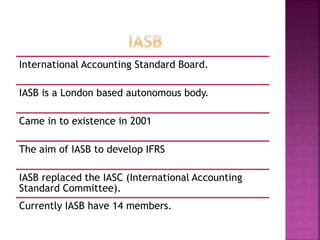
International Accounting Standard Board.
IASB is a London based autonomous body.
Came in to existence in 2001
The aim of IASB to develop IFRS
IASB replaced the IASC (International Accounting
Standard Committee).
Currently IASB have 14 members.
The ICAI (the institute of chartered
Accountants of India) has decided that
beginning with April 1,2015 these will be
complete harmonization between Indian
accounting standards and IFRS.
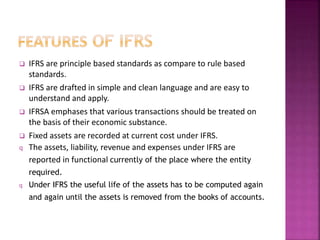
 IFRS are principle based standards as compare to rule based
standards.
 IFRS are drafted in simple and clean language and are easy to
understand and apply.
 IFRSA emphases that various transactions should be treated on
the basis of their economic substance.
 Fixed assets are recorded at current cost under IFRS.
q The assets, liability, revenue and expenses under IFRS are
reported in functional currently of the place where the entity
required.
q Under IFRS the useful life of the assets has to be computed again
and again until the assets is removed from the books of accounts.
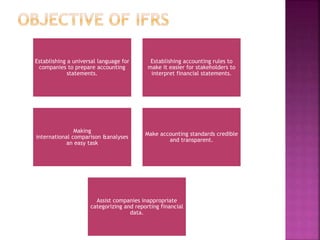
Establishing a universal language for
companies to prepare accounting
statements.
Establishing accounting rules to
make it easier for stakeholders to
interpret financial statements.
Making
international comparison &analyses
an easy task
Make accounting standards credible
and transparent.
Assist companies inappropriate
categorizing and reporting financial
data.
It is used in more than 130 countries.
More visible
one language
Easy access to global capital market
True and fair valuation
Attract foreign investment
Helpful to enterprise operating
globally
Difficult to commit fraude
Helpful to investors in comparison
High quality, transparent,
understandable, globally enforceable
more cross-border transaction
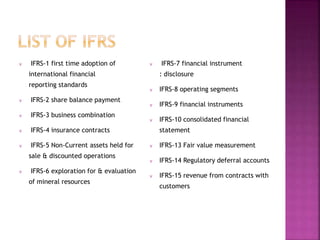
v IFRS-1 first time adoption of
international financial
reporting standards
v IFRS-2 share balance payment
v IFRS-3 business combination
v IFRS-4 insurance contracts
v IFRS-5 Non-Current assets held for
sale & discounted operations
v IFRS-6 exploration for & evaluation
of mineral resources
v IFRS-7 financial instrument
: disclosure
v IFRS-8 operating segments
v IFRS-9 financial instruments
v IFRS-10 consolidated financial
statement
v IFRS-13 Fair value measurement
v IFRS-14 Regulatory deferral accounts
v IFRS-15 revenue from contracts with
customers
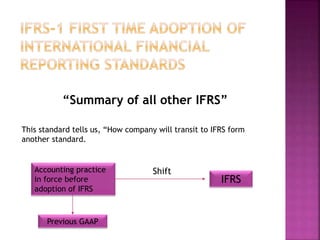
Accounting practice
in force before
adoption of IFRS
IFRS
Previous GAAP
Shift
“Summary of all other IFRS”
This standard tells us, “How company will transit to IFRS form
another standard.
 Any transaction by an entity from other entity or
employee settled in fixed no of shares are called
share based payment transaction.
Entity
Asset
Service
Goods
Purchased
Fixed No. of E/S
Rule1
Eg.
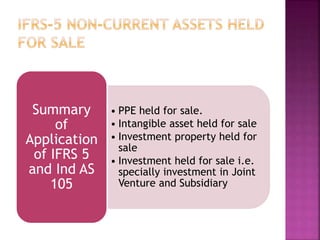
• PPE held for sale.
• Intangible asset held for sale
• Investment property held for
sale
• Investment held for sale i.e.
specially investment in Joint
Venture and Subsidiary
Summary
of
Application
of IFRS 5
and Ind AS
105
 An Entity shall classify non current asset as
held for sale if carrying amount will be
recovered for sale rather than use.
• Available for
immediate sale.
• Sale is highly probable.
Condition for
Classification
as held for
sale

IFRS presentation.pptx

  • 1.
    International Financial ReportingStandards Submitted by: Muskan Ankit Upasana Ekta Submitted to: Ms.Nishi Malik
  • 2.
    •Anything that can universallyacceptable international •Anything that is related to finance financial •To make a report in a single set or format Reporting •Set of rules and regulation standards
  • 3.
    IFRS are setof accounting standards that govern how particular type of transactions and events should be reported in financial statements. That are developed and maintained by the International Accounting standard of board.
  • 4.
    Linda Mezon-Hutter Appointed as: IASBvice-chair person 19 December 2022
  • 5.
  • 6.
     International financialreporting standards are designed as a common global language for business affairs so that company accounts are understandable and comparable across international boundaries.  IFRS were issued by the board of the International Accounting Standards Committee (IASC), known as International Accounting Standard Board (IASB).
  • 7.
    International Accounting StandardBoard. IASB is a London based autonomous body. Came in to existence in 2001 The aim of IASB to develop IFRS IASB replaced the IASC (International Accounting Standard Committee). Currently IASB have 14 members.
  • 8.
    The ICAI (theinstitute of chartered Accountants of India) has decided that beginning with April 1,2015 these will be complete harmonization between Indian accounting standards and IFRS.
  • 9.
     IFRS areprinciple based standards as compare to rule based standards.  IFRS are drafted in simple and clean language and are easy to understand and apply.  IFRSA emphases that various transactions should be treated on the basis of their economic substance.  Fixed assets are recorded at current cost under IFRS. q The assets, liability, revenue and expenses under IFRS are reported in functional currently of the place where the entity required. q Under IFRS the useful life of the assets has to be computed again and again until the assets is removed from the books of accounts.
  • 10.
    Establishing a universallanguage for companies to prepare accounting statements. Establishing accounting rules to make it easier for stakeholders to interpret financial statements. Making international comparison &analyses an easy task Make accounting standards credible and transparent. Assist companies inappropriate categorizing and reporting financial data.
  • 11.
    It is usedin more than 130 countries. More visible one language Easy access to global capital market True and fair valuation Attract foreign investment
  • 12.
    Helpful to enterpriseoperating globally Difficult to commit fraude Helpful to investors in comparison High quality, transparent, understandable, globally enforceable more cross-border transaction
  • 13.
    v IFRS-1 firsttime adoption of international financial reporting standards v IFRS-2 share balance payment v IFRS-3 business combination v IFRS-4 insurance contracts v IFRS-5 Non-Current assets held for sale & discounted operations v IFRS-6 exploration for & evaluation of mineral resources v IFRS-7 financial instrument : disclosure v IFRS-8 operating segments v IFRS-9 financial instruments v IFRS-10 consolidated financial statement v IFRS-13 Fair value measurement v IFRS-14 Regulatory deferral accounts v IFRS-15 revenue from contracts with customers
  • 14.
    Accounting practice in forcebefore adoption of IFRS IFRS Previous GAAP Shift “Summary of all other IFRS” This standard tells us, “How company will transit to IFRS form another standard.
  • 15.
     Any transactionby an entity from other entity or employee settled in fixed no of shares are called share based payment transaction. Entity Asset Service Goods Purchased Fixed No. of E/S
  • 16.
  • 17.
    • PPE heldfor sale. • Intangible asset held for sale • Investment property held for sale • Investment held for sale i.e. specially investment in Joint Venture and Subsidiary Summary of Application of IFRS 5 and Ind AS 105
  • 18.
     An Entityshall classify non current asset as held for sale if carrying amount will be recovered for sale rather than use. • Available for immediate sale. • Sale is highly probable. Condition for Classification as held for sale