DAMS
DAMS
 Dam is a solid barrier constructed at a suitable
location across a river valley to store flowing
water.
 Storage of water is utilized for following objectives:
 Hydropower
 Irrigation
 Water for domestic consumption
 Drought and flood control
 For navigational facilities
 Other additional utilization is to develop
fisheries
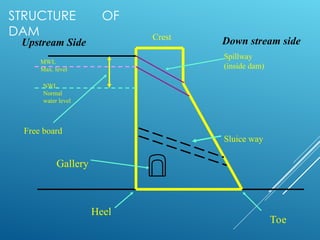
STRUCTURE OF
DAM
Heel
Gallery
Toe
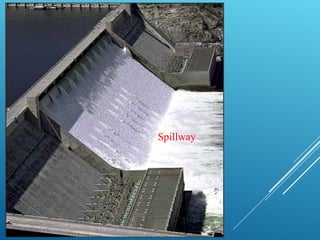
Spillway
(inside dam)
Crest
NWL
Normal
water level
MWL
Max. level
Free board
Sluice way
Upstream Side Down stream side
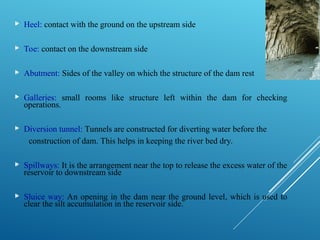
 Heel: contact with the ground on the upstream side
 Toe: contact on the downstream side
 Abutment: Sides of the valley on which the structure of the dam rest
 Galleries: small rooms like structure left within the dam for checking
operations.
 Diversion tunnel: Tunnels are constructed for diverting water before the
construction of dam. This helps in keeping the river bed dry.
 Spillways: It is the arrangement near the top to release the excess water of the
reservoir to downstream side
 Sluice way: An opening in the dam near the ground level, which is used to
clear the silt accumulation in the reservoir side.
TYPES OF DAMS
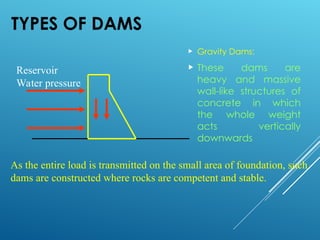
 Gravity Dams:
 These dams are
heavy and massive
wall-like structures of
concrete in which
the whole weight
acts vertically
downwards
Reservoir
Water pressure
As the entire load is transmitted on the small area of foundation, such
dams are constructed where rocks are competent and stable.
Spillway
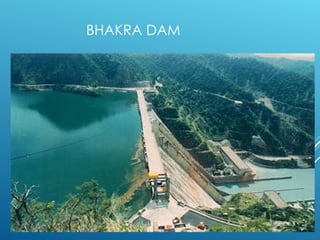
BHAKRA DAM
 Bhakra Dam is the highest Concrete Gravity dam in Asia and Second
Highest in the world.
 Bhakra Dam is across river Sutlej in Himachal Pradesh
 The construction of this project was started in the year 1948 and was
completed in 1963 .
• It is 740 ft. high above the deepest foundation as straight concrete dam being
more than three times the height of Qutab Minar.
• Length at top 518.16 m (1700 feet); Width at base 190.5 m (625 feet), and at
the top is 9.14 m (30 feet)
• Bhakra Dam is the highest Concrete Gravity dam in Asia and Second
Highest in the world.
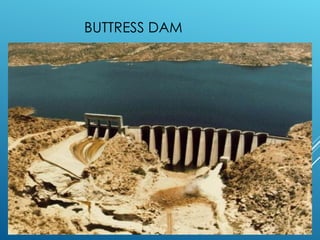
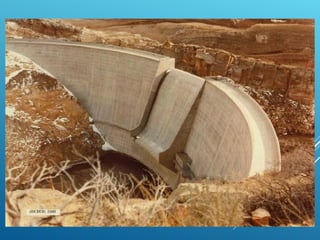
BUTTRESS DAM
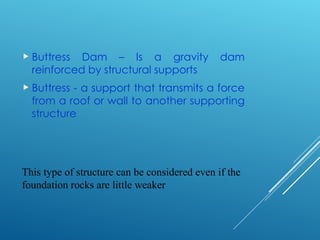
This type of structure can be considered even if the
foundation rocks are little weaker
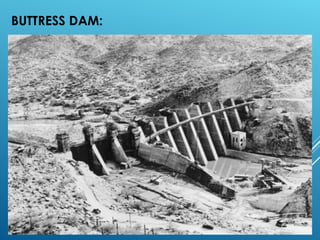
 Buttress Dam – Is a gravity dam
reinforced by structural supports
 Buttress - a support that transmits a force
from a roof or wall to another supporting
structure
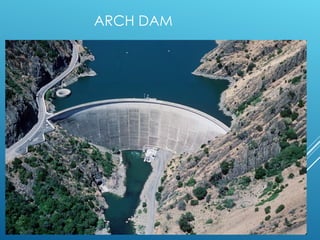
BUTTRESS DAM:
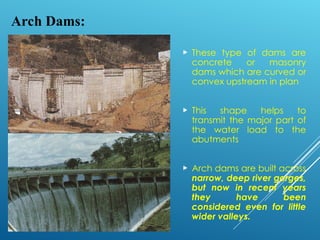
 These type of dams are
concrete or masonry
dams which are curved or
convex upstream in plan
 This shape helps to
transmit the major part of
the water load to the
abutments
 Arch dams are built across
narrow, deep river gorges,
but now in recent years
they have been
considered even for little
wider valleys.
Arch Dams:
ARCH DAM
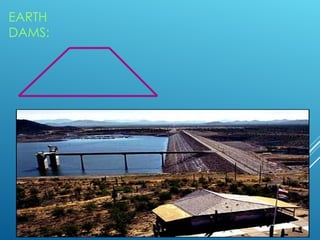
EARTH
DAMS:
 They are trapezoidal in shape
 Earth dams are constructed where the foundation or the
underlying material or rocks are weak to support the masonry
dam or where the suitable competent rocks are at greater depth.
 Earthen dams are relatively smaller in height and broad at the
base
 They are mainly built with clay, sand and gravel, hence they are
also known as Earth fill dam or Rock fill dam

IEN- Chapter 3 Dams project .ppt

  • 1.
  • 2.
    DAMS  Dam isa solid barrier constructed at a suitable location across a river valley to store flowing water.  Storage of water is utilized for following objectives:  Hydropower  Irrigation  Water for domestic consumption  Drought and flood control  For navigational facilities  Other additional utilization is to develop fisheries
  • 3.
    STRUCTURE OF DAM Heel Gallery Toe Spillway (inside dam) Crest NWL Normal waterlevel MWL Max. level Free board Sluice way Upstream Side Down stream side
  • 4.
     Heel: contactwith the ground on the upstream side  Toe: contact on the downstream side  Abutment: Sides of the valley on which the structure of the dam rest  Galleries: small rooms like structure left within the dam for checking operations.  Diversion tunnel: Tunnels are constructed for diverting water before the construction of dam. This helps in keeping the river bed dry.  Spillways: It is the arrangement near the top to release the excess water of the reservoir to downstream side  Sluice way: An opening in the dam near the ground level, which is used to clear the silt accumulation in the reservoir side.
  • 5.
    TYPES OF DAMS Gravity Dams:  These dams are heavy and massive wall-like structures of concrete in which the whole weight acts vertically downwards Reservoir Water pressure As the entire load is transmitted on the small area of foundation, such dams are constructed where rocks are competent and stable.
  • 6.
  • 7.
  • 8.
     Bhakra Damis the highest Concrete Gravity dam in Asia and Second Highest in the world.  Bhakra Dam is across river Sutlej in Himachal Pradesh  The construction of this project was started in the year 1948 and was completed in 1963 . • It is 740 ft. high above the deepest foundation as straight concrete dam being more than three times the height of Qutab Minar. • Length at top 518.16 m (1700 feet); Width at base 190.5 m (625 feet), and at the top is 9.14 m (30 feet) • Bhakra Dam is the highest Concrete Gravity dam in Asia and Second Highest in the world.
  • 10.
  • 11.
    This type ofstructure can be considered even if the foundation rocks are little weaker  Buttress Dam – Is a gravity dam reinforced by structural supports  Buttress - a support that transmits a force from a roof or wall to another supporting structure
  • 12.
  • 13.
     These typeof dams are concrete or masonry dams which are curved or convex upstream in plan  This shape helps to transmit the major part of the water load to the abutments  Arch dams are built across narrow, deep river gorges, but now in recent years they have been considered even for little wider valleys. Arch Dams:
  • 15.
  • 16.
  • 17.
     They aretrapezoidal in shape  Earth dams are constructed where the foundation or the underlying material or rocks are weak to support the masonry dam or where the suitable competent rocks are at greater depth.  Earthen dams are relatively smaller in height and broad at the base  They are mainly built with clay, sand and gravel, hence they are also known as Earth fill dam or Rock fill dam