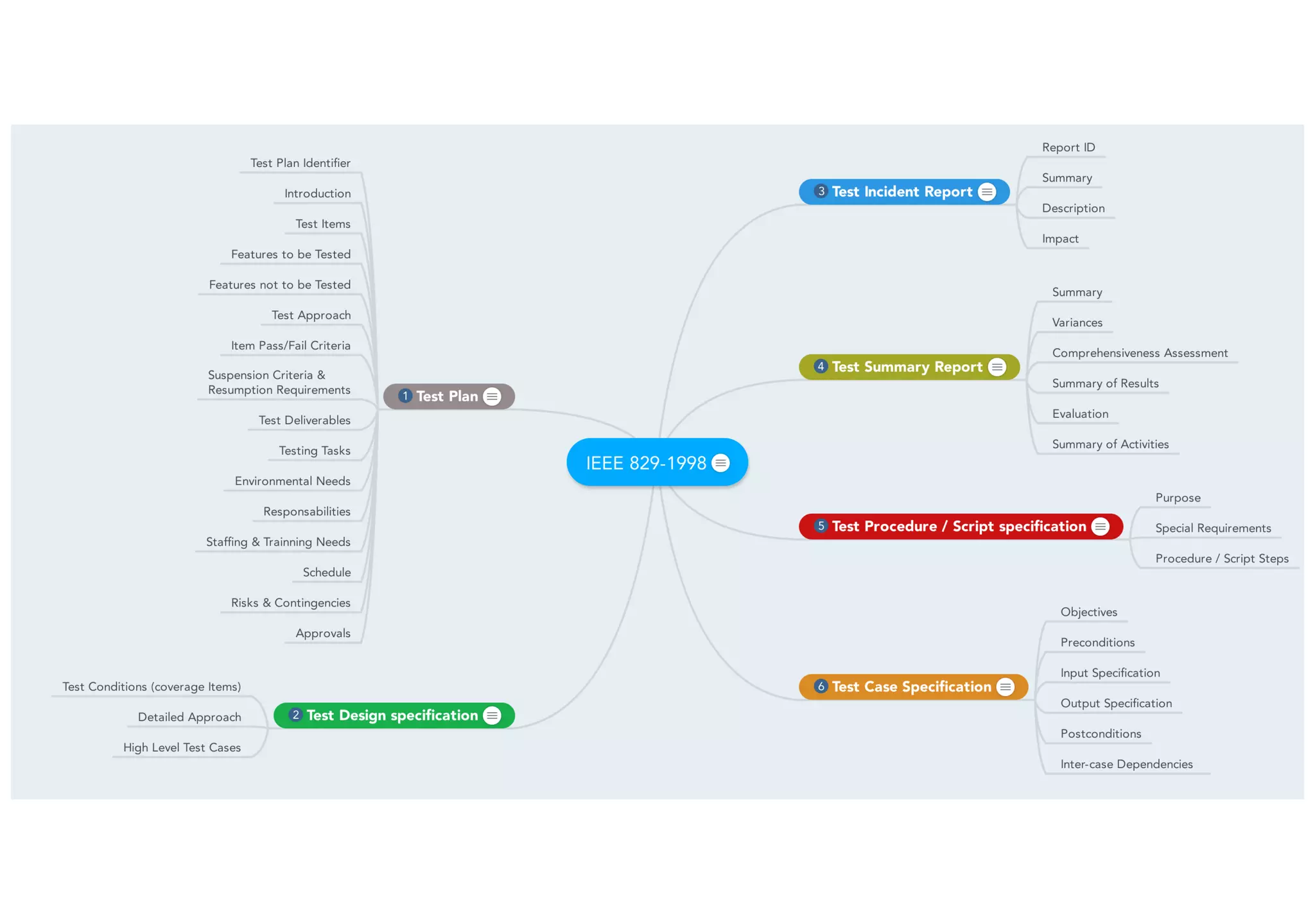
IEEE	829-1998
IEEE	829-2008,	also	known	as	the	829	Standard	for	Software	and	System	Test	Documentation,	is	an	IEEE	standard	that
specifies	the	form	of	a	set	of	documents	for	use	in	eight	defined	stages	of	software	testing	and	system	testing,	each	stage
potentially	producing	its	own	separate	type	of	document.	The	standard	specifies	the	format	of	these	documents,	but
does	not	stipulate	whether	they	must	all	be	produced,	nor	does	it	include	any	criteria	regarding	adequate	content	for
these	documents.	These	are	a	matter	of	judgment	outside	the	purview	of	the	standard.	The	documents	are:	Master	Test
Plan:	The	purpose	of	the	Master	Test	Plan	is	to	provide	an	overall	test	planning	and	test	management	document	for
multiple	levels	of	test.	Level	Test	Plan:	For	each	LTP	the	scope,	approach,	resources,	and	schedule	of	the	testing	activities
for	its	specified	level	of	testing	need	to	be	described.	The	items	being	tested,	the	features	to	be	tested,	the	testing	tasks
to	be	performed,	the	personnel	responsible	for	each	task,	and	the	associated	risk	need	to	be	identified.	Level	Test
Design:	Detailing	test	cases	and	the	expected	results	as	well	as	test	pass	criteria.
Test	Plan
A	test	plan	is	a	document	detailing	a	systematic	approach	to	testing	a	system	such	as	a	machine	or	software.	The	plan
typically	contains	a	detailed	understanding	of	the	eventual	workflow.
Test	Summary	Report
Test	summary	report	is	the	report	which	is	prepared	after	testing	is	complete.
Test	Case	Specification
The	Classification	Tree	Method	is	a	method	for	test	design,	as	it	is	used	in	different	areas	of	software	development.	It	has
been	developed	by	Grimm	and	Grochtmann	in	1993.	Classification	Trees	in	terms	of	the	Classification	Tree	Method	must
not	be	confused	with	decision	trees.	The	classification	tree	method	consists	of	two	major	steps:	Identification	of	test
relevant	aspects	and	their	corresponding	values	as	well	as	Combination	of	different	classes	from	all	classifications	into	test
cases.	The	identification	of	test	relevant	aspects	usually	follows	the	specification	of	the	system	under	test.	These	aspects
form	the	input	and	output	data	space	of	the	test	object.	The	second	step	of	test	design	then	follows	the	principles	of
combinatorial	test	design.	While	the	method	can	be	applied	using	a	pen	and	a	paper,	the	usual	way	involves	the	usage	of
the	Classification	Tree	Editor,	a	software	tool	implementing	the	classification	tree	method.
Test	Procedure	/	Script	specification
-	Test	Procedure	-	Manual
-	Test	Script	-	Automated
Test	Design	specification
Specification	may	refer	to	an	explicit	set	of	requirements	to	be	satisfied	by	a	material,	design,	product,	or	service.	Should
a	material,	product,	or	service	fail	to	meet	one	or	more	of	the	applicable	specifications,	it	may	be	referred	to	as	being	out
of	specification;	the	abbreviation	OOS	may	also	be	used.	In	casual	usage,	underspec	or	overspec	are	used	when
something	is	worse	or	better	than	specified,	though	in	general	there	is	only	a	notion	of	"in	spec"	or	"out	of	spec",	not
"better"	or	"worse".	A	specification	is	a	type	of	technical	standard.	A	technical	specification	may	be	developed	by	any	of
various	kinds	of	organizations,	both	public	and	private.	Example	organization	types	include	a	corporation,	a	consortium,	a
trade	association,	a	national	government,	a	professional	association,	a	purpose-made	standards	organization	such	as	ISO,
or	vendor-neutral	developed	generic	requirements.	It	is	common	for	one	organization	to	refer	to	the	standards	of
another.	Voluntary	standards	may	become	mandatory	if	adopted	by	a	government	or	business	contract.
Test	Incident	Report
Test	Incident	Report	is	another	name	for	bug	report.
Is	how	incidents	are	reported	with	as	much	information	as	possible	to	help	developers	solve	the	issue.
Involves	incident	description	and	the	impact	of	the	issue.

Ieee 829 1998-a3