Leading the way in Best Practice in Data Driven Communication
Managing Marketing
in a
Changing Landscape
Justin Gleeson – NIRSA
Edel McCabe – PublicisD
Brendan Sheridan – Experian
Leading the way in Best Practice in Data Driven Communication
Mapping, demographics and the new
small area statistical geography of
Ireland
Justin Gleeson – NIRSA
All-Island Research Observatory (AIRO), NUI Maynooth
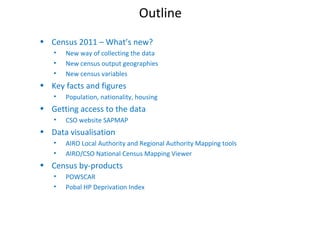
Outline
• Census 2011 – What’s new?
• New way of collecting the data
• New census output geographies
• New census variables
• Key facts and figures
• Population, nationality, housing
• Getting access to the data
• CSO website SAPMAP
• Data visualisation
• AIRO Local Authority and Regional Authority Mapping tools
• AIRO/CSO National Census Mapping Viewer
• Census by-products
• POWSCAR
• Pobal HP Deprivation Index
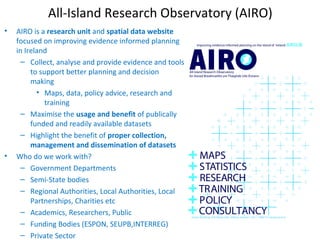
All-Island Research Observatory (AIRO)
• AIRO is a research unit and spatial data website
focused on improving evidence informed planning
in Ireland
– Collect, analyse and provide evidence and tools
to support better planning and decision
making
• Maps, data, policy advice, research and
training
– Maximise the usage and benefit of publically
funded and readily available datasets
– Highlight the benefit of proper collection,
management and dissemination of datasets
• Who do we work with?
– Government Departments
– Semi-State bodies
– Regional Authorities, Local Authorities, Local
Partnerships, Charities etc
– Academics, Researchers, Public
– Funding Bodies (ESPON, SEUPB,INTERREG)
– Private Sector
Census 2011 – What’s new?
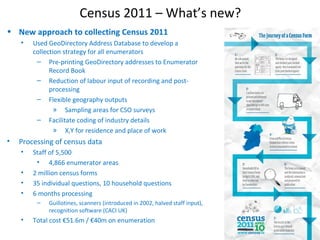
• New approach to collecting Census 2011
• Used GeoDirectory Address Database to develop a
collection strategy for all enumerators
– Pre-printing GeoDirectory addresses to Enumerator
Record Book
– Reduction of labour input of recording and post-
processing
– Flexible geography outputs
» Sampling areas for CSO surveys
– Facilitate coding of industry details
» X,Y for residence and place of work
• Processing of census data
• Staff of 5,500
• 4,866 enumerator areas
• 2 million census forms
• 35 individual questions, 10 household questions
• 6 months processing
– Guillotines, scanners (introduced in 2002, halved staff input),
recognition software (CACI UK)
• Total cost €51.6m / €40m on enumeration
Census 2011 – What’s new?
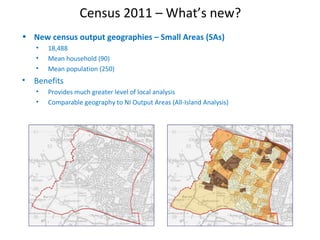
• New census output geographies – Small Areas (SAs)
• 18,488
• Mean household (90)
• Mean population (250)
• Benefits
• Provides much greater level of local analysis
• Comparable geography to NI Output Areas (All-Island Analysis)
Census 2011 – What’s new?
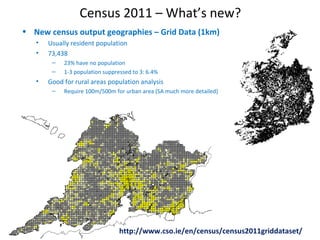
• New census output geographies – Grid Data (1km)
• Usually resident population
• 73,438
– 23% have no population
– 1-3 population suppressed to 3: 6.4%
• Good for rural areas population analysis
– Require 100m/500m for urban area (SA much more detailed)
http://www.cso.ie/en/census/census2011griddataset/
Census 2011 – What’s new?
• New census variables
• Other languages spoken
– Data on languages, other than English or Irish, that are spoken at home
– Also provides information on how well English is spoken
• General Health
– How is your health in general?
– Country wide picture of peoples health
» Age
» Social class
» Education
– Also being asked in NI Census and will allow an all-island analysis of health
• Place of School and Work Census of Anonymised Records (POWSCAR)
– Place of Work
» Urban Areas catchments
» Job Density analysis
– Place of School
» School catchments
» University Catchments
Census 2011 – Key Facts and Figures?
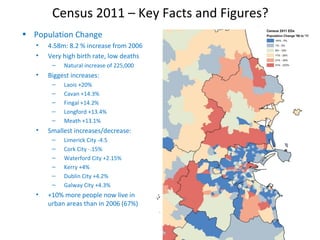
• Population Change
• 4.58m: 8.2 % increase from 2006
• Very high birth rate, low deaths
– Natural increase of 225,000
• Biggest increases:
– Laois +20%
– Cavan +14.3%
– Fingal +14.2%
– Longford +13.4%
– Meath +13.1%
• Smallest increases/decrease:
– Limerick City -4.5
– Cork City -.15%
– Waterford City +2.15%
– Kerry +4%
– Dublin City +4.2%
– Galway City +4.3%
• +10% more people now live in
urban areas than in 2006 (67%)
Census 2011 – Key Facts and Figures?
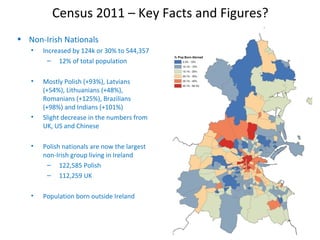
• Non-Irish Nationals
• Increased by 124k or 30% to 544,357
– 12% of total population
• Mostly Polish (+93%), Latvians
(+54%), Lithuanians (+48%),
Romanians (+125%), Brazilians
(+98%) and Indians (+101%)
• Slight decrease in the numbers from
UK, US and Chinese
• Polish nationals are now the largest
non-Irish group living in Ireland
– 122,585 Polish
– 112,259 UK
• Population born outside Ireland
Census 2011 – Key Facts and Figures?
• Housing
• 1.99m total housing stock in 2011
– +12.7% from 2006
– 71% increase in stock in past 20
years (population by 30%)
» 785 housing units per
1000 population
• 1.65 million occupied permanent
housing units in 2011 (82%)
– +187,100 or 13% from 2006
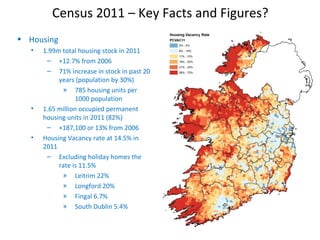
• Housing Vacancy rate at 14.5% in
2011
– Excluding holiday homes the
rate is 11.5%
» Leitrim 22%
» Longford 20%
» Fingal 6.7%
» South Dublin 5.4%
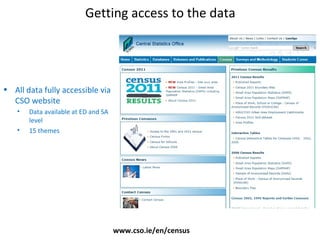
Getting access to the data
www.cso.ie/en/census
• All data fully accessible via
CSO website
• Data available at ED and SA
level
• 15 themes
Getting access to the data
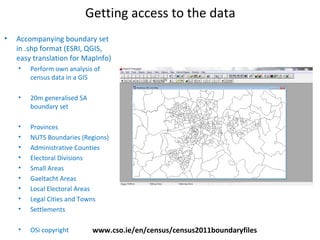
www.cso.ie/en/census/census2011boundaryfiles
• Accompanying boundary set
in .shp format (ESRI, QGIS,
easy translation for MapInfo)
• Perform own analysis of
census data in a GIS
• 20m generalised SA
boundary set
• Provinces
• NUTS Boundaries (Regions)
• Administrative Counties
• Electoral Divisions
• Small Areas
• Gaeltacht Areas
• Local Electoral Areas
• Legal Cities and Towns
• Settlements
• OSi copyright
Getting access to the data
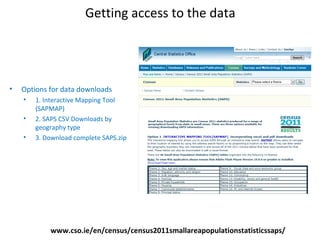
www.cso.ie/en/census/census2011smallareapopulationstatisticssaps/
• Options for data downloads
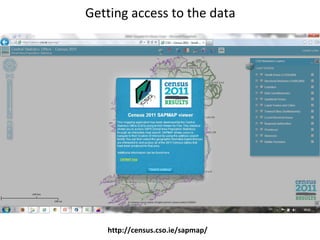
• 1. Interactive Mapping Tool
(SAPMAP)
• 2. SAPS CSV Downloads by
geography type
• 3. Download complete SAPS.zip
Getting access to the data
http://census.cso.ie/sapmap/
Getting access to the data
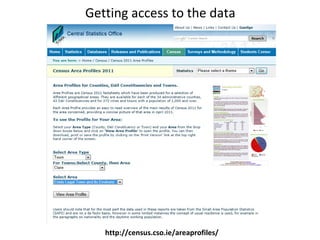
http://census.cso.ie/areaprofiles/
Getting access to the data
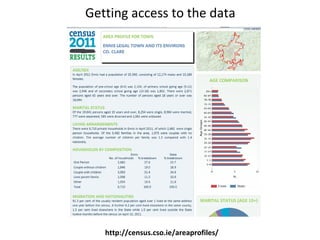
http://census.cso.ie/areaprofiles/
Census 2011 - Data Visualisation through AIRO
http://www.airo.ie/mapping-module
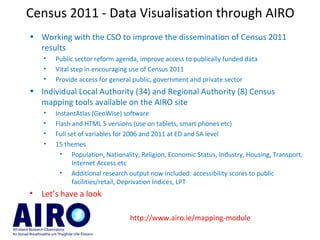
• Working with the CSO to improve the dissemination of Census 2011
results
• Public sector reform agenda, improve access to publically funded data
• Vital step in encouraging use of Census 2011
• Provide access for general public, government and private sector
• Individual Local Authority (34) and Regional Authority (8) Census
mapping tools available on the AIRO site
• InstantAtlas (GeoWise) software
• Flash and HTML 5 versions (use on tablets, smart phones etc)
• Full set of variables for 2006 and 2011 at ED and SA level
• 15 themes
• Population, Nationality, Religion, Economic Status, Industry, Housing, Transport,
Internet Access etc
• Additional research output now included: accessibility scores to public
facilities/retail, Deprivation Indices, LPT
• Let’s have a look
Census 2011 - Data Visualisation through AIRO
http://airomaps.nuim.ie/census2011
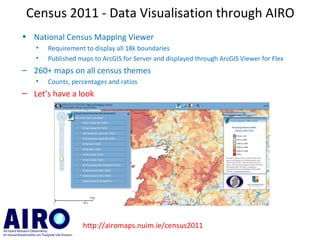
• National Census Mapping Viewer
• Requirement to display all 18k boundaries
• Published maps to ArcGIS for Server and displayed through ArcGIS Viewer for Flex
– 260+ maps on all census themes
• Counts, percentages and ratios
– Let’s have a look
Census 2011 – By-Products
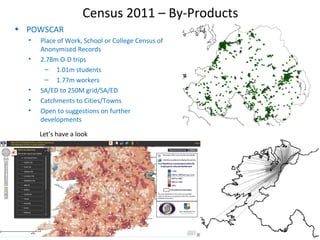
• POWSCAR
• Place of Work, School or College Census of
Anonymised Records
• 2.78m O-D trips
– 1.01m students
– 1.77m workers
• SA/ED to 250M grid/SA/ED
• Catchments to Cities/Towns
• Open to suggestions on further
developments
Let’s have a look
Census 2011 – By-Products
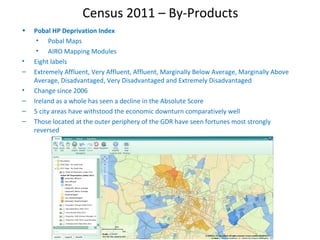
• Pobal HP Deprivation Index
• Pobal Maps
• AIRO Mapping Modules
• Eight labels
– Extremely Affluent, Very Affluent, Affluent, Marginally Below Average, Marginally Above
Average, Disadvantaged, Very Disadvantaged and Extremely Disadvantaged
• Change since 2006
– Ireland as a whole has seen a decline in the Absolute Score
– 5 city areas have withstood the economic downturn comparatively well
– Those located at the outer periphery of the GDR have seen fortunes most strongly
reversed
Thanks
Questions?
w: www.airo.ie
e: justin.gleeson@nuim.ie
twitter: airo_nuim
Leading the way in Best Practice in Data Driven Communication
Brendan’s Header…Customer
Insight
Brendan Sheridan - Experian
Leading the way in Best Practice in Data Driven Communication
Edel’s Header…Targeting &
Segmentation
Justin Gleeson - NIRSA
Leading the way in Best Practice in Data Driven Communication
Thank you!
Any Questions?
Please join us for a drink!

IDMA/Experian Presentation: Justin Gleeson, AIRO

  • 1.
    Leading the wayin Best Practice in Data Driven Communication Managing Marketing in a Changing Landscape Justin Gleeson – NIRSA Edel McCabe – PublicisD Brendan Sheridan – Experian
  • 2.
    Leading the wayin Best Practice in Data Driven Communication Mapping, demographics and the new small area statistical geography of Ireland Justin Gleeson – NIRSA All-Island Research Observatory (AIRO), NUI Maynooth
  • 3.
    Outline • Census 2011– What’s new? • New way of collecting the data • New census output geographies • New census variables • Key facts and figures • Population, nationality, housing • Getting access to the data • CSO website SAPMAP • Data visualisation • AIRO Local Authority and Regional Authority Mapping tools • AIRO/CSO National Census Mapping Viewer • Census by-products • POWSCAR • Pobal HP Deprivation Index
  • 4.
    All-Island Research Observatory(AIRO) • AIRO is a research unit and spatial data website focused on improving evidence informed planning in Ireland – Collect, analyse and provide evidence and tools to support better planning and decision making • Maps, data, policy advice, research and training – Maximise the usage and benefit of publically funded and readily available datasets – Highlight the benefit of proper collection, management and dissemination of datasets • Who do we work with? – Government Departments – Semi-State bodies – Regional Authorities, Local Authorities, Local Partnerships, Charities etc – Academics, Researchers, Public – Funding Bodies (ESPON, SEUPB,INTERREG) – Private Sector
  • 5.
    Census 2011 –What’s new? • New approach to collecting Census 2011 • Used GeoDirectory Address Database to develop a collection strategy for all enumerators – Pre-printing GeoDirectory addresses to Enumerator Record Book – Reduction of labour input of recording and post- processing – Flexible geography outputs » Sampling areas for CSO surveys – Facilitate coding of industry details » X,Y for residence and place of work • Processing of census data • Staff of 5,500 • 4,866 enumerator areas • 2 million census forms • 35 individual questions, 10 household questions • 6 months processing – Guillotines, scanners (introduced in 2002, halved staff input), recognition software (CACI UK) • Total cost €51.6m / €40m on enumeration
  • 6.
    Census 2011 –What’s new? • New census output geographies – Small Areas (SAs) • 18,488 • Mean household (90) • Mean population (250) • Benefits • Provides much greater level of local analysis • Comparable geography to NI Output Areas (All-Island Analysis)
  • 7.
    Census 2011 –What’s new? • New census output geographies – Grid Data (1km) • Usually resident population • 73,438 – 23% have no population – 1-3 population suppressed to 3: 6.4% • Good for rural areas population analysis – Require 100m/500m for urban area (SA much more detailed) http://www.cso.ie/en/census/census2011griddataset/
  • 8.
    Census 2011 –What’s new? • New census variables • Other languages spoken – Data on languages, other than English or Irish, that are spoken at home – Also provides information on how well English is spoken • General Health – How is your health in general? – Country wide picture of peoples health » Age » Social class » Education – Also being asked in NI Census and will allow an all-island analysis of health • Place of School and Work Census of Anonymised Records (POWSCAR) – Place of Work » Urban Areas catchments » Job Density analysis – Place of School » School catchments » University Catchments
  • 9.
    Census 2011 –Key Facts and Figures? • Population Change • 4.58m: 8.2 % increase from 2006 • Very high birth rate, low deaths – Natural increase of 225,000 • Biggest increases: – Laois +20% – Cavan +14.3% – Fingal +14.2% – Longford +13.4% – Meath +13.1% • Smallest increases/decrease: – Limerick City -4.5 – Cork City -.15% – Waterford City +2.15% – Kerry +4% – Dublin City +4.2% – Galway City +4.3% • +10% more people now live in urban areas than in 2006 (67%)
  • 10.
    Census 2011 –Key Facts and Figures? • Non-Irish Nationals • Increased by 124k or 30% to 544,357 – 12% of total population • Mostly Polish (+93%), Latvians (+54%), Lithuanians (+48%), Romanians (+125%), Brazilians (+98%) and Indians (+101%) • Slight decrease in the numbers from UK, US and Chinese • Polish nationals are now the largest non-Irish group living in Ireland – 122,585 Polish – 112,259 UK • Population born outside Ireland
  • 11.
    Census 2011 –Key Facts and Figures? • Housing • 1.99m total housing stock in 2011 – +12.7% from 2006 – 71% increase in stock in past 20 years (population by 30%) » 785 housing units per 1000 population • 1.65 million occupied permanent housing units in 2011 (82%) – +187,100 or 13% from 2006 • Housing Vacancy rate at 14.5% in 2011 – Excluding holiday homes the rate is 11.5% » Leitrim 22% » Longford 20% » Fingal 6.7% » South Dublin 5.4%
  • 12.
    Getting access tothe data www.cso.ie/en/census • All data fully accessible via CSO website • Data available at ED and SA level • 15 themes
  • 13.
    Getting access tothe data www.cso.ie/en/census/census2011boundaryfiles • Accompanying boundary set in .shp format (ESRI, QGIS, easy translation for MapInfo) • Perform own analysis of census data in a GIS • 20m generalised SA boundary set • Provinces • NUTS Boundaries (Regions) • Administrative Counties • Electoral Divisions • Small Areas • Gaeltacht Areas • Local Electoral Areas • Legal Cities and Towns • Settlements • OSi copyright
  • 14.
    Getting access tothe data www.cso.ie/en/census/census2011smallareapopulationstatisticssaps/ • Options for data downloads • 1. Interactive Mapping Tool (SAPMAP) • 2. SAPS CSV Downloads by geography type • 3. Download complete SAPS.zip
  • 15.
    Getting access tothe data http://census.cso.ie/sapmap/
  • 16.
    Getting access tothe data http://census.cso.ie/areaprofiles/
  • 17.
    Getting access tothe data http://census.cso.ie/areaprofiles/
  • 18.
    Census 2011 -Data Visualisation through AIRO http://www.airo.ie/mapping-module • Working with the CSO to improve the dissemination of Census 2011 results • Public sector reform agenda, improve access to publically funded data • Vital step in encouraging use of Census 2011 • Provide access for general public, government and private sector • Individual Local Authority (34) and Regional Authority (8) Census mapping tools available on the AIRO site • InstantAtlas (GeoWise) software • Flash and HTML 5 versions (use on tablets, smart phones etc) • Full set of variables for 2006 and 2011 at ED and SA level • 15 themes • Population, Nationality, Religion, Economic Status, Industry, Housing, Transport, Internet Access etc • Additional research output now included: accessibility scores to public facilities/retail, Deprivation Indices, LPT • Let’s have a look
  • 19.
    Census 2011 -Data Visualisation through AIRO http://airomaps.nuim.ie/census2011 • National Census Mapping Viewer • Requirement to display all 18k boundaries • Published maps to ArcGIS for Server and displayed through ArcGIS Viewer for Flex – 260+ maps on all census themes • Counts, percentages and ratios – Let’s have a look
  • 20.
    Census 2011 –By-Products • POWSCAR • Place of Work, School or College Census of Anonymised Records • 2.78m O-D trips – 1.01m students – 1.77m workers • SA/ED to 250M grid/SA/ED • Catchments to Cities/Towns • Open to suggestions on further developments Let’s have a look
  • 21.
    Census 2011 –By-Products • Pobal HP Deprivation Index • Pobal Maps • AIRO Mapping Modules • Eight labels – Extremely Affluent, Very Affluent, Affluent, Marginally Below Average, Marginally Above Average, Disadvantaged, Very Disadvantaged and Extremely Disadvantaged • Change since 2006 – Ireland as a whole has seen a decline in the Absolute Score – 5 city areas have withstood the economic downturn comparatively well – Those located at the outer periphery of the GDR have seen fortunes most strongly reversed
  • 22.
  • 23.
    Leading the wayin Best Practice in Data Driven Communication Brendan’s Header…Customer Insight Brendan Sheridan - Experian
  • 24.
    Leading the wayin Best Practice in Data Driven Communication Edel’s Header…Targeting & Segmentation Justin Gleeson - NIRSA
  • 26.
    Leading the wayin Best Practice in Data Driven Communication Thank you! Any Questions? Please join us for a drink!