NEWS Dream Factory | Quarterly
International
Controller Association
Issue 13 │ April 2014
Dear Readers,
in both of the last two Dream Factory Quarterlies we gave you
insights into how our current major topic is developing. We
can now tell you that the Dream Car Report “Big Data –
Potential for the controller” is in the home stretch and will
be presented to the controller community in time for the 39th
Controller Congress on May 19/20 in Munich.
In order to bridge the time to publication, we would like to use
this issue of the newsletter to give you one more little taste of
what’s to come in the Dream Car Report.
First, we use selected real-world examples to show you the
corporate functions Big Data is already being used in.
Then we take a closer look at the impact upon controllers by
highlighting the questions and challenges controllers have to
deal with in main controlling processes due to Big Data.
Finally, we give suggestions on how to identify the strategic
potentials of Big Data in companies.
We hope you enjoy reading this issue of the Dream Factory
Quarterly.
Best regards,
Péter Horváth and Uwe Michel
Green Controlling Prize | Call for applications 2014
This year, for the fourth time the Péter Horváth Foundation
recognizes the achievements of companies and public
institutions for their most innovative and most effective “green”
controlling solutions for designing and managing ecological
strategies, programs, projects and measures. The prize is
awarded in cooperation with the Dream Factory of the ICV
and fosters the work of controlling in dealing with the “green
challenge”.
The award comes with a €10,000 endowment and is given to
controllers or controller teams whose solution has been
implemented since 2013. Please submit your green
controlling solution by September 15, 2014, to:
Péter Horváth-Stiftung, c/o IPRI gGmbH,
Königstraße 5, 70173 Stuttgart
To apply, please use the following criteria to describe the
implemented green controlling solution in no more than ten
pages:
• Which problem should be solved?
• How is the green controlling solution designed?
• What makes this solution innovative?
• How is the green controlling solution implemented?
• What role does the controller play in concept design,
implementation and application?
• How can the results or impact of the solution be
evaluated in economic and ecological terms?
You can find further information on the ICV Dream Factory’s
website.
The complete Dream Car Report of the ICV Dream Car Factory “Big Data – Potential for the controller” will be published
shortly and you will be notified via the usual ICV channels. Subsequently, the report will be available as a free download from
the Dream Factory’s website at:
www.controllerverein.com/iw
NEWS Dream Factory | Quarterly
Big Data | “Along the entire value chain”
Here at the Dream Factory, we understand the term Big Data as being the analysis and real-time processing of large,
unstructured and continuously flowing data from a wide range of different sources. At the forefront of this is the creation
of credible information which then forms the basis for decisions which create benefit. A look at the real world shows that
the fields where Big Data can be used and the potential benefits are very heterogeneous. As a result, completely new
possibilities are created, such as dynamic pricing, which can be coupled with the current market situation in real time.
This can lead to prices for online retailing which change depending on the day or the time of day in order to, for example,
manage the capacity utilization of in-company logistics. In the words of Mattias Ulbrich, CIO of Audia AG, “We are looking
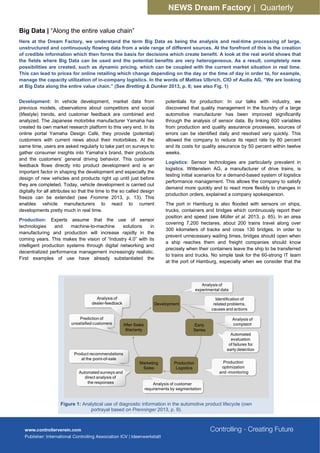
at Big Data along the entire value chain.” (See Bretting & Dunker 2013, p. 6; see also Fig. 1)
Development: In vehicle development, market data from
previous models, observations about competitors and social
(lifestyle) trends, and customer feedback are combined and
analyzed. The Japanese motorbike manufacturer Yamaha has
created its own market research platform to this very end. In its
online portal Yamaha Design Café, they provide (potential)
customers with current news about their motorbikes. At the
same time, users are asked regularly to take part on surveys to
gather consumer insights into Yamaha’s brand, their products
and the customers’ general driving behavior. This customer
feedback flows directly into product development and is an
important factor in shaping the development and especially the
design of new vehicles and products right up until just before
they are completed. Today, vehicle development is carried out
digitally for all attributes so that the time to the so called design
freeze can be extended (see Fromme 2013, p. 13). This
enables vehicle manufacturers to react to current
developments pretty much in real time.
Production: Experts assume that the use of sensor
technologies and machine-to-machine solutions in
manufacturing and production will increase rapidly in the
coming years. This makes the vision of “Industry 4.0” with its
intelligent production systems through digital networking and
decentralized performance management increasingly realistic.
First examples of use have already substantiated the
potentials for production: In our talks with industry, we
discovered that quality management in the foundry of a large
automotive manufacturer has been improved significantly
through the analysis of sensor data. By linking 600 variables
from production and quality assurance processes, sources of
errors can be identified daily and resolved very quickly. This
allowed the company to reduce its reject rate by 80 percent
and its costs for quality assurance by 50 percent within twelve
weeks.
Logistics: Sensor technologies are particularly prevalent in
logistics. Wittenstein AG, a manufacturer of drive trains, is
testing initial scenarios for a demand-based system of logistics
performance management. This allows the company to satisfy
demand more quickly and to react more flexibly to changes in
production orders, explained a company spokesperson.
The port in Hamburg is also flooded with sensors on ships,
trucks, containers and bridges which continuously report their
position and speed (see Müller et al. 2013, p. 65). In an area
covering 7,200 hectares, about 200 trains travel along over
300 kilometers of tracks and cross 130 bridges. In order to
prevent unnecessary waiting times, bridges should open when
a ship reaches them and freight companies should know
precisely when their containers leave the ship to be transferred
to trains and trucks. No simple task for the 60-strong IT team
at the port of Hamburg, especially when we consider that the
Figure 1: Analytical use of diagnostic information in the automotive product lifecycle (own
portrayal based on Prenninger 2013, p. 9).
Development
Early
Series
Marketing
Sales
Production
Logistics
After Sales
Warranty
Analysis of
dealer-feedback
Identification of
related problems,
causes and actions
Analysis of
experimental data
Prediction of
unsatisfied customers
Product recommendations
at the point-of-sale
Automated surveys and
direct analysis of
the responses
Analysis of
complaint
Automated
evaluation
of failures for
early detection
Production
optimization
and -monitoring
Analysis of customer
requirements by segmentation
NEWS Dream Factory | Quarterly
Hamburg senate has targeted a tripling in cargo handling by
2025 although there is very little room to expand the port itself.
These and other examples of use show that both production
and logistics processes can be made considerably more
flexible and versatile through digital networking and can be
adjusted to cope with current changes in conditions.
Sales: The British insurance company Aviva grants its
customers a 20 percent discount on their car insurance
policies as long as they allow their individual driving behavior
to be recorded (Business Intelligence Magazine 2/2013, p. 15).
Indeed, in the future customers should profit even more from
this approach. If you allow your driving behavior to be
monitored permanently, you will be categorized in risk profiles
and receive individually structured tariffs (see Müller et al.
2013, p. 67) according to the principle of cash for user data.
After sales: If we remain in the automotive industry, a detailed
analysis of user data has further benefits: The waiting times for
vehicles can be calculated more precisely, which is especially
advantageous for logistics companies. But the user can also
benefit: Visits to the repair shop can be planned better to suit
demand and, thanks to already existing databases between
repair shops, causes and solutions for defects can be identified
and rectified more quickly based on similar cases for each
model. Automotive manufacturers and their authorized repair
shops can design their customer care proactively and
individually, thus saving both time and money, while customers
can plan their visits better, thus shortening waiting times (see
Fromme 2013, p. 13).
Controllers and Big Data | Anchoring in the main controlling processes
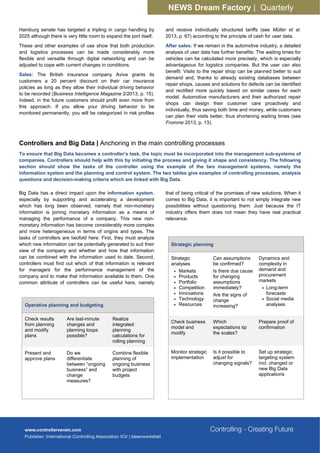
To ensure that Big Data becomes a controller’s task, the topic must be incorporated into the management sub-systems of
companies. Controllers should help with this by initiating the process and giving it shape and consistency. The following
section should show the tasks of the controller using the example of the two management systems, namely the
information system and the planning and control system. The two tables give examples of controlling processes, analysis
questions and decision-making criteria which are linked with Big Data.
Big Data has a direct impact upon the information system,
especially by supporting and accelerating a development
which has long been observed, namely that non-monetary
information is joining monetary information as a means of
managing the performance of a company. This new non-
monetary information has become considerably more complex
and more heterogeneous in terms of origins and types. The
tasks of controllers are twofold here: First, they must analyze
which new information can be potentially generated to suit their
view of the company and whether and how that information
can be combined with the information used to date. Second,
controllers must find out which of that information is relevant
for managers for the performance management of the
company and to make that information available to them. One
common attribute of controllers can be useful here, namely
that of being critical of the promises of new solutions. When it
comes to Big Data, it is important to not simply integrate new
possibilities without questioning them: Just because the IT
industry offers them does not mean they have real practical
relevance.
Operative planning and budgeting
Check results
from planning
and modify
plans
Are last-minute
changes and
planning loops
possible?
Realize
integrated
planning
calculations for
rolling planning
Present and
approve plans
Do we
differentiate
between “ongoing
business” and
change
measures?
Combine flexible
planning of
ongoing business
with project
budgets
Strategic planning
Strategic
analyses
• Markets
• Products
• Portfolio
• Competition
• Innovations
• Technology
• Resources
Can assumptions
be confirmed?
Is there due cause
for changing
assumptions
immediately?
Are the signs of
change
increasing?
Dynamics and
complexity in
demand and
procurement
markets
• Long-term
forecasts
• Social media
analyses
Check business
model and
modify
Which
expectations tip
the scales?
Prepare proof of
confirmation
Monitor strategic
implementation
Is it possible to
adjust for
changing signals?
Set up strategic
targeting system
incl. changed or
new Big Data
applications
NEWS Dream Factory | Quarterly
The potential fields of application for the planning and control
system also need to be analyzed. Of particular significance
here are topics such as forecasting or early recognition, but the
spectrum is broad. For example, we can use data for image
development for impairment tests or use new developments in
the field of social media for considering risks. Once again, the
tasks requires that controllers be both highly creative and
critically open towards new possibilities.
The Strategic Potentials of Big Data | Ask the right questions!
Most companies already have the data which would enable them to develop their products and services into a new
business model, but how can these potentials be discovered and ultimately also used? Parmar et al. 2014 provide an
overview of the strategic potentials of using Big Data and ask the right questions – the questions a company must find the
answers to – in order to identify these potentials.
In order to identify the potentials of using Big Data, we first
have to answer a series of general questions: What data do we
have in our company? What data can we make available which
we don’t collect yet? What data can we generate from our
products and processes? What useful data can we get from
external parties? What data do other companies have which
we could perhaps use together? These questions might seem
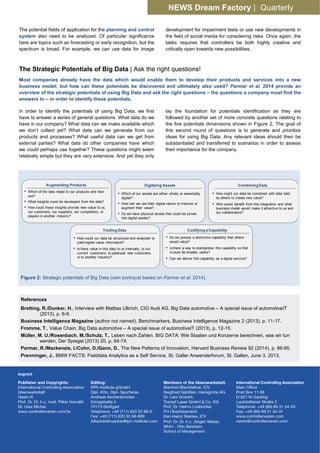
relatively simple but they are very extensive. And yet they only
lay the foundation for potentials identification as they are
followed by another set of more concrete questions relating to
the five potentials dimensions shown in Figure 2. The goal of
this second round of questions is to generate and prioritize
ideas for using Big Data. Any relevant ideas should then be
substantiated and transferred to scenarios in order to assess
their importance for the company.
References
Bretting, R./Dunker, H., Interview with Mattias Ulbrich, CIO Audi AG, Big Data automotive – A special issue of automotiveIT
(2013), p. 6-9.
Business Intelligence Magazine (author not named), Benchmarkers, Business Intelligence Magazine 2 (2013), p. 11-17.
Fromme, T., Value Chain, Big Data automotive – A special issue of automotiveIT (2013), p. 12-15.
Müller, M. U./Rosenbach, M./Schulz, T., Leben nach Zahlen. BIG DATA: Wie Staaten und Konzerne berechnen, was wir tun
werden, Der Spiegel (2013) 20, p. 64-74.
Parmar, R./Mackenzie, I./Cohn, D./Gann, D., The New Patterns of Innovation, Harvard Business Review 92 (2014), p. 86-95.
Prenninger, J., BMW FACTS: Fielddata Analytics as a Self Service, St. Galler Anwenderforum, St. Gallen, June 3, 2013.
Figure 2: Strategic potentials of Big Data (own portrayal based on Parmar et al. 2014).
Which of the data relate to our products and their
use?
What insights could be developed from the data?
How could those insights provide new value to us,
our customers, our suppliers, our competitors, or
players in another industry?
Augmenting Products Digitizing Assets
Which of our assets are either wholly or essentially
digital?
How can we use their digital nature to improve or
augment their value?
Do we have physical assets that could be turned
into digital assets?
How might our data be combined with data held
by others to create new value?
Who would benefit from this integration and what
business model would make it attractive to us and
our collaborators?
CombiningData
Trading Data
How could our data be structured and analyzed to
yield higher-value information?
Is there value in this data to us internally, to our
current customers, to potenzial new customers,
or to another industry?
Codifying a Capability
Do we posses a distinctive capability that others
would value?
Is there a way to standardize this capability so that
it could be broadly useful?
Can we deliver this capability as a digital service?

Ideenwerkstatt quarterly 2014_13_eng

  • 1.
    NEWS Dream Factory| Quarterly International Controller Association Issue 13 │ April 2014 Dear Readers, in both of the last two Dream Factory Quarterlies we gave you insights into how our current major topic is developing. We can now tell you that the Dream Car Report “Big Data – Potential for the controller” is in the home stretch and will be presented to the controller community in time for the 39th Controller Congress on May 19/20 in Munich. In order to bridge the time to publication, we would like to use this issue of the newsletter to give you one more little taste of what’s to come in the Dream Car Report. First, we use selected real-world examples to show you the corporate functions Big Data is already being used in. Then we take a closer look at the impact upon controllers by highlighting the questions and challenges controllers have to deal with in main controlling processes due to Big Data. Finally, we give suggestions on how to identify the strategic potentials of Big Data in companies. We hope you enjoy reading this issue of the Dream Factory Quarterly. Best regards, Péter Horváth and Uwe Michel Green Controlling Prize | Call for applications 2014 This year, for the fourth time the Péter Horváth Foundation recognizes the achievements of companies and public institutions for their most innovative and most effective “green” controlling solutions for designing and managing ecological strategies, programs, projects and measures. The prize is awarded in cooperation with the Dream Factory of the ICV and fosters the work of controlling in dealing with the “green challenge”. The award comes with a €10,000 endowment and is given to controllers or controller teams whose solution has been implemented since 2013. Please submit your green controlling solution by September 15, 2014, to: Péter Horváth-Stiftung, c/o IPRI gGmbH, Königstraße 5, 70173 Stuttgart To apply, please use the following criteria to describe the implemented green controlling solution in no more than ten pages: • Which problem should be solved? • How is the green controlling solution designed? • What makes this solution innovative? • How is the green controlling solution implemented? • What role does the controller play in concept design, implementation and application? • How can the results or impact of the solution be evaluated in economic and ecological terms? You can find further information on the ICV Dream Factory’s website. The complete Dream Car Report of the ICV Dream Car Factory “Big Data – Potential for the controller” will be published shortly and you will be notified via the usual ICV channels. Subsequently, the report will be available as a free download from the Dream Factory’s website at: www.controllerverein.com/iw
  • 2.
    NEWS Dream Factory| Quarterly Big Data | “Along the entire value chain” Here at the Dream Factory, we understand the term Big Data as being the analysis and real-time processing of large, unstructured and continuously flowing data from a wide range of different sources. At the forefront of this is the creation of credible information which then forms the basis for decisions which create benefit. A look at the real world shows that the fields where Big Data can be used and the potential benefits are very heterogeneous. As a result, completely new possibilities are created, such as dynamic pricing, which can be coupled with the current market situation in real time. This can lead to prices for online retailing which change depending on the day or the time of day in order to, for example, manage the capacity utilization of in-company logistics. In the words of Mattias Ulbrich, CIO of Audia AG, “We are looking at Big Data along the entire value chain.” (See Bretting & Dunker 2013, p. 6; see also Fig. 1) Development: In vehicle development, market data from previous models, observations about competitors and social (lifestyle) trends, and customer feedback are combined and analyzed. The Japanese motorbike manufacturer Yamaha has created its own market research platform to this very end. In its online portal Yamaha Design Café, they provide (potential) customers with current news about their motorbikes. At the same time, users are asked regularly to take part on surveys to gather consumer insights into Yamaha’s brand, their products and the customers’ general driving behavior. This customer feedback flows directly into product development and is an important factor in shaping the development and especially the design of new vehicles and products right up until just before they are completed. Today, vehicle development is carried out digitally for all attributes so that the time to the so called design freeze can be extended (see Fromme 2013, p. 13). This enables vehicle manufacturers to react to current developments pretty much in real time. Production: Experts assume that the use of sensor technologies and machine-to-machine solutions in manufacturing and production will increase rapidly in the coming years. This makes the vision of “Industry 4.0” with its intelligent production systems through digital networking and decentralized performance management increasingly realistic. First examples of use have already substantiated the potentials for production: In our talks with industry, we discovered that quality management in the foundry of a large automotive manufacturer has been improved significantly through the analysis of sensor data. By linking 600 variables from production and quality assurance processes, sources of errors can be identified daily and resolved very quickly. This allowed the company to reduce its reject rate by 80 percent and its costs for quality assurance by 50 percent within twelve weeks. Logistics: Sensor technologies are particularly prevalent in logistics. Wittenstein AG, a manufacturer of drive trains, is testing initial scenarios for a demand-based system of logistics performance management. This allows the company to satisfy demand more quickly and to react more flexibly to changes in production orders, explained a company spokesperson. The port in Hamburg is also flooded with sensors on ships, trucks, containers and bridges which continuously report their position and speed (see Müller et al. 2013, p. 65). In an area covering 7,200 hectares, about 200 trains travel along over 300 kilometers of tracks and cross 130 bridges. In order to prevent unnecessary waiting times, bridges should open when a ship reaches them and freight companies should know precisely when their containers leave the ship to be transferred to trains and trucks. No simple task for the 60-strong IT team at the port of Hamburg, especially when we consider that the Figure 1: Analytical use of diagnostic information in the automotive product lifecycle (own portrayal based on Prenninger 2013, p. 9). Development Early Series Marketing Sales Production Logistics After Sales Warranty Analysis of dealer-feedback Identification of related problems, causes and actions Analysis of experimental data Prediction of unsatisfied customers Product recommendations at the point-of-sale Automated surveys and direct analysis of the responses Analysis of complaint Automated evaluation of failures for early detection Production optimization and -monitoring Analysis of customer requirements by segmentation
  • 3.
    NEWS Dream Factory| Quarterly Hamburg senate has targeted a tripling in cargo handling by 2025 although there is very little room to expand the port itself. These and other examples of use show that both production and logistics processes can be made considerably more flexible and versatile through digital networking and can be adjusted to cope with current changes in conditions. Sales: The British insurance company Aviva grants its customers a 20 percent discount on their car insurance policies as long as they allow their individual driving behavior to be recorded (Business Intelligence Magazine 2/2013, p. 15). Indeed, in the future customers should profit even more from this approach. If you allow your driving behavior to be monitored permanently, you will be categorized in risk profiles and receive individually structured tariffs (see Müller et al. 2013, p. 67) according to the principle of cash for user data. After sales: If we remain in the automotive industry, a detailed analysis of user data has further benefits: The waiting times for vehicles can be calculated more precisely, which is especially advantageous for logistics companies. But the user can also benefit: Visits to the repair shop can be planned better to suit demand and, thanks to already existing databases between repair shops, causes and solutions for defects can be identified and rectified more quickly based on similar cases for each model. Automotive manufacturers and their authorized repair shops can design their customer care proactively and individually, thus saving both time and money, while customers can plan their visits better, thus shortening waiting times (see Fromme 2013, p. 13). Controllers and Big Data | Anchoring in the main controlling processes To ensure that Big Data becomes a controller’s task, the topic must be incorporated into the management sub-systems of companies. Controllers should help with this by initiating the process and giving it shape and consistency. The following section should show the tasks of the controller using the example of the two management systems, namely the information system and the planning and control system. The two tables give examples of controlling processes, analysis questions and decision-making criteria which are linked with Big Data. Big Data has a direct impact upon the information system, especially by supporting and accelerating a development which has long been observed, namely that non-monetary information is joining monetary information as a means of managing the performance of a company. This new non- monetary information has become considerably more complex and more heterogeneous in terms of origins and types. The tasks of controllers are twofold here: First, they must analyze which new information can be potentially generated to suit their view of the company and whether and how that information can be combined with the information used to date. Second, controllers must find out which of that information is relevant for managers for the performance management of the company and to make that information available to them. One common attribute of controllers can be useful here, namely that of being critical of the promises of new solutions. When it comes to Big Data, it is important to not simply integrate new possibilities without questioning them: Just because the IT industry offers them does not mean they have real practical relevance. Operative planning and budgeting Check results from planning and modify plans Are last-minute changes and planning loops possible? Realize integrated planning calculations for rolling planning Present and approve plans Do we differentiate between “ongoing business” and change measures? Combine flexible planning of ongoing business with project budgets Strategic planning Strategic analyses • Markets • Products • Portfolio • Competition • Innovations • Technology • Resources Can assumptions be confirmed? Is there due cause for changing assumptions immediately? Are the signs of change increasing? Dynamics and complexity in demand and procurement markets • Long-term forecasts • Social media analyses Check business model and modify Which expectations tip the scales? Prepare proof of confirmation Monitor strategic implementation Is it possible to adjust for changing signals? Set up strategic targeting system incl. changed or new Big Data applications
  • 4.
    NEWS Dream Factory| Quarterly The potential fields of application for the planning and control system also need to be analyzed. Of particular significance here are topics such as forecasting or early recognition, but the spectrum is broad. For example, we can use data for image development for impairment tests or use new developments in the field of social media for considering risks. Once again, the tasks requires that controllers be both highly creative and critically open towards new possibilities. The Strategic Potentials of Big Data | Ask the right questions! Most companies already have the data which would enable them to develop their products and services into a new business model, but how can these potentials be discovered and ultimately also used? Parmar et al. 2014 provide an overview of the strategic potentials of using Big Data and ask the right questions – the questions a company must find the answers to – in order to identify these potentials. In order to identify the potentials of using Big Data, we first have to answer a series of general questions: What data do we have in our company? What data can we make available which we don’t collect yet? What data can we generate from our products and processes? What useful data can we get from external parties? What data do other companies have which we could perhaps use together? These questions might seem relatively simple but they are very extensive. And yet they only lay the foundation for potentials identification as they are followed by another set of more concrete questions relating to the five potentials dimensions shown in Figure 2. The goal of this second round of questions is to generate and prioritize ideas for using Big Data. Any relevant ideas should then be substantiated and transferred to scenarios in order to assess their importance for the company. References Bretting, R./Dunker, H., Interview with Mattias Ulbrich, CIO Audi AG, Big Data automotive – A special issue of automotiveIT (2013), p. 6-9. Business Intelligence Magazine (author not named), Benchmarkers, Business Intelligence Magazine 2 (2013), p. 11-17. Fromme, T., Value Chain, Big Data automotive – A special issue of automotiveIT (2013), p. 12-15. Müller, M. U./Rosenbach, M./Schulz, T., Leben nach Zahlen. BIG DATA: Wie Staaten und Konzerne berechnen, was wir tun werden, Der Spiegel (2013) 20, p. 64-74. Parmar, R./Mackenzie, I./Cohn, D./Gann, D., The New Patterns of Innovation, Harvard Business Review 92 (2014), p. 86-95. Prenninger, J., BMW FACTS: Fielddata Analytics as a Self Service, St. Galler Anwenderforum, St. Gallen, June 3, 2013. Figure 2: Strategic potentials of Big Data (own portrayal based on Parmar et al. 2014). Which of the data relate to our products and their use? What insights could be developed from the data? How could those insights provide new value to us, our customers, our suppliers, our competitors, or players in another industry? Augmenting Products Digitizing Assets Which of our assets are either wholly or essentially digital? How can we use their digital nature to improve or augment their value? Do we have physical assets that could be turned into digital assets? How might our data be combined with data held by others to create new value? Who would benefit from this integration and what business model would make it attractive to us and our collaborators? CombiningData Trading Data How could our data be structured and analyzed to yield higher-value information? Is there value in this data to us internally, to our current customers, to potenzial new customers, or to another industry? Codifying a Capability Do we posses a distinctive capability that others would value? Is there a way to standardize this capability so that it could be broadly useful? Can we deliver this capability as a digital service?