Ideas For Activities
Binary Bracelet
Potato King Says If-Else
Minesweeper Unplugged
Treasure Hunt
Graph Paper Programming
Turing Test
Spy Message
Sorting
The Activities
Binary Bracelet
Binary Bracelet
(AGES 7 & UP)
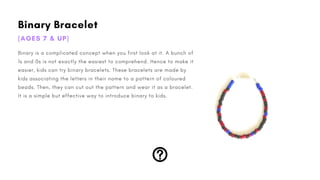
Binary is a complicated concept when you first look at it. A bunch of
1s and 0s is not exactly the easiest to comprehend. Hence to make it
easier, kids can try binary bracelets. These bracelets are made by
kids associating the letters in their name to a pattern of coloured
beads. Then, they can cut out the pattern and wear it as a bracelet.
It is a simple but effective way to introduce binary to kids.
WHAT DOES IT TEACH?
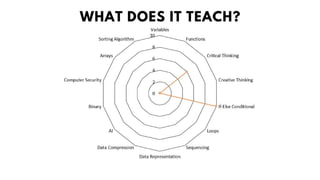
Potato King Says If-Else
(AGES 3-6)
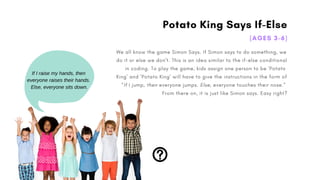
We all know the game Simon Says. If Simon says to do something, we
do it or else we don't. This is an idea similar to the if-else conditional
in coding. To play the game, kids assign one person to be 'Potato
King' and 'Potato King' will have to give the instructions in the form of
"If I jump, then everyone jumps. Else, everyone touches their nose."
From there on, it is just like Simon says. Easy right?
If I raise my hands, then
everyone raises their hands.
Else, everyone sits down.
WHAT DOES IT TEACH?
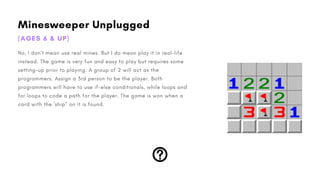
Minesweeper Unplugged
(AGES 6 & UP)
No, I don't mean use real mines. But I do mean play it in real-life
instead. The game is very fun and easy to play but requires some
setting-up prior to playing. A group of 2 will act as the
programmers. Assign a 3rd person to be the player. Both
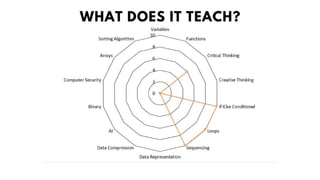
programmers will have to use if-else conditionals, while loops and
for loops to code a path for the player. The game is won when a
card with the 'ship" on it is found.
WHAT DOES IT TEACH?
Treasure Hunt
Treasure Hunt
(AGES 6 & UP)
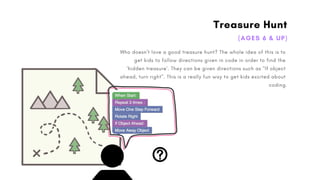
Who doesn't love a good treasure hunt? The whole idea of this is to
get kids to follow directions given in code in order to find the
'hidden treasure'. They can be given directions such as "If object
ahead, turn right". This is a really fun way to get kids excited about
coding.
WHAT DOES IT TEACH?
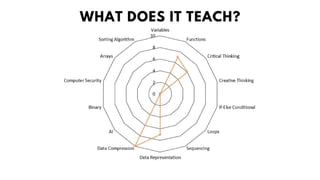
Graph Paper Programming
(AGES 6 & UP)
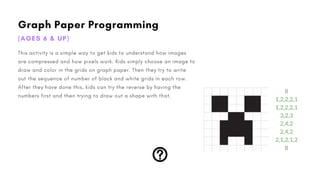
This activity is a simple way to get kids to understand how images
are compressed and how pixels work. Kids simply choose an image to
draw and color in the grids on graph paper. Then they try to write
out the sequence of number of black and white grids in each row.
After they have done this, kids can try the reverse by having the
numbers first and then trying to draw out a shape with that.
8
1,2,2,2,1
1,2,2,2,1
3,2,3
2,4,2
2,4,2
2,1,2,1,2
8
WHAT DOES IT TEACH?
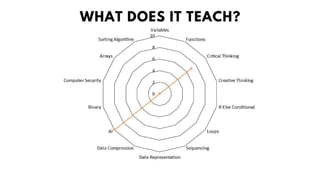
Turing Test
Turing Test
(AGES 6 & UP)
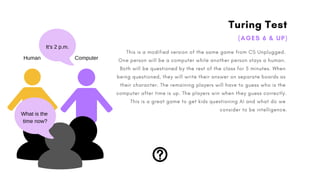
This is a modified version of the same game from CS Unplugged.
One person will be a computer while another person stays a human.
Both will be questioned by the rest of the class for 5 minutes. When
being questioned, they will write their answer on separate boards as
their character. The remaining players will have to guess who is the
computer after time is up. The players win when they guess correctly.
This is a great game to get kids questioning AI and what do we
consider to be intelligence.
It's 2 p.m.
What is the
time now?
ComputerHuman
WHAT DOES IT TEACH?
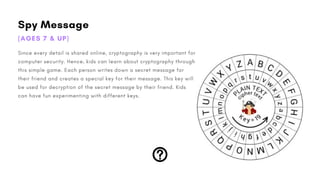
Spy Message
Spy Message
(AGES 7 & UP)
Since every detail is shared online, cryptography is very important for
computer security. Hence, kids can learn about cryptography through
this simple game. Each person writes down a secret message for
their friend and creates a special key for their message. This key will
be used for decryption of the secret message by their friend. Kids
can have fun experimenting with different keys.
WHAT DOES IT TEACH?
Sorting
Sorting
(AGES 6 & UP)
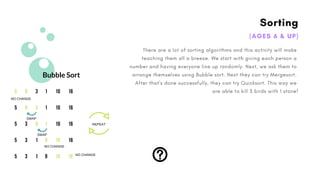
There are a lot of sorting algorithms and this activity will make
teaching them all a breeze. We start with giving each person a
number and having everyone line up randomly. Next, we ask them to
arrange themselves using Bubble sort. Next they can try Mergesort.
After that's done successfully, they can try Quicksort. This way we
are able to kill 3 birds with 1 stone!5 9 3 1 10 16
5 9 3 1 10 16
5 3 9 1 10 16
5 3 1 9 10 16
5 3 1 9 10 16
SWAP
SWAP
NO CHANGE
NO CHANGE
NO CHANGE
REPEAT
Bubble Sort
WHAT DOES IT TEACH?
You Made It!
DID YOU FIND THIS ARTICLE USEFUL? COMMENT BELOW
THANK YOU FOR READING

Ideas for Activities to Teach Coding & Computer Science

  • 1.
  • 2.
    Binary Bracelet Potato KingSays If-Else Minesweeper Unplugged Treasure Hunt Graph Paper Programming Turing Test Spy Message Sorting The Activities
  • 3.
  • 4.
    Binary Bracelet (AGES 7& UP) Binary is a complicated concept when you first look at it. A bunch of 1s and 0s is not exactly the easiest to comprehend. Hence to make it easier, kids can try binary bracelets. These bracelets are made by kids associating the letters in their name to a pattern of coloured beads. Then, they can cut out the pattern and wear it as a bracelet. It is a simple but effective way to introduce binary to kids.
  • 5.
  • 6.
  • 7.
    Potato King SaysIf-Else (AGES 3-6) We all know the game Simon Says. If Simon says to do something, we do it or else we don't. This is an idea similar to the if-else conditional in coding. To play the game, kids assign one person to be 'Potato King' and 'Potato King' will have to give the instructions in the form of "If I jump, then everyone jumps. Else, everyone touches their nose." From there on, it is just like Simon says. Easy right? If I raise my hands, then everyone raises their hands. Else, everyone sits down.
  • 8.
  • 9.
  • 10.
    Minesweeper Unplugged (AGES 6& UP) No, I don't mean use real mines. But I do mean play it in real-life instead. The game is very fun and easy to play but requires some setting-up prior to playing. A group of 2 will act as the programmers. Assign a 3rd person to be the player. Both programmers will have to use if-else conditionals, while loops and for loops to code a path for the player. The game is won when a card with the 'ship" on it is found.
  • 11.
  • 12.
  • 13.
    Treasure Hunt (AGES 6& UP) Who doesn't love a good treasure hunt? The whole idea of this is to get kids to follow directions given in code in order to find the 'hidden treasure'. They can be given directions such as "If object ahead, turn right". This is a really fun way to get kids excited about coding.
  • 14.
  • 15.
  • 16.
    Graph Paper Programming (AGES6 & UP) This activity is a simple way to get kids to understand how images are compressed and how pixels work. Kids simply choose an image to draw and color in the grids on graph paper. Then they try to write out the sequence of number of black and white grids in each row. After they have done this, kids can try the reverse by having the numbers first and then trying to draw out a shape with that. 8 1,2,2,2,1 1,2,2,2,1 3,2,3 2,4,2 2,4,2 2,1,2,1,2 8
  • 17.
  • 18.
  • 19.
    Turing Test (AGES 6& UP) This is a modified version of the same game from CS Unplugged. One person will be a computer while another person stays a human. Both will be questioned by the rest of the class for 5 minutes. When being questioned, they will write their answer on separate boards as their character. The remaining players will have to guess who is the computer after time is up. The players win when they guess correctly. This is a great game to get kids questioning AI and what do we consider to be intelligence. It's 2 p.m. What is the time now? ComputerHuman
  • 20.
  • 21.
  • 22.
    Spy Message (AGES 7& UP) Since every detail is shared online, cryptography is very important for computer security. Hence, kids can learn about cryptography through this simple game. Each person writes down a secret message for their friend and creates a special key for their message. This key will be used for decryption of the secret message by their friend. Kids can have fun experimenting with different keys.
  • 23.
  • 24.
  • 25.
    Sorting (AGES 6 &UP) There are a lot of sorting algorithms and this activity will make teaching them all a breeze. We start with giving each person a number and having everyone line up randomly. Next, we ask them to arrange themselves using Bubble sort. Next they can try Mergesort. After that's done successfully, they can try Quicksort. This way we are able to kill 3 birds with 1 stone!5 9 3 1 10 16 5 9 3 1 10 16 5 3 9 1 10 16 5 3 1 9 10 16 5 3 1 9 10 16 SWAP SWAP NO CHANGE NO CHANGE NO CHANGE REPEAT Bubble Sort
  • 26.
  • 27.
    You Made It! DIDYOU FIND THIS ARTICLE USEFUL? COMMENT BELOW THANK YOU FOR READING