JOINT COMMITTEE OF THE EUROPEAN
SUPERVISORY AUTHORITIES
SESSION 1:
RTS on ICT risk management framework
RTS on simplified ICT RMF
RTS to specify the policy on ICT services
RTS to specify elements when sub-contracting critical or important functions
Barbara Daskala, Senior Supervision Officer ESMA
2
Oversight framework (Chapter V.II)
ICT risk framework (Chapter
II)
ICT related incident
management classification
and reporting (Chapter III)
Digital Operational
Resilience Testing (Chapter
IV)
Third-party risk management
(Chapter V.I)
JOINT COMMITTEE OF THE EUROPEAN
SUPERVISORY AUTHORITIES
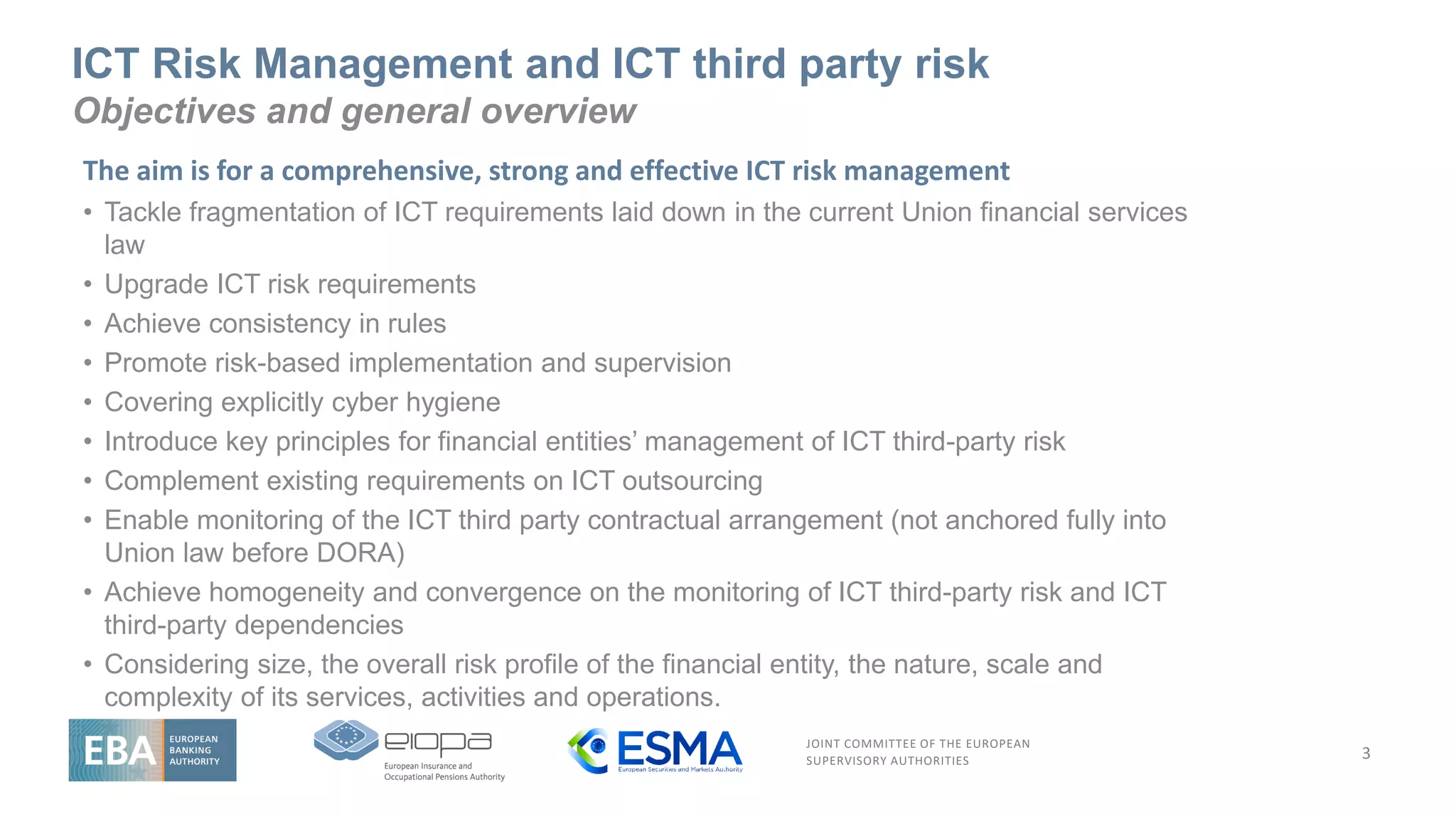
ICT Risk Management and ICT third party risk
Objectives and general overview
The aim is for a comprehensive, strong and effective ICT risk management
• Tackle fragmentation of ICT requirements laid down in the current Union financial services
law
• Upgrade ICT risk requirements
• Achieve consistency in rules
• Promote risk-based implementation and supervision
• Covering explicitly cyber hygiene
• Introduce key principles for financial entities’ management of ICT third-party risk
• Complement existing requirements on ICT outsourcing
• Enable monitoring of the ICT third party contractual arrangement (not anchored fully into
Union law before DORA)
• Achieve homogeneity and convergence on the monitoring of ICT third-party risk and ICT
third-party dependencies
• Considering size, the overall risk profile of the financial entity, the nature, scale and
complexity of its services, activities and operations.
3
JOINT COMMITTEE OF THE EUROPEAN
SUPERVISORY AUTHORITIES
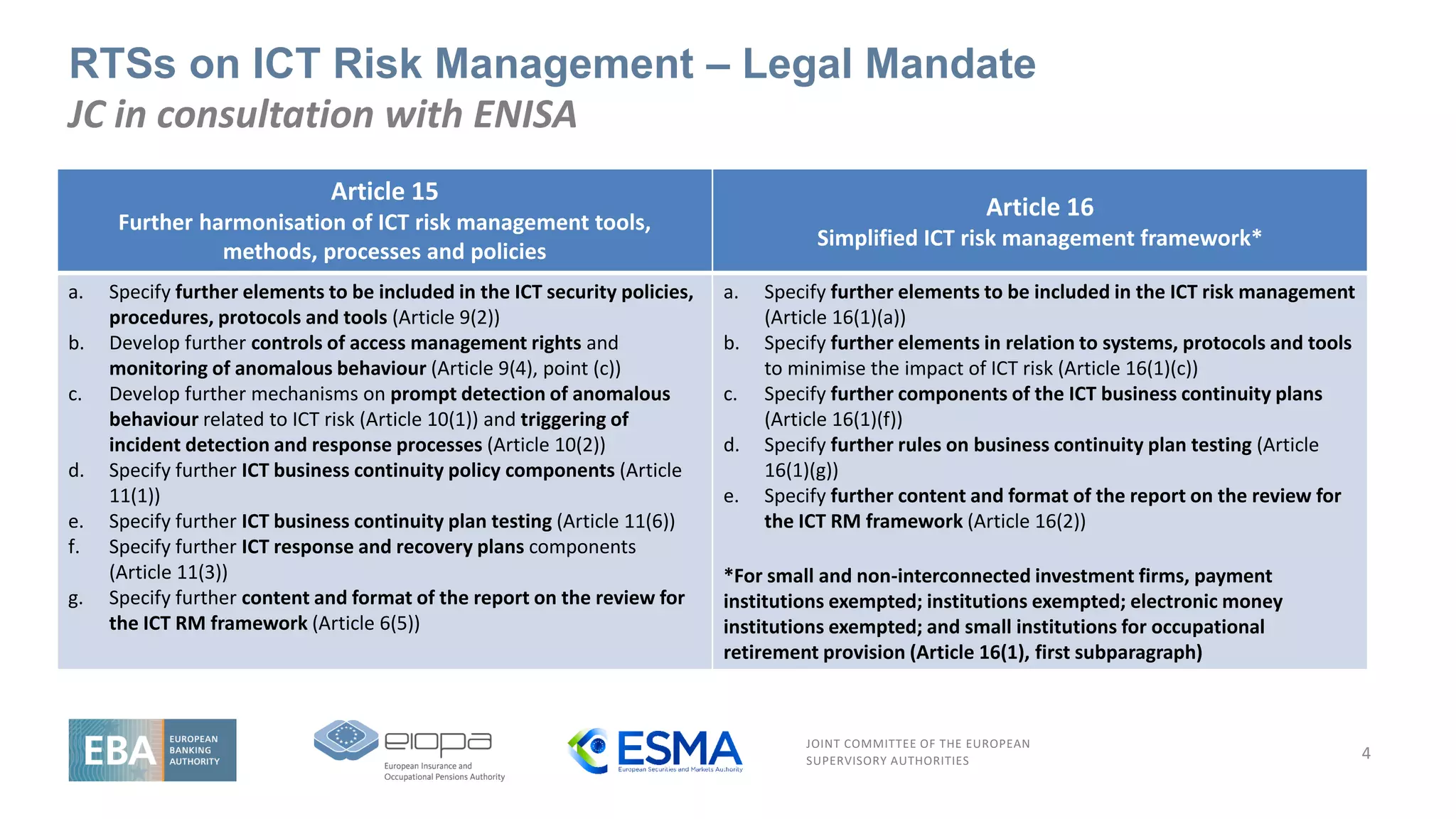
RTSs on ICT Risk Management – Legal Mandate
JC in consultation with ENISA
4
Article 15
Further harmonisation of ICT risk management tools,
methods, processes and policies
Article 16
Simplified ICT risk management framework*
a. Specify further elements to be included in the ICT security policies,
procedures, protocols and tools (Article 9(2))
b. Develop further controls of access management rights and
monitoring of anomalous behaviour (Article 9(4), point (c))
c. Develop further mechanisms on prompt detection of anomalous
behaviour related to ICT risk (Article 10(1)) and triggering of
incident detection and response processes (Article 10(2))
d. Specify further ICT business continuity policy components (Article
11(1))
e. Specify further ICT business continuity plan testing (Article 11(6))
f. Specify further ICT response and recovery plans components
(Article 11(3))
g. Specify further content and format of the report on the review for
the ICT RM framework (Article 6(5))
a. Specify further elements to be included in the ICT risk management
(Article 16(1)(a))
b. Specify further elements in relation to systems, protocols and tools
to minimise the impact of ICT risk (Article 16(1)(c))
c. Specify further components of the ICT business continuity plans
(Article 16(1)(f))
d. Specify further rules on business continuity plan testing (Article
16(1)(g))
e. Specify further content and format of the report on the review for
the ICT RM framework (Article 16(2))
*For small and non-interconnected investment firms, payment
institutions exempted; institutions exempted; electronic money
institutions exempted; and small institutions for occupational
retirement provision (Article 16(1), first subparagraph)
JOINT COMMITTEE OF THE EUROPEAN
SUPERVISORY AUTHORITIES
RTSs on Third Party Risk Management – Legal Mandate
5
Article 28(10)
To further specify the content of the policy on the use of ICT
services concerning critical or important functions provided by
ICT third-party service providers
Article 30(5)
To specify elements when sub-contracting services supporting
critical or important functions
Under Article 28 (2) of DORA, as part of their ICT risk management framework,
financial entities, other than financial entities referred to in Article 16(1) and
other than microenterprises, shall adopt, and regularly review, a strategy on
ICT third-party risk, taking into account the multi-vendor strategy referred to
in Article 5(9) where applicable. The strategy on ICT third-party risk shall
include a policy on the use of ICT services supporting critical or important
functions provided by ICT third-party service providers and shall apply on an
individual and, where relevant, on a sub-consolidated and consolidated basis.
[…]
In accordance with Article 30(2) (a) of DORA, the contractual arrangements on
the use of ICT services shall include at least the following: (a) a clear and
complete description of all functions and ICT services to be provided by the
ICT third-party service provider, indicating whether subcontracting of an ICT
service supporting a critical or important function, or material parts thereof,
is permitted and, when this is the case, the conditions applying to such
subcontracting.
In accordance with Article 28 (10) of DORA, the ESAs shall, through the Joint
Committee, develop draft regulatory technical standards to further specify
the detailed content of the policy referred to in paragraph 2 in relation to the
contractual arrangements on the use of ICT services supporting critical or
important functions provided by ICT third-party service providers. When
developing those draft regulatory technical standards, the ESAs shall take into
account the size, nature, scale, complexity and overall risk profile of the
financial entities.
Article 30 (5) of DORA sets out that the ESAs shall, through the Joint
Committee, develop draft regulatory technical standards to specify further
the elements referred to in paragraph 2, point (a), which a financial entity
needs to determine and assess when subcontracting ICT services supporting
critical or important functions.
Deadline: 12 Months Deadline: 18 Months
JOINT COMMITTEE OF THE EUROPEAN
SUPERVISORY AUTHORITIES
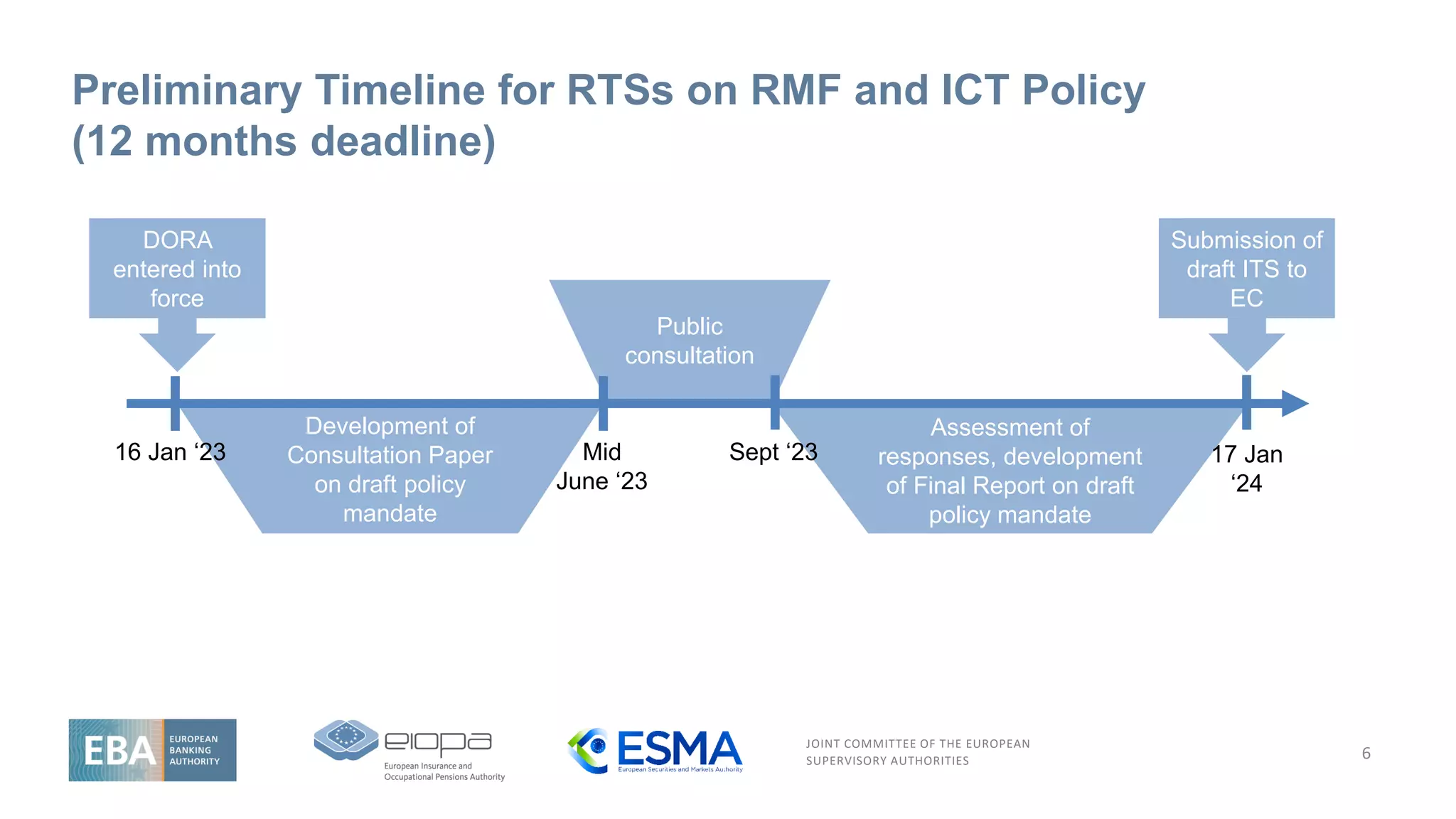
Assessment of
responses, development
of Final Report on draft
policy mandate
Public
consultation
Preliminary Timeline for RTSs on RMF and ICT Policy
(12 months deadline)
6
DORA
entered into
force
Submission of
draft ITS to
EC
Development of
Consultation Paper
on draft policy
mandate
16 Jan ‘23 17 Jan
‘24
Mid
June ‘23
Sept ‘23
JOINT COMMITTEE OF THE EUROPEAN
SUPERVISORY AUTHORITIES
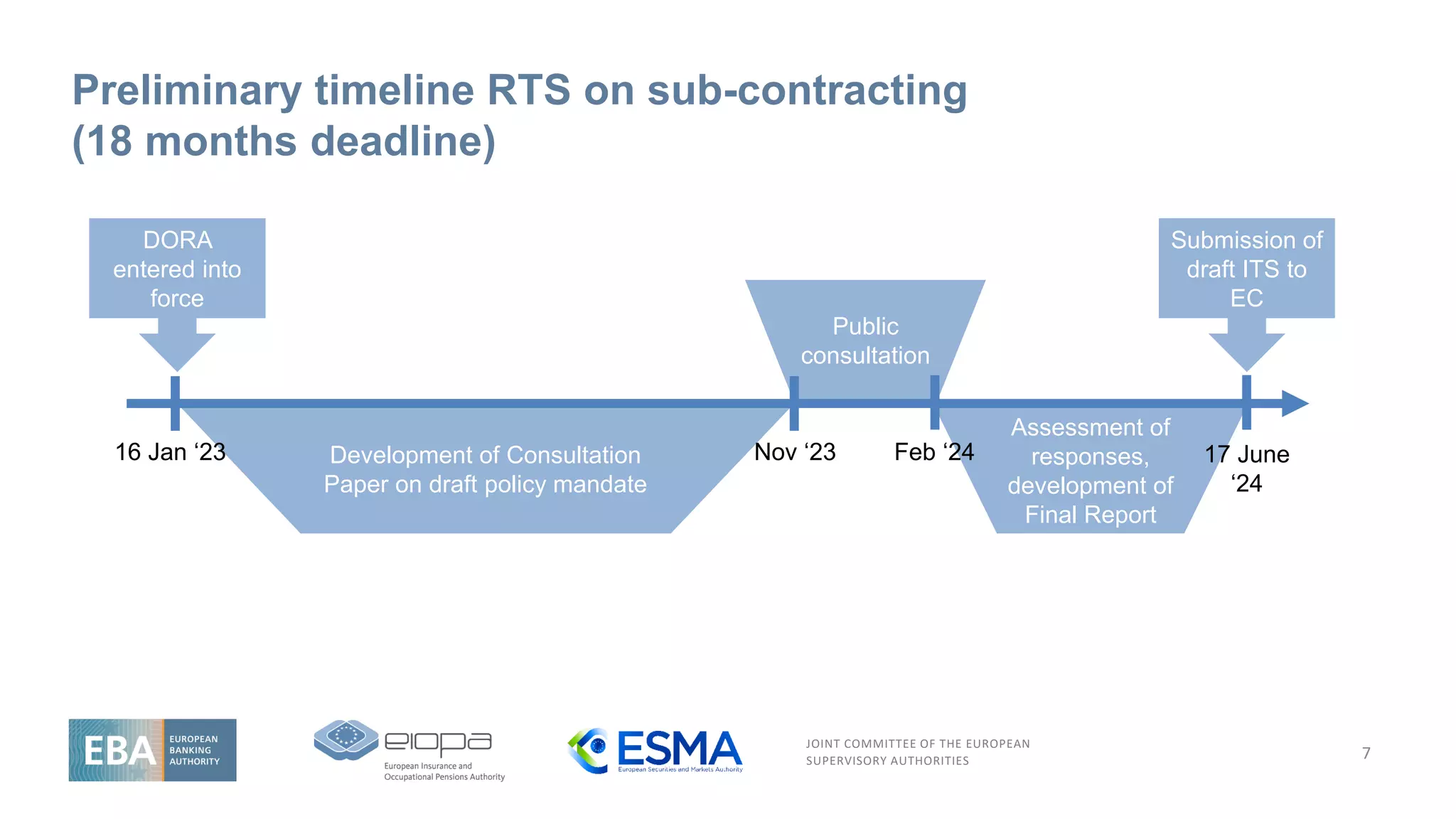
Assessment of
responses,
development of
Final Report
Public
consultation
Preliminary timeline RTS on sub-contracting
(18 months deadline)
7
DORA
entered into
force
Submission of
draft ITS to
EC
Development of Consultation
Paper on draft policy mandate
16 Jan ‘23 17 June
‘24
Nov ‘23 Feb ‘24
JOINT COMMITTEE OF THE EUROPEAN
SUPERVISORY AUTHORITIES
SESSION 2:
RTS on classification of major ICT incidents
RTS on reporting of major ICT incidents
Antonio Barzachki, Senior Expert EBA
8
Oversight framework (Chapter V.II)
ICT risk framework (Chapter
II)
ICT related incident
management classification
and reporting (Chapter III)
Digital Operational
Resilience Testing (Chapter
IV)
Third-party risk management
(Chapter V.I)
JOINT COMMITTEE OF THE EUROPEAN
SUPERVISORY AUTHORITIES
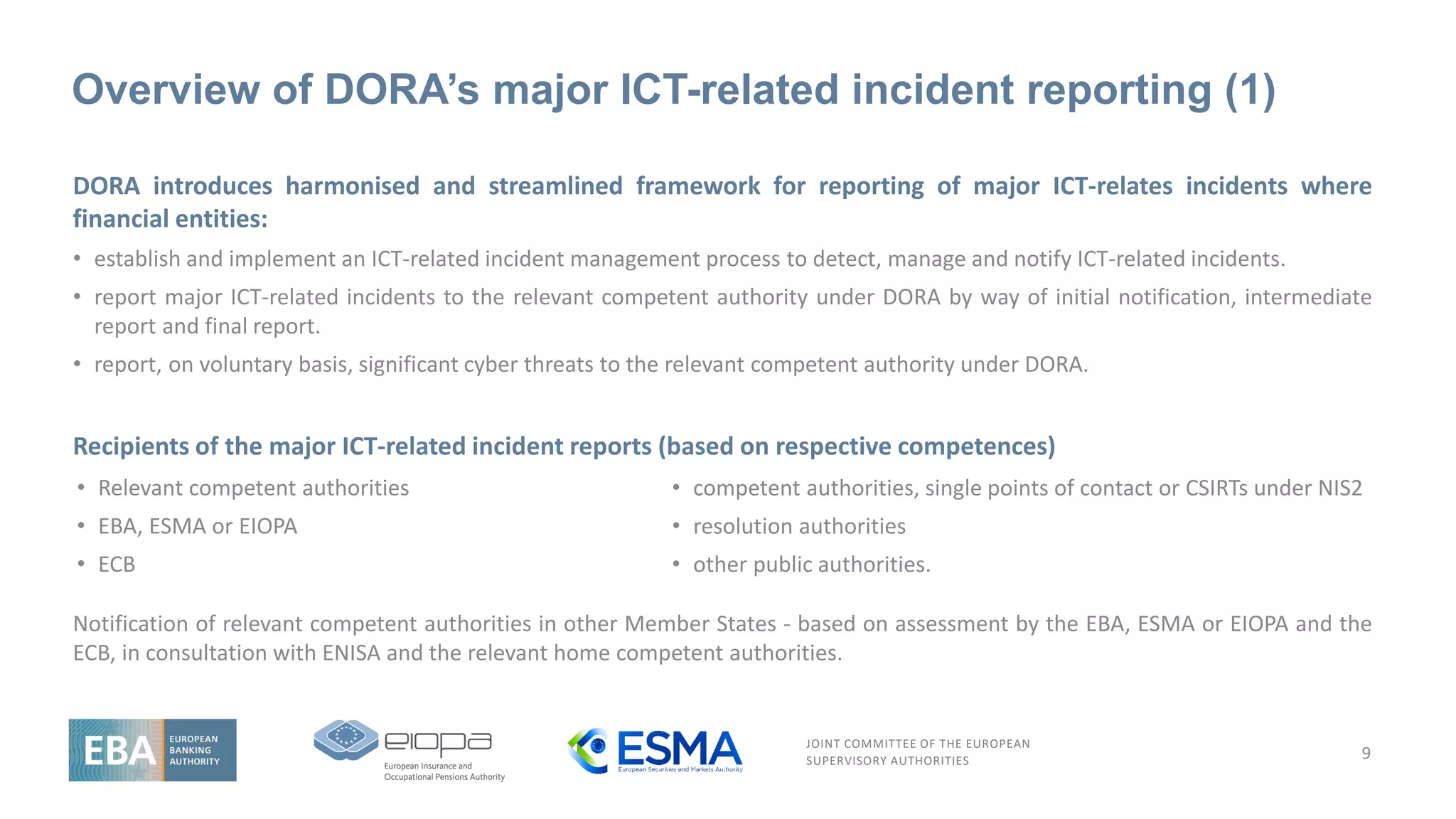
Overview of DORA’s major ICT-related incident reporting (1)
DORA introduces harmonised and streamlined framework for reporting of major ICT-relates incidents where
financial entities:
• establish and implement an ICT-related incident management process to detect, manage and notify ICT-related incidents.
• report major ICT-related incidents to the relevant competent authority under DORA by way of initial notification, intermediate
report and final report.
• report, on voluntary basis, significant cyber threats to the relevant competent authority under DORA.
Recipients of the major ICT-related incident reports (based on respective competences)
Notification of relevant competent authorities in other Member States - based on assessment by the EBA, ESMA or EIOPA and the
ECB, in consultation with ENISA and the relevant home competent authorities.
9
• competent authorities, single points of contact or CSIRTs under NIS2
• resolution authorities
• other public authorities.
• Relevant competent authorities
• EBA, ESMA or EIOPA
• ECB
JOINT COMMITTEE OF THE EUROPEAN
SUPERVISORY AUTHORITIES
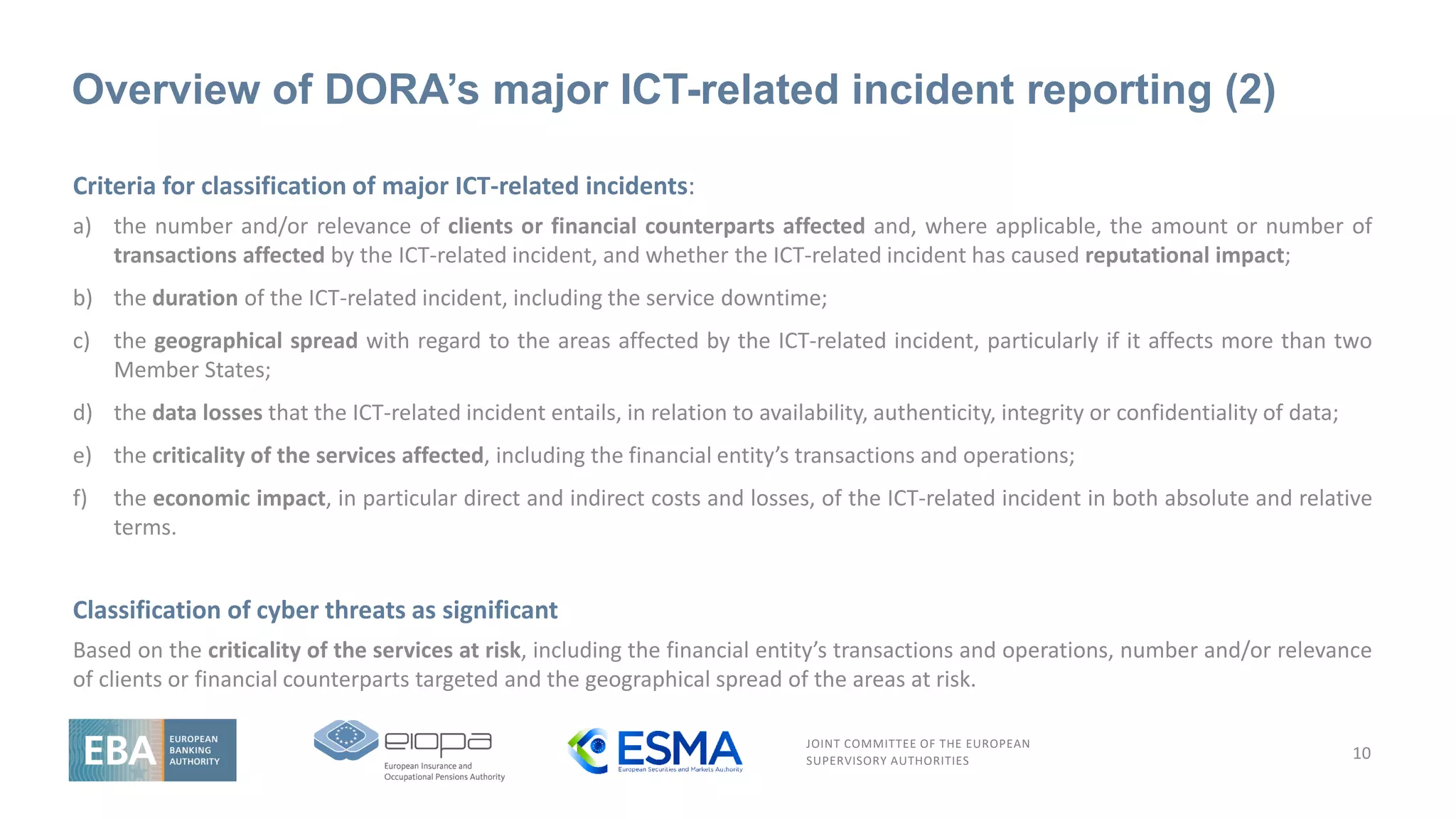
Overview of DORA’s major ICT-related incident reporting (2)
Criteria for classification of major ICT-related incidents:
a) the number and/or relevance of clients or financial counterparts affected and, where applicable, the amount or number of
transactions affected by the ICT-related incident, and whether the ICT-related incident has caused reputational impact;
b) the duration of the ICT-related incident, including the service downtime;
c) the geographical spread with regard to the areas affected by the ICT-related incident, particularly if it affects more than two
Member States;
d) the data losses that the ICT-related incident entails, in relation to availability, authenticity, integrity or confidentiality of data;
e) the criticality of the services affected, including the financial entity’s transactions and operations;
f) the economic impact, in particular direct and indirect costs and losses, of the ICT-related incident in both absolute and relative
terms.
Classification of cyber threats as significant
Based on the criticality of the services at risk, including the financial entity’s transactions and operations, number and/or relevance
of clients or financial counterparts targeted and the geographical spread of the areas at risk.
10
JOINT COMMITTEE OF THE EUROPEAN
SUPERVISORY AUTHORITIES
Overview of the legal mandate on the RTS on classification
of major ICT incidents
11
Article 18(3) and (4)
RTS on criteria for classification of major ICT-related incidents and significant cyber threats
The ESAs shall, through the Joint Committee, and in consultation with the ECB and ENISA, develop draft RTS to further specifythe following:
a) the criteria set out in paragraph 1, including materiality thresholds for determining major ICT-related incidents or, as applicable, major
operational or security payment-related incidents, that are subject to the reporting obligation laid down in Article 19(1);
b) the criteria to be applied by competent authorities for the purpose of assessing the relevance of major ICT-related incidents or, as
applicable, major operational or security payment-related incidents, to relevant competent authorities in other Member States’, and the
details of reports of major ICT-related incidents or, as applicable, major operational or security payment-related incidents, to be shared
with other competent authorities pursuant to Article 19(6) and (7)
c) the criteria set out in paragraph 2 of this Article, including high materiality thresholds for determining significant cyber threats.
When developing the common draft regulatory technical standards referred to in paragraph 3 of this Article, the ESAs shall take into account the
criteria set out in Article 4(2) [proportionality principle], as well as international standards, guidance and specifications developed and published by
ENISA, including, where appropriate, specifications for other economic sectors. For the purposes of applying the criteria set out in Article 4(2), the
ESAs shall duly consider the need for microenterprises and small and medium-sized enterprises to mobilise sufficient resources and capabilities to
ensure that ICT-related incidents are managed swiftly.
Deadline: 12 Months
JOINT COMMITTEE OF THE EUROPEAN
SUPERVISORY AUTHORITIES
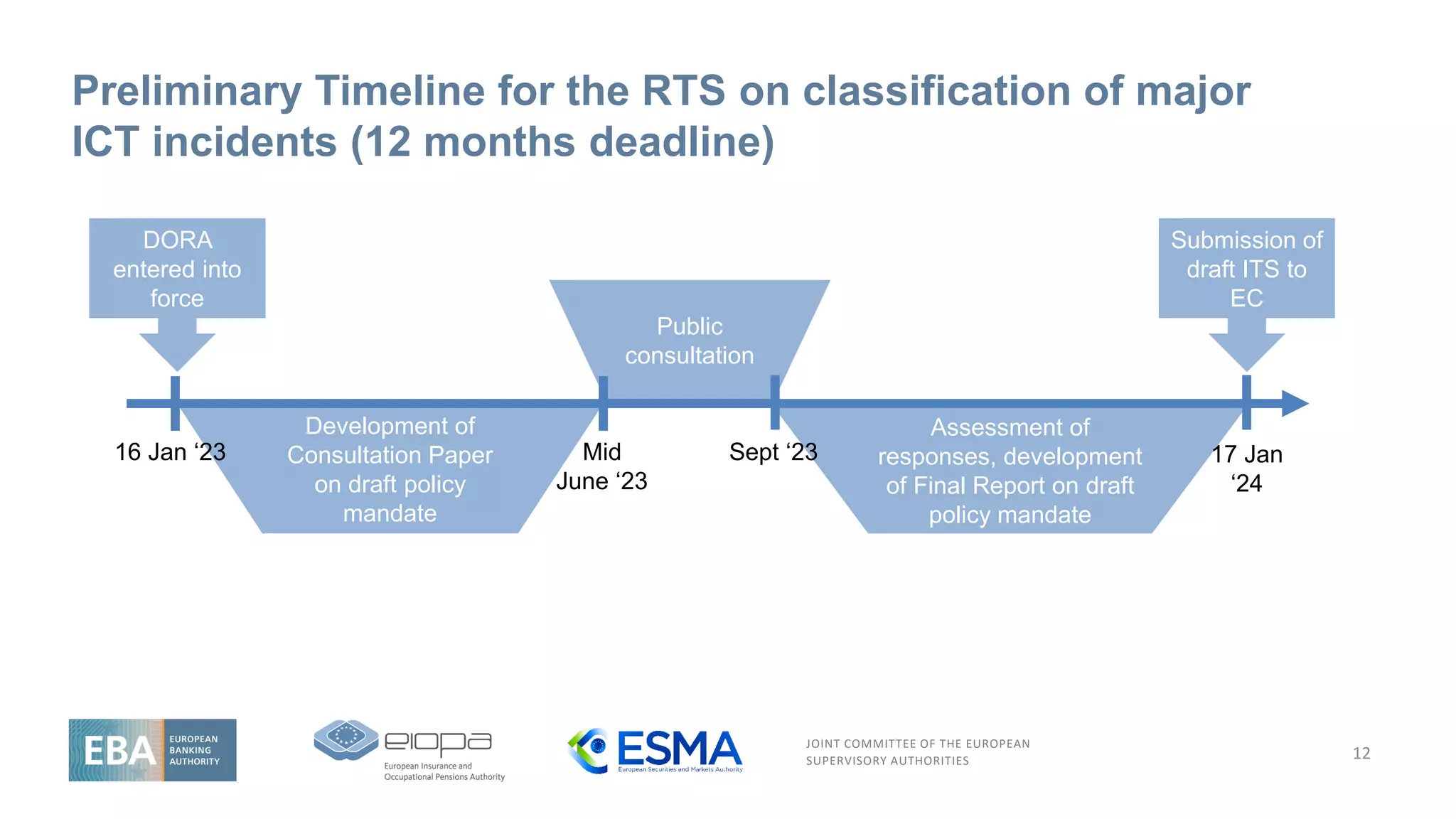
Assessment of
responses, development
of Final Report on draft
policy mandate
Public
consultation
Preliminary Timeline for the RTS on classification of major
ICT incidents (12 months deadline)
12
DORA
entered into
force
Submission of
draft ITS to
EC
Development of
Consultation Paper
on draft policy
mandate
16 Jan ‘23 17 Jan
‘24
Mid
June ‘23
Sept ‘23
JOINT COMMITTEE OF THE EUROPEAN
SUPERVISORY AUTHORITIES
Overview of the legal mandate on the RTS on reporting
of major ICT incidents
13
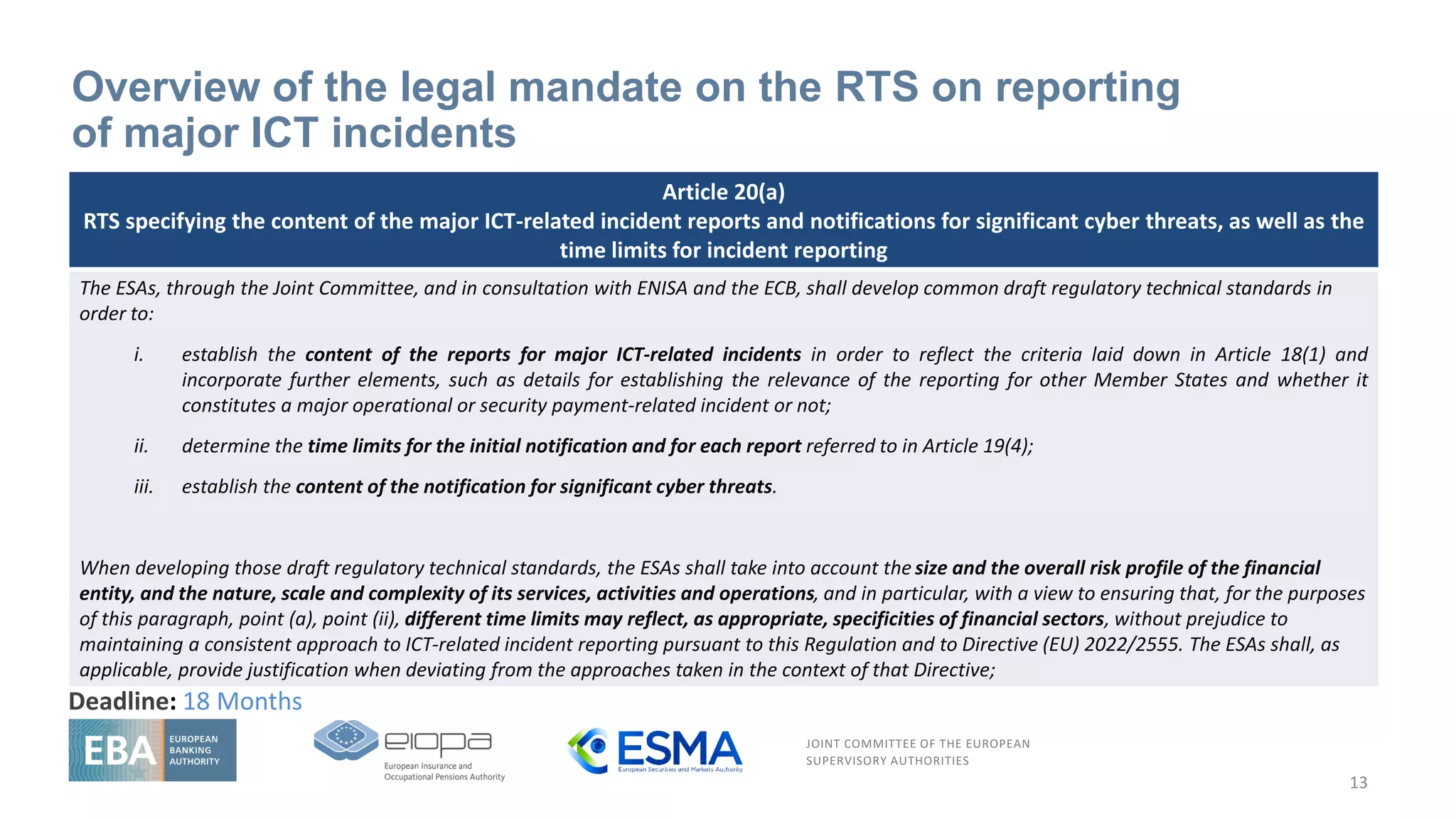
Article 20(a)
RTS specifying the content of the major ICT-related incident reports and notifications for significant cyber threats, as well as the
time limits for incident reporting
The ESAs, through the Joint Committee, and in consultation with ENISA and the ECB, shall develop common draft regulatory technical standards in
order to:
i. establish the content of the reports for major ICT-related incidents in order to reflect the criteria laid down in Article 18(1) and
incorporate further elements, such as details for establishing the relevance of the reporting for other Member States and whether it
constitutes a major operational or security payment-related incident or not;
ii. determine the time limits for the initial notification and for each report referred to in Article 19(4);
iii. establish the content of the notification for significant cyber threats.
When developing those draft regulatory technical standards, the ESAs shall take into account the size and the overall risk profile of the financial
entity, and the nature, scale and complexity of its services, activities and operations, and in particular, with a view to ensuring that, for the purposes
of this paragraph, point (a), point (ii), different time limits may reflect, as appropriate, specificities of financial sectors, without prejudice to
maintaining a consistent approach to ICT-related incident reporting pursuant to this Regulation and to Directive (EU) 2022/2555. The ESAs shall, as
applicable, provide justification when deviating from the approaches taken in the context of that Directive;
Deadline: 18 Months
JOINT COMMITTEE OF THE EUROPEAN
SUPERVISORY AUTHORITIES
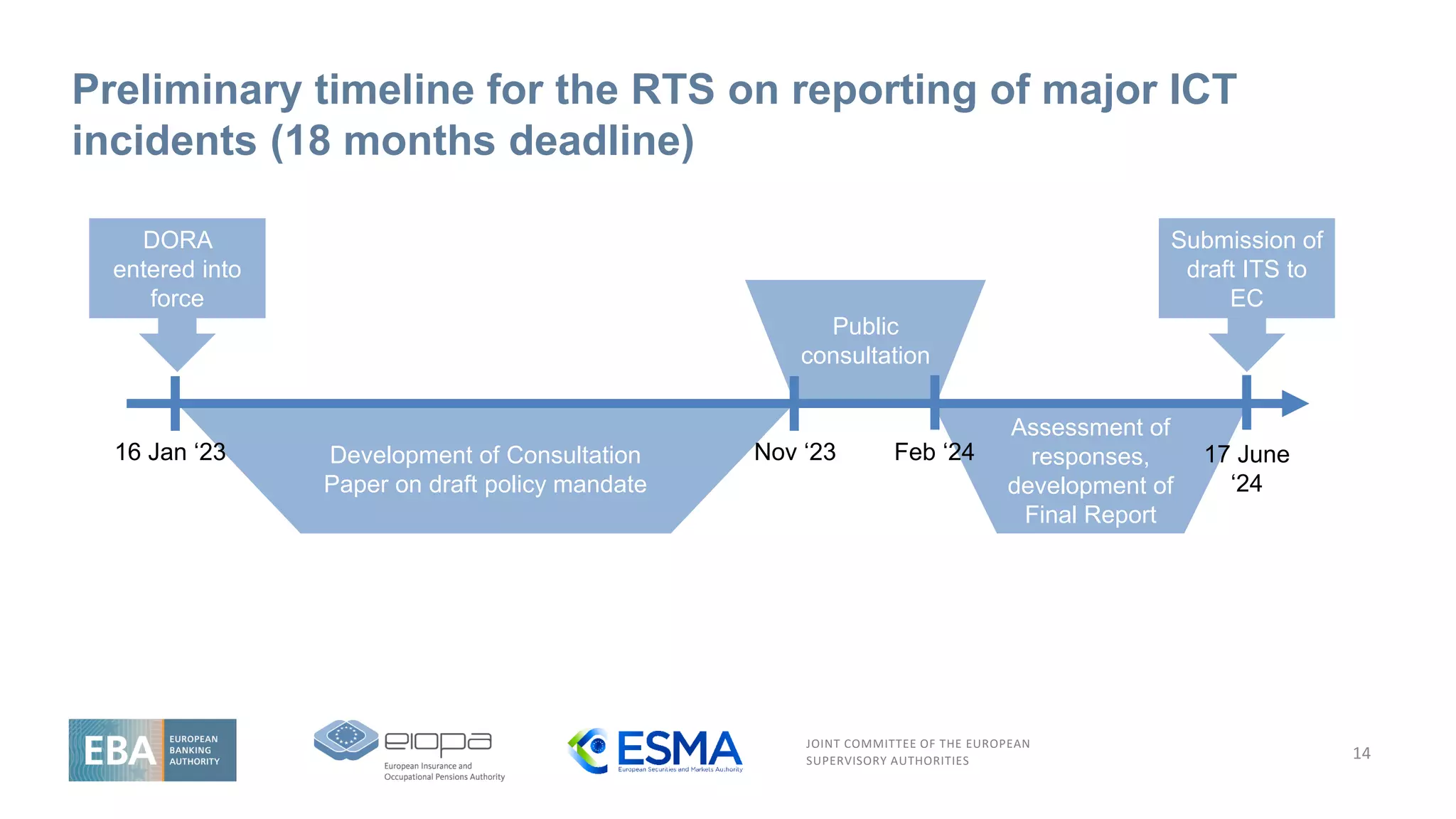
Assessment of
responses,
development of
Final Report
Public
consultation
Preliminary timeline for the RTS on reporting of major ICT
incidents (18 months deadline)
14
DORA
entered into
force
Submission of
draft ITS to
EC
Development of Consultation
Paper on draft policy mandate
16 Jan ‘23 17 June
‘24
Nov ‘23 Feb ‘24
JOINT COMMITTEE OF THE EUROPEAN
SUPERVISORY AUTHORITIES
Andrea Vetrone, Senior Expert EIOPA
15
SESSION 3: ITS on register of information
Oversight framework (Chapter V.II)
ICT risk framework (Chapter
II)
ICT related incident
management classification
and reporting (Chapter III)
Digital Operational
Resilience Testing (Chapter
IV)
Third-party risk management
(Chapter V.I)
JOINT COMMITTEE OF THE EUROPEAN
SUPERVISORY AUTHORITIES
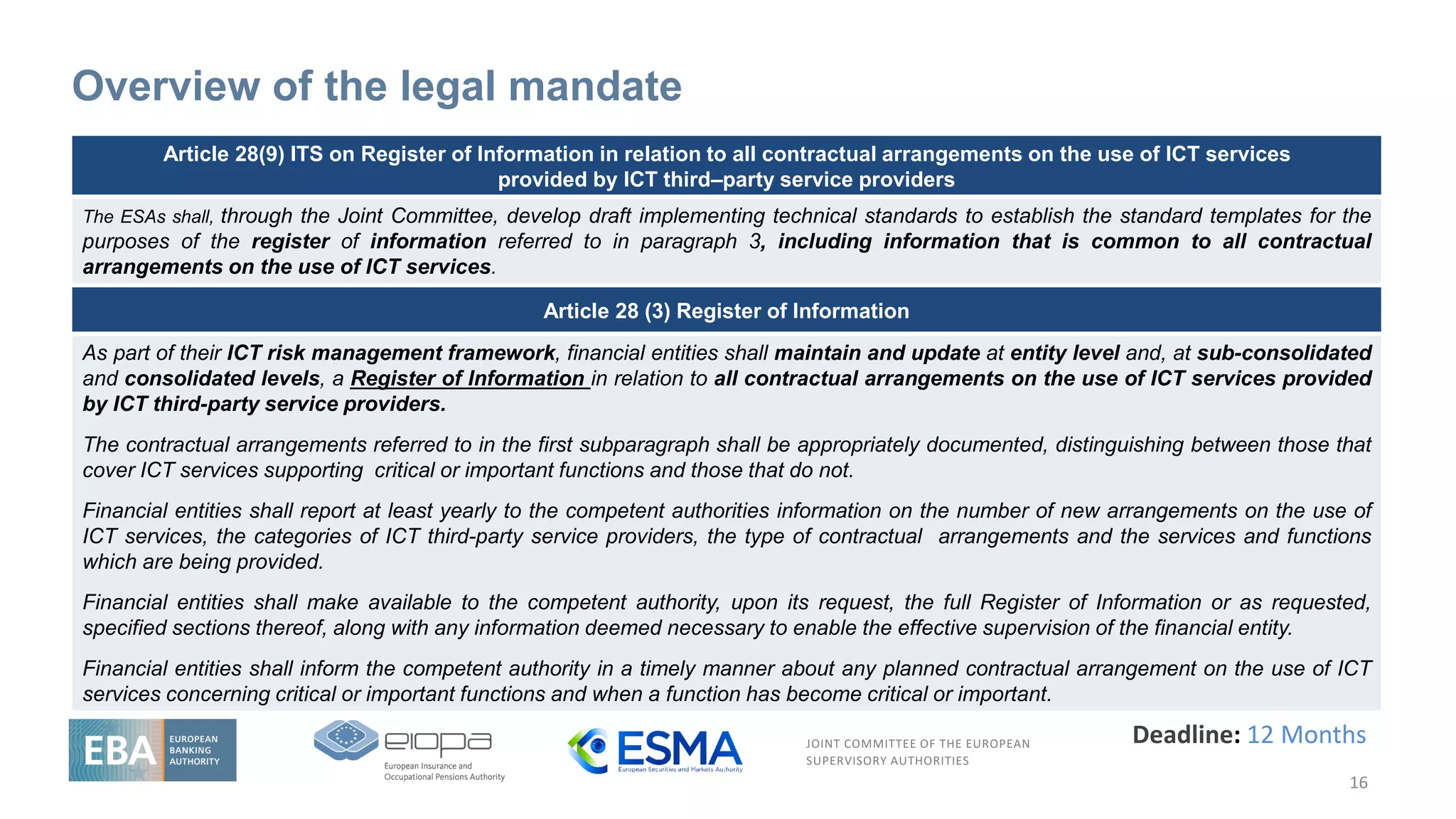
Article 28 (3) Register of Information
As part of their ICT risk management framework, financial entities shall maintain and update at entity level and, at sub-consolidated
and consolidated levels, a Register of Information in relation to all contractual arrangements on the use of ICT services provided
by ICT third-party service providers.
The contractual arrangements referred to in the first subparagraph shall be appropriately documented, distinguishing between those that
cover ICT services supporting critical or important functions and those that do not.
Financial entities shall report at least yearly to the competent authorities information on the number of new arrangements on the use of
ICT services, the categories of ICT third-party service providers, the type of contractual arrangements and the services and functions
which are being provided.
Financial entities shall make available to the competent authority, upon its request, the full Register of Information or as requested,
specified sections thereof, along with any information deemed necessary to enable the effective supervision of the financial entity.
Financial entities shall inform the competent authority in a timely manner about any planned contractual arrangement on the use of ICT
services concerning critical or important functions and when a function has become critical or important.
Overview of the legal mandate
16
Article 28(9) ITS on Register of Information in relation to all contractual arrangements on the use of ICT services
provided by ICT third–party service providers
The ESAs shall, through the Joint Committee, develop draft implementing technical standards to establish the standard templates for the
purposes of the register of information referred to in paragraph 3, including information that is common to all contractual
arrangements on the use of ICT services.
Deadline: 12 Months
JOINT COMMITTEE OF THE EUROPEAN
SUPERVISORY AUTHORITIES
Purpose of the register of information
17
As part of their ICT risk management framework, financial entities shall maintain and
update at entity level and, at sub-consolidated and consolidated levels, a Register of
Information in relation to all contractual arrangements on the use of ICT services
provided by ICT third-party service providers. (Art 28.3)
Financial entities ICT
risk management
Financial entities shall make available to the competent authority, upon its request, the
full Register of Information […] along with any information deemed necessary to enable
the effective supervision of the financial entity (Art. 28.3)
Supervision by
competent authorities
To enhance supervisory awareness of ICT third-party dependencies, and with a view to
further supporting the work in the context of the Oversight Framework established by
this Regulation, all financial entities should be required to maintain a register of information
with all contractual arrangements about the use of ICT services provided by ICT third-party
service providers. (Recital 65)
Designation of critical
third-party providers
JOINT COMMITTEE OF THE EUROPEAN
SUPERVISORY AUTHORITIES
Assessment of
responses, development
of Final Report on draft
policy mandate
Public
consultation
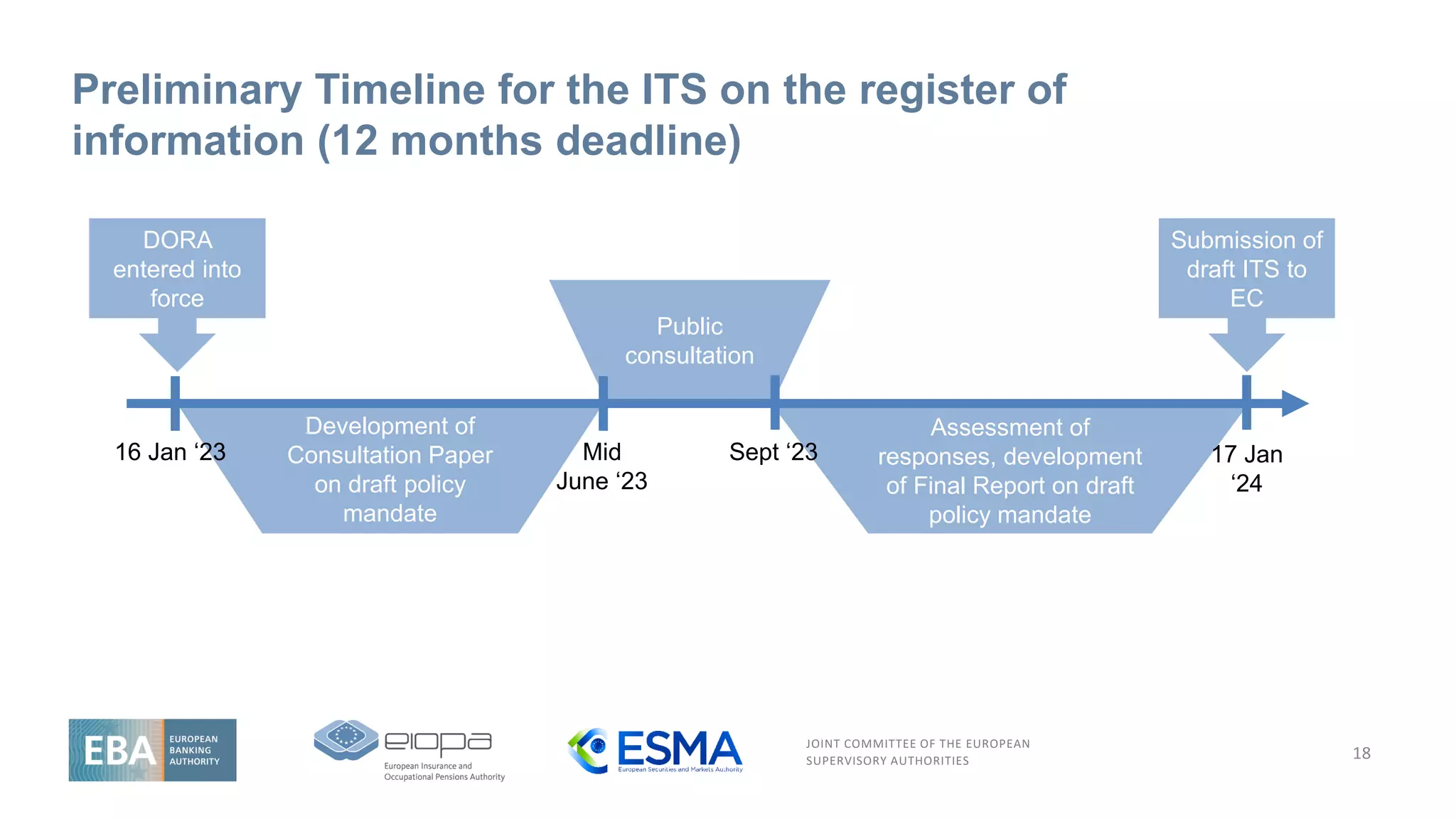
Preliminary Timeline for the ITS on the register of
information (12 months deadline)
18
DORA
entered into
force
Submission of
draft ITS to
EC
Development of
Consultation Paper
on draft policy
mandate
16 Jan ‘23 17 Jan
‘24
Mid
June ‘23
Sept ‘23
JOINT COMMITTEE OF THE EUROPEAN
SUPERVISORY AUTHORITIES
Andrea Vetrone, Senior Expert EIOPA
19
SESSION 4: Call for advice on criticality criteria
Oversight framework (Chapter V.II)
ICT risk framework (Chapter
II)
ICT related incident
management classification
and reporting (Chapter III)
Digital Operational
Resilience Testing (Chapter
IV)
Third-party risk management
(Chapter V.I)
JOINT COMMITTEE OF THE EUROPEAN
SUPERVISORY AUTHORITIES
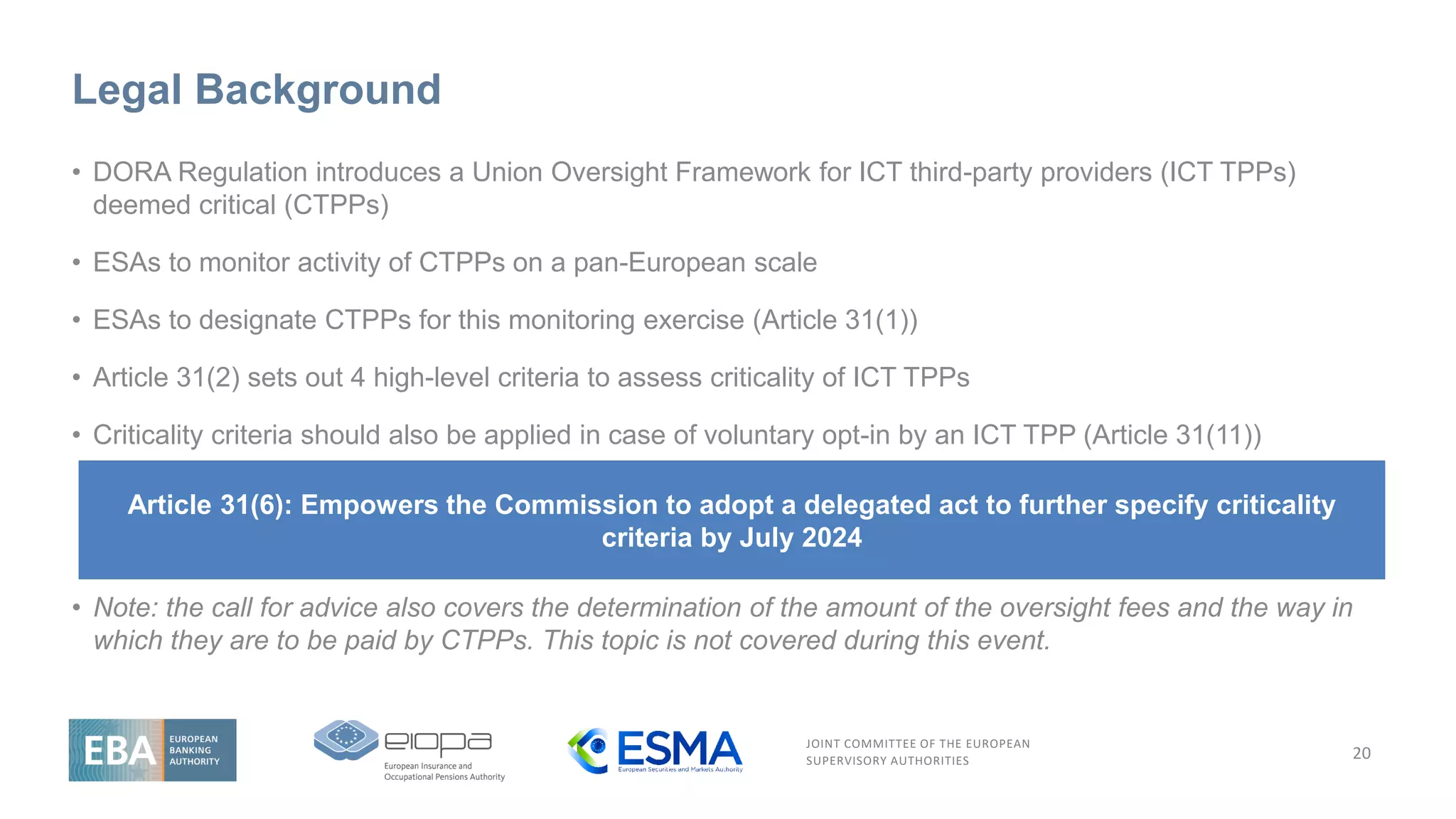
Legal Background
• DORA Regulation introduces a Union Oversight Framework for ICT third-party providers (ICT TPPs)
deemed critical (CTPPs)
• ESAs to monitor activity of CTPPs on a pan-European scale
• ESAs to designate CTPPs for this monitoring exercise (Article 31(1))
• Article 31(2) sets out 4 high-level criteria to assess criticality of ICT TPPs
• Criticality criteria should also be applied in case of voluntary opt-in by an ICT TPP (Article 31(11))
• Note: the call for advice also covers the determination of the amount of the oversight fees and the way in
which they are to be paid by CTPPs. This topic is not covered during this event.
20
Article 31(6): Empowers the Commission to adopt a delegated act to further specify criticality
criteria by July 2024
JOINT COMMITTEE OF THE EUROPEAN
SUPERVISORY AUTHORITIES
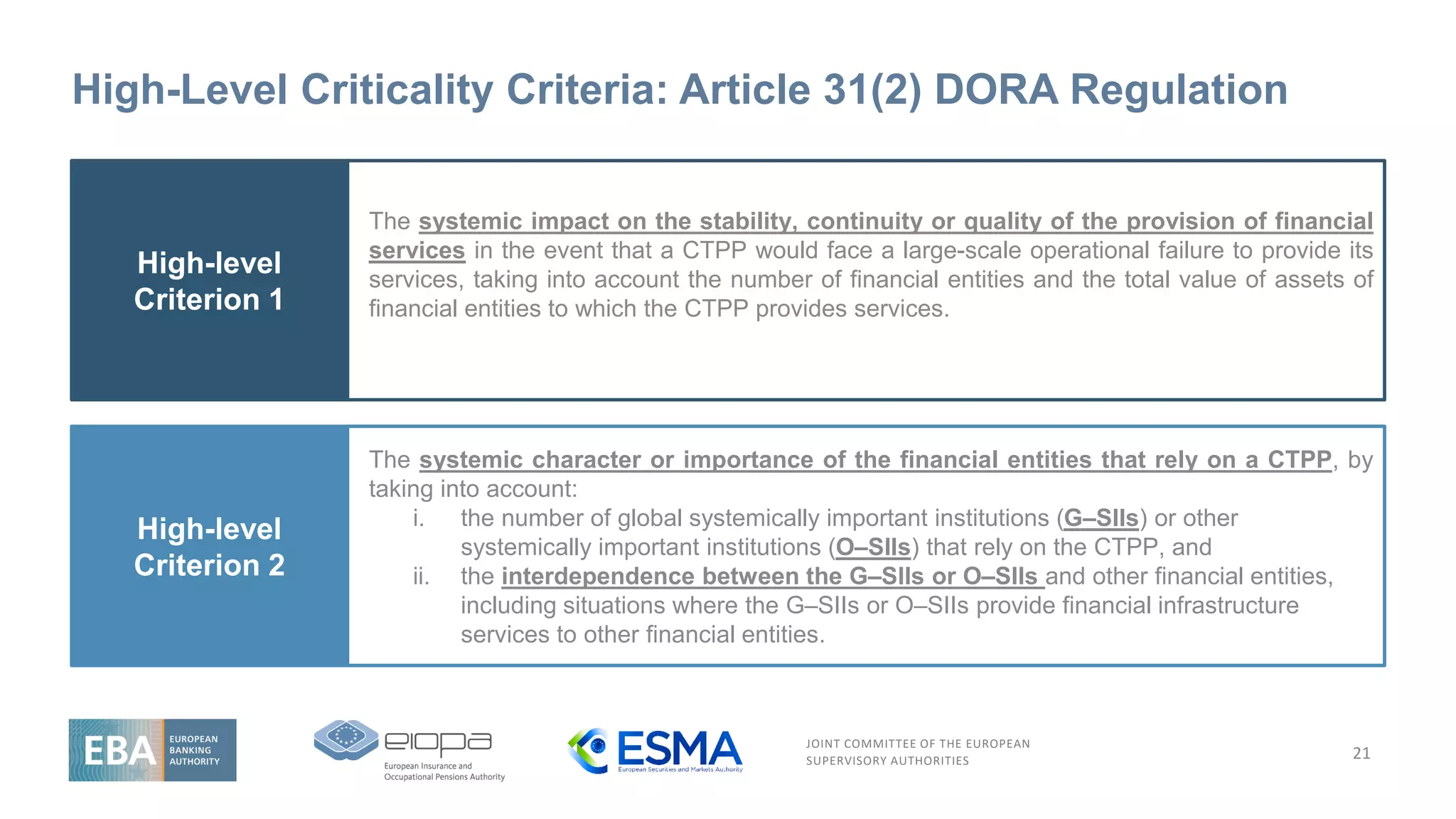
High-Level Criticality Criteria: Article 31(2) DORA Regulation
21
The systemic impact on the stability, continuity or quality of the provision of financial
services in the event that a CTPP would face a large-scale operational failure to provide its
services, taking into account the number of financial entities and the total value of assets of
financial entities to which the CTPP provides services.
High-level
Criterion 1
The systemic character or importance of the financial entities that rely on a CTPP, by
taking into account:
i. the number of global systemically important institutions (G–SIIs) or other
systemically important institutions (O–SIIs) that rely on the CTPP, and
ii. the interdependence between the G–SIIs or O–SIIs and other financial entities,
including situations where the G–SIIs or O–SIIs provide financial infrastructure
services to other financial entities.
High-level
Criterion 2
JOINT COMMITTEE OF THE EUROPEAN
SUPERVISORY AUTHORITIES
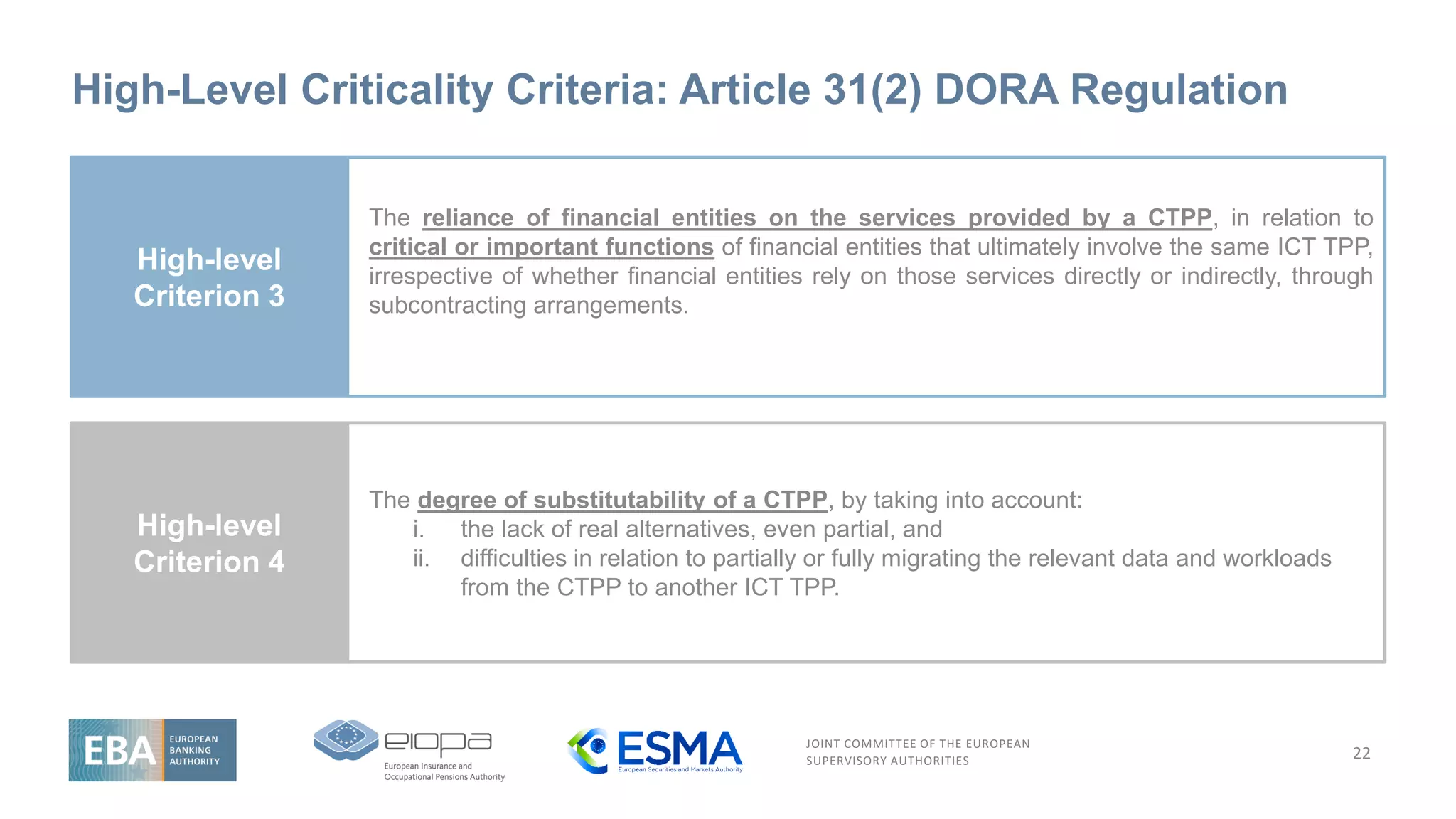
High-Level Criticality Criteria: Article 31(2) DORA Regulation
22
The reliance of financial entities on the services provided by a CTPP, in relation to
critical or important functions of financial entities that ultimately involve the same ICT TPP,
irrespective of whether financial entities rely on those services directly or indirectly, through
subcontracting arrangements.
High-level
Criterion 3
The degree of substitutability of a CTPP, by taking into account:
i. the lack of real alternatives, even partial, and
ii. difficulties in relation to partially or fully migrating the relevant data and workloads
from the CTPP to another ICT TPP.
High-level
Criterion 4
JOINT COMMITTEE OF THE EUROPEAN
SUPERVISORY AUTHORITIES
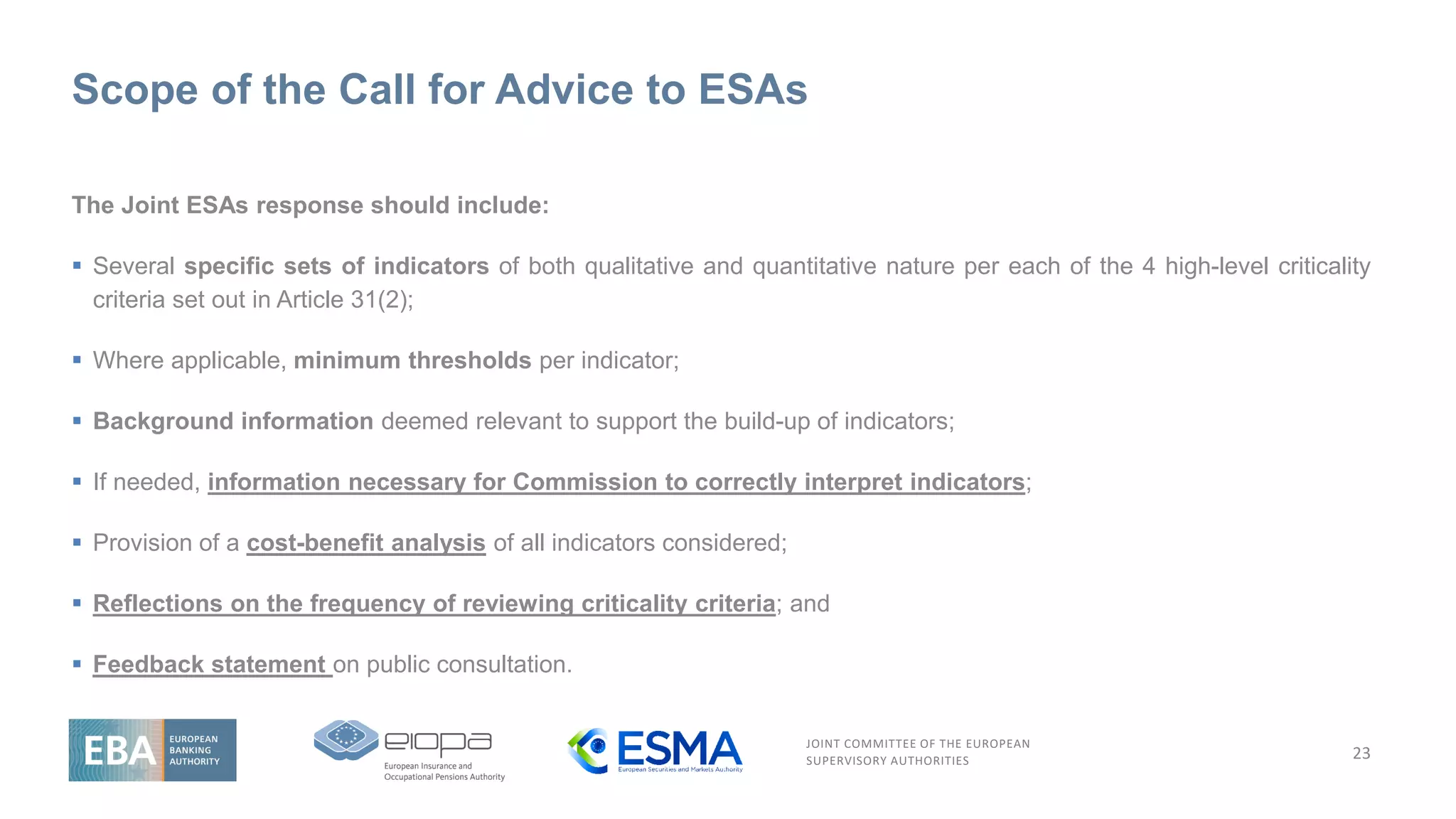
Scope of the Call for Advice to ESAs
23
The Joint ESAs response should include:
▪ Several specific sets of indicators of both qualitative and quantitative nature per each of the 4 high-level criticality
criteria set out in Article 31(2);
▪ Where applicable, minimum thresholds per indicator;
▪ Background information deemed relevant to support the build-up of indicators;
▪ If needed, information necessary for Commission to correctly interpret indicators;
▪ Provision of a cost-benefit analysis of all indicators considered;
▪ Reflections on the frequency of reviewing criticality criteria; and
▪ Feedback statement on public consultation.
JOINT COMMITTEE OF THE EUROPEAN
SUPERVISORY AUTHORITIES
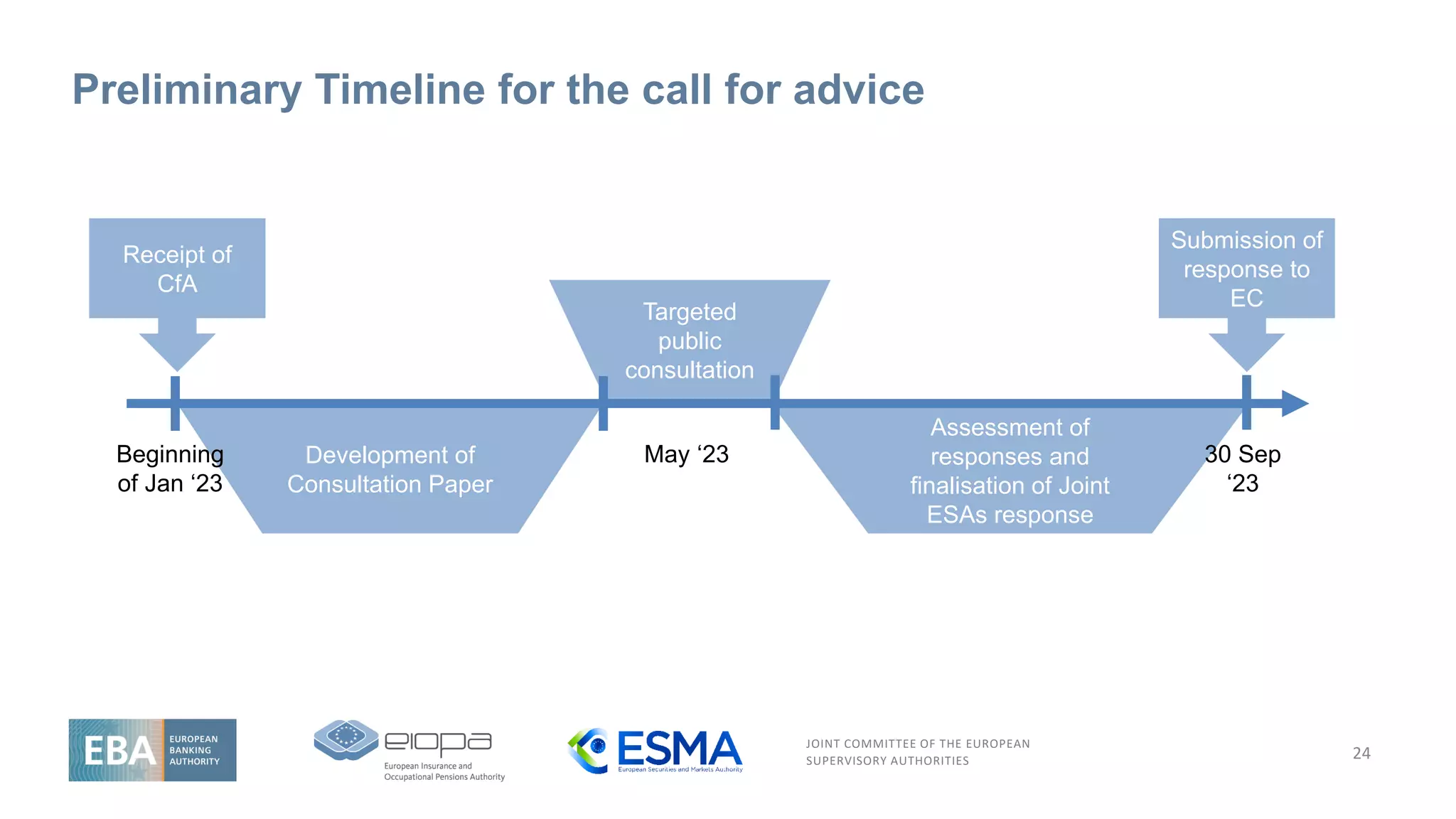
Preliminary Timeline for the call for advice
24
Assessment of
responses and
finalisation of Joint
ESAs response
Targeted
public
consultation
Receipt of
CfA
Submission of
response to
EC
Development of
Consultation Paper
Beginning
of Jan ‘23
30 Sep
‘23
May ‘23

ICT Risk Management and ICT third party risk Objectives

  • 1.
    JOINT COMMITTEE OFTHE EUROPEAN SUPERVISORY AUTHORITIES SESSION 1: RTS on ICT risk management framework RTS on simplified ICT RMF RTS to specify the policy on ICT services RTS to specify elements when sub-contracting critical or important functions Barbara Daskala, Senior Supervision Officer ESMA 2 Oversight framework (Chapter V.II) ICT risk framework (Chapter II) ICT related incident management classification and reporting (Chapter III) Digital Operational Resilience Testing (Chapter IV) Third-party risk management (Chapter V.I)
  • 2.
    JOINT COMMITTEE OFTHE EUROPEAN SUPERVISORY AUTHORITIES ICT Risk Management and ICT third party risk Objectives and general overview The aim is for a comprehensive, strong and effective ICT risk management • Tackle fragmentation of ICT requirements laid down in the current Union financial services law • Upgrade ICT risk requirements • Achieve consistency in rules • Promote risk-based implementation and supervision • Covering explicitly cyber hygiene • Introduce key principles for financial entities’ management of ICT third-party risk • Complement existing requirements on ICT outsourcing • Enable monitoring of the ICT third party contractual arrangement (not anchored fully into Union law before DORA) • Achieve homogeneity and convergence on the monitoring of ICT third-party risk and ICT third-party dependencies • Considering size, the overall risk profile of the financial entity, the nature, scale and complexity of its services, activities and operations. 3
  • 3.
    JOINT COMMITTEE OFTHE EUROPEAN SUPERVISORY AUTHORITIES RTSs on ICT Risk Management – Legal Mandate JC in consultation with ENISA 4 Article 15 Further harmonisation of ICT risk management tools, methods, processes and policies Article 16 Simplified ICT risk management framework* a. Specify further elements to be included in the ICT security policies, procedures, protocols and tools (Article 9(2)) b. Develop further controls of access management rights and monitoring of anomalous behaviour (Article 9(4), point (c)) c. Develop further mechanisms on prompt detection of anomalous behaviour related to ICT risk (Article 10(1)) and triggering of incident detection and response processes (Article 10(2)) d. Specify further ICT business continuity policy components (Article 11(1)) e. Specify further ICT business continuity plan testing (Article 11(6)) f. Specify further ICT response and recovery plans components (Article 11(3)) g. Specify further content and format of the report on the review for the ICT RM framework (Article 6(5)) a. Specify further elements to be included in the ICT risk management (Article 16(1)(a)) b. Specify further elements in relation to systems, protocols and tools to minimise the impact of ICT risk (Article 16(1)(c)) c. Specify further components of the ICT business continuity plans (Article 16(1)(f)) d. Specify further rules on business continuity plan testing (Article 16(1)(g)) e. Specify further content and format of the report on the review for the ICT RM framework (Article 16(2)) *For small and non-interconnected investment firms, payment institutions exempted; institutions exempted; electronic money institutions exempted; and small institutions for occupational retirement provision (Article 16(1), first subparagraph)
  • 4.
    JOINT COMMITTEE OFTHE EUROPEAN SUPERVISORY AUTHORITIES RTSs on Third Party Risk Management – Legal Mandate 5 Article 28(10) To further specify the content of the policy on the use of ICT services concerning critical or important functions provided by ICT third-party service providers Article 30(5) To specify elements when sub-contracting services supporting critical or important functions Under Article 28 (2) of DORA, as part of their ICT risk management framework, financial entities, other than financial entities referred to in Article 16(1) and other than microenterprises, shall adopt, and regularly review, a strategy on ICT third-party risk, taking into account the multi-vendor strategy referred to in Article 5(9) where applicable. The strategy on ICT third-party risk shall include a policy on the use of ICT services supporting critical or important functions provided by ICT third-party service providers and shall apply on an individual and, where relevant, on a sub-consolidated and consolidated basis. […] In accordance with Article 30(2) (a) of DORA, the contractual arrangements on the use of ICT services shall include at least the following: (a) a clear and complete description of all functions and ICT services to be provided by the ICT third-party service provider, indicating whether subcontracting of an ICT service supporting a critical or important function, or material parts thereof, is permitted and, when this is the case, the conditions applying to such subcontracting. In accordance with Article 28 (10) of DORA, the ESAs shall, through the Joint Committee, develop draft regulatory technical standards to further specify the detailed content of the policy referred to in paragraph 2 in relation to the contractual arrangements on the use of ICT services supporting critical or important functions provided by ICT third-party service providers. When developing those draft regulatory technical standards, the ESAs shall take into account the size, nature, scale, complexity and overall risk profile of the financial entities. Article 30 (5) of DORA sets out that the ESAs shall, through the Joint Committee, develop draft regulatory technical standards to specify further the elements referred to in paragraph 2, point (a), which a financial entity needs to determine and assess when subcontracting ICT services supporting critical or important functions. Deadline: 12 Months Deadline: 18 Months
  • 5.
    JOINT COMMITTEE OFTHE EUROPEAN SUPERVISORY AUTHORITIES Assessment of responses, development of Final Report on draft policy mandate Public consultation Preliminary Timeline for RTSs on RMF and ICT Policy (12 months deadline) 6 DORA entered into force Submission of draft ITS to EC Development of Consultation Paper on draft policy mandate 16 Jan ‘23 17 Jan ‘24 Mid June ‘23 Sept ‘23
  • 6.
    JOINT COMMITTEE OFTHE EUROPEAN SUPERVISORY AUTHORITIES Assessment of responses, development of Final Report Public consultation Preliminary timeline RTS on sub-contracting (18 months deadline) 7 DORA entered into force Submission of draft ITS to EC Development of Consultation Paper on draft policy mandate 16 Jan ‘23 17 June ‘24 Nov ‘23 Feb ‘24
  • 7.
    JOINT COMMITTEE OFTHE EUROPEAN SUPERVISORY AUTHORITIES SESSION 2: RTS on classification of major ICT incidents RTS on reporting of major ICT incidents Antonio Barzachki, Senior Expert EBA 8 Oversight framework (Chapter V.II) ICT risk framework (Chapter II) ICT related incident management classification and reporting (Chapter III) Digital Operational Resilience Testing (Chapter IV) Third-party risk management (Chapter V.I)
  • 8.
    JOINT COMMITTEE OFTHE EUROPEAN SUPERVISORY AUTHORITIES Overview of DORA’s major ICT-related incident reporting (1) DORA introduces harmonised and streamlined framework for reporting of major ICT-relates incidents where financial entities: • establish and implement an ICT-related incident management process to detect, manage and notify ICT-related incidents. • report major ICT-related incidents to the relevant competent authority under DORA by way of initial notification, intermediate report and final report. • report, on voluntary basis, significant cyber threats to the relevant competent authority under DORA. Recipients of the major ICT-related incident reports (based on respective competences) Notification of relevant competent authorities in other Member States - based on assessment by the EBA, ESMA or EIOPA and the ECB, in consultation with ENISA and the relevant home competent authorities. 9 • competent authorities, single points of contact or CSIRTs under NIS2 • resolution authorities • other public authorities. • Relevant competent authorities • EBA, ESMA or EIOPA • ECB
  • 9.
    JOINT COMMITTEE OFTHE EUROPEAN SUPERVISORY AUTHORITIES Overview of DORA’s major ICT-related incident reporting (2) Criteria for classification of major ICT-related incidents: a) the number and/or relevance of clients or financial counterparts affected and, where applicable, the amount or number of transactions affected by the ICT-related incident, and whether the ICT-related incident has caused reputational impact; b) the duration of the ICT-related incident, including the service downtime; c) the geographical spread with regard to the areas affected by the ICT-related incident, particularly if it affects more than two Member States; d) the data losses that the ICT-related incident entails, in relation to availability, authenticity, integrity or confidentiality of data; e) the criticality of the services affected, including the financial entity’s transactions and operations; f) the economic impact, in particular direct and indirect costs and losses, of the ICT-related incident in both absolute and relative terms. Classification of cyber threats as significant Based on the criticality of the services at risk, including the financial entity’s transactions and operations, number and/or relevance of clients or financial counterparts targeted and the geographical spread of the areas at risk. 10
  • 10.
    JOINT COMMITTEE OFTHE EUROPEAN SUPERVISORY AUTHORITIES Overview of the legal mandate on the RTS on classification of major ICT incidents 11 Article 18(3) and (4) RTS on criteria for classification of major ICT-related incidents and significant cyber threats The ESAs shall, through the Joint Committee, and in consultation with the ECB and ENISA, develop draft RTS to further specifythe following: a) the criteria set out in paragraph 1, including materiality thresholds for determining major ICT-related incidents or, as applicable, major operational or security payment-related incidents, that are subject to the reporting obligation laid down in Article 19(1); b) the criteria to be applied by competent authorities for the purpose of assessing the relevance of major ICT-related incidents or, as applicable, major operational or security payment-related incidents, to relevant competent authorities in other Member States’, and the details of reports of major ICT-related incidents or, as applicable, major operational or security payment-related incidents, to be shared with other competent authorities pursuant to Article 19(6) and (7) c) the criteria set out in paragraph 2 of this Article, including high materiality thresholds for determining significant cyber threats. When developing the common draft regulatory technical standards referred to in paragraph 3 of this Article, the ESAs shall take into account the criteria set out in Article 4(2) [proportionality principle], as well as international standards, guidance and specifications developed and published by ENISA, including, where appropriate, specifications for other economic sectors. For the purposes of applying the criteria set out in Article 4(2), the ESAs shall duly consider the need for microenterprises and small and medium-sized enterprises to mobilise sufficient resources and capabilities to ensure that ICT-related incidents are managed swiftly. Deadline: 12 Months
  • 11.
    JOINT COMMITTEE OFTHE EUROPEAN SUPERVISORY AUTHORITIES Assessment of responses, development of Final Report on draft policy mandate Public consultation Preliminary Timeline for the RTS on classification of major ICT incidents (12 months deadline) 12 DORA entered into force Submission of draft ITS to EC Development of Consultation Paper on draft policy mandate 16 Jan ‘23 17 Jan ‘24 Mid June ‘23 Sept ‘23
  • 12.
    JOINT COMMITTEE OFTHE EUROPEAN SUPERVISORY AUTHORITIES Overview of the legal mandate on the RTS on reporting of major ICT incidents 13 Article 20(a) RTS specifying the content of the major ICT-related incident reports and notifications for significant cyber threats, as well as the time limits for incident reporting The ESAs, through the Joint Committee, and in consultation with ENISA and the ECB, shall develop common draft regulatory technical standards in order to: i. establish the content of the reports for major ICT-related incidents in order to reflect the criteria laid down in Article 18(1) and incorporate further elements, such as details for establishing the relevance of the reporting for other Member States and whether it constitutes a major operational or security payment-related incident or not; ii. determine the time limits for the initial notification and for each report referred to in Article 19(4); iii. establish the content of the notification for significant cyber threats. When developing those draft regulatory technical standards, the ESAs shall take into account the size and the overall risk profile of the financial entity, and the nature, scale and complexity of its services, activities and operations, and in particular, with a view to ensuring that, for the purposes of this paragraph, point (a), point (ii), different time limits may reflect, as appropriate, specificities of financial sectors, without prejudice to maintaining a consistent approach to ICT-related incident reporting pursuant to this Regulation and to Directive (EU) 2022/2555. The ESAs shall, as applicable, provide justification when deviating from the approaches taken in the context of that Directive; Deadline: 18 Months
  • 13.
    JOINT COMMITTEE OFTHE EUROPEAN SUPERVISORY AUTHORITIES Assessment of responses, development of Final Report Public consultation Preliminary timeline for the RTS on reporting of major ICT incidents (18 months deadline) 14 DORA entered into force Submission of draft ITS to EC Development of Consultation Paper on draft policy mandate 16 Jan ‘23 17 June ‘24 Nov ‘23 Feb ‘24
  • 14.
    JOINT COMMITTEE OFTHE EUROPEAN SUPERVISORY AUTHORITIES Andrea Vetrone, Senior Expert EIOPA 15 SESSION 3: ITS on register of information Oversight framework (Chapter V.II) ICT risk framework (Chapter II) ICT related incident management classification and reporting (Chapter III) Digital Operational Resilience Testing (Chapter IV) Third-party risk management (Chapter V.I)
  • 15.
    JOINT COMMITTEE OFTHE EUROPEAN SUPERVISORY AUTHORITIES Article 28 (3) Register of Information As part of their ICT risk management framework, financial entities shall maintain and update at entity level and, at sub-consolidated and consolidated levels, a Register of Information in relation to all contractual arrangements on the use of ICT services provided by ICT third-party service providers. The contractual arrangements referred to in the first subparagraph shall be appropriately documented, distinguishing between those that cover ICT services supporting critical or important functions and those that do not. Financial entities shall report at least yearly to the competent authorities information on the number of new arrangements on the use of ICT services, the categories of ICT third-party service providers, the type of contractual arrangements and the services and functions which are being provided. Financial entities shall make available to the competent authority, upon its request, the full Register of Information or as requested, specified sections thereof, along with any information deemed necessary to enable the effective supervision of the financial entity. Financial entities shall inform the competent authority in a timely manner about any planned contractual arrangement on the use of ICT services concerning critical or important functions and when a function has become critical or important. Overview of the legal mandate 16 Article 28(9) ITS on Register of Information in relation to all contractual arrangements on the use of ICT services provided by ICT third–party service providers The ESAs shall, through the Joint Committee, develop draft implementing technical standards to establish the standard templates for the purposes of the register of information referred to in paragraph 3, including information that is common to all contractual arrangements on the use of ICT services. Deadline: 12 Months
  • 16.
    JOINT COMMITTEE OFTHE EUROPEAN SUPERVISORY AUTHORITIES Purpose of the register of information 17 As part of their ICT risk management framework, financial entities shall maintain and update at entity level and, at sub-consolidated and consolidated levels, a Register of Information in relation to all contractual arrangements on the use of ICT services provided by ICT third-party service providers. (Art 28.3) Financial entities ICT risk management Financial entities shall make available to the competent authority, upon its request, the full Register of Information […] along with any information deemed necessary to enable the effective supervision of the financial entity (Art. 28.3) Supervision by competent authorities To enhance supervisory awareness of ICT third-party dependencies, and with a view to further supporting the work in the context of the Oversight Framework established by this Regulation, all financial entities should be required to maintain a register of information with all contractual arrangements about the use of ICT services provided by ICT third-party service providers. (Recital 65) Designation of critical third-party providers
  • 17.
    JOINT COMMITTEE OFTHE EUROPEAN SUPERVISORY AUTHORITIES Assessment of responses, development of Final Report on draft policy mandate Public consultation Preliminary Timeline for the ITS on the register of information (12 months deadline) 18 DORA entered into force Submission of draft ITS to EC Development of Consultation Paper on draft policy mandate 16 Jan ‘23 17 Jan ‘24 Mid June ‘23 Sept ‘23
  • 18.
    JOINT COMMITTEE OFTHE EUROPEAN SUPERVISORY AUTHORITIES Andrea Vetrone, Senior Expert EIOPA 19 SESSION 4: Call for advice on criticality criteria Oversight framework (Chapter V.II) ICT risk framework (Chapter II) ICT related incident management classification and reporting (Chapter III) Digital Operational Resilience Testing (Chapter IV) Third-party risk management (Chapter V.I)
  • 19.
    JOINT COMMITTEE OFTHE EUROPEAN SUPERVISORY AUTHORITIES Legal Background • DORA Regulation introduces a Union Oversight Framework for ICT third-party providers (ICT TPPs) deemed critical (CTPPs) • ESAs to monitor activity of CTPPs on a pan-European scale • ESAs to designate CTPPs for this monitoring exercise (Article 31(1)) • Article 31(2) sets out 4 high-level criteria to assess criticality of ICT TPPs • Criticality criteria should also be applied in case of voluntary opt-in by an ICT TPP (Article 31(11)) • Note: the call for advice also covers the determination of the amount of the oversight fees and the way in which they are to be paid by CTPPs. This topic is not covered during this event. 20 Article 31(6): Empowers the Commission to adopt a delegated act to further specify criticality criteria by July 2024
  • 20.
    JOINT COMMITTEE OFTHE EUROPEAN SUPERVISORY AUTHORITIES High-Level Criticality Criteria: Article 31(2) DORA Regulation 21 The systemic impact on the stability, continuity or quality of the provision of financial services in the event that a CTPP would face a large-scale operational failure to provide its services, taking into account the number of financial entities and the total value of assets of financial entities to which the CTPP provides services. High-level Criterion 1 The systemic character or importance of the financial entities that rely on a CTPP, by taking into account: i. the number of global systemically important institutions (G–SIIs) or other systemically important institutions (O–SIIs) that rely on the CTPP, and ii. the interdependence between the G–SIIs or O–SIIs and other financial entities, including situations where the G–SIIs or O–SIIs provide financial infrastructure services to other financial entities. High-level Criterion 2
  • 21.
    JOINT COMMITTEE OFTHE EUROPEAN SUPERVISORY AUTHORITIES High-Level Criticality Criteria: Article 31(2) DORA Regulation 22 The reliance of financial entities on the services provided by a CTPP, in relation to critical or important functions of financial entities that ultimately involve the same ICT TPP, irrespective of whether financial entities rely on those services directly or indirectly, through subcontracting arrangements. High-level Criterion 3 The degree of substitutability of a CTPP, by taking into account: i. the lack of real alternatives, even partial, and ii. difficulties in relation to partially or fully migrating the relevant data and workloads from the CTPP to another ICT TPP. High-level Criterion 4
  • 22.
    JOINT COMMITTEE OFTHE EUROPEAN SUPERVISORY AUTHORITIES Scope of the Call for Advice to ESAs 23 The Joint ESAs response should include: ▪ Several specific sets of indicators of both qualitative and quantitative nature per each of the 4 high-level criticality criteria set out in Article 31(2); ▪ Where applicable, minimum thresholds per indicator; ▪ Background information deemed relevant to support the build-up of indicators; ▪ If needed, information necessary for Commission to correctly interpret indicators; ▪ Provision of a cost-benefit analysis of all indicators considered; ▪ Reflections on the frequency of reviewing criticality criteria; and ▪ Feedback statement on public consultation.
  • 23.
    JOINT COMMITTEE OFTHE EUROPEAN SUPERVISORY AUTHORITIES Preliminary Timeline for the call for advice 24 Assessment of responses and finalisation of Joint ESAs response Targeted public consultation Receipt of CfA Submission of response to EC Development of Consultation Paper Beginning of Jan ‘23 30 Sep ‘23 May ‘23