WELCOME
ICT IN BANGLADESH
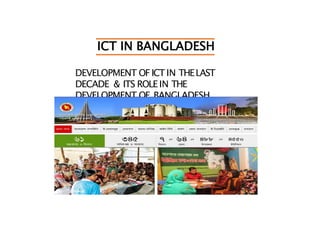
DEVELOPMENT OFICT IN THELAST
DECADE & ITS ROLEIN THE
DEVELOPMENT OF BANGLADESH
ICT IN BANGLADESH
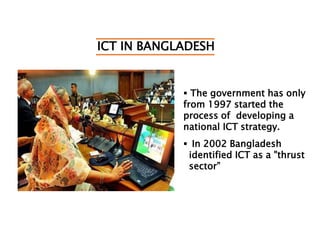
 The government has only
from 1997 started the
process of developing a
national ICT strategy.
 In 2002 Bangladesh
identified ICT as a "thrust
sector”
ICT IN BANGLADESH
INFRASTRUCTURE
 Poor infrastructure is the biggest challenge
for implementing the vision of a ‘Digital
Bangladesh’.
 The government has decided to build a
tech park, Wi-Fi zone, computer lab etc. for
the progress of ICT sector.
ICT IN BANGLADESH
PC MARKET
The tablet is getting popular among
people. The year 2012-13 has been the
year for notebook and tablet PC .
PC sales specially tab and laptop in 2013-
14 increased along with the widescreen
smart phones.
ICT IN BANGLADESH
SOFTWARE & OUTSOURCING
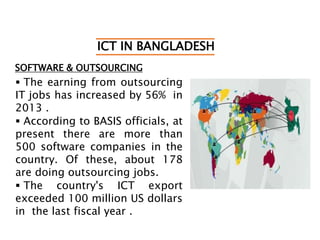
 The earning from outsourcing
IT jobs has increased by 56% in
2013 .
 According to BASIS officials, at
present there are more than
500 software companies in the
country. Of these, about 178
are doing outsourcing jobs.
 The country's ICT export
exceeded 100 million US dollars
in the last fiscal year .
ICT IN BANGLADESH
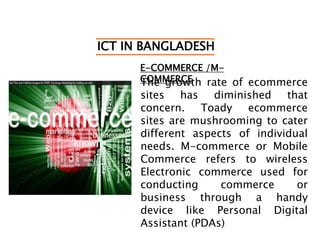
E-COMMERCE /M-
COMMERCEThe growth rate of ecommerce
sites has diminished that
concern. Toady ecommerce
sites are mushrooming to cater
different aspects of individual
needs. M-commerce or Mobile
Commerce refers to wireless
Electronic commerce used for
conducting commerce or
business through a handy
device like Personal Digital
Assistant (PDAs)
ICT IN BANGLADESH
3G AND TELCO
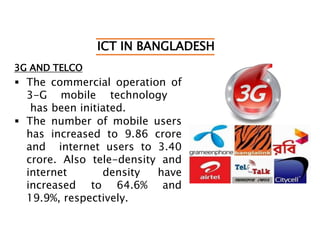
 The commercial operation of
3-G mobile technology
has been initiated.
 The number of mobile users
has increased to 9.86 crore
and internet users to 3.40
crore. Also tele-density and
internet density have
increased to 64.6% and
19.9%, respectively.
ICT IN BANGLADESH
E- AGRICULTURE
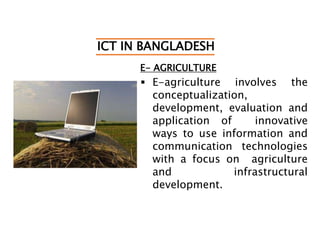
 E-agriculture involves the
conceptualization,
development, evaluation and
application of innovative
ways to use information and
communication technologies
with a focus on agriculture
and infrastructural
development.
ICT IN BANGLADESH
Access to Information (a2i)
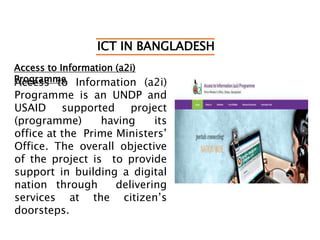
ProgrammeAccess to Information (a2i)
Programme is an UNDP and
USAID supported project
(programme) having its
office at the Prime Ministers’
Office. The overall objective
of the project is to provide
support in building a digital
nation through delivering
services at the citizen’s
doorsteps.
ICT IN BANGLADESH
NATIONAL PORTAL FRAMEWORK
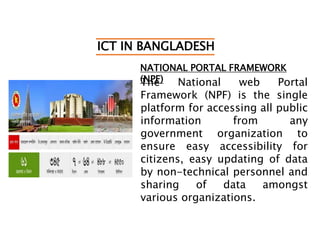
(NPF)The National web Portal
Framework (NPF) is the single
platform for accessing all public
information from any
government organization to
ensure easy accessibility for
citizens, easy updating of data
by non-technical personnel and
sharing of data amongst
various organizations.
ICT IN BANGLADESH
UNION DIGITAL CENTER
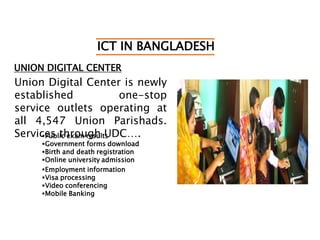
Union Digital Center is newly
established one-stop
service outlets operating at
all 4,547 Union Parishads.
Services through UDC….Public exam results
Government forms download
Birth and death registration
Online university admission
Employment information
Visa processing
Video conferencing
Mobile Banking
ICT IN BANGLADESH
DISTRICT E-SERVICE CENTERS
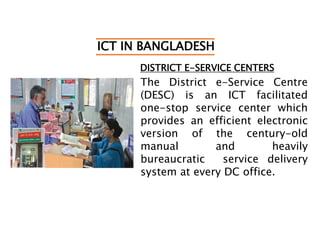
The District e-Service Centre
(DESC) is an ICT facilitated
one-stop service center which
provides an efficient electronic
version of the century-old
manual and heavily
bureaucratic service delivery
system at every DC office.
ICT IN BANGLADESH
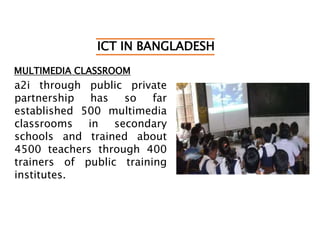
MULTIMEDIA CLASSROOM
a2i through public private
partnership has so far
established 500 multimedia
classrooms in secondary
schools and trained about
4500 teachers through 400
trainers of public training
institutes.
ICT IN BANGLADESH
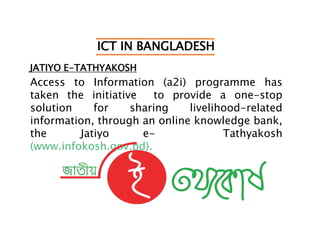
JATIYO E-TATHYAKOSH
Access to Information (a2i) programme has
taken the initiative to provide a one-stop
solution for sharing livelihood-related
information, through an online knowledge bank,
the Jatiyo e- Tathyakosh
(www.infokosh.gov.bd).
ICT IN BANGLADESH
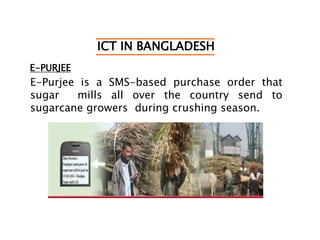
E-PURJEE
E-Purjee is a SMS-based purchase order that
sugar mills all over the country send to
sugarcane growers during crushing season.
ICT IN BANGLADESH
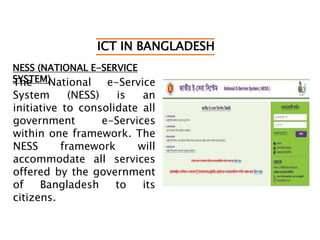
NESS (NATIONAL E-SERVICE
SYSTEM)The National e-Service
System (NESS) is an
initiative to consolidate all
government e-Services
within one framework. The
NESS framework will
accommodate all services
offered by the government
of Bangladesh to its
citizens.
ICT IN BANGLADESH
E-GOVERNANCE
Uses of ICT in Public Service and in Public Administration
ICT IN BANGLADESH
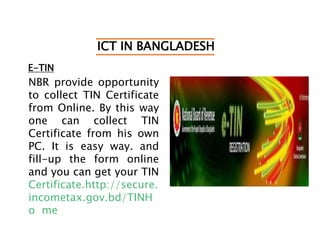
E-TIN
NBR provide opportunity
to collect TIN Certificate
from Online. By this way
one can collect TIN
Certificate from his own
PC. It is easy way. and
fill-up the form online
and you can get your TIN
Certificate.http://secure.
incometax.gov.bd/TINH
o me
ICT IN BANGLADESH
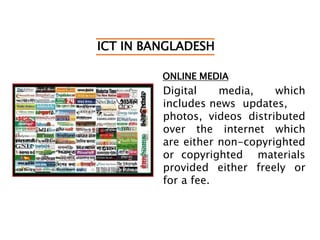
ONLINE MEDIA
Digital media, which
includes news updates,
photos, videos distributed
over the internet which
are either non-copyrighted
or copyrighted materials
provided either freely or
for a fee.
ICT IN BANGLADESH
MACHINE READABLE PASSPORT (MRP) MACHINE-READABLE VISA
(MRV)The Bangladesh Government has implemented a project
to replace 6.6 million Bangladeshi passports with new
Machine-Readable Passports. According to a guideline
of The International Civil Aviation Organization
Machine-Readable Passport (MRP) and Machine-
readable Visa (MRV) issue started by Bangladesh
Government from April, 2010.
ICT IN BANGLADESH
E- TENDERING
procurement process may not
work properly for which
government introduced e-
tendering. encompasses total
procurement life cycle ensure
transparency and mass
participation.
ICT IN BANGLADESH
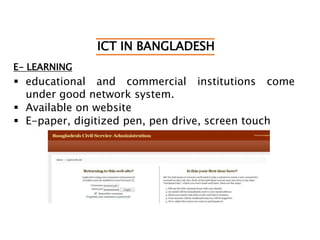
E- LEARNING
 educational and commercial institutions come
under good network system.
 Available on website
 E-paper, digitized pen, pen drive, screen touch
ICT IN BANGLADESH
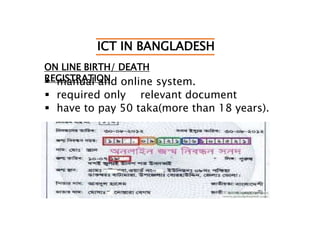
ON LINE BIRTH/ DEATH
REGISTRATION manual and online system.
 required only relevant document
 have to pay 50 taka(more than 18 years).
ICT IN BANGLADESH
CHALLENGES
Bangladesh is facing various obstacles to the
promotion and implementation of ICT. Major
challenges include:
 Poor ICT infrastructure
 Lack of public awareness
 Low literacy rate or poor
 basic education
 Low ICT knowledge
 Power deficit
 Lack of IT training
 High-cost, lower liability of internet
access
 Wide spread corruption
 Lack of IT funds
 Political instability or lack of
 political will
 Slow decision- making process
 Absence of self- help culture
 Privacy concerns or security
 Start up cost very high
 Lack of adequate hardware
 Lack of adequate connectivity
THANKYOU

ICT in Bangladesh

  • 1.
  • 2.
    ICT IN BANGLADESH DEVELOPMENTOFICT IN THELAST DECADE & ITS ROLEIN THE DEVELOPMENT OF BANGLADESH
  • 3.
    ICT IN BANGLADESH The government has only from 1997 started the process of developing a national ICT strategy.  In 2002 Bangladesh identified ICT as a "thrust sector”
  • 4.
    ICT IN BANGLADESH INFRASTRUCTURE Poor infrastructure is the biggest challenge for implementing the vision of a ‘Digital Bangladesh’.  The government has decided to build a tech park, Wi-Fi zone, computer lab etc. for the progress of ICT sector.
  • 5.
    ICT IN BANGLADESH PCMARKET The tablet is getting popular among people. The year 2012-13 has been the year for notebook and tablet PC . PC sales specially tab and laptop in 2013- 14 increased along with the widescreen smart phones.
  • 6.
    ICT IN BANGLADESH SOFTWARE& OUTSOURCING  The earning from outsourcing IT jobs has increased by 56% in 2013 .  According to BASIS officials, at present there are more than 500 software companies in the country. Of these, about 178 are doing outsourcing jobs.  The country's ICT export exceeded 100 million US dollars in the last fiscal year .
  • 7.
    ICT IN BANGLADESH E-COMMERCE/M- COMMERCEThe growth rate of ecommerce sites has diminished that concern. Toady ecommerce sites are mushrooming to cater different aspects of individual needs. M-commerce or Mobile Commerce refers to wireless Electronic commerce used for conducting commerce or business through a handy device like Personal Digital Assistant (PDAs)
  • 8.
    ICT IN BANGLADESH 3GAND TELCO  The commercial operation of 3-G mobile technology has been initiated.  The number of mobile users has increased to 9.86 crore and internet users to 3.40 crore. Also tele-density and internet density have increased to 64.6% and 19.9%, respectively.
  • 9.
    ICT IN BANGLADESH E-AGRICULTURE  E-agriculture involves the conceptualization, development, evaluation and application of innovative ways to use information and communication technologies with a focus on agriculture and infrastructural development.
  • 10.
    ICT IN BANGLADESH Accessto Information (a2i) ProgrammeAccess to Information (a2i) Programme is an UNDP and USAID supported project (programme) having its office at the Prime Ministers’ Office. The overall objective of the project is to provide support in building a digital nation through delivering services at the citizen’s doorsteps.
  • 11.
    ICT IN BANGLADESH NATIONALPORTAL FRAMEWORK (NPF)The National web Portal Framework (NPF) is the single platform for accessing all public information from any government organization to ensure easy accessibility for citizens, easy updating of data by non-technical personnel and sharing of data amongst various organizations.
  • 12.
    ICT IN BANGLADESH UNIONDIGITAL CENTER Union Digital Center is newly established one-stop service outlets operating at all 4,547 Union Parishads. Services through UDC….Public exam results Government forms download Birth and death registration Online university admission Employment information Visa processing Video conferencing Mobile Banking
  • 13.
    ICT IN BANGLADESH DISTRICTE-SERVICE CENTERS The District e-Service Centre (DESC) is an ICT facilitated one-stop service center which provides an efficient electronic version of the century-old manual and heavily bureaucratic service delivery system at every DC office.
  • 14.
    ICT IN BANGLADESH MULTIMEDIACLASSROOM a2i through public private partnership has so far established 500 multimedia classrooms in secondary schools and trained about 4500 teachers through 400 trainers of public training institutes.
  • 15.
    ICT IN BANGLADESH JATIYOE-TATHYAKOSH Access to Information (a2i) programme has taken the initiative to provide a one-stop solution for sharing livelihood-related information, through an online knowledge bank, the Jatiyo e- Tathyakosh (www.infokosh.gov.bd).
  • 16.
    ICT IN BANGLADESH E-PURJEE E-Purjeeis a SMS-based purchase order that sugar mills all over the country send to sugarcane growers during crushing season.
  • 17.
    ICT IN BANGLADESH NESS(NATIONAL E-SERVICE SYSTEM)The National e-Service System (NESS) is an initiative to consolidate all government e-Services within one framework. The NESS framework will accommodate all services offered by the government of Bangladesh to its citizens.
  • 18.
    ICT IN BANGLADESH E-GOVERNANCE Usesof ICT in Public Service and in Public Administration
  • 19.
    ICT IN BANGLADESH E-TIN NBRprovide opportunity to collect TIN Certificate from Online. By this way one can collect TIN Certificate from his own PC. It is easy way. and fill-up the form online and you can get your TIN Certificate.http://secure. incometax.gov.bd/TINH o me
  • 20.
    ICT IN BANGLADESH ONLINEMEDIA Digital media, which includes news updates, photos, videos distributed over the internet which are either non-copyrighted or copyrighted materials provided either freely or for a fee.
  • 21.
    ICT IN BANGLADESH MACHINEREADABLE PASSPORT (MRP) MACHINE-READABLE VISA (MRV)The Bangladesh Government has implemented a project to replace 6.6 million Bangladeshi passports with new Machine-Readable Passports. According to a guideline of The International Civil Aviation Organization Machine-Readable Passport (MRP) and Machine- readable Visa (MRV) issue started by Bangladesh Government from April, 2010.
  • 22.
    ICT IN BANGLADESH E-TENDERING procurement process may not work properly for which government introduced e- tendering. encompasses total procurement life cycle ensure transparency and mass participation.
  • 23.
    ICT IN BANGLADESH E-LEARNING  educational and commercial institutions come under good network system.  Available on website  E-paper, digitized pen, pen drive, screen touch
  • 24.
    ICT IN BANGLADESH ONLINE BIRTH/ DEATH REGISTRATION manual and online system.  required only relevant document  have to pay 50 taka(more than 18 years).
  • 25.
    ICT IN BANGLADESH CHALLENGES Bangladeshis facing various obstacles to the promotion and implementation of ICT. Major challenges include:  Poor ICT infrastructure  Lack of public awareness  Low literacy rate or poor  basic education  Low ICT knowledge  Power deficit  Lack of IT training  High-cost, lower liability of internet access  Wide spread corruption  Lack of IT funds  Political instability or lack of  political will  Slow decision- making process  Absence of self- help culture  Privacy concerns or security  Start up cost very high  Lack of adequate hardware  Lack of adequate connectivity
  • 26.