ICT Framework for Smart Cities
Møte mellom NTNU Smart Sustainable Cities og Gjøvik
kommune & eiendomsutviklere, 12.01.2018
Dr. Dirk Ahlers
Department for Computer Science, NTNU
https://www.ntnu.edu/employees/dirk.ahlers
http://dhere.de/
https://www.ntnu.edu/smartcities
2
What is a Smart City?
• Technology?
• ICT?
• Data?
• Smarter Planning?
• Smarter Operation?
• Smarter Organization?
• Smarter People?
3
What is a Smart City?
• Many definitions depending on view, role, discipline, sector,
domain, country, …
• Combination of physical world, services, infrastructure, ICT
• Dimensions of technology, people, institutions
A Smart City is a dynamic complex socio-technical system-of-
systems that integrates information and communication
technology into its structure to manage and improve its
planning, services, and operations towards a livable city.
4
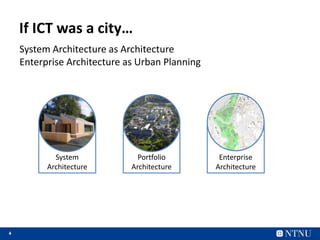
Portfolio
Architecture
If ICT was a city…
Enterprise
Architecture
System
Architecture
System Architecture as Architecture
Enterprise Architecture as Urban Planning
5
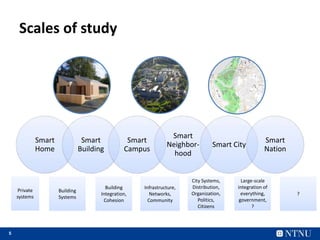
Scales of study
Smart
Home
Smart
Building
Smart
Campus
Smart
Neighbor-
hood
Smart City
Smart
Nation
Building
Systems
Building
Integration,
Cohesion
Infrastructure,
Networks,
Community
City Systems,
Distribution,
Organization,
Politics,
Citizens
Large-scale
integration of
everything,
government,
?
Private
systems
?
6
The (Smart) City environment
[ITU-T, Setting the framework for an ICT architecture of a smart sustainable city (SSC-0345), 2015]
7
Project Examples
Gaining Insight, building systems
8
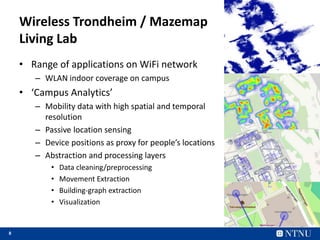
Wireless Trondheim / Mazemap
Living Lab
• Range of applications on WiFi network
– WLAN indoor coverage on campus
• ‘Campus Analytics’
– Mobility data with high spatial and temporal
resolution
– Passive location sensing
– Device positions as proxy for people’s locations
– Abstraction and processing layers
• Data cleaning/preprocessing
• Movement Extraction
• Building-graph extraction
• Visualization
9
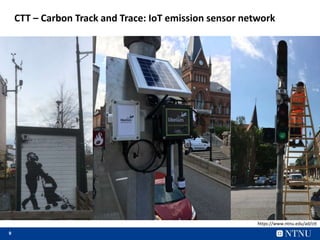
CTT – Carbon Track and Trace: IoT emission sensor network
https://www.ntnu.edu/ad/ctt
10
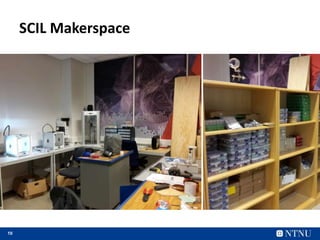
SCIL Makerspace
11
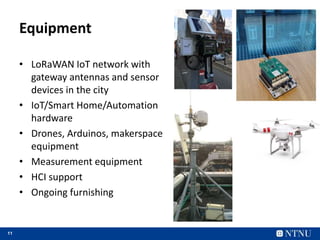
• LoRaWAN IoT network with
gateway antennas and sensor
devices in the city
• IoT/Smart Home/Automation
hardware
• Drones, Arduinos, makerspace
equipment
• Measurement equipment
• HCI support
• Ongoing furnishing
Equipment
12
Framework Approaches
Large ecosystems, integration, orchestration
13
Smart City Evolution
City Evolution, City Systems Evolution
Technological
constraints
and
opportunities
City needs
and strategy
External and
internal
constraints,
options,
changes
[adapted from ITU-T, Setting the framework for an ICT architecture of a smart sustainable city (SSC-0345), 2015]
Architecture Evolution
and Adaptation,
Development and
Maintenance
Urban Renewal, City
Development, City
Redevelopment, Urban
Innovation
Smart City Co-Evolution
City ICT/EA
Smart Ci es
Enterprise
Architecture
Development
and
Evolu on
14
Quadruple Helix Innovation Model
• Method used in Innovation,
Urban Planning/Development,
Citizen engagement
• Co-Creation and Open
Innovation
• Involvement and collaboration
of relevant actors
• Structural changes beyond any
one segment
• Smart city means involvement of
all stakeholders in urban
innovation, knowledge sharing,
collaboration
Participatory
Innovation
Industry
Academia
Civil Society
Government
[EU Digital Single Market: Open Innovation2.0 https://ec.europa.eu/digital-single-market/en/open-innovation-20]
15
Handling Complexity
• Smart City ➞ Smart City Development and Evolution
• Cities are complex
• Integrated interoperable solutions are hard (not only ICT)
• Goal: Keep flexibility, enable experimentation
• Trondheim: > 200 IT systems in the administration alone
(including legacy), does not include connection to physical
systems, physical asset management and automation,
external departments (health, …), subcontractors, national
systems, needs of future SC/IoT/BigData projects
16
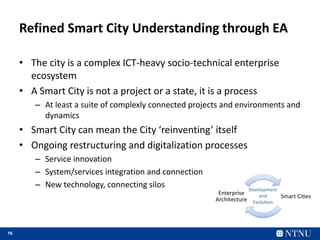
Refined Smart City Understanding through EA
• The city is a complex ICT-heavy socio-technical enterprise
ecosystem
• A Smart City is not a project or a state, it is a process
– At least a suite of complexly connected projects and environments and
dynamics
• Smart City can mean the City ‘reinventing’ itself
• Ongoing restructuring and digitalization processes
– Service innovation
– System/services integration and connection
– New technology, connecting silos
Smart Ci es
Enterprise
Architecture
Development
and
Evolu on
17
Trondheim Kommune, Reference Architecture
for IT Services
[Referansearkitektur for IKT Tjenester, Trondheim Kommune, 2017]
18
Espresso Smart Cities Reference Architecture
[Espresso H2020 project: D4.2.1 Smart City reference architecture report, 2016]
19
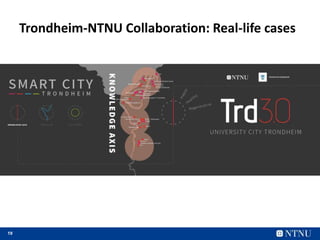
Trondheim-NTNU Collaboration: Real-life cases
Contact
search://Dirk Ahlers
geo: 63°25‘10“N 10°24‘9“E
@dirkahlers
dirk.ahlers@ntnu.no
https://www.ntnu.edu/smartcities

ICT Framework for Smart Cities

  • 1.
    ICT Framework forSmart Cities Møte mellom NTNU Smart Sustainable Cities og Gjøvik kommune & eiendomsutviklere, 12.01.2018 Dr. Dirk Ahlers Department for Computer Science, NTNU https://www.ntnu.edu/employees/dirk.ahlers http://dhere.de/ https://www.ntnu.edu/smartcities
  • 2.
    2 What is aSmart City? • Technology? • ICT? • Data? • Smarter Planning? • Smarter Operation? • Smarter Organization? • Smarter People?
  • 3.
    3 What is aSmart City? • Many definitions depending on view, role, discipline, sector, domain, country, … • Combination of physical world, services, infrastructure, ICT • Dimensions of technology, people, institutions A Smart City is a dynamic complex socio-technical system-of- systems that integrates information and communication technology into its structure to manage and improve its planning, services, and operations towards a livable city.
  • 4.
    4 Portfolio Architecture If ICT wasa city… Enterprise Architecture System Architecture System Architecture as Architecture Enterprise Architecture as Urban Planning
  • 5.
    5 Scales of study Smart Home Smart Building Smart Campus Smart Neighbor- hood SmartCity Smart Nation Building Systems Building Integration, Cohesion Infrastructure, Networks, Community City Systems, Distribution, Organization, Politics, Citizens Large-scale integration of everything, government, ? Private systems ?
  • 6.
    6 The (Smart) Cityenvironment [ITU-T, Setting the framework for an ICT architecture of a smart sustainable city (SSC-0345), 2015]
  • 7.
  • 8.
    8 Wireless Trondheim /Mazemap Living Lab • Range of applications on WiFi network – WLAN indoor coverage on campus • ‘Campus Analytics’ – Mobility data with high spatial and temporal resolution – Passive location sensing – Device positions as proxy for people’s locations – Abstraction and processing layers • Data cleaning/preprocessing • Movement Extraction • Building-graph extraction • Visualization
  • 9.
    9 CTT – CarbonTrack and Trace: IoT emission sensor network https://www.ntnu.edu/ad/ctt
  • 10.
  • 11.
    11 • LoRaWAN IoTnetwork with gateway antennas and sensor devices in the city • IoT/Smart Home/Automation hardware • Drones, Arduinos, makerspace equipment • Measurement equipment • HCI support • Ongoing furnishing Equipment
  • 12.
  • 13.
    13 Smart City Evolution CityEvolution, City Systems Evolution Technological constraints and opportunities City needs and strategy External and internal constraints, options, changes [adapted from ITU-T, Setting the framework for an ICT architecture of a smart sustainable city (SSC-0345), 2015] Architecture Evolution and Adaptation, Development and Maintenance Urban Renewal, City Development, City Redevelopment, Urban Innovation Smart City Co-Evolution City ICT/EA Smart Ci es Enterprise Architecture Development and Evolu on
  • 14.
    14 Quadruple Helix InnovationModel • Method used in Innovation, Urban Planning/Development, Citizen engagement • Co-Creation and Open Innovation • Involvement and collaboration of relevant actors • Structural changes beyond any one segment • Smart city means involvement of all stakeholders in urban innovation, knowledge sharing, collaboration Participatory Innovation Industry Academia Civil Society Government [EU Digital Single Market: Open Innovation2.0 https://ec.europa.eu/digital-single-market/en/open-innovation-20]
  • 15.
    15 Handling Complexity • SmartCity ➞ Smart City Development and Evolution • Cities are complex • Integrated interoperable solutions are hard (not only ICT) • Goal: Keep flexibility, enable experimentation • Trondheim: > 200 IT systems in the administration alone (including legacy), does not include connection to physical systems, physical asset management and automation, external departments (health, …), subcontractors, national systems, needs of future SC/IoT/BigData projects
  • 16.
    16 Refined Smart CityUnderstanding through EA • The city is a complex ICT-heavy socio-technical enterprise ecosystem • A Smart City is not a project or a state, it is a process – At least a suite of complexly connected projects and environments and dynamics • Smart City can mean the City ‘reinventing’ itself • Ongoing restructuring and digitalization processes – Service innovation – System/services integration and connection – New technology, connecting silos Smart Ci es Enterprise Architecture Development and Evolu on
  • 17.
    17 Trondheim Kommune, ReferenceArchitecture for IT Services [Referansearkitektur for IKT Tjenester, Trondheim Kommune, 2017]
  • 18.
    18 Espresso Smart CitiesReference Architecture [Espresso H2020 project: D4.2.1 Smart City reference architecture report, 2016]
  • 19.
  • 20.
    Contact search://Dirk Ahlers geo: 63°25‘10“N10°24‘9“E @dirkahlers dirk.ahlers@ntnu.no https://www.ntnu.edu/smartcities

Editor's Notes

  • #3 Technology? ICT? Data? Smarter Planning? Smarter Operation? Smarter Organization? Smarter People?
  • #14 Implicit view: EA for a city + city IT department (+ partners)