11/06/2015
1
www.ifslearning.ac.uk
Expanding the Boundaries of
Service Design Research:
Social Media Service Encounters
Dr. Nurdilek Dalziel
ICDBM 2014
Research Objectives
• To provide insights into social media
service encounters
• To highlight what issues service
providers should consider when they
design/redesign their service offerings to
include social media platforms
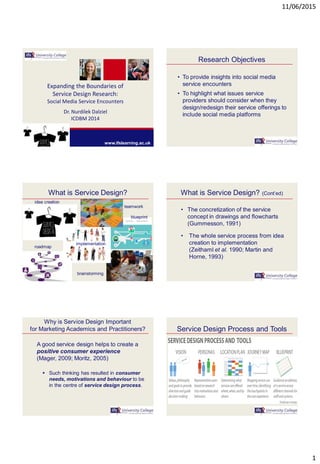
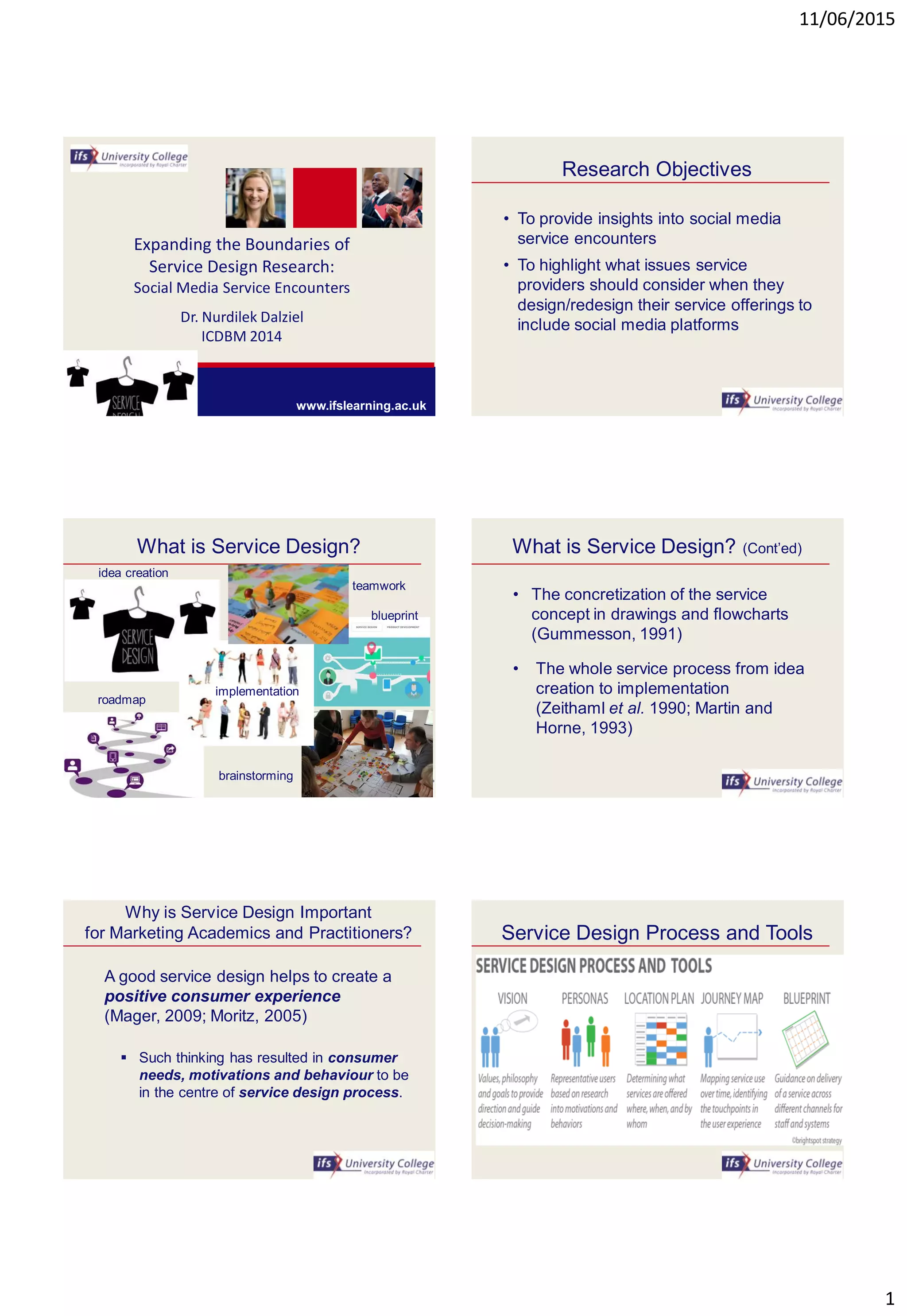
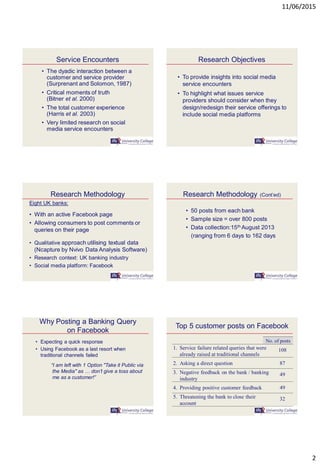
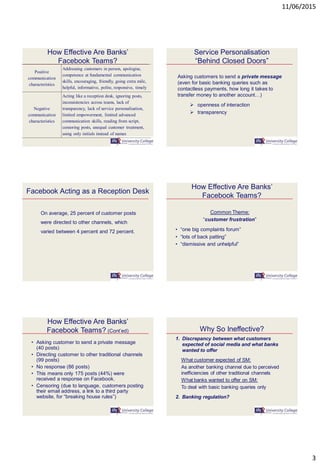
What is Service Design?
idea creation
roadmap
teamwork
blueprint
brainstorming
implementation
What is Service Design? (Cont’ed)
• The concretization of the service
concept in drawings and flowcharts
(Gummesson, 1991)
• The whole service process from idea
creation to implementation
(Zeithaml et al. 1990; Martin and
Horne, 1993)
Why is Service Design Important
for Marketing Academics and Practitioners?
A good service design helps to create a
positive consumer experience
(Mager, 2009; Moritz, 2005)
 Such thinking has resulted in consumer
needs, motivations and behaviour to be
in the centre of service design process.
Service Design Process and Tools
11/06/2015
2
Service Encounters
• The dyadic interaction between a
customer and service provider
(Surprenant and Solomon, 1987)
• Critical moments of truth
(Bitner et al. 2000)
• The total customer experience
(Harris et al. 2003)
• Very limited research on social
media service encounters
Research Objectives
• To provide insights into social media
service encounters
• To highlight what issues service
providers should consider when they
design/redesign their service offerings to
include social media platforms
Research Methodology
• Qualitative approach utilising textual data
(Ncapture by Nvivo Data Analysis Software)
• Research context: UK banking industry
• Social media platform: Facebook
Eight UK banks:
• With an active Facebook page
• Allowing consumers to post comments or
queries on their page
Research Methodology (Cont’ed)
• 50 posts from each bank
• Sample size = over 800 posts
• Data collection:15th August 2013
(ranging from 6 days to 162 days
Why Posting a Banking Query
on Facebook
• Expecting a quick response
• Using Facebook as a last resort when
traditional channels failed
“I am left with 1 Option "Take it Public via
the Media" as … don’t give a toss about
me as a customer!”
Top 5 customer posts on Facebook
No. of posts
1. Service failure related queries that were
already raised at traditional channels
108
2. Asking a direct question 87
3. Negative feedback on the bank / banking
industry
49
4. Providing positive customer feedback 49
5. Threatening the bank to close their
account
32
11/06/2015
3
How Effective Are Banks’
Facebook Teams?
Positive
communication
characteristics
Addressing customers in person, apologise,
competence at fundamental communication
skills, encouraging, friendly, going extra mile,
helpful, informative, polite, responsive, timely
Negative
communication
characteristics
Acting like a reception desk, ignoring posts,
inconsistencies across teams, lack of
transparency, lack of service personalisation,
limited empowerment, limited advanced
communication skills, reading from script,
censoring posts, unequal customer treatment,
using only initials instead of names
Service Personalisation
“Behind Closed Doors”
Asking customers to send a private message
(even for basic banking queries such as
contactless payments, how long it takes to
transfer money to another account…)
 openness of interaction
 transparency
Facebook Acting as a Reception Desk
On average, 25 percent of customer posts
were directed to other channels, which
varied between 4 percent and 72 percent.
How Effective Are Banks’
Facebook Teams?
Common Theme:
“customer frustration”
• “one big complaints forum”
• “lots of back patting”
• “dismissive and unhelpful”
How Effective Are Banks’
Facebook Teams? (Cont’ed)
• Asking customer to send a private message
(40 posts)
• Directing customer to other traditional channels
(99 posts)
• No response (86 posts)
• This means only 175 posts (44%) were
received a response on Facebook.
• Censoring (due to language, customers posting
their email address, a link to a third party
website, for “breaking house rules”)
Why So Ineffective?
1. Discrepancy between what customers
expected of social media and what banks
wanted to offer
What customer expected of SM:
As another banking channel due to perceived
inefficiencies of other traditional channels
What banks wanted to offer on SM:
To deal with basic banking queries only
2. Banking regulation?
11/06/2015
4
Is It Due To Banking Regulation?
Considerable differences across banks:
• whether to answer a query or not
• whether to answer openly on Facebook or via PM
• whether to direct the customer to other channels
Considerable differences within banks:
Depending on who was working on a particular shift,
some customers received a faster and more
empathetic response than others, and some even
received privileged treatment, which was seen as
part of “social media lottery”.
Conclusions
• Apart from banking regulation, a bank’s own
social media policies and the training &
empowerment of its social media team are
likely to impact on its interactions with
customers with potential to either facilitate or
threaten the development of customer
relationships.
• it does not look that banks designed their
social media channel by putting their
customers in the centre of their planning
which appears to be a main weakness of
social media service encounters.
References
1. Ballantyne, D., Christopher, M. and Payne, A. (1995). Improving the quality of services
marketing: Service (re)design is the critical link. Journal of Marketing Management.11(1-3),
p7-24.
2. Bitner, M. J., Brown, S. W. and Meuter, M. L. (2000). "Technology infusion in service
encounters." Journal of the Academy of Marketing Science 28(1): 138-149.
3. Gummesson, E. (1991). Qualitative methods in managementresearch. Newbury, CA.:
Sage.
4. Harris, R., Harris, K. and Baron, S. (2003). "Theatrical service experiences: Dramatic script
development with employees." International Journal of Service Industry Management 14(2):
184-199.
5. Mager, B. (2009). Service design as an emerging field In: Miettinen, S. and Kivisto, M. (eds)
Designing services with innovative methods.Helsinki: Helsinki University of Art and Design.
6. Martin, C. R. and Horne, D. A. (1993). Service innovations: Successful versus unsuccessful
firms. . International Journal of Service Industry Management(4), p49–65.
7. Moritz, S. (2005). Service design:Practical access to an evolving field.Cologne: Koln
International School of Design.
8. Surprenant, C. F. and Solomon, M. R. (1987). "Predictability and Personalization in the
Service Encounter." Journal of Marketing 51(2): 86-96.Zeithaml, V. A., Berry, L. L. and
Parasuraman, A. (1990). Delivering quality service:Balancing customerperceptions and
expectations New York: Free Press.
Thank you
Dr. Nurdilek Dalziel
ifs University College | Institute of Financial Services
E: ndalziel@edu.ifslearning.ac.uk
W: www.ifslearning.ac.uk | www.iofs.org.uk
www.ifslearning.ac.uk

ICDBM_2014_presentation_Nurdilek_Dalziel_LinkedIn_version

  • 1.
    11/06/2015 1 www.ifslearning.ac.uk Expanding the Boundariesof Service Design Research: Social Media Service Encounters Dr. Nurdilek Dalziel ICDBM 2014 Research Objectives • To provide insights into social media service encounters • To highlight what issues service providers should consider when they design/redesign their service offerings to include social media platforms What is Service Design? idea creation roadmap teamwork blueprint brainstorming implementation What is Service Design? (Cont’ed) • The concretization of the service concept in drawings and flowcharts (Gummesson, 1991) • The whole service process from idea creation to implementation (Zeithaml et al. 1990; Martin and Horne, 1993) Why is Service Design Important for Marketing Academics and Practitioners? A good service design helps to create a positive consumer experience (Mager, 2009; Moritz, 2005)  Such thinking has resulted in consumer needs, motivations and behaviour to be in the centre of service design process. Service Design Process and Tools
  • 2.
    11/06/2015 2 Service Encounters • Thedyadic interaction between a customer and service provider (Surprenant and Solomon, 1987) • Critical moments of truth (Bitner et al. 2000) • The total customer experience (Harris et al. 2003) • Very limited research on social media service encounters Research Objectives • To provide insights into social media service encounters • To highlight what issues service providers should consider when they design/redesign their service offerings to include social media platforms Research Methodology • Qualitative approach utilising textual data (Ncapture by Nvivo Data Analysis Software) • Research context: UK banking industry • Social media platform: Facebook Eight UK banks: • With an active Facebook page • Allowing consumers to post comments or queries on their page Research Methodology (Cont’ed) • 50 posts from each bank • Sample size = over 800 posts • Data collection:15th August 2013 (ranging from 6 days to 162 days Why Posting a Banking Query on Facebook • Expecting a quick response • Using Facebook as a last resort when traditional channels failed “I am left with 1 Option "Take it Public via the Media" as … don’t give a toss about me as a customer!” Top 5 customer posts on Facebook No. of posts 1. Service failure related queries that were already raised at traditional channels 108 2. Asking a direct question 87 3. Negative feedback on the bank / banking industry 49 4. Providing positive customer feedback 49 5. Threatening the bank to close their account 32
  • 3.
    11/06/2015 3 How Effective AreBanks’ Facebook Teams? Positive communication characteristics Addressing customers in person, apologise, competence at fundamental communication skills, encouraging, friendly, going extra mile, helpful, informative, polite, responsive, timely Negative communication characteristics Acting like a reception desk, ignoring posts, inconsistencies across teams, lack of transparency, lack of service personalisation, limited empowerment, limited advanced communication skills, reading from script, censoring posts, unequal customer treatment, using only initials instead of names Service Personalisation “Behind Closed Doors” Asking customers to send a private message (even for basic banking queries such as contactless payments, how long it takes to transfer money to another account…)  openness of interaction  transparency Facebook Acting as a Reception Desk On average, 25 percent of customer posts were directed to other channels, which varied between 4 percent and 72 percent. How Effective Are Banks’ Facebook Teams? Common Theme: “customer frustration” • “one big complaints forum” • “lots of back patting” • “dismissive and unhelpful” How Effective Are Banks’ Facebook Teams? (Cont’ed) • Asking customer to send a private message (40 posts) • Directing customer to other traditional channels (99 posts) • No response (86 posts) • This means only 175 posts (44%) were received a response on Facebook. • Censoring (due to language, customers posting their email address, a link to a third party website, for “breaking house rules”) Why So Ineffective? 1. Discrepancy between what customers expected of social media and what banks wanted to offer What customer expected of SM: As another banking channel due to perceived inefficiencies of other traditional channels What banks wanted to offer on SM: To deal with basic banking queries only 2. Banking regulation?
  • 4.
    11/06/2015 4 Is It DueTo Banking Regulation? Considerable differences across banks: • whether to answer a query or not • whether to answer openly on Facebook or via PM • whether to direct the customer to other channels Considerable differences within banks: Depending on who was working on a particular shift, some customers received a faster and more empathetic response than others, and some even received privileged treatment, which was seen as part of “social media lottery”. Conclusions • Apart from banking regulation, a bank’s own social media policies and the training & empowerment of its social media team are likely to impact on its interactions with customers with potential to either facilitate or threaten the development of customer relationships. • it does not look that banks designed their social media channel by putting their customers in the centre of their planning which appears to be a main weakness of social media service encounters. References 1. Ballantyne, D., Christopher, M. and Payne, A. (1995). Improving the quality of services marketing: Service (re)design is the critical link. Journal of Marketing Management.11(1-3), p7-24. 2. Bitner, M. J., Brown, S. W. and Meuter, M. L. (2000). "Technology infusion in service encounters." Journal of the Academy of Marketing Science 28(1): 138-149. 3. Gummesson, E. (1991). Qualitative methods in managementresearch. Newbury, CA.: Sage. 4. Harris, R., Harris, K. and Baron, S. (2003). "Theatrical service experiences: Dramatic script development with employees." International Journal of Service Industry Management 14(2): 184-199. 5. Mager, B. (2009). Service design as an emerging field In: Miettinen, S. and Kivisto, M. (eds) Designing services with innovative methods.Helsinki: Helsinki University of Art and Design. 6. Martin, C. R. and Horne, D. A. (1993). Service innovations: Successful versus unsuccessful firms. . International Journal of Service Industry Management(4), p49–65. 7. Moritz, S. (2005). Service design:Practical access to an evolving field.Cologne: Koln International School of Design. 8. Surprenant, C. F. and Solomon, M. R. (1987). "Predictability and Personalization in the Service Encounter." Journal of Marketing 51(2): 86-96.Zeithaml, V. A., Berry, L. L. and Parasuraman, A. (1990). Delivering quality service:Balancing customerperceptions and expectations New York: Free Press. Thank you Dr. Nurdilek Dalziel ifs University College | Institute of Financial Services E: ndalziel@edu.ifslearning.ac.uk W: www.ifslearning.ac.uk | www.iofs.org.uk www.ifslearning.ac.uk