1
The ICD-10 Classification of Mental and Behavioural Disorders
Clinical descriptions and diagnostic guidelines
World Health Organization
In the early 1960s, the Mental Health Programme of the World Health
Organization (WHO) became actively engaged in a programme aiming to improve
the diagnosis and classification of mental disorders. At that time, WHO convened
a series of meetings to review knowledge, actively involving representatives of
different disciplines, various schools of thought in psychiatry, and all parts of the
world in the programme. It stimulated and conducted research on criteria for
classification and for reliability of diagnosis, and produced and promulgated
procedures for joint rating of videotaped interviews and other useful research
methods. Numerous proposals to improve the classification of mental disorders
resulted from the extensive consultation process, and these were used in drafting
the Eighth Revision of the International Classification of Diseases (ICD-8). A
glossary defining each category of mental disorder in ICD-8 was also developed.
The programme activities also resulted in the establishment of a network of
individuals and centres who continued to work on issues related to the
improvement of psychiatric classification (1, 2).
The 1970s saw further growth of interest in improving psychiatric classification
worldwide. Expansion of international contacts, the undertaking of several
international collaborative studies, and the availability of new treatments all
contributed to this trend. Several national psychiatric bodies encouraged the
development of specific criteria for classification in order to improve diagnostic
reliability. In particular, the American Psychiatric Association developed and
promulgated its Third Revision of the Diagnostic and Statistical Manual, which
incorporated operational criteria into its classification system. In 1978, WHO
entered into a long-term collaborative project with the Alcohol, Drug Abuse and
Mental Health Administration (ADAMHA) in the USA, aiming to facilitate further
improvements in the classification and diagnosis of mental disorders, and alcohol-
and drug-related problems (3). A series of workshops brought together scientists
from a number of different psychiatric traditions and cultures, reviewed
2
knowledge in specified areas, and developed recommendations for future
research. A major international conference on classification and diagnosis was
held in Copenhagen, Denmark, in 1982 to review the recommendations that
emerged from these workshops and to outline a research agenda and guidelines
for future work (4).
Several major research efforts were undertaken to implement the
recommendations of the Copenhagen conference. One of them, involving centres
in 17 countries, had as its aim the development of the Composite International
Diagnostic Interview, an instrument suitable for conducting epidemiological
studies of mental disorders in general population groups in different countries (5).
Another major project focused on developing an assessment instrument suitable
for use by clinicians (Schedules for Clinical Assessment in Neuropsychiatry) (6).
Still another study was initiated to develop an instrument for the assessment of
personality disorders in different countries (the InternationalPersonality Disorder
Examination) (7).
In addition, several lexicons have been, or are being, prepared to provide clear
definitions of terms (8). A mutually beneficial relationship evolved between these
projects and the work on definitions of mental and behavioural disorders in the
Tenth Revision of the International Classification of Diseases and Related Health
Problems
(ICD-10) (9). Converting diagnostic criteria into diagnostic algorithms
incorporated in the assessment instruments was useful in uncovering
inconsistencies, ambiguities and overlap and allowing their removal. The work on
refining the ICD-10 also helped to shape the assessment instruments. The final
result was a clear set of criteria for ICD-10 and assessment instruments which can
produce data necessary for the classification of disorders according to the criteria
included in Chapter V(F) of ICD-10. The Copenhagen conference also
recommended that the viewpoints of the different psychiatric traditions be
presented in publications describing the origins of the classification in the ICD-10.
This resulted in several major publications, including a volume that contains a
series of presentations highlighting the origins of classification in contemporary
3
psychiatry (10). The preparation and publication of this work, Clinical
descriptions and diagnostic guidelines, are the culmination of the efforts of
numerous people who have contributed to it over many years. Thework has gone
through several major drafts, each prepared after extensive consultation with
panels of experts, national and international psychiatric societies, and individual
consultants. The draft in use in 1987 was the basis of field trials conducted in
some 40 countries, which constituted the largest ever research effort of this type
designed to improve psychiatric diagnosis (11, 12). The results of the trials were
used in finalizing these guidelines.
This work is the first of a series of publications developed from Chapter V(F) of
ICD-10. Other texts will include diagnostic criteria for researchers, a version for
use by general health care workers, a multiaxial presentation, and "crosswalks" -
allowing cross- referencebetween corresponding terms in ICD-10, ICD-9 and ICD-
8.
Use of this publication is described in the Introduction, and a subsequent section
of the book provides notes on some of the frequently discussed difficulties of
classification. The Acknowledgements section is of particular significance since it
bears witness to the vast number of individual experts and institutions, all over
the world, who actively participated in the production of the classification and the
guidelines. All the major traditions and schools of psychiatry are represented,
which gives this work its uniquely international character. The classification and
the guidelines were produced and tested in many languages; it is hoped that the
arduous process of ensuring equivalence of translations has resulted in
improvements in the clarity, simplicity and logical structure of the texts in English
and in other languages. A classification is a way of seeing the world at a point in
time. There is no doubt that scientific progress and experience with the use of
these guidelines will ultimately require their revision and updating. I hope that
such revisions will be the product of the same cordial and productive worldwide
scientific collaboration as that which has produced the current text. Norman
Sartorius Director, Division of Mental Health World Health Organization
References
4
1.Kramer, M. et al. The ICD-9 classification of mental disorders: a review of its
developments and contents. Acta psychiatrica scandinavica, 59:241-262 (1979).
2.Sartorius, N. Classification: an international perspective. Psychiatric annals, 6:
22-35 (1976). 3.Jablensky, A. et al. Diagnosis and classification of mental
disorders and alcohol- and drug-related problems: a research agenda for the
1980s. Psychological medicine, 13:907-921 (1983). 4.Mental disorders, alcohol-
and drug-related problems: international perspectives on their diagnosis and
classification. Amsterdam, Excerpta Medica, 1985 (International Congress Series,
No. 669). 5.Robins, L. et al. The composite international diagnostic interview.
Archives of general psychiatry, 45: 1069-1077 (1989). 6.Wing, J.K. et al. SCAN:
schedules for clinical assessment in neuropsychiatry. Archives of general
psychiatry, 47: 589-593 (1990). 7.Loranger, A.W. et al. The WHO/ADAMHA
international pilot study of personality disorders: background and purpose.
Journal of personality disorders, 5(3): 296-306 (1991). 8.Lexicon of psychiatric
and mental health terms. Vol. 1. Geneva, World Health Organization, 1989.
9.International Statistical Classification of Diseases and Related Health Problems.
Tenth Revision. Vol. 1: Tabular list, 1992. Vol. 2: Instruction Manual, 1993. Vol. 3:
Index (in press). Geneva, World Health Organization. 10.Sartorius, N. et al. (ed.)
Sources and traditions in classification in psychiatry. Toronto, Hogrefe and Huber,
1990. 11.Sartorius, N. et al. (ed.) Psychiatric classification in an international
perspective. British journal of psychiatry, 152 (Suppl. 1) (1988). 12.Sartorius, N.
et al. Progress towards achieving a common language in psychiatry: results from
the field trials of the clinical guidelines accompanying the WHO Classification of
Mental and BehaviouralDisorders in ICD-10. Archivesof generalpsychiatry, 1993,
50:115-124.
Acknowledgements
Many individuals and organizations have contributed to the production of the
classification of mental and behavioural disorders in ICD-10 and to the
development of the texts that accompany it. The field trials of the ICD-10
5
proposals, for example, involved researchers and clinicians in some 40 countries;
it is clearly impossible to present a complete list of all those who participated in
this effort. What follows is a mention of individuals and agencies whose
contributions were central to the creation of the documents composing the ICD-
10 family of classifications and guidelines. The individuals who produced the
initial drafts of the classification and guidelines are included in the list of principal
investigators on pages 312-325: their names are marked by an asterisk. Dr A.
Jablensky, then Senior Medical Officer in the Division of Mental Health of WHO, in
Geneva, coordinated this part of the programme and thus made a major
contribution to the proposals. Once the proposals for the classification were
assembled and circulated for comment to WHO expert panels and many other
individuals, including those listed below, an amended version of the classification
was produced for field tests. These were conducted according to a protocol
produced by WHO staff with the help of Dr J. Burke, Dr J.E. Cooper, and Dr J.
Mezzich and involved a large number of centres, whose work was coordinated by
Field Trial Coordinating Centres (FTCCs). The FTCCs (listed on pages xi-xii) also
undertook the task of producing equivalent translations of the ICD in the
languages used in their countries. Dr N. Sartorius had overall responsibility for
the work on the classification of mental and behavioural disorders in ICD-10 and
for the production of accompanying documents. Throughout the phase of field
testing and subsequently, Dr J.E. Cooper acted as chief consultant to the project
and provided invaluable guidance and help to the WHO coordinating team.
Among the team members were Dr J. van Drimmelen, who has worked with WHO
from the beginning of the process of developing ICD-10 proposals, and Mrs J.
Wilson, who conscientiously and efficiently handled the innumerable
administrative tasks linked to the field tests and other activities related to the
projects. Mr A. L'Hours provided generous support, ensuring compliance between
the ICD-10 development in general and the production of this classification, and
Mr G. Gemert produced the index. A number of other consultants, including in
particular Dr A. Bertelsen, Dr H. Dilling, Dr J. López-Ibor, Dr C. Pull, Dr D. Regier, Dr
M. Rutter and Dr N. Wig, were also closely involved in this work, functioning not
only as heads of FTCCs for the field trials but also providing advice and guidance
about issues in their area of expertise and relevant to the psychiatric traditions of
6
the groups of countries about which they were particularly knowledgeable.
Among the agencies whose help was of vital importance were the Alcohol, Drug
Abuse and Mental Health Administration in the USA, which provided generous
supportto the activities preparatory to the drafting of ICD-10, and which ensured
effective and productive consultation between groups working on ICD-10 and
those working on the fourth revision of the American Psychiatric Association's
Diagnostic and Statistical Manual (DSM-IV) classification; the WHO Advisory
Committee on ICD-10, chaired by Dr E. Strömgren; and the World Psychiatric
Association which, through its President, Dr C. Stefanis, and the special
committee on classification, assembled comments of numerous psychiatrists in its
member associations and gave most valuable advice during both the field trials
and the finalization of the proposals. Other nongovernmental organizations in
official and working relations with WHO, including the World Federation for
Mental Health, the World Association for Psychosocial Rehabilitation, the World
Association of Social Psychiatry, the World Federation of Neurology, and the
International Union of Psychological Societies, helped in many ways, as did the
WHO Collaborating Centres for Research and Training in Mental Health, located in
some 40 countries. Governments of WHO Member States, including in particular
Belgium, Germany, the Netherlands, Spain and the USA, also provided direct
support to the process of developing the classification of mental and behavioural
disorders, both through their designated contributions to WHO and through
contributions and financial support to the centres that participated in this work.
The ICD-10 proposals are thus a product of collaboration, in the true sense of the
word, between very many individuals and agencies in numerous countries. They
were produced in the hope that they will serve as a strong support to the work of
the many who are concerned with caring for the mentally ill and their families,
worldwide. No classification is ever perfect: further improvements and
simplifications should become possible with increases in our knowledge and as
experience with the classification accumulates. The task of collecting and
digesting comments and results of tests of the classification will remain largely on
the shoulders of the centres that collaborated with WHO in the development of
the classification. Their addresses are listed below because it is hoped that they
will continue to be involved in the improvement of the WHO classifications and
7
associated materials in the future and to assist the Organization in this work as
generously as they have so far. Numerous publications have arisen from Field
Trial Centres describing results of their studies in connection with ICD-10. A full
list of these publications and reprints of the articles can be obtained from Division
of Mental Health, World Health Organization, 1211 Geneva 27, Switzerland.
Field Trial Coordinating Centres and Directors Dr A. Bertelsen, Institute of
Psychiatric Demography, Psychiatric Hospital, University of Aarhus, Risskov,
Denmark Dr D. Caetano, Department of Psychiatry, State University of
Campinas, Campinas, Brazil Dr S. Channabasavanna, National Institute of Mental
Health and Neurosciences, Bangalore, India Dr H. Dilling, Psychiatric Clinic of the
Medical School, Lübeck, Germany Dr M. Gelder, Department of Psychiatry,
Oxford University Hospital, Warneford Hospital, Headington, England Dr D.
Kemali, University of Naples, First Faculty of Medicine and Surgery, Institute of
Medical Psychology and Psychiatry, Naples, Italy Dr J.J. López-Ibor Jr, López-Ibor
Clinic, Pierto de Hierro, Madrid, Spain Dr G. Mellsop, The Wellington Clinical
School, Wellington Hospital, Wellington, New Zealand Dr Y. Nakane,
Department of Neuropsychiatry, Nagasaki University, School of Medicine,
Nagasaki, Japan Dr A. Okasha, Department of Psychiatry, Ain-Shams University,
Cairo, Egypt Dr C. Pull, Department of Neuropsychiatry, Centre Hospitalier de
Luxembourg, Luxembourg, Luxembourg Dr D. Regier, Director, Division of
Clinical Research, National Institute of Mental Health, Rockville, MD, USA Dr S.
Tzirkin, All Union Research Centre of Mental Health, Institute of Psychiatry,
Academy of Medical Sciences, Moscow, Russian Federation Dr Xu Tao-Yuan,
Department of Psychiatry, Shanghai Psychiatric Hospital, Shanghai, China
Former directors of field trial centres Dr J.E. Cooper, Department of Psychiatry,
Queen's Medical Centre, Nottingham, England Dr R. Takahashi, Department of
Psychiatry, Tokyo Medical and Dental University, Tokyo, Japan Dr N. Wig,
Regional Adviser for Mental Health, World Health Organization, Regional Office
for the Eastern Mediterranean, Alexandria, Egypt Dr Yang De-sen, Hunan
Medical College, Changsha, Hunan, China
Introduction
8
Chapter V, Mental and behavioural disorders, of ICD-10 is to be available in
severaldifferent versions for differentpurposes. This version, Clinical descriptions
and diagnostic guidelines, is intended for general clinical, educational and service
use. Diagnostic criteria for research has been produced for research purposes and
is designed to be used in conjunction with this book. The much shorter glossary
provided by Chapter V(F) for ICD-10 itself is suitable for use by coders or clerical
workers, and also serves as a reference point for compatibility with other
classifications; it is not recommended for use by mental health professionals.
Shorter and simpler versions of the classifications for use by primary health care
workers are now in preparation, as is a multiaxial scheme. Clinical descriptions
and diagnostic guidelines has been the starting point for the development of the
different versions, and the utmost care has been taken to avoid problems of
incompatibility between them.
Layout
It is important that users study this general introduction, and also read carefully
the additional introductory and explanatory texts at the beginning of several of
the individual categories. This is particularly important for F23.-(Acute and
transient psychotic disorders), and for the block F30-F39 (Mood [affective]
disorders). Because of the long-standing and notoriously difficult problems
associated with the description and classification of these disorders, special care
has been taken to explain how the classification has been approached.
For each disorder, a description is provided of the main clinical features, and also
of any important but less specific associated features. "Diagnostic guidelines" are
then provided in most cases, indicating the number and balance of symptoms
usually required before a confident diagnosis can be made. The guidelines are
worded so that a degree of flexibility is retained for diagnostic decisions in clinical
work, particularly in the situation where provisional diagnosis may have to be
made before the clinical picture is entirely clear or information is complete. To
avoid repetition, clinical descriptions and some general diagnostic guidelines are
provided for certain groups of disorders, in addition to those that relate only to
individual disorders.
9
When the requirements laid down in the diagnostic guidelines are clearly fulfilled,
the diagnosis can be regarded as "confident". When the requirements are only
partially fulfilled, it is nevertheless usefulto record a diagnosis for most purposes.
It is then for the diagnostician and other users of the diagnostic statements to
decide whether to record the lesser degrees of confidence (such as "provisional"
if more information is yet to come, or "tentative" if more information is unlikely
to become available) that are implied in these circumstances. Statements about
the duration of symptoms are also intended as general guidelines rather than
strict requirements; clinicians should use their own judgement about the
appropriateness of choosing diagnoses when the duration of particular symptoms
is slightly longer or shorter than that specified.
The diagnostic guidelines should also provide a useful stimulus for clinical
teaching, since they serve as a reminder about points of clinical practice that can
be found in a fuller form in most textbooks of psychiatry. They may also be
suitable for some types of research projects, where the greater precision (and
therefore restriction) of the diagnostic criteria for research are not required.
These descriptions and guidelines carry no theoretical implications, and they do
not pretend to be comprehensive statements about the current state of
knowledge of the disorders. They are simply a set of symptoms and comments
that have been agreed, by a large number of advisors and consultants in many
different countries, to be a reasonable basis for defining the limits of categories in
the classification of mental disorders.
Principal differences between Chapter V(F) of ICD-10 and Chapter V of ICD-9
General principles of ICD-10
ICD-10 is much larger than ICD-9. Numeric codes (001-999) were used in ICD-9,
whereas an alphanumeric coding scheme, based on codes with a single letter
followed by two numbers at the three-character level (A00-Z99), has been
adopted in ICD-10. This has significantly enlarged the number of categories
available for the classification. Further detail is then provided by means of
decimal numeric subdivisions at the four-character level.
10
The chapter that dealt with mental disorders in ICD-9 had only 30 three-character
categories (290-319); Chapter V(F) of ICD-10 has 100 such categories. A
proportion of these categories has been left unused for the time being, so as to
allow the introduction of changes into the classification without the need to
redesign the entire system.
ICD-10 as a whole is designed to be a central ("core") classification for a family of
disease- and health-related classifications. Some members of the family of
classifications are derived by using a fifth or even sixth character to specify more
detail. In others, the categories are condensed to give broad groups suitable for
use, for instance, in primary health care or general medical practice. There is a
multiaxial presentation of Chapter V(F) of ICD-10 and a version for child
psychiatric practice and research. The "family" also includes classifications that
cover information not contained in the ICD, but having important medical or
health implications, e.g. the classification of impairments, disabilities and
handicaps, the classification of procedures in medicine, and the classification of
reasons for encounter between patients and health workers.
Neurosis and psychosis
The traditional division between neurosis and psychosis that was evident in ICD-9
(although deliberately left without any attempt to define these concepts) has not
been used in ICD-10. However, the term "neurotic" is still retained for occasional
use and occurs, for instance, in the heading of a major group (or block) of
disorders F40-F48, "Neurotic, stress-related and somatoform disorders". Except
for depressiveneurosis, mostof the disorders regarded as neuroses by those who
use the concept are to be found in this block,and the remainder are in the
subsequent blocks. Instead of following the neurotic-psychotic dichotomy, the
disorders are now arranged in groups according to major common themes or
descriptive likenesses, which makes for increased convenience of use. For
instance, cyclothymia (F34.0) is in the block F30-F39, Mood [affective] disorders,
rather than in F60-F69, Disorders of adult personality and behaviour; similarly, all
disorders associated with the use of psychoactive substances are grouped
together in F10-F19, regardless of their severity.
11
"Psychotic" has been retained as a convenient descriptive term, particularly in
F23, Acute and transient psychotic disorders. Its usedoes notinvolve assumptions
about psychodynamic mechanisms, but simply indicates the presence of
hallucinations, delusions, or a limited number of severe abnormalities of
behaviour, such as gross excitement and overactivity, marked psychomotor
retardation, and catatonic behaviour.
Other differences between ICD-9 and ICD-10
All disorders attributable to an organic cause are grouped together in the block
F00-F09, which makes the use of this part of the classification easier than the
arrangement in the ICD-9.
The new arrangement of mental and behavioural disorders due to psychoactive
substance use in the block F10-F19 has also been found more useful than the
earlier system. The third character indicates the substance used, the fourth and
fifth characters the psychopathological syndrome, e.g. from acute intoxication
and residual states; this allows the reporting of all disorders related to a
substance even when only three-character categories are used.
The block that covers schizophrenia, schizotypal states and delusional disorders
(F20-F29) has been expanded by the introduction of new categories such as
undifferentiated schizophrenia, postschizophrenic depression, and schizotypal
disorder. The classification of acute short-lived psychoses, which are commonly
seen in most developing countries, is considerably expanded compared with that
in the ICD-9.
Classification of affective disorders has been particularly influenced by the
adoption of the principle of grouping together disorders with a common theme.
Terms such as "neurotic depression" and "endogenous depression" are not used,
but their close equivalents can be found in the different types and severities of
depression now specified (including dysthymia (F34.1)).
-11-
12
The behavioural syndromes and mental disorders associated with physiological
dysfunction and hormonal changes, such as eating disorders, nonorganic sleep
disorders, and sexual dysfunctions, have been brought together in F50-F59 and
described in greater detail than in ICD-9, because of the growing needs for such a
classification in liaison psychiatry.
Block F60-F69 contains a number of new disorders of adult behaviour such as
pathological gambling, fire-setting, and stealing, as well as the more traditional
disorders of personality. Disorders of sexual preference are clearly differentiated
from disorders of gender identity, and homosexuality in itself is no longer
included as a category.
Some further comments about changes between the provisions for the coding of
disorders specific to childhood and mental retardation can be found on pages 18-
20.
Problems of terminology
Disorder
The term "disorder" is used throughout the classification, so as to avoid even
greater problems inherent in the use of terms such as "disease" and "illness".
"Disorder" is not an exact term, but it is used here to imply the existence of a
clinically recognizableset of symptoms or behaviour associated in mostcases with
distress and with interference with personal functions. Social deviance or conflict
alone, without personaldysfunction, should not be included in mental disorder as
defined here.
Psychogenic and psychosomatic
The term "psychogenic" has not been used in the titles of categories, in view of its
different meanings in different languages and psychiatric traditions. It still occurs
occasionally in the text, and should be taken to indicate that the diagnostician
regards obvious life events or difficulties as playing an important role in the
genesis of the disorder.
13
"Psychosomatic" is not used for similar reasons and also because use of this term
might be taken to imply that psychological factors play no role in the occurrence,
course and outcome of other diseases that are not so described. Disorders
described as psychosomatic in other classifications can be found here in F45.-
(somatoform disorders), F50.- (eating disorders), F52.- (sexual dysfunction), and
F54.- (psychological or behavioural factors associated with disorders or diseases
classified elsewhere). It is particularly important to note category F54.- (category
316 in ICD-9) and to remember to use it for specifying the association of physical
disorders, coded elsewhere in ICD-10, with an emotional causation. A common
example would be the recording of psychogenic asthma or eczema by means of
both F54 from Chapter V(F) and the appropriate code for the physical condition
from other chapters in ICD-10.
Impairment, disability, handicap and related terms
-12-
The terms "impairment", "disability" and "handicap" are used according to the
recommendations of the system adopted by WHO.1 Occasionally, where justified
by clinical tradition, the terms are used in a broader sense. See also pages 8 and 9
regarding dementia and its relationships with impairment, disability and
handicap.
Some specific points for users
Children and adolescents
Blocks F80-F89 (disorders of psychological development) and F90-F98
(behavioural and emotional disorders with onset usually occurring in childhood
and adolescence) cover only those disorders that are specific to childhood and
adolescence. A number of disorders placed in other categories can occur in
persons of almost any age, and should be used for children and adolescents when
required. Examples are disorders of eating (F50.-), sleeping (F51.-) and gender
identity (F64.-). Some types of phobia occurring in children pose special problems
14
for classification, as noted in the description of F93.1 (phobic anxiety disorder of
childhood).
Recording more than one diagnosis
It is recommended that clinicians should follow the general rule of recording as
many diagnoses as are necessary to cover the clinical picture. When recording
more than one diagnosis, it is usually best to give one precedence over the others
by specifying it as the main diagnosis, and to label any others as subsidiary or
additional diagnoses. Precedence should be given to that diagnosis most relevant
to the purpose for which the diagnoses are being collected; in clinical work this is
often the disorder that gave rise to the consultation or contact with health
services. In many cases it will be the disorder that necessitates admission to an
inpatient, outpatient or day-care service. At other times, for example when
reviewing the patient's whole career, the most important diagnosis may well be
the "life-time" diagnosis, which could be different from the one most relevant to
the immediate consultation (for instance a patient with chronic schizophrenia
presenting for an episode of care because of symptoms of acute anxiety). If there
is any doubt about the order in which to record several diagnoses, or the
diagnostician is uncertain of the purpose for which information will be used, a
useful rule is to record the diagnoses in the numerical order in which they appear
in the classification.
Recording diagnoses from other chapters of ICD-10
The use of other chapters of the ICD-10 system in addition to Chapter V(F) is
strongly recommended. The categories most relevant to mental health services
are listed in the Annex to this book. 1International
classification of impairments, disabilities and handicaps. Geneva, World Health
Organization, 1980.
-13-
15
Notes on selected categories in the classification of mental and behavioural
disorders in ICD-10
In the course of preparation of the ICD-10 chapter on mental disorder, certain
categories attracted considerable interest and debate before a reasonable level of
consensus could be achieved among all concerned. Brief notes are presented here
on some of the issues that were raised.
Dementia (F01-F03) and its relationships with impairment, disability and
handicap Although a decline in cognitive abilities is essential for the diagnosis of
dementia, no consequent interference with the performance of social roles,
either within the family or with regard to employment, is used as a diagnostic
guideline or criterion. This is a particular instance of a general principle that
applies to the definitions of all the disorders in Chapter V(F) of ICD-10, adopted
because of the wide variations between different cultures, religions, and
nationalities in terms of work and social roles that are available, or regarded as
appropriate. Nevertheless, once a diagnosis has been made using other
information, the extent to which an individual's work, family, or leisure activities
are hindered or even prevented is often a useful indicator of the severity of a
disorder. This is an opportune moment to refer to the general issue of the
relationships between symptoms, diagnostic criteria, and the system adopted by
WHO for describing impairment, disability, and handicap.2 In terms of this
system, impairment (i.e. a "loss or abnormality... of structure or function") is
manifest psychologically by interference with mental functions such as memory,
attention, and emotive functions. Many types of psychological impairment have
always been recognized as psychiatric symptoms. To a lesser degree, some types
of disability (defined in the WHO system as "a restriction or lack... of ability to
perform an activity in the manner or within the range considered normal for a
human being") have also conventionally been regarded as psychiatric symptoms.
Examples of disability at the personal level include the ordinary, and usually
necessary, activities of daily life involved in personal care and survival related to
washing, dressing, eating, and excretion. Interference with these activities is often
a direct consequence of psychological impairment, and is influenced little, if at all,
by culture. Personal disabilities can therefore legitimately appear among
16
diagnostic guidelines and criteria, particularly for dementia. In contrast, a
handicap ("the disadvantage for an individual... that prevents or limits the
performance of a role that is normal...for that individual") represents the effects
of impairments or disabilities in a wide social context that may be heavily
influenced by culture. Handicaps should therefore not be used as essential
components of a diagnosis.
2International classification of impairments,
disabilities and handicaps. Geneva, World Health Organization, 1980.
-14-
Duration of symptoms required for schizophrenia (F20.-) Prodromal states
Before the appearance of typical schizophrenic symptoms, there is sometimes a
period of weeks or months - particularly in young people - during which a
prodromeof nonspecific symptoms appears (such as loss of interest, avoiding the
company of others, staying away from work, being irritable and oversensitive).
These symptoms are not diagnostic of any particular disorder, but neither are
they typical of the healthy state of the individual. They are often just as
distressing to the family and as incapacitating to the patient as the more clearly
morbid symptoms, such as delusions and hallucinations, which develop later.
Viewed retrospectively, such prodromal states seem to be an important part of
the development of the disorder, but little systematic information is available as
to whether similar prodromes are common in other psychiatric disorders, or
whether similar states appear and disappear from time to time in individuals who
never develop any diagnosablepsychiatric disorder. If a prodrome typical of and
specific to schizophrenia could be identified, described reliably, and shown to be
uncommon in those with other psychiatric disorders and those with no disorders
at all, it would be justifiable to include a prodrome among the optional criteria for
schizophrenia. For the purposes of ICD-10, it was considered that insufficient
information is available on these points at present to justify the inclusion of a
17
prodromal state as a contributor to this diagnosis. An additional, closely related,
and still unsolved problem is the extent to which such prodromes can be
distinguished from schizoid and paranoid personality disorders.
Separation of acute and transient psychotic disorders (F23.-) from schizophrenia
(F20.-) In ICD-10, the diagnosis of schizophrenia depends upon the presence of
typical delusions, hallucinations or other symptoms (described on pages 86-89),
and a minimum duration of 1 month is specified. Strong clinical traditions in
several countries, based on descriptive though not epidemiological studies,
contribute towards the conclusion that, whatever the nature of the dementia
praecox of Kraepelin and the schizophrenias of Bleuler, it, or they, are not the
same as very acute psychoses that have an abrupt onset, a short course of a few
weeks or even days, and a favourable outcome. Terms such as "bouffée
délirante", "psychogenic psychosis", "schizophreniform psychosis", "cycloid
psychosis" and "brief reactive psychosis" indicate the widespread but diverse
opinion and traditions that havedeveloped. Opinions and evidence also vary as to
whether transient but typical schizophrenic symptoms may occur with these
disorders, and whether they are usually or always associated with acute
psychological stress (bouffée délirante, at least, was originally described as not
usually associated with an obvious psychological precipitant).
-15-
Given the present lack of knowledge about both schizophrenia and these more
acute disorders, it was considered that the best option for ICD-10 would be to
allow sufficient time for the symptoms of the acute disorders to appear, be
recognized, and largely subside, before a diagnosis of schizophrenia was made.
Most clinical reports and authorities suggest that, in the large majority of patients
with these acute psychoses,onsetof psychotic symptoms occurs over a few days,
or over 1-2 weeks at most, and that many patients recover with or without
medication within 2-3 weeks. It therefore seems appropriate to specify 1 month
as the transition point between the acute disorders in which symptoms of the
schizophrenic type have been a feature and schizophrenia itself. For patients with
18
psychotic, but non-schizophrenic, symptoms that persist beyond the 1-month
point, there is no need to change the diagnosis until the duration requirement of
delusional disorder (F22.0) is reached (3 months, as discussed below). A similar
duration suggests itself when acute symptomatic psychoses (amphetamine
psychosis is the best example) are considered. Withdrawal of the toxic agent is
usually followed by disappearance of the symptoms over 8-10 days, but since it
often takes 7-10 days for the symptoms to become manifest and troublesome
(and for the patient to present to the psychiatric services), the overall duration is
often 20 days or more. About 30 days, or 1 month, would therefore seem an
appropriate time to allow as an overall duration before calling the disorder
schizophrenia, if the typical symptoms persist. To adopt a 1-month duration of
typical psychotic symptoms as a necessary criterion for the diagnosis of
schizophrenia rejects the assumption that schizophrenia must be of
comparatively long duration. A duration of 6 months has been adopted in more
than one national classification, but in the present state of ignorance there
appear to be no advantages in restricting the diagnosis of schizophrenia in this
way. In two large international collaborative studies on schizophrenia and related
disorders3, the second of which was epidemiologically based, a substantial
proportion of patients were found whose clear and typical schizophrenic
symptoms lasted for more than 1 month but less than 6 months, and who made
good, if not complete, recoveries from the disorder. It therefore seems best for
the purposes of ICD-10 to avoid any assumption about necessary chronicity for
schizophrenia, and to regard the term as descriptive of a syndrome with a variety
of causes (many of which are still unknown) and a variety of outcomes, depending
upon the balance of genetic, physical, social, and cultural influences. There has
also been considerable debate about the most appropriate duration of symptoms
to specify as necessary for the diagnosis of persistent delusional disorder (F22.-).
Three months was finally chosen as being the least unsatisfactory, since to delay
3The international pilot study of schizophrenia. Geneva, World Health
Organization, 1973 (Offset Publication, No. 2).
Sartorius, N. et al. Early manifestations and first contact incidence of
schizophrenia in different cultures. A preliminary report on the initial evaluation
19
phase of the WHO Collaborative Study on Determinants of Outcome of Severe
Mental Disorders, Psychological medicine, 16: 909- 928 (1986).
-16-
the decision point to 6 months or more makes it necessary to introduce another
intermediate category between acute and transient psychotic disorders (F23.-)
and persistent delusional disorder. The whole subject of the relationship between
the disorders under discussion awaits more and better information than is at
present available; a comparatively simple solution, which gives precedence to the
acute and transient states, seemed the best option, and perhaps one that will
stimulate research. The principle of describing and classifying a disorder or
group of disorders so as to display options rather than to use built-in
assumptions, has been used for acute and transient psychotic disorders (F23.-);
these and related points are discussed briefly in the introduction to that category
(pages 97-99). The term "schizophreniform" has not been used for a defined
disorder in this classification. This is because it has been applied to several
different clinical concepts over the last few decades, and associated with various
mixtures of characteristics such as acute onset, comparatively brief duration,
atypical symptoms or mixtures of symptoms, and a comparatively good outcome.
There is no evidence to suggesta preferred choice for its usage, so the case for its
inclusion as a diagnostic term was considered to be weak. Moreover, the need for
an intermediate category of this type is obviated by the use of F23.- (acute and
transient psychotic disorders) and its subdivisions, together with the requirement
of 1 month of psychotic symptoms for a diagnosis of schizophrenia. As guidance
for those who do use schizophreniform as a diagnostic term, it has been inserted
in several places as an inclusion term relevant to those disorders that have the
most overlap with the meanings it has acquired. These are: "schizophreniform
attack or psychosis, NOS" in F20.8 (other schizophrenia), and "brief
schizophreniform disorder or psychosis" in F23.2 (acute schizophrenia-like
psychotic disorder).
20
Simple schizophrenia (F20.6) This category has been retained because of its
continued use in some countries, and because of the uncertainty about its nature
and its relationships to schizoid personality disorder and schizotypal disorder,
which will require additional information for resolution. The criteria proposed for
its differentiation highlight the problems of defining the mutual boundaries of this
whole group of disorders in practical terms.
Schizoaffectivedisorders (F25.-) The evidence at present available as to whether
schizoaffectivedisorders (F25.-) as defined in the ICD-10 should be placed in block
F20-F29 (schizophrenia, schizotypaland delusional disorders) or in F30-F39 (mood
[affective] disorders) is fairly evenly balanced. The final decision to place it in F20-
F29 was influenced by feedback from the field trials of the 1987 draft, and by
comments resulting from the worldwide circulation of the same draft to member
societies of the World Psychiatric Association. It is clear that widespread and
strong clinical traditions exist that favour its retention among schizophrenia and
delusional disorders. It is relevant to this discussion that, given a set of affective
symptoms, the addition of only mood-incongruent delusions is not sufficient to
change the diagnosis to a schizoaffective category. At least one typically
schizophrenic
-17-
symptom must be present with the affective symptoms during the same episode
of the disorder.
Mood [affective] disorders (F30-F39) It seems likely that psychiatrists will
continue to disagree about the classification of disorders of mood until methods
of dividing the clinical syndromes are developed that rely at least in part upon
physiological or biochemical measurement, rather than being limited as at
present to clinical descriptions of emotions and behaviour. As long as this
limitation persists, one of the major choices lies between a comparatively simple
classification with only a few degrees of severity, and one with greater details and
more subdivisions. The 1987 draft of ICD-10 used in the field trials had the merit
21
of simplicity, containing, for example, only mild and severe depressive episodes,
no separation of hypomania from mania, and no recommendation to specify the
presence or absence of familiarly clinical concepts, such as the "somatic"
syndrome or affective hallucinations and delusions. However, feedback from
many of the clinicians involved in the field trials, and other comments received
from a variety of sources, indicated a widespread demand for opportunities to
specify several grades of depression and the other features noted above. In
addition, it is clear from the preliminary analysis of field trial data that in many
centres the category of "mild depressive episode" often had a comparatively low
inter-rater reliability. It has also become evident that the views of clinicians on
the required number of subdivisions of depression are strongly influenced by the
types of patient they encounter most frequently. Those working in primary care,
outpatient clinics and liaison settings need ways of describing patients with mild
but clinically significantstates of depression, whereas thosewhose work is mainly
with inpatients frequently need to use the more extreme categories. Further
consultations with experts on affective disorders resulted in the present versions.
Options for specifying several aspects of affective disorders have been included,
which, although still some way from being scientifically respectable, are regarded
by psychiatrists in many parts of the world as clinically useful. It is hoped that
their inclusion will stimulate further discussion and research into their true clinical
value. Unsolved problems remain about how best to define and make diagnostic
use of the incongruence of delusions with mood. There would seem to be both
enough evidence and sufficient clinical demand for the inclusion of provisions for
mood-congruent or mood-incongruent delusions to be included, at least as an
"optional extra".
Recurrent brief depressive disorder Since the introduction of ICD-9, sufficient
evidence has accumulated to justify the provision of a special category for the
brief episodes of depression that meet the severity criteria but not the duration
criteria for depressive episode (F32.-). These recurrent states are of unclear
nosological significance and the provision of a category for their recording
22
-18-
should encourage the collection of information that will lead to a better
understanding of their frequency and long-term course.
Agoraphobia and panic disorder There has been considerable debate recently as
to which of agoraphobia and panic disorder should be regarded as primary. From
an international and cross-cultural perspective, the amount and type of evidence
available does not appear to justify rejection of the still widely accepted notion
that the phobic disorder is best regarded as the prime disorder, with attacks of
panic usually indicating its severity.
Mixed categories of anxiety and depression Psychiatrists and others, especially
in developing countries, who see patients in primary health care services should
find particular use for F41.2 (mixed anxiety and depressivedisorder), F41.3 (other
mixed disorders), the various subdivisions of F43.2 (adjustment disorder), and
F44.7 (mixed dissociative [conversion] disorder). The purpose of these categories
is to facilitate the description of disorders manifest by a mixture of symptoms for
which a simpler and more traditional psychiatric label is not appropriate but
which nevertheless represent significantly common, severe states of distress and
interference with functioning. They also result in frequent referral to primary
care, medical and psychiatric services. Difficulties in using these categories
reliably may be encountered, but it is important to test them and - if necessary -
improve their definition.
Dissociative and somatoform disorders, in relation to hysteria The term
"hysteria" has notbeen used in the title for any disorder in Chapter V(F) of ICD-10
because of its many and varied shades of meaning. Instead, "dissociative" has
been preferred, to bring together disorders previously termed hysteria, of both
dissociative and conversion types. This is largely because patients with the
dissociative and conversion varieties often share a number of other
characteristics, and in addition they frequently exhibit both varieties at the same
or different times. It also seems reasonable to presume that the same (or very
similar) psychological mechanisms are common to both types of symptoms.
There appears to be widespread international acceptance of the usefulness of
23
grouping together several disorders with a predominantly physical or somatic
mode of presentation under the term "somatoform". For the reasons already
given, however, this new concept was not considered to be an adequate reason
for separating amnesias and fugues from dissociative sensory and motor loss. If
multiple personality disorder (F44.81) does exist as something other than a
culture-specific or even iatrogenic condition, then it is presumably best placed
among the dissociative group.
-19-
Neurasthenia Although omitted from some classification systems, neurasthenia
has been retained as a category in ICD-10, since this diagnosis is still regularly and
widely used in a number of countries. Research carried out in various settings has
demonstrated that a significant proportion of cases diagnosed as neurasthenia
can also be classified under depression or anxiety: there are, however, cases in
which the clinical syndrome does not match the description of any other category
but does meet all the criteria specified for a syndromeof neurasthenia. It is hoped
that further research on neurasthenia will be stimulated by its inclusion as a
separate category.
Culture-specific disorders The need for a separate category for disorders such
as latah, amok, koro, and a variety of other possibly culture-specific disorders has
been expressed less often in recent years. Attempts to identify sound descriptive
studies, preferably with an epidemiological basis, that would strengthen the case
for these inclusions as disorders clinically distinguishable from others already in
the classification have failed, so they have not been separately classified.
Descriptions of these disorders currently available in the literature suggest that
they may be regarded as local variants of anxiety, depression, somatoform
disorder, or adjustmentdisorder; the nearest equivalent code should therefore be
used if required, together with an additional note of which culture-specific
disorder is involved. There may also be prominent elements of attention-seeking
behaviour or adoption of the sick role akin to that described in F68.1 (intentional
production or feigning of symptoms or disabilities), which can also be recorded.
24
Mental and behavioural disorders associated with the puerperium (F53.-) This
category is unusual and apparently paradoxical in carrying a recommendation
that it should be used only when unavoidable. Its inclusion is a recognition of the
very real practical problems in many developing countries that make the
gathering of details about many cases of puerperal illness virtually impossible.
However, even in the absence of sufficient information to allow a diagnosis of
some variety of affective disorder (or, more rarely, schizophrenia), there will
usually be enough known to allow diagnosis of a mild (F53.0) or severe (F53.1)
disorder; this subdivision is useful for estimations of workload, and when
decisions are to be made about provision of services. The inclusion of this
category should not be taken to imply that, given adequate information, a
significant proportion of cases of postpartum mental illness cannot be classified in
other categories. Most experts in this field are of the opinion that a clinical picture
of puerperal psychosis is so rarely (if ever) reliably distinguishable from affective
disorder or schizophrenia that a special category is not justified. Any psychiatrist
who is of the minority opinion that special postpartum psychoses do indeed exist
may use this category, but should be aware of its real purpose.
-20-
Disorders of adult personality (F60.-) In all current psychiatric classifications,
disorders of adult personality include a variety of severe problems, whose
solution requires information that can come only from extensive and time-
consuming investigations. The difference between observations and
interpretation becomes particularly troublesome when attempts are made to
write detailed guidelines or diagnostic criteria for these disorders; and the
number of criteria that must be fulfilled before a diagnosis is regarded as
confirmed remains an unsolved problem in the light of present knowledge.
Nevertheless, the attempts that have been made to specify guidelines and criteria
for this category may help to demonstrate that a new approach to the description
of personality disorders is required. After initial hesitation, a brief description of
borderline personality disorder (F60.31) was finally included as a subcategory of
25
emotionally unstable personality disorder (F60.3), again in the hope of stimulating
investigations.
Other disorders of adult personality and behaviour (F68) Two categories that
have been included here but were not present in ICD-9 are F68.0, elaboration of
physicalsymptoms for psychologicalreasons, and F68.1, intentionalproduction or
feigning of symptoms or disabilities, either physical or psychological [factitious
disorder]. Since these are, strictly speaking, disorders of role or illness behaviour,
it should be convenient for psychiatrists to have them grouped with other
disorders of adult behaviour. Together with malingering (Z76.5), which has always
been outside Chapter V of the ICD, the disorders from a trio of diagnoses often
need to be considered together. The crucial difference between the first two and
malingering is that the motivation for malingering is obvious and usually confined
to situations where personal danger, criminal sentencing, or large sums of money
are involved.
Mental retardation (F70-F79) The policy for Chapter V(F) of ICD-10 has always
been to deal with mental retardation as briefly and as simply as possible,
acknowledging that justice can be done to this topic only by means of a
comprehensive, possibly multiaxial, system. Such a system needs to be developed
separately, and work to produce appropriate proposals for international use is
now in progress.
-21-
Disorders with onset specific to childhood F80-F89 Disorders of psychological
development Disorders of childhood such as infantile autism and disintegrative
psychosis, classified in ICD-9 as psychoses, are now more appropriately contained
in F84.-, pervasive developmental disorders. While some uncertainty remains
about their nosological status, it has been considered that sufficient information
is now available to justify the inclusion of the syndromes of Rett and Asperger in
this group as specified disorders. Overactive disorder associated with mental
retardation and stereotyped movements (F84.4) has been included in spite of its
26
mixed nature, because evidence suggests that this may have considerable
practical utility.
F90-F98 Behavioural andemotional disorders with onsetusuallyoccurringinchildhoodand
adolescence Differencesininternational opinionaboutthe broadnessof the conceptof hyperkinetic
disorderhave beenawell-knownproblemformanyyears,andwere discussedindetail atthe meetings
betweenWHOadvisorsandotherexpertsheldunderthe auspicesof the WHO-ADAMHA jointproject.
Hyperkineticdisorderisnowdefinedmore broadlyinICD-10than itwas inICD-9. The ICD-10 definition
isalso differentinthe relativeemphasisgiventothe constituentsymptomsof the overall hyperkinetic
syndrome;since recentempirical researchwasusedasthe basisfor the definition,there are good
reasonsforbelievingthatthe definitioninICD-10representsasignificantimprovement. Hyperkinetic
conduct disorder(F90.1) isone of the few examplesof acombinationcategoryremaininginICD-10,
ChapterV(F).The use of thisdiagnosisindicatesthatthe criteriaforbothhyperkineticdisorder(F90.-)
and conductdisorder(F91.-) are fulfilled.These fewexceptionstothe general rule were considered
justifiedonthe groundsof clinical convenienceinview of the frequentcoexistence of those disorders
and the demonstratedlaterimportanceof the mixedsyndrome.However,itislikelythatThe ICD-10
Classificationof Mental andBehavioural Disorders:Diagnosticcriteriaforresearch(DCR-10) will
recommendthat,forresearchpurposes,individual casesinthese categoriesbe describedintermsof
hyperactivity,emotional disturbance,andseverityof conductdisorder(inadditiontothe combination
categorybeingusedasan overall diagnosis). Oppositionaldefiantdisorder(F91.3) wasnot inICD-9,
but hasbeenincludedinICD-10because of evidenceof itspredictivepotential forlaterconduct
problems.There is,however,acautionarynote recommendingitsuse mainlyforyoungerchildren. The
ICD-9 category313 (disturbancesof emotionspecifictochildhoodandadolescence)hasbeendeveloped
intotwo separate categoriesforICD-10,namelyemotional disorderswithonsetspecifictochildhood
(F93.-) and disordersof social functioningwithonsetspecifictochildhoodandadolescence (F94.-).This
isbecause of the continuingneedfora differentiationbetweenchildrenandadultswithrespectto
variousforms of morbidanxietyandrelatedemotions.The frequencywithwhichemotionaldisordersin
childhoodare followedbynosignificantsimilardisorderinadultlife,andthe frequentonsetof neurotic
disordersinadultsare clearindicatorsof this
-22-
need.The keydefiningcriterionusedinICD-10isthe appropriatenesstothe developmentalstage of the
childof the emotionshown,plusanunusual degree of persistence withdisturbance of function.Inother
words,these childhooddisordersare significantexaggerationsof emotional statesandreactionsthat
are regardedasnormal for the age inquestionwhenoccurringinonlyamildform.If the contentof the
emotional state isunusual,orif itoccurs at an unusual age,the general categorieselsewhere inthe
classificationshouldbe used. Inspite of its name,the new categoryF94.- (disordersof social
functioningwithonsetspecifictochildhoodandadolescence) doesnotgoagainstthe general rule for
ICD-10 of notusinginterferencewithsocial rolesasa diagnosticcriterion.The abnormalitiesof social
27
functioninginvolvedinF94.- are of a limitednumberandcontainedwithinthe parent-childrelationship
and the immediate family;these relationshipsdonothave the same connotationsorshow the same
cultural variationsasthose formedinthe contextof workor of providingforthe family,whichare
excludedfromuse asdiagnosticcriteria. A numberof categoriesthatwill be usedfrequentlybychild
psychiatrists,suchaseatingdisorders(F50.-),nonorganicsleepdisorders(F51.-),andgenderidentity
disorders(F64.-),are tobe foundinthe general sectionsof the classificationsbecauseof theirfrequent
onsetandoccurrence in adultsas well aschildren.Nevertheless,clinical features specifictochildhood
were thoughttojustifythe additional categoriesof feedingdisorderof infancy(F98.2) andpica of
infancyandchildhood(F98.3). Users of blocksF80-F89 and F90-F98 alsoneedto be aware of the
contentsof the neurological chapterof ICD-10(ChapterVI(G)).Thiscontainssyndromeswith
predominantlyphysicalmanifestationsandclear"organic"etiology,of whichthe Kleine-Levinsyndrome
(G47.8) is of particularinteresttochildpsychiatrists.
Unspecifiedmental disorder(F99) There are practical reasonswhya categoryfor the recordingof
"unspecifiedmental disorder"isrequiredinICD-10,butthe subdivisionof the whole of the classificatory
space available forChapterV(F) into10 blocks,eachcoveringaspecificarea,posedaproblemforthis
requirement.Itwasdecidedthatthe leastunsatisfactorysolutionwastouse the last categoryinthe
numerical orderof the classification,i.e.F99. Deletionof categoriesproposedforearlierdrafts of ICD-
10 The processof consultationandreviewsof the literature thatprecededthe draftingof ChapterV(F)
of ICD-10 resultedinnumerousproposalsforchanges.Decisionsonwhethertoacceptor reject
proposalswere influencedbyanumberof factors.These includedthe resultsof the fieldtestsof the
classification,consultationswithheadsof WHOcollaborative centres,resultsof collaborationwith
nongovernmental organizations,advice frommembersof WHOexpertadvisorypanels,resultsof
translationsof the classification,andthe constraintsof the rulesgoverningthe structure of the ICDas a
whole.
-23-
It was normallyeasytorejectproposalsthatwere idiosyncraticandunsupportedbyevidence,andto
accept othersthatwere accompaniedbysoundjustification.Someproposals,althoughreasonable when
consideredinisolation,couldnotbe acceptedbecause of the implicationsthatevenminorchangesto
one part of the classificationwouldhave forotherparts.Some otherproposalshadclearmerit,but
more researchwouldbe necessarybefore theycouldbe consideredforinternationaluse.A numberof
these proposalsincludedinearlyversionsof the general classificationwere omittedfromthe final
version,including"accentuationof personalitytraits"and "hazardoususe of psychoactive substances".
It ishopedthat researchintothe statusand usefulnessof these andotherinnovativecategorieswill
continue.
28
-24-
List of categories
F00-F09 Organic,includingsymptomatic,mentaldisorders
F00 DementiainAlzheimer'sdisease F00.0DementiainAlzheimer'sdiseasewithearlyonset
F00.1DementiainAlzheimer'sdisease withlate onsetF00.2DementiainAlzheimer'sdisease,atypical or
mixedtype F00.9DementiainAlzheimer'sdisease,unspecified
F01VasculardementiaF01.0Vasculardementiaof acute onsetF01.1Multi-infarctdementia
F01.2Subcortical vasculardementiaF01.3Mixedcortical andsubcortical vasculardementiaF01.8Other
vasculardementiaF01.9Vasculardementia,unspecified
F02Dementiainotherdiseasesclassifiedelsewhere F02.0DementiainPick'sdisease F02.1Dementiain
Creutzfeldt-Jakobdisease F02.2DementiainHuntington'sdisease F02.3DementiainParkinson'sdisease
F02.4Dementiainhumanimmunodeficiencyvirus[HIV] diseaseF02.8Dementiainotherspecified
diseasesclassifiedelsewhere
F03Unspecifieddementia
A fifthcharactermay be addedto specifydementiainF00-F03,as follows:
.x0 Withoutadditional symptoms.x1Othersymptoms,predominantlydelusional .x2Othersymptoms,
predominantlyhallucinatory.x3Othersymptoms,predominantlydepressive .x4Othermixedsymptoms
F04Organic amnesicsyndrome,notinducedbyalcohol andothersubstances
F05Delirium,notinducedbyalcohol andotherpsychoactive substancesF05.0Delirium, not
superimposedondementia,sodescribedF05.1Delirium, superimposedondementiaF05.8Other
deliriumF05.9Delirium, unspecified
F06Other mental disordersdue tobraindamage anddysfunctionandtophysical disease F06.0Organic
hallucinosisF06.1Organiccatatonicdisorder
-25-
F06.2Organic delusional[schizophrenia-like]disorderF06.3Organicmood[affective] disorders .30
Organicmanic disorder .31 Organicbipolaraffective disorder .32 Organicdepressive disorder .33
OrganicmixedaffectivedisorderF06.4OrganicanxietydisorderF06.5Organicdissociative disorder
F06.6Organic emotionallylabile [asthenic] disorder F06.7Mildcognitive disorderF06.8Otherspecified
mental disordersdue tobraindamage anddysfunctionandtophysical disease F06.9Unspecifiedmental
disorderdue tobraindamage and dysfunctionandtophysical disease
29
F07Personalityandbehavioural disorderdue tobraindisease,damage anddysfunctionF07.0Organic
personalitydisorderF07.1PostencephaliticsyndromeF07.2Postconcussional syndrome F07.8Other
organicpersonalityandbehavioural disorder due tobraindisease,damage anddysfunction
F09Unspecifiedorganicorsymptomaticmental disorder
-26-
F10--F19 Mental andbehavioural disordersdue to psychoactive substance use
F10.-Mental and behavioural disordersdue touse of alcohol
F11.-Mental and behavioural disordersdue touse of opioids
F12.-Mental and behavioural disordersdue touse of cannabinoids
F13.-Mental and behavioural disordersdue touse of sedativesorhypnotics
F14.-Mental and behavioural disordersdue touse of cocaine
F15.-Mental and behavioural disordersdue touse of otherstimulants,includingcaffeine
F16.-Mental and behavioural disordersdue touse of hallucinoeens
F17.-Mental and behavioural disordersdue touse of tobacco
F18.-Mental and behavioural disordersdue touse of volatile solvents
F19.-Mental and behavioural disordersdue tomultipledruguse anduse of otherpsychoactive
substances
Four- and five-charactercategoriesmaybe usedtospecifythe clinical conditions,asfollows:
F1x.0 Acute intoxication .00 Uncomplicated .01 Withtrauma or otherbodilyinjury .02 Withother
medical complications .03With delirium .04 Withperceptual distortions .05 Withcoma .06 With
convulsions .07Pathological intoxication
F1x.1 Harmful use
F1x.2 Dependence syndrome .20 Currentlyabstinent .21 Currentlyabstinent,butina protected
environment .22 Currentlyona clinicallysupervised maintenance orreplacementregime [controlled
dependence] .23 Currentlyabstinent,butreceivingtreatment withaversive orblockingdrugs .24
Currentlyusingthe substance [active
-27-
30
dependence] .25 Continuoususe .26Episodicuse [dipsomania]
F1x.3 Withdrawal state .30 Uncomplicated .31With convulsions
F1x.4 Withdrawal state withdelirium .40Withoutconvulsions .41With convulsions
F1x.5 Psychoticdisorder .50 Schizophrenia-like .51 Predominantlydelusional .52 Predominantly
hallucinatory .53Predominantlypolymorphic .54 Predominantlydepressive symptoms .55
Predominantlymanicsymptoms .56Mixed
F1x.6 Amnesicsyndrome
F1x.7 Residual andlate-onsetpsychoticdisorder .70 Flashbacks .71 Personalityorbehaviourdisorder
.72 Residual affectivedisorder .73 Dementia .74 Otherpersistingcognitiveimpairment .75 Late-onset
psychoticdisorder
F1x.8 Othermental andbehavioural disorders
F1x.9 Unspecifiedmental andbehavioural disorder
-28-
F20-F29 Schizophrenia, schizotypal anddelusional disorders
F20 Schizophrenia F20.0 Paranoidschizophrenia F20.1 Hebephrenicschizophrenia F20.2 Catatonic
schizophrenia F20.3 Undifferentiatedschizophrenia F20.4 Post-schizophrenicdepression F20.5
Residual schizophrenia F20.6 Simple schizophrenia F20.8Other schizophrenia F20.9 Schizophrenia,
unspecified
A fifthcharactermay be usedto classifycourse:.x0Continuous.x1Episodicwithprogressive deficit.x2
Episodicwithstable deficit.x3Episodicremittent.x4Incomplete remission.x5Complete remission.x6
Other.x9 Course uncertain,periodof observationtooshort
F21 Schizotypal disorder
F22 Persistentdelusionaldisorders F22.0 Delusional disorder F22.8 Otherpersistentdelusional
disorders F22.9 Persistentdelusional disorder,unspecified
F23 Acute and transientpsychoticdisorders F23.0 Acute polymorphicpsychoticdisorderwithout
symptomsof schizophrenia F23.1Acute polymorphicpsychoticdisorderwithsymptomsof
schizophrenia F23.2 Acute schizophrenia-likepsychoticdisorder F23.3 Otheracute predominantly
delusionalpsychoticdisorders F23.8 Otheracute andtransientpsychoticdisorders F23.9Acute and
transientpsychoticdisordersunspecified
31
A fifthcharactermay be usedto identifythe presence orabsence of associatedacute stress:.x0Without
associatedacute stress.x1With associatedacute stress
-29-
F24 Induceddelusional disorder
F25 Schizoaffective disorders F25.0 Schizoaffectivedisorder,manictype F25.1 Schizoaffectivedisorder,
depressivetype F25.2 Schizoaffective disorder,mixedtype F25.8 Otherschizoaffective disorders F25.9
Schizoaffective disorder,unspecified
F28 Othernonorganicpsychoticdisorders
F29 Unspecifiednonorganicpsychosis
-30-
F30-F39 Mood [affective] disorders
Overviewof thisblock F30 Manic episode F30.0Hypomania F30.1 Mania withoutpsychoticsymptoms
F30.2 Mania withpsychoticsymptoms F30.8 Othermanicepisodes F30.9 Manic episode,unspecified
F31 Bipolaraffective disorder F31.0 Bipolaraffective disorder,currentepisode hypomanic F31.1 Bipolar
affective disorder,currentepisodemanicwithoutpsychoticsymptoms F31.2 Bipolaraffective disorder,
currentepisode manicwithpsychoticsymptoms F31.3Bipolaraffectivedisorder,currentepisode mild
or moderate depression .30 Withoutsomaticsyndrome .31 Withsomaticsyndrome F31.4 Bipolar
affective disorder,currentepisodesevere depressionwithoutpsychoticsymptoms F31.5 Bipolar
affective disorder,currentepisodesevere depressionwithpsychoticsymptoms F31.6 Bipolaraffective
disorder,currentepisodemixed F31.7 Bipolaraffectivedisorder,currentlyinremission F31.8Other
bipolaraffectivedisorders F31.9 Bipolaraffectivedisorder,unspecified
F32 Depressiveepisode F32.0 Milddepressive episode .00 Withoutsomaticsyndrome .01 With
somaticsyndrome F32.1 Moderate depressive episode .10 Without somaticsyndrome .11 With
somaticsyndrome F32.2 Severe depressive episode withoutpsychoticsymptoms F32.3 Severe
depressiveepisodewithpsychoticsymptoms F32.8Otherdepressive episodes F32.9 Depressive
episode,unspecified
-31-
F33 Recurrentdepressive disorder F33.0Recurrentdepressivedisorder,currentepisode mild .00
Withoutsomaticsyndrome .01 Withsomaticsyndrome F33.1 Recurrentdepressive disorder,current
32
episode moderate .10 Withoutsomaticsyndrome .11 With somaticsyndrome F33.2 Recurrent
depressivedisorder,currentepisode severewithoutpsychoticsymptoms F33.3 Recurrentdepressive
disorder,currentepisodesevere withpsychoticsymptoms F33.4 Recurrentdepressive disorder,
currentlyinremission F33.8Otherrecurrentdepressivedisorders F33.9 Recurrentdepressive disorder,
unspecified
F34 Persistentmood[affective] disorders F34.0Cyclothymia F34.1 Dysthymia F34.8 Otherpersistent
mood[affective] disorders F34.9Persistent mood[affective] disorder,unspecified F38 Othermood
[affective] disorders F38.0Othersingle mood[affective] disorders .00 Mixedaffectiveepisode F38.1
Otherrecurrentmood[affective] disorders .10 Recurrentbrief depressive disorder F38.8 Other
specifiedmood[affective] disorders
F39 Unspecifiedmood[affective] disorder
-32-
F40-F48 Neurotic,stress-relatedandsomatoformdisorders F40 Phobicanxietydisorders F40.0
Agoraphobia .00 Withoutpanicdisorder .01 Withpanic disorder F40.1 Social phobias F40.2 Specific
(isolated)phobias F40.8 Otherphobicanxietydisorders F40.9 Phobicanxietydisorder,unspecified
F41 Otheranxietydisorders F41.0 Panicdisorder[episodicparoxysmal anxiety] F41.1Generalized
anxietydisorder F41.2 Mixedanxietyanddepressivedisorder F41.3 Othermixedanxietydisorders
F41.8 Otherspecifiedanxietydisorders F41.9 Anxietydisorder,unspecified
F42 Obsessive- compulsive disorder F42.0 Predominantlyobsessionalthoughtsorruminations F42.1
Predominantlycompulsive acts[obsessionalrituals] F42.2 Mixedobsessional thoughtsandacts F42.8
Otherobsessive - compulsivedisorders F42.9 Obsessive - compulsive disorder,unspecified
F43 Reactiontosevere stress,andadjustmentdisorders F43.0Acute stressreaction F43.1 Post-
traumaticstressdisorder F43.2 Adjustmentdisorders .20 Brief depressive reaction .21 Prolonged
depressivereaction .22 Mixedanxietyanddepressive reaction .23 Withpredominantdisturbanceof
otheremotions .24 With predominantdisturbance of conduct .25 With mixeddisturbance of
emotionsandconduct .28 With otherspecifiedpredominantsymptoms F43.8Otherreactionsto
severe stress F43.9 Reactiontosevere stress,unspecified
F44 Dissociative [conversion] disorders F44.0Dissociative amnesia F44.1 Dissociative fugue F44.2
Dissociative stupor F44.3Trance and possessiondisorders F44.4 Dissociative motordisorders
-33-
F44.5 Dissociative convulsions
33
F44.6 Dissociative anaesthesiaandsensoryloss F44.7 Mixeddissociative [conversion] disorders F44.8
Otherdissociative[conversion] disorders .80 Ganser's syndrome .81 Multiple personalitydisorder .82
Transientdissociative [conversion]disordersoccurringinchildhood and adolescence .88 Other
specifieddissociative [conversion]disorders F44.9 Dissociative[conversion] disorder,unspecified
F45 Somatoformdisorders F45.0Somatizationdisorder F45.1Undifferentiatedsomatoformdisorder
F45.2 Hypochondriacal disorder F45.3 Somatoformautonomicdysfunction .30 Heart and
cardiovascularsystem .31 Upper gastrointestinal tract .32 Lowergastrointestinaltract .33
Respiratorysystem .34 Genitourinarysystem .38 Otherorgan or system F45.4 Persistentsomatoform
paindisorder F45.8 Othersomatoformdisorders F45.9Somatoformdisorder,unspecified
F48 Otherneuroticdisorders F48.0 Neurasthenia F48.1 Depersonalization - derealizationsyndrome
F48.8 Otherspecifiedneuroticdisorders F48.9Neuroticdisorder,unspecified
-34-
F50-F59 Behavioural syndromesassociatedwithphysiological disturbancesandphysical factors F50
Eatingdisorders F50.0 Anorexianervosa F50.1 Atypical anorexianervosa F50.2 Bulimianervosa F50.3
Atypical bulimianervosa F50.4 Overeatingassociated withotherpsychological disturbances F50.5
Vomitingassociatedwithotherpsychological disturbances F50.8Othereatingdisorders F50.9 Eating
disorder,unspecified
F51 Nonorganicsleepdisorders F51.0Nonorganicinsomnia F51.1 Nonorganichypersomnia F51.2
Nonorganicdisorderof the sleep-wake schedule F51.3 Sleepwalking[somnambulism] F51.4 Sleep
terrors[nightterrors] F51.5 Nightmares F51.8 Othernonorganicsleepdisorders F51.9 Nonorganic
sleepdisorder,unspecified
F52 Sexual dysfunction,notcausedbyorganicdisorderordisease F52.0 Lack or lossof sexual desire
F52.1 Sexual aversionandlackof sexual enjoyment .10 Sexual aversion .11 Lack of sexual enjoyment
F52.2 Failure of genital response F52.3 Orgasmicdysfunction F52.4Premature ejaculation F52.5
Nonorganicvaginismus F52.6 Nonorganicdyspareunia F52.7 Excessive sexual drive F52.8 Othersexual
dysfunction,notcausedbyorganicdisordersordisease F52.9 Unspecifiedsexual dysfunction,not
causedby organicdisorderordisease F53Mental and behavioural disordersassociatedwiththe
puerperium, notelsewhereclassified F53.0Mild mental andbehavioural disordersassociatedwiththe
puerperium, notelsewhereclassified
-35-
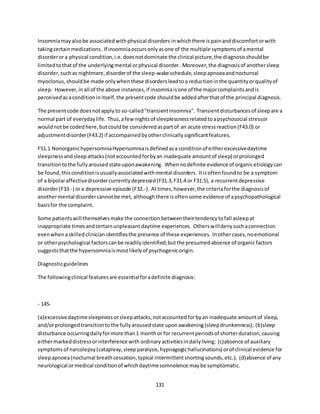
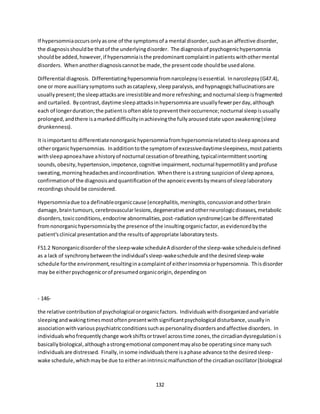
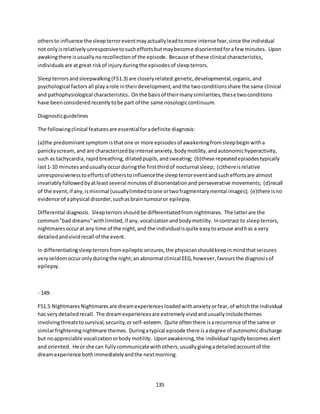
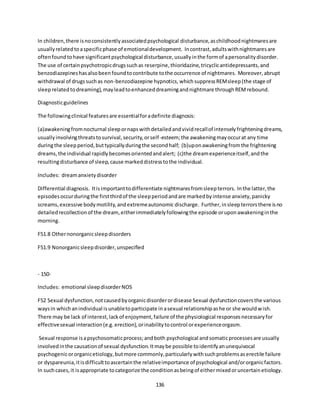
F53.1 Severe mental andbehavioural disordersassociatedwiththe puerperium, notelsewhere
classified F53.8 Othermental andbehavioural disordersassociatedwiththe puerperium, notelsewhere
classified F53.9 Puerperal mental disorder,unspecified
34
F54Psychological andbehavioural factorsassociatedwithdisordersordiseasesclassifiedelsewhere
F55 Abuse of non-dependence-producingsubstances F55.0 Antidepressants F55.1 Laxatives F55.2
Analgesics F55.3 Antacids F55.4 Vitamins F55.5 Steroidsorhormones F55.6 Specificherbal orfolk
remedies F55.8Othersubstancesthatdo not produce dependence F55.9Unspecified
F59Unspecifiedbehavioural syndromesassociatedwithphysiological disturbancesandphysical factors
-36-
F60-F69 Disordersof adultpersonalityandbehaviour
F60 Specificpersonalitydisorders F60.0 Paranoidpersonalitydisorder F60.1 Schizoidpersonality
disorder F60.2 Dissocial personalitydisorder F60.3 Emotionallyunstable personalitydisorder .30
Impulsive type .31 Borderline type F60.4Histrionicpersonalitydisorder F60.5 Anankasticpersonality
disorder F60.6 Anxious[avoidant]personalitydisorder F60.7 Dependentpersonalitydisorder F60.8
Otherspecificpersonalitydisorders F60.9 Personalitydisorder,unspecified
F61 Mixedandotherpersonalitydisorders F61.0 Mixedpersonalitydisorders F61.1Troublesome
personalitychanges
F62 Enduringpersonalitychanges,notattributabletobraindamage anddisease F62.0 Enduring
personalitychange aftercatastrophicexperience F62.1 Enduringpersonalitychange afterpsychiatric
illness F62.8Otherenduringpersonalitychanges F62.9Enduringpersonalitychange,unspecified
F63 Habitand impulse disorders F63.0 Pathological gambling F63.1Pathological fire-setting
[pyromania] F63.2 Pathological stealing[kleptomania] F63.3 Trichotillomania F63.8 Otherhabitand
impulse disorders F63.9Habit and impulse disorder,unspecified
F64 Genderidentitydisorders F64.0 Transsexualism F64.1 Dual-role transvestism F64.2 Gender
identitydisorderof childhood F64.8 Othergenderidentitydisorders F64.9 Genderidentitydisorder,
unspecified
F65 Disordersof sexual preference F65.0 Fetishism F65.1 Fetishistictransvestism F65.2Exhibitionism
F65.3 Voyeurism F65.4Paedophilia
-37-
F65.5 Sadomasochism F65.6 Multiple disordersof sexual preference F65.8Otherdisordersof sexual
preference F65.9Disorderof sexual preference,unspecified
F66 Psychological andbehavioural disordersassociatedwithsexual developmentandorientation F66.0
Sexual maturationdisorder F66.1 Egodystonicsexual orientation F66.2Sexual relationshipdisorder
35
F66.8 Otherpsychosexual developmentdisorders F66.9 Psychosexual developmentdisorder,
unspecified
A fifthcharactermay be usedto indicate associationwith:.x0Heterosexuality.x1Homosexuality.x2
Bisexuality.x8Other,includingprepubertal
F68 Otherdisordersof adultpersonalityandbehaviour F68.0 Elaborationof physical symptomsfor
psychological reasons F68.1 Intentional productionorfeigningof symptomsordisabilities,either
physical orpsychological [factitiousdisorder] F68.8 Otherspecifieddisordersof adultpersonalityand
behaviour
F69 Unspecifieddisorderof adultpersonalityandbehaviour
-38-
F70-F79 Mental retardation
F70 Mildmental retardation
F71 Moderate mental retardation
F72 Severe mental retardation
F73 Profoundmental retardation
F78 Othermental retardation
F79 Unspecifiedmental retardation
A fourthcharacter maybe usedto specifythe extentof associatedbehavioural impairment:
F7x.0 No,or minimal,impairmentof behaviour F7x.1Significantimpairmentof behaviourrequiring
attentionortreatment F7x.8 Otherimpairmentsof behaviour F7x.9Withoutmentionof impairmentof
behaviour
-39-
F80-F89 Disordersof psychological development
F80 Specificdevelopmental disordersof speechandlanguage F80.0 Specificspeecharticulation
disorder F80.1 Expressivelanguage disorder F80.2 Receptive languagedisorder F80.3 Acquiredaphasia
withepilepsy[Landau-Kleffnersyndrome] F80.8 Otherdevelopmentaldisordersof speechandlanguage
F80.9 Developmental disorderof speechandlanguage,unspecified F81 Specificdevelopmental
disordersof scholasticskills F81.0 Specificreadingdisorder F81.1Specificspellingdisorder F81.2
36
Specificdisorderof arithmetical skills F81.3 Mixeddisorderof scholasticskills F81.8 Other
developmental disordersof scholasticskills F81.9 Developmentaldisorderof scholasticskills,
unspecified F82Specificdevelopmental disorderof motorfunction F83 Mixedspecificdevelopmental
disorders
F84 Pervasive developmental disorders F84.0Childhoodautism F84.1 Atypical autism F84.2 Rett's
syndrome F84.3 Otherchildhooddisintegrative disorder F84.4Overactive disorderassociatedwith
mental retardationand stereotypedmovements F84.5 Asperger'ssyndrome F84.8Otherpervasive
developmental disorders F84.9Pervasive developmentaldisorder,unspecified F88Otherdisordersof
psychological development
F89 Unspecifieddisorderof psychological development
-40-
F90-F98 Behavioural andemotionaldisorderswithonsetusuallyoccurringinchildhoodandadolescence
F90 Hyperkineticdisorders F90.0 Disturbance of activityandattention F90.1 Hyperkineticconduct
disorder F90.8 Otherhyperkineticdisorders F90.9 Hyperkineticdisorder,unspecified F91 Conduct
disorders F91.0 Conductdisorderconfinedtothe familycontext F91.1 Unsocializedconductdisorder
F91.2 Socializedconductdisorder F91.3 Oppositionaldefiantdisorder F91.8 Otherconductdisorders
F91.9 Conductdisorder,unspecified F92Mixeddisordersof conductandemotions F92.0 Depressive
conduct disorder F92.8 Othermixeddisordersof conductandemotions F92.9Mixeddisorderof
conduct andemotions,unspecified F93 Emotional disorderswithonsetspecifictochildhood F93.0
Separationanxietydisorderof childhood F93.1Phobicanxietydisorderof childhood F93.2 Social
anxietydisorderof childhood F93.3Siblingrivalrydisorder F93.8 Otherchildhoodemotional disorders
F93.9 Childhoodemotionaldisorder,unspecified F94Disordersof social functioningwithonsetspecific
to childhoodandadolescence F94.0 Elective mutism F94.1 Reactive attachmentdisorderof childhood
F94.2 Disinhibitedattachmentdisorderof childhood F94.8 Otherchildhooddisordersof social
functioning F94.9 Childhooddisorderof social functioning,unspecified F95Tic disorders F95.0
Transientticdisorder F95.1 Chronicmotoror vocal ticdisorder F95.2 Combinedvocal andmultiple
motor ticdisorder[de laTourette's syndrome] F95.8 Othertic disorders F95.9 Tic disorder,
unspecified
-41-
F98 Otherbehavioural andemotional disorderswithonsetusually occurringinchildhoodand
adolescence F98.0Nonorganicenuresis F98.1Nonorganicencopresis F98.2Feedingdisorderof infancy
and childhood F98.3 Picaof infancyandchildhood F98.4 Stereotypedmovementdisorders F98.5
Stuttering[stammering] F98.6 Cluttering F98.8Otherspecifiedbehavioural andemotionaldisorders
37
withonset usuallyoccurringinchildhoodandadolescence F98.9Unspecifiedbehaviouralandemotional
disorderswithonsetusuallyoccurringinchildhoodandadolescence
F99 Unspecifiedmental disorder
F99 Mental disorder,nototherwise specified
-42-
Clinical descriptions
and
diagnosticguidelines
-43-
F00-F09 Organic,includingsymptomatic,mentaldisorders
Overviewof thisblock
F00 DementiainAlzheimer'sdisease F00.0DementiainAlzheimer'sdiseasewithearlyonset
F00.1DementiainAlzheimer'sdisease withlate onsetF00.2DementiainAlzheimer'sdisease,atypical or
mixed type F00.9DementiainAlzheimer'sdisease,unspecified
F01VasculardementiaF01.0Vasculardementiaof acute onsetF01.1Multi-infarctdementia
F01.2Subcortical vasculardementiaF01.3Mixedcortical andsubcortical vasculardementiaF01.8Other
vasculardementiaF01.9Vasculardementia, unspecified
F02Dementiainotherdiseasesclassifiedelsewhere F02.0DementiainPick'sdisease F02.1Dementiain
Creutzfeldt-Jakobdisease F02.2DementiainHuntington'sdisease F02.3DementiainParkinson'sdisease
F02.4Dementiainhumanimmunodeficiency virus[HIV] disease F02.8Dementiainotherspecified
diseasesclassified elsewhere
F03Unspecifieddementia
A fifthcharactermay be addedto specifydementiainF00-F03,as`follows: .x0Withoutadditional
symptoms .x1Othersymptoms,predominantlydelusional .x2Othersymptoms,predominantly
hallucinatory .x3Othersymptoms,predominantlydepressive .x4Othermixedsymptoms
F04Organic amnesicsyndrome,notinducedbyalcohol andother psychoactive substances
38
F05Delirium,notinducedbyalcohol andotherpsychoactive substancesF05.0Delirium, not
superimposedondementia,sodescribedF05.1Delirium, superimposedondementiaF05.8Other
deliriumF05.9Delirium, unspecified
F06Other mental disordersdue tobraindamage anddysfunction andtophysical disease F06.0Organic
hallucinosisF06.1OrganiccatatonicdisorderF06.2Organicdelusional [schizophrenia-like] disorder
-44-
F06.3Organic mood[affective]disorders.30Organicmanic disorder.31 Organicbipolardisorder.32
Organicdepressive disorder.33 Organicmixedaffective disorderF06.4Organicanxietydisorder
F06.5Organic dissociative disorderF06.6Organicemotionallylabile[asthenic] disorder F06.7Mild
cognitive disorderF06.8Otherspecifiedmentaldisordersdue tobraindamage anddysfunctionandto
physical disease F06.9Unspecifiedmentaldisorderdue tobraindamage and dysfunctionandto
physical disease
F07Personalityandbehavioural disordersdue tobraindisease,damage anddysfunctionF07.0Organic
personalitydisorderF07.1PostencephaliticsyndromeF07.2Postconcussional syndrome F07.8Other
organicpersonalityandbehavioural disorder due tobraindisease,damage anddysfunctionF07.9
Unspecifiedorganicpersonalityandbehavioural disordersdue tobraindisease, damage anddysfunction
F09Unspecifiedorganicorsymptomaticmental disorder
-45-
Introduction
Thisblockcomprises`arange of mental disordersgroupedtogetheronthe basisof theircommon,
demonstrable etiologyincerebral disease,braininjury,orotherinsultleadingtocerebral dysfunction.
The dysfunctionmaybe primary,as indiseases,injuries,andinsultsthataffectthe braindirectlyorwith
predilection;orsecondary,asinsystemicdiseasesanddisordersthatattackthe brainonlyas one of the
multiple organsorsystemsof the bodyinvolved.Alcohol-anddrug-causedbraindisorders,though
logicallybelongingtothisgroup,are classifiedunderF10-F19 because of practical advantagesinkeeping
all disordersdue topsychoactive substance use inasingle block.
Althoughthe spectrumof psychopathological manifestationsof the conditionsincludedhere isbroad,
the essential featuresof the disordersformtwomainclusters.Onthe one hand,there are syndromesin
whichthe invariable andmostprominentfeaturesare eitherdisturbancesof cognitive functions,suchas
memory,intellect,andlearning,ordisturbancesof the sensorium, suchasdisordersof consciousness
and attention.Onthe otherhand,there are syndromesof whichthe mostconspicuousmanifestations
are inthe areas of perception(hallucinations),thoughtcontents(delusions),ormoodand emotion
39
(depression,elation,anxiety),orinthe overall patternof personalityandbehaviour,while cognitiveor
sensorydysfunction isminimal ordifficulttoascertain.The lattergroupof disordershaslesssecure
footinginthisblockthanthe formerbecause itcontainsmanydisordersthatare symptomaticallysimilar
to conditionsclassifiedinotherblocks(F20-F29,F30-F39, F40-F49, F60-F69) and are knownto occur
withoutgrosscerebral pathological change ordysfunction.However,the growingevidence thata
varietyof cerebral andsystemicdiseasesare causallyrelatedtothe occurrence of such syndromes
providessufficientjustificationfortheirinclusionhere inaclinicallyorientedclassification.
The majorityof the disordersinthisblockcan,at leasttheoretically,have theironsetatanyage,except
perhapsearlychildhood.Inpractice,mosttendtostart inadultlife oroldage.While some of these
disordersare seeminglyirreversible andprogressive,othersare transientorrespondtocurrently
available treatments.
Use of the term"organic"doesnot implythatconditionselsewhere inthisclassificationare
"nonorganic"inthe sense of havingnocerebral substrate.Inthe presentcontext,the term"organic"
meanssimplythatthe syndrome soclassifiedcanbe attributedtoan independentlydiagnosable
cerebral or systemicdisease ordisorder.The term"symptomatic"isusedforthose organicmental
disordersinwhichcerebral involvementissecondarytoasystemicextracerebral disease ordisorder.
It followsfromthe foregoingthat,inthe majorityof cases,the recordingof a diagnosisof anyone of the
disordersinthisblockwill require the use of twocodes:one forthe psychopathologicalsyndromeand
anotherforthe underlyingdisorder.The etiological code shouldbe selectedfromthe relevantchapter
of the overall ICD-10classification.
Dementia
-46-
A general descriptionof dementiaisgivenhere,toindicate the minimumrequirementforthe diagnosis
of dementiaof anytype,andisfollowedbythe criteriathatgovernthe diagnosisof more specifictypes.
Dementiaisasyndrome due todisease of the brain,usuallyof achronic or progressive nature,inwhich
there isdisturbance of multiplehighercortical functions,includingmemory,thinking,orientation,
comprehension,calculation,learningcapacity,language,andjudgement.Consciousnessisnot clouded.
Impairmentsof cognitivefunctionare commonlyaccompanied,andoccasionallypreceded,by
deteriorationinemotionalcontrol,social behaviour,ormotivation.Thissyndrome occursinAlzheimer's
disease,incerebrovasculardisease,andinotherconditionsprimarilyorsecondarilyaffectingthe brain.
In assessingthe presence orabsence of a dementia,special care shouldbe takentoavoidfalse-positive
identification:motivationaloremotional factors,particularlydepression,inadditiontomotorslowness
and general physical frailty,ratherthanlossof intellectualcapacity,mayaccountfor failure toperform.
40
Dementiaproducesanappreciabledecline inintellectual functioning,andusuallysome interference
withpersonal activitiesof daily living,suchaswashing,dressing,eating,personal hygiene,excretoryand
toiletactivities.Howsuchadecline manifestsitself willdependlargelyonthe social andcultural setting
inwhichthe patientlives.Changesinrole performance,suchasloweredabilitytokeeporfindajob,
shouldnotbe usedas criteriaof dementiabecause of the large cross-cultural differencesthatexistin
whatis appropriate,andbecause there maybe frequent,externallyimposedchangesinthe availability
of workwithin aparticularculture.
If depressive symptomsare presentbutthe criteriafordepressiveepisode (F32.0- F32.3) are not
fulfilled,theycanbe recordedbymeansof a fifthcharacter.The presence of hallucinationsordelusions
may be treatedsimilarly.
.x0 Withoutadditional symptoms.x1Othersymptoms,predominantlydelusional .x2Othersymptoms,
predominantlyhallucinatory.x3Othersymptoms,predominantlydepressive .x4Othermixedsymptoms
Diagnosticguidelines
The primaryrequirementfordiagnosisisevidence of adecline inbothmemoryandthinkingwhichis
sufficienttoimpairpersonal activitiesof dailyliving,asdescribedabove.The impairmentof memory
typicallyaffectsthe registration,storage,andretrievalof new information,butpreviouslylearnedand
familiarmaterial mayalsobe lost,particularlyinthe laterstages.Dementiaismore thandysmnesia:
there isalsoimpairmentof thinkingandof reasoningcapacity,andareductioninthe flow of ideas.The
processingof incominginformationisimpaired,in thatthe individual findsitincreasinglydifficultto
attendto more than one stimulusata time,suchas takingpart ina conversationwithseveral persons,
and to shiftthe focusof attentionfromone topicto another.If dementiaisthe sole diagnosis, evidence
of clearconsciousnessis
-47-
required.However,adouble diagnosisof deliriumsuperimposedupondementiaiscommon(F05.1).The
above symptomsandimpairmentsshouldhave beenevidentforat least6 monthsfora confident
clinical diagnosisof dementiatobe made.
Differential diagnosis.Consider:adepressivedisorder(F30-F39),whichmayexhibitmanyof the features
of an earlydementia,especiallymemoryimpairment,slowedthinking,andlackof spontaneity;delirium
(F05); mildormoderate mental retardation(F70-F71);statesof subnormal cognitivefunctioning
attributable toa severelyimpoverishedsocial environmentandlimitededucation;iatrogenicmental
disordersdue tomedication(F06.-).
Dementiamayfollowanyotherorganicmental disorderclassifiedinthisblock,orcoexistwithsome of
them,notablydelirium(seeF05.1).
F00 DementiainAlzheimer'sdisease
41
Alzheimer'sdisease isaprimarydegenerative cerebral disease of unknownetiology,withcharacteristic
neuropathological andneurochemical features.Itisusuallyinsidiousinonsetanddevelopsslowlybut
steadilyoveraperiodof years.Thisperiodcanbe as shortas 2 or 3 years,butcan occasionallybe
considerablylonger.The onsetcanbe inmiddle adultlife orevenearlier(Alzheimer'sdiseasewithearly
onset),butthe incidence ishigherinlaterlife (Alzheimer'sdiseasewithlate onset).Incaseswithonset
before the age of 65-70, there isthe likelihoodof afamilyhistoryof a similardementia,amore rapid
course,and prominence of featuresof temporal andparietal lobedamage,includingdysphasiaor
dyspraxia.Incaseswitha lateronset,the course tendstobe slowerandto be characterizedbymore
general impairmentof highercortical functions.PatientswithDown'ssyndrome are athighriskof
developingAlzheimer'sdisease.
There are characteristicchangesinthe brain:a markedreductioninthe populationof neurons,
particularlyinthe hippocampus,substantiainnominata,locusceruleus,andtemporoparietal andfrontal
cortex;appearance of neurofibrillarytanglesmade of pairedhelicalfilaments;neuritic(argentophil)
plaques,whichconsistlargelyof amyloidandshow adefinite progressionintheirdevelopment
(althoughplaqueswithoutamyloidare alsoknowntoexist);andgranulovacuolarbodies.Neurochemical
changeshave alsobeenfound,includingamarkedreductioninthe enzyme choline acetyltransferase,in
acetylcholineitself,andinotherneurotransmittersandneuromodulators.
As originallydescribed,the clinical featuresare accompaniedbythe above brainchanges.However.it
nowappearsthat the two do notalwaysprogressinparallel:one maybe indisputablypresentwithonly
minimal evidenceof the other.Nevertheless,the clinical featuresof Alzheimer'sdiseaseare suchthat it
isoftenpossible tomake apresumptive diagnosisonclinical groundsalone.
DementiainAlzheimer'sdisease isatpresentirreversible.
Diagnosticguidelines
The followingfeaturesare essentialfor adefinite diagnosis:
-48-
(a) Presence of a dementiaasdescribedabove.(b)Insidiousonsetwithslow deterioration.Whilethe
onsetusuallyseemsdifficulttopinpointintime,realizationbyothersthatthe defectsexistmaycome
suddenly.Anapparentplateaumayoccurinthe progression.(c)Absenceof clinical evidence,orfindings
fromspecial investigations,tosuggestthatthe mental state maybe due to othersystemicorbrain
disease whichcaninduce adementia(e.g.hypothyroidism, hypercalcaemia,vitaminB12deficiency,
niacindeficiency,neurosyphilis,normal pressure hydrocephalus,orsubdural haematoma).(d)Absence
of a sudden,apoplecticonset,orof neurological signsof focal damage suchas hemiparesis,sensoryloss,
visual fielddefects,andincoordinationoccurringearlyinthe illness(althoughthese phenomenamaybe
superimposedlater).
42
In a certainproportionof cases,the featuresof Alzheimer'sdiseaseandvasculardementiamaybothbe
present.Insuchcases,double diagnosis(andcoding)shouldbe made.Whenthe vasculardementia
precedesthe Alzheimer'sdisease,itmaybe impossibletodiagnose the latteronclinical grounds.
Includes:primarydegenerative dementiaof the Alzheimer'stype
Differential diagnosis.Consider:a depressivedisorder(F30-F39);delirium(F05.-);organicamnesic
syndrome (F04);otherprimarydementias,suchasinPick's,Creutzfeldt-JakoborHuntington'sdisease
(F02.-);secondarydementiasassociatedwithavarietyof physical diseases,toxicstates,etc.(F02.8);
mild,moderate orsevere mental retardation(F70-F72).
DementiainAlzheimer'sdisease maycoexistwithvasculardementia(tobe codedF00.2),as when
cerebrovascularepisodes(multi-infarctphenomena)are superimposedonaclinical picture andhistory
suggestingAlzheimer'sdisease.Suchepisodesmayresultinsuddenexacerbationsof the manifestations
of dementia.Accordingtopostmortemfindings,bothtypesmaycoexistinasmanyas 10-15% of all
dementiacases.
F00.0 Dementiain Alzheimer'sdisease withearlyonsetDementiainAlzheimer'sdiseasebeginning
before the age of 65. There is relativelyrapiddeterioration,withmarkedmultiple disordersof the
highercortical functions.Aphasia,agraphia,alexia,andapraxiaoccurrelativelyearlyinthe course of the
dementiainmostcases.
DiagnosticguidelinesAsfordementia,describedabove,withonsetbefore the age of 65 years,and
usuallywithrapidprogressionof symptoms.Familyhistoryof Alzheimer'sdiseaseisacontributorybut
not necessaryfactorforthe diagnosis,asisa familyhistoryof Down'ssyndrome orof lymphoma.
Includes:Alzheimer'sdisease,type 2 presenile dementia,Alzheimer'stype
F00.1 DementiainAlzheimer'sdisease withlate onset
-49-
DementiainAlzheimer'sdisease wherethe clinicallyobservableonsetisafterthe age of 65 yearsand
usuallyinthe late 70s or thereafter,withaslow progression,andusuallywithmemoryimpairmentas
the principal feature.
Diagnosticguidelines
As fordementia,describedabove,withattentiontothe presence orabsence of featuresdifferentiating
the disorderfromthe early-onsetsubtype (F00.0).
Includes:Alzheimer'sdisease,type 1 senile dementia,Alzheimer'stype
43
F00.2 DementiainAlzheimer'sdisease,atypical ormixedtype Dementiasthatdonot fitthe
descriptionsandguidelinesforeitherF00.0or F00.1 shouldbe classifiedhere;mixedAlzheimer'sand
vasculardementiasare alsoincludedhere.
F00.9 DementiainAlzheimer'sdisease,unspecified
-50-
F01 Vasculardementia
Vascular(formerlyarteriosclerotic) dementia,whichincludesmulti-infarctdementia,isdistinguished
fromdementiainAlzheimer'sdisease byitshistoryof onset,clinical features,andsubsequentcourse.
Typically,there isahistoryof transientischaemicattackswithbrief impairmentof consciousness,
fleetingpareses,orvisual loss.The dementiamayalsofollow asuccessionof acute cerebrovascular
accidentsor,lesscommonly,asingle majorstroke.Some impairmentof memoryandthinkingthen
becomesapparent.Onset,whichisusuallyinlaterlife,canbe abrupt,followingone particularischaemic
episode,orthere maybe more gradual emergence.The dementiaisusuallythe resultof infarctionof
the braindue tovascular diseases,includinghypertensive cerebrovasculardisease.The infarctsare
usuallysmall butcumulativeintheireffect.
Diagnosticguidelines
The diagnosispresupposesthe presence of adementiaasdescribedabove.Impairmentof cognitive
functioniscommonlyuneven,sothatthere maybe memoryloss,intellectualimpairment,andfocal
neurological signs.Insightandjudgementmaybe relativelywell preserved.Anabruptonsetora
stepwise deterioration,aswell asthe presence of focal neurological signsandsymptoms,increasesthe
probabilityof the diagnosis;insome cases,confirmationcanbe providedonlybycomputerizedaxial
tomographyor,ultimately,neuropathological examination.
Associatedfeaturesare:hypertension,carotidbruit,emotionallabilitywithtransientdepressive mood,
weepingorexplosive laughter,andtransientepisodesof cloudedconsciousnessordelirium,often
provokedbyfurtherinfarction.Personalityisbelievedtobe relativelywell preserved,but personality
changesmay be evidentinaproportionof caseswithapathy,disinhibition,oraccentuationof previous
traitssuch as egocentricity,paranoidattitudes,orirritability.
Includes:arterioscleroticdementia
Differential diagnosis.Consider: delirium(F05.-);otherdementia,particularlyinAlzheimer'sdisease
(F00.-);mood[affective] disorders(F30-F39);mildormoderate mental retardation(F70-F71);subdural
haemorrhage (traumatic(S06.5),nontraumatic(162.0)).
44
VasculardementiamaycoexistwithdementiainAlzheimer'sdisease(tobe codedF00.2),as when
evidence of avascularepisode issuperimposedonaclinical picture andhistorysuggestingAlzheimer's
disease.
F01.0 Vasculardementiaof acute onsetUsuallydevelopsrapidlyafterasuccessionof strokesfrom
cerebrovascularthrombosis,embolism, orhaemorrhage,Inrare cases,a single large infarctionmaybe
the cause.
F01.1 Multi-infarctdementia
-51-
Thisis more gradual inonsetthan the acute form, followinganumberof minorischaemicepisodes
whichproduce an accumulationof infarctsinthe cerebral parenchyma.
Includes:predominantlycortical dementia
F01.2 Subcortical vasculardementiaThere maybe ahistoryof hypertensionandfoci of ischaemic
destructioninthe deepwhite matterof the cerebral hemispheres,whichcanbe suspectedonclinical
groundsand demonstratedoncomputerizedaxial tomographyscans.The cerebral cortex isusually
preservedandthiscontrastswiththe clinical picture,whichmay closelyresemble thatof dementiain
Alzheimer'sdisease.(Where diffuse demyelinationof white mattercanbe demonstrated,the term
"'Binswanger'sencephalopathy"maybe used.)
F01.3 Mixedcortical and subcortical vasculardementiaMixedcortical and subcortical componentsof
the vasculardementiamaybe suspectedfromthe clinical features,the resultsof investigations
(includingautopsy),orboth.
F01.8 Othervasculardementia
F01.9 Vasculardementia,unspecified
F02Dementiainotherdiseasesclassifiedelsewhere Casesof dementiadue,orpresumedtobe due,
to causesotherthan Alzheimer'sdisease orcerebrovasculardisease.Onsetmaybe at anytime inlife,
thoughrarelyinoldage.
Diagnosticguidelines
Presence of adementia asdescribedabove;presence of featurescharacteristicof one of the specified
syndromes,assetoutin the followingcategories.
F02.0 DementiainPick'sdisease A progressive dementia,commencinginmiddlelife(usuallybetween
50 and 60 years),characterizedbyslowlyprogressingchangesof characterand social deterioration,
followedbyimpairmentof intellect,memory,andlanguage functions,withapathy,euphoria,and
(occasionally)extrapyramidal phenomena.The neuropathologicalpicture isone of selective atrophyof
45
the frontal and temporal lobes,butwithoutthe occurrence of neuriticplaquesandneurofibrillary
tanglesin excessof thatseeninnormal aging.Caseswithearlyonsettendtoexhibitamore malignant
course.The social and behavioural manifestationsoftenprecedefrankmemoryimpairment.
Diagnosticguidelines
The followingfeaturesare requiredforadefinite diagnosis:
-52-
(a) a progressive dementia;(b)apredominance of frontal lobe featureswitheuphoria,emotional
blunting,andcoarseningof social behaviour,disinhibition,andeitherapathyorrestlessness;
(c)behavioural manifestations,which commonlyprecede frankmemoryimpairment.
Frontal lobe featuresare more markedthantemporal andparietal,unlike Alzheimer'sdisease.
Differential diagnosis.Consider:dementiainAlzheimer'sdisease (F00);vasculardementia(F01);
dementiasecondary tootherdisorderssuchasneurosyphilis(F02.8);normal pressure hydrocephalus
(characterizedbyextreme psychomotorslowing,andgaitandsphincterdisturbances)(G91.2);other
neurological ormetabolicdisorders.
F02.1 DementiainCreutzfeldt-Jakobdisease A progressivedementiawithextensive neurologicalsigns,
due to specificneuropathological changes(subacute spongiformencephalopathy) thatare presumedto
be causedby a transmissibleagent.Onsetisusuallyinmiddleorlaterlife,typically inthe fifthdecade,
but maybe at any adultage.The course issubacute,leadingtodeathwithin1-2years.
Diagnosticguidelines
Creutzfeldt-Jakobdisease shouldbe suspectedinall casesof a dementiathatprogressesfairlyrapidly
overmonthsto 1 or 2 yearsand thatis accompaniedorfollowedbymultiple neurological symptoms.In
some cases,suchas the so-calledamyotrophicform, the neurologicalsignsmayprecede the onsetof
the dementia.
There isusuallya progressive spasticparalysisof the limbs,accompaniedbyextrapyramidal signswith
tremor,rigidity,andchoreoathetoidmovements.Othervariantsmayinclude ataxia,visual failure,or
muscle fibrillationandatrophyof the uppermotorneurontype.The triadconsistingof - rapidly
progressing,devastatingdementia, - pyramidal andextrapyramidaldisease withmyoclonus,and - a
characteristic(triphasic) electroencephalogramisthoughttobe highlysuggestive of thisdisease.
Differential diagnosis.Consider:Alzheimer'sdisease (F00.-) orPick'sdisease (F02.0);Parkinson'sdisease
(F02.3); postencephaliticparkinsonism(G21.3).
The rapid course and earlymotorinvolvementshouldsuggestCreutzfeldt-Jakobdisease.
46
F02.2 DementiainHuntington'sdisease A dementiaoccurringaspartof a widespreaddegenerationof
the brain.Huntington'sdisease istransmittedbyasingle autosomal dominantgene.Symptomstypically
emerge inthe thirdand fourthdecade,andthe sex incidence isprobablyequal.Inaproportionof cases,
the earliestsymptomsmaybe depression,anxiety,orfrankparanoidillness,accompaniedbya
personalitychange.Progressionisslow,leadingto deathusuallywithin10to 15 years.
-53-
Diagnosticguidelines
The associationof choreiformmovementdisorder,dementia,andfamilyhistoryof Huntington'sdisease
ishighlysuggestiveof the diagnosis,thoughsporadiccasesundoubtedlyoccur.
Involuntarychoreiformmovements,typicallyof the face,hands,andshoulders,orinthe gait,are early
manifestations.Theyusuallyprecede the dementiaandonlyrarelyremainabsentuntilthe dementiais
veryadvanced.Othermotorphenomenamaypredominate whenthe onsetisatan unusuallyyoungage
(e.g.striatal rigidity)orat a late age (e.g.intentiontremor).
The dementiaischaracterizedbythe predominantinvolvementof frontal lobe functionsinthe early
stage,withrelative preservationof memoryuntillater.
Includes:dementiainHuntington'schorea
Differential diagnosis.Consider:othercasesof choreicmovements;Alzheimer's,Pick'sorCreutzfeldt-
Jakobdisease (F00.-,F02.0, F02.1).
F02.3 DementiainParkinson'sdisease A dementiadevelopinginthe course of establishedParkinson's
disease (especiallyitssevereforms).Noparticulardistinguishingclinicalfeatureshave yetbeen
demonstrated.The dementiamaybe differentfromthatineitherAlzheimer'sdiseaseorvascular
dementia;however,there isalsoevidence thatitmaybe the manifestationof aco-occurrence of one of
these conditionswithParkinson'sdisease.Thisjustifiesthe identificationof casesof Parkinson'sdisease
withdementiaforresearchuntil the issueisresolved.
Diagnosticguidelines
Dementiadevelopinginanindividualwithadvanced,usuallysevere,Parkinson'sdisease.
Includes:dementiainparalysisagitans dementiainparkinsonism Differential diagnosis.Consider:
othersecondarydementias(F02.8);multi-infarctdementia(F01.1) associatedwithhypertensiveor
diabeticvasculardisease;braintumor(C70-C72);normal pressure hydrocephalus(G91.2).
F02.4 Dementiainhumanimmunodeficiencyvirus[HIV] disease A disordercharacterizedbycognitive
deficitsmeetingthe clinical diagnosticcriteriafordementia,inthe absenceof aconcurrentillnessor
condition otherthanHIV infectionthatcouldexplainthe findings.
47
HIV dementiatypicallypresentswithcomplaintsof forgetfulness,slowness,poorconcentration,and
difficultieswithproblem-solvingandreading.Apathy,reducedspontaneity,andsocial withdrawal are
common,and ina significantminorityof
-54-
affectedindividualsthe illnessmaypresentatypicallyasanaffective disorder,psychosis,orseizures.
Physical examinationoftenrevealstremor,impairedrapidrepetitive movements,imbalance,ataxia,
hypertonia,generalizedhyperreflexia,positivefrontal releasesigns,andimpairedpursuitandsaccadic
eye movements.
ChildrenalsodevelopanHIV-associatedneurodevelopmental disordercharacterizedbydevelopmental
delay,hypertonia,microcephaly,andbasal gangliacalcification.The neurological involvementmost
oftenoccursin the absence of opportunisticinfectionsandneoplasms,whichisnotthe case foradults.
HIV dementiagenerally,butnotinvariably,progressesquickly(overweeksormonths) tosevere global
dementia,mutism,anddeath.
Includes:AIDS-dementiacomplex HIV encephalopathyorsubacute encephalitis
F02.8 Dementiainotherspecifieddiseasesclassifiedelsewhere Dementiacanoccur as a manifestation
or consequence of avarietyof cerebral andsomaticconditions.Tospecifythe etiology,the ICD-10code
for the underlyingconditionshouldbe added.
Parkinsonism-dementiacomplex of Guamshouldalsobe codedhere (identifiedbyafifthcharacter,if
necessary).Itisa rapidlyprogressingdementiafollowedbyextrapyramidal dysfunctionand,insome
cases,amyotrophiclateral sclerosis.The disease wasoriginallydescribedonthe islandof Guamwhere it
occurs withhighfrequencyinthe indigenouspopulation,affectingtwice asmanymalesasfemales;itis
nowknownto occur alsoin PapuaNewGuineaandJapan.
Includes:dementiain: carbon monoxide poisoning(T58) cerebral lipidosis(E75.-) epilepsy(G40.-)
general paralysisof the insane (A52.1) hepatolenticulardegeneration(Wilson'sdisease) (E83.0)
hypercalcaemia(E83.5) hypothyroidism, acquired(E00.-,E02) intoxications(T36-T65) multiple
sclerosis(G35) neurosyphilis(A52.1) niacindeficiency[pellagra] (E52) polyarteritisnodosa(M30.0)
systemiclupuserythematosus(M32.-) trypanosomiasis(AfricanB56.-,AmericanB57.-) vitaminB12
deficiency(E53.8)
F03 Unspecifieddementia
-55-
48
Thiscategoryshouldbe usedwhenthe general criteriaforthe diagnosisof dementiaare satisfied,but
whenitis notpossible toidentifyone of the specifictypes(F00.0- F02.9).
Includes:presenile orseniledementiaNOS presenile orsenile psychosisNOS primarydegenerative
dementiaNOS
F04 Organicamnesicsyndrome,notinducedbyalcohol andotherpsychoactivesubstances
A syndrome of prominentimpairmentof recentandremote memory.Whileimmediate recall is
preserved,the abilitytolearnnewmaterial ismarkedlyreducedandthisresultsinanterograde amnesia
and disorientationintime.Retrograde amnesiaof varyingintensityisalsopresentbutitsextentmay
lessenovertime if the underlyinglesionorpathological processhasa tendencytorecover.
Confabulationmaybe amarkedfeature butisnot invariablypresent.Perceptionandothercognitive
functions,includingthe intellect,are usuallyintactandprovide abackgroundagainstwhichthe memory
disturbance appearsasparticularlystriking.The prognosisdependsonthe course of the underlying
lesion(whichtypicallyaffectsthe hypothalamic-diencephalicsystemorthe hippocampal region);almost
complete recoveryis,inprinciple,possible.
Diagnosticguidelines
For a definitive diagnosisitisnecessarytoestablish:
(a)presence of amemoryimpairmentmanifestinadefectof recentmemory(impairedlearningof new
material);anterograde andretrograde amnesia,andareducedabilitytorecall pastexperiencesin
reverse orderof theiroccurrence;(b)historyorobjective evidenceof aninsultto,or a disease of,the
brain(especiallywithbilateralinvolvementof the diencephalicandmedial temporal structures);
(c)absence of adefectinimmediate recall(astested,forexample,bythe digitspan),of disturbancesof
attentionandconsciousness,andof global intellectual impairment.
Confabulations,lackof insightandemotional changes(apathy,lackof initiative)are additional,though
not ineverycase necessary,pointerstothe diagnosis.
Includes:Korsakov'ssyndromeorpsychosis,nonalcoholic
Differential diagnosis.Thisdisordershouldbe distinguished fromotherorganicsyndromesinwhich
memoryimpairmentisprominent(e.g.dementiaordelirium),fromdissociative amnesia(F44.0),from
impairedmemoryfunctionindepressive disorders(F30-F39),andfrommalingeringpresentingwitha
complaintof memory
-56-
loss(Z76.5). Korsakov'ssyndrome inducedbyalcohol ordrugsshouldnotbe codedhere but inthe
appropriate section(F1x.6).
49
F05 Delirium, notinducedbyalcohol andotherpsychoactive substances
An etiologicallynonspecificsyndrome characterizedbyconcurrentdisturbancesof consciousnessand
attention,perception,thinking,memory,psychomotorbehaviour,emotion,andthe sleep-wake cycle.It
may occur at any age butis mostcommonafterthe age of 60 years.The deliriousstate istransientand
of fluctuatingintensity;mostcasesrecoverwithin4weeksorless.However,deliriumlasting,with
fluctuations,forupto6 monthsisnot uncommon.especiallywhenarisinginthe course of chronicliver
disease,carcinoma,orsubacute bacterial endocarditis.The distinctionthatissometimesmade between
acute and subacute deliriumisof littleclinical relevance;the conditionshouldbe seenasa unitary
syndrome of variable durationandseverityrangingfrommildtoverysevere.A delirious state maybe
superimposedon,orprogressinto,dementia.
Thiscategoryshouldnotbe usedforstatesof deliriumassociatedwiththe use of psychoactive drugs
specifiedinF10-F19. Deliriousstatesdue toprescribedmedication(suchasacute confusional statesin
elderlypatientsdue toantidepressants) shouldbe codedhere.Insuchcases,the medicationconcerned
shouldalsobe recordedbymeansof an additional Tcode from ChapterXIXof ICD-10.
Diagnosticguidelines
For a definite diagnosis,symptoms,mildorsevere,shouldbe presentineachone of the followingareas:
(a)impairmentof consciousnessandattention(onacontinuumfromcloudingtocoma;reducedability
to direct,focus,sustain,andshiftattention); (b)globaldisturbance of cognition(perceptual distortions,
illusionsandhallucinations - mostoftenvisual;impairmentof abstractthinkingandcomprehension,
withor withouttransientdelusions,buttypicallywithsomedegreeof incoherence;impairment of
immediate recallandof recentmemorybutwithrelativelyintactremote memory;disorientationfor
time as well as,inmore severe cases,forplace andperson);(c)psychomotordisturbances(hypo- or
hyperactivityandunpredictable shiftsfromone tothe other;increasedreactiontime;increasedor
decreasedflowof speech;enhancedstartle reaction); (d)disturbanceof the sleep-wake cycle (insomnia
or, insevere cases,total sleeplossorreversal of the sleep-wakecycle;daytimedrowsiness;nocturnal
worseningof symptoms;disturbingdreamsornightmares,whichmaycontinue ashallucinationsafter
awakening);(e)emotionaldisturbances,e.g.depression,anxietyorfear,irritability,euphoria,apathy,or
wonderingperplexity.
The onsetis usuallyrapid,the course diurnallyfluctuating,andthe total durationof the conditionless
than 6 months. The above clinical picture issocharacteristicthata
-57-
fairlyconfidentdiagnosisof deliriumcanbe made evenif the underlyingcause isnotclearlyestablished.
In additiontoa historyof an underlyingphysical orbraindisease,evidenceof cerebral dysfunction(e.g.
an abnormal electroencephalogram, usuallybutnotinvariablyshowingaslowingof the background
activity) maybe requiredif the diagnosisisindoubt.
50
Includes:acute brainsyndrome acute confusional state (nonalcoholic) acute infective psychosis
acute organic reaction acute psycho-organicsyndrome
Differential diagnosis.Deliriumshouldbe distinguishedfromotherorganicsyndromes,especially
dementia(F00-F03),fromacute and transientpsychoticdisorders(F23.-),andfromacute statesin
schizophrenia(F20.-) ormood[affective] disorders(F30-F39) inwhichconfusionalfeaturesmaybe
present.Delirium, inducedbyalcohol andotherpsychoactivesubstances,shouldbe codedinthe
appropriate section(F1x.4).
F05.0 Delirium,notsuperimposedondementia,sodescribedThiscode shouldbe usedfordelirium
that isnot superimposeduponpre-existingdementia.
F05.1 Delirium,superimposedondementiaThiscode shouldbe usedforconditionsmeetingthe above
criteriabutdevelopinginthe course of a dementia(F00-F03).
F05.8 Otherdelirium
Includes:deliriumof mixedorigin subacute confusional state ordelirium
F05.9 Delirium,unspecified
-58-
F06 Othermental disordersdue tobraindamage anddysfunctionandtophysical disease
Thiscategoryincludesmiscellaneousconditionscausallyrelatedtobraindysfunctiondue toprimary
cerebral disease,tosystemicdisease affectingthe brainsecondarily,toendocrine disorderssuchas
Cushing'ssyndrome orothersomaticillnesses,andtosome exogenoustoxicsubstances(butexcluding
alcohol anddrugs classifiedunderF10-F19) or hormones.These conditionshave incommonclinical
featuresthatdo notby themselvesallow apresumptivediagnosisof anorganicmental disorder,suchas
dementiaordelirium.Rather,the clinicalmanifestationsresemble,orare identical with,thoseof
disordersnotregardedas"organic"in the specificsense restrictedtothisblockof the classification.
Theirinclusionhere isbasedonthe hypothesisthattheyare directlycausedbycerebral diseaseor
dysfunctionratherthanresultingfromeitherafortuitousassociationwithsuchdiseaseordysfunction,
or a psychological reactiontoitssymptoms,suchasschizophrenia-likedisordersassociatedwithlong-
standingepilepsy.
The decisiontoclassifyaclinical syndrome here issupportedbythe following:
(a)evidence of cerebral disease,damage ordysfunctionorof systemicphysical disease,knowntobe
associatedwithone of the listedsyndromes;(b)atemporal relationship(weeksorafew months)
betweenthe developmentof the underlyingdiseaseandthe onsetof the mental syndrome;(c)recovery
fromthe mental disorderfollowingremoval orimprovementof the underlyingpresumedcause;
51
(d)absence of evidence tosuggestanalternative cause of the mental syndrome(suchasa strongfamily
historyor precipitatingstress).
Conditions(a) and(b) justifyaprovisional diagnosis;if all fourare present,the certaintyof diagnostic
classificationissignificantlyincreased.
The followingare amongthe conditionsknowntoincrease the relativeriskforthe syndromesclassified
here:epilepsy;limbicencephalitis;Huntington'sdisease;headtrauma;brainneoplasms;extracranial
neoplasmswithremote CNSeffects(especiallycarcinomaof the pancreas);vascularcerebral disease,
lesions,ormalformations;lupuserythematosusandothercollagendiseases;endocrine disease
(especiallyhypo-andhyperthyroidism, Cushing'sdisease);metabolicdisorders(e.g.,hypoglycaemia,
porphyria,hypoxia);tropical infectiousandparasiticdiseases(e.g.trypanosomiasis);toxiceffectsof
nonpsychotropicdrugs(propranolol,levodopa,methyldopa,steroids,antihypertensives,antimalarials).
Excludes:mental disordersassociatedwithdelirium(F05.-) mental disordersassociatedwithdementia
as classifiedinF00-F03
F06.0 OrganichallucinosisA disorderof persistentorrecurrenthallucinations,usuallyvisualor
auditory,thatoccur in clearconsciousnessandmayor maynot be recognizedbythe subjectassuch.
Delusional elaborationof the hallucinationsmayoccur,butinsightis not infrequentlypreserved.
-59-
Diagnosticguidelines
In additiontothe general criteriainthe introductiontoF06 above,there shouldbe evidence of
persistentorrecurrenthallucinationsinanymodality;nocloudingof consciousness;nosignificant
intellectual decline;nopredominantdisturbance of mood;andnopredominance of delusions.
Includes:Dermatozoenwahn organichallucinatorystate (nonalcoholic)
Excludes:alcoholichallucinosis(F10.52) schizophrenia(F20.-)
F06.1 Organiccatatonic disorderA disorderof diminished(stupor) orincreased(excitement)
psychomotoractivityassociatedwithcatatonicsymptoms.The extremesof psychomotordisturbance
may alternate.Itisnotknownwhetherthe full range of catatonicdisturbancesdescribedin
schizophreniaoccursinsuch organicstates,nor has itbeenconclusivelydeterminedwhetheranorganic
catatonicstate mayoccur inclearconsciousnessorwhetheritisalwaysamanifestationof delirium,
withsubsequentpartial ortotal amnesia.Thiscallsforcautioninmakingthisdiagnosisandfora careful
delimitationof the conditionfromdelirium.Encephalitisandcarbonmonoxide poisoningare presumed
to be associatedwiththissyndrome more oftenthanotherorganiccauses.
Diagnosticguidelines
52
The general criteriaforassumingorganicetiology,laiddowninthe introductiontoF06, mustbe met.In
addition,there shouldbe one of the following:
(a)stupor(diminutionorcomplete absence of spontaneousmovementwithpartial orcomplete mutism,
negativism, andrigidposturing); (b)excitement(grosshypermotilitywithorwithoutatendencyto
assaultiveness);(c)both(shiftingrapidlyandunpredictablyfromhypo- tohyperactivity).
Othercatatonic phenomenathat increase confidence inthe diagnosisare:stereotypies,waxyflexibility,
and impulsive acts.
Excludes:catatonicschizophrenia(20.2) dissociativestupor(F44.2) stuporNOS (R40.1)
F06.2 Organicdelusional [schizophrenia-like] disorderA disorderinwhichpersistentorrecurrent
delusionsdominate the clinical picture.The delusionsmaybe accompaniedbyhallucinationsbutare not
confinedtotheircontent.Featuressuggestive of schizophrenia,suchasbizarre delusions,hallucinations,
or thoughtdisorder,mayalsobe present.
Diagnosticguidelines
-60-
The general criteriaforassuminganorganic etiology,laiddowninthe introductiontoF06, mustbe met.
In addition,there shouldbe delusions(persecutory,of bodilychange,jealousy, disease,ordeathof the
subjector anotherperson).Hallucinations,thoughtdisorder,orisolatedcatatonicphenomenamaybe
present.Consciousnessandmemorymustnotbe affected.Thisdiagnosisshouldnotbe made if the
presumedevidenceof organiccausationisnonspecificorlimitedtofindingssuchasenlargedcerebral
ventricles(visualizedoncomputerizedaxial tomography) or"soft"neurological signs.
Includes:paranoidandparanoid-hallucinatoryorganicstates schizophrenia-likepsychosisinepilepsy
Excludes:acute andtransientpsychoticdisorders(F23.-) drug-inducedpsychoticdisorders(F1x.5)
persistentdelusionaldisorder(F22.-) schizophrenia(F20.-)
F06.3 Organicmood [affective] disordersDisorderscharacterizedbyachange inmood or affect,
usuallyaccompaniedbyachange in the overall level of activity.The onlycriterionforinclusionof these
disordersinthisblockistheirpresumeddirectcausationbyacerebral orother physical disorderwhose
presence musteitherbe demonstratedindependently(e.g.bymeansof appropriate physical and
laboratoryinvestigations) orassumedonthe basisof adequate historyinformation.The affective
disordermustfollowthe presumedorganicfactorandbe judgednotto representanemotional
response tothe patient'sknowledge of having,orhavingthe symptomsof,aconcurrentbrain disorder.
Postinfective depression(e.g.followinginfluenza)isacommonexample andshouldbe codedhere.
Persistentmildeuphorianotamountingtohypomania(whichissometimesseen,forinstance,in
associationwithsteroidtherapyorantidepressants) shouldnotbe codedhere butunderF06.8.
53
Diagnosticguidelines
In additiontothe general criteriaforassumingorganicetiology,laiddowninthe introductiontoF06,the
conditionmustmeetthe requirementsforadiagnosisof one of the disorderslistedunderF30-F33.
Excludes:mood[affective] disorders,nonorganicor unspecified(F30- F39) righthemispheric
affective disorder(F07.8)
The followingfive-charactercodesmightbe usedtospecifythe clinical disorder:
F06.30 OrganicmanicdisorderF06.31 Organicbipolaraffective disorderF06.32 Organic depressive
disorderF06.33 Organicmixedaffective disorder
-61-
F06.4 OrganicanxietydisorderA disordercharacterizedbythe essential descriptive featuresof a
generalizedanxietydisorder(41.1),apanic disorder(F41.0),ora combinationof both,butarisingasa
consequence of anorganicdisordercapable of causingcerebral dysfunction(e.g.temporal lobe
epilepsy,thyrotoxicosis,orphaechromocytoma).
Excludes:anxietydisorders,nonorganicorunspecified(F41.-)
F06.5 Organicdissociative disorderA disorderthatmeetsthe requirementsforone of the disordersin
F44.- (dissociative [conversion] disorder) andforwhichthe general criteriafororganicetiologyare also
fulfilled(asdescribedinthe introductiontothisblock).
Excludes:dissociative[conversion] disorders,nonorganicor unspecified(F44.-)
F06.6 Organicemotionallylabile [asthenic] disorderA disordercharacterizedbymarkedandpersistent
emotional incontinence orlability,fatiguability,ora varietyof unpleasantphysicalsensations(e.g.
dizziness)andpainsregardedasbeingdue tothe presence of anorganic disorder.Thisdisorderis
thoughtto occur in associationwithcerebrovasculardiseaseorhypertensionmore oftenthanwith
othercauses.
Excludes:somatoformdisorders,nonorganicorunspecified (F45.-)
F06.7 Mildcognitive disorderThisdisordermayprecede,accompany,orfollow awide varietyof
infectionsandphysical disorders,bothcerebral andsystemic(includingHIV infection).Direct
neurological evidence of cerebral involvementisnotnecessarilypresent,butthere mayneverthelessbe
distressandinterference withusual activities.The boundariesof thiscategoryare still tobe firmly
established.Whenassociatedwithaphysical disorderfromwhichthe patientrecovers,mildcognitive
disorderdoesnotlastfor more thana few additional weeks.Thisdiagnosisshouldnotbe made if the
conditionisclearlyattributable toamental or behavioural disorderclassifiedinanyof the remaining
blocksinthisbook.
54
Diagnosticguidelines
The main feature isa decline incognitive performance.Thismayinclude memoryimpairment,learning
or concentrationdifficulties.Objectivetestsusuallyindicate abnormality.The symptomsare suchthata
diagnosisof dementia(F00-F03),organicamnesicsyndrome (F04) ordelirium(F05.-) cannotbe made.
Differential diagnosis.The disordercanbe differentiatedfrompostencephaliticsyndrome(F07.1) and
postconcussional syndrome (F07.2) byitsdifferentetiology,more restrictedrange of generallymilder
symptoms,andusuallyshorterduration.
F06.8 Otherspecifiedmental disordersdue tobraindamage anddysfunctionandtophysical disease
-62-
Examplesare abnormal moodstatesoccurringduringtreatmentwithsteroidsorantidepressants.
Includes:epilepticpsychosisNOS
F06.9 Unspecifiedmental disorderdue tobraindamage anddysfunc- tionand to physical disease
F07Personalityandbehavioural disordersdue tobraindisease,damage anddysfunction
Alterationof personalityandbehaviourcanbe a residual orconcomitantdisorderof braindisease,
damage,or dysfunction.Insome instances,differencesinthe manifestationof suchresidual or
concomitantpersonalityandbehavioural syndromesmaybe suggestive of the type and/or localization
of the intracerebral problem,butthe reliabilityof thiskindof diagnosticinferenceshouldnotbe
overestimated.Thusthe underlyingetiologyshouldalwaysbe soughtbyindependentmeansand,if
known,recorded.
F07.0 OrganicpersonalitydisorderThisdisorderischaracterizedbyasignificantalterationof the
habitual patternsof premorbidbehaviour.The expressionof emotions,needs,andimpulsesis
particularlyaffected.Cognitivefunctionsmaybe defective mainlyorevenexclusivelyinthe areasof
planningandanticipatingthe likelypersonalandsocial consequences,asinthe so- calledfrontal lobe
syndrome.However,itisnowknownthatthissyndrome occursnot onlywithfrontal lobe lesionsbut
alsowithlesionstoothercircumscribedareasof the brain.
Diagnosticguidelines
In additiontoan establishedhistoryorotherevidenceof braindisease,damage,ordysfunction,a
definitivediagnosisrequiresthe presence of twoormore of the followingfeatures:
(a)consistently reducedabilitytoperseverewithgoal-directedactivities,especiallythose involving
longerperiodsof time andpostponedgratification;(b)alteredemotionalbehaviour,characterizedby
emotional lability,shallow andunwarrantedcheerfulness(euphoria, inappropriate jocularity),andeasy
change to irritabilityorshort-livedoutburstsof angerandaggression;insome instancesapathymaybe
55
a more prominentfeature;(c)expressionof needsandimpulseswithoutconsiderationof consequences
or social convention(the patientmayengage indissocialacts,suchas stealing,inappropriatesexual
advances,orvoraciouseating,ormay exhibitdisregardforpersonal hygiene);(d)cognitive disturbances,
inthe formof suspiciousnessorparanoidideation,and/orexcessive preoccupationwithasingle,usually
abstract, theme (e.g.religion,"right"and"wrong");(e)markedalterationof the rate and flow of
language production,withfeaturessuchascircumstantiality,over-inclusiveness,viscosity,and
hypergraphia;(f)alteredsexual behaviour(hyposexualityorchange of sexual preference).
-63-
Includes:frontal lobe syndrome limbicepilepsypersonalitysyndrome lobotomysyndrome organic
pseudopsychopathicpersonality organicpseudoretardedpersonality postleucotomysyndrome
Excludes:enduringpersonalitychange aftercatastrophic experience (F62.0) enduringpersonality
change afterpsychiatric illness(F62.1) postconcussional syndrome (F07.2) postencephalitic
syndrome (F07.1) specificpersonalitydisorder(F60.-)
F07.1 PostencephaliticsyndromeThe syndrome includesresidual behavioural change following
recoveryfromeitherviral orbacterial encephalitis.Symptomsare nonspecificandvaryfrom individual
to individual,fromone infectiousagenttoanother,and,mostconsistently,withthe age of the
individualatthe time of infection.The principal differencebetweenthisdisorderandthe organic
personalitydisordersisthatitisoftenreversible.
Diagnosticguidelines
The manifestationsmayinclude general malaise,apathyorirritability,some loweringof cognitive
functioning(learningdifficulties),alteredsleepandeatingpatterns,andchangesinsexualityandin
social judgement.Theremaybe a varietyof residual neurological dysfunctionssuchasparalysis,
deafness,aphasia,constructionalapraxia,andacalculia.
Excludes:organicpersonalitydisorder(F07.0)
F07.2 Postconcussional syndrome The syndrome occursfollowingheadtrauma(usuallysufficiently
severe toresultinlossof consciousness)andincludesanumberof disparate symptomssuchas
headache,dizziness(usuallylackingthe featuresof true vertigo),fatigue,irritability,difficultyin
concentratingandperformingmental tasks,impairmentof memory,insomnia,andreducedtoleranceto
stress,emotional excitement,oralcohol.These symptomsmaybe accompaniedbyfeelingsof
depressionoranxiety,resultingfromsome lossof self-esteemandfearof permanentbraindamage.
Such feelingsenhancethe original symptomsandaviciouscircle results.Some patientsbecome
hypochondriacal,embarkonasearchfor diagnosisandcure,andmay adopt a permanentsickrole.The
etiologyof these symptomsisnotalwaysclear,andbothorganic andpsychological factorshave been
proposedtoaccount for them.The nosological statusof thisconditionisthussomewhatuncertain.
There islittle doubt,however,thatthissyndrome iscommonanddistressingtothe patient.
56
-64-
Diagnosticguidelines
At leastthree of the featuresdescribedabove shouldbe presentfora definitediagnosis.Careful
evaluationwithlaboratorytechniques(electroencephalography,brainstemevokedpotentials,brain
imaging,oculonystagmography) mayyieldobjectiveevidence tosubstantiate the symptomsbutresults
are oftennegative.The complaintsare notnecessarilyassociatedwithcompensationmotives.
Includes:postcontusionalsyndrome(encephalopathy) post-traumaticbrainsyndrome,nonpsychotic
F07.8 Otherorganicpersonalityandbehavioural disordersdue to braindisease,damage and
dysfunctionBraindisease,damage ,ordysfunctionmayproduce avarietyof cognitive,emotional,
personality,andbehaviouraldisorders,notall of whichare classifiable underthe precedingrubrics.
However,since the nosological statusof the tentativesyndromesinthisareaisuncertain,theyshould
be codedas "other".A fifthcharactermay be added,if necessary,toidentifypresumptive individual
entitiessuchas:
Righthemisphericorganicaffectivedisorder(changesinthe abilitytoexpressorcomprehendemotion
inindividualswithrighthemisphere disorder).Althoughthe patientmaysuperficiallyappeartobe
depressed,depressionisnotusuallypresent: itisthe expressionof emotionthatisrestricted.
Alsocodedhere:
(a)anyotherspecifiedbutpresumptivesyndromesof personalityorbehavioural change due tobrain
disease,damage,ordysfunctionotherthanthose listedunderF07.0-F07.2; and(b)conditionswithmild
degreesof cognitive impairmentnotyetamountingtodementiainprogressive mental disorderssuchas
Alzheimer'sdisease,Parkinson'sdisease,etc.The diagnosisshouldbe changedwhenthe criteriafor
dementiaare fulfilled.
Excludes:delirium(F05.-)
F07.9 Unspecifiedorganicpersonalityandbehavioural disorder due tobraindisease,damage and
dysfunction
Includes:organicpsychosyndrome
F09Unspecifiedorganicorsymptomaticmental disorder
This categoryshouldonly be usedforrecordingmental disordersof knownorganicetiology.
Includes:organicpsychosisNOS symptomaticpsychosisNOS
Excludes:psychosisNOS(F29)
57
-65-
F10-F19 Mental and behavioural disordersdue topsychoactivesubstance use
Overviewof thisblock
F10.-Mental and behavioural disordersdue touse of alcohol F11.-Mental andbehavioural disordersdue
to use of opioidsF12.-Mental andbehavioural disordersdue touse of cannabinoidsF13.-Mental and
behavioural disordersdue touse of sedativesorhypnoticsF14.-Mental andbehavioural disordersdue to
use of cocaine F15.-Mental andbehavioural disordersdue touse of otherstimulants,includingcaffeine
F16.-Mental and behavioural disordersdue touse of hallucinogensF17.-Mental and behavioural
disordersdue touse of tobacco F18.-Mental and behavioural disordersdue touse of volatile solvents
F19.-Mental and behavioural disordersdue tomultipledruguse anduse of otherpsychoactive
substances
Four- and five-charactercodesmaybe usedtospecifythe clinical conditions,asfollows:
F1x.0 Acute intoxication .00 Uncomplicated.01With trauma or otherbodilyinjury.02Withother
medical complications.03Withdelirium.04With perceptual distortions.05Withcoma .06 With
convulsions.07Pathological intoxication
F1x.1 Harmful use
F1x.2 Dependence syndrome .20 Currentlyabstinent.21Currentlyabstinent,butinaprotected
environment.22Currentlyona clinicallysupervisedmaintenanceor replacementregime [controlled
dependence] .23 Currentlyabstinent,butreceivingtreatmentwith aversive orblockingdrugs .24
Currentlyusingthe substance [active dependence].25Continuoususe .26 Episodicuse [dipsomania]
F1x.3 Withdrawal state .30 Uncomplicated.31 Withconvulsions
-66-
F1x.4 Withdrawal state withdelirium .40Withoutconvulsions.41Withconvulsions
F1x.5 Psychoticdisorder .50 Schizophrenia-like .51Predominantlydelusional.52Predominantly
hallucinatory.53Predominantlypolymorphic.54 Predominantlydepressive symptoms.55
Predominantlymanicsymptoms.56Mixed
F1x.6 Amnesicsyndrome
F1x.7 Residual andlate-onsetpsychoticdisorder.70 Flashbacks.71 Personalityorbehaviourdisorder.72
Residual affective disorder.73 Dementia.74Otherpersistingcognitive impairment.75Late-onset
psychoticdisorder
58
F1x.8 Othermental andbehavioural disorders
F1x.9 Unspecifiedmental andbehavioural disorder
-67-
Introduction
Thisblockcontainsa wide varietyof disordersthatdifferinseverity(fromuncomplicatedintoxication
and harmful use toobviouspsychoticdisordersanddementia),butthatare all attributable tothe use of
one or more psychoactive substances(whichmayormay not have beenmedicallyprescribed).
The substance involvedisindicatedbymeansof the secondandthirdcharacters(i.e.the firsttwodigits
afterthe letterF),and the fourthand fifthcharactersspecifythe clinicalstates.Tosave space, all the
psychoactive substancesare listedfirst,followedbythe four-charactercodes;these shouldbe used,as
required,foreachsubstance specified,butitshouldbe notedthatnotall four-charactercodesare
applicable toall substances. Diagnosticguidelines Identificationof the psychoactive substanceused
may be made on the basisof self-reportdata,objective analysisof specimensof urine,blood,etc.,or
otherevidence (presence of drugsamplesinthe patient'spossession,clinical signsandsymptoms,or
reportsfrominformedthirdparties).Itisalwaysadvisable toseekcorroborationfrommore thanone
source of evidencerelatingtosubstance use. Objective analysesprovidethe mostcompellingevidence
of presentorrecentuse,though these datahave limitationswithregardtopastuse and currentlevels
of use. Many druguserstake more thanone type of drug,but the diagnosisof the disordershouldbe
classified,wheneverpossible,accordingtothe mostimportantsingle substance(orclassof substances)
used.Thismayusuallybe done withregardto the particulardrug,or type of drug,causingthe
presentingdisorder.Whenindoubt,code the drugor type of drug mostfrequentlymisused,particularly
inthose casesinvolvingcontinuousordailyuse. Onlyin casesinwhichpatternsof psychoactive
substance takingare chaotic andindiscriminate,orinwhichthe contributionsof differentdrugsare
inextricablymixed,shouldcode F19.- be used(disordersresultingfrommultiple drug use). Misuse of
otherthan psychoactive substances,suchaslaxativesoraspirin,shouldbe codedbymeansof F55.-
(abuse of non-dependence-producingsubstances),withafourthcharacter to specifythe type of
substance involved. Casesinwhichmental disorders(particularlydeliriuminthe elderly) are due to
psychoactive substances,butwithoutthe presence of one of the disordersinthisblock(e.g.harmful use
or dependencesyndrome),shouldbe codedinF00-F09.Where a state of deliriumissuperimposedupon
such a disorderinthisblock,itshouldbe codedbymeansof F1x.3 or F1x.4.
The level of alcohol involvementcanbe indicatedbymeansof a supplementarycode fromChapterXXof
ICD-10: Y90.- (evidence of alcohol involvementdeterminedby bloodalcohol content) orY91.- (evidence
of alcohol involvementdeterminedbylevel of intoxication).
-68-
59
F1x.0 Acute intoxication A transientconditionfollowingthe administrationof alcohol orother
psychoactive substance,resultingindisturbancesinlevel of consciousness,cognition,perception,affect
or behaviour,orotherpsychophysiological functionsandresponses. This shouldbe a maindiagnosis
onlyincaseswhere intoxicationoccurswithoutmore persistentalcohol- ordrug-relatedproblemsbeing
concomitantlypresent.Where there are suchproblems,precedence shouldbe giventodiagnosesof
harmful use (F1x.1),dependencesyndrome(F1x.2),orpsychoticdisorder(F1x.5).
Diagnosticguidelines Acute intoxicationisusuallycloselyrelatedtodose levels(see ICD-10,Chapter
XX).Exceptionstothismayoccur in individualswithcertainunderlyingorganicconditions(e.g.renalor
hepaticinsufficiency) inwhomsmall dosesof asubstance mayproduce a disproportionatelysevere
intoxicatingeffect.Disinhibitiondue tosocial contextshouldalsobe takenintoaccount(e.g.behavioural
disinhibitionatpartiesorcarnivals).Acute intoxicationisatransientphenomenon.Intensityof
intoxicationlessenswithtime,andeffectseventuallydisappearinthe absence of furtheruse of the
substance.Recoveryistherefore complete exceptwhere tissue damage oranothercomplicationhas
arisen. Symptomsof intoxicationneednotalwaysreflectprimaryactionsof the substance:for
instance, depressantdrugsmayleadtosymptomsof agitationor hyperactivity,andstimulantdrugsmay
leadto sociallywithdrawnandintrovertedbehaviour.Effectsof substancessuchascannabisand
hallucinogensmaybe particularlyunpredictable.Moreover,manypsychoactive substancesare capable
of producingdifferenttypesof effectatdifferentdose levels.Forexample,alcohol mayhave apparently
stimu- lanteffectsonbehaviouratlowerdose levels,leadtoagitationandaggressionwithincreasing
dose levels,andproduce clearsedationatveryhighlevels.
Includes:acute drunkennessinalcoholism "badtrips"(due tohallucinogenicdrugs) drunkennessNOS
Differential diagnosis.Consideracute headinjuryandhypoglycaemia.Consideralsothe possibilitiesof
intoxicationasthe resultof mixedsubstance use. The followingfive-charactercodesmaybe usedto
indicate whetherthe acute intoxicationwasassociatedwithanycomplications: F1x.00 Uncomplicated
Symptomsof varyingseverity,usuallydose-dependent,particularlyathighdose levels.
-69-
F1x.01 With trauma or otherbodilyinjury F1x.02 Withothermedical complications Complications
such as haematemesis,inhalationof vomitus. F1x.03 Withdelirium F1x.04 Withperceptual
distortions F1x.05 Withcoma F1x.06 With convulsions F1x.07 Pathological intoxication Applies
onlyto alcohol.Suddenonsetof aggressionandoftenviolentbehaviourthatisnottypical of the
individualwhensober,verysoonafterdrinkingamountsof alcohol thatwouldnotproduce intoxication
inmost people. F1x.1 Harmful use A patternof psychoactive substanceuse thatiscausingdamage to
health.The damage maybe physical (asincasesof hepatitisfromthe self-administrationof injected
drugs) or mental (e.g.episodesof depressive disordersecondarytoheavyconsumptionof alcohol).
Diagnosticguidelines The diagnosisrequiresthatactual damage shouldhave beencausedtothe
mental or physical healthof the user. Harmful patternsof use are oftencriticizedbyothersand
frequentlyassociatedwithadverse socialconsequencesof variouskinds.The factthat a patternof use
60
or a particularsubstance isdisapprovedof byanotherpersonorby the culture,ormay have led to
sociallynegativeconsequencessuchasarrestor marital argumentsisnot initself evidence of harmful
use. Acute intoxication(see F1x.0),or"hangover"isnotinitself sufficientevidenceof the damage to
healthrequiredforcodingharmful use. Harmful use shouldnotbe diagnosedif dependence syndrome
(F1x.2),a psychoticdisorder(F1x.5),oranotherspecificformof drug- or alcohol-relateddisorderis
present. F1x.2 Dependencesyndrome A clusterof physiological,behavioural,andcognitive
phenomenainwhichthe use of a substance ora classof substancestakesona muchhigherpriorityfor
a givenindividual thanotherbehavioursthatonce hadgreatervalue.A central descriptivecharacteristic
of the dependence syndrome isthe desire (oftenstrong,sometimesoverpowering)totake psychoactive
drugs(whichmayor maynot have beenmedicallyprescribed),alcohol,ortobacco.
-70-
There may be evidence thatreturntosubstance use aftera periodof abstinence leadstoa more rapid
reappearance of otherfeaturesof the syndrome thanoccurswithnondependentindividuals.
Diagnosticguidelines A definite diagnosisof dependenceshouldusuallybe made onlyif three or
more of the followinghave beenpresenttogetheratsome time duringthe previousyear:
(a)astrong desire orsense of compulsiontotake the substance; (b)difficultiesincontrollingsubstance -
takingbehaviourintermsof itsonset,termination,orlevelsof use; (c)aphysiological withdrawal state
(see F1x.3and F1x.4) whensubstance use hasceasedor beenreduced,asevidencedby:the
characteristicwithdrawal syndrome forthe substance;oruse of the same (or a closelyrelated)
substance withthe intentionof relievingoravoidingwithdrawal symptoms; (d)evidence of tolerance,
such that increaseddosesof the psychoactivesubstance are requiredinordertoachieve effects
originallyproducedbylowerdoses(clearexamplesof thisare foundinalcohol- andopiate-dependent
individualswhomaytake dailydosessufficienttoincapacitate orkill nontolerantusers);(e)progressive
neglectof alternative pleasuresorinterestsbecause of psychoactive substance use,increasedamount
of time necessarytoobtainortake the substance orto recoverfromits effects; (f)persistingwith
substance use despite clearevidence of overtlyharmful consequences,suchasharm to the liverthrough
excessivedrinking,depressive moodstatesconsequenttoperiodsof heavysubstance use,ordrug-
relatedimpairmentof cognitivefunctioning;effortsshouldbe made todetermine thatthe userwas
actually,orcouldbe expectedtobe,aware of the nature and extentof the harm. Narrowingof the
personal repertoireof patternsof psychoactive substance use hasalsobeendescribedasa
characteristicfeature (e.g.atendencytodrinkalcoholicdrinksinthe same wayonweekdaysand
weekends,regardlessof social constraintsthatdetermineappropriatedrinkingbehaviour). It isan
essential characteristicof the dependencesyndromethat eitherpsychoactive substance takingora
desire totake a particularsubstance shouldbe present;the subjectiveawarenessof compulsiontouse
drugsis mostcommonlyseenduringattemptstostopor control substance use.Thisdiagnostic
requirementwouldexclude,forinstance,surgical patientsgivenopioiddrugsforthe relief of pain,who
may showsignsof an opioidwithdrawal state whendrugsare notgivenbutwhohave no desire to
61
continue takingdrugs. The dependence syndrome maybe presentfora specificsubstance (e.g.
tobacco or diazepam),foraclass of substances(e.g.opioiddrugs),orfora wider
-71-
range of differentsubstances(asforthose individualswhofeel asense of compulsionregularlytouse
whateverdrugsare available andwhoshow distress,agitation,and/orphysical signsof awithdrawal
state uponabstinence).
Includes:chronicalcoholism dipsomania drugaddiction The diagnosisof the dependence syndrome
may be furtherspecifiedbythe followingfive-charactercodes:
F1x.20 Currentlyabstinent F1x.21 Currentlyabstinent,butinaprotectedenvironment(e.g.inhospital,
ina therapeuticcommunity,inprison,etc.) F1x.22 Currentlyona clinicallysupervisedmaintenance
or replacementregime[controlleddependence] (e.g.withmethadone;nicotinegumornicotine patch)
F1x.23 Currentlyabstinent,butreceivingtreatmentwithaversiveorblockingdrugs (e.g.naltrexone or
disulfiram) F1x.24 Currentlyusingthe substance [active dependence] F1x.25 Continuoususe
F1x.26 Episodicuse [dipsomania] F1.3 Withdrawal state A groupof symptomsof variable clustering
and severityoccurringonabsolute orrelative withdrawal of asubstance afterrepeated,andusually
prolongedand/orhigh-dose,use of thatsubstance.Onsetandcourse of the withdrawal state are time-
limitedandare relatedtothe type of substance andthe dose beingusedimmediatelybefore
abstinence.The withdrawal state maybe complicatedbyconvulsions. Diagnosticguidelines
Withdrawal state isone of the indicatorsof dependence syndrome (see F1x.2) andthislatterdiagnosis
shouldalsobe considered. Withdrawal state shouldbe codedasthe maindiagnosisif itisthe reason
for referral andsufficientlysevere to require medical attentioninitsownright. Physical symptoms
vary accordingto the substance beingused.Psychological disturbances(e.g.anxiety,depression,and
sleepdisorders) are also
-72-
commonfeaturesof withdrawal.Typically,the patientislikelytoreportthatwithdrawal symptomsare
relievedbyfurthersubstance use.
It shouldbe rememberedthatwithdrawalsymptomscanbe inducedbyconditioned/learnedstimuliin
the absence of immediatelyprecedingsubstance use.Insuchcasesa diagnosisof withdrawalstate
shouldbe made onlyif itis warrantedintermsof severity. Differential diagnosis.Manysymptoms
presentindrugwithdrawal state mayalsobe causedby otherpsychiatricconditions,e.g.anxietystates
and depressive disorders.Simple "hangover"ortremordue to otherconditionsshouldnotbe confused
withthe symptomsof a withdrawal state. The diagnosisof withdrawal state maybe furtherspecified
by usingthe followingfive-charactercodes: F1x.30 Uncomplicated
62
F1x.31 With convulsions F1x.4 Withdrawal state withdelirium A conditioninwhichthe withdrawal
state (see F1x.3) iscomplicatedbydelirium(see criteriaforF05.-). Alcohol-induceddeliriumtremens
shouldbe codedhere.Deliriumtremensisashort-lived,butoccasionallylife-threatening,toxic-
confusional state withaccompanyingsomaticdisturbances.Itisusuallyaconsequence of absolute or
relative withdrawal of alcohol inseverelydependentuserswithalonghistoryof use.Onsetusually
occurs afterwithdrawal of alcohol.Insome casesthe disorderappearsduringanepisode of heavy
drinking,inwhichcase itshouldbe codedhere. Prodromal symptomstypicallyinclude insomnia,
tremulousness,andfear.Onsetmayalsobe precededbywithdrawalconvulsions.The classical triadof
symptomsincludescloudingof consciousnessandconfusion,vividhallucinationsandillusionsaffecting
any sensorymodality,andmarkedtremor.Delusions,agitation,insomniaorsleep-cyclereversal,and
autonomicoveractivityare usuallyalsopresent. Excludes:delirium, notinducedbydrugsandalcohol
(F05.-) The diagnosisof withdrawal state withdeliriummaybe furtherspecifiedbyusingthe following
five-charactercodes: F1x.40 Withoutconvulsions F1x.41 Withconvulsions F1x.5 Psychotic
disorder
-73-
A clusterof psychoticphenomenathatoccurduringor immediatelyafterpsychoactive substance use
and are characterizedbyvividhallucinations(typicallyauditory,butofteninmore thanone sensory
modality),misidentifications,delusionsand/orideas of reference (oftenof aparanoidorpersecutory
nature),psychomotordisturbances(excitementorstupor),andanabnormal affect,whichmayrange
fromintense feartoecstasy.The sensoriumisusuallyclearbutsome degree of cloudingof
consciousness,thoughnotsevere confusion,maybe present.The disordertypicallyresolvesatleast
partiallywithin1monthandfullywithin6months. Diagnosticguidelines
A psychoticdisorderoccurringduringorimmediatelyafterdruguse (usuallywithin48hours) shouldbe
recordedhere providedthatitisnota manifestationof drugwithdrawal state withdelirium(see F1x.4)
or of late onset.Late-onsetpsychoticdisorders(withonsetmore than2 weeksaftersubstance use) may
occur, but shouldbe codedasF1x.75.
Psychoactive substance-inducedpsychoticdisordersmaypresentwithvaryingpatternsof symptoms.
These variationswillbe influencedbythe type of substance involvedandthe personalityof the user.For
stimulantdrugssuchas cocaine and amfetamines,drug-inducedpsychoticdisordersare generally
closelyrelatedtohighdose levelsand/orprolongeduse of the substance. A diagnosisof a psychotic
disordershouldnotbe made merelyonthe basisof perceptual distortionsorhallucinatoryexperiences
whensubstanceshavingprimaryhallucinogeniceffects(e.g.lysergide(LSD),mescaline,cannabisathigh
doses) have beentaken.Insuchcases,andalsofor confusional states,apossible diagnosisof acute
intoxication(F1x.0) shouldbe considered. Particularcare shouldalsobe takento avoidmistakenly
diagnosingamore seriouscondition(e.g.schizophrenia)whenadiagnosisof psychoactive substance-
inducedpsychosisisappropriate.Manypsychoactive substance-inducedpsychoticstatesare of short
durationprovidedthatnofurtheramountsof the drug are taken(asin the case of amfetamine and
63
cocaine psychoses).Falsediagnosisinsuchcasesmayhave distressingandcostlyimplicationsforthe
patientandfor the healthservices. Includes:alcoholichallucinosis alcoholicjealousy alcoholic
paranoia alcoholicpsychosisNOS Differential diagnosis.Considerthe possibilityof anothermental
disorderbeingaggravatedorprecipitatedbypsychoactive substance use (e.g.schizophrenia(F20.-);
mood[affective] disorder(F30-F39);paranoidorschizoidpersonalitydisorder(F60.0,F60.1)).In such
cases,a diagnosisof psychoactive substance-inducedpsychoticstate maybe inappropriate.
-74-
The diagnosisof psychoticstate maybe furtherspecifiedbythe followingfive-charactercodes:
F1x.50 Schizophrenia-like F1x.51 Predominantlydelusional F1x.52 Predominantlyhallucinatory
(includesalcoholichallucinosis) F1x.53 Predominantlypolymorphic F1x.54 Predominantly
depressivesymptoms F1x.55 Predominantlymanicsymptoms F1x.56 Mixed F1x.6 Amnesic
syndrome A syndrome associatedwithchronicprominentimpairmentof recentmemory;remote
memoryissometimesimpaired,while immediaterecall ispreserved.Disturbancesof time sense and
orderingof eventsare usuallyevident,asare difficultiesinlearningnew material.Confabulationmaybe
markedbut isnot invariablypresent.Othercognitivefunctionsare usuallyrelativelywell preservedand
amnesicdefects are outof proportiontoother disturbances. Diagnosticguidelines Amnesic
syndrome inducedbyalcohol orotherpsychoactive substancescodedhere shouldmeetthe general
criteriafororganic amnesicsyndrome (seeF04).The primaryrequirementsfor thisdiagnosisare:
(a)memoryimpairmentasshowninimpairmentof recentmemory(learningof new material);
disturbancesof time sense (rearrangementsof chronological sequence,telescopingof repeatedevents
intoone,etc.); (b)absence of defectin immediate recall,of impairmentof consciousness,andof
generalizedcognitive impairment; (c)historyorobjectiveevidence of chronic(andparticularlyhigh-
dose) use of alcohol ordrugs. Personalitychanges,oftenwithapparentapathyandlossof initiative,
and a tendencytowardsself-neglectmayalsobe present,butshouldnotbe regardedasnecessary
conditionsfordiagnosis. Althoughconfabulationmaybe markeditshouldnotbe regardedas a
necessaryprerequisite fordiagnosis.
-75-
Includes:Korsakov'spsychosisorsyndrome,alcohol- or otherpsychoactive substance-induced
Differential diagnosis.Consider:organicamnesicsyndrome (nonalcoholic) (see F04);otherorganic
syndromesinvolvingmarkedimpairmentof memory(e.g.dementiaordelirium) (F00-F03;F05.-);a
depressivedisorder(F31-F33). F1x.7Residual andlate-onsetpsychoticdisorder A disorderinwhich
alcohol- orpsychoactive substance-inducedchangesof cognition,affect,personality,orbehaviour
persistbeyondthe periodduringwhichadirectpsychoactive substance-relatedeffectmightreasonably
be assumedto be operating. Diagnosticguidelines Onsetof the disordershouldbe directlyrelatedto
the use of alcohol ora psychoactive substance.Casesinwhichinitial onsetoccurslaterthanepisode(s)
of substance use shouldbe codedhere onlywhereclearandstrongevidence isavailabletoattribute the
64
state to the residual effectof the substance.The disordershouldrepresentachange fromor marked
exaggerationof priorandnormal state of functioning. The disordershouldpersistbeyondanyperiod
of time duringwhichdirecteffectsof the psychoactive substance mightbe assumedtobe operative(see
F1x.0, acute intoxication).Alcohol-orpsychoactive substance-induceddementiaisnotalways
irreversible;afteranextendedperiodof total abstinence,intellectualfunctionsandmemorymay
improve. The disordershouldbe carefullydistinguishedfromwithdrawal-relatedconditions(see F1x.3
and F1x.4).It shouldbe rememberedthat,undercertainconditionsandforcertainsubstances,
withdrawal state phenomenamaybe presentforaperiodof manydays or weeksafterdiscontinuation
of the substance. Conditionsinducedbyapsychoactive substance,persistingafteritsuse,andmeeting
the criteriafor diagnosisof psychoticdisordershouldnotbe diagnosedhere (use F1x.5,psychotic
disorder).Patientswhoshowthe chronicend-stateof Korsakov'ssyndrome shouldbe codedunder
F1x.6.
Differential diagnosis.Consider:pre-existingmental disordermaskedbysubstance use andre-emerging
as psychoactive substance-relatedeffectsfade (forexample,phobicanxiety,adepressivedisorder,
schizophrenia,orschizotypal disorder).Inthe case of flashbacks, consideracute andtransientpsychotic
disorders(F23.-).Consideralsoorganicinjuryandmildormoderate mental retardation(F70-F71),which
may coexistwithpsychoactive substancemisuse. Thisdiagnosticrubricmaybe furthersubdividedby
usingthe followingfive-charactercodes:
-76-
F1x.70 Flashbacks May be distinguishedfrompsychoticdisorderspartlybytheirepisodicnature,
frequentlyof veryshortduration(secondsorminutes) andbytheirduplication(sometimesexact) of
previous drug-relatedexperiences. F1x.71 Personalityorbehaviourdisorder Meetingthe criteriafor
organicpersonalitydisorder(F07.0). F1x.72 Residual affectivedisorder Meetingthe criteriafor
organicmood [affective] disorders(F06.3). F1x.73 Dementia Meetingthe general criteriafor
dementiaasoutlinedinthe introductiontoF00-F09. F1x.74 Otherpersistingcognitive impairment A
residual categoryfordisorderswithpersistingcognitive impairment,whichdonotmeetthe criteriafor
psychoactive substance-inducedamnesicsyndrome(F1x.6) ordementia(F1x.73).
F1x.75 Late-onsetpsychoticdisorder F1x.8Othermental andbehavioural disorders Code here any
otherdisorderinwhichthe use of a substance canbe identifiedascontributingdirectlytothe condition,
but whichdoesnotmeetthe criteriaforinclusioninanyof the above disorders. F1x.9Unspecified
mental andbehavioural disorder F20-F29 Schizophrenia,schizotypalanddelusionaldisorders
Overviewof thisblock F20 Schizophrenia F20.0 Paranoidschizophrenia F20.1 Hebephrenic
schizophrenia F20.2 Catatonicschizophrenia F20.3 Undifferentiatedschizophrenia F20.4 Post-
schizophrenicdepression F20.5 Residual schizophrenia F20.6 Simple schizophrenia F20.8 Other
schizophrenia F20.9 Schizophrenia,unspecified A fifthcharactermay be usedto classifycourse:
F20.x0 Continuous F20.x1 Episodicwithprogressive deficit F20.x2 Episodicwithstable deficit
65
F20.x3 Episodicremittent F20.x4 Incomplete remission F20.x5 Complete remission F20.x8
Other
-77-
F20.x9 Course uncertain,periodof observationtooshort F21 Schizotypal disorder F22 Persistent
delusionaldisorders F22.0 Delusional disorder F22.8 Otherpersistentdelusional disorders F22.9
Persistentdelusionaldisorder,unspecified F23 Acute and transientpsychoticdisorders F23.0Acute
polymorphicpsychoticdisorderwithoutsymptomsof schizophrenia F23.1 Acute polymorphic
psychoticdisorderwithsymptomsof schizophrenia F23.2 Acute schizophrenia-like psychoticdisorder
F23.3 Otheracute predominantlydelusionalpsychoticdisorder F23.8 Otheracute andtransient
psychoticdisorders F23.9 Acute and transientpsychoticdisorder,unspecified A fifthcharactermay
be usedto identifythe presence orabsence of associatedacute stress: F23.x0 Withoutassociated
acute stress F23.x1 Withassociatedacute stress F24 Induceddelusional disorder F25
Schizoaffective disorders F25.0 Schizoaffective disorder,manictype F25.1 Schizoaffective disorder,
depressivetype F25.2 Schizoaffective disorder,mixedtype F25.8 Otherschizoaffective disorders
F25.9 Schizoaffective disorder,unspecified F28 Othernonorganicpsychoticdisorders F29
Unspecifiednonorganicpsychosis
-78-
Introduction Schizophreniaisthe commonestandmostimportantdisorderof thisgroup. Schizotypal
disorderpossessesmanyof the characteristicfeaturesof schizophrenicdisordersandisprobably
geneticallyrelatedtothem;however,the hallucinations,delusions,andgrossbehaviouraldisturbances
of schizophreniaitself are absentandsothisdisorderdoesnotalwayscome tomedical attention. Most
of the delusional disordersare probablyunrelatedtoschizophrenia,althoughtheymaybe difficultto
distinguishclinically,particularlyintheirearlystages. Theyforma heterogeneousandpoorly
understoodcollectionof disorders,whichcanconvenientlybe dividedaccordingtotheirtypical duration
intoa group of persistentdelusional disordersandalargergroup of acute andtransientpsychotic
disorders. The latterappeartobe particularlycommonindevelopingcountries. The subdivisionslisted
here shouldbe regardedasprovisional. Schizoaffectivedisordershave beenretainedinthissectionin
spite of theircontroversial nature. F20 Schizophrenia
The schizophrenicdisordersare characterizedingeneral byfundamentalandcharacteristicdistortions
of thinkingandperception,andbyinappropriate orbluntedaffect. Clearconsciousnessandintellectual
capacityare usuallymaintained,althoughcertaincognitive deficitsmayevolve inthe course of time.
The disturbance involvesthe mostbasicfunctionsthatgive the normal personafeelingof individuality,
uniqueness,andself-direction. The mostintimate thoughts,feelings,andactsare oftenfelttobe
knownto or sharedbyothers,and explanatorydelusionsmaydevelop,tothe effectthatnatural or
supernatural forcesare at workto influencethe afflictedindividual'sthoughtsandactionsinwaysthat
66
are oftenbizarre. The individual maysee himself orherself asthe pivotof all thathappens.
Hallucinations,especiallyauditory,are commonandmaycommenton the individual'sbehaviouror
thoughts. Perceptionisfrequentlydisturbedinotherways:coloursorsoundsmayseemundulyvividor
alteredinquality,andirrelevantfeaturesof ordinarythingsmayappearmore importantthanthe whole
objector situation. Perplexityisalsocommonearlyonandfrequentlyleadstoabelief thateveryday
situationspossessaspecial,usuallysinister,meaningintendeduniquelyforthe individual. Inthe
characteristicschizo- phrenicdisturbance of thinking,peripheral andirrelevantfeaturesof atotal
concept,whichare inhibitedinnormal directedmentalactivity,are broughttothe fore andutilizedin
place of those that are relevantandappropriate tothe situation. Thusthinking becomesvague,
elliptical,andobscure,anditsexpressioninspeechsometimesincomprehensible. Breaksand
interpolationsinthe trainof thoughtare frequent,andthoughtsmayseemtobe withdrawnbysome
outside agency. Moodischaracteristicallyshallow,capricious,orincongruous. Ambivalence and
disturbance of volitionmayappearas inertia,negativism, orstupor. Catatoniamaybe present. The
onsetmaybe acute,withseriouslydisturbedbehaviour,orinsidious,withagradual developmentof odd
ideasandconduct. The course of the disordershowsequallygreatvariationandisbyno means
inevitablychronicordeteriorating(the course isspecifiedbyfive-charactercategories). Ina proportion
of cases,whichmayvary indifferentculturesand populations,the outcome iscomplete,ornearly
complete,recovery. The sexesare approximatelyequallyaffectedbutthe onsettendstobe laterin
women. Althoughnostrictlypathognomonicsymptomscanbe identified,forpractical purposesitis
useful todivide the above symptomsintogroupsthathave special importance forthe diagnosisand
oftenoccur together,suchas: (a) thoughtecho,thoughtinsertionorwithdrawal,andthought
broadcasting; (b)delusionsof control,influence,orpassivity,clearlyreferredtobodyorlimb
movementsorspecificthoughts,actions,orsensations;delusional perception; (c)hallucinatoryvoices
givinga runningcommentaryonthe patient'sbehaviour,ordiscussingthe patientamongthemselves,or
othertypesof hallucinatoryvoicescomingfromsome partof the body; (d)persistentdelusionsof other
kindsthatare culturallyinappropriate andcompletelyimpossible,suchasreligiousorpolitical identity,
or superhumanpowersand
-79-
abilities(e.g.being able tocontrol the weather,orbeingincommunicationwithaliensfromanother
world); (e)persistenthallucinationsinanymodality,whenaccompaniedeitherbyfleetingorhalf-
formeddelusionswithoutclearaffective content,orbypersistentover-valuedideas,orwhenoccurring
everydayfor weeksormonthsonend; (f)breaksorinterpolationsinthe trainof thought,resultingin
incoherence orirrelevantspeech,orneologisms; (g)catatonicbehaviour,suchasexcitement,posturing,
or waxyflexibility,negativism,mutism,andstupor; (h)"negative"symptomssuchasmarkedapathy,
paucityof speech,andbluntingorincongruityof emotionalresponses,usuallyresultinginsocial
withdrawal andloweringof social performance;itmustbe clearthat these are not due to depressionor
to neurolepticmedication; (i)asignificantandconsistentchange inthe overall qualityof some aspects
of personal behaviour,manifestaslossof interest,aimlessness,idleness,aself-absorbedattitude,and
social withdrawal. Diagnosticguidelines
67
The normal requirementforadiagnosisof schizophreniaisthata minimumof one veryclearsymptom
(andusuallytwoor more if lessclear-cut) belongingtoanyone of the groupslistedas(a) to (d) above,
or symptomsfrom at leasttwoof the groupsreferredtoas (e) to(h),shouldhave beenclearlypresent
for mostof the time d u ri n g a p e ri o d o f 1 m o n t h o r m o r e. Conditionsmeetingsuch
symptomaticrequirementsbutof durationlessthan1 month(whethertreatedornot) shouldbe
diagnosedinthe firstinstance asacute schizophrenia-like psychoticdisorder(F23.2) andreclassifiedas
schizophreniaif the symptomspersistforlongerperiods. Symptom(i) inthe above listappliesonlyto
the diagnosisof Simple Schizophrenia(F20.6),anda durationof at leastone yearisrequired. Viewed
retrospectively,itmaybe clearthat a prodromal phase inwhichsymptomsandbehaviour,suchasloss
of interestinwork,social activities,andpersonal appearanceandhygiene,togetherwithgeneralized
anxietyandmilddegreesof depressionandpreoccupation,precededthe onsetof psychoticsymptoms
by weeksorevenmonths. Because of the difficultyintimingonset,the 1-monthdurationcriterion
appliesonlytothe specificsymptomslistedabove andnottoany prodromal nonpsychoticphase. The
diagnosisof schizophreniashouldnotbe made inthe presence of extensivedepressiveormanic
symptomsunlessitisclearthatschizophrenicsymptomsantedatedthe affective disturbance. If both
schizophrenicandaffective symptomsdeveloptogetherandare evenlybalanced,the diagnosisof
schizoaffective disorder(F25.-) shouldbe made,evenif the schizophrenicsymptomsbythemselves
wouldhave justifiedthe diagnosisof schizophrenia. Schizophreniashouldnotbe diagnosedinthe
presence of overtbraindisease orduringstatesof drugintoxicationorwithdrawal. Similardisorders
developinginthe presenceof epilepsyorotherbraindisease shouldbe codedunderF06.2 and those
inducedbydrugsunderF1 x .5. Patternof course The course of schizophrenicdisorderscanbe
classifiedbyusingthe followingfive-charactercodes:
F20. x 0 Continuous F20.x 1 Episodicwithprogressive deficit F20. x 2 Episodicwithstable deficit F20.x
3 Episodicremittent F20. x 4 Incomplete remission F20.x 5 Complete remission F20.x 8 Other F20. x 9
Course uncertain,periodof observationtooshort
-80-
F20.0 Paranoidschizophrenia Thisisthe commonesttype of schizophreniainmostpartsof the world.
The clinical picture isdominatedbyrelativelystable,oftenparanoid,delusions,usuallyaccompaniedby
hallucinations,particularlyof the auditory variety,andperceptual disturbances. Disturbancesof affect,
volition,andspeech,andcatatonicsymptoms,are notprominent. Examplesof the mostcommon
paranoidsymptomsare: (a)delusionsof persecution,reference,exaltedbirth,specialmission,bodily
change,or jealousy; (b)hallucinatoryvoicesthatthreatenthe patientorgive commands,orauditory
hallucinationswithoutverbal form,suchaswhistling,humming,orlaughing; (c)hallucinationsof smell
or taste,or of sexual orotherbodilysensations;visual hallucinationsmayoccurbut are rarely
predominant. Thoughtdisordermaybe obviousinacute states,butif so itdoesnot preventthe
typical delusionsorhallucinationsfrombeingdescribedclearly. Affectisusuallylessblunted thanin
othervarietiesof schizophrenia,butaminordegree of incongruityiscommon,asare mood
68
disturbancessuchasirritability,suddenanger,fearfulness,andsuspicion. "Negative"symptomssuchas
bluntingof affectandimpairedvolitionare often presentbutdonotdominate the clinical picture.
The course of paranoidschizophreniamaybe episodic,withpartialorcomplete remissions,orchronic.
In chroniccases,the floridsymptomspersistoveryearsanditisdifficulttodistinguishdiscreteepisodes.
The onsettendsto be laterthan inthe hebephrenicandcatatonicforms. Diagnosticguidelines
The general criteriafora diagnosisof schizophrenia(seeintroductiontoF20 above) mustbe satisfied. In
addition,hallucinationsand/or delusionsmustbe prominent,anddisturbancesof affect,volitionand
speech,andcatatonicsymptomsmustbe relativelyinconspicuous. The hallucinationswill usuallybe of
the kinddescribedin(b) and(c) above. Delusionscanbe of almostanykindbut delusionsof control,
influence,orpassivity,andpersecutorybeliefsof variouskindsare the mostcharacteristic. Includes:
paraphrenicschizophrenia Differential diagnosis.Itis importanttoexclude epilepticanddrug-induced
psychoses,and torememberthatpersecutorydelusionsmightcarrylittle diagnosticweightinpeople
fromcertaincountriesor cultures. Excludes: involutionalparanoidstate (F22.8) paranoia
(F22.0) F20.1 Hebephrenicschizophrenia A formof schizophreniainwhichaffective changesare
prominent,delusionsandhallucinationsfleetingandfragmentary,behaviourirresponsible and
unpredictable,andmannerismscommon. The moodisshallow andinappropriateandoften
accompaniedbygigglingorself-satisfied,self-absorbedsmiling,orbya loftymanner,grimaces,
mannerisms,pranks,hypochondriacal complaints,andreiteratedphrases. Thoughtisdisorganizedand
speechramblingandincoherent. There isatendencytoremainsolitary,andbehaviourseemsemptyof
purpose andfeeling. Thisformof schizophreniausuallystartsbetweenthe agesof 15 and 25 yearsand
tendsto have a poor prognosisbecause of the rapiddevelopmentof "negative"symptoms,particularly
flatteningof affectandlossof volition.
-81-
In addition,disturbancesof affectandvolition,andthoughtdisorderare usuallyprominent.
Hallucinationsanddelusionsmaybe presentbutare notusuallyprominent. Drive anddetermination
are lostand goalsabandoned,sothatthe patient'sbehaviourbecomescharacteristicallyaimlessand
emptyof purpose. A superficial andmanneristicpreoccupationwithreligion,philosophy,andother
abstract themesmayaddto the listener'sdifficultyinfollowingthe trainof thought. Diagnostic
guidelines
The general criteriafora diagnosisof schizophrenia(seeintroductiontoF20 above) mustbe satisfied.
Hebephreniashouldnormallybe diagnosedforthe firsttime onlyinadolescentsoryoungadults. The
premorbidpersonalityischaracteristically,butnotnecessarily,rathershyandsolitary. Fora confident
diagnosisof hebephrenia,aperiodof 2 or 3 monthsof continuousobservationisusuallynecessary,in
orderto ensure thatthe characteristicbehavioursdescribedabove are sustained. Includes:
disorganizedschizophrenia hebephrenia F20.2 Catatonicschizophrenia Prominentpsychomotor
disturbancesare essential anddominantfeaturesandmayalternate betweenextremessuchas
hyperkinesisandstupor,orautomaticobedience andnegativism. Constrainedattitudesandpostures
69
may be maintainedforlongperiods. Episodesof violentexcitementmaybe astrikingfeature of the
condition. For reasonsthat are poorlyunderstood,catatonicschizophreniaisnow rarelyseenin
industrial countries,thoughitremainscommonelsewhere. These catatonicphenomenamaybe
combinedwithadream-like(oneiroid) state withvividscenichallucinations. Diagnosticguidelines
The general criteriafora diagnosisof schizophrenia(see introductiontoF20 above) mustbe satisfied.
Transitoryand isolatedcatatonicsymptomsmayoccurinthe contextof any othersubtype of
schizophrenia,butfora diagnosisof catatonicschizophreniaone ormore of the followingbehaviours
shoulddominate the clinical picture: (a)stupor(markeddecreaseinreactivitytothe environmentand
inspontaneousmovementsandactivity)ormutism; (b)excitement(apparentlypurposelessmotor
activity,notinfluencedbyexternal stimuli); (c)posturing(voluntary assumptionandmaintenance of
inappropriate orbizarre postures); (d)negativism(anapparentlymotivelessresistance toall instructions
or attemptsto be moved,ormovementinthe opposite direction); (e)rigidity(maintenance of arigid
posture againsteffortstobe moved); (f)waxyflexibility(maintenance of limbsandbodyinexternally
imposedpositions);and (g)othersymptomssuchascommandautomatism(automaticcompliance with
instructions),andperseverationof wordsandphrases. Inuncommunicative patientswithbehavioural
manifestationsof catatonicdisorder,the diagnosisof schizophreniamayhave tobe provisional until
adequate evidence of the presenceof othersymptomsisobtained. Itisalsovital to appreciate that
catatonicsymptoms are not diagnosticof schizophrenia. A catatonicsymptomorsymptomsmayalso
be provokedbybraindisease,metabolicdisturbances,oralcohol anddrugs,and mayalsooccur inmood
disorders. Includes: catatonic stupor schizophreniccatalepsy schizophreniccatatonia
schizophrenicflexibilitascerea
-82-
F20.3 Undifferentiatedschizophrenia Conditionsmeetingthe general diagnosticcriteriafor
schizophrenia(see introductiontoF20 above) butnot conformingtoany of the above subtypes(F20.0-
F20.2), or exhibitingthe featuresof more thanone of themwithoutaclearpredominance of aparticular
setof diagnosticcharacteristics. Thisrubricshouldbe usedonlyforpsychoticconditions(i.e.residual
schizophrenia,F20.5,and post-schizophrenicdepression,F20.4,are excluded) andafteranattempthas
beenmade toclassifythe conditionintoone of the three precedingcategories. Diagnosticguidelines
Thiscategoryshouldbe reservedfordisordersthat: (a)meetthe general criteriaforschizophrenia;
(b)eitherwithoutsufficientsymptomstomeetthe criteriaforonlyone of the subtypesF20.0,F20.1,
F20.2, F20.4, or F20.5, or withsomany symptomsthatthe criteriaformore thanone of the paranoid
(F20.0), hebephrenic(F20.1),orcatatonic(F20.2) subtypesare met. Includes:atypical schizophrenia
F20.4 Post-schizophrenicdepression A depressive episode,whichmaybe prolonged,arisinginthe
aftermathof a schizophrenicillness. Some schizophrenicsymptomsmuststill be presentbutnolonger
dominate the clinical picture. These persistingschizophrenicsymptomsmaybe "positive"or"negative",
thoughthe latterare more common. It is uncertain,andimmaterial tothe diagnosis,towhatextentthe
depressivesymptomshave merelybeenuncoveredbythe resolutionof earlierpsychoticsymptoms
70
(ratherthan beinganewdevelopment)orare an intrinsicpartof schizophreniaratherthana
psychological reactiontoit. Theyare rarelysufficientlysevereorextensive tomeetcriteriafora severe
depressiveepisode(F32.2and F32.3), and itis oftendifficulttodecide whichof the patient'ssymptoms
are due to depressionandwhichtoneurolepticmedicationortothe impairedvolitionandaffective
flatteningof schizophreniaitself. Thisdepressivedisorderisassociatedwithanincreasedriskof suicide.
Diagnosticguidelines
The diagnosisshouldbe made onlyif: (a)the patienthashada schizophrenicillnessmeetingthe
general criteriaforschizophrenia(seeintroductiontoF20 above) withinthe past12 months; (b)some
schizophrenicsymptomsare still present;and (c)the depressive symptomsare prominentand
distressing,fulfillingatleastthe criteriafora depressiveepisode(F32.-),andhave beenpresentforat
least2 weeks. If the patientnolongerhasany schizophrenicsymptoms,adepressiveepisode should
be diagnosed(F32.-). If schizophrenicsymptomsare stillfloridandprominent,the diagnosisshould
remainthatof the appropriate schizophrenicsubtype(F20.0,F20.1, F20.2, or F20.3). F20.5 Residual
schizophrenia A chronicstage inthe developmentof aschizophrenicdisorderinwhichthere hasbeena
clearprogressionfromanearlystage (comprisingone ormore episodeswithpsychoticsymptoms
meetingthe general criteriaforschizophreniadescribedabove) toalaterstage characterizedbylong-
term,thoughnot necessarilyirreversible,"negative"symptoms. Diagnosticguidelines
-83-
For a confidentdiagnosis,the followingrequirementsshouldbe met: (a)prominent"negative"
schizophrenicsymptoms,i.e.psychomotorslowing,underactivity,bluntingof affect,passivityandlackof
initiative,povertyof quantityorcontentof speech,poornonverbal communicationbyfacial expression,
eye contact,voice modulation,andposture,poorself-care andsocial performance; (b)evidence inthe
past of at leastone clear-cutpsychoticepisode meetingthe diagnosticcriteriaforschizophrenia; (c)a
periodof at least1 year duringwhichthe intensityandfrequencyof floridsymptomssuchasdelusions
and hallucinationshave beenminimal orsubstantiallyreducedand the "negative"schizophrenic
syndrome hasbeenpresent; (d)absenceof dementiaorotherorganicbraindisease ordisorder,andof
chronicdepressionorinstitutionalismsufficienttoexplainthe negative impairments. If adequate
informationaboutthe patient'sprevioushistorycannotbe obtained,anditthereforecannotbe
establishedthatcriteriaforschizophreniahave beenmetatsome time inthe past,itmay be necessary
to make a provisional diagnosisof residual schizophrenia. Includes: chronicundifferentiated
schizophrenia "Restzustand" schizophrenicresidual state F20.6 Simple schizophrenia An
uncommondisorderinwhichthere isaninsidiousbutprogressivedevelopmentof odditiesof conduct,
inabilitytomeetthe demandsof society,anddeclineintotal performance. Delusionsandhallucinations
are notevident,andthe disorderisless obviouslypsychoticthanthe hebephrenic,paranoid,and
catatonicsubtypesof schizophrenia. The characteristic"negative"featuresof residual schizophrenia
(e.g.bluntingof affect,lossof volition) developwithoutbeingprecededbyanyovertpsychotic
symptoms. Withincreasingsocial impoverishment,vagrancymayensue andthe individual maythen
become self-absorbed,idle,andaimless. Diagnosticguidelines
71
Simple schizophreniaisadifficultdiagnosistomake withanyconfidence because itdependson
establishingthe slowlyprogressive developmentof the characteristic"negative"symptomsof residual
schizophrenia(see F20.5above) withoutanyhistoryof hallucinations,delusions,orothermanifestations
of an earlierpsychoticepisode,andwithsignificantchangesinpersonal behaviour,manifestasa
markedlossof interest,idleness,andsocial withdrawal overaperiodof atleastone year. Includes:
schizophreniasimplex F20.8 Otherschizophrenia
Includes: cenesthopathicschizophrenia schizophreniformdisorderNOS Excludes: acute
schizophrenia-like disorder(F23.2) cyclicschizophrenia(F25.2) latentschizophrenia(F23.2) F20.9
Schizophrenia,unspecified F21 Schizotypal disorder
-84-
A disordercharacterizedbyeccentricbehaviourandanomaliesof thinkingandaffectwhichresemble
those seeninschizophrenia,thoughnodefiniteandcharacteristicschizophrenicanomalieshave
occurredat anystage. There isno dominantortypical disturbance,butany of the followingmaybe
present: (a)inappropriate orconstrictedaffect(the individual appearscoldandaloof); (b)behaviouror
appearance thatis odd,eccentric,orpeculiar; (c)poorrapportwithothersand a tendencytosocial
withdrawal; (d)odd beliefsormagical thinking,influencingbehaviourandinconsistentwithsubcultural
norms; (e)suspiciousnessorparanoidideas; (f)obsessiveruminationswithoutinnerresistance,often
withdysmorphophobic,sexual oraggressivecontents; (g)unusualperceptual experiencesincluding
somatosensory(bodily) orotherillusions,depersonalizationorderealization; (h)vague,circumstantial,
metaphorical,overelaborate,orstereotypedthinking,manifestedbyoddspeechorinotherways,
withoutgrossincoherence; (i)occasional transientquasi-psychoticepisodeswithintenseillusions,
auditoryor otherhallucinations,anddelusion-like ideas,usuallyoccurringwithoutexternal provocation.
The disorderrunsa chroniccourse withfluctuationsof intensity. Occasionallyitevolvesintoovert
schizophrenia. There isnodefiniteonsetanditsevolutionandcourse are usuallythose of apersonality
disorder. Itismore commoninindividualsrelatedtoschizophrenicsandisbelievedtobe part of the
genetic"spectrum"of schizophrenia. Diagnosticguidelines
Thisdiagnosticrubricisnot recommendedforgeneraluse because itisnotclearlydemarcatedeither
fromsimple schizophreniaorfromschizoidorparanoidpersonalitydisorders. If the termisused,three
or four of the typical featureslistedabove shouldhave beenpresent,continuouslyorepisodically,forat
least2 years . The individual mustneverhave metcriteriaforschizophreniaitself. A historyof
schizophreniaina first-degree relative givesadditionalweighttothe diagnosisbutisnota prerequisite.
Includes:borderline schizophrenia latentschizophrenia latentschizophrenicreaction
prepsychoticschizophrenia prodromal schizophrenia pseudoneuroticschizophrenia
pseudopsychopathicschizophrenia schizotypal personalitydisorder Excludes:Asperger'ssyndrome
(F84.5) schizoidpersonalitydisorder(F60.1) F22 Persistentdelusional disorders
Thisgroup includesavarietyof disordersinwhichlong-standingdelusionsconstitute the only,orthe
mostconspicuous,clinical characteristicandwhichcannotbe classifiedasorganic,schizophrenic,or
72
affective. Theyare probablyheterogeneous,andhave uncertainrelationshipstoschizophrenia. The
relative importanceof geneticfactors,personalitycharacteristics,andlife circumstancesintheirgenesis
isuncertainand probablyvariable. F22.0 Delusionaldisorder Thisgroupof disordersischaracterized
by the developmenteitherof a single delusionorof a set of relateddelusionswhichare usually
persistentandsometimeslifelong. The delusions
-85-
are highlyvariable incontent. Oftentheyare persecutory,hypochondriacal,orgrandiose,buttheymay
be concernedwithlitigationorjealousy,orexpressaconvictionthatthe individual'sbodyismisshapen,
or that othersthinkthathe or she smellsorishomosexual. Otherpsychopathologyischaracteristically
absent,butdepressivesymptomsmaybe presentintermittently,and olfactoryandtactile hallucinations
may developinsome cases. Clearandpersistentauditoryhallucinations(voices),schizophrenic
symptomssuchas delusionsof control andmarkedbluntingof affect,anddefinite evidence of brain
disease are all incompatible withthisdiagnosis. However,occasionalortransitoryauditory
hallucinations,particularlyinelderlypatients,donotrule outthisdiagnosis,providedthattheyare not
typicallyschizophrenicandformonlya small partof the overall clinical picture. Onsetiscommonlyin
middle age butsometimes,particularlyinthe case of beliefsabouthavingamisshapenbody,inearly
adultlife. The contentof the delusion,andthe timingof itsemergence,canoftenbe relatedtothe
individual'slife situation,e.g.persecutorydelusionsinmembersof minorities. Apartfromactionsand
attitudesdirectlyrelatedtothe delusionordelusional system, affect,speech,andbehaviourare normal.
Diagnosticguidelines
Delusionsconstitute the mostconspicuousorthe onlyclinical characteristic. Theymustbe presentfor
at least3 monthsandbe clearlypersonal ratherthansubcultural. Depressive symptomsorevenafull-
blowndepressive episode (F32.-) maybe presentintermittently,providedthatthe delusionspersistat
timeswhenthere isnodisturbance of mood. There mustbe no evidence of braindisease,nooronly
occasional auditoryhallucinations,andnohistoryof schizophrenicsymptoms(delusionsof control,
thoughtbroadcasting,etc.). Includes: paranoia paranoidpsychosis paranoidstate
paraphrenia(late) sensitiverBeziehungswahn Excludes:paranoidpersonalitydisorder(F60.0)
psychogenicparanoidpsychosis(F23.3) paranoidreaction(F23.3) paranoidschizophrenia(F20.0)
F22.8 Otherpersistentdelusional disorders Thisisa residual categoryforpersistentdelusional disorders
that do notmeetthe criteriafor delusional disorder(F22.0). Disordersinwhichdelusionsare
accompaniedbypersistenthallucinatoryvoicesorbyschizophrenicsymptomsthatare insufficientto
meetcriteriaforschizophrenia(F20.-) shouldbe codedhere. Delusional disordersthathave lastedfor
lessthan3 monthsshould,however,be coded,atleasttemporarily,underF23.-. Includes:
delusionaldysmorphophobia involutionalparanoidstate paranoiaquerulans F22.9 Persistent
delusionaldisorder,unspecified F23 Acute and transientpsychoticdisorders
Systematicclinical informationthatwouldprovidedefinitive guidance onthe classificationof acute
psychoticdisordersisnotyetavailable,andthe limiteddataandclinical traditionthatmusttherefore be
73
usedinsteaddonotgive rise to conceptsthatcan be clearlydefinedandseparatedfromeachother. In
the absence of a triedand testedmultiaxial system, the methodusedhere toavoiddiagnosticcon-
fusionistoconstruct a diagnosticsequence thatreflectsthe
-86-
orderof prioritygiventoselectedkeyfeaturesof the disorder. The orderof priorityusedhere is: (a)an
acute onset(within2weeks) asthe definingfeature of the whole group; (b)thepresence of typical
syndromes; (c)the presence of associatedacute stress. The classificationisneverthelessarrangedso
that those whodo notagree withthisorderof prioritycan still identifyacute psychoticdisorderswith
each of these specifiedfeatures. It isalsorecommendedthatwheneverpossible a furthersubdivision
of onsetbe used,if applicable,forall the disordersof thisgroup. Acute onsetisdefinedasachange
froma state withoutpsychoticfeaturestoa clearlyabnormal psychoticstate,withinaperiodof 2 weeks
or less. There issome evidence thatacute onsetisassociatedwithagoodoutcome,anditmay be that
the more abrupt the onset,the betterthe outcome. Itis therefore recommendedthat,whenever
appropriate,abruptonset(within48hours or less) be specified. The typical syndromesthathave been
selectedare first,the rapidlychangingandvariable state,calledhere"polymorphic",thathasbeengiven
prominence inacute psychoticstatesinseveral countries,andsecond,the presence of typical
schizophrenicsymptoms. Associatedacute stresscanalso be specified,withafifthcharacterif
desired,inview of itstraditional linkage withacute psychosis. The limitedevidenceavailable,however,
indicatesthata substantial proportionof acute psychoticdisordersarise withoutassociatedstress,and
provisionhastherefore beenmade forthe presence orthe absence of stresstobe recorded. Associated
acute stressis takento meanthat the firstpsychoticsymptomsoccurwithinabout2 weeksof one or
more eventsthatwouldbe regardedasstressful tomostpeople insimilarcircumstances,withinthe
culture of the personconcerned. Typical eventswouldbe bereavement,unexpectedlossof partneror
job,marriage,or the psychological traumaof combat,terrorism, andtorture. Long-standingdifficulties
or problemsshouldnotbe includedasasource of stressinthiscontext. Complete recoveryusually
occurs within2 to 3 months,oftenwithinafew weeksorevendays,andonlyasmall proportionof
patientswiththese disordersdeveloppersistentanddisablingstates. Unfortunately,the presentstate
of knowledge doesnotallowthe earlypredictionof thatsmall proportionof patientswhowill not
recoverrapidly. These clinical descriptionsanddiagnosticguidelinesare writtenonthe assumption
that theywill be usedbyclinicianswhomayneedtomake adiagnosiswhenhavingtoassessandtreat
patientswithinafewdaysorweeksof the onsetof the disorder,notknowinghow longthe disorderwill
last. A numberof remindersaboutthe time limitsandtransitionfromone disordertoanotherhave
therefore beenincluded,soasto alertthose recordingthe diagnosistothe needtokeepthemupto
date. The nomenclature of these acute disordersisasuncertainastheirnosological status,butan
attempthas beenmade touse simple andfamiliarterms. "Psychoticdisorder"isusedasa term of
convenienceforall the membersof thisgroup(psychoticisdefinedinthe generalintroduction,page 3)
withan additional qualifyingtermindicatingthe majordefiningfeatureof eachseparate type asit
appearsinthe sequence notedabove. Diagnosticguidelines
74
None of the disordersinthe groupsatisfiesthe criteriaforeithermanic(F30.-) ordepressive (F32.-)
episodes,althoughemotional changesandindividual affectivesymptomsmaybe prominentfromtime
to time.
-87-
These disordersare alsodefinedbythe absence of organiccausation,suchas statesof concussion,
delirium, ordementia. Perplexity,preoccupation,andinattentiontothe immediate conversationare
oftenpresent,butif theyare somarkedor persistentasto suggestdeliriumordementiaof organic
cause,the diagnosisshouldbe delayeduntilinvestigationorobservationhasclarifiedthis point.
Similarly,disordersinF23.- shouldnotbe diagnosedinthe presence of obviousintoxicationbydrugsor
alcohol. However,arecentminorincrease inthe consumptionof,forinstance,alcohol ormarijuana,
withno evidenceof severe intoxication ordisorientation,shouldnotrule outthe diagnosisof one of
these acute psychoticdisorders. It isimportantto note that the 48-hour and the 2-weekcriteriaare
not putforwardas the timesof maximumseverityanddisturbance,butastimesbywhichthe psychotic
symptomshave become obviousanddisruptive of atleastsome aspectsof dailylife andwork. The peak
disturbance maybe reachedlaterinbothinstances;the symptomsanddisturbance have onlytobe
obviousbythe statedtimes,inthe sense thattheywill usuallyhave broughtthe patientintocontact
withsome formof helpingormedical agency. Prodromal periodsof anxiety,depression,social
withdrawal,ormildlyabnormal behaviourdonotqualifyforinclusioninthese periodsof time. A fifth
character may be usedto indicate whetherornor the acute psychoticdisorderisassociatedwithacute
stress: F23. x 0 Withoutassociatedacute stress
F23. x 1 With associatedacute stress F23.0 Acute polymorphicpsychoticdisorderwithoutsymptoms
of schizophrenia Anacute psychoticdisorderinwhichhallucinations,delusions,andperceptual
disturbancesare obviousbutmarkedlyvariable,changingfromdaytoday or evenfromhourto hour.
Emotional turmoil,withintensetransientfeelingsof happinessandecstasyoranxietiesandirritability,is
alsofrequentlypresent. Thispolymorphicandunstable,changingclinical picture ischaracteristic,and
eventhoughindividual affective orpsychoticsymptomsmayattimesbe present,the criteriaformanic
episode (F30.-),depressive episode(F32.-),orschizophrenia(F20.-) are notfulfilled. Thisdisorderis
particularlylikelytohave anabruptonset(within48 hours) anda rapidresolutionof symptoms;ina
large proportionof cases there isno obviousprecipitatingstress. If the symptomspersistformore
than 3 months,the diagnosisshouldbe changed. (Persistentdelusional disorder(F22.-) orother
nonorganicpsychoticdisorder(F28) islikelytobe the mostappropriate.) Diagnosticguidelines
For a definite diagnosis: (a)the onsetmustbe acute (froma nonpsychoticstate toa clearlypsychotic
state within2 weeksorless); (b)theremustbe several typesof hallucinationordelusion,changingin
bothtype and intensityfromdaytoday or withinthe same day; (c)there shouldbe asimilarlyvarying
emotional state;and (d)inspite of the varietyof symptoms,none shouldbe presentwithsufficient
consistencytofulfil the criteriaforschizophrenia(F20.-) orformanicor depressive episode (F30.- or
75
F32.-). Includes:bouffée délirante withoutsymptomsof schizophreniaorunspecified cycloid
psychosiswithoutsymptomsof schizophreniaorunspecified
-88-
F23.1 Acute polymorphicpsychoticdisorderwithsymptomsof schizophrenia Anacute psychotic
disorderwhichmeetsthe descriptivecriteriaforacute polymorphicpsychoticdisorder(F23.0) butin
whichtypicallyschizophrenicsymptomsare alsoconsistentlypresent. Diagnosticguidelines
For a definite diagnosis,criteria(a),(b),and(c) specifiedforacute polymorphicpsychoticdisorder
(F23.0) mustbe fulfilled;inaddition,symptomsthatfulfilthe criteriaforschizophrenia(F20.-) musthave
beenpresentforthe majorityof the time since the establishmentof anobviouslypsychoticclinical
picture. If the schizophrenicsymptomspersistformore than1 month,the diagnosisshouldbe
changedto schizophrenia(F20.-). Includes:bouffée délirante withsymptomsof schizophrenia
cycloidpsychosiswithsymptomsof schizophrenia F23.2 Acute schizophrenia-like psychoticdisorder
An acute psychoticdisorderinwhichthe psychoticsymptomsare comparativelystable andfulfil the
criteriaforschizophrenia(F20.-) buthave lastedforlessthan1 month. Some degree of emotional
variabilityorinstabilitymaybe present,butnotto the extentdescribedinacute polymorphicpsychotic
disorder(F23.0). Diagnosticguidelines
For a definite diagnosis: (a)the onsetof psychoticsymptomsmustbe acute (2 weeksorlessfroma
nonpsychotictoa clearlypsychoticstate); (b)symptomsthatfulfil the criteriaforschizophrenia(F20.-)
musthave beenpresentforthe majorityof the time since the establishmentof anobviouslypsychotic
clinical picture; (c)the criteriaforacute polymorphicpsychoticdisorderare notfulfilled. If the
schizophrenicsymptomslastformore than1 month,the diagnosisshouldbe changedtoschizophrenia
(F20.-). Includes: acute (undifferentiated)schizophrenia brief schizophreniformdisorder brief
schizophreniformpsychosis oneirophrenia schizophrenicreaction Excludes:organicdelusional
[schizophrenia-like] disorder(F06.2) schizophreniformdisorderNOS(F20.8) F23.3 Otheracute
predominantlydelusional psychoticdisorders Acute psychoticdisordersinwhichcomparativelystable
delusionsorhallucinationsare the mainclinical features,butdonotfulfil the criteriaforschizophrenia
(F20.-). Delusionsof persecutionorreference are common,andhallucinationsare usuallyauditory
(voicestalkingdirectlytothe patient). Diagnosticguidelines
For a definite diagnosis:
-89-
(a)the onsetof psychoticsymptomsmustbe acute (2weeksorlessfroma nonpsychotictoa clearly
psychoticstate); (b)delusionsorhallucinationsmusthave beenpresentforthe majorityof the time
since the establishmentof anobviouslypsychoticstate;and (c)the criteriaforneitherschizophrenia
(F20.-) nor acute polymorphicpsychoticdisorder(F23.0) are fulfilled. If delusionspersistformore than
76
3 months,the diagnosisshouldbe changedtopersistentdelusional disorder(F22.-). If only
hallucinationspersistformore than3 months,the diagnosisshouldbe changedtoothernonorganic
psychoticdisorder(F28). Includes:paranoidreaction psychogenicparanoidpsychosis F23.8 Other
acute and transientpsychoticdisorders Anyotheracute psychoticdisordersthatare unclassifiable
underany othercategoryin F23 (suchas acute psychoticstatesinwhichdefinite delusionsor
hallucinationsoccurbutpersistforonlysmall proportionsof the time) shouldbe codedhere. Statesof
undifferentiatedexcitementshouldalsobe codedhere if more detailedinformation aboutthe patient's
mental state isnot available,providedthatthere isnoevidence of anorganiccause. F23.9 Acute and
transientpsychoticdisorder,unspecified
Includes:(brief) reactivepsychosisNOS
F24 Induceddelusionaldisorder
A delusional disordersharedbytwoormore people withclose emotional links. Onlyone of the people
suffersfroma genuine psychoticdisorder;the delusionsare inducedinthe other(s) andusually
disappearwhenthe peopleare separated.
Includes:folie àdeux inducedparanoidorpsychoticdisorder
F25 Schizoaffective disorders
These are episodicdisordersinwhichbothaffectiveandschizophrenicsymptomsare prominentwithin
the same episode of illness,preferablysimultaneously,butatleast withinafew daysof each other.
Theirrelationshiptotypical mood[affective] disorders(F30-F39) andto schizophrenicdisorders(F20-
F24) is uncertain. Theyare givena separate categorybecause theyare toocommonto be ignored.
Otherconditionsin whichaffective symptomsare superimposeduponorformpart of a pre-existing
schizophrenicillness,orinwhichtheycoexistoralternate withothertypesof persistentdelusional
disorders,are classifiedunderthe appropriate categoryinF20-F29. Mood-incongruentdelusionsor
hallucinationsinaffective disorders(F30.2,F31.2, F31.5, F32.3, or F33.3) donot by themselvesjustifya
diagnosisof schizoaffective disorder. Patientswhosufferfromrecurrentschizoaffective episodes,
particularlythose whose symptomsare of the manicrather thanthe depressive type,usuallymake afull
recoveryandonlyrarelydevelopadefectstate. Diagnosticguidelines
-90-
A diagnosisof schizoaffective disordershouldbe made onlywhenbothdefinite schizophrenicand
definiteaffectivesymptomsare prominentsimultaneously,or withinafew daysof each other,within
the same episode of illness,andwhen,asaconsequence of this,the episode of illnessdoesnotmeet
criteriaforeitherschizophreniaor a depressive ormanicepisode. The termshouldnotbe appliedto
patientswhoexhibitschizophrenicsymptomsandaffectivesymptomsonlyindifferentepisodesof
illness. Itiscommon,for example,foraschizophrenicpatienttopresentwithdepressive symptomsin
the aftermathof a psychoticepisode(seepost-schizophrenicdepression(F20.4)). Some patientshave
77
recurrentschizoaffectiveepisodes,whichmaybe of the manicor depressivetype ora mixture of the
two. Othershave one or twoschizoaffective episodesinterspersedbetweentypical episodesof mania
or depression. Inthe formercase,schizoaffective disorderisthe appropriate diagnosis. Inthe latter,
the occurrence of an occasional schizoaffective episode doesnotinvalidateadiagnosisof bipolar
affective disorderorrecurrentdepressivedisorderif the clinical pictureistypical inotherrespects.
F25.0 Schizoaffective disorder,manictype A disorderinwhichschizophrenicandmanicsymptomsare
bothprominentinthe same episode of illness. The abnormalityof moodusuallytakesthe formof
elation,accompaniedbyincreasedself-esteemandgrandiose ideas,butsometimesexcitementor
irritabilityare more obviousandaccompaniedbyaggressivebehaviourandpersecutoryideas. Inboth
casesthere isincreasedenergy,overactivity,impairedconcentration,andalossof normal social
inhibition. Delusionsof reference,grandeur,orpersecutionmaybe present,butothermore typically
schizophrenicsymptomsare requiredtoestablishthe diagnosis. People mayinsist,forexample,that
theirthoughtsare beingbroadcastor interferedwith,orthatalienforcesare tryingto control them,or
theymay reporthearingvoicesof variedkindsorexpressbizarre delusional ideasthatare not merely
grandiose orpersecutory. Careful questioningisoftenrequiredtoestablishthatanindividualreallyis
experiencingthese morbidphenomena,andnotmerelyjokingortalkinginmetaphors. Schizoaffective
disorders,manictype,are usuallyfloridpsychoseswithanacute onset;althoughbehaviourisoften
grosslydisturbed,full recoverygenerallyoccurswithinafew weeks. Diagnosticguidelines
There mustbe a prominentelevationof mood,ora lessobviouselevationof moodcombinedwith
increasedirritabilityorexcitement. Withinthe same episode,atleastone andpreferablytwotypically
schizophrenicsymptoms(asspecifiedforschizophrenia(F20.-),diagnosticguidelines(a)-(d)) shouldbe
clearlypresent. This categoryshouldbe used bothfora single schizoaffective episodeof the manic
type and fora recurrentdisorderinwhichthe majorityof episodesare schizoaffective,manictype.
Includes: schizoaffective psychosis,manictype schizophreniformpsychosis,manictype F25.1
Schizoaffective disorder,depressive type A disorderinwhichschizophrenicanddepressive symptoms
are bothprominentinthe same episode of illness. Depressionof moodisusuallyaccompaniedby
several characteristicdepressive symptomsorbehavioural abnormalitiessuchasretardation,insomnia,
lossof energy,appetite orweight,reductionof normal interests,impairmentof concentration,guilt,
feelingsof hopelessness,andsuicidal thoughts. Atthe same time,orwithinthe same episode,other
more typicallyschizophrenicsymptomsare present;patientsmayinsist,forexample,thattheirthoughts
are beingbroadcastor interferedwith,orthatalienforcesare tryingto control them. Theymay be
convincedthattheyare beingspieduponorplottedagainstandthisisnot justifiedbytheirown
behaviour. Voicesmaybe heardthatare notmerelydisparagingorcondemnatorybutthattalkof killing
the patientor discussthisbehaviourbetweenthemselves. Schizoaffective episodesof the depressive
type are usuallylessfloridandalarmingthanschizoaffective episodesof the manictype,buttheytend
to lastlongerand
-91-
78
the prognosisislessfavourable. Althoughthe majorityof patientsrecovercompletely,someeventually
developaschizophrenicdefect. Diagnosticguidelines
There mustbe prominentdepression,accompaniedbyatleasttwocharacteristicdepressive symptoms
or associatedbehavioural abnormalitiesaslistedfordepressiveepisode (F32.-);withinthe same
episode,atleastone andpreferablytwotypicallyschizophrenicsymptoms(asspecifiedfor
schizophrenia(F20.-),diagnosticguidelines(a)-(d)) shouldbe clearlypresent. Thiscategory shouldbe
usedbothfor a single schizoaffectiveepisode,depressive type,andfora recurrentdisorderinwhichthe
majorityof episodesare schizoaffective,depressive type. Includes: schizoaffective psychosis,
depressivetype schizophreniformpsychosis,depressivetype F25.2 Schizoaffective disorder,mixed
type Disordersinwhichsymptomsof schizophrenia(F20.-) coexistwiththose of amixedbipolar
affective disorder(F31.6) shouldbe codedhere. Includes: cyclicschizophrenia mixed
schizophrenicandaffective psychosis F25.8 Otherschizoaffectivedisorders F25.9 Schizoaffective
disorder,unspecified
Includes: schizoaffective psychosisNOS
F28 Othernonorganicpsychoticdisorders
Psychoticdisordersthatdonot meetthe criteriaforschizophrenia(F20.-) orforpsychotictypesof mood
[affective] disorders(F30-F39),andpsychoticdisordersthatdonot meetthe symptomaticcriteriafor
persistentdelusionaldisorder(F22.-) shouldbe codedhere. Includes: chronic hallucinatorypsychosis
NOS
F29 Unspecifiednonorganicpsychosis
Thiscategoryshouldalsobe usedfor psychosisof unknownetiology.
Includes: psychosisNOS Excludes: mental disorderNOS (F99) organicor symptomaticpsychosis
NOS(F09) F30-F39 Mood [affective]disorders
Overviewof thisblock
F30 Manic Episode F30.0 Hypomania
-92-
F30.1 Mania withoutpsychoticsymptomsF30.2Mania withpsychoticsymptomsF30.8 Othermanic
episodesF30.9Manic episode,unspecified F31Bipolaraffective disorderF31.0Bipolaraffective
disorder,currentepisodehypomanicF31.1Bipolaraffective disorder,currentepisodemanicwithout
psychoticsymptomsF31.2Bipolaraffectivedisorder,currentepisode manicwithpsychoticsymptoms
F31.3Bipolaraffctive disorder,currentepisodemildormoderate depression .30Withoutsomatic
syndrome .31 Withsomaticsyndrome F31.4Bipolaraffective disorder,currentepisode severe
depressionwithoutpsychoticsymptomsF31.5Bipolaraffective disorder,currentepisodesevere
79
depressionwithpsychoticsymptomsF31.6Bipolaraffective disorder,currentepisode mixed
F31.7Bipolaraffective disorder,currentlyinremissionF31.8Otherbipolaraffectivedisorders
F31.9Bipolaraffective disorder,unspecified F32Depressive episode F32.0Milddepressiveepisode .00
Withoutsomaticsyndrome .01 With somaticsyndrome F32.1 Moderate depressiveepisode .10
Withoutsomaticsyndrome .11 With somaticsyndrome F32.2 Severe depressive episodewithout
psychoticsymptomsF32.3 Severe depressive episode withpsychoticsymptomsF32.8Otherdepressive
episodesF32.9Depressive episode,unspecified
-93-
F33 Recurrentdepressive disorderF33.0Recurrentdepressive disorder,currentepisodemild .00
Withoutsomaticsyndrome .01 With somaticsyndrome F33.1 Recurrentdepressive disorder,current
episode moderate .10 Withoutsomaticsyndrome .11 Withsomaticsyndrome F33.2Recurrent
depressivedisorder,currentepisode severewithoutpsychoticsymptomsF33.3Recurrentdepressive
disorder,currentepisodesevere withpsychoticsymptomsF33.4Recurrentdepressivedisorder,
currentlyinremissionF33.8Otherrecurrentdepressive disordersF33.9Recurrentdepressivedisorder,
unspecified F34Persistentmood[affective]disordersF34.0CyclothymiaF34.1 DysthymiaF34.8 Other
persistentmood[affective]disordersF34.9Persistentmood[affective] disorder,unspecified F38Other
mood[affective] disordersF38.0Othersingle mood[affective] disorders .00Mixedaffective episode
F38.1 Otherrecurrentmood[affective] disorders .10Recurrentbrief depressivedisorderF38.8 Other
specifiedmood[affective] disorders F39 Unspecifiedmood[affective] disorder
-94-
Introduction
The relationshipbetweenetiology,symptoms,underlyingbiochemical processes,response to
treatment,andoutcome of mood[affective] disordersisnotyetsufficientlywell understoodtoallow
theirclassificationinaway thatis likelytomeetwithuniversalapproval. Nevertheless,aclassification
mustbe attempted,andthatpresentedhere isputforwardinthe hope thatit will atleastbe
acceptable,since itisthe resultof widespreadconsultation.
In these disorders,the fundamental disturbance isachange inmoodor affect,usuallytodepression
(withorwithoutassociatedanxiety) ortoelation. Thismoodchange isnormallyaccompaniedbya
change in the overall level of activity,andmostothersymptomsare eithersecondaryto,oreasily
understoodinthe contextof,suchchanges. Most of these disorderstendtobe recurrent,andthe onset
of individual episodesisoftenrelatedtostressful eventsorsituations. Thisblockdealswithmood
disordersinall age groups;those arisinginchildhoodandadolescence shouldtherefore be codedhere.
The main criteriabywhichthe affective disordershave beenclassifiedhave beenchosenforpractical
reasons,inthat theyallowcommonclinical disorderstobe easilyidentified. Single episodeshave been
80
distinguishedfrombipolarandothermultiple episode disordersbecausesubstantial proportionsof
patientshave onlyone episode of illness,andseverityisgivenprominence becauseof implicationsfor
treatmentandfor provisionof differentlevelsof service. Itisacknowledgedthatthe symptoms
referredtohere as "somatic"couldalsohave beencalled"melancholic","vital","biological",or
"endogenomorphic",andthatthe scientificstatusof thissyndrome isinanycase somewhat
questionable. Itisto be hopedthatthe resultof its inclusionhere willbe widespreadcritical appraisal of
the usefulnessof itsseparate identification. The classificationisarrangedsothat thissomaticsyndrome
can be recordedbythose whoso wish,butcan alsobe ignoredwithoutlossof anyotherinformation.
Distinguishingbetweendifferentgradesof severityremainsaproblem;the three gradesof mild,
moderate,andsevere have beenspecifiedhere becausemanyclinicianswishtohave themavailable.
The terms "mania"and"severe depression"are usedinthisclassificationtodenote the opposite endsof
the affective spectrum;"hypomania"isusedtodenote anintermediate state withoutdelusions,
hallucinations,orcomplete disruptionof normal activities,whichisoften(butnotexclusively) seenas
patientsdeveloporrecoverfrommania.
F30 Manic episode
Three degreesof severityare specifiedhere,sharingthe commonunderlyingcharacteristicsof elevated
mood,and an increase inthe quantityandspeedof physical andmental activity. All the subdivisionsof
thiscategoryshouldbe usedonlyfora single manicepisode. If previousorsubsequentaffective
episodes(depressive,manic,orhypomanic),the disordershouldbe codedunder bipolaraffective
disorder(F31.-). I n c l u d e s: bipolardisorder,single manicepisode
-95-
F30.0 HypomaniaHypomaniaisa lesserdegreeof mania(F30.1),inwhichabnormalitiesof moodand
behaviourare toopersistentandmarkedtobe includedundercyclothymia(F34.0) butare not
accompaniedbyhallucinationsordelusions. There isa persistentmildelevationof mood(foratleast
several daysonend),increasedenergyandactivity,andusuallymarkedfeelingsof well-beingandboth
physical andmental efficiency. Increasedsociability,talkativeness,overfamiliarity,increasedsexual
energy, anda decreasedneedforsleepare oftenpresentbutnottothe extentthattheyleadto severe
disruptionof workorresultinsocial rejection. Irritability,conceit,andboorishbehaviourmaytake the
place of the more usual euphoricsociability.
Concentrationandattentionmaybe impaired,thusdiminishingthe abilitytosettle downtoworkorto
relaxationandleisure,butthismaynotpreventthe appearance of interestsinquitenew venturesand
activities,ormildover-spending.
Diagnosticguidelines
81
Several of the featuresmentionedabove,consistentwithelevatedorchangedmoodandincreased
activity,shouldbe presentforatleastseveral daysonend,toa degree andwitha persistence greater
than describedforcyclothymia(F34.0). Considerable interference withworkorsocial activityis
consistentwithadiagnosisof hypomania,butif disruptionof these issevere orcomplete,mania(F30.1
or F30.2) shouldbe diagnosed.
Differential diagnosis.Hypomaniacoversthe range of disordersof moodandlevel of activitiesbetween
cyclothymia(F34.0) and mania(F30.1 and F30.2). The increasedactivityandrestlessness(andoften
weightloss) mustbe distinguishedfromthe same symptomsoccurringinhyperthyroidismandanorexia
nervosa;earlystatesof "agitateddepression",particularlyinlate middleage,maybeara superficial
resemblance tohypomaniaof the irritable variety. Patientswithsevere obsessionalsymptomsmaybe
active part of the nightcompletingtheirdomesticcleaningrituals,buttheiraffectwill usuallybe the
opposite of thatdescribedhere.
Whena short periodof hypomaniaoccursas a prelude toor aftermathof mania(F30.1 andF30.2), itis
usuallynotworthspecifyingthe hypomaniaseparately.
F30.1 Mania withoutpsychoticsymptomsMoodiselevatedoutof keepingwiththe individual's
circumstancesandmay varyfrom carefree jovialitytoalmostuncontrollable excitement. Elationis
accompaniedbyincreasedenergy,resultinginoveractivity,pressure of speech,andadecreasedneed
for sleep. Normal social inhibitionsare lost,attentioncannotbe sustained,andthere isoftenmarked
distractability. Self-esteemisinflated,andgrandiose orover-optimisticideasare freelyexpressed.
Perceptual disordersmayoccur,such as the appreciationof coloursasespeciallyvivid(andusually
beautiful),apreoccupationwithfine detailsof surfacesortextures,andsubjective hyperacusis. The
individualmayembarkonextravagantandimpractical schemes,spend moneyrecklessly,orbecome
aggressive,amorous,orfacetiousin
-96-
inappropriate circumstances. Insome manicepisodesthe moodisirritable andsuspiciousratherthan
elated. The firstattackoccurs most commonlybetweenthe agesof 15 and 30 years,but may occur at
any age from late childhoodtothe seventhoreighthdecade.
Diagnosticguidelines
The episode shouldlastforatleast1 weekandshouldbe severe enoughtodisruptordinaryworkand
social activitiesmore orlesscompletely. The moodchange shouldbe accompaniedbyincreasedenergy
and several of the symptomsreferredtoabove (particularlypressureof speech,decreasedneedfor
sleep,grandiosity,andexcessive optimism).
F30.2 Mania withpsychoticsymptomsThe clinical picture isthatof a more severe formof maniaas
describedinF30.1.Inflatedself-esteemandgrandiose ideasmaydevelopintodelusions,andirritability
82
and suspiciousnessintodelusionsof persecution. Insevere cases,grandioseorreligiousdelusions of
identityorrole maybe prominent,andflightof ideasandpressure of speechmayresultinthe individual
becomingincomprehensible. Severe andsustainedphysicalactivityandexcitementmayresultin
aggressionorviolence,andneglectof eating,drinking,andpersonalhygiene mayresultindangerous
statesof dehydrationandself-neglect. If required,delusionsorhallucinationscanbe specifiedas
congruentor incongruentwiththe mood. "Incongruent"shouldbe takenasincludingaffectivelyneutral
delusionsandhallucinations;forexample,delusionsof referencewithnoguiltyoraccusatorycontent,
or voicesspeakingtothe individual abouteventsthathave nospecial emotional significance.
Differential diagnosis. One of the commonestproblemsisdifferentiationof thisdisorderfrom
schizophrenia,particularlyif the stagesof developmentthroughhypomaniahave beenmissedandthe
patientisseenonlyatthe heightof the illnesswhenwidespreaddelusions,incomprehensiblespeech,
and violentexcitementmayobscure the basicdisturbance of affect. Patientswithmaniathatis
respondingtoneurolepticmedicationmaypresentasimilardiagnosticproblematthe stage whenthey
have returnedtonormal levelsof physical andmental activitybut still have delusionsorhallucinations.
Occasional hallucinationsordelusionsasspecifiedforschizophrenia(F20.-) mayalsobe classedas
mood-incongruent,butif these symptomsare prominentandpersistent,the diagnosisof schizoaffective
disorder(F25.-) ismore likelytobe appropriate (seealsopage ??).
Includes:manicstupor
F30.8 Othermanic episodes
F30.9 Manic episode,unspecified
Includes: maniaNOS
-97-
F31 Bipolaraffective disorder
Thisdisorderischaracterizedbyrepeated(i.e.atleasttwo) episodesinwhichthe patient'smoodand
activitylevelsare significantlydisturbed,thisdisturbanceconsistingonsome occasionsof anelevation
of moodand increasedenergyandactivity(maniaorhypomania),andonothersof a loweringof mood
and decreasedenergyandactivity(depression). Characteristically,recoveryisusuallycomplete
betweenepisodes,andthe incidence inthe twosexesismore nearlyequalthaninothermood
disorders. Aspatientswhosufferonlyfromrepeatedepisodesof maniaare comparativelyrare,and
resemble (intheirfamilyhistory,premorbidpersonality,age of onset,andlong-termprognosis)those
whoalsohave at leastoccasional episodesof depression,suchpatientsare classifiedasbipolar(F31.8).
Manic episodesusuallybeginabruptlyandlastforbetween2weeksand4-5 months(medianduration
about4 months). Depressionstendtolastlonger(medianlengthabout6months),thoughrarelyfor
more than a year,exceptinthe elderly. Episodesof bothkindsoftenfollowstressful life eventsorother
83
mental trauma,but the presence of suchstressisnot essentialforthe diagnosis. The firstepisode may
occur at anyage fromchildhoodtooldage. The frequencyof episodesandthe patternof remissions
and relapsesare bothveryvariable,thoughremissionstendtogetshorterastime goeson and
depressionstobecome commonerandlongerlastingaftermiddle age.
Althoughthe original conceptof "manic-depressivepsychosis"alsoincluded patientswhosufferedonly
fromdepression,the term"manic-depressive disorderorpsychosis"isnow usedmainlyasasynonym
for bipolardisorder.
Includes: manic-depressive illness,psychosisorreaction
Excludes:bipolardisorder,single manicepisode(F30.-) cyclothymia(F34.0)
F31.0 Bipolaraffective disorder,currentepisode hypomanic
Diagnosticguidelines
For a definite diagnosis:
(a)the currentepisode mustfulfilthe criteriaforhypomania(F30.0);and(b)there musthave beenat
leastone otheraffective episode (hypomanic,manic,depressive,ormixed) inthe past.
F31.1 Bipolaraffective disorder,currentepisode manicwithoutpsychoticsymptoms
Diagnosticguidelines
For a definite diagnosis:
-98-
(a)the currentepisode mustfulfilthe criteriaformaniawithoutpsychoticsymptoms(F30.1);and
(b)there musthave beenatleastone otheraffective episode(hypomanic, manic,depressive,ormixed)
inthe past.
F31.2Bipolaraffective disorder,currentepisode manicwithpsychoticsymptoms
Diagnosticguidelines
For a definite diagnosis:
(a)the currentepisode mustfulfilthe criteriaformaniawithpsychoticsymptoms(F30.2);and(b)there
musthave beenat leastone otheraffective episode (hypomanic,manic,depressive,ormixed) inthe
past.
If required,delusionsorhallucinationsmaybe specifiedascongruentorincongruentwithmood(see
F30.2).
84
F31.3Bipolaraffective disorder,currentepisode mildormoderate depression
Diagnosticguidelines
For a definite diagnosis:
(a)the currentepisode mustfulfilthe criteriaforadepressiveepisode of eithermild(F32.0) ormoderate
(F32.1) severity;and(b)theremusthave beenatleastone hypomanic,manic,ormixedaffective episode
inthe past.
A fifthcharactermay be usedto specifythe presence orabsence of the somaticsyndrome inthe current
episode of depression:
F31.30 Withoutsomaticsyndrome F31.31 Withsomaticsyndrome
F31.4Bipolaraffective disorder,currentepisode severedepressionwithoutpsychoticsymptoms
Diagnosticguidelines
For a definite diagnosis:
(a)the currentepisode mustfulfilthe criteriaforasevere depressiveepisodewithoutpsychotic
symptoms(F32.2);and (b)there musthave beenatleastone hypomanic,manic,ormixedaffective
episode inthe past.
F31.5Bipolaraffective disorder,currentepisode severedepressionwithpsychoticsymptoms
-99-
Diagnosticguidelines
For a definite diagnosis:
(a)the currentepisode mustfulfilthe criteriaforasevere depressiveepisodewithpsychoticsymptoms
(F32.3); and (b)there musthave beenatleastone hypomanic,manic,ormixedaffectiveepisode in the
past.
If required,delusionsorhallucinationsmaybe specifiedascongruentorincongruentwithmood(see
F30.2).
F31.6Bipolaraffective disorder,currentepisode mixedThe patienthashadat leastone manic,
hypomanic,ormixedaffective episode inthe pastandcurrentlyexhibitseitheramixture ora rapid
alternationof manic,hypomanic,anddepressive symptoms.
Diagnosticguidelines
85
Althoughthe mosttypical formof bipolardisorderconsistsof alternatingmanicanddepressiveepisodes
separatedbyperiodsof normal mood,itisnot uncommonfordepressivemoodtobe accompaniedfor
daysor weeksonendbyoveractivityandpressure of speech,orfora manicmoodand grandiositytobe
accompaniedbyagitationandlossof energyandlibido. Depressivesymptomsandsymptomsof
hypomaniaormaniamay alsoalternate rapidly,fromdaytoday or evenfromhourto hour. A diagnosis
of mixedbipolaraffective disordershouldbe made onlyif the twosetsof symptomsare bothprominent
for the greaterpart of the currentepisode of illness,andif thatepisode haslastedforat least2 weeks.
Excludes:single mixedaffectiveepisode(F38.0)
F31.7 Bipolaraffective disorder,currentlyinremissionThe patienthashadat leastone manic,
hypomanic,ormixedaffective episode inthe pastandinadditionat leastone otheraffectiveepisode of
hypomanic,manic,depressive,ormixedtype,butisnotcurrentlysufferingfromanysignificantmood
disturbance,andhasnot done sofor several months. The patientmay,however,be receivingtreatment
to reduce the riskof future episodes.
F31.8 Otherbipolaraffective disorders
Includes: bipolarIIdisorder recurrentmanic episodes
F31.9 Bipolaraffective disorder,unspecified
F32 Depressiveepisode
-100-
In typical depressive episodesof all three varietiesdescribedbelow (mild(F32.0),moderate (F32.1),and
severe (F32.2and F32.3)), the individual usuallysuffersfromdepressedmood,lossof interestand
enjoyment,andreducedenergyleadingtoincreasedfatiguabilityanddiminishedactivity. Marked
tirednessafteronlyslighteffortiscommon. Other commonsymptomsare:
(a)reducedconcentrationandattention; (b)reducedself-esteemandself-confidence; (c)ideasof guilt
and unworthiness(eveninamildtype of episode); (d)bleakandpessimisticviewsof the future;
(e)ideasoractsof self-harmorsuicide; (f)disturbedsleep(g)diminishedappetite.
The loweredmoodvarieslittle fromdaytoday,and is oftenunresponsivetocircumstances,yetmay
showa characteristicdiurnal variationasthe daygoeson. As withmanicepisodes,the clinical
presentationshowsmarkedindividual variations,andatypical presentationsare particularlycommonin
adolescence. Insome cases,anxiety,distress,andmotoragitationmaybe more prominentattimes
than the depression,andthe moodchange mayalso be maskedbyaddedfeaturessuchas irritability,
excessiveconsumptionof alcohol,histrionicbehaviour,andexacerbationof pre-existingphobicor
obsessionalsymptoms,orbyhypochondriacal preoccupations. Fordepressiveepisodesof all three
86
gradesof severity,adurationof atleast2 weeksisusuallyrequiredfordiagnosis,butshorterperiods
may be reasonable if symptomsare unusuallysevere andof rapidonset.
Some of the above symptomsmaybe markedanddevelopcharacteristicfeaturesthatare widely
regardedas havingspecial clinical significance. The mosttypical examplesof these "somatic"symptoms
(see introductiontothisblock,page 112 [of Blue Book]) are:lossof interestorpleasure inactivitiesthat
are normallyenjoyable;lackof emotional reactivitytonormallypleasurablesurroundingsandevents;
wakinginthe morning2 hours or more before the usual time;depressionworseinthe morning;
objective evidence of definite psychomotorretardationoragitation(remarkedonorreportedbyother
people);markedlossof appetite;weightloss(oftendefinedas5% or more of bodyweightinthe past
month);markedlossof libido. Usually,thissomaticsyndrome isnotregardedaspresentunlessabout
fourof these symptomsare definitelypresent.
The categoriesof mild(F32.0),moderate (F32.1) and severe (F32.2and F32.3) depressive episodes
describedinmore detail belowshouldbe usedonlyforasingle (first) depressive episode. Further
depressiveepisodesshouldbe classifiedunder one of the subdivisionsof recurrentdepressive disorder
(F33.-).
These gradesof severityare specifiedtocoverawide range of clinical statesthatare encounteredin
differenttypesof psychiatricpractice. Individualswithmilddepressiveepisodesare commoninprimary
care and general medical settings,whereaspsychiatricinpatientunitsdeal largelywithpatientssuffering
fromthe severe grades.
-101-
Acts of self-harmassociatedwithmood[affective] disorders,mostcommonlyself-poisoningby
prescribedmedication,shouldbe recordedbymeansof anadditional code fromChapterXXof ICD-10
(X60-X84). These codesdonot involve differentiationbetweenattemptedsuicideand"parasuicide",
since bothare includedinthe general category of self-harm.
Differentiationbetweenmild,moderate,andsevere depressive episodesrestsuponacomplicated
clinical judgementthatinvolvesthe number,type,andseverityof symptomspresent. The extentof
ordinarysocial andwork activitiesisoftenauseful general guide tothe likelydegreeof severityof the
episode,butindividual,social,andcultural influencesthatdisruptasmoothrelationshipbetween
severityof symptomsandsocial performanceare sufficientlycommonandpowerful tomake itunwise
to include social performance amongstthe essentialcriteriaof severity.
The presence of dementia(F00-F03) ormental retardation(F70-F79) doesnotrule out the diagnosisof a
treatable depressiveepisode,butcommunicationdifficultiesare likelytomake itnecessarytorelymore
than usual forthe diagnosisuponobjectivelyobservedsomaticsymptoms,suchaspsychomotor
retardation,lossof appetite andweight,andsleepdisturbance.
Includes:
87
single episodesof depressivereaction,majordepression(withoutpsychoticsymptoms),psychogenic
depressionorreactive depression(F32.0,F32.1 or F32.2)
F32.0 Milddepressive episode
Diagnosticguidelines
Depressedmood,lossof interestandenjoyment,andincreasedfatiguabilityare usuallyregardedasthe
mosttypical symptomsof depression,andatleasttwoof these,plusatleasttwoof the othersymptoms
describedonpage 119 (forF32.-) shouldusuallybe presentforadefinite diagnosis. None of the
symptomsshouldbe present toanintense degree. Minimumdurationof the whole episodeisabout2
weeks.
An individual withamilddepressive episode isusuallydistressedbythe symptomsandhassome
difficultyincontinuingwithordinaryworkandsocial activities,butwill probablynotcease tofunction
completely.
A fifthcharactermay be usedto specifythe presence of the somaticsyndrome:
F32.00 Withoutsomaticsyndrome The criteriaformilddepressiveepisode are fulfilled,andthere are
fewor none of the somaticsymptoms present.
F32.01 Withsomaticsyndrome The criteriaformilddepressive episodeare fulfilled,andfourormore
of the somaticsymptomsare alsopresent. (If onlytwoorthree somaticsymptomsare presentbutthey
are unusuallysevere,use of thiscategorymaybe justified.)
-102-
F32.1 Moderate depressiveepisode
Diagnosticguidelines
At leasttwoof the three mosttypical symptomsnotedformilddepressive episode (F32.0) shouldbe
present,plusatleastthree (andpreferablyfour) of the othersymptoms. Several symptomsare likelyto
be presenttoa markeddegree,butthisisnotessential if aparticularlywidevarietyof symptomsis
presentoverall. Minimumdurationof the whole episode isabout2 weeks.
An individual withamoderatelysevere depressive episodewill usuallyhave considerable difficultyin
continuingwithsocial,workordomesticactivities.
A fifthcharactermay be usedto specifythe occurrence of the somaticsyndrome:
F32.10 Withoutsomaticsyndrome The criteriaformoderate depressiveepisodeare fulfilled,andfewif
any of the somatic symptomsare present.
88
F32.11 Withsomaticsyndrome The criteriaformoderate depressive episode are fulfilled,andfouror
more or the somaticsymptomsare present. (If onlytwoorthree somaticsymptomsare presentbut
theyare unusuallysevere,use of thiscategorymaybe justified.)
F32.2 Severe depressive episodewithoutpsychoticsymptomsInasevere depressiveepisode,the
suffererusuallyshowsconsiderable distressoragitation,unlessretardationisamarkedfeature. Lossof
self-esteemorfeelingsof uselessnessor guiltare likelytobe prominent,andsuicideisadistinctdanger
inparticularlysevere cases. Itispresumedhere thatthe somaticsyndrome will almostalwaysbe
presentina severe depressive episode.
Diagnosticguidelines
All three of the typical symptomsnotedformildandmoderate depressive episodes(F32.0,F32.1)
shouldbe present,plusatleastfourothersymptoms,some of whichshouldbe of severe intensity.
However,if importantsymptomssuchasagitationorretardationare marked,the patientmaybe
unwillingorunable todescribe manysymptomsindetail. Anoverall gradingof severe episodemaystill
be justifiedinsuchinstances. The depressive episode shouldusuallylastatleast2 weeks,butif the
symptomsare particularlysevere andof veryrapidonset,itmaybe justifiedtomake thisdiagnosisafter
lessthan2 weeks.
Duringa severe depressiveepisode itisveryunlikelythatthe suffererwill be able tocontinue with
social,work,or domesticactivities,excepttoa very limitedextent.
Thiscategoryshouldbe usedonlyforsingle episodesof severe depressionwithoutpsychoticsymptoms;
for furtherepisodes,asubcategoryof recurrentdepressivedisorder(F33.-) shouldbe used.
-103-
Includes: single episodesof agitateddepression melancholiaorvital depressionwithoutpsychotic
symptoms
F32.3 Severe depressive episodewithpsychoticsymptoms
Diagnosticguidelines
A severe depressive episode whichmeetsthe criteriagivenforF32.2 above andin whichdelusions,
hallucinations,ordepressivestuporare present. The delusionsusuallyinvolve ideasof sin,poverty,or
imminentdisasters,responsibilityforwhichmaybe assumedbythe patient. Auditoryorolfactory
hallucinationsare usuallyof defamatoryoraccusatoryvoicesor of rottingfilthor decomposingflesh.
Severe psychomotorretardationmayprogresstostupor. If required,delusionsorhallucinationsmaybe
specifiedasmood-congruentormood-incongruent(see F30.2). Differential diagnosis. Depressive
stupormust be differentiatedfromcatatonicschizophrenia(F20.2),fromdissociative stupor(F44.2),and
fromorganic formsof stupor. Thiscategoryshouldbe usedonlyforsingle episodesof severe
89
depressionwithpsychoticsymptoms;for furtherepisodesasubcategoryof recurrentdepressive
disorder(F33.-) shouldbe used.
Includes:
single episodesof majordepressionwithpsychoticsymptoms,psychoticdepression,psychogenic
depressivepsychosis,reactive depressivepsychosis
F32.8 OtherdepressiveepisodesEpisodesshouldbe includedhere whichdonotfitthe descriptions
givenfordepressive episodesdescribedinF32.0-F32.3, but forwhichthe overall diagnosticimpression
indicatesthattheyare depressiveinnature. Examples includefluctuatingmixturesof depressive
symptoms(particularlythe somaticvariety) withnon-diagnosticsymptomssuchastension,worry,and
distress,andmixturesof somaticdepressive symptomswithpersistentpainorfatigue notdue to
organiccauses (as sometimesseeningeneral hospital services).
Includes: atypical depression single episodesof "masked"depressionNOS
F32.9 Depressive episode,unspecified
Includes: depressionNOS depressivedisorderNOS
F33 Recurrentdepressive disorder
The disorderischaracterizedbyrepeatedepisodesof depressionasspecifiedindepressive episode
(mild(F32.0),moderate (F32.1),or severe (F32.2and F32.3)),withoutanyhistoryof independent
episodesof moodelevationandoveractivitythatfulfilthe criteriaof mania(F30.1and F30.2). However,
the categoryshouldstill be usedif
-104-
there isevidence of brief episodesof mildmoodelevationandoveractivitywhichfulfilthe criteriaof
hypomania(F30.0) immediatelyafteradepressiveepisode (sometimesapparentlyprecipitatedby
treatmentof a depression).The age of onsetandthe severity,duration,andfrequencyof the episodes
of depressionare all highlyvariable.Ingeneral,the firstepisode occurs laterthaninbipolardisorder,
witha meanage of onsetinthe fifthdecade.Individual episodesalsolastbetween3and 12 months
(mediandurationabout6months) butrecur lessfrequently.Recoveryisusuallycomplete between
episodes,butaminorityof patientsmaydevelopapersistentdepression,mainlyinoldage (forwhich
thiscategoryshouldstill be used).Individualepisodesof anyseverityare oftenprecipitatedbystressful
life events;inmanycultures,bothindividual episodesandpersistent depressionare twice ascommonin
womenasin men.
The risk that a patientwithrecurrentdepressive disorderwill have anepisodeof manianever
disappearscompletely,howevermanydepressiveepisodeshe orshe has experienced.If amanic
episode doesoccur,the diagnosisshouldchange tobipolaraffective disorder.
90
Recurrentdepressive episode maybe subdivided,asbelow,byspecifyingfirstthe type of the current
episode andthen(if sufficientinformationisavailable)the type thatpredominatesin all the episodes.
Includes:recurrentepisodesof depressivereaction,psychogenicdepression, reactive depression,
seasonal affective disorder(F33.0or F33.2) recurrentepisodesof endogenousdepression,major
depression,manic depressive psychosis(depressedtype),psychogenicorreactive depressive
psychosis,psychoticdepression,vital depression(F33.2 or F33.3)
Excludes:recurrentbrief depressiveepisodes(F38.1)
F33.0 Recurrentdepressive disorder,currentepisodemild
D i a g n o s ti c g u i d e li n e s
For a definite diagnosis:
(a)the criteriaforrecurrentdepressive disorder(F33.-) shouldbe fulfilled,andthe currentepisode
shouldfulfilthe criteriafordepressiveepisode,mildseverity(F32.0);and(b)atleasttwoepisodes
shouldhave lastedaminimumof 2 weeksandshouldhave beenseparatedbyseveral monthswithout
significantmooddisturbance. Otherwise,the diagnosisshouldbe otherrecurrentmood[affective]
disorder(F38.1).
A fifthcharactermay be usedto specifythe presence of the somaticsyndromeinthe currentepisode:
F33.00 Withoutsomaticsyndrome (See F32.00)
-105-
F33.01 With somaticsyndrome (See F32.01)
If required,the predominanttype of previousepisodes(mildormoderate,severe,uncertain)maybe
specified.
F33.2Recurrentdepressive disorder,currentepisode moderate
D i a g n o s ti c g u i d e li n e s
For a definite diagnosis:
(a)the criteriaforrecurrentdepressive disorder(F33.-) shouldbe fulfilled,andthe currentepisode
shouldfulfilthe criteriafordepressiveepisode,moderateseverity(F32.1);and(b)atleasttwoepisodes
shouldhave lastedaminimumof 2 weeksandshouldhave beenseparatedbyseveral monthswithout
significantmooddisturbance.
Otherwise the diagnosisshouldbe otherrecurrentmood[affective] disorder(F38.1).
91
A fifthcharactermay be usedto specifythe presence of the somaticsyndromeinthe currentepisode:
F33.10 Withoutsomaticsyndrome (see F32.10)
F33.11 Withsomaticsyndrome (see F32.11)
If required,the predominanttype of previousepisodes(mild,moderate,severe,uncertain) maybe
specified.
F33.3Recurrentdepressive disorder,currentepisode severe withpsychoticsymptoms
D i a g n o s ti c g u i d e li n e s
For a definite diagnosis:
(a)the criteriaforrecurrentdepressive disorder(F33.-) shouldbe fulfilled,andthe currentepisode
shouldfulfilthe criteriaforsevere depressive episode withpsychoticsymptoms(F32.3);and(b)atleast
twoepisodesshouldhave lastedaminimumof 2weeksandshouldhave beenseparatedbyseveral
monthswithoutsignificantmooddisturbance.
Otherwise the diagnosisshouldbe otherrecurrentmood[affective] disorder(F38.1).
If required,delusionsorhallucinationsmaybe specifiedasmood-congruentormood- incongruent(see
F30.2).
-106-
If required,the predominanttype of previousepisodes(mild,moderate,severe,uncertain) maybe
specified.
F33.4 Recurrentdepressive disorder,currentlyinremission
D i a g n o s ti c g u i d e li n e s
For a definite diagnosis:
(a)the criteriaforrecurrentdepressive disorder(F33.-) shouldhave beenfulfilledinthe past,butthe
currentstate shouldnotfulfil the criteriafordepressive episode of anydegree of severityorforany
otherdisorderinF30 - F39; and (b)atleasttwoepisodesshouldhave lastedaminimumof 2 weeksand
shouldhave beenseparatedbyseveral monthswithoutsignificantmooddisturbance. Otherwise the
diagnosisshouldbe otherrecurrentmood[affective]disorder(F38.1).
Thiscategorycan still be usedif the patientisreceivingtreatmenttoreduce the riskof furtherepisodes.
F33.8 Otherrecurrentdepressivedisorders
92
F33.9 Recurrentdepressive disorder,unspecified
Includes: monopolardepressionNOS
F34 Persistentmood[affective] disorders
These are persistentandusuallyfluctuatingdisordersof moodinwhichindividual episodesare rarelyif
eversufficientlysevere towarrant beingdescribedashypomanicorevenmilddepressive episodes.
Because theylastforyears at a time,andsometimesforthe greaterpartof the individual'sadultlife,
theyinvolve considerable subjectivedistressanddisability.Insome instances,however,recurrentor
single episodesof manicdisorder,ormildorsevere depressive disorder,maybecome superimposedon
a persistentaffectivedisorder.The persistentaffective disordersare classifiedhere ratherthanwiththe
personalitydisordersbecause of evidencefromfamilystudiesthattheyare geneticallyrelatedtothe
mooddisorders,andbecause theyare sometimesamenable tothe same treatmentsasmooddisorders.
Both early- andlate- onsetvarietiesof cyclothymiaanddysthymiaare described,and shouldbe
specifiedassuchif required.
F34.0 CyclothymiaA persistentinstabilityof mood,involvingnumerousperiodsof milddepressionand
mildelation.Thisinstabilityusuallydevelopsearlyinadultlifeandpursuesachroniccourse,althoughat
timesthe moodmay be normal and stable formonthsat a time.The moodswingsare usuallyperceived
by the individual asbeingunrelatedtolife events.The diagnosisisdifficulttoestablishwithouta
prolongedperiodof
-107-
observationoran unusuallygoodaccountof the individual'spastbehaviour.Because the moodswings
are relativelymildandthe periodsof moodelevationmaybe enjoyable,cyclothymiafrequentlyfailsto
come to medical attention.Insome casesthismaybe because the moodchange,althoughpresent,is
lessprominentthancyclical changesinactivity,self-confidence,sociability,orappetitive behaviour.If
required,age of onsetmaybe specifiedasearly(inlate teenage orthe twenties) orlate.
Diagnosticguidelines
The essential featureisapersistentinstabilityof mood,involvingnumerousperiodsof milddepression
and mildelation,noneof whichhasbeensufficientlysevere orprolongedtofulfil the criteriaforbipolar
affective disorder(F31.-) orrecurrentdepressivedisorder(F33.-).Thisimpliesthatindividual episodesof
moodswingsdonot fulfil the criteriaforanyof the categoriesdescribedundermanicepisode (F30.-) or
depressiveepisode(F32.-).
Includes:affective personalitydisordercycloidpersonalitycyclothymicpersonality
Differential diagnosis.Thisdisorderiscommoninthe relativesof patientswithbipolaraffective disorder
(F31.-) and some individualswithcyclothymiaeventuallydevelopbipolaraffective disorderthemselves.
93
It may persistthroughoutadultlife,cease temporarilyorpermanently,ordevelopintomore severe
moodswingsmeetingthe criteriaforbipolaraffective disorder(F31.-) orrecurrentdepressivedisorder
(F33.-)
F34.1 DysthymiaA chronicdepressionof moodwhichdoesnotcurrentlyfulfil the criteriaforrecurrent
depressivedisorder,mildormoderate severity(F33.0of F33.1), in termsof eitherseverityordurationof
individualepisodes,althoughthe criteriaformilddepressive episode mayhave beenfulfilledinthe past,
particularlyatthe onsetof the disorder.The balance betweenindividual phasesof milddepressionand
interveningperiodsof comparative normalityisveryvariable.Sufferersusuallyhave periodsof daysor
weekswhentheydescribe themselves aswell,butmostof the time (oftenformonthsata time) they
feel tiredanddepressed;everythingisaneffortandnothingisenjoyed.Theybroodandcomplain,sleep
badlyand feel inadequate,butare usuallyable tocope withthe basicdemandsof everydaylife.
Dysthymiathereforehasmuchincommonwiththe conceptsof depressive neurosisandneurotic
depression.If required,age of onsetmaybe specifiedasearly(inlate teenage orthe twenties) orlate.
Diagnosticguidelines
The essential featureisaverylong-standingdepressionof moodwhichisnever,oronlyveryrarely,
severe enoughtofulfil the criteriaforrecurrentdepressive disorder,mildormoderate severity(F33.0or
F33.1). It usuallybeginsearlyinadultlifeandlastsforat leastseveral years,sometimesindefinitely.
Whenthe onsetislater inlife,the
-108-
disorderisoftenthe aftermathof a discrete depressive episode (F32.-) andassociatedwith
bereavementorotherobviousstress.
Includes:depressive neurosis depressive personalitydisorder neuroticdepression(withmore than2
years'duration) persistentanxietydepression
Excludes:anxietydepression(mildornotpersistent) (F41.2) bereavementreaction,lastinglessthan2
years(F43.21, prolonged depressivereaction) residualschizophrenia(F20.5)
F34.8 Otherpersistentmood[affective] disordersA residual categoryforpersistentaffective disorders
that are notsufficientlysevere orlong- lastingtofulfil the criteriaforcyclothymia(F34.0) ordysthymia
(F34.1) but that are neverthelessclinicallysignificant.Some typesof depressionpreviouslycalled
"neurotic"are includedhere,providedthattheydonot meetthe criteriaforeithercyclothymia(F34.0)
or dysthymia(F34.1) or for depressive episodeof mild(F32.0) ormoderate (F32.1) severity.
F34.9 Persistentmood[affective]disorder,unspecified
F38 Othermood[affective] disorders
94
F38.0 Othersingle mood[affective] disordersF38.00Mixedaffective episodeAnaffective episode
lastingforat least2 weeks,characterizedbyeitheramixture ora rapidalternation(usuallywithinafew
hours) of hypomanic,manic,anddepressivesymptoms.
F38.1 Otherrecurrentmood[affective] disorders F38.10 Recurrentbrief depressive disorderRecurrent
brief depressive episodes,occurringaboutonce a monthoverthe past year.The individual depressive
episodesall lastlessthan2weeks(typically2-3days,withcomplete recovery) butfulfil the symptomatic
criteriaformild,moderate,orsevere depressiveepisode (F32.0,F32.1, F32.2).
Differential diagnosis.Incontrasttothose withdysthymia(F34.1),patientsare notdepressedforthe
majorityof the time.If the depressiveepisodesoccuronlyin relationtothe menstrual cycle,F38.8
shouldbe usedwitha secondcode forthe underlyingcause (N94.8,otherspecifiedconditions
associatedwithfemalegenitalorgansandmenstrual cycle).
F38.8 Otherspecifiedmood[affective] disordersThisisaresidual categoryforaffectivedisordersthat
do notmeetthe criteriafor anyothercategoriesF30 - F38.1 above.
-109-
F39 Unspecifiedmood[affective] disorder
To be usedonlyasa lastresort,whennootherterm can be used.
Includes:affective psychosisNOS
Excludes:mental disorderNOS(F99)
-110-
F40-F48 Neurotic,stress-relatedandsomatoformdisorders
Overviewof thisblock
F40 Phobicanxietydisorders F40.0Agoraphobia .00 Withoutpanicdisorder .01 Withpanic disorder
F40.1 Social phobias F40.2 Specific(isolated) phobias F40.8Otherphobicanxietydisorders F40.9
Phobicanxietydisorder,unspecified F41Otheranxietydisorders F41.0 Panicdisorder[episodic
paroxysmal anxiety] F41.1Generalizedanxiety disorder F41.2 Mixedanxietyanddepressivedisorder
F41.3 Othermixedanxietydisorders F41.8 Otherspecifiedanxietydisorders F41.9Anxietydisorder,
unspecified F42Obsessive-compulsive disorder F42.0 Predominantlyobsessional thoughtsor
ruminations F42.1 Predominantlycompulsive acts[obsessional rituals] F42.2 Mixedobsessional
thoughtsandacts F42.8 Otherobsessive-compulsive disorders F42.9 Obsessive-compulsivedisorder,
unspecified F43Reactionto severe stress,andadjustmentdisorders F43.0 Acute stressreaction F43.1
Post-traumaticstressdisorder F43.2 Adjustmentdisorders .20 Brief depressivereaction .21 Prolonged
95
depressivereaction .22 Mixedanxietyanddepressive reaction .23 Withpredominantdisturbanceof
otheremotions .24 With predominantdisturbance of conduct .25 With mixeddisturbance of
emotionsandconduct .28 With otherspecifiedpredominantsymptoms F43.8Otherreactionsto
severe stress F43.9 Reactiontosevere stress,unspecified
-111-
F44 Dissociative [conversion] disorders F44.0Dissociative amnesia F44.1 Dissociative fugue F44.2
Dissociative stupor F44.3Trance and possessiondisorders F44.4 Dissociative motordisorders F44.5
Dissociative convulsions F44.6 Dissociative anaesthesia andsensoryloss F44.7Mixeddissociative
[conversion] disorders F44.8 Otherdissociative[conversion] disorders .80 Ganser's syndrome .81
Multiple personalitydisorder.82 Transientdissociative[conversion] disordersoccurringinchildhood
and adolescence .88 Otherspecifieddissociative [conversion] disorders F44.9Dissociative
[conversion] disorder,unspecified F45 Somatoformdisorders F45.0 Somatizationdisorder F45.1
Undifferentiatedsomatoformdisorder F45.2 Hypochondriacal disorder F45.3 Somatoformautonomic
dysfunction .30 Heart andcardiovascularsystem .31 Uppergastrointestinaltract .32 Lower
gastrointestinal tract .33 Respiratorysystem .34 Genitourinarysystem .38 Otherorgan or system
F45.4 Persistentsomatoform paindisorder F45.8 Othersomatoformdisorders F45.9 Somatoform
disorder,unspecified F48 Otherneuroticdisorders F48.0 Neurasthenia F48.1 Depersonalization-
derealizationsyndrome F48.8Other specifiedneuroticdisorders F48.9 Neuroticdisorder,unspecified
-112-
Introduction
Neurotic,stress-related,andsomatoformdisordershave beenbroughttogetherinone large overall
groupbecause of theirhistorical associationwiththe conceptof neurosisandthe associationof a
substantial (thoughuncertain)proportionof these disorderswithpsychological causation. Asnotedin
the general introductiontothisclassification,the conceptof neurosishasnotbeenretainedasa major
organizingprinciple,butcare hasbeentakentoallow the easyidentificationof disordersthatsome
usersstill mightwishtoregardas neuroticintheirownusage of the term(see note onneurosisinthe
general introduction(page3).
Mixturesof symptomsare common(coexistentdepressionandanxietybeingbyfarthe mostfrequent),
particularlyinthe lesssevere varietiesof these disordersoftenseeninprimarycare. Althoughefforts
shouldbe made to decide whichisthe predominantsyndrome,acategoryisprovidedforthose casesof
mixeddepressionandanxietyinwhichitwouldbe artificial toforce adecision(F41.2).
F40 Phobicanxietydisorders
96
In thisgroupof disorders,anxietyisevokedonly,orpredominantly,bycertainwell-definedsituationsor
objects(externaltothe individual) whichare notcurrentlydangerous. Asaresult,these situationsor
objectsare characteristicallyavoidedorenduredwithdread. Phobicanxietyisindistinguishable
subjectively,physiologically,andbehaviourallyfromothertypesof anxietyandmayvary inseverityfrom
mildunease toterror. The individual'sconcernmayfocusonindividual symptomssuchaspalpitations
or feelingfaintandisoftenassociatedwithsecondaryfearsof dying,losingcontrol,orgoingmad. The
anxietyisnotrelievedbythe knowledge thatotherpeople donotregardthe situationinquestionas
dangerousorthreatening. Mere contemplationof entrytothe phobicsituationusuallygenerates
anticipatoryanxiety. The adoptionof the criterionthatthe phobicobjectorsituationisexternal tothe
subjectimpliesthatmany of the fearsrelatingtothe presence of disease(nosophobia) and
disfigurement(dysmorphobia) are nowclassifiedunderF45.2(hypochondriacal disorder). However,if
the fearof disease arisespredominantlyandrepeatedlyfrompossibleexposure toinfectionor
contamination,orissimplyafearof medical procedures(injections,operations,etc.) ormedical
establishments(dentists'surgeries,hospitals,etc.),acategoryfromF40.- will be appropriate (usually
F40.2, specificphobia).
Phobicanxiety oftencoexistswithdepression. Pre-existingphobicanxietyalmostinvariablygetsworse
duringan intercurrentdepressive episode. Some depressiveepisodesare accompaniedbytemporary
phobicanxietyanda depressive moodoftenaccompaniessome phobias, particularlyagoraphobia.
Whethertwodiagnoses,phobicanxietyanddepressiveepisode,are neededoronlyone isdetermined
by whetherone disorderdevelopedclearlybefore the otherandbywhetherone isclearlypredominant
at the time of diagnosis. If the criteriafordepressive disorderwere metbefore the phobicsymptoms
firstappeared,the formershouldbe givendiagnosticprecedence (see note inIntroduction,pages6and
7).
Most phobicdisordersotherthansocial phobiasare more commoninwomenthanin men.
In thisclassification,apanicattack (F41.0) occurringin an establishedphobicsituationisregardedasan
expressionof the severityof the phobia,whichshouldbe givendiagnosticprecedence. Panicdisorder
as a main diagnosisshouldbe diagnosedonlyinthe absence of anyof the phobiaslistedinF40.-.
F40.0 AgoraphobiaThe term"agoraphobia"isusedhere withawidermeaningthanithadwhen
originallyintroducedandasitis still usedinsome countries. Itisnow taken to include fearsnotonlyof
open
-113-
spacesbut alsoof relatedaspectssuchas the presence of crowdsand the difficultyof immediate easy
escape to a safe place (usuallyhome). The termthereforereferstoaninterrelatedandoften
overlappingclusterof phobiasembracingfearsof leavinghome:fearof enteringshops,crowds,and
publicplaces,orof travellingalone intrains,buses,orplanes. Althoughthe severityof the anxietyand
the extentof avoidance behaviourare variable,thisisthe mostincapacitatingof the phobicdisorders
97
and some sufferersbecomecompletelyhousebound;manyare terrifiedbythe thoughtof collapsingand
beinglefthelplessinpublic. The lackof an immediatelyavailable exitisone of the keyfeaturesof many
of these agoraphobicsituations. Mostsufferersare womenandthe onsetisusuallyearlyinadultlife.
Depressive andobsessional symptomsandsocial phobiasmayalsobe presentbutdonotdominate the
clinical picture. Inthe absence of effective treatment,agoraphobiaoftenbecomeschronic,though
usuallyfluctuating.
Diagnosticguidelines
All of the followingcriteriashouldbe fulfilledforadefinite diagnosis:
(a)the psychological orautonomicsymptomsmustbe primarilymanifestationsof anxietyandnot
secondarytoother symptoms,suchasdelusionsorobsessional thoughts; (b)theanxietymustbe
restrictedto(or occur mainlyin) atleasttwoof the followingsituations:crowds,publicplaces,travelling
away fromhome,andtravellingalone;and(c)avoidanceof the phobicsituationmustbe,orhave been,
a prominentfeature.
Differential diagnosis. Itmustbe rememberedthatsome agoraphobicsexperience littleanxietybecause
theyare consistentlyable toavoidtheirphobicsituations. The presence of othersymptomssuchas
depression,depersonalization,obsessional symptoms,andsocial phobiasdoesnotinvalidate the
diagnosis,providedthatthese symptomsdonotdominate the clinical picture. However,if the patient
was alreadysignificantlydepressedwhenthe phobicsymptomsfirstappeared,depressive episodemay
be a more appropriate maindiagnosis;thisismore commoninlate-onsetcases. The presence or
absence of panicdisorder(F41.0) in the agoraphobicsituationonamajorityof occasionsmay be
recordedbymeansof a fifthcharacter:
F40.00 Withoutpanicdisorder
F40.01 Withpanic disorder
Includes:panicdisorderwithagoraphobia
F40.1 Social phobiasSocial phobiasoftenstartinadolescence andare centredarounda fearof scrutiny
by otherpeople incomparativelysmallgroups(asopposedtocrowds),usuallyleadingtoavoidance of
social situations. Unlikemostotherphobias,social phobiasare equallycommoninmenandwomen.
Theymay be discrete (i.e.restrictedtoeatinginpublic,topublicspeaking,ortoencounterswiththe
opposite sex) ordiffuse,involvingalmostall social situationsoutsidethe familycircle. A fearof vomiting
inpublicmaybe important. Directeye-to-eye confrontationmaybe particularlystressful insome
cultures. Social phobiasare usuallyassociatedwithlow self-esteemandfearof criticism. Theymay
presentasa complaintof blushing,handtremor,nausea,orurgencyof micturition,the individual
sometimesbeingconvinced thatone of these secondarymanifestationsof anxietyisthe primary
problem;symptomsmayprogresstopanicattacks. Avoidance isoftenmarked,andinextreme cases
may resultinalmostcomplete social isolation.
Diagnosticguidelines
98
All of the followingcriteriashouldbe fulfilledforadefinite diagnosis:
-114-
(a)the psychological,behavioural,orautonomicsymptomsmustbe primarilymanifestationsof anxiety
and notsecondaryto othersymptomssuchas delusionsorobsessionalthoughts; (b)theanxietymust
be restrictedtoor predominate inparticularsocial situations;and(c)the phobicsituationisavoided
wheneverpossible.
Includes:anthropophobia social neurosis
Differential diagnosis. Agoraphobiaanddepressivedisorders are oftenprominent,andmayboth
contribute tosufferersbecoming"housebound". If the distinctionbetweensocial phobiaand
agoraphobiaisverydifficult,precedence shouldbe giventoagoraphobia;adepressivediagnosisshould
not be made unlessafull depressive syndrome canbe identifiedclearly.
F40.2 Specific(isolated) phobiasThese are phobiasrestrictedtohighlyspecificsituationssuchas
proximitytoparticularanimals,heights,thunder,darkness,flying,closedspaces,urinatingordefecating
inpublictoilets,eatingcertainfoods,dentistry,the sightof bloodorinjury,andthe fearof exposure to
specificdiseases. Althoughthe triggeringsituationisdiscrete,contactwithitcan evoke panicasin
agoraphobiaor social phobias. Specificphobiasusuallyariseinchildhoodorearlyadultlife andcan
persistfordecadesif theyremainuntreated. The seriousnessof the resultinghandicapdependsonhow
easyit isfor the sufferertoavoidthe phobicsituation. Fearof the phobicsituationtendsnotto
fluctuate,incontrastto agoraphobia. Radiationsicknessandvenereal infectionsand,more recently,
AIDSare commonsubjectsof disease phobias. Diagnosticguidelines
All of the followingshouldbe fulfilledforadefinitediagnosis:
(a)the psychological orautonomicsymptomsmustbe primarymanifestationsof anxiety,andnot
secondarytoother symptomssuchas delusionorobsessional thought; (b)theanxietymustbe
restrictedtothe presence of the particularphobicobjectorsituation;and(c)the phobicsituationis
avoidedwheneverpossible.
Includes:acrophobia animal phobias claustrophobia examinationphobia simple phobia
Differential diagnosis. Itisusual forthere to be no otherpsychiatricsymptoms,incontrastto
agoraphobiaandsocial phobias. Blood-injuryphobiasdifferfromothersinleadingtobradycardiaand
sometimessyncope,ratherthantachycardia. Fearsof specificdiseasessuchascancer,heart disease,or
venereal infectionshouldbe classifiedunderhypochondriacal disorder(F45.2),unlesstheyrelateto
specificsituationswherethe diseasemightbe acquired. If the convictionof disease reachesdelusional
intensity,the diagnosisshouldbe delusionaldisorder(F22.0). Individualswhoare convincedthatthey
have an abnormalityordisfigurementof aspecificbodily(oftenfacial) part,whichisnotobjectively
noticedbyothers(sometimestermeddysmorphophobia),shouldbe classifiedunderhypochondriacal
99
disorder(F45.2) or delusional disorder(F22.0),dependinguponthe strengthandpersistence of their
conviction.
F40.8 Otherphobicanxietydisorders F40.9 Phobicanxietydisorder,unspecified
Includes:phobiaNOS phobicstatesNOS
-115-
F41 Otheranxietydisorders
Manifestationsof anxietyare the majorsymptomsof these disordersandare not restrictedtoany
particularenvironmental situation. Depressiveandobsessionalsymptoms,andevensome elementsof
phobicanxiety,mayalsobe present,providedthattheyare clearlysecondaryorlesssevere.
F41.0 Panicdisorder[episodicparoxysmal anxiety] The essential featuresare recurrentattacksof severe
anxiety(panic) whichare notrestrictedtoany particularsituationorsetof circumstances,andwhichare
therefore unpredictable. Asinotheranxietydisorders,the dominantsymptomsvaryfrompersonto
person,butsuddenonsetof palpitations,chestpain,chokingsensations,dizziness,andfeelingsof
unreality(depersonalizationorderealization) are common. There isalso,almostinvariably,asecondary
fearof dying,losingcontrol,orgoingmad. Individual attacksusuallylastforminutesonly,though
sometimeslonger; theirfrequencyandthe course of the disorderare both rathervariable. Anindividual
ina panicattack oftenexperiencesacrescendoof fearand autonomicsymptomswhichresultsinan
exit,usuallyhurried,fromwhereverhe orshe may be. If thisoccurs ina specificsituation,suchasona
busor ina crowd, the patientmaysubsequentlyavoidthatsituation. Similarly,frequentand
unpredictablepanicattacksproduce fearof beingalone orgoingintopublicplaces. A panicattack is
oftenfollowedby apersistentfearof havinganotherattack.
Diagnosticguidelines
In thisclassification,apanicattack that occurs inan establishedphobicsituationisregardedasan
expressionof the severityof the phobia,whichshouldbe givendiagnosticprecedence. Panicdisorder
shouldbe the maindiagnosisonlyinthe absence of anyof the phobiasinF40.-.
For a definite diagnosis,several severe attacksof autonomicanxietyshouldhave occurredwithina
periodof about1 month:
(a)incircumstances where thereisnoobjective danger; (b)withoutbeingconfinedtoknownor
predictable situations;and(c)withcomparativefreedomfromanxietysymptomsbetweenattacks
(althoughanticipatoryanxietyiscommon). Includes:panicattack panicstate
Differential diagnosis. Panicdisordermustbe distinguishedfrompanicattacksoccurringas part of
establishedphobicdisordersasalreadynoted. Panicattacksmay be secondaryto depressive disorders,
100
particularlyinmen,andif the criteriafor a depressivedisorderare fulfilledatthe same time,the panic
disordershouldnotbe givenasthe maindiagnosis.
F41.1 GeneralizedanxietydisorderThe essential feature isanxiety,whichisgeneralizedandpersistent
but notrestrictedto,or evenstronglypredominatingin,anyparticularenvironmental circumstances
(i.e.itis"free-floating"). Asinotheranxietydisordersthe dominantsymptomsare highlyvariable,but
complaintsof continuousfeelingsof nervousness,trembling,musculartension,sweating,
lightheadedness,palpitations,dizziness,andepigastricdiscomfortare common. Fearsthatthe sufferer
or a relative will shortlybecome ill orhave anaccidentare oftenexpressed,togetherwithavarietyof
otherworriesandforebodings. Thisdisorderismore commoninwomen,andoftenrelatedtochronic
environmental stress. Itscourse isvariable buttendstobe fluctuatingandchronic.
-116-
Diagnosticguidelines
The sufferermusthave primarysymptomsof anxietymostdaysforat leastseveral weeksata time,and
usuallyforseveral months. These symptomsshouldusuallyinvolveelementsof:
(a)apprehension(worriesaboutfuture misfortunes,feeling"onedge",difficultyinconcentrating,etc.);
(b)motortension(restlessfidgeting,tensionheadaches,trembling,inabilitytorelax);and(c)autonomic
overactivity(lightheadedness,sweating,tachycardiaortachypnoea,epigastricdiscomfort,dizziness,dry
mouth,etc.).
In children,frequentneedforreassurance andrecurrentsomaticcomplaintsmaybe prominent.
The transientappearance (forafewdays at a time) of othersymptoms,particularlydepression,doesnot
rule outgeneralizedanxietydisorderasa maindiagnosis,butthe sufferermustnotmeetthe full criteria
for depressive episode (F32.-),phobicanxietydisorder(F40.-),panicdisorder(F41.0),orobsessive-
compulsive disorder(F42.-)
Includes:anxietyneurosis anxietyreaction anxietystate
Excludes:neurasthenia(F48.0)
F41.2 MixedanxietyanddepressivedisorderThismixedcategoryshouldbe usedwhensymptomsof
bothanxietyanddepressionare present,butneithersetof symptoms,consideredseparately,is
sufficientlyseveretojustifyadiagnosis. If severe anxietyispresentwithalesserdegreeof depression,
one of the othercategoriesforanxietyorphobicdisordersshouldbe used. Whenbothdepressive and
anxietysyndromesare presentandsevere enoughtojustifyindividual diagnoses,bothdisordersshould
be recordedand thiscategoryshouldnotbe used;if,forpractical reasonsof recording,onlyone
diagnosiscanbe made,depressionshouldbe givenprecedence. Some autonomicsymptoms(tremor,
palpitations,drymouth,stomachchurning,etc.) mustbe present,evenif onlyintermittently;if only
101
worryor over-concernispresent,withoutautonomicsymptoms,thiscategoryshouldnotbe used. If
symptomsthatfulfil the criteriaforthisdisorderoccurinclose associationwithsignificantlife changes
or stressful lifeevents,categoryF43.2,adjustmentdisorders,shouldbe used.
Individualswiththismixture of comparativelymildsymptomsare frequentlyseeninprimarycare,but
manymore casesexistamongthe populationatlarge whichnevercome tomedical orpsychiatric
attention.
Includes:anxietydepression(mildornotpersistent)
Excludes:persistentanxietydepression(dysthymia)(F34.1)
F41.3 OthermixedanxietydisordersThiscategoryshouldbe usedfordisordersthatmeetthe criteriafor
generalizedanxietydisorder(F41.1) andthat alsohave prominent(althoughoftenshort-lasting)
featuresof otherdisordersinF40-F48,althoughthe full criteriaforthese additionaldisordersare not
met. The commonestexamplesare obsessive-compulsive disorder(F42.-),dissociativedisorders(F44.-),
somatizationdisorder(F45.0),undifferentiatedsomatoformdisorder(F45.1),andhypochondriacal
disorder(F45.2). If symptomsthatfulfil the criteriaforthisdisorderoccurinclose associationwith
significantlife changesorstressfullifeevents,categoryF43.2,adjustmentdisorders,shouldbe used.
F41.8 Otherspecifiedanxietydisorders
-117-
Includes:anxietyhysteria
F41.9 Anxietydisorder,unspecified
Includes:anxietyNOS
F42 Obsessive-compulsivedisorder
The essential featureof thisdisorderisrecurrentobsessional thoughtsorcompulsiveacts. (Forbrevity,
"obsessional"will be usedsubsequentlyinplace of "obsessive-compulsive"whenreferringto
symptoms.) Obsessional thoughtsare ideas,imagesorimpulsesthatenterthe individual'smindagain
and againin a stereotypedform. Theyare almostinvariablydistressing(because theyare violentor
obscene,orsimplybecause theyare perceivedassenseless)andthe suffereroftentries,unsuccessfully,
to resistthem. Theyare,however,recognizedasthe individual'sownthoughts,eventhoughtheyare
involuntaryandoftenrepugnant. Compulsiveactsor ritualsare stereotypedbehavioursthatare
repeatedagainandagain. Theyare not inherentlyenjoyable,nordotheyresultinthe completionof
inherentlyuseful tasks. The individualoftenviewsthemaspreventingsome objectivelyunlikelyevent,
ofteninvolvingharmtoor causedby himself orherself. Usually,thoughnotinvariably,thisbehaviouris
recognizedbythe individual aspointlessorineffectual andrepeatedattemptsare made toresistit;in
verylong-standingcases,resistancemaybe minimal. Autonomicanxietysymptomsare oftenpresent,
102
but distressingfeelingsof internalorpsychictensionwithoutobviousautonomicarousal are also
common. There isa close relationshipbetweenobsessionalsymptoms,particularlyobsessional
thoughts,anddepression. Individualswithobsessive-compulsive disorderoftenhave depressive
symptoms,andpatientssufferingfromrecurrentdepressivedisorder(F33.-) maydevelopobsessional
thoughtsduringtheirepisodesof depression. Ineithersituation,increasesordecreasesinthe severity
of the depressive symptomsare generallyaccompaniedbyparallelchangesinthe severityof the
obsessionalsymptoms.
Obsessive-compulsive disorderisequallycommoninmenandwomen,andthere are oftenprominent
anankasticfeaturesinthe underlyingpersonality. Onsetisusually inchildhoodorearlyadultlife. The
course is variable andmore likelytobe chronicinthe absence of significantdepressive symptoms.
Diagnosticguidelines
For a definite diagnosis,obsessional symptomsorcompulsive acts,orboth,mustbe presentonmost
daysfor at least2 successive weeksandbe asource of distressorinterference withactivities. The
obsessionalsymptomsshouldhave the followingcharacteristics:
(a)theymustbe recognizedasthe individual'sownthoughtsorimpulses; (b)there mustbe atleastone
thoughtor act thatis still resistedunsuccessfully,eventhoughothersmaybe presentwhichthe sufferer
no longerresists; (c)the thoughtof carryingoutthe act must notin itself be pleasurable(simplerelief of
tensionoranxietyisnotregardedaspleasure inthissense); (d)the thoughts,images,orimpulsesmust
be unpleasantlyrepetitive.
Includes: anankasticneurosis obsessionalneurosis obsessive-compulsiveneurosis
Differential diagnosis.
Differentiatingbetweenobsessive-compulsive disorderandadepressivedisordermaybe difficult
because these twotypesof symptomssofrequentlyoccurtogether. Inanacute episode of disorder,
precedence shouldbe giventothe symptomsthatdeveloped
-118-
first;whenbothtypesare presentbutneitherpredominates,itisusuallybesttoregardthe depression
as primary. In chronicdisordersthe symptomsthatmostfrequentlypersistinthe absence of the other
shouldbe givenpriority.
Occasional panicattacks or mildphobicsymptomsare nobar to the diagnosis. However,obsessional
symptomsdevelopinginthe presence of schizophrenia,Tourette'ssyndrome,ororganicmental
disordershouldbe regardedaspartof these conditions.
103
Althoughobsessionalthoughtsandcompulsive actscommonlycoexist,itisusefultobe able tospecify
one setof symptomsaspredominantinsome individuals,since theymayrespondtodifferent
treatments.
F42.0 Predominantlyobsessional thoughtsorruminationsThese maytake the formof ideas,mental
images,orimpulsestoact. Theyare veryvariable incontentbutnearlyalwaysdistressingtothe
individual. A womanmaybe tormented,forexample,byafearthat she mighteventuallybe unable to
resistan impulse to kill the childshe loves,orbythe obscene orblasphemousandego-alienqualityof a
recurrentmental image. Sometimesthe ideasare merelyfutile,involvinganendlessandquasi-
philosophical considerationof imponderable alternatives. Thisindecisive considerationof alternativesis
an importantelementinmanyotherobsessional ruminationsandisoftenassociatedwithaninabilityto
make trivial butnecessarydecisionsinday-to-dayliving.
The relationshipbetweenobsessionalruminationsanddepressionisparticularlyclose:adiagnosisof
obsessive-compulsive disordershouldbe preferredonlyif ruminationsarise orpersistinthe absence of
a depressive disorder.
F42.1 Predominantlycompulsive acts[obsessionalrituals]The majorityof compulsive actsare
concernedwithcleaning(particularlyhand-washing),repeatedcheckingtoensure thata potentially
dangeroussituationhasnotbeenallowedtodevelop,ororderlinessandtidiness. Underlyingthe overt
behaviourisafear,usuallyof dangereithertoor causedby the patient,andthe ritual act is an
ineffectual orsymbolicattempttoavertthatdanger. Compulsive ritual actsmayoccupymanyhours
everydayand are sometimesassociatedwithmarkedindecisivenessandslowness. Overall,theyare
equallycommoninthe twosexesbuthand-washingritualsare more commoninwomenandslowness
withoutrepetitionismore commoninmen.
Compulsiveritual actsare lesscloselyassociatedwithdepressionthanobsessional thoughtsandare
more readilyamenable tobehavioural therapies.
F42.2 Mixedobsessional thoughtsandactsMost obsessive-compulsive individualshave elementsof
bothobsessional thinkingandcompulsivebehaviour. Thissubcategoryshouldbe usedif the twoare
equallyprominent,asisoftenthe case,butitis useful tospecifyonlyone if itisclearlypredominant,
since thoughtsandacts may respondtodifferenttreatments.
F42.8 Otherobsessive-compulsive disorders F42.9 Obsessive-compulsivedisorder,unspecified
F43 Reactiontosevere stress,andadjustmentdisorders
Thiscategorydiffersfromothersinthatit includesdisordersidentifiablenotonlyongroundsof
symptomatologyandcourse butalsoonthe basisof one or otherof twocausative influences - an
exceptionallystressful life eventproducinganacute stressreaction,ora significantlifechange leading
to continuedunpleasantcircumstancesthatresultinanadjustmentdisorder. Lesssevere psychosocial
stress("life events")mayprecipitatethe onsetorcontribute tothe
104
-119-
presentationof averywide range of disordersclassifiedelsewhereinthiswork,butthe etiological
importance of suchstressis notalwaysclearand ineach case will be foundtodependonindividual,
oftenidiosyncratic,vulnerability. Inotherwords, the stressisneithernecessarynorsufficienttoexplain
the occurrence and formof the disorder. Incontrast,the disordersbroughttogetherinthiscategoryare
thoughtto arise alwaysasa directconsequence of the acute severe stressorcontinuedtrauma. The
stressful eventorthe continuingunpleasantnessof circumstancesisthe primaryandoverridingcausal
factor,and the disorderwouldnothave occurredwithoutitsimpact. Reactionstosevere stressand
adjustmentdisordersinall age groups,includingchildrenandadolescents,are includedinthiscategory.
Althougheachindividual symptomof whichboththe acute stressreactionandthe adjustmentdisorder
are composedmayoccur inotherdisorders,there are some special featuresinthe way the symptoms
are manifestthatjustifythe inclusionof these statesasa clinical entity. The thirdconditioninthis
section- post-traumaticstressdisorder- hasrelativelyspecificandcharacteristicclinical features.
These disorderscanthusbe regardedas maladaptive responsestosevere orcontinuedstress,inthat
theyinterfere withsuccessful copingmechanismsandthusleadtoproblemsinsocial functioning.
Acts of self-harm,mostcommonlyself-poisoningbyprescribedmedication,that are associatedcloselyin
time withthe onsetof eitherastressreactionor an adjustmentdisordershouldbe recordedbymeans
of an additional Xcode fromICD-10,ChapterXX. These codesdonot allow differentiationbetween
attemptedsuicide and"parasuicide",bothbeingincludedinthe general categoryof self-harm.
F43.0 Acute stressreactionA transientdisorderof significantseveritywhichdevelopsinanindividual
withoutanyotherapparentmental disorderinresponsetoexceptional physical and/ormentalstress
and whichusuallysubsideswithinhoursordays. The stressormay be an overwhelmingtraumatic
experience involvingseriousthreattothe securityorphysical integrityof the individualorof a loved
person(s) (e.g.natural catastrophe,accident,battle,criminal assault,rape),oranunusuallysuddenand
threateningchange inthe social positionand/ornetworkof the individual,suchasmultiple
bereavementordomesticfire. The riskof thisdisorderdevelopingisincreasedif physical exhaustionor
organicfactors (e.g.inthe elderly) are alsopresent.
Individual vulnerabilityandcopingcapacityplaya role inthe occurrence and severityof acute stress
reactions,asevidencedbythe factthatnot all people exposedtoexceptional stressdevelopthe
disorder. The symptomsshowgreatvariationbuttypicallytheyincludeaninitial state of "daze",with
some constrictionof the fieldof consciousnessandnarrowingof attention,inabilitytocomprehend
stimuli,anddisorientation. Thisstate maybe followedeitherbyfurtherwithdrawal fromthe
surroundingsituation(tothe extentof adissociativestupor - see F44.2),or byagitationandover-activity
(flightreactionorfugue). Autonomicsignsof panicanxiety(tachycardia,sweating,flushing) are
commonlypresent. The symptomsusuallyappearwithinminutesof the impactof the stressful stimulus
or event,anddisappearwithin2-3days(oftenwithinhours). Partial orcomplete amnesia(seeF44.0)
for the episode maybe present.
105
Diagnosticguidelines
There mustbe an immediateandcleartemporal connectionbetweenthe impactof anexceptional
stressorandthe onsetof symptoms;onsetisusuallywithinafew minutes,if notimmediate. In
addition,the symptoms:
-120-
(a)showamixedandusuallychangingpicture;inadditiontothe initial state of "daze",depression,
anxiety,anger,despair,overactivity,andwithdrawalmayall be seen,butnoone type of symptom
predominatesforlong; (b)resolve rapidly(withinafew hoursat the most) inthose caseswhere removal
fromthe stressful environmentispossible;incaseswhere the stresscontinuesorcannotbyitsnature
be reversed,the symptomsusuallybegintodiminishafter24-48 hoursand are usuallyminimalafter
about3 days.
Thisdiagnosisshouldnotbe usedtocoversuddenexacerbationsof symptomsinindividualsalready
showingsymptomsthatfulfilthe criteriaof anyotherpsychiatricdisorder,exceptforthose inF60.-
(personalitydisorders). However,ahistoryof previouspsychiatricdisorderdoesnotinvalidatethe use
of thisdiagnosis.
Includes:acute crisisreaction combat fatigue crisisstate psychicshock
F43.1 Post-traumaticstressdisorderThisarisesasa delayedand/orprotracted response toastressful
eventorsituation(eithershort- orlong-lasting) of anexceptionallythreateningorcatastrophicnature,
whichislikelytocause pervasive distressinalmostanyone(e.g.natural orman-made disaster,combat,
seriousaccident,witnessingthe violentdeathof others,orbeingthe victimof torture,terrorism, rape,
or othercrime). Predisposingfactorssuchaspersonalitytraits(e.g.compulsive,asthenic) orprevious
historyof neuroticillnessmaylowerthe thresholdforthe developmentof the syndrome oraggravate its
course,buttheyare neithernecessarynorsufficienttoexplainitsoccurrence.
Typical symptomsinclude episodesof repeatedrelivingof the traumainintrusive memories
("flashbacks") ordreams,occurringagainstthe persistingbackgroundof asense of "numbness"and
emotional blunting,detachmentfromotherpeople,unresponsivenesstosurroundings,anhedonia,and
avoidance of activitiesandsituationsreminiscentof the trauma. Commonlythere isfearandavoidance
of cuesthat remindthe suffererof the original trauma. Rarely,there maybe dramatic,acute burstsof
fear,panicor aggression,triggeredbystimuli arousingasuddenrecollectionand/orre-enactmentof the
trauma or of the original reactiontoit.
There isusuallya state of autonomichyperarousal withhypervigilance,anenhancedstartle reaction,
and insomnia. Anxietyanddepressionare commonlyassociatedwiththe above symptomsandsigns,
and suicidal ideationisnotinfrequent. Excessive use of alcohol ordrugsmaybe a complicatingfactor.
106
The onsetfollowsthe traumawitha latencyperiodwhichmayrange froma few weekstomonths(but
rarelyexceeds6months). The course isfluctuatingbutrecoverycanbe expectedinthe majorityof
cases. In a small proportionof patientsthe conditionmayshow achroniccourse overmany yearsand a
transitiontoan enduringpersonalitychange (see F62.0).
Diagnosticguidelines
Thisdisordershouldnotgenerallybe diagnosedunlessthere isevidence thatitarose within6monthsof
a traumatic eventof exceptional severity. A "probable"diagnosismightstillbe possible if the delay
betweenthe eventandthe onsetwaslongerthan6 months,providedthatthe clinical manifestations
are typical andno alternative identificationof the disorder(e.g.asananxietyorobsessive-compulsive
disorderordepressive episode) isplausible. Inadditiontoevidence of trauma,there mustbe a
repetitive,intrusive recollectionorre-enactmentof the eventinmemories,daytimeimagery,ordreams.
Conspicuousemotional detachment,numbingof feeling,andavoidance of stimuli thatmightarouse
recollectionof the traumaare
-121-
oftenpresentbutare not essentialforthe diagnosis. The autonomicdisturbances,mooddisorder,and
behavioural abnormalitiesall contribute tothe diagnosisbutare notof prime importance.
The late chronic sequelae of devastatingstress,i.e.thosemanifestdecadesafterthe stressful
experience, shouldbe classifiedunderF62.0.
Includes:traumatic neurosis
F43.2 AdjustmentdisordersStatesof subjectivedistressandemotional disturbance,usuallyinterfering
withsocial functioningandperformance,andarisinginthe periodof adaptationtoasignificantlife
change or to the consequencesof astressful lifeevent(includingthe presence orpossibilityof serious
physical illness). The stressormayhave affectedthe integrityof anindividual'ssocial network(through
bereavementorseparationexperiences) orthe widersystemof social supportsandvalues(migrationor
refugee status). The stressormayinvolveonlythe individual oralsohisorher groupor community.
Individual predispositionorvulnerabilityplaysagreaterrole inthe riskof occurrence and the shapingof
the manifestationsof adjustmentdisordersthanitdoesinthe otherconditionsinF43.-,butit is
neverthelessassumedthatthe conditionwouldnothave arisenwithoutthe stressor. The
manifestationsvary,andinclude depressed mood,anxiety,worry(oramixture of these),afeelingof
inabilitytocope,planahead,orcontinue inthe presentsituation,andsome degreeof disabilityinthe
performance of dailyroutine. The individual mayfeel liable todramaticbehaviouroroutburstsof
violence,butthese rarelyoccur. However,conductdisorders(e.g.aggressive ordissocialbehaviour)
may be an associatedfeature,particularlyinadolescents. None of the symptomsisof sufficientseverity
or prominence initsownrightto justifyamore specificdiagnosis. Inchildren,regressivephenomena
107
such as returnto bed-wetting,babyishspeech,orthumb-suckingare frequentlypartof the symptom
pattern. If these featurespredominate,F43.23 shouldbe used.
The onsetis usuallywithin1monthof the occurrence of the stressful eventorlife change,andthe
durationof symptomsdoesnotusuallyexceed6months,exceptinthe case of prolongeddepressive
reaction(F43.21). If the symptomspersistbeyondthisperiod,the diagnosisshouldbe changed
accordingto the clinical picture present,andanycontinuingstresscanbe codedbymeansof one of the
Z codesin ChapterXXIof ICD-10.
Contactswithmedical andpsychiatricservicesbecauseof normal bereavementreactions,appropriate
to the culture of the individual concernedandnotusuallyexceeding6monthsinduration,shouldnotbe
recordedbymeansof the codesinthisbookbut by a code from ChapterXXIof ICD-10 suchas Z63.4
(disappearance ordeathof familymember) plusfor example Z71.9(counselling) orZ73.3 (stressnot
elsewhere classified). Grief reactionsof anyduration,consideredtobe abnormal because of theirform
or content,shouldbe codedasF43.22, F43.23, F43.24 or F43.25, andthose that are still intense and last
longerthan6 monthsas F43.21 (prolongeddepressive reaction).
Diagnosticguidelines
Diagnosisdependsona careful evaluationof the relationshipbetween:
(a)form,content,andseverityof symptoms; (b)previoushistoryandpersonality;and (c)stressful
event,situation,orlife crisis.
The presence of thisthirdfactor shouldbe clearlyestablishedandthere shouldbe strong,though
perhapspresumptive,evidence thatthe disorderwouldnothave arisenwithoutit. If the stressoris
relativelyminor,orif a temporal connection(lessthan3months) cannotbe
-122-
demonstrated,the disordershouldbe classifiedelsewhere,accordingtoitspresentingfeatures.
Includes:culture shock grief reaction hospitalisminchildren
Excludes:separationanxietydisorderof childhood(F93.0)
If the criteriaforadjustmentdisorderare satisfied,the clinical formorpredominantfeaturescan be
specifiedbya fifthcharacter:
F43.20 Brief depressive reactionA transient,milddepressive state of durationnotexceeding1month.
F43.21 Prolongeddepressive reactionA milddepressive state occurringinresponsetoa prolonged
exposure to a stressful situationbutof durationnotexceeding2years.
108
F43.22 Mixedanxietyanddepressive reactionBothanxietyanddepressive symptomsare prominent,
but at levelsnogreaterthanspecifiedinmixedanxietyanddepressive disorder(F41.2) or othermixed
anxietydisorder(F41.3).
F43.23 Withpredominantdisturbanceof otheremotionsThe symptomsare usuallyof several typesof
emotion,suchasanxiety,depression,worry,tensions,andanger. Symptomsof anxietyanddepression
may fulfil the criteriaformixedanxietyanddepressive disorder(F41.2) orothermixedanxietydisorder
(F41.3), buttheyare not sopredominantthatothermore specificdepressive oranxietydisorderscanbe
diagnosed. Thiscategoryshouldalsobe usedforreactionsinchildreninwhichregressive behaviour
such as bed-wettingorthumb-suckingare alsopresent.
F43.24 Withpredominantdisturbanceof conductThe maindisturbance isone involvingconduct,e.g.an
adolescentgrief reactionresultinginaggressive ordissocialbehaviour.
F43.25 Withmixeddisturbance of emotionsandconductBothemotional symptomsanddisturbance of
conduct are prominentfeatures.
F43.28 Withotherspecifiedpredominantsymptoms
F43.8 Otherreactionsto severe stress
F43.9 Reactionto severe stress,unspecified F44 Dissociative [conversion] disorders
The common theme sharedbydissociative (orconversion) disordersisapartial or complete lossof the
normal integrationbetweenmemoriesof the past,awarenessof identity,immediate sensations,and
control of bodilymovements. There isnormallyaconsiderable degree of consciouscontrol overthe
memoriesandsensationsthatcan be selectedforimmediateattention,andthe movementsthatare to
be carriedout. In the dissociative disordersitispresumedthatthisabilitytoexercise aconsciousand
selectivecontrol isimpaired,toa degree thatcan varyfrom dayto day or evenfromhour to hour. It is
usuallyverydifficulttoassessthe extenttowhichsome of the lossof functionsmightbe under
voluntarycontrol.
These disordershave previouslybeenclassifiedasvarioustypesof "conversionhysteria",butitnow
seemsbesttoavoidthe term"hysteria"asfar as possible,inview of itsmanyandvaried
-123-
meanings. Dissociative disordersasdescribedhere are presumedtobe "psychogenic"inorigin,being
associatedcloselyintime withtraumaticevents,insoluble andintolerable problems,ordisturbed
relationships. Itistherefore oftenpossible tomake interpretationsandpresumptionsaboutthe
individual'smeansof dealingwithinintolerablestress,butconceptsderivedfromanyone particular
theory,suchas "unconsciousmotivation"and"secondarygain",are notincludedamongthe guidelines
or criteriafor diagnosis.
109
The term "conversion"iswidelyappliedtosome of these disorders,andimpliesthatthe unpleasant
affect,engenderedbythe problemsandconflictsthatthe individual cannotsolve,issomehow
transformedintothe symptoms.
The onsetand terminationof dissociativestatesare oftenreportedasbeingsudden,buttheyare rarely
observedexceptduringcontrivedinteractionsorproceduressuchashypnosisorabreaction. Change in
or disappearance of adissociative state maybe limitedtothe durationof suchprocedures. All typesof
dissociativestate tendtoremitaftera few weeksormonths,particularlyif theironsetwasassociated
witha traumatic life event. More chronicstates,particularlyparalysesandanaesthesias,maydevelop
(sometimesmore slowly) if theyare associatedwithinsoluble problemsorinterpersonal difficulties.
Dissociative statesthathave enduredformore than1-2 yearsbefore comingtopsychiatricattentionare
oftenresistanttotherapy.
Individualswithdissociative disordersoftenshow astrikingdenial of problemsordifficultiesthatmay
be obvioustoothers. Anyproblemsthattheythemselvesrecognize maybe attributedbypatientsto
the dissociative symptoms.
Depersonalizationand derealizationare notincludedhere,since inthese syndromesonlylimited
aspectsof personal identityare usuallyaffected,andthere isnoassociatedlossof performance interms
of sensations,memories,ormovements.
Diagnosticguidelines
For a definite diagnosisthe followingshouldbe present:
(a)the clinical featuresasspecifiedforthe individual disordersinF44.-; (b)noevidence of aphysical
disorderthatmightexplainthe symptoms; (c)evidence forpsychologicalcausation,inthe formof clear
associationintime withstressful eventsandproblemsordisturbedrelationships(evenif deniedbythe
individual).
Convincingevidence of psychological causationmaybe difficulttofind,eventhoughstronglysuspected.
In the presence of knowndisordersof the central orperipheral nervoussystem, the diagnosisof
dissociativedisordershouldbe made withgreatcaution. Inthe absence of evidence forpsychological
causation,the diagnosisshouldremainprovisional,andenquiryinto bothphysical andpsychological
aspectsshouldcontinue.
Includes:conversionhysteria conversionreaction hysteria hysterical psychosis
Excludes:malingering[conscioussimulation](Z76.5)
F44.0 Dissociative amnesiaThe mainfeature islossof memory,usuallyof importantrecentevents,
whichisnot due to organicmental disorderandistoo extensive tobe explainedbyordinary
forgetfulnessorfatigue. The amnesiaisusuallycentredontraumaticevents,suchasaccidentsor
unexpectedbereavements,andisusuallypartial andselective. The extentandcompletenessof the
110
-124-
amnesiaoftenvaryfromdayto day and betweeninvestigators,butthere isapersistentcommoncore
that cannot be recalledinthe wakingstate. Complete andgeneralizedamnesiaisrare;itis usuallypart
of a fugue (F44.1) and, if so,shouldbe classifiedassuch.
The affective statesthataccompanyamnesiaare veryvaried,butsevere depressionisrare. Perplexity,
distress,andvaryingdegreesof attention-seekingbehaviourmaybe evident,butcalmacceptance is
alsosometimesstriking. Youngadultsare mostcommonlyaffected,the mostextremeinstancesusually
occurringin mensubjecttobattle stress. Nonorganicdissociativestatesare rare in the elderly.
Purposelesslocal wanderingmayoccur;it isusuallyaccompaniedbyself-neglectandrarelylastsmore
than a day or two.
Diagnosticguidelines
A definitediagnosisrequires:
(a)amnesia,eitherpartial orcomplete,forrecenteventsthatare of a traumaticor stressful nature
(these aspectsmayemerge onlywhenotherinformantsare available); (b)absence of organicbrain
disorders,intoxication,orexcessivefatigue.
Differential diagnosis.
In organicmental disorders,there are usuallyothersignsof disturbance inthe nervoussystem,plus
obviousandconsistentsignsof cloudingof consciousness,disorientation,andfluctuatingawareness.
Loss of veryrecentmemoryismore typical of organic states,irrespective of anypossiblytraumatic
eventsorproblems. "Blackouts"due toabuse of alcohol ordrugs are closelyassociatedwiththe time of
abuse,andthe lost memoriescanneverbe regained. The short-termmemorylossof the amnesicstate
(Korsakov'ssyndrome),inwhichimmediate recall isnormal butrecall afteronly2-3minutesislost,is
not foundindissociativeamnesia.
Amnesiafollowingconcussionorseriousheadinjuryisusuallyretrograde,althoughinsevere casesit
may be anterograde also;dissociative amnesia isusuallypredominantlyretrograde. Onlydissociative
amnesiacanbe modifiedbyhypnosisorabreaction. Postictal amnesiainepileptics,andotherstatesof
stuporor mutismoccasionallyfoundinschizophrenicordepressive illnessescanusuallybe
differentiatedbyothercharacteristicsof the underlyingillness.
The most difficultdifferentiationisfromconscioussimulationof amnesia(malingering),andrepeated
and detailedassessmentof premorbidpersonalityandmotivationmaybe required. Conscious
simulationof amnesiaisusuallyassociatedwithobviousproblemsconcerningmoney,dangerof death
inwartime,orpossible prisonordeathsentences.
111
Excludes:alcohol- orotherpsychoactive substance-inducedamnesic disorder (F10-F19 with
commonfourthcharacter . 6) amnesiaNOS(R41.3) anterograde amnesia(R41.1) nonalcoholic
organicamnesicsyndrome (F04) postictal amnesiainepilepsy(G40.-) retrograde amnesia(R41.2)
F44.1 Dissociative fugueDissociative fuguehas all the featuresof dissociativeamnesia,plusan
apparentlypurposeful journeyawayfromhome orplace of workduringwhichself-care ismaintained.
In some cases,a newidentitymaybe assumed,usuallyonlyforafew daysbutoccasionallyforlong
periodsof time andto a surprisingdegree of completeness. Organizedtravelmaybe toplaces
previouslyknownandof emotional significance. Althoughthere isamnesiaforthe periodof the fugue,
the individual'sbehaviourduringthistime mayappearcompletelynormal toindependentobservers.
-125-
Diagnosticguidelines
For a definite diagnosisthere shouldbe:
(a)the featuresof dissociative amnesia(F44.0); (b)purposeful travel beyondthe usual everydayrange
(the differentiationbetweentravelandwanderingmustbe made bythose withlocal knowledge);and
(c)maintenanceof basicself-care (eating,washing,etc.) andsimplesocial interactionwithstrangers
(suchas buyingticketsorpetrol,askingdirections,orderingmeals).
Differential diagnosis. Differentiationfrompostictal fugue,seenparticularlyaftertemporal lobe
epilepsy,isusuallyclearbecause of the historyof epilepsy,the lackof stressful eventsorproblems,and
the lesspurposeful andmore fragmentedactivitiesandtravel of the epileptic.
As withdissociative amnesia,differentiationfromconscioussimulationof afugue maybe verydifficult.
F44.2 Dissociative stuporThe individual'sbehaviourfulfilsthe criteriaforstupor,butexaminationand
investigation reveal noevidence of aphysical cause. Inaddition,asinotherdissociativedisorders,there
ispositive evidenceof psychogeniccausationinthe formof eitherrecentstressful eventsorprominent
interpersonalorsocial problems.
Stuporis diagnosedonthe basisof a profounddiminutionorabsence of voluntarymovementand
normal responsivenesstoexternal stimuli suchaslight,noise,andtouch. The individual liesorsits
largelymotionlessforlongperiodsof time. Speechandspontaneousandpurposeful movementare
completelyoralmostcompletelyabsent. Althoughsome degree of disturbance of consciousnessmay
be present,muscle tone,posture,breathing,andsometimeseye-openingandcoordinatedeye
movementsare suchthatit isclear that the individual isneitherasleepnorunconscious. Diagnostic
guidelines
For a definite diagnosisthere shouldbe:
112
(a)stupor,asdescribedabove; (b)absence of aphysical orother psychiatricdisorderthatmightexplain
the stupor;and (c)evidence of recentstressful eventsorcurrentproblems.
Differential diagnosis. Dissociativestupormustbe differentiatedfromcatatonicstuporanddepressive
or manic stupor. The stupor of catatonicschizophreniaisoftenprecededbysymptomsorbehaviour
suggestive of schizophrenia. Depressive andmanicstuporusuallydevelopcomparativelyslowly,soa
historyfromanotherinformantshouldbe decisive. Bothdepressiveandmanicstuporare increasingly
rare inmany countriesasearlytreatmentof affectiveillnessbecomesmore widespread.
F44.3 Trance and possessiondisordersDisordersinwhichthere isatemporaryloss of both the sense of
personal identityandfull awarenessof the surroundings;insome instancesthe individual actsasif
takenoverby anotherpersonality,spirit,deity,or"force". Attentionandawarenessmaybe limitedto
or concentratedupononlyone or twoaspectsof the immediateenvironment,andthere isoftena
limitedbutrepeatedsetof movements,postures,andutterances. Onlytrance disordersthatare
involuntaryorunwanted,andthatintrude intoordinaryactivitiesbyoccurringoutside (or beinga
prolongationof) religiousorotherculturallyacceptedsituationsshouldbe includedhere.
-126-
Trance disordersoccurringduringthe course of schizophrenicoracute psychoseswithhallucinationsor
delusions,ormultiplepersonalityshouldnotbe includedhere,norshouldthiscategorybe usedif the
trance disorderisjudgedtobe closelyassociatedwithanyphysical disorder(suchastemporal lobe
epilepsyorheadinjury) orwithpsychoactive substanceintoxication.
F44.4-F44.7 Dissociative disordersof movementandsensationInthese disordersthere isalossof or
interference withmovementsorlossof sensations(usuallycutaneous). The patienttherefore presents
as havinga physical disorder,althoughnone canbe foundthat wouldexplainthe symptoms. The
symptomscan oftenbe seentorepresentthe patient'sconceptof physical disorder,whichmaybe at
variance withphysiological oranatomical principles. Inaddition,assessmentof the patient'smental
state and social situationusuallysuggeststhatthe disabilityresultingfromthe lossof functionsis
helpingthe patienttoescape fromanunpleasantconflict,orto expressdependencyorresentment
indirectly. Althoughproblemsorconflictsmaybe evidenttoothers,the patientoftendeniestheir
presence andattributesanydistresstothe symptomsorthe resultingdisability.
The degree of disabilityresultingfromall these typesof symptommayvaryfromoccasionto occasion,
dependinguponthe numberandtype of otherpeople present,anduponthe emotional state of the
patient. Inotherwords,a variable amountof attention-seekingbehaviourmaybe presentinadditionto
a central and unvaryingcore of lossof movementorsensationwhichisnotundervoluntarycontrol.
In some patients,the symptomsusuallydevelopinclose relationshiptopsychological stress,butin
othersthislinkdoesnotemerge. Calmacceptance ("belle indifférence")of seriousdisabilitymaybe
113
striking,butisnot universal;itisalso foundinwell-adjustedindividualsfacingobviousandserious
physical illness.
Premorbidabnormalitiesof personal relationshipsandpersonalityare usuallyfound,andclose relatives
and friendsmayhave sufferedfromphysical illnesswithsymptoms resemblingthose of the patient.
Mildand transientvarietiesof these disordersare oftenseeninadolescence,particularlyingirls,butthe
chronicvarietiesare usuallyfoundinyoungadults. A few individualsestablisharepetitivepatternof
reactionto stressbythe productionof these disorders,andmaystill manifestthisinmiddle andoldage.
Disordersinvolvingonlylossof sensationsare includedhere;disordersinvolvingadditional sensations
such as pain,andothercomplex sensationsmediatedbythe autonomicnervoussystemare includedin
somatoformdisorders(F45.-). Diagnosticguidelines
The diagnosisshouldbe made withgreatcautioninthe presence of physical disordersof the nervous
system,orin a previouslywell-adjustedindividual withnormal familyandsocial relationships.
For a definite diagnosis:
(a)there shouldbe noevidence of physicaldisorder;and(b)sufficientmustbe knownaboutthe
psychological andsocial settingandpersonal relationshipsof the patient toallow aconvincing
formulationtobe made of the reasonsfor the appearance of the disorder.
The diagnosisshouldremainprobable orprovisional if there isanydoubtaboutthe contributionof
actual or possible physical disorders,orif itis impossible toachieve anunderstandingof whythe
disorderhasdeveloped. Incasesthat are puzzlingornotclear-cut,
-127-
the possibilityof the laterappearance of seriousphysical orpsychiatricdisordersshouldalwaysbe kept
inmind.
Differential diagnosis. The earlystagesof progressiveneurological disorders,particularlymultiple
sclerosisandsystemiclupuserythematosus,maybe confusedwithdissociative disordersof movement
and sensation. Patientsreactingtoearlymultiple sclerosis withdistressandattention-seeking
behaviourpose especiallydifficultproblems;comparativelylongperiodsof assessmentandobservation
may be neededbeforethe diagnosticprobabilitiesbecome clear.
Multiple andill-definedsomaticcomplaintsshouldbe classifiedelsewhere,undersomatoformdisorders
(F45.-) or neurasthenia(F48.0).
Isolateddissociativesymptomsmayoccurduringmajor mental disorderssuchasschizophreniaor
severe depression,butthese disordersare usuallyobviousandshould take precedence overthe
dissociativesymptomsfordiagnosticandcodingpurposes. Conscioussimulationof lossof movement
and sensationisoftenverydifficulttodistinguishfromdissociation;the decisionwill restupondetailed
114
observation,anduponobtaininganunderstandingof the personalityof the patient,the circumstances
surroundingthe onsetof the disorder,andthe consequencesof recoveryversuscontinueddisability.
F44.4 Dissociative motordisordersThe commonestvarietiesof dissociative motordisorderare lossof
abilitytomove the whole ora part of a limbor limbs. Paralysismaybe partial,withmovementsbeing
weakor slow,orcomplete. Variousformsandvariable degreesof incoordination(ataxia) maybe
evident,particularly inthe legs,resultinginbizarre gaitorinabilitytostandunaided(astasia-abasia).
There may alsobe exaggeratedtremblingorshakingof one ormore extremitiesorthe whole body.
There may be close resemblancetoalmostanyvarietyof ataxia,apraxia,akinesia,aphonia,dysarthria,
dyskinesia,orparalysis.
Includes:psychogenicaphonia psychogenicdysphonia
F44.5 Dissociative convulsionsDissociative convulsions(pseudoseizures) maymimicepilepticseizures
verycloselyintermsof movements,buttongue-biting,seriousbruisingdue tofalling,andincontinence
of urine are rare indissociative convulsion,andlossof consciousnessisabsentorreplacedbya state of
stuporor trance.
F44.6 Dissociative anaesthesiaandsensorylossAnaestheticareasof skinoftenhave boundarieswhich
make it clearthat theyare associatedmore withthe patient'sideasaboutbodilyfunctionsthanwith
medical knowledge. There mayalsobe differential lossbetweenthe sensorymodalitieswhichcannot
be due to a neurological lesion. Sensorylossmaybe accompaniedbycomplaintsof paraesthesia.
Loss of visionisrarelytotal indissociative disorders,andvisual disturbancesare more oftenalossof
acuity,general blurringof vision,or"tunnel vision". Inspite of complaintsof visual loss,the patient's
general mobilityandmotorperformance are oftensurprisinglywell preserved.
Dissociative deafnessandanosmiaare farlesscommonthanlossof sensationorvision. Includes:
psychogenicdeafness
F44.7 Mixeddissociative [conversion] disordersMixturesof the disordersspecifiedabove (F44.0-F44.6)
shouldbe codedhere.
-128-
F44.8 Otherdissociative [conversion] disorders
F44.80 Ganser'ssyndrome The complex disorderdescribedbyGanser,whichischaracterizedby
"approximate answers",usuallyaccompaniedbyseveral otherdissociative symptoms,oftenin
circumstancesthatsuggesta psychogenicetiology,shouldbe codedhere.
F44.81 Multiple personalitydisorderThisdisorderisrare,and controversyexistsaboutthe extentto
whichitis iatrogenicorculture-specific. The essential feature isthe apparentexistence of twoormore
distinctpersonalitieswithinanindividual,withonlyone of thembeingevidentata time. Each
115
personalityiscomplete,withitsownmemories,behaviour,andpreferences;these maybe inmarked
contrast to the single premorbidpersonality.
In the commonformwithtwo personalities,one personalityisusuallydominantbutneitherhasaccess
to the memoriesof the otherandthe two are almostalwaysunaware of eachother'sexistence. Change
fromone personalitytoanotherinthe firstinstance isusuallysuddenandcloselyassociatedwith
traumaticevents. Subsequentchangesare oftenlimitedtodramaticor stressful events,oroccurduring
sessionswithatherapistthatinvolve relaxation,hypnosis,orabreaction.
F44.82 Transientdissociative [conversion] disordersoccurringinchildhoodandadolescence
F44.88 Otherspecifieddissociative [conversion] disorders
Includes:psychogenicconfusion twilightstate
F44.9 Dissociative [conversion]disorder,unspecified
- 129-
F45 Somatoformdisorders
The main feature of somatoformdisordersisrepeatedpresentationof physical symptoms,together
withpersistentrequestsformedicalinvestigations,inspite of repeatednegativefindingsand
reassurancesbydoctorsthat the symptomshave nophysical basis. If any physical disordersare present,
theydo notexplainthe nature andextentof the symptomsorthe distressandpreoccupationof the
patient. Evenwhenthe onsetandcontinuationof the symptomsbearaclose relationshipwith
unpleasantlifeeventsorwithdifficultiesorconflicts,the patientusuallyresistsattemptstodiscussthe
possibilityof psychological causation;thismayevenbe the case inthe presence of obviousdepressive
and anxietysymptoms. The degree of understanding,eitherphysical orpsychological,thatcanbe
achievedaboutthe cause of the symptomsisoftendisappointingandfrustratingforbothpatientand
doctor.
In these disordersthere isoftenadegree of attention-seeking(histrionic) behaviour,particularlyin
patientswhoare resentful of theirfailure topersuade doctorsof the essentiallyphysical nature of their
illnessandof the needforfurtherinvestigationsorexaminations.
Differential diagnosis. Differentiationfromhypochondriacal delusionsusuallydependsuponclose
acquaintance withthe patient. Althoughthe beliefsare long-standingandappearto be heldagainst
reason,the degree of convictionisusuallysusceptible,tosome degreeandinthe shortterm, to
argument,reassurance,andthe performance of yetanotherexaminationorinvestigation. Inaddition,
the presence of unpleasantandfrighteningphysical sensationscanbe regardedasa culturally
acceptable explanationforthe developmentandpersistence of aconvictionof physical illness.
116
Excludes:dissociativedisorders(F44.-) hair-plucking(F98.4) lalling(F80.0) lisping(F80.8) nail-biting
(F98.8) psychological orbehavioural factorsassociatedwithdisordersor diseasesclassified
elsewhere (F54) sexual dysfunction,notcausedbyorganicdisorderor disease (F52.-) thumb-sucking
(F98.8) tic disorders(inchildhoodandadolescence) (F95.-) Tourette'ssyndrome (F95.2) trichotillomania
(F63.3)
F45.0 SomatizationdisorderThe mainfeaturesare multiple,recurrent,andfrequentlychangingphysical
symptoms,whichhave usuallybeenpresentforseveralyearsbefore the patientisreferredtoa
psychiatrist. Mostpatientshave alongand complicatedhistoryof contactwithbothprimaryand
specialistmedical services,duringwhichmanynegative investigationsorfruitlessoperationsmayhave
beencarriedout. Symptomsmaybe referredtoany part or systemof the body,but gastrointestinal
sensations(pain,belching,regurgitation,vomiting,nausea,etc.),andabnormal skinsensations(itching,
burning,tingling,numbness,soreness,etc.) andblotchinessare amongthe commonest. Sexual and
menstrual complaintsare alsocommon.
Marked depressionandanxietyare frequentlypresentandmayjustifyspecifictreatment.
The course of the disorderischronicand fluctuating,andisoftenassociatedwithlong-standing
disruptionof social,interpersonal,andfamilybehaviour. The disorderisfarmore commoninwomen
than inmen,and usuallystartsinearlyadultlife.
Dependence uponorabuse of medication(usuallysedativesandanalgesics) oftenresultsfromthe
frequentcoursesof medication. Diagnosticguidelines
- 130-
A definitediagnosisrequiresthe presence of all of the following:
(a)atleast2 yearsof multiple andvariable physical symptomsforwhichnoadequate physical
explanationhasbeenfound; (b)persistentrefusaltoacceptthe advice or reassurance of several doctors
that there isno physical explanationforthe symptoms; (c)some degree of impairmentof social and
familyfunctioningattributabletothe nature of the symptomsandresultingbehaviour.
Includes:multiplecomplaintsyndrome multiple psychosomaticdisorder
Differential diagnosis. Indiagnosis,differentiationfromthe followingdisordersisessential:
Physical disorders. Patientswithlong-standingsomatizationdisorderhave the same chance of
developingindependentphysical disordersasanyotherpersonof theirage,and furtherinvestigations
or consultationsshouldbe consideredif there is ashiftinthe emphasisorstabilityof the physical
complaintswhichsuggestspossible physical disease.
117
Affective(depressive) andanxietydisorders. Varyingdegreesof depressionandanxietycommonly
accompanysomatizationdisorders,butneednot be specifiedseparatelyunlesstheyare sufficiently
markedand persistentastojustifyadiagnosisintheirownright. The onsetof multiple somatic
symptomsafterthe age of 40 yearsmay be an earlymanifestationof aprimarilydepressivedisorder.
Hypochondriacal disorder. Insomatizationdisorders,the emphasisisonthe symptomsthemselvesand
theirindividual effects,whereasinhypochondriacal disorder,attentionisdirectedmore tothe presence
of an underlyingprogressiveandseriousdisease processanditsdisablingconsequences. In
hypochondriacal disorder,the patienttendstoaskfor investigationstodetermineorconfirmthe nature
of the underlyingdisease,whereasthe patientwithsomatizationdisorderasksfortreatmenttoremove
the symptoms. Insomatizationdisorderthere isusuallyexcessive druguse,togetherwith
noncompliance overlongperiods,whereaspatientswithhypochondriacal disorderfeardrugsandtheir
side-effects,andseekforreassurance byfrequentvisitstodifferentphysicians.
Delusional disorders(suchasschizophreniawithsomaticdelusions,anddepressive disorderswith
hypochondriacal delusions). The bizarre qualitiesof the beliefs,togetherwithfewerphysical symptoms
of more constantnature,are mosttypical of the delusional disorders.
Short-lived(e.g.lessthan2 years) andlessstrikingsymptompatternsare betterclassifiedas
undifferentiatedsomatoformdisorder(F45.1).
F45.1 UndifferentiatedsomatoformdisorderWhenphysical complaintsare multiple,varyingand
persistent,butthe completeandtypical clinical picture of somatizationdisorderisnotfulfilled,this
categoryshouldbe considered. Forinstance,the forceful anddramaticmannerof complaintmaybe
lacking,the complaintsmaybe comparatively few innumber,orthe associatedimpairmentof social and
familyfunctioningmaybe totallyabsent. There mayor may notbe groundsforpresuminga
psychological causation,butthere mustbe nophysical basisforthe symptomsuponwhichthe
psychiatricdiagnosisisbased.
If a distinctpossibilityof underlyingphysical disorderstill exists,orif the psychiatricassessmentisnot
completedatthe time of diagnosticcoding,othercategoriesfromthe relevantchaptersof ICD-10
shouldbe used.
Includes:undifferentiatedpsychosomaticdisorder
- 131-
Differential diagnosis. Asforthe full syndrome of somatizationdisorder(F45.0).
F45.2 Hypochondriacal disorderThe essential featureisapersistentpreoccupationwiththe possibility
of havingone ormore seriousandprogressivephysicaldisorders. Patientsmanifestpersistentsomatic
complaintsorpersistentpreoccupationwiththeirphysical appearance. Normal orcommonplace
sensationsandappearancesare ofteninterpretedbyapatient as abnormal anddistressing,and
118
attentionisusuallyfocusedononlyone ortwo organsor systemsof the body. The fearedphysical
disorderordisfigurementmaybe namedbythe patient,butevensothe degree of convictionaboutits
presence andthe emphasisuponone disorderratherthananotherusuallyvariesbetween
consultations;the patientwill usuallyentertainthe possibilitythatotheroradditional physical disorders
may existinadditiontothe one givenpre-eminence.
Marked depressionandanxietyare oftenpresent,andmayjustifyadditionaldiagnosis. The disorders
rarelypresentforthe firsttime afterthe age of 50 years,and the course of bothsymptomsanddisability
isusuallychronicandfluctuating. There mustbe nofixeddelusions aboutbodilyfunctionsorshape.
Fearsof the presence of one ormore diseases(nosophobia)shouldbe classifiedhere.
Thissyndrome occursin bothmenand women,andthere are no special familial characteristics(in
contrast to somatizationdisorder).
Many individuals,especiallythose withmilderformsof the disorder,remainwithinprimarycare or
nonpsychiatricmedicalspecialties. Psychiatricreferral isoftenresented,unlessaccomplishedearlyin
the developmentof the disorderandwithtactful collaborationbetweenphysicianandpsychiatrist. The
degree of associateddisabilityisveryvariable;some individualsdominate ormanipulatefamilyand
social networksasa resultof theirsymptoms,incontrastto a minoritywhofunctionalmostnormally.
Diagnosticguidelines
For a definite diagnosis,bothof the followingshouldbe present:
(a)persistentbelief inthe presence of atleastone seriousphysical illnessunderlyingthe presenting
symptomor symptoms,eventhoughrepeatedinvestigationsandexaminationshave identifiedno
adequate physical explanation,ora persistentpreoccupationwithapresumeddeformityor
disfigurement; (b)persistentrefusal toacceptthe advice andreassurance of several differentdoctors
that there isno physical illnessorabnormalityunderlyingthe symptoms.
Includes:bodydysmorphicdisorder dysmorphophobia(nondelusional) hypochondriacal neurosis
hypochondriasis nosophobia
Differential diagnosis. Differentiationfromthe followingdisordersisessential:
Somatizationdisorder. Emphasisisonthe presence of the disorderitself anditsfuture consequences,
rather thanon the individualsymptomsasinsomatizationdisorder. Inhypochondriacal disorder,there
isalso likelytobe preoccupationwithonlyone ortwopossible physical disorders,whichwillbe named
consistently,ratherthanwiththe more numerousandoftenchangingpossibilitiesinsomatization
disorder. Inhypochondriacal disorderthere isnomarkedsex differential rate, norare there anyspecial
familial connotations.
- 132-
119
Depressive disorders. If depressivesymptomsare particularlyprominentandprecede the development
of hypochondriacal ideas,the depressivedisordermaybe primary.
Delusional disorders. The beliefsinhypochondriacal disorderdonothave the same fixityasthose in
depressiveandschizophrenicdisordersaccompaniedbysomaticdelusions. A disorderinwhichthe
patientisconvincedthathe or she has an unpleasantappearance orisphysicallymisshapenshouldbe
classifiedunderdelusional disorder(F22.-).
Anxietyandpanicdisorders. The somaticsymptomsof anxietyare sometimesinterpretedassignsof
seriousphysical illness,butinthese disordersthe patientsare usuallyreassuredbyphysiological
explanations,andconvictionsaboutthe presence of physical illnessdonotdevelop.
F45.3 SomatoformautonomicdysfunctionThe symptomsare presentedbythe patientasif theywere
due to a physical disorderof asystemor organ that islargelyorcompletelyunderautonomic
innervationandcontrol,i.e.the cardiovascular,gastrointestinal,orrespiratorysystem. (Some aspectsof
the genitourinarysystemare alsoincludedhere.) The mostcommonandstrikingexamplesaffectthe
cardiovascularsystem("cardiacneurosis"),the respiratorysystem(psychogenichyperventilationand
hiccough) andthe gastrointestinal system("gastricneurosis"and"nervousdiarrhoea"). The symptoms
are usuallyof twotypes,neitherof whichindicatesa physical disorderof the organor system
concerned. The firsttype,uponwhichthisdiagnosislargelydepends,ischaracterizedbycomplaints
baseduponobjective signsof autonomicarousal,suchaspalpitations,sweating,flushing,andtremor.
The secondtype is characterizedbymore idiosyncratic,subjective,andnonspecificsymptoms,suchas
sensationsof fleetingachesandpains,burning,heaviness,tightness,andsensationsof beingbloatedor
distended;these are referredbythe patienttoa specificorganor system(asthe autonomicsymptoms
may alsobe). It isthe combinationof clearautonomicinvolvement,additional nonspecificsubjective
complaints,andpersistentreferral toaparticularorgan or systemasthe cause of the disorderthatgives
the characteristicclinical picture.
In manypatientswiththisdisorderthere will alsobe evidence of psychological stress,orcurrent
difficultiesandproblemsthatappeartobe relatedtothe disorder;however,thisisnotthe case ina
substantial proportionof patientswhoneverthelessclearlyfulfilthe criteriaforthiscondition.
In some of these disorders,some minordisturbanceof physiological functionmayalsobe present,such
as hiccough,flatulence,andhyperventilation,butthese do notof themselvesdisturbthe essential
physiological functionof the relevantorganorsystem. Diagnosticguidelines
Definite diagnosisrequiresall of the following:
(a)symptomsof autonomicarousal,suchaspalpitations,sweating,tremor,flushing,whichare persistent
and troublesome; (b)additional subjectivesymptomsreferredtoa specificorganorsystem;
(c)preoccupationwithanddistressaboutthe possibilityof aserious(butoftenunspecified) disorderof
the statedorgan or system,which doesnotrespondtorepeatedexplanationandreassurance by
doctors; (d)noevidence of asignificantdisturbance of structure orfunctionof the statedsystemor
120
organ.
Differential diagnosis. Differentiationfromgeneralizedanxietydisorderisbasedonthe predominance
of the psychological,componentsof autonomicarousal,suchasfearand anxiousforebodingin
generalizedanxietydisorder,andthe lackof a consistentphysical focusforthe othersymptoms. In
somatizationdisorders,autonomicsymptomsmayoccurbuttheyare neitherprominentnorpersistent
incomparisonwiththe manyothersensationsandfeelings,andthe symptomsare notsopersistently
attributedtoone statedorgan or system.
- 133-
Excludes:psychological andbehavioural factorsassociatedwithdisordersor diseasesclassified
elsewhere (F54)
A fifthcharactermay be usedto classifythe individual disordersinthisgroup,indicatingthe organor
systemregardedbythe patientasthe originof the symptoms:
F45.30 Heart andcardiovascularsystem
Includes:cardiacneurosis Da Costa's syndrome neurocirculatoryasthenia
F45.31 Uppergastrointestinal tract
Includes:gastricneurosis psychogenicaerophagy,hiccough,dyspepsia,andpylorospasm
F45.32 Lowergastrointestinal tract
Includes:psychogenicflatulence,irritablebowel syndrome,anddiarrhoeagas syndrome
F45.33 Respiratorysystem
Includes:psychogenicformsof coughandhyperventilation
F45.34 Genitourinarysystem
Includes:psychogenicincreaseof frequencyof micturitionanddysuria
F45.38 Otherorganor system
F45.4 PersistentsomatoformpaindisorderThe predominantcomplaintisof persistent,severe,and
distressingpain,whichcannot be explainedfullybyaphysiological processoraphysical disorder. Pain
occurs inassociationwithemotionalconflictorpsychosocial problemsthatare sufficienttoallow the
conclusionthattheyare the maincausative influences. The resultisusuallyamarkedincrease in
supportand attention,eitherpersonalormedical.
121
Painpresumedtobe of psychogenicoriginoccurringduringthe course of depressive disorderor
schizophreniashouldnotbe includedhere. Paindue toknownorinferredpsychophysiological
mechanismssuchasmuscle tensionpainormigraine,butstill believedtohave apsychogeniccause,
shouldbe codedbythe use of F54 (psychological orbehavioural factorsassociatedwithdisordersor
diseasesclassifiedelsewhere) plusanadditionalcode fromelsewhere inICD-10(e.g.migraine,G43.-).
Includes:psychalgia psychogenicbackache orheadache somatoformpaindisorder
Differential diagnosis. The commonestproblemistodifferentiate thisdisorderfromthe histrionic
elaborationof organicallycausedpain. Patientswithorganicpainforwhoma definitephysical diagnosis
has notyet beenreachedmayeasilybecomefrightenedorresentful,withresultingattention-seeking
behaviour. A varietyof achesandpainsare common in somatizationdisordersbutare notso persistent
or so dominantoverthe othercomplaints.
Excludes:backache NOS(M54.9)
- 134-
painNOS(acute/chronic) (R52.-) tension-type headache(G44.2)
F45.8 OthersomatoformdisordersInthese disordersthe presentingcomplaintsare notmediated
throughthe autonomicnervoussystem,andare limitedtospecificsystemsorpartsof the body. This is
incontrast to the multiple andoftenchangingcomplaintsof the originof symptomsanddistressfound
insomatizationdisorder(F45.0) and undifferentiatedsomatoformdisorder(F45.1). Tissue damage is
not involved.
Anyotherdisordersof sensationnotdue tophysical disorders,whichare closelyassociatedintime with
stressful eventsorproblems, orwhichresultinsignificantlyincreasedattentionforthe patient,either
personal ormedical,shouldalsobe classifiedhere. Sensationsof swelling,movementsonthe skin,and
paraesthesias(tinglingand/ornumbness)are commonexamples. Disorders suchasthe following
shouldalsobe includedhere:
(a)"globushystericus"(afeelingof alumpin the throat causingdysphagia) andotherformsof
dysphagia; (b)psychogenictorticollis,andotherdisordersof spasmodicmovements(butexcluding
Tourette'ssyndrome); (c)psychogenicpruritus(butexcludingspecificskinlesionssuchasalopecia,
dermatitis,eczema,orurticariaof psychogenicorigin(F54)); (d)psychogenicdysmenorrhoea(but
excludingdyspareunia(F52.6) andfrigidity(F52.0)); (e)teeth-grinding
F45.9 Somatoformdisorder,unspecified
Includes:unspecifiedpsychophysiological orpsychosomaticdisorder
F48 Otherneuroticdisorders F48.0 NeurastheniaConsiderable cultural variationsoccurinthe
presentationof thisdisorder;twomaintypesoccur,withsubstantial overlap. Inone type,the main
122
feature isa complaintof increasedfatigueaftermental effort,oftenassociatedwithsome decrease in
occupational performance orcopingefficiencyindailytasks. The mental fatiguability istypically
describedasan unpleasantintrusionof distractingassociationsorrecollections,difficultyin
concentrating,andgenerallyinefficientthinking. Inthe othertype,the emphasisisonfeelingsof bodily
or physical weaknessandexhaustionafteronlyminimal effort,accompaniedbyafeelingof muscular
achesand painsand inabilitytorelax. Inbothtypes,a varietyof otherunpleasantphysical feelings,such
as dizziness,tensionheadaches,andasense of general instability,iscommon. Worryaboutdecreasing
mental andbodilywell-being,irritability,anhedonia,andvaryingminordegreesof bothdepressionand
anxietyare all common. Sleepisoftendisturbedinitsinitial andmiddlephasesbuthypersomniamay
alsobe prominent. Diagnosticguidelines
Definite diagnosisrequiresthe following:
(a)eitherpersistentanddistressingcomplaintsof increasedfatigue aftermentaleffort,orpersistentand
distressingcomplaintsof bodilyweaknessandexhaustionafterminimal effort; (b)atleasttwoof the
following: - feelingsof muscularachesand pains - dizziness - tensionheadaches - sleepdisturbance
- 135-
- inabilitytorelax - irritability - dyspepsia; (c)anyautonomicordepressivesymptomspresentare not
sufficientlypersistentandsevere tofulfilthe criteriaforanyof the more specificdisordersinthis
classification.
Includes:fatigue syndrome
Differential diagnosis. Inmanycountriesneurastheniaisnotgenerallyusedasadiagnosticcategory.
Many of the casesso diagnosedinthe pastwouldmeetthe currentcriteriafordepressivedisorderor
anxietydisorder. There are,however,casesthatfitthe descriptionof neurastheniabetterthanthatof
any otherneuroticsyndrome,andsuchcasesseemtobe more frequentinsome culturesthaninothers.
If the diagnosticcategoryof neurastheniaisused,anattemptshouldbe made firsttorule outa
depressiveillnessorananxietydisorder. Hallmarksof the syndromeare the patient'semphasison
fatiguabilityandweaknessandconcernaboutloweredmentalandphysical efficiency(incontrasttothe
somatoformdisorders,where bodilycomplaintsandpreoccupationwithphysical disease dominatethe
picture). If the neurasthenicsyndrome developsinthe aftermathof aphysical illness(particularly
influenza,viral hepatitis,orinfectiousmononucleosis),the diagnosisof the lattershouldalsobe
recorded.
Excludes:astheniaNOS(R53) burn-out(Z73.0) malaise andfatigue (R53) postviral fatigue syndrome
(G93.3) psychasthenia(F48.8)
F48.1 Depersonalization-derealizationsyndrome A disorderinwhichthe sufferercomplainsthathisor
hermental activity,body,and/orsurroundingsare changedintheirquality,soasto be unreal,remote,
or automatized. Individualsmayfeel thattheyare nolongerdoingtheir ownthinking,imaging,or
123
remembering;thattheirmovementsandbehaviourare somehow nottheirown;thattheirbodyseems
lifeless,detached,orotherwise anomalous;andthattheirsurroundingsseemtolackcolourand life and
appearas artificial,oras a stage on whichpeople are actingcontrivedroles. Insome cases,theymay
feel asif theywere viewingthemselvesfromadistance or as if theywere dead. The complaintof lossof
emotionsisthe mostfrequentamongthese variedphenomena.
The numberof individualswhoexperience thisdisorderinapure or isolatedformissmall. More
commonly,depersonalization-derealizationphenomenaoccurinthe contextof depressiveillnesses,
phobicdisorder,andobsessive-compulsive disorder. Elementsof the syndrome mayalsooccurin
mentallyhealthyindividualsinstatesof fatigue,sensorydeprivation,hallucinogenintoxication,orasa
hypnogogic/hypnopompicphenomenon. The depersonalization-derealizationphenomenaare similar
to the so-called"near-deathexperiences"associatedwithmomentsof extreme dangertolife.
Diagnosticguidelines
For a definite diagnosis,there mustbe eitherorbothof (a) and (b),plus(c) and(d):
(a)depersonalizationsymptoms,i.e.the individual feelsthathisorher ownfeelingsand/orexperiences
are detached,distant,nothisorherown,lost,etc; (b)derealizationsymptoms,i.e.objects,people,
and/orsurroundingsseemunreal,distant,artificial,colourless,lifeless,etc; (c)anacceptance thatthisis
a subjective andspontaneouschange,notimposedbyoutside forcesorotherpeople(i.e.insight); (d)a
clearsensoriumandabsence of toxicconfusionalstate orepilepsy.
- 136-
Differential diagnosis. The disordermustbe differentiatedfromotherdisordersinwhich"change of
personality"isexperiencedorpresented,suchasschizophrenia(delusionsof transformationorpassivity
and control experiences),dissociativedisorders(where awarenessof change islacking),andsome
instancesof earlydementia. The preictal auraof temporal lobe epilepsyandsome postictal statesmay
include depersonalizationandderealizationsyndromesassecondaryphenomena.
If the depersonalization-derealizationsyndrome occursaspart of a diagnosable depressive,phobic,
obsessive-compulsive,orschizophrenicdisorder,the lattershouldbe givenprecedenceasthe main
diagnosis.
F48.8 OtherspecifiedneuroticdisordersThiscategoryincludesmixeddisordersof behaviour,beliefs,
and emotionswhichare of uncertainetiologyandnosological statusandwhichoccurwithparticular
frequencyincertaincultures;examplesinclude Dhatsyndrome (undue concernaboutthe debilitating
effectsof the passage of semen),koro(anxietyandfearthatthe peniswill retractinto the abdomenand
cause death),andlatah (imitative andautomaticresponsebehaviour). The strongassociationof these
syndromeswithlocallyacceptedcultural beliefsandpatternsof behaviourindicatesthattheyare
probablybestregardedasnot delusional.
124
Includes:Briquet'sdisorder Dhat syndrome koro latah occupational neurosis,includingwriter's
cramp psychasthenia psychasthenicneurosis psychogenicsyncope
F48.9 Neuroticdisorder,unspecified
Includes:neurosisNOSF50-F59 Behavioural syndromesassociatedwithphysiological disturbancesand
physical factors
Overviewof thisblock
F50 EatingdisordersF50.0 Anorexianervosa F50.1 Atypical anorexianervosaF50.2Bulimianervosa
F50.3 Atypical bulimianervosaF50.4Overeatingassociatedwithotherpsychological disturbancesF50.5
Vomitingassociatedwithotherpsychological disturbancesF50.8OthereatingdisordersF50.9 Eating
disorder,unspecified F51 NonorganicsleepdisordersF51.0NonorganicinsomniaF51.1Nonorganic
hypersomniaF51.2Nonorganicdisorderof the sleep - wake schedule F51.3Sleepwalking
[somnambulism]
- 137-
F51.4 Sleepterrors[nightterrors] F51.5 NightmaresF51.8OthernonorganicsleepdisordersF51.9
Nonorganicsleepdisorder,unspecified F52 Sexual dysfunction,notcausedbyorganicdisorderor
disease F52.0 Lack or lossof sexual desireF52.1Sexual aversionandlackof sexual enjoyment .10 Sexual
aversion .11 Lack of sexual enjoymentF52.2Failure of genital response F52.3Orgasmicdysfunction
F52.4 Premature ejaculationF52.5NonorganicvaginismusF52.6NonorganicdyspareuniaF52.7
Excessive sexual driveF52.8Other sexual dysfunction,notcausedbyorganicdisorderordisease F52.9
Unspecifiedsexualdysfunction,notcausedbyorganicdisorderordisease F53 Mental and behavioural
disordersassociatedwiththe puerperium, notelsewhereclassifiedF53.0Mildmental andbehavioural
disordersassociatedwiththe puerperium, notelsewhereclassifiedF53.1Severemental andbehavioural
disorders associatedwiththe puerperium, notelsewhereclassifiedF53.8Othermental andbehavioural
disordersassociatedwiththe puerperium, notelsewhereclassifiedF53.9Puerperal mental disorder,
unspecified
F54Psychological andbehavioural factorsassociated withdisordersordiseasesclassifiedelsewhere
F55Abuse of non-dependence-producingsubstancesF55.0AntidepressantsF55.1LaxativesF55.2
AnalgesicsF55.3AntacidsF55.4 VitaminsF55.5SteroidsorhormonesF55.6 Specificherbal orfolk
remediesF55.8Othersubstancesthatdo notproduce dependence F55.9Unspecified
F59Unspecifiedbehavioural syndromesassociatedwithphysiological disturbancesandphysical factors
- 138-
125
F50 Eatingdisorders
Under the headingof eatingdisorders,twoimportantandclear-cutsyndromesare described:anorexia
nervosaandbulimianervosa. Lessspecificbulimicdisordersalsodeserve place,asdoesovereating
whenitis associatedwithpsychologicaldisturbances. A brief note isprovidedonvomitingassociated
withpsychological disturbances.
Excludes: anorexiaorlossof appetite NOS(R63.0) feedingdifficultiesandmismanagement(R63.3)
feedingdisorderininfancyandchildhood(F98.2) pica inchildren(F98.3)
F50.0 AnorexianervosaAnorexianervosaisadisordercharacterizedbydeliberateweightloss,induced
and/orsustainedbythe patient. The disorderoccursmostcommonlyinadolescentgirlsandyoung
women,butadolescentboysandyoungmenmaybe affectedmore rarely,asmaychildrenapproaching
pubertyandolderwomenupto the menopause. Anorexianervosaconstitutesanindependent
syndrome inthe followingsense:
(a)the clinical featuresof the syndrome are easilyrecognized,sothatdiagnosisisreliable withahigh
level of agreementbetweenclinicians; (b)follow-upstudieshave shownthat,amongpatientswhodo
not recover,aconsiderable numbercontinue toshow the same mainfeaturesof anorexianervosa,ina
chronicform.
Althoughthe fundamental causesof anorexianervosaremainelusive,there isgrowingevidence that
interactingsocioculturalandbiological factorscontribute toitscausation,asdolessspecific
psychological mechanismsandavulnerabilityof personality. The disorderisassociatedwith
undernutritionof varyingseverity,withresultingsecondaryendocrine andmetabolicchangesand
disturbancesof bodilyfunction. There remainssome doubtastowhetherthe characteristicendocrine
disorderisentirelydue to the undernutritionandthe directeffectof variousbehavioursthathave
broughtit about(e.g.restricteddietarychoice,excessive exercise andalterationsinbodycomposition,
inducedvomitingandpurgationandthe consequentelectrolyte disturbances), orwhetheruncertain
factors are alsoinvolved.
Diagnosticguidelines
For a definite diagnosis,all the followingare required:
(a)Bodyweightismaintainedatleast15% below thatexpected(eitherlostorneverachieved),or
Quetelet'sbody-massindex4 is17.5 or less.
4 Quetelet'sbody-massindex =weight(kg) to be usedfor age 16 or
more
- 139-
126
Prepubertal patientsmayshowfailure tomake the expectedweightgainduringthe periodof growth.
(b)The weightlossisself-inducedbyavoidance of "fatteningfoods". One ormore of the followingmay
alsobe present:self-inducedvomiting;self-inducedpurging;excessive exercise;use of appetite
suppressantsand/ordiuretics. (c)There isbody-imagedistortioninthe formof a specific
psychopathologywherebyadreadof fatnesspersistsasan intrusive,overvaluedideaandthe patient
imposesalowweightthresholdonhimself orherself. (d)A widespreadendocrine disorderinvolving the
hypothalamic- pituitary - gonadal axisismanifestinwomenasamenorrhoeaandinmenas a lossof
sexual interestandpotency. (Anapparentexceptionisthe persistence of vaginal bleedsinanorexic
womenwhoare receivingreplacementhormonal therapy,mostcommonlytakenasacontraceptive
pill.) There mayalsobe elevatedlevelsof growthhormone,raisedlevelsof cortisol,changesinthe
peripheral metabolismof the thyroidhormone,andabnormalitiesof insulinsecretion. (e)If onsetis
prepubertal,the sequenceof pubertal eventsisdelayedorevenarrested(growthceases;ingirlsthe
breastsdo notdevelopandthere isa primaryamenorrhoea;inboysthe genitalsremainjuvenile). With
recovery,pubertyisoftencompletednormally,butthe menarche islate.
Differential diagnosis. There maybe associateddepressive orobsessionalsymptoms,aswell asfeatures
of a personalitydisorder,whichmaymake differentiationdifficultand/orrequire the use of more than
one diagnosticcode. Somaticcausesof weightlossinyoungpatientsthatmustbe distinguishedinclude
chronicdebilitatingdiseases,braintumors,andintestinal disorderssuchasCrohn'sdisease ora
malabsorptionsyndrome.
Excludes: lossof appetite (R63.0) psychogeniclossof appetite(F50.8)
F50.1 Atypical anorexianervosaThistermshouldbe usedforthose individualsinwhomone ormore of
the keyfeaturesof anorexianervosa(F50.0),suchas amenorrhoeaorsignificantweightloss,isabsent,
but whootherwise presentafairlytypical clinical picture. Suchpeople are usuallyencounteredin
psychiatricliaisonservicesingeneral hospitalsorinprimarycare. Patientswhohave all the key
symptomsbutto onlya milddegree mayalsobe bestdescribedbythisterm. Thistermshouldnotbe
usedforeatingdisordersthatresemble anorexianervosabutthatare due to knownphysical illness.
F50.2 BulimianervosaBulimianervosaisasyndrome characterizedbyrepeatedboutsof overeatingand
an excessivepreoccupationwiththe control of bodyweight,leadingthe patienttoadoptextreme
measuressoas to mitigate the "fattening"effectsof ingestedfood. The termshouldbe restrictedtothe
formof the disorderthatis relatedto
[height(m)]2
- 140-
anorexianervosabyvirtue of sharingthe same psychopathology. The age andsex distributionissimilar
to that of anorexianervosa,butthe age of presentationtendstobe slightlylater. The disordermaybe
viewedasa sequel topersistentanorexianervosa(althoughthe reverse sequence mayalsooccur). A
previouslyanorexicpatientmayfirstappeartoimprove asa resultof weightgainandpossiblyareturn
127
of menstruation,butaperniciouspatternof overeatingandvomitingthenbecomesestablished.
Repeatedvomitingislikelytogive rise todisturbancesof bodyelectrolytes,physical complications
(tetany,epilepticseizures,cardiacarrhythmias,muscularweakness),andfurthersevere lossof weight.
Diagnosticguidelines
For a definite diagnosis,all the followingare required:
(a)There isa persistentpreoccupationwitheating,andanirresistible craving forfood;the patient
succumbsto episodesof overeatinginwhichlarge amountsof foodare consumedinshortperiodsof
time. (b)The patientattemptstocounteractthe "fattening"effectsof foodbyone or more of the
following:self-inducedvomiting;purgativeabuse,alternatingperiodsof starvation;use of drugssuchas
appetite suppressants,thyroidpreparationsordiuretics. Whenbulimiaoccursindiabeticpatientsthey
may choose toneglecttheirinsulintreatment. (c)The psychopathologyconsistsof amorbiddreadof
fatnessandthe patientsetsherself orhimself asharplydefinedweightthreshold,well below the
premorbidweightthatconstitutesthe optimumorhealthyweightinthe opinionof the physician. There
isoften,butnot always,ahistoryof an earlierepisode of anorexianervosa,the intervalbetweenthe
twodisordersrangingfroma fewmonthsto several years. Thisearlierepisode mayhave beenfully
expressed,ormayhave assumeda minorcrypticform witha moderate lossof weight and/oratransient
phase of amenorrhoea.
Includes: bulimiaNOS hyperorexianervosa
Differential diagnosis. Bulimianervosamustbe differentiatedfrom:
(a)uppergastrointestinal disordersleadingtorepeatedvomiting(the characteristicpsychopathologyis
absent); (b)amore general abnormalityof personality(theeatingdisordermaycoexistwithalcohol
dependence andpettyoffensessuchasshoplifting); (c)depressive disorder(bulimicpatientsoften
experience depressivesymptoms).
F50.3 Atypical bulimianervosaThistermshouldbe usedforthose individualsinwhomone ormore of
the keyfeatureslistedforbulimianervosa(F50.2) isabsent,butwhootherwise presentafairlytypical
clinical picture. Mostcommonlythisappliestopeople withnormal orevenexcessiveweightbutwith
typical periodsof overeatingfollowedbyvomitingorpurging. Partial syndromestogetherwith
depressivesymptomsare
- 141-
alsonot uncommon,butif the depressivesymptomsjustifyaseparate diagnosisof adepressive disorder
twoseparate diagnosesshouldbe made.
Includes: normal weightbulimia
128
F50.4 Overeatingassociatedwithotherpsychological disturbancesOvereatingthathasledto obesityas
a reactionto distressingeventsshouldbe codedhere. Bereavements,accidents,surgical operations,
and emotionallydistressingeventsmaybe followedbya"reactive obesity",especiallyinindividuals
predisposedtoweight gain.
Obesityasa cause of psychological disturbance shouldnotbe codedhere. Obesitymaycause the
individualtofeel sensitiveabouthisorher appearance andgive rise toa lack of confidence inpersonal
relationships;the subjective appraisalof bodysize maybe exaggerated. Obesityasacause of
psychological disturbance shouldbe codedinacategorysuch as F38.- (othermood[affective]
disorders),F41.2(mixedanxietyanddepressive disorder),orF48.9 (neuroticdisorder,unspecified),plus
a code fromE66.- of ICD-10 to indicate the type of obesity.
Obesityasan undesirableeffectof long-termtreatmentwithneurolepticantidepressantsorothertype
of medicationshouldnotbe codedhere,butunderE66.1 (drug-inducedobesity) plusanadditionalcode
fromChapterXX (External causes) of ICD-10,toidentifythe drug.
Obesitymaybe the motivationfordieting,whichinturnresultsinminoraffective symptoms(anxiety,
restlessness,weakness,andirritability)or,more rarely,severe depressive symptoms("dieting
depression"). The appropriate code fromF30-F39 or F40-F49 shouldbe usedtocoverthe symptomsas
above,plusF50.8 (othereatingdisorder) toindicate the dieting,plusacode fromE66.- to indicate the
type of obesity.
Includes: psychogenicovereating
Excludes: obesity(E66.-) polyphagiaNOS(R63.2)
F50.5 VomitingassociatedwithotherpsychologicaldisturbancesApartfromthe self-inducedvomiting
of bulimianervosa,repeatedvomitingmayoccurindissociative disorders(F44.-),inhypochondriacal
disorder(F45.2) whenvomitingmaybe one of several bodilysymptoms,andinpregnancywhen
emotional factorsmaycontribute torecurrentnauseaandvomiting.
Includes: psychogenichyperemesisgravidarum psychogenicvomiting
Excludes: nauseaandvomitingNOS(R11)
F50.8 Othereatingdisorders
- 142-
Includes: picaof nonorganicorigininadults psychogeniclossof appetite
F50.9 Eatingdisorder,unspecified
F51 Nonorganicsleepdisorders
129
Thisgroup of disordersincludes:
(a)dyssomnias:primarilypsychogenicconditionsinwhichthe predominantdisturbance isinthe amount,
quality,ortimingof sleepdue toemotional causes,i.e.insomnia,hypersomnia,anddisorderof sleep -
wake schedule; and (b)parasomnias:abnormal episodiceventsoccurringduringsleep;inchildhood
these are relatedmainlytothe child'sdevelopment,while inadulthoodtheyare predominantly
psychogenic,i.e.sleepwalking,sleepterrors,andnightmares.
Thissectionincludesonlythosesleepdisordersinwhichemotionalcausesare consideredtobe a
primaryfactor. Sleepdisordersof organicoriginsuchas Kleine-Levinsyndrome(G47.8) are codedin
ChapterVI(G47.-) of ICD-10. Nonpsychogenicdisordersincludingnarcolepsyandcataplexy(G47.4) and
disordersof the sleep - wake schedule(G47.2) are alsolistedinChapterVI,asare sleepapnoea(G47.3)
and episodicmovementdisorderswhichinclude nocturnal myoclonus(G25.3). Finally,enuresis(F98.0)
islistedwithotheremotionalandbehavioural disorderswithonsetspecifictochildhoodand
adolescence,whileprimarynocturnal enuresis(R33.8),whichisconsideredtobe due toa maturational
delayof bladdercontrol duringsleep,islistedinChapterXVIIIof ICD-10amongthe symptomsinvolving
the urinarysystem.
In manycases,a disturbance of sleepisone of the symptomsof anotherdisorder,eithermental or
physical. Evenwhenaspecificsleepdisorderappearstobe clinicallyindependent,anumberof
associatedpsychiatricand/orphysical factorsmaycontribute toitsoccurrence. Whetherasleep
disorderina givenindividualisanindependentconditionorsimplyone of the featuresof another
disorder(classifiedelsewhere inChapterV orin otherchaptersof ICD-10) shouldbe determinedonthe
basisof its clinical presentationandcourse,aswell asof therapeuticconsiderationsandprioritiesatthe
time of the consultation. Inanyevent,wheneverthe disturbance of sleepisamongthe predominant
complaints,asleepdisordershouldbe diagnosed. Generally,however,itispreferable tolistthe
diagnosisof the specificsleepdisorderalongwithasmanyotherpertinentdiagnosesasare necessaryto
describe adequatelythe psychopathologyand/orpathophysiologyinvolvedinagivencase.
Excludes: sleepdisorders(organic) (G47.-)
F51.0 Nonorganicinsomnia
- 143-
Insomniaisa conditionof unsatisfactoryquantityand/orqualityof sleep,whichpersistsfora
considerable periodof time. The actual degree of deviationfromwhatisgenerallyconsideredasa
normal amountof sleepshouldnotbe the primaryconsiderationinthe diagnosisof insomnia,because
some individuals(the so-calledshortsleepers) obtainaminimal amountof sleepandyet donotconsider
themselvesasinsomniacs. Conversely,there are people whosufferimmenselyfromthe poorqualityof
theirsleep,while sleepquantityisjudgedsubjectivelyand/orobjectivelyaswithinnormal limits.
130
Amonginsomniacs,difficultyfallingasleepisthe mostprevalentcomplaint,followedbydifficultystaying
asleepandearlyfinal wakening. Usually,however,patientsreportacombinationof these complaints.
Typically,insomniadevelopsata time of increasedlife-stressandtendsto be more prevalentamong
women,olderindividualsandpsychologicallydisturbedandsocioeconomicallydisadvantagedpeople.
Wheninsomniaisrepeatedlyexperienced,itcanleadto an increasedfearof sleeplessnessanda
preoccupationwithitsconsequences. Thiscreatesaviciouscircle whichtendstoperpetuate the
individual'sproblem.
Individualswithinsomniadescribe themselvesasfeelingtense,anxious,worried,ordepressedat
bedtime,andasthoughtheirthoughtsare racing. Theyfrequentlyruminate overgettingenoughsleep,
personal problems,healthstatus,andevendeath. Oftentheyattempttocope withtheirtensionby
takingmedicationoralcohol. Inthe morning,theyfrequentlyreportfeelingphysicallyandmentally
tired;duringthe day,theycharacteristicallyfeel depressed,worried,tense,irritable,andpreoccupied
withthemselves.
Childrenare oftensaidtohave difficultysleepingwheninrealitythe problemisadifficultyinthe
managementof bedtime routines(ratherthanof sleepperse );bedtime difficultiesshouldnotbe coded
here,butinChapterXXI of ICD-10 (Z62.0, inadequate parentalsupervisionandcontrol).
Diagnosticguidelines
The followingare essential clinicalfeaturesforadefinite diagnosis:
(a)the complaintiseitherof difficultyfallingasleepormaintainingsleep,orof poorqualityof sleep;
(b)the sleepdisturbancehasoccurredat leastthree timesperweekforatleast1 month; (c)there is
preoccupationwiththe sleeplessnessandexcessiveconcernoveritsconsequencesatnightandduring
the day; (d)the unsatisfactoryquantityand/orqualityof sleepeithercausesmarkeddistressor
interfereswithordinaryactivitiesindailyliving.
Wheneverunsatisfactoryquantityand/orqualityof sleepisthe patient'sonlycomplaint,the disorder
shouldbe codedhere. The presence of otherpsychiatricsymptomssuchasdepression,anxietyor
obsessionsdoesnotinvalidate the diagnosisof insomnia,providedthatinsomniaisthe primary
complaintorthe chronicityand severityof insomniacause the patienttoperceiveitasthe primary
- 144-
disorder. Othercoexistingdisordersshouldbe codedif theyare sufficientlymarkedandpersistentto
justifytreatmentintheirownright. Itshouldbe notedthatmostchronic insomniacsare usually
preoccupiedwiththeirsleepdisturbanceanddenythe existence of anyemotional problems. Thus,
careful clinical assessmentisnecessarybefore rulingouta psychological basisforthe complaint.
Insomniaisa commonsymptomof othermental disorders,suchasaffective,neurotic,organic,and
eatingdisorders,substanceuse,andschizophrenia,andof othersleepdisorderssuchasnightmares.
131
Insomniamayalsobe associatedwithphysical disorders inwhichthere ispainanddiscomfortorwith
takingcertainmedications. If insomniaoccursonlyasone of the multiple symptomsof amental
disorderora physical condition,i.e.doesnotdominate the clinical picture,the diagnosisshouldbe
limitedtothatof the underlyingmental orphysical disorder. Moreover,the diagnosisof anothersleep
disorder,suchas nightmare,disorderof the sleep-wake schedule,sleepapnoeaandnocturnal
myoclonus,shouldbe made onlywhenthese disordersleadtoa reductioninthe quantityorqualityof
sleep. However,inall of the above instances,if insomniaisone of the majorcomplaintsandis
perceivedasaconditioninitself,the presentcode shouldbe addedafterthatof the principal diagnosis.
The presentcode doesnotapplyto so-called"transientinsomnia". Transientdisturbancesof sleepare a
normal part of everydaylife. Thus,afew nightsof sleeplessnessrelatedtoapsychosocial stressor
wouldnotbe codedhere,butcouldbe consideredaspartof an acute stressreaction(F43.0) or
adjustmentdisorder(F43.2) if accompaniedbyotherclinicallysignificantfeatures.
F51.1 NonorganichypersomniaHypersomniaisdefinedasa conditionof eitherexcessivedaytime
sleepinessandsleepattacks(notaccountedforbyan inadequate amountof sleep) orprolonged
transitiontothe fullyarousedstate uponawakening. Whennodefinite evidence of organicetiologycan
be found,thisconditionisusuallyassociatedwithmental disorders. Itisoftenfoundto be a symptom
of a bipolaraffectivedisordercurrentlydepressed(F31.3,F31.4 or F31.5), a recurrentdepressive
disorder(F33.-) ora depressive episode (F32.-). Attimes,however,the criteriaforthe diagnosisof
anothermental disordercannotbe met, althoughthere isoftensome evidence of apsychopathological
basisfor the complaint.
Some patientswill themselvesmake the connectionbetweentheirtendencytofall asleepat
inappropriate timesandcertainunpleasantdaytime experiences. Otherswilldenysuchaconnection
evenwhenaskilledclinicianidentifiesthe presence of these experiences. Inothercases,noemotional
or otherpsychological factorscanbe readilyidentified,butthe presumedabsence of organicfactors
suggeststhatthe hypersomniaismostlikelyof psychogenicorigin.
Diagnosticguidelines
The followingclinical featuresare essentialforadefinite diagnosis:
- 145-
(a)excessivedaytimesleepinessorsleepattacks,notaccountedforbyan inadequate amountof sleep,
and/orprolongedtransitiontothe fullyarousedstate uponawakening(sleepdrunkenness); (b)sleep
disturbance occurringdailyformore than1 monthor for recurrentperiodsof shorterduration,causing
eithermarkeddistressorinterference with ordinaryactivitiesindailyliving; (c)absence of auxiliary
symptomsof narcolepsy(cataplexy,sleepparalysis,hypnagogichallucinations) orof clinical evidence for
sleepapnoea(nocturnal breathcessation,typical intermittentsnortingsounds,etc.); (d)absence of any
neurological ormedical conditionof whichdaytimesomnolence maybe symptomatic.
132
If hypersomniaoccursonlyasone of the symptomsof a mental disorder,suchasan affective disorder,
the diagnosisshouldbe thatof the underlyingdisorder. The diagnosisof psychogenichypersomnia
shouldbe added,however,if hypersomniaisthe predominantcomplaintinpatientswithothermental
disorders. Whenanotherdiagnosiscannotbe made,the presentcode shouldbe usedalone.
Differential diagnosis. Differentiatinghypersomniafromnarcolepsyisessential. Innarcolepsy(G47.4),
one or more auxiliarysymptomssuchascataplexy,sleepparalysis,andhypnagogichallucinationsare
usuallypresent;the sleepattacksare irresistibleandmore refreshing;andnocturnal sleepisfragmented
and curtailed. Bycontrast,daytime sleepattacksinhypersomniaare usuallyfewerperday,although
each of longerduration;the patientisoftenable topreventtheiroccurrence;nocturnal sleepisusually
prolonged,andthere isamarkeddifficultyinachievingthe fullyarousedstate uponawakening(sleep
drunkenness).
It isimportantto differentiatenonorganichypersomniafromhypersomniarelatedtosleepapnoeaand
otherorganichypersomnias. Inadditiontothe symptomof excessivedaytimesleepiness,mostpatients
withsleepapnoeahave ahistoryof nocturnal cessationof breathing,typicalintermittentsnorting
sounds,obesity,hypertension,impotence,cognitive impairment,nocturnal hypermotilityandprofuse
sweating,morningheadachesandincoordination. Whenthere isastrong suspicionof sleepapnoea,
confirmationof the diagnosisandquantificationof the apnoeiceventsbymeansof sleeplaboratory
recordingsshouldbe considered.
Hypersomniadue toa definableorganiccause (encephalitis,meningitis,concussionandotherbrain
damage,braintumours,cerebrovascularlesions,degenerative andotherneurologicdiseases,metabolic
disorders,toxicconditions,endocrine abnormalities,post-radiationsyndrome)canbe differentiated
fromnonorganichypersomniabythe presence of the insultingorganicfactor,asevidencedbythe
patient'sclinical presentationandthe resultsof appropriate laboratorytests.
F51.2 Nonorganicdisorderof the sleep-wake scheduleA disorderof the sleep-wake scheduleisdefined
as a lack of synchronybetweenthe individual'ssleep-wakeschedule andthe desiredsleep-wake
schedule forthe environment,resultinginacomplaintof eitherinsomniaorhypersomnia. Thisdisorder
may be eitherpsychogenicorof presumedorganicorigin,dependingon
- 146-
the relative contributionof psychological ororganicfactors. Individualswithdisorganizedandvariable
sleepingandwakingtimesmostoftenpresentwithsignificantpsychological disturbance,usuallyin
associationwithvariouspsychiatricconditionssuchaspersonalitydisordersandaffective disorders. In
individualswhofrequentlychange workshiftsortravel acrosstime zones,the circadiandysregulationi s
basicallybiological,althoughastrongemotional componentmayalsobe operatingsince manysuch
individualsare distressed. Finally,insome individualsthere isaphase advance tothe desiredsleep-
wake schedule,whichmaybe due to eitheranintrinsicmalfunctionof the circadianoscillator(biological
133
clock) or an abnormal processingof the time-cuesthatdrive the biological clock(the lattermayinfact
be relatedtoan emotional and/orcognitivedisturbance).
The presentcode isreservedfor those disordersof the sleep-wake schedule inwhichpsychological
factors playthe mostimportantrole,whereascasesof presumedorganicoriginshouldbe classified
underG47.2, i.e.as non-psychogenicdisordersof the sleep-wakeschedule. Whetherornot
psychological factorsare of primaryimportance and,therefore,whetherthe presentcode orG47.2
shouldbe usedisa matterfor clinical judgementineachcase.
Diagnosticguidelines
The followingclinical featuresare essentialforadefinite diagnosis:
(a)the individual'ssleep-wakepatternisoutof synchronywiththe sleep-wake schedulethatisnormal
for a particularsocietyandsharedbymost people inthe same cultural environment; (b)insomnia
duringthe major sleepperiodandhypersomnia duringthe wakingperiodare experiencednearlyevery
day forat least1 monthor recurrentlyforshorterperiodsof time; (c)the unsatisfactoryquantity,
quality,andtimingof sleepcause markeddistressorinterferewithordinaryactivitiesindailyliving.
Wheneverthere isnoidentifiablepsychiatricorphysical cause of the disorder,the presentcode should
be usedalone. None the less,the presenceof psychiatricsymptomssuchasanxiety,depression,or
hypomaniadoesnotinvalidatethe diagnosisof anonorganicdisorderof the sleep-wake schedule,
providedthatthisdisorderispredominantinthe patient'sclinical picture. Whenotherpsychiatric
symptomsare sufficientlymarkedandpersistent,the specificmental disorder(s) shouldbe diagnosed
separately.
Includes: psychogenicinversionof circadian,nyctohemeral,orsleeprhythm
F51.3 Sleepwalking[somnambulism] Sleepwalkingorsomnambulismisastate of alteredconsciousness
inwhichphenomenaof sleepandwakefulnessare combined. Duringasleepwalkingepisode the
individualarisesfrombed,usuallyduringthe firstthirdof nocturnal sleep,andwalksabout,exhibiting
lowlevelsof awareness,reactivity,andmotorskill. A sleepwalkerwill sometimesleave the bedroom
and at timesmayactually
- 147-
walkout of the house,andis thusexposedtoconsiderable risksof injuryduringthe episode. Most
often,however,he orshe will returnquietlytobed,eitherunaidedorwhengentlyledbyanother
person. Upon awakeningeitherfromthe sleepwalkingepisodeorthe nextmorning,there isusuallyno
recall of the event.
Sleepwalkingandsleepterrors(F51.4) are verycloselyrelated. Bothare consideredasdisordersof
arousal,particularlyarousal fromthe deepeststagesof sleep(stages3and 4). Many individualshave a
134
positive familyhistoryforeitherconditionaswell asapersonal historyof havingexperiencedboth.
Moreover,bothconditionsare muchmore commonin childhood,whichindicatesthe role of
developmental factorsintheiretiology. Inaddition,insome cases,the onsetof these conditions
coincideswithafebrile illness. Whentheycontinue beyondchildhoodorare firstobservedin
adulthood,bothconditionstendtobe associatedwithsignificantpsychological disturbance;the
conditionsmayalsooccur forthe firsttime inoldage or in the earlystagesof dementia. Baseduponthe
clinical andpathogeneticsimilaritiesbetweensleepwalkingandsleepterrors,andthe factthat the
differentialdiagnosisof these disordersisusuallyamatterof whichof the twois predominant,they
have bothbeenconsideredrecentlytobe partof the same nosologiccontinuum. Forconsistencywith
tradition,however,aswell astoemphasize the differencesinthe intensityof clinicalmanifestations,
separate codesare providedinthisclassification.
Diagnosticguidelines
The followingclinical featuresare essentialforadefinite diagnosis:
(a)the predominantsymptomisone ormore episodesof risingfrombed,usuallyduringthe firstthirdof
nocturnal sleep,andwalkingabout; (b)duringanepisode,the individualhasa blank,staringface,is
relativelyunresponsivetothe effortsof otherstoinfluence the eventortocommunicate withhimor
her,and can be awakenedonlywithconsiderabledifficulty; (c)uponawakening(eitherfromanepisode
or the nextmorning),the individualhasnorecollectionof the episode; (d)withinseveral minutesof
awakeningfromthe episode,there isnoimpairmentof mental activityorbehaviour,althoughthere
may initiallybe ashortperiodof some confusionanddisorientation; (e)there isnoevidence of an
organicmental disordersuchas dementia,oraphysical disordersuchasepilepsy.
Differential diagnosis. Sleepwalkingshouldbe differentiatedfrompsychomotorepilepticseizures.
Psychomotorepilepsyveryseldomoccursonlyat night. Duringthe epilepticattackthe individual is
completelyunresponsive toenvironmental stimuli,andperseverativemovementssuchasswallowing
and rubbingthe handsare common. The presence of epilepticdischargesinthe EEG confirms the
diagnosis,althoughaseizure disorderdoesnotpreclude coexistingsleepwalking.
- 148-
Dissociative fugue(seeF44.1) mustalsobe differentiatedfromsleepwalking. Indissociative disorders
the episodesare muchlongerindurationandpatientsare more alertand capable of complex and
purposeful behaviours. Further,thesedisordersare rare inchildrenandtypicallybeginduringthe hours
of wakefulness.
F51.4 Sleepterrors[nightterrors] Sleepterrorsornightterrorsare nocturnal episodesof extremeterror
and panicassociatedwithintensevocalization,motility,andhighlevelsof autonomicdischarge. The
individualsitsuporgetsup witha panickyscream, usuallyduringthe firstthirdof nocturnal sleep,often
rushingto the dooras if tryingto escape,althoughhe orshe veryseldomleavesthe room. Effortsof
135
othersto influence the sleepterroreventmayactuallyleadtomore intense fear,since the individual
not onlyisrelativelyunresponsivetosucheffortsbutmaybecome disorientedforafew minutes. Upon
awakingthere isusuallynorecollectionof the episode. Because of these clinical characteristics,
individualsare atgreat riskof injuryduringthe episodesof sleepterrors.
Sleepterrorsandsleepwalking(F51.3) are closelyrelated:genetic,developmental,organic,and
psychological factorsall playarole intheirdevelopment,andthe twoconditionsshare the same clinical
and pathophysiological characteristics. Onthe basisof theirmanysimilarities,these twoconditions
have beenconsideredrecentlytobe part of the same nosologiccontinuum.
Diagnosticguidelines
The followingclinical featuresare essentialforadefinite diagnosis:
(a)the predominantsymptomisthatone or more episodesof awakeningfromsleepbeginwitha
panickyscream,and are characterizedbyintense anxiety,bodymotility,andautonomichyperactivity,
such as tachycardia,rapidbreathing,dilatedpupils,andsweating; (b)these repeatedepisodestypically
last1-10 minutes andusuallyoccurduringthe firstthirdof nocturnal sleep; (c)thereisrelative
unresponsivenesstoeffortsof otherstoinfluencethe sleepterroreventandsucheffortsare almost
invariablyfollowedbyatleastseveral minutesof disorientationand perseverative movements; (d)recall
of the event,if any,isminimal (usuallylimitedtoone ortwofragmentarymental images); (e)there isno
evidence of aphysical disorder,suchasbrain tumouror epilepsy.
Differential diagnosis. Sleepterrorsshouldbe differentiatedfromnightmares. The latterare the
common"bad dreams"withlimited,if any,vocalizationandbodymotility. Incontrast to sleepterrors,
nightmaresoccurat any time of the night,and the individualisquite easytoarouse andhas a very
detailedandvividrecall of the event.
In differentiatingsleepterrorsfromepilepticseizures,the physicianshouldkeepinmindthatseizures
veryseldomoccuronlyduringthe night;an abnormal clinical EEG,however,favoursthe diagnosisof
epilepsy.
- 149-
F51.5 NightmaresNightmaresare dreamexperiencesloadedwithanxietyorfear,of whichthe individual
has verydetailedrecall. The dreamexperiencesare extremelyvividandusuallyincludethemes
involvingthreatstosurvival,security,orself-esteem. Quite oftenthere isarecurrence of the same or
similarfrighteningnightmare themes. Duringatypical episode there isadegree of autonomicdischarge
but noappreciable vocalizationorbodymotility. Uponawakening,the individual rapidlybecomesalert
and oriented. He orshe can fullycommunicatewithothers,usuallygivingadetailedaccountof the
dreamexperience bothimmediatelyandthe nextmorning.
136
In children,there isnoconsistentlyassociatedpsychological disturbance,aschildhoodnightmaresare
usuallyrelatedtoaspecificphase of emotionaldevelopment. Incontrast,adultswithnightmaresare
oftenfoundtohave significantpsychological disturbance,usuallyinthe formof apersonalitydisorder.
The use of certainpsychotropicdrugssuchas reserpine,thioridazine,tricyclicantidepressants,and
benzodiazepineshasalsobeenfoundtocontribute tothe occurrence of nightmares. Moreover,abrupt
withdrawal of drugssuchas non-benzodiazepine hypnotics, whichsuppressREMsleep(the stage of
sleeprelatedtodreaming),mayleadtoenhanceddreamingandnightmare throughREMrebound.
Diagnosticguidelines
The followingclinical featuresare essentialforadefinite diagnosis:
(a)awakeningfromnocturnal sleepornapswithdetailedandvividrecallof intenselyfrighteningdreams,
usuallyinvolvingthreatstosurvival,security,orself-esteem;the awakeningmayoccurat any time
duringthe sleepperiod,buttypicallyduringthe secondhalf; (b)uponawakeningfromthe frightening
dreams,the individual rapidlybecomesorientedandalert; (c)the dreamexperienceitself,andthe
resultingdisturbance of sleep,cause markeddistresstothe individual.
Includes: dreamanxietydisorder
Differential diagnosis. Itisimportanttodifferentiate nightmaresfromsleepterrors. Inthe latter,the
episodesoccurduringthe firstthirdof the sleepperiodandare markedbyintense anxiety,panicky
screams,excessive bodymotility,andextremeautonomic discharge. Further,insleepterrorsthere isno
detailedrecollectionof the dream,eitherimmediatelyfollowingthe episode oruponawakeninginthe
morning.
F51.8 Othernonorganicsleepdisorders
F51.9 Nonorganicsleepdisorder,unspecified
- 150-
Includes: emotional sleepdisorderNOS
F52 Sexual dysfunction,notcausedbyorganicdisorderordisease Sexual dysfunctioncoversthe various
waysin whichanindividual isunabletoparticipate inasexual relationshipashe or she wouldwish.
There may be lack of interest,lackof enjoyment,failure of the physiological responsesnecessaryfor
effectivesexual interaction(e.g.erection),orinabilitytocontrol orexperienceorgasm.
Sexual response isapsychosomaticprocess;andboth psychological andsomaticprocessesare usually
involvedinthe causationof sexual dysfunction.Itmaybe possible toidentifyanunequivocal
psychogenicororganicetiology,butmore commonly,particularlywithsuchproblemsaserectile failure
or dyspareunia,itisdifficulttoascertainthe relativeimportance of psychological and/ororganicfactors.
In suchcases,it isappropriate tocategorize the conditionasbeingof eithermixedoruncertainetiology.
137
Some typesof dysfunction(e.g.lackof sexual desire) occurinbothmenand women.Women,however,
tendto presentmore commonlywithcomplaintsaboutthe subjectivequalityof the sexual experience
(e.g.lackof enjoymentorinterest) ratherthanfailure of aspecificresponse.The complaintof orgasmic
dysfunctionisnotunusual,butwhenone aspectof a women'ssexual responseisaffected,othersare
alsolikelytobe impaired.Forexample,if awomanisunable toexperience orgasm, she will oftenfind
herself unabletoenjoyotheraspectsof lovemakingandwill thuslose muchof hersexual appetite.Men,
on the otherhand,thoughcomplainingof failure of aspecificresponse suchaserectionorejaculation,
oftenreporta continuingsexualappetite.Itisthereforenecessarytolookbeyondthe presenting
complainttofindthe mostappropriate diagnosticcategory.
Excludes:Dhatsyndrome (F48.8) koro (F48.8)
F52.0 Lack or lossof sexual desire Lossof sexual desire isthe principalproblemandisnotsecondaryto
othersexual difficulties,suchaserectile failure ordyspareunia.Lackof sexual desiredoesnotpreclude
sexual enjoymentorarousal,butmakesthe initiationof sexualactivitylesslikely.
Includes:frigidity hypoactive sexual desire disorder
F52.1 Sexual aversionandlackof sexual enjoymentF52.10 Sexual aversionThe prospectof sexual
interactionwithapartnerisassociatedwithstrongnegative feelingsandproducessufficientfearor
anxietythatsexual activityisavoided.
- 151-
F52.11 Lack of sexual enjoymentSexualresponsesoccurnormallyandorgasmisexperiencedbutthere
isa lackof appropriate pleasure.Thiscomplaintismuchmore commoninwomenthanin men.
Includes:anhedonia(sexual)
F52.2 Failure of genital responseInmen,the principal problemiserectiledysfunction,i.e.difficultyin
developingormaintaininganerectionsuitable forsatisfactoryintercourse.If erectionoccursnormallyin
certainsituations,e.g.duringmasturbationorsleeporwithadifferentpartner,the causationis likelyto
be psychogenic.Otherwise,the correctdiagnosisof nonorganicerectiledysfunctionmaydependon
special investigations(e.g.measurementof nocturnal peniletumescence)orthe response to
psychological treatment.
In women,the principal problemisvaginal drynessorfailure of lubrication.The cause can be
psychogenicorpathological (e.g.infection) orestrogendeficiency(e.g.postmenopausal).Itisunusual
for womentocomplainprimarilyof vaginal drynessexceptasa symptomof postmenopausal estrogen
deficiency.
Includes:femalesexual arousal disorder male erectile disorder psychogenicimpotence
138
F52.3 OrgasmicdysfunctionOrgasmeitherdoesnotoccuror ismarkedlydelayed.Thismaybe
situational (i.e.occuronlyincertainsituations),inwhichcase etiologyislikelytobe psychogenic,or
invariable,whenphysical orconstitutional factorscannotbe easilyexcludedexceptbyapositive
response topsychological treatment.Orgasmicdysfunctionismore commoninwomenthaninmen.
Includes:inhibitedorgasm(male)(female) psychogenicanorgasmy
F52.4 Premature ejaculationThe inabilitytocontrol ejaculationsufficientlyforbothpartnerstoenjoy
sexual interaction.Insevere cases,ejaculationmayoccurbefore vaginal entryorinthe absence of an
erection.Premature ejaculationisunlikelytobe of organicoriginbutcan occur as a psychological
reactionto organicimpairment,e.g.erectilefailure orpain.Ejaculationmayalsoappeartobe
premature if erectionrequiresprolongedstimulation,causingthe time interval betweensatisfactory
erectionandejaculationtobe shortened;the primaryprobleminsuchacase isdelayederection.
F52.5 NonorganicvaginismusSpasmof the musclesthatsurroundthe vagina,causingocclusionof the
vaginal opening.Penile entryiseitherimpossibleorpainful.Vaginismusmaybe asecondaryreactionto
some local cause of pain,inwhichcase thiscategoryshouldnotbe used.
Includes:psychogenicvaginismus
F52.6 Nonorganicdyspareunia
- 152-
Dyspareunia(painduringsexual intercourse) occursinbothwomenandmen.Itcan oftenbe attributed
to a local pathological conditionandshouldthenbe appropriatelycategorized.Insome cases,however,
no obviouscause isapparentandemotional factorsmaybe important.Thiscategoryisto be usedonlyif
there isno othermore primarysexual dysfunction(e.g.vaginismusorvaginal dryness).
Includes:psychogenicdyspareunia
F52.7 Excessive sexual driveBothmenandwomenmayoccasionallycomplainof excessivesexual drive
as a problemisitsownright,usuallyduringlate teenage orearlyadulthood.Whenthe excessive sexual
drive issecondarytoan affective disorder(F30-F39) or whenitoccurs duringthe earlystagesof
dementia(F00-F03),the underlyingdisordershouldbe coded.
Includes:nymphomania satyriasis
F52.8 Othersexual dysfunction,notcausedbyorganicdisorderordisease
F52.9 Unspecifiedsexual dysfunction,notcausedbyorganicdisorderordisease
F53 Mental and behavioural disordersassociatedwiththe puerperium, notelsewhereclassified
139
Thisclassificationshouldbe usedonlyformental disordersassociatedwiththe puerperium
(commencingwithin6weeksof delivery) thatdonotmeetthe criteriafordisordersclassifiedelsewhere
inthisbook,eitherbecause insufficientinformationisavailable,orbecause itisconsideredthatspecial
additional clinical featuresare presentwhichmake classificationelsewhereinappropriate.Itwill usually
be possible toclassifymental disordersassociatedwiththe puerperiumbyusingtwoothercodes:the
firstisfrom elsewhere inChapterV(F)andindicatesthe specifictype of mental disorder(usually
affective (F30-F39),andthe secondis099.3 (mental diseasesanddiseasesof the nervoussystem
complicatingthe puerperium)of ICD-10.
F53.0Mild mental andbehavioural disordersassociatedwiththe puerperium, notelsewhere classified
Includes:postnatal depressionNOS postpartumdepressionNOS
F53.1Severe mental andbehavioural disordersassociatedwiththe puerperium,notelsewhere classified
Includes:puerperalpsychosisNOS
F53.8 Othermental andbehavioural disordersassociatedwiththe puerperium, notelsewhere classified
F53.9 Puerperal mental disorder,unspecified
- 153-
F54 Psychological andbehavioural factorsassociatedwithdisordersordiseasesclassifiedelsewhere
Thiscategoryshouldbe usedto recordthe presence of psychological orbehavioural influencesthought
to have playedamajor part inthe manifestationof physicaldisordersthatcanbe classifiedbyusing
otherchaptersof ICD-10. Anyresultingmental disturbancesare usuallymildandoftenprolonged(such
as worry,emotional conflict,apprehension),anddonotof themselvesjustifythe use of anyof the
categoriesdescribedinthe restof thisbook. An additional code shouldbe usedtoidentifythe physical
disorder. (Inthe rare instancesinwhichan overtpsychiatricdisorderisthoughttohave causeda
physical disorder,asecondadditional code shouldbe usedtorecordthe psychiatricdisorder.)
Examplesof the use of thiscategoryare: asthma(F54 plusJ45.-);dermatitisandeczema(F54plusL23-
L25); gastriculcer(F54 plusK25.-);mucouscolitis(F54 plusK58.-);ulcerative colitis(F54plusK51.-);and
urticaria(F54 plusL50.-). Includes: psychological factorsaffectingphysicalconditions
Excludes: tension-typeheadache (G44.2)
F55 Abuse of non-dependence-producingsubstances
A wide varietyof medicaments,proprietarydrugs,andfolkremediesmaybe involved,butthree
particularlyimportantgroupsare:psychotropicdrugsthatdo notproduce dependence,suchas
antidepressants;laxatives;andanalgesicsthatcan be purchasedwithoutmedical prescription,suchas
aspirinandparacetamol. Althoughthe medicationmayhave beenmedicallyprescribedor
140
recommendedinthe firstinstance,prolonged,unnecessary,andoftenexcessivedosage develops, which
isfacilitatedbythe availabilityof the substanceswithoutmedical prescription.
Persistentandunjustifieduse of thesesubstancesisusuallyassociatedwithunnecessaryexpense,often
involvesunnecessarycontactswithmedical professionals orsupportingstaff,andissometimesmarked
by the harmful physical effectsof the substances. Attemptstodiscourage orforbidthe use of the
substancesare oftenmetwithresistance;forlaxativesandanalgesicsthismaybe inspite of warnings
about(or eventhe developmentof) physical problemssuchasrenal dysfunctionorelectrolyte
disturbances. Althoughitisusuallyclearthatthe patienthasa strong motivationtotake the substance,
there isno developmentof dependence(F1x.2) or withdrawal symptoms(F1x .3) as in the case of the
psychoactive substancesspecifiedinF10-F19.
A fourthcharacter maybe usedto identifythe type of substance involved.
F55.0 Antidepressants(suchastricyclicandtetracyclicantidepressantsandmonamine oxidase
inhibitors)
- 154-
F55.1 Laxatives
F55.2 Analgesics(suchasaspirin,paracetamol,phenacetin,notspecifiedaspsycho-active inF10-F19)
F55.3 Antacids
F55.4 Vitamins
F55.5 Steroidsorhormones
F55.6 Specificherbal orfolkremedies
F55.8 Othersubstancesthatdo not produce dependence (suchasdiuretics)
F55.9 Unspecified
Excludes:abuse of (dependence-producing) psychoactivesubstance (F10-F19)
F59 Unspecifiedbehavioural syndromesassociatedwithphysiological disturbancesandphysical factors
Includes: psychogenicphysiological dysfunctionNOS F60-F69 Disordersof adultpersonalityand
behaviour
Overviewof thisblock
F60 SpecificpersonalitydisordersF60.0 ParanoidpersonalitydisorderF60.1Schizoidpersonality
disorderF60.2 Dissocial personalitydisorderF60.3Emotionallyunstable personalitydisorder .30
141
Impulsive type .31 Borderline type F60.4HistrionicpersonalitydisorderF60.5 Anankasticpersonality
disorderF60.6 Anxious[avoidant] personalitydisorderF60.7DependentpersonalitydisorderF60.8
OtherspecificpersonalitydisordersF60.9 Personalitydisorder,unspecified F61Mixedand other
personalitydisordersF61.01 MixedpersonalitydisordersF61.11 Troublesomepersonalitychanges
F62 Enduringpersonalitychanges,notattributabletobraindamage anddisease F62.0 Enduring
personalitychange aftercatastrophicexperience
- 155-
F62.1 Enduringpersonalitychange afterpsychiatricillnessF62.8Otherenduringpersonalitychanges
F62.9 Enduringpersonalitychange,unspecified F63 Habitand impulse disordersF63.0Pathological
gamblingF63.1 Pathological fire-setting[pyromania] F63.2Pathological stealing[kleptomania] F63.3
TrichotillomaniaF63.8Otherhabitand impulse disordersF63.9Habit and impulse disorder,unspecified
F64 GenderidentitydisordersF64.0TranssexualismF64.1Dual-role transvestismF64.2Genderidentity
disorderof childhoodF64.8OthergenderidentitydisordersF64.9Genderidentitydisorder,unspecified
F65 Disordersof sexual preference F65.0FetishismF65.1FetishistictransvestismF65.2Exhibitionism
F65.3 VoyeurismF65.4PaedophiliaF65.5SadomasochismF65.6Multiple disordersof sexual preference
F65.8 Otherdisordersof sexual preference F65.9Disorderof sexual preference,unspecified F66
Psychological andbehavioural disordersassociatedwithsexualdevelopmentandorientationF66.0
Sexual maturationdisorderF66.1 Egodystonicsexual orientationF66.2Sexual relationshipdisorder
F66.8 Otherpsychosexual developmentdisordersF66.9Psychosexual developmentdisorder,
unspecified
A fifthcharactermay be usedto indicate associationwith: . x0 Heterosexuality .x1 Homosexuality .x2
Bisexuality .x8 Other,includingprepubertal F68Otherdisordersof adultpersonalityandbehaviour
F68.0 Elaborationof physical symptomsforpsychological reasonsF68.1Intentional productionor
feigningof symptomsordisabilitieseitherphysicalorpsychological [factitiousdisorder] F68.8Other
specifieddisordersof adultpersonalityandbehaviour F69 Unspecifieddisorderof adultpersonalityand
behaviour
- 156-
Introduction
Thisblockincludesavarietyof clinicallysignificantconditionsandbehaviourpatternswhichtendtobe
persistentandare the expressionof anindividual'scharacteristiclifestyleandmode of relatingtoself
and others. Some of these conditionsandpatternsof behaviouremergeearlyinthe course of individual
development,asa resultof bothconstitutional factorsandsocial experience,whileothersare acquired
laterinlife.
142
F60-F62 Specificpersonalitydisorders,mixedandotherpersonalitydisorders,andenduringpersonality
changes
These typesof conditioncomprise deeplyingrainedandenduringbehaviourpatterns,manifesting
themselvesasinflexible responsestoabroad range of personal andsocial situations. Theyrepresent
eitherextremeorsignificantdeviationsfromthe waythe average individual inagivenculture perceives,
thinks,feels,andparticularlyrelatestoothers. Suchbehaviourpatternstendtobe stable andto
encompassmultiple domainsof behaviourandpsychological functioning. Theyare frequently,butnot
always,associatedwithvariousdegreesof subjective distressandproblemsinsocial functioningand
performance.
Personalitydisordersdifferfrompersonalitychange intheirtimingandthe mode of theiremergence:
theyare developmental conditions,whichappearinchildhoodoradolescence andcontinue into
adulthood. Theyare not secondarytoanothermental disorderorbraindisease,althoughtheymay
precede andcoexistwithotherdisorders. Incontrast,personalitychange isacquired,usuallyduring
adultlife,followingsevere orprolongedstress,extremeenvironmentaldeprivation,seriouspsychiatric
disorder,orbraindisease orinjury(see F07.-).
Each of the conditionsinthisgroupcan be classifiedaccordingtoitspredominantbehavioural
manifestations. However,classificationinthisareaiscurrentlylimitedtothe descriptionof aseriesof
typesandsubtypes,whichare notmutuallyexclusiveandwhichoverlapinsome of theircharacteristics.
Personalitydisordersare therefore subdividedaccordingtoclustersof traitsthat correspondtothe
mostfrequentorconspicuousbehavioural manifestations. The subtypessodescribedare widely
recognizedasmajorformsof personalitydeviation. Inmakingadiagnosisof personalitydisorder,the
clinicianshouldconsiderall aspectsof personal functioning,althoughthe diagnosticformulation,tobe
simple andefficient,willrefertoonlythose dimensionsortraitsforwhichthe suggestedthresholdsfor
severityare reached.
The assessmentshouldbe basedonasmanysourcesof informationaspossible. Althoughitis
sometimespossible toevaluateapersonalityconditioninasingle interviewwiththe patient,itisoften
necessarytohave more than one interview andtocollecthistorydatafrominformants.
- 157-
Cyclothymiaandschizotypal disorderswere formerlyclassifiedwiththe personalitydisordersbutare
nowlistedelsewhere (cyclothymiainF30-F39 andschizotypal disorderinF20-F29),since theyseemto
have manyaspectsin commonwiththe otherdisordersinthose blocks (e.g. phenomena,family
history).
The subdivisionof personalitychange isbasedonthe cause or antecedentof suchchange,i.e.
catastrophicexperience,prolongedstressorstrain,andpsychiatricillness(excludingresidual
schizophrenia,whichisclassifiedunderF20.5).
143
It isimportantto separate personalityconditionsfromthe disordersincludedinothercategoriesof this
book. If a personalityconditionprecedesorfollowsatime-limitedorchronicpsychiatricdisorder,both
shouldbe diagnosed. Use of the multiaxialformataccompanyingthe core classificationof mental
disordersandpsychosocial factorswill facilitate the recordingof suchconditionsanddisorders.
Cultural or regional variationsinthe manifestationsof personalityconditionsare important,butspecific
knowledge inthisareaisstill scarce. Personalityconditionsthatappearto be frequentlyrecognizedina
givenpartof the worldbutdo not correspondtoany one of the specifiedsubtypesbelow maybe
classifiedas"other"personalitydisordersandidentifiedthroughafive-charactercode providedinan
adaptationof thisclassificationforthatparticularcountryor region. Local variationsinthe
manifestationsof apersonalitydisordermayalsobe reflectedinthe wordingof the diagnostic
guidelinessetforsuchconditions.
F60 Specificpersonalitydisorders
A specificpersonalitydisorderisasevere disturbance inthe characterological constitutionand
behavioural tendenciesof the individual,usuallyinvolvingseveral areasof the personality,andnearly
alwaysassociatedwithconsiderable personal andsocial disruption. Personalitydisordertendsto
appearin late childhoodoradolescence andcontinuestobe manifestintoadulthood. Itistherefore
unlikelythatthe diagnosisof personalitydisorderwill be appropriate before the age of 16 or 17 years.
General diagnosticguidelinesapplyingtoall personalitydisordersare presentedbelow;supplementary
descriptionsare providedwitheachof the subtypes.
Diagnosticguidelines
Conditionsnotdirectlyattributabletogrossbraindamage or disease,or toanotherpsychiatricdisorder,
meetingthe followingcriteria:
(a)markedlydisharmoniousattitudesandbehaviour,involvingusuallyseveral areasof functioning,e.g.
affectivity,arousal,impulsecontrol,waysof perceivingandthinking,andstyle of relatingtoothers;
(b)the abnormal behaviourpatternisenduring,of longstanding,andnotlimitedtoepisodesof mental
illness;
- 158-
(c)the abnormal behaviourpatternispervasiveandclearlymaladaptive toabroadrange of personal and
social situations; (d)theabove manifestationsalwaysappearduringchildhoodoradolescence and
continue intoadulthood; (e)the disorderleadstoconsiderable personal distressbutthismayonly
become apparentlate initscourse; (f)the disorderisusually,butnotinvariably,associatedwith
significantproblemsinoccupationalandsocial performance.
144
For differentculturesitmaybe necessarytodevelopspecificsetsof criteriawithregardtosocial norms,
rulesandobligations. Fordiagnosingmost of the subtypeslistedbelow,clearevidence isusually
requiredof the presence of atleastthree of the traitsor behavioursgiveninthe clinical description.
F60.0 ParanoidpersonalitydisorderPersonalitydisordercharacterizedby:
(a)excessivesensitivenesstosetbacksandrebuffs; (b)tendencytobeargrudgespersistently,e.g.refusal
to forgive insultsandinjuriesorslights; (c)suspiciousnessandapervasive tendencytodistort
experience bymisconstruingthe neutral orfriendlyactions of othersashostile orcontemptuous; (d)a
combative andtenacioussense of personalrightsoutof keepingwiththe actual situation; (e)recurrent
suspicions,withoutjustification,regardingsexualfidelityof spouse orsexual partner; (f)tendencyto
experience excessiveself-importance,manifestinapersistentself-referential attitude;
(g)preoccupationwithunsubstantiated"conspiratorial"explanationsof eventsbothimmediate tothe
patientandinthe worldat large.
Includes:expansiveparanoid,fanatic,querulantandsensitiveparanoidpersonality(disorder)
Excludes: delusional disorder(F22.-) schizophrenia(F20.-)
F60.1 SchizoidpersonalitydisorderPersonalitydisordermeetingthe followingdescription:
(a)few,if any,activities,providepleasure; (b)emotional coldness,detachmentorflattenedaffectivity;
(c)limitedcapacitytoexpresseitherwarm, tenderfeelingsorangertowardsothers; (d)apparent
indifferencetoeitherpraise orcriticism; (e)littleinterestinhavingsexual experienceswithanother
person(takingintoaccountage); (f)almostinvariablepreference forsolitaryactivities;
- 159-
(g)excessive preoccupationwithfantasyandintrospection; (h)lackof close friendsorconfiding
relationships(orhavingonlyone) andof desire forsuchrelationships; (i)markedinsensitivityto
prevailingsocial normsandconventions.
Excludes: Asperger'ssyndrome (F84.5) delusionaldisorder(F22.0) schizoiddisorderof childhood
(F84.5) schizophrenia(F20.-) schizotypal disorder(F21) F60.2 Dissocial personalitydisorder
Personalitydisorder,usuallycomingtoattentionbecause of agrossdisparitybetweenbehaviourand
the prevailingsocial norms,andcharacterizedby:
(a)callousunconcernforthe feelingsof others; (b)grossandpersistentattitudeof irresponsibilityand
disregardforsocial norms,rulesandobligations; (c)incapacitytomaintainenduringrelationships,
thoughhavingnodifficultyinestablishingthem; (d)verylow tolerance tofrustrationanda low
thresholdfordischarge of aggression,includingviolence; (e)incapacitytoexperience guiltorto profit
fromexperience,particularlypunishment; (f)markedpronenesstoblame others,ortoofferplausible
rationalizations,forthe behaviourthathasbroughtthe patientintoconflictwithsociety.
145
There may alsobe persistentirritabilityasanassociatedfeature. Conductdisorderduringchildhood
and adolescence,thoughnotinvariablypresent,mayfurthersupportthe diagnosis.
Includes: amoral,antisocial,asocial,psychopathic,andsociopathic personality(disorder)
Excludes: conduct disorders(F91.-) emotionallyunstablepersonalitydisorder(F60.3)
F60.3 Emotionallyunstable personalitydisorderA personality disorderinwhichthere isa marked
tendencytoact impulsivelywithoutconsiderationof the consequences,togetherwithaffective
instability. The abilitytoplanaheadmaybe minimal,andoutburstsof intenseangermayoftenleadto
violence or"behavioural explosions";theseare easilyprecipitatedwhenimpulsiveactsare criticizedor
thwartedbyothers. Two variantsof thispersonalitydisorderare specified,andbothshare thisgeneral
theme of impulsivenessandlackof self-control.
- 160-
F60.30 Impulsivetype The predominantcharacteristicsare emotionalinstabilityandlackof impulse
control. Outburstsof violence orthreateningbehaviourare common,particularlyinresponse to
criticismbyothers.
Includes: explosive andaggressive personality(disorder)
Excludes: dissocial personalitydisorder(F60.2)
F60.31 Borderline type Several of the characteristicsof emotionalinstabilityare present;inaddition,
the patient'sownself-image,aims,andinternal preferences(includingsexual) are oftenunclearor
disturbed. There are usuallychronicfeelingsof emptiness. A liabilitytobecome involvedinintenseand
unstable relationshipsmaycause repeatedemotional crisesandmaybe associatedwithexcessive
effortstoavoidabandonmentanda seriesof suicidal threatsoractsof self-harm(althoughthesemay
occur withoutobviousprecipitants).
Includes: borderline personality(disorder)
F60.4 HistrionicpersonalitydisorderPersonalitydisordercharacterizedby:
(a)self-dramatization,theatricality,exaggeratedexpressionof emotions; (b)suggestibility,easily
influencedbyothersorby circumstances; (c)shallow andlabileaffectivity; (d)continual seekingfor
excitementandactivitiesinwhichthe patientisthe centre of attention; (e)inappropriate seductiveness
inappearance or behaviour; (f)over-concernwithphysical attractiveness.
Associatedfeaturesmayinclude egocentricity,self-indulgence,continuouslongingforappreciation,
feelingsthatare easilyhurt,andpersistentmanipulativebehaviourtoachieve ownneeds.
Includes: hysterical andpsychoinfantile personality(disorder)
146
F60.5 AnankasticpersonalitydisorderPersonalitydisordercharacterizedby:
(a)feelingsof excessivedoubtandcaution; (b)preoccupationwithdetails,rules,lists,order,organization
or schedule; (c)perfectionismthatinterfereswithtaskcompletion; (d)excessive conscientiousness,
scrupulousness,andundue preoccupationwithproductivitytothe exclusionof pleasureand
interpersonalrelationships; (e)excessivepedantryandadherence tosocial conventions; (f)rigidityand
stubbornness;
- 161-
(g)unreasonable insistence bythe patientthatotherssubmittoexactlyhisorherway of doingthings,or
unreasonable reluctance toallowotherstodothings; (h)intrusionof insistentandunwelcomethoughts
or impulses.
Includes: compulsive andobsessionalpersonality(disorder) obsessive-compulsive personalitydisorder
Excludes: obsessive-compulsive disorder(F42.-)
F60.6 Anxious[avoidant] personalitydisorder
Personalitydisordercharacterizedby:
(a)persistentandpervasive feelingsof tensionandapprehension; (b)belief thatone issociallyinept,
personallyunappealing,orinferiortoothers; (c)excessive preoccupationwithbeingcriticizedor
rejectedinsocial situations;(d)unwillingnesstobecome involvedwithpeople unlesscertainof being
liked;(e)restrictionsinlifestyle because of needtohave physical security; (f)avoidance of social or
occupational activitiesthatinvolvesignificantinterpersonal contactbecause of fearof criticism,
disapproval,orrejection. Associatedfeaturesmayinclude hypersensitivitytorejectionandcriticism.
F60.7 DependentpersonalitydisorderPersonalitydisordercharacterizedby:
(a)encouragingorallowingotherstomake mostof one'simportantlife decisions; (b)subordinationof
one'sownneedstothose of othersonwhomone is dependent,andundue compliance withtheir
wishes; (c)unwillingnesstomake evenreasonabledemandsonthe peopleone dependson; (d)feeling
uncomfortable orhelplesswhenalone,because of exaggeratedfearsof inabilitytocare foroneself;
(e)preoccupationwithfearsof beingabandonedbyapersonwithwhomone hasa close relationship,
and of beinglefttocare for oneself; (f)limitedcapacitytomake everydaydecisionswithoutanexcessive
amountof advice andreassurance fromothers.
Associatedfeaturesmayinclude perceivingoneself ashelpless, incompetent,andlackingstamina.
Includes:asthenic,inadequate,passive,andself-defeatingpersonality (disorder)
147
- 162-
F60.8 OtherspecificpersonalitydisordersA personalitydisorderthatfitsnone of the specificrubrics
F60.0-F60.7.
Includes: eccentric,"haltlose"type,immature,narcissistic,passive- aggressive,andpsychoneurotic
personality(disorder)
F60.9 Personalitydisorder,unspecified
Includes: characterneurosisNOS pathological personalityNOS
F61 Mixedandotherpersonalitydisorders
Thiscategoryis intendedforpersonality disordersandabnormalitiesthatare oftentroublesomebutdo
not demonstrate the specificpatternsof symptomsthatcharacterize the disordersdescribedinF60.-.
As a resulttheyare oftenmore difficulttodiagnose thanthe disordersinthatcategory. Twotypesare
specifiedhere bythe fourthcharacter;any otherdifferenttypesshouldbe codedasF60.8.
F61.05 MixedpersonalitydisordersWithfeaturesof several of the disordersinF60.- butwithouta
predominantsetof symptomsthatwouldallow a more specificdiagnosis.
F61.11 TroublesomepersonalitychangesNotclassifiable inF60.- orF62.- andregardedas secondaryto
a maindiagnosisof a coexistingaffective oranxietydisorder.
Excludes: accentuationof personalitytraits(Z73.1)
F62 Enduringpersonalitychanges,notattributabletobraindamage anddisease
Thisgroup includesdisordersof adultpersonalityandbehaviourwhichdevelopfollowingcatastrophicor
excessiveprolongedstress,orfollowingasevere psychiatricillness, inpeople withnoprevious
personalitydisorder.Thesediagnosesshouldbe made onlywhenthere isevidence of adefinite and
enduringchange ina person'spatternof perceiving,relatingto,orthinkingaboutthe environmentand
the self.The personality change shouldbe significantandassociatedwithinflexible andmaladaptive
behaviourwhichwasnotpresentbefore the pathogenicexperience.The change shouldnotbe a
manifestationof anothermental disorder,oraresidual symptomof anyantecedentmental disorder.
Such enduringpersonalitychange ismostoftenseenfollowingdevastatingtraumaticexperience but
may alsodevelopinthe aftermathof asevere,recurrent,or 5 Thisfour-
character code is notincludedinChapterV(F) of ICD-10.
- 163-
prolongedmental disorder.Itmaybe difficulttodifferentiate betweenanacquiredpersonalitychange
and the unmaskingorexacerbationof anexistingpersonalitydisorderfollowingstress,strain,or
psychoticexperience.Enduringpersonalitychange shouldbe diagnosedonlywhenthe change
148
representsapermanentanddifferentwayof being,whichcanbe etiologicallytracedbacktoa
profound,existentiallyextreme experience.The diagnosisshouldnotbe made if the personalitydisorder
issecondaryto braindamage or disease (categoryF07.0 shouldbe usedinstead).
Excludes:personalityandbehavioural disorderdue tobraindisease,damage anddysfunction
(F07.-)
62.0 Enduringpersonalitychange aftercatastrophicexperience Enduringpersonalitychange mayfollow
the experience of catastrophicstress.The stressmustbe soextreme thatitisunnecessarytoconsider
personal vulnerabilityinordertoexplainitsprofoundeffectonthe personality.Examplesinclude
concentrationcampexperiences,torture,disasters,prolongedexposure tolife-threatening
circumstances(e.g.hostage situations - prolongedcaptivitywithanimminentpossibilityof beingkilled).
Post-traumaticstressdisorder(F43.1) mayprecede thistype of personalitychange,whichmaythenbe
seenasa chronic,irreversible sequel of stressdisorder.Inotherinstances,however,enduring
personalitychange meetingthe descriptiongivenbelow maydevelopwithoutaninterimphase of a
manifestpost-traumaticstressdisorder.However,long-termchange inpersonalityfollowingshort-term
exposure toa life- threateningexperience suchasa car accidentshouldnotbe includedinthiscategory,
since recentresearchindicatesthatsucha developmentdependsonapre-existingpsychological
vulnerability.
Diagnosticguidelines
The personalitychange shouldbe enduringandmanifestasinflexibleandmaladaptive featuresleading
to an impairmentininterpersonal,social,andoccupational functioning.Usuallythe personalitychange
has to be confirmedbya keyinformant.Inorderto make the diagnosis,itisessential toestablishthe
presence of featuresnotpreviouslyseen,suchas:
(a) a hostile ormistrustfulattitudetowardsthe world;(b) social withdrawal;(c) feelingsof emptinessor
hopelessness;(d) achronicfeelingof being"onedge",asif constantlythreatened(e) estrangement.
Thispersonalitychange musthave beenpresentforatleast2 years,andshouldnotbe attributable toa
pre-existingpersonalitydisorderorto a mental disorderotherthanpost-traumaticstressdisorder
(F43.1). The
- 164-
presence of braindamage or disease whichmaycause similarclinical featuresshouldbe ruledout.
Includes:personalitychange afterconcentrationcampexperiences,disasters, prolongedcaptivity
withimminentpossibilityof beingkilled, prolongedexposure tolife-threateningsituationssuch
as beinga victimof terrorismortorture
Excludes:post-traumaticstressdisorder(F43.1)
149
62.1 Enduringpersonalitychange afterpsychiatricillnessPersonalitychange attributable tothe
traumaticexperience of sufferingfromasevere psychiatricillness.The change cannotbe explainedby
pre- existingpersonalitydisorderandshouldbe differentiatedfromresidualschizophreniaandother
statesof incomplete recoveryfromanantecedentmental disorder.
Diagnosticguidelines
The personalitychange shouldbe enduringandmanifestasan inflexibleandmaladaptive patternof
experiencingandfunctioning,leadingtolong- standingproblemsininterpersonal,social,or
occupational functioningandsubjective distress.There shouldbe noevidenceof apre-existing
personalitydisorderthatcanexplainthe personalitychange,andthe diagnosisshouldnotbe basedon
any residual symptomsof the antecedentmental disorder. The change inpersonalitydevelopsfollowing
clinical recoveryfromamental disorderthatmusthave beenexperiencedasemotionallyextremely
stressful andshatteringtothe patient'sself-image. Otherpeople'sattitudesorreactionstothe patient
followingthe illnessare importantindeterminingandreinforcinghisorherperceivedlevel of stress.
Thistype of personalitychange cannotbe fullyunderstoodwithouttakingintoconsiderationthe
subjective emotional experience andthe previouspersonality,itsadjustment,anditsspecific
vulnerabilities.
Diagnosticevidence forthistype of personalitychange shouldinclude suchclinical featuresasthe
following:
(a) excessivedependence onanda demandingattitudetowardsothers;(b)convictionof beingchanged
or stigmatizedbythe precedingillness,leadingtoaninabilitytoformandmaintainclose andconfiding
personal relationshipsandtosocial isolation;(c)passivity,reducedinterests,anddiminished
involvementinleisureactivities;(d)persistentcomplaintsof beingill,whichmaybe associatedwith
hypochondriacal claimsandillnessbehaviour;(e)dysphoricorlabile mood,notdue tothe presence of a
currentmental disorderorantecedentmental disorderwithresidualaffectivesymptoms;
- 165-
(f)significantimpairmentinsocial andoccupational functioningcomparedwiththe premorbidsituation.
The above manifestationsmusthave beenpresentoveraperiodof 2 or more years.The change isnot
attributable togrossbraindamage or disease.A previousdiagnosisof schizophreniadoesnotpreclude
the diagnosis.
62.8 Otherenduringpersonalitychanges
Includes:enduringpersonalitydisorderafterexperiencesnotmentionedinF62.0 andF62.1, such as
chronicpain personalitysyndromeandenduring personalitychange afterbereavement
62.9 Enduringpersonalitychange,unspecified F63 Habitand impulse disorders
150
Thiscategoryincludescertainbehavioural disordersthatare notclassifiable underotherrubrics. They
are characterizedbyrepeatedactsthathave no clearrational motivationandthatgenerallyharmthe
patient'sowninterestsandthose of otherpeople. The patientreportsthatthe behaviourisassociated
withimpulsestoactionthatcannot be controlled. The causesof these conditionsare notunderstood;
the disordersare groupedtogetherbecause of broaddescriptive similarities,notbecause theyare
knownto share any otherimportantfeatures. Byconvention,the habitualexcessive use of alcohol or
drugs(F10-F19) and impulse andhabitdisordersinvolvingsexual (F65.-) oreating(F52.-) behaviourare
excluded.
F63.0 Pathological gamblingThe disorderconsistsof frequent,repeatedepisodesof gamblingwhich
dominate the individual'slifetothe detrimentof social,occupational,material,andfamilyvaluesand
commitments.
Those whosufferfromthisdisordermayputtheirjobsat risk,acquire large debts,andlie or breakthe
lawto obtainmoneyor evade paymentof debts. Theydescribeanintense urge togamble,whichis
difficulttocontrol,togetherwithpreoccupationwithideasandimagesof the actof gamblingandthe
circumstancesthatsurroundthe act. These preoccupationsandurgesoftenincreaseattimeswhenlife
isstressful.
Thisdisorderisalsocalled"compulsive gambling"butthistermislessappropriate becausethe
behaviourisnotcompulsive inthe technical sense,noristhe disorderrelatedtoobsessive-compulsive
neurosis.
Diagnosticguidelines
- 166-
The essential featureof the disorderispersistentlyrepeatedgambling,whichcontinuesandoften
increasesdespiteadversesocial consequencessuchasimpoverishment,impairedfamilyrelationships,
and disruptionof personal life.
Includes: compulsive gambling
Differential diagnosis. Pathological gamblingshouldbe distinguishedfrom:
(a)gamblingandbetting(Z72.6) (frequentgamblingforexcitement,orinanattemptto make money;
people inthiscategoryare likelytocurbtheirhabitwhenconfrontedwithheavylosses,orotheradverse
effects); (b)excessivegamblingbymanicpatients(F30.-); (c)gamblingbysociopathicpersonalities
(F60.2) (inwhichthere isa widerpersistentdisturbance of social behaviour,showninactsthatare
aggressive orinotherwaysdemonstrate amarkedlack of concernfor the well-beingandfeelingsof
otherpeople).
151
F63.1 Pathological fire-setting[pyromania] The disorderischaracterizedbymultipleactsof,or attempts
at, settingfire topropertyorotherobjects,withoutapparentmotive,andbya persistentpreoccupation
withsubjectsrelatedtofire andburning. There mayalsobe an abnormal interestinfire-enginesand
otherfire-fightingequipment,inotherassociationsof fires,andincallingoutthe fire service.
Diagnosticguidelines
The essential featuresare:
(a)repeatedfire-settingwithoutanyobviousmotivesuchasmonetarygain,revenge,orpolitical
extremism; (b)anintenseinterestinwatchingfiresburn;and(c)reportedfeelingsof increasingtension
before the act,and intense excitementimmediatelyafterithasbeencarriedout.
Differential diagnosis. Pathological fire-settingshouldbe distinguishedfrom:
(a)deliberatefire-settingwithoutamanifestpsychiatricdisorder(inthese casesthere isanobvious
motive) (Z03.2,observationforsuspectedmental disorder); (b)fire-settingbyayoungpersonwith
conduct disorder(F91.1),where there isevidenceof otherdisorderedbehavioursuchas stealing,
aggression,ortruancy; (c)fire-settingbyanadultwithsociopathicpersonalitydisorder(F60.2),where
there isevidence of otherpersistentdisturbance of social
- 167-
behavioursuchasaggression,orotherindicationsof lackof concernwiththe interestsandfeelingsof
otherpeople; (d)fire-settinginschizophrenia(F20.-),whenfires are typicallystartedinresponseto
delusionalideasorcommandsfromhallucinatedvoices; (e)fire-settinginorganicpsychiatricdisorders
(F00-F09), whenfiresare startedaccidentallyasa resultof confusion,poormemory,orlackof
awarenessof the consequencesof the act,or a combinationof these factors.
Dementiaoracute organic statesmayalso leadtoinadvertentfire-setting;acute drunkenness,chronic
alcoholismorotherdrugintoxication(F10-F19) are othercauses.
F63.2 Pathological stealing[kleptomania] The disorderischaracterizedbyrepeatedfailure toresist
impulsestosteal objectsthatare notacquiredforpersonal use or monetarygain. The objectsmay
insteadbe discarded,givenaway,orhoarded.
Diagnosticguidelines
There isan increasingsense of tensionbefore,andasense of gratificationduringandimmediatelyafter,
the act. Althoughsome effortatconcealmentisusuallymade,notall the opportunitiesforthisare
taken. The theftis a solitaryact,not carriedout withan accomplice. The individual mayexpress
anxiety,despondency,andguiltbetweenepisodesof stealingfromshops(orotherpremises) butthis
doesnotpreventrepetition. Casesmeetingthisdescriptionalone,andnotsecondarytoone of the
disorderslistedbelow,are uncommon.
152
Differential diagnosis. Pathological stealingshouldbe distinguishedfrom:
(a)recurrentshopliftingwithoutamanifestpsychiatricdisorder,whenthe actsare more carefully
planned,andthere isanobvious motive of personal gain(Z03.2,observationforsuspectedmental
disorder); (b)organicmental disorder(F00-F09),whenthere isrecurrentfailure topayforgoodsas a
consequence of poormemoryandotherkindsof intellectualdeterioration; (c)depressive disorderwith
stealing(F30-F33);some depressedindividualssteal,andmaydoso repeatedlyaslongas the depressive
disorderpersists.
F63.3 TrichotillomaniaA disordercharacterizedbynoticeable hairlossdue toa recurrentfailure toresist
impulsestopull outhairs. The hair-pullingisusuallyprecededbymountingtensionandisfollowedbya
sense of relief orgratification. Thisdiagnosisshouldnotbe made if there isapre-existinginflammation
of the skin,orif the hair- pullingisin response toadelusionora hallucination.
- 168-
Excludes: stereotypedmovementdisorderwithhair-plucking(F98.4)
F63.8 Otherhabitand impulse disordersThiscategoryshouldbe usedforotherkindsof persistently
repeatedmaladaptive behaviourthatare not secondarytoa recognizedpsychiatricsyndrome,andin
whichitappearsthat there isrepeatedfailure toresistimpulsestocarry outthe behaviour. There isa
prodromal periodof tensionwithafeelingof release atthe time of the act.
Includes: intermittentexplosive(behaviour) disorder
F63.9 Habit andimpulse disorder,unspecified F64Genderidentity disorders F64.0 Transsexualism A
desire tolive andbe acceptedas a memberof the opposite sex,usuallyaccompaniedbyasense of
discomfortwith,orinappropriatenessof,one'sanatomicsex andawishto have hormonal treatment
and surgeryto make one'sbodyas congruentas possible withthe preferredsex.
Diagnosticguidelines
For thisdiagnosistobe made,the transsexual identityshouldhave beenpresentpersistentlyforatleast
2 years,andmust notbe a symptomof anothermental disorder,suchasschizophrenia,orassociated
withanyintersex,genetic,orsex chromosome abnormality.
F64.1 Dual-role transvestismThe wearingof clothesof the opposite sexforpartof the individual's
existence inordertoenjoythe temporaryexperience of membershipof the opposite sex,butwithout
any desire fora more permanentsex change orassociatedsurgical reassignment.Nosexualexcitement
accompaniesthe cross-dressing,whichdistinguishesthe disorderfromfetishistictransvestism(F65.1).
Includes:genderidentifydisorderof adolescence oradulthood,nontranssexual type
Excludes:fetishistictransvestism(F65.1)
153
F64.2 Genderidentitydisorderof childhoodDisorders,usuallyfirstmanifestduringearlychildhood(and
alwayswell beforepuberty),characterizedbyapersistentandintensedistressaboutassignedsex,
togetherwithadesire tobe (orinsistence thatone is) of the othersex.There isa persistent
preoccupationwiththe dressand/oractivitiesof the oppositesex and/orrepudiationof the patient's
ownsex.These disordersare thoughttobe relativelyuncommonandshouldnotbe confusedwiththe
much more frequentnonconformitywitstereotypicsex- role behaviour.The diagnosisof genderidentify
disorderinchildhoodrequires aprofounddisturbance of the normal sense of malenessorfemaleness;
mere 'tomboyishness'ingirlsor'girlish'behaviourinboysis
- 169-
not sufficient.The diagnosiscannotbe made whenthe individual hasreachedpuberty.
Because genderidentitydisorderof childhoodhasmanyfeaturesincommonwiththe otheridentity
disordersinthissection,ithasbeenclassifiedinF64.- ratherthanin F90 - F98.
Diagnosticguidelines
The essential diagnosticfeatureisthe child'spervasive andpersistentdesire tobe (orinsistence thathe
or she is of) the opposite sex tothatassigned,togetherwithanintense rejectionof the behaviour,
attributes,and/orattire of the assignedsex. Typically,thisisfirstmanifestduringthe preschool years;
for the diagnosistobe made,the disordermusthave beenapparentbeforepuberty. Inbothsexes,
there maybe repudiationof the anatomical structuresof theirownsex,butthisisanuncommon,
probablyrare,manifestation. Characteristically,childrenwithagenderidentitydisorderdenybeing
disturbedbyit,althoughtheymaybe distressedbythe conflictwiththe expectationsof theirfamilyor
peersandby the teasingand/orrejectiontowhichtheymaybe subjected.
More isknownaboutthese disordersinboysthaningirls. Typically,fromthe preschool yearsonwards,
boysare preoccupiedwithtypesof playandotheractivitiesstereotypicallyassociatedwithfemales,and
there mayoftenbe a preferencefordressingingirls'orwomen'sclothes. However,suchcross-dressing
doesnotcause sexual excitement(unlike fetishistictransvestisminadults(F65.1)). Theymayhave a
verystrongdesire toparticipate inthe gamesand pastimesof girls,female dollsare oftentheirfavourite
toys,and girls are regularlytheirpreferredplaymates. Social ostracismtendstoarise duringthe early
yearsof schoolingandisoftenata peakinmiddle childhood,withhumiliatingteasingbyotherboys.
Grosslyfemininebehaviourmaylessenduringearlyadolescence butfollow-upstudiesindicatethat
betweenone-thirdandtwo-thirdsof boyswithgenderidentitydisorderof childhoodshow a
homosexual orientationduringandafteradolescence. However,veryfew exhibittranssexualismin
adultlife (althoughmostadultswithtranssexualismreporthavinghadagenderidentityproblemin
childhood).
In clinicsamples,genderidentitydisordersare lessfrequentingirlsthaninboys,butitis not known
whetherthissex ratioappliesinthe generalpopulation. Ingirls,asinboys,there isusuallyanearly
154
manifestationof apreoccupationwithbehaviourstereotypicallyassociatedwiththe opposite sex.
Typically,girlswiththesedisordershave male companionsandshow anavidinterestinsportsand
rough-and-tumble play;theylackinterestindollsandintakingfemale rolesinmake-believe gamessuch
as "mothersandfathers"or playing"house". Girlswithagenderidentitydisordertendnotto
experience the same degreeof social ostracismasboys,althoughthey maysufferfromteasinginlater
childhoodoradolescence. Mostgive upan exaggeratedinsistence onmale activitiesandattire asthey
approach
- 170-
adolescence,butsome retainamale identificationandgoon to show a homosexual orientation.
Rarely,a genderidentitydisordermaybe associatedwithapersistentrepudiationof the anatomic
structuresof the assignedsex. Ingirls,thismaybe manifestbyrepeatedassertionsthattheyhave,or
will grow,apenis,byrejectionof urinationin the sittingposition,orbythe assertionthattheydo not
wantto grow breastsor to menstruate. Inboys,itmay be shownbyrepeatedassertionsthattheywill
grow upphysicallytobecome awoman,that penisandtestesare disgustingorwill disappear, and/or
that itwouldbe betternotto have a penisortestes.
Excludes: egodystonicsexualorientation(F66.1) sexual maturationdisorder(F66.0)
F64.8 Othergenderidentitydisorders
F64.9 Genderidentitydisorder,unspecified
Includes:gender-role disorderNOS
F65 Disordersof sexual preference
Includes:paraphilias
Excludes:problemsassociatedwithsexualorientation(F66.-) F65.0 FetishismReliance onsome non-
livingobjectasa stimulusforsexual arousal andsexualgratification.Manyfetishesare extensionsof the
humanbody,such as articlesof clothingorfootware.Othercommonexamplesare characterizedby
some particulartexture suchasrubber,plastic,or leather. Fetishobjectsvaryintheirimportance tothe
individual:insome casestheyserve simplytoenhance sexual excitementachievedinordinaryways(e.g.
havingthe partnerweara particulargarment).
Diagnosticguidelines
Fetishismshouldbe diagnosedonlyif the fetishisthe mostimportantsource of sexual stimulationor
essential forsatisfactorysexualresponse.
155
Fetishisticfantasiesare common,buttheydonot amountto a disorderunlesstheyleadtoritualsthat
are so compellingandunacceptable astointerfere withsexual intercourse andcause the individual
distress.
Fetishismislimitedalmostexclusivelytomales.
F65.1 FetishistictransvestismThe wearingof clothesof the opposite sex principallytoobtainsexual
excitement.
- 171-
Diagnosticguidelines
The disorderisto be distinguishedfromsimple fetishisminthatthe fetishisticarticlesof clothingare not
onlyworn,butworn alsoto create the appearance of a personof the opposite sex.Usuallymore than
one article iswornand oftena complete outfit,pluswigandmakeup.Fetishistictransvestismis
distinguishedfromtranssexualtransvestismbyitsclearassociationwithsexualarousal andthe strong
desire toremove the clothingonce orgasmoccursand sexual arousal declines.A historyof fetishistic
transvestismiscommonlyreportedasanearlierphase bytranssexualsandprobablyrepresentsastage
inthe developmentof transsexualisminsuchcases.
Includes:transvesticfetishism.
F65.2 ExhibitionismA recurrentorpersistenttendencytoexpose the genitaliatostrangers(usuallyof
the opposite sex) ortopeople inpublicplaces,withoutinvitingorintendingclosercontact.There is
usually,butnotinvariably,sexual excitementatthe time of the exposure andthe act iscommonly
followedbymasturbation.Thistendencymaybe manifestonlyattimesof emotional stressorcrises,
interspersedwithlongperiodswithoutsuchovertbehaviour.
Diagnosticguidelines
Exhibitionismisalmostentirelylimitedtoheterosexual maleswhoexpose tofemales,adultor
adolescent,usuallyconfrontingthemfromasafe distance insome publicplace.Forsome,exhibitionism
istheironlysexual outlet,butotherscontinuethe habitsimultaneouslywithanactive sex life within
long-standingrelationships,althoughtheirurgesmaybecome more pressingattimesof conflictinthose
relationships.Mostexhibitionistsfindtheirurgesdifficulttocontrol andego-alien.If the witness
appearsshocked,frightened,orimpressed,the exhibitionist'sexcitementisoftenheightened.
F65.3 VoyeurismA recurrentorpersistenttendencytolookatpeople engaginginsexual orintimate
behavioursuchasundressing.Thisusuallyleadstosexual excitementandmasturbationandiscarried
out withoutthe observedpeople beingaware.
156
F65.4 PaedophiliaA sexual preference forchildren,usuallyof prepubertal orearlypubertal age.Some
paedophilesare attractedonlytogirls,othersonlytoboys,and othersagainare interestedinboth
sexes.
Paedophiliaisrarelyidentifiedinwomen.Contactsbetweenadultsandsexuallymature adolescentsare
sociallydisapproved,especiallyif the participantsare of the same sex,butare not necessarilyassociated
withpaedophilia.Anisolatedincident,especiallyif the perpetratorishimself anadolescent,doesnot
establishthe presence of the persistentorpredominanttendencyrequiredforthe diagnosis.Included
amongpaedophiles,however,are menwhoretaina preferenceforadultsex partnersbut,because they
are chronicallyfrustratedinachievingappropriate contacts,habituallyturntochildrenassubstitutes.
Men whosexuallymolesttheirownprepubertalchildrenoccasionallyapproachotherchildrenaswell,
but ineithercase theirbehaviourisindicativeof paedophilia.
- 172-
F65.5 SadomasochismA preference forsexual activitythatinvolvesbondageorthe inflictionof painor
humiliation.If the individual preferstobe the recipientof suchstimulationthisiscalledmasochism;if
the provider,sadism.Oftenanindividual obtainssexualexcitementfrombothsadisticandmasochistic
activities.
Milddegreesof sadomasochisticstimulationare commonlyusedtoenhance otherwise normal sexual
activity.Thiscategoryshouldbe usedonlyif sadomasochisticactivityisthe mostimportantsource of
stimulationornecessaryforsexual gratification.
Sexual sadismissometimesdifficult todistinguishfromcrueltyinsexualsituationsorangerunrelatedto
eroticism.Where violence isnecessaryforeroticarousal,the diagnosiscanbe clearlyestablished.
Includes:masochism sadism
F65.6 Multiple disordersof sexual preference Sometimesmore thanone disorderof sexual preference
occurs inone personand none hasclear precedence.The mostcommoncombinationisfetishism,
transvestism,andsadomasochism.
F65.8 Otherdisordersof sexual preference A varietyof otherpatternsof sexual preference andactivity
may occur, eachbeingrelativelyuncommon.These includesuchactivitiesasmakingobscene telephone
calls,rubbingupagainstpeople forsexual stimulationincrowdedpublicplaces(frotteurism),sexual
activitywithanimals,use of strangulationoranoxiaforintensifyingsexual excitement,andapreference
for partnerswithsome particularanatomical abnormalitysuchasan amputatedlimb.
Erotic practicesare too diverse andmanytoo rare or idiosyncratictojustifyaseparate termforeach.
Swallowingurine,smearingfaeces,orpiercingforeskinornipplesmaybe partof the behavioural
repertoire insadomasochism. Masturbatoryritualsof variouskindsare common,butthe more extreme
practices,suchas the insertionof objectsintothe rectumorpenile urethra,orpartial self-strangulation,
157
whentheytake the place of ordinarysexual contacts,amounttoabnormalities.Necrophiliashouldalso
be codedhere.
Includes:frotteurism necrophilia
F65.9 Disorderof sexual preference,unspecified
Includes:sexual deviationNOS
F66 Psychological andbehavioural disordersassociatedwithsexual developmentandorientation
Note:Sexual orientationaloneisnottobe regardedasa disorder.
- 173-
The followingfive-charactercodesmaybe usedtoindicate variationsof sexual developmentor
orientationthatmaybe problematicforthe individual:
F66. x 0 Heterosexual
F66. x 1 Homosexual
F66. x 2 Bisexual Tobe usedonlywhenthere isclearevidenceof sexual attractiontomembersof both
sexes.
F66. x 8 Other,includingprepubertal
F66.0 Sexual maturationdisorderThe individualsuffersfromuncertaintyabouthisorhergender
identityorsexual orientation,whichcausesanxietyor depression. Mostcommonlythisoccursin
adolescentswhoare notcertainwhethertheyare homosexual,heterosexual,orbisexualinorientation,
or in individualswhoafteraperiodof apparentlystablesexual orientation,oftenwithinalong-standing
relationship,findthattheirsexual orientationischanging.
F66.1 Egodystonicsexual orientationThe genderidentityorsexual preference isnotindoubtbutthe
individualwishesitwere differentbecause of associatedpsychological andbehavioural disordersand
may seektreatmentinordertochange it.
F66.2 Sexual relationshipdisorderThe genderidentityorsexual preferenceabnormalityisresponsible
for difficultiesinformingormaintainingarelationshipwithasexual partner.
F66.8 Otherpsychosexual developmentdisorders
F66.9 Psychosexual developmentdisorder,unspecified F68Otherdisordersof adultpersonalityand
behaviour
158
F68.0 Elaborationof physical symptomsforpsychological reasonsPhysicalsymptomscompatible with
and originallydue toaconfirmedphysical disorder,disease,ordisabilitybecome exaggeratedor
prolongeddue tothe psychological state of the patient.Anattention-seeking(histrionic) behavioural
syndrome develops,whichmayalsocontainadditional (andusuallynonspecific) complaintsthatare not
of physical origin.The patientiscommonlydistressedbythispainordisabilityandisoftenpreoccupied
withworries,whichmaybe justified,of the possibilityof prolongedorprogressive disabilityorpain.
Dissatisfactionwiththe resultof treatmentorinvestigations,ordisappointmentwiththe amountof
personal attentionreceivedinwardsandclinicsmayalsobe a motivatingfactor.Some casesappearto
be clearlymotivatedbythe possibilityof financialcompensationfollowingaccidentsorinjuries,butthe
syndrome doesnotnecessarilyresolve rapidlyevenaftersuccessful litigation.
- 174-
Includes:compensationneurosis
F68.1 Intentional productionorfeigningof symptomsordisabilities,eitherphysical orpsychological
[factitiousdisorder] Inthe absence of aconfirmedphysical ormental disorder,disease,ordisability,the
individualfeignssymptomsrepeatedlyandconsistently.Forphysical symptomsthismayevenextendto
self-inflictionof cutsor abrasionstoproduce bleeding,ortoself-injectionof toxicsubstances.The
imitationof painandthe insistence uponthe presence of bleedingmaybe soconvincingandpersistent
that repeatedinvestigationsandoperationsare performedatseveral differenthospitalsorclinics,in
spite of repeatedlynegative findings.
The motivationforthisbehaviourisalmostalwaysobscure andpresumablyinternal,andthe condition
isbestinterpretedasa disorderof illnessbehaviourandthe sickrole.Individualswiththispatternof
behaviourusuallyshowsignsof anumberof othermarkedabnormalitiesof personalityand
relationships.
Malingering,definedasthe intentional productionorfeigningof eitherphysical orpsychological
symptomsordisabilities,motivatedbyexternal stressesorincentives,shouldbe codedasZ76.5 of ICD-
10, and notby one of the codesinthisbook.The commonestexternal motivesformalingeringinclude
evadingcriminal prosecution.obtainingillicitdrugs,avoidingmilitary conscriptionordangerousmilitary
duty,and attemptstoobtainsicknessbenefitsorimprovementsinlivingconditionssuchashousing.
Malingeringiscomparativelycommoninlegal andmilitarycircles,andcomparativelyuncommonin
ordinarycivilianlife.
Includes:hospital hoppersyndrome Munchhausen'ssyndrome peregrinatingpatient
Excludes:batteredbabyorchildsyndrome NOS(T74.1) factitial dermatitis(unintentionallyproduced)
(L98.1) malingering(personfeigningillness)(Z76.5) Munchhausenbyproxy(childabuse) (T74.8)
159
F68.8 Otherspecifieddisordersof adultpersonalityandbehaviourThiscategoryshouldbe usedfor
codingany specifieddisorderof adultpersonalityandbehaviourthatcannotbe classifiedunderanyone
of the precedingheadings.
Includes:characterdisorderNOS relationshipdisorderNOS F69 Unspecifieddisorderof adult
personalityandbehaviour
Thiscode shouldbe usedonlyasa last resort,if the presence of adisorderof adultpersonalityand
behaviourcanbe assumed,butinformationtoallow itsdiagnosisandallocationtoaspecificcategoryis
lacking.F70-F79 Mental retardation
Overviewof thisblock
- 175 -
F70 Mild mental retardationF71 Moderate mental retardationF72 Severe mental retardationF73
Profoundmental retardationF78 Othermental retardationF79 Unspecifiedmental retardation
A fourthcharacter maybe usedto specifythe extentof associatedbehavioural impairment:
F7x.0 No,or minimal,impairmentof behaviour F7x.1Significantimpairmentof behaviourrequiring
attentionortreatment F7x.8 Otherimpairmentsof behaviour F7x.9Withoutmentionof impairmentof
behaviour
- 176-
Introduction
Mental retardationisa conditionof arrestedorincomplete developmentof the mind,whichisespecially
characterizedbyimpairmentof skillsmanifestedduringthe developmental period,whichcontribute to
the overall levelof intelligence, i.e.cognitive,language,motor,andsocial abilities. Retardationcan
occur withor withoutanyothermental or physical disorder. However,mentallyretardedindividuals
can experience the full range of mental disorders,andthe prevalence of othermental disordersisat
leastthree tofour timesgreaterinthispopulationthaninthe general population. Inaddition,mentally
retardedindividualsare at greaterriskof exploitationandphysical/sexual abuse. Adaptivebehaviouris
alwaysimpaired,but inprotectedsocial environmentswheresupportisavailable thisimpairmentmay
not be at all obviousinsubjectswithmildmentalretardation.
A fourthcharacter maybe usedto specifythe extentof the behavioural impairment,if thisisnotdue to
an associateddisorder:
160
F7 x .0 No,or minimal,impairmentof behaviourF7x .1 Significantimpairmentof behaviourrequiring
attentionortreatmentF7 x .8 Otherimpairmentsof behaviourF7x .9 Withoutmentionof impairment
of behaviour
If the cause of the mental retardationisknown,anadditionalcode fromICD-10shouldbe used(e.g.F72
severe mental retardationplusE00.- (congenital iodine-deficiencysyndrome)).
The presence of mental retardationdoesnotrule outadditional diagnosescodedelsewhere inthis
book. However,communicationdifficultiesare likelytomake itnecessarytorelymore than usual for
the diagnosisuponobjectivelyobservable symptomssuchas,inthe case of a depressive episode,
psychomotorretardation,lossof appetiteandweight,andsleepdisturbance.
Diagnosticguidelines
Intelligenceisnota unitarycharacteristicbutisassessedonthe basisof a large numberof different,
more-or-lessspecificskills. Althoughthe general tendencyisforall these skills todeveloptoa similar
level ineachindividual,there canbe large discrepancies,especiallyinpersonswhoare mentally
retarded. Suchpeople mayshowsevere impairmentsinone particulararea(e.g.language),ormayhave
a particulararea of higherskill (e.g.insimple visuo-spatialtasks) againstabackgroundof severe mental
retardation. Thispresentsproblemswhendeterminingthe diagnosticcategoryinwhicharetarded
personshouldbe classified. The assessmentof intellectual levelshouldbe basedonwhatever
informationisavailable,includingclinical findings,adaptive behaviour(judgedinrelationtothe
individual'scultural background),andpsychometrictestperformance.
- 177-
For a definite diagnosis,there shouldbe areducedlevelof intellectual functioningresultingin
diminishedabilitytoadapttothe dailydemandsof the normal social environment. Associatedmental
or physical disordershave amajorinfluenceonthe clinical picture andthe use made of anyskills. The
diagnosticcategorychosenshouldthereforebe basedonglobal assessmentsof abilityandnotonany
single areaof specificimpairmentorskill. The IQlevelsgivenare providedasaguide and shouldnotbe
appliedrigidlyinview of the problemsof cross-cultural validity. The categoriesgivenbelow are
arbitrarydivisionsof acomplex continuum,andcannotbe definedwithabsolute precision. The IQ
shouldbe determinedfromstandardized,individuallyadministeredintelligence testsforwhichlocal
cultural normshave beendetermined,andthe testselectedshouldbe appropriate tothe individual's
level of functioningandadditional specifichandicappingconditions,e.g.expressivelanguageproblems,
hearingimpairment,physicalinvolvement. Scalesof social maturityandadaptation,againlocally
standardized,shouldbe completedif atall possible byinterviewingaparentor care-providerwhois
familiarwiththe individual'sskillsineverydaylife. Withoutthe use of standardizedprocedures,the
diagnosismustbe regardedasa provisional estimate only.
F70 Mildmental retardation
161
Mildlyretardedpeopleacquire languagewithsome delaybutmostachieve the abilitytouse speechfor
everydaypurposes,toholdconversations,andtoengage inthe clinical interview. Mostof themalso
achieve full independenceinself-care (eating,washing,dressing,bowelandbladdercontrol) andin
practical and domesticskills,evenif the rate of developmentisconsiderablyslowerthannormal. The
maindifficultiesare usuallyseeninacademicschool work,andmanyhave particularproblemsin
readingandwriting. However,mildlyretardedpeople canbe greatlyhelpedbyeducationdesignedto
developtheirskillsandcompensate fortheirhandicaps. Mostof those inthe higherrangesof mild
mental retardationare potentiallycapableof workdemandingpractical ratherthanacademicabilities,
includingunskilledorsemiskilledmanual labour. Ina sociocultural contextrequiringlittle academic
achievement,some degree of mildretardationmaynotitself representaproblem. However,if thereis
alsonoticeable emotionalandsocial immaturity,the consequencesof the handicap,e.g.inabilityto
cope withthe demandsof marriage or child-rearing,ordifficultyfitting inwithcultural traditionsand
expectations,will be apparent.
In general,the behavioural,emotional,andsocial difficultiesof the mildlymentallyretarded,andthe
needsfortreatmentandsupportarisingfromthem, are more closelyakintothose foundinpeople of
normal intelligence thantothe specificproblemsof the moderatelyandseverelyretarded. Anorganic
etiologyisbeingidentifiedinincreasingproportionsof patients,althoughnotyetinthe majority.
Diagnosticguidelines
- 178-
If the properstandardizedIQtestsare used,the range 50 to 69 is indicative of mildretardation.
Understandinganduse of language tendtobe delayedtoavaryingdegree,andexecutive speech
problemsthatinterfere withthe developmentof independence maypersistintoadultlife. Anorganic
etiologyisidentifiable inonlyaminorityof subjects. Associatedconditionssuchasautism, other
developmental disorders,epilepsy,conductdisorders,orphysical disabilityare foundinvarying
proportions. If suchdisordersare present,theyshouldbe codedindependently.
Includes: feeble-mindedness mildmental subnormality mildoligophrenia moron
F71 Moderate mental retardation
Individualsinthiscategoryare slowindevelopingcomprehensionanduse of language,andtheir
eventual achievementinthisareaislimited. Achievementof self-care andmotorskillsisalsoretarded,
and some needsupervisionthroughoutlife. Progressinschool workislimited,butaproportionof these
individualslearnthe basicskillsneededforreading,writing,andcounting. Educational programmescan
provide opportunitiesforthemtodeveloptheirlimitedpotential andtoacquire some basicskills;such
programmesare appropriate forslowlearnerswithalow ceilingof achievement. Asadults,moderately
retardedpeople are usuallyabletodosimple practical work,if the tasksare carefullystructuredand
skilledsupervisionisprovided. Completelyindependentlivinginadultlifeisrarelyachieved. Generally,
162
however,suchpeopleare fullymobile andphysicallyactive andthe majorityshow evidenceof social
developmentintheirabilitytoestablishcontact,tocommunicate withothers,andtoengage insimple
social activities.
Diagnosticguidelines
The IQ is usuallyinthe range 35 to 49. Discrepantprofilesof abilitiesare commoninthisgroup,with
some individualsachievinghigherlevelsinvisuo-spatialskillsthanintasksdependentonlanguage,while
othersare markedlyclumsybutenjoysocial interactionandsimple conversation. The level of
developmentof language isvariable:some of those affectedcantake partin simple conversationswhile
othershave onlyenoughlanguage tocommunicate theirbasicneeds. Some neverlearntouse
language,thoughtheymayunderstandsimple instructionsandmaylearntouse manual signsto
compensate tosome extentfortheirspeechdisabilities. Anorganicetiologycanbe identifiedinthe
majorityof moderatelymentallyretardedpeople. Childhoodautismorotherpervasive developmental
disordersare presentinasubstantial minority,andhave amajoreffectuponthe clinical picture andthe
type of managementneeded. Epilepsy,andneurological andphysical disabilitiesare alsocommon,
- 179-
althoughmostmoderatelyretardedpeople are able towalkwithoutassistance. Itissometimespossible
to identifyotherpsychiatricconditions,butthe limitedlevel of languagedevelopmentmaymake
diagnosisdifficultanddependentuponinformation obtainedfromotherswhoare familiarwiththe
individual. Anysuchassociateddisordersshouldbe codedindependently.
Includes: imbecility moderate mental subnormality moderate oligophrenia
F72 Severe mental retardation
Thiscategoryis broadlysimilartothatof moderate mental retardationintermsof the clinical picture,
the presence of an organicetiology,andthe associatedconditions. The lowerlevelsof achievement
mentionedunderF71 are also the mostcommonin thisgroup. Most people inthiscategorysufferfrom
a markeddegree of motorimpairmentorotherassociateddeficits,indicatingthe presenceof clinically
significantdamage toormaldevelopmentof the central nervoussystem.
Diagnosticguidelines
The IQ is usuallyinthe range of 20 to 34.
Includes: severe mental subnormality severe oligophrenia
F73 Profoundmental retardation
The IQ in thiscategoryisestimatedtobe under20, whichmeansinpractice that affectedindividualsare
severelylimitedintheirabilitytounderstandorcomplywithrequestsorinstructions. Mostsuch
163
individualsare immobileorseverelyrestrictedinmobility,incontinent,andcapable atmostof onlyvery
rudimentaryformsof nonverbal communication. Theypossesslittle ornoabilitytocare fortheirown
basicneeds,andrequire constanthelpandsupervision.
Diagnosticguidelines
The IQ is under20. Comprehensionanduse of language islimitedto,atbest,understandingbasic
commandsand makingsimple requests. The mostbasicand simple visuo-spatialskillsof sortingand
matchingmay be acquired,andthe affectedpersonmaybe able withappropriate supervisionand
guidance totake a small partin domesticandpractical tasks. An organicetiologycanbe identifiedin
mostcases. Severe neurological orotherphysical disabilitiesaffectingmobilityare common,asare
epilepsyandvisual andhearingimpairments. Pervasive developmental disordersin
- 180-
theirmostsevere form,especiallyatypical autism,are particularlyfrequent,especiallyinthose whoare
mobile.
Includes: idiocy profoundmental subnormality profoundoligophrenia
F78 Othermental retardation
Thiscategoryshouldbe usedonlywhenassessmentof the degree of intellectual retardationbymeans
of the usual proceduresisrenderedparticularlydifficultorimpossible byassociatedsensoryorphysical
impairments,asinblind,deaf-mute,andseverelybehaviourallydisturbedorphysicallydisabledpeople.
F79 Unspecifiedmental retardation
There isevidence of mental retardation,butinsufficientinformationisavailable toassignthe patientto
one of the above categories.
Includes: mental deficiencyNOS mental subnormalityNOS oligophreniaNOSF80-F89 Disordersof
psychological development
Overviewof thisblock
F80 Specificdevelopmental disordersof speechandlanguage F80.0 Specificspeecharticulation
disorder F80.1 Expressivelanguage disorder F80.2 Receptive languagedisorder F80.3 Acquiredaphasia
withepilepsy[Landau-Kleffnersyndrome] F80.8 Otherdevelopmentaldisordersof speechandlanguage
F80.9 Developmental disorderof speechandlanguage,unspecified F81 Specificdevelopmental
disordersof scholasticskills F81.0 Specificreadingdisorder F81.1Specificspellingdisorder F81.2
Specificdisorderof arithmetical skills F81.3 Mixeddisorderof scholasticskills F81.8 Other
developmental disordersof scholasticskills F81.9 Developmentaldisorderof scholasticskills,
164
unspecified F82Specificdevelopmental disorderof motorfunction F83 Mixedspecificdevelopmental
disorders
- 181-
F84 Pervasive developmental disorders F84.0Childhoodautism F84.1 Atypical autism F84.2 Rett's
syndrome F84.3 Otherchildhooddisintegrative disorder F84.4Overactive disorderassociatedwith
mental retardationandstereotypedmovements F84.5 Asperger'ssyndrome F84.8 Otherpervasive
developmental disorders F84.9Pervasive developmentaldisorder,unspecified F88Otherdisordersof
psychological development
F89 Unspecifieddisorderof psychological development
- 182-
Introduction
The disordersincludedinF80-F89have the followingfeaturesincommon:
(a)anonsetthat isinvariablyduringinfancyorchildhood; (b)animpairmentordelayinthe development
of functionsthatare stronglyrelatedtobiological maturationof the central nervoussystem;and(c)a
steadycourse that doesnotinvolve the remissionsandrelapsesthattendtobe characteristicof many
mental disorders.
In mostcases,the functionsaffectedinclude language,visuo-spatial skillsand/ormotorcoordination. It
ischaracteristicfor the impairmentstolessenprogressivelyaschildrengrow older(althoughmilder
deficitsoftenremaininadultlife). Usually,the historyisof a delayorimpairmentthathasbeenpresent
fromas earlyas it couldbe reliablydetected,withnopriorperiodof normal development. Mostof
these conditionsare severaltimesmore commoninboysthaningirls.
It ischaracteristicof developmental disordersthata familyhistoryof similarorrelateddisordersis
common,and there ispresumptiveevidence thatgeneticfactorsplayan importantrole in the etiology
of many(butnot all) cases. Environmentalfactorsofteninfluence the developmentalfunctionsaffected
but inmostcases theyare not of paramountinfluence. However,althoughthere isgenerallygood
agreementonthe overall conceptualizationof disordersinthissection,the etiologyinmostcasesis
unknownandthere iscontinuinguncertaintyregardingboththe boundariesandthe precise
subdivisionsof developmentaldisorders. Moreover,twotypesof conditionare includedinthisblock
that do notentirelymeetthe broadconceptual definitionoutlinedabove. First,there are disordersin
whichthere hasbeenan undoubtedphase of priornormal development,suchasthe childhood
disintegrative disorder,the Landau-Kleffnersyndrome,andsome casesof autism. These conditionsare
includedbecause,althoughtheironsetisdifferent,theircharacteristicsandcourse have many
165
similaritieswiththe groupof developmental disorders;moreoveritisnotknownwhetherornot they
are etiologically distinct. Second,there are disordersthatare definedprimarilyintermsof deviance
rather thandelayindevelopmental functions;thisappliesespeciallytoautism. Autisticdisordersare
includedinthisblockbecause,althoughdefinedintermsof deviance,developmentaldelayof some
degree isalmostinvariable. Furthermore,thereisoverlapwiththe otherdevelopmental disordersin
termsof boththe featuresof individual casesandfamiliarclustering.
F80 Specificdevelopmental disordersof speechandlanguage
These are disordersinwhichnormal patternsof language acquisitionare disturbedfromthe earlystages
of development. The conditionsare notdirectlyattributable toneurological orspeechmechanism
abnormalities,sensoryimpairments,mentalretardation,orenvironmentalfactors. The childmaybe
betterable tocommunicate orunderstandincertainvery
- 183-
familiarsituationsthaninothers,butlanguage abilityineverysettingisimpaired.
Differential diagnosis. As withotherdevelopmental disorders,the firstdifficultyindiagnosisconcerns
the differentiationfromnormal variationsindevelopment. Normal childrenvarywidelyinthe age at
whichtheyfirstacquire spokenlanguage andinthe pace at whichlanguage skillsbecome firmly
established. Suchnormal variationsare of little ornoclinical significance,asthe greatmajorityof "slow
speakers"goon to developentirelynormally. Insharpcontrast,childrenwithspecificdevelopmental
disordersof speechandlanguage,althoughmostultimatelyacquire anormal levelof language skills,
have multiple associatedproblems. Language delayisoftenfollowedbydifficultiesinreadingand
spelling,abnormalitiesininterpersonal relationships,andemotionalandbehavioural disorders.
Accordingly,earlyandaccurate diagnosisof specificdevelopmental disordersof speechandlanguage is
important. There isno clear-cutdemarcationfromthe extremesof normal variation,butfourmain
criteriaare useful insuggestingthe occurrence of aclinicallysignificantdisorder:severity,course,
pattern,andassociatedproblems.
As a general rule,alanguage delaythatissufficientlysevere tofall outsidethe limitsof 2 standard
deviationsmaybe regardedasabnormal. Mostcases of thisseverityhave associatedproblems. The
level of severityinstatisticaltermsisof lessdiagnosticuse inolderchildren,however,because there isa
natural tendencytowardsprogressive improvement. Inthissituationthe course providesauseful
indicator. If the current level of impairmentismildbutthere isneverthelessahistoryof a previously
severe degree of impairment,the likelihoodisthatthe currentfunctioningrepresentsthe sequelaeof a
significantdisorderratherthanjustnormal variation. Attentionshouldbe paidtothe patternof speech
and language functioning;if the patternisabnormal (i.e.deviantandnotjustof a kindappropriate for
an earlierphase of development),orif the child'sspeechorlanguage includesqualitativelyabnormal
features,aclinicallysignificantdisorderislikely. Moreover,if adelayinsome specificaspectof speech
or language developmentisaccompaniedbyscholasticdeficits(suchasspecificretardationinreadingor
166
spelling),byabnormalitiesininterpersonal relationships,and/orbyemotional orbehavioural
disturbance,the delayisunlikelytoconstitute justanormal variation.
The seconddifficultyindiagnosisconcernsthe differentiationfrommental retardationor global
developmental delay. Because intelligence includesverbal skills,itislikelythata childwhose IQis
substantiallybelowaverage will alsoshow languagedevelopmentthatissomewhatbelowaverage. The
diagnosisof a specificdevelopmentaldisorderimpliesthatthe specificdelayissignificantlyoutof
keepingwiththe generallevel of cognitive functioning. Accordingly,whenalanguage delayissimply
part of a more pervasive mental retardationorglobal developmental delay,amental retardationcoding
(F70-F79) shouldbe used,notan F80.- coding. However,itiscommonformental retardationtobe
associatedwithan
- 184-
unevenpatternof intellectual performance andespeciallywithadegree of language impairmentthatis
more severe thanthe retardationinnonverbal skills. Whenthisdisparityisof sucha markeddegree
that itis evidentineverydayfunctioning,aspecificdevelopmental disorderof speechandlanguage
shouldbe codedinadditiontoa codingfor mental retardation(F70-F79).
The third difficultyconcernsthe differentiationfromadisordersecondarytosevere deafnessortosome
specificneurological orotherstructural abnormality. Severedeafnessinearlychildhoodwillalmost
alwaysleadtoa markeddelayand distortionof language development;suchconditionsshouldnotbe
includedhere,astheyare a directconsequence of the hearingimpairment. However,itisnot
uncommonforthe more severe developmentaldisordersof receptive languagetobe accompaniedby
partial selectivehearingimpairments(especiallyof highfrequencies). The guidelineistoexclude these
disordersfromF80-F89 if the severityof hearinglossconstitutesasufficientexplanationforthe
language delay,buttoinclude themif partial hearinglossisacomplicatingfactorbutnota sufficient
directcause. However,ahard and fastdistinctionisimpossible tomake. A similarprinciple applieswith
respectto neurologicalabnormalitiesandstructural defects. Thus,anarticulationabnormalitydirectly
due to a cleftpalate or to a dysarthriaresultingfromcerebral palsywouldbe excludedfromthisblock.
On the otherhand,the presence of subtle neurological abnormalitiesthatcouldnothave directly
causedthe speechor language delaywouldnotconstituteareasonforexclusion.
F80.0 SpecificspeecharticulationdisorderA specificdevelopmental disorderinwhichthe child'suse of
speechsoundsisbelowthe appropriate level forhisorhermental age,but inwhichthere isa normal
level of language skills.
Diagnosticguidelines
The age of acquisitionof speechsounds,andthe orderinwhichthese soundsdevelop,show
considerable individual variation.
167
Normal development. At the age of 4 years,errorsinspeechsound productionare common,butthe
childisable to be understoodeasilybystrangers. Bythe age of 6-7, mostspeechsoundswill be
acquired. Althoughdifficultiesmayremainwithcertainsoundcombinations,these shouldnotresultin
any problemsof communication. Bythe age of 11-12 years,masteryof almostall speechsoundsshould
be acquired.
Abnormal developmentoccurswhenthe child'sacquisitionof speechsoundsisdelayedand/ordeviant,
leadingto:misarticulationsinthe child'sspeechwithconsequentdifficultiesforothersinunderstanding
himor her; omissions,distortions,orsubstitutionsof speechsounds;and
- 185-
inconsistenciesinthe co-occurrence of sounds(i.e.the childmayproduce phonemescorrectlyinsome
wordpositionsbutnotinothers).
The diagnosisshouldbe made onlywhenthe severityof the articulationdisorderisoutside the limitsof
normal variationforthe child'smental age;nonverbal intelligenceiswithinthe normal range;expressive
and receptive languageskillsare withinthe normal range;the articulationabnormalitiesare notdirectly
attributable toa sensory,structural orneurological abnormality;andthe mispronunciationsare clearly
abnormal inthe contextof colloquial usage inthe child'ssubculture.
Includes: developmental articulationdisorder developmental phonological disorder dyslalia
functional articulationdisorder lalling
Excludes: articulationdisorderdue to: aphasiaNOS(R47.0) apraxia(R48.2) articulation
impairmentsassociatedwithadevelopmental disorderof expressiveorreceptive language (F80.1,
F80.2) cleftpalate or otherstructural abnormalitiesof the oral structuresinvolvedinspeech(Q35-
Q38) hearingloss(H90-H91) mental retardation(F70-F79)
F80.1 Expressive language disorderA specificdevelopmental disorderinwhichthe child'sabilitytouse
expressive spokenlanguageismarkedlybelow the appropriate level forhisorher mental age,butin
whichlanguage comprehensioniswithinnormal limits. There mayormay not be abnormalitiesin
articulation.
Diagnosticguidelines
Althoughconsiderableindividual variationoccursinnormal language development,the absence of
single words(orwordapproximations) bythe age of 2 years,andthe failure togenerate simpletwo-
wordphrasesby 3 years,shouldbe takenas significantsignsof delay. Laterdifficultiesinclude:
restrictedvocabularydevelopment;overuse of asmall setof general words,difficultiesinselecting
appropriate words,andwordsubstitutions;shortutterance length;immature sentencestructure;
syntactical errors,especiallyomissionsof wordendingsorprefixes;andmisuse of orfailure touse
grammatical featuressuchasprepositions,pronouns,articles,andverbandnouninflexions. Incorrect
168
overgeneralizationsof rulesmayalsooccur,as maya lackof sentence fluencyanddifficultiesin
sequencingwhenrecountingpastevents.
- 186-
It isfrequentforimpairmentsinspokenlanguagetobe accompaniedbydelaysorabnormalitiesin
word-soundproduction.
The diagnosisshouldbe made onlywhenthe severityof the delayinthe developmentof expressive
language isoutside the limitsof normal variationforthe child'smental age,butreceptivelanguageskills
are withinnormal limits(althoughmayoftenbe somewhatbelow average). The use of nonverbal cues
(suchas smilesandgesture) and"internal"language asreflectedinimaginative ormake-believe play
shouldbe relativelyintact,andthe abilitytocommunicate sociallywithoutwordsshouldbe relatively
unimpaired. The childwill seektocommunicate inspite of the language impairmentandwill tendto
compensate forlackof speechbyuse of demonstration,gesture,mime,ornon-speechvocalizations.
However,associateddifficultiesinpeerrelationships,emotionaldisturbance,behavioural disruption,
and/oroveractivityandinattentionare notuncommon,particularlyinschool-age children. Ina minority
of casesthere maybe some associatedpartial (oftenselective) hearingloss,butthisshouldnotbe of a
severitysufficienttoaccountforthe language delay. Inadequate involvementinconversational
interchanges,ormore general environmentalprivation,mayplayamajoror contributoryrole inthe
impaireddevelopmentof expressive language. Where thisisthe case,the environmental causal factor
shouldbe notedbymeansof the appropriate Zcode fromChapterXXI of ICD-10.The impairmentin
spokenlanguage shouldhave beenevidentfrominfancywithoutanyclearprolongedphase of normal
language usage. However,ahistoryof apparentlynormal firstuse of afew single words,followedbya
setbackor failure toprogress,isnotuncommon. Includes: developmental dysphasiaoraphasia,
expressive type
Excludes: acquiredaphasiawithepilepsy[Landau-Kleffnersyndrome] (F80.3) developmentalaphasia
or dysphasia,receptive type (F80.2) dysphasiaandaphasiaNOS(R47.0) elective mutism(F94.0)
mental retardation(F70-F79) pervasive developmentaldisorders(F84.-)
F80.2 Receptive languagedisorderA specificdevelopmental disorderin whichthe child'sunderstanding
of language isbelowthe appropriatelevel forhisorhermental age. In almostall cases,expressive
language ismarkedlydisturbedandabnormalitiesinword-soundproductionare common.
Diagnosticguidelines
Failure torespondtofamiliarnames(inthe absence of nonverbalclues)bythe firstbirthday,inabilityto
identifyatleastafewcommonobjectsby18 months,or failure tofollow simple,routineinstructionsby
the age of 2 yearsshouldbe takenas significantsignsof delay. Laterdifficulties
169
- 187-
include inabilitytounderstandgrammatical structures(negatives,questions,comparatives,etc.),and
lack of understandingof more subtle aspectsof language (tone of voice,gesture,etc.).
The diagnosisshouldbe made onlywhenthe severityof the delayinreceptivelanguage isoutside the
normal limitsof variationforthe child'smental age,andwhenthe criteriafora pervasive developmental
disorderare not met. In almostall cases,the developmentof expressivelanguageisalsoseverely
delayedandabnormalitiesinword-soundproductionare common. Of all the varietiesof specific
developmental disordersof speechandlanguage,thishasthe highestrate of associatedsocio-
emotional-behaviouraldisturbance. Suchdisturbancesdonottake any specificform, buthyperactivity
and inattention,social ineptnessandisolationfrompeers,andanxiety,sensitivity,orundue shynessare
all relativelyfrequent. Childrenwiththe mostsevere formsof receptivelanguage impairmentmaybe
somewhatdelayedintheirsocial development,mayecholanguage thattheydonotunderstand,and
may showsomewhatrestrictedinterestpatterns. However,theydifferfromautisticchildreninusually
showingnormal social reciprocity,normal make-believe play,normal use of parentsforcomfort,near-
normal use of gesture,andonlymildimpairmentsinnonverbal communication. Some degree of high-
frequencyhearinglossisnotinfrequent,butthe degree of deafnessisnot sufficienttoaccountfor the
language impairment.
Includes: congenital auditoryimperception developmentalaphasiaordysphasia,receptivetype
developmental Wernicke'saphasia worddeafness
Excludes: acquiredaphasiawithepilepsy[Landau-Kleffnersyndrome] (F80.3) autism(F84.0, F84.1)
dysphasiaandaphasia,NOS(R47.0) or expressive type (F80.1) elective mutism(F94.0) language delay
due to deafness(H90-H91) mental retardation(F70-F79)
F80.3 Acquiredaphasiawithepilepsy[Landau-Kleffnersyndrome] A disorderinwhichthe child,having
previouslymade normal progressinlanguage development,losesbothreceptiveandexpressive
language skillsbutretainsgeneral intelligence. Onsetof the disorderisaccompaniedbyparoxysmal
abnormalitiesonthe EEG (almostalwaysfromthe temporal lobes,usuallybilateral,butoftenwithmore
widespreaddisturbance),andinthe majorityof casesalsobyepilepticseizures. Typicallythe onsetis
betweenthe agesof 3 and 7 years butthe disordercan arise earlierorlaterinchildhood. Ina quarterof
casesthe lossof language occursgraduallyovera periodof some months,butmore oftenthe lossis
abrupt,withskillsbeinglostoverdaysorweeks. The temporal associationbetweenonset of
- 188-
seizuresandlossof language israthervariable,witheitherone precedingthe otherbyafew monthsto
2 years. It ishighlycharacteristicthatthe impairmentof receptive languageisprofound,withdifficulties
inauditorycomprehensionoftenbeingthe firstmanifestationof the condition. Some childrenbecome
mute,some are restrictedtojargon-like sounds,andsome show milderdeficitsinwordfluencyand
170
outputoftenaccompaniedbymisarticulations. Ina few casesvoice qualityis affected,withalossof
normal inflexions. Sometimeslanguage functionsappearfluctuatinginthe earlyphasesof the disorder.
Behavioural andemotionaldisturbancesare quite commoninthe monthsafterthe initiallanguage loss,
but theytendtoimprove asthe childacquiressome meansof communication.
The etiologyof the conditionisnotknownbutthe clinical characteristicssuggestthe possibilityof an
inflammatoryencephaliticprocess. The course of the disorderisquite variable:abouttwo-thirdsof the
childrenare leftwithamore or lesssevere receptive language deficitandabouta thirdmake a complete
recovery.
Excludes: acquiredaphasiadue to cerebral trauma,tumouror otherknown disease process autism
(F84.0, F84.1) otherdisintegrativedisorderof childhood(F84.3)
F80.8 Otherdevelopmentaldisordersof speechandlanguage
Includes: lisping
F80.9 Developmental disorderof speechandlanguage,unspecifiedThiscategoryshouldbe avoidedas
far as possible and shouldbe usedonlyforunspecifieddisordersinwhichthere issignificantimpairment
inthe developmentof speechorlanguage thatcannotbe accountedfor by mental retardation,orby
neurological,sensoryorphysical impairmentsthatdirectlyaffectspeechorlanguage.
Includes: language disorderNOS
F81 Specificdevelopmental disordersof scholasticskills
The concept of specificdevelopmental disordersof scholasticskillsisdirectlycomparable tothatof
specificdevelopmental disordersof speechandlanguage (see F80.-) andessentiallythe same issuesof
definitionandmeasurementapply. These are disordersinwhichthe normal patternsof skill acquisition
are disturbedfromthe earlystagesof development. Theyare not simplyaconsequence of alackof
opportunitytolearn,norare theydue to anyform of acquiredbraintrauma or disease. Rather,the
disordersare thoughtto stemfromabnormalitiesincognitiveprocessingthatderive largelyfromsome
type of biological dysfunction. As withmostother
- 189-
developmental disorders,the conditionsare substantiallymore commoninboysthaningirls.
Five kindsof difficultyarise indiagnosis. First,there isthe needtodifferentiate the disordersfrom
normal variationsinscholasticachievement. The considerationsare similartothose inlanguage
disorders,andthe same criteriaare proposedforthe assessmentof abnormality(withthe necessary
modificationsthatarise fromevaluationof scholasticachievementratherthanlanguage). Second,there
isthe needtotake developmentalcourse intoaccount. Thisisimportantfortwo differentreasons:
171
(a)Severity:the significance of one year'sretardationinreadingatage 7 yearsisquite differentfrom
that of one year's retardationat14 years. (b)Change inpattern:itiscommonfor a language delayin
the preschool yearstoresolve sofar as spokenlanguage isconcernedbuttobe followedbyaspecific
readingretardationwhich,inturn,diminishesinadolescence;the principalproblemremaininginearly
adulthoodisa severe spellingdisorder. The conditionisthe same throughoutbutthe patternalters
withincreasingage;the diagnosticcriterianeedtotake intoaccountthisdevelopmental change.
Third,there isthe difficultythatscholasticskillshave tobe taughtandlearned:theyare notsimplya
functionof biological maturation. Inevitablyachild'slevelof skillswilldependonfamilycircumstances
and schooling,aswell asonhisor her ownindividualcharacteristics. Unfortunately,thereisno
straightforwardandunambiguouswayof differentiatingscholasticdifficultiesdue tolackof adequate
experiencesfromthose due tosome individual disorder. There are goodreasonsforsupposingthatthe
distinctionisreal andclinicallyvalidbutthe diagnosisinindividual casesisdifficult. Fourth,although
researchfindingsprovide supportforthe hypothesisof underlyingabnormalitiesincognitiveprocessing,
there isno easywayin the individualchildtodifferentiatethose thatcause readingdifficultiesfrom
those that derive fromorare associatedwithpoorreadingskills. The difficultyiscompoundedbythe
findingthatreadingdisordersmaystemfrommore thanone type of cognitive abnormality. Fifth,there
are continuinguncertaintiesoverthe bestwayof subdividingthe specificdevelopmental disordersof
scholasticskills.
Childrenlearntoread,write,spell,andperformarithmetical computationswhentheyare introducedto
these activitiesathome andat school. Countriesvarywidelyinthe age atwhichformal schoolingis
started,inthe syllabusfollowedwithin schools,andhence inthe skillsthatchildrenare expectedto
have acquiredbydifferentages. Thisdisparityof expectationsisgreaterduringelementaryorprimary
school years(i.e.upto age about11 years) andcomplicatesthe issue of devisingoperational definitions
of disordersof scholasticskillsthathave cross-national validity.
- 190-
Nevertheless,withinall educationsettings,itisclearthat eachchronological age groupof schoolchildren
containsa wide spreadof scholasticattainmentsandthatsome childrenare underachievinginspecific
aspectsof attainmentrelative totheirgeneral level of intellectual functioning.
Specificdevelopmental disordersof scholasticskills(SDDSS) comprise groupsof disordersmanifestedby
specificandsignificantimpairmentsinlearningof scholasticskills. These impairmentsinlearningare
not the directresultof otherdisorders(suchasmental retardation,grossneurological deficits,
uncorrectedvisual orauditoryproblems,oremotional disturbances),althoughtheymayoccur
concurrentlywithsuchconditions. SDDSSfrequentlyoccurinconjunctionwithotherclinical syndromes
(suchas attentiondeficitdisorderorconduct disorder) orotherdevelopmental disorders(suchas
specificdevelopmental disorderof motorfunctionorspecificdevelopmental disordersof speechand
language).
172
The etiologyof SDDSSisnot known,butthere isan assumptionof the primacyof biological factors
whichinteractwithnonbiological factors(suchasopportunityforlearningandqualityof teaching) to
produce the manifestations. Althoughthesedisordersare relatedtobiological maturation,there isno
implicationthatchildrenwiththese disordersare simplyatthe lowerendof a normal continuumand
will therefore "catchup"withtime. Inmany instances,tracesof these disordersmaycontinue through
adolescence intoadulthood. Nevertheless,itisanecessarydiagnosticfeaturethatthe disorderswere
manifestinsome formduringthe earlyyearsof schooling. Childrencanfall behindintheirscholastic
performance ata laterstage intheireducational careers(because of lackof interest,poorteaching,
emotional disturbance,anincrease orchange inpatternof task demands,etc.),butsuchproblemsdo
not formpart of the conceptof SDDSS.
Diagnosticguidelines
There are several basicrequirementsforthe diagnosisof anyof the specificdevelopmentaldisordersof
scholasticskills. First,there mustbe a clinicallysignificantdegree of impairmentinthe specified
scholasticskill. Thismaybe judgedonthe basisof severityasdefinedinscholasticterms(i.e.adegree
that may be expectedtooccurin lessthan3% of schoolchildren);ondevelopmental precursors(i.e.the
scholasticdifficultieswere precededbydevelopmental delaysordeviance - mostofteninspeechor
language - inthe preschool years);onassociatedproblems(suchasinattention,overactivity,emotional
disturbance,orconductdifficulties);onpattern(i.e.the presenceof qualitative abnormalitiesthatare
not usuallypartof normal development);andonresponse (i.e.the scholasticdifficultiesdonotrapidly
and readilyremitwithincreasedhelpathome and/orat school).
- 191-
Second,the impairmentmustbe specificinthe sense thatitisnot solelyexplainedbymental
retardationorby lesserimpairmentsingeneralintelligence. Because IQandscholasticachievementdo
not run exactlyinparallel,thisdistinctioncanbe made onlyon the basisof individually administered
standardizedtestsof achievementandIQthat are appropriate forthe relevantculture andeducational
system. Suchtestsshouldbe usedinconnectionwithstatistical tablesthatprovide dataonthe average
expectedlevelof achievementfor anygivenIQlevel atanygivenchronological age. Thislast
requirementisnecessarybecauseof the importance of statistical regressioneffects:diagnosesbasedon
subtractionsof achievementage frommental age are boundto be seriouslymisleading. In routine
clinical practice,however,itisunlikelythatthese requirementswill be metinmostinstances.
Accordingly,the clinical guideline issimplythatthe child'slevel of attainmentmustbe verysubstantially
belowthatexpectedforachildof the same mental age.
Third,the impairmentmustbe developmental,inthe sense thatitmusthave beenpresentduringthe
earlyyearsof schoolingandnot acquiredlaterinthe educational process. The historyof the child's
school progressshouldprovide evidence onthispoint.
173
Fourth,there mustbe no external factorsthatcouldprovide asufficientreasonforthe scholastic
difficulties. Asindicatedabove,adiagnosisof SDDSSshouldgenerallyrestonpositive evidenceof
clinicallysignificantdisorderof scholasticachievementassociatedwithfactorsintrinsictothe child's
development. Tolearneffectively,however,childrenmusthave adequatelearningopportunities.
Accordingly,if itisclearthat the poor scholasticachievementisdirectly due toveryprolongedschool
absence withoutteachingathome orto grosslyinadequate education,the disordersshouldnotbe
codedhere. Frequentabsencesfromschool oreducationaldiscontinuitiesresultingfromchangesin
school are usuallynot sufficienttogive rise toscholasticretardationof the degree necessaryfor
diagnosisof SDDSS. However,poorschoolingmaycomplicateoraddto the problem, inwhichcase the
school factorsshouldbe codedby meansof a Z code fromChapterXXIof ICD-10.
Fifth,the SDDSSmustnot be directlydue touncorrectedvisual orhearingimpairments.
Differential diagnosis. Itisclinicallyimportanttodifferentiate betweenSDDSSthatarise inthe absence
of anydiagnosable neurological disorderandthose that are secondaryto some neurologicalcondition
such as cerebral palsy. Inpractice thisdifferentiationisoftendifficulttomake (because of the uncertain
significance of multiple "soft"neurological signs),andresearchfindingsdonotshow anyclear-cut
differentiationineitherthe patternorcourse of SDDSS accordingto the presence orabsence of overt
neurological dysfunction. Accordingly,althoughthisdoesnot formpartof the diagnosticcriteria,it is
necessarythatthe presence of any
- 192-
associateddisorderbe separatelycodedinthe appropriate neurological sectionof the classification.
F81.0 SpecificreadingdisorderThe mainfeature of thisdisorderisa specificandsignificantimpairment
inthe developmentof readingskills, whichisnotsolelyaccountedforbymental age,visual acuity
problems,orinadequate schooling. Readingcomprehensionskill,readingwordrecognition,oral reading
skill,andperformance of tasksrequiringreadingmayall be affected. Spellingdifficultiesare frequently
associatedwithspecificreadingdisorderandoftenremainintoadolescence evenaftersome progressin
readinghasbeenmade. Childrenwithspecificreadingdisorderfrequentlyhave ahistoryof specific
developmental disordersof speechandlanguage,andcomprehensive assessmentof currentlanguage
functioningoftenrevealssubtlecontemporaneousdifficulties. Inadditiontoacademicfailure,poor
school attendance andproblemswithsocial adjustmentare frequentcomplications,particularlyinthe
laterelementaryandsecondaryschool years. The conditionisfoundinall knownlanguages,butthere is
uncertaintyasto whetherornot itsfrequencyisaffectedbythe nature of the language andof the
writtenscript.
Diagnosticguidelines
The child'sreadingperformance shouldbe significantlybelow the level expectedonthe basisof age,
general intelligence,andschool placement. Performance isbestassessedbymeansof anindividually
174
administered,standardizedtestof reading accuracyand comprehension. The precise nature of the
readingproblemdependsonthe expectedlevelof reading,andonthe language andscript. However,in
the earlystagesof learninganalphabeticscript,there maybe difficultiesinrecitingthe alphabet,in
givingthe correctnamesof letters,ingivingsimplerhymesforwords,andinanalysingorcategorizing
sounds(inspite of normal auditoryacuity). Later,there maybe errorsin oral readingskillssuchas
shownby:
(a)omissions,substitutions,distortions,oradditionsof wordsorpartsof words; (b) slow readingrate;
(c)false starts,longhesitationsor"lossof place"intext,andinaccurate phrasing;and(d)reversalsof
wordsin sentencesorof letterswithinwords.
There may also be deficitsinreadingcomprehension,asshownby,forexample:
(e)aninabilitytorecall factsread; (f)inabilitytodraw conclusionsorinferencesfrommaterial read;and
(g)use of general knowledge asbackgroundinformationratherthanof informationfromaparticular
storyto answerquestionsaboutastory read.
- 193-
In laterchildhoodandinadultlife,itiscommonforspellingdifficultiestobe more profoundthanthe
readingdeficits. Itischaracteristicthat the spellingdifficultiesofteninvolve phoneticerrors,andit
seemsthatboththe readingandspelling problemsmayderive inpartfroman impairmentin
phonological analysis. Little isknownaboutthe nature orfrequencyof spellingerrorsinchildrenwho
have to readnon-phoneticlanguages,andlittle isknownaboutthe typesof errorinnon-alphabetic
scripts.
Specificdevelopmental disordersof readingare commonlyprecededbyahistoryof disordersinspeech
or language development. Inothercases,childrenmaypasslanguage milestonesatthe normal age but
have difficultiesinauditoryprocessing asshownbyproblemsinsoundcategorization,inrhyming,and
possiblybydeficitsinspeechsounddiscrimination,auditorysequential memory,andauditory
association. Insome cases,too,there maybe problemsinvisual processing(suchasinletter
discrimination);however,theseare commonamongchildrenwhoare justbeginningtolearntoread
and hence are probablynotdirectlycausallyrelatedtothe poorreading. Difficultiesinattention,often
associatedwithoveractivityandimpulsivity,are alsocommon. The precise patternof developmental
difficultiesinthe preschool periodvariesconsiderablyfromchildtochild,asdoestheirseverity;
neverthelesssuchdifficultiesare usually(butnotinvariably) present.
Associatedemotional and/orbehavioural disturbancesare alsocommonduringthe school-ageperiod.
Emotional problemsare more commonduringthe earlyschool years,butconductdisordersand
hyperactivitysyndromesare mostlikelytobe presentinlaterchildhoodandadolescence. Low self-
esteemiscommonandproblemsinschool adjustmentandinpeerrelationshipsare alsofrequent.
175
Includes: "backwardreading" developmentaldyslexia specificreadingretardation spellingdifficulties
associatedwithareadingdisorder
Excludes: acquiredalexiaanddyslexia(R48.0) acquiredreadingdifficultiessecondarytoemotional
disturbance (F93.-) spellingdisordernotassociatedwithreadingdifficulties(F81.1)
F81.1 SpecificspellingdisorderThe mainfeature of this disorderisaspecificandsignificantimpairment
inthe developmentof spellingskillsinthe absence of ahistoryof specificreadingdisorder,whichisnot
solelyaccountedforbylowmental age,visual acuityproblems,orinadequate schooling. The abilityto
spell orallyandtowrite outwordscorrectlyare bothaffected. Childrenwhose
- 194-
problemissolelyone of handwritingshouldnotbe included,butinsome casesspellingdifficultiesmay
be associatedwithproblemsinwriting. Unlike the usual patternof specificreadingdisorder,the
spellingerrorstendtobe predominantlyphoneticallyaccurate.
Diagnosticguidelines
The child'sspellingperformance shouldbe significantlybelowthe level expectedonthe basisof hisor
herage, general intelligence,andschool placement,andisbestassessedbymeansof anindividually
administered,standardizedtestof spelling. The child'sreadingskills(withrespecttobothaccuracy and
comprehension) shouldbe withinthe normal range andthere shouldbe nohistoryof previous
significantreadingdifficulties. The difficultiesinspellingshouldnotbe mainlydue togrosslyinadequate
teachingor to the directeffectsof deficitsof visual,hearing,orneurological function,andshouldnot
have beenacquiredasa resultof any neurological,psychiatric,orotherdisorder.
Althoughitisknownthata "pure"spellingdisorderdiffersfromreadingdisordersassociatedwith
spellingdifficulties,littleisknownof the antecedents,course,correlates,oroutcome of specificspelling
disorders.
Includes: specificspellingretardation(withoutreadingdisorder)
Excludes: acquiredspellingdisorder(R48.8) spellingdifficultiesassociatedwithareadingdisorder
(F81.0) spellingdifficultiesmainlyattributabletoinadequateteaching (Z55.8)
F81.2 Specificdisorderof arithmetical skillsThisdisorderinvolvesaspecificimpairmentinarithmetical
skills,whichisnotsolelyexplicable onthe basisof general mentalretardationorof grosslyinadequate
schooling. The deficitconcernsmasteryof basiccomputational skillsof addition,subtraction,
multiplication,anddivision(ratherthanof the more abstract mathematical skillsinvolvedinalgebra,
trigonometry,geometry,orcalculus).
Diagnosticguidelines
176
The child'sarithmetical performance shouldbe significantlybelow the levelexpectedonthe basisof his
or her age,general intelligence,andschool placement,andisbestassessedbymeansof anindividually
administered,standardizedtestof arithmetic. Readingandspellingskillsshouldbe withinthe normal
range expectedforthe child'smental age,preferablyasassessedonindividuallyadministered,
appropriatelystandardizedtests. The difficultiesinarithmeticshouldnotbe mainlydue togrossly
inadequate teaching,ortothe directeffectsof defectsof visual,
- 195-
hearing,orneurological function,andshouldnothave beenacquiredasa resultof any neurological,
psychiatric,orotherdisorder.
Arithmetical disordershave beenstudiedlessthanreadingdisorders,andknowledgeof antecedents,
course,correlates,andoutcome isquite limited. However,itseemsthatchildrenwiththese disorders
tendto have auditory-perceptualandverbal skills withinthe normal range,butimpairedvisuo-spatial
and visual-perceptual skills;thisisincontrastto manychildrenwithreadingdisorders. Some children
have associatedsocio-emotional-behavioural problemsbutlittle isknownabouttheircharacteristicsor
frequency. Ithasbeensuggestedthatdifficultiesinsocial interactionsmaybe particularlycommon.
The arithmetical difficultiesthatoccurare variousbutmay include:failuretounderstandthe concepts
underlyingparticulararithmetical operations;lackof understandingof mathematical termsorsigns;
failure torecognize numerical symbols;difficultyincarryingoutstandardarithmetical manipulations;
difficultyinunderstandingwhichnumbersare relevanttothe arithmetical problembeing considered;
difficultyinproperlyaligningnumbersorininsertingdecimal pointsorsymbolsduringcalculations;poor
spatial organizationof arithmetical calculations;andinabilitytolearnmultiplicationtablessatisfactorily.
Includes: developmental acalculia developmentalarithmetical disorder developmental Gerstmann
syndrome
Excludes: acquiredarithmetical disorder(acalculia) (R48.8) arithmetical difficultiesassociatedwitha
readingor spellingdisorder (F81.1) arithmetical difficultiesmainlyattributabletoinadequate
teaching (Z55.8)
F81.3 Mixeddisorderof scholasticskillsThisisanill-defined,inadequatelyconceptualized(but
necessary) residual categoryof disordersinwhichbotharithmetical andreadingor spellingskillsare
significantlyimpaired,butinwhichthe disorderisnotsolelyexplicableintermsof general mental
retardationorinadequate schooling. Itshouldbe usedfordisordersmeetingthe criteriaforF81.2 and
eitherF81.0 or F81.1.
Excludes: specificdisorderof arithmetical skills(F81.2) specificreadingdisorder(F81.0) specific
spellingdisorder(F81.1)
F81.8 Otherdevelopmentaldisordersof scholasticskills
177
- 196-
Includes: developmentalexpressivewritingdisorder
F81.9 Developmental disorderof scholasticskills,unspecifiedThiscategoryshouldbe avoidedasfar as
possible andshouldbe usedonlyforunspecifieddisordersinwhichthere isasignificantdisabilityof
learningthatcannotbe solelyaccountedforbymental retardation,visual acuityproblems,or
inadequate schooling.
Includes: knowledge acquisitiondisabilityNOS learningdisabilityNOS learningdisorderNOS
F82 Specificdevelopmental disorderof motorfunction
The main feature of thisdisorderisaseriousimpairmentinthe developmentof motorcoordinationthat
isnot solelyexplicable intermsof general intellectual retardationorof anyspecificcongenitalor
acquiredneurological disorder(otherthanthe one thatmaybe implicitinthe coordinationabnormality).
It isusual for the motor clumsinesstobe associatedwithsome degree of impairedperformanceon
visuo-spatial cognitive tasks.
Diagnosticguidelines
The child'smotor coordination,onfine orgrossmotortasks,shouldbe significantlybelow the level
expectedonthe basisof hisor herage and general intelligence. Thisisbestassessedonthe basisof an
individuallyadministered,standardizedtestof fine and grossmotorcoordination. The difficultiesinco-
ordinationshouldhave beenpresentsince earlyindevelopment(i.e.theyshouldnotconstitutean
acquireddeficit),andtheyshouldnotbe a directresultof anydefectsof visionorhearingorof any
diagnosable neurological disorder.
The extenttowhichthe disordermainlyinvolvesfine orgrossmotorcoordinationvaries,andthe
particularpatternof motor disabilitiesvarieswithage. Developmental motormilestonesmaybe
delayedandthere maybe some associatedspeechdifficulties(especiallyinvolvingarticulation). The
youngchildmaybe awkwardingeneral gait,beingslow tolearntorun,hop, andgo up and downstairs.
There islikelytobe difficultylearningtotie shoe laces,tofastenandunfastenbuttons,andtothrow
and catch balls. The childmay be generallyclumsyinfineand/orgrossmovements - tendingtodrop
things,tostumble,tobumpintoobstacles,andtohave poor handwriting. Drawingskillsare usually
poor,and children withthisdisorderare oftenpoorat jigsaw puzzles,usingconstructional toys,building
models,ball games,anddrawingandunderstandingmaps.
- 197-
In mostcasesa careful clinical examinationshowsmarkedneurodevelopmental immaturitiessuchas
choreiformmovementsof unsupportedlimbs,ormirrormovementsandotherassociatedmotor
178
features,aswell assignsof poor fine andgrossmotor coordination(generallydescribedas"soft"
neurological signsbecause of theirnormal occurrence inyounger childrenandtheirlackof localizing
value). Tendonreflexesmaybe increasedordecreasedbilaterallybutwill notbe asymmetrical.
Scholasticdifficultiesoccurinsome childrenandmayoccasionallybe severe;insome casesthere are
associatedsocio-emotional-behavioural problems,butlittleisknownof theirfrequencyor
characteristics.
There isno diagnosable neurological disorder(suchascerebral palsyormusculardystrophy). Insome
cases,however,there isahistoryof perinatal complications,suchasverylow birthweightormarkedly
premature birth.
The clumsychildsyndrome hasoftenbeendiagnosedas"minimal braindysfunction",butthistermis
not recommendedasithasso manydifferentandcontradictorymeanings.
Includes: clumsychildsyndrome developmental coordinationdisorder developmental dyspraxia
Excludes: abnormalitiesof gaitandmobility(R26.-) lackof coordination(R27.-) secondarytoeither
mental retardation (F70-F79) or some specificdiagnosable neurological disorder (G00-G99)
F83 Mixedspecificdevelopmentaldisorders
Thisis an ill-defined,inadequatelyconceptualized(butnecessary) residual categoryof disordersinwhich
there issome admixture of specificdevelopmental disordersof speechandlanguage,of scholasticskills,
and/orof motorfunction,butinwhichnone predominatessufficientlytoconstitute the prime diagnosis.
It iscommon foreach of these specificdevelopmentaldisorderstobe associatedwithsome degreeof
general impairmentof cognitivefunctions,andthismixedcategoryshouldbe usedonlywhenthere isa
majoroverlap. Thus,the categoryshouldbe usedwhenthere are dysfunctionsmeetingthe criteriafor
twoor more of F80.-, F81.-, and F82.
F84 Pervasive developmental disorders
- 198-
Thisgroup of disordersischaracterizedbyqualitative abnormalitiesinreciprocal social interactionsand
inpatternsof communication,andbyrestricted,stereotyped,repetitiverepertoire of interestsand
activities. These qualitativeabnormalitiesare apervasive feature of the individual'sfunctioninginall
situations,althoughtheymayvaryindegree. Inmostcases,developmentisabnormal frominfancyand,
withonlya fewexceptions,the conditionsbecome manifestduringthe first5yearsof life. Itisusual,
but notinvariable,forthere tobe some degree of general cognitiveimpairmentbutthe disordersare
definedintermsof behaviourthatisdeviantinrelationtomental age (whetherthe individual is
retardedor not). There issome disagreementonthe subdivisionof thisoverall groupof pervasive
developmental disorders.
179
In some casesthe disordersare associatedwith,andpresumablydue to,some medical condition,of
whichinfantilespasms,congenital rubella,tuberoussclerosis,cerebral lipidosis,andthe fragile X
chromosome anomalyare amongthe mostcommon. However,the disordershouldbe diagnosedon
the basisof the behavioural features,irrespective of the presenceorabsence of anyassociatedmedical
conditions;anysuchassociatedconditionmust,nevertheless,be separatelycoded. If mental
retardationispresent,itisimportantthatit tooshouldbe separatelycoded,underF70-F79, because it
isnot a universal feature of the pervasive developmental disorders.
F84.0 ChildhoodautismA pervasive developmental disorderdefinedbythe presence of abnormal
and/orimpaireddevelopmentthatismanifestbeforethe age of 3 years,andby the characteristictype
of abnormal functioninginall three areasof social interaction,communication,andrestricted,repetitive
behaviour. The disorderoccursinboysthree tofour timesmore oftenthaningirls.
Diagnosticguidelines
Usuallythere isnoprior periodof unequivocallynormal developmentbut,if there is,abnormalities
become apparentbefore the age of 3 years. There are alwaysqualitativeimpairmentsinreciprocal
social interaction. These take the formof aninadequate appreciationof socio-emotional cues,asshown
by a lack of responsestootherpeople'semotionsand/oralack of modulationof behaviouraccordingto
social context;pooruse of social signalsanda weakintegrationof social,emotional,andcommunicative
behaviours;and,especially,alackof socio-emotional reciprocity. Similarly,qualitative impairmentsin
communicationsare universal. These take the formof a lackof social usage of whateverlanguage skills
are present;impairmentinmake-believe andsocial imitativeplay;poorsynchronyandlackof
reciprocityinconversationalinterchange;poor
- 199-
flexibilityinlanguageexpressionandarelative lackof creativityandfantasyinthoughtprocesses;lack
of emotional responsetootherpeople'sverbalandnonverbal overtures;impaireduse of variationsin
cadence or emphasistoreflectcommunicativemodulation;anda similarlackof accompanyinggesture
to provide emphasisoraidmeaninginspokencommunication.
The conditionisalsocharacterizedbyrestricted,repetitive,andstereotypedpatternsof behaviour,
interests,andactivities. These take the formof a tendencytoimpose rigidityandroutine onawide
range of aspectsof day-today functioning;thisusuallyappliestonovel activitiesaswell astofamiliar
habitsand playpatterns. Inearlychildhoodparticularly,there maybe specific attachmenttounusual,
typicallynon-softobjects. The childrenmayinsistonthe performance of particularroutinesinritualsof
a nonfunctional character;there maybe stereotypedpreoccupationswithinterestssuchasdates,
routesor timetables;oftenthere are motorstereotypies;aspecificinterestinnonfunctional elementsof
objects(suchas theirsmell orfeel) iscommon;andthere maybe a resistance tochangesinroutine orin
detailsof the personal environment(suchasthe movementof ornamentsorfurniture inthe family
home).
180
In additiontothese specificdiagnosticfeatures,itisfrequentforchildrenwithautismtoshow arange
of othernonspecificproblemssuchasfear/phobias,sleepingandeatingdisturbances,tempertantrums,
and aggression. Self-injury(e.g.bywrist-biting)isfairlycommon,especiallywhenthereisassociated
severe mental retardation. Mostindividualswithautismlackspontaneity,initiative,andcreativityinthe
organizationof theirleisure time andhave difficultyapplyingconceptualizationsindecision-makingin
work(evenwhenthe tasksthemselvesare well withintheircapacity). The specificmanifestationof
deficitscharacteristicof autismchange as the childrengrow older,butthe deficitscontinue intoand
throughadultlife withabroadlysimilarpatternof problemsinsocialization,communication,and
interestpatterns. Developmental abnormalitiesmusthave beenpresentinthe first3years forthe
diagnosistobe made,butthe syndrome canbe diagnosedinall age groups.
All levelsof IQcanoccur inassociationwithautism, butthere issignificantmentalretardationinsome
three-quartersof cases.
Includes: autisticdisorder infantile autism infantile psychosis Kanner'ssyndrome
Differential diagnosis. Apartfromthe othervarietiesof pervasivedevelopmental disorderitis
importantto consider:specificdevelopmentaldisorderof receptivelanguage (F80.2) withsecondary
socio-emotionalproblems;reactiveattachmentdisorder(F94.1) ordisinhibitedattachmentdisorder
(F94.2); mental retardation(F70-F79) withsome associated
- 200-
emotional/behavioural disorder;schizophrenia(F20.-) of unusuallyearlyonset;andRett'ssyndrome
(F84.2).
Excludes: autisticpsychopathy(F84.5)
F84.1 Atypical autismA pervasive developmental disorderthatdiffersfromautismintermseitherof age
of onsetorof failure tofulfil all threesetsof diagnosticcriteria. Thus,abnormal and/orimpaired
developmentbecomesmanifestforthe firsttime onlyafterage 3 years;and/orthere are insufficient
demonstrable abnormalitiesinone ortwoof the three areasof psychopathologyrequiredforthe
diagnosisof autism(namely,reciprocal socialinteractions,communication,andrestrictive, stereotyped,
repetitivebehaviour) inspite of characteristicabnormalitiesinthe otherarea(s). Atypical autismarises
mostofteninprofoundlyretardedindividualswhoseverylow level of functioningprovideslittlescope
for exhibitionof the specificdeviantbehavioursrequiredforthe diagnosisof autism;italsooccurs in
individualswithasevere specificdevelopmental disorderof receptivelanguage. Atypical autismthus
constitutesameaningfullyseparate conditionfromautism.
Includes: atypical childhoodpsychosis mental retardationwithautisticfeatures
F84.2 Rett'ssyndrome A conditionof unknowncause,sofarreportedonlyingirls,whichhasbeen
differentiatedonthe basisof a characteristiconset,course,andpatternof symptomatology. Typically,
181
apparentlynormal ornear-normal earlydevelopmentisfollowedbypartial orcomplete lossof acquired
handskillsandof speech,togetherwithdecelerationinheadgrowth,usuallywithanonsetbetween7
and 24 monthsof age. Hand-wringingstereotypies,hyperventilationandlossof purposive hand
movementsare particularlycharacteristic. Social andplaydevelopmentare arrestedinthe first2 or 3
years,butsocial interesttendstobe maintained. Duringmiddle childhood,trunkataxiaandapraxia,
associatedwithscoliosisorkyphoscoliosistendtodevelopandsometimesthereare choreoathetoid
movements. Severe mental handicapinvariablyresults. Fitsfrequentlydevelopduringearlyormiddle
childhood.
Diagnosticguidelines
In mostcasesonsetis between7and24 monthsof age. The mostcharacteristicfeature isa lossof
purposive handmovementsandacquiredfinemotormanipulative skills. Thisisaccompaniedbyloss,
partial lossor lack of developmentof language;distinctive stereotypedtortuouswringingor"hand-
washing"movements,withthe armsflexedinfrontof the chestor chin;stereotypicwettingof the
handswithsaliva;lackof properchewingof food;oftenepisodesof hyperventilation;almostalwaysa
failure togainbowel andbladdercontrol;oftenexcessive droolingandprotrusion
- 201-
of the tongue;anda lossof social engagement. Typically,the childrenretainakindof "social smile",
lookingator "through"people,butnotinteractingsociallywiththeminearlychildhood(althoughsocial
interactionoftendevelopslater). The stance andgaittendto become broad-based,the musclesare
hypotonic,trunkmovementsusuallybecomepoorlycoordinated,andscoliosisorkyphoscoliosisusually
develops. Spinal atrophies,withsevere motordisability,developinadolescence oradulthoodinabout
half the cases. Later, rigidspasticitymaybecome manifest,andisusuallymore pronouncedinthe lower
than inthe upperlimbs. Epilepticfits,usuallyinvolvingsome type of minorattack,andwithan onset
generallybefore the age of 8 years,occur in the majorityof cases. In contrastto autism, bothdeliberate
self-injuryandcomplexstereotypedpreoccupationsorroutinesare rare.
Differential diagnosis. Initially,Rett'ssyndromeisdifferentiatedprimarilyonthe basisof the lack of
purposive handmovements,decelerationof headgrowth,ataxia,stereotypic"hand-washing"
movements,andlackof properchewing. The course of the disorder,intermsof progressive motor
deterioration,confirmsthe diagnosis.
F84.3 OtherchildhooddisintegrativedisorderA pervasivedevelopmental disorder(otherthanRett's
syndrome) thatisdefinedbyaperiodof normal developmentbefore onset,andbyadefinite loss,over
the course of a fewmonths,of previouslyacquiredskillsinatleastseveral areasof development,
togetherwiththe onsetof characteristicabnormalitiesof social,communicative,andbehavioural
functioning. Oftenthereisaprodromicperiod of vague illness;the childbecomesrestive,irritable,
anxious,andoveractive. Thisisfollowedbyimpoverishmentandthenlossof speechandlanguage,
accompaniedbybehavioural disintegration. Insome casesthe lossof skillsispersistentlyprogressive
182
(usuallywhenthe disorderisassociatedwithaprogressive diagnosable neurological condition),but
more oftenthe decline overaperiodof some monthsisfollowedbyaplateauandthena limited
improvement. The prognosisisusuallyverypoor,andmostindividualsare leftwithsevere mental
retardation. There isuncertaintyaboutthe extenttowhichthisconditiondiffersfromautism. Insome
casesthe disordercanbe shownto be due to some associatedencephalopathy,butthe diagnosisshould
be made on the behavioural features. Anyassociatedneurologicalconditionshouldbe separately
coded.
Diagnosticguidelines
Diagnosisisbasedonan apparentlynormal developmentuptothe age of at least2 years,followedbya
definitelossof previouslyacquiredskills;thisisaccompaniedbyqualitativelyabnormal social
functioning. Itisusual forthere to be a profoundregressionin,orlossof,language,aregressioninthe
level of play,social skills,andadaptivebehaviour,andoftenalossof bowel orbladdercontrol,
sometimeswithadeterioratingmotorcontrol. Typically,thisisaccompaniedbyageneral lossof
interestinthe
- 202-
environment,bystereotyped,repetitivemotormannerisms,andbyan autistic-likeimpairmentof social
interactionandcommunication. Insome respects,the syndrome resemblesdementiainadultlife,butit
differsinthree keyrespects:thereisusuallynoevidenceof anyidentifiable organicdiseaseordamage
(althoughorganicbraindysfunctionof some type isusuallyinferred);the lossof skillsmaybe followed
by a degree of recovery;andthe impairmentinsocializationandcommunicationhasdeviantqualities
typical of autismratherthan of intellectualdecline. Forall these reasonsthe syndrome is includedhere
rather thanunderF00-F09.
Includes: dementiainfantilis disintegrative psychosis Heller'ssyndrome symbioticpsychosis
Excludes: acquiredaphasiawithepilepsy(F80.3) elective mutism(F94.0) Rett's syndrome (F84.2)
schizophrenia(F20.-)
F84.4 Overactive disorderassociatedwithmental retardationandstereotypedmovementsThisisanill-
defineddisorderof uncertainnosological validity. The categoryisincludedhere because of the
evidence thatchildrenwithmoderatetosevere mental retardation(IQbelow 50) whoexhibitmajor
problemsinhyperactivityandinattentionfrequentlyshow stereotypedbehaviours;suchchildrentend
not to benefitfromstimulantdrugs(unlikethose withanIQinthe normal range) and may exhibita
severe dysphoricreaction(sometimeswithpsychomotorretardation) whengivenstimulants;in
adolescence the overactivitytendstobe replacedbyunderactivity(apatternthatisnot usual in
hyperkineticchildrenwithnormal intelligence). Itisalsocommonfor the syndrome tobe associated
witha varietyof developmental delays,eitherspecificorglobal.
183
The extenttowhichthe behavioural patternisafunctionof low IQ or of organic braindamage isnot
known,neitherisitclearwhetherthe disordersinchildren withmildmental retardationwhoshowthe
hyperkineticsyndromewouldbe betterclassifiedhere orunderF90.-;at presenttheyare includedin
F90-.
Diagnosticguidelines
Diagnosisdependsonthe combinationof developmentallyinappropriate severeoveractivity,motor
stereotypies,andmoderate toseveremental retardation;all three mustbe presentforthe diagnosis. If
the diagnosticcriteriaforF84.0, F84.1 or F84.2 are met,that conditionshouldbe diagnosedinstead.
- 203-
F84.5 Asperger'ssyndrome A disorderof uncertainnosological validity,characterizedbythe same kind
of qualitativeabnormalitiesof reciprocal socialinteractionthattypifyautism,togetherwitharestricted,
stereotyped,repetitive repertoire of interestsandactivities. The disorderdiffersfromautismprimarily
inthat there isno general delayorretardationinlanguage orincognitive development. Most
individualsare of normal general intelligence butitiscommonforthemto be markedlyclumsy;the
conditionoccurspredominantlyinboys(inaratioof abouteightboysto one girl). It seemshighl ylikely
that at leastsome casesrepresentmildvarietiesof autism, butitisuncertainwhetherornotthat isso
for all. There isa strong tendencyforthe abnormalitiestopersistintoadolescence andadultlife andit
seemsthattheyrepresentindividual characteristicsthatare notgreatlyaffectedbyenvironmental
influences. Psychoticepisodesoccasionallyoccurinearlyadultlife.
Diagnosticguidelines
Diagnosisisbasedonthe combinationof a lackof anyclinicallysignificantgeneral delayinlanguage or
cognitive developmentplus,aswithautism, the presence of qualitativedeficienciesinreciprocal social
interactionandrestricted,repetitive,stereotypedpatternsof behaviour,interests,andactivities. There
may or may notbe problemsincommunicationsimilartothose associatedwithautism,butsignificant
language retardationwouldrule outthe diagnosis.
Includes: autisticpsychopathy schizoiddisorderof childhood
Excludes: anankasticpersonalitydisorder(F60.5) attachmentdisordersof childhood(F94.1,F94.2)
obsessive-compulsive disorder(F42.-) schizotypal disorder(F21) simple schizophrenia(F20.6)
F84.8 Otherpervasive developmentaldisorders
F84.9 Pervasive developmental disorder,unspecifiedThis isaresidual diagnosticcategorythatshouldbe
usedfordisorderswhichfitthe general descriptionforpervasivedevelopmental disordersbutinwhicha
lack of adequate information,orcontradictoryfindings,meansthatthe criteriaforanyof the other F84
codescannot be met.
184
F88 Otherdisordersof psychologicaldevelopment
Includes: developmentalagnosia
- 204-
F89 Unspecifieddisorderof psychological development
Includes: developmentaldisorderNOS
F90-F98 Behavioural andemotionaldisorderswithonsetusually occurringinchildhoodand
adolescence
F99 Unspecifiedmentaldisorder
Overviewof thissection
F90 HyperkineticdisordersF90.0 Disturbance of activityandattentionF90.1Hyperkineticconduct
disorderF90.8 OtherhyperkineticdisordersF90.9 Hyperkineticdisorder,unspecified F91Conduct
disordersF91.0 Conductdisorderconfinedtothe familycontextF91.1Unsocializedconductdisorder
F91.2 SocializedconductdisorderF91.3 Oppositional defiantdisorderF91.8Otherconduct disorders
F91.9 Conductdisorder,unspecified F92Mixeddisordersof conductandemotionsF92.0 Depressive
conduct disorderF92.8 Othermixeddisordersof conductandemotionsF92.9 Mixeddisorderof conduct
and emotions,unspecified F93Emotional disorderswithonsetspecifictochildhoodF93.0Separation
anxietydisorderof childhoodF93.1Phobicanxietydisorderof childhoodF93.2Social anxietydisorderof
childhoodF93.3 SiblingrivalrydisorderF93.8 Otherchildhoodemotional disordersF93.9 Childhood
emotional disorder,unspecified F94Disordersof social functioningwithonsetspecifictochildhoodand
adolescence F94.0Elective mutismF94.1Reactive attachmentdisorderof childhoodF94.2Disinhibited
attachmentdisorderof childhoodF94.8Otherchildhooddisordersof social functioningF94.9Childhood
disorderof social functioning,unspecified F95Tic disordersF95.0 Transienttic disorderF95.1 Chronic
motor or vocal tic disorderF95.2 Combinedvocal andmultiplemotorticdisorder [de laTourette's
syndrome]
- 205-
F95.8 Othertic disordersF95.9 Tic disorder,unspecified F98 Otherbehavioural andemotional disorders
withonsetusuallyoccurringinchildhoodandadolescenceF98.0 NonorganicenuresisF98.1Nonorganic
encopresis F98.2Feedingdisorderof infancyandchildhoodF98.3Pica of infancyandchildhoodF98.4
StereotypedmovementdisordersF98.5Stuttering[stammering] F98.6ClutteringF98.8Otherspecified
behavioural andemotional disorderswithonsetusuallyoccurringinchildhoodandadolescence
F98.9Unspecifiedbehaviouralandemotionaldisorderswithonsetusuallyoccurringinchildhoodand
adolescence F99Mental disorder,nototherwise specified
185
- 206-
F90 Hyperkineticdisorders
Thisgroup of disordersischaracterizedby:earlyonset;acombinationof overactive,poorlymodulated
behaviourwithmarkedinattentionandlackof persistenttaskinvolvement;andpervasivenessover
situationsandpersistence overtime of these behavioural characteristics.
It iswidelythoughtthatconstitutional abnormalitiesplayacrucial role inthe genesisof these disorders,
but knowledgeonspecificetiologyislackingatpresent. Inrecentyearsthe use of the diagnosticterm
"attentiondeficitdisorder"forthese syndromeshasbeenpromoted. Ithasnot beenusedhere because
it impliesaknowledgeof psychological processesthatisnotyetavailable,anditsuggeststhe inclusion
of anxious,preoccupied,or"dreamy"apatheticchildrenwhose problemsare probablydifferent.
However,itisclearthat, fromthe pointof view of behaviour,problemsof inattentionconstitute a
central feature of these hyperkineticsyndromes.
Hyperkineticdisordersalwaysarise earlyindevelopment(usuallyinthe first5 yearsof life). Theirchief
characteristicsare lack of persistence inactivitiesthatrequire cognitive involvement,andatendencyto
move fromone activityto anotherwithoutcompletinganyone,togetherwithdisorganized,ill-
regulated,andexcessiveactivity. These problemsusuallypersistthroughschool yearsandeveninto
adultlife,butmanyaffectedindividualsshow agradual improvementinactivityandattention.
Several otherabnormalitiesmaybe associatedwiththese disorders. Hyperkineticchildren are often
recklessandimpulsive,prone toaccidents,andfindthemselvesindisciplinarytrouble becauseof
unthinking(ratherthandeliberatelydefiant)breachesof rules. Theirrelationshipswithadultsare often
sociallydisinhibited,withalackof normal cautionand reserve;theyare unpopularwithotherchildren
and maybecome isolated. Cognitiveimpairmentiscommon,andspecificdelaysinmotorandlanguage
developmentare disproportionatelyfrequent.
Secondarycomplicationsincludedissocial behaviourandlow self esteem. There isaccordingly
considerable overlapbetweenhyperkinesisandotherpatternsof disruptive behavioursuch
as"unsocializedconductdisorder". Nevertheless,currentevidence favoursthe separationof agroupin
whichhyperkinesisisthe mainproblem.
Hyperkineticdisordersare several timesmore frequentinboysthaningirls. Associatedreading
difficulties(and/orotherscholasticproblems) are common.
Diagnosticguidelines
The cardinal featuresare impairedattentionandoveractivity:bothare necessaryforthe diagnosisand
shouldbe evidentinmore thanone situation(e.g.home,classroom,clinic).
186
- 207-
Impairedattentionismanifestedbyprematurelybreakingoff fromtasksandleavingactivities
unfinished. The childrenchange frequentlyfromone activitytoanother,seeminglylosinginterestin
one task because theybecome divertedtoanother(althoughlaboratorystudiesdonotgenerallyshow
an unusual degree of sensoryorperceptual distractibility). These deficitsinpersistence andattention
shouldbe diagnosedonlyif theyare excessive forthe child'sage andIQ.
Overactivityimpliesexcessiverestlessness,especiallyinsituationsrequiringrelativecalm. Itmay,
dependinguponthe situation,involve the childrunningandjumpingaround,gettingupfroma seat
whenhe or she was supposedtoremainseated,excessive talkativenessandnoisiness,orfidgetingand
wriggling. The standardforjudgementshouldbe thatthe activityisexcessive inthe contextof whatis
expectedinthe situationandbycomparisonwithotherchildrenof the same age andIQ. This
behavioural feature ismostevidentinstructured,organizedsituationsthatrequireahighdegree of
behavioural self-control.
The associatedfeaturesare notsufficientforthe diagnosisorevennecessary,buthelptosustainit.
Disinhibitioninsocial relationships,recklessnessinsituationsinvolvingsome danger,andimpulsive
floutingof social rules(asshownbyintrudingonorinterruptingothers'activities,prematurely
answeringquestionsbefore theyhave beencompleted,ordifficultyinwaitingturns) are all
characteristicof childrenwiththisdisorder.
Learningdisordersandmotorclumsinessoccurwithundue frequency,andshouldbe notedseparately
(underF80-F89) whenpresent;theyshouldnot,however,be partof the actual diagnosisof hyperkinetic
disorder.
Symptomsof conductdisorderare neitherexclusionnorinclusioncriteriaforthe maindiagnosis, but
theirpresence orabsence constitutesthe basisforthe mainsubdivisionof the disorder(see below).
The characteristicbehaviourproblemsshouldbe of earlyonset(beforeage 6 years) andlongduration.
However,before the age of school entry,hyperactivityisdifficulttorecognize because of the wide
normal variation:onlyextremelevelsshouldleadtoa diagnosisinpreschool children.
Diagnosisof hyperkineticdisordercanstill be made inadultlife. The groundsare the same,but
attentionandactivitymustbe judgedwithreference todevelopmentallyappropriate norms. When
hyperkinesiswaspresentinchildhood,buthasdisappearedandbeensucceededbyanothercondition,
such as dissocial personalitydisorderorsubstance abuse,the currentconditionratherthanthe earlier
one iscoded.
Differential diagnosis. Mixeddisordersare common,andpervasivedevelopmentaldisorderstake
precedence whentheyare present. The majorproblemsindiagnosislieindifferentiationfromconduct
disorder:whenitscriteriaare met,hyperkineticdisorderisdiagnosedwithpriorityoverconduct
disorder. However,milderdegreesof overactivityandinattentionare commoninconductdisorder.
Whenfeaturesof bothhyperactivityandconductdisorder are
187
- 208-
present,andthe hyperactivityispervasiveandsevere,"hyperkineticconductdisorder"(F90.1) should
be the diagnosis.
A furtherproblemstemsfromthe factthat overactivityandinattention,of arather differentkindfrom
that whichischaracteristicof a hyperkineticdisorder,mayarise asa symptomof anxietyordepressive
disorders. Thus,the restlessnessthatistypicallypartof an agitateddepressive disordershouldnotlead
to a diagnosisof a hyperkineticdisorder. Equally,the restlessnessthatisoftenpartof severe anxiety
shouldnotleadto the diagnosisof ahyperkineticdisorder. If the criteriaforone of the anxiety
disorders(F40.-,F41.-,F43.-, or F93.-) are met,thisshouldtake precedence overhyperkineticdisorder
unlessthere isevidence,apartfromthe restlessnessassociatedwithanxiety,forthe additional presence
of a hyperkineticdisorder. Similarly,if the criteriaforamooddisorder(F30-F39) are met,hyperkinetic
disordershouldnotbe diagnosedinadditionsimplybecauseconcentrationisimpairedandthere is
psychomotoragitation. The double diagnosisshouldbe made onlywhensymptomsthatare notsimply
part of the mooddisturbance clearlyindicate the separate presence of ahyperkineticdisorder.
Acute onsetof hyperactive behaviourinachildof school age is more probablydue tosome type of
reactive disorder(psychogenicororganic),manicstate,schizophrenia,orneurological disease(e.g.
rheumaticfever).
Excludes: anxietydisorders(F41.- orF93.0) mood[affective] disorders(F30-F39) pervasive
developmental disorders(F84.-) schizophrenia(F20.-)
F90.0 Disturbance of activityandattentionThere iscontinuinguncertaintyoverthe mostsatisfactory
subdivisionof hyperkineticdisorders. However,follow-upstudiesshow thatthe outcome in
adolescence andadultlife ismuchinfluencedbywhetherornotthere isassociatedaggression,
delinquency,ordissocialbehaviour. Accordingly,the mainsubdivisionismade according tothe
presence orabsence of these associatedfeatures. The code usedshouldbe F90.0 whenthe overall
criteriaforhyperkineticdisorder(F90.-) are metbut those forF91.- (conductdisorders) are not.
Includes: attentiondeficitdisorderorsyndrome withhyperactivity attentiondeficithyperactivity
disorder
Excludes:hyperkineticdisorderassociatedwithconductdisorder(F90.1)
F90.1 HyperkineticconductdisorderThiscodingshouldbe usedwhenboththe overall criteriafor
hyperkineticdisorders(F90.-) and the overall criteriaforconductdisorders(F91.-) are met.
F90.8 Otherhyperkineticdisorders
F90.9 Hyperkineticdisorder,unspecified
188
- 209-
Thisresidual categoryisnotrecommendedandshouldbe usedonlywhenthere isalack of
differentiationbetweenF90.0and F90.1 butthe overall criteriaforF90.- are fulfilled. Includes:
hyperkineticreactionorsyndrome of childhoodoradolescenceNOS
F91 Conductdisorders
Conductdisordersare characterizedbya repetitive andpersistentpatternof dissocial,aggressive,or
defiantconduct. Suchbehaviour,whenatitsmostextreme forthe individual,shouldamounttomajor
violationsof age-appropriatesocial expectations,andistherefore more severe thanordinarychildish
mischief oradolescentrebelliousness. Isolateddissocial orcriminal actsare not inthemselvesgrounds
for the diagnosis,whichimpliesanenduringpatternof behaviour.
Featuresof conductdisordercan alsobe symptomaticof otherpsychiatricconditions,inwhichcase the
underlyingdiagnosisshouldbe coded.
Disordersof conductmay insome casesproceedto dissocial personalitydisorder(F60.2). Conduct
disorderisfrequentlyassociatedwithadversepsychosocial environments,includingunsatisfactory
familyrelationshipsandfailureatschool,andismore commonlynotedinboys. Itsdistinctionfrom
emotional disorderiswell validated;itsseparationfromhyperactivityislessclearandthere isoften
overlap.
Diagnosticguidelines
Judgementsconcerningthe presence of conductdisordershouldtake intoaccountthe child's
developmental level. Tempertantrums,forexample,are anormal part of a 3-year-old'sdevelopment
and theirmere presence wouldnotbe groundsfordiagnosis. Equally,the violationof otherpeople's
civicrights(as byviolentcrime) isnotwithinthe capacityof most7-year-oldsandsoisnot a necessary
diagnosticcriterionforthat age group.
Examplesof the behavioursonwhichthe diagnosisisbasedincludethe following:excessive levelsof
fightingorbullying;crueltytoanimalsorotherpeople;severe destructivenesstoproperty;fire-setting;
stealing;repeatedlying;truancyfromschool andrunningawayfrom home;unusuallyfrequentand
severe tempertantrums;defiantprovocative behaviour;andpersistentsevere disobedience. Anyone
of these categories,if marked,issufficientforthe diagnosis,butisolateddissocial actsare not.
Exclusioncriteriainclude uncommonbutseriousunderlyingconditionssuchasschizophrenia,mania,
pervasive developmentaldisorder,hyperkineticdisorder,anddepression.
Thisdiagnosisisnotrecommendedunlessthe durationof the behaviourdescribedabove hasbeen6
monthsor longer.
- 210-
189
Differential diagnosis. Conductdisorderoverlapswithotherconditions. The coexistence of emotional
disordersof childhood(F93.-) shouldleadtoadiagnosisof mixeddisorderof conductandemotions
(F92.-). If a case also meetsthe criteriaforhyperkineticdisorder(F90.-),thatconditionshouldbe
diagnosedinstead. However,milderormore situation-specificlevelsof overactivityandinattentiveness
are commoninchildrenwithconductdisorder,asare low self-esteemandminoremotional upsets;
neitherexcludesthe diagnosis.
Excludes: conductdisordersassociatedwithemotional disorders(F92.-) or hyperkineticdisorders
(F90.-) mood[affective] disorders(F30-F39) pervasive developmental disorders(F84.-) schizophrenia
(F20.-)
F91.0 Conductdisorderconfinedtothe familycontextThiscategorycomprisesconductdisorders
involvingdissocialoraggressive behaviour(andnotmerelyoppositional,defiant,disruptive behaviour)
inwhichthe abnormal behaviourisentirely,oralmostentirely,confinedtothe home and/orto
interactionswithmembersof the nuclearfamilyorimmediate household. The disorderrequiresthat
the overall criteriaforF91 be met;evenseverelydisturbedparent-childrelationshipsare notof
themselvessufficientfordiagnosis. There maybe stealingfromthe home,oftenspecificallyfocusedon
the moneyor possessionsof one ortwo particularindividuals. Thismaybe accompaniedbydeliberately
destructive behaviour,againoftenfocusedonspecificfamilymembers - suchasbreakingof toysor
ornaments,tearingof clothes,carvingonfurniture,ordestructionof prizedpossessions. Violence
againstfamilymembers(butnotothers) anddeliberate fire-settingconfinedtothe home are also
groundsfor the diagnosis.
Diagnosticguidelines
Diagnosisrequiresthatthere be nosignificantconductdisturbance outside the familysettingand that
the child'ssocial relationshipsoutside the familybe withinthe normal range.
In mostcasesthese family-specificconductdisorderswill have ariseninthe contextof some formof
markeddisturbance inthe child'srelationshipwithone ormore membersof the nuclearfamily. Insome
cases,for example,the disordermayhave ariseninrelationtoconflictwithanewlyarrivedstep-parent.
The nosological validityof thiscategoryremainsuncertain,butitispossible thatthese highlysituation-
specificconductdisordersdonotcarry the generally poorprognosisassociatedwithpervasive conduct
disturbances.
F91.1 UnsocializedconductdisorderThistype of conductdisorderischaracterizedbythe combinationof
persistentdissocial oraggressivebehaviour(meetingthe overall criteriaforF91 and not merely
comprisingoppositional,defiant,disruptivebehaviour),withasignificantpervasive abnormalityinthe
individual'srelationshipswithotherchildren.
- 211-
Diagnosticguidelines
190
The lack of effective integrationintoapeergroupconstitutesthe keydistinctionfrom"socialized"
conduct disordersandthishasprecedence overall otherdifferentiations. Disturbedpeerrelationships
are evidencedchieflybyisolationfromand/orrejectionbyorunpopularitywithotherchildren,andbya
lack of close friendsorof lastingempathic,reciprocal relationshipswithothersinthe same age group.
Relationshipswithadultstendtobe markedbydiscord,hostility,andresentment. Goodrelationships
withadultscan occur (althoughusually theylackaclose,confidingquality) and,if present,donot rule
out the diagnosis. Frequently,butnotalways,there issome associatedemotional disturbance (but,if
thisisof a degree sufficienttomeetthe criteriaof amixeddisorder,the code F92.- shouldbe used).
Offendingischaracteristically(butnotnecessarily) solitary. Typical behaviourscomprise:bullying,
excessivefighting,and(inolderchildren) extortionorviolentassault;excessive levelsof disobedience,
rudeness,uncooperativeness,andresistance toauthority;severe tempertantrumsanduncontrolled
rages;destructivenesstoproperty,fire-setting,andcrueltytoanimalsandotherchildren. Some isolated
children,however,become involvedingroupoffending. The nature of the offence istherefore less
importantinmakingthe diagnosisthanthe qualityof personal relationships.
The disorderisusuallypervasive acrosssituationsbutitmaybe mostevidentatschool;specificityto
situationsotherthanthe home iscompatible withthe diagnosis.
Includes: conductdisorder,solitaryaggressive type unsocializedaggressive disorder
F91.2 SocializedconductdisorderThiscategoryappliestoconductdisordersinvolvingpersistent
dissocial oraggressive behaviour(meetingthe overall criteriaforF91 and not merelycomprising
oppositional,defiant,disruptivebehaviour) occurringinindividualswhoare generallywellintegrated
intotheirpeergroup.
Diagnosticguidelines
The keydifferentiatingfeature isthe presence of adequate,lastingfriendshipswithothersof roughly
the same age. Often,butnotalways,the peergroupwill consistof otheryoungstersinvolvedin
delinquentordissocial activities(inwhichcase the child'ssociallyunacceptableconductmaywell be
approvedbythe peergroupand regulatedbythe subculture towhichitbelongs). However,thisisnota
necessaryrequirementforthe diagnosis:the childmayformpartof a non-delinquentpeergroupwith
hisor her dissocial behaviourtakingplace outside thiscontext. If the dissocial behaviourinvolves
bullyinginparticular,there maybe disturbedrelationshipswithvictimsorsome otherchildren. Again,
thisdoesnot invalidatethe diagnosisprovided thatthe childhassome peergrouptowhichhe or she is
loyal andwhichinvolveslastingfriendships.
- 212-
Relationshipswithadultsinauthoritytendtobe poorbut there maybe goodrelationshipswithothers.
Emotional disturbancesare usuallyminimal. The conductdisturbance mayor maynot include the
familysettingbutif itisconfinedtothe home the diagnosisisexcluded. Oftenthe disorderismost
191
evidentoutside the familycontextandspecificitytothe school (orotherextrafamilial setting) is
compatible withthe diagnosis.
Includes: conductdisorder,grouptype group delinquency offencesinthe contextof gang
membership stealingincompanywithothers truancyfrom school
Excludes: gang activitywithoutmanifestpsychiatricdisorder(Z03.2)
F91.3 OppositionaldefiantdisorderThistype of conductdisorderischaracteristicallyseeninchildren
belowthe age of 9 or 10 years. Itis definedbythe presenceof markedlydefiant,disobedient,
provocative behaviourand bythe absence of more severe dissocialoraggressive actsthatviolate the
lawor the rightsof others. The disorderrequiresthatthe overall criteriaforF91 be met:evenseverely
mischievousornaughtybehaviourisnotinitself sufficientfordiagnosis. Manyauthoritiesconsiderthat
oppositionaldefiantpatternsof behaviourrepresentalesssevere type of conductdisorder,ratherthan
a qualitativelydistincttype. Researchevidence islackingonwhetherthe distinctionisqualitative or
quantitative. However,findingssuggestthat,insofar as it isdistinctive,thisistrue mainlyoronlyin
youngerchildren. Cautionshouldbe employedinusingthiscategory,especiallyinthe case of older
children. Clinicallysignificantconductdisorders inolderchildrenare usuallyaccompaniedbydissocial
or aggressive behaviourthatgobeyonddefiance,disobedience,ordisruptiveness,although,not
infrequently,theyare precededbyoppositional defiantdisordersatan earlierage. The categoryis
includedtoreflectcommondiagnosticpractice andtofacilitate the classificationof disordersoccurring
inyoungchildren.
Diagnosticguidelines
The essential featureof thisdisorderisapatternof persistentlynegativistic,hostile,defiant,
provocative,anddisruptive behaviour,whichisclearlyoutside the normal range of behaviourforachild
of the same age in the same sociocultural context,andwhichdoesnotinclude the more serious
violationsof the rightsof othersasreflectedinthe aggressiveanddissocial behaviourspecifiedfor
categoriesF91.0 and F91.2. Childrenwiththisdisordertendfrequentlyandactivelytodefyadult
requestsorrulesanddeliberatelytoannoyotherpeople. Usuallytheytendtobe angry,resentful,and
easily annoyedbyotherpeoplewhomtheyblamefortheirownmistakesordifficulties. Theygenerally
have a lowfrustrationtolerance andreadilylosetheirtemper. Typically,theirdefiance hasa
provocative quality,sothattheyinitiate confrontationsandgenerallyexhibitexcessive levelsof
rudeness,uncooperativeness,andresistance toauthority.
- 213-
Frequently,thisbehaviourismostevidentininteractionswithadultsorpeerswhomthe childknows
well,andsignsof the disordermaynotbe evidentduringaclinical interview. The keydistinctionfrom
othertypesof conduct disorderisthe absence of behaviourthatviolatesthe law andthe basicrightsof
others,suchas theft,cruelty,bullying,assault,anddestructiveness. The definite presence of anyof the
192
above wouldexcludethe diagnosis. However,oppositionaldefiantbehaviour,asoutlinedinthe
paragraph above,isoftenfoundinothertypesof conductdisorder. If anothertype (F91.0-F91.2) is
present,itshouldbe codedinpreference tooppositional defiantdisorder.
Excludes: conductdisordersincludingovertlydissocialoraggressive behaviour (F91.0-F91.2)
F91.8 Otherconduct disorders
F91.9 Conductdisorder,unspecifiedThisresidual categoryisnotrecommendedandshouldbe usedonly
for disordersthatmeetthe general criteriaforF91 butthat have not beenspecifiedastosubtype or
that do notfulfil the criteriaforanyof the specifiedsubtypes.
Includes: childhoodbehavioural disorderNOS childhoodconductdisorderNOS
F92 Mixeddisordersof conductandemotions
Thisgroup of disordersischaracterizedbythe combinationof persistentlyaggressive,dissocial,or
defiantbehaviourwithovertandmarkedsymptomsof depression,anxiety,orotheremotional upsets.
Diagnosticguidelines
The severityshouldbe sufficientthatthe criteriaforbothconductdisordersof childhood(F91.-) and
emotional disordersof childhood(F93.-),orforan adult-type neuroticdisorder(F40-49) or mood
disorder(F30-39) are met.
Insufficientresearchhasbeencarriedoutto be confidentthatthiscategoryshouldindeedbe separate
fromconduct disordersof childhood. Itisincludedhere foritspotential etiological andtherapeutic
importance anditscontributiontoreliabilityof classification.
F92.0 Depressive conductdisorderThiscategoryrequiresthe combinationof conductdisorderof
childhood(F91.-) withpersistentandmarkeddepressionof mood,asevidencedbysymptomssuchas
excessivemisery,lossof interestandpleasure inusual activities,self-blame,andhopelessness.
Disturbancesof sleeporappetite mayalsobe present.
- 214-
Includes: conductdisorder(F91.-) associatedwithdepressive disorder (F30-F39)
F92.8 Othermixed disordersof conductandemotionsThiscategoryrequiresthe combinationof
conduct disorderof childhood(F91.-) withpersistentandmarkedemotional symptomssuchasanxiety,
fearfulness,obsessionsorcompulsions,depersonalizationorderealization,phobias,orhypochondriasis.
Angerand resentmentare featuresof conductdisorderratherthanof emotional disorder;theyneither
contradictnor supportthe diagnosis.
193
Includes: conductdisorder(F91.-) associatedwithemotional disorder(F93.-) or neuroticdisorder
(F40-F48)
F92.9 Mixeddisorderof conductand emotions,unspecified
F93 Emotional disorderswithonsetspecifictochildhood Inchildpsychiatrya differentiationhas
traditionallybeenmade betweenemotionaldisordersspecifictochildhoodandadolescence andadult-
type neuroticdisorders. There have beenfourmainjustificationsforthisdifferentiation. First,research
findingshave beenconsistentinshowingthatthe majorityof childrenwithemotionaldisordersgoonto
become normal adults:onlyaminorityshow neuroticdisordersinadultlife. Conversely,many adult
neuroticdisordersappeartohave anonsetin adultlife withoutsignificantpsychopathological
precursorsinchildhood. Hence there isconsiderablediscontinuitybetweenemotional disorders
occurringin these twoage periods. Second,manyemotional disordersinchildhoodseemtoconstitute
exaggerationsof normal developmentaltrendsratherthanphenomenathatare qualitativelyabnormal
inthemselves. Third,relatedtothe lastconsideration,therehasoftenbeenthe theoretical assumption
that the mental mechanismsinvolvedinemotionaldisordersof childhoodmaynotbe the same as for
adultneuroses. Fourth,the emotional disordersof childhoodare lessclearlydemarcatedinto
supposedlyspecificentitiessuchasphobicdisordersorobsessional disorders. The thirdof these
pointslacksempirical validation,andepidemiologicaldatasuggestthat,if the fourthiscorrect, it isa
matterof degree only(withpoorlydifferentiatedemotional disordersquite commoninbothchildhood
and adultlife). Accordingly,the secondfeature (i.e.developmental appropriateness) isusedasthe key
diagnosticfeature indefiningthe difference betweenthe emotionaldisorderswithanonsetspecificto
childhood(F93.-) andthe neuroticdisorders(F40-F49). The validityof thisdistinctionisuncertain,but
there issome empirical evidence tosuggestthatthe developmentallyappropriate emotionaldisorders
of childhoodhave abetterprognosis. F93.0 Separationanxietydisorderof childhood Itisnormal for
toddlersandpreschool childrentoshowa degree of anxietyoverreal orthreatenedseparationfrom
people towhomtheyare attached. Separationanxietydisordershouldbe diagnosedonlywhenfear
overseparationconstitutes
- 215-
the focusof the anxietyandwhensuchanxietyarisesduringthe earlyyears. Itisdifferentiatedfrom
normal separationanxietywhenitisof suchseveritythatisstatisticallyunusual(includinganabnormal
persistence beyondthe usual age period) andwhenitisassociatedwithsignificantproblemsinsocial
functioning. Inaddition,the diagnosisrequiresthatthere shouldbe nogeneralizeddisturbance of
personalitydevelopmentof functioning;if suchadisturbance ispresent,acode fromF40-F49 shouldbe
considered. Separationanxietythatarisesata developmentallyinappropriateage (suchasduring
adolescence)shouldnotbe codedhere unlessitconstitutesanabnormal continuationof
developmentallyappropriateseparationanxiety. Diagnosticguidelines The keydiagnosticfeature is
a focusedexcessive anxietyconcerningseparationfromthose individualstowhomthe childisattached
(usuallyparentsorotherfamilymembers),thatisnotmerelypartof a generalizedanxietyabout
194
multiple situations. The anxietymaytake the formof: (a)anunrealistic,preoccupyingworryabout
possible harmbefallingmajorattachmentfiguresorafearthat theywill leave andnotreturn; (b)an
unrealistic,preoccupyingworrythatsome untowardevent,suchasthe child beinglost,kidnapped,
admittedtohospital,orkilled,willseparate himorherfroma major attachmentfigure; (c)persistent
reluctance orrefusal togo to school because of fearabout separation(ratherthanforotherreasons
such as fearaboutevents at school); (d)persistentreluctance orrefusal togoto sleepwithoutbeing
nearor nexttoa majorattachmentfigure; (e)persistentinappropriate fearof beingalone,orotherwise
withoutthe majorattachmentfigure,athome duringthe day; (f)repeatednightmaresabout
separation; (g)repeatedoccurrence of physical symptoms(nausea,stomachache,headache,vomiting,
etc.) on occasionsthatinvolve separationfromamajor attachmentfigure,suchasleavinghome togoto
school; (h)excessive,recurrent distress(asshownbyanxiety,crying,tantrums,misery,apathy,orsocial
withdrawal) inanticipationof,during,orimmediatelyfollowingseparationfromamajorattachment
figure. Many situationsthatinvolve separationalsoinvolveotherpotential stressorsorsourcesof
anxiety. The diagnosisrestsonthe demonstrationthatthe commonelementgivingrise toanxietyinthe
varioussituationsisthe circumstance of separationfromamajorattachmentfigure. Thisarisesmost
commonly,perhaps,inrelationtoschool refusal (or"phobia"). Often,thisdoesrepresentseparation
anxietybutsometimes(especiallyinadolescence) itdoesnot. School refusal arisingforthe firsttime in
adolescence shouldnotbe codedhere unlessitisprimarilyafunctionof separationanxiety,andthat
anxietywasfirstevidenttoanabnormal degree duringthe preschool years. Unlessthose criteriaare
met,the syndrome shouldbe codedinone of the othercategoriesinF93 or underF40-F48.
- 216-
Excludes: mood[affective]disorders(F30-F39) neuroticdisorders(F40-F48) phobicanxietydisorder
of childhood(F93.1) social anxietydisorderof childhood(F93.2) F93.1 Phobicanxietydisorderof
childhood Children,like adults,candevelopfearthat isfocusedona wide range of objectsorsituations.
Some of these fears(orphobias),forexampleagoraphobia,are nota normal part of psychosocial
development. Whensuchfearsoccur inchildhoodtheyshouldbe codedunderthe appropriate
categoryin F40-F48.However,some fearsshow amarkeddevelopmental phase specificityandarise (in
some degree) inamajorityof children;thiswouldbe true,forexample,of fearof animalsinthe
preschool period. Diagnosticguidelines This categoryshouldbe usedonlyfordevelopmental phase-
specificfearswhentheymeetthe additional criteriathatapplytoall disordersinF93,namelythat:
(a)the onsetisduringthe developmentallyappropriate age period; (b)thedegreeof anxietyisclinically
abnormal;and (c)the anxietydoesnotformpart of a more generalizeddisorder. Excludes:
generalizedanxietydisorder(F41.1) F93.2 Social anxietydisorderof childhood A warinessof strangers
isa normal phenomenoninthe secondhalf of the firstyear of life anda degree of social apprehension
or anxietyisnormal duringearlychildhoodwhenchildrenencounternew,strange,orsocially
threateningsituations. Thiscategoryshouldtherefore be usedonlyfordisordersthatarise before the
age of 6 years,that are both unusual indegree andaccompaniedbyproblemsinsocial functioning,and
that are notpart of some more generalizedemotionaldisturbance. Diagnosticguidelines Children
withthisdisordershowapersistentorrecurrentfearand/or avoidance of strangers;suchfearmay
195
occur mainlywithadults,mainlywithpeers,orwithboth. The fearisassociatedwitha normal degree
of selective attachmenttoparentsorto otherfamiliarpersons. The avoidance orfearof social
encountersisof a degree thatisoutside the normal limitsforthe child'sage andisassociatedwith
clinicallysignificantproblemsinsocial functioning. Includes: avoidantdisorderof childhoodor
adolescence F93.3 Siblingrivalrydisorder A highproportion, orevenamajority,of youngchildren
showsome degree of emotional disturbancefollowingthe birthof ayounger(usuallyimmediately
- 217-
younger) sibling. Inmostcasesthe disturbance ismild,butthe rivalryorjealousysetupduringthe
periodafterthe birthmay be remarkablypersistent. Diagnosticguidelines The disorderis
characterizedbythe combinationof: (a)evidence of siblingrivalryand/orjealousy; (b)onsetduringthe
monthsfollowingthe birthof the younger(usuallyimmediatelyyounger) sibling; (c)emotional
disturbance thatisabnormal indegree and/orpersistence andassociatedwithpsychosocialproblems.
Siblingrivalry/jealousymaybe shownbymarkedcompetitionwithsiblingsforthe attentionand
affectionof parents;forthisto be regardedasabnormal,itshouldbe associatedwithanunusual degree
of negative feelings. Insevere casesthismaybe accompaniedbyoverthostility,physical traumaand/or
maliciousnesstowards,andunderminingof,the sibling. Inlessercases,itmaybe shownby a strong
reluctance toshare,a lack of positive regard,anda paucityof friendlyinteractions.
The emotional disturbance maytake anyof several forms,oftenincludingsome regressionwithlossof
previouslyacquiredskills(suchasbowel orbladdercontrol) andatendencytobabyishbehaviour.
Frequently,too,the childwantstocopy the babyin activitiesthatprovide forparental attention,suchas
feeding. There isusuallyanincrease inconfrontational oroppositional behaviourwiththe parents,
tempertantrums,anddysphoriaexhibitedinthe formof anxiety,misery,orsocial withdrawal. Sleep
may become disturbedandthere isfrequentlyincreasedpressure forparental attention,suchasat
bedtime. Includes: siblingjealousy Excludes:peerrivalries(non-sibling) (F93.8) F93.8 Other
childhoodemotional disorders Includes: identitydisorder overanxiousdisorder peerrivalries
(non-sibling) Excludes: genderidentitydisorderof childhood(F64.2) F93.9 Childhoodemotional
disorder,unspecified
Includes: childhoodemotional disorderNOS
F94Disordersof social functioningwithonsetspecifictochildhoodandadolescence
- 218-
Thisisa somewhatheterogeneousgroupof disorders,whichhave incommonabnormalitiesinsocial
functioningthatbeginduringthe developmental period,butthat(unlike the pervasivedevelopmental
disorders) are notprimarilycharacterizedbyanapparentlyconstitutional social incapacityordeficitthat
pervadesall areasof functioning. Seriousenvironmental distortionsorprivationsare commonly
196
associatedandare thoughtto playa crucial etiological role inmanyinstances. There isnomarkedsex
differential. The existenceof thisgroup of disordersof social functioningiswell recognized,butthere is
uncertaintyregardingthe definingdiagnosticcriteria,andalsodisagreementregardingthe most
appropriate subdivisionandclassification. F94.0 Elective mutism The conditionischaracterizedbya
marked,emotionallydeterminedselectivityinspeaking,suchthatthe childdemonstrateshisorher
language competence insome situationsbutfailstospeakinother(definable) situations. Most
frequently,the disorderisfirstmanifest inearlychildhood;itoccurswithapproximatelythe same
frequencyinthe twosexes,anditisusual forthe mutismtobe associatedwithmarkedpersonality
featuresinvolvingsocial anxiety,withdrawal,sensitivity,orresistance. Typically,the child speaksat
home or withclose friendsandismute at school or withstrangers,butotherpatterns(includingthe
converse) canoccur. Diagnosticguidelines The diagnosispresupposes: (a)anormal,or near-
normal,level of language comprehension; (b)alevel of competence inlanguageexpressionthatis
sufficientforsocial communication; (c)demonstrableevidence thatthe individual cananddoesspeak
normallyoralmostnormallyinsome situations. However,asubstantial minorityof childrenwith
elective mutismhave ahistoryof eithersome speechdelayorarticulationproblems. The diagnosismay
be made in the presence of suchproblemsprovidedthatthere isadequate language foreffective
communicationanda grossdisparityinlanguage usage accordingtothe social context,suchthat the
childspeaksfluentlyinsome situationsbutismute ornear-mute inothers. There shouldalsobe
demonstrable failuretospeakinsome social situationsbutnotinothers. The diagnosisrequiresthat
the failure tospeakispersistentovertime andthatthere isa consistencyandpredictabilitywithrespect
to the situationsinwhichspeechdoesanddoesnotoccur. Othersocio-emotional disturbancesare
presentinthe greatmajorityof cases buttheydo not constitute partof the necessaryfeaturesfor
diagnosis. Suchdisturbancesdonotfollow aconsistentpattern,butabnormal temperamentalfeatures
(especiallysocial sensitivity,social anxiety,andsocial withdrawal) are usual andoppositional behaviour
iscommon.
- 219-
Includes: selectivemutism
Excludes: pervasivedevelopmentaldisorders(F84.-) schizophrenia(F20.-) specificdevelopmental
disordersof speechandlanguage (F80.-) transientmutismaspartof separationanxietyinyoung
children (F93.0) F94.1 Reactive attachmentdisorderof childhood Thisdisorder,occurringininfants
and youngchildren,ischaracterizedbypersistentabnormalitiesinthe child'spatternof social
relationships,whichare associatedwithemotionaldisturbance andreactive tochangesin
environmental circumstances. Fearfulnessandhypervigilance thatdonot respondtocomfortingare
characteristic,poorsocial interactionwithpeersistypical,aggressiontowardsthe self andothersis very
frequent,miseryisusual,andgrowthfailure occursinsome cases. The syndrome probablyoccursas a
directresultof severe parental neglect,abuse,orseriousmishandling. The existence of thisbehavioural
patterniswell recognizedandaccepted,butthere iscontinuinguncertaintyregardingthe diagnostic
criteriato be applied,the boundariesof the syndrome,andwhetherthe syndromeconstitutesavalid
197
nosological entity. However,the categoryisincludedhere becauseof the publichealthimportance of
the syndrome,because there isnodoubtof itsexistence,andbecause the behavioural patternclearly
doesnotfit the criteriaof otherdiagnosticcategories. Diagnosticguidelines The keyfeature isan
abnormal patternof relationships withcare-giversthatdevelopedbefore the age of 5 years,that
involvesmaladaptive featuresnotordinarilyseeninnormal children,andthatispersistentyetreactive
to sufficientlymarkedchangesinpatternsof rearing. Youngchildrenwiththissyndrome show
stronglycontradictoryorambivalentsocial responsesthatmaybe mostevidentattimesof partingsand
reunions. Thus,infantsmayapproachwithavertedlook,gaze stronglyawaywhile beingheld,or
respondtocare-giverswithamixture of approach,avoidance,andresistance tocomforting. The
emotional disturbance maybe evidentinapparentmisery,alackof emotional responsiveness,
withdrawal reactionssuchashuddlingonthe floor,and/oraggressiveresponsestotheirownorothers'
distress. Fearfulnessandhypervigilance (sometimesdescribedas"frozenwatchfulness") thatare
unresponsive tocomfortingoccurinsome cases. In mostcases,the childrenshow interestinpeer
interactionsbutsocial playisimpededbynegative emotional responses. The attachmentdisordermay
alsobe accompaniedbya failure tothrive physicallyandbyimpairedphysical growth(whichshouldbe
codedaccordingto the appropriate somaticcategory(R62)). Many normal childrenshow insecurityin
the pattern of theirselective attachmenttoone or otherparent,butthisshouldnotbe confusedwith
the reactive attachmentdisorderwhichdiffersinseveral crucial respects. The disorderischaracterized
by an abnormal type of insecurityshowninmarkedlycontradictory
- 220-
social responsesnotordinarilyseeninnormal children. The abnormal responsesextendacrossdifferent
social situationsandare not confinedtoadyadicrelationshipwithaparticularcare-giver;there isalack
of responsivenessto comforting;andthere isassociatedemotional disturbance inthe formof apathy,
misery,orfearfulness. Five mainfeaturesdifferentiate thisconditionfrompervasivedevelopmental
disorders. First,childrenwithareactive attachmentdisorderhave anormal capacityfor social
reciprocityandresponsiveness,whereasthose withapervasive developmental disorderdonot.
Second,althoughthe abnormal patternsof social responsesinareactive attachmentdisorderare
initiallyageneral feature of the child'sbehaviourinavarietyof situations,theyremittoa majordegree
if the childis placedina normal rearingenvironmentthatprovidescontinuityinresponsivecare-giving.
Thisdoesnot occur withpervasive developmental disorders. Third,althoughchildrenwithreactive
attachmentdisordersmayshowimpairedlanguagedevelopment(of the type describedunderF80.1),
theydo notexhibitthe abnormal qualitiesof communicationcharacteristicof autism. Fourth,unlike
autism,reactive attachmentdisorderisnotassociatedwithpersistentandsevere cognitive deficitsthat
do notrespondappreciablytoenvironmental change. Fifth,persistentlyrestricted,repetitive,and
stereotypedpatternsof behaviour,interestsandactivitiesare notafeature of reactive attachment
disorders. Reactive attachmentdisordersnearlyalwaysariseinrelationtogrosslyinadequatechild
care. Thismay take the form of psychological abuse orneglect(asevidencedbyharshpunishment,
persistentfailure torespond tothe child'sovertures,orgrosslyineptparenting),orof physical abuse or
neglect(asevidencedbypersistentdisregardof the child'sbasicphysical needs,repeateddeliberate
198
injury,orinadequate provisionof nutrition). Because there isinsufficientknowledgeof the consistency
of associationbetweeninadequate childcare andthe disorder,the presence of environmentalprivation
and distortionisnota diagnosticrequirement. However,there shouldbe cautioninmakingthe
diagnosisinthe absence of evidence of abuse orneglect. Conversely,the diagnosisshouldnotbe made
automaticallyonthe basisof abuse or neglect:notall abusedorneglectedchildrenmanifestthe
disorder. Excludes: Asperger'ssyndrome(F84.5) disinhibitedattachmentdisorderof childhood
(F94.2) maltreatmentsyndromes,resultinginphysical problems(T74) normal variationinpatternof
selectiveattachment sexual orphysical abuse inchildhood,resultinginpsychosocial problems
(Z61.4-Z61.6) F94.2 Disinhibitedattachmentdisorderof childhood A particularpatternof abnormal
social functioningthatarisesduringthe first5yearsof life andthat,havingbecome established,showsa
tendencytopersistdespitemarkedchangesinenvironmentalcircumstances. Atage about2 yearsit is
usuallymanifestbyclinginganddiffuse,non-selectivelyfocusedattachmentbehaviour. Byage 4 years,
diffuse attachmentsremainbutclingingtendstobe replacedbyattention-seekingandindiscriminately
friendly behaviour. Inmiddle
- 221-
and laterchildhood,individualsmayormay nothave developedselective attachmentsbutattention-
seekingbehaviouroftenpersists,andpoorlymodulatedpeerinteractionsare usual;dependingon
circumstances,there may alsobe associatedemotional orbehavioural disturbance. The syndrome has
beenmostclearlyidentifiedinchildrenrearedininstitutionsfrominfancybutitalsooccurs inother
situations;itisthoughttobe due inpart to a persistentfailureof opportunitytodevelopselective
attachmentsas a consequence of extremelyfrequentchangesincare-givers. The conceptual unityof
the syndrome dependsonthe earlyonsetof diffuse attachments,continuingpoorsocial interactions,
and lackof situation-specificity. Diagnosticguidelines Diagnosisshouldbe basedonevidence that
the childshowedanunusual degree of diffusenessinselectiveattachmentsduringthe first5years and
that thiswas associatedwithgenerallyclingingbehaviourininfancyand/orindiscriminatelyfriendly,
attention-seekingbehaviourinearlyormiddle childhood. Usuallythere isdifficultyinformingclose,
confidingrelationshipswithpeers. There mayor maynot be associatedemotional orbehavioural
disturbance (depending inpartonthe child'scurrentcircumstances). Inmostcasesthere will be aclear
historyof rearinginthe firstyearsthat involvedmarkeddiscontinuitiesincare-giversormultiple
changesinfamilyplacements(aswithmultiple fosterfamilyplacements). Includes: affectionless
psychopathy institutional syndrome Excludes: Asperger'ssyndrome (F84.5) hospitalismin
children(F43.2) hyperkineticorattentiondeficitdisorder(F90.-) reactive attachmentdisorderof
childhood(F94.1) F94.8 Otherchildhooddisordersof social functioning Includes: disordersof social
functioningwithwithdrawalandshynessdue to social competence deficiencies F94.9 Childhood
disorderof social functioning,unspecified
F95 Tic disorders The predominantmanifestationinthese syndromesissome formof tic. A tic isan
involuntary,rapid,recurrent,non-rhythmicmotormovement(usuallyinvolvingcircumscribedmuscle
groups),or vocal production,thatisof suddenonsetandservesnoapparentpurpose. Ticstendtobe
199
experiencedasirresistible buttheycanusuallybe suppressedforvaryingperiodsof time. Bothmotor
and vocal tics maybe classifiedaseithersimple orcomplex,althoughthe boundariesare notwell
defined. Commonsimplemotorticsinclude eye-blinking,
- 222-
neck-jerking,shoulder-shrugging,andfacial grimacing. Commonsimplevocal ticsinclude throat-
clearing,barking,sniffing,andhissing. Commoncomplexticsinclude hittingone'sself,jumping,and
hopping. Commoncomplex vocal ticsincludethe repetitionof particularwords,andsometimesthe use
of sociallyunacceptable (oftenobscene) words(coprolalia),andthe repetitionof one'sownsoundsor
words(palilalia). There isimmense variationinthe severityof tics. Atthe one extreme the
phenomenonisnear-normal,withperhaps1in5 to 1 in 10 childrenshowingtransientticsatsome time.
At the otherextreme,Tourette'ssyndromeisanuncommon,chronic,incapacitatingdisorder. There is
uncertaintyaboutwhethertheseextremesrepresentdifferentconditionsorare opposite endsof the
same continuum;manyauthoritiesregardthe latterasmore likely. Ticdisordersare substantiallymore
frequentinboysthaningirlsand a familyhistoryof ticsiscommon. Diagnosticguidelines The major
featuresdistinguishingticsfromothermotordisordersare the sudden,rapid,transient,and
circumscribednature of the movements,togetherwiththe lackof evidence of underlyingneurological
disorder;theirrepetitiveness;(usually) theirdisappearance duringsleep;andthe ease withwhichthey
may be voluntarilyreproducedorsuppressed. The lackof rhythmicitydifferentiatesticsfromthe
stereotypedrepetitive movementsseeninsome casesof autismorof mental retardation. Manneristic
motor activitiesseeninthe same disorderstendtocomprise more complex andvariablemovements
than those usuallyseenwithtics. Obsessive- compulsive activitiessometimesresemble complexticsbut
differinthattheirformtendsto be definedbytheirpurpose (suchastouchingsome objectorturninga
numberof times) ratherthanby the muscle groupsinvolved;however,the differentiationissometimes
difficult. Tics oftenoccuras an isolatedphenomenonbutnotinfrequentlytheyare associatedwitha
wide varietyof emotionaldisturbances,especially,perhaps,obsessionalandhypochondriacal
phenomena. However,specificdevelopmental delaysare alsoassociatedwithtics. There is noclear
dividinglinebetweenticdisorderwithsome associatedemotional disturbance andanemotional
disorderwithsome associatedtics. However,the diagnosisshouldrepresentthe majortype of
abnormality. F95.0 Transientticdisorder Meetsthe general criteriaforatic disorder,butticsdo not
persistforlongerthan12 months. Thisis the commonestformof tic and ismostfrequentaboutthe age
of 4 or 5 years;the ticsusuallytake the formof eye-blinking,facial grimacing,orhead-jerking. Insome
casesthe ticsoccur as a single episode butinothercasesthere are remissionsandrelapsesovera
periodof months. F95.1 Chronicmotoror vocal ticdisorder
- 223-
Meetsthe general criteriafora tic disorder,inwhichthere are motoror vocal tics (butnot both);tics
may be eithersingle ormultiple (butusuallymultiple),andlastformore thana year. F95.2 Combined
200
vocal and multiple motorticdisorder[de laTourette'ssyndrome] A formof tic disorderinwhichthere
are,or have been,multiplemotorticsandone or more vocal tics,althoughthese neednothave
occurredconcurrently. Onsetisalmostalwaysinchildhoodoradolescence. A historyof motor tics
before developmentof vocal ticsiscommon; the symptomsfrequentlyworsenduringadolescence,and
it iscommonfor the disordertopersistintoadultlife. The vocal tics are oftenmultiple withexplosive
repetitivevocalizations,throat-clearing,andgrunting,andthere maybe the use of obscene wordsor
phrases. Sometimesthere isassociatedgestural echopraxia,whichalsomaybe of an obscene nature
(copropraxia). Aswithmotortics,the vocal tics maybe voluntarilysuppressedforshortperiods,be
exacerbatedbystress,anddisappearduringsleep. F95.8 Othertic disorders F95.9 Tic disorder,
unspecified A non-recommendedresidual categoryforadisorderthatfulfilsthe generalcriteriaforatic
disorderbutinwhichthe specificsubcategoryisnotspecifiedorinwhichthe featuresdonotfulfil the
criteriaforF95.0, F95.1 or F95.2.
F98Other behavioural andemotional disorderswithonsetusuallyoccurringinchildhoodand
adolescence Thisrubric comprisesaheterogeneousgroupof disordersthatshare the characteristicof
onsetinchildhoodbutotherwisedifferinmanyrespects. Some of the conditionsrepresentwell defined
syndromes,butothersare nomore thansymptomcomplexeswhichlacknosological validity,butwhich
are includedbecauseof theirfrequencyandassociationwithpsychosocial problems,andbecause they
cannot be incorporatedintoothersyndromes. Excludes: breath-holdingattacks(R06.8) gender
identitydisorderof childhood(F64.2) hypersomnolence andmegaphagia(Kleine-Levinsyndrome)
(G47.8) obsessive-compulsivedisorder(F42.-) sleepdisorders(F51.-) F98.0 Nonorganicenuresis A
disordercharacterizedbyinvoluntaryvoidingof urine,bydayand/orbynight,whichisabnormal in
relationtothe individual'smental age andwhichisnota consequence of alack of bladdercontrol due to
any neurological disorder,toepilepticattacks,or to anystructural abnormalityof the urinarytract. The
enuresismayhave beenpresentfrombirth(i.e.anabnormal extensionof the normal infantile
incontinence) oritmayhave arisenfollowingaperiodof acquired
- 224-
bladdercontrol. The lateronset(orsecondary) varietyusuallybeginsaboutthe age of 5 to 7 years. The
enuresismayconstitute amonosymptomaticconditionoritmaybe associatedwithamore widespread
emotional orbehaviouraldisorder. Inthe lattercase there isuncertaintyoverthe mechanismsinvolved
inthe association. Emotional problemsmayarise asa secondaryconsequence of the distressorstigma
that resultsfromenuresis,the enuresismayformpartof some otherpsychiatricdisorder,orboththe
enuresisandthe emotional/behavioural disturbance mayarise inparallelfromrelatedetiological
factors. There isno straightforward,unambiguouswayof decidingbetweenthesealternativesinthe
individualcase,andthe diagnosisshouldbe made onthe basisof whichtype of disturbance (i.e.
enuresisoremotional/behaviouraldisorder) constitutesthe mainproblem. Diagnosticguidelines
There isno clear-cutdemarcationbetweenanenuresisdisorderandthe normal variationsinthe age of
acquisition of bladdercontrol. However,enuresiswouldnotordinarilybe diagnosedinachildunderthe
age of 5 yearsor witha mental age under4 years. If the enuresisisassociatedwithsome (other)
201
emotional orbehaviouraldisorder,enuresiswouldnormallyconstitute the primarydiagnosisonlyif the
involuntaryvoidingof urine occurredatleastseveral timesperweekandif the othersymptomsshowed
some temporal covariationwiththe enuresis. Enuresissometimesoccursinconjunctionwith
encopresis;whenthisisthe case,encopresisshouldbe diagnosed. Occasionally,childrendevelop
transientenuresisasa resultof cystitisorpolyuria(asfromdiabetes). However,these donotconstitute
a sufficientexplanationforenuresisthatpersistsafterthe infectionhasbeencuredorafterthe polyuria
has beenbroughtundercontrol. Notinfrequently,the cystitismaybe secondarytoan enuresisthathas
arisenbyascendinginfectionupthe urinarytract as a resultof persistentwetness(especiallyingirls).
Includes: enuresis(primary) (secondary) of nonorganicorigin functional orpsychogenicenuresis
urinaryincontinence of nonorganicorigin Excludes: enuresisNOS(R32) F98.1 Nonorganicencopresis
Repeatedvoluntaryorinvoluntarypassage of faeces,usuallyof normal ornear-normal consistency,in
placesnotappropriate forthat purpose inthe individual'sownsociocultural setting. The conditionmay
representanabnormal continuationof normal infantile incontinence,itmayinvolve alossof continence
followingthe acquisitionof bowelcontrol,oritmay involve the deliberatedepositionof faecesin
inappropriate placesinspite of normal physiological bowelcontrol. The conditionmayoccuras a
monosymptomaticdisorder,oritmayform part of a widerdisorder,especiallyanemotional disorder
(F93.-) or a conductdisorder(F91.-).
- 225-
Diagnosticguidelines The crucial diagnosticfeature isthe inappropriate placementof faeces. The
conditionmayarise inseveral differentways. First,itmayrepresentalackof adequate toilet-trainingor
of adequate responsetotraining,withthe historybeingone of continuousfailureevertoacquire
adequate bowel control. Second,itmayreflectapsychologicallydetermineddisorderinwhichthere is
normal physiological control overdefecationbut,forsome reason,areluctance,resistance,orfailure to
conformto social normsindefecatinginacceptable places. Third,itmaystemfrom physiological
retention,involvingimpactionof faeces,withsecondaryoverflow anddepositionof faecesin
inappropriate places. Suchretentionmayarise fromparent/childbattlesoverbowel-training,from
withholdingof faecesbecause of painful defecation(e.g.asa consequence of anal fissure),orforother
reasons. Insome instances,the encopresismaybe accompaniedbysmearingof faecesoverthe body
or overthe external environmentand,lesscommonly,there maybe anal fingeringormasturbation.
There isusuallysome degree of associatedemotional/behavioural disturbance. There isnoclear-cut
demarcationbetweenencopresiswithassociatedemotional/behavioural disturbance andsome other
psychiatricdisorderwhichincludesencopresisasasubsidiarysymptom. The recommendedguideline is
to code encopresisif thatisthe predominantphenomenonandthe otherdisorderif itisnot(or if the
frequencyof the encopresisislessthanonce a month). Encopresisandenuresisare notinfrequently
associatedand,whenthisisthe case,the codingof encopresisshouldhave precedence. Encopresismay
sometimesfollowanorganicconditionsuchasanal fissure ora gastrointestinalinfection;the organic
conditionshouldbe the sole codingif itconstitutesasufficientexplanationforthe faecal soilingbut,if it
servesasprecipitantbutnota sufficientcause,encopresisshouldbe coded(inadditiontothe somatic
condition). Differential diagnosis. Itisimportanttoconsiderthe following: (a)encopresisdue to
202
organicdisease such as aganglionicmegacolon(Q43.1) or spinabifida(Q05.-) (note,however,that
encopresismayaccompanyorfollowconditionssuchasanal fissure orgastrointestinal infection);
(b)constipationinvolvingfaecal blockage resultingin"overflow"faecal soilingof liquidorsemiliquid
faeces(K59.0);if,as happensinsome cases,encopresisandconstipationcoexist,encopresisshouldbe
coded(withanadditional code,if appropriate,toidentifythe cause of the constipation).
F98.2 Feedingdisorderof infancyandchildhood A feedingdisorderof varyingmanifestations,usually
specifictoinfancyandearlychildhood. Itgenerallyinvolvesrefusal of foodandextreme faddinessinthe
presence of anadequate foodsupplyanda reasonablycompetentcare-giver,andthe absence of
organicdisease. There mayor maynot be associatedrumination(repeatedregurgitationwithout
nauseaor gastrointestinal illness). Diagnosticguidelines
- 226-
Minordifficultiesineatingare verycommonininfancyand childhood(inthe formof faddiness,
supposedundereating,orsupposedovereating). Inthemselves,these shouldnotbe consideredas
indicative of disorder. Disordershouldbe diagnosedonlyif the difficultiesare clearlybeyondthe
normal range,if the nature of the eatingproblemisqualitativelyabnormal incharacter,orif the child
failstogain weightorlosesweightoveraperiodof atleast1 month. Includes: ruminationdisorderof
infancy Differential diagnosis. Itisimportantto differentiate thisdisorderfrom: (a)conditionswhere
the childreadilytakesfoodfromadultsotherthanthe usual care-giver; (b)organicdiseasesufficientto
explainthe foodrefusal; (c)anorexianervosaandothereatingdisorders(F50.-); (d)broaderpsychiatric
disorder; (e)pica(F98.3); (f)feedingdifficultiesandmismanagement(R63.3). F98.3 Picaof infancyand
childhood Persistenteatingof non-nutritive substances(soil,paintchippings,etc). Picamayoccur as
one of manysymptomsof a more widespreadpsychiatricdisorder(suchasautism),oras a relatively
isolatedpsychopathological behaviour; onlyinthe lattercase shouldthiscode be used. The
phenomenonismostcommoninmentallyretardedchildren;if mental retardationisalsopresent,it
shouldbe coded(F70-79). However,picamayalsooccur in children(usuallyyoungchildren) of normal
intelligence. F98.4 Stereotypedmovementdisorders Voluntary,repetitive,stereotyped,
nonfunctional (andoftenrhythmic) movementsthatdo notformpart of any recognizedpsychiatricor
neurological condition. Whensuchmovementsoccuras symptomsof some otherdisorder,onlythe
overall disordershouldbe coded(i.e.F98.4shouldnotbe used). The movementsthatare noninjurious
include:body-rocking,head-rocking,hair-plucking,hair-twisting,finger-flickingmannerisms,andhand-
flapping. (Nail-biting,thumb-sucking,andnose-pickingshouldnotbe includedastheyare notgood
indicatorsof psychopathology,andare notof sufficientpublichealthimportancetowarrant
classification.) Stereotypedself-injuriousbehaviourincludesrepetitive head-banging,face-slapping,
eye-poking,andbitingof hands,lipsorotherbodyparts. All the stereotypedmovementdisordersoccur
mostfrequentlyinassociationwithmentalretardation;whenthisisthe case,bothdisordersshouldbe
coded. Eye-pokingisparticularlycommoninchildrenwithvisual impairment. However,the visual
disabilitydoesnotconstitute asufficientexplanation,andwhenbotheye-pokingandblindness(or
203
partial blindness) occur,bothshouldbe coded:eye-pokingunderF98.4 and the visual conditionunder
the appropriate somaticdisordercode.
- 227-
Excludes: abnormal involuntarymovements(R25.-) movementdisordersof organicorigin(G20-G26)
nail-biting,nose-picking,thumb-sucking(F98.8) obsessive-compulsive disorder(F42.-) stereotypies
that are part of a broaderpsychiatriccondition(suchas pervasive developmental disorder) tic
disorders(F95.-) trichotillomania(F63.3) F98.5 Stuttering[stammering] Speechthatischaracterized
by frequentrepetitionorprolongationof soundsorsyllablesorwords,or byfrequenthesitationsor
pausesthatdisruptthe rhythmicflowof speech. Minordysrhythmiasof thistype are quite commonas
a transientphase inearlychildhood,orasa minorbut persistentspeechfeatureinlaterchildhoodand
adultlife. Theyshouldbe classifiedasa disorderonlyif theirseverityissuchasmarkedlytodisturbthe
fluencyof speech. There maybe associatedmovementsof the face and/orotherpartsof the bodythat
coincide intime withthe repetitions,prolongations,orpausesinspeechflow. Stutteringshouldbe
differentiatedfromcluttering(seebelow) andfromtics. Insome casesthere may be an associated
developmental disorderof speechorlanguage,inwhichcase thisshouldbe separatelycodedunder
F80.-. Excludes: cluttering(F98.6) neurological disordergivingrise tospeechdysrhythmias(Chapter
VI of ICD-10) obsessive-compulsive disorder(F42.-) tic disorders(F95.-) F98.6 Cluttering A
rapidrate of speechwithbreakdowninfluency,butnorepetitionsorhesitations,of aseveritytogive
rise to reducedspeech intelligibility. Speechiserraticanddysrhythmic,withrapid,jerkyspurtsthat
usuallyinvolve faultyphrasingpatterns(e.g.alternatingpausesandburstsof speech,producinggroups
of wordsunrelatedtothe grammatical structure of the sentence). Excludes: neurological disorder
givingrise tospeechdysrhythmias(ChapterVI of ICD-10) obsessive-compulsive disorder(F42.-)
stuttering(F98.5) tic disorders(F95.-) F98.8 Otherspecifiedbehaviouralandemotionaldisorders
withonsetusuallyoccurringinchildhoodandadolescence Includes: attentiondeficitdisorderwithout
hyperactivity (excessive)masturbation nail-biting nose-picking
- 228-
thumb-sucking F98.9Unspecifiedbehavioural andemotional disorderswithonsetusuallyoccurringin
childhoodandadolescence
F99 Mental disorder,nototherwise specified
Non-recommendedresidual category,whennoothercode fromF00-F98 can be used.
204
- 229-
ANNEX OTHER CONDITIONSFROMICD-10 OFTEN ASSOCIATEDWITH MENTAL AND BEHAVIOURAL
DISORDERS
Thisappendix containsalistof conditionsinotherchaptersof ICD-10that are oftenfoundin
associationwiththe disordersinChapterV(F)itself. Theyare providedhere sothatpsychiatrists
recordingdiagnosesbymeansof the Clinical DescriptionsandDiagnosticGuidelineshave immediately
to handthe ICD termsandcodesthat cover the associateddiagnosesmostlikelytobe encounteredin
ordinaryclinical practice. The majorityof the conditions coveredare givenonlyatthe three-character
level,butfour-charactercodesare givenforaselectionof those diagnosesthatwill be usedmost
frequently.
ChapterI Certaininfectiousandparasiticdiseases(A00-B99) A50 Congenital syphilis A50.4 Late
congenital neurosyphilis[juvenile neurosyphilis] A52 Late syphilis A52.1 Symptomaticneurosyphilis
Includes: tabesdorsalis
A81 Slowvirusinfectionsof central nervoussystem A81.0 Creutzfeldt-Jakobdisease A81.1 Subacute
sclerosingpanencephalitis A81.2 Progressive multifocal leukoencephalopathy B22Human
immunodeficiencyvirus(HIV) diseaseresultinginotherspecifieddiseases B22.0 HIV disease resulting
inencephalopathy Includes: HIV dementia
ChapterII Neoplasms(C00-D48) C70.- Malignantneoplasmof meninges C71.- Malignantneoplasmof
brain C72.-Malignantneoplasmof spinal cord,cranial nervesandotherpartsof central nervoussystem
D33.-Benignneoplasmof brainandotherpartsof central nervoussystem
- 230-
D42.-Neoplasmof uncertainandunknownbehaviourof meninges D43.-Neoplasmof uncertainand
unknownbehaviourof brainandcentral nervoussystem
ChapterIV Endocrine,nutritional andmetabolicdiseases(E00-E90) E00.- Congenital iodine-deficiency
syndrome E01.- Iodine-deficiency-relatedthyroiddisordersandalliedconditions E02 Subclinical
iodine-deficiencyhypothyroidism E03 Otherhypothyroidism E03.2 Hypothyroidismdue to
medicamentsandotherexogenoussubstances E03.5 Myxoedemacoma E05.- Thyrotoxicosis
[hyperthyroidism] E15 Nondiabetichypoglycaemiccoma E22 Hyperfunctionof pituitarygland E22.0
Acromegalyandpituitarygigantism E22.1 Hyperprolactinaemia Includes: drug-induced
hyperprolactinaemia E23.- Hypofunctionandotherdisordersof pituitarygland E24.- Cushing's
syndrome E30 Disordersof puberty,not elsewhere classified E30.0 Delayedpuberty E30.1
Precociouspuberty E34 Otherendocrine disorders E34.3 Shortstature,not elsewhereclassified E51
Thiamine deficiency E51.2 Wernicke'sencephalopathy E64.- Sequelaeof malnutritionand other
nutritional deficiencies E66.- Obesity E70 Disordersof aromaticamino-acidmetabolism E70.0
205
Classical phenylketonuria E71Disordersof branched-chainamino-acidmetabolismandfatty-acid
metabolism
- 231-
E71.0 Maple-syrup-urinedisease E74.- Otherdisordersof carbohydrate metabolism E80.- Disorders
of porphyrinandbilirubinmetabolism
ChapterVI Diseasesof the nervoussystem(G00-G99) G00.- Bacterial meningitis,notelsewhere
classified Includes: haemophilus,pneumococcal,streptococcal,staphylococcal andother
bacterial meningitis G02.- Meningitisinotherinfectiousandparasiticdiseasesclassifiedelsewhere
G03.- Meningitisdue tootherandunspecifiedcauses G04.- Encephalitis,myelitis and
encephalomyelitis G06 Intracranial and intraspinal abscessandgranuloma G06.2 Extradural and
subdural abscess,unspecified G10 Huntington'sdisease G11.- Hereditaryataxia G20 Parkinson's
disease G21 Secondaryparkinsonism G21.0 Malignantneurolepticsyndrome G21.1 Otherdrug-
inducedsecondaryparkinsonism G21.2 Secondaryparkinsonismdue tootherexternal agents G21.3
Postencephaliticparkinsonism G24 Dystonia Includes: dyskinesia
G24.0 Drug-induceddystonia G24.3 Spasmodictorticollis G24.8 Otherdystonia Includes: tardive
dyskinesia G25.- Otherextrapyramidal andmovementdisorders Includes:restlesslegssyndrome,
drug-inducedtremor,myoclonus,chorea,tics
- 232-
G30 Alzheimer's disease G30.0 Alzheimer'sdisease withearlyonset G30.1 Alzheimer'sdisease with
late onset G30.8 OtherAlzheimer'sdisease G30.9 Alzheimer'sdisease,unspecified G31 Other
degenerative diseasesof nervoussystem, notelsewhere classified G31.0 Circumscribedbrainatrophy
Includes: Pick'sdisease
G31.1 Senile degenerationof brain,notelsewhere classified G31.2 Degenerationof nervoussystem
due to alcohol Includes: alcoholiccerebellarataxiaanddegeneration,cerebral degeneration and
encephalopathy;dysfunctionof the autonomicnervous systemdue toalcohol G31.8 Other
specifieddegenerativediseasesof the nervoussystem Includes: Subacute necrotizing
encephalopathy[Leigh] grey-matter degeneration[Alpers] G31.9 Degenerative diseaseof nervous
system,unspecified G32.-Otherdegenerativedisordersof nervoussystemindiseasesclassified
elsewhere G35 Multiple sclerosis G37 Otherdemyelinatingdiseasesof central nervoussystem
G37.0 Diffuse sclerosis Includes: periaxial encephalitis;Schilder'sdisease G40 Epilepsy
G40.0Localization-related(focal)(partial) idiopathicepilepsyandepilepticsyndromeswithseizuresof
localizedonset Includes: benignchildhoodepilepsywithcentrotemporal EEGspikesor occipital
EEG paroxysms G40.1Localization-related(focal) (partial)symptomaticepilepsyandepileptic
syndromeswithsimple partial seizures Includes: attacks withoutalterationof consciousness
206
G40.2Localization-related(focal)(partial) symptomaticepilepsyandepilepticsyndromeswithcomplex
partial seizures
- 233-
Includes: attackswithalterationof consciousness,oftenwithautomatisms G40.3Generalized
idiopathicepilepsyandepilepticsyndromes G40.4Other generalizedepilepsyandepilepticsyndromes
Includes: salaam attacks
G40.5 Special epilepticsyndromes Includes: epilepticseizuresrelatedtoalcohol,drugsandsleep
deprivation G40.6 Grand mal seizures,unspecified(withorwithoutpetitmal) G40.7 Petitmal,
unspecified,withoutgrandmal seizures G41.- Statusepilepticus G43.- Migraine G44.- Other
headache syndromes G45.- Transientcerebral ischaemicattacksandrelatedsyndromes G47 Sleep
disorders G47.2 Disordersof the sleep-wake schedule G47.3 Sleepapnoea G47.4 Narcolepsyand
cataplexy G70 Myastheniagravisandothermyoneural disorders G70.0 Myastheniagravis G91.-
Hydrocephalus G92 Toxicencephalopathy G93 Otherdisordersof brain G93.1 Anoxicbrain
damage,notelsewhereclassified G93.3 Postviral fatigue syndrome Includes: benignmyalgic
encephomyelitis G93.4 Encephalopathy,unspecified G97 Postprocedural disordersof nervous
system,notelsewhere classified G97.0 Cerebrospinal fluidleakfromspinalpuncture
ChapterVII Diseasesof the eye andadnexa(H00-H59) H40 Glaucoma H40.6 Glaucoma secondaryto
drugs
- 234-
ChapterVIII Diseasesof the earand mastoidprocess(H60-H95) H93 Otherdisordersof ear,not
elsewhere classified H93.1 Tinnitus
ChapterIX Diseasesof the circulatorysystem(I00-I99) I10 Essential (primary) hypertension I60.-
Subarachnoidhaemorrhage I61.- Intracerebral haemorrhage I62 Othernontraumaticintracranial
haemorrhage I62.0 Subdural haemorrhage (acute) (nontraumatic) I62.1 Nontraumaticextradural
haemorrhage I63.- Cerebral infarction I64 Stroke,notspecifiedashaemorrhage orinfarction I65.-
Occlusionandstenosisof precerebral arteries,notresultingincerebral infarction I66.- Occlusionand
stenosisof cerebral arteries,notresultingincerebral infarction I67 Othercerebrovasculardiseases
I67.2 Cerebral atherosclerosis I67.3 Progressivevascularleukoencephalopathy Includes:
Binswanger'sdisease I67.4 Hypertensive encephalopathy I69.- Sequelae of cerebrovasculardisease
I95 Hypotension I95.2 Hypotensiondue todrugs
ChapterX Diseasesof the respiratorysystem(J00-J99) J10 Influenzadue toidentifiedinfluenzavirus
J10.8 Influenzawithothermanifestations,influenzavirusidentified J11 Influenza,virusnotidentified
207
- 235-
J11.8 Influenzawithothermanifestations,virusnotidentified J42 Unspecifiedchronicbronchitis
J43.- Emphysema J45.- Asthma
ChapterXI Diseasesof the digestive system(K00-K93) K25 Gastric ulcer K26 Duodenal ulcer K27
Pepticulcer,site unspecified K29 Gastritisand duodenitis K29.2 Alcoholicgastritis K30 Dyspepsia
K58.- Irritable bowel syndrome K59.- Otherfunctional intestinal disorders K70.- Alcoholicliver
disease K71.- Toxic liverdisease
Includes: drug-inducedliverdisease K86 Otherdiseasesof pancreas K86.0 Alcohol-inducedchronic
pancreatitis
ChapterXII Diseasesof the skinandsubcutaneoustissue (L00-L99) L20.- Atopicdermatitis L98 Other
disordersof skinandsubcutaneoustissue,notelsewhere classified L98.1 Factitial dermatitis
Includes: neuroticexcoriation
ChapterXIII Diseasesof the musculoskeletal systemandconnectivetissue(M00-M99)
- 236-
M32.- Systemiclupuserythematosus M54.- Dorsalgia
ChapterXIV Diseasesof the genitourinarysystem(N00-N99) N48 Otherdisordersof penis N48.3
Priapism N48.4 Impotence of organicorigin N91.- Absent,scantyandrare menstruation N94Pain
and otherconditionsassociated withfemale genital organsandmenstrual cycle N94.3 Premenstrual
tensionsyndrome N94.4 Primarydysmenorrhoea N94.5 Secondarydysmenorrhoea N94.6
Dysmenorrhoea,unspecified N95 Menopausal andotherperimenopausaldisorders N95.1
Menopausal andfemale climactericstates N95.3 Statesassociatedwithartificial menopause
ChapterXV Pregnancy,childbirthandthe puerperium(O00-O99) O04 Medical abortion O35
Maternal care for knownor suspectedfetal abnormalityanddamage O35.4Maternal care for
(suspected) damage tofetusfromalcohol O35.5 Maternal care for (suspected)damage tofetusby
drugs O99Other maternal diseasesclassifiable elsewhere butcomplicatingpregnancy,childbirthand
puerperium O99.3Mental disordersanddiseasesof the nervoussystemcomplicatingpregnancy,
childbirthandthe puerperium Includes: conditionsinF00-F99 and G00-G99
ChapterXVII Congenital malformations,deformations,andchromosomal abnormalities(Q00-Q99)
Q02 Microcephaly Q03.- Congenital hydrocephalus
- 237-
208
Q04.- Othercongenital malformationsof brain Q05.- Spinabifida Q75.- Othercongenital
malformationsof skull andface bones Q85 Phakomatoses,notelsewhere classified Q85.0
Neurofibromatosis (nonmalignant) Q85.1 Tuberoussclerosis Q86Congenital malformation
syndromesdue toknownexogenouscauses,notelsewhere classified Q86.0 Fetal alcohol syndrome
(dysmorphic) Q90 Down'ssyndrome Q90.0 Trisomy21, meioticnondisjunction Q90.1 Trisomy21,
mosaicism(mitoticnondisjunction) Q90.2 Trisomy21, translocation Q90.9 Down's syndrome,
unspecified Q91.- Edwards' syndrome andPatau'ssyndrome Q93 Monosomiesanddeletionsfrom
the autosomes,notelsewhereclassified Q93.4 Deletionof shortarm of chromosome 5 Includes:
cri-du-chatsyndrome Q96.- Turner's syndrome Q97.-Othersex chromosome abnormalities,female
phenotype,notelsewhereclassified Q98Other sex chromosome abnormalities,malephenotype,not
elsewhere classified Q98.0 Klinefelter'ssyndromekaryotype47,XXY Q98.1 Klinefelter'ssyndrome,
male withmore thantwo X chromosomes Q98.2 Klinefelter'ssyndrome,malewith46,XXkaryotype
Q98.4 Klinefelter'ssyndrome,unspecified Q99.- Otherchromosome abnormalities,notelsewhere
classified
ChapterXVIII Symptoms,signsandabnormal clinical andlaboratoryfindings,notelsewhere classified
(R00-R99) R55 Syncope andcollapse R56 Convulsions,notelsewhereclassified R56.0 Febrile
convulsions R56.8 Otherand unspecifiedconvulsions
- 238-
R62 Lack of expectednormal physiological development R62.0 Delayedmilestone R62.8 Otherlackof
expectednormal physiological development R62.9Lack of expectednormal physiological development,
unspecified R63 Symptomsandsignsconcerningfoodandfluidintake R63.0 Anorexia R63.1
Polydipsia R63.4 Abnormal weightloss R63.5 Abnormal weightgain R78.- Findingsof drugsand
othersubstances,normallynotfoundinblood Includes:alcohol (R78.0); opiate drug(R78.1); cocaine
(R78.2); hallucinogen(R78.3);otherdrugsof addictive potential (R78.4); psychotropicdrug(R78.5);
abnormal level of lithium(R78.8) R83 Abnormal findingsincerebrospinal fluid R90.- Abnormal
findingsondiagnosticimagingof central nervoussystem R94 Abnormal resultsof functionstudies
R94.0 Abnormal resultsof functionstudiesof central nervoussystem Includes: abnormal
electroencephalogram[EEG]
ChapterXIX Injury,poisoningandcertainotherconsequencesof externalcauses(S00-T98) S06
Intracranial injury S06.0 Concussion S06.1 Traumaticcerebral oedema S06.2 Diffuse braininjury
S06.3 Focal brain injury S06.4 Epidural haemorrhage S06.5 Traumaticsubdural haemorrhage S06.6
Traumatic subarachnoidhaemorrhage S06.7 Intracranial injurywithprolongedcoma
ChapterXX External causesof morbidityandmortality(V0I-Y98) Intentional self-harm(X60-X84)
Includes: purposelyself-inflictedpoisoningorinjury;suicide
209
- 239 -
X60Intentional self-poisoningbyandexposure tononopioidanalgesics,antipyreticsandantirheumatics
X61Intentional self-poisoningbyandexposure toantiepileptic,sedative-hypnotic,antiparkinsonismand
psychotropicdrugs,notelsewhere classified Includes: antidepressants,barbiturates,neuroleptics,
psychostimulants X62Intentional self-poisoningbyandexposure tonarcoticsandpsychodysleptics
[hallucinogens],not elsewhereclassified Includes: cannabis(derivatives),cocaine,codeine,heroin,
lysergide [LSD], mescaline,methadone,morphine,opium(alkaloids) X63Intentional self-poisoningby
and exposure tootherdrugsactingon the autonomicnervoussystems X64Intentional self-poisoning
by andexposure tootherand unspecifieddrugsandbiological substances X65Intentional self-
poisoningbyandexposure toalcohol X66Intentional self-poisoningbyandexposure toorganic
solventsandhalogenated hydrocarbonsandtheirvapours X67Intentional self-poisoningbyand
exposure toothergasesandvapours Includes: carbon monoxide;utilitygas X68 Intentional self-
poisoningbyandexposure topesticides X69Intentional self-poisoningbyand exposure tootherand
unspecifiedchemicalsandnoxioussubstances Includes: corrosive aromatics,acidsandcaustic alkalis
X70 Intentional self-harmbyhanging,strangulationandsuffocation X71 Intentional self-harmby
drowningandsubmersion X72 Intentional self-harmbyhandgundischarge X73 Intentional self-harm
by rifle,shotgunandlargerfirearmdischarge X74 Intentionalself-harmbyotherandunspecified
firearmdischarge X75 Intentionalself-harmbyexplosivematerial X76 Intentional self-harmbyfire
and flames X77 Intentional self-harmbysteam, hotvapoursandhot objects X78 Intentional self-
harm by sharpobject
- 240-
X79 Intentional self-harmbybluntobject X80 Intentional self-harmbyjumpingfrom ahighplace
X81 Intentional self-harmbyjumpingorlyingbefore movingobject X82 Intentional self-harmby
crashingof motorvehicle X83 Intentional self-harmbyotherspecifiedmeans
Includes: crashingof aircraft, electrocution,caustic substances (exceptpoisoning) X84
Intentional self-harmbyunspecifiedmeans
Assault(X85-Y09) Includes: homicide;injuriesinflictedbyanotherpersonwithintenttoinjure or
kill,byanymeans X93 Assaultbyhandgundischarge X99 Assaultbysharpobject Y00 Assaultby
bluntobject Y04 Assaultbybodilyforce Y05 Sexual assaultbybodilyforce Y06.- Neglectand
abandonment Y07.- Othermaltreatmentsyndromes Includes: mental cruelty;physical abuse;
sexual abuse;torture
Drugs,medicamentsandbiological substancescausingadverse effectsintherapeuticuse (Y40-Y59)
Y46 Antiepilepticsandantiparkinsonismdrugs Y46.7 Antiparkinsonismdrugs Y47.- Sedatives,
hypnoticsandantianxietydrugs Y49 Psychotropicdrugs,notelsewhere classified Y49.0 Tricyclicand
tetracyclicantidepressants Y49.1 Monoamine-oxidase-inhibitorantidepressants Y49.2 Otherand
unspecifiedantidepressants Y49.3 Phenothiazineantipsychoticsandneuroleptics
210
- 241-
Y49.4 Butyrophenone andthioxanthene neuroleptics Y49.5 Other antipsychoticsandneuroleptics
Y49.6 Psychodysleptics[hallucinogens] Y49.7 Psychostimulantswithabusepotential Y49.8 Other
psychotropicdrugs,notelsewhere classified Y49.9 Psychotropicdrug,unspecified Y50.- Central
nervoussystemstimulants,notelsewhereclassified Y51.- Drugsprimarilyaffectingthe autonomic
nervoussystem Y57.- Otherand unspecifieddrugsandmedicaments ChapterXXI Factors
influencinghealthstatusandcontact withhealthservices(Z00-Z99) Z00General examinationand
investigationof personswithoutcomplaintandreporteddiagnosis Z00.4General psychiatric
examination,notelsewhere classified Z02Examinationandencounterforadministrativepurposes
Z02.3Examinationforrecruitmenttoarmedforces Z02.4Examinationfordrivinglicence
Z02.6Examinationforinsurance purposes Z02.7Issue of medical certificate Z03Medical observation
and evaluationforsuspecteddiseasesand conditions Z03.2Observationforsuspectedmentaland
behavioural disorders Includes:observationfordissocial behaviour,fire-setting,gangactivity,and
shoplifting,withoutmanifestpsychiatricdisorder Z04Examinationandobservation forotherreasons
Includes:examinationformedicolegalreasons Z04.6General psychiatricexamination,requestedby
authority Z50Care involvinguse of rehabilitationprocedures Z50.2Alcohol rehabilitation Z50.3Drug
rehabilitation Z50.4Psychotherapy,notelsewhere classified Z50.7Occupational therapyandvocational
rehabilitation,notelsewhereclassified Z50.8Care involvinguse of otherspecifiedrehabilitation
procedures Includes:tobacco abuse rehabilitation
- 242-
trainingin activitiesof dailyliving[ADL] Z54Convalescence Z54.3Convalescence following
psychotherapy Z55.-Problemsrelatedtoeducationandliteracy Z56.-Problemsrelatedto
employmentandunemployment Z59.-Problemsrelatedtohousingandeconomiccircumstances
Z60Problemsrelatedtosocial environment Z60.0Problemsof adjustmenttolife-cycle transitions
Z60.1Atypical parentingsituation Z60.2Livingalone Z60.3Acculturationdifficulty Z60.4Social exclusion
and rejection Z60.5Targetof perceivedadverse discriminationandpersecution Z60.8Other specified
problemsrelatedtosocial environment Z61Problemsrelatedtonegative life eventsinchildhood
Z61.0Loss of love relationshipinchildhood Z61.1Removal fromhome inchildhood Z61.2Altered
patternof familyrelationshipsinchildhood Z61.3Eventsresultinginlossof self-esteeminchildhood
Z61.4Problemsrelatedtoallegedsexual abuseof childbypersonwithinprimarysupportgroup
Z61.5Problemsrelatedtoallegedsexual abuseof childbypersonoutside primarysupportgroup
Z61.6Problemsrelatedtoallegedphysical abuse of child Z61.7Personal frighteningexperience in
childhood Z61.8Other negative lifeeventsinchildhood Z62Other problemsrelatedtoupbringing
Z62.0Inadequate parental supervisionandcontrol Z62.1Parental overprotection Z62.2Institutional
upbringing Z62.3Hostilitytowardsandscapegoatingof child Z62.4Emotional neglectof child
Z62.5Other problemsrelatedtoneglectinupbringing Z62.6Inappropriate parental pressure andother
211
abnormal qualitiesof upbringing Z62.8Other specifiedproblemsrelatedtoupbringing Z63Other
problemsrelatedtoprimarysupportgroup,includingfamilycircumstances Z63.0Problemsin
relationshipwithspouseorpartner Z63.1Problemsinrelationshipwithparentsandin-laws
Z63.2Inadequate familysupport Z63.3Absence of familymember
- 243-
Z63.4Disappearance and deathof familymember Z63.5Disruptionof familybyseparationanddivorce
Z63.6Dependentrelativeneedingcare at home Z63.7Other stressful lifeeventsaffectingfamilyand
household Z63.8Other specifiedproblemsrelatedtoprimarysupportgroup Z64Problemsrelatedto
certainpsychosocial circumstances Z64.0Problemsrelatedtounwantedpregnancy Z64.2Seekingand
acceptingphysical,nutritional andchemical interventionsknowntobe hazardousandharmful
Z64.3Seekingandacceptingbehavioural andpsychologicalinterventionsknowntobe hazardousand
harmful Z64.4Discord withcounsellors Includes:probationofficer;social worker Z65Problems
relatedtootherpsychosocial circumstances Z65.0Convictionincivil andcriminal proceedingswithout
imprisonment Z65.1Imprisonmentandotherincarceration Z65.2Problemsrelatedtorelease from
prison Z65.3Problemsrelatedtootherlegal circumstances Includes:arrest childcustodyor support
proceedings
Z65.4Victimof crime andterrorism(includingtorture) Z65.5Exposure todisaster,warandother
hostilities Z70.-Counsellingrelatedtosexual attitude,behaviourandorientation Z71Persons
encounteringhealthservicesforothercounsellingandmedical advice,notelsewhere classified
Z71.4Alcohol abuse counsellingandsurveillance Z71.5Drug abuse counsellingandsurveillance
Z71.6Tobacco abuse counselling Z72Problemsrelatingtolifestyle Z72.0Tobacco use Z72.1Alcohol use
Z72.2Drug use Z72.3Lack of physical exercise Z72.4Inappropriate dietandeatinghabits Z72.5High-
risksexual behaviour Z72.6Gambling andbetting Z72.8Other problemsrelatedtolifestyle Includes:
self-damagingbehaviour
- 244-
Z73Problemsrelatedtolife-managementdifficulty Z73.0Burn-out Z73.1Accentuationof personality
traits
Includes:type A behaviourpattern Z73.2Lack of relaxationorleisure Z73.3Stress,notelsewhere
classified Z73.4Inadequate social skills,notelsewhere classified Z73.5Social role conflict,notelsewhere
classified Z75Problemsrelatedtomedical facilitiesandotherhealthcare Z75.1Person awaiting
admissiontoadequate facilityelsewhere Z75.2Other waitingperiodforaninvestigationandtreatment
Z75.5Holidayrelief care Z76Personsencounteringhealthservicesinothercircumstances Z76.0Issue
of repeatprescription Z76.5Malingerer[conscioussimulation] Includes:personsfeigningillnesswith
212
obviousmotivation Z81Familyhistoryof mental andbehavioural disorders Z81.0Familyhistoryof
mental retardation Z81.1Familyhistoryof alcohol abuse Z81.3Familyhistoryof other psychoactive
substance abuse Z81.8Familyhistoryof othermental andbehavioural disorders Z82Familyhistoryof
certaindisabilitiesandchronicdiseasesleadingtodisablement Z82.0Familyhistoryof epilepsyand
otherdiseasesof the nervoussystem Z85.-Personal historyof malignantneoplasm Z86Personal
historyof certainotherdiseases Z86.0Personal historyof otherneoplasms Z86.4Personal historyof
psychoactive substance abuse Z86.5Personal historyof othermental andbehaviouraldisorders
Z86.6Personal historyof diseasesof the nervoussystemandsense organs Z87Personal historyof other
diseasesandconditions Z87.7Personal historyof congenital malformations,deformationsand
chromosomal abnormalities Z91Personal historyof risk-factors,notelsewhereclassified
Z91.1Personal historyof noncompliance withmedical treatmentandregimen Z91.4Personal historyof
psychological trauma,notelsewhere classified Z91.5Personal historyof self-harm
- 245-
Includes: parasuicide;self-poisoning;suicideattempt
- 246-
List of principal investigators
Fieldtrialsof the ICD-10 proposalsinvolvedresearchersandcliniciansinsome 110 institutesin40
countries.Theireffortsand commentswere of greatimportance forthe successive revisionsof the first
draft of the classificationandthe clinical descriptionsanddiagnosticguidelines.All principal
investigatorsare namedbelow.The individualswhoproducedthe initial draftsof the classificationand
guidelinesare markedwithanasterisk.
Australia
Dr P.J.V.Beumont(Sydney) DrE.Blackmore (Nedlands) DrR. Davidson(Nedlands) MsC.R.Dossetor
(Melbourne) DrG.A.German(Nedlands) *Dr A.S.Henderson(Canberra) DrH.E. Herrman(Melbourne)
Dr G. Johnson(Perth) DrA.F.Jorm(Canberra) DrS.D. Joshua(Melbourne) DrS.Kisely(Perth) DrT.
Lambert(Nedlands) DrP.D.McGorry (Melbourne) DrI.Pilowski (Adelaide)DrJ.Saunders(Camperdown)
Dr B. Singh(Melbourne)
Austria
Dr P. Berner(Vienna) DrH.Katschnig(Vienna)DrG. Koinig(Vienna) DrK.Meszaros(Vienna) DrP.
Schuster(Vienna) *Dr H. Strotzka(Vienna)
Bahrain
213
Dr M.K. Al-HaddadDr C.A.Kamel Dr M.A.Mawgoud
Belgium
Dr D. Bobon(Liège) DrC.Mormont (Liège) DrW. Vandereyken(Louvain)
Brazil
- 247-
Dr P.B. Abreu(PortoAlegre)DrN.Bezerra(PortoAlegre) DrM. Bugallo(Pelotas) DrE.Busnello(Porto
Alegre) DrD. Caetano(Campinas)
Dr C. Castellarin(PortoAlegre)DrM.L.F. Chaves(PortoAlegre)DrD. Coniberti (Pelotas) DrV.Damiani
(Pelotas) DrM.P.A.Fleck(PortoAlegre) DrM.K.Gehlen(PortoAlegre) DrD.HiltonPost(Pelotas) DrL.
Knijnik(PortoAlegre)DrM. Knobel (Campinas) DrP.S.P.Lima(PortoAlegre) DrS.Olivé Leite (Pelotas) Dr
C.M.S. Osorio(PortoAlegre)DrF. Resmini (Pelotas) DrG. Soares(PortoAlegre) DrA.P.Santin(Porto
Alegre) DrS.B.Zimmer(PortoAlegre)
Bulgaria
Dr M. Boyadjieva(Sofia) DrA.Jablensky (Sofia) DrK.Kirov(Sofia) DrV.Milanova(Sofia) DrV.Nikolov
(Sofia) DrI. Temkov(Sofia) DrK.Zaimov(Sofia)
Canada
Dr J. Beitchman(London) DrD. Bendjilali (Baie-Comeau) DrD.Berube (Baie-Comeau)DrD. Bloom
(Verdun) DrD. Boisvert(Baie-Comeau)DrR. Cooke (London) DrA.J.Cooper(StThomas) Dr J.J.Curtin
(London) DrJ.L. Deinum(London) DrM.L.D. Fernando(StThomas) Dr P. Flor-Henry(Edmonton) DrL.
Gaborit(Baie-Comeau) DrP.D.Gatfield(London) DrA.Gordon(Edmonton)
- 248-
Dr J.A. Hamilton(Toronto) DrG.P. Harnois(Verdun) DrG. Hasey(London) Dr W.-T.Hwang (Toronto) Dr
H. Iskandar(Verdun) DrB. Jean(Verdun) DrW.Jilek(Vancouver) DrD.L.Keshav(London) DrM. Koilpillai
(Edmonton) DrM. Konstantareas(London) DrT.Lawrence (Toronto) Dr M. Lalinec(Verdun) DrG.
Lefebvre (Edmonton) DrH. Lehmann(Montreal) *Dr Z. Lipowski (Toronto)
Dr B.L. Malhotra (London) Dr R. Manchanda (StThomas) Dr H. Merskey(London) Dr J.Morin (Verdun) Dr
N.P.V.Nair(Verdun) DrJ.Peachey(Toronto) DrB. Pedersen(Toronto) DrE.Persad(London) Dr G.
Remington(London) DrP.Roper(Verdun) DrC.Ross (Winnipeg) DrS.S.Sandhu(StThomas) Dr M.
Sharma (Verdun) DrM. Subak(Verdun) DrR.S.Swaminath(StThomas) Dr G.N.Swamy(St Thomas) Dr
V.R.Velamoor(StThomas) DrK. Zukowska(Baie-Comeau)
214
China
Dr He Wei (Chengdu) DrHuang Zong-mei (Shanghai)DrLiuPei-yi (Chengdu) DrLiuXie-he (Chengdu)
*Dr ShenYu-cun(Beijing) DrSongWei-sheng(Chengdu) DrXuTao-yuan(Shanghai) DrXu Yi-feng
(Shanghai) *Dr Xu You-xin(Beijing)DrYang De-sen(Changsha) DrYangQuan (Chengdu) DrZhangLian-
di (Shanghai)
- 249-
Colombia
Dr A. Acosta(Cali) Dr W. Arevalo(Cali) DrA.Calvo(Cali) DrE. Castrillon(Cali) DrC.E.Climent(Cali) DrL.V.
de Aragon (Cali) DrM.V.de Arango(Cali) DrG. Escobar (Cali) DrL.F. Gaviria(Cali) DrC.H. Gonzalez(Cali)
Dr C.A. Léon(Cali) DrS. Martinez(Cali) DrR. Perdomo(Cali) DrE. Zambrano(Cali)
Costa Rica
Dr E. Madrigal-Segura(SanJosé)
Côte d'Ivoire
Dr B. Claver(Abidjan)
Cuba
Dr C. Acosta Nodal (Havana) Dr C.Acosta Rabassa(Manzanillo) DrO. AresFreijo(Havana) DrA.Castro
Gonzalez(Manzanillo) DrJ.CueriaBasulto(Manzanillo) DrC.DominguezAbreu(Havana) DrF.Duarte
Castaneda(Havana) Dr O.A.Freijo(Havana) DrF. Galan Rubi (Havana) Dr A.C.Gonzalez(Manzanillo) Dr
R. GonzalezMenendez(Havana) DrM. GuevaraMachado (Havana) Dr H. HernandezElias(Pinardel Rio)
Dr R. HernandezRios(Havana) Dr M. LeyvaConcepcion(Havana) DrM. Ochoa Cortina(Havana) Dr A.
OteroOjeda(Havana) Dr L. de la Parte Perez(Havana) Dr V.RaveloPerez(Havana) DrM. RaveloSalazar
(Havana) Dr R.H. Rios(Havana) Dr J. RodriguezGarcia(Havana) Dr T. RodriguezLopez(Pinardel Rio)
- 250-
Dr E. SabasMoraleda(Havana) Dr M.R. Salazar(Havana) Dr H. SuarezRamos(Havana) Dr I. Valdes
Hidalgo(Havana) Dr C. VasalloMantilla(Havana)
Czechoslovakia
Dr P. Baudis(Prague) DrV. Filip(Prague)DrD. Seifertova(Prague) DrD.Taussigova(Prague)
Denmark
215
Dr J. Aagaard (Aarhus) DrJ. Achton(Aarhus) Dr E. Andersen(Odense) DrT.Arngrim(Aarhus) Dr E. Bach
Jensen(Aarhus) DrU. Bartels(Aarhus) DrP. Bech(Hillerod)DrA.Bertelsen(Aarhus)DrB. Butler
(Hillerod)DrL. Clemmesen(Hillerod) DrH.Faber(Aarhus) Dr O. FalkMadsen(Aarhus) Dr T. Fjord-Larsen
(Aalborg) DrF. Gerholt(Odense) DrJ.Hoffmeyer(Odense)DrS. Jensen(Aarhus)Dr.P.W.Jepsen
(Hillerod)DrP.Jorgensen(Aarhus)
Dr M. Kastrup(Hillerod) DrP.Kleist(Aarhus) DrA.Korner(Copenhagen) DrP.Kragh-Sorensen(Odense)
Dr K. Kristensen(Odense) DrI.Kyst(Aarhus) Dr M. Lajer (Aarhus) DrJ.K.Larsen(Copenhagen) DrP.
Liisberg(Aarhus) DrH. Lund(Aarhus) Dr J.Lund (Aarhus) DrS. Moller-Madsen(Copenhagen) DrI.
Moulvad(Aarhus) Dr B. Nielsen(Odense) DrB.M. Nielsen(Copenhagen) DrC. Norregard(Copenhagen)
- 251-
Dr P. Pedersen(Odense) DrL.Poulsen(Odense) DrK.RabenPedersen(Aarhus) DrP.Rask (Odense)Dr
N.Reisby(Aarhus) DrK. Retboll (Aarhus)DrF. Schulsinger(Copenhagen) DrC.Simonsen(Aarhus) DrE.
Simonsen(Copenhagen) DrH.Stockmar (Aarhus) DrS.E. Straarup(Aarhus) *Dr E. Strömgren(Aarhus)
Dr L.S. Strömgren(Aarhus) DrJ.S.Thomsen(Aalborg) DrP.Vestergaard(Aarhus) DrT. Videbech(Aarhus)
Dr T. Vilmar(Hillerod) DrA.Weeke (Aarhus)
Egypt
Dr M. Sami Abdel-Gawad(Cairo)DrA.S.Eldawla(Cairo) DrK. El Fawal (Alexandria) DrA.H.Khalil (Cairo)
Dr S.S. Nicolas(Alexandria) DrA.Okasha(Cairo) Dr M.A.Shohdy(Cairo) Dr H. El Shoubashi (Alexandria)
Dr M.I. Soueif (Cairo) DrN.N.Wig(Alexandria)
Germany
Dr M. Albus(Munich) DrH. Amorosa(Munich) Dr O. Benkert(Mainz) DrM. Berger(Freiburg) DrB. Blanz
(Mannheim) DrM. von Bose (Munich) Dr B. Cooper(Mannheim) DrM. vonCranach (Kaufbeuren)
Mr T. Degener(Essen) DrH. Dilling(Lübeck) DrR.R.Engel (Munich) Dr K.Foerster(Tübingen) DrH.
Freyberger(Lübeck) DrG.Fuchs (Ottobrunn) DrM. Gastpar (Essen)
- 252-
*Dr J. Glatzel (Mainz) DrH. Gutzmann (Berlin) DrH.Häfner(Mannheim) DrH. Helmchen (Berlin) DrS.
Herdemerten(Essen) DrW.Hiller(Munich) DrA. Hillig(Mannheim) DrH. Hippius(Munich) DrP.Hoff
(Munich) Dr S.O.Hoffmann(Mainz) Dr K.Koehler(Bonn) DrR.Kuhlmann(Essen) *Dr G.-E. Kühne
(Jena) DrE. Lomb(Essen) Dr W. Maier(Mainz) Dr E. Markwort (Lübeck) DrK. Maurer (Mannheim) DrJ.
Mittelhammer(Munich) DrH.-J.Moller(Bonn) DrW. Mombour (Munich) DrJ. Niemeyer(Mannheim) Dr
R. Olbrich(Mannheim) DrM. Philipp(Mainz) DrK.Quaschner(Mannheim) DrH.Remschmidt(Marburg)
Dr G. Rother(Essen) DrR. Rummler(Munich) DrH. Sass (Aachen) DrH.W. Schaffert(Essen) DrH.
216
Schepank(Mannheim) DrM.H. Schmidt(Mannheim) DrR.-D.Stieglitz(Berlin)DrM. Strockens(Essen) Dr
W. Trabert (Homburg) DrW. Tress(Mannheim) DrH.-U.Wittchen (Munich) Dr M. Zaudig(Munich)
France
Dr J. F. Allilaire (Paris) DrJ.M.Azorin(Marseilles) DrBaier(Strasbourg) DrM. Bouvard(Paris) DrC.
Bursztejn(Strasbourg) DrP.F.Chanoit(Paris) DrM.-A.Crocq (Rouffach) DrJ.M. Danion(Strasbourg) DrA.
DesLauriers(Paris) Dr M. Dugas (Paris)
- 253-
Dr B. Favre (Paris)
Dr C. Gerard (Paris) Dr S.Giudicelli (Marseilles) DrJ.D.Guelfi (Paris) DrM.F.Le Heuzey(Paris) DrV.
Kapsambelis(Paris) DrKoriche (Strasbourg)DrS. Lebovici (Bobigny) DrJ.P. Lepine (Paris) DrC.
Lermuzeaux (Paris) *Dr R. Misès(Paris) DrJ. Oules(Montauban) DrP.Pichot(Paris) Dr.D. Roume
(Paris) Dr L. Singer(Strasbourg) DrM. Triantafyllou(Paris) DrD. Widlocher(Paris)
Greece
*Dr C.R. Soldatos(Athens) DrC.Stefanis(Athens)
Hungary
Dr J. Szilard(Szeged)
India
Dr A.K.Agarwal (Lucknow) DrN. Ahuja(New Delhi) DrA.Avasthi (Chandigarh) DrG.Bandopaday
(Calcutta) Dr P.B.Behere (Varanasi) DrP.K.Chaturvedi (Lucknow)DrH.M. Chawla(New Delhi) DrH.M.
Chowla(NewDelhi) DrP.K.Dalal (Lucknow) DrP. Das (New Delhi) DrR. Gupta (Ludhiana) DrS.K.
Khandelwal (New Delhi) DrS.Kumar (Lucknow) DrN. Lal (Lucknow) DrS. Malhotra (Chandigarh) DrD.
Mohan (NewDelhi) DrS.Murthy (Bangalore) DrP.S.Nandi (Calcutta) DrR.L. Narang(Ludhiana) Dr J.Paul
(Vellore)
- 254-
Dr M. Prasad (Lucknow) DrR. Raghuram(Bangalore) DrG.N.N.Reddy(Bangalore) DrS.Saxena(New
Delhi) DrB. Sen(Calcutta) Dr C. Shamasundar(Bangalore) DrH.Singh(Lucknow) DrP. Sitholey
(Lucknow) DrS.C. Tiwari (Lucknow) DrB.M. Tripathi (Varanasi)
217
Dr J.K.Trivedi (Lucknow) DrV.K.Varma(Chandigarh) DrA.VenkobaRao(Madurai) Dr A. Verghese
(Vellore) DrK.R.Verma(Varanasi)
Indonesia
Dr R. KusumantoSetyonegoro (Jakarta) Dr D.B. Lubis(Jakarta) Dr L. Mangendaan(Jakarta) Dr W.M.
Roan (Jakarta) Dr K.B.Tun (Jakarta)
IslamicRepublicof Iran
Dr H. Davidian(Tehran)
Ireland
Dr A. O'Grady-Walshe (Dublin) DrD.Walsh (Dublin)
Israel
Dr R. Blumensohn(Petach-Tikua) DrH.Hermesh(Petach-Tikua) DrH. Munitz(Petach-Tikua) DrS.Tyano
(Petach-Tikua)
Italy
Dr M.G. Ariano(Naples) DrF.Catapano(Naples) DrA.Cerreta(Naples) DrS.Galderisi (Naples)DrM.
Guazzelli (Pisa) DrD. Kemali (Naples)
- 255-
Dr S. Lobrace (Naples) DrC.Maggini (Pisa) DrM. Maj (Naples) DrA.Mucci (Naples)DrM. Mauri (Pisa) Dr
P. Sarteschi (Pisa) DrM.R. Solla(Naples) DrF.Veltro(Naples)
Japan
Dr Y. Atsumi (Tokyo) DrT. Chiba(Sapporo) DrT. Doi (Tokyo) DrF. Fukamauchi (Tokyo) DrJ. Fukushima
(Sapporo) DrT. Gotohda(Sapporo) Dr R.Hayashi (Ichikawa) DrI. Hironaka(Nagasaki)
Dr H. Hotta (Fukuoka) DrJ.Ichikawa(Sapporo) DrT. Inoue (Sapporo) DrK. Kadota(Fukuoka) DrR.
Kanena(Tokyo) DrT. Kasahara(Sapporo) Dr M. Kato (Tokyo) DrD. Kawatani (Fukuoka) DrR. Kobayashi
(Fukuoka) DrM. Kohsaka(Sapporo) DrT. Kojima(Tokyo) DrM. Komiyama(Tokyo) DrT. Koyama
(Sapporo) DrA. Kuroda(Tokyo) Dr H. Machizawa (Ichikawa) DrR.Masui (Fukuoka) DrR. Matsubara
(Sapporo) DrM. Matsumori (Ichikawa) DrE. Matsushima(Tokyo) Dr M. Matsuura (Tokyo) Dr M. S.
Michituji (Nagasaki)DrH. Mori (Sapporo) Dr N.Morita (Sapporo) Dr I.Nakama (Nagasaki) DrY. Nakane
(Nagasaki) DrM. Nakayama(Sapporo) Dr M. Nankai (Tokyo) Dr R. Nishimura(Fukuoka) DrM. Nishizono
(Fukuoka) DrY. Nonaka(Fukuoka)
218
- 256-
Dr T. Obara (Sapporo) DrY. Odagaki (Sapporo) DrU.Y. Ohta(Nagasaki) DrK. Ohya(Tokyo) Dr S. Okada
(Ichikawa) DrY. Okubo(Tokyo) Dr J.Semba(Tokyo) Dr H. Shibuya(Tokyo) DrN.Shinfuku(Tokyo) DrM.
Shintani (Tokyo) DrK.Shoda(Tokyo) Dr T. Sumi (Sapporo) DrR. Takahashi (Tokyo) Dr T. Takahashi
(Ichikawa) DrT. Takeuchi (Ichikawa) DrS.Tanaka (Sapporo) Dr G. Tomiyama(Ichikawa) DrS.Tsutsumi
(Fukuoka) DrJ. Uchino(Nagasaki) DrH. Uesugi (Tokyo) Dr S.Ushijima(Fukuoka) DrM. Wada (Sapporo)
Dr T. Watanabe (Tokyo) DrY. Yamashita(Sapporo) DrN.Yamanouchi (Ichikawa) DrH. Yasuoka (Fukuoka)
Kuwait
Dr F. El-Islam(Kuwait)
Liberia
Dr B.L. Harris (Monrovia)
Luxembourg
Dr G. Chaillet(Luxembourg) *Dr C.B.Pull (Luxembourg) DrM.C. Pull (Luxembourg)
Mexico
Dr S. Altamirano(MexicoD.F.) DrG. Barajas (MexicoD.F.) DrC. Berlanga(MexicoD.F.) Dr J.Cravioto
(MexicoD.F.) Dr G. Enriquez(MexicoD.F.) DrR. de la Fuente (MexicoD.F.) DrG. Heinze (MexicoD.F.)
- 257-
Dr J. Hernandez(MexicoD.F.) DrM. Hernandez(MexicoD.F.) DrM. Ruiz(MexicoD.F.) Dr M. Solano
(MexicoD.F.) Dr A.Sosa (MexicoD.F.) DrD. Urdapileta(MexicoD.F.) DrL.E. de la Vega(MexicoD.F.)
Netherlands
Dr V.D. Bosch(Groningen) DrR.F.W.Diekstra(Leiden) *Dr R. Giel (Groningen) DrO.Vander Hart
(Amsterdam) DrW.Heuves(Leiden)DrY. Poortinga(Tilburg) DrC.Slooff (Groningen)
NewZealand
Dr C.M. Braganza(Tokanui) Dr J.Crawshaw (Wellington) DrP.Ellis(Wellington) DrP.Hay (Wellington)Dr
G. Mellsop(Wellington) DrJ.R.B.Saxby(Tokanui) DrG.S.Ungvari (Tokanui)
Nigeria
*Dr R. Jegede (Ibadan) DrK.Ogunremi (Ilorin) DrJ.U.Ohaeri (Ibadan) DrM. Olatawura(Ibadan) Dr
B.O.Osuntokun(Ibadan)
219
Norway
Dr M. Bergem(Oslo) DrA.A.Dahl (Oslo) DrL. Eitinger(Oslo) DrC. Guldberg(Oslo) DrH. Hansen(Oslo)
*Dr U. Malt (Oslo)
Pakistan
Dr S. Afgan(Rawalpindi) DrA.R.Ahmed(Rawalpindi) DrM.M. Ahmed(Rawalpindi)
- 258-
Dr S.H. Ahmed(Karachi) DrM. Arif (Karachi) DrS. Baksh(Rawalpindi)DrT. Baluch(Karachi) Dr K.Z.Hasan
(Karachi) Dr I.Haq (Karachi) DrS. Hussain(Rawalpindi) DrS.Kalamat(Rawalpindi) DrK.Lal (Karachi) Dr
F. Malik(Rawalpindi) DrM.H. Mubbashar (Rawalpindi)DrQ. Nazar (Rawalpindi) DrT. Qamar
(Rawalpindi) DrT.Y.Saraf (Rawalpindi) DrSirajuddin(Karachi) DrI.A.K.Tareen(Lahore) DrK.Tareen
(Lahore) Dr M.A. Zahid(Lahore)
Peru
Dr J. Marietegui (Lima) DrA. Perales(Lima) DrC.Sogi (Lima) Dr D. Worton (Lima) Dr H. Rotondo(Lima)
Poland
Dr M. Anczewska(Warsaw) DrE. Bogdanowicz(Warsaw) DrA. Chojnowska(Warsaw) DrK.Gren
(Warsaw) Dr J. Jaroszynski (Warsaw) DrA.Kiljan(Warsaw) DrE. Kobrzynska(Warsaw) DrL. Kowalski
(Warsaw) Dr S. Leder(Warsaw) Dr E. Lutynska(Warsaw) Dr B. Machowska (Warsaw) Dr A.Piotrowski
(Warsaw) Dr S. Puzynski (Warsaw) DrM. Rzewuska(Warsaw) DrI. Stanikowska(Warsaw)
Dr K. Tarczynska (Warsaw) Dr I.Wald (Warsaw) Dr J. Wciorka(Warsaw)
Republicof Korea
- 259-
Dr Young Ki Chung(Seoul) DrM.S. Kil (Seoul) DrB.W.Kim(Seoul) DrH.Y. Lee (Seoul) DrM.H. Lee (Seoul)
Dr S.K. Min(Seoul) DrB.H. Oh (Seoul) DrS.C.Shin(Seoul)
Romania
Dr M. Dehelean(Timisoara) DrP.Dehelean(Timisoara) DrM. Ienciu(Timisoara) DrM. Lazarescu
(Timisoara) DrO. Nicoara(Timisoara) DrF. Romosan(Timisoara) DrD. Schrepler(Timisoara)
RussianFederation
220
Dr I. Anokhina(Moscow) DrV.Kovalev(Moscow) DrA. Lichko(StPetersburg) *Dr R.A. Nadzharov
(Moscow) *Dr A.B.Smulevitch(Moscow) DrA.S.Tiganov(Moscow) DrV.Tsirkin(Moscow) Dr M.
Vartanian(Moscow) Dr A.V.Vovin(StPetersburg) DrN.N.Zharikov(Moscow)
Saudi Arabia
Dr O.M. Al-Radi (Taif) DrH. Amin(Riyadh) DrW. Dodd(Riyadh) DrS.R.A.El Fadl (Riyadh) DrA.T. Ibrahim
(Riyadh) DrM. Marasky (Riyadh) DrF.M.A.Rahim(Riyadh)
Spain
Dr A. Abrines(Madrid) DrJ.L.Alcázar (Madrid) Dr C. Alvarez(Bilbao) DrC. Ballús (Barcelona) DrP.
Benjumea(Seville)
- 260-
Dr V. Beramendi (Bilbao) DrM. Bernardo(Barcelona) DrJ. Blanco(Seville)
Dr J.M. Blazquez(Salamanca) DrE. Bodega(Madrid) Dr I. Boulandier(Bilbao) DrA.Cabero(Granada) Dr
M. Camacho(Seville)DrA. Candina(Bilbao) DrJ.L. Carrasco (Madrid) Dr N.Casas (Seville)DrC. Caso
(Bilbao) DrA.Castaño (Madrid) Dr M.L. Cerceño(Salamanca) DrV. Corcés(Madrid) Dr D. Crespo
(Madrid) Dr O. Cuenca(Madrid) Dr E. Ensunza (Bilbao) DrA.Fernández(Madrid) DrP. Fernández-
Argüelles(Seville) DrE. Gallego(Bilbao) DrGarcía (Madrid) Dr E. Giles(Seville) DrJ.Giner(Seville) DrJ.
González(Saragossa) DrA. González-Pinto(Bilbao) DrC.Guaza (Madrid) Dr J.Guerrero(Seville) DrC.
Hernández(Madrid) DrA. Higueras(Granada) Dr D. Huertas(Madrid) Dr J.A.Izquierdo(Salamanca) Dr
J.L. Jimenez(Granada) DrL. Jordá(Madrid) Dr J. Laforgue (Bilbao) DrF.Lana (Madrid) Dr A.Lobo
(Saragossa) Dr J.J.López-IborJr(Madrid) Dr J. López-Plaza(Saragossa) DrC.Maestre (Granada) Dr F.
Marquínez (Bilbao) DrM. Martin (Madrid) Dr T. Monsalve (Madrid) Dr P.Morales (Madrid) Dr P.E.
Muñoz (Madrid) Dr A.Nieto(Bilbao) DrP.Oronoz(Bilbao) DrA. Otero(Barcelona) DrA.Ozamiz(Bilbao)
- 261-
Dr J. Padierna(Bilbao) DrE.Palacios(Madrid) Dr J. Pascual (Bilbao) DrM. Paz (Granada) Dr J. Pérezde
losCobos(Madrid) Dr J. Pérez-Arango(Madrid) DrA.Pérez-Torres(Granada) DrA.Pérez-Urdaniz
(Salamanca) Dr J.Perfecto(Salamanca) DrR. del Pino(Granada) Dr J.M. Poveda(Madrid) DrA. Preciado
(Salamanca)
Dr L. Prieto-Moreno(Madrid)DrJ.L.Ramos (Salamanca) DrF. Rey(Salamanca) Dr M.L. Rivera(Seville)Dr
P. Rodríguez(Madrid) Dr P.Rodríguez-Sacristan(Seville) DrC.Rueda(Madrid) Dr J. Ruiz(Granada) Dr B.
Salcedo(Bilbao) DrJ.San Sebastián(Madrid) DrJ.Sola (Granada) Dr S. Tenorio(Madrid) Dr R. Teruel
(Bilbao) DrF. Torres(Granada) Dr J.Vallejo(Barcelona) DrM. Vega(Madrid) Dr B. Viar(Madrid) Dr D.
Vico(Granada) Dr V.Zubeldia(Madrid)
221
Sudan
Dr M.B. Bashir(Khartoum) DrA.O.Sirag (Khartoum)
Sweden
Dr T. Bergmark(Danderyd) DrG. Dalfelt(Lund) DrG. Elofsson(Lund) DrE. Essen-Möller(Lysekil) DrL.
Gustafson(Lund) *Dr B. Hagberg (Gothenburg) *Dr C. Perris(Umea) DrB. Wistedt(Danderyd)
Switzerland
- 262-
Dr N. Aapro(Geneva) DrJ. Angst(Zurich) Dr L. Barrelet(Perreux) DrL. Ciompi (Bern) DrV.Dittman
(Basel) DrP. Kielholz(Basel) DrE. Kolatti (Geneva) DrD. Ladewig(Basel) DrC.Müller(Prilly)DrJ. Press
(Geneva) DrC. Quinto(Basel) DrB.Reith(Geneva) *Dr C.Scharfetter(Zurich) DrM. Sieber(Zurich) Dr
H.-C.Steinhausen(Zurich) MrA.Tongue (Lausanne)
Thailand
Dr C. Krishna(Bangkok)
Dr S. Dejatiwongse (Bangkok)
Turkey
Dr I.F. Dereboy(Ankara) DrA.Gögü_ (Ankara) Dr C. Güleç(Ankara) Dr O.Öztürk (Ankara) DrD.B. Ulug
(Ankara) Dr N.A.Ulu_ahin(Ankara) DrT.B. Üstün (Ankara)
UnitedKingdom
Dr Adityanjee (London) DrP.Ainsworth(Manchester) DrT. Arie (Nottingham) DrJ.Bancroft (Edinburgh)
Dr P. Bebbington(London)DrS. Benjamin(Manchester) DrI.Berg (Leeds) DrK.Bergman (London) DrI.
Brockington(Birmingham) DrJ.Brothwell (Nottingham)DrC. Burford(London) DrJ. Carrick (London)
*Dr A.Clare (London) Dr A.W.Clare (London)
- 263-
Dr D. Clarke (Birmingham) *Dr J.E. Cooper(Nottingham) DrP.Coorey(Liverpool) DrS.J.Cope (London)
Dr J. Copeland(Liverpool) DrA.Coppen(Epsom) *Dr J.A.Corbett(London) DrT.K.J.Craig(London) Dr
C. Darling(Nottingham)DrC. Dean(Birmingham) DrR.Dolan (London) *Dr J.GriffithEdwards
(London) DrD.M. Eminson(Manchester) DrA.Farmer(Cardiff) DrK. Fitzpatrick(Nottingham)DrT.
Fryers(Manchester) *Dr M. Gelder(Oxford) *Dr D. Goldberg(Manchester) DrI.M. Goodyer
(Manchester) *Dr M. Gossop (London) *Dr P.Graham (London) Dr T. Hale (London) Dr M. Harper
222
(Cardiff) DrA.Higgitt(London) DrJ. Higgs (Manchester) DrN.Holden(Nottingham)DrP.Howlin
(London) DrC. Hyde (Manchester) Dr R. Jacoby(London) DrI. Janota (London)
Dr P. Jenkins(Cardiff) DrR.Jenkins(London) DrG.Jones(Cardiff) *Dr R.E. Kendell (Edinburgh) DrN.
Kreitman(Edinburgh)DrR. Kumar(London) Dr M.H. Lader (London) DrR. Levy(London) Dr J.E.B.
Lindesay(London) DrW.A.Lishman(London) DrA.McBride (Cardiff) DrA.D.J.MacDonald(London) DrC.
McDonald (London) DrP. McGuffin(Cardiff) DrM. McKenzie (Manchester) DrJ.McLaughlin(Leeds) Dr
A.H.Mann (London) DrS. Mann (London) *Dr I. Marks (London)
- 264-
Dr D. Masters(London) Dr M. Monaghan (Manchester) DrK.W. Moses(Manchester) DrJ. Oswald
(Edinburgh) DrE. Paykel (London) DrN.Richman(London) DrSir Martin Roth(Cambridge) *Dr G.
Russell (London) *Dr M. Rutter(London) Dr N.Seivewright(Nottingham) DrD. Shaw (Cardiff) *Dr M.
Shepherd(London) DrA.Steptoe (London) *Dr E. Taylor(London) Dr D. Taylor(Manchester) DrR.
Thomas(Cardiff) DrP. Tyrer(London) *Dr D.J. West(Cambridge) DrP.D.White (London) DrA.O.
Williams(Liverpool) DrP.Williams(London) *Dr J. Wing(London) *Dr L. Wing (London) DrS. Wolff
(Edinburgh) DrS. Wood(London) Dr W. Yule (London)
UnitedRepublicof Tanzania
*Dr J.S.Neki (Dares Salaam)
UnitedStatesof America
Dr T.M. Achenbach(Burlington) DrH.S.Akiskal (Memphis) DrN.Andreasen(IowaCity) DrT.Babor
(Farmington) DrT. Ban (Nashville) DrG. Barker(Cincinnati)
Dr J. Bartko (Rockville) DrM. Bauer(Richmond) DrC. Beebe (Columbia)DrD. Beedle (Cambridge) DrB.
Benson(Chicago) *Dr F.Benson(LosAngeles) DrJ.Blaine (Rockville) DrG. Boggs(Cincinnati) DrR.
Boshes(Cambridge)DrJ. Brown(Farmington)
- 265-
Dr J. Burke (Rockville) DrJ.Cain(Dallas) Dr M. Campbell (New York) *Dr D. Cantwell (LosAngeles) Dr
R.C. Casper(Chicago) DrA. Conder(Richmond) DrP.Coons(Indianapolis) MrsW. Davis(Washington,
DC) Dr J. Deltito(White Plains)DrM. Diaz (Farmington) DrM. Dumaine (Cincinnati) DrC.DuRand
(Cambridge) DrM.H. Ebert(Nashville)DrJ.I.Escobar (Farmington) DrR. Falk(Richmond) Dr M. First
(NewYork) Dr M.F. Folstein(Baltimore) DrS.Foster(Philadelphia)DrA.Frances (New York) Dr S.Frazier
(Belmont) DrS.Freeman(Cambridge)DrH.E. Genaidy(Hastings) DrP.M.Gillig(Cincinnati) DrM.
Ginsburg(Cincinnati) DrF.Goodwin(Rockville) DrE.Gordis (Rockville)DrI.I.Gottesman(Charlottesville)
Dr B. Grant (Rockville) *Dr S.Guze (StLouis) Dr R. Hales(SanFrancisco) Dr D. Haller(Richmond) DrJ.
223
Harris (Baltimore) DrR.Hart (Richmond) *Dr J. Helzer(StLouis) DrL. Hersov(Worcester) DrJ.R.Hillard
(Cincinnati)DrR.M.A.Hirschfeld(Rockville) DrC.E.Holzer(Galveston) *Dr P. Holzman(Cambridge) Dr
M.J. Horowitz(SanFrancisco) Dr T.R. Insel (Bethesda) DrL.F.Jarvik(LosAngeles) DrV.Jethanandani
(Philadelphia)DrL. Judd(Rockville) DrC.Kaelber(Rockville) DrI.Katz (Philadelphia) DrB. Kaup
(Baltimore) DrS.A.Kelt(Dallas)
Dr P. Keck(Belmont)
- 266-
Dr K.S. Kendler(Richmond)DrD.F.Klein(New York) *Dr A. Kleinman(Cambridge) DrG. Klerman
(Boston) DrR. Kluft(Philadelphia)DrR.D. Kobes(Dallas) DrR.Kolodner(Dallas) DrJ.S.Ku(Cincinnati)
*Dr D.J.Kupfer(Pittsburgh)DrM. Lambert (Dallas) DrM. Lebowitz(New York) DrB. Lee (Cambridge) Dr
L. Lettich(Cambridge) DrN.Liebowitz(Farmington)DrB.R.Lima (Baltimore) DrA.W.Loranger(New
York) Dr D. Mann (Cambridge) DrW.G. McPherson(Hastings) DrL. Meloy(Cincinnati)DrW. Mendel
(Hastings) DrR. Meyer(Farmington) *Dr J.Mezzich(Pittsburgh) DrC. Moran (Richmond) DrP.Nathan
(Chicago) DrD. Neal (AnnArbor) DrG. Nestadt(Baltimore)DrB. Orrok (Farmington) DrD.Orvin
(Cambridge) DrH. Pardes(NewYork) DrJ. Parks(Cincinnati) DrR.Pary (Pittsburgh) DrR.Peel
(Washington,DC) DrM. Peszke (Farmington) DrR.Petry(Richmond) DrF. Petty(Dallas) DrR. Pickens
(Rockville) DrH.Pincus(Washington,DC) DrM. Popkin(LongLake) Dr R. PossRosen(Bayside) DrH.van
Praag (Bronx) Mr D. Rae (Rockville) DrJ.Rapoport(Bethesda) DrD.Regier(Rockville)DrR. Resnick
(Richmond) DrR. Room(Berkeley) DrS.Rosenthal (Cambridge) DrB. Rounsaville (New Haven)DrA.J.
Rush(Dallas) Dr M. Sabshin(Washington,DC) DrR. Salomon(Farmington)
- 267-
Dr B. Schoenberg(Bethesda) DrE. Schopler(Chicago) DrM.A.Schuckit(SanDiego) Dr R. Schuster
(Rockville) DrM. Schwab-Stone (NewHaven) DrS.Schwartz(Richmond) DrD. Shaffer(New York)
Dr T. Shapiro(NewYork) *Dr R. Spitzer(New York) DrT.S. Stein(EastLansing) Dr R.Stewart(Dallas) Dr
G. Tarnoff (NewHaven) DrJ.R. Thomas(Richmond) DrK. Towbin(New Haven) MrL. Towle (Rockville) Dr
M.T. Tsuang (IowaCity) Dr J.Wade (Richmond) DrJ.Walkup(New Haven) DrM. Weissmann(New
Haven) Dr J. Williams(NewYork) DrR.W.Winchel (NewYork) DrK. Winters(StPaul) Dr T.K.Wolff
(Dallas) DrW.C. Young(Littleton)
Uruguay
Dr R. Almada(Montevideo)DrP.Alterwain(Montevideo) DrL.Bolognin(Montevideo)DrP.Bustelo
(Montevideo) DrU. Casarotti (Montevideo) DrE. Dorfman(Montevideo) DrF.Leite Gastal (Montevideo)
Dr A.J.Montoya (Montevideo) DrA.Nogueira(Montevideo) DrE. Probst(Montevideo) DrC. Valino
(Montevideo)
224
Yugoslavia
Dr N. Bohacek(Zagreb) Dr M. Kocmur (Ljubljana) *Dr J.Lokar (Ljubljana) DrB. Milac (Ljubljana)DrM.
Tomori (Ljubljana)

Icd

  • 1.
    1 The ICD-10 Classificationof Mental and Behavioural Disorders Clinical descriptions and diagnostic guidelines World Health Organization In the early 1960s, the Mental Health Programme of the World Health Organization (WHO) became actively engaged in a programme aiming to improve the diagnosis and classification of mental disorders. At that time, WHO convened a series of meetings to review knowledge, actively involving representatives of different disciplines, various schools of thought in psychiatry, and all parts of the world in the programme. It stimulated and conducted research on criteria for classification and for reliability of diagnosis, and produced and promulgated procedures for joint rating of videotaped interviews and other useful research methods. Numerous proposals to improve the classification of mental disorders resulted from the extensive consultation process, and these were used in drafting the Eighth Revision of the International Classification of Diseases (ICD-8). A glossary defining each category of mental disorder in ICD-8 was also developed. The programme activities also resulted in the establishment of a network of individuals and centres who continued to work on issues related to the improvement of psychiatric classification (1, 2). The 1970s saw further growth of interest in improving psychiatric classification worldwide. Expansion of international contacts, the undertaking of several international collaborative studies, and the availability of new treatments all contributed to this trend. Several national psychiatric bodies encouraged the development of specific criteria for classification in order to improve diagnostic reliability. In particular, the American Psychiatric Association developed and promulgated its Third Revision of the Diagnostic and Statistical Manual, which incorporated operational criteria into its classification system. In 1978, WHO entered into a long-term collaborative project with the Alcohol, Drug Abuse and Mental Health Administration (ADAMHA) in the USA, aiming to facilitate further improvements in the classification and diagnosis of mental disorders, and alcohol- and drug-related problems (3). A series of workshops brought together scientists from a number of different psychiatric traditions and cultures, reviewed
  • 2.
    2 knowledge in specifiedareas, and developed recommendations for future research. A major international conference on classification and diagnosis was held in Copenhagen, Denmark, in 1982 to review the recommendations that emerged from these workshops and to outline a research agenda and guidelines for future work (4). Several major research efforts were undertaken to implement the recommendations of the Copenhagen conference. One of them, involving centres in 17 countries, had as its aim the development of the Composite International Diagnostic Interview, an instrument suitable for conducting epidemiological studies of mental disorders in general population groups in different countries (5). Another major project focused on developing an assessment instrument suitable for use by clinicians (Schedules for Clinical Assessment in Neuropsychiatry) (6). Still another study was initiated to develop an instrument for the assessment of personality disorders in different countries (the InternationalPersonality Disorder Examination) (7). In addition, several lexicons have been, or are being, prepared to provide clear definitions of terms (8). A mutually beneficial relationship evolved between these projects and the work on definitions of mental and behavioural disorders in the Tenth Revision of the International Classification of Diseases and Related Health Problems (ICD-10) (9). Converting diagnostic criteria into diagnostic algorithms incorporated in the assessment instruments was useful in uncovering inconsistencies, ambiguities and overlap and allowing their removal. The work on refining the ICD-10 also helped to shape the assessment instruments. The final result was a clear set of criteria for ICD-10 and assessment instruments which can produce data necessary for the classification of disorders according to the criteria included in Chapter V(F) of ICD-10. The Copenhagen conference also recommended that the viewpoints of the different psychiatric traditions be presented in publications describing the origins of the classification in the ICD-10. This resulted in several major publications, including a volume that contains a series of presentations highlighting the origins of classification in contemporary
  • 3.
    3 psychiatry (10). Thepreparation and publication of this work, Clinical descriptions and diagnostic guidelines, are the culmination of the efforts of numerous people who have contributed to it over many years. Thework has gone through several major drafts, each prepared after extensive consultation with panels of experts, national and international psychiatric societies, and individual consultants. The draft in use in 1987 was the basis of field trials conducted in some 40 countries, which constituted the largest ever research effort of this type designed to improve psychiatric diagnosis (11, 12). The results of the trials were used in finalizing these guidelines. This work is the first of a series of publications developed from Chapter V(F) of ICD-10. Other texts will include diagnostic criteria for researchers, a version for use by general health care workers, a multiaxial presentation, and "crosswalks" - allowing cross- referencebetween corresponding terms in ICD-10, ICD-9 and ICD- 8. Use of this publication is described in the Introduction, and a subsequent section of the book provides notes on some of the frequently discussed difficulties of classification. The Acknowledgements section is of particular significance since it bears witness to the vast number of individual experts and institutions, all over the world, who actively participated in the production of the classification and the guidelines. All the major traditions and schools of psychiatry are represented, which gives this work its uniquely international character. The classification and the guidelines were produced and tested in many languages; it is hoped that the arduous process of ensuring equivalence of translations has resulted in improvements in the clarity, simplicity and logical structure of the texts in English and in other languages. A classification is a way of seeing the world at a point in time. There is no doubt that scientific progress and experience with the use of these guidelines will ultimately require their revision and updating. I hope that such revisions will be the product of the same cordial and productive worldwide scientific collaboration as that which has produced the current text. Norman Sartorius Director, Division of Mental Health World Health Organization References
  • 4.
    4 1.Kramer, M. etal. The ICD-9 classification of mental disorders: a review of its developments and contents. Acta psychiatrica scandinavica, 59:241-262 (1979). 2.Sartorius, N. Classification: an international perspective. Psychiatric annals, 6: 22-35 (1976). 3.Jablensky, A. et al. Diagnosis and classification of mental disorders and alcohol- and drug-related problems: a research agenda for the 1980s. Psychological medicine, 13:907-921 (1983). 4.Mental disorders, alcohol- and drug-related problems: international perspectives on their diagnosis and classification. Amsterdam, Excerpta Medica, 1985 (International Congress Series, No. 669). 5.Robins, L. et al. The composite international diagnostic interview. Archives of general psychiatry, 45: 1069-1077 (1989). 6.Wing, J.K. et al. SCAN: schedules for clinical assessment in neuropsychiatry. Archives of general psychiatry, 47: 589-593 (1990). 7.Loranger, A.W. et al. The WHO/ADAMHA international pilot study of personality disorders: background and purpose. Journal of personality disorders, 5(3): 296-306 (1991). 8.Lexicon of psychiatric and mental health terms. Vol. 1. Geneva, World Health Organization, 1989. 9.International Statistical Classification of Diseases and Related Health Problems. Tenth Revision. Vol. 1: Tabular list, 1992. Vol. 2: Instruction Manual, 1993. Vol. 3: Index (in press). Geneva, World Health Organization. 10.Sartorius, N. et al. (ed.) Sources and traditions in classification in psychiatry. Toronto, Hogrefe and Huber, 1990. 11.Sartorius, N. et al. (ed.) Psychiatric classification in an international perspective. British journal of psychiatry, 152 (Suppl. 1) (1988). 12.Sartorius, N. et al. Progress towards achieving a common language in psychiatry: results from the field trials of the clinical guidelines accompanying the WHO Classification of Mental and BehaviouralDisorders in ICD-10. Archivesof generalpsychiatry, 1993, 50:115-124. Acknowledgements Many individuals and organizations have contributed to the production of the classification of mental and behavioural disorders in ICD-10 and to the development of the texts that accompany it. The field trials of the ICD-10
  • 5.
    5 proposals, for example,involved researchers and clinicians in some 40 countries; it is clearly impossible to present a complete list of all those who participated in this effort. What follows is a mention of individuals and agencies whose contributions were central to the creation of the documents composing the ICD- 10 family of classifications and guidelines. The individuals who produced the initial drafts of the classification and guidelines are included in the list of principal investigators on pages 312-325: their names are marked by an asterisk. Dr A. Jablensky, then Senior Medical Officer in the Division of Mental Health of WHO, in Geneva, coordinated this part of the programme and thus made a major contribution to the proposals. Once the proposals for the classification were assembled and circulated for comment to WHO expert panels and many other individuals, including those listed below, an amended version of the classification was produced for field tests. These were conducted according to a protocol produced by WHO staff with the help of Dr J. Burke, Dr J.E. Cooper, and Dr J. Mezzich and involved a large number of centres, whose work was coordinated by Field Trial Coordinating Centres (FTCCs). The FTCCs (listed on pages xi-xii) also undertook the task of producing equivalent translations of the ICD in the languages used in their countries. Dr N. Sartorius had overall responsibility for the work on the classification of mental and behavioural disorders in ICD-10 and for the production of accompanying documents. Throughout the phase of field testing and subsequently, Dr J.E. Cooper acted as chief consultant to the project and provided invaluable guidance and help to the WHO coordinating team. Among the team members were Dr J. van Drimmelen, who has worked with WHO from the beginning of the process of developing ICD-10 proposals, and Mrs J. Wilson, who conscientiously and efficiently handled the innumerable administrative tasks linked to the field tests and other activities related to the projects. Mr A. L'Hours provided generous support, ensuring compliance between the ICD-10 development in general and the production of this classification, and Mr G. Gemert produced the index. A number of other consultants, including in particular Dr A. Bertelsen, Dr H. Dilling, Dr J. López-Ibor, Dr C. Pull, Dr D. Regier, Dr M. Rutter and Dr N. Wig, were also closely involved in this work, functioning not only as heads of FTCCs for the field trials but also providing advice and guidance about issues in their area of expertise and relevant to the psychiatric traditions of
  • 6.
    6 the groups ofcountries about which they were particularly knowledgeable. Among the agencies whose help was of vital importance were the Alcohol, Drug Abuse and Mental Health Administration in the USA, which provided generous supportto the activities preparatory to the drafting of ICD-10, and which ensured effective and productive consultation between groups working on ICD-10 and those working on the fourth revision of the American Psychiatric Association's Diagnostic and Statistical Manual (DSM-IV) classification; the WHO Advisory Committee on ICD-10, chaired by Dr E. Strömgren; and the World Psychiatric Association which, through its President, Dr C. Stefanis, and the special committee on classification, assembled comments of numerous psychiatrists in its member associations and gave most valuable advice during both the field trials and the finalization of the proposals. Other nongovernmental organizations in official and working relations with WHO, including the World Federation for Mental Health, the World Association for Psychosocial Rehabilitation, the World Association of Social Psychiatry, the World Federation of Neurology, and the International Union of Psychological Societies, helped in many ways, as did the WHO Collaborating Centres for Research and Training in Mental Health, located in some 40 countries. Governments of WHO Member States, including in particular Belgium, Germany, the Netherlands, Spain and the USA, also provided direct support to the process of developing the classification of mental and behavioural disorders, both through their designated contributions to WHO and through contributions and financial support to the centres that participated in this work. The ICD-10 proposals are thus a product of collaboration, in the true sense of the word, between very many individuals and agencies in numerous countries. They were produced in the hope that they will serve as a strong support to the work of the many who are concerned with caring for the mentally ill and their families, worldwide. No classification is ever perfect: further improvements and simplifications should become possible with increases in our knowledge and as experience with the classification accumulates. The task of collecting and digesting comments and results of tests of the classification will remain largely on the shoulders of the centres that collaborated with WHO in the development of the classification. Their addresses are listed below because it is hoped that they will continue to be involved in the improvement of the WHO classifications and
  • 7.
    7 associated materials inthe future and to assist the Organization in this work as generously as they have so far. Numerous publications have arisen from Field Trial Centres describing results of their studies in connection with ICD-10. A full list of these publications and reprints of the articles can be obtained from Division of Mental Health, World Health Organization, 1211 Geneva 27, Switzerland. Field Trial Coordinating Centres and Directors Dr A. Bertelsen, Institute of Psychiatric Demography, Psychiatric Hospital, University of Aarhus, Risskov, Denmark Dr D. Caetano, Department of Psychiatry, State University of Campinas, Campinas, Brazil Dr S. Channabasavanna, National Institute of Mental Health and Neurosciences, Bangalore, India Dr H. Dilling, Psychiatric Clinic of the Medical School, Lübeck, Germany Dr M. Gelder, Department of Psychiatry, Oxford University Hospital, Warneford Hospital, Headington, England Dr D. Kemali, University of Naples, First Faculty of Medicine and Surgery, Institute of Medical Psychology and Psychiatry, Naples, Italy Dr J.J. López-Ibor Jr, López-Ibor Clinic, Pierto de Hierro, Madrid, Spain Dr G. Mellsop, The Wellington Clinical School, Wellington Hospital, Wellington, New Zealand Dr Y. Nakane, Department of Neuropsychiatry, Nagasaki University, School of Medicine, Nagasaki, Japan Dr A. Okasha, Department of Psychiatry, Ain-Shams University, Cairo, Egypt Dr C. Pull, Department of Neuropsychiatry, Centre Hospitalier de Luxembourg, Luxembourg, Luxembourg Dr D. Regier, Director, Division of Clinical Research, National Institute of Mental Health, Rockville, MD, USA Dr S. Tzirkin, All Union Research Centre of Mental Health, Institute of Psychiatry, Academy of Medical Sciences, Moscow, Russian Federation Dr Xu Tao-Yuan, Department of Psychiatry, Shanghai Psychiatric Hospital, Shanghai, China Former directors of field trial centres Dr J.E. Cooper, Department of Psychiatry, Queen's Medical Centre, Nottingham, England Dr R. Takahashi, Department of Psychiatry, Tokyo Medical and Dental University, Tokyo, Japan Dr N. Wig, Regional Adviser for Mental Health, World Health Organization, Regional Office for the Eastern Mediterranean, Alexandria, Egypt Dr Yang De-sen, Hunan Medical College, Changsha, Hunan, China Introduction
  • 8.
    8 Chapter V, Mentaland behavioural disorders, of ICD-10 is to be available in severaldifferent versions for differentpurposes. This version, Clinical descriptions and diagnostic guidelines, is intended for general clinical, educational and service use. Diagnostic criteria for research has been produced for research purposes and is designed to be used in conjunction with this book. The much shorter glossary provided by Chapter V(F) for ICD-10 itself is suitable for use by coders or clerical workers, and also serves as a reference point for compatibility with other classifications; it is not recommended for use by mental health professionals. Shorter and simpler versions of the classifications for use by primary health care workers are now in preparation, as is a multiaxial scheme. Clinical descriptions and diagnostic guidelines has been the starting point for the development of the different versions, and the utmost care has been taken to avoid problems of incompatibility between them. Layout It is important that users study this general introduction, and also read carefully the additional introductory and explanatory texts at the beginning of several of the individual categories. This is particularly important for F23.-(Acute and transient psychotic disorders), and for the block F30-F39 (Mood [affective] disorders). Because of the long-standing and notoriously difficult problems associated with the description and classification of these disorders, special care has been taken to explain how the classification has been approached. For each disorder, a description is provided of the main clinical features, and also of any important but less specific associated features. "Diagnostic guidelines" are then provided in most cases, indicating the number and balance of symptoms usually required before a confident diagnosis can be made. The guidelines are worded so that a degree of flexibility is retained for diagnostic decisions in clinical work, particularly in the situation where provisional diagnosis may have to be made before the clinical picture is entirely clear or information is complete. To avoid repetition, clinical descriptions and some general diagnostic guidelines are provided for certain groups of disorders, in addition to those that relate only to individual disorders.
  • 9.
    9 When the requirementslaid down in the diagnostic guidelines are clearly fulfilled, the diagnosis can be regarded as "confident". When the requirements are only partially fulfilled, it is nevertheless usefulto record a diagnosis for most purposes. It is then for the diagnostician and other users of the diagnostic statements to decide whether to record the lesser degrees of confidence (such as "provisional" if more information is yet to come, or "tentative" if more information is unlikely to become available) that are implied in these circumstances. Statements about the duration of symptoms are also intended as general guidelines rather than strict requirements; clinicians should use their own judgement about the appropriateness of choosing diagnoses when the duration of particular symptoms is slightly longer or shorter than that specified. The diagnostic guidelines should also provide a useful stimulus for clinical teaching, since they serve as a reminder about points of clinical practice that can be found in a fuller form in most textbooks of psychiatry. They may also be suitable for some types of research projects, where the greater precision (and therefore restriction) of the diagnostic criteria for research are not required. These descriptions and guidelines carry no theoretical implications, and they do not pretend to be comprehensive statements about the current state of knowledge of the disorders. They are simply a set of symptoms and comments that have been agreed, by a large number of advisors and consultants in many different countries, to be a reasonable basis for defining the limits of categories in the classification of mental disorders. Principal differences between Chapter V(F) of ICD-10 and Chapter V of ICD-9 General principles of ICD-10 ICD-10 is much larger than ICD-9. Numeric codes (001-999) were used in ICD-9, whereas an alphanumeric coding scheme, based on codes with a single letter followed by two numbers at the three-character level (A00-Z99), has been adopted in ICD-10. This has significantly enlarged the number of categories available for the classification. Further detail is then provided by means of decimal numeric subdivisions at the four-character level.
  • 10.
    10 The chapter thatdealt with mental disorders in ICD-9 had only 30 three-character categories (290-319); Chapter V(F) of ICD-10 has 100 such categories. A proportion of these categories has been left unused for the time being, so as to allow the introduction of changes into the classification without the need to redesign the entire system. ICD-10 as a whole is designed to be a central ("core") classification for a family of disease- and health-related classifications. Some members of the family of classifications are derived by using a fifth or even sixth character to specify more detail. In others, the categories are condensed to give broad groups suitable for use, for instance, in primary health care or general medical practice. There is a multiaxial presentation of Chapter V(F) of ICD-10 and a version for child psychiatric practice and research. The "family" also includes classifications that cover information not contained in the ICD, but having important medical or health implications, e.g. the classification of impairments, disabilities and handicaps, the classification of procedures in medicine, and the classification of reasons for encounter between patients and health workers. Neurosis and psychosis The traditional division between neurosis and psychosis that was evident in ICD-9 (although deliberately left without any attempt to define these concepts) has not been used in ICD-10. However, the term "neurotic" is still retained for occasional use and occurs, for instance, in the heading of a major group (or block) of disorders F40-F48, "Neurotic, stress-related and somatoform disorders". Except for depressiveneurosis, mostof the disorders regarded as neuroses by those who use the concept are to be found in this block,and the remainder are in the subsequent blocks. Instead of following the neurotic-psychotic dichotomy, the disorders are now arranged in groups according to major common themes or descriptive likenesses, which makes for increased convenience of use. For instance, cyclothymia (F34.0) is in the block F30-F39, Mood [affective] disorders, rather than in F60-F69, Disorders of adult personality and behaviour; similarly, all disorders associated with the use of psychoactive substances are grouped together in F10-F19, regardless of their severity.
  • 11.
    11 "Psychotic" has beenretained as a convenient descriptive term, particularly in F23, Acute and transient psychotic disorders. Its usedoes notinvolve assumptions about psychodynamic mechanisms, but simply indicates the presence of hallucinations, delusions, or a limited number of severe abnormalities of behaviour, such as gross excitement and overactivity, marked psychomotor retardation, and catatonic behaviour. Other differences between ICD-9 and ICD-10 All disorders attributable to an organic cause are grouped together in the block F00-F09, which makes the use of this part of the classification easier than the arrangement in the ICD-9. The new arrangement of mental and behavioural disorders due to psychoactive substance use in the block F10-F19 has also been found more useful than the earlier system. The third character indicates the substance used, the fourth and fifth characters the psychopathological syndrome, e.g. from acute intoxication and residual states; this allows the reporting of all disorders related to a substance even when only three-character categories are used. The block that covers schizophrenia, schizotypal states and delusional disorders (F20-F29) has been expanded by the introduction of new categories such as undifferentiated schizophrenia, postschizophrenic depression, and schizotypal disorder. The classification of acute short-lived psychoses, which are commonly seen in most developing countries, is considerably expanded compared with that in the ICD-9. Classification of affective disorders has been particularly influenced by the adoption of the principle of grouping together disorders with a common theme. Terms such as "neurotic depression" and "endogenous depression" are not used, but their close equivalents can be found in the different types and severities of depression now specified (including dysthymia (F34.1)). -11-
  • 12.
    12 The behavioural syndromesand mental disorders associated with physiological dysfunction and hormonal changes, such as eating disorders, nonorganic sleep disorders, and sexual dysfunctions, have been brought together in F50-F59 and described in greater detail than in ICD-9, because of the growing needs for such a classification in liaison psychiatry. Block F60-F69 contains a number of new disorders of adult behaviour such as pathological gambling, fire-setting, and stealing, as well as the more traditional disorders of personality. Disorders of sexual preference are clearly differentiated from disorders of gender identity, and homosexuality in itself is no longer included as a category. Some further comments about changes between the provisions for the coding of disorders specific to childhood and mental retardation can be found on pages 18- 20. Problems of terminology Disorder The term "disorder" is used throughout the classification, so as to avoid even greater problems inherent in the use of terms such as "disease" and "illness". "Disorder" is not an exact term, but it is used here to imply the existence of a clinically recognizableset of symptoms or behaviour associated in mostcases with distress and with interference with personal functions. Social deviance or conflict alone, without personaldysfunction, should not be included in mental disorder as defined here. Psychogenic and psychosomatic The term "psychogenic" has not been used in the titles of categories, in view of its different meanings in different languages and psychiatric traditions. It still occurs occasionally in the text, and should be taken to indicate that the diagnostician regards obvious life events or difficulties as playing an important role in the genesis of the disorder.
  • 13.
    13 "Psychosomatic" is notused for similar reasons and also because use of this term might be taken to imply that psychological factors play no role in the occurrence, course and outcome of other diseases that are not so described. Disorders described as psychosomatic in other classifications can be found here in F45.- (somatoform disorders), F50.- (eating disorders), F52.- (sexual dysfunction), and F54.- (psychological or behavioural factors associated with disorders or diseases classified elsewhere). It is particularly important to note category F54.- (category 316 in ICD-9) and to remember to use it for specifying the association of physical disorders, coded elsewhere in ICD-10, with an emotional causation. A common example would be the recording of psychogenic asthma or eczema by means of both F54 from Chapter V(F) and the appropriate code for the physical condition from other chapters in ICD-10. Impairment, disability, handicap and related terms -12- The terms "impairment", "disability" and "handicap" are used according to the recommendations of the system adopted by WHO.1 Occasionally, where justified by clinical tradition, the terms are used in a broader sense. See also pages 8 and 9 regarding dementia and its relationships with impairment, disability and handicap. Some specific points for users Children and adolescents Blocks F80-F89 (disorders of psychological development) and F90-F98 (behavioural and emotional disorders with onset usually occurring in childhood and adolescence) cover only those disorders that are specific to childhood and adolescence. A number of disorders placed in other categories can occur in persons of almost any age, and should be used for children and adolescents when required. Examples are disorders of eating (F50.-), sleeping (F51.-) and gender identity (F64.-). Some types of phobia occurring in children pose special problems
  • 14.
    14 for classification, asnoted in the description of F93.1 (phobic anxiety disorder of childhood). Recording more than one diagnosis It is recommended that clinicians should follow the general rule of recording as many diagnoses as are necessary to cover the clinical picture. When recording more than one diagnosis, it is usually best to give one precedence over the others by specifying it as the main diagnosis, and to label any others as subsidiary or additional diagnoses. Precedence should be given to that diagnosis most relevant to the purpose for which the diagnoses are being collected; in clinical work this is often the disorder that gave rise to the consultation or contact with health services. In many cases it will be the disorder that necessitates admission to an inpatient, outpatient or day-care service. At other times, for example when reviewing the patient's whole career, the most important diagnosis may well be the "life-time" diagnosis, which could be different from the one most relevant to the immediate consultation (for instance a patient with chronic schizophrenia presenting for an episode of care because of symptoms of acute anxiety). If there is any doubt about the order in which to record several diagnoses, or the diagnostician is uncertain of the purpose for which information will be used, a useful rule is to record the diagnoses in the numerical order in which they appear in the classification. Recording diagnoses from other chapters of ICD-10 The use of other chapters of the ICD-10 system in addition to Chapter V(F) is strongly recommended. The categories most relevant to mental health services are listed in the Annex to this book. 1International classification of impairments, disabilities and handicaps. Geneva, World Health Organization, 1980. -13-
  • 15.
    15 Notes on selectedcategories in the classification of mental and behavioural disorders in ICD-10 In the course of preparation of the ICD-10 chapter on mental disorder, certain categories attracted considerable interest and debate before a reasonable level of consensus could be achieved among all concerned. Brief notes are presented here on some of the issues that were raised. Dementia (F01-F03) and its relationships with impairment, disability and handicap Although a decline in cognitive abilities is essential for the diagnosis of dementia, no consequent interference with the performance of social roles, either within the family or with regard to employment, is used as a diagnostic guideline or criterion. This is a particular instance of a general principle that applies to the definitions of all the disorders in Chapter V(F) of ICD-10, adopted because of the wide variations between different cultures, religions, and nationalities in terms of work and social roles that are available, or regarded as appropriate. Nevertheless, once a diagnosis has been made using other information, the extent to which an individual's work, family, or leisure activities are hindered or even prevented is often a useful indicator of the severity of a disorder. This is an opportune moment to refer to the general issue of the relationships between symptoms, diagnostic criteria, and the system adopted by WHO for describing impairment, disability, and handicap.2 In terms of this system, impairment (i.e. a "loss or abnormality... of structure or function") is manifest psychologically by interference with mental functions such as memory, attention, and emotive functions. Many types of psychological impairment have always been recognized as psychiatric symptoms. To a lesser degree, some types of disability (defined in the WHO system as "a restriction or lack... of ability to perform an activity in the manner or within the range considered normal for a human being") have also conventionally been regarded as psychiatric symptoms. Examples of disability at the personal level include the ordinary, and usually necessary, activities of daily life involved in personal care and survival related to washing, dressing, eating, and excretion. Interference with these activities is often a direct consequence of psychological impairment, and is influenced little, if at all, by culture. Personal disabilities can therefore legitimately appear among
  • 16.
    16 diagnostic guidelines andcriteria, particularly for dementia. In contrast, a handicap ("the disadvantage for an individual... that prevents or limits the performance of a role that is normal...for that individual") represents the effects of impairments or disabilities in a wide social context that may be heavily influenced by culture. Handicaps should therefore not be used as essential components of a diagnosis. 2International classification of impairments, disabilities and handicaps. Geneva, World Health Organization, 1980. -14- Duration of symptoms required for schizophrenia (F20.-) Prodromal states Before the appearance of typical schizophrenic symptoms, there is sometimes a period of weeks or months - particularly in young people - during which a prodromeof nonspecific symptoms appears (such as loss of interest, avoiding the company of others, staying away from work, being irritable and oversensitive). These symptoms are not diagnostic of any particular disorder, but neither are they typical of the healthy state of the individual. They are often just as distressing to the family and as incapacitating to the patient as the more clearly morbid symptoms, such as delusions and hallucinations, which develop later. Viewed retrospectively, such prodromal states seem to be an important part of the development of the disorder, but little systematic information is available as to whether similar prodromes are common in other psychiatric disorders, or whether similar states appear and disappear from time to time in individuals who never develop any diagnosablepsychiatric disorder. If a prodrome typical of and specific to schizophrenia could be identified, described reliably, and shown to be uncommon in those with other psychiatric disorders and those with no disorders at all, it would be justifiable to include a prodrome among the optional criteria for schizophrenia. For the purposes of ICD-10, it was considered that insufficient information is available on these points at present to justify the inclusion of a
  • 17.
    17 prodromal state asa contributor to this diagnosis. An additional, closely related, and still unsolved problem is the extent to which such prodromes can be distinguished from schizoid and paranoid personality disorders. Separation of acute and transient psychotic disorders (F23.-) from schizophrenia (F20.-) In ICD-10, the diagnosis of schizophrenia depends upon the presence of typical delusions, hallucinations or other symptoms (described on pages 86-89), and a minimum duration of 1 month is specified. Strong clinical traditions in several countries, based on descriptive though not epidemiological studies, contribute towards the conclusion that, whatever the nature of the dementia praecox of Kraepelin and the schizophrenias of Bleuler, it, or they, are not the same as very acute psychoses that have an abrupt onset, a short course of a few weeks or even days, and a favourable outcome. Terms such as "bouffée délirante", "psychogenic psychosis", "schizophreniform psychosis", "cycloid psychosis" and "brief reactive psychosis" indicate the widespread but diverse opinion and traditions that havedeveloped. Opinions and evidence also vary as to whether transient but typical schizophrenic symptoms may occur with these disorders, and whether they are usually or always associated with acute psychological stress (bouffée délirante, at least, was originally described as not usually associated with an obvious psychological precipitant). -15- Given the present lack of knowledge about both schizophrenia and these more acute disorders, it was considered that the best option for ICD-10 would be to allow sufficient time for the symptoms of the acute disorders to appear, be recognized, and largely subside, before a diagnosis of schizophrenia was made. Most clinical reports and authorities suggest that, in the large majority of patients with these acute psychoses,onsetof psychotic symptoms occurs over a few days, or over 1-2 weeks at most, and that many patients recover with or without medication within 2-3 weeks. It therefore seems appropriate to specify 1 month as the transition point between the acute disorders in which symptoms of the schizophrenic type have been a feature and schizophrenia itself. For patients with
  • 18.
    18 psychotic, but non-schizophrenic,symptoms that persist beyond the 1-month point, there is no need to change the diagnosis until the duration requirement of delusional disorder (F22.0) is reached (3 months, as discussed below). A similar duration suggests itself when acute symptomatic psychoses (amphetamine psychosis is the best example) are considered. Withdrawal of the toxic agent is usually followed by disappearance of the symptoms over 8-10 days, but since it often takes 7-10 days for the symptoms to become manifest and troublesome (and for the patient to present to the psychiatric services), the overall duration is often 20 days or more. About 30 days, or 1 month, would therefore seem an appropriate time to allow as an overall duration before calling the disorder schizophrenia, if the typical symptoms persist. To adopt a 1-month duration of typical psychotic symptoms as a necessary criterion for the diagnosis of schizophrenia rejects the assumption that schizophrenia must be of comparatively long duration. A duration of 6 months has been adopted in more than one national classification, but in the present state of ignorance there appear to be no advantages in restricting the diagnosis of schizophrenia in this way. In two large international collaborative studies on schizophrenia and related disorders3, the second of which was epidemiologically based, a substantial proportion of patients were found whose clear and typical schizophrenic symptoms lasted for more than 1 month but less than 6 months, and who made good, if not complete, recoveries from the disorder. It therefore seems best for the purposes of ICD-10 to avoid any assumption about necessary chronicity for schizophrenia, and to regard the term as descriptive of a syndrome with a variety of causes (many of which are still unknown) and a variety of outcomes, depending upon the balance of genetic, physical, social, and cultural influences. There has also been considerable debate about the most appropriate duration of symptoms to specify as necessary for the diagnosis of persistent delusional disorder (F22.-). Three months was finally chosen as being the least unsatisfactory, since to delay 3The international pilot study of schizophrenia. Geneva, World Health Organization, 1973 (Offset Publication, No. 2). Sartorius, N. et al. Early manifestations and first contact incidence of schizophrenia in different cultures. A preliminary report on the initial evaluation
  • 19.
    19 phase of theWHO Collaborative Study on Determinants of Outcome of Severe Mental Disorders, Psychological medicine, 16: 909- 928 (1986). -16- the decision point to 6 months or more makes it necessary to introduce another intermediate category between acute and transient psychotic disorders (F23.-) and persistent delusional disorder. The whole subject of the relationship between the disorders under discussion awaits more and better information than is at present available; a comparatively simple solution, which gives precedence to the acute and transient states, seemed the best option, and perhaps one that will stimulate research. The principle of describing and classifying a disorder or group of disorders so as to display options rather than to use built-in assumptions, has been used for acute and transient psychotic disorders (F23.-); these and related points are discussed briefly in the introduction to that category (pages 97-99). The term "schizophreniform" has not been used for a defined disorder in this classification. This is because it has been applied to several different clinical concepts over the last few decades, and associated with various mixtures of characteristics such as acute onset, comparatively brief duration, atypical symptoms or mixtures of symptoms, and a comparatively good outcome. There is no evidence to suggesta preferred choice for its usage, so the case for its inclusion as a diagnostic term was considered to be weak. Moreover, the need for an intermediate category of this type is obviated by the use of F23.- (acute and transient psychotic disorders) and its subdivisions, together with the requirement of 1 month of psychotic symptoms for a diagnosis of schizophrenia. As guidance for those who do use schizophreniform as a diagnostic term, it has been inserted in several places as an inclusion term relevant to those disorders that have the most overlap with the meanings it has acquired. These are: "schizophreniform attack or psychosis, NOS" in F20.8 (other schizophrenia), and "brief schizophreniform disorder or psychosis" in F23.2 (acute schizophrenia-like psychotic disorder).
  • 20.
    20 Simple schizophrenia (F20.6)This category has been retained because of its continued use in some countries, and because of the uncertainty about its nature and its relationships to schizoid personality disorder and schizotypal disorder, which will require additional information for resolution. The criteria proposed for its differentiation highlight the problems of defining the mutual boundaries of this whole group of disorders in practical terms. Schizoaffectivedisorders (F25.-) The evidence at present available as to whether schizoaffectivedisorders (F25.-) as defined in the ICD-10 should be placed in block F20-F29 (schizophrenia, schizotypaland delusional disorders) or in F30-F39 (mood [affective] disorders) is fairly evenly balanced. The final decision to place it in F20- F29 was influenced by feedback from the field trials of the 1987 draft, and by comments resulting from the worldwide circulation of the same draft to member societies of the World Psychiatric Association. It is clear that widespread and strong clinical traditions exist that favour its retention among schizophrenia and delusional disorders. It is relevant to this discussion that, given a set of affective symptoms, the addition of only mood-incongruent delusions is not sufficient to change the diagnosis to a schizoaffective category. At least one typically schizophrenic -17- symptom must be present with the affective symptoms during the same episode of the disorder. Mood [affective] disorders (F30-F39) It seems likely that psychiatrists will continue to disagree about the classification of disorders of mood until methods of dividing the clinical syndromes are developed that rely at least in part upon physiological or biochemical measurement, rather than being limited as at present to clinical descriptions of emotions and behaviour. As long as this limitation persists, one of the major choices lies between a comparatively simple classification with only a few degrees of severity, and one with greater details and more subdivisions. The 1987 draft of ICD-10 used in the field trials had the merit
  • 21.
    21 of simplicity, containing,for example, only mild and severe depressive episodes, no separation of hypomania from mania, and no recommendation to specify the presence or absence of familiarly clinical concepts, such as the "somatic" syndrome or affective hallucinations and delusions. However, feedback from many of the clinicians involved in the field trials, and other comments received from a variety of sources, indicated a widespread demand for opportunities to specify several grades of depression and the other features noted above. In addition, it is clear from the preliminary analysis of field trial data that in many centres the category of "mild depressive episode" often had a comparatively low inter-rater reliability. It has also become evident that the views of clinicians on the required number of subdivisions of depression are strongly influenced by the types of patient they encounter most frequently. Those working in primary care, outpatient clinics and liaison settings need ways of describing patients with mild but clinically significantstates of depression, whereas thosewhose work is mainly with inpatients frequently need to use the more extreme categories. Further consultations with experts on affective disorders resulted in the present versions. Options for specifying several aspects of affective disorders have been included, which, although still some way from being scientifically respectable, are regarded by psychiatrists in many parts of the world as clinically useful. It is hoped that their inclusion will stimulate further discussion and research into their true clinical value. Unsolved problems remain about how best to define and make diagnostic use of the incongruence of delusions with mood. There would seem to be both enough evidence and sufficient clinical demand for the inclusion of provisions for mood-congruent or mood-incongruent delusions to be included, at least as an "optional extra". Recurrent brief depressive disorder Since the introduction of ICD-9, sufficient evidence has accumulated to justify the provision of a special category for the brief episodes of depression that meet the severity criteria but not the duration criteria for depressive episode (F32.-). These recurrent states are of unclear nosological significance and the provision of a category for their recording
  • 22.
    22 -18- should encourage thecollection of information that will lead to a better understanding of their frequency and long-term course. Agoraphobia and panic disorder There has been considerable debate recently as to which of agoraphobia and panic disorder should be regarded as primary. From an international and cross-cultural perspective, the amount and type of evidence available does not appear to justify rejection of the still widely accepted notion that the phobic disorder is best regarded as the prime disorder, with attacks of panic usually indicating its severity. Mixed categories of anxiety and depression Psychiatrists and others, especially in developing countries, who see patients in primary health care services should find particular use for F41.2 (mixed anxiety and depressivedisorder), F41.3 (other mixed disorders), the various subdivisions of F43.2 (adjustment disorder), and F44.7 (mixed dissociative [conversion] disorder). The purpose of these categories is to facilitate the description of disorders manifest by a mixture of symptoms for which a simpler and more traditional psychiatric label is not appropriate but which nevertheless represent significantly common, severe states of distress and interference with functioning. They also result in frequent referral to primary care, medical and psychiatric services. Difficulties in using these categories reliably may be encountered, but it is important to test them and - if necessary - improve their definition. Dissociative and somatoform disorders, in relation to hysteria The term "hysteria" has notbeen used in the title for any disorder in Chapter V(F) of ICD-10 because of its many and varied shades of meaning. Instead, "dissociative" has been preferred, to bring together disorders previously termed hysteria, of both dissociative and conversion types. This is largely because patients with the dissociative and conversion varieties often share a number of other characteristics, and in addition they frequently exhibit both varieties at the same or different times. It also seems reasonable to presume that the same (or very similar) psychological mechanisms are common to both types of symptoms. There appears to be widespread international acceptance of the usefulness of
  • 23.
    23 grouping together severaldisorders with a predominantly physical or somatic mode of presentation under the term "somatoform". For the reasons already given, however, this new concept was not considered to be an adequate reason for separating amnesias and fugues from dissociative sensory and motor loss. If multiple personality disorder (F44.81) does exist as something other than a culture-specific or even iatrogenic condition, then it is presumably best placed among the dissociative group. -19- Neurasthenia Although omitted from some classification systems, neurasthenia has been retained as a category in ICD-10, since this diagnosis is still regularly and widely used in a number of countries. Research carried out in various settings has demonstrated that a significant proportion of cases diagnosed as neurasthenia can also be classified under depression or anxiety: there are, however, cases in which the clinical syndrome does not match the description of any other category but does meet all the criteria specified for a syndromeof neurasthenia. It is hoped that further research on neurasthenia will be stimulated by its inclusion as a separate category. Culture-specific disorders The need for a separate category for disorders such as latah, amok, koro, and a variety of other possibly culture-specific disorders has been expressed less often in recent years. Attempts to identify sound descriptive studies, preferably with an epidemiological basis, that would strengthen the case for these inclusions as disorders clinically distinguishable from others already in the classification have failed, so they have not been separately classified. Descriptions of these disorders currently available in the literature suggest that they may be regarded as local variants of anxiety, depression, somatoform disorder, or adjustmentdisorder; the nearest equivalent code should therefore be used if required, together with an additional note of which culture-specific disorder is involved. There may also be prominent elements of attention-seeking behaviour or adoption of the sick role akin to that described in F68.1 (intentional production or feigning of symptoms or disabilities), which can also be recorded.
  • 24.
    24 Mental and behaviouraldisorders associated with the puerperium (F53.-) This category is unusual and apparently paradoxical in carrying a recommendation that it should be used only when unavoidable. Its inclusion is a recognition of the very real practical problems in many developing countries that make the gathering of details about many cases of puerperal illness virtually impossible. However, even in the absence of sufficient information to allow a diagnosis of some variety of affective disorder (or, more rarely, schizophrenia), there will usually be enough known to allow diagnosis of a mild (F53.0) or severe (F53.1) disorder; this subdivision is useful for estimations of workload, and when decisions are to be made about provision of services. The inclusion of this category should not be taken to imply that, given adequate information, a significant proportion of cases of postpartum mental illness cannot be classified in other categories. Most experts in this field are of the opinion that a clinical picture of puerperal psychosis is so rarely (if ever) reliably distinguishable from affective disorder or schizophrenia that a special category is not justified. Any psychiatrist who is of the minority opinion that special postpartum psychoses do indeed exist may use this category, but should be aware of its real purpose. -20- Disorders of adult personality (F60.-) In all current psychiatric classifications, disorders of adult personality include a variety of severe problems, whose solution requires information that can come only from extensive and time- consuming investigations. The difference between observations and interpretation becomes particularly troublesome when attempts are made to write detailed guidelines or diagnostic criteria for these disorders; and the number of criteria that must be fulfilled before a diagnosis is regarded as confirmed remains an unsolved problem in the light of present knowledge. Nevertheless, the attempts that have been made to specify guidelines and criteria for this category may help to demonstrate that a new approach to the description of personality disorders is required. After initial hesitation, a brief description of borderline personality disorder (F60.31) was finally included as a subcategory of
  • 25.
    25 emotionally unstable personalitydisorder (F60.3), again in the hope of stimulating investigations. Other disorders of adult personality and behaviour (F68) Two categories that have been included here but were not present in ICD-9 are F68.0, elaboration of physicalsymptoms for psychologicalreasons, and F68.1, intentionalproduction or feigning of symptoms or disabilities, either physical or psychological [factitious disorder]. Since these are, strictly speaking, disorders of role or illness behaviour, it should be convenient for psychiatrists to have them grouped with other disorders of adult behaviour. Together with malingering (Z76.5), which has always been outside Chapter V of the ICD, the disorders from a trio of diagnoses often need to be considered together. The crucial difference between the first two and malingering is that the motivation for malingering is obvious and usually confined to situations where personal danger, criminal sentencing, or large sums of money are involved. Mental retardation (F70-F79) The policy for Chapter V(F) of ICD-10 has always been to deal with mental retardation as briefly and as simply as possible, acknowledging that justice can be done to this topic only by means of a comprehensive, possibly multiaxial, system. Such a system needs to be developed separately, and work to produce appropriate proposals for international use is now in progress. -21- Disorders with onset specific to childhood F80-F89 Disorders of psychological development Disorders of childhood such as infantile autism and disintegrative psychosis, classified in ICD-9 as psychoses, are now more appropriately contained in F84.-, pervasive developmental disorders. While some uncertainty remains about their nosological status, it has been considered that sufficient information is now available to justify the inclusion of the syndromes of Rett and Asperger in this group as specified disorders. Overactive disorder associated with mental retardation and stereotyped movements (F84.4) has been included in spite of its
  • 26.
    26 mixed nature, becauseevidence suggests that this may have considerable practical utility. F90-F98 Behavioural andemotional disorders with onsetusuallyoccurringinchildhoodand adolescence Differencesininternational opinionaboutthe broadnessof the conceptof hyperkinetic disorderhave beenawell-knownproblemformanyyears,andwere discussedindetail atthe meetings betweenWHOadvisorsandotherexpertsheldunderthe auspicesof the WHO-ADAMHA jointproject. Hyperkineticdisorderisnowdefinedmore broadlyinICD-10than itwas inICD-9. The ICD-10 definition isalso differentinthe relativeemphasisgiventothe constituentsymptomsof the overall hyperkinetic syndrome;since recentempirical researchwasusedasthe basisfor the definition,there are good reasonsforbelievingthatthe definitioninICD-10representsasignificantimprovement. Hyperkinetic conduct disorder(F90.1) isone of the few examplesof acombinationcategoryremaininginICD-10, ChapterV(F).The use of thisdiagnosisindicatesthatthe criteriaforbothhyperkineticdisorder(F90.-) and conductdisorder(F91.-) are fulfilled.These fewexceptionstothe general rule were considered justifiedonthe groundsof clinical convenienceinview of the frequentcoexistence of those disorders and the demonstratedlaterimportanceof the mixedsyndrome.However,itislikelythatThe ICD-10 Classificationof Mental andBehavioural Disorders:Diagnosticcriteriaforresearch(DCR-10) will recommendthat,forresearchpurposes,individual casesinthese categoriesbe describedintermsof hyperactivity,emotional disturbance,andseverityof conductdisorder(inadditiontothe combination categorybeingusedasan overall diagnosis). Oppositionaldefiantdisorder(F91.3) wasnot inICD-9, but hasbeenincludedinICD-10because of evidenceof itspredictivepotential forlaterconduct problems.There is,however,acautionarynote recommendingitsuse mainlyforyoungerchildren. The ICD-9 category313 (disturbancesof emotionspecifictochildhoodandadolescence)hasbeendeveloped intotwo separate categoriesforICD-10,namelyemotional disorderswithonsetspecifictochildhood (F93.-) and disordersof social functioningwithonsetspecifictochildhoodandadolescence (F94.-).This isbecause of the continuingneedfora differentiationbetweenchildrenandadultswithrespectto variousforms of morbidanxietyandrelatedemotions.The frequencywithwhichemotionaldisordersin childhoodare followedbynosignificantsimilardisorderinadultlife,andthe frequentonsetof neurotic disordersinadultsare clearindicatorsof this -22- need.The keydefiningcriterionusedinICD-10isthe appropriatenesstothe developmentalstage of the childof the emotionshown,plusanunusual degree of persistence withdisturbance of function.Inother words,these childhooddisordersare significantexaggerationsof emotional statesandreactionsthat are regardedasnormal for the age inquestionwhenoccurringinonlyamildform.If the contentof the emotional state isunusual,orif itoccurs at an unusual age,the general categorieselsewhere inthe classificationshouldbe used. Inspite of its name,the new categoryF94.- (disordersof social functioningwithonsetspecifictochildhoodandadolescence) doesnotgoagainstthe general rule for ICD-10 of notusinginterferencewithsocial rolesasa diagnosticcriterion.The abnormalitiesof social
  • 27.
    27 functioninginvolvedinF94.- are ofa limitednumberandcontainedwithinthe parent-childrelationship and the immediate family;these relationshipsdonothave the same connotationsorshow the same cultural variationsasthose formedinthe contextof workor of providingforthe family,whichare excludedfromuse asdiagnosticcriteria. A numberof categoriesthatwill be usedfrequentlybychild psychiatrists,suchaseatingdisorders(F50.-),nonorganicsleepdisorders(F51.-),andgenderidentity disorders(F64.-),are tobe foundinthe general sectionsof the classificationsbecauseof theirfrequent onsetandoccurrence in adultsas well aschildren.Nevertheless,clinical features specifictochildhood were thoughttojustifythe additional categoriesof feedingdisorderof infancy(F98.2) andpica of infancyandchildhood(F98.3). Users of blocksF80-F89 and F90-F98 alsoneedto be aware of the contentsof the neurological chapterof ICD-10(ChapterVI(G)).Thiscontainssyndromeswith predominantlyphysicalmanifestationsandclear"organic"etiology,of whichthe Kleine-Levinsyndrome (G47.8) is of particularinteresttochildpsychiatrists. Unspecifiedmental disorder(F99) There are practical reasonswhya categoryfor the recordingof "unspecifiedmental disorder"isrequiredinICD-10,butthe subdivisionof the whole of the classificatory space available forChapterV(F) into10 blocks,eachcoveringaspecificarea,posedaproblemforthis requirement.Itwasdecidedthatthe leastunsatisfactorysolutionwastouse the last categoryinthe numerical orderof the classification,i.e.F99. Deletionof categoriesproposedforearlierdrafts of ICD- 10 The processof consultationandreviewsof the literature thatprecededthe draftingof ChapterV(F) of ICD-10 resultedinnumerousproposalsforchanges.Decisionsonwhethertoacceptor reject proposalswere influencedbyanumberof factors.These includedthe resultsof the fieldtestsof the classification,consultationswithheadsof WHOcollaborative centres,resultsof collaborationwith nongovernmental organizations,advice frommembersof WHOexpertadvisorypanels,resultsof translationsof the classification,andthe constraintsof the rulesgoverningthe structure of the ICDas a whole. -23- It was normallyeasytorejectproposalsthatwere idiosyncraticandunsupportedbyevidence,andto accept othersthatwere accompaniedbysoundjustification.Someproposals,althoughreasonable when consideredinisolation,couldnotbe acceptedbecause of the implicationsthatevenminorchangesto one part of the classificationwouldhave forotherparts.Some otherproposalshadclearmerit,but more researchwouldbe necessarybefore theycouldbe consideredforinternationaluse.A numberof these proposalsincludedinearlyversionsof the general classificationwere omittedfromthe final version,including"accentuationof personalitytraits"and "hazardoususe of psychoactive substances". It ishopedthat researchintothe statusand usefulnessof these andotherinnovativecategorieswill continue.
  • 28.
    28 -24- List of categories F00-F09Organic,includingsymptomatic,mentaldisorders F00 DementiainAlzheimer'sdisease F00.0DementiainAlzheimer'sdiseasewithearlyonset F00.1DementiainAlzheimer'sdisease withlate onsetF00.2DementiainAlzheimer'sdisease,atypical or mixedtype F00.9DementiainAlzheimer'sdisease,unspecified F01VasculardementiaF01.0Vasculardementiaof acute onsetF01.1Multi-infarctdementia F01.2Subcortical vasculardementiaF01.3Mixedcortical andsubcortical vasculardementiaF01.8Other vasculardementiaF01.9Vasculardementia,unspecified F02Dementiainotherdiseasesclassifiedelsewhere F02.0DementiainPick'sdisease F02.1Dementiain Creutzfeldt-Jakobdisease F02.2DementiainHuntington'sdisease F02.3DementiainParkinson'sdisease F02.4Dementiainhumanimmunodeficiencyvirus[HIV] diseaseF02.8Dementiainotherspecified diseasesclassifiedelsewhere F03Unspecifieddementia A fifthcharactermay be addedto specifydementiainF00-F03,as follows: .x0 Withoutadditional symptoms.x1Othersymptoms,predominantlydelusional .x2Othersymptoms, predominantlyhallucinatory.x3Othersymptoms,predominantlydepressive .x4Othermixedsymptoms F04Organic amnesicsyndrome,notinducedbyalcohol andothersubstances F05Delirium,notinducedbyalcohol andotherpsychoactive substancesF05.0Delirium, not superimposedondementia,sodescribedF05.1Delirium, superimposedondementiaF05.8Other deliriumF05.9Delirium, unspecified F06Other mental disordersdue tobraindamage anddysfunctionandtophysical disease F06.0Organic hallucinosisF06.1Organiccatatonicdisorder -25- F06.2Organic delusional[schizophrenia-like]disorderF06.3Organicmood[affective] disorders .30 Organicmanic disorder .31 Organicbipolaraffective disorder .32 Organicdepressive disorder .33 OrganicmixedaffectivedisorderF06.4OrganicanxietydisorderF06.5Organicdissociative disorder F06.6Organic emotionallylabile [asthenic] disorder F06.7Mildcognitive disorderF06.8Otherspecified mental disordersdue tobraindamage anddysfunctionandtophysical disease F06.9Unspecifiedmental disorderdue tobraindamage and dysfunctionandtophysical disease
  • 29.
    29 F07Personalityandbehavioural disorderdue tobraindisease,damageanddysfunctionF07.0Organic personalitydisorderF07.1PostencephaliticsyndromeF07.2Postconcussional syndrome F07.8Other organicpersonalityandbehavioural disorder due tobraindisease,damage anddysfunction F09Unspecifiedorganicorsymptomaticmental disorder -26- F10--F19 Mental andbehavioural disordersdue to psychoactive substance use F10.-Mental and behavioural disordersdue touse of alcohol F11.-Mental and behavioural disordersdue touse of opioids F12.-Mental and behavioural disordersdue touse of cannabinoids F13.-Mental and behavioural disordersdue touse of sedativesorhypnotics F14.-Mental and behavioural disordersdue touse of cocaine F15.-Mental and behavioural disordersdue touse of otherstimulants,includingcaffeine F16.-Mental and behavioural disordersdue touse of hallucinoeens F17.-Mental and behavioural disordersdue touse of tobacco F18.-Mental and behavioural disordersdue touse of volatile solvents F19.-Mental and behavioural disordersdue tomultipledruguse anduse of otherpsychoactive substances Four- and five-charactercategoriesmaybe usedtospecifythe clinical conditions,asfollows: F1x.0 Acute intoxication .00 Uncomplicated .01 Withtrauma or otherbodilyinjury .02 Withother medical complications .03With delirium .04 Withperceptual distortions .05 Withcoma .06 With convulsions .07Pathological intoxication F1x.1 Harmful use F1x.2 Dependence syndrome .20 Currentlyabstinent .21 Currentlyabstinent,butina protected environment .22 Currentlyona clinicallysupervised maintenance orreplacementregime [controlled dependence] .23 Currentlyabstinent,butreceivingtreatment withaversive orblockingdrugs .24 Currentlyusingthe substance [active -27-
  • 30.
    30 dependence] .25 Continuoususe.26Episodicuse [dipsomania] F1x.3 Withdrawal state .30 Uncomplicated .31With convulsions F1x.4 Withdrawal state withdelirium .40Withoutconvulsions .41With convulsions F1x.5 Psychoticdisorder .50 Schizophrenia-like .51 Predominantlydelusional .52 Predominantly hallucinatory .53Predominantlypolymorphic .54 Predominantlydepressive symptoms .55 Predominantlymanicsymptoms .56Mixed F1x.6 Amnesicsyndrome F1x.7 Residual andlate-onsetpsychoticdisorder .70 Flashbacks .71 Personalityorbehaviourdisorder .72 Residual affectivedisorder .73 Dementia .74 Otherpersistingcognitiveimpairment .75 Late-onset psychoticdisorder F1x.8 Othermental andbehavioural disorders F1x.9 Unspecifiedmental andbehavioural disorder -28- F20-F29 Schizophrenia, schizotypal anddelusional disorders F20 Schizophrenia F20.0 Paranoidschizophrenia F20.1 Hebephrenicschizophrenia F20.2 Catatonic schizophrenia F20.3 Undifferentiatedschizophrenia F20.4 Post-schizophrenicdepression F20.5 Residual schizophrenia F20.6 Simple schizophrenia F20.8Other schizophrenia F20.9 Schizophrenia, unspecified A fifthcharactermay be usedto classifycourse:.x0Continuous.x1Episodicwithprogressive deficit.x2 Episodicwithstable deficit.x3Episodicremittent.x4Incomplete remission.x5Complete remission.x6 Other.x9 Course uncertain,periodof observationtooshort F21 Schizotypal disorder F22 Persistentdelusionaldisorders F22.0 Delusional disorder F22.8 Otherpersistentdelusional disorders F22.9 Persistentdelusional disorder,unspecified F23 Acute and transientpsychoticdisorders F23.0 Acute polymorphicpsychoticdisorderwithout symptomsof schizophrenia F23.1Acute polymorphicpsychoticdisorderwithsymptomsof schizophrenia F23.2 Acute schizophrenia-likepsychoticdisorder F23.3 Otheracute predominantly delusionalpsychoticdisorders F23.8 Otheracute andtransientpsychoticdisorders F23.9Acute and transientpsychoticdisordersunspecified
  • 31.
    31 A fifthcharactermay beusedto identifythe presence orabsence of associatedacute stress:.x0Without associatedacute stress.x1With associatedacute stress -29- F24 Induceddelusional disorder F25 Schizoaffective disorders F25.0 Schizoaffectivedisorder,manictype F25.1 Schizoaffectivedisorder, depressivetype F25.2 Schizoaffective disorder,mixedtype F25.8 Otherschizoaffective disorders F25.9 Schizoaffective disorder,unspecified F28 Othernonorganicpsychoticdisorders F29 Unspecifiednonorganicpsychosis -30- F30-F39 Mood [affective] disorders Overviewof thisblock F30 Manic episode F30.0Hypomania F30.1 Mania withoutpsychoticsymptoms F30.2 Mania withpsychoticsymptoms F30.8 Othermanicepisodes F30.9 Manic episode,unspecified F31 Bipolaraffective disorder F31.0 Bipolaraffective disorder,currentepisode hypomanic F31.1 Bipolar affective disorder,currentepisodemanicwithoutpsychoticsymptoms F31.2 Bipolaraffective disorder, currentepisode manicwithpsychoticsymptoms F31.3Bipolaraffectivedisorder,currentepisode mild or moderate depression .30 Withoutsomaticsyndrome .31 Withsomaticsyndrome F31.4 Bipolar affective disorder,currentepisodesevere depressionwithoutpsychoticsymptoms F31.5 Bipolar affective disorder,currentepisodesevere depressionwithpsychoticsymptoms F31.6 Bipolaraffective disorder,currentepisodemixed F31.7 Bipolaraffectivedisorder,currentlyinremission F31.8Other bipolaraffectivedisorders F31.9 Bipolaraffectivedisorder,unspecified F32 Depressiveepisode F32.0 Milddepressive episode .00 Withoutsomaticsyndrome .01 With somaticsyndrome F32.1 Moderate depressive episode .10 Without somaticsyndrome .11 With somaticsyndrome F32.2 Severe depressive episode withoutpsychoticsymptoms F32.3 Severe depressiveepisodewithpsychoticsymptoms F32.8Otherdepressive episodes F32.9 Depressive episode,unspecified -31- F33 Recurrentdepressive disorder F33.0Recurrentdepressivedisorder,currentepisode mild .00 Withoutsomaticsyndrome .01 Withsomaticsyndrome F33.1 Recurrentdepressive disorder,current
  • 32.
    32 episode moderate .10Withoutsomaticsyndrome .11 With somaticsyndrome F33.2 Recurrent depressivedisorder,currentepisode severewithoutpsychoticsymptoms F33.3 Recurrentdepressive disorder,currentepisodesevere withpsychoticsymptoms F33.4 Recurrentdepressive disorder, currentlyinremission F33.8Otherrecurrentdepressivedisorders F33.9 Recurrentdepressive disorder, unspecified F34 Persistentmood[affective] disorders F34.0Cyclothymia F34.1 Dysthymia F34.8 Otherpersistent mood[affective] disorders F34.9Persistent mood[affective] disorder,unspecified F38 Othermood [affective] disorders F38.0Othersingle mood[affective] disorders .00 Mixedaffectiveepisode F38.1 Otherrecurrentmood[affective] disorders .10 Recurrentbrief depressive disorder F38.8 Other specifiedmood[affective] disorders F39 Unspecifiedmood[affective] disorder -32- F40-F48 Neurotic,stress-relatedandsomatoformdisorders F40 Phobicanxietydisorders F40.0 Agoraphobia .00 Withoutpanicdisorder .01 Withpanic disorder F40.1 Social phobias F40.2 Specific (isolated)phobias F40.8 Otherphobicanxietydisorders F40.9 Phobicanxietydisorder,unspecified F41 Otheranxietydisorders F41.0 Panicdisorder[episodicparoxysmal anxiety] F41.1Generalized anxietydisorder F41.2 Mixedanxietyanddepressivedisorder F41.3 Othermixedanxietydisorders F41.8 Otherspecifiedanxietydisorders F41.9 Anxietydisorder,unspecified F42 Obsessive- compulsive disorder F42.0 Predominantlyobsessionalthoughtsorruminations F42.1 Predominantlycompulsive acts[obsessionalrituals] F42.2 Mixedobsessional thoughtsandacts F42.8 Otherobsessive - compulsivedisorders F42.9 Obsessive - compulsive disorder,unspecified F43 Reactiontosevere stress,andadjustmentdisorders F43.0Acute stressreaction F43.1 Post- traumaticstressdisorder F43.2 Adjustmentdisorders .20 Brief depressive reaction .21 Prolonged depressivereaction .22 Mixedanxietyanddepressive reaction .23 Withpredominantdisturbanceof otheremotions .24 With predominantdisturbance of conduct .25 With mixeddisturbance of emotionsandconduct .28 With otherspecifiedpredominantsymptoms F43.8Otherreactionsto severe stress F43.9 Reactiontosevere stress,unspecified F44 Dissociative [conversion] disorders F44.0Dissociative amnesia F44.1 Dissociative fugue F44.2 Dissociative stupor F44.3Trance and possessiondisorders F44.4 Dissociative motordisorders -33- F44.5 Dissociative convulsions
  • 33.
    33 F44.6 Dissociative anaesthesiaandsensorylossF44.7 Mixeddissociative [conversion] disorders F44.8 Otherdissociative[conversion] disorders .80 Ganser's syndrome .81 Multiple personalitydisorder .82 Transientdissociative [conversion]disordersoccurringinchildhood and adolescence .88 Other specifieddissociative [conversion]disorders F44.9 Dissociative[conversion] disorder,unspecified F45 Somatoformdisorders F45.0Somatizationdisorder F45.1Undifferentiatedsomatoformdisorder F45.2 Hypochondriacal disorder F45.3 Somatoformautonomicdysfunction .30 Heart and cardiovascularsystem .31 Upper gastrointestinal tract .32 Lowergastrointestinaltract .33 Respiratorysystem .34 Genitourinarysystem .38 Otherorgan or system F45.4 Persistentsomatoform paindisorder F45.8 Othersomatoformdisorders F45.9Somatoformdisorder,unspecified F48 Otherneuroticdisorders F48.0 Neurasthenia F48.1 Depersonalization - derealizationsyndrome F48.8 Otherspecifiedneuroticdisorders F48.9Neuroticdisorder,unspecified -34- F50-F59 Behavioural syndromesassociatedwithphysiological disturbancesandphysical factors F50 Eatingdisorders F50.0 Anorexianervosa F50.1 Atypical anorexianervosa F50.2 Bulimianervosa F50.3 Atypical bulimianervosa F50.4 Overeatingassociated withotherpsychological disturbances F50.5 Vomitingassociatedwithotherpsychological disturbances F50.8Othereatingdisorders F50.9 Eating disorder,unspecified F51 Nonorganicsleepdisorders F51.0Nonorganicinsomnia F51.1 Nonorganichypersomnia F51.2 Nonorganicdisorderof the sleep-wake schedule F51.3 Sleepwalking[somnambulism] F51.4 Sleep terrors[nightterrors] F51.5 Nightmares F51.8 Othernonorganicsleepdisorders F51.9 Nonorganic sleepdisorder,unspecified F52 Sexual dysfunction,notcausedbyorganicdisorderordisease F52.0 Lack or lossof sexual desire F52.1 Sexual aversionandlackof sexual enjoyment .10 Sexual aversion .11 Lack of sexual enjoyment F52.2 Failure of genital response F52.3 Orgasmicdysfunction F52.4Premature ejaculation F52.5 Nonorganicvaginismus F52.6 Nonorganicdyspareunia F52.7 Excessive sexual drive F52.8 Othersexual dysfunction,notcausedbyorganicdisordersordisease F52.9 Unspecifiedsexual dysfunction,not causedby organicdisorderordisease F53Mental and behavioural disordersassociatedwiththe puerperium, notelsewhereclassified F53.0Mild mental andbehavioural disordersassociatedwiththe puerperium, notelsewhereclassified -35- F53.1 Severe mental andbehavioural disordersassociatedwiththe puerperium, notelsewhere classified F53.8 Othermental andbehavioural disordersassociatedwiththe puerperium, notelsewhere classified F53.9 Puerperal mental disorder,unspecified
  • 34.
    34 F54Psychological andbehavioural factorsassociatedwithdisordersordiseasesclassifiedelsewhere F55Abuse of non-dependence-producingsubstances F55.0 Antidepressants F55.1 Laxatives F55.2 Analgesics F55.3 Antacids F55.4 Vitamins F55.5 Steroidsorhormones F55.6 Specificherbal orfolk remedies F55.8Othersubstancesthatdo not produce dependence F55.9Unspecified F59Unspecifiedbehavioural syndromesassociatedwithphysiological disturbancesandphysical factors -36- F60-F69 Disordersof adultpersonalityandbehaviour F60 Specificpersonalitydisorders F60.0 Paranoidpersonalitydisorder F60.1 Schizoidpersonality disorder F60.2 Dissocial personalitydisorder F60.3 Emotionallyunstable personalitydisorder .30 Impulsive type .31 Borderline type F60.4Histrionicpersonalitydisorder F60.5 Anankasticpersonality disorder F60.6 Anxious[avoidant]personalitydisorder F60.7 Dependentpersonalitydisorder F60.8 Otherspecificpersonalitydisorders F60.9 Personalitydisorder,unspecified F61 Mixedandotherpersonalitydisorders F61.0 Mixedpersonalitydisorders F61.1Troublesome personalitychanges F62 Enduringpersonalitychanges,notattributabletobraindamage anddisease F62.0 Enduring personalitychange aftercatastrophicexperience F62.1 Enduringpersonalitychange afterpsychiatric illness F62.8Otherenduringpersonalitychanges F62.9Enduringpersonalitychange,unspecified F63 Habitand impulse disorders F63.0 Pathological gambling F63.1Pathological fire-setting [pyromania] F63.2 Pathological stealing[kleptomania] F63.3 Trichotillomania F63.8 Otherhabitand impulse disorders F63.9Habit and impulse disorder,unspecified F64 Genderidentitydisorders F64.0 Transsexualism F64.1 Dual-role transvestism F64.2 Gender identitydisorderof childhood F64.8 Othergenderidentitydisorders F64.9 Genderidentitydisorder, unspecified F65 Disordersof sexual preference F65.0 Fetishism F65.1 Fetishistictransvestism F65.2Exhibitionism F65.3 Voyeurism F65.4Paedophilia -37- F65.5 Sadomasochism F65.6 Multiple disordersof sexual preference F65.8Otherdisordersof sexual preference F65.9Disorderof sexual preference,unspecified F66 Psychological andbehavioural disordersassociatedwithsexual developmentandorientation F66.0 Sexual maturationdisorder F66.1 Egodystonicsexual orientation F66.2Sexual relationshipdisorder
  • 35.
    35 F66.8 Otherpsychosexual developmentdisordersF66.9 Psychosexual developmentdisorder, unspecified A fifthcharactermay be usedto indicate associationwith:.x0Heterosexuality.x1Homosexuality.x2 Bisexuality.x8Other,includingprepubertal F68 Otherdisordersof adultpersonalityandbehaviour F68.0 Elaborationof physical symptomsfor psychological reasons F68.1 Intentional productionorfeigningof symptomsordisabilities,either physical orpsychological [factitiousdisorder] F68.8 Otherspecifieddisordersof adultpersonalityand behaviour F69 Unspecifieddisorderof adultpersonalityandbehaviour -38- F70-F79 Mental retardation F70 Mildmental retardation F71 Moderate mental retardation F72 Severe mental retardation F73 Profoundmental retardation F78 Othermental retardation F79 Unspecifiedmental retardation A fourthcharacter maybe usedto specifythe extentof associatedbehavioural impairment: F7x.0 No,or minimal,impairmentof behaviour F7x.1Significantimpairmentof behaviourrequiring attentionortreatment F7x.8 Otherimpairmentsof behaviour F7x.9Withoutmentionof impairmentof behaviour -39- F80-F89 Disordersof psychological development F80 Specificdevelopmental disordersof speechandlanguage F80.0 Specificspeecharticulation disorder F80.1 Expressivelanguage disorder F80.2 Receptive languagedisorder F80.3 Acquiredaphasia withepilepsy[Landau-Kleffnersyndrome] F80.8 Otherdevelopmentaldisordersof speechandlanguage F80.9 Developmental disorderof speechandlanguage,unspecified F81 Specificdevelopmental disordersof scholasticskills F81.0 Specificreadingdisorder F81.1Specificspellingdisorder F81.2
  • 36.
    36 Specificdisorderof arithmetical skillsF81.3 Mixeddisorderof scholasticskills F81.8 Other developmental disordersof scholasticskills F81.9 Developmentaldisorderof scholasticskills, unspecified F82Specificdevelopmental disorderof motorfunction F83 Mixedspecificdevelopmental disorders F84 Pervasive developmental disorders F84.0Childhoodautism F84.1 Atypical autism F84.2 Rett's syndrome F84.3 Otherchildhooddisintegrative disorder F84.4Overactive disorderassociatedwith mental retardationand stereotypedmovements F84.5 Asperger'ssyndrome F84.8Otherpervasive developmental disorders F84.9Pervasive developmentaldisorder,unspecified F88Otherdisordersof psychological development F89 Unspecifieddisorderof psychological development -40- F90-F98 Behavioural andemotionaldisorderswithonsetusuallyoccurringinchildhoodandadolescence F90 Hyperkineticdisorders F90.0 Disturbance of activityandattention F90.1 Hyperkineticconduct disorder F90.8 Otherhyperkineticdisorders F90.9 Hyperkineticdisorder,unspecified F91 Conduct disorders F91.0 Conductdisorderconfinedtothe familycontext F91.1 Unsocializedconductdisorder F91.2 Socializedconductdisorder F91.3 Oppositionaldefiantdisorder F91.8 Otherconductdisorders F91.9 Conductdisorder,unspecified F92Mixeddisordersof conductandemotions F92.0 Depressive conduct disorder F92.8 Othermixeddisordersof conductandemotions F92.9Mixeddisorderof conduct andemotions,unspecified F93 Emotional disorderswithonsetspecifictochildhood F93.0 Separationanxietydisorderof childhood F93.1Phobicanxietydisorderof childhood F93.2 Social anxietydisorderof childhood F93.3Siblingrivalrydisorder F93.8 Otherchildhoodemotional disorders F93.9 Childhoodemotionaldisorder,unspecified F94Disordersof social functioningwithonsetspecific to childhoodandadolescence F94.0 Elective mutism F94.1 Reactive attachmentdisorderof childhood F94.2 Disinhibitedattachmentdisorderof childhood F94.8 Otherchildhooddisordersof social functioning F94.9 Childhooddisorderof social functioning,unspecified F95Tic disorders F95.0 Transientticdisorder F95.1 Chronicmotoror vocal ticdisorder F95.2 Combinedvocal andmultiple motor ticdisorder[de laTourette's syndrome] F95.8 Othertic disorders F95.9 Tic disorder, unspecified -41- F98 Otherbehavioural andemotional disorderswithonsetusually occurringinchildhoodand adolescence F98.0Nonorganicenuresis F98.1Nonorganicencopresis F98.2Feedingdisorderof infancy and childhood F98.3 Picaof infancyandchildhood F98.4 Stereotypedmovementdisorders F98.5 Stuttering[stammering] F98.6 Cluttering F98.8Otherspecifiedbehavioural andemotionaldisorders
  • 37.
    37 withonset usuallyoccurringinchildhoodandadolescence F98.9Unspecifiedbehaviouralandemotional disorderswithonsetusuallyoccurringinchildhoodandadolescence F99Unspecifiedmental disorder F99 Mental disorder,nototherwise specified -42- Clinical descriptions and diagnosticguidelines -43- F00-F09 Organic,includingsymptomatic,mentaldisorders Overviewof thisblock F00 DementiainAlzheimer'sdisease F00.0DementiainAlzheimer'sdiseasewithearlyonset F00.1DementiainAlzheimer'sdisease withlate onsetF00.2DementiainAlzheimer'sdisease,atypical or mixed type F00.9DementiainAlzheimer'sdisease,unspecified F01VasculardementiaF01.0Vasculardementiaof acute onsetF01.1Multi-infarctdementia F01.2Subcortical vasculardementiaF01.3Mixedcortical andsubcortical vasculardementiaF01.8Other vasculardementiaF01.9Vasculardementia, unspecified F02Dementiainotherdiseasesclassifiedelsewhere F02.0DementiainPick'sdisease F02.1Dementiain Creutzfeldt-Jakobdisease F02.2DementiainHuntington'sdisease F02.3DementiainParkinson'sdisease F02.4Dementiainhumanimmunodeficiency virus[HIV] disease F02.8Dementiainotherspecified diseasesclassified elsewhere F03Unspecifieddementia A fifthcharactermay be addedto specifydementiainF00-F03,as`follows: .x0Withoutadditional symptoms .x1Othersymptoms,predominantlydelusional .x2Othersymptoms,predominantly hallucinatory .x3Othersymptoms,predominantlydepressive .x4Othermixedsymptoms F04Organic amnesicsyndrome,notinducedbyalcohol andother psychoactive substances
  • 38.
    38 F05Delirium,notinducedbyalcohol andotherpsychoactive substancesF05.0Delirium,not superimposedondementia,sodescribedF05.1Delirium, superimposedondementiaF05.8Other deliriumF05.9Delirium, unspecified F06Other mental disordersdue tobraindamage anddysfunction andtophysical disease F06.0Organic hallucinosisF06.1OrganiccatatonicdisorderF06.2Organicdelusional [schizophrenia-like] disorder -44- F06.3Organic mood[affective]disorders.30Organicmanic disorder.31 Organicbipolardisorder.32 Organicdepressive disorder.33 Organicmixedaffective disorderF06.4Organicanxietydisorder F06.5Organic dissociative disorderF06.6Organicemotionallylabile[asthenic] disorder F06.7Mild cognitive disorderF06.8Otherspecifiedmentaldisordersdue tobraindamage anddysfunctionandto physical disease F06.9Unspecifiedmentaldisorderdue tobraindamage and dysfunctionandto physical disease F07Personalityandbehavioural disordersdue tobraindisease,damage anddysfunctionF07.0Organic personalitydisorderF07.1PostencephaliticsyndromeF07.2Postconcussional syndrome F07.8Other organicpersonalityandbehavioural disorder due tobraindisease,damage anddysfunctionF07.9 Unspecifiedorganicpersonalityandbehavioural disordersdue tobraindisease, damage anddysfunction F09Unspecifiedorganicorsymptomaticmental disorder -45- Introduction Thisblockcomprises`arange of mental disordersgroupedtogetheronthe basisof theircommon, demonstrable etiologyincerebral disease,braininjury,orotherinsultleadingtocerebral dysfunction. The dysfunctionmaybe primary,as indiseases,injuries,andinsultsthataffectthe braindirectlyorwith predilection;orsecondary,asinsystemicdiseasesanddisordersthatattackthe brainonlyas one of the multiple organsorsystemsof the bodyinvolved.Alcohol-anddrug-causedbraindisorders,though logicallybelongingtothisgroup,are classifiedunderF10-F19 because of practical advantagesinkeeping all disordersdue topsychoactive substance use inasingle block. Althoughthe spectrumof psychopathological manifestationsof the conditionsincludedhere isbroad, the essential featuresof the disordersformtwomainclusters.Onthe one hand,there are syndromesin whichthe invariable andmostprominentfeaturesare eitherdisturbancesof cognitive functions,suchas memory,intellect,andlearning,ordisturbancesof the sensorium, suchasdisordersof consciousness and attention.Onthe otherhand,there are syndromesof whichthe mostconspicuousmanifestations are inthe areas of perception(hallucinations),thoughtcontents(delusions),ormoodand emotion
  • 39.
    39 (depression,elation,anxiety),orinthe overall patternofpersonalityandbehaviour,while cognitiveor sensorydysfunction isminimal ordifficulttoascertain.The lattergroupof disordershaslesssecure footinginthisblockthanthe formerbecause itcontainsmanydisordersthatare symptomaticallysimilar to conditionsclassifiedinotherblocks(F20-F29,F30-F39, F40-F49, F60-F69) and are knownto occur withoutgrosscerebral pathological change ordysfunction.However,the growingevidence thata varietyof cerebral andsystemicdiseasesare causallyrelatedtothe occurrence of such syndromes providessufficientjustificationfortheirinclusionhere inaclinicallyorientedclassification. The majorityof the disordersinthisblockcan,at leasttheoretically,have theironsetatanyage,except perhapsearlychildhood.Inpractice,mosttendtostart inadultlife oroldage.While some of these disordersare seeminglyirreversible andprogressive,othersare transientorrespondtocurrently available treatments. Use of the term"organic"doesnot implythatconditionselsewhere inthisclassificationare "nonorganic"inthe sense of havingnocerebral substrate.Inthe presentcontext,the term"organic" meanssimplythatthe syndrome soclassifiedcanbe attributedtoan independentlydiagnosable cerebral or systemicdisease ordisorder.The term"symptomatic"isusedforthose organicmental disordersinwhichcerebral involvementissecondarytoasystemicextracerebral disease ordisorder. It followsfromthe foregoingthat,inthe majorityof cases,the recordingof a diagnosisof anyone of the disordersinthisblockwill require the use of twocodes:one forthe psychopathologicalsyndromeand anotherforthe underlyingdisorder.The etiological code shouldbe selectedfromthe relevantchapter of the overall ICD-10classification. Dementia -46- A general descriptionof dementiaisgivenhere,toindicate the minimumrequirementforthe diagnosis of dementiaof anytype,andisfollowedbythe criteriathatgovernthe diagnosisof more specifictypes. Dementiaisasyndrome due todisease of the brain,usuallyof achronic or progressive nature,inwhich there isdisturbance of multiplehighercortical functions,includingmemory,thinking,orientation, comprehension,calculation,learningcapacity,language,andjudgement.Consciousnessisnot clouded. Impairmentsof cognitivefunctionare commonlyaccompanied,andoccasionallypreceded,by deteriorationinemotionalcontrol,social behaviour,ormotivation.Thissyndrome occursinAlzheimer's disease,incerebrovasculardisease,andinotherconditionsprimarilyorsecondarilyaffectingthe brain. In assessingthe presence orabsence of a dementia,special care shouldbe takentoavoidfalse-positive identification:motivationaloremotional factors,particularlydepression,inadditiontomotorslowness and general physical frailty,ratherthanlossof intellectualcapacity,mayaccountfor failure toperform.
  • 40.
    40 Dementiaproducesanappreciabledecline inintellectual functioning,andusuallysomeinterference withpersonal activitiesof daily living,suchaswashing,dressing,eating,personal hygiene,excretoryand toiletactivities.Howsuchadecline manifestsitself willdependlargelyonthe social andcultural setting inwhichthe patientlives.Changesinrole performance,suchasloweredabilitytokeeporfindajob, shouldnotbe usedas criteriaof dementiabecause of the large cross-cultural differencesthatexistin whatis appropriate,andbecause there maybe frequent,externallyimposedchangesinthe availability of workwithin aparticularculture. If depressive symptomsare presentbutthe criteriafordepressiveepisode (F32.0- F32.3) are not fulfilled,theycanbe recordedbymeansof a fifthcharacter.The presence of hallucinationsordelusions may be treatedsimilarly. .x0 Withoutadditional symptoms.x1Othersymptoms,predominantlydelusional .x2Othersymptoms, predominantlyhallucinatory.x3Othersymptoms,predominantlydepressive .x4Othermixedsymptoms Diagnosticguidelines The primaryrequirementfordiagnosisisevidence of adecline inbothmemoryandthinkingwhichis sufficienttoimpairpersonal activitiesof dailyliving,asdescribedabove.The impairmentof memory typicallyaffectsthe registration,storage,andretrievalof new information,butpreviouslylearnedand familiarmaterial mayalsobe lost,particularlyinthe laterstages.Dementiaismore thandysmnesia: there isalsoimpairmentof thinkingandof reasoningcapacity,andareductioninthe flow of ideas.The processingof incominginformationisimpaired,in thatthe individual findsitincreasinglydifficultto attendto more than one stimulusata time,suchas takingpart ina conversationwithseveral persons, and to shiftthe focusof attentionfromone topicto another.If dementiaisthe sole diagnosis, evidence of clearconsciousnessis -47- required.However,adouble diagnosisof deliriumsuperimposedupondementiaiscommon(F05.1).The above symptomsandimpairmentsshouldhave beenevidentforat least6 monthsfora confident clinical diagnosisof dementiatobe made. Differential diagnosis.Consider:adepressivedisorder(F30-F39),whichmayexhibitmanyof the features of an earlydementia,especiallymemoryimpairment,slowedthinking,andlackof spontaneity;delirium (F05); mildormoderate mental retardation(F70-F71);statesof subnormal cognitivefunctioning attributable toa severelyimpoverishedsocial environmentandlimitededucation;iatrogenicmental disordersdue tomedication(F06.-). Dementiamayfollowanyotherorganicmental disorderclassifiedinthisblock,orcoexistwithsome of them,notablydelirium(seeF05.1). F00 DementiainAlzheimer'sdisease
  • 41.
    41 Alzheimer'sdisease isaprimarydegenerative cerebraldisease of unknownetiology,withcharacteristic neuropathological andneurochemical features.Itisusuallyinsidiousinonsetanddevelopsslowlybut steadilyoveraperiodof years.Thisperiodcanbe as shortas 2 or 3 years,butcan occasionallybe considerablylonger.The onsetcanbe inmiddle adultlife orevenearlier(Alzheimer'sdiseasewithearly onset),butthe incidence ishigherinlaterlife (Alzheimer'sdiseasewithlate onset).Incaseswithonset before the age of 65-70, there isthe likelihoodof afamilyhistoryof a similardementia,amore rapid course,and prominence of featuresof temporal andparietal lobedamage,includingdysphasiaor dyspraxia.Incaseswitha lateronset,the course tendstobe slowerandto be characterizedbymore general impairmentof highercortical functions.PatientswithDown'ssyndrome are athighriskof developingAlzheimer'sdisease. There are characteristicchangesinthe brain:a markedreductioninthe populationof neurons, particularlyinthe hippocampus,substantiainnominata,locusceruleus,andtemporoparietal andfrontal cortex;appearance of neurofibrillarytanglesmade of pairedhelicalfilaments;neuritic(argentophil) plaques,whichconsistlargelyof amyloidandshow adefinite progressionintheirdevelopment (althoughplaqueswithoutamyloidare alsoknowntoexist);andgranulovacuolarbodies.Neurochemical changeshave alsobeenfound,includingamarkedreductioninthe enzyme choline acetyltransferase,in acetylcholineitself,andinotherneurotransmittersandneuromodulators. As originallydescribed,the clinical featuresare accompaniedbythe above brainchanges.However.it nowappearsthat the two do notalwaysprogressinparallel:one maybe indisputablypresentwithonly minimal evidenceof the other.Nevertheless,the clinical featuresof Alzheimer'sdiseaseare suchthat it isoftenpossible tomake apresumptive diagnosisonclinical groundsalone. DementiainAlzheimer'sdisease isatpresentirreversible. Diagnosticguidelines The followingfeaturesare essentialfor adefinite diagnosis: -48- (a) Presence of a dementiaasdescribedabove.(b)Insidiousonsetwithslow deterioration.Whilethe onsetusuallyseemsdifficulttopinpointintime,realizationbyothersthatthe defectsexistmaycome suddenly.Anapparentplateaumayoccurinthe progression.(c)Absenceof clinical evidence,orfindings fromspecial investigations,tosuggestthatthe mental state maybe due to othersystemicorbrain disease whichcaninduce adementia(e.g.hypothyroidism, hypercalcaemia,vitaminB12deficiency, niacindeficiency,neurosyphilis,normal pressure hydrocephalus,orsubdural haematoma).(d)Absence of a sudden,apoplecticonset,orof neurological signsof focal damage suchas hemiparesis,sensoryloss, visual fielddefects,andincoordinationoccurringearlyinthe illness(althoughthese phenomenamaybe superimposedlater).
  • 42.
    42 In a certainproportionofcases,the featuresof Alzheimer'sdiseaseandvasculardementiamaybothbe present.Insuchcases,double diagnosis(andcoding)shouldbe made.Whenthe vasculardementia precedesthe Alzheimer'sdisease,itmaybe impossibletodiagnose the latteronclinical grounds. Includes:primarydegenerative dementiaof the Alzheimer'stype Differential diagnosis.Consider:a depressivedisorder(F30-F39);delirium(F05.-);organicamnesic syndrome (F04);otherprimarydementias,suchasinPick's,Creutzfeldt-JakoborHuntington'sdisease (F02.-);secondarydementiasassociatedwithavarietyof physical diseases,toxicstates,etc.(F02.8); mild,moderate orsevere mental retardation(F70-F72). DementiainAlzheimer'sdisease maycoexistwithvasculardementia(tobe codedF00.2),as when cerebrovascularepisodes(multi-infarctphenomena)are superimposedonaclinical picture andhistory suggestingAlzheimer'sdisease.Suchepisodesmayresultinsuddenexacerbationsof the manifestations of dementia.Accordingtopostmortemfindings,bothtypesmaycoexistinasmanyas 10-15% of all dementiacases. F00.0 Dementiain Alzheimer'sdisease withearlyonsetDementiainAlzheimer'sdiseasebeginning before the age of 65. There is relativelyrapiddeterioration,withmarkedmultiple disordersof the highercortical functions.Aphasia,agraphia,alexia,andapraxiaoccurrelativelyearlyinthe course of the dementiainmostcases. DiagnosticguidelinesAsfordementia,describedabove,withonsetbefore the age of 65 years,and usuallywithrapidprogressionof symptoms.Familyhistoryof Alzheimer'sdiseaseisacontributorybut not necessaryfactorforthe diagnosis,asisa familyhistoryof Down'ssyndrome orof lymphoma. Includes:Alzheimer'sdisease,type 2 presenile dementia,Alzheimer'stype F00.1 DementiainAlzheimer'sdisease withlate onset -49- DementiainAlzheimer'sdisease wherethe clinicallyobservableonsetisafterthe age of 65 yearsand usuallyinthe late 70s or thereafter,withaslow progression,andusuallywithmemoryimpairmentas the principal feature. Diagnosticguidelines As fordementia,describedabove,withattentiontothe presence orabsence of featuresdifferentiating the disorderfromthe early-onsetsubtype (F00.0). Includes:Alzheimer'sdisease,type 1 senile dementia,Alzheimer'stype
  • 43.
    43 F00.2 DementiainAlzheimer'sdisease,atypical ormixedtypeDementiasthatdonot fitthe descriptionsandguidelinesforeitherF00.0or F00.1 shouldbe classifiedhere;mixedAlzheimer'sand vasculardementiasare alsoincludedhere. F00.9 DementiainAlzheimer'sdisease,unspecified -50- F01 Vasculardementia Vascular(formerlyarteriosclerotic) dementia,whichincludesmulti-infarctdementia,isdistinguished fromdementiainAlzheimer'sdisease byitshistoryof onset,clinical features,andsubsequentcourse. Typically,there isahistoryof transientischaemicattackswithbrief impairmentof consciousness, fleetingpareses,orvisual loss.The dementiamayalsofollow asuccessionof acute cerebrovascular accidentsor,lesscommonly,asingle majorstroke.Some impairmentof memoryandthinkingthen becomesapparent.Onset,whichisusuallyinlaterlife,canbe abrupt,followingone particularischaemic episode,orthere maybe more gradual emergence.The dementiaisusuallythe resultof infarctionof the braindue tovascular diseases,includinghypertensive cerebrovasculardisease.The infarctsare usuallysmall butcumulativeintheireffect. Diagnosticguidelines The diagnosispresupposesthe presence of adementiaasdescribedabove.Impairmentof cognitive functioniscommonlyuneven,sothatthere maybe memoryloss,intellectualimpairment,andfocal neurological signs.Insightandjudgementmaybe relativelywell preserved.Anabruptonsetora stepwise deterioration,aswell asthe presence of focal neurological signsandsymptoms,increasesthe probabilityof the diagnosis;insome cases,confirmationcanbe providedonlybycomputerizedaxial tomographyor,ultimately,neuropathological examination. Associatedfeaturesare:hypertension,carotidbruit,emotionallabilitywithtransientdepressive mood, weepingorexplosive laughter,andtransientepisodesof cloudedconsciousnessordelirium,often provokedbyfurtherinfarction.Personalityisbelievedtobe relativelywell preserved,but personality changesmay be evidentinaproportionof caseswithapathy,disinhibition,oraccentuationof previous traitssuch as egocentricity,paranoidattitudes,orirritability. Includes:arterioscleroticdementia Differential diagnosis.Consider: delirium(F05.-);otherdementia,particularlyinAlzheimer'sdisease (F00.-);mood[affective] disorders(F30-F39);mildormoderate mental retardation(F70-F71);subdural haemorrhage (traumatic(S06.5),nontraumatic(162.0)).
  • 44.
    44 VasculardementiamaycoexistwithdementiainAlzheimer'sdisease(tobe codedF00.2),as when evidenceof avascularepisode issuperimposedonaclinical picture andhistorysuggestingAlzheimer's disease. F01.0 Vasculardementiaof acute onsetUsuallydevelopsrapidlyafterasuccessionof strokesfrom cerebrovascularthrombosis,embolism, orhaemorrhage,Inrare cases,a single large infarctionmaybe the cause. F01.1 Multi-infarctdementia -51- Thisis more gradual inonsetthan the acute form, followinganumberof minorischaemicepisodes whichproduce an accumulationof infarctsinthe cerebral parenchyma. Includes:predominantlycortical dementia F01.2 Subcortical vasculardementiaThere maybe ahistoryof hypertensionandfoci of ischaemic destructioninthe deepwhite matterof the cerebral hemispheres,whichcanbe suspectedonclinical groundsand demonstratedoncomputerizedaxial tomographyscans.The cerebral cortex isusually preservedandthiscontrastswiththe clinical picture,whichmay closelyresemble thatof dementiain Alzheimer'sdisease.(Where diffuse demyelinationof white mattercanbe demonstrated,the term "'Binswanger'sencephalopathy"maybe used.) F01.3 Mixedcortical and subcortical vasculardementiaMixedcortical and subcortical componentsof the vasculardementiamaybe suspectedfromthe clinical features,the resultsof investigations (includingautopsy),orboth. F01.8 Othervasculardementia F01.9 Vasculardementia,unspecified F02Dementiainotherdiseasesclassifiedelsewhere Casesof dementiadue,orpresumedtobe due, to causesotherthan Alzheimer'sdisease orcerebrovasculardisease.Onsetmaybe at anytime inlife, thoughrarelyinoldage. Diagnosticguidelines Presence of adementia asdescribedabove;presence of featurescharacteristicof one of the specified syndromes,assetoutin the followingcategories. F02.0 DementiainPick'sdisease A progressive dementia,commencinginmiddlelife(usuallybetween 50 and 60 years),characterizedbyslowlyprogressingchangesof characterand social deterioration, followedbyimpairmentof intellect,memory,andlanguage functions,withapathy,euphoria,and (occasionally)extrapyramidal phenomena.The neuropathologicalpicture isone of selective atrophyof
  • 45.
    45 the frontal andtemporal lobes,butwithoutthe occurrence of neuriticplaquesandneurofibrillary tanglesin excessof thatseeninnormal aging.Caseswithearlyonsettendtoexhibitamore malignant course.The social and behavioural manifestationsoftenprecedefrankmemoryimpairment. Diagnosticguidelines The followingfeaturesare requiredforadefinite diagnosis: -52- (a) a progressive dementia;(b)apredominance of frontal lobe featureswitheuphoria,emotional blunting,andcoarseningof social behaviour,disinhibition,andeitherapathyorrestlessness; (c)behavioural manifestations,which commonlyprecede frankmemoryimpairment. Frontal lobe featuresare more markedthantemporal andparietal,unlike Alzheimer'sdisease. Differential diagnosis.Consider:dementiainAlzheimer'sdisease (F00);vasculardementia(F01); dementiasecondary tootherdisorderssuchasneurosyphilis(F02.8);normal pressure hydrocephalus (characterizedbyextreme psychomotorslowing,andgaitandsphincterdisturbances)(G91.2);other neurological ormetabolicdisorders. F02.1 DementiainCreutzfeldt-Jakobdisease A progressivedementiawithextensive neurologicalsigns, due to specificneuropathological changes(subacute spongiformencephalopathy) thatare presumedto be causedby a transmissibleagent.Onsetisusuallyinmiddleorlaterlife,typically inthe fifthdecade, but maybe at any adultage.The course issubacute,leadingtodeathwithin1-2years. Diagnosticguidelines Creutzfeldt-Jakobdisease shouldbe suspectedinall casesof a dementiathatprogressesfairlyrapidly overmonthsto 1 or 2 yearsand thatis accompaniedorfollowedbymultiple neurological symptoms.In some cases,suchas the so-calledamyotrophicform, the neurologicalsignsmayprecede the onsetof the dementia. There isusuallya progressive spasticparalysisof the limbs,accompaniedbyextrapyramidal signswith tremor,rigidity,andchoreoathetoidmovements.Othervariantsmayinclude ataxia,visual failure,or muscle fibrillationandatrophyof the uppermotorneurontype.The triadconsistingof - rapidly progressing,devastatingdementia, - pyramidal andextrapyramidaldisease withmyoclonus,and - a characteristic(triphasic) electroencephalogramisthoughttobe highlysuggestive of thisdisease. Differential diagnosis.Consider:Alzheimer'sdisease (F00.-) orPick'sdisease (F02.0);Parkinson'sdisease (F02.3); postencephaliticparkinsonism(G21.3). The rapid course and earlymotorinvolvementshouldsuggestCreutzfeldt-Jakobdisease.
  • 46.
    46 F02.2 DementiainHuntington'sdisease Adementiaoccurringaspartof a widespreaddegenerationof the brain.Huntington'sdisease istransmittedbyasingle autosomal dominantgene.Symptomstypically emerge inthe thirdand fourthdecade,andthe sex incidence isprobablyequal.Inaproportionof cases, the earliestsymptomsmaybe depression,anxiety,orfrankparanoidillness,accompaniedbya personalitychange.Progressionisslow,leadingto deathusuallywithin10to 15 years. -53- Diagnosticguidelines The associationof choreiformmovementdisorder,dementia,andfamilyhistoryof Huntington'sdisease ishighlysuggestiveof the diagnosis,thoughsporadiccasesundoubtedlyoccur. Involuntarychoreiformmovements,typicallyof the face,hands,andshoulders,orinthe gait,are early manifestations.Theyusuallyprecede the dementiaandonlyrarelyremainabsentuntilthe dementiais veryadvanced.Othermotorphenomenamaypredominate whenthe onsetisatan unusuallyyoungage (e.g.striatal rigidity)orat a late age (e.g.intentiontremor). The dementiaischaracterizedbythe predominantinvolvementof frontal lobe functionsinthe early stage,withrelative preservationof memoryuntillater. Includes:dementiainHuntington'schorea Differential diagnosis.Consider:othercasesof choreicmovements;Alzheimer's,Pick'sorCreutzfeldt- Jakobdisease (F00.-,F02.0, F02.1). F02.3 DementiainParkinson'sdisease A dementiadevelopinginthe course of establishedParkinson's disease (especiallyitssevereforms).Noparticulardistinguishingclinicalfeatureshave yetbeen demonstrated.The dementiamaybe differentfromthatineitherAlzheimer'sdiseaseorvascular dementia;however,there isalsoevidence thatitmaybe the manifestationof aco-occurrence of one of these conditionswithParkinson'sdisease.Thisjustifiesthe identificationof casesof Parkinson'sdisease withdementiaforresearchuntil the issueisresolved. Diagnosticguidelines Dementiadevelopinginanindividualwithadvanced,usuallysevere,Parkinson'sdisease. Includes:dementiainparalysisagitans dementiainparkinsonism Differential diagnosis.Consider: othersecondarydementias(F02.8);multi-infarctdementia(F01.1) associatedwithhypertensiveor diabeticvasculardisease;braintumor(C70-C72);normal pressure hydrocephalus(G91.2). F02.4 Dementiainhumanimmunodeficiencyvirus[HIV] disease A disordercharacterizedbycognitive deficitsmeetingthe clinical diagnosticcriteriafordementia,inthe absenceof aconcurrentillnessor condition otherthanHIV infectionthatcouldexplainthe findings.
  • 47.
    47 HIV dementiatypicallypresentswithcomplaintsof forgetfulness,slowness,poorconcentration,and difficultieswithproblem-solvingandreading.Apathy,reducedspontaneity,andsocialwithdrawal are common,and ina significantminorityof -54- affectedindividualsthe illnessmaypresentatypicallyasanaffective disorder,psychosis,orseizures. Physical examinationoftenrevealstremor,impairedrapidrepetitive movements,imbalance,ataxia, hypertonia,generalizedhyperreflexia,positivefrontal releasesigns,andimpairedpursuitandsaccadic eye movements. ChildrenalsodevelopanHIV-associatedneurodevelopmental disordercharacterizedbydevelopmental delay,hypertonia,microcephaly,andbasal gangliacalcification.The neurological involvementmost oftenoccursin the absence of opportunisticinfectionsandneoplasms,whichisnotthe case foradults. HIV dementiagenerally,butnotinvariably,progressesquickly(overweeksormonths) tosevere global dementia,mutism,anddeath. Includes:AIDS-dementiacomplex HIV encephalopathyorsubacute encephalitis F02.8 Dementiainotherspecifieddiseasesclassifiedelsewhere Dementiacanoccur as a manifestation or consequence of avarietyof cerebral andsomaticconditions.Tospecifythe etiology,the ICD-10code for the underlyingconditionshouldbe added. Parkinsonism-dementiacomplex of Guamshouldalsobe codedhere (identifiedbyafifthcharacter,if necessary).Itisa rapidlyprogressingdementiafollowedbyextrapyramidal dysfunctionand,insome cases,amyotrophiclateral sclerosis.The disease wasoriginallydescribedonthe islandof Guamwhere it occurs withhighfrequencyinthe indigenouspopulation,affectingtwice asmanymalesasfemales;itis nowknownto occur alsoin PapuaNewGuineaandJapan. Includes:dementiain: carbon monoxide poisoning(T58) cerebral lipidosis(E75.-) epilepsy(G40.-) general paralysisof the insane (A52.1) hepatolenticulardegeneration(Wilson'sdisease) (E83.0) hypercalcaemia(E83.5) hypothyroidism, acquired(E00.-,E02) intoxications(T36-T65) multiple sclerosis(G35) neurosyphilis(A52.1) niacindeficiency[pellagra] (E52) polyarteritisnodosa(M30.0) systemiclupuserythematosus(M32.-) trypanosomiasis(AfricanB56.-,AmericanB57.-) vitaminB12 deficiency(E53.8) F03 Unspecifieddementia -55-
  • 48.
    48 Thiscategoryshouldbe usedwhenthe generalcriteriaforthe diagnosisof dementiaare satisfied,but whenitis notpossible toidentifyone of the specifictypes(F00.0- F02.9). Includes:presenile orseniledementiaNOS presenile orsenile psychosisNOS primarydegenerative dementiaNOS F04 Organicamnesicsyndrome,notinducedbyalcohol andotherpsychoactivesubstances A syndrome of prominentimpairmentof recentandremote memory.Whileimmediate recall is preserved,the abilitytolearnnewmaterial ismarkedlyreducedandthisresultsinanterograde amnesia and disorientationintime.Retrograde amnesiaof varyingintensityisalsopresentbutitsextentmay lessenovertime if the underlyinglesionorpathological processhasa tendencytorecover. Confabulationmaybe amarkedfeature butisnot invariablypresent.Perceptionandothercognitive functions,includingthe intellect,are usuallyintactandprovide abackgroundagainstwhichthe memory disturbance appearsasparticularlystriking.The prognosisdependsonthe course of the underlying lesion(whichtypicallyaffectsthe hypothalamic-diencephalicsystemorthe hippocampal region);almost complete recoveryis,inprinciple,possible. Diagnosticguidelines For a definitive diagnosisitisnecessarytoestablish: (a)presence of amemoryimpairmentmanifestinadefectof recentmemory(impairedlearningof new material);anterograde andretrograde amnesia,andareducedabilitytorecall pastexperiencesin reverse orderof theiroccurrence;(b)historyorobjective evidenceof aninsultto,or a disease of,the brain(especiallywithbilateralinvolvementof the diencephalicandmedial temporal structures); (c)absence of adefectinimmediate recall(astested,forexample,bythe digitspan),of disturbancesof attentionandconsciousness,andof global intellectual impairment. Confabulations,lackof insightandemotional changes(apathy,lackof initiative)are additional,though not ineverycase necessary,pointerstothe diagnosis. Includes:Korsakov'ssyndromeorpsychosis,nonalcoholic Differential diagnosis.Thisdisordershouldbe distinguished fromotherorganicsyndromesinwhich memoryimpairmentisprominent(e.g.dementiaordelirium),fromdissociative amnesia(F44.0),from impairedmemoryfunctionindepressive disorders(F30-F39),andfrommalingeringpresentingwitha complaintof memory -56- loss(Z76.5). Korsakov'ssyndrome inducedbyalcohol ordrugsshouldnotbe codedhere but inthe appropriate section(F1x.6).
  • 49.
    49 F05 Delirium, notinducedbyalcoholandotherpsychoactive substances An etiologicallynonspecificsyndrome characterizedbyconcurrentdisturbancesof consciousnessand attention,perception,thinking,memory,psychomotorbehaviour,emotion,andthe sleep-wake cycle.It may occur at any age butis mostcommonafterthe age of 60 years.The deliriousstate istransientand of fluctuatingintensity;mostcasesrecoverwithin4weeksorless.However,deliriumlasting,with fluctuations,forupto6 monthsisnot uncommon.especiallywhenarisinginthe course of chronicliver disease,carcinoma,orsubacute bacterial endocarditis.The distinctionthatissometimesmade between acute and subacute deliriumisof littleclinical relevance;the conditionshouldbe seenasa unitary syndrome of variable durationandseverityrangingfrommildtoverysevere.A delirious state maybe superimposedon,orprogressinto,dementia. Thiscategoryshouldnotbe usedforstatesof deliriumassociatedwiththe use of psychoactive drugs specifiedinF10-F19. Deliriousstatesdue toprescribedmedication(suchasacute confusional statesin elderlypatientsdue toantidepressants) shouldbe codedhere.Insuchcases,the medicationconcerned shouldalsobe recordedbymeansof an additional Tcode from ChapterXIXof ICD-10. Diagnosticguidelines For a definite diagnosis,symptoms,mildorsevere,shouldbe presentineachone of the followingareas: (a)impairmentof consciousnessandattention(onacontinuumfromcloudingtocoma;reducedability to direct,focus,sustain,andshiftattention); (b)globaldisturbance of cognition(perceptual distortions, illusionsandhallucinations - mostoftenvisual;impairmentof abstractthinkingandcomprehension, withor withouttransientdelusions,buttypicallywithsomedegreeof incoherence;impairment of immediate recallandof recentmemorybutwithrelativelyintactremote memory;disorientationfor time as well as,inmore severe cases,forplace andperson);(c)psychomotordisturbances(hypo- or hyperactivityandunpredictable shiftsfromone tothe other;increasedreactiontime;increasedor decreasedflowof speech;enhancedstartle reaction); (d)disturbanceof the sleep-wake cycle (insomnia or, insevere cases,total sleeplossorreversal of the sleep-wakecycle;daytimedrowsiness;nocturnal worseningof symptoms;disturbingdreamsornightmares,whichmaycontinue ashallucinationsafter awakening);(e)emotionaldisturbances,e.g.depression,anxietyorfear,irritability,euphoria,apathy,or wonderingperplexity. The onsetis usuallyrapid,the course diurnallyfluctuating,andthe total durationof the conditionless than 6 months. The above clinical picture issocharacteristicthata -57- fairlyconfidentdiagnosisof deliriumcanbe made evenif the underlyingcause isnotclearlyestablished. In additiontoa historyof an underlyingphysical orbraindisease,evidenceof cerebral dysfunction(e.g. an abnormal electroencephalogram, usuallybutnotinvariablyshowingaslowingof the background activity) maybe requiredif the diagnosisisindoubt.
  • 50.
    50 Includes:acute brainsyndrome acuteconfusional state (nonalcoholic) acute infective psychosis acute organic reaction acute psycho-organicsyndrome Differential diagnosis.Deliriumshouldbe distinguishedfromotherorganicsyndromes,especially dementia(F00-F03),fromacute and transientpsychoticdisorders(F23.-),andfromacute statesin schizophrenia(F20.-) ormood[affective] disorders(F30-F39) inwhichconfusionalfeaturesmaybe present.Delirium, inducedbyalcohol andotherpsychoactivesubstances,shouldbe codedinthe appropriate section(F1x.4). F05.0 Delirium,notsuperimposedondementia,sodescribedThiscode shouldbe usedfordelirium that isnot superimposeduponpre-existingdementia. F05.1 Delirium,superimposedondementiaThiscode shouldbe usedforconditionsmeetingthe above criteriabutdevelopinginthe course of a dementia(F00-F03). F05.8 Otherdelirium Includes:deliriumof mixedorigin subacute confusional state ordelirium F05.9 Delirium,unspecified -58- F06 Othermental disordersdue tobraindamage anddysfunctionandtophysical disease Thiscategoryincludesmiscellaneousconditionscausallyrelatedtobraindysfunctiondue toprimary cerebral disease,tosystemicdisease affectingthe brainsecondarily,toendocrine disorderssuchas Cushing'ssyndrome orothersomaticillnesses,andtosome exogenoustoxicsubstances(butexcluding alcohol anddrugs classifiedunderF10-F19) or hormones.These conditionshave incommonclinical featuresthatdo notby themselvesallow apresumptivediagnosisof anorganicmental disorder,suchas dementiaordelirium.Rather,the clinicalmanifestationsresemble,orare identical with,thoseof disordersnotregardedas"organic"in the specificsense restrictedtothisblockof the classification. Theirinclusionhere isbasedonthe hypothesisthattheyare directlycausedbycerebral diseaseor dysfunctionratherthanresultingfromeitherafortuitousassociationwithsuchdiseaseordysfunction, or a psychological reactiontoitssymptoms,suchasschizophrenia-likedisordersassociatedwithlong- standingepilepsy. The decisiontoclassifyaclinical syndrome here issupportedbythe following: (a)evidence of cerebral disease,damage ordysfunctionorof systemicphysical disease,knowntobe associatedwithone of the listedsyndromes;(b)atemporal relationship(weeksorafew months) betweenthe developmentof the underlyingdiseaseandthe onsetof the mental syndrome;(c)recovery fromthe mental disorderfollowingremoval orimprovementof the underlyingpresumedcause;
  • 51.
    51 (d)absence of evidencetosuggestanalternative cause of the mental syndrome(suchasa strongfamily historyor precipitatingstress). Conditions(a) and(b) justifyaprovisional diagnosis;if all fourare present,the certaintyof diagnostic classificationissignificantlyincreased. The followingare amongthe conditionsknowntoincrease the relativeriskforthe syndromesclassified here:epilepsy;limbicencephalitis;Huntington'sdisease;headtrauma;brainneoplasms;extracranial neoplasmswithremote CNSeffects(especiallycarcinomaof the pancreas);vascularcerebral disease, lesions,ormalformations;lupuserythematosusandothercollagendiseases;endocrine disease (especiallyhypo-andhyperthyroidism, Cushing'sdisease);metabolicdisorders(e.g.,hypoglycaemia, porphyria,hypoxia);tropical infectiousandparasiticdiseases(e.g.trypanosomiasis);toxiceffectsof nonpsychotropicdrugs(propranolol,levodopa,methyldopa,steroids,antihypertensives,antimalarials). Excludes:mental disordersassociatedwithdelirium(F05.-) mental disordersassociatedwithdementia as classifiedinF00-F03 F06.0 OrganichallucinosisA disorderof persistentorrecurrenthallucinations,usuallyvisualor auditory,thatoccur in clearconsciousnessandmayor maynot be recognizedbythe subjectassuch. Delusional elaborationof the hallucinationsmayoccur,butinsightis not infrequentlypreserved. -59- Diagnosticguidelines In additiontothe general criteriainthe introductiontoF06 above,there shouldbe evidence of persistentorrecurrenthallucinationsinanymodality;nocloudingof consciousness;nosignificant intellectual decline;nopredominantdisturbance of mood;andnopredominance of delusions. Includes:Dermatozoenwahn organichallucinatorystate (nonalcoholic) Excludes:alcoholichallucinosis(F10.52) schizophrenia(F20.-) F06.1 Organiccatatonic disorderA disorderof diminished(stupor) orincreased(excitement) psychomotoractivityassociatedwithcatatonicsymptoms.The extremesof psychomotordisturbance may alternate.Itisnotknownwhetherthe full range of catatonicdisturbancesdescribedin schizophreniaoccursinsuch organicstates,nor has itbeenconclusivelydeterminedwhetheranorganic catatonicstate mayoccur inclearconsciousnessorwhetheritisalwaysamanifestationof delirium, withsubsequentpartial ortotal amnesia.Thiscallsforcautioninmakingthisdiagnosisandfora careful delimitationof the conditionfromdelirium.Encephalitisandcarbonmonoxide poisoningare presumed to be associatedwiththissyndrome more oftenthanotherorganiccauses. Diagnosticguidelines
  • 52.
    52 The general criteriaforassumingorganicetiology,laiddownintheintroductiontoF06, mustbe met.In addition,there shouldbe one of the following: (a)stupor(diminutionorcomplete absence of spontaneousmovementwithpartial orcomplete mutism, negativism, andrigidposturing); (b)excitement(grosshypermotilitywithorwithoutatendencyto assaultiveness);(c)both(shiftingrapidlyandunpredictablyfromhypo- tohyperactivity). Othercatatonic phenomenathat increase confidence inthe diagnosisare:stereotypies,waxyflexibility, and impulsive acts. Excludes:catatonicschizophrenia(20.2) dissociativestupor(F44.2) stuporNOS (R40.1) F06.2 Organicdelusional [schizophrenia-like] disorderA disorderinwhichpersistentorrecurrent delusionsdominate the clinical picture.The delusionsmaybe accompaniedbyhallucinationsbutare not confinedtotheircontent.Featuressuggestive of schizophrenia,suchasbizarre delusions,hallucinations, or thoughtdisorder,mayalsobe present. Diagnosticguidelines -60- The general criteriaforassuminganorganic etiology,laiddowninthe introductiontoF06, mustbe met. In addition,there shouldbe delusions(persecutory,of bodilychange,jealousy, disease,ordeathof the subjector anotherperson).Hallucinations,thoughtdisorder,orisolatedcatatonicphenomenamaybe present.Consciousnessandmemorymustnotbe affected.Thisdiagnosisshouldnotbe made if the presumedevidenceof organiccausationisnonspecificorlimitedtofindingssuchasenlargedcerebral ventricles(visualizedoncomputerizedaxial tomography) or"soft"neurological signs. Includes:paranoidandparanoid-hallucinatoryorganicstates schizophrenia-likepsychosisinepilepsy Excludes:acute andtransientpsychoticdisorders(F23.-) drug-inducedpsychoticdisorders(F1x.5) persistentdelusionaldisorder(F22.-) schizophrenia(F20.-) F06.3 Organicmood [affective] disordersDisorderscharacterizedbyachange inmood or affect, usuallyaccompaniedbyachange in the overall level of activity.The onlycriterionforinclusionof these disordersinthisblockistheirpresumeddirectcausationbyacerebral orother physical disorderwhose presence musteitherbe demonstratedindependently(e.g.bymeansof appropriate physical and laboratoryinvestigations) orassumedonthe basisof adequate historyinformation.The affective disordermustfollowthe presumedorganicfactorandbe judgednotto representanemotional response tothe patient'sknowledge of having,orhavingthe symptomsof,aconcurrentbrain disorder. Postinfective depression(e.g.followinginfluenza)isacommonexample andshouldbe codedhere. Persistentmildeuphorianotamountingtohypomania(whichissometimesseen,forinstance,in associationwithsteroidtherapyorantidepressants) shouldnotbe codedhere butunderF06.8.
  • 53.
    53 Diagnosticguidelines In additiontothe generalcriteriaforassumingorganicetiology,laiddowninthe introductiontoF06,the conditionmustmeetthe requirementsforadiagnosisof one of the disorderslistedunderF30-F33. Excludes:mood[affective] disorders,nonorganicor unspecified(F30- F39) righthemispheric affective disorder(F07.8) The followingfive-charactercodesmightbe usedtospecifythe clinical disorder: F06.30 OrganicmanicdisorderF06.31 Organicbipolaraffective disorderF06.32 Organic depressive disorderF06.33 Organicmixedaffective disorder -61- F06.4 OrganicanxietydisorderA disordercharacterizedbythe essential descriptive featuresof a generalizedanxietydisorder(41.1),apanic disorder(F41.0),ora combinationof both,butarisingasa consequence of anorganicdisordercapable of causingcerebral dysfunction(e.g.temporal lobe epilepsy,thyrotoxicosis,orphaechromocytoma). Excludes:anxietydisorders,nonorganicorunspecified(F41.-) F06.5 Organicdissociative disorderA disorderthatmeetsthe requirementsforone of the disordersin F44.- (dissociative [conversion] disorder) andforwhichthe general criteriafororganicetiologyare also fulfilled(asdescribedinthe introductiontothisblock). Excludes:dissociative[conversion] disorders,nonorganicor unspecified(F44.-) F06.6 Organicemotionallylabile [asthenic] disorderA disordercharacterizedbymarkedandpersistent emotional incontinence orlability,fatiguability,ora varietyof unpleasantphysicalsensations(e.g. dizziness)andpainsregardedasbeingdue tothe presence of anorganic disorder.Thisdisorderis thoughtto occur in associationwithcerebrovasculardiseaseorhypertensionmore oftenthanwith othercauses. Excludes:somatoformdisorders,nonorganicorunspecified (F45.-) F06.7 Mildcognitive disorderThisdisordermayprecede,accompany,orfollow awide varietyof infectionsandphysical disorders,bothcerebral andsystemic(includingHIV infection).Direct neurological evidence of cerebral involvementisnotnecessarilypresent,butthere mayneverthelessbe distressandinterference withusual activities.The boundariesof thiscategoryare still tobe firmly established.Whenassociatedwithaphysical disorderfromwhichthe patientrecovers,mildcognitive disorderdoesnotlastfor more thana few additional weeks.Thisdiagnosisshouldnotbe made if the conditionisclearlyattributable toamental or behavioural disorderclassifiedinanyof the remaining blocksinthisbook.
  • 54.
    54 Diagnosticguidelines The main featureisa decline incognitive performance.Thismayinclude memoryimpairment,learning or concentrationdifficulties.Objectivetestsusuallyindicate abnormality.The symptomsare suchthata diagnosisof dementia(F00-F03),organicamnesicsyndrome (F04) ordelirium(F05.-) cannotbe made. Differential diagnosis.The disordercanbe differentiatedfrompostencephaliticsyndrome(F07.1) and postconcussional syndrome (F07.2) byitsdifferentetiology,more restrictedrange of generallymilder symptoms,andusuallyshorterduration. F06.8 Otherspecifiedmental disordersdue tobraindamage anddysfunctionandtophysical disease -62- Examplesare abnormal moodstatesoccurringduringtreatmentwithsteroidsorantidepressants. Includes:epilepticpsychosisNOS F06.9 Unspecifiedmental disorderdue tobraindamage anddysfunc- tionand to physical disease F07Personalityandbehavioural disordersdue tobraindisease,damage anddysfunction Alterationof personalityandbehaviourcanbe a residual orconcomitantdisorderof braindisease, damage,or dysfunction.Insome instances,differencesinthe manifestationof suchresidual or concomitantpersonalityandbehavioural syndromesmaybe suggestive of the type and/or localization of the intracerebral problem,butthe reliabilityof thiskindof diagnosticinferenceshouldnotbe overestimated.Thusthe underlyingetiologyshouldalwaysbe soughtbyindependentmeansand,if known,recorded. F07.0 OrganicpersonalitydisorderThisdisorderischaracterizedbyasignificantalterationof the habitual patternsof premorbidbehaviour.The expressionof emotions,needs,andimpulsesis particularlyaffected.Cognitivefunctionsmaybe defective mainlyorevenexclusivelyinthe areasof planningandanticipatingthe likelypersonalandsocial consequences,asinthe so- calledfrontal lobe syndrome.However,itisnowknownthatthissyndrome occursnot onlywithfrontal lobe lesionsbut alsowithlesionstoothercircumscribedareasof the brain. Diagnosticguidelines In additiontoan establishedhistoryorotherevidenceof braindisease,damage,ordysfunction,a definitivediagnosisrequiresthe presence of twoormore of the followingfeatures: (a)consistently reducedabilitytoperseverewithgoal-directedactivities,especiallythose involving longerperiodsof time andpostponedgratification;(b)alteredemotionalbehaviour,characterizedby emotional lability,shallow andunwarrantedcheerfulness(euphoria, inappropriate jocularity),andeasy change to irritabilityorshort-livedoutburstsof angerandaggression;insome instancesapathymaybe
  • 55.
    55 a more prominentfeature;(c)expressionofneedsandimpulseswithoutconsiderationof consequences or social convention(the patientmayengage indissocialacts,suchas stealing,inappropriatesexual advances,orvoraciouseating,ormay exhibitdisregardforpersonal hygiene);(d)cognitive disturbances, inthe formof suspiciousnessorparanoidideation,and/orexcessive preoccupationwithasingle,usually abstract, theme (e.g.religion,"right"and"wrong");(e)markedalterationof the rate and flow of language production,withfeaturessuchascircumstantiality,over-inclusiveness,viscosity,and hypergraphia;(f)alteredsexual behaviour(hyposexualityorchange of sexual preference). -63- Includes:frontal lobe syndrome limbicepilepsypersonalitysyndrome lobotomysyndrome organic pseudopsychopathicpersonality organicpseudoretardedpersonality postleucotomysyndrome Excludes:enduringpersonalitychange aftercatastrophic experience (F62.0) enduringpersonality change afterpsychiatric illness(F62.1) postconcussional syndrome (F07.2) postencephalitic syndrome (F07.1) specificpersonalitydisorder(F60.-) F07.1 PostencephaliticsyndromeThe syndrome includesresidual behavioural change following recoveryfromeitherviral orbacterial encephalitis.Symptomsare nonspecificandvaryfrom individual to individual,fromone infectiousagenttoanother,and,mostconsistently,withthe age of the individualatthe time of infection.The principal differencebetweenthisdisorderandthe organic personalitydisordersisthatitisoftenreversible. Diagnosticguidelines The manifestationsmayinclude general malaise,apathyorirritability,some loweringof cognitive functioning(learningdifficulties),alteredsleepandeatingpatterns,andchangesinsexualityandin social judgement.Theremaybe a varietyof residual neurological dysfunctionssuchasparalysis, deafness,aphasia,constructionalapraxia,andacalculia. Excludes:organicpersonalitydisorder(F07.0) F07.2 Postconcussional syndrome The syndrome occursfollowingheadtrauma(usuallysufficiently severe toresultinlossof consciousness)andincludesanumberof disparate symptomssuchas headache,dizziness(usuallylackingthe featuresof true vertigo),fatigue,irritability,difficultyin concentratingandperformingmental tasks,impairmentof memory,insomnia,andreducedtoleranceto stress,emotional excitement,oralcohol.These symptomsmaybe accompaniedbyfeelingsof depressionoranxiety,resultingfromsome lossof self-esteemandfearof permanentbraindamage. Such feelingsenhancethe original symptomsandaviciouscircle results.Some patientsbecome hypochondriacal,embarkonasearchfor diagnosisandcure,andmay adopt a permanentsickrole.The etiologyof these symptomsisnotalwaysclear,andbothorganic andpsychological factorshave been proposedtoaccount for them.The nosological statusof thisconditionisthussomewhatuncertain. There islittle doubt,however,thatthissyndrome iscommonanddistressingtothe patient.
  • 56.
    56 -64- Diagnosticguidelines At leastthree ofthe featuresdescribedabove shouldbe presentfora definitediagnosis.Careful evaluationwithlaboratorytechniques(electroencephalography,brainstemevokedpotentials,brain imaging,oculonystagmography) mayyieldobjectiveevidence tosubstantiate the symptomsbutresults are oftennegative.The complaintsare notnecessarilyassociatedwithcompensationmotives. Includes:postcontusionalsyndrome(encephalopathy) post-traumaticbrainsyndrome,nonpsychotic F07.8 Otherorganicpersonalityandbehavioural disordersdue to braindisease,damage and dysfunctionBraindisease,damage ,ordysfunctionmayproduce avarietyof cognitive,emotional, personality,andbehaviouraldisorders,notall of whichare classifiable underthe precedingrubrics. However,since the nosological statusof the tentativesyndromesinthisareaisuncertain,theyshould be codedas "other".A fifthcharactermay be added,if necessary,toidentifypresumptive individual entitiessuchas: Righthemisphericorganicaffectivedisorder(changesinthe abilitytoexpressorcomprehendemotion inindividualswithrighthemisphere disorder).Althoughthe patientmaysuperficiallyappeartobe depressed,depressionisnotusuallypresent: itisthe expressionof emotionthatisrestricted. Alsocodedhere: (a)anyotherspecifiedbutpresumptivesyndromesof personalityorbehavioural change due tobrain disease,damage,ordysfunctionotherthanthose listedunderF07.0-F07.2; and(b)conditionswithmild degreesof cognitive impairmentnotyetamountingtodementiainprogressive mental disorderssuchas Alzheimer'sdisease,Parkinson'sdisease,etc.The diagnosisshouldbe changedwhenthe criteriafor dementiaare fulfilled. Excludes:delirium(F05.-) F07.9 Unspecifiedorganicpersonalityandbehavioural disorder due tobraindisease,damage and dysfunction Includes:organicpsychosyndrome F09Unspecifiedorganicorsymptomaticmental disorder This categoryshouldonly be usedforrecordingmental disordersof knownorganicetiology. Includes:organicpsychosisNOS symptomaticpsychosisNOS Excludes:psychosisNOS(F29)
  • 57.
    57 -65- F10-F19 Mental andbehavioural disordersdue topsychoactivesubstance use Overviewof thisblock F10.-Mental and behavioural disordersdue touse of alcohol F11.-Mental andbehavioural disordersdue to use of opioidsF12.-Mental andbehavioural disordersdue touse of cannabinoidsF13.-Mental and behavioural disordersdue touse of sedativesorhypnoticsF14.-Mental andbehavioural disordersdue to use of cocaine F15.-Mental andbehavioural disordersdue touse of otherstimulants,includingcaffeine F16.-Mental and behavioural disordersdue touse of hallucinogensF17.-Mental and behavioural disordersdue touse of tobacco F18.-Mental and behavioural disordersdue touse of volatile solvents F19.-Mental and behavioural disordersdue tomultipledruguse anduse of otherpsychoactive substances Four- and five-charactercodesmaybe usedtospecifythe clinical conditions,asfollows: F1x.0 Acute intoxication .00 Uncomplicated.01With trauma or otherbodilyinjury.02Withother medical complications.03Withdelirium.04With perceptual distortions.05Withcoma .06 With convulsions.07Pathological intoxication F1x.1 Harmful use F1x.2 Dependence syndrome .20 Currentlyabstinent.21Currentlyabstinent,butinaprotected environment.22Currentlyona clinicallysupervisedmaintenanceor replacementregime [controlled dependence] .23 Currentlyabstinent,butreceivingtreatmentwith aversive orblockingdrugs .24 Currentlyusingthe substance [active dependence].25Continuoususe .26 Episodicuse [dipsomania] F1x.3 Withdrawal state .30 Uncomplicated.31 Withconvulsions -66- F1x.4 Withdrawal state withdelirium .40Withoutconvulsions.41Withconvulsions F1x.5 Psychoticdisorder .50 Schizophrenia-like .51Predominantlydelusional.52Predominantly hallucinatory.53Predominantlypolymorphic.54 Predominantlydepressive symptoms.55 Predominantlymanicsymptoms.56Mixed F1x.6 Amnesicsyndrome F1x.7 Residual andlate-onsetpsychoticdisorder.70 Flashbacks.71 Personalityorbehaviourdisorder.72 Residual affective disorder.73 Dementia.74Otherpersistingcognitive impairment.75Late-onset psychoticdisorder
  • 58.
    58 F1x.8 Othermental andbehaviouraldisorders F1x.9 Unspecifiedmental andbehavioural disorder -67- Introduction Thisblockcontainsa wide varietyof disordersthatdifferinseverity(fromuncomplicatedintoxication and harmful use toobviouspsychoticdisordersanddementia),butthatare all attributable tothe use of one or more psychoactive substances(whichmayormay not have beenmedicallyprescribed). The substance involvedisindicatedbymeansof the secondandthirdcharacters(i.e.the firsttwodigits afterthe letterF),and the fourthand fifthcharactersspecifythe clinicalstates.Tosave space, all the psychoactive substancesare listedfirst,followedbythe four-charactercodes;these shouldbe used,as required,foreachsubstance specified,butitshouldbe notedthatnotall four-charactercodesare applicable toall substances. Diagnosticguidelines Identificationof the psychoactive substanceused may be made on the basisof self-reportdata,objective analysisof specimensof urine,blood,etc.,or otherevidence (presence of drugsamplesinthe patient'spossession,clinical signsandsymptoms,or reportsfrominformedthirdparties).Itisalwaysadvisable toseekcorroborationfrommore thanone source of evidencerelatingtosubstance use. Objective analysesprovidethe mostcompellingevidence of presentorrecentuse,though these datahave limitationswithregardtopastuse and currentlevels of use. Many druguserstake more thanone type of drug,but the diagnosisof the disordershouldbe classified,wheneverpossible,accordingtothe mostimportantsingle substance(orclassof substances) used.Thismayusuallybe done withregardto the particulardrug,or type of drug,causingthe presentingdisorder.Whenindoubt,code the drugor type of drug mostfrequentlymisused,particularly inthose casesinvolvingcontinuousordailyuse. Onlyin casesinwhichpatternsof psychoactive substance takingare chaotic andindiscriminate,orinwhichthe contributionsof differentdrugsare inextricablymixed,shouldcode F19.- be used(disordersresultingfrommultiple drug use). Misuse of otherthan psychoactive substances,suchaslaxativesoraspirin,shouldbe codedbymeansof F55.- (abuse of non-dependence-producingsubstances),withafourthcharacter to specifythe type of substance involved. Casesinwhichmental disorders(particularlydeliriuminthe elderly) are due to psychoactive substances,butwithoutthe presence of one of the disordersinthisblock(e.g.harmful use or dependencesyndrome),shouldbe codedinF00-F09.Where a state of deliriumissuperimposedupon such a disorderinthisblock,itshouldbe codedbymeansof F1x.3 or F1x.4. The level of alcohol involvementcanbe indicatedbymeansof a supplementarycode fromChapterXXof ICD-10: Y90.- (evidence of alcohol involvementdeterminedby bloodalcohol content) orY91.- (evidence of alcohol involvementdeterminedbylevel of intoxication). -68-
  • 59.
    59 F1x.0 Acute intoxicationA transientconditionfollowingthe administrationof alcohol orother psychoactive substance,resultingindisturbancesinlevel of consciousness,cognition,perception,affect or behaviour,orotherpsychophysiological functionsandresponses. This shouldbe a maindiagnosis onlyincaseswhere intoxicationoccurswithoutmore persistentalcohol- ordrug-relatedproblemsbeing concomitantlypresent.Where there are suchproblems,precedence shouldbe giventodiagnosesof harmful use (F1x.1),dependencesyndrome(F1x.2),orpsychoticdisorder(F1x.5). Diagnosticguidelines Acute intoxicationisusuallycloselyrelatedtodose levels(see ICD-10,Chapter XX).Exceptionstothismayoccur in individualswithcertainunderlyingorganicconditions(e.g.renalor hepaticinsufficiency) inwhomsmall dosesof asubstance mayproduce a disproportionatelysevere intoxicatingeffect.Disinhibitiondue tosocial contextshouldalsobe takenintoaccount(e.g.behavioural disinhibitionatpartiesorcarnivals).Acute intoxicationisatransientphenomenon.Intensityof intoxicationlessenswithtime,andeffectseventuallydisappearinthe absence of furtheruse of the substance.Recoveryistherefore complete exceptwhere tissue damage oranothercomplicationhas arisen. Symptomsof intoxicationneednotalwaysreflectprimaryactionsof the substance:for instance, depressantdrugsmayleadtosymptomsof agitationor hyperactivity,andstimulantdrugsmay leadto sociallywithdrawnandintrovertedbehaviour.Effectsof substancessuchascannabisand hallucinogensmaybe particularlyunpredictable.Moreover,manypsychoactive substancesare capable of producingdifferenttypesof effectatdifferentdose levels.Forexample,alcohol mayhave apparently stimu- lanteffectsonbehaviouratlowerdose levels,leadtoagitationandaggressionwithincreasing dose levels,andproduce clearsedationatveryhighlevels. Includes:acute drunkennessinalcoholism "badtrips"(due tohallucinogenicdrugs) drunkennessNOS Differential diagnosis.Consideracute headinjuryandhypoglycaemia.Consideralsothe possibilitiesof intoxicationasthe resultof mixedsubstance use. The followingfive-charactercodesmaybe usedto indicate whetherthe acute intoxicationwasassociatedwithanycomplications: F1x.00 Uncomplicated Symptomsof varyingseverity,usuallydose-dependent,particularlyathighdose levels. -69- F1x.01 With trauma or otherbodilyinjury F1x.02 Withothermedical complications Complications such as haematemesis,inhalationof vomitus. F1x.03 Withdelirium F1x.04 Withperceptual distortions F1x.05 Withcoma F1x.06 With convulsions F1x.07 Pathological intoxication Applies onlyto alcohol.Suddenonsetof aggressionandoftenviolentbehaviourthatisnottypical of the individualwhensober,verysoonafterdrinkingamountsof alcohol thatwouldnotproduce intoxication inmost people. F1x.1 Harmful use A patternof psychoactive substanceuse thatiscausingdamage to health.The damage maybe physical (asincasesof hepatitisfromthe self-administrationof injected drugs) or mental (e.g.episodesof depressive disordersecondarytoheavyconsumptionof alcohol). Diagnosticguidelines The diagnosisrequiresthatactual damage shouldhave beencausedtothe mental or physical healthof the user. Harmful patternsof use are oftencriticizedbyothersand frequentlyassociatedwithadverse socialconsequencesof variouskinds.The factthat a patternof use
  • 60.
    60 or a particularsubstanceisdisapprovedof byanotherpersonorby the culture,ormay have led to sociallynegativeconsequencessuchasarrestor marital argumentsisnot initself evidence of harmful use. Acute intoxication(see F1x.0),or"hangover"isnotinitself sufficientevidenceof the damage to healthrequiredforcodingharmful use. Harmful use shouldnotbe diagnosedif dependence syndrome (F1x.2),a psychoticdisorder(F1x.5),oranotherspecificformof drug- or alcohol-relateddisorderis present. F1x.2 Dependencesyndrome A clusterof physiological,behavioural,andcognitive phenomenainwhichthe use of a substance ora classof substancestakesona muchhigherpriorityfor a givenindividual thanotherbehavioursthatonce hadgreatervalue.A central descriptivecharacteristic of the dependence syndrome isthe desire (oftenstrong,sometimesoverpowering)totake psychoactive drugs(whichmayor maynot have beenmedicallyprescribed),alcohol,ortobacco. -70- There may be evidence thatreturntosubstance use aftera periodof abstinence leadstoa more rapid reappearance of otherfeaturesof the syndrome thanoccurswithnondependentindividuals. Diagnosticguidelines A definite diagnosisof dependenceshouldusuallybe made onlyif three or more of the followinghave beenpresenttogetheratsome time duringthe previousyear: (a)astrong desire orsense of compulsiontotake the substance; (b)difficultiesincontrollingsubstance - takingbehaviourintermsof itsonset,termination,orlevelsof use; (c)aphysiological withdrawal state (see F1x.3and F1x.4) whensubstance use hasceasedor beenreduced,asevidencedby:the characteristicwithdrawal syndrome forthe substance;oruse of the same (or a closelyrelated) substance withthe intentionof relievingoravoidingwithdrawal symptoms; (d)evidence of tolerance, such that increaseddosesof the psychoactivesubstance are requiredinordertoachieve effects originallyproducedbylowerdoses(clearexamplesof thisare foundinalcohol- andopiate-dependent individualswhomaytake dailydosessufficienttoincapacitate orkill nontolerantusers);(e)progressive neglectof alternative pleasuresorinterestsbecause of psychoactive substance use,increasedamount of time necessarytoobtainortake the substance orto recoverfromits effects; (f)persistingwith substance use despite clearevidence of overtlyharmful consequences,suchasharm to the liverthrough excessivedrinking,depressive moodstatesconsequenttoperiodsof heavysubstance use,ordrug- relatedimpairmentof cognitivefunctioning;effortsshouldbe made todetermine thatthe userwas actually,orcouldbe expectedtobe,aware of the nature and extentof the harm. Narrowingof the personal repertoireof patternsof psychoactive substance use hasalsobeendescribedasa characteristicfeature (e.g.atendencytodrinkalcoholicdrinksinthe same wayonweekdaysand weekends,regardlessof social constraintsthatdetermineappropriatedrinkingbehaviour). It isan essential characteristicof the dependencesyndromethat eitherpsychoactive substance takingora desire totake a particularsubstance shouldbe present;the subjectiveawarenessof compulsiontouse drugsis mostcommonlyseenduringattemptstostopor control substance use.Thisdiagnostic requirementwouldexclude,forinstance,surgical patientsgivenopioiddrugsforthe relief of pain,who may showsignsof an opioidwithdrawal state whendrugsare notgivenbutwhohave no desire to
  • 61.
    61 continue takingdrugs. Thedependence syndrome maybe presentfora specificsubstance (e.g. tobacco or diazepam),foraclass of substances(e.g.opioiddrugs),orfora wider -71- range of differentsubstances(asforthose individualswhofeel asense of compulsionregularlytouse whateverdrugsare available andwhoshow distress,agitation,and/orphysical signsof awithdrawal state uponabstinence). Includes:chronicalcoholism dipsomania drugaddiction The diagnosisof the dependence syndrome may be furtherspecifiedbythe followingfive-charactercodes: F1x.20 Currentlyabstinent F1x.21 Currentlyabstinent,butinaprotectedenvironment(e.g.inhospital, ina therapeuticcommunity,inprison,etc.) F1x.22 Currentlyona clinicallysupervisedmaintenance or replacementregime[controlleddependence] (e.g.withmethadone;nicotinegumornicotine patch) F1x.23 Currentlyabstinent,butreceivingtreatmentwithaversiveorblockingdrugs (e.g.naltrexone or disulfiram) F1x.24 Currentlyusingthe substance [active dependence] F1x.25 Continuoususe F1x.26 Episodicuse [dipsomania] F1.3 Withdrawal state A groupof symptomsof variable clustering and severityoccurringonabsolute orrelative withdrawal of asubstance afterrepeated,andusually prolongedand/orhigh-dose,use of thatsubstance.Onsetandcourse of the withdrawal state are time- limitedandare relatedtothe type of substance andthe dose beingusedimmediatelybefore abstinence.The withdrawal state maybe complicatedbyconvulsions. Diagnosticguidelines Withdrawal state isone of the indicatorsof dependence syndrome (see F1x.2) andthislatterdiagnosis shouldalsobe considered. Withdrawal state shouldbe codedasthe maindiagnosisif itisthe reason for referral andsufficientlysevere to require medical attentioninitsownright. Physical symptoms vary accordingto the substance beingused.Psychological disturbances(e.g.anxiety,depression,and sleepdisorders) are also -72- commonfeaturesof withdrawal.Typically,the patientislikelytoreportthatwithdrawal symptomsare relievedbyfurthersubstance use. It shouldbe rememberedthatwithdrawalsymptomscanbe inducedbyconditioned/learnedstimuliin the absence of immediatelyprecedingsubstance use.Insuchcasesa diagnosisof withdrawalstate shouldbe made onlyif itis warrantedintermsof severity. Differential diagnosis.Manysymptoms presentindrugwithdrawal state mayalsobe causedby otherpsychiatricconditions,e.g.anxietystates and depressive disorders.Simple "hangover"ortremordue to otherconditionsshouldnotbe confused withthe symptomsof a withdrawal state. The diagnosisof withdrawal state maybe furtherspecified by usingthe followingfive-charactercodes: F1x.30 Uncomplicated
  • 62.
    62 F1x.31 With convulsionsF1x.4 Withdrawal state withdelirium A conditioninwhichthe withdrawal state (see F1x.3) iscomplicatedbydelirium(see criteriaforF05.-). Alcohol-induceddeliriumtremens shouldbe codedhere.Deliriumtremensisashort-lived,butoccasionallylife-threatening,toxic- confusional state withaccompanyingsomaticdisturbances.Itisusuallyaconsequence of absolute or relative withdrawal of alcohol inseverelydependentuserswithalonghistoryof use.Onsetusually occurs afterwithdrawal of alcohol.Insome casesthe disorderappearsduringanepisode of heavy drinking,inwhichcase itshouldbe codedhere. Prodromal symptomstypicallyinclude insomnia, tremulousness,andfear.Onsetmayalsobe precededbywithdrawalconvulsions.The classical triadof symptomsincludescloudingof consciousnessandconfusion,vividhallucinationsandillusionsaffecting any sensorymodality,andmarkedtremor.Delusions,agitation,insomniaorsleep-cyclereversal,and autonomicoveractivityare usuallyalsopresent. Excludes:delirium, notinducedbydrugsandalcohol (F05.-) The diagnosisof withdrawal state withdeliriummaybe furtherspecifiedbyusingthe following five-charactercodes: F1x.40 Withoutconvulsions F1x.41 Withconvulsions F1x.5 Psychotic disorder -73- A clusterof psychoticphenomenathatoccurduringor immediatelyafterpsychoactive substance use and are characterizedbyvividhallucinations(typicallyauditory,butofteninmore thanone sensory modality),misidentifications,delusionsand/orideas of reference (oftenof aparanoidorpersecutory nature),psychomotordisturbances(excitementorstupor),andanabnormal affect,whichmayrange fromintense feartoecstasy.The sensoriumisusuallyclearbutsome degree of cloudingof consciousness,thoughnotsevere confusion,maybe present.The disordertypicallyresolvesatleast partiallywithin1monthandfullywithin6months. Diagnosticguidelines A psychoticdisorderoccurringduringorimmediatelyafterdruguse (usuallywithin48hours) shouldbe recordedhere providedthatitisnota manifestationof drugwithdrawal state withdelirium(see F1x.4) or of late onset.Late-onsetpsychoticdisorders(withonsetmore than2 weeksaftersubstance use) may occur, but shouldbe codedasF1x.75. Psychoactive substance-inducedpsychoticdisordersmaypresentwithvaryingpatternsof symptoms. These variationswillbe influencedbythe type of substance involvedandthe personalityof the user.For stimulantdrugssuchas cocaine and amfetamines,drug-inducedpsychoticdisordersare generally closelyrelatedtohighdose levelsand/orprolongeduse of the substance. A diagnosisof a psychotic disordershouldnotbe made merelyonthe basisof perceptual distortionsorhallucinatoryexperiences whensubstanceshavingprimaryhallucinogeniceffects(e.g.lysergide(LSD),mescaline,cannabisathigh doses) have beentaken.Insuchcases,andalsofor confusional states,apossible diagnosisof acute intoxication(F1x.0) shouldbe considered. Particularcare shouldalsobe takento avoidmistakenly diagnosingamore seriouscondition(e.g.schizophrenia)whenadiagnosisof psychoactive substance- inducedpsychosisisappropriate.Manypsychoactive substance-inducedpsychoticstatesare of short durationprovidedthatnofurtheramountsof the drug are taken(asin the case of amfetamine and
  • 63.
    63 cocaine psychoses).Falsediagnosisinsuchcasesmayhave distressingandcostlyimplicationsforthe patientandforthe healthservices. Includes:alcoholichallucinosis alcoholicjealousy alcoholic paranoia alcoholicpsychosisNOS Differential diagnosis.Considerthe possibilityof anothermental disorderbeingaggravatedorprecipitatedbypsychoactive substance use (e.g.schizophrenia(F20.-); mood[affective] disorder(F30-F39);paranoidorschizoidpersonalitydisorder(F60.0,F60.1)).In such cases,a diagnosisof psychoactive substance-inducedpsychoticstate maybe inappropriate. -74- The diagnosisof psychoticstate maybe furtherspecifiedbythe followingfive-charactercodes: F1x.50 Schizophrenia-like F1x.51 Predominantlydelusional F1x.52 Predominantlyhallucinatory (includesalcoholichallucinosis) F1x.53 Predominantlypolymorphic F1x.54 Predominantly depressivesymptoms F1x.55 Predominantlymanicsymptoms F1x.56 Mixed F1x.6 Amnesic syndrome A syndrome associatedwithchronicprominentimpairmentof recentmemory;remote memoryissometimesimpaired,while immediaterecall ispreserved.Disturbancesof time sense and orderingof eventsare usuallyevident,asare difficultiesinlearningnew material.Confabulationmaybe markedbut isnot invariablypresent.Othercognitivefunctionsare usuallyrelativelywell preservedand amnesicdefects are outof proportiontoother disturbances. Diagnosticguidelines Amnesic syndrome inducedbyalcohol orotherpsychoactive substancescodedhere shouldmeetthe general criteriafororganic amnesicsyndrome (seeF04).The primaryrequirementsfor thisdiagnosisare: (a)memoryimpairmentasshowninimpairmentof recentmemory(learningof new material); disturbancesof time sense (rearrangementsof chronological sequence,telescopingof repeatedevents intoone,etc.); (b)absence of defectin immediate recall,of impairmentof consciousness,andof generalizedcognitive impairment; (c)historyorobjectiveevidence of chronic(andparticularlyhigh- dose) use of alcohol ordrugs. Personalitychanges,oftenwithapparentapathyandlossof initiative, and a tendencytowardsself-neglectmayalsobe present,butshouldnotbe regardedasnecessary conditionsfordiagnosis. Althoughconfabulationmaybe markeditshouldnotbe regardedas a necessaryprerequisite fordiagnosis. -75- Includes:Korsakov'spsychosisorsyndrome,alcohol- or otherpsychoactive substance-induced Differential diagnosis.Consider:organicamnesicsyndrome (nonalcoholic) (see F04);otherorganic syndromesinvolvingmarkedimpairmentof memory(e.g.dementiaordelirium) (F00-F03;F05.-);a depressivedisorder(F31-F33). F1x.7Residual andlate-onsetpsychoticdisorder A disorderinwhich alcohol- orpsychoactive substance-inducedchangesof cognition,affect,personality,orbehaviour persistbeyondthe periodduringwhichadirectpsychoactive substance-relatedeffectmightreasonably be assumedto be operating. Diagnosticguidelines Onsetof the disordershouldbe directlyrelatedto the use of alcohol ora psychoactive substance.Casesinwhichinitial onsetoccurslaterthanepisode(s) of substance use shouldbe codedhere onlywhereclearandstrongevidence isavailabletoattribute the
  • 64.
    64 state to theresidual effectof the substance.The disordershouldrepresentachange fromor marked exaggerationof priorandnormal state of functioning. The disordershouldpersistbeyondanyperiod of time duringwhichdirecteffectsof the psychoactive substance mightbe assumedtobe operative(see F1x.0, acute intoxication).Alcohol-orpsychoactive substance-induceddementiaisnotalways irreversible;afteranextendedperiodof total abstinence,intellectualfunctionsandmemorymay improve. The disordershouldbe carefullydistinguishedfromwithdrawal-relatedconditions(see F1x.3 and F1x.4).It shouldbe rememberedthat,undercertainconditionsandforcertainsubstances, withdrawal state phenomenamaybe presentforaperiodof manydays or weeksafterdiscontinuation of the substance. Conditionsinducedbyapsychoactive substance,persistingafteritsuse,andmeeting the criteriafor diagnosisof psychoticdisordershouldnotbe diagnosedhere (use F1x.5,psychotic disorder).Patientswhoshowthe chronicend-stateof Korsakov'ssyndrome shouldbe codedunder F1x.6. Differential diagnosis.Consider:pre-existingmental disordermaskedbysubstance use andre-emerging as psychoactive substance-relatedeffectsfade (forexample,phobicanxiety,adepressivedisorder, schizophrenia,orschizotypal disorder).Inthe case of flashbacks, consideracute andtransientpsychotic disorders(F23.-).Consideralsoorganicinjuryandmildormoderate mental retardation(F70-F71),which may coexistwithpsychoactive substancemisuse. Thisdiagnosticrubricmaybe furthersubdividedby usingthe followingfive-charactercodes: -76- F1x.70 Flashbacks May be distinguishedfrompsychoticdisorderspartlybytheirepisodicnature, frequentlyof veryshortduration(secondsorminutes) andbytheirduplication(sometimesexact) of previous drug-relatedexperiences. F1x.71 Personalityorbehaviourdisorder Meetingthe criteriafor organicpersonalitydisorder(F07.0). F1x.72 Residual affectivedisorder Meetingthe criteriafor organicmood [affective] disorders(F06.3). F1x.73 Dementia Meetingthe general criteriafor dementiaasoutlinedinthe introductiontoF00-F09. F1x.74 Otherpersistingcognitive impairment A residual categoryfordisorderswithpersistingcognitive impairment,whichdonotmeetthe criteriafor psychoactive substance-inducedamnesicsyndrome(F1x.6) ordementia(F1x.73). F1x.75 Late-onsetpsychoticdisorder F1x.8Othermental andbehavioural disorders Code here any otherdisorderinwhichthe use of a substance canbe identifiedascontributingdirectlytothe condition, but whichdoesnotmeetthe criteriaforinclusioninanyof the above disorders. F1x.9Unspecified mental andbehavioural disorder F20-F29 Schizophrenia,schizotypalanddelusionaldisorders Overviewof thisblock F20 Schizophrenia F20.0 Paranoidschizophrenia F20.1 Hebephrenic schizophrenia F20.2 Catatonicschizophrenia F20.3 Undifferentiatedschizophrenia F20.4 Post- schizophrenicdepression F20.5 Residual schizophrenia F20.6 Simple schizophrenia F20.8 Other schizophrenia F20.9 Schizophrenia,unspecified A fifthcharactermay be usedto classifycourse: F20.x0 Continuous F20.x1 Episodicwithprogressive deficit F20.x2 Episodicwithstable deficit
  • 65.
    65 F20.x3 Episodicremittent F20.x4Incomplete remission F20.x5 Complete remission F20.x8 Other -77- F20.x9 Course uncertain,periodof observationtooshort F21 Schizotypal disorder F22 Persistent delusionaldisorders F22.0 Delusional disorder F22.8 Otherpersistentdelusional disorders F22.9 Persistentdelusionaldisorder,unspecified F23 Acute and transientpsychoticdisorders F23.0Acute polymorphicpsychoticdisorderwithoutsymptomsof schizophrenia F23.1 Acute polymorphic psychoticdisorderwithsymptomsof schizophrenia F23.2 Acute schizophrenia-like psychoticdisorder F23.3 Otheracute predominantlydelusionalpsychoticdisorder F23.8 Otheracute andtransient psychoticdisorders F23.9 Acute and transientpsychoticdisorder,unspecified A fifthcharactermay be usedto identifythe presence orabsence of associatedacute stress: F23.x0 Withoutassociated acute stress F23.x1 Withassociatedacute stress F24 Induceddelusional disorder F25 Schizoaffective disorders F25.0 Schizoaffective disorder,manictype F25.1 Schizoaffective disorder, depressivetype F25.2 Schizoaffective disorder,mixedtype F25.8 Otherschizoaffective disorders F25.9 Schizoaffective disorder,unspecified F28 Othernonorganicpsychoticdisorders F29 Unspecifiednonorganicpsychosis -78- Introduction Schizophreniaisthe commonestandmostimportantdisorderof thisgroup. Schizotypal disorderpossessesmanyof the characteristicfeaturesof schizophrenicdisordersandisprobably geneticallyrelatedtothem;however,the hallucinations,delusions,andgrossbehaviouraldisturbances of schizophreniaitself are absentandsothisdisorderdoesnotalwayscome tomedical attention. Most of the delusional disordersare probablyunrelatedtoschizophrenia,althoughtheymaybe difficultto distinguishclinically,particularlyintheirearlystages. Theyforma heterogeneousandpoorly understoodcollectionof disorders,whichcanconvenientlybe dividedaccordingtotheirtypical duration intoa group of persistentdelusional disordersandalargergroup of acute andtransientpsychotic disorders. The latterappeartobe particularlycommonindevelopingcountries. The subdivisionslisted here shouldbe regardedasprovisional. Schizoaffectivedisordershave beenretainedinthissectionin spite of theircontroversial nature. F20 Schizophrenia The schizophrenicdisordersare characterizedingeneral byfundamentalandcharacteristicdistortions of thinkingandperception,andbyinappropriate orbluntedaffect. Clearconsciousnessandintellectual capacityare usuallymaintained,althoughcertaincognitive deficitsmayevolve inthe course of time. The disturbance involvesthe mostbasicfunctionsthatgive the normal personafeelingof individuality, uniqueness,andself-direction. The mostintimate thoughts,feelings,andactsare oftenfelttobe knownto or sharedbyothers,and explanatorydelusionsmaydevelop,tothe effectthatnatural or supernatural forcesare at workto influencethe afflictedindividual'sthoughtsandactionsinwaysthat
  • 66.
    66 are oftenbizarre. Theindividual maysee himself orherself asthe pivotof all thathappens. Hallucinations,especiallyauditory,are commonandmaycommenton the individual'sbehaviouror thoughts. Perceptionisfrequentlydisturbedinotherways:coloursorsoundsmayseemundulyvividor alteredinquality,andirrelevantfeaturesof ordinarythingsmayappearmore importantthanthe whole objector situation. Perplexityisalsocommonearlyonandfrequentlyleadstoabelief thateveryday situationspossessaspecial,usuallysinister,meaningintendeduniquelyforthe individual. Inthe characteristicschizo- phrenicdisturbance of thinking,peripheral andirrelevantfeaturesof atotal concept,whichare inhibitedinnormal directedmentalactivity,are broughttothe fore andutilizedin place of those that are relevantandappropriate tothe situation. Thusthinking becomesvague, elliptical,andobscure,anditsexpressioninspeechsometimesincomprehensible. Breaksand interpolationsinthe trainof thoughtare frequent,andthoughtsmayseemtobe withdrawnbysome outside agency. Moodischaracteristicallyshallow,capricious,orincongruous. Ambivalence and disturbance of volitionmayappearas inertia,negativism, orstupor. Catatoniamaybe present. The onsetmaybe acute,withseriouslydisturbedbehaviour,orinsidious,withagradual developmentof odd ideasandconduct. The course of the disordershowsequallygreatvariationandisbyno means inevitablychronicordeteriorating(the course isspecifiedbyfive-charactercategories). Ina proportion of cases,whichmayvary indifferentculturesand populations,the outcome iscomplete,ornearly complete,recovery. The sexesare approximatelyequallyaffectedbutthe onsettendstobe laterin women. Althoughnostrictlypathognomonicsymptomscanbe identified,forpractical purposesitis useful todivide the above symptomsintogroupsthathave special importance forthe diagnosisand oftenoccur together,suchas: (a) thoughtecho,thoughtinsertionorwithdrawal,andthought broadcasting; (b)delusionsof control,influence,orpassivity,clearlyreferredtobodyorlimb movementsorspecificthoughts,actions,orsensations;delusional perception; (c)hallucinatoryvoices givinga runningcommentaryonthe patient'sbehaviour,ordiscussingthe patientamongthemselves,or othertypesof hallucinatoryvoicescomingfromsome partof the body; (d)persistentdelusionsof other kindsthatare culturallyinappropriate andcompletelyimpossible,suchasreligiousorpolitical identity, or superhumanpowersand -79- abilities(e.g.being able tocontrol the weather,orbeingincommunicationwithaliensfromanother world); (e)persistenthallucinationsinanymodality,whenaccompaniedeitherbyfleetingorhalf- formeddelusionswithoutclearaffective content,orbypersistentover-valuedideas,orwhenoccurring everydayfor weeksormonthsonend; (f)breaksorinterpolationsinthe trainof thought,resultingin incoherence orirrelevantspeech,orneologisms; (g)catatonicbehaviour,suchasexcitement,posturing, or waxyflexibility,negativism,mutism,andstupor; (h)"negative"symptomssuchasmarkedapathy, paucityof speech,andbluntingorincongruityof emotionalresponses,usuallyresultinginsocial withdrawal andloweringof social performance;itmustbe clearthat these are not due to depressionor to neurolepticmedication; (i)asignificantandconsistentchange inthe overall qualityof some aspects of personal behaviour,manifestaslossof interest,aimlessness,idleness,aself-absorbedattitude,and social withdrawal. Diagnosticguidelines
  • 67.
    67 The normal requirementforadiagnosisofschizophreniaisthata minimumof one veryclearsymptom (andusuallytwoor more if lessclear-cut) belongingtoanyone of the groupslistedas(a) to (d) above, or symptomsfrom at leasttwoof the groupsreferredtoas (e) to(h),shouldhave beenclearlypresent for mostof the time d u ri n g a p e ri o d o f 1 m o n t h o r m o r e. Conditionsmeetingsuch symptomaticrequirementsbutof durationlessthan1 month(whethertreatedornot) shouldbe diagnosedinthe firstinstance asacute schizophrenia-like psychoticdisorder(F23.2) andreclassifiedas schizophreniaif the symptomspersistforlongerperiods. Symptom(i) inthe above listappliesonlyto the diagnosisof Simple Schizophrenia(F20.6),anda durationof at leastone yearisrequired. Viewed retrospectively,itmaybe clearthat a prodromal phase inwhichsymptomsandbehaviour,suchasloss of interestinwork,social activities,andpersonal appearanceandhygiene,togetherwithgeneralized anxietyandmilddegreesof depressionandpreoccupation,precededthe onsetof psychoticsymptoms by weeksorevenmonths. Because of the difficultyintimingonset,the 1-monthdurationcriterion appliesonlytothe specificsymptomslistedabove andnottoany prodromal nonpsychoticphase. The diagnosisof schizophreniashouldnotbe made inthe presence of extensivedepressiveormanic symptomsunlessitisclearthatschizophrenicsymptomsantedatedthe affective disturbance. If both schizophrenicandaffective symptomsdeveloptogetherandare evenlybalanced,the diagnosisof schizoaffective disorder(F25.-) shouldbe made,evenif the schizophrenicsymptomsbythemselves wouldhave justifiedthe diagnosisof schizophrenia. Schizophreniashouldnotbe diagnosedinthe presence of overtbraindisease orduringstatesof drugintoxicationorwithdrawal. Similardisorders developinginthe presenceof epilepsyorotherbraindisease shouldbe codedunderF06.2 and those inducedbydrugsunderF1 x .5. Patternof course The course of schizophrenicdisorderscanbe classifiedbyusingthe followingfive-charactercodes: F20. x 0 Continuous F20.x 1 Episodicwithprogressive deficit F20. x 2 Episodicwithstable deficit F20.x 3 Episodicremittent F20. x 4 Incomplete remission F20.x 5 Complete remission F20.x 8 Other F20. x 9 Course uncertain,periodof observationtooshort -80- F20.0 Paranoidschizophrenia Thisisthe commonesttype of schizophreniainmostpartsof the world. The clinical picture isdominatedbyrelativelystable,oftenparanoid,delusions,usuallyaccompaniedby hallucinations,particularlyof the auditory variety,andperceptual disturbances. Disturbancesof affect, volition,andspeech,andcatatonicsymptoms,are notprominent. Examplesof the mostcommon paranoidsymptomsare: (a)delusionsof persecution,reference,exaltedbirth,specialmission,bodily change,or jealousy; (b)hallucinatoryvoicesthatthreatenthe patientorgive commands,orauditory hallucinationswithoutverbal form,suchaswhistling,humming,orlaughing; (c)hallucinationsof smell or taste,or of sexual orotherbodilysensations;visual hallucinationsmayoccurbut are rarely predominant. Thoughtdisordermaybe obviousinacute states,butif so itdoesnot preventthe typical delusionsorhallucinationsfrombeingdescribedclearly. Affectisusuallylessblunted thanin othervarietiesof schizophrenia,butaminordegree of incongruityiscommon,asare mood
  • 68.
    68 disturbancessuchasirritability,suddenanger,fearfulness,andsuspicion. "Negative"symptomssuchas bluntingof affectandimpairedvolitionareoften presentbutdonotdominate the clinical picture. The course of paranoidschizophreniamaybe episodic,withpartialorcomplete remissions,orchronic. In chroniccases,the floridsymptomspersistoveryearsanditisdifficulttodistinguishdiscreteepisodes. The onsettendsto be laterthan inthe hebephrenicandcatatonicforms. Diagnosticguidelines The general criteriafora diagnosisof schizophrenia(seeintroductiontoF20 above) mustbe satisfied. In addition,hallucinationsand/or delusionsmustbe prominent,anddisturbancesof affect,volitionand speech,andcatatonicsymptomsmustbe relativelyinconspicuous. The hallucinationswill usuallybe of the kinddescribedin(b) and(c) above. Delusionscanbe of almostanykindbut delusionsof control, influence,orpassivity,andpersecutorybeliefsof variouskindsare the mostcharacteristic. Includes: paraphrenicschizophrenia Differential diagnosis.Itis importanttoexclude epilepticanddrug-induced psychoses,and torememberthatpersecutorydelusionsmightcarrylittle diagnosticweightinpeople fromcertaincountriesor cultures. Excludes: involutionalparanoidstate (F22.8) paranoia (F22.0) F20.1 Hebephrenicschizophrenia A formof schizophreniainwhichaffective changesare prominent,delusionsandhallucinationsfleetingandfragmentary,behaviourirresponsible and unpredictable,andmannerismscommon. The moodisshallow andinappropriateandoften accompaniedbygigglingorself-satisfied,self-absorbedsmiling,orbya loftymanner,grimaces, mannerisms,pranks,hypochondriacal complaints,andreiteratedphrases. Thoughtisdisorganizedand speechramblingandincoherent. There isatendencytoremainsolitary,andbehaviourseemsemptyof purpose andfeeling. Thisformof schizophreniausuallystartsbetweenthe agesof 15 and 25 yearsand tendsto have a poor prognosisbecause of the rapiddevelopmentof "negative"symptoms,particularly flatteningof affectandlossof volition. -81- In addition,disturbancesof affectandvolition,andthoughtdisorderare usuallyprominent. Hallucinationsanddelusionsmaybe presentbutare notusuallyprominent. Drive anddetermination are lostand goalsabandoned,sothatthe patient'sbehaviourbecomescharacteristicallyaimlessand emptyof purpose. A superficial andmanneristicpreoccupationwithreligion,philosophy,andother abstract themesmayaddto the listener'sdifficultyinfollowingthe trainof thought. Diagnostic guidelines The general criteriafora diagnosisof schizophrenia(seeintroductiontoF20 above) mustbe satisfied. Hebephreniashouldnormallybe diagnosedforthe firsttime onlyinadolescentsoryoungadults. The premorbidpersonalityischaracteristically,butnotnecessarily,rathershyandsolitary. Fora confident diagnosisof hebephrenia,aperiodof 2 or 3 monthsof continuousobservationisusuallynecessary,in orderto ensure thatthe characteristicbehavioursdescribedabove are sustained. Includes: disorganizedschizophrenia hebephrenia F20.2 Catatonicschizophrenia Prominentpsychomotor disturbancesare essential anddominantfeaturesandmayalternate betweenextremessuchas hyperkinesisandstupor,orautomaticobedience andnegativism. Constrainedattitudesandpostures
  • 69.
    69 may be maintainedforlongperiods.Episodesof violentexcitementmaybe astrikingfeature of the condition. For reasonsthat are poorlyunderstood,catatonicschizophreniaisnow rarelyseenin industrial countries,thoughitremainscommonelsewhere. These catatonicphenomenamaybe combinedwithadream-like(oneiroid) state withvividscenichallucinations. Diagnosticguidelines The general criteriafora diagnosisof schizophrenia(see introductiontoF20 above) mustbe satisfied. Transitoryand isolatedcatatonicsymptomsmayoccurinthe contextof any othersubtype of schizophrenia,butfora diagnosisof catatonicschizophreniaone ormore of the followingbehaviours shoulddominate the clinical picture: (a)stupor(markeddecreaseinreactivitytothe environmentand inspontaneousmovementsandactivity)ormutism; (b)excitement(apparentlypurposelessmotor activity,notinfluencedbyexternal stimuli); (c)posturing(voluntary assumptionandmaintenance of inappropriate orbizarre postures); (d)negativism(anapparentlymotivelessresistance toall instructions or attemptsto be moved,ormovementinthe opposite direction); (e)rigidity(maintenance of arigid posture againsteffortstobe moved); (f)waxyflexibility(maintenance of limbsandbodyinexternally imposedpositions);and (g)othersymptomssuchascommandautomatism(automaticcompliance with instructions),andperseverationof wordsandphrases. Inuncommunicative patientswithbehavioural manifestationsof catatonicdisorder,the diagnosisof schizophreniamayhave tobe provisional until adequate evidence of the presenceof othersymptomsisobtained. Itisalsovital to appreciate that catatonicsymptoms are not diagnosticof schizophrenia. A catatonicsymptomorsymptomsmayalso be provokedbybraindisease,metabolicdisturbances,oralcohol anddrugs,and mayalsooccur inmood disorders. Includes: catatonic stupor schizophreniccatalepsy schizophreniccatatonia schizophrenicflexibilitascerea -82- F20.3 Undifferentiatedschizophrenia Conditionsmeetingthe general diagnosticcriteriafor schizophrenia(see introductiontoF20 above) butnot conformingtoany of the above subtypes(F20.0- F20.2), or exhibitingthe featuresof more thanone of themwithoutaclearpredominance of aparticular setof diagnosticcharacteristics. Thisrubricshouldbe usedonlyforpsychoticconditions(i.e.residual schizophrenia,F20.5,and post-schizophrenicdepression,F20.4,are excluded) andafteranattempthas beenmade toclassifythe conditionintoone of the three precedingcategories. Diagnosticguidelines Thiscategoryshouldbe reservedfordisordersthat: (a)meetthe general criteriaforschizophrenia; (b)eitherwithoutsufficientsymptomstomeetthe criteriaforonlyone of the subtypesF20.0,F20.1, F20.2, F20.4, or F20.5, or withsomany symptomsthatthe criteriaformore thanone of the paranoid (F20.0), hebephrenic(F20.1),orcatatonic(F20.2) subtypesare met. Includes:atypical schizophrenia F20.4 Post-schizophrenicdepression A depressive episode,whichmaybe prolonged,arisinginthe aftermathof a schizophrenicillness. Some schizophrenicsymptomsmuststill be presentbutnolonger dominate the clinical picture. These persistingschizophrenicsymptomsmaybe "positive"or"negative", thoughthe latterare more common. It is uncertain,andimmaterial tothe diagnosis,towhatextentthe depressivesymptomshave merelybeenuncoveredbythe resolutionof earlierpsychoticsymptoms
  • 70.
    70 (ratherthan beinganewdevelopment)orare anintrinsicpartof schizophreniaratherthana psychological reactiontoit. Theyare rarelysufficientlysevereorextensive tomeetcriteriafora severe depressiveepisode(F32.2and F32.3), and itis oftendifficulttodecide whichof the patient'ssymptoms are due to depressionandwhichtoneurolepticmedicationortothe impairedvolitionandaffective flatteningof schizophreniaitself. Thisdepressivedisorderisassociatedwithanincreasedriskof suicide. Diagnosticguidelines The diagnosisshouldbe made onlyif: (a)the patienthashada schizophrenicillnessmeetingthe general criteriaforschizophrenia(seeintroductiontoF20 above) withinthe past12 months; (b)some schizophrenicsymptomsare still present;and (c)the depressive symptomsare prominentand distressing,fulfillingatleastthe criteriafora depressiveepisode(F32.-),andhave beenpresentforat least2 weeks. If the patientnolongerhasany schizophrenicsymptoms,adepressiveepisode should be diagnosed(F32.-). If schizophrenicsymptomsare stillfloridandprominent,the diagnosisshould remainthatof the appropriate schizophrenicsubtype(F20.0,F20.1, F20.2, or F20.3). F20.5 Residual schizophrenia A chronicstage inthe developmentof aschizophrenicdisorderinwhichthere hasbeena clearprogressionfromanearlystage (comprisingone ormore episodeswithpsychoticsymptoms meetingthe general criteriaforschizophreniadescribedabove) toalaterstage characterizedbylong- term,thoughnot necessarilyirreversible,"negative"symptoms. Diagnosticguidelines -83- For a confidentdiagnosis,the followingrequirementsshouldbe met: (a)prominent"negative" schizophrenicsymptoms,i.e.psychomotorslowing,underactivity,bluntingof affect,passivityandlackof initiative,povertyof quantityorcontentof speech,poornonverbal communicationbyfacial expression, eye contact,voice modulation,andposture,poorself-care andsocial performance; (b)evidence inthe past of at leastone clear-cutpsychoticepisode meetingthe diagnosticcriteriaforschizophrenia; (c)a periodof at least1 year duringwhichthe intensityandfrequencyof floridsymptomssuchasdelusions and hallucinationshave beenminimal orsubstantiallyreducedand the "negative"schizophrenic syndrome hasbeenpresent; (d)absenceof dementiaorotherorganicbraindisease ordisorder,andof chronicdepressionorinstitutionalismsufficienttoexplainthe negative impairments. If adequate informationaboutthe patient'sprevioushistorycannotbe obtained,anditthereforecannotbe establishedthatcriteriaforschizophreniahave beenmetatsome time inthe past,itmay be necessary to make a provisional diagnosisof residual schizophrenia. Includes: chronicundifferentiated schizophrenia "Restzustand" schizophrenicresidual state F20.6 Simple schizophrenia An uncommondisorderinwhichthere isaninsidiousbutprogressivedevelopmentof odditiesof conduct, inabilitytomeetthe demandsof society,anddeclineintotal performance. Delusionsandhallucinations are notevident,andthe disorderisless obviouslypsychoticthanthe hebephrenic,paranoid,and catatonicsubtypesof schizophrenia. The characteristic"negative"featuresof residual schizophrenia (e.g.bluntingof affect,lossof volition) developwithoutbeingprecededbyanyovertpsychotic symptoms. Withincreasingsocial impoverishment,vagrancymayensue andthe individual maythen become self-absorbed,idle,andaimless. Diagnosticguidelines
  • 71.
    71 Simple schizophreniaisadifficultdiagnosistomake withanyconfidencebecause itdependson establishingthe slowlyprogressive developmentof the characteristic"negative"symptomsof residual schizophrenia(see F20.5above) withoutanyhistoryof hallucinations,delusions,orothermanifestations of an earlierpsychoticepisode,andwithsignificantchangesinpersonal behaviour,manifestasa markedlossof interest,idleness,andsocial withdrawal overaperiodof atleastone year. Includes: schizophreniasimplex F20.8 Otherschizophrenia Includes: cenesthopathicschizophrenia schizophreniformdisorderNOS Excludes: acute schizophrenia-like disorder(F23.2) cyclicschizophrenia(F25.2) latentschizophrenia(F23.2) F20.9 Schizophrenia,unspecified F21 Schizotypal disorder -84- A disordercharacterizedbyeccentricbehaviourandanomaliesof thinkingandaffectwhichresemble those seeninschizophrenia,thoughnodefiniteandcharacteristicschizophrenicanomalieshave occurredat anystage. There isno dominantortypical disturbance,butany of the followingmaybe present: (a)inappropriate orconstrictedaffect(the individual appearscoldandaloof); (b)behaviouror appearance thatis odd,eccentric,orpeculiar; (c)poorrapportwithothersand a tendencytosocial withdrawal; (d)odd beliefsormagical thinking,influencingbehaviourandinconsistentwithsubcultural norms; (e)suspiciousnessorparanoidideas; (f)obsessiveruminationswithoutinnerresistance,often withdysmorphophobic,sexual oraggressivecontents; (g)unusualperceptual experiencesincluding somatosensory(bodily) orotherillusions,depersonalizationorderealization; (h)vague,circumstantial, metaphorical,overelaborate,orstereotypedthinking,manifestedbyoddspeechorinotherways, withoutgrossincoherence; (i)occasional transientquasi-psychoticepisodeswithintenseillusions, auditoryor otherhallucinations,anddelusion-like ideas,usuallyoccurringwithoutexternal provocation. The disorderrunsa chroniccourse withfluctuationsof intensity. Occasionallyitevolvesintoovert schizophrenia. There isnodefiniteonsetanditsevolutionandcourse are usuallythose of apersonality disorder. Itismore commoninindividualsrelatedtoschizophrenicsandisbelievedtobe part of the genetic"spectrum"of schizophrenia. Diagnosticguidelines Thisdiagnosticrubricisnot recommendedforgeneraluse because itisnotclearlydemarcatedeither fromsimple schizophreniaorfromschizoidorparanoidpersonalitydisorders. If the termisused,three or four of the typical featureslistedabove shouldhave beenpresent,continuouslyorepisodically,forat least2 years . The individual mustneverhave metcriteriaforschizophreniaitself. A historyof schizophreniaina first-degree relative givesadditionalweighttothe diagnosisbutisnota prerequisite. Includes:borderline schizophrenia latentschizophrenia latentschizophrenicreaction prepsychoticschizophrenia prodromal schizophrenia pseudoneuroticschizophrenia pseudopsychopathicschizophrenia schizotypal personalitydisorder Excludes:Asperger'ssyndrome (F84.5) schizoidpersonalitydisorder(F60.1) F22 Persistentdelusional disorders Thisgroup includesavarietyof disordersinwhichlong-standingdelusionsconstitute the only,orthe mostconspicuous,clinical characteristicandwhichcannotbe classifiedasorganic,schizophrenic,or
  • 72.
    72 affective. Theyare probablyheterogeneous,andhaveuncertainrelationshipstoschizophrenia. The relative importanceof geneticfactors,personalitycharacteristics,andlife circumstancesintheirgenesis isuncertainand probablyvariable. F22.0 Delusionaldisorder Thisgroupof disordersischaracterized by the developmenteitherof a single delusionorof a set of relateddelusionswhichare usually persistentandsometimeslifelong. The delusions -85- are highlyvariable incontent. Oftentheyare persecutory,hypochondriacal,orgrandiose,buttheymay be concernedwithlitigationorjealousy,orexpressaconvictionthatthe individual'sbodyismisshapen, or that othersthinkthathe or she smellsorishomosexual. Otherpsychopathologyischaracteristically absent,butdepressivesymptomsmaybe presentintermittently,and olfactoryandtactile hallucinations may developinsome cases. Clearandpersistentauditoryhallucinations(voices),schizophrenic symptomssuchas delusionsof control andmarkedbluntingof affect,anddefinite evidence of brain disease are all incompatible withthisdiagnosis. However,occasionalortransitoryauditory hallucinations,particularlyinelderlypatients,donotrule outthisdiagnosis,providedthattheyare not typicallyschizophrenicandformonlya small partof the overall clinical picture. Onsetiscommonlyin middle age butsometimes,particularlyinthe case of beliefsabouthavingamisshapenbody,inearly adultlife. The contentof the delusion,andthe timingof itsemergence,canoftenbe relatedtothe individual'slife situation,e.g.persecutorydelusionsinmembersof minorities. Apartfromactionsand attitudesdirectlyrelatedtothe delusionordelusional system, affect,speech,andbehaviourare normal. Diagnosticguidelines Delusionsconstitute the mostconspicuousorthe onlyclinical characteristic. Theymustbe presentfor at least3 monthsandbe clearlypersonal ratherthansubcultural. Depressive symptomsorevenafull- blowndepressive episode (F32.-) maybe presentintermittently,providedthatthe delusionspersistat timeswhenthere isnodisturbance of mood. There mustbe no evidence of braindisease,nooronly occasional auditoryhallucinations,andnohistoryof schizophrenicsymptoms(delusionsof control, thoughtbroadcasting,etc.). Includes: paranoia paranoidpsychosis paranoidstate paraphrenia(late) sensitiverBeziehungswahn Excludes:paranoidpersonalitydisorder(F60.0) psychogenicparanoidpsychosis(F23.3) paranoidreaction(F23.3) paranoidschizophrenia(F20.0) F22.8 Otherpersistentdelusional disorders Thisisa residual categoryforpersistentdelusional disorders that do notmeetthe criteriafor delusional disorder(F22.0). Disordersinwhichdelusionsare accompaniedbypersistenthallucinatoryvoicesorbyschizophrenicsymptomsthatare insufficientto meetcriteriaforschizophrenia(F20.-) shouldbe codedhere. Delusional disordersthathave lastedfor lessthan3 monthsshould,however,be coded,atleasttemporarily,underF23.-. Includes: delusionaldysmorphophobia involutionalparanoidstate paranoiaquerulans F22.9 Persistent delusionaldisorder,unspecified F23 Acute and transientpsychoticdisorders Systematicclinical informationthatwouldprovidedefinitive guidance onthe classificationof acute psychoticdisordersisnotyetavailable,andthe limiteddataandclinical traditionthatmusttherefore be
  • 73.
    73 usedinsteaddonotgive rise toconceptsthatcan be clearlydefinedandseparatedfromeachother. In the absence of a triedand testedmultiaxial system, the methodusedhere toavoiddiagnosticcon- fusionistoconstruct a diagnosticsequence thatreflectsthe -86- orderof prioritygiventoselectedkeyfeaturesof the disorder. The orderof priorityusedhere is: (a)an acute onset(within2weeks) asthe definingfeature of the whole group; (b)thepresence of typical syndromes; (c)the presence of associatedacute stress. The classificationisneverthelessarrangedso that those whodo notagree withthisorderof prioritycan still identifyacute psychoticdisorderswith each of these specifiedfeatures. It isalsorecommendedthatwheneverpossible a furthersubdivision of onsetbe used,if applicable,forall the disordersof thisgroup. Acute onsetisdefinedasachange froma state withoutpsychoticfeaturestoa clearlyabnormal psychoticstate,withinaperiodof 2 weeks or less. There issome evidence thatacute onsetisassociatedwithagoodoutcome,anditmay be that the more abrupt the onset,the betterthe outcome. Itis therefore recommendedthat,whenever appropriate,abruptonset(within48hours or less) be specified. The typical syndromesthathave been selectedare first,the rapidlychangingandvariable state,calledhere"polymorphic",thathasbeengiven prominence inacute psychoticstatesinseveral countries,andsecond,the presence of typical schizophrenicsymptoms. Associatedacute stresscanalso be specified,withafifthcharacterif desired,inview of itstraditional linkage withacute psychosis. The limitedevidenceavailable,however, indicatesthata substantial proportionof acute psychoticdisordersarise withoutassociatedstress,and provisionhastherefore beenmade forthe presence orthe absence of stresstobe recorded. Associated acute stressis takento meanthat the firstpsychoticsymptomsoccurwithinabout2 weeksof one or more eventsthatwouldbe regardedasstressful tomostpeople insimilarcircumstances,withinthe culture of the personconcerned. Typical eventswouldbe bereavement,unexpectedlossof partneror job,marriage,or the psychological traumaof combat,terrorism, andtorture. Long-standingdifficulties or problemsshouldnotbe includedasasource of stressinthiscontext. Complete recoveryusually occurs within2 to 3 months,oftenwithinafew weeksorevendays,andonlyasmall proportionof patientswiththese disordersdeveloppersistentanddisablingstates. Unfortunately,the presentstate of knowledge doesnotallowthe earlypredictionof thatsmall proportionof patientswhowill not recoverrapidly. These clinical descriptionsanddiagnosticguidelinesare writtenonthe assumption that theywill be usedbyclinicianswhomayneedtomake adiagnosiswhenhavingtoassessandtreat patientswithinafewdaysorweeksof the onsetof the disorder,notknowinghow longthe disorderwill last. A numberof remindersaboutthe time limitsandtransitionfromone disordertoanotherhave therefore beenincluded,soasto alertthose recordingthe diagnosistothe needtokeepthemupto date. The nomenclature of these acute disordersisasuncertainastheirnosological status,butan attempthas beenmade touse simple andfamiliarterms. "Psychoticdisorder"isusedasa term of convenienceforall the membersof thisgroup(psychoticisdefinedinthe generalintroduction,page 3) withan additional qualifyingtermindicatingthe majordefiningfeatureof eachseparate type asit appearsinthe sequence notedabove. Diagnosticguidelines
  • 74.
    74 None of thedisordersinthe groupsatisfiesthe criteriaforeithermanic(F30.-) ordepressive (F32.-) episodes,althoughemotional changesandindividual affectivesymptomsmaybe prominentfromtime to time. -87- These disordersare alsodefinedbythe absence of organiccausation,suchas statesof concussion, delirium, ordementia. Perplexity,preoccupation,andinattentiontothe immediate conversationare oftenpresent,butif theyare somarkedor persistentasto suggestdeliriumordementiaof organic cause,the diagnosisshouldbe delayeduntilinvestigationorobservationhasclarifiedthis point. Similarly,disordersinF23.- shouldnotbe diagnosedinthe presence of obviousintoxicationbydrugsor alcohol. However,arecentminorincrease inthe consumptionof,forinstance,alcohol ormarijuana, withno evidenceof severe intoxication ordisorientation,shouldnotrule outthe diagnosisof one of these acute psychoticdisorders. It isimportantto note that the 48-hour and the 2-weekcriteriaare not putforwardas the timesof maximumseverityanddisturbance,butastimesbywhichthe psychotic symptomshave become obviousanddisruptive of atleastsome aspectsof dailylife andwork. The peak disturbance maybe reachedlaterinbothinstances;the symptomsanddisturbance have onlytobe obviousbythe statedtimes,inthe sense thattheywill usuallyhave broughtthe patientintocontact withsome formof helpingormedical agency. Prodromal periodsof anxiety,depression,social withdrawal,ormildlyabnormal behaviourdonotqualifyforinclusioninthese periodsof time. A fifth character may be usedto indicate whetherornor the acute psychoticdisorderisassociatedwithacute stress: F23. x 0 Withoutassociatedacute stress F23. x 1 With associatedacute stress F23.0 Acute polymorphicpsychoticdisorderwithoutsymptoms of schizophrenia Anacute psychoticdisorderinwhichhallucinations,delusions,andperceptual disturbancesare obviousbutmarkedlyvariable,changingfromdaytoday or evenfromhourto hour. Emotional turmoil,withintensetransientfeelingsof happinessandecstasyoranxietiesandirritability,is alsofrequentlypresent. Thispolymorphicandunstable,changingclinical picture ischaracteristic,and eventhoughindividual affective orpsychoticsymptomsmayattimesbe present,the criteriaformanic episode (F30.-),depressive episode(F32.-),orschizophrenia(F20.-) are notfulfilled. Thisdisorderis particularlylikelytohave anabruptonset(within48 hours) anda rapidresolutionof symptoms;ina large proportionof cases there isno obviousprecipitatingstress. If the symptomspersistformore than 3 months,the diagnosisshouldbe changed. (Persistentdelusional disorder(F22.-) orother nonorganicpsychoticdisorder(F28) islikelytobe the mostappropriate.) Diagnosticguidelines For a definite diagnosis: (a)the onsetmustbe acute (froma nonpsychoticstate toa clearlypsychotic state within2 weeksorless); (b)theremustbe several typesof hallucinationordelusion,changingin bothtype and intensityfromdaytoday or withinthe same day; (c)there shouldbe asimilarlyvarying emotional state;and (d)inspite of the varietyof symptoms,none shouldbe presentwithsufficient consistencytofulfil the criteriaforschizophrenia(F20.-) orformanicor depressive episode (F30.- or
  • 75.
    75 F32.-). Includes:bouffée délirantewithoutsymptomsof schizophreniaorunspecified cycloid psychosiswithoutsymptomsof schizophreniaorunspecified -88- F23.1 Acute polymorphicpsychoticdisorderwithsymptomsof schizophrenia Anacute psychotic disorderwhichmeetsthe descriptivecriteriaforacute polymorphicpsychoticdisorder(F23.0) butin whichtypicallyschizophrenicsymptomsare alsoconsistentlypresent. Diagnosticguidelines For a definite diagnosis,criteria(a),(b),and(c) specifiedforacute polymorphicpsychoticdisorder (F23.0) mustbe fulfilled;inaddition,symptomsthatfulfilthe criteriaforschizophrenia(F20.-) musthave beenpresentforthe majorityof the time since the establishmentof anobviouslypsychoticclinical picture. If the schizophrenicsymptomspersistformore than1 month,the diagnosisshouldbe changedto schizophrenia(F20.-). Includes:bouffée délirante withsymptomsof schizophrenia cycloidpsychosiswithsymptomsof schizophrenia F23.2 Acute schizophrenia-like psychoticdisorder An acute psychoticdisorderinwhichthe psychoticsymptomsare comparativelystable andfulfil the criteriaforschizophrenia(F20.-) buthave lastedforlessthan1 month. Some degree of emotional variabilityorinstabilitymaybe present,butnotto the extentdescribedinacute polymorphicpsychotic disorder(F23.0). Diagnosticguidelines For a definite diagnosis: (a)the onsetof psychoticsymptomsmustbe acute (2 weeksorlessfroma nonpsychotictoa clearlypsychoticstate); (b)symptomsthatfulfil the criteriaforschizophrenia(F20.-) musthave beenpresentforthe majorityof the time since the establishmentof anobviouslypsychotic clinical picture; (c)the criteriaforacute polymorphicpsychoticdisorderare notfulfilled. If the schizophrenicsymptomslastformore than1 month,the diagnosisshouldbe changedtoschizophrenia (F20.-). Includes: acute (undifferentiated)schizophrenia brief schizophreniformdisorder brief schizophreniformpsychosis oneirophrenia schizophrenicreaction Excludes:organicdelusional [schizophrenia-like] disorder(F06.2) schizophreniformdisorderNOS(F20.8) F23.3 Otheracute predominantlydelusional psychoticdisorders Acute psychoticdisordersinwhichcomparativelystable delusionsorhallucinationsare the mainclinical features,butdonotfulfil the criteriaforschizophrenia (F20.-). Delusionsof persecutionorreference are common,andhallucinationsare usuallyauditory (voicestalkingdirectlytothe patient). Diagnosticguidelines For a definite diagnosis: -89- (a)the onsetof psychoticsymptomsmustbe acute (2weeksorlessfroma nonpsychotictoa clearly psychoticstate); (b)delusionsorhallucinationsmusthave beenpresentforthe majorityof the time since the establishmentof anobviouslypsychoticstate;and (c)the criteriaforneitherschizophrenia (F20.-) nor acute polymorphicpsychoticdisorder(F23.0) are fulfilled. If delusionspersistformore than
  • 76.
    76 3 months,the diagnosisshouldbechangedtopersistentdelusional disorder(F22.-). If only hallucinationspersistformore than3 months,the diagnosisshouldbe changedtoothernonorganic psychoticdisorder(F28). Includes:paranoidreaction psychogenicparanoidpsychosis F23.8 Other acute and transientpsychoticdisorders Anyotheracute psychoticdisordersthatare unclassifiable underany othercategoryin F23 (suchas acute psychoticstatesinwhichdefinite delusionsor hallucinationsoccurbutpersistforonlysmall proportionsof the time) shouldbe codedhere. Statesof undifferentiatedexcitementshouldalsobe codedhere if more detailedinformation aboutthe patient's mental state isnot available,providedthatthere isnoevidence of anorganiccause. F23.9 Acute and transientpsychoticdisorder,unspecified Includes:(brief) reactivepsychosisNOS F24 Induceddelusionaldisorder A delusional disordersharedbytwoormore people withclose emotional links. Onlyone of the people suffersfroma genuine psychoticdisorder;the delusionsare inducedinthe other(s) andusually disappearwhenthe peopleare separated. Includes:folie àdeux inducedparanoidorpsychoticdisorder F25 Schizoaffective disorders These are episodicdisordersinwhichbothaffectiveandschizophrenicsymptomsare prominentwithin the same episode of illness,preferablysimultaneously,butatleast withinafew daysof each other. Theirrelationshiptotypical mood[affective] disorders(F30-F39) andto schizophrenicdisorders(F20- F24) is uncertain. Theyare givena separate categorybecause theyare toocommonto be ignored. Otherconditionsin whichaffective symptomsare superimposeduponorformpart of a pre-existing schizophrenicillness,orinwhichtheycoexistoralternate withothertypesof persistentdelusional disorders,are classifiedunderthe appropriate categoryinF20-F29. Mood-incongruentdelusionsor hallucinationsinaffective disorders(F30.2,F31.2, F31.5, F32.3, or F33.3) donot by themselvesjustifya diagnosisof schizoaffective disorder. Patientswhosufferfromrecurrentschizoaffective episodes, particularlythose whose symptomsare of the manicrather thanthe depressive type,usuallymake afull recoveryandonlyrarelydevelopadefectstate. Diagnosticguidelines -90- A diagnosisof schizoaffective disordershouldbe made onlywhenbothdefinite schizophrenicand definiteaffectivesymptomsare prominentsimultaneously,or withinafew daysof each other,within the same episode of illness,andwhen,asaconsequence of this,the episode of illnessdoesnotmeet criteriaforeitherschizophreniaor a depressive ormanicepisode. The termshouldnotbe appliedto patientswhoexhibitschizophrenicsymptomsandaffectivesymptomsonlyindifferentepisodesof illness. Itiscommon,for example,foraschizophrenicpatienttopresentwithdepressive symptomsin the aftermathof a psychoticepisode(seepost-schizophrenicdepression(F20.4)). Some patientshave
  • 77.
    77 recurrentschizoaffectiveepisodes,whichmaybe of themanicor depressivetype ora mixture of the two. Othershave one or twoschizoaffective episodesinterspersedbetweentypical episodesof mania or depression. Inthe formercase,schizoaffective disorderisthe appropriate diagnosis. Inthe latter, the occurrence of an occasional schizoaffective episode doesnotinvalidateadiagnosisof bipolar affective disorderorrecurrentdepressivedisorderif the clinical pictureistypical inotherrespects. F25.0 Schizoaffective disorder,manictype A disorderinwhichschizophrenicandmanicsymptomsare bothprominentinthe same episode of illness. The abnormalityof moodusuallytakesthe formof elation,accompaniedbyincreasedself-esteemandgrandiose ideas,butsometimesexcitementor irritabilityare more obviousandaccompaniedbyaggressivebehaviourandpersecutoryideas. Inboth casesthere isincreasedenergy,overactivity,impairedconcentration,andalossof normal social inhibition. Delusionsof reference,grandeur,orpersecutionmaybe present,butothermore typically schizophrenicsymptomsare requiredtoestablishthe diagnosis. People mayinsist,forexample,that theirthoughtsare beingbroadcastor interferedwith,orthatalienforcesare tryingto control them,or theymay reporthearingvoicesof variedkindsorexpressbizarre delusional ideasthatare not merely grandiose orpersecutory. Careful questioningisoftenrequiredtoestablishthatanindividualreallyis experiencingthese morbidphenomena,andnotmerelyjokingortalkinginmetaphors. Schizoaffective disorders,manictype,are usuallyfloridpsychoseswithanacute onset;althoughbehaviourisoften grosslydisturbed,full recoverygenerallyoccurswithinafew weeks. Diagnosticguidelines There mustbe a prominentelevationof mood,ora lessobviouselevationof moodcombinedwith increasedirritabilityorexcitement. Withinthe same episode,atleastone andpreferablytwotypically schizophrenicsymptoms(asspecifiedforschizophrenia(F20.-),diagnosticguidelines(a)-(d)) shouldbe clearlypresent. This categoryshouldbe used bothfora single schizoaffective episodeof the manic type and fora recurrentdisorderinwhichthe majorityof episodesare schizoaffective,manictype. Includes: schizoaffective psychosis,manictype schizophreniformpsychosis,manictype F25.1 Schizoaffective disorder,depressive type A disorderinwhichschizophrenicanddepressive symptoms are bothprominentinthe same episode of illness. Depressionof moodisusuallyaccompaniedby several characteristicdepressive symptomsorbehavioural abnormalitiessuchasretardation,insomnia, lossof energy,appetite orweight,reductionof normal interests,impairmentof concentration,guilt, feelingsof hopelessness,andsuicidal thoughts. Atthe same time,orwithinthe same episode,other more typicallyschizophrenicsymptomsare present;patientsmayinsist,forexample,thattheirthoughts are beingbroadcastor interferedwith,orthatalienforcesare tryingto control them. Theymay be convincedthattheyare beingspieduponorplottedagainstandthisisnot justifiedbytheirown behaviour. Voicesmaybe heardthatare notmerelydisparagingorcondemnatorybutthattalkof killing the patientor discussthisbehaviourbetweenthemselves. Schizoaffective episodesof the depressive type are usuallylessfloridandalarmingthanschizoaffective episodesof the manictype,buttheytend to lastlongerand -91-
  • 78.
    78 the prognosisislessfavourable. Althoughthemajorityof patientsrecovercompletely,someeventually developaschizophrenicdefect. Diagnosticguidelines There mustbe prominentdepression,accompaniedbyatleasttwocharacteristicdepressive symptoms or associatedbehavioural abnormalitiesaslistedfordepressiveepisode (F32.-);withinthe same episode,atleastone andpreferablytwotypicallyschizophrenicsymptoms(asspecifiedfor schizophrenia(F20.-),diagnosticguidelines(a)-(d)) shouldbe clearlypresent. Thiscategory shouldbe usedbothfor a single schizoaffectiveepisode,depressive type,andfora recurrentdisorderinwhichthe majorityof episodesare schizoaffective,depressive type. Includes: schizoaffective psychosis, depressivetype schizophreniformpsychosis,depressivetype F25.2 Schizoaffective disorder,mixed type Disordersinwhichsymptomsof schizophrenia(F20.-) coexistwiththose of amixedbipolar affective disorder(F31.6) shouldbe codedhere. Includes: cyclicschizophrenia mixed schizophrenicandaffective psychosis F25.8 Otherschizoaffectivedisorders F25.9 Schizoaffective disorder,unspecified Includes: schizoaffective psychosisNOS F28 Othernonorganicpsychoticdisorders Psychoticdisordersthatdonot meetthe criteriaforschizophrenia(F20.-) orforpsychotictypesof mood [affective] disorders(F30-F39),andpsychoticdisordersthatdonot meetthe symptomaticcriteriafor persistentdelusionaldisorder(F22.-) shouldbe codedhere. Includes: chronic hallucinatorypsychosis NOS F29 Unspecifiednonorganicpsychosis Thiscategoryshouldalsobe usedfor psychosisof unknownetiology. Includes: psychosisNOS Excludes: mental disorderNOS (F99) organicor symptomaticpsychosis NOS(F09) F30-F39 Mood [affective]disorders Overviewof thisblock F30 Manic Episode F30.0 Hypomania -92- F30.1 Mania withoutpsychoticsymptomsF30.2Mania withpsychoticsymptomsF30.8 Othermanic episodesF30.9Manic episode,unspecified F31Bipolaraffective disorderF31.0Bipolaraffective disorder,currentepisodehypomanicF31.1Bipolaraffective disorder,currentepisodemanicwithout psychoticsymptomsF31.2Bipolaraffectivedisorder,currentepisode manicwithpsychoticsymptoms F31.3Bipolaraffctive disorder,currentepisodemildormoderate depression .30Withoutsomatic syndrome .31 Withsomaticsyndrome F31.4Bipolaraffective disorder,currentepisode severe depressionwithoutpsychoticsymptomsF31.5Bipolaraffective disorder,currentepisodesevere
  • 79.
    79 depressionwithpsychoticsymptomsF31.6Bipolaraffective disorder,currentepisode mixed F31.7Bipolaraffectivedisorder,currentlyinremissionF31.8Otherbipolaraffectivedisorders F31.9Bipolaraffective disorder,unspecified F32Depressive episode F32.0Milddepressiveepisode .00 Withoutsomaticsyndrome .01 With somaticsyndrome F32.1 Moderate depressiveepisode .10 Withoutsomaticsyndrome .11 With somaticsyndrome F32.2 Severe depressive episodewithout psychoticsymptomsF32.3 Severe depressive episode withpsychoticsymptomsF32.8Otherdepressive episodesF32.9Depressive episode,unspecified -93- F33 Recurrentdepressive disorderF33.0Recurrentdepressive disorder,currentepisodemild .00 Withoutsomaticsyndrome .01 With somaticsyndrome F33.1 Recurrentdepressive disorder,current episode moderate .10 Withoutsomaticsyndrome .11 Withsomaticsyndrome F33.2Recurrent depressivedisorder,currentepisode severewithoutpsychoticsymptomsF33.3Recurrentdepressive disorder,currentepisodesevere withpsychoticsymptomsF33.4Recurrentdepressivedisorder, currentlyinremissionF33.8Otherrecurrentdepressive disordersF33.9Recurrentdepressivedisorder, unspecified F34Persistentmood[affective]disordersF34.0CyclothymiaF34.1 DysthymiaF34.8 Other persistentmood[affective]disordersF34.9Persistentmood[affective] disorder,unspecified F38Other mood[affective] disordersF38.0Othersingle mood[affective] disorders .00Mixedaffective episode F38.1 Otherrecurrentmood[affective] disorders .10Recurrentbrief depressivedisorderF38.8 Other specifiedmood[affective] disorders F39 Unspecifiedmood[affective] disorder -94- Introduction The relationshipbetweenetiology,symptoms,underlyingbiochemical processes,response to treatment,andoutcome of mood[affective] disordersisnotyetsufficientlywell understoodtoallow theirclassificationinaway thatis likelytomeetwithuniversalapproval. Nevertheless,aclassification mustbe attempted,andthatpresentedhere isputforwardinthe hope thatit will atleastbe acceptable,since itisthe resultof widespreadconsultation. In these disorders,the fundamental disturbance isachange inmoodor affect,usuallytodepression (withorwithoutassociatedanxiety) ortoelation. Thismoodchange isnormallyaccompaniedbya change in the overall level of activity,andmostothersymptomsare eithersecondaryto,oreasily understoodinthe contextof,suchchanges. Most of these disorderstendtobe recurrent,andthe onset of individual episodesisoftenrelatedtostressful eventsorsituations. Thisblockdealswithmood disordersinall age groups;those arisinginchildhoodandadolescence shouldtherefore be codedhere. The main criteriabywhichthe affective disordershave beenclassifiedhave beenchosenforpractical reasons,inthat theyallowcommonclinical disorderstobe easilyidentified. Single episodeshave been
  • 80.
    80 distinguishedfrombipolarandothermultiple episode disordersbecausesubstantialproportionsof patientshave onlyone episode of illness,andseverityisgivenprominence becauseof implicationsfor treatmentandfor provisionof differentlevelsof service. Itisacknowledgedthatthe symptoms referredtohere as "somatic"couldalsohave beencalled"melancholic","vital","biological",or "endogenomorphic",andthatthe scientificstatusof thissyndrome isinanycase somewhat questionable. Itisto be hopedthatthe resultof its inclusionhere willbe widespreadcritical appraisal of the usefulnessof itsseparate identification. The classificationisarrangedsothat thissomaticsyndrome can be recordedbythose whoso wish,butcan alsobe ignoredwithoutlossof anyotherinformation. Distinguishingbetweendifferentgradesof severityremainsaproblem;the three gradesof mild, moderate,andsevere have beenspecifiedhere becausemanyclinicianswishtohave themavailable. The terms "mania"and"severe depression"are usedinthisclassificationtodenote the opposite endsof the affective spectrum;"hypomania"isusedtodenote anintermediate state withoutdelusions, hallucinations,orcomplete disruptionof normal activities,whichisoften(butnotexclusively) seenas patientsdeveloporrecoverfrommania. F30 Manic episode Three degreesof severityare specifiedhere,sharingthe commonunderlyingcharacteristicsof elevated mood,and an increase inthe quantityandspeedof physical andmental activity. All the subdivisionsof thiscategoryshouldbe usedonlyfora single manicepisode. If previousorsubsequentaffective episodes(depressive,manic,orhypomanic),the disordershouldbe codedunder bipolaraffective disorder(F31.-). I n c l u d e s: bipolardisorder,single manicepisode -95- F30.0 HypomaniaHypomaniaisa lesserdegreeof mania(F30.1),inwhichabnormalitiesof moodand behaviourare toopersistentandmarkedtobe includedundercyclothymia(F34.0) butare not accompaniedbyhallucinationsordelusions. There isa persistentmildelevationof mood(foratleast several daysonend),increasedenergyandactivity,andusuallymarkedfeelingsof well-beingandboth physical andmental efficiency. Increasedsociability,talkativeness,overfamiliarity,increasedsexual energy, anda decreasedneedforsleepare oftenpresentbutnottothe extentthattheyleadto severe disruptionof workorresultinsocial rejection. Irritability,conceit,andboorishbehaviourmaytake the place of the more usual euphoricsociability. Concentrationandattentionmaybe impaired,thusdiminishingthe abilitytosettle downtoworkorto relaxationandleisure,butthismaynotpreventthe appearance of interestsinquitenew venturesand activities,ormildover-spending. Diagnosticguidelines
  • 81.
    81 Several of thefeaturesmentionedabove,consistentwithelevatedorchangedmoodandincreased activity,shouldbe presentforatleastseveral daysonend,toa degree andwitha persistence greater than describedforcyclothymia(F34.0). Considerable interference withworkorsocial activityis consistentwithadiagnosisof hypomania,butif disruptionof these issevere orcomplete,mania(F30.1 or F30.2) shouldbe diagnosed. Differential diagnosis.Hypomaniacoversthe range of disordersof moodandlevel of activitiesbetween cyclothymia(F34.0) and mania(F30.1 and F30.2). The increasedactivityandrestlessness(andoften weightloss) mustbe distinguishedfromthe same symptomsoccurringinhyperthyroidismandanorexia nervosa;earlystatesof "agitateddepression",particularlyinlate middleage,maybeara superficial resemblance tohypomaniaof the irritable variety. Patientswithsevere obsessionalsymptomsmaybe active part of the nightcompletingtheirdomesticcleaningrituals,buttheiraffectwill usuallybe the opposite of thatdescribedhere. Whena short periodof hypomaniaoccursas a prelude toor aftermathof mania(F30.1 andF30.2), itis usuallynotworthspecifyingthe hypomaniaseparately. F30.1 Mania withoutpsychoticsymptomsMoodiselevatedoutof keepingwiththe individual's circumstancesandmay varyfrom carefree jovialitytoalmostuncontrollable excitement. Elationis accompaniedbyincreasedenergy,resultinginoveractivity,pressure of speech,andadecreasedneed for sleep. Normal social inhibitionsare lost,attentioncannotbe sustained,andthere isoftenmarked distractability. Self-esteemisinflated,andgrandiose orover-optimisticideasare freelyexpressed. Perceptual disordersmayoccur,such as the appreciationof coloursasespeciallyvivid(andusually beautiful),apreoccupationwithfine detailsof surfacesortextures,andsubjective hyperacusis. The individualmayembarkonextravagantandimpractical schemes,spend moneyrecklessly,orbecome aggressive,amorous,orfacetiousin -96- inappropriate circumstances. Insome manicepisodesthe moodisirritable andsuspiciousratherthan elated. The firstattackoccurs most commonlybetweenthe agesof 15 and 30 years,but may occur at any age from late childhoodtothe seventhoreighthdecade. Diagnosticguidelines The episode shouldlastforatleast1 weekandshouldbe severe enoughtodisruptordinaryworkand social activitiesmore orlesscompletely. The moodchange shouldbe accompaniedbyincreasedenergy and several of the symptomsreferredtoabove (particularlypressureof speech,decreasedneedfor sleep,grandiosity,andexcessive optimism). F30.2 Mania withpsychoticsymptomsThe clinical picture isthatof a more severe formof maniaas describedinF30.1.Inflatedself-esteemandgrandiose ideasmaydevelopintodelusions,andirritability
  • 82.
    82 and suspiciousnessintodelusionsof persecution.Insevere cases,grandioseorreligiousdelusions of identityorrole maybe prominent,andflightof ideasandpressure of speechmayresultinthe individual becomingincomprehensible. Severe andsustainedphysicalactivityandexcitementmayresultin aggressionorviolence,andneglectof eating,drinking,andpersonalhygiene mayresultindangerous statesof dehydrationandself-neglect. If required,delusionsorhallucinationscanbe specifiedas congruentor incongruentwiththe mood. "Incongruent"shouldbe takenasincludingaffectivelyneutral delusionsandhallucinations;forexample,delusionsof referencewithnoguiltyoraccusatorycontent, or voicesspeakingtothe individual abouteventsthathave nospecial emotional significance. Differential diagnosis. One of the commonestproblemsisdifferentiationof thisdisorderfrom schizophrenia,particularlyif the stagesof developmentthroughhypomaniahave beenmissedandthe patientisseenonlyatthe heightof the illnesswhenwidespreaddelusions,incomprehensiblespeech, and violentexcitementmayobscure the basicdisturbance of affect. Patientswithmaniathatis respondingtoneurolepticmedicationmaypresentasimilardiagnosticproblematthe stage whenthey have returnedtonormal levelsof physical andmental activitybut still have delusionsorhallucinations. Occasional hallucinationsordelusionsasspecifiedforschizophrenia(F20.-) mayalsobe classedas mood-incongruent,butif these symptomsare prominentandpersistent,the diagnosisof schizoaffective disorder(F25.-) ismore likelytobe appropriate (seealsopage ??). Includes:manicstupor F30.8 Othermanic episodes F30.9 Manic episode,unspecified Includes: maniaNOS -97- F31 Bipolaraffective disorder Thisdisorderischaracterizedbyrepeated(i.e.atleasttwo) episodesinwhichthe patient'smoodand activitylevelsare significantlydisturbed,thisdisturbanceconsistingonsome occasionsof anelevation of moodand increasedenergyandactivity(maniaorhypomania),andonothersof a loweringof mood and decreasedenergyandactivity(depression). Characteristically,recoveryisusuallycomplete betweenepisodes,andthe incidence inthe twosexesismore nearlyequalthaninothermood disorders. Aspatientswhosufferonlyfromrepeatedepisodesof maniaare comparativelyrare,and resemble (intheirfamilyhistory,premorbidpersonality,age of onset,andlong-termprognosis)those whoalsohave at leastoccasional episodesof depression,suchpatientsare classifiedasbipolar(F31.8). Manic episodesusuallybeginabruptlyandlastforbetween2weeksand4-5 months(medianduration about4 months). Depressionstendtolastlonger(medianlengthabout6months),thoughrarelyfor more than a year,exceptinthe elderly. Episodesof bothkindsoftenfollowstressful life eventsorother
  • 83.
    83 mental trauma,but thepresence of suchstressisnot essentialforthe diagnosis. The firstepisode may occur at anyage fromchildhoodtooldage. The frequencyof episodesandthe patternof remissions and relapsesare bothveryvariable,thoughremissionstendtogetshorterastime goeson and depressionstobecome commonerandlongerlastingaftermiddle age. Althoughthe original conceptof "manic-depressivepsychosis"alsoincluded patientswhosufferedonly fromdepression,the term"manic-depressive disorderorpsychosis"isnow usedmainlyasasynonym for bipolardisorder. Includes: manic-depressive illness,psychosisorreaction Excludes:bipolardisorder,single manicepisode(F30.-) cyclothymia(F34.0) F31.0 Bipolaraffective disorder,currentepisode hypomanic Diagnosticguidelines For a definite diagnosis: (a)the currentepisode mustfulfilthe criteriaforhypomania(F30.0);and(b)there musthave beenat leastone otheraffective episode (hypomanic,manic,depressive,ormixed) inthe past. F31.1 Bipolaraffective disorder,currentepisode manicwithoutpsychoticsymptoms Diagnosticguidelines For a definite diagnosis: -98- (a)the currentepisode mustfulfilthe criteriaformaniawithoutpsychoticsymptoms(F30.1);and (b)there musthave beenatleastone otheraffective episode(hypomanic, manic,depressive,ormixed) inthe past. F31.2Bipolaraffective disorder,currentepisode manicwithpsychoticsymptoms Diagnosticguidelines For a definite diagnosis: (a)the currentepisode mustfulfilthe criteriaformaniawithpsychoticsymptoms(F30.2);and(b)there musthave beenat leastone otheraffective episode (hypomanic,manic,depressive,ormixed) inthe past. If required,delusionsorhallucinationsmaybe specifiedascongruentorincongruentwithmood(see F30.2).
  • 84.
    84 F31.3Bipolaraffective disorder,currentepisode mildormoderatedepression Diagnosticguidelines For a definite diagnosis: (a)the currentepisode mustfulfilthe criteriaforadepressiveepisode of eithermild(F32.0) ormoderate (F32.1) severity;and(b)theremusthave beenatleastone hypomanic,manic,ormixedaffective episode inthe past. A fifthcharactermay be usedto specifythe presence orabsence of the somaticsyndrome inthe current episode of depression: F31.30 Withoutsomaticsyndrome F31.31 Withsomaticsyndrome F31.4Bipolaraffective disorder,currentepisode severedepressionwithoutpsychoticsymptoms Diagnosticguidelines For a definite diagnosis: (a)the currentepisode mustfulfilthe criteriaforasevere depressiveepisodewithoutpsychotic symptoms(F32.2);and (b)there musthave beenatleastone hypomanic,manic,ormixedaffective episode inthe past. F31.5Bipolaraffective disorder,currentepisode severedepressionwithpsychoticsymptoms -99- Diagnosticguidelines For a definite diagnosis: (a)the currentepisode mustfulfilthe criteriaforasevere depressiveepisodewithpsychoticsymptoms (F32.3); and (b)there musthave beenatleastone hypomanic,manic,ormixedaffectiveepisode in the past. If required,delusionsorhallucinationsmaybe specifiedascongruentorincongruentwithmood(see F30.2). F31.6Bipolaraffective disorder,currentepisode mixedThe patienthashadat leastone manic, hypomanic,ormixedaffective episode inthe pastandcurrentlyexhibitseitheramixture ora rapid alternationof manic,hypomanic,anddepressive symptoms. Diagnosticguidelines
  • 85.
    85 Althoughthe mosttypical formofbipolardisorderconsistsof alternatingmanicanddepressiveepisodes separatedbyperiodsof normal mood,itisnot uncommonfordepressivemoodtobe accompaniedfor daysor weeksonendbyoveractivityandpressure of speech,orfora manicmoodand grandiositytobe accompaniedbyagitationandlossof energyandlibido. Depressivesymptomsandsymptomsof hypomaniaormaniamay alsoalternate rapidly,fromdaytoday or evenfromhourto hour. A diagnosis of mixedbipolaraffective disordershouldbe made onlyif the twosetsof symptomsare bothprominent for the greaterpart of the currentepisode of illness,andif thatepisode haslastedforat least2 weeks. Excludes:single mixedaffectiveepisode(F38.0) F31.7 Bipolaraffective disorder,currentlyinremissionThe patienthashadat leastone manic, hypomanic,ormixedaffective episode inthe pastandinadditionat leastone otheraffectiveepisode of hypomanic,manic,depressive,ormixedtype,butisnotcurrentlysufferingfromanysignificantmood disturbance,andhasnot done sofor several months. The patientmay,however,be receivingtreatment to reduce the riskof future episodes. F31.8 Otherbipolaraffective disorders Includes: bipolarIIdisorder recurrentmanic episodes F31.9 Bipolaraffective disorder,unspecified F32 Depressiveepisode -100- In typical depressive episodesof all three varietiesdescribedbelow (mild(F32.0),moderate (F32.1),and severe (F32.2and F32.3)), the individual usuallysuffersfromdepressedmood,lossof interestand enjoyment,andreducedenergyleadingtoincreasedfatiguabilityanddiminishedactivity. Marked tirednessafteronlyslighteffortiscommon. Other commonsymptomsare: (a)reducedconcentrationandattention; (b)reducedself-esteemandself-confidence; (c)ideasof guilt and unworthiness(eveninamildtype of episode); (d)bleakandpessimisticviewsof the future; (e)ideasoractsof self-harmorsuicide; (f)disturbedsleep(g)diminishedappetite. The loweredmoodvarieslittle fromdaytoday,and is oftenunresponsivetocircumstances,yetmay showa characteristicdiurnal variationasthe daygoeson. As withmanicepisodes,the clinical presentationshowsmarkedindividual variations,andatypical presentationsare particularlycommonin adolescence. Insome cases,anxiety,distress,andmotoragitationmaybe more prominentattimes than the depression,andthe moodchange mayalso be maskedbyaddedfeaturessuchas irritability, excessiveconsumptionof alcohol,histrionicbehaviour,andexacerbationof pre-existingphobicor obsessionalsymptoms,orbyhypochondriacal preoccupations. Fordepressiveepisodesof all three
  • 86.
    86 gradesof severity,adurationof atleast2weeksisusuallyrequiredfordiagnosis,butshorterperiods may be reasonable if symptomsare unusuallysevere andof rapidonset. Some of the above symptomsmaybe markedanddevelopcharacteristicfeaturesthatare widely regardedas havingspecial clinical significance. The mosttypical examplesof these "somatic"symptoms (see introductiontothisblock,page 112 [of Blue Book]) are:lossof interestorpleasure inactivitiesthat are normallyenjoyable;lackof emotional reactivitytonormallypleasurablesurroundingsandevents; wakinginthe morning2 hours or more before the usual time;depressionworseinthe morning; objective evidence of definite psychomotorretardationoragitation(remarkedonorreportedbyother people);markedlossof appetite;weightloss(oftendefinedas5% or more of bodyweightinthe past month);markedlossof libido. Usually,thissomaticsyndrome isnotregardedaspresentunlessabout fourof these symptomsare definitelypresent. The categoriesof mild(F32.0),moderate (F32.1) and severe (F32.2and F32.3) depressive episodes describedinmore detail belowshouldbe usedonlyforasingle (first) depressive episode. Further depressiveepisodesshouldbe classifiedunder one of the subdivisionsof recurrentdepressive disorder (F33.-). These gradesof severityare specifiedtocoverawide range of clinical statesthatare encounteredin differenttypesof psychiatricpractice. Individualswithmilddepressiveepisodesare commoninprimary care and general medical settings,whereaspsychiatricinpatientunitsdeal largelywithpatientssuffering fromthe severe grades. -101- Acts of self-harmassociatedwithmood[affective] disorders,mostcommonlyself-poisoningby prescribedmedication,shouldbe recordedbymeansof anadditional code fromChapterXXof ICD-10 (X60-X84). These codesdonot involve differentiationbetweenattemptedsuicideand"parasuicide", since bothare includedinthe general category of self-harm. Differentiationbetweenmild,moderate,andsevere depressive episodesrestsuponacomplicated clinical judgementthatinvolvesthe number,type,andseverityof symptomspresent. The extentof ordinarysocial andwork activitiesisoftenauseful general guide tothe likelydegreeof severityof the episode,butindividual,social,andcultural influencesthatdisruptasmoothrelationshipbetween severityof symptomsandsocial performanceare sufficientlycommonandpowerful tomake itunwise to include social performance amongstthe essentialcriteriaof severity. The presence of dementia(F00-F03) ormental retardation(F70-F79) doesnotrule out the diagnosisof a treatable depressiveepisode,butcommunicationdifficultiesare likelytomake itnecessarytorelymore than usual forthe diagnosisuponobjectivelyobservedsomaticsymptoms,suchaspsychomotor retardation,lossof appetite andweight,andsleepdisturbance. Includes:
  • 87.
    87 single episodesof depressivereaction,majordepression(withoutpsychoticsymptoms),psychogenic depressionorreactivedepression(F32.0,F32.1 or F32.2) F32.0 Milddepressive episode Diagnosticguidelines Depressedmood,lossof interestandenjoyment,andincreasedfatiguabilityare usuallyregardedasthe mosttypical symptomsof depression,andatleasttwoof these,plusatleasttwoof the othersymptoms describedonpage 119 (forF32.-) shouldusuallybe presentforadefinite diagnosis. None of the symptomsshouldbe present toanintense degree. Minimumdurationof the whole episodeisabout2 weeks. An individual withamilddepressive episode isusuallydistressedbythe symptomsandhassome difficultyincontinuingwithordinaryworkandsocial activities,butwill probablynotcease tofunction completely. A fifthcharactermay be usedto specifythe presence of the somaticsyndrome: F32.00 Withoutsomaticsyndrome The criteriaformilddepressiveepisode are fulfilled,andthere are fewor none of the somaticsymptoms present. F32.01 Withsomaticsyndrome The criteriaformilddepressive episodeare fulfilled,andfourormore of the somaticsymptomsare alsopresent. (If onlytwoorthree somaticsymptomsare presentbutthey are unusuallysevere,use of thiscategorymaybe justified.) -102- F32.1 Moderate depressiveepisode Diagnosticguidelines At leasttwoof the three mosttypical symptomsnotedformilddepressive episode (F32.0) shouldbe present,plusatleastthree (andpreferablyfour) of the othersymptoms. Several symptomsare likelyto be presenttoa markeddegree,butthisisnotessential if aparticularlywidevarietyof symptomsis presentoverall. Minimumdurationof the whole episode isabout2 weeks. An individual withamoderatelysevere depressive episodewill usuallyhave considerable difficultyin continuingwithsocial,workordomesticactivities. A fifthcharactermay be usedto specifythe occurrence of the somaticsyndrome: F32.10 Withoutsomaticsyndrome The criteriaformoderate depressiveepisodeare fulfilled,andfewif any of the somatic symptomsare present.
  • 88.
    88 F32.11 Withsomaticsyndrome Thecriteriaformoderate depressive episode are fulfilled,andfouror more or the somaticsymptomsare present. (If onlytwoorthree somaticsymptomsare presentbut theyare unusuallysevere,use of thiscategorymaybe justified.) F32.2 Severe depressive episodewithoutpsychoticsymptomsInasevere depressiveepisode,the suffererusuallyshowsconsiderable distressoragitation,unlessretardationisamarkedfeature. Lossof self-esteemorfeelingsof uselessnessor guiltare likelytobe prominent,andsuicideisadistinctdanger inparticularlysevere cases. Itispresumedhere thatthe somaticsyndrome will almostalwaysbe presentina severe depressive episode. Diagnosticguidelines All three of the typical symptomsnotedformildandmoderate depressive episodes(F32.0,F32.1) shouldbe present,plusatleastfourothersymptoms,some of whichshouldbe of severe intensity. However,if importantsymptomssuchasagitationorretardationare marked,the patientmaybe unwillingorunable todescribe manysymptomsindetail. Anoverall gradingof severe episodemaystill be justifiedinsuchinstances. The depressive episode shouldusuallylastatleast2 weeks,butif the symptomsare particularlysevere andof veryrapidonset,itmaybe justifiedtomake thisdiagnosisafter lessthan2 weeks. Duringa severe depressiveepisode itisveryunlikelythatthe suffererwill be able tocontinue with social,work,or domesticactivities,excepttoa very limitedextent. Thiscategoryshouldbe usedonlyforsingle episodesof severe depressionwithoutpsychoticsymptoms; for furtherepisodes,asubcategoryof recurrentdepressivedisorder(F33.-) shouldbe used. -103- Includes: single episodesof agitateddepression melancholiaorvital depressionwithoutpsychotic symptoms F32.3 Severe depressive episodewithpsychoticsymptoms Diagnosticguidelines A severe depressive episode whichmeetsthe criteriagivenforF32.2 above andin whichdelusions, hallucinations,ordepressivestuporare present. The delusionsusuallyinvolve ideasof sin,poverty,or imminentdisasters,responsibilityforwhichmaybe assumedbythe patient. Auditoryorolfactory hallucinationsare usuallyof defamatoryoraccusatoryvoicesor of rottingfilthor decomposingflesh. Severe psychomotorretardationmayprogresstostupor. If required,delusionsorhallucinationsmaybe specifiedasmood-congruentormood-incongruent(see F30.2). Differential diagnosis. Depressive stupormust be differentiatedfromcatatonicschizophrenia(F20.2),fromdissociative stupor(F44.2),and fromorganic formsof stupor. Thiscategoryshouldbe usedonlyforsingle episodesof severe
  • 89.
    89 depressionwithpsychoticsymptoms;for furtherepisodesasubcategoryof recurrentdepressive disorder(F33.-)shouldbe used. Includes: single episodesof majordepressionwithpsychoticsymptoms,psychoticdepression,psychogenic depressivepsychosis,reactive depressivepsychosis F32.8 OtherdepressiveepisodesEpisodesshouldbe includedhere whichdonotfitthe descriptions givenfordepressive episodesdescribedinF32.0-F32.3, but forwhichthe overall diagnosticimpression indicatesthattheyare depressiveinnature. Examples includefluctuatingmixturesof depressive symptoms(particularlythe somaticvariety) withnon-diagnosticsymptomssuchastension,worry,and distress,andmixturesof somaticdepressive symptomswithpersistentpainorfatigue notdue to organiccauses (as sometimesseeningeneral hospital services). Includes: atypical depression single episodesof "masked"depressionNOS F32.9 Depressive episode,unspecified Includes: depressionNOS depressivedisorderNOS F33 Recurrentdepressive disorder The disorderischaracterizedbyrepeatedepisodesof depressionasspecifiedindepressive episode (mild(F32.0),moderate (F32.1),or severe (F32.2and F32.3)),withoutanyhistoryof independent episodesof moodelevationandoveractivitythatfulfilthe criteriaof mania(F30.1and F30.2). However, the categoryshouldstill be usedif -104- there isevidence of brief episodesof mildmoodelevationandoveractivitywhichfulfilthe criteriaof hypomania(F30.0) immediatelyafteradepressiveepisode (sometimesapparentlyprecipitatedby treatmentof a depression).The age of onsetandthe severity,duration,andfrequencyof the episodes of depressionare all highlyvariable.Ingeneral,the firstepisode occurs laterthaninbipolardisorder, witha meanage of onsetinthe fifthdecade.Individual episodesalsolastbetween3and 12 months (mediandurationabout6months) butrecur lessfrequently.Recoveryisusuallycomplete between episodes,butaminorityof patientsmaydevelopapersistentdepression,mainlyinoldage (forwhich thiscategoryshouldstill be used).Individualepisodesof anyseverityare oftenprecipitatedbystressful life events;inmanycultures,bothindividual episodesandpersistent depressionare twice ascommonin womenasin men. The risk that a patientwithrecurrentdepressive disorderwill have anepisodeof manianever disappearscompletely,howevermanydepressiveepisodeshe orshe has experienced.If amanic episode doesoccur,the diagnosisshouldchange tobipolaraffective disorder.
  • 90.
    90 Recurrentdepressive episode maybesubdivided,asbelow,byspecifyingfirstthe type of the current episode andthen(if sufficientinformationisavailable)the type thatpredominatesin all the episodes. Includes:recurrentepisodesof depressivereaction,psychogenicdepression, reactive depression, seasonal affective disorder(F33.0or F33.2) recurrentepisodesof endogenousdepression,major depression,manic depressive psychosis(depressedtype),psychogenicorreactive depressive psychosis,psychoticdepression,vital depression(F33.2 or F33.3) Excludes:recurrentbrief depressiveepisodes(F38.1) F33.0 Recurrentdepressive disorder,currentepisodemild D i a g n o s ti c g u i d e li n e s For a definite diagnosis: (a)the criteriaforrecurrentdepressive disorder(F33.-) shouldbe fulfilled,andthe currentepisode shouldfulfilthe criteriafordepressiveepisode,mildseverity(F32.0);and(b)atleasttwoepisodes shouldhave lastedaminimumof 2 weeksandshouldhave beenseparatedbyseveral monthswithout significantmooddisturbance. Otherwise,the diagnosisshouldbe otherrecurrentmood[affective] disorder(F38.1). A fifthcharactermay be usedto specifythe presence of the somaticsyndromeinthe currentepisode: F33.00 Withoutsomaticsyndrome (See F32.00) -105- F33.01 With somaticsyndrome (See F32.01) If required,the predominanttype of previousepisodes(mildormoderate,severe,uncertain)maybe specified. F33.2Recurrentdepressive disorder,currentepisode moderate D i a g n o s ti c g u i d e li n e s For a definite diagnosis: (a)the criteriaforrecurrentdepressive disorder(F33.-) shouldbe fulfilled,andthe currentepisode shouldfulfilthe criteriafordepressiveepisode,moderateseverity(F32.1);and(b)atleasttwoepisodes shouldhave lastedaminimumof 2 weeksandshouldhave beenseparatedbyseveral monthswithout significantmooddisturbance. Otherwise the diagnosisshouldbe otherrecurrentmood[affective] disorder(F38.1).
  • 91.
    91 A fifthcharactermay beusedto specifythe presence of the somaticsyndromeinthe currentepisode: F33.10 Withoutsomaticsyndrome (see F32.10) F33.11 Withsomaticsyndrome (see F32.11) If required,the predominanttype of previousepisodes(mild,moderate,severe,uncertain) maybe specified. F33.3Recurrentdepressive disorder,currentepisode severe withpsychoticsymptoms D i a g n o s ti c g u i d e li n e s For a definite diagnosis: (a)the criteriaforrecurrentdepressive disorder(F33.-) shouldbe fulfilled,andthe currentepisode shouldfulfilthe criteriaforsevere depressive episode withpsychoticsymptoms(F32.3);and(b)atleast twoepisodesshouldhave lastedaminimumof 2weeksandshouldhave beenseparatedbyseveral monthswithoutsignificantmooddisturbance. Otherwise the diagnosisshouldbe otherrecurrentmood[affective] disorder(F38.1). If required,delusionsorhallucinationsmaybe specifiedasmood-congruentormood- incongruent(see F30.2). -106- If required,the predominanttype of previousepisodes(mild,moderate,severe,uncertain) maybe specified. F33.4 Recurrentdepressive disorder,currentlyinremission D i a g n o s ti c g u i d e li n e s For a definite diagnosis: (a)the criteriaforrecurrentdepressive disorder(F33.-) shouldhave beenfulfilledinthe past,butthe currentstate shouldnotfulfil the criteriafordepressive episode of anydegree of severityorforany otherdisorderinF30 - F39; and (b)atleasttwoepisodesshouldhave lastedaminimumof 2 weeksand shouldhave beenseparatedbyseveral monthswithoutsignificantmooddisturbance. Otherwise the diagnosisshouldbe otherrecurrentmood[affective]disorder(F38.1). Thiscategorycan still be usedif the patientisreceivingtreatmenttoreduce the riskof furtherepisodes. F33.8 Otherrecurrentdepressivedisorders
  • 92.
    92 F33.9 Recurrentdepressive disorder,unspecified Includes:monopolardepressionNOS F34 Persistentmood[affective] disorders These are persistentandusuallyfluctuatingdisordersof moodinwhichindividual episodesare rarelyif eversufficientlysevere towarrant beingdescribedashypomanicorevenmilddepressive episodes. Because theylastforyears at a time,andsometimesforthe greaterpartof the individual'sadultlife, theyinvolve considerable subjectivedistressanddisability.Insome instances,however,recurrentor single episodesof manicdisorder,ormildorsevere depressive disorder,maybecome superimposedon a persistentaffectivedisorder.The persistentaffective disordersare classifiedhere ratherthanwiththe personalitydisordersbecause of evidencefromfamilystudiesthattheyare geneticallyrelatedtothe mooddisorders,andbecause theyare sometimesamenable tothe same treatmentsasmooddisorders. Both early- andlate- onsetvarietiesof cyclothymiaanddysthymiaare described,and shouldbe specifiedassuchif required. F34.0 CyclothymiaA persistentinstabilityof mood,involvingnumerousperiodsof milddepressionand mildelation.Thisinstabilityusuallydevelopsearlyinadultlifeandpursuesachroniccourse,althoughat timesthe moodmay be normal and stable formonthsat a time.The moodswingsare usuallyperceived by the individual asbeingunrelatedtolife events.The diagnosisisdifficulttoestablishwithouta prolongedperiodof -107- observationoran unusuallygoodaccountof the individual'spastbehaviour.Because the moodswings are relativelymildandthe periodsof moodelevationmaybe enjoyable,cyclothymiafrequentlyfailsto come to medical attention.Insome casesthismaybe because the moodchange,althoughpresent,is lessprominentthancyclical changesinactivity,self-confidence,sociability,orappetitive behaviour.If required,age of onsetmaybe specifiedasearly(inlate teenage orthe twenties) orlate. Diagnosticguidelines The essential featureisapersistentinstabilityof mood,involvingnumerousperiodsof milddepression and mildelation,noneof whichhasbeensufficientlysevere orprolongedtofulfil the criteriaforbipolar affective disorder(F31.-) orrecurrentdepressivedisorder(F33.-).Thisimpliesthatindividual episodesof moodswingsdonot fulfil the criteriaforanyof the categoriesdescribedundermanicepisode (F30.-) or depressiveepisode(F32.-). Includes:affective personalitydisordercycloidpersonalitycyclothymicpersonality Differential diagnosis.Thisdisorderiscommoninthe relativesof patientswithbipolaraffective disorder (F31.-) and some individualswithcyclothymiaeventuallydevelopbipolaraffective disorderthemselves.
  • 93.
    93 It may persistthroughoutadultlife,ceasetemporarilyorpermanently,ordevelopintomore severe moodswingsmeetingthe criteriaforbipolaraffective disorder(F31.-) orrecurrentdepressivedisorder (F33.-) F34.1 DysthymiaA chronicdepressionof moodwhichdoesnotcurrentlyfulfil the criteriaforrecurrent depressivedisorder,mildormoderate severity(F33.0of F33.1), in termsof eitherseverityordurationof individualepisodes,althoughthe criteriaformilddepressive episode mayhave beenfulfilledinthe past, particularlyatthe onsetof the disorder.The balance betweenindividual phasesof milddepressionand interveningperiodsof comparative normalityisveryvariable.Sufferersusuallyhave periodsof daysor weekswhentheydescribe themselves aswell,butmostof the time (oftenformonthsata time) they feel tiredanddepressed;everythingisaneffortandnothingisenjoyed.Theybroodandcomplain,sleep badlyand feel inadequate,butare usuallyable tocope withthe basicdemandsof everydaylife. Dysthymiathereforehasmuchincommonwiththe conceptsof depressive neurosisandneurotic depression.If required,age of onsetmaybe specifiedasearly(inlate teenage orthe twenties) orlate. Diagnosticguidelines The essential featureisaverylong-standingdepressionof moodwhichisnever,oronlyveryrarely, severe enoughtofulfil the criteriaforrecurrentdepressive disorder,mildormoderate severity(F33.0or F33.1). It usuallybeginsearlyinadultlifeandlastsforat leastseveral years,sometimesindefinitely. Whenthe onsetislater inlife,the -108- disorderisoftenthe aftermathof a discrete depressive episode (F32.-) andassociatedwith bereavementorotherobviousstress. Includes:depressive neurosis depressive personalitydisorder neuroticdepression(withmore than2 years'duration) persistentanxietydepression Excludes:anxietydepression(mildornotpersistent) (F41.2) bereavementreaction,lastinglessthan2 years(F43.21, prolonged depressivereaction) residualschizophrenia(F20.5) F34.8 Otherpersistentmood[affective] disordersA residual categoryforpersistentaffective disorders that are notsufficientlysevere orlong- lastingtofulfil the criteriaforcyclothymia(F34.0) ordysthymia (F34.1) but that are neverthelessclinicallysignificant.Some typesof depressionpreviouslycalled "neurotic"are includedhere,providedthattheydonot meetthe criteriaforeithercyclothymia(F34.0) or dysthymia(F34.1) or for depressive episodeof mild(F32.0) ormoderate (F32.1) severity. F34.9 Persistentmood[affective]disorder,unspecified F38 Othermood[affective] disorders
  • 94.
    94 F38.0 Othersingle mood[affective]disordersF38.00Mixedaffective episodeAnaffective episode lastingforat least2 weeks,characterizedbyeitheramixture ora rapidalternation(usuallywithinafew hours) of hypomanic,manic,anddepressivesymptoms. F38.1 Otherrecurrentmood[affective] disorders F38.10 Recurrentbrief depressive disorderRecurrent brief depressive episodes,occurringaboutonce a monthoverthe past year.The individual depressive episodesall lastlessthan2weeks(typically2-3days,withcomplete recovery) butfulfil the symptomatic criteriaformild,moderate,orsevere depressiveepisode (F32.0,F32.1, F32.2). Differential diagnosis.Incontrasttothose withdysthymia(F34.1),patientsare notdepressedforthe majorityof the time.If the depressiveepisodesoccuronlyin relationtothe menstrual cycle,F38.8 shouldbe usedwitha secondcode forthe underlyingcause (N94.8,otherspecifiedconditions associatedwithfemalegenitalorgansandmenstrual cycle). F38.8 Otherspecifiedmood[affective] disordersThisisaresidual categoryforaffectivedisordersthat do notmeetthe criteriafor anyothercategoriesF30 - F38.1 above. -109- F39 Unspecifiedmood[affective] disorder To be usedonlyasa lastresort,whennootherterm can be used. Includes:affective psychosisNOS Excludes:mental disorderNOS(F99) -110- F40-F48 Neurotic,stress-relatedandsomatoformdisorders Overviewof thisblock F40 Phobicanxietydisorders F40.0Agoraphobia .00 Withoutpanicdisorder .01 Withpanic disorder F40.1 Social phobias F40.2 Specific(isolated) phobias F40.8Otherphobicanxietydisorders F40.9 Phobicanxietydisorder,unspecified F41Otheranxietydisorders F41.0 Panicdisorder[episodic paroxysmal anxiety] F41.1Generalizedanxiety disorder F41.2 Mixedanxietyanddepressivedisorder F41.3 Othermixedanxietydisorders F41.8 Otherspecifiedanxietydisorders F41.9Anxietydisorder, unspecified F42Obsessive-compulsive disorder F42.0 Predominantlyobsessional thoughtsor ruminations F42.1 Predominantlycompulsive acts[obsessional rituals] F42.2 Mixedobsessional thoughtsandacts F42.8 Otherobsessive-compulsive disorders F42.9 Obsessive-compulsivedisorder, unspecified F43Reactionto severe stress,andadjustmentdisorders F43.0 Acute stressreaction F43.1 Post-traumaticstressdisorder F43.2 Adjustmentdisorders .20 Brief depressivereaction .21 Prolonged
  • 95.
    95 depressivereaction .22 Mixedanxietyanddepressivereaction .23 Withpredominantdisturbanceof otheremotions .24 With predominantdisturbance of conduct .25 With mixeddisturbance of emotionsandconduct .28 With otherspecifiedpredominantsymptoms F43.8Otherreactionsto severe stress F43.9 Reactiontosevere stress,unspecified -111- F44 Dissociative [conversion] disorders F44.0Dissociative amnesia F44.1 Dissociative fugue F44.2 Dissociative stupor F44.3Trance and possessiondisorders F44.4 Dissociative motordisorders F44.5 Dissociative convulsions F44.6 Dissociative anaesthesia andsensoryloss F44.7Mixeddissociative [conversion] disorders F44.8 Otherdissociative[conversion] disorders .80 Ganser's syndrome .81 Multiple personalitydisorder.82 Transientdissociative[conversion] disordersoccurringinchildhood and adolescence .88 Otherspecifieddissociative [conversion] disorders F44.9Dissociative [conversion] disorder,unspecified F45 Somatoformdisorders F45.0 Somatizationdisorder F45.1 Undifferentiatedsomatoformdisorder F45.2 Hypochondriacal disorder F45.3 Somatoformautonomic dysfunction .30 Heart andcardiovascularsystem .31 Uppergastrointestinaltract .32 Lower gastrointestinal tract .33 Respiratorysystem .34 Genitourinarysystem .38 Otherorgan or system F45.4 Persistentsomatoform paindisorder F45.8 Othersomatoformdisorders F45.9 Somatoform disorder,unspecified F48 Otherneuroticdisorders F48.0 Neurasthenia F48.1 Depersonalization- derealizationsyndrome F48.8Other specifiedneuroticdisorders F48.9 Neuroticdisorder,unspecified -112- Introduction Neurotic,stress-related,andsomatoformdisordershave beenbroughttogetherinone large overall groupbecause of theirhistorical associationwiththe conceptof neurosisandthe associationof a substantial (thoughuncertain)proportionof these disorderswithpsychological causation. Asnotedin the general introductiontothisclassification,the conceptof neurosishasnotbeenretainedasa major organizingprinciple,butcare hasbeentakentoallow the easyidentificationof disordersthatsome usersstill mightwishtoregardas neuroticintheirownusage of the term(see note onneurosisinthe general introduction(page3). Mixturesof symptomsare common(coexistentdepressionandanxietybeingbyfarthe mostfrequent), particularlyinthe lesssevere varietiesof these disordersoftenseeninprimarycare. Althoughefforts shouldbe made to decide whichisthe predominantsyndrome,acategoryisprovidedforthose casesof mixeddepressionandanxietyinwhichitwouldbe artificial toforce adecision(F41.2). F40 Phobicanxietydisorders
  • 96.
    96 In thisgroupof disorders,anxietyisevokedonly,orpredominantly,bycertainwell-definedsituationsor objects(externaltotheindividual) whichare notcurrentlydangerous. Asaresult,these situationsor objectsare characteristicallyavoidedorenduredwithdread. Phobicanxietyisindistinguishable subjectively,physiologically,andbehaviourallyfromothertypesof anxietyandmayvary inseverityfrom mildunease toterror. The individual'sconcernmayfocusonindividual symptomssuchaspalpitations or feelingfaintandisoftenassociatedwithsecondaryfearsof dying,losingcontrol,orgoingmad. The anxietyisnotrelievedbythe knowledge thatotherpeople donotregardthe situationinquestionas dangerousorthreatening. Mere contemplationof entrytothe phobicsituationusuallygenerates anticipatoryanxiety. The adoptionof the criterionthatthe phobicobjectorsituationisexternal tothe subjectimpliesthatmany of the fearsrelatingtothe presence of disease(nosophobia) and disfigurement(dysmorphobia) are nowclassifiedunderF45.2(hypochondriacal disorder). However,if the fearof disease arisespredominantlyandrepeatedlyfrompossibleexposure toinfectionor contamination,orissimplyafearof medical procedures(injections,operations,etc.) ormedical establishments(dentists'surgeries,hospitals,etc.),acategoryfromF40.- will be appropriate (usually F40.2, specificphobia). Phobicanxiety oftencoexistswithdepression. Pre-existingphobicanxietyalmostinvariablygetsworse duringan intercurrentdepressive episode. Some depressiveepisodesare accompaniedbytemporary phobicanxietyanda depressive moodoftenaccompaniessome phobias, particularlyagoraphobia. Whethertwodiagnoses,phobicanxietyanddepressiveepisode,are neededoronlyone isdetermined by whetherone disorderdevelopedclearlybefore the otherandbywhetherone isclearlypredominant at the time of diagnosis. If the criteriafordepressive disorderwere metbefore the phobicsymptoms firstappeared,the formershouldbe givendiagnosticprecedence (see note inIntroduction,pages6and 7). Most phobicdisordersotherthansocial phobiasare more commoninwomenthanin men. In thisclassification,apanicattack (F41.0) occurringin an establishedphobicsituationisregardedasan expressionof the severityof the phobia,whichshouldbe givendiagnosticprecedence. Panicdisorder as a main diagnosisshouldbe diagnosedonlyinthe absence of anyof the phobiaslistedinF40.-. F40.0 AgoraphobiaThe term"agoraphobia"isusedhere withawidermeaningthanithadwhen originallyintroducedandasitis still usedinsome countries. Itisnow taken to include fearsnotonlyof open -113- spacesbut alsoof relatedaspectssuchas the presence of crowdsand the difficultyof immediate easy escape to a safe place (usuallyhome). The termthereforereferstoaninterrelatedandoften overlappingclusterof phobiasembracingfearsof leavinghome:fearof enteringshops,crowds,and publicplaces,orof travellingalone intrains,buses,orplanes. Althoughthe severityof the anxietyand the extentof avoidance behaviourare variable,thisisthe mostincapacitatingof the phobicdisorders
  • 97.
    97 and some sufferersbecomecompletelyhousebound;manyareterrifiedbythe thoughtof collapsingand beinglefthelplessinpublic. The lackof an immediatelyavailable exitisone of the keyfeaturesof many of these agoraphobicsituations. Mostsufferersare womenandthe onsetisusuallyearlyinadultlife. Depressive andobsessional symptomsandsocial phobiasmayalsobe presentbutdonotdominate the clinical picture. Inthe absence of effective treatment,agoraphobiaoftenbecomeschronic,though usuallyfluctuating. Diagnosticguidelines All of the followingcriteriashouldbe fulfilledforadefinite diagnosis: (a)the psychological orautonomicsymptomsmustbe primarilymanifestationsof anxietyandnot secondarytoother symptoms,suchasdelusionsorobsessional thoughts; (b)theanxietymustbe restrictedto(or occur mainlyin) atleasttwoof the followingsituations:crowds,publicplaces,travelling away fromhome,andtravellingalone;and(c)avoidanceof the phobicsituationmustbe,orhave been, a prominentfeature. Differential diagnosis. Itmustbe rememberedthatsome agoraphobicsexperience littleanxietybecause theyare consistentlyable toavoidtheirphobicsituations. The presence of othersymptomssuchas depression,depersonalization,obsessional symptoms,andsocial phobiasdoesnotinvalidate the diagnosis,providedthatthese symptomsdonotdominate the clinical picture. However,if the patient was alreadysignificantlydepressedwhenthe phobicsymptomsfirstappeared,depressive episodemay be a more appropriate maindiagnosis;thisismore commoninlate-onsetcases. The presence or absence of panicdisorder(F41.0) in the agoraphobicsituationonamajorityof occasionsmay be recordedbymeansof a fifthcharacter: F40.00 Withoutpanicdisorder F40.01 Withpanic disorder Includes:panicdisorderwithagoraphobia F40.1 Social phobiasSocial phobiasoftenstartinadolescence andare centredarounda fearof scrutiny by otherpeople incomparativelysmallgroups(asopposedtocrowds),usuallyleadingtoavoidance of social situations. Unlikemostotherphobias,social phobiasare equallycommoninmenandwomen. Theymay be discrete (i.e.restrictedtoeatinginpublic,topublicspeaking,ortoencounterswiththe opposite sex) ordiffuse,involvingalmostall social situationsoutsidethe familycircle. A fearof vomiting inpublicmaybe important. Directeye-to-eye confrontationmaybe particularlystressful insome cultures. Social phobiasare usuallyassociatedwithlow self-esteemandfearof criticism. Theymay presentasa complaintof blushing,handtremor,nausea,orurgencyof micturition,the individual sometimesbeingconvinced thatone of these secondarymanifestationsof anxietyisthe primary problem;symptomsmayprogresstopanicattacks. Avoidance isoftenmarked,andinextreme cases may resultinalmostcomplete social isolation. Diagnosticguidelines
  • 98.
    98 All of thefollowingcriteriashouldbe fulfilledforadefinite diagnosis: -114- (a)the psychological,behavioural,orautonomicsymptomsmustbe primarilymanifestationsof anxiety and notsecondaryto othersymptomssuchas delusionsorobsessionalthoughts; (b)theanxietymust be restrictedtoor predominate inparticularsocial situations;and(c)the phobicsituationisavoided wheneverpossible. Includes:anthropophobia social neurosis Differential diagnosis. Agoraphobiaanddepressivedisorders are oftenprominent,andmayboth contribute tosufferersbecoming"housebound". If the distinctionbetweensocial phobiaand agoraphobiaisverydifficult,precedence shouldbe giventoagoraphobia;adepressivediagnosisshould not be made unlessafull depressive syndrome canbe identifiedclearly. F40.2 Specific(isolated) phobiasThese are phobiasrestrictedtohighlyspecificsituationssuchas proximitytoparticularanimals,heights,thunder,darkness,flying,closedspaces,urinatingordefecating inpublictoilets,eatingcertainfoods,dentistry,the sightof bloodorinjury,andthe fearof exposure to specificdiseases. Althoughthe triggeringsituationisdiscrete,contactwithitcan evoke panicasin agoraphobiaor social phobias. Specificphobiasusuallyariseinchildhoodorearlyadultlife andcan persistfordecadesif theyremainuntreated. The seriousnessof the resultinghandicapdependsonhow easyit isfor the sufferertoavoidthe phobicsituation. Fearof the phobicsituationtendsnotto fluctuate,incontrastto agoraphobia. Radiationsicknessandvenereal infectionsand,more recently, AIDSare commonsubjectsof disease phobias. Diagnosticguidelines All of the followingshouldbe fulfilledforadefinitediagnosis: (a)the psychological orautonomicsymptomsmustbe primarymanifestationsof anxiety,andnot secondarytoother symptomssuchas delusionorobsessional thought; (b)theanxietymustbe restrictedtothe presence of the particularphobicobjectorsituation;and(c)the phobicsituationis avoidedwheneverpossible. Includes:acrophobia animal phobias claustrophobia examinationphobia simple phobia Differential diagnosis. Itisusual forthere to be no otherpsychiatricsymptoms,incontrastto agoraphobiaandsocial phobias. Blood-injuryphobiasdifferfromothersinleadingtobradycardiaand sometimessyncope,ratherthantachycardia. Fearsof specificdiseasessuchascancer,heart disease,or venereal infectionshouldbe classifiedunderhypochondriacal disorder(F45.2),unlesstheyrelateto specificsituationswherethe diseasemightbe acquired. If the convictionof disease reachesdelusional intensity,the diagnosisshouldbe delusionaldisorder(F22.0). Individualswhoare convincedthatthey have an abnormalityordisfigurementof aspecificbodily(oftenfacial) part,whichisnotobjectively noticedbyothers(sometimestermeddysmorphophobia),shouldbe classifiedunderhypochondriacal
  • 99.
    99 disorder(F45.2) or delusionaldisorder(F22.0),dependinguponthe strengthandpersistence of their conviction. F40.8 Otherphobicanxietydisorders F40.9 Phobicanxietydisorder,unspecified Includes:phobiaNOS phobicstatesNOS -115- F41 Otheranxietydisorders Manifestationsof anxietyare the majorsymptomsof these disordersandare not restrictedtoany particularenvironmental situation. Depressiveandobsessionalsymptoms,andevensome elementsof phobicanxiety,mayalsobe present,providedthattheyare clearlysecondaryorlesssevere. F41.0 Panicdisorder[episodicparoxysmal anxiety] The essential featuresare recurrentattacksof severe anxiety(panic) whichare notrestrictedtoany particularsituationorsetof circumstances,andwhichare therefore unpredictable. Asinotheranxietydisorders,the dominantsymptomsvaryfrompersonto person,butsuddenonsetof palpitations,chestpain,chokingsensations,dizziness,andfeelingsof unreality(depersonalizationorderealization) are common. There isalso,almostinvariably,asecondary fearof dying,losingcontrol,orgoingmad. Individual attacksusuallylastforminutesonly,though sometimeslonger; theirfrequencyandthe course of the disorderare both rathervariable. Anindividual ina panicattack oftenexperiencesacrescendoof fearand autonomicsymptomswhichresultsinan exit,usuallyhurried,fromwhereverhe orshe may be. If thisoccurs ina specificsituation,suchasona busor ina crowd, the patientmaysubsequentlyavoidthatsituation. Similarly,frequentand unpredictablepanicattacksproduce fearof beingalone orgoingintopublicplaces. A panicattack is oftenfollowedby apersistentfearof havinganotherattack. Diagnosticguidelines In thisclassification,apanicattack that occurs inan establishedphobicsituationisregardedasan expressionof the severityof the phobia,whichshouldbe givendiagnosticprecedence. Panicdisorder shouldbe the maindiagnosisonlyinthe absence of anyof the phobiasinF40.-. For a definite diagnosis,several severe attacksof autonomicanxietyshouldhave occurredwithina periodof about1 month: (a)incircumstances where thereisnoobjective danger; (b)withoutbeingconfinedtoknownor predictable situations;and(c)withcomparativefreedomfromanxietysymptomsbetweenattacks (althoughanticipatoryanxietyiscommon). Includes:panicattack panicstate Differential diagnosis. Panicdisordermustbe distinguishedfrompanicattacksoccurringas part of establishedphobicdisordersasalreadynoted. Panicattacksmay be secondaryto depressive disorders,
  • 100.
    100 particularlyinmen,andif the criteriafora depressivedisorderare fulfilledatthe same time,the panic disordershouldnotbe givenasthe maindiagnosis. F41.1 GeneralizedanxietydisorderThe essential feature isanxiety,whichisgeneralizedandpersistent but notrestrictedto,or evenstronglypredominatingin,anyparticularenvironmental circumstances (i.e.itis"free-floating"). Asinotheranxietydisordersthe dominantsymptomsare highlyvariable,but complaintsof continuousfeelingsof nervousness,trembling,musculartension,sweating, lightheadedness,palpitations,dizziness,andepigastricdiscomfortare common. Fearsthatthe sufferer or a relative will shortlybecome ill orhave anaccidentare oftenexpressed,togetherwithavarietyof otherworriesandforebodings. Thisdisorderismore commoninwomen,andoftenrelatedtochronic environmental stress. Itscourse isvariable buttendstobe fluctuatingandchronic. -116- Diagnosticguidelines The sufferermusthave primarysymptomsof anxietymostdaysforat leastseveral weeksata time,and usuallyforseveral months. These symptomsshouldusuallyinvolveelementsof: (a)apprehension(worriesaboutfuture misfortunes,feeling"onedge",difficultyinconcentrating,etc.); (b)motortension(restlessfidgeting,tensionheadaches,trembling,inabilitytorelax);and(c)autonomic overactivity(lightheadedness,sweating,tachycardiaortachypnoea,epigastricdiscomfort,dizziness,dry mouth,etc.). In children,frequentneedforreassurance andrecurrentsomaticcomplaintsmaybe prominent. The transientappearance (forafewdays at a time) of othersymptoms,particularlydepression,doesnot rule outgeneralizedanxietydisorderasa maindiagnosis,butthe sufferermustnotmeetthe full criteria for depressive episode (F32.-),phobicanxietydisorder(F40.-),panicdisorder(F41.0),orobsessive- compulsive disorder(F42.-) Includes:anxietyneurosis anxietyreaction anxietystate Excludes:neurasthenia(F48.0) F41.2 MixedanxietyanddepressivedisorderThismixedcategoryshouldbe usedwhensymptomsof bothanxietyanddepressionare present,butneithersetof symptoms,consideredseparately,is sufficientlyseveretojustifyadiagnosis. If severe anxietyispresentwithalesserdegreeof depression, one of the othercategoriesforanxietyorphobicdisordersshouldbe used. Whenbothdepressive and anxietysyndromesare presentandsevere enoughtojustifyindividual diagnoses,bothdisordersshould be recordedand thiscategoryshouldnotbe used;if,forpractical reasonsof recording,onlyone diagnosiscanbe made,depressionshouldbe givenprecedence. Some autonomicsymptoms(tremor, palpitations,drymouth,stomachchurning,etc.) mustbe present,evenif onlyintermittently;if only
  • 101.
    101 worryor over-concernispresent,withoutautonomicsymptoms,thiscategoryshouldnotbe used.If symptomsthatfulfil the criteriaforthisdisorderoccurinclose associationwithsignificantlife changes or stressful lifeevents,categoryF43.2,adjustmentdisorders,shouldbe used. Individualswiththismixture of comparativelymildsymptomsare frequentlyseeninprimarycare,but manymore casesexistamongthe populationatlarge whichnevercome tomedical orpsychiatric attention. Includes:anxietydepression(mildornotpersistent) Excludes:persistentanxietydepression(dysthymia)(F34.1) F41.3 OthermixedanxietydisordersThiscategoryshouldbe usedfordisordersthatmeetthe criteriafor generalizedanxietydisorder(F41.1) andthat alsohave prominent(althoughoftenshort-lasting) featuresof otherdisordersinF40-F48,althoughthe full criteriaforthese additionaldisordersare not met. The commonestexamplesare obsessive-compulsive disorder(F42.-),dissociativedisorders(F44.-), somatizationdisorder(F45.0),undifferentiatedsomatoformdisorder(F45.1),andhypochondriacal disorder(F45.2). If symptomsthatfulfil the criteriaforthisdisorderoccurinclose associationwith significantlife changesorstressfullifeevents,categoryF43.2,adjustmentdisorders,shouldbe used. F41.8 Otherspecifiedanxietydisorders -117- Includes:anxietyhysteria F41.9 Anxietydisorder,unspecified Includes:anxietyNOS F42 Obsessive-compulsivedisorder The essential featureof thisdisorderisrecurrentobsessional thoughtsorcompulsiveacts. (Forbrevity, "obsessional"will be usedsubsequentlyinplace of "obsessive-compulsive"whenreferringto symptoms.) Obsessional thoughtsare ideas,imagesorimpulsesthatenterthe individual'smindagain and againin a stereotypedform. Theyare almostinvariablydistressing(because theyare violentor obscene,orsimplybecause theyare perceivedassenseless)andthe suffereroftentries,unsuccessfully, to resistthem. Theyare,however,recognizedasthe individual'sownthoughts,eventhoughtheyare involuntaryandoftenrepugnant. Compulsiveactsor ritualsare stereotypedbehavioursthatare repeatedagainandagain. Theyare not inherentlyenjoyable,nordotheyresultinthe completionof inherentlyuseful tasks. The individualoftenviewsthemaspreventingsome objectivelyunlikelyevent, ofteninvolvingharmtoor causedby himself orherself. Usually,thoughnotinvariably,thisbehaviouris recognizedbythe individual aspointlessorineffectual andrepeatedattemptsare made toresistit;in verylong-standingcases,resistancemaybe minimal. Autonomicanxietysymptomsare oftenpresent,
  • 102.
    102 but distressingfeelingsof internalorpsychictensionwithoutobviousautonomicarousalare also common. There isa close relationshipbetweenobsessionalsymptoms,particularlyobsessional thoughts,anddepression. Individualswithobsessive-compulsive disorderoftenhave depressive symptoms,andpatientssufferingfromrecurrentdepressivedisorder(F33.-) maydevelopobsessional thoughtsduringtheirepisodesof depression. Ineithersituation,increasesordecreasesinthe severity of the depressive symptomsare generallyaccompaniedbyparallelchangesinthe severityof the obsessionalsymptoms. Obsessive-compulsive disorderisequallycommoninmenandwomen,andthere are oftenprominent anankasticfeaturesinthe underlyingpersonality. Onsetisusually inchildhoodorearlyadultlife. The course is variable andmore likelytobe chronicinthe absence of significantdepressive symptoms. Diagnosticguidelines For a definite diagnosis,obsessional symptomsorcompulsive acts,orboth,mustbe presentonmost daysfor at least2 successive weeksandbe asource of distressorinterference withactivities. The obsessionalsymptomsshouldhave the followingcharacteristics: (a)theymustbe recognizedasthe individual'sownthoughtsorimpulses; (b)there mustbe atleastone thoughtor act thatis still resistedunsuccessfully,eventhoughothersmaybe presentwhichthe sufferer no longerresists; (c)the thoughtof carryingoutthe act must notin itself be pleasurable(simplerelief of tensionoranxietyisnotregardedaspleasure inthissense); (d)the thoughts,images,orimpulsesmust be unpleasantlyrepetitive. Includes: anankasticneurosis obsessionalneurosis obsessive-compulsiveneurosis Differential diagnosis. Differentiatingbetweenobsessive-compulsive disorderandadepressivedisordermaybe difficult because these twotypesof symptomssofrequentlyoccurtogether. Inanacute episode of disorder, precedence shouldbe giventothe symptomsthatdeveloped -118- first;whenbothtypesare presentbutneitherpredominates,itisusuallybesttoregardthe depression as primary. In chronicdisordersthe symptomsthatmostfrequentlypersistinthe absence of the other shouldbe givenpriority. Occasional panicattacks or mildphobicsymptomsare nobar to the diagnosis. However,obsessional symptomsdevelopinginthe presence of schizophrenia,Tourette'ssyndrome,ororganicmental disordershouldbe regardedaspartof these conditions.
  • 103.
    103 Althoughobsessionalthoughtsandcompulsive actscommonlycoexist,itisusefultobe abletospecify one setof symptomsaspredominantinsome individuals,since theymayrespondtodifferent treatments. F42.0 Predominantlyobsessional thoughtsorruminationsThese maytake the formof ideas,mental images,orimpulsestoact. Theyare veryvariable incontentbutnearlyalwaysdistressingtothe individual. A womanmaybe tormented,forexample,byafearthat she mighteventuallybe unable to resistan impulse to kill the childshe loves,orbythe obscene orblasphemousandego-alienqualityof a recurrentmental image. Sometimesthe ideasare merelyfutile,involvinganendlessandquasi- philosophical considerationof imponderable alternatives. Thisindecisive considerationof alternativesis an importantelementinmanyotherobsessional ruminationsandisoftenassociatedwithaninabilityto make trivial butnecessarydecisionsinday-to-dayliving. The relationshipbetweenobsessionalruminationsanddepressionisparticularlyclose:adiagnosisof obsessive-compulsive disordershouldbe preferredonlyif ruminationsarise orpersistinthe absence of a depressive disorder. F42.1 Predominantlycompulsive acts[obsessionalrituals]The majorityof compulsive actsare concernedwithcleaning(particularlyhand-washing),repeatedcheckingtoensure thata potentially dangeroussituationhasnotbeenallowedtodevelop,ororderlinessandtidiness. Underlyingthe overt behaviourisafear,usuallyof dangereithertoor causedby the patient,andthe ritual act is an ineffectual orsymbolicattempttoavertthatdanger. Compulsive ritual actsmayoccupymanyhours everydayand are sometimesassociatedwithmarkedindecisivenessandslowness. Overall,theyare equallycommoninthe twosexesbuthand-washingritualsare more commoninwomenandslowness withoutrepetitionismore commoninmen. Compulsiveritual actsare lesscloselyassociatedwithdepressionthanobsessional thoughtsandare more readilyamenable tobehavioural therapies. F42.2 Mixedobsessional thoughtsandactsMost obsessive-compulsive individualshave elementsof bothobsessional thinkingandcompulsivebehaviour. Thissubcategoryshouldbe usedif the twoare equallyprominent,asisoftenthe case,butitis useful tospecifyonlyone if itisclearlypredominant, since thoughtsandacts may respondtodifferenttreatments. F42.8 Otherobsessive-compulsive disorders F42.9 Obsessive-compulsivedisorder,unspecified F43 Reactiontosevere stress,andadjustmentdisorders Thiscategorydiffersfromothersinthatit includesdisordersidentifiablenotonlyongroundsof symptomatologyandcourse butalsoonthe basisof one or otherof twocausative influences - an exceptionallystressful life eventproducinganacute stressreaction,ora significantlifechange leading to continuedunpleasantcircumstancesthatresultinanadjustmentdisorder. Lesssevere psychosocial stress("life events")mayprecipitatethe onsetorcontribute tothe
  • 104.
    104 -119- presentationof averywide rangeof disordersclassifiedelsewhereinthiswork,butthe etiological importance of suchstressis notalwaysclearand ineach case will be foundtodependonindividual, oftenidiosyncratic,vulnerability. Inotherwords, the stressisneithernecessarynorsufficienttoexplain the occurrence and formof the disorder. Incontrast,the disordersbroughttogetherinthiscategoryare thoughtto arise alwaysasa directconsequence of the acute severe stressorcontinuedtrauma. The stressful eventorthe continuingunpleasantnessof circumstancesisthe primaryandoverridingcausal factor,and the disorderwouldnothave occurredwithoutitsimpact. Reactionstosevere stressand adjustmentdisordersinall age groups,includingchildrenandadolescents,are includedinthiscategory. Althougheachindividual symptomof whichboththe acute stressreactionandthe adjustmentdisorder are composedmayoccur inotherdisorders,there are some special featuresinthe way the symptoms are manifestthatjustifythe inclusionof these statesasa clinical entity. The thirdconditioninthis section- post-traumaticstressdisorder- hasrelativelyspecificandcharacteristicclinical features. These disorderscanthusbe regardedas maladaptive responsestosevere orcontinuedstress,inthat theyinterfere withsuccessful copingmechanismsandthusleadtoproblemsinsocial functioning. Acts of self-harm,mostcommonlyself-poisoningbyprescribedmedication,that are associatedcloselyin time withthe onsetof eitherastressreactionor an adjustmentdisordershouldbe recordedbymeans of an additional Xcode fromICD-10,ChapterXX. These codesdonot allow differentiationbetween attemptedsuicide and"parasuicide",bothbeingincludedinthe general categoryof self-harm. F43.0 Acute stressreactionA transientdisorderof significantseveritywhichdevelopsinanindividual withoutanyotherapparentmental disorderinresponsetoexceptional physical and/ormentalstress and whichusuallysubsideswithinhoursordays. The stressormay be an overwhelmingtraumatic experience involvingseriousthreattothe securityorphysical integrityof the individualorof a loved person(s) (e.g.natural catastrophe,accident,battle,criminal assault,rape),oranunusuallysuddenand threateningchange inthe social positionand/ornetworkof the individual,suchasmultiple bereavementordomesticfire. The riskof thisdisorderdevelopingisincreasedif physical exhaustionor organicfactors (e.g.inthe elderly) are alsopresent. Individual vulnerabilityandcopingcapacityplaya role inthe occurrence and severityof acute stress reactions,asevidencedbythe factthatnot all people exposedtoexceptional stressdevelopthe disorder. The symptomsshowgreatvariationbuttypicallytheyincludeaninitial state of "daze",with some constrictionof the fieldof consciousnessandnarrowingof attention,inabilitytocomprehend stimuli,anddisorientation. Thisstate maybe followedeitherbyfurtherwithdrawal fromthe surroundingsituation(tothe extentof adissociativestupor - see F44.2),or byagitationandover-activity (flightreactionorfugue). Autonomicsignsof panicanxiety(tachycardia,sweating,flushing) are commonlypresent. The symptomsusuallyappearwithinminutesof the impactof the stressful stimulus or event,anddisappearwithin2-3days(oftenwithinhours). Partial orcomplete amnesia(seeF44.0) for the episode maybe present.
  • 105.
    105 Diagnosticguidelines There mustbe animmediateandcleartemporal connectionbetweenthe impactof anexceptional stressorandthe onsetof symptoms;onsetisusuallywithinafew minutes,if notimmediate. In addition,the symptoms: -120- (a)showamixedandusuallychangingpicture;inadditiontothe initial state of "daze",depression, anxiety,anger,despair,overactivity,andwithdrawalmayall be seen,butnoone type of symptom predominatesforlong; (b)resolve rapidly(withinafew hoursat the most) inthose caseswhere removal fromthe stressful environmentispossible;incaseswhere the stresscontinuesorcannotbyitsnature be reversed,the symptomsusuallybegintodiminishafter24-48 hoursand are usuallyminimalafter about3 days. Thisdiagnosisshouldnotbe usedtocoversuddenexacerbationsof symptomsinindividualsalready showingsymptomsthatfulfilthe criteriaof anyotherpsychiatricdisorder,exceptforthose inF60.- (personalitydisorders). However,ahistoryof previouspsychiatricdisorderdoesnotinvalidatethe use of thisdiagnosis. Includes:acute crisisreaction combat fatigue crisisstate psychicshock F43.1 Post-traumaticstressdisorderThisarisesasa delayedand/orprotracted response toastressful eventorsituation(eithershort- orlong-lasting) of anexceptionallythreateningorcatastrophicnature, whichislikelytocause pervasive distressinalmostanyone(e.g.natural orman-made disaster,combat, seriousaccident,witnessingthe violentdeathof others,orbeingthe victimof torture,terrorism, rape, or othercrime). Predisposingfactorssuchaspersonalitytraits(e.g.compulsive,asthenic) orprevious historyof neuroticillnessmaylowerthe thresholdforthe developmentof the syndrome oraggravate its course,buttheyare neithernecessarynorsufficienttoexplainitsoccurrence. Typical symptomsinclude episodesof repeatedrelivingof the traumainintrusive memories ("flashbacks") ordreams,occurringagainstthe persistingbackgroundof asense of "numbness"and emotional blunting,detachmentfromotherpeople,unresponsivenesstosurroundings,anhedonia,and avoidance of activitiesandsituationsreminiscentof the trauma. Commonlythere isfearandavoidance of cuesthat remindthe suffererof the original trauma. Rarely,there maybe dramatic,acute burstsof fear,panicor aggression,triggeredbystimuli arousingasuddenrecollectionand/orre-enactmentof the trauma or of the original reactiontoit. There isusuallya state of autonomichyperarousal withhypervigilance,anenhancedstartle reaction, and insomnia. Anxietyanddepressionare commonlyassociatedwiththe above symptomsandsigns, and suicidal ideationisnotinfrequent. Excessive use of alcohol ordrugsmaybe a complicatingfactor.
  • 106.
    106 The onsetfollowsthe traumawithalatencyperiodwhichmayrange froma few weekstomonths(but rarelyexceeds6months). The course isfluctuatingbutrecoverycanbe expectedinthe majorityof cases. In a small proportionof patientsthe conditionmayshow achroniccourse overmany yearsand a transitiontoan enduringpersonalitychange (see F62.0). Diagnosticguidelines Thisdisordershouldnotgenerallybe diagnosedunlessthere isevidence thatitarose within6monthsof a traumatic eventof exceptional severity. A "probable"diagnosismightstillbe possible if the delay betweenthe eventandthe onsetwaslongerthan6 months,providedthatthe clinical manifestations are typical andno alternative identificationof the disorder(e.g.asananxietyorobsessive-compulsive disorderordepressive episode) isplausible. Inadditiontoevidence of trauma,there mustbe a repetitive,intrusive recollectionorre-enactmentof the eventinmemories,daytimeimagery,ordreams. Conspicuousemotional detachment,numbingof feeling,andavoidance of stimuli thatmightarouse recollectionof the traumaare -121- oftenpresentbutare not essentialforthe diagnosis. The autonomicdisturbances,mooddisorder,and behavioural abnormalitiesall contribute tothe diagnosisbutare notof prime importance. The late chronic sequelae of devastatingstress,i.e.thosemanifestdecadesafterthe stressful experience, shouldbe classifiedunderF62.0. Includes:traumatic neurosis F43.2 AdjustmentdisordersStatesof subjectivedistressandemotional disturbance,usuallyinterfering withsocial functioningandperformance,andarisinginthe periodof adaptationtoasignificantlife change or to the consequencesof astressful lifeevent(includingthe presence orpossibilityof serious physical illness). The stressormayhave affectedthe integrityof anindividual'ssocial network(through bereavementorseparationexperiences) orthe widersystemof social supportsandvalues(migrationor refugee status). The stressormayinvolveonlythe individual oralsohisorher groupor community. Individual predispositionorvulnerabilityplaysagreaterrole inthe riskof occurrence and the shapingof the manifestationsof adjustmentdisordersthanitdoesinthe otherconditionsinF43.-,butit is neverthelessassumedthatthe conditionwouldnothave arisenwithoutthe stressor. The manifestationsvary,andinclude depressed mood,anxiety,worry(oramixture of these),afeelingof inabilitytocope,planahead,orcontinue inthe presentsituation,andsome degreeof disabilityinthe performance of dailyroutine. The individual mayfeel liable todramaticbehaviouroroutburstsof violence,butthese rarelyoccur. However,conductdisorders(e.g.aggressive ordissocialbehaviour) may be an associatedfeature,particularlyinadolescents. None of the symptomsisof sufficientseverity or prominence initsownrightto justifyamore specificdiagnosis. Inchildren,regressivephenomena
  • 107.
    107 such as returntobed-wetting,babyishspeech,orthumb-suckingare frequentlypartof the symptom pattern. If these featurespredominate,F43.23 shouldbe used. The onsetis usuallywithin1monthof the occurrence of the stressful eventorlife change,andthe durationof symptomsdoesnotusuallyexceed6months,exceptinthe case of prolongeddepressive reaction(F43.21). If the symptomspersistbeyondthisperiod,the diagnosisshouldbe changed accordingto the clinical picture present,andanycontinuingstresscanbe codedbymeansof one of the Z codesin ChapterXXIof ICD-10. Contactswithmedical andpsychiatricservicesbecauseof normal bereavementreactions,appropriate to the culture of the individual concernedandnotusuallyexceeding6monthsinduration,shouldnotbe recordedbymeansof the codesinthisbookbut by a code from ChapterXXIof ICD-10 suchas Z63.4 (disappearance ordeathof familymember) plusfor example Z71.9(counselling) orZ73.3 (stressnot elsewhere classified). Grief reactionsof anyduration,consideredtobe abnormal because of theirform or content,shouldbe codedasF43.22, F43.23, F43.24 or F43.25, andthose that are still intense and last longerthan6 monthsas F43.21 (prolongeddepressive reaction). Diagnosticguidelines Diagnosisdependsona careful evaluationof the relationshipbetween: (a)form,content,andseverityof symptoms; (b)previoushistoryandpersonality;and (c)stressful event,situation,orlife crisis. The presence of thisthirdfactor shouldbe clearlyestablishedandthere shouldbe strong,though perhapspresumptive,evidence thatthe disorderwouldnothave arisenwithoutit. If the stressoris relativelyminor,orif a temporal connection(lessthan3months) cannotbe -122- demonstrated,the disordershouldbe classifiedelsewhere,accordingtoitspresentingfeatures. Includes:culture shock grief reaction hospitalisminchildren Excludes:separationanxietydisorderof childhood(F93.0) If the criteriaforadjustmentdisorderare satisfied,the clinical formorpredominantfeaturescan be specifiedbya fifthcharacter: F43.20 Brief depressive reactionA transient,milddepressive state of durationnotexceeding1month. F43.21 Prolongeddepressive reactionA milddepressive state occurringinresponsetoa prolonged exposure to a stressful situationbutof durationnotexceeding2years.
  • 108.
    108 F43.22 Mixedanxietyanddepressive reactionBothanxietyanddepressivesymptomsare prominent, but at levelsnogreaterthanspecifiedinmixedanxietyanddepressive disorder(F41.2) or othermixed anxietydisorder(F41.3). F43.23 Withpredominantdisturbanceof otheremotionsThe symptomsare usuallyof several typesof emotion,suchasanxiety,depression,worry,tensions,andanger. Symptomsof anxietyanddepression may fulfil the criteriaformixedanxietyanddepressive disorder(F41.2) orothermixedanxietydisorder (F41.3), buttheyare not sopredominantthatothermore specificdepressive oranxietydisorderscanbe diagnosed. Thiscategoryshouldalsobe usedforreactionsinchildreninwhichregressive behaviour such as bed-wettingorthumb-suckingare alsopresent. F43.24 Withpredominantdisturbanceof conductThe maindisturbance isone involvingconduct,e.g.an adolescentgrief reactionresultinginaggressive ordissocialbehaviour. F43.25 Withmixeddisturbance of emotionsandconductBothemotional symptomsanddisturbance of conduct are prominentfeatures. F43.28 Withotherspecifiedpredominantsymptoms F43.8 Otherreactionsto severe stress F43.9 Reactionto severe stress,unspecified F44 Dissociative [conversion] disorders The common theme sharedbydissociative (orconversion) disordersisapartial or complete lossof the normal integrationbetweenmemoriesof the past,awarenessof identity,immediate sensations,and control of bodilymovements. There isnormallyaconsiderable degree of consciouscontrol overthe memoriesandsensationsthatcan be selectedforimmediateattention,andthe movementsthatare to be carriedout. In the dissociative disordersitispresumedthatthisabilitytoexercise aconsciousand selectivecontrol isimpaired,toa degree thatcan varyfrom dayto day or evenfromhour to hour. It is usuallyverydifficulttoassessthe extenttowhichsome of the lossof functionsmightbe under voluntarycontrol. These disordershave previouslybeenclassifiedasvarioustypesof "conversionhysteria",butitnow seemsbesttoavoidthe term"hysteria"asfar as possible,inview of itsmanyandvaried -123- meanings. Dissociative disordersasdescribedhere are presumedtobe "psychogenic"inorigin,being associatedcloselyintime withtraumaticevents,insoluble andintolerable problems,ordisturbed relationships. Itistherefore oftenpossible tomake interpretationsandpresumptionsaboutthe individual'smeansof dealingwithinintolerablestress,butconceptsderivedfromanyone particular theory,suchas "unconsciousmotivation"and"secondarygain",are notincludedamongthe guidelines or criteriafor diagnosis.
  • 109.
    109 The term "conversion"iswidelyappliedtosomeof these disorders,andimpliesthatthe unpleasant affect,engenderedbythe problemsandconflictsthatthe individual cannotsolve,issomehow transformedintothe symptoms. The onsetand terminationof dissociativestatesare oftenreportedasbeingsudden,buttheyare rarely observedexceptduringcontrivedinteractionsorproceduressuchashypnosisorabreaction. Change in or disappearance of adissociative state maybe limitedtothe durationof suchprocedures. All typesof dissociativestate tendtoremitaftera few weeksormonths,particularlyif theironsetwasassociated witha traumatic life event. More chronicstates,particularlyparalysesandanaesthesias,maydevelop (sometimesmore slowly) if theyare associatedwithinsoluble problemsorinterpersonal difficulties. Dissociative statesthathave enduredformore than1-2 yearsbefore comingtopsychiatricattentionare oftenresistanttotherapy. Individualswithdissociative disordersoftenshow astrikingdenial of problemsordifficultiesthatmay be obvioustoothers. Anyproblemsthattheythemselvesrecognize maybe attributedbypatientsto the dissociative symptoms. Depersonalizationand derealizationare notincludedhere,since inthese syndromesonlylimited aspectsof personal identityare usuallyaffected,andthere isnoassociatedlossof performance interms of sensations,memories,ormovements. Diagnosticguidelines For a definite diagnosisthe followingshouldbe present: (a)the clinical featuresasspecifiedforthe individual disordersinF44.-; (b)noevidence of aphysical disorderthatmightexplainthe symptoms; (c)evidence forpsychologicalcausation,inthe formof clear associationintime withstressful eventsandproblemsordisturbedrelationships(evenif deniedbythe individual). Convincingevidence of psychological causationmaybe difficulttofind,eventhoughstronglysuspected. In the presence of knowndisordersof the central orperipheral nervoussystem, the diagnosisof dissociativedisordershouldbe made withgreatcaution. Inthe absence of evidence forpsychological causation,the diagnosisshouldremainprovisional,andenquiryinto bothphysical andpsychological aspectsshouldcontinue. Includes:conversionhysteria conversionreaction hysteria hysterical psychosis Excludes:malingering[conscioussimulation](Z76.5) F44.0 Dissociative amnesiaThe mainfeature islossof memory,usuallyof importantrecentevents, whichisnot due to organicmental disorderandistoo extensive tobe explainedbyordinary forgetfulnessorfatigue. The amnesiaisusuallycentredontraumaticevents,suchasaccidentsor unexpectedbereavements,andisusuallypartial andselective. The extentandcompletenessof the
  • 110.
    110 -124- amnesiaoftenvaryfromdayto day andbetweeninvestigators,butthere isapersistentcommoncore that cannot be recalledinthe wakingstate. Complete andgeneralizedamnesiaisrare;itis usuallypart of a fugue (F44.1) and, if so,shouldbe classifiedassuch. The affective statesthataccompanyamnesiaare veryvaried,butsevere depressionisrare. Perplexity, distress,andvaryingdegreesof attention-seekingbehaviourmaybe evident,butcalmacceptance is alsosometimesstriking. Youngadultsare mostcommonlyaffected,the mostextremeinstancesusually occurringin mensubjecttobattle stress. Nonorganicdissociativestatesare rare in the elderly. Purposelesslocal wanderingmayoccur;it isusuallyaccompaniedbyself-neglectandrarelylastsmore than a day or two. Diagnosticguidelines A definitediagnosisrequires: (a)amnesia,eitherpartial orcomplete,forrecenteventsthatare of a traumaticor stressful nature (these aspectsmayemerge onlywhenotherinformantsare available); (b)absence of organicbrain disorders,intoxication,orexcessivefatigue. Differential diagnosis. In organicmental disorders,there are usuallyothersignsof disturbance inthe nervoussystem,plus obviousandconsistentsignsof cloudingof consciousness,disorientation,andfluctuatingawareness. Loss of veryrecentmemoryismore typical of organic states,irrespective of anypossiblytraumatic eventsorproblems. "Blackouts"due toabuse of alcohol ordrugs are closelyassociatedwiththe time of abuse,andthe lost memoriescanneverbe regained. The short-termmemorylossof the amnesicstate (Korsakov'ssyndrome),inwhichimmediate recall isnormal butrecall afteronly2-3minutesislost,is not foundindissociativeamnesia. Amnesiafollowingconcussionorseriousheadinjuryisusuallyretrograde,althoughinsevere casesit may be anterograde also;dissociative amnesia isusuallypredominantlyretrograde. Onlydissociative amnesiacanbe modifiedbyhypnosisorabreaction. Postictal amnesiainepileptics,andotherstatesof stuporor mutismoccasionallyfoundinschizophrenicordepressive illnessescanusuallybe differentiatedbyothercharacteristicsof the underlyingillness. The most difficultdifferentiationisfromconscioussimulationof amnesia(malingering),andrepeated and detailedassessmentof premorbidpersonalityandmotivationmaybe required. Conscious simulationof amnesiaisusuallyassociatedwithobviousproblemsconcerningmoney,dangerof death inwartime,orpossible prisonordeathsentences.
  • 111.
    111 Excludes:alcohol- orotherpsychoactive substance-inducedamnesicdisorder (F10-F19 with commonfourthcharacter . 6) amnesiaNOS(R41.3) anterograde amnesia(R41.1) nonalcoholic organicamnesicsyndrome (F04) postictal amnesiainepilepsy(G40.-) retrograde amnesia(R41.2) F44.1 Dissociative fugueDissociative fuguehas all the featuresof dissociativeamnesia,plusan apparentlypurposeful journeyawayfromhome orplace of workduringwhichself-care ismaintained. In some cases,a newidentitymaybe assumed,usuallyonlyforafew daysbutoccasionallyforlong periodsof time andto a surprisingdegree of completeness. Organizedtravelmaybe toplaces previouslyknownandof emotional significance. Althoughthere isamnesiaforthe periodof the fugue, the individual'sbehaviourduringthistime mayappearcompletelynormal toindependentobservers. -125- Diagnosticguidelines For a definite diagnosisthere shouldbe: (a)the featuresof dissociative amnesia(F44.0); (b)purposeful travel beyondthe usual everydayrange (the differentiationbetweentravelandwanderingmustbe made bythose withlocal knowledge);and (c)maintenanceof basicself-care (eating,washing,etc.) andsimplesocial interactionwithstrangers (suchas buyingticketsorpetrol,askingdirections,orderingmeals). Differential diagnosis. Differentiationfrompostictal fugue,seenparticularlyaftertemporal lobe epilepsy,isusuallyclearbecause of the historyof epilepsy,the lackof stressful eventsorproblems,and the lesspurposeful andmore fragmentedactivitiesandtravel of the epileptic. As withdissociative amnesia,differentiationfromconscioussimulationof afugue maybe verydifficult. F44.2 Dissociative stuporThe individual'sbehaviourfulfilsthe criteriaforstupor,butexaminationand investigation reveal noevidence of aphysical cause. Inaddition,asinotherdissociativedisorders,there ispositive evidenceof psychogeniccausationinthe formof eitherrecentstressful eventsorprominent interpersonalorsocial problems. Stuporis diagnosedonthe basisof a profounddiminutionorabsence of voluntarymovementand normal responsivenesstoexternal stimuli suchaslight,noise,andtouch. The individual liesorsits largelymotionlessforlongperiodsof time. Speechandspontaneousandpurposeful movementare completelyoralmostcompletelyabsent. Althoughsome degree of disturbance of consciousnessmay be present,muscle tone,posture,breathing,andsometimeseye-openingandcoordinatedeye movementsare suchthatit isclear that the individual isneitherasleepnorunconscious. Diagnostic guidelines For a definite diagnosisthere shouldbe:
  • 112.
    112 (a)stupor,asdescribedabove; (b)absence ofaphysical orother psychiatricdisorderthatmightexplain the stupor;and (c)evidence of recentstressful eventsorcurrentproblems. Differential diagnosis. Dissociativestupormustbe differentiatedfromcatatonicstuporanddepressive or manic stupor. The stupor of catatonicschizophreniaisoftenprecededbysymptomsorbehaviour suggestive of schizophrenia. Depressive andmanicstuporusuallydevelopcomparativelyslowly,soa historyfromanotherinformantshouldbe decisive. Bothdepressiveandmanicstuporare increasingly rare inmany countriesasearlytreatmentof affectiveillnessbecomesmore widespread. F44.3 Trance and possessiondisordersDisordersinwhichthere isatemporaryloss of both the sense of personal identityandfull awarenessof the surroundings;insome instancesthe individual actsasif takenoverby anotherpersonality,spirit,deity,or"force". Attentionandawarenessmaybe limitedto or concentratedupononlyone or twoaspectsof the immediateenvironment,andthere isoftena limitedbutrepeatedsetof movements,postures,andutterances. Onlytrance disordersthatare involuntaryorunwanted,andthatintrude intoordinaryactivitiesbyoccurringoutside (or beinga prolongationof) religiousorotherculturallyacceptedsituationsshouldbe includedhere. -126- Trance disordersoccurringduringthe course of schizophrenicoracute psychoseswithhallucinationsor delusions,ormultiplepersonalityshouldnotbe includedhere,norshouldthiscategorybe usedif the trance disorderisjudgedtobe closelyassociatedwithanyphysical disorder(suchastemporal lobe epilepsyorheadinjury) orwithpsychoactive substanceintoxication. F44.4-F44.7 Dissociative disordersof movementandsensationInthese disordersthere isalossof or interference withmovementsorlossof sensations(usuallycutaneous). The patienttherefore presents as havinga physical disorder,althoughnone canbe foundthat wouldexplainthe symptoms. The symptomscan oftenbe seentorepresentthe patient'sconceptof physical disorder,whichmaybe at variance withphysiological oranatomical principles. Inaddition,assessmentof the patient'smental state and social situationusuallysuggeststhatthe disabilityresultingfromthe lossof functionsis helpingthe patienttoescape fromanunpleasantconflict,orto expressdependencyorresentment indirectly. Althoughproblemsorconflictsmaybe evidenttoothers,the patientoftendeniestheir presence andattributesanydistresstothe symptomsorthe resultingdisability. The degree of disabilityresultingfromall these typesof symptommayvaryfromoccasionto occasion, dependinguponthe numberandtype of otherpeople present,anduponthe emotional state of the patient. Inotherwords,a variable amountof attention-seekingbehaviourmaybe presentinadditionto a central and unvaryingcore of lossof movementorsensationwhichisnotundervoluntarycontrol. In some patients,the symptomsusuallydevelopinclose relationshiptopsychological stress,butin othersthislinkdoesnotemerge. Calmacceptance ("belle indifférence")of seriousdisabilitymaybe
  • 113.
    113 striking,butisnot universal;itisalso foundinwell-adjustedindividualsfacingobviousandserious physicalillness. Premorbidabnormalitiesof personal relationshipsandpersonalityare usuallyfound,andclose relatives and friendsmayhave sufferedfromphysical illnesswithsymptoms resemblingthose of the patient. Mildand transientvarietiesof these disordersare oftenseeninadolescence,particularlyingirls,butthe chronicvarietiesare usuallyfoundinyoungadults. A few individualsestablisharepetitivepatternof reactionto stressbythe productionof these disorders,andmaystill manifestthisinmiddle andoldage. Disordersinvolvingonlylossof sensationsare includedhere;disordersinvolvingadditional sensations such as pain,andothercomplex sensationsmediatedbythe autonomicnervoussystemare includedin somatoformdisorders(F45.-). Diagnosticguidelines The diagnosisshouldbe made withgreatcautioninthe presence of physical disordersof the nervous system,orin a previouslywell-adjustedindividual withnormal familyandsocial relationships. For a definite diagnosis: (a)there shouldbe noevidence of physicaldisorder;and(b)sufficientmustbe knownaboutthe psychological andsocial settingandpersonal relationshipsof the patient toallow aconvincing formulationtobe made of the reasonsfor the appearance of the disorder. The diagnosisshouldremainprobable orprovisional if there isanydoubtaboutthe contributionof actual or possible physical disorders,orif itis impossible toachieve anunderstandingof whythe disorderhasdeveloped. Incasesthat are puzzlingornotclear-cut, -127- the possibilityof the laterappearance of seriousphysical orpsychiatricdisordersshouldalwaysbe kept inmind. Differential diagnosis. The earlystagesof progressiveneurological disorders,particularlymultiple sclerosisandsystemiclupuserythematosus,maybe confusedwithdissociative disordersof movement and sensation. Patientsreactingtoearlymultiple sclerosis withdistressandattention-seeking behaviourpose especiallydifficultproblems;comparativelylongperiodsof assessmentandobservation may be neededbeforethe diagnosticprobabilitiesbecome clear. Multiple andill-definedsomaticcomplaintsshouldbe classifiedelsewhere,undersomatoformdisorders (F45.-) or neurasthenia(F48.0). Isolateddissociativesymptomsmayoccurduringmajor mental disorderssuchasschizophreniaor severe depression,butthese disordersare usuallyobviousandshould take precedence overthe dissociativesymptomsfordiagnosticandcodingpurposes. Conscioussimulationof lossof movement and sensationisoftenverydifficulttodistinguishfromdissociation;the decisionwill restupondetailed
  • 114.
    114 observation,anduponobtaininganunderstandingof the personalityofthe patient,the circumstances surroundingthe onsetof the disorder,andthe consequencesof recoveryversuscontinueddisability. F44.4 Dissociative motordisordersThe commonestvarietiesof dissociative motordisorderare lossof abilitytomove the whole ora part of a limbor limbs. Paralysismaybe partial,withmovementsbeing weakor slow,orcomplete. Variousformsandvariable degreesof incoordination(ataxia) maybe evident,particularly inthe legs,resultinginbizarre gaitorinabilitytostandunaided(astasia-abasia). There may alsobe exaggeratedtremblingorshakingof one ormore extremitiesorthe whole body. There may be close resemblancetoalmostanyvarietyof ataxia,apraxia,akinesia,aphonia,dysarthria, dyskinesia,orparalysis. Includes:psychogenicaphonia psychogenicdysphonia F44.5 Dissociative convulsionsDissociative convulsions(pseudoseizures) maymimicepilepticseizures verycloselyintermsof movements,buttongue-biting,seriousbruisingdue tofalling,andincontinence of urine are rare indissociative convulsion,andlossof consciousnessisabsentorreplacedbya state of stuporor trance. F44.6 Dissociative anaesthesiaandsensorylossAnaestheticareasof skinoftenhave boundarieswhich make it clearthat theyare associatedmore withthe patient'sideasaboutbodilyfunctionsthanwith medical knowledge. There mayalsobe differential lossbetweenthe sensorymodalitieswhichcannot be due to a neurological lesion. Sensorylossmaybe accompaniedbycomplaintsof paraesthesia. Loss of visionisrarelytotal indissociative disorders,andvisual disturbancesare more oftenalossof acuity,general blurringof vision,or"tunnel vision". Inspite of complaintsof visual loss,the patient's general mobilityandmotorperformance are oftensurprisinglywell preserved. Dissociative deafnessandanosmiaare farlesscommonthanlossof sensationorvision. Includes: psychogenicdeafness F44.7 Mixeddissociative [conversion] disordersMixturesof the disordersspecifiedabove (F44.0-F44.6) shouldbe codedhere. -128- F44.8 Otherdissociative [conversion] disorders F44.80 Ganser'ssyndrome The complex disorderdescribedbyGanser,whichischaracterizedby "approximate answers",usuallyaccompaniedbyseveral otherdissociative symptoms,oftenin circumstancesthatsuggesta psychogenicetiology,shouldbe codedhere. F44.81 Multiple personalitydisorderThisdisorderisrare,and controversyexistsaboutthe extentto whichitis iatrogenicorculture-specific. The essential feature isthe apparentexistence of twoormore distinctpersonalitieswithinanindividual,withonlyone of thembeingevidentata time. Each
  • 115.
    115 personalityiscomplete,withitsownmemories,behaviour,andpreferences;these maybe inmarked contrastto the single premorbidpersonality. In the commonformwithtwo personalities,one personalityisusuallydominantbutneitherhasaccess to the memoriesof the otherandthe two are almostalwaysunaware of eachother'sexistence. Change fromone personalitytoanotherinthe firstinstance isusuallysuddenandcloselyassociatedwith traumaticevents. Subsequentchangesare oftenlimitedtodramaticor stressful events,oroccurduring sessionswithatherapistthatinvolve relaxation,hypnosis,orabreaction. F44.82 Transientdissociative [conversion] disordersoccurringinchildhoodandadolescence F44.88 Otherspecifieddissociative [conversion] disorders Includes:psychogenicconfusion twilightstate F44.9 Dissociative [conversion]disorder,unspecified - 129- F45 Somatoformdisorders The main feature of somatoformdisordersisrepeatedpresentationof physical symptoms,together withpersistentrequestsformedicalinvestigations,inspite of repeatednegativefindingsand reassurancesbydoctorsthat the symptomshave nophysical basis. If any physical disordersare present, theydo notexplainthe nature andextentof the symptomsorthe distressandpreoccupationof the patient. Evenwhenthe onsetandcontinuationof the symptomsbearaclose relationshipwith unpleasantlifeeventsorwithdifficultiesorconflicts,the patientusuallyresistsattemptstodiscussthe possibilityof psychological causation;thismayevenbe the case inthe presence of obviousdepressive and anxietysymptoms. The degree of understanding,eitherphysical orpsychological,thatcanbe achievedaboutthe cause of the symptomsisoftendisappointingandfrustratingforbothpatientand doctor. In these disordersthere isoftenadegree of attention-seeking(histrionic) behaviour,particularlyin patientswhoare resentful of theirfailure topersuade doctorsof the essentiallyphysical nature of their illnessandof the needforfurtherinvestigationsorexaminations. Differential diagnosis. Differentiationfromhypochondriacal delusionsusuallydependsuponclose acquaintance withthe patient. Althoughthe beliefsare long-standingandappearto be heldagainst reason,the degree of convictionisusuallysusceptible,tosome degreeandinthe shortterm, to argument,reassurance,andthe performance of yetanotherexaminationorinvestigation. Inaddition, the presence of unpleasantandfrighteningphysical sensationscanbe regardedasa culturally acceptable explanationforthe developmentandpersistence of aconvictionof physical illness.
  • 116.
    116 Excludes:dissociativedisorders(F44.-) hair-plucking(F98.4) lalling(F80.0)lisping(F80.8) nail-biting (F98.8) psychological orbehavioural factorsassociatedwithdisordersor diseasesclassified elsewhere (F54) sexual dysfunction,notcausedbyorganicdisorderor disease (F52.-) thumb-sucking (F98.8) tic disorders(inchildhoodandadolescence) (F95.-) Tourette'ssyndrome (F95.2) trichotillomania (F63.3) F45.0 SomatizationdisorderThe mainfeaturesare multiple,recurrent,andfrequentlychangingphysical symptoms,whichhave usuallybeenpresentforseveralyearsbefore the patientisreferredtoa psychiatrist. Mostpatientshave alongand complicatedhistoryof contactwithbothprimaryand specialistmedical services,duringwhichmanynegative investigationsorfruitlessoperationsmayhave beencarriedout. Symptomsmaybe referredtoany part or systemof the body,but gastrointestinal sensations(pain,belching,regurgitation,vomiting,nausea,etc.),andabnormal skinsensations(itching, burning,tingling,numbness,soreness,etc.) andblotchinessare amongthe commonest. Sexual and menstrual complaintsare alsocommon. Marked depressionandanxietyare frequentlypresentandmayjustifyspecifictreatment. The course of the disorderischronicand fluctuating,andisoftenassociatedwithlong-standing disruptionof social,interpersonal,andfamilybehaviour. The disorderisfarmore commoninwomen than inmen,and usuallystartsinearlyadultlife. Dependence uponorabuse of medication(usuallysedativesandanalgesics) oftenresultsfromthe frequentcoursesof medication. Diagnosticguidelines - 130- A definitediagnosisrequiresthe presence of all of the following: (a)atleast2 yearsof multiple andvariable physical symptomsforwhichnoadequate physical explanationhasbeenfound; (b)persistentrefusaltoacceptthe advice or reassurance of several doctors that there isno physical explanationforthe symptoms; (c)some degree of impairmentof social and familyfunctioningattributabletothe nature of the symptomsandresultingbehaviour. Includes:multiplecomplaintsyndrome multiple psychosomaticdisorder Differential diagnosis. Indiagnosis,differentiationfromthe followingdisordersisessential: Physical disorders. Patientswithlong-standingsomatizationdisorderhave the same chance of developingindependentphysical disordersasanyotherpersonof theirage,and furtherinvestigations or consultationsshouldbe consideredif there is ashiftinthe emphasisorstabilityof the physical complaintswhichsuggestspossible physical disease.
  • 117.
    117 Affective(depressive) andanxietydisorders. Varyingdegreesofdepressionandanxietycommonly accompanysomatizationdisorders,butneednot be specifiedseparatelyunlesstheyare sufficiently markedand persistentastojustifyadiagnosisintheirownright. The onsetof multiple somatic symptomsafterthe age of 40 yearsmay be an earlymanifestationof aprimarilydepressivedisorder. Hypochondriacal disorder. Insomatizationdisorders,the emphasisisonthe symptomsthemselvesand theirindividual effects,whereasinhypochondriacal disorder,attentionisdirectedmore tothe presence of an underlyingprogressiveandseriousdisease processanditsdisablingconsequences. In hypochondriacal disorder,the patienttendstoaskfor investigationstodetermineorconfirmthe nature of the underlyingdisease,whereasthe patientwithsomatizationdisorderasksfortreatmenttoremove the symptoms. Insomatizationdisorderthere isusuallyexcessive druguse,togetherwith noncompliance overlongperiods,whereaspatientswithhypochondriacal disorderfeardrugsandtheir side-effects,andseekforreassurance byfrequentvisitstodifferentphysicians. Delusional disorders(suchasschizophreniawithsomaticdelusions,anddepressive disorderswith hypochondriacal delusions). The bizarre qualitiesof the beliefs,togetherwithfewerphysical symptoms of more constantnature,are mosttypical of the delusional disorders. Short-lived(e.g.lessthan2 years) andlessstrikingsymptompatternsare betterclassifiedas undifferentiatedsomatoformdisorder(F45.1). F45.1 UndifferentiatedsomatoformdisorderWhenphysical complaintsare multiple,varyingand persistent,butthe completeandtypical clinical picture of somatizationdisorderisnotfulfilled,this categoryshouldbe considered. Forinstance,the forceful anddramaticmannerof complaintmaybe lacking,the complaintsmaybe comparatively few innumber,orthe associatedimpairmentof social and familyfunctioningmaybe totallyabsent. There mayor may notbe groundsforpresuminga psychological causation,butthere mustbe nophysical basisforthe symptomsuponwhichthe psychiatricdiagnosisisbased. If a distinctpossibilityof underlyingphysical disorderstill exists,orif the psychiatricassessmentisnot completedatthe time of diagnosticcoding,othercategoriesfromthe relevantchaptersof ICD-10 shouldbe used. Includes:undifferentiatedpsychosomaticdisorder - 131- Differential diagnosis. Asforthe full syndrome of somatizationdisorder(F45.0). F45.2 Hypochondriacal disorderThe essential featureisapersistentpreoccupationwiththe possibility of havingone ormore seriousandprogressivephysicaldisorders. Patientsmanifestpersistentsomatic complaintsorpersistentpreoccupationwiththeirphysical appearance. Normal orcommonplace sensationsandappearancesare ofteninterpretedbyapatient as abnormal anddistressing,and
  • 118.
    118 attentionisusuallyfocusedononlyone ortwo organsorsystemsof the body. The fearedphysical disorderordisfigurementmaybe namedbythe patient,butevensothe degree of convictionaboutits presence andthe emphasisuponone disorderratherthananotherusuallyvariesbetween consultations;the patientwill usuallyentertainthe possibilitythatotheroradditional physical disorders may existinadditiontothe one givenpre-eminence. Marked depressionandanxietyare oftenpresent,andmayjustifyadditionaldiagnosis. The disorders rarelypresentforthe firsttime afterthe age of 50 years,and the course of bothsymptomsanddisability isusuallychronicandfluctuating. There mustbe nofixeddelusions aboutbodilyfunctionsorshape. Fearsof the presence of one ormore diseases(nosophobia)shouldbe classifiedhere. Thissyndrome occursin bothmenand women,andthere are no special familial characteristics(in contrast to somatizationdisorder). Many individuals,especiallythose withmilderformsof the disorder,remainwithinprimarycare or nonpsychiatricmedicalspecialties. Psychiatricreferral isoftenresented,unlessaccomplishedearlyin the developmentof the disorderandwithtactful collaborationbetweenphysicianandpsychiatrist. The degree of associateddisabilityisveryvariable;some individualsdominate ormanipulatefamilyand social networksasa resultof theirsymptoms,incontrastto a minoritywhofunctionalmostnormally. Diagnosticguidelines For a definite diagnosis,bothof the followingshouldbe present: (a)persistentbelief inthe presence of atleastone seriousphysical illnessunderlyingthe presenting symptomor symptoms,eventhoughrepeatedinvestigationsandexaminationshave identifiedno adequate physical explanation,ora persistentpreoccupationwithapresumeddeformityor disfigurement; (b)persistentrefusal toacceptthe advice andreassurance of several differentdoctors that there isno physical illnessorabnormalityunderlyingthe symptoms. Includes:bodydysmorphicdisorder dysmorphophobia(nondelusional) hypochondriacal neurosis hypochondriasis nosophobia Differential diagnosis. Differentiationfromthe followingdisordersisessential: Somatizationdisorder. Emphasisisonthe presence of the disorderitself anditsfuture consequences, rather thanon the individualsymptomsasinsomatizationdisorder. Inhypochondriacal disorder,there isalso likelytobe preoccupationwithonlyone ortwopossible physical disorders,whichwillbe named consistently,ratherthanwiththe more numerousandoftenchangingpossibilitiesinsomatization disorder. Inhypochondriacal disorderthere isnomarkedsex differential rate, norare there anyspecial familial connotations. - 132-
  • 119.
    119 Depressive disorders. Ifdepressivesymptomsare particularlyprominentandprecede the development of hypochondriacal ideas,the depressivedisordermaybe primary. Delusional disorders. The beliefsinhypochondriacal disorderdonothave the same fixityasthose in depressiveandschizophrenicdisordersaccompaniedbysomaticdelusions. A disorderinwhichthe patientisconvincedthathe or she has an unpleasantappearance orisphysicallymisshapenshouldbe classifiedunderdelusional disorder(F22.-). Anxietyandpanicdisorders. The somaticsymptomsof anxietyare sometimesinterpretedassignsof seriousphysical illness,butinthese disordersthe patientsare usuallyreassuredbyphysiological explanations,andconvictionsaboutthe presence of physical illnessdonotdevelop. F45.3 SomatoformautonomicdysfunctionThe symptomsare presentedbythe patientasif theywere due to a physical disorderof asystemor organ that islargelyorcompletelyunderautonomic innervationandcontrol,i.e.the cardiovascular,gastrointestinal,orrespiratorysystem. (Some aspectsof the genitourinarysystemare alsoincludedhere.) The mostcommonandstrikingexamplesaffectthe cardiovascularsystem("cardiacneurosis"),the respiratorysystem(psychogenichyperventilationand hiccough) andthe gastrointestinal system("gastricneurosis"and"nervousdiarrhoea"). The symptoms are usuallyof twotypes,neitherof whichindicatesa physical disorderof the organor system concerned. The firsttype,uponwhichthisdiagnosislargelydepends,ischaracterizedbycomplaints baseduponobjective signsof autonomicarousal,suchaspalpitations,sweating,flushing,andtremor. The secondtype is characterizedbymore idiosyncratic,subjective,andnonspecificsymptoms,suchas sensationsof fleetingachesandpains,burning,heaviness,tightness,andsensationsof beingbloatedor distended;these are referredbythe patienttoa specificorganor system(asthe autonomicsymptoms may alsobe). It isthe combinationof clearautonomicinvolvement,additional nonspecificsubjective complaints,andpersistentreferral toaparticularorgan or systemasthe cause of the disorderthatgives the characteristicclinical picture. In manypatientswiththisdisorderthere will alsobe evidence of psychological stress,orcurrent difficultiesandproblemsthatappeartobe relatedtothe disorder;however,thisisnotthe case ina substantial proportionof patientswhoneverthelessclearlyfulfilthe criteriaforthiscondition. In some of these disorders,some minordisturbanceof physiological functionmayalsobe present,such as hiccough,flatulence,andhyperventilation,butthese do notof themselvesdisturbthe essential physiological functionof the relevantorganorsystem. Diagnosticguidelines Definite diagnosisrequiresall of the following: (a)symptomsof autonomicarousal,suchaspalpitations,sweating,tremor,flushing,whichare persistent and troublesome; (b)additional subjectivesymptomsreferredtoa specificorganorsystem; (c)preoccupationwithanddistressaboutthe possibilityof aserious(butoftenunspecified) disorderof the statedorgan or system,which doesnotrespondtorepeatedexplanationandreassurance by doctors; (d)noevidence of asignificantdisturbance of structure orfunctionof the statedsystemor
  • 120.
    120 organ. Differential diagnosis. Differentiationfromgeneralizedanxietydisorderisbasedonthepredominance of the psychological,componentsof autonomicarousal,suchasfearand anxiousforebodingin generalizedanxietydisorder,andthe lackof a consistentphysical focusforthe othersymptoms. In somatizationdisorders,autonomicsymptomsmayoccurbuttheyare neitherprominentnorpersistent incomparisonwiththe manyothersensationsandfeelings,andthe symptomsare notsopersistently attributedtoone statedorgan or system. - 133- Excludes:psychological andbehavioural factorsassociatedwithdisordersor diseasesclassified elsewhere (F54) A fifthcharactermay be usedto classifythe individual disordersinthisgroup,indicatingthe organor systemregardedbythe patientasthe originof the symptoms: F45.30 Heart andcardiovascularsystem Includes:cardiacneurosis Da Costa's syndrome neurocirculatoryasthenia F45.31 Uppergastrointestinal tract Includes:gastricneurosis psychogenicaerophagy,hiccough,dyspepsia,andpylorospasm F45.32 Lowergastrointestinal tract Includes:psychogenicflatulence,irritablebowel syndrome,anddiarrhoeagas syndrome F45.33 Respiratorysystem Includes:psychogenicformsof coughandhyperventilation F45.34 Genitourinarysystem Includes:psychogenicincreaseof frequencyof micturitionanddysuria F45.38 Otherorganor system F45.4 PersistentsomatoformpaindisorderThe predominantcomplaintisof persistent,severe,and distressingpain,whichcannot be explainedfullybyaphysiological processoraphysical disorder. Pain occurs inassociationwithemotionalconflictorpsychosocial problemsthatare sufficienttoallow the conclusionthattheyare the maincausative influences. The resultisusuallyamarkedincrease in supportand attention,eitherpersonalormedical.
  • 121.
    121 Painpresumedtobe of psychogenicoriginoccurringduringthecourse of depressive disorderor schizophreniashouldnotbe includedhere. Paindue toknownorinferredpsychophysiological mechanismssuchasmuscle tensionpainormigraine,butstill believedtohave apsychogeniccause, shouldbe codedbythe use of F54 (psychological orbehavioural factorsassociatedwithdisordersor diseasesclassifiedelsewhere) plusanadditionalcode fromelsewhere inICD-10(e.g.migraine,G43.-). Includes:psychalgia psychogenicbackache orheadache somatoformpaindisorder Differential diagnosis. The commonestproblemistodifferentiate thisdisorderfromthe histrionic elaborationof organicallycausedpain. Patientswithorganicpainforwhoma definitephysical diagnosis has notyet beenreachedmayeasilybecomefrightenedorresentful,withresultingattention-seeking behaviour. A varietyof achesandpainsare common in somatizationdisordersbutare notso persistent or so dominantoverthe othercomplaints. Excludes:backache NOS(M54.9) - 134- painNOS(acute/chronic) (R52.-) tension-type headache(G44.2) F45.8 OthersomatoformdisordersInthese disordersthe presentingcomplaintsare notmediated throughthe autonomicnervoussystem,andare limitedtospecificsystemsorpartsof the body. This is incontrast to the multiple andoftenchangingcomplaintsof the originof symptomsanddistressfound insomatizationdisorder(F45.0) and undifferentiatedsomatoformdisorder(F45.1). Tissue damage is not involved. Anyotherdisordersof sensationnotdue tophysical disorders,whichare closelyassociatedintime with stressful eventsorproblems, orwhichresultinsignificantlyincreasedattentionforthe patient,either personal ormedical,shouldalsobe classifiedhere. Sensationsof swelling,movementsonthe skin,and paraesthesias(tinglingand/ornumbness)are commonexamples. Disorders suchasthe following shouldalsobe includedhere: (a)"globushystericus"(afeelingof alumpin the throat causingdysphagia) andotherformsof dysphagia; (b)psychogenictorticollis,andotherdisordersof spasmodicmovements(butexcluding Tourette'ssyndrome); (c)psychogenicpruritus(butexcludingspecificskinlesionssuchasalopecia, dermatitis,eczema,orurticariaof psychogenicorigin(F54)); (d)psychogenicdysmenorrhoea(but excludingdyspareunia(F52.6) andfrigidity(F52.0)); (e)teeth-grinding F45.9 Somatoformdisorder,unspecified Includes:unspecifiedpsychophysiological orpsychosomaticdisorder F48 Otherneuroticdisorders F48.0 NeurastheniaConsiderable cultural variationsoccurinthe presentationof thisdisorder;twomaintypesoccur,withsubstantial overlap. Inone type,the main
  • 122.
    122 feature isa complaintofincreasedfatigueaftermental effort,oftenassociatedwithsome decrease in occupational performance orcopingefficiencyindailytasks. The mental fatiguability istypically describedasan unpleasantintrusionof distractingassociationsorrecollections,difficultyin concentrating,andgenerallyinefficientthinking. Inthe othertype,the emphasisisonfeelingsof bodily or physical weaknessandexhaustionafteronlyminimal effort,accompaniedbyafeelingof muscular achesand painsand inabilitytorelax. Inbothtypes,a varietyof otherunpleasantphysical feelings,such as dizziness,tensionheadaches,andasense of general instability,iscommon. Worryaboutdecreasing mental andbodilywell-being,irritability,anhedonia,andvaryingminordegreesof bothdepressionand anxietyare all common. Sleepisoftendisturbedinitsinitial andmiddlephasesbuthypersomniamay alsobe prominent. Diagnosticguidelines Definite diagnosisrequiresthe following: (a)eitherpersistentanddistressingcomplaintsof increasedfatigue aftermentaleffort,orpersistentand distressingcomplaintsof bodilyweaknessandexhaustionafterminimal effort; (b)atleasttwoof the following: - feelingsof muscularachesand pains - dizziness - tensionheadaches - sleepdisturbance - 135- - inabilitytorelax - irritability - dyspepsia; (c)anyautonomicordepressivesymptomspresentare not sufficientlypersistentandsevere tofulfilthe criteriaforanyof the more specificdisordersinthis classification. Includes:fatigue syndrome Differential diagnosis. Inmanycountriesneurastheniaisnotgenerallyusedasadiagnosticcategory. Many of the casesso diagnosedinthe pastwouldmeetthe currentcriteriafordepressivedisorderor anxietydisorder. There are,however,casesthatfitthe descriptionof neurastheniabetterthanthatof any otherneuroticsyndrome,andsuchcasesseemtobe more frequentinsome culturesthaninothers. If the diagnosticcategoryof neurastheniaisused,anattemptshouldbe made firsttorule outa depressiveillnessorananxietydisorder. Hallmarksof the syndromeare the patient'semphasison fatiguabilityandweaknessandconcernaboutloweredmentalandphysical efficiency(incontrasttothe somatoformdisorders,where bodilycomplaintsandpreoccupationwithphysical disease dominatethe picture). If the neurasthenicsyndrome developsinthe aftermathof aphysical illness(particularly influenza,viral hepatitis,orinfectiousmononucleosis),the diagnosisof the lattershouldalsobe recorded. Excludes:astheniaNOS(R53) burn-out(Z73.0) malaise andfatigue (R53) postviral fatigue syndrome (G93.3) psychasthenia(F48.8) F48.1 Depersonalization-derealizationsyndrome A disorderinwhichthe sufferercomplainsthathisor hermental activity,body,and/orsurroundingsare changedintheirquality,soasto be unreal,remote, or automatized. Individualsmayfeel thattheyare nolongerdoingtheir ownthinking,imaging,or
  • 123.
    123 remembering;thattheirmovementsandbehaviourare somehow nottheirown;thattheirbodyseems lifeless,detached,orotherwiseanomalous;andthattheirsurroundingsseemtolackcolourand life and appearas artificial,oras a stage on whichpeople are actingcontrivedroles. Insome cases,theymay feel asif theywere viewingthemselvesfromadistance or as if theywere dead. The complaintof lossof emotionsisthe mostfrequentamongthese variedphenomena. The numberof individualswhoexperience thisdisorderinapure or isolatedformissmall. More commonly,depersonalization-derealizationphenomenaoccurinthe contextof depressiveillnesses, phobicdisorder,andobsessive-compulsive disorder. Elementsof the syndrome mayalsooccurin mentallyhealthyindividualsinstatesof fatigue,sensorydeprivation,hallucinogenintoxication,orasa hypnogogic/hypnopompicphenomenon. The depersonalization-derealizationphenomenaare similar to the so-called"near-deathexperiences"associatedwithmomentsof extreme dangertolife. Diagnosticguidelines For a definite diagnosis,there mustbe eitherorbothof (a) and (b),plus(c) and(d): (a)depersonalizationsymptoms,i.e.the individual feelsthathisorher ownfeelingsand/orexperiences are detached,distant,nothisorherown,lost,etc; (b)derealizationsymptoms,i.e.objects,people, and/orsurroundingsseemunreal,distant,artificial,colourless,lifeless,etc; (c)anacceptance thatthisis a subjective andspontaneouschange,notimposedbyoutside forcesorotherpeople(i.e.insight); (d)a clearsensoriumandabsence of toxicconfusionalstate orepilepsy. - 136- Differential diagnosis. The disordermustbe differentiatedfromotherdisordersinwhich"change of personality"isexperiencedorpresented,suchasschizophrenia(delusionsof transformationorpassivity and control experiences),dissociativedisorders(where awarenessof change islacking),andsome instancesof earlydementia. The preictal auraof temporal lobe epilepsyandsome postictal statesmay include depersonalizationandderealizationsyndromesassecondaryphenomena. If the depersonalization-derealizationsyndrome occursaspart of a diagnosable depressive,phobic, obsessive-compulsive,orschizophrenicdisorder,the lattershouldbe givenprecedenceasthe main diagnosis. F48.8 OtherspecifiedneuroticdisordersThiscategoryincludesmixeddisordersof behaviour,beliefs, and emotionswhichare of uncertainetiologyandnosological statusandwhichoccurwithparticular frequencyincertaincultures;examplesinclude Dhatsyndrome (undue concernaboutthe debilitating effectsof the passage of semen),koro(anxietyandfearthatthe peniswill retractinto the abdomenand cause death),andlatah (imitative andautomaticresponsebehaviour). The strongassociationof these syndromeswithlocallyacceptedcultural beliefsandpatternsof behaviourindicatesthattheyare probablybestregardedasnot delusional.
  • 124.
    124 Includes:Briquet'sdisorder Dhat syndromekoro latah occupational neurosis,includingwriter's cramp psychasthenia psychasthenicneurosis psychogenicsyncope F48.9 Neuroticdisorder,unspecified Includes:neurosisNOSF50-F59 Behavioural syndromesassociatedwithphysiological disturbancesand physical factors Overviewof thisblock F50 EatingdisordersF50.0 Anorexianervosa F50.1 Atypical anorexianervosaF50.2Bulimianervosa F50.3 Atypical bulimianervosaF50.4Overeatingassociatedwithotherpsychological disturbancesF50.5 Vomitingassociatedwithotherpsychological disturbancesF50.8OthereatingdisordersF50.9 Eating disorder,unspecified F51 NonorganicsleepdisordersF51.0NonorganicinsomniaF51.1Nonorganic hypersomniaF51.2Nonorganicdisorderof the sleep - wake schedule F51.3Sleepwalking [somnambulism] - 137- F51.4 Sleepterrors[nightterrors] F51.5 NightmaresF51.8OthernonorganicsleepdisordersF51.9 Nonorganicsleepdisorder,unspecified F52 Sexual dysfunction,notcausedbyorganicdisorderor disease F52.0 Lack or lossof sexual desireF52.1Sexual aversionandlackof sexual enjoyment .10 Sexual aversion .11 Lack of sexual enjoymentF52.2Failure of genital response F52.3Orgasmicdysfunction F52.4 Premature ejaculationF52.5NonorganicvaginismusF52.6NonorganicdyspareuniaF52.7 Excessive sexual driveF52.8Other sexual dysfunction,notcausedbyorganicdisorderordisease F52.9 Unspecifiedsexualdysfunction,notcausedbyorganicdisorderordisease F53 Mental and behavioural disordersassociatedwiththe puerperium, notelsewhereclassifiedF53.0Mildmental andbehavioural disordersassociatedwiththe puerperium, notelsewhereclassifiedF53.1Severemental andbehavioural disorders associatedwiththe puerperium, notelsewhereclassifiedF53.8Othermental andbehavioural disordersassociatedwiththe puerperium, notelsewhereclassifiedF53.9Puerperal mental disorder, unspecified F54Psychological andbehavioural factorsassociated withdisordersordiseasesclassifiedelsewhere F55Abuse of non-dependence-producingsubstancesF55.0AntidepressantsF55.1LaxativesF55.2 AnalgesicsF55.3AntacidsF55.4 VitaminsF55.5SteroidsorhormonesF55.6 Specificherbal orfolk remediesF55.8Othersubstancesthatdo notproduce dependence F55.9Unspecified F59Unspecifiedbehavioural syndromesassociatedwithphysiological disturbancesandphysical factors - 138-
  • 125.
    125 F50 Eatingdisorders Under theheadingof eatingdisorders,twoimportantandclear-cutsyndromesare described:anorexia nervosaandbulimianervosa. Lessspecificbulimicdisordersalsodeserve place,asdoesovereating whenitis associatedwithpsychologicaldisturbances. A brief note isprovidedonvomitingassociated withpsychological disturbances. Excludes: anorexiaorlossof appetite NOS(R63.0) feedingdifficultiesandmismanagement(R63.3) feedingdisorderininfancyandchildhood(F98.2) pica inchildren(F98.3) F50.0 AnorexianervosaAnorexianervosaisadisordercharacterizedbydeliberateweightloss,induced and/orsustainedbythe patient. The disorderoccursmostcommonlyinadolescentgirlsandyoung women,butadolescentboysandyoungmenmaybe affectedmore rarely,asmaychildrenapproaching pubertyandolderwomenupto the menopause. Anorexianervosaconstitutesanindependent syndrome inthe followingsense: (a)the clinical featuresof the syndrome are easilyrecognized,sothatdiagnosisisreliable withahigh level of agreementbetweenclinicians; (b)follow-upstudieshave shownthat,amongpatientswhodo not recover,aconsiderable numbercontinue toshow the same mainfeaturesof anorexianervosa,ina chronicform. Althoughthe fundamental causesof anorexianervosaremainelusive,there isgrowingevidence that interactingsocioculturalandbiological factorscontribute toitscausation,asdolessspecific psychological mechanismsandavulnerabilityof personality. The disorderisassociatedwith undernutritionof varyingseverity,withresultingsecondaryendocrine andmetabolicchangesand disturbancesof bodilyfunction. There remainssome doubtastowhetherthe characteristicendocrine disorderisentirelydue to the undernutritionandthe directeffectof variousbehavioursthathave broughtit about(e.g.restricteddietarychoice,excessive exercise andalterationsinbodycomposition, inducedvomitingandpurgationandthe consequentelectrolyte disturbances), orwhetheruncertain factors are alsoinvolved. Diagnosticguidelines For a definite diagnosis,all the followingare required: (a)Bodyweightismaintainedatleast15% below thatexpected(eitherlostorneverachieved),or Quetelet'sbody-massindex4 is17.5 or less. 4 Quetelet'sbody-massindex =weight(kg) to be usedfor age 16 or more - 139-
  • 126.
    126 Prepubertal patientsmayshowfailure tomakethe expectedweightgainduringthe periodof growth. (b)The weightlossisself-inducedbyavoidance of "fatteningfoods". One ormore of the followingmay alsobe present:self-inducedvomiting;self-inducedpurging;excessive exercise;use of appetite suppressantsand/ordiuretics. (c)There isbody-imagedistortioninthe formof a specific psychopathologywherebyadreadof fatnesspersistsasan intrusive,overvaluedideaandthe patient imposesalowweightthresholdonhimself orherself. (d)A widespreadendocrine disorderinvolving the hypothalamic- pituitary - gonadal axisismanifestinwomenasamenorrhoeaandinmenas a lossof sexual interestandpotency. (Anapparentexceptionisthe persistence of vaginal bleedsinanorexic womenwhoare receivingreplacementhormonal therapy,mostcommonlytakenasacontraceptive pill.) There mayalsobe elevatedlevelsof growthhormone,raisedlevelsof cortisol,changesinthe peripheral metabolismof the thyroidhormone,andabnormalitiesof insulinsecretion. (e)If onsetis prepubertal,the sequenceof pubertal eventsisdelayedorevenarrested(growthceases;ingirlsthe breastsdo notdevelopandthere isa primaryamenorrhoea;inboysthe genitalsremainjuvenile). With recovery,pubertyisoftencompletednormally,butthe menarche islate. Differential diagnosis. There maybe associateddepressive orobsessionalsymptoms,aswell asfeatures of a personalitydisorder,whichmaymake differentiationdifficultand/orrequire the use of more than one diagnosticcode. Somaticcausesof weightlossinyoungpatientsthatmustbe distinguishedinclude chronicdebilitatingdiseases,braintumors,andintestinal disorderssuchasCrohn'sdisease ora malabsorptionsyndrome. Excludes: lossof appetite (R63.0) psychogeniclossof appetite(F50.8) F50.1 Atypical anorexianervosaThistermshouldbe usedforthose individualsinwhomone ormore of the keyfeaturesof anorexianervosa(F50.0),suchas amenorrhoeaorsignificantweightloss,isabsent, but whootherwise presentafairlytypical clinical picture. Suchpeople are usuallyencounteredin psychiatricliaisonservicesingeneral hospitalsorinprimarycare. Patientswhohave all the key symptomsbutto onlya milddegree mayalsobe bestdescribedbythisterm. Thistermshouldnotbe usedforeatingdisordersthatresemble anorexianervosabutthatare due to knownphysical illness. F50.2 BulimianervosaBulimianervosaisasyndrome characterizedbyrepeatedboutsof overeatingand an excessivepreoccupationwiththe control of bodyweight,leadingthe patienttoadoptextreme measuressoas to mitigate the "fattening"effectsof ingestedfood. The termshouldbe restrictedtothe formof the disorderthatis relatedto [height(m)]2 - 140- anorexianervosabyvirtue of sharingthe same psychopathology. The age andsex distributionissimilar to that of anorexianervosa,butthe age of presentationtendstobe slightlylater. The disordermaybe viewedasa sequel topersistentanorexianervosa(althoughthe reverse sequence mayalsooccur). A previouslyanorexicpatientmayfirstappeartoimprove asa resultof weightgainandpossiblyareturn
  • 127.
    127 of menstruation,butaperniciouspatternof overeatingandvomitingthenbecomesestablished. Repeatedvomitingislikelytogiverise todisturbancesof bodyelectrolytes,physical complications (tetany,epilepticseizures,cardiacarrhythmias,muscularweakness),andfurthersevere lossof weight. Diagnosticguidelines For a definite diagnosis,all the followingare required: (a)There isa persistentpreoccupationwitheating,andanirresistible craving forfood;the patient succumbsto episodesof overeatinginwhichlarge amountsof foodare consumedinshortperiodsof time. (b)The patientattemptstocounteractthe "fattening"effectsof foodbyone or more of the following:self-inducedvomiting;purgativeabuse,alternatingperiodsof starvation;use of drugssuchas appetite suppressants,thyroidpreparationsordiuretics. Whenbulimiaoccursindiabeticpatientsthey may choose toneglecttheirinsulintreatment. (c)The psychopathologyconsistsof amorbiddreadof fatnessandthe patientsetsherself orhimself asharplydefinedweightthreshold,well below the premorbidweightthatconstitutesthe optimumorhealthyweightinthe opinionof the physician. There isoften,butnot always,ahistoryof an earlierepisode of anorexianervosa,the intervalbetweenthe twodisordersrangingfroma fewmonthsto several years. Thisearlierepisode mayhave beenfully expressed,ormayhave assumeda minorcrypticform witha moderate lossof weight and/oratransient phase of amenorrhoea. Includes: bulimiaNOS hyperorexianervosa Differential diagnosis. Bulimianervosamustbe differentiatedfrom: (a)uppergastrointestinal disordersleadingtorepeatedvomiting(the characteristicpsychopathologyis absent); (b)amore general abnormalityof personality(theeatingdisordermaycoexistwithalcohol dependence andpettyoffensessuchasshoplifting); (c)depressive disorder(bulimicpatientsoften experience depressivesymptoms). F50.3 Atypical bulimianervosaThistermshouldbe usedforthose individualsinwhomone ormore of the keyfeatureslistedforbulimianervosa(F50.2) isabsent,butwhootherwise presentafairlytypical clinical picture. Mostcommonlythisappliestopeople withnormal orevenexcessiveweightbutwith typical periodsof overeatingfollowedbyvomitingorpurging. Partial syndromestogetherwith depressivesymptomsare - 141- alsonot uncommon,butif the depressivesymptomsjustifyaseparate diagnosisof adepressive disorder twoseparate diagnosesshouldbe made. Includes: normal weightbulimia
  • 128.
    128 F50.4 Overeatingassociatedwithotherpsychological disturbancesOvereatingthathasledtoobesityas a reactionto distressingeventsshouldbe codedhere. Bereavements,accidents,surgical operations, and emotionallydistressingeventsmaybe followedbya"reactive obesity",especiallyinindividuals predisposedtoweight gain. Obesityasa cause of psychological disturbance shouldnotbe codedhere. Obesitymaycause the individualtofeel sensitiveabouthisorher appearance andgive rise toa lack of confidence inpersonal relationships;the subjective appraisalof bodysize maybe exaggerated. Obesityasacause of psychological disturbance shouldbe codedinacategorysuch as F38.- (othermood[affective] disorders),F41.2(mixedanxietyanddepressive disorder),orF48.9 (neuroticdisorder,unspecified),plus a code fromE66.- of ICD-10 to indicate the type of obesity. Obesityasan undesirableeffectof long-termtreatmentwithneurolepticantidepressantsorothertype of medicationshouldnotbe codedhere,butunderE66.1 (drug-inducedobesity) plusanadditionalcode fromChapterXX (External causes) of ICD-10,toidentifythe drug. Obesitymaybe the motivationfordieting,whichinturnresultsinminoraffective symptoms(anxiety, restlessness,weakness,andirritability)or,more rarely,severe depressive symptoms("dieting depression"). The appropriate code fromF30-F39 or F40-F49 shouldbe usedtocoverthe symptomsas above,plusF50.8 (othereatingdisorder) toindicate the dieting,plusacode fromE66.- to indicate the type of obesity. Includes: psychogenicovereating Excludes: obesity(E66.-) polyphagiaNOS(R63.2) F50.5 VomitingassociatedwithotherpsychologicaldisturbancesApartfromthe self-inducedvomiting of bulimianervosa,repeatedvomitingmayoccurindissociative disorders(F44.-),inhypochondriacal disorder(F45.2) whenvomitingmaybe one of several bodilysymptoms,andinpregnancywhen emotional factorsmaycontribute torecurrentnauseaandvomiting. Includes: psychogenichyperemesisgravidarum psychogenicvomiting Excludes: nauseaandvomitingNOS(R11) F50.8 Othereatingdisorders - 142- Includes: picaof nonorganicorigininadults psychogeniclossof appetite F50.9 Eatingdisorder,unspecified F51 Nonorganicsleepdisorders
  • 129.
    129 Thisgroup of disordersincludes: (a)dyssomnias:primarilypsychogenicconditionsinwhichthepredominantdisturbance isinthe amount, quality,ortimingof sleepdue toemotional causes,i.e.insomnia,hypersomnia,anddisorderof sleep - wake schedule; and (b)parasomnias:abnormal episodiceventsoccurringduringsleep;inchildhood these are relatedmainlytothe child'sdevelopment,while inadulthoodtheyare predominantly psychogenic,i.e.sleepwalking,sleepterrors,andnightmares. Thissectionincludesonlythosesleepdisordersinwhichemotionalcausesare consideredtobe a primaryfactor. Sleepdisordersof organicoriginsuchas Kleine-Levinsyndrome(G47.8) are codedin ChapterVI(G47.-) of ICD-10. Nonpsychogenicdisordersincludingnarcolepsyandcataplexy(G47.4) and disordersof the sleep - wake schedule(G47.2) are alsolistedinChapterVI,asare sleepapnoea(G47.3) and episodicmovementdisorderswhichinclude nocturnal myoclonus(G25.3). Finally,enuresis(F98.0) islistedwithotheremotionalandbehavioural disorderswithonsetspecifictochildhoodand adolescence,whileprimarynocturnal enuresis(R33.8),whichisconsideredtobe due toa maturational delayof bladdercontrol duringsleep,islistedinChapterXVIIIof ICD-10amongthe symptomsinvolving the urinarysystem. In manycases,a disturbance of sleepisone of the symptomsof anotherdisorder,eithermental or physical. Evenwhenaspecificsleepdisorderappearstobe clinicallyindependent,anumberof associatedpsychiatricand/orphysical factorsmaycontribute toitsoccurrence. Whetherasleep disorderina givenindividualisanindependentconditionorsimplyone of the featuresof another disorder(classifiedelsewhere inChapterV orin otherchaptersof ICD-10) shouldbe determinedonthe basisof its clinical presentationandcourse,aswell asof therapeuticconsiderationsandprioritiesatthe time of the consultation. Inanyevent,wheneverthe disturbance of sleepisamongthe predominant complaints,asleepdisordershouldbe diagnosed. Generally,however,itispreferable tolistthe diagnosisof the specificsleepdisorderalongwithasmanyotherpertinentdiagnosesasare necessaryto describe adequatelythe psychopathologyand/orpathophysiologyinvolvedinagivencase. Excludes: sleepdisorders(organic) (G47.-) F51.0 Nonorganicinsomnia - 143- Insomniaisa conditionof unsatisfactoryquantityand/orqualityof sleep,whichpersistsfora considerable periodof time. The actual degree of deviationfromwhatisgenerallyconsideredasa normal amountof sleepshouldnotbe the primaryconsiderationinthe diagnosisof insomnia,because some individuals(the so-calledshortsleepers) obtainaminimal amountof sleepandyet donotconsider themselvesasinsomniacs. Conversely,there are people whosufferimmenselyfromthe poorqualityof theirsleep,while sleepquantityisjudgedsubjectivelyand/orobjectivelyaswithinnormal limits.
  • 130.
    130 Amonginsomniacs,difficultyfallingasleepisthe mostprevalentcomplaint,followedbydifficultystaying asleepandearlyfinal wakening.Usually,however,patientsreportacombinationof these complaints. Typically,insomniadevelopsata time of increasedlife-stressandtendsto be more prevalentamong women,olderindividualsandpsychologicallydisturbedandsocioeconomicallydisadvantagedpeople. Wheninsomniaisrepeatedlyexperienced,itcanleadto an increasedfearof sleeplessnessanda preoccupationwithitsconsequences. Thiscreatesaviciouscircle whichtendstoperpetuate the individual'sproblem. Individualswithinsomniadescribe themselvesasfeelingtense,anxious,worried,ordepressedat bedtime,andasthoughtheirthoughtsare racing. Theyfrequentlyruminate overgettingenoughsleep, personal problems,healthstatus,andevendeath. Oftentheyattempttocope withtheirtensionby takingmedicationoralcohol. Inthe morning,theyfrequentlyreportfeelingphysicallyandmentally tired;duringthe day,theycharacteristicallyfeel depressed,worried,tense,irritable,andpreoccupied withthemselves. Childrenare oftensaidtohave difficultysleepingwheninrealitythe problemisadifficultyinthe managementof bedtime routines(ratherthanof sleepperse );bedtime difficultiesshouldnotbe coded here,butinChapterXXI of ICD-10 (Z62.0, inadequate parentalsupervisionandcontrol). Diagnosticguidelines The followingare essential clinicalfeaturesforadefinite diagnosis: (a)the complaintiseitherof difficultyfallingasleepormaintainingsleep,orof poorqualityof sleep; (b)the sleepdisturbancehasoccurredat leastthree timesperweekforatleast1 month; (c)there is preoccupationwiththe sleeplessnessandexcessiveconcernoveritsconsequencesatnightandduring the day; (d)the unsatisfactoryquantityand/orqualityof sleepeithercausesmarkeddistressor interfereswithordinaryactivitiesindailyliving. Wheneverunsatisfactoryquantityand/orqualityof sleepisthe patient'sonlycomplaint,the disorder shouldbe codedhere. The presence of otherpsychiatricsymptomssuchasdepression,anxietyor obsessionsdoesnotinvalidate the diagnosisof insomnia,providedthatinsomniaisthe primary complaintorthe chronicityand severityof insomniacause the patienttoperceiveitasthe primary - 144- disorder. Othercoexistingdisordersshouldbe codedif theyare sufficientlymarkedandpersistentto justifytreatmentintheirownright. Itshouldbe notedthatmostchronic insomniacsare usually preoccupiedwiththeirsleepdisturbanceanddenythe existence of anyemotional problems. Thus, careful clinical assessmentisnecessarybefore rulingouta psychological basisforthe complaint. Insomniaisa commonsymptomof othermental disorders,suchasaffective,neurotic,organic,and eatingdisorders,substanceuse,andschizophrenia,andof othersleepdisorderssuchasnightmares.
  • 131.
    131 Insomniamayalsobe associatedwithphysical disordersinwhichthere ispainanddiscomfortorwith takingcertainmedications. If insomniaoccursonlyasone of the multiple symptomsof amental disorderora physical condition,i.e.doesnotdominate the clinical picture,the diagnosisshouldbe limitedtothatof the underlyingmental orphysical disorder. Moreover,the diagnosisof anothersleep disorder,suchas nightmare,disorderof the sleep-wake schedule,sleepapnoeaandnocturnal myoclonus,shouldbe made onlywhenthese disordersleadtoa reductioninthe quantityorqualityof sleep. However,inall of the above instances,if insomniaisone of the majorcomplaintsandis perceivedasaconditioninitself,the presentcode shouldbe addedafterthatof the principal diagnosis. The presentcode doesnotapplyto so-called"transientinsomnia". Transientdisturbancesof sleepare a normal part of everydaylife. Thus,afew nightsof sleeplessnessrelatedtoapsychosocial stressor wouldnotbe codedhere,butcouldbe consideredaspartof an acute stressreaction(F43.0) or adjustmentdisorder(F43.2) if accompaniedbyotherclinicallysignificantfeatures. F51.1 NonorganichypersomniaHypersomniaisdefinedasa conditionof eitherexcessivedaytime sleepinessandsleepattacks(notaccountedforbyan inadequate amountof sleep) orprolonged transitiontothe fullyarousedstate uponawakening. Whennodefinite evidence of organicetiologycan be found,thisconditionisusuallyassociatedwithmental disorders. Itisoftenfoundto be a symptom of a bipolaraffectivedisordercurrentlydepressed(F31.3,F31.4 or F31.5), a recurrentdepressive disorder(F33.-) ora depressive episode (F32.-). Attimes,however,the criteriaforthe diagnosisof anothermental disordercannotbe met, althoughthere isoftensome evidence of apsychopathological basisfor the complaint. Some patientswill themselvesmake the connectionbetweentheirtendencytofall asleepat inappropriate timesandcertainunpleasantdaytime experiences. Otherswilldenysuchaconnection evenwhenaskilledclinicianidentifiesthe presence of these experiences. Inothercases,noemotional or otherpsychological factorscanbe readilyidentified,butthe presumedabsence of organicfactors suggeststhatthe hypersomniaismostlikelyof psychogenicorigin. Diagnosticguidelines The followingclinical featuresare essentialforadefinite diagnosis: - 145- (a)excessivedaytimesleepinessorsleepattacks,notaccountedforbyan inadequate amountof sleep, and/orprolongedtransitiontothe fullyarousedstate uponawakening(sleepdrunkenness); (b)sleep disturbance occurringdailyformore than1 monthor for recurrentperiodsof shorterduration,causing eithermarkeddistressorinterference with ordinaryactivitiesindailyliving; (c)absence of auxiliary symptomsof narcolepsy(cataplexy,sleepparalysis,hypnagogichallucinations) orof clinical evidence for sleepapnoea(nocturnal breathcessation,typical intermittentsnortingsounds,etc.); (d)absence of any neurological ormedical conditionof whichdaytimesomnolence maybe symptomatic.
  • 132.
    132 If hypersomniaoccursonlyasone ofthe symptomsof a mental disorder,suchasan affective disorder, the diagnosisshouldbe thatof the underlyingdisorder. The diagnosisof psychogenichypersomnia shouldbe added,however,if hypersomniaisthe predominantcomplaintinpatientswithothermental disorders. Whenanotherdiagnosiscannotbe made,the presentcode shouldbe usedalone. Differential diagnosis. Differentiatinghypersomniafromnarcolepsyisessential. Innarcolepsy(G47.4), one or more auxiliarysymptomssuchascataplexy,sleepparalysis,andhypnagogichallucinationsare usuallypresent;the sleepattacksare irresistibleandmore refreshing;andnocturnal sleepisfragmented and curtailed. Bycontrast,daytime sleepattacksinhypersomniaare usuallyfewerperday,although each of longerduration;the patientisoftenable topreventtheiroccurrence;nocturnal sleepisusually prolonged,andthere isamarkeddifficultyinachievingthe fullyarousedstate uponawakening(sleep drunkenness). It isimportantto differentiatenonorganichypersomniafromhypersomniarelatedtosleepapnoeaand otherorganichypersomnias. Inadditiontothe symptomof excessivedaytimesleepiness,mostpatients withsleepapnoeahave ahistoryof nocturnal cessationof breathing,typicalintermittentsnorting sounds,obesity,hypertension,impotence,cognitive impairment,nocturnal hypermotilityandprofuse sweating,morningheadachesandincoordination. Whenthere isastrong suspicionof sleepapnoea, confirmationof the diagnosisandquantificationof the apnoeiceventsbymeansof sleeplaboratory recordingsshouldbe considered. Hypersomniadue toa definableorganiccause (encephalitis,meningitis,concussionandotherbrain damage,braintumours,cerebrovascularlesions,degenerative andotherneurologicdiseases,metabolic disorders,toxicconditions,endocrine abnormalities,post-radiationsyndrome)canbe differentiated fromnonorganichypersomniabythe presence of the insultingorganicfactor,asevidencedbythe patient'sclinical presentationandthe resultsof appropriate laboratorytests. F51.2 Nonorganicdisorderof the sleep-wake scheduleA disorderof the sleep-wake scheduleisdefined as a lack of synchronybetweenthe individual'ssleep-wakeschedule andthe desiredsleep-wake schedule forthe environment,resultinginacomplaintof eitherinsomniaorhypersomnia. Thisdisorder may be eitherpsychogenicorof presumedorganicorigin,dependingon - 146- the relative contributionof psychological ororganicfactors. Individualswithdisorganizedandvariable sleepingandwakingtimesmostoftenpresentwithsignificantpsychological disturbance,usuallyin associationwithvariouspsychiatricconditionssuchaspersonalitydisordersandaffective disorders. In individualswhofrequentlychange workshiftsortravel acrosstime zones,the circadiandysregulationi s basicallybiological,althoughastrongemotional componentmayalsobe operatingsince manysuch individualsare distressed. Finally,insome individualsthere isaphase advance tothe desiredsleep- wake schedule,whichmaybe due to eitheranintrinsicmalfunctionof the circadianoscillator(biological
  • 133.
    133 clock) or anabnormal processingof the time-cuesthatdrive the biological clock(the lattermayinfact be relatedtoan emotional and/orcognitivedisturbance). The presentcode isreservedfor those disordersof the sleep-wake schedule inwhichpsychological factors playthe mostimportantrole,whereascasesof presumedorganicoriginshouldbe classified underG47.2, i.e.as non-psychogenicdisordersof the sleep-wakeschedule. Whetherornot psychological factorsare of primaryimportance and,therefore,whetherthe presentcode orG47.2 shouldbe usedisa matterfor clinical judgementineachcase. Diagnosticguidelines The followingclinical featuresare essentialforadefinite diagnosis: (a)the individual'ssleep-wakepatternisoutof synchronywiththe sleep-wake schedulethatisnormal for a particularsocietyandsharedbymost people inthe same cultural environment; (b)insomnia duringthe major sleepperiodandhypersomnia duringthe wakingperiodare experiencednearlyevery day forat least1 monthor recurrentlyforshorterperiodsof time; (c)the unsatisfactoryquantity, quality,andtimingof sleepcause markeddistressorinterferewithordinaryactivitiesindailyliving. Wheneverthere isnoidentifiablepsychiatricorphysical cause of the disorder,the presentcode should be usedalone. None the less,the presenceof psychiatricsymptomssuchasanxiety,depression,or hypomaniadoesnotinvalidatethe diagnosisof anonorganicdisorderof the sleep-wake schedule, providedthatthisdisorderispredominantinthe patient'sclinical picture. Whenotherpsychiatric symptomsare sufficientlymarkedandpersistent,the specificmental disorder(s) shouldbe diagnosed separately. Includes: psychogenicinversionof circadian,nyctohemeral,orsleeprhythm F51.3 Sleepwalking[somnambulism] Sleepwalkingorsomnambulismisastate of alteredconsciousness inwhichphenomenaof sleepandwakefulnessare combined. Duringasleepwalkingepisode the individualarisesfrombed,usuallyduringthe firstthirdof nocturnal sleep,andwalksabout,exhibiting lowlevelsof awareness,reactivity,andmotorskill. A sleepwalkerwill sometimesleave the bedroom and at timesmayactually - 147- walkout of the house,andis thusexposedtoconsiderable risksof injuryduringthe episode. Most often,however,he orshe will returnquietlytobed,eitherunaidedorwhengentlyledbyanother person. Upon awakeningeitherfromthe sleepwalkingepisodeorthe nextmorning,there isusuallyno recall of the event. Sleepwalkingandsleepterrors(F51.4) are verycloselyrelated. Bothare consideredasdisordersof arousal,particularlyarousal fromthe deepeststagesof sleep(stages3and 4). Many individualshave a
  • 134.
    134 positive familyhistoryforeitherconditionaswell asapersonalhistoryof havingexperiencedboth. Moreover,bothconditionsare muchmore commonin childhood,whichindicatesthe role of developmental factorsintheiretiology. Inaddition,insome cases,the onsetof these conditions coincideswithafebrile illness. Whentheycontinue beyondchildhoodorare firstobservedin adulthood,bothconditionstendtobe associatedwithsignificantpsychological disturbance;the conditionsmayalsooccur forthe firsttime inoldage or in the earlystagesof dementia. Baseduponthe clinical andpathogeneticsimilaritiesbetweensleepwalkingandsleepterrors,andthe factthat the differentialdiagnosisof these disordersisusuallyamatterof whichof the twois predominant,they have bothbeenconsideredrecentlytobe partof the same nosologiccontinuum. Forconsistencywith tradition,however,aswell astoemphasize the differencesinthe intensityof clinicalmanifestations, separate codesare providedinthisclassification. Diagnosticguidelines The followingclinical featuresare essentialforadefinite diagnosis: (a)the predominantsymptomisone ormore episodesof risingfrombed,usuallyduringthe firstthirdof nocturnal sleep,andwalkingabout; (b)duringanepisode,the individualhasa blank,staringface,is relativelyunresponsivetothe effortsof otherstoinfluence the eventortocommunicate withhimor her,and can be awakenedonlywithconsiderabledifficulty; (c)uponawakening(eitherfromanepisode or the nextmorning),the individualhasnorecollectionof the episode; (d)withinseveral minutesof awakeningfromthe episode,there isnoimpairmentof mental activityorbehaviour,althoughthere may initiallybe ashortperiodof some confusionanddisorientation; (e)there isnoevidence of an organicmental disordersuchas dementia,oraphysical disordersuchasepilepsy. Differential diagnosis. Sleepwalkingshouldbe differentiatedfrompsychomotorepilepticseizures. Psychomotorepilepsyveryseldomoccursonlyat night. Duringthe epilepticattackthe individual is completelyunresponsive toenvironmental stimuli,andperseverativemovementssuchasswallowing and rubbingthe handsare common. The presence of epilepticdischargesinthe EEG confirms the diagnosis,althoughaseizure disorderdoesnotpreclude coexistingsleepwalking. - 148- Dissociative fugue(seeF44.1) mustalsobe differentiatedfromsleepwalking. Indissociative disorders the episodesare muchlongerindurationandpatientsare more alertand capable of complex and purposeful behaviours. Further,thesedisordersare rare inchildrenandtypicallybeginduringthe hours of wakefulness. F51.4 Sleepterrors[nightterrors] Sleepterrorsornightterrorsare nocturnal episodesof extremeterror and panicassociatedwithintensevocalization,motility,andhighlevelsof autonomicdischarge. The individualsitsuporgetsup witha panickyscream, usuallyduringthe firstthirdof nocturnal sleep,often rushingto the dooras if tryingto escape,althoughhe orshe veryseldomleavesthe room. Effortsof
  • 135.
    135 othersto influence thesleepterroreventmayactuallyleadtomore intense fear,since the individual not onlyisrelativelyunresponsivetosucheffortsbutmaybecome disorientedforafew minutes. Upon awakingthere isusuallynorecollectionof the episode. Because of these clinical characteristics, individualsare atgreat riskof injuryduringthe episodesof sleepterrors. Sleepterrorsandsleepwalking(F51.3) are closelyrelated:genetic,developmental,organic,and psychological factorsall playarole intheirdevelopment,andthe twoconditionsshare the same clinical and pathophysiological characteristics. Onthe basisof theirmanysimilarities,these twoconditions have beenconsideredrecentlytobe part of the same nosologiccontinuum. Diagnosticguidelines The followingclinical featuresare essentialforadefinite diagnosis: (a)the predominantsymptomisthatone or more episodesof awakeningfromsleepbeginwitha panickyscream,and are characterizedbyintense anxiety,bodymotility,andautonomichyperactivity, such as tachycardia,rapidbreathing,dilatedpupils,andsweating; (b)these repeatedepisodestypically last1-10 minutes andusuallyoccurduringthe firstthirdof nocturnal sleep; (c)thereisrelative unresponsivenesstoeffortsof otherstoinfluencethe sleepterroreventandsucheffortsare almost invariablyfollowedbyatleastseveral minutesof disorientationand perseverative movements; (d)recall of the event,if any,isminimal (usuallylimitedtoone ortwofragmentarymental images); (e)there isno evidence of aphysical disorder,suchasbrain tumouror epilepsy. Differential diagnosis. Sleepterrorsshouldbe differentiatedfromnightmares. The latterare the common"bad dreams"withlimited,if any,vocalizationandbodymotility. Incontrast to sleepterrors, nightmaresoccurat any time of the night,and the individualisquite easytoarouse andhas a very detailedandvividrecall of the event. In differentiatingsleepterrorsfromepilepticseizures,the physicianshouldkeepinmindthatseizures veryseldomoccuronlyduringthe night;an abnormal clinical EEG,however,favoursthe diagnosisof epilepsy. - 149- F51.5 NightmaresNightmaresare dreamexperiencesloadedwithanxietyorfear,of whichthe individual has verydetailedrecall. The dreamexperiencesare extremelyvividandusuallyincludethemes involvingthreatstosurvival,security,orself-esteem. Quite oftenthere isarecurrence of the same or similarfrighteningnightmare themes. Duringatypical episode there isadegree of autonomicdischarge but noappreciable vocalizationorbodymotility. Uponawakening,the individual rapidlybecomesalert and oriented. He orshe can fullycommunicatewithothers,usuallygivingadetailedaccountof the dreamexperience bothimmediatelyandthe nextmorning.
  • 136.
    136 In children,there isnoconsistentlyassociatedpsychologicaldisturbance,aschildhoodnightmaresare usuallyrelatedtoaspecificphase of emotionaldevelopment. Incontrast,adultswithnightmaresare oftenfoundtohave significantpsychological disturbance,usuallyinthe formof apersonalitydisorder. The use of certainpsychotropicdrugssuchas reserpine,thioridazine,tricyclicantidepressants,and benzodiazepineshasalsobeenfoundtocontribute tothe occurrence of nightmares. Moreover,abrupt withdrawal of drugssuchas non-benzodiazepine hypnotics, whichsuppressREMsleep(the stage of sleeprelatedtodreaming),mayleadtoenhanceddreamingandnightmare throughREMrebound. Diagnosticguidelines The followingclinical featuresare essentialforadefinite diagnosis: (a)awakeningfromnocturnal sleepornapswithdetailedandvividrecallof intenselyfrighteningdreams, usuallyinvolvingthreatstosurvival,security,orself-esteem;the awakeningmayoccurat any time duringthe sleepperiod,buttypicallyduringthe secondhalf; (b)uponawakeningfromthe frightening dreams,the individual rapidlybecomesorientedandalert; (c)the dreamexperienceitself,andthe resultingdisturbance of sleep,cause markeddistresstothe individual. Includes: dreamanxietydisorder Differential diagnosis. Itisimportanttodifferentiate nightmaresfromsleepterrors. Inthe latter,the episodesoccurduringthe firstthirdof the sleepperiodandare markedbyintense anxiety,panicky screams,excessive bodymotility,andextremeautonomic discharge. Further,insleepterrorsthere isno detailedrecollectionof the dream,eitherimmediatelyfollowingthe episode oruponawakeninginthe morning. F51.8 Othernonorganicsleepdisorders F51.9 Nonorganicsleepdisorder,unspecified - 150- Includes: emotional sleepdisorderNOS F52 Sexual dysfunction,notcausedbyorganicdisorderordisease Sexual dysfunctioncoversthe various waysin whichanindividual isunabletoparticipate inasexual relationshipashe or she wouldwish. There may be lack of interest,lackof enjoyment,failure of the physiological responsesnecessaryfor effectivesexual interaction(e.g.erection),orinabilitytocontrol orexperienceorgasm. Sexual response isapsychosomaticprocess;andboth psychological andsomaticprocessesare usually involvedinthe causationof sexual dysfunction.Itmaybe possible toidentifyanunequivocal psychogenicororganicetiology,butmore commonly,particularlywithsuchproblemsaserectile failure or dyspareunia,itisdifficulttoascertainthe relativeimportance of psychological and/ororganicfactors. In suchcases,it isappropriate tocategorize the conditionasbeingof eithermixedoruncertainetiology.
  • 137.
    137 Some typesof dysfunction(e.g.lackofsexual desire) occurinbothmenand women.Women,however, tendto presentmore commonlywithcomplaintsaboutthe subjectivequalityof the sexual experience (e.g.lackof enjoymentorinterest) ratherthanfailure of aspecificresponse.The complaintof orgasmic dysfunctionisnotunusual,butwhenone aspectof a women'ssexual responseisaffected,othersare alsolikelytobe impaired.Forexample,if awomanisunable toexperience orgasm, she will oftenfind herself unabletoenjoyotheraspectsof lovemakingandwill thuslose muchof hersexual appetite.Men, on the otherhand,thoughcomplainingof failure of aspecificresponse suchaserectionorejaculation, oftenreporta continuingsexualappetite.Itisthereforenecessarytolookbeyondthe presenting complainttofindthe mostappropriate diagnosticcategory. Excludes:Dhatsyndrome (F48.8) koro (F48.8) F52.0 Lack or lossof sexual desire Lossof sexual desire isthe principalproblemandisnotsecondaryto othersexual difficulties,suchaserectile failure ordyspareunia.Lackof sexual desiredoesnotpreclude sexual enjoymentorarousal,butmakesthe initiationof sexualactivitylesslikely. Includes:frigidity hypoactive sexual desire disorder F52.1 Sexual aversionandlackof sexual enjoymentF52.10 Sexual aversionThe prospectof sexual interactionwithapartnerisassociatedwithstrongnegative feelingsandproducessufficientfearor anxietythatsexual activityisavoided. - 151- F52.11 Lack of sexual enjoymentSexualresponsesoccurnormallyandorgasmisexperiencedbutthere isa lackof appropriate pleasure.Thiscomplaintismuchmore commoninwomenthanin men. Includes:anhedonia(sexual) F52.2 Failure of genital responseInmen,the principal problemiserectiledysfunction,i.e.difficultyin developingormaintaininganerectionsuitable forsatisfactoryintercourse.If erectionoccursnormallyin certainsituations,e.g.duringmasturbationorsleeporwithadifferentpartner,the causationis likelyto be psychogenic.Otherwise,the correctdiagnosisof nonorganicerectiledysfunctionmaydependon special investigations(e.g.measurementof nocturnal peniletumescence)orthe response to psychological treatment. In women,the principal problemisvaginal drynessorfailure of lubrication.The cause can be psychogenicorpathological (e.g.infection) orestrogendeficiency(e.g.postmenopausal).Itisunusual for womentocomplainprimarilyof vaginal drynessexceptasa symptomof postmenopausal estrogen deficiency. Includes:femalesexual arousal disorder male erectile disorder psychogenicimpotence
  • 138.
    138 F52.3 OrgasmicdysfunctionOrgasmeitherdoesnotoccuror ismarkedlydelayed.Thismaybe situational(i.e.occuronlyincertainsituations),inwhichcase etiologyislikelytobe psychogenic,or invariable,whenphysical orconstitutional factorscannotbe easilyexcludedexceptbyapositive response topsychological treatment.Orgasmicdysfunctionismore commoninwomenthaninmen. Includes:inhibitedorgasm(male)(female) psychogenicanorgasmy F52.4 Premature ejaculationThe inabilitytocontrol ejaculationsufficientlyforbothpartnerstoenjoy sexual interaction.Insevere cases,ejaculationmayoccurbefore vaginal entryorinthe absence of an erection.Premature ejaculationisunlikelytobe of organicoriginbutcan occur as a psychological reactionto organicimpairment,e.g.erectilefailure orpain.Ejaculationmayalsoappeartobe premature if erectionrequiresprolongedstimulation,causingthe time interval betweensatisfactory erectionandejaculationtobe shortened;the primaryprobleminsuchacase isdelayederection. F52.5 NonorganicvaginismusSpasmof the musclesthatsurroundthe vagina,causingocclusionof the vaginal opening.Penile entryiseitherimpossibleorpainful.Vaginismusmaybe asecondaryreactionto some local cause of pain,inwhichcase thiscategoryshouldnotbe used. Includes:psychogenicvaginismus F52.6 Nonorganicdyspareunia - 152- Dyspareunia(painduringsexual intercourse) occursinbothwomenandmen.Itcan oftenbe attributed to a local pathological conditionandshouldthenbe appropriatelycategorized.Insome cases,however, no obviouscause isapparentandemotional factorsmaybe important.Thiscategoryisto be usedonlyif there isno othermore primarysexual dysfunction(e.g.vaginismusorvaginal dryness). Includes:psychogenicdyspareunia F52.7 Excessive sexual driveBothmenandwomenmayoccasionallycomplainof excessivesexual drive as a problemisitsownright,usuallyduringlate teenage orearlyadulthood.Whenthe excessive sexual drive issecondarytoan affective disorder(F30-F39) or whenitoccurs duringthe earlystagesof dementia(F00-F03),the underlyingdisordershouldbe coded. Includes:nymphomania satyriasis F52.8 Othersexual dysfunction,notcausedbyorganicdisorderordisease F52.9 Unspecifiedsexual dysfunction,notcausedbyorganicdisorderordisease F53 Mental and behavioural disordersassociatedwiththe puerperium, notelsewhereclassified
  • 139.
    139 Thisclassificationshouldbe usedonlyformental disordersassociatedwiththepuerperium (commencingwithin6weeksof delivery) thatdonotmeetthe criteriafordisordersclassifiedelsewhere inthisbook,eitherbecause insufficientinformationisavailable,orbecause itisconsideredthatspecial additional clinical featuresare presentwhichmake classificationelsewhereinappropriate.Itwill usually be possible toclassifymental disordersassociatedwiththe puerperiumbyusingtwoothercodes:the firstisfrom elsewhere inChapterV(F)andindicatesthe specifictype of mental disorder(usually affective (F30-F39),andthe secondis099.3 (mental diseasesanddiseasesof the nervoussystem complicatingthe puerperium)of ICD-10. F53.0Mild mental andbehavioural disordersassociatedwiththe puerperium, notelsewhere classified Includes:postnatal depressionNOS postpartumdepressionNOS F53.1Severe mental andbehavioural disordersassociatedwiththe puerperium,notelsewhere classified Includes:puerperalpsychosisNOS F53.8 Othermental andbehavioural disordersassociatedwiththe puerperium, notelsewhere classified F53.9 Puerperal mental disorder,unspecified - 153- F54 Psychological andbehavioural factorsassociatedwithdisordersordiseasesclassifiedelsewhere Thiscategoryshouldbe usedto recordthe presence of psychological orbehavioural influencesthought to have playedamajor part inthe manifestationof physicaldisordersthatcanbe classifiedbyusing otherchaptersof ICD-10. Anyresultingmental disturbancesare usuallymildandoftenprolonged(such as worry,emotional conflict,apprehension),anddonotof themselvesjustifythe use of anyof the categoriesdescribedinthe restof thisbook. An additional code shouldbe usedtoidentifythe physical disorder. (Inthe rare instancesinwhichan overtpsychiatricdisorderisthoughttohave causeda physical disorder,asecondadditional code shouldbe usedtorecordthe psychiatricdisorder.) Examplesof the use of thiscategoryare: asthma(F54 plusJ45.-);dermatitisandeczema(F54plusL23- L25); gastriculcer(F54 plusK25.-);mucouscolitis(F54 plusK58.-);ulcerative colitis(F54plusK51.-);and urticaria(F54 plusL50.-). Includes: psychological factorsaffectingphysicalconditions Excludes: tension-typeheadache (G44.2) F55 Abuse of non-dependence-producingsubstances A wide varietyof medicaments,proprietarydrugs,andfolkremediesmaybe involved,butthree particularlyimportantgroupsare:psychotropicdrugsthatdo notproduce dependence,suchas antidepressants;laxatives;andanalgesicsthatcan be purchasedwithoutmedical prescription,suchas aspirinandparacetamol. Althoughthe medicationmayhave beenmedicallyprescribedor
  • 140.
    140 recommendedinthe firstinstance,prolonged,unnecessary,andoftenexcessivedosage develops,which isfacilitatedbythe availabilityof the substanceswithoutmedical prescription. Persistentandunjustifieduse of thesesubstancesisusuallyassociatedwithunnecessaryexpense,often involvesunnecessarycontactswithmedical professionals orsupportingstaff,andissometimesmarked by the harmful physical effectsof the substances. Attemptstodiscourage orforbidthe use of the substancesare oftenmetwithresistance;forlaxativesandanalgesicsthismaybe inspite of warnings about(or eventhe developmentof) physical problemssuchasrenal dysfunctionorelectrolyte disturbances. Althoughitisusuallyclearthatthe patienthasa strong motivationtotake the substance, there isno developmentof dependence(F1x.2) or withdrawal symptoms(F1x .3) as in the case of the psychoactive substancesspecifiedinF10-F19. A fourthcharacter maybe usedto identifythe type of substance involved. F55.0 Antidepressants(suchastricyclicandtetracyclicantidepressantsandmonamine oxidase inhibitors) - 154- F55.1 Laxatives F55.2 Analgesics(suchasaspirin,paracetamol,phenacetin,notspecifiedaspsycho-active inF10-F19) F55.3 Antacids F55.4 Vitamins F55.5 Steroidsorhormones F55.6 Specificherbal orfolkremedies F55.8 Othersubstancesthatdo not produce dependence (suchasdiuretics) F55.9 Unspecified Excludes:abuse of (dependence-producing) psychoactivesubstance (F10-F19) F59 Unspecifiedbehavioural syndromesassociatedwithphysiological disturbancesandphysical factors Includes: psychogenicphysiological dysfunctionNOS F60-F69 Disordersof adultpersonalityand behaviour Overviewof thisblock F60 SpecificpersonalitydisordersF60.0 ParanoidpersonalitydisorderF60.1Schizoidpersonality disorderF60.2 Dissocial personalitydisorderF60.3Emotionallyunstable personalitydisorder .30
  • 141.
    141 Impulsive type .31Borderline type F60.4HistrionicpersonalitydisorderF60.5 Anankasticpersonality disorderF60.6 Anxious[avoidant] personalitydisorderF60.7DependentpersonalitydisorderF60.8 OtherspecificpersonalitydisordersF60.9 Personalitydisorder,unspecified F61Mixedand other personalitydisordersF61.01 MixedpersonalitydisordersF61.11 Troublesomepersonalitychanges F62 Enduringpersonalitychanges,notattributabletobraindamage anddisease F62.0 Enduring personalitychange aftercatastrophicexperience - 155- F62.1 Enduringpersonalitychange afterpsychiatricillnessF62.8Otherenduringpersonalitychanges F62.9 Enduringpersonalitychange,unspecified F63 Habitand impulse disordersF63.0Pathological gamblingF63.1 Pathological fire-setting[pyromania] F63.2Pathological stealing[kleptomania] F63.3 TrichotillomaniaF63.8Otherhabitand impulse disordersF63.9Habit and impulse disorder,unspecified F64 GenderidentitydisordersF64.0TranssexualismF64.1Dual-role transvestismF64.2Genderidentity disorderof childhoodF64.8OthergenderidentitydisordersF64.9Genderidentitydisorder,unspecified F65 Disordersof sexual preference F65.0FetishismF65.1FetishistictransvestismF65.2Exhibitionism F65.3 VoyeurismF65.4PaedophiliaF65.5SadomasochismF65.6Multiple disordersof sexual preference F65.8 Otherdisordersof sexual preference F65.9Disorderof sexual preference,unspecified F66 Psychological andbehavioural disordersassociatedwithsexualdevelopmentandorientationF66.0 Sexual maturationdisorderF66.1 Egodystonicsexual orientationF66.2Sexual relationshipdisorder F66.8 Otherpsychosexual developmentdisordersF66.9Psychosexual developmentdisorder, unspecified A fifthcharactermay be usedto indicate associationwith: . x0 Heterosexuality .x1 Homosexuality .x2 Bisexuality .x8 Other,includingprepubertal F68Otherdisordersof adultpersonalityandbehaviour F68.0 Elaborationof physical symptomsforpsychological reasonsF68.1Intentional productionor feigningof symptomsordisabilitieseitherphysicalorpsychological [factitiousdisorder] F68.8Other specifieddisordersof adultpersonalityandbehaviour F69 Unspecifieddisorderof adultpersonalityand behaviour - 156- Introduction Thisblockincludesavarietyof clinicallysignificantconditionsandbehaviourpatternswhichtendtobe persistentandare the expressionof anindividual'scharacteristiclifestyleandmode of relatingtoself and others. Some of these conditionsandpatternsof behaviouremergeearlyinthe course of individual development,asa resultof bothconstitutional factorsandsocial experience,whileothersare acquired laterinlife.
  • 142.
    142 F60-F62 Specificpersonalitydisorders,mixedandotherpersonalitydisorders,andenduringpersonality changes These typesofconditioncomprise deeplyingrainedandenduringbehaviourpatterns,manifesting themselvesasinflexible responsestoabroad range of personal andsocial situations. Theyrepresent eitherextremeorsignificantdeviationsfromthe waythe average individual inagivenculture perceives, thinks,feels,andparticularlyrelatestoothers. Suchbehaviourpatternstendtobe stable andto encompassmultiple domainsof behaviourandpsychological functioning. Theyare frequently,butnot always,associatedwithvariousdegreesof subjective distressandproblemsinsocial functioningand performance. Personalitydisordersdifferfrompersonalitychange intheirtimingandthe mode of theiremergence: theyare developmental conditions,whichappearinchildhoodoradolescence andcontinue into adulthood. Theyare not secondarytoanothermental disorderorbraindisease,althoughtheymay precede andcoexistwithotherdisorders. Incontrast,personalitychange isacquired,usuallyduring adultlife,followingsevere orprolongedstress,extremeenvironmentaldeprivation,seriouspsychiatric disorder,orbraindisease orinjury(see F07.-). Each of the conditionsinthisgroupcan be classifiedaccordingtoitspredominantbehavioural manifestations. However,classificationinthisareaiscurrentlylimitedtothe descriptionof aseriesof typesandsubtypes,whichare notmutuallyexclusiveandwhichoverlapinsome of theircharacteristics. Personalitydisordersare therefore subdividedaccordingtoclustersof traitsthat correspondtothe mostfrequentorconspicuousbehavioural manifestations. The subtypessodescribedare widely recognizedasmajorformsof personalitydeviation. Inmakingadiagnosisof personalitydisorder,the clinicianshouldconsiderall aspectsof personal functioning,althoughthe diagnosticformulation,tobe simple andefficient,willrefertoonlythose dimensionsortraitsforwhichthe suggestedthresholdsfor severityare reached. The assessmentshouldbe basedonasmanysourcesof informationaspossible. Althoughitis sometimespossible toevaluateapersonalityconditioninasingle interviewwiththe patient,itisoften necessarytohave more than one interview andtocollecthistorydatafrominformants. - 157- Cyclothymiaandschizotypal disorderswere formerlyclassifiedwiththe personalitydisordersbutare nowlistedelsewhere (cyclothymiainF30-F39 andschizotypal disorderinF20-F29),since theyseemto have manyaspectsin commonwiththe otherdisordersinthose blocks (e.g. phenomena,family history). The subdivisionof personalitychange isbasedonthe cause or antecedentof suchchange,i.e. catastrophicexperience,prolongedstressorstrain,andpsychiatricillness(excludingresidual schizophrenia,whichisclassifiedunderF20.5).
  • 143.
    143 It isimportantto separatepersonalityconditionsfromthe disordersincludedinothercategoriesof this book. If a personalityconditionprecedesorfollowsatime-limitedorchronicpsychiatricdisorder,both shouldbe diagnosed. Use of the multiaxialformataccompanyingthe core classificationof mental disordersandpsychosocial factorswill facilitate the recordingof suchconditionsanddisorders. Cultural or regional variationsinthe manifestationsof personalityconditionsare important,butspecific knowledge inthisareaisstill scarce. Personalityconditionsthatappearto be frequentlyrecognizedina givenpartof the worldbutdo not correspondtoany one of the specifiedsubtypesbelow maybe classifiedas"other"personalitydisordersandidentifiedthroughafive-charactercode providedinan adaptationof thisclassificationforthatparticularcountryor region. Local variationsinthe manifestationsof apersonalitydisordermayalsobe reflectedinthe wordingof the diagnostic guidelinessetforsuchconditions. F60 Specificpersonalitydisorders A specificpersonalitydisorderisasevere disturbance inthe characterological constitutionand behavioural tendenciesof the individual,usuallyinvolvingseveral areasof the personality,andnearly alwaysassociatedwithconsiderable personal andsocial disruption. Personalitydisordertendsto appearin late childhoodoradolescence andcontinuestobe manifestintoadulthood. Itistherefore unlikelythatthe diagnosisof personalitydisorderwill be appropriate before the age of 16 or 17 years. General diagnosticguidelinesapplyingtoall personalitydisordersare presentedbelow;supplementary descriptionsare providedwitheachof the subtypes. Diagnosticguidelines Conditionsnotdirectlyattributabletogrossbraindamage or disease,or toanotherpsychiatricdisorder, meetingthe followingcriteria: (a)markedlydisharmoniousattitudesandbehaviour,involvingusuallyseveral areasof functioning,e.g. affectivity,arousal,impulsecontrol,waysof perceivingandthinking,andstyle of relatingtoothers; (b)the abnormal behaviourpatternisenduring,of longstanding,andnotlimitedtoepisodesof mental illness; - 158- (c)the abnormal behaviourpatternispervasiveandclearlymaladaptive toabroadrange of personal and social situations; (d)theabove manifestationsalwaysappearduringchildhoodoradolescence and continue intoadulthood; (e)the disorderleadstoconsiderable personal distressbutthismayonly become apparentlate initscourse; (f)the disorderisusually,butnotinvariably,associatedwith significantproblemsinoccupationalandsocial performance.
  • 144.
    144 For differentculturesitmaybe necessarytodevelopspecificsetsofcriteriawithregardtosocial norms, rulesandobligations. Fordiagnosingmost of the subtypeslistedbelow,clearevidence isusually requiredof the presence of atleastthree of the traitsor behavioursgiveninthe clinical description. F60.0 ParanoidpersonalitydisorderPersonalitydisordercharacterizedby: (a)excessivesensitivenesstosetbacksandrebuffs; (b)tendencytobeargrudgespersistently,e.g.refusal to forgive insultsandinjuriesorslights; (c)suspiciousnessandapervasive tendencytodistort experience bymisconstruingthe neutral orfriendlyactions of othersashostile orcontemptuous; (d)a combative andtenacioussense of personalrightsoutof keepingwiththe actual situation; (e)recurrent suspicions,withoutjustification,regardingsexualfidelityof spouse orsexual partner; (f)tendencyto experience excessiveself-importance,manifestinapersistentself-referential attitude; (g)preoccupationwithunsubstantiated"conspiratorial"explanationsof eventsbothimmediate tothe patientandinthe worldat large. Includes:expansiveparanoid,fanatic,querulantandsensitiveparanoidpersonality(disorder) Excludes: delusional disorder(F22.-) schizophrenia(F20.-) F60.1 SchizoidpersonalitydisorderPersonalitydisordermeetingthe followingdescription: (a)few,if any,activities,providepleasure; (b)emotional coldness,detachmentorflattenedaffectivity; (c)limitedcapacitytoexpresseitherwarm, tenderfeelingsorangertowardsothers; (d)apparent indifferencetoeitherpraise orcriticism; (e)littleinterestinhavingsexual experienceswithanother person(takingintoaccountage); (f)almostinvariablepreference forsolitaryactivities; - 159- (g)excessive preoccupationwithfantasyandintrospection; (h)lackof close friendsorconfiding relationships(orhavingonlyone) andof desire forsuchrelationships; (i)markedinsensitivityto prevailingsocial normsandconventions. Excludes: Asperger'ssyndrome (F84.5) delusionaldisorder(F22.0) schizoiddisorderof childhood (F84.5) schizophrenia(F20.-) schizotypal disorder(F21) F60.2 Dissocial personalitydisorder Personalitydisorder,usuallycomingtoattentionbecause of agrossdisparitybetweenbehaviourand the prevailingsocial norms,andcharacterizedby: (a)callousunconcernforthe feelingsof others; (b)grossandpersistentattitudeof irresponsibilityand disregardforsocial norms,rulesandobligations; (c)incapacitytomaintainenduringrelationships, thoughhavingnodifficultyinestablishingthem; (d)verylow tolerance tofrustrationanda low thresholdfordischarge of aggression,includingviolence; (e)incapacitytoexperience guiltorto profit fromexperience,particularlypunishment; (f)markedpronenesstoblame others,ortoofferplausible rationalizations,forthe behaviourthathasbroughtthe patientintoconflictwithsociety.
  • 145.
    145 There may alsobepersistentirritabilityasanassociatedfeature. Conductdisorderduringchildhood and adolescence,thoughnotinvariablypresent,mayfurthersupportthe diagnosis. Includes: amoral,antisocial,asocial,psychopathic,andsociopathic personality(disorder) Excludes: conduct disorders(F91.-) emotionallyunstablepersonalitydisorder(F60.3) F60.3 Emotionallyunstable personalitydisorderA personality disorderinwhichthere isa marked tendencytoact impulsivelywithoutconsiderationof the consequences,togetherwithaffective instability. The abilitytoplanaheadmaybe minimal,andoutburstsof intenseangermayoftenleadto violence or"behavioural explosions";theseare easilyprecipitatedwhenimpulsiveactsare criticizedor thwartedbyothers. Two variantsof thispersonalitydisorderare specified,andbothshare thisgeneral theme of impulsivenessandlackof self-control. - 160- F60.30 Impulsivetype The predominantcharacteristicsare emotionalinstabilityandlackof impulse control. Outburstsof violence orthreateningbehaviourare common,particularlyinresponse to criticismbyothers. Includes: explosive andaggressive personality(disorder) Excludes: dissocial personalitydisorder(F60.2) F60.31 Borderline type Several of the characteristicsof emotionalinstabilityare present;inaddition, the patient'sownself-image,aims,andinternal preferences(includingsexual) are oftenunclearor disturbed. There are usuallychronicfeelingsof emptiness. A liabilitytobecome involvedinintenseand unstable relationshipsmaycause repeatedemotional crisesandmaybe associatedwithexcessive effortstoavoidabandonmentanda seriesof suicidal threatsoractsof self-harm(althoughthesemay occur withoutobviousprecipitants). Includes: borderline personality(disorder) F60.4 HistrionicpersonalitydisorderPersonalitydisordercharacterizedby: (a)self-dramatization,theatricality,exaggeratedexpressionof emotions; (b)suggestibility,easily influencedbyothersorby circumstances; (c)shallow andlabileaffectivity; (d)continual seekingfor excitementandactivitiesinwhichthe patientisthe centre of attention; (e)inappropriate seductiveness inappearance or behaviour; (f)over-concernwithphysical attractiveness. Associatedfeaturesmayinclude egocentricity,self-indulgence,continuouslongingforappreciation, feelingsthatare easilyhurt,andpersistentmanipulativebehaviourtoachieve ownneeds. Includes: hysterical andpsychoinfantile personality(disorder)
  • 146.
    146 F60.5 AnankasticpersonalitydisorderPersonalitydisordercharacterizedby: (a)feelingsof excessivedoubtandcaution;(b)preoccupationwithdetails,rules,lists,order,organization or schedule; (c)perfectionismthatinterfereswithtaskcompletion; (d)excessive conscientiousness, scrupulousness,andundue preoccupationwithproductivitytothe exclusionof pleasureand interpersonalrelationships; (e)excessivepedantryandadherence tosocial conventions; (f)rigidityand stubbornness; - 161- (g)unreasonable insistence bythe patientthatotherssubmittoexactlyhisorherway of doingthings,or unreasonable reluctance toallowotherstodothings; (h)intrusionof insistentandunwelcomethoughts or impulses. Includes: compulsive andobsessionalpersonality(disorder) obsessive-compulsive personalitydisorder Excludes: obsessive-compulsive disorder(F42.-) F60.6 Anxious[avoidant] personalitydisorder Personalitydisordercharacterizedby: (a)persistentandpervasive feelingsof tensionandapprehension; (b)belief thatone issociallyinept, personallyunappealing,orinferiortoothers; (c)excessive preoccupationwithbeingcriticizedor rejectedinsocial situations;(d)unwillingnesstobecome involvedwithpeople unlesscertainof being liked;(e)restrictionsinlifestyle because of needtohave physical security; (f)avoidance of social or occupational activitiesthatinvolvesignificantinterpersonal contactbecause of fearof criticism, disapproval,orrejection. Associatedfeaturesmayinclude hypersensitivitytorejectionandcriticism. F60.7 DependentpersonalitydisorderPersonalitydisordercharacterizedby: (a)encouragingorallowingotherstomake mostof one'simportantlife decisions; (b)subordinationof one'sownneedstothose of othersonwhomone is dependent,andundue compliance withtheir wishes; (c)unwillingnesstomake evenreasonabledemandsonthe peopleone dependson; (d)feeling uncomfortable orhelplesswhenalone,because of exaggeratedfearsof inabilitytocare foroneself; (e)preoccupationwithfearsof beingabandonedbyapersonwithwhomone hasa close relationship, and of beinglefttocare for oneself; (f)limitedcapacitytomake everydaydecisionswithoutanexcessive amountof advice andreassurance fromothers. Associatedfeaturesmayinclude perceivingoneself ashelpless, incompetent,andlackingstamina. Includes:asthenic,inadequate,passive,andself-defeatingpersonality (disorder)
  • 147.
    147 - 162- F60.8 OtherspecificpersonalitydisordersApersonalitydisorderthatfitsnone of the specificrubrics F60.0-F60.7. Includes: eccentric,"haltlose"type,immature,narcissistic,passive- aggressive,andpsychoneurotic personality(disorder) F60.9 Personalitydisorder,unspecified Includes: characterneurosisNOS pathological personalityNOS F61 Mixedandotherpersonalitydisorders Thiscategoryis intendedforpersonality disordersandabnormalitiesthatare oftentroublesomebutdo not demonstrate the specificpatternsof symptomsthatcharacterize the disordersdescribedinF60.-. As a resulttheyare oftenmore difficulttodiagnose thanthe disordersinthatcategory. Twotypesare specifiedhere bythe fourthcharacter;any otherdifferenttypesshouldbe codedasF60.8. F61.05 MixedpersonalitydisordersWithfeaturesof several of the disordersinF60.- butwithouta predominantsetof symptomsthatwouldallow a more specificdiagnosis. F61.11 TroublesomepersonalitychangesNotclassifiable inF60.- orF62.- andregardedas secondaryto a maindiagnosisof a coexistingaffective oranxietydisorder. Excludes: accentuationof personalitytraits(Z73.1) F62 Enduringpersonalitychanges,notattributabletobraindamage anddisease Thisgroup includesdisordersof adultpersonalityandbehaviourwhichdevelopfollowingcatastrophicor excessiveprolongedstress,orfollowingasevere psychiatricillness, inpeople withnoprevious personalitydisorder.Thesediagnosesshouldbe made onlywhenthere isevidence of adefinite and enduringchange ina person'spatternof perceiving,relatingto,orthinkingaboutthe environmentand the self.The personality change shouldbe significantandassociatedwithinflexible andmaladaptive behaviourwhichwasnotpresentbefore the pathogenicexperience.The change shouldnotbe a manifestationof anothermental disorder,oraresidual symptomof anyantecedentmental disorder. Such enduringpersonalitychange ismostoftenseenfollowingdevastatingtraumaticexperience but may alsodevelopinthe aftermathof asevere,recurrent,or 5 Thisfour- character code is notincludedinChapterV(F) of ICD-10. - 163- prolongedmental disorder.Itmaybe difficulttodifferentiate betweenanacquiredpersonalitychange and the unmaskingorexacerbationof anexistingpersonalitydisorderfollowingstress,strain,or psychoticexperience.Enduringpersonalitychange shouldbe diagnosedonlywhenthe change
  • 148.
    148 representsapermanentanddifferentwayof being,whichcanbe etiologicallytracedbacktoa profound,existentiallyextremeexperience.The diagnosisshouldnotbe made if the personalitydisorder issecondaryto braindamage or disease (categoryF07.0 shouldbe usedinstead). Excludes:personalityandbehavioural disorderdue tobraindisease,damage anddysfunction (F07.-) 62.0 Enduringpersonalitychange aftercatastrophicexperience Enduringpersonalitychange mayfollow the experience of catastrophicstress.The stressmustbe soextreme thatitisunnecessarytoconsider personal vulnerabilityinordertoexplainitsprofoundeffectonthe personality.Examplesinclude concentrationcampexperiences,torture,disasters,prolongedexposure tolife-threatening circumstances(e.g.hostage situations - prolongedcaptivitywithanimminentpossibilityof beingkilled). Post-traumaticstressdisorder(F43.1) mayprecede thistype of personalitychange,whichmaythenbe seenasa chronic,irreversible sequel of stressdisorder.Inotherinstances,however,enduring personalitychange meetingthe descriptiongivenbelow maydevelopwithoutaninterimphase of a manifestpost-traumaticstressdisorder.However,long-termchange inpersonalityfollowingshort-term exposure toa life- threateningexperience suchasa car accidentshouldnotbe includedinthiscategory, since recentresearchindicatesthatsucha developmentdependsonapre-existingpsychological vulnerability. Diagnosticguidelines The personalitychange shouldbe enduringandmanifestasinflexibleandmaladaptive featuresleading to an impairmentininterpersonal,social,andoccupational functioning.Usuallythe personalitychange has to be confirmedbya keyinformant.Inorderto make the diagnosis,itisessential toestablishthe presence of featuresnotpreviouslyseen,suchas: (a) a hostile ormistrustfulattitudetowardsthe world;(b) social withdrawal;(c) feelingsof emptinessor hopelessness;(d) achronicfeelingof being"onedge",asif constantlythreatened(e) estrangement. Thispersonalitychange musthave beenpresentforatleast2 years,andshouldnotbe attributable toa pre-existingpersonalitydisorderorto a mental disorderotherthanpost-traumaticstressdisorder (F43.1). The - 164- presence of braindamage or disease whichmaycause similarclinical featuresshouldbe ruledout. Includes:personalitychange afterconcentrationcampexperiences,disasters, prolongedcaptivity withimminentpossibilityof beingkilled, prolongedexposure tolife-threateningsituationssuch as beinga victimof terrorismortorture Excludes:post-traumaticstressdisorder(F43.1)
  • 149.
    149 62.1 Enduringpersonalitychange afterpsychiatricillnessPersonalitychangeattributable tothe traumaticexperience of sufferingfromasevere psychiatricillness.The change cannotbe explainedby pre- existingpersonalitydisorderandshouldbe differentiatedfromresidualschizophreniaandother statesof incomplete recoveryfromanantecedentmental disorder. Diagnosticguidelines The personalitychange shouldbe enduringandmanifestasan inflexibleandmaladaptive patternof experiencingandfunctioning,leadingtolong- standingproblemsininterpersonal,social,or occupational functioningandsubjective distress.There shouldbe noevidenceof apre-existing personalitydisorderthatcanexplainthe personalitychange,andthe diagnosisshouldnotbe basedon any residual symptomsof the antecedentmental disorder. The change inpersonalitydevelopsfollowing clinical recoveryfromamental disorderthatmusthave beenexperiencedasemotionallyextremely stressful andshatteringtothe patient'sself-image. Otherpeople'sattitudesorreactionstothe patient followingthe illnessare importantindeterminingandreinforcinghisorherperceivedlevel of stress. Thistype of personalitychange cannotbe fullyunderstoodwithouttakingintoconsiderationthe subjective emotional experience andthe previouspersonality,itsadjustment,anditsspecific vulnerabilities. Diagnosticevidence forthistype of personalitychange shouldinclude suchclinical featuresasthe following: (a) excessivedependence onanda demandingattitudetowardsothers;(b)convictionof beingchanged or stigmatizedbythe precedingillness,leadingtoaninabilitytoformandmaintainclose andconfiding personal relationshipsandtosocial isolation;(c)passivity,reducedinterests,anddiminished involvementinleisureactivities;(d)persistentcomplaintsof beingill,whichmaybe associatedwith hypochondriacal claimsandillnessbehaviour;(e)dysphoricorlabile mood,notdue tothe presence of a currentmental disorderorantecedentmental disorderwithresidualaffectivesymptoms; - 165- (f)significantimpairmentinsocial andoccupational functioningcomparedwiththe premorbidsituation. The above manifestationsmusthave beenpresentoveraperiodof 2 or more years.The change isnot attributable togrossbraindamage or disease.A previousdiagnosisof schizophreniadoesnotpreclude the diagnosis. 62.8 Otherenduringpersonalitychanges Includes:enduringpersonalitydisorderafterexperiencesnotmentionedinF62.0 andF62.1, such as chronicpain personalitysyndromeandenduring personalitychange afterbereavement 62.9 Enduringpersonalitychange,unspecified F63 Habitand impulse disorders
  • 150.
    150 Thiscategoryincludescertainbehavioural disordersthatare notclassifiableunderotherrubrics. They are characterizedbyrepeatedactsthathave no clearrational motivationandthatgenerallyharmthe patient'sowninterestsandthose of otherpeople. The patientreportsthatthe behaviourisassociated withimpulsestoactionthatcannot be controlled. The causesof these conditionsare notunderstood; the disordersare groupedtogetherbecause of broaddescriptive similarities,notbecause theyare knownto share any otherimportantfeatures. Byconvention,the habitualexcessive use of alcohol or drugs(F10-F19) and impulse andhabitdisordersinvolvingsexual (F65.-) oreating(F52.-) behaviourare excluded. F63.0 Pathological gamblingThe disorderconsistsof frequent,repeatedepisodesof gamblingwhich dominate the individual'slifetothe detrimentof social,occupational,material,andfamilyvaluesand commitments. Those whosufferfromthisdisordermayputtheirjobsat risk,acquire large debts,andlie or breakthe lawto obtainmoneyor evade paymentof debts. Theydescribeanintense urge togamble,whichis difficulttocontrol,togetherwithpreoccupationwithideasandimagesof the actof gamblingandthe circumstancesthatsurroundthe act. These preoccupationsandurgesoftenincreaseattimeswhenlife isstressful. Thisdisorderisalsocalled"compulsive gambling"butthistermislessappropriate becausethe behaviourisnotcompulsive inthe technical sense,noristhe disorderrelatedtoobsessive-compulsive neurosis. Diagnosticguidelines - 166- The essential featureof the disorderispersistentlyrepeatedgambling,whichcontinuesandoften increasesdespiteadversesocial consequencessuchasimpoverishment,impairedfamilyrelationships, and disruptionof personal life. Includes: compulsive gambling Differential diagnosis. Pathological gamblingshouldbe distinguishedfrom: (a)gamblingandbetting(Z72.6) (frequentgamblingforexcitement,orinanattemptto make money; people inthiscategoryare likelytocurbtheirhabitwhenconfrontedwithheavylosses,orotheradverse effects); (b)excessivegamblingbymanicpatients(F30.-); (c)gamblingbysociopathicpersonalities (F60.2) (inwhichthere isa widerpersistentdisturbance of social behaviour,showninactsthatare aggressive orinotherwaysdemonstrate amarkedlack of concernfor the well-beingandfeelingsof otherpeople).
  • 151.
    151 F63.1 Pathological fire-setting[pyromania]The disorderischaracterizedbymultipleactsof,or attempts at, settingfire topropertyorotherobjects,withoutapparentmotive,andbya persistentpreoccupation withsubjectsrelatedtofire andburning. There mayalsobe an abnormal interestinfire-enginesand otherfire-fightingequipment,inotherassociationsof fires,andincallingoutthe fire service. Diagnosticguidelines The essential featuresare: (a)repeatedfire-settingwithoutanyobviousmotivesuchasmonetarygain,revenge,orpolitical extremism; (b)anintenseinterestinwatchingfiresburn;and(c)reportedfeelingsof increasingtension before the act,and intense excitementimmediatelyafterithasbeencarriedout. Differential diagnosis. Pathological fire-settingshouldbe distinguishedfrom: (a)deliberatefire-settingwithoutamanifestpsychiatricdisorder(inthese casesthere isanobvious motive) (Z03.2,observationforsuspectedmental disorder); (b)fire-settingbyayoungpersonwith conduct disorder(F91.1),where there isevidenceof otherdisorderedbehavioursuchas stealing, aggression,ortruancy; (c)fire-settingbyanadultwithsociopathicpersonalitydisorder(F60.2),where there isevidence of otherpersistentdisturbance of social - 167- behavioursuchasaggression,orotherindicationsof lackof concernwiththe interestsandfeelingsof otherpeople; (d)fire-settinginschizophrenia(F20.-),whenfires are typicallystartedinresponseto delusionalideasorcommandsfromhallucinatedvoices; (e)fire-settinginorganicpsychiatricdisorders (F00-F09), whenfiresare startedaccidentallyasa resultof confusion,poormemory,orlackof awarenessof the consequencesof the act,or a combinationof these factors. Dementiaoracute organic statesmayalso leadtoinadvertentfire-setting;acute drunkenness,chronic alcoholismorotherdrugintoxication(F10-F19) are othercauses. F63.2 Pathological stealing[kleptomania] The disorderischaracterizedbyrepeatedfailure toresist impulsestosteal objectsthatare notacquiredforpersonal use or monetarygain. The objectsmay insteadbe discarded,givenaway,orhoarded. Diagnosticguidelines There isan increasingsense of tensionbefore,andasense of gratificationduringandimmediatelyafter, the act. Althoughsome effortatconcealmentisusuallymade,notall the opportunitiesforthisare taken. The theftis a solitaryact,not carriedout withan accomplice. The individual mayexpress anxiety,despondency,andguiltbetweenepisodesof stealingfromshops(orotherpremises) butthis doesnotpreventrepetition. Casesmeetingthisdescriptionalone,andnotsecondarytoone of the disorderslistedbelow,are uncommon.
  • 152.
    152 Differential diagnosis. Pathologicalstealingshouldbe distinguishedfrom: (a)recurrentshopliftingwithoutamanifestpsychiatricdisorder,whenthe actsare more carefully planned,andthere isanobvious motive of personal gain(Z03.2,observationforsuspectedmental disorder); (b)organicmental disorder(F00-F09),whenthere isrecurrentfailure topayforgoodsas a consequence of poormemoryandotherkindsof intellectualdeterioration; (c)depressive disorderwith stealing(F30-F33);some depressedindividualssteal,andmaydoso repeatedlyaslongas the depressive disorderpersists. F63.3 TrichotillomaniaA disordercharacterizedbynoticeable hairlossdue toa recurrentfailure toresist impulsestopull outhairs. The hair-pullingisusuallyprecededbymountingtensionandisfollowedbya sense of relief orgratification. Thisdiagnosisshouldnotbe made if there isapre-existinginflammation of the skin,orif the hair- pullingisin response toadelusionora hallucination. - 168- Excludes: stereotypedmovementdisorderwithhair-plucking(F98.4) F63.8 Otherhabitand impulse disordersThiscategoryshouldbe usedforotherkindsof persistently repeatedmaladaptive behaviourthatare not secondarytoa recognizedpsychiatricsyndrome,andin whichitappearsthat there isrepeatedfailure toresistimpulsestocarry outthe behaviour. There isa prodromal periodof tensionwithafeelingof release atthe time of the act. Includes: intermittentexplosive(behaviour) disorder F63.9 Habit andimpulse disorder,unspecified F64Genderidentity disorders F64.0 Transsexualism A desire tolive andbe acceptedas a memberof the opposite sex,usuallyaccompaniedbyasense of discomfortwith,orinappropriatenessof,one'sanatomicsex andawishto have hormonal treatment and surgeryto make one'sbodyas congruentas possible withthe preferredsex. Diagnosticguidelines For thisdiagnosistobe made,the transsexual identityshouldhave beenpresentpersistentlyforatleast 2 years,andmust notbe a symptomof anothermental disorder,suchasschizophrenia,orassociated withanyintersex,genetic,orsex chromosome abnormality. F64.1 Dual-role transvestismThe wearingof clothesof the opposite sexforpartof the individual's existence inordertoenjoythe temporaryexperience of membershipof the opposite sex,butwithout any desire fora more permanentsex change orassociatedsurgical reassignment.Nosexualexcitement accompaniesthe cross-dressing,whichdistinguishesthe disorderfromfetishistictransvestism(F65.1). Includes:genderidentifydisorderof adolescence oradulthood,nontranssexual type Excludes:fetishistictransvestism(F65.1)
  • 153.
    153 F64.2 Genderidentitydisorderof childhoodDisorders,usuallyfirstmanifestduringearlychildhood(and alwayswellbeforepuberty),characterizedbyapersistentandintensedistressaboutassignedsex, togetherwithadesire tobe (orinsistence thatone is) of the othersex.There isa persistent preoccupationwiththe dressand/oractivitiesof the oppositesex and/orrepudiationof the patient's ownsex.These disordersare thoughttobe relativelyuncommonandshouldnotbe confusedwiththe much more frequentnonconformitywitstereotypicsex- role behaviour.The diagnosisof genderidentify disorderinchildhoodrequires aprofounddisturbance of the normal sense of malenessorfemaleness; mere 'tomboyishness'ingirlsor'girlish'behaviourinboysis - 169- not sufficient.The diagnosiscannotbe made whenthe individual hasreachedpuberty. Because genderidentitydisorderof childhoodhasmanyfeaturesincommonwiththe otheridentity disordersinthissection,ithasbeenclassifiedinF64.- ratherthanin F90 - F98. Diagnosticguidelines The essential diagnosticfeatureisthe child'spervasive andpersistentdesire tobe (orinsistence thathe or she is of) the opposite sex tothatassigned,togetherwithanintense rejectionof the behaviour, attributes,and/orattire of the assignedsex. Typically,thisisfirstmanifestduringthe preschool years; for the diagnosistobe made,the disordermusthave beenapparentbeforepuberty. Inbothsexes, there maybe repudiationof the anatomical structuresof theirownsex,butthisisanuncommon, probablyrare,manifestation. Characteristically,childrenwithagenderidentitydisorderdenybeing disturbedbyit,althoughtheymaybe distressedbythe conflictwiththe expectationsof theirfamilyor peersandby the teasingand/orrejectiontowhichtheymaybe subjected. More isknownaboutthese disordersinboysthaningirls. Typically,fromthe preschool yearsonwards, boysare preoccupiedwithtypesof playandotheractivitiesstereotypicallyassociatedwithfemales,and there mayoftenbe a preferencefordressingingirls'orwomen'sclothes. However,suchcross-dressing doesnotcause sexual excitement(unlike fetishistictransvestisminadults(F65.1)). Theymayhave a verystrongdesire toparticipate inthe gamesand pastimesof girls,female dollsare oftentheirfavourite toys,and girls are regularlytheirpreferredplaymates. Social ostracismtendstoarise duringthe early yearsof schoolingandisoftenata peakinmiddle childhood,withhumiliatingteasingbyotherboys. Grosslyfemininebehaviourmaylessenduringearlyadolescence butfollow-upstudiesindicatethat betweenone-thirdandtwo-thirdsof boyswithgenderidentitydisorderof childhoodshow a homosexual orientationduringandafteradolescence. However,veryfew exhibittranssexualismin adultlife (althoughmostadultswithtranssexualismreporthavinghadagenderidentityproblemin childhood). In clinicsamples,genderidentitydisordersare lessfrequentingirlsthaninboys,butitis not known whetherthissex ratioappliesinthe generalpopulation. Ingirls,asinboys,there isusuallyanearly
  • 154.
    154 manifestationof apreoccupationwithbehaviourstereotypicallyassociatedwiththe oppositesex. Typically,girlswiththesedisordershave male companionsandshow anavidinterestinsportsand rough-and-tumble play;theylackinterestindollsandintakingfemale rolesinmake-believe gamessuch as "mothersandfathers"or playing"house". Girlswithagenderidentitydisordertendnotto experience the same degreeof social ostracismasboys,althoughthey maysufferfromteasinginlater childhoodoradolescence. Mostgive upan exaggeratedinsistence onmale activitiesandattire asthey approach - 170- adolescence,butsome retainamale identificationandgoon to show a homosexual orientation. Rarely,a genderidentitydisordermaybe associatedwithapersistentrepudiationof the anatomic structuresof the assignedsex. Ingirls,thismaybe manifestbyrepeatedassertionsthattheyhave,or will grow,apenis,byrejectionof urinationin the sittingposition,orbythe assertionthattheydo not wantto grow breastsor to menstruate. Inboys,itmay be shownbyrepeatedassertionsthattheywill grow upphysicallytobecome awoman,that penisandtestesare disgustingorwill disappear, and/or that itwouldbe betternotto have a penisortestes. Excludes: egodystonicsexualorientation(F66.1) sexual maturationdisorder(F66.0) F64.8 Othergenderidentitydisorders F64.9 Genderidentitydisorder,unspecified Includes:gender-role disorderNOS F65 Disordersof sexual preference Includes:paraphilias Excludes:problemsassociatedwithsexualorientation(F66.-) F65.0 FetishismReliance onsome non- livingobjectasa stimulusforsexual arousal andsexualgratification.Manyfetishesare extensionsof the humanbody,such as articlesof clothingorfootware.Othercommonexamplesare characterizedby some particulartexture suchasrubber,plastic,or leather. Fetishobjectsvaryintheirimportance tothe individual:insome casestheyserve simplytoenhance sexual excitementachievedinordinaryways(e.g. havingthe partnerweara particulargarment). Diagnosticguidelines Fetishismshouldbe diagnosedonlyif the fetishisthe mostimportantsource of sexual stimulationor essential forsatisfactorysexualresponse.
  • 155.
    155 Fetishisticfantasiesare common,buttheydonot amounttoa disorderunlesstheyleadtoritualsthat are so compellingandunacceptable astointerfere withsexual intercourse andcause the individual distress. Fetishismislimitedalmostexclusivelytomales. F65.1 FetishistictransvestismThe wearingof clothesof the opposite sex principallytoobtainsexual excitement. - 171- Diagnosticguidelines The disorderisto be distinguishedfromsimple fetishisminthatthe fetishisticarticlesof clothingare not onlyworn,butworn alsoto create the appearance of a personof the opposite sex.Usuallymore than one article iswornand oftena complete outfit,pluswigandmakeup.Fetishistictransvestismis distinguishedfromtranssexualtransvestismbyitsclearassociationwithsexualarousal andthe strong desire toremove the clothingonce orgasmoccursand sexual arousal declines.A historyof fetishistic transvestismiscommonlyreportedasanearlierphase bytranssexualsandprobablyrepresentsastage inthe developmentof transsexualisminsuchcases. Includes:transvesticfetishism. F65.2 ExhibitionismA recurrentorpersistenttendencytoexpose the genitaliatostrangers(usuallyof the opposite sex) ortopeople inpublicplaces,withoutinvitingorintendingclosercontact.There is usually,butnotinvariably,sexual excitementatthe time of the exposure andthe act iscommonly followedbymasturbation.Thistendencymaybe manifestonlyattimesof emotional stressorcrises, interspersedwithlongperiodswithoutsuchovertbehaviour. Diagnosticguidelines Exhibitionismisalmostentirelylimitedtoheterosexual maleswhoexpose tofemales,adultor adolescent,usuallyconfrontingthemfromasafe distance insome publicplace.Forsome,exhibitionism istheironlysexual outlet,butotherscontinuethe habitsimultaneouslywithanactive sex life within long-standingrelationships,althoughtheirurgesmaybecome more pressingattimesof conflictinthose relationships.Mostexhibitionistsfindtheirurgesdifficulttocontrol andego-alien.If the witness appearsshocked,frightened,orimpressed,the exhibitionist'sexcitementisoftenheightened. F65.3 VoyeurismA recurrentorpersistenttendencytolookatpeople engaginginsexual orintimate behavioursuchasundressing.Thisusuallyleadstosexual excitementandmasturbationandiscarried out withoutthe observedpeople beingaware.
  • 156.
    156 F65.4 PaedophiliaA sexualpreference forchildren,usuallyof prepubertal orearlypubertal age.Some paedophilesare attractedonlytogirls,othersonlytoboys,and othersagainare interestedinboth sexes. Paedophiliaisrarelyidentifiedinwomen.Contactsbetweenadultsandsexuallymature adolescentsare sociallydisapproved,especiallyif the participantsare of the same sex,butare not necessarilyassociated withpaedophilia.Anisolatedincident,especiallyif the perpetratorishimself anadolescent,doesnot establishthe presence of the persistentorpredominanttendencyrequiredforthe diagnosis.Included amongpaedophiles,however,are menwhoretaina preferenceforadultsex partnersbut,because they are chronicallyfrustratedinachievingappropriate contacts,habituallyturntochildrenassubstitutes. Men whosexuallymolesttheirownprepubertalchildrenoccasionallyapproachotherchildrenaswell, but ineithercase theirbehaviourisindicativeof paedophilia. - 172- F65.5 SadomasochismA preference forsexual activitythatinvolvesbondageorthe inflictionof painor humiliation.If the individual preferstobe the recipientof suchstimulationthisiscalledmasochism;if the provider,sadism.Oftenanindividual obtainssexualexcitementfrombothsadisticandmasochistic activities. Milddegreesof sadomasochisticstimulationare commonlyusedtoenhance otherwise normal sexual activity.Thiscategoryshouldbe usedonlyif sadomasochisticactivityisthe mostimportantsource of stimulationornecessaryforsexual gratification. Sexual sadismissometimesdifficult todistinguishfromcrueltyinsexualsituationsorangerunrelatedto eroticism.Where violence isnecessaryforeroticarousal,the diagnosiscanbe clearlyestablished. Includes:masochism sadism F65.6 Multiple disordersof sexual preference Sometimesmore thanone disorderof sexual preference occurs inone personand none hasclear precedence.The mostcommoncombinationisfetishism, transvestism,andsadomasochism. F65.8 Otherdisordersof sexual preference A varietyof otherpatternsof sexual preference andactivity may occur, eachbeingrelativelyuncommon.These includesuchactivitiesasmakingobscene telephone calls,rubbingupagainstpeople forsexual stimulationincrowdedpublicplaces(frotteurism),sexual activitywithanimals,use of strangulationoranoxiaforintensifyingsexual excitement,andapreference for partnerswithsome particularanatomical abnormalitysuchasan amputatedlimb. Erotic practicesare too diverse andmanytoo rare or idiosyncratictojustifyaseparate termforeach. Swallowingurine,smearingfaeces,orpiercingforeskinornipplesmaybe partof the behavioural repertoire insadomasochism. Masturbatoryritualsof variouskindsare common,butthe more extreme practices,suchas the insertionof objectsintothe rectumorpenile urethra,orpartial self-strangulation,
  • 157.
    157 whentheytake the placeof ordinarysexual contacts,amounttoabnormalities.Necrophiliashouldalso be codedhere. Includes:frotteurism necrophilia F65.9 Disorderof sexual preference,unspecified Includes:sexual deviationNOS F66 Psychological andbehavioural disordersassociatedwithsexual developmentandorientation Note:Sexual orientationaloneisnottobe regardedasa disorder. - 173- The followingfive-charactercodesmaybe usedtoindicate variationsof sexual developmentor orientationthatmaybe problematicforthe individual: F66. x 0 Heterosexual F66. x 1 Homosexual F66. x 2 Bisexual Tobe usedonlywhenthere isclearevidenceof sexual attractiontomembersof both sexes. F66. x 8 Other,includingprepubertal F66.0 Sexual maturationdisorderThe individualsuffersfromuncertaintyabouthisorhergender identityorsexual orientation,whichcausesanxietyor depression. Mostcommonlythisoccursin adolescentswhoare notcertainwhethertheyare homosexual,heterosexual,orbisexualinorientation, or in individualswhoafteraperiodof apparentlystablesexual orientation,oftenwithinalong-standing relationship,findthattheirsexual orientationischanging. F66.1 Egodystonicsexual orientationThe genderidentityorsexual preference isnotindoubtbutthe individualwishesitwere differentbecause of associatedpsychological andbehavioural disordersand may seektreatmentinordertochange it. F66.2 Sexual relationshipdisorderThe genderidentityorsexual preferenceabnormalityisresponsible for difficultiesinformingormaintainingarelationshipwithasexual partner. F66.8 Otherpsychosexual developmentdisorders F66.9 Psychosexual developmentdisorder,unspecified F68Otherdisordersof adultpersonalityand behaviour
  • 158.
    158 F68.0 Elaborationof physicalsymptomsforpsychological reasonsPhysicalsymptomscompatible with and originallydue toaconfirmedphysical disorder,disease,ordisabilitybecome exaggeratedor prolongeddue tothe psychological state of the patient.Anattention-seeking(histrionic) behavioural syndrome develops,whichmayalsocontainadditional (andusuallynonspecific) complaintsthatare not of physical origin.The patientiscommonlydistressedbythispainordisabilityandisoftenpreoccupied withworries,whichmaybe justified,of the possibilityof prolongedorprogressive disabilityorpain. Dissatisfactionwiththe resultof treatmentorinvestigations,ordisappointmentwiththe amountof personal attentionreceivedinwardsandclinicsmayalsobe a motivatingfactor.Some casesappearto be clearlymotivatedbythe possibilityof financialcompensationfollowingaccidentsorinjuries,butthe syndrome doesnotnecessarilyresolve rapidlyevenaftersuccessful litigation. - 174- Includes:compensationneurosis F68.1 Intentional productionorfeigningof symptomsordisabilities,eitherphysical orpsychological [factitiousdisorder] Inthe absence of aconfirmedphysical ormental disorder,disease,ordisability,the individualfeignssymptomsrepeatedlyandconsistently.Forphysical symptomsthismayevenextendto self-inflictionof cutsor abrasionstoproduce bleeding,ortoself-injectionof toxicsubstances.The imitationof painandthe insistence uponthe presence of bleedingmaybe soconvincingandpersistent that repeatedinvestigationsandoperationsare performedatseveral differenthospitalsorclinics,in spite of repeatedlynegative findings. The motivationforthisbehaviourisalmostalwaysobscure andpresumablyinternal,andthe condition isbestinterpretedasa disorderof illnessbehaviourandthe sickrole.Individualswiththispatternof behaviourusuallyshowsignsof anumberof othermarkedabnormalitiesof personalityand relationships. Malingering,definedasthe intentional productionorfeigningof eitherphysical orpsychological symptomsordisabilities,motivatedbyexternal stressesorincentives,shouldbe codedasZ76.5 of ICD- 10, and notby one of the codesinthisbook.The commonestexternal motivesformalingeringinclude evadingcriminal prosecution.obtainingillicitdrugs,avoidingmilitary conscriptionordangerousmilitary duty,and attemptstoobtainsicknessbenefitsorimprovementsinlivingconditionssuchashousing. Malingeringiscomparativelycommoninlegal andmilitarycircles,andcomparativelyuncommonin ordinarycivilianlife. Includes:hospital hoppersyndrome Munchhausen'ssyndrome peregrinatingpatient Excludes:batteredbabyorchildsyndrome NOS(T74.1) factitial dermatitis(unintentionallyproduced) (L98.1) malingering(personfeigningillness)(Z76.5) Munchhausenbyproxy(childabuse) (T74.8)
  • 159.
    159 F68.8 Otherspecifieddisordersof adultpersonalityandbehaviourThiscategoryshouldbeusedfor codingany specifieddisorderof adultpersonalityandbehaviourthatcannotbe classifiedunderanyone of the precedingheadings. Includes:characterdisorderNOS relationshipdisorderNOS F69 Unspecifieddisorderof adult personalityandbehaviour Thiscode shouldbe usedonlyasa last resort,if the presence of adisorderof adultpersonalityand behaviourcanbe assumed,butinformationtoallow itsdiagnosisandallocationtoaspecificcategoryis lacking.F70-F79 Mental retardation Overviewof thisblock - 175 - F70 Mild mental retardationF71 Moderate mental retardationF72 Severe mental retardationF73 Profoundmental retardationF78 Othermental retardationF79 Unspecifiedmental retardation A fourthcharacter maybe usedto specifythe extentof associatedbehavioural impairment: F7x.0 No,or minimal,impairmentof behaviour F7x.1Significantimpairmentof behaviourrequiring attentionortreatment F7x.8 Otherimpairmentsof behaviour F7x.9Withoutmentionof impairmentof behaviour - 176- Introduction Mental retardationisa conditionof arrestedorincomplete developmentof the mind,whichisespecially characterizedbyimpairmentof skillsmanifestedduringthe developmental period,whichcontribute to the overall levelof intelligence, i.e.cognitive,language,motor,andsocial abilities. Retardationcan occur withor withoutanyothermental or physical disorder. However,mentallyretardedindividuals can experience the full range of mental disorders,andthe prevalence of othermental disordersisat leastthree tofour timesgreaterinthispopulationthaninthe general population. Inaddition,mentally retardedindividualsare at greaterriskof exploitationandphysical/sexual abuse. Adaptivebehaviouris alwaysimpaired,but inprotectedsocial environmentswheresupportisavailable thisimpairmentmay not be at all obviousinsubjectswithmildmentalretardation. A fourthcharacter maybe usedto specifythe extentof the behavioural impairment,if thisisnotdue to an associateddisorder:
  • 160.
    160 F7 x .0No,or minimal,impairmentof behaviourF7x .1 Significantimpairmentof behaviourrequiring attentionortreatmentF7 x .8 Otherimpairmentsof behaviourF7x .9 Withoutmentionof impairment of behaviour If the cause of the mental retardationisknown,anadditionalcode fromICD-10shouldbe used(e.g.F72 severe mental retardationplusE00.- (congenital iodine-deficiencysyndrome)). The presence of mental retardationdoesnotrule outadditional diagnosescodedelsewhere inthis book. However,communicationdifficultiesare likelytomake itnecessarytorelymore than usual for the diagnosisuponobjectivelyobservable symptomssuchas,inthe case of a depressive episode, psychomotorretardation,lossof appetiteandweight,andsleepdisturbance. Diagnosticguidelines Intelligenceisnota unitarycharacteristicbutisassessedonthe basisof a large numberof different, more-or-lessspecificskills. Althoughthe general tendencyisforall these skills todeveloptoa similar level ineachindividual,there canbe large discrepancies,especiallyinpersonswhoare mentally retarded. Suchpeople mayshowsevere impairmentsinone particulararea(e.g.language),ormayhave a particulararea of higherskill (e.g.insimple visuo-spatialtasks) againstabackgroundof severe mental retardation. Thispresentsproblemswhendeterminingthe diagnosticcategoryinwhicharetarded personshouldbe classified. The assessmentof intellectual levelshouldbe basedonwhatever informationisavailable,includingclinical findings,adaptive behaviour(judgedinrelationtothe individual'scultural background),andpsychometrictestperformance. - 177- For a definite diagnosis,there shouldbe areducedlevelof intellectual functioningresultingin diminishedabilitytoadapttothe dailydemandsof the normal social environment. Associatedmental or physical disordershave amajorinfluenceonthe clinical picture andthe use made of anyskills. The diagnosticcategorychosenshouldthereforebe basedonglobal assessmentsof abilityandnotonany single areaof specificimpairmentorskill. The IQlevelsgivenare providedasaguide and shouldnotbe appliedrigidlyinview of the problemsof cross-cultural validity. The categoriesgivenbelow are arbitrarydivisionsof acomplex continuum,andcannotbe definedwithabsolute precision. The IQ shouldbe determinedfromstandardized,individuallyadministeredintelligence testsforwhichlocal cultural normshave beendetermined,andthe testselectedshouldbe appropriate tothe individual's level of functioningandadditional specifichandicappingconditions,e.g.expressivelanguageproblems, hearingimpairment,physicalinvolvement. Scalesof social maturityandadaptation,againlocally standardized,shouldbe completedif atall possible byinterviewingaparentor care-providerwhois familiarwiththe individual'sskillsineverydaylife. Withoutthe use of standardizedprocedures,the diagnosismustbe regardedasa provisional estimate only. F70 Mildmental retardation
  • 161.
    161 Mildlyretardedpeopleacquire languagewithsome delaybutmostachievethe abilitytouse speechfor everydaypurposes,toholdconversations,andtoengage inthe clinical interview. Mostof themalso achieve full independenceinself-care (eating,washing,dressing,bowelandbladdercontrol) andin practical and domesticskills,evenif the rate of developmentisconsiderablyslowerthannormal. The maindifficultiesare usuallyseeninacademicschool work,andmanyhave particularproblemsin readingandwriting. However,mildlyretardedpeople canbe greatlyhelpedbyeducationdesignedto developtheirskillsandcompensate fortheirhandicaps. Mostof those inthe higherrangesof mild mental retardationare potentiallycapableof workdemandingpractical ratherthanacademicabilities, includingunskilledorsemiskilledmanual labour. Ina sociocultural contextrequiringlittle academic achievement,some degree of mildretardationmaynotitself representaproblem. However,if thereis alsonoticeable emotionalandsocial immaturity,the consequencesof the handicap,e.g.inabilityto cope withthe demandsof marriage or child-rearing,ordifficultyfitting inwithcultural traditionsand expectations,will be apparent. In general,the behavioural,emotional,andsocial difficultiesof the mildlymentallyretarded,andthe needsfortreatmentandsupportarisingfromthem, are more closelyakintothose foundinpeople of normal intelligence thantothe specificproblemsof the moderatelyandseverelyretarded. Anorganic etiologyisbeingidentifiedinincreasingproportionsof patients,althoughnotyetinthe majority. Diagnosticguidelines - 178- If the properstandardizedIQtestsare used,the range 50 to 69 is indicative of mildretardation. Understandinganduse of language tendtobe delayedtoavaryingdegree,andexecutive speech problemsthatinterfere withthe developmentof independence maypersistintoadultlife. Anorganic etiologyisidentifiable inonlyaminorityof subjects. Associatedconditionssuchasautism, other developmental disorders,epilepsy,conductdisorders,orphysical disabilityare foundinvarying proportions. If suchdisordersare present,theyshouldbe codedindependently. Includes: feeble-mindedness mildmental subnormality mildoligophrenia moron F71 Moderate mental retardation Individualsinthiscategoryare slowindevelopingcomprehensionanduse of language,andtheir eventual achievementinthisareaislimited. Achievementof self-care andmotorskillsisalsoretarded, and some needsupervisionthroughoutlife. Progressinschool workislimited,butaproportionof these individualslearnthe basicskillsneededforreading,writing,andcounting. Educational programmescan provide opportunitiesforthemtodeveloptheirlimitedpotential andtoacquire some basicskills;such programmesare appropriate forslowlearnerswithalow ceilingof achievement. Asadults,moderately retardedpeople are usuallyabletodosimple practical work,if the tasksare carefullystructuredand skilledsupervisionisprovided. Completelyindependentlivinginadultlifeisrarelyachieved. Generally,
  • 162.
    162 however,suchpeopleare fullymobile andphysicallyactiveandthe majorityshow evidenceof social developmentintheirabilitytoestablishcontact,tocommunicate withothers,andtoengage insimple social activities. Diagnosticguidelines The IQ is usuallyinthe range 35 to 49. Discrepantprofilesof abilitiesare commoninthisgroup,with some individualsachievinghigherlevelsinvisuo-spatialskillsthanintasksdependentonlanguage,while othersare markedlyclumsybutenjoysocial interactionandsimple conversation. The level of developmentof language isvariable:some of those affectedcantake partin simple conversationswhile othershave onlyenoughlanguage tocommunicate theirbasicneeds. Some neverlearntouse language,thoughtheymayunderstandsimple instructionsandmaylearntouse manual signsto compensate tosome extentfortheirspeechdisabilities. Anorganicetiologycanbe identifiedinthe majorityof moderatelymentallyretardedpeople. Childhoodautismorotherpervasive developmental disordersare presentinasubstantial minority,andhave amajoreffectuponthe clinical picture andthe type of managementneeded. Epilepsy,andneurological andphysical disabilitiesare alsocommon, - 179- althoughmostmoderatelyretardedpeople are able towalkwithoutassistance. Itissometimespossible to identifyotherpsychiatricconditions,butthe limitedlevel of languagedevelopmentmaymake diagnosisdifficultanddependentuponinformation obtainedfromotherswhoare familiarwiththe individual. Anysuchassociateddisordersshouldbe codedindependently. Includes: imbecility moderate mental subnormality moderate oligophrenia F72 Severe mental retardation Thiscategoryis broadlysimilartothatof moderate mental retardationintermsof the clinical picture, the presence of an organicetiology,andthe associatedconditions. The lowerlevelsof achievement mentionedunderF71 are also the mostcommonin thisgroup. Most people inthiscategorysufferfrom a markeddegree of motorimpairmentorotherassociateddeficits,indicatingthe presenceof clinically significantdamage toormaldevelopmentof the central nervoussystem. Diagnosticguidelines The IQ is usuallyinthe range of 20 to 34. Includes: severe mental subnormality severe oligophrenia F73 Profoundmental retardation The IQ in thiscategoryisestimatedtobe under20, whichmeansinpractice that affectedindividualsare severelylimitedintheirabilitytounderstandorcomplywithrequestsorinstructions. Mostsuch
  • 163.
    163 individualsare immobileorseverelyrestrictedinmobility,incontinent,andcapable atmostofonlyvery rudimentaryformsof nonverbal communication. Theypossesslittle ornoabilitytocare fortheirown basicneeds,andrequire constanthelpandsupervision. Diagnosticguidelines The IQ is under20. Comprehensionanduse of language islimitedto,atbest,understandingbasic commandsand makingsimple requests. The mostbasicand simple visuo-spatialskillsof sortingand matchingmay be acquired,andthe affectedpersonmaybe able withappropriate supervisionand guidance totake a small partin domesticandpractical tasks. An organicetiologycanbe identifiedin mostcases. Severe neurological orotherphysical disabilitiesaffectingmobilityare common,asare epilepsyandvisual andhearingimpairments. Pervasive developmental disordersin - 180- theirmostsevere form,especiallyatypical autism,are particularlyfrequent,especiallyinthose whoare mobile. Includes: idiocy profoundmental subnormality profoundoligophrenia F78 Othermental retardation Thiscategoryshouldbe usedonlywhenassessmentof the degree of intellectual retardationbymeans of the usual proceduresisrenderedparticularlydifficultorimpossible byassociatedsensoryorphysical impairments,asinblind,deaf-mute,andseverelybehaviourallydisturbedorphysicallydisabledpeople. F79 Unspecifiedmental retardation There isevidence of mental retardation,butinsufficientinformationisavailable toassignthe patientto one of the above categories. Includes: mental deficiencyNOS mental subnormalityNOS oligophreniaNOSF80-F89 Disordersof psychological development Overviewof thisblock F80 Specificdevelopmental disordersof speechandlanguage F80.0 Specificspeecharticulation disorder F80.1 Expressivelanguage disorder F80.2 Receptive languagedisorder F80.3 Acquiredaphasia withepilepsy[Landau-Kleffnersyndrome] F80.8 Otherdevelopmentaldisordersof speechandlanguage F80.9 Developmental disorderof speechandlanguage,unspecified F81 Specificdevelopmental disordersof scholasticskills F81.0 Specificreadingdisorder F81.1Specificspellingdisorder F81.2 Specificdisorderof arithmetical skills F81.3 Mixeddisorderof scholasticskills F81.8 Other developmental disordersof scholasticskills F81.9 Developmentaldisorderof scholasticskills,
  • 164.
    164 unspecified F82Specificdevelopmental disorderofmotorfunction F83 Mixedspecificdevelopmental disorders - 181- F84 Pervasive developmental disorders F84.0Childhoodautism F84.1 Atypical autism F84.2 Rett's syndrome F84.3 Otherchildhooddisintegrative disorder F84.4Overactive disorderassociatedwith mental retardationandstereotypedmovements F84.5 Asperger'ssyndrome F84.8 Otherpervasive developmental disorders F84.9Pervasive developmentaldisorder,unspecified F88Otherdisordersof psychological development F89 Unspecifieddisorderof psychological development - 182- Introduction The disordersincludedinF80-F89have the followingfeaturesincommon: (a)anonsetthat isinvariablyduringinfancyorchildhood; (b)animpairmentordelayinthe development of functionsthatare stronglyrelatedtobiological maturationof the central nervoussystem;and(c)a steadycourse that doesnotinvolve the remissionsandrelapsesthattendtobe characteristicof many mental disorders. In mostcases,the functionsaffectedinclude language,visuo-spatial skillsand/ormotorcoordination. It ischaracteristicfor the impairmentstolessenprogressivelyaschildrengrow older(althoughmilder deficitsoftenremaininadultlife). Usually,the historyisof a delayorimpairmentthathasbeenpresent fromas earlyas it couldbe reliablydetected,withnopriorperiodof normal development. Mostof these conditionsare severaltimesmore commoninboysthaningirls. It ischaracteristicof developmental disordersthata familyhistoryof similarorrelateddisordersis common,and there ispresumptiveevidence thatgeneticfactorsplayan importantrole in the etiology of many(butnot all) cases. Environmentalfactorsofteninfluence the developmentalfunctionsaffected but inmostcases theyare not of paramountinfluence. However,althoughthere isgenerallygood agreementonthe overall conceptualizationof disordersinthissection,the etiologyinmostcasesis unknownandthere iscontinuinguncertaintyregardingboththe boundariesandthe precise subdivisionsof developmentaldisorders. Moreover,twotypesof conditionare includedinthisblock that do notentirelymeetthe broadconceptual definitionoutlinedabove. First,there are disordersin whichthere hasbeenan undoubtedphase of priornormal development,suchasthe childhood disintegrative disorder,the Landau-Kleffnersyndrome,andsome casesof autism. These conditionsare includedbecause,althoughtheironsetisdifferent,theircharacteristicsandcourse have many
  • 165.
    165 similaritieswiththe groupof developmentaldisorders;moreoveritisnotknownwhetherornot they are etiologically distinct. Second,there are disordersthatare definedprimarilyintermsof deviance rather thandelayindevelopmental functions;thisappliesespeciallytoautism. Autisticdisordersare includedinthisblockbecause,althoughdefinedintermsof deviance,developmentaldelayof some degree isalmostinvariable. Furthermore,thereisoverlapwiththe otherdevelopmental disordersin termsof boththe featuresof individual casesandfamiliarclustering. F80 Specificdevelopmental disordersof speechandlanguage These are disordersinwhichnormal patternsof language acquisitionare disturbedfromthe earlystages of development. The conditionsare notdirectlyattributable toneurological orspeechmechanism abnormalities,sensoryimpairments,mentalretardation,orenvironmentalfactors. The childmaybe betterable tocommunicate orunderstandincertainvery - 183- familiarsituationsthaninothers,butlanguage abilityineverysettingisimpaired. Differential diagnosis. As withotherdevelopmental disorders,the firstdifficultyindiagnosisconcerns the differentiationfromnormal variationsindevelopment. Normal childrenvarywidelyinthe age at whichtheyfirstacquire spokenlanguage andinthe pace at whichlanguage skillsbecome firmly established. Suchnormal variationsare of little ornoclinical significance,asthe greatmajorityof "slow speakers"goon to developentirelynormally. Insharpcontrast,childrenwithspecificdevelopmental disordersof speechandlanguage,althoughmostultimatelyacquire anormal levelof language skills, have multiple associatedproblems. Language delayisoftenfollowedbydifficultiesinreadingand spelling,abnormalitiesininterpersonal relationships,andemotionalandbehavioural disorders. Accordingly,earlyandaccurate diagnosisof specificdevelopmental disordersof speechandlanguage is important. There isno clear-cutdemarcationfromthe extremesof normal variation,butfourmain criteriaare useful insuggestingthe occurrence of aclinicallysignificantdisorder:severity,course, pattern,andassociatedproblems. As a general rule,alanguage delaythatissufficientlysevere tofall outsidethe limitsof 2 standard deviationsmaybe regardedasabnormal. Mostcases of thisseverityhave associatedproblems. The level of severityinstatisticaltermsisof lessdiagnosticuse inolderchildren,however,because there isa natural tendencytowardsprogressive improvement. Inthissituationthe course providesauseful indicator. If the current level of impairmentismildbutthere isneverthelessahistoryof a previously severe degree of impairment,the likelihoodisthatthe currentfunctioningrepresentsthe sequelaeof a significantdisorderratherthanjustnormal variation. Attentionshouldbe paidtothe patternof speech and language functioning;if the patternisabnormal (i.e.deviantandnotjustof a kindappropriate for an earlierphase of development),orif the child'sspeechorlanguage includesqualitativelyabnormal features,aclinicallysignificantdisorderislikely. Moreover,if adelayinsome specificaspectof speech or language developmentisaccompaniedbyscholasticdeficits(suchasspecificretardationinreadingor
  • 166.
    166 spelling),byabnormalitiesininterpersonal relationships,and/orbyemotional orbehavioural disturbance,thedelayisunlikelytoconstitute justanormal variation. The seconddifficultyindiagnosisconcernsthe differentiationfrommental retardationor global developmental delay. Because intelligence includesverbal skills,itislikelythata childwhose IQis substantiallybelowaverage will alsoshow languagedevelopmentthatissomewhatbelowaverage. The diagnosisof a specificdevelopmentaldisorderimpliesthatthe specificdelayissignificantlyoutof keepingwiththe generallevel of cognitive functioning. Accordingly,whenalanguage delayissimply part of a more pervasive mental retardationorglobal developmental delay,amental retardationcoding (F70-F79) shouldbe used,notan F80.- coding. However,itiscommonformental retardationtobe associatedwithan - 184- unevenpatternof intellectual performance andespeciallywithadegree of language impairmentthatis more severe thanthe retardationinnonverbal skills. Whenthisdisparityisof sucha markeddegree that itis evidentineverydayfunctioning,aspecificdevelopmental disorderof speechandlanguage shouldbe codedinadditiontoa codingfor mental retardation(F70-F79). The third difficultyconcernsthe differentiationfromadisordersecondarytosevere deafnessortosome specificneurological orotherstructural abnormality. Severedeafnessinearlychildhoodwillalmost alwaysleadtoa markeddelayand distortionof language development;suchconditionsshouldnotbe includedhere,astheyare a directconsequence of the hearingimpairment. However,itisnot uncommonforthe more severe developmentaldisordersof receptive languagetobe accompaniedby partial selectivehearingimpairments(especiallyof highfrequencies). The guidelineistoexclude these disordersfromF80-F89 if the severityof hearinglossconstitutesasufficientexplanationforthe language delay,buttoinclude themif partial hearinglossisacomplicatingfactorbutnota sufficient directcause. However,ahard and fastdistinctionisimpossible tomake. A similarprinciple applieswith respectto neurologicalabnormalitiesandstructural defects. Thus,anarticulationabnormalitydirectly due to a cleftpalate or to a dysarthriaresultingfromcerebral palsywouldbe excludedfromthisblock. On the otherhand,the presence of subtle neurological abnormalitiesthatcouldnothave directly causedthe speechor language delaywouldnotconstituteareasonforexclusion. F80.0 SpecificspeecharticulationdisorderA specificdevelopmental disorderinwhichthe child'suse of speechsoundsisbelowthe appropriate level forhisorhermental age,but inwhichthere isa normal level of language skills. Diagnosticguidelines The age of acquisitionof speechsounds,andthe orderinwhichthese soundsdevelop,show considerable individual variation.
  • 167.
    167 Normal development. Atthe age of 4 years,errorsinspeechsound productionare common,butthe childisable to be understoodeasilybystrangers. Bythe age of 6-7, mostspeechsoundswill be acquired. Althoughdifficultiesmayremainwithcertainsoundcombinations,these shouldnotresultin any problemsof communication. Bythe age of 11-12 years,masteryof almostall speechsoundsshould be acquired. Abnormal developmentoccurswhenthe child'sacquisitionof speechsoundsisdelayedand/ordeviant, leadingto:misarticulationsinthe child'sspeechwithconsequentdifficultiesforothersinunderstanding himor her; omissions,distortions,orsubstitutionsof speechsounds;and - 185- inconsistenciesinthe co-occurrence of sounds(i.e.the childmayproduce phonemescorrectlyinsome wordpositionsbutnotinothers). The diagnosisshouldbe made onlywhenthe severityof the articulationdisorderisoutside the limitsof normal variationforthe child'smental age;nonverbal intelligenceiswithinthe normal range;expressive and receptive languageskillsare withinthe normal range;the articulationabnormalitiesare notdirectly attributable toa sensory,structural orneurological abnormality;andthe mispronunciationsare clearly abnormal inthe contextof colloquial usage inthe child'ssubculture. Includes: developmental articulationdisorder developmental phonological disorder dyslalia functional articulationdisorder lalling Excludes: articulationdisorderdue to: aphasiaNOS(R47.0) apraxia(R48.2) articulation impairmentsassociatedwithadevelopmental disorderof expressiveorreceptive language (F80.1, F80.2) cleftpalate or otherstructural abnormalitiesof the oral structuresinvolvedinspeech(Q35- Q38) hearingloss(H90-H91) mental retardation(F70-F79) F80.1 Expressive language disorderA specificdevelopmental disorderinwhichthe child'sabilitytouse expressive spokenlanguageismarkedlybelow the appropriate level forhisorher mental age,butin whichlanguage comprehensioniswithinnormal limits. There mayormay not be abnormalitiesin articulation. Diagnosticguidelines Althoughconsiderableindividual variationoccursinnormal language development,the absence of single words(orwordapproximations) bythe age of 2 years,andthe failure togenerate simpletwo- wordphrasesby 3 years,shouldbe takenas significantsignsof delay. Laterdifficultiesinclude: restrictedvocabularydevelopment;overuse of asmall setof general words,difficultiesinselecting appropriate words,andwordsubstitutions;shortutterance length;immature sentencestructure; syntactical errors,especiallyomissionsof wordendingsorprefixes;andmisuse of orfailure touse grammatical featuressuchasprepositions,pronouns,articles,andverbandnouninflexions. Incorrect
  • 168.
    168 overgeneralizationsof rulesmayalsooccur,as mayalackof sentence fluencyanddifficultiesin sequencingwhenrecountingpastevents. - 186- It isfrequentforimpairmentsinspokenlanguagetobe accompaniedbydelaysorabnormalitiesin word-soundproduction. The diagnosisshouldbe made onlywhenthe severityof the delayinthe developmentof expressive language isoutside the limitsof normal variationforthe child'smental age,butreceptivelanguageskills are withinnormal limits(althoughmayoftenbe somewhatbelow average). The use of nonverbal cues (suchas smilesandgesture) and"internal"language asreflectedinimaginative ormake-believe play shouldbe relativelyintact,andthe abilitytocommunicate sociallywithoutwordsshouldbe relatively unimpaired. The childwill seektocommunicate inspite of the language impairmentandwill tendto compensate forlackof speechbyuse of demonstration,gesture,mime,ornon-speechvocalizations. However,associateddifficultiesinpeerrelationships,emotionaldisturbance,behavioural disruption, and/oroveractivityandinattentionare notuncommon,particularlyinschool-age children. Ina minority of casesthere maybe some associatedpartial (oftenselective) hearingloss,butthisshouldnotbe of a severitysufficienttoaccountforthe language delay. Inadequate involvementinconversational interchanges,ormore general environmentalprivation,mayplayamajoror contributoryrole inthe impaireddevelopmentof expressive language. Where thisisthe case,the environmental causal factor shouldbe notedbymeansof the appropriate Zcode fromChapterXXI of ICD-10.The impairmentin spokenlanguage shouldhave beenevidentfrominfancywithoutanyclearprolongedphase of normal language usage. However,ahistoryof apparentlynormal firstuse of afew single words,followedbya setbackor failure toprogress,isnotuncommon. Includes: developmental dysphasiaoraphasia, expressive type Excludes: acquiredaphasiawithepilepsy[Landau-Kleffnersyndrome] (F80.3) developmentalaphasia or dysphasia,receptive type (F80.2) dysphasiaandaphasiaNOS(R47.0) elective mutism(F94.0) mental retardation(F70-F79) pervasive developmentaldisorders(F84.-) F80.2 Receptive languagedisorderA specificdevelopmental disorderin whichthe child'sunderstanding of language isbelowthe appropriatelevel forhisorhermental age. In almostall cases,expressive language ismarkedlydisturbedandabnormalitiesinword-soundproductionare common. Diagnosticguidelines Failure torespondtofamiliarnames(inthe absence of nonverbalclues)bythe firstbirthday,inabilityto identifyatleastafewcommonobjectsby18 months,or failure tofollow simple,routineinstructionsby the age of 2 yearsshouldbe takenas significantsignsof delay. Laterdifficulties
  • 169.
    169 - 187- include inabilitytounderstandgrammaticalstructures(negatives,questions,comparatives,etc.),and lack of understandingof more subtle aspectsof language (tone of voice,gesture,etc.). The diagnosisshouldbe made onlywhenthe severityof the delayinreceptivelanguage isoutside the normal limitsof variationforthe child'smental age,andwhenthe criteriafora pervasive developmental disorderare not met. In almostall cases,the developmentof expressivelanguageisalsoseverely delayedandabnormalitiesinword-soundproductionare common. Of all the varietiesof specific developmental disordersof speechandlanguage,thishasthe highestrate of associatedsocio- emotional-behaviouraldisturbance. Suchdisturbancesdonottake any specificform, buthyperactivity and inattention,social ineptnessandisolationfrompeers,andanxiety,sensitivity,orundue shynessare all relativelyfrequent. Childrenwiththe mostsevere formsof receptivelanguage impairmentmaybe somewhatdelayedintheirsocial development,mayecholanguage thattheydonotunderstand,and may showsomewhatrestrictedinterestpatterns. However,theydifferfromautisticchildreninusually showingnormal social reciprocity,normal make-believe play,normal use of parentsforcomfort,near- normal use of gesture,andonlymildimpairmentsinnonverbal communication. Some degree of high- frequencyhearinglossisnotinfrequent,butthe degree of deafnessisnot sufficienttoaccountfor the language impairment. Includes: congenital auditoryimperception developmentalaphasiaordysphasia,receptivetype developmental Wernicke'saphasia worddeafness Excludes: acquiredaphasiawithepilepsy[Landau-Kleffnersyndrome] (F80.3) autism(F84.0, F84.1) dysphasiaandaphasia,NOS(R47.0) or expressive type (F80.1) elective mutism(F94.0) language delay due to deafness(H90-H91) mental retardation(F70-F79) F80.3 Acquiredaphasiawithepilepsy[Landau-Kleffnersyndrome] A disorderinwhichthe child,having previouslymade normal progressinlanguage development,losesbothreceptiveandexpressive language skillsbutretainsgeneral intelligence. Onsetof the disorderisaccompaniedbyparoxysmal abnormalitiesonthe EEG (almostalwaysfromthe temporal lobes,usuallybilateral,butoftenwithmore widespreaddisturbance),andinthe majorityof casesalsobyepilepticseizures. Typicallythe onsetis betweenthe agesof 3 and 7 years butthe disordercan arise earlierorlaterinchildhood. Ina quarterof casesthe lossof language occursgraduallyovera periodof some months,butmore oftenthe lossis abrupt,withskillsbeinglostoverdaysorweeks. The temporal associationbetweenonset of - 188- seizuresandlossof language israthervariable,witheitherone precedingthe otherbyafew monthsto 2 years. It ishighlycharacteristicthatthe impairmentof receptive languageisprofound,withdifficulties inauditorycomprehensionoftenbeingthe firstmanifestationof the condition. Some childrenbecome mute,some are restrictedtojargon-like sounds,andsome show milderdeficitsinwordfluencyand
  • 170.
    170 outputoftenaccompaniedbymisarticulations. Ina fewcasesvoice qualityis affected,withalossof normal inflexions. Sometimeslanguage functionsappearfluctuatinginthe earlyphasesof the disorder. Behavioural andemotionaldisturbancesare quite commoninthe monthsafterthe initiallanguage loss, but theytendtoimprove asthe childacquiressome meansof communication. The etiologyof the conditionisnotknownbutthe clinical characteristicssuggestthe possibilityof an inflammatoryencephaliticprocess. The course of the disorderisquite variable:abouttwo-thirdsof the childrenare leftwithamore or lesssevere receptive language deficitandabouta thirdmake a complete recovery. Excludes: acquiredaphasiadue to cerebral trauma,tumouror otherknown disease process autism (F84.0, F84.1) otherdisintegrativedisorderof childhood(F84.3) F80.8 Otherdevelopmentaldisordersof speechandlanguage Includes: lisping F80.9 Developmental disorderof speechandlanguage,unspecifiedThiscategoryshouldbe avoidedas far as possible and shouldbe usedonlyforunspecifieddisordersinwhichthere issignificantimpairment inthe developmentof speechorlanguage thatcannotbe accountedfor by mental retardation,orby neurological,sensoryorphysical impairmentsthatdirectlyaffectspeechorlanguage. Includes: language disorderNOS F81 Specificdevelopmental disordersof scholasticskills The concept of specificdevelopmental disordersof scholasticskillsisdirectlycomparable tothatof specificdevelopmental disordersof speechandlanguage (see F80.-) andessentiallythe same issuesof definitionandmeasurementapply. These are disordersinwhichthe normal patternsof skill acquisition are disturbedfromthe earlystagesof development. Theyare not simplyaconsequence of alackof opportunitytolearn,norare theydue to anyform of acquiredbraintrauma or disease. Rather,the disordersare thoughtto stemfromabnormalitiesincognitiveprocessingthatderive largelyfromsome type of biological dysfunction. As withmostother - 189- developmental disorders,the conditionsare substantiallymore commoninboysthaningirls. Five kindsof difficultyarise indiagnosis. First,there isthe needtodifferentiate the disordersfrom normal variationsinscholasticachievement. The considerationsare similartothose inlanguage disorders,andthe same criteriaare proposedforthe assessmentof abnormality(withthe necessary modificationsthatarise fromevaluationof scholasticachievementratherthanlanguage). Second,there isthe needtotake developmentalcourse intoaccount. Thisisimportantfortwo differentreasons:
  • 171.
    171 (a)Severity:the significance ofone year'sretardationinreadingatage 7 yearsisquite differentfrom that of one year's retardationat14 years. (b)Change inpattern:itiscommonfor a language delayin the preschool yearstoresolve sofar as spokenlanguage isconcernedbuttobe followedbyaspecific readingretardationwhich,inturn,diminishesinadolescence;the principalproblemremaininginearly adulthoodisa severe spellingdisorder. The conditionisthe same throughoutbutthe patternalters withincreasingage;the diagnosticcriterianeedtotake intoaccountthisdevelopmental change. Third,there isthe difficultythatscholasticskillshave tobe taughtandlearned:theyare notsimplya functionof biological maturation. Inevitablyachild'slevelof skillswilldependonfamilycircumstances and schooling,aswell asonhisor her ownindividualcharacteristics. Unfortunately,thereisno straightforwardandunambiguouswayof differentiatingscholasticdifficultiesdue tolackof adequate experiencesfromthose due tosome individual disorder. There are goodreasonsforsupposingthatthe distinctionisreal andclinicallyvalidbutthe diagnosisinindividual casesisdifficult. Fourth,although researchfindingsprovide supportforthe hypothesisof underlyingabnormalitiesincognitiveprocessing, there isno easywayin the individualchildtodifferentiatethose thatcause readingdifficultiesfrom those that derive fromorare associatedwithpoorreadingskills. The difficultyiscompoundedbythe findingthatreadingdisordersmaystemfrommore thanone type of cognitive abnormality. Fifth,there are continuinguncertaintiesoverthe bestwayof subdividingthe specificdevelopmental disordersof scholasticskills. Childrenlearntoread,write,spell,andperformarithmetical computationswhentheyare introducedto these activitiesathome andat school. Countriesvarywidelyinthe age atwhichformal schoolingis started,inthe syllabusfollowedwithin schools,andhence inthe skillsthatchildrenare expectedto have acquiredbydifferentages. Thisdisparityof expectationsisgreaterduringelementaryorprimary school years(i.e.upto age about11 years) andcomplicatesthe issue of devisingoperational definitions of disordersof scholasticskillsthathave cross-national validity. - 190- Nevertheless,withinall educationsettings,itisclearthat eachchronological age groupof schoolchildren containsa wide spreadof scholasticattainmentsandthatsome childrenare underachievinginspecific aspectsof attainmentrelative totheirgeneral level of intellectual functioning. Specificdevelopmental disordersof scholasticskills(SDDSS) comprise groupsof disordersmanifestedby specificandsignificantimpairmentsinlearningof scholasticskills. These impairmentsinlearningare not the directresultof otherdisorders(suchasmental retardation,grossneurological deficits, uncorrectedvisual orauditoryproblems,oremotional disturbances),althoughtheymayoccur concurrentlywithsuchconditions. SDDSSfrequentlyoccurinconjunctionwithotherclinical syndromes (suchas attentiondeficitdisorderorconduct disorder) orotherdevelopmental disorders(suchas specificdevelopmental disorderof motorfunctionorspecificdevelopmental disordersof speechand language).
  • 172.
    172 The etiologyof SDDSSisnotknown,butthere isan assumptionof the primacyof biological factors whichinteractwithnonbiological factors(suchasopportunityforlearningandqualityof teaching) to produce the manifestations. Althoughthesedisordersare relatedtobiological maturation,there isno implicationthatchildrenwiththese disordersare simplyatthe lowerendof a normal continuumand will therefore "catchup"withtime. Inmany instances,tracesof these disordersmaycontinue through adolescence intoadulthood. Nevertheless,itisanecessarydiagnosticfeaturethatthe disorderswere manifestinsome formduringthe earlyyearsof schooling. Childrencanfall behindintheirscholastic performance ata laterstage intheireducational careers(because of lackof interest,poorteaching, emotional disturbance,anincrease orchange inpatternof task demands,etc.),butsuchproblemsdo not formpart of the conceptof SDDSS. Diagnosticguidelines There are several basicrequirementsforthe diagnosisof anyof the specificdevelopmentaldisordersof scholasticskills. First,there mustbe a clinicallysignificantdegree of impairmentinthe specified scholasticskill. Thismaybe judgedonthe basisof severityasdefinedinscholasticterms(i.e.adegree that may be expectedtooccurin lessthan3% of schoolchildren);ondevelopmental precursors(i.e.the scholasticdifficultieswere precededbydevelopmental delaysordeviance - mostofteninspeechor language - inthe preschool years);onassociatedproblems(suchasinattention,overactivity,emotional disturbance,orconductdifficulties);onpattern(i.e.the presenceof qualitative abnormalitiesthatare not usuallypartof normal development);andonresponse (i.e.the scholasticdifficultiesdonotrapidly and readilyremitwithincreasedhelpathome and/orat school). - 191- Second,the impairmentmustbe specificinthe sense thatitisnot solelyexplainedbymental retardationorby lesserimpairmentsingeneralintelligence. Because IQandscholasticachievementdo not run exactlyinparallel,thisdistinctioncanbe made onlyon the basisof individually administered standardizedtestsof achievementandIQthat are appropriate forthe relevantculture andeducational system. Suchtestsshouldbe usedinconnectionwithstatistical tablesthatprovide dataonthe average expectedlevelof achievementfor anygivenIQlevel atanygivenchronological age. Thislast requirementisnecessarybecauseof the importance of statistical regressioneffects:diagnosesbasedon subtractionsof achievementage frommental age are boundto be seriouslymisleading. In routine clinical practice,however,itisunlikelythatthese requirementswill be metinmostinstances. Accordingly,the clinical guideline issimplythatthe child'slevel of attainmentmustbe verysubstantially belowthatexpectedforachildof the same mental age. Third,the impairmentmustbe developmental,inthe sense thatitmusthave beenpresentduringthe earlyyearsof schoolingandnot acquiredlaterinthe educational process. The historyof the child's school progressshouldprovide evidence onthispoint.
  • 173.
    173 Fourth,there mustbe noexternal factorsthatcouldprovide asufficientreasonforthe scholastic difficulties. Asindicatedabove,adiagnosisof SDDSSshouldgenerallyrestonpositive evidenceof clinicallysignificantdisorderof scholasticachievementassociatedwithfactorsintrinsictothe child's development. Tolearneffectively,however,childrenmusthave adequatelearningopportunities. Accordingly,if itisclearthat the poor scholasticachievementisdirectly due toveryprolongedschool absence withoutteachingathome orto grosslyinadequate education,the disordersshouldnotbe codedhere. Frequentabsencesfromschool oreducationaldiscontinuitiesresultingfromchangesin school are usuallynot sufficienttogive rise toscholasticretardationof the degree necessaryfor diagnosisof SDDSS. However,poorschoolingmaycomplicateoraddto the problem, inwhichcase the school factorsshouldbe codedby meansof a Z code fromChapterXXIof ICD-10. Fifth,the SDDSSmustnot be directlydue touncorrectedvisual orhearingimpairments. Differential diagnosis. Itisclinicallyimportanttodifferentiate betweenSDDSSthatarise inthe absence of anydiagnosable neurological disorderandthose that are secondaryto some neurologicalcondition such as cerebral palsy. Inpractice thisdifferentiationisoftendifficulttomake (because of the uncertain significance of multiple "soft"neurological signs),andresearchfindingsdonotshow anyclear-cut differentiationineitherthe patternorcourse of SDDSS accordingto the presence orabsence of overt neurological dysfunction. Accordingly,althoughthisdoesnot formpartof the diagnosticcriteria,it is necessarythatthe presence of any - 192- associateddisorderbe separatelycodedinthe appropriate neurological sectionof the classification. F81.0 SpecificreadingdisorderThe mainfeature of thisdisorderisa specificandsignificantimpairment inthe developmentof readingskills, whichisnotsolelyaccountedforbymental age,visual acuity problems,orinadequate schooling. Readingcomprehensionskill,readingwordrecognition,oral reading skill,andperformance of tasksrequiringreadingmayall be affected. Spellingdifficultiesare frequently associatedwithspecificreadingdisorderandoftenremainintoadolescence evenaftersome progressin readinghasbeenmade. Childrenwithspecificreadingdisorderfrequentlyhave ahistoryof specific developmental disordersof speechandlanguage,andcomprehensive assessmentof currentlanguage functioningoftenrevealssubtlecontemporaneousdifficulties. Inadditiontoacademicfailure,poor school attendance andproblemswithsocial adjustmentare frequentcomplications,particularlyinthe laterelementaryandsecondaryschool years. The conditionisfoundinall knownlanguages,butthere is uncertaintyasto whetherornot itsfrequencyisaffectedbythe nature of the language andof the writtenscript. Diagnosticguidelines The child'sreadingperformance shouldbe significantlybelow the level expectedonthe basisof age, general intelligence,andschool placement. Performance isbestassessedbymeansof anindividually
  • 174.
    174 administered,standardizedtestof reading accuracyandcomprehension. The precise nature of the readingproblemdependsonthe expectedlevelof reading,andonthe language andscript. However,in the earlystagesof learninganalphabeticscript,there maybe difficultiesinrecitingthe alphabet,in givingthe correctnamesof letters,ingivingsimplerhymesforwords,andinanalysingorcategorizing sounds(inspite of normal auditoryacuity). Later,there maybe errorsin oral readingskillssuchas shownby: (a)omissions,substitutions,distortions,oradditionsof wordsorpartsof words; (b) slow readingrate; (c)false starts,longhesitationsor"lossof place"intext,andinaccurate phrasing;and(d)reversalsof wordsin sentencesorof letterswithinwords. There may also be deficitsinreadingcomprehension,asshownby,forexample: (e)aninabilitytorecall factsread; (f)inabilitytodraw conclusionsorinferencesfrommaterial read;and (g)use of general knowledge asbackgroundinformationratherthanof informationfromaparticular storyto answerquestionsaboutastory read. - 193- In laterchildhoodandinadultlife,itiscommonforspellingdifficultiestobe more profoundthanthe readingdeficits. Itischaracteristicthat the spellingdifficultiesofteninvolve phoneticerrors,andit seemsthatboththe readingandspelling problemsmayderive inpartfroman impairmentin phonological analysis. Little isknownaboutthe nature orfrequencyof spellingerrorsinchildrenwho have to readnon-phoneticlanguages,andlittle isknownaboutthe typesof errorinnon-alphabetic scripts. Specificdevelopmental disordersof readingare commonlyprecededbyahistoryof disordersinspeech or language development. Inothercases,childrenmaypasslanguage milestonesatthe normal age but have difficultiesinauditoryprocessing asshownbyproblemsinsoundcategorization,inrhyming,and possiblybydeficitsinspeechsounddiscrimination,auditorysequential memory,andauditory association. Insome cases,too,there maybe problemsinvisual processing(suchasinletter discrimination);however,theseare commonamongchildrenwhoare justbeginningtolearntoread and hence are probablynotdirectlycausallyrelatedtothe poorreading. Difficultiesinattention,often associatedwithoveractivityandimpulsivity,are alsocommon. The precise patternof developmental difficultiesinthe preschool periodvariesconsiderablyfromchildtochild,asdoestheirseverity; neverthelesssuchdifficultiesare usually(butnotinvariably) present. Associatedemotional and/orbehavioural disturbancesare alsocommonduringthe school-ageperiod. Emotional problemsare more commonduringthe earlyschool years,butconductdisordersand hyperactivitysyndromesare mostlikelytobe presentinlaterchildhoodandadolescence. Low self- esteemiscommonandproblemsinschool adjustmentandinpeerrelationshipsare alsofrequent.
  • 175.
    175 Includes: "backwardreading" developmentaldyslexiaspecificreadingretardation spellingdifficulties associatedwithareadingdisorder Excludes: acquiredalexiaanddyslexia(R48.0) acquiredreadingdifficultiessecondarytoemotional disturbance (F93.-) spellingdisordernotassociatedwithreadingdifficulties(F81.1) F81.1 SpecificspellingdisorderThe mainfeature of this disorderisaspecificandsignificantimpairment inthe developmentof spellingskillsinthe absence of ahistoryof specificreadingdisorder,whichisnot solelyaccountedforbylowmental age,visual acuityproblems,orinadequate schooling. The abilityto spell orallyandtowrite outwordscorrectlyare bothaffected. Childrenwhose - 194- problemissolelyone of handwritingshouldnotbe included,butinsome casesspellingdifficultiesmay be associatedwithproblemsinwriting. Unlike the usual patternof specificreadingdisorder,the spellingerrorstendtobe predominantlyphoneticallyaccurate. Diagnosticguidelines The child'sspellingperformance shouldbe significantlybelowthe level expectedonthe basisof hisor herage, general intelligence,andschool placement,andisbestassessedbymeansof anindividually administered,standardizedtestof spelling. The child'sreadingskills(withrespecttobothaccuracy and comprehension) shouldbe withinthe normal range andthere shouldbe nohistoryof previous significantreadingdifficulties. The difficultiesinspellingshouldnotbe mainlydue togrosslyinadequate teachingor to the directeffectsof deficitsof visual,hearing,orneurological function,andshouldnot have beenacquiredasa resultof any neurological,psychiatric,orotherdisorder. Althoughitisknownthata "pure"spellingdisorderdiffersfromreadingdisordersassociatedwith spellingdifficulties,littleisknownof the antecedents,course,correlates,oroutcome of specificspelling disorders. Includes: specificspellingretardation(withoutreadingdisorder) Excludes: acquiredspellingdisorder(R48.8) spellingdifficultiesassociatedwithareadingdisorder (F81.0) spellingdifficultiesmainlyattributabletoinadequateteaching (Z55.8) F81.2 Specificdisorderof arithmetical skillsThisdisorderinvolvesaspecificimpairmentinarithmetical skills,whichisnotsolelyexplicable onthe basisof general mentalretardationorof grosslyinadequate schooling. The deficitconcernsmasteryof basiccomputational skillsof addition,subtraction, multiplication,anddivision(ratherthanof the more abstract mathematical skillsinvolvedinalgebra, trigonometry,geometry,orcalculus). Diagnosticguidelines
  • 176.
    176 The child'sarithmetical performanceshouldbe significantlybelow the levelexpectedonthe basisof his or her age,general intelligence,andschool placement,andisbestassessedbymeansof anindividually administered,standardizedtestof arithmetic. Readingandspellingskillsshouldbe withinthe normal range expectedforthe child'smental age,preferablyasassessedonindividuallyadministered, appropriatelystandardizedtests. The difficultiesinarithmeticshouldnotbe mainlydue togrossly inadequate teaching,ortothe directeffectsof defectsof visual, - 195- hearing,orneurological function,andshouldnothave beenacquiredasa resultof any neurological, psychiatric,orotherdisorder. Arithmetical disordershave beenstudiedlessthanreadingdisorders,andknowledgeof antecedents, course,correlates,andoutcome isquite limited. However,itseemsthatchildrenwiththese disorders tendto have auditory-perceptualandverbal skills withinthe normal range,butimpairedvisuo-spatial and visual-perceptual skills;thisisincontrastto manychildrenwithreadingdisorders. Some children have associatedsocio-emotional-behavioural problemsbutlittle isknownabouttheircharacteristicsor frequency. Ithasbeensuggestedthatdifficultiesinsocial interactionsmaybe particularlycommon. The arithmetical difficultiesthatoccurare variousbutmay include:failuretounderstandthe concepts underlyingparticulararithmetical operations;lackof understandingof mathematical termsorsigns; failure torecognize numerical symbols;difficultyincarryingoutstandardarithmetical manipulations; difficultyinunderstandingwhichnumbersare relevanttothe arithmetical problembeing considered; difficultyinproperlyaligningnumbersorininsertingdecimal pointsorsymbolsduringcalculations;poor spatial organizationof arithmetical calculations;andinabilitytolearnmultiplicationtablessatisfactorily. Includes: developmental acalculia developmentalarithmetical disorder developmental Gerstmann syndrome Excludes: acquiredarithmetical disorder(acalculia) (R48.8) arithmetical difficultiesassociatedwitha readingor spellingdisorder (F81.1) arithmetical difficultiesmainlyattributabletoinadequate teaching (Z55.8) F81.3 Mixeddisorderof scholasticskillsThisisanill-defined,inadequatelyconceptualized(but necessary) residual categoryof disordersinwhichbotharithmetical andreadingor spellingskillsare significantlyimpaired,butinwhichthe disorderisnotsolelyexplicableintermsof general mental retardationorinadequate schooling. Itshouldbe usedfordisordersmeetingthe criteriaforF81.2 and eitherF81.0 or F81.1. Excludes: specificdisorderof arithmetical skills(F81.2) specificreadingdisorder(F81.0) specific spellingdisorder(F81.1) F81.8 Otherdevelopmentaldisordersof scholasticskills
  • 177.
    177 - 196- Includes: developmentalexpressivewritingdisorder F81.9Developmental disorderof scholasticskills,unspecifiedThiscategoryshouldbe avoidedasfar as possible andshouldbe usedonlyforunspecifieddisordersinwhichthere isasignificantdisabilityof learningthatcannotbe solelyaccountedforbymental retardation,visual acuityproblems,or inadequate schooling. Includes: knowledge acquisitiondisabilityNOS learningdisabilityNOS learningdisorderNOS F82 Specificdevelopmental disorderof motorfunction The main feature of thisdisorderisaseriousimpairmentinthe developmentof motorcoordinationthat isnot solelyexplicable intermsof general intellectual retardationorof anyspecificcongenitalor acquiredneurological disorder(otherthanthe one thatmaybe implicitinthe coordinationabnormality). It isusual for the motor clumsinesstobe associatedwithsome degree of impairedperformanceon visuo-spatial cognitive tasks. Diagnosticguidelines The child'smotor coordination,onfine orgrossmotortasks,shouldbe significantlybelow the level expectedonthe basisof hisor herage and general intelligence. Thisisbestassessedonthe basisof an individuallyadministered,standardizedtestof fine and grossmotorcoordination. The difficultiesinco- ordinationshouldhave beenpresentsince earlyindevelopment(i.e.theyshouldnotconstitutean acquireddeficit),andtheyshouldnotbe a directresultof anydefectsof visionorhearingorof any diagnosable neurological disorder. The extenttowhichthe disordermainlyinvolvesfine orgrossmotorcoordinationvaries,andthe particularpatternof motor disabilitiesvarieswithage. Developmental motormilestonesmaybe delayedandthere maybe some associatedspeechdifficulties(especiallyinvolvingarticulation). The youngchildmaybe awkwardingeneral gait,beingslow tolearntorun,hop, andgo up and downstairs. There islikelytobe difficultylearningtotie shoe laces,tofastenandunfastenbuttons,andtothrow and catch balls. The childmay be generallyclumsyinfineand/orgrossmovements - tendingtodrop things,tostumble,tobumpintoobstacles,andtohave poor handwriting. Drawingskillsare usually poor,and children withthisdisorderare oftenpoorat jigsaw puzzles,usingconstructional toys,building models,ball games,anddrawingandunderstandingmaps. - 197- In mostcasesa careful clinical examinationshowsmarkedneurodevelopmental immaturitiessuchas choreiformmovementsof unsupportedlimbs,ormirrormovementsandotherassociatedmotor
  • 178.
    178 features,aswell assignsof poorfine andgrossmotor coordination(generallydescribedas"soft" neurological signsbecause of theirnormal occurrence inyounger childrenandtheirlackof localizing value). Tendonreflexesmaybe increasedordecreasedbilaterallybutwill notbe asymmetrical. Scholasticdifficultiesoccurinsome childrenandmayoccasionallybe severe;insome casesthere are associatedsocio-emotional-behavioural problems,butlittleisknownof theirfrequencyor characteristics. There isno diagnosable neurological disorder(suchascerebral palsyormusculardystrophy). Insome cases,however,there isahistoryof perinatal complications,suchasverylow birthweightormarkedly premature birth. The clumsychildsyndrome hasoftenbeendiagnosedas"minimal braindysfunction",butthistermis not recommendedasithasso manydifferentandcontradictorymeanings. Includes: clumsychildsyndrome developmental coordinationdisorder developmental dyspraxia Excludes: abnormalitiesof gaitandmobility(R26.-) lackof coordination(R27.-) secondarytoeither mental retardation (F70-F79) or some specificdiagnosable neurological disorder (G00-G99) F83 Mixedspecificdevelopmentaldisorders Thisis an ill-defined,inadequatelyconceptualized(butnecessary) residual categoryof disordersinwhich there issome admixture of specificdevelopmental disordersof speechandlanguage,of scholasticskills, and/orof motorfunction,butinwhichnone predominatessufficientlytoconstitute the prime diagnosis. It iscommon foreach of these specificdevelopmentaldisorderstobe associatedwithsome degreeof general impairmentof cognitivefunctions,andthismixedcategoryshouldbe usedonlywhenthere isa majoroverlap. Thus,the categoryshouldbe usedwhenthere are dysfunctionsmeetingthe criteriafor twoor more of F80.-, F81.-, and F82. F84 Pervasive developmental disorders - 198- Thisgroup of disordersischaracterizedbyqualitative abnormalitiesinreciprocal social interactionsand inpatternsof communication,andbyrestricted,stereotyped,repetitiverepertoire of interestsand activities. These qualitativeabnormalitiesare apervasive feature of the individual'sfunctioninginall situations,althoughtheymayvaryindegree. Inmostcases,developmentisabnormal frominfancyand, withonlya fewexceptions,the conditionsbecome manifestduringthe first5yearsof life. Itisusual, but notinvariable,forthere tobe some degree of general cognitiveimpairmentbutthe disordersare definedintermsof behaviourthatisdeviantinrelationtomental age (whetherthe individual is retardedor not). There issome disagreementonthe subdivisionof thisoverall groupof pervasive developmental disorders.
  • 179.
    179 In some casesthedisordersare associatedwith,andpresumablydue to,some medical condition,of whichinfantilespasms,congenital rubella,tuberoussclerosis,cerebral lipidosis,andthe fragile X chromosome anomalyare amongthe mostcommon. However,the disordershouldbe diagnosedon the basisof the behavioural features,irrespective of the presenceorabsence of anyassociatedmedical conditions;anysuchassociatedconditionmust,nevertheless,be separatelycoded. If mental retardationispresent,itisimportantthatit tooshouldbe separatelycoded,underF70-F79, because it isnot a universal feature of the pervasive developmental disorders. F84.0 ChildhoodautismA pervasive developmental disorderdefinedbythe presence of abnormal and/orimpaireddevelopmentthatismanifestbeforethe age of 3 years,andby the characteristictype of abnormal functioninginall three areasof social interaction,communication,andrestricted,repetitive behaviour. The disorderoccursinboysthree tofour timesmore oftenthaningirls. Diagnosticguidelines Usuallythere isnoprior periodof unequivocallynormal developmentbut,if there is,abnormalities become apparentbefore the age of 3 years. There are alwaysqualitativeimpairmentsinreciprocal social interaction. These take the formof aninadequate appreciationof socio-emotional cues,asshown by a lack of responsestootherpeople'semotionsand/oralack of modulationof behaviouraccordingto social context;pooruse of social signalsanda weakintegrationof social,emotional,andcommunicative behaviours;and,especially,alackof socio-emotional reciprocity. Similarly,qualitative impairmentsin communicationsare universal. These take the formof a lackof social usage of whateverlanguage skills are present;impairmentinmake-believe andsocial imitativeplay;poorsynchronyandlackof reciprocityinconversationalinterchange;poor - 199- flexibilityinlanguageexpressionandarelative lackof creativityandfantasyinthoughtprocesses;lack of emotional responsetootherpeople'sverbalandnonverbal overtures;impaireduse of variationsin cadence or emphasistoreflectcommunicativemodulation;anda similarlackof accompanyinggesture to provide emphasisoraidmeaninginspokencommunication. The conditionisalsocharacterizedbyrestricted,repetitive,andstereotypedpatternsof behaviour, interests,andactivities. These take the formof a tendencytoimpose rigidityandroutine onawide range of aspectsof day-today functioning;thisusuallyappliestonovel activitiesaswell astofamiliar habitsand playpatterns. Inearlychildhoodparticularly,there maybe specific attachmenttounusual, typicallynon-softobjects. The childrenmayinsistonthe performance of particularroutinesinritualsof a nonfunctional character;there maybe stereotypedpreoccupationswithinterestssuchasdates, routesor timetables;oftenthere are motorstereotypies;aspecificinterestinnonfunctional elementsof objects(suchas theirsmell orfeel) iscommon;andthere maybe a resistance tochangesinroutine orin detailsof the personal environment(suchasthe movementof ornamentsorfurniture inthe family home).
  • 180.
    180 In additiontothese specificdiagnosticfeatures,itisfrequentforchildrenwithautismtoshowarange of othernonspecificproblemssuchasfear/phobias,sleepingandeatingdisturbances,tempertantrums, and aggression. Self-injury(e.g.bywrist-biting)isfairlycommon,especiallywhenthereisassociated severe mental retardation. Mostindividualswithautismlackspontaneity,initiative,andcreativityinthe organizationof theirleisure time andhave difficultyapplyingconceptualizationsindecision-makingin work(evenwhenthe tasksthemselvesare well withintheircapacity). The specificmanifestationof deficitscharacteristicof autismchange as the childrengrow older,butthe deficitscontinue intoand throughadultlife withabroadlysimilarpatternof problemsinsocialization,communication,and interestpatterns. Developmental abnormalitiesmusthave beenpresentinthe first3years forthe diagnosistobe made,butthe syndrome canbe diagnosedinall age groups. All levelsof IQcanoccur inassociationwithautism, butthere issignificantmentalretardationinsome three-quartersof cases. Includes: autisticdisorder infantile autism infantile psychosis Kanner'ssyndrome Differential diagnosis. Apartfromthe othervarietiesof pervasivedevelopmental disorderitis importantto consider:specificdevelopmentaldisorderof receptivelanguage (F80.2) withsecondary socio-emotionalproblems;reactiveattachmentdisorder(F94.1) ordisinhibitedattachmentdisorder (F94.2); mental retardation(F70-F79) withsome associated - 200- emotional/behavioural disorder;schizophrenia(F20.-) of unusuallyearlyonset;andRett'ssyndrome (F84.2). Excludes: autisticpsychopathy(F84.5) F84.1 Atypical autismA pervasive developmental disorderthatdiffersfromautismintermseitherof age of onsetorof failure tofulfil all threesetsof diagnosticcriteria. Thus,abnormal and/orimpaired developmentbecomesmanifestforthe firsttime onlyafterage 3 years;and/orthere are insufficient demonstrable abnormalitiesinone ortwoof the three areasof psychopathologyrequiredforthe diagnosisof autism(namely,reciprocal socialinteractions,communication,andrestrictive, stereotyped, repetitivebehaviour) inspite of characteristicabnormalitiesinthe otherarea(s). Atypical autismarises mostofteninprofoundlyretardedindividualswhoseverylow level of functioningprovideslittlescope for exhibitionof the specificdeviantbehavioursrequiredforthe diagnosisof autism;italsooccurs in individualswithasevere specificdevelopmental disorderof receptivelanguage. Atypical autismthus constitutesameaningfullyseparate conditionfromautism. Includes: atypical childhoodpsychosis mental retardationwithautisticfeatures F84.2 Rett'ssyndrome A conditionof unknowncause,sofarreportedonlyingirls,whichhasbeen differentiatedonthe basisof a characteristiconset,course,andpatternof symptomatology. Typically,
  • 181.
    181 apparentlynormal ornear-normal earlydevelopmentisfollowedbypartialorcomplete lossof acquired handskillsandof speech,togetherwithdecelerationinheadgrowth,usuallywithanonsetbetween7 and 24 monthsof age. Hand-wringingstereotypies,hyperventilationandlossof purposive hand movementsare particularlycharacteristic. Social andplaydevelopmentare arrestedinthe first2 or 3 years,butsocial interesttendstobe maintained. Duringmiddle childhood,trunkataxiaandapraxia, associatedwithscoliosisorkyphoscoliosistendtodevelopandsometimesthereare choreoathetoid movements. Severe mental handicapinvariablyresults. Fitsfrequentlydevelopduringearlyormiddle childhood. Diagnosticguidelines In mostcasesonsetis between7and24 monthsof age. The mostcharacteristicfeature isa lossof purposive handmovementsandacquiredfinemotormanipulative skills. Thisisaccompaniedbyloss, partial lossor lack of developmentof language;distinctive stereotypedtortuouswringingor"hand- washing"movements,withthe armsflexedinfrontof the chestor chin;stereotypicwettingof the handswithsaliva;lackof properchewingof food;oftenepisodesof hyperventilation;almostalwaysa failure togainbowel andbladdercontrol;oftenexcessive droolingandprotrusion - 201- of the tongue;anda lossof social engagement. Typically,the childrenretainakindof "social smile", lookingator "through"people,butnotinteractingsociallywiththeminearlychildhood(althoughsocial interactionoftendevelopslater). The stance andgaittendto become broad-based,the musclesare hypotonic,trunkmovementsusuallybecomepoorlycoordinated,andscoliosisorkyphoscoliosisusually develops. Spinal atrophies,withsevere motordisability,developinadolescence oradulthoodinabout half the cases. Later, rigidspasticitymaybecome manifest,andisusuallymore pronouncedinthe lower than inthe upperlimbs. Epilepticfits,usuallyinvolvingsome type of minorattack,andwithan onset generallybefore the age of 8 years,occur in the majorityof cases. In contrastto autism, bothdeliberate self-injuryandcomplexstereotypedpreoccupationsorroutinesare rare. Differential diagnosis. Initially,Rett'ssyndromeisdifferentiatedprimarilyonthe basisof the lack of purposive handmovements,decelerationof headgrowth,ataxia,stereotypic"hand-washing" movements,andlackof properchewing. The course of the disorder,intermsof progressive motor deterioration,confirmsthe diagnosis. F84.3 OtherchildhooddisintegrativedisorderA pervasivedevelopmental disorder(otherthanRett's syndrome) thatisdefinedbyaperiodof normal developmentbefore onset,andbyadefinite loss,over the course of a fewmonths,of previouslyacquiredskillsinatleastseveral areasof development, togetherwiththe onsetof characteristicabnormalitiesof social,communicative,andbehavioural functioning. Oftenthereisaprodromicperiod of vague illness;the childbecomesrestive,irritable, anxious,andoveractive. Thisisfollowedbyimpoverishmentandthenlossof speechandlanguage, accompaniedbybehavioural disintegration. Insome casesthe lossof skillsispersistentlyprogressive
  • 182.
    182 (usuallywhenthe disorderisassociatedwithaprogressive diagnosableneurological condition),but more oftenthe decline overaperiodof some monthsisfollowedbyaplateauandthena limited improvement. The prognosisisusuallyverypoor,andmostindividualsare leftwithsevere mental retardation. There isuncertaintyaboutthe extenttowhichthisconditiondiffersfromautism. Insome casesthe disordercanbe shownto be due to some associatedencephalopathy,butthe diagnosisshould be made on the behavioural features. Anyassociatedneurologicalconditionshouldbe separately coded. Diagnosticguidelines Diagnosisisbasedonan apparentlynormal developmentuptothe age of at least2 years,followedbya definitelossof previouslyacquiredskills;thisisaccompaniedbyqualitativelyabnormal social functioning. Itisusual forthere to be a profoundregressionin,orlossof,language,aregressioninthe level of play,social skills,andadaptivebehaviour,andoftenalossof bowel orbladdercontrol, sometimeswithadeterioratingmotorcontrol. Typically,thisisaccompaniedbyageneral lossof interestinthe - 202- environment,bystereotyped,repetitivemotormannerisms,andbyan autistic-likeimpairmentof social interactionandcommunication. Insome respects,the syndrome resemblesdementiainadultlife,butit differsinthree keyrespects:thereisusuallynoevidenceof anyidentifiable organicdiseaseordamage (althoughorganicbraindysfunctionof some type isusuallyinferred);the lossof skillsmaybe followed by a degree of recovery;andthe impairmentinsocializationandcommunicationhasdeviantqualities typical of autismratherthan of intellectualdecline. Forall these reasonsthe syndrome is includedhere rather thanunderF00-F09. Includes: dementiainfantilis disintegrative psychosis Heller'ssyndrome symbioticpsychosis Excludes: acquiredaphasiawithepilepsy(F80.3) elective mutism(F94.0) Rett's syndrome (F84.2) schizophrenia(F20.-) F84.4 Overactive disorderassociatedwithmental retardationandstereotypedmovementsThisisanill- defineddisorderof uncertainnosological validity. The categoryisincludedhere because of the evidence thatchildrenwithmoderatetosevere mental retardation(IQbelow 50) whoexhibitmajor problemsinhyperactivityandinattentionfrequentlyshow stereotypedbehaviours;suchchildrentend not to benefitfromstimulantdrugs(unlikethose withanIQinthe normal range) and may exhibita severe dysphoricreaction(sometimeswithpsychomotorretardation) whengivenstimulants;in adolescence the overactivitytendstobe replacedbyunderactivity(apatternthatisnot usual in hyperkineticchildrenwithnormal intelligence). Itisalsocommonfor the syndrome tobe associated witha varietyof developmental delays,eitherspecificorglobal.
  • 183.
    183 The extenttowhichthe behaviouralpatternisafunctionof low IQ or of organic braindamage isnot known,neitherisitclearwhetherthe disordersinchildren withmildmental retardationwhoshowthe hyperkineticsyndromewouldbe betterclassifiedhere orunderF90.-;at presenttheyare includedin F90-. Diagnosticguidelines Diagnosisdependsonthe combinationof developmentallyinappropriate severeoveractivity,motor stereotypies,andmoderate toseveremental retardation;all three mustbe presentforthe diagnosis. If the diagnosticcriteriaforF84.0, F84.1 or F84.2 are met,that conditionshouldbe diagnosedinstead. - 203- F84.5 Asperger'ssyndrome A disorderof uncertainnosological validity,characterizedbythe same kind of qualitativeabnormalitiesof reciprocal socialinteractionthattypifyautism,togetherwitharestricted, stereotyped,repetitive repertoire of interestsandactivities. The disorderdiffersfromautismprimarily inthat there isno general delayorretardationinlanguage orincognitive development. Most individualsare of normal general intelligence butitiscommonforthemto be markedlyclumsy;the conditionoccurspredominantlyinboys(inaratioof abouteightboysto one girl). It seemshighl ylikely that at leastsome casesrepresentmildvarietiesof autism, butitisuncertainwhetherornotthat isso for all. There isa strong tendencyforthe abnormalitiestopersistintoadolescence andadultlife andit seemsthattheyrepresentindividual characteristicsthatare notgreatlyaffectedbyenvironmental influences. Psychoticepisodesoccasionallyoccurinearlyadultlife. Diagnosticguidelines Diagnosisisbasedonthe combinationof a lackof anyclinicallysignificantgeneral delayinlanguage or cognitive developmentplus,aswithautism, the presence of qualitativedeficienciesinreciprocal social interactionandrestricted,repetitive,stereotypedpatternsof behaviour,interests,andactivities. There may or may notbe problemsincommunicationsimilartothose associatedwithautism,butsignificant language retardationwouldrule outthe diagnosis. Includes: autisticpsychopathy schizoiddisorderof childhood Excludes: anankasticpersonalitydisorder(F60.5) attachmentdisordersof childhood(F94.1,F94.2) obsessive-compulsive disorder(F42.-) schizotypal disorder(F21) simple schizophrenia(F20.6) F84.8 Otherpervasive developmentaldisorders F84.9 Pervasive developmental disorder,unspecifiedThis isaresidual diagnosticcategorythatshouldbe usedfordisorderswhichfitthe general descriptionforpervasivedevelopmental disordersbutinwhicha lack of adequate information,orcontradictoryfindings,meansthatthe criteriaforanyof the other F84 codescannot be met.
  • 184.
    184 F88 Otherdisordersof psychologicaldevelopment Includes:developmentalagnosia - 204- F89 Unspecifieddisorderof psychological development Includes: developmentaldisorderNOS F90-F98 Behavioural andemotionaldisorderswithonsetusually occurringinchildhoodand adolescence F99 Unspecifiedmentaldisorder Overviewof thissection F90 HyperkineticdisordersF90.0 Disturbance of activityandattentionF90.1Hyperkineticconduct disorderF90.8 OtherhyperkineticdisordersF90.9 Hyperkineticdisorder,unspecified F91Conduct disordersF91.0 Conductdisorderconfinedtothe familycontextF91.1Unsocializedconductdisorder F91.2 SocializedconductdisorderF91.3 Oppositional defiantdisorderF91.8Otherconduct disorders F91.9 Conductdisorder,unspecified F92Mixeddisordersof conductandemotionsF92.0 Depressive conduct disorderF92.8 Othermixeddisordersof conductandemotionsF92.9 Mixeddisorderof conduct and emotions,unspecified F93Emotional disorderswithonsetspecifictochildhoodF93.0Separation anxietydisorderof childhoodF93.1Phobicanxietydisorderof childhoodF93.2Social anxietydisorderof childhoodF93.3 SiblingrivalrydisorderF93.8 Otherchildhoodemotional disordersF93.9 Childhood emotional disorder,unspecified F94Disordersof social functioningwithonsetspecifictochildhoodand adolescence F94.0Elective mutismF94.1Reactive attachmentdisorderof childhoodF94.2Disinhibited attachmentdisorderof childhoodF94.8Otherchildhooddisordersof social functioningF94.9Childhood disorderof social functioning,unspecified F95Tic disordersF95.0 Transienttic disorderF95.1 Chronic motor or vocal tic disorderF95.2 Combinedvocal andmultiplemotorticdisorder [de laTourette's syndrome] - 205- F95.8 Othertic disordersF95.9 Tic disorder,unspecified F98 Otherbehavioural andemotional disorders withonsetusuallyoccurringinchildhoodandadolescenceF98.0 NonorganicenuresisF98.1Nonorganic encopresis F98.2Feedingdisorderof infancyandchildhoodF98.3Pica of infancyandchildhoodF98.4 StereotypedmovementdisordersF98.5Stuttering[stammering] F98.6ClutteringF98.8Otherspecified behavioural andemotional disorderswithonsetusuallyoccurringinchildhoodandadolescence F98.9Unspecifiedbehaviouralandemotionaldisorderswithonsetusuallyoccurringinchildhoodand adolescence F99Mental disorder,nototherwise specified
  • 185.
    185 - 206- F90 Hyperkineticdisorders Thisgroupof disordersischaracterizedby:earlyonset;acombinationof overactive,poorlymodulated behaviourwithmarkedinattentionandlackof persistenttaskinvolvement;andpervasivenessover situationsandpersistence overtime of these behavioural characteristics. It iswidelythoughtthatconstitutional abnormalitiesplayacrucial role inthe genesisof these disorders, but knowledgeonspecificetiologyislackingatpresent. Inrecentyearsthe use of the diagnosticterm "attentiondeficitdisorder"forthese syndromeshasbeenpromoted. Ithasnot beenusedhere because it impliesaknowledgeof psychological processesthatisnotyetavailable,anditsuggeststhe inclusion of anxious,preoccupied,or"dreamy"apatheticchildrenwhose problemsare probablydifferent. However,itisclearthat, fromthe pointof view of behaviour,problemsof inattentionconstitute a central feature of these hyperkineticsyndromes. Hyperkineticdisordersalwaysarise earlyindevelopment(usuallyinthe first5 yearsof life). Theirchief characteristicsare lack of persistence inactivitiesthatrequire cognitive involvement,andatendencyto move fromone activityto anotherwithoutcompletinganyone,togetherwithdisorganized,ill- regulated,andexcessiveactivity. These problemsusuallypersistthroughschool yearsandeveninto adultlife,butmanyaffectedindividualsshow agradual improvementinactivityandattention. Several otherabnormalitiesmaybe associatedwiththese disorders. Hyperkineticchildren are often recklessandimpulsive,prone toaccidents,andfindthemselvesindisciplinarytrouble becauseof unthinking(ratherthandeliberatelydefiant)breachesof rules. Theirrelationshipswithadultsare often sociallydisinhibited,withalackof normal cautionand reserve;theyare unpopularwithotherchildren and maybecome isolated. Cognitiveimpairmentiscommon,andspecificdelaysinmotorandlanguage developmentare disproportionatelyfrequent. Secondarycomplicationsincludedissocial behaviourandlow self esteem. There isaccordingly considerable overlapbetweenhyperkinesisandotherpatternsof disruptive behavioursuch as"unsocializedconductdisorder". Nevertheless,currentevidence favoursthe separationof agroupin whichhyperkinesisisthe mainproblem. Hyperkineticdisordersare several timesmore frequentinboysthaningirls. Associatedreading difficulties(and/orotherscholasticproblems) are common. Diagnosticguidelines The cardinal featuresare impairedattentionandoveractivity:bothare necessaryforthe diagnosisand shouldbe evidentinmore thanone situation(e.g.home,classroom,clinic).
  • 186.
    186 - 207- Impairedattentionismanifestedbyprematurelybreakingoff fromtasksandleavingactivities unfinished.The childrenchange frequentlyfromone activitytoanother,seeminglylosinginterestin one task because theybecome divertedtoanother(althoughlaboratorystudiesdonotgenerallyshow an unusual degree of sensoryorperceptual distractibility). These deficitsinpersistence andattention shouldbe diagnosedonlyif theyare excessive forthe child'sage andIQ. Overactivityimpliesexcessiverestlessness,especiallyinsituationsrequiringrelativecalm. Itmay, dependinguponthe situation,involve the childrunningandjumpingaround,gettingupfroma seat whenhe or she was supposedtoremainseated,excessive talkativenessandnoisiness,orfidgetingand wriggling. The standardforjudgementshouldbe thatthe activityisexcessive inthe contextof whatis expectedinthe situationandbycomparisonwithotherchildrenof the same age andIQ. This behavioural feature ismostevidentinstructured,organizedsituationsthatrequireahighdegree of behavioural self-control. The associatedfeaturesare notsufficientforthe diagnosisorevennecessary,buthelptosustainit. Disinhibitioninsocial relationships,recklessnessinsituationsinvolvingsome danger,andimpulsive floutingof social rules(asshownbyintrudingonorinterruptingothers'activities,prematurely answeringquestionsbefore theyhave beencompleted,ordifficultyinwaitingturns) are all characteristicof childrenwiththisdisorder. Learningdisordersandmotorclumsinessoccurwithundue frequency,andshouldbe notedseparately (underF80-F89) whenpresent;theyshouldnot,however,be partof the actual diagnosisof hyperkinetic disorder. Symptomsof conductdisorderare neitherexclusionnorinclusioncriteriaforthe maindiagnosis, but theirpresence orabsence constitutesthe basisforthe mainsubdivisionof the disorder(see below). The characteristicbehaviourproblemsshouldbe of earlyonset(beforeage 6 years) andlongduration. However,before the age of school entry,hyperactivityisdifficulttorecognize because of the wide normal variation:onlyextremelevelsshouldleadtoa diagnosisinpreschool children. Diagnosisof hyperkineticdisordercanstill be made inadultlife. The groundsare the same,but attentionandactivitymustbe judgedwithreference todevelopmentallyappropriate norms. When hyperkinesiswaspresentinchildhood,buthasdisappearedandbeensucceededbyanothercondition, such as dissocial personalitydisorderorsubstance abuse,the currentconditionratherthanthe earlier one iscoded. Differential diagnosis. Mixeddisordersare common,andpervasivedevelopmentaldisorderstake precedence whentheyare present. The majorproblemsindiagnosislieindifferentiationfromconduct disorder:whenitscriteriaare met,hyperkineticdisorderisdiagnosedwithpriorityoverconduct disorder. However,milderdegreesof overactivityandinattentionare commoninconductdisorder. Whenfeaturesof bothhyperactivityandconductdisorder are
  • 187.
    187 - 208- present,andthe hyperactivityispervasiveandsevere,"hyperkineticconductdisorder"(F90.1)should be the diagnosis. A furtherproblemstemsfromthe factthat overactivityandinattention,of arather differentkindfrom that whichischaracteristicof a hyperkineticdisorder,mayarise asa symptomof anxietyordepressive disorders. Thus,the restlessnessthatistypicallypartof an agitateddepressive disordershouldnotlead to a diagnosisof a hyperkineticdisorder. Equally,the restlessnessthatisoftenpartof severe anxiety shouldnotleadto the diagnosisof ahyperkineticdisorder. If the criteriaforone of the anxiety disorders(F40.-,F41.-,F43.-, or F93.-) are met,thisshouldtake precedence overhyperkineticdisorder unlessthere isevidence,apartfromthe restlessnessassociatedwithanxiety,forthe additional presence of a hyperkineticdisorder. Similarly,if the criteriaforamooddisorder(F30-F39) are met,hyperkinetic disordershouldnotbe diagnosedinadditionsimplybecauseconcentrationisimpairedandthere is psychomotoragitation. The double diagnosisshouldbe made onlywhensymptomsthatare notsimply part of the mooddisturbance clearlyindicate the separate presence of ahyperkineticdisorder. Acute onsetof hyperactive behaviourinachildof school age is more probablydue tosome type of reactive disorder(psychogenicororganic),manicstate,schizophrenia,orneurological disease(e.g. rheumaticfever). Excludes: anxietydisorders(F41.- orF93.0) mood[affective] disorders(F30-F39) pervasive developmental disorders(F84.-) schizophrenia(F20.-) F90.0 Disturbance of activityandattentionThere iscontinuinguncertaintyoverthe mostsatisfactory subdivisionof hyperkineticdisorders. However,follow-upstudiesshow thatthe outcome in adolescence andadultlife ismuchinfluencedbywhetherornotthere isassociatedaggression, delinquency,ordissocialbehaviour. Accordingly,the mainsubdivisionismade according tothe presence orabsence of these associatedfeatures. The code usedshouldbe F90.0 whenthe overall criteriaforhyperkineticdisorder(F90.-) are metbut those forF91.- (conductdisorders) are not. Includes: attentiondeficitdisorderorsyndrome withhyperactivity attentiondeficithyperactivity disorder Excludes:hyperkineticdisorderassociatedwithconductdisorder(F90.1) F90.1 HyperkineticconductdisorderThiscodingshouldbe usedwhenboththe overall criteriafor hyperkineticdisorders(F90.-) and the overall criteriaforconductdisorders(F91.-) are met. F90.8 Otherhyperkineticdisorders F90.9 Hyperkineticdisorder,unspecified
  • 188.
    188 - 209- Thisresidual categoryisnotrecommendedandshouldbeusedonlywhenthere isalack of differentiationbetweenF90.0and F90.1 butthe overall criteriaforF90.- are fulfilled. Includes: hyperkineticreactionorsyndrome of childhoodoradolescenceNOS F91 Conductdisorders Conductdisordersare characterizedbya repetitive andpersistentpatternof dissocial,aggressive,or defiantconduct. Suchbehaviour,whenatitsmostextreme forthe individual,shouldamounttomajor violationsof age-appropriatesocial expectations,andistherefore more severe thanordinarychildish mischief oradolescentrebelliousness. Isolateddissocial orcriminal actsare not inthemselvesgrounds for the diagnosis,whichimpliesanenduringpatternof behaviour. Featuresof conductdisordercan alsobe symptomaticof otherpsychiatricconditions,inwhichcase the underlyingdiagnosisshouldbe coded. Disordersof conductmay insome casesproceedto dissocial personalitydisorder(F60.2). Conduct disorderisfrequentlyassociatedwithadversepsychosocial environments,includingunsatisfactory familyrelationshipsandfailureatschool,andismore commonlynotedinboys. Itsdistinctionfrom emotional disorderiswell validated;itsseparationfromhyperactivityislessclearandthere isoften overlap. Diagnosticguidelines Judgementsconcerningthe presence of conductdisordershouldtake intoaccountthe child's developmental level. Tempertantrums,forexample,are anormal part of a 3-year-old'sdevelopment and theirmere presence wouldnotbe groundsfordiagnosis. Equally,the violationof otherpeople's civicrights(as byviolentcrime) isnotwithinthe capacityof most7-year-oldsandsoisnot a necessary diagnosticcriterionforthat age group. Examplesof the behavioursonwhichthe diagnosisisbasedincludethe following:excessive levelsof fightingorbullying;crueltytoanimalsorotherpeople;severe destructivenesstoproperty;fire-setting; stealing;repeatedlying;truancyfromschool andrunningawayfrom home;unusuallyfrequentand severe tempertantrums;defiantprovocative behaviour;andpersistentsevere disobedience. Anyone of these categories,if marked,issufficientforthe diagnosis,butisolateddissocial actsare not. Exclusioncriteriainclude uncommonbutseriousunderlyingconditionssuchasschizophrenia,mania, pervasive developmentaldisorder,hyperkineticdisorder,anddepression. Thisdiagnosisisnotrecommendedunlessthe durationof the behaviourdescribedabove hasbeen6 monthsor longer. - 210-
  • 189.
    189 Differential diagnosis. Conductdisorderoverlapswithotherconditions.The coexistence of emotional disordersof childhood(F93.-) shouldleadtoadiagnosisof mixeddisorderof conductandemotions (F92.-). If a case also meetsthe criteriaforhyperkineticdisorder(F90.-),thatconditionshouldbe diagnosedinstead. However,milderormore situation-specificlevelsof overactivityandinattentiveness are commoninchildrenwithconductdisorder,asare low self-esteemandminoremotional upsets; neitherexcludesthe diagnosis. Excludes: conductdisordersassociatedwithemotional disorders(F92.-) or hyperkineticdisorders (F90.-) mood[affective] disorders(F30-F39) pervasive developmental disorders(F84.-) schizophrenia (F20.-) F91.0 Conductdisorderconfinedtothe familycontextThiscategorycomprisesconductdisorders involvingdissocialoraggressive behaviour(andnotmerelyoppositional,defiant,disruptive behaviour) inwhichthe abnormal behaviourisentirely,oralmostentirely,confinedtothe home and/orto interactionswithmembersof the nuclearfamilyorimmediate household. The disorderrequiresthat the overall criteriaforF91 be met;evenseverelydisturbedparent-childrelationshipsare notof themselvessufficientfordiagnosis. There maybe stealingfromthe home,oftenspecificallyfocusedon the moneyor possessionsof one ortwo particularindividuals. Thismaybe accompaniedbydeliberately destructive behaviour,againoftenfocusedonspecificfamilymembers - suchasbreakingof toysor ornaments,tearingof clothes,carvingonfurniture,ordestructionof prizedpossessions. Violence againstfamilymembers(butnotothers) anddeliberate fire-settingconfinedtothe home are also groundsfor the diagnosis. Diagnosticguidelines Diagnosisrequiresthatthere be nosignificantconductdisturbance outside the familysettingand that the child'ssocial relationshipsoutside the familybe withinthe normal range. In mostcasesthese family-specificconductdisorderswill have ariseninthe contextof some formof markeddisturbance inthe child'srelationshipwithone ormore membersof the nuclearfamily. Insome cases,for example,the disordermayhave ariseninrelationtoconflictwithanewlyarrivedstep-parent. The nosological validityof thiscategoryremainsuncertain,butitispossible thatthese highlysituation- specificconductdisordersdonotcarry the generally poorprognosisassociatedwithpervasive conduct disturbances. F91.1 UnsocializedconductdisorderThistype of conductdisorderischaracterizedbythe combinationof persistentdissocial oraggressivebehaviour(meetingthe overall criteriaforF91 and not merely comprisingoppositional,defiant,disruptivebehaviour),withasignificantpervasive abnormalityinthe individual'srelationshipswithotherchildren. - 211- Diagnosticguidelines
  • 190.
    190 The lack ofeffective integrationintoapeergroupconstitutesthe keydistinctionfrom"socialized" conduct disordersandthishasprecedence overall otherdifferentiations. Disturbedpeerrelationships are evidencedchieflybyisolationfromand/orrejectionbyorunpopularitywithotherchildren,andbya lack of close friendsorof lastingempathic,reciprocal relationshipswithothersinthe same age group. Relationshipswithadultstendtobe markedbydiscord,hostility,andresentment. Goodrelationships withadultscan occur (althoughusually theylackaclose,confidingquality) and,if present,donot rule out the diagnosis. Frequently,butnotalways,there issome associatedemotional disturbance (but,if thisisof a degree sufficienttomeetthe criteriaof amixeddisorder,the code F92.- shouldbe used). Offendingischaracteristically(butnotnecessarily) solitary. Typical behaviourscomprise:bullying, excessivefighting,and(inolderchildren) extortionorviolentassault;excessive levelsof disobedience, rudeness,uncooperativeness,andresistance toauthority;severe tempertantrumsanduncontrolled rages;destructivenesstoproperty,fire-setting,andcrueltytoanimalsandotherchildren. Some isolated children,however,become involvedingroupoffending. The nature of the offence istherefore less importantinmakingthe diagnosisthanthe qualityof personal relationships. The disorderisusuallypervasive acrosssituationsbutitmaybe mostevidentatschool;specificityto situationsotherthanthe home iscompatible withthe diagnosis. Includes: conductdisorder,solitaryaggressive type unsocializedaggressive disorder F91.2 SocializedconductdisorderThiscategoryappliestoconductdisordersinvolvingpersistent dissocial oraggressive behaviour(meetingthe overall criteriaforF91 and not merelycomprising oppositional,defiant,disruptivebehaviour) occurringinindividualswhoare generallywellintegrated intotheirpeergroup. Diagnosticguidelines The keydifferentiatingfeature isthe presence of adequate,lastingfriendshipswithothersof roughly the same age. Often,butnotalways,the peergroupwill consistof otheryoungstersinvolvedin delinquentordissocial activities(inwhichcase the child'ssociallyunacceptableconductmaywell be approvedbythe peergroupand regulatedbythe subculture towhichitbelongs). However,thisisnota necessaryrequirementforthe diagnosis:the childmayformpartof a non-delinquentpeergroupwith hisor her dissocial behaviourtakingplace outside thiscontext. If the dissocial behaviourinvolves bullyinginparticular,there maybe disturbedrelationshipswithvictimsorsome otherchildren. Again, thisdoesnot invalidatethe diagnosisprovided thatthe childhassome peergrouptowhichhe or she is loyal andwhichinvolveslastingfriendships. - 212- Relationshipswithadultsinauthoritytendtobe poorbut there maybe goodrelationshipswithothers. Emotional disturbancesare usuallyminimal. The conductdisturbance mayor maynot include the familysettingbutif itisconfinedtothe home the diagnosisisexcluded. Oftenthe disorderismost
  • 191.
    191 evidentoutside the familycontextandspecificitytotheschool (orotherextrafamilial setting) is compatible withthe diagnosis. Includes: conductdisorder,grouptype group delinquency offencesinthe contextof gang membership stealingincompanywithothers truancyfrom school Excludes: gang activitywithoutmanifestpsychiatricdisorder(Z03.2) F91.3 OppositionaldefiantdisorderThistype of conductdisorderischaracteristicallyseeninchildren belowthe age of 9 or 10 years. Itis definedbythe presenceof markedlydefiant,disobedient, provocative behaviourand bythe absence of more severe dissocialoraggressive actsthatviolate the lawor the rightsof others. The disorderrequiresthatthe overall criteriaforF91 be met:evenseverely mischievousornaughtybehaviourisnotinitself sufficientfordiagnosis. Manyauthoritiesconsiderthat oppositionaldefiantpatternsof behaviourrepresentalesssevere type of conductdisorder,ratherthan a qualitativelydistincttype. Researchevidence islackingonwhetherthe distinctionisqualitative or quantitative. However,findingssuggestthat,insofar as it isdistinctive,thisistrue mainlyoronlyin youngerchildren. Cautionshouldbe employedinusingthiscategory,especiallyinthe case of older children. Clinicallysignificantconductdisorders inolderchildrenare usuallyaccompaniedbydissocial or aggressive behaviourthatgobeyonddefiance,disobedience,ordisruptiveness,although,not infrequently,theyare precededbyoppositional defiantdisordersatan earlierage. The categoryis includedtoreflectcommondiagnosticpractice andtofacilitate the classificationof disordersoccurring inyoungchildren. Diagnosticguidelines The essential featureof thisdisorderisapatternof persistentlynegativistic,hostile,defiant, provocative,anddisruptive behaviour,whichisclearlyoutside the normal range of behaviourforachild of the same age in the same sociocultural context,andwhichdoesnotinclude the more serious violationsof the rightsof othersasreflectedinthe aggressiveanddissocial behaviourspecifiedfor categoriesF91.0 and F91.2. Childrenwiththisdisordertendfrequentlyandactivelytodefyadult requestsorrulesanddeliberatelytoannoyotherpeople. Usuallytheytendtobe angry,resentful,and easily annoyedbyotherpeoplewhomtheyblamefortheirownmistakesordifficulties. Theygenerally have a lowfrustrationtolerance andreadilylosetheirtemper. Typically,theirdefiance hasa provocative quality,sothattheyinitiate confrontationsandgenerallyexhibitexcessive levelsof rudeness,uncooperativeness,andresistance toauthority. - 213- Frequently,thisbehaviourismostevidentininteractionswithadultsorpeerswhomthe childknows well,andsignsof the disordermaynotbe evidentduringaclinical interview. The keydistinctionfrom othertypesof conduct disorderisthe absence of behaviourthatviolatesthe law andthe basicrightsof others,suchas theft,cruelty,bullying,assault,anddestructiveness. The definite presence of anyof the
  • 192.
    192 above wouldexcludethe diagnosis.However,oppositionaldefiantbehaviour,asoutlinedinthe paragraph above,isoftenfoundinothertypesof conductdisorder. If anothertype (F91.0-F91.2) is present,itshouldbe codedinpreference tooppositional defiantdisorder. Excludes: conductdisordersincludingovertlydissocialoraggressive behaviour (F91.0-F91.2) F91.8 Otherconduct disorders F91.9 Conductdisorder,unspecifiedThisresidual categoryisnotrecommendedandshouldbe usedonly for disordersthatmeetthe general criteriaforF91 butthat have not beenspecifiedastosubtype or that do notfulfil the criteriaforanyof the specifiedsubtypes. Includes: childhoodbehavioural disorderNOS childhoodconductdisorderNOS F92 Mixeddisordersof conductandemotions Thisgroup of disordersischaracterizedbythe combinationof persistentlyaggressive,dissocial,or defiantbehaviourwithovertandmarkedsymptomsof depression,anxiety,orotheremotional upsets. Diagnosticguidelines The severityshouldbe sufficientthatthe criteriaforbothconductdisordersof childhood(F91.-) and emotional disordersof childhood(F93.-),orforan adult-type neuroticdisorder(F40-49) or mood disorder(F30-39) are met. Insufficientresearchhasbeencarriedoutto be confidentthatthiscategoryshouldindeedbe separate fromconduct disordersof childhood. Itisincludedhere foritspotential etiological andtherapeutic importance anditscontributiontoreliabilityof classification. F92.0 Depressive conductdisorderThiscategoryrequiresthe combinationof conductdisorderof childhood(F91.-) withpersistentandmarkeddepressionof mood,asevidencedbysymptomssuchas excessivemisery,lossof interestandpleasure inusual activities,self-blame,andhopelessness. Disturbancesof sleeporappetite mayalsobe present. - 214- Includes: conductdisorder(F91.-) associatedwithdepressive disorder (F30-F39) F92.8 Othermixed disordersof conductandemotionsThiscategoryrequiresthe combinationof conduct disorderof childhood(F91.-) withpersistentandmarkedemotional symptomssuchasanxiety, fearfulness,obsessionsorcompulsions,depersonalizationorderealization,phobias,orhypochondriasis. Angerand resentmentare featuresof conductdisorderratherthanof emotional disorder;theyneither contradictnor supportthe diagnosis.
  • 193.
    193 Includes: conductdisorder(F91.-) associatedwithemotionaldisorder(F93.-) or neuroticdisorder (F40-F48) F92.9 Mixeddisorderof conductand emotions,unspecified F93 Emotional disorderswithonsetspecifictochildhood Inchildpsychiatrya differentiationhas traditionallybeenmade betweenemotionaldisordersspecifictochildhoodandadolescence andadult- type neuroticdisorders. There have beenfourmainjustificationsforthisdifferentiation. First,research findingshave beenconsistentinshowingthatthe majorityof childrenwithemotionaldisordersgoonto become normal adults:onlyaminorityshow neuroticdisordersinadultlife. Conversely,many adult neuroticdisordersappeartohave anonsetin adultlife withoutsignificantpsychopathological precursorsinchildhood. Hence there isconsiderablediscontinuitybetweenemotional disorders occurringin these twoage periods. Second,manyemotional disordersinchildhoodseemtoconstitute exaggerationsof normal developmentaltrendsratherthanphenomenathatare qualitativelyabnormal inthemselves. Third,relatedtothe lastconsideration,therehasoftenbeenthe theoretical assumption that the mental mechanismsinvolvedinemotionaldisordersof childhoodmaynotbe the same as for adultneuroses. Fourth,the emotional disordersof childhoodare lessclearlydemarcatedinto supposedlyspecificentitiessuchasphobicdisordersorobsessional disorders. The thirdof these pointslacksempirical validation,andepidemiologicaldatasuggestthat,if the fourthiscorrect, it isa matterof degree only(withpoorlydifferentiatedemotional disordersquite commoninbothchildhood and adultlife). Accordingly,the secondfeature (i.e.developmental appropriateness) isusedasthe key diagnosticfeature indefiningthe difference betweenthe emotionaldisorderswithanonsetspecificto childhood(F93.-) andthe neuroticdisorders(F40-F49). The validityof thisdistinctionisuncertain,but there issome empirical evidence tosuggestthatthe developmentallyappropriate emotionaldisorders of childhoodhave abetterprognosis. F93.0 Separationanxietydisorderof childhood Itisnormal for toddlersandpreschool childrentoshowa degree of anxietyoverreal orthreatenedseparationfrom people towhomtheyare attached. Separationanxietydisordershouldbe diagnosedonlywhenfear overseparationconstitutes - 215- the focusof the anxietyandwhensuchanxietyarisesduringthe earlyyears. Itisdifferentiatedfrom normal separationanxietywhenitisof suchseveritythatisstatisticallyunusual(includinganabnormal persistence beyondthe usual age period) andwhenitisassociatedwithsignificantproblemsinsocial functioning. Inaddition,the diagnosisrequiresthatthere shouldbe nogeneralizeddisturbance of personalitydevelopmentof functioning;if suchadisturbance ispresent,acode fromF40-F49 shouldbe considered. Separationanxietythatarisesata developmentallyinappropriateage (suchasduring adolescence)shouldnotbe codedhere unlessitconstitutesanabnormal continuationof developmentallyappropriateseparationanxiety. Diagnosticguidelines The keydiagnosticfeature is a focusedexcessive anxietyconcerningseparationfromthose individualstowhomthe childisattached (usuallyparentsorotherfamilymembers),thatisnotmerelypartof a generalizedanxietyabout
  • 194.
    194 multiple situations. Theanxietymaytake the formof: (a)anunrealistic,preoccupyingworryabout possible harmbefallingmajorattachmentfiguresorafearthat theywill leave andnotreturn; (b)an unrealistic,preoccupyingworrythatsome untowardevent,suchasthe child beinglost,kidnapped, admittedtohospital,orkilled,willseparate himorherfroma major attachmentfigure; (c)persistent reluctance orrefusal togo to school because of fearabout separation(ratherthanforotherreasons such as fearaboutevents at school); (d)persistentreluctance orrefusal togoto sleepwithoutbeing nearor nexttoa majorattachmentfigure; (e)persistentinappropriate fearof beingalone,orotherwise withoutthe majorattachmentfigure,athome duringthe day; (f)repeatednightmaresabout separation; (g)repeatedoccurrence of physical symptoms(nausea,stomachache,headache,vomiting, etc.) on occasionsthatinvolve separationfromamajor attachmentfigure,suchasleavinghome togoto school; (h)excessive,recurrent distress(asshownbyanxiety,crying,tantrums,misery,apathy,orsocial withdrawal) inanticipationof,during,orimmediatelyfollowingseparationfromamajorattachment figure. Many situationsthatinvolve separationalsoinvolveotherpotential stressorsorsourcesof anxiety. The diagnosisrestsonthe demonstrationthatthe commonelementgivingrise toanxietyinthe varioussituationsisthe circumstance of separationfromamajorattachmentfigure. Thisarisesmost commonly,perhaps,inrelationtoschool refusal (or"phobia"). Often,thisdoesrepresentseparation anxietybutsometimes(especiallyinadolescence) itdoesnot. School refusal arisingforthe firsttime in adolescence shouldnotbe codedhere unlessitisprimarilyafunctionof separationanxiety,andthat anxietywasfirstevidenttoanabnormal degree duringthe preschool years. Unlessthose criteriaare met,the syndrome shouldbe codedinone of the othercategoriesinF93 or underF40-F48. - 216- Excludes: mood[affective]disorders(F30-F39) neuroticdisorders(F40-F48) phobicanxietydisorder of childhood(F93.1) social anxietydisorderof childhood(F93.2) F93.1 Phobicanxietydisorderof childhood Children,like adults,candevelopfearthat isfocusedona wide range of objectsorsituations. Some of these fears(orphobias),forexampleagoraphobia,are nota normal part of psychosocial development. Whensuchfearsoccur inchildhoodtheyshouldbe codedunderthe appropriate categoryin F40-F48.However,some fearsshow amarkeddevelopmental phase specificityandarise (in some degree) inamajorityof children;thiswouldbe true,forexample,of fearof animalsinthe preschool period. Diagnosticguidelines This categoryshouldbe usedonlyfordevelopmental phase- specificfearswhentheymeetthe additional criteriathatapplytoall disordersinF93,namelythat: (a)the onsetisduringthe developmentallyappropriate age period; (b)thedegreeof anxietyisclinically abnormal;and (c)the anxietydoesnotformpart of a more generalizeddisorder. Excludes: generalizedanxietydisorder(F41.1) F93.2 Social anxietydisorderof childhood A warinessof strangers isa normal phenomenoninthe secondhalf of the firstyear of life anda degree of social apprehension or anxietyisnormal duringearlychildhoodwhenchildrenencounternew,strange,orsocially threateningsituations. Thiscategoryshouldtherefore be usedonlyfordisordersthatarise before the age of 6 years,that are both unusual indegree andaccompaniedbyproblemsinsocial functioning,and that are notpart of some more generalizedemotionaldisturbance. Diagnosticguidelines Children withthisdisordershowapersistentorrecurrentfearand/or avoidance of strangers;suchfearmay
  • 195.
    195 occur mainlywithadults,mainlywithpeers,orwithboth. Thefearisassociatedwitha normal degree of selective attachmenttoparentsorto otherfamiliarpersons. The avoidance orfearof social encountersisof a degree thatisoutside the normal limitsforthe child'sage andisassociatedwith clinicallysignificantproblemsinsocial functioning. Includes: avoidantdisorderof childhoodor adolescence F93.3 Siblingrivalrydisorder A highproportion, orevenamajority,of youngchildren showsome degree of emotional disturbancefollowingthe birthof ayounger(usuallyimmediately - 217- younger) sibling. Inmostcasesthe disturbance ismild,butthe rivalryorjealousysetupduringthe periodafterthe birthmay be remarkablypersistent. Diagnosticguidelines The disorderis characterizedbythe combinationof: (a)evidence of siblingrivalryand/orjealousy; (b)onsetduringthe monthsfollowingthe birthof the younger(usuallyimmediatelyyounger) sibling; (c)emotional disturbance thatisabnormal indegree and/orpersistence andassociatedwithpsychosocialproblems. Siblingrivalry/jealousymaybe shownbymarkedcompetitionwithsiblingsforthe attentionand affectionof parents;forthisto be regardedasabnormal,itshouldbe associatedwithanunusual degree of negative feelings. Insevere casesthismaybe accompaniedbyoverthostility,physical traumaand/or maliciousnesstowards,andunderminingof,the sibling. Inlessercases,itmaybe shownby a strong reluctance toshare,a lack of positive regard,anda paucityof friendlyinteractions. The emotional disturbance maytake anyof several forms,oftenincludingsome regressionwithlossof previouslyacquiredskills(suchasbowel orbladdercontrol) andatendencytobabyishbehaviour. Frequently,too,the childwantstocopy the babyin activitiesthatprovide forparental attention,suchas feeding. There isusuallyanincrease inconfrontational oroppositional behaviourwiththe parents, tempertantrums,anddysphoriaexhibitedinthe formof anxiety,misery,orsocial withdrawal. Sleep may become disturbedandthere isfrequentlyincreasedpressure forparental attention,suchasat bedtime. Includes: siblingjealousy Excludes:peerrivalries(non-sibling) (F93.8) F93.8 Other childhoodemotional disorders Includes: identitydisorder overanxiousdisorder peerrivalries (non-sibling) Excludes: genderidentitydisorderof childhood(F64.2) F93.9 Childhoodemotional disorder,unspecified Includes: childhoodemotional disorderNOS F94Disordersof social functioningwithonsetspecifictochildhoodandadolescence - 218- Thisisa somewhatheterogeneousgroupof disorders,whichhave incommonabnormalitiesinsocial functioningthatbeginduringthe developmental period,butthat(unlike the pervasivedevelopmental disorders) are notprimarilycharacterizedbyanapparentlyconstitutional social incapacityordeficitthat pervadesall areasof functioning. Seriousenvironmental distortionsorprivationsare commonly
  • 196.
    196 associatedandare thoughtto playacrucial etiological role inmanyinstances. There isnomarkedsex differential. The existenceof thisgroup of disordersof social functioningiswell recognized,butthere is uncertaintyregardingthe definingdiagnosticcriteria,andalsodisagreementregardingthe most appropriate subdivisionandclassification. F94.0 Elective mutism The conditionischaracterizedbya marked,emotionallydeterminedselectivityinspeaking,suchthatthe childdemonstrateshisorher language competence insome situationsbutfailstospeakinother(definable) situations. Most frequently,the disorderisfirstmanifest inearlychildhood;itoccurswithapproximatelythe same frequencyinthe twosexes,anditisusual forthe mutismtobe associatedwithmarkedpersonality featuresinvolvingsocial anxiety,withdrawal,sensitivity,orresistance. Typically,the child speaksat home or withclose friendsandismute at school or withstrangers,butotherpatterns(includingthe converse) canoccur. Diagnosticguidelines The diagnosispresupposes: (a)anormal,or near- normal,level of language comprehension; (b)alevel of competence inlanguageexpressionthatis sufficientforsocial communication; (c)demonstrableevidence thatthe individual cananddoesspeak normallyoralmostnormallyinsome situations. However,asubstantial minorityof childrenwith elective mutismhave ahistoryof eithersome speechdelayorarticulationproblems. The diagnosismay be made in the presence of suchproblemsprovidedthatthere isadequate language foreffective communicationanda grossdisparityinlanguage usage accordingtothe social context,suchthat the childspeaksfluentlyinsome situationsbutismute ornear-mute inothers. There shouldalsobe demonstrable failuretospeakinsome social situationsbutnotinothers. The diagnosisrequiresthat the failure tospeakispersistentovertime andthatthere isa consistencyandpredictabilitywithrespect to the situationsinwhichspeechdoesanddoesnotoccur. Othersocio-emotional disturbancesare presentinthe greatmajorityof cases buttheydo not constitute partof the necessaryfeaturesfor diagnosis. Suchdisturbancesdonotfollow aconsistentpattern,butabnormal temperamentalfeatures (especiallysocial sensitivity,social anxiety,andsocial withdrawal) are usual andoppositional behaviour iscommon. - 219- Includes: selectivemutism Excludes: pervasivedevelopmentaldisorders(F84.-) schizophrenia(F20.-) specificdevelopmental disordersof speechandlanguage (F80.-) transientmutismaspartof separationanxietyinyoung children (F93.0) F94.1 Reactive attachmentdisorderof childhood Thisdisorder,occurringininfants and youngchildren,ischaracterizedbypersistentabnormalitiesinthe child'spatternof social relationships,whichare associatedwithemotionaldisturbance andreactive tochangesin environmental circumstances. Fearfulnessandhypervigilance thatdonot respondtocomfortingare characteristic,poorsocial interactionwithpeersistypical,aggressiontowardsthe self andothersis very frequent,miseryisusual,andgrowthfailure occursinsome cases. The syndrome probablyoccursas a directresultof severe parental neglect,abuse,orseriousmishandling. The existence of thisbehavioural patterniswell recognizedandaccepted,butthere iscontinuinguncertaintyregardingthe diagnostic criteriato be applied,the boundariesof the syndrome,andwhetherthe syndromeconstitutesavalid
  • 197.
    197 nosological entity. However,thecategoryisincludedhere becauseof the publichealthimportance of the syndrome,because there isnodoubtof itsexistence,andbecause the behavioural patternclearly doesnotfit the criteriaof otherdiagnosticcategories. Diagnosticguidelines The keyfeature isan abnormal patternof relationships withcare-giversthatdevelopedbefore the age of 5 years,that involvesmaladaptive featuresnotordinarilyseeninnormal children,andthatispersistentyetreactive to sufficientlymarkedchangesinpatternsof rearing. Youngchildrenwiththissyndrome show stronglycontradictoryorambivalentsocial responsesthatmaybe mostevidentattimesof partingsand reunions. Thus,infantsmayapproachwithavertedlook,gaze stronglyawaywhile beingheld,or respondtocare-giverswithamixture of approach,avoidance,andresistance tocomforting. The emotional disturbance maybe evidentinapparentmisery,alackof emotional responsiveness, withdrawal reactionssuchashuddlingonthe floor,and/oraggressiveresponsestotheirownorothers' distress. Fearfulnessandhypervigilance (sometimesdescribedas"frozenwatchfulness") thatare unresponsive tocomfortingoccurinsome cases. In mostcases,the childrenshow interestinpeer interactionsbutsocial playisimpededbynegative emotional responses. The attachmentdisordermay alsobe accompaniedbya failure tothrive physicallyandbyimpairedphysical growth(whichshouldbe codedaccordingto the appropriate somaticcategory(R62)). Many normal childrenshow insecurityin the pattern of theirselective attachmenttoone or otherparent,butthisshouldnotbe confusedwith the reactive attachmentdisorderwhichdiffersinseveral crucial respects. The disorderischaracterized by an abnormal type of insecurityshowninmarkedlycontradictory - 220- social responsesnotordinarilyseeninnormal children. The abnormal responsesextendacrossdifferent social situationsandare not confinedtoadyadicrelationshipwithaparticularcare-giver;there isalack of responsivenessto comforting;andthere isassociatedemotional disturbance inthe formof apathy, misery,orfearfulness. Five mainfeaturesdifferentiate thisconditionfrompervasivedevelopmental disorders. First,childrenwithareactive attachmentdisorderhave anormal capacityfor social reciprocityandresponsiveness,whereasthose withapervasive developmental disorderdonot. Second,althoughthe abnormal patternsof social responsesinareactive attachmentdisorderare initiallyageneral feature of the child'sbehaviourinavarietyof situations,theyremittoa majordegree if the childis placedina normal rearingenvironmentthatprovidescontinuityinresponsivecare-giving. Thisdoesnot occur withpervasive developmental disorders. Third,althoughchildrenwithreactive attachmentdisordersmayshowimpairedlanguagedevelopment(of the type describedunderF80.1), theydo notexhibitthe abnormal qualitiesof communicationcharacteristicof autism. Fourth,unlike autism,reactive attachmentdisorderisnotassociatedwithpersistentandsevere cognitive deficitsthat do notrespondappreciablytoenvironmental change. Fifth,persistentlyrestricted,repetitive,and stereotypedpatternsof behaviour,interestsandactivitiesare notafeature of reactive attachment disorders. Reactive attachmentdisordersnearlyalwaysariseinrelationtogrosslyinadequatechild care. Thismay take the form of psychological abuse orneglect(asevidencedbyharshpunishment, persistentfailure torespond tothe child'sovertures,orgrosslyineptparenting),orof physical abuse or neglect(asevidencedbypersistentdisregardof the child'sbasicphysical needs,repeateddeliberate
  • 198.
    198 injury,orinadequate provisionof nutrition).Because there isinsufficientknowledgeof the consistency of associationbetweeninadequate childcare andthe disorder,the presence of environmentalprivation and distortionisnota diagnosticrequirement. However,there shouldbe cautioninmakingthe diagnosisinthe absence of evidence of abuse orneglect. Conversely,the diagnosisshouldnotbe made automaticallyonthe basisof abuse or neglect:notall abusedorneglectedchildrenmanifestthe disorder. Excludes: Asperger'ssyndrome(F84.5) disinhibitedattachmentdisorderof childhood (F94.2) maltreatmentsyndromes,resultinginphysical problems(T74) normal variationinpatternof selectiveattachment sexual orphysical abuse inchildhood,resultinginpsychosocial problems (Z61.4-Z61.6) F94.2 Disinhibitedattachmentdisorderof childhood A particularpatternof abnormal social functioningthatarisesduringthe first5yearsof life andthat,havingbecome established,showsa tendencytopersistdespitemarkedchangesinenvironmentalcircumstances. Atage about2 yearsit is usuallymanifestbyclinginganddiffuse,non-selectivelyfocusedattachmentbehaviour. Byage 4 years, diffuse attachmentsremainbutclingingtendstobe replacedbyattention-seekingandindiscriminately friendly behaviour. Inmiddle - 221- and laterchildhood,individualsmayormay nothave developedselective attachmentsbutattention- seekingbehaviouroftenpersists,andpoorlymodulatedpeerinteractionsare usual;dependingon circumstances,there may alsobe associatedemotional orbehavioural disturbance. The syndrome has beenmostclearlyidentifiedinchildrenrearedininstitutionsfrominfancybutitalsooccurs inother situations;itisthoughttobe due inpart to a persistentfailureof opportunitytodevelopselective attachmentsas a consequence of extremelyfrequentchangesincare-givers. The conceptual unityof the syndrome dependsonthe earlyonsetof diffuse attachments,continuingpoorsocial interactions, and lackof situation-specificity. Diagnosticguidelines Diagnosisshouldbe basedonevidence that the childshowedanunusual degree of diffusenessinselectiveattachmentsduringthe first5years and that thiswas associatedwithgenerallyclingingbehaviourininfancyand/orindiscriminatelyfriendly, attention-seekingbehaviourinearlyormiddle childhood. Usuallythere isdifficultyinformingclose, confidingrelationshipswithpeers. There mayor maynot be associatedemotional orbehavioural disturbance (depending inpartonthe child'scurrentcircumstances). Inmostcasesthere will be aclear historyof rearinginthe firstyearsthat involvedmarkeddiscontinuitiesincare-giversormultiple changesinfamilyplacements(aswithmultiple fosterfamilyplacements). Includes: affectionless psychopathy institutional syndrome Excludes: Asperger'ssyndrome (F84.5) hospitalismin children(F43.2) hyperkineticorattentiondeficitdisorder(F90.-) reactive attachmentdisorderof childhood(F94.1) F94.8 Otherchildhooddisordersof social functioning Includes: disordersof social functioningwithwithdrawalandshynessdue to social competence deficiencies F94.9 Childhood disorderof social functioning,unspecified F95 Tic disorders The predominantmanifestationinthese syndromesissome formof tic. A tic isan involuntary,rapid,recurrent,non-rhythmicmotormovement(usuallyinvolvingcircumscribedmuscle groups),or vocal production,thatisof suddenonsetandservesnoapparentpurpose. Ticstendtobe
  • 199.
    199 experiencedasirresistible buttheycanusuallybe suppressedforvaryingperiodsoftime. Bothmotor and vocal tics maybe classifiedaseithersimple orcomplex,althoughthe boundariesare notwell defined. Commonsimplemotorticsinclude eye-blinking, - 222- neck-jerking,shoulder-shrugging,andfacial grimacing. Commonsimplevocal ticsinclude throat- clearing,barking,sniffing,andhissing. Commoncomplexticsinclude hittingone'sself,jumping,and hopping. Commoncomplex vocal ticsincludethe repetitionof particularwords,andsometimesthe use of sociallyunacceptable (oftenobscene) words(coprolalia),andthe repetitionof one'sownsoundsor words(palilalia). There isimmense variationinthe severityof tics. Atthe one extreme the phenomenonisnear-normal,withperhaps1in5 to 1 in 10 childrenshowingtransientticsatsome time. At the otherextreme,Tourette'ssyndromeisanuncommon,chronic,incapacitatingdisorder. There is uncertaintyaboutwhethertheseextremesrepresentdifferentconditionsorare opposite endsof the same continuum;manyauthoritiesregardthe latterasmore likely. Ticdisordersare substantiallymore frequentinboysthaningirlsand a familyhistoryof ticsiscommon. Diagnosticguidelines The major featuresdistinguishingticsfromothermotordisordersare the sudden,rapid,transient,and circumscribednature of the movements,togetherwiththe lackof evidence of underlyingneurological disorder;theirrepetitiveness;(usually) theirdisappearance duringsleep;andthe ease withwhichthey may be voluntarilyreproducedorsuppressed. The lackof rhythmicitydifferentiatesticsfromthe stereotypedrepetitive movementsseeninsome casesof autismorof mental retardation. Manneristic motor activitiesseeninthe same disorderstendtocomprise more complex andvariablemovements than those usuallyseenwithtics. Obsessive- compulsive activitiessometimesresemble complexticsbut differinthattheirformtendsto be definedbytheirpurpose (suchastouchingsome objectorturninga numberof times) ratherthanby the muscle groupsinvolved;however,the differentiationissometimes difficult. Tics oftenoccuras an isolatedphenomenonbutnotinfrequentlytheyare associatedwitha wide varietyof emotionaldisturbances,especially,perhaps,obsessionalandhypochondriacal phenomena. However,specificdevelopmental delaysare alsoassociatedwithtics. There is noclear dividinglinebetweenticdisorderwithsome associatedemotional disturbance andanemotional disorderwithsome associatedtics. However,the diagnosisshouldrepresentthe majortype of abnormality. F95.0 Transientticdisorder Meetsthe general criteriaforatic disorder,butticsdo not persistforlongerthan12 months. Thisis the commonestformof tic and ismostfrequentaboutthe age of 4 or 5 years;the ticsusuallytake the formof eye-blinking,facial grimacing,orhead-jerking. Insome casesthe ticsoccur as a single episode butinothercasesthere are remissionsandrelapsesovera periodof months. F95.1 Chronicmotoror vocal ticdisorder - 223- Meetsthe general criteriafora tic disorder,inwhichthere are motoror vocal tics (butnot both);tics may be eithersingle ormultiple (butusuallymultiple),andlastformore thana year. F95.2 Combined
  • 200.
    200 vocal and multiplemotorticdisorder[de laTourette'ssyndrome] A formof tic disorderinwhichthere are,or have been,multiplemotorticsandone or more vocal tics,althoughthese neednothave occurredconcurrently. Onsetisalmostalwaysinchildhoodoradolescence. A historyof motor tics before developmentof vocal ticsiscommon; the symptomsfrequentlyworsenduringadolescence,and it iscommonfor the disordertopersistintoadultlife. The vocal tics are oftenmultiple withexplosive repetitivevocalizations,throat-clearing,andgrunting,andthere maybe the use of obscene wordsor phrases. Sometimesthere isassociatedgestural echopraxia,whichalsomaybe of an obscene nature (copropraxia). Aswithmotortics,the vocal tics maybe voluntarilysuppressedforshortperiods,be exacerbatedbystress,anddisappearduringsleep. F95.8 Othertic disorders F95.9 Tic disorder, unspecified A non-recommendedresidual categoryforadisorderthatfulfilsthe generalcriteriaforatic disorderbutinwhichthe specificsubcategoryisnotspecifiedorinwhichthe featuresdonotfulfil the criteriaforF95.0, F95.1 or F95.2. F98Other behavioural andemotional disorderswithonsetusuallyoccurringinchildhoodand adolescence Thisrubric comprisesaheterogeneousgroupof disordersthatshare the characteristicof onsetinchildhoodbutotherwisedifferinmanyrespects. Some of the conditionsrepresentwell defined syndromes,butothersare nomore thansymptomcomplexeswhichlacknosological validity,butwhich are includedbecauseof theirfrequencyandassociationwithpsychosocial problems,andbecause they cannot be incorporatedintoothersyndromes. Excludes: breath-holdingattacks(R06.8) gender identitydisorderof childhood(F64.2) hypersomnolence andmegaphagia(Kleine-Levinsyndrome) (G47.8) obsessive-compulsivedisorder(F42.-) sleepdisorders(F51.-) F98.0 Nonorganicenuresis A disordercharacterizedbyinvoluntaryvoidingof urine,bydayand/orbynight,whichisabnormal in relationtothe individual'smental age andwhichisnota consequence of alack of bladdercontrol due to any neurological disorder,toepilepticattacks,or to anystructural abnormalityof the urinarytract. The enuresismayhave beenpresentfrombirth(i.e.anabnormal extensionof the normal infantile incontinence) oritmayhave arisenfollowingaperiodof acquired - 224- bladdercontrol. The lateronset(orsecondary) varietyusuallybeginsaboutthe age of 5 to 7 years. The enuresismayconstitute amonosymptomaticconditionoritmaybe associatedwithamore widespread emotional orbehaviouraldisorder. Inthe lattercase there isuncertaintyoverthe mechanismsinvolved inthe association. Emotional problemsmayarise asa secondaryconsequence of the distressorstigma that resultsfromenuresis,the enuresismayformpartof some otherpsychiatricdisorder,orboththe enuresisandthe emotional/behavioural disturbance mayarise inparallelfromrelatedetiological factors. There isno straightforward,unambiguouswayof decidingbetweenthesealternativesinthe individualcase,andthe diagnosisshouldbe made onthe basisof whichtype of disturbance (i.e. enuresisoremotional/behaviouraldisorder) constitutesthe mainproblem. Diagnosticguidelines There isno clear-cutdemarcationbetweenanenuresisdisorderandthe normal variationsinthe age of acquisition of bladdercontrol. However,enuresiswouldnotordinarilybe diagnosedinachildunderthe age of 5 yearsor witha mental age under4 years. If the enuresisisassociatedwithsome (other)
  • 201.
    201 emotional orbehaviouraldisorder,enuresiswouldnormallyconstitute theprimarydiagnosisonlyif the involuntaryvoidingof urine occurredatleastseveral timesperweekandif the othersymptomsshowed some temporal covariationwiththe enuresis. Enuresissometimesoccursinconjunctionwith encopresis;whenthisisthe case,encopresisshouldbe diagnosed. Occasionally,childrendevelop transientenuresisasa resultof cystitisorpolyuria(asfromdiabetes). However,these donotconstitute a sufficientexplanationforenuresisthatpersistsafterthe infectionhasbeencuredorafterthe polyuria has beenbroughtundercontrol. Notinfrequently,the cystitismaybe secondarytoan enuresisthathas arisenbyascendinginfectionupthe urinarytract as a resultof persistentwetness(especiallyingirls). Includes: enuresis(primary) (secondary) of nonorganicorigin functional orpsychogenicenuresis urinaryincontinence of nonorganicorigin Excludes: enuresisNOS(R32) F98.1 Nonorganicencopresis Repeatedvoluntaryorinvoluntarypassage of faeces,usuallyof normal ornear-normal consistency,in placesnotappropriate forthat purpose inthe individual'sownsociocultural setting. The conditionmay representanabnormal continuationof normal infantile incontinence,itmayinvolve alossof continence followingthe acquisitionof bowelcontrol,oritmay involve the deliberatedepositionof faecesin inappropriate placesinspite of normal physiological bowelcontrol. The conditionmayoccuras a monosymptomaticdisorder,oritmayform part of a widerdisorder,especiallyanemotional disorder (F93.-) or a conductdisorder(F91.-). - 225- Diagnosticguidelines The crucial diagnosticfeature isthe inappropriate placementof faeces. The conditionmayarise inseveral differentways. First,itmayrepresentalackof adequate toilet-trainingor of adequate responsetotraining,withthe historybeingone of continuousfailureevertoacquire adequate bowel control. Second,itmayreflectapsychologicallydetermineddisorderinwhichthere is normal physiological control overdefecationbut,forsome reason,areluctance,resistance,orfailure to conformto social normsindefecatinginacceptable places. Third,itmaystemfrom physiological retention,involvingimpactionof faeces,withsecondaryoverflow anddepositionof faecesin inappropriate places. Suchretentionmayarise fromparent/childbattlesoverbowel-training,from withholdingof faecesbecause of painful defecation(e.g.asa consequence of anal fissure),orforother reasons. Insome instances,the encopresismaybe accompaniedbysmearingof faecesoverthe body or overthe external environmentand,lesscommonly,there maybe anal fingeringormasturbation. There isusuallysome degree of associatedemotional/behavioural disturbance. There isnoclear-cut demarcationbetweenencopresiswithassociatedemotional/behavioural disturbance andsome other psychiatricdisorderwhichincludesencopresisasasubsidiarysymptom. The recommendedguideline is to code encopresisif thatisthe predominantphenomenonandthe otherdisorderif itisnot(or if the frequencyof the encopresisislessthanonce a month). Encopresisandenuresisare notinfrequently associatedand,whenthisisthe case,the codingof encopresisshouldhave precedence. Encopresismay sometimesfollowanorganicconditionsuchasanal fissure ora gastrointestinalinfection;the organic conditionshouldbe the sole codingif itconstitutesasufficientexplanationforthe faecal soilingbut,if it servesasprecipitantbutnota sufficientcause,encopresisshouldbe coded(inadditiontothe somatic condition). Differential diagnosis. Itisimportanttoconsiderthe following: (a)encopresisdue to
  • 202.
    202 organicdisease such asaganglionicmegacolon(Q43.1) or spinabifida(Q05.-) (note,however,that encopresismayaccompanyorfollowconditionssuchasanal fissure orgastrointestinal infection); (b)constipationinvolvingfaecal blockage resultingin"overflow"faecal soilingof liquidorsemiliquid faeces(K59.0);if,as happensinsome cases,encopresisandconstipationcoexist,encopresisshouldbe coded(withanadditional code,if appropriate,toidentifythe cause of the constipation). F98.2 Feedingdisorderof infancyandchildhood A feedingdisorderof varyingmanifestations,usually specifictoinfancyandearlychildhood. Itgenerallyinvolvesrefusal of foodandextreme faddinessinthe presence of anadequate foodsupplyanda reasonablycompetentcare-giver,andthe absence of organicdisease. There mayor maynot be associatedrumination(repeatedregurgitationwithout nauseaor gastrointestinal illness). Diagnosticguidelines - 226- Minordifficultiesineatingare verycommonininfancyand childhood(inthe formof faddiness, supposedundereating,orsupposedovereating). Inthemselves,these shouldnotbe consideredas indicative of disorder. Disordershouldbe diagnosedonlyif the difficultiesare clearlybeyondthe normal range,if the nature of the eatingproblemisqualitativelyabnormal incharacter,orif the child failstogain weightorlosesweightoveraperiodof atleast1 month. Includes: ruminationdisorderof infancy Differential diagnosis. Itisimportantto differentiate thisdisorderfrom: (a)conditionswhere the childreadilytakesfoodfromadultsotherthanthe usual care-giver; (b)organicdiseasesufficientto explainthe foodrefusal; (c)anorexianervosaandothereatingdisorders(F50.-); (d)broaderpsychiatric disorder; (e)pica(F98.3); (f)feedingdifficultiesandmismanagement(R63.3). F98.3 Picaof infancyand childhood Persistenteatingof non-nutritive substances(soil,paintchippings,etc). Picamayoccur as one of manysymptomsof a more widespreadpsychiatricdisorder(suchasautism),oras a relatively isolatedpsychopathological behaviour; onlyinthe lattercase shouldthiscode be used. The phenomenonismostcommoninmentallyretardedchildren;if mental retardationisalsopresent,it shouldbe coded(F70-79). However,picamayalsooccur in children(usuallyyoungchildren) of normal intelligence. F98.4 Stereotypedmovementdisorders Voluntary,repetitive,stereotyped, nonfunctional (andoftenrhythmic) movementsthatdo notformpart of any recognizedpsychiatricor neurological condition. Whensuchmovementsoccuras symptomsof some otherdisorder,onlythe overall disordershouldbe coded(i.e.F98.4shouldnotbe used). The movementsthatare noninjurious include:body-rocking,head-rocking,hair-plucking,hair-twisting,finger-flickingmannerisms,andhand- flapping. (Nail-biting,thumb-sucking,andnose-pickingshouldnotbe includedastheyare notgood indicatorsof psychopathology,andare notof sufficientpublichealthimportancetowarrant classification.) Stereotypedself-injuriousbehaviourincludesrepetitive head-banging,face-slapping, eye-poking,andbitingof hands,lipsorotherbodyparts. All the stereotypedmovementdisordersoccur mostfrequentlyinassociationwithmentalretardation;whenthisisthe case,bothdisordersshouldbe coded. Eye-pokingisparticularlycommoninchildrenwithvisual impairment. However,the visual disabilitydoesnotconstitute asufficientexplanation,andwhenbotheye-pokingandblindness(or
  • 203.
    203 partial blindness) occur,bothshouldbecoded:eye-pokingunderF98.4 and the visual conditionunder the appropriate somaticdisordercode. - 227- Excludes: abnormal involuntarymovements(R25.-) movementdisordersof organicorigin(G20-G26) nail-biting,nose-picking,thumb-sucking(F98.8) obsessive-compulsive disorder(F42.-) stereotypies that are part of a broaderpsychiatriccondition(suchas pervasive developmental disorder) tic disorders(F95.-) trichotillomania(F63.3) F98.5 Stuttering[stammering] Speechthatischaracterized by frequentrepetitionorprolongationof soundsorsyllablesorwords,or byfrequenthesitationsor pausesthatdisruptthe rhythmicflowof speech. Minordysrhythmiasof thistype are quite commonas a transientphase inearlychildhood,orasa minorbut persistentspeechfeatureinlaterchildhoodand adultlife. Theyshouldbe classifiedasa disorderonlyif theirseverityissuchasmarkedlytodisturbthe fluencyof speech. There maybe associatedmovementsof the face and/orotherpartsof the bodythat coincide intime withthe repetitions,prolongations,orpausesinspeechflow. Stutteringshouldbe differentiatedfromcluttering(seebelow) andfromtics. Insome casesthere may be an associated developmental disorderof speechorlanguage,inwhichcase thisshouldbe separatelycodedunder F80.-. Excludes: cluttering(F98.6) neurological disordergivingrise tospeechdysrhythmias(Chapter VI of ICD-10) obsessive-compulsive disorder(F42.-) tic disorders(F95.-) F98.6 Cluttering A rapidrate of speechwithbreakdowninfluency,butnorepetitionsorhesitations,of aseveritytogive rise to reducedspeech intelligibility. Speechiserraticanddysrhythmic,withrapid,jerkyspurtsthat usuallyinvolve faultyphrasingpatterns(e.g.alternatingpausesandburstsof speech,producinggroups of wordsunrelatedtothe grammatical structure of the sentence). Excludes: neurological disorder givingrise tospeechdysrhythmias(ChapterVI of ICD-10) obsessive-compulsive disorder(F42.-) stuttering(F98.5) tic disorders(F95.-) F98.8 Otherspecifiedbehaviouralandemotionaldisorders withonsetusuallyoccurringinchildhoodandadolescence Includes: attentiondeficitdisorderwithout hyperactivity (excessive)masturbation nail-biting nose-picking - 228- thumb-sucking F98.9Unspecifiedbehavioural andemotional disorderswithonsetusuallyoccurringin childhoodandadolescence F99 Mental disorder,nototherwise specified Non-recommendedresidual category,whennoothercode fromF00-F98 can be used.
  • 204.
    204 - 229- ANNEX OTHERCONDITIONSFROMICD-10 OFTEN ASSOCIATEDWITH MENTAL AND BEHAVIOURAL DISORDERS Thisappendix containsalistof conditionsinotherchaptersof ICD-10that are oftenfoundin associationwiththe disordersinChapterV(F)itself. Theyare providedhere sothatpsychiatrists recordingdiagnosesbymeansof the Clinical DescriptionsandDiagnosticGuidelineshave immediately to handthe ICD termsandcodesthat cover the associateddiagnosesmostlikelytobe encounteredin ordinaryclinical practice. The majorityof the conditions coveredare givenonlyatthe three-character level,butfour-charactercodesare givenforaselectionof those diagnosesthatwill be usedmost frequently. ChapterI Certaininfectiousandparasiticdiseases(A00-B99) A50 Congenital syphilis A50.4 Late congenital neurosyphilis[juvenile neurosyphilis] A52 Late syphilis A52.1 Symptomaticneurosyphilis Includes: tabesdorsalis A81 Slowvirusinfectionsof central nervoussystem A81.0 Creutzfeldt-Jakobdisease A81.1 Subacute sclerosingpanencephalitis A81.2 Progressive multifocal leukoencephalopathy B22Human immunodeficiencyvirus(HIV) diseaseresultinginotherspecifieddiseases B22.0 HIV disease resulting inencephalopathy Includes: HIV dementia ChapterII Neoplasms(C00-D48) C70.- Malignantneoplasmof meninges C71.- Malignantneoplasmof brain C72.-Malignantneoplasmof spinal cord,cranial nervesandotherpartsof central nervoussystem D33.-Benignneoplasmof brainandotherpartsof central nervoussystem - 230- D42.-Neoplasmof uncertainandunknownbehaviourof meninges D43.-Neoplasmof uncertainand unknownbehaviourof brainandcentral nervoussystem ChapterIV Endocrine,nutritional andmetabolicdiseases(E00-E90) E00.- Congenital iodine-deficiency syndrome E01.- Iodine-deficiency-relatedthyroiddisordersandalliedconditions E02 Subclinical iodine-deficiencyhypothyroidism E03 Otherhypothyroidism E03.2 Hypothyroidismdue to medicamentsandotherexogenoussubstances E03.5 Myxoedemacoma E05.- Thyrotoxicosis [hyperthyroidism] E15 Nondiabetichypoglycaemiccoma E22 Hyperfunctionof pituitarygland E22.0 Acromegalyandpituitarygigantism E22.1 Hyperprolactinaemia Includes: drug-induced hyperprolactinaemia E23.- Hypofunctionandotherdisordersof pituitarygland E24.- Cushing's syndrome E30 Disordersof puberty,not elsewhere classified E30.0 Delayedpuberty E30.1 Precociouspuberty E34 Otherendocrine disorders E34.3 Shortstature,not elsewhereclassified E51 Thiamine deficiency E51.2 Wernicke'sencephalopathy E64.- Sequelaeof malnutritionand other nutritional deficiencies E66.- Obesity E70 Disordersof aromaticamino-acidmetabolism E70.0
  • 205.
    205 Classical phenylketonuria E71Disordersofbranched-chainamino-acidmetabolismandfatty-acid metabolism - 231- E71.0 Maple-syrup-urinedisease E74.- Otherdisordersof carbohydrate metabolism E80.- Disorders of porphyrinandbilirubinmetabolism ChapterVI Diseasesof the nervoussystem(G00-G99) G00.- Bacterial meningitis,notelsewhere classified Includes: haemophilus,pneumococcal,streptococcal,staphylococcal andother bacterial meningitis G02.- Meningitisinotherinfectiousandparasiticdiseasesclassifiedelsewhere G03.- Meningitisdue tootherandunspecifiedcauses G04.- Encephalitis,myelitis and encephalomyelitis G06 Intracranial and intraspinal abscessandgranuloma G06.2 Extradural and subdural abscess,unspecified G10 Huntington'sdisease G11.- Hereditaryataxia G20 Parkinson's disease G21 Secondaryparkinsonism G21.0 Malignantneurolepticsyndrome G21.1 Otherdrug- inducedsecondaryparkinsonism G21.2 Secondaryparkinsonismdue tootherexternal agents G21.3 Postencephaliticparkinsonism G24 Dystonia Includes: dyskinesia G24.0 Drug-induceddystonia G24.3 Spasmodictorticollis G24.8 Otherdystonia Includes: tardive dyskinesia G25.- Otherextrapyramidal andmovementdisorders Includes:restlesslegssyndrome, drug-inducedtremor,myoclonus,chorea,tics - 232- G30 Alzheimer's disease G30.0 Alzheimer'sdisease withearlyonset G30.1 Alzheimer'sdisease with late onset G30.8 OtherAlzheimer'sdisease G30.9 Alzheimer'sdisease,unspecified G31 Other degenerative diseasesof nervoussystem, notelsewhere classified G31.0 Circumscribedbrainatrophy Includes: Pick'sdisease G31.1 Senile degenerationof brain,notelsewhere classified G31.2 Degenerationof nervoussystem due to alcohol Includes: alcoholiccerebellarataxiaanddegeneration,cerebral degeneration and encephalopathy;dysfunctionof the autonomicnervous systemdue toalcohol G31.8 Other specifieddegenerativediseasesof the nervoussystem Includes: Subacute necrotizing encephalopathy[Leigh] grey-matter degeneration[Alpers] G31.9 Degenerative diseaseof nervous system,unspecified G32.-Otherdegenerativedisordersof nervoussystemindiseasesclassified elsewhere G35 Multiple sclerosis G37 Otherdemyelinatingdiseasesof central nervoussystem G37.0 Diffuse sclerosis Includes: periaxial encephalitis;Schilder'sdisease G40 Epilepsy G40.0Localization-related(focal)(partial) idiopathicepilepsyandepilepticsyndromeswithseizuresof localizedonset Includes: benignchildhoodepilepsywithcentrotemporal EEGspikesor occipital EEG paroxysms G40.1Localization-related(focal) (partial)symptomaticepilepsyandepileptic syndromeswithsimple partial seizures Includes: attacks withoutalterationof consciousness
  • 206.
    206 G40.2Localization-related(focal)(partial) symptomaticepilepsyandepilepticsyndromeswithcomplex partial seizures -233- Includes: attackswithalterationof consciousness,oftenwithautomatisms G40.3Generalized idiopathicepilepsyandepilepticsyndromes G40.4Other generalizedepilepsyandepilepticsyndromes Includes: salaam attacks G40.5 Special epilepticsyndromes Includes: epilepticseizuresrelatedtoalcohol,drugsandsleep deprivation G40.6 Grand mal seizures,unspecified(withorwithoutpetitmal) G40.7 Petitmal, unspecified,withoutgrandmal seizures G41.- Statusepilepticus G43.- Migraine G44.- Other headache syndromes G45.- Transientcerebral ischaemicattacksandrelatedsyndromes G47 Sleep disorders G47.2 Disordersof the sleep-wake schedule G47.3 Sleepapnoea G47.4 Narcolepsyand cataplexy G70 Myastheniagravisandothermyoneural disorders G70.0 Myastheniagravis G91.- Hydrocephalus G92 Toxicencephalopathy G93 Otherdisordersof brain G93.1 Anoxicbrain damage,notelsewhereclassified G93.3 Postviral fatigue syndrome Includes: benignmyalgic encephomyelitis G93.4 Encephalopathy,unspecified G97 Postprocedural disordersof nervous system,notelsewhere classified G97.0 Cerebrospinal fluidleakfromspinalpuncture ChapterVII Diseasesof the eye andadnexa(H00-H59) H40 Glaucoma H40.6 Glaucoma secondaryto drugs - 234- ChapterVIII Diseasesof the earand mastoidprocess(H60-H95) H93 Otherdisordersof ear,not elsewhere classified H93.1 Tinnitus ChapterIX Diseasesof the circulatorysystem(I00-I99) I10 Essential (primary) hypertension I60.- Subarachnoidhaemorrhage I61.- Intracerebral haemorrhage I62 Othernontraumaticintracranial haemorrhage I62.0 Subdural haemorrhage (acute) (nontraumatic) I62.1 Nontraumaticextradural haemorrhage I63.- Cerebral infarction I64 Stroke,notspecifiedashaemorrhage orinfarction I65.- Occlusionandstenosisof precerebral arteries,notresultingincerebral infarction I66.- Occlusionand stenosisof cerebral arteries,notresultingincerebral infarction I67 Othercerebrovasculardiseases I67.2 Cerebral atherosclerosis I67.3 Progressivevascularleukoencephalopathy Includes: Binswanger'sdisease I67.4 Hypertensive encephalopathy I69.- Sequelae of cerebrovasculardisease I95 Hypotension I95.2 Hypotensiondue todrugs ChapterX Diseasesof the respiratorysystem(J00-J99) J10 Influenzadue toidentifiedinfluenzavirus J10.8 Influenzawithothermanifestations,influenzavirusidentified J11 Influenza,virusnotidentified
  • 207.
    207 - 235- J11.8 Influenzawithothermanifestations,virusnotidentifiedJ42 Unspecifiedchronicbronchitis J43.- Emphysema J45.- Asthma ChapterXI Diseasesof the digestive system(K00-K93) K25 Gastric ulcer K26 Duodenal ulcer K27 Pepticulcer,site unspecified K29 Gastritisand duodenitis K29.2 Alcoholicgastritis K30 Dyspepsia K58.- Irritable bowel syndrome K59.- Otherfunctional intestinal disorders K70.- Alcoholicliver disease K71.- Toxic liverdisease Includes: drug-inducedliverdisease K86 Otherdiseasesof pancreas K86.0 Alcohol-inducedchronic pancreatitis ChapterXII Diseasesof the skinandsubcutaneoustissue (L00-L99) L20.- Atopicdermatitis L98 Other disordersof skinandsubcutaneoustissue,notelsewhere classified L98.1 Factitial dermatitis Includes: neuroticexcoriation ChapterXIII Diseasesof the musculoskeletal systemandconnectivetissue(M00-M99) - 236- M32.- Systemiclupuserythematosus M54.- Dorsalgia ChapterXIV Diseasesof the genitourinarysystem(N00-N99) N48 Otherdisordersof penis N48.3 Priapism N48.4 Impotence of organicorigin N91.- Absent,scantyandrare menstruation N94Pain and otherconditionsassociated withfemale genital organsandmenstrual cycle N94.3 Premenstrual tensionsyndrome N94.4 Primarydysmenorrhoea N94.5 Secondarydysmenorrhoea N94.6 Dysmenorrhoea,unspecified N95 Menopausal andotherperimenopausaldisorders N95.1 Menopausal andfemale climactericstates N95.3 Statesassociatedwithartificial menopause ChapterXV Pregnancy,childbirthandthe puerperium(O00-O99) O04 Medical abortion O35 Maternal care for knownor suspectedfetal abnormalityanddamage O35.4Maternal care for (suspected) damage tofetusfromalcohol O35.5 Maternal care for (suspected)damage tofetusby drugs O99Other maternal diseasesclassifiable elsewhere butcomplicatingpregnancy,childbirthand puerperium O99.3Mental disordersanddiseasesof the nervoussystemcomplicatingpregnancy, childbirthandthe puerperium Includes: conditionsinF00-F99 and G00-G99 ChapterXVII Congenital malformations,deformations,andchromosomal abnormalities(Q00-Q99) Q02 Microcephaly Q03.- Congenital hydrocephalus - 237-
  • 208.
    208 Q04.- Othercongenital malformationsofbrain Q05.- Spinabifida Q75.- Othercongenital malformationsof skull andface bones Q85 Phakomatoses,notelsewhere classified Q85.0 Neurofibromatosis (nonmalignant) Q85.1 Tuberoussclerosis Q86Congenital malformation syndromesdue toknownexogenouscauses,notelsewhere classified Q86.0 Fetal alcohol syndrome (dysmorphic) Q90 Down'ssyndrome Q90.0 Trisomy21, meioticnondisjunction Q90.1 Trisomy21, mosaicism(mitoticnondisjunction) Q90.2 Trisomy21, translocation Q90.9 Down's syndrome, unspecified Q91.- Edwards' syndrome andPatau'ssyndrome Q93 Monosomiesanddeletionsfrom the autosomes,notelsewhereclassified Q93.4 Deletionof shortarm of chromosome 5 Includes: cri-du-chatsyndrome Q96.- Turner's syndrome Q97.-Othersex chromosome abnormalities,female phenotype,notelsewhereclassified Q98Other sex chromosome abnormalities,malephenotype,not elsewhere classified Q98.0 Klinefelter'ssyndromekaryotype47,XXY Q98.1 Klinefelter'ssyndrome, male withmore thantwo X chromosomes Q98.2 Klinefelter'ssyndrome,malewith46,XXkaryotype Q98.4 Klinefelter'ssyndrome,unspecified Q99.- Otherchromosome abnormalities,notelsewhere classified ChapterXVIII Symptoms,signsandabnormal clinical andlaboratoryfindings,notelsewhere classified (R00-R99) R55 Syncope andcollapse R56 Convulsions,notelsewhereclassified R56.0 Febrile convulsions R56.8 Otherand unspecifiedconvulsions - 238- R62 Lack of expectednormal physiological development R62.0 Delayedmilestone R62.8 Otherlackof expectednormal physiological development R62.9Lack of expectednormal physiological development, unspecified R63 Symptomsandsignsconcerningfoodandfluidintake R63.0 Anorexia R63.1 Polydipsia R63.4 Abnormal weightloss R63.5 Abnormal weightgain R78.- Findingsof drugsand othersubstances,normallynotfoundinblood Includes:alcohol (R78.0); opiate drug(R78.1); cocaine (R78.2); hallucinogen(R78.3);otherdrugsof addictive potential (R78.4); psychotropicdrug(R78.5); abnormal level of lithium(R78.8) R83 Abnormal findingsincerebrospinal fluid R90.- Abnormal findingsondiagnosticimagingof central nervoussystem R94 Abnormal resultsof functionstudies R94.0 Abnormal resultsof functionstudiesof central nervoussystem Includes: abnormal electroencephalogram[EEG] ChapterXIX Injury,poisoningandcertainotherconsequencesof externalcauses(S00-T98) S06 Intracranial injury S06.0 Concussion S06.1 Traumaticcerebral oedema S06.2 Diffuse braininjury S06.3 Focal brain injury S06.4 Epidural haemorrhage S06.5 Traumaticsubdural haemorrhage S06.6 Traumatic subarachnoidhaemorrhage S06.7 Intracranial injurywithprolongedcoma ChapterXX External causesof morbidityandmortality(V0I-Y98) Intentional self-harm(X60-X84) Includes: purposelyself-inflictedpoisoningorinjury;suicide
  • 209.
    209 - 239 - X60Intentionalself-poisoningbyandexposure tononopioidanalgesics,antipyreticsandantirheumatics X61Intentional self-poisoningbyandexposure toantiepileptic,sedative-hypnotic,antiparkinsonismand psychotropicdrugs,notelsewhere classified Includes: antidepressants,barbiturates,neuroleptics, psychostimulants X62Intentional self-poisoningbyandexposure tonarcoticsandpsychodysleptics [hallucinogens],not elsewhereclassified Includes: cannabis(derivatives),cocaine,codeine,heroin, lysergide [LSD], mescaline,methadone,morphine,opium(alkaloids) X63Intentional self-poisoningby and exposure tootherdrugsactingon the autonomicnervoussystems X64Intentional self-poisoning by andexposure tootherand unspecifieddrugsandbiological substances X65Intentional self- poisoningbyandexposure toalcohol X66Intentional self-poisoningbyandexposure toorganic solventsandhalogenated hydrocarbonsandtheirvapours X67Intentional self-poisoningbyand exposure toothergasesandvapours Includes: carbon monoxide;utilitygas X68 Intentional self- poisoningbyandexposure topesticides X69Intentional self-poisoningbyand exposure tootherand unspecifiedchemicalsandnoxioussubstances Includes: corrosive aromatics,acidsandcaustic alkalis X70 Intentional self-harmbyhanging,strangulationandsuffocation X71 Intentional self-harmby drowningandsubmersion X72 Intentional self-harmbyhandgundischarge X73 Intentional self-harm by rifle,shotgunandlargerfirearmdischarge X74 Intentionalself-harmbyotherandunspecified firearmdischarge X75 Intentionalself-harmbyexplosivematerial X76 Intentional self-harmbyfire and flames X77 Intentional self-harmbysteam, hotvapoursandhot objects X78 Intentional self- harm by sharpobject - 240- X79 Intentional self-harmbybluntobject X80 Intentional self-harmbyjumpingfrom ahighplace X81 Intentional self-harmbyjumpingorlyingbefore movingobject X82 Intentional self-harmby crashingof motorvehicle X83 Intentional self-harmbyotherspecifiedmeans Includes: crashingof aircraft, electrocution,caustic substances (exceptpoisoning) X84 Intentional self-harmbyunspecifiedmeans Assault(X85-Y09) Includes: homicide;injuriesinflictedbyanotherpersonwithintenttoinjure or kill,byanymeans X93 Assaultbyhandgundischarge X99 Assaultbysharpobject Y00 Assaultby bluntobject Y04 Assaultbybodilyforce Y05 Sexual assaultbybodilyforce Y06.- Neglectand abandonment Y07.- Othermaltreatmentsyndromes Includes: mental cruelty;physical abuse; sexual abuse;torture Drugs,medicamentsandbiological substancescausingadverse effectsintherapeuticuse (Y40-Y59) Y46 Antiepilepticsandantiparkinsonismdrugs Y46.7 Antiparkinsonismdrugs Y47.- Sedatives, hypnoticsandantianxietydrugs Y49 Psychotropicdrugs,notelsewhere classified Y49.0 Tricyclicand tetracyclicantidepressants Y49.1 Monoamine-oxidase-inhibitorantidepressants Y49.2 Otherand unspecifiedantidepressants Y49.3 Phenothiazineantipsychoticsandneuroleptics
  • 210.
    210 - 241- Y49.4 Butyrophenoneandthioxanthene neuroleptics Y49.5 Other antipsychoticsandneuroleptics Y49.6 Psychodysleptics[hallucinogens] Y49.7 Psychostimulantswithabusepotential Y49.8 Other psychotropicdrugs,notelsewhere classified Y49.9 Psychotropicdrug,unspecified Y50.- Central nervoussystemstimulants,notelsewhereclassified Y51.- Drugsprimarilyaffectingthe autonomic nervoussystem Y57.- Otherand unspecifieddrugsandmedicaments ChapterXXI Factors influencinghealthstatusandcontact withhealthservices(Z00-Z99) Z00General examinationand investigationof personswithoutcomplaintandreporteddiagnosis Z00.4General psychiatric examination,notelsewhere classified Z02Examinationandencounterforadministrativepurposes Z02.3Examinationforrecruitmenttoarmedforces Z02.4Examinationfordrivinglicence Z02.6Examinationforinsurance purposes Z02.7Issue of medical certificate Z03Medical observation and evaluationforsuspecteddiseasesand conditions Z03.2Observationforsuspectedmentaland behavioural disorders Includes:observationfordissocial behaviour,fire-setting,gangactivity,and shoplifting,withoutmanifestpsychiatricdisorder Z04Examinationandobservation forotherreasons Includes:examinationformedicolegalreasons Z04.6General psychiatricexamination,requestedby authority Z50Care involvinguse of rehabilitationprocedures Z50.2Alcohol rehabilitation Z50.3Drug rehabilitation Z50.4Psychotherapy,notelsewhere classified Z50.7Occupational therapyandvocational rehabilitation,notelsewhereclassified Z50.8Care involvinguse of otherspecifiedrehabilitation procedures Includes:tobacco abuse rehabilitation - 242- trainingin activitiesof dailyliving[ADL] Z54Convalescence Z54.3Convalescence following psychotherapy Z55.-Problemsrelatedtoeducationandliteracy Z56.-Problemsrelatedto employmentandunemployment Z59.-Problemsrelatedtohousingandeconomiccircumstances Z60Problemsrelatedtosocial environment Z60.0Problemsof adjustmenttolife-cycle transitions Z60.1Atypical parentingsituation Z60.2Livingalone Z60.3Acculturationdifficulty Z60.4Social exclusion and rejection Z60.5Targetof perceivedadverse discriminationandpersecution Z60.8Other specified problemsrelatedtosocial environment Z61Problemsrelatedtonegative life eventsinchildhood Z61.0Loss of love relationshipinchildhood Z61.1Removal fromhome inchildhood Z61.2Altered patternof familyrelationshipsinchildhood Z61.3Eventsresultinginlossof self-esteeminchildhood Z61.4Problemsrelatedtoallegedsexual abuseof childbypersonwithinprimarysupportgroup Z61.5Problemsrelatedtoallegedsexual abuseof childbypersonoutside primarysupportgroup Z61.6Problemsrelatedtoallegedphysical abuse of child Z61.7Personal frighteningexperience in childhood Z61.8Other negative lifeeventsinchildhood Z62Other problemsrelatedtoupbringing Z62.0Inadequate parental supervisionandcontrol Z62.1Parental overprotection Z62.2Institutional upbringing Z62.3Hostilitytowardsandscapegoatingof child Z62.4Emotional neglectof child Z62.5Other problemsrelatedtoneglectinupbringing Z62.6Inappropriate parental pressure andother
  • 211.
    211 abnormal qualitiesof upbringingZ62.8Other specifiedproblemsrelatedtoupbringing Z63Other problemsrelatedtoprimarysupportgroup,includingfamilycircumstances Z63.0Problemsin relationshipwithspouseorpartner Z63.1Problemsinrelationshipwithparentsandin-laws Z63.2Inadequate familysupport Z63.3Absence of familymember - 243- Z63.4Disappearance and deathof familymember Z63.5Disruptionof familybyseparationanddivorce Z63.6Dependentrelativeneedingcare at home Z63.7Other stressful lifeeventsaffectingfamilyand household Z63.8Other specifiedproblemsrelatedtoprimarysupportgroup Z64Problemsrelatedto certainpsychosocial circumstances Z64.0Problemsrelatedtounwantedpregnancy Z64.2Seekingand acceptingphysical,nutritional andchemical interventionsknowntobe hazardousandharmful Z64.3Seekingandacceptingbehavioural andpsychologicalinterventionsknowntobe hazardousand harmful Z64.4Discord withcounsellors Includes:probationofficer;social worker Z65Problems relatedtootherpsychosocial circumstances Z65.0Convictionincivil andcriminal proceedingswithout imprisonment Z65.1Imprisonmentandotherincarceration Z65.2Problemsrelatedtorelease from prison Z65.3Problemsrelatedtootherlegal circumstances Includes:arrest childcustodyor support proceedings Z65.4Victimof crime andterrorism(includingtorture) Z65.5Exposure todisaster,warandother hostilities Z70.-Counsellingrelatedtosexual attitude,behaviourandorientation Z71Persons encounteringhealthservicesforothercounsellingandmedical advice,notelsewhere classified Z71.4Alcohol abuse counsellingandsurveillance Z71.5Drug abuse counsellingandsurveillance Z71.6Tobacco abuse counselling Z72Problemsrelatingtolifestyle Z72.0Tobacco use Z72.1Alcohol use Z72.2Drug use Z72.3Lack of physical exercise Z72.4Inappropriate dietandeatinghabits Z72.5High- risksexual behaviour Z72.6Gambling andbetting Z72.8Other problemsrelatedtolifestyle Includes: self-damagingbehaviour - 244- Z73Problemsrelatedtolife-managementdifficulty Z73.0Burn-out Z73.1Accentuationof personality traits Includes:type A behaviourpattern Z73.2Lack of relaxationorleisure Z73.3Stress,notelsewhere classified Z73.4Inadequate social skills,notelsewhere classified Z73.5Social role conflict,notelsewhere classified Z75Problemsrelatedtomedical facilitiesandotherhealthcare Z75.1Person awaiting admissiontoadequate facilityelsewhere Z75.2Other waitingperiodforaninvestigationandtreatment Z75.5Holidayrelief care Z76Personsencounteringhealthservicesinothercircumstances Z76.0Issue of repeatprescription Z76.5Malingerer[conscioussimulation] Includes:personsfeigningillnesswith
  • 212.
    212 obviousmotivation Z81Familyhistoryof mentalandbehavioural disorders Z81.0Familyhistoryof mental retardation Z81.1Familyhistoryof alcohol abuse Z81.3Familyhistoryof other psychoactive substance abuse Z81.8Familyhistoryof othermental andbehavioural disorders Z82Familyhistoryof certaindisabilitiesandchronicdiseasesleadingtodisablement Z82.0Familyhistoryof epilepsyand otherdiseasesof the nervoussystem Z85.-Personal historyof malignantneoplasm Z86Personal historyof certainotherdiseases Z86.0Personal historyof otherneoplasms Z86.4Personal historyof psychoactive substance abuse Z86.5Personal historyof othermental andbehaviouraldisorders Z86.6Personal historyof diseasesof the nervoussystemandsense organs Z87Personal historyof other diseasesandconditions Z87.7Personal historyof congenital malformations,deformationsand chromosomal abnormalities Z91Personal historyof risk-factors,notelsewhereclassified Z91.1Personal historyof noncompliance withmedical treatmentandregimen Z91.4Personal historyof psychological trauma,notelsewhere classified Z91.5Personal historyof self-harm - 245- Includes: parasuicide;self-poisoning;suicideattempt - 246- List of principal investigators Fieldtrialsof the ICD-10 proposalsinvolvedresearchersandcliniciansinsome 110 institutesin40 countries.Theireffortsand commentswere of greatimportance forthe successive revisionsof the first draft of the classificationandthe clinical descriptionsanddiagnosticguidelines.All principal investigatorsare namedbelow.The individualswhoproducedthe initial draftsof the classificationand guidelinesare markedwithanasterisk. Australia Dr P.J.V.Beumont(Sydney) DrE.Blackmore (Nedlands) DrR. Davidson(Nedlands) MsC.R.Dossetor (Melbourne) DrG.A.German(Nedlands) *Dr A.S.Henderson(Canberra) DrH.E. Herrman(Melbourne) Dr G. Johnson(Perth) DrA.F.Jorm(Canberra) DrS.D. Joshua(Melbourne) DrS.Kisely(Perth) DrT. Lambert(Nedlands) DrP.D.McGorry (Melbourne) DrI.Pilowski (Adelaide)DrJ.Saunders(Camperdown) Dr B. Singh(Melbourne) Austria Dr P. Berner(Vienna) DrH.Katschnig(Vienna)DrG. Koinig(Vienna) DrK.Meszaros(Vienna) DrP. Schuster(Vienna) *Dr H. Strotzka(Vienna) Bahrain
  • 213.
    213 Dr M.K. Al-HaddadDrC.A.Kamel Dr M.A.Mawgoud Belgium Dr D. Bobon(Liège) DrC.Mormont (Liège) DrW. Vandereyken(Louvain) Brazil - 247- Dr P.B. Abreu(PortoAlegre)DrN.Bezerra(PortoAlegre) DrM. Bugallo(Pelotas) DrE.Busnello(Porto Alegre) DrD. Caetano(Campinas) Dr C. Castellarin(PortoAlegre)DrM.L.F. Chaves(PortoAlegre)DrD. Coniberti (Pelotas) DrV.Damiani (Pelotas) DrM.P.A.Fleck(PortoAlegre) DrM.K.Gehlen(PortoAlegre) DrD.HiltonPost(Pelotas) DrL. Knijnik(PortoAlegre)DrM. Knobel (Campinas) DrP.S.P.Lima(PortoAlegre) DrS.Olivé Leite (Pelotas) Dr C.M.S. Osorio(PortoAlegre)DrF. Resmini (Pelotas) DrG. Soares(PortoAlegre) DrA.P.Santin(Porto Alegre) DrS.B.Zimmer(PortoAlegre) Bulgaria Dr M. Boyadjieva(Sofia) DrA.Jablensky (Sofia) DrK.Kirov(Sofia) DrV.Milanova(Sofia) DrV.Nikolov (Sofia) DrI. Temkov(Sofia) DrK.Zaimov(Sofia) Canada Dr J. Beitchman(London) DrD. Bendjilali (Baie-Comeau) DrD.Berube (Baie-Comeau)DrD. Bloom (Verdun) DrD. Boisvert(Baie-Comeau)DrR. Cooke (London) DrA.J.Cooper(StThomas) Dr J.J.Curtin (London) DrJ.L. Deinum(London) DrM.L.D. Fernando(StThomas) Dr P. Flor-Henry(Edmonton) DrL. Gaborit(Baie-Comeau) DrP.D.Gatfield(London) DrA.Gordon(Edmonton) - 248- Dr J.A. Hamilton(Toronto) DrG.P. Harnois(Verdun) DrG. Hasey(London) Dr W.-T.Hwang (Toronto) Dr H. Iskandar(Verdun) DrB. Jean(Verdun) DrW.Jilek(Vancouver) DrD.L.Keshav(London) DrM. Koilpillai (Edmonton) DrM. Konstantareas(London) DrT.Lawrence (Toronto) Dr M. Lalinec(Verdun) DrG. Lefebvre (Edmonton) DrH. Lehmann(Montreal) *Dr Z. Lipowski (Toronto) Dr B.L. Malhotra (London) Dr R. Manchanda (StThomas) Dr H. Merskey(London) Dr J.Morin (Verdun) Dr N.P.V.Nair(Verdun) DrJ.Peachey(Toronto) DrB. Pedersen(Toronto) DrE.Persad(London) Dr G. Remington(London) DrP.Roper(Verdun) DrC.Ross (Winnipeg) DrS.S.Sandhu(StThomas) Dr M. Sharma (Verdun) DrM. Subak(Verdun) DrR.S.Swaminath(StThomas) Dr G.N.Swamy(St Thomas) Dr V.R.Velamoor(StThomas) DrK. Zukowska(Baie-Comeau)
  • 214.
    214 China Dr He Wei(Chengdu) DrHuang Zong-mei (Shanghai)DrLiuPei-yi (Chengdu) DrLiuXie-he (Chengdu) *Dr ShenYu-cun(Beijing) DrSongWei-sheng(Chengdu) DrXuTao-yuan(Shanghai) DrXu Yi-feng (Shanghai) *Dr Xu You-xin(Beijing)DrYang De-sen(Changsha) DrYangQuan (Chengdu) DrZhangLian- di (Shanghai) - 249- Colombia Dr A. Acosta(Cali) Dr W. Arevalo(Cali) DrA.Calvo(Cali) DrE. Castrillon(Cali) DrC.E.Climent(Cali) DrL.V. de Aragon (Cali) DrM.V.de Arango(Cali) DrG. Escobar (Cali) DrL.F. Gaviria(Cali) DrC.H. Gonzalez(Cali) Dr C.A. Léon(Cali) DrS. Martinez(Cali) DrR. Perdomo(Cali) DrE. Zambrano(Cali) Costa Rica Dr E. Madrigal-Segura(SanJosé) Côte d'Ivoire Dr B. Claver(Abidjan) Cuba Dr C. Acosta Nodal (Havana) Dr C.Acosta Rabassa(Manzanillo) DrO. AresFreijo(Havana) DrA.Castro Gonzalez(Manzanillo) DrJ.CueriaBasulto(Manzanillo) DrC.DominguezAbreu(Havana) DrF.Duarte Castaneda(Havana) Dr O.A.Freijo(Havana) DrF. Galan Rubi (Havana) Dr A.C.Gonzalez(Manzanillo) Dr R. GonzalezMenendez(Havana) DrM. GuevaraMachado (Havana) Dr H. HernandezElias(Pinardel Rio) Dr R. HernandezRios(Havana) Dr M. LeyvaConcepcion(Havana) DrM. Ochoa Cortina(Havana) Dr A. OteroOjeda(Havana) Dr L. de la Parte Perez(Havana) Dr V.RaveloPerez(Havana) DrM. RaveloSalazar (Havana) Dr R.H. Rios(Havana) Dr J. RodriguezGarcia(Havana) Dr T. RodriguezLopez(Pinardel Rio) - 250- Dr E. SabasMoraleda(Havana) Dr M.R. Salazar(Havana) Dr H. SuarezRamos(Havana) Dr I. Valdes Hidalgo(Havana) Dr C. VasalloMantilla(Havana) Czechoslovakia Dr P. Baudis(Prague) DrV. Filip(Prague)DrD. Seifertova(Prague) DrD.Taussigova(Prague) Denmark
  • 215.
    215 Dr J. Aagaard(Aarhus) DrJ. Achton(Aarhus) Dr E. Andersen(Odense) DrT.Arngrim(Aarhus) Dr E. Bach Jensen(Aarhus) DrU. Bartels(Aarhus) DrP. Bech(Hillerod)DrA.Bertelsen(Aarhus)DrB. Butler (Hillerod)DrL. Clemmesen(Hillerod) DrH.Faber(Aarhus) Dr O. FalkMadsen(Aarhus) Dr T. Fjord-Larsen (Aalborg) DrF. Gerholt(Odense) DrJ.Hoffmeyer(Odense)DrS. Jensen(Aarhus)Dr.P.W.Jepsen (Hillerod)DrP.Jorgensen(Aarhus) Dr M. Kastrup(Hillerod) DrP.Kleist(Aarhus) DrA.Korner(Copenhagen) DrP.Kragh-Sorensen(Odense) Dr K. Kristensen(Odense) DrI.Kyst(Aarhus) Dr M. Lajer (Aarhus) DrJ.K.Larsen(Copenhagen) DrP. Liisberg(Aarhus) DrH. Lund(Aarhus) Dr J.Lund (Aarhus) DrS. Moller-Madsen(Copenhagen) DrI. Moulvad(Aarhus) Dr B. Nielsen(Odense) DrB.M. Nielsen(Copenhagen) DrC. Norregard(Copenhagen) - 251- Dr P. Pedersen(Odense) DrL.Poulsen(Odense) DrK.RabenPedersen(Aarhus) DrP.Rask (Odense)Dr N.Reisby(Aarhus) DrK. Retboll (Aarhus)DrF. Schulsinger(Copenhagen) DrC.Simonsen(Aarhus) DrE. Simonsen(Copenhagen) DrH.Stockmar (Aarhus) DrS.E. Straarup(Aarhus) *Dr E. Strömgren(Aarhus) Dr L.S. Strömgren(Aarhus) DrJ.S.Thomsen(Aalborg) DrP.Vestergaard(Aarhus) DrT. Videbech(Aarhus) Dr T. Vilmar(Hillerod) DrA.Weeke (Aarhus) Egypt Dr M. Sami Abdel-Gawad(Cairo)DrA.S.Eldawla(Cairo) DrK. El Fawal (Alexandria) DrA.H.Khalil (Cairo) Dr S.S. Nicolas(Alexandria) DrA.Okasha(Cairo) Dr M.A.Shohdy(Cairo) Dr H. El Shoubashi (Alexandria) Dr M.I. Soueif (Cairo) DrN.N.Wig(Alexandria) Germany Dr M. Albus(Munich) DrH. Amorosa(Munich) Dr O. Benkert(Mainz) DrM. Berger(Freiburg) DrB. Blanz (Mannheim) DrM. von Bose (Munich) Dr B. Cooper(Mannheim) DrM. vonCranach (Kaufbeuren) Mr T. Degener(Essen) DrH. Dilling(Lübeck) DrR.R.Engel (Munich) Dr K.Foerster(Tübingen) DrH. Freyberger(Lübeck) DrG.Fuchs (Ottobrunn) DrM. Gastpar (Essen) - 252- *Dr J. Glatzel (Mainz) DrH. Gutzmann (Berlin) DrH.Häfner(Mannheim) DrH. Helmchen (Berlin) DrS. Herdemerten(Essen) DrW.Hiller(Munich) DrA. Hillig(Mannheim) DrH. Hippius(Munich) DrP.Hoff (Munich) Dr S.O.Hoffmann(Mainz) Dr K.Koehler(Bonn) DrR.Kuhlmann(Essen) *Dr G.-E. Kühne (Jena) DrE. Lomb(Essen) Dr W. Maier(Mainz) Dr E. Markwort (Lübeck) DrK. Maurer (Mannheim) DrJ. Mittelhammer(Munich) DrH.-J.Moller(Bonn) DrW. Mombour (Munich) DrJ. Niemeyer(Mannheim) Dr R. Olbrich(Mannheim) DrM. Philipp(Mainz) DrK.Quaschner(Mannheim) DrH.Remschmidt(Marburg) Dr G. Rother(Essen) DrR. Rummler(Munich) DrH. Sass (Aachen) DrH.W. Schaffert(Essen) DrH.
  • 216.
    216 Schepank(Mannheim) DrM.H. Schmidt(Mannheim)DrR.-D.Stieglitz(Berlin)DrM. Strockens(Essen) Dr W. Trabert (Homburg) DrW. Tress(Mannheim) DrH.-U.Wittchen (Munich) Dr M. Zaudig(Munich) France Dr J. F. Allilaire (Paris) DrJ.M.Azorin(Marseilles) DrBaier(Strasbourg) DrM. Bouvard(Paris) DrC. Bursztejn(Strasbourg) DrP.F.Chanoit(Paris) DrM.-A.Crocq (Rouffach) DrJ.M. Danion(Strasbourg) DrA. DesLauriers(Paris) Dr M. Dugas (Paris) - 253- Dr B. Favre (Paris) Dr C. Gerard (Paris) Dr S.Giudicelli (Marseilles) DrJ.D.Guelfi (Paris) DrM.F.Le Heuzey(Paris) DrV. Kapsambelis(Paris) DrKoriche (Strasbourg)DrS. Lebovici (Bobigny) DrJ.P. Lepine (Paris) DrC. Lermuzeaux (Paris) *Dr R. Misès(Paris) DrJ. Oules(Montauban) DrP.Pichot(Paris) Dr.D. Roume (Paris) Dr L. Singer(Strasbourg) DrM. Triantafyllou(Paris) DrD. Widlocher(Paris) Greece *Dr C.R. Soldatos(Athens) DrC.Stefanis(Athens) Hungary Dr J. Szilard(Szeged) India Dr A.K.Agarwal (Lucknow) DrN. Ahuja(New Delhi) DrA.Avasthi (Chandigarh) DrG.Bandopaday (Calcutta) Dr P.B.Behere (Varanasi) DrP.K.Chaturvedi (Lucknow)DrH.M. Chawla(New Delhi) DrH.M. Chowla(NewDelhi) DrP.K.Dalal (Lucknow) DrP. Das (New Delhi) DrR. Gupta (Ludhiana) DrS.K. Khandelwal (New Delhi) DrS.Kumar (Lucknow) DrN. Lal (Lucknow) DrS. Malhotra (Chandigarh) DrD. Mohan (NewDelhi) DrS.Murthy (Bangalore) DrP.S.Nandi (Calcutta) DrR.L. Narang(Ludhiana) Dr J.Paul (Vellore) - 254- Dr M. Prasad (Lucknow) DrR. Raghuram(Bangalore) DrG.N.N.Reddy(Bangalore) DrS.Saxena(New Delhi) DrB. Sen(Calcutta) Dr C. Shamasundar(Bangalore) DrH.Singh(Lucknow) DrP. Sitholey (Lucknow) DrS.C. Tiwari (Lucknow) DrB.M. Tripathi (Varanasi)
  • 217.
    217 Dr J.K.Trivedi (Lucknow)DrV.K.Varma(Chandigarh) DrA.VenkobaRao(Madurai) Dr A. Verghese (Vellore) DrK.R.Verma(Varanasi) Indonesia Dr R. KusumantoSetyonegoro (Jakarta) Dr D.B. Lubis(Jakarta) Dr L. Mangendaan(Jakarta) Dr W.M. Roan (Jakarta) Dr K.B.Tun (Jakarta) IslamicRepublicof Iran Dr H. Davidian(Tehran) Ireland Dr A. O'Grady-Walshe (Dublin) DrD.Walsh (Dublin) Israel Dr R. Blumensohn(Petach-Tikua) DrH.Hermesh(Petach-Tikua) DrH. Munitz(Petach-Tikua) DrS.Tyano (Petach-Tikua) Italy Dr M.G. Ariano(Naples) DrF.Catapano(Naples) DrA.Cerreta(Naples) DrS.Galderisi (Naples)DrM. Guazzelli (Pisa) DrD. Kemali (Naples) - 255- Dr S. Lobrace (Naples) DrC.Maggini (Pisa) DrM. Maj (Naples) DrA.Mucci (Naples)DrM. Mauri (Pisa) Dr P. Sarteschi (Pisa) DrM.R. Solla(Naples) DrF.Veltro(Naples) Japan Dr Y. Atsumi (Tokyo) DrT. Chiba(Sapporo) DrT. Doi (Tokyo) DrF. Fukamauchi (Tokyo) DrJ. Fukushima (Sapporo) DrT. Gotohda(Sapporo) Dr R.Hayashi (Ichikawa) DrI. Hironaka(Nagasaki) Dr H. Hotta (Fukuoka) DrJ.Ichikawa(Sapporo) DrT. Inoue (Sapporo) DrK. Kadota(Fukuoka) DrR. Kanena(Tokyo) DrT. Kasahara(Sapporo) Dr M. Kato (Tokyo) DrD. Kawatani (Fukuoka) DrR. Kobayashi (Fukuoka) DrM. Kohsaka(Sapporo) DrT. Kojima(Tokyo) DrM. Komiyama(Tokyo) DrT. Koyama (Sapporo) DrA. Kuroda(Tokyo) Dr H. Machizawa (Ichikawa) DrR.Masui (Fukuoka) DrR. Matsubara (Sapporo) DrM. Matsumori (Ichikawa) DrE. Matsushima(Tokyo) Dr M. Matsuura (Tokyo) Dr M. S. Michituji (Nagasaki)DrH. Mori (Sapporo) Dr N.Morita (Sapporo) Dr I.Nakama (Nagasaki) DrY. Nakane (Nagasaki) DrM. Nakayama(Sapporo) Dr M. Nankai (Tokyo) Dr R. Nishimura(Fukuoka) DrM. Nishizono (Fukuoka) DrY. Nonaka(Fukuoka)
  • 218.
    218 - 256- Dr T.Obara (Sapporo) DrY. Odagaki (Sapporo) DrU.Y. Ohta(Nagasaki) DrK. Ohya(Tokyo) Dr S. Okada (Ichikawa) DrY. Okubo(Tokyo) Dr J.Semba(Tokyo) Dr H. Shibuya(Tokyo) DrN.Shinfuku(Tokyo) DrM. Shintani (Tokyo) DrK.Shoda(Tokyo) Dr T. Sumi (Sapporo) DrR. Takahashi (Tokyo) Dr T. Takahashi (Ichikawa) DrT. Takeuchi (Ichikawa) DrS.Tanaka (Sapporo) Dr G. Tomiyama(Ichikawa) DrS.Tsutsumi (Fukuoka) DrJ. Uchino(Nagasaki) DrH. Uesugi (Tokyo) Dr S.Ushijima(Fukuoka) DrM. Wada (Sapporo) Dr T. Watanabe (Tokyo) DrY. Yamashita(Sapporo) DrN.Yamanouchi (Ichikawa) DrH. Yasuoka (Fukuoka) Kuwait Dr F. El-Islam(Kuwait) Liberia Dr B.L. Harris (Monrovia) Luxembourg Dr G. Chaillet(Luxembourg) *Dr C.B.Pull (Luxembourg) DrM.C. Pull (Luxembourg) Mexico Dr S. Altamirano(MexicoD.F.) DrG. Barajas (MexicoD.F.) DrC. Berlanga(MexicoD.F.) Dr J.Cravioto (MexicoD.F.) Dr G. Enriquez(MexicoD.F.) DrR. de la Fuente (MexicoD.F.) DrG. Heinze (MexicoD.F.) - 257- Dr J. Hernandez(MexicoD.F.) DrM. Hernandez(MexicoD.F.) DrM. Ruiz(MexicoD.F.) Dr M. Solano (MexicoD.F.) Dr A.Sosa (MexicoD.F.) DrD. Urdapileta(MexicoD.F.) DrL.E. de la Vega(MexicoD.F.) Netherlands Dr V.D. Bosch(Groningen) DrR.F.W.Diekstra(Leiden) *Dr R. Giel (Groningen) DrO.Vander Hart (Amsterdam) DrW.Heuves(Leiden)DrY. Poortinga(Tilburg) DrC.Slooff (Groningen) NewZealand Dr C.M. Braganza(Tokanui) Dr J.Crawshaw (Wellington) DrP.Ellis(Wellington) DrP.Hay (Wellington)Dr G. Mellsop(Wellington) DrJ.R.B.Saxby(Tokanui) DrG.S.Ungvari (Tokanui) Nigeria *Dr R. Jegede (Ibadan) DrK.Ogunremi (Ilorin) DrJ.U.Ohaeri (Ibadan) DrM. Olatawura(Ibadan) Dr B.O.Osuntokun(Ibadan)
  • 219.
    219 Norway Dr M. Bergem(Oslo)DrA.A.Dahl (Oslo) DrL. Eitinger(Oslo) DrC. Guldberg(Oslo) DrH. Hansen(Oslo) *Dr U. Malt (Oslo) Pakistan Dr S. Afgan(Rawalpindi) DrA.R.Ahmed(Rawalpindi) DrM.M. Ahmed(Rawalpindi) - 258- Dr S.H. Ahmed(Karachi) DrM. Arif (Karachi) DrS. Baksh(Rawalpindi)DrT. Baluch(Karachi) Dr K.Z.Hasan (Karachi) Dr I.Haq (Karachi) DrS. Hussain(Rawalpindi) DrS.Kalamat(Rawalpindi) DrK.Lal (Karachi) Dr F. Malik(Rawalpindi) DrM.H. Mubbashar (Rawalpindi)DrQ. Nazar (Rawalpindi) DrT. Qamar (Rawalpindi) DrT.Y.Saraf (Rawalpindi) DrSirajuddin(Karachi) DrI.A.K.Tareen(Lahore) DrK.Tareen (Lahore) Dr M.A. Zahid(Lahore) Peru Dr J. Marietegui (Lima) DrA. Perales(Lima) DrC.Sogi (Lima) Dr D. Worton (Lima) Dr H. Rotondo(Lima) Poland Dr M. Anczewska(Warsaw) DrE. Bogdanowicz(Warsaw) DrA. Chojnowska(Warsaw) DrK.Gren (Warsaw) Dr J. Jaroszynski (Warsaw) DrA.Kiljan(Warsaw) DrE. Kobrzynska(Warsaw) DrL. Kowalski (Warsaw) Dr S. Leder(Warsaw) Dr E. Lutynska(Warsaw) Dr B. Machowska (Warsaw) Dr A.Piotrowski (Warsaw) Dr S. Puzynski (Warsaw) DrM. Rzewuska(Warsaw) DrI. Stanikowska(Warsaw) Dr K. Tarczynska (Warsaw) Dr I.Wald (Warsaw) Dr J. Wciorka(Warsaw) Republicof Korea - 259- Dr Young Ki Chung(Seoul) DrM.S. Kil (Seoul) DrB.W.Kim(Seoul) DrH.Y. Lee (Seoul) DrM.H. Lee (Seoul) Dr S.K. Min(Seoul) DrB.H. Oh (Seoul) DrS.C.Shin(Seoul) Romania Dr M. Dehelean(Timisoara) DrP.Dehelean(Timisoara) DrM. Ienciu(Timisoara) DrM. Lazarescu (Timisoara) DrO. Nicoara(Timisoara) DrF. Romosan(Timisoara) DrD. Schrepler(Timisoara) RussianFederation
  • 220.
    220 Dr I. Anokhina(Moscow)DrV.Kovalev(Moscow) DrA. Lichko(StPetersburg) *Dr R.A. Nadzharov (Moscow) *Dr A.B.Smulevitch(Moscow) DrA.S.Tiganov(Moscow) DrV.Tsirkin(Moscow) Dr M. Vartanian(Moscow) Dr A.V.Vovin(StPetersburg) DrN.N.Zharikov(Moscow) Saudi Arabia Dr O.M. Al-Radi (Taif) DrH. Amin(Riyadh) DrW. Dodd(Riyadh) DrS.R.A.El Fadl (Riyadh) DrA.T. Ibrahim (Riyadh) DrM. Marasky (Riyadh) DrF.M.A.Rahim(Riyadh) Spain Dr A. Abrines(Madrid) DrJ.L.Alcázar (Madrid) Dr C. Alvarez(Bilbao) DrC. Ballús (Barcelona) DrP. Benjumea(Seville) - 260- Dr V. Beramendi (Bilbao) DrM. Bernardo(Barcelona) DrJ. Blanco(Seville) Dr J.M. Blazquez(Salamanca) DrE. Bodega(Madrid) Dr I. Boulandier(Bilbao) DrA.Cabero(Granada) Dr M. Camacho(Seville)DrA. Candina(Bilbao) DrJ.L. Carrasco (Madrid) Dr N.Casas (Seville)DrC. Caso (Bilbao) DrA.Castaño (Madrid) Dr M.L. Cerceño(Salamanca) DrV. Corcés(Madrid) Dr D. Crespo (Madrid) Dr O. Cuenca(Madrid) Dr E. Ensunza (Bilbao) DrA.Fernández(Madrid) DrP. Fernández- Argüelles(Seville) DrE. Gallego(Bilbao) DrGarcía (Madrid) Dr E. Giles(Seville) DrJ.Giner(Seville) DrJ. González(Saragossa) DrA. González-Pinto(Bilbao) DrC.Guaza (Madrid) Dr J.Guerrero(Seville) DrC. Hernández(Madrid) DrA. Higueras(Granada) Dr D. Huertas(Madrid) Dr J.A.Izquierdo(Salamanca) Dr J.L. Jimenez(Granada) DrL. Jordá(Madrid) Dr J. Laforgue (Bilbao) DrF.Lana (Madrid) Dr A.Lobo (Saragossa) Dr J.J.López-IborJr(Madrid) Dr J. López-Plaza(Saragossa) DrC.Maestre (Granada) Dr F. Marquínez (Bilbao) DrM. Martin (Madrid) Dr T. Monsalve (Madrid) Dr P.Morales (Madrid) Dr P.E. Muñoz (Madrid) Dr A.Nieto(Bilbao) DrP.Oronoz(Bilbao) DrA. Otero(Barcelona) DrA.Ozamiz(Bilbao) - 261- Dr J. Padierna(Bilbao) DrE.Palacios(Madrid) Dr J. Pascual (Bilbao) DrM. Paz (Granada) Dr J. Pérezde losCobos(Madrid) Dr J. Pérez-Arango(Madrid) DrA.Pérez-Torres(Granada) DrA.Pérez-Urdaniz (Salamanca) Dr J.Perfecto(Salamanca) DrR. del Pino(Granada) Dr J.M. Poveda(Madrid) DrA. Preciado (Salamanca) Dr L. Prieto-Moreno(Madrid)DrJ.L.Ramos (Salamanca) DrF. Rey(Salamanca) Dr M.L. Rivera(Seville)Dr P. Rodríguez(Madrid) Dr P.Rodríguez-Sacristan(Seville) DrC.Rueda(Madrid) Dr J. Ruiz(Granada) Dr B. Salcedo(Bilbao) DrJ.San Sebastián(Madrid) DrJ.Sola (Granada) Dr S. Tenorio(Madrid) Dr R. Teruel (Bilbao) DrF. Torres(Granada) Dr J.Vallejo(Barcelona) DrM. Vega(Madrid) Dr B. Viar(Madrid) Dr D. Vico(Granada) Dr V.Zubeldia(Madrid)
  • 221.
    221 Sudan Dr M.B. Bashir(Khartoum)DrA.O.Sirag (Khartoum) Sweden Dr T. Bergmark(Danderyd) DrG. Dalfelt(Lund) DrG. Elofsson(Lund) DrE. Essen-Möller(Lysekil) DrL. Gustafson(Lund) *Dr B. Hagberg (Gothenburg) *Dr C. Perris(Umea) DrB. Wistedt(Danderyd) Switzerland - 262- Dr N. Aapro(Geneva) DrJ. Angst(Zurich) Dr L. Barrelet(Perreux) DrL. Ciompi (Bern) DrV.Dittman (Basel) DrP. Kielholz(Basel) DrE. Kolatti (Geneva) DrD. Ladewig(Basel) DrC.Müller(Prilly)DrJ. Press (Geneva) DrC. Quinto(Basel) DrB.Reith(Geneva) *Dr C.Scharfetter(Zurich) DrM. Sieber(Zurich) Dr H.-C.Steinhausen(Zurich) MrA.Tongue (Lausanne) Thailand Dr C. Krishna(Bangkok) Dr S. Dejatiwongse (Bangkok) Turkey Dr I.F. Dereboy(Ankara) DrA.Gögü_ (Ankara) Dr C. Güleç(Ankara) Dr O.Öztürk (Ankara) DrD.B. Ulug (Ankara) Dr N.A.Ulu_ahin(Ankara) DrT.B. Üstün (Ankara) UnitedKingdom Dr Adityanjee (London) DrP.Ainsworth(Manchester) DrT. Arie (Nottingham) DrJ.Bancroft (Edinburgh) Dr P. Bebbington(London)DrS. Benjamin(Manchester) DrI.Berg (Leeds) DrK.Bergman (London) DrI. Brockington(Birmingham) DrJ.Brothwell (Nottingham)DrC. Burford(London) DrJ. Carrick (London) *Dr A.Clare (London) Dr A.W.Clare (London) - 263- Dr D. Clarke (Birmingham) *Dr J.E. Cooper(Nottingham) DrP.Coorey(Liverpool) DrS.J.Cope (London) Dr J. Copeland(Liverpool) DrA.Coppen(Epsom) *Dr J.A.Corbett(London) DrT.K.J.Craig(London) Dr C. Darling(Nottingham)DrC. Dean(Birmingham) DrR.Dolan (London) *Dr J.GriffithEdwards (London) DrD.M. Eminson(Manchester) DrA.Farmer(Cardiff) DrK. Fitzpatrick(Nottingham)DrT. Fryers(Manchester) *Dr M. Gelder(Oxford) *Dr D. Goldberg(Manchester) DrI.M. Goodyer (Manchester) *Dr M. Gossop (London) *Dr P.Graham (London) Dr T. Hale (London) Dr M. Harper
  • 222.
    222 (Cardiff) DrA.Higgitt(London) DrJ.Higgs (Manchester) DrN.Holden(Nottingham)DrP.Howlin (London) DrC. Hyde (Manchester) Dr R. Jacoby(London) DrI. Janota (London) Dr P. Jenkins(Cardiff) DrR.Jenkins(London) DrG.Jones(Cardiff) *Dr R.E. Kendell (Edinburgh) DrN. Kreitman(Edinburgh)DrR. Kumar(London) Dr M.H. Lader (London) DrR. Levy(London) Dr J.E.B. Lindesay(London) DrW.A.Lishman(London) DrA.McBride (Cardiff) DrA.D.J.MacDonald(London) DrC. McDonald (London) DrP. McGuffin(Cardiff) DrM. McKenzie (Manchester) DrJ.McLaughlin(Leeds) Dr A.H.Mann (London) DrS. Mann (London) *Dr I. Marks (London) - 264- Dr D. Masters(London) Dr M. Monaghan (Manchester) DrK.W. Moses(Manchester) DrJ. Oswald (Edinburgh) DrE. Paykel (London) DrN.Richman(London) DrSir Martin Roth(Cambridge) *Dr G. Russell (London) *Dr M. Rutter(London) Dr N.Seivewright(Nottingham) DrD. Shaw (Cardiff) *Dr M. Shepherd(London) DrA.Steptoe (London) *Dr E. Taylor(London) Dr D. Taylor(Manchester) DrR. Thomas(Cardiff) DrP. Tyrer(London) *Dr D.J. West(Cambridge) DrP.D.White (London) DrA.O. Williams(Liverpool) DrP.Williams(London) *Dr J. Wing(London) *Dr L. Wing (London) DrS. Wolff (Edinburgh) DrS. Wood(London) Dr W. Yule (London) UnitedRepublicof Tanzania *Dr J.S.Neki (Dares Salaam) UnitedStatesof America Dr T.M. Achenbach(Burlington) DrH.S.Akiskal (Memphis) DrN.Andreasen(IowaCity) DrT.Babor (Farmington) DrT. Ban (Nashville) DrG. Barker(Cincinnati) Dr J. Bartko (Rockville) DrM. Bauer(Richmond) DrC. Beebe (Columbia)DrD. Beedle (Cambridge) DrB. Benson(Chicago) *Dr F.Benson(LosAngeles) DrJ.Blaine (Rockville) DrG. Boggs(Cincinnati) DrR. Boshes(Cambridge)DrJ. Brown(Farmington) - 265- Dr J. Burke (Rockville) DrJ.Cain(Dallas) Dr M. Campbell (New York) *Dr D. Cantwell (LosAngeles) Dr R.C. Casper(Chicago) DrA. Conder(Richmond) DrP.Coons(Indianapolis) MrsW. Davis(Washington, DC) Dr J. Deltito(White Plains)DrM. Diaz (Farmington) DrM. Dumaine (Cincinnati) DrC.DuRand (Cambridge) DrM.H. Ebert(Nashville)DrJ.I.Escobar (Farmington) DrR. Falk(Richmond) Dr M. First (NewYork) Dr M.F. Folstein(Baltimore) DrS.Foster(Philadelphia)DrA.Frances (New York) Dr S.Frazier (Belmont) DrS.Freeman(Cambridge)DrH.E. Genaidy(Hastings) DrP.M.Gillig(Cincinnati) DrM. Ginsburg(Cincinnati) DrF.Goodwin(Rockville) DrE.Gordis (Rockville)DrI.I.Gottesman(Charlottesville) Dr B. Grant (Rockville) *Dr S.Guze (StLouis) Dr R. Hales(SanFrancisco) Dr D. Haller(Richmond) DrJ.
  • 223.
    223 Harris (Baltimore) DrR.Hart(Richmond) *Dr J. Helzer(StLouis) DrL. Hersov(Worcester) DrJ.R.Hillard (Cincinnati)DrR.M.A.Hirschfeld(Rockville) DrC.E.Holzer(Galveston) *Dr P. Holzman(Cambridge) Dr M.J. Horowitz(SanFrancisco) Dr T.R. Insel (Bethesda) DrL.F.Jarvik(LosAngeles) DrV.Jethanandani (Philadelphia)DrL. Judd(Rockville) DrC.Kaelber(Rockville) DrI.Katz (Philadelphia) DrB. Kaup (Baltimore) DrS.A.Kelt(Dallas) Dr P. Keck(Belmont) - 266- Dr K.S. Kendler(Richmond)DrD.F.Klein(New York) *Dr A. Kleinman(Cambridge) DrG. Klerman (Boston) DrR. Kluft(Philadelphia)DrR.D. Kobes(Dallas) DrR.Kolodner(Dallas) DrJ.S.Ku(Cincinnati) *Dr D.J.Kupfer(Pittsburgh)DrM. Lambert (Dallas) DrM. Lebowitz(New York) DrB. Lee (Cambridge) Dr L. Lettich(Cambridge) DrN.Liebowitz(Farmington)DrB.R.Lima (Baltimore) DrA.W.Loranger(New York) Dr D. Mann (Cambridge) DrW.G. McPherson(Hastings) DrL. Meloy(Cincinnati)DrW. Mendel (Hastings) DrR. Meyer(Farmington) *Dr J.Mezzich(Pittsburgh) DrC. Moran (Richmond) DrP.Nathan (Chicago) DrD. Neal (AnnArbor) DrG. Nestadt(Baltimore)DrB. Orrok (Farmington) DrD.Orvin (Cambridge) DrH. Pardes(NewYork) DrJ. Parks(Cincinnati) DrR.Pary (Pittsburgh) DrR.Peel (Washington,DC) DrM. Peszke (Farmington) DrR.Petry(Richmond) DrF. Petty(Dallas) DrR. Pickens (Rockville) DrH.Pincus(Washington,DC) DrM. Popkin(LongLake) Dr R. PossRosen(Bayside) DrH.van Praag (Bronx) Mr D. Rae (Rockville) DrJ.Rapoport(Bethesda) DrD.Regier(Rockville)DrR. Resnick (Richmond) DrR. Room(Berkeley) DrS.Rosenthal (Cambridge) DrB. Rounsaville (New Haven)DrA.J. Rush(Dallas) Dr M. Sabshin(Washington,DC) DrR. Salomon(Farmington) - 267- Dr B. Schoenberg(Bethesda) DrE. Schopler(Chicago) DrM.A.Schuckit(SanDiego) Dr R. Schuster (Rockville) DrM. Schwab-Stone (NewHaven) DrS.Schwartz(Richmond) DrD. Shaffer(New York) Dr T. Shapiro(NewYork) *Dr R. Spitzer(New York) DrT.S. Stein(EastLansing) Dr R.Stewart(Dallas) Dr G. Tarnoff (NewHaven) DrJ.R. Thomas(Richmond) DrK. Towbin(New Haven) MrL. Towle (Rockville) Dr M.T. Tsuang (IowaCity) Dr J.Wade (Richmond) DrJ.Walkup(New Haven) DrM. Weissmann(New Haven) Dr J. Williams(NewYork) DrR.W.Winchel (NewYork) DrK. Winters(StPaul) Dr T.K.Wolff (Dallas) DrW.C. Young(Littleton) Uruguay Dr R. Almada(Montevideo)DrP.Alterwain(Montevideo) DrL.Bolognin(Montevideo)DrP.Bustelo (Montevideo) DrU. Casarotti (Montevideo) DrE. Dorfman(Montevideo) DrF.Leite Gastal (Montevideo) Dr A.J.Montoya (Montevideo) DrA.Nogueira(Montevideo) DrE. Probst(Montevideo) DrC. Valino (Montevideo)
  • 224.
    224 Yugoslavia Dr N. Bohacek(Zagreb)Dr M. Kocmur (Ljubljana) *Dr J.Lokar (Ljubljana) DrB. Milac (Ljubljana)DrM. Tomori (Ljubljana)