Performance of IC Engines
What is an IC Engine…….?
An IC engine, or Internal
Combustion Engine, is a type of
engine where the combustion of
fuel takes place internally, within the
engine itself.
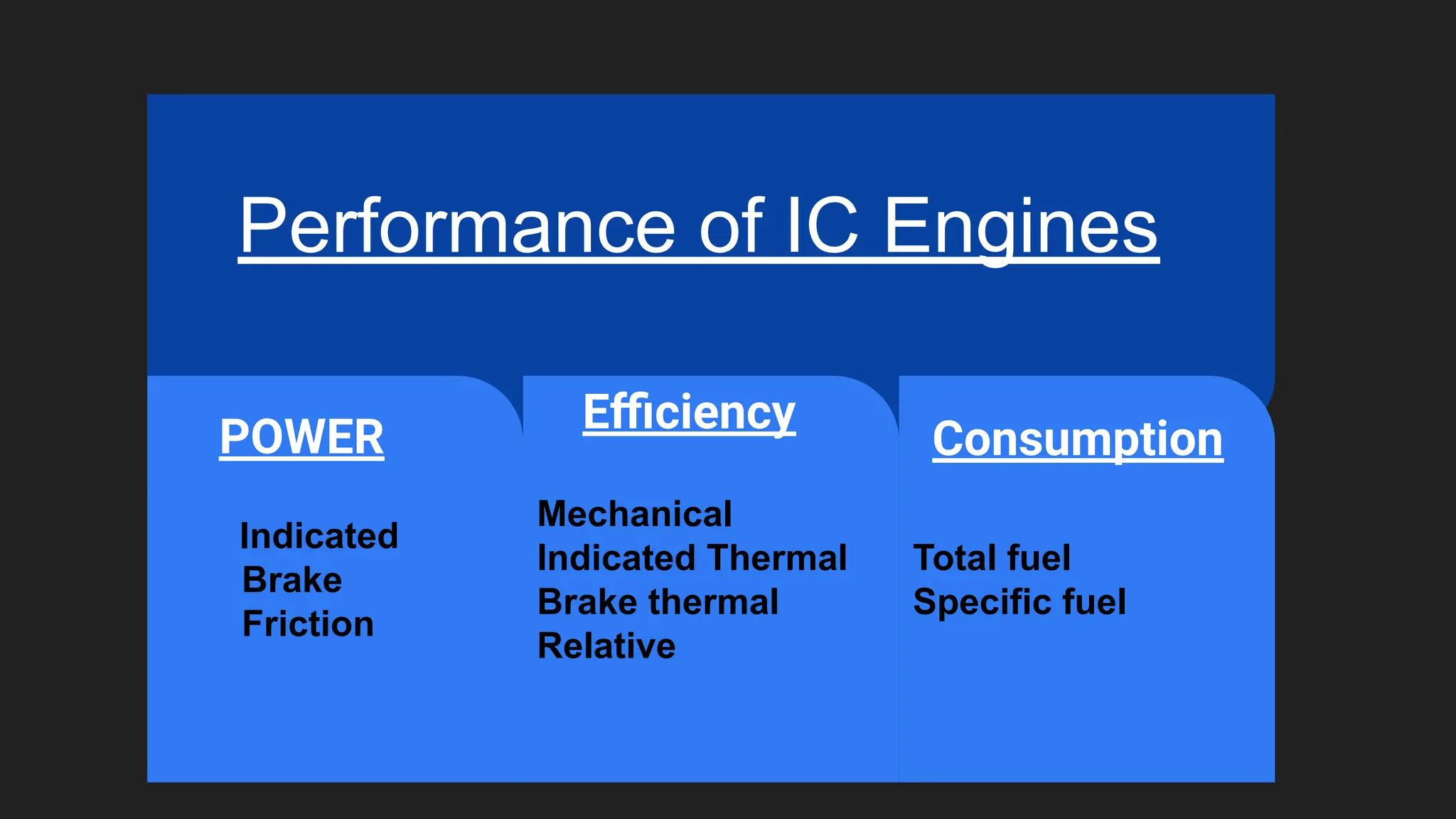
Performance of IC Engines
Indicated
Brake
Friction
POWER
Total fuel
Specific fuel
Consumption
Mechanical
Indicated Thermal
Brake thermal
Relative
Efficiency
POWER PERFORMANCE
Power performance in internal combustion (IC) engines refers to the engine's
ability to produce and deliver power efficiently. It involves evaluating various
aspects of the engine's operation to understand how effectively it converts
fuel into useful mechanical work.
INDICATED POWER
It represents the total power produced by the engine's cylinders as a result of the combustion
process. Indicated Power is measured in units of power, such as watts or horsepower.
FRICTION POWER
Friction power refers to the power losses within an engine that result from friction between
moving components, such as the piston rings, cylinder walls, bearings, and other internal parts. It
is an important aspect to consider when evaluating the overall efficiency of an engine..
BRAKE POWER
It represents the effective mechanical power delivered by the engine to the crankshaft and
is the power available to perform external work. Brake Power is measured using a device
called a dynamometer
EFFICIENCY PERFORMANCE
The efficiency performance of an Internal Combustion (IC) engine is a critical
aspect that reflects how well the engine converts the chemical energy in fuel into
useful mechanical work
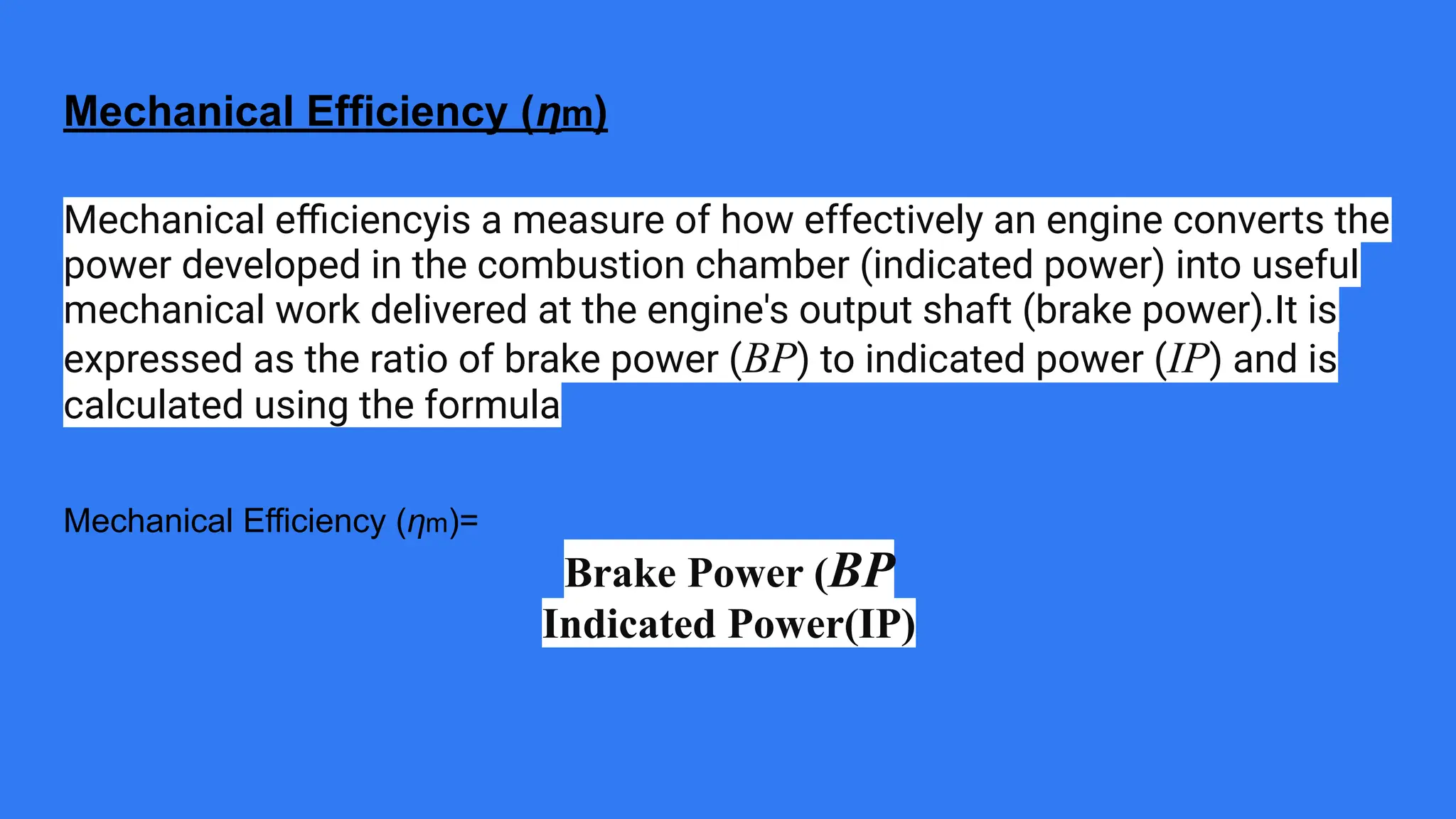
Mechanical Efficiency (ηm)
Mechanical efficiencyis a measure of how effectively an engine converts the
power developed in the combustion chamber (indicated power) into useful
mechanical work delivered at the engine's output shaft (brake power).It is
expressed as the ratio of brake power (BP) to indicated power (IP) and is
calculated using the formula
Mechanical Efficiency (ηm)=
Brake Power (BP
Indicated Power(IP)
INDICATED THERMAL EFFICIENCY
Indicated Thermal Efficiencyis a measure of how effectively an internal
combustion engine converts the chemical energy in the fuel into indicated
power within the combustion chamber. It is an important parameter for
assessing the efficiency of the combustion process. The formula for
calculating indicated thermal efficiency is given by
IP*3600/HEAT INPUT FROM FUEL
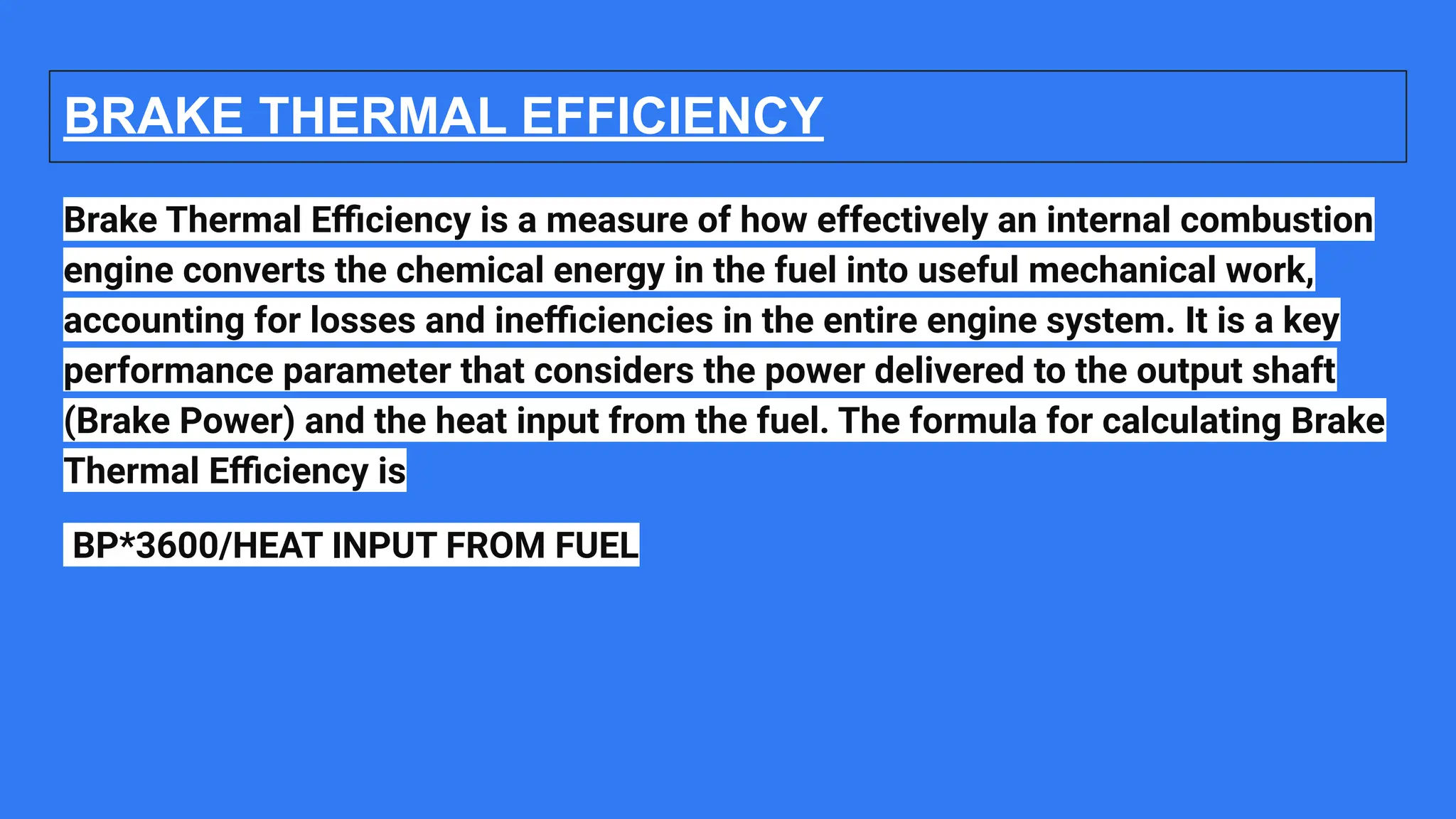
BRAKE THERMAL EFFICIENCY
Brake Thermal Efficiency is a measure of how effectively an internal combustion
engine converts the chemical energy in the fuel into useful mechanical work,
accounting for losses and inefficiencies in the entire engine system. It is a key
performance parameter that considers the power delivered to the output shaft
(Brake Power) and the heat input from the fuel. The formula for calculating Brake
Thermal Efficiency is
BP*3600/HEAT INPUT FROM FUEL
RELATIVE EFFICENCY
In the analysis of different components within a system, such as pumps,
compressors, or turbines, relative efficiency can be used to compare the
efficiency of one component to another. For example, in pump systems,
relative efficiency might be expressed as the ratio of the actual pump
efficiency to the best possible pump efficiency.

IC engine performance of mechanical.....

  • 1.
  • 2.
    What is anIC Engine…….? An IC engine, or Internal Combustion Engine, is a type of engine where the combustion of fuel takes place internally, within the engine itself.
  • 4.
    Performance of ICEngines Indicated Brake Friction POWER Total fuel Specific fuel Consumption Mechanical Indicated Thermal Brake thermal Relative Efficiency
  • 5.
    POWER PERFORMANCE Power performancein internal combustion (IC) engines refers to the engine's ability to produce and deliver power efficiently. It involves evaluating various aspects of the engine's operation to understand how effectively it converts fuel into useful mechanical work.
  • 6.
    INDICATED POWER It representsthe total power produced by the engine's cylinders as a result of the combustion process. Indicated Power is measured in units of power, such as watts or horsepower.
  • 7.
    FRICTION POWER Friction powerrefers to the power losses within an engine that result from friction between moving components, such as the piston rings, cylinder walls, bearings, and other internal parts. It is an important aspect to consider when evaluating the overall efficiency of an engine..
  • 8.
    BRAKE POWER It representsthe effective mechanical power delivered by the engine to the crankshaft and is the power available to perform external work. Brake Power is measured using a device called a dynamometer
  • 9.
    EFFICIENCY PERFORMANCE The efficiencyperformance of an Internal Combustion (IC) engine is a critical aspect that reflects how well the engine converts the chemical energy in fuel into useful mechanical work
  • 10.
    Mechanical Efficiency (ηm) Mechanicalefficiencyis a measure of how effectively an engine converts the power developed in the combustion chamber (indicated power) into useful mechanical work delivered at the engine's output shaft (brake power).It is expressed as the ratio of brake power (BP) to indicated power (IP) and is calculated using the formula Mechanical Efficiency (ηm)= Brake Power (BP Indicated Power(IP)
  • 11.
    INDICATED THERMAL EFFICIENCY IndicatedThermal Efficiencyis a measure of how effectively an internal combustion engine converts the chemical energy in the fuel into indicated power within the combustion chamber. It is an important parameter for assessing the efficiency of the combustion process. The formula for calculating indicated thermal efficiency is given by IP*3600/HEAT INPUT FROM FUEL
  • 12.
    BRAKE THERMAL EFFICIENCY BrakeThermal Efficiency is a measure of how effectively an internal combustion engine converts the chemical energy in the fuel into useful mechanical work, accounting for losses and inefficiencies in the entire engine system. It is a key performance parameter that considers the power delivered to the output shaft (Brake Power) and the heat input from the fuel. The formula for calculating Brake Thermal Efficiency is BP*3600/HEAT INPUT FROM FUEL
  • 13.
    RELATIVE EFFICENCY In theanalysis of different components within a system, such as pumps, compressors, or turbines, relative efficiency can be used to compare the efficiency of one component to another. For example, in pump systems, relative efficiency might be expressed as the ratio of the actual pump efficiency to the best possible pump efficiency.